Monthly Archives: November 2014

Happy 239th Birthday U.S. Marine Corps

usmcflags

Today is one of these days where I just want to wish people well. Those men and women are those of the United States Marine Corps, with whom I have have spent almost ten years of my thirty-three year military career assigned to or in support of as a chaplain. Today is the 239th anniversary of the establishment of the Marine Corps and its founding at Tun Tavern, in Philadelphia. Tonight I wish all those who have served past, present and future, especially those who I have served alongside a happy birthday.

On November 10th 1775 the Continental congress passed a resolution that stated:

Resolved, that two Battalions of Marines be raised consisting of one Colonel, two Lieutenant Colonels, two Majors & Officers as usual in other regiments, that they consist of an equal number of privates with other battalions; that particular care be taken that no persons be appointed to office or enlisted into said Battalions, but such as are good seamen, or so acquainted with maritime affairs as to be able to serve to advantage by sea, when required. That they be enlisted and commissioned for and during the present war with Great Britain and the colonies, unless dismissed by Congress. That they be distinguished by the names of the first & second battalions of American Marines, and that they be considered a part of the number, which the continental Army before Boston is ordered to consist of.

Today is the 239th birthday of the United States Marine Corps. The history of the Marine Corps is one of the most fascinating of any armed service in the world. Starting out as a tiny force attached to Navy ships and shipyards the Corps has gained prominence as one of the premier fighting forces ever assembled. Flexible and deployable anywhere in the world on short notice the Marine Corps has seen action in “every place and clime” and continues to serve around the world.

In 1775 a committee of the Continental Congress met at Philadelphia’s Tun Tavern to draft a resolution calling for two battalions of Marines able to fight for independence at sea and on shore.  The resolution was approved on November 10, 1775, officially forming the Continental Marines. The first order of business was to appoint Samuel Nicholas as the Commandant of the newly formed Marines.

Robert Mullan the owner and proprietor of the said Tun Tavern became Nicholson’s first captain and recruiter. They began gathering support and were ready for action by early 1776.  They served throughout the War for Independence and like the Navy they were disbanded in April 1783 and reconstituted as the Marine Corps in 1798.

The Marines served on the ships of the Navy in the Quasi-war with France, against the Barbary Pirates where a small group of 8 Marines and 500 Arabs under Lieutenant Presley O’Bannon made a march of 500 miles across the Libyan Desert to lay siege Tripoli but only reached Derna. The action is immortalized in the Marine Hymn as well as the design of the Marine Officer’s “Mameluke” Sword. They served in the War of 1812, the Seminole Wars and in the Mexican-American War where in the storming of the on Chapultepec Palace they continued to build and enduring legacy. In the months leading up to the Civil War they played a key role at home and abroad.  In October 1859 Colonel Robert E. Lee led Marines from the Marine Barracks Washington DC to capture John Brown and his followers who had captured the Federal Armory at Harper’s Ferry.

The Corps would serve through the Civil War and on into the age of American Expansion serving in the Spanish American War in the Philippines, Puerto Rico and Cuba where they seized Guantanamo Bay at the battle of Cuzco Wells.  The would serve in China and be a key component of the international force that defended foreign diplomats during the Boxer Revolt as well as the international force that would relieve the diplomatic compound in Peking (Beijing).  In World War One the Marines stopped the German advance at Chateau Thierry and cemented their reputation as an elite fighting force at Belleau Wood where legend has it that the Germans nicknamed them Teufelhunden or Devil Dogs, a name that they Marines have appropriated with great aplomb.

During the inter-war years the Marines were quite active in the Caribbean and Asia and also developed amphibious tactics and doctrine that would be put to use in the Pacific Campaign.  During the war the Marines served in all theaters but won enduring fame at Wake Island, Guadalcanal, Tarawa, Iwo Jima, Okinawa and numerous other battles in the Pacific war. Marine Aviators flew in some the most desperate actions in the war to support the Navy and amphibious operations ashore.

After the war the Truman Administration sought to eliminate the Marine Corps but the Corps was saved by the efforts of Americans across the country and Marine supporters in Congress.  That was a good thing because the Marines were instrumental in keeping the North Koreans from overrunning the South during the Korean War on the Pusan Perimeter, turned the tide at Inchon and helped decimate Communist Chinese forces at the Chosin Reservoir.  After Korea the Marines would serve around the World in the Caribbean and Lebanon and in Vietnam where at Da Nang Keh Sanh, Hue City, Con Thien fighting the North Vietnamese and their Viet Cong allies.  The Marines took the initiative to implement innovative counter insurgency measures such as the Combined Action Platoons which enjoyed tremendous success until they were shut down by the Army high command.  These lessons would serve the Marines well in the new millennium during the Anbar Awakening in Iraq which changed the course of that insurgency and war.

The Marines would again be involved around the World after Vietnam serving in the Cold War, in Lebanon and the First Gulf War which was followed by actions in Somalia, the Balkans and Haiti. After the attacks of September 11th 2001 the Marines were among the first into Afghanistan helping to drive the Taliban from power. In the Iraq Campaign the Marines had a leading role both in the invasion and in the campaign in Al Anbar Province.  After their withdraw from Iraq the Marines became a central player in Afghanistan where until last month they were engaged around Khandahar and in Helmand Province.

The Marines are elite among world military organizations and continue to “fight our nations battles on the air and land and sea.” The Corps under General John LeJeune institutionalized the celebration of the Marine Corps Birthday and their establishment at Tun Tavern. General LeJeune issued this order which is still read at every Marine Corps Birthday Ball or observance:

MARINE CORPS ORDER No. 47 (Series 1921)
HEADQUARTERS
U.S. MARINE CORPS Washington, November 1, 1921

The following will be read to the command on the 10th of November, 1921, and hereafter on the 10th of November of every year. Should the order not be received by the 10th of November, 1921, it will be read upon receipt.

On November 10, 1775, a Corps of Marines was created by a resolution of Continental Congress. Since that date many thousand men have borne the name “Marine”. In memory of them it is fitting that we who are Marines should commemorate the birthday of our corps by calling to mind the glories of its long and illustrious history.

The record of our corps is one which will bear comparison with that of the most famous military organizations in the world’s history. During 90 of the 146 years of its existence the Marine Corps has been in action against the Nation’s foes. From the Battle of Trenton to the Argonne, Marines have won foremost honors in war, and in the long eras of tranquility at home, generation after generation of Marines have grown gray in war in both hemispheres and in every corner of the seven seas, that our country and its citizens might enjoy peace and security.

In every battle and skirmish since the birth of our corps, Marines have acquitted themselves with the greatest distinction, winning new honors on each occasion until the term “Marine” has come to signify all that is highest in military efficiency and soldierly virtue.

This high name of distinction and soldierly repute we who are Marines today have received from those who preceded us in the corps. With it we have also received from them the eternal spirit which has animated our corps from generation to generation and has been the distinguishing mark of the Marines in every age. So long as that spirit continues to flourish Marines will be found equal to every emergency in the future as they have been in the past, and the men of our Nation will regard us as worthy successors to the long line of illustrious men who have served as “Soldiers of the Sea” since the founding of the Corps.

JOHN A. LEJEUNE,
Major General
Commandant


1 Comment

Filed under History, Military

Der Schicksaltag: An Execution, an Abdication, a Beer Hall Putsch, Kristallnacht, and the Fall of the Wall

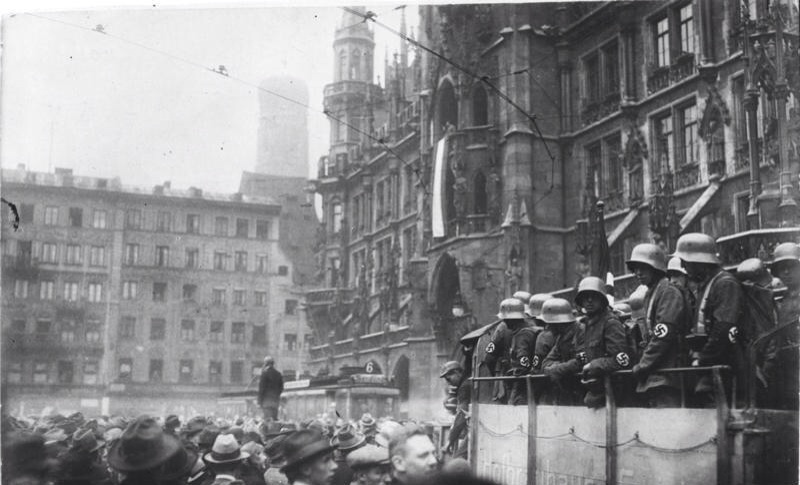
Hitler-Putsch, M¸nchen, Marienplatz

Schicksaltag: The Fateful Day and the Beer Hall Putsch November 9th 1923

There are some days in history that are crammed full world changing events, and sometimes those events occur, for good or bad and sometimes good and bad in different countries. In the United States July 4th is not only Independence Day, but eighty-seven years later marked the surrender of Vicksburg and the retreat of Robert E. Lee’s army from Gettysburg. Likewise it was the day that the Louisiana Purchase was announced in 1803 and that in 1826 the Thomas Jefferson and John Adams died. In Russia however it was on July 4th 1918 that Czar Nicholas and his family were killed by the Bolsheviks.

Since 1918 November 9th has been a day in German history that has impacted both Germany and the world in many ways. In a sense it is almost hard to believe that so much occurred on that day. It is known by many as Der Schicksaltag (the fateful day).

robert-blum-03


Robert Blum

In 1848 a member of the Frankfurt Parliament, Robert Blum was arrested and executed executed for traveling to Vienna to support the 1848 democracy uprising there. A liberal, humanist and democrat Blum advocated German unification without Prussian dominance, protested Prussian oppression of Poles, stood against anti-Semitism and for the rights of Catholics in heavily Protestant German kingdoms. Blum’s dream remained unfulfilled for over a century after his death.

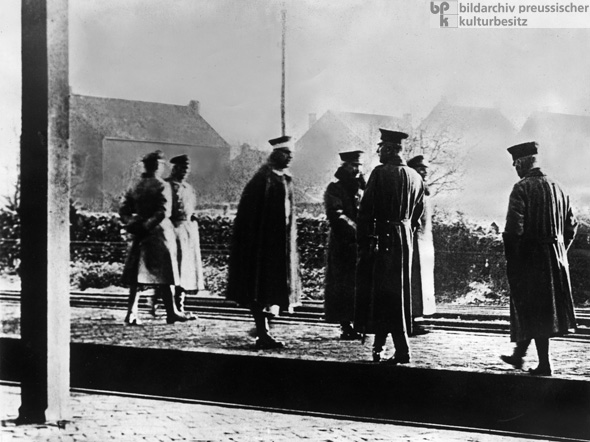
Wilhelm II. (4.v.l.) geht am Tag der Unterzeichnung seiner Abdankung über die Grenze in das holländische Exil


Kaiser Wilhelm II Cross the Dutch Border Following his Abdication

It was a gloomy day at the military headquarters of Kaiser Wilhelm II on November 9th 1918 when General Wilhelm Groener looked his sovereign in the eye and told Kaiser Wilhelm that the war was lost, and that he no longer had the support of the Army. The Kaiser, reeling from battlefield defeats and the mutiny of the High Seas Fleet was stunned, and Field Marshal Paul von Hindenburg, who had for all practical intents directed the war effort meekly nodded his concurrence with Groener. The Kaiser abdicated the throne and departed in his private train to the Netherlands the next day.

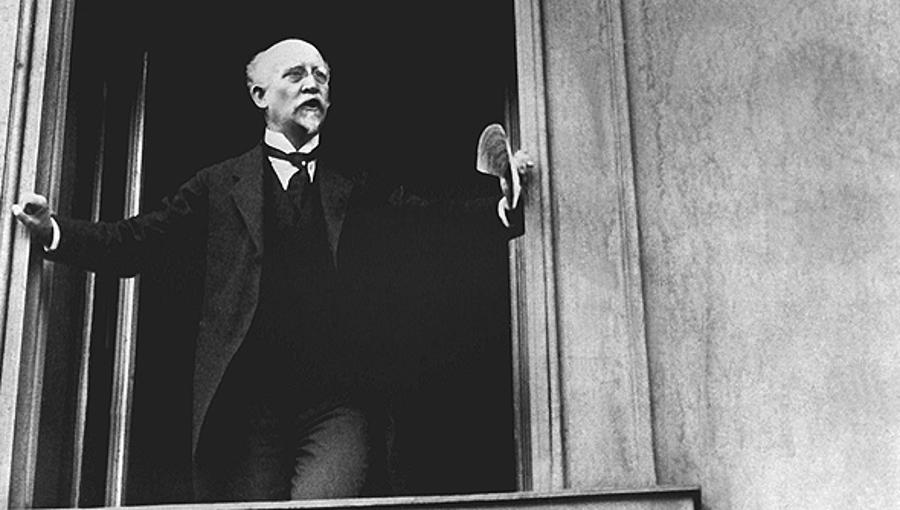
ausrufung-der-republik-in-berlin-preview-image_900x510


Phillip Scheidemann Proclaims the Republic 

In Berlin Majority Socialist parliament member Philip Scheidemann proclaimed the Republic, in part to prevent a Soviet takeover, which became known as the Weimar Republic. However, the promise of democracy was soured by a continued allied blockade, a humiliating peace treaty, loss of territory, and occupation of the industrial areas of the Ruhr and Saar by France and Belgium, heavy reparations, and war guilt; compounded by civil war between various right and left wing factions and major economic problems including massive hyper-inflation doomed the young republic.

Beer Hall Putsch


Beer Hall Putsch

Five years later an Austrian in Munich who had fought and been wounded fighting for Germany in the First World War gathered with his political sympathizes and para-military street thugs and attempted a putsch. The man was Adolf Hitler, the head of the small and radical National Socialist Deutches Arbeiter Partei, or National Socialist German Workers Party, which he hoped that his putsch would result in a popular uprising against the German government in Berlin. The putsch was a failure and ended in bloodshed at the Feldherrnhalle on Munich’s Odeonsplatz.

Hitler was wounded, convicted of treason and jailed for nine months at the Landesberg prison where he wrote his book Mein Kampf and continued to recruit others to his cause. Under ten years later Hitler was appointed Chancellor by President Hindenburg. He quickly banned political opposition and began his persecution of Jews and others that he believed to be sub human and on Hindenburg’s death in 1934 merged the office of Chancellor and President become the leader of Nazi Germany.

In November 1938 Hitler’s and his henchmen were looking for a reason to openly begin persecuting the Jews, something that they had already been doing since the seizure of power. One of the chief reasons for this was to seize the property and financial resources of German Jews, which coincided with the expulsion of Polish Jews from Germany. A reason was furnished when a young Polish man, Herschel Grynszpan, whose parents were expelled from Germany on November 3rd went to the German embassy in Paris and shot and mortally wounded Ernst von Rath, a young diplomat, who reportedly had some anti-Nazi sentiments.

kristallnacht1


The murder was what Josef Goebbels needed and on the night of November 9th Nazi storm troopers ransacked Jewish businesses, homes and synagogues causing hundreds of millions of Reichsmarks in damage, destroying over 200 synagogues and 7000 businesses. About 100 Jews were killed during the rampage, which went unchecked by police. Another 2000-3000 subsequently died either by suicide or in concentration camps. About 30,000 Jewish men were incarcerated. To add to the insult to injury Jews were charged for the damage done to their property and insurance payments that should have gone to them were collected by the state. The night became known as Kristallnacht, the night of broken glass and marked a major turn in the open Nazi persecution of Jews in Germany, which would extend throughout Europe and end in the Final Solution and the systematic murder of nearly six million Jews. World War Two ended with the total defeat of Germany and the Nazi regime.

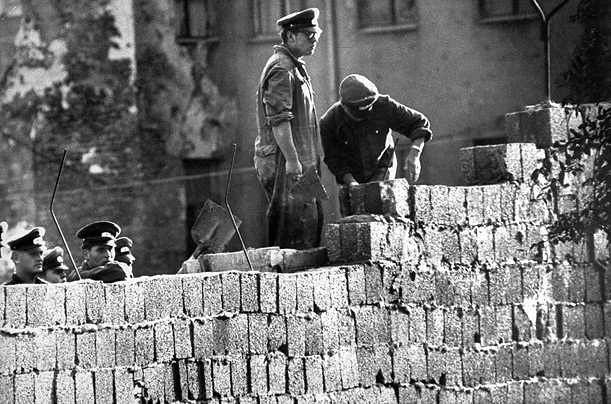
berlin_wall_02


Occupied by the allied powers Germany was split in two, the East under the domination of the Soviet Union which became the German Democratic Republic, and the West which supported by the United States and Britain became the Federal Republic of Germany. The divided country became the focal point of what became the Cold War, the fortified border became infamous as the Iron Curtain. The divided Berlin was blockaded by the Soviets in 1948 and the subsequent airlift kept West Berlin Free. However in August 1961 as the Cold War escalated the leaders of East Germany erected a fence which became the Berlin Wall, a wall which was effectively a means to imprison the population. It seemed to be a fixture that would never come down.

berlin-wall_1412605c

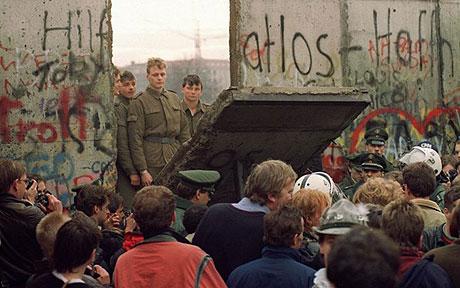
But in the 1980s the Cold War began to thaw, the economically strapped Soviet Union was bogged down in a costly war in Afghanistan, and a struggle against a Polish democratic movement; Premier Gorbachev sought to relieve the situation with a policy of openness. It backfired, throughout Eastern Europe, pro-democracy and pro-freedom groups began to protest the status quo, and as borders were opened hundreds of thousands of Eastern Europeans including thousands of East Germans went west through Hungary and Czechoslovakia. East Germans began to gather at the wall and on November 9th 1989 a tottering East German government decided to open border crossing points, but on hearing the news hundreds of thousands of people gathered at the six crossings demanding to be let through, finally, ignoring orders, Stasi Lieutenant Colonel Harald Jäger who commanded the Bornholmer Strasse crossing opened the gates. The wall had fallen and 339 days later East Germany was dissolved and Germany reunited.

The new Germany is the economic heart of the European Union and has become a champion of human rights and social progress. It has now been twenty five years since the Wall fell, seventy-six years since Kristallnacht, eighty-nine years since the Beer Hall Putsch and ninety-six years since the abdication of Kaiser Wilhelm II. These are all important events, and our challenge as citizens of the world is never to forget just how important and fateful each was, and why November 9th is indeed the “fateful day.”

Peace,

Padre Steve+

2 Comments

Filed under History

Volunteers for Freedom: Strong Vincent and Joshua Chamberlain at Gettysburg

dont give an inch

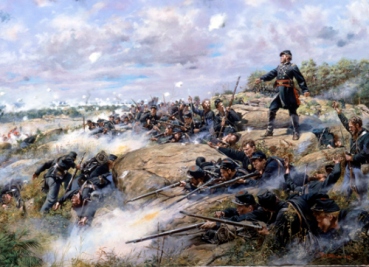
Colonel Strong Vincent directing the Defense of Little Round Top

Friends of Padre Steve’s World,

This is an excerpt from one of the chapters of my Gettysburg text. It deals with two men, volunteer “Citizen Soldiers” whose actions that day were instrumental in the Union victory at Gettysburg. But their story, despite being one of great courage and exceptional leadership is a story of tragedy and sacrifice, which in the case of Chamberlain went long after the battle. Their struggles also affected their families, leaving one wife a widow, and the other marriage one that was tumultuous and very similar to those of many combat veterans who return from war forever changed.

Peace

Padre Steve+

July 2nd 1863 was to be a pivotal day in the history of the United States, a day of valor, courage and carnage. A day where nearly 20,000 Americans were killed, wounded or missing. It was a day where the fate of the Union and the Confederacy were in the balance. On the afternoon of that day, two volunteers rose to the challenge.

Yes, there were many more heroes on Little Round Top that day, but these two men, along with Gouverneur Warren were instrumental in securing the Union victory. They were unlikely heroes, neither was a professional soldier, but both took to soldiering and leading soldiers as if it were second nature. They were men who along with others “who stepped out of themselves for a moment and turned a corner at some inexpressibly right instant.” 1

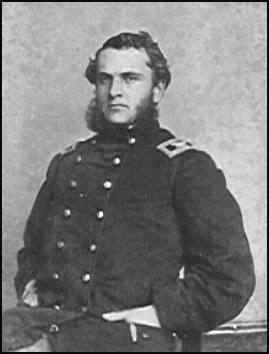
Colonel Strong Vincent was a 26 year old Harvard graduate and lawyer from Erie Pennsylvania. He was born in Waterford and attended school in Erie. Growing up he worked in his father’s iron foundry, where the work helped make him a man of great physical strength. He studied at Trinity College in Hartford Connecticut and transferred to Harvard from which he graduated in 1859. However, he was not an outstanding student and “earned admonishments on his record for missing chapel and smoking in Harvard Yard.” 2

When war came and the call went out for volunteers, Vincent enlisted in a 30 Day regiment, the Wayne Guards as a private and then was appointed as a 1st Lieutenant and Adjutant of the regiment because of his academic and administrative acumen. He married his wife Elizabeth the same day. Vincent like many young northerners believed in the cause of the Union undivided, and he wrote his wife shortly after after the regiment went to war on the Peninsula:

“Surely the right will prevail. If I live we will rejoice in our country’s success. If I fall, remember you have given your husband to the most righteous cause that ever widowed a woman.” 3
vincent


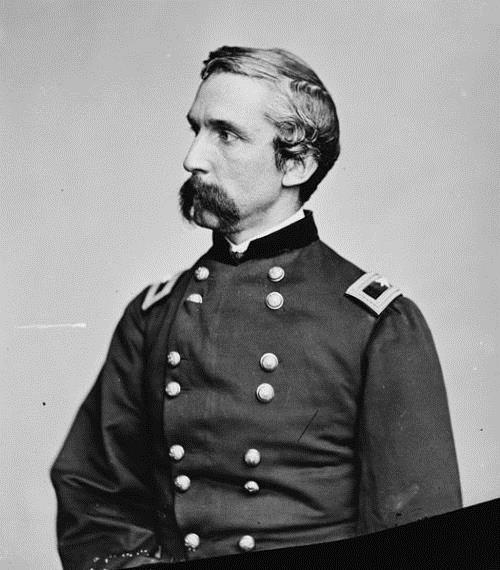
Colonel Strong Vincent

When the Wayne Guards were disbanded at the end of their enlistment, Vincent helped to raise the 83rd Pennsylvania and was commissioned as a Lieutenant Colonel in it on September 14th 1861. The young officer learned his trade well and was considered a “strict disciplinarian and master of drill.” 4 That being said one enlisted man remarked that “no officer in the army was more thoughtful and considerate of the health and comfort of his men.” 5 He assumed command of the regiment when the commander was killed during the Seven Days in June of 1862 where he learned lessons that he would help impart to his fellow officers as well as subordinates, including Chamberlain. At Fredericksburg any doubters about the young officer’s courage and leadership ability were converted where they observed his poise “with sword in hand” he “stood erect in full view of the enemy’s artillery, and though the shot fell fast on all sides, he never wavered or once changed his position.” 6

By the time of the Battle of Gettysburg, the 26 year old Vincent was the youngest brigade commander in the army. He was noted for his intelligence, leadership, military acumen and maturity. One friend wrote “As a general thing his companions were older than himself;….Among his associates were men of the highest rank. He could adapt himself to all,- could talk with the politician on questions of history, with a general officer on military evolutions, or with a sporting man on the relative merits of horses,-and all respected his opinion.” 7

His promotion was well earned, following a bout with a combination of Malaria and Typhoid, the “Chickahominy Fever” which almost killed him, Vincent took command of the regiment after its commander was killed at Gaines Mill. He commanded the regiment at Fredericksburg and was promoted to command the 3rd Brigade after the Battle of Chancellorsville following the resignation of its commander, Colonel T.W.B. Stockton on May 18th 1863.

Vincent was offered the chance to serve as the Judge Advocate General of the Army of the Potomac by Joseph Hooker in the spring of 1863 after spending three months on court-martial duty. But Vincent refused the offer in so that he might remain in the fight commanding troops. 8  He told his friends “I enlisted to fight.” 9

Vincent, like Chamberlain who admired him greatly had “become a kind of model of the citizen soldier.” 10 As a result of his experience in battle and the tenacity of the Confederate army he became an advocate of the tactics that William Tecumseh Sherman would later employ during his march to the sea in 1864. He wrote his wife before Chancellorsville:

“We must fight them more vindictively, or we shall be foiled at every step.  We must desolate the country as we pass through it, and not leave a trace of a doubtful friend or foe behind us; make them believe that we are in earnest, terribly in earnest; that to break this band in twain is monstrous and impossible; that the life of every man, yea, of every weak woman or child in the entire South, is of no value whatever compared with the integrity of the Union.” 11

Unlike most other brigade commanders, Vincent was still a Colonel, and he, like many others would in his place hoping for a General’s star. He remarked that his move to save Sickles’ command “will either bring me my stars, or finish my career as a soldier.” 12 On July first, Vincent, a native Pennsylvanian came to Hanover and learning that battle had been joined, ordered “the pipes and drums of the 83rd Pennsylvania to play his brigade through the town and ordered the regiments to uncover their flags again….” 13 As the brigade marched through the town Vincent “reverently bared his head” and announced to his adjutant, “What death more glorious can any man desire than to die on the soil of old Pennsylvania fighting for that flag?” 14

Vincent was known for his personal courage and a soldier of the 83rd Pennsylvania observed “Vincent had a particular penchant for being in the lead….Whenever or wherever his brigade might be in a position to get ahead…, he was sure to be ahead.” 15 That courage and acumen to be in the right place at the right time was in evidence when he led his brigade into battle on July second.

On July 2nd Barnes’ division of V Corps, which Vincent’s brigade was a part was being deployed to the threat posed by the Confederate attack of McLaws’ division on the Peach Orchard and the Wheat Field to reinforce Sickles’ III Corps. While that division marched toward the Peach Orchard, Vincent’s 3rd Brigade was the trail unit. When Gouverneur Warren’s aide, Lieutenant Randall Mackenzie 16 came toward the unit in search of Barnes he came across Vincent and his brigade near the George Weikert house on Cemetery Ridge awaiting further orders. 17

Vincent intercepted him and demanded what his orders were. Upon being told that Sykes’ orders to Barnes were to “send one of his brigades to occupy that hill yonder,” 18 Vincent, defied normal protocol assuming that Barnes was drunk 19 and told Mackenzie “I will take responsibility of taking my brigade there.” 20 Vincent immediately went into action and ordered Colonel James Rice of the 44th New York “to bring the brigade to the hill as quickly as possible,” and then turned on his horse and galloped off toward Little Round Top.” 21

It was a fortunate thing for the Union that he did. His quick action to get his brigade, clear orders to his subordinate commanders and skilled analysis of the ground were a decisive factor in the Union forces holding Little Round Top. After ordering Colonel Rice to lead the brigade up to the hill, he and his aide went forward to scout positions accompanied by the brigade standards. Rice brought the brigade forward at the double quick “across the field to the road leading up the north shoulder of the hill” with Chamberlain’s 20th Maine in the lead. 22

Vincent and his orderly made a reconnaissance of the south and east slope of the hill which adjoined a small valley and a rocky outcrop called Devil’s Den, which was occupied by the 124th New York and which was the end of Sickles’ line. Near the summit of the southern aspect of the hill, they came under Confederate artillery fire and told his aid “They are firing at the flag, go behind the rocks with it.” 23

Vincent dismounted, leaving is sword secured on his horse, carrying only his riding crop. He continued and “with the skill and precision of a professional had reconnoitered and decided how to best place his slim brigade of 1350 muskets.” 24 He chose a position along a spur of the hill, which now bears his name, running from the northwest to the southeast to place his regiments where they could intercept the Confederate troops of Hood’s division which he could see advancing toward the hill.

What Vincent saw when he arrived was a scene of disaster. Confederate troops had overwhelmed the 124th New York and were moving on Little Round Top, “Devil’s Den was a smoking crater,” and the ravine which separated Devil’s Den from Little Round Top “was a whirling maelstrom.” 25 Seeing the threat Vincent began to deploy his brigade but also sent at messenger back to Barnes telling him “Go tell General Barnes to send reinforcements at once, the enemy are coming against us with an overwhelming force” 26

The 16th Michigan, the smallest regiment with barely 150 soldiers in line 27 was placed on the right of the brigade. As it moved forward, its adjutant, Rufus W. Jacklin’s horse was hit by a canon ball which decapitated that unfortunate animal and left it “a mass of quivering flesh.” 28 The Confederate artillery fell among the advancing Union troops and splintered trees, causing some concern among the soldiers. The 20th Maine’s Chaplain, Luther French, saw the “beheading of Jacklin’s horse and and ran to Captain Atherton W. Clark, commanding the 20th’s Company E, babbling about what he had seen. Clark interrupted French abruptly and shouted: “For Christ sake Chaplain, if you have any business attend to it.” 29

That section of the line was located on massive boulders that placed it high above the valley below, making it nearly impregnable to frontal attack. On the summit Vincent deployed the 83rd Pennsylvania and 44th New York to their left at the request of Rice who told him “In every battle that we have engaged the Eighty-third and Forty-fourth have fought side by side. I wish that it might be so today.” 30 The story is probably apocryphal but the regiments remained side by side with the 16th Michigan on the right and the 20th Maine on the left. The two  regiments  were deployed below the crest among the large number of boulders; the 83rd was about two-thirds of the way down the way down the slope where it joined the right of the 44th, whose line angled back up the slope to the southeast. A historian of the 83rd Pennsylvania noted that “Each rock”… “was a fortress behind which the soldier[s] instantly took shelter.” 31 The soldiers were determined to do their duty as they now were fighting on home ground.

Vincent deployed the 20th Maine on his extreme left of his line, and in fact the extreme end of the Union line. Vincent knew that if this flank was turned and Chamberlain overrun that it would imperil the entire Union position. Vincent came up to Chamberlain who remembered that Vincent said “in an awed, faraway voice. “I place you here….This is the left of the Union line. You understand. You are to hold this ground at all costs.” 32 Chamberlain acknowledged his understanding of the order and since the regiment lacked field grade officers, Chamberlain “assigned Captain Atherton Clark of company E to command the right wing, and acting Major Ellis Spear the left.” 33

While Colonel Joshua Chamberlain’s story is much more well known than his brigade commander, Strong Vincent, he was another one of the citizen soldiers whose performance and leadership on Little Round Top saved the Union line that hot July evening. Chamberlain was a graduate of Bowdoin College and Bangor Theological Seminary. Fluent in nine languages other than English he remained at Bowdoin as Professor of Rhetoric before seeking an appointment in a newly raised Maine Regiment without consulting either the college or his wife Fannie. He actually deceived the college by requesting a “scholarly sabbatical when in fact he had applied to the governor of Maine in the new 20th Maine Infantry in the late summer of 1862.” 34

The letter that Chamberlain wrote to Governor Israel Washburn details Chamberlain’s desire to serve:

“For seven years past I have been Professor in Bowdoin College. I have always been interested in military matters, and what I do not know in that line I know how to learn.

Having been lately elected to a new department here, I am expecting to have leave, at the approaching Commencement, to spend a year or more in Europe, in the service of the College. I am entirely unwilling, however, to accept this offer, if my Country needs my service or example here.

Your Excellency presides over the Educational as well as the military affairs of our State, and, I am well aware, appreciates the importance of sustaining our Institutions of Learning. You will therefore be able to decide where my influence is most needed.

But, I fear, this war, so costly of blood and treasure, will not cease until the men of the North are willing to leave good positions, and sacrifice the dearest personal interests, to rescue our Country from Desolation, and defend the National Existence against treachery at home and jeopardy abroad. This war must be ended, with a swift and strong hand; and every man ought to come forward and ask to be placed at his proper post.

Nearly a hundred of those who have been my pupils, are now officers in our army; but there are many more all over our State, who, I believe, would respond with enthusiasm, if summoned by me, and who would bring forward men enough to fill up a Regiment at once. I can not free myself from my obligations here until the first week in August, but I do not want to be the last in the field, if it can possibly be helped.” 35

Chamberlain’s pre-war experiences gave no indication that he would emerge as a military hero. His father had named him after Captain James Lawrence, the commanding officer of the frigate  USS Chesapeake in the War of 1812 who uttered the famous words “Don’t give up the ship” as he lay mortally wounded. His mother added the name Joshua as his first name in the town’s books. His father hoped that the young Chamberlain who pursue a military career, his mother wished that he pursue the ministry. He did become a minister but had no desire to become a pastor, and instead took up his academic career at Bowdoin and his tumultuous marriage to his wife Fannie, a musician and the child of a minister. “During most of his life, Chamberlain struggled with bouts of deep depression and melancholy. But not during the war years. It was as if the war and soldiering had made a new man out of him.” 36

Chamberlain was offered command of the 20th Maine but asked the governor that be appointed as a Lieutenant Colonel, which he was in August 1862. He fought with the regiment at Fredericksburg and was named commander of the when Colonel Adelbert Ames, his commander was promoted to brigade command in Oliver Howard’s XI Corps following the debacle at Chancellorsville.
chamberlain


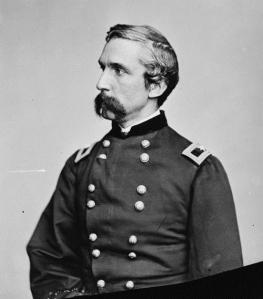
Colonel Joshua Lawrence Chamberlain (while serving as a Brigadier General)

Like Vincent, Chamberlain was also a quick student and rapidly adapted to being a soldier, officer and commander of troops in combat. On the march up to Gettysburg Chamberlain was ordered to take a number of veterans of the 2nd Maine, who had signed three year, rather than two year enlistment contracts and were angry at remaining in the army when the regiment was mustered out. The soldiers were bitter but Chamberlain treated them graciously and “almost all of them agreed to take up their muskets again the the service of the 20th Maine.” 37

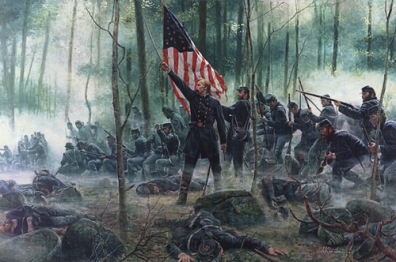
On receiving his orders Chamberlain deployed his small regiment halfway down the southern slope facing the small valley between Little Round Top and Big Round Top. By the time he arrived at Gettysburg had become “a great infantry officer, and among his valuable qualities was where an attack would come….” 38
chamberlain lrt

Since Chamberlain’s account is so important I will forgo a discussion of his tactics and instead quote the sections of his after action report that explains his actions. Chamberlain wrote:

“On reaching the field at about 4 p.m. July 2d, Col. Vincent commanding the Brigade, placing me on the left of the Brigade and consequently on the extreme left of our entire line of battle, instructed me that the enemy were expected shortly to make a desperate attempt to turn our left flank, and that the position assigned to me must be held at every hazard.

I established my line on the crest of a small spur of a rocky and wooded hill, and sent out at once a company of skirmishers on my left to guard against surprise on that unprotected flank.

These dispositions were scarcely made when the attack commenced, and the right of the Regt. found itself at once hotly engaged. Almost at the same moment, from a high rock which gave me a full view of the enemy, I perceived a heavy force in rear of their principal line, moving rapidly but stealthily toward our left, with the intention, as I judged, of gaining our rear unperceived. Without betraying our peril to any but one or two officers, I had the right wing move by the left flank, taking intervals of a pace or two, according to the shelter afforded by rocks or trees, extending so as to cover the whole front then engaged; and at the same time moved the left wing to the left and rear, making a large angle at the color, which was now brought to the front where our left had first rested.

This hazardous maneuvre was so admirably executed by my men that our fire was not materially slackened in front, and the enemy gained no advantage there, while the left wing in the meantime had formed a solid and steady line in a direction to meet the expected assault. We were not a moment too soon; for the enemy having gained their desired point of attack came to a front, and rushed forward with an impetuosity which showed their sanguine expectations.

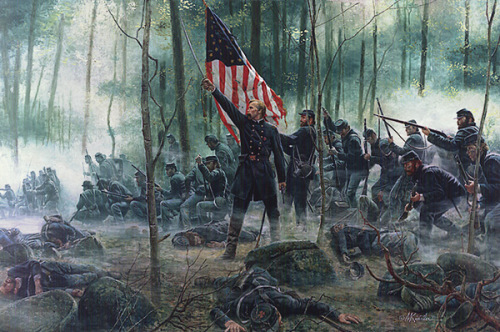
Their astonishment however was evident, when emerging from their cover, they met instead of an unsuspecting flank, a firm and ready front. A strong fire opened at once from both sides, and with great effect, the enemy still advancing until they came within ten pacesof our line, where our steady and telling volleys brought them to a stand. From that moment began a struggle fierce and bloody beyond any that I have witnessed, and which lasted in all its fury, a full hour. The two lines met, and broke and mingled in the shock. At times I saw around me more of the enemy than of my own men. The edge of conflict swayed to and fro -now one and now the other party holding the contested ground. Three times our line was forced back, but only to rally and repulse the enemy. As often as the enemy’s line was broken and routed, a new line was unmasked, which advanced with fresh vigor. Our “sixty rounds” were rapidly reduced; I sent several messengers to the rear for ammunition, and also for reinforcements. In the mean time we seized the opportunity of a momentary lull to gather ammunition and more serviceable arms, from the dead and dying on the field. With these we met the enemy’s last and fiercest assault. Their own rifles and their own bullets were turned against them. In the midst of this struggle, our ammunition utterly failed. The enemy were close upon us with a fresh line, pouring on us a terrible fire. Half the left wing already lay on the field. Although I had brought two companies from the right to its support, it was now scarcely more than a skirmish line. The heroic energy of my officers could avail no more. Our gallant line withered and shrunk before the fire it could not repel. It was too evident that we could maintain the defensive no longer. As a last desperate resort, I ordered a charge. The word “fix bayonets” flew from man to man. The click of the steel seemed to give new zeal to all. The men dashed forward with a shout. The two wings came into one line again, and extending to the left, and at the same time wheeling to the right, the whole Regiment described nearly a half circle, the left passing over the space of half a mile, while the right kept within the support of the 83d Penna. thus leaving no chance of escape to the enemy except to climb the steep side of the mountain or to pass by the whole front of the 83d Penna. The enemy’s first line scarcely tried to run-they stood amazed, threw down their loaded arms and surrendered in whole companies. Those in their rear had more time and gave us more trouble. My skirmishing company threw itself upon the enemy’s flank behind a stone wall, and their effective fire added to the enemy’s confusion. In this charge we captured three hundred and sixty eight prisoners, many of them officers, and took three hundred stand of arms. The prisoners were from four different regiments, and admitted that they had attacked with a Brigade.” 39

Colonel William Oates of the 15th Alabama gave Chamberlain and his regiment the credit for stopping his attack. Oates wrote: “There have never been harder fighters than the Twentieth Maine and their gallant Colonel. His skill and persistency and the great bravery of his men saved Little Round Top and the Army of the Potomac from defeat.” 40

As with any firsthand account, aspects of Chamberlain’s accounts are contested by others at the scene. Oates notes that he ordered the retreat and that there were not as many prisoners taken, one of Chamberlain’s company commanders disputes the account of the order of the bayonet charge however the fact is that Chamberlain who was outnumbered nearly two to one by the, 4th 15th and 47th Alabama regiments “offset this superiority with strength of position, iron determination and better tactics.” 41 Also a factor was the fatigue of the Confederates, these regiments and their parent unit, Law’s brigade of Hood’s division had conducted a grueling 28 mile march to get to the battlefield and were exhausted and dehydrated by the time that they arrived, something that their commander, Colonel Oates believed “contributed largely to our failure at Little Round Top.” 42

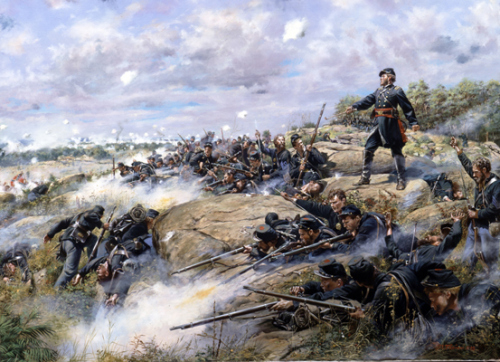
Vincent was mortally wounded while leading the defense of the hill. As the men of Robertson’s Texas brigade rushed the hill and threatened to crack “the stout 16th Michigan defense….” 43 Vincent rushed to bolster the defenders. He was standing on a large boulder with a riding crop as the men of the 16th Michigan were beginning to waiver. Fully exposed to enemy fire he attempted to drive the retreating men back into the fight. Brandishing the riding which he cried out “Don’t yield an inch now men or all is lost,” 44 and moments later was struck by a “minie ball which passed through his left groin and lodged in his left thigh. He fell to the ground and as he was being carried from the field, “This is the fourth or fifth time they have shot at me…and they have hit me at last.” 45 He was taken to a field hospital where he suffered for five days and died on July 7th. Meade recommended Vincent for posthumous promotion to Brigadier General, but the request was lost. Ten weeks after his death his wife gave birth to a baby girl. The baby would not live a year and was buried next to him.

Colonel Rice who led the 44th New York up the hill and took command of the brigade on Vincent’s death memorialized his fallen commander in his general order to the brigade on July 12th:

“The colonel commanding hereby announces to the brigade the death of Brig. Gen. Strong Vincent. He died near Gettysburg, Pa., July 7, 1863, from the effects of a wound received on the 2d instant, and within sight of that field which his bravery had so greatly assisted to win. A day hallowed with all the glory of success is thus sombered by the sorrow of our loss. Wreaths of victory give way to chaplets of mourning, hearts exultant to feelings of grief. A soldier, a scholar, a friend, has fallen. For his country, struggling for its life, he willingly gave his own. Grateful for his services, the State which proudly claims him as her own will give him an honored grave and a costly monument, but he ever will remain buried in our hearts, and our love for his memory will outlast the stone which shall bear the inscription of his bravery, his virtues, and his patriotism.

While we deplore his death, and remember with sorrow our loss, let us emulate the example of his fidelity and patriotism, feeling that e lives but in vain who lives not for his God and his country.

After the battle, as the army looked to replace the casualties in the ranks of senior leadership and “when Colonel Rice, in charge of 3rd Brigade after Vincent fell, was promoted to brigadier general and given another command” the new division commander Major General Charles Griffin, “insisted on having Chamberlain, for the 3rd Brigade.” 46 Chamberlain survived the war to great acclaim being wounded three times, being promoted to Major General and awarded the Medal of Honor. He received the surrender of the Army of Northern Virginia at Appomattox on April 9th 1865 and ordered his men to present arms in honor of their defeated foe as those haggard soldiers passed his division. After the war like most citizen soldiers, he returned to civilian life, serving as a four term Governor of Maine and President of Bowdoin College. He became a champion of national reconciliation admired by friend and former foe alike.

Chamberlain’s accolades were certainly earned but others on that hill have been all too often overlooked by most people. This list includes Gouverneur Warren who was humiliated by Phillip Sheridan at Five Forks, Strong Vincent who died on the Hill and Paddy O’Rorke, the commander of the 140th New York of Weed’s Brigade on Vincent’s right who was mortally wounded that day. Despite this, after the end war, Joshua Chamberlain, the hero of Little Round Top who was well acquainted with the carnage of war suffered immensely. His wounds never fully healed and he was forced to wear what would be considered an early form of a catheter and bag. Chamberlain struggled to climb out of “an emotional abyss” in the years after the war. Part was caused by his wounds which included wounds to his sexual organs, shattering his sexuality and caused his marriage to deteriorate.
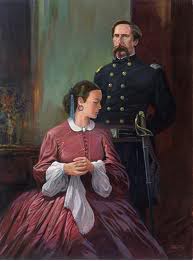
fannychamberlain1


Joshua and Fannie Chamberlain (Dale Gallon Painting) 

He wrote to Fannie in 1867 about the “widening gulf between them, one created at least in part by his physical limitations: “There is not much left in me to love. I feel that all too well.” 47 Chamberlain’s inability to readjust to civilian life following the war and Fanny’s inability to understand what he had gone through during it, caused great troubles in their marriage. By 1868 the issues were so deep that Fannie was accusing Joshua of domestic abuse a charge which he contested even offering her a divorce which were very similar to what many combat veterans and their families experience today. After he received news of the allegations Chamberlain wrote to her:

“If it is true (as Mr. Johnson seems to think there is a chance of its being) that you are preparing for an action against me, you need not give yourself all this trouble. I should think we had skill enough to adjust the terms of a separation without the wretchedness to all our family which these low people to whom it would seem that you confide your grievances + plans will certainly bring about.

You never take my advice, I am aware.

But if you do not stop this at once it will end in hell.” 48

The marriage endured a separation which lasted until 1871 when they reconciled, and it did survive, for nearly forty more years. Fannie died in 1905 and Chamberlain , who despite all of their conflicts loved her, wrote after her death:

“You in my soul I see, faithful watcher, by my cot-side long days and nights together, through the delirium of mortal anguish – steadfast, calm, and sweet as eternal love. We pass now quickly from each other’s sight, but I know full well that where beyond these passing scenes you shall be, there will be heaven!”

Chamberlain died on February 24th 1914 of complications from complications of the ghastly wound that he received at Petersburg in 1864. Sadly, their marriage is typical of many relationships where a spouse returns home from war, something that we need to remember when we encounter those changed by war and the struggles of their families.

Notes

1 Guelzo, Allen C. Gettysburg: The Last Invasion Vintage Books a Division of Random House, New York 2013 p.462

2 LaFantasie, Glenn W. Twilight at Little Round Top: July 2, 1863 The Tide Turns at Gettysburg Vintage Books, a Division of Random House, New York 2005 p.105

3 ________. Erie County Historical Society http://www.eriecountyhistory.org/wp-content/uploads/2008/10/strongvincent.pdf retrieved 9 June 2014

4 Golay, Michael. To Gettysburg and Beyond: The Parallel Lives of Joshua Lawrence Chamberlain and Edward Porter Alexander Crown Publishers Inc. New York 1994 p.129

5 Nevins, James H. and Styple, William B. What death More Glorious: A Biography of General Strong Vincent Belle Grove Publishing Company, Kearney NJ 1997 p.29

6 Ibid Guelzo, Gettysburg: The Last Invasion p.262

7 Ibid. Nevins, James H. and Styple, William B. What death More Glorious p.548 Leonardi, Ron Strong Vincent at Gettysburg Barringer-Erie Times News retrieved June 9th 2014 from http://history.goerie.com/2013/06/30/strong-vincent-at-gettysburg/

9 Ibid. Nevins, James H. and Styple, William B. What death More Glorious p.55

10 Wallace, Willard. The Soul of the Lion: A Biography of Joshua L. Chamberlain Stan Clark Military Books, Gettysburg PA 1960 p.91

11 Ibid. Nevins, James H. and Styple, William B. What death More Glorious p.57

12 Ibid. Guelzo, Gettysburg: The Last Invasion p.264

13 Pfanz, Harry F. Gettysburg: The Second Day. University of North Carolina Press, Chapel Hill 1987 p.51

14 Ibid. Guelzo Gettysburg: The Last Invasion Vintage p.159

15 Tredeau, Noah Andre. Gettysburg: A Testing of Courage, Harper Collins Publishers, New York 2002 p.305

16 Some such as Guelzo believe this may have been Captain William Jay of Sykes staff.

17 Ibid. Tredeau, Gettysburg: A Testing of Courage p.327

18 Ibid. Guelzo Gettysburg: The Last Invasion Vintage p.262 19 Ibid. Guelzo Gettysburg: The Last Invasion Vintage p.262

20 Ibid. Tredeau, Gettysburg: A Testing of Courage p.32721 Ibid. LeFantasie Twilight at Little Round Top p.108

22 Coddington, Edwin B. The Gettysburg Campaign: A Study in Command, A Touchstone Book, Simon and Schuster New York, 1968 p.389

23 Ibid. LaFantasie Twilight at Little Round Top p.109

24 Ibid. Coddington The Gettysburg Campaign p.390

25 Ibid. Guelzo Gettysburg: The Last Invasion Vintage p.270

26 Ibid. Nevins, James H. and Styple, William B. What death More Glorious p.75

27 Sears, Stephen W. Gettysburg. Houghton Mifflin Co. Boston and New York 2003 p.292

28 Ibid. LaFantasie Twilight at Little Round Top p.109

29 Ibid. LaFantasie Twilight at Little Round Top p.109

30 Ibid. Pfanz, Gettysburg: The Second Day. p.213

31 Ibid. LaFantasie Twilight at Little Round Top p.111

32 Ibid. Golay To Gettysburg and Beyond p.157

33 Ibid. LaFantasie Twilight at Little Round Top p.111

34 Ibid. LaFantasie Twilight at Little Round Top pp.44-45

35 Chamberlain, Joshua Lawrence Letter From Joshua L. Chamberlain to Governor [Israel] Washburn, Brunswick, July 14, 1862 retrieved from Bowdoin College, Joshua Lawrence Chamberlain Documents http://learn.bowdoin.edu/joshua-lawrence-chamberlain/documents/1862-07-14.html 8 November 2014

36 Ibid. LaFantasie Twilight at Little Round Top p.45

37 Ibid. LaFantasie Twilight at Little Round Top p.45

38 Ibid. Wallace The Soul of the Lion p.94

39 Chamberlain, Joshua Lawrence. Official Narrative of Joshua Chamberlain of July 6th 1863, Maine Military Historical Society, Inc., Augusta, Maine, copyright 1989 U.S. Army Combat Studies Institute Reprint, retrieved from http://usacac.army.mil/cac2/cgsc/carl/download/csipubs/chamberlain.pdf June 15th 2014

40 Oates, Willam C. and Haskell, Frank A. Gettysburg Bantam Books edition, New York 1992, originally published in 1905 p.98

41 Ibid. Coddington The Gettysburg Campaign: A Study in Command p.393

42 Ibid. Oates and Haskell Gettysburg p.87

43 Ibid. Wallace The Soul of the Lion p.95

44 Ibid. Guelzo Gettysburg: The Last Invasion Vintage p.272

45 Ibid. Tredeau, Gettysburg: A Testing of Courage p.361

46 Ibid. Wallace The Soul of the Lion p.115

47 Longacre, Edward Joshua Chamberlain: The Soldier and the Man Combined Publishing Conshohocken PA 1999 p.259

48 Chamberlain, Joshua L. Letter Joshua L. Chamberlain to “Dear Fanny” [Fanny Chamberlain], Augusta, November 20, 1868 retrieved from Bowdoin College, Joshua Lawrence Chamberlain Documents http://learn.bowdoin.edu/joshua-lawrence-chamberlain/documents/1868-11-20.html 8 November 2014


2 Comments

Filed under civil war, History, leadership, Loose thoughts and musings, marriage and relationships, mental health, Military

The Bond: Veteran’s Day 2014

all who served

Honor to the soldier and sailor everywhere, who bravely bears his country’s cause. Honor, also, to the citizen who cares for his brother in the field and serves, as he best can, the same cause. Abraham Lincoln

I always become a bit more thoughtful and quite often emotional  around Veterans Day and Memorial Day.  I’ve been in the military for over 30 years now.  I enlisted in the National Guard while in college and entered Army ROTC back on August 25th 1981.  Since then it has been to quote Jerry Garcia “a long strange trip.”  During that trip I learned a lot from the veterans who I am blessed to have encountered on the way, men and women who have touched my life in truly special ways.

dad-on-hancock

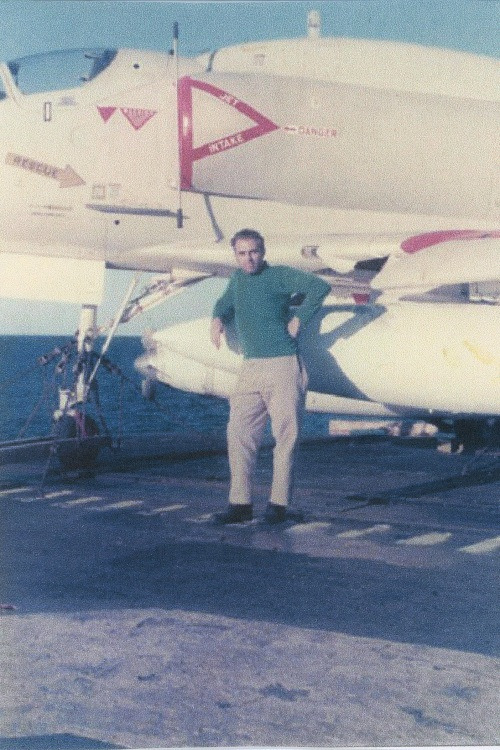
My Dad: Chief Petty Officer Carl Dundas aboard the USS Hancock CVA 19 circa 1971-72

I come from a Navy family. My dad served twenty years in the Navy.  Growing up in a Navy family in the 1960s and 1970s was an adventure for me and that Navy family that surrounded us then remained part of my family’s life long after.  My mom and dad remained in contact with friends that they served with or were stationed with, and now many of them are elderly and a good number have passed away.  Even so my mom, now a widow stays in regular contact with a number of her Navy wife “sisters.”

My dad retired in 1974 as a Chief Petty Officer and did time surrounded in the South Vietnamese city of An Loc when it was surrounded by the North Vietnamese for 80 days in 1972.  He didn’t talk about it much when he came back; in fact he came back different from the war.  He probably suffered from PTSD.  All the markers were there but we had no idea about it back then, after all he was in the Navy not the Army.  I had friends whose dad’s did not return from Vietnam and saw how Vietnam veterans were treated by the country as a whole including some members of the Greatest Generation.  They were not welcomed home and were treated often with scorn, even by veterans who had fought in the “real wars” of World War II and Korea.  Instead of being depicted a Americans doing their best in a war that few supported they were demonized in the media and in the entertainment industry for many years afterwards.

My dad never made a big deal out of his service but he inspired me to pursue a career in the military by being a man of honor and integrity.

It was the early Navy family experience that shaped much of how I see the world and is why I place such great value on the contributions of veterans to our country and to me.  That was also my introduction to war; the numbers shown in the nightly news “body count” segment were flesh and blood human beings.

breedlove-ness2

My second view of war came from the Veterans of Vietnam that I served with in the National Guard and the Army.  Some of these men served as teachers and mentors.  LCDR Jim Breedlove and Senior Chief John Ness at the Edison High School Naval Junior ROTC program were the first who helped me along.  Both have passed away but I will never forget them.  Commander Breedlove was someone that I would see every time that I went home as an adult. His sudden death the week before I returned from Iraqshook me.  I have a post dedicated to them at this link.  (In Memorium: Chief John Ness and LCDR Jim Breedlove USN )

Colonel Edgar Morrison was my first battalion commander.  He was the most highly decorated member of the California National Guard at that time and had served multiple tours in Vietnam.  He encouraged me as a young specialist and officer cadet and showed a tremendous amount of care for his soldiers.  Staff Sergeant’s Buff Rambo and Mickey Yarro taught me the ropes as a forward observer and shared many of their Vietnam experiences. Buff had been a Marine dog handler on the DMZ and Mickey a Forward Observer.

The Senior NCOs that trained me while in the Army ROTC program at UCLA and Fort Lewis had a big impact. All were combat veterans that had served in Vietnam.  Sergeant First Class Harry Zilkan was my training NCO at the UCLA Army ROTC program.  He was a Special Forces Medic with 7th Group in Vietnam.  He still had part of a VC bayonet embedded in his foot.  He received my first salute as a newly commissioned Second Lieutenant as well as a Silver Dollar.  I understand that after the Army he became a fire fighter.  He had a massive heart attack on the scene of a fire and died a few years later from it.  Sergeant Major John Butler was our senior enlisted advisor at UCLA.  An infantryman he served with the 173rd Airborne in Vietnam.  Sergeant First Class Harry Ball was my drill sergeant at the ROTC pre-commissioning camp at Fort Lewis Washington in 1982.  He was a veteran of the Special Forces and Rangers and served multiple tours in Vietnam.  Though he only had me for a summer he was quite influential in my life, tearing me apart and then building me back up.  He was my version of Drill Sergeant Foley in An Officer and a Gentleman. Like Zack Mayo played by Richard Gere in the movie I can only say: Drill Sergeant “I will never forget you.”

As I progressed through my Army career I encountered others of this generation who also impacted my life. First among them was First Sergeant Jim Koenig who had been a Ranger in the Mekong Delta.  I was the First Sergeant that I would measure all others by.  Once during an ARTEP we were aggressed and all of a sudden he was back in the Delta. This man cared so much for his young soldiers in the 557th Medical Company.   He did so much for them and I’m sure that those who served with him can attest to this as well as me. Jim had a brick on his desk so that when he got pissed he could chew on it.   He was great.  He played guitar for the troops and had a song called “Jane Fonda, Jane Fonda You Communist Slut.” It was a classic.  He retired after he was selected to be a Command Sergeant Major because he valued his wife and family more than the promotion.  It hurt him to do this, but he put them first. Colonel Donald Johnson was the commander of the 68th Medical Group when I got to Germany in January 1984.  Colonel “J” as well all called him was one of the best leaders I have seen in 28 years in the military.  He knew everything about everything and his knowledge forced us all to learn and be better officers and NCOs.  On an inspection visit you could always find him dressed in coveralls and underneath a truck verifying the maintenance done on it.  He served a number of Vietnam tours.  He died of Multiple Myeloma and is buried at Arlington.  Chaplain (LTC) Rich Whaley who had served as a company commander in Vietnam on more than one occasion saved my young ass at the Army Chaplain School.  No really he saved my career at least twice, and kept me out of big trouble on both occasions. Personally I don’t know too many senior chaplains who would put themselves on the line for a junior chaplain the way that Rich did for me. He remains a friend and is the Endorsing Agent for the Church of Jesus Christ of Latter Day Saints. As a Mormon he is one of the most “Christian” men that I have ever met.  I know some Christians who might have a hard time with that, but Rich demonstrated every trait of a Christian who loved God and his neighbor.

When I was the Installation Chaplain at Fort Indiantown Gap PA I was blessed to have some great veterans in my Chapel Parish.  Major General Frank Smoker flew 25 missions as a B-17 pilot over Germany during the height of the air war in Europe. He brought his wonderful wife Kate back from England with him and long after his active service was over he remained a vital part of the military community until his death in 2010.  Sergeant Henry Boyd was one of the 101st Airborne soldiers epitomized in Band of Brothers. He had a piece of shrapnel lodged next to his heart from the Battle of the Bulge until the day he died and was honored to conduct his funeral while stationed at Indiantown Gap. Colonel Walt Swank also served in Normandy.  Major Scotty Jenkes was an Air Force pilot in Vietnam flying close air support while Colonel Ray Hawthorne served several tours both in artillery units and as an adviser in 1972 and was with General Smoker a wonderful help to me as I applied to enter the Navy while CWO4 Charlie Kosko flew helicopters in Vietnam.  All these men made a deep impact on me and several contributed to my career in very tangible ways.

My life more recently has been impacted by others. Since coming into the Navy I have been blessed to serve with the Marines and Sailors of the 2nd Combat Engineer Battalion and Lieutenant Colonel T D Anderson, 1st Battalion 8thMarines and Lieutenant Colonel Desroches, 3rd Battalion 8th Marines and Colonel Lou Rachal and Headquarters Battalion 2nd Marine Division and Colonel, now Major General Richard Lake.   My friends of the veterans of the Battle of Hue City including General Peter Pace, Barney Barnes, Tony “Limey” Cartilage, Sergeant Major Thomas and so many others have become close over the years, especially after I did my time in Iraq. They and all the Vietnam vets, including the guys from the Vietnam Veterans of America like Ray and John who manned the beer stand behind the plate at Harbor Park all mean a lot to me.  My friends at Marine Security Forces Colonel Mike Paulovich and Sergeant Major Kim Davis mean more than almost any people in the world.  We traveled the globe together visiting our Marines.  Both of these men are heroes to me as well as friends, Colonel Paulovich was able to administer the oath of office to me when I was promoted to Commander.

hue city boarding team

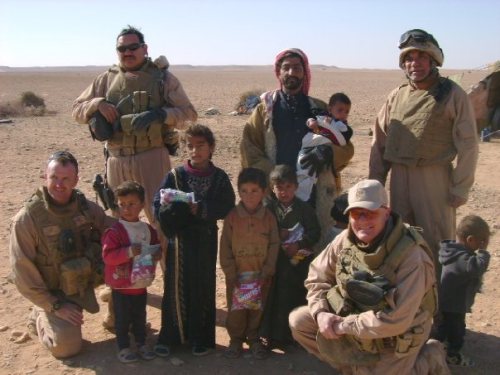
Finally there are my friends and brothers that I have served with at sea on USS HUE CITY during Operation Enduring Freedom and the advisers on the ground in Al Anbar mean more than anything to me. Perhaps the most important is my bodyguard, RP1 Nelson Lebron, who helped keep me safe and accompanied me all over the battlefield.  Nelson who has done Iraq three times, Afghanistan, Lebanon and the Balkans is a hero.  The men and women of Navy EOD who I served with from 2006-2008 have paid dearly in combating IEDs and other explosive devices used against us in Iraq and Afghanistan are heroes too.  There is no routine mission for EOD technicians.  Then there are the friends that I serve with in Navy Medicine, medical professionals who care for our Sailors, Marines, Soldiers and Airmen, family members and veterans at home and in the thick of the fighting in Afghanistan.

bedouin

There are many from my time in Navy Medicine who have meant so much to me. Chaplain Jeff Seiler, an Episcopal Priest at Naval Medical Center Portsmouth and Father Fred Elkin, a retired Navy Chaplain who served there helped keep me together during the darkest time of my life after Iraq, as did many of the physicians and nurses that I worked with there, and many of them were not Christians, but they helped and cared for me. That continued at Naval Hospital Camp LeJeune, where I served as Director of Pastoral Care. At Lejeune I was fortunate to serve with Duke Quarles, a civilian pastoral counselor and retired Navy Chaplain. Duke was a rock for me there, as was Command Master Chief Ed Marino, one of the most spiritual and kind people that I know.

IMG_0230

I now serve in a wonderful place, the Joint Forces Staff College. I am surrounded by great people here, from all the services of our armed forces, active duty and retired. I get to do wonderful things, and despite having gone through absolute hell dealing with the military mental health system this year, these folks have stood by me, especially Commander Lisa Rose, our staff nurse. She is a highly skilled nurse and a courageous woman. For eighteen years of her career she served always wondering if someone was going to try to persecute, prosecute or try to run her out the Navy because she is a lesbian. For years she could not take her spouse to official functions, she could not even take a chance on being seen in public by someone with her spouse, even under “don’t ask don’t tell.” She is now able to do that, but truthfully I cannot imagine what it would be like to want to serve your country, your shipmates and your God, while always knowing that anyone could end that simply because they didn’t approve. I am glad that Lisa and my other gay and lesbian friends in the military are able to openly serve.

There are others who I have served alongside who have died while in the service of the country, or after their service had ended. Some, like Staff Sergeant Ergin Osman who I served with at 3rd Battalion 8th Marines, were killed in Afghanistan, others like Commander Marsha Handley, a nurse I served with in the ICU at Portsmouth, who was one of the people who helped hold me together when I was so fragile, died of complications of chemotherapy treatment. Damage Control Specialist 2nd Class Ray Krolikowski, who I served with aboard USS Hue City died yesterday eleven years after suffering an injury that left him a quadriplegic in 2003, and some like Captain Tom Sitsch who was my last Commodore at EOD Group Two, and Father Dennis Rocheford died by their own hand after being tormented by the demons of PTSD and TBI. Both of them were real heroes. I could mention so many more, but will end there because I am getting a bit emotional.

There is a closing thought from the television mini-series Band of Brothers which kind of sums up how I feel. The American troops who have fought so long and hard are watching a German general address his troops after the German surrender. An American soldier of German-Jewish descent translates for his comrades the words spoken by the German commander, and it as if the German is speaking for each of them as well.

Men, it’s been a long war, it’s been a tough war. You’ve fought bravely, proudly for your country. You’re a special group. You’ve found in one another a bond that exists only in combat, among brothers. You’ve shared foxholes, held each other in dire moments. You’ve seen death and suffered together. I’m proud to have served with each and every one of you. You all deserve long and happy lives in peace.

So for me, I have a bond, a special bond with so many of my brothers and sisters who volunteer to serve. Today we number less than one percent of the nation, a tiny number of people in comparison to the size of our nation and the commitments that our leaders have engaged us.

Unless by some chance I am selected for Captain, I plan to retire from the Navy at the end of this assignment. As Sergeant Murtaugh (Danny Glover) said in the movie Lethal Weapon “I’m getting too old for this shit.” The military is a young person’s game, and I am now older than almost everyone on active duty, and have been in the military longer than almost everyone that I know, including many people senior in rank to me. I am a dinosaur, and sometimes a cranky one at that when it comes to dealing with the bureaucracy of the military.

I give thanks for all them men that I mention in this post, especially my dad. For the countless others that are not mentioned by name please know that I thank God for all of you too. Someone once said “A ‘Special Day’ once a year creates an excuse for neglect on the other 365 days for mothers, fathers & veterans” Please do not let that continue to happen, please do not just look at this as time off, or if you are a corporation or retailer use this day to boost your sales by acting like you care.

I do hope that people will remember the Veterans that impacted their lives this and every day. Some may have been the men and women that we served with, perhaps a parent, sibling or other relative, maybe a childhood friend, a teacher, coach or neighbor. As we pause for a moment this Friday let us honor those who gave their lives in the defense of liberty in all of the wars of our nation. They have earned it and please thank any veteran that you know in some small way this weekend.

Peace

Padre Steve+


Leave a comment

Filed under iraq,afghanistan, Military, PTSD, remembering friends, shipmates and veterans

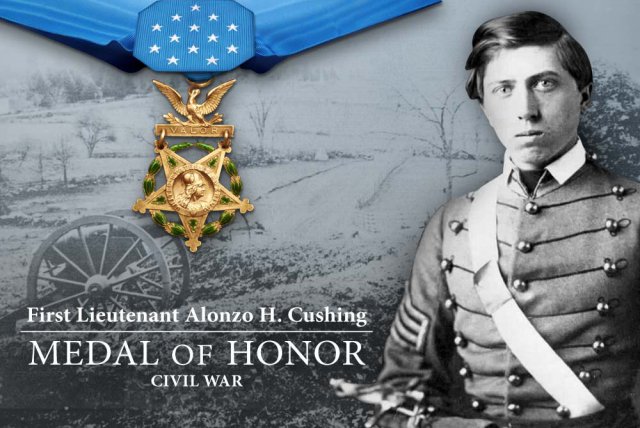
The Last Full Measure: 1LT Alonzo Cushing awarded Medal of Honor

92681186b29b70439321935b2ab79a62

Cushing at the Angle: Dale Gallon

“No. I stay right here and fight it out or die in the attempt.” First Lieutenant Alonzo Cushing

I have a framed print of the picture above by artist Dale Gallon, of Lieutenant Alonzo Cushing in my office. 151 years ago First Lieutenant Alonzo Cushing, United States Army was a 22 year old combat veteran.  Just a few hours after he emplaced his battery, Battery A, 4th US Artillery behind a stone wall at the center of Cemetery Ridge on the night of July 2nd 1863, the name of this obscure Lieutenant would be etched in the history of his country.

Cushing was part of a family of young men from Wisconsin who stood tall and served during the Civil War. His brothers William Cushing, was a Navy Lieutenant, who launched a daring raid to sink a powerful Confederate ironclad, the CSS Albemarle on October 27th 1864 and Howard Cushing who volunteered and was commissioned after Alonzo’s death becoming a distinguished soldier and Indian fighter after the war. Howard was so effective at fighting the Apache that the legendary Apache Chief, Cochise, put a bounty on his head, and Howard was killed in action fighting them in 1871. William died after the war having been promoted to the rank of commander. Several ships were named after him; the USS Cushing Torpedo Boat 1 (TB1) USS Cushing DD 55, USS Cushing DD 376 which sacrificed herself fighting at point blank range against the Japanese Battleship Hiei at the Naval Battle of Guadalcanal, USS Cushing DD 797 a Fletcher Class Destroyer, and USS Cushing DD 985 a Spruance Class destroyer.

a-ALONZO-CUSHING-768x504

Alonzo Cushing graduated from the United States Military Academy in 1861 and without ceremony reported for duty as an artillery officer in the Army of the Potomac. At Gettysburg the young Cushing commanded Battery A, 4th United States Field Artillery, which though part of the Artillery Reserve was attached to the Union II Corps and deployed in the center of the Union line at a place now known as “the Angle.” During the Confederate artillery barrage Cushing was twice wounded, in the groin and shoulder. Cushing, seeing the mass of Confederate infantry advancing on his position refused to go to the rear and told one of his sergeants who attempted to have him leave the field and seek treatment for his wounds “No. I stay right here and fight it out or die in the attempt.” 

Since I lead a staff ride to Gettysburg about once a quarter, and because the site of Cushing sacrifice is at one of the most important stops of the staff ride, I have come to know and appreciate Alonzo Cushing, as well as his famous Navy brother William, and nearly forgotten elder brother Howard, the Indian fighter.

Today, November 6th 2014, 151 years after Cushing’s death fighting off the remnants of Major General George Pickett’s division, Cushing was awarded the Medal of Honor.

The citation reads:

First Lieutenant Alonzo H. Cushing distinguished himself by acts of bravery above and beyond the call of duty while serving as an artillery commander in Battery A, 4th U.S. Artillery, Army of the Potomac at Gettysburg, Pennsylvania on July 3rd, 1863 during the American Civil War.  

That morning, Confederate forces led by General Robert E. Lee began cannonading First Lieutenant Cushing’s position on Cemetery Ridge.  Using field glasses, First Lieutenant Cushing directed fire for his own artillery battery.  He refused to leave the battlefield after being struck in the shoulder by a shell fragment.  As he continued to direct fire, he was struck again — this time suffering grievous damage to his abdomen.

Still refusing to abandon his command, he boldly stood tall in the face of Major General George E. Pickett’s charge and continued to direct devastating fire into oncoming forces.  As the Confederate forces closed in, First Lieutenant Cushing was struck in the mouth by an enemy bullet and fell dead beside his gun.

His gallant stand and fearless leadership inflicted severe casualties upon Confederate forces and opened wide gaps in their lines, directly impacting the Union force’s ability to repel Pickett’s charge.  First Lieutenant Cushing’s extraordinary heroism and selflessness above and beyond the call of duty at the cost of his own life are in keeping with the highest traditions of military service and reflect great credit upon himself, Battery A, 4th U.S. Artillery, Army of the Potomac, and the United States Army.

Civil-War-Soldier-Lt.-Alonzo-H.-Cushing

President Obama remarked honored Cushing today and reminded all of us about what such dedication, courage, commitment and sacrifice mean. No matter what one’s political point of view, his comments are sincere and poignant :

“Yet this medal is about more than one soldier or one family.  It reflects our obligations as a country to the men and women in our armed services — obligations that continue long after they return home, after they’ve removed their uniforms, and even — perhaps especially — after they’ve laid down their lives.  And so this medal is a reminder that no matter how long it takes, it is never too late to do the right thing. 

Alonzo, or “Lon,” Cushing was raised by his widowed mother in Fredonia, NY with his siblings, including three brothers who also fought for the Union.  As the congressman who recommended Lon to West Point wrote, “His mother is poor, but highly committed and her son will do honor to the position.”  After graduating from West Point, Lon was assigned to Battery A, 4th United States Artillery.  From Bull Run to Antietam, from Chancellorsville to Fredericksburg, Lon fought bravely and developed a reputation for his cool, his competence, and his courage under fire.

But it was at Gettysburg, what one newspaper later called “emphatically a soldiers’ battle,” where Lon would be immortalized.  It was July 3rd, 1863, the final day of a grueling three-day fight.  Lon commanded his battery along the wall on Cemetery Ridge, fending off punishing fire from General Lee’s Confederate troops in advance of what we now know as Pickett’s Charge.  In the chaos and smoke, Lon and his men could barely see ahead of them.  One colonel later described the “terrible grandeur of that rain of missiles and that chaos of strange and terror-spreading sounds.”

Lon was hit and badly wounded.  His first sergeant — a soldier by the name of Frederick Fuger — urged him to go to the rear.  But Lon refused and said he’d “fight it out, or die in the attempt.”  Bleeding and weak, he moved his remaining guns closer to the front.  Over 10,000 Confederate infantrymen advanced, elbow to elbow, in rows over a mile wide.  Peering through field glasses, Lon ordered his men to continue firing at the advancing columns.  He used his own thumb to stop his gun’s vent, burning his fingers to the bone.  When he was hit the final time, as a poet later wrote, “His gun spoke out for him once more before he fell to the ground.”  And Alonzo Cushing was just 22 years old.

In a letter to Lon’s sister, Fuger wrote that the bravery of their men that day “was entirely due to your brother’s training and example set on numerous battlefields.”  Etched on Lon’s tombstone at West Point is the simple epitaph, “Faithful unto death.” 

Today there are many young men and women who serve this country in the spirit of Alonzo Cushing and his brothers in very uniformed branch of the Armed services. As we approach Veterans’s Day it is right that wee do not forget them. In the ceremony where Alonzo Cushing was presented his nation’s highest award for heroism, may none of us forget that freedom is not free, and that the ideology, motivation and spirit of the leaders of the Confederacy who Cushing gave his life to defeat are still working to destroy what Abraham Lincoln called The New Birth of Freedom and which President Obama so correctly noted:

And here today, we know that Lon and the others who fell that day could not — we know — we know what they could not — that Gettysburg was a turning point in the Civil War.  It’s also proof, if any was needed, that it was thousands of unknown young soldiers, committing unsung acts of heroism, who saved our union, and freed a people, and reaffirmed our nation as “one Nation, under God, indivisible, with Liberty and Justice for all.”  I’m mindful that I might not be standing here today, as President, had it not been for the ultimate sacrifices of those courageous Americans.

Today we honor just one of those men, Lieutenant Alonzo Cushing, who, as Lincoln said, gave their “last full measure of devotion.”  His story is part of our larger American story — one that continues today.  The spirit, the courage, the determination that he demonstrated lives on in our brave men and women in uniform who this very day are serving and making sure that they are defending the freedoms that Alonzo helped to preserve.  And it’s incumbent on all of us as Americans to uphold the values that they fight for, and to continue to honor their service long after they leave the battlefield — for decades, even centuries to come.

Last weekend, I met another Medal of Honor Winner, Colonel Walter Marm, US Army Retired, who at while serving as a 1st Lieutenant and company commander at the Battle of the Ia Drang valley in November 1965, won the Medal of Honor, in a battle now immortalized in the movie We Were Soldiers.

As you go to bed tonight and who do whatever you do this Veterans’ Day, do not forget the sacrifices of those who through their sacrifice and service continue to bring about the new birth of freedom that Abraham Lincoln referred in the Gettysburg Address. 

Peace,

Padre Steve+

Leave a comment

Filed under civil war, History, leadership, Military

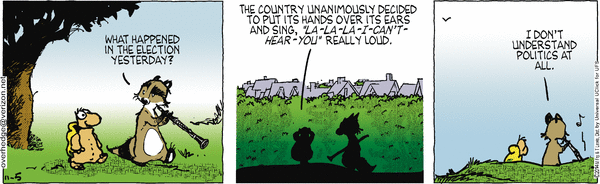
What Does it Mean? Will Rogers, Padre Steve & Election 2014
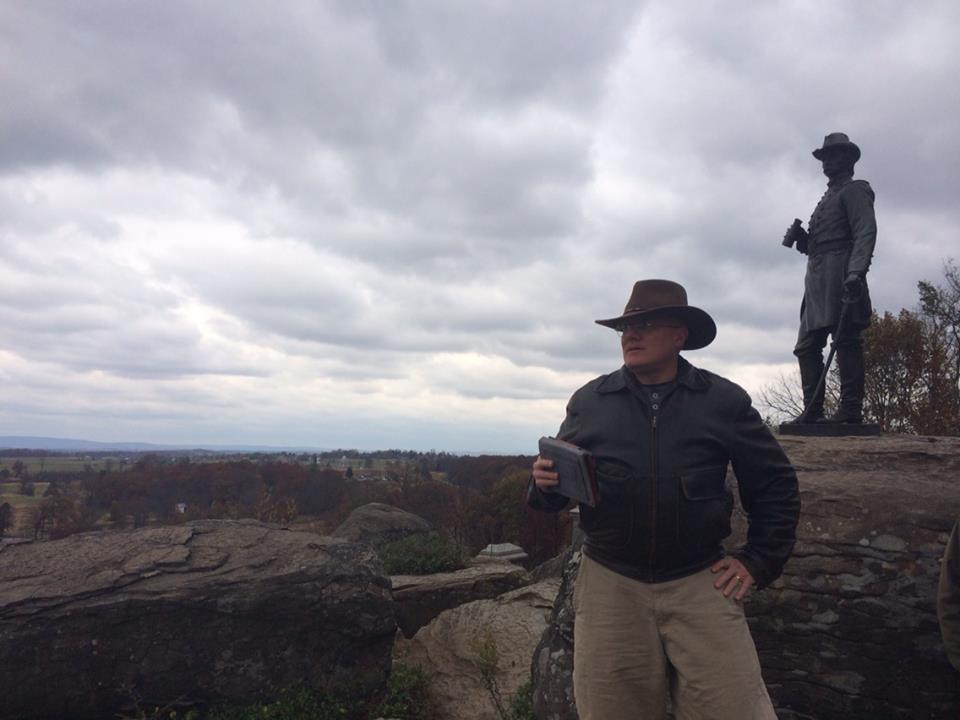
blm141101

“The trouble with practical jokes is that very often they get elected.” Will Rogers

Last night in battle of the witless, funded by the soulless, and empowered by the clueless the American electorate finally finished the 2014 warm up for the 2016 bloodletting known as the 2016 General election. Why they call it that I don’t know, we haven’t had a general as President since Eisenhower, but I digress…
What does it all mean? Actually I don’t know, I have some ideas but there is one thing I know, it means nothing because people do not change, especially the Trinity of Evil, the politicians, pundits and preachers that work overtime to get power and maintain it for power’s sake so they can use the police power of government to enforce their will by restricting the liberties of those who do not share their views.

But this is a far deeper question than we would want to contemplate. The problem in American life and politics is that we lack any kind of historical perspective, not only about the world, but our own history and that extends across the ideological spectrum of the country, that is why over eighty years ago Rogers noted “The short memories of the American voters is what keeps our politicians in office” and why he noted “The problem ain’t what people know. It’s what people know that ain’t so that’s the problem.” Ignorance is bliss and my God there is a lot of bliss out there today…

pb141015

That my friends is why no matter what party they represent we too often elect the worst examples of the human species into office; many times in the case of congressmen, for decades, or until the cows come home. Since cows like to stay out late, play cards, and drink that can be a very long time.

But we as American voters elect them and we collectively are idiots for doing so.

My God, in what civilized country could a man like the disgraced, court-martialed, convicted criminal, serial liar and Talibanesque religious fanatic like Gordon Klingenschmitt win a State Senate office in Colorado with over 70 percent of the vote? But assured that Klingenschmitt, running as a Republican but motivated by the soulless hatred of his Christian Dominionism will be around for a while. He is a megalomanic with delusions of grandeur and feelings of unjust persecution. There is a reason that he was court-martialed and thrown out of the Navy and why anyone should be very afraid that any party, including my former party, the Republicans would ever even allow someone like him to enter a race under their banner.

I guess that is one of the big reasons that I am not a Republican, too many soulless, clueless and heartless religious fanatics just like him are driving that party and the country to the abyss. Like Rogers I can now say “I am not a member of any organized political party — I am a Democrat.” But again I digress…

gordon-rides-the-bomb-copy1

But whenever I hear the name Gordon Klingenschmitt; a man who entered the military with a political-religious agenda, dishonored his uniform, made a mockery of faith, family, slandered countless of his commanding officers and fellow chaplains in the Right Wing media; all in the name of Jesus, I get upset, and wish a pox on any political party, or voter who would elect this man or anyone else like him. Klingenschmitt and many like him are quick to label liberals or progressives as Nazis, but they are the people who have said they would, if they ever had the political power to limit the rights or people that they admittedly hate, be it for political, religious or social issues.  Their targets, Democrats, liberals, blacks, gays and lesbians, Moslems, immigrants, and any other group that they want to demonize to mobilize their base depending on their needs.

You see my friends, that is what this election meant. Yes, one can say it is a rejection of Obama and his policies by voters, but it is also, and much more importantly a return to religious fanaticism as a basis and instrument of policy among elected officials. Klingenschmitt may be an outlier right now, but he and others like him are now the face of the GOP. If you are a moderate in the GOP, get ready, you will be either pushed out or forced to adopt their extremism because theirs is a religious crusade that allows no dissent. If you are a secularist, an economic conservative or a “strong on defense” type in the GOP for whom religion is a minor concern, or something best left at home or in the churches, get ready, you too are on their hit list. The problem is that people will do anything to gain power, even make allies of guys like Klingenschmitt and the other American Taliban that are just like him.

I wonder if people will ever learn, but as Rogers said:

“There are three kinds of men. The one that learns by reading. The few who learn by observation. The rest of them have to pee on the electric fence for themselves.”

I guess there are going to be a lot of people learning by in that manner over the next two years….Let me take a deep breath and then continue…. thank you.

For those that think the election will have the effect that people Klingenschmitt and the religious fanatics like him think  that it will, think again. It has the potential of destroying the Republican party, with consequences as important and perhaps as dire as the collapse of the Whigs in 1854 and the split in the Democrat Party between 1856 and 1861. (For those that don’t know about that split it helped light the fire that became the Civil War, read some of my Civil War articles, I cover it to some degree in them.)

Some Republicans recognize this, they know that the victories last night came mostly in reliably conservative states and districts, or places that depending on the year and the situation can swing between Republican or Democrat control. Neil Newhouse who was Mitt Romney’s pollster noted yesterday that “the image of the Republican Party has actually gotten worse since the end of 2012.”

That my friends is what this election meant. Senator Rand Paul, a man who has his eyes on the white House noted: “The Republican Party brand sucks, and so people don’t want to be a Republican… why?…The problem is the perception … that no one in the Republican Party cares.” The problem is that it is no longer about perception, it is about reality. The fact is that unless one is rich, white, male, or a conservative Christian you don’t matter to those now driving the party. The attitude is “you are either for us or against us.” It is a no-compromise attitude which will be their downfall and may very well split the party if old line Republicans finally grow some balls and say no to it. 

oh141105

As far as hope for what the new Republican controlled Congress will do, only one in four Americans think they will do better than the split Congress that we have had the past four years and a full 40% said in that survey said that nothing would change in Washington DC. This is something that Tea Party party pundits Erick Erickson, who I am not a fan of, noted over at Politico.com two days ago:

“So while we are going to see a Republican Congress in name in January, its small-government rhetoric is certainly not going to fool or win over the party base. In 2014, the American public has shown that it hates Washington, D.C., and the Republican leaders in Washington are demonstrating why. They have assembled a team of strategists, consultants, and other political operatives who eat, breathe, and sleep Washington, D.C. Instead of standing for something, they stand for anything they think might get them back into power.

The message from Washington’s Republican elite is no longer that government is the problem, but that Democrats in charge of government are the problem. That might work in 2014, but it’s not going to carry the day in the next presidential election. Republicans cannot make the case that government is the problem when they covet the power of controlling it to the extent they do.” http://www.politico.com/magazine/story/2014/11/midterms-hollow-victory-gop-112463.html#ixzz3IE1eHexj

Be assured the Democrats are no gem right now, like the GOP they too have some wing nuts in the party. Though I am a Democrat there have been times that I wonder if the Democratic leadership have lost their souls and are more intent on maintaining power than solving problems. Based on the massive number of e-mails I received from Democrat and progressive organizations that I support, almost all dealing with fundraising, which ran about twenty a day during the last two months of the campaign have to wonder. Yes, I know that to fight the Koch brothers funding wars brought about by Citizens United that one has to have a lot of money, but those e-mails did not motivate me, they were annoying and disruptive. 
The GOP won yesterday because it won where it was supposed to win, in states where it had the home field advantage, in states where legislatures limited the opportunities of poor, elderly, students living away from home, military personnel serving out of state as well as minority voters to vote by in effect creating a defacto-Poll Tax. But such a strategy goes back to Paul Weyrich, the co-founder of the Heritage Foundation who said in 1980:

“Now many of our Christians have what I call the ‘goo-goo syndrome.’ Good government. They want everybody to vote. I don’t want everybody to vote. Elections are not won by a majority of people. They never have been from the beginning of our country, and they are not now. As a matter of fact our leverage in the elections quite candidly goes up as the voting populace goes down.”

But in 2016, it will be a different electorate, an electorate radically different from the one that voted yesterday. The 2016 electorate will be much more favorable to Democrats, one that is not enamored with people like Klingenschmitt. They are young people who want to get ahead in life and are not concerned about someone’s religious beliefs, no fueled by racism, accepting of minorities, women, immigrants and the LGBT community. Those voters typically don’t vote in large numbers in mid-term elections, but do in presidential elections and their influence will be decisive particularly if the new GOP Congressional majority does what I expect to do by focusing on a narrow agenda that is being defined by crackpots, conspiracy theorists and religious fanatics, further driving them, as well as anyone of moderation away from the GOP. If the Democrats can get off their ass, they will keep the White House and will have an excellent chance to take back the Senate in 2016.

I am no expert, but I do know history and I know human nature. I could be try wrong about all of this, but no-matter what I am glad this election is over. The only break I got from it was going to German for the Oktoberfest, with good friends who spanned the political spectrum from left to right. It is almost enough to want to move overseas and be an expat if it means that I don’t have to listen to all of the lies and dirty campaign ads that were a staple of both parties this year. But then we can thank the Supremes and their Citizens United decision for that.

blm141105

The campaign wore me out and I look forward to at least a few months of peace, before the next phase of the 2016 campaign begins.

Peace

Padre Steve+


2 Comments

Filed under History, News and current events, Political Commentary

I’m a Disenfranchised Military Voter in DeFacto Red State

votersupresssion

I did not to get to vote in this election. I am active duty military and have lived away from the state where I vote, West Virginia, where my family settled in the 1790s for about eighteen years. It used to be that as long as I let the state knew where I lived my absentee ballot was sent to me without question. But then something changed. I stopped getting ballots. In 2012 I ended up calling my county commissioner’s office to ask why. I was told that I had to now reapply each election year. I was barely allowed to vote. In fact though I sent it in, I don’t even know if it was counted.

West Virginia used to be a Blue State, and the legislature still has a slight majority of Democrats, but at its heart the state as as Fire Engine Red as it gets. Business interests have priority, the environment suffers, the secondary education system is broken and the poor, who gives a damn about them?

The code of my state specifically states that military personnel must reapply every election cycle. This is a fairly recent change. In fact I grew up in a California, and when I first entered activity duty in the early 1980s in that state never failed to get an absentee ballot. Now the rules have changed. Evidently in an attempt to make it harder to vote under the guise of preventing voter fraud the onus is on the person serving their country to make sure that they reapply, mind you that people living in the state don’t need to do that. In fact they can walk up, do early voting or vote the same day. Heck even a person dying on a hospital bed in the state on election day can get an emergency absentee ballot brought to them and in between their dying breaths can have someone mark a ballot for them.

The sad thing is you don’t even get a reminder from the state that you need to reapply, even though they have my address and e-mail info. It’s not like the state or county is a massive metropolis where it would be too difficult to do this. That simple effort on the part of the state to reach their active duty members living away from home wouldn’t be that hard, nor would simply sending out the ballot.

Now I will take my personal responsibility, I knew the rule and should have registered. If I was in my right mind I would have done it. However I was in the midst of terrible year dealing with a move, and a major PTSD meltdown that shattered me for much of the year, I just forgot to reapply, and by the time I remembered it was too late. 

But it shouldn’t have to be that way. We in the military should not have to jump through extra hoops that people at home don’t have to be concerned with when it comes to voting. In fact, though the mechanism is there to vote, it is a way to make it more difficult and to ensure that your vote doesn’t get counted. But, that’s what you get for begin registered in a state when certain groups want to make sure that voting is restricted.

The process is insidious and terribly undemocratic, and it devalues the citizenship and voting rights of the members of less than one percent of the population that serves in the military. But then, if those people only make up one percent of the vote, what do they matter and why should anyone give a damn.

I’ll remember that the next time some politician from West Virginia says the empty words “thank you for your service.”

Screw you West Virginia politicians, pundits and preachers of both parties, my Democrats, and  my former party the GOP, which is about to take over, I won’t be coming back when I retire. You can keep it.

Peace

Padre Steve+

Leave a comment

Filed under civil rights, News and current events, Political Commentary

Councils of War at Gettysburg: Lee & Meade July 2nd 1863

Friends of Padre Steve’s World

As I noted yesterday I returned from Gettysburg and another Staff Ride, and one of the questions that came up during some of our table talk, as well as on the battlefield was about the command decision process by which Robert E. Lee and George Gordon Meade and their subordinates planned, prepared and debated what to do on the night of July 2nd 1863, following the bloody, but unsuccessful attacks by Hood’s and McLaw’s Divisions at Little Round Top, Devil’s Den, the Wheat Field, Peach Orchard and Plum Run.

To provide that overview in one article I have encapsulated a number of chapters from my Gettysburg text into one article. The contrast between Lee’s decision to attack, his refusal to take counsel of dissenting voices and views of his subordinates stand in stark contrast to those of his opponent, George Gordon Meade, his subordinate commanders and staff. Their decisions shaped the outcome of the battle of Gettysburg, and were decisive in Lee’s defeat, and instrumental in the eventual defeat of the Confederacy, just under 21 months later.

I hope you enjoy,

Peace

Padre Steve+

Lee1

As night fell on July 2nd 1863 General Robert E Lee had already made his decision. Despite the setbacks of the day he was determined to strike the Army of the Potomac yet again. He did not view the events as setback, and though he lacked clarity of how badly many of his units were mauled Lee took no external council to make his decision. With the exception of A.P. Hill who came and submitted a report to him Lee neither required his other two corps commanders, James Longstreet or Richard Ewell to consult with him, nor took any action to visit them.

Lee did “not feel that his troops had been defeated” and he felt that “the failure on the second day had been due to a lack of coordination.”1

In his official report of the battle he wrote:

“The result of this day’s operations induced the belief that, with proper concert of action, and with the increased support that the positions gained on the right would enable the artillery to render to the assaulting columns, that we should succeed, and it was ultimately determined to continue the attack…” 2

While Lee’s charge of a “lack of coordination” of the attacks can certainly be substantiated, the fact of the matter was that if there was anyone to blame for his lack of coordination it was him, and  even Lee’s most devoted biographer Douglas Southall Freeman would write that on July 2d “the Army of Northern Virginia was without a commander.” 3 Lee’s decision to attack on July 3rd, having not taken counsel of his commanders or assessed the battle-worthiness of the units that he was planning to through into his final assault on the Union center was “utterly divorced from reality.” 4 His plan was essentially unchanged from the previous day. Longstreet’s now battered divisions were to renew their assault on the Federal left in coordination with Pickett and two of Hill’s divisions.

In light of Lee’s belief that “a lack of coordination” was responsible for the failures of July 2nd it would have been prudent for him to ensure such coordination happened on the night of July 2nd. “Lee would have done well to have called out his three lieutenants to confer with them and spell out exactly what he wanted. That was not the way he did things however…” 5

Lee knew about the heavy losses among his key leaders but “evidently very little was conveyed to him regarding the condition of the units engaged this day.” 6 This certainly had to be because during the day his only view of the battlefield was from Seminary Ridge through binoculars and because he did not get first hand reports from the commanders involved. Lee was undeterred and according to some who saw Lee that night he seemed confident noting that when Hill reported he shook his and said “It is well, General,…Everything is well.” 7

It was not an opinion that Lee’s subordinates shared. Ewell and his subordinates were told to renew their attack on Cemetery and Culp’s Hill on the night of July 2nd, but “he and his generals believed more than ever that a daylight assault against the ranked guns on Cemetery Hill would be suicidal-Harry Hays said that such an attack would invite “nothing more than slaughter…” 8

LongstreetJ_main

James Longstreet was now more settled in his opposition to another such frontal attack and shortly after dawn when Lee visited him to deliver the order to attack again argued for a flanking movement around the Federal left. Lee’s order was for Longstreet to “attack again the next morning” according to the “general plan of July 2nd.” 9 Longstreet had not wanted to attack the previous day and when Lee came to him Longstreet again attempted to persuade Lee of his desire to turn the Federal flank. “General, I have had my scouts out all night, and I find that you still have an excellent opportunity to move around to the right of Meade’s army and maneuver him into attacking us.” 10

Lee would have nothing of it. He looked at his “Old Warhorse” and as he had done the previous day insisted: “The enemy is there,” he said, pointing northeast as he spoke, “and I am going to strike him.” 11 Longstreet’s gloom deepened and he wrote that he felt “it was my duty to express my convictions.” He bluntly told Lee:

“General, I have been a soldier all of my life. I have been with soldiers engaged in fights by couples, by squads, companies, regiments, divisions and armies, and should know, as well as any one, what soldiers can do. It is my opinion that no fifteen thousand men ever arranged for battle can take that position.” 12

But Lee was determined to force his will on both his subordinates and the battle. Lee was convinced that the plan could succeed while Longstreet “was certain” that the plan “was misguided and doomed to fail.” 13 Longstreet, now realized that further arguments were in vain recalled that Lee “was impatient of listening, and tired of talking, and nothing was left but to proceed.” 14

Even a consultation with Brigadier General William Wofford whose brigade had help crush Sickle’s III Corps at the Peach Orchard and had nearly gotten to the crest of Cemetery Ridge could not alter Lee’s plan. Wofford had to break off his attack on July 2nd when he realized that there were no units to support him. Lee asked if Wofford could “go there again” to which Wofford replied “No, General I think not.” Lee asked “why not” and Wofford explained: “General, the enemy have had all night to intrench and reinforce. I had been pursuing a broken enemy, and now the situation is very different.” 15

The attack would go forward despite Longstreet’s objections and the often unspoken concerns of others who had the ear of Lee, or who would carry out the attack. Walter Taylor of Lee’s staff wrote to his sister a few days after the attack the “position was impregnable to any such force as ours” while Pickett’s brigadier Richard Garnett remarked “this is a desperate thing to attempt” and Lewis Armistead said “the slaughter will be terrible.” 16

Pickett’s fresh division would lead the attack supported by Johnston Pettigrew commanding the wounded Harry Heth’s division of Hill’s Third Corps and Isaac Trimble commanding two brigades of Pender’s division, Trimble having been given command just minutes prior to the artillery bombardment. 17 On the command side few of the commanders had commanded alongside each other before July 3rd. Trimble had just recovered from wounds had never been with his men. Pettigrew had been given command when Pender was wounded was still new and relatively untested, and Pickett’s three brigadiers and their brigades had never fought together. Two of the divisions had never served under Longstreet. From a command perspective where relationships and trust count as much as strength and numbers the situation was nearly as bad is it could be. Although the Confederates massed close to 170 cannon on Seminary Ridge to support the attack ammunition was in short supply and the Lieutenant Colonel Porter Alexander who had been tasked with coordinating fires only controlled the guns of First Corps.

The assaulting troops would attack with their right flank exposed to deadly enfilade fire from Federal artillery and with the left flank unsupported and exposed to such fires from Union artillery on Cemetery Hill. It was a disaster waiting to happen. Longstreet noted “Never was I so depressed as on that day…” 18

general-george-meade

While Lee took no counsel and determined to attack on the night of July 2nd little more than two miles away Major General George Meade took no chances. After sending a message to Henry Halleck at 8 PM Meade called his generals together. Unlike Lee who had observed the battle from a distance Meade had been everywhere on the battlefield during the day and had a good idea what his army had suffered and the damage that he had inflicted on the Army of Northern Virginia. Likewise during the day he had been with the majority of his commanders as opposed to Lee who after issuing orders that morning had remained unengaged, as was noted by the British observer Lieutenant Colonel Arthur Fremantle who wrote that during the “whole time the firing continued, he sent only one message, and only received one report.” 19

Meade wired Halleck that evening: “The enemy attacked me about 4 P.M. this day…and after one of the severest contests of the war was repulsed at all points.” 20 However Meade, realizing that caution was not a vice still needed to better assess the condition of his army, hear his commanders and hear from his intelligence service, ended his message: “I shall remain in my present position to-morrow, but am not prepared to say until better advised of the condition of the army, whether operations will be of an offensive or a defensive character.” 21

As Meade waited for his commanders his caution was apparent. Before the attack on Sickles’ III Corps at the Peach Orchard Meade had asked his Chief of Staff Brigadier General Dan Butterfield to “draw up a contingency plan for withdraw to Pipe Creek.” After the attack on Sickles Alfred Pleasanton said that Meade ordered him to “gather what cavalry I could, and prepare for the retreat of the army.” 22 Some of his commanders who heard of the contingency plan including John Gibbon and John Sedgwick believed that Meade was “thinking of a retreat.” 23. Despite Meade’s  flat assurances to Halleck  his army’s position had been threatened on both flanks, though both were now solidly held, but some of his subordinates believed, maybe through the transference of their own doubts, that Meade “foresaw disaster, and not without cause.” 24

In assessing Meade’s conduct it has to be concluded that while he had determined to remain, that he was smart enough to plan of the worst and to consult his commanders and staff in making his decision. Meade wrote to his wife that evening “for at one time things looked a little blue,…but I managed to get up reinforcements in time to save the day….The most difficult part of my work is acting without correct information on which to predicate action.” 25

Gettysburg_Council_of_War

Meade called Colonel George Sharpe from the Bureau of Military Information to meet with him, Hancock and Slocum at the cottage on the Taneytown Road where he made his headquarters. Sharpe and his aide explained the enemy situation. Sharpe noted “nearly 100 Confederate regiments in action Wednesday and Thursday” and that “not one of those regiments belonged to Pickett.” He then reported with confidence that indicated that “Pickett’s division has just come up and is bivouac.” 26

It was the assurance that Meade needed as his commanders came together. When Sharpe concluded his report Hancock exclaimed “General, we have got them nicked.” 27

About 9 P.M. the generals gathered. Present were Meade, and two of his major staff officers Warren just back from Little Round Top, wounded and tired, and Butterfield his Chief of Staff. Hancock action as a Wing Commander was there with Gibbon now commanding II Corps, Slocum of XII Corps with Williams. John Newton a division commander from VI Corps who had just arrived on the battlefield now commanding I Corps was present along with Oliver Howard of XI Corps, John Sedgwick of VI Corps, George Sykes of V Corps and David Birney, now commanding what was left of the wounded Dan Sickles’ III Corps. Pleasanton was off with the cavalry and Hunt attending to the artillery.

The meeting began and John Gibbon noted that it “was at first very informal and in the shape of a conversation….” 28 The condition of the army was discussed and it was believed that now only about 58,000 troops were available to fight. Birney honestly described the condition of III Corps noting that “his corps was badly chewed up, and that he doubted that it was fit for much more.” 29 Newton who had just arrived was quoted by Gibbon as saying that Gettysburg was “a bad position” and that “Cemetery Hill was no place to fight a battle in.” 20 The remarks sparked a serious discussion with Meade asking the assembled generals “whether our army should remain on that field and continue the battle, or whether we should change to some other position.” 31

The reactions to the question showed that the army commanders still had plenty of fight in the. Meade listened as his generals discussed the matter. Hancock said he was “puzzled about the practicability of retiring.” 32 Newton later noted that he made his observations about the battlefield based on his belief that that Lee might turn the Federal left and impose his army between it and its supplies, as Longstreet However Newton and the other commanders agreed that pulling back “would be a highly dangerous maneuver to attempt in the immediate presence of the enemy.” 33

Finally Butterfield, no friend of Meade and one of the McClellan and Hooker political cabal who Meade had retained when he took command posed three questions to the assembled generals:

“Under existing circumstances, is it advisable for this army to remain in its present position, or retire to another nearer its base of supplies?

It being determined to remain in present position, shall the army attack or wait the attack of the enemy?

If we wait attack, how long?” 34

Gibbon as the junior officer present said “Correct the position of the army…but do not retreat.” Williams counseled “stay,” as did Birney and Sykes, and Newton, who after briefly arguing the dangers finally agreed. Oliver Howard not only recommended remaining but “even urged an attack if the Confederates stayed their hand.” Hancock who earlier voiced his opinion to Meade that “we have them nicked” added “with a touch of anger, “Let us have no more retreats. The Army of the Potomac has had too many retreats….Let this be our last retreat.” Sedgwick of VI Corps voted “remain” and finally Slocum uttered just three words “stay and fight.” 35

None of Meade’s assembled commanders counseled an immediate attack; all recommended remaining at least another day. When the discussion concluded Meade told his generals “Well gentlemen…the question is settled. We remain here.” 36

Some present believed that Meade was looking for a way to retreat to a stronger position, that he had been rattled by the events of the day. Slocum believed that “but for the decision of his corps commanders” that Meade and the Army of the Potomac “would have been in full retreat…on the third of July.” 37 Meade would deny such accusations before Congressional committees the following year as Radical Republicans in Congress sought to have him relieved for political reasons.

Much of the criticism of his command decisions during the battle were made by political partisans associated with the military cabal of Hooker, Butterfield and Sickles as well as Radical Republicans who believed that Meade was a Copperhead. Both Butterfield and Birney accused Meade before the committee of wanting to retreat and “put the worst possible interpretation on Meade’s assumed lack of self-confidence without offering any real evidence to substantiate it.” Edwin Coddington notes “that Meade, other than contemplating a slight withdraw to straighten his lines, wanted no retreat from Gettysburg.” 38

Alpheus Williams of XII Corps, wrote to his daughters on July 6th regarding his beliefs about Meade on the night of July 2nd. “I heard no expression from him which led me to think that he was in favor of withdrawing the army from before Gettysburg.” 39 Likewise the message sent by Meade to Halleck indicates Meade’s own confidence in the upcoming battle of July 3rd. If Meade had some reservations during the day, as he mentioned in the letter to his wife they certainly were gone by the time he received the intelligence report from Sharpe and heard Hancock’s bold assertion that the enemy was “nicked.”

As the meeting broke up after shortly after midnight and the generals returned to their commands Meade pulled Gibbon aside. Gibbon with II Corps had the Federal center on Cemetery Ridge. Meade told him “If Lee attacks tomorrow, it will be in your front.” Gibbon queried as to why Meade thought this and Meade continued “Because he has made attacks on both our flanks and failed,…and if he concludes to try it again it will be on our center.” Gibbon wrote years later “I expressed the hope that he would, and told General Meade with confidence, that if he did we would defeat him.” 40

If some of his generals and political opponents believed Meade to be a defeatist,  that defeatism was not present in his private correspondence. He wrote to his wife early in the morning of July 3rd displaying a private confidence that speaks volumes: “Dearest love, All well and going on well in the Army. We had a great fight yesterday, the enemy attacking & we completely repulsing them- both armies shattered….Army in fine spirits & every one determined to do or die.” 41

The contrast between Lee’s and Meade’s decision making process is Meade did what Lee should have done, he had been active on the battlefield, he consulted his intelligence service and he consulted his commanders on the options available to him. Lee remained away from the action on July 2nd he failed to consult his commanders. He failed to gain accurate intelligence on the Federal forces facing him and he failed to fully take into account his losses. Meade better demonstrated the principles of what we now call “mission command.”

Notes

1 Freeman, Douglas Southall, Lee’s Lieutenant’s a Study in Command, One volume abridgement by Stephen W Sears, Scribner, New York 1998 p.558

2 Lee, Robert E, Reports of Robert E Lee, C.S. Army, Commanding Army of Northern Virginia Campaign Report Dated January 20th 1864. Amazon Kindle Edition location 594 of 743

3 Freeman, Douglas S. R.E. Lee volume 3 Charles Scribner’s Sons, New York 1935 p.150

4 Sears, Stephen W Gettysburg Houghton Mifflin Company, New York 2003 p.349

5 Coddinton, Edwin Gettysburg, A Study in Command Simon and Schuster New York 1968 p.455

6 Trudeau, Noah Andre Gettysburg, A Testing of Courage Harper Collins, New York 2002 p.4117 Ibid p.412

8 Ibid. p.347

9 Ibid. p.430

10 Wert, Jeffry General James Longstreet, the Confederacy’s Most Controversial Soldier A Tuchstone Book, Simon and Schuster, New York 1993 p.283

11 Foote, Shelby The Civil War, A Narrative, Fredericksburg to Meridian Random House, New York 1963 p.529 12 Ibid. Wert p.283

13 Ibid. Sears p.349

14 Guelzo, Allen C. Gettysburg: The Last Invasion Vintage Books, a Division of Random House, New York 2013 p.377

15 Ibid. Foote p.531

16 Ibid. Wert p.287

17 Ibid. Freeman p.589

18 Ibid. Wert p.290

19 Fremantle, Arthur Three Months in the Southern States, April- June 1863 William Blackwood and Sons, Edinburgh and London 1863 Amazon Kindle edition p.266

20 Sears, Stephen W Gettysburg Houghton Mifflin Company, New York 2003 pp.341-342

21 Ibid. p.342

22 Guelzo, Allen C. Gettysburg: The Last Invasion Vintage Books, a Division of Random House, New York 2013 p.355

23 Ibid.

24 Foote, Shelby The Civil War, A Narrative, Fredericksburg to Meridian Random House, New York 1963 p.524

25 Trudeau, Noah Andre Gettysburg, A Testing of Courage Harper Collins, New York 2002 p.413

26 Ibid. Sears p.342

27 Ibid. Trudeau p.413

28 Ibid. Sears p.342

29 Ibid. Trudeau p.415

30 Ibid. Guelzo p.556

31 Ibid. Guelzo p.556

32 Ibid. Sears p.343

33 Ibid. Sears p.343

34 Ibid. Trudeau p.415

35 Ibid. Guelzo p.556

36 Ibid. Foote p.525

37 Ibid. Guelzo

38 Coddinton, Edwin Gettysburg, A Study in Command Simon and Schuster New York 1968 pp.451-452

39 Ibid. p.452

40 Ibid. Foote p.525

41 Ibid. Trudeau p.345


1 Comment

Filed under civil war, History, leadership, Military

Return from Gettysburg: Table Talk and Meeting a Hero

IMG_0463.JPG

I am on the way back from Gettysburg following our Staff Ride. As always it was a very interesting trip and as much as I get to expound on what I know, I also get to learn. As the late Hall of Fame Manager of the Baltimore Orioles, Earl Weaver so eloquently put it: “It’s what you learn after you know it all that counts.”

I love going up, not just for the teaching opportunity, but to spend time with the students, and sometimes their family members over lunch, dinner or drinks at the various watering holes. These occasions of table talk are probably some of the most important parts of learning and relationships. They are something that have become an anomaly in our modern higher education process, which driven by the need for profit, or by austerity in public or military educational systems, or fear of legal liability, have all too often sacrificed this all too important manner of learning.

I remember reading Martin Luther’s Table Talk, which is a collection of writings by his student’s gathered around the table as they ate and drank. They show Luther at his best and worst, expounding on some of his less systematized ideas, as well as his ability to expound on subjects outside of the lecture hall or the theological debate, sometimes while certainly under the influence of good German beer.

This type of learning was common at one time, but now is a dying art. One of the things that it does for me is that my student’s questions, comments, experiences and ideas also spur my thinking and cause me to do more research, discover more and learn more. I then attempt to assimilate what I have learned and then develop those thoughts into things that I am either writing or teaching.

For me this is about a commitment to the truth, as I quoted from Star Trek the Next Generation on Friday, that my first duty, is to the truth, and as one of my students mention to me last night can be painful, especially when long cherished myths, are crushed by the weight of facts. For him it was the ugly truth of the Lost Cause and especially in the role of religion in the South to justify slavery, secession and following the war segregation, discrimination and sometimes even lynching. For him, as it was for me, so many years ago at Southwestern Baptist Theological Seminary, this was difficult. But if truth matters at all, we cannot ignore it as so many do and cling to myth, as Captain Picard said ” be it scientific, historic or personal truth.” 

I was fortunate that my professors at Southwestern, especially my professors of Church History, Systematic Theology and Philosophy of religion challenged me and laid waste to the myths that I believed that I am who I am today.

I think I am going to start doing table talk sessions for any interested students during our next term.

I also had a unique honor on this trip. One of my students brought his dad, a retired Army Colonel and Vietnam veteran. He was a very interesting man and was engaged in the lessons of the trip, even since his son had provided him a copy of my text, asking when I would get it published. He didn’t try to draw attention to himself, we had some nice conversation over dinner and drinks with the rest of the students, and at the end of the Staff Ride, which is at the Solder’s Cemetery he walked up and thanked me. He the said “let me give you my coin.”

For us in the military a being presented a commander’s coin or unit coin is an honor. I have a lot of them, including one from former Chairman of the Joint Chiefs of Staff, General Peter Pace, who I met at the Battle of Hue City Memorial weekend when I was the chaplain of the ship that carries the name and legacy of Hue City.

When I looked at the coin it was inscribed “Colonel Walter Marm, Vietnam, 14 November 1965.” In the center a depiction of the Medal of Honor. The front, Congressional Medal of Honor Society, United States of America. Colonel Marm was a platoon leader then, a young lieutenant, in Company A, 1st Battalion, 7th Cavalry at the Battle of the Ia Drang. You might recognize it, the battle was chronicled in the book We Were Soldiers Once…and Young” and film We Were Soldiers

If you want to read about his heroism you can google him or go to this site, which is just one of many where you can read about this American hero.

http://www.medalofhonorspeakout.org/bio/walter-marm

Interestingly enough President Obama will award the Medal of Honor posthumously on November 6th to Lieutenant Alonzo Cushing who died defending the Angle on day three at Gettysburg.

So this indeed was a special trip, a reminder to me of the lost art of table talk in education, as well as the heroes who do not draw attention to themselves. Yes my friends, it is what you learn after you know it all that counts.

Peace

Padre Steve+

1 Comment

Filed under civil war, History, Military, vietnam

All Hallows and All Saints at Gettysburg

 10570298_10152872503382059_5058681841617456899_n

Me on Little Round Top teaching near Gouverneur Warren Monument

Well my friends I have been up in Gettysburg the past two days, actually I drove up with my class for the Staff Ride on Friday. Last night which was Halloween I toured the Jenny Wade House which is according to those that pursue the paranormal is consistently rated one of the haunted spots in the United States, since the house sits not twenty feet from the hotel that I stay each time I come up here, that is fascinating because ever since I was a kid and saw a misty figure in my grandfather’s bedroom where I was sleeping since he was in hospital back in early 1970 I have been fascinated with such things. But I digress…

Anyway, today was a good day out with my students and their families as del walked the battlefield in some very cold and raw weather, yes winter is coming sooner than any one of us want to admit….

Anyway, I always feel a special, almost spiritual connection to those who fought and died at Gettysburg. Walt Whitman wrote in his poem “Ashes of Dead Soldiers”:

Ashes of soldiers South or North, As I muse retrospective murmuring a chant in thought, The war resumes, again to my sense your shapes, And again the advance of the armies. Noiseless as mists and vapors, From their graves in the trenches ascending, From cemeteries all through Virginia and Tennessee, From every point of the compass out of the countless graves, In wafted clouds, in myriads large, or squads of twos or threes or single ones they come, And silently gather round me…”

After dinner with my student’s at the Farnsworth House I took a few minutes and wandered East Cemetery Hill where the Union forces helped hold back the army of Robert E. Lee. I have been to the hill many times, but never after dark. It was surreal.

10408807_10152872503372059_1781792705317577605_n

Monument of Oliver Howard at Night

Anyway, I will as always write more about Gettysburg, the battle, campaign and the people but tonight just a thought that sometimes things remain that we cannot explain, As Joshua Chamberlain wrote:

In great deeds, something abides. On great fields, something stays. Forms change and pass; bodies disappear; but spirits linger, to consecrate ground for the vision-place of souls… generations that know us not and that we know not of, heart-drawn to see where and by whom great things were suffered and done for them, shall come to this deathless field, to ponder and dream; and lo! the shadow of a mighty presence shall wrap them in its bosom, and the power of the vision pass into their souls.”

I am one of those people, a member of a generation who knew them not but one who is heart-drawn to see where and by whom great things were suffered and done for them.  And yes, for me, ever since my first visit to this hallowed ground in the spring of 1997, the shadow of a mighty presence wraps me in its bosom, and the power of their vision passes into my soul.

Today as always I took my class around the battlefield and traced the events of July 1st and 2nd 1863, days when tens of thousands of men were killed, wounded, or captured. This evening I went to dinner with about half of the group, and met for a couple of beers as well as interesting talk with some others after my stroll on the dark Cemetery Hill. Tomorrow I will lead my class to Culp’s Hill, and then back across the battlefield where we will trace the route of Pickett’s division during Pickett’s Charge, before we discuss the High Water Mark of the Confederacy, take a group photo at General George Meade’s headquarters behind Cemetery Ridge and going on to the Soldier’s Cemetery where Abraham Lincoln gave his Gettysburg Address.

I am going to try to get some rest since we “fall back” in a couple of hours. It would be nice to sleep. However, since my sleep so resembles what Gouverneur Warren described in 1867. Warren recounted in a letter to his wife:

“I wish I did not dream so much. They make me sometimes to dread to go to sleep. Scenes from the war, are so constantly recalled, with bitter feelings I wish never to experience again. Lies, vanity, treachery, and carnage.”

Have a nice night and a better tomorrow.

Peace

Padre Steve+

Leave a comment

Filed under civil war, History, Military, philosophy, Religion

Mine Eyes Have Seen the Glory!

The Website of Historian, Author and Priest Steve Dundas

It Is What It Is

Dr. Rex .... Blogging for change.

Questionable Motives

What is the right question?

Square Cop In A Round World

A former cop taking on tough subjects

Discover WordPress

A daily selection of the best content published on WordPress, collected for you by humans who love to read.

Another Spectrum

Personal ramblings and rants of a somewhat twisted mind

Chicago FEEDBACK Film Festival

Toronto, Los Angeles.....and now CHICAGO. LOGAN Cinemas in midtown Chicago.

Mar3sons

A liberal that believes in facts.

Seclusion 101 with AnneMarie

Life After Retirement

WJB's Turn

Devotionals, Opinion, General Musings

John Oliver Mason

Observations about my life and the world around me.

Mrmoteeye's Blog

Just another WordPress.com weblog

NONVIOLENT CHRISTIANS

Living nonviolently in a violent world

Filosofa's Word

Cogito Ergo Sum

Souvenirs de guerre

Souvenons-nous