Monthly Archives: November 2015

A Personal Bond: The Veterans who Impacted My Life

Friends of Padre Steve’s World,

IMG_1931

Today is Veteran’s Day. I wrote a reflective piece on it two days ago and I want to follow up on it in a more personal manner in this post.

I am one of those unusual people for our day whose entire life has been somehow connected to life in the military. Thus I always become a bit more thoughtful and quite often emotional around Veterans Day and Memorial Day.  I’ve been in the military for over 34 years now.  I enlisted in the National Guard while in college and entered Army ROTC back on August 25th 1981.  Since then it has been to quote Jerry Garcia “a long strange trip.”  During that trip I learned a lot from the veterans who I am blessed to have encountered on the way, men and women who have touched my life in truly special ways.
dad-on-hancock

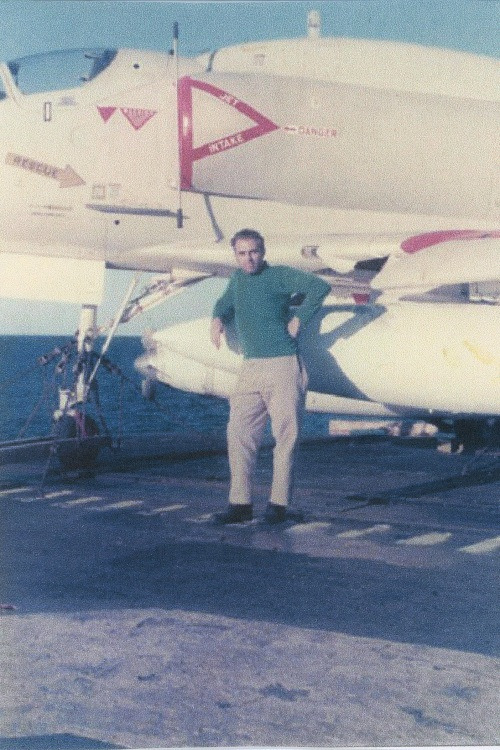
My Dad, Chief Petty Officer Carl Dundas aboard the USS Hancock in 1972

I come from a Navy family and was born in in a Navy hospital. Growing up in a Navy family in the 1960s and 1970s was a big adventure for me that never got old. I still remember looking forward to each new duty assignment with only the wonder that a child can have and to each new adventure that the next move would bring. We lived up and down the West Coast, Oakland, San Diego, Long Beach, Oak Harbor Washington, and finally Stockton California. My earliest memories of life come from our tour at Cubi Point Naval Air Station in Philippines, the sharply dressed Marine gate guards, the Navy officers in their resplendent white uniforms, the jungle that came up to our back yard, and the wild boars that would show up and tear up our garden, trees and lawn. I remember the Blue Angles flying directly over our house in Oak Harbor, those huge F4F Phantom jets roaring over me so low that every detail could be seen. I remember going on my dad’s last ship, the aircraft carrier USS Hancock and being amazed at how big and impressive everything on it was, the sights, sounds, and smells of the ship evoked a wonder that to this day I feel whenever I set foot about a ship. Of course compared to our modern carriers Hancock was old, and small but she was my dad’s ship and I was proud of him.

My dad retired from the Navy in 1974 as a Chief Petty Officer. While he was assigned to the Hancock was sent to manage aviation supplies at an emergency airstrip which was in the South Vietnamese city of An Loc when it was surrounded by the North Vietnamese for 80 days in 1972.  He didn’t talk about it much when he came back; in fact he came back different from the war.  He probably suffered from PTSD.  All the markers were there but we had no idea about it back then, after all he was in the Navy not the Army.  I had friends whose dad’s did not return from Vietnam and saw how Vietnam veterans were treated by the country as a whole including some members of the Greatest Generation.  They were not welcomed home and were treated often with scorn, even by veterans who had fought in the “real wars” of World War II and Korea.  Instead of being depicted an Americans doing their best in a war that few supported they were demonized in the media and in the entertainment industry for many years afterwards.

My dad never made a big deal out of his service but he inspired me to pursue a career in the military by being a man of honor and integrity.

Growing up then, we had a Navy family that surrounded us then remained part of my family’s life long after. My mom and dad remained in contact with friends that they served with or were stationed with, and now many of them are elderly and a good number have passed away.  Even so my mom, now a widow stays in regular contact with a number of her Navy wife “sisters.” There are not many of them left anymore, but mom tries to stay in touch with them. It was the early Navy family experience that shaped much of how I see the world and is a big reason as to why I place such great value on the contributions of veterans to our country and to me.

But there was another part of growing up in a military family in the 1960s, and that was the Vietnam War. I knew kids whose dads never came home from that war, and of course every night the evening news broadcast a “body count” segment which looked like a scoreboard showing how many Americans, South Vietnamese, Viet Cong and North Vietnamese were killed, wounded or captured; but to me, at a very young age, those numbers on that “scoreboard” were flesh and blood human beings. This was my first experience of war.

breedlove-ness2

LCDR Breedlove and Senior Chief Ness

My second view of war came from the veterans of Vietnam who were my teachers in Navy Junior ROTC and the men that I served with in the National Guard and the Army.  Some of these men served as teachers and mentors.  LCDR Jim Breedlove and Senior Chief John Ness at the Edison High School Naval Junior ROTC program were the first who helped me along.  Both have passed away but I will never forget them.  Commander Breedlove was someone that I would see every time that I went home as an adult. His sudden death the week before I returned from Iraq shook me.  I have a post dedicated to them at this link.  (In Memorium: Chief John Ness and LCDR Jim Breedlove USN)

When I joined the California Army National Guard in 1981 Colonel Edgar Morrison was my first battalion commander.  He was the most highly decorated member of the California National Guard at that time and had served multiple tours in Vietnam.  He encouraged me as a young specialist and officer cadet and showed a tremendous amount of care for his soldiers.  Staff Sergeants Buff Rambo and Mickey Yarro taught me the ropes as a forward observer and shared many of their Vietnam experiences as we sat on lonely hillsides at Camp Roberts California calling in artillery fire on so many weekends and during annual training. Buff had been a Marine dog handler on the DMZ, and Mickey a Forward Observer and they were fascinating men, with so many stories and such great experience which they imparted to me.

The Senior NCOs that trained me while in the Army ROTC program at UCLA and Fort Lewis had a big impact. All were combat veterans that had served in Vietnam.  Sergeant First Class Harry Zilkan was my training NCO at the UCLA Army ROTC program.  He was a Special Forces medic with 7th Group in Vietnam.  In Vietnam he was wounded three times, and was awarded two Silver Star Medals. He still had part of a VC bayonet embedded in his foot at UCLA, a reminder of his time serving in Southeast Asia.  He received my first salute as a newly commissioned Second Lieutenant as well as a Silver Dollar.  I understand that after the Army he became a fire fighter.  He had a massive heart attack on the scene of a fire and died a few years later from it.  Sergeant Major John Butler was our senior enlisted adviser at UCLA, he served as a paratrooper and infantryman with the 173rd Airborne brigade in Vietnam.

Another fascinating character was Sergeant First Class Harry Ball was my drill sergeant at the ROTC pre-commissioning camp at Fort Lewis Washington in 1982. I kid you not, that was really his name, but this was probably one of the most important experiences of my life, which was incredibly difficult but most necessary. Sergeant First Class Ball was a veteran of the Special Forces and Rangers and served multiple tours in Vietnam and when he walked across the drill field his Smokey Bear hat reminded me of a shark fin cutting across the water, the man was scary as shit, but he had a heart of gold. Though he only had me for a summer he was quite influential in my life, tearing me apart and then building me back up.  He was my version of Drill Sergeant Foley in the classic movie An Officer and a Gentleman. Like Zack Mayo played by Richard Gere at the end of that movie I can only say: Drill Sergeant “I will never forget you.” Every time I see that movie

As I progressed through my Army career I encountered others of this generation who also impacted my life. First among them was First Sergeant Jim Koenig who had been a Ranger in the Mekong Delta.  I was the First Sergeant that I would measure all others by.  Once during an ARTEP we were aggressed and all of a sudden he was back in the Delta. This man cared so much for his young soldiers in the 557th Medical Company.   He did so much for them and I’m sure that those who served with him can attest to this as well as me. Jim had a brick on his desk so that when he got pissed he could chew on it.  He retired after he was selected to be a Command Sergeant Major because he valued his wife and family more than the promotion.  It hurt him to do this, but he put his family first.

2nd platoon

1985 with 2nd Platoon of 557th Medical Company (Ambulance) in Germany

Colonel Donald Johnson was the commander of the 68th Medical Group when I got to Germany in January 1984.  Colonel “J” as well all called him was one of the best leaders I have seen or served under in 34 years in the military.  He knew everything about everything and his knowledge forced us all to learn and be better officers and NCOs.  On an inspection visit you could always find him dressed in coveralls and underneath a truck verifying the maintenance done on it.  He served a number of Vietnam tours.  He died of Multiple Myeloma and is buried at Arlington.

Chaplain (LTC) Rich Whaley who had served as a company commander in Vietnam on more than one occasion saved my young ass at the Army Chaplain School.  No really he saved my career at least twice, and kept me out of big trouble on both occasions. Personally I don’t know too many senior chaplains who would put themselves on the line for a junior chaplain the way that Rich did for me. He remains a friend and is the Endorsing Agent for the Church of Jesus Christ of Latter Day Saints. As a Mormon he is one of the most “Christian” men that I have ever met.  I know some Christians who might have a hard time with that, but Rich demonstrated every trait of a Christian who loved God and his neighbor.

When I was the Installation Chaplain at Fort Indiantown Gap PA I was blessed to have some great veterans in my Chapel Parish.  Major General Frank Smoker flew 25 missions as a B-17 pilot over Germany during the height of the air war in Europe. He brought his wonderful wife Kate back from England with him and long after his active service was over he remained a vital part of the military community until his death in 2010.  Sergeant Henry Boyd was one of the 101st Airborne soldiers epitomized in Band of Brothers. He had a piece of shrapnel lodged next to his heart from the Battle of the Bulge until the day he died and was honored to conduct his funeral while stationed at Indiantown Gap. Colonel Walt Swank also served in Normandy.  Major Scotty Jenkes was an Air Force pilot in Vietnam flying close air support while Colonel Ray Hawthorne served several tours both in artillery units and as an adviser in 1972 and was with General Smoker a wonderful help to me as I applied to enter the Navy while CWO4 Charlie Kosko flew helicopters in Vietnam.  All these men made a deep impact on me and several contributed to my career in very tangible ways. Another man who I knew at Indiantown Gap was Sergeant Billy Ward who just passed away last week of a major heart attack. Billy was a bear of a man, but one of the kindest and gentlest men who I have ever known. Billy never knew a stranger and loved people no matter what their station in life, no matter what their beliefs, no matter what their lifestyle. I can honestly say that Billy didn’t have an enemy and though he was a lay preacher and was later ordained to the ministry, he just loved people and never judged anyone. He exemplified what it is to be a Christian. 
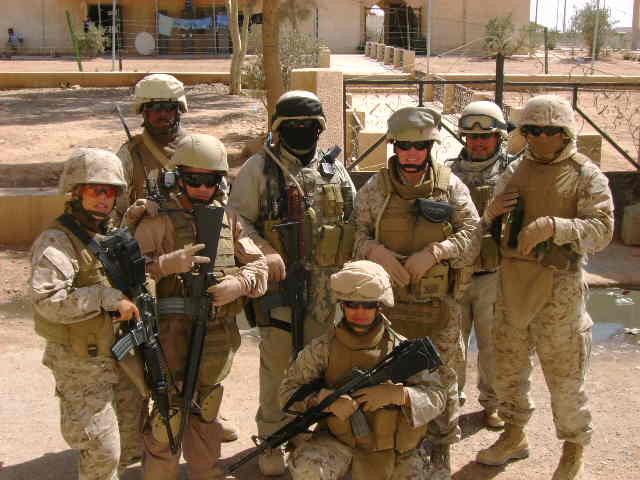
Al Waleed Iraq 2007

In 1999 I resigned my commission as an Army reserve Major to enter active duty in the Navy, with a reduction in rank. Since joining the Navy my life has continued to be impacted and influenced by other veterans. A good amount of my Navy career has been spent serving with Marine Corps. I served with some great Marines and Sailors in those units, including Lieutenant Colonel T D Anderson, and then Major, but now Brigadier General Dave Ottignon of the 2nd Combat Engineer Battalion, Lieutenant Colonel Desroches of 1st Battalion 8th Marines, Colonel Lou Rachal of 3rd Battalion 8th Marines, and Colonel, now Major General Richard Lake of Headquarters Battalion 2nd Marine Division. My friends at Marine Security Forces Colonel Mike Paulovich and Sergeant Major Kim Davis mean more than almost any people in the world.  We traveled the globe together visiting our Marines.  Both of these men are heroes to me as well as friends, Colonel Paulovich was able to administer the oath of office to me when I was promoted to Commander.

I was blessed to become friends with many of the Marine Corps veterans of the Battle of Hue City including General Peter Pace, Barney Barnes, Tony “Limey” Cartilage, Sergeant Major Thomas. They and so many others have become close over the years, especially after I did my time in Iraq. They and all the Vietnam vets, including the guys from the Vietnam Veterans of America like Ray and John who manned the beer stand behind the plate at Harbor Park all mean a lot to me.

hue city boarding team

Boarding Team of USS Hue City 2002

Finally there are my friends and brothers that I have served with at sea on USS HUE CITY during Operation Enduring Freedom and the advisers on the ground in Al Anbar mean more than anything to me. Perhaps the most important is my bodyguard, RP1 Nelson Lebron, who helped keep me safe and accompanied me all over the battlefield.  Nelson who has done Iraq three times, Afghanistan, Lebanon and the Balkans is a hero.  Two others who matter a great deal to me from Iraq were Army Colonel David Abramowitz, Navy Captain (Chaplain) Mike Langston, and Father Jose Bautista-Rojas, a Navy Chaplain and Roman Catholic priest. Then there are the men and women of Navy EOD who I served with from 2006-2008 have paid dearly in combating IEDs and other explosive devices used against us in Iraq and Afghanistan are heroes too.  There is no routine mission for EOD technicians.  Then there are the friends that I serve with in Navy Medicine, medical professionals who care for our Sailors, Marines, Soldiers and Airmen, family members and veterans at home and in the thick of the fighting in Afghanistan.

There are many from my time in Navy Medicine who have meant so much to me. Chaplain Jeff Seiler, an Episcopal Priest at Naval Medical Center Portsmouth and Father Fred Elkin, a retired Navy Chaplain who served there helped keep me together during the darkest time of my life after Iraq, as did many of the physicians and nurses that I worked with there, and many of them were not Christians, but they helped and cared for me. That continued at Naval Hospital Camp LeJeune, where I served as Director of Pastoral Care. At Lejeune I was fortunate to serve with Duke Quarles, a civilian pastoral counselor and retired Navy Chaplain. Duke was a rock for me there, as was Command Master Chief Ed Marino, one of the most spiritual and kind people that I know.

I now serve in a wonderful place, the Joint Forces Staff College. I am surrounded by great people here, from all the services of our armed forces, active duty and retired. I get to do wonderful things, and despite having gone through absolute hell dealing with the military mental health system this year, these folks have stood by me, especially Commander Lisa Rose, our former staff nurse who retired last year. Lisa is a highly skilled nurse and a courageous woman. For eighteen years of her career she served always wondering if someone was going to try to persecute, prosecute or try to run her out the Navy because she is a lesbian. For years she could not take her spouse to official functions, she could not even take a chance on being seen in public by someone with her spouse, even under “don’t ask don’t tell.” She was finally able to do that, but truthfully I cannot imagine what it would be like to want to serve your country, your shipmates and your God, while always knowing that anyone could end that simply because they didn’t approve of who you loved. I am glad that Lisa and my other gay and lesbian friends in the military are now able to openly serve.
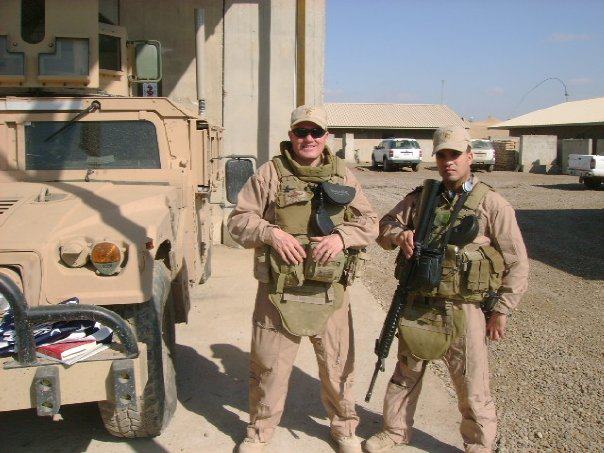
me and nelson

Me with RP1 Nelson Lebron just prior to leaving Iraq

There are others who I have served alongside who have died while in the service of the country, or after their service had ended. Some, like Staff Sergeant Ergin Osman, who I served with at 3rd Battalion 8th Marines, were killed in Afghanistan, others like Commander Marsha Hanley, a nurse I served with in the ICU at Portsmouth, who was one of the people who helped hold me together when I was so fragile; she died of complications of chemotherapy treatment at far too young age. Damage Control Specialist 2nd Class Ray Krolikowski, who I served with aboard USS Hue City died just over a year ago, eleven years after suffering an injury that left him a quadriplegic in 2003. Then there those who died by their own hand, having never recovered from war. Captain Tom Sitsch who was my last Commodore at EOD Group Two, and Father Dennis Rocheford committed suicide after being tormented by the demons of PTSD and TBI. Both men were real heroes. I could mention so many more, but will end there because I am getting a bit emotional.

There is a closing thought from the television mini-series Band of Brothers which kind of sums up how I feel. The American troops who have fought so long and hard are watching a German general address his troops after the German surrender. An American soldier of German-Jewish descent translates for his comrades the words spoken by the German commander, and it as if the German is speaking for each of them as well.

Men, it’s been a long war, it’s been a tough war. You’ve fought bravely, proudly for your country. You’re a special group. You’ve found in one another a bond that exists only in combat, among brothers. You’ve shared foxholes, held each other in dire moments. You’ve seen death and suffered together. I’m proud to have served with each and every one of you. You all deserve long and happy lives in peace.

So for me Veteran’s Day is intensely personal because of the veterans, living and dead, who made an impact on my life. I have a bond, a special bond with so many of my brothers and sisters who volunteer to serve. Today we number less than one percent of the nation, a tiny number of people in comparison to the size of our nation and the commitments that our leaders have engaged us.
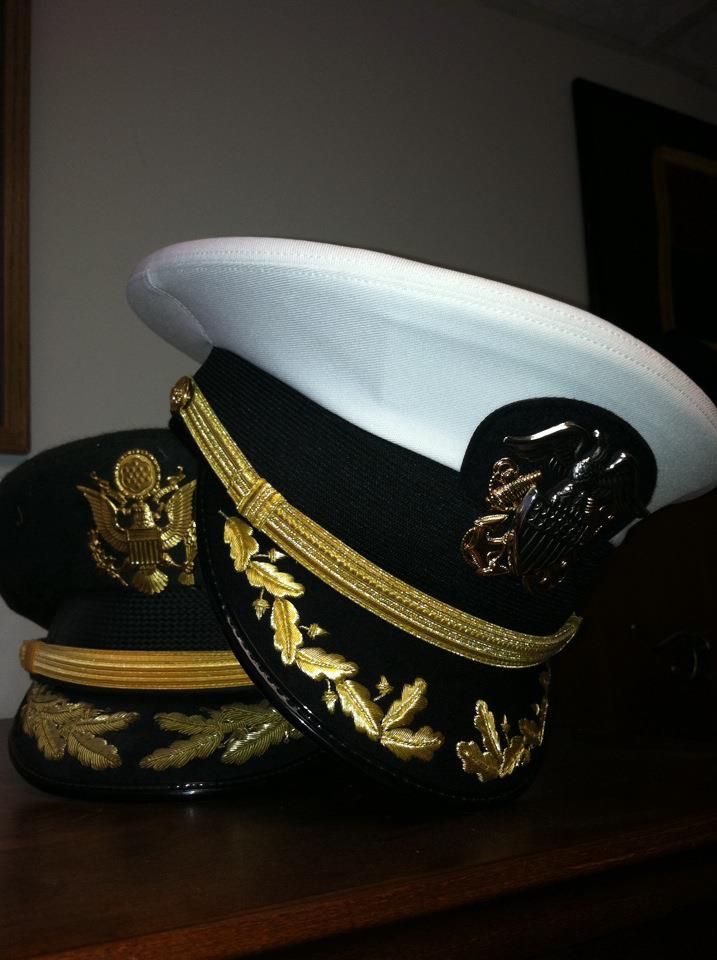
hats

The military is a young persons game, and I am now older than almost everyone on active duty. I have been in the military longer than almost everyone that I know, including many people senior in rank to me. I am a dinosaur, and sometimes a cranky one at that when it comes to dealing with the bureaucracy of the military, but my long strange trip continues. That being said, though I served over half of my career in the Army, at heart I have always been a navy man. I think that President John F. Kennedy expressed how I feel about serving the best. He said, “I can imagine no more rewarding a career. And any man who may be asked in this century what he did to make his life worthwhile, I think can respond with a good deal of pride and satisfaction: ‘I served in the United States Navy.’”

So today I give thanks for all them men that I mention in this post, especially my dad. For the countless others that are not mentioned by name please know that I thank God for all of you too. Someone once said “A ‘Special Day’ once a year creates an excuse for neglect on the other 365 days for mothers, fathers & veterans” Please do not let that continue to happen, please do not just look at this as time off, or if you are a corporation or retailer use this day to boost your sales by acting like you care.

I do hope that people will remember the Veterans that impacted their lives this and every day. Some may have been the men and women that we served with, perhaps a parent, sibling or other relative, maybe a childhood friend, a teacher, coach or neighbor. As we pause for a moment this Friday let us honor those who gave their lives in the defense of liberty in all of the wars of our nation. They have earned it and please thank any veteran that you know in some small way today.

Peace

Padre Steve+

4 Comments

Filed under iraq,afghanistan, Military, remembering friends, Tour in Iraq, US Navy, vietnam

Happy 240th Birthday Marines!

usmcflags

Friends of Padre Steve’s World,

Today is one of these days where I just want to wish people well. Those men and women are those of the United States Marine Corps, with whom I have spent almost ten years of my thirty-three year military career assigned to or in support of as a chaplain. Today is the 240th anniversary of the establishment of the Marine Corps and its founding at Tun Tavern, in Philadelphia. Tonight I wish all those who have served past, present and future, especially those who I have served alongside a happy birthday. Today I will have the privilege of celebrating the 240th Birthday of the Marine Corps here at the Joint Forces Staff College.

On November 10th 1775 the Continental Congress passed a resolution that stated:

Resolved, that two Battalions of Marines be raised consisting of one Colonel, two Lieutenant Colonels, two Majors & Officers as usual in other regiments, that they consist of an equal number of privates with other battalions; that particular care be taken that no persons be appointed to office or enlisted into said Battalions, but such as are good seamen, or so acquainted with maritime affairs as to be able to serve to advantage by sea, when required. That they be enlisted and commissioned for and during the present war with Great Britain and the colonies, unless dismissed by Congress. That they be distinguished by the names of the first & second battalions of American Marines, and that they be considered a part of the number, which the continental Army before Boston is ordered to consist of.

Today is the 239th birthday of the United States Marine Corps. The history of the Marine Corps is one of the most fascinating of any armed service in the world. Starting out as a tiny force attached to Navy ships and shipyards the Corps has gained prominence as one of the premier fighting forces ever assembled. Flexible and deployable anywhere in the world on short notice the Marine Corps has seen action in “every place and clime” and continues to serve around the world.

In 1775 a committee of the Continental Congress met at Philadelphia’s Tun Tavern to draft a resolution calling for two battalions of Marines able to fight for independence at sea and on shore.  The resolution was approved on November 10, 1775, officially forming the Continental Marines. The first order of business was to appoint Samuel Nicholas as the Commandant of the newly formed Marines.

Robert Mullan the owner and proprietor of the said Tun Tavern became Nicholson’s first captain and recruiter. They began gathering support and were ready for action by early 1776.  They served throughout the War for Independence and like the Navy they were disbanded in April 1783 and reconstituted as the Marine Corps in 1798.

The Marines served on the ships of the Navy in the Quasi-war with France, against the Barbary Pirates where a small group of 8 Marines and 500 Arabs under Lieutenant Presley O’Bannon made a march of 500 miles across the Libyan Desert to lay siege Tripoli but only reached Derna. The action is immortalized in the Marine Hymn as well as the design of the Marine Officer’s “Mameluke” Sword. They served in the War of 1812, the Seminole Wars and in the Mexican-American War where in the storming of the on Chapultepec Palace they continued to build and enduring legacy. In the months leading up to the Civil War they played a key role at home and abroad.  In October 1859 Colonel Robert E. Lee led Marines from the Marine Barracks Washington DC to capture John Brown and his followers who had captured the Federal Armory at Harper’s Ferry.

The Corps would serve through the Civil War and on into the age of American Expansion serving in the Spanish American War in the Philippines, Puerto Rico and Cuba where they seized Guantanamo Bay at the battle of Cuzco Wells.  The would serve in China and be a key component of the international force that defended foreign diplomats during the Boxer Revolt as well as the international force that would relieve the diplomatic compound in Peking (Beijing).  In World War One the Marines stopped the German advance at Chateau Thierry and cemented their reputation as an elite fighting force at Belleau Wood where legend has it that the Germans nicknamed them Teufelhunden or Devil Dogs, a name that they Marines have appropriated with great aplomb.

During the inter-war years the Marines were quite active in the Caribbean and Asia and also developed amphibious tactics and doctrine that would be put to use in the Pacific Campaign.  During the war the Marines served in all theaters but won enduring fame at Wake Island, Guadalcanal, Tarawa, Iwo Jima, Okinawa and numerous other battles in the Pacific war. Marine Aviators flew in some the most desperate actions in the war to support the Navy and amphibious operations ashore.

After the war the Truman Administration sought to eliminate the Marine Corps but the Corps was saved by the efforts of Americans across the country and Marine supporters in Congress.  That was a good thing because the Marines were instrumental in keeping the North Koreans from overrunning the South during the Korean War on the Pusan Perimeter, turned the tide at Inchon and helped decimate Communist Chinese forces at the Chosin Reservoir.  After Korea the Marines would serve around the World in the Caribbean and Lebanon and in Vietnam where at Da Nang Keh Sanh, Hue City, Con Thien fighting the North Vietnamese and their Viet Cong allies.  The Marines took the initiative to implement innovative counter insurgency measures such as the Combined Action Platoons which enjoyed tremendous success until they were shut down by the Army high command.  These lessons would serve the Marines well in the new millennium during the Anbar Awakening in Iraq which changed the course of that insurgency and war.

The Marines would again be involved around the World after Vietnam serving in the Cold War, in Lebanon and the First Gulf War which was followed by actions in Somalia, the Balkans and Haiti. After the attacks of September 11th 2001 the Marines were among the first into Afghanistan helping to drive the Taliban from power. In the Iraq Campaign the Marines had a leading role both in the invasion and in the campaign in Al Anbar Province.  After the Marines were withdrawn from Iraq, they became a central player in Afghanistan where until last month they were engaged around Khandahar and in Helmand Province. Today, Marines are deployed in support of many operation around the world and as one of the elite military organizations in the world continue to “fight our country’s battles on the air and land and sea.” The Corps under General John LeJeune institutionalized the celebration of the Marine Corps Birthday and their establishment at Tun Tavern. General LeJeune issued this order which is still read at every Marine Corps Birthday Ball or observance:

MARINE CORPS ORDER No. 47 (Series 1921)
HEADQUARTERS
U.S. MARINE CORPS Washington, November 1, 1921

The following will be read to the command on the 10th of November, 1921, and hereafter on the 10th of November of every year. Should the order not be received by the 10th of November, 1921, it will be read upon receipt.

On November 10, 1775, a Corps of Marines was created by a resolution of Continental Congress. Since that date many thousand men have borne the name “Marine”. In memory of them it is fitting that we who are Marines should commemorate the birthday of our corps by calling to mind the glories of its long and illustrious history.

The record of our corps is one which will bear comparison with that of the most famous military organizations in the world’s history. During 90 of the 146 years of its existence the Marine Corps has been in action against the Nation’s foes. From the Battle of Trenton to the Argonne, Marines have won foremost honors in war, and in the long eras of tranquility at home, generation after generation of Marines have grown gray in war in both hemispheres and in every corner of the seven seas, that our country and its citizens might enjoy peace and security.

In every battle and skirmish since the birth of our corps, Marines have acquitted themselves with the greatest distinction, winning new honors on each occasion until the term “Marine” has come to signify all that is highest in military efficiency and soldierly virtue.

This high name of distinction and soldierly repute we who are Marines today have received from those who preceded us in the corps. With it we have also received from them the eternal spirit which has animated our corps from generation to generation and has been the distinguishing mark of the Marines in every age. So long as that spirit continues to flourish Marines will be found equal to every emergency in the future as they have been in the past, and the men of our Nation will regard us as worthy successors to the long line of illustrious men who have served as “Soldiers of the Sea” since the founding of the Corps.

JOHN A. LEJEUNE,
Major General
Commandant

Leave a comment

Filed under History, Military

They Thanked Us Kindly: Reflections on Veteran’s Day 2015

481801_10151367001287059_1003164983_n1

Friends of Padre Steve’s World,

As a career military officer and veteran of the Iraq campaign as well as Operation Enduring Freedom I get very reflective around Veteran’s Day. For me it is a melancholy time. I remember those who have gone to war, those who did not come home, and those who came home, especially those who came home wounded in body, mind, or spirit; those who were forever changed by their experience of war.

One of my heroes is T.E. Lawrence, the immortal Lawrence of Arabia. After World War One ended and the politicians, diplomats, and business leaders betrayed those who served, as well as the people of many nations with a terrible peace, Lawrence wrote, “We were fond together because of the sweep of open places, the taste of wide winds, the sunlight, and the hopes in which we worked. The morning freshness of the world-to-be intoxicated us. We were wrought up with ideas inexpressible and vaporous, but to be fought for. We lived many lives in those whirling campaigns, never sparing ourselves: yet when we achieved and the new world dawned, the old men came out again and took our victory to remake in the likeness of the former world they knew. Youth could win, but had not learned to keep, and was pitiably weak against age. We stammered that we had worked for a new heaven and a new earth, and they thanked us kindly and made their peace.”

One hundred and one years ago, in November 1914, millions of soldiers were fighting in horrible conditions throughout Europe. From the English Channel to Serbia, Poland and Galicia; French, British, German, Austro-Hungarian, Serbian and Russian troops engaged each other in bloody and often pointless battles. Often commanded by old men who did not understand how the character of war had changed, millions were killed, wounded, maimed or died of disease.

After four years, with the Empires that were at the heart of the war’s outbreak collapsing one after the other there was an armistice. On the eleventh hour, of the eleventh day, of the eleventh month the shooting stopped and the front lines quieted. By then over 20 million people, soldiers and civilians alike had died. Millions more had been wounded, captured, seen their homes and lands devastated or been driven from there ancestral homelands, never to return.

The human cost of that war was horrific. Over 65 million soldiers were called up on all sides of the conflict, of which nearly 37.5 million became casualties, some 57.5% of all soldiers involved. Some countries saw the flower of their manhood, a generation decimated. Russia sustained over 9 million casualties of the 12 million men they committed to the war, a casualty rate of over 76%. The other Allied powers suffered as well.  France lost 6.4 million of 8.5 million, or 73%, Great Britain 3.1 million of nearly 9 million, 35%; Italy 2.2 million of 5.6 million, 39%. Their opponents, Germany, Austria-Hungary and the Ottoman Empire suffered greatly. Germany sustained 7.1 million casualties of 11 million men called up, or nearly 65%, Austria 7 million of 7.8 million, 90% and the Ottoman Empire 975,000 of 2.8 million or 34% of the soldiers that they sent to war.

It was supposed to be the War to end all War…but it wasn’t, it was the mother of countless wars.

It has been a century since that bleak November of 1914, and ninety-six years since the time where for a brief moment, people around the world, but especially in Europe dared to hope for a lasting and just peace. But that would not be the case…

The victors imposed humiliating peace terms on the vanquished, be it the Germans on the Russians, or the Allies on Germany and her partners. The victors divided up nations, drew up borders without regard to historic, ethnic, tribal or religious sensibilities. But then, it was about the victors imposing themselves and their quest for domination, expanding colonial empires and controlling natural resources rather than seeking a just and lasting peace. The current war against the Islamic State is one of the wars spawned by the Sykes-Picot agreement which divided the Middle East between the French and the British at the end of the war. It was a war that keeps on giving.

Of course we have known the disastrous results of their hubris, a hubris still carried on by those who love and profit by war…war without end which continues seemingly with no end in sight.

I am a veteran of Iraq and Operation Enduring Freedom, as well as the Bosnia mission and the Cold War. My dad was a Vietnam veteran who enlisted during the Korean War. I serve because it is the right thing to do, not because I find war romantic or desirable. It is as General William Tecumseh Sherman said “Hell.” If called to go back to Iraq, where I left so much of my soul, I would go in a heartbeat.

This week as we do every year we will pay our homage to honor our veterans, especially in the United States, Great Britain, Canada and France. But sometimes it seems so hollow, for in all of our countries those that serve are a tiny minority of those eligible to serve, who are much of the time ignored or even scorned by those that feel that providing for them after they have served is too much of a burden on the wealthy who make their profits on the backs of these soldiers, sailors, marines and airmen.

I have walked about since returning from Iraq often in a fog, trying to comprehend how a country can be at war for so long, and there is such a gap between the few who serve and the vast majority for whom war is an abstract concept happening to someone else, in places far away, and whose experience of war is its glorification in video games. Personally I find that obscene, and feel that I live in a foreign world. Erich Maria Remarque wrote in All Quiet on the Western Front: 

“I imagined leave would be different from this. Indeed, it was different a year ago. It is I of course that have changed in the interval. There lies a gulf between that time and today. At that time I still knew nothing about the war, we had been only in quiet sectors. But now I see that I have been crushed without knowing it. I find I do not belong here any more, it is a foreign world.”

Similarly Guy Sajer wrote in his classic The Forgotten Soldier: 

“In the train, rolling through the sunny French countryside, my head knocked against the wooden back of the seat. Other people, who seemed to belong to a different world, were laughing. I couldn’t laugh and couldn’t forget.”

Major General Gouverneur Warren wrote to his wife two years after the American Civil War:

“I wish I did not dream that much. They make me sometimes dread to go to sleep. Scenes from the war, are so constantly recalled, with bitter feelings I wish to never experience again. Lies, vanity, treachery, and carnage.”

Sometimes I find it obscene that retailers and other corporations have turned this solemnity into another opportunity to profit. But then why should I expect different? Such profiteers have been around from the beginning of time, but then maybe I still am foolish enough to hope for something different. Please don’t get me wrong, I do appreciate the fact that some businesses attempt in at least some small way to thank veterans. I also know there are many businesses and business owners who do more than offer up tokens once a year, by putting their money where their mouth is to support returning veterans with decent jobs and career opportunities; but for too many others the day is just another day to increase profits while appearing to “support the troops.”

As Marine Corps legend and two-time Medal of Honor winner Major General Smedley Butler Wrote:

“What is the cost of war? what is the bill? “This bill renders a horrible accounting. Newly placed gravestones. Mangled bodies. Shattered minds. Broken hearts and homes. Economic instability. Depression and all of its attendant miseries. Back -breaking taxation for generations and generations. For a great many years as a soldier I had a suspicion that war was a racket; not only until I retired to civilian life did I fully realize it….”

But the marketers of war do not mind, almost Orwellian language is used to lessen its barbarity. Dave Grossman wrote in his book On Killing:

“Even the language of men at war is the full denial of the enormity of what they have done. Most solders do not “kill,” instead the enemy was knocked over, wasted, greased, taken out, and mopped up. The enemy is hosed, zapped, probed, and fired on. The enemy’s humanity is denied, and he becomes a strange beast called a Jap, Reb, Yank, dink, slant, or slope. Even the weapons of war receive benign names- Puff the Magic Dragon, Walleye, TOW, Fat Boy, Thin Man- and the killing weapon of the individual soldier becomes a piece or a hog, and a bullet becomes a round.”

There is even a cottage industry of war buffs, some of who are veterans seeking some kind of camaraderie after their service, but most of whom have little or know skin in the real game, and at no inconvenience to themselves. As far as the veterans I understand, but as for the others I can fully understand the words of Guy Sajer, who wrote:

“Too many people learn about war with no inconvenience to themselves. They read about Verdun or Stalingrad without comprehension, sitting in a comfortable armchair, with their feet beside the fire, preparing to go about their business the next day, as usual…One should read about war standing up, late at night, when one is tired, as I am writing about it now, at dawn, while my asthma attack wears off. And even now, in my sleepless exhaustion, how gentle and easy peace seems!”

It was to be the War to end all war” but I would venture that it was the war that birthed countless wars, worse tyrannies and genocides; That war, which we mark the end of today, is in a very real and tragic sense, the mother of the wars that have followed. Today, war threatens in so many places; the Middle East, Ukraine, Asia, and Africa. Terrorism has apparently returned with a vengeance. War without end, amen.

As so to my friends, my comrades and all that served I honor you, especially those that I served alongside. We are a band of brothers; no matter what the war profiteers do, no matter how minuscule our number as compared to those who do not know what we do, and those who never will.  We share a timeless bond and no one can take that away.

I close with the words of a German General from the television mini-series Band of Brothers which kind of sums up how I feel today. The American troops who have fought so long and hard are watching the general address his troops after their surrender. An American soldier of German-Jewish descent translates for his comrades the words spoken by the German commander, and it as if the German is speaking for each of them as well.

Men, it’s been a long war, it’s been a tough war. You’ve fought bravely, proudly for your country. You’re a special group. You’ve found in one another a bond that exists only in combat, among brothers. You’ve shared foxholes, held each other in dire moments. You’ve seen death and suffered together. I’m proud to have served with each and every one of you. You all deserve long and happy lives in peace.

In hopes of peace,

Padre Steve+

5 Comments

Filed under History, iraq,afghanistan, Military, Political Commentary, shipmates and veterans, Tour in Iraq, War on Terrorism

History is the Witness: The Worth of Human Life

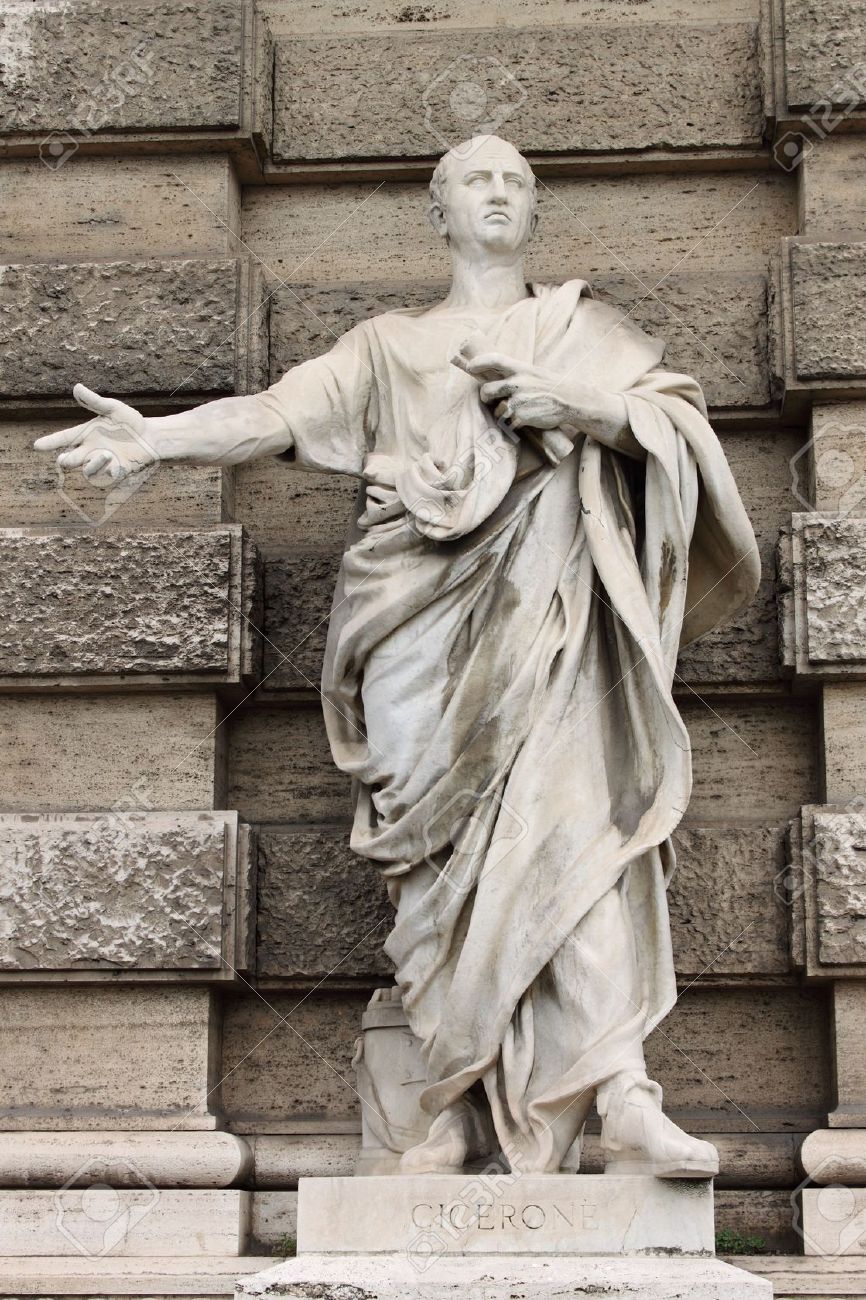
Statue-of-Cicero-Stock-Photo-rome

Friends of Padre Steve’s World,

The great Roman philosopher and political theorist Marcus Tullius Cicero wrote, “History is the witness that testifies to the passing of time; it illumines reality, vitalizes memory, provides guidance in daily life and brings us tidings of antiquities.”

Those who follow my writings here on this site know that I am a historian and that much of what I write, even regarding current events, is framed by history and the stories of those who came before us. That is one of my driving passions, a passion for historical truth, and a passion to ensure that the past is not forgotten. Sadly, it seems that our society, and even our education system is disconnecting itself from history. We have pretty much stopped teaching history in schools, and often what is taught is myth. As such we have become a society that through its ignorance of the past is ever repeating the worst aspects of our history. As a whole we are ignorant of our past, and that ignorance is demonstrated by many of our political, business, journalism, educational, and military leaders on a daily basis.

Cicero wrote “To be ignorant of what occurred before you were born is to remain always a child. For what is the worth of human life, unless it is woven into the life of our ancestors by the records of history?”

Our lives must be woven together with those who came before us, without that sacred connection to the past, we endanger the future, and doom those who follow us. Cicero wrote,The life of the dead is placed in the memory of the living.” Thus, it is for us the living to remember and never forget those who have gone before.

That is why I write.

Peace

Padre Steve+

4 Comments

Filed under History, philosophy, Political Commentary

Freedom or Security? The Precarious Balance

sloaninquarters

Friends of Padre Steve’s World,

The Roman philosopher and political theorist Cicero wrote words that are chilling, and over 2000 years after he wrote them, still troubling, “Inter Arma Enim Silent Leges,” in time of war the law stands silent…

Yesterday I wrote a piece that dealt with the moral and ethical costs of fighting a war against the self-proclaimed Islamic State using the lens of the Star Trek Deep Space Nine episode In the Pale Moonlight. I found it troubling and even had some nightmares involving this war, as a result I did not sleep well last night. So today I am going to continue the discussion, with a slightly different emphasis, again using a Deep Space Nine episode, this one called Inter Arma Enim Silent Leges which deals with a Federation security service trying to co-opt the Chief Medical Officer of Deep Space Nine to spy for them.

James Madison wrote that “A popular government, without popular information, or the means of acquiring it, is but a prologue to a farce or a tragedy; or, perhaps both.”

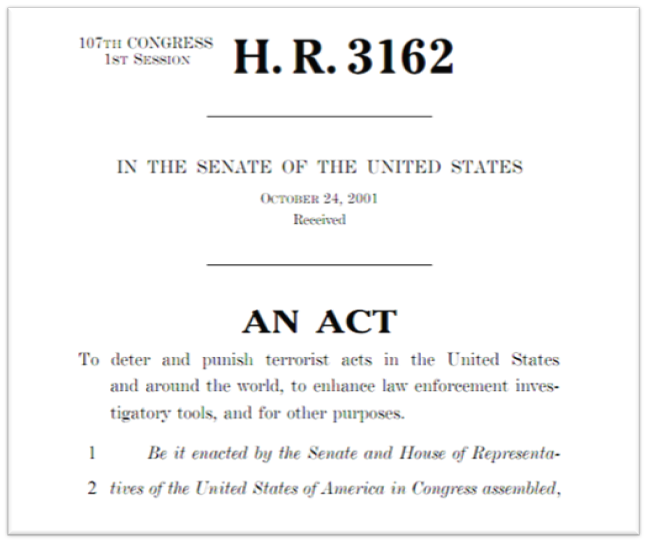
After September 11th 2001 the National Security State went into overdrive with the passage of the so called Patriot Act. That act opened the floodgates for an ever expanding national security state. With the growing likelihood that a Russian airline was destroyed by a terrorist bomb over the Sinai Peninsula, the probability is that more and more civil liberties will disappear in the name of national security. The fact is that we as a society need to wrestle with the questions of maintaining an open and free society in the midst of a world that is growing ever more dangerous. If we are to maintain an open and free society we must have this discussion, and we cannot allow ourselves to be duped into surrendering the very rights and civil liberties that we hold dear, in the name of security against threats real, and imagined. The fact that the threat to civil liberties is growing, and has been for the last decade and a half under both Republican and Democratic administrations, and Congresses controlled at one time or another by the Republican and the Democratic Parties.

Patriot-Act-HR-3162

I have a lot of apprehension when I read the reports about the activities of the National Security Agency, other intelligence and police agencies at all levels of government and the pervasive erosion of civil rights.  The national security state and the seeming all pervasive security and surveillance apparatus which demolishes any sense of privacy, especially the protections enunciated in the Fourth Amendment and to some extent the First Amendment. Of course the use of similar methods by the private sector, often in conduction with government agencies is another concern, but that needs to wait for another day.

I also understand from history and empirical evidence that many others, many from unfriendly countries do not share those apprehensions. Many of these competitors are willing to use whatever openness that we have as a society against us, using similar technology and methods used by our intelligence, police, governmental and private sector. It makes for an ethical, legal and even constitutional conundrum. I know that I am not comfortable with this, and perhaps maybe none of us should be.

It is very easy on one hand in light of history, our Constitution and democratic process to condemn the NSA, the FISA courts and other lawfully constituted agencies and those that drafted the laws over the decades that allow the activities which they now conduct. The same can be said of foreign intelligence agencies which all engage in similar activities including the British GCHQ, the German Bundesnachrichtendienst and so many others including the Chinese and Russians.

Likewise it is equally easy in light of history, current events and national security concerns for people to jump to the other side of the fence and not only defend the activities of the NSA and agencies like it, and to demonize those that protest or expose such activities.

When I see the talking heads on cable news shows defending or condemning such activities and not agonizing over the complexity and issues involved I get worried. Because there are legitimate concerns voiced by critics as well as defenders. But since we live in an era of soundbites, gotcha and half-truths being portrayed as all truth I find it helpful to use either historical examples, literature or fiction, and even science fiction to wrestle with the fundamental truths. So I find looking at such issues through the prism of Star Trek sometimes more interesting and provocative than simply doing the whole moralizing pundit thing.

There was an episode of Star Trek Deep Space Nine that aired well before the events of 9-11-2001, and the subsequent Global War on Terror, that I find fascinating. The episode deals with a secretive agency in Starfleet operating in the gray areas between the laws and ideals of the Federation and the threats that the Federation faces. Even when the Federation is a peace, Section 31, as it is called is engaged in activities https://www.youtube.com/watch?v=DhkfuyBLDlYagainst historic or potential enemies. In a way it is somewhat like the NSA or the Defense Intelligence Agency.

At the beginning of the Deep Space Nine Episode Inter Arma Enim Silent Leges the head of Section 31, a man only known as Sloan comes back Doctor Julia Bashir to involve him in an clandestine operation. An operation to on the Romulans who at this point are a Federation ally against the Dominion.

Sloan makes his approach and Bashir, who expresses his reservations:

BASHIR: You want me to spy on an ally.

SLOAN: To evaluate an ally. And a temporary ally at that. I say that because when the war is over, the following will happen in short order. The Dominion will be forced back to the Gamma Quadrant, the Cardassian Empire will be occupied, the Klingon Empire will spend the next ten years recovering from the war and won’t pose a serious threat to anyone. That leaves two powers to vie for control of the quadrant, the Federation and the Romulans.

BASHIR: This war isn’t over and you’re already planning for the next.

SLOAN: Well put. I hope your report is equally succinct.

BASHIR: How many times do I have to tell you, Sloan? I don’t work for you.

SLOAN: You will. It’s in your nature. You are a man who loves secrets. Medical, personal, fictional. I am a man of secrets. You want to know what I know, and the only way to do that is to accept the assignment.

I find the exchange both illuminating and riveting. The fact is that in the situation we face today the arguments of both sides should make us very uncomfortable.

Whether we like it or not or not, the incredibly rapid technical and communication advances of the past couple of decades have primed us for our present conundrum of liberty and privacy or security. That technology, as wonderful as it is  has enabled a generation to grow up in a virtual world in many ways detached from the moral and ethical balances between individual rights and liberties as well responsibility to community.

All the wonderful gadgets that we employ in everyday life, make it easy for enemies and “friends” to do things that were unimaginable to people other than science fiction writers even twenty to thirty years ago. Likewise they were certainly beyond the wildest imaginations of any of the founders who drafted Constitution.

The reality is, the things that make are lives so easy are also the things that have the potential to remove the very liberties that we treasure, either by our enemies using them, or those that defend us.

The truth is, that throughout history, even our own there have been operatives within the government in charge of secrets, as well as spies. In the Inter Arma Enim Silent Leges episode we see an operation that is full of duplicity and moral ambiguity all committed in the name of security. I won’t go into the details because it is too full of twists, and turns, you can read the plot of the episode at Memory Alpha.org http://en.memory-alpha.org/wiki/Inter_Arma_Enim_Silent_Leges_%28episode%29

There is an exchange between Dr. Bashir and Admiral Ross of Starfleet command which is very enlightening because it practically mirrors how many on both the civil liberties and the national security side of the current controversy feel about the War on Terror.

BASHIR: You don’t see anything wrong with what happened, do you.

ROSS: I don’t like it. But I’ve spent the last year and a half of my life ordering young men and young women to die. I like that even less.

BASHIR: That’s a glib answer and a cheap way to avoid the fact that you’ve trampled on the very thing that those men and women are out there dying to protect! Does that not mean anything to you?

ROSS: Inter arma enim silent leges.

BASHIR: In time of war, the law falls silent. Cicero. So is that what we have become? A twenty fourth century Rome driven by nothing more than the certainty that Caesar can do no wrong!

ROSS: This conversation never happened.

In light of the controversy of today regarding the NSA, FISA Courts, government secrecy and intelligence gathering information on its own citizens, as well as allies, friends and and enemies we face a growing tide of reporters and others seeking to reveal those secrets. Back in 1989 ethicist Sissela Bok wrote something very important in her book Secrets: Moral Choice in Public and Private Life:

“…as government secrecy expands, more public officials become privy to classified information and are faced with the choice of whether or not to leak … growing secrecy likewise causes reporters to press harder from the outside to uncover what is hidden. And then in a vicious circle, the increased revelations give government leaders further reasons to press for still more secrecy.”

As we wade through the continuing controversy surrounding these issues we will see people do exactly what Bok said. These are the exact arguments are being made by the people and officials directly involved in such activities, as well as former elected and appointed officials, and members of the press.

The interesting thing to me is that very few of the people or agencies, past and present, Republican and Democrat involved have clean hands. It is amazing to see former champions of civil liberties defend the NSA actions and those that empowered the NSA in the Patriot Act now condemn it. I find it both fascinating and frightening.

At the end of the Inter Arma Enim Silent Leges episode the mysterious Sloan pops back in on Doctor Bashir who is in his quarters, asleep and depressed by what he experienced during the operation on Romulus and with Admiral Ross.

https://www.youtube.com/watch?v=KonWH1hg1ok

SLOAN: Good evening.

BASHIR: Are you expecting applause? Have you come to take a bow?

SLOAN: I just wanted to say thank you.

BASHIR: For what? Allowing you to manipulate me so completely?

SLOAN: For being a decent human being. That’s why we selected you in the first place, Doctor. We needed somebody who wanted to play the game, but who would only go so far. When the time came, you stood your ground. You did the right thing. You reached out to an enemy, you told her the truth, you tried to stop a murder. The Federation needs men like you, Doctor. Men of conscience, men of principle, men who can sleep at night. You’re also the reason Section Thirty one exists. Someone has to protect men like you from a universe that doesn’t share your sense of right and wrong.

BASHIR: Should I feel sorry for you? Should I be weeping over the burden you’re forced to carry in order to protect the rest of us?

SLOAN: It is an honor to know you, Doctor. Goodnight.

We live in this kind of world and maybe it is good to sometimes step back and look at issues using a different prism. I really don’t have the answers. I am a civil libertarian who places a high value on the openness of a government to its people. I also know that there are those that have no regard for such openness or, to quote Sloan don’t “share your sense of right and wrong.”

Maybe that is not a good answer. I really don’t know. All I know is that as uncomfortable as this all is that those on both sides of the issue have valid points and concerns. It is a debate that needs to happen if we are able to balance that a society needs to balance individual rights and responsibility to the community; openness and secrecy; civil liberties and national security.

But that being said. it is a debate that needs to happen, even if it makes us uncomfortable. I for one think that it is better that we be uncomfortable when looking at such an important debate than to be prisoners of our certitude.

Peace

Padre Steve+

1 Comment

Filed under civil rights, ethics, laws and legislation, national security, Political Commentary, star trek, terrorism

Can You Live with It? War, ISIL & a Downed Airliner

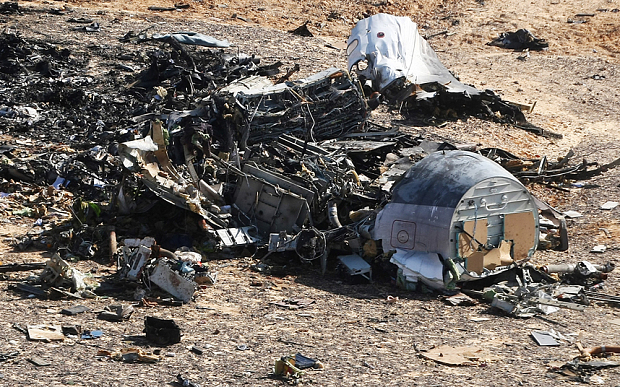
plane_3489909b

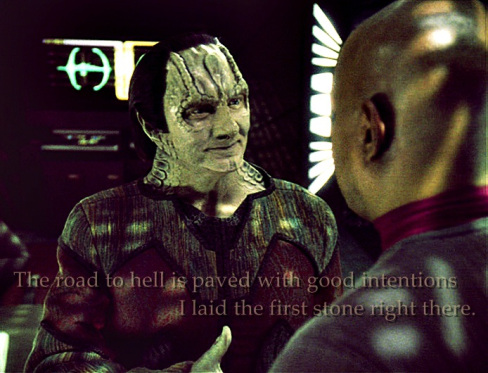
“My father used to say that the road to Hell is paved with good intentions. I laid the first stone right there. I’d committed myself. I’d pay any price, go to any lengths, because my cause was righteous. My… intentions were good. In the beginning, that seemed like enough.” Captain Benjamin Sisko (Avery Brooks) Star Trek Deep Space Nine, In the Pale Moonlight

Friends of Padre Steve’s World,

With the increasing probability that elements of the self-proclaimed Islamic State brought down a Russian airliner in the Sinai last week, it is important to ask what we are willing to do to protect innocent lives. I am not just talking about the situation in Syria and Iraq, where tens of thousands have died and millions have been displaced; but around the world from a hybrid terrorist state that knows no creed but victory or death.

Iraq-unrest

The question is not just about fighting the Islamic State as this is already happening. Though there is no formal alliance and many of the states involved have their own interests at heart, the war now involves the United States, some NATO allies, Russia, Iran, Saudi Arabia, and a number of Arab states, not to mention the kaleidoscope of different warring parties in Iraq and Syria. Until last week the United States was content to fight using airpower alone. Now it appears that albeit with great hesitancy the Obama administration is slowly expanding the fight to include ground troops, although at the time this is limited to special operations troops and advisers.

As the war expands, we do have to ask hard questions, chief among them how far we will go to fight the Islamic State. The fact that no matter what course of action the United States, our allies, and the other combatants take, each one has its drawbacks, as well as benefits. Each one involves a certain amount of risk, and the fact is that the Islamic State does believe that the United States, Europe, Russia, Iran, and Israel are their greatest enemies and is working to attack each one. This poses a question of making alliances with disparate nations, some of which are mortal enemies of each other. But sometimes necessity makes strange bedfellows, just ask Winston Churchill and Josef Stalin.

So today, I am posing a reflection from the television series Star Trek Deep Space Nine. I think that among the Star Trek series that my favorite is Deep Space Nine. Of course all of the Star Trek series and movies deal with ethics, philosophy and morality to some extent; but Deep Space Nine is perhaps the most interesting to me. Don’t get me wrong I think that the Original Series and Start Trek the Next Generation were and are leap years ahead of most television series when it comes to addressing ethical, moral and existential issues, but somehow living in the post 9-11 “War on Terrorism” world I find Deep Space Nine to be the most compelling. I think that is that the fact that the moral issues get blurred which attracts me to the series, and to this episode in particular.

I think that using the medium of science fiction we can think about real life issues in a new, and maybe more creative way than we might. I think it to do this is to think outside the traditional box, which sometimes limits our discussion, and consideration of all of the factors involved. But the subject is uncomfortable because it makes us face truths that we might not want to see, and parts of ourselves, our beliefs, and our values that can become clouded in times of crisis.

One of my favorite episodes is from season six and is entitled “In the Pale Moonlight.” The episode deals with the unsavory matter of contriving a reason to get the Romulan Empire to join with the Federation and the Klingons to fight the Dominion-Cardassian alliance that is threatening those entities as well as potentially the entire Alpha Quadrant. I have included a link to the conclusion of that episode here:

The ethics of this episode seem very timely as I look at the new phase of the conflict that the United States has been engaged for the past thirteen years. The fact is that in spite of our appeal to higher ideals we are having to make alliances with powers that are only slightly less unsavory than ISIS, powers whose polices have help ISIS grow. In a sense it is the classic scenario of making a deal with the devil to defeat one’s enemy. Of course this is not a new phenomena, individuals and nations have made such deals, sometimes with mortal enemies throughout history.

Unfortunately we usually judge such decisions based on their results, rather than wrestle with the ethical issues involved and how we might behave in similar situations. For me the philosophical and ethical issues involved in such alliances have a special interest and as such I tend to notice or recall instances where I saw, read or heard something that makes a connection to an ethical or moral dilemma faced by policy makers and planners today.

Some of the issues involved for policy makers are related to the traditional Just War Theory, and what is called the “Supreme Emergency” exemption. This exemption basically posits that when faced with a supreme and existential emergency a person or state may engage in behaviors that ordinarily would be considered unethical if the situation were not of a supreme emergency.

Of course such decisions in the real world are difficult. Those who have a system of beliefs that help them define right and wrong behaviors, even if they are not codified in law may struggle with such decisions, while those who act according to what they deem necessary or expedient, unbridled by religious, philosophical or other similar codes may not, instead making their decisions based on what appears to be necessary at the time.

This Deep Space Nine episode is remarkable because we get to see an actor playing a military commander dealing with the morality of the course of action that he is taking. In one of the early scenes Captain Sisko expresses his doubts relating to the morality of a decision that he is making in a war that has already consumed the lives of tens of millions of people.

pale-moonlight

After an incident where a Federation starship was destroyed, Sisko went to Elim Garak (Andrew Robinson), an exiled Cardassian intelligence officer to uncover any evidence about Dominion-Cardassian collusion to attack the Romulans. When none was uncovered and Garak’s sources on Cardassia were compromised he agreed to allow Garak to manufacture evidence in order to get the Romulans into the war on the side of the Federation and Klingons. Sisko compounded the situation by having the Klingons release a master forger who was on death row to help Garak. Sisko knew it was wrong and confided in his log:

“Why I didn’t listen to the voice in the back of my mind telling me not to believe a word he said, I’ll never know… But it didn’t take long for me to come face to face with the fact that I’d made a mistake.”

When the former prisoner gets drunk and attacks the owner of a tavern on the space station Sisko was in a bind. He wanted no evidence that the man had been on his station and in order to keep Quark, the bar owner quite had to bribe him. Sisko again expressed his doubts in his personal log:

“Maybe I should have put a stop to it right there. Maybe I should have said, “Thank you very much for your input, Mister Garak, I will take your suggestion under advisement,” and then gone back to my office and forgotten the whole thing. But I didn’t. Because in my heart, I knew what he was saying made sense.”

Even so Sisko still had doubts:

“That was my first moment of real doubt, when I started to wonder if the whole thing was a mistake. So I went back to my office. And there was a new casualty list waiting for me. People are dying out there every day! Entire worlds are struggling for their freedom! And here I am still worrying about the finer points of morality! No, I had to keep my eye on the ball! Winning the war, stopping the bloodshed, those were the priorities! So I pushed on. And every time another doubt appeared before me, I just found another way to shove it aside.”

When nations feel they are engaged in a life and death struggle, those who serve as policy makers, planners and military commanders often make uncomfortable compromises with their own religious, ethical or philosophical codes. Sisko continued down the path despite his doubts but justified his actions by the fact that Starfleet had approved them:

“Maybe… I was under more pressure than I realized. Maybe it really was starting to get to me, but I was off the hook. Starfleet Command had given the plan their blessing and I thought that would make things easier. But I was the one who had to make it happen. I was the one who had to look Senator Vreenak in the eye and convince him that a lie… was the truth.”

The forgery was completed and the Romulan Senator secretly arrived on the station to examine the evidence and as he did so all Sisko could do was wait, confiding in his log:

“So all I could do was wait… and see how masterful Tolar’s forgery really was. So I waited… tried to catch up on my paperwork, but I find it very difficult to focus on criminal activity reports, cargo manifests… So I went back to pacing, staring out of the window. I’m not an impatient man, I’m not one to agonize over decisions once they’re made. I got that from my father. He always says, “Worry and doubt are the greatest enemies of a great chef. The soufflé will either rise or it won’t – there’s not a damn thing you can do about it, so you might as well just sit back and wait and see what happens.” But this time the cost of failure was so high, I found it difficult to take his advice. If Vreenak discovered that the data rod was a forgery, if he realized that we were trying to trick them into the war it could push the Romulans even farther into the enemy camp. They could start to openly help the Dominion. If worst came to worst they could actually join the war against us. I had the distinct feeling that victory or defeat would be decided in the next few minutes.”

It did not work, Vreenak discovered that the data rod was a forgery and threatened to expose Sisko’s deception and possibly bring the Romulans into alliance with the Dominion. When Sisko’s actions blew up in his face and his deceit was revealed he was not happy and resigned himself to face the consequences:

“So it all blew up in my face. All the lies and the compromises, the inner doubts and the rationalizations – all for nothing. Vreenak was furious. I can’t say I blamed him; I’d have reacted the same way. After telling me in no uncertain terms that he intended to expose this “vile deception” to the entire Alpha Quadrant, he got back in his shuttle and headed home. There didn’t seem to be anything more to do… so I went back to work. Two days later we got the news.”

Sisko learned in a Starfleet communication that Vreenak’s shuttle had blown up and that is was suspected to be the work of the Dominion. When Sisko found that Vreenak was dead he went to Garak and forcefully confronted him, striking him in the process. He accused Garak of sabotaging the senator’s ship and killing him as well as the forger, Tolar. Instead of backing down Garak confronted the results and the ethical issue. The heated exchange between the two men is fascinating:

Garak: If you can allow your anger to subside for a moment, you’ll see that they did not die in vain! The Romulans will enter the war!

Captain Sisko: There’s no guarantee of that!

Garak: Oh, but I think that there is. You see, when the Tal Shiar finishes examining the wreckage of Vreenak’s shuttle, they’ll find the burnt remnants of a Cardassian optolythic data rod which somehow miraculously survived the explosion. After painstaking forensic examination, they’ll discover that the rod contains a recording of a high-level Dominion meeting, at which the invasion of Romulus was being planned.

Captain Sisko: And then they’ll discover that it is a fraud!

Garak: Oh, I don’t think they will! Because any imperfections in the forgery will appear to be a result of the explosion. So – with a seemingly legitimate rod in one hand, and a dead senator in the other, I ask you, Captain – what conclusion would you draw?

As Sisko’s anger subsided Garak continued:

“That’s why you came to me, isn’t it, Captain? Because you knew I could do those things that you weren’t capable of doing? Well, it worked. And you’ll get what you want: a war between the Romulans and the Dominion. And if your conscience is bothering you, you should soothe it with the knowledge that you may have just saved the entire Alpha Quadrant. And all it cost was the life of one Romulan senator, one criminal, and the self-respect of one Starfleet officer. I don’t know about you, but I’d call that a bargain.”

DS9SiskoToast

Shortly thereafter Sisko found out that the out that the deception was successful as Garak had said it would be. The Romulans who recovered the damaged data rod believed that it was genuine and declared war on the Dominion-Cardassian alliance and had entered the war on the side of the Federation. He completed his personal log:

“At oh-eight-hundred hours, station time… the Romulan Empire formally declared war against the Dominion. They’ve already struck fifteen bases along the Cardassian border. So, this is a huge victory for the good guys! This may even be the turning point of the entire war! There’s even a “Welcome to the Fight” party tonight in the wardroom!… So… I lied. I cheated. I bribed men to cover up the crimes of other men. I am an accessory to murder. But most damning of all… I think I can live with it… And if I had to do it all over again… I would. Garak was right about one thing – a guilty conscience is a small price to pay for the safety of the Alpha Quadrant. So I will learn to live with it…Because I can live with it…I can live with it. Computer – erase that entire personal log.”

My guess is that before this war is over, there will be men and women serving in positions of responsibility in our or allied militaries, policy makers and government officials who will make similar deals, violating their own moral codes and even laws in order to defeat the Islamic State and prevent acts of terror against their citizens. Most, like Sisko will not be happy but will live with their decisions. The fact is that long asymmetrical wars in which nation states have to fight non-state terrorist entities get really ugly and the longer and more bloody that they become the more decent and honorable people will make decisions like Sisko and resort to actions that in normal times they would never countenance.

This is nothing new. Those who have fought in such wars throughout history have found ways to “live” with actions that they would not approve of had things been different. Wars such as the one that we are fighting and continue to fight in the years ahead have a corrosive affect on the human spirit. They corrupt and destroy even when they are “successful.”

The question is: Can we live with it? Sadly, as much as I hate to admit it, in a similar situation I think like Sisko, that I could condone or be complicit in something like this. I too could probably convince myself that the end justified the means and that I could live with it, against ISIL. If in fact an ISIL bomb downed the Russian airliner, it is a watershed, and points to worse things to come, and we will have to ask the question, “can you live with it?”

Of course it is possible that this was an accident, truthfully, I do as tragic as it would be, hope this it the case. 

Of course there is always the possibility that ISIL or one of its allied groups did it. But another possibility cannot be ruled out; that a bomb was planted bye third party, possibly the Russians themselves, hoping to implicate ISIL. That my friends is far to frightening to contemplate as there are too many nations that have both the capability and a motive to do this. 

There are some other issues that I want to discuss about this war using the Star Trek motif, and like this they will be unsettling.

Peace

Padre Steve+

2 Comments

Filed under ethics, Foreign Policy, History, middle east, Military, News and current events, Political Commentary, star trek, terrorism

Try to Understand: The Kindest, Noblest, & Best Thing You Will Ever Do

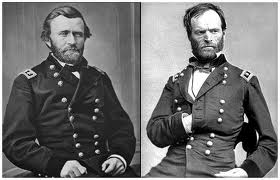
grant and sherman

Grant and Sherman

Friends of Padre Steve’s World,

The great American Civil War general William Tecumseh Sherman once said of his relationship with Ulysses S. Grant, “Grant stood by me when I was crazy, and I stood by him when he was drunk. Now we stand together.” Having been both crazy, and at times drunk, I can relate to both men, both of whom also often suffered from severe and often disabling depression at different points in their lives.

Yesterday I wrote an article about depression and I decided to follow it up with another on the same subject. Yesterday I mentioned the late Iris Chang and her comments about how depression is not rational, and C.S. Lewis who talked about how mental pain is harder to deal with than physical pain. During my worst phases of depression in the years after I came back from Iraq, I fought every day to find something to hold onto, something to keep me from ending my life. If you have never experienced real depression, the kind that slowly eats away the very fabric of your being, you might not understand. In fact it was something that I really didn’t understand until I went through years of it.

Depression is far different than being sad. It is like the difference between having a cold, which you know should pass, and having an insidious cancer which even if it goes into remission lurks for another chance to strike again.

I think that Elizabeth Wurtzel, the author of the book Prozac Nation, hit what I am describing on the head, “That’s the thing about depression: A human being can survive almost anything, as long as he sees the end in sight. But depression is so insidious, and in compounds daily, that it’s impossible to ever see the end.”

In a similar manner, J.K. Rowling, the author of the Harry Potter books noted, “Depression is the most unpleasant thing I have ever experienced. . . . It is that absence of being able to envisage that you will ever be cheerful again. The absence of hope. That very deadened feeling, which is so very different from feeling sad. Sad hurts but it’s a healthy feeling. It is a necessary thing to feel. Depression is very different.”

I have to agree with both of these writers, depression is the worst. I can live with insomnia, and night terrors, even with anxiety, but depression is the worst, it never seems like it will end. I was fortunate that I got through my most difficult times, including a period just over a year ago where I was nearly suicidal after very bad treatment in the Mental Health Department at the local naval medical center. It took the intervention of my former commanding officer, a doctor named David Lane, who had just been selected for promotion to admiral to get me the help that I needed, but not everyone has that kind of ace in the hole. I wouldn’t have thought of asking him, but his Command Master Chief, and my friend Ed Moreno, intervened, told him of how bad I was doing and that made all the difference. Ed didn’t try to fix me, he just stood beside me and when I needed help, he came through as a friend, and he is still a friend. That is what friends do.

I still struggle, sometimes with depression, but more often the nightmares and night terrors associated with my PTSD. Last night my wife woke me up when in one of my high definition nightmares I was thrashing around trying to defend myself from an enemy insurgent in Iraq. Now mind you, I was never in a close combat situation, but I took part in a number of missions where we didn’t know who the good guys or bad guys were and I was unarmed. But I can live with that, depression without end is far different.

In my worst times I had a lot of people tell me what I needed to do to get out of being depressed. Most were well meaning but didn’t have a clue as to what I really needed. I didn’t need someone to fix me. I didn’t need a checklist of things to make me well. I didn’t need to pray more, or read my Bible more. I didn’t need to work ungodly numbers of hours in ICUs where lives of people were hanging in the balance… all I needed was people who would say I love you, I care for you, and I value you for who you are, not what I want you to be, and will be there for you no matter what, or maybe, let me buy you a beer. Thankfully, there were a few people who did all of those things, and they have been there for me since I emerged from that darkness.

As for the others, who seemed more like “Job’s helpers” it is sometime embarrassing to come across them. Of course I am polite and I do not avoid them. That being said, once you have gone through this, you can see just how uncomfortable that they are to be around you. So those encounters tend to be brief and uncomfortable, as Job’s helpers quickly move along to avoid the awkwardness of the situation. The interesting thing is now I am perfectly fine with their discomfort.

I think that some of the best advice for those who live with, work with, or are friends with a person struggling with depression was written by English comedian Stephen Fry, who said, “Try to understand the blackness, lethargy, hopelessness, and loneliness they’re going through. Be there for them when they come through the other side. It’s hard to be a friend to someone who’s depressed, but it is one of the kindest, noblest, and best things you will ever do.” That is empathy in action.

I have a number of friends; classmates, and other people I have served with in the military who this very day just hope to stay alive, to find something to live for. The depression that they feel is often overwhelming. They are wonderful, talented and gifted people, people who have a strong amount of empathy for others, but they are enveloped by a darkness and fog which makes it hard for them to see any sign that the depression will ever lift. I have been there, and now I try to be there for them. For me it comes back to what Sherman said about Grant, If I don’t stand with those who suffer from depression after what I have been through, what good would I be?

Peace

Padre Steve+

2 Comments

Filed under faith, healthcare, mental health

Success, Depression & Empathy

chicken of depression

Friends of Padre Steve’s World,

I just finished reading a biography of the late Iris Chang, who wrote the book The Rape of Nanking and A History of the Chinese in America. She was a brilliant, caring, and passionate women who had a major depressive crash and ended up committing suicide. She wrote her mother about her feelings when Charles Schulz, the creator of Peanuts died, the night before the final Sunday comic came out. She wrote her mom:

Dear Mom,

I think it was Charles Schulz’s pessimism – as well as his ability to understand human failure, insecurity, heartbreak – that made millions love Peanuts.

You’re absolutely right, Schulz had no reason whatsoever to be depressed, after achieving wealth and fame at such an early age. But depression is not rational. Perhaps he did have a mental problem, or some chemically induced condition. But whatever it was, it prevented him from losing touch with the underdogs of the world.

It’s strange, but I still feel a void in my heart after Schulz’s death – even though I never knew him and didn’t particularly like him after meeting him in person, It made me wonder, what is the secret to Schulz’s magical appeal?

The answer, I believe, is simple. Schulz understands the heart of a loser. He captures those moments in life when we fell utterly unloved, unwanted, and alone. And all of us – no matter how successful- have felt like losers at some point in life.

Love, Iris

(From The Woman Who Could Not Forget: Iris Chang Before and After The Rape of Nanking, a memoir by Ying-Ying Chang, Pegasus Books, New York, 2013)

The book intrigued me and I was drawn to Iris’s story, and was so impressed with her as a person, and having suffered major depression myself, felt a certain kinship with her as I read the book, especially the chapters dealing with her success, and her collapse.

Those of you who have followed me for a while know that I have struggled a lot with major depression, anxiety, and even have occasionally been suicidal since returning from Iraq in 2008 with one hell of a case of PTSD. Thankfully over the past couple of months I have been doing pretty well. While I still suffer chronic insomnia, really weird dreams, nightmares, and night terrors, as well as anxiety in crowed places and flashbacks; but I have not been chronically depressed. I have had a few down days, but nothing like the past number of years. So all in all I think that is a good thing, I am starting to get back in better physical shape, eating better, and losing weight, so all in all I count that in the win column.

That being said, since Iraq I have developed a tremendous amount of empathy for those that suffer from depression, because it is not a rational disease. It affects millions of people in our country, and I am not referring to people who once in a while get the blues or feel a bit down, but people who live their lives in a state of clinical depression. I have known a lot of people who suffer from depression. Most are tremendously talented, witty, charming, intelligent, and caring. I have known very successful people who suffer from such depression that they cannot appreciate their own achievements and feel like failures. I have known some who have committed suicide because they saw no hope for themselves and believed that the world would be better off without them. I have friends who walk this path today, people who are battling to stay alive.

Likewise, many of my heroes, my role models, have suffered from depression, even lifelong depression. These include Joshua Lawrence Chamberlain, the hero of Little Round Top at Gettysburg, Abraham Lincoln, and T.E. Lawrence, better known as Lawrence of Arabia.

Sadly, most people, especially religious people have little long term tolerance for depressed people. If the depressed person does not get better, they abandon them, sometimes in very cruel ways.

In a Peanuts strip Charlie Brown goes to Lucy and says, “I have deep feelings of depression… What can I do about this?” Lucy does what is so common in our culture and says “Snap out of it! Five cents, please.” The fact is that if you are chronically depressed or suffer from clinical depression, you don’t simply snap out of it and I think that depression and mental pain is harder to bear than physical pain. C.S. Lewis wrote in his book The Problem of Pain:

“Mental pain is less dramatic than physical pain, but it is more common and also more hard to bear. The frequent attempt to conceal mental pain increases the burden: it is easier to say “My tooth is aching” than to say “My heart is broken.”

The reality is that depression is not rational, nor is it logical, and thus it defies the attempts of well-meaning people to help those who suffer from it. You can tell a depressed person to get involved in activities, to stay busy, work harder, to read their Bible or pray more, but most of the time this only makes things worse. The depressed person tries them and does not get better which makes the depression and feeling of failure even worse. I know this because I lived it, I did all those things. I worked harder, prayed more, and the rest of that, and I only got worse. Then I began to lose hope. It was terribly frightening and very few people understood, and even fewer stood by me. Those who did were mainly my drinking buddies and friends from the Norfolk Tides and Kinston Indians ballparks, not clergy, or chaplains. 

This makes it terribly frustrating for all concerned. The depressed person ends up feeling alone, lost, isolated, and rejected when the friends, family, and caregivers give up.

I think to me the hardest thing is that for those of us who serve in caring professions, the clergy, mental health care, medicine, and nursing; is that when we struggle there is often no-one to go to. When I was absolutely falling apart after Iraq, my new commanding officer asked me “where does a chaplain go to get help?” and I said “I don’t know, but not to other chaplains.” I know that I said that in the abyss of total despair, and that there are a couple of chaplains that I can go to and pour out my heart without fear of rejection, but they are the minority. The fact is that many caregivers, especially clergy, have no empathy for those most like them. I know this because I have known and seen so many clergy, across the denominational and theological spectrum who have been broken by the cares of life, and been abandoned by their churches and their peers.

But like, Iris Chang, I do think that some, people like Charles Schulz, the depression they live enables them not to lose touch with those who suffer, that in a sense that their suffering engenders a great empathy for others that many lack. I have been told by some that I have that kind of empathy and if I do it is not because I am such a great person, but rather because I have suffered and still suffer from the pain, and despite my own accomplishments, and achievements, that I still occasionally feel like a loser or failure. But as far as my condition goes, I am oddly comforted by the words of Raymond “Red Reddington (James Spader) in The Blacklist:

“There is nothing that can take the pain away. But eventually, you will find a way to live with it. There will be nightmares. And everyday when you wake up, it will be the first thing you think about. Until one day, it’s the second.”

I know my ongoing battle will continue, but I have determined to try to be there for others that struggle with pain that does not want to go away, and nightmares that never seem to end. As the late Henri Nouwen wrote: “Ministry means the ongoing attempt to put one’s own search for God, with all the moments of pain and joy, despair and hope, at the disposal of those who want to join this search but do not know how.”

Until tomorrow,

Peace

Padre Steve+

2 Comments

Filed under faith, History, mental health, ministry

Designed to Break Your Heart: Baseball Season Ends

DSCN9504

Friends of Padre Steve’s World,

The late commissioner of baseball and literary giant A. Bartlett Giamatti once wrote:

It breaks your heart.  It is designed to break your heart.  The game begins in spring, when everything else begins again, and it blossoms in the summer, filling the afternoons and evenings, and then as soon as the chill rains come, it stops and leaves you to face the fall alone.” (A. Bartlett Giamatti, “The Green Fields of the Mind,” Yale Alumni Magazine, November 1977)

Last night when the Kansas City Royals came back to defeat the New York Mets in extra innings, the won their first World Series in thirty years and ended the 2015 baseball season and with it a lot of hearts broke, as they do every year at this time. It is not just that somewhere along the way our favorite team loses, but it is the how for many people, like me, that baseball is more than a game, but has an incredible spiritual component.

This year none of my teams made the playoffs, except for our local Triple-A International League affiliate of the Baltimore Orioles, the Norfolk Tides. That being said the post-season was interesting and had a lot of great stories within the story of the post-season playoff series and the World Series. The Royals picked up where they did last year after they lost a heartbreaker to the San Francisco Giants and continued to win even when it looked like the opposition, whether it was the Astros, Blue Jays or the Mets was poised to win. I am not a Royals fan but as a lover of baseball I have to say that they are an amazing team.

However, the season is now over, and for me winter is now officially here, and yesterday was dreary with a lot of rain. The official beginning of winter for me starts with the end of the Fall Classic.

With the end of the season one of my places of solace from the cares of the world. Really, when I came home from Iraq, baseball was one of the few things that helped to calm my soul from the demons of PTSD, TBI, major depression, anxiety, and often-suicidal thoughts. I can agree with Sharon Olds who wrote back in the early 1970s “Baseball is reassuring.  It makes me feel as if the world is not going to blow up.”

In a world where so many things are unsettling baseball is reassuring. In the run-up to the 2016 general election where the politicians, pundits, and preachers, the “Trinity of Evil” use every means available to raise the levels of fear and anxiety of people, it is even more so. In such a world baseball is a safe-harbor for me, as Mark Kramer wrote, “Baseball is a harbor, a seclusion from failure that really matters, a playful utopia in which virtuosity can be savored to the third decimal place of a batting average.”

Now I wait for Spring Training 2016 begins and the pitchers and catchers, including a number of friends start reporting, and with that my spring will begin.

Peace

Padre Steve+

Leave a comment

Filed under Baseball, faith, philosophy

Where is the Reckoning? Reflections on War

IMG_0463

Friends of Padre Steve’s World,

I finished up my latest Gettysburg Staff Ride and as always I end up in a reflective mood. There was so much this time that caught my attention, both in the actual staff ride and my run up and down Cemetery Ridge on Friday evening. I guess the one thing that continues to strike me is a theological question that I began to wonder about after my return from Iraq.

The question is more theological, philosophical, and sociological in nature, and it goes to a place that most of us are unwilling or unable to go. I say this because so many Americans have no idea what war is really about. We tend to exalt the military, say that we “support the troops” but no one asks the hard questions of whether the wars that we are fighting, and the vast amounts of money we are spending are worth it. Frankly I think that the reason is that because for the vast majority of Americans that war is an abstract concept, and they are so disconnected from the military that they do not understand. As such the military is idolized and even mythologized by a public that is willing to send them to war, but unwilling to understand or question decisions of policy that begin and perpetuate war without end.

I see the sacrifice, the broken lives, bodies, minds and families of our military personnel who have deployed so many times. With the expansion of the war against the self-proclaimed Islamic State the wars will probably continue indefinitely. Do I think that the war against ISIS/ISIL is worth it? I have to admit I do, they are thugs who have commandeered a religion to justify their crusade against all who do not agree with them and who seek to obliterate all history and culture that they do not agree, and to paraphrase Vice President Biden, Hell is where they will reside.

At the same time I cannot support a war in which a tiny minority of citizens have skin in the game while those who send them to war do so with no cost to themselves. In fact it wearies me to think that those who so loudly call for war refuse to support those who fight with increased taxes, or even war bonds. I have no doubt that those who send people to war, and those who allow them to do so without question, have no interest in actually putting their lives, or the lives of their sons and daughters on the line.

Joshua Chamberlain, the hero of Little Round Top asked the question that I think needs to be asked by all of us today:

“…men made in the image of God, marred by the hand of man, and must we say in the name of God? And where is the reckoning for such things? And who is answerable? One might almost shrink from the sound of his own voice, which had launched into the palpitating air words of order–do we call it? – fraught with such ruin. Was it God’s command that we heard, or His forgiveness that we must forever implore?”

My question for those who advocate war without end, who refuse to serve, and even refuse to sacrifice a wooden nickel to support those wars, is, whose forgiveness will you implore?

Peace

Padre Steve+

3 Comments

Filed under civil war, Gettysburg, History, national security, Political Commentary