Yearly Archives: 2016

July 2nd at Gettysburg Pt. 5: The Wheatfield

gettysburg-1

Friends of Padre Steve’s World

For those that have followed my writing for some time you know that I teach military history and ethics at the Joint Forces Staff College. One of the great joys that I have is leading the Gettysburg Staff Ride, which is an optional event for students that want to participate. When I took the position here I took some of my older writings on Gettysburg and put them into a student study guide and text. That was two years ago. Then the text was about 70 pages long. It is now about 925 pages long and eventually I hope to get it published. When and if that happens I expect it to become two, and possibly three books.

This is the fifth of a series of articles that I will be posting potions of a chapter that I have rewritten about the critical battles on the south side of the battlefield on July 2nd 1863, the battle for Devil’s Den, the Wheatfield, the Peach Orchard, and the final repulse on Cemetery Ridge.

As you read this don’t just look at the events, but look at the people, and their reaction to the what they encountered on the battlefield, for that understanding of people is where we come to understand history.

So even if you are not a Civil War buff, or even a history buff, take the time to look at the people, their actions, and the things that made them who they were, and influenced what they did. History is about people.

So please enjoy,

Peace

Padre Steve+

To the left of Benning, “Tige” Anderson’s brigade and two of Robertson’s orphaned regiments assaulted the remaining elements of Hobart Ward’s brigade along the western section of Houck’s Ridge and Rose’s Woods. Ward had been assigned by his division commander, David Birney to defend the left flank of Sickles over-extended line. To do so he had already placed the men of the 124th New York and the 4th Maine on his left, while those remaining took position on Houck’s Ridge and in Rose’s Woods. Like the other units of Third Corps, these troops were all veterans led by veteran officers and they would not give ground without a fight. However, Ward’s troops had not taken the time to erecting any hasty fortifications or breastworks, as one “veteran remembered it, “we had not yet learned the inestimable value of breastworks, and instead of spending time rolling the loose stones into a bullet-proof line, we lounged about on the grass and rocks.” [1] But when the Confederate assault began, these men took advantage of the nature terrain features which made it formidable even without such efforts.

As the Confederates moved against Ward’s troops on the ridge and in Rose’s Woods their left flank made contact with the adjoining brigade of Regis de Trobriand, the leftmost regiment of which, the 17th Maine was posted at the southwest corner of the Wheatfield. As the Union infantry regiments braced for the attack, the Confederate formations were shredded by the shells of the Federal artillery which crashed upon them. “I could hear bones crash like glass in a hail storm,” asserted a Georgian. Colonel Dudley M. DuBose of the 15th Georgia avowed, “I never saw troops move on more steadily & in better order than these did on that occasion.” [2] Despite the carnage the Georgians continued on, and when they got within seventy-five yards of the 17th Maine opened a blistering fire which “slowed Anderson’s brigade’s assault but certainly did not stop it.” [3] Lieutenant Colonel Charles Merrill of the 17th Maine wrote:

“We opened fire on the enemy, then within 100 yards of us. The contest became very severe, the enemy at times being driven back by our line, then by superior numbers compelling us in turn to give way. The ground was hotly contested, but we held our position till, finding the right of my regiment outflanked and exposed to murderous fire from the enemy’s reinforcements, I was obliged to form a new line, changing the right wing of the regiment into position at a right angle to the left. This movement was executed in good order, under a heavy fire from the advancing foe. In this position we continued to fight, checking the enemy till, receiving orders to retire, we fell back across a wheat-field in our rear to the edge of the woods.” [4]

Anderson’s Confederates continued their attack and as they advanced Anderson was wounded and Colonel W.W. White took command, and while the Georgians had succeeded in taking some ground and inflicted heavy casualties on the Federal troops, the brigade was spent. Attesting to the severity of the fight Colonel White wrote, “From the exhausted condition of the men, together with the fact that the enemy were pouring in large re-enforcements on the right, it was deemed impractical to follow him further… The brigade retired in good order across the ravine, and went into bivouac for the night…. The loss of the brigade was heavy…. 105 killed, 512 wounded, and 146 missing.” [5]

The fight in Rose’s Woods and the Wheatfield between Birney’s division and the men of Benning and Anderson’s brigades drew in other units and McLaws’ division entered the fight and the men of Caldwell’s division of the Federal Fifth Corps entered the battle. Initially, the Union infantry was outnumbered but it had the support of the artillery that Henry Hunt had rushed into the fight. The brigades to the right of the woods on the rocky hill commanded by Tilton and Sweitzer were rapidly becoming isolated as the Confederates advanced to their rear and Kershaw’s South Carolina brigade “appeared through the smoke” like a malevolent fury, “moving with shout, shriek, curse, and yell…loading and firing with deliberation as they advanced, begrimed and dirty-looking fellows in all sorts of garb, some without hats, some without coats, none apparently in the real dress or uniform of a soldier.” [6]

Joseph Kershaw was one of the few Confederate commanders without a legacy to protect to write in detail about the battle in the Wheatfield. Kershaw was a lawyer and politician who had served in the Mexican-American War with the Palmetto Regiment. After the war he went back to civilian life and served as a member of the South Carolina State Senate. When South Carolina seceded from the Union, Kershaw volunteered for service and was made Colonel of the 2nd South Carolina Volunteer Infantry which he commanded at Fort Sumter, Bull Run, and on the Peninsula. “Natural leadership and applied intelligence had advanced him to brigades command, and he was tabbed for future material for division command.” [7] As a brigade commander he distinguished himself during the Seven days, Second Bull, Run, Antietam, and Fredericksburg. Kershaw was an natural leader and displayed an ability for “quick and rational decisions, and he never endangered his men rashly” [8] His division commander, Lafayette McLaws had a tremendous amount of trust and respect for his subordinate. “Pious, intelligent, a clear blond of high bred, clean-cut features, he had the bearing of command and a clear voice that seemed to inspire courage when it was raised in battle.” [9] Kershaw was “probably the most popular brigade commander in the entire Army of Northern Virginia. His South Carolinians – the 2,100 men of the 2nd, 3rd, 7th, 8th, and 15th South Carolina, along with the seven companies that made up the 3rd South Carolina Battalion – adored him as “a very fine man and good officer” who is liked by everyone.” Actually, this forty-one-year-old lawyer from Camden…was a chronic depressive, unhappily married, and “intensely lonely” [10] That did not diminish the love of his men for him, and His brigade had been the lead unit of the First Corps’ disastrous movement to contact that afternoon, and he had watched the contra-temps between Longstreet’s and McLaws during the march and counter-march that morning and afternoon, and upon the discovery of Sickles’ troops in the Peach Orchard. His brigade, a unit of battle-hardened veterans may not have looked like soldiers due to the wear and tear of constant campaigning and the lack of new uniforms or equipment but they were among the toughest and most disciplined brigades on either side.

Kershaw’s brigade as well as the Georgia brigade of Brigadier General Paul Semmes, the brother of Rafael Semmes, the Captain of the raider CSS Alabama, formed the right flank of Lafayette McLaws’ attack on the Peach Orchard and the Wheatfield. Kershaw understood from his discussions with McLaws and Longstreet that his attack was supposed to be coordinated with that of Hood’s division on his right, which was “sweep down the Federal line in a direction perpendicular to our line of battle.” [11] and with Barksdale’s brigade on his left. However, as his troops prepared to jump off to start their attack Kershaw “got his first unpleasant surprise when he observed Hood’s brigades moving “independently against Round Top,” a departure from the plan that meant they would not “directly participate in the joint attack.” [12] Without Hood’s support on his right Kershaw was now completely dependent on Barksdale’s brigade on his left to hit the Peach Orchard to protect his left flank from the massed Federal artillery on that height.

When Kershaw received word to advance his troops moved off followed by Semmes’ brigade while Longstreet accompanied the brigade until it reached the Emmitsburg Road. Kershaw made a tactical decision which made sense but which had a major impact on his attack. “All field and staff officers were dismounted on account of the many obstacles in the way.” [13] Kershaw chose to move with his right regiments and being dismounted this diminished his ability to see what was going on with his left, and limited his ability to provide command and control. This was not a mistake, it was a sound tactical move due to the terrain and the exposure of mounted officers to sharpshooters and artillery directed specifically at them.

As Kershaw’s men advanced he looked for Barksdale’s brigade, and only then “heard Barksdale’s drums beat the assembly, and I knew then that I should have no immediate support on my left, about to be squarely presented to the heavy force of infantry and artillery at and in the rear of the Peach Orchard.[14] Without Barksdale on his flank Kershaw was forced to improvise, he divided his regiments with “two going straight toward the stony hill, he sent two to their left to take the Union batteries in the back of the peach orchard.” [15] Porter Alexander, commanding Longstreet’s artillery noted that “Barksdale’s delay “ was especially unfortunate in this case, because advancing Kershaw without advancing Barksdale would expose Kershaw to enfilade by troops who Barksdale would easily drive off. Few battlefields can furnish examples of worse tactics.” [16]

Up to the point of crossing the Emmitsburg Road, Kershaw’s regiments had a relatively easy advance, but as Kershaw feared, they were hit from the front and flank by rifle fire, and by artillery fire. “We saw plainly that their artillerists were loading their guns to meet our assault, while their mounted officers went dashing wildly from gun to gun, to be sure that all were ready,” recalled one soldier of the 2nd South Carolina, and when they opened fire, “every Federal cannon let fly at us” with solid shot and canister.” [17] The effect on Kershaw’s troops was devastating. Scores of his troops were cut down as they advanced, even so they continued to move forward. Private William Shumate of the 2nd South Carolina described the effect of the massed Union artillery fire on Kershaw’s troops. “Kershaw’s brigade moved…in perfect order and with the precision of brigade drill, while upon my right and left comrades were stricken down by grape and canister which went crashing through our ranks. It did not seem to me that none could escape.” [18] Kershaw’s left regiments were now approaching the Federal artillery and Kershaw had lost contact with them. As they approached the Union guns, those batteries ceased fire and prepared to withdraw.

Victory seemed assured and then the unthinkable happened, as it so often does in the confusion of battle and the fog of war; an order was issued by an unknown officer to change the direction of the attack. Evidently someone misunderstood “Kershaw’s orders or his intent and with this false order aborted the attack.” [19] The change of direction resulted in those regiments making a right flank and presenting their exposed left to the Federal artillery men, who now remained their guns and opened a devastating and merciless fire into the flank of the South Carolinians. Kershaw was livid and later wrote:

“The Federals returned to their guns and opened on these doomed regiments a raking fire of grape and canister, at short distance, which proved most disastrous, and for a time destroyed their usefulness. Hundreds of the bravest and best men of Carolina fell, victims of this fatal blunder.” [20]

A Massachusetts infantryman walked the field after the charge and noted, “Masses of Kershaw’s and Wofford’s brigades had been swept from the muzzles of the guns, which had been loaded either with double-shotted, or spherical case, with fuses being cut to one second, to explode near the muzzles. They were literally blown to atoms. Corpses strewed the ground at every step. Arms, heads, legs and parts of dismembered bodies were scattered all about, and sticking among the rocks and against the trunks of trees, hair, brains, entrails, and shreds of human flesh still hung, a disgusting, sickening, heart-rending spectacle to our young minds.” [21]

While his left regiments were being manhandled by the Federal artillery due to the errant order, Kershaw’s right regiments continued their attack on troops of De Trobriand, Sweitzer, and Tilton, on the stony hill. This landmark was in the process of being cut off from the rest of the Federal army as Anderson’s troops gained control of the Wheatfield.

On the surface it seems that the three brigades should have been enough to hold the stony hill, although this is not entirely clear from contemporary accounts or from the histories published since. But, there is one overriding opinion that comes through in most of the accounts, which is that there was a problem with Federal command and control on this section of the battlefield. When the Fifth Corps units of Barnes’ division began arriving in the Third Corps section, Sickles and Birney assumed that these troops were subordinated to their command, but Meade had given contrary orders to Sykes who assumed that the changed orders “relieved his troops from “any call from the commander of the Third Corps.” [22] Whether this was Meade’s plan, Sykes’ interpretation of his orders, or Sickles’ seeking to shift some of the blame for the near disaster to someone else depends on which account one reads.

Thus when pressure began to build on the stony hill as Kershaw’s troops advanced from the front and Anderson’s worked their way to the rear, Barnes or Tilton apparently gave orders to Tilton and Sweitzer, whose “brigades had put up a brief but determined fight along their end of the stony ridge” [23] to withdraw from their position. Like the other controversies of this day this too played out in the media long after the battle was over, however, Sweitzer “clearly reported that he did not retreat until after Tilton’s brigade had fallen back, and then fell back by Barnes’ order.” [24] What appeared to have happened was that the renewed advance of Kershaw’s troops had intimidated Barnes and Tilton, and Barnes, watching the advance with anxiety “issued a precautionary order for withdraw. It seems in retrospect that caution had gone beyond prudence to pessimism.” [25] De Trobriand, who had been encouraged by the arrival of the two brigades was stunned when he saw them withdraw and wrote, “I saw these troops rise up and fall back hurriedly at the command of their officers.” [26] He realized that his position was now untenable noting, “I found myself in danger of being surrounded, and fell back out of the woods” and reforming his lines kept “the enemy at bay until the arrival of sufficient reinforcements from the Second Corps allowed us to be relieved when our ammunition was just exhausted.” [27] The end result was that Kershaw’s troops, despite the heavy casualties that they had suffered now gained the summit of the stony hill and joined forces with Anderson’s brigade. “This success, coupled with the eviction of Ward’s brigade from its position at Devil’s Den, meant that the whole left wing of Sickles’s line had been smashed and that its right wing along the Emmitsburg Road was in jeopardy.” [28]

gettysburg-blog-photo-1

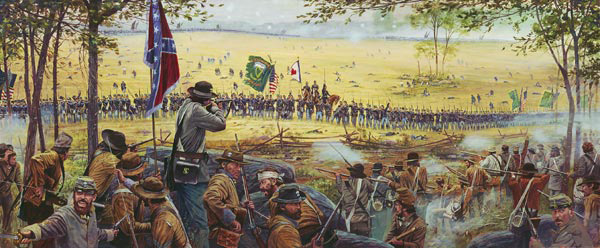
The arrival of the four brigades of John Caldwell’s division of Winfield Scott Hancock’s Second Corps occurred in a nick of time for the men along Sickles’ beleaguered line along the Wheatfield. One of these brigades was the Irish Brigade formerly commanded by Dan Sickles’ friend, and former defense attorney, Thomas Meagher, and now commanded by Colonel Patrick Kelly of the 88th New York. The Irish Brigade had been decimated in fight after fight, “now numbering only about five hundred men. Indeed, as one Irish Brigade officer noted, they “were a brigade in name only.” [29] When it became clear that the brigade was about to go into action, the brigade’s chaplain and after the war, the President of Notre Dame University, Father William Corby, realized that his duties “included the lifting the burden of sin from his flock through the act of conditional absolution.” [30] What followed was one of the most remembered events of the battle. Colonel Kelly:

“called the brigade to attention and commanded it to “Order Arms.” Father Corby stepped up on a boulder about three feet high, explained what he was about to do, and ended his remarks with the observation that the “Catholic church refuses Christian burial to the soldier who turns his back on the foe or deserts his flag.” The men of the brigade knelt, each man on his right knee, head uncovered, hat in left hand, rifle in right, and head bowed, while Chaplain Corby, raised his right hand and pronounced the Latin words of absolution.” [31]

When Father Corby pronounced the words “Dominus nos Jesus Christus vos absolvat” they were made more poignant by the sound of the guns and echoing explosions to their south. The commander of the 116th Pennsylvania noted that even General Hancock, a Protestant noted for his frequent blasphemy, was “watching from his horse, removed his hat and bowed his head. It was, as Corby later declared, an absolution for them all – Catholics and Protestants, northerners and southerners, all “who were susceptible of it who were about to appear before their judge.” [32] An observer wrote “The service was more than impressive, it was awe-inspiring.” [33]

Upon receiving his orders Caldwell moved his division forward crossing Plum Run and moving toward the Wheatfield at the double-quick. Colonel Edward Cross’s brigade was on the right. When Hancock saw him he remarked “Colonel Cross, this day will bring you a star.” Colonel Cross, looking up at Hancock, shook his head and replied gravely, “No General, this is my last battle.” [34] Cross normally wore a red bandana to allow his troops to recognize him in battle, but today he wore a black scarf on his head. As his troops advanced he called out to them, “Boys, you know what’s before you…give ’em hell.” [35] His brigade was followed by Kelly’s Irish Brigade and Brigadier General Samuel Zook’s brigade and that John Brooke. When Caldwell’s division struck it struck with fury, but was met with terrific resistance by Anderson’s men in the Wheatfield and Kershaw’s on the stony hill. Cross’s brigade was stopped before it could break through the Confederate line, with their commander being mortally wounded in the attack. Cross was hit in the abdomen and realizing his wound was mortal said “I hope that peace will be restored to our distressed country. I think that the boys will miss me. Say goodbye to all.” [36]
Wheatfield-irish

Zook’s brigade came next, taking its direction from Dan Sickles. The brigade “deployed near the Trostle farm, and advanced against Kershaw’s men on the stony hill.” [37] There they were met by withering fire, and Zook leading his men from the front was mortally wounded, his brigade suffering massive casualties even as they continued to advance and many “of the companies…came out commanded by sergeants.” [38] A survivor of the brigade remembered it, “the firing became terrific and the slaughter frightful. We were enveloped in smoke and fire, not only in our front, but on our left, and even at times on our right….Our men fired promiscuously, steadily pressing forward, but the fighting was so mixed, rebel and union lines so close together, and in some places intermingled, that a clear idea of what was going on was not readily obtainable.” [39] These stalwart men were followed by Kelly’s Irish Brigade and Brooke’s brigade, Caldwell’s last available unit, which moved through the Wheatfield and up the slope of the stony hill.

These brigades, as well as Sweitzer’s, which had been commandeered by Caldwell finally wrested control of the Wheatfield from Anderson and the stony hill from Kershaw. As the Irish advanced a South Carolina officer remarked “Isn’t that a magnificent sight.” [40] Kershaw later wrote that “the fighting was general and desperate all along the time and so continued for some time….I feared the brave men around me would be surrounded by the large force of enemy constantly increasing in numbers and all the while enveloping us. In order to avoid such a catastrophe, I ordered a retreat to the buildings at Rose’s.” [41] Major St. Clair Mulholland, commanding the 116th Pennsylvania of the Irish Brigade recalled the fight for the hill:

“Having entered a dense woods, we began to ascend a hill, where large bowlders of rocks impeded our progress, notwithstanding which we advanced in good order. We soon came within sight of the enemy, who occupied the crest of the hill, and who immediately opened fire at our approach. Our brigade returned the fire with good effect. After firing for about ten minutes, the order was given to advance, which the brigade did in excellent style, driving the enemy from their position, which we at once occupied….We found the position which our enemy had occupied but a few moments before thickly strewn with the dead and wounded.” [42]

For a time the mixed units that the Federals had committed to the fight for the Wheatfield and the stony hill, along with Sykes’s division of Regulars which had moved up to their left flank stabilized the Federal line. For a time it “appeared that the Rebel effort to overwhelm the Federal flank had failed, save for Devil’s Den. But the situation was changing quickly…”[43]. But the conduct of the battle, “in large part to Sickles, and with help from Longstreet’s execution of the attack, the situation was proving to be a bloody mess on both sides.” [44] The Federal occupation of the stony hill lasted barely twenty minutes when a new threat arose from the direction of the Peach Orchard, Caldwell’s success had placed the division in an exposed position and he had no reserves left to counter any Confederate move on his right flank.

To be continued…

Notes

[1] Ibid. Hessler Sickles at Gettysburg p.164

[2] Ibid. Wert A Glorious Army p.259

[3] Ibid. Pfanz Gettysburg, the Second Day p.247

[4] Ibid. Luvaas and Nelson Guide to the Battle of Gettysburg p.105

[5] Ibid. Luvaas and Nelson Guide to the Battle of Gettysburg p.108

[6] Ibid. Guelzo Gettysburg, the Last Invasion p.286

[7] Ibid. Dowdy Lee and His Men at Gettysburg p.197

[8] Ibid. Tagg The Generals of Gettysburg p.214

[9] Ibid. Pfanz Gettysburg, The Second Day p.151

[10] Ibid Guelzo Gettysburg, The Last Invasion p.282

[11] Ibid. Kershaw Kershaw’s Brigade at Gettysburg p.333

[12] Ibid. Trudeau Gettysburg, a Testing of Courage p.351

[13] Ibid. Kershaw Kershaw’s Brigade at Gettysburg p.334

[14] Ibid. Kershaw Kershaw’s Brigade at Gettysburg pp.334-335

[15] Ibid. Dowdy Lee and His Men at Gettysburg p.222

[16] Ibid. Hessler Sickles at Gettysburg p.181

[17] Ibid. Guelzo Gettysburg, the Last Invasion p.287

[18] Gottfried, Bradley The Artillery of Gettysburg Cumberland House Publishing, Nashville TN 2008 p.125

[19] Ibid. Sears Gettysburg p.285

[20] Ibid. Kershaw Kershaw’s Brigade at Gettysburg p.335

[21] Ibid. Gottfried The Artillery of Gettysburg p.126

[22] Ibid. Coddington The Gettysburg Campaign a Study in Command p.399

[23] Ibid. Guelzo Gettysburg, the Last Invasion p.286

[24] Ibid. Hessler Sickles at Gettysburg p.187

[25] Ibid. Pfanz Gettysburg, The Second Day p.259

[26] Ibid. Sears Gettysburg p.286

[27] Ibid. Luvaas and Nelson Guide to the Battle of Gettysburg p.114

[28] Ibid. Pfanz Gettysburg, The Second Day pp.264-265

[29] Bruce, Susannah Ural The Harp and the Flag: Irish American Volunteers and the Union Army, 1861-1865 New York University Press, New York and London 2006 p.160

[30] Ibid. Trudeau Gettysburg, a Testing of Courage p.303

[31] Ibid. Pfanz Gettysburg, The Second Day p.268

[32] Ibid. Bruce The Harp and the Flag p.165

[33] Ibid. Trudeau Gettysburg, a Testing of Courage p.303

[34] Ibid. Pfanz Gettysburg, The Second Day p.269

[35] Ibid. Guelzo Gettysburg, the Last Invasion p.291

[36] Ibid. Pfanz Gettysburg, The Second Day p.273

[37] Ibid. Trudeau Gettysburg, a Testing of Courage p.363

[38] Ibid. Guelzo Gettysburg, the Last Invasion p.295

[39] Ibid. Sears Gettysburg p.290

[40] Ibid. Trudeau Gettysburg, a Testing of Courage p.363

[41] Ibid. Kershaw Kershaw’s Brigade at Gettysburg pp.336-337

[42] Ibid. Luvaas and Nelson Guide to the Battle of Gettysburg p.117

[43] Ibid. Trudeau Gettysburg, a Testing of Courage p.367

[44] Ibid. Hessler Sickles at Gettysburg p.192

Leave a comment

Filed under civil war, Gettysburg, History, Military

July 2nd at Gettysburg Pt. 4: The Confederate Storm at Devil’s Den

Friends of Padre Steve’s World

For those that have followed my writing for some time you know that I teach military history and ethics at the Joint Forces Staff College. One of the great joys that I have is leading the Gettysburg Staff Ride, which is an optional event for students that want to participate. When I took the position here I took some of my older writings on Gettysburg and put them into a student study guide and text. That was two years ago. Then the text was about 70 pages long. It is now about 925 pages long and eventually I hope to get it published. When and if that happens I expect it to become two, and possibly three books.

This is the fourth of a series of articles that I will be posting potions of a chapter that I have rewritten about the critical battles on the south side of the battlefield on July 2nd 1863, the battle for Devil’s Den, the Wheatfield, the Peach Orchard, and the final repulse on Cemetery Ridge.

As you read this don’t just look at the events, but look at the people, and their reaction to the what they encountered on the battlefield, for that understanding of people is where we come to understand history.

So even if you are not a Civil War buff, or even a history buff, take the time to look at the people, their actions, and the things that made them who they were, and influenced what they did. History is about people.

So please enjoy,

Peace

Padre Steve+

Men_of_Granite

Fix bayonets my brave Texans

The delays had taken a toll on the Confederate plan. By the time Hood and McLaws divisions were in place along with Anderson’s division from Hill’s Third Corps it was nearly four o’clock. Throughout the day the senior commanders of the Army of Northern Virginia had made a thorough mess of their chances for success, but when the attack began it blew into the Federal forces like a violent storm as the Confederate troops fell upon the soldiers of Sickles Third Corps.

However, the Confederate assault was marred by still more command and control issues, the most important which happened in Hood’s division.. “Contrary to orders Hood had moved his division away from the Emmitsburg road for the purpose of taking Little Round Top and outflanking the Union position on the heights of Devil’s Den.” [1] Riding in front of his old Texas brigade, Hood called out “Fix bayonets my brave Texans…forward and take those heights.” His loyal troops responded to their former commander, and cheered his words in response: “Follow the Lone Star Flag to the Top of the mountain!” Cried the lieutenant colonel of the 1st Texas, and there “arose such a wild indescribable battle yell that no one having heard ever forgot.” [2]

McLaws had waited until Hood’s troops advanced across the rough ground that separated his division from “Smith recalled that his guns “tore gap after gap in the ranks of the Confederate foe.” Robertson agreed, reporting that as his brigade advanced through the intervening fields, “for half a mile we were exposed a heavy and destructive fire of canister, grape, and shell” [3] Little Round Top and Devil’s Den. As Hood’s division moved forward it came under artillery fire from the four 10 pound Parrot Rifles of Captain James Smith’s 4th New York Independent Battery on Houck’s Ridge above Devil’s Den and it began to sustain casualties. . Among the earliest to fall was John Bell Hood who was badly wounded when a shell “exploded above his head, and one of the fragments tore into his left arm.” The arm would have to be amputated and as he was taken away by stretcher-bearers recalled that he experienced “deep distress of mind and heart at the inevitable fate of my brave fellow-soldiers, who formed one of the greatest divisions of that world-renown army….” [4]

The absence of Hood would create a leadership void in his division as it made its attack on Devil’s Den and Little Round Top as his successor Evander Law was deeply engaged in leading his brigade in its epic fight at Little Round Top, and not able to influence or coordinate the attacks of the remaining brigades of the division. Coordination “between the brigades soon dissolved. Regiments in Law’s Alabama brigade veered apart, and a gap formed in the center of Jerome Robertson’s Texas Brigade. While these units angled toward the Round Tops, behind them, moving towards Rose’s Woods and Devil’s Den came the pair of Georgia brigades under Henry Benning and George T. Anderson.” [5] Order broke down, and soon control was at the company commander level or lower, “Every fellow was his own general,” a Texan later wrote. “Private soldiers give commands as loud as officers, nobody paying attention to either. [6] In the absence of Hood, Brigadier, and feeling the pressure of the situation, General J.B. Robertson commanding the Texas Brigade on Law’s left, took the initiative and sent couriers to Henry Benning and George Anderson “urging them to hurry their brigades to his support.” [7]

As Law’s brigade and two of Robertson’s regiments assaulted Little Round Top, the remainder of Robertson’s brigade as well as those of Benning and Anderson attacked the Federal position on Devil’s Den. There a fierce fight ensued as the badly outnumbered troops of the 124th New York under the command of Colonel Augustus Van Horn Ellis, and the four guns of Smith’s 4th New York Independent Battery refused to yield the hill to Robertson and Benning’s troops.

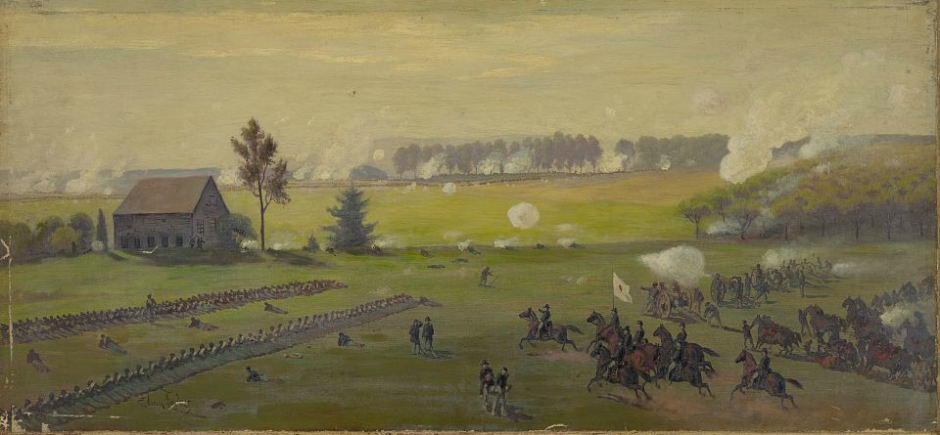
Men_Must_See_Us_Today_Gettysburg

The 124th New York was raised in Orange County New York, and a veteran unit, but it had taken many casualties and during the afternoon of July 2nd 1863 it went into action with just 18 officers and 220 men, in a position just to the left rear of Smith’s battery. The left flank of the 124th was protected by the tiny 4th Maine Infantry and the two remaining guns of Smith’s battery. Captain Smith whose battery had already expended its supply of case shot called out, “Give them she’ll! Give them solid shot! Damn them, give them anything!” [8]

Led by their gallant commander, who against the advice of a number of officers, mounted his horse and further exposed himself to enemy fire, the New Yorkers of the 124th were aware of their critical place on the battlefield. Looking at his Major Cromwell, Ellis remarked “the men must see us today.” [9] Cromwell cried out the order to charge the advancing Texans, and “the New Yorkers rushed down the west face of Houck’s Ridge at the double-quick. The 1st Texas reeled back some 200 yards under the surprise onslaught. “The conflict at this point defied description,” wrote an officer of e 124th. “Roaring cannon, crashing rifles, screeching shots, bursting shells, hissing bullets, cheers, shouts, shrieks and groans….” [10] A Confederate soldier wrote that the battle “was more like Indian fighting…than anything I experienced in the war.” [11] A reporter from the Savannah Republican accompanying Benning’s brigade wrote, “Down the plunging shot came…bursting before and around and everywhere tearing up the ground in a terrific rain of death….[As Benning’s brigade] approached the [Yankee] guns, the rain of grape and canister began! Mingling their sharp cries with the shrill whistle of the mad minnie balls which seemed to come in showers.” [12] The gallant regiment held off several attacks by Robertson’s Texans, and Ellis was killed by a bullet, as was Major Cromwell, and many of their gallant soldiers. “In the savage hand-to-hand fighting among the rocks, men shot at one another from the opposite side of the same Boulder, sometimes so close that clothing caught fire from the blaze of an enemy’s rifle. The high-pitched Rebel yell and the full-throated Federal huzzahs echoed through the rocks as first one side and then the other gave way…” [13]

In his after action report, Henry Benning wrote:

“When my first line reached the foot of the peak, I found there a part of the First Texas, struggling to make the ascent… The part of the First Texas…falling in with my brigade, the whole line commenced ascending the rugged…steep [incline] and, on the right, crossing the gorge. The ground was difficult – rocks in many places presenting, by their precipitous sides, insurmountable obstacles, while the fire of the was very heavy and very deadly. The progress was, therefore, not very rapid, but it was regular and uninterrupted….” [14]

With their supporting infantry considerably weakened, Smith’s guns were in danger. Some of Robertson’s troops had reached the base of the hill and taken cover behind a stone wall where they could take Smith’s artillery men under fire. Smith “could no longer depress his guns sufficiently to hit the Rebels. Occupying the low ground and using boulders for cover, the Confederates began to pick off Smith’s gunners. Smith “saw it would be impossible…to hold my position without assistance” and fell back…but the loss of artillery support was the beginning of the collapse of Sickles left flank.” [15] To the left in the Plum Run Valley, which later became known as the Valley of Death, the 4th Maine and Smith’s remaining guns fought off attacks by Robertson and Benning’s brigades before being forced to retreat. With his left now threatened Brigadier General Hobart Ward dispatched the 99th Pennsylvania to protect it, thinning his lines to do so. The Pennsylvanians of the 99th as well as men from the 124th New York, and the 4th Maine launched a counter-attack which succeeded in regaining the lower section of Houck’s Ridge. A soldier of the 99th recalled the moment his unit entered the fight, “Above the crack of the rifle, the scream of shells and the cries of the wounded, could be heard the shout of for “Pennsylvania and our homes…” [16] The cost had been great, but the ridge had been retaken from it the Union men rained fire down on the Alabamians below them in the Valley of Death. Hood’s men occupied Devil’s Den and secured a small lodgment on Houck’s Ridge which enabled the assault on Little Round Top to continue.

In a sense the fight at Devil’s Den was a victory for the Confederates as they had forced Ward’s troops from the position, but the human cost had been high among the men of the assaulting regiments. Robertson was wounded and had to be carried from the field, and most of the field officers of the Texas brigade were either killed or wounded leading their troops in the fight. Historian Harry Pfanz wrote, “The hard fighting at Devil’s Den, together with the sinister character of the spot, gave it a hallowed place in American history that might actually exceed its actual significance.” [17]

Robertson’s Texans and some of Law’s Alabamians surged up the slope of Little Round Top. But the sacrifice of the New Yorkers and Maine men was not in vain, they had helped buy the needed minutes for the soldiers of Colonel Strong Vincent’s brigade to arrive at the summit of Little Round Top, and Confederate casualties had been very heavy even before they attempted to scale the heights of Little Round Top.

To be continued…

Notes

[1] Ibid. Coddington The Gettysburg Campaign p.402

[2] Ibid. Guelzo Gettysburg, the Last Invasion p.256

[3] Ibid. Hessler Sickles at Gettysburg p.166

[4] Ibid. Pfanz The Second Day at Gettysburg pp.172-173

[5] Ibid. Wert A Glorious Army p.259

[6] Ibid. Foote The Stars in Their Courses p.128

[7] Ibid. Coddington The Gettysburg Campaign a Study in Command p.402

[8] Ibid. Sears Gettysburg p.273

[9] Ibid. Pfanz The Second Day at Gettysburg p.293

[10] Ibid. Sears Gettysburg pp.273-274

[11] Ibid. Foote The Stars in Their Courses p.128

[12] Ibid. Trudeau Gettysburg, A Testing of Courage p.342

[13] Ibid. Dowdy Lee and His Men at Gettysburg p.211

[14] Luvaas, Jay and Nelson, Harold W. Editors The U.S. army War College Guide to the Battle of Gettysburg, South Mountain Press Incorporated, Carlisle PA 1986 p.99

[15] Ibid. Hessler Sickles at Gettysburg p.166

[16] Ibid. Trudeau Gettysburg, A Testing of Courage p.345

[17] Ibid. Pfanz Gettysburg, the Second Day

Leave a comment

Filed under civil war, Gettysburg, History, Military

Hallowed Ground: A Weekend at Gettysburg


Friends of Padre Steve’s World,

Once again I am leading a group of my students on a Staff Ride at Gettysburg. We left the Staff College later than I like to but even so we made much better time getting up here than we usually do, only a little traffic to slow us down on I-495 on the way out of Washington D.C. This got us into Gettysburg earlier than I expected so after getting my stuff in my hotel room I took a walk around Cemetery Hill and through the Soldiers Cemetery.

As always I was astounded and humbled as I walked the ground. This really is hallowed ground. I think that Abraham Lincoln, who spoke “a few words” at the dedication of the Soldiers Cemetery said it the best:

“But, in a larger sense, we can not dedicate — we can not consecrate — we can not hallow — this ground. The brave men, living and dead, who struggled here, have consecrated it, far above our poor power to add or detract. The world will little note, nor long remember what we say here, but it can never forget what they did here. It is for us the living, rather, to be dedicated here to the unfinished work which they who fought here have thus far so nobly advanced. It is rather for us to be here dedicated to the great task remaining before us — that from these honored dead we take increased devotion to that cause for which they gave the last full measure of devotion…”


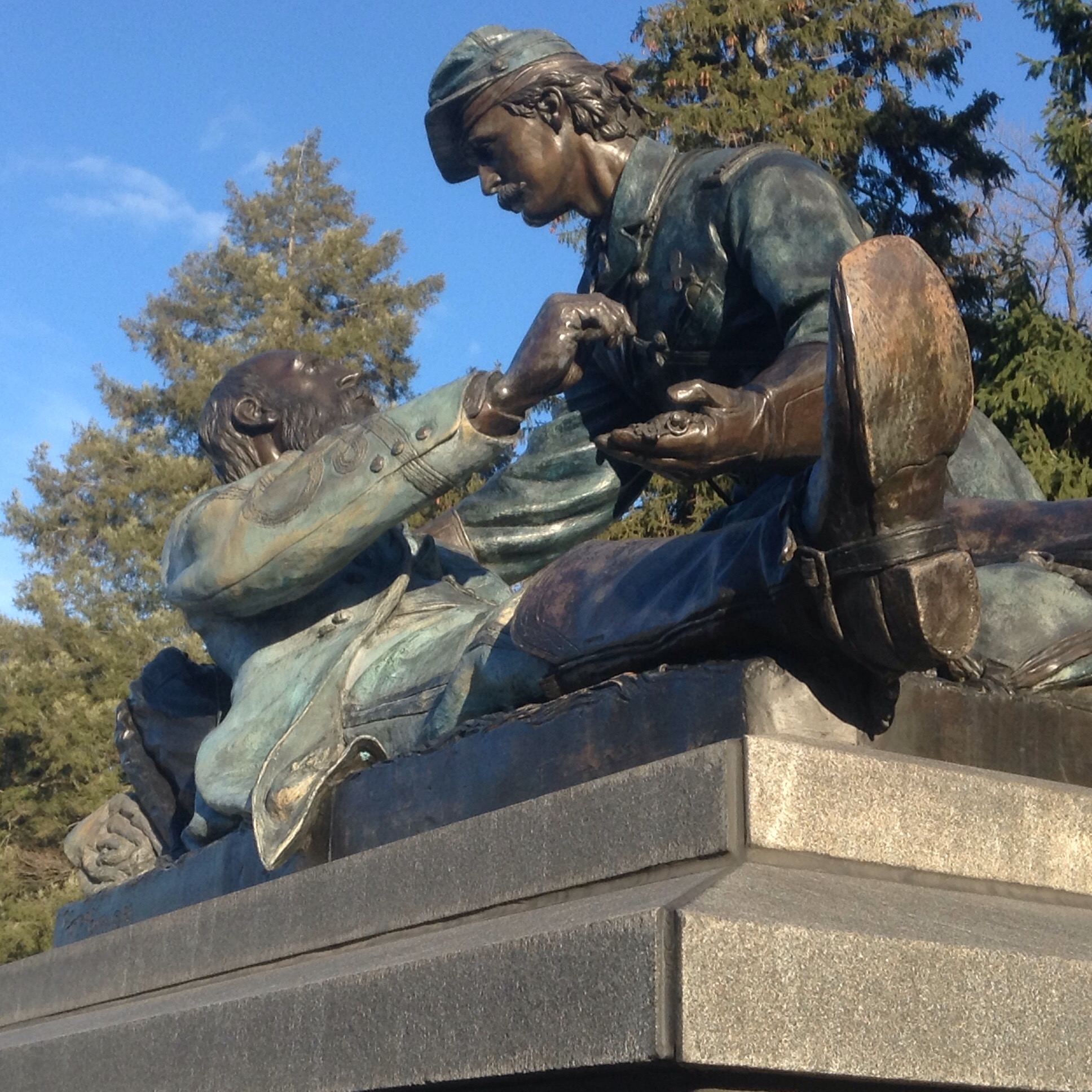
As I walked around Cemetery Hill and through the Soldiers Cemetery I felt the presence of the men that fought and died to preserve this remarkable Union. But when I got to the Masonic Memorial on the western slope of the hill was touched by an image of one of the more human things that happened on the battlefield. That image is a statue of a Union officer, a Captain Bingham rendering aid to Confederate General Lewis Armistead as the latter lay mortally wounded after leading his troops to the High Water Mark of the Confederacy. The story of Armistead is tragic, I have written about it before and it was movingly portrayed by Richard Jordan in the movie Gettysburg.

But when I come up here it is always Lincoln’s words, as well as the gallantry of the soldiers of the Army of the Potomac that inspire me more than anything. Please don’t get me wrong, while I admire the bravery and many of the cities of the Conferate soldiers, I despise the cause that they died for, and no, it is not the myth of states rights. It is the reality that Confederate leaders seceded because they had failed in Congress and at the ballot box to expand slavery outside of where it was legal.

I guess that is why Lincoln’s conclusion of the address resonates with me so much, “that from these honored dead we take increased devotion to that cause for which they gave the last full measure of devotion — that we here highly resolve that these dead shall not have died in vain — that this nation, under God, shall have a new birth of freedom — and that government of the people, by the people, for the people, shall not perish from the earth.”

So anyway, I hope that you are enjoying my latest Gettysburg posts.

Peace

Padre Steve+q

Leave a comment

Filed under civil war, Gettysburg, Military

July Second at Gettysburg Pt.3: Confederate Deployments

LongstreetJ_main

Lieutenant General James Longstreet C.S.A.

Friends of Padre Steve’s World

For those that have followed my writing for some time you know that I teach military history and ethics at the Joint Forces Staff College. One of the great joys that I have is leading the Gettysburg Staff Ride, which is an optional event for students that want to participate. When I took the position here I took some of my older writings on Gettysburg and put them into a student study guide and text. That was two years ago. Then the text was about 70 pages long. It is now about 925 pages long and eventually I hope to get it published. When and if that happens I expect it to become two, and possibly three books.

This is the third of a series of articles that I will be posting potions of a chapter that I have rewritten about the critical battles on the south side of the battlefield on July 2nd 1863, the battle for Devil’s Den, the Wheatfield, the Peach Orchard, and the final repulse on Cemetery Ridge.

As you read this don’t just look at the events, but look at the people, and their reaction to the what they encountered on the battlefield, for that understanding of people is where we come to understand history.

So even if you are not a Civil War buff, or even a history buff, take the time to look at the people, their actions, and the things that made them who they were, and influenced what they did. History is about people.

So please enjoy,

Peace

Padre Steve+

But Sickles’ deployment of his Corps had a number of lasting effects, “for all of Dan Sickles’ many faults,, he was correct on one point: the primary Confederate attack would occur on his front…” and “by moving forward into the Peach Orchard, he occupied one of the Key objectives of the Confederate attack plan.” [1] In fact, Longstreet had done “exactly what Sickles had thought he would do – wheeled around and come in from the South.” [2]

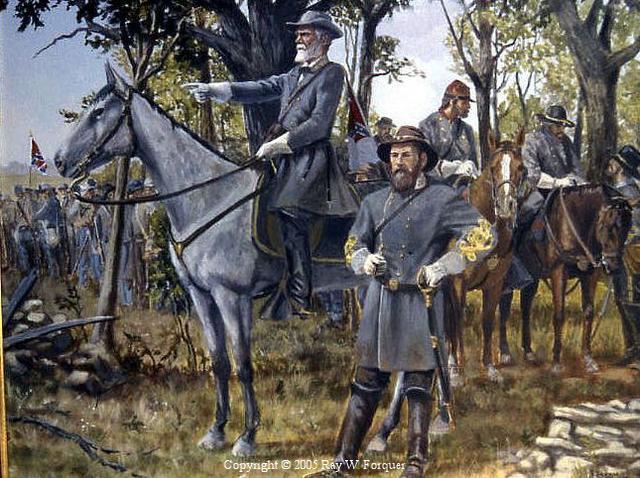
Lee and Longstreet the morning had been spent disagreeing on a plan to crush Meade’s army. Though Lee’s army was operating on exterior lines with his corps having no way to effectively coordinate their actions, Lee still desired to attack. Complicating matters was the fact that Lee was still lacking Stuart’s Cavalry with which to do a proper reconnaissance of the Federal positions. Likewise, Longstreet’s First Corps did not have Pickett’s Infantry division, Law’s brigade of Hood’s division when Lee insisted that Longstreet and his First Corps make a frontal attack on the Union left. Longstreet, as he had the night prior and earlier in the morning demurred, and tried to convince Lee of moving the army to the south and turning the Union flank the south of the Round Tops. Lee rejected Longstreet’s argument sand Longstreet reportedly told Hood “The General is a little nervous this morning; he wishes me to attack; I do not wish to do so without Pickett. I never like to go into battle with one boot off.” [3]

Part of the conflict was that Lee did not believe that Longstreet proposed move could succeed without the assistance of Stuart’s cavalry, while Longstreet did not believe that his First Corps had the combat necessary combat power to successfully complete the mission without Pickett’s division. Lee would hear no more of Longstreet’s objections and ordered the attack, and Lee in his after action report noted, “Longstreet was directed to place the divisions of McLaws and Hood on the right of Hill, partially enveloping the enemy’s left, which he was to drive in.” [4] Instead of leaping into action, Longstreet “allowed his disagreement with Lee’s decision to affect his conduct. One the commanding general determined to assail the enemy, duty required Longstreet to comply with the vigor and thoroughness that had previously characterized his generalship.” [5] This he did not do, he sought further delay, and though he could not force Lee to wait until Pickett arrived he did ask and get permission “to wait until Hood’s division was completed by the arrival of Law’s brigade.” [6] This unit arrived about forty-five minutes later and Longstreet finally began to move his divisions to their starting positions.

mclaws

Major General Lafayette McLaws C.S.A.

Leading the advance division was Major General Lafayette McLaws. McLaws was “a capable soldier without flair, who steady performance never produced a high moment. His reliability and dogged tenacity rubbed off on his men, however, and made them as hard to dislodge as any in the army.” [7] He had put together as solid of a record as a division commander and led the division for almost two years. During his time in command his exceptional care for the welfare of his men had endeared him to them. He and his division were excellent in the defense, and McLaws was very deliberate “but his attention to his men made him and his division a reliable command.” [8]

Porter Alexander noted that in the defense “McLaws was about the best in the army…being very painstaking about details, & having an eye for good ground.” [9] But there was a drawback, for all of his solidness and fortitude “he lacked a military imagination,” and was “best when told exactly what to do and closely supervised by superiors.” [10] McLaws’ solid division was typical of many of the units in Longstreet’s First Corps, “outstanding on defense and led by a competent soldier, they were thoroughly dependable. With the reliance of old pro’s, they did what they were told, stood up under heavy casualties, and produced tremendous firepower.” [11]

The two divisions began their march which “soon became a comedy of errors such as one might expect of inexperienced commanders and raw militia, but not of Lee’s War Horse” and his veteran troops.” [12] In part this was due to a lack of well trained staff officers to help guide the movements and ensure that the divisions reached their assigned position on the battlefield with a minimum of friction. Longstreet, who was still upset about Lee overriding his course of action, Longstreet “chose this moment to be more than punctilious in complying with army protocol. Since Lee had ordered Johnson to lead and guide the head of the column, which was McLaws’ division, Longstreet decided to regard him as Lee’s special representative who during the march possessed greater authority over these troops than he.” [13] Longstreet’s decision was questionable at best, for he ceded command of an approach to contact to a relatively inexperienced engineering officer who had no experience leading large numbers of troops and dropped back, accompanying Hood’s division.

Colonel Porter Alexander, who observed the Confederate infantry’s movements and who had successfully navigated the terrain not long before, wrote:

“This is just one illustration of how time may be lost in handling troops, and the need of an abundance of competent staff officers by the generals in command. Scarcely any of our generals had half of what they needed to keep a constant & close supervision on the execution of important orders. And that always ought to be done. An army is like a great machine, and in putting it into battle it is not enough for its commander to merely issue the necessary orders. He should have a staff ample to supervise the execution of each step, & to promptly report any difficulty or misunderstanding. There is no telling the value of the hours which were lost by that division that morning.” [14]

Since Longstreet, wisely wanted his movements to be out of sight of the enemy, the two divisions had to pick their way across bad ground, over stone walls, and wooden fences which had to be torn down, which combined with the miserably hot weather slowed their advance. Eventually, just passed the Black Horse Tavern the head of McLaws’ division came upon a clear piece of high ground that was in clear view of the Union signal station on Little Round Top and halted. Longstreet came riding up to find the reason for the delay and going with McLaws, he snapped “Why this won’t do,… Is there any way to avoid it?” [15]

Brigadier General Joseph Kershaw, whose brigade led the march, and who has to be considered one of the most objective officers in the controversy that continued long after the battle, recalled what happened.

“At length General McLaws ordered me to move by a flank, get under the cover of the hill and move along Marsh Creek toward the enemy, taking care to keep out of their view. In executing this order we passed the Black Horse Tavern and followed a road leading from that point to the Emmitsburg pike, until the head of the column reached a point where the road passed over the top of a hill from which our movement would be plainly visible from the Federal signal station on Little Round Top. Here we were halted by General McLaws in person, while he and General Longstreet rode forward to reconnoiter.” [16]

The countermarch became a muddled mess. The halt had snarled the divisions of Hood and McLaws, “quickest way to countermarch was simply to about face the troops, but McLaws had been assigned specifically by lee to lead the column into attack position and he felt obliged to hold that place.” [17] With McLaws insisting on maintaining his position, the whole column had to double back on itself. As such the initial halt and the subsequent countermarch further slowed the Confederate deployment as McLaws and Hood’s divisions became entangled and had to be separated. To reach their positions the Longstreet’s troops “followed a farm lane to Fairfield Road, marched north a short distance before striking a road along Willoughby Run, and angled southeast, shielded by Seminary Ridge. At Pitzer’s Schoolhouse they struck Millerstown Road, turned east, and approached the ridge’s crest,[18] where they were met by an astounding sight. Instead of finding the open ground along the Emmitsburg Road as they expected, Longstreet and McLaws discovered the high ground of the Peach Orchard full of Dan Sickles’ Third Corps infantry and artillery.

In the time it had taken for Longstreet to move his corps to its start positions, the situation on the ground had changed. While Sickles move jeopardized the Federal line, it also “disrupted Confederate Battle plans. Should the Sickles salient be attacked or outflanked?” [19] Lee had developed his plan on the assumption that First Corps would not encounter enemy opposition as they moved up the Emmitsburg Road. Years later McLaws wrote, “The view presented astonished me…” [20] “as the enemy was massed in my front and extended to my left and right as far as I could see.” [21]and to his wife he wrote about it a few days later, “On arriving at the vicinity of the Orchard, the enemy were discovered in greater force than we supposed, and two of my brigades were deployed to face the enemy, and the other two in the rear as reserve…” [22] The presence of Third Corps necessitated that Longstreet either notify Lee of the change and ask for new orders, or to adjust in the fly and redeploy his troops to meet the new situation. While informing Lee would have been the optimal course of action, Longstreet, who had been rebuffed by Lee on several occasions in the last day, and probably was in no mood to again go toe-to-toe with the general commanding, rigidly held to the attack, and chose the latter course of action.

Instead of deploying perpendicular to the Emmitsburg Road in order to roll up the flank of the Federal positions, but “for Longstreet to attack at the angle Lee had specified would expose him to enfolding fire.” [23] To meet the new situation, Longstreet and McLaws deployed parallel to the road to make a frontal attack on the salient presented by Third Corps, while Hood’s division was ordered further south in order to take Little Round Top, while McLaws wrote that he “was directed not to assault until General Hood was in position.” [24] the movement took about another hour as Hood attempted to mask the movement of his troops from Federal observers by remaining in the wood line.

Porter Alexander, whose ever-insightful observations provide an alarming commentary on the Confederate senior leadership and their preparation for the assault the Federal left: “I never remember hearing of any conference or discussions among our generals at this time as to the best formations & tactics in making our attacks, & our method on this occasion struck me as peculiar even then, & I don’t think it was the best.” [25]

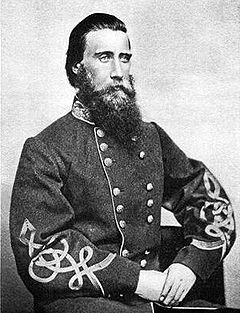
Lt._Gen._John_B._Hood

Major General John Bell Hood C.S.A.

Hood was never one to hesitate to attack, but when he saw the situation that faced First Corps, he objected to the attack. “For the first time in his army career Hood suggested a change of orders to his commanding general,” [26] and pleaded with Longstreet to change it. “From his own observations and those of his scouts he concluded that the attack would be futile and result in wanton wage of life.” [27] The fierce Texan “recognized that the battle order, written more than two miles away on mistaken information…did not fit existing conditions.” [28] His objections included the rocky terrain which he believed would break up his battle formations, as well as “the concave character of the enemy’s line from the north end of Cemetery Ridge to Big Round Top would expose his division to a “destructive fire in flank and rear, as well as in front” if his men attacked it obliquely.” [29]He told Longstreet that it was “unwise to attack up the Emmitsburg Road, as ordered” and requested that he be allowed to “turn Round Top and attack the enemy flank and rear.” [30]

Lafayette McLaws “believed that if Lee had known of the changed conditions that he would have called off the attack.” [31] While this might have been the case, Lee was now over two miles away on his way back to his headquarters after pushing Longstreet to force the attack. From his other decisions to force the attack on both July 2nd and 3rd McLaws’ opinion can be debated. But Longstreet had consulted with Lee and while Lee “was already fretting over the delay which had occurred,” and even if it was no longer possible to launch an attack that wheeled up the Emmitsburg Road, he certainly was not going to call the whole thing off.” [32]

Meanwhile, the debate between Longstreet and Hood continued as Hood objected and Longstreet reiterated Lee’s insistence on the planned attack. McLaws noted that Hood “found that the enemy were strongly posted on two rocky hills, with artillery and infantry…” [33] and he pleaded for freedom of maneuver. He believed that an attack up the rocky hills was doomed and later noted “it seemed to me that the enemy occupied a position so strong- I may say impregnable – that independently of their flank fire, they could easily repulse our attack by merely throwing or rolling stones down the mountainside as we approached.” [34]

Despite his objections to the plan Longstreet ordered Hood to attack as Lee planned and after a fourth attempt by Hood to persuade Longstreet to change the plan Longstreet told his subordinate “We must obey the orders of General Lee.” [35] In defending his decision to launch the attack despite his own misgivings after the war Longstreet wrote, “that the move to the right had been proposed the day before and rejected.” [36] However, Longstreet’s explanation, made years after the battle and in the midst of a long running dispute with Jubal Early on who was at fault for the defeat at Gettysburg, was somewhat disingenuous.

Longstreet was referring to Lee’s rejection of Longstreet’s plan for an operational movement by the army to position itself between the Army of the Potomac and Washington, in order to fight a defensive battle, not the tactical adjustment to the plan of attack that Hood proposed. Clifford Dowdy argued that, “In basing his rejection of Hood’s extemporized plan on the rejection of his own strategy, Longstreet revealed the depth of the wound to his own ego and the consequent undermining of his judgement.” [37] This is an argument that has some merit, and it seems to be born out by Longstreet’s repeated rejections and dismissals of Hood’s repeated proposals to attempt to flank the Federal left. However, in light of the arrival of John Sedgwick’s Sixth Corps on the battlefield about the time of the assault it is quite possible that Hood’s division could have been completely separated from the rest of the Confederate army, surrounded and destroyed had Longstreet yielded to his subordinate’s request.

To be continued…

Notes

[1] Ibid. Hessler Sickles at Gettysburg p.134

[2] Ibid. Swanberg Sickles the Incredible p.213

[3] Ibid. Pfanz Gettysburg the Second Day p.112

[4] Ibid. Dowdy Lee and His Men at Gettysburg p.192
[5] Ibid. Wert General James Longstreet p.268

[6] Ibid. Dowdy Lee and His Men at Gettysburg p.192
[7] Tagg, Larry The Generals of Gettysburg: The Leaders of America’s Greatest Battle Da Capo Press Cambridge MA 1998 Amazon Kindle Edition pp.208-209

[8] Ibid. Wert General James Longstreet p.209

[9] Ibid. Alexander Fighting for the Confederacy: p.170

[10] Ibid. Tagg The Generals of Gettysburg p.209

[11] Ibid. Dowdy. Lee and His Men at Gettysburg p.176

[12] Ibid. Coddington The Gettysburg Campaign a Study in Command p.378

[13] Ibid. Coddington The Gettysburg Campaign a Study in Command pp.378-379

[14] Ibid. Alexander Fighting for the Confederacy p.236

[15] Ibid. Sears Gettysburg p.258

[16] Kershaw, J.B. Kershaw’s Brigade at Gettysburg in Battles and Leaders of the Civil War Volume III, The Tide Shifts. Edited by Robert Underwood Johnson and Clarence Clough Buel Castle, Secaucus NJ p.331

[17] Ibid. Sears Gettysburg p.259

[18] Wert, Jeffry D. A Glorious Army: Robert E. Lee’s Triumph 1862-1863 Simon and Schuster, New York and London 2011 pp.256-257

[19] Taylor, John M.Duty Faithfully Performed: Robert E. Lee and His Critics, Brassey’s Dulles Va 1999 p.148

[20] Ibid. Wert “General James Longstreet p.271

[21] Foote, Shelby The Stars in Their Courses: The Gettysburg Campaign June-July 1863 Modern Library, a division of Random House New York 1994 p.124

[22] Oeffinger, John C. Editor. A Soldier’s General: The Civil War Letters of Major General Lafayette McLaws, University of North Carolina Press 2009 p.196

[23] Ibid. Taylor Duty Faithfully Performed p.148

[24] Ibid. Oeffinger A Soldier’s General p.196

[25] Ibid. Alexander Fighting for the Confederacy p.238

[26] Ibid. Dowdy Lee and His Men at Gettysburg p.205

[27] Ibid. Coddington The Gettysburg Campaign p.382

[28] Ibid. Dowdy Lee and His Men at Gettysburg p.204

[29] Ibid. Coddington The Gettysburg Campaign p.382

[30] Ibid. Foote The Civil War, A Narrative: Fredericksburg to Meridian p.499

[31] Ibid. Taylor Duty Faithfully Performed p.148

[32] Ibid. Guelzo Gettysburg, the Last Invasion p.254

[33] Ibid. Oeffinger A Soldier’s General p.196

[34] Ibid. Foote The Civil War, A Narrative: Fredericksburg to Meridian p.499

[35] Ibid. Foote The Stars in Their Courses p.126

[36] Ibid. Dowdy Lee and His Men at Gettysburg p.206

[37] Ibid. Dowdy Lee and His Men at Gettysburg p.206


Leave a comment

Filed under civil war, Gettysburg, History, Military

A Grand Sight to Witness: July 2nd at Gettysburg Pt. 2

sickles peach orchard

Friends of Padre Steve’s World

For those that have followed my writing for some time you know that I teach military history and ethics at the Joint Forces Staff College. One of the great joys that I have is leading the Gettysburg Staff Ride, which is an optional event for students that want to participate. When I took the position here I took some of my older writings on Gettysburg and put them into a student study guide and text. That was two years ago. Then the text was about 70 pages long. It is now about 925 pages long and eventually I hope to get it published. When and if that happens I expect it to become two, and possibly three books.

This is the second of a series of articles that I will be posting potions of a chapter that I have rewritten about the critical battles on the south side of the battlefield on July 2nd 1863, the battle for Devil’s Den, the Wheatfield, the Peach Orchard, and the final repulse on Cemetery Ridge.

As you read this don’t just look at the events, but look at the people, and their reaction to the what they encountered on the battlefield, for that understanding of people is where we come to understand history.

So even if you are not a Civil War buff, or even a history buff, take the time to look at the people, their actions, and the things that made them who they were, and influenced what they did. History is about people.

So please enjoy,

Peace

Padre Steve+

sickles as brigadier

The Problem of Dan Sickles and Third Corps

In the early morning hours of July 2nd 1863, George Meade had instructed Dan Sickles’ Third Corps “to go into position on the left of the Second corps [so] that his right was to connect with the left of the Second Corps, [and] he was going to prolong the line of that corps occupying the position that general Geary held the night before,” [1] that is the area of South Cemetery Ridge and Little Round Top. However during the night and early morning hours Sickles had not done so. However, Sickles was not comfortable with the position of his corps, especially in relation to the high ground that lay in front of him.

All morning he had been lobbying Meade, through Meade son and Aide-de-Camp Captain George Meade, the Artillery Reserve Commander Henry Hunt, Warren and even Meade himself to adjust the line held by his corps to no avail. Sickles had posted some of Birney’s division to the west of Plum Run near the Peach Orchard as pickets. His left, which should have rested on Little Round Top was located at Devil’s Den while Berdan’s Sharpshooters pushed further west as a skirmish line along with a few regiments of Birney’s division and a few squadrons of cavalry.

Sickles ordered Berdan to lead about one hundred of his sharpshooters into the woods west of the Warfield farm where they engaged part of Cadmus Wilcox’s brigade and noticed “three columns in motion in the rear of the wood, changing direction… by the right flank.” [2] The troops were those of Hood and McLaws divisions moving to their start positions from which they would assault the federal left. Berdan reported the Confederate troop movements to Sickles. Additionally, Sickles was also concerned because John Buford’s Cavalry division which has been deployed on the Federal left, had just “been pulled to the rear to be refitted, but not replaced. The horsemen had been supplying him with vital information about rebel dispositions; with mobile reconnaissance now gone, Sickles felt naked and vulnerable.” [3] He believed that it was absolutely vital that he move troops onto the Peach Orchard, and to a hill known as Stony Hill, Houck’s Ridge, and another known by local children by the sinister name of Devil’s Den.

Sickles decided to voice his concerns to Meade and sent his aide de camp, Major Henry Tremain, to report those concerns at Meade’s headquarters. Tremain explained the positions of the Third Corps, as well as the skirmishers, and reminded Meade “that there were no troops on the left of Third Corps, and told him that Sickles had sent General Graham to bring up the two brigades left at Emmitsburg.” [4] Apparently Meade was not concerned and paid little attention to Sickles concerns. Later in the morning Sickles had Tremain take him to Meade’s headquarters where Sickles complained about the position. He noted that “the Ridge dipped slightly just before meeting Little Round Top,” [5] and that there was higher ground in front. Sickles “spoke of his concerns, the poor position assigned to his corps, the advantages of holding the high ground at the Peach Orchard, and his fear of an assault from his front.” [6] Meade seemed unconcerned and Sickles pressed Meade to see the ground for himself. Meade curtly refused to do so, so Sickles asked if “Meade would at least send his chief engineer, Gouverneur K. Warren? The answer was even more curt: no” [7]

Meade was most concerned about another Confederate assault on his right, and paid little attention to the concerns of the political general. Sickles also asked the army commander “if he was authorized to post his corps in a manner he “should deem the most suitable.” Meade replied, “Certainly, within the limits of the general instructions I have given you; any ground within those limits you choose to occupy I leave to you.” [8] Finally after some discussion Sickles was able to convince Meade to send his artillery chief, Henry Hunt to come with him to examine potential artillery positions for his corps. Had Meade not been so concerned about his right he might have paid more attention to the reports of the Signal Corps station on Little Round Top which as early as noon were reporting the Confederate troop movements being reported by Sickles and Berdan. Scoffing at Sickles Meade allegedly said, “Generals are all apt to look for the attack to be made where they are.” [9]

Hunt accompanied Sickles back to his corps and made a reconnaissance of the ground that Sickles was determined to hold. While Hunt believed that it had some advantages that those advantages were cancelled out by several factors, including the fact that the position would be a salient exposed to enemy attacks from multiple sides, and that the Third Corps “was not strong enough with only two divisions instead of the three possessed by most corps) to hold the new line and also connect Hancock’s flank in the north.”[10] Though Hunt sympathized with Sickles predicament, and recognized the inadequacies along the southern sector of Cemetery Ridge near Little Round Top, he would not authorize the insistent Knickerbocker to advance. He “suggested that Sickles talk further with headquarters, and he now advised Meade to examine the position for himself.” [11] Hunt then left Sickles in order to check on his other artillery dispositions along Cemetery Ridge.

Sickles, who lived with the vision of being ordered off of Hazel Grove by Hooker at Chancellorsville and who had seen what had happened to Howard’s Eleventh Corps when it had its flank rolled up by Jackson, now felt that history was about to repeat itself. Though his requests to Meade and Hunt had been met with a “no,” and while Hunt’s answer might have been more ambiguous, but the answer was still no, unless Meade changed his mind. That did not happen. Hunt made his report to Meade and told Meade that “the proposed line [by Sickles] was a good one in itself; that it offered favorable positions for artillery, but that its relations to other lines were such that I could not advise it, and suggested that he examine it himself before ordering occupation.” [12]

With Hunt gone, and Sickles having heard what he wanted to hear from Meade and the artillery chief, Sickles acted on his own. Sickles was determined not to be victimized a second time by Robert E. Lee and “he was not going to let his men suffer the fate of the Eleventh Corps.” [13] As he continued to get reports from Berdan’s skirmishers of the Confederate build up just to the west of the Peach Orchard, he “took it to mean that the Peach Orchard line that he coveted was about to be occupied by the enemy. At 2:00 P.M., without authorization from Meade, without even informing Meade, he ordered Third Corps forward.” [14]

It was an act of brazen insubordination, but typical of him, and while historians still debate what Sickles did, his action was not entirely without justification. Some of this is directly attributed to George Meade, whose apparent lack of empathy for Sickles’ plight as the commander on the scene, and for “the situation on his front, and so Sickles had taken the bit in his teeth and abandoned the position ordered by General Meade for one that he believed better. He defended his decision and action afterward – aggressively, if not always credibly and honorably – until his dying day, half a century later.” [15] Sickles later wrote: “Impossible to wait any longer without giving the enemy serious advantages in his attack, I advanced my line toward the highest ground to my front, occupying the Emmitsburg Road at the very point where Longstreet hoped to cross it unopposed.” [16] But Sickles, while he certainly believed that he was making the correct move, did not see the second, third, and fourth order effects of his decision on the Union defensive plan. Admittedly, had Meade paid more attention to Sickles’ pleas earlier in the day and not been consumed with concern for the Federal right, the situation might not have come to this. But like in any real world situation the clash between Sickles and Meade was not simply a matter of a disagreement in tactics, but of a profound distrust for one another. Meade, the professional, had little regard for and loathed Sickles the political general, while Sickles, ever the politician, believed that Meade was doing what he could to set him up for failure, and “that Meade had deliberately left him alone in the path of a Confederate landslide, with no cavalry screen and no supports within easy distance.” [17] Some of Sickles’ officers in Third Corps saw the situation in a similar manner. Lieutenant Colonel Rafferty “argued that no attention was paid to Sickles’ concerns and “General Sickles has one sterling quality of a good soldier, – he was equal to an emergency; and left as he was now to the exercise of his own judgement, he was prompt to act.” [18]

About mid-afternoon Sickles advanced Third Corps forward in a “mile long line of battle with waving flags and rumbling batteries rolling west into the afternoon sunlight.” [19] It was a magnificent sight that was inspiring to watch, and perplexing to other commanders Frank Haskell, wrote, “It was magnificent to see those ten or twelve thousand men – the were good men- with their batteries and some squadrons of cavalry upon the left flank, all in battle order in several lines with flags streaming, sweep steadily down the slope, across the valley, and up the next ascent towards their destined position! From our position we could see it all.” [20] Others were equally impressed with the sight that they beheld.

“The eye beheld” wrote an officer of Carr’s brigade, “battery and brigade extended from point to point,” full of “moving columns and gay banners.” It was “a grand sight to witness this little corps of two divisions gallantly move on the advance,” and despite what was taking place on what was after all a battlefield, it all “appeared to be a peaceful review….” [21]

Another wrote, “The sun shone brilliantly on their waving colors, and flashed in scintillating rays from their burnished arms, as with well aligned ranks and even steps they moved proudly across the field. Away to the right, along cemetery Ridge, the soldiers of the Second Corps, leaving their coffee and their cards, where they gazed with soldierly pride and quickened pulse on the stirring scene.” [22] As the troops advanced “the fifteen-piece brass band of the 114th Pennsylvania (Collis’ Zouaves) thumped away to mark the time.” [23] Chaplain Joseph Twitchell who had been with the Excelsior Brigade from the beginning wrote, “with a firm step with colors flying the bravest men in the army marched in the open field. It was a splendid sight.” [24] The sight inspired the men, and it was remember by witnesses long after other memories had faded into time.

Sickles advance confused John Gibbon, who watched in amazement from his vantage point on Cemetery Ridge “commanding Hancock’s Second Division on Cemetery Ridge, looked out in amazement and wondered if a general order to advance upon the enemy had somehow missed him.” [25] Gibbon’s Corps commander Winfield Scott Hancock saw it too and wrote: “I recollect looking on and admiring the spectacle, but I did not know the object of it.” He “quietly” remarked to his staff, “Gentlemen, that is a splendid advance” and “beautiful to look at.” But he could not imagine that Meade had sanction this parade, and he predicted that “those troops will be coming back again very soon.” [26]

The movement to the Peach Orchard placed the Third Corps nearly a mile in front of his previous position, and opened up a significant gap between his corps and Hancock’s Second Corps. Sickles was now attempting to hold a new line that was nearly twice as long as the position that Meade had designated. By advancing Sickles had “put his corps out of alignment with the rest of the army and exposed his flanks.” [27] The line Meade had prosed was essentially a straight line, only about 1,600 yards long with its left flank anchored on Little Round Top and its right tied in to the line of Second Corps on Cemetery Ridge. It was a manageable front for a small corps of less than 11,000 soldiers. The new front which Sickles occupied was some 2,700 yards long and he did not have enough men to fill it out, or extend it to Little Round Top. Instead he had to anchor his left flank on Devil’s Den, some 500 yards to the front of Little Round Top. Sickles “wanted to hold the road and the peach-orchard hill and to bend the rest of the line back to the Round Tops, and he did not have enough men for it.” [28] The line Sickles created formed a salient, which protruded toward the Confederate line, and it “would be dangerously exposed to attack from two directions – the west and the south simultaneously.” [29] Humphrey’s Second Division aligned itself on the Emmitsburg road facing west and northwest, while “Birney’s division crammed the little orchard with men and guns and extended its line back to the southeast.” [30]

He placed Humphrey’s division along the Emmitsburg Road and extended Birney’s division through the Peach Orchard, a wheat field down to Devil’s Den where Birney ran out of troops. Birney had barley 5,000 soldiers to hold the ground assigned, which stretching in an irregular pattern from the east side of the Peach Orchard, down the Stoney Hill, to Houck’s Ridge and Devil’s Den, “Charles Graham’s brigade on the right, at the Orchard, Regis de Trobriand’s in the center, and Hobart Ward’s on the right…. At the literal end of the line – the extreme left of the Army of the Potomac – was Captain James E. Smith’s New York 5th Independent Battery, posted on Houck’s Ridge overlooking devil’s Den.” [31] The position on the ridge was so tight that Smith could only deploy four of his six guns on it and was forced to place the other two in the Plum Run Valley, later known as the “Valley of Death,” between Devil’s Den and Little Round Top. Despite his good intentions, Sickles had formed an exposed and vulnerable salient which was too thinly manned for its length. It was open to attack on three sides, had little depth, no reserves and no place to fall back to as an alternate position.[32]

While Sickles was deploying his Corps, George Meade called for a conference of his corps commanders at the Leister House. Unable to see Sickles movement as his headquarters was behind and below the crest of Cemetery Ridge, Meade was consulting with various staff members and sending messages to Washington regarding his plans. As such Meade was one of the last to find out about Sickles’ advance.

When John Sedgwick’s Sixth Corps arrived Meade sent a message to Halleck informing him “The Sixth Corps is just coming in, very much worn out. I have…awaited the attack of the enemy, I having a strong position for the defensive…. He has been moving on both my flanks apparently. Expecting battle, I have ordered my trains to the rear.” [33] With Sedgwick now on the field, Meade called for a meeting of his corps commanders, sending a circular to each. Sickles received his copy and asked “to be excused, stating that the enemy was in great force on his front and preparing to attack.” [34] Meade refused to let Sickles off the hook and ordered his recalcitrant general to report to the Leister house.

Before Sickles arrived, Gouverneur Warren told Meade that Sickles’ corps was not in position, and the army commander’s volcanic tempter erupted just as Sickles rode up. An engineering officer at the headquarters wrote, “I never saw General Meade so angry if I may call it.” When Meade saw Sickles he ordered him to “retire his line to the position he had been instructed to take.” [35] Meade told Sickles to get back to Third Corps immediately, Sickles recalled that “General Meade met me just outside the headquarters and excused me from dismounting”…. He said that I should return at once and that he would follow soon.” [36] Meade soon followed after he instructed General Sykes of Fifth Corps to shift it “from its reserve position toward the left with all speed, “and hold it at all hazards.” [37] Riding with Warren, the two men saw the empty positions on Cemetery Ridge where Third Corps should have been and saw where Sickles had placed them in front of the line. Warren, most familiar with the section of the line, noted that Third Corps “was very badly disposed on that part of the field,” [38] commented to Meade, “Here is where our line should be,” and “Meade replied grimly, “it is too late now.” [39] Meade later explained, that he was, “wholly unprepared to find it [Sickles’ corps] advanced beyond the line of Second Corps. It’s lines were over a mile and a half out to the front, to the Emmitsburg Road, entirely disconnected with the rest of the army, and beyond supporting distance.” [40]

Meade had been surprised by his subordinate’s unauthorized move, and his “staff served him poorly with respect to the Third corps activities,” [41] the at times crotchety Pennsylvanian did not lose his composure. While Meade went forward to meet Sickles, he sent Warren to check what was happening at Little Round Top and authorized Warren to attend to it and would help save the exposed left flank of the army when he discovered that Little Round Top was undefended.

About the time that Meade arrived at the Peach Orchard, Sickles corps was about to be hit by the full fury and power of Hood’s and McLaws’ divisions of Longstreet’s First Corps. The Confederate infantry was supported by Porter Alexander who had situated 46 well placed artillery pieces in a perfect position to open fire on Birney and Humphrey’s Third Corps divisions in the Peach Orchard Salient. [42]

When he confronted Sickles in the Peach Orchard, George Meade was visibly perturbed. Looking at Sickles’ dispositions, Meade informed the New Yorker, “General I am afraid that you are too far out” [43] as he attempted to control his temper. Sickles disagreed and said that “if supported, the line could be held; and in my judgement it was the best one.” [44] with support he could hold the position because it was higher ground than what he had previously occupied. Meade then pointed out the obvious stating “General Sickles this is in some respects higher ground than that to the rear, but there is still higher in front of you…” [45] As the conversation progressed Meade told Sickles that “this is neutral ground, our guns command it as well as the enemy’s. The reason you cannot hold it applies to them.” [46]

Sickles now offered to withdraw, and reportedly told Meade, “General, I have received no orders. I have made these dispositions to the best of my judgement. Of course I shall be happy to modify them according to your views.” [47] But as he did so the Confederate cannonade began signaling the beginning of Longstreet’s attack. Meade told Sickles “I wish to God you could,” said Meade, “but the enemy won’t let you.” [48] Another account states that Meade told Sickles “You cannot hold this position but the enemy will not let you get away without a fight, & it may begin at any time now.” [49] Meade later wrote about the encounter, “Having found Major-General Sickles, I was explaining to him that he was too far in advance, and discussing with him the propriety of withdrawing, when the enemy opened fire on him with several batteries in his front and on his flank, and immediately brought forward columns of infantry and made a most vigorous assault.” [50] For Sickles and Meade their exchange in the Peach Orchard on the afternoon of July 2nd 1863 would develop into an acrimonious lifelong feud, with both men and their supporters bending the truth, and sometimes repeating outright lies to defend their actions before Congress, and in the press.

Since John Sedgwick’s powerful Sixth Corps had just arrived Meade ordered it into reserve to replace Sykes’ Fifth Corps which he had ordered, along with division of Winfield Scott Hancock’s Second Corps to support Sickles’ Third Corps around the Peach Orchard and Wheat Field. Meade told Sickles, “I will send you the Firth Corps, and you may send for support from the Second Corps.” [51] Meade, acting decisively then told Sickles “if you need more artillery call on the reserve!” [52] Henry Hunt heard the conversation and immediately went to work to get as many guns as possible up to support Sickles. It was an action that very likely saved the day, example of Meade taking control of a bad situation, albeit one that he might have prevented by paying more attention to Sickles, but, even so, preventing it from becoming even worse. General Tyler, commander of the Artillery Reserve, “had already sent up the first two batteries Hunt had ordered; now, on his own initiative, the Reserve commander dispatched McGilvery’s First Volunteer Brigade to the scene; Hunt met it on the road and was extremely relieved by its presence.” [53] The guns that Hunt and Tyler had rushed to the front were about to be put to good use in the impending fight.

To be continued…

Notes

[1] Ibid. Trudeau Gettysburg a Testing of Courage p.294

[2] Ibid. Guelzo, Gettysburg The Last Invasion p.246

[3] Longacre, Edward G. The Man Behind the Guns: A Military Biography of General Henry J. Hunt, Chief of Artillery, Army of the Potomac Da Capo Press, Perseus Book Group, Cambridge MA 2003 p.163

[4] Ibid. Pfanz The Second Day at Gettysburg p.90

[5] Ibid. Cleaves Meade of Gettysburg p.145

[6] Ibid. Pfanz The Second Day at Gettysburg p.93

[7] Ibid. Guelzo, Gettysburg The Last Invasion p.247

[8] Ibid. Sears Gettysburg p.250

[9] Ibid. Guelzo, Gettysburg The Last Invasion p.247

[10] Ibid. Longacre The Man Behind the Guns p.162

[11] Ibid. Cleaves Meade of Gettysburg p.146

[12] Ibid. Hessler Sickles at Gettysburg p.120

[13] Ibid. Coddington The Gettysburg Campaign a Study in Command p.45

[14] Ibid. Sears Gettysburg p.252

[15] Ibid. Pfanz The Second Day at Gettysburg p.103

[16] Ibid. Keneally American Scoundrel p.279

[17] Ibid. Guelzo, Gettysburg The Last Invasion p.246

[18] Ibid. Hessler Sickles at Gettysburg p.132

[19] Ibid. Catton Glory Road p.288

[20] Oates, William C. and Haskell, Frank A. Gettysburg: The Confederate and Union Views of the Most Decisive Battle of the War in One Volume Bantam Books edition, New York 1992, originally published in 1905 p.168

[21] Ibid. Guelzo, Gettysburg The Last Invasion pp.250-251

[22] Ibid. Pfanz The Second Day at Gettysburg p.145

[23] Ibid. Guelzo, Gettysburg The Last Invasion p.250

[24] Ibid. Pfanz The Second Day at Gettysburg p.145

[25] Ibid. Catton Glory Road p.288

[26] Ibid. Guelzo, Gettysburg The Last Invasion p.251

[27] Ibid. Coddington The Gettysburg Campaign a Study in Command p.355

[28] Ibid. Catton Glory Road p.288

[29] Ibid. Hessler Sickles at Gettysburg p.117

[30] Ibid. Catton Glory Road p.288

[31] Ibid. Sears Gettysburg p.265

[32] Ibid. Foote The Civil War, A Narrative: Fredericksburg to Meridian p.496

[33] Ibid. Cleaves Meade of Gettysburg p.147

[34] Ibid. Pfanz The Second Day at Gettysburg p.139

[35] Ibid. Sears Gettysburg p.263

[36] Ibid. Trudeau Gettysburg: A Testing of Courage p.319

[37] Ibid. Sears Gettysburg p.263

[38] Ibid. Jordan Happiness is not My Companion p.90

[39] Ibid. Trudeau Gettysburg: A Testing of Courage p.320

[40] Ibid. Hessler Sickles at Gettysburg p.146

[41] Ibid. Pfanz The Second Day at Gettysburg p.141

[42] Ibid. Catton Glory Road p.289

[43] Ibid. Foote The Civil War, A Narrative: Fredericksburg to Meridian p.496

[44] Ibid. Trudeau Gettysburg: A Testing of Courage p.325

[45] Schultz, Duane The Most Glorious Fourth: Vicksburg and Gettysburg July 4th 1863. W.W. Norton and Company New York and London, 2002 p.251

[46] Ibid. Sears Gettysburg p.263

[47] Ibid. Pfanz The Second Day at Gettysburg p.143

[48] Ibid. Sears Gettysburg p.263

[49] Ibid. Trudeau Gettysburg: A Testing of Courage p.326

[50] Ibid. Hessler Sickles at Gettysburg pp.146-148

[51] Ibid. Guelzo, Gettysburg The Last Invasion p.252

[52] Ibid. Foote The Civil War, A Narrative: Fredericksburg to Meridian p.497

[53] Ibid. Longacre The Man Behind the Guns pp.163-164

1 Comment

Filed under civil war, Gettysburg, History, Military

July 2nd at Gettysburg: Part 1, Preparations

The Enemy is There

Friends of Padre Steve’s World

For those that have followed my writing for some time you know that I teach military history and ethics at the Joint Forces Staff College. One of the great joys that I have is leading the Gettysburg Staff Ride, which is an optional event for students that want to participate. When I took the position here I took some of my older writings on Gettysburg and put them into a student study guide and text. That was two years ago. Then the text was about 70 pages long. It is now about 925 pages long and eventually I hope to get it published. When and if that happens I expect it to become two, and possibly three books.

This is the first of a series of articles that I will be posting potions of a chapter that I have rewritten about the critical battles on the south side of the battlefield on July 2nd 1863, the battle for Devil’s Den, the Wheatfield, the Peach Orchard, and the final repulse on Cemetery Ridge.

As you read this don’t just look at the events, but look at the people, and their reaction to the what they encountered on the battlefield, for that understanding of people is where we come to understand history.

So even if you are not a Civil War buff, or even a history buff, take the time to look at the people, their actions, and the things that made them who they were, and influenced what they did. History is about people.

So please enjoy,

Peace

Padre Steve+

Preparations

On July 2nd 1863 as on the first day of battle and throughout the Gettysburg campaign issues of command and control would be of paramount importance to both armies. On the second day the glaring deficiencies of Robert E Lee and his corps commanders command and control at Gettysburg would again be brought to the fore. Likewise the exemplary command of the Army of the Potomac by George Meade, Winfield Scott Hancock, staff artillery officer Henry Hunt and staff engineer Gouverneur Warren exemplified the best aspects of what we now define as Mission Command.

The definition of mission command as currently defined in American doctrine helps us in some ways to understand what happened on July 2nd 1863. Without imposing current doctrine on the leaders at Gettysburg, the definition describes the timeless aspect of leadership in battle and the importance of the human dynamic in war.

“Mission command is the conduct of military operations through decentralized execution based upon mission-type orders. Successful mission command demands that subordinate leaders at all echelons exercise disciplined initiative, acting aggressively and independently to accomplish the mission. Essential to mission command is the thorough knowledge and understanding of the commander’s intent at every level of command.” [1]

It is with this in mind that we look at the actions of various commanders during the critical second day of the battle of Gettysburg, and as we do so we also try to examine their lives and in a sense try to bring them to life. It is important because the actions of a number of commanders, including Robert E. Lee, George Meade, James Longstreet, Dan Sickles, and to a lesser degree A.P. Hill would be the subject of a great amount of controversy and partisan bickering that still lingers a century and a half later.

Confederate Consternation

Before the sun rose on July 2nd James Longstreet took stock of the situation. The burly commander of First Corps was now working to bring the divisions of McLaws and Hood from their bivouac sites west of Herr’s Ridge and onto the battlefield. While his divisions moved out, Longstreet met with Lee to again express his opposition to taking the offensive. He again brought up the subject of making a “broad turning movement around the enemy’s left flank that would place the Confederate army between the Federal capital and George Meade’s army.” [2] As he did the previous night, Lee again rebuffed Longstreet’s suggestion and apparently frustrated by Longstreet’s continued resistance to his decision Lee “walked off by himself, away from the conflict.” [3] Lee then left Longstreet and went to confer with Dick Ewell to discuss the possibility of attacking the Federal right, and he sent his staff topographical engineer, Captain Samuel Johnson to reconnoiter the Federal left.

At this point Lee had not yet decided where to attack. Again he conferred with Ewell about the possibility of attacking the Federal right, but Ewell again dissuaded him from doing so. Ewell insisted that a “daylight attack on Culp’s Hill or Cemetery Hill would be costly and of doubtful success.” [4] For a second time Lee brought up the possibility of Ewell redeploying his corps from its positions around the “fishhook” of the Federal line to the west where they could better support an assault on the Federal left, but as he had the previous night “Ewell persuaded the general commanding to leave his corps where it was.” [5] In doing so Ewell promised to create a demonstration on the Federal right when he heard Longstreet’s attack commence. But, “according to Fitzhugh Lee, He decided to turn Meade’s left with Longstreet’s corps, demonstrate against his centre and right with Hill’s and Ewell’s corps, and then convert this demonstration into a real attack directly Longstreet’s attack succeeded.” [6] Ewell’s corps was to be the “anvil against which Longstreet would smash whatever was left of the 1st and 11th Corps, or any other Union reinforcements might have arrived overnight.” [7] However, the position of Second Corps around the fishhook was a poor position. “It greatly extended the army’s lines, and confronted the most defensible part of the Federal lines.” [8] Likewise, the position offered little advantage for Ewell’s artillery.

By the time Lee returned to his headquarters the divisions of Hood and McLaws, with the exception of Law’s brigade of Hood’s division, “which had been “left by Hood on picket” below the pike stretching back to Chambersburg, and was far behind the others” [9] were marching onto the field and halted just west of Seminary Ridge while the Confederate leaders conferred. But Longstreet was also troubled by the absence of George Pickett’s division of Virginians, which due to the lack of cavalry had been left at Chambersburg to guard the Confederate supply trains and would not be available for action until late in the evening.

Captain Johnson returned to the headquarters following his reconnaissance of the Federal left. He reported that the Federal left was weakly held and that there were no Federal troops on the Round Tops. But Johnson’s reconnaissance was not nearly as thorough or accurate as he reported. Johnson made “no detailed sketches of the hazardously rough ground at the southern end of the Federal line” and gave “an inadequate picture of the obstacles to mass troop movement.”[10] Despite getting up to the Round Tops he did not observe the large number of Union troops from Sickles’ Third Corps in the woods to the north and northwest of Little Round Top. The latter omission appears to be more to bad timing, lack of attention, Johnson’s lack of familiarity with the terrain and lack of experience in conducting a reconnaissance that should have been undertaken by cavalry scouts.

Johnson arrived with his report as Lee was conferring with Hill and Longstreet. He traced his route on the map. Johnson’s replies to Lee’s questions satisfied Lee that the Federal left was again up in the air and unprotected as it had been at Chancellorsville. However, this was not the case. First, had Johnson taken the route that he described he “would have come upon the encampments of the Third Corps, located north and west of Little Round Top. He would have also encountered trouble from John Buford’s cavalry vedettes, some of whom were posted about Sherfy’s peach orchard.” [11] Johnson claimed to have gotten up to Little Round Top, and if he did the only way he could not have seen Federal troops was if he had gotten there “just after the guarding troops of the night had been withdrawn and just before their replacements had arrived.” [12] Even if that was the case it would have been hard for Johnson to miss the Third Corps troop bivouacs. The Federals might have been obscured from the Captain’s view by the morning mist, but “Johnson should have detected the noise of men and animals, drums and bugles.” [13] A more likely scenario is that the inexperienced Johnson went further south and scaled Big Round Top from which his report of seeing no troops would have been completely accurate, but the inaccuracies of Johnson’s report were to cause serious complications and consequences for Lee’s plan.

Johnson’s report convinced Lee of the soundness of his plan to roll up the Federal left. He again conferred with Longstreet and announced his intention to attack Meade’s left flank with Hood and McLaws divisions. Lee went directly to McLaws and described his plan. He desired McLaws division to move south to a position perpendicular to the Emmitsburg Road south of the Peach Orchard. McLaws said it was possible but wanted to make a personal reconnaissance and Longstreet objected to the position that Lee indicated for McLaws division. Longstreet said “No, sir, I do not want wish for you to leave your division,” and tracing with his finger a line perpendicular to that drawn on the map, said, “I wish your division placed so.” “No, General,” Lee objected, “I wish it placed just so.” [14] Lee’s statement ended the conversation and after another consult with Ewell, Lee returned to lay out his plan. As he left for his division McLaws recalled that “General Longstreet appeared if he was irritated and annoyed,… but the cause I did not ask.” [15]

The divisions of Hood and McLaws were still about a mile and a half to the rear of the Confederate line. As soon as those divisions were in position they would march south while attempting to remain unseen by Federal troops on the high ground to the east, and then wheel left and come up the Emmitsburg Road into what Lee believed was the rear of the Federal position. After his brief consultation with Ewell regarding the security of his left flank, Lee returned to check the progress of Longstreet. Longstreet had not been completely inactive. He had already sent out his artillery led by Porter Alexander to find a suitable position to support the impending attack, but he did not make any further consultations with Hood of McLaws, nor send any officers to make a further reconnaissance until receiving definitive orders from Lee to launch the attack. For some reason, perhaps his misunderstanding with Lee concerning the nature of the campaign, or Lee’s rejection of his course of action, Longstreet did not demonstrate his usual energy and the careful preparation that he showed in previous actions. His biographer, Jeffry Wert noted “He allowed his disagreement with Lee to affect his conduct….The concern for detail, the regard for timely information, and the need for preparation were absent. Or, as Moxley Sorrell admitted, “there was apparent apathy in his movements. They lacked the fire and point of his usual bearing on the battlefield.” [16]

Like all movements to contact made by large armies was fraught with logistical complications and irritating, yet unavoidable delays in moving large numbers of troops over unfamiliar terrain. Even if Longstreet had acted with greater alacrity, and if the Confederates at all levels had been more efficient managers, “it would take several hours for to march them a distance of four miles or more to the place where they would be deployed for battle.” [17] Lee desired for McLaws division to lead the assault. However, McLaws division was trailing Hood’s troops on the Chambersburg Pike west of town, and would have to pass around Hood’s division to take up its position in the Confederate van. Another delay occurred when Longstreet requested additional time for Law’s brigade of Hood’s division, marching up from Guilford to rejoin Hood before he began his movement. Lee acquiesced to Longstreet and Law’s men reached Hood about an hour later.

Lee’s plan required that Anderson’s division of Hill’s Corps would have to move first to take up a supporting position along Seminary Ridge so it could launch a supporting attack as Longstreet’s corps advanced up the Emmitsburg Road. However, elements of Anderson’s division had become embroiled in a firefight at the Bliss farm which delayed his movement to reach his start position for the attack. But in addition to this, lee complicated matters by not removing Anderson from Hill’s command and giving Longstreet operational control. Instead Lee, possibly to avoid hurting the “sensitive Hill by removing a division that had not yet fought with his corps, and yet allow Longstreet to call on Anderson without going through Hill, Lee instructed Anderson “to cooperate…in Longstreet’s attack.” [18] It was another example of Lee’s vague orders which plagued the campaign, as one historian observed, “This order was the vaguest he ever gave. He did not specify whether Anderson was to act under the orders of Longstreet, or of Hill. His new corps commander, or Lee’s own. He seemed to be reverting to the loose structure of his early days in command.” [19]

But even more importantly it was an offensive that required “careful coordination and expert timing. If his plan was sound, which is debatable, there was still the question of whether the army was equal to the task.” [20]

As the various Confederate commands struggled to get in position to attack, without being observed, the Army of the Potomac readied itself for action. After the near disaster of July 1st, the army had recovered its “operational balance, setting in place the systems necessary for command and control.” [21] Meade and his subordinates had chosen a strong position from which they could maximize their strengths, and in addition to this they ensured that each corps had established headquarters and reported their position to the army staff. Wireless was set up to allow Meade to communicate directly to Washington, while the army’s Signal Corps detachments set up observation points on every bit of high ground under Federal control, including Little Round Top, which allowed them communicate with Meade’s headquarters by semaphore. Meanwhile, Henry Hunt had brought up the reserve artillery and began refitting damaged guns while supervising the emplacement of newly arrived batteries along the Federal line. Even more importantly, unlike Lee whose exterior lines refusal to use semaphore created undue delays in communications, Meade’s little headquarters at the Leister house was “almost up to the line of battle and little time would be wasted in the transmittal of orders.” [22]

general-george-meade

Meade’s Defensive Preparation

On the morning of July 2nd the Army of the Potomac was mostly assembled on the high ground from Culp’s Hill to Cemetery Hill and along Cemetery Ridge. In the north and east, the Twelfth Corps under the command of Major General Henry Slocum held Culp’s Hill and protected the Federal right. His troops began fortifying the already formidable position as soon as they arrived on the night of July 1st and continued to strengthen their positions throughout the day.

413px-Gettysburg_Battle_Map_Day2

The battered remnants of the First and Eleventh Corps held Cemetery Hill where they had made their final stand on the night of July 1st. Oliver Howard retained command of Eleventh Corps, while Meade returned Doubleday to command of his division and brought John Newton from Sixth Corps to command the remnants of the battered First Corps. Winfield Scott Hancock’s crack Second Corps extended the line down southward down Cemetery Ridge. To Second Corps right was Dan Sickles’ Third Corps. George Sykes Fifth Corps was in reserve just to the north and east of Little Round Top, while John Sedgwick’s massive Sixth Corps was still enroute, marching up the Baltimore Pike. “The convex character of the Union line facilitated the rapid movement of troops to reinforce any threatened section.” [23] Unlike Lee’s troops who had to make long marches to support each other, the Union men “never had to march more than two and half miles, usually less.” [24]This would provide Meade with a vital advantage during the viscous battle that was to ensue on July 2nd and as the ever observant Porter Alexander noted, “Communication between our flanks was very long – roundabout & slow while the enemy were practically all in one convenient sized bunch. Reinforcements from their extreme right marched across in ample time to repulse our attack on their extreme left. But Ewell’s men could hardly have come to our help in half a day – & only under view & fire.” [25]

The Army of the Potomac now occupied a solid and well laid out position which commanded the battlefield. Meade and Warren were worried that Lee might attempt to turn them out of their position by moving south, as Longstreet was begging Lee to do, but in reality there was little threat. Even so, Major General Gouverneur Warren, the Army’s Staff Engineer Officer who had been sent by Meade to assist Hancock the night of the first wrote his wife that morning: “we are now all in line of battle before the enemy in a position where we cannot be beaten but fear being turned.” [26]

There was one notable problem, the commander of the Third Corps, Major General Dan Sickles did not like the position assigned to his corps on the south end of Cemetery Ridge.

To be continued…

Notes

[1] __________ Mission Command White Paper and JP 3-31

[2] Wert, Jeffry D. General James Longstreet The Confederacy’s Most Controversial Soldier, A Touchstone Book, Simon and Schuster, New York and London 1993 pp. 260-261

[3] Thomas, Emory Robert E. Lee W.W. Norton and Company, New York and London 1995 p.297

[4] Pfanz, Donald. Richard S. Ewell: A Soldier’s Life University of North Carolina Press, Chapel Hill and London 1998 p.315

[5] Sears, Stephen Gettysburg Houghton Mifflin Company Boston and New York 2004 p.256

[6] Fuller, J.F.C. Grant and Lee: A Study in Personality and Generalship, Indiana University Press, Bloomington IN 1957 p.197

[7] Guelzo, Allen C. Gettysburg: The Last Invasion Vintage Books a Division of Random House, New York 2013 p.236

[8] Ibid. Sears Gettysburg p.256

[9] Ibid. Guelzo, Gettysburg The Last Invasion p.237

[10] Dowdy, Clifford. Lee and His Men at Gettysburg: The Death of a Nation Skyhorse Publishing, New York 1986, originally published as Death of a Nation Knopf, New York 1958 p.186

[11] Trudeau, Noah Andre Gettysburg a Testing of Courage Perennial Books, Harper Collins Publishers, New York 2002 p.289

[12] Ibid. Dowdy Lee and His Men at Gettysburg p.186

[13] Ibid. Wert General James Longstreet p.262

[14] Pfanz, Harry W. Gettysburg the Second Day University of North Carolina Press, Charlotte and London, 1987 p.110

[15] Ibid. Trudeau Gettysburg a Testing of Courage p.290

[16] Ibid. Wert General James Longstreet p.268

[17] Coddington, Edwin B. The Gettysburg Campaign a Study in Command A Touchstone Book, Simon and Schuster, New York 1968 p.376

[18] Ibid. Dowdy Lee and His Men at Gettysburg p.193

[19] Ibid. Dowdy Lee and His Men at Gettysburg p.193

[20] Ibid. Coddington The Gettysburg Campaign p.384

[21] Ibid. Trudeau Gettysburg a Testing of Courage p.292

[22] Cleaves, Freeman Meade of Gettysburg University of Oklahoma Press, Norman and London 1960 p.142

[23] Ibid. Coddington The Gettysburg Campaign a Study in Command p.332

[24] Ibid. Coddington The Gettysburg Campaign a Study in Command p.332

[25] Alexander, Edward Porter. Fighting for the Confederacy: The Personal Recollections of General Edward Porter Alexander edited by Gary Gallagher University of North Carolina Press, Chapel Hill 1989 p242

[26] Jordan, David M. Happiness is Not My Companion: The Life of G.K. Warren Indiana University Press, Bloomington Indiana 2001 p.89

Leave a comment

Filed under civil war, Gettysburg, History, Loose thoughts and musings, Military

The Slow Integration of Major League Baseball

Jackie Robinson Shaking Branch Rickey's Hand

Friends of Padre Steve’s World,

Back in 1947 Branch Rickey told Jackie Robinson, “Jackie, we’ve got no army. There’s virtually nobody on our side. No owners, no umpires, very few newspapermen. And I’m afraid that many fans will be hostile. We’ll be in a tough position. We can win only if we can convince the world that I’m doing this because you’re a great ballplayer, a fine gentleman.”

My friends, last week pitchers and catchers reported to their teams for the 2016 Baseball Spring Training, and it is time to reflect again on how Branch Rickey’s signing of Jackie Robinson helped advance the Civil Rights of Blacks in the United States. What Rickey did was a watershed, and though it took time for every team in the Major Leagues to integrate, the last being the Boston Red Sox in 1959, a dozen years after Jackie Robinson broke the color barrier.

Branch Rickey shook the foundations of America when he signed Jackie Robinson to a Major League deal in 1947, a year before President Truman desegregated the military and years before Jim Crow laws were overturned in many states.

Robinson and the early pioneers of the game did a service to the nation. They helped many white Americans see that Blacks were not only their equals as human beings, and as it was note about Ernie Banks and others that soon “little white boys wanted to grow up and be Ernie Banks.” 

robinson2-popup

Charles Thomas

But for Rickey the crusade to integrate baseball began long before 1947. In 1903, Rickey, then a coach for the Ohio Wesleyan University baseball team had to console his star player, Charles Thomas when a hotel in South Bend Indiana refused him a room because he was black. Rickey found Thomas sobbing rubbing his hands together and repeating “Black skin. Black skin. If only I could make them white.” Rickey attempted to console his friend saying “Come on, Tommy, snap out of it, buck up! We’ll lick this one day, but we can’t if you feel sorry for yourself.”

Thomas, encouraged by Rickey was remembered by one alumnus who saw a game that Thomas played in noted that “the only unpleasant feature of the game was the coarse slurs cast at Mr. Thomas, the catcher.” However, the writer noted something else about Thomas that caught his eye: “But through it all, he showed himself far more the gentleman than his insolent tormentors though their skin is white.”

Baseball like most of America was not a place for the Black man. Rickey, a devout Christian later remarked “I vowed that I would always do whatever I could to see that other Americans did not have to face the bitter humiliation that was heaped upon Charles Thomas.”

In April 1947 Rickey, now the owner of the Brooklyn Dodgers had one African-American ballplayer at the Dodgers’ Spring Training site in Daytona Beach Florida. The South was still a hotbed of racial prejudice, Jim Crow was the law of the land and Blacks had no place in White Man’s baseball. That player was Jackie Robinson.

The Dodgers had been coming to Florida for years. Rickey moved the Dodgers from Jacksonville to Daytona Beach in 1947 after Jacksonville had refused to alter its segregation laws to allow an exhibition game between the Dodgers International League affiliate the Montreal Royals, for whom Robinson starred.

That was the year that Rickey signed Robinson to a minor league contract with the Royals.  When Rickey called up Robinson 6 days prior to the 1947 season, it was  Robinson broke the color barrier for the Dodgers and Major League Baseball. However it would take another 12 years before all Major League teams had a black player on their roster.

robinson-dodgers

It is hard to imagine now that even after Jackie Robinson had broken the color barrier that other teams did not immediately sign black players. However Rickey and Robinson broke the color barrier a year before Harry Truman had integrated the Armed Forces and seven years before the Supreme Court ruled the segregation of public schools illegal. But how could that be a surprise? The country was still rampant with unbridled racism. Outside of a few Blacks in the military and baseball most African Americans had few rights. In the North racism regulated most blacks to ghettos, while in the South, Jim Crow laws and public lynching of progressive or outspoken Blacks.

But Jackie Robinson and Branch Rickey helped bring about change, and soon other teams were following suit.

roy-campanella-ap2

Roy Campenella

The Cleveland Indians under their legendary owner Bill Veeck were not far behind the Dodgers in integrating their team. They signed Larry Doby on July 5th 1947. Doby would go on to the Hall of Fame and was a key player on the 1948 Indian team which won the 1948 World Series, the last that the storied franchise has won to this date.

The St. Louis Browns signed Third Baseman Hank Thompson 12 days after the Indians signed Doby. But Thompson, Robinson and Doby would be the only Blacks to play in that inaugural season of integration. They would be joined by others in 1948 including the immortal catcher Roy Campanella who signed with the Dodgers and the venerable Negro League pitcher, Satchel Paige who was signed by the Indians.

WillieMays

Willie Mays and Monte Ervin

monte_irvin

It was not until 1949 when the New York Giants became the next team to integrate. They brought up Monte Irvin and Hank Thompson who they had acquired from the Browns. In 1951 these men would be joined by a young, rookie Willie Mays to become the first all African-American outfield in the Major Leagues. Both Mays and Irvin would enter the Hall of Fame and both are still a key part of the Giants’ story. Despite their age have continued to be active in with the Giants and Major League Baseball.

The Boston Braves were the next to desegregate calling up Samuel “the Jet” Jethroe to play Center Field. Jethroe was named the National League Rookie of the Year in 1950. In 1951 the Chicago White Sox signed Cuban born Minnie Minoso who had played for Cleveland in 1949 and 1951 before signing with the White Sox. Minoso would be elected to 9 All-Star teams and win 3 Golden Gloves awards during his illustrious career.

BANKS-ERNIE

Ernie Banks

The Chicago Cubs and Philadelphia Athletics integrated at the end of the 1953 season. The Cubs signed Shortstop Ernie Banks who would go on to be a 14 time All-Star, 2 time National League MVP and be elected to the Hall of Fame in 1977 on the first ballot and sadly he died a year ago. The Athletics called up pitcher Bob Trice from their Ottawa Farm team where he had won 21 games. Trice only pitched in 27 Major League games over the course of three seasons with the Athletics.

Four teams integrated in 1954. The Pittsburgh Pirates acquired Second Baseman Curt Roberts from Denver of the Western League as part of a minor league deal. He would play 171 games in the Majors.  He was sent to the Columbus Jets of the International League in 1956 and though he played in both the Athletics and Yankees farm systems but never again reached the Majors. The St. Louis Cardinals, the team that had threatened to not play against the Dodgers and Jackie Robinson in 1947 traded for First Baseman Tom Alston of the Pacific Coast League San Diego Padres. Alston would only play in 91 Major League games with his career hindered by bouts with depression and anxiety. The Cincinnati Reds brought up Puerto Rican born First Baseman Nino Escalera and Third Baseman Chuck Harmon. Harmon had played in the Negro Leagues and had been a Professional Basketball player in the American Basketball League. Harmon who was almost 30 when called up played just 4 years in the Majors. Both he and Escalera would go on to be Major League scouts. Escalera is considered one of the best First Baseman from Puerto Rico and was elected to the Puerto Rican Baseball Hall of Fame. Harmon’s first game was recognized by the Reds in 2004 and a plaque hangs in his honor. The Washington Senators called up Cuban born Center Fielder Carlos Paula from their Charlotte Hornets’ farm team in September 1954. Paula played through the 1956 season with the Senators and his contract was sold to the Sacramento Salons of the Pacific Coast League. He hit .271 in 157 plate appearances with 9 home runs and 60 RBIs. He died at the age of 55 in Miami.

elston-howard

Elston Howard

In April 1955 the New York Yankees finally integrated 8 years after the Dodgers and 6 years after the Giants. They signed Catcher/Left Fielder Elston Howard from their International League affiliate where he had been the League MVP in 1954. Howard would play 13 years in the Majors with the Yankees and later the Red Sox retiring in 1968. He would be a 12-time All Star and 6-time World Series Champion as a player and later as a coach for the Yankees. He died of heart disease in 1980.  His number 32 was retired by the Yankees in 1984.

The Philadelphia Phillies purchased the contract of Shortstop John Kennedy from the Kansas City Monarchs of the Negro League at the end of the 1956 season. Kennedy played in just 5 games in April and May of 1957.

In 1958 the Detroit Tigers obtained Dominican born Utility Player Ozzie Virgil Sr. who had played with the Giants in 1955 and 1956. Virgil would play 9 seasons in the Majors with the Giants, Tigers, Athletics and Pirates and retire from the Giants in 1969. He later coached for 19 years in the Majors with the Giants, Expos, Padres and Mariners.

The last team to integrate was the Boston Red Sox who signed Infielder Pumpsie Green. Green made his debut on 21 July 1959 during his three years with the Red Sox was primarily used as a pinch runner. He played his final season with the New York Mets in 1963. He was honored by the Red Sox in 2009 on the 50th anniversary of breaking the Red Sox color barrier.

robbyii

It took 12 years for all the teams of the Major Leagues to integrate, part of the long struggle of African Americans to achieve equality not just in baseball but in all areas of public life.  These men, few in number paved the way for African Americans in baseball and were part of the inspiration of the Civil Rights Movement itself.  They should be remembered by baseball fans, and all Americans everywhere for their sacrifices and sheer determination to overcome the obstacles and hatreds that they faced. It would not be until August of 1963 that Martin Luther King Jr. would give his I Have a Dream speech and 1964 that African Americans received equal voting rights.

Spring training for the 2016 season is about to begin in Florida and Arizona, in what are called the Grapefruit and Cactus Leagues. It is hard to believe that only 68 years ago that only one team and one owner dared to break the color barrier that was, then, and often today is still a part of American life.

However in those 69 years despite opposition and lingering prejudice African Americans in baseball led the way in the Civil Rights Movement and are in large part responsible for many of the breakthroughs in race relations and the advancement of not only African Americans, but so many others.

We can thank men like Charles Thomas, Jackie Robinson and Branch Rickey for this and pray that we who remain, Black and White, Asian, and Latin American, as well as all others who make up our great nation will never relinquish the gains that have been won at such a great cost.

Today we have a Black President who has the same kind of racial epitaphs thrown at him every day by whites who as they did to Charles Thomas, Jackie Robinson and so many other pioneers, Frankly such behavior can only be called what is it, unrepentant, unabashed, and evil racism. The fact is that such people don’t think that any Black man should hold such high an office, just as they did not think that Blacks should be allowed to play integrated baseball. It is anathema to them, and that is why their unabashed hatred for Obama runs so deep. They may disagree with his policies, but I guarantee if Obama was white, their opposition to him would be far more civil and respectful. But because he is half-black, and has a funny name they hate him with a passion, a passion that scares me, because words and hateful beliefs can easily become actions.

Racism still exists, but one day thanks to the efforts of the early ball-players as well as pioneers like President Obama, and the undying commitment of decent Americans to accept people regardless of race, ethnicity, gender, religion, or even sexual orientation, we will see a new birth of freedom.

Peace

Padre Steve+

1 Comment

Filed under Baseball, civil rights, History, Political Commentary

Atticus v. Antonin: Farewell Harper Lee

mock

Friends of Padre Steve’s World,

Last week we lost a number of people who made a real difference. One of them never held elective office, and she remained a part and parcel of the town that she was born and raised in, that was Harper Lee, the author of the classic novel To Kill a Mockingbird.

In that book she wrote these words:

“We know all men are not created equal in the sense some people would have us believe- some people are smarter than others, some people have more opportunity because they’re born with it, some men make more money than others, some ladies make better cakes than others- some people are born gifted beyond the normal scope of men. But there is one way in this country in which all men are created equal – there is one human institution that makes a pauper the equal of a Rockefeller, the stupid man the equal of an Einstein, and the ignorant man the equal of any college president. That institution, gentlemen, is a court.”

A few days before she died, Supreme Court Justice Antonin Scalia passed away, alone, while at an exclusive hunting lodge in Texas. In a way he too was a prophet, but not of equality before the law, his judicial opinions almost always favored the rich, the elites, those of white European ancestry, as well as those who shared his religious views on the limited rights of women and gays. In fact, Scalia believed in the inherent inequity of people, and his opinions for the most part echoed that idea, for Scalia, law remained fixed in time and could not change, except when he wanted to change it.

I do not read a lot of novels, but this is one that I did, of course after I saw the film by the same name. Harper Lee was an amazing writer as well as a gifted prophet, if you will. She was able to see through the cultural, religious, and racial prejudices of her times and write a novel that echoes though the decades, and will probably remain a classic of literature for centuries to come.

Harper Lee demonstrated something that Scalia, a legal giant by all measure never understood. She actually believed that all people should be equal before the law. Scalia, for all of his brilliance, never really understood that. He held to an interpretation of law and the Constitution that existed before the 13th, 14th and 15th Amendments.

Scalia called himself an “Originalist” in his understanding of the Constitution. He viewed the Constitution in the same way as Roger Taney, the author of the Dred Scott decision, and the Court members who wrote the majority opinion in Plessy v. Fergusson that enshrined Jim Crow as law. Scalia, for all of his oratory, and legal brilliance, honestly believed that not everyone was equal in the eyes of the law, and it showed in opinion after opinion that he wrote from the bench. He never understood the words of Thomas Jefferson who wrote, “I know also, that laws and institutions must go hand in hand with the progress of the human mind. As that becomes more developed, more enlightened, as new discoveries are made, new truths disclosed, and manners and opinions change with the change of circumstances, institutions must advance also, and keep pace with the times. We might as well require a man to wear still the coat which fitted him when a boy, as civilized society to remain ever under the regimen of their barbarous ancestors.” 

Admittedly there are a lot of people who share the opinions of the late Justice Scalia, but I am not one of them. To use the idea of Jefferson that we cannot “as a civilized society remain under the regimen of our barbarous ancestors.” That is the essence of Scalia’s “Originalism,” it is an argument that assumes, much like Fundamentalist religion that there is a point when law is fixed in time and thus immutable, even when the proponents of such views have no problem changing law or religious doctrine to suit their needs, so long as it is done in the name of some kind of faux conservatism.

Presence-To-Kill-a-Mockingbird-Harper-Lee-631.jpg__800x600_q85_crop

I would agree with the words spoke by Atticus Finch in To Kill a Mockingbird in regard to the opinions of others like the late Justice Scalia and his disciples, “They’re certainly entitled to think that, and they’re entitled to full respect for their opinions… but before I can live with other folks I’ve got to live with myself. The one thing that doesn’t abide by majority rule is a person’s conscience.”

I am glad that I encountered the work of Harper Lee, and I mourn her passing. I do hope that many others, inspired by her writing will be the prophets of a new era.

Have a great Monday.

Peace

Padre Steve+

2 Comments

Filed under History, laws and legislation, News and current events

Rites of Spring: Spring Training and Faith

DSCN9504

Friends of Padre Steve’s World,

Sharon Olds wrote, “Baseball is reassuring. It makes me feel as if the world is not going to blow up.”

This week was the true beginning of spring. I know that spring does not actually begin until March, but even so amid the continuing winter, spring is showing its first sign of dawning as pitchers and catchers reported to Spring Training. As Bill Veeck once said, “That’s the true harbinger of spring, not crocuses or swallows returning to Capistrano, but the sound of a bat on a ball.”

I grew up with a love for baseball that was cultivated by my late father, we didn’t always agree on much, but he imparted to me a love for the game that knows no bounds.

For me that is true. From the day the World Series ends I wait in anticipation for the beginning of Spring Training and I can agree with the great Rogers Hornsby who said, “People ask me what I do in winter when there’s no baseball. I’ll tell you what I do. I stare out the window and wait for spring.” Now don’t get me wrong I like Hockey, Soccer, and Football, but in the end they are merely sports and entertainment, were Baseball is a refuge with profoundly religious meaning to me. As Bryant Gumbel once said, “The other sports are just sports. Baseball is a love.”

I think that unlike so many other sports and entertainment that it has a healing quality that is good for society. Walt Whitman wrote, “I see great things in baseball. It’s our game — the American game. It will take our people out-of-doors, fill them with oxygen, give them a larger physical stoicism. Tend to relieve us from being a nervous, dyspeptic set. Repair these losses, and be a blessing to us.”

In a society like ours, wracked by political division, social turmoil, and economic uncertainty, that is important. It can teach us a lot about ourselves, as Saul Steinberg wrote, “Baseball is an allegorical play about America, a poetic, complex, and subtle play of courage, fear, good luck, mistakes, patience about fate, and sober self-esteem.”

When I came back from Iraq the ballpark was one of the very few places that I could go and feel absolutely safe. There is something comforting in looking out over that beautiful diamond, smelling the freshly cut grass, the carefully manicured infield, and taking it all in. In fact for me tit still is one of my few truly safe refuges where war, terrorism, political and religious hatred, and the endless ideological battles of conservative and liberal pundits and politicians take a back seat, and as they fade away I find a peace that I seldom find anywhere else, and that includes most churches where for the life of me I find neither peace, nor God. Maybe that’s why I believe in the Church of Baseball.

I guess that is why it baseball matters so much to me, and why in spite of all the craziness of this week, that the seemingly insignificant act of pitchers and catchers reporting to Spring Training means so much.

Peace

Padre Steve+

Leave a comment

Filed under Baseball, faith

They are Not Just Names: Remembering the Fallen

481801_10151367001287059_1003164983_n

Friends of Padre Steve’s World,

Back in October of 2001 as the United States invaded Afghanistan following the attacks on the World Trade Center and the Pentagon which killed nearly 3,000 people I began to read the casualty reports. The first name that I knew was Lieutenant Colonel Karen Wagner, who was killed at the Pentagon on September 11th 2001. She had been a training company commander at the Academy of Health Sciences when I served there as the Brigade Adjutant.

As the war spread following the Bush administration’s misbegotten invasion of Iraq those casualty lists got longer and longer, and I read them because I thought it was the least that I could do to attempt to enshrine their memory as something more than a number. Each year around Memorial Day the various publications of the Military Times, the Army, Navy, Marine Corps, and Air Force Times would publish a center section with the names, pictures and dates of death of these men and women. Some were just eighteen years old, and a few in their fifties, showing the face of an all-volunteer force that few see. Most of the time I didn’t know the individuals, but sometimes I did, and when I did, the war came home.

The other night Judy and I were watching the Star Trek Deep Space Nine episode The Siege of AR-558. At the beginning of the episode Captain Benjamin Sisko, played by Avery Brooks is looking at the latest casualty list when his executive officer, Colonel Kira walks in on him. He makes a comment that hit home with me, in fact it summed up how I came to see those lists:

“I think that’s what I’m going to remember most about this war – looking through casualty reports. Sometimes it feels like that’s all I do – stare at the names of the dead. When the war started, I read every name. I felt it was the least I could do to honor their sacrifices… But now, the names have begun to blur together.”

Of course I did two combat tours, the second of them in Iraq where I served with our advisers in Al Anbar Province. A couple of times while back in the large base camp at T’Qaddum I was called to the Trauma Platoon, a Navy medical unit designed to try to save the lives of the wounded and evacuate them to higher levels of care in Iraq, Germany, or the United States. Despite all of the protective gear worn by soldiers, the injuries caused by IEDs, bombs, anti-tank rockets, explosions, and bullets are ghastly. I still can vividly remember the faces and the wounds of the young men that I attended to as the surgeons, nurses and corpsmen valiantly tried to save their lives.

Months later I was home but the war was still real. The casualty reports from Iraq and Afghanistan kept coming, and more people I knew were on them. Of course there were others who died later, sometimes by their own hand because of the suffering that they had been through in body, mind, and spirit. I saw many of them in the naval hospitals and medical centers where I served, to see the faces scarred by bombs, bullets, and burns, to see the men and women with artificial limbs struggling down hallways, and to see the pain in their eyes is something that I will never forget.

The last couple of years in my teaching assignment I have been somewhat shielded from revisiting those times. Likewise the number of casualties in the more recent reports has slowed to a trickle, just a few a month most of the time. But I don’t forget, I still check the reports on a daily basis.

Sadly, despite the yellow ribbons bumper stickers that boldly say “I Support the Troops,” for most Americans these wars never were that important, and without the constant reminder of the dead and wounded coming home, they have been forgotten. However, they are still very real, some 6840 American military personnel have died in these wars, and close to 50,000 wounded. Those numbers do not count the contractors, diplomats, or aid-workers killed and wounded, nor those diagnosed with combat related PTSD. Likewise it does it count the losses of our coalition or NATO allies, or those of the Iraqis or Afghanis.

At the end of the Siege of AR-558 Kira gives Sisko the latest casualty list. Their conversation is something that I think that we should remember when we think of those lost in these wars, and the ones who certainly will die in the war against the Islamic State.

https://www.youtube.com/watch?v=LI2WTfB0mz4

Colonel Kira: Sir, the latest casualty reports have just been posted.

Captain Sisko: How many this time?

Colonel Kira: Including the troops lost at AR-558 – 1730.

Captain Sisko: [whispering] 1730…

Colonel Kira: It’s a lot of names.

Captain Sisko: They’re not just names. It’s important we remember that. We have to remember.

Peace,

Padre Steve+

2 Comments

Filed under afghanistan, History, iraq, shipmates and veterans, star trek, Tour in Iraq, War on Terrorism