Monthly Archives: January 2018

The Problem of Scruples

Friends of Padre Steve’s World,

I have written a lot about the dehumanization of people and genocide, and some of the things that create a climate where such events take place, and how political and religious leaders stir the primal passions of otherwise good, decent and law abiding citizens. I have written much over the course of the past year my fears of what is going on in our country, especially in regard to the unabashed lies, falsehoods, and violence being sanctioned and even promoted by President Donald Trump.

Back in 2015 I read a book by World War II German Luftwaffe ace Johannes Steinhoff. Steinhoff was unlike many of the German officers who wrote memoirs following the war, memoirs that historian Williamson Murray wrote “fell generally into two categories; generals writing in the genre of “if the fuhrer had only listened to me!” and fighter pilots or tank busters writing about their heroics against the productive flood from America or the primitively masses of the Soviet Union.” His book, The Final Hours: The Luftwaffe Plot Against Goering should be essential reading for any currently serving officer.
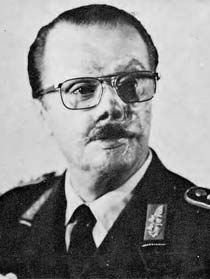
steinhoff6General Johannes Steinhof (above) as a Bundeswehr and NATO officer, showing his burns and before his crash (below)
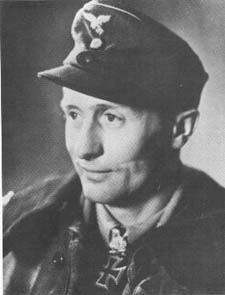
steinhoff WW IIIn his books, Steinhoff does something that you do not see authors do in most military or political memoirs, he actually does serious self reflection on his role in supporting an evil regime. In his introduction to his book The Final Hours the legendary fighter ace who was horribly disfigured when his Me-262 jet fighter crashed and burned two weeks prior to the end of the war wrote:

“In recalling these events, which had been long buried in my memory, it has not been my intention to make excuses. Our unconditional self-sacrifice in the service of the Third Reich is too well documented for that….

So it is because of what is happening today—with freedom threatened in virtually every respect by its own abuse—that I offer this contribution, in the form of an episode in which I was myself involved, to the history of the soldier in the twentieth century. Soldiers have always, in every century of their existence, been victims of the ruthless misuse of power; indeed, given the opportunity, they have joined in the power game themselves. But it fell to our own century to accomplish, with the aid of a whole technology of mass extermination, the most atrocious massacres in the history of mankind. This fact alone makes pacifism a philosophy worthy of respect, and I have a great deal of sympathy with those who profess it. 

The figure of the soldier in all his manifestations is thus symptomatic of the century now nearing its close, and it is to the history of that figure that I wish to contribute by describing what happened to me. I have tried to show what it is possible to do to men, how insidiously they can be manipulated by education, how they can be hoisted onto a pedestal as “heroes,” how they can be so corrupted as even to enjoy the experience—and how they can be dropped and denounced as mutineers when they discover that they have scruples. The complete lack of scruples that such treatment implies is peculiar to rulers who believe that the problems of their own and other peoples can be solved by imposing, through the use of military force, peace on their, the rulers’, terms—in our case a pax germanica, but the second Latin word is readily interchangeable.” from “The Final Hours: The Luftwaffe Plot Against Goring (Aviation Classics)” by Johannes Steinhoff

Since I am a historian and and a career military officer with service in the Iraq War, a war that was illegal and unjust by all measure I can understand Steinhof’s words. Because much of my undergraduate and graduate work focused on German history, particularly that of Imperial Germany after the unification, the Weimar Republic, and the Nazi Reich, I draw a lot of lessons from the period. I also understand how people in this country can fall for the same kind of vitriolic propaganda that the Germans of that era did. I can understand because for years I fell for the lies and propaganda being put out by the politicians, pundits and preachers of the American political right.
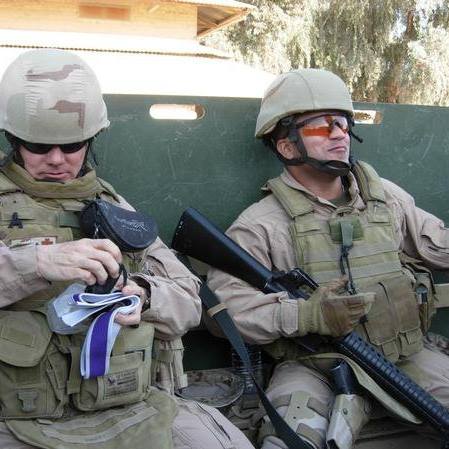
10665323_10154041610267059_5277331492232210946_nA picture of me (on left) in Iraq 2007 with my assistant and bodyguard RP1 Nelson Lebron

One of those lessons is that in times of crisis, that people, no matter what their race, culture, religious belief system, educational, or economic background are still human. Humanity is the one constant in all of history, our prejudices are often ingrained in us during childhood and reinforced by the words of politicians, pundits, and preachers. In times of stress, crisis, and societal change or upheaval even good people, moral people, people of great intellectual, scientific abilities can fall prey to demagogues who preach hate and blame others, usually racial, ethnic, or religious minorities, as well as civil libertarians who champion the rights of those minorities for the problems of the nation.

Shrewd politicians, preachers, and pundits do this well. They demonize the target group or population and then let the hatred of their disaffected followers flow. The leaders need that disaffected and angry base in order to rise to power; such was how Hitler, Stalin, and so many other despots gained power. They took advantage of a climate of fear, and found others to blame. For Hitler it was the Jews, Slavs, Socialists and Communists; while for Stalin it was various groups like the Ukrainians, or the Poles who were the devil to be feared and destroyed. Timothy Snyder in his book Bloodlands: Europe Between Hitler and Stalin wrote:

“Dead human beings provided retrospective arguments for the rectitude of policy. Hitler and Stalin thus shared a certain politics of tyranny: they brought about catastrophes, blamed the enemy of their choice, and then used the death of millions to make the case that their policies were necessary or desirable. Each of them had a transformative utopia, a group to be blamed when its realization proved impossible, and then a policy of mass murder that could be proclaimed as a kind of ersatz victory.”

But that being said, there are a lot of people who from childhood believe the lies about others without question. In good times such people continue on with life as normal, but in crisis those hatreds and prejudices come to the fore. Rudolf Höss, the notorious sociopath who commanded Auschwitz told American Army psychologist Gustave Gilbert about his reaction when ordered to turn the camp into an extermination center. He said that the order “fitted in with all that had been preached to me for years,” and “at the same time I didn’t think of it as propaganda, but as something one just had to believe.” 

Eugene Davidson in his book on the Nuremberg Trials wrote:

“Every society has in it at all times negative, criminal, sadistic, asocial forces. What holds them in check more than law and police is the consensus of the society – a general belief that despite everything wrong and stupid and muddleheaded in politics, the state is a going concern that will somehow make its way into the future.” (Davidson, The Trial of the Germans p.581)

But when things do not go well, when people do not feel that things will be okay, that the future will be better, and that they have a purpose they look for answers. However, they tend to find their answers in the rantings of demagogues, race baiters, conspiracy theorists, and others who they would tend to dismiss out of hand in good times. In Germany it was the loss of the First World War, the humiliation of Versailles and the economic chaos and social change of the Weimar period which allowed Hitler to gain an audience, then a following, then political power. The demagogues played to what was already in the hearts and minds of the disaffected masses, without that fertile soil, the rantings of Hitler and his propagandists would have never succeeded. Albert Speer wrote:

“As I see it today, Hitler and Goebbels were in fact molded by the mob itself, guided by its yearnings and its daydreams. Of course, Goebbels and Hitler knew how to penetrate through to the instincts of their audiences; but in the deeper sense they derived their whole existence from these audiences. Certainly the masses roared to the beat set by Hitler’s and Goebbels’ baton; yet they were not the true conductors. The mob determined the theme. To compensate for misery, insecurity, unemployment, and hopelessness, this anonymous assemblage wallowed for hours at a time in obsessions, savagery and license. The personal unhappiness caused by the breakdown of the economy was replaced by a frenzy that demanded victims. By lashing out at their opponents and vilifying the Jews, they gave expression and direction to fierce primal passions.”

In a sense a similar thing has happened in the United States which has experienced a series of wars beginning with Vietnam, the shock of the 9-11-2001 attacks, the economic crash of 2007 and 2008 which devastated the savings, home ownership, and investments of many Americans while at the same time benefiting the banking and brokerage houses whose government assisted policies brought about the crash. Of course there are other issues, many religious conservatives hate the progress made by the Women’s and Gay Rights movements, and their leaders play to their fears in apocalyptic terms. I could go on, but I am sure that my readers can identify other issues which demagogues and others use to spread fear and hate to further their goals. The fact is that without the the fertile soil that lays in the hearts of their most fervent followers they would never have a following.

In Weimar Germany hate mongers like Julius Streicher and propagandist Josef Goebbels stuck a chord with disenchanted people who felt that they had lost their country. They were fearful, angry, and desired a leader who would “make Germany great again.” Hitler and his Nazi media sycophants played to that fear, and took advantage of their anger at the existing order. Davidson wrote such people “exist everywhere and in a sick society they can flourish.” 

For decades the way has been prepared for true extremists to take advantage of the fears and doubts of people as modern American versions of Streicher and Goebbels have been at work for years. Rush Limbaugh was a modern pioneer of this in the United States, and he has been joined by so many who are even more extreme in their rantings that it is hard to name them all. Likewise, whole media corporations, websites, and political networks spread such fear every minute of the day, claiming that they, and they alone are real Americans. They actively support politicians who condemn, and sometimes even threaten people who oppose them, and all the while claim that “make America great again.”

When I was younger I devoured that propaganda, despite all of my learning I followed the rantings of men who I realize today are propagandists who promote the basest of lies, and hatred, often in the name of God. I was changed when I was at war, and when I returned home from Iraq in 2008 I realized through hard experience that I had been lied to, and that as a result that thousands of my brothers and sisters were dead, and tens of thousands shattered in body, mind, and spirit. Likewise I saw the massive destruction levied on Iraq and realized how terrible war really is. That was my epiphany, that is what it took to see how much I had been lied to, and it called me to question everything else that I had so willingly believed, things which had been fed to me by years of indoctrination in church, through the media, and by politicians who I believed were truly Christian. I can understand now how Martin Niemoller felt after the Nazi seizure of power when he said, “I hated the growing atheistic movement, which was fostered and promoted by the Social Democrats and the Communists. Their hostility toward the Church made me pin my hopes on Hitler for a while. I am paying for that mistake now; and not me alone, but thousands of other persons like me.”

There was a time that I hated people who espouse the views that I hold today, the views that I write about so often here on this site. I can remember how angry I would get as I listened to the propaganda being put out by Limbaugh, Hannity, the Fox News Channel and all of the others that I listened to every time that I had the chance. But when I changed after Iraq, I felt the sting of that hatred in very real ways. I remember the day I was called by my bishop in my former church, who told me that I had to leave because my views on women, gays, and Moslems were to use his words were now “too liberal.” After that, many men who I considered to be the best of friends turned their backs on me, some in the most bitter and vindictive of ways.

But I realize now that what they did was because I had in a sense left the cult, and had to be ostracized. I can understand that now, because when I was under the spell I too turned my back on people who had fallen out of favor, or people who had rejected the tenants of the church or the political movement, and those are things that I can never undo. But at the time it made sense, it fitted in with all I had been taught for decades, as Albert Speer wrote of Hitler, “One seldom recognizes the devil when he is putting his hand on your shoulder.”

What happened to Steinhoff’s generation is threatening to happen again, in our country, an authoritarian movement is threatening to destroy our democracy and republic. In it soldiers are esteemed, until they realize what is going on and speak out, but by then it is usually too late. I am understanding that fact more and more every day, and having had people troll this blog and call me a traitor and worse, I understand just a bit of what happened to Steinhoff and his fellow officers when they protested to the highest levels what was happening to Germany in early 1945.

I don’t know when it will happen, but sometime I expect that know we will how military professionals react to being labeled as traitors. President Trump and his followers have been demonizing the personnel of the nation’s intelligence, law enforcement, and diplomatic communities since before the election and have increased that since his inauguration, especially against the FBI and Justice Department. In fact those attacks by the President and his sycophants have become much more shrill as the Mueller probe turns more and more Trump associates into witnesses against him.

The President has lambasted his critics on his Twitter feed which occasionally results in them receiving death threats from his followers.  Like a religious cult they have no capacity to tolerate dissent, loyalty to the man will supersede loyalty to the country or the Constitution. When that happens to a senior military officer, or perhaps even Secretary of Defense Mattis, it will be interesting to see the legion of people in the military and outside of it who support the President make the choice to impugn and punish men and women who have spent their lives in defense of their country.

Their’s will be a conscious decision. My opinion is that the Constitution and the country will always come first. When he was elected and inaugurated I gave the President Elect the benefit of the doubt and honestly prayed that he would do the right thing for the country, but since then I have become much more concerned for the country and the world because of his behavior before and since his inauguration has demonstrated that his only loyalty is to himself. General Ludwig Beck, who resigned rather than obey Hitler’s order to invade Czechoslovakia in 1938 and died in the anti-Hitler coup attempt in 1944 said:

“It is a lack of character and insight, when a soldier in high command sees his duty and mission only in the context of his military orders without realizing that the highest responsibility is to the people of his country.” 

I have no doubt that many military officers and Secretary of Defense Mattis understand that and will courageously speak his mind, even if he is condemned for doing so. Sadly I have many doubts about other leaders: military, political, business, or religious. There are many people who will sell their souls for their personal advancement, the advancement of their agenda, or an increase in their bottom line. It is after all human nature.

But the question is: will we see true men and women of courage who will stand when it appears there is no chance of success? As Atticus Finch said in To Kill a Mockingbird: “Real courage is when you know you’re licked before you begin, but you begin anyway and see it through no matter what.” 

That will be what is demanded in the coming months as tensions in Asia, the Middle East, and Europe continue to escalate.

Peace

Padre Steve+
4 Comments

Filed under ethics, History, Military, national security, News and current events, Political Commentary

Who Has the Bigger Button?

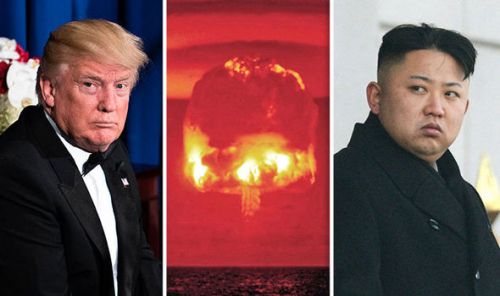
North-Korea-Kim-Jong-un-nuclear-Starfish-800967

Friends of Padre Steve’s World,

Over the past 24 hours we have seen two very emotionally and intellectually stunted, narcissistic and sociopathic authoritarian leaders continue to threaten each other and the world with nuclear war.

As I watch this drama play out I am reminded of the words that Albert Speer wrote of Adolf Hitler when he unleashed the Second World War by invading Poland:

“I do not think that in those early days of September, Hitler was fully aware that he had irrevocably unleashed a world war. He had merely meant to move one step further. To be sure, he was ready to accept the risk associated with that step, just as he had been a year before during the Czech crisis; but he had prepared himself only for the risk, not really for the great war.”

When I think of the statements, tweets, and comments of President Trump and Kim Jong Un I am reminded of what Speer said about his Fuhrer, Both men are thumping their chests and speaking of their nuclear weapons and military power as if they, like middle school boys were comparing the size of their penises. Both men threaten each other and their nations with nuclear armageddon but neither seem to understand what war really means. Likewise there seem to be other American leaders apart from the President who appear think that a nuclear war, even a “limited” one will be not have major repercussions around the world. Kim, Trump, and their most devout supporters are perfectly prepared to assume the risks of war, but not for its consequences.

I think that we are standing at the edge of the abyss and that President Trump, Kim Jong Un, and their supporters are not nearly as prepared for the consequences of their words and machinations as they think that they are. Sadly those who go to fight in their wars and those who happen to be in the way of war, those who will be war’s first victims won’t live long enough to get a say in the decisions made by these men.

So until tomorrow,

Peace

Padre Steve+

3 Comments

Filed under History, News and current events, Political Commentary

A Steady Diet of Falsifications and Distortions: The World of “Alternative Truth” and “Fake News”

hannah-arendt

Hannah Arendt 

Friends of Padre Steve’s World,

The day after President Trump’s inauguration Presidential spokesperson Kellyanne Conway who defended a number of outright lies posited by then Press Secretary Sean Spicer in his first press conference as alternative truth. The statement was astounding and was met with much criticism and ridicule, but it reflected a key tenant of the administration  that facts as they are, are unimportant, that truth itself is malleable.

In the year since the inauguration the nation has been subjected to a propaganda campaign by the administration, the right wing media led by Fox News, certain members of Congress, and a host of flacks including prominent pastors. This campaign, often led by the President’s early morning Twitter storms labels any opposing news or facts as “fake news” while often demonizing and sometimes threatening those making the reports or conducting investigations of the administration.

In the past year we have entered a world that our founders never expected to happen but warned us about. Alexander Hamilton wrote in Federalist No. 1, that the fiercest enemies of the republic were those men who begin “by paying an obsequious court to the people, commencing demagogues and ending tyrants.” 

In her book The Origins of Totalitarianism Hannah Arendt wrote: “The ideal subject of totalitarian rule is not the convinced Nazi or the dedicated communist, but people for whom the distinction between fact and fiction, true and false, no longer exists.”

The world that most of us grew up with is changing before our eyes and it is happening around the world and it is hard to say what is going to happen. I started re-reading Hannah Arendt’s book last night. It was one of my texts as an undergraduate when studying Hitler’s Germany. The book deals with both Naziism and Stalinism which makes it in some sense like Timothy Snyder’s Bloodlands: Europe Between Hitler and Stalin. While the latter focuses more on how Hitler and Stalin used their power on their own people as well as the Poles, the Ukrainians, the Belorussians, and others who happened to find themselves swallowed up by the two totalitarian states; Arendt’s book more at the underlying social conditions. In a time when populist politicians around the world are speaking in the the language of authoritarians, and promising to deliver their people from various political, racial, and religious enemies, it is important to remember where such talk almost always ends, totalitarian states.

But the fact is based on numerous polls in this country and around the world going back two decades show a rise in people of all ages and ideologies who are willing to accept authoritarian government and to abandon democracy. Well before President Trump ever announced his run for the presidency in 2015 the stage was set for an authoritarian leader to arise in the United States just as many are doing in Europe. Whether President Trump actually ends up ruling as an authoritarian is not yet clear, but the signs keep pointing that he may be heading in that direction, and that his followers will have no problem with it. His inaugural address was marked by his distain for both political parties and the political establishment and linking himself with the people. It was loaded with populism and nationalism, as are the messages of  Vladimir Putin, Nigel Farage, Marine Le Pen, and others in Europe.

William Shirer who served as a correspondent in Berlin from 1934 to 1941 wrote in his book The Rise and Fall of the Third Reich about the corrosive power of repeated lies by the leaders of the Third Reich and its propaganda organs on people who in every other way were completely ordinary.

“I myself was to experience how easily one is taken in by a lying and censored press and radio in a totalitarian state. Though unlike most Germans I had daily access to foreign newspapers, especially those of London, Paris and Zurich, which arrived the day after publication, and though I listened regularly to the BBC and other foreign broadcasts, my job necessitated the spending of many hours a day in combing the German press, checking the German radio, conferring with Nazi officials and going to party meetings. It was surprising and sometimes consternating to find that notwithstanding the opportunities I had to learn the facts and despite one’s inherent distrust of what one learned from Nazi sources, a steady diet over the years of falsifications and distortions made a certain impression on one’s mind and often misled it. No one who has not lived for years in a totalitarian land can possibly conceive how difficult it is to escape the dread consequences of a regime’s calculated and incessant propaganda. Often in a German home or office or sometimes in a casual conversation with a stranger in a restaurant, a beer hall, a café, I would meet with the most outlandish assertions from seemingly educated and intelligent persons. It was obvious that they were parroting some piece of nonsense they had heard on the radio or read in the newspapers. Sometimes one was tempted to say as much, but on such occasions one was met with such a stare of incredulity, such a shock of silence, as if one had blasphemed the Almighty, that one realized how useless it was even to try to make contact with a mind which had become warped and for whom the facts of life had become what Hitler and Goebbels, with their cynical disregard for truth, said they were.”

I have had similar experiences sitting and talking with people are much like the Germans that Shirer was speaking and I shake my head.

I often wonder how did we got to this point as I watch and read the President’s tweets, speeches, interviews, and the comments of members of the administration and his allies.  I am perplexed about how we did got to the point that a presidential spokesperson, as well as once respectable Republican members of Congress, and former administrations  can defend outright lies and refer to them as alternative facts. 

I think that this incessant barrage of propaganda and demonization by the administration and their media supporters is designed designed to bypass the intellect and appeal to the raw passions of followers who have ceased to think critically. I have written about this trend for several years using different historical examples but today I am just going to leave you with one other thing that Arendt wrote:

“In an ever-changing, incomprehensible world the masses had reached the point where they would, at the same time, believe everything and nothing, think that everything was possible and that nothing was true. … Mass propaganda discovered that its audience was ready at all times to believe the worst, no matter how absurd, and did not particularly object to being deceived because it held every statement to be a lie anyhow. The totalitarian mass leaders based their propaganda on the correct psychological assumption that, under such conditions, one could make people believe the most fantastic statements one day, and trust that if the next day they were given irrefutable proof of their falsehood, they would take refuge in cynicism; instead of deserting the leaders who had lied to them, they would protest that they had known all along that the statement was a lie and would admire the leaders for their superior tactical cleverness.”

I will discuss that passage in depth at another time but I think it is good just to let it sink in.

Have a good day,

Peace,

Padre Steve+

4 Comments

Filed under History, News and current events, Political Commentary

“Sound Loud the Timbrel” The Emancipation Proclamation at 155 Years

Friends of Padre Steve’s World

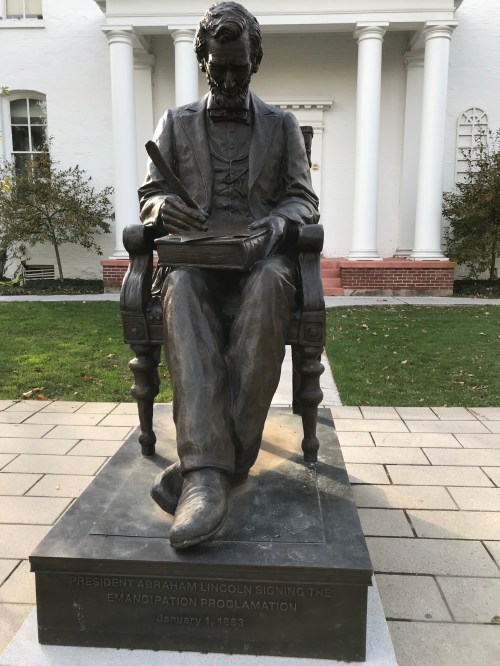
Today is the 155th anniversary of the Emancipation Proclamation. The proclamation made by Abraham Lincoln when the outcome of the rebellion of the Southern slave states against the Union was still up in the air was a watershed for civil rights in the United States. Though it was a military order that only affected slaves in the rebellious states, it also set the stage for the 13th, 14th, and 15th Amendments and other legal rulings that affected not only African Americans and former slaves, but also Native Americans, Women, other racial minorities and LGBTQ people. It is something that in our era when so many civil rights are under threat that we must remember and continue to fight for in the coming years. Freedom is never free.

This article is a part of my hopefully soon to be published book “Mine Eyes Have Seen the Glory!” Race, Religion, Ideology, and Politics in the civil War Era. 

Peace

Padre Steve+

From the beginning of the war many Northerners, especially abolitionists and radical Republicans believed that “as the “cornerstone” of the confederacy (the oft-cited description by the South’s vice-president, Alexander H. Stephens) slavery must become a military target.” [1]When some Union generals made their own attempts at issuing emancipation orders, Lincoln countermanded them for exceeding their authority. Lincoln resisted the early calls of the abolitionists to make that a primary war goal for very practical reasons, he had to first ensure that the Border Slave States did not secede, something that would have certainly ensured that the Union would not survived. As a result in the first year of the war, Lincoln “maneuvered to hold Border South neutrals in the Union and to lure Union supporters from the Confederacy’s Middle South white belts. He succeeded on both scores. His double success with southern whites gave the Union greater manpower, a stronger economy, and a larger domain. These slave state resources boosted free labor states’ capacity to should the Union’s heavier Civil War burden.” [2] His success in doing this was instrumental in enabling him to turn to emancipation in 1862.

Finally, some twenty months after Fort Sumter fell and after nearly two years of unrelenting slaughter culminating in the bloody battle of Antietam, Abraham Lincoln published the Emancipation Proclamation. Emancipation was a tricky legal issue for Lincoln as “an executive order of emancipation would be beyond the powers of the president, but not, Lincoln concluded, if such an order were issued as furtherance of the executive’s war powers.” [3] Lincoln had desired to issue the order during the summer and sounded out elected officials and soldiers as to his plan.

Lincoln discussed his views with General George McClellan during a visit to the latter’s headquarters. McClellan stated his strident opposition to them in writing. McClellan did not admire slavery but he despised abolitionists and he wrote one of his political backers “Help me to dodge the nigger – we want nothing to do with him. I am fighting for the Union…. To gain that end we cannot afford to mix up the negro question.”  [4]

Lincoln then called border state Congressmen to sound them out on the subject on July 12th 1862 only to be met with opposition. Such opposition caused Lincoln “to give up trying to conciliate conservatives. From then on the president tilted toward the radical position, though this would not become publicly apparent for more than two months.” [5]

Lincoln’s cabinet met to discuss the proclamation on July 22nd 1862 and after some debate decided that it should be issued, although it was opposed by Postmaster General Montgomery Blair who believed that “the Democrats would capitalize on the unpopularity of such a measure in the border states and parts of the North to gain control of the House in the fall elections.” [6] Wisely, Lincoln heeded the advice of Secretary of State Seward to delay the announcement until military victories ensured that people did not see it as a measure of desperation. Seward noted: “I approve of the proclamation, but I question the expediency of its issue at this juncture. The depression of the public mind, consequent on our repeated reverses, is so great I fear…it may be viewed as the last measure of an exhausted government, a cry for help…our last shriek on the retreat.” Seward suggested that Lincoln wait “until the eagle of victory takes his flight,” and buoyed by military success, “hang your proclamation about his neck.” [7]

After the Battle of Antietam, President Lincoln issued the Preliminary Emancipation Proclamation. This document served as a warning to the leaders of the South, and insisted that there was much more at stake in their rebellion unless they surrendered; their slaves, the very “property” for which the seceded. The document “warned that unless the South laid down its arms by the end of 1862, he would emancipate the slaves.” [8] This was something that they could not and would not do, even as their cities burned and Confederacy collapsed around them in 1864.

The proclamation was a military order in which Lincoln ordered the emancipation of slaves located in the Rebel states and areas of those states occupied by Union troops. It was not designed to change law, which would have to wait until Lincoln felt he could have Congress amend the Constitution.  Instead of law it was “the doctrine of military necessity justified Lincoln’s action.” [9] The concept emanated from Boston lawyer William Whiting who argued “the laws of war “give the President full belligerent rights” as commander and chief to seize enemy property (in this case slaves) being used to wage war against the United States.” [10] There was a legitimate military necessity in the action as Confederate armies used slaves as teamsters, laborers, cooks, and other non-combatant roles to free up white soldiers for combat duty, and because slaves were an important part of the Southern war economy which could not function without them. The proclamation gave inspiration to many slaves throughout the South to desert to the Union cause or to labor less efficiently for their Confederate masters. A South Carolina planter wrote in 1865:

“the conduct of the Negro in the late crisis of our affairs has convinced me that we were all laboring under a delusion….I believed that these people were content, happy, and attached to their masters, But events and reflection have caused me to change these positions….If they were content, happy and attached to their masters, why did they desert him in the moment of need and flocked to the enemy, whom they did not know….” [11]

The proclamation authorized that freed blacks be recruited into the Federal army and it ensured that freed slaves would not again be surrendered back into slavery. As Montgomery Blair had warned Lincoln and the Republicans suffered sharp electoral reverses as “Democrats made opposition to emancipation the centerpiece of their campaign, warning that the North would be “Africanized” – inundated by freed slaves competing for jobs and seeking to marry white women.”  [12]

Lincoln’s response was to continue on despite the opposition and issue the Proclamation in spite of electoral reverses and political resistance. The vehemence of some Northern Democrats came close to matching that of white Southerners. The “white Southerner’s view of Lincoln as a despot, hell-bent on achieving some unnatural vision of “equality,” was shared by Northern Democrats, some of whom thought the president was now possessed by a “religious fanaticism.” [13] But Lincoln was not deterred and he understood “that he was sending the war and the country down a very different road than people thought they would go.” [14] He noted in December 1862:

“Fellow citizens, we cannot escape history….This fiery trial through which we pass, will light us down, in honor or dishonor, to the latest generation….In giving freedom to the slave, we assure freedom to the free – honorable alike in what we give, and what we preserve.”[15]

For Lincoln the Emancipation Proclamation was something that he believed was something that he had to do, and he believed that it would be the one thing that he did in life that would be remembered. He had long been convicted of the need for it, but timing mattered, even six months before it might have created a political backlash in the North which would have fractured support for the war effort, and in this case timing and how he made the proclamation mattered.

The Emancipation Proclamation had military, domestic political, and diplomatic implications, as well as moral implications for the conduct of the war.

The military implication would take some time to achieve but were twofold. First, Lincoln hoped that the Emancipation Proclamation would encourage former slaves, as well as already free blacks in the North to join the Union cause and enlist to serve in the Federal Army. The act would vest African Americans in the Union’s cause as little else could, and at the same time begin to choke-off the agricultural labor force that provided the backbone of the Confederate economy. Frederick Douglass eloquently made the case for African Americans to serve in July 1863, telling a crowd in Philadelphia, “Do not flatter yourself, my friends, that you are more important to the Government than the Government is to you. You stand but as a plank to the ship. This rebellion can be put down without your help. Slavery can be abolished by white men: but Liberty so won for the black man, while it may leave him an object of pity, can never make him an object of respect…. Young men of Philadelphia, you are without excuse. The hour has arrived, and your place is in the Union army. Remember that the musket – the United States musket with its bayonet of steel – is better than all the parchment guarantees of Liberty. In you hands the musket means Liberty…” [16] By the end of the war over 180,000 African American men would serve as volunteers in the United States Army.

Politically the proclamation would the diplomatic purpose by isolating the Confederacy from European assistance. This it did, after the proclamation public sentiment, especially among Europe’s working classes turned solidly against the Confederacy. Domestically it would break-ground for the Thirteenth Amendment, which Lincoln, the pragmatic lawyer was needed to actually abolish slavery. Morally, it  would serve as the guarantee of The United States Government’s public, irrevocable pledge of freedom to African Americans if the North won the war.

Lincoln signed the order on January 1st 1863. As he got ready to sign the document he paused and put down the pen, speaking to Seward he said “I never, in my life, felt more certain that I was doing right, than I do now in signing this paper….If my name ever goes down in history it will be for signing this act, and my whole soul is in it.” [17] The opening paragraph read:

“That on the first day of January, in the year of our Lord one thousand eight hundred and sixty-three, all persons held as slaves within any State or designated part of a State, the people whereof shall then be in rebellion against the United States, shall be then, thenceforward, and forever free; and the Executive Government of the United States, including the military and naval authority thereof, will recognize and maintain the freedom of such persons, and will do no act or acts to repress such persons, or any of them, in any efforts they may make for their actual freedom.” [18]

At the ends of the proclamation he added the words suggested by his devoutly Christian Secretary of the Treasury Salmon Chase: “And upon this act, sincerely believed to be an act of justice, warranted by the Constitution, upon military necessity, I invoke the considerate judgment of mankind, and the gracious favor of Almighty God.” [19]

The response throughout the North was euphoric as celebrations took place throughout the North. In some cities one hundred gun salutes were fired. At Boston’s Tremont Temple people broke out singing a hymn “Sound the loud timbrel o’er Egypt’s dark sea, Jehovah hath triumphed, his people are free.” [20] The Boston Daily Evening Telegraph predicted, “Slavery from this hour ceases to be a political power in this country…such a righteous revolution as it inaugurates never goes backward.” [21]

Frederick Douglass wrote about his reactions to the Emancipation proclamation as he had nearly despaired wondering if the Lincoln administration would actually take up the fight for emancipation:

“The fourth of July was great, but the first of January, when we consider it in all of its relations and bearings in incomparably greater. The one we respect to the mere political birth to a nation, the last concerns national life and character, and is to determine whether that life and character shall be radiantly and glorious with all high and noble virtues, or infamously blackened, forevermore, with all the hell-darkened crimes and horrors which we attach to Slavery.” [22]

The proclamation was not all some had hoped for and it was certainly provoked a negative response in the South and among many Northern Democrats. Southerners accused Lincoln of inciting racial warfare and Jefferson Davis responded “The day is not so distant when the old Union will be restored with slavery nationally declared to be the proper condition of all of African descent.” [23]

But the proclamation did something that politicians, lawyers did not comprehend, that “the details of the emancipation decree were less significant than the fact that there was an emancipation decree, and while the proclamation read like a dull legal brief, filled with qualifying clauses and exceptions, it was not language made for this, finally, a moral document. It was its existence, its title, its arrival into this world, its challenge to the accepted order, and from that there was no turning back. In this sense it was a revolutionary statement, like the Declaration itself, and nearly as significant.” [24]That the proclamation most certainly was and it was a watershed from which there was no stepping back. “It irrevocably committed the government of the United States to the termination of slavery. It was an act of political courage, take at the right time, in the right way.” [25]

However, it would take another two years, with the Confederacy crumbling under the combined Federal military onslaught before Lincoln was able to secure passage of the Thirteenth Amendment to the Constitution in January 1865.  The amendment abolished slavery and involuntary servitude throughout the country, as well as nullified the fugitive slave clause and the Three-Fifths Compromise. It would be followed after Lincoln’s death by the Fourteenth Amendment which reversed the result of the Dred Scott decision and declared that all people born in the United States were citizens and entitled to the rights of citizenship. During the Grant administration the Fifteenth Amendment was passed, and this finally extended to African American men, the right to vote in every state.

Though limited in scope, the Emancipation Proclamation had more than a domestic military, social and political effect. It also had an effect on foreign policy which ensured that Britain, and thereby France would not intervene in the war on behalf of the Southern Confederacy. It stopped all British support for the Rebels to include seizing warships that had been contracted for by Confederate agents that were building or being fitted out in British Yards. Likewise the British rejected various proposals of Emperor Napoleon III to intervene in the war in late 1862 and during the summer of 1863.

Effects of the Emancipation Proclamation on Military Law

The Emancipation Proclamation and the elimination of slavery also impacted the Union war effort in terms of law, law that eventually had an impact around the world as nations began to adapt to the changing character of war. It was important because for the first time slavery was accounted for in the laws of war. The “Instructions for the Government of Armies of the United States in the Field, General Orders No. 100 by President Lincoln, April 24, 1863; Prepared by Francis Lieber, LLD noted in Article 42 of that Code:

“Slavery, complicating and confounding the ideas of property, (that is of a thing,) and of personality, (that is of humanity,) exists according to municipal or local law only. The law of nature and nations has never acknowledged it. The digest of the Roman law enacts the early dictum of the pagan jurist, that “so far as the law of nature is concerned, all men are equal.” Fugitives escaping from a country in which they were slaves, villains, or serfs, into another country, have, for centuries past, been held free and acknowledged free by judicial decisions of European countries, even though the municipal law of the country in which the slave had taken refuge acknowledged slavery within its own dominions.” [26]

It continued in Article 43:

“Therefore, in a war between the United States and a belligerent which admits of slavery, if a person held in bondage by that belligerent be captured by or come as a fugitive under the protection of the military forces of the United States, such person is immediately entitled to the rights and privileges of a freeman To return such person into slavery would amount to enslaving a free person, and neither the United States nor any officer under their authority can enslave any human being. Moreover, a person so made free by the law of war is under the shield of the law of nations, and the former owner or State can have, by the law of postliminy, no belligerent lien or claim of service.” [27]

The Continued Fight for Emancipation: Dealing with the Copperheads and the Passage of the Thirteenth Amendment

But there were still legitimate concerns that slavery might survive as the war continued. Lincoln knew that in issuing the Emancipation Proclamation raised the stakes of the war far higher than they had been. He noted, “We shall nobly save, or meanly lose, the last best hope on earth.” [28] The threat of the destruction of the Union and the continuance of slavery in either the states of the Confederacy, the new western states, territories, or the maintenance of the Union without emancipation was too great for some; notably, the American Freedmen’s Commission to contemplate. With Grant’s army stalled outside Richmond the Copperheads and the peace party gained influence and threatened to bring about a peace that allowed Confederate independence and the continuance of slavery; members of that caucus they Edwin Stanton in the spring of 1864:

“In such a state of feeling, under such a state of things, can we doubt the inevitable results? Shall we escape border raids after fleeing fugitives? No man will expect it. Are we to suffer these? We are disgraced! Are we to repel them? It is a renewal of hostilities!…In the case of a foreign war…can we suppose that they will refrain from seeking their own advantage by an alliance with the enemy?”[29]

The effort of the Copperheads and the peace party to was soon crushed under the military successes of William Tecumseh Sherman’s armies in Georgia. This was especially true of the capture of Atlanta, which was followed by Sherman’s march to the sea and the Carolinas. Additionally the naval victory of David Farragut’s fleet at the Battle of Mobile Bay served to break the stranglehold that the Copperheads were beginning to wield in Northern politics.  These efforts helped secure Lincoln’s reelection by a large margin in the 1864 presidential election over a divided Democratic opposition, whose presidential nominee McClellan could not even endorse his party’s platform.

In his Second Inaugural Address, Abraham Lincoln discussed the issue of slavery as the chief cause of the war. In it, Lincoln noted that slavery was the chief cause of the war in no uncertain terms and talked in a language of faith that was difficult for many, especially Christians, who “believed weighty political issues could be parsed into good or evil. Lincoln’s words offered a complexity that many found difficult to accept,” for the war had devastated the playground of evangelical politics, and it had “thrashed the certitude of evangelical Protestantism” [30] as much as the First World War shattered Classic European Protestant Liberalism.  Lincoln’s confrontation of the role that people of faith brought to the war in both the North and the South is both illuminating and a devastating critique of the religious attitudes that so stoked the fires of hatred.  His realism in confronting facts was masterful, and badly needed.  He spoke of “American slavery” as a single offense ascribed to the whole nation.” [31]

“One-eighth of the whole population were colored slaves, not distributed generally over the Union, but localized in the southern part of it. These slaves constituted a peculiar and powerful interest. All knew that this interest was somehow the cause of the war. To strengthen, perpetuate, and extend this interest was the object for which the insurgents would rend the Union even by war, while the Government claimed no right to do more than to restrict the territorial enlargement of it. Neither party expected for the war the magnitude or the duration which it has already attained. Neither anticipated that the cause of the conflict might cease with or even before the conflict itself should cease. Each looked for an easier triumph, and a result less fundamental and astounding. Both read the same Bible and pray to the same God, and each invokes His aid against the other. It may seem strange that any men should dare to ask a just God’s assistance in wringing their bread from the sweat of other men’s faces, but let us judge not, that we be not judged. The prayers of both could not be answered. That of neither has been answered fully. The Almighty has His own purposes. “Woe unto the world because of offenses; for it must needs be that offenses come, but woe to that man by whom the offense cometh.” If we shall suppose that American slavery is one of those offenses which, in the providence of God, must needs come, but which, having continued through His appointed time, He now wills to remove, and that He gives to both North and South this terrible war as the woe due to those by whom the offense came, shall we discern therein any departure from those divine attributes which the believers in a living God always ascribe to Him? Fondly do we hope, fervently do we pray, that this mighty scourge of war may speedily pass away. Yet, if God wills that it continue until all the wealth piled by the bondsman’s two hundred and fifty years of unrequited toil shall be sunk, and until every drop of blood drawn with the lash shall be paid by another drawn with the sword, as was said three thousand years ago, so still it must be said “the judgments of the Lord are true and righteous altogether.” [32]

Notes 

[1] Ibid. Foner Forever Free: The Story of Emancipation and Reconstruction p.42

[2] Ibid. Freehling The South vs. The South p.47

[3] Brewster, Todd. Lincoln’s Gamble: The Tumultuous Six Months that Gave America the Emancipation Proclamation and Changed the Course of the Civil War Scribner a Division of Simon and Schuster, New York and London p.59

[4] Ibid. McPherson The Battle Cry of Freedom p.364

[5] Ibid. McPherson The Battle Cry of Freedom p.504

[6] McPherson, James M. Tried by War: Abraham Lincoln as Commander in Chief Penguin Books, New York and London 2008 p.109

[7] Ibid. Goodwin Team of Rivals p. 468

[8] Ibid. Foner Forever Free p.49

[9] McGovern, George Abraham Lincoln Times Books, Henry Holt and Company, New York 2009 p.70

[10] Ibid. McPherson Tried by War: p.108

[11] Ibid. Zinn The Other Civil War p.39

[12] Ibid. Foner Forever Free p.49

[13] Ibid. Brewster Lincoln’s Gamble p.169

[14] Ibid. Guelzo Fateful Lightning p.184

[15] Ibid. Foner Forever Free p.49

[16] Douglass, Frederick. Philadelphia Speech of July 6th 1863 recorded in the Liberator in The Civil War and Reconstruction: A Documentary Collection edited by William E. Gienapp, W.W. Norton and Company, New York and London 2001 p.221

[17] Ibid. Goodwin Team of Rivals p. 499

[18] Lincoln, Abraham The Emancipation Proclamation The National Archives & Records Administration retrieved from http://www.archives.gov/exhibits/featured_documents/emancipation_proclamation/transcript.html 14 June 2014

[19] Ibid. Lincoln The Emancipation Proclamation

[20] Ibid. Brewster Lincoln’s Gamble p.244

[21] Ibid. McPherson The Battle Cry of Freedom p.501

[22] Ibid. Guelzo Fateful Lightning pp. 180-181

[23] Ibid. Goldfield America Aflame p.263

[24] Ibid. Brewster Lincoln’s Gamble p.245

[25] Ibid. McGovern Abraham Lincoln p.78

[26] Reichberg, Gregory M, Syse Henrik, and Begby, Endre The Ethics of War: Classic and Contemporary Readings Blackwell Publishing Ltd, Malden, MA and Oxford UK 2006 p.570

[27] Ibid. Reichberg et al. The Ethics of War p.570

[28] Ibid. Goldfield America Aflame p.263

[29] Ibid. Guelzo Fateful Lightning p.534

[30] Ibid. Goldfield  America Aflame p.358

[31] Ibid. Wills Lincoln at Gettysburg p.186

[32] Lincoln, Abraham Second Inaugural Address March 4th 1865 retrieved from www.bartleby.com/124/pres32.html 24 March 2014

1 Comment

Filed under civil rights, civil war, History, laws and legislation, leadership, News and current events, Political Commentary

Enter 2018, If We Don’t Try We May as Well Lay Down and Die…

Friends of Padre Steve’s World,

It is now 2018.

After the year that was 2017 with its seeming unending cycle of violence, hate, war, destruction, and political turmoil including political turmoil in Europe and the chaotic political  Overall 2017 was a difficult year around the world despite the boom stock markets.

One hundred years ago the world was engaged in a war that was killing thousands of men a day. Some hoped that 1918 would be better, but it wasn’t. Despite the victory that the French, British, and Americans achieved over Imperial Germany and its allies brought some measure of peace to the world, the embers of war, economic crisis, and political instability would plant the seeds for the totalitarian movements of communism, and Fascism in its various forms. Because of this the conflagration that had erupted in 1914 would get far worse in just over 20 years time.

I hope that 2018 is different and turns out better than 2018, we certainly could use a break, but the forces of history and nature are sometimes greater than our hopes, but we can always hope. Even so more than hope we who believe in liberty, freedom, humanity, brotherhood, and justice must work against the forces of war, terrorism, dehumanization, and political ideologies that are designed to enslave, devalue, and marginal people based on race, religion, gender, color, or belief.

I believe that the forces that made 2017 so terrible in so many ways will not take a break and that we need to stand up and do the right and sometimes the hard things in order to protect liberty. The time for safe zones is past, as progressives we have to toughen up; think rationally, and act strategically if we are to protect the liberties of all people, including people who will find out far to late that they placed their trust in the wrong place. But I digress…

Many people will see in the New Year singing Auld Lang Syne. It is a nice song, I have written about it before. A little bit ago after watching the movies It’s a Mad Mad Mad Mad World and The Great Race Judy, I and our friend Patty popped the Champagne and toasted tonight as we watched the Ball descend in Times Square on our television, safe from all the drunk drivers that we will as well.

But I digress. My favorite song for the New Year is Abba’s Happy New Year.  Like Auld Lang Syne it is a melancholy song of the end of one year’s hopes, dreams and expectations and hopes and dreams for the New Year. The song is embedded above and the lyrics are here:

Happy New Year

No more champagne

And the fireworks are through

Here we are, me and you

Feeling lost and feeling blue

It’s the end of the party

And the morning seems so grey

So unlike yesterday

Now’s the time for us to say…


Happy new year

Happy new year

May we all have a vision now and then

Of a world where every neighbour is a friend

Happy new year

Happy new year

May we all have our hopes, our will to try

If we don’t we might as well lay down and die

You and I


Sometimes I see

How the brave new world arrives

And I see how it thrives

In the ashes of our lives

Oh yes, man is a fool

And he thinks he’ll be okay

Dragging on, feet of clay

Never knowing he’s astray

Keeps on going anyway…


Happy new year

Happy new year

May we all have a vision now and then

Of a world where every neighbour is a friend

Happy new year

Happy new year

May we all have our hopes, our will to try

If we don’t we might as well lay down and die

You and I


Seems to me now

That the dreams we had before

Are all dead, nothing more

Than confetti on the floor

It’s the end of a decade

In another ten years time

Who can say what we’ll find

What lies waiting down the line

In the end of eighty-nine…


Happy new year

Happy new year

May we all have a vision now and then

Of a world where every neighbour is a friend

Happy new year

Happy new year

May we all have our hopes, our will to try

If we don’t we might as well lay down and die

You and I

I think one of the lines that I like, one which I think calls on us to actually do more than hope, but to act on hope, is “May we all have a vision…” A vision requires that we begin to imagine a better future, in a sense it is to dream, as Martin Luther King Jr. dreamed, I have a dream that one day this nation will rise up and live out the true meaning of its creed: “We hold these truths to be self-evident, that all men are created equal.”

To fulfill that dream and vision we must live, work, dream and imagine that things can be better, and as Dr. King said, Let us not wallow in the valley of despair, I say to you today, my friends.

And so even though we face the difficulties of today and tomorrow, I still have a dream…

The song, Happy New Year ends with this verse, May we all have our hopes, our will to tryIf we don’t we might as well lay down and dieYou and I…

Here is wishing you the best New Year possible, and I for one will not lay down and die.

Peace

Padre Steve+

3 Comments

Filed under faith, History, Loose thoughts and musings, News and current events, philosophy, Political Commentary