Monthly Archives: December 2020

“Fighting…reached a degree of savagery unprecedented on the western front.“ The Battle of the Bulge 76 Years Later

battle-bulge

Friend’s of Padre Steve’s World,

Well shit fire and save the matches. I’m reposting an old article because I have yet another tooth a ticking like it wants to relocate from my mouth to the infernal regions of a medical waste bin. I think that I have mentioned what I have been dealing with over the past two months with my teeth and infections that spread throughout my face and today I had two appointments to deal with some of those and set up an MRI a consult with a Nose surgeon and tomorrow to go over CT results that might link another tooth to those infections, but I digress…

Wednesday marked the 76th anniversary of the beginning of the German offensive known as Wacht am Rhein, but better known as the Ardennes Offensive or it’s popular name The Battle of the Bulge. The battle was for all intents and purposes a suicide mission for the remnants of the German Wehrmacht, Waffen SS, and Luftwaffe Paratroop divisions.

It is hard to believe that the youngest surviving veterans of this battle are 94-95 years old. I’m 60 and been in the military over 39 years. I have been to combat but not like they went through. Now back in December and January of 1984 and 1985 when I was a Medical Service Corps officer serving as the Executive Officer, platoon leader and Motor Maintenance officer of an Ambulance Company in Winter REFORGER 1984-85. That happened to be the coldest Winter Europe had since the Battle of the Bulge. In that weather I would have hated to be in real combat, with all that went wrong and all the insanity of that exercise it would have been far worse in intensive ground combat against a desperate enemy.

The offensive was the brainchild of Adolf Hitler, who over the objections of many military leaders, who wanted to conserve their last remaining Panzer and infantry reserves for holding back the final Soviet attack in the East, while preserving just enough strength to hold the West Wall defenses, while preserving fuel reserves to counter Allied incursions into the heart of the Reich. It was an all or nothing gamble by the German dictator, who had succeeded in many of his military gambles earlier in the war. However, now desperately trying to change the course of the war, he threw his best forces into a battle with almost no chance of success; but such is how despots in dire situations react. They become even more desperate to win.

We have seen how desperately a President with delusions of being a Dictator and his Cult act in the face of actual defeat, truthfully, not much differently than any other Dictator. For such people only their power, even at the expense of their followers matters more, but I digress…

So until tomorrow, and hopefully less pain.

Peace,

Padre Steve+

Hitler’s Decision 


Adolf Hitler gathered with the Chiefs of Oberkommando des Wehrmachton September 16th 1944 at his “Wolf’s Lair” headquarters in East Prussia.  The situation was critical; he had recently survived an assassination attempt by Army officers led by Colonel Klaus Von Staufenberg at his Wolf’s Lair headquarters in East Prussia.  When the assassination attempt took place the German situation in Normandy was critical.

The Americans broke out of the Normandy Bocage at St. Lo and spread out across Brittany and the interior of France with Patton’s 3rd Army leading the way.  Even as his commanders in the West pleaded for permission to withdraw to the Seine Hitler forbade withdraw and ordered a counter attack at Mortain to try to close the gap in the German line and isolate American forces. When the German offensive failed the German front collapsed. 40,000 troops, hundreds of tanks and thousands of vehicles were eliminated when the Americans and Canadians closed the Falaise pocket.

Despite this cadres of decimated divisions including SS Panzer, Army Panzer and elite Paratroops made their way out of Normandy.  With the Germans in full retreat the Allies advanced to the border of the Reich itself. On the Eastern Front as well disaster threatened when the Red Army launched an Operation Bagration which annihilated the German Army Group Center, wiping out over 300,000 German troops. The Red Army advanced to the border of Poland before outrunning supply lines and stalling on the Vistula River just shy of Warsaw.

Tiger II Advancing in the Ardennes

Since Normandy Hitler had wanted to counter attack but had neither the forces nor the opportunity to strike the Allied armies. As the Allied offensive ground to a halt due to combat losses, lack of supplies and stiffening German resistance Hitler maintained a close eye on the situation in the West.  He believed that despite their success that the Americans and British alliance was weak and that a decisive blow could cause one or both to drop out of the war. During a briefing an officer noted the events of the day on the Western Front including a minor counterattack by kampfgrüppen of the 2nd SS Panzer and the 2nd Panzer Divisions which had made minor gains in the Ardennes, Hitler rose from his seat ““Stop!” He exclaimed. “I have come to a momentous decision. I shall go over to the counterattack….Out of the Ardennes, with the objective Antwerp.””[i]

 Thus began the planning for the last great German offensive of WWII.  Hitler “believed that sufficient damage could be inflicted to fracture the Anglo-American alliance, buy time to strike anew against the Soviets, and allow his swelling arsenal of V-weapons to change the course of the war.”[ii]  It was a course of born of desperation, even admitted by Hitler in his briefings to assembled commanders in the week prior to the offensive, one officer noted his remarks: “Gentlemen, if our breakthrough via Liege to Antwerp is not successful, we will be approaching an end to the war which will be extremely bloody. Time is not working for us, but against us. This is really the last opportunity to turn the war in our favor.”[iii]

US Soldiers manhandling a 57mm Anti-Tank Gun into Position

Despite shortages of men and equipment, continuous Allied assaults and over the objections of General Guderian who argued to reinforce the Eastern Front[iv], the OKW staff secretly developed detailed plans. The planning was so secretive that the “Commander in Chief West and the other senior commanders destined to carry out the attack were not informed.”[v] The plans were submitted to Hitler on October 9th [vi] and presented to Field Marshalls Von Rundstedt and Model at the End of October. General Hasso Von Manteuffel, commander of 5th Panzer Army commented that: “The plan for the Ardennes offensive…drawn up completely by O.K.W. and sent to us as a cut and dried “Führer order.”[vii]  Likewise Model and Von Rundstedt objected to the scope of the attack. Von Rundstedt stated: “I was staggered…It was obvious to me that the available forces were way too small for such an extremely ambitious plan. Model took the same view of it as I did….”[viii]  Model, who is sometime referred to as “Hitler’s Field Marshall”, reportedly said to General Hans Krebs: “This plan hasn’t got a damned leg to stand on.”[ix] And “you can tell your Führer from me, that Model won’t have any part of it.”[x] Sepp Dietrich, the old SS fighter and commander of 6th Panzer Army expressed similar sentiments.[xi]  Despite the objections by so many senior commanders Hitler scorned Model’s attempt to float a less ambitious plan to reduce the Allied salient at Aachen. Likewise Von Rundstedt’s desire to remain of the defense and wait for the Allies to attack using the armored forces to launch against any breakthrough was rejected.[xii] Hitler’s mind was set and the preparations moved forward.  The plan was complete down to the timing of the artillery bombardment and axes of advance, and “endorsed in the Führer’s own handwriting “not to be altered.””[xiii] Such a plan flew in the face of the well established doctrine of the Auftragstaktik which gave commanders at all levels the freedom of action to develop the battle as the situation allowed and opportunities arose.
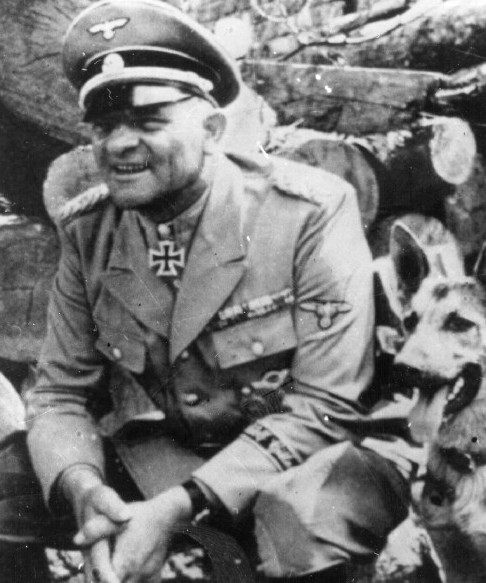
SS General Sepp Dietrich Commander of the 6th SS Panzer Army

The Allies also made mistakes in calculating German capabilities because of their success after Normandy. The Germans who the Allies presumed to be at the brink of collapse made a miraculous  recovery following their ghastly losses in Normandy. Kampfgrüppen and remnants of divisions bled the Americans at the Huertgen Forrest and blunted the British attempt to leapfrog the Northern Rhine at Arnhem decimated the British First Airborne division and causing heavy casualties among other British and American units during Operation Market Garden.

The German 15th Army avoided disaster when the British failed to close their escape route from Walchern island allowing 60,000 troops and much equipment to escape.  The Germans we’re able reform, reorganize, and stabilize the front by October. They pulled back many units of the 5th and 6th Panzer Armies for re-fitting and diverted nearly all tank, armored fighting vehicle and artillery production to the West at the expense of the Eastern Front.

The Germans called up 17 year olds and transferred young fit personnel from the Navy and Luftwaffe to the Army and Waffen SS.  Here they were trained by experienced NCOs and officers and brought into veteran units alongside hardened veterans who showed taught them the lessons of 5 years of war.[xiv]  However the rapid influx of new personnel meant that they could not be assimilated as quickly as needed and thus many were not as well trained as they might have been with more time.[xv] Many infantry and Parachute units had received inexperienced officers, taken from garrison duty, simply because so many experienced officers were dead, to fill key positions a problem that would show up frequently during the offensive.[xvi]

Panzer IV Ausf H of an SS Panzer Divsion in the Bulge

 The Germans were aided by the caution displayed by the Allies throughout the campaign in France which allowed the Germans to reconstitute formations around veteran headquarters staffs.[xvii]  The Germans built up the 5th and 6thPanzer Armies as the Schwerpunkt of the offensive giving them the lion’s share of reinforcements and pulling them out of the line during the fall battles along the Seigfried line and in the Alsace and Lorraine.  The plan was for the two Panzer armies and 7th Army to punch through the Ardennes, cross the Meuse, drive across Belgium, capture Antwerp and severe the link between the British and the Americans.

The spearhead of the assault was 6th Panzer Army Commanded by SS General Sepp Dietrich. It was composed of 1st and 2nd SS Panzer Corps and Army’s LXVII Corps.  The 6th SS Panzer Army included some of the best formations available to the German Army at this late stage of the war including the 1st  SS Panzer Division, the Leibstandarte Adolf Hitler, the 2nd  SS Panzer Division Das Reich, the 9th SS Panzer Division Hohenstaufen and the12th  SS Panzer Division Hitler Jügend. It’s ranks were filled out by the 3rd Parachute Division, the 501st SS Heavy Tank Battalion (attached to 1st SS), the 3rd Panzer Grenadier Division and the 12th, 246th, 272nd, 277th and 326th Volksgrenadier or Infantry divisions. The 6th Panzer Army would be the northern thrust of the offensive and its ultimate objective was Antwerp.  The 6th Panzer Army would be aided by a hastily organized parachute battalion under Colonel Von Der Heydte[xviii] and the 150th Panzer Brigade under SS Colonel Otto Skorzeny which included teams of American dialect speaking soldiers in American uniforms and equipment that were to spread confusion and panic in American rear areas.[xix]

Bradley, Eisenhower and Patton at Bastogne

 To the south was the 5th Panzer Army commanded by General Hasso Von Manteuffel.  The 5th Panzer Army was to advance alongside of the 6th Panzer Army with Brussels as its objective.  Composed of the XLVII and LVIII Panzer Corps and LXVI Corps the major subordinate commands included the best of the Army Panzer divisions including the 2nd Panzer, Panzer Lehr, 9th and the16thPanzer division. It also had the elite Führer Begleit Brigade composed of troops from Panzer Corps Grossdeutschland and commanded by Otto Remer who had help crush the coup against Hitler in July.  The 5th Panzer Army also included the 18th, 26th, 62nd, 560th and later the 167th Volksgrenadier divisions.

The south flank was guarded by 7th Army commanded by General Erich Brandenburger composed of LIII, LXXX and LXXXV Corps.  It included the Führer Grenadier Brigade and later the 15th Panzergrenadier division.  It was the weakest of the three armies but eventually included 6Volksgrenadierdivisions of varying quality and strength[xx] and the veteran 5th Parachute division.[xxi]  However with only 4 divisions at the start of the offensive the 7th Army was the equivalent of a reinforced corps.

While this force seemed formidable it had a number of weaknesses beginning with tank strength.  The 1st and 12th SS Panzer divisions were only at approximately half their established tank strengths and faced severe shortages in other vehicles.[xxii]  2nd SS and 9th SS of II SS Panzer Corps reported similar shortages.[xxiii]The shortage of other motorized vehicles, even in Panzer divisions was acute.  “Even the best equipped divisions had no more than 80 percent of the vehicles called for under their tables of equipment, and one Panzergrenadier division had sixty different types of motor vehicles, a logistician’s nightmare”.[xxiv] Panzer Lehr was so short in armored half tracks that only one battalion of its Panzer Grenadiers could be transported in them while others had to use “trucks or bicycles.”[xxv]

Limitations on equipment as well as fuel were not the only challenges that the Germans faced. The US V Corps launched an attack on the Roer River Dams just before the offensive making it necessary for the Germans to divert some of the  6th SS Panzer Army’s infantry divisions and Jagdpanzer units to be used by 6th SS Panzer Army away from the offensive.  One regiment of 3rd Parachute Division and over half of a second division could not take part in the initial 6th Panzer Army attack. Likewise some Jagdpanzer and Sturmgeschutzen units did not arrive until three days after the offensive began.[xxvi]

Allied Response: Before the Battle

While the German commanders sought to implement Hitler’s plan Allied commanders looked only to completing the destruction of Germany not believing the Germans capable of any major operation.  The Allied commanders with the exception of Patton did not believe the Germans capable of any more than local counter attacks.  Patton’s 3rd Army G-2 Colonel Koch was the only intelligence officer to credit the Germans with the ability to attack.[xxvii]  Most allied commanders and intelligence officers discounted the German ability to recover from disastrous losses, something that they should have learned in Holland or learned from the Soviet experiences on the Eastern front.  Bradley noted in his memoirs “I had greatly underestimated the enemy’s offensive capabilities.”[xxviii]  Carlo D’Este noted that “there was another basic reason why the Allies were about to be caught with their pants down: “Everyone at SHAEF was thinking offensively, about what they could do to the enemy, and never about what the enemy might do to them.””[xxix]   This mindset was amazing due to the amount of intelligence from Ultra and reports from frontline units that major German forces were no longer in the line.[xxx] Additionally nearly all commentators note that American units in the Ardennes did not conduct aggressive patrols to keep the enemy off balance and obtain intelligence.[xxxi]  One describes the efforts of 106th Division as “lackadaisical” and notes that enemy before the offensive was not the Germans but the cold.[xxxii] Max Hastings noted that: “the Allies’ failure to anticipate Hitler’s assault was the most notorious intelligence disaster of the war.”[xxxiii]

The Allies also were in the midst of a manpower crisis. Eisenhower did not have enough divisions to establish a clear manpower advantage as “there were not enough Anglo-American divisions, or enough replacements for casualties in the existing divisions.”[xxxiv]  No more American Infantry divisions were available as the Army had been capped at 90 divisions and infantry replacements were in short supply.  This shortage meant that Eisenhower could not pull divisions out of line to rest and refit. He could only transfer divisions such as the 4th and 28thInfantry divisions to the relative quiet of the Ardennes. He had no ability to“create a strategic reserve unless he abandoned the broad front strategy.”[xxxv]The Germans knew of the allied weakness and believed that they could achieve local superiority even if they did not believe they could reach Antwerp. Model believed that “he was sure that he would reach the Meuse in strength before the Americans could move sufficient reserves to halt his armies or even head them off.”[xxxvi]

The German Breakthrough and American Response
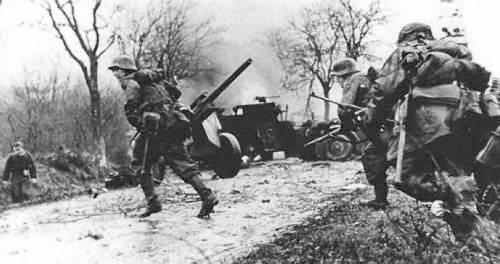
German-Troops-at-the-Battle-of-the-Bulge

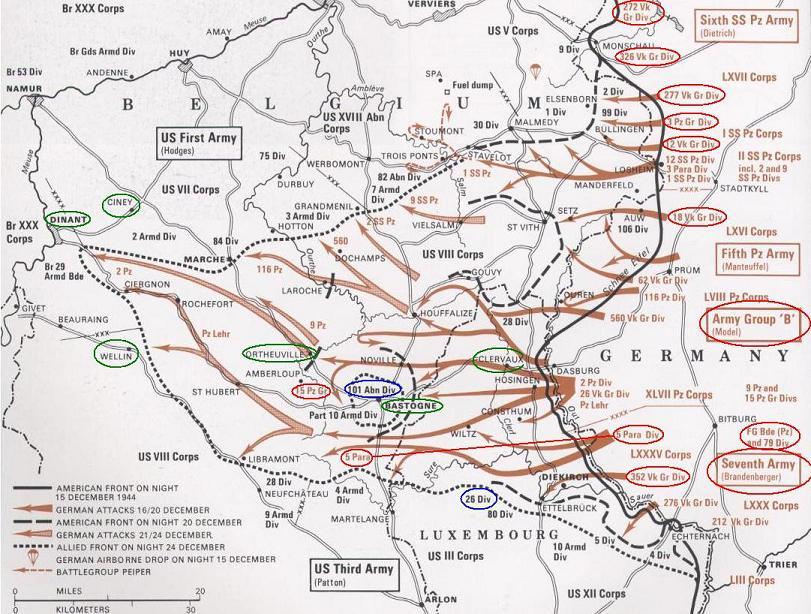
The German assault began on December 16th. Some breakthroughs were made especially in the vicinity of the Losheim Gap and the Schnee Eifel by the southern elements of 6th Panzer Army and Manteuffel’s 5th Panzer Army. However the Germans could not break through around Monschau and Elsenborn Ridge held by the inexperienced but well trained 99th Infantry division and elements of the veteran 2nd “Indianhead” Division.  In the far south near Diekirch the 4th Infantry Division held stubbornly against the attacks of 7thArmy’s Volksgrenadiers. The Germans achieved their greatest success at Losheim where SS Colonel Josef Peiper and his 1st SS Panzer Regiment had driven off the US 14th Cavalry Group and penetrated 6 miles into the American front.  5th Panzer Army made several breakthroughs and isolated two regiments of newly arrived 106th Infantry Division in the Schnee Eifel. Manteufel also pressed the 28th Division hard along the Clerf River, Skyline Ridge and Clairvaux.

Yet at ‘no point on that first day did the Germans gain all of their objectives.”[xxxvii]  The credit goes to US units that stubbornly held on, but also to the poor performance of many German infantry units.  German commanders were frustrated by their infantry’s failure even as the panzers broke through the American lines.  Manteuffel noted his infantry was “incapable of carrying out the attack with the necessary violence.”[xxxviii]

US Airborne Commanders James Gavin (R) and Matthew Ridgeway (L)

 The initial Allied command response to the attack by senior commanders varied.  Bradley believed it was a spoiling attack “to try and force a shift of Patton’s troops from the Saar offensive back to the Ardennes.”[xxxix] Courtney Hodges of 1st Army agreed with Bradley and refused to allow General Gerow, commander of V Corps to call off 2nd Infantry Division’s attack against the Roer dams on the 16th in order to face the German offensive.[xl]  Gerow was one of the first American commanders to recognize the scope of the German attack but Hodges, perhaps the least competent senior American commander in Europe failed to heed Gerow’s advice. Soon after making this decision Hodges “panicked” and evacuated his headquarters at Spa fearing that it would be overrun by the advancing Germans.[xli] Eisenhower when informed of the news realized that something major was occurring and ordered the 7th Armored Division from the 9th Army and 10th Armored Division from 3rd Army into the Ardennes. On the 17th he made other dispositions and released the 82nd and 101stAirborne Divisions from SHAEF reserve at Rheims to the Ardennes under the command of XVIII Airborne Corps.[xlii]  However during this short amount of time Mantueffel’s panzers had advanced 20 miles.
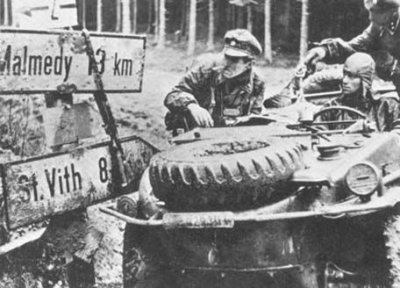
SS Panzer Troops of Kampfgruppe Knittel on the advance.  Photo has often been identified for decades in books and other publications as Waffen-SS Colonel Joachim Peiper the commanding officer of the 1st SS Panzer Regiment and Kampfgruppe Peiper. This has been refuted by recent study.  Peiper is pictured below.

At the command level Eisenhower made a controversial, but correct decsion to divide the command of the Bulge placing on a temporary basis all forces in the northern sector under Montgomery and leaving those to the south under Bradley.  Montgomery according to one commentary initially “had been astonishingly tactful in handing his American subordinates.”[xliii] However he quickly made himself obnoxious to many American commanders.[xliv]Following the battle Montgomery made the situation worse by claiming to have saved the Americans and giving credit to British units which scarcely engaged during the battle.[xlv]  Eisenhower also ordered Patton to launch a counter-attack along the southern flank of the German advance.  However Patton was already working on such an eventuality and promised to be able to launch a counterattack with three divisions by the 22nd.[xlvi]  Bradley praised Patton highly in his memoirs noting: “Patton’s brilliant shift of 3rd Army from its bridgehead in the Saar to the snow-covered Ardennes front became one of the most astonishing feats of generalship of our campaign in the West.”[xlvii]

The Americans Hold the Shoulders 

  688px-Bulge_stvithroad_1945jan24_375

The 99th Division’s position was precarious, its right flank was subject to being turned and it was suffering severely at the hands of 12 SS Panzer and several Volksgrenadier divisions.  Gerow reinforced the 99th with elements of the 2nd Infantry division even before he had the final authorization to end its attack.  The two divisions stubbornly held Elsenborn Ridge and the villages of Rockerath, Krinkelt and Büllingen. By the 20th the 9th and 1st Infantry divisions arrived to strengthen the defense and lengthen the line to prevent it from being rolled up by the Germans.  The stubborn resistance of the Americans and arrival of reinforcements meant line was proof “against anything Sepp Dietrich might hurl against it”[xlviii]  By the 23rd Dietrich and 6th SS Panzer Army conceded defeat at Elsenborn and “turned its offensive attentions to other sectors.”[xlix]  German commanders like General Priess the commander of 1st SS Panzer Corps believed that terrain and road network in this sector was unfavorable to the German offensive and had proposed moving the attack further south.[l]  The Panzers could not deploy properly and the German infantry was not up to the task of driving the Americans out of their positions before the reinforcements arrived.

In the south the 4th Infantry Division held the line though heavily pressed by Brandenburger’s 7th Army.  The division was reinforced by elements of both 9thand 10th Armored divisions on the 17th and generally held its line along the Sauer River around Echternach “largely because the left flank of the enemy assault lacked the power-and particularly the armor-of the thrust farther north.”[li]

Turning Point: The Destruction of Kampfgruppe Peiper

While V Corps fought the 6th Panzer Army to a standstill, to the south 1stSS Panzer Division led by Kampfgrüppe Peiper split the seam between V Corps and VIII Corps. The Kampfgrüppe moved west leaving a brutal path of destruction in its wake, including massacres of American POWs and Belgian civilians.[lii]  However its advance was marked with difficulty. On the night of the 17th it failed to take Stavelot. After clearing the American defenders from the town after a hard fight on the 19th it failed to capture a major American fuel dump a few miles beyond the town.  When the Germans approached the American commander ordered his troops to pour 124,000 gallons down the road leading to the dump and set it on fire, depriving the Germans of badly needed fuel.[liii]  Combat Engineers from the 291st Engineer Battalion blew a key bridge across the Ambleve at Trois Ponts and another bridge across the Lienne Creek which left the Germans bottled up in the Ambleve River valley.  This bought time for the 30th Infantry Division to set up positions barring Peiper from the Meuse.  The 30th would be joined by Combat Command B of 3rd Armored Division and elements of 82nd Airborne. These units eventually forced Peiper to abandon his equipment and extricate some 800 troops by foot by the 23rd after a hard fight with the Americans who had barred his every effort to break through to the Meuse.

Turning Point: The Crossroads: St Vith & Bastogne
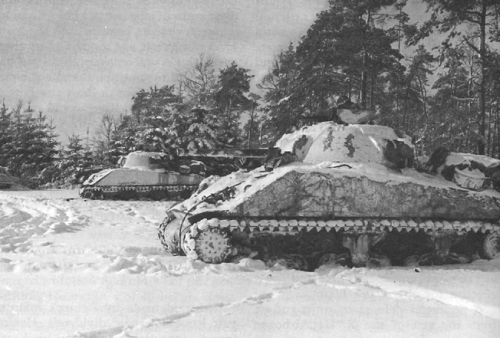
American_7th_Armored_Division_Shermans_taking_up_positions_outside_St._Vith,_1944

The battle rapidly became focused on key roads and junctions, in particular St. Vith in the north and Bastogne in the south.  At St. Vith the 7thArmored Division under General Hasbrouck, who Chester Wilmont calls one of the “great men of the Ardennes”[liv] completed a fifty mile road march from Aachen to St. Vith.  On his arrival he deployed his combat commands around the town which was the key to the road network in the north and also to the only rail line running west through the Ardennes.[lv]  Hasbrouck gathered in Colonel Hoge’s Combat Command B of 9th Armored Division and the 424th Infantry Regiment of the 106th Division into his defensive scheme as well as the survivors of the 112th Infantry Regiment of the 28th Infantry Division which had escaped the German onslaught after holding as long as possible along the Clerf River and Skyline Drive.[lvi]  With these units Hasbrouck conducted “an eight-day stand that was as critical and courageous, as the defense of Bastogne.”[lvii]  After holding the Germans at St. Vith the units were withdrawn to another defensive position along the Salm and Ourthe Rivers and the village of Viesalm.  This was done at the behest of Montgomery and General Ridgeway of XVII Airborne Corps whose 82nd Airborne had moved into that area on the 19th.  The arrival of the 82nd greatly assisted Hasbrouck’s force holding St. Vith whose defenders had lost an estimated 5000 casualties.[lviii]

The stand at St. Vith confined the “confined the Sixth Panzer Army’s penetration to a chokingly narrow corridor.”[lix]  It also posed a problem for German command and control which because it was out of the 6th Panzer Army’s area of operations Dietrich was unable to lend his weight into the fight.  “Hitler himself had strictly prohibited deviations from the zonal boundaries”[lx] which left the fight for St. Vith in the hands of 5th Panzer Army who felt the impact of the stand as the Americans “also choked off one of the Fifth Panzer Army’s best routes to Bastogne, almost nullifying the significance of the captured road junction at Houffalize.”[lxi] 
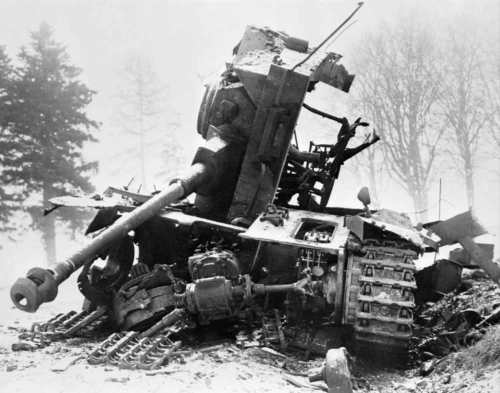
EA-48892

To the south of St. Vith lay Bastogne, another key road junction needed by 5thPanzer Army for its advance.  On the night of the18th Panzer Lehr division came within two miles of the town before being checked by resistance by units of the 10th Armored division, remnants of 28th Division and misdirection by “friendly” Belgian guides onto a muddy path that helped halt their advance.[lxii]  This gave the 101st Airborne just enough time to get to the town and prevent its capture. The siege of Bastogne and its defense by the 101st elements of 9th and 10thArmored Divisions and 28th Division became an epic stand against Manteuffel’s Panzers which had surged around the town.  Wilmont comments that “had the Germans won the race for Bastogne, Manteuffel’s armor would have had a clear run to Dinant and Namur on December 19th and 20th” [lxiii] when there were only scattered American units between them and the Meuse. Manteuffel b bypassed Bastonge after the failure to capture it and masked it with 26thVolksgrenadier Division and a regiment of Panzer Lehr.  The remainder of Panzer Lehr and the 2nd Panzer Division moved to the west. [lxiv]  The garrison endured numerous attacks and on the 22nd one of the most celebrated incidents of the war took place when Brigadier General Anthony McAuliffe responded to a demand for the surrender of the town with the reply; “Nuts.”  The town would continue to hold until relieved by 3rd Army on the afternoon of December 26th.[lxv]

The American Counterattack


The Allied counterattack began with 3rd Army in the south on 21 December.  Patton’s initially proposed to attack toward the base of the Bulge in order to cut off the largest number of Germans possible.  Eisenhower dictated an attack further west with the goal of relieving Bastogne.  Eisenhower wanted to delay the attack to concentrate combat power while Patton wanted to attack sooner in order to ensure surprise. Patton got his way but attacked on a wide front.  The attack lost its impetus and bogged down into a slugging match with 7th Army’s infantry and paratroops along the southern flank. [lxvi]  Patton’s failure to concentrate his forc forces for the advance to the north diminished his combat power.[lxvii] While Patton attacked from the south the 1st Army dealt with the advanced spearhead of 2nd Panzer Division which had reached the town of Celles and ran out of gas just four miles from Dinant and the Meuse. The 84thInfantry Division stopped the 116th Panzer division from being able to effect a relief of the 2nd Panzer the US 2nd Armored Division and allied fighter bombers chopped up the virtually immobile 2nd Panzer division completing that task by the 26th.[lxviii]  

41d233ae6d2744c2cbab2d76cf798341

To the north Montgomery launched a cautious counterattack which slowly and methodically took back lost ground but allowed many Germans to escape. While Montgomery moved south Patton faced heavy German resistance from elements of 5th Panzer Army, reinforced by 1st SS Panzer Corps and 7th Army.  The rupture in the American front was not repaired until 17 January when the American forces met at Houffalize.[lxix] Bradley took over for Montgomery and the Americans pushed the Germans slowly back across the Clerf River by the 23rd.  The advance was hampered by tough German resistance and terrible weather which forced much of the attack to be made by dismounted troops as the roads had completely frozen over.[lxx]

The Allied counter attack has been criticized for allowing too many Germans to escape what could have been a major encirclement.  Patton recognized the incompleteness of the victory in the Ardennes stating: ““We want to catch as many Germans as possible, but he is pulling out.” The “but” clause, the note of regret, the awareness of the imperfection of his victories typified Patton.””[lxxi]  Patton in his memoirs noted: “In making the attack we were wholly ignorant of what was ahead of us, but we were determined to strike through to Bastogne.”[lxxii] Max Hastings simply said: “the Allies were content with success.”[lxxiii]  Murray and Millett place blame on Bradley and Hodges for choosing “merely to drive the enemy out of the Ardennes rather than destroy him.”[lxxiv]

Analysis: Could Wacht Am Rhein Have Worked?

Could Wacht am Rhein worked?  If much was different, yes. Success of the operation depended more on ifs that the Germans could not control, than events they had the power to influence. If the German had been stronger in tanks and vehicles and had adequate stocks of fuel; if their infantry was better trained, and had the Americans not resisted so stubbornly it might have at least got to the Meuse.  Perhaps if the the bad weather held keeping Allied air forces away from the Germans, or had St. Vith and Bastogne been taken by the 18th or 19th, they might have reached the Meuse. Likewise, had the Germans executed their plan and coordinated their assault better[lxxv] in the 6thPanzer Army sector, and had the 7th Army enough strength to conduct offensive operations in depth and secure the left flank the attack might have succeeded. But only revisionists and fiction writers could construct such success.

Because the Americans held the shoulders and road junctions, Manteuffel’s 5thPanzer Army, the only force besides the regimental sized Kampfgrüppe Peiper to actually threaten the Meuse was forced to advance while attempting to take Bastogne and defeat 3rd Army’s counterattack. Whether they could have made Antwerp is another matter.  Nearly all German commanders felt the offensive could not take Antwerp but did believe that they could inflict a defeat on the Allies and destroy a significant amount of allied combat power.

The German offense was a desperate gamble.  Too few divisions, scant supplies of petrol and ammunition, formations that had recently been rebuilt and not given enough time to train to the standard needed for offensive operations coupled with Hitler’s insistence on an unalterable plan kept them from success. It was a part of Hitler’s Cloud Cukoo Land.

At the same time the Allies were so weak in troops and overstretched because of their losses during the Normandy Campaign, Market Garden, and the Huertgen Forrest, Eisenhower had no strategic reserve save the two American Airborne Divisions.  All reinforcements to the threatened sector had to come from the flanks and by the middle of the battle the 9th Army was drawn down to two divisions.

Russell Weigley noted how the constraints imposed by the 90 division Army, and of the limited stocks of artillery ammunition hurt the allies.[lxxvi] If the Germans had more forces they might have inflicted a significant defeat on the Allies had they been able to reinforce their success in depth. Despite this they still inflicted punishing losses on the Americans though suffering greatly themselves.  Hastings noted that the real beneficiaries of the Ardennes offensive were the Russians.[lxxvii]  In the end the conclusion had to be that German success was unlikely and that the offensive could have never achieved Hitler’s goals of taking Antwerp and fracturing the British-American alliance.

A Postscript About other Parts of the Campaign in France

The Riviera and Rhone

The campaign in south France was strategically wise although opposed by the British to the last minute because they felt it would take away from Overlord.[lxxviii] Though delayed the campaign was well executed by 7th Army, particularly Lt. General Lucian Truscott’s VI Corps of 3 American divisions. Truscott believed “destroying the enemy army was the goal”[lxxix] managed the battle well and skillfully maneuvered his small forces against Blaskowitz’s 19thArmy inflicting heavy losses, though some German commanders noted the caution of American infantry in the attack.[lxxx]  Only Blaskowitz’s tactical skills and the weakness of the American force prevented the Germans from disaster. The seizure of Marseilles and Toulon provided the allies with sorely needed ports that were invaluable to sustain the campaign.[lxxxi]

The Lorraine Campaign

Patton attacked in the Lorraine with the goal of crossing the Moselle river and attempting to break into Germany. He doing so he ran into some of the strongest German forces on the front and his troops became bogged down in the poor terrain and mud of the region.[lxxxii]  Patton was convinced that he was delayed in making his assault due to his place “at the far end of the logistics queue.” during Market Garden. [lxxxiii] Despite Patton’s efforts, German forces skillfully defended the ancient fortress of city Metz forcing the Americans into a protracted campaign to clear the area with the last strongpoint surrendering on 13 December.  Patton is criticized for his failure to concentrate his forces[lxxxiv] but American tactics were less to blame than the weather, German resistance and shortages of infantry.[lxxxv] In some cases American infantry units performed admirably, particularly 80th Division’s assault on the Falkenburg Stellung.[lxxxvi]Liddell Hart criticized the Allies for failing to attack through the then weakly defended Ardennes, commenting: “By taking what appeared to be the easier paths into Germany the Allies met greater difficulties.”[lxxxvii]

The Huertgen Forrest

The Huertgen Forrest was the worst managed American fight Western European campaign. [lxxxviii] General Courtney Hodges leadership was poor.[lxxxix] In the Huertgen he fed division after division into a battle that made no strategic sense.  American infantry performed poorly and took extremely heavy casualties leaving four divisions shattered.[xc]  Poor American tactics demonstrated by attacking into a forest in poor weather without concentration negated all of Hodges’ advantages in tanks, artillery and airpower. The forest contained no significant German forces capable of threatening any American advance[xci] and its gain offered little advantage.[xcii] Hastings noted that the gains the only saving grace was that it made it easier for the northern shoulder of the Bulge to hold[xciii]  General Model and his subordinates expertly handled their handful of excellent but weary divisions in this battle using terrain, weather and prepared defensive positions to contest nearly every yard of the Forrest.[xciv]

Conclusions

The lessons of the Bulge and the other campaigns on the German-French border are many and can be gleaned from Allied and German mistakes. On the Allied side the most glaring mistakes were assumptions prior to the German attack that the Germans were incapable of any serious offensive and ignoring the fact that the Germans had attacked through the Ardennes in 1940.  Likewise the self limitation of the American Army to 90 divisions for world-wide service meant that there were no more divisions in the pipeline and that worn out divisions would have to be reinforced with inexperienced troops while in the front line which ensured a lack of cohesiveness in many divisions, especially the infantry.  Allied intelligence failures as well as their reliance of forces much smaller than they should have had for such a campaign ensured that they would suffer heavy losses in the Bulge while poor planning and execution by Hodges wasted many good troops in a senseless battle.  The Germans were hamstrung by Hitler’s fantasy that the Western Allies could be forced out of the war or the Alliance split by a defeat in the Ardennes.  Likewise German forces, even those so quickly reconstituted were often short troops, tanks and vehicles.  German commanders were forced by Hitler’s rigid insistence on not altering the plan to not be as flexible as they might have been in earlier offensives to adjust according to the situation on the ground.

None of these attitudes is exclusive to the Allied and German commanders during the campaign in France and the Battle of the Bulge. They are common throughout history and have been repeated in Vietnam, Iraq, and Afghanistan by the United States military. It would be easy for Americans to believe that in future conflicts we will be victorious when despite our massive military budgets many if not most of our combat forces could not be deployed to a conflict at short notice and those in theater could be overwhelmed by enemies who exploit our weaknesses rather than directly engage our strengths.

Notes


[i] Dupay, Trevor N.  Hitler’s Last Gamble: The Battle of the Bulge December 1944-January 1945Harper Collins Publishers, New York NY 1994 p.2.

[ii] Hastings, Max. Armageddon:  The Battle for Germany 1944-1945 Alfred A Knopf, New York NY 2004 p.197.

[iii] Reynolds, Michael. Sons of the Reich: II SS Panzer Corps; Normandy, Arnhem, Ardennes, and on the Eastern Front.  Casemate Publishing, Havertown PA 2002 p.186

[iv] Ibid. p.198

[v] Warlimont, Walter. Inside Hitler’s Headquarters 1939-1945 translated by R.H. Barry. Presidio Press, San Francisco, CA 1964. p. 480

[vi] Ibid.

[vii] Liddell Hart, B.H. The German Generals Talk. Originally published 1948, Quill Publishers Edition, New York 1979 p.274.

[viii] Liddell Hart, B.H. The History of the Second World War G.P. Putnam’s Sons, New York NY 1970. p.646.

[ix] MacDonald, Charles B. A Time for Trumpets: The Untold Story of the Battle of the Bulge William Morrow and Company, New York, NY 1985 p.35.

[x] [x] Newton, Steven H. Hitler’s Commander: Field Marshal Walter Model, Hitler’s Favorite General.DeCapo Press, Cambridge MA 2005. p.329

[xi] Ibid. Hastings p.198.  Hastings quotes Dietrich: “All Hitler wants me to do is cross a river, capture Brussels, then go on and take Antwerp. And all this at the worst time of year through the Ardennes when the snow is waist-deep and there isn’t enough room to deploy four tanks abreast let alone armored divisions. When it doesn’t get light until eight and it’s dark again by four and with re-formed divisions made up chiefly of kids and sick old men-and at Christmas.”

[xii] Ibid. Liddell-Hart The German Generals Talk p.276

[xiii] Wilmont, Chester. The Struggle for Europe Harper and Brothers Publishers, New York, NY 1952 p.576

[xiv] Ibid. p.557.

[xv] Ibid. Hastings. p.199. Hastings notes that Manteuffel said: “It was not that his soldiers now lacked determination of drive; what they lacked were weapons and equipment of every sort. Von Manteuffel also considered the German infantry ill trained.”

[xvi] Ibid. Dupay.p.47  Dupay notes that in 3rd Parachute Division that most of the regimental commanders had no combat experience.

[xvii] Weigley, Russell  F. Eisenhower’s Lieutenants: The Campaign in France and Germany 1944-1945. Indiana University Press, Bloomington IN 1981 p.432.  Weigley speaks of Allied caution and predictable strategy, caution in logistical planning which did not allow the Allies to provide the fuel needs for a rapid drive into Germany and caution of operational commanders.

[xviii] Liddell Hart discusses the issue of paratroops at length in discussions with Manteuffel and General Kurt Student. At the time of the operation there were very few jump trained paratroops available for the operation as most of the 6 organized Parachute Divisions were committed to battle as infantry during the 1944 battles in the East, Italy and in the West. German Generals Talk pp.282-285.  Although Liddell Hart makes note of the employment of these troops and talked with Model and student about why they were not used to seize bridges and other critical terrain featured ahead of the Panzers instead of the use as a blocking force, I have found no one who questioned why the Germans did not use small glider detachments for the same purpose.  The Germans had demonstrated with Skorzeny when they rescued Mussolini from his mountain prison that they still retained this capability.  The use of the SS Paratroop battalion which could have been assigned to Skorzeny as a glider borne force could have been decisive in capturing the key bridges and terrain ahead of 6thPanzer Army.

[xix] Skorzeny’s operation was Operation Greif designed to sow confusion in the Allied Ranks.  His brigade numbered about 3500 men and had a good number of captured US vehicles including some tanks and tank-destroyers on hand to confuse American units that they came in contact with.

[xx] Ibid. Hastings.  p. 199.  Hastings quotes the Adjutant of 18th Volksgrenadier Division who “felt confident of his unit’s officers, but not of the men “some were very inexperienced and paid the price.”  MacDonald notes that the division had many Navy and Air Force replacements but was at full strength. p.646.

[xxi] See MacDonland pp. 644-655 for a detailed commentary on the German Order of Battle.

[xxii] Reynolds, Michael. Men of Steel: 1st SS Panzer Corps;  The Ardennes and Eastern Front 1944-1945 Sarpendon Publishers, Rockville Center NY, 1999. pp.36-37.  Reynolds notes that the 1st SS Panzer Regiment only had 36 Panthers and 34 Mark IV Panzers to begin the operation (excluding the attached 501st SS Heavy Tank Battalion).  He also notes that many of the tank crew replacements had no more than 6 weeks of military training and some of the tank crews had never been in a tank.  Similar problems were found in all the Panzer Divisions.  Severe shortages of armored half tracks, reconnaissance vehicles and other vehicles meant that Panzer Grenadier and Motorized battalions lacked the lift needed and some went on foot or on bicycles.

[xxiii] Ibid. Reynolds. Sons of the Reich. P.183

[xxiv] Ibid. MacDonald. p.44.

[xxv] Ibid.

[xxvi] Ibid. Dupay pp. 27-28.

[xxvii] Ibid. MacDonald. p.52.  MacDonald notes that Koch warned that the Germans were not finished, that “his withdraw, though continuing has not been a rout or mass collapse.” He calls Koch a “lone voice” in the Allied intelligence world.

[xxviii] Bradley, Omar  N. A Soldier’s Story Henry Holt and Company, New York NY 1951. p.459.  Weigley makes some poignant calling Bradley’s comments  “contradictory” and states that: “his apologia is hardly a model of coherence. (p.461)

[xxix]  D’Este, Carlo. Eisenhower: A Soldier’s Life Owl Books, Henry Holt and Company, New York NY 2002. p.638

[xxx] Dupay and others talk about this in detail. See Dupay pp. 35-44.

[xxxi] Ibid. p.38.

[xxxii] Ibid. Hastings. p.201

[xxxiii] Ibid. Hastings. p.199

[xxxiv] Ibid. Weigley. p.464

[xxxv] Ibid.

[xxxvi] Ibid. Wilmont. P.581.

[xxxvii] Ibid. p.583

[xxxviii] Ibid. Hastings. p.223

[xxxix] Ibid. Weigley. P.457

[xl] Ibid. p.471

[xli] Ibid. Hastings. pp.205-206

[xlii] Ibid. Wilmont. pp.583-584

[xliii] Murray, Williamson and Millett, Allan R. A War to Be Won: Fighting the Second World War The Belknap Press of Harvard University Press, Cambridge Massachusetts and London England, 2000 p.470 The authors must base their conclusion on the fact that Montgomery who mentioned to Eisenhower that Hodges might have to be relieved, did not do so and by the next day told Eisenhower that the action was not needed.  A  few other American commanders in the north were favorable to Montgomery but this appears to be a minority view.

[xliv] Ibid. Weigley. pp.504-506.  Weigley and Wilmont both note the comment of a British Staff Officer the Montgomery “strode into Hodges HQ like Christ come to cleanse the temple.” (Wilmont p.592)

[xlv] Ibid. Hastings. pp.230-232.  Hastings is especially critical of Montgomery.  Weigley, equally critical notes regarding  the January 7th press conference, Montgomery’s “inability to be self critical at any point.” p.566.

[xlvi] Ibid. Weigley. p.500.

[xlvii] Ibid. Bradley. p.472  Other commentators differ in their view of Patton’s movement.  Wilmont notes that Patton had no “equal in the on the Allied side in the rapid deployment of troops. (p.589) Weigley urges readers that “it should be kept in appropriate perspective; it was not a unique stroke of genius.” And he compares it to Guderians disengagement with Panzer Group 4 and 90 degree change of direction and assault against the Kiev pocket in the 1941 Russian campaign (p.500)  Hastings notes that “Patton had shown himself skilled in driving his forces into action and gaining credit for their successes. But he proved less effective in managing a tough, tight battle on the southern flank.” (p.230)  Regardless of the perspective and criticism Patton’s movement was unequaled by any Allied commander in the war and had he not moved so quickly the 101st Airborne might not have held Bastogne. Admittedly his attack north was dispersed along a wide front but part of the blame for this must be assigned to Eisenhower who dictated the attack toward the west vice the base of the Bulge where Patton desired to make it.  A note I would make is that being a cavalryman Patton thought like one and when faced with the tight battles in close quarters was not at his best.  Similar comparisons could be made to J.E.B. Stuart at Chancellorsville when he had to take command of Jackson’s Corps.

[xlviii] Ibid. Weigley. p.475

[xlix] Ibid. p.474

[l] Ibid. Reynolds Men of Steel pp.51-52.

[li] Ibid. Weigley. p.470

[lii] The worst of these took place at the village of Malmedy where Battery B 285th Field Artillery Observation Battalion of 7th Armored Division was captured and about 150 soldiers were rounded up and machined gunned in a field with survivors killed with pistol shots in the head.

[liii] Ibid. Weigley. pp.478-479.

[liv] Ibid. Wilmont. p.584

[lv] Ibid. Weigley. p.487

[lvi] Ibid. Weigley. pp.486-487

[lvii] Ibid. Hastings. p.215. Hastings gives most of the credit to Brigadier General Bruce Clarke of CCB 7th Armored Division for the stand.

[lviii] Ibid. MacDonald. 481-487.  MacDonald notes that following the war that the commanders of the units involved “would be grateful to Field Marshal Montgomery for getting them out of what they saw as a deathtrap for their commands. (p.487)

[lix] Ibid. Weigley. p.487

[lx] Ibid.

[lxi] Ibid.

[lxii] Ibid. Hastings. p.217 Also  MacDonald. p.289 who talks of the confused situation east of Bastogne both for the Americans and Germans.

[lxiii] Ibid. Wilmont. p.598

[lxiv] Ibid. Liddel Hart. The German Generals Talk. p.288

[lxv] The defense of Bastogne would continue until after the 1st of January as Hitler renewed the attempts to secure the town in order to push on to the Meuse. Other German formations including units of 1st SS Panzer Corps shifted south from their original attack would make determined efforts to dislodge the stubborn American defenders.

[lxvi] Ibid. Weigley. pp.500-501.  Bradley gives Patton more credit than later commentators. Wilmont notes that the Germans though “amazed at the speed with which Patton had disengaged from the Saar and wheeled them northward…they received due warning of his movement by monitoring the radio net which controlled American traffic, and they were braced to meet his assault. (p.599).

[lxvii] Ibid. Weigely. Pp.520-521

[lxviii] Ibid.  pp.535-537

[lxix] Ibid. pp. 558-561

[lxx] Ibid. pp.563-564

[lxxi] Ibid. p.566.

[lxxii] Patton, George S. War as I Knew It  Originally published by Houghton Mifflin Company NY 1947, Bantam Paperback Edition,  Bantam Books, New York, NY 1980 p.364

[lxxiii] Ibid. Hastings. p.230

[lxxiv] Ibid. Murray and Millett p.471.

[lxxv] Hastings notes that “Tactically, the Ardennes was one of the worst-conducted German battles of the war, perhaps reflecting that none of the generals giving the orders saw any prospect of success. (p.236)

[lxxvi] Ibid. Weigley. pp.567-572

[lxxvii] Ibid. Hastings. p.236-237.  Hastings believes that the employment of the 5th and 6th Panzer Armies in the East “made the task of Zhukov and his colleagues much harder.”

[lxxviii] Ibid. Weigley. p.236. I find it interesting that neither Hastings nor Liddell Hart mention the Riviera and Rhone campaign.

[lxxix] Ibid. Weigley. p.236

[lxxx] Giziowski, Richard. The Enigma of General Blaskowitz  Hippocrene Books Inc. New York NY, 1997. p.328

[lxxxi] Ibid.  Weigley comments on how much the overall supply situation was aided by the operation and capture of the ports and notes that the pace of the Cobra breakout had created a crisis in supply and “without the southern French ports the crisis would have been insurmountable.” (p.237)

[lxxxii] Ibid. p.397.  Weigley notes: “The immobilizing mud and the enemy’s recalcitrant resistance had fragmented the battle into affairs of squads, platoons, companies and battalions….and Patton’s juniors more than he controlled the course of action, to the extent that control was possible.”

[lxxxiii] Ibid. p.384

[lxxxiv] Ibid. p.390 Weigley states: “The American disinclination to concentrate power was rarely more apparent.” comparing the frontages of 1st, 9th and 3rdArmies and notes that Patton attacked along his entire front.”

[lxxxv] Ibid. Weigley. pp.400-401.  Weigley spends a fair amount of time on American infantry shortages in 3rd Army.

[lxxxvi] Ibid. Weigly. P.400.  Weigley notes a German General Wellm attributed part of that victory to the “prowess of the American infantry.”

[lxxxvii] Ibid. Liddell Hart. The History of the Second World War p.560

[lxxxviii] Hastings and Weigley both note how many American division and regimental commanders were relieved of command for their failures in the Huertgen.

[lxxxix] Ibid. Hastings. p.179.  Hastings notes that “instead of recognizing the folly of attacking on terrain that suited the Germans so well, Courtney Hodges reinforced failure.”

[xc] Ibid. Weigley. p.420.  Weigley notes the high numbers of ballet and non battle casualties in the 4th, 8th, 9th and 28th Divisions as well as CCR of 5thArmored and 2nd Ranger Battalion.

[xci] Ibid. Hastings. p.275.  Hastings notes that defending 275th Division “were poor grade troops who-like the garrison of Aachen posed no plausible threat to the flanks of an American advance to the Roer.”

[xcii] Weigley compares the battle in its effect on the American army to Grants “destruction of the Confederate army in the Wilderness-Spotsylvania-Cold Harbor campaign expended many proud old Union army formations…” (p.438)

[xciii] Ibid. Hastings. p.215

[xciv] Ibid. Newton. p.324

Leave a comment

Filed under armored fighting vehicles, artillery, History, leadership, Military, national security, nazi germany, Political Commentary, us army, US Army Air Corps, world war two in europe

Thoughts After My Retirement Ceremony: The Good, the Bad, the Ugly, and Thanking all Who Were there for Me

Friends of Padre Steve’s World,

Sorry not to have written anything the past few days but I was exhausted after dealing with medical and dental issues, getting no sleep and being stressed out getting ready for my retirement ceremony. When it was done I was happy and so tired that I had a hard time doing anything.

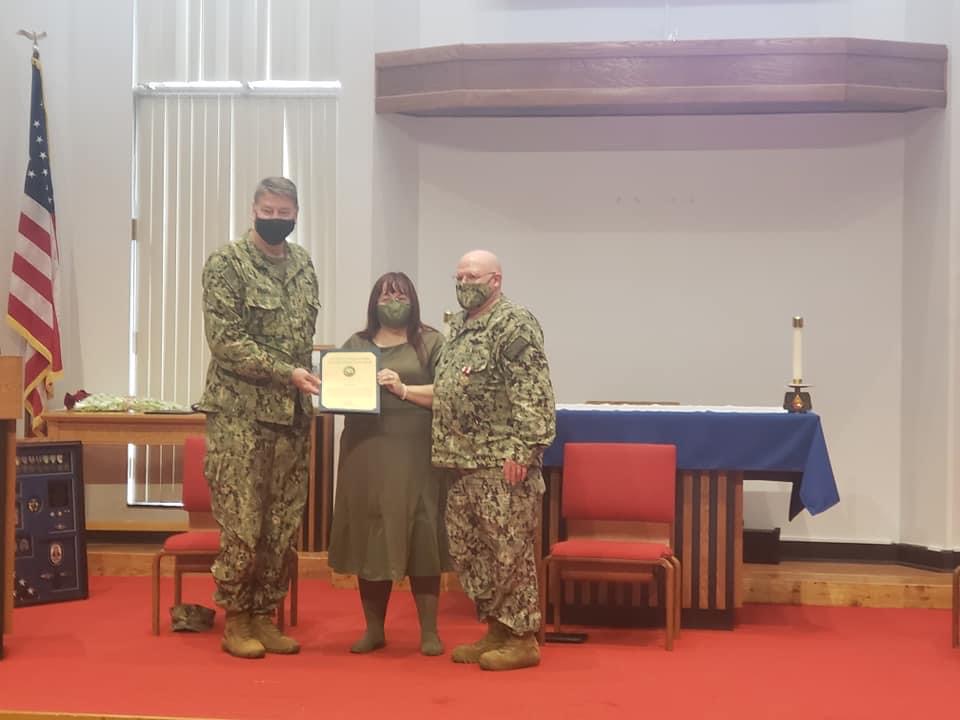
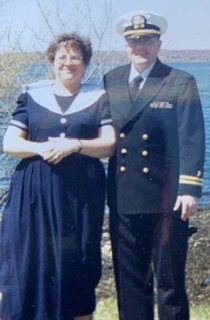
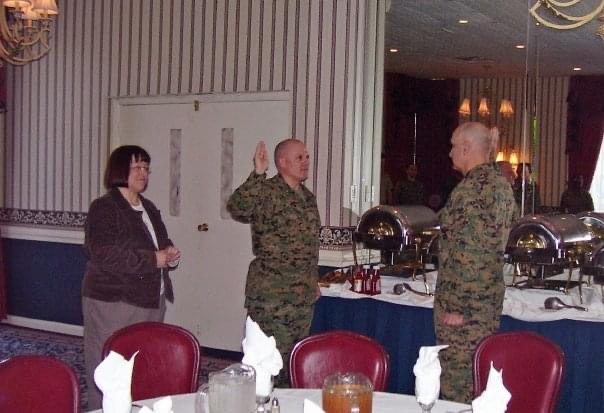
Monday I had my COVID-19 Era retirement ceremony. It very special. Unfortunately the live stream video got deleted by the Chapel were it was held, but I heard from a number of people that a lot of it could not be heard on the livestream. Even so the people I wanted there were there and it was an appropriate coda to my career. One of our friends present with his wife is an active Staff Sergeant in the Virginia Army National Guard’s 29th Infantry Division in which I served after I became an Army Chaplain in 1995.

I had my Command Master Chief from Norfolk Naval Shipyard as well the Chief Bos’ns Mate from the Shipyard to sound the bells and pipe me ashore. Having two Chiefs was awesome, as the Command Master Chief read the traditional reading The Watch, something I wanted because my late father was a Chief Petty Officer. For me that was a huge honor. Seldom do Chief’s or Senior Non-Commissioned Officers get leading roles at an officer’s retirement, especially like in reading the The Watch in the Navy. If you have never heard it read this is how it goes, only the number of years of service change.

 Like the Chiefs, few Chaplains have their RPs or Chaplain Assistants speak at their retirement ceremonies. I don’t know why? In the Army we are Unit Ministry Teams, and the Navy Religious Ministry Teams, the key word being teams. I was talking to a friend today, the only other Chaplain that I have seen have one of his enlisted men speak. He noted that during his time in the Navy that most Religious Program Specialists at the Rank of Petty Officer First Class, had worked for at least one Chaplain who treated them in such a way that they lost faith in God, other Chaplains and the church or religious institutions in general. Nelson fricking nailed it. God bless him and his wonderful daughter.

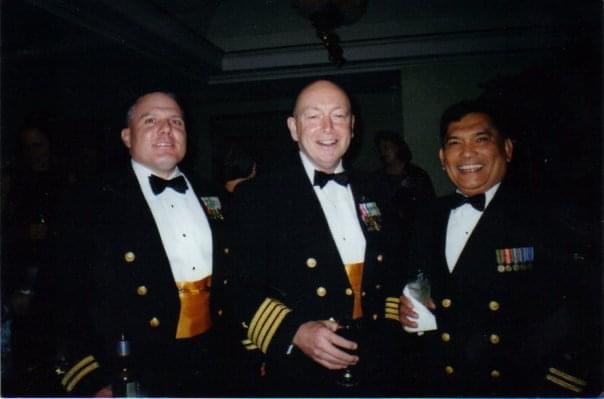
I had two former Commanding Officers who had a huge impact in my Navy speak with prerecorded remarks. Retired Medical Corps Rear Admiral David Lane who was my commanding officer at Naval Hospital Camp LeJeune during one of the darkest points of my life. He was there for they then and in 2015 when due to the maltreatment and abuse I was getting from staff members of the Mental Health Department of the Naval Medical Center, interceded with the Admiral commanding it. That Admiral called me, spoke to me for an hour, got me the appropriate referrals and got some things changed, because I wondered if a senior officer was being treated the way I was, how were junior sailors, marines, soldiers and airmen being treated. I was suicidal, but Admiral Lane helped keep me from it. Monday, he honored me, and my wife Judy with his remarks. He is one of the good guys, he sees people not in light of their rank or job, but as human beings. His words brought tears to my eyes too.

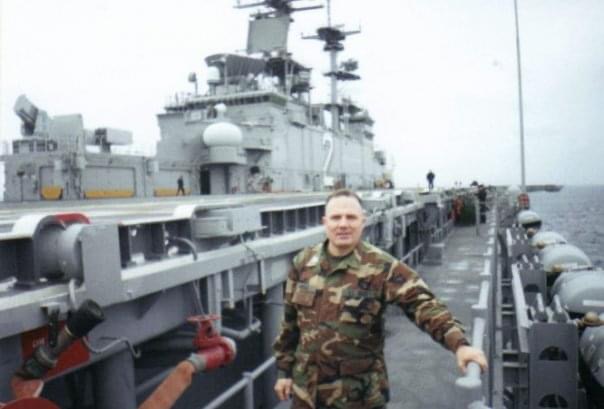
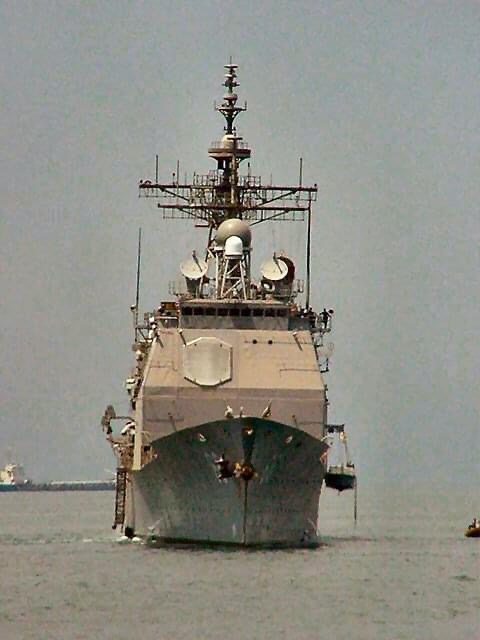
The other was Captain Rick Hoffman, my Skipper aboard USS HUE CITY on her first combat deployment having been a test ship for new combat systems for five years. That was shortly after the attacks of September 11th 2001, and he helped put my service aboard the ship in context. He is an amazing man. He lost his wife to Cancer not long after he retired. He offered to turn down command of the ship   when she was diagnosed, but she wouldn’t let him. She survived the first bout but not the second. The Admiral who presided over the ceremony, Rear Admiral Charles Rock said that when he was a young Lieutenant Commander that Captain Hoffman was a legend. He didn’t know that he had been my Skipper on HUE CITY. Likewise, he had worked with Admiral Lane not long before Admiral Lane retired in Washington DC.

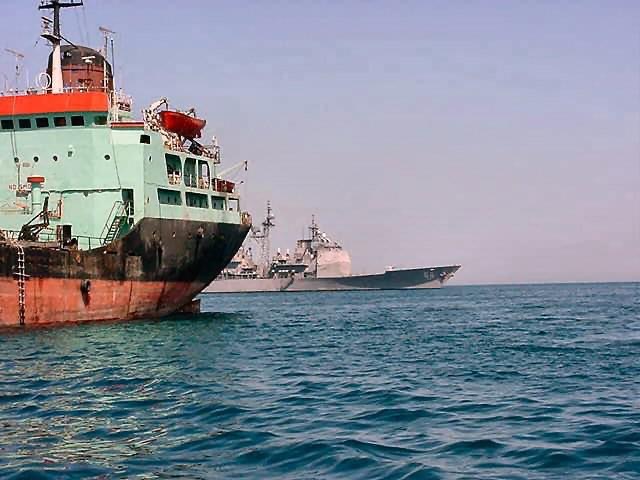
Captain Hoffman’s children are great people, and since retiring he has continued to look after his sailors and our national security. He provided me chances to do things chaplains never get to do. His comments were so good, and brought back many fond memories of my shipmates, including the ones who removed me from breaking up a fight between a disgruntled crewman and Master of a ship impounded under the UN Oil Sanctions on Iraq, for which the crew gave me the nickname “Battle Chaps.” Not only was I unarmed, but because of a shortage of Kevlar armor plates for our combat floatation vests, I was also going into danger without any protection except that of my shipmates. Thankfully, I had great shipmates. That was good living, difficult, arduous, but what you live for if you sign up to serve as a Navy Chaplain. It was such an honor to have Captain Hoffman there, even as like Admiral Lane had to do, he did so virtually.

I also had Mikey Weinstein, President of the Military Religious Freedom Foundation, who defended me when I was facing potential Court Martial. Since then he and I have become fast friends and allies in the defense of the civil and religious rights of military personnel and their families. He echoed the words of Nelson, Admiral Lane, and Captain Hoffman said about me, and he never had met them. All understand that a Chaplain’s job is far more than preaching his or her faith, it is about caring for military personnel, their families, and our Department of Defense and Department of the Navy civilian personnel, and protecting their Constitutional rights.

As Admiral Lane noted, to preach at stateside chaplains we could hire contractors, but we needed chaplains who could be there for our military personnel and their families, regardless of their faith or lack thereof. There really are no other places someone in the military can go with complete confidentiality to reveal their hurts, pains, anxiety, worries, and even sins in complete confidence without fear of reprisal, or punishment. In some ways, good military Chaplains are to use the words of James Spader’s character in The Blacklist, are sin eaters. This is not saying that we cover up crimes, but that we are a safe place for people to cast their cares and get sound counsel on how to get whatever help they need and if need be go with them to get that help be it medical, psychological, legal, administrative, or the help best given by their chain of command. One finds as a chaplain that most of our flock’s needs are not necessarily spiritual and that they don’t need to only person with absolute confidentiality they can go to shove religion down their throats.

Mikey understands this much more than his critics give him credit. He understands the needs and religious rights of military personnel as only one who has had his life threatened by Christian theocrats, and Anti-Semites can only understand. He spoke very personal and inspiring words about my service.

My regular readers understand my understanding of religious liberty, government, and citizenship. One of my inspirations is the great Virginia Baptist, John Leland who advised Thomas Jefferson in the Virginia Declaration of Religious Liberties and James Madison on the First Amendment wrote, and which I quoted Monday in my remarks:

Is conformity of sentiments in matters of religion essential to the happiness of civil government? Not at all. Government has no more to do with the religious opinions of men than it has with the principles of mathematics. Let every man speak freely without fear–maintain the principles that he believes–worship according to his own faith, either one God, three Gods, no God, or twenty Gods; and let government protect him in so doing, i.e., see that he meets with no personal abuse or loss of property for his religious opinions. Instead of discouraging him with proscriptions, fines, confiscation or death, let him be  encouraged, as a free man, to bring forth his arguments and maintain his points with all boldness; then if his doctrine is false it will be confuted, and if it is true (though ever so novel) let others credit it. When every man has this liberty what can he wish for more? A liberal man asks for nothing more of government.”

I also quoted James Madison said, “Every new & successful example therefore of a perfect separation between ecclesiastical and civil matters, is of importance. And I have no doubt that every new example, will succeed, as every past one has done, in shewing that religion & Govt. will both exist in greater purity, the less they are mixed together.”

Sadly, in our country today many people, including the church leaders of a majority leader of many military Chaplains hold an opposite doctrine, that of the very doctrines of a supposedly “Christian” Religious theocracy that the Framers of our Constitution so opposed. I opposed those opinions and had someone try to get me tried by Court Martial for preaching a Biblical and Christian sermon on social justice and the the racist policies of the outgoing administration. Some people think that they can use their position to condemn people whose religious and beliefs in our Constitutional rights disagree with theirs. Thank God, whatever God’s there may be or just dumb luck and fate for men like Mikey. I look forward to working with him after my official retirement date.

I also brought up my understanding of leadership which included my devotion to the West Point motto Duty, Honor, Country. I received my commission as an Army ROTC cadet, and I was not an Academy graduate. However those words  have served as a compass to my career. For me the first duty has always been to the truth be it as a Medical Service Corps officer commanding a company and later dealing with the Army’s response to soldiers infected with HIV or dying of AIDS, where I helped write the Army’s personnel policies and because no other personnel officer at the Academy of Health Sciences wanted to be in the same room with an HIV infected soldier, I became CINC AIDS. I got to be the person who dealt with men and women dealing with a disease that at the time was certain to kill them, and how they could still serve. That brought me a whole new perspective on life, and a great deal of compassion for those who received news that they did not have much longer to live.

The same was true when I was an Armor Officer and Battalion S-1 in a Texas Army National Guard Armor battalion and saw how racism still permeated the National Guard in Texas. As a non-Texan and former Active Officer I found that I was a foreigner, something that I experienced transferring from Texas to Virginia. It is funny how the same prejudices that permeated the Armies of the Confederate States were still existent in the 1980s and 1990s.

Likewise, honor, is about my sacred honor to my Oath of Office and my sacred vows as a husband, and Priest, and finally my Country in good times as bad.

Captain Jean Luc Picard, played by Sir Patrick Stewart in Star Trek the Next Generation said: “the first duty of every Starfleet officer is to the truth, whether it’s scientific truth, historical truth or personnel truth…” I am not a Starfleet Officer but as an officer nonetheless I have always believed that the truth matters, but sadly I, like so many of us have turned the other way and not spoken out. But the older I get the more I realize that I cannot be silent about subjects that at one time I turned a blind eye to because they were uncomfortable, unpopular or might hurt my career either in the church or in the military. That really didn’t take that long. It began when I was an Army Second Lieutenant and has continued until today.

Likewise I have been guided by the words of General Ludwig Beck who resigned his office rather than obey Hitler’s plan to invade Czechoslovakia, and then gave up his life in the attempt to kill Hitler on 20 July 1944. Beck said:

“It is a lack of character and insight, when a soldier in high command sees his duty and mission only in the context of his military orders without realizing that the highest responsibility is to the people of his country.”

I reminded those present or watching online that those words were especially important in our conflicted and divided country. While I did not say it directly I implied that Officers cannot simply dedicate themselves to purely military matters when their Chief Executive violates the Constitution they swore to defend against all enemies, foreign and domestic. 

While it was in the script since we were running late and I didn’t want to get any more political than I had I left out. Beck also said:

“Final decisions about the nation’s existence are at stake here; history will incriminate these leaders with bloodguilt if they do not act in accordance with their specialist political knowledge and conscience. Their soldierly obedience reaches its limit when their knowledge, their conscience, and their responsibility forbid carrying out an order.” 

That is exactly what I believe. I wish time had allowed me to say it, but I digress…

Then there was my dear friend and colleague, retired Navy Chaplain Vince Miller who served as both the Chaplain and Master of Ceremonies for my retirement due to COVID-19 restrictions on how many people could attend. Vince and I have had so many similar experiences, endured similar treatment in the Chaplain Corps, but hold so many values about the rights of people, their faith, and those who served under our supervision sought to uphold, regardless of their beliefs. Both of us ended up getting off-ramped from promotion because of things that happened to us or family considerations. He is a fast friend, a man of integrity and honor who like William Tecumseh Sherman understood the value of friendship. Sherman was a friend of Ulysses S. Grant. Sherman said of their friendship:

“Grant stood by me when I was crazy, I stood by him when he was drunk. Now we stand together.”

That my friends is friendship.

Finally, the ceremony was maybe more about the selfless love and devotion of my wife Judy. One cannot imagine what it is to spend almost 40 years in the military with someone who remains as faithful and devoted for so long despite the separations, deployments, and everything else associated with military marriage.

My God she has been through so much and not just because of deployments, separations, and the hassles of moves, and not seeing family. But also because Chaplains spouses don’t have much support, especially from other Chaplains or their spouses, especially if they suffer from a physical disability, like being profoundly deaf while having speech as good as any hearing person. But even with the best hearing aids around which have improved her hearing and life tremendously, there are times that our facilities are not built with the disabled, especially the deaf in mind. The acoustics were so poor where we had the retirement ceremony that with the exception of me and Admiral Rock Judy had a difficult time understanding the ceremony. She was hoping to try to watch it Tuesday with her Bluetooth hearing aids synced to her iPad but the livestream had been deleted, again reminding her of how little the military values people with disabilities. At least I have the speeches of the three men who spoke saved and she will be able to listen to them when we get the chance, but it hurt.

Likewise, it used to be that when a Chaplain retired the Chief of Chaplains at least sent a “thank you” note or acknowledged their retirement regardless of their rank. A few months ago I saw an email from our current Navy Chief of Chaplains and his Deputy acknowledging the Chaplains retiring in the rank of Captains and the Religious Program Specialists retiring as Master Chief Petty Officers by name but not acknowledging anyone below those ranks. I wondered to myself what the fuck? Is it all about climbing the highest ranks of the Chaplain Corps, or about caring for those we serve and lead? Of course for me it is about those that we serve, especially those who serve under us.

Then I realized that of all people, Senior Chaplains serving as Admirals or who would crush anyone to bet their Star, don’t give a damn about those who serve and have stomped over to achieve their positions. They don’t give a damn about anyone except themselves and their power.

During my remarks I quoted Joseph Heller in his novel Catch-22 about the Chaplain. There is something about secular power in religious matters that transforms otherwise decent people and ministers into monsters. No wonder my ceremony disappeared off of the Chapel’s Facebook video archive. Heller wrote:

“The chaplain had mastered, in a moment of divine intuition, the handy technique of protective rationalization, and he was exhilarated by his discovery. It was miraculous. It was almost no trick at all, he saw, to turn vice into virtue and slander into truth, impotence into abstinence, arrogance into humility, plunder into philanthropy, thievery into honor, blasphemy into wisdom, brutality into patriotism, and sadism into justice. Anybody could do it; it required no brains at all. It merely required no character.”

That being said, we were blessed by those who attended, what they did and what they said. It meant the world to us, as do the wonderful words, thoughts, prayers, and actions of people who have been there for us to be there in person or by whatever virtual means available.

I am not bitter because I leave the service knowing that I have given all that I can and that the people that matter the most to me still care, regardless of rank or station. I would rather have the well wishes of a man or women I helped when they were an E-3 or E-4 rather than the platitudes of Clergymen wearing stars or eagles who didn’t care. But what I experienced is not uncommon, but most people will never speak as openly as I do, because from the earliest days of my service I believed in telling the truth whether it pissed people off, or harmed my upward mobility.

So despite being worn out and having to deal with more medical and dental issues than I thought I would ever see in the final days of my career I am still blessed and one of the luckiest men in the world, to paraphrase Lou Gehrig when he had to retire from baseball due to ALS. I am, at least to my knowledge not dying of anything, but it doesn’t take away my sentiments towards those people who have been there for me the past 39 plus years in the military, and even those before I signed my name on the dotted line.

When I am actually completely retired at 2359 hours on 31 December I can truly embrace my inner Smedley Butler, and embrace the fullness of truth and patriotism.

So until tomorrow,

Peace and thank you,

Padtre Steve+


6 Comments

Filed under civil rights, Coronavirus 19 Pandemic, COVID19, History, holocaust, laws and legislation, leadership, Military, ministry, Pastoral Care, philosophy, Political Commentary, racism, Religion, Tour in Iraq, us army, US Marine Corps, US Navy

Trump’s Embrace of the “Stab in the Back” and the Danger to America

Friends of Padre Steve’s World

I am modifying an article from last year and updating it to reflect the post-election chaos sowed by President Trump and his cult followers. These alleged “patriots” include Nazis, White Supremacists, anti-Semites and racist murderers, as well as men convicted of working with the Russians in the 2016 election, Christian theocrats, convicted War Criminals, and a host of Un-American and most unsavory haters of the Declaration, Constitution, and the ideals our nation was founded upon. I have no tolerance left for their actions to undermine the country for the last four years but especially in the forty days since the election Trump lost fair and square. The last time a group of people as angry and consumed with hatred of our system of government as these people are was in 1860, and they brought about the bloodiest war in American history, the American Civil War, or as it should be better known, The War of the Slaveholders  Rebellion.

Anyone can fret over their presidential candidate losing an election. They also have the right in cases where the results were close to recounts, in some cases mandated by state law, in others requested by the losing party so long as they pay for the cost. In every state where Trump lost and recounts were conducted Trump lost again, sometimes by wider margins than the first time. Trump’s supporters viciously attacked than threatened Republican Governors, Attorneys General, and Elections Officials, even making death threats. They then launched a flurry of frivolous lawsuits with no factual evidence to support their allegations.  Of over 60 they only gained one minimal “victory” that did not alter any results in Pennsylvania where it was filed. Finally the Supreme Court unanimously rejected a lawsuit by Texas Attorney General Ken Paxton sued to disenfranchise voters in five states where Trump lost. 17 Red State Attorneys General filed amicus briefs supporting Texas. The Supreme Court’s justices including Clarence  Thomas, Samuel Alito, and all three of Trump’s nominees on the bench, Gorsuch, Kavanaugh, and Coney-Bennett, together with Chief Justice Roberts, and Democrat appointed justices Breyer, Sotomayor and Kagan rejected what Trump called a “very big event.”

Such actions are not the actions of patriots who seek to uphold the Constitution, the Declaration, and the understanding that liberty was ever expanding to include those who at one time in the United who were considered to be less than human and undeserving of equality with White men. Instead they act like Nazis, Klansmen, and every other enemy of freedom who has ever breathed. Their actions are those of a desperate, dangerous, and devilish hoard of enraged losers who cannot admit defeat. They would rather go down in their own Götterdämmerung than understanding that the key to maintaining the ideals of the American experiment are found through progressive ideals and compromise to conserve the best of our past in order that the future will be better.

I was reminded of the importance of why I write after I read conservative columnist Michael Gerson’s article in the Washington Post last year.

Gerson wrote:

“Fascism may not describe what Trump has done, as opposed to what he says. But what he says matters and can create its own dangerous dynamic. It is possible for a leader to be incompetent and still profoundly corrupt the people who follow him, undermining the virtues — tolerance, civility and compromise — that make democratic self-government work. It is possible for a foolish leader to leave the imprint of fascism on a portion of his followers. And the language used by Trump — particularly a certain racially tinged nostalgia and a tribal resentment for the other — strikes me as at a higher level of prominence and acceptance than at any time I can remember. So maybe, rather than fearing a fascist dictator, we should fear the legitimacy of fascist modes of thought in the Republican Party.

This is a more complex danger than most talk of fascism generally suggests. But it is a danger nonetheless.”


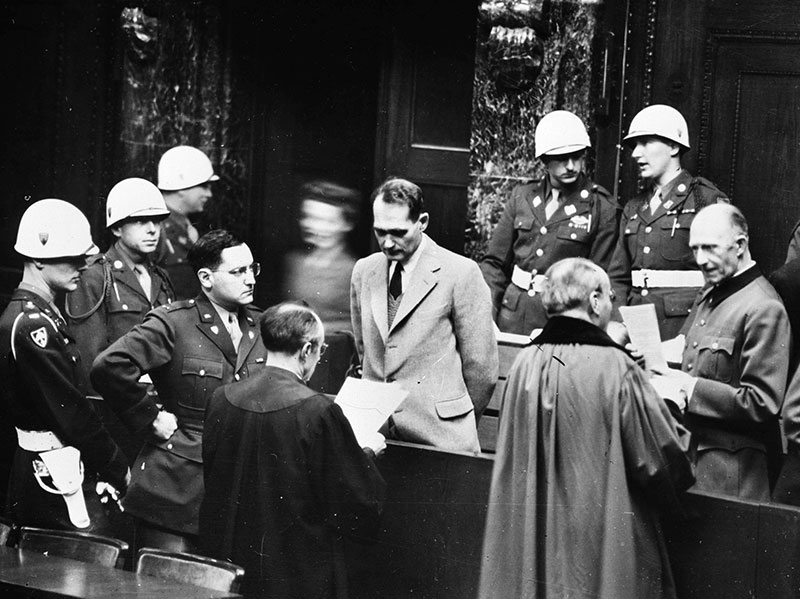
Gustave Gilbert,
who served as a psychologist to the major Nazi war criminals at Nuremberg noted that in his observation and discussions with them he had to deal with the nature of evil. He had to find the common thread among them that allowed them to take part in the most horrific crimes against humanity conducted by an allegedly civilians, western and Christian country. He noted that in his dealings with them they had one thing in common, they had no empathy for their victims. He said, “evil is the absence of empathy.” The common psychological term for a person who cannot empathize with other people is a sociopath. That is what are President is. It is a trait that he shares with the vilest criminals of the Twentieth Century. Many of his followers seem to share that attribute. You can see it in their words and in their actions from the day he came down the escalator at Trump Tower to announce his candidacy until this very minute.

President Donald Trump holds a Bible as he visits outside St. John’s Church across Lafayette Park from the White House Monday, June 1, 2020, in Washington. Part of the church was set on fire during protests on Sunday night. (AP Photo/Patrick Semansky)

At a campaign rally the President praised a Congressman from Montana who assaulted a reporter just before the 2016 elections and the crowd cheered its approval. As they cheered Trump said: “Any guy that can do a body slam … he’s my guy.” Then he acted out a motion of a person violently throwing someone to the ground, and the crowd continued to cheer. Though he has repeatedly attacked and mocked the press, it was the first time that he praised and openly condoned the attack on a reporter, and it came at a time when he did not condemn the brutal murder of the Saudi Arabian journalist and American resident Jamal Khashoggi in the Saudi consulate in Istanbul Turkey. Sadly he never did.

Because Trump is what he is, a malignant narcissistic sociopath, I never doubted that he would end up here. But I never expected people who I believed  were decent and held to the beliefs of their Christian faith to become vicious, cruel and opponents of life after it leaves the womb to fall in behind him in lockstep, believing every crackpot conspiracy their and joining in with the Nazis in their support of race hatred.  For Trump’s crowds to applaud his remarks then and now showed the deep moral rot in the Republican Party. It is troubling because it reflects something far more dangerous which could actually bring about a Fascist type takeover of the U.S. Government.

Gerson wrote:

And one event in particular could quickly heighten that danger. Consider what American politics would look like if Republicans — against all odds and expectations — were to keep the Senate and House. There might be many explanations for such a result — exceptional economic conditions, bad Democratic strategy, the rallying effect of Justice Brett M. Kavanaugh among Republicans — but we know how the president would interpret it. He would regard such a victory as the complete vindication — the stamp of national approval — on his entire approach to politics.

All the last remaining opposition in the GOP would melt, and many of his supporters would be calling for retribution against enemies and traitors. The whole leadership of the FBI and Justice Department — anyone who ever displeased him — would be at immediate risk of replacement. Trump would take his victory as permission for even more brutal treatment of migrants. More generally, a leader with no commitment to the separation of powers, with no respect for the traditional self-restraints of the presidency, with savage disdain for the free press, with an admiration for authoritarians, with a history of menacing individuals and companies by name, and with a talent for division and dehumanization would feel unbound.

The boor, the bluffer, the bully would be a political colossus. Then the language of fascism might become less theoretical. Then alarmism would be realism.

As I thought of these things over the past year and change, I was reminded of the words of Hannah Arendt: “When evil is allowed to compete with good, evil has an emotional populist appeal that wins out unless good men and women stand as a vanguard against abuse.”

Now honestly, at one time I believed that a majority of Trump supporters were themselves evil or even bad people. But that being said I also used to believe that quite a few of them, perhaps a majority of them  surrendered to taking the path of least resistance and looking out for what they think are their interests first, even if the result of their decisions hurt people who are much like them. They include people I knew or know, and I struggle to think how they could have crossed this line. But as time has passed I believe that quite a few of the people I used to excuse as being misled and having a better sense of morality and right and wrong do not. They cannot make up their minds as to what is evil and what is good, so long as they personally benefit from the transaction.

As Arendt said, “The sad truth is that most evil is done by people who never make up their minds to be good or evil.”

That is what we are watching happen before our very eyes. Some might claim ignorance, or claim that they are non-political and are in no position to judge the morality of this President and his administration, but that is the refuge of cowardS. Karl Popper noted “Ignorance is not a simple lack of knowledge but an active aversion to knowledge, the refusal to know, issuing from cowardice, pride, or laziness of mind.”

The fact is that today, like in Germany between 1933 and 1945 no one can claim ignorance about the nature and character of President Trump whether they support or oppose him. But if they chose not know Of his malfeasance and evil, it is simply cause they do not want to know, and for those in positions of authority who turn a blind eye, what Albert Speer, Hitler’s architect and later armaments minister wrote “…being in a position to know and nevertheless shunning knowledge creates direct responsibility for the consequences…”

It is a tremendous lack of empathy, an active aversion to truth, intentionally shunning knowledge, and perhaps worse, a refusal to know when in a position to know which allow people to look the other way in the face of evil and injustice.

I cannot do that. Regardless of past relationships I cannot have anything to do with people, friends or not who propagate an American version of the German Dolchstoßlegende, or the myth of the “Stab in the back.”  This is the rallying cry of authoritarians, theocrats, and racists who cannot accept their defeat in war or politics, and who will do all they can to avenge their losses at all costs.  There is nothing patriotic, Christian, or American about it. It is a treasonous attempt to paint themselves as patriots while leading the nation to catastrophe while blaming others for their incompetence and criminality.

As for me I have to quote a number of Hitler’s opponents who lost their lives either speaking out against his crimes or trying to overthrow his criminal regime.

Sophie Scholl, a 22 year old student at the University of Munich wrote:

“The real damage is done by those millions who want to ‘survive.’ The honest men who just want to be left in peace. Those who don’t want their little lives disturbed by anything bigger than themselves. Those with no sides and no causes. Those who won’t take measure of their own strength, for fear of antagonizing their own weakness. Those who don’t like to make waves—or enemies. Those for whom freedom, honour, truth, and principles are only literature. Those who live small, mate small, die small. It’s the reductionist approach to life: if you keep it small, you’ll keep it under control. If you don’t make any noise, the bogeyman won’t find you. But it’s all an illusion, because they die too, those people who roll up their spirits into tiny little balls so as to be safe. Safe?! From what? Life is always  on the edge of death; narrow streets lead to the same place as wide avenues, and a little candle burns itself out just like a flaming torch does. I choose my own way to burn.”

D.Bonhoeffer im Gefaengnis Berlin-Tegel Bonhoeffer, Dietrich evang. Theologe, Widerstandskaempfer Breslau 4.2.1906 – (hingerichtet) KZ Flossenbuerg 9.4.1945. – Bonhoeffer im Hof des Wehrmachtunter- suchungsgefaengnis in Berlin-Tegel, Sommer 1944. – Foto.

The German Pastor and theologian Dietrich Bonhoeffer wrote: “The fearful danger of the present time is that above the cry for authority, be it of a Leader or of an office, we forget that man stands alone before the ultimate authority and that anyone who lays violent hands on man here is infringing eternal laws and taking upon himself superhuman authority which will eventually crush him. The eternal law that the individual stands alone before God takes fearful vengeance where it is attacked and distorted. Thus the Leader points to the office, but Leader and office together point to the final authority itself, before which Reich or state are penultimate authorities. Leaders or offices which set themselves up as gods mock God and the individual who stands alone before him, and must perish.”

Bonhoeffer also noted in his defense of Hitler’s Jewish victims:

“The church has an unconditional obligation to the victims of any ordering society, even if they do not belong to the Christian community.” and also“We are not to simply bandage the wounds of victims beneath the wheels of injustice, we are to drive a spoke into the wheel itself.”

General Ludwig Beck who resigned his office as head of the German Army in 1938 over Hitler’s decision to invade Czechoslovakia said: “It is a lack of character and insight, when a soldier in high command sees his duty and mission only in the context of his military orders without realizing that the highest responsibility is to the people of his country.”

He also noted: “Final decisions about the nation’s existence are at stake here; history will incriminate these leaders with bloodguilt if they do not act in accordance with their specialist political knowledge and conscience. Their soldierly obedience reaches its limit when their knowledge, their conscience, and their responsibility forbid carrying out an order.”

Then there are the words of Major General Henning Von Tresckow who said: “I cannot understand how people can still call themselves Christians and not be furious adversaries of Hitler’s regime.” I would say the same of Trump’s allegedly Christian supporters and defenders. Tresckow also said “We have to show the world that not all of us are like him. Otherwise, this will always be Hitler’s Germany.” The same is true today. If we do not reject Trump and his dictatorial, racist, and unconstitutional actions, we will always be Trump’s America.

Colonel Claus Von Stauffenberg who planted the bomb intended to kill Hitler and was executed that same night said something that should be asked of every church that overlooks Trump’s personal crimes, sins, and attacks on the nation: “Can the church grant absolution to a murderer who has taken the life of a tyrant?” Theoretically they can, but morally and spiritually they cannot if the claim to be Christian Churches.

in Trump’s final days he and his followers cannot be allowed to damage our Republic more than they already have. After he leaves office they must be accountable for their words and actions against American citizens, The laws and Constitution of the United States, their  crimes against humanity, and violations of treaties, that the American Government has abided by for decades. Just because we are Americans and think that we are better than other nations, history shows that we are not.

Supreme Court Robert Jackson said:

“If certain acts of violation of treaties are crimes, they are crimes whether the United States does them or whether Germany does them, and we are not prepared to lay down a rule of criminal conduct against others which we would not be willing to have invoked against us.” Justice Robert Jackson International Conference on Military Trials, London, 1945, Dept. of State Pub.No. 3080 (1949), p.330.

Unfortunately, the United States has failed to live up to our treaty obligations far too often at home in regard to the treaties we made with the people’s of America’s First Nations, now through genocide and forced relocation to reservations on inhospitable and desolate lands to allow for the expansion of White American and our Manifest Destiny, and abroad where Mark Twain wrote during our war against Filipino patriots who had help us defeat Spain: “There must be two Americas: one that sets the captive free, and one that takes a once-captive’s new freedom away from him, and picks a quarrel with him with nothing to found it on; then kills him to get his land. . .” 

Having served my country for over 39 years in the military I can only say that I love her enough to be honest and admit our failings without being disloyal. That actually is a definition of true patriotism. Fake patriotism embraces myth ERs and allows tyranny to subvert our democratic institutions, Constitution, and the ideals set forth in the Declaration of Independence, the Gettysburg Address, the Four Freedoms, and Dr. King’s “I Have a Dream,” “Letter from a Birmingham Jail”, and “I have been to the Mountain” speech. 

So anyway, until tomorrow, which might be Monday because I need to write my retirement address that I will give on Monday.

Peace,

Padre Steve+

5 Comments

Filed under civil rights, civil war, Coronavirus, Coronavirus 19 Pandemic, faith, germany, Gettysburg, life, Military, philosophy, Political Commentary, world war two in europe

If They Act Like Nazis, Threaten Like Nazis, They Are Nazis and I Will Fight Them


The Nazi Desecration of the Anne Frank Memorial

Friends of Padre Steve’s World,

it seems that every day I see acts committed by admitted Nazis such as the act against the only monument to Anne Frank, the Dutch Jewish teenager who with her family was betrayed to the Nazis and died at the Bergen-Belsen Concentration Camp. Her diary of hiding during the Nazi occupation was published after the war. It became one of the classics of Holocaust literature and taught at least a generation of Americans, Western Europeans, and others around the world of the inhumanity of the Nazis, and the humanity of the victims.

Instead of just being another number, young Anne Frank became the voice of those otherwise names faceless statistics of the Nazi war against the Jews and so many others, but the Jews were the special objects of their race hatred and genocide. It remains so today, but most of what I am talking about are Americans. Yes new-Nazis are making a comeback in Europe where the ancient hatred of the Jews never went away despite the Nazi extermination programs.

This week, the only memorial in the United States was defaced by Nazi leaflets with the Swastika and the words “we are everywhere” on it. I saw an email to a Jewish friend that was saturated with Nazi language and imagery, that was supposedly sent by a “Christian pastor.” During the Coronavirus, QAnon members displayed vile images of Jews being responsible for the virus. Likewise some wore placards, again using the imagery of the Nazis of “life unworthy of life” urging that the “weak be sacrificed for the strong.” The number of anti-Semitic crimes is rising in the United States. Synagogues have to have armed uniformed police guards just to worship. Barely two years ago the Tree of Life Synagogue was attacked in Pittsburgh with a new-Nazi killing numerous worshipers. Neo-Nazis and White Supremacists in the United States and around the world have committed mass murder against Jews, Muslims, Christians, and their own countrymen. They will not stop until they are crushed, without mercy.

To the Neo-Nazi supporters of President Trump who he has praised as “very good people” and ordered to Stand back and stand by” in terms of being ready to kill for him to ensure he remains in power, the Jews, especially the Hungarian Holocaust survivor George Soros are the enemy. Quite a few of the allegedly “Christian” members of these movements openly embrace Anti-Semitism, calling Jews “the Synagogue of Satan” misusing scripture to attack the people who are the direct relations of Christians, whose Scriptures we use as the basis of our beliefs.

JACKSONVILLE BEACH, FL – APRIL 17: People crowded the beaches in its first open hour on April 17, 2020 in Jacksonville Beach, Fl. Jacksonville Mayor Lenny Curry opened the beaches to residents for limited activities for the first time in weeks since closing them to the public due to the Coronavirus (COVID-19) outbreak. Jacksonville Beach became the first beach in the country to reopen. (Photo by David Rosenblum/Icon Sportswire via Getty Images)

In my books anyone who calls themself a Christian who attacks the Jews in such a matter is not a Christian but a son or daughter of Satan himself. That includes all of these Goddamned Nazis, no matter what hat they wear, even the red #MAGA hat.

If they were confined to past history and were not threatening and even killing people now.

As a Holocaust scholar I will stand against these barbarians who stand against everything our nation was founded upon, and embrace the perverted doctrines and race hatred of the Nazis and every Nazi type group that has ever existed, including President Trump’s Cult followers. Those people use the Constitution and Declaration ass wipe  while claiming to be “patriots.” I say expose them, shame them, deny the entrance into decent society, which obviously will not stop their corrupt and cultish Trump churches to keep welcoming them with open arms and open mouths, without masks.


I have spent a decade being threatened by them and as I retire from the military I will expose them and do everything I can to show their faces, names, and addresses to Americans quoting their words verbatim to show the depth of their evil and depravity. If it comes to a physical confrontation I will not back down. These Anti-Semites are no different than Hitler’s Brownshirts or SS, except they don’t have the snazzy uniforms. Instead they look like scruffy or fat rejects of any kind of reputable organization. Hitler’s Nazis would have not accepted a one of these shit for brains assholes. If they think they are a “Master Race” they better look at their DNA and IQ tests. They are mongrels without a clue. Few if any could pass the Nazi racial standards tests, which were exceedingly strict and only a few got around, with a lot of political help. Mind you, these losers don’t have that.

They hide behind pseudonyms, use spoofed email addresses, and when they do show their faces they do so from behind body armor and assault type weapons. They are nothing more than cowards and bullies reminiscent of the American No Nothing’s of the 1830s-1860s, the racist and murderous Ku Klux Klan, Red Shirts, White League, and White Liners who murdered thousands of Blacks and White civil rights supporters from the end of the Civil War until now. Sadly, they are to ignorant, just plain stupid, and blinded by race hatred to understand nothing but force. Since the day Terry McVeigh bombed the Murough Federal Building in Oklahoma City until today these terrorists have threatened, bullied, attacked and killed Americans of all races, ethnicity, and religions because at heart they are Nazis and their whole life is built upon hating and pushing down others to keep their place in society, tolerated by the rich and powerful who need their votes, but never respected and really accepted, by the men like Trump that they elect to office. No wonder they hate others and need to use violence and threaten revolution to be able to hold their limp weenies over the fire. I despise the Nazis and everyone who holds their views but deny being Nazis. Lying Nazis who hide in plain sight are worse than those who admit who and what they are and the murderous racism they promote.


There are times that as a Gentile I would like to be a real life version of Lieutenant Aldo Raine, played by Brad Pitt in the Quentin Tarantino classic Inglourious Basterds. I would like to use my K-Bar knife to carve Swastikas into their foreheads so they couldn’t hide who and what they are.

If we allow the Donald Trump’s, the Steve Bannon’s, the Stephen Miller’s, Rush Limbaugh’s, Tucker Carlson’s, Michael Flynn’s, the QAnon crowd, and others who promote race hatred, plant the seeds of genocide in others, and stoke the flames of civil war to get off with nothing more than a slap on the wrist then we plant the seeds of our demise, and that of our Republic. I would like to see all of them, from the greatest to the least marked on the forehead with a Swastika than cannot be erased.

That may seem harsh, but it is exactly what history shows must happen to such people, otherwise they blend back in to decent society and infect yet another generation with their race hatred and dreams of genocide. That cannot be allowed to happen. Killing them makes them martyrs, but marking them on the forehead with the symbol of hatred they wear in their hearts would be a great warning to others, and if well done an immense artistic and social statement. Nazis can’t be allowed to hide in order to conceal what they are. While I would be tempted to break out my K-Bar to do it, I won’t unless one of these gutless sons of bitches tries to harm me or my family, then that K-Bar will be used to paraphrase the words General George Patton, filet them and use their guts to grease the treads of American tanks. Nazis of whatever kind are the enemy.

Thant’s it for the night, but to all Nazis beware. Don’t fuck with me, or anyone that you think is subhuman, because I will find you and expose you. That is a promise. I will ensure that you that everything I can find out about you will be exposed. Nazis are not patriots. They are enemies, who deserve nothing but shame. People who desecrate monuments to children killed by the Nazis, people who believe that Jews and people of color are Untermenschen, and label anyone supporting civil rights and equality as Communists are as bad or even worse than Hitler and his henchmen, because they should know better.

As Major General Henning von Tresckow, who lost his life in the attempt to kill Hitler, wrote: “We have to show the world that not all of us are like him. Otherwise, this will always be Hitler’s Germany.” The same is true about Trump’s America. Any American worth his or her salt has to show that we are not like him or any of his henchmen, otherwise they are no different than those who killed millions in Hitler’s name and got away with their crimes.

So until tomorrow, have a good day, a better tomorrow and resolve to expose these American Nazis, no matter what label they wear.

Fight well, for today is a good day to die.

Padre Steve+


3 Comments

Filed under authoritarian government, civil rights, Coronavirus 19 Pandemic, crimes against humanity, ethics, film, History, holocaust, nazi germany, News and current events, Political Commentary, racism, Religion, White nationalism

Trying to Get Back to Normal: Another Tooth Adventure While Trying to Retire


Friends of Padre Steve’s World,

After another dental emergency and the beginning of a root canal after the tooth extraction and major jaw infection last month I am starting to catch up on what I need to be doing, getting ready to retire from the Navy. I still have some things to do, but the retirement ceremony is moving forward. You can catch it beginning about 1230 PM Eastern Standard Time, 0930 AM Pacific Standard Time, and 1830 or 6:30 PM Central European Time. Simply go to the Facebook Page of the Naval Air Station Oceana Dam Neck Annex Chapel Facebook page and you will be able to livestream it as it happens. The link is here. https://m.facebook.com/oceanadamneckannexchapel/

Tomorrow I have to go in to Norfolk to digitally sign my last bit of paperwork for my DD-214. Then I go to the Naval Medical Center for a CT Scan of the left side of my head to get a better look at what was going on with the infection that was the result of my first tooth issue last month, and finally visit the Shipyard to work with the petty officer working on my pre-retirement slide show. Then I can come home and pay attention to Judy and the pups after I get the garbage and recycle bins out.

I make no predictions about my personal future, because I tend to be more right about history and prognostications that don’t include me, but I do think that I will be able to get back to a relatively normal life. I can start finishing the last thing I have to do with my book to get it to the publisher, get the estimates I need to fix up out townhome to put it on the market, and get a new place that is more suitable for what we need. Also make sure I have the employment I need until the book is published. Then I can go on the book tour and take up a professorship at one of the local universities and finish the five books I have in process and get to work on others.

So anyway, until tomorrow,

Peace,

Padre Steve+

4 Comments

Filed under life, Military, US Navy

Finishing Where I Began: Navy, Marines, and with the Joint Force 1999-2020

Friends of Padre Steve’s World,

I’m coming to an end of my photo history of my military and this one will reflect fun, seriousness, and some sadness. After my 17 1/2 years in the Army, Army Reserve, and the Army National Guard of three states I was commissioned as a Lieutenant in the Navy Chaplain Corps on 9 February 1999. In my 21 plus years in the Navy I have served with the Marines for seven years, including Iraq where I was part of the Iraq Assistance Group of Multinational Force Iraq, attached to the Second Marine Expeditionary Force Forward working with the Marine, Army, and other Joint advisory teams across Iraq’s Al Anbar Province in 2007-2008. I served at sea aboard the USS Hue City supporting Operation Enduring Freedom, and Operation Southern Watch in 2002 where I was an advisor to a boarding team inspecting and ensuring the health and safety of detained Iraqi oil smugglers, making 75 boardings of such ships where to say the least conditions were not great, crews often resentful not just of us but their ship’s Masters and employers and having to go aboard one ship several times that had active tuberculosis cases among about half of its crew. Once we came minutes from engaging Iranian Revolutionary Guards Naval Corps gunboats which were firing at our Force flagship. They hurried back into Iranian territorial waters before we could launch. That would have made headlines. We also were in between the Indian and Pakistani Fleets as they maneuvered as their nations stood on the brink of nuclear war. Good living and a lot of excitement. The ship and my boarding team were even featured in the first episode of Jerry Bruckheimer’s series Profiles from the Front Lines, featuring stores from the battles fields of Operation Enduring Freedom, and would have been on more had we not been cancelled by the invasion of Iraq. But if there are any television or film directors out there, take a look at this video and know that in a few short weeks I am available. I can can play good guys and bad guys, Military characters, clergymen, Nazi or Stasi bad guys, and I do speak pretty good German without an American accent. Our part starts at the 32 minute mark.

Anyway I served with Second Marine Division in four different battalions making a deployment to Okinawa, Japan, and Korea from early December 2000-July of 2001, Marine Security Force Battalion where my commanders had me always on the move to visit and even make emergency visits to Security Force Marines all over the World.

Returning from Iraq with a severe case of PTSD, mild TBI, and a host of other neurological, psychological, physical, and spiritual maladies I served as a Wounded Healer to people facing life and death in the ICU of Naval Medical Center Portsmouth, and later as Head of the Pastoral Care and Counseling Department at Camp LeJeune Naval Hospital. That is hard to do when you are struggling with faith, belief, and thinking about suicide almost every night. Faith did return but not in a traditional way, but I am better for it because I have much more empathy and being able to feel the emotions of others in ways I had never been able to do before. After Iraq it was much more difficult to compartmentalize my very logical and at times cold manner of analyzing issues.

Faith came back on an overnight on-call duty at Portsmouth around the middle of December. I was called to the ER because a man was dying. He had been a Navy office in the Second World War, became a Navy Doctor after the war doing his internship at Portsmouth. After his retirement from the Navy he served as a physician in Portsmouth, which was his home town providing care for the poor of the city, pre-natal care and delivering the babies of women without medical insurance or benefits, and volunteering his services to the prisoners of the county jail. He was a devout Episcopalian Christian, and when I arrived his wife asked if I was Episcopalian. At the time I belonged to an Anglo-Catholic denomination and told her that. She asked if I could perform the last rights and I said I could. I put on my hospital stole, broke out my Book of Common Prayer and Oil Stock. When I was making his head with the sign of the Cross while giving the final prayer of commendation he breathed his last and it was if something had changed. I felt the presence of God again.

I have not been the same since. Yes I still struggle with PTSD, anxiety, depression, severe nightmare and night terror disorders that have me attacking phantom enemies in my sleep, on more that one occasion requiring Emergency room visits for a broken nose, concussions, and a sprained jaw and neck. Judy has an inmate sense of when what she calls “the hand of death” is coming toward her and gently guides it down.

My tour there was made worse by my attempts to heal myself by never leaving the ICUs, working 60-100 hours a week. There were also a number of suicides and unexpected deaths, some of people I knew well on staff that further traumatized me, even as I tried to care for their survivors and friends on staff. I haven’t forgotten a one of them, they are burned into my brain. Then toward the end of the tour my dad died of Alzheimer’s, the morning after I had found I had been selected for promotion to commander. When I returned from his funeral I was given no-choice orders to go on a three year unaccompanied tour to Camp LeJeune to head the Pastoral Care Department, despite his knowledge that I was still very fragile, and need continuity of psychiatric, psychological, and spiritual care which all had to be restarted when I transferred with new providers, and I never found a spiritual community there where I fit.

A month later my former church denomination kicked be out because I had allegedly become too liberal for suggesting through a lot of theological study and reflection that women should be ordained as Deacons, Priests, and even consecrated as Bishops. I also announced that if we truly believed that the blood of Jesus forgave all sins why didn’t we welcome LGBTQ people into our church the way they were, especially when many of our Bishops engaged in various forms of the Seven Deadly Sins, and they remained bishops, and finally that I had seen Iraqi Muslims, Shia, and Sunni who had a higher reverence for Jesus and the Virgin Mary than many if not most American Christians, despite Mohammed’s adoption of the beliefs of the excommunicated Arian Christian Clergy and Monks he met in the Arabian Desert. They believed that Jesus was a lot like God, but not God, but just below him. That’s what Mohammed adopted as his, and now Islam’s view of Christ.

Well, those were my three strikes and I was out. Thankfully the military bishop of the main Episcopal Church found me a home with a small but reputable Old Catholic Denomination, the Apostolic Catholic Orthodox Church. They provided me a home where my beliefs about the Grace of God and efficacy of the Sacraments were welcomed and affirmed. This allowed me to continue to serve in the Navy as a Priest. Even when I retire in a few weeks I will remain with them whether I am in an active ministry or not, because I will always remain a Priest for people who have lost their faith, struggle with faith, have been rejected, traumatized or abused by the Church or its ministers, those afflicted with PTSD and other mental illness, and those who may never darken the door of a church.

Since I returned from LeJeuene I had the blessing of one of the most fulfilling assignments of my entire career, as the Ethics instructor, Chaplain, and leader of the Gettysburg Staff Ride. That opened the door that I always wanted, to be a historian, writer, teacher, and professor. I expect I will be focused more on that than anything when I retire.

I left the Staff College in April 2017 for a hellish assignment as the Command Chaplain at Joint Expeditionary Base Little-Creek Fort Story, which had become known as a toxic assignment and career killer for many who occupied the position. In June of 2018 I substituted for my Protestant pastor and a retired Navy Lieutenant Commander tried to have me tried by Court-Martial. Only one senior Navy Chaplain had my back and despite being much more conservative than me argued for my right to preach according to my Church’s tradition. Despite this I had to undergo an investigation where over half of the congregation present that day were interviewed. No one corroborated my accuser’s account because every part was a lie. Thankfully I had the support of Mikey Weinstein and the Military Religious Freedom Foundation, who provided me legal counsel to defend me. The charges were dropped, but the damage was done.

No one from the Chief of Chaplains Office came to my defense or offered spiritual care or support, just as they had not when I went public with my struggles with PTSD in 2011 and 2014 when asked by my commands to do so.  My story made the Front Page of the Jacksonville Daily News in March 2011. Soon after my story was featured as a video by the Department of Defense Real Warriors program.

Later I was a panelist at a forum presented by the Military Officers Association of America and other advocacy groups about caring for the wounding, including those with PTSD, TBI, and Moral Injury.


In April 2014 while at the Staff College the Washington Times covered my story on their front page, which no one in the Chief of Chaplains Office could have missed. Pulitzer Prize winning military columnist David Wood in his 2016 book What Have We Done? The Moral Injury of Our Longest Wars, used my story in the majority of a chapter. I was told later by an EOD Master Chief Petty Officer that while we could get help for PTSD and other similar injuries we would never get the premier assignments or be promoted. He was right, and while most of the time the Chaplain Corps provides great care for our Sailors, Marines, Coast Guardsmen, and their families, they kill their own wounded.

My treatment led me to put in voluntary retirement papers for 1 September 2019, but those had to be cancelled because I was undergoing treatment for knee injuries, a failed meniscus surgery and injuries to my right hip and ankles that made it impossible to walk, much less run the 3-8 miles or more I ran 3 or more times a week until then. So my retirement date was moved to what was thought to be my statutory retirement date of 1 April 2020. However, when I called for my orders, I was told that there was a mistake and my retirement date was now 1 August 2020. That was fine with me but since my replacement had arrived, the Navy had to find something to do with me so they placed me at Naval Shipyard Norfolk, located in Portsmouth Virginia. There I found a welcoming environment, had the support of my commander, and my faith in God was again renewed as was my faith in the good of people. When the COVID-19 Pandemic in the spring the Navy put out a call for soon to retire officers to remain on active duty in a retired retained status until 31 December. I didn’t want to leave the people I had fallen in love with in the lurch so I volunteered and well here I am now. I think I have set more retirement dates than Brett Farve, but this one should be it.

In retrospect I have loved serving in most of the places I have throughout my military career. As a Chaplain with only one exception I had great relationships with my commanders and the Sailors, Soldiers, Marines, Airmen, the men and women of Allied nations, and members of the State Department, Defense Intelligence Agency, and other Federal agencies whose personnel I supported. As a Chaplain my problems, especially after coming out with PTSD came from other Chaplains, especially senior Chaplains. To them I was broken and pretty much a spent round. As my Executive Officer at the Academy Brigade, Academy of Health Sciences warned me before I left the active duty Army for seminary, “Steve, if you think the Army Medical Department is political, vicious, and back-stabbing, we can’t hold a candle to the Chaplain Corps.” Sadly, he was right, in both the Army and Navy.

Several of my former commanders in the Navy and Marine Corps have been there for me every step of the way as I struggled, and those I served returned kindness and support to me when I was hurting. A few other Chaplains who had been crushed by the system were also there for me. However, with the exception on one of my closest  Chaplain friends of my previous denomination, who pledge to always be there for me and I them, a Band of Brothers we used to call ourselves, ghosted me, I would call them and they would not call me. That sense of betrayal still stings. Yes, I have forgiven, but the lingering pain of being cast off by people I knew and was close to for a decade or more is still there. These same is true for some of my Chaplain contemporaries who also turned their back on me. But the good thing is, that among the younger chaplains I supervised all have at least made Lieutenant Commander and one Commander. One who I supervised in the Army when I was a Major and he was a First Lieutenant is now a Catholic Priest and a Colonel in the Air Force Reserve. My Chaplain Assistant at Fort Indiantown Gap Pennsylvania is now a Colonel in  the Army Chaplain Corps. My Religious Program Specialist at 1st Battalion 8th Marines become a Chaplain and because he had so much enlisted time was able to retire as a Lieutenant at 20 years. He is now in civilian ministry. I have always thought that was more important to help others succeed by mentoring, giving sage advice to keep them from blowing up their careers, and to care for them in hard times, as I would anyone who came to me. Their success brings me great joy, as does the success of anyone who has ever come to me for assistance.

Recently I had a friend on Facebook remark that I hurt and suffered because I cared so much. I told them that being a narcissistic sociopath would be much easier, and my Skipper from the HUE CITY, Captain Rick Hoffman remarked, “no we have too many of those already.” I appreciated that. He and another of my commanding officers Medical Corps Admiral David Lane will be giving prerecorded remarks at my retirement. For those who don’t know, Admiral Lane quite literally helped to keep me from committing suicide in 2015 after being maltreated by a Psychiatrist at Portsmouth Naval Medical Center, and the person responsible to help people resolve issues like mine refused to help. Admiral Lane contacted Rear Admiral Terry Moulton the commander of the Medical Center who called me and talked with me for over an hour, and then got me the help that I needed, listening to my complaints about how I was treated when I told him that “If I was treated so badly as a senior officer, imagine what was happening to junior Sailors, Marines, and Soldiers going there for care.” Admiral Mouton took action, and some things did change for the better. But since the the Defense Health Agency has taken over all military medical facilities, cut over 17,000 billets from the active duty medical force, reduced civilian and contract providers, forcing the military to push patients to civilian providers in the Tricare network, and that that includes people with PTSD and other psychological issues directly related to military service, including sexual assault. God help us now if we get in a real high intensity war, not the counter-insurgency campaigns we fought since 9-11-2001.

All of that considered I have so many good memories from my service and from serving with great people that I cannot be bitter. I will speak the truth to power, not as an embittered person, but a person who believes that all of our military personnel, veterans, and their families deserve to be treated as people, not numbers, not economic units, but real human beings, the kind that God loves and cares about.

As far as my service, I regret nothing, except for the men and women I couldn’t help, those who died in combat, or of tragic diseases at far too young ages, and those who as a result of their combat trauma and treatment in the military committed suicide. Those include friends and men and women I served  with, including genuine war heroes. Their faces and voices don’t recede from my memory. Sometime I will have to write about them too, they should not be forgotten and maybe I can use my voice to make sure they are not forgotten.

But all that considered here is my Navy story in pictures.

Commissioning and Chaplain School


Second Marine Division 


Deployment with 3D Battalion 8th Marines to Okinawa, Mainland Japan and South Korea


USS HUE CITY, deployment and Battle of Hue City Memorial


Marine Security Force Battalion, USA, Bahrain, Guantanamo Bay Cuba, France and Scotland


Deployment to Iraq


Joint Forces Staff College 


  • JEB Little Creek Fort Story and Norfolk Naval Shipyard 

1 Comment

Filed under History, iraq, Loose thoughts and musings, middle east, Military, ministry, Navy Ships, Photo Montages, shipmates and veterans, suicide, Tour in Iraq, US Marine Corps, US Navy

The Army Interregnum, 1981-1999: A Photo Montage


Friends of Padre Steve’s World,

This is another in a series of posts that serve a dual purpose, the first and most important is to shrink pictures of my 39 year military career into sizes where they won’t crush the size of the Power Point presentation to be played before my retirement ceremony, the second is to provide just a brief look through pictures at my time in the Army.

Without using a lot of verbose prose I grew up in a Navy family but surrounded myself with all things military, Navy, Army, Marines, Air Force. Of course that included everything I could read about history, especially military and Naval history, biography, technical aspects of ships, aircraft, artillery, small arms, armored fighting vehicles, strategy, operational methods, strategy and grand strategy, and even ethics and war crimes even before I finished high school.

After my dad retired from the Navy I was lost, I didn’t want to be a civilian, and this was at the end of the Vietnam War when the military was not popular at all. The draft had been abolished, the all-volunteer Force established and there were a lot of problems even as the Soviets became a greater threat and the Middle East began a descent into the chaos that it is now. But even so I want to serve.

My parents talked me out of enlisting in the Navy or Army right out of high school to try a year of junior college. It was a good thing they did because in August of 1978 I met Judy, we began dating and in 1980 I followed her to California State University at Northridge.

Before I went to Northridge I applied and was accepted into the Air Force ROTC program and I would have jumped on it had they not insisted on attending a four week summer training camp that would have destroyed the income from an extremely well paying summer job at the John Deere and Company Warehouse where my dad worked in Stockton, California. I am forever grateful for my dad for getting me that job because it paid a good amount of my college expenses. So the Air Force was out, as was the Navy because Judy who had a number a sister and two brothers-law-serve in the Navy, did not want to have to deal with regular Navy deployments. I asked her if the Army was okay and she said yes because at the time Army assignments were pretty predicable, and with Vietnam in the rear view mirror Not too bad for family life on the whole. Not to say that in Cold War Germany my work days were usually 12-14 hours long and we had a lot of alerts, field exercises, and a massive event called REFORGER once or twice a year that took a month to six weeks out of our lives.

This is my Army story in pictures, from Army ROTC at UCLA and time in the 3rd Battalion 144th Field Artillery while in ROTC, my commissioning as a Medical Service Corps Lieutenant and our marriage in 1983, and my first five years on active duty from July 1983 to September 1988, which included time as a platoon leader, motor maintenance officer, NBC defense officer, Company Executive Office, Company Commander as well as Group and Brigade Personnel Staff Officer. I left active duty to attend seminary while serving in the Texas Army National Guard where I was commissioned as an Armor Officer and served in an Armor Battalion as the S-1, and on brigade staff before the State Chaplain forced me into the Chaplain Candidate Program because by regulation seminary and theological students are not allowed to serve in combatant positions. He had me branch transferred into the Staff Specialist Branch where seminary and law students went while in school. Now if you know the Army every Branch or Corps has its two letter designation. An Armor officer is AR, Infantry IN, Military Intelligence MI, and Field Artillery FA. There are many more but the Staff Specialist Branch was SS, so yours truly was a SS Captain, but not the Nazi kind for a couple of years. That being said, though I had orders and wore the insignia, the God of Military personnel in the 49th Armored Division still kept me on the books as a Medical Service Corps Officer, and a secondary Armor Officer in case we were mobilized for Operation Desert Storm, and we were days away from mobilization when that war ended. But during seminary I completed the Chaplain Officer Basic Course, and commissioned as a Chaplain following my graduation and ordination.

During that time I decided to try civilian hospital chaplaincy, completed a Clinical Pastoral Education Residency at Parkland Memorial Hospital in Dallas, and then took a full time contract position as a Contract Emergency Department Chaplain in my parent’s home town of Huntington West Virginia, where both my grandmothers and numerous other more distant relatives lived. During all of this time I served as a Chaplain in the Texas and Virginia National Guard and when promoted to Major in December 1995 transferred to the Army Reserve. In the summer of 1996 8 volunteered for and mobilized to support Operation Joint Endeavor, the NATO Intervention in the Balkans. Coming home from that I had no civilian job as contractors have no reemployment rights.

About a week later the Army gave me orders to Fort Indiantown Gap Pennsylvania to help close it down as a Federal installation and prepare to hand it over to the Pennsylvania Army National Guard. That kept me there until the end of September 1997, but the Garrison Commander did not want to go the final year without a Chaplain, and since the Army didn’t have money to do it, he worked out a deal with the Pennsylvania State Military Department to hire me as a civilian chaplain while remaining a drilling member of the Army Reserve. That was a really cool time, Judy got to be with me, we had a great congregation, and I was recognized by the Army for my creativity in preparing the chapel congregation and the other inactive chapels on the base for turnover. This included the demolition of one, the decommissioning and neutralization of two others to serve in other capacities, one as a daycare center, the other a supply building. The partial renovations of three to serve as chapels for units training on base or mobilization purposes, the renovation of a tiny but historic Catholic Chapel, the Our Lady of Victory. The donations and removal of another which despite the structure being in pristine condition, would have been demolished with the rest of area six. It was donated to the First Free Congregational Church of Orwigsburg, Pennsylvania. After it had its lead paint exterior planks removed and was decontaminated by the removal of asbestos panels inside, the church had a crew of Amish workers take it apart and reassemble it on their site where it still stands. Judy represented me at the groundbreaking because I was serving as a Exchange Officer at the Chapel of the German Panzertruppen Schule in Munsterlager, between Hamburg and Hannover. When we turned the base over we went home to Huntington where jobs for someone like me were incredibly nonexistent, I got a call from the bishop of my old church Just before Christmas of 1998 that the Navy was willing to take me on active duty if I was willing to reduce in rank from being an Army Major to being a Navy Lieutenant. On 8 February 1999 I drilled for the last time in the Army Reserve and on 9 February was commissioned as a Navy Chaplain.

But the Army did a lot for me that led me to success in the Navy, Marine Corps, and in Combat. It prepared me by allowing me to serve in command and staff positions. To realize that war was more than a game, that one always had to expect the unexpected, and to realize that soldiers and their families were more than cogs in a wheel. I learned to try to balance justice with mercy and I learned from my mistakes when I didn’t to that as well as I should. Because of Judy we never were ones to treat ourselves above enlisted people, particularly because the Army tends to be a less stratified service than the Navy, and because we made sure that we invited enlisted personnel to dinners, including thanksgiving at our quarters, and to treat enlisted personnel and their families with respect, especially when unexpected things happened like massive pay failures during a unit move, or when we had to remain in the field longer than scheduled and Judy and the platoon leader, XO, or Company Commanders wife making sure that families were notified and cared for during such times.

I learned from excellent leaders and from the less than caring or stellar leader on how to treat people and not treat people. I learned how much my Oath to the Constitution meant, and though not a West Point Graduate adopted their creed of Duty, Honor, Country as my own.

As I said, the Army thought me about how to survive and succeed in combat, and prepare me for war. Good Army leaders taught me to think outside of the box and to throw away the book when it’s answers didn’t make sense. The bad ones always said to stick to the book no-matter what. Combined with my study of military history and successful leaders I found that taking risks and doing things that the Chaplain Corps frowned upon in combat was key to being where people needed me. Thankfully I had leaders that let me do those things.

I also leaned that to be honest and truthful when things were going to shit wasn’t appreciated by much of the brass, but was appreciated by the enlisted men. I also found that being honest and truthful could make one enemies more devoted to their power in the system than by being honest and truthful with people that have to power to fix things, including faulty weapons systems and vehicles, communications equipment, personnel regulations, training programs, and so much more that when not fixed or changed to meet changing situations, cost lives unnecessarily, and lose wars.

As the British military theorist, historian, and philosopher B.H. Liddell-Hart wrote toward the end of his life:

“We learn from history that in every age and every clime the majority of people have resented what seems in retrospect to have been purely matter-of-fact comment on their institutions. We learn too that nothing has aided the persistence of falsehood, and the evils resulting from it, more than the unwillingness of good people to admit the truth when it was disturbing to their comfortable assurance. Always the tendency continues to be shocked by natural comment and to hold certain things too “sacred” to think about.”

He then noted something that some of us learn as we progress through the ranks of the military if we are honest, “As a young officer I had cherished a deep respect for the Higher Command, but I was sadly disillusioned about many of them when I came to see them more closely from the angle of a military correspondent. It was saddening to discover how many apparently honourable men would stoop to almost anything to help their own advancement.” 

Anyway, here is the Army Part of my story in pictures.

Peace,

Padre Steve+


Well friends, that’s my Army story. There are many more photos I could have digitalized and used but this will have to work for now. On to the Navy and some reflections at the end of my career.

Peace,

Padre Steve+

Leave a comment

Filed under History, leadership, Military, ministry, philosophy, Photo Montages, remembering friends, US Navy

Where It All Began, a Navy Family and NJROTC: Prelude to a 39 Year Military Career


Friends of Padre Steve’s World,

Every story has to start somewhere. Mine began in the womb of my mother after she and my father engaged in some merry making somewhere along the scenic 17  Mile Drive near Monterrey California. Nine months later after nearly a day of labor I was was born at what used to be Oak Knoll Navy Hospital in Oakland California. At the time my dad was a young Petty Officer serving at Naval Station Alameda. Thus I became a Navy brat and by the time I was in kindergarten I had dreams of military glory, and I kid you not.

Pretty soon I was watching television series like Combat, The Rat Patrol, Twelve O’Clock High, Gomer Pyle USMC, Hogan’s Heroes, and McHale’s Navy. Then I graduated to military movies like Sink the Bismarck, The Caine Mutiny, Away All Boats, The Desert Fox, The Enemy Below, Mr. Roberts, Cockleshell Heroes, Stalag 17, The Battle of the Bulge, The Bridge Over the River Kwai, They Were Expendable, The Great Escape, The Sands of Iwo Jima, Fort Apache, Tora! Tora! Tora!, The Longest Day, and later Patton, M*A*S*H, The Dirty Dozen, Kelly’s Heroes, A Bridge Too Far, and Stripes. By the time I was a teenager I wanted to be every hero, malcontent, misfit, rebel that ever served in the military. But that wasn’t all I graduated from toy soldiers to military models of all kinds, the old hexagonal war games, and reading every book about military history, battles, leaders, and technology I could. When I was in 10th Grade I even cut geometry classes to go to the library reference section to read the books I couldn’t check out so often the librarians thought I had a permanent pass to be there.

It was also in 10th grade where I first donned a uniform, actually that’s not true, I was a Cub Scout for two weeks until my Den Mother quit right after I got my Bobcat pin, but I digress. I think that when my dad retired from the Navy in 1974 and we were going to settle down that I must have had some kind of mental break, but I could have just been mental.

Armed for Battle, Cubi Point, the Philippines 1963 or 1964

After moving up and down the West Coast from San Diego to Oak Harbor, Washington, and across the Pacific to Naval Air Station Cubi Point, the Philippines we stopped moving and it was like the life I knew ended. I knew I didn’t want to live what I thought was the boring life of a civilian.

All I knew was being around Navy bases, watching Navy ships and aircraft, and even traveling home from the Philippines on the USS John C. Breckinridge, AP-176, a Navy Transport Ship assigned to the Military Sea Transportation Service moving Military Personnel, their families, and Marine Units around the Pacific from San Francisco, Pearl Harbor, Guam, Okinawa, Japan, Korea, Vietnam and other exotic locations. To safeguard the families a Marine Guard was stationed at the family quarters. My first real memories are being stationed in the Philippines, and I never will forget the F-4 Phantoms of the Blue Angels flying low over our house in Oak Harbor practicing for an air show at the Naval Air Station.


My little and much more serious and mature brother who is now a School Principal  was born at the Naval Hospital and when dad retired he and mom never looked back, but I couldn’t get it out of my head. So I joined the NJROTC unit at Edison High School, Stockton California. My instructors, LCDR Jim Breedlove and Senior Chief John Ness were awesome. In addition to our classes and our extra curricular activities like the Rifle Team, Drill Team, and Color Guard, they got us every opportunity to experience life at sea on Navy ships. in an interesting twist, his son Darren is now a Marine serving with a squadron at MCAS Yuma, Arizona. So now we have three generations, my late father, Aviation Storekeeper Chief Carl Dundas, me, and my Nephew Darren who have served or are currently serving in the Sea Services. 


During high school I spent about 70 days aboard ships or naval installations learning about the Navy at NTC San Diego mini-Boot Camp, with Coastal River Division 11 at Mare Island Naval Shipyard, and aboard USS Agerholm DD-826, a modernized World War Two designed destroyer, USS Pyro AE-24 an ammunition ship, USS Coral Sea CVA-43, USS Mount Vernon LSD-39, a Dock Landing Ship used to Transport Marines, USS Frederick LST-1184 a Landing Ship Tank which was the last of here type in the Navy when she was decommissioned and sold to Mexico in 2002, where she still serves, and finally USS Grey FF-1054. Aboard those ships I sailed up and down the West Coast and to Pearl Harbor and back. Aboard Frederick I first felt the call to be a Navy Chaplain just before Easter of 1978. Little did I know that 23 years later, as a Navy Chaplain serving with 3rd Battalion 8th Marines in Korea, that Frederick would embark us for our return to Okinawa and on her I celebrated my first underway Easter Sunrise Service and first underway celebration of the Holy Eucharist aboard a Navy Ship.
My parents talked me out of enlist immediately out of high school but asked me to try at least a semester at our local Junior College before making the decision. That was a good thing, because in late August 1978 I met Judy, and began a brief interregnum before my heart would no longer let me remain a civilian. That is my next subject.

Peace,

Padre Steve+


2 Comments

Filed under faith, life, Military, Navy Ships, US Marine Corps, US Navy

Remembering 37 Years of Military Marriage: Judy, My Own Lili Marlene


Friends of Padre Steve’s World,

One of the most beloved songs of love between a woman and a soldier is the song Lili Marlene. Hans Leip, a school teacher conscripted into the Imperial Army wrote it in 1915 as a three verse poem. It was published in 1937 with two additional verses prior to the Second World War in Germany. It was set to music by Norbert Schultze in 1938 and recorded in German by Lale Anderson in 1939, and in English in 1942.

https://youtu.be/Q56QzGcAKZc

Lili Marlene German- English Translation


Lili Marlene (Semi-literal Translation)

Vor der Kaserne, vor dem grossen Tor
In front of the barracks, at the large entrance gate

Stand eine Laterne, und steht sie noch davor.
Stood a lamplight, and if it’s still standing there,

So woll’n wir uns da wieder seh’n
We want to see each other there again

Bei der Laterne wollen wir steh’n
We want to stand at the lamplight

Wie einst Lili Marleen, Wie einst Lili Marleen.
As before, Lili Marlene, as before, Lili Marlene.

Unsere beide Schatten sah’n wie einer aus
Our two shadows appeared as one

Dass wir so lieb uns hatten, das sah man gleich daraus.
That we were so  much in love, one saw immediately.

Und alle Leute solln es seh’n
And everyone should see it

Wenn wir bei der Laterne steh’n,
When we are standing by the lamplight

Wie einst Lili Marleen, wie einst Lili Marleen
As before, Lili Marlene, as before,  Lili Marlene.

Schon rief der Posten: Sie blasen  Zapfenstreich
The sentry had already called out: They are sounding curfew.

Das kann drei Tage kosten.  Kam’rad, ich komm sogleich.
“It can cost three days.”  “I’m coming momentarily, comrade.”

Da sagten wir auf Wiedersehen,
Then we said goodbye.

Wie gerne wollt ich mit mir dir geh’n,
How much I wanted to go with you,

Mit dir Lili Marleen, mit dir Lili Marleen.
With you, Lili Marlene, with you, Lili Marlene.

Deine Schritte kennt sie, deinen zieren Gang
It [the lamplight] knows your footsteps, your graceful walk

Alle Abend brennt sie, doch mich vergass sie lang.
Every evening it is burning, but it forgot about me long ago.

Und sollte mir ein Leids gescheh’n,
If harm should come to me,

Wer wird bei der Laterne stehen,
Who will stand at the lamplight,

Mit dir Lili Marleen, mir dir Lili Marleen?
With you, Lili Marlene, with you, Lili Marlene?

Aus dem stillen Raume, aus der Erde Grund
From the quiet place, out of the earthly ground

Hebt mich wie im Traume dein verliebter Mund.
I am lifted as in a dream to your loving lips.

Wenn sich die spaeten Nebel drehn,
When the evening mist swirls in

Werd’ ich bei der Laterne steh’n
I will be standing at the lamplight

Wie einst Lili Marleen, wie einst Lili Marleen.
As before, Lili Marlene, as before, Lili Marlene.

The German and later the English version was broadcast by Radio Belgrade, under German control began to broadcast it. It became a sentimental hit among British, Australian, and New Zealanders of the British 8th Army in North Africa and it became the unofficial song of the 8th Army and 6th Armored Division. As American military personnel began arriving in Europe and began fighting in North Africa, Sicily, and Italy. Nazi Propaganda Minister Joseph Goebbels was infuriated and order that Radio Belgrade cease playing it, but under pressure from Field Marschall Erwin Rommel, Goebbels backed down. Afterwards, until Belgrade was captured by the Russians Radio Belgrade would play it nightly at their 9:55 sign off. Soldiers from both sides turned in to the song. In 1944 the expatriate German film star and singer Marlene Dietrich, for the OSS, and later in both the English and the original German version.
There is nothing political about the song, it reflects the heartache of separation and the anxiety experienced by those separated by military duties, deployments, and war. There is a certain tenderness and sadness that it reflects that that only those whose spouses or loved ones who go into harms way, that includes military personnel, law enforcement officers, Fire Fighters and EMS workers, and others who go into harms way not knowing what that day might bring. It has become popular in countries around the world, even today, were soldiers go to war and leave their loved ones behind.


But among these, military personnel are unique because when we go away, we go away not knowing when or if they would return. Most of us who have gone to war over the last two decades have wondered about this because no matter where we fought there was no front line, the enemy could be anywhere even on supposedly safe bases. Honestly I seldom told Judy exactly what I was doing in combat operations I was always the one unarmed dude accompanying small groups of 8-12 advisors to Iraqi forces in Al Anbar Province equipped with small arms and HUMMV mounted machine guns. Then there were the 75 missions I made as an adviser with a boarding team in the Persian Gulf during the Iraqi Oil Embargo, and the time we almost got into a shooting match with Iranian Revolutionary Guard Naval Gunboats who were harassing our flagship, an Australian special operations support ship with little in the way of defensive armament. It was just a matter of minutes until we launched at them when they broke off their attack and went back into Iranian territorial waters, then there was the week we were in between the Indian and Pakistani fleets as their nations sat on the brink of nuclear war.

For 37 years Judy has been my Lili Marlene, and she still is. Back in the early part of our marriage the Cold War was about to turn hot and we never knew when an alert to go to the Fulda Gap to sacrifice ourselves to support the 11th Armored Cavalry. Our casualties were predicted to be 75-90% in order to buy time for troops from the United States arrive. The wives had a way to figure out if it was a real thing or not, especially if the alert occurred at an odd hour, they looked to see if the cars from Air Force personnel were still parked. But I digress, in those days the tensions between the US and the Soviet Union were very high, and there was one day where due to computer glitch the Soviets nearly launched a nuclear strike thinking that our missiles were already on the way.  Add to that the Red Brigade and Bader-Meinhof terrorist gangs that went around bombing and killing American military personnel, NATO and West German Officials.


Of course there were the times on stateside duty in non-deploying active duty units, or National Guard and Reserve units with combat missions should war break out where there were always things that kept us apart, field exercises, duty, Death notifications, meetings and planning sessions, conferences, required schools and so on. I figure over the course of my career where we were married, of over 37 years we have been separated for over 14 years due to a combination of everything above, I am probably underestimating by some because I’m not counting the number of days that I spent on call in hospitals, or was at home studying for another master’s degree, other schools, or taking students to Gettysburg,  I have been away for 17 wedding anniversaries and more holidays and birthdays than I can count.

But Judy is an amazing woman, despite the hardships, frequent moves, my time in seminary and my hospital residency where between those things and duties in the National Guard, my mobilizations and deployments she soldiered on. We have had our share of difficulties, especially since we both suffer from different types of PTSD on top of my TBI and Moral Injury. Thankfully we’ve had our long line of dogs to help us through tough times, and were there for each other to the best of our ability, which sometimes wasn’t very good.

But since the day I laid eyes on her she has been the only woman I have ever loved. She is a friend who will tell me the truth and when needed try to keep me coloring within the lines. That my friends can be difficult as my personality type is a Myers-Briggs INTJ, think Dr. Greg House, (House M.D.) Marcellus Wallace, (Pulp Fiction) Michael and Vito Corleone, (The Godfather series) Professor Moriarty, (Sherlock Holmes) Ellen Ripley, (Alien), Gandalf, (Lord of the Rings), Mr. Burns, (The Simpson’s), Sherlock Holmes, Hannibal Lector and Clarice Starling (Silence of the Lambs), Bruce Wayne/Batman, Emperor Palpatine and Count Doku (Star Wars trilogy) and Walter White (Breaking Bad). That being said she has to be a saint to love me the way she does and probably feels the same about me.

But Judy is my Lili Marlene and for too many years she has waited for me, and now my military career is coming to an end. My retirement ceremony will be as much as her as about me. She was there when when I marched to the sound of the guns and volunteered for every dangerous mission I could. When I came home from Iraq and melted down, and occasionally still do from my PTSD, TBI, and Moral Injury, my anxiety and depression, nightmare and night terror disorder, which gets pretty violent at times, she stayed with me, and I can now understand a least some of what she suffered and struggled with for years.

She is the best, incredibly creative and talented, able to see what can be made and how to make it better, and so amazingly compassionate and caring for people, but willing to be honest with people when they are being unreasonable. I am incredibly thankful and blessed that she stood by me all these years.

Peace,

Padre Steve+


2 Comments

Filed under life, marriage and relationships, Military, Tour in Iraq