Author Archives: padresteve

padresteve's avatar

About padresteve

I'm a Navy Chaplain and Old Catholic Priest

“Sound Loud the Timbrel” The Emancipation Proclamation at 155 Years

Friends of Padre Steve’s World

Today is the 155th anniversary of the Emancipation Proclamation. The proclamation made by Abraham Lincoln when the outcome of the rebellion of the Southern slave states against the Union was still up in the air was a watershed for civil rights in the United States. Though it was a military order that only affected slaves in the rebellious states, it also set the stage for the 13th, 14th, and 15th Amendments and other legal rulings that affected not only African Americans and former slaves, but also Native Americans, Women, other racial minorities and LGBTQ people. It is something that in our era when so many civil rights are under threat that we must remember and continue to fight for in the coming years. Freedom is never free.

This article is a part of my hopefully soon to be published book “Mine Eyes Have Seen the Glory!” Race, Religion, Ideology, and Politics in the civil War Era. 

Peace

Padre Steve+

From the beginning of the war many Northerners, especially abolitionists and radical Republicans believed that “as the “cornerstone” of the confederacy (the oft-cited description by the South’s vice-president, Alexander H. Stephens) slavery must become a military target.” [1]When some Union generals made their own attempts at issuing emancipation orders, Lincoln countermanded them for exceeding their authority. Lincoln resisted the early calls of the abolitionists to make that a primary war goal for very practical reasons, he had to first ensure that the Border Slave States did not secede, something that would have certainly ensured that the Union would not survived. As a result in the first year of the war, Lincoln “maneuvered to hold Border South neutrals in the Union and to lure Union supporters from the Confederacy’s Middle South white belts. He succeeded on both scores. His double success with southern whites gave the Union greater manpower, a stronger economy, and a larger domain. These slave state resources boosted free labor states’ capacity to should the Union’s heavier Civil War burden.” [2] His success in doing this was instrumental in enabling him to turn to emancipation in 1862.

Finally, some twenty months after Fort Sumter fell and after nearly two years of unrelenting slaughter culminating in the bloody battle of Antietam, Abraham Lincoln published the Emancipation Proclamation. Emancipation was a tricky legal issue for Lincoln as “an executive order of emancipation would be beyond the powers of the president, but not, Lincoln concluded, if such an order were issued as furtherance of the executive’s war powers.” [3] Lincoln had desired to issue the order during the summer and sounded out elected officials and soldiers as to his plan.

Lincoln discussed his views with General George McClellan during a visit to the latter’s headquarters. McClellan stated his strident opposition to them in writing. McClellan did not admire slavery but he despised abolitionists and he wrote one of his political backers “Help me to dodge the nigger – we want nothing to do with him. I am fighting for the Union…. To gain that end we cannot afford to mix up the negro question.”  [4]

Lincoln then called border state Congressmen to sound them out on the subject on July 12th 1862 only to be met with opposition. Such opposition caused Lincoln “to give up trying to conciliate conservatives. From then on the president tilted toward the radical position, though this would not become publicly apparent for more than two months.” [5]

Lincoln’s cabinet met to discuss the proclamation on July 22nd 1862 and after some debate decided that it should be issued, although it was opposed by Postmaster General Montgomery Blair who believed that “the Democrats would capitalize on the unpopularity of such a measure in the border states and parts of the North to gain control of the House in the fall elections.” [6] Wisely, Lincoln heeded the advice of Secretary of State Seward to delay the announcement until military victories ensured that people did not see it as a measure of desperation. Seward noted: “I approve of the proclamation, but I question the expediency of its issue at this juncture. The depression of the public mind, consequent on our repeated reverses, is so great I fear…it may be viewed as the last measure of an exhausted government, a cry for help…our last shriek on the retreat.” Seward suggested that Lincoln wait “until the eagle of victory takes his flight,” and buoyed by military success, “hang your proclamation about his neck.” [7]

After the Battle of Antietam, President Lincoln issued the Preliminary Emancipation Proclamation. This document served as a warning to the leaders of the South, and insisted that there was much more at stake in their rebellion unless they surrendered; their slaves, the very “property” for which the seceded. The document “warned that unless the South laid down its arms by the end of 1862, he would emancipate the slaves.” [8] This was something that they could not and would not do, even as their cities burned and Confederacy collapsed around them in 1864.

The proclamation was a military order in which Lincoln ordered the emancipation of slaves located in the Rebel states and areas of those states occupied by Union troops. It was not designed to change law, which would have to wait until Lincoln felt he could have Congress amend the Constitution.  Instead of law it was “the doctrine of military necessity justified Lincoln’s action.” [9] The concept emanated from Boston lawyer William Whiting who argued “the laws of war “give the President full belligerent rights” as commander and chief to seize enemy property (in this case slaves) being used to wage war against the United States.” [10] There was a legitimate military necessity in the action as Confederate armies used slaves as teamsters, laborers, cooks, and other non-combatant roles to free up white soldiers for combat duty, and because slaves were an important part of the Southern war economy which could not function without them. The proclamation gave inspiration to many slaves throughout the South to desert to the Union cause or to labor less efficiently for their Confederate masters. A South Carolina planter wrote in 1865:

“the conduct of the Negro in the late crisis of our affairs has convinced me that we were all laboring under a delusion….I believed that these people were content, happy, and attached to their masters, But events and reflection have caused me to change these positions….If they were content, happy and attached to their masters, why did they desert him in the moment of need and flocked to the enemy, whom they did not know….” [11]

The proclamation authorized that freed blacks be recruited into the Federal army and it ensured that freed slaves would not again be surrendered back into slavery. As Montgomery Blair had warned Lincoln and the Republicans suffered sharp electoral reverses as “Democrats made opposition to emancipation the centerpiece of their campaign, warning that the North would be “Africanized” – inundated by freed slaves competing for jobs and seeking to marry white women.”  [12]

Lincoln’s response was to continue on despite the opposition and issue the Proclamation in spite of electoral reverses and political resistance. The vehemence of some Northern Democrats came close to matching that of white Southerners. The “white Southerner’s view of Lincoln as a despot, hell-bent on achieving some unnatural vision of “equality,” was shared by Northern Democrats, some of whom thought the president was now possessed by a “religious fanaticism.” [13] But Lincoln was not deterred and he understood “that he was sending the war and the country down a very different road than people thought they would go.” [14] He noted in December 1862:

“Fellow citizens, we cannot escape history….This fiery trial through which we pass, will light us down, in honor or dishonor, to the latest generation….In giving freedom to the slave, we assure freedom to the free – honorable alike in what we give, and what we preserve.”[15]

For Lincoln the Emancipation Proclamation was something that he believed was something that he had to do, and he believed that it would be the one thing that he did in life that would be remembered. He had long been convicted of the need for it, but timing mattered, even six months before it might have created a political backlash in the North which would have fractured support for the war effort, and in this case timing and how he made the proclamation mattered.

The Emancipation Proclamation had military, domestic political, and diplomatic implications, as well as moral implications for the conduct of the war.

The military implication would take some time to achieve but were twofold. First, Lincoln hoped that the Emancipation Proclamation would encourage former slaves, as well as already free blacks in the North to join the Union cause and enlist to serve in the Federal Army. The act would vest African Americans in the Union’s cause as little else could, and at the same time begin to choke-off the agricultural labor force that provided the backbone of the Confederate economy. Frederick Douglass eloquently made the case for African Americans to serve in July 1863, telling a crowd in Philadelphia, “Do not flatter yourself, my friends, that you are more important to the Government than the Government is to you. You stand but as a plank to the ship. This rebellion can be put down without your help. Slavery can be abolished by white men: but Liberty so won for the black man, while it may leave him an object of pity, can never make him an object of respect…. Young men of Philadelphia, you are without excuse. The hour has arrived, and your place is in the Union army. Remember that the musket – the United States musket with its bayonet of steel – is better than all the parchment guarantees of Liberty. In you hands the musket means Liberty…” [16] By the end of the war over 180,000 African American men would serve as volunteers in the United States Army.

Politically the proclamation would the diplomatic purpose by isolating the Confederacy from European assistance. This it did, after the proclamation public sentiment, especially among Europe’s working classes turned solidly against the Confederacy. Domestically it would break-ground for the Thirteenth Amendment, which Lincoln, the pragmatic lawyer was needed to actually abolish slavery. Morally, it  would serve as the guarantee of The United States Government’s public, irrevocable pledge of freedom to African Americans if the North won the war.

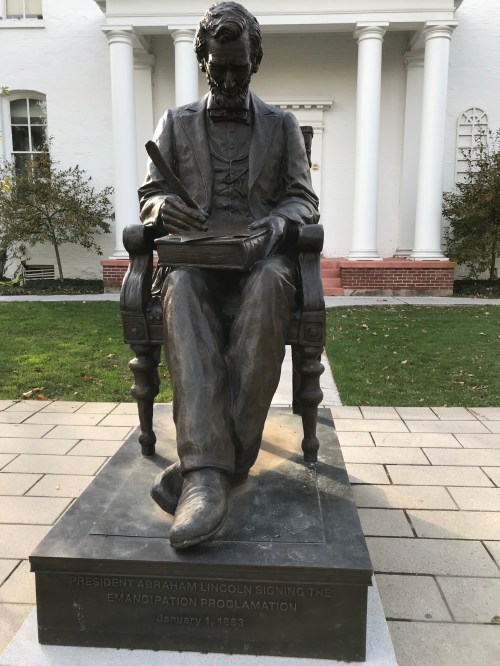
Lincoln signed the order on January 1st 1863. As he got ready to sign the document he paused and put down the pen, speaking to Seward he said “I never, in my life, felt more certain that I was doing right, than I do now in signing this paper….If my name ever goes down in history it will be for signing this act, and my whole soul is in it.” [17] The opening paragraph read:

“That on the first day of January, in the year of our Lord one thousand eight hundred and sixty-three, all persons held as slaves within any State or designated part of a State, the people whereof shall then be in rebellion against the United States, shall be then, thenceforward, and forever free; and the Executive Government of the United States, including the military and naval authority thereof, will recognize and maintain the freedom of such persons, and will do no act or acts to repress such persons, or any of them, in any efforts they may make for their actual freedom.” [18]

At the ends of the proclamation he added the words suggested by his devoutly Christian Secretary of the Treasury Salmon Chase: “And upon this act, sincerely believed to be an act of justice, warranted by the Constitution, upon military necessity, I invoke the considerate judgment of mankind, and the gracious favor of Almighty God.” [19]

The response throughout the North was euphoric as celebrations took place throughout the North. In some cities one hundred gun salutes were fired. At Boston’s Tremont Temple people broke out singing a hymn “Sound the loud timbrel o’er Egypt’s dark sea, Jehovah hath triumphed, his people are free.” [20] The Boston Daily Evening Telegraph predicted, “Slavery from this hour ceases to be a political power in this country…such a righteous revolution as it inaugurates never goes backward.” [21]

Frederick Douglass wrote about his reactions to the Emancipation proclamation as he had nearly despaired wondering if the Lincoln administration would actually take up the fight for emancipation:

“The fourth of July was great, but the first of January, when we consider it in all of its relations and bearings in incomparably greater. The one we respect to the mere political birth to a nation, the last concerns national life and character, and is to determine whether that life and character shall be radiantly and glorious with all high and noble virtues, or infamously blackened, forevermore, with all the hell-darkened crimes and horrors which we attach to Slavery.” [22]

The proclamation was not all some had hoped for and it was certainly provoked a negative response in the South and among many Northern Democrats. Southerners accused Lincoln of inciting racial warfare and Jefferson Davis responded “The day is not so distant when the old Union will be restored with slavery nationally declared to be the proper condition of all of African descent.” [23]

But the proclamation did something that politicians, lawyers did not comprehend, that “the details of the emancipation decree were less significant than the fact that there was an emancipation decree, and while the proclamation read like a dull legal brief, filled with qualifying clauses and exceptions, it was not language made for this, finally, a moral document. It was its existence, its title, its arrival into this world, its challenge to the accepted order, and from that there was no turning back. In this sense it was a revolutionary statement, like the Declaration itself, and nearly as significant.” [24]That the proclamation most certainly was and it was a watershed from which there was no stepping back. “It irrevocably committed the government of the United States to the termination of slavery. It was an act of political courage, take at the right time, in the right way.” [25]

However, it would take another two years, with the Confederacy crumbling under the combined Federal military onslaught before Lincoln was able to secure passage of the Thirteenth Amendment to the Constitution in January 1865.  The amendment abolished slavery and involuntary servitude throughout the country, as well as nullified the fugitive slave clause and the Three-Fifths Compromise. It would be followed after Lincoln’s death by the Fourteenth Amendment which reversed the result of the Dred Scott decision and declared that all people born in the United States were citizens and entitled to the rights of citizenship. During the Grant administration the Fifteenth Amendment was passed, and this finally extended to African American men, the right to vote in every state.

Though limited in scope, the Emancipation Proclamation had more than a domestic military, social and political effect. It also had an effect on foreign policy which ensured that Britain, and thereby France would not intervene in the war on behalf of the Southern Confederacy. It stopped all British support for the Rebels to include seizing warships that had been contracted for by Confederate agents that were building or being fitted out in British Yards. Likewise the British rejected various proposals of Emperor Napoleon III to intervene in the war in late 1862 and during the summer of 1863.

Effects of the Emancipation Proclamation on Military Law

The Emancipation Proclamation and the elimination of slavery also impacted the Union war effort in terms of law, law that eventually had an impact around the world as nations began to adapt to the changing character of war. It was important because for the first time slavery was accounted for in the laws of war. The “Instructions for the Government of Armies of the United States in the Field, General Orders No. 100 by President Lincoln, April 24, 1863; Prepared by Francis Lieber, LLD noted in Article 42 of that Code:

“Slavery, complicating and confounding the ideas of property, (that is of a thing,) and of personality, (that is of humanity,) exists according to municipal or local law only. The law of nature and nations has never acknowledged it. The digest of the Roman law enacts the early dictum of the pagan jurist, that “so far as the law of nature is concerned, all men are equal.” Fugitives escaping from a country in which they were slaves, villains, or serfs, into another country, have, for centuries past, been held free and acknowledged free by judicial decisions of European countries, even though the municipal law of the country in which the slave had taken refuge acknowledged slavery within its own dominions.” [26]

It continued in Article 43:

“Therefore, in a war between the United States and a belligerent which admits of slavery, if a person held in bondage by that belligerent be captured by or come as a fugitive under the protection of the military forces of the United States, such person is immediately entitled to the rights and privileges of a freeman To return such person into slavery would amount to enslaving a free person, and neither the United States nor any officer under their authority can enslave any human being. Moreover, a person so made free by the law of war is under the shield of the law of nations, and the former owner or State can have, by the law of postliminy, no belligerent lien or claim of service.” [27]

The Continued Fight for Emancipation: Dealing with the Copperheads and the Passage of the Thirteenth Amendment

But there were still legitimate concerns that slavery might survive as the war continued. Lincoln knew that in issuing the Emancipation Proclamation raised the stakes of the war far higher than they had been. He noted, “We shall nobly save, or meanly lose, the last best hope on earth.” [28] The threat of the destruction of the Union and the continuance of slavery in either the states of the Confederacy, the new western states, territories, or the maintenance of the Union without emancipation was too great for some; notably, the American Freedmen’s Commission to contemplate. With Grant’s army stalled outside Richmond the Copperheads and the peace party gained influence and threatened to bring about a peace that allowed Confederate independence and the continuance of slavery; members of that caucus they Edwin Stanton in the spring of 1864:

“In such a state of feeling, under such a state of things, can we doubt the inevitable results? Shall we escape border raids after fleeing fugitives? No man will expect it. Are we to suffer these? We are disgraced! Are we to repel them? It is a renewal of hostilities!…In the case of a foreign war…can we suppose that they will refrain from seeking their own advantage by an alliance with the enemy?”[29]

The effort of the Copperheads and the peace party to was soon crushed under the military successes of William Tecumseh Sherman’s armies in Georgia. This was especially true of the capture of Atlanta, which was followed by Sherman’s march to the sea and the Carolinas. Additionally the naval victory of David Farragut’s fleet at the Battle of Mobile Bay served to break the stranglehold that the Copperheads were beginning to wield in Northern politics.  These efforts helped secure Lincoln’s reelection by a large margin in the 1864 presidential election over a divided Democratic opposition, whose presidential nominee McClellan could not even endorse his party’s platform.

In his Second Inaugural Address, Abraham Lincoln discussed the issue of slavery as the chief cause of the war. In it, Lincoln noted that slavery was the chief cause of the war in no uncertain terms and talked in a language of faith that was difficult for many, especially Christians, who “believed weighty political issues could be parsed into good or evil. Lincoln’s words offered a complexity that many found difficult to accept,” for the war had devastated the playground of evangelical politics, and it had “thrashed the certitude of evangelical Protestantism” [30] as much as the First World War shattered Classic European Protestant Liberalism.  Lincoln’s confrontation of the role that people of faith brought to the war in both the North and the South is both illuminating and a devastating critique of the religious attitudes that so stoked the fires of hatred.  His realism in confronting facts was masterful, and badly needed.  He spoke of “American slavery” as a single offense ascribed to the whole nation.” [31]

“One-eighth of the whole population were colored slaves, not distributed generally over the Union, but localized in the southern part of it. These slaves constituted a peculiar and powerful interest. All knew that this interest was somehow the cause of the war. To strengthen, perpetuate, and extend this interest was the object for which the insurgents would rend the Union even by war, while the Government claimed no right to do more than to restrict the territorial enlargement of it. Neither party expected for the war the magnitude or the duration which it has already attained. Neither anticipated that the cause of the conflict might cease with or even before the conflict itself should cease. Each looked for an easier triumph, and a result less fundamental and astounding. Both read the same Bible and pray to the same God, and each invokes His aid against the other. It may seem strange that any men should dare to ask a just God’s assistance in wringing their bread from the sweat of other men’s faces, but let us judge not, that we be not judged. The prayers of both could not be answered. That of neither has been answered fully. The Almighty has His own purposes. “Woe unto the world because of offenses; for it must needs be that offenses come, but woe to that man by whom the offense cometh.” If we shall suppose that American slavery is one of those offenses which, in the providence of God, must needs come, but which, having continued through His appointed time, He now wills to remove, and that He gives to both North and South this terrible war as the woe due to those by whom the offense came, shall we discern therein any departure from those divine attributes which the believers in a living God always ascribe to Him? Fondly do we hope, fervently do we pray, that this mighty scourge of war may speedily pass away. Yet, if God wills that it continue until all the wealth piled by the bondsman’s two hundred and fifty years of unrequited toil shall be sunk, and until every drop of blood drawn with the lash shall be paid by another drawn with the sword, as was said three thousand years ago, so still it must be said “the judgments of the Lord are true and righteous altogether.” [32]

Notes 

[1] Ibid. Foner Forever Free: The Story of Emancipation and Reconstruction p.42

[2] Ibid. Freehling The South vs. The South p.47

[3] Brewster, Todd. Lincoln’s Gamble: The Tumultuous Six Months that Gave America the Emancipation Proclamation and Changed the Course of the Civil War Scribner a Division of Simon and Schuster, New York and London p.59

[4] Ibid. McPherson The Battle Cry of Freedom p.364

[5] Ibid. McPherson The Battle Cry of Freedom p.504

[6] McPherson, James M. Tried by War: Abraham Lincoln as Commander in Chief Penguin Books, New York and London 2008 p.109

[7] Ibid. Goodwin Team of Rivals p. 468

[8] Ibid. Foner Forever Free p.49

[9] McGovern, George Abraham Lincoln Times Books, Henry Holt and Company, New York 2009 p.70

[10] Ibid. McPherson Tried by War: p.108

[11] Ibid. Zinn The Other Civil War p.39

[12] Ibid. Foner Forever Free p.49

[13] Ibid. Brewster Lincoln’s Gamble p.169

[14] Ibid. Guelzo Fateful Lightning p.184

[15] Ibid. Foner Forever Free p.49

[16] Douglass, Frederick. Philadelphia Speech of July 6th 1863 recorded in the Liberator in The Civil War and Reconstruction: A Documentary Collection edited by William E. Gienapp, W.W. Norton and Company, New York and London 2001 p.221

[17] Ibid. Goodwin Team of Rivals p. 499

[18] Lincoln, Abraham The Emancipation Proclamation The National Archives & Records Administration retrieved from http://www.archives.gov/exhibits/featured_documents/emancipation_proclamation/transcript.html 14 June 2014

[19] Ibid. Lincoln The Emancipation Proclamation

[20] Ibid. Brewster Lincoln’s Gamble p.244

[21] Ibid. McPherson The Battle Cry of Freedom p.501

[22] Ibid. Guelzo Fateful Lightning pp. 180-181

[23] Ibid. Goldfield America Aflame p.263

[24] Ibid. Brewster Lincoln’s Gamble p.245

[25] Ibid. McGovern Abraham Lincoln p.78

[26] Reichberg, Gregory M, Syse Henrik, and Begby, Endre The Ethics of War: Classic and Contemporary Readings Blackwell Publishing Ltd, Malden, MA and Oxford UK 2006 p.570

[27] Ibid. Reichberg et al. The Ethics of War p.570

[28] Ibid. Goldfield America Aflame p.263

[29] Ibid. Guelzo Fateful Lightning p.534

[30] Ibid. Goldfield  America Aflame p.358

[31] Ibid. Wills Lincoln at Gettysburg p.186

[32] Lincoln, Abraham Second Inaugural Address March 4th 1865 retrieved from www.bartleby.com/124/pres32.html 24 March 2014

1 Comment

Filed under civil rights, civil war, History, laws and legislation, leadership, News and current events, Political Commentary

Enter 2018, If We Don’t Try We May as Well Lay Down and Die…

Friends of Padre Steve’s World,

It is now 2018.

After the year that was 2017 with its seeming unending cycle of violence, hate, war, destruction, and political turmoil including political turmoil in Europe and the chaotic political  Overall 2017 was a difficult year around the world despite the boom stock markets.

One hundred years ago the world was engaged in a war that was killing thousands of men a day. Some hoped that 1918 would be better, but it wasn’t. Despite the victory that the French, British, and Americans achieved over Imperial Germany and its allies brought some measure of peace to the world, the embers of war, economic crisis, and political instability would plant the seeds for the totalitarian movements of communism, and Fascism in its various forms. Because of this the conflagration that had erupted in 1914 would get far worse in just over 20 years time.

I hope that 2018 is different and turns out better than 2018, we certainly could use a break, but the forces of history and nature are sometimes greater than our hopes, but we can always hope. Even so more than hope we who believe in liberty, freedom, humanity, brotherhood, and justice must work against the forces of war, terrorism, dehumanization, and political ideologies that are designed to enslave, devalue, and marginal people based on race, religion, gender, color, or belief.

I believe that the forces that made 2017 so terrible in so many ways will not take a break and that we need to stand up and do the right and sometimes the hard things in order to protect liberty. The time for safe zones is past, as progressives we have to toughen up; think rationally, and act strategically if we are to protect the liberties of all people, including people who will find out far to late that they placed their trust in the wrong place. But I digress…

Many people will see in the New Year singing Auld Lang Syne. It is a nice song, I have written about it before. A little bit ago after watching the movies It’s a Mad Mad Mad Mad World and The Great Race Judy, I and our friend Patty popped the Champagne and toasted tonight as we watched the Ball descend in Times Square on our television, safe from all the drunk drivers that we will as well.

But I digress. My favorite song for the New Year is Abba’s Happy New Year.  Like Auld Lang Syne it is a melancholy song of the end of one year’s hopes, dreams and expectations and hopes and dreams for the New Year. The song is embedded above and the lyrics are here:

Happy New Year

No more champagne

And the fireworks are through

Here we are, me and you

Feeling lost and feeling blue

It’s the end of the party

And the morning seems so grey

So unlike yesterday

Now’s the time for us to say…


Happy new year

Happy new year

May we all have a vision now and then

Of a world where every neighbour is a friend

Happy new year

Happy new year

May we all have our hopes, our will to try

If we don’t we might as well lay down and die

You and I


Sometimes I see

How the brave new world arrives

And I see how it thrives

In the ashes of our lives

Oh yes, man is a fool

And he thinks he’ll be okay

Dragging on, feet of clay

Never knowing he’s astray

Keeps on going anyway…


Happy new year

Happy new year

May we all have a vision now and then

Of a world where every neighbour is a friend

Happy new year

Happy new year

May we all have our hopes, our will to try

If we don’t we might as well lay down and die

You and I


Seems to me now

That the dreams we had before

Are all dead, nothing more

Than confetti on the floor

It’s the end of a decade

In another ten years time

Who can say what we’ll find

What lies waiting down the line

In the end of eighty-nine…


Happy new year

Happy new year

May we all have a vision now and then

Of a world where every neighbour is a friend

Happy new year

Happy new year

May we all have our hopes, our will to try

If we don’t we might as well lay down and die

You and I

I think one of the lines that I like, one which I think calls on us to actually do more than hope, but to act on hope, is “May we all have a vision…” A vision requires that we begin to imagine a better future, in a sense it is to dream, as Martin Luther King Jr. dreamed, I have a dream that one day this nation will rise up and live out the true meaning of its creed: “We hold these truths to be self-evident, that all men are created equal.”

To fulfill that dream and vision we must live, work, dream and imagine that things can be better, and as Dr. King said, Let us not wallow in the valley of despair, I say to you today, my friends.

And so even though we face the difficulties of today and tomorrow, I still have a dream…

The song, Happy New Year ends with this verse, May we all have our hopes, our will to tryIf we don’t we might as well lay down and dieYou and I…

Here is wishing you the best New Year possible, and I for one will not lay down and die.

Peace

Padre Steve+

3 Comments

Filed under faith, History, Loose thoughts and musings, News and current events, philosophy, Political Commentary

Uncertain Times: Ushering out the Old Year and Thinking about the New Year

Friends of Padre Steve’s World,

Well finally we come to the end of the year 2017.  That being said we can say that it was definitely a year.  It was a year that filled the hearts of many with fear and unease.  At the same time it is now in the past. It cannot be relieved or changed but we can take the time to learn from it and hopefully build a better future. In fact, building a better future and fighting against the forces that threaten freedom and democracy, including those in the highest reaches of government.

2017 like all of the past will be remembered and written about by historians, theologians journalists and philosophers and most will place their own interpretation on it and then go on to prognosticate about the future.  However the future is unknown and even Jesus warned us “that we do not know what tomorrow brings.”

I am a historian. For me history is not just something dead in the past but a living reality that influences us in everything we do. As such I thing we need to learn lessons from history and apply that knowledge to what we do now. We do not live in a vacuum, if we did we would be very dusty and always spinning around, but I digress.

340702.full-2

Uncertain Times 

I think that we have to learn from the past in order to be ready for the future. But the future is unknown and often uncharted.  Thus we should as George Patton said  “Prepare for the unknown by studying how others in the past have coped with the unforeseeable and the unpredictable.” That really is the reason I study history, not so we have a laundry list of facts events and dates that I can use to prove my point but rather to see how people and nations dealt with things that they either could not or did not foresee. Human nature doesn’t change and while circumstances and technology may change the way people deal with unforeseeable events can help us navigate future difficulties. It is not a guarantee but it is a help.

Dallas Maverick’s owner Mark Cuban wrote that “None of us are born into the world we live in.”  That is so true because we are all born at a moment in time and the world is always changing and changing is ways that will always surprise us. Maybe not some of the events themselves, but the players that make things happen, the places that they happen and the speed of which they happen.  Time stands still for no person.

Though the future is yet to be written people of faith place the future in the hands of God. Yet that being said we cannot erase the past and go back to some point in time where our interpretation of history says that things were better. Such thinking is pure fantasy and is  quite delusional. Golda Meir said “One cannot and must not try to erase the past merely because it does not fit the present.” 

Unfortunately it seems that the American President, many of his supporters, pundits, politicians, and people alike do not understand this; nor do many of their opponents.  George Orwell so poignantly noted “All political thinking for years past has been vitiated in the same way. People can foresee the future only when it coincides with their own wishes, and the most grossly obvious facts can be ignored when they are unwelcome.”

I think that is a large part of why we are in the political mess we have been in for so long in this country and why I don’t expect things to get better anytime soon.

For me 2017 was a year of growth and learning as I transitioned from full time academia to dealing with the problems and challenges of managing a large Navy chapel program.

In 2017 I made plenty of mistakes and really haven’t deviated too much off of the Mendoza Line, I still am battling about 200 in the game of life and as long as I keep doing that I figure I’m doing okay.  But hopefully have learned from those mistakes. I’m not going to make any resolutions for the new year because no-matter what I resolve to do it will simply be a repeat of something that I have resolved to do at least once if not several times during previous new years times and I don’t want to have to give myself “resolution absolution” yet again. I figure that there is no way that I could make it through New Year’s Day if without totally screwing them up so why bother.

However that being said I do resolve this year is to go out every day, do my best and try not to screw things up too badly.  It is the same attitude that I have playing baseball or softball, so why not apply it to the rest of my life?

English poet Thomas Hood penned this:

And ye, who have met with Adversity’s blast,
And been bow’d to the earth by its fury;
To whom the Twelve Months, that have recently pass’d
Were as harsh as a prejudiced jury –
Still, fill to the Future! and join in our chime,
The regrets of remembrance to cozen,
And having obtained a New Trial of Time,
Shout in hopes of a kindlier dozen.

All this being said I think that the wisest thing ever said about the future was by Yogi Berra who wisely remarked “The future ain’t what it used to be.” But then was it ever what it used to be?

Tonight I will usher in the New Eve with Judy, our friend Patty, and our Papillons Minnie, Izzy, and Pierre. Right now we’re watching a movie that has been a long standing tradition for Judy and I, “It’s a Mad Mad Mad Mad World.”

So tonight to all of my friends I wish you the best, and in the words of Auld Lang Syne:

And surely you’ll buy your pint cup !
and surely I’ll buy mine !
And we’ll take a cup o’ kindness yet,
for auld lang syne.

Blessings my friends, Happy end of the Old Year and all the best for the New Year!

Peace

Padre Steve+

10 Comments

Filed under faith, Loose thoughts and musings, philosophy

The Danger of Private Power of Corporate Oligarchs Backed by President Trump and Congress: Warnings from Franklin Roosevelt

roosevelt2

Friends of Padre Steve’s World,

As we enter into what I think will be a very eventful and peril filled 2018 I think that it is to take heed of the warnings of President Franklin Delano Roosevelt spoke these words in his Four Freedoms speech. I think they are worth pondering as we go into the second year of the Trump Presidency and the increase of autocratic rule worldwide. Roosevelt said:

“I suppose that every realist knows that the democratic way of life is at this moment being directly assailed in every part of the world — assailed either by arms or by secret spreading of poisonous propaganda by those who seek to destroy unity and promote discord in nations that are still at peace.”

Sadly a large portion of the American populace neither seems to understand or care about these threats to our Constitution and democratic way of life. I will return again to that speech early in 2018 but tonight I wanted to share a couple of other thoughts by him from his Message to Congress on Controlling Monopolies of April 1938 which I think are appropriate for us to ponder at this critical time.

“Unhappy events abroad have retaught us two simple truths about the liberty of a democratic people.

The first truth is that the liberty of a democracy is not safe if the people tolerate the growth of private power to a point where it becomes stronger than their democratic state itself. That, in its essence, is Fascism—ownership of Government by an individual, by a group, or by any other controlling private power.

The second truth is that the liberty of a democracy is not safe if its business system does not provide employment and produce and distribute goods in such a way as to sustain an acceptable standard of living.

Both lessons hit home.

Among us today a concentration of private power without equal in history is growing…”

His speech in its entirety can be read here: http://www.presidency.ucsb.edu/ws/?pid=15637

When I read Roosevelt’s words I am concerned.  It appears to me that what he spoke then is perhaps even more true now. In the past year we have seen the consolidation of power in the hands of the great corporate oligarchs of our time, speeded by the executive actions of the Trump administration and the legislation of the Republican controlled Congress.

His words are a warning to the wise…

Have a great day,

Peace

Padre Steve+

Leave a comment

Filed under History, laws and legislation, leadership, News and current events, Political Commentary

Déjà Vu All Over Again: Are We Sleepwalking into 2018?

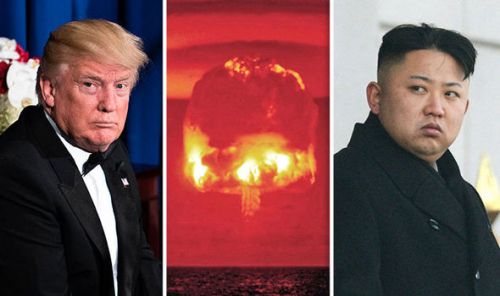
North-Korea-Kim-Jong-un-nuclear-Starfish-800967

Friends of Padre Steve’s World,

The late great Yogi Berra once said “Déjà vu all over again, and as I wrap up the year and reflect on a number of things, I keep thinking about how much history can teach us about our own time, should we just pay attention to it. I have been continuing to do research and work on my future book “Mine Eyes Have Seen the Glory: Race, Religion, Ideology, and Politics in the Civil War Era” as well as my Gettysburg and Civil War text, and that continues to lead me to pure gold in the pursuit for truth, historical truth that is as relevant today as it was when it happened over a century and a half ago. Likewise I have increased my study of totalitarian leaders and movements as well as the military, political, social, and economic effects of entering into unadvised, aggressive wars.

The former, that is studying and writing about the Civil War era is something that I have been doing for a few years, but the latter: the study of authoritarian leaders and of ill advised wars of aggression is something that I have renewed beginning in 2016 with the emergence of Donald Trump, his followers, and the rapid decline of the Republican Party as anything other than a shill for the extremely wealthy and a convenient cover for white nationalists and other assorted enemies of the American Constitution and ideals forged over a period of more than two centuries of conflict and compromise, as well as assorted attempts to help the country meet those ideals in order to form “a more perfect Union.”

Sadly, the same issues that dominated America in the 1840s, 1850s, and 1860s and later following Reconstruction still dominate so much of our social, political and religious debate. Whether it is the voting franchise which many on the political right seek to restrict, the rights of women, blacks and other minorities, immigrants and the LGBT community, to any semblance of political, economic equality or social justice very little has changed. Not only that there are some political, media and religious leaders who argue for the unabashed imperialism of Manifest Destiny and American Exceptionalism.

As it was then, much of this can be laid squarely at the feet of Evangelical Protestant and other conservative Christian leaders. A century and a half ago men who claimed to be Christian leaders led the efforts to support slavery, discriminate against women, persecute gays and promote imperialistic policies that would have embarrassed the founders of the United States. After the defeat of the Confederacy most of the same people used the same theology to disenfranchise and discriminate against African Americans through Jim Crow laws, as well as discriminate against minorities, women and gays all the while claiming to be the victims of persecution.

Before the Civil War many Protestant ministers, intellectuals, and theologians, not only Southerners, but men like “Princeton’s venerable theologian Charles B. Hodge – supported the institution of slavery on biblical grounds, often dismissing abolitionists as liberal progressives who did not take the Bible seriously.”  This leaves a troubling question over those who claim to oppose other issues on supposedly Biblical grounds. Conservative Anglican theologian Alistair McGrath asks, “Might not the same mistakes be made all over again, this time over another issue?”

But moving on from the issues of economic inequity, intolerance for minorities, and racism that still permeate there is the very real threat of war. When I speak about war I do not mean the never ending small wars of empire that the United States has been involved with since September 11th 2001, I mean massive, destructive, and bloody wars the likes that have not been seen since the Second World War. Unfortunately the leaders of nations, especially President Trump and Kim Jong Un seem to be a prisoners of their preconceived ideas and are sleepwalking into war, each acting as if the forces of destiny were controlling them and placing, as Christopher Clark wrote in his book about the outbreak of the First World War The Sleepwalkers:

“Here again is the tendency we can discern in the reasoning of so many of the actors in this crisis, to perceive oneself as operating under irresistible external constraints while placing the responsibility for deciding between peace and war firmly on the shoulders of the opponent.” 

As I watch events unfold and comment just how real that I believe the the threat of war is I am often met with disbelief. I really want to be wrong but I don’t think that I am, and the possibility that Trump, Kim Jong Un, or another actor whether intentionally or unintentionally bringing about such a war is all too real, and all of them are too blind to the horror that they will unleash. Clark wrote:

“the protagonists of 1914 were sleepwalkers, watchful but unseeing, haunted by dreams, yet blind to the reality of the horror they were about to bring into the world.”

The question is will we learn from history or make the same mistakes all over again? That is something to ask ourselves as we leave 2017 behind and enter 2018, a year that promises to be tumultuous and eventful, but which the history of is yet to be written. The That my friends is important, and why all of us must be engaged and not remain silent, there is too much at stake.

As a side note I want to I thank all of those who subscribe to this site, as well as those who follow my writings through Twitter or Facebook. The fact that so many people are doing this humbles me, thank you.

Until tomorrow,

Peace

Padre Steve+

5 Comments

Filed under History, Loose thoughts and musings, News and current events, Political Commentary, Religion

Nothing Remains Static: The Never Built G3, Amagi, and Lexington Class Battle Cruisers

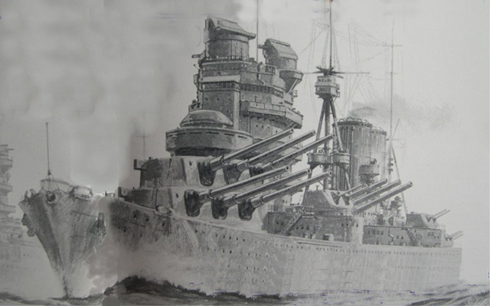
artist

Artists Depiction of G3 Battlecruiser 

Friends of Padre Steve’s World,

This weekend I will be reflecting on the old year and the coming new year, but tonight I decided to tweak and republish an article from about four years ago dealing with the battle cruisers being built by Great Britain, Japan, and the United States after the First World War. They represented the pinnacle of naval design for their era and would have been far superior to their adversaries had technology and war remained static. As Admiral Ernest King noted:

“Nothing remains static in war or military weapons, and it is consequently often dangerous to rely on courses suggested by apparent similarities in the past.”

As the First World War ended a new Naval Race was heating up. The United States had announced its intention during the war to build a navy second to none while Imperial Japan was making plans for a fleet that would give it superiority in the Western Pacific. The British, though still be far the largest naval power in the world were burdened by the massive costs of war and empire, but also seeking to maintain their naval dominance and to that end they were in the process of building a class of massive super-Dreadnought battleships, and Battle Cruisers.

The ships known as battle cruisers were first built by the British Royal Navy as a compliment to the all big gun Dreadnought battleships. The Battle Cruiser concept was for a ship of roughly the same size and firepower as a Battleship but sacrificing protection for greater speed, endurance and range.  and Japan joined in the Battle Cruiser race before and during the war. Unlike Britain the United States had concentrated on building battleships but following the war began to design and build its own class of massive battle cruisers.

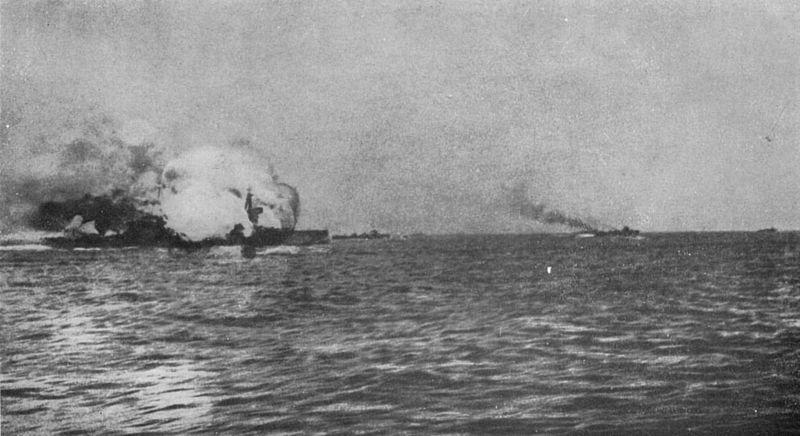
800px-InvincibleBlowingUpJutland1916

HMS Invincible Blowing Up at Jutland 

During the war the weaknesses of the type were exposed during the Battle of Jutland where three British Battle Cruisers, the HMS InvincibleHMS Indefatigable and HMS Queen Mary blew up with the loss of most of their crews; of the 3311 officers and sailors on the ships only 26 survived. The HMS Lion was almost lost in a similar manner but the heroic actions of her crew saved her from her sisters fate. The British ships had glaring deficiencies in armor protection and the arrangement of their ammunition magazines and hoists which certainly contributed to their loss. Their German counterparts on the other hand proved much tougher and though all sustained heavy damage while engaging British Battleships and Battle Cruisers, only one the Lützow was lost. She absorbed over 30 hits from large caliber shells and only lost 128 crew members.

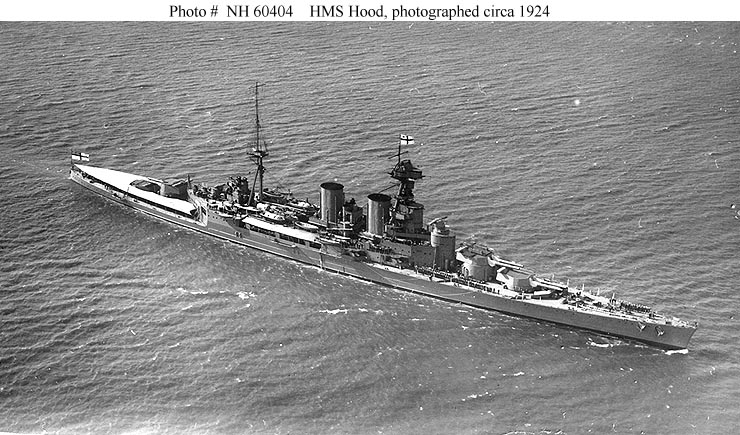
h60404

HMS Hood

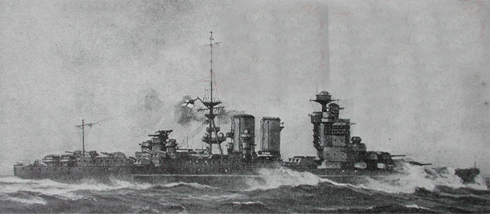
As the war progressed other Battle Cruisers were built, the British launched the HMS Repulse and HMS Renown and completed the HMS Hood shortly after the war was over. The Japanese built the four ship Kongo class from a British design, the first of which, the Kongo was completed in a British yard. As the powers embarked on the next Naval Race planners and naval architects designed ships of massive firepower, better protection and higher range and speed. All would have been better classed as Fast Battleships.

The British designed and began construction on the G3 class in 1921, while the Japanese began work on the Amagi Class, and the United States the Lexington Class. However the construction and completion of these ships as Battle Cruisers was prevented by the Washington Naval Treaty.

invincible 490

The treaty, which was ratified in 1922 limited the United States and Great Britain to a maximum of 525,000 tons in their battle ship fleets and 125,000 tons in aircraft carriers.  The Japanese agreed to a limit of 315,000 tons and the French and Italians 175,000 tons each. Tonnage for battleships was limited to a maximum of 35,000 tons with a limitation on guns size to 16 inches.  Since the bulk of the ships planned or being built by the US and Japan exceeded those limits they would be effected more than the British whose post war shipbuilding program had not begun in earnest, in fact the G3 Class had just been approved for construction.

The G3 class would have comprised four ships and been similar to the N3 Class Battleships. They were very well balanced ships and would have mounted nine 16” guns in three turrets on a displacement of 49,200 tons and deep load of 54,774 tons. They had an all or nothing protection plan meaning that the armored belt was concentrated in vital areas around the armored citadel, conning tower, turrets and magazines and engineering spaces. Their armor belt would have ranged from 12-14 inches, deck armor from 3-8 inches, conning tower 8 inches, barbettes 11-14 inches, turrets 13-17 inches and bulkheads 10-12 inches. Their propulsion system of 20 small tube boilers powering 4 geared steam turbines connected to 4 propeller shafts would have produced 160,000 shp with a designed speed of 32 knots.

The four ships, none of which were named were ordered between October and November of 1921. Their construction was suspended on November 18th 1921 and they and the N3 Battleships were cancelled in February 1922 due to the limitations of the Washington Naval Treaty. Many concepts of their design were incorporated in the Nelson Class battleships which were a compromise design built to stay within the limits of the treaty.

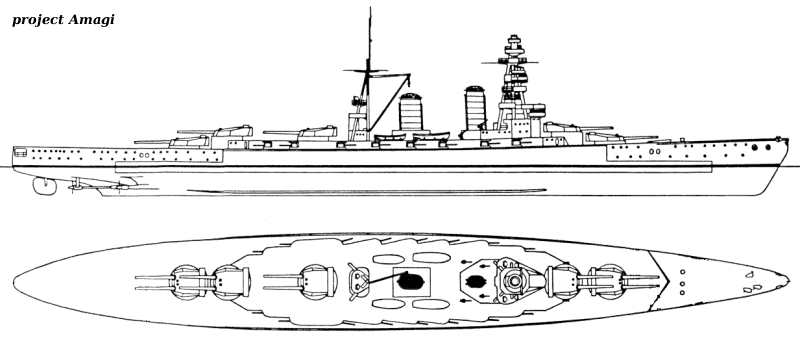
rys-amagi

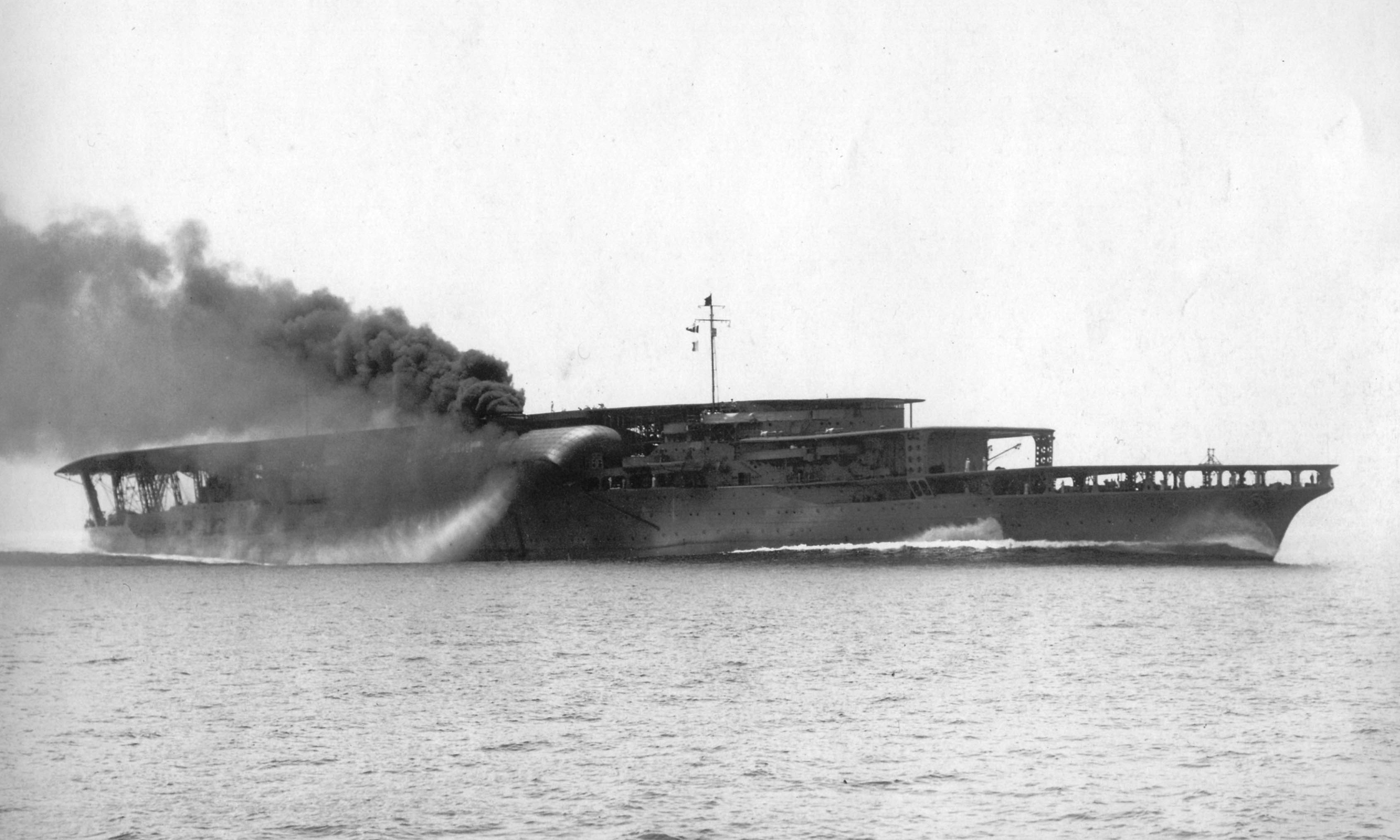
Amagi Class as Designed, Akagi as Completed (below) 

JapaneseAircraftCarrierAkagi3Deck_cropped

The four planned Japanese Amagi Class ships would have mounted ten 16” guns on a displacement of 47,000 tons at full load. Their propulsion system 19 Kampon boilers powering four Gihon turbines would have given them a maximum speed of 30 knots, They would have had less protection than the G3 ships being more of a traditional Battle Cruiser design. As a result of the Washington Naval Treaty the Japanese elected to convert two of the ships, the Amagi and Akagi to aircraft carriers. Amagi was destroyed on the ways during the great Tokyo earthquake and Akagi was completed as a carrier. The other two vessels were scrapped on the ways.

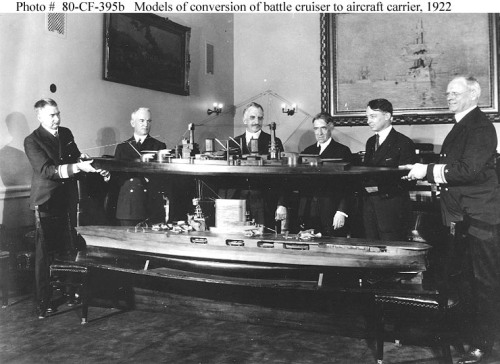
Lexington_battlecruiser_conversion_models

lexington-class-battle-cruisern11978

Lex4259BrassDraw

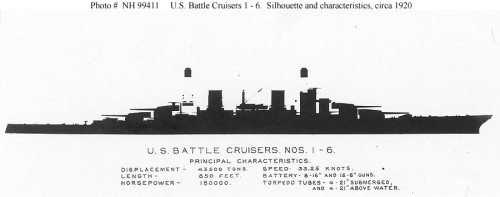
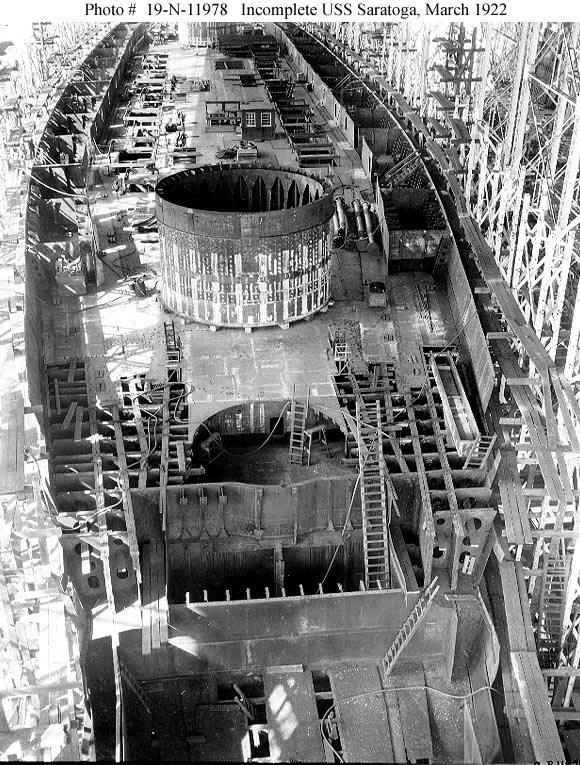
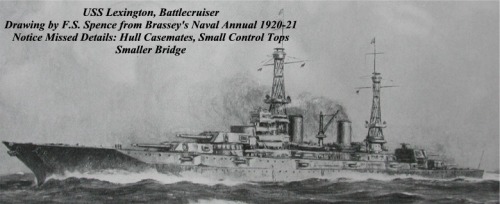
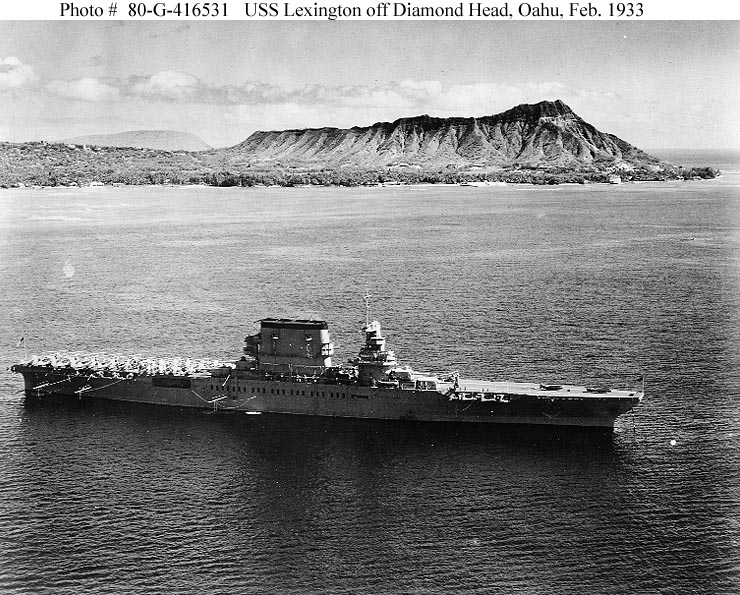
The United States Navy planned the six ship Lexington Class. These ships would have mounted eight 16” guns on a ship measuring 874 feet long and 105 feet in beam, displacing 43,254 tons at full load, or nearly the size of the Iowa Class battleships. They would have had a maximum speed of 33 knots being powered by 16 boilers which drove 4 GE electric turbines producing 180,000 shaft horse power. Theirs was a massive engineering plant and while the class did not have as heavy armor protection as either the G3 or Amagi classes, they were superior to them in speed as well as endurance. Upon ratification of the Washington Naval Treaty four of the six ships were cancelled and the remaining two, the Lexington and Saratoga competed as aircraft carriers.  Had any of the ships been completed as Battle Cruisers it is likely due to their speed that they would have operated primarily with the the carriers that the US Navy built during the 1930s.

g416531

One can only speculate what the navies of World War II would have looked like had the Washington and the subsequent London Naval Treaties not been ratified. One can also only imagine how the war at sea would have been different had the ships completed as carriers been completed as Battle Cruisers.

However that was not to be, of the planned 14 ships of these three classes only three were completed, all as aircraft carriers, ships that helped to forge the future of naval operations and warfare for nearly a century. Thus the uncompleted ships are an interesting footnote in naval history yet have their own mystique. and one might wonder if the new aircraft carriers currently being built by the United States, Britain, China, India and other nations will also be displaced by advancing technology as were these ships.

Until tomorrow,

Peace

Padre Steve+

5 Comments

Filed under History, Military, Navy Ships, US Navy

Life in the Past, Present, and Future: A Reflection on Life and Faith in the Age of Trump

Matt-Frewer-as-Berlingoff-Rasmussen-TNG-A-Matter-of-Time-7

Friends at Padre Steve’s World,

I tend to become somewhat reflective as the New Year approaches. I am reminded of Peter Benchley, who wrote, “The past always seems better when you look back on it than it did at the time. And the present never looks as good as it will in the future.” Likewise, St Augustine of Hippo once asked “How can the past and future be, when the past no longer is, and the future is not yet?”

Augustine’s question is interesting, but I think that his question is flawed. I think that the past lives in the present much more than we would like to think and that our future, though unwritten can unfold in a multitude of ways and possibilities. We have seen that over the past two years with the campaign and presidency of Donald Trump and how the illusion of a mythical past has driven many ordinary people to support a man who despises them, all because he appeals to certain parts of a shared mythology about the past which sadly is often too racist to imagine. As the conservative writer and historian Max Boot noted today:

“The larger problem of racism in our society was made evident in Donald Trump’s election, despite — or because of — his willingness to dog-whistle toward white nationalists with his pervasive bashing of Mexicans, Muslims, and other minorities. Trump even tried to delegitimize the first African-American president by claiming he wasn’t born in this country, and now he goes after African-American football players who kneel during the playing of the anthem to protest police brutality. (Far from being concerned about police misconduct, which disproportionately targets people of color, Trump actively encourages it.)”

But politics aside, many of us live in the past as if it were today. We, individually and collectively, as individuals and nations live in the past and look to it much more fondly than when it was our present. I think that historian Will Durant possibly said it the best: “The past is not dead. Indeed, it is often not even past.”

As a historian myself I value the past and seek answers and wisdom from it to use in the present because what we do in the present does, for better or worse defines our future. Confucius said “study the past if you would define the future.” He was quite wise, he said to study the past did not say to live in it.

That is something that I have been learning for close to 25 years now when my Clinical Pastoral Education Supervisor, using a Star Trek Next Generation metaphor from the episode A Matter of Time helped me to begin to recognize just how much the past impinged on my own life. In that episode a shadowy visitor claiming to be from the future refuses to help the Captain and crew of the Enterprise, claiming that if he were to help that his “history – would unfold in a way other than it already has.”

Finally Captain Picard is forced to make a decision and confronts the visitor, who turns out to be, not a historian from the future but a con-artist and thief from the past who was using time travel with a stolen space ship to collect technology to enrich himself. Picard refused the mans help and told him:

“A person’s life, their future, hinges on each of a thousand choices. Living is making choices! Now, you ask me to believe that if I make a choice other than the one that appears in your history books, then your past will be irrevocably altered. Well… you know, Professor, perhaps I don’t give a damn about your past, because your past is my future, and as far as I’m concerned, it hasn’t been written yet!”

My residency supervisor suggested to me that my future did not have to be my past, and in doing so opened a door of life and faith that I had never experienced before and which showed me that life was to be boldly lived in the present. While it meant a lot then, it means more now for the past according to William Shakespeare “is prologue.”

We cannot help being influenced by the past. I admit that I am. That being said we should indeed learn from from our past but we cannot remain in the past or try to return to it. Kierkegaard said that “Life can only be understood backwards; but it must be lived forwards.”

Since I am a Christian, at least by profession, my faith in that future is in the God who is eternal, the God of love. Victor Hugo in Les Miserables said “Love is the only future God offers.” That is the future that I want to envision.

Living is making choices and the future hinges on thousands of them. Many of these choices we make automatically without thought simply because we have always done them that way, or because that is how it was done in the past. However, if we want to break the cycle, if we want to live in and envision that future of the God of love then we have to live in the present though the past lives in us.

T.S. Elliot penned this verse:

“For last year’s words belong to last year’s language
And next year’s words await another voice.
And to make an end is to make a beginning.”

Peace

Padre Steve+

1 Comment

Filed under faith, History, News and current events, Political Commentary, star trek

Death in the Arctic: The Sinking of the Scharnhorst at North Cape

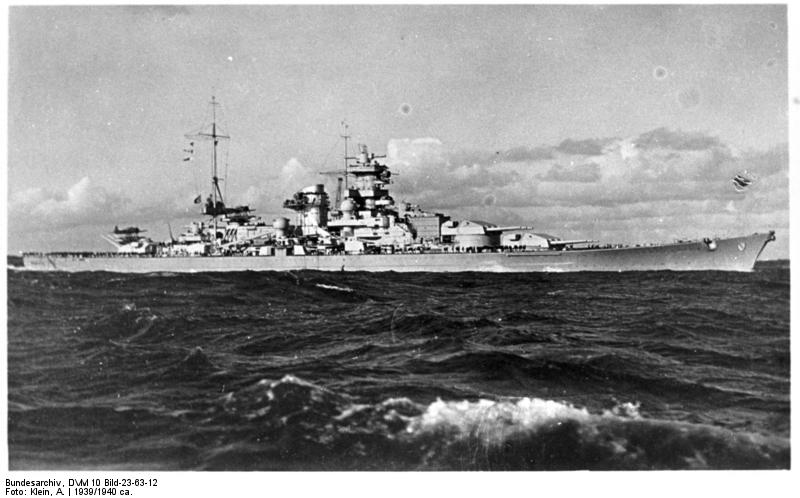
Schlachtschiff Friends of Padre Steve’s World,

Today was the Second Day of Christmas or as it is also known, the Feast of St. Stephen.

Christmastide is a joyous time for many, but in the course of history there have been times that military men have fought and died in hopeless battles far from their families. Thus it is often a time of sorrow, especially for those that die alone. Among those who died alone in the Arctic darkness of December 26th 1943 were the officers and crew of the German battlecruiser Scharnhorst.

Schlachtschiff

The Scharnhorst along with her sister ship Gneisenau were the product of the naval architects of Germany who in the early 1930s designed some of the most beautiful as well as deadly warships of the Second World War.  Following Germany’s rejection of the provisions of the Treaty of Versailles the Kreigsmarine enacted a building program to enlarge and modernize the German Navy which then was composed of obsolete pre-Dreadnaught battleships and a few modern light cruisers and destroyers.   The first major units constructed were actually begun by the predecessor to the Kreigsmarine, the Reichsmarineof the Weimar Republic.  These were the Deutschland class Armored Ships, sometimes called “Pocket Battleships” and later reclassified as Heavy Cruisers. These ships were designed to replace the old pre-Dreadnaught battleships and incorporated electric welds to reduce displacement, diesel engines for extended cruise range to enable them to serve as commerce raiders and a battery of six 11” guns.  While an advance over anything in the German inventory they were outclassed by the British battle cruisers Hood, Renown and Repulse.

However, the first truly capital ships built by the Kriegsmarine were the Scharnhorst and Gneisenau Rated as battleships, in reality they were battle cruisers because of their light main battery of 11” guns as opposed to the 14”, 15” or 16” batteries of other nations battleships.  Despite this in displacement and armor protection of the ships was comparable to other battleships of the era and their designed speed of 31.5 knots was superior to almost all other battleships of the era including the British King George V Class and the US Navy’s  North Carolina class.  Only the massive battlecruiser HMS Hood was their superior in speed and firepower.

As built Scharnhorst and Gneisenau displaced 31,000 toms, however at full combat load they both weighed in at nearly 38,000 tons and were 772 feet long.  They had an armor belt that was nearly 14 inches thick.  Armed with a main battery of nine 11” guns and a secondary armament of twelve 5.9 inch guns they also mounted a powerful for the time anti- aircraft battery of fourteen 4.1 inch guns, 16 37mm and 16 20mm anti-aircraft cannons.  Additionally they mounted six 21” torpedo tubes and carried three Arado 196 A3 scout planes.  The main battery was eventually to be replaced by six 15” guns but this never occurred; Gneisenau was taken in hand to mount the new weapons but the conversion was never completed due to Hitler’s anger after the failure of a German task force during the Battle of the Barents Sea in December 1942.

scharnhorst2Scharnhorst firing at HMS Glorious 

Laid down on 15 June 1935 and launched 3 October 1936 Scharnhorst was commissioned 7 January 1939.  Her sister Gneisenau was laid down 6 May 1935, launched 8 December 1936 and commissioned 21 May 1938.  Upon the commencement of the Second World War the two sisters began a reign of destruction on British shipping. In November they sank the Armed Merchant Cruiser HMS Rawalpindi During Operation Weserübung the pair surprised sank the aircraft carrier HMS Glorious and her two escorting destroyers, the only time a Fleet carrier was caught and sunk by battleships during the war.   From January to March 1941 they conducted Operation Berlin against British merchant shipping in the North Atlantic sinking 22 ships before returning to base.

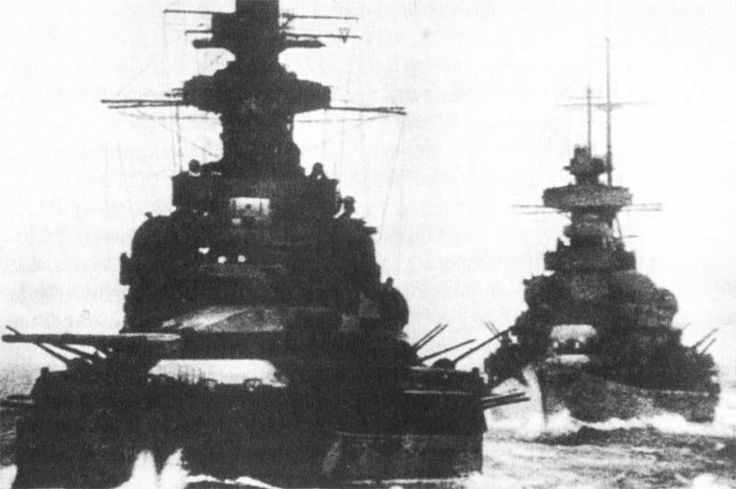
eeb893a0b92de4ae595de56fe0fd90caScharnhorst and Gneisenau during Operation Cerebus

While in the port of Brest Gneisenau was bombed and torpedoed requiring extensive repairs.  Due to the exposed location of the port the German high command decided to return the ships to Germany along with the Heavy Cruiser Prinz Eugen.  The operation was called Operation Cerberus and it took place from 11-13 February 1942. The ships made a dash up the English Channel which was unsuccessfully contested by the British Royal Air Force and Royal Navy. However, both Scharnhorst and Gneisenau were damaged by mines and needed subsequent repairs.  While undergoing repairs in Kiel Gneisenauwas further damaged by the Royal Air Force requiring repairs in or to steam to the port of Gotenhafen for repair and conversion.  Although some work was completed she was decommissioned and sunk as a blockship on 23 March 1945.  Following the war she was raised by the Poles and scrapped.

Scharnhorst was repaired following Operation Cerberes and in March 1943 was transferred to Norway where along with Tirpitz, Admiral Scheer, Lutzow (the former Deutschland), Admiral Hipper and Prinz Eugen she became part of a “fleet in being” poised to strike the Allied convoys bound for Russia.

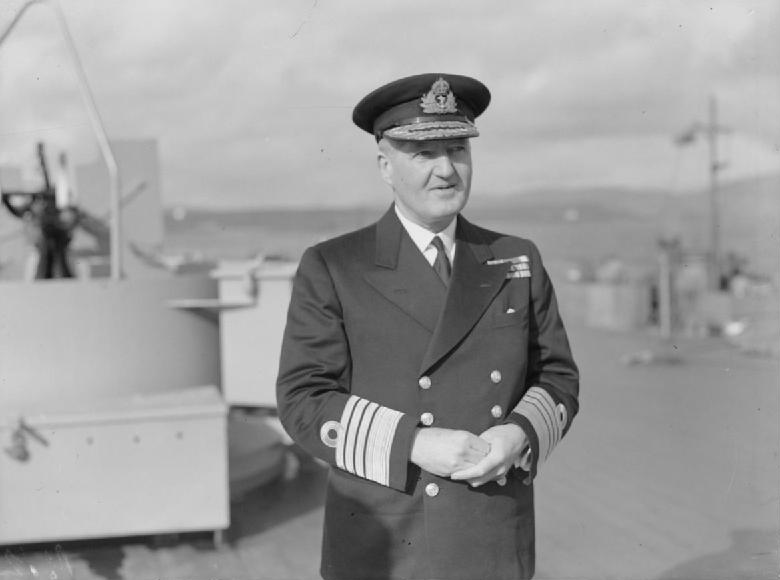
Admiral_Bruce_Fraser_1943_IWM_A_16489Admiral Bruce Fraser

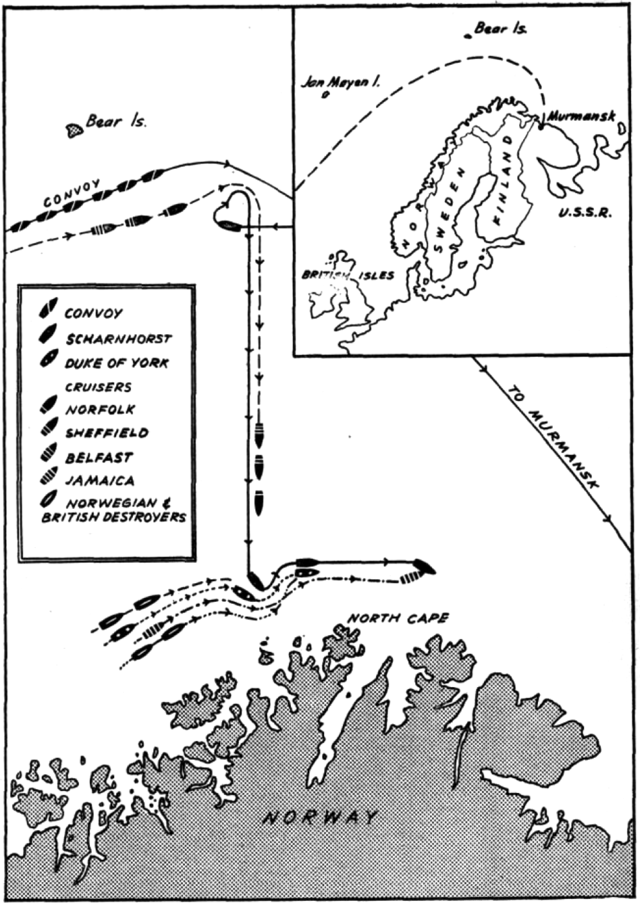
The German surface ships were a potent force that if the circumstances allowed could devastate the Russia bound convoys and the Commander of the British Home Fleet, Admiral Bruce Fraser was determined to entrap and destroy any of these ships that threatened any convoy. As such in December 1943 Fraser formed a task group built around the HMS Duke of York to be ready to pounce on any German raider that threatened the convoys. His intent was to catch any of these ships, especially Scharnhorst and trap them between the convoys and their base, in conduction with a second task group centered around the cruisers HMS Belfast, HMS Norfolk, and HMS Sheffield, Known as Force One, and destroy the German battleship.

The key to British the British operation was Enigma the German code machine and cipher system which they had acquired from captured U-Boats, and which British code-breakers had mastered. The Germans decided to send Scharnhorst and five destroyers to locate and destroy convoy JW-55B which had been spotted by Luftwaffe reconnaissance aircraft. Because of EnigmaFraser knew that Scharnhorst would attempt to intercept the convoy and put his plan in motion.

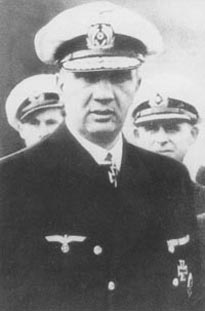
Battle_of_North_Cape_26_December_1943_mapScharnhorst and her escorts set sail on Christmas Day 1943 under the command of Rear Admiral Erich Bey to conduct Operation Ostfront. Since Fraser knew that the Germans were coming he had the convoy to temporarily reverse course which caused the Germans to miss the convoy. When he did not find the convoy in the expected location Bey detached his destroyers to expand the search area, leaving Scharnhorst alone to face the enemy.

scharnhort_operation_ostfront_5Rear Admiral Erich Bey

At about 0900 on December 26th 1943 the cruisers of Force One discovered Scharnhorst and the  Battle of North Cape was on. Though little damage was suffered in the first engagement, the radar of Scharnhorst was knocked out, leaving her not only without air support or escort, but blind.

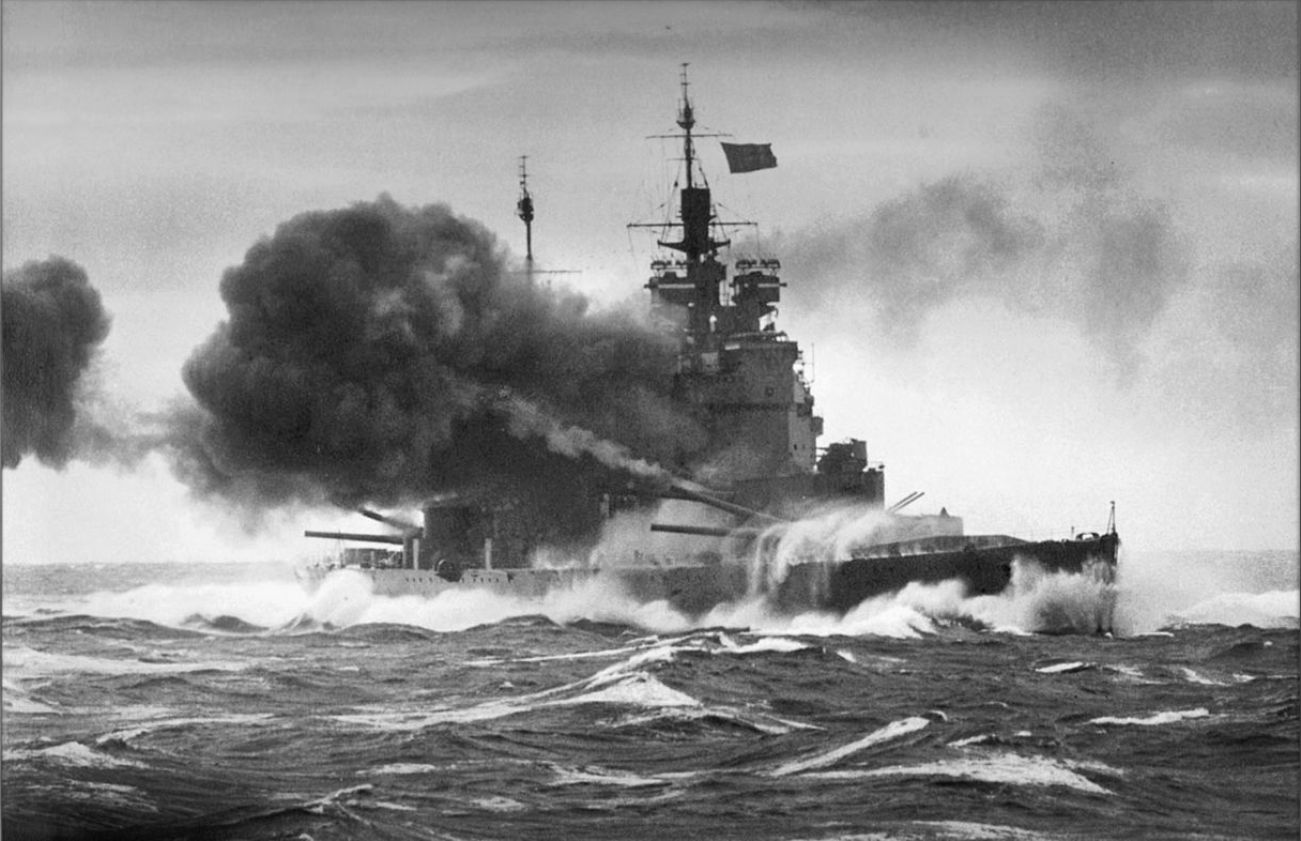
6050465664_e1f42ac7f8_oHMS Duke of York firing her main battery

Scharnhorst attempted to flee but Fraser’s Duke of York  and her four escorting destroyers destroyers intercepted her. Without radar in the blinding snow squalls Scharnhorst was surprised. Duke of York’s first radar direct salvos knocked out her forward main battery but the German ship appeared to be making a getaway when a shell from Duke of York hit her number one boiler room and reduced her speed to barely ten knots. Although the German engineers and damage control teams made some repairs and were able to bring her speed back up to 22 knots, the British ships rapidly made up the distance enabling the British destroyers to launch torpedo attacks.

Knowing the ship was doomed Admiral Bey dispatched a message to the high command of the Kriegsmarine: “We will fight on until the last shell is fired.”

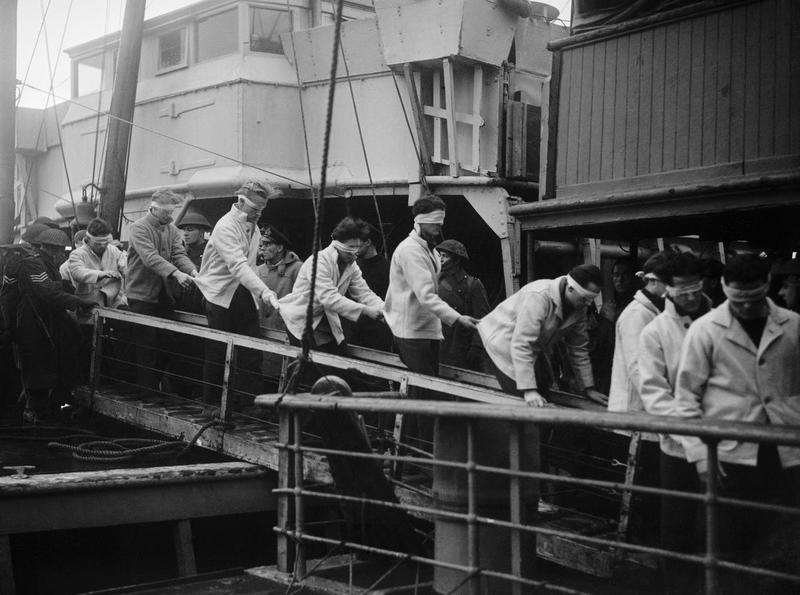
While she still attempted to fight off her attackers and escape she was struck by torpedoes from several destroyers as well as was pummeled by the at at distance of under 10,000 yards by Duke of York’s 14″ shells, as well as the 6″ shells of HMS Belfast and HMS Jamaica. Savaged by hits and incapable of further resistance the German ship capsized and sank at 1945 hours with the loss of all but 36 of her 1968 man crew.  Her wreck was discovered on October 3rd 2000 some 70 miles north of North Cape Norway.

Scharnhorst_survivors_A_021202Survivors of Scharnhorst 

Admiral Fraser praised the gallantry of the German ship to his officers later that night saying: “Gentlemen, the battle against Scharnhorst has ended in victory for us. I hope that if any of you are ever called upon to lead a ship into action against an opponent many times superior, you will command your ship as gallantly as Scharnhorst was commanded today”

After the battle Grand Admiral Erich Raeder who had authorized the sortie was relieved as commander in chief of the navy and was replaced by Grand Admiral Karl Donitz who commanded the U-Boat forces. Hitler was furious and ended most surface naval operations.

800px-Scharnhorst-WHV-April-2011Memorial to Scharnhorst and her crew at Kiel

I have written many times about the tragedy of war, on land and at sea. Having served in combat zones on land and having been shot at by the enemy, as well as having served at sea on a cruiser I have a sense of what these men must have gone through on that final day of their lives. Though I am a realist and know that such tragedies will likely occur again, I do pray for the day that war will be no more and that those who serve in harm’s way will never have to again.

Peace

Padre Steve+

1 Comment

Filed under History, Military, Navy Ships, nazi germany, World War II at Sea

Merry Christmas from a Wounded Healer

Friends of Padre Steve’s World,

We had a special Christmas this year with friends who can be best described as a relatively eclectic group. We hosted dinner as is our custom and it really turned out well, and I do have to say that emotionally and spiritually I am in in a better place than was not too long ago.

So today, especially for my new readers I want to recount a bit of that journey.

The German theologian Jürgen Moltmann wrote, “God weeps with us so that we may one day laugh with him.”  Since coming home from Iraq in 2008 my faith has undergone a profound change. This is a part of my story that I share with you.

Christmas is a special time for me, it always has been but in spite of that there were times that I took the faith element for granted. I believed and my faith in God, for me the Christian God, Father, Son and Holy Spirit was unquestioned. I knew the Scriptures, the Creeds and the Councils and I felt that my faith in a sense was untouchable. I was sure of it, in fact almost cocksure or arrogant about it. That came out in published writings in a very conservative Catholic monthly, the New Oxford Review back in 2000-2001.

For me the elements of my faith were very much intellectual. I could see other points of view but if I disagreed with them enough I would engage them with the purpose of defeating them. Of course this usually went to theological methods, history and hermeneutics. As far as those that lost their faith it was something that I had difficulty comprehending. Not that I was unsympathetic or uncaring of them or their plight, but I didn’t see how it could happen to me.

But that was before Iraq. That was before PTSD, moral injury and my own crisis of faith when I returned from the Iraq War in 2008.  That war changed me as war has changed so many others before. Guy Sager wrote of his return from war in his classic The Forgotten Soldier:

“In the train, rolling through the sunny French countryside, my head knocked against the wooden back of the seat. Other people, who seemed to belong to a different world, were laughing. I couldn’t laugh and couldn’t forget.” 

My return instigated a crisis of faith, I felt like I still belonged in Iraq and home seemed like a foreign land.  In the crisis I was for all practical purposes I was an agnostic trying to believe and feeling abandoned by God and many of his people, especially clergy.  Commodore Tom Sitsch at EOD Group Two, a veteran of much combat asked me “where does a Chaplain go for help?” I told him “not to other Chaplains or clergy.” Sadly Captain Sitsch, struggling with his own PTSD and other life crises took his life in 2014, but I think that he understood me better than most Chaplains or clergy.

That the crisis etched a permanent scar in my soul which led to some fairly major changes in my life.  It forced me to enter what Saint John of the Cross called the “Dark Night of the Soul.” For those not familiar with that book it is the sense that God has withdrawn his presence from you which you must go through to experience true union with God.

I will not tell of how my great spiritual disciplines and intellect helped me get through the crisis, for they did not. I found it hard to pray or believe in anything for nearly two years as I struggled with abandonment. I felt that God, the Church and the Navy had abandoned me.  The only thing that kept me going was my profound sense of vocation as a Priest and Chaplain and commitment to others who were suffering.  When I watch the classic film about the 1914 Christmas Truce, Joyeaux Noel I very much understand the priest who is being relieved of his duties by his bishop who he tells “I belong here, with those in pain who have lost their faith.” 

In the fall of 2008 was losing my battle with PTSD during that time I was clinically  depressed, terribly anxious, angry, and in despair I threw myself into my work among the critically ill ICU patients and those that cared for them.  Christmas Eve of 2008 was spent in despair as I wandered through the darkness on a cold night after leaving the Christmas Eve Vigil Mass because I could not get through it. If a bar had been open anywhere within walking distance I would have poured myself into it.

Though I found a community and camaraderie among those that I worked with and tried to provide spiritual care, my own condition grew worse.  I was so bad enough that my clinical duties had to be curtailed over my objections in September of 2009.

I still stood the overnight duty and filled in for others as needed, but for a number of months I had no clinical assignments.  That meant that others in our minimally staffed department had to fill in for me. I am sure that they resented that, especially because before this I often worked 70-90 hours a week mostly in our ICUs and the staff of the ICUs now expected that kind of intensive ministry and support. Likewise I was largely absent from home which was not a good thing for my marriage.

But in my desperation I was greeted with a surprise. On one of the on call nights not long before Christmas of 2009 I received a call to the ER to provide the last rites to an elderly retired Navy Medical Doctor.  The man was a saint, faithful to God, his Church and the community. For years he dedicated much of his practice to the poorest members of the community, delivering babies for women with no insurance and caring for prisoners in the Portsmouth City Jail.  He breathed his last as I prayed this prayed the prayer of commendation following the anointing and something strange happened. I felt the presence of God for the first time since Christmas of 2007 in Iraq. It is too this day hard to explain. It was as if his faith

Something miraculous happened that night and by Christmas Eve I realized that something was happening to me. As I wrote in Padre Steve’s Christmas Miracle on Christmas Eve of 2009:

“Mid afternoon I was walking down the hall and I experienced a wave of emotion flood over me, and unlike the majority of emotions that I have felt in the past couple of years this was different.  It was a feeling of grace and I guess the presence of God.  I went up and talked with Elmer the shrink about what I was feeling and the experience was awesome, I was in tears as I shared, not the tears of sadness, but of grace.  I am beginning to re-experience the grace of God, something that has been so long absent that I did not expect it, at least right now.  I didn’t do anything differently; I certainly was not working extra hard to pray more, get more spiritual or pack my brain full of Bible verses.  I was too far gone to do those things.  It was all I could do many mornings just to get out of bed and come to work.”

Since that time I have continued to recover faith and belief. I cannot say that it is the same kind of faith that I had before Iraq. This was a different kind of faith.  It was faith born of the terrible emptiness and pain of abandonment and despair, a faith that is not content with easy answers and not afraid to ask questions.  It is a faith in Jesus Christ, the crucified one who’s image we see hanging from the crucifix and adorning icons of the Crucifixion. It is as Moltmann wrote in The Crucified God:

“The Symbol of the Crucifix in church points to the God who was crucified not between two candles on an altar, but between two thieves in the place of the skull, where the outcasts belong, outside the gates of the city. It is a symbol which therefore leads out of the church and out of religious longing in to the fellowship of the oppressed and abandoned. On the other hand, it is a symbol which calls the oppressed and godless into the church and through the church into the fellowship of the crucified God”

My Philosophy of Religion Professor, Dr. Yandall Woodfin at Southwestern Baptist Theological Seminary told us in class that until we had “dealt with the reality of suffering and death we were not doing Christian theology.” At the time the words were offensive to me, but by the time I had graduated and also done a year of Clinical Pastoral Education they became a part of my experience. However that did not prepare me for the darkness that I lived in from February of 2008 until that Christmas Eve of 2009.  I would say that in addition to Dr Woodfin’s understanding of grappling with suffering and death that one has to add the abandonment of the outcast to the equation.

The “I Believe in God” of the Creed is no longer for me simply a theological proposition to defend, but rather an experience of God born out of pain, despair, anxiety, doubt, unbelief and abandonment. During my crisis I found almost no Christians willing to walk through the darkness with me, including clergy. The only clergy willing to were those who were walking the same path of the outcast with me, suffering from PTSD, TBI and other unseen wounds of war. It was if I was radioactive. Many people had “answers” for me, but none sought to understood my questions until my first  therapist Dr. Elmer Maggard asked me “how I was with the big guy?”

When I finally collapsed in the summer of 2008 and met with Dr. Maggard I made a conscious decision that I would not hide what I was going through.  I felt that if someone didn’t speak out that others like me wouldn’t seek help. In the nearly six years since I returned from Iraq I have encountered many people, men and women, current and former military personnel and families of veterans who came to me either in person or through this website. It led to me being interviewed in a newspaper and being featured on the Real Warriors website http://www.realwarriors.net , a program run by the Department of Defense to help reduce the stigma of getting help for PTSD which features the stories of military personnel suffering from it. My story can be found here: 

https://www.realwarriors.net/multimedia/profiles/dundas.php

I have had a number of military chaplains come to me also experiencing a faith crisis. Most said that I was the first Chaplain or minister that they had met or who admitted that he struggled with faith and the existence of God.  For a minister to be open about such struggles is dangerous. When my faith returned and was different I was asked to leave my former denomination because I was now “too liberal.”

In each of those encounters with those suffering there was a glimmer of hope for me and I think for them.  It was as if for the first time we had people that we could be open with.  Co-workers and others said that I was “real.” I certainly do not boast of that because it was painful to be transparent with people while in the depths of doubt and despair while hoping that somehow God would touch them with some measure of grace when I found it hard to believe.  I guess it was the fact that I was willing to walk with them in their crisis and let them be honest even if it meant facing my own pain and doubt. I learned something about being what Henri Nouwen called a wounded healer.  Nouwen wrote:

“Nobody escapes being wounded. We all are wounded people, whether physically, emotionally, mentally, or spiritually. The main question is not “How can we hide our wounds?” so we don’t have to be embarrassed, but “How can we put our woundedness in the service of others?” When our wounds cease to be a source of shame, and become a source of healing, we have become wounded healers.”

I do still struggle with the continued effects of War and PTSD, but I am in a much better place. That being said over past couple of weeks or so my crazy nightmares and night terrors have come back with a vengeance, last night I threw myself out of bed in the midst of a particularly violent nightmare but it hasn’t soured my mood, my hip still hurts a bit but like unlike the last couple of times I neither broke my nose, sustained a concussion, nor bruised by jaw and sprained my neck.; that my friends is an improvement.

I also struggle with faith at times when I look at the actions of those who profess to believe but treat others with contempt, especially the men and women that call themselves Conservative Evangelical Christians who seem to me to have sacrificed any pretense of faith in Christ in the pursuit of raw political power by supporting a man who is as much of a Christian as the Medici Popes. So I can understand the quote from the Gospel “I believe, help my unbelief.”

So today this wounded healer celebrated Christmas at home, hosting friends after having preached at Christmas services for American and German military communities. It was a healing experience for me and helped to increase my faith. I know: faith versus reason. I get that, but as reasonable and logical as I try to be I do find the mystery of faith to be something that attracts me to Jesus the Christ.

So this evening, this Christmas night, I want to thank all of my readers, especially those who like or comment on my posts.

You are appreciated as some are lengthy and you choose to take your time to read them and often share them. Likewise there are times that my own biases show through in what I write, and I know that a decent number of people who subscribe to this site and comment don’t always agree with me. I appreciate that and thank you for continuing to follow what I write.

Likewise, if you are walking the path of the outcast feel free to drop me a line here or on my Facebook page. My wish for you and for all is a Christmas of peace, reconciliation and love.

Peace and blessings,

Padre Steve+

5 Comments

Filed under faith, Military, ministry, Political Commentary, Tour in Iraq

Christmas Eve 2017: Light, Life, and Love in Hell, Kurt Reuber and the Madonna of Stalingrad

Bundeswehr zeigt "Stalingrad"-Ausstellung

Friends of Padre Steve’s World,

It is late on Christmas Eve and I am reflecting about the true meaning of Christmas in a world where hope seems to be dying before our eyes. This morning I preached in my Chapel from the Christmas story in the Gospel of St. Luke, the same passage I preached on a week or so ago with the German NATO contingent. The story of the incarnation, of God coming in the weakness of a tiny baby who would grow up and be crucified not far from where he was born is of profound importance for my faith, because it is not a pie in the sky promise of prosperity and power, but God who can be present in midst of the human made hell of war.

In such an environment I reflect on men who lived in a human made hell, a hell made by hate filled ideologues who launched the world into its bloodiest war, and I wonder, could it happen again? A decade ago I would have said it never could again happen. In December of 2016 after the election of Donald Trump I began to hedge my bets, but a year later I do believe that it can, and very well may happen again. So in such a world I must try to find hope wherever I can find it, especially as I seen the pattern of a descent into authoritarianism which has been so much a part of 20th Century European history developing in the United States. I worry about that because I can see nothing good coming of it, and notice friends, including Christian clergy openly advocating against the safeguards, the checks and balances put forth in our Constitution and laws to ensure that the President has unchecked power; and that means the power to plunge the nation into war.

I think most of my readers know that I am a career military officer and have served in peace and war as a chaplain. That service includes a tour in Iraq, a war, which by almost any standard would have been considered unjust and illegal, yet I served there, and came back a changed man. As such the stories of those who served in war, especially those who serve in hopeless battles, and even in evil causes during Christmas have a special place in my heart. One of those men was a German pastor and medical doctor named Kurt Reuber.

k_reuberl

As I said, Reuber was a theologian, pastor and medical doctor, likewise he was an accomplished artist and used that medium to convey his own faith, and doubts. He was a friend of Albert Schweitzer and in 1939 he was conscripted to serve as a physician in the Germany Army. By November 1942 he was a seasoned military physician serving with the 16th Panzer Division, part of the German 6th Army, which had been fighting in the hell of Stalingrad. When his division along with most of 6th Army was surrounded by the Soviets, cut off from most supply and without real hope of relief, he like other physicians continued to serve the soldiers committed to his care.

pg-34-stalingrad-2-getty

However, unlike most physicians, the care Reuber offered care included spiritual matters, as he sought to help his soldiers deal with the hopelessness of their situation. As Reuber reflected on the desperation of the German soldiers in the Stalingrad pocket. He wrote to his family.

“I wondered for a long while what I should paint, and in the end I decided on a Madonna, or mother and child. I have turned my hole in the frozen mud into a studio. The space is too small for me to be able to see the picture properly, so I climb on to a stool and look down at it from above, to get the perspective right. Everything is repeatedly knocked over, and my pencils vanish into the mud. There is nothing to lean my big picture of the Madonna against, except a sloping, home-made table past which I can just manage to squeeze. There are no proper materials and I have used a Russian map for paper. But I wish I could tell you how absorbed I have been painting my Madonna, and how much it means to me.”

“The picture looks like this: the mother’s head and the child’s lean toward each other, and a large cloak enfolds them both. It is intended to symbolize ‘security’ and ‘mother love.’ I remembered the words of St. John: light, life, and love. What more can I add? I wanted to suggest these three things in the homely and common vision of a mother with her child and the security that they represent.”

The picture was drawn on the back of a captured Soviet map and when he finished it he displayed it in his bunker, which became something of a shrine. Reuber wrote:

“When according to ancient custom I opened the Christmas door, the slatted door of our bunker, and the comrades went in, they stood as if entranced, devout and too moved to speak in front of the picture on the clay wall…The entire celebration took place under the influence of the picture, and they thoughtfully read the words: light, life, love…Whether commander or simple soldier, the Madonna was always an object of outward and inward contemplation.”

drkrop

As the brutal siege continued men came to the bunker for both medical care and spiritual solace.  On Christmas Eve Reuber found himself treating a number of men wounded by bombs outside the bunker. Another soldier lay dying, just minutes before the soldier had been in the bunker singing the Christmas hymn O Du Froehliche.  Reuber wrote:

“I spent Christmas evening with the other doctors and the sick. The Commanding Officer had presented the letter with his last bottle of Champagne. We raised our mugs and drank to those we love, but before we had had a chance to taste the wine we had to throw ourselves flat on the ground as a stick of bombs fell outside. I seized my doctor’s bag and ran to the scene of the explosions, where there were dead and wounded. My shelter with its lovely Christmas decorations became a dressing station. One of the dying men had been hit in the head and there was nothing more I could do for him. He had been with us at our celebration, and had only that moment left to go on duty, but before he went he had said: ‘I’ll finish the carol with first. O du Frohliche!” A few moments later he was dead. There was plenty of hard and sad work to do in our Christmas shelter. It is late now, but it is Christmas night still. And so much sadness everywhere.”

On January 9th 1943 with all hope of escape or reinforcement gone Reuber gave the picture to the battalion commander as the officer was too ill to carry on and was one of the last soldiers to be evacuated from the pocket. Reuber’s commander carried the Madonna out of the pocket and returned it delivered it to Reuber’s family, preserving it for all.

Reuber was taken prisoner and survived the harrowing winter march to the Yelabuga prison camp. In late 1943 Reuber wrote his Christmas Letter to a German Wife and Mother – Advent 1943. It was a spiritual reflection but also a reflection on the hope for life after the war, when the Nazi regime would be defeated, and Germany given a new birth.

Reuber wrote:

“The concatenation of guilt and fate has opened our eyes wide to the guilt. You know, perhaps we will be grateful at the end of our present difficult path yet once again that we will be granted true salvation and liberation of the individual and the nation by apparent disappointment of our “anticipation of Advent”, by all of the suffering of last year’s as well as this year’s Christmas. According to ancient tradition, the Advent season is simultaneously the season of self-reflection. So at the very end, facing ruin, in death’s grip – what a revaluation of values has taken place in us! We thus want to use this period of waiting as inner preparation for a meaningful new existence and enterprise in our family, in our vocation, in the nation. The Christmas light of joy is already shining in the midst of our Advent path of death as a celebration of the birth of a new age in which – as hard as it may also be – we want to prove ourselves worthy of the newly given life.”  (Erich Wiegand in Kurt Reuber, Pastor, Physician, Painter, Evangelischer Medienverb. Kassel 2004. )

prisoner's madonna

Reuber did not live to see that day. He died of Typhus on January 20th 1944, not long after writing this and just a few weeks after painting another portrait of the Madonna, this one entitled The Prisoner’s Madonna. He was not alone, of the approximately 95,000 German POWs taken at Stalingrad only about 6,000 returned home.

His paintings survived the war and his family gave The Madonna of Stalingrad to the Kaiser Wilhelm Memorial Church in Berlin after it was restored as a symbol of hope and reconciliation. Copies are also displayed in Coventry Cathedral and the Russian Orthodox Cathedral in Volgograd, the former Stalingrad. A copy of The Prisoner’s Madonna is now displayed at the Church of the Resurrection in Kassel.

I have a print of the Madonna of Stalingrad in my office. It has become one of the most meaningful pictures I have since I returned from Iraq in 2008. To me they are symbols of God’s presence when God seems entirely absent.

I praying for an end to war and likewise that the United States will not fall victim to a lawless authoritarian leader who seems intent on stoking the fires of more wars.

Peace

Padre Steve+

1 Comment

Filed under faith, History, Military, ministry, nazi germany, Pastoral Care, Political Commentary, world war two in europe