Author Archives: padresteve

padresteve's avatar

About padresteve

I'm a Navy Chaplain and Old Catholic Priest

“The Wrong Shall Fail, the Right Prevail” I Heard the Bells on Christmas Day in the Final Days of Trump

Friends of Padre Steve’s World,

After another long day, most of it spent in the Dental Clinic getting examined, x-rayed and when that cut into the time to do the concluding work on the root canal. So I had to go back in the afternoon. In between I went to deal with making sure the lady correcting my DD-214. So from 8:00 to 9:00 AM, that’s 0800-0900 military time, I was getting x-rayed and prodded. From nine to 1215 on the road and working on my personnel records to correct the DD-214 before being in the chair another couple of hours getting prepped and completing what had been started a couple of weeks ago. The problem was that in dental-speak the inside of that molar had “unusual architecture” only found in about 6% of people. That being said the did well, I suffered no undo pain, was informed that the other teeth they checked were not in need of any immediate treatment and for that I am glad. But I digress…

I could be writing about the travails being inflicted on the country and the world by our soon to be former President Donald Trump, but I do enough of that. Christmas is coming and even when I don’t explicitly write about Trump the message of the season stands against him and against all that he stands. Frankly I couldn’t give a horses patoot what his Court Following of Evangelical Christian Leaders or his Cult of badly compromised Conservative, Evangelical, Charismatic, Pentecostal, and Catholic followers, who choose him over Christ on a daily basis.

I cannot be part of that despite what such people call me on social media and in comments I will not approve on this blog. Christmas of 2020 comes amid social and religious turmoil not seen since the 1850s that led up to the American Civil War. The rhetoric across the politic spectrum is becoming more uncompromising, and especially in the case of Trump supporters tinged by threats of violence, and even killing political opponents, and this is condoned by supposedly Christian people. Trump demands their fealty and most regardless of the reality of his election loss many if not most continue to worship at his electroplated golden calf.

It is in such times that I reach back to history and often music that came out of the tumult. The American Civil War was such an occasion.

The great American poet Henry Wadsworth Longfellow penned these words of hope on Christmas Day, 1863:

“God is not dead, nor doth He sleep; The wrong shall fail, the right prevail With peace on earth, good will to men.”

Christmas is coming and I feel that Longfellow’s words are as pertinent today as when he first penned them. The thought of what is to come in the next few years, in the United States and in many other liberal democracies bodes ill for our future as authoritarian and often xenophobic leaders like Trump rise to power. The world that we grew up is is passing away, and what comes in its place, a dystopian world where hope will be a rare commodity beckons.

Longfellow’s words became the heart of the song I Heard the Bells on Christmas Day.  I have heard it a number of times in the past few days and each time it really touches me, because it is real. In it reality and faith come face to face, and both win. No-matter what Trump and his cult do, they will fail and the right will prevail.

The song has been recorded in a number of versions by different artists over the years. However, the words of the song go back to the American Civil War. Longfellow on Christmas Day 1863 following the serious wounding of his son Charles, a Lieutenant in the Union Army at the Battle of New Hope Church during the Mine Run Campaign (not to be confused with a battle of the same name outside Atlanta in 1864) and the death of his wife in a fire two years before. Longfellow had much to despair about, but he maintained a faith in God, as well as the founding principles of the United States.

Longfellow’s words are haunting. Probably because they demonstrate the profound tension that lies at the heart of the Incarnation, which is the heart of Christmas and the Christian faith. the tension, played out so well in the song is the existence of a message of peace and reconciliation in a world where war and hatred of many kinds rip human beings apart coupled with the tragic inability of Christendom, especially American Conservative Evangelicalism to even come close to the message of Christmas.

I heard the bells on Christmas day

Their old familiar carols play,

And wild and sweet the words repeat

Of peace on earth, good will to men.

I thought how, as the day had come,

The belfries of all Christendom

Had rolled along th’ unbroken song

Of peace on earth, good will to men.

gburg dead2

The reality of this is seen in the third verse. It is a verse that echoes throughout history and seems to be true even today, in fact it seems to be the most real as we deal with war, hatred, terrorism, killing in the name of God, and political fratricide.

And in despair I bowed my head

“There is no peace on earth,” I said,

“For hate is strong and mocks the song

Of peace on earth, good will to men.”

The interesting part about the songs as opposed to the poem is that they omit three of Longfellow’s verses that admittedly in a reunited country would not help record sales. Those verses speak to the heart of the Civil War.

Till ringing, singing on its way,
The world revolved from night to day,

A voice, a chime,

A chant sublime

Of peace on earth, good-will to men!

Then from each black, accursed mouth
The cannon thundered in the South,

And with the sound

The carols drowned

Of peace on earth, good-will to men!

It was as if an earthquake rent
The hearth-stones of a continent,

And made forlorn

The households born

Of peace on earth, good-will to men!

But Longfellow hears in the bells something more powerful. It is the message of Christmas and the incarnation. The message that justice and peace will finally embrace.

Then pealed the bells more loud and deep:

“God is not dead, nor doth He sleep;

The wrong shall fail, the right prevail

With peace on earth, good will to men.”

Till ringing, singing on its way

The world revolved from night to day,

A voice, a chime, a chant sublime

Of peace on earth, good will to men.

The song has been recorded many times by many artists. I like the version sung by Frank Sinatra, which the music was composed by Johnny Marks, composer of Rudolph the Red Nosed Reindeer. Another earlier version composed by John Baptiste Calkin has been recorded by Elvis Presley and Johnny Cash among others.

As wars rage in the Middle East, tensions rise in Asia, Africa and even Eastern Europe while the Unholy Trinity of Politicians, Pundits and Preachers, led by the American President rage as we go into another, and even more perilous year with the possibility of nuclear war more probably than not, people still look for hope.

Longfellow, who lost so much in a short time in the midst of a terrible Civil War, reminds us that in such times, “God is not dead, nor doth He sleep; The wrong shall fail, the right prevail With peace on earth, good will to men.”

In a time like this when the world led by the American President seems to be hurtling into the abyss, it is important to remember Longfellow’s words and the message of Christ and the Incarnation. The child born as an outcast in a manger would die as a criminal, crucified by an occupying power with the full support of the leaders of the occupied country. As the German theologian Jurgen Moltmann wrote:

“He humbles himself and takes upon himself the eternal death of the godless and the godforsaken, so that all the godless and the godforsaken can experience communion with him.” 

Yes, the wrong shall fail, and the right prevail, but it in the age of Trump it will certainly involve much travail. As for the travail, it is just beginning.

Until tomorrow,

Peace

Padre Steve+

Leave a comment

Filed under christian life, civil war, faith, History, Military, music, Political Commentary, spirituality

Please Christmas Don’t Be Late, But But Wear a Mask: Some Mostly Silly Christmas Songs

Friends of Padre Steve’s World,

After a long day of medical appointments including an MRI to ensure my brain isn’t leaking into my nose. No kidding, it’s something they have to rule out before doing a biopsy of a growth there that regardless of what it is, so long as it is not brain needs to come out. Of course it might be the sane part trying to escape, but as usual I digress, but in the midst of all I think I need to spread a bit of cheer on a dark COVID-19 Winter night, unless you are reading this with the sun up.

I get sentimental when I hear Christmas songs of almost any genre. That sentimentality ranges from the hymns of the season such as Silent Night, The First Noel, or Joy to the World. Likewise I find the hymns of Advent like O Come, O Come Immanuel and Es ist Ein Ros Ensprungen (Lo, how a Rose e’re Blooming) to be songs of hope in dark times.

I have shared many of my Christmas favorites each year. This year I haven’t done much of that. But tonight I am going to share some of my favorite non-religious and sometimes funny Christmas songs. I suppose this goes back to my earliest days when as a three to four year old living in the Philippines and my parents bought me David Seville and the Chipmunks Christmas Album, which included the song Christmas Don’t Be Late. 

That came to mind when I had to make sure that our Papillons, especially our puppy Maddy Lyn who is sweet, scary smart and always looking for trouble. She was doing that tonight when I asked what she was doing. She turned around and gave me the “Moi?” look. She is mischievous but so damned funny and sweet. But she is not alone, we have our little boy, Pierre who is sure that he is French royalty. He and Maddy Lyn are about the same size and over the past couple of months they have become buddies once Pierre’s high horse died. Then there is our big girl, Izzy Bella, the sweetest enforcer around. She is bigger than both of the little ones combined, she’s a big Papillon and is drop-dead gorgeous.


Maddie in Time-Out in Judy’s Art Room 

Maddy Lyn and Pierre 


Maddy Lyn and Daddy on the Road

Izzy and his Big Girl Izzy Bella

So anyway, here are my favorite non-religious Christmas songs. Some are sentimental, some irreverent, but I love them all.

Until tomorrow,

Peace,

Padre Steve+


Leave a comment

Filed under Coronavirus 19 Pandemic, COVID19, faith, film, History, movies, music, News and current events, spirituality

Muddling Through: Have Yourself a Merry Little Christmas, a Perfect Song for a Pandemic

Friends of Padre Steve’s World

There are some songs at Christmas that despite their relative newness as compared to ancient carols seem to strike a chord that resonates deep in the hearts of people. I think that in our day that some speak louder than others.

One of those songs, at least for me, and probably many others is the song Have Yourself a Merry Little Christmas. The music was written by Ralph Blane and the lyrics by Hugh Martin for the musical Meet Me in St Louis and first performed by Judy Garland in that film. In the movie Garland’s character sings the song to her younger sister after their father announces plans to move from their home of St Louis to New York for a job. It is a haunting song with a fascinating story, especially in the age of the COVID-19 Pandemic, the relentless grasps for power of Fascists and Authoritarians in this country and around the world, economic catastrophe, and the clouds of war looming.

But the lyrics for the musical were different than the ones originally penned by Martin, and it would not be the last time that the words were changed.

For the musical, Garland, director Vincent Minnelli, and co-star Tom Drake felt that Martin’s original lyrics which began with “Have yourself a Merry Little Christmas, it could be your last. Next year we may all be living in the past” were too depressing. Martin resisted but finally bowed to pressure and the lyrics were changed to “let your heart be light, Next year all our troubles will be out of sight” in response to their request.

The words sung in the musical by Judy Garland have a haunting but very real feel for people who face uncertainty at Christmas, as such they were very meaningful to the US military personnel who heard them at the front in the dark days of the Second World War.

As originally produced they reflect a hope for a better future as opposed to a carefree present. As such they are probably much more appropriate to our current time than in the mid-1950s when Frank Sinatra recorded a modified version of the song for his album A Jolly Christmas.

Frank Sinatra asked Martin to “jolly up” the line “we’ll have to muddle through somehow” and Martin changed it to “Hang a shining star upon the highest bough.”

When Sinatra recorded the song in 1957 it too became a hit and the focus on present happiness rather than a hope for a better future fit the times in which it was recorded. It was a time when economic prosperity and growth triumphed, bomb shelters were a growth industry, and Reds in Hollywood were alleged Communists and not people from Red States. Sinatra’s version also notes that “faithful friends gather near to us once more” instead of “will be near to us once more.” Gathering is such a nice thought, unless people spread COVID-19 wherever they gather.

The song was re-written by Martin a number of times including a “Christian” version which included the words “if the Lord allows” instead of “if the fates allow.” Though I am a Christian I think that change was a lame appeal to make a few dollars to be made off religious people who otherwise wouldn’t listen to a song because God wasn’t mentioned in it. But then why not, and he wasn’t the first and he certainly won’t be the last.

The song is one is one of the most recorded Christmas songs ever written and can be heard being sung by artists as diverse as Bing Crosby, Ella Fitzgerald, Rod Steward, the Carpenters, Kelly Clarkson, John Denver with the Muppets, the Pretenders, Olivia Newton John, Kenny Loggins, and even Twisted Sister.

The song as recorded by Judy Garland is actually my favorite, though I also love the Sinatra version. But that being said, in a time like we are living, “muddling through somehow” seems to be more appropriate.

So enjoy these versions of a song that has touched the hearts of hundreds of millions of people since it was first recorded. May it be an inspiration in these uncertain times of a hope for a better future. Maybe that makes it a better Advent song than a Christmas song, and maybe that’s why Muddling Through Somehow isn’t such a bad thing after all, especially if you live to see the end of the worst of COVID-19. 

For me it is kind of a sad song, but at the same time it is mixed with hope…and I always try to live in hope, even when I am sad.

So, here’s to muddling through somehow…

Peace

Padre Steve+

3 Comments

Filed under faith, film, History, life

“Nuts” The Immortal Reply of General Anthony McAuliffe to the Germans at Bastogne

anthony_mcauliffe1

Brigadier General Anthony McAuliffe

Friends of Padre Steve’s World,

Another rerun of an older post because I didn’t sleep well last night and I still have so much to do before my official retirement which is beset with medical and dental issues that are really screwing with my life. I am also dealing with a Navy personnel website that has screwed up my security credentials to get on their website and I found out late Thursday that I have to get on it to get my DD-214 approved. That little document that releases me from active duty is necessary for me to get my VA benefits including my medical care and disability payments.

So until the next time,

Peace,

Padre Steve+

On December 16th 1944 the German Army launched an assault in the Ardennes Forrest completely surprising the thinly spread American VIII Corps.  The German 6th Panzer Army, 5th Panzer Army and 7th Army attacked and forced the surrender of 2 regiments of 106th Infantry Division, mauled the 28th Division in the center of the American line while battering other U.S. forces.  To the north the 2nd and 99th Infantry Divisions were tenaciously defending Elsenborn Ridge while to the south the thinly spread 4th Infantry and 9th Armored Divisions resisted the 7th Army advance. As elements of the two German Panzer armies advanced west Eisenhower dispatched his only reserves the 82nd and 101stAirborne Divisions to meet the threat. The 82nd moved to the town of St Vith to aid the 7th Armored Division while the 101st was dispatched to hold the key road center of Bastogne.

By the 22nd of December the besieged American defenders of Bastogne were causing Hasso Von Manteuffel’s 5th Panzer Army headaches. Manteuffel’s leading Panzer units of the 2nd Panzer Division and Panzer Lehr had been thwarted from taking Bastogne by a Combat Command of 10th Armored Division and lead elements of the 101st Airborne Division. After failing to take the town the Germans invested it with the 26thVolksgrenadier Division, and a regiment of Panzer Lehr while the  2ndPanzer and the bulk of Panzer Lehr continued their westward advance.

Cut off from any other American forces the 101st and a collection of stray units including CCB 10th Armored Division and remnants of CCR 9th Armored Division, three 155mm artillery battalions including the African American 969th Field Artillery Battalion held out. By the 21st of December they were completely surrounded by strong German Forces with no relief in sight.

The Commander of the American garrison was Brigadier General Anthony McAuliffe. McAuliffe was the acting commander of the 101st and normally was the commander of the Division Artillery. Major General Matthew Ridgeway and many key commanders and staff were away from the division when it was hastily deployed to the Bulge to combat the German offensive.  McAuliffe now commanded a division which was surrounded, and that was short of ammunition, food, and cold weather gear.

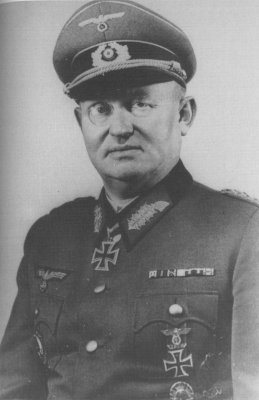
luettwitz

General Der Panzertrüppen Heinrich Freiherr von Lüttwitz

The German forces surrounding the city were commanded by the veteran General Der Panzertrüppen Heinrich Freiherr von Lüttwitz, commander of XLVII Panzer Corps.  Lüttwitz believed that resistance to his forces was futile sent the following message under a flag of truce to McAuliffe.

To the U.S.A. Commander of the encircled town of Bastogne.

The fortune of war is changing. This time the U.S.A. forces in and near Bastogne have been encircled by strong German armored units. More German armored units have crossed the river Our near Ortheuville, have taken Marche and reached St. Hubert by passing through Hompre-Sibret-Tillet. Libramont is in German hands.

There is only one possibility to save the encircled U.S.A. troops from total annihilation: that is the honorable surrender of the encircled town. In order to think it over a term of two hours will be granted beginning with the presentation of this note.

If this proposal should be rejected one German Artillery Corps and six heavy A. A. Battalions are ready to annihilate the U.S.A. troops in and near Bastogne. The order for firing will be given immediately after this two hours term.

All the serious civilian losses caused by this artillery fire would not correspond with the well-known American humanity.

The German Commander

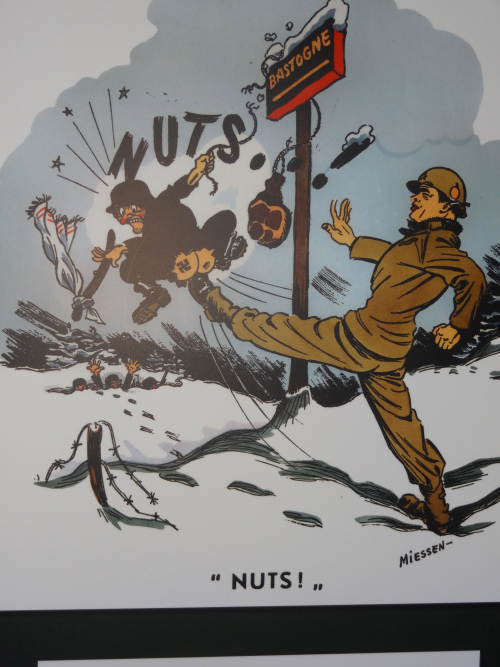
McAuliffe’s response has become one of the immortal responses to a surrender demand in military history. According to staff members present when he received Lüttwitz’s note he simple said “nuts.” One of his staff officers suggested that he use “nuts” as his official reply to Lüttwitz and the following reply was typed:

To the German Commander

NUTS!

The American Commander

The reply was delivered by the commander of the 327th Glider Infantry Regiment Lieutenant Colonel Joseph Harper and his S-3 Major Alvin Jones. When Harper delivered the message he told the German delegation that in “plain English” it meant “Go to hell.” The scene has been immortalized on film in the movie The Battle of the Bulge

Likewise it is also depicted in the mini-series Band of Brothers. 

And in the 1949 film Battleground 

dsc00072a

The garrison held out until it was relieved on December 26th by the 4th Armored Division of General George Patton’s 3rd Army.  Despite that the situation remained tenuous and the town was the scene of much hard fighting over the next two weeks.

1901879_10153009725477994_814138470181390794_n

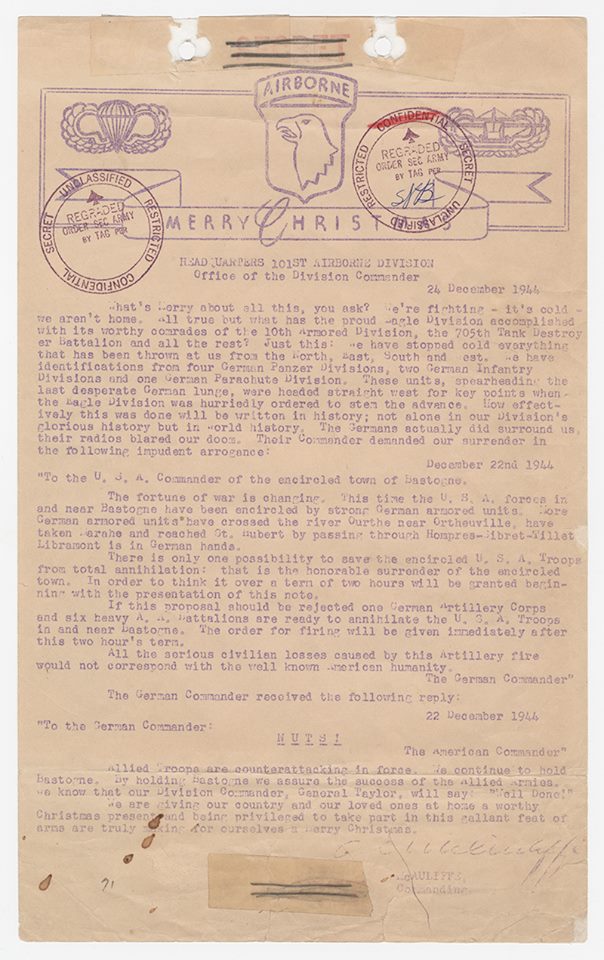
McAuliffe’s Christmas Message to his Soldiers

McAuliffe went on to command the 103rd Infantry Division by the end of the war.  He returned to Europe as Commander of 7th Army in 1953 and U.S. Army Europe in 1955. He retired in 1956 with the rank of General.  He died in 1975 at the age of 77. His adversary Von Lüttwitz died at the age of 72 in 1969.

As we remain engaged in the current war it is always worth our time to remember the heroism, courage and faith of those that served before us.

Peace

Padre Steve+

2 Comments

Filed under film, History, leadership, Military, movies, us army, US Army Air Corps, world war two in europe

I Hate Being Right: My Words from 13 December 2019 about 2020


Friends of Padre Steve’s World,

I wrote this on 13 December 2019. It was my prediction for 2020. Damn, I hate being right, except that I did not predict the Coronavirus 19 Pandemic. Apart from that it’s pretty damned accurate. I only wish I was good at picking lottery numbers. So here it is again with no edits.

Peace,

Padre Steve+

It is not even Christmas and I am beginning to write about the coming year. This was provoked in part by a discussion I had with a dear friend, who also happens to be an Evangelical Christian Trump Cultist. I attempted to talk of basic middle of the road stuff and be honest about history, especially because I was a Republican for 32 years, until I returned from Iraq in 2008 and realized that we had been lied into a war that would have fit three of the four charges leveled against the Nazi War Criminals at Nuremberg.

But there was no convincing my friend of anything, even when attempting to bridge the divide using facts. To him Trump is the greatest President ever, and Obama, the worst. Of course I live in one of the “reddest” areas of Virginia and while I have quite a few liberal or progressive friends here, quite a few of the people who are also long time friends have transformed themselves from traditional conservatives who could be reasoned with to part of the Trump Cult. Such was the case with this person, every response he gave came straight from a Trump tweet, or something off of Fox News, or Rush Limbaugh. But I digress, my friend is not a bad person, he has

Abraham Lincoln noted:

“The best thing about the future is that it comes one day at a time.”

It is good to remember Lincoln’s words in times of turmoil. I do, and they bring me great motivation to work, believe, and fight for justice, truth, and the belief in a spark of goodness in humanity which enables me to believe the words of the Declaration of Independence:

“We hold these truths to be self-evident, that that all men are created equal, that they are endowed by their Creator with certain unalienable Rights, that among these are Life, Liberty and the pursuit of Happiness.”

The fact that those words come from a time of tumult, yet in a time where men were beginning to wrestle with and proclaim principles of the Enlightenment matters much to me, especially in times like we live today, where that principle is being attacked and undermined by the American President.

That being said, I believe that 2019 will be remembered in history as a time great turmoil, upheaval, and probably usher in a new epoch of war, economic, and ecological disaster. We are ending the year with the impeachment proceedings against President Trump, and threats of violence and civil war from his supporters if he is removed from office or loses the 2020 election.

I don’t want to sound like a pessimist, but as a historian I to look at the world through how human beings, governments, and businesses behave in times of crisis. In fact, human beings are the singular constant in history and in crisis human beings don’t always live up to our ideals.

When major powers and international systems of order break down, or collapse for whatever reason, instability, disorder, and primordial hatreds based on nationalism, religion, and racism rise. A vacuum is created, filled by other powers, but not without some element of travail. Edmond Taylor wrote in his classic “The Fall of the Dynasties: The Collapse of the Order, 1905-1922:

“The collapse of the great supranational — or at least supraparochial — authorities and the dissolution of long-accepted Imperial bonds released upon Europe a fearsome flood of conflicting national ambitions, of inflamed minority particularisms, of historic (sometimes almost prehistoric) irredentisms, of irreconcilable social aspirations and of rival political fanaticisms.

The impending collapse of the old order today can be seen in a return to a more isolationist policy by the United States, rising populist, nationalist, and ethnocentric movements in Europe which are threatening the existence of the European Union. Those include Brexit, ethnic nationalism mixed with a bit of Fascism in Hungary, Italy, Poland, and great strains in France and Germany between right and left wing populist movements, but no one has found a way to deal with these Right Wing  populist movements.

The common thread is the center which was the key to so much social progress, democracy, economic growth and stability, scientific advancement, and international security is giving way. In fact it has pretty much disappeared, There are many reasons for this, on the American side going back to the imperialist overreach of the George W. Bush administration, the inconsistent and detached method of the Obama administration towards the Middle East, especially Syria and Iraq, following that, the overtly populist, authoritarian, and isolationist policies of the Trump presidency, and his decidedly inconsistent, often irresponsible, and irreconcilable policies of isolationism on one hand, and militarism on the other.

Now a rejuvenated Russia is rushing to fill the void in the Middle East as well as working to destabilize its neighbors, Europe, and even the United States. The Chinese are attempting to make gains in other areas and to drive the United States out of Asia by using every element of national power: diplomacy, information, military might, and economics, while the United States following the Trump Administration’s withdraw from the Trans Pacific Partnership, and subsequent punishing tariffs that are hurting allies and Americans more than China the United States is now at a decided disadvantage in Asia.

I could go on, and could go into details on the causes of the current situation but they are many. What we are seeing now is the beginning of the collapse of an order that we have known most of our lives. While many people might be uneasy, most don’t view things in terms of history, in many cases because the events that led to the establishment of the current order are too distant and the witnesses to those times are few, and dying off. People today seldom study history, and even worse no longer know people, including family members who remember what happened to remind them of it.

That was quite similar to the situation in 1914. Europe had been at relative peace for a century. With the exception of the French Republic, most of Europe was still ruled by monarchies with rather limited democratic participation, if any. Barbara Tuchman wrote in her book The Proud Tower: A Portrait Of the World Before the War, 1890-1914:

“The proud tower built up through the great age of European civilization was an edifice of grandeur and passion, of riches and beauty and dark cellars. Its inhabitants lived, as compared to a later time, with more self-reliance, more confidence, more hope; greater magnificence, extravagance and elegance; more careless ease, more gaiety, more pleasure in each other’s company and conversation, more injustice and hypocrisy, more misery and want, more sentiment including false sentiment, less sufferance of mediocrity, more dignity in work, more delight in nature, more zest. The Old World had much that has since been lost, whatever may have been gained. Looking back on it from 1915, Emile Verhaeren, the Belgian Socialist poet, dedicated his pages, “With emotion, to the man I used to be.”

I believe that 2020 will the a year of multiple crises and the further erosion, if not collapse of the old order, regardless of what happens with impeachment. What will come I do not know, but I expect that at the minimum it will be unsettling and disruptive, if not catastrophic. That doesn’t mean that I am a pessimist, it means that I study history. Provided that humanity does not find a way to destroy itself, we will recover. It may not be pretty and it certainly will not be the same as it was, but we will recover.

Walter Lord wrote about this his book on American in the early Twentieth Century The Good Years: 1900-1914. In the book he wrote about how things changed for Americans as Europe plunged into war. The effects of the war were soon felt in the United States though it would not enter the war until 1917. Lord wrote:

Economics were only part of the story. Almost overnight, Americans lost a happy, easygoing, confident way of looking at things. Gone was the bright lilt of “When You Wore a Tulip”; already it was the sadly nostalgic, “There’s a Long, Long Trail a-Winding,” or the grimly suggestive, “I Didn’t Raise My Boy to Be a Soldier.” A mounting crescendo of screaming headlines… atrocity stories… U-boat sinkings… charges and counter-charges shocked the nation, jarred its faith, left a residue of doubt and dismay.

Nothing seemed simple any more. Nothing was black and white. Nothing was “right” or “wrong,” the way Theodore Roosevelt used to describe things. And as the simple problems vanished, so did the simple solutions. Trust-busting, direct primaries, arbitration treaties and all the rest. They somehow lost their glamour as exciting panaceas, and nothing took their place. But the problems grew and grew —preparedness… taxes… war… Bolshevism… disillusionment… depression… Fascism… Moscow… fallout… space… more taxes.

So the old life slipped away, never to return again, and wise men sensed it almost at once. Men like Henry White, the immensely urbane diplomat who had served the country so well. “He instinctively felt,” according to his biographer Allan Nevins, “that his world —the world of constant travel, cosmopolitan intercourse, secure comfort and culture —would never be the same again.” The Philadelphia North American felt the same way, but in blunter words: “What does this mean but that our boasted civilization has broken down?”

Perhaps it was just as well. There was much that was wrong with this old way of living —its injustices, its naivete, its waste, its smug self-assurance. Men would come along to fix all that. New laws, controls, regulations, forms filled out in triplicate would keep anybody from getting too much or too little. And swarms of consultants, researchers, special assistants, and executive committees would make sure that great men always said and did the right thing.

There would be great gains. But after all the gains had been counted, it would turn out that something was also lost —a touch of optimism, confidence, exuberance, and hope. The spirit of an era can’t be blocked out and measured, but it is there nonetheless. And in these brief, buoyant years it was a spark that somehow gave extra promise to life. By the light of this spark, men and women saw themselves as heroes shaping the world, rather than victims struggling through it.

Actually, this was nothing unique. People had seen the spark before, would surely do so again. For it can never die as long as men breathe. But sometimes it burns low, leaving men uncertain in the shadows; other times it glows bright, catching the eye with breath-taking visions of the future.

The truth is, even in the midst of crises that the spark that enables people to believe, to hope, and to labor for a better future where the possibilities of peace, justice, freedom, and progress can be realized.

2019 was a very difficult year, a year of change and turbulence, and truthfully it will probably be just the beginning; but unless we find a way to destroy ourselves before the end of the year, it will not be the end, and 2020 may be one of the most important, yet tumultuous years in human history, and I cannot say if it will end well, for the United States, or the world.

Peace,

Padre Steve+

4 Comments

Filed under authoritarian government, civil rights, civil war, Coronavirus 19 Pandemic, COVID19, Diseases Epidemics and Pandemics, ethics, faith, History, laws and legislation, leadership, national security, natural disasters, News and current events, Political Commentary

A Christmas Coda: Joyeux Noel and My Call after the Military

palmer

Friends of Padre Steve’s World

As a veteran who served in the badlands of Al Anbar Province during Christmas of 2007 I can relate to Father Palmer, the British priest and chaplain in the film Joyeux Noel (Merry Christmas) when he makes the comment “I belong with those who are in pain, and who have lost their faith, I belong here.”

I again watched that film tonight. The film is the story of the amazing and exceptional Christmas Truce of 1914. It is a film that each time I see it that I discover something new, more powerful than the last time I viewed it. It reminds me of serving in Iraq, at Christmas from my perspective as a Chaplain, and thereby giving voice to those who serve now, as well as those who served God’s people in hellish places before me. It reminds me of how much I hate war, and how much I often hate the clergy who are all too often, bloodthirsty


As a Chaplain I am drawn to the actions of the British Padre in the film, who during the truce conducts a Mass for all the soldiers, British, French and German in no-man’s land, who goes about caring for the soldiers both the living and the dead. His actions are contrasted with his Bishop who comes to relieve him of his duties and to urge on the replacement soldiers to better kill the Germans.

As the Chaplain begins to provide the last Rites to a dying soldier the Bishop walks in, in full purple cassock frock coat and hat and the chaplain looks up and kisses his ring.

As the chaplain looks at his clerical superior there is a silence and the Bishop looks sternly at the priest and addresses him:

“You’re being sent back to your parish in Scotland. I’ve brought you your marching orders.”

Stunned the Priest replies: “I belong with those who are in pain, and who have lost their faith, I belong here.”

The Bishop then sternly lectures the Priest: “I am very disappointed you know. When you requested permission to accompany the recruits from your parish I personally vouched for you. But then when I heard what happened I prayed for you.”

The Priest humbly and respectfully yet with conviction responds to his superior: “I sincerely believe that our Lord Jesus Christ guided me in what was the most important Mass of my life. I tried to be true to his trust and carry his message to all, whoever they may be.”

The Bishop seems a bit taken aback but then blames the Chaplain for what will next happen to the Soldiers that he has served with in the trenches: “Those men who listened to you on Christmas Eve will very soon bitterly regret it; because in a few days time their regiment is to be disbanded by the order of His Majesty the King. Where will those poor boys end up on the front line now? And what will their families think?”

They are interrupted when a soldier walks in to let the Bishop know that the new soldiers are ready for his sermon. After acknowledging the messenger the Bishop continues: “They’re waiting for me to preach a sermon to those who are replacing those who went astray with you.” He gets ready to depart and continues: “May our Lord Jesus Christ guide your steps back to the straight and narrow path.”

The Priest looks at him and asks: “Is that truly the path of our Lord?”

The Bishop looks at the Priest and asks what I think is the most troubling question: “You’re not asking the right question. Think on this: are you really suitable to remain with us in the house of Our Lord?”

With that the Bishop leaves and goes on to preach. The words of the sermon are from a 1915 sermon preached by an Anglican Bishop in Westminster Abbey. They reflect the poisonous aspects of many religious leaders on all sides of the Great War, but also many religious leaders of various faiths even today, sadly I have to say Christian leaders are among the worst when it comes to inciting violence against those that they perceive as enemies of the Church, their nation or in some cases their political faction within this country.

I was reminded of that last night and today as the now Impeached President called upon and received the fealty and obedience of his Imperial Court Clergy, and the ever faithful cult of conservative and Evangelical Christians while pledging to destroy his enemies. In such a time I cannot

The Bishop who relieved Father Palmer went on to preach a sermon to newly arrived troops.

“Christ our Lord said, “Think not that I come to bring peace on earth. I come not to bring peace, but a sword.” The Gospel according to St. Matthew. Well, my brethren, the sword of the Lord is in your hands. You are the very defenders of civilization itself. The forces of good against the forces of evil. For this war is indeed a crusade! A holy war to save the freedom of the world. In truth I tell you: the Germans do not act like us, neither do they think like us, for they are not, like us, children of God. Are those who shell cities populated only by civilians the children of God? Are those who advanced armed hiding behind women and children the children of God? With God’s help, you must kill the Germans, good or bad, young or old. Kill every one of them so that it won’t have to be done again.”

The sermon is chilling and had it not been edited by the director would have contained the remark actually said by the real Bishop that the Germans “crucified babies on Christmas.” Of course that was typical of the propaganda of the time and similar to things that religious leaders of all faiths use to demonize their opponents and stir up violence in the name of their God.

When the Bishop leaves the Priest finishes his ministration to the wounded while listening to the words of the Bishop who is preaching not far away in the trenches. He meditates upon his simple cross, takes it off, kisses it hand hangs it upon a tripod where a container of water hangs.

The scene is chilling for a number of reasons. First is the obvious, the actions of a religious leader to denigrate the efforts of some to bring the Gospel of Peace into the abyss of Hell of earth and then to incite others to violence dehumanizing the enemy forces. The second and possibly even more troubling is to suggest that those who do not support dehumanizing and exterminating the enemy are not suitable to remain in the house of the Lord. Since I have had people, some in person and others on social media say similar things to what the Bishop asks Palmer the scene hits close to home.

When I left Iraq in February 2008 I felt that I was abandoning those committed to my spiritual care, but my time was up. Because of it I missed going with some of my advisors to Basra with the 1st Iraqi Division to retake that city from insurgents. It was only a bit over a month after I had celebrated what I consider to be my most important Masses of my life at COP South and COP North on December 23rd as well as Christmas Eve and Christmas Day. In fact until very recently they were really the last masses that I felt the mystery and awe of the love of God that I used to so much feel.

When I left Iraq the new incoming senior Chaplain refused to take my replacement leaving our advisers without dedicated support. He then slandered me behind my back because what I was doing was not how he would do things and because I and my relief were under someone else’s operational control. It is funny how word gets back to you when people talk behind your back. Thankfully he is now retired from the Navy and I feel for any ministers of his denomination under his “spiritual” care. So I cannot forget those days and every time I think about them, especially around Christmas I am somewhat melancholy and why I can relate so much to Father Palmer in the movie. While I cannot prove it I do believe, and have heard from others who used to work at the Chief of Chaplains office that I have been shunned and punished by past and present leaders of the Chaplain Corps because of my witness in being open about my struggles with faith and PTSD. A can recount a number of incidents that would be of circumstantial evidence, but I digress. That being said I am much better off for that experience than I would be had it not occurred.

It has been thirteen years since those Christmas Masses and they still feel like yesterday. In the intervening years my life has been different. Just a year later I was walking home from church where my wife was to sing in the choir during the Christmas vigil mass. I couldn’t handle the crowds, the noise, and I felt so far away from God. That night I walked home in the dark looking up into the sky asking God if he still was there. If there had been a bar on the way home I would have stopped by and poured myself in.

Since Iraq I have dealt with severe and chronic PTSD, depression, anxiety and insomnia were coupled with a two year period where due to my struggles I lost faith, was for all practical purposes an agnostic. I felt abandoned by God, but even more so and maybe more importantly by my former church and most other Chaplains. It was like being radioactive, there was and is a stigma for Chaplains that admits to PTSD and go through a faith crisis, especially from other Chaplains and Clergy. It was just before Christmas in late 2009 that faith began to return in what I call my Christmas Miracle. But be sure, let no one tell you differently, no Soldier, Sailor, Marine or Airman who has suffered the trauma of war and admitted to PTSD does not feel the stigma that goes with it, and sadly, despite the best efforts of many there is a stigma.

Now that faith is different and I have become much more skeptical of the motivations of religious leaders, especially those that demonize and dehumanize those that do not believe like them or fully support their cause or agenda. Unfortunately there are far too many men and women who will use religion to do that, far too many. Unlike a few years ago they now occupy the seat of political power as sycophants of our soon to be ex-President, offering no prophetic voice but speaking the words of death covered in the veneer of the Christian faith.

As for me I had the floor kicked from out from under me in the summer of 2014 and it has been a hard fight and while I am beginning to get back to some sense of normal it is a day to day thing. I still suffer the effects of the PTSD, especially the insomnia, nightmares and the nightmares which came back with a vengeance that summer. I have a REM sleep disorder in which my body doesn’t shut down when I get into REM sleep. This reacts well with the Nightmare and Night Terror disorders because I act out my responses to those terrors. In 2014 I ended up with a visit to the medical clinic with a concussion and sprained jaw and neck. In 2016 I broke my nose, and dark and early this morning I busted my head open  requiring 9 stitches, 2 deep ones and 7 on top. Thankfully Judy got my stubborn ass to the ER. Coupled with my other ongoing maladies of the past couple of months I am really getting too old for this shit.

As for faith, I do believe again, more often than not, though at the same time I doubt. Though I believe I think I still consider myself to be a Christian Agnostic who echoes the cry of the man who cried out to Jesus, “Lord I believe, help my unbelief!” I believe and yet, I don’t and I don’t think that is a bad thing, I think it helps me understand those who no longer believe, those that struggle, and those who raised as Christians have left the faith.

Like the Priest in Joyeux Noel I know that my place is with those who are “in pain, and who have lost their faith.” For me this may no longer be on the battlefield as I will be retired, unless some massive war breaks out and they start calling back recent retirees to service. That has happened before and the Soviets, Chicoms and Iranians aren’t taking time off for Christmas.

However, that being said I will strive to be there for those that struggle with faith and believe, especially those who struggle because of what they saw and experienced during war and when they returned home. Three years ago I hosted the NATO contingent at my former chapel, and had the honor of preaching an Advent message in German.

533506_10151366982457059_868388211_n

Over the last year of my service I continued speak truth to those in power and those whose faithfulness is more a product of their comfort with the God that they create in their own mind rather than the Crucified God wise death on the Cross s a scandal. For many Christians the scandal of the cross is too easy to avoid by surrounding ourselves with pet theologies that appeal to our pride, prejudice and power. The kind of malevolent power represented by the bishop in Joyeux Noel as well as the leaders of the so called “Conservative Evangelicals” who supported a President who says “Merry Christmas” even as he continues to defecate on all who believe in the God who became incarnate as a helpless babe in a manger and who died on a cross.  Last year I saw a mocking meme of Trump saying “Merry Christmas” as he holds a bigger than life Bible to his chest from a very conservative evangelical friend on Facebook, it was blasphemous. Those people remind me of the hate filled nationalist British Bishop.

The French mystic Simone Weil said “He who has not God in himself cannot feel His absence.” I think that sums up the President and his ardent Evangelical supporters. I don’t think they would recognize Christ if he walked among them and would have been among those shouting “Crucify him!” but of course I could be wrong in some individual cases.

So, this Christmas, like the theologian Paul Tillich I have come to believe  that “Sometimes I think it is my mission to bring faith to the faithless, and doubt to the faithful.”  In other words I am going to be faithful to the Crucified Christ and remain a complete pain in the ass to them until the day that I die, a real Padre Smedley if you get my drift.

Once again I watched Joyeux Noel, and as usual I cried. Though I had my retirement ceremony Monday, and am officially retired on 31 December and I am praying for peace in hopes that someday it becomes real. St. Francis prayed:

Lord, make me an instrument of Your peace;
Where there is hated, let me sow love;
Where there is injury, pardon;
Where there is discord, harmony;
Where there is error, truth;
Where there is doubt, faith;
Where there is despair, hope;
Where there is darkness, light;
And where there is sadness, joy.
O Divine Master, Grant that I may no so much seek
To be consoled as to console;
To be understood as to understand;

To be loved as to love.
For it is in giving that we receive;
It is in pardoning that we are pardoned;
And it is in dying hat we are born into eternal life. 

After all, I still belong with those who are in pain, and who have lost their faith, whether I am in the Navy or not.

So until tomorrow,

Praying for Peace this Christmas,

Padre Steve+

7 Comments

Filed under christian life, faith, film, History, Military, ministry, movies, Pastoral Care, Political Commentary, PTSD, Religion, spirituality, Tour in Iraq, US Navy, world war one

“Fighting…reached a degree of savagery unprecedented on the western front.“ The Battle of the Bulge 76 Years Later

battle-bulge

Friend’s of Padre Steve’s World,

Well shit fire and save the matches. I’m reposting an old article because I have yet another tooth a ticking like it wants to relocate from my mouth to the infernal regions of a medical waste bin. I think that I have mentioned what I have been dealing with over the past two months with my teeth and infections that spread throughout my face and today I had two appointments to deal with some of those and set up an MRI a consult with a Nose surgeon and tomorrow to go over CT results that might link another tooth to those infections, but I digress…

Wednesday marked the 76th anniversary of the beginning of the German offensive known as Wacht am Rhein, but better known as the Ardennes Offensive or it’s popular name The Battle of the Bulge. The battle was for all intents and purposes a suicide mission for the remnants of the German Wehrmacht, Waffen SS, and Luftwaffe Paratroop divisions.

It is hard to believe that the youngest surviving veterans of this battle are 94-95 years old. I’m 60 and been in the military over 39 years. I have been to combat but not like they went through. Now back in December and January of 1984 and 1985 when I was a Medical Service Corps officer serving as the Executive Officer, platoon leader and Motor Maintenance officer of an Ambulance Company in Winter REFORGER 1984-85. That happened to be the coldest Winter Europe had since the Battle of the Bulge. In that weather I would have hated to be in real combat, with all that went wrong and all the insanity of that exercise it would have been far worse in intensive ground combat against a desperate enemy.

The offensive was the brainchild of Adolf Hitler, who over the objections of many military leaders, who wanted to conserve their last remaining Panzer and infantry reserves for holding back the final Soviet attack in the East, while preserving just enough strength to hold the West Wall defenses, while preserving fuel reserves to counter Allied incursions into the heart of the Reich. It was an all or nothing gamble by the German dictator, who had succeeded in many of his military gambles earlier in the war. However, now desperately trying to change the course of the war, he threw his best forces into a battle with almost no chance of success; but such is how despots in dire situations react. They become even more desperate to win.

We have seen how desperately a President with delusions of being a Dictator and his Cult act in the face of actual defeat, truthfully, not much differently than any other Dictator. For such people only their power, even at the expense of their followers matters more, but I digress…

So until tomorrow, and hopefully less pain.

Peace,

Padre Steve+

Hitler’s Decision 


Adolf Hitler gathered with the Chiefs of Oberkommando des Wehrmachton September 16th 1944 at his “Wolf’s Lair” headquarters in East Prussia.  The situation was critical; he had recently survived an assassination attempt by Army officers led by Colonel Klaus Von Staufenberg at his Wolf’s Lair headquarters in East Prussia.  When the assassination attempt took place the German situation in Normandy was critical.

The Americans broke out of the Normandy Bocage at St. Lo and spread out across Brittany and the interior of France with Patton’s 3rd Army leading the way.  Even as his commanders in the West pleaded for permission to withdraw to the Seine Hitler forbade withdraw and ordered a counter attack at Mortain to try to close the gap in the German line and isolate American forces. When the German offensive failed the German front collapsed. 40,000 troops, hundreds of tanks and thousands of vehicles were eliminated when the Americans and Canadians closed the Falaise pocket.

Despite this cadres of decimated divisions including SS Panzer, Army Panzer and elite Paratroops made their way out of Normandy.  With the Germans in full retreat the Allies advanced to the border of the Reich itself. On the Eastern Front as well disaster threatened when the Red Army launched an Operation Bagration which annihilated the German Army Group Center, wiping out over 300,000 German troops. The Red Army advanced to the border of Poland before outrunning supply lines and stalling on the Vistula River just shy of Warsaw.

Tiger II Advancing in the Ardennes

Since Normandy Hitler had wanted to counter attack but had neither the forces nor the opportunity to strike the Allied armies. As the Allied offensive ground to a halt due to combat losses, lack of supplies and stiffening German resistance Hitler maintained a close eye on the situation in the West.  He believed that despite their success that the Americans and British alliance was weak and that a decisive blow could cause one or both to drop out of the war. During a briefing an officer noted the events of the day on the Western Front including a minor counterattack by kampfgrüppen of the 2nd SS Panzer and the 2nd Panzer Divisions which had made minor gains in the Ardennes, Hitler rose from his seat ““Stop!” He exclaimed. “I have come to a momentous decision. I shall go over to the counterattack….Out of the Ardennes, with the objective Antwerp.””[i]

 Thus began the planning for the last great German offensive of WWII.  Hitler “believed that sufficient damage could be inflicted to fracture the Anglo-American alliance, buy time to strike anew against the Soviets, and allow his swelling arsenal of V-weapons to change the course of the war.”[ii]  It was a course of born of desperation, even admitted by Hitler in his briefings to assembled commanders in the week prior to the offensive, one officer noted his remarks: “Gentlemen, if our breakthrough via Liege to Antwerp is not successful, we will be approaching an end to the war which will be extremely bloody. Time is not working for us, but against us. This is really the last opportunity to turn the war in our favor.”[iii]

US Soldiers manhandling a 57mm Anti-Tank Gun into Position

Despite shortages of men and equipment, continuous Allied assaults and over the objections of General Guderian who argued to reinforce the Eastern Front[iv], the OKW staff secretly developed detailed plans. The planning was so secretive that the “Commander in Chief West and the other senior commanders destined to carry out the attack were not informed.”[v] The plans were submitted to Hitler on October 9th [vi] and presented to Field Marshalls Von Rundstedt and Model at the End of October. General Hasso Von Manteuffel, commander of 5th Panzer Army commented that: “The plan for the Ardennes offensive…drawn up completely by O.K.W. and sent to us as a cut and dried “Führer order.”[vii]  Likewise Model and Von Rundstedt objected to the scope of the attack. Von Rundstedt stated: “I was staggered…It was obvious to me that the available forces were way too small for such an extremely ambitious plan. Model took the same view of it as I did….”[viii]  Model, who is sometime referred to as “Hitler’s Field Marshall”, reportedly said to General Hans Krebs: “This plan hasn’t got a damned leg to stand on.”[ix] And “you can tell your Führer from me, that Model won’t have any part of it.”[x] Sepp Dietrich, the old SS fighter and commander of 6th Panzer Army expressed similar sentiments.[xi]  Despite the objections by so many senior commanders Hitler scorned Model’s attempt to float a less ambitious plan to reduce the Allied salient at Aachen. Likewise Von Rundstedt’s desire to remain of the defense and wait for the Allies to attack using the armored forces to launch against any breakthrough was rejected.[xii] Hitler’s mind was set and the preparations moved forward.  The plan was complete down to the timing of the artillery bombardment and axes of advance, and “endorsed in the Führer’s own handwriting “not to be altered.””[xiii] Such a plan flew in the face of the well established doctrine of the Auftragstaktik which gave commanders at all levels the freedom of action to develop the battle as the situation allowed and opportunities arose.
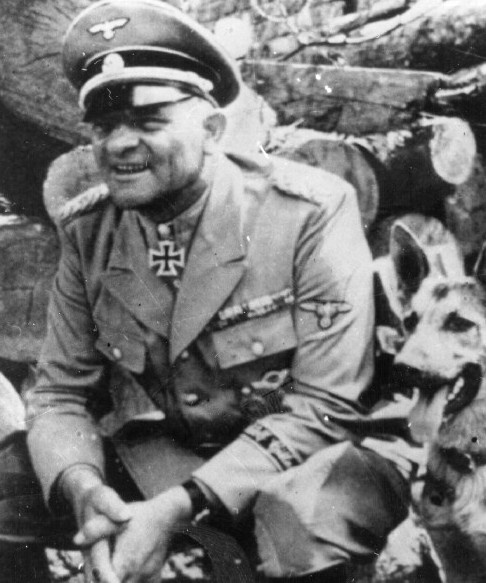
SS General Sepp Dietrich Commander of the 6th SS Panzer Army

The Allies also made mistakes in calculating German capabilities because of their success after Normandy. The Germans who the Allies presumed to be at the brink of collapse made a miraculous  recovery following their ghastly losses in Normandy. Kampfgrüppen and remnants of divisions bled the Americans at the Huertgen Forrest and blunted the British attempt to leapfrog the Northern Rhine at Arnhem decimated the British First Airborne division and causing heavy casualties among other British and American units during Operation Market Garden.

The German 15th Army avoided disaster when the British failed to close their escape route from Walchern island allowing 60,000 troops and much equipment to escape.  The Germans we’re able reform, reorganize, and stabilize the front by October. They pulled back many units of the 5th and 6th Panzer Armies for re-fitting and diverted nearly all tank, armored fighting vehicle and artillery production to the West at the expense of the Eastern Front.

The Germans called up 17 year olds and transferred young fit personnel from the Navy and Luftwaffe to the Army and Waffen SS.  Here they were trained by experienced NCOs and officers and brought into veteran units alongside hardened veterans who showed taught them the lessons of 5 years of war.[xiv]  However the rapid influx of new personnel meant that they could not be assimilated as quickly as needed and thus many were not as well trained as they might have been with more time.[xv] Many infantry and Parachute units had received inexperienced officers, taken from garrison duty, simply because so many experienced officers were dead, to fill key positions a problem that would show up frequently during the offensive.[xvi]

Panzer IV Ausf H of an SS Panzer Divsion in the Bulge

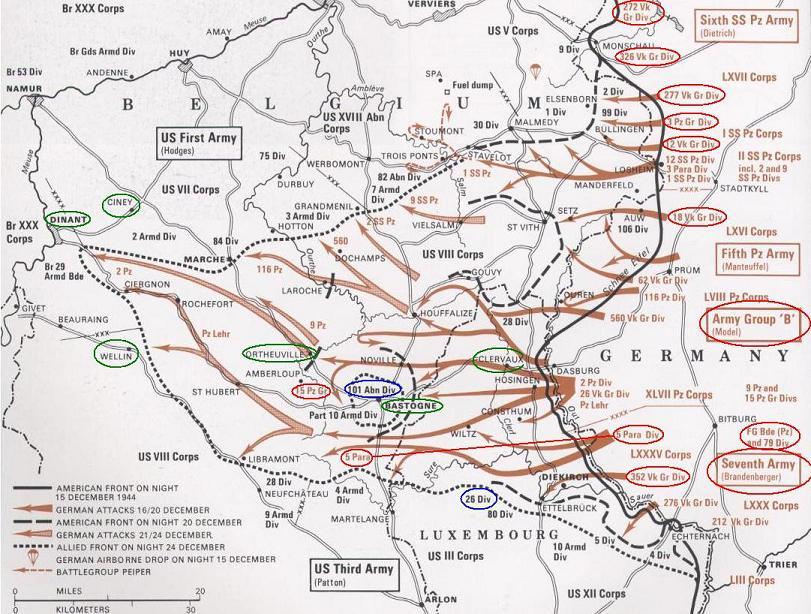
 The Germans were aided by the caution displayed by the Allies throughout the campaign in France which allowed the Germans to reconstitute formations around veteran headquarters staffs.[xvii]  The Germans built up the 5th and 6thPanzer Armies as the Schwerpunkt of the offensive giving them the lion’s share of reinforcements and pulling them out of the line during the fall battles along the Seigfried line and in the Alsace and Lorraine.  The plan was for the two Panzer armies and 7th Army to punch through the Ardennes, cross the Meuse, drive across Belgium, capture Antwerp and severe the link between the British and the Americans.

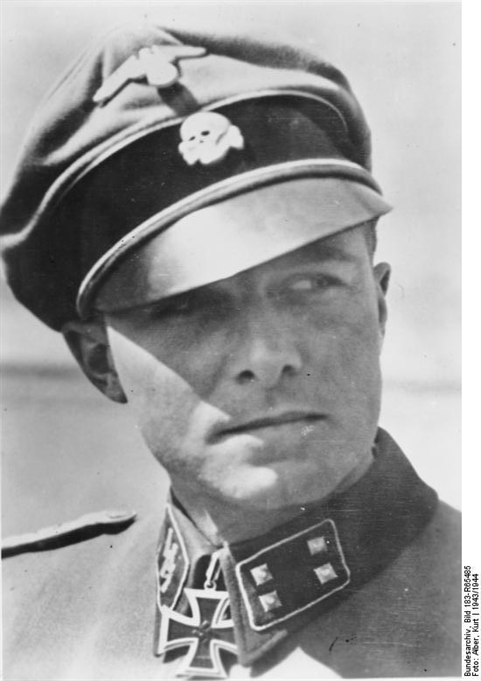
The spearhead of the assault was 6th Panzer Army Commanded by SS General Sepp Dietrich. It was composed of 1st and 2nd SS Panzer Corps and Army’s LXVII Corps.  The 6th SS Panzer Army included some of the best formations available to the German Army at this late stage of the war including the 1st  SS Panzer Division, the Leibstandarte Adolf Hitler, the 2nd  SS Panzer Division Das Reich, the 9th SS Panzer Division Hohenstaufen and the12th  SS Panzer Division Hitler Jügend. It’s ranks were filled out by the 3rd Parachute Division, the 501st SS Heavy Tank Battalion (attached to 1st SS), the 3rd Panzer Grenadier Division and the 12th, 246th, 272nd, 277th and 326th Volksgrenadier or Infantry divisions. The 6th Panzer Army would be the northern thrust of the offensive and its ultimate objective was Antwerp.  The 6th Panzer Army would be aided by a hastily organized parachute battalion under Colonel Von Der Heydte[xviii] and the 150th Panzer Brigade under SS Colonel Otto Skorzeny which included teams of American dialect speaking soldiers in American uniforms and equipment that were to spread confusion and panic in American rear areas.[xix]

Bradley, Eisenhower and Patton at Bastogne

 To the south was the 5th Panzer Army commanded by General Hasso Von Manteuffel.  The 5th Panzer Army was to advance alongside of the 6th Panzer Army with Brussels as its objective.  Composed of the XLVII and LVIII Panzer Corps and LXVI Corps the major subordinate commands included the best of the Army Panzer divisions including the 2nd Panzer, Panzer Lehr, 9th and the16thPanzer division. It also had the elite Führer Begleit Brigade composed of troops from Panzer Corps Grossdeutschland and commanded by Otto Remer who had help crush the coup against Hitler in July.  The 5th Panzer Army also included the 18th, 26th, 62nd, 560th and later the 167th Volksgrenadier divisions.

The south flank was guarded by 7th Army commanded by General Erich Brandenburger composed of LIII, LXXX and LXXXV Corps.  It included the Führer Grenadier Brigade and later the 15th Panzergrenadier division.  It was the weakest of the three armies but eventually included 6Volksgrenadierdivisions of varying quality and strength[xx] and the veteran 5th Parachute division.[xxi]  However with only 4 divisions at the start of the offensive the 7th Army was the equivalent of a reinforced corps.

While this force seemed formidable it had a number of weaknesses beginning with tank strength.  The 1st and 12th SS Panzer divisions were only at approximately half their established tank strengths and faced severe shortages in other vehicles.[xxii]  2nd SS and 9th SS of II SS Panzer Corps reported similar shortages.[xxiii]The shortage of other motorized vehicles, even in Panzer divisions was acute.  “Even the best equipped divisions had no more than 80 percent of the vehicles called for under their tables of equipment, and one Panzergrenadier division had sixty different types of motor vehicles, a logistician’s nightmare”.[xxiv] Panzer Lehr was so short in armored half tracks that only one battalion of its Panzer Grenadiers could be transported in them while others had to use “trucks or bicycles.”[xxv]

Limitations on equipment as well as fuel were not the only challenges that the Germans faced. The US V Corps launched an attack on the Roer River Dams just before the offensive making it necessary for the Germans to divert some of the  6th SS Panzer Army’s infantry divisions and Jagdpanzer units to be used by 6th SS Panzer Army away from the offensive.  One regiment of 3rd Parachute Division and over half of a second division could not take part in the initial 6th Panzer Army attack. Likewise some Jagdpanzer and Sturmgeschutzen units did not arrive until three days after the offensive began.[xxvi]

Allied Response: Before the Battle

While the German commanders sought to implement Hitler’s plan Allied commanders looked only to completing the destruction of Germany not believing the Germans capable of any major operation.  The Allied commanders with the exception of Patton did not believe the Germans capable of any more than local counter attacks.  Patton’s 3rd Army G-2 Colonel Koch was the only intelligence officer to credit the Germans with the ability to attack.[xxvii]  Most allied commanders and intelligence officers discounted the German ability to recover from disastrous losses, something that they should have learned in Holland or learned from the Soviet experiences on the Eastern front.  Bradley noted in his memoirs “I had greatly underestimated the enemy’s offensive capabilities.”[xxviii]  Carlo D’Este noted that “there was another basic reason why the Allies were about to be caught with their pants down: “Everyone at SHAEF was thinking offensively, about what they could do to the enemy, and never about what the enemy might do to them.””[xxix]   This mindset was amazing due to the amount of intelligence from Ultra and reports from frontline units that major German forces were no longer in the line.[xxx] Additionally nearly all commentators note that American units in the Ardennes did not conduct aggressive patrols to keep the enemy off balance and obtain intelligence.[xxxi]  One describes the efforts of 106th Division as “lackadaisical” and notes that enemy before the offensive was not the Germans but the cold.[xxxii] Max Hastings noted that: “the Allies’ failure to anticipate Hitler’s assault was the most notorious intelligence disaster of the war.”[xxxiii]

The Allies also were in the midst of a manpower crisis. Eisenhower did not have enough divisions to establish a clear manpower advantage as “there were not enough Anglo-American divisions, or enough replacements for casualties in the existing divisions.”[xxxiv]  No more American Infantry divisions were available as the Army had been capped at 90 divisions and infantry replacements were in short supply.  This shortage meant that Eisenhower could not pull divisions out of line to rest and refit. He could only transfer divisions such as the 4th and 28thInfantry divisions to the relative quiet of the Ardennes. He had no ability to“create a strategic reserve unless he abandoned the broad front strategy.”[xxxv]The Germans knew of the allied weakness and believed that they could achieve local superiority even if they did not believe they could reach Antwerp. Model believed that “he was sure that he would reach the Meuse in strength before the Americans could move sufficient reserves to halt his armies or even head them off.”[xxxvi]

The German Breakthrough and American Response
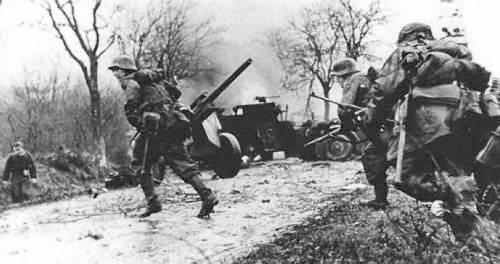
German-Troops-at-the-Battle-of-the-Bulge

The German assault began on December 16th. Some breakthroughs were made especially in the vicinity of the Losheim Gap and the Schnee Eifel by the southern elements of 6th Panzer Army and Manteuffel’s 5th Panzer Army. However the Germans could not break through around Monschau and Elsenborn Ridge held by the inexperienced but well trained 99th Infantry division and elements of the veteran 2nd “Indianhead” Division.  In the far south near Diekirch the 4th Infantry Division held stubbornly against the attacks of 7thArmy’s Volksgrenadiers. The Germans achieved their greatest success at Losheim where SS Colonel Josef Peiper and his 1st SS Panzer Regiment had driven off the US 14th Cavalry Group and penetrated 6 miles into the American front.  5th Panzer Army made several breakthroughs and isolated two regiments of newly arrived 106th Infantry Division in the Schnee Eifel. Manteufel also pressed the 28th Division hard along the Clerf River, Skyline Ridge and Clairvaux.

Yet at ‘no point on that first day did the Germans gain all of their objectives.”[xxxvii]  The credit goes to US units that stubbornly held on, but also to the poor performance of many German infantry units.  German commanders were frustrated by their infantry’s failure even as the panzers broke through the American lines.  Manteuffel noted his infantry was “incapable of carrying out the attack with the necessary violence.”[xxxviii]
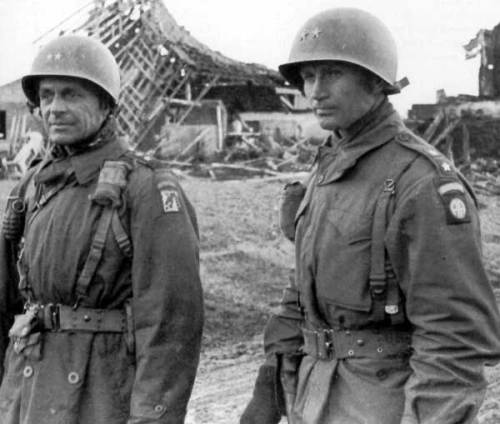
US Airborne Commanders James Gavin (R) and Matthew Ridgeway (L)

 The initial Allied command response to the attack by senior commanders varied.  Bradley believed it was a spoiling attack “to try and force a shift of Patton’s troops from the Saar offensive back to the Ardennes.”[xxxix] Courtney Hodges of 1st Army agreed with Bradley and refused to allow General Gerow, commander of V Corps to call off 2nd Infantry Division’s attack against the Roer dams on the 16th in order to face the German offensive.[xl]  Gerow was one of the first American commanders to recognize the scope of the German attack but Hodges, perhaps the least competent senior American commander in Europe failed to heed Gerow’s advice. Soon after making this decision Hodges “panicked” and evacuated his headquarters at Spa fearing that it would be overrun by the advancing Germans.[xli] Eisenhower when informed of the news realized that something major was occurring and ordered the 7th Armored Division from the 9th Army and 10th Armored Division from 3rd Army into the Ardennes. On the 17th he made other dispositions and released the 82nd and 101stAirborne Divisions from SHAEF reserve at Rheims to the Ardennes under the command of XVIII Airborne Corps.[xlii]  However during this short amount of time Mantueffel’s panzers had advanced 20 miles.

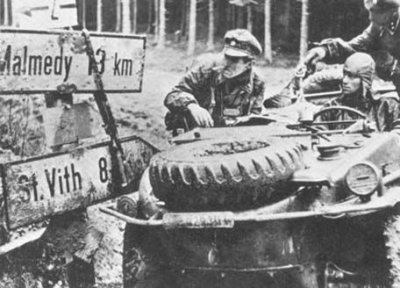
SS Panzer Troops of Kampfgruppe Knittel on the advance.  Photo has often been identified for decades in books and other publications as Waffen-SS Colonel Joachim Peiper the commanding officer of the 1st SS Panzer Regiment and Kampfgruppe Peiper. This has been refuted by recent study.  Peiper is pictured below.
At the command level Eisenhower made a controversial, but correct decsion to divide the command of the Bulge placing on a temporary basis all forces in the northern sector under Montgomery and leaving those to the south under Bradley.  Montgomery according to one commentary initially “had been astonishingly tactful in handing his American subordinates.”[xliii] However he quickly made himself obnoxious to many American commanders.[xliv]Following the battle Montgomery made the situation worse by claiming to have saved the Americans and giving credit to British units which scarcely engaged during the battle.[xlv]  Eisenhower also ordered Patton to launch a counter-attack along the southern flank of the German advance.  However Patton was already working on such an eventuality and promised to be able to launch a counterattack with three divisions by the 22nd.[xlvi]  Bradley praised Patton highly in his memoirs noting: “Patton’s brilliant shift of 3rd Army from its bridgehead in the Saar to the snow-covered Ardennes front became one of the most astonishing feats of generalship of our campaign in the West.”[xlvii]

The Americans Hold the Shoulders 

  688px-Bulge_stvithroad_1945jan24_375

The 99th Division’s position was precarious, its right flank was subject to being turned and it was suffering severely at the hands of 12 SS Panzer and several Volksgrenadier divisions.  Gerow reinforced the 99th with elements of the 2nd Infantry division even before he had the final authorization to end its attack.  The two divisions stubbornly held Elsenborn Ridge and the villages of Rockerath, Krinkelt and Büllingen. By the 20th the 9th and 1st Infantry divisions arrived to strengthen the defense and lengthen the line to prevent it from being rolled up by the Germans.  The stubborn resistance of the Americans and arrival of reinforcements meant line was proof “against anything Sepp Dietrich might hurl against it”[xlviii]  By the 23rd Dietrich and 6th SS Panzer Army conceded defeat at Elsenborn and “turned its offensive attentions to other sectors.”[xlix]  German commanders like General Priess the commander of 1st SS Panzer Corps believed that terrain and road network in this sector was unfavorable to the German offensive and had proposed moving the attack further south.[l]  The Panzers could not deploy properly and the German infantry was not up to the task of driving the Americans out of their positions before the reinforcements arrived.

In the south the 4th Infantry Division held the line though heavily pressed by Brandenburger’s 7th Army.  The division was reinforced by elements of both 9thand 10th Armored divisions on the 17th and generally held its line along the Sauer River around Echternach “largely because the left flank of the enemy assault lacked the power-and particularly the armor-of the thrust farther north.”[li]

Turning Point: The Destruction of Kampfgruppe Peiper

While V Corps fought the 6th Panzer Army to a standstill, to the south 1stSS Panzer Division led by Kampfgrüppe Peiper split the seam between V Corps and VIII Corps. The Kampfgrüppe moved west leaving a brutal path of destruction in its wake, including massacres of American POWs and Belgian civilians.[lii]  However its advance was marked with difficulty. On the night of the 17th it failed to take Stavelot. After clearing the American defenders from the town after a hard fight on the 19th it failed to capture a major American fuel dump a few miles beyond the town.  When the Germans approached the American commander ordered his troops to pour 124,000 gallons down the road leading to the dump and set it on fire, depriving the Germans of badly needed fuel.[liii]  Combat Engineers from the 291st Engineer Battalion blew a key bridge across the Ambleve at Trois Ponts and another bridge across the Lienne Creek which left the Germans bottled up in the Ambleve River valley.  This bought time for the 30th Infantry Division to set up positions barring Peiper from the Meuse.  The 30th would be joined by Combat Command B of 3rd Armored Division and elements of 82nd Airborne. These units eventually forced Peiper to abandon his equipment and extricate some 800 troops by foot by the 23rd after a hard fight with the Americans who had barred his every effort to break through to the Meuse.

Turning Point: The Crossroads: St Vith & Bastogne
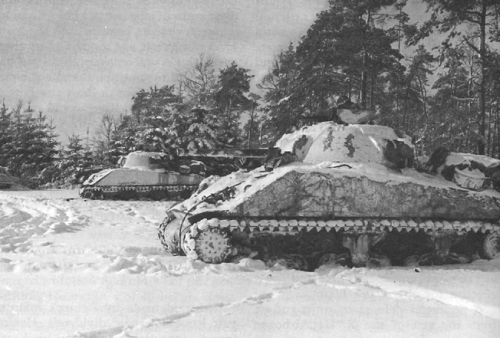
American_7th_Armored_Division_Shermans_taking_up_positions_outside_St._Vith,_1944

The battle rapidly became focused on key roads and junctions, in particular St. Vith in the north and Bastogne in the south.  At St. Vith the 7thArmored Division under General Hasbrouck, who Chester Wilmont calls one of the “great men of the Ardennes”[liv] completed a fifty mile road march from Aachen to St. Vith.  On his arrival he deployed his combat commands around the town which was the key to the road network in the north and also to the only rail line running west through the Ardennes.[lv]  Hasbrouck gathered in Colonel Hoge’s Combat Command B of 9th Armored Division and the 424th Infantry Regiment of the 106th Division into his defensive scheme as well as the survivors of the 112th Infantry Regiment of the 28th Infantry Division which had escaped the German onslaught after holding as long as possible along the Clerf River and Skyline Drive.[lvi]  With these units Hasbrouck conducted “an eight-day stand that was as critical and courageous, as the defense of Bastogne.”[lvii]  After holding the Germans at St. Vith the units were withdrawn to another defensive position along the Salm and Ourthe Rivers and the village of Viesalm.  This was done at the behest of Montgomery and General Ridgeway of XVII Airborne Corps whose 82nd Airborne had moved into that area on the 19th.  The arrival of the 82nd greatly assisted Hasbrouck’s force holding St. Vith whose defenders had lost an estimated 5000 casualties.[lviii]

The stand at St. Vith confined the “confined the Sixth Panzer Army’s penetration to a chokingly narrow corridor.”[lix]  It also posed a problem for German command and control which because it was out of the 6th Panzer Army’s area of operations Dietrich was unable to lend his weight into the fight.  “Hitler himself had strictly prohibited deviations from the zonal boundaries”[lx] which left the fight for St. Vith in the hands of 5th Panzer Army who felt the impact of the stand as the Americans “also choked off one of the Fifth Panzer Army’s best routes to Bastogne, almost nullifying the significance of the captured road junction at Houffalize.”[lxi] 
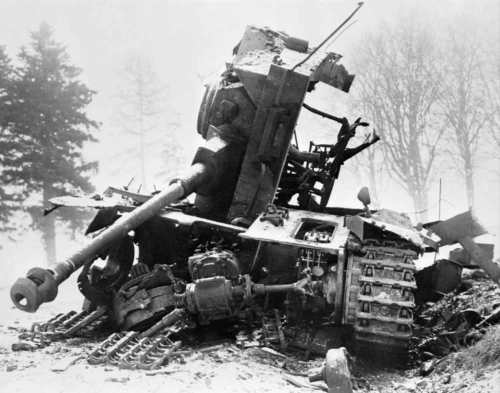
EA-48892

To the south of St. Vith lay Bastogne, another key road junction needed by 5thPanzer Army for its advance.  On the night of the18th Panzer Lehr division came within two miles of the town before being checked by resistance by units of the 10th Armored division, remnants of 28th Division and misdirection by “friendly” Belgian guides onto a muddy path that helped halt their advance.[lxii]  This gave the 101st Airborne just enough time to get to the town and prevent its capture. The siege of Bastogne and its defense by the 101st elements of 9th and 10thArmored Divisions and 28th Division became an epic stand against Manteuffel’s Panzers which had surged around the town.  Wilmont comments that “had the Germans won the race for Bastogne, Manteuffel’s armor would have had a clear run to Dinant and Namur on December 19th and 20th” [lxiii] when there were only scattered American units between them and the Meuse. Manteuffel b bypassed Bastonge after the failure to capture it and masked it with 26thVolksgrenadier Division and a regiment of Panzer Lehr.  The remainder of Panzer Lehr and the 2nd Panzer Division moved to the west. [lxiv]  The garrison endured numerous attacks and on the 22nd one of the most celebrated incidents of the war took place when Brigadier General Anthony McAuliffe responded to a demand for the surrender of the town with the reply; “Nuts.”  The town would continue to hold until relieved by 3rd Army on the afternoon of December 26th.[lxv]

The American Counterattack


The Allied counterattack began with 3rd Army in the south on 21 December.  Patton’s initially proposed to attack toward the base of the Bulge in order to cut off the largest number of Germans possible.  Eisenhower dictated an attack further west with the goal of relieving Bastogne.  Eisenhower wanted to delay the attack to concentrate combat power while Patton wanted to attack sooner in order to ensure surprise. Patton got his way but attacked on a wide front.  The attack lost its impetus and bogged down into a slugging match with 7th Army’s infantry and paratroops along the southern flank. [lxvi]  Patton’s failure to concentrate his forc forces for the advance to the north diminished his combat power.[lxvii] While Patton attacked from the south the 1st Army dealt with the advanced spearhead of 2nd Panzer Division which had reached the town of Celles and ran out of gas just four miles from Dinant and the Meuse. The 84thInfantry Division stopped the 116th Panzer division from being able to effect a relief of the 2nd Panzer the US 2nd Armored Division and allied fighter bombers chopped up the virtually immobile 2nd Panzer division completing that task by the 26th.[lxviii]  

41d233ae6d2744c2cbab2d76cf798341

To the north Montgomery launched a cautious counterattack which slowly and methodically took back lost ground but allowed many Germans to escape. While Montgomery moved south Patton faced heavy German resistance from elements of 5th Panzer Army, reinforced by 1st SS Panzer Corps and 7th Army.  The rupture in the American front was not repaired until 17 January when the American forces met at Houffalize.[lxix] Bradley took over for Montgomery and the Americans pushed the Germans slowly back across the Clerf River by the 23rd.  The advance was hampered by tough German resistance and terrible weather which forced much of the attack to be made by dismounted troops as the roads had completely frozen over.[lxx]

The Allied counter attack has been criticized for allowing too many Germans to escape what could have been a major encirclement.  Patton recognized the incompleteness of the victory in the Ardennes stating: ““We want to catch as many Germans as possible, but he is pulling out.” The “but” clause, the note of regret, the awareness of the imperfection of his victories typified Patton.””[lxxi]  Patton in his memoirs noted: “In making the attack we were wholly ignorant of what was ahead of us, but we were determined to strike through to Bastogne.”[lxxii] Max Hastings simply said: “the Allies were content with success.”[lxxiii]  Murray and Millett place blame on Bradley and Hodges for choosing “merely to drive the enemy out of the Ardennes rather than destroy him.”[lxxiv]

Analysis: Could Wacht Am Rhein Have Worked?

Could Wacht am Rhein worked?  If much was different, yes. Success of the operation depended more on ifs that the Germans could not control, than events they had the power to influence. If the German had been stronger in tanks and vehicles and had adequate stocks of fuel; if their infantry was better trained, and had the Americans not resisted so stubbornly it might have at least got to the Meuse.  Perhaps if the the bad weather held keeping Allied air forces away from the Germans, or had St. Vith and Bastogne been taken by the 18th or 19th, they might have reached the Meuse. Likewise, had the Germans executed their plan and coordinated their assault better[lxxv] in the 6thPanzer Army sector, and had the 7th Army enough strength to conduct offensive operations in depth and secure the left flank the attack might have succeeded. But only revisionists and fiction writers could construct such success.

Because the Americans held the shoulders and road junctions, Manteuffel’s 5thPanzer Army, the only force besides the regimental sized Kampfgrüppe Peiper to actually threaten the Meuse was forced to advance while attempting to take Bastogne and defeat 3rd Army’s counterattack. Whether they could have made Antwerp is another matter.  Nearly all German commanders felt the offensive could not take Antwerp but did believe that they could inflict a defeat on the Allies and destroy a significant amount of allied combat power.

The German offense was a desperate gamble.  Too few divisions, scant supplies of petrol and ammunition, formations that had recently been rebuilt and not given enough time to train to the standard needed for offensive operations coupled with Hitler’s insistence on an unalterable plan kept them from success. It was a part of Hitler’s Cloud Cukoo Land.

At the same time the Allies were so weak in troops and overstretched because of their losses during the Normandy Campaign, Market Garden, and the Huertgen Forrest, Eisenhower had no strategic reserve save the two American Airborne Divisions.  All reinforcements to the threatened sector had to come from the flanks and by the middle of the battle the 9th Army was drawn down to two divisions.

Russell Weigley noted how the constraints imposed by the 90 division Army, and of the limited stocks of artillery ammunition hurt the allies.[lxxvi] If the Germans had more forces they might have inflicted a significant defeat on the Allies had they been able to reinforce their success in depth. Despite this they still inflicted punishing losses on the Americans though suffering greatly themselves.  Hastings noted that the real beneficiaries of the Ardennes offensive were the Russians.[lxxvii]  In the end the conclusion had to be that German success was unlikely and that the offensive could have never achieved Hitler’s goals of taking Antwerp and fracturing the British-American alliance.

A Postscript About other Parts of the Campaign in France

The Riviera and Rhone

The campaign in south France was strategically wise although opposed by the British to the last minute because they felt it would take away from Overlord.[lxxviii] Though delayed the campaign was well executed by 7th Army, particularly Lt. General Lucian Truscott’s VI Corps of 3 American divisions. Truscott believed “destroying the enemy army was the goal”[lxxix] managed the battle well and skillfully maneuvered his small forces against Blaskowitz’s 19thArmy inflicting heavy losses, though some German commanders noted the caution of American infantry in the attack.[lxxx]  Only Blaskowitz’s tactical skills and the weakness of the American force prevented the Germans from disaster. The seizure of Marseilles and Toulon provided the allies with sorely needed ports that were invaluable to sustain the campaign.[lxxxi]

The Lorraine Campaign

Patton attacked in the Lorraine with the goal of crossing the Moselle river and attempting to break into Germany. He doing so he ran into some of the strongest German forces on the front and his troops became bogged down in the poor terrain and mud of the region.[lxxxii]  Patton was convinced that he was delayed in making his assault due to his place “at the far end of the logistics queue.” during Market Garden. [lxxxiii] Despite Patton’s efforts, German forces skillfully defended the ancient fortress of city Metz forcing the Americans into a protracted campaign to clear the area with the last strongpoint surrendering on 13 December.  Patton is criticized for his failure to concentrate his forces[lxxxiv] but American tactics were less to blame than the weather, German resistance and shortages of infantry.[lxxxv] In some cases American infantry units performed admirably, particularly 80th Division’s assault on the Falkenburg Stellung.[lxxxvi]Liddell Hart criticized the Allies for failing to attack through the then weakly defended Ardennes, commenting: “By taking what appeared to be the easier paths into Germany the Allies met greater difficulties.”[lxxxvii]

The Huertgen Forrest

The Huertgen Forrest was the worst managed American fight Western European campaign. [lxxxviii] General Courtney Hodges leadership was poor.[lxxxix] In the Huertgen he fed division after division into a battle that made no strategic sense.  American infantry performed poorly and took extremely heavy casualties leaving four divisions shattered.[xc]  Poor American tactics demonstrated by attacking into a forest in poor weather without concentration negated all of Hodges’ advantages in tanks, artillery and airpower. The forest contained no significant German forces capable of threatening any American advance[xci] and its gain offered little advantage.[xcii] Hastings noted that the gains the only saving grace was that it made it easier for the northern shoulder of the Bulge to hold[xciii]  General Model and his subordinates expertly handled their handful of excellent but weary divisions in this battle using terrain, weather and prepared defensive positions to contest nearly every yard of the Forrest.[xciv]

Conclusions

The lessons of the Bulge and the other campaigns on the German-French border are many and can be gleaned from Allied and German mistakes. On the Allied side the most glaring mistakes were assumptions prior to the German attack that the Germans were incapable of any serious offensive and ignoring the fact that the Germans had attacked through the Ardennes in 1940.  Likewise the self limitation of the American Army to 90 divisions for world-wide service meant that there were no more divisions in the pipeline and that worn out divisions would have to be reinforced with inexperienced troops while in the front line which ensured a lack of cohesiveness in many divisions, especially the infantry.  Allied intelligence failures as well as their reliance of forces much smaller than they should have had for such a campaign ensured that they would suffer heavy losses in the Bulge while poor planning and execution by Hodges wasted many good troops in a senseless battle.  The Germans were hamstrung by Hitler’s fantasy that the Western Allies could be forced out of the war or the Alliance split by a defeat in the Ardennes.  Likewise German forces, even those so quickly reconstituted were often short troops, tanks and vehicles.  German commanders were forced by Hitler’s rigid insistence on not altering the plan to not be as flexible as they might have been in earlier offensives to adjust according to the situation on the ground.

None of these attitudes is exclusive to the Allied and German commanders during the campaign in France and the Battle of the Bulge. They are common throughout history and have been repeated in Vietnam, Iraq, and Afghanistan by the United States military. It would be easy for Americans to believe that in future conflicts we will be victorious when despite our massive military budgets many if not most of our combat forces could not be deployed to a conflict at short notice and those in theater could be overwhelmed by enemies who exploit our weaknesses rather than directly engage our strengths.

Notes


[i] Dupay, Trevor N.  Hitler’s Last Gamble: The Battle of the Bulge December 1944-January 1945Harper Collins Publishers, New York NY 1994 p.2.

[ii] Hastings, Max. Armageddon:  The Battle for Germany 1944-1945 Alfred A Knopf, New York NY 2004 p.197.

[iii] Reynolds, Michael. Sons of the Reich: II SS Panzer Corps; Normandy, Arnhem, Ardennes, and on the Eastern Front.  Casemate Publishing, Havertown PA 2002 p.186

[iv] Ibid. p.198

[v] Warlimont, Walter. Inside Hitler’s Headquarters 1939-1945 translated by R.H. Barry. Presidio Press, San Francisco, CA 1964. p. 480

[vi] Ibid.

[vii] Liddell Hart, B.H. The German Generals Talk. Originally published 1948, Quill Publishers Edition, New York 1979 p.274.

[viii] Liddell Hart, B.H. The History of the Second World War G.P. Putnam’s Sons, New York NY 1970. p.646.

[ix] MacDonald, Charles B. A Time for Trumpets: The Untold Story of the Battle of the Bulge William Morrow and Company, New York, NY 1985 p.35.

[x] [x] Newton, Steven H. Hitler’s Commander: Field Marshal Walter Model, Hitler’s Favorite General.DeCapo Press, Cambridge MA 2005. p.329

[xi] Ibid. Hastings p.198.  Hastings quotes Dietrich: “All Hitler wants me to do is cross a river, capture Brussels, then go on and take Antwerp. And all this at the worst time of year through the Ardennes when the snow is waist-deep and there isn’t enough room to deploy four tanks abreast let alone armored divisions. When it doesn’t get light until eight and it’s dark again by four and with re-formed divisions made up chiefly of kids and sick old men-and at Christmas.”

[xii] Ibid. Liddell-Hart The German Generals Talk p.276

[xiii] Wilmont, Chester. The Struggle for Europe Harper and Brothers Publishers, New York, NY 1952 p.576

[xiv] Ibid. p.557.

[xv] Ibid. Hastings. p.199. Hastings notes that Manteuffel said: “It was not that his soldiers now lacked determination of drive; what they lacked were weapons and equipment of every sort. Von Manteuffel also considered the German infantry ill trained.”

[xvi] Ibid. Dupay.p.47  Dupay notes that in 3rd Parachute Division that most of the regimental commanders had no combat experience.

[xvii] Weigley, Russell  F. Eisenhower’s Lieutenants: The Campaign in France and Germany 1944-1945. Indiana University Press, Bloomington IN 1981 p.432.  Weigley speaks of Allied caution and predictable strategy, caution in logistical planning which did not allow the Allies to provide the fuel needs for a rapid drive into Germany and caution of operational commanders.

[xviii] Liddell Hart discusses the issue of paratroops at length in discussions with Manteuffel and General Kurt Student. At the time of the operation there were very few jump trained paratroops available for the operation as most of the 6 organized Parachute Divisions were committed to battle as infantry during the 1944 battles in the East, Italy and in the West. German Generals Talk pp.282-285.  Although Liddell Hart makes note of the employment of these troops and talked with Model and student about why they were not used to seize bridges and other critical terrain featured ahead of the Panzers instead of the use as a blocking force, I have found no one who questioned why the Germans did not use small glider detachments for the same purpose.  The Germans had demonstrated with Skorzeny when they rescued Mussolini from his mountain prison that they still retained this capability.  The use of the SS Paratroop battalion which could have been assigned to Skorzeny as a glider borne force could have been decisive in capturing the key bridges and terrain ahead of 6thPanzer Army.

[xix] Skorzeny’s operation was Operation Greif designed to sow confusion in the Allied Ranks.  His brigade numbered about 3500 men and had a good number of captured US vehicles including some tanks and tank-destroyers on hand to confuse American units that they came in contact with.

[xx] Ibid. Hastings.  p. 199.  Hastings quotes the Adjutant of 18th Volksgrenadier Division who “felt confident of his unit’s officers, but not of the men “some were very inexperienced and paid the price.”  MacDonald notes that the division had many Navy and Air Force replacements but was at full strength. p.646.

[xxi] See MacDonland pp. 644-655 for a detailed commentary on the German Order of Battle.

[xxii] Reynolds, Michael. Men of Steel: 1st SS Panzer Corps;  The Ardennes and Eastern Front 1944-1945 Sarpendon Publishers, Rockville Center NY, 1999. pp.36-37.  Reynolds notes that the 1st SS Panzer Regiment only had 36 Panthers and 34 Mark IV Panzers to begin the operation (excluding the attached 501st SS Heavy Tank Battalion).  He also notes that many of the tank crew replacements had no more than 6 weeks of military training and some of the tank crews had never been in a tank.  Similar problems were found in all the Panzer Divisions.  Severe shortages of armored half tracks, reconnaissance vehicles and other vehicles meant that Panzer Grenadier and Motorized battalions lacked the lift needed and some went on foot or on bicycles.

[xxiii] Ibid. Reynolds. Sons of the Reich. P.183

[xxiv] Ibid. MacDonald. p.44.

[xxv] Ibid.

[xxvi] Ibid. Dupay pp. 27-28.

[xxvii] Ibid. MacDonald. p.52.  MacDonald notes that Koch warned that the Germans were not finished, that “his withdraw, though continuing has not been a rout or mass collapse.” He calls Koch a “lone voice” in the Allied intelligence world.

[xxviii] Bradley, Omar  N. A Soldier’s Story Henry Holt and Company, New York NY 1951. p.459.  Weigley makes some poignant calling Bradley’s comments  “contradictory” and states that: “his apologia is hardly a model of coherence. (p.461)

[xxix]  D’Este, Carlo. Eisenhower: A Soldier’s Life Owl Books, Henry Holt and Company, New York NY 2002. p.638

[xxx] Dupay and others talk about this in detail. See Dupay pp. 35-44.

[xxxi] Ibid. p.38.

[xxxii] Ibid. Hastings. p.201

[xxxiii] Ibid. Hastings. p.199

[xxxiv] Ibid. Weigley. p.464

[xxxv] Ibid.

[xxxvi] Ibid. Wilmont. P.581.

[xxxvii] Ibid. p.583

[xxxviii] Ibid. Hastings. p.223

[xxxix] Ibid. Weigley. P.457

[xl] Ibid. p.471

[xli] Ibid. Hastings. pp.205-206

[xlii] Ibid. Wilmont. pp.583-584

[xliii] Murray, Williamson and Millett, Allan R. A War to Be Won: Fighting the Second World War The Belknap Press of Harvard University Press, Cambridge Massachusetts and London England, 2000 p.470 The authors must base their conclusion on the fact that Montgomery who mentioned to Eisenhower that Hodges might have to be relieved, did not do so and by the next day told Eisenhower that the action was not needed.  A  few other American commanders in the north were favorable to Montgomery but this appears to be a minority view.

[xliv] Ibid. Weigley. pp.504-506.  Weigley and Wilmont both note the comment of a British Staff Officer the Montgomery “strode into Hodges HQ like Christ come to cleanse the temple.” (Wilmont p.592)

[xlv] Ibid. Hastings. pp.230-232.  Hastings is especially critical of Montgomery.  Weigley, equally critical notes regarding  the January 7th press conference, Montgomery’s “inability to be self critical at any point.” p.566.

[xlvi] Ibid. Weigley. p.500.

[xlvii] Ibid. Bradley. p.472  Other commentators differ in their view of Patton’s movement.  Wilmont notes that Patton had no “equal in the on the Allied side in the rapid deployment of troops. (p.589) Weigley urges readers that “it should be kept in appropriate perspective; it was not a unique stroke of genius.” And he compares it to Guderians disengagement with Panzer Group 4 and 90 degree change of direction and assault against the Kiev pocket in the 1941 Russian campaign (p.500)  Hastings notes that “Patton had shown himself skilled in driving his forces into action and gaining credit for their successes. But he proved less effective in managing a tough, tight battle on the southern flank.” (p.230)  Regardless of the perspective and criticism Patton’s movement was unequaled by any Allied commander in the war and had he not moved so quickly the 101st Airborne might not have held Bastogne. Admittedly his attack north was dispersed along a wide front but part of the blame for this must be assigned to Eisenhower who dictated the attack toward the west vice the base of the Bulge where Patton desired to make it.  A note I would make is that being a cavalryman Patton thought like one and when faced with the tight battles in close quarters was not at his best.  Similar comparisons could be made to J.E.B. Stuart at Chancellorsville when he had to take command of Jackson’s Corps.

[xlviii] Ibid. Weigley. p.475

[xlix] Ibid. p.474

[l] Ibid. Reynolds Men of Steel pp.51-52.

[li] Ibid. Weigley. p.470

[lii] The worst of these took place at the village of Malmedy where Battery B 285th Field Artillery Observation Battalion of 7th Armored Division was captured and about 150 soldiers were rounded up and machined gunned in a field with survivors killed with pistol shots in the head.

[liii] Ibid. Weigley. pp.478-479.

[liv] Ibid. Wilmont. p.584

[lv] Ibid. Weigley. p.487

[lvi] Ibid. Weigley. pp.486-487

[lvii] Ibid. Hastings. p.215. Hastings gives most of the credit to Brigadier General Bruce Clarke of CCB 7th Armored Division for the stand.

[lviii] Ibid. MacDonald. 481-487.  MacDonald notes that following the war that the commanders of the units involved “would be grateful to Field Marshal Montgomery for getting them out of what they saw as a deathtrap for their commands. (p.487)

[lix] Ibid. Weigley. p.487

[lx] Ibid.

[lxi] Ibid.

[lxii] Ibid. Hastings. p.217 Also  MacDonald. p.289 who talks of the confused situation east of Bastogne both for the Americans and Germans.

[lxiii] Ibid. Wilmont. p.598

[lxiv] Ibid. Liddel Hart. The German Generals Talk. p.288

[lxv] The defense of Bastogne would continue until after the 1st of January as Hitler renewed the attempts to secure the town in order to push on to the Meuse. Other German formations including units of 1st SS Panzer Corps shifted south from their original attack would make determined efforts to dislodge the stubborn American defenders.

[lxvi] Ibid. Weigley. pp.500-501.  Bradley gives Patton more credit than later commentators. Wilmont notes that the Germans though “amazed at the speed with which Patton had disengaged from the Saar and wheeled them northward…they received due warning of his movement by monitoring the radio net which controlled American traffic, and they were braced to meet his assault. (p.599).

[lxvii] Ibid. Weigely. Pp.520-521

[lxviii] Ibid.  pp.535-537

[lxix] Ibid. pp. 558-561

[lxx] Ibid. pp.563-564

[lxxi] Ibid. p.566.

[lxxii] Patton, George S. War as I Knew It  Originally published by Houghton Mifflin Company NY 1947, Bantam Paperback Edition,  Bantam Books, New York, NY 1980 p.364

[lxxiii] Ibid. Hastings. p.230

[lxxiv] Ibid. Murray and Millett p.471.

[lxxv] Hastings notes that “Tactically, the Ardennes was one of the worst-conducted German battles of the war, perhaps reflecting that none of the generals giving the orders saw any prospect of success. (p.236)

[lxxvi] Ibid. Weigley. pp.567-572

[lxxvii] Ibid. Hastings. p.236-237.  Hastings believes that the employment of the 5th and 6th Panzer Armies in the East “made the task of Zhukov and his colleagues much harder.”

[lxxviii] Ibid. Weigley. p.236. I find it interesting that neither Hastings nor Liddell Hart mention the Riviera and Rhone campaign.

[lxxix] Ibid. Weigley. p.236

[lxxx] Giziowski, Richard. The Enigma of General Blaskowitz  Hippocrene Books Inc. New York NY, 1997. p.328

[lxxxi] Ibid.  Weigley comments on how much the overall supply situation was aided by the operation and capture of the ports and notes that the pace of the Cobra breakout had created a crisis in supply and “without the southern French ports the crisis would have been insurmountable.” (p.237)

[lxxxii] Ibid. p.397.  Weigley notes: “The immobilizing mud and the enemy’s recalcitrant resistance had fragmented the battle into affairs of squads, platoons, companies and battalions….and Patton’s juniors more than he controlled the course of action, to the extent that control was possible.”

[lxxxiii] Ibid. p.384

[lxxxiv] Ibid. p.390 Weigley states: “The American disinclination to concentrate power was rarely more apparent.” comparing the frontages of 1st, 9th and 3rdArmies and notes that Patton attacked along his entire front.”

[lxxxv] Ibid. Weigley. pp.400-401.  Weigley spends a fair amount of time on American infantry shortages in 3rd Army.

[lxxxvi] Ibid. Weigly. P.400.  Weigley notes a German General Wellm attributed part of that victory to the “prowess of the American infantry.”

[lxxxvii] Ibid. Liddell Hart. The History of the Second World War p.560

[lxxxviii] Hastings and Weigley both note how many American division and regimental commanders were relieved of command for their failures in the Huertgen.

[lxxxix] Ibid. Hastings. p.179.  Hastings notes that “instead of recognizing the folly of attacking on terrain that suited the Germans so well, Courtney Hodges reinforced failure.”

[xc] Ibid. Weigley. p.420.  Weigley notes the high numbers of ballet and non battle casualties in the 4th, 8th, 9th and 28th Divisions as well as CCR of 5thArmored and 2nd Ranger Battalion.

[xci] Ibid. Hastings. p.275.  Hastings notes that defending 275th Division “were poor grade troops who-like the garrison of Aachen posed no plausible threat to the flanks of an American advance to the Roer.”

[xcii] Weigley compares the battle in its effect on the American army to Grants “destruction of the Confederate army in the Wilderness-Spotsylvania-Cold Harbor campaign expended many proud old Union army formations…” (p.438)

[xciii] Ibid. Hastings. p.215

[xciv] Ibid. Newton. p.324

Leave a comment

Filed under armored fighting vehicles, artillery, History, leadership, Military, national security, nazi germany, Political Commentary, us army, US Army Air Corps, world war two in europe

Thoughts After My Retirement Ceremony: The Good, the Bad, the Ugly, and Thanking all Who Were there for Me

Friends of Padre Steve’s World,

Sorry not to have written anything the past few days but I was exhausted after dealing with medical and dental issues, getting no sleep and being stressed out getting ready for my retirement ceremony. When it was done I was happy and so tired that I had a hard time doing anything.

Monday I had my COVID-19 Era retirement ceremony. It very special. Unfortunately the live stream video got deleted by the Chapel were it was held, but I heard from a number of people that a lot of it could not be heard on the livestream. Even so the people I wanted there were there and it was an appropriate coda to my career. One of our friends present with his wife is an active Staff Sergeant in the Virginia Army National Guard’s 29th Infantry Division in which I served after I became an Army Chaplain in 1995.

I had my Command Master Chief from Norfolk Naval Shipyard as well the Chief Bos’ns Mate from the Shipyard to sound the bells and pipe me ashore. Having two Chiefs was awesome, as the Command Master Chief read the traditional reading The Watch, something I wanted because my late father was a Chief Petty Officer. For me that was a huge honor. Seldom do Chief’s or Senior Non-Commissioned Officers get leading roles at an officer’s retirement, especially like in reading the The Watch in the Navy. If you have never heard it read this is how it goes, only the number of years of service change.

 Like the Chiefs, few Chaplains have their RPs or Chaplain Assistants speak at their retirement ceremonies. I don’t know why? In the Army we are Unit Ministry Teams, and the Navy Religious Ministry Teams, the key word being teams. I was talking to a friend today, the only other Chaplain that I have seen have one of his enlisted men speak. He noted that during his time in the Navy that most Religious Program Specialists at the Rank of Petty Officer First Class, had worked for at least one Chaplain who treated them in such a way that they lost faith in God, other Chaplains and the church or religious institutions in general. Nelson fricking nailed it. God bless him and his wonderful daughter.

I had two former Commanding Officers who had a huge impact in my Navy speak with prerecorded remarks. Retired Medical Corps Rear Admiral David Lane who was my commanding officer at Naval Hospital Camp LeJeune during one of the darkest points of my life. He was there for they then and in 2015 when due to the maltreatment and abuse I was getting from staff members of the Mental Health Department of the Naval Medical Center, interceded with the Admiral commanding it. That Admiral called me, spoke to me for an hour, got me the appropriate referrals and got some things changed, because I wondered if a senior officer was being treated the way I was, how were junior sailors, marines, soldiers and airmen being treated. I was suicidal, but Admiral Lane helped keep me from it. Monday, he honored me, and my wife Judy with his remarks. He is one of the good guys, he sees people not in light of their rank or job, but as human beings. His words brought tears to my eyes too.

The other was Captain Rick Hoffman, my Skipper aboard USS HUE CITY on her first combat deployment having been a test ship for new combat systems for five years. That was shortly after the attacks of September 11th 2001, and he helped put my service aboard the ship in context. He is an amazing man. He lost his wife to Cancer not long after he retired. He offered to turn down command of the ship   when she was diagnosed, but she wouldn’t let him. She survived the first bout but not the second. The Admiral who presided over the ceremony, Rear Admiral Charles Rock said that when he was a young Lieutenant Commander that Captain Hoffman was a legend. He didn’t know that he had been my Skipper on HUE CITY. Likewise, he had worked with Admiral Lane not long before Admiral Lane retired in Washington DC.

Captain Hoffman’s children are great people, and since retiring he has continued to look after his sailors and our national security. He provided me chances to do things chaplains never get to do. His comments were so good, and brought back many fond memories of my shipmates, including the ones who removed me from breaking up a fight between a disgruntled crewman and Master of a ship impounded under the UN Oil Sanctions on Iraq, for which the crew gave me the nickname “Battle Chaps.” Not only was I unarmed, but because of a shortage of Kevlar armor plates for our combat floatation vests, I was also going into danger without any protection except that of my shipmates. Thankfully, I had great shipmates. That was good living, difficult, arduous, but what you live for if you sign up to serve as a Navy Chaplain. It was such an honor to have Captain Hoffman there, even as like Admiral Lane had to do, he did so virtually.

I also had Mikey Weinstein, President of the Military Religious Freedom Foundation, who defended me when I was facing potential Court Martial. Since then he and I have become fast friends and allies in the defense of the civil and religious rights of military personnel and their families. He echoed the words of Nelson, Admiral Lane, and Captain Hoffman said about me, and he never had met them. All understand that a Chaplain’s job is far more than preaching his or her faith, it is about caring for military personnel, their families, and our Department of Defense and Department of the Navy civilian personnel, and protecting their Constitutional rights.

As Admiral Lane noted, to preach at stateside chaplains we could hire contractors, but we needed chaplains who could be there for our military personnel and their families, regardless of their faith or lack thereof. There really are no other places someone in the military can go with complete confidentiality to reveal their hurts, pains, anxiety, worries, and even sins in complete confidence without fear of reprisal, or punishment. In some ways, good military Chaplains are to use the words of James Spader’s character in The Blacklist, are sin eaters. This is not saying that we cover up crimes, but that we are a safe place for people to cast their cares and get sound counsel on how to get whatever help they need and if need be go with them to get that help be it medical, psychological, legal, administrative, or the help best given by their chain of command. One finds as a chaplain that most of our flock’s needs are not necessarily spiritual and that they don’t need to only person with absolute confidentiality they can go to shove religion down their throats.

Mikey understands this much more than his critics give him credit. He understands the needs and religious rights of military personnel as only one who has had his life threatened by Christian theocrats, and Anti-Semites can only understand. He spoke very personal and inspiring words about my service.

My regular readers understand my understanding of religious liberty, government, and citizenship. One of my inspirations is the great Virginia Baptist, John Leland who advised Thomas Jefferson in the Virginia Declaration of Religious Liberties and James Madison on the First Amendment wrote, and which I quoted Monday in my remarks:

Is conformity of sentiments in matters of religion essential to the happiness of civil government? Not at all. Government has no more to do with the religious opinions of men than it has with the principles of mathematics. Let every man speak freely without fear–maintain the principles that he believes–worship according to his own faith, either one God, three Gods, no God, or twenty Gods; and let government protect him in so doing, i.e., see that he meets with no personal abuse or loss of property for his religious opinions. Instead of discouraging him with proscriptions, fines, confiscation or death, let him be  encouraged, as a free man, to bring forth his arguments and maintain his points with all boldness; then if his doctrine is false it will be confuted, and if it is true (though ever so novel) let others credit it. When every man has this liberty what can he wish for more? A liberal man asks for nothing more of government.”

I also quoted James Madison said, “Every new & successful example therefore of a perfect separation between ecclesiastical and civil matters, is of importance. And I have no doubt that every new example, will succeed, as every past one has done, in shewing that religion & Govt. will both exist in greater purity, the less they are mixed together.”

Sadly, in our country today many people, including the church leaders of a majority leader of many military Chaplains hold an opposite doctrine, that of the very doctrines of a supposedly “Christian” Religious theocracy that the Framers of our Constitution so opposed. I opposed those opinions and had someone try to get me tried by Court Martial for preaching a Biblical and Christian sermon on social justice and the the racist policies of the outgoing administration. Some people think that they can use their position to condemn people whose religious and beliefs in our Constitutional rights disagree with theirs. Thank God, whatever God’s there may be or just dumb luck and fate for men like Mikey. I look forward to working with him after my official retirement date.

I also brought up my understanding of leadership which included my devotion to the West Point motto Duty, Honor, Country. I received my commission as an Army ROTC cadet, and I was not an Academy graduate. However those words  have served as a compass to my career. For me the first duty has always been to the truth be it as a Medical Service Corps officer commanding a company and later dealing with the Army’s response to soldiers infected with HIV or dying of AIDS, where I helped write the Army’s personnel policies and because no other personnel officer at the Academy of Health Sciences wanted to be in the same room with an HIV infected soldier, I became CINC AIDS. I got to be the person who dealt with men and women dealing with a disease that at the time was certain to kill them, and how they could still serve. That brought me a whole new perspective on life, and a great deal of compassion for those who received news that they did not have much longer to live.

The same was true when I was an Armor Officer and Battalion S-1 in a Texas Army National Guard Armor battalion and saw how racism still permeated the National Guard in Texas. As a non-Texan and former Active Officer I found that I was a foreigner, something that I experienced transferring from Texas to Virginia. It is funny how the same prejudices that permeated the Armies of the Confederate States were still existent in the 1980s and 1990s.

Likewise, honor, is about my sacred honor to my Oath of Office and my sacred vows as a husband, and Priest, and finally my Country in good times as bad.

Captain Jean Luc Picard, played by Sir Patrick Stewart in Star Trek the Next Generation said: “the first duty of every Starfleet officer is to the truth, whether it’s scientific truth, historical truth or personnel truth…” I am not a Starfleet Officer but as an officer nonetheless I have always believed that the truth matters, but sadly I, like so many of us have turned the other way and not spoken out. But the older I get the more I realize that I cannot be silent about subjects that at one time I turned a blind eye to because they were uncomfortable, unpopular or might hurt my career either in the church or in the military. That really didn’t take that long. It began when I was an Army Second Lieutenant and has continued until today.

Likewise I have been guided by the words of General Ludwig Beck who resigned his office rather than obey Hitler’s plan to invade Czechoslovakia, and then gave up his life in the attempt to kill Hitler on 20 July 1944. Beck said:

“It is a lack of character and insight, when a soldier in high command sees his duty and mission only in the context of his military orders without realizing that the highest responsibility is to the people of his country.”

I reminded those present or watching online that those words were especially important in our conflicted and divided country. While I did not say it directly I implied that Officers cannot simply dedicate themselves to purely military matters when their Chief Executive violates the Constitution they swore to defend against all enemies, foreign and domestic. 

While it was in the script since we were running late and I didn’t want to get any more political than I had I left out. Beck also said:

“Final decisions about the nation’s existence are at stake here; history will incriminate these leaders with bloodguilt if they do not act in accordance with their specialist political knowledge and conscience. Their soldierly obedience reaches its limit when their knowledge, their conscience, and their responsibility forbid carrying out an order.” 

That is exactly what I believe. I wish time had allowed me to say it, but I digress…

Then there was my dear friend and colleague, retired Navy Chaplain Vince Miller who served as both the Chaplain and Master of Ceremonies for my retirement due to COVID-19 restrictions on how many people could attend. Vince and I have had so many similar experiences, endured similar treatment in the Chaplain Corps, but hold so many values about the rights of people, their faith, and those who served under our supervision sought to uphold, regardless of their beliefs. Both of us ended up getting off-ramped from promotion because of things that happened to us or family considerations. He is a fast friend, a man of integrity and honor who like William Tecumseh Sherman understood the value of friendship. Sherman was a friend of Ulysses S. Grant. Sherman said of their friendship:

“Grant stood by me when I was crazy, I stood by him when he was drunk. Now we stand together.”

That my friends is friendship.

Finally, the ceremony was maybe more about the selfless love and devotion of my wife Judy. One cannot imagine what it is to spend almost 40 years in the military with someone who remains as faithful and devoted for so long despite the separations, deployments, and everything else associated with military marriage.

My God she has been through so much and not just because of deployments, separations, and the hassles of moves, and not seeing family. But also because Chaplains spouses don’t have much support, especially from other Chaplains or their spouses, especially if they suffer from a physical disability, like being profoundly deaf while having speech as good as any hearing person. But even with the best hearing aids around which have improved her hearing and life tremendously, there are times that our facilities are not built with the disabled, especially the deaf in mind. The acoustics were so poor where we had the retirement ceremony that with the exception of me and Admiral Rock Judy had a difficult time understanding the ceremony. She was hoping to try to watch it Tuesday with her Bluetooth hearing aids synced to her iPad but the livestream had been deleted, again reminding her of how little the military values people with disabilities. At least I have the speeches of the three men who spoke saved and she will be able to listen to them when we get the chance, but it hurt.

Likewise, it used to be that when a Chaplain retired the Chief of Chaplains at least sent a “thank you” note or acknowledged their retirement regardless of their rank. A few months ago I saw an email from our current Navy Chief of Chaplains and his Deputy acknowledging the Chaplains retiring in the rank of Captains and the Religious Program Specialists retiring as Master Chief Petty Officers by name but not acknowledging anyone below those ranks. I wondered to myself what the fuck? Is it all about climbing the highest ranks of the Chaplain Corps, or about caring for those we serve and lead? Of course for me it is about those that we serve, especially those who serve under us.

Then I realized that of all people, Senior Chaplains serving as Admirals or who would crush anyone to bet their Star, don’t give a damn about those who serve and have stomped over to achieve their positions. They don’t give a damn about anyone except themselves and their power.

During my remarks I quoted Joseph Heller in his novel Catch-22 about the Chaplain. There is something about secular power in religious matters that transforms otherwise decent people and ministers into monsters. No wonder my ceremony disappeared off of the Chapel’s Facebook video archive. Heller wrote:

“The chaplain had mastered, in a moment of divine intuition, the handy technique of protective rationalization, and he was exhilarated by his discovery. It was miraculous. It was almost no trick at all, he saw, to turn vice into virtue and slander into truth, impotence into abstinence, arrogance into humility, plunder into philanthropy, thievery into honor, blasphemy into wisdom, brutality into patriotism, and sadism into justice. Anybody could do it; it required no brains at all. It merely required no character.”

That being said, we were blessed by those who attended, what they did and what they said. It meant the world to us, as do the wonderful words, thoughts, prayers, and actions of people who have been there for us to be there in person or by whatever virtual means available.

I am not bitter because I leave the service knowing that I have given all that I can and that the people that matter the most to me still care, regardless of rank or station. I would rather have the well wishes of a man or women I helped when they were an E-3 or E-4 rather than the platitudes of Clergymen wearing stars or eagles who didn’t care. But what I experienced is not uncommon, but most people will never speak as openly as I do, because from the earliest days of my service I believed in telling the truth whether it pissed people off, or harmed my upward mobility.

So despite being worn out and having to deal with more medical and dental issues than I thought I would ever see in the final days of my career I am still blessed and one of the luckiest men in the world, to paraphrase Lou Gehrig when he had to retire from baseball due to ALS. I am, at least to my knowledge not dying of anything, but it doesn’t take away my sentiments towards those people who have been there for me the past 39 plus years in the military, and even those before I signed my name on the dotted line.

When I am actually completely retired at 2359 hours on 31 December I can truly embrace my inner Smedley Butler, and embrace the fullness of truth and patriotism.

So until tomorrow,

Peace and thank you,

Padtre Steve+


6 Comments

Filed under civil rights, Coronavirus 19 Pandemic, COVID19, History, holocaust, laws and legislation, leadership, Military, ministry, Pastoral Care, philosophy, Political Commentary, racism, Religion, Tour in Iraq, us army, US Marine Corps, US Navy

Trump’s Embrace of the “Stab in the Back” and the Danger to America

Friends of Padre Steve’s World

I am modifying an article from last year and updating it to reflect the post-election chaos sowed by President Trump and his cult followers. These alleged “patriots” include Nazis, White Supremacists, anti-Semites and racist murderers, as well as men convicted of working with the Russians in the 2016 election, Christian theocrats, convicted War Criminals, and a host of Un-American and most unsavory haters of the Declaration, Constitution, and the ideals our nation was founded upon. I have no tolerance left for their actions to undermine the country for the last four years but especially in the forty days since the election Trump lost fair and square. The last time a group of people as angry and consumed with hatred of our system of government as these people are was in 1860, and they brought about the bloodiest war in American history, the American Civil War, or as it should be better known, The War of the Slaveholders  Rebellion.

Anyone can fret over their presidential candidate losing an election. They also have the right in cases where the results were close to recounts, in some cases mandated by state law, in others requested by the losing party so long as they pay for the cost. In every state where Trump lost and recounts were conducted Trump lost again, sometimes by wider margins than the first time. Trump’s supporters viciously attacked than threatened Republican Governors, Attorneys General, and Elections Officials, even making death threats. They then launched a flurry of frivolous lawsuits with no factual evidence to support their allegations.  Of over 60 they only gained one minimal “victory” that did not alter any results in Pennsylvania where it was filed. Finally the Supreme Court unanimously rejected a lawsuit by Texas Attorney General Ken Paxton sued to disenfranchise voters in five states where Trump lost. 17 Red State Attorneys General filed amicus briefs supporting Texas. The Supreme Court’s justices including Clarence  Thomas, Samuel Alito, and all three of Trump’s nominees on the bench, Gorsuch, Kavanaugh, and Coney-Bennett, together with Chief Justice Roberts, and Democrat appointed justices Breyer, Sotomayor and Kagan rejected what Trump called a “very big event.”

Such actions are not the actions of patriots who seek to uphold the Constitution, the Declaration, and the understanding that liberty was ever expanding to include those who at one time in the United who were considered to be less than human and undeserving of equality with White men. Instead they act like Nazis, Klansmen, and every other enemy of freedom who has ever breathed. Their actions are those of a desperate, dangerous, and devilish hoard of enraged losers who cannot admit defeat. They would rather go down in their own Götterdämmerung than understanding that the key to maintaining the ideals of the American experiment are found through progressive ideals and compromise to conserve the best of our past in order that the future will be better.

I was reminded of the importance of why I write after I read conservative columnist Michael Gerson’s article in the Washington Post last year.

Gerson wrote:

“Fascism may not describe what Trump has done, as opposed to what he says. But what he says matters and can create its own dangerous dynamic. It is possible for a leader to be incompetent and still profoundly corrupt the people who follow him, undermining the virtues — tolerance, civility and compromise — that make democratic self-government work. It is possible for a foolish leader to leave the imprint of fascism on a portion of his followers. And the language used by Trump — particularly a certain racially tinged nostalgia and a tribal resentment for the other — strikes me as at a higher level of prominence and acceptance than at any time I can remember. So maybe, rather than fearing a fascist dictator, we should fear the legitimacy of fascist modes of thought in the Republican Party.

This is a more complex danger than most talk of fascism generally suggests. But it is a danger nonetheless.”


Gustave Gilbert,
who served as a psychologist to the major Nazi war criminals at Nuremberg noted that in his observation and discussions with them he had to deal with the nature of evil. He had to find the common thread among them that allowed them to take part in the most horrific crimes against humanity conducted by an allegedly civilians, western and Christian country. He noted that in his dealings with them they had one thing in common, they had no empathy for their victims. He said, “evil is the absence of empathy.” The common psychological term for a person who cannot empathize with other people is a sociopath. That is what are President is. It is a trait that he shares with the vilest criminals of the Twentieth Century. Many of his followers seem to share that attribute. You can see it in their words and in their actions from the day he came down the escalator at Trump Tower to announce his candidacy until this very minute.

President Donald Trump holds a Bible as he visits outside St. John’s Church across Lafayette Park from the White House Monday, June 1, 2020, in Washington. Part of the church was set on fire during protests on Sunday night. (AP Photo/Patrick Semansky)

At a campaign rally the President praised a Congressman from Montana who assaulted a reporter just before the 2016 elections and the crowd cheered its approval. As they cheered Trump said: “Any guy that can do a body slam … he’s my guy.” Then he acted out a motion of a person violently throwing someone to the ground, and the crowd continued to cheer. Though he has repeatedly attacked and mocked the press, it was the first time that he praised and openly condoned the attack on a reporter, and it came at a time when he did not condemn the brutal murder of the Saudi Arabian journalist and American resident Jamal Khashoggi in the Saudi consulate in Istanbul Turkey. Sadly he never did.

Because Trump is what he is, a malignant narcissistic sociopath, I never doubted that he would end up here. But I never expected people who I believed  were decent and held to the beliefs of their Christian faith to become vicious, cruel and opponents of life after it leaves the womb to fall in behind him in lockstep, believing every crackpot conspiracy their and joining in with the Nazis in their support of race hatred.  For Trump’s crowds to applaud his remarks then and now showed the deep moral rot in the Republican Party. It is troubling because it reflects something far more dangerous which could actually bring about a Fascist type takeover of the U.S. Government.

Gerson wrote:

And one event in particular could quickly heighten that danger. Consider what American politics would look like if Republicans — against all odds and expectations — were to keep the Senate and House. There might be many explanations for such a result — exceptional economic conditions, bad Democratic strategy, the rallying effect of Justice Brett M. Kavanaugh among Republicans — but we know how the president would interpret it. He would regard such a victory as the complete vindication — the stamp of national approval — on his entire approach to politics.

All the last remaining opposition in the GOP would melt, and many of his supporters would be calling for retribution against enemies and traitors. The whole leadership of the FBI and Justice Department — anyone who ever displeased him — would be at immediate risk of replacement. Trump would take his victory as permission for even more brutal treatment of migrants. More generally, a leader with no commitment to the separation of powers, with no respect for the traditional self-restraints of the presidency, with savage disdain for the free press, with an admiration for authoritarians, with a history of menacing individuals and companies by name, and with a talent for division and dehumanization would feel unbound.

The boor, the bluffer, the bully would be a political colossus. Then the language of fascism might become less theoretical. Then alarmism would be realism.

As I thought of these things over the past year and change, I was reminded of the words of Hannah Arendt: “When evil is allowed to compete with good, evil has an emotional populist appeal that wins out unless good men and women stand as a vanguard against abuse.”

Now honestly, at one time I believed that a majority of Trump supporters were themselves evil or even bad people. But that being said I also used to believe that quite a few of them, perhaps a majority of them  surrendered to taking the path of least resistance and looking out for what they think are their interests first, even if the result of their decisions hurt people who are much like them. They include people I knew or know, and I struggle to think how they could have crossed this line. But as time has passed I believe that quite a few of the people I used to excuse as being misled and having a better sense of morality and right and wrong do not. They cannot make up their minds as to what is evil and what is good, so long as they personally benefit from the transaction.

As Arendt said, “The sad truth is that most evil is done by people who never make up their minds to be good or evil.”

That is what we are watching happen before our very eyes. Some might claim ignorance, or claim that they are non-political and are in no position to judge the morality of this President and his administration, but that is the refuge of cowardS. Karl Popper noted “Ignorance is not a simple lack of knowledge but an active aversion to knowledge, the refusal to know, issuing from cowardice, pride, or laziness of mind.”

The fact is that today, like in Germany between 1933 and 1945 no one can claim ignorance about the nature and character of President Trump whether they support or oppose him. But if they chose not know Of his malfeasance and evil, it is simply cause they do not want to know, and for those in positions of authority who turn a blind eye, what Albert Speer, Hitler’s architect and later armaments minister wrote “…being in a position to know and nevertheless shunning knowledge creates direct responsibility for the consequences…”

It is a tremendous lack of empathy, an active aversion to truth, intentionally shunning knowledge, and perhaps worse, a refusal to know when in a position to know which allow people to look the other way in the face of evil and injustice.

I cannot do that. Regardless of past relationships I cannot have anything to do with people, friends or not who propagate an American version of the German Dolchstoßlegende, or the myth of the “Stab in the back.”  This is the rallying cry of authoritarians, theocrats, and racists who cannot accept their defeat in war or politics, and who will do all they can to avenge their losses at all costs.  There is nothing patriotic, Christian, or American about it. It is a treasonous attempt to paint themselves as patriots while leading the nation to catastrophe while blaming others for their incompetence and criminality.

As for me I have to quote a number of Hitler’s opponents who lost their lives either speaking out against his crimes or trying to overthrow his criminal regime.

Sophie Scholl, a 22 year old student at the University of Munich wrote:

“The real damage is done by those millions who want to ‘survive.’ The honest men who just want to be left in peace. Those who don’t want their little lives disturbed by anything bigger than themselves. Those with no sides and no causes. Those who won’t take measure of their own strength, for fear of antagonizing their own weakness. Those who don’t like to make waves—or enemies. Those for whom freedom, honour, truth, and principles are only literature. Those who live small, mate small, die small. It’s the reductionist approach to life: if you keep it small, you’ll keep it under control. If you don’t make any noise, the bogeyman won’t find you. But it’s all an illusion, because they die too, those people who roll up their spirits into tiny little balls so as to be safe. Safe?! From what? Life is always  on the edge of death; narrow streets lead to the same place as wide avenues, and a little candle burns itself out just like a flaming torch does. I choose my own way to burn.”

D.Bonhoeffer im Gefaengnis Berlin-Tegel Bonhoeffer, Dietrich evang. Theologe, Widerstandskaempfer Breslau 4.2.1906 – (hingerichtet) KZ Flossenbuerg 9.4.1945. – Bonhoeffer im Hof des Wehrmachtunter- suchungsgefaengnis in Berlin-Tegel, Sommer 1944. – Foto.

The German Pastor and theologian Dietrich Bonhoeffer wrote: “The fearful danger of the present time is that above the cry for authority, be it of a Leader or of an office, we forget that man stands alone before the ultimate authority and that anyone who lays violent hands on man here is infringing eternal laws and taking upon himself superhuman authority which will eventually crush him. The eternal law that the individual stands alone before God takes fearful vengeance where it is attacked and distorted. Thus the Leader points to the office, but Leader and office together point to the final authority itself, before which Reich or state are penultimate authorities. Leaders or offices which set themselves up as gods mock God and the individual who stands alone before him, and must perish.”

Bonhoeffer also noted in his defense of Hitler’s Jewish victims:

“The church has an unconditional obligation to the victims of any ordering society, even if they do not belong to the Christian community.” and also“We are not to simply bandage the wounds of victims beneath the wheels of injustice, we are to drive a spoke into the wheel itself.”

General Ludwig Beck who resigned his office as head of the German Army in 1938 over Hitler’s decision to invade Czechoslovakia said: “It is a lack of character and insight, when a soldier in high command sees his duty and mission only in the context of his military orders without realizing that the highest responsibility is to the people of his country.”

He also noted: “Final decisions about the nation’s existence are at stake here; history will incriminate these leaders with bloodguilt if they do not act in accordance with their specialist political knowledge and conscience. Their soldierly obedience reaches its limit when their knowledge, their conscience, and their responsibility forbid carrying out an order.”

Then there are the words of Major General Henning Von Tresckow who said: “I cannot understand how people can still call themselves Christians and not be furious adversaries of Hitler’s regime.” I would say the same of Trump’s allegedly Christian supporters and defenders. Tresckow also said “We have to show the world that not all of us are like him. Otherwise, this will always be Hitler’s Germany.” The same is true today. If we do not reject Trump and his dictatorial, racist, and unconstitutional actions, we will always be Trump’s America.

Colonel Claus Von Stauffenberg who planted the bomb intended to kill Hitler and was executed that same night said something that should be asked of every church that overlooks Trump’s personal crimes, sins, and attacks on the nation: “Can the church grant absolution to a murderer who has taken the life of a tyrant?” Theoretically they can, but morally and spiritually they cannot if the claim to be Christian Churches.

in Trump’s final days he and his followers cannot be allowed to damage our Republic more than they already have. After he leaves office they must be accountable for their words and actions against American citizens, The laws and Constitution of the United States, their  crimes against humanity, and violations of treaties, that the American Government has abided by for decades. Just because we are Americans and think that we are better than other nations, history shows that we are not.

Supreme Court Robert Jackson said:

“If certain acts of violation of treaties are crimes, they are crimes whether the United States does them or whether Germany does them, and we are not prepared to lay down a rule of criminal conduct against others which we would not be willing to have invoked against us.” Justice Robert Jackson International Conference on Military Trials, London, 1945, Dept. of State Pub.No. 3080 (1949), p.330.

Unfortunately, the United States has failed to live up to our treaty obligations far too often at home in regard to the treaties we made with the people’s of America’s First Nations, now through genocide and forced relocation to reservations on inhospitable and desolate lands to allow for the expansion of White American and our Manifest Destiny, and abroad where Mark Twain wrote during our war against Filipino patriots who had help us defeat Spain: “There must be two Americas: one that sets the captive free, and one that takes a once-captive’s new freedom away from him, and picks a quarrel with him with nothing to found it on; then kills him to get his land. . .” 

Having served my country for over 39 years in the military I can only say that I love her enough to be honest and admit our failings without being disloyal. That actually is a definition of true patriotism. Fake patriotism embraces myth ERs and allows tyranny to subvert our democratic institutions, Constitution, and the ideals set forth in the Declaration of Independence, the Gettysburg Address, the Four Freedoms, and Dr. King’s “I Have a Dream,” “Letter from a Birmingham Jail”, and “I have been to the Mountain” speech. 

So anyway, until tomorrow, which might be Monday because I need to write my retirement address that I will give on Monday.

Peace,

Padre Steve+

5 Comments

Filed under civil rights, civil war, Coronavirus, Coronavirus 19 Pandemic, faith, germany, Gettysburg, life, Military, philosophy, Political Commentary, world war two in europe

If They Act Like Nazis, Threaten Like Nazis, They Are Nazis and I Will Fight Them


The Nazi Desecration of the Anne Frank Memorial

Friends of Padre Steve’s World,

it seems that every day I see acts committed by admitted Nazis such as the act against the only monument to Anne Frank, the Dutch Jewish teenager who with her family was betrayed to the Nazis and died at the Bergen-Belsen Concentration Camp. Her diary of hiding during the Nazi occupation was published after the war. It became one of the classics of Holocaust literature and taught at least a generation of Americans, Western Europeans, and others around the world of the inhumanity of the Nazis, and the humanity of the victims.

Instead of just being another number, young Anne Frank became the voice of those otherwise names faceless statistics of the Nazi war against the Jews and so many others, but the Jews were the special objects of their race hatred and genocide. It remains so today, but most of what I am talking about are Americans. Yes new-Nazis are making a comeback in Europe where the ancient hatred of the Jews never went away despite the Nazi extermination programs.

This week, the only memorial in the United States was defaced by Nazi leaflets with the Swastika and the words “we are everywhere” on it. I saw an email to a Jewish friend that was saturated with Nazi language and imagery, that was supposedly sent by a “Christian pastor.” During the Coronavirus, QAnon members displayed vile images of Jews being responsible for the virus. Likewise some wore placards, again using the imagery of the Nazis of “life unworthy of life” urging that the “weak be sacrificed for the strong.” The number of anti-Semitic crimes is rising in the United States. Synagogues have to have armed uniformed police guards just to worship. Barely two years ago the Tree of Life Synagogue was attacked in Pittsburgh with a new-Nazi killing numerous worshipers. Neo-Nazis and White Supremacists in the United States and around the world have committed mass murder against Jews, Muslims, Christians, and their own countrymen. They will not stop until they are crushed, without mercy.

To the Neo-Nazi supporters of President Trump who he has praised as “very good people” and ordered to Stand back and stand by” in terms of being ready to kill for him to ensure he remains in power, the Jews, especially the Hungarian Holocaust survivor George Soros are the enemy. Quite a few of the allegedly “Christian” members of these movements openly embrace Anti-Semitism, calling Jews “the Synagogue of Satan” misusing scripture to attack the people who are the direct relations of Christians, whose Scriptures we use as the basis of our beliefs.

JACKSONVILLE BEACH, FL – APRIL 17: People crowded the beaches in its first open hour on April 17, 2020 in Jacksonville Beach, Fl. Jacksonville Mayor Lenny Curry opened the beaches to residents for limited activities for the first time in weeks since closing them to the public due to the Coronavirus (COVID-19) outbreak. Jacksonville Beach became the first beach in the country to reopen. (Photo by David Rosenblum/Icon Sportswire via Getty Images)

In my books anyone who calls themself a Christian who attacks the Jews in such a matter is not a Christian but a son or daughter of Satan himself. That includes all of these Goddamned Nazis, no matter what hat they wear, even the red #MAGA hat.

If they were confined to past history and were not threatening and even killing people now.

As a Holocaust scholar I will stand against these barbarians who stand against everything our nation was founded upon, and embrace the perverted doctrines and race hatred of the Nazis and every Nazi type group that has ever existed, including President Trump’s Cult followers. Those people use the Constitution and Declaration ass wipe  while claiming to be “patriots.” I say expose them, shame them, deny the entrance into decent society, which obviously will not stop their corrupt and cultish Trump churches to keep welcoming them with open arms and open mouths, without masks.


I have spent a decade being threatened by them and as I retire from the military I will expose them and do everything I can to show their faces, names, and addresses to Americans quoting their words verbatim to show the depth of their evil and depravity. If it comes to a physical confrontation I will not back down. These Anti-Semites are no different than Hitler’s Brownshirts or SS, except they don’t have the snazzy uniforms. Instead they look like scruffy or fat rejects of any kind of reputable organization. Hitler’s Nazis would have not accepted a one of these shit for brains assholes. If they think they are a “Master Race” they better look at their DNA and IQ tests. They are mongrels without a clue. Few if any could pass the Nazi racial standards tests, which were exceedingly strict and only a few got around, with a lot of political help. Mind you, these losers don’t have that.

They hide behind pseudonyms, use spoofed email addresses, and when they do show their faces they do so from behind body armor and assault type weapons. They are nothing more than cowards and bullies reminiscent of the American No Nothing’s of the 1830s-1860s, the racist and murderous Ku Klux Klan, Red Shirts, White League, and White Liners who murdered thousands of Blacks and White civil rights supporters from the end of the Civil War until now. Sadly, they are to ignorant, just plain stupid, and blinded by race hatred to understand nothing but force. Since the day Terry McVeigh bombed the Murough Federal Building in Oklahoma City until today these terrorists have threatened, bullied, attacked and killed Americans of all races, ethnicity, and religions because at heart they are Nazis and their whole life is built upon hating and pushing down others to keep their place in society, tolerated by the rich and powerful who need their votes, but never respected and really accepted, by the men like Trump that they elect to office. No wonder they hate others and need to use violence and threaten revolution to be able to hold their limp weenies over the fire. I despise the Nazis and everyone who holds their views but deny being Nazis. Lying Nazis who hide in plain sight are worse than those who admit who and what they are and the murderous racism they promote.


There are times that as a Gentile I would like to be a real life version of Lieutenant Aldo Raine, played by Brad Pitt in the Quentin Tarantino classic Inglourious Basterds. I would like to use my K-Bar knife to carve Swastikas into their foreheads so they couldn’t hide who and what they are.

If we allow the Donald Trump’s, the Steve Bannon’s, the Stephen Miller’s, Rush Limbaugh’s, Tucker Carlson’s, Michael Flynn’s, the QAnon crowd, and others who promote race hatred, plant the seeds of genocide in others, and stoke the flames of civil war to get off with nothing more than a slap on the wrist then we plant the seeds of our demise, and that of our Republic. I would like to see all of them, from the greatest to the least marked on the forehead with a Swastika than cannot be erased.

That may seem harsh, but it is exactly what history shows must happen to such people, otherwise they blend back in to decent society and infect yet another generation with their race hatred and dreams of genocide. That cannot be allowed to happen. Killing them makes them martyrs, but marking them on the forehead with the symbol of hatred they wear in their hearts would be a great warning to others, and if well done an immense artistic and social statement. Nazis can’t be allowed to hide in order to conceal what they are. While I would be tempted to break out my K-Bar to do it, I won’t unless one of these gutless sons of bitches tries to harm me or my family, then that K-Bar will be used to paraphrase the words General George Patton, filet them and use their guts to grease the treads of American tanks. Nazis of whatever kind are the enemy.

Thant’s it for the night, but to all Nazis beware. Don’t fuck with me, or anyone that you think is subhuman, because I will find you and expose you. That is a promise. I will ensure that you that everything I can find out about you will be exposed. Nazis are not patriots. They are enemies, who deserve nothing but shame. People who desecrate monuments to children killed by the Nazis, people who believe that Jews and people of color are Untermenschen, and label anyone supporting civil rights and equality as Communists are as bad or even worse than Hitler and his henchmen, because they should know better.

As Major General Henning von Tresckow, who lost his life in the attempt to kill Hitler, wrote: “We have to show the world that not all of us are like him. Otherwise, this will always be Hitler’s Germany.” The same is true about Trump’s America. Any American worth his or her salt has to show that we are not like him or any of his henchmen, otherwise they are no different than those who killed millions in Hitler’s name and got away with their crimes.

So until tomorrow, have a good day, a better tomorrow and resolve to expose these American Nazis, no matter what label they wear.

Fight well, for today is a good day to die.

Padre Steve+


3 Comments

Filed under authoritarian government, civil rights, Coronavirus 19 Pandemic, crimes against humanity, ethics, film, History, holocaust, nazi germany, News and current events, Political Commentary, racism, Religion, White nationalism