Author Archives: padresteve

padresteve's avatar

About padresteve

I'm a Navy Chaplain and Old Catholic Priest

Worldwide Uncertainty & the Importance of Now

1625727_10152283192447059_782802676_n

Friends of Padre Steve’s World

“Some people see things as they are and ask why? Others see things as they never were and claim mad cow.” Alan Shore

I am not an economist, I am a historian and I while I do understand some things about economic theory and history, and I am certainly no expert on markets. Like many I do get concerned when I see the stock markets around the world crashing, not so much for the rich people who are losing inflated stock value, for the rich almost without exception seem to do well in times of such turmoil, in fact they often do better because governments value their business expertise and depend on them to get countries out of the mess. But I worry more for the possible effects that this could have on small business owners, the middle class and the poor. I do get concerned for the middle class who have money invested in the markets through their 401k’s and retirement programs, as well as the poor who could lose their jobs if the companies that they work for tank.

150824123207-market-1000-pt-graphic-hedline-780x439

There are so many variables; interest rates, oil prices, housing prices, and employment rates just to name a few. There are also the factors of what is happening in China and other big yet developing markets which can have ripple effects, or even tsunami-like affects across the globe depending how bad things get. There are so many other things going on in the world economy dealing with Greece the EU and the Euro, Russian rumblings in Eastern Europe and the Ukraine, the rise of ISIL and the potential threats to oil producing countries in the Middle East, things going on with vast refugee migrations as well as economic, political, and potential viral epidemics in African countries which frankly most Americans and Europeans could care less about until they reach our shores. 

All of these things are so troubling on so many levels, and why shouldn’t they be. Not only are we looking at potential economic chaos, but there is climate change and its effects on endangered wildlife like the Virgin Island Screech Owl and the Fresno Kangaroo. Who knows what could be next?

So in light of this worldwide uncertainty I can recommend a number of things. Look at your investments, take a look at history because it always has lessons, or follow the immortal advice of John “Bluto” Blutarsky: “My advice to you is to start drinking heavily.”

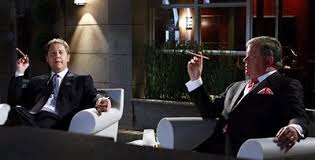
crane and shore

But that being said, no matter how bad things are and how much worse they could get it is far more important to live in the moment with those that you love and care about in the now, not the future that we have so little influence over. As Danny Crane (William Shatner) told Alan Shore (James Spader) in Boston Legal:

“Let me tell you something. When you got polar ice caps melting and breaking off into big chunks and you got Osama still hiding in a cave, planning his next attack, when you got other rogue nations with nuclear arsenals, and not to mention some wack-job, home-grown that can cancel you at any second and when you got…mad cow, now gets high priority. And when you’re still on the balcony on a clear night, sipping scotch with your best friend, now is everything.”

Yes my friends, in the midst of all the craziness that we cannot control, now is everything so keep calm. 

Peace

Padre Steve+

1 Comment

Filed under economics and financial policy, History, Just for fun, philosophy, purely humorous

The Rebirth of American Nativism: Trump and the Know Nothings

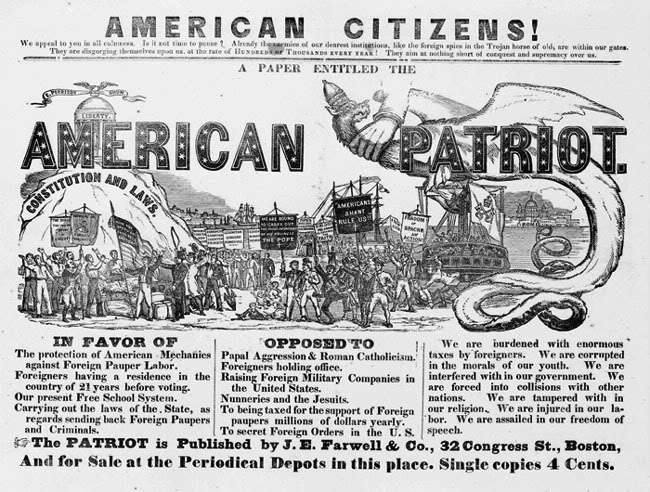
american-patriot

Friends of Padre Steve’s World,

In the past few months we have witnessed a big debate in the Republican Party regarding immigration. This is not a new phenomenon, over the past few decades the debate has come and gone, but it has returned with a vengeance as Donald Trump, the billionaire developer and current GOP frontrunner has made immigration, or rather a virulent anti-immigration platform the centerpiece of his campaign. This has other Republican candidates scrambling to find a position close enough to Trump’s without completely throwing away the vote of immigrants who they will need to win in many states; if they are to have any hope of winning back the presidency in 2016.

But Trump’s position has resonated with parts of the Republican base, and by appealing to their anger and frustration he has built a solid core of support whether he becomes the GOP nominee or runs as a third-party candidate. If one takes the time to read Trump’s speeches and the reactions to them by his supporters it becomes apparent that Trump has tapped into that vast reservoir of nativism that has always been a part of the American body-politic.

knownothing-convent-main

As I said, such attitudes and movements are nothing new. Anti-immigrant movements in the United States go back to our earliest days, ever since the first Irish Catholics showed up in the northeast in the late 1790s and early 1800s. Met with scorn and treated as criminals the Irish Catholics had to work hard to gain any kind of acceptance in Protestant America. But immigrants continued to come, seeking the freedom promised in the Declaration of Independence.

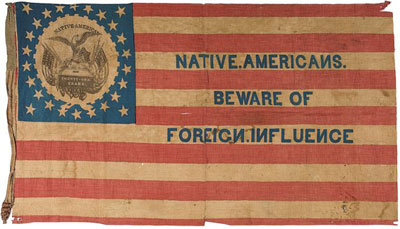
know-nothing_flag

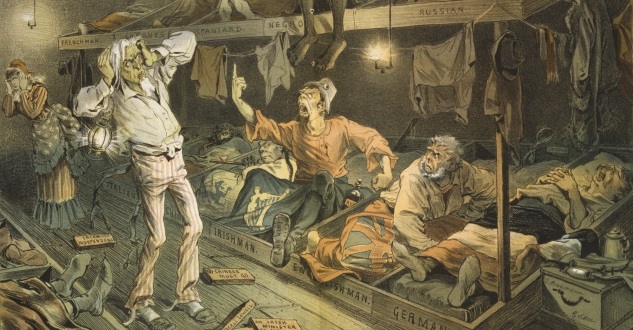
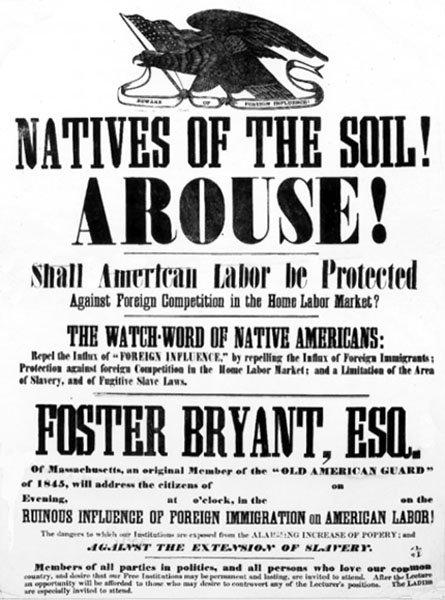
Many White American Protestants viewed Irish, German and other European immigrants to the Unites States in the 1830s, 1840s, and 1850s as interlopers who were attempting to take over the country. The immigrants were regarded as poor, uneducated, uncouth, and immoral, and in the case of Catholic immigrants as representatives and foot soldiers of a hostile government, the Vatican, headed by the Pope and the bishops. Those who opposed immigration formed a movement that was aimed at forbidding immigrants from being granted full rights, especially the rights of citizenship and voting. The fear was pervasive. Many Northern Whites were afraid that immigrants would take their jobs, since like slaves in the South, the new immigrants were a source of cheap labor.

Northern Protestant church leaders and ministers were some of the most vocal anti-immigrant voices and their words were echoed by politicians and in the press. The movement grew and used government action, the courts and violence to oppress the Irish and Germans who were the most frequent targets of their hate. The movement eventually became known as the “Know Nothing” movement.

Know Nothing leaders were not content to simply discuss their agenda in the forum of ideas and political discourse, they often used mob-violence and intimidation to keep Catholics away from the ballot box. Mobs of nativist Know Nothings sometimes numbering in the hundreds or even the thousands attacked immigrants in what they called “Paddy hunts,” Paddy being a slur for the Irish. To combat immigrants who might want to exercise their right to vote, the Know Nothings deployed gangs like the New York’s Bowery Boys and Baltimore’s Plug Uglies. They also deployed their own paramilitary organization to intimidate immigrants on Election Day. This group, known as the Wide Awakes was especially prone to use violence and physical intimidation in pursuit of their goals. The Nativist paramilitaries also provided security for anti-immigrant preachers from angry immigrants who might try to disrupt their “prayer” meetings.

Know Nothing’s and other Nativist organizations, organized mass meetings throughout the country which were attended by thousands of men. The meetings were often led by prominent Protestant ministers who were rich in their use of preaching and prayer to rile up their audiences. The meetings often ended with physical attacks and other violence against German or Irish immigrants and sometimes with the burning of the local Catholic Church. They also provided security for preachers from angry immigrants who might try to disrupt nativist prayer meetings.

The violence was widespread and reached its peak in the mid-1850s.

Bloody Monday.jpg.opt836x314o0,0s836x314

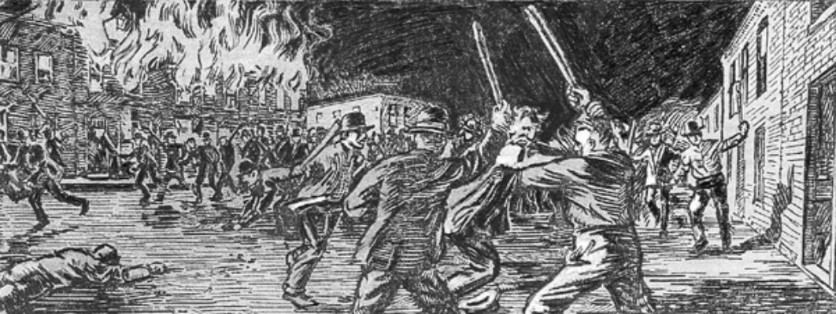
Black Monday in Louisville 

003.jpg.opt562x853o0,0s562x853

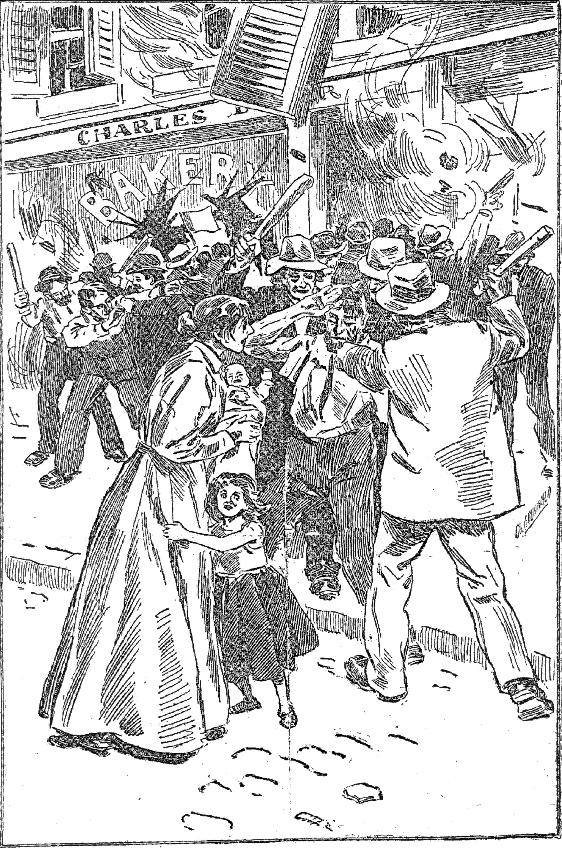
Monday, August 6, 1855 was Election Day in Louisville, Kentucky. To prevent German and Irish Catholics from voting, Know Nothing mobs took to the street and launched a violent attack on immigrants as well as their churches and businesses. Known now as “Black Monday” the Nativists burned Armbruster’s Brewery, they rolled cannons to the doors of the St. Martin of Tours Church, the Cathedral of the Assumption and Saint Patrick’s Church, which they then were searched for arms. The private dwellings and the businesses of immigrants were looted. A neighborhood known as “Quinn’s Row” was burned with the inhabitants barricaded inside. At least 22 persons were killed in the violence and many more were injured. In Baltimore the 1856, 1857, and 1858 elections were all marred by violence perpetrated by Nativist mobs. In Maine, Know Nothing followers tarred and feathered a Catholic priest and burned down a Catholic church.

natives

The Know Nothings did not merely seek to disenfranchise immigrants through violence alone, they were more sophisticated than that. They knew that to be successful they had to change the law. Then, as now, a new immigrant had to live in the United States for five years before becoming eligible to become a naturalized of the United States. The Know nothings felt that this was too short of time and their party platform in the 1856 election had this as one of the party planks:

A change in the laws of naturalization, making a continued residence of twenty-one years, of all not heretofore provided for, an indispensable requisite for citizenship hereafter, and excluding all paupers, and persons convicted of crime, from landing upon our shores; but no interference with the vested rights of foreigners.

The rational of the Know Nothings for the 21 year wait was that if a baby born in the United States had to wait until it was 21 years old he could vote, that immigrants were being permitted to “jump the line” and vote sooner than native-born Americans. But really what the Know Nothings wanted to was to destroy the ability of immigrant communities to use the ballot box. In many localities and some states Know Nothing majorities took power. The Massachusetts legislature, which was dominated by Know Nothings, passed a law barring immigrants from voting for two additional years after they became United States citizens.

know-nothing-letter

The 1856 platform Know Nothing Party was synopsized by a Know Nothing supporter:

(1) Repeal of all Naturalization Laws.

(2) None but Americans for office.

(3) A pure American Common School system.

(4) War to the hilt, on political Romanism.

(5) Opposition to the formation of Military Companies, composed of Foreigners.

(6) The advocacy of a sound, healthy and safe Nationality.

(7) Hostility to all Papal influences, when brought to bear against the Republic.

(8) American Constitutions & American sentiments.

(9) More stringent & effective Emigration Laws.

(10) The amplest protection to Protestant Interests.

(11) The doctrines of the revered Washington.

(12) The sending back of all foreign paupers.

(13) Formation of societies to protect American interests.

(14) Eternal enmity to all those who attempt to carry out the principles of a foreign Church or State.

(15) Our Country, our whole Country, and nothing but our Country.

(16) Finally,-American Laws, and American Legislation, and Death to all foreign influences, whether in high places or low

In addition to their violent acts, the use of the courts and political intimidation the Know Nothings waged a culture war against immigrants. Latin mottoes on courthouses were replaced by English translations. Actions were taken to remove immigrants who had become naturalized citizens from public offices and civil service jobs as well as to use the government to persecute Catholic churches. In Philadelphia, all naturalized citizens on the police force were fired, including non-Catholics who has supported Catholic politicians, and in Boston, a special board was set up to investigate the sex lives of nuns and other supposed crimes of the Catholic church.

In the political upheaval of the 1850s Nativists tried to find homes in the different political parties. Some Know Nothings who were abolitionists became part of the new Republican Party, and Abraham Lincoln condemned them in harsh terms. He wrote his friend Joshua Speed about the hypocrisy that they displayed by supposedly being against the oppression of blacks while willing to oppress immigrants:

“I am not a Know-Nothing. That is certain. How could I be? How can any one who abhors the oppression of negroes, be in favor or degrading classes of white people? Our progress in degeneracy appears to me to be pretty rapid. As a nation, we began by declaring that “all men are created equal.” We now practically read it “all men are created equal, except negroes” When the Know-Nothings get control, it will read “all men are created equal, except negroes, and foreigners, and Catholics.” When it comes to this I should prefer emigrating to some country where they make no pretence of loving liberty — to Russia, for instance, where despotism can be taken pure, and without the base alloy of hypocracy [sic].”

1880_Anti-Chinese_Riot_in_Denver_anagoria

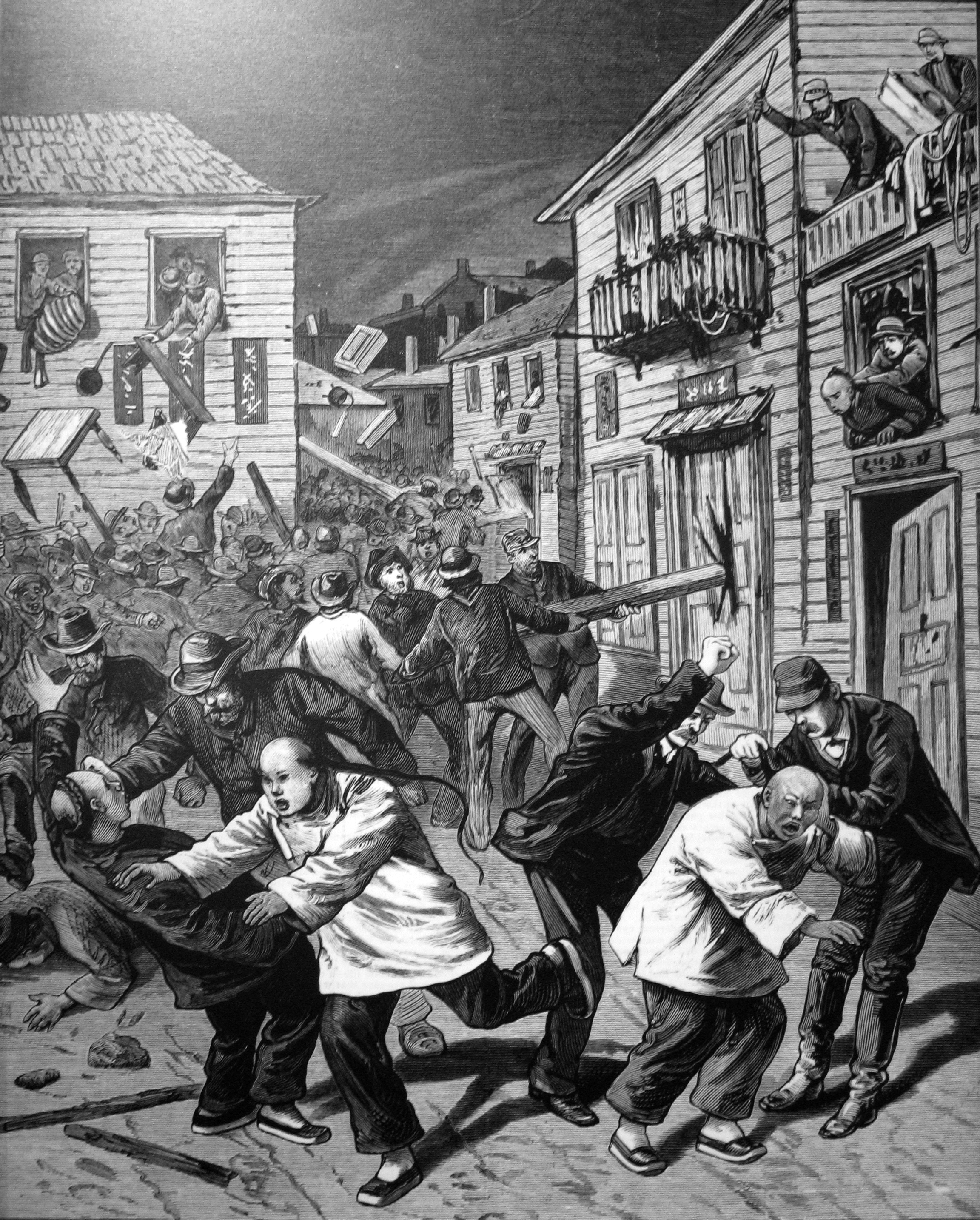
As an organized movement, the Know Nothings died out by the early 1860s, migrating to different parties and causes. In the North many became part of the pro-slavery Copperhead movement, which opposed Lincoln on emancipation and the Thirteenth Amendment. In the post-war South the anti-Catholic parts of the Nativist movement found a home in the Ku Klux Klan and other white terrorist organizations which also used racist and nativist propaganda to perpetuate violence, and disenfranchise emancipated blacks in the decades following the end of the Civil War and the end of Reconstruction. The Nativist and anti-immigrant sentiments have periodically found a home in different parts of the country and the electorate. Violence was used against Chinese, Japanese and Filipino immigrants on the West Coast, against Mexicans in the Southwest, Italians, Slavs, Eastern Europeans and Jews in the Northeast.

9587864_orig

Sadly it seems that it is being turned against others today. I find it strange that there are a host of people, mostly on the political right that are doing their best in their local communities, state legislatures and even Congress to roll back civil liberties for various groups of people. There is a certain amount of xenophobia in regard to immigrants of all types, especially those with darker skin white Americans, but some of the worst is reserved for Arabs and other Middle-Easterners, even Arab Christians who are presumed as all Middle Easterners are to be Moslem terrorists, even those who have been here decades and hold respectable places in their communities.

But immigrants are not alone, there seems to be in some states a systematized attempt to disenfranchise the one group of people that has almost always born the brunt of legal and illegal discrimination, African Americans.

Likewise there have been numerous attempts to roll back the rights of women, especially working women; the use of the legislature by religious conservatives to place limits on the reproductive rights of women, holding them to the standard of a religion that they do not practice. Despite the Supreme Court’s ruling for Marriage Equality in Obergfell v. Hodges there still are numerous attempts to curb any civil rights, including the right to marriage or civil unions of the LGBT community.

As I said, this is nothing new, that hatred and intolerance of some toward anyone who is different than them, who they deem to be a threat is easily exploited by politicians, pundits and preachers, none of whom care for anything but their prosperity, ideology, religion, or cause. While I would not call them a new incarnation of the Know Nothings, I have to notice the similarities in their message and the way that they push their agenda. As for those among them who claim the mantle of Christ and call themselves Christians I am troubled, because I know that when religion is entwined with political movements that are based in repressing or oppressing others that it does not end well. As Brian Cox who played Herman Goering in the television miniseries Nuremberg told the American Army psychologist Captain Gustave Gilbert played by Matt Craven “The segregation laws in your country and the anti-Semitic laws in mine, are they not just a difference of degree?

That difference of degree does matter, and there have been and still could be times when the frustration and anger of people, especially religious people can be whipped into a frenzy of violence and government sanctioned oppression by unscrupulous politicians, preachers and pundits. History is replete with examples of how it can happen. When I think of this I am reminded of the close of Spencer Tracy’s remarks in the movie Judgment at Nuremberg:

But this trial has shown that under a national crisis, ordinary – even able and extraordinary – men can delude themselves into the commission of crimes so vast and heinous that they beggar the imagination. No one who has sat through the trial can ever forget them: men sterilized because of political belief; a mockery made of friendship and faith; the murder of children. How easily it can happen. There are those in our own country too who today speak of the “protection of country” – of ‘survival’. A decision must be made in the life of every nation at the very moment when the grasp of the enemy is at its throat. Then, it seems that the only way to survive is to use the means of the enemy, to rest survival upon what is expedient – to look the other way. Well, the answer to that is ‘survival as what’? A country isn’t a rock. It’s not an extension of one’s self. It’s what it stands for. It’s what it stands for when standing for something is the most difficult! Before the people of the world, let it now be noted that here, in our decision, this is what we stand for: justice, truth, and the value of a single human being.”

Peace

Padre Steve+

9 Comments

Filed under civil rights, History, LGBT issues, News and current events, Political Commentary

Logistics, Transportation & Communication in the Civil War

Friends of Padre Steve’s World

Today something a bit wonkish, another section of my Civil War and Gettysburg Staff Ride text. Nothing controversial, but an interesting look at how all of these mundane and often forgotten components of war advanced during the Civil War and how both sides adapted to these developments.

Peace

Padre Steve+
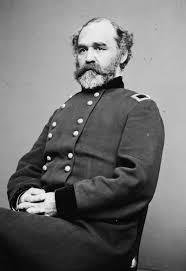
meigs

General Montgomery Meigs: Logistician Extraordinaire

With the advances in weaponry, technology turned the adoption of field fortifications and the tactical defense; even during offensive operations changed the way that the armies conducted the war; other advances were occurring. These took place in logistics, transportation, signals and communications.

In a country as vast as the United States logistics was a major concern of both armies. The ante-bellum Army developed its logistic doctrine from Napoleonic examples. That doctrine had to be modified in light of the American reality of a less developed continent with far greater distances involved in the movement of troops. “While the North’s logistical mobilization expanded, the South’s peaked in early 1863 and then declined. Fundamental interlocking problems beset logistics. The Confederacy had few preexisting industries to expand and lacked sufficient raw materials upon which to build an industrial base.” [1]

The Confederacy “did not have the material resources to fight a mass industrial war” [2] and the actions of its leaders from Jefferson Davis down did not help their cause. “The South needed a careful weighing of assets and liabilities, the setting of strict priorities, and centralized direction in order to use its resources efficiently. But Confederate leaders allowed events to control planning, resulting in uncoordinated, tardy, and incompetent centralization of the logistical effort.” [3]

The issue was not limited to industry but also agriculture, which in a region as rich as the Confederacy should not have been a problem. However, it was a major issue that became ever more serious throughout the war, not only for the Confederate armies in the field but also for the population as a whole. While the South managed to maintain effective armies until the end of 1864, it “failed to preserve the population’s well-being.” [4] This would prove to be a major problem.

By the spring of 1863 five major cities experienced bread riots, the most serious being in Richmond. Here, women, many of whose husbands were in the army “could no longer defer starvation. Living without men meant living without livelihood for many women. On the morning of April 2, 1863, a group of working class women met at a Baptist church in Richmond. Unable to feed their families they resolved to march to the governor’s mansion to seek redress.” [5] The governor was unable to satisfy their demands and the women, armed with guns and knives proceeded to wreak havoc, and over the “next several hours, all semblance of order disappeared in Richmond’s commercial district as the enraged women broke down doors and windows, seized bread and meat, and then went on to loot jewelry, clothing, hats, “and whatever they wanted.” [6]

Army troops and militia arrived on the scene and it appeared that Confederate soldiers might soon open fire on upon Confederate women. Jefferson Davis, who heard about the situation went to the commercial district and personally gave an ultimatum to the rioters ordering them to disperse or have the troops and militia open fire. [7] He turned “glanced at the soldiers behind him and turned to the women. “We do not desire to injure anyone, but this lawlessness must stop. I will give you five minutes to disburse, otherwise you will be fired upon.” [8] Soon the crowd disbursed and order was restored, but the damage was done. Other bread riots occurred in Southern cities until the fall of 1863. Many Southerners blamed merchants in general and the press labeled most businesses as speculators and extortionists. However as a result of the great privations at home and the need for a scapegoat, the specter of anti-Semitism rose in the Confederacy. Many, including some influential newspapers and government officials “focused on the Jews as the worst “extortioners” [9] blaming them for many if not most of the Confederacy’s economic woes.

civil-war-city-point-dock

Even as their families went without food many soldiers in the armies of the Confederacy likewise faced hunger and privation. In the fall of 1863 some soldiers of the Army of Tennessee were ordered into line to be reviewed by Jefferson Davis. One soldier, Private Sam Watkins wrote: “When he passed by us with his great retinue of staff officers …cheers greeted them, with the words “Send us something to eat, Massa Jeff! Give us something to eat, Massa Jeff! I’m hungry! I’m hungry!” [10]

During the war, both armies learned to adapt their logistical support services to the reality of war. However, the South, for a number of reasons had difficultly this. Poor infrastructure and the lack of standardized rail systems were significant factors. But even more importantly inability of the government in Richmond, various states governments as well as the private sector to work together helped doom the Confederacy. The South did not lack for food. It was a rich agricultural region, but its ability to provide sustenance for its people and its armies was hindered due to its woeful infrastructure and various self-inflicted political and economic reasons. Several major issues affected the South’s ability to feed its people and its armies.

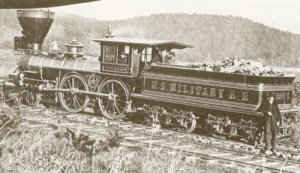
Among these were “the deficiencies of the Confederate rail system” which deteriorated throughout the war and was made worse by the lack of cooperation of Confederate railroad owners. The South “did not have a railroad network that tied its scant industrial base together or readily permitted long distance movements.” [11] This would hamper Confederate attempts to move and supply its armies as well as sustain its economy throughout the war. The Confederacy never nationalized its railroads, and “no centralized planning or organization developed, and field commanders, supply agencies, and civilian shippers competed for use of Southern rolling stock.” [12]
civil-war-locomotive

Southern policy towards the use of its railroads was muddled at best and the demands of the war and by 1863, “the excessive wear of wartime rail movement was chewing up southern rail lines[13] which resulted in the “South barely keeping a few lines operating by cannibalizing less important lines and could not replace its rolling stock.” [14] The combination of the lack of a strong industrial base to produce the iron to make replacement rails and the similar lack of producing facilities to manufacture locomotives and rolling stock, combined with the “unsure policies of the Confederate government and military” [15] ran the already feeble Southern railway system into the ground.

The Confederacy also faced a basic unwillingness of many producers of food, textiles and other necessities to cooperate with the Confederate government, which often could not even find ways for its own agencies to cooperate with each other. “The government gave no overall direction to the supply bureaus, which often bid against each other for materials and labor.” [16] This was a pervasive problem, and not helped by the efforts of some parts of the Confederate government to nationalize various parts of their economy in direct competition with the private sector. This contrasted starkly with the Union whose “quartermaster and commissary heads contracted out their needs for weapons, horses and clothes by bid on the open market, rather than by appropriating existing industries for government use.” [17]

The Confederate policies meant that many citizens and businesses found ways to not submit to government edicts. There was a basic “unwillingness of farmers to sell goods and produce at government rates” [18] and the greed of hoarders and war profiteers who through “hoarding, black marketing and simple withdraw from the market[19] crippled Southern war efforts and by “1862 much of the Confederate economy had become unmanageable.” [20] When Davis attempted to use the religious faith of the people to bolster more and “called for a day of fasting and prayer in March 1863, one man wrote that the president asked for “fasting in the midst of famine.” [21]

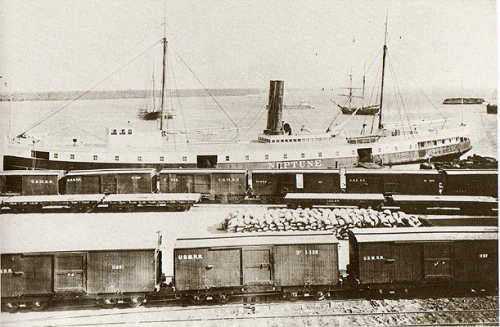
Where possible each side used railroads and maritime forces to move troops and supplies. The Confederacy, as has been noted was lacking in both, and was at a severe disadvantage. The Union however enjoyed a great advantage in modern rail networks, as well as ocean and river based maritime power. By late 1863 the Army of the Potomac, as well as forces in the West demonstrated “the close integration of operational planning and that of the general in chief and supply bureaus. In this one area, the development of a mature and modern staff was evident.” [22]

Once the armies were away from railheads or the ports from where they drew supplies both armies, like their Napoleonic cousins relied on wagons to transport essential food, supplies and ammunition when on campaign. In both armies commanders and their logisticians experimented with the number of wagons per regiment and how army commanders, modified that number at various points during the war based on their situation.

At the beginning of the war the Napoleonic standards by which both armies based the number of wagons, 12 wagons per 1000 men to support the troops on campaign were found to be insufficient as it “placed too much emphasis on foraging for American conditions” [23] and throughout the war standards for what the armies needed would be debated and commanders in different theaters of the war often set their own standards based on their needs and the availability of wagons and livestock to draw them.

As the war went on the Federal army experimented with the use of the “flying column” as a response to the dependency on wagons in order to increase their mobility. The flying column was an idea drawn from the French by Major General Montgomery Meigs, the Union Quartermaster General. The idea was simple; in order to reduce dependency on wagons the army itself would be reorganized at the lowest level, the infantry squad.

“The soldier in a flying column carried eight days’ compressed rations, including desiccated vegetables on his back. He carried a blanket but no overcoat. The men were divided into squads of eight, one of whom was to carry a covered cooking kettle, another a large mess tin, another an axe, another a pick, and one a shovel. One man in each company carried the hospital knapsack. Each man carried his share of a shelter tent. The cavalry were pickets and grain for their horses.” [24]

After Gettysburg and the unsuccessful pursuit of Lee’s army, Halleck and Rufus Ingalls, the Army of the Potomac’s chief quartermaster made provision and set standards “to convert the army into a flying column that would be self-sufficient for eight- and twelve- day periods away from the base of supply.” [25] In contrast, the Confederacy lacked the wagons and livestock to support the field operations of the army on campaign. Wagons, especially those suited for military operations were in short supply and any time the opportunity presented, confederate commanders ensured the capture of Union wagons. This turned out to be a major problem during the Gettysburg campaign, when Stuart during his ride around the Army of the Potomac “succumbed to temptation of capturing a beautifully equipped and heavily laden Union supply train near Rockville, Maryland, at the cost of exhausting his cavalry and wasting precious time.” [26] In most cases Stuart’s action would have been commendable, and he certainly felt that such should have been the case here as well, but the cost to his operations and Lee’s need for his cavalry were such that it was a mistake of disastrous consequences.

The basic load of food and ammunition carried by each soldier in order to increase strategic maneuverability was adjusted to meet the operational need. Both armies, but more often the Confederate army frequently had to live off the land. The success and failure of forage operations and the requirements for people and animals in each theater of operations had a large impact on each army. By early 1863 the Army of Northern Virginia was “greatly deficient in all areas of supply….there were extreme shortages of footwear, clothing, draft animals, and wagons.” [27] When the Army of Northern Virginia advanced into Pennsylvania they found it to be “a land of plenty” while “quartermaster and commissary details, acting under official instructions, filled wagons and supplies with foodstuffs.” [28]

While the Federal army never lacked in provisions or supplies, the Confederate armies were almost always in short supply. Even adequate food supplies needed to maintain an adequate caloric intake on the march were almost impossible to achieve. Food supplies were so limited that they were barely adequate, especially when the army was encamped. In fact, one of the reasons that Lee based his invasion of Pennsylvania was to alleviate his desperate supply situation. One regimental commander in Pickett’s division recalled that Lee told him “the movement was a necessity; that our provisions and supplies of every kind were nearly exhausted in Virginia, and we had to go into Pennsylvania for supplies.” [29]

As Federal forces moved into the South they encountered a new problem, the areas that the conquered and their essential supply bases, railheads and railroads had to protected from Confederate partisans, irregulars, raiders and other insurgents. Railroads were especially important to the Federal logistics chain as they provided “new strategic and operational abilities” to civil war armies, but they were an “extremely delicate sources of dependence when they ran through hostile territory.” [30] As such they had to be protected, as did the sprawling supply bases on which the Federal armies in the South depended. This resulted in an ever increasing logistics tail in proportion to the fighting forces spearheading the Federal advance. The three Union armies commanded by William Tecumseh Sherman that carried “the brunt of the Union effort against Joe Johnston and Atlanta, for example, showed 352,265 men on their muster rolls, but took only about 100,000 directly into the campaign.” [31] The rest were engaged in protecting the vital logistics tail.

Communications and Signals

The size of the armies and the distances involved on the battlefield made command and control difficult.  As such, communications became more important and each army experimented with new signals organizations that used both old and new communication technologies. At the beginning of the war both sides made extensive use of visual signals and couriers, but rapidly began to rely on the telegraph for rapid communications.

03-Beardslee-telegraph-US-Army-photo

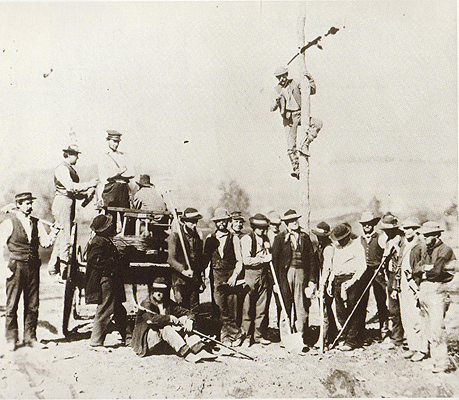
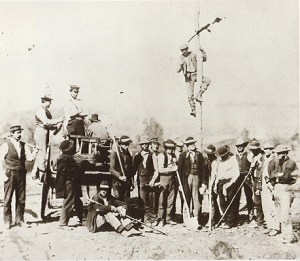
The organizational tension was particularly evident in the rivalry between the U.S. Army Signal Corps and the Military Telegraph Service.  The Signal Corps focused on wireless communications. It preferred the Beardslee wireless telegraphs, however, they were plagued by the limitations of such early wireless technology. The Union Army command favored the traditional wire bound networks operated by the Military Telegraph due to better reliability and security and eventually the Military Telegraph Service and its Morse trained operators were given “jurisdiction for all field telegraph” services at the urging of President Lincoln in November 1863. [32] Though the Army rejected the Beardslee equipment some commanders requested it for their operations.[33] As each Army became more dependent on the telegraph, each feared that their signals could be compromised through wiretapping and made efforts to encode their transmissions.

While the various forms of telegraphic communication were important in keeping higher headquarters in contact with armies in the field, battlefield communication could be difficult. Commanders on both sides relied on messengers to relay orders to subordinate commanders as well as pass information to senior commanders. On the battlefield this took time, and since the messengers were subject to the same dangers as ordinary soldiers messages might not reach the intended commanders. It took approximately an hour for a message to travel from an army commander to a corps commander, 30 minutes from a corps commander to a division commander, 20 from division to brigade, 15 from brigade to regiment and 5 minutes from regiment to company. [34]

Written orders generally provided better clarity if detailed enough but if they were passed orally, as was Lee’s preferred method they could easily be miscommunicated by messengers, or misunderstood or even ignored by commanders. This was a major source of Lee’s consternation during the Gettysburg campaign. A major problem for Lee during the campaign was that his orders, be they written or oral were frequently vague and discretionary, something that we will discuss in detail later, but Lieutenant General Richard Ewell spoke for many Confederate subordinate commanders on the evening of June 30th when he asked his division commanders in frustration “Why can’t a commanding General have someone on his staff who can write an intelligent order?” [35]

The Union Signal Corps also pioneered the use and development with a “modern system of semaphores with a telegraphic alphabet…” as well as “a cipher disk…that allowed the Union Signal Corps to change the code hourly if need be.” [36] The one disadvantage to this form of visual communication was that it could be limited due to weather conditions or the smoke of battle. While semaphore was used with a good deal of success by the Union, and Meade would make good use of it at Gettysburg, it was not used by the Confederate army.
civil-war-us-signal-corps

Likewise Meade “set a precedent in command procedures” during the Gettysburg campaign, where “for perhaps the first time in military history the commanding general of a large army was kept in communication during active operations with his corps and division commanders.” Likewise Meade “set a precedent in command procedures when he brought signal officers to the conference table for consultation on the plan of battle” [37] and for the first time Signal Corps officers were assigned directly to each corps, when Meade ordered that two Signal Corps officers be “detached for service with each corps.” [38]

The troops of the Union Signal Corps were also a vital link in the transmission of military intelligence gathered by Colonel George Sharpe’s Bureau of Military Information, whose network of scouts during the Gettysburg campaign were “supported by Signal Corps detachments which could establish chains of flag stations from Harpers Ferry to “South Mountain, Monterrey, Greencastle…up to Parnell’s Knob, in the Cumberland Valley.” [39] This link helped provide Meade with much better intelligence regarding the movement of Lee’s army throughout the campaign.

Regardless of the means of transmitting orders, the fact was that at Gettysburg the element of friction entered the communication process. Wireless communications suffered from encryption problems, semaphore could not always be read due to the reduced visibility caused by the smoke covered battlefield. Commanders who took the time to issue written orders found that those could be delayed or lost due to battlefield conditions that impacted a messenger’s ability to deliver them, or misunderstood by their recipients. Likewise, verbal orders sent by messenger were frequently garbled and misunderstood, or depending on the situation, understood in the manner that best fit the situation of the recipient.

The developments in tactics, maneuver, defense and logistics and how those were developed over the course of the war brought about a form of warfare that remained dominant of decades. In studying the campaigns, developments and tensions between the competing theories of Jomini and Mahan in the Civil War, a student can begin to recognize them in future wars fought by the US Army including World War Two.

Russell Weigley picks up this theme in his books The American Way of War and Eisenhower’s Lieutenants. Weigley discusses Lee’s use of Napoleonic strategy and Grant’s corresponding strategy of annihilation as well as Sherman’s campaign against Johnston, as well as Sheridan’s devastation of the Shenandoah Valley to impose its aims on the Confederacy. [40] These lessons influenced American strategic doctrine well into the next century, and were employed by leaders in the First and Second World Wars, as well as much less effectively in Korea and Vietnam. Weigley concluded: “Because it worked so well, achieving total submission, American soldiers thereafter tended to generalize the United States strategy of the Civil War into the appropriate strategy for all major, full scale wars.” [41]

Notes

[1] Ibid. Millet and Maslowski For the Common Defense p.216

[2] Ibid. Thomas, The Confederate Nation p.135

[3] Ibid. Millet and Maslowski For the Common Defense pp.216-217

[4] Ibid. Millet and Maslowski For the Common Defense p.218

[5] Ibid. Goldfield America Aflame pp.296-297

[6] Ibid. Guelzo Fateful Lightening p.326

[7] Ibid. McPherson. The Battle Cry of Freedom p.617-618

[8] Ibid. Goldfield America Aflame p.297

[9] Ibid. McPherson. The Battle Cry of Freedom p.441

[10] Ibid. Robertson Soldiers Blue and Gray p.72

[11] Ibid. Millet and Maslowski For the Common Defense p.156

[12] Ibid. Thomas, The Confederate Nation p.211

[13] Ibid. Guelzo Fateful Lightening p.319

[14] Ibid. Millet and Maslowski For the Common Defense p.216

[15] Ibid. Guelzo Fateful Lightening p.323

[16] Ibid. Millet and Maslowski For the Common Defense p.217

[17] Ibid. Guelzo Fateful Lightening p.322

[18] Ibid. Guelzo Fateful Lightening p.320

[19] Ibid. Guelzo Fateful Lightening p.322

[20] Ibid. McPherson. The Battle Cry of Freedom p.442

[21] Ibid. Millet and Maslowski For the Common Defense p.219

[22] Ibid. Hagerman The American Civil War and the Origins of Modern Warfare p.79

[23] Ibid. Hagerman The American Civil War and the Origins of Modern Warfare p.44

[24] Ibid. Hagerman The American Civil War and the Origins of Modern Warfare p.71

[25] Ibid. Hagerman The American Civil War and the Origins of Modern Warfare p.76

[26] Coddington, Edwin B. The Gettysburg Campaign: A Study in Command, A Touchstone Book, Simon and Schuster New York, 1968 p.198

[27] Ibid. Hagerman The American Civil War and the Origins of Modern Warfare p.126

[28] Wert, Jeffry D. A Glorious Army: Robert E. Lee’s Triumph 1862-1863 Simon and Schuster, New York and London 2011 p.229

[29] Ibid. West A Glorious Army p.230

[30] Ibid. Weigley A Great Civil War p.322

[31] Ibid. Weigley A Great Civil War p.322

[32] Ibid. Hagerman The American Civil War and the Origins of Modern Warfare p.87

[33] Ibid. Hagerman The American Civil War and the Origins of Modern Warfare p.87

[34] Cole, Phillip M. Command and Communication Friction in the Gettysburg Campaign Colecraft Industries, Ortanna PA 2006 p.80

[35] Trudeau, Noah Andre. Gettysburg: A Testing of Courage, Harper Collins Publishers, New York 2002 p.140

[36] Ibid. Hagerman The American Civil War and the Origins of Modern Warfare pp.43-44

[37] Ibid. Hagerman The American Civil War and the Origins of Modern Warfare p.87

[38] Ibid. Guelzo Gettysburg: The Last Invasion p.123

[39] Ibid. Guelzo Gettysburg: The Last Invasion p.42

[40] Ibid. Weigley The American Way of War pp.145-146

[41] Weigley, Russell F. Eisenhower’s Lieutenants: The Campaign in France and Germany 1944-1945. Indiana University Press, Bloomington IN 1981 p.3

2 Comments

Filed under civil war, Gettysburg, History, Military

The Obligation of Ideas

410w-1

Friends of Padre Steve’s World

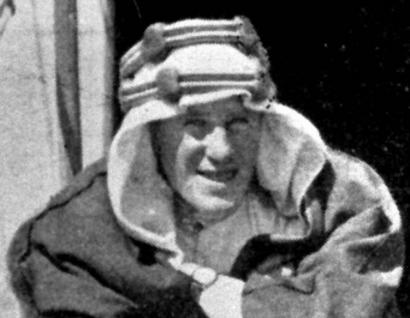
T.E. Lawrence wrote, “All men dream: but not equally. Those who dream by night in the dusty recesses of their minds wake up in the day to find it was vanity, but the dreamers of the day are dangerous men, for they may act their dreams with open eyes, to make it possible.”

I am an out of the box thinker and when I am allowed to pursue my ideas I do my best. When I feel constrained or force myself to “stay between” the lines in order to fit in I get frustrated. When I was younger this lead to instances where I got in trouble for too aggressively pushing my ideas.

However as I have matured I have become more patient. When my ideas are shunned or pushed aside I will stay within the lines of the system but work through back channels, finding people who will listen and hope that they will take up the ideas, even if I do not get credit. This is often frustrating in its own right but it allows me to continue to develop the ideas and to propagate them among people who will listen and possibly will in their own way help see those dreams to fruition.

Many times I have been order to stand down and stay in my lane and been taken to task on more than one occasion for pushing too hard. This has actually happened a number of times in my military career dating back to my time as an Army Lieutenant serving in Germany, even to the point of having that noted as a point of criticism in an Officer Evaluation Report.
So over the years I have learned that the direct approach to trying to propagate ideas that are considered out of the mainstream, or even dare I say radical when compared with conventional doctrines is not always the best case. The truth is that many people consider dreamers and outside the box thinkers to be arrogant and dangerous. It took me many years to discover this fact.

Thus I have taken to being more patient and using indirect approaches to get ideas across. Part of this is in taking the time to get to know myself. Lao Tzu said “He who knows others is wise; he who knows himself is enlightened.” When I was younger I often acted on impulse thinking that my ideas needed to be implemented and fought for right then and there. Now I am willing to take more time, allow them to germinate and take form and if necessary allow other people to take credit as long as the ideas find a home.

I am a dreamer, one who dreams with my eyes open. Admiral James Stavridis said: “overall, I think that’s an obligation to share your ideas. It’s how we move forward with innovation.”

I think both Lawrence and Admiral Stavridis are right. Innovation and dreams are the key to the future. Those trapped in outdated orthodoxies be they military, scientific, philosophical or religious will find that they will be left behind in history. One once said that the seven last words of the church were “We’ve never done it that way before.” That being said, those words are the last words of any organization or culture that refuses to dream or think outside the box. Eric Hoffer wrote “In a time of drastic change it is the learners who inherit the future. The learned usually find themselves equipped to live in a world that no longer exists.”

In an age of decreasing resources, rapid social and technological change and ever increasing challenges we must heed the words of Admiral Stavridis who said: “Because we’re in an era of declining resources, and I think we need to be unafraid of and embrace change. That means listening to more junior people, who often have the best ideas, trying new things…”

It also means listening to people from different disciplines or even cultures than our own, military from civilian, civilian from military, science from religion, religion from science and so on. It may be necessary to look to times than our own, delving into history to find answers to current challenges. Likewise it may prove wise to look to the dreamers who write science fiction for answers. It is important for the dreamers as well allow themselves and ideas to be questioned or challenged and to keep an open mind. Ideas developed in the vacuum of self seldom hold up over the course of time and stubbornness and intolerance of contradiction of one’s ideas and dreams come from a type of ego that is often as destructive to the self as it is to others.

Military historian and theorist B. H. Liddell-Hart wrote about using the indirect approach in the realm of though and ideas and not just military strategy or tactics:

“Opposition to the truth is inevitable, especially if it takes the form of a new idea, but the degree of resistance can be diminished- by giving thought not only to the aim but to the method of approach. Avoid a frontal attack on a long established position; instead, seek to turn it by flank movement, so that a more penetrable side is exposed to the thrust of truth. But, in any such indirect approach, take care not to diverge from the truth- for nothing is more fatal to its real advancement than to lapse into untruth.”

But like Lawrence said, the dreamers must be the ones who dream with their eyes open in order to make those dreams possible. However, the dreamers need to know that their ideas may not be welcome and that patience the use of the indirect approach and willingness to let others receive credit in order to see those dreams fulfilled is essential. Truth matters over individual success or recognition and in a sense it alone is eternal while our lives on this earth are fleeting.

Peace

Padre Steve+

1 Comment

Filed under philosophy

There Will be Nightmares: PTSD & Memories of War

Friends of Padre Steve’s World

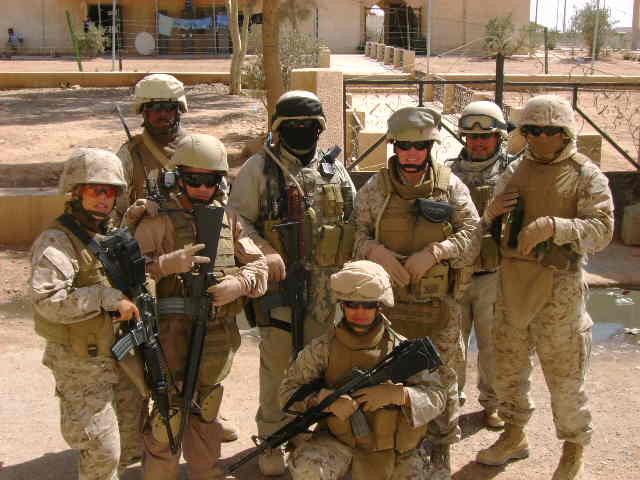
I’m really very tired today so another short post. I haven’t slept well in several weeks, part of this of course was the worry I had regarding my wife Judy and her cancer diagnosis, surgery and recovery. As she has gotten better I have been dealing with stuff from my own closet of anxieties. Those who have been reading my articles here know that I deal with PTSD, Traumatic Brain Injury and moral injury from my time in Iraq, and my return home.

ramadi

Last year I went through a very difficult time dealing with the military mental health system that I never want to repeat again. I hope I don’t have to, but I may. My therapist who I have had since last summer took a new job thousands of miles away and now I am going to have to find another therapist. I am hoping the man I see for my medication management can get me referred to someone good, because I do not want to be thrust back into the system and take the luck of the draw. That scares me to death, and since I found out my therapist was leaving and that I will not see her again I have been trying to keep my anxiety under control and not to panic. Awake I do pretty well with this, but when I try to sleep, all my Iraq stuff, plus all the very real and bad experiences that I had with the military mental health system last year flood my psyche. The night terrors are back, the terrible dreams and fears. It is not fun waking up in the middle of the night in a state of terror. Last year, after dealing with a number of providers and administrators I was nearly suicidal. It took the intervention of a former commanding officer who had been recently selected for promotion to Admiral in the Medical Corps to get me listened to and to get me the help that I sought.

295_26912092058_3949_n

But I know that I am not alone, I will get the professional help that I still need and I do have some friends I can talk to about these issues. Likewise I know many combat who veterans deal with similar issues related to their service, as well what happened to them when they returned home from Iraq or Afghanistan. The return from war is often worse than actually being over there, few people really understand, unless they too have been there.

Guy Sajer wrote in his book The Forgotten Soldier, “Only happy people have nightmares, from overeating. For those who live a nightmare reality, sleep is a black hole, lost in time, like death.” General Gouverneur Warren, a hero of many Civil War battles including Gettysburg wrote to his wife after the war “I wish I did not dream so much. They make me sometimes to dread to go to sleep. Scenes from the war, are so constantly recalled, with bitter feelings I wish never to experience again. Lies, vanity, treachery, and carnage.”

n671902058_1153794_4301

I am a realist about this. I know that there is no magic wand which will make it all go away and I don’t expect any therapist, or even God to cure me. I can understand why Alexander Dumas in the Count of Monte Cristo wrote, “Moral wounds have this peculiarity – they may be hidden, but they never close; always painful, always ready to bleed when touched, they remain fresh and open in the heart.”

That is true and I know to some people that may sound like I have given up, especially because it runs counter to the snake oil salesmen who write self-help books which promise to heal you in whatever number of steps or exercises; especially the ones written by preachers. But that is not the case, despite everything I still have a love of life and lust for learning. Except that now I just have moved to a new level of understanding concerning my own dark places, and that pain that manifests at night as I try to sleep. Since nothing will take it away I need to live with it and realize that it won’t always be the first thing that I think about when I wake up in the morning. That my friends is the essence of hope. 

n671902058_1219154_8844

One of my favorite actors, James Spader, plays a character named Raymond Reddington on the television show The Blacklist. During one episode he told another character something quite profound, something that if we actually embrace it can be somewhat comforting. “There is nothing that can take the pain away. But eventually, you will find a way to live with it. There will be nightmares. And every day when you wake up, it will be the first thing you think about. Until one day, it’s the second.”

I think that is why I can continue and at the same time seek to be available to those who suffer similar afflictions, and thankfully, I do still have those opportunities and as the late Henri Nouwen wrote, “Ministry means the ongoing attempt to put one’s own search for God, with all the moments of pain and joy, despair and hope, at the disposal of those who want to join this search but do not know how.”

Anyway, have a nice night.

Peace

Padre Steve+

4 Comments

Filed under Loose thoughts and musings

History, Critical Thinking & Truth

  
Friends of Padre Steve’s World

Just a short note today as I continue to read, reflect and do some research and writing on my Civil War and Gettysburg Staff Ride text.

Yesterday I was adding books that I have read over the past few months to my “read” list on my Facebook page, and there were a lot more than I remembered as I worked my way through my stack. If you add things to your Facebook page, movies, books, music or television shows, Facebook will provide lists of suggested titles that you can browse. This of course includes books, and not surprisingly to me, most of the books that were suggested were various forms of fiction or children’s books. There were a few literature classics among the suggestions and a host of Bible books. What I noticed was there were few books on history, philosophy, political science, world affairs or even theology listed. William Hughes

I was troubled by this; not because I am against people reading fiction or children’s book by any means, but typically those books, with the exception of some of the children’s books are for entertainment, not learning. As entertainment they are fine, but since almost everything else in our culture is geared toward entertainment I wonder where people are being challenged to think critically, and not simply be sponges for the sound bites offered by the politicians, preachers and pundits who dominate so much of our airwaves and the internet.

Barbara Tuchman wrote, “Books are the carriers of civilization. Without books, history is silent, literature dumb, science crippled, thought and speculation at a standstill. Without books, the development of civilization would have been impossible. They are engines of change (as the poet said), windows on the world and lighthouses erected in the sea of time. They are companions, teachers, magicians, bankers of the treasures of the mind. Books are humanity in print.”

Sadly, many people in this country and around the world are sadly deficient in knowing any history at all, and much of what they do know is based on myth. This is dangerous, historian George Santayana wrote, “Those who cannot remember the past are condemned to repeat it.” But I think that Howard Zinn said it the best:

“History can come in handy. If you were born yesterday, with no knowledge of the past, you might easily accept whatever the government tells you. But knowing a bit of history–while it would not absolutely prove the government was lying in a given instance–might make you skeptical, lead you to ask questions, make it more likely that you would find out the truth.”

Have a great night,

Peace

Padre Steve+

2 Comments

Filed under History, philosophy

Critical Thinking & Conscience: Learning from Dr. Martin Luther King Jr.

index

Friends of Padre Steve’s World

I have been taking the time to do some reading and reflecting and yesterday I wrote a short piece about reason, critical thinking and the challenge of unreason and anti-intellectualism in our society. As I did that I was reminded of the words of Dr. Martin Luther King Jr. as he addressed issues prevalent in the 1960s; many of which unfortunately are still with us today.

A lot of people today seek to marginalize Dr. King’s life and work by simply relegating him to the pages of history. The attitude of such people seems to be that maybe Dr. King was important in his day, but that we have advanced to the point that we don’t need to see beyond the King of history. Thus we miss so much of what he still teaches us today.

Dr. King was a man of tremendous personal courage. Nearly every day of his public ministry and advocacy for the rights of African Americans and the poor his life was in danger. Of course he, like so many other men who throughout history understood that those that champion the cause of justice and peace must ask hard questions. They must engage in hard thinking. They must challenge their own beliefs as well as those that they come in contact, and they must do so from the least safe place to do so, the place of conscience which commands us to do what is right.

In 1968 Dr. King said something that should make us all look in the mirror and ask who we really are and what we represent. He noted how cowardice, expediency and vanity all vie with conscience. He said:

“On some positions, Cowardice asks the question, “Is it safe?” Expediency asks the question, “Is it politic?” And Vanity comes along and asks the question, “Is it popular?” But Conscience asks the question “Is it right?” And there comes a time when one must take a position that is neither safe, nor politic, nor popular, but he must do it because Conscience tells him it is right.” 

If you look closely at what Dr. King said one can almost see every political, business or religious leader make decisions about things which matter to people, but without facing the demands of conscience.

It would be easy just to say this of our leaders. However, it is also true of most of us, for regardless of our protestations most of us follow the demands of cowardice, expediency or vanity rather than conscience. We do it not because we are bad people, but because we fear the potential negative consequences of doing the right thing, we count the cost and decide we cannot pay it.

Every time we make these decisions not to do the right, but to shrink in cowardice, appeal to the calculation of being politic, or choose to go with what is popular, something in us dies.

Dietrich Bonhoeffer, the German pastor and martyr wrote about the results of such equivocation from prison:

“We have been silent witnesses of evil deeds: we have been drenched by many storms; we have learnt the arts of equivocation and pretense; experience has made us suspicious of others and kept us from being truthful and open; intolerable conflicts have worn us down and even made us cynical. Are we still of any use?”

But to follow the demands of conscience requires us to think, and think critically. Too often we simply do things or support causes because we are comfortable with the ideas, and because we do not want to face inconvenient or uncomfortable ideas. We do not like to be challenged. I think that is why there is such a great appeal to often ignorant loud mouthed politicians, pundits and preachers, the Unholy Trinity, to do our thinking for us. The pundits, preachers and politicians often appeal to the must base human instincts to turn citizens against each other, or to drive up support for their ideology. Such ideas are made more destructive when they appear as “memes” on social media, attached to pictures which are designed to invoke an emotional response of anger, hatred and resentment at person or group being demonized. In following them we can become unthinking fanatics, convinced of our rightness without ever examining what we believe to see if it really true.

This is not thinking when we follow the lead of such people, regardless of their ideology. In doing so we give up our right and responsibility to think for ourselves and ask the hard questions. Eric Hoffer noted how ideology blinds us:

“A doctrine insulates the devout not only against the realities around them but also against their own selves. The fanatical believer is not conscious of his envy, malice, pettiness and dishonesty. There is a wall of words between his consciousness and his real self.”

Dr. King’s words spoken in 1963 are equally true today:
“Rarely do we find men who willingly engage in hard, solid thinking. There is an almost universal quest for easy answers and half-baked solutions. Nothing pains some people more than having to think.”

I hope that we may we find in Dr. King’s words inspiration to be people of character and conscience today. But to do so we must start doing the hard thinking that allows us to follow the demands of conscience and not cowardice. We must do the hard thinking that places justice over popularity and the hard thinking which exposes the emptiness of brazen political calculation embodied in the easy answers and half-baked solutions of the Unholy Trinity. Sadly, I don’t think that most people want to do this type of thinking, our materialistic culture does not value it and as a result we give up our rights as a people to a few oligarchs who throw a few small breaks our way while they expand their control, power and wealth. It’s a bad formula and we all suffer for it. It is time to stop asking if things are safe, politic, or expedient and do the hard work and thinking that conscience demands.

Peace

Padre Steve+

Leave a comment

Filed under civil rights, ethics, History, Political Commentary

Reason, the Salvation of Freedom

IMG_0230

Friends of Padre Steve’s World,

Adlai Stevenson once wrote

“Unreason and anti-intellectualism abominate thought. Thinking implies disagreement; and disagreement implies nonconformity; and nonconformity implies heresy; and heresy implies disloyalty. So, obviously, thinking must be stopped. But shouting is not a substitute for thinking and reason is not the subversion but the salvation of freedom.”

I have traveled to a lot of places, in this country and around the world where reason has been a scarce commodity and to me that has always been a frightening specter; a world where reason is is all too often sacrificed on the altar of political, ideological or religious expediency.

I had a Church History professor in seminary that was known for his attention to detail and his expectation that his students would master the subject.  His method was quite simple. A fellow student asked him during review for a mid-term exam “what do we need to study for the test?”  His answer was simple “everything.” The student restated his question “what do we really need to know?”  My professor paused and made a comment that did not make the student very happy.  He said something that I paraphrase here “it is the details that enable you to see the big picture, without the details you know nothing.”

A good number of my fellow students did not appreciate the fact that he was deadly serious.  I actually think that GOP Presidential hopeful Mike Huckabee, who flunked out of my seminary, may have been one of them. It was not simply the ability to remember names and dates and events but to be able to connect them and see what was really important.  Many did not take him seriously and when the test came many failed it.  In fact some continued to fail every exam because they could not reconcile that details were important. The attitude of a good number of my classmates was that history, philosophy or even systematic theology was not important especially if they involved study of people or ideas that they did not agree with.

Unfortunately we now live in an age of anti-intellectualism and anti-historicism. As much as some of us would like to try to affix blame, this is not a problem that can be blamed on any one side of the political spectrum. Sadly, it cuts across the spectrum as people return to more primal instincts in an uncertain time, where established political parties and systems of government seem unable to get the job done, where economic systems seem rigged in favor of a small minority of people and where the social and religious underpinnings of society are rocked by change and uncertainty.

But reason does matter, and those who ignore it do so at their own peril as Christopher Hitchens once said “That which can be asserted without evidence, can be dismissed without evidence.” History shows us in times like this, where reason is tossed aside in favor of primordial urges; that instead of seeking answers and instead of trying to figure out what is really important and studying the details of the great questions, that frustrated people become intellectually lazy and gravitate towards people who play to their often legitimate anger and frustration.

People simply fall back on the dogmas presented by the Unholy Trinity of Pundits, Politicians and Preachers that cater to their ideology for reassurance and quite often carry very dangerous demagogues into office with often-tragic results for their nations and the world.  The demagogues of the Unholy Trinity are quite good at taking advantage of frightened and angry people who need scapegoats.

If you listen to talk radio or are a devoted fan of any particular cable news pundit you can see this on display daily and even more so by our political leaders and those seeking political power. For the most part what is presented is at best half-truth sprinkled with deadly venom of hatred to make the half-truth an absolute truth.  In such a world facts are only important if the “true believer” can use them buttress his ideological bias even if he has to take the completely out of context to in order to do so.  The demagogues do not need to appeal to reason, they appeal to something more primal, they appeal to fear, anger, and the need of desperate people to find someone to blame.

Appealing to fear and loathing is so much easier than using reason. To call an opponent a Communist or Nazi, Fascist or Imperialist, Unbeliever or Heretic or even a Racist; and then connect them to the evil we want to demonize them is far easier than it is to actually engage them in a truthful debate and to see things in their historical context. The same is true when we try to shut them down without even listening to them or giving the chance to air their views, even views that are not supported by the facts or history. Likewise when we use such labels against those that disagree with us we dehumanize our opponents thereby justifying any evil that we use to silence them. That is one reason that on this site I do my best to listen to others, even those who do not agree with me and why I do my best to build bridges and maintain a respectful dialogue. I may disagree with someone’s argument but I will always do my best to treat them with respect, allow them to present their position and unless they are threatening me with death or bodily harm allow their comments to remain on the site. Sadly, I have had some of those threats, notably from known White Supremacists, one of which was so specific in violent intent that I had to report the man to the FBI.

That being said, I have a decent number of people who comment and express their disagreement, sometimes quite strongly, with me who are respectful and who I will never label with any of those often-pejorative terms. In fact there one commentator on this site with who I have often spirited disagreements, but despite that I have come to appreciate him and believe that if we were to spend any amount of time together drinking beer and watching baseball that we could become fast friends. But sadly, I do not think that many people on either side of the political divide could do now. I actually wouldn’t mind spending time with this man. Why? Because despite all of our disagreements; he remains respectful and continues to comment. I think that speaks volumes about his character, which has to be honorable. I think that is what we are supposed to be about in the United States.

Sometimes it seems to me that we presume that if we repeat what we believe enough, even if it what we believe is unsound or erroneous that it will become truth.  As individuals, governments, institutions and businesses we often settle for easy answers that agree with our presuppositions and dismiss opposing views as heresy.  Too often we allow people of little learning but whose great charm and salesmanship ability, to sell us myth in place of fact and this happens across the political, social, economic and theological spectrum. That is a tragedy for all of us no matter what our political, ideological, or religious views.

I have written on this site about the study of history as well as ways of learning.  The little things do matter, and the study of history, philosophy, theology, the sciences, economics in fact anything of any importance is based on understanding details, and things like precedent and context.  It is not enough to string together a series of quotations or citations if they are taken out of context, altered or intentionally misused to fit our ideology or doctrine, whatever it may be.

Such methods may comfort the true believer in whatever cause and even make them feel superior to those that disagree but such thinking. But it blinds them to reality and ensures that they never become aware of their own envy, malice, pettiness and dishonesty. The “wall of words” that flow so easily from the mouths and pens of the members of the Unholy Trinity that their faithful followers, ensures that they are unable to separate them from reality, truth from fiction, opinion from fact.  This “wall of words” serves as their protection against any thought, fact, presumption or doctrine that contradicts them.  John F Kennedy said, “Too often we enjoy the comfort of opinion without the discomfort of thought.” 

In times like this it is most important to take the time to learn from history, not just generalities that mix fact and myth but the little details that make up history and for that matter the sciences, philosophy, sociology, political thought and theology.  As a society we have ceased to do this and until we take the time to return to such study, dialogue and put aside our blinders we will be doomed to remain as we are no matter what political party is in power or ideology dominates the airwaves and cyber space.

Reason, it is important, and as unreasonable as it sounds there is a prayer that neatly sums up what I desire for me and for our society:

From the cowardice that dares not face new truth

From the laziness that is contented with half truth

From the arrogance that thinks it knows all truth,

Good Lord, deliver me.

Have a great night.

Peace

Padre Steve+

3 Comments

Filed under civil rights, faith, History, leadership, Political Commentary

Read, Observe, or Pee on the Electric Fence

IMG_0535

Friends of Padre Steve’s World,

The great American humorist Will Rogers once said, “There are three kinds of men. The one that learns by reading. The few who learn by observation. The rest of them have to pee on the electric fence for themselves.”

I am slowing down my writing for the next few days to spend more time thinking, reflecting, reading and observing. I have been writing a lot on the Civil War, Civil Rights and Reconstruction, and I have been doing some writing on the outbreak of the First World War, I will continue to do that but I am going to slow down a bit, and just post a few short thoughts each day as I do some reading and reflecting on history and the things that we face today.

I do this because as a historian I known that for all of our great advances, especially in the form of technology that the character of people, the nature of humanity remains fairly constant. Technology may change the way we look the world, how we gather information, how and what we produce, how we fight wars, and even how we relate to each other, but humanity remains the same. Our forms of government and even religious faith may evolve, but the character of humanity is the one constant.

There has been a lot going on in this country and around the world and the one thing that I notice is that few seem to be taking the time to observe and seem to be more interested in immediately framing the events of the day into their particular ideology. This tendency is not limited to any one segment the population and goes across ideological divides.  We live in a time of great political and social upheaval and drastic change and if we are to ride out the storm we must continue to learn and not be satisfied with the banal and insipid sound bites that the Unholy Trinity of pundits, politicians and preachers spew out as wisdom.  The pundits, politicians and preachers who cite history usually do so completely out of context and do so in the form of bad analogies rather than by using any semblance of deductive or inductive reasoning.

Our culture has for the most part abandoned any serious attempt at learning. Schools teach to standardized tests, state school boards ensure that textbooks include nothing too controversial; universities sacrifice faculty and academic programs to prop up bloated administration and non-academic programs. We are consumers of corporate owned news networks that consider their programing entertainment and value market share more than truth. American philosopher Eric Hoffer quite rightly said, “In a time of drastic change it is the learners who inherit the future. The learned usually find themselves equipped to live in a world that no longer exists.” But sadly many people, including learned people who should know better and who have great responsibility in political, economic and even education, are content to live in a world that no longer exists.  

Learning comes from reading, observation and experience. Otto Von Bismarck, one of the most remarkable statesmen that ever lived said, “only a fool learns from his own mistakes, a wise man from the mistakes of others,” while Arthur Wellesley, the First Duke of Wellington and victor of Waterloo wrote, “Wise people learn when they can; fools learn when they must.”

I for one would rather not be one of those that learn by the last named method.  Learning from my mistakes has never been enjoyable and has usually been quite painful, but then as the late Baltimore Orioles Manager Earl Weaver said, “It’s what you learn after you know it all that counts.”

While I know I will make mistakes and hope to learn from them when I do I would much rather learn from the mistakes of others. Let’s hope that our leaders decide to actually pay attention and learn instead of making us pay for their mistakes. Sadly, I think that most people, especially those who claim to be leaders would rather pee on the electric fence themselves.

Anyway, it is time to do some reading and reflecting.

Peace

Padre Steve+

1 Comment

Filed under History, leadership, philosophy, Teaching and education

The Peril of Preventive War

Friends of Padre Steve’s World,

About this time of month one hundred and one years ago the armies of Europe were beginning a four-year bloodletting that killed over ten million soldiers and resulted in twenty million other deaths. That war spawned other wars and conflicts the world over, some of which still go on today. Since I have been to war in Iraq, a war that if we took international law and war crimes seriously would be considered illegal under the codes that we tried the major German and Japanese war criminals under at the end of the Second World War, I take war, and going to war very seriously.

The beginning of the First World War provides an example for us of how out of control things can get when leaders opt for war when doing the hard work to keep the peace is much more in their interests.

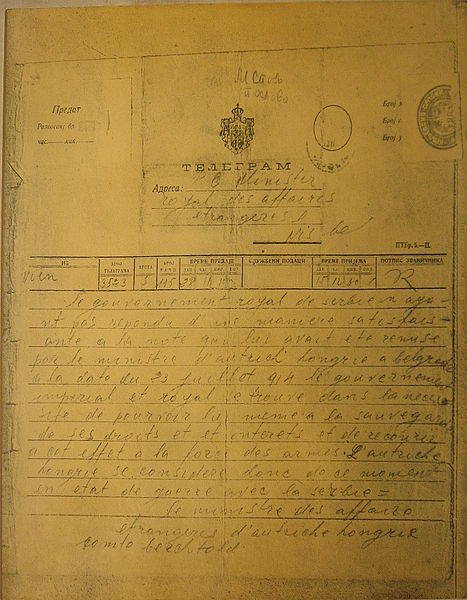
The Austrian Declaration of War against Serbia

One of the premier military and political theorist who has ever lived, Carl von Clausewitz “No one starts a war–or rather, no one in his senses ought to do so–without first being clear in his mind what he intends to achieve by that war and how he intends to conduct it.” Sadly, few political leaders take his advice.

It was a war that should never have happened. It was a war for which the belligerent powers could boast many causes but for which few had any real objectives. One hundred and one years ago this week the armies nations of Europe were beginning clashing on the frontiers of France, Germany, Belgium and Russia. Their leaders were hell bent on waging a war that all thought would be short, decisive and end in victory for their side. The leaders were wrong and nearly a century later the world still pays the price for their misplaced beliefs and hubris of those men.

It was a war in large part brought on by the declining Austro-Hungarian Empire’s fears. Fear of neighbors, ethnic minorities and its place among regional and world powers led the leaders of the Austro-Hungarian Empire to decide for war when the very unpopular heir to the throne Archduke Franz Ferdinand was assassinated in Sarajevo, the capital of the recently annexed province of Bosnia-Herzegovina on June 28th 1914.

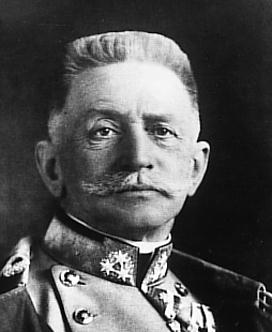
Conrad von Hötzendorf: War was the only means of politics

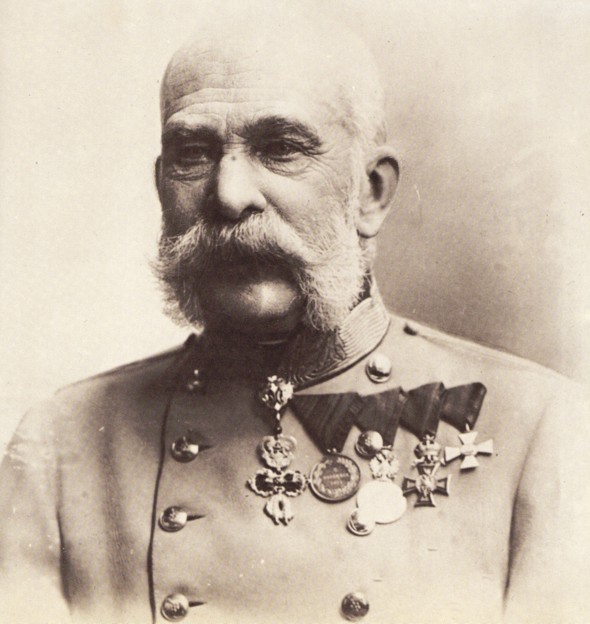
It was a series of decisions by those in the government of the Empire that brought Europe and the world to war, a war which we still feel the effects of today. In particular it was the decisions of the Austrian Chief of the General Staff Conrad von Hötzendorf, the Foreign Minister Leopold Berchtold and the aging Emperor, Franz Joseph which plunged the world into a world war which spawned revolutions, regional wars, a second world war, a cold war and countless other wars. The decisions were based on the belief, still common today that war is the only means of politics.

Emperor Franz Joseph: “If we must go under, we better go under decently”

Hötzendorf had been a continual advocate of war in every situation. He lobbied for war in 1907 against Italy and Serbia, in 1908 against Serbia, Russia and Italy, in 1909 against Serbia and Montenegro, in 1910 against Italy and the list increased in the years leading up to the war. He fervently believed that “the use of armed force alone could retard the centrifugal forces of nationalism in the ‘multinational empire’; war was the only means of politics.” The Emperor, Franz Joseph was of the same mindset by 1914 and in the days following the assassination of Franz Ferdinand he gave his approval to the actions of Hötzendorf and the diplomacy of Berchtold that doomed the Austro-Hungarian Empire and would destroy and remake Europe within a span of four years.

Theobald von Bethmann-Hollweg: The Blank Cheque

 The leadership of the Empire had decided on war within days of the assassination. Berchtold dispatched an emissary to Kaiser Wilhelm who decided in counsel with his Imperial Chancellor Theobald von Bethmann-Hollweg gave the Austrians a “blank cheque” of unconditional support for war against Serbia. Berlin was confident that “the Balkan crisis could be localized” and “advised Vienna to “proceed with all means at its disposal” and that Germany would support Austria-Hungary “come what may.” In doing so they willingly ignored the wise counsel of Otto Von Bismarck who considered the Balkans “not worth the life of a single Pomeranian Grenadier.

800px-Bain_News_Service_-_The_Library_of_Congress_-_Kaiser_Wilhelm_(LOC)_(pd)

Kaiser Wilhelm II

After they received German support the Austrians did everything that they could to ensure that war would occur. Their demands of Serbia were intentionally designed to be unacceptable to that country and they held key information from their German allies in the three weeks after they received the unconditional German support.

Helmuth Von Molkte: “no alternative but to fight a preventive war…” 

German militarists, particularly the Chief of the General Staff Helmuth Von Molkte the younger saw the coming conflict in racial and cultural terms. Von Molkte said that the coming war   would come “sooner or later” and be a war “primarily a struggle between Germans and Slavs” and compared Serbia to an “abscess.”  As the war cloud built Von Molkte told the Foreign Secretary von Jagrow that there was “no alternative but to fight a preventive war so as to beat the enemy while we could still emerge fairly well from the struggle” ignoring the advice of the Iron Chancellor Otto Von Bismarck who counseled “Preventive war is like committing suicide out of fear of death.”


Austrian Reservists going to war

 The Austrians felt that the threat from Serbia combined with internal political factors related to the Hungarian and other Slavic regions of the Empire, and the increasing influence of Russia and Germany in the Balkans was an existential threat. At the same time they were poorly prepared for war. Their military was large but poorly trained and equipped.  Their national infrastructure, industry and railroads were ill prepared for the demands of war. Their German allies had not planned for war either and were critically short of the required stocks of ammunition needed for a general war in Europe.

Cheering crowds in Petersburg

The Russians were heavily invested in the Balkans linked to other Slavic people by culture, language and religion. The French were bent on revenge against the Germans for the debacle of 1870 and had no stake in what happened in the Balkans. The British a few years prior to the war had told the Belgians not to expect support if they were invaded by Germany, but declared war to “protect Belgian neutrality.”

German wives and girlfriends walking alongside the Landser…

 The Austrians thought that with German support that even if Russia intervened that the war could be limited to Serbia. They were wrong. Just as the Germans had given the Austrians a “blank cheque” the French, both officially and unofficially were giving the Russians their own blank cheque. French Ambassador Maurice Paleologue assured Russian Foreign Minister S.D. Sazonov of the “complete readiness” of France to fulfill her obligations as an ally in case of necessity.

French Soldiers being cheered

Austria declared war on July 28th, Russia followed by a partial mobilization to support Serbia on the 29th. Kaiser Wilhelm attempted to avert war at the last minute but Czar Nicholas II wrote, “An ignoble war has been declared on a weak country. The indignation of Russia, fully shared by me, is enormous. I foresee that very soon I shall be overwhelmed by pressure to which I am exposed and compelled to take measures which will lead to war.”  This was met with German mobilization on the 30th and the French on August 1st. Declarations of war were exchanged and on August 4th in response to Germany’s refusal to respect the neutrality of Belgium Great Britain declared war against Germany.

A final kiss from a British Soldier at Victoria Station

They were fateful days. Only the Austrians entered the war with any positive objectives, military or political goals. Every other power lurched into the war without clear objectives or end states. One writer noted that the war had “causes but no objectives.”

The world again finds itself perched at the edge of the abyss of war. There are people, smart and otherwise reasonable people who believe that they can wage “preventive wars” and rely on brute military force to solve nearly any problem. There are others that suggest that we should not criticize “allies” even when their decisions could be disastrous to them and the world, much as the Germans gave their Austrian brothers a “blank cheque.”  I wish that they would just look at the consequences before they commit nations and the world to more war that can only result in calamity and great suffering without benefit for anyone or any nation involved.

Those that counsel “preventive wars” need to remember the words of Otto Von Bismarck that “Preventive war is like committing suicide out of fear of death.”

Peace

Padre Steve+

3 Comments

Filed under Foreign Policy, History, leadership, Military, national security, Political Commentary, world war one