Author Archives: padresteve

padresteve's avatar

About padresteve

I'm a Navy Chaplain and Old Catholic Priest

The Devil Wears My Sister’s Face

Friends of Padre Steve’s World

I don’t re-post other blogs often, but this is one that I think is important.

As a Chaplain I have helped care for many people who have been the victims of abuse by spouses, parents, other older relatives or by “friends” of the family. Some is physical, some sexual and most also involve emotional abuse. However, little is written about abusive siblings, though it is quite common, usually these siblings are also the victims of abuse who take out their anger on the only people they can, usually younger or weaker siblings. Thankfully I was never abused by any family members. However my wife Judy suffered a lot of abuse, verbal and physical abuse by her father, the same and worse by her sister and had a mother who allowed it to happen.

This is Judy’s latest blog over at the Abby Normal Abbess site, which I encourage you to visit. It is quite powerful.

Peace

Padre Steve+

abbeynormalabbess's avatarAbbeynormalabbess's Blog

When I think of the Devil, I see an angry, red, scowling face. I don’t see a mythical figure. I see my sister. This is the only part of her I ever saw.

“Nobody will ever love you. Nobody will ever want you. Nobody will ever be your friend. You’ll never be anybody,you’ll never do anything.” So went the litany of non-affirmations she heaped on me constantly. She drew an imaginary line down the middle of our bedroom, and I was never, ever, allowed to cross it, unless it was to reach the closet, or one of the two doors leading out of our bedroom. She was older than me. She knew me better than anyone. She had to know what I was really like. I believed her. Sometimes, I believe her now. When I entered a room, she wrinkled her nose, like she smelled a foul odor. I was…

View original post 1,911 more words

Leave a comment

Filed under Loose thoughts and musings, Uncategorized

Iraq, ISIS and Al Qaeda: Sowing the Wind…

In recent days I have been reading the statements, speeches and documents of senior members of the Bush administration justifying the overthrow of Saddam Hussein’s regime in Iraq. Until it invaded Kuwait in August 1990, that regime was considered an ally against the Iranian Mullahs. But that changed when he invaded Kuwait, following an American diplomatic miscalculation which he interpreted as our acquiescence to his plans.

Of course like Paul Harvey used to say, we know “the rest of the story.” The administration of George H.W. Bush assembled a coalition and obtained the support of the United Nations Security Council to drive Saddam’s forces out of Kuwait. Interestingly enough the coalition included Sunni and Arab, Shia regimes including that of Syria. Twelve years later following the Al Qaeda attacks on the World Trade Center and the Pentagon, the son-of-Bush, George W. Bush and his administration desperately tried to link the most disparate group of nations to the actions of Al Qaeda; Iran, a mortal enemy of the Sunni Al Qaeda extremists, North Korea, a rogue nation in its own right, but with no proven contacts with the terrorist group, and Saddam Hussein’s Iraq, a rather unique regime which managed under a secular mantle to unify a disparate country well enough that hundreds of thousands of Shia Arabs gave their lives in nearly decade long war with Shia Iran.

The imbecilic decision to attack Iraq, despite all the evidence to the contrary, and the knowledge that the previous Bush administration rejected the idea of overthrowing Saddam and occupying the county was disastrous. Likewise the decision to lump the Shia regime of Iran, which realized the militant Al Qaeda threat and was working through back channels to cooperate with the United States against it, was stupid. The decisions destroyed the balance of power in the region and eliminated the one relatively, though admittedly despotic secular state that opposed both Al Qaeda and Iran ran contrary to an sane understanding of geopolitics and national security.

After eight years of struggle the United States withdrew its military forces pursuant to an agreement negotiated by the Bush administration with the Shia dominated government of Iraq. The rest is history. That government under Prime Minister Maliki did all that it could to keep itself in power while marginalizing the largely secular Sunnis who rose to drive out Al Qaeda in the Anbar Awakening helped bring about the resurgence of the Al Qaeda terrorist extremism, in its new and more lethal form of the Islamic State.

Too late the Iraqi government, Iran, the United States, Europe, the United Nations, Saudi Arabia and the Emirates have woken up to the threat. ISIS now controls large chunks of strategic territory in Iraq and Syria, it is dismantling Al Qaeda and supplanting it as the terrorist organization of choice for young Jihadists around the world. The brutality and single minded devotion of of ISIS to radical Salafi and Wahhabi Islam makes Al Qaeda and the Taliban look like the Boy Scouts. It is well funded through black market oil and through rich benefactors in the Gulf States and Saudi Arabia and its recruiting efforts are bringing in volunteers around the world.

Now the world is faced with a beast that need not have been created. But, the hubris of the Bush administration to destroy the long standing balance of power in the region, eliminate Saddam and alienate Iran, just when we needed both; as well as the short sighted religious devotion of Sunni- Wahhabi and Salafist fundamentalists who funded Sunni militants and terrorists with petrodollars for two decades has opened the door to Pandora’s box. The beheading of American Photo-Journalist James Foley, the killing and persecution of Christian and Yadizi minorities who have lived in Iraq for millennia and the slaughter of Shia Moslems by the ISIS Caliphate demonstrate the level to which ISIS will go to achieve their ends.

There will be no quick end to this war. It will be a war of unimaginable duration, brutality and excess because it will be a war of radically opposed ideology infused with fanatical religion and even racism? The West, too long in denial of the importance of ideology in war, despite having fought ideological, religions or racial wars will be slow to appreciate this fact. However, when it does after yet another massive terrorist strike, the media will whip Americans and Europeans into a frenzy and the gloves will come off and the battle will be joined. The war will take years, maybe decades and the effects will be felt around the world. The brutality will drive moderates to the extremes and it will become a clash of civilizations, probably only rivaled in brutality and destruction by the war between Nazi Germany and the Soviet Union.

Of course none of this is what I want, and I do hope that I am wrong, but I sense that it will play out this way. The details are yet to be decided, but this ideological war, the offspring of the American hubris of the second Bush administration, European greed and the shortsightedness of wealthy Sunni Arabs in promoting a dangerous brand of Islam have brought us to this point. All of us have sowed the wind and now, we will reap the whirlwind.

In such a conflict I wonder about the words Joshua Chamberlain spoke at Gettysburg almost a century and a half ago: “…men made in the image of God, marred by the hand of man, and must we say in the name of God? And where is the reckoning for such things? And who is answerable? One might almost shrink from the sound of his own voice, which had launched into the palpitating air words of order–do we call it?–fraught with such ruin. Was it God’s command that we heard, or His forgiveness that we must forever implore?”

Peace Padre Steve+

2 Comments

Filed under Foreign Policy, middle east, national security, Uncategorized

Requiem of Empire: The Yamato Class Battleships

Friends of Padre Steve’s World,
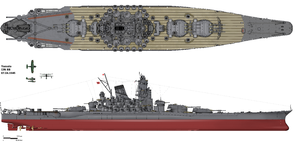
One last re-run until I post some new material tomorrow. This one on the largest battleships ever constructed, the Yamato and Musashi of the Imperial Japanese Navy in the Second World War. They were amazing as well as tragic ships, both sunk by U.S. Naval airpower, Musashi at the Battle of Leyte Gulf in October 1944 and Yamato in a suicide mission to attack U.S. invasion forces at Okinawa in April 1945.
Peace
Padre Steve+

padresteve's avatarThe Inglorius Padre Steve's World

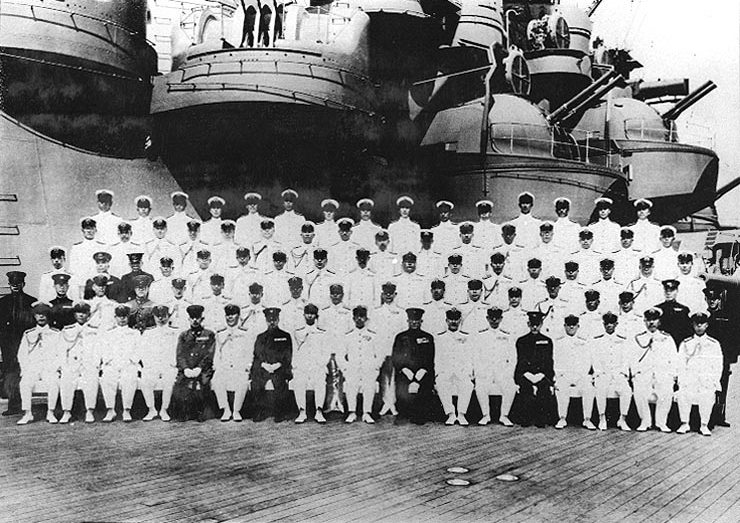
Emperor Hirohito on Musashi in 1943

The is a long delayed installment of my series on Battleships. Previous were about the Battleships constructed under conditions of the London Naval Conference.  These have dealt with the British King George V Class, FrenchDunkerqueandRichelieuClasses, ItalianVittorio VentoClassand the American North CarolinaandSouth Dakota ClassesI then wrote an introduction to the Post Treaty Super-Battleships. This article is the first in that series which will include articles on the GermanBismarckand Tirpitz, British Vanguardand AmericanIowa Class.

They were the largest and most heavily armed battleships ever built. Shrouded in secrecy by the Imperial Japanese Navy and Government the ships were designed to offset projected American numerical superiority. Their names were symbolic of Japan’s history. Yamato was named after Yamato Province, the ancestral home of the Yamato People, the dominant…

View original post 1,573 more words

Leave a comment

Filed under Loose thoughts and musings

The First Aircraft Carriers Part One: The First American Flattops- Langley, Lexington and Saratoga

Friends of Padre Steve’s World
As I am using this weekend to catch up on a few things, and to rest and regroup, here is another old article about the first aircraft carriers that served the U.S. Navy. None were initially designed as carriers but they helped pave the way for the carrier force that drove the Imperial Japanese Navy from the Pacific in World War II and have been a facet of U.S. Military and diplomatic power ever since. Have a great Sunday. Now down to my chapel…
Peace
Padre Steve+

padresteve's avatarThe Inglorius Padre Steve's World

saratoga aircraft approach for landingAircraft over Saratoga

Note: This is the first in a series on the early aircraft carriers.  Two others will follow on the British and Japanese carriers.  My dad was a Chief Petty Officer in Naval Aviation.  As such I grew up around Naval Air Stations, Squadrons and of course Aircraft Carriers.  My dad retired off of the USS Hancock CVA-19 in 1974.  I spent two weeks underway on USS Coral Sea CV-43 as a NJROTC Cadet in the summer of 1976.  It was an experience that I will never forget.  While on the Cruiser USS Hue City CG-66 we deployed with the USS John F Kennedy CV-67 for Operation Enduring Freedom.  There is something about the power and majesty of the modern carriers at the same time there is a sense of timelessness in the first aircraft carriers.  Three of the first four American ships were converted from other platforms. …

View original post 1,115 more words

Leave a comment

Filed under Loose thoughts and musings

100 Years of Navy Aviation: Part One the Aircraft Carriers

Friends of Padre Steve’s World
Today a break from writing anything really new. For those that don’t know, I grew up as the child of a Navy Chief Petty Officer. Growing up around naval bases and naval air stations in the 1960s and 1970s I became enthralled by the Navy, ships, aircraft and naval history. I still am, though due to my writing on Gettysburg I have not done much new writing on the subject in the past year or so. This is an article from 2010 that I have updated today. It is about the U.S. Navy aircraft carriers. It is a “wave top” treatment, really more of an introduction than anything else. I followed it with a number of articles about the U.S. Navy carriers, as well as the British carriers of the 1920s, 1930s and early World War II carriers. Those articles can be found by clicking on the Warship and Naval Battles tab.
Have a great weekend,
Peace
Padre Steve+

padresteve's avatarThe Inglorius Padre Steve's World

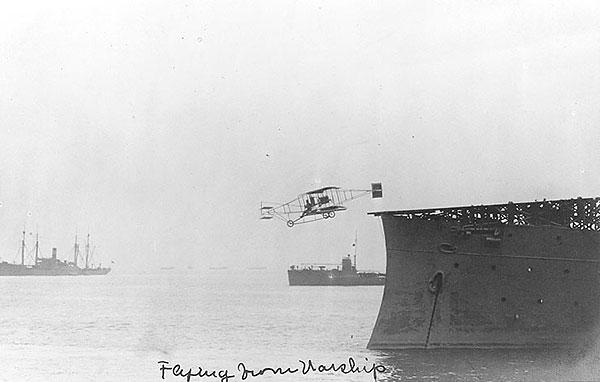
Eugene Ely makes the first takeoff from USS Birmingham on November 14th 1910

On a blustery November 14th in the year 1910 a young civilian pilot hailing from Williamsburg Iowa became the first man to fly an aircraft off the deck of a ship.  At the age of 24 and having taught himself to fly barely 7 months before Eugene Ely readied himself and his Curtis biplane aboard the Cruiser USS Birmingham anchored just south of Fort Monroe in Hampton Roads.  Ely was there because he was discovered by Navy Captain Washington Irving Chambers who had been tasked with exploring how aircraft might become part of Naval Operations. Chambers had no budget or authority for his seemingly thankless task but hearing that a German steamship might launch and aircraft from a ship hustled to find a way to stake a claim for the U.S. Navy to be the first…

View original post 2,717 more words

Leave a comment

Filed under Loose thoughts and musings

Miscellaneous Thoughts on a Friday

IMG_1915

Friends, I am tired. It has been a busy week and I am going to try to rest some over the weekend as well as spend some quality time with my wife Judy.

Part of the issue with my tiredness is that I haven’t been the same since my experience over the last month or so dealing with the military mental health system. I won’t bore you with details since I have already written a lot on it, including the fact that I got some resolution, but frankly I didn’t realize just how fragile that I was still was. I had no idea that trying to get help would be so emotionally punishing. Truthfully, I have not had a good night sleep since the initial conflict with the physician and the system. The nightmares, terrors and restlessness are all back. Hopefully in a few weeks or months things will settle out again.

On the positive side I was provided new hearing aids which are quite remarkable in their capabilities and are already helping me to understand speech better. For those that don’t know I hear noise just great. I have almost no loss of that ability. However, since Iraq I suffer unending tinnitus and my speech discrimination, a neurological function is in the third percentile, meaning that 97% of people understand speech better than me. So I am grateful for the hearing aids, as Judy, who was becoming ever more frustrated with me not understanding her or others. The ironic thing is that she has been severely hard of hearing her whole life and has a 77% hearing loss, but she usually understands speech better than me. a funny thing did happen yesterday. I was asked by a Charismatic Christian about praying from my hearing. While I appreciate that and I am touched by such sincere desires to help, it would be a shame if the government wasted over 5,000 on the hearing aids that are working so well.

Likewise, it looks like I have been invited to speak at the Military Officers Association of America conference in Washington DC in September on the topic of being a care giver to those suffering from PTSD while suffering from it myself. That should be interesting. In a way it is something that I hope to do on a regular basis once I retire from the military.

I have been writing a lot about Gettysburg and each thing that I write helps bring me a better understanding of the battle, but also the people, as well as the culture and philosophic ideas that had such an influence on those times. So you can expect that as I write new material and revise old material that I will share them with you here.

Finally as to current events. I am troubled by the events in Ferguson Missouri, especially many of the surprisingly racist reactions by “white America.” Since I wrote about that recently as well, I won’t go back into it.

The situation in Iraq with the rise of ISIS and its “Caliphate” has me greatly concerned. This is not a normal terrorist organization, it is Al Qaeda on steroids. The Secretary of Defense, Chuck Hegel, sounded a clear warning in the wake of the public execution of  American photo journalist James Foley and threats to bring their war to the United States and the west. I do not think that Secretary Hegel, a very circumspect man would make such an announcement if there was no real threat. The problem is that back in 2003 the Bush Administration sewed the wind in Iraq and left a very fragile and unstable state, whose leaders failed their people, and now we are reaping the whirlwind. We want peace, I know I think I speak for everyone, but the rise of ISIS with its apocalyptic vision, vast financial resources, international reach and success on the battlefields of Syria and Iraq is drawing radicalized Moslems to it’s black banner around the world. Because of this I expect that we are in for a long hard fight, and that our new opponent will cause us grave damage.

That being said, I fear for civil liberties in the wake of any attack, and I especially fear that, if something bad happens in the United States, that we will react not just against the culprits; but innocent, loyal and patriotic Americans of Moslem or Arab descent or because they look like the bad guys, or because they share the Islamic religion. Since I know a good number of such people I worry. We can be quite a xenophobic people when aroused, and our quite often “yellow journalism” and jingoistic politicians and preachers stir the cauldron of hatred to the point of paranoid insanity. Our history is colored by such xenophobia.

Finally, the news that the Russians may be attacking in the Ukraine is seriously bad news, which we all, Americans and Europeans need to wake up to.

So I close this Friday sharing my sense of foreboding even while I hope and pray for peace and justice.

Peace and have a wonderful weekend.

Padre Steve+


Leave a comment

Filed under faith, Loose thoughts and musings, middle east, News and current events, PTSD

We Have Done Well Enough: July 4th at Gettysburg

gburg retreat

“Dead men and plenty here – and I saw plenty of them in all shapes on the field – Help to wound & Kill men then Patch them up I could show more suffering here in one second than you will see in a Life…” Elbert Corbin, Union Soldier at Gettysburg 1st Regiment, Light Artillery, N. Y. S. Volunteers (Pettit’s Battery) [1]

“In great deeds something abides. On great fields something stays. Forms change and pass; bodies disappear, but spirits linger, to consecrate ground for the vision-place of souls.” [2]

“The day after the battle began muggy and cloudy, and there was a tremendous rainstorm” [3] as the Army of Northern Virginia and Army of the Potomac licked their wounds on the bloodstained Gettysburg battlefield on July 4th 1863. Both armies had suffered severely in the fighting and around 50,000 soldiers from both sides lay dead, dying or wounded on the battlefield. It was a somber day, the sweltering heat sunshine which had bathed the battlefield as Longstreet’s’ Corps attacked Cemetery Ridge was now broken by heavy rain and wind. The commanders of both armies, General Robert E Lee and Major General George Mead attempted to discern the others intent while making their own plans.

Early in the morning, or rather very late the night of July 3rd, General Robert E. Lee called Brigadier General John Imboden, to his headquarters to discuss the withdraw of the Army of Northern Virginia from the place of its defeat. Lee had spent the evening of July 3rd with Longstreet they “rode together along the lines on Seminary Ridge and conferred with other generals.” [4]

When Lee arrived to meet Imboden the brigadier felt the need to say something and said to Lee: “General, this has been a hard day on you.” [5] Lee waited some time before replying mournfully, “Yes, it has been a sad, sad day for us” [6]and then praised the conduct of Pickett’s men saying “I never saw troops behave more magnificently than Pickett’s division of Virginians did today in that grand charge upon the enemy.” He continued and lamented what he believed to be the lack of support from the rest of the army, then paused and “exclaimed in a voice that echoed loudly and grimly through the night, “Too bad! Too bad! Oh, too bad!” [7] It was a strange thing to say, and showed his inability to comprehend the strength and tenacity of his opponent on that final day of battle, and just how his own decisions, including the fact that “he had denied Hill’s permission to throw his whole corps into the assault,” [8] contributed to his defeat.

Lee realized, that unless “he could somehow entice Meade into counterattacking along his Seminary Ridge line, he must get the army back to Virginia with all speed. There was only enough ammunition for one battle, if that…and lee had to consider that Meade might aggressively seek to cut the routes south to the Potomac.” [9] Thus he wasted little time in preparing the army for its return. Lee “chose his routes, decided on the order of march, and then, despite the lateness of the hour and his bone-deep weariness after three days of failure and frustration, went in person to make certain that his plans were understood by the responsible commanders.” [10] He felt, if not in his words, but in his actions, that he had been failed by his subordinates. He was now aware that the method of command he had employed so successfully with Stonewall Jackson had failed, and in “the task of saving his army, he trusted no one with any discretion at all.” [11] Unlike “the vague and discretionary orders he had issued throughout the week leading up to battle and even during the past three days of fighting…his instructions were now written and precise….” [12] Meade explained “that he had not wanted to follow “the bad example [Lee] had set me, in ruining himself attacking a strong position.” [13] In not attacking Meade was probably correct, despite the criticism he received from contemporaries and later commentators. Lee’s army, though defeated was not broken and held good ground on July 4th, likewise the lack of supplies, exhaustion of his troops and foul weather would likely have doomed any attack. Instead he told a cavalry officer “We have done well enough…” [14]

About 1:00 P.M. on the 4th Imboden’s troopers escorting the ambulance trains carrying the wounded began to withdraw. As they did “a steady, pounding rain increased Imboden’s problems manifold, yet by 4 o’clock that afternoon he had the journey under way. He estimated this “vast procession of misery” stretched for seventeen miles. It bore between 8,000 and 8,500 wounded men, many in constant, almost unendurable agony as they jolted over the rough and rutted roads.” [15] Although beaten, the Lee’s army “retained confidence in itself and its commander” [16] and they retreated in good order.

Across the carnage strewn battlefield on Cemetery Ridge George Meade took inventory and “unsure about the nature and extent of Lee’s movements from information he had already received, he realized he had a busy day ahead.” [17] The army, tired from three weeks of hard marching and three days of brutal combat was exhausted; Meade’s was down to about “51,000 men armed and equipped for duty.” About 15,000 were loose from the ranks, and though they would return “for the moment they were lost.” [18] The at times torrential rain “was a damper on enthusiasms,” and the Federal burial parties, exhausted from the battle and engaged in somber work, “dug long trenches and, after separating Rebel from Yankee, without ceremony piled the bodies several layers deep and threw dirt over them.” [19]

Meade ordered his trains to bring the supplies from Westminster Maryland on the morning of the 4th as Federal patrols pushed into the town to see what Lee’s army was doing, but apart from isolated skirmishing and sniper actions the day was quite. During the afternoon, “David Birney summoned the band of the 114th Pennsylvania “to play in honor of the National Anniversary” and up on the “line of battle.” They played the usual “national airs, finishing with the Star Spangled Banner.” [20] As they did a Confederate artillery shell passed over them, and with that last shot the battle of Gettysburg was over. Meade, signaling the beginning of an overly cautious pursuit, wired Halleck: “I shall require some time to get up supplies, ammunition, etc. [and to] rest the army, worn out by hard marches and three days hard fighting.” [21]

Surgeons and their assistants manned open air hospitals while parties of stretcher bearers evacuated wounded men for treatment and other soldiers began to identify and bury the dead.  A Confederate soldier described the scene west of the town on July 4th:

“The sights and smells that assailed us were simply indescribable-corpses swollen to twice their size, asunder with the pressure of gases and vapors…The odors were nauseating, and so deadly that in a short time we all sickened and were lying with our mouths close to the ground, most of us vomiting profusely.” [22]

Halfway across the continent Confederate Lieutenant General John C. Pemberton surrendered his emaciated forces at Vicksburg to Major General Ulysses S Grant which cut the Confederacy in half. It was a fitting day of remembrance as it was the 87th anniversary of the signing of the Declaration of Independence, and the significance was not lost on any of the commanders. Grant, the victor of Vicksburg had eliminated a Confederate army of over 43,000 troops, and William Tecumseh Sherman wired his friend a most appropriate message: “This is a day of jubilee, a day of rejoicing for the faithful.” [23]

Lieutenant Elisha Hunt Rhodes of the 2nd Rhode Island wrote:

“Was ever the Nation’s Birthday celebrated in such a way before. This morning the 2nd R.I. was sent out to the front and found that during the night General Lee and his Rebel Army had fallen back. It was impossible to march across the field without stepping upon dead or wounded men, while horses and broken artillery lay on every side.” [24]

As Lee withdrew Meade slowly pursued and lost his chance of trapping the Confederate Army before it could escape across the rain swollen Potomac River.  Lee completed his withdraw under pressure on the 14th and his rear-guard under the command of Major General Harry Heth fought an action against Union forces at the in which the accomplished academic and author Brigadier General James Pettigrew was mortally wounded.

Meade’s lackluster pursuit was criticized by many including President Lincoln who believed that had Meade been more aggressive that the war could have ended there. Had Lee’s army been destroyed in little over a week after the surrender of Vicksburg it could have well brought about the downfall of the Confederacy in the summer of 1863.  Even so the skill of Meade in defeating Lee at Gettysburg was one of the greatest achievements by a Union commander during the war in the East.  In earlier times Lee had held sway over his Federal opponents. McClellan, Porter, Pope, Burnside and Hooker had all failed against Lee and his army.

Many of the dead at Gettysburg were the flower of the nation. Intelligent, thoughtful and passionate they were cut down in their prime. The human cost some of over 50,000 men killed or wounded is astonishing. In those three days more Americans were killed or wounded than in the entire Iraq campaign.

The war would go on for almost two more years adding many thousands more dead and wounded. However the Union victory at Gettysburg was decisive. Never again did Lee go on the offensive and when Grant came east at the end of 1863 to command Union armies in the East against Lee the Federal armies fought with renewed ferocity and once engaged Grant never let Lee’s forces out of their grip.

[1] Corbin, Elbert. Union soldier in Pettit’s Battery account of caring for wounded at the Battle of Gettysburg retrieved from https://www.gilderlehrman.org/sites/default/files/inline-pdfs/t-03685.pdf 18 July 2014

[2] Primono, John W. The Appomattox Generals: The Parallel Lives of Joshua L Chamberlain, USA, and John B. Gordon, CSA, Commanders at the Surrender Ceremony of April 12th 1865 McFarland and Company Publishers, Jefferson NC 2013 p.187

[3] Catton, Bruce The Army of the Potomac: Glory Road Doubleday and Company, Garden City New York, 1952 p.322


[4] Wert, Jeffry D. General James Longstreet The Confederacy’s Most Controversial Soldier, A Touchstone Book, Simon and Schuster, New York and London 1993 p.293

[5] Trudeau, Noah Andre. Gettysburg: A Testing of Courage, Harper Collins Publishers, New York 2002 p.530

[6] Freeman, Douglas Southall, Lee an abridgment by Richard Harwell, Touchstone Books, New York 1997 p.341

[7] Ibid. Freeman Lee p.341

[8] Foote, Shelby, The Civil War, A Narrative. Volume Two Fredericksburg to Meridian Random House, New York 1963 p. 581

[9] Sears, Stephen W. Gettysburg. Houghton Mifflin Co. Boston and New York 2003 p.470

[10] Ibid. Foote, The Civil War, A Narrative. Volume Two pp.579-580

[11] Dowdy, Clifford. Lee and His Men at Gettysburg: The Death of a Nation Skyhorse Publishing, New York 1986, originally published as Death of a Nation Knopf, New York 1958

[12] Ibid. Foote, The Civil War, A Narrative. Volume Two p.580

[13] McPherson, James. The Battle Cry of Freedom: The Civil War Era Oxford University Press, Oxford and New York 1988 p.663

[14] Ibid. McPherson The Battle Cry of Freedom p.663

[15] Ibid, Sears Gettysburg pp.471-472

[16] Coddington, Edwin B. The Gettysburg Campaign: A Study in Command, A Touchstone Book, Simon and Schuster New York, 1968 p.536

[17] Ibid. Coddington, The Gettysburg Campaign p.535

[18] Ibid. Catton The Army of the Potomac: Glory Road p.323

[19] Ibid, Sears Gettysburg p.474

[20] Guelzo, Allen C. Gettysburg: The Last Invasion Vintage Books a Division of Random House, New York 2013 pp.433-434

[21] Schultz, Duane The Most Glorious Fourth: Vicksburg and Gettysburg July 4th 1863. W.W. Norton and Company New York and London, 2002 pp.355-356

[22] _________ What Happened to Gettysburg’s Confederate Dead? The Blog of Gettysburg National Military Park, retrieved from http://npsgnmp.wordpress.com/2012/07/26/what-happened-to-gettysburgs-confederate-dead/ 18 July 2014

[23] Ibid. Schultz, Duane The Most Glorious Fourth p.364

[24] Rhodes, Robert Hunt ed. All for the Union: The Civil War Diaries and Letters of Elisha Hunt Rhodes, Vintage Civil War Library, Vintage Books a Division of Random House, New York 1985 p.109

3 Comments

Filed under civil war, History, leadership, Military

Reembracing the New Birth of Freedom

gburg address

I am always humbled when I travel to Gettysburg as I did a week and a half ago. It is hard to believe in that now peaceful pastoral setting that over 157,000 Americans, almost 82,000 Union and 75,000 Confederate met in a three day battle. In those three days over 28,000 Confederates and 23,000 Union soldiers were killed, wounded, missing or captured. It was the greatest number of casualties inflicted in one battle on American soil in history.

The places that the battle was fought have become legendary, for they are “hallowed ground” as President Abraham Lincoln so eloquently put it. The places, McPherson’s and Herr’s Ridge, Seminary Ridge, the Railroad Cut, Barlow’s Knoll, Cemetery Hill, Culp’s Hill, The Wheat Field, Devil’s Den, the Peach Orchard, Little Round Top, Cemetery Ridge, the Apse of Trees, the Angle and the High Water Mark are in a sense holy, or hallowed, consecrated by those who struggled there, those who lived and those who gave the last full measure of devotion to their country. When I take my students there I always finish at the Soldier’s Cemetery where Abraham Lincoln delivered the Gettysburg Address.

I think about those men of both sides, fully convinced of the rightness of their cause who fought valiantly in the struggle. That being said when I go there though my family predominantly fought for the Confederacy my heart is drawn to those men who remained loyal to the Union and those who answered the call of Abraham Lincoln to serve in a cause greater than their own interests, the great and the small alike.

Lincoln was a masterful orator who managed to rally the Union and bring hundreds of thousands of men volunteer before Gettysburg. They came for an ideal an ideal which Lincoln’s oratory was probably the most effective at articulating in a way that men would volunteer to suffer hardship, fight and die to bring about. It was well put in the movie Gettysburg where Colonel Joshua Chamberlain, played by Jeff Daniels said:

“This is a different kind of army. If you look at history you’ll see men fight for pay, or women, or some other kind of loot. They fight for land, or because a king makes them, or just because they like killing. But we’re here for something new. This has not happened much, in the history of the world: We are an army out to set other men free. America should be free ground, all of it, from here to the Pacific Ocean. No man has to bow, no man born to royalty. Here we judge you by what you do, not by who your father was. Here you can be something. Here is the place to build a home. But it’s not the land. There’s always more land. It’s the idea that we all have value, you and me. What we’re fighting for, in the end… we’re fighting for each other…” [1]

On November 19th 1863 Lincoln delivered a “few words” at Gettysburg which were in all practical aspects a benediction at the dedication of the battlefield cemetery. Lincoln was the second speaker at the ceremony following former Pennsylvania Congressman Edward Everett who spoke for more than two hours, a typical speech from the period.

Everett was one of the leading orators of his day. Everett was “a scholar and Ivy-League diplomat who could hold mass audiences in thrall. His voice, diction, and gestures were successfully dramatic, and he always performed his carefully written text, no matter how long, from memory.” [2]

The 270 words of Lincoln’s address are perhaps the most important of any speech or document in American history save the Declaration of Independence and the Constitution of the United States, in those words “Lincoln, nevertheless managed to justify the ways of democracy more than anyone, then or now.” [3]

The speech was so powerful that Everett wrote Lincoln the next day:

“Permit me also to express my great admiration of the thoughts expressed by you, with such eloquent simplicity & appropriateness, at the consecration of the Cemetery. I should be glad, if I could flatter myself that I came as near to the central idea of the occasion, in two hours, as you did in two minutes.” [4]

The speech is short, but its eloquence is unmatched. Lincoln wrapped ideas, concepts and ideals that men have written volumes about into a speech so powerful that many have memorized it.

But few realize the context that it must be placed. Though the Union had defeated Lee’s Army at Gettysburg and Grant had taken Vicksburg to cut the Confederacy in half the North was growing war weary. During the fall of 1863 after a series of inconclusive battles in northern Virginia both Lee and Meade’s armies had sent significant numbers of troops to the west, to support operations in eastern Tennessee.

Lee sent Longstreet’s First Corps, which took part in the bloody battle of Chickamauga, which “is a Cherokee word meaning “river of death.” [5] where on September 19th and 20th the Federal Army of the Cumberland under General Rosecrans “were soundly whipped at …and driven back into the strategic point of Chattanooga.” [6] The number of casualties on both sides, over 16,000 Federal and 18,000 Confederate, a “combined total of 34,634 was exceeded only the three day slaughter at Gettysburg and by the week-long series of five battles known collectively as the Seven Days.” [7] Despite the number of casualties it was one of the biggest Confederate victories of the war. A clerk in Richmond wrote “The whole South will be filled again with patriotic fervor, and in the North there will be a corresponding depression.” [8] That changed rapidly when the Union reacted quickly and reversed the strategic situation. One action taken was to deploy Oliver Howard’s XI Corps and Henry Slocum’s XII Corps west, where “they would be commanded by Joe hooker, who was conveniently at hand and unemployed.” [9]

In the east during the following weeks “Lee and Meade, like two wounded, spent gladiators, sparred listlessly along the Rapidan. It seemed to Northerners that the fruits of Gettysburg had been thrown away.” [10] Lee sensed an opportunity to go back on the offensive against Meade’s weakened army, but his offensive was stopped on October 14th when “the Union Second Corps shattered a reckless attack by A.P. Hill’s corps at Bristoe Station, five miles south of Manassas.[11]

There was a faction in the North, the Copperheads, who were willing even after Gettysburg and Vicksburg to end the war on terms favorable to the Confederacy, even allowing for Confederate independence and the continuation of slavery. The efforts of the Copperheads to gain governorships in Ohio and Pennsylvania met defeat in November 1863, although their efforts would persist through the 1864 Presidential election.

However, the anti-abolitionist and racist views espoused by the northern Democrat Copperheads had begun to lose their potency in the North after July of 1863 with the onset of “the New York draft riot, which shocked many northerners into a backlash against the consequences of virulent racism” [12] and the sacrifice of the African American 54th Massachusetts Infantry when it assaulted Fort Wagoner outside of Charleston South Carolina, which occurred “just after the Democratic rioters in New York had lynched black people and burned the Colored Orphan Asylum. Few Republican newspapers failed to point the moral: black men who fought for the Union deserved more respect than white men who fought against it.” [13]

The speeches of Everett and Lincoln are deeply connected with Romanticism, the Greek revival and the Transcendentalist movement in the United States. Both were children of the enlightenment, and Everett, a former President of Harvard was well versed in these subjects and Lincoln, though a politician who appealed to the tenets of the Enlightenment, the Declaration of Independence and the Constitution. Lincoln appealed to the “sacred principles of the laws of nature,” and hailed “the constitution and laws” as “hewn from the solid quarry of sober reason.” For Lincoln, the war was a test of the practical worth of liberalism.” [14]

Everett had been a mentor to some of the leading Transcendentalist thinkers of his era including Ralph Waldo Emmerson who found that the experience of “Everett’s classroom gave him an entirely new direction in life. He wrote:

“Germany had created [literary] criticism in vain for us until 1820, when Edward Everett returned from his five years in Europe, and brought to Cambridge his rich results, which no one was so fitted by natural grace and splendor of his rhetoric to introduce and recommend….The novelty of the learning lost northing in the skill and genius of its interpreter, and the rudest undergraduate found a new morning opening to him in the lecture room at Harvard.” [15]

Everett, who had previously dedicated battlefields at Bunker Hill, as well as Lexington and Concord, was at his best when dedicating battlefields and cemeteries. He spent weeks preparing his speech. Everett had studied the battle and knew it well from official reports and talks with those who fought it. Everett painted a vivid picture of the battle for his audience and connected the sacrifice of those who fought and died to preserve the Union form antiquity and from those who founded the nation. In his narrative Everett aspired to more than mere accuracy. Along “with Bancroft and other romantic historians of his time, he meant to create a tradition that would inspire as well as inform. Like the Attic orators- and dramatists- he knew the power of symbols to create a people’s political identity.” [16]

Lincoln was sick when he delivered the address having what was mostly likely a mild form of Smallpox when he gave the address. Thus the tenor, simplicity and philosophical depth of the address are even more remarkable. It is a speech given in the manner of Winston Churchill’s “Blood sweat toil and tears” address to Parliament upon being appoint Prime Minister in 1940. Likewise it echoes the Transcendentalist understanding of the Declaration of Independence as a “test for all other things.” Many in the United States and Europe did not agree and argued that no nation found on such principles could long survive. But Lincoln disagreed. He believed that the “sacrifices of Gettysburg, Shiloh, Murfreesboro, Chancellorsville, and a hundred other places demonstrated otherwise, that men would die rather than to lose hold of that proposition. Reflecting on that dedication, the living should themselves experience a new birth of freedom, a determination….”that government of the people, by the people, for the people, shall not perish from the earth.[17]

The Unitarian pastor and leading Transcendentalist Theodore Parker wrote:

“Our national ideal out-travels our experience, and all experience. We began our national career by setting all history at defiance- for that said, “A republic on a large scale cannot exist.” Our progress since that has shown that we were right in refusing to be limited by the past. The practical ideas of the nation are transcendent, not empirical. Human history could not justify the Declaration of Independence and its large statements of the new idea: the nation went beyond human history and appealed to human nature.” [18]

Likewise Lincoln’s address echoes the thought of George Bancroft who wrote of the Declaration:

“The bill of rights which it promulgates is of rights that are older than human institutions, and spring from the eternal justice…. The heart of Jefferson in writing the Declaration, and of Congress in adopting it, beat for all humanity; the assertion of right was made for the entire world of mankind and all coming generations, without any exceptions whatsoever.” [19]

Parker’s words also prefigured an idea that Lincoln used in his address, that being: The American Revolution, with American history since, is an attempt to prove by experience this transcendental proposition, to organize the transcendental idea of politics. The ideal demands for its organization a democracy- a government of all, for all, and by all…” [20]

Lincoln delivered these words on that November afternoon:

Four score and seven years ago our fathers brought forth on this continent, a new nation, conceived in Liberty, and dedicated to the proposition that all men are created equal.

Now we are engaged in a great civil war, testing whether that nation, or any nation so conceived and so dedicated, can long endure. We are met on a great battle-field of that war. We have come to dedicate a portion of that field, as a final resting place for those who here gave their lives that that nation might live. It is altogether fitting and proper that we should do this.

But, in a larger sense, we cannot dedicate — we can not consecrate — we can not hallow — this ground. The brave men, living and dead, who struggled here, have consecrated it, far above our poor power to add or detract. The world will little note, nor long remember what we say here, but it can never forget what they did here. It is for us the living, rather, to be dedicated here to the unfinished work which they who fought here have thus far so nobly advanced. It is rather for us to be here dedicated to the great task remaining before us — that from these honored dead we take increased devotion to that cause for which they gave the last full measure of devotion — that we here highly resolve that these dead shall not have died in vain — that this nation, under God, shall have a new birth of freedom — and that government of the people, by the people, for the people, shall not perish from the earth.[21]

In a time where many are wearied by the foibles and follies of our politicians, even wondering about our form of government can survive Lincoln’s words matter. Dr. Allen Guelzo, Professor of Civil War Studies at Gettysburg College wrote in the New York Times:

“The genius of the address thus lay not in its language or in its brevity (virtues though these were), but in the new birth it gave to those who had become discouraged and wearied by democracy’s follies, and in the reminder that democracy’s survival rested ultimately in the hands of citizens who saw something in democracy worth dying for. We could use that reminder again today.” [22]

Dr. Guelzo is quite correct. Many people in this country and around the world are having grave doubts about our democracy. I wonder myself, but I am an optimist. I do believe that we will recover because for the life of me I see no nation anywhere else with our resiliency and ability to overcome the stupidity of politicians, pundits and preachers.

The amazing thing was that in spite of everything the Union survived. Lincoln was a big part of that but it was the men who left lives of comfort and security like Joshua Chamberlain and so many others who brought about that victory. Throughout the war, even to the end Southern political leaders failed to understand that Union men would fight and die for an ideal, something greater than themselves, the preservation of the Union and the freedom of an enslaved race. For those men that volunteered to serve, the war was not about personal gain, loot or land, it was about something greater. It was about freedom.

Now I for one do not think that we are currently living up to the ideals enunciated by Lincoln that day at Gettysburg. I can understand the cynicism disillusionment of Americans as well as those around the world who have for over 200 years looked to us and our system as a “city set on a hill.” That being said, when I read these words and walk that hallowed ground I am again a believer. I believe that we can realize the ideal, even in our lifetime should we desire.

[1] Shaara, Michael. The Killer Angels, Ballantine Books, New York. 1974 p.28

[2] Wills, Garry. Lincoln at Gettysburg: The Words that Remade America Simon and Schuster Paperbacks, New York 1992 p.25

[3] Guelzo Allen C. Fateful Lightening: A New History of the Civil War Era and Reconstruction Oxford University Press, Oxford and New York 2012 p.407

[4] Everett, Edward Letter from Edward Everett to Abraham Lincoln, (Transcription) 20 November 1863 retrieved from http://www.in.gov/judiciary/citc/files/everett-to-lincoln.pdf July 18th 2014

[5] Ibid. Guelzo Fateful Lighteningp.352

[6] Hebert, Walter H. Fighting Joe Hooker University of Nebraska Press, Lincoln and London 1999. Originally published by Bobbs-Merrill, New York 1944

[7] Foote, Shelby, The Civil War, A Narrative. Volume Two Fredericksburg to Meridian Random House, New York 1963 p.758

[8] Ibid. Foote The Civil War, A Narrative. Volume Two p.757

[9] Ibid. Foote The Civil War, A Narrative. Volume Two p.764

[10] Sears, Stephen W. Gettysburg Mariner Books, Houghton Mifflin Company Boston, New York 2004 p.513

[11] McPherson, James M. Tried by War: Abraham Lincoln as Commander in Chief Penguin Books, New York and London 2008 p.200

[12] McPherson, James. The Battle Cry of Freedom: The Civil War Era Oxford University Press, Oxford and New York 1988 p.686

[13] Ibid. McPherson The Battle Cry of Freedom p.687

[14] Ibid. Guelzo. Fateful Lightening pp.406-407

[15] Ibid. Wills. Lincoln at Gettysburg p.45

[16] Ibid. Wills. Lincoln at Gettysburg p.51

[17] Ibid. Guelzo. Fateful Lightening p.408

[18] Ibid. Wills. Lincoln at Gettysburg p.110

[19] Ibid. Wills. Lincoln at Gettysburg p.105

[20] Ibid. Wills. Lincoln at Gettysburg p.105

[21] Lincoln, Abraham The Gettysburg Address the Bliss Copy retrieved from http://www.abrahamlincolnonline.org/lincoln/speeches/gettysburg.htm

[22] Guelzo, Allen C. Lincoln’s Sound Bite: Have Faith in Democracy New York Time Opinionator, November 17th 2013 retrieved from http://opinionator.blogs.nytimes.com/2013/11/17/lincolns-sound-bite-have-faith-in-democracy/?_php=true&_type=blogs&_r=0 July 18th 2014


4 Comments

Filed under civil war, History, philosophy, Political Commentary

Gettysburg: June 28th the Day of Surprises

army of the potomac

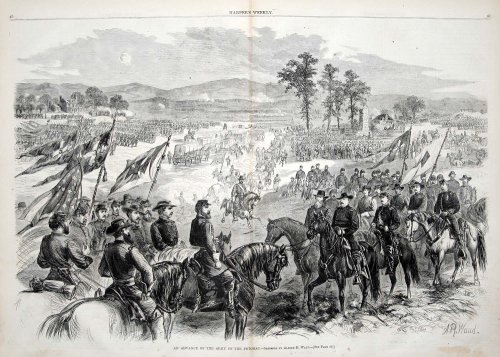
The Army of the Potomac on the Move

One of the Desired Leader Attributes of the CJCS Review of Joint Education is “The ability to anticipate and respond to surprise and uncertainty.” The Gettysburg Campaign provides many examples of leaders who anticipated or failed to anticipate surprise and uncertainty.

If you were an ordinary soldier in either the Army of the Potomac or Army of Northern Virginia June 28th 1863 would not have been much different than any of the previous days, in fact it was “uneventful for men in the ranks.” [1] Both armies had been on the march for over three weeks, and now both armies were across the Potomac, Lee’s was now mostly in Pennsylvania and Hooker’s following in Maryland. With the exception of the cavalry engagements at Brandy Station, Aldie, Middleburg and Upperville, and Ewell’s easy victory over Milroy at Winchester, the main body of either army had been engaged.

The morale of the soldiers of the Army of Northern Virginia was high, and reflected by Lee’s own attitude toward the campaign. Colonel Eppa Hunton of the 8th Virginia recalled that Lee told him that “the invasion of Pennsylvania would be a great success, and if so, it would end the war, or we would have rest for some time to come.” Hunton added, “General Lee was so enthusiastic about the movement that I threw away my doubts and became as enthusiastic as he was.” [2] Like its commander the army was superbly confident as it marched north. A Virginian observing the army as it marched through Maryland recalled: “The health of the troops was never better and above all the morale of the army was never more favorable for offensive or defensive operations….Victory will inevitably attend our arms in any collision with the enemy.” [3] Another soldier later recalled “no one ever admitted the possibility of defeat across the Potomac.” [4]

However, Lee was uneasy, but not overly concerned. Though he had not heard anything from J.E.B. Stuart since June 23rd, when Stuart had begun his ride, he was still confident. Not knowing the location of the Federal army he met with Major General Isaac Trimble on the evening of June 27th at his headquarters near Chambersburg. Though he had been slated to command to division now commanded by Allegheny Johnson, he had been slow to recover from a leg wound incurred in 1862 and could not take command. Though he did not have a command, Trimble had accompanied the army north, as Lee did not want to lose “the services of so hard a fighter as this veteran of all the Second Corps victories from First through Second Manassas.” [5] Trimble recalled the words of a very confident commander:

“Our army is in good spirits, not overly fatigued, and can be concentrated on any point in twenty-four hours or less. I have not yet heard that the enemy have crossed the Potomac, and I am waiting to hear from General Stuart….They will come up, probably through Frederick, broken down with hunger and hard marching….I shall throw up an overwhelming force on their advance, crush it, follow up the success, [and] drive one corps back on another…create a panic and virtually destroy the enemy.” [6]

Trimble was “stirred” by Lee’s words and told Lee that he did “not doubt of the outcome of such a confrontation, especially because the moral of the Army of Northern Virginia had never been higher than it was now.” [7] Lee agreed and “as Trimble rose to go, Lee laid his hand on the map and pointed to a little town east of the mountains, Gettysburg by name, from which roads radiated like so many spikes. “Hereabout,” he said, “we shall probably meet the army and fight a great battle, and if God gives us the victory, the war will be over and we shall achieve the recognition of our independence.” [8]

On the night of June 27th George Meade was simply one of seven Corps Commanders in the Army of the Potomac. As Trimble left and Lee settled in for the night, Meade, Commander of V Corps, was at his new headquarters located at Robert McGill’s farm outside of Frederick. Meade was asleep in his tent, was unaware that Colonel James A. Hardie, Halleck’s Assistant Adjutant General, was on a train from Washington with orders that would change the course of the war. Hardie arrived in Fredericksburg after midnight and instead of remaining for the night rented a carriage and made his way directly to Meade’s headquarters, bearing in his hand “General Orders 194…relieving General Hooker as commander of the Army of the Potomac and appointing General Meade in his place.” [9]

Meade, though he desired the appointment as commander of the Army did not expect it. Meade, a career soldier “possessed ambition but had never allowed it to consume him as Joseph Hooker had.” [10] Meade believed that if Hooker was relieved of command that John Reynolds of First Corps or another would receive it. Meade was outranked by his fellow Corps commanders Reynolds and John Sedgwick of VI Corps, and he felt that Reynolds was the ideal man to command the army.

Meade wrote to his wife the reasons he believed that he would not get command a few days before: “because I have no friends, political or others, who press or advance my claims or pretentions.” [11] The latter was not because Meade did not have friends, but because unlike Hooker, Sickles and so many others he stayed out of the various political cabals in the army and their constant intrigues. Meade, though on bad terms with Hooker was not one of the Generals who conspired against Hooker in the weeks following Chancellorsville. He told Governor Andrew Curtain of Pennsylvania that “I should be very sorry to see him removed, unless a decidedly better man is substituted.” [12]

On June 25th Meade had written his wife Margaret, who was uneasy with the rumors that her husband might be named head of the army. Reiterating his belief that he did not have the necessary political connections, and that there were others at least as competent or more to lead the army, he wrote:

“For these reasons I have never indulged in any dreams of ambition, contented to await events, and do my duty in the sphere it pleases God to place me in…and I really think that it would be well for you to take the same philosophical view; but do you know, I think your ambition is being roused and that you are beginning to be bitten with the dazzling prospect of having for a husband a commanding general of an army. How is this?” [13]

At 3:00 A.M. Hardie arrived. “Led to Meade’s tent, Hardie greeted the suddenly awakened general by saying he brought “trouble.” [14] Meade wrote his wife:

“At 3:00 A.M. I was roused from my sleep by an officer from Washington entering my tent…and after waking me up, saying he had come to give me trouble. At first I thought that it was to either relieve or arrest me, and promptly replied to him, that my conscience was clear, void of offense towards any man; I was prepared for his bad news. He then handed me a communication to read: which I found was an order relieving Hooker from the command and assigning me to it.” [15]

Meade stated his objections to Hardie, again reiterating his belief that Reynolds should command the army but Hardie explained that the decision had been made-Meade had no choice but to obey his orders or resign. Hardie provided Meade a letter from Halleck which said “Considering the circumstances…no one ever received a more important command; and I cannot doubt that you will firmly justify the confidence that the Government has reposed in you.” [16]

The order gave Meade command of the troops at Harper’s Ferry which had been denied to Hooker just days before. It also gave him freedom of command. It read: “You will not be hampered by any minute instructions from these headquarters” and “you are free to act as you deem proper under the circumstances as they arise.” [17] Likewise Meade was authorized to take command General Couch’s forces along the Susquehanna. A further power given to Meade which had not been given to previous commanders of the Army of the Potomac was the authority to relieve from command and dismiss officers from the army, or appoint to command officers regardless of seniority as he saw fit. It was a power that during the tumult of battle that he would use well in the coming days.

Meade went by horseback with Hardie and his son Captain George Meade to Hooker’s headquarters at Prospect Hall. The previous night Hooker who after hearing nothing after Halleck’s terse response to his request to be relieved “had convinced himself that the ensuing silence meant that he had beaten Halleck.” [18] But now, Hooker, aware that Hardie was in the camp, and obviously correctly assumed that he was through as the commander of the Army of the Potomac. Hooker greeted his visitors in his dress uniform and with “much effort he tried to hide his feelings and by extreme courtesy to relieve the situation of embarrassment.” [19]

Meade had not seen Hooker in two weeks and had no idea how scattered the army was. When Hooker and Dan Butterfield his Chief of Staff briefed Meade, and Meade learned of the army’s disposition he “unguardedly expressed himself.” Hooker “retorted with feeling.[20] Despite the uncomfortableness of the situation Hooker and Meade were able to successfully pass command of the army and Hooker issued General Order 66 in which “he praised his successor and asked the army to extend the hearty support it had given him. He added:

“Impressed with the ability that my usefulness as the commander of the Army of the Potomac is impaired I part from it; yet not without the deepest emotion.

The sorrow of parting with comrades of so many battles is relieved by the conviction that the courage and devotion of this army will never cease to fail.” [21]

Meade’s words in his General Order 67 are indicative of his feelings on assuming command of the army:

“By direction of the President of the United States, I hereby assume command of the Army of the Potomac…. As a soldier obeying this order- an order totally unexpected and unsolicited- I have no promises to make.”

‘The country looks to this army to relieve it from the devastation and disgrace of a foreign invasion. Whatever fatigues and sacrifices we may be called to undergo, let us have in view, constantly the magnitude of the interests involved, and let each man determine to do his duty, leaving to an all-controlling Providence the decision of the contest.

“It is with great diffidence that I relieve in the command of this army an eminent and accomplished soldier, whose name must appear conspicuous in the history of its achievements; but I rely on the hearty support of my companions in arms to assist me in the discharge of the duties of the important trust which has been confided to me.” [22]

That afternoon Meade sent a note to Halleck telling him he had received “the order placing me in command of this army” and that “as a soldier, I obey it.” [23] Reynolds was among the first corps commanders to pay his respects to Meade, and Meade “grabbed him by the arm and earnestly told him he wished Reynolds had received the assignment. Reynolds replied that Meade was the right choice and that he would do whatever was necessary to support him.” [24] John Gibbon greeted Meade’s appointment “with a sigh of relief” and Reynold’s artillery commander wrote “For my part, I think that we have got the best man of the two, much as I think of Reynolds….” [25]

Meade had good reason to wish that Reynolds or another had been appointed and certainly welcomed his friend Reynolds’ support. Meade knew that he was not Lincoln’s first choice for the job, partly because of being associated with George McClellan, as well as his own political ties as a Democrat, and the opposition of leading Republicans to his appointment to any command. He had run afoul of the Northern abolitionist “fire eaters” in Detroit when Fort Sumter was fired on, and “while he was a staunch Unionist he was dismayed by the arrogance of the fire-eaters, to whom Southern secession looked like a simple riot which would be suppressed by the mere appearance of Federal troops.” [26] William Lloyd Garrison’s abolitionist newspaper The Liberator had early on tired Meade and found him to be wanting in abolitionist sentiment: “There seems to be a marked deficiency of benevolence, and a dainty, aristocratic look, which…reveals a character that never efficiently and consistently served a liberal cause.” [27]

Aware of the fate of other officers who had a similar political bent, such as Fitz-John Porter who was “court-martialed, cashiered and disgraced” [28] after being falsely accused of “disobedience of orders during the Second Battle of Bull Run” [29] by John Pope who had brought about the disaster. Thus with that in mind Meade understood the political danger that his appointment entailed. “If he was successful in protecting Washington and Baltimore or if he somehow defeated Lee and drove the Confederates back across the Potomac, he would receive precious little credit from the Lincoln administration; if he failed, even for the most plainly military reasons, he expected to be pilloried without mercy as a halfheart and traitor.” [30]

The appointment of Meade was met with relief by most of his fellow Corps commanders. He was respected by them, despite having “a cold, even irascible, edge to him, particularly when occupied with army business. He was demanding of himself and of aids and subordinates,” [31] but what mattered to them was that Meade “was a thorough soldier, and a “mighty clear headed man”, with “extraordinary courage.” [32] A future staff officer noted that Meade “will pitch himself in a moment, if he thinks he has done wrong; and woe to those, no matter who they are, who do not do right.” [33]

He was viewed as a truthful, honest and caring commander who after a blow- up would do what he could to reconcile. He was passionate about the lives of his troops and whenever possible avoided battles that he believed their sacrifice would be in vain. He knew his trade, paid close attention to detail and knew and understood his troops and commanders. He had earned respect throughout his career and during the battles on the Peninsula, Antietam, Fredericksburg and Chancellorsville proved that he was an excellent leader and commander of troops.

All that being said Meade was virtually “an unknown quantity outside of his corps.” [34] Many in the rank and file wondered about the change of commanders in the middle of the campaign, “What’s Meade ever done?” was a common response among the men- those outside his corps at least- when they heard that he was their new commander. The general himself had few delusions on this score. “I know they call me a damned old snapping turtle….” [35] These soldiers had seen good and bad commanders and seen how Washington had dealt with each one, but by now “their training in the school of hard knocks under fumbling leaders had toughened the soldiers to a flinty self-reliance that left many indifferent to the identity of their commander. [36] On the eve of battle they had a new commanding general and “they were almost within rifleshot of a supremely aggressive enemy…whatever happened during the next week, the one certainty was now that the soldiers themselves would run this next battle. The most that could be expected of Meade was that he would make no ruinous mistakes.” [37] It not only was an army with a new leader, but in its soul, the Army of the Potomac was a different army than Lee had ever faced.

Meade had an immense task to accomplish. When he went to bed on the night of the 27th he was unaware of the locations of the bulk of the Federal Army and knew that Lee was already deep in Pennsylvania. Meade was determined to bring Lee to battle was cautious as he did not want to take a chance of his forces being split up and defeated in detail.

With his assumption of command Meade had to make some organizational changes. Against the advice of some Meade kept General Daniel Butterfield as his Chief of Staff despite Butterfield’s close association with Hooker and his political cabal.  He appointed Major General George Sykes to command his old V Corps and wired Halleck with an “unheard of request: to promote in one jump three brilliant young officers from the rank of captain to that of brigadier general. They were Elon J. Farnsworth of the 8th Illinois Cavalry, George A Custer of the 5th United States Cavalry and Wesley Merritt of the 2nd United States Cavalry.” [38] Each was appointed to command brigades in Pleasanton’s Cavalry Corps which was being reorganized that day.

Meade had a great advantage over Lee in that Colonel George Sharpe of the Bureau of Military Information had provided him with the information that “the enemy force does not exceed 80,000 men and 275 guns,” as well as “a remarkably accurate outline of Lee’s movements.” [39] The information allowed Meade to begin his pursuit of Lee in earnest the following morning.

Meade knew that if he was to defeat Lee he had to concentrate his combat power. He wired Halleck that he would “move toward the Susquehanna keeping Baltimore and Washington well covered, and if the enemy is checked in his attempt to cross the Susquehanna or if he turns toward Baltimore, to give him battle.” [40] He prepared a fallback position along Pipe Creek and gave his Corps commanders permission to withdraw back to the Pipe Creek line outside Taneytown Maryland if they felt threatened by a larger Confederate force, and on the morning of June 29th the Army of the Potomac began to march north where it was fated to do battle with its old nemesis.

Any commander that embarks on a high risk offensive operation in enemy territory must do so with great care, especially in regard to command and control of his forces. This is especially true regarding reconnaissance. Lee had been operating blind for well over a week and this was his fault. Because Lee had issued such vague orders Stuart was well to the east conducting his ride around the Federal army and completely useless to Lee and now Lee was reaping the results of such carelessness and overconfidence. 

Though Lee still had three brigades of Stuart’s Cavalry Division available, none were in a position to assist his reconnaissance needs. Again blame for this has to be laid at the feet of Lee. Robertson’s and Jones’ brigades were still deep in Virginia guarding Snicker’s and Ashby’s Gap. Iboden’s Brigade was to the west at Hancock Maryland. Jenkins’ brigade, which was not a part of Stuart’s division, was far to the front with Ewell’s Corps. Had Robertson followed Stuart’s orders “Lee would not have felt the want of adequate cavalry support” [41] but since Robertson had remained stationary Lee had nothing available when he needed it.

In the case of the selection of Jones’ and Robertson’s brigades for the mission of screening Lee, Stuart made a critical mistake. Jones and Robertson both had serious deficiencies as leaders and proved that neither had Lee’s “confidence or understood his expectations…and Stuart badly misread the amount of personal connection his superior required.” [42] While Lee’s orders to Stuart allowed him to go off on his mission, Lee had plenty of cavalry available. However, he employed it in a woeful manner and did not take the steps necessary to ensure that the commanders assigned understood his expectations. This was another critical mistake made by Lee and as Alan T. Nolan wrote: “There seems to be no excuse for Lee’s finding himself at Chambersburg on the 28th without a single regiment of cavalry” [43] The tragic thing for the Confederacy was that Lee would make this same mistake in failing to communicate his intent with other subordinates throughout the campaign.

Late on the night of June 28th Lieutenant General James Longstreet “was woken by someone banging on his tent pole.” [44] It was the assistant Inspector General, Major John W. Fairfax who had with him a man claiming to have information on the movement and location of the Army of the Potomac. The man’s name was Harrison and he was an actor, employed by Longstreet as a “scout.” Harrison was one of those mysterious figures that occasionally show up in the context of a historical event and make it even more interesting.

Harrison brought word to Longstreet the news Hooker’s relief and replacement by Meade as well as the location of Federal Cavalry as well as the location of five of the Army of the Potomac’s seven army corps, all too close for comfort. Questioned about the location and activities of Stuart, Harrison could give no information. The news was electrifying and Longstreet immediately sent Fairfax with Harrison to Lee’s headquarters. Lee distrusted spies and was “very reluctant to make a move without confirmation of his cavalry.” [45] Lee was skeptical of the news and told Fairfax “I do not know what to do….I cannot hear from General Stuart, the eye of the army. What do you think of Harrison? I have no confidence in any scout, but General Longstreet thinks a good deal of Harrison.” [46]

Lee’s puzzlement at finding the federal army across the Potomac is curious as he had known as early as June 23rd of the pontoon bridge being built over the Potomac, but he seemed paralyzed by the absence of Stuart. The surprise of the Union Army being concentrated so near him took away Lee’s ability to retain the initiative of a campaign of maneuver. Because his army was so scattered he was now in danger of being hit and defeated in detail by the Federal army, “Meade, in short, might be able to do what he had planned to do to Hooker- defeat him in detail.” [47] It was a dangerous position for him to be in and he knew it. In a sense he was fortunate that on June 28th the Army of the Potomac was changing command and unable to strike while he was so vulnerable.

With the knowledge that the Federal army was near Lee acted with alacrity to concentrate his army in the Cashtown and Gettysburg area. “Within eight hours of Harrison’s report to Lee” [48] Lee had set in motion orders to all commands of his scattered army.  Lee still had “no idea of the whereabouts of the enemy’s forces beyond what Longstreet’s spy had just told him- information that was already twenty-four hours old,” and did have “any idea of how to remedy this intelligence gathering void.” [49] He knew precious little other than the fact that “Hooker’s army, now under Meade, was across the mountain from him and that it was Stuart who was still in Virginia,” [50] a fact he had learned from Captain James Power Smith who informed Lee that he had met two troopers of Stuart’s division who “casually told him that on the preceding day (Saturday the 27th) that they had left the main body of cavalry under Stuart in Prince William County back in northern Virginia. When Smith passed on this information, General Lee, he said, “was evidently surprised and disturbed.” [51]

Another consequence of his lack of available cavalry was that he had to leave Pickett’s division to guard the rear until Imboden’s cavalry could arrive to take up the task. The detention of Pickett’s division would be another unfortunate consequence of Stuart’s absence that would plague Lee during the battle, especially on July 2nd, when Longstreet’s corps would be without Pickett’s troops as they assaulted the Federal left.

On the afternoon of June 29th Lee met with a number of officers and his outward calm was still present. He told them “Tomorrow, gentlemen, we will not move to Harrisburg, as we expected, but will go over to Gettysburg and see what General Meade is after.” [52] When questioned by his subordinates about the relief of Hooker, and by his replacement by Lee’s former subordinate, Meade, Lee noted “General Meade will commit no blunder in my front, and if I make one he will make haste to take advantage of it.” [53]

Meade too had recognized the importance of Gettysburg and began to move his forces toward the town even as Lee gathered his army. He sent the evening of the 30th the 1st Cavalry Division under the command of Brigadier General John Buford, a seasoned Indian fighter and brigade commander conducting his first battle commanding a division ahead to Gettysburg. Meade then  “redirected the 1st, 3rd and 11th Corps north toward Emmitsburg and the Pennsylvania state line, and the 2nd, 5th, 6th and 12th Corps to the northeast toward Pipe Creek and Taneytown.” [54]

On the morning of June 30th, Buford detected Confederate infantry to the west of the town. Buford had a keen eye for terrain and instantly recognized that the area around Gettysburg was favorable ground. He knew that the battle was to be there and sent word back to John Reynolds, commander of I Corps:

“Have Occupied Gettysburg. Contacted large force of Reb infantry. I think they are coming this way. Expect they will be here in force in the morning.”[55]

[1] Coddington, Edwin B. The Gettysburg Campaign, A Study in Command A Touchstone Book, Simon and Shuster New York 1968 p. 180

[2] Wert, Jeffry D. A Glorious Army: Robert E. Lee’s Triumph 1862-1863 Simon and Schuster, New York and London 2011 p.226

[3] Guelzo, Allen C. Gettysburg: The Last Invasion Vintage Books a Division of Random House, New York 2013 p.67

[4] Foote, Shelby, The Civil War, A Narrative. Volume Two Fredericksburg to Meridian Random House, New York 1963 p.455

[5] Ibid. Foote The Civil War, A Narrative. Volume Two p.445

[6] Taylor, John M. Duty Faithfully Performed: Robert E Lee and His Critics Brassey’s, Dulles VA 1999 p.140

[7] Ibid. Foote The Civil War, A Narrative. Volume Two p.446

[8] Freeman, Douglas Southall, Lee an abridgment by Richard Harwell, Touchstone Books, New York 1997 p.320

[9] Sears, Stephen W. Gettysburg. Houghton Mifflin Co. Boston and New York 2003 p.123

[10] Wert, Jeffry D. The Sword of Lincoln: The Army of the Potomac Simon and Schuster, New York and London 2005 p.267

[11] Ibid. Foote The Civil War, A Narrative. Volume Two p.446

[12] Huntington, Tom Searching for George Gordon Meade: The Forgotten Victor of Gettysburg Stackpole Books, Mechanicsburg PA 2013 p.145

[13] Ibid. Huntington Searching for George Gordon Meade p.147

[14] Ibid. Wert The Sword of Lincoln p.266

[15] Trudeau, Noah Andre. Gettysburg, A Testing of Courage Harper Collins, New York, 2003. p.102

[16] Ibid. Huntington Searching for George Gordon Meade p.148

[17] Ibid. Foote The Civil War, A Narrative. Volume Two p.451

[18] Ibid. Guelzo Gettysburg: The Last Invasion p.89

[19] Hebert, Walter H. Fighting Joe Hooker University of Nebraska Press, Lincoln and London 1999. Originally published by Bobbs-Merrill, New York 1944 p. 246

[20] Ibid. Huntington Searching for George Gordon Meade p.149

[21] Ibid. Hebert Fighting Joe Hooker p.246

[22] Ibid. Huntington Searching for George Gordon Meade p.150

[23] Ibid. Guelzo Gettysburg: The Last Invasion p.89

[24] Ibid. Huntington Searching for George Gordon Meade p.149

[25] Ibid. Huntington Searching for George Gordon Meade p.150

[26] Catton, Bruce The Army of the Potomac: Glory Road Doubleday and Company, Garden City New York, 1952 p.257

[27] Ibid. Guelzo Gettysburg: The Last Invasion p.88

[28] Ibid. Guelzo Gettysburg: The Last Invasion p.90

[29] Ibid. Wert The Sword of Lincoln p.185

[30] Ibid. Guelzo Gettysburg: The Last Invasion p.90

[31] Ibid. Wert The Sword of Lincoln p.267

[32] Ibid. Wert The Sword of Lincoln p.268

[33] Ibid. Wert The Sword of Lincoln p.267

[34] McPherson, James. The Battle Cry of Freedom: The Civil War Era Oxford University Press, Oxford and New York 1988 p.652

[35] Ibid. Foote The Civil War, A Narrative. Volume Two p.454

[36] Ibid. McPherson The Battle Cry of Freedom p.652

[37] Ibid. Catton The Army of the Potomac p.259

[38] Ibid. Coddington p.220

[39] Ibid. Trudeau Gettysburg, A Testing of Courage p.106

[40] Ibid. Coddington The Gettysburg Campaign, A Study in Command pp. 219-220

[41] Ibid. The Gettysburg Campaign, A Study in Command p.184

[42] Ibid. Trudeau Gettysburg, A Testing of Courage. p.69

[43] Nolan, Alan T. R.E. Lee and July 1 at Gettysburg in The First Day at Gettysburg, Gallagher, Gary W. Editor, Kent State University Press, Kent Ohio 1992 p. 20

[44] Korda, Michael. Clouds of Glory: The Life and Legend of Robert E. Lee Harper Collins Publishers, New York 2014 p.542

[45] Ibid. Wert A Glorious Army p.231

[46] Ibid. Freeman Lee p.320

[47] Ibid. Foote The Civil War, A Narrative. Volume Two pp.462-463

[48] Ibid. Foote The Civil War, A Narrative. Volume Two p. 463

[49] Ibid. Sears Gettysburg p.124

[50] Dowdy, Clifford. Lee and His Men at Gettysburg: The Death of a Nation Skyhorse Publishing, New York 1986, originally published as Death of a Nation Knopf, New York 1958 p.49

[51] Ibid. Dowdy Lee and His Men at Gettysburg p.48

[52] Ibid. Freeman Lee p.321

[53] Ibid. Freeman Lee p.321

[54] Ibid. Guelzo Gettysburg: The Last Invasion pp.115-116

[55] Shaara, Michael. The Killer Angels. Ballantine Books, New York. 1974 p.40

1 Comment

Filed under civil war, History, leadership, Military

The Misuse of Force: Shock and Awe Backfires in Ferguson

7d26d74bd316b81f5c0f6a706700affa_c0-48-4989-2956_s561x327

“When the gap between ideal and real becomes too wide, the system breaks down.” Barbara Tuchman

Not Iraq, not Syria or the Ukraine, but Ferguson Missouri, a suburb of St. Louis. The shooting of an unarmed black teenager, Michael Brown, by a white police officer was one of the most crass, unconscionable and violent over-reactions of a local government in the United States in years. When the peaceful protests began after the shooting Ferguson and St Louis County police deployed heavy weapons, armored vehicles and chemical weapons against the mainly peaceful protestors who simply sought answers and justice at yet another unjustified killing of a young black man by law enforcement.

The “shock and awe” displayed by the local police agencies had the opposite effect. Instead of defusing the crisis, it provoked violence, mainly from looters by also from young people fed up with police using tactics of fear and intimidation against citizens who have little opportunity. The economic and demographic inequities, including the de-facto segregation in Ferguson are stunning. Two thirds of the population is black and only one member of the city council and one member of the local school board are black. Likewise the police force in Ferguson is overwhelmingly white. It is almost like apartheid South Africa, but it is right here in the United States, and it’s not just a problem in Ferguson but in many other towns and cities in this nation.

After weeks of delay and after days of protests, demonstrations and riots, the Police Chief of Ferguson revealed the name of the officer who killed Brown. However, instead of discussing justice, or inviting an external investigation of the shooting the man took the time to praise and defend the officer and release surveillance video designed to demonize Brown in the eyes of the public. In fact there was no other reason to do it. It was designed to play in his narrative to smear a dead man, for the actions of his officer; and maybe, even more insidiously to possibly taint any jury pool that might have to sit in judgment on that officer. Now I believe in due process and that the officer is innocent until proven guilty, but the calculated actions of the Ferguson police chief were designed to convict a dead man who could not defend his own actions or reputation because his body had at been riddled by at least six bullets including two the to head. Now there may be mitigating circumstances that show that the officer felt that he was in danger, but still six bullets including two to the head.

No wonder instead of subsiding more protests, again mainly peaceful, but with some malicious actors as well have continued. One only has to look at what happened in Cairo’s Tahir Square at the beginning of the Arab Spring, or in Gaza to see why people risk their lives to face overwhelming militarized police forces or military forces deployed in such operations. There is a sense of inequity based on the proportionality of the forces used, and when that inequity becomes too great, revolutions occur.

Part of the problem is that police on every level have become extremely militarized. Local police departments only need to fill out a form to get the latest in surplus combat equipment from the military, thanks to policies enacted after the passage of the wonderfully Orwellian named Patriot Act. Once a department gets the new weaponry, why go back to the old way that police did things. In fact there is an almost a case of “penis envy” that local police departments have. If one department gets an armored MRAP or APC, then another, even if it has no legitimate use for one gets one. Instead of peacefully serving warrants by knocking on a door to confront a non-violent offender, it is time to deploy a platoon of tactical officers to do the same job.

Now I am not excusing looters, arsonists or other criminals that take advantage of unrest such as this to create havoc, and in fact many of the protestors attempted to keep businesses and other property safe from the criminals, even as they themselves were being targeted by the tear gas fired by police. Likewise the police arrested reporters and fired at other reporters covering the story. The reporters had every right to be there covering the protests and nothing in the Constitution excuses the behavior of police interfering with reporters conducting their business.

There is a quote from the most recent television adaptation of Battlestar Galactica where Commander Adama says something most relevant to this needless militarization of police power:

“There’s a reason you separate military and the police. One fights the enemies of the state, the other serves and protects the people. When the military becomes both, then the enemies of the state tend to become the people.”

The fact is that anybody with the slightest understanding of history, sociology, economics or group psychology should know this. It’s not that hard to defuse these kinds of situations before they reach a crisis. It simply takes the courage of leaders to meet people where they are and address their concerns without resorting to deploying heavily armed militarized police forces before any violence occurs. As a career military man who has served with our advisers in Iraq, and who has been an adviser on a boarding team keeping the peace on detained Iraqi oil smugglers in 2002, in both cases unarmed and the latter not even having the body armor of the rest of my team, and having been in a number of potentially violent close quarters situations with emotions running high I can safely say that listening and working to de-escalate the situations worked, and that was with Iraqis, not Americans.

When I was going to seminary and was serving in the National Guard, I worked in poor and crime ridden neighborhoods, homeless shelters and inner city public hospitals. I have seen the inequity and the results in broken homes, lives and communities. Likewise, because we were pretty broke and poor in seminary and in the couple years after it we experienced what is now called “profiling.” We lived on the edge of a very affluent suburb between Dallas and Fort Worth, for several years we had a series of crappy hand me down used cars that we used to go to school, work and church. Because some of those cars were so crappy looking we are frequently followed by the police, and every couple of months one of us would be pulled over.

I remember watching through the peep hole on my front door when a tactical team raided my across the hall neighbor late one night in 1991 of 1992. I remember being awakened by the crash of the team breaking through the door, and seeing their guns drawn. It scared the crap out of me, and in fact it made me feel less safe and more vulnerable. What if they had raided my house by mistake, like so often happens, I might have been gunned down at the door. You see, we were poor, and obviously poor people should not be in affluent areas, they are bad for property values. But, we often didn’t know where the next pay check, tank of gas, tuition payment, money for medications or or even groceries were coming from.

I cannot imagine what it would be like to not just experience that for a few years, but to have to live that way with little or no hope of the situation ever getting better. But, that being said, I think I can understand the pent up frustration and rage of those who live their whole lives in such conditions, where they are because of their race, the kind of car they drive or the way that they dress, are accosted and interrogated by the police as a matter of course.

To borrow from the movie Cool Hand Luke: “What we’ve got here is a failure to communicate.” The problem is that it’s the police who are not listening and they are being joined by the cacophony of Right Wing politicians, pundits and preachers blaming everyone but themselves and the long term, economic and social policies that have brought this to a head. The scary think is how the pundits on Fox News, at Townhall.com, World Net Daily and other “conservative” and allegedly “Christian” websites and “news” sources incessantly blame the victims of police violence and intimidation, and lack of opportunity and hope rather than looking at the real problems.

Barbara Tuchman was absolutely right. “When the gap between ideal and real becomes too wide, the system breaks down.” We are seeing that in Ferguson and I dare say that if we as a nation do not take action to solve these problems that this is just the beginning, and we will have no one to blame but ourselves.

Peace

Padre Steve+

4 Comments

Filed under civil rights, laws and legislation, leadership, Military, political commentary