Author Archives: padresteve

padresteve's avatar

About padresteve

I'm a Navy Chaplain and Old Catholic Priest

The Dangers of the Expanding National Security State: The Drumhead


picard_in_interrogation_room1

Lieutenant Worf: “Sir, the Federation does have enemies. We must seek them out.”


Captain Jean-Luc Picard: “Oh, yes. That’s how it starts. But the road from legitimate suspicion to rampant paranoia is very much shorter than we think. Something is wrong here, Mister Worf. I don’t like what we have become.”

Back in 1991 when I was still in seminary I spent every Saturday evening glued to my television set to watch Star Trek the Next Generation.  Even today I enjoy watching the human drama that Gene Roddenberry and his cohorts created on the small screen.  Of all the Star Trek series my favorites are TNG and Deep Space Nine. Those series often touched on very pertinent social, political, medical, and technological and dare I say national security issues. In fact I have used some Deep Space Nine episodes in my previous posts about the NSA leak situation and the War on Terrorism.

One of the most chilling episodes regarding national security and potential terrorism or sabotage is called “The Drumhead.” In light of the the ever expanding National Security State and the ability of governments, private industry and even individuals to use technology to gather information on almost anyone and to abuse that power, The Drumhead is an episode that remains as relevant today, perhaps even more so, than when it first aired in 1991.

The episode is about an investigation that takes place on the Enterprise following an explosion in its engineering spaces.  Suspicion centers on a Klingon exchange officer. However, the investigator, the retired Starfleet Judge Advocate General, Nora Satie and her Betazed assistant soon casts a wide net which eventually brings charges against a crew member and eventually Captain Picard.

At first Admiral Satie’s investigation seems reasonable. After all the Federation faced danger from the Romulans, who were always trying to use Klingons unhappy with the Federsation-Klingon peace treaty, to further their interests. The initial situation raised the possibility that the Enterprise, was sabotaged and that the Klingons or others might be involved.  Thus as Sati began her investigation she was welcomed by the Captain as well as the Security Chief, Lieutenant Worf, the only Klingon serving as a Starfleet officer.  Satie, assisted by Enterprise security officers then discovered how the Klingon scientist smuggled classified information off the Enterprise.

The Chief Engineer of the Enterprise, Lieutenant Commander LeForge determined in his investigation that the explosion thought to be “sabotage” was caused by a flaw in a recently replaced dilithium chamber.  Although she was convinced that the Klingon was not the saboteur Satie believed that another saboteur was aboard the Enterprise.  Satie and her assistant uncovered a piece of information that a crewman lied about his family background on his enlistment contract. They then used it to connect the crewman to to the Klingon spy by supplying false information about the explosion in an attempt to get the crewman to admit guilt.

As the investigation widened Picard discussed it with Lieutenant Worf. I find this dialogue to be quite relevant to today thirteen years into the war on terror and about the same amount of time since the Patriot Act was passed.

Lieutenant Worf: “Sir, the Federation does have enemies. We must seek them out.”


Captain Jean-Luc Picard: “Oh, yes. That’s how it starts. But the road from legitimate suspicion to rampant paranoia is very much shorter than we think. Something is wrong here, Mister Worf. I don’t like what we have become.”

When Picard objected to the grilling of the crewman, Admiral Satie and her chief assistant began an investigation of Picard.  As she informed him that he was now a subject of the investigation, the normally calm Picard erupted, telling Sati;  “Admiral! What you’re doing here is unethical; it’s immoral. I’ll fight it.” Admiral Sati then laid down the gauntlet, and told Picard, “Do what you must, Captain. And so will I.”

Admiral Satie called on the Director of Starfleet Security, Admiral Henry, to watch her interrogate Picard who she had by now labeled a traitor.

Picard forced to testify at an open hearing where Sati began to attack him. However, the tables are turned during Picard’s testimony. The dialogue is riveting as Sati attempts to use anything that she can to prove Picard a traitor the the Federation.

Admiral Satie: Tell me, Captain, have you completely recovered from your experience with the Borg?
Captain Jean-Luc Picard: Yes, I have completely recovered.
Admiral Satie: It must have been awful for you… actually becoming one of them. Being forced to use your vast knowledge of Starfleet operations to aid the Borg. Just how many of our ships were lost? Thirty-nine? And a loss of life, I believe, measured at nearly 11,000. One wonders how you can sleep at night, having caused so much destruction. I question your actions, Captain; I question your choices, I question your loyalty!
Capt. Picard: You know there are some words I’ve known since I was a schoolboy: “With the first link, the chain is forged. The first speech censured, the first thought forbidden, the first freedom denied, chains us all irrevocably.” Those words were uttered by Judge Aaron Satie, as wisdom and warning. The first time any man’s freedom is trodden on, we’re all damaged. I fear that today…
Admiral Satie: [stands up in anger and interrupts Picard] How dare you! You who consort with Romulans, invoke my father’s name to support your traitorous arguments! It is an offense to everything I hold dear! And to hear those words used to subvert the United Federation of Planets. My father was a great man! His name stands for integrity and principle. You dirty his name when you speak it! He loved the Federation. But you, Captain, corrupt it. You undermine our very way of life. I will expose you for what you are. I’ve brought down bigger men than you, Picard! [Admiral Henry gets up and leaves the room]

With Sati obviously unhinged, Admiral Henry ends the investigation and sends Admiral Satie home.

Of course this is fiction but the mindset and attitude of Admiral Satie seems to have been embraced by some in our government and security agencies, including the TSA and the NSA. But the talk is out there, former Senator and Secretary of Defense William J. Cohen said: “Terrorism is escalating to the point that Americans soon may have to choose between civil liberties and more intrusive means of protection.”

Well the choice has been made and I don’t think that there is any going back despite the posturing of politicians on both sides of the political divide. The fact is that polls show that the majority of Americans are willing to sacrifice freedoms for security.
Sati had become so consumed with “defending liberty” that she was willing to trample the rights of anyone that she suspected of disloyalty to the Federation.  

Sati’s questioning of Picard by is fascinating and thought provoking, because there are people that think and act just her fictional character. People who believe, that they too are defending “freedom.”

Frederick Douglass once said: “Find out just what the people will submit to and you have found out the exact amount of injustice and wrong which will be imposed upon them; and these will continue until they are resisted with either words or blows, or with both. The limits of tyrants are prescribed by the endurance of those whom they oppress.”

The balance has to be found in this effort; right now the pendulum is so far to the security side that it seems freedom is no longer even a concern at least for the vast majority of the population and our political leadership, and not just the Executive Branch, the Congress seems to love making new laws that further limit freedom, local governments have militarized their police forces and the courts don’t seem to mind. Unless we undertake a real debate in the issue it is very likely that it will fade away and the national security state that we have become will grow even stronger with the inevitable loss of even more civil liberties.

One only has to look at what politicians on both sides of the political chasm have said about “protecting the homeland” to realize that this is only the beginning and that if we do not have a spirited public debate that we risk our Constitutional liberties under the 4th Amendment as well as potentially the 1st Amendment. Prosecuting actual wrongdoers is one thing, but prominent legislators on important committees dealing with national security suggest prosecuting reporters for doing their job, something that would be a crushing blow to freedom of speech and freedom of the press. The fact that some suggest this shows how just how close we are to surrendering even more freedom in the name of security.

The last scene of The Drumhead is enlightening. Lieutenant Worf, who had so eagerly embraced the investigation, goes to Picard to let him know that Admiral Satie and Admiral Henry have left the Enterprise. Worf is apologetic about his rather overzealous role in the investigation. He tells Picard about Sati: “after yesterday, people will not be so ready to trust her.” Picard replies “Maybe. But she, or someone like her, will always be with us, waiting for the right climate in which to flourish, spreading fear in the name of righteousness. Vigilance, Mister Worf – that is the price we have to continually pay.”

Eternal vigilance in the face of both terrors from abroad and self imposed tyranny designed to protect us from the terrorists. Yes James Madison, was absolutely right when he said “The means of defense against foreign danger historically have become the instruments of tyranny at home.” However I fear that those that warn of such dangers will themselves be labeled the enemy.

Henry Steele Commager said “Men in authority will always think that criticism of their policies is dangerous. They will always equate their policies with patriotism, and find criticism subversive.” This, my friends is the reality that we live in and the danger that we face.

Peace

Padre Steve+

Leave a comment

Filed under civil rights, ethics, laws and legislation, national security, political commentary

“A Foreign World”: The High Cost of Coming Home from War

Friends of Padre Steve’s World,
I am spending the day doing some work around the house and giving some well deserved attention to my wife Judy. In fact right now I am kid of taking a break waiting for the hair dye on her roots to set so I can do the rest in a few minutes.
So today I am re-posting something I wrote in January about coming home from war and how different things are for those who do, especially, those who are damaged in body, mind or spirit.
Alos, Judy has a blog called “The Abbey Normal Abbess” which I have a link to in my blog roll section in the center column. She is an amazing woman who has some really good things to say. She doesn’t write as much as me, but expect her to become more active. She is also a very gifted artist in a wide number of mediums, and maybe even some smalls and larges, but I digress…
I wish you all a happy Saturday full of peace and love,
Peace
Padre Steve+

padresteve's avatarThe Inglorius Padre Steve's World

295_26912117058_5652_n

For me it began in February 2008 when on the way back from Iraq the military charter aircraft bringing us home stopped in Ramstein Germany. After a few hour layover we re-boarded the aircraft but we were no longer alone, the rest of the aircraft had been filled with the families of soldiers and airmen stationed in Germany. Just days before most of us had been in Iraq or Afghanistan. The cries of children and the intrusion of these people, not bad people by any means on our return flight was shocking, it was like returning to a world that I no longer knew.

I think that coming home from war, especially for those damaged in some way, in mind, body or spirit is harder than being at war. In that thought I am not alone. Erich Maria Remarque in his classic novel All Quiet on the Western Front wrote:

View original post 1,674 more words

Leave a comment

Filed under Loose thoughts and musings

“Can You Tell Me Where General Stuart Is?” JEB Stuart’s Ride

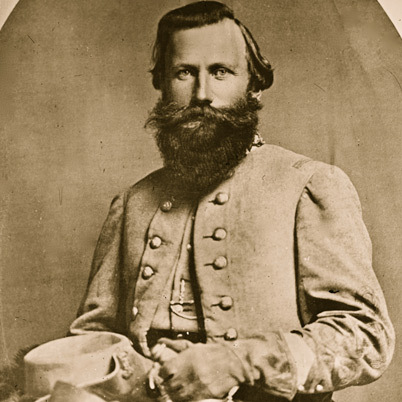
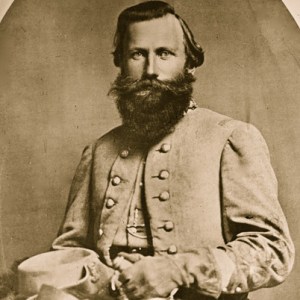
CWP015

While the embattled Hooker slowly pursued Lee with the Army of the Potomac drama of major significance to the battle Robert E. Lee’s own making was beginning to engulf his operations and leave him blind to the movements of the Federal Army. It was the first of a number of mistakes that would characterize his campaign almost all dealing with his singular inability to get his commanders to understand his intent. The necessity of subordinate commanders understanding the intent of their superior is essential to the success of any military operation and Lee failed miserably at this during the Gettysburg campaign.

After the surprise at Brandy Station Stuart’s troopers screened the right flank of the army as it moved north, defending the gaps in the Blue Ridge to keep Pleasanton’s cavalry from interdicting the march or discovering the location of Lee’s infantry corps. In this he was successful. Between June 17th and June 21st his troopers fought a series of engagements at Ashby’s Gap, Middleburg and Upperville. While Stuart’s troopers had held off Pleasanton the “running combats were taking a toll on the Southern mounted arm, however. Stuart had already suffered several hundred casualties defending gaps and passes.” [1] The Confederates also noted the improvements in the Federal cavalry during these battles. Captain William Blackford, who served as an engineer on Stuart’s staff noted:

“the improvement of enemy cavalry was enormous, mainly in the heavy fire from long range carbines, and horse artillery that was a match for Stuart’s own These cavalrymen fought as if they had been taken from infantry regiments, for they knew how to fight with horses left behind.” [2]

Unlike the rest of the army which was now marching into Pennsylvania and Maryland, Stuart’s Cavalry Division had little cause to rejoice. They had been surprised at Brandy Station and Stuart had been humiliated in the Southern press. The Federal cavalry under Pleasanton gave him no opportunity to redeem himself. While Pleasanton’s troopers never broke through Stuart’s screen, they had pressed him hard, and his division was “really fought out during those two weeks from June 9 until the misty morning of June 22….Not only had Stuart’s cavalry been pressed on the defensive as never before, but also they had not been able to gain a spot of information about the enemy.” [3] Pleasanton’s troopers and proven that the days of “easy Confederate cavalry triumphs were gone,” [4] and Stuart “smarting over the cuts to his ego, refused to read the portents.” [5]

Stuart had been fighting defensively the entire campaign, but desperately wanted to go on the offensive. As his troops battled at Aldie, Middleburg and Upperville, Stuart formulated a plan which he submitted to Lee. Stuart reasoned now that “all the infantry were west of the Blue Ridge…that it would be possible to leave one or two brigades of cavalry to defend the gaps and with the remaining three to descend on the enemy and harass Hooker in any advance into Pennsylvania.” [6]

On the morning of the 22nd of June Stuart noticed that the Federal cavalry which had engaged him at Upperville the previous day was no longer present. That morning he also received an order from Lee that was the first of a series of vague, poorly written and contradictory orders that was to plague the campaign. Unlike his new infantry corps commanders, Ewell and Hill, Stuart was very familiar with Robert E. Lee’s method of command, and Lee had “so much faith in Stuart’s judgment and ability to make the right moves that after indicating his wishes he gave him considerable latitude in carrying them out. His orders were more suggestions than commands….” [7] However well that may have worked for Lee in the past with Jackson and Stuart, the nature of Lee’s orders to Stuart, being conditional, needed to clearly address “the conditions upon which they are based.” [8] This Lee did not do. His order read:

“I judge the efforts of the enemy yesterday were to arrest our progress and ascertain our whereabouts. Perhaps he is satisfied. Do you know where he is and what he is doing? I fear he will steal a march on us and get across the Potomac before we are aware. If you find that he is moving northward and that two brigades can guard the Blue Ridge and take care of your rear, you can move with the other three into Maryland and take position on General Ewell’s right, place yourself in communication with him, guard his flank, keep him informed of the enemy’s movements and collect all the supplies you can….” [9]

Longstreet, who Stuart was cooperating with on the northward march, added his own comments to Lee’s instruction which even further clouded the order:

General Lee has enclosed this letter for you, to be forwarded to you, provided you can be spared from my front, and provided I think that you can move across the Potomac without disclosing our plans. He speaks of your leaving via the Hopewell Gap and passing by the rear of the enemy. If you can get through by that route I think that you will be less likely to indicate what our plans are than if you should be passing to our rear. I forward the letter of instructions with these suggestions. Please advise me of the condition of affairs before you leave, and order General Hampton, whom I suppose will leave here in command, to report to me at Millwood, either by letter or in person, as may be most agreeable to him.” [10]  
stuartsridemap

Stuart was already planning his offensive which he believed would restore his glory. He had sent Major John Mosby with a small detachment of troops to reconnoiter behind the Union lines. Mosby reported the location of all the infantry corps of the Army of the Potomac. Mosby reported to Stuart on June 23rd that the Federal corps were stationary and “were so widely separated…that a column of cavalry could easily get between them.” [11] It was news that Stuart was delighted to hear. Mosby painted a glowing picture of how an operation using the Hopewell Gap could create havoc in the Federal rear and cause panic in Washington as he could “severe communications between Hooker and Pleasanton, destroy a “large portion” of Hooker’s transportation, and take some of the pressure off Lee by creating a diversion for the Union cavalry.” [12]

The inactivity of the Federal army reported by Mosby was exactly the news Stuart wanted to hear, and he asked Lee for permission to plunge into the Federal rear, and in his after action report wrote:

“I submitted to the commanding general the plan of leaving a brigade or so in my present front, and passing through Hopewell, or some other gap in Bull Run Mountain, attaining the enemy’s rear, and passing between his main body and Washington, to cross into Maryland and joining our army north of the Potomac.” [13]

Lee noted that “Upon the suggestion of the former officer (General Stuart) that he could damage the enemy and delay his passage of the river by getting to his rear, he was authorized to do so.” [14] In his after action report of the campaign Lee wrote:

“General Stuart was left to guard the passes of the mountains and observe the movements of the enemy, whom he was instructed to impede and harass as much as possible, should he attempt to cross the Potomac. In that event, General Stuart was directed to move into Maryland, crossing the Potomac east or west of the Blue Ridge, as, in his judgment, should be best, and take position on the right of our column as it advanced.” [15]

That night, during a heavy rainstorm Stuart’s chief of staff Major McClellan received Lee’s reply to his superior’s request which he immediately delivered to Stuart. Lee’s stated:

“If General Hooker’s army remains inactive, you can leave two brigades to watch him, and withdraw with three others, but should he not appear to be moving northward, I think you had better withdraw this side of the mountains tomorrow night, cross as  Shepherdstown next day, and move over to Frederickstown.

You will, however, be able to judge whether you can pass around their army without hindrance, doing them all the damage you can, and cross the river east of the mountains. In either case, after crossing the river, you must move on and feel the right of Ewell’s troops, collecting information, provisions, etc.” [16]

However, the orders or suggestions that Lee and Longstreet gave Stuart “are so badly worded that it is difficult to make sense of them.” [17]  Lee should have “established that Stuart’s most important task was to guard Ewell’s right and report on the direction of Hooker’s advance once Lee crossed the Potomac.” [18] This he did not do. Instead, Stuart was directed maintain contact with Ewell, screen the Blue Ridge gaps, collecting information, “raiding around the rear of Hooker’s forces” [19] damaging the enemy and collecting supplies.

Lee’s lack of clarity and vagueness allowed to Stuart interpret the order in a manner that benefited him. The order could easily be interpreted as getting Stuart and his men into Pennsylvania as quickly as possible to guard Ewell’s flank and discern the intentions of the enemy, which in hindsight appears to be Lee’s intent, or as permission to conduct a raid “roam in the enemy’s rear for an unpredictable period of time, raising havoc with his communications, supplies, and isolated commands” and then “seek out Ewell’s corps and use it as a place of refuge from an aroused enemy.” [20]

The fact is that different standards apply to each of those courses of action and orders must be clear, otherwise subordinates may interpret them in a far different manner, with far reaching effects, than the commander issuing them intended. But, by giving Stuart the latitude to go around the Federal army Lee had undercut his own preference that Stuart cross into Maryland via Shepherdstown and Frederick on June 24th. Lee had provided Stuart an opportunity for something that “Longstreet half-apologetically called “something better than the drudgery of a march around our flank.” [21] It was a critical mistake, which was then further compounded by Stuart and the movement of the Army of the Potomac.

Stung by the criticism of his conduct of the Battle of Brandy Station in the Southern press and frustrated by Pleasanton’s constant thrusts Stuart interpreted the orders in the manner that appealed to Stuart’s sense of glory. He would repeat his triumph of the previous year when he rode around the Army of the Potomac. For Stuart this was a chance to regain the limelight and add to his luster. Stuart “summed up his interpretation of his orders when he said later: …it was deemed practicable to move entirely in the enemy’s rear, intercepting his communications with his base (Washington), and, inflicting damage upon his rear, to rejoin the army in Pennsylvania in time to participate in its actual conflicts.” [22]

Historians have long wondered why Lee was not more explicit in his orders to Stuart and why Stuart conducted an operation that left Lee blind and had no obvious advantages, except to allow Stuart to recover his tarnished reputation. Stephen Sears noted in his book Gettysburg that: “The very concept of Stuart’s expedition was fueled by overconfidence and misjudgment at the highest command level.” [23] In a sense the decision harkens back to the hubris of Lee and others about the superiority of his army, and Lee’s distain for the Federal army.

In organizing his movement, decided to take his three best brigades with him, and leave the brigades of “Grumble” Jones and Beverly Robertson to defend gaps and screen the rear of the army. The choice was unfortunate; Robertson was unpredictable and was “senior to the dependable Jones” [24] who was considered the “best outpost officer in his command.” [25] The choice ridded Stuart of Robertson, who he did not trust in battle and Jones “whose antipathy for Stuart at least equaled Stuart’s for him.” [26] The intent was that Robertson would screen the army and follow it into Maryland, in fact Stuart gave Robertson “explicit instructions” [27] to do so, but instead “the two brigades would remain fixed, as if planted there, in an inanition of command which immobilized the men for whom Lee in Pennsylvania was anxiously watching.” [28] Longstreet had requested the industrious and dependable Hampton command the remain cavalry, but Stuart disregarded his counsel

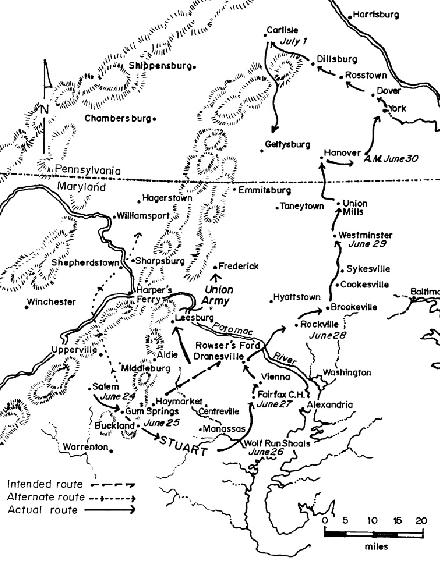
Stuart set off with his three best brigades, Wade Hampton’s, Fitzhugh Lee’s, and Rooney Lee’s now, with Lee wounded was under the command of Colonel John R. Chambliss, another former West Pointer retired from the old army. Almost immediately after setting off Stuart and his brigades encountered a situation that should have immediately stopped movement to the Federal rear and instead move west of the Blue Ridge. Moving through Glasscock’s Gap they “bumped unexpectedly into “an immense wagon train,” which happened to be the tail end of Winfield Hancock’s 2nd Corps, blocking the road in exactly the fashion Lee had described as a hindrance.” [29] Instead of going back when he had the chance Stuart elected to continue with his “plan to go around the Federal army. It was a crucial decision, for he still could have turned back without losing any more time.” [30] Stuart had to spend a day grazing his horses since he had no grain with him, delaying his advance north and east, placing him a day behind schedule and though he made better time on the 26th, advancing twenty-five miles he had to again stop to graze his horses at the Occoquan River. It had “taken forty-eight hours to march thirty-five miles.” [31]

Stuart continued on past the outskirts of Washington on June 27th and was again delayed when attempting to cross the Potomac at Rowser’s Ford by the “water level two feet higher than normal.” [32] He then encountered a large Federal wagon train not far from Washington capturing over 100 wagons and 600 mules. He reveled in that feat and boasted that “he had taken more than one hundred and twenty-five best United States model wagons and splendid teams and gay caparisons,” containing “foodstuffs, oats, hay…bacon, ham, crackers and bread” but his progress was slowed by his enormous wagon train of captured supplies…” [33] He and briefly wondered “whether it might be worth “our entering Washington City” [34] before determining that the effort might be too costly.

On June 28th, Stuart received word that Hooker was across the Potomac and by now Stuart “knew nothing of Lee’s position,[35] and instead of abandoning the wagon train he sacrificed speed and mobility to keep it. Now, “far from guarding Ewell’s right, he was now moving away from Ewell, with no idea where Hooker’s army might be and no communication with Lee, who frequently inquiring of his aides, “Can you tell me where General Stuart is?” [36]

On the wrong side of the federal army, encumbered by the captured wagon train, “Stuart would have to make a half circle of more than fifty miles around Gettysburg before arriving there about noon on the second day of battle with most of his troopers, his artillery, and his wagon train lumbering far behind him.” [37] On June 30th his men were engaged by Judson Kilpatrick’s Federal near cavalry division near Hanover, and “his men never fought more poorly…and General Stuart and his staff were nearly captured.” [38] By the time Stuart’s troopers arrived in Gettysburg, the once proud outfit was “exhausted and too late to be of any service.” [39] His arrival at Gettysburg was not a moment of triumph, but was humiliating. Instead of reporting to his commander with information that Lee needed, it was Lee who informed him of the position of his own army and the Army of the Potomac. Lee’s words to his much beloved subordinate were painful. He asked him “General Stuart, where have you been?” [40] Stuart seemed to wilt at his mentor’s words, and attempted to put the best face forward, and told Lee “I have brought you 125 wagons and their teams, General,” to which Lee replied “Yes, General, but they are an impediment to me now.” [41]

Stuart’s raid was disastrous for Lee. He was blind and had no idea where the Federal army was until told by Longstreet’s scout Harrison on June 28th. It was “an act of folly- ill-planned, badly conducted, and (until the very end) executed with an almost total disregard for anything for any interest other than the self-promotion of J.E.B. Stuart.” [42]

To this point a number of issues important to those involved in planning campaigns became clear: Deception, commander’s intent and unity of command. Lee successfully used deception to prevent the Federals from discerning his purposes. That was counteracted by his lack of clarity in communicating his intent to Stuart, and Stuart’s careless disregard of any other consideration but his own reputation and vanity.

[1] Petruzzi, J. David and Stanley, Steven The Gettysburg Campaign in Numbers and Losses: Synopses, Orders of Battle, Strengths, Casualties and Maps, June 9 – July 1, 1863 Savas Beatie LLC, El Dorado Hills CA 2012 p.41

[2] Davis, Burke J.E.B. Stuart: The Last Cavalier Random House, New York 1957 pp.319-320

[3] Dowdy, Clifford. Lee and His Men at Gettysburg: The Death of a Nation Skyhorse Publishing, New York 1986, originally published as Death of a Nation Knopf, New York 1958 p.57

[4] Freeman, Douglas Southall, Lee’s Lieutenant’s a Study in Command, One volume abridgement by Stephen W Sears, Scribner, New York 1998 p.553

[5] Ibid. Dowdy Lee and His Men at Gettysburg p.57

[6] Ibid. Freeman Lee’s Lieutenants p.553

[7] Coddington, Edwin B. The Gettysburg Campaign: A Study in Command, A Touchstone Book, Simon and Schuster New York, 1968 p.108

[8] Ibid. Coddington The Gettysburg Campaign p.108

[9] Ibid. Davis J.E.B. Stuart: The Last Cavalier p.321

[10] Oates, Willam C. and Haskell, Frank A. Gettysburg: The Confederate and Union Views of the Most Decisive Battle of the War in One Volume Bantam Books edition, New York 1992, originally published in 1905 p.61

[11] Ibid. Coddington The Gettysburg Campaign p.109

[12] Ibid. Coddington The Gettysburg Campaign p.109

[13] McClellan, Henry Brainerd The Life and Campaigns of Major General J.E.B. Stuart Commander of the Cavalry of the Army of Northern Virginia 1885. Digital edition copyright 2011 Strait Gate Publications, Charlotte NC Location 6087

[14] Ibid. McClellan The Life and Campaigns of Major General J.E.B. Stuart location 6106

[15] Lee, Robert E. Reports of Robert E Lee, C.S. Army, Commanding Army of Northern Virginia Campaign Report Dated January 20th 1864. Amazon Kindle Edition location 285

[16] Ibid. Davis J.E.B. Stuart: The Last Cavalier p.324

[17] Fuller, J.F.C. Decisive Battles of the U.S.A. 1776-1918 University of Nebraska Press, Lincoln 2007 copyright 1942 The Royal Society for the Prevention of Cruelty to Animals p.226

[18] Korda, Michael. Clouds of Glory: The Life and Legend of Robert E. Lee Harper Collins Publishers, New York 2014 p.540

[19] Ibid Korda Clouds of Glory p.540

[20] Ibid. Coddington The Gettysburg Campaign p.110

[21] Guelzo, Allen C. Gettysburg: The Last Invasion Vintage Books a Division of Random House, New York 2013 p.96

[22] Ibid. Freeman Lee’s Lieutenants p.555

[23] Sears, Stephen W. Gettysburg, Mariner Books, Houghton Mifflin Company, Boston and New York, 2003 p.106

[24] Ibid. Dowdy Lee and His Men at Gettysburg p.63

[25] Ibid. Davis J.E.B. Stuart: The Last Cavalier p.324

[26] Ibid. Dowdy Lee and His Men at Gettysburg p.63

[27] Ibid. Coddington The Gettysburg Campaign p.112

[28] Ibid. Dowdy Lee and His Men at Gettysburg p.63

[29] Ibid. Guelzo Gettysburg: The Last Invasion p.96

[30] Ibid. Coddington The Gettysburg Campaign p.112

[31] Ibid. Davis J.E.B. Stuart: The Last Cavalier p.325

[32] Ibid. Coddington The Gettysburg Campaign p.112

[33] Ibid Korda Clouds of Glory p.541

[34] Ibid. Guelzo Gettysburg: The Last Invasion p.98

[35] Ibid. Davis J.E.B. Stuart: The Last Cavalier p.325

[36] Ibid Korda Clouds of Glory p.541

[37] Ibid Korda Clouds of Glory p.541

[38] Ibid. Dowdy Lee and His Men at Gettysburg p.73

[39] Ibid. Fuller Decisive Battles of the U.S.A. 1776-1918 p.227

[40] Ibid. Davis J.E.B. Stuart: The Last Cavalier p.334

[41] Ibid. Davis J.E.B. Stuart: The Last Cavalier p.334

[42] Ibid. Guelzo Gettysburg: The Last Invasion p.98

2 Comments

Filed under civil war, History, leadership, Military

A Good Day to Speak Truth to Power and to be Listened to

IMG_1915

I have been writing about my recent experiences in trying to get help for my own issues dealing with PTSD as well as my frustration with a military mental health system that is, at least in my view, floundering.

That effort over the past month or so has been quite painful, at times humiliating and dehumanizing, and frankly driven me into a depressed and nearly suicidal fog, from which I am slowly emerging.

Today was a good day. Not just for me but maybe for all of those seeking help at our local Naval Medical Center. Instead of being blown off and shunted aside by providers as well as mid and high level administrators I was able to have a long, nearly forty-five minute phone conversation with the Admiral who commands that facility as well as every Naval Medical facility on the East Coast and Europe, with the exception of the Bethesda-Walter Reed complex in Washington DC. Bottom line up front; it was a very good and positive experience for me that I believe will help others get better care.

I have to say up front that I was terrified about asking to talk to him. One of the people on his staff told me that “it would not be a good thing for me to talk to him.” When I heard that comment my heart sank. I didn’t know what to do, I was perplexed because most commanders of Medical facilities in the Navy that I have worked for actually did want to hear about negative experiences of the people that are their customers, most because they care, but if nothing else because they want to make sure that they pass the Joint Commission accreditation that their facilities get every few years. So I wondered if the Admiral actually knew what was going on, at least in regard to the Mental Health Department and the experiences of people like me.

My last Command Master Chief, who read some of my very angry posts on a social media site suggested that I call my former Commanding Officer, a man who helped me a lot, cared about me and who is soon to become an admiral. I finally worked up the courage to call him, not out of fear, but because I felt like I might be bothering him, and would not be worth his time. I left his command a year ago and frankly I thought why should someone moving up in an organization be bothered by the problems of a former subordinate.

However, he was both concerned and helpful. He did not just listen but he took action by contacting the Admiral here. He told him that he knew me and that he knew that it was my desire to make sure that people get the help and care that they need, that I wasn’t just complaining or seeking special treatment.

Yesterday the admiral called me, of course my phone went directly to voice mail so I missed the call, but his message, and the tone of his voice conveyed a sense of care and concern. I called back and got his voice mail. So this morning I called again and was able to share my heart, in a very respectful way with him. He listened and seemed to be attempting to formulate some kind of positive response that would actually help people. He wants to get answers and he told me that he wanted those that come to that facility to be treated as he would want his grandparents treated.

As I said we talked for forty-five minutes and he listened. I have no doubt, within the very real fiscal constraints faced with current budget cuts and the still looming threat of sequester that he will do his best to improve and change the system that is within his control. He also did something that I have never experienced before from a superior officer, he called me “sir” a number of times. I am not used to that and I don’t think that I have ever in all of my reading of military history recall an Admiral or General calling a subordinate “sir.” I was blown away.

That system appears to be undermanned, under-budgeted and overwhelmed. It is struggling and as it struggles, as it reacts to criticism from the media, politicians and advocacy groups, it resorts to protecting itself as any bureaucracy does in such a situation. The Admiral realized this and he encouraged me to call him again on his office number if I see things that he can help. That was very encouraging. I don’t think that I will have to ask him to intervene on my part, but I have an open door to use this relationship to help others.

All that being said, most people do not have the connections that I have in the system, nor are they willing to take the risks to rock the boat. The stigma is great and personal risk can be or at least seem too great to make the effort, so most people just give up. After all the bureaucracy can be unbending and even vindictive in the way that it rebuffs those that try to raise issues. They resist change and try to keep bad news from enquiring superiors. Bureaucracies and those who faithfully serve them do just that. It is part of who and what they are; be they military, other government, business or ecclesiastical organizations. Admiral Alfred Thayer Mahan wrote:

“It [the bureaucracy] tends to overvalue the orderly routine and observance of the system by which it receives information, transmits orders, checks expenditures, files returns, keeps the Service the touch of paper; in short, the organization has been created for facilitating its own labors.”

However, when I first collapsed after Iraq, I decided that I could not be silent and have “sky-lined” myself which probably will not help me get promoted, not that care anymore. I am sure that being so public about my struggles with PTSD, Moral Injury and even my crisis of faith, which left me an agnostic for a couple of years, while serving as a Chaplain in adult and pediatric Intensive Care Units has marginalized me in the Chaplain Corps. I don’t know that for a fact and would hope that it is not the case, but it is the feeling that I get when I deal with most Chaplains.

All of that said, the past few weeks have been some of the most difficult since my return from Iraq. I personally find no pleasure in being anxious, depressed or feeling suicidal and getting even less sleep than my chronic insomnia normally allows.

At least I was listened to, and I really did get the sense that the Admiral that I was able to have such an honest conversation with today, does really care and wants to help improve the system and change the culture.

But that is the thing. This is a systemic and cultural problem, not just in the military or the Veterans Administration, but in society as a whole. In our desire for efficiency, supposed effectiveness  measured by profits and the bottom line; we have forgotten to care about people. Sadly that is statistically verified in poll after poll by people from all parts of the political spectrum. People don’t trust the government, they don’t trust big business, they don’t trust health care systems, they don’t trust the police, they don’t trust the banking and insurance industries and they certainly don’t trust the church or religion in general. Can I get an amen?

Thank you…

But our culture has to change, we have become so materialistic and embrace the most crass forms of predatory Capitalism and Social Darwinism, even in church, that people don’t matter, especially the poor and those with no voice or power, especially those who volunteer to serve the nation and come back broken in body, mind and spirit.

Joshua Chamberlain the hero of Little Round Top at Gettysburg spoke years after the Civil War something that should be a warning to us about how we treat people. Of course Chamberlain was talking about the horror of war, but it can apply to anyone, anywhere:

“But we had with us, to keep and care for, more than five hundred bruised bodies of men–men made in the image of God, marred by the hand of man, and must we say in the name of God? And where is the reckoning for such things? And who is answerable? One might almost shrink from the sound of his own voice, which had launched into the palpitating air words of order–do we call it?–fraught with such ruin. Was it God’s command that we heard, or His forgiveness that we must forever implore?”

His question is as operable today as it was then. There has to be a reckoning somewhere for destroying peoples lives, and further traumatizing them when they seek help, otherwise there is no justice nor anything that resembles a loving God.

We have to start valuing people, regardless of their social status, their race, religion, sexual preference, disability or even their alma mater. If we don’t start caring for people as human beings, then why bother with anything else? It is either about humanity or its not. Those who are comfortable cannot turn a  blind eye thinking that these issues don’t affect them, because they will.

So in spite of being unpopular in some circles I take the personal risk to speak the truth the best and most honest way I can to anyone that will listen. I have to do it, for those that feel that they have no voice, as well as those who I have known who have lost their lives after giving up on the system. I owe it to them. It is now my mission in life and I do that I can both inside the system and outside of it to speak out for those who need it.  I guess I have become something of a liberal social activist, not that there is anything wrong with that.

I can be as persistent and irritating as Mustard Gas; I am doggedly determined to speak out for those that do not feel that they matter or have a voice; and I will stay in the fight until I can’t fight anymore. As Paul Tillich said “It is my mission to comfort the afflicted and to afflict the comfortable.”

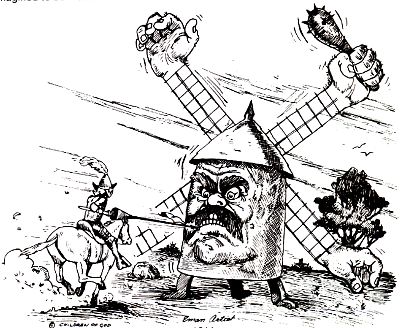
I admit that sometimes it is like tilting at windmills, but this week, two men who have the position to influence the system took the time to listen and just maybe at least at some level things will begin to change. I am grateful tonight, maybe I will sleep well…

Peace

Padre Steve+

Leave a comment

Filed under faith, healthcare, mental health, Military, PTSD, suicide, US Navy

Moral Injury: Betrayal, Isolation, Suicidality, & Meaninglessness; the War after the War

IMG_1915.JPG

“Great Odysseus woke from sleep on native ground at last- he’d been away for years- but failed to know the land.” Homer, The Odyssey 

War changes the men and women that fight them. This is a truth that dates to antiquity. It does not matter the age or era, where the war was fought or what weapons were used, the pathology is similar, the scars of war, physical, The trauma of war, as Jonathan Shay notes in his book Odysseus in America, “shows ugly deformities of character that trauma can cause, but these deformities are fully human such as might happen to ourselves….” The fact is that the does happen is normal, but how we deal with it is not.

One of the most difficult things that many returning combat veterans face is being re traumatized upon returning home. As the Odyssey shows, for many returning combat veterans it is as if they are returning to an alien planet, which looks familiar, but feels like an alternate universe. It looks the same, but it is profoundly different. Erich Maria Remarque in his classic All Quite on the Western Front wrote:

“I imagined leave would be different from this. Indeed, it was different a year ago. It is I of course that have changed in the interval. There lies a gulf between that time and today. At that time I still knew nothing about the war, we had been only in quiet sectors. But now I see that I have been crushed without knowing it. I find I do not belong here any more, it is a foreign world.”

Shortly before his death in a motorcycle crash T.E. Lawrence, the great Lawrence of Arabia wrote a friend. Lawrence certainly suffered from PTSD and other afflictions that lingered long after the war. The words are haunting and they so describe how many veterans feel, even long after they left the combat zone. For Lawrence and so many others the war after the war never ended.

Lawrence wrote:

“You wonder what I am doing? Well, so do I, in truth. Days seem to dawn, suns to shine, evenings to follow, and then I sleep. What I have done, what I am doing, what I am going to do, puzzle and bewilder me. Have you ever been a leaf and fallen from your tree in autumn and been really puzzled about it? That’s the feeling.”

This has been a facet of life for American military personnel ever since the Vietnam War. Much of the trauma comes from the unnatural and ahistorical manner of how we send men and women to war and bring them home. Now generally we prepare people for war fairly well. However, we send many to war as individual augments, away from their units and people they know, place them in units or organizations where they are relatively isolated and sometimes face great danger, then we bring them back alone, with barely any time to decompress, tell their story and face the consequences of war with those that they know.

Guy Sager, writer of the classic The Forgotten Soldier wrote of his return from war:

“In the train, rolling through the sunny French countryside, my head knocked against the wooden back of the seat. Other people, who seemed to belong to a different world, were laughing. I couldn’t laugh and couldn’t forget.”

The result is that most don’t get the help that they need to make the adjustment. The fact is that the best help is usually found among our comrades who have shared our experience. Before trans-ocean air travel, soldiers came home on troopships, with those that they served and the voyage home lasted anywhere from two weeks to a month. That gave these soldiers the opportunity to process what they had been through, and while they might not have had much in the way of “professional” mental health care, they did have each other. Likewise, they returned to a country where many if not most of the citizenry had shared at least some of the sacrifice of war, and many of whom had family members who had served at war, or who had lost people they knew.

A survivor of World War I’s “Lost Battalion” wrote after the war:

“We just do not have the control we should have. I went through without a visible wound, but have spent many months in hospitals and dollars for medical treatment as a result of those terrible experiences.”

Today soldiers are sent from the United States or United States military bases in Europe or Asia into harms way, and when their tour of duty is done, are sent home in a process that seldom takes more than a week, usually less. Apart from a few airport greeters and their family, if they have a family, their return goes almost unnoticed. They return to a world where there has been no shared experience and people go about their business untouched by war. The return is often overwhelming, and many times disorienting and frightening to the combat veteran who no longer feels connected to the country or people that sent him or her to war. The normal issues faced by redeploying soldiers, especially with their families are often even more pronounced, they and their families struggle.

The general feeling of social isolation is often made worse when they return to their home bases, stations or units and discover that instead of being welcomed home, that they are treated as if they made the life of those who did not deploy harder. “Welcome back, now you can get back to real work, now you can be back on the duty roster.” Within weeks they are submerged in routine, often mind numbing tasks among people who have not shared their experience. Alone they try to cope, quite often not very successfully. For those suffering from combat trauma, especially the unseen injuries of PTSD and Traumatic Brain Injury the experience is magnified. There is a sense of isolation and meaninglessness as they attempt to put their lives back together. For those that seek help, on the active duty side of the house there is a stigma to getting mental health care, which is so pronounced that many either avoid treatment or stop shortly after starting, instead self-medicating with alcohol or drugs. The same is often true for those who seek help in the Veterans Administration system, except they, having finished their active service do not have to endure the shame of being called or considered “broken” by their superiors or their peers. For those that have not served, to be labeled as “broken” is one of the worst things that can happen to you in the military, it is to say that you have no intrinsic value, no matter what you have accomplished to that point or what you have suffered in the line of duty.

Those that do decide to take the risk in going to get mental health care are often then traumatized by the very system that supposedly is there to help them. While there are many gifted, caring and skillful psychiatrists, psychologists and therapists working for the military and the VA, the process of getting care can be brutal and dehumanizing. The intake process is often impersonal and quite often the ordeal dissolutions those going through it. As a personal note, when I transferred back to the area that I previously had been treated it was like I had never been in the system. It was starting from scratch, and while I had gone back to the system seeking basic follow up care, the process broke me and made me worse. Due to the intervention of so very caring people including a former commanding officer who is being promoted to Admiral, I am getting some help and may even be able to contribute to a solution. But it should not be so hard, the system in overwhelmed, undermanned, underfunded and broken, despite the best efforts of some in leadership. The result is that combat veterans are further traumatized and marginalized.

The combination of new trauma, that of no longer feeling a part of society, that of being disconnected from friends and family; that of being isolated at work and treated as a number by those in the medical and mental health system. All of those things add further injury and contributes to the sense of betrayal, the sense of betrayal that goes to the heart of Moral Injury.

Moral Injury involves the breaking of trust, confidence and core beliefs. That can encompass everything from what a person believes about God, the idealism about one’s country, the military that one serves and even the society and family. Moral Injury is an abiding sense of loss of faith and confidence in the things, the beliefs and ideals that one held dear. It is a layer of trauma that adds to what one has experienced in combat, it is another layer of trauma on top of PTSD, TBI and other Combat Stress related issues. It increases the severity of other psychological conditions including depression, anxiety and the risk of suicidal, or other risk taking behaviors.

But it doesn’t seem to me that anyone gets this, and those that do are not in a position to influence policy. Neither are they in a position to ensure that mental health providers are trained to recognize, care for and not increase the chance of further traumatizing those in their care. Instead those coming home from war seem to be condemned to a sort of hell where they do not feel they matter, are treated as numbers or even worse, feel that they no longer can contribute, because they are “broken.”

My experience is that it takes far too much effort to get the basic care that one requires, and most people after being beaten down simply give up. A person should not be reduced to tears and seriously consider suicide to get attention. A person should not have to know a doctor who is going to be an Admiral to get someone to listen to them. Honestly most people will neither endure the ignominy or pain of seeking help in such an environment, much less skyline themselves but writing and speaking about I like I do. For most any of that is far too dangerous or risky.

Some, including people that I know and love and respect have lost their families, careers and lives simply because they did not want to have the stigma of being considered “broken” or deal with the impersonal and machine like bureaucracy that is our mental health system. The sad thing is that this encompasses not only the military and VA systems, but the civilian system as well. I have known far too many people who have ended their lives after being further traumatized by the system. These people include senior officers and even chaplains, most who risked their lives in combat multiple times only to return home broken. I know too many of them, men who were real heroes, who died at their own hand, or others who lost their families and careers.

I know PTSD, I live with that reality daily, the depression, anxiety, hyper vigilance, paranoia, nightmares, night terrors, insomnia and fear of of crowds, traffic, and normal relationships. That is life and I do my best to deal with it, sometimes more successfully than others. My marriage has suffered because of my madness, and I have experienced the rejection of many of my peers in the Chaplain Corps. Likewise my former church and bishop, after two knowing that for two years I was for all practical purposes an agnostic and knowing my life was a wreck, kicked me out when my faith, though very fragile and mixed with doubt, returned. I asked hard questions, and when I asked them publicly I was tossed for being “too liberal.” That rejection, the rejection of a faith community also contributes to Moral Injury. Sadly I know too many others who have returned from war to be rejected by faith communities that advertise how the “love, pray for and support the troops.”

In spite of that I continued to seek help, and at Camp LeJeune my commanders and others ensured that I got what I needed. It helped and when I returned to Hampton Roads a year ago I really thought that I was doing better. That changed last month. I went back, seeking follow-up care, which I assumed was just to download my issues with once in a while and manage my medication. Instead that attempt to re-enter the military mental health care system did me considerable harm, hell I considered suicide just last week after this. I no longer think that what I need is simple occasional follow up care, instead my experience shattered me. I had no idea just how fragile that I was, it was as if the floor had been kicked out from under me.

That my friends is what Moral Injury does to someone. Those are the kind of experiences that break a person’s faith and trust in the things, ideals, institutions and people that they grew up trusting and believing in. That loss of faith and trust, combined with the other layers of Combat Stress Injury can be devastating, and it doesn’t seem to matter because most people are neither aware, nor do they care. Not because they are bad people, but because there is such a gulf between the military and society at large that such issues are distant and incomprehensible to most people not in the military.

Yes, my trust in the system and my country is broken and I don’t know if I will ever regain the faith that I have lost. I honestly want to, I want to believe. God I want to believe. Now it does look like I will be getting help, and maybe even a chance to help being a part of the solution, and that will be a good thing.  Today I got a call from the Admiral at the Medical Center, unfortunately it went directly to voice mail, but he did sound like he cared and wanted to listen. For that I am grateful.

Pray for me as I get a chance to speak with leaders who have some influence to make things better, not just for me, but for all of us.

Peace

Padre Steve+

6 Comments

Filed under mental health, PTSD, suicide

No Shutting Up Until it is Fixed: Veteran and Military Mental Health Care

tom-clancy-look-2

“If a policy is wrongheaded feckless and corrupt I take it personally and consider it a moral obligation to sound off and not shut up until it’s fixed.” Col David Hackworth

Over the past couple of weeks I discovered just how mentally and emotionally fragile I still am. As those that follow my writings here know I wrote a couple of articles recently about the treatment that I was receiving at the local Naval Medical Center, and my perceptions of that command. Those, as well as the e-mails to my provider, which were then shared by the person in charge of fixing the problem with the Medical Center Executive Officer without my permission, (I think there is another violation of my HIPPA rights there as well)  were very difficult to write.

They were extremely painful because of the emotions that were unleashed, especially because I thought of doing something that scared me to death. I considered, very briefly in my pain, anger and my sense that the system had betrayed me and for that matter all of us seeking help; the possibility of committing suicide, in a very public and dramatic way. It scared the hell out of me that I developed a perfectly executable plan to do it, a plan that for a moment would have drawn attention to the issue, but at the same time would have traumatized many others.

Of course I do not think I would ever do it. The death of Robin Williams by suicide yesterday shattered me, and no matter how bad things are I wouldn’t want my death to cause distress to anyone. Frankly, I love life too much, and God knows that one more dead body won’t change how the military or the Veteran Administration medical systems treat people in crisis.

However a living person, especially a pain in the ass like me, that won’t stop speaking out just might make a difference. That might take a while to do, but I will do it until war, and the indifference of soulless bureaucracies are  no more. That may be unreasonable, unrealistic and unattainable but it is a windmill worth tilting at.

But I fully understand that people in a moment of madness and despair, would make the choice to end their life, and see as it as a perfectly logical and rational act. I have known senior chaplain colleagues and former commanders who have chosen suicide, and I am sure that none of them thought that they would ever make that choice, until they actually did it. Please don’t worry about me. I am not going to kill myself, the thought scares me too much. Honestly I would rather live to a ripe old age and be a thorn in the side of the system to get veterans the care that they deserve, and the care that this country owes them than to be yet another statistic whose death is swept under the rug as quickly as the system can do it. Unfortunately, that is the reality; any bureaucratic system, military, government or the private sector will go on with as little inconvenience and reflection as is required once the body is disposed of properly.

Just a few months ago I was talking about simple teaching history, religion and ethics at local junior colleges and for profit universities “for the beer money” as I joked with friends. I told people that my desire when I retire was to be like LT Weinberg in the classic movie A Few Good Men and “have absolutely no responsibility here.” The fact is that I am tired and I don’t want to be in charge of anything when I retire, either in the military, civilian or church world. What T.E. Lawrence wrote to a friend shortly before his death in 1935 resonates with me:

“You wonder what I am doing? Well, so do I, in truth. Days seem to dawn, suns to shine, evenings to follow, and then I sleep. What I have done, what I am doing, what I am going to do, puzzle and bewilder me. Have you ever been a leaf and fallen from your tree in autumn and been really puzzled about it? That’s the feeling.”

That being said, I want whatever amount of time left on this earth, and hopefully it is a very, very long time, is to make a difference in the lives of the men and women who have served in the military and who come home broken, in mind, body and spirit. I can think of no other option or higher calling at this point. To that end I have been referred to a therapist in the system, but not at the Naval Medical Center. The therapist was highly recommended by a chaplain friend who has also went through some very difficult times, even in trying to get help for himself. Thankfully, the person who I talked to a week ago agreed to the referral. So I will get help for me, something that I need and go into with a positive attitude based on my friend’s recommendation.

Now those who have never walked the dark path of long lasting, abiding clinical depression or other mental illness may not understand what I am talking about, but those that have walked this terrible path know it all too well. The feeling that no one cares and that you are alone is a major factor in the despair that overwhelms people, and acts as a trigger to suicide.  Unfortunately far too many military personnel and veterans reach that point. The numbers are staggering. No wonder that Major General Smedley Butler wrote about the cost of war, or the “bill” as he calls it: “This bill renders a horrible accounting. Newly placed gravestones. Mangled bodies. Shattered minds. Broken hearts and homes. Economic instability. Depression and all its attendant miseries. Back-breaking taxation for generations and generations…”

There are a number of ways that I could do this. I could go to work for the VA as a Chaplain, or I could go get a degree in counseling and do therapy or any number of other venues. But I think I would be limited by having to serve in ossified bureaucracies if I was to do any of those things.

Thus I am probably going to venture into the world of social activism, working with veterans organizations, political leaders and the media to draw attention to what is happening to veterans that seek care. Veterans like me who perceive that the system doesn’t really care about them, many individual providers may care deeply and deliver wonderful care, but the system itself is soulless and seems often to be clueless. Likewise I will work to expose the war profiteers who seek to cut back medical and mental health care for veterans even more and actively lobby the military, and Congress to enact those cuts. Personally I feel that is immoral and unjust and that it needs to be confronted and exposed.

I wish I could say that things were any better in the civilian mental health system, but they are not. My wife has battled and suffered from severe depression almost all of her life, and over the past 20 years what is paid for by insurance companies for people in crisis has shrunk to a pathetic “system” whereby a person that is hospitalized remains in hospital 2-5 days until they assure they providers that they will not kill themselves. There is no continuity of care, there is little or no therapy or medication management, it is simply warehousing. I’d like to take that on too, but I have to start somewhere, so I’ll start with where I am.

quioxte

I am a dreamer, and I don’t mind tilting at windmills. Lawrence wrote: “All men dream: but not equally. Those who dream by night in the dusty recesses of their minds wake up in the day to find it was vanity, but the dreamers of the day are dangerous men, for they may act their dreams with open eyes, to make it possible.”

I am a dangerous dreamer because as Lawrence noted I will act on my dreams with open eyes. I may not be able to do a lot while I am still on active duty, but when I retire I will be very dangerous because I know far too much and I won’t be afraid to speak out. My heroes include men like Major General Smedley Butler and Colonel David Hackworth and I have no inhibitions at following in their footsteps. I am very determined, persistent and I can be a total ass. When I determine to do something I don’t quit.

As Colonel Hackworth, who I had the honor of corresponding with in the years before he died said: “If a policy is wrongheaded feckless and corrupt I take it personally and consider it a moral obligation to sound off and not shut up until it’s fixed.” The way we are treating our veterans is just that and I won’t shut my mouth until the day that I die, which Lord willing won’t be anytime soon.

Pray for me, I do need it.

Peace

Padre Steve+


3 Comments

Filed under healthcare, leadership, mental health, Military

Depression Kills: RIP Robin Williams

williams

Robin Williams during his 2007 USO Tour to Iraq and Afghanistan 

Tonight I found out about the unexpected death of the great Robin Williams. It was shocking and upsetting to hear that it was believed that Williams had recently suffered from severe depression and that he was believed to had committed suicide.

I guess I can say that I almost met Williams when I was in Iraq, in between missions at Ta’Qaddum airbase west of Fallujah in 2007. Williams was with a number of celebrities and the former chairman of the Joint Chiefs of Staff, Admiral Mike Mullen touring Iraq and Afghanistan. I had just come in from a mission and could not see his show, but the following morning I walked by Williams as he was walking back from the dinning facility. I recognized him, but I am loathe to interrupt a person’s time alone. I simp gave him a “good morning” which he returned and both of us went on our ways. I could have stooped him and detained him, but in good conscience could not do it. My friend Fr Jose Bautista, a Navy Chaplain had Williams and Lance Armstrong sign a baseball cap for me. I treasure it.

Robin Williams was brilliant, talented and brought much you to many people. Unfortunately. like so many brilliant and caring people he was afflicted with his own personal “demons.” He struggled with depression ands substance abuse.

I understand. Since returning from Iraq in 2008 I have dealt with the effects of PTSD, including depression, anxiety, hyper-vigilance, insomnia, nightmares and night terrors. I know why people commit suicide, and at times considered it myself. Most recently less than two weeks ago when dealing with the inhuman machine that is the Navy mental health system, something that is common to the rest of the military and VA systems.

The fact is that depression is a killer and it disproportionally afflicts the most talented, brilliant, artistic and insightful people.  Van Gogh, Hemingway, Williams and so many others, including men and women that distinguished themselves in combat, some of whom I knew, have taken their lives.

The death of Robin Williams has shaken me. I pray for his wife and children and all those who loved him, or who were touched by him.

Please, if you are suffering from anything that makes you think that suicide is the only option, please seek help. If you have no one else, contact me. I may not be able to do much but I will listen. You are not alone.

Rest in Peace Robin Williams. You brought much joy to my life and to so many others.

Peace

Padre Steve+


4 Comments

Filed under celebrities, mental health, suicide

“Integrity, Purity Unselfish Devotion to Duty” Reflections on Winfield Scott Hancock after another Gettysburg Staff Ride

Friends of Padre Steve’s World
Today is a comp day and recovery day from the Gettysburg Staff Ride. I was thinking about writing something about what is going on in Iraq, what ISIS is doing, the US Military response and what is going on with the Maliki regime, and reflect on my time in Iraq. I will probably do that tomorrow as I chance to read more and get the latest updates. One thing about doing the Staff Ride and socializing with my students in the evening is that I do tend only to get a wave top view of other events when I am conducting these trips.
This article is a reflection that I wrote in May after the Staff Ride for my previous class. It is about a man of integrity who served the country faithfully at war, and almost became President, something that many wished had occurred, Major General Winfield Scott Hancock.
So anyway, until tomorrow.
Peace
Padre Steve+

padresteve's avatarThe Inglorius Padre Steve's World

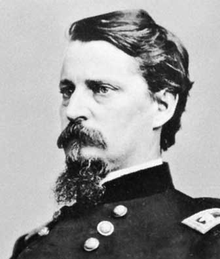
hancock

“I shall not fight upon the principle of state-rights, but for the Union, whole and undivided.” Winfield Scott Hancock

I am back home after leading another trip to Gettysburg with a new group of students.

I always come away from Gettysburg with a new appreciation of the sacrifice that was made there by so many Americans. I am always humbled and learn something new. I only wish that most Americans and our leaders of both political parties as well as most media types and pundits could grasp what I experience on each visit to this “hallowed ground.”

Quite honestly I do not think that the vast majority Americans understand, appreciate or value in the slightest the sacrifices of the men who fought and in many cases died to preserve the Union at Gettysburg. Even among those who do I think that the object of their appreciation are the military…

View original post 1,225 more words

Leave a comment

Filed under Loose thoughts and musings

Remembering the Sacrifice: A Weekend in Gettysburg

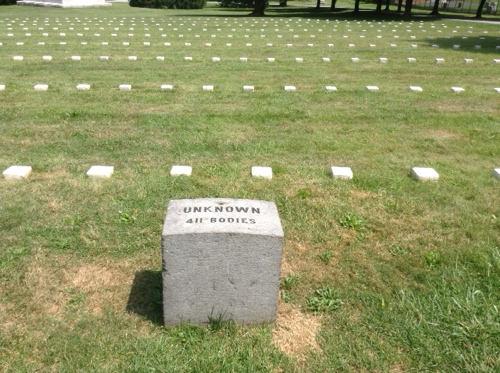
Gettysburg_Unknowns.JPG

I am on the way home from Gettysburg with my students after concluding the second day of our Staff Ride. As always it has been a really good experience. We concluded the event by going to the Soldier’s Cemetary, which is located on the western section of Cemetary Hill. It is the place that Abraham Lincoln delivered the Gettysburg address as well as the final resting place of many of the Union soldiers who died during the battle or shortly thereafter from their wounds. Many of these men are unknowns. They are buried in sections which simply note how many unknown soldiers are in that section, and each of these graves is marked by a small stone engraved with a number.

I strongly believe that all citizens should have to make a pilgrimage to Gettysburg. I do not limit this belief to the military professionals who have to prepare for war and fight it when it breaks out, like the men and women of my class. But I  especially believe others need to walk the battlefield and be taught by someone that can put the events of the battle into proper perspective. This includes the politicians and policy makers that get us into wars, the think tank wonks and business leaders who profit from war, and the pundits and preachers who stir up the passions of people to support war, need to walk the battlefield.

Guy Sager wrote in his book The Forgotton Soldier:

“Too many people learn about war with no inconvenience to themselves. They read about Verdun or Stalingrad without comprehension, sitting in a comfortable armchair, with their feet beside the fire, preparing to go about their business the next day, as usual…One should read about war standing up, late at night, when one is tired, as I am writing about it now, at dawn, while my asthma attack wears off. And even now, in my sleepless exhaustion, how gentle and easy peace seems!”

The same is true today. Too many people, especially those with “no skin in the game” eagerly urge the President to throw U.S. Military power into conflicts that have little chance of being solved by the application of that power. To me it seems like the lives of our military personnel are cheap for many people, especially the politicians, pundits and preachers; but also the war profiteers, while most citizens are apathetic at best, as bumper sticker patriotism is easy.

Basically this is because for most people war is remote from their lives. The military is a voluntary organization with comparatively stringent standards required for enlistees. Even at the peak of our Iraq-Afghanistan wartime strength under one percent of the population actually served in the military. So when I hear people yammering about committing troops to places that many citizens, including the politicians, pundits and preachers, cannot even find on a map, with no plan or purpose once we commit ourselves to war, I get spun up.

For me Gettysburg, and many other battlefields are powerful reminders of the cost of war. They are also reminders of the grave responsibility of those who take a nation into war or who counsel leaders to go to war, responsibilities that many people seem to take lightly. I think that those with that responsibility, which in a democracy is all of us, need that reminder and most of us don’t get it.

Since so few citizens actually serve in the military, I think that everyone should spend two or three days walking that battlefield and learn the lessons as they stand in the elements, exposed to whatever the weather gods can throw at them. People should learn the lessons when they are tired and uncomfortable. This weekend the weather was very similar to what the men than fought at Gettysburg experienced, it was warm and humid, and walking across the field that Pickett’s soldiers advanced, or over the craggy rocks of Little Round Top gave us an appreciation for what those soldiers experienced, without the shooting and death.

As I walked the cemetary with my students spent some time talking about the number of casulaties incurred at Gettysburg, because there is a real flesh and blood cost associated with war, it’s not like the movies or a video game.

Abraham Lincoln reminded the nation of that cost, and the responsibility of the nation, when he spoke “a few words” following the main speech dedicating the Soldier’s Cemetary. Those immortal words are known as the Gettysburg Address. I read them to my students as I dispatched them to walk around the cemetary, and I post them here as well:

 “Four score and seven years ago our fathers brought forth on this continent, a new nation, conceived in Liberty, and dedicated to the proposition that all men are created equal. 

Now we are engaged in a great civil war, testing whether that nation, or any nation so conceived and so dedicated, can long endure. We are met on a great battle-field of that war. We have come to dedicate a portion of that field, as a final resting place for those who here gave their lives that that nation might live. It is altogether fitting and proper that we should do this.

But, in a larger sense, we can not dedicate — we can not consecrate — we can not hallow — this ground. The brave men, living and dead, who struggled here, have consecrated it, far above our poor power to add or detract. The world will little note, nor long remember what we say here, but it can never forget what they did here. It is for us the living, rather, to be dedicated here to the unfinished work which they who fought here have thus far so nobly advanced. It is rather for us to be here dedicated to the great task remaining before us — that from these honored dead we take increased devotion to that cause for which they gave the last full measure of devotion — that we here highly resolve that these dead shall not have died in vain — that this nation, under God, shall have a new birth of freedom — and that government of the people, by the people, for the people, shall not perish from the earth.”

I don’t know about you, but I don’t like it when soldiers die in vain.

Peace

Padre Steve+

Leave a comment

Filed under civil war, History, philosophy, Political Commentary

A Trip to Gettysburg amid Worldwide Chaos

Friends of Padre Steve’s World,

I am heading up to Gettysburg with my students to conduct our staff ride teaching all of those things that I write about all the time. I guess a lot of what I like about studying Gettysburg and the men that fought the battle, like all of history is how timeless the lessons are. As I have pointed out this is not about weapons and tactics, but rather basic human nature, virtue, vice and character or lack thereof. It is about leaders, good and bad who make decisions that affect the lives of thousands and even the course of nations in times of crisis.

The fascinating thing is how so many of these leaders, like many of our own today had feet of clay, which I think makes them more fascinating to study than supposed “saints.”

But as I make this trip their are tumultuous events going around the world. In Iraq the forces of ISIS, or the Islamic Caliphate continue to enjoy their reign of terror against Christians, Yazidi, Shi’ite and moderate Sunnis in the areas they occupy. It is becoming a humanitarian disaster. As of last night U.S. Navy aircraft are conducting bombing missions on ISIS positions, as U.S. Air Force aircraft conduct humanitarian airdrops to refugees fleeing ISIS. Likewise through the Middle East conflicts are raging in Libya, Lebanon, Syria, Israel and Gaza. In the Ukraine the situation continues to escalate in the wake of the shoot down of MH-17. The situation in West Africa with the Ebola outbreak continues to grow.

All of these situations are troubling and very serious and I am concerned. In 1863 following the defeat at Chancellorsville, the delays in taking Vicksburg and Lee’s invasion of Pennsylvania there was a near panic in Washington and in many places in the North. History is history, people are people and react to turmoil and uncertainty in predicable ways, many assume that the sky is falling and that things are worse than they have ever been. That is normal, it is human nature, but it doesn’t mean that perception is reality.

In fact as Barbara Tuchman so wisely wrote is as true today as it has been throughout history.

“Disaster is rarely as pervasive as it seems from recorded events. The fact of being on the record makes it appear continuous and ubiquitous whereas it is more likely to have been sporadic in time and place…. The fact of being reported multiplies the apparent extent of any deplorable development by five or ten-fold.”

That being said, I will sign off for now.

Peace

Padre Steve+

IMG_0426.JPG

1 Comment

Filed under Loose thoughts and musings