Author Archives: padresteve

padresteve's avatar

About padresteve

I'm a Navy Chaplain and Old Catholic Priest

The American Civil War as an Ideological War

picketts charge

“The More powerful and inspiring the motives for war, the more they affect the belligerent nations and the fiercer the tensions that precede the outbreak, the closer will war approach its abstract concept, the more important will be the destruction of the enemy, the more closely will the military and the political objects of war coincide, and the more military and less political will war appear to be….” [1]

One can never separate war and the means by which it is fought from its political ends. War according to Clausewitz is an extension or continuation of politics. The American Civil War was not only the first modern war based on the advancement of technology and the changing nature of war, but also in terms of it being the first modern war caused by the clash of radically different ideologies, ideologies which championed two very different views of civilization. British theorist and military historian J.F.C. Fuller wrote of it:

“As a moral issue, the dispute acquired a religious significance, state rights becoming wrapped up in a politico-mysticism, which defying definition, could be argued for ever without any hope of a final conclusion being reached.” [2]

That is why it impossible to simply examine the military campaigns and battles of the Civil War in isolation from the politics polices and even the philosophy and theology which brought it about. This is one reason why the American Civil War is very important in understanding civil wars in other nations which are currently raging as it brings an American or Western historical perspective to those wars, from which we can gain insight into how the people of a nation can war against each other in the most brutal of fashions. For American and western political and military policy makers this is particularly important in Iraq where many Americans have fought, and the related civil war in Syria. Thus the study of the American Civil War, from the cultural, economic, social and religious aspects which divided the nation, helps us to understand how those factors influence politics, policy and the primal passions of the people which drive them to war.

The political ends of the Civil War came out of the growing differences between the North and South that had been growing wider since the 1830s and included the growing economic disparity and cultural religious issues especially the South’s insistence on both maintaining slavery where it was already legal and expanding it into new territories. As those differences grew and tensions rose “the system of subordination reached out still further to require a certain kind of society, one in which certain questions were not publically discussed. It must give blacks no hope of cultivating dissention among the whites. It must commit nonslaveholders to the unquestioning support of racial subordination….In short, the South became increasingly a closed society, distrustful of isms from outside and unsympathetic to dissenters. Such were the pervasive consequences of giving top priority to the maintenance of a system of racial subordination.” [3]

ruffin

Edmund Ruffin

The world was changed when Edmund Ruffin a 67 year old farm paper editor, plantation owner and ardent old line secessionist from Virginia pulled the lanyard which fired the first shot at Fort Sumter. Ruffin was a radical ideologue. He was a type of man who understood reality far better than some of the more moderate oligarchs that populated the Southern political and social elite. While in the years leading up to the war these men attempted to secure the continued existence and spread of slavery within the Union. Ruffin was not such a man. He and other radical secessionists believed that there could be no compromise with the north. He believed that in order to maintain the institution of slavery the slave holding states that those states had to be independent from the North.

Ruffin’s views were not unique to him, the formed the basis of how most slave owners and supporters felt about slavery’s economic benefits, Ruffin wrote:

“Still, even this worst and least profitable kind of slavery (the subjection of equals and men of the same race with their masters) served as the foundation and the essential first cause of all the civilization and refinement, and improvement of arts and learning, that distinguished the oldest nations. Except where the special Providence and care of God may have interposed to guard a particular family and its descendants, there was nothing but the existence of slavery to prevent any race or society in a state of nature from sinking into the rudest barbarism. And no people could ever have been raised from that low condition without the aid and operation of slavery, either by some individuals of the community being enslaved, by conquest and subjugation, in some form, to a foreign and more enlightened people.”[4]

The South of the time was an agrarian society which depended on the free labor provided by slaves and in a socio-political sense it was a The Northern states had abolished slavery in the years since the United States had gained independence and over the intervening years the North had embraced the Industrial Revolution leading to advances which gave it a marked economic advantage over the South. The population of the North also expanded at a clip that far outpaced the South as European immigrants swelled the population.

The divide was not helped by the various compromises worked out between northern and southern legislators. After the Missouri Compromise Thomas Jefferson wrote:

“but this momentous question, like a fire bell in the night, awakened and filled me with terror. I considered it at once as the knell of the Union. It is hushed indeed for the moment, but this is a reprieve only, not a final sentence. A geographical line, coinciding with a marked principle, moral and political, once conceived and held up to the angry passions of men, will never be obliterated; and every new irritation will mark it deeper and deeper.”[5]

The trigger for the increase in tensions was the war with Mexico in which the United States annexed nearly half of Mexico. The new territories were viewed by those who advocated the expansion of slavery as fresh and fertile ground for its spread. Ulysses S Grant noted the effects of the war with Mexico in his memoirs:

“In taking military possession of Texas after annexation, the army of occupation, under General [Zachary] Taylor, was directed to occupy the disputed territory.  The army did not stop at the Nueces and offer to negotiate for a settlement of the boundary question, but went beyond, apparently in order to force Mexico to initiate war….To us it was an empire and of incalculable value; but it might have been obtained by other means.  The Southern rebellion was largely the outgrowth of the Mexican war.”[6]

uncletoms

Uncle Tom’s Cabin

In the North a strident abolitionist movement took root. This movement aimed to not only stop the spread of slavery but to abolish it. Given a boost by the huge popularity of Harriett Beecher Stowe’s 1852 novel Uncle Tom’s Cabin the abolitionist movement gained steam and power. The leaders fought against acts like the Fugitive Slave Act and the Dred Scott decision and with the formation of the Republican Party found a formidable political voice.

As the 1850s wore on the divisions over slavery became deeper and voices of moderation retreated. The trigger for the for the worsening of the division was the political battle regarding the expansion of slavery, even the status of free blacks in the north who were previously slaves, over whom their owners asserted their ownership. In 1856 the Supreme Court, dominated by southern Democrats ruled in favor of southern views in the Dred Scott decision one pillar of which gave slavery the right to expand by denying to Congress the power to prohibit slavery in Federal territories.

This ignited a firestorm in the north where Republicans now led by Abraham Lincoln decried the decision and southerners basked in their judicial victory. Northerners quite rightly feared that an activist court would rule to deny their states the right to forbid slavery. As early as 1854 Lincoln posed the idea that the Declaration of Independence was “the standard maxim of free society …constantly spreading and deepening its influence,” ultimately applicable “to peoples of all colors everywhere.”[7]

But after the Dred Scott decision Lincoln warned that the Declaration was being cheapened and diluted “to aid in making the bondage of the Negro universal and eternal….All the powers of the earth seem rapidly combining against him. Mammon is after him; ambition follows, and philosophy follows, and the theology of the day is fast joining the cry. They have him in his prison house;…One after another they have closed the heavy doors upon him…and they stand musing as to what invention, in all the dominions of mind and matter, can be produced the impossibility of his escape more complete than it is.” [8]

Jefferson Davis

In response to the decision the advocates of the expansion of slavery not only insisted on its westward expansion in Federal territories but to Panama, Nicaragua and Cuba as well. In 1857 Jefferson Davis further provoked northern ire when he insisted that “African Slavery as it exists in the United States is a moral, a social, and a political blessing.”[9]

Taking advantage of the judicial ruling Davis and his supporters in Congress began to bring about legislation not just to ensure that Congress could not “exclude slavery” but to protect it in all places and all times. They sought a statute that would explicitly guarantee “that slave owners and their property would be unmolested in all Federal territories.” This was commonly known in the south as the doctrine of positive protection, designed to “prevent a free-soil majority in a territory from taking hostile action against a slave holding minority in their midst.”[10]

jeffdavis

Abraham Lincoln

Previously a man of moderation Lincoln laid out his views in the starkest terms in his House Divided speech given on June 16th 1858. Lincoln understood, possibly with more clarity than others of his time that the divide over slavery was deep and that the country could not continue to exist while two separate systems contended with one another. He was to the point and laid out in clear terms what few had ever said before and which even some in his own Republican Party did not want to say because they felt it was too divisive:

“If we could first know where we are and whither we are tending, we could better judge what to do and how to do it. We are now far into the fifth year since a policy was initiated with the avowed object and confident promise of putting an end to slavery agitation. Under the operation of that policy, that agitation has not only not ceased but has constantly augmented. In my opinion, it will not cease until a crisis shall have been reached and passed. “A house divided against itself cannot stand.” I believe this government cannot endure, permanently, half slave and half free. I do not expect the Union to be dissolved; I do not expect the house to fall; but I do expect it will cease to be divided. It will become all one thing, or all the other. Either the opponents of slavery will arrest the further spread of it and place it where the public mind shall rest in the belief that it is in the course of ultimate extinction, or its advocates will push it forward till it shall become alike lawful in all the states, old as well as new, North as well as South.”[11]

The crisis continued to fester and when Lincoln was elected to the Presidency in November 1860 with no southern states voting Republican the long festering volcano erupted. It did not take long before southern states began to secede from the Union. South Carolina was first, followed by Mississippi, Florida, Alabama, Georgia, Louisiana and Texas. Many of the declarations of causes for secession made it clear that slavery was the root cause. The declaration of South Carolina is typical of these and is instructive of the basic root cause of the war:

“all the States north of that line have united in the election of a man to the high office of President of the United States, whose opinions and purposes are hostile to slavery. He is to be entrusted with the administration of the common Government, because he has declared that that “Government cannot endure permanently half slave, half free,” and that the public mind must rest in the belief that slavery is in the course of ultimate extinction.”[12]

Throughout the war slavery loomed large. In his First Inaugural Address Lincoln noted: “One section of our country believes slavery is right and ought to be extended, while the other believes it is wrong and ought not to be extended. This is the only substantial dispute.”[13] Of course he was right, and his southern opponents agreed.
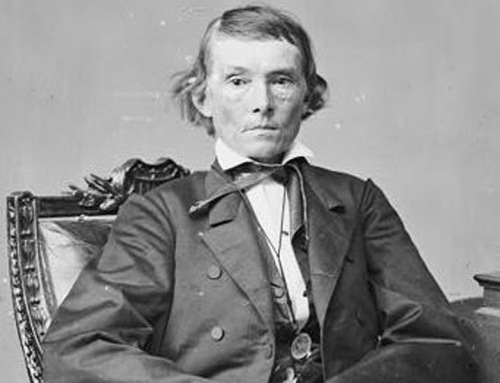
alexander-stephens

Alexander Stephens

Alexander Stephens the Vice President of the Confederacy noted in his Cornerstone Speech of March 21st 1861 that: “Our new government is founded upon exactly the opposite idea; its foundations are laid, its corner- stone rests upon the great truth, that the negro is not equal to the white man; that slavery — subordination to the superior race — is his natural and normal condition. [Applause.] This, our new government, is the first, in the history of the world, based upon this great physical, philosophical, and moral truth.”[14]

Thus the American ideological war was born as Fuller wrote:

“At length on 12th April, the tension could no longer bear the strain. Contrary to instructions, in the morning twilight, and when none could see clearly what the historic day portended, the Confederates in Charleston bombarded Fort Sumter, and the thunder of their guns announced that the argument of a generation should be decided by the ordeal of war. A war, not between two antagonistic political parties, but a struggle to the death between two societies, each championing a different civilization…”[15]

After the bloody battle of Antietam Lincoln published the emancipation proclamation in which he proclaimed the emancipation of slaves located in the rebel states. Likewise in his Second Inaugural Address he discussed slavery as being the cause of the war:

“One-eighth of the whole population were colored slaves, not distributed generally over the Union, but localized in the southern part of it. These slaves constituted a peculiar and powerful interest. All knew that this interest was somehow the cause of the war. To strengthen, perpetuate, and extend this interest was the object for which the insurgents would rend the Union even by war, while the Government claimed no right to do more than to restrict the territorial enlargement of it. Neither party expected for the war the magnitude or the duration which it has already attained. Neither anticipated that the cause of the conflict might cease with or even before the conflict itself should cease. Each looked for an easier triumph, and a result less fundamental and astounding. Both read the same Bible and pray to the same God, and each invokes His aid against the other. It may seem strange that any men should dare to ask a just God’s assistance in wringing their bread from the sweat of other men’s faces, but let us judge not, that we be not judged. The prayers of both could not be answered. That of neither has been answered fully. The Almighty has His own purposes. “Woe unto the world because of offenses; for it must needs be that offenses come, but woe to that man by whom the offense cometh.” If we shall suppose that American slavery is one of those offenses which, in the providence of God, must needs come, but which, having continued through His appointed time, He now wills to remove, and that He gives to both North and South this terrible war as the woe due to those by whom the offense came, shall we discern therein any departure from those divine attributes which the believers in a living God always ascribe to Him? Fondly do we hope, fervently do we pray, that this mighty scourge of war may speedily pass away. Yet, if God wills that it continue until all the wealth piled by the bondsman’s two hundred and fifty years of unrequited toil shall be sunk, and until every drop of blood drawn with the lash shall be paid by another drawn with the sword, as was said three thousand years ago, so still it must be said “the judgments of the Lord are true and righteous altogether.”[16]

When Edmund Ruffin pulled the lanyard of the cannon that fired the first shot at Fort Sumter it marked the end of an era and despite Ruffin, Stephens and Davis’ plans gave birth to what Lincoln would describe as “a new birth of freedom.”

When the war ended with the Confederacy defeated and the south in ruins Ruffin still could not abide the result. In a carefully crafted suicide note he sent to his son the bitter and hate filled old man wrote on June 14th 1865:

“… And now with my latest writing and utterance, and with what will be near my last breath, I here repeat and would willingly proclaim my unmitigated hatred to Yankee rule — to all political, social and business connections with Yankees, and the perfidious, malignant and vile Yankee race.”[17]

Though Ruffin was dead in the coming years the southern states would again find themselves under the governance of former secessionists who were unabashed white supremacists. By 1877 many southerners we taking as much pride in the “Lost Cause” as Northerners took in Appomattox.[18] This led to nearly a hundred more years of effective second class citizenship for now free blacks who were often deprived of the vote and forced into “separate but equal” public and private facilities, schools and recreational activities. The Ku Klux Klan and other violent organizations harassed, intimidated, persecuted and used violence against blacks. Lynching was common and even churches were not safe. It would not be until the Civil Rights movement of the 1950s and 1960s that blacks would finally begin to gain the same rights enjoyed by whites in most of the south.

Ruffin outlived Lincoln who was killed by the assassin John Wilkes Boothe on April 14th 1864. However the difference between the two men was marked. In his Second Inaugural Address Lincoln spoke in a different manner. He concluded that address with these thoughts:

“With malice toward none, with charity for all, with firmness in the right as God gives us to see the right, let us strive on to finish the work we are in, to bind up the nation’s wounds, to care for him who shall have borne the battle and for his widow and his orphan, to do all which may achieve and cherish a just and lasting peace among ourselves and with all nations.” [19]

Notes

[1] Clausewitz, Carl von. On War Indexed edition, edited and translated by Michael Howard and Peter Paret, Princeton University Press, Princeton NJ 1976

[2] Fuller, J.F.C. Decisive Battles of the U.S.A. 1776-1918 University of Nebraska Press, Lincoln 2007 copyright 1942 The Royal Society for the Prevention of Cruelty to Animals p.174

[3] Potter, David M. The Impending Crisis: America before the Civil War 1848-1861 completed and edited by Don E. Fehrenbacher Harper Collins Publishers, New York 1976 pp.457-458

[4] Ruffin, Edmund The Political Economy of Slavery in McKitrick, Eric L. ed. Slavery Defended: The Views of the Old South. Englewood Cliffs, NJ: Prentice Hall/Spectrum Books, 1963.Retrieved from http://www.pbs.org/wgbh/americanexperience/features/primary-resources/lincolns-political-economy/ 24 March 2014

[5] Jefferson, Thomas Letter to John Holmes dated April 22nd 1824 retrieved from www.loc.gov/exhibits/jefferson/159.html 24 March 2014

[6] U.S. Grant, Personal Memoirs of U.S. Grant New York 1885 pp.243-245

[7] Catton, William and Bruce, Two Roads to Sumter: Abraham Lincoln, Jefferson Davis and the March to Civil War McGraw Hill Book Company New York 1963, Phoenix Press edition London p.139

[8] Ibid.

[9] Ibid. p.142

[10] Ibid.

[11] Lincoln, Abraham A House Divided given at the Illinois Republican Convention, June 16th 1858, retrieved from www.pbs.org/wgbh/ala/part4/4h2934.html 24 March 2014

[12] __________ Declaration of the Immediate Causes Which Induce and Justify the Secession of South Carolina from the Federal Union. Retrieved from The Avalon Project, Yale School of Law http://avalon.law.yale.edu/19th_century/csa_scarsec.asp 24 March 2014

[13] Lincoln, Abraham First Inaugural Address March 4th 1861 retrieved from www.bartleby.com/124/pres31.html 24 March 2014

[14] Cleveland, Henry Alexander H. Stevens, in Public and Private: With Letters and Speeches, before, during and since the War, Philadelphia 1886 pp.717-729 retrieved from http://civilwarcauses.org/corner.htm 24 March 2014

[15] Ibid. Fuller . The Conduct of War 1789-1961 p.98

[16] Lincoln, Abraham Second Inaugural Address March 4th 1865 retrieved from www.bartleby.com/124/pres32.html 24 March 2014

[17] Edmund Ruffin (1794-1865). Diary entry, June 18, 1865. Manuscript Division, Library of Congress Retrieved from http://blogs.loc.gov/civil-war-voices/about/edmund-ruffin/ 24 March 2014

[18] Millet Allen R and Maslowsk, Peter. For the Common Defense: A Military History of the United States of America The Free Press, a division of McMillan Publishers, New York 1984 p.230

[19] Ibid. Lincoln Second Inaugural Address

Leave a comment

Filed under civil war, History, Political Commentary

The Journey of a Christian Agnostic: Remembering 18 Years of Priestly Ministry

“Do you exist? I think not. I have never seen you or touched you or felt you. Well, sometimes I think you’re presen163017_10150113444907059_3944470_nt but that may be wish fulfillment. Intellectually, I have no reason to believe. Yet much of the time I act like I do believe …. Only when I have time to reflect do I feel doubts, and then after the doubts certainty that the universe is cold and lonely. I know that I am a hypocrite and a fool. Then I preside over the Eucharist in my unsteady bumbling way and I know that you are. I don’t believe but I know.” Andrew Greeley in The Beggar Girl of St Germain

Eighteen years ago, on a warm and sultry night in Libertytown Maryland I was ordained as a Priest. I had been graduated from seminary in 1992 and been ordained as a minister in an Evangelical Protestant church in 1991 and served as a chaplain in the Army National Guard and Reserve as well as civilian hospital ministry, but in the course of my studies and subsequent study I came to a more Anglican and Catholic understanding of life and ministry.

Since that time the world has changed and I have changed. Back then I lived my life with a fair amount of certitude, hubris and arrogance, a trait that many, maybe even most young ministers regardless of their denomination or religion often fall into, and unfortunately many who seek to climb the ecclesiastical ladder to power, influence and sometimes fortune never forsake. At one time I believed that church and church leaders should not be questioned, until I found that they like many others were just as prone to cruelty, injustice and desire for power and authority as anyone I knew in the secular world.

After encountering this lack of care, cruelty and and injustice, both in the church and among some senior military chaplains my eyes were opened. I should have known better because just before I left the active duty Army to go to seminary I was told by my brigade executive officer “Steve, you think that the Medical department is too political, cutthroat and vicious, we can’t hold a candle to the Chaplain Corps.”

Unfortunately he was right, not only the Chaplain Corps, but many churches and denominations. I know far too many ministers and other ordained clergy who have been crushed by the burdens placed on them by their faith groups as well as various chaplain ministries, military and civilian. When I was in seminary I was shocked by the number of “former ministers” that I encountered, many who had real, earned academic theological degrees, as well as a wealth of pastoral experience, but the common thing that must shared was being abused, abandoned and sometimes even persecuted by their faith communities, often for the most trivial of reasons.

While I do not have any regrets about following the call to ministry and the priestly vocation, and would do it again, I do not recommend it to most people, it is an incredibly difficult life .

Since that night in 1996 my life has experienced twists and turns that I could never have imagined. Like Jerry Garcia of the Grateful Dead wrote in his song “Truckin’” 
“what a long strange trip it’s been.” That being said most of my time as a priest has been spent serving in some capacity on active duty as a military chaplain, first in the Army, but since 1999 in the Navy.

After Iraq, my life changed, afflicted with severe PTSD and what also might be considered “moral injury” I collapsed, psychologically, physically and spiritually. For all practical purposes I was an agnostic, praying that God just might still exist. When faith, seemingly miraculously returned it ended the hubris and certitude. I became much more willing to ask questions, express my doubts and publicly disagree with the church that I was first ordained as a priest. That got me thrown out of that church, as my bishop accused me of being “too liberal,” and thankfully I am now in a faith community where I am a good fit.

Faith has returned, at least part of the time and to be honest I still doubt, and that is not a bad thing. Andrew Greeley, speaking as Bishop Blackie Ryan in the novel The Bishop and the Beggar Girl of St Germain wrote: “Most priests, if they have any sense or any imagination, wonder if they truly believe all the things they preach. Like Jean-Claude they both believe and not believe at the same time.”

I still serve as a priest and Navy Chaplain. I am happy and like Father Jean-Claude in Andrew Greeley’s novel I believe and do not believe at the same time. I have the honor of serving a small chapel for our students at the Joint Forces Staff College as well as teaching ethics, military history and leading the Gettysburg Staff Ride. I also find a great deal of meaning in writing on this website, something that was begun out of the anguish of what I was going through after Iraq. In this website I serve people that I may never meet, and when they write, share their own stories and seek and encourage me it renews my faith and hope. As Andrew Greeley said: “I wouldn’t say the world is my parish, but my readers are my parish. And especially the readers that write to me. They’re my parish. And it’s a responsibility that I enjoy.”

My politics and views on many social issues have changed significantly since I was ordained, they are significantly more liberal and I think better grounded in the grace and love of God than they were before. As far as the people I encounter, both in the chapel setting, at the Staff College and among people I meet in town I find that I am much more comfortable listening to and being there for others, especially struggling clergy and others who find church not a place of solace, but a place of fear where they are neither cared for or accepted, the outcasts. Thus I feel strongly that eery encounter, especially sacramental ones are times to show care for others. As Andrew Greeley wrote in his final Bishop Blackie novel The Archbishop Goes to Andalusia:

“Every sacramental encounter is an evangelical occasion. A smile warm and happy is sufficient. If people return to the pews with a smile, it’s been a good day for them. If the priest smiles after the exchanges of grace, it may be the only good experience of the week.” 

That was something that I experienced this weekend with a visitor to my chapel. That makes it all worth it, despite that I believe and do not believe at the same time and I will live with this tension and trust that the Jesus the Christ, God who took on the fullness of humanity for the life of the world will somehow understand.

Peace

Padre Steve+

4 Comments

Filed under christian life, faith, ministry

“We had Nothing to do but to Obey the Orders” Final Confederate Preparations for Pickett’s Charge

10003289_10152329730082059_400175304_n

While James Longstreet was depressed and many Confederate commanders who had seen the carnage of attacking the entrenched Federal army on July 2nd doubted whether any assault could break the Federal line, Robert E. Lee held on to the hope that one more assault would carry the day. It had to, “the importance with which his whole strategy had invested in this battle and the stubbornness which had driven him on at Gaines’s Mill, Malvern Hill, and Antietam, impelled Lee to still try another major attack on July 3.” 1 His partial success on July 2nd also “persuaded Lee that with the proper coordination and support of artillery, it was still possible to assault and break through Meade’s front.” 2 Convinced that his men could conquer the Federal position, and encouraged by the small successes of the second day “the general plan of attack was unchanged.” 3

However the real problem was not breaking through the line, but “how to stay there and exploit the advantage once the enemy’s line was pierced.” 4 Lee’s tactical problem remained the same as it had on July 2nd, when the power of the rifled musket and massed artillery on the defense cut his assaulting troops to ribbons, even though they inflicted heavy casualties on the Federal army, especially Sickles’ badly exposed III Corps in the Wheat Field and the Peach Orchard. His problem was how to break the enemy’s line and then exploit the breakthrough in order to gain not only a victory, but destroy the Army of the Potomac as a fighting force in the process.

As we have already discussed, on the new battlefield of the Civil War where the killing power of entrenched troops on the defense had grown exponentially as compared to the Napoleonic era or even the Mexican War, of which Lee and so many commanders were veterans. As Russell Weigley noted that by the time an attacking force was able to breach a prepared defensive position, “almost invariably, by that time the attacker had lost so heavily, and his reserves were so distant, that he could not hold on against a counterattack by the defending army’s nearby reserves.” 5 And like his assaults at Gaines’s Mill, Malvern Hill and those at Gettysburg on July 2nd, the assault of July 3rd by the divisions of Pickett, Pettigrew and Trimble would meet a similar bloody repulse, only Lee refused to accept it. Colonel Porter Alexander, commanding Longstreet’s corps artillery noted that “even if the attack was “entirely successful, it can be only be at a very bloody cost” 6 while Brigadier General A.R. Wright, whose brigade had actually reached Cemetery Ridge on July 2nd told Alexander “The trouble is not going in there…the problem is to stay there after you get there.” 7

With a fresh army, or perhaps a number of fresh divisions, Lee’s plan might have had a chance to succeed. But Lee had already lost heavily on July 1st and 2nd and in the process shattered the divisions of Heth, Pender, Rodes, Johnson, Hood and McLaws and suffered serious casualties to the divisions of Early and Anderson. As far as infantry he had very little left, only Pickett’s short handed division which was missing two of its five brigades, with which to mount a frontal assault that would further decimate his army and render it incapable of further offensive operations, even if he drove Meade from his positions on Cemetery Hill and Cemetery Ridge.

But Robert E. Lee was not deterred, over the past year of action “Lee had developed extremely high expectations of his enlisted men” 8 He had seen them overcome adversity as well as defeat far larger forces, but this time the open terrain, the superiority of the Federal artillery, the excellent position that Meade’s army occupied and his own lack of fresh troops and scarcity of artillery ammunition, combined with poor staff work and bad organization would ensure that this assault would be more than they could handle. Unlike Longstreet, Lee was never in awe “of the formidable character of the Union position…and he felt sure his incomparable infantry if properly handled could take any height.” 9

But even Porter Alexander, like most in the Army, held Lee in such esteem that regardless of the situation they implicitly trusted his judgment. As the preparations were made in the morning initially “believed that it would come out right, because General Lee had planned it.” 10 As he weighed the matter more fully Alexander told Longstreet “if there is any alternative to this attack, it should be carefully considered before opening our fire, for it will take all the artillery ammunition we have left to test this one thoroughly, and if the result is unfavorable, we will have none left for another effort.” 11

Once again Lee’s lack of clarity and vagueness in his orders and the reluctance of a subordinate to carry them out hindered Lee’s plan. Lee and Longstreet “had not reached a clear understanding on the nature, extent, and direction of his offensive operations” 12 and somehow, in “the strange, undeclared conflict of wills that had begun thirty-six hours before, neither general was thinking clearly. As Longstreet would now do anything to avoid assuming responsibility for a full-scale attack, Lee would do anything to get him to move out.” 13

Pickett’s division had arrived at Marsh Creek was of Gettysburg after a long and tiring forced march from Chambersburg at about 4 p.m. on July 2nd. Lee informed Pickett that he would not be needed that day and to rest his troops, and for whatever reason they remained in that position until about 4 a.m on July 3rd. Neither Lee nor Longstreet ordered them up earlier, where they might have been in position for an earlier assault on the Federal center, an attack that might have been coordinated with Ewell’s attack on Culp’s Hill which went off about 4 a.m.

Some of the blame for this can be laid at the feet of Longstreet, who still determined to find a way to turn the Federal left flank had his staff planning throughout the night for a way to execute that attack, but Lee was remiss in not clearly communicating his intent to his subordinate, to include what he expected him to do as well as when and where he expected him to do it. These questions were not cleared up until after sunrise on July 3rd, when Lee reiterated his plans to Longstreet and A.P. Hill.

Lee decided to attack the Federal center, where Cemetery Ridge was less commanding than Cemetery Hill, or the Round Tops which had been so costly to attack on the first two days of battle. All of Pickett’s division arrived behind Seminary Ridge between 7 a.m. and 9 a.m. on the morning of July 3rd. There it joined the other units assigned to the attack by Lee. Those units, apart from Pickett all came from A.P. Hill’s Third Corps, Longstreet having convinced that the badly cut up divisions of Hood and McLaws remain in place on the south end of the battlefield to protect the flank. Longstreet was of the opinion, and gained Lee’s concurrence that if those units joined the assault that the flank would be exposed to the well dug in and reinforced Federal units on and around the Round Tops, as Longstreet explained, “To have rushed forward with my two divisions, then carrying bloody noses from their terrible conflict the day before, would have been madness.” 14

The decision to leave these two divisions in place resulted in a change of plan as to where the Confederate assault would be directed. Lee initially planned for Longstreet’s corps to continue its push in the south, from the positions they had taken near Little Round Top, Devil’s Den, the Peach Orchard and the Wheat Field. In that attack Hood’s division now lead by Evander Law, would be on the extreme right, McLaws division in the center attacking from the Wheat Field and Peach Orchard and Pickett on the left, supported by some of A.P. Hill’s Third Corps. However, with the change of plan Pickett’s division was now on the left of the attack, while Heth’s division, now commanded by Johnston Pettigrew would be in the center supported by Lane’s and Scales’ brigades of Dorsey Pender’s division, now commanded by Isaac Trimble, who had taken command only that morning. The selection of Heth’s division to join the attack now “provided a focal point for the attack, since it was roughly opposite the Federal center; then, too, there was a concealed position to the right of Heth’s line that offered room enough for Pickett’s men.” 15 This necessitated a change to the intended target of the attack, which Lee now identified as the “small clump of trees” visible in the center of the Federal position.

Lee discounted the terrain as a factor, thinking that the fences that criss-crossed the open field between the two opponents was of little concern. The open ground lent itself to the “massive attack on the scale that Lee visualized” but would “expose his men to a raking fire from enemy muskets and artillery.” 16 Lee hoped to reduce this danger with an overwhelming artillery barrage, but while Longstreet opposed the attack, and other Confederate commanders such as Armistead and Garnett realized the near hopelessness of the attack but maintained a silence, William Mahone, whose brigade was part of Anderson’s division and not assigned to the attack was mortified. Mahone begged Anderson to observe the battlefield and told him his honest opinion of the coming attack: “That no troops ever formed a line of battle that could cross the plain of fire to which the attacking force would be subjected, and…that I could not believe that General Lee would insist on such an assault after he had seen the ground.” 17 But Lee was determined and Anderson refused to confront Lee, saying “in substance, that we had nothing to do but to obey the orders.” 18

Mahone was right both about the ground and the fires that the attacking Confederates would encounter. While the fences along the Emmitsburg road in Pickett’s area were not much of a factor, they were on Pettigrew’s front. The Plum Run Valley which cut across the battlefield was a wide swale which “was truly a valley of death; Union artillery placed on Little Round Top could easily fire up its shallow groove as if it were a bowling alley, and Federal infantry could easily counterattack into it.” 19 In front of Pettigrew the ground formed “a natural glacis. In short, it naturally sloped at a steeper angle, forcing the attacker to literally walk up directly into the muzzles of the defending infantrymen.” 20 Whether Lee recognized it or not the ground itself offered major obstacles that the attacking Confederates would have to negotiate under heavy artillery and musket fire.

From a command, control and coordination aspect there was little to be commended in Lee’s plan. The artillery support, nominally to be conducted by all the Confederate artillery from all three corps was not well coordinated and lacked an overall commander, this ensured that the “corps artillery commanders acted independently, without a firm understanding of the crucial importance of their roles.” 21 Porter Alexander, who had the heaviest responsibility only had operational control of the batteries of First Corps and a few from Third Corps, the rest of the artillery battalions remained under their respective corps artillery commanders. Additionally, the senior artilleryman present, who had no command authority, Brigadier General William Pendleton moved batteries committed to Alexander and the infantry assault without telling him, and removed the artillery trains far to the rear where the ammunition needed to sustain an attack was out of reach when needed. Additionally the batteries of Third Corps did not conserve their limited ammunition and became involved in a long battle over the Bliss farmhouse between the lines, thus limiting their ability to take part in the attack. Likewise the guns of Second Corps, some of which could have had good enfilade fire on Cemetery Hill took little part in the action.

Of the three infantry divisions allotted to the attack, only one, Pickett’s actually belonged to the corps commander leading the attack, and the two divisions from Third Corps were badly cut up from the battle on July 1st and commanded by new commanders, neither who had commanded a division, and one of who, Trimble had never worked with or even met his subordinate commanders until that morning. Additionally, the two brigades assigned from Pender’s division were units that had been heavily engaged, there were two other brigades, those of Mahone and Posey from Anderson’s division, which “yet to see see serious action” and were “just as fresh as Pickett’s division, yet they were overlooked and not even assigned a supporting role.” 22

Despite his objections to it and the challenges posed by the attack, James Longstreet earnestly worked to make it succeed. Longstreet, Pickett and Pettigrew attempted to smooth out communications to “avoid mistakes and secure proper coordination between various units.” 23 However, despite his good intentions, Longstreet made a number of mistakes which could be best described as “lapses of thought.” He failed to “explain the details of the attack to all levels of command in all units…he failed to communicate effectively with anyone outside of First Corps, even though Third Corps troops would make up more than half of the attackers.” He left the artillery plan to Alexander and failed to develop a detailed plan that would determine if the artillery bombardment had weakened the Federals enough “to justify sending in the infantry.” He also did not appreciate the weakened condition of the attached Third Corps units and more importantly seemed to give little thought to the placement of Pickett’s troops in relationship to Pettigrew. This left a 400 yard gap between the Pickett and Pettigrew’s divisions, a gap that would cause problems during the attack, as it necessitated “a significant and difficult left oblique movement by the Virginians across the valley, under artillery fire.” 24

Despite Longstreet’s lapses the fact was that Lee reviewed the plans, and troops dispositions late in the morning. Lee had gone up and down the line inspecting it, but somehow he too “did not detect the hidden flaws in the deployment of his troops and the layout of its batteries.” 25 Likewise he seemed to continue the passive role that he had maintained throughout the battle. Alexander spelled this out in a private letter noting that “The arrangement of all the troops,… must have been apparent to Gen Lee when he was going about the lines between 11 & 12, & his not interfering with it stamps of his approval.” 26

About noon the approximately 13,000 troops in the attacking divisions continued to make their individual preparations for the attack. As they did this “a great stillness came down over the field and over the two armies on their ridges…the Confederates maintaining their mile wide formation along the wooded slope and in the swale, the heat was oppressive.” 27 Pickett wrote his young fiancee “the suffering and waiting are almost unbearable.” 28

Notes

1 Weigley, Russell F. The American Way of War: A History of United States Military Strategy and Policy Indiana University Press, Bloomington and Indianapolis 1973 p.117 

2 Fuller, J.F.C. Grant and Lee: A Study in Command Indiana University Press, Bloomington and Indianapolis 1957 pp. 198-199 

3 Guelzo, Allen C. Gettysburg: The Last Invasion Vintage Books, a Division of Random House, New York 2013 p.375

4 Ibid. Weigley The American Way of War p.117 5 Ibid. Weigley The American Way of War p.117

6 Korda, Michael. Clouds of Glory: The Life and Legend of Robert E Lee Harper Collins Books, New York 2014 p.591

7 Coddington, Edwin B. The Gettysburg Campaign: A Study in Command A Touchstone Book, New York, 1968 p.459

8 Hess, Earl J. Pickett’s Charge: The Last Attack at Gettysburg University of North Carolina Press, Chapel Hill and London 2001 p.13

9 Coddington The Gettysburg Campaign: A Study in Command p.457

10 Golay, Michael To Gettysburg and Beyond: The Parallel Lives of Joshua Lawrence Chamberlain and Edward Porter Alexander Crown Publishers, New York 1994 p.167

11 Freeman, Douglas Southall. Lee’s Lieutenants: A Study in Command One Volume Abridgment by Stephen Sears, Scribner New York 1998 p.592

12 Ibid. Coddington Gettysburg: A Study in Command p.454

13 Dowdy, Clifford Lee and His Men at Gettysburg: The Death of a Nation originally published as Death of a Nation Skyhorse Publishing New York 1958 p.258 

14 Trudeau, Noah Andre Gettysburg a Testing of Courage Harper Collins Publishers, New York 2002 p.441

15 Ibid. Trudeau Gettysburg: A Testing of Courage p.441

16 Ibid. Coddington The Gettysburg Campaign p.459

17 Ibid. Trudeau Gettysburg: A Testing of Courage p.458

18 Ibid. Trudeau Gettysburg: A Testing of Courage p.458

19 Ibid. Hess Pickett’s Charge p.79

20 Ibid. Hess Pickett’s Charge p.81

21 Wert, Jeffery D. Gettysburg Day Three A Touchstone Book, New York 2001 p.126

22 Ibid. Coddington The Gettysburg Campaign p.462

23 Ibid. Coddington The Gettysburg Campaign p.491

24 Ibid. Hess Pickett’s Charge p.32

25 Ibid. Coddington The Gettysburg Campaign p.492

26 Ibid. Wert. Gettysburg Day Three p.128

27 Foote, Shelby The Civil War a Narrative: Fredericksburg to Meridian Vintage Books a Division of Random House, New York 1963 p.539

28 Ibid. Dowdy Lee and His Men at Gettysburg p.281

Leave a comment

Filed under civil war, History, leadership, Military

“Well, We May as Well Fight it out Here” Meade Decides to Fight at Gettysburg

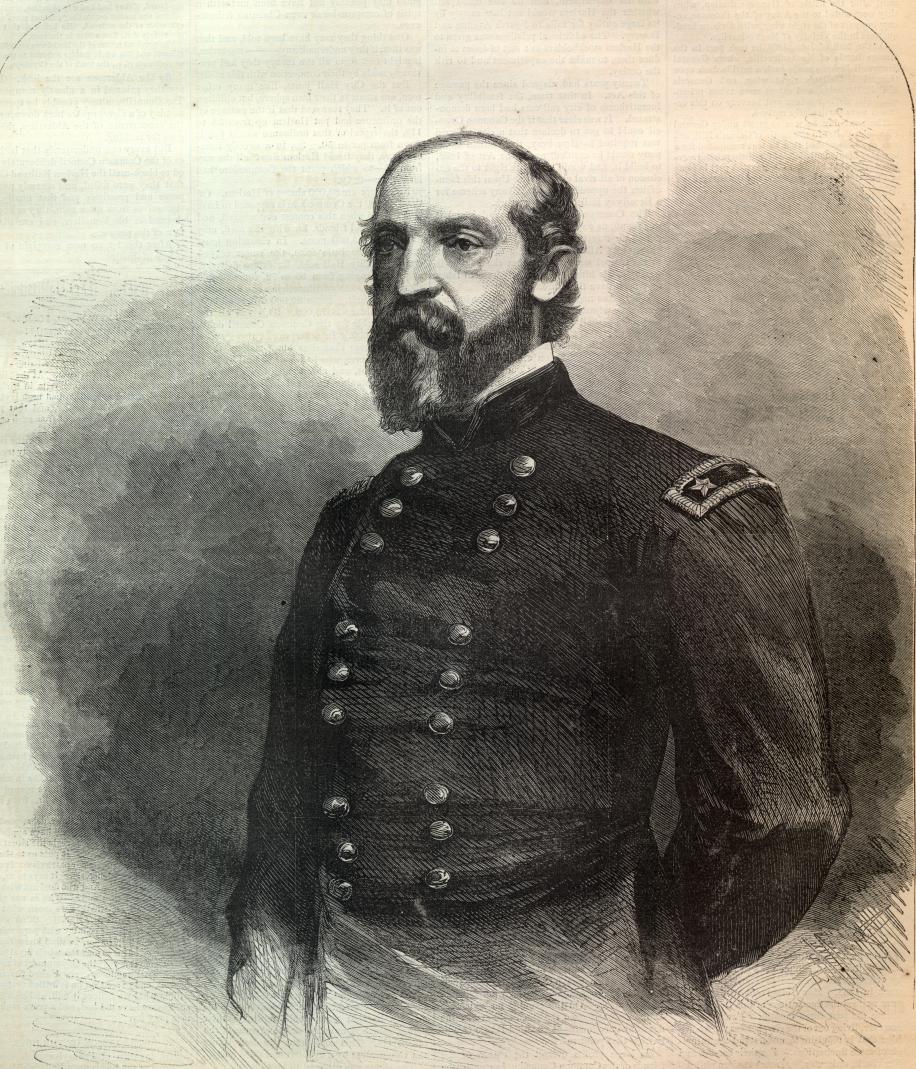
general-george-meade

“General Meade will commit no blunder in my front, and if I commit one he will make haste to take advantage of it.” Robert E Lee June 28th 1863

The choosing of the place to give battle, at any level of war, but particularly at the operational level is always of the utmost importance and has been so from time immemorial. Despite advances in technology terrain and weather are major factors that a commander or staff must consider in terms of their courses of action. Knowing the terrain features as well as the infrastructure such as road networks that they are operating on allows commanders to choose courses of action which accentuate their strengths and expose their opponent’s weaknesses. To understand this is a key part of Course of Action (COA) development, Operational Art and Operational Design as well as analyzing Centers of Gravity, especially in determining decisive points.

While the commanders at Gettysburg did not use such terminology, they did understand the effects of terrain and weather, friction and the importance of occupying “good ground.” Our understanding of these concepts can help us draw from the actions of the commanders at Gettysburg lessons that we can employ today, despite the vast changes in technology and expansion of the battlefield.

As he looked at the dispositions of the Confederate army on June 30th George Gordon Meade “felt he had move his forces in such a way as to challenge the enemy advance while at the same time protecting Washington and Baltimore.” 1 To do this he decided to concentrate the Army of the Potomac along what is known as the Pipe Creek line, a line along Parr’s Ridge just behind Pipe Creek to the south of Meade’s Taneytown headquarters. As an engineer Meade recognized the The decision was made because he realized that his advance had caused Lee’s army to abandon its threatening movement toward Harrisburg and the Susquehanna and was concentrating in the general area of Cashtown, South Mountain and possibly advancing toward Gettysburg.

The Pipe Creek line offered Meade a number of advantages; “it covered his own supply line and blocked the direct route to Baltimore.” 2 The positions of his intrenched army there would be “almost impossible to storm by frontal attack” 3 as well as allow his army to concentrate quickly. By placing himself in that position Meade believed that it would force Lee to attack him on good ground of his own choosing, offer him the chance to attack should Lee divide his forces, or by allowing Lee to exhaust his forage and supplies to withdraw from Pennsylvania without giving battle. Meade’s intention at Pipe Creek was to fight the “kind of battle he was to fight at Gettysburg.” 4

However Meade’s carefully laid plan became a victim of circumstances as events progressed during the evening of June 30th and morning of July 1st. When Reynolds was told by Buford that contact had been made and the Confederates were advancing on Gettysburg he brought I Corps and XI Corps up as quickly as he could and issued orders for III Corps under Sickles to join them at Gettysburg.

About 1130 a.m. Meade received word from John Reynolds’ aide Captain Stephen Weld that Reynolds had engaged the enemy at Gettysburg and had not received Meade’s Pipe Creek circular, which jeopardized his plan. Meade, having not known that Reynolds was not acting on his latest plan had assumed that Reynolds was conducting a temporary holding action at Gettysburg, but at 1 p.m. he was given the message that “Reynolds was dead or severely wounded and that Otis Howard was in command on the field.” 5 At this point Meade wasted no time and appointed Winfield Scott Hancock to go to Gettysburg and take charge of the situation, not trusting Howard’s abilities and instructed him “If you think the ground and position there are a better one to fight under existing circumstances, you will so advise the General, and he will order his troops up.” 6 He placed John Gibbon in command of II Corps and because he was concerned that Lee might cut off the embattled I Corps and XI Corps.

It was at this point that Meade decided to abandon his Pipe Creek plan and even before getting Hancock’s report, issued orders to his Corps commanders. At about 4:30 p.m. Meade ordered Sedgwick and his VI Corps up to Taneytown and put Slocum’s XII Corps and Sykes V Corps on the road to “move up to Gettysburg at once.” 7

Throughout the afternoon Meade kept his wits and “may have restrained a natural impulse to rush to the battleground and take over control of affairs himself.” 8 After the battle some criticized Meade for this, but it was from a perspective of command, and what we now call Mission Command did the right thing. He stayed at his headquarters to better control the movements and communicate with all his forces, which he could not have done had he rushed to the front, and instead “delegated authority to a highly competent subordinate, while he himself stayed close to the center of operations at army headquarters.” 9

Had Meade done what many commanders might have done in his position, and moved to the battle he might not have been able to do the more important job of ensuring the in a moment of crisis that his subordinate commanders received his orders and moved their units where they were needed. In fact any delay of getting the Union forces to Gettysburg could have been fatal to his army and allowed Lee to gain the advantage and possibly defeat his forces in detail. Likewise if Hancock arrived and found that the position could not be held, Meade would still be in position to ensure that the Pipe Creek position could be held.

The man he appointed in his stead, Hancock was someone that was not only capable but someone that “was a man who he knew and could trust,” 10 and who despite being junior to Howard, Slocum and Sickles was able to diplomatically handle the awkwardness of the situation. After Hancock arrived on the field he took in the tactical situation and judged it “the strongest position by nature on which to fight a battle that I ever saw.” 11

Howard objected to Hancock taking charge of the battlefield due to seniority, and although Howard had selected the position, demurred to Howard and said “and if it meets your approbation I will select this as the battlefield.” After Howard concurred Hancock announced “Very well, sir. I select this as the battlefield.” 12 While Howard could make the claim that he actually selected the ground of where to fight by emplacing Steinwehr’s division on the Hill as a reserve and withdrawing the battered remnants of I Corps and XI Corps to it during the afternoon, it was Hancock that “organized the all-round defense of the position.” 13 After consulting with Howard and directing Slocum’s XII Corps to occupy Culp’s Hill Hancock sent his aide Major William Mitchell to tell Meade that the position “could not well be taken.” 14 He had III Corps extend the line down Cemetery Ridge and directed his own II Corps to protect the flank in case Lee attempted to turn the Federal left. Upon Slocum’s arrival Hancock relinquished command and rode to Taneytown to personally brief Meade on the situation.

When Meade received word that from Hancock that he believed that “Gettysburg could maintain itself until dark” he dispatched a message to Hancock and Doubleday “It seems to me that we have so concentrated that a battle at Gettysburg is now forced upon us.” 15 Meade then sent a dispatch to Henry Halleck in Washington: “A.P. Hill and Ewell are certainly concentrating…Longstreet’s whereabouts I do not know. If he is not up tomorrow, I hope with the force I have concentrated to defeat Hill and Ewell; at any rate I see no other course that to hazard a general battle.” 16 He added “Circumstances during the night may alter this decision, of which I will try to advise you.” 17 Upon sending out his final orders directing all units to Gettysburg he had his headquarters strike its tents and equipment and begin to move to Gettysburg, being briefed by Hancock before he set off at 10 p.m.

Meade arrived on the field about midnight to the surreal scene of soldiers of the I Corps and XI Corps encamped on the grounds of the cemetery, many exhausted and asleep having thrown back the last Confederate attacks, and met Slocum, who had taken charge when Hancock went back to brief Meade, as well as Howard, his artillery chief Henry Hunt and chief engineer, Gouverneur Warren, Dan Sickles of III Corps his and by Hancock when that weary general arrived back from Taneytown.

Howard was anxious due to the disaster that had befallen his Corps, but Meade assured him that he was not assigning any blame. He then asked their opinions about the position. Howard declared “I am confident that we can hold this position.” He was joined by Slocum who noted “It is good for defense,” and Sickles added “It is a good place to fight from.”
Meade was satisfied with their conclusions and replied: “I am glad to hear you say so, gentlemen for it is too late to leave it.” 18

Meade then began a thorough inspection of his lines, the placement of his forces and disposition of his artillery, which he directed Hunt “to see that the artillery was properly posted.” 19 An engineer officer made a sketch of the position, and “Meade used to indicate where he wanted to post his troops” 20 and he had copies made and “sent to the corps commanders.” 21 After consulting with Slocum about the position on Culp’s Hill, and the “practicability of attacking the enemy in that quarter.” Slocum indicated that it was excellent for defense but “not favorable for attack,” 22 Warren added his “his doubts about attacking across ground that was sullied and uneven” 23 and Meade gave up the option of taking the offensive there, which he had considered to do when Sedgwick arrived with VI Corps later in the day. He and Warren also directed XII Corps to construct “breastworks and abatis” on the peaks of Culp’s Hill,” 24 a measure that would prove to be of decisive importance on the night of July 2nd and morning of July 3rd. He also moved V Corps into a reserve position behind Cemetery Hill on the Baltimore Pike, and used his command authority to replace Doubleday, who he did not feel able enough to command a Corps, who had been in acting command of I Corps since the death of Reynolds’ with Brigadier General John Newton who commanded a division in Sedgwick’s V Corps, earning himself Doubleday’s undying enmity.
About 3 a.m. still unsure of Lee’s intent Meade wrote Halleck informing him that the army “was in a strong position for the defensive” and though hoped to attack had considered all possibilities, and attempted to prepare for anything, even Lee attempting to move around his flank to interpose himself between Meade and Washington, exactly as Longstreet had recommended to Lee. If that occurred he told Halleck that he would “fall back to my supplies at Westminster….” 25 (the Pipe Creek line).

Meade made his headquarters at the Liester House behind Cemetery Ridge where he continued planning. Meade’s headquarters offered him a central position from which he could easily reach any position on the battlefield and speed communications with his commanders. The position he had taken was strong, with his Corps all occupying good ground and positions being continuously improved and reinforced as more troops arrived. To the north XII Corps occupied a very strong position on Culp’s Hill while I Corps and XI Corps occupied Cemetery Hill. II Corps now occupied the central area of Cemetery Ridge with Sickles III Corps extend that line south toward the Round Tops. V Corps was in reserve and cavalry was posted to cover each flank. Sedgwick’s VI Corps was nearing Gettysburg and expect to arrive in the afternoon after completing a 36 mile forced march from Manchester Maryland. His army occupied interior lines allowing rapid reinforcements to any threatened area. It was as strong as a position as could be imagined.

After sunrise Meade met Carl Schurz, who had so ably helped maintain XI Corps on July 1st and whose troops occupied the northern face of Cemetery Hill. Schurz observed that though Meade “looked careworn and tired, as though he had not slept the night before-probably because he hadn’t” but that “his mind was evidently absorbed by a hard problem. But this simple, cold, serious soldier with his business-like air did inspire confidence….” 26

As Schurz watched Meade survey the Federal defenses he asked how many soldiers Meade expected to have on hand. Meade told him that he expected about 95,000. 27 Meade then told Schurz: “Well, we may fight it out here just as well as anywhere else” and then rode off. 28

During the night of July 1st Meade did what Lee failed to do. Lee failed to control his units or commanders, while Meade maintained control of his units, ensured that his commanders understood his intent and replaced ones that he felt unable to do what was needed. Lee conducted no reconnaissance of any importance, the only attempt sending his staff engineer to look around Little Round Top, a task that he failed in, while Meade and his subordinates made a thorough reconnaissance of their lines and fortified them. Lee, in an almost fatalistic manner did no real contingency planning, leaving things to the elan’ of his troops and the Providence of God, but Meade planned for contingencies that Lee might attempt, even the possibility that Lee might do what Longstreet so strongly advocated.

In the end Meade did almost everything that a commander could do to ensure that his army not only was in position to succeed in the tactical and operational levels, but also through his contact with his superiors linked his operations to larger strategic considerations.

Notes

1 Trudeau, Noah Andre. Gettysburg: A Testing of Courage Harper Collins Publishers, New York 2002 p.118

2 Sears, Stephen W. Gettysburg Houghton Mifflin Co. Boston and New York p.150

3 Coddington, Edwin B. The Gettysburg Campaign: A Study in Command A Touchstone Book, Simon and Schuster, New York 1968 p.239

4 Ibid. Coddington The Gettysburg Campaign p.239

5 Ibid. Sears Gettysburg p.188

6 Huntington, Tom Searching for George Gordon Meade: The Forgotten Victor of Gettysburg Stackpole Books, Mechanicsburg PA 2013 p.154

7 Guelzo, Allen C. Gettysburg: The Last Invasion Vintage Books a Division of Random House, New York 2013 p.159

8 Ibid. Coddington The Gettysburg Campaign p.323 9 Ibid Coddington. The Gettysburg Campaign p.323

10 Ibid. Guelzo Gettysburg: The Last Invasion p.158

11 Jordan, David M. Winfield Scott Hancock: A Soldier’s Life University of Indiana Press, Bloomington and Indianapolis 1988 p.84 

12 Foote, Shelby The Civil War a Narrative: Fredericksburg to Meridian Random House, New York 1963 p.48313 Ibid. Foote The Civil War a Narrative: Fredericksburg to Meridian p.483

14 Ibid. Coddington The Gettysburg Campaign p.321

15 Ibid. Trudeau pp.264-265

16 Ibid. Sears Gettysburg p.241

17 Ibid. Trudeau p.265

18 Ibid. Huntington Searching for George Meade p. 159

19 Hunt, Henry J. The Second Day at Gettysburg in Battles and Leaders of the Civil War, Volume III The Tide Shifts, edited by Robert Underwood Johnson and Clarence Clough Buel, Castle Books Secaucus New Jersey p.293

20 Ibid. Huntington. p.15921 Ibid. Coddington The Gettysburg Campaign p.330

22 Ibid. Foote The Civil War a Narrative: Fredericksburg to Meridian p.494

23 Ibid. Guelzo Gettysburg: The Last Invasion p.228 

24 Ibid. Guelzo Gettysburg: The Last Invasion p.228

25 Ibid. Foote The Civil War a Narrative: Fredericksburg to Meridian p.464

26 Ibid. Huntington Searching for George Meade p.160

27 An overestimate based on unit reports, which included many troops not present for duty, or able to perform their duties. He actually had about 83,000-85,000 on the field during the battle. 

28 Ibid. Huntington Searching for George Meade p.160


1 Comment

Filed under civil war, History, leadership, Military

We Hold These Truths…

Declaration_of_Independence_by_JoeSnuffy

Last night I re-read the Declaration of Independence. I do this about every time this year. It is not a long read, but quite profound. As I read again I reflected on the beginning of the second sentence of that document.

“We hold these truths to be self-evident, that all men are created equal…” When penned by Thomas Jefferson and ratified by the Continental Congress in July 1776 these words, which begin the second sentence of the Declaration of Independence announced something unimaginable to the world, most of which labored under the rule of ensconced monarchies, nobilities and state religions, where your social status and religious affiliation counted more than anything else, places where few commoners had any hope of social advancement, no matter what their talent, ability or genius.

They were a clarion call of equality and revolutionary in their impact, not only in the American colonies but around the world. In the coming years people around the world would look to those words as they sought to free themselves from oppressive governments and systems where the vast majority of people had few rights, and in fact no equality existed.

But the liberty and equality stated in the Declaration of Independence did not extend to all in the United States, or in its territories as it expanded westward, and the inequity eventually brought on a great civil war.

Eighty seven years after those words were published the nation was divided, in the midst of a great civil war, a climactic battle having just been fought at Gettysburg. A few months later President Abraham Lincoln penned one of the most insightful and influential documents ever written, the Gettysburg Address.

One thing that our founders overlooked was that even while proclaiming equality, they later enshrined that one group of people, African slaves were not equal, in fact they only counted as three fifths of a person. Eventually, many states on their own abolished slavery, but because of the invention of the Cotton Gin slavery became even more fully entrenched in the American South, when an oligarchy of land and slave owners held immense power, where nearly half of the population was enslaved and where even poor whites had few rights and little recourse to justice.

After the Dred Scott decision of 1857 which declared that African Americans, no matter if they were slave or free could be American Citizens and had no standing to sue in Federal courts. Scott had sued to gain his family’s freedom after his owner refused to allow him to purchase it, because they were in a territory where slavery was but even more importantly held that the Missouri Compromise of 1824 which had prohibited the introduction of Slavery into Federal territories was unconstitutional and that the Federal government had no right to limit slavery in territories acquired after the creation of the United States. Chief Justice Roger Taney writing for the majority wrote that all African Americans were viewed by the authors of the Constitution as:

“beings of an inferior order, and altogether unfit to associate with the white race, either in social or political relations, and so far inferior that they had no rights which the white man was bound to respect.”

Taney held that Article V of the Constitution barred any law that would deprive a slave owner of his “property” on entrance into free states or territories. and enunciated a string of negative effects, or “parade of horribles” that would derive if Scott’s petition for freedom was granted. His declaration is amazing in its ignorance and prejudice. Taney wrote:

“It would give to persons of the negro race, …the right to enter every other State whenever they pleased, …to sojourn there as long as they pleased, to go where they pleased …the full liberty of speech in public and in private upon all subjects upon which its own citizens might speak; to hold public meetings upon political affairs, and to keep and carry arms wherever they went.”

The two dissenting Justices, Curtis and McLain disagreed with the proposition that the writers of the Constitution believed as Taney and the majority believed, noting that at the time of the ratification of the Constitution that blacks could vote in five of the thirteen states, making them citizens, not just of those states but the United States. Referring to the Declaration of Independence in 1854 Lincoln wrote: “the standard maxim of free society …constantly spreading and deepening its influence,” ultimately applicable “to peoples of all colors everywhere.”

However, much to the concern of slave holders and the South, the decision energized the abolitionist movement who believed that now no black, even those with a long history of being Freed Men living in non-slave states could be claimed as property by those claiming to be former owners, and that state laws which gave blacks equal rights and citizenship could be overturned. Lincoln again referring to the Declaration wrote of the Dred Scott decision:

“to aid in making the bondage of the Negro universal and eternal….All the powers of the earth seem rapidly combining against him. Mammon is after him; ambition follows, and philosophy follows, and the theology of the day is fast joining the cry. They have him in his prison house;…One after another they have closed the heavy doors upon him…and they stand musing as to what invention, in all the dominions of mind and matter, can be produced the impossibility of his escape more complete than it is.”

Eventually the tensions led to the election of Lincoln along sectional lines and the immediate secession of seven southern states and the establishment of the Confederacy. British military historian and theorist Major General J.F.C. Fuller wrote that the war was “not between two antagonistic political parties, but a struggle to the death between two societies, each championing a different civilization…”

The Confederate Vice President, Alexander Stephens openly proclaimed that the inequity of African Americans was foundational to the Confederacy in his Cornerstone speech of 1861, if there are any doubters about the “rights” the leaders of the Southern States longed to preserve in their secession from the Union, Stephen’s words are all to clear in their intent:

“Our new government is founded upon exactly the opposite idea; its foundations are laid, its corner- stone rests upon the great truth, that the negro is not equal to the white man; that slavery — subordination to the superior race — is his natural and normal condition. [Applause.] This, our new government, is the first, in the history of the world, based upon this great physical, philosophical, and moral truth.”

Lincoln, in his Second Inaugural Address acknowledged what everyone had known, but few, him included in the North were willing to say in 1861:

“One-eighth of the whole population were colored slaves, not distributed generally over the Union, but localized in the southern part of it. These slaves constituted a peculiar and powerful interest. All knew that this interest was somehow the cause of the war. To strengthen, perpetuate, and extend this interest was the object for which the insurgents would rend the Union even by war, while the Government claimed no right to do more than to restrict the territorial enlargement of it….”

Even so it took time for the abolition of slavery to be acknowledged as a major concern by the Federal government, it was not until 1862 after Lee’s failed invasion of Maryland and the Battle of Antietam that Lincoln published the Emancipation Proclamation, and that only applied to Confederate territories.

But in 1863 after Gettysburg Lincoln was asked to speak a “few words” at the dedication of the Soldiers’ cemetery. Lincoln’s words focused the issue of the war in relation to those first words of the second sentence of the Declaration of Independence, the understanding that all men are created equal.

“Four score and seven years ago our fathers brought forth on this continent, a new nation, conceived in Liberty, and dedicated to the proposition that all men are created equal.

Now we are engaged in a great civil war, testing whether that nation, or any nation so conceived and so dedicated, can long endure. We are met on a great battle-field of that war. We have come to dedicate a portion of that field, as a final resting place for those who here gave their lives that that nation might live. It is altogether fitting and proper that we should do this.

But, in a larger sense, we can not dedicate — we can not consecrate — we can not hallow — this ground. The brave men, living and dead, who struggled here, have consecrated it, far above our poor power to add or detract. The world will little note, nor long remember what we say here, but it can never forget what they did here. It is for us the living, rather, to be dedicated here to the unfinished work which they who fought here have thus far so nobly advanced. It is rather for us to be here dedicated to the great task remaining before us — that from these honored dead we take increased devotion to that cause for which they gave the last full measure of devotion — that we here highly resolve that these dead shall not have died in vain — that this nation, under God, shall have a new birth of freedom — and that government of the people, by the people, for the people, shall not perish from the earth.”

Unfortunately, the issue of equality has languished in our political debates. Equality is the sister of and the guarantor of the individual liberties enunciated in the Declaration. However because of human nature always more vulnerable to those that would attempt to enshrine their personal liberty over others, or attempt to use the courts and Constitution to deprive others of the rights that they themselves enjoy, or to enshrine their place in society above others. In some cases this is about race, sometimes religion, sometimes about gender and even sexual orientation. Likewise there are those that would try to roll back the rights of others, as those who seek to disenfranchise the poor and minorities, particularly African Americans at the ballot box.

That is why it is important, even as we celebrate and protect individual liberties that we also seek to fight for the equality of all citizens, irrespective of race, religion, gender or sexual orientation. The Declaration of Independence is our guide for this as Jefferson so eloquently wrote: “We hold these truths to be self-evident, that all men are created equal, that they are endowed by their Creator with certain unalienable Rights, that among these are Life, Liberty and the pursuit of Happiness.–That to secure these rights, Governments are instituted among Men…”

Have a happy 4th of July and please remember that unless liberty is liberty for all then it is really only liberty for some; those of great economic power and influence; or who happen to be the right race, religion, gender or sexual preference.

Peace

Padre Steve+

Leave a comment

Filed under civil rights, civil war, History, laws and legislation, News and current events, Political Commentary

“The Artillery…Must Concur as a Unit” -Henry Hunt and the Union Artillery at Pickett’s Charge

Friends of Padre Steve’s World
Today is going to be a fairly busy day and my newest article is again delayed. Since today is July 3rd and it is the 151st anniversary of Pickett’s Charge, I thought I should take a few minutes and re-publish an article on Union General Henry Hunt who commanded the artillery that smashed the Confederate forces on that climactic third day of battle and helped seal the doom of the Confederacy.
Peace and Blessings
Padre Steve+

padresteve's avatarThe Inglorius Padre Steve's World

220px-HJHunt

Major General Henry Hunt

Fires are defined as the use of weapon systems to create specific lethal or nonlethal effects on a target. All fires are normally synchronized and integrated to achieve synergistic results.Joint Publication 3-09 Joint Fire Support30 June 2010 p.I-1

Major General Henry Hunt the Chief of Union artillery was the admitted expert of all the artillerymen present at Gettysburg. Prior to the war he had taught artillery theory and tactics at West Point and written the Army’s artillery doctrine. However, he was no mere theoretician. He was an excellent battlefield leader who had a keen eye to assess the tactical situation and effectively employ his batteries. Hunt also understood the change in warfare brought about by small arms, particularly the rifled musket and that artillery had become a support weapon instead of an assault weapon, something that Lee had not yet…

View original post 2,626 more words

Leave a comment

Filed under Loose thoughts and musings

The Forgotten Hero: Brigadier General George Sears Greene at Culp’s Hill: Night of July 2nd and 3rd 1863

Friends of Padre Steve’s World
Very busy day teaching and working with my ethics class, so the next new Gettysburg article is still in process. Since it is now July 2nd and the anniversary of the second day of battle at Gettysburg I didn’t want to write about anything else, even though I am planning to write about the recent Supreme Court decision and the ongoing situation in Iraq. So tonight I am re-publishing this article about a nearly forgotten hero of that battle, a man who Like Strong Vincent on Little Round Top helped save the Union at Culp’s Hill, where he helped by his actions bring about a new birth of freedom.
Peace
Padre Steve+

padresteve's avatarThe Inglorius Padre Steve's World

220px-George_S._GreeneBrigadier General George Sears Greene

On the night of July 1st 1863 Dick Ewell’s Second Corps of the Army of Northern Virginia and the Army of the Potomac on Cemetery and Culp’s Hill prepared for another day of battle. Despite a significant amount of success Lee’s Army had failed to drive the lead elements of the Army of the Potomac off of Cemetery Hill. As the evening progressed more Federal troops in the form of Henry Slocum’s XII Corps began to take up positions on Cemetery Hill as well as Culp’s Hill which Oliver Howard and Winfield Scott Hancock recognized to be vital to holding the Federal position.

The three brigades of Geary’s division entered the line to the east of Wadsworth’s division of I Corps along the northern and eastern face of Culp’s Hill. Key to the position was the placement of the brigade of Brigadier General George…

View original post 1,421 more words

Leave a comment

Filed under Loose thoughts and musings

Gettysburg Day One: John Reynolds’ Finest Hour

Friends of Padre Steve’s World
Another day of writing, reflecting, discussing Gettysburg and other issues including what is going on in Iraq with other faculty. I have also been preparing for the first meeting of my Ethics elective for this class. The number of students in this class is the largest that I have had since I have been on faculty. It is always challenging because I am not exactly traditional in my teaching methods and since many of our students are STEM (Science, Technology, Engineering and Mathematics) majors at the undergraduate and graduate level our ethics course, though very introductory and more concerned with Just War Theory, it is new ground for many. All that being said today is July 1st, the 151st anniversary of the first day of the Battle of Gettysburg. This article is one that I wrote for my Gettysburg Staff Ride class last month, Reynolds was one of the men who helped win the Battle of Gettysburg and though he was killed helped bring about the New Birth of Freedom.
Have a great night
Peace
Padre Steve+

padresteve's avatarThe Inglorius Padre Steve's World

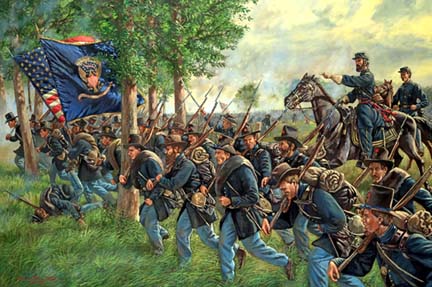
z_maritato_ironbrigadeforward1

While A.P. Hill and Harry Heth ignored warnings and launched their troops towards Gettysburg, Buford believing an engagement was in the offing sought out good ground to give battle and hold back the enemy until the army could arrive. This he found on the ridges west of Gettysburg. The choice of ground is always important and in this battle was paramount to the success of the Army of the Potomac. Buford alerted Major General John Reynolds and the cavalry corps commander Alfred Pleasanton to the location of the approaching Confederates on the night of June 30th. However, Buford’s warning, and that of the intelligence bureau came too late for Reynolds or Meade to take action on them that evening, nor give Meade “to dictate the choice of giving or accepting battle.” [1]

The Army of the Potomac had the good fortune of having Reynolds in this key position…

View original post 2,729 more words

Leave a comment

Filed under Loose thoughts and musings

“If the Enemy is There Tomorrow, We Must Attack Him” Lee’s Decision to Continue his Attack and Failure to Appreciate Changing Technology


lee-and-longstreet-10709161246_9f5baf6452_o

One of the key issues that military leaders must face is how new and changing technology changes the shape of the battlefield and impacts operations at the tactical as well as the operational level. While some technological advances merely adjust how military organizations fight, others force military organizations to completely change the way they conduct war. Examples are found throughout history, but truly became more far reaching during the Civil War with their echoes redounding to the present day.

Those changes can include firepower, protection, mobility, communication and even the frontiers of war to what goes on underwater, in the air, in space and cyber-space. None of these advances are necessarily limited to how military professionals conduct war at any given time. In fact technological changes are often unwelcome by military professionals who have invested their professional lives and careers defending doctrinal traditions. Likewise those victimized by opponents who use new technology to their advantage sometimes accuse their opponents as being unfair, as if fairness counts in war.

The development of the rifled musket just prior to the Civil War and its widespread usage on the battlefield brought about change that most leaders were slow to appreciate, including Robert E. Lee. The fact was that the rifled musket changed war even when military tactics were still rooted in Napoleonic tactics, which were built around the weaponry commonly employed in 1800, the smoothbore flintlock musket, with an effect range of barely 100 yards and smoothbore artillery. The artillery, even when firing grapeshot and canister was superior in range, lethality and as a result dominated the offense. [1] Thus Napoleonic tactics emphasized the artillery as an assault weapon, placed in advance of the infantry, breaking up enemy formations and allowing the infantry to close with the enemy and finish him with the bayonet charge.

The advent of the rifled musket, use of percussion caps and the Minie’ ball bullet by necessity changed how war had to be fought. Rifles firing the Minie’ ball “had an effective range of at least 500 yards” [2] and the new weapons outranged both grapeshot and canister, putting artillerymen exposed to the long range rifle fire in more danger on the battlefield. Not only did they do this but they allowed the infantryman to increase his rate of fire.

Prior to this the limitations of the smoothbore flintlock musket necessitated that the infantry form in dense formations where their firepower could be concentrated. Dennis Hart Mahan was one of the first to recognize how this would change warfare and in 1847 advocated that close line and columns be “replaced by the regular infantry advancing in the loose order of skirmishers” and “take advantage of available cover and close by rushing within about 200 yards.” [3] Even so both armies, as well as their European counterparts were restrained by their continued adherence to “a body of tactical doctrine with long roots back to the 1790s,” the debate between the virtues of line and column formations. [4] The effectiveness of the new weapons was seen by American observers to the Crimean War and despite this both the Union and Confederate armies insisted on employing the old tactics in massed infantry attacks.

This was in part because many of the senior leaders had last experienced combat in the Mexican War, where both sides still used smoothbore muskets and in which frontal attacks and bayonet charges were used effectively. However, as Bruce Catton so well noted:

“the generals had been brought up wrong. The tradition they had learned was that of close order fighting in the open country, where men with bayonets bravely charged a line of men firing smoothbore muskets. That used to work well enough, because the range at which defenders could kill their assailants was very short….But the rifle came in and changed all of that. The range which charging men began to be killed was at least five times as great as it used to be, which meant about five times as many of the assailants were likely to be hit…A few men, like young Colonel Upton, sensed that new tactics were called for, but most could not quite get the idea.” [5]

Lee was one of them.

This new technology changed the battlefield, although many leaders were slow to appreciate who. “The artillery now had to fall back behind the infantry and became a support instead of an assault weapon.” [6] The new firepower available to the infantry “reduced artillery to the defense and forced cavalry to fight dismounted beside the infantry,” [7] something that had been show in its best form in John Buford’s defense of McPherson Ridge on the morning of July first. “The devastating increase in firepower doomed the open frontal assault and ushered in the entrenched battlefield.” [8]

Despite the plentiful evidence which showed that the defense now had the advantage, including his own experience at Malvern Hill and at Fredericksburg, Lee as well as his “right arm” Thomas “Stonewall” Jackson were firm believers in the offense. In their vision of battle, the the close assault of infantry and the bayonet retained its Napoleonic prominence, in 1861 Jackson enunciated his tactical philosophy: “my opinion is that there should not be much firing at all. My idea is that the best mode of fighting is to reserve your fire until the enemy get- or until you get them- to close quarters. The deliver one deadly, deliberate fire- and charge [with the bayonet].” [9] In fact the more time that Lee worked with Jackson the more he became an adherent of the offense, requiring “large scale battles and large casualties” [10] in order to bring about a climactic victory that would secure Southern independence.

At Gettysburg, Lee was “counting on the fighting spirit- the élan, as it is called in the French army- of his officers and men to win the day.” [11] The war in Mexico had not prepared Lee for the advent of the rifle and its effect on the battlefield and despite the tactical preference for the bayonet, the use of that weapon proved rare in combat. Heroes Von Borcke, a Prussian who served under the command of Stuart wrote the “accounts of bayonet fights are current after every general engagement, and are frequently embodied in subsequent ‘histories,’ so called; but as my experience goes, bayonet-fights rarely occur, and exist only in the imagination.” [12] Russell Weigley noted that “bayonet and saber wounds combined accounted for only 922 of some 250,000 wounded treated in Union hospitals during the war.” [13] But as late as 1862 Jackson just before Second Manassas “urged the Light Division under attack to hold their fire and use their bayonets” while “Lee’s penchant for frontal attacks when flanking and enveloping maneuvers failed to secure the results he hoped for…suggests slowness on the part of this otherwise astute and even brilliant commander to appreciate the power of the new weaponry.” [14] However, that being said, in defense of Lee, Jackson and so many commanders of the Civil War, despite the predictions of Mahan 15 years prior, “had no precedent to guide them, for all intents and purposes this was a new weapon.” [15] However, that was before the war began and bitter experience and massive casualties had demonstrated the power of the new weapons, especially when used by troops in strong defensive positions.

At about 5 p.m. on July 1st Lieutenant General James Longstreet reached the battlefield ahead of his corps, the closest division being still six miles away from the battle. He joined Lee on Seminary Ridge and commenced to survey the battlefield for a period of about ten minutes. While the scene before him gave the appearance of Confederate victory, Longstreet thought otherwise and believed that the Federal troop’s position on Cemetery Hill and Ridge “was a strong one.” [16] However, Lee despite his initial hesitancy to engage the Federal army was now certain that he could follow up the success of the day, and if the Union forces which he had driven back to the hill were still there the next morning “he had plenty of fresh troops to move in behind them and finish them off.” [17] Lee believed, even without any true idea of where the rest of the Federal Army was that he would be able to defeat it in detail as each Union corps arrived on the field. But Lee had misjudged Meade’s response and the movement of the Army of the Potomac to Gettysburg, and instead of a part of that army, almost all of it would be in place on ground of Meade and his commanders choosing.

The actions of Lee and his “Old Warhorse” on Seminary Ridge are part of much of the myth of Gettysburg, and the cause of endless debate between Lee’s supporters and Longstreet’s detractors. After Longstreet surveyed the ground he was pleased. The battlefield appeared to be set up for what he believed was a repetition of the Confederate victory at Fredericksburg, as he was under the assumption that Lee had promised to fight a defensive battle when contact was made. [18]

However, Longstreet was not aware of Lee’s though process on the march up. Lee had discussed the matter with Isaac Trimble on June 27th, before he discovered that Hooker had been relieved and was across the Potomac. Trimble recalled Lee’s words:

“Our army is in good spirits, not overly fatigued, and can be concentrated on any point in twenty-four hours or less….They will come up, probably through Frederick; broken down with hunger and hard marching, strung out on a long line and march demoralized, when they come into Pennsylvania. I shall throw an overwhelming force on their advance, crush it, follow up the success, drive on corps back and another, and by successive repulses and surprises before they can concentrate; create a panic and virtually destroy the army.” [19]

Trimble’s account of Lee’s state of mind is consistent with how Lee had conducted his operations over the previous year, Lee’s watchword in nearly every encounter with Union forces was “we must destroy this army” and the “aim of his maneuvers was always the battle of annihilation.” [20]

The only record of the conversation between the two men is that of Longstreet, written in his memoirs after years of being blamed by Lee’s supporters for the loss at Gettysburg. Without that knowledge and still under the impression, or “delusion” as Clifford Dowdey wrote, [21] that Lee had accepted his idea of fighting defensive battles in Pennsylvania. He “said that “he didn’t like the look of things, and he urged quite vehemently that the Confederates avoid any attack on the union position at Gettysburg.” [22] Longstreet commented: to Lee: “We could not call the enemy to position better suited to our plans. All we do is have do is to file around his left and secure good ground between him and his capital.” [23] Thus Longstreet was stunned by Lee’s impatience with the suggestion noting that Lee said “If he is there tomorrow I will attack him.” [24] Longstreet and Lee debated the matter for a while and Longstreet replied to Lee’s comment: “If he is there, it will be because he is anxious that we would attack him- a good reason, in my judgment, for not doing so.” [25]

That conversation has ignited a debate that continues today, but both Lee and Longstreet had sound arguments to support their positions, but both were hamstrung by the absolute lack of intelligence as to where the rest of the Federal army was and Meade’s intentions. Longstreet’s strategic and tactical concepts regarding employing the tactical defensive in the offense “grew out of an appreciation of the advantages Civil War military technology gave to the side having strong defensive positions.” [26] But the course of action that he suggested to Lee was vague and impractical, he did not specify at any time whether he meant a strategic sweeping move to the south or a shorter tactical move around the Round Tops, and “Lee rightly dismissed it at the time. Without Stuart’s cavalry he could not agree to a movement into the unknown.” [27]

Those that believe that if only Longstreet’s advice to move around the enemy was followed that the Confederates would have won a victory are mistaken. One of the key errors that many military history buffs make is that they assume that if one strategy failed and another had been suggested that the neglected course of action would have brought about victory. This is the case with those who assume that if only had lee followed Longstreet’s advice he would have won the battle. That neglects the understanding that the enemy too has a say in one’s plan. Several other factors have to be considered in this. First Meade had already prepared at strong position at Pipe Creek on the Maryland Pennsylvania border, this position was actually a stronger defensive position than Gettysburg. Likewise it neglects to account for the fact that any such maneuver would have exposed Lee’s army’s flank as it was strung out on the march in front of a now concentrated Federal army, and it ignores the logistics of the move deep in enemy territory without knowledge of the enemy’s positions. Additionally and possibly more important neither Lee nor Longstreet “had no idea where this “magic” good ground could be found, and no way to look for it until Stuart arrived with the cavalry.” [28]

But while rejecting Longstreet’s advice to move around the enemy what other choices did Robert E. Lee have on the evening of July 1st 1863? Lee obviously and with good reason rejected maneuver as a possibility, but there were other options, as Porter Alexander and others have noted. Freeman and others have discussed the concern that Lee had with forage, and his fear that if he remained in place that with supplies low that “the Federals could easily block the mountain passes and limit the area in which the Southern army could forage.” [29] But this need did “not require his renewal of the battle on July 1 any more than days following….” [30] Alexander noted that it was possible “for the Confederates to have abandoned Seminary Ridge on the night of July 1 or on July 2: “The onus of the attack was on Meade….we could have fallen back on Cashtown & held the mountain passes… & popular sentiment would have forced Meade to take the aggressive.” [31]

It seems that Lee’s decision to attack on July 2nd was mistaken, despite his appraisal that “A battle had, became in a measure unavoidable, and that the success already gained gave hope of a favorable issue.” [32] But Lee’s assertion is very much a matter of his framing life and actions in the context a nearly fatalistic understanding of Divine Providence and God’s will, it was not in accordance with the facts on the ground. Lee remarked “as soon as I order my army into battle, I leave my army in the hands of God…” [33] Porter Alexander later wrote “Not fully appreciating the strength of the enemy’s position, and mislead by the hope that a large fraction of the Federal Army was out of reach, Lee had determined to strike….” [34]

Lee elected to attack again, and even when he had the knowledge that most of the Federal army had come up he continued with his attack, committing his troops to fight an enemy who had strong defensive positions, high ground and interior lines from which they could shift troops and artillery to endangered sectors. Lee had taken heavy casualties on July 1st, three of the four divisions committed had been severely blooded and two division commanders wounded and he still did not have his entire army in position. As night settled on July 1st the only decision Lee had not made was where to make his attack.

Lee’s decision to attack, even when knowing the full Federal army was on the field was an exercise of both bad strategy, hubris and the refusal to acknowledge how the battlefield had changed with the advent of the rifled musket. It showed that even a great commander and a man associated with military genius was not infallible, despite the myth of the Lost Cause and its icon, General Robert E. Lee.

Peace

Padre Steve+

Notes

[1] Fuller, J.F.C. The Conduct of War 1789-1961 Da Capo Press, New York 1992. Originally published by Rutgers University Press, New Brunswick N.J p.104

[2] Ibid. Fuller The Conduct of War 1789-1961 p.104

[3] Hagerman, Edward. The American Civil War and the Origins of Modern Warfare. Midland Book Editions, Indiana University Press. Bloomington IN. 1992 p.10

[4] Guelzo, Allen C. Gettysburg: The Last Invasion Vintage Books a Division of Random House, New York 2013 p.38

[5] Catton, Bruce. A Stillness at Appomattox Doubleday and Company Garden City, New York 1953 pp.154-155

[6] Ibid. Fuller The Conduct of War 1789-1961 p.104

[7] Ibid. Hagerman The American Civil War and the Origins of Modern Warfare. p.xii

[8] Ibid. Hagerman The American Civil War and the Origins of Modern Warfare. p.xi

[9] Weigley, Russell F. American Strategy from its Beginnings to the First World War in Makers of Modern Strategy from Machiavelli to the Nuclear Age edited by a Peter Paret, Princeton University Press, Princeton New Jersey, 1986 p.428

[10] Weigley, Russell F. American Strategyp.426

[11] Korda, Michael Clouds of Glory: The Life and Legend of Robert E. Lee Harper Collins Books, New York 2014 p.593

[12] Fuller, J.F.C. Grant and Lee: A Study in Personality and Generalship Indiana University Press, Bloomington Indiana 1957 p.48

[13] Ibid. Weigley American Strategy p.428

[14] Ibid. Weigley American Strategy p.428

[15] Ibid. Fuller Grant and Lee p.48

[16] Ibid. Korda Clouds of Glory p.559

[17] Ibid. Guelzo Gettysburg: The Last Invasion p.215

[18] Freeman, Douglas Southall, Lee’s Lieutenant’s a Study in Command, One volume abridgement by Stephen W Sears, Scribner, New York 1998 pp.574-575

[19] Thomas, Emory Robert E. Lee W.W. Norton and Company, New York and London 1995 pp.293-294

[20] Ibid. Weigley American Strategy p.427

[21] Dowdy, Clifford. Lee and His Men at Gettysburg: The Death of a Nation Skyhorse Publishing, New York 1986, originally published as Death of a Nation Knopf, New York 1958 p.169

[22] Coddington, Edwin B. The Gettysburg Campaign: A Study in Command, A Touchstone Book, Simon and Schuster New York, 1968 p.360

[23] Longstreet, James From Manassas to Appomattox, Memoirs of the Civil War in Americaoriginally published 1896, Amazon Kindle Edition loc. 5059

[24] Ibid. Longstreet From Manassas to Appomattox loc. 5059

[25] Sears, Stephen W. Gettysburg. Houghton Mifflin Co. Boston and New York 2003 p.234

[26] Ibid. Coddington The Gettysburg Campaign: A Study in Command p.360

[27] Wert, Jeffry D. General James Longstreet The Confederacy’s Most Controversial Soldier, A Touchstone Book, Simon and Schuster, New York and London 1993 p.258


[28] Ibid. Korda Clouds of Glory p.561

[29] Ibid. Freeman Lee’s Lieutenants p.575

[30] Nolan, Alan T. R. E. Lee and July 1 at Gettysburg in the First Day at Gettysburg edited by Gallagher, Gary W. Kent State University Press, Kent Ohio 1992 p.24

[31] Ibid. Nolan R. E. Lee and July 1 at Gettysburg p.24

[32] Ibid. Freeman Lee’s Lieutenants p.575

[33] Ibid. Fuller Grant and Lee p.112

[34] Alexander, Edward Porter Military Memoirs of a Confederate: A Critical Narrative 1907 republished 2013 by Pickle Partners Publishing, Amazon Kindle Edition loc. 7517


1 Comment

Filed under civil war, leadership, Military

The Gettysburg Campaign: Lee Moves North, the Battle of Brandy Station, Stuart’s Ride and the Relief of Fighting Joe Hooker

Friends of Padre Steve’s World
It is now the evening of June 29th and 151 years ago two armies, the Army of Northern Virginia and the Federal Army of the Potomac were on a course that would lead them into one of the most decisive as well as the bloodiest battle every fought on the North American continent. This is a short introduction to the movement of the armies leading up to the battle. I am in the process of doing a major revision of it as part of my Gettysburg Staff Ride text that I use to teach that at the Staff College. That being said, apart from being less academic and detail oriented than I prefer I believe that it is a nice introduction to that part of the campaign for anyone with a casual interest in this battle. I will be posting more Gettysburg articles over the next few days, including a new one for my text on Robert E. Lee’s decision to continue his attack on the night of July 1st and if I finish it in time one on Pickett’s Charge. As for the last subject I have three articles on it already, two about the artillery and one about the tragedy of friends at war, dealing with Lewis Armistead and Winfield Scott Hancock. Those are all on this site. I have been working on the article on Lee’s decision the past couple of days, hopefully I will have it completed tomorrow. But then with me it seems that nothing is ever complete when it comes to Gettysburg, I am always reading, researching and discovering new things, some of which cause me to revise previous thoughts or ideas. While in the newer articles I seek to provide as much detail as possible, I also attempt to find current application for leaders, as well as to shape a readable and interesting story. That is harder than it looks. Barbara Tuchman so eloquently wrote “Historians who stuff in every item of research they have found, every shoelace and telephone call of a biographical subject, are not doing the hard work of selecting and shaping a readable story.” To find the balance is what I seek. While this article is less detailed and sourced than my other work, it does tell the story. So until tomorrow,
Peace
Padre Steve+

padresteve's avatarThe Inglorius Padre Steve's World

on-to-gettysburg-900L

Lee with his Commanders at Williamsport 

Note: This is another of my preparations for for the Gettysburg Staff Ride that I will be conducting with students from the Staff College that I teach. 

On June 3rd 1863 Robert E Lee began to move his units west, away from Fredericksburg to begin his campaign to take the war to the North. He began his exfiltration moving Second Corps under Richard Ewell and First Corps under James Longstreet west. Initially he left A.P. Hill’s Third Corps at Fredericksburg to guard against any sudden advance by Hooker’s Army of the Potomac toward Richmond.

Once it was ascertained that Hooker was not making for Richmond, Hill’s Corps followed and on June 7th all three Corps were reunited at Culpepper. Lee’s movement did not go unnoticed, Hooker’s aerial observers detected the move, but Hooker after throwing pontoon bridges across the river and discovering that Hill’s…

View original post 1,734 more words

Leave a comment

Filed under Loose thoughts and musings