Author Archives: padresteve

padresteve's avatar

About padresteve

I'm a Navy Chaplain and Old Catholic Priest

PTSD Dreams and Stranger Things

400236_10151328400862059_541742014_n-2

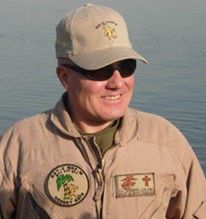
I didn’t get much sleep last night. For some reason I was back in Iraq.

Last night’s dream world was about every fear I had when I was in Iraq on steroids. I woke up almost every hour in terror of IED attacks, ambushes and attacks on the small groups of advisers on Iraq bases with whom I served.

It is important to note that none of these events happened to me. I was shot at on a number of occasions but none of the terrifying instances that were part of my nightmares last night happened to me. In fact there were people in them who I know now who served in Iraq but not with me. That being said, they were terrifying and all too real in my mind. Though I never actually experienced any of them they were a part of my life and my fears that I lived with on a daily basis as I operated in Al Anbar Province during 2007 and 2008 with small groups of advisers to the Iraqi Army and Security Forces.

Nightmares and dreams are surreal. They are real, but they are not. They blend elements of our lives and our subconscious into visions that can be pleasant or terrifying. Last night was for the most part terrifying but at one point pointed to hope. That being said, I didn’t get much sleep. When I got up for a very busy yet productive day at the final day of my denominational clergy-chaplain training symposium I looked in the mirror. My eyes were bloodshot and I looked terrible.

I remembered a quote by Guy Sager, the author of the classic book of war The Forgotten Soldier:

“Only happy people have nightmares, from overeating. For those who live a nightmare reality, sleep is a black hole, lost in time, like death.

Since I have to wake up very early for my flight back home tomorrow I do hope that my sleep is sound and my dreams for once pleasant. However, I know that such thoughts are an illusion and that like me countless thousands of other combat veterans live what I live. So my hope an prayer is that we will all be able to get at least one good night of sleep.

Peace

Padre Steve+

Leave a comment

Filed under Military, PTSD

Where did I Go Left?

Friends of Padre Steve’s World, It has been a bust day at my church denominational conference and I am about to head to bed. However, I am posting a more strongly worded and explicit revision of something I wrote a couple of years ago. Yes my friends, though I consider myself a moderate and will not change the title of this page, I am probably better classified as a former conservative who is now a liberal. The path that I took was intellectual, spiritual and emotional. It is something that I tie to my faith as a Christian as well as my humanity and realization that we as human beings are in this world together, whether we like it or not. So have a great night and hopefully I will have some time my last night in Houston to do a fresh article. Peace, Padre Steve+

padresteve's avatarThe Inglorius Padre Steve's World

Somewhere along the path from conservatism to moderation I got labeled.

I got labeled with the “L” Word. no, not the Lesbian one, the other less socially acceptable one, the Liberal label…and to tell the truth though I consider myself a moderate I actually fall on the Liberal side of the political and religious spectrum.

It actually surprised me when I figured it out. To tell the truth I don’t know how it happened. I cheered the demise of Jimmy Carter, Walter Mondale, Mike Dukakis and even Al Gore. I listened to Rush as much as I could. Not even 8 years ago I was defending “W” against what I thought were unfair assaults from the left. I enjoyed liberal bashing. It was fun.

But a funny thing happened between 2004 and now, I think it was a place called Iraq, where I began to question the unquestionable questions of…

View original post 449 more words

2 Comments

Filed under Loose thoughts and musings

Remembering Hell: The Fall of Dien Bien Phu 59 Years Gone by and Still Forgotten

Friends of Padre Steve’s World, Today has been a long day of meetings with very special colleagues and friends that I serve alongside as a Priest in the Apostolic Catholic Orthodox Church. Since it is late and I am on Central Standard Time in Houston tonight is a re-run about the end of the battle of Dien Bien Phu. It was the battle that put the nail in the coffin of French colonial dreams in Indochina and the cumulation of a war that the United States should have learned from before a single American soldier set foot in Vietnam. It is a reminder that modern armies can be defeated by less technically advanced forces when the people that send them to war do not recognize their limitations. I feel a bond with the French defenders of Dien Bien Phu and others who have serve their nations faithfully in thankless and un-winnable conflicts where they were sent to bolster the political prestige and economy of their country by politicians, pundits and preachers, as well as the bulk of the populace that could care less where they lived or died. Dien Bien Phu is a battle that I commend the soldiers of both sides, but sympathize with the losers , who were then sent by their country into another long term insurgency in Algeria and once again abandoned by their political leadership and nation. So my friends until tomorrow. Peace, Padre Steve+

padresteve's avatarThe Inglorius Padre Steve's World

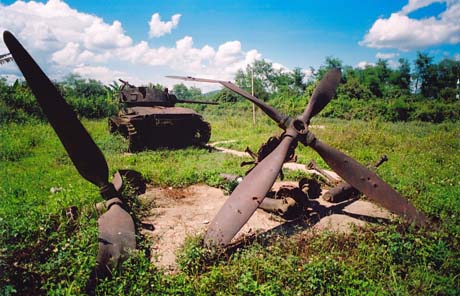
Dien Bien Phu War Remnants

Dien Bien Phu Today

It was an epic battle in a tragic war and most people neither know or care what happened in the valley where a small border post named Dien Bien Phu became synonymous with forgotten sacrifice. This year fewer remembrances are taking place. Some are in Vietnam and others in France.

Diplomat_Sep10059-227x300

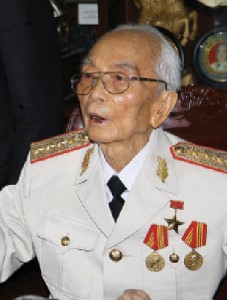
General Vo Nguyen Giap

On May 7th 2011 in Hanoi a small remembrance was held to mark the fall of Dien Bien Phu and honor the victor, 101 year old General Vo Nguyen Giap at his home. Giap is the last senior commander of the war alive at 103 he remains active. That 2011 ceremony was one of the few remembrances held anywhere marking that battle which was one of the watersheds of the 20th Century. A half a world away in Houston Texas a small group of French veterans, expatriates and historians laid a wreath at…

View original post 1,856 more words

Leave a comment

Filed under Loose thoughts and musings

Long Days, Lost Wallets and a Long Layover…Ministry Included

10151918_10152444030142059_7871957421917905974_nWell my friends it is after Nine PM Eastern Time and I am still enroute to Houston after leaving my home at Six AM. This means that I have been traveling for over 15 hours and since I still have about three hours before I get to Houston and maybe more before I lay my head down on my pillow that this qualifies as a long day.

Things went well enough at first until I got to what I thought was my one layover at Baltimore Washington International Airport and discovered that I did not have my wallet. Long story short after about an hour of searching, phone calls and consternation it looked like my travel to an important conference with my church and fellow denomination clergy and chaplains was not going to happen. I went to the Southwest Airlines gate agent who put my information in the computer and found that my missing wallet had been turned in to the gate agent in Norfolk. Armed with that information I called the Staff College and the industrious young man got me back to Norfolk to my wallet and connected me with flights to get me to Houston late tonight.  While in Baltimore some nice lady who overheard my near panicked conversation with people at the Staff College gave me $20 to eat. Since beer is technically bread since it is made from grain that was lunch.

To let you know I do not do airports or aircraft well. Today, even with all the craziness I am still in one peace. I attribute this to prayer and pilsner, though technically I was drinking lagers at almost every stop. I figure when it come to dealing with airports I can deal with panic mode because of the crowds by going crazy, not a good option, drugging myself with anti-anxiety meds which don’t taste good or drink beer which does taste good. Once I had my wallet back I also got food, comfort food instead of healthy food, which I will go back to tomorrow. Of course with over three hours to go before I get to Houston I have switched to lots of water since I tend not to do sodas very often.

While at the Johnny Rivers Grill and Market in Orlando Airport I had some pulled pork BBQ, it was okay, as well as a couple of beers and while there had a young man in a delay situation for another flight sit next to me at the bar. He was a Staff Sergeant in the National Guard who was being called home early from vacation to drill. He was leaving his family in Orlando. He has spent several deployments to Iraq and Afghanistan and was telling me that he still has not been able to re-set after his last deployment because in addition to his civilian commitments his Guard unit continues to push him and all of its personnel hard, without much thanks and with no support to soldiers or families. It was a similar conversation that I had with a senior Marine Corps Officer recently. The important thing for this soldier who has served his country for 15 years as a citizen soldier was that I cared to listen to him and understood.

I didn’t do much talking, mentioned that I had been to Iraq, had PTSD and had been an agnostic for a couple of years and he was grateful just for someone to listen. The sad thing is there are far to few people, especially leaders who will take the time to do that. The fact is we have to stand by our guys, they have put themselves on the line time and time again, we as leaders owe them. But the truth is as my Marine friend noted is that since 2001 the attitude is that you owe the military.

When I was training to be a Chaplain in the Texas Army National Guard, Colonel John Price, an Episcopal Priest told me that his best ministry happened in officer’s clubs and bars, being available to people who would never darken the door of a church, come to a chapel service or would be too proud to come to the office.  Father Price was right. Jesus didn’t cloister himself, he was out with people. Most religious people didn’t care much for it but he drew people to him because he was where they were.

We as Chaplains as well as leaders must change our culture or we will destroy the men and women entrusted to us by the nation and in the process destroy our armed forces. Without the people the machines don’t matter that much.

So anyway, not much longer until I will board this flight. So until tomorrow,

Peace

Padre Steve+


Leave a comment

Filed under christian life, faith, Military, ministry, PTSD

Thoughts on the 2014 National Day of Prayer and a Big Reason to be Thankful

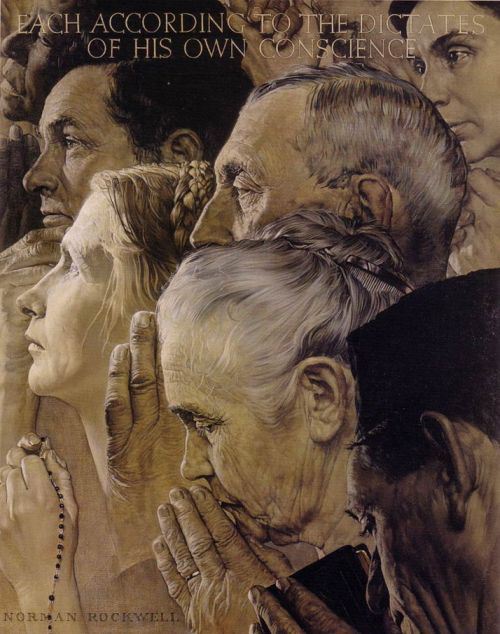
norman-rockwell-freedom-of-worship-2

Friends, I am traveling today and it is indeed the National Day of Prayer and the sinner that I am, I am always in need of prayer. Just to let you know that I do pray contrary to what some may think, I had good reason to pray today. Somehow on the trip I dropped my wallet and when I got to my mid way stop in Baltimore I didn’t have it. Near panic ensued as I looked everywhere I had been in the BWI terminal as well as called back to Norfolk where I departed.I saw my entire life flashing in front of my eyes and wondered if an identity thief was going to take me for everything I have before I could cancel all of my credit cards, not to mention the pain of getting new military ID and drivers license. I felt so incredibly stupid.

Finally after contacting the Staff College it looked like I was going to be heading home and missing the conference that I really needed to attend. A lady sitting near me took pity on me and gave me $20 so I could at least eat. I was grateful. After talking with our travel people I went to the desk agent at the Southwest gate where my Houston flight was to depart from and asked them what to do since I had no identification. They put my name in their computer and found that their gate agents in Norfolk had found the wallet. The young man at the gate worked with everything to not only get me back to Norfolk but, to arrange to get me my wallet and on another flight to get me to Houston late tonight. It was positively amazing. 

But what was really cool was that people who I didn’t know, who I don’t know if they are Christians, or any other religion or in fact if they had any faith at all stepped in to help me. I do not know or care what their political affilation, religion, Alma Mater is, or even if they are Los Angeles Dodgers fans. Someone turned in my wallet in Norfolk rather than making off with it. The airline personnel of Southwest Airlines went  above and beyond the call of duty to help me and to calm me, and yes I did need calming.

Other people, security and TSA at BWI and Norfolk tried to help. Then there was the kind lady who gave me $20. Since I routinely give to panhandlers because I have been poor before her act of kindness was quite touching. What is cool about this experience was that a bunch of good people cared about me. Like I said I don’t know any of them but they were wonderful and I am thankful, not just to God, but to the decent human beings who whatever their motivation were wonderful.

It will be a lot longer travel day than I had planned but my misadventure has shown me that we still have a lot of good and kind people in this country and that is something to celebrate.

Since I needed calming I was able to get me a big beer and now with that in hand waiting for my flight I give you my thoughts on the National Day of Prayer. I actually wrote this article last year, but since most people seem to think that the day is for the right wing political hacks at the “National Day of Prayer Task Force” founded in by Shirley Dobson in 1982, here is the real story. As the late Paul Harvey would have said “the rest of the story.”

“The notion of a Christian commonwealth should be exploded forever…Government should protect every man in thinking and speaking freely, and see that one does not abuse another.  The liberty I contend for is more than toleration.  The very idea of toleration is despicable; it supposes that some have a pre-eminence above the rest to grant indulgence, whereas all should be equally free, Jews, Turks, Pagans and Christians.” John Leland

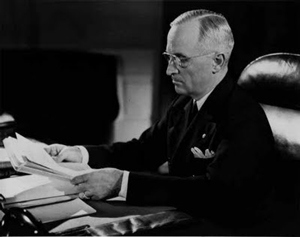
Today was the National Day of Prayer. The event was established by President Harry S Truman in 1952 was designed to mark the common freedom that we have as American citizens.

I am a big fan of religious liberty and critic of those that desire to establish any religion as the official religion of the country and in doing so suppress the rights of others. An attempt was made in the North Carolina State Legislature early this year to establish the right of the state to establish a religion in complete disregard of the Constitution of the United States and the Constitution of the State of North Carolina. Part of the text of that bill, which was killed in committee stated:

“The North Carolina General Assembly does not recognize federal court rulings which prohibit and otherwise regulate the State of North Carolina, its public schools, or any political subdivisions of the State from making laws respecting an establishment of religion.

I do feel that there are those that want to use such occasions as today’s observance of the National Day of Prayer as a means to establish their religion, as the law of the land. However, if we actually look at our history such is not the case and was never the intent of our founders or those that established the National Day of Prayer.
harry-truman1

President Truman’s proclamation stated:

“Now, Therefore, I, Harry S. Truman, President of the United States of America, do hereby proclaim Friday, July 4, 1952, as a National Day of Prayer, on which all of us, in our churches, in our homes, and in our hearts, may beseech God to grant us wisdom to know the course which we should follow, and strength and patience to pursue that course steadfastly. May we also give thanks to Him for His constant watchfulness over us in every hour of national prosperity and national peril.”

Ronald Reagan eloquently stated the purpose and significance of the National Day of Prayer in his 1983 proclamation which in part read:

It took the tragedy of the Civil War to restore a National Day of Prayer. As Abraham Lincoln said, “Intoxicated with unbroken success, we have become too self-sufficient to feel the necessity of redeeming and preserving grace, too proud to pray to the God that made us.”

Revived as an annual observance by Congress in 1952, the National Day of Prayer has become a great unifying force for our citizens who come from all the great religions of the world. Prayer unites people. This common expression of reverence heals and brings us together as a Nation and we pray it may one day bring renewed respect for God to all the peoples of the world.

From General Washington’s struggle at Valley Forge to the present, this Nation has fervently sought and received divine guidance as it pursued the course of history. This occasion provides our Nation with an opportunity to further recognize the source of our blessings, and to seek His help for the challenges we face today and in the future.

Now, Therefore, I, Ronald Reagan, President of the United States of America, do hereby proclaim Thursday, May 5, 1983, National Day of Prayer. I call upon every citizen of this great Nation to gather together on that day in homes and places of worship to pray, each after his or her own manner, for unity of the hearts of all mankind.

President Reagan’s 1983 and subsequent proclamations stood firmly in the American tradition of Civil Religion and was decidedly non-sectarian.  It acknowledged that our citizens “come from all the great religions of the world” and called on Americans to gather on the day “in homes and places of worship to pray, each after his or her own manner, for unity of the hearts of all mankind.”

While the American religious tradition is highly Christian and even more so from the Reformed tradition this has always existed in tension with a decidedly secularist philosophy embodied by many of the Founding Fathers who were very careful to recognize the importance of religion but at the same time both sought to protect religious liberty by NOT enacting laws to establish a particular religion nor to entangle the government in the affairs of religion which could in their view be detrimental to true religious liberty.

In fact both Thomas Jefferson and James Madison were very careful about proclamations and ensuring that government was not favoring any particular religious body. Jefferson wrote to Reverend Samuel Miller in 1808 that:

Fasting and prayer are religious exercises; the enjoining them an act of discipline. Every religious society has a right to determine for itself the time for these exercises, and the objects proper for them, according to their own particular tenets; and right can never be safer than in their hands, where the Constitution has deposited it. …civil powers alone have been given to the President of the United States and no authority to direct the religious exercises of his constituents.”

Madison who was the author of the Bill of Rights and included religious liberty in the First Amendment in support of Virginia Baptists who were under pressure from those who were determined to make and keep the Episcopal Church as the state religion of the commonwealth. Madison wrote to Edward Livingston in 1822 that:

“There has been another deviation from the strict principle in the Executive Proclamations of fasts & festivals, so far, at least, as they have spoken the language of injunction, or have lost sight of the equality of all religious sects in the eye of the Constitution. Whilst I was honored with the Executive Trust I found it necessary on more than one occasion to follow the example of predecessors. But I was always careful to make the Proclamations absolutely indiscriminate, and merely recommendatory; or rather mere designations of a day, on which all who thought proper might unite in consecrating it to religious purposes, according to their own faith & forms. In this sense, I presume you reserve to the Govt. a right to appoint particular days for religious worship throughout the State, without any penal sanction enforcing the worship.”

President Obama’s 2013 Proclamation for the National Day of Prayer stands in line with the founders as well as that of Presidents Truman and Reagan. It calls Americans to join with him to:

Americans have long turned to prayer both in times of joy and times of sorrow. On their voyage to the New World, the earliest settlers prayed that they would “rejoice together, mourn together, labor, and suffer together, always having before our eyes our commission and community in the work.” From that day forward, Americans have prayed as a means of uniting, guiding, and healing. In times of hardship and tragedy, and in periods of peace and prosperity, prayer has provided reassurance, sustenance, and affirmation of common purpose.

Prayer brings communities together and can be a wellspring of strength and support. In the aftermath of senseless acts of violence, the prayers of countless Americans signal to grieving families and a suffering community that they are not alone. Their pain is a shared pain, and their hope a shared hope. Regardless of religion or creed, Americans reflect on the sacredness of life and express their sympathy for the wounded, offering comfort and holding up a light in an hour of darkness.

All of us have the freedom to pray and exercise our faiths openly. Our laws protect these God-given liberties, and rightly so. Today and every day, prayers will be offered in houses of worship, at community gatherings, in our homes, and in neighborhoods all across our country. Let us give thanks for the freedom to practice our faith as we see fit, whether individually or in fellowship.

On this day, let us remember in our thoughts and prayers all those affected by recent events, such as the Boston Marathon bombings, the Newtown, Connecticut shootings, and the explosion in West, Texas. Let us pray for the police officers, firefighters, and other first responders who put themselves in harm’s way to protect their fellow Americans. Let us also pray for the safety of our brave men and women in uniform and their families who serve and sacrifice for our country. Let us come together to pray for peace and goodwill today and in the days ahead as we work to meet the great challenges of our time.

The Congress, by Public Law 100-307, as amended, has called on the President to issue each year a proclamation designating the first Thursday in May as a “National Day of Prayer.”

NOW, THEREFORE, I, BARACK OBAMA, President of the United States of America, by virtue of the authority vested in me by the Constitution and the laws of the United States, do hereby proclaim May 2, 2013, as a National Day of Prayer. I join the citizens of our Nation in giving thanks, in accordance with our own faiths and consciences, for our many freedoms and blessings, and in asking for God’s continued guidance, mercy, and protection.

However, no matter how similar President Obama’s proclamation is to those of President Reagan or Truman or for that matter any other President with the exception of President George W Bush, he is attacked by people on the extremely partisan political right World Net Daily columnist Bob Unruh and others for supposedly “cleansing the day of prayer of Christianity.”

The fact that Unruh and others like him routinely engage in this behavior makes me tired. The real fact of the matter is that most of the men who helped establish the freedom of religious faith and practice in this country were decidedly not very Christian and determined not to repeat the tragic mistakes of European nations which had both established state religions or churches and had on numerous occasions entered into bloody warfare to ensure that their religion came out on top.

But for them that is par for the course. Unruh and so many others are such strong advocates for a Christian Theocracy, something that it is perfectly obvious to me that they have no understanding of history, our Constitution or the ideals of our founders. It is a common theme that runs through all that they do. I have written about them many times before so I won’t go into gory detail today. I’d like to but I won’t, if you want to find my articles just search under the term “religious liberty” or look on my Civil Rights or Faith and Life pages.
treatyoftripoli1

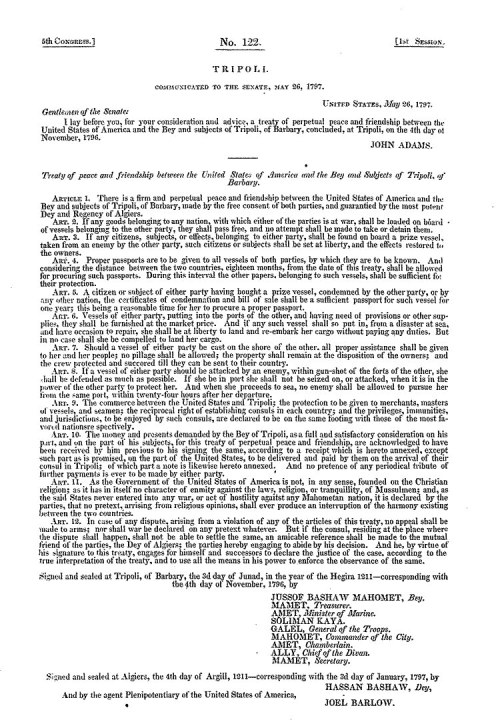
Our founders were so opposed to the idea of a State Religion that in one of the first treaties entered into with another nation, the Treaty of Tripoli of 1796 drafted by the future President John Adams noted in Article 11:

As the government of the United States of America is not in any sense founded on the Christian Religion, — as it has in itself no character of enmity against the laws, religion or tranquility of Musselmen, — and as the said States never have entered into any war or act of hostility against any Mehomitan nation, it is declared by the parties that no pretext arising from religious opinions shall ever produce an interruption of the harmony existing between the two countries.”
thomas_jefferson_rect1

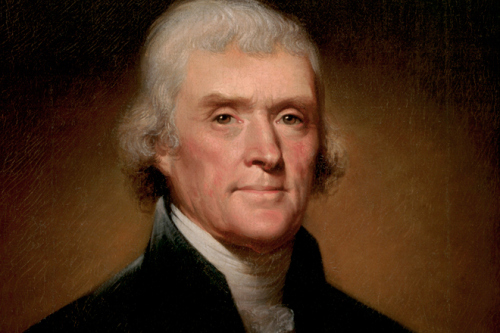
Jefferson wrote in the Virginia Act for the Establishment of Religious Freedom:

Be it therefore enacted by the General Assembly, That no man shall be compelled to frequent or support any religious worship, place, or ministry whatsoever, nor shall be enforced, restrained, molested, or burdened in his body or goods, nor shall otherwise suffer on account of his religious opinions or belief; but that all men shall be free to profess, and by argument to maintain, their opinions in matters of religion, and that the same shall in nowise diminish, enlarge, or affect their civil capacities. 

Madison wrote:

“Who does not see that the same authority which can establish Christianity, in exclusion of all other religions, may establish with the same ease any particular sect of Christians, in exclusion of all other sects?”

John Leland, leader of the Virginia Baptists who were being persecuted by Episcopalians intent on re-establishing themselves as the official State Religion of Virginia became involved in the fight for religious liberty in the newly independent colonies wrote:

“The notion of a Christian commonwealth should be exploded forever…Government should protect every man in thinking and speaking freely, and see that one does not abuse another.  The liberty I contend for is more than toleration.  The very idea of toleration is despicable; it supposes that some have a pre-eminence above the rest to grant indulgence, whereas all should be equally free, Jews, Turks, Pagans and Christians.”

Leland heavily influenced both Madison and Jefferson in crafting the Virginia statement on religious liberty and the First Amendment. Toward the end of his life Madison wrote:

“The settled opinion here is, that religion is essentially distinct from civil Government, and exempt from its cognizance; that a connection between them is injurious to both; that there are causes in the human breast which ensure the perpetuity of religion without the aid of the law; that rival sects, with equal rights, exercise mutual censorships in favor of good morals; that if new sects arise with absurd opinions or over-heated imaginations, the proper remedies lie in time, forbearance, and example; that a legal establishment of religion without a toleration could not be thought of, and with a toleration, is no security for and animosity; and, finally, that these opinions are supported by experience, which has shewn that every relaxation of the alliance between law and religion, from the partial example of Holland to the consummation in Pennsylvania, Delaware, New Jersey, &c., has been found as safe in practice as it is sound in theory. Prior to the Revolution, the Episcopal Church was established by law in this State. On the Declaration of Independence it was left, with all other sects, to a self-support. And no doubt exists that there is much more of religion among us now than there ever was before the change, and particularly in the sect which enjoyed the legal patronage. This proves rather more than that the law is not necessary to the support of religion” (Letter to Edward Everett, Montpelier, March 18, 1823).

I am all in on religious liberty including the rights of people that are not Christians to practice whatever faith or non-faith that they please. This is the freedom that our founders fought to bring forth in this land.

Today we celebrated the National Day of Prayer and I had the privilege of leading our prayer at our facility. I have included that prayer here:

Loving God, we thank you for the privilege of living in this country where our founders were wise enough to neither establish nor forbid any religious practice. We thank you that as the beneficiaries of the wisdom handed down by these men that we have the liberty to believe and practice our faith in the manner that we see fit and that whether Christian or Jew, Moslem or Wiccan, Buddhist or any other faith represented in our land that we have this freedom. We thank also thank you for the freedoms granted to all, the freedom to believe, practice and even not believe as our conscience dictates and that Congress can enact no law to either establish a state religion nor prevent the free exercise of the beliefs of any citizen. 

For the wisdom and the foresight of these fallible men whose actions redound to us we give you thanks.  We pray this in your Holy Name. Amen. 

So as the time draws near to go to bed and I offer my night prayers for all, I do wish you the peace and freedom that so many Americans have fought and died to maintain.

Peace

Padre Steve+


2 Comments

Filed under christian life, civil rights, faith, laws and legislation, News and current events, Religion

The Battle of Camarón 1863: The Heroic Stand of the Foreign Legion

Friends of Padre Steve’s World, Today I am getting to go on the road for a few days and since it is the anniversary of the Battle of Camarón, a battle legendary to the French Foreign Legion I am re-publishing something that I wrote two years ago. I have a soft spot for soldiers that fight in hopeless causes and wars launched by politicians that do not have their interests at heart. The men at Camarón are honored not only by the nation they served but by the people of the nation that they were attempting to occupy. That is an interesting testimony to the bravery and honor that these men of the Foreign Legion had on that day. Peace, Padre Steve+

padresteve's avatarThe Inglorius Padre Steve's World

Lieutenant Clement Maudet Leads Surviving Legionnaires in a Final Charge at Camarón 

“We may die, but never will surrender.” Lieutenant Jean Villian

Almost every Army or nation has a story of a heroic group of soldiers that fight valiantly and often die against enemies of far greater strength.  The United States has the Texan defenders of the Alamo and in World War II the Marine defenders of Wake Island. The British the Battle of Rourke’s Drift in the Zulu War. In 1989 the 9th Company of the Red Army’s 345th Independent Guards Airborne Regiment conducted a heroic defense against Afghan Mujahideen at Hill 3234 during Operation Magistral.

However, seldom are “the few” honored by friend and foe alike.  Among these are the 65 men of the 3rd Company of the 1st Battalion Légion Étrangère (Foreign Legion). These few would battle nearly 2000 Mexican Soldiers at a small Hacienda called Camarón…

View original post 763 more words

Leave a comment

Filed under Loose thoughts and musings

“The Artillery…Must Concur as a Unit” -Henry Hunt and the Union Artillery at Pickett’s Charge

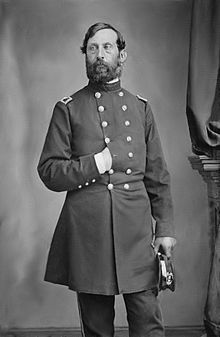
220px-HJHunt

Major General Henry Hunt

Fires are defined as the use of weapon systems to create specific lethal or nonlethal effects on a target. All fires are normally synchronized and integrated to achieve synergistic results.Joint Publication 3-09 Joint Fire Support30 June 2010 p.I-1


Major General Henry Hunt the Chief of Union artillery was the admitted expert of all the artillerymen present at Gettysburg. Prior to the war he had taught artillery theory and tactics at West Point and written the Army’s artillery doctrine. However, he was no mere theoretician. He was an excellent battlefield leader who had a keen eye to assess the tactical situation and effectively employ his batteries. Hunt also understood the change in warfare brought about by small arms, particularly the rifled musket and that artillery had become a support weapon instead of an assault weapon, something that Lee had not yet fully appreciated as we have seen from his use of artillery.

The employment of fires is an important part of military art and to be effective it must be understood and used in concert with maneuver. As George Patton wrote in War as I Knew It Battles are won by fire and by movement. The purpose of the movement is to get the fire in a more advantageous place to play on the enemy. In contrast to Lee and his employment of artillery at Gettysburg which was ineffective in large part because he declined to use maneuver to his advantage, Meade, Hancock, Hunt and the various Union Corps commanders used their artillery to maximum effect taking advantage of their interior lines.

After Hooker’s disastrous experiment at Chancellorsville to decentralize the command and organization of the artillery Hunt was give a free hand to reorganize the artillery of the Army of the Potomac. The changes were sweeping. Batteries were removed from divisions and consolidated into brigades for each corps. Additionally Hunt created an Artillery Reserve of five Brigades totaling 21 batteries which could be employed to support the army at any given point and provided both him and the army commander a flexible and powerful source of firepower. Hunt put his best veteran artillerymen in charge of these brigades, and their deployment was in the hands of Hunt and the corps commanders.[1] At Gettysburg the changes would be of decisive importance.

Hunt had been very active on July 2nd in working with Meade, Hancock and vital in ensuring that Sickles beleaguered command received batteries from the artillery reserve. He was not present at the council of war held that night but was informed of the decision to remain upon his return from his last inspection of his lines and supervision of artillery at Culp’s Hill. In his inspection of the Federal artillery positions he took charge and moved units as needed and coordinated his work with the brigade commanders of each corps ensuring that they understood their part in the next day’s action.

Unlike his Confederate counterpart William Pendleton, Hunt went into battle on July 3rd with very definite ideas of how he was going to employ his artillery and developed a detailed plan of fire support. Hunt’s artillery regulations dictated that in the attackthe artillery is employed to silence the batteries that protect the [enemy] position. In the defense it is better to direct its fire on the advancing troops.[2]

One of his most critical decisions was in relation to the Artillery Reserve to address Meade’s concerns about an attack on the Union center. About 11 A.M. Hunt went to Cemetery Hill where he was able to gain a good view of Confederate preparations. He wrote that Here a magnificent display greeted my eyes. Our whole front for two miles was covered by batteries in line or going into position. Never before had such a sight been witnessed on this continent, and rarely if ever abroad…”[3]Hunt placed twenty batteries of his artillery reserve along Cemetery Ridge and laid out a deadly latticework of crossfire lanes designed to scourge the fields in front of every living thing.[4] Hunt was aided in his efforts by the commander of the Artillery Reserve Brigadier General Robert O. Tyler who was able to increase the number of guns available through repairs and reconditioning.[5]

As Hunt examined the situation before him he had to discern what the Confederate intentions were. He thought there was the possibility that Lee might use them to cover a move of infantry to support Ewell but he dismissed that as he did the possibility of Lee withdrawing his army. Despite the fact that he could not see the deployment of the Confederate infantry massing for the assault Hunt was convinced that the attack would hit the center. In light of his understanding of the how artillery should be employed in the defense he grasped the essence of the situation-that the duty of the artillery was not to combat the opposing ones, but to reserve themselves to smash the infantry assault.[6]

fig59

As such his guns, both of the artillery reserve as well as II Corps deployed on Cemetery Ridge was confronted with an artilleryman’s dream. “He was posted on the high ground…with clear fields of fire. He had 119 guns of high quality massed in battery, with plentiful reserves and sufficient ammunition. He was positioned to catch an infantry attack in a deadly crossfire. His brigade commanders were chosen by him and trained by him….”[1] This total included the guns on Cemetery Hill as well as Cemetery Ridge.

Hunt knew that any Confederate infantry assault on Cemetery Ridge would be preceded by an artillery bombardment and once he was sure that this was the Confederate intent Hunt “immediately set out to ride his lines once again”[2]and went to each of his artillery commanders and instructed them. Another insightful Union officer, Gouverneur Warren felt counter battery fire was doing little goodand from his observation post on Little Round Top, sent a message to Meade, suggesting that the Union batteries cease firing. [3] The message was unnecessary as Hunt was working to ensure this but it showed that insightful officers on the Union side were not adverse to recommending changes in deployments or tactics to meet the conditions of the battlefield.

“I gave instructions to the batteries and to the chiefs of artillery not to fire at small bodies! nor to allow their fire to be drawn without promise of adequate results; to watch the enemy closely, and when he opened to concentrate the fire of their guns on one battery at a time until it was silenced; under all circumstances to fire deliberately, and to husband their ammunition as much as possible.” [4]

Until the Confederate bombardment began at 1:07 P.M. Hunt continued to “check on the condition of his batteries” [5] and was with Hazlett’s former battery of 10 pounder Parrotts on Little Round Top, now commanded by Rittenhouse. When the cannonade began reiterated his orders to Rittenhouse to ensure that he “would not tolerate any yielding to the usual artilleryman’s temptation to fire back and turn things into a useless artillery duel.” [6]and then rode down to Freeman McGilvery’s guns on the south end of Cemetery Ridge.

In the process he observed the performance of his former students commanding the Confederate artillery. He was not impressed by their performance. At Appomattox Hunt, the consummate instructor recounted to Colonel Armistead Lindsey Long of Lee’s staff been his student:

I was not satisfied with the conduct of this cannonade which I heard was under his direction, inasmuch as he had not done justice to his instruction; that his fire, instead of being concentrated on the point of attack, as it ought to have been, or as I expected it would be, was scattered, over the whole field.” [7]

Though Long was not in charge of the Confederate barrage Hunt remembered that his former student’s was amused and replied “I remembered my lessons at the time, and when the fire became so scattered I wondered what you would think about it!” [8]

As a Hunt moved back up the Union gun line he was pleased that his artillerymen were doing as he had told, except for guns of Hancock’s II Corps Artillery commanded by Captain John Hazard. Hancock, confused as to why his guns were not replying to the Confederate barrage berated his artillery Chief and ordered him to open fire. He believed that the moral of an infantryman under an artillery barrage is best maintained by a heavy and vigorous counterbarrage by ones own artillery. [9] It was a classic clash between the points of view of an infantryman and an artillery expert.

Hancock seeing McGilvery’s guns silent rode to that officer to demand that he open fire. McGilvery refused as he was not under Hancock’s command which “brought a red-hot stream of language…profane and blasphemous such as a drunken Ruffian would use.” McGilvery was the wrong officer to attempt such a tactic. The former sea captain told Hancock straight up that “he was not under General Hancock’s orders, and….his orders would result in a most dangerous and irreplaceable waste of ammunition.” [10]

During the barrage Hunt supervised the rotation of batteries off of Cemetery Ridge from the reserve and from the VI Corps artillery brigade. Hunt’s persistence paid off with fresh batteries ready for the Confederate infantry assault.

Many Confederates later assumed that their massive barrage had severely damaged the union batteries and caused significant casualties. There were some areas around Cemetery Hill that the early part of the cannonade had an effect, causing heavy damage to a few batteries. However the damage caused much less than the effort and ammunition expended. The Prussian observer to the Army of Northern Virginia referred to the barrage as a “Pulververschwendung” which can be translated as “a waste of powder.” [11]

As Pickett’s men prepared to advance the essential batteries capable of the crossfire that would slaughter them were unaffected, and the morale of the Union infantry awaiting the assault still high. The infantry brigade at the center of the Confederate maelstrom commanded by brigadier General A. S. Webb only suffered about 50 casualties. The Union counter battery fire caused about 350 casualties among the waiting Confederate infantry, especially among Kemper’s brigade of Pickett’s division. [12]

As Pickett’s, Pettigrew’s and Trimble’s divisions advanced across the mile separating Cemetery and Seminary Ridge the came under fire from the concentrated enfilade and cross fire from batteries of Osborne’s on Cemetery Hill, Rittenhouse on Little Round Top and McGilvery’s powerful brigade of 8 batteries poured a merciless fire into them. “The gun crews manned their pieces and directed them on the advancing gray line in-that most cold blooded of military phrases- “anti-personnel fire.” They were firing bursting shells, some solid shots, and much canister.” [13]

The barrage from the well protected Union artillery was devastating. The storm of hot metal shredded the attacking column, which suffered 50 percent casualties. [14] Fifty percent is a good round number but the Confederate casualties were likely higher. Stewart whose micro-history of focuses solely on Pickett’s Charge in relation to the rest of the battle notes and who examined numerous sources, discounting many “official” reports as inaccurate believes that Pickett’s division suffered 67 percent casualties, Pettigrew 60 percent and Trimble 52 percent. [15]

McGilvery and Hunt had skillfully deployed his brigade behind a rise of high ground that shielded them from view of the Confederates. Pickett’s division was advancing oblique angle past McGivery’s brigade. McGilvery explained “the Rebel battle lines “presented an oblique front to the guns under my command, and by training the whole line of guns obliquely to the right, we had a raking fire through all three of these lines.” [16]As a Florida regiment of Wilcox’s brigade which had come up in support of Pickett passed in front of McGilvery’s brigade an officer found “himself in a bewildering storm of “men falling all around me with brains blown out, arms off, and wounded in every direction.” [17]One of McGilvery’s captains later testified “We had a splendid chance at them…and we made the most of it.” [18]

It was almost all that Hunt had hoped for. [19] But because Hancock had ordered his guns to fire throughout the Confederate cannonade Hazlett’s guns kept silence until the enemy was within canister range. Hunt believed that has his “instructions been followed here, as they were by McGilvery, I do not believe that Pickett’s division would have reached our line. We lost not only the fire of one third of our guns, but the resulting cross fire, which would have doubled its value.” [20]

A few hundred Confederates led by Brigadier General Lewis Armistead survived the blistering fire and broke into the Federal lines at the angle. The subsequent minutes of fierce hand to hand fighting caused heavy casualties in the artillery batteries posted there from Hazlett’s brigade. Hunt noted that of the five II Corps battery commanders there that four were killed or mortally wounded a fifth severely wounded and that four batteries had to be combined in order to form two complete batteries after the battle. [21]

Fresh batteries arrived and opened fired even as masses of Confederates attempted to surrender. One rebel soldier approached Captain Gulian Weir of Battery C, 5th United States Light Artillery out of the maelstrom and asked “Where can I go to get out of this Hellish fire?” [22]But the attack was spent and Pickett’s charge was history, soon “Confederates on both sides of the wall three down their arms and were taken prisoners of war. All those who could do so streamed back to their own lines” [23]

The devastation that Hunt’s well planned artillery defense and it’s execution by most of his commanders sealed the doom of the Robert E Lee’s plan to break the Army of the Potomac. Like Malvern Hill, Fredericksburg and Cold Harbor it showed that a frontal assault on an unshaken enemy led to a costly failure.[24] Hunt’s command of the artillery was an excellent example of mission command applied to fires and the value of well executed planning of fires in the defense.


[1] Sears, Stephen W. Gettysburg  Houghton Mifflin Co. Boston and New York 2003 p.376

[2] Ibid

[3] Jordan, David M. Happiness is Not My Companion: The Life of G.K. Warren Indiana University Press, Bloomington Indiana 2001 p.97

[4] Hunt Henry Report of Brigadier General Henry Hunt, USA, chief of Artillery, Army of the Potomac in Guide to the Battle of Gettysburg edited by Luvaas, Jay and Nelson, Harold W. University Press of Kansas, Lawrence Kansas 1994 p.175

[5] Coddington, Edwin B. The Gettysburg Campaign, A Study in Command A Touchstone Book, Simon and Schuster New York 1968 p.496

[6] Guelzo, Allen C. Gettysburg: The Last Invasion Vintage Books a Division of Random House, New York 2013 p.402

[7] Ibid. Hunt, The Third Day at Gettysburg p.386

[8] Ibid.

[9] Jordan, David M. Winfield Scott Hancock: A Soldier’s LifeIndian University Press, Bloomington and Indianapolis 1988 p.96

[10] Ibid. Guelzo p.404

[11] Ibid. Stewart p.160

[12] Ibid. pp.160-161

[13] Downey, Clifford Lee and his Men at Gettysburg: The Death of a Nation Skyhorse Publishing New York 1958 p.309

[14] Millet, Allan R. and Maslowski, Peter, For the Common Defense: A Military History of the United StatesThe Free Press a Division of Macmillan Inc. New York, 1984 p.206


[15] Ibid. Stewart p.263

[16] Ibid. Sears p.425

[17] Ibid. Guelzo p.415

[18] Ibid. Foote p.555

[19] Ibid. Sears p.424

[20] Ibid, Hunt The Third Day at Gettysburg p.387

[21] Ibid.

[22] Ibid. Trudeau p.510

[23] Ibid. Coddington p.519

[24] Fuller, J.F.C. The Conduct of War 1789-1961 Da Capo Press New York 1992, originally published by Rutgers University Press, Brunswick NJ 1961 p.104


[1] Sears, Stephen W. Gettysburg. Houghton Mifflin Co. Boston and New York 2003 p.32

[2] Foote, Shelby, The Civil War, A Narrative. Volume Two Fredericksburg to Meridian Random House, New York 1963 p.545

[3] Hunt, Henry The Third Day at Gettysburg in Battles and Leaders of the Civil War edited by Bradford, Neil Meridian Press, New York 1989 p.385

[4] Trudeau, Noah Andre. Gettysburg: A Testing of Courage, Harper Collins Publishers, New York 2002 p.486

[5] Ibid. Sears p.375

[6] Stewart, George R. Pickett’s Charge: A Micro-History of the Final Attack at Gettysburg, July 3rd 1863 Houghton Mifflin Company Boston 1959 p.131

1 Comment

Filed under civil war, History, leadership, Military

War Crimes are Us: I Want No Part of Sarah Palin’s Torture Loving Christianity

-nrarallypalin

Well, Sarah Palin is at it again and I do have to say something. The former Alaska Governor, losing V.P. Candidate and failed reality television celebrity who can’t even hold a down a steady job with Fox News committed an act so brazenly anti-Christian and anti-American that as a Christian I have to condemn it. I wrote about this subject before in my article Baptism and Water Boarding: When Professed Christians Defile Their Own Faith to Make Cheap Political Points which I wrote almost a year ago in response to people making the same comment.

Palin said at the National Rifle Association convention Sunday April 27th that “waterboarding is how we baptize terrorists” and the crowd, many certainly God fearing Christians went wild. You see Palin and many like her believe with all their hearts that waterboarding and other techniques of “enhanced interrogation” should not only be used, but be national policy when it comes to dealing with enemies of the state. Their view is not that torture is inherently evil but might be justified in a supreme emergency to save lives, but that it should be institutionalized as a matter of judicial and military policy and publicized. Torture is considered by all civilized nations to be a war crime and crime against humanity. We set the standard for that in what we did at Nuremberg.

Justice Robert Jackson, the chief prosecutor of the Nuremberg Trials wrote:

“If certain acts of violation of treaties are crimes, they are crimes whether the United States does them or whether Germany does them, and we are not prepared to lay down a rule of criminal conduct against others which we would not be willing to have invoked against us.”

First I object to Palin’s use of the “baptism” to bless torture, to bless actions that our country sentenced the soldiers of Germany and Japan to death for doing after World War II. Yes, at Nuremberg, Tokyo and Manila American justices sentenced leaders both civilian and military to death for institutionalized policies of torture. People like Palin who advocate the routine use of torture as an act of national policy put our military, intelligence and diplomatic personnel as well as other citizens at greater risk should they be held captive by a state or non-state actor.

Some are speculating that she is doing this to slam John McCain, the only serving member of the Senate or Congress to have been a Prisoner of War and subjected to waterboarding as a means of torture. If so it shows that she has no grace or ability to be thankful, for without John McCain she would not be on the national political stage and the vast majority of us would have been blessed never to know who she is.

Of course for people like Palin and her cheering media supporters who have no skin in this game it doesn’t matter. They don’t serve in the military, nor intelligence or diplomatic corps, nor do they don’t volunteer in humanitarian relieve operations. In fact to them those who lose their lives because of such stupid statements, actions and policies are simply part of the cost of war.

Baptism is a sacrament of the Christian church, or in some cases considered an “ordinance.” There is a difference. Christians who view baptism as a sacrament see it as something that is the entrance into new life, it is a vehicle of God’s grace where the Holy Spirit acts in a special way to cleanse the person being baptized from sin, incorporate them into the family of faith and a chance for the Christian community to join with the Baptized in recommitting ourselves to the faith and pledging to help the new Christian in theirs. In churches where it is an ordinance; or something we do because it was commanded by Jesus it is still important. It is an outward demonstration and witness of faith that has already been received. Christians have been persecuted and even gone to their death as martyrs for what they believed about baptism in all of its forms. Thus what Sarah Palin did is not only cheap and tawdry political speech by a narcissistic self-aggrandizing diva of extremely limited intellect and zero spiritual acumen, but sacrilege that every Christian who values their faith and baptism should condemn in the strongest terms.

The sad thing is that many Christians will not condemn her nor call her into account simply because they have bought into the evil of systematized torture as an instrument of public policy. Likewise many want Palin to run again for either the Presidency or for the Senate because she embodies what they believe.

But here is the real rub. Once you make torture a part of your public policy where does it stop? Every society that has practiced it has used it not only on their military foes, but on their own people.

What Palin supports and endorses is nothing more than the evil perpetuated by every totalitarian regime that has ever existed.

For those that support her, be warned; like the non-Nazi German conservatives who initially supported Hitler but later had second thoughts you too could considered a terrorist using the methods that Palin advocates against others today. You get what you vote for…

As Martin Niemoller said after the fall of the Third Reich:

First they came for the communists, and I did not speak out—because I was not a communist;
Then they came for the socialists, and I did not speak out—because I was not a socialist;
Then they came for the trade unionists, and I did not speak out—because I was not a trade unionist;
Then they came for the Jews, and I did not speak out—because I was not a Jew;
Then they came for me—and there was no one left to speak out for me.

Peace

Padre Steve+
4 Comments

Filed under christian life, faith, History, laws and legislation, national security, News and current events, Political Commentary

Schadenfreude: Who Doesn’t Love the Exposure of Unrepentant Racists?

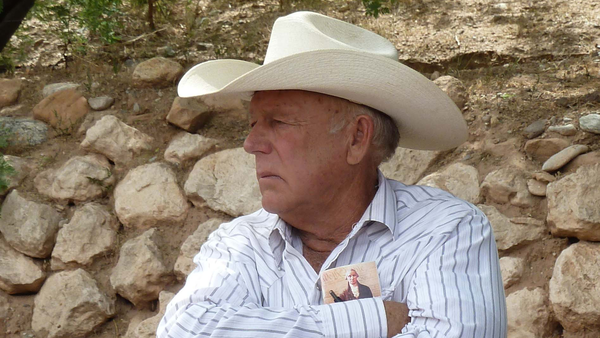
la-ed-rancher-cliven-bundy-grazing-federal-lan-001

Note to readers: It has been a while since I waded into the morass that is American politics of 2014 but I need to get my two cents in for what it is worth. My long time readers know my background, my newer readers may not. If you are a new reader take a look on my civil rights section to see what I believe about racist attitudes and actions. 

I am amazed. Freeloading rancher and welfare prince Cliven Bundy flat out demonstrated that he is an unrepentant racist who would have just loved the Ante-Bellum days before the Civil War when “good blacks” were happy as clams to be slaves. Now Bundy who managed to call together every form of anti-government, anti-Federal Government and just plain wacko racist militia type to his side in his fight to avoid paying over a million dollars in back taxes shows his real hand.

Not that he hadn’t before. Heck, even Glenn Beck was a voice of sanity compared to Sean Hannity in the build up to this fiasco, but Bundy’s own words showed that he is for all practical purposes an unrepentant racist, secessionist freeloader who only cares about himself. The 68 year old “rancher” who for use of lands that he does not own and is making money on made incredibly stupid comments that not only showed his racism, but also his historical ignorance.

Bundy’s comments were so full of irony. Bundy has been making money by grazing his cattle for free on land that he does not own and not paid taxes and fees initially approved by the Reagan administration. So in one of his daily “news conferences” he went on the attack to condemn poor blacks on various forms of Federal assistance. It was the Pot calling the Kettle “Black,” or maybe better calling the Kettle “Negro.”

It was a wondrous thing to behold as all sorts of right wing politicians, pundits and preachers had to back track from their support of Bundy. Frankly I loved it. To me Bundy is no hero, no patriot or anything of the sort. He is a wealthy man who has lied his way to fame in order to embarrass that “Negro” in the White House.

Lies lies and lies….Bundy claimed that his family has been grazing his cattle on the land since before the Federal Government owned it, actually since the late 1800s. Funny thing is that according to court and real estate records Bundy’s family didn’t even purchase the land where there ranch is until 1948. Those nasty legal documents always get in the way of lies… but I digress…

You see Bundy is no hero, he is no patriot. In fact he is little different from Edmund Ruffin, the secessionist leader who fired the first shot at Fort Sumter back in 1861 or Alexander Stephens the Vice President of the Confederate States of America who said in his “Cornerstone Speech” of 1861:

“Our new government is founded upon exactly the opposite idea; its foundations are laid, its corner- stone rests upon the great truth, that the negro is not equal to the white man; that slavery — subordination to the superior race — is his natural and normal condition….”

Based on what Bundy has said I have no doubt that he would wholeheartedly agree with Stephens. The people supporting Bundy include “true believers” like the heavily armed militiamen protecting him who long for bloodshed in order to create martyrs for their cause and their media allies. The militia types are quite interesting because many are either blatantly racist or affiliated in some way with White Separatist, Neo Nazi or Neo Confederate groups all itching for a bloody battle with the Federal Government that it is scary to comprehend.

Likewise there are others who have been deceived by the constant fear mongering of men like Sean Hannity into thinking the Federal Government they have a say in electing is their enemy who fell for Bundy’s outrageous lies hook line and sinker. Thus when men like Bundy reveal in excruciating and painful detail just who they really are I like it.

Donald-Sterling

Then there is the owner of the Los Angeles Clippers Basketball team who makes big money off of the efforts of some really outstanding African-American basketball players. The owner, Donald Sterling told his girlfriend that he doesn’t want her hanging out with blacks or having her picture taken with them, including men like Magic Johnson. I don’t have to mention but will that Sterling had to pay a lot of money to settle previous discrimination complaints and lawsuits, all of which had substantial racial overtones.

I like it because there is a cottage industry of right wing myth makers who like to say that there is no such thing as racism, that it it is a thing of the past or even that it is a product of liberals, liberalism or even the Civil Rights movement. When guys like Bundy or Sterling betray their lies it gives me a certain sense of schadenfreude. When I see college dropout Sean Hannity have to run for cover and condemn men like Bundy that he has helped to build up it really makes me happy.

The fact is that many Americans love the myth that racism no longer exists and that what is left is simply a fabrication of the “liberal media.” If that was true why would there need to be such concerted efforts to roll back civil rights and voting rights to disenfranchise African Americans, Hispanics and poor whites? Why would there be such a concerted media campaign to demonize minorities, women, the poor and yes even Moslems and gays?

If there wasn’t a big streak of racism, sexism, and other prejudice and discrimination still why would the pundits, politicians and preachers be working to hard to disprove it? Why would a political-media and even religious cottage industry be working overtime with lobbyists who support the most wealth people in the country in their quest to disenfranchise the bulk of Americans, even those who are their unwitting foot soldiers?

The fact is and I hate to admit it, but many attitudes haven’t changed that much since the days of Edmund Ruffin and Alexander Stephens, they have just become more suave and savvy. But every once in a while idiots like Bundy and Sterling show up and remind us that this is still all too real and that my friends as distasteful as it is, is a good thing. We like our racism and other prejudices hidden and unspoken so they don’t embarrass us.

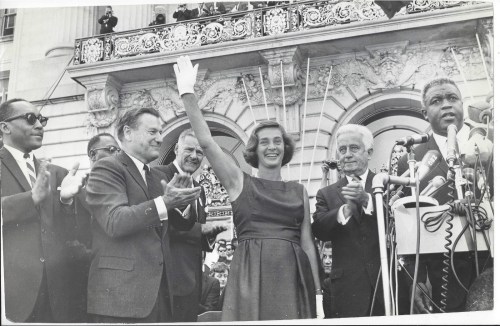
kgrhqfqefgdotlsbqojfqwe0w60_57

Baseball hero Jackie Robinson was a Republican. But in 1964 he found that the party of Lincoln was no more. After the 1964 Republican Convention where he supported Nelson Rockefeller he wrote:

“I wasn’t altogether caught of guard by the victory of the reactionary forces in the Republican party, but I was appalled by the tactics they used to stifle their liberal opposition.  I was a special delegate to the convention through an arrangement made by the Rockefeller office. That convention was one of the most unforgettable and frightening experiences of my life. The hatred I saw was unique to me because it was hatred directed against a white man.  It embodied a revulsion for all he stood for, including his enlightened attitude toward black people.

A new breed of Republicans had taken over the GOP.  As I watched this steamroller operation in San Francisco, I had a better understanding of how it must have felt to be a Jew in Hitler’s Germany….”

Robinson was right even though most people didn’t realize it at the time. The Republican Party of today is not the party of Lincoln, it is the party of Jefferson Davis and Alexander Stephens. As distasteful as the Bundy affair has been and will unfortunately continue to be, it does allow us as individuals and a society to look in the mirror and reevaluate who we are as Americans.

Personally I would rather stand with Jackie Robinson than men like Bundy, Sterling or Hannity.

Anyway, that’s all for tonight. Another Gettysburg article tomorrow unless I get derailed.

Peace

Padre Steve+

1 Comment

Filed under civil rights, History, News and current events, Political Commentary

Indescribably Grand… a Mere Waste of Ammunition: The Confederate Artillery at Pickett’s Charge

Edwin_Forbes_Pickett's_Charge

Many times battles are won or lost due to organizational failures as much as they are by tactical decisions. One of the issues that plagued Robert E Lee at Gettysburg was the effects of the army reorganization prior to and after Chancellorsville. While much attention is given to the reorganization of the Second Corps following the death of Stonewall Jackson and its division between A.P. Hill and Richard Ewell, less attention is given to the reorganization of the artillery.

Following Chancellorsville Lee abolished his artillery reserve and split all artillery between the three corps of his army. Each corps now had its own artillery reserve while divisions maintained control of their own organic batteries. Each corps had its own artillery reserve commander. The reorganization had been delegated by Pendleton to Porter Alexander and Jackson’s Corps Artillery Chief Colonel Stapleton Crutchfield. 1 The initial reorganization approved by Lee on April 16th 1863 retained a 36 gun general reserve was retained, but after Chancellorsville the battalions assigned to it were distributed to the corps. 2 While the reorganization did give the corps commanders more firepower it took away the ability of the army commander to have a ready reserve of firepower that could be used at when he needed.

At Gettysburg the artillery of the Army of Northern Virginia was assigned to each of the three army corps. First Corps under James Longstreet was assigned 5 battalions with 21 total batteries of 84 guns. Longstreet’s artillery chief was Colonel James B Walton, though during the battle Longstreet would come to rely on Lieutenant Colonel Edward Porter Alexander as his de facto artillery chief. Richard Ewell’s Second Corps also had five battalions of artillery, again with 21 assigned batteries totaling 84 guns. The chief of Second Corps artillery was Colonel J. Thomson Brown. Lastly A. P. Hill’s Third Corps had five battalions composed of 20 batteries with 80 guns under direction of Colonel Lindsey Walker. 3

It was an idea the Union army had experimented with but Henry Hunt had the wisdom to retain the reserve. 4 The actions of the union artillery reserve on the second day were in large measure responsible for breaking the back of Confederate assaults on both flanks of July 2nd. The the fact Meade and his artillery Chief Henry Hunt had this reserve available and not split up among the various army corps gave them a flexibility in employing massed firepower at critical points throughout the battle.

The head of the Army of Northern Virginia’s artillery Brigadier General William Pendleton, given the inflated title of “General in Chief Artillery” had his actual role “deflated to purely advisory.” 5 However as Lee’s advisor he was still the senior artilleryman in the army and Lee issued orders regarding the employment of the artillery through him. Pendleton was a 1830 graduate of West Point but had left the army to enter the Episcopal Priesthood. A “well meaning bumbler” 6 he owed his appointment to his “friendship with both Lee and Davis.” 7 He had no combat experience prior to the war, had missed the war with Mexico, shared in the responsibility for the disaster at Malvern Hill and he “lacked any instinct for the battlefield.” 8

At Gettysburg Pendleton was especially ineffectual and his role on July 3rd was to sow confusion in Confederate artillery units as he “sought to supervise the whole artillery operation.” 9 Though his administrative skills should have made him effective in the advisory role he contributed to the failure of the attack.

Since the Confederates were more than 200 miles from their nearest artillery depot the amount of ammunition for the operation was always an issue. This became critical after the first two days of battle because Pendleton did not keep track of his ammunition expenditure and failed to let Lee know of ammunition shortages, information that might have made Lee reconsider the ill-fated attack of July 3rd.

During the day of July 3rd without a real job of his own to do Pendleton moved batteries on his own authority without coordination with the commanders to which they belonged. Even more importantly he placed the artillery ammunition supply trains too far to the rear to resupply the guns. This was discovered by Alexander during the great artillery barrage when his ammunition ran low and he had to tell Longstreet and Pickett at a critical point that he could not maintain his fire much longer. Pendleton who should have ensured that the ammunition was located where it needed to be instead “lurked about the artillery corps commanders and gave them the impression that he was exercising the supervisory control implied by his title.” 10 As a result “some of the guns remained mute and their gunners stood help’ess during the cannonade and charge.” 11

With Longstreet’s First Corps given the assignment of breaking the center of the Federal line priority of fires was given to him. Lee had high expectations of the artillery. Alexander recorded that Lee’s intent was “First, to give the enemy the most effective cannonade possible. It was not meant simply to make a noise, but to try to cripple him-to tear him limbless, as it were, if possible….” 12 Lee wanted the artillery from all of his corps to concentrate on the Federal position. In theory the exterior lines that his army occupied which were such a disadvantage to him in the attack should have allowed Ewell’s and some of Hill’s batteries to enfilade the Federal position, in a sense creating a cross fire.

This should have been the job of Pendleton as the General in Chief of Artillery, but as noted he was not effective in coordinating anything. It was the biggest artillery operation ever attempted by the Army of Northern Virginia and it required a great deal of coordination, “assigning or approving the best firing positions, specifying targets, ordering and coordinating the fire of a dozen artillery battalions of three army corps” 13 and a host of other important details, which Pendleton, though he claimed to have given “earnest attention” to all of these matters fell short. Alexander noted “our line was so extended that all of it was not well studied, and the officers of the different corps had no opportunity to examine each other’s ground for chances to cooperate.” 14

Instead the real responsibility for the artillery battle fell upon the shoulders of three corps artillery commanders, each unaware of what the other was doing. “Alexander did not know what Lindsey Walker was doing with Hill’s artillery and Walker was apparently not even sure of what he was doing himself.” 15 While Porter Alexander attempted to provide what Lee and Longstreet required Ewell’s artillery took almost no part in the battle and Hill’s artillery under Walker was largely ineffectual in large part because it had spent much of its ammunition supporting a meaningless skirmish prior to Pickett’s attack. Likewise, Second Corps artillery badly needed supervision as Crutchfield was now wounded and out of action. 16

As a result “two thirds of Lee’s guns were idle or improperly employed.” Instead of shattering Meade’s lines as Lee intended “the guns achieved little beyond adding to the terrifying noise, and overshooting, scaring the men in Meade’s noncombatant services…” 17 In all at least 58 guns assigned to support the attack never fired a shot.

When the bombardment began at 1:07 P.M. Henry Hunt described the sight as “indescribably grand.” but he noted that “most of the enemy’s projectiles passed overhead, the effect being to sweep all the open ground in our rear, which was of little benefit to the Confederates – a mere waste of ammunition.” 18 Their target, a thin infantry and gun line was hard to hit and complicating matters was the smoke which obscured their view and “the inferior quality of their fuzes.” 19

Command, control, logistics and organization helped make the largest artillery attack on American soil fall far short of what Robert E. Lee expected. As Lee stood by Alexander watching the battered remnants of Pickett’s division return from the assault Alexander noted that “at this moment he must have foreseen Appomattox.” 20

1. Golay, Michael To Gettysburg and Beyond: The Parallel lives of Joshua Lawrence Chamberlain and Edward Porter Alexander Crown Publishers Inc. New York 1994 p.1552

2. Coco, Gregory A. A Concise Guide to the Artillery at Gettysburg Colcraft Industries Ortanna PA 1998 p.43

3 Ibid.

4 Dowdey, Clifford Lee and His Men at Gettysburg: The Death of a Nation, Skyhorse Publishing New York 1958 p.284

5 Sears Stephen W Gettysburg Houghton Mifflin Company Boston and New York 2004 p.377

6 Ibid Dowdey, p.284

7 Ibid. Sears p.377

8 Ibid.

9 Ibid. Dowdey p.285

10 Ibid. p.286

11 Coddington, Edwin The Gettysburg Campaign, a Study in Command A Touchstone Book, Simon and Schuster New York 1968 p.499

12 Trudeau, Noah Andre Gettysburg A Testing of Courage Harper Collins New York 2002 pp.444-445

13 Ibid. Sears p.379

14 Alexander, Edward Porter The Great Charge and the Artillery Fighting at Gettysburg in Battles and Leaders of the Civil War edited by Bradford, Neil Meridian Press New York 1989 p.395

15 Ibid. Dowdey p.286

16 Ibid.

17 Ibid.

18 Hunt, Henry The Third Day at Gettysburg in Battles and Leaders of the Civil War edited by Bradford, Neil Meridian Press, New York 1989 p.386

19 Ibid. Sears p.381

20 Ibid. Alexander p.397

Leave a comment

Filed under civil war, History, leadership, Military