Author Archives: padresteve

padresteve's avatar

About padresteve

I'm a Navy Chaplain and Old Catholic Priest

Yes Friends, God Really Does Speak to Me Through Baseball

“Baseball, it is said, is only a game. True. And the Grand Canyon is only a hole in Arizona. Not all holes, or games, are created equal.” George Will

Padresteve, Jeff and Angels 3rd Base Coach Rocky Bridges in 1970

Well we are deep into football season, while hockey, basketball that World Cup qualifiers move along.  Don’t get me wrong.  I know these sports well but for me they are not the same as baseball.  I have played all of them in school, the biggest mistake that I made as a kid was forsaking organized baseball first for hockey and then for football.  I gave up playing my first love for short term flings with other sports.

The Church of Baseball, Harbor Park Parish

I was down walking the concourse at Harbor Park the other day to relax following about 32 hours spanning two nights at the hospital.  I like going to the ballpark even when it is the off season because it is one of the few places where I can be fully relaxed and at peace.  Tuesday was beautiful, the temperature was in the mid 50s with sunshine and a light breeze, the field was a brilliant great and the ever present grounds crew was at work.  In the front office I talked with a number of the office staff about players who would and would not be coming back for the 2010 season as well as highlights of the past season.  The Tides have a wonderful front office staff.  To walk the concourse from behind home plate, out to the right field corner and then back across to the left field picnic area and then to go down to my seat in Section 102, Row B seats 1 and 2 at the Church of Baseball, Harbor Park Parish is a highlight of the week when I have the chance to do it.  I feel closeness to God at the ballpark that after Iraq is hard for me to find in many other places.  For me there is a mystery and magic about a ballpark that just isn’t there for the other sports, not that there’s anything wrong with that.

For me the other sports can grab my momentary attention but because of their nature cause them to be merely ordinary and occasionally interesting.  Baseball is another matter, it is more than a game, it is a metaphor for life, a spiritual experience and a game that mirrors life and faith in many ways. For me this goes back to childhood.

As a kid my dad made me learn the fundamentals of the game and whether we were attending a game in person, watching one on television or playing catch, pepper or practicing infield or pitching in the back yard or in a park, dad was all about the game.  Of course he was the same way with football, hockey and basketball, but the sport that he seemed most passionate about was baseball.  As a kid he was a Cincinnati Reds fan.  His mother, my grandmother who hailed from the hollers of West Virginia was a die hard Dodgers fan.  That I still wonder about to this day, but she was the same woman who as a widow in the late 1930s went to work, raised her two boys and bought her own house.  Unlike most of the state she was also a Republican, long before West Virginia ever voted for a Republican either President or statewide office. True to form Granny was a Dodgers fan in a land of Reds, Indians and Pirates fans, fierce and independent.  However, as a Giants fan I mourn how she had been taken in by the power of the dark side.  Despite having fallen under the spell of the Dark Lords Granny was a real baseball fan. Any time you went to Granny’s house and there was a game on, the television was tuned in to it.  We were immersed in baseball thanks to my dad and his mother.

Dad always made sure that we got to see baseball wherever we lived. In 1967 he took us to see the Seattle Pilots during their first and only season in that fair city before they went to Milwaukee and became the Brewers.  In the elementary schools of those days many our teachers would put the playoff and World’s Series games on the TV as many of those games were played during daylight hours.  I remember watching Bob Gibson pitch when the Cardinals played against the Red Sox in the 1967 series.  It was awesome to see that man pitch.   I remember the Amazing Mets upsetting the Orioles in 1969 and the Orioles take down the Reds in 1970. I will never forget the 1970 All Star Game where Pete Rose ran over Ray Fosse at home plate for the winning run and the great dynasty teams of the 1970s, especially the Reds and the Athletics who dominated much of that decade and the resurgence of the Yankees in the summer that the Bronx burned.
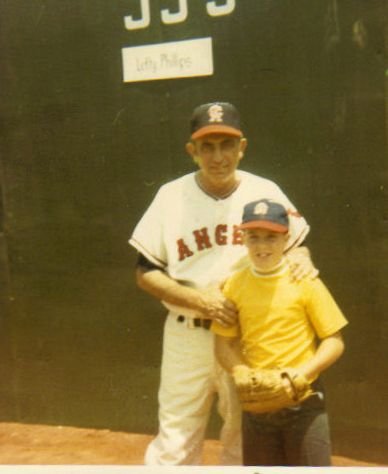
Me with Angel’s Manager Lefty Phillips 1970

When we were stationed in Long Beach California dad had us at Anaheim stadium all the time.  I imagine that we attended at least 20 games there in 1970 and another 25-30 in 1971 as well as a couple at Dodger stadium that year.  We met a lot of the Angel players at community events and before the games. I entered the “My Favorite Angel” contest and my entry was picked as a runner up. This netted me two seats behind the plate and having Dick Enberg announced my name on the radio.  I wrote about Jim Spencer a Gold Glove First Baseball who later played for the Yankees.  I still have a hat from that team with numerous autographs on the inside of the bill including Sandy Alomar, Jim Spencer, Jim Fregosi, Chico Ruiz, and Billy Cowan. It was a magical time for a 10 year old boy.

When we moved to Stockton California dad took us to see the A’s dynasty teams including a number of playoff games.  But he also took us across San Francisco Bay to watch the Giants.  I got to see Ed Halicki of the Giants no-hit the Mets a Candlestick on August 24th 1975.  I got to see some of the greats of the era play in those stadiums, Catfish, Reggie, McCovey, Garvey, Vida Blue, Harmon Killebrew and so many others.  I also became acquainted with Minor League Baseball at this time through the Stockton Ports. At the time the Ports were the Class A California League farm team for the Orioles.  I remember a few years back talking to Paul Blair the Orioles great Paul Blair who played for the Ports in the early 1960s about Billy Hebert Field and how the sun would go down in the outfield blinding hitters and spectators in its glare.  Today I have a renewed interest in the Orioles because of their affiliation with the Norfolk Tides.

As I have grown older my appreciation for the game only deepens despite strikes and steroids and other problems that plague the game at the major league level.  I am in awe of the game and the diamond on which it is played.  I have played catch on the field of dreams, seen a game in the Yankee Stadium Right Field bleachers, seen a no-hitter, playoff games and met players. I’ve watched the game in Japan, seen historic moments when deployed to combat zones in and have thrown out the first pitch in a couple of minor league games.  I am enchanted with the game. The foul lines theoretical go on to infinity, only broken by the placement of the outfield wall.  Likewise unlike all other sports there is no time limit, meaning that baseball can be an eschatological game going on into eternity. The Hall of Fame is like the Calendar of Saints in the Catholic, Orthodox and Anglican Churches.  There are rituals, the exchange of batting orders and explanation of the ground rules, the ceremonial first pitch, players not stepping on the foul line when entering and leaving the field of play, no talking about it when a pitcher is throwing a no-hitter and the home run trot. The care of a field by an expert ground crew is a thing to behold, especially when they still use the wooden box frames to lay down the chalk on the baselines and the batters box.

My kitchen and much of my dining room are as close to a baseball shrine as Judy will let me make them.

Since I returned from Iraq the baseball diamond is one of my few places of solace.  For the first time last year I bought season tickets to my local minor league team the Norfolk Tides.  Section 102, row B seats 1 and 2 from which I will, the Deity Herself willing take in the 2010 season at the Church of Baseball, Harbor Park Parish.  The home opener is April the 8th against the Durham Bulls, barely 4 months away.  From there I will sit back and imagine the words of James Earl Jones in Field of Dreams:

“The one constant through all the years has been baseball. America has rolled by like an army of steamrollers. It’s been erased like a blackboard, rebuilt, and erased again. But baseball has marked the time. This field, this game, is a part of our past. It reminds us of all that once was good, and what could be again.”

In a sense this says it all to me in an age of war, economic crisis and division.  In a sense it is a prayer. Peace and blessings, Steve+

2 Comments

Filed under Baseball, philosophy, Religion

The Afghan War 2009-2012: Lessons from Algeria 1954-1960 A Review of “A Savage War of Peace

“A Savage War of Peace.” By Alistair Horne. The New York Review of Books, 1977, 1987, 1996, 2006.  Maps. Photographs. Bibliography. Index. 608 pp.

Foreign Legion in Algeria

In light of the developing situation in Afghanistan and the plan to apply the counterinsurgency techniques of clear and hold, or “the oil slick” in that country it is wise to look at other instances of this type of warfare before criticizing those about to implement the strategy.  Of course when doing this the best place to look is history, especially where the strategy worked, at least until the DeGaulle government abandoned the nearly complete military success achieved by French forces in Algeria triggering a national crisis.

Alistair Horne’s “A Savage War of Peace” is a most needed addition for anyone seriously interested in studying the dynamics of insurgency and counterinsurgency warfare; especially political and military leaders of a western nation occupying a Moslem country.  Horne’s work is important and one of the few in English that cover this subject.  The two other books in English to cover the subject, albeit only on part of the campaign is Paul Aussaresses’ controversial memoir “The Battle of the Casbah” and Ted Morgan’s memoir “My Battle of Algiers” though useful suffer from the fact that they are limited in scope to the events the individuals experienced while serving as French Army officers in Algeria. In both the author’s personal biases are readily in evidence and by the fact that they were written many years after the events in question.  Since those books are heavily dependent on the author’s memories.

Paratroops of the First Colonial Paratroop Regiment in Algeria

Horne is not limited by these factors.  Horne is a historian who served as a British Army officer assigned to the MI5 in the Middle East and later as a foreign correspondent for the Daily Mail who has written a trilogy of excellent works on the Franco-German wars: The Fall of Paris: The Siege and the Commune 1870-1871, The Price of Glory: Verdun 1916 and To Lose a Battle: France 1940. As such his account is as close to being objective as any could be in the case of writing this particular history.

Horne approaches the subject from the perspective of the broader issues that France and the Fourth Republic were facing in 1954, economic, military and psychological recovery from the Second World War, the loss of colonies, defeat in Indochina culminating in the Dien Bien Phu debacle.  Such is important when examining a military campaign as the latter do not take place in isolation of other events in the life of a nation. When the history of the US campaigns in Iraq and Afghanistan are written they will have to take into account many other factors apart from the military operations.

Horne tackles the complex issues of the Algerian war in a multifaceted manner looking not only at the military issues, but the political and social issues faced by the French, the European Pied-Noir Algerians and the Algerian natives, both Berber and Arab alike.  Horne also looks at the conflict in the broader context of the Cold War, the emergence of the Non-Aligned nation movement and the rise of Arab nationalism, skillfully weaving the actions of these movements and key individuals such as Egypt’s Nasser, Khrushchev of the Soviet Union and the most influential, and President Jacques de Gaulle into the story of the Algerian conflict. Unlike other writers Horne had access to many of the individuals involved, including leaders from each rebel faction, the Pied-Noir and the French government and military.  Included in those he interviewed is Algerian President Boumedienne who had commanded rebels during the conflict and was instrumental in Algeria’s independence as well as Jacque Soustelle who had been Governor General from 1955 through 1956. These sources as well as numerous others help give his narrative a depth and subtlety lacking in the first hand English language memoirs and accounts.

Terrorism by FLN Militias and Sympathizers Caused Great Problems for the French

Horne begins his account with the story of the aborted revolt and massacre at Setif on May 8th, VE Day, 1945 and the attempt by the French government to reassert its control over Algeria. Of particular interest in this section is Horne’s analysis of the mistake of the Pied Noirs and the French government in not offering a settlement to the Algerian separatists under magnanimous terms due to the scale of the victory they had won following the Setif uprising and their security forces “decapitation” of the leadership of the various Algerian nationalist factions.  He compares the victory to that of the Israelis in the 1967 War and the political reaction of the Pied Noir to the Israelis, who instead of negotiating a settlement that could have long term effects advantageous to them from a position of strength determined to humiliate and subjugate their foe.[1] If the US military is able to reverse the situation in Afghanistan the United States and the Afghan government will need to be magnanimous to a defeated foe in order to prevent yet another repetition of another Al Qaida and Taliban resurgence.

French Paratroops Going House to House in Algiers

In examining the period before the actual outbreak of the war in 1954 Horne looks at the missed opportunities of the French to prevent it.  He also examines the development of the Algerian independence movement, especially the senior leaders of the movement; many of whom had served in the French Army during the Second World War with distinction. His portrayal of the conflicts within the independence movement, show that this was not a monolithic movement, but that each faction had its own goals which often were in conflict with other groups.  This is also the case in Afghanistan where a disparate number of ethnic, political, criminal, nationalist and terrorist groups who often are at war with each other.  Likewise, Horne’s treatment of the Pied Noir and certain parts of the French leadership examine how they too were divided at some points in regard to the ultimate plan for the relationship of Algeria to France.

Horne makes much of political mistakes and machinations of French leaders that culminated in the end of the Fourth Republic and subsequent impact on de Gaulle when he became president in June 1958.  Some mistakes that Horne explores are those committed in the immediate wake of Setif. He also examines mistakes during the revolt; such as not taking it seriously, to individuals in the National Assembly impeding the efforts of Soustelle to effect reforms and compromise between hard line factions in the Pied Noir and Moslem communities.[2] Likewise he notes how the draconian treatment of Algerian Moslems by the French Army in the early phases of the counter-insurgency effort, including the assignment of “collective responsibility” to punish communities for the actions of individuals helped alienate the populace and strengthen the insurgency.  Such was the case in the first part of the Iraq occupation and helped inspire that insurgency.  One member of Soustelle’s cabinet noted: “the cycle of repression getting ever tougher, and the rebellion ever stronger, will ruin all your efforts of pacification.”[3]

Besides political mistakes Horne examines issues in military tactics that seem to plague counterinsurgency efforts to the present time.  He describes the early application of heavy conventional forces in an attempt to defeat the insurgency.  Horne discusses unsuccessful efforts in 1954-1955 and how they not only did not destroy the insurgency but how the insurgency spread in response to the efforts.  The question: “Did ‘pacification’, for instance mean trying to regain the confidence of the inhabitants; or did it mean crushing the rebellion by whatever means available?”[4] This question is still asked today by soldiers fighting insurgencies and often the latter is counseled by those who still think along the lines of the conventional tactics of the Cold War and World War Two, which many conservative pundits are enamored with.  Horne also discusses the successful tactics of commando units used by General Challe to effectively combat the insurgency.[5]

Horne examines the attitudes of the French Army which in a sense fought the war for itself.  Armies that have fought many campaigns together often have a sense of comradeship that transcends even the loyalty that they have to their nation.  It is the understanding of a “Band of Brothers” and can be found throughout history.  When the histories of Iraq and Afghanistan are written they will certainly include the fact that many soldiers, Marines and Sailors engaged in actual combat operations fought for the men and women with whom they served more than for anything else.

The French Army felt little affinity for the Pied Noir who they often saw as only interested in their interest at the expense of the campaign.  Likewise the Army, felt little more than contempt for the French government which they felt had betrayed them. General Lorillot noted “They made fools of us in Indo-China…they screwed in Tunisia…We are being screwed in Morocco. But they will never screw us in Algeria. I swear to you. Let this be known in Paris.”[6] Instead attitudes of not losing, stopping the humiliations were animated by the feeling of anti-communism in French ranks, especially in the Elite Parachute, Foreign Legion, Commando and Colonials (Marines). The novel The Centurions and voiced the feelings of one Paratroop commander “We want to halt the decadence of the West and the march of Communism.”[7]

Horne provides a narrative analysis of the military campaigns within the Algerian War.  In particular he describes the successes of units designed to live among and better the lives of the Algerians and the SAS,[8] He describes the building of the border wall to keep weapons out of rebel hands.  He describes the “success” of units which specialized in torture,[9] which turned out to be helpful in the short run but which ultimately damaged the fabric of the Army.  Horne notes the effects of torture on soldiers who participated and how it negatively affected support of the war in France and internationally.[10] The use of torture in Algeria has parallels with Iraq. Horne notes: “one has to take into account all those factors…horror at the atrocities of the F.L.N., a determination not to lose yet another campaign, and the generally brutalizing effect of so cruel and protracted war.”[11]

The most powerful part of the narrative is the drama when French President de Gaulle was faced with the revolts of 1959. At this time the Pied Noir militias, dissatisfied with potential political settlements went to the barricades in Algiers and other major cities, assisted in some cases by Army units.  These forces again revolted against his attempts to mediate a settlement and were followed by the General’s revolt of April 1961 which nearly became a military coup in France itself.   President de Gaulle’s role in bringing these revolts to an end, without the collapse of the government or a civil war was miraculous.  Though his actions undercut the military success of the Army in Algeria which had virtually eliminated the insurgency his foresight in recognizing that France had a future not dependant on Algeria remaining French was exceptional.  The actions of de Gaulle should be studied by those who closely link their country’s future to holding a foreign country, even one that is considered an integral part of the mother country, as Algeria was to France.

Horne’s book is as timely as it was when first published, maybe more so with the current escalation in Afghanistan.  Along with works by David Galula “Pacification In Algeria 1956-1958, Bernard Fall “Street Without Joy” and “Hell in a Very Small Place,” Andrew Krepinevich’s  “The Army in Vietnam,” Brian McAllister Linn’s “The Philippine War: 1899-1902” and Ben Shepherd’s “War in the Wild East: The German Army and Soviet Partisans” Horne’s work is vital reading for military and political leaders fighting counter-insurgency operations.  Unfortunately many militaries are often enamored by high tech innovation are not often receptive to the decidedly human factors and strategies necessary to fight insurgencies until they experience frustration and failure attempting to use conventional forces and tactics to win a counter-insurgency campaign.  Effective intelligence, efforts to win the hearts and minds of the populace by protecting them, knowledge of public affairs and the effect of media on operations are all key elements of a proper counter-insurgency campaign are covered by Horne. Horne’s work reminds us that these conflicts are not won by the forces with the greatest firepower or most modern weapons. This is something that the United States and its NATO and other Allies in Afghanistan should never forget.


[1] Horne, Alistair. A Savage War f Peace: Algeria 1954-1962. The New York Review of Books, New York, NY 1977, 1987, 1996 2006. p.69

[2] Ibid. pp. 113-114

[3] Ibid. p.115  Some would later compare the attitudes of the French Army to those of the Nazis. In one point of his narrative Horne notes the attitude of an officer who saw nothing wrong with the tactics used by the Nazis in the Second World War.

[4] Ibid. p.112.  Another question noted is something that seems to be commonplace in the Iraq War ““Limited Repression” did not always make the clearest sense to a patrol of young soldiers caught in a vicious ambush.” When one reads Horne’s accounts one sometimes almost feels that he is writing about the current American experience in Iraq.

[5] Ibid. pp. 334-335

[6] Ibid. pp.175-176

[7] Ibid. p.176

[8] The SAS Section Administrative Specialise first set up by Soustelle.  These units had great success but also suffered heavy losses as their efforts were recognized as having a positive effect by the FLN and other Algerian rebel groups.

[9] Such as the 11th Shock Regiment

[10] See pp. 195-207.

[11] Ibid. p.198.

2 Comments

Filed under Foreign Policy, History, iraq,afghanistan, Military

The Manhattan Transfer: Why I Cannot Sign the Manhattan Declaration

“It behooves every man who values liberty of conscience for himself, to resist invasions of it in the case of others: or their case may, by change of circumstances, become his own.” Thomas Jefferson

Note: I do not expect that everyone will agree with my views on this subject.  Thus it is good that I am neither the Pope nor even a bishop.  I fully support the rights of all who have signed this declaration to do so and have the utmost respect for Chuck Colson as well as the Bishops of my Church who have signed this declaration.  I would never impugn the earnest beliefs or motives of these men and women.  However I do not believe that the Manhattan Declaration is fully reflective of the preponderance of the Gospel being that it does not address any traditional theological distinctive of the Christian faith.  It addresses instead moral, social and political issues that are used as wedge issues in contemporary American society.  While I believe that every Church has a right to comment on such issues to use them in their own realm that in a democracy or constitutional republic that such statements serve little purpose other than to rally the troops who already are convinced of them and do little to change the hearts and minds of those who do not.

Recently a fairly sizable number of Christian Leaders from Evangelical Protestant, Roman Catholic and Orthodox Churches have drafted and signed a document called the Manhattan Declaration.  It is a statement of four basic sociological and political issues with significant religious and theological overtones.  Let me provide a brief synopsis of the major points of the declaration:

1. The sanctity of human life.
2. The sanctity of marriage.
3. The protection of religious liberty.
4. The rejection of unjust laws.

To be honest these are all worthwhile goals and I can agree with them.  In fact I agree that the right to life of the unborn as well as the born must be protected.  I believe in sanctity of Christian marriage but recognize that the institution of marriage pre-dates the Christian Church and that descriptions of “traditional marriage” in the Old Testament do not reflect a Christian understanding of marriage but rather a ancient Near Eastern Culture of marriage that is more reflective of Islam than Christianity.  I believe in the protection of religious liberty as defined by the founders of the United States in our Constitution.  While I am a Christian every citizen in the United States has a Constitutional right that protects their religious liberty even if offends and is in contradiction to the Christian faith.  The United States was the first nation of the Enlightenment and the drafters of the Constitution would not allow any denomination to impose its interpretation of the Christian faith on any citizen.  Finally there is the rejection of unjust laws; who can be against that?  At the same time who determines what law is unjust? Or is it a matter of political dogma and not the faith that defines what is or is not an unjust law?

By definition Christians should strive to protect life as a matter of course.  Defending the rights of the innocent both the unborn and the born are essential if one truly is pro-life.  As such simply being anti-abortion is not enough to call oneself pro-life.  Unfortunately the vast majority of those who have signed the Manhattan Declaration would limit it to that and pay lip service to everything else that would make one pro-life including the provision of adequate health to those of inadequate means or access to healthcare, the use of the death penalty and the proper application of the Christian understanding of the “Just War” which prohibits preemptive wars or attacks against nations that have not attacked us. Pro-life would also include the implicit command for the Church to be leading the way in caring for the poor, indigent and the foreigner among us.  Likewise such would assume that the government would also have some responsibility to care for its citizens as the institution that God has raised up to maintain public order and maintain a just society.

Likewise it is within the context of the Church define marriage recognizing that while the vast majority of Christians would define marriage as the union of one man and one woman, that is the understanding of the vast majority of people who have signed this document.  No church or religious body should be required to perform rites that are in contravention to their beliefs. At the same time they cannot under the laws of the land impose those beliefs on others or force the government to do so.  The understanding of religious liberty as defined by the Constitution does not allow this.  One of the good things about going to a Southern Baptist Seminary before the Fundamentalist takeover of the denomination was the deep understanding of religious liberty and the freedom of conscience that is given to all citizens.

Likewise defending religious liberty, both to practice one’s religion as well as respect the rights of others to practice theirs is a sacrosanct principle of being an American.  This is especially true for those who serve as Chaplains in the Federal government.  To use a Star Trek metaphor, such is our “Prime Directive.”  Religious liberty is essential and protected in the First Amendment to the Constitution which also guards the rights of free speech and association.  It is my hope that what I model to others in word and deed, and definitely helped by the Holy Spirit, will allow people, even those hostile to the Church or the Christian faith to maybe reconsider, especially if they have rejected the faith because of the intolerance of other Christians or our sometimes sordid history in regard to the treatment of people.

Finally the rejection of “unjust laws” is a bit of a Red Herring.  An unjust law is in the eye of the beholder. The founders of the country believed that a African American only counted as 3/5ths of a person. Which 3/5ths I don’t know, but certainly this cannot be considered a “just law” however it was supported by many Churches including those that resisted anti-slavery provisions adopted by their denominations and left those denominations in the years preceding the Civil War.

However it is not the theological principles of the sanctity of human life, the sanctity of marriage, freedom of religious expression and resistance of unjust laws that is the problem.  Rather it is the tacit political emphasis of the document in spite of the comments by major supporters such as the President and CEO of Focus on the Family:

“It is important, first off, to note that the Manhattan Declaration is not a partisan or political statement…Instead, it addresses and elevates four specific areas of universal consensus. Some have referred to these as “threshold issues,” meaning they represent the foundation of our faith and the pivot point from which everything else flows. This is the bedrock. If we can’t agree on these areas of doctrine, everything else will be of reduced value.” Jim Daly, President and CEO of Focus on the Family

As a Christian of the Anglo-Catholic tradition the bedrock of the faith resides in the Bible and the testimony of the Church in the Creeds and the first seven Ecumenical Councils of the Church. These are not areas that “represent the foundation of our faith and the pivot point from which everything else flows.” I dare anyone to show me this in scripture or church tradition.  While there are places that one can draw inferences of these issues to be scriptural one can claim that the Scripture at no point forbids abortion. In fact the one place where these is even an inference of this is in Exodus 21:22-25 where a man injures a woman to cause a miscarriage is fined and not treated as a murderer.  Likewise the “imprecatory prayers” in the Psalms calm for dashing infants against stones.  If one looks at marriage it is obvious that Israel, like all Middle Eastern cultures of the day and many of the Moslems condemned by many supporters of the Manhattan Declaration practice was more of a property transfer than a true union of husband and wife as we now understand it to be. As far as freedom of religion one can cite numerous examples in the Old Testament where there is no religious freedom or rights given to non-Jews.   So to claim any of these as universal and foundational is inaccurate, even if they are worthy goals.

The drafters of the document refer to the Barmen Declaration of the Confessing Church during the Nazi era as a precedent for their work.  This is a bad analogy and bad history.  The Barmen Declaration was a statement of faith. The bulk of the declaration dealt with historic Lutheran and Reformed beliefs in the context of bearing witness and being faithful as members of a State Church which was falling in line and becoming a political instrument of the Nazis sacrificing its actual Christian faith and adopting a Nazi-Aryan faith.  This was viewed as heresy and apostasy by the members of the Confessing Church.  These men had no political party to support them, they were alone.  This is not the case with those who sign the Manhattan Declaration.  It is not a statement of orthodox Christianity against the apostasy of a church but a statement of political and social beliefs that have a religious component.

The partisan nature of the document is shown in the timing.  It now occurs with a President who is a liberal Democrat.  It well could have been issued during the Bush administration where little than political speeches were made in support of pro-life or anti-abortion causes.  In fact the Chief Justice of the Supreme Court in his confirmation hearings referred to Roe v. Wade as “settled law.” Likewise the Bush administration adopted the policy of pre-emptive warfare as a matter of doctrine.  This is blatantly in contravention of both international law as well as the Christian understanding of the Just War.  One has to remember that the United States prosecuted the Nazis for wars of aggression; wars that the Nazis believed were justified.  Likewise the open support of Gay marriage by the former Republican Vice President was never criticized by many of these people.  It seems that such a document would have had much more credibility has the writers published it during the past administration.

The point of this article is to reaffirm actual Christian doctrine defined by the Creeds, Councils and Scriptures as the standard of the Christian faith and not a list which is not and has never been the central component of the Christian faith.  It is my belief that the Manhattan Declaration is well meaning but ill-conceived and can and is being construed as the litmus test of what it means to be a faithful Christian.  I have seen two friends this weekend, who are totally orthodox in their denomination’s understanding of the Christian faith, theological conservatives who have difficulty with such declarations attacked as liberals and unbelievers.  I expect that some will do this with me.  It is my belief that this statement will serve to ghettoize Christians into a particular wing of the Republican Party providing their critics with the opportunity to simple count them as a subgroup of that party.  That is a real and present danger.

I do find that the preamble to the declaration has much that I can agree with, however it is the focus on a narrow band of issues that concerns me, issues that have been for the past 30-40 years hot button political issues where both major political parties play upon religious groups to further their agendas.

Again, I am totally pro-life and orthodox in my faith as a Christian.  I just believe that such declarations serve only to reaffirm the previously held positions of those who support them and have little effect on the vast majority of people and almost none on the government.

My friends Joel and Jared have made some interesting observations on their own sites.  Joel is at

http://thechurchofjesuschrist.us/ and Jared at

http://jzholloway.wordpress.com/

The text of the Manhattan Declaration is here:

http://www.manhattandeclaration.org/images/content/ManhattanDeclaration.pdf

Peace,

Padre Steve+

4 Comments

Filed under marriage and relationships, philosophy, Political Commentary, pro-life anti-abortion, Religion

Padre Steve Nails His Comprehensive Exams and a Few Loose Thoughts

After about 3 years and some change I have completed my Masters of Arts in Military History with a concentration in World War II at American Military University.  Today I learned the results of my comprehensive exams which I took last Tuesday.  I “Passed with Distinction.”  That was very satisfying because I did work hard all the way through the program which I began about a year after I finished the Marine Corps Command and Staff College and my Doctor of Ministry in 2005.  I finished with a 4.0 GPA and will officially graduate in Washington D.C. on February 15th

The program was pretty grueling and to refresh my brain I began to take and re-write various research papers or essays that I had written during the program and posted them on this site.  I found that in doing so I improved what I had written and was able to really refresh my knowledge even as I added more information to the posts or otherwise reworked them. Doing this has given me inspiration to begin writing on new topics in history dealing with military history and theory, church history and religious liberty, including the freedom of conscience, historical theology as well as baseball and my own story of my tour in Iraq and subsequent struggle with PTSD.  Some of these articles and essays are posted throughout this site. I hope to turn at least some of this into books at a later date.  If you happen to be a publisher, literary agent or know one please let me know.   

One thing that I have enjoyed is having others comment on my work, some even to criticize it.  I found that the criticism was sometimes not just of the work but of me for enunciating opinions that are contrary to theirs.  Terms like “traitor” “unbeliever” and “heretic” have been used to describe me by some.  I have found that if you don’t want criticism of your work don’t write.  If doesn’t matter what the subject is, whether you are liberal or conservative, Christian or something else that there will be someone who will take issue with either your work or you.  I have learned that depending on the type of criticism I can take it seriously, lightly or blow it off, but I am learning not to take it personally.  Heck, most critics don’t know me from Adam so what do they know.  People who know me on the other hand I do try to listen to and if I am wrong, misinterpreted or wrote something that I really didn’t want to come out the way that it did to be generally civil to my critics and treat them with respect.  I think only once or twice I replied to people in a snarky way.  I am not afraid to mix it up with someone, see the comments ton my post on A Christian Defense of the Rights of Moslems in a Democracy but try never to demean the person by name calling, stereotyping or vilifying their position but sticking to the facts and hoping to build a bridge of reconciliation even if we cannot come to agreement.  On the other hand there are a few individuals and groups that I have been somewhat sarcastic or hard in dealing with, but only because they open themselves up to it by, to use a baseball metaphor, throwing at the other teams’ batters.  I figure if they want to throw at people then I can throw at them.  Since fair is fair I would imagine that some of these kind folks are praying for me using “impreccatory prayers.”  Oh well. 

Anyway, a couple of other things.  Today we hosted LTC Dave Grossman a leading expert on the effects of combat and killing on the human body, mind and spirit.  Dave has written the books On Killing and On Combat. He is highly sought after works heavily with military, police and emergency services personnel as well as those in the psychiatric, psychological and chaplain/clergy fields.  The seminar was well attended by a diverse audience of physicians, nurses, psychologists, chaplains, social workers, counselors, corpsmen and others.  I met him late last night when his plane came in, picked him up this morning and took him back to the airport before coming back to the medical center for the rest of my on-call shift. 

The first time that I met Dave was a EOD Group Two where we hosted him about a year and a half ago.  At the time I was in the middle of my post deployment PTSD crack up.  Everything was setting me off, the Great Dismal Swamp was burning, visibilities were down to half a mile, the sky was “Iraqi Sandstorm Brown” and smelled like the burn pits that litter that country.  Every sound, loud noise, jet aircraft, especially F-18s, helicopters and sudden move was sending me back to Iraq.  We hosted Dave as I said and he was most gracious during his presentation then, but his subject matter send me down hard back then.  It was after that seminar that our Diving Medical Officer looked at me and asked “Chaplain are you okay?”  To which I had to say no, I was crashing and it was really difficult.  I’m doing better now and while some of Dave’s presentation did affect me, it was not to the extent of last year.  I held together and realized that I will get through this, that I will be stronger for what I have gone through and hopefully be able to help others who have suffered the same or worse.  While I was in Iraq I was “in the zone” and it was coming home to a world that didn’t seem to understand what I had experienced, what I had learned and at least initially didn’t seem to care for me or value what I did that sent me down. 

Today made me realize that I am doing better.  I’m not where I want to be.  I still have great problems with sleep and some issues with anxiety as well as some flashbacks, dreams and nightmares, but not like they were even a year to 9 months ago. 

So, not much else for the night.  I’m praying that I don’t get a 0230 or 0300 page and that I get 4-5 hours of sleep. 

Thank you for your prayers, support and encouraging and even non-encouraging words since I started this site back in February.  So many people have been so kind to me, in person and in their responses to what I write here and on the link in my Facebook page to my articles that I am blown away. What really matters is when I get a comment from someone with PTSD or a family member of someone who let me know that something that I wrote touched them. I think that matters more than anything that something that was so difficult and even devastating to me is now helping others who thought that they were alone.  It also feels really good to have completed the work for the Masters Degree and to realize that I am getting better.

I think tomorrow after work I shall take a breather at the Church of Baseball, Harbor Park Parish as well as take the Abbess over to Gordon Biersch for the Stein Club appreciation night. Take care and blessings,

Peace, Padre Steve+


Leave a comment

Filed under iraq,afghanistan, Loose thoughts and musings, philosophy

Lessons in Coalition Warfare: Admiral Ernest King and the British Pacific Fleet

The genesis and strategy of British Royal Navy’s participation in the Pacific in 1945 is a little studied aspect of the Pacific campaign.  Prior to 1945 the participation of the Royal Navy in the Pacific ended at the Battle of the Java Sea.  After that the Royal Navy operated in the Indian Ocean in support of British operations in Burma and against German surface raiders. Michael Coles in “Ernest King and the British Pacific Fleet: The Conference at Quebec, 1944 (Octagon) published in The Journal of Military History January 2001, 65, 1 Research Library pp. 105-129 provides a good analysis of the Allied decision to allow the Royal Navy a role in the Pacific and the objections of Admiral Ernest King to the proposal.

The renewal of the Royal Navy’s Pacific role began at the 1944 Octagon Conference where the Allied Joint Staff made the decision to bring the Royal Navy back to the Pacific. Admiral Ernest King was the only dissenter in the question of Royal Navy operations in the Pacific.  The strategic aspects of this decision are seldom addressed by most who chronicle the Pacific war.[i] William Kimball in “Forged in War: Roosevelt Churchill and the Second World War” never mentions the naval strategy discussed at the Octagon conference. Samuel Elliott Morison in “The Two-Ocean War” described the decision for the Royal Navy to enter the Pacific as “important” and outlines King’s opposition to it without addressing strategic considerations.[ii] John Costello in “The Pacific War” described how Churchill insisted on the Royal Navy being committed to operations against Japan and how Roosevelt’s agreed to “to avoid a bitter clash.”[iii] Likewise Williamson Murray and Allen R. Millett in “War to Be Won” note that one of the goals of Octagon was “to determine the level and nature of British in the air-naval war in the Pacific.” However they do so as do the others without addressing the naval strategy.[iv] Max Hastings mentions Octagon in “Retribution: The Battle for Japan, 1944-1945” again without specific reference to naval strategy.  However later in the book later discusses the Royal Navy’s limitations in ships, manning, logistics and operational art as it entered the Pacific campaign.[v] Other writers chronicle British operations in the Pacific but usually focus in the gallantry and determination of the Royal Navy and not its weaknesses.[vi]

Coles’ article is invaluable to understand the decision in relation to the political, military and economic considerations which influenced both King’s opposition to the deployment and the performance of the British fleet in the Pacific.  Coles analyzes tensions between King and the other participants at Octagon. He judges King to be more realistic and informed regarding Royal Navy capabilities and more importantly its limitations than British leaders especially Churchill.[vii]

King was surprised at Roosevelt’s decision to accept Churchill’s offer of the Royal Navy without prior discussion by the Combined Chiefs of Staff.  Coles notes that King may have kept silent at subsequent meetings of the Combined Chiefs, because he either assumed that his positions were logical and apparent to all or that he believed that Churchill was lying about his navy’s capabilities. Of course it was politically impossible for King to suggest such.[viii]

King’s realism on the subject was a directly related to the political tensions between American and British visions for the outcome of the Pacific war, and the pressing strategic considerations necessitated by Japanese offensives in Burma and China. The British goal of re-establishing colonial rule in Southeast Asia was a major bone of contention.  Many Americans believed that the British goals were “aimed primarily at the resurgence of British political and economic ascendancy in South East Asia and restoration of British prestige.”[ix] Yet the US wanted to defeat Japan’s formidable Army in Asia without the sacrifice of large numbers of American troops or material which necessitated British participation.[x] The introduction of large numbers of American troops on the Asian continent was impossible due to the lineation of the US Army to 90 divisions, most of which were engaged in Europe.  Likewise US domestic issues regarding war production and the Navy’s share of it in relations to changing wartime conditions was a major concern for King.  King and the Navy argued for high naval production while others including George Marshall were beginning to question it, especially if the British could provide “make substantial Naval forces available in the Pacific.”[xi]

American Lend Lease aid to Britain was another issue.  Roosevelt calculated that the US needed Britain to be active in post-war Europe, this required significant post war aid. Roosevelt viewed “vigorous participation” by the Royal Navy as a means to gain congressional support in spite of the fact that Britain could no longer play a global military role without US support.[xii] One of the problems faced in the Pacific was how British mandated modifications to weapons systems supplied by the United States caused problems in production and caused shortages in key weapons systems, especially naval aircraft.  Coles’ notes how King had problems with this and wondered if supplying the Royal Navy’s Pacific operations “represented the most effective use of American industrial capacity.[xiii] However King did not chose to argue this point at the conference, once again demurring to President Roosevelt.

The most compelling factor discussed by Coles was the operational and logistic problems related to the deployment, supply and operation of the Royal Navy. There were a number of problems that the Royal Navy faced as it deployed to the Pacific.  First among them was the fact that the Royal Navy was in large part short-legged and cold water Navy.  Its ships were designed mainly for service in the Atlantic and Mediterranean and ill-suited for the Pacific. The Royal Navy did not have the operational experience of the Americans in regard to Fast Carrier Task Forces, especially coordination of refueling and resupply operations or coordination of air group operations.  Admiral Philip Vian insisted that “Before joining the Americans…we needed to be adept at using a great many more aircraft at a time, and for longer periods.”[xiv] Max Hastings’ noted that the Royal Navy was “overstretched and war weary”[xv] and Coles goes to great lengths to illustrate British weakness while analyzing tensions in the British-American relationship particularly the shift in the relationship as the Americans took the leading role.

King had the foresight to recognize that the British contribution would be more of a liability than help.[xvi] The principal Royal Navy purpose in the Pacific was political, not military and Coles asks if it helped or hindered “the achievement of the respective nations’ policy objectives.” Coles does not believe that it helped; that in fact the Royal Navy would not have been able to continue had the war continued.  He quoted a British liaison officer who wrote that the Royal Navy would have “been unable to continue operations because of lack of logistic support.”[xvii] Coles calls the Royal Navy’s effort in the Pacific an “expensive instrument of failed policy” and that Admiral King seemed to have recognized this better than others, arguing that King’s opinions were not based on simple personal prejudice.[xviii]

Coles uses an excellent mix of primary and secondary sources including diaries, operational reports, histories and journal articles from American and British sources to document his work providing ample references throughout his article. His work is important in recognizing the importance strategy plays in making political decisions in coalition warfare.  Likewise he places value on individuals such as King who are able to recognize the strategic aims and limitations in coalition warfare by various partners.

Though the Royal Navy’s participation in the Pacific War was a relatively insignificant in terms of its overall role in the war it provides lessons for our time. Coalition warfare requires that members of the coalition be able to function our time we can see a similar situation where many of the NATO forces in Afghanistan are dependent on the US for most of their operational and logistic support. It also requires that the members of the coalition have a firm grip on the overall strategy and understand the capabilities and limitations of each.  In Afghanistan the United States faces a situation where it needs capable alliance partners.  It does not have the force capacity to go it alone and political support for additional troops has weakened in congress and in the public.  It is a somewhat similar situation to the Second World War where the United States needed significant British participation in the Asian ground war to ensure that the United States would not have to make major commitments to on the Asian mainland.  Likewise it was needed to get congressional support for post war aid to Britain.  Likewise George Marshall and others wondered if the British could provide significant naval support which would alleviate the need for high naval production which they questioned.  Strategy and the desired end state must be central to how coalitions fight wars.


[i] See Spector, Ronald H. Eagle Against the Sun: The American War With Japan. The Free Press and Division of MacMillan, Inc. New York, NY 1985. Spector nowhere mentions the British Navy in his history of the campaign  and in his short reference to Octagon he does not mention the debate over the Royal Navy’s inclusion in the campaign. p.419

[ii] Morison, Samuel Eliot. The Two Ocean War: A Short History of the United States Navy in the Second World War. An Atlantic Monthly Press Book, Boston MA 1963. pp. Morrison does also mention some of the specific actions of Royal Navy in the Pacific. Pp.423-424.

[iii] Costello, John. The Pacific War: 1941-1945 Quill Publishers, New York, NY 1981. p.495.

[iv] Murray, Williamson and Millett, Allan R. A War to Be Won: Fighting the Second World War.  The Belknap Press of Harvard University, Cambridge, MA. 2000. pp.484-485.

[v] Hastings, Max. Retribution: The Battle for Japan, 1944-1945. Alfred A Knopf, New York, NY 2008. Originally published in Great Britain as Nemesis: The Battle for Japan, 1944-45, Harper Press, London, 2007.  p.112-113 and 400-402.

[vi] “Ernest King and the British Pacific Fleet: The Conference at Quebec, 1944 (Octagon). By Michael  Coles.  Published in The Journal of Military History January 2001, 65, 1 Research Library. p.127

[vii] Ibid. pp.111-112

[viii] Ibid. p.111

[ix] Ibid. p.113

[x] Ibid. p.114

[xi] Ibid. p.117

[xii] Ibid. p.118

[xiii] Ibid. p.120 Coles describes several instances where the “Anglicized” systems delayed deliveries and lengthened transportation to operational British units.  Modifications included flight helmets, radios and aircraft modifications. He also discusses how ineffectively the British used the large number of Escort Carriers provided by the US.

[xiv] Ibid. p.123

[xv] Hastings. p.400

[xvi] Coles. p.127. This is something that Morison does with utmost deference to the British.

[xvii] Ibid. p.128

[xviii] Ibid. p.129

8 Comments

Filed under Foreign Policy, History, iraq,afghanistan, world war two in the pacific

Can Anybody Spare a DIME: A Short Primer on Early Axis Success and How the Allies Won the Second World War

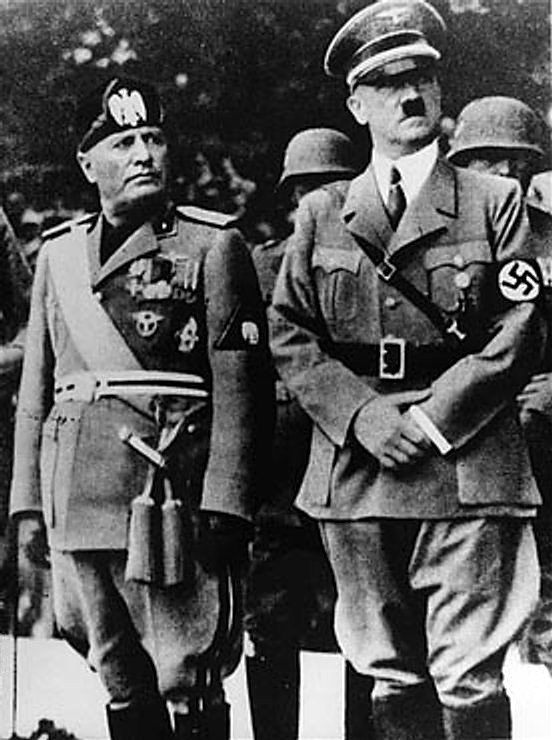
Hitler and Mussolini, the Axis Leaders Never Developed a Grand Strategy

All modern war is predicated on the full potential of a nation or alliance to fight a war.  This includes what is known in today’s parlance the DIME, or the Diplomatic, Intelligence, Military and Economic factors of national power. During the war the Axis powers almost exclusively fixated on the military dimension, especially at the operational and tactical level never coordinating a national or alliance grand strategy.  On the other hand the Allies were successful in doing so despite competing national interests of the British Empire, the Soviet Union and the United States.

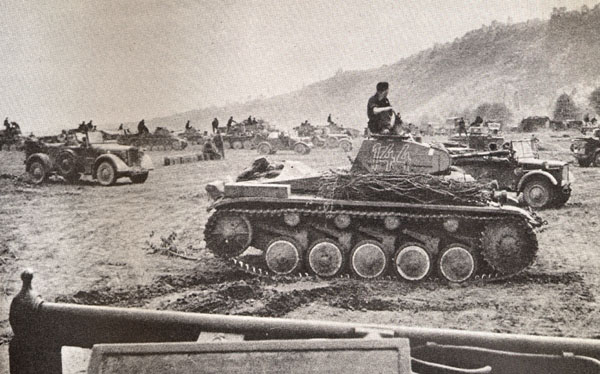
Early German Success in France Changed the Face of Warfare

The Germans and Japanese were victorious in the early years of the World War Two due to their application of the most modern forms of warfare and ability to exploit weaknesses in their opponents.  For the Germans this entailed the use of the “Blitzkrieg” or lightening war which used the combined arms team of tanks, artillery, and mechanized infantry with close air support coordinated by commanders in mobile command posts who were able to adapt to tactical considerations on the ground and exploit enemy’s weaknesses.  This involved the classic forms of applied mass, speed and firepower to overwhelm enemy defenses at critical points and the encouragement of initiative by commanders, the Auftragstaktik. Led by men such as Heinz Guderian, Erich Von Manstein and Erwin Rommel to name but a few, the German commanders overcame allied opposition as well as the occasional hesitancy of their own senior leaders to defeat Allied forces throughout Europe.  The blitzkrieg involved risk, but the Germans for the most part, with key exceptions such as at Dunkirk during the French campaign took risks and exploited weaknesses in Allied political goals, military coordination and operational art. The Allies were hampered by weak political leadership, an aversion to risk, an outmoded strategy and poor coordination of a force which outnumbered the Germans and included more tanks than the Germans could field.  The German armaments were not necessarily superior to the Allies, but were better used for the most part.

German skill at the operational level was exemplified in Poland, France and the Low Countries, a daring Norwegian operation, which could be described as one of the first joint operations in military history, the Balkans and North Africa as well as the initial phases of Operation Barbarossa.  Each of these operations had flaws, the most glaring being at the strategic level and lack of a Grand Strategy.  The operations also exposed weaknesses in logistics and limits to what the mechanized and tactical air forces could do when stretched too far, North Africa and Russia as cases in point.  The Germans would always be outnumbered and fighting a multi-front war because of their limited naval capability, both in surface units and U-Boats, as well as the lack of a strategic air capability which kept them from eliminating Britain from the war.  Hitler’s desire for German domination in Europe excluded a true coalition effort to make allies with powers in Europe such as Vichy France which shared an aversion to the British especially after the attack of the British Navy on the French fleet in North Africa.  Likewise Germany’s alliance with Mussolini’s Italy was more of a strategic liability than a true partner. Hitler’s aversion to the Soviet State prevented any more than a brief cooperation with the USSR which was ended by the German invasion of the USSR. The Germans also failed in their war strategy by not going to a total war effort until 1943 after the ascension of Albert Speer as the Armaments Minister.  Thus German forces had to fight war “on the cheap” so to speak for the first part of the war, especially in North Africa and in Russia. In Russia the vast expanse of the front forced the Germans to thin out their forces to dangerous levels and whose pathetic road and rail network limited the already limited ability of the Wehrmacht to supply its forces as they advanced deep into Russia.

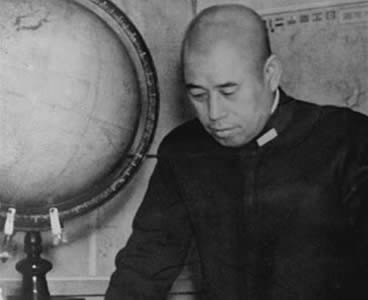
Admiral Yamamoto One of the Few Japanese Leaders to Understand what the Japanese Faced in Going to War with the United States

In the Pacific the Japanese used fast carrier task forces and naval air power coupled with superior surface warfare groups of fast battleships, cruisers and destroyers operating in conjunction with land based Army and Naval air units to isolate and destroy allied naval forces and outposts throughout the Pacific.   The Japanese exploited their superiority to conduct their own form of blitzkrieg.

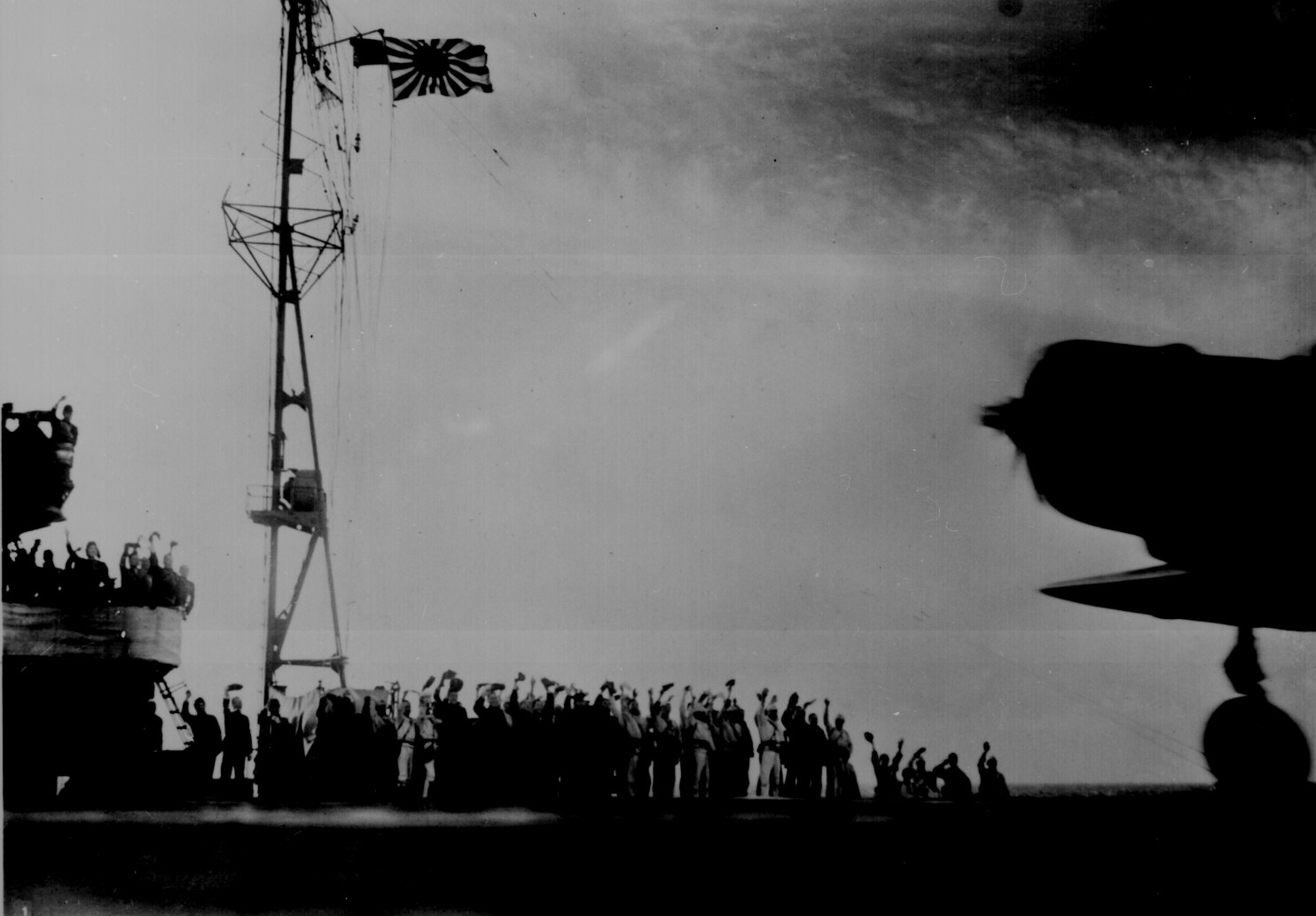
Despite Inflicting Crushing Defeats on the Allies in late 1941 and early 1942 the Japanese period of Conquest would be Short Lived

At the same time the Japanese, even more so than the Germans lacked the ability to fight a long war; something that the best and most realistic of the Japanese strategists, Admiral Yamamoto understood and warned his government about before the attack on Pearl Harbor.  Likewise they like the Germans failed to develop a cohesive Grand Strategy in their war effort.  Competing priorities and inter-service rivalries between the Army and the Navy over resources, manufacturing priorities and war aims crippled Japanese efforts.  Despite this the Japanese used superior tactical application of forces, exploited Allied command and control weaknesses, numerical and qualitative superiority over dispersed and often obsolete Allied forces. The Allies in the opening phase of the war were often led by officers who had little respect for the Japanese and underestimated the Japanese skill at the tactical and operational level of warfare as well as the individual Japanese soldier and sailor, with tragic results.

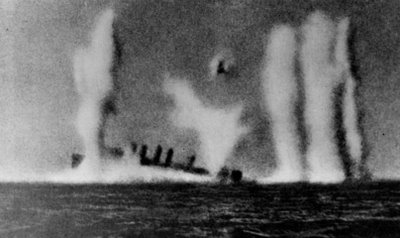
USS Pope Being Blown out of the Water at the Battle of the Java Sea

The Japanese were constrained by limited resources and intense competition between the Army and Navy for those resources as well as a long term war in China which drew off the larger part of the Japanese Army and Army Air Forces.  The Japanese effort stalled after they lost much of their carrier fleet and experienced naval aviators at Coral Sea, Midway and the Guadalcanal Campaign.  The Americans, who assumed the mantle of the Pacific Theater after the initial Japanese success and weakness of British and Dutch forces in the Pacific and demands of the war in Europe began an aggressive defense and opened an offensive against the Japanese long before the Japanese believed that they would at Guadalcanal.

At the heart of the early German and Japanese success lay their superior application of the techniques and weapons of modern warfare on the land, sea and air against opponents who were initially ill-prepared to meet their onslaught.  They both had glaring weaknesses but their weaknesses in the early years of the war were masked by Allied ineptitude at all levels, tactical, operational and strategic.   Thus they were successful and at times wildly so, but in their success lay the seeds of their defeat.

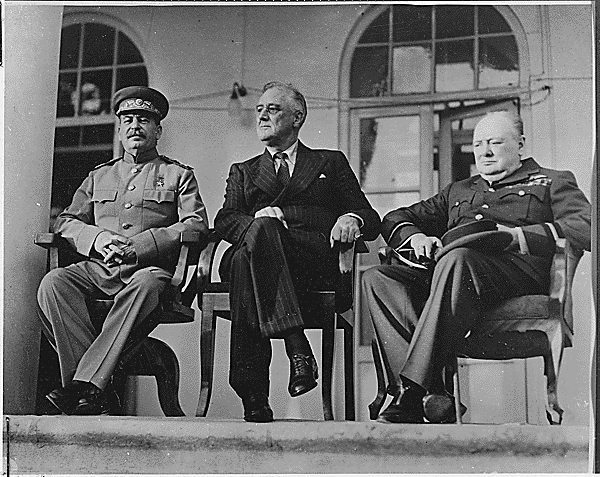
Stalin, Roosevelt and Churchill overcame Significant Conflicts of Interest to Build a Grand Strategy

The defeat of the Axis powers was in large part a combination of superior Allied strategy at the “grand strategy” level and lack of a corresponding Axis Grand Strategy; as well as the Axis powers inherent weaknesses in natural resources, manpower and industrial capabilities to fight multi-front wars, coupled with poor transportation and logistics capabilities for distant operations.

The US Navy Breaking of the Japanese Naval and Diplomatic Codes as well as the Cracking of the German Ultra Code and Capture of the Enigma Machine Greatly Enhanced Allied Intelligence

The cracking of Japanese Naval and diplomatic codes and the capture of the German Enigma code machine and code books aided Allied strategic planning, none or the Axis intelligence services rose to the challenges of the war. The Allied victory and Axis defeat was in fact a combination of what is called the DIME, the Diplomatic Intelligence Military and Economic factors which caused the Axis defeat.  While it is in part due to Allied strategy, Axis deficiencies in each of these areas played a part in their ultimate defeat.

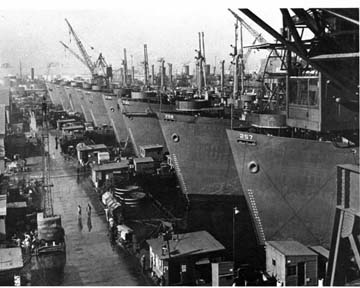
Massive US Industrial Capacity Drove the Allied War Effort

On the Grand Strategic level there was no comparison. The Allies, even factoring in often conflicting national goals were able to coordinate a strategy to first defeat Germany and then Japan.  The Americans, British and Russians began such cooperation even prior to the American entry into the war through the Lend Lease, followed by the British and American Combined Chiefs of Staff, which helped coordinate often disparate British and American strategies in Europe and Asia. Murray and Millett assert and I agree with the thesis that the British and Americans “came closest to designing a global strategy that accommodated their war aims.” (War to Be Won p.584) While close coordination with the Russians was illusory at best, the Western Allies were able to help keep the Russians in war the by helping to supply them (War to Be Won p.388), and on occasion launching operations which assisted the Russians, such as the invasion of Italy. The Italian invasion, though the pipe dream of Churchill to crack the “soft underbelly” of Europe was a key factor in the German decision to quit the Kursk offensive and redeploy Panzer Divisions, including SS formations to Italy and the West. This weakened the Germans in the face of the Russian counter offensive following Kursk which aided Russian success. The Axis powers knew no such coordinated strategic thinking.

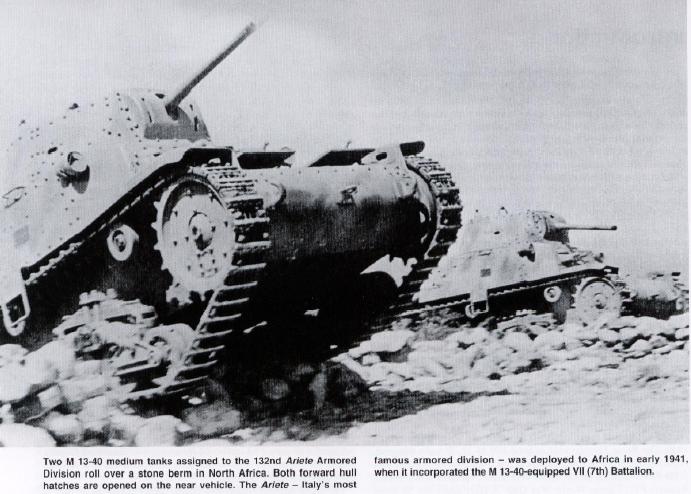
Poor Italian Technology, Training and Organization Made them More of  a Burden to Germany than a Help

The Japanese, Germans and Italians ran separate wars based on their perceived national considerations at times which often ran contrary to the common needs of their coalition.  Italian actions in the Mediterranean caused a diversion in German efforts at key times, such as in Greece where the Germans had to save the Italians and delay the opening of Operation Barbarossa.  Italian incompetence forced the Germans to commit forces to North Africa, Greece, the Balkans and Italy upon its collapse which could have been used to great effect in Europe or Russia. The Japanese and Germans never coordinated their efforts to defeat either the western Allies or the Soviets.  The lack of a coherent Grand Strategy on the part of the Axis powers, especially in the early part of the war when Allied fortunes were at lowest ebb, was every bit as much a part of their ultimate defeat as was a coordinated or “superior” Allied strategy.

The lack of a coordinated Axis Grand Strategy was reflected in the way each fought its war, the Japanese were hindered by lack of natural resources, especially those most important in maintaining a war economy, fuels, metals, rubber and even foodstuffs for which they were dependant on foreign suppliers such as the United States.  They were also hindered by a war in China which consumed troops and supplies without a corresponding benefit.  (See Barnhart’s “Japan Prepares for Total War and Toland’s “Rising Sun.) Their inability to produce the machines of war in sufficient numbers to replace losses due to combat operations and their failure to keep up with advances in technology negated their initial success and superiority at sea and in the air.

US Naval Forces Would Dominate the Pacific

The Germans failed to mobilize their economy to a total war footing until after Stalingrad and the accession of Albert Speer to head Reich war production.   They also attempted to fight a multi-front war and were dependant on weak and unenthusiastic satellite states such as Romania and Hungary to hold what they deemed to be less important areas in order free up German units.  Likewise the Germans had not adequately prepared for the war at sea with sufficient surface, naval air or U-boat strength to win the battle of the Atlantic, nor had the Luftwaffe developed a strategic bombing capability with long range fighter escorts to win the Battle of Britain. German industrial efforts, even the great strides made after Speer took over war production were unable to keep pace with the massive production of the Americans and the Soviet Union.  The Red Army ground the Wehrmacht to dust on the Steppes of Russia, a key factor in that helped the American and British successfully invade Western Europe.

B-17s Over Europe

The preponderance of western Air, Naval, war production and natural resources enabled them to field Fleets, Armies and Air Forces which were unmatched in size or technical sophistication for their time in history.  The Japanese and the Germans had no way to win by 1944, short of developing and deploying Atomic weapons and delivery systems before the Americans and British did could defeat.  Murray and Millett note this in regard to Germany which had the Wehrmacht held out longer would have been the first target of the Atomic bombs. (War to Be Won p.483)

Atomic Bomb at Hiroshima, It could Have Been Berlin Instead

In summary the Axis powers were defeated by their own weaknesses in the diplomatic, intelligence, military and economic arenas as much as they were by superior Allied strategy.  This in no way negates the superior way in which the Allies marshaled their resources and coordinated a coherent Grand Strategy.  But even so the Allies by were running out of troops by the end of the European war.  Russian formations while still formidable were operating at greatly diminished strength by the end of the war and their losses “carried political and social consequences that were to burden the Soviet Union to its demise.” (War to Be Won p.483)  The British were bled dry and unable to keep up with losses suffered after Normandy. The Americans too suffered from a shortage of manpower, particularly in Army infantry forces, and had limited their Army to a mere 90 divisions of all types to fight a world war. They had diverted manpower to the Army Air Corps, Naval and Marine Corps leaving the Army chronically short infantry. The Americans were forced into emergency drafts of troops from the Air Corps and other ancillary formations and support units to fill out infantry formations during the winter of 1944-45.  (See Russell Weigley’s book Eisenhower’s Lieutenants.” and Max Hasting’s “Armageddon” for a good treatment of the manpower situation in 1944-45) This is one point were the Americans took a risk that almost backfired on them and could have cost them victory.

12 Comments

Filed under History, Military, world war two in europe, world war two in the pacific

The Transitional Carriers: USS Ranger CV-4 and USS Wasp CV-7

Note: This is the second in a series of articles on US Aircraft Carriers. The first article “The First Aircraft Carriers Part One: The First American Flattops- Langley, Lexington and Saratoga” can be found at this link: https://padresteve.wordpress.com/2009/10/08/the-first-aircraft-carriers-part-one-the-first-american-flattops-langley-lexington-and-saratoga/

I expect to write a follow up article on the Yorktown class, followed by one on the World War II Essex class and Independence class carriers.  At some point I might tackle the post war modernizations, modifications and careers of the Essex class.

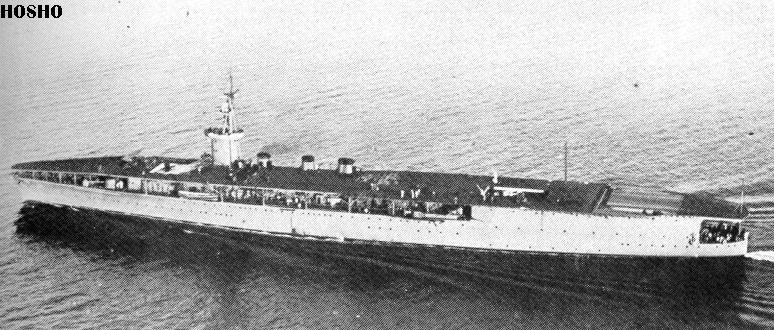
Following the success of the Langley, Lexington and Saratoga the Navy began to design aircraft carriers from the keel up.  The Japanese had already done so when they commissioned the IJN Hosho in 1922. Hosho displaced 10,000 tons was 579 feet long full load carried 26 aircraft at a top speed of 25 knots.  Hosho would serve in a secondary role in the Second World War, surviving the war with minor damage.

Hosho as Built

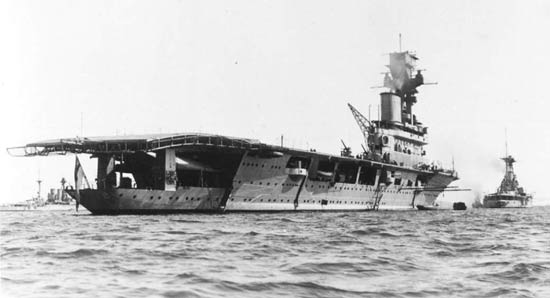
The British commissioned the HMS Hermes in 1923. She was slightly larger than Hosho at 12,900 tons and 598 feet long and capable of carrying 15-20 aircraft. She had a maximum speed of 25 knots.  She was sunk by Admiral Nagumo’s carrier strike force off Ceylon on 23 January 1941.  Both of these ships served in fleet support and training roles much of their careers being smaller and less capable of operating more modern aircraft developed in the late 1920s and 1930s.

HMS Hermes

The United States Navy was late compared to the Japanese and British ion designing carriers from the keel up, however when it did they were larger, faster and carried a far larger number of aircraft than the Hosho or Hermes.

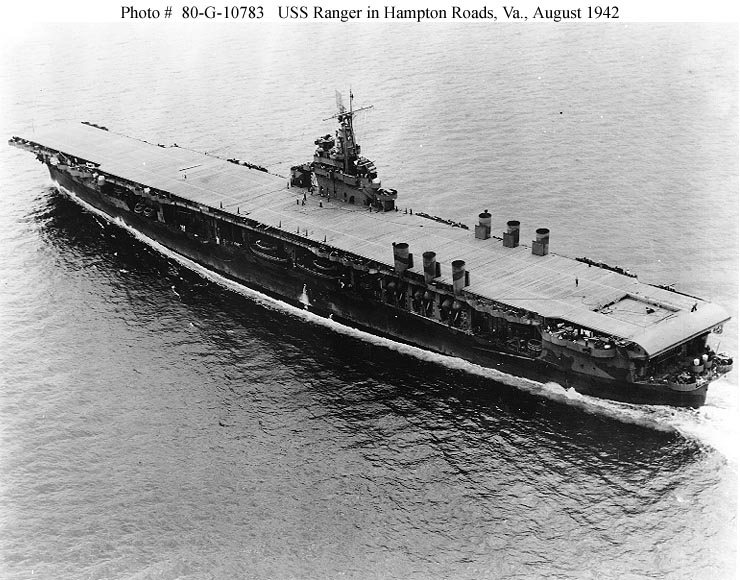
Ranger at Hampton Roads 1942: Note the Funnel Arrangement

The Ranger was commissioned on June 4th 1934 and displaced 14,500 tons, was 769 feet long and had a maximum speed of 29.25 knots.  She carried 86 aircraft, over four times more than Hermes and three times that of Hosho.  She was not initially equipped with a catapult though one would be added later with a more advanced one being retrofitted in 1944.  She had a unique funnel arrangement having 6 small funnels located aft along both sides of the flight deck. These could be repositioned out so as not to interfere with aircraft operations.

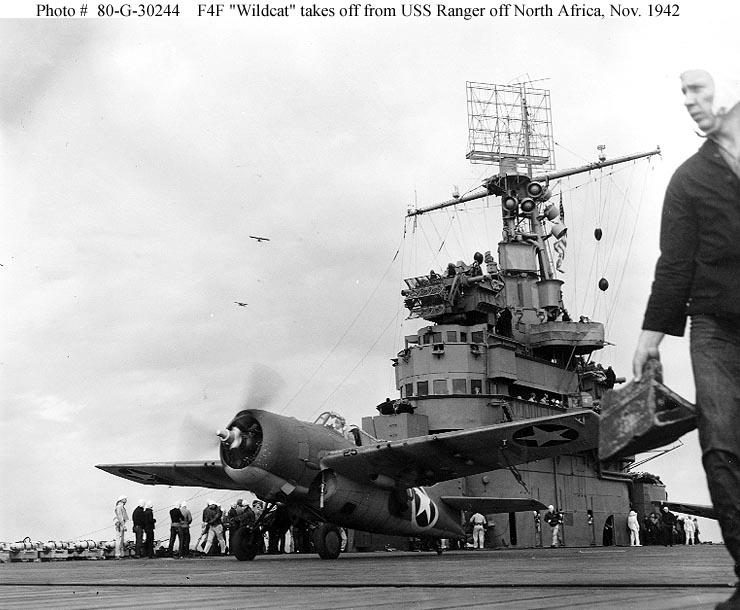
Ranger Launching F4F-3 Wildcat off French North Africa November 1942

She had a small island structure.  This was not a particularly satisfactory design and would not be repeated in the fleet carriers which followed but would be used on the Independence class Light Fleet Carriers (CVL) and all Escort Carriers (CVE).  Ranger would operate with the Pacific Fleet in the 1930s before returning to the Atlantic in early 1939.  She would participate in Neutrality Patrols to protect US Shipping and missions to transfer US Army Air Corps aircraft across the Atlantic.  After the US entry into the war would participate in the Allied landings in French North Africa, Operation Torch launching 496 sorties against Vichy French ships, airfields and ground targets.  She remained in the Atlantic in 1943 conducting patrols, transporting Army Air Corps aircraft across the Atlantic and operating with the British Home Fleet conducting raids against German ships and installations at Bodo Norway.  Following these operations she would be refitted and sent to the Pacific to serve as an advanced training carrier for pilots and air crew being trained for combat duty.   She would decommission in October 1946 and sold for scrap in 1947.

Wasp at Hampton Roads, May 1942

She was not used in a combat role in the Pacific as she was determined to be too small and too slow and having very limited armor protection.  However her design was such that it could be refined for future classes of carriers including better armor protection, expanded anti-aircraft capabilities and better command and control facilities.

The second of these transitional carriers was the USS Wasp; CV-7 was built as a replacement under the Washington Treaty for the Langley and her displacement was limited to 14,700 tons.  Laid down in 1936 and commissioned in April 1940 she benefitted from experience with the Ranger and though roughly the same displacement as Ranger and only marginally faster.  Wasp was only 688 feet long as compared to Ranger, but had better protection and a more efficient design that was similar to the larger Yorktown class ships.  She carried over 80 aircraft and was equipped with 2 flight deck and two hanger deck catapults. Wasp’s career was short but action filled.  During 1940 through early 1942 she remained in the Atlantic conducting training, Neutrality patrols, shadowing Vichy French warships in the Caribbean, transporting badly needed British Spitfires to the besieged island of Malta and operating with the British Home Fleet against the Germans.

Wasp Loading Spitfires for Malta

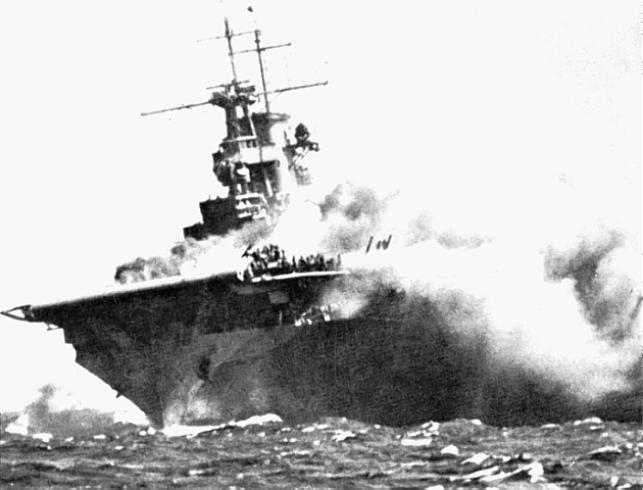
With the shortage of carriers in the Pacific due to the loss of Lexington and damage to Saratoga Wasp was transferred to the Pacific where her air group received new aircraft prior to sailing to the South Pacific to take part in the invasion of Guadalcanal in August 1942.  Her air group acquitted itself well in action against the Japanese in the initial operations and she would remain in the area of operations.  On September Wasp was escorting troop transports carrying the 7th Marine Regiment to Guadalcanal.   As she recovered aircraft she was hit by 2 torpedoes from the Japanese submarine I-19.  I-19 had executed one of the most successful attacks by a Japanese submarine on US Naval Forces during the war, sinking Wasp, damaging the Battleship North Carolina and the destroyer O’Brien which later sank while sailing to the United States for permanent repairs.  At about 1420 the powerful 24” “Long Lance” torpedoes hit the Wasp in the vicinity of her ammunition magazine and aircraft gasoline tanks.  The fires rapidly spread throughout the ship igniting ready ammunition for the anti-aircraft guns.  Despite damage control efforts the fires spread and large secondary explosions wracked the ship forcing her abandonment at 1520.  With the ship abandoned she was sunk by the USS Lansdowne going down at 2100 with the loss of 196 of her crew.

Wasp Burning and Sinking

Though small and short lived the Wasp was a successful design incorporating a folding T-shaped deck edge elevator which was a predecessor of the much larger ones found on modern US Aircraft Carriers. The Ranger despite her limitations was far more capable than other countries early designs and served well in the Atlantic and as a training platform.

Peace,

Padre Steve+

16 Comments

Filed under History, Navy Ships, world war two in europe, world war two in the pacific

Padre Steve’s Thanksgiving Thoughts

The Abbess: “Steve would you pray for the food?”

Padre Steve: “Dear Lord we pray for this turkey and all of it’s relatives on this Thanksgiving. We ask you to comfort them in their sorrow and give them your peace. Amen.”   Padre Steve’s Thanksgiving prayer from 1992.  I think the last time that we hosted a Thanksgiving dinner.

I am on duty tonight, pretty tired and I have been pretty busy this evening.  Hopefully things will settle down and no one will take any turns for the worse that will cause them or their families to have to mourn on this Thanksgiving 2009.  We have several in pretty bad shape as well as some I know not in hospital who are in pretty dire straits.

But since things have settled down a little I do need on this Thanksgiving Eve pause to give thanks for all of the blessings that I have been given.  I also need to give thanks for  wife who has had to suffer all of my rough edges, refusal to completely grow up, my wanderlust, dreams as well as my obsession with work, academics and yea verily, even baseball.

I am grateful for so many things but most of all the Abbess of the Abby Normal.  This dear soul has put up with me yea these 26 years of marriage and the 31 years that we have known each other.  She has had to deal with a husband who has devoted himself to a military career and vocation as a Priest that has spanned 28 years of that time.  She has endured separations too many to count and a decent number of deployments, unaccompanied tours and temporary duty out of the areas that we have lived.  In the 20 or so months that I have been back from Iraq she has also had to deal with my struggle with PTSD and all the trimmings that go with it.  Likewise she has had to see me grieve my dad, who though still alive only exists in body and does not know me anymore. I am truly thankful for the wife that I am blessed to have.

I think I have tried this dear woman’s patience quite often in our marriage, of course I do not think that she has forgotten the 1992 “Prayer for the Food.”  It is dangerous sometimes to ask me to pray because I might just take you literally, as I did the Abbess back in 1992 who slipped up and instead of asking me to “ask a blessing on the meal” “say grace” or simply “give thanks” but rather asked me to “pray for the food.” Something that I did, and I think that the prayer was actually longer as I remember making eye contact with her during the prayer as she glared daggers at me as the guests either giggled or listened in stunned silence. This will surprise no one who really knows me well.  Tonight as I made my rounds in our cardiac care unit I noticed one of the newer high-tech CPR dummies looking bored in the training/ conference room.  I had to remedy the situation.  Taking the obviously bored and neglected dummy I set him in a high-backed office chair facing the television which happened to be on.  I so arranged him so that a person coming in the room would see the back of the head, which happens to be bald like mine as it was looking at the TV.

Bob the CPR Dummy Watching TV

A person entering from the hallway into the unit would see the profile for the dummy.  This one is kind of cool as it has a shirt and the facial features are more realistic than the old style.  I did let the charge nurse know so he could get a laugh out of anyone who does a double take as they enter the unit bleary eyed at two or three in the morning.  I mentioned my misdeeds to my buddies Cinda and Jennifer over in the PICU who both got a laugh out of it.

Bob Chilling Out

I think the greatest honor that I had on a Thanksgiving  was in 2007 serving in Iraq. I got  a chance to serve the troops and workers in the chow hall at TQ after coming back that afternoon from an aborted mission to Waleed on the Syrian border when our air support mission was cancelled when a host of Congressmen, Senators and dignitaries decided that they needed to visit Iraq leaving us and quite a few others marooned at Al Asad’s air terminal for 4 days as they flew about Iraq in our aircraft.  Thankfully when I knew that we could not get anywhere the west and that we had to return to TQ so we could prepare for our next mission later in the week I got us on a C-130 back to TQ which delivered us home in time for me to help serve at the dinner that night.  I was in charge of the Mac n’ Cheese and the Sweet potatoes.  So since Mac n’  Cheese was not in my typical Thanksgiving dinner growing up I figured that I had to sell it.  So with that in mind as each person came up to where I was I would say “Get your Mac n’ Cheese, an American Classic….8 of 10 customers agree that this is the best Mac n’ Cheese in Iraq.”  The servers from the Gulf Catering Company who were to my right and left, both from the Indian subcontinent somewhere had very limited English but were laughing as I served people and even called people over to my serving station from across the room. When the workers got a chance to come up and eat knowing that they were mainly vegetarians  I would say, “step right up, get your Mac n’ Cheese an American delicacy making American kids fat for years.” I don’t know if they bought the shtick but they did come back for more and most were smiling.

This year because of my duty schedule as well as my comprehensive exams the Abbess has done most of the work, even the turkey which is usually my job. When I go home I will help her with what I can since she has worked hard to get ready for this.  After all, we haven’t hosted one of these since 1992 so I’d better help.

Anyway, it is late and with any luck the Deity Herself will grant me a night’s sleep with no 2 AM pages.

Peace and Happy Thanksgiving to you and yours.  Please pray for my fellow Sailors, Marines, Soldiers and Airmen who serve in harm’s way, those who suffer the wounds of war in any form and those in need in the USA as well as around the world.  Despite all of our countries issues we still have so much to be thankful for to live in such a country.

Happy Thanksgiving!

I know that I am grateful and thankful for all the blessings that God has given me and all the people who have been there for me.  God bless you again.  Happy Thanksgiving!

Peace,

Padre Steve+

3 Comments

Filed under iraq,afghanistan, Loose thoughts and musings, marriage and relationships

Waiting on Results and Planning

I completed my comprehensive exam today and I am full of joy.  I used 6 hours and 12 minutes and maybe a bit of change of the 6 hours and 15 minutes allotted. I think I did okay, certainly well enough to pass.  I want to “pass with distinction” but I did not time myself as well as I could have and my last answer was not as well developed as I would have liked.  Oh well, 4 questions, any of which could have been developed into a thesis or book in 6 hours 15 minutes…I guess I should be satisfied.

So now that the exam is done I wait on results.  Presuming that I am right and that I passed it I will officially graduate on February 15th in Washington DC.

My biggest challenge now is to kick myself back into shape and lose the wait that I picked up over the summer thanks to my friends at Krispy Kreme.  Nothing like 3-5 hot and fresh glazed washed down with a beer or two before bed to pick up some wait.  Tastes great…really filling.  I am pleased that my PT is coming along, especially now that I have time to do it.  This week I have decided to vary what I do and went to a class on body shaping, those girls who lead that shit will kick your ass.  I kept up but it was work.  Today I went to a spinning class.  That too when you do it right takes a lot of effort. However I will kick this in thee ass and be off of the fat boy program as fast as I can.

Next on my agenda is to keep working to recover from Iraq and deal with my PTSD related issues.  I am getting”top cover” from my boss to do this and I am grateful.

Next comes my board certification as a Clinical Chaplain in the hospital setting, with luck that will be done by the spring sometime.  I have a few other certification  type things that I am working on and all should be good when I get them done too.

Finally I am looking at writing two baseball books one on the Negro Leagues.  Over the summer I met Sam Allen, one of the remaining Negro League players who lives in the local area.  I also want to do one on the minor leagues.

I guess that’s enough to put on the table for now. Tonight we watched Four Weddings and a Funeral and Bedazzled and since I don’t want to wake up like Hugh Grant in Four Weddings and a Funeral by oversleeping my alarm and saying a certain four letter word in a variety of ways as I dash in to work I should get ready for bed.

Peace,

Padre Steve+

Leave a comment

Filed under Loose thoughts and musings

The Night Before the Big Game: Comprehensive Exams All or Nothing

In the Funky Winkerbean comic there was a strip that one the the characters made this comment:

“There is no such thing as a “final” exam…if they were they would take you out and shoot you afterward.”

Anyway, the quote may not be exact but it does convey a truth, unless you are living in a country where academic failure is punishable in some way shape or form.  The old Soviet Bloc countries did this well….screw up in Olympic Training Camp and end up picking rotten turnips in a Gulag.  Yummy.

Tomorrow, Tuesday 24 November I take my Comprehensive Exams for my Masters Degree in Military History from American Military University.  It is a venture into the unknown.  In my degree program I performed very well.  I have a 4.0 average in all academic work to this point.  I did very well in Marine Command and Staff College and aced my studies for my Doctor of Ministry. However, this is different, it is one shot, like a World Series appearance.  The rest was regular season stuff, it mattered, but not as much.

The past 7 weeks I have been preparing, unfortunately I really don’t know what for.  The class I believe is taught by the Department Chair, a man from whom I have never taken a course. Thus although I understand the format and expectations I have no earthly idea what he will ask.  I will have to answer four questions in 6 hours.  I’m told that they probably will tie together but it is like going into a game against a pitcher that you have never seen before,  You don’t know his stuff, you don’t know how he works and all you have is your experience and knowledge to face him. As such I am out of my comfort zone with this guy.  In addition I go into the exam at a pretty low point emotionally because of the situation with my parents and just being worn down.  So I will have to dig deep tomorrow to do as well as I want to do.

Despite all of my prior preparation which has included a lot of review and even re-writing of old research papers to put on this site, I am anxious.  My stomach and gastric systems started doing backflips like when I was in California and after my return.  I hardly slept last night and hopefully will not only get to sleep early but actually get some rest before getting an early session of PT in before the exam begins at 0815 and end 6 hours later.  I will be alone with the exam.  A sign will be on my office door warning humanity to stay away.  I can certainly relate to Roger Clemons who said: “If someone met me on a game day, he wouldn’t like me. The days in between, I’m the goodest guy you can find.” For 6 hours tomorrow I will be unlikable.

If I do well I will be celebrating at Gordon Biersch tomorrow night.  If I don’t I will be drowning my sorrows there.  The beer will be the same but the mood a bit different.  It is like Tommy Lasorda once said: “When we win, I’m so happy I eat a lot. When we lose, I’m so depressed, I eat a lot. When we’re rained out, I’m so disappointed I eat a lot.” I can drink happy or sad, I would prefer to celebrate.  It is more fun.

Now I do expect that I will do well.  I want a grade of “Pass With Distinction” versus just a “Pass.”  It will take work and probably drain me as I will not have the time that I normally have to prepare and research my writing.  Heck I take a lot of time to polish what I write here on this site.  I figure if I am lucky that I will have about 65-70 minutes on each question.  I do hope that I can pull it off. But then maybe I need to relax a bit and remember what Bill “Spaceman” Lee said:

“I think about the cosmic snowball theory. A few million years from now the sun will burn out and lose its gravitational pull. The earth will turn into a giant snowball and be hurled through space. When that happens it won’t matter if I get this guy out.”

Maybe I just need to pass the damned thing and get it done with.  Well I need to get ready for bed.  Nothing much more to do. I just gotta go out and do what I’ve worked so long and hard to do. I’ve wanted a Masters in History since my undergrad days. This is for all the marbles.  I hate to lose and will be pissed at me if I do not kick this thing in the ass.  This is my World Series, at least until the next time….Ph.D. anyone?

Peace,

Padre Steve+


Leave a comment

Filed under philosophy