Author Archives: padresteve

padresteve's avatar

About padresteve

I'm a Navy Chaplain and Old Catholic Priest

Predators and Workhorses: The U-Boat Type VIIc

U-96

Friends of Padre Steve’s World,

When it comes to World War II and the ships of the German Kriegsmarine many Naval history buffs focus on the mighty battleships Bismarck and Tirptiz, sometimes the other major surface warships, or the massive battleships that never left the drawing board. However, for me it is the U-Boats, the German submarine fleet, which came very close to winning the war for Germany.  So for the next few nights I am going to be posting about some of the types of German submarines, or Unterseebooten, U-Boats. 

The signature warship of the German Kreigsmarine of the Second World War has to be the U-Boat Type VIIC, the most numerous type of submarine ever produced by any Navy.  568 of these U-Boats would be commissioned between 1940 and 1945 as well as 91 of the Type VIIC/41.  The Type VIIC was developed from the prewar Type I and Type VIIA and VIIB classes.

Compared to contemporary American submarines of the Gato class they were smaller, mounted fewer torpedo tubes and had a shorter range. However the American boats were designed for the vast expanse of the Pacific while the German boats for the most part were operated in the smaller confines of the Atlantic and Mediterranean.

U-1023

They displaced a mere 769 tons on the surface and 871 tons submerged and were 67.1 meters (220.14 feet) long. The boats had a single pressure hull and the VIIC could dive to a maximum depth of 230 meters (754 feet) and had a crush depth of 250-295 meters (820-967 feet).  The VIIC/41 could dive to 250 meters or 820 feet and a crush depth of 275-325 meters (902-1066 feet).  This was deeper than any allied submarines of the period and a testament to their sound construction.

Admiral Dönitz greeting U-94 in 1941

The Type VIICs were armed with a C35 88 mm/L45 gun with 220 rounds for surface actions and various types and numbers of anti-aircraft guns. The standard configuration for torpedo tubes was 4 bow mounted tubes and 1 stern mounted tube although a small number only carried 2 forward and none aft. They carried a maximum of 14 torpedoes and could carry 26 TMA Mines which would be laid at approaches to various ports.

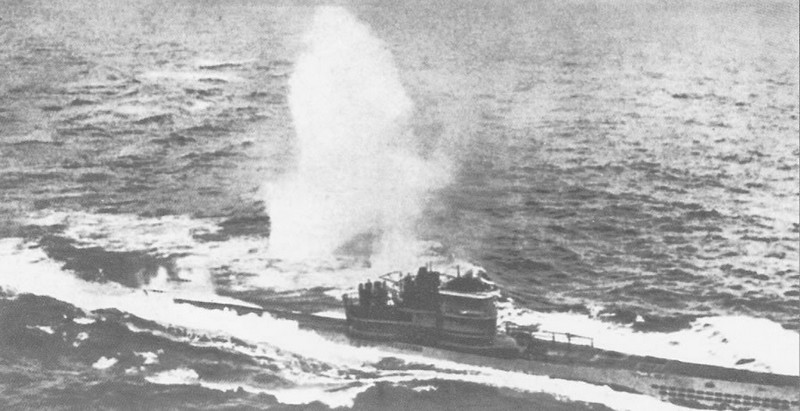
U-966 under air attack

The Type VIIC was powered by two supercharged Germaniawerft, 6 cylinder, 4-stroke M6V 40/46 diesel engines on the surface producing between 2,800 to 3,200 horsepower which gave the boats a 17.7 knot maximum speed on surface. For submerged operations the boats were powered by one of a number of different electric motors whose batteries were charged by the diesels. The electric motors produced 750 horsepower (560 kW) and could drive the boats a maximum of 7.6 knots. In 1944 many of the surviving boats were equipped with the schnorkel apparatus which allowed them to use their diesel engines underwater at shallow depths.  The had a range of 8190 miles at 10 knots surfaced which gave them a decent amount of operational flexibility for their Atlantic operations.

The last Type VII- U-995 (Type VIIC/41) German U-Boat Memorial Laboe Germany

During the war the German U-Boat force suffered grievous losses many of which were Type VIICs. The VIICs performed excellently in combat and many survived engagements that would have sunk less tough boats. The most famous of the Type VIICs of all variants is probably the U-96 which was featured in the epic submarine film Das Boot. A number had post war careers in several navies and the last active VIIC the U-573 which served in the Spanish Navy as the G-7 was decommissioned in 1970 and sold for scrap over the objections of those that wanted to purchase her as a memorial.  The only surviving Type VIIC is the U-995at Laboe Germany where she is a memorial to all the U-Boat Sailors of the Second World War.  Two full sized mock ups one for exterior scenes and one for interior scenes were constructed for Das Boot and the exterior mock up was also used in Raiders of the Lost Ark.

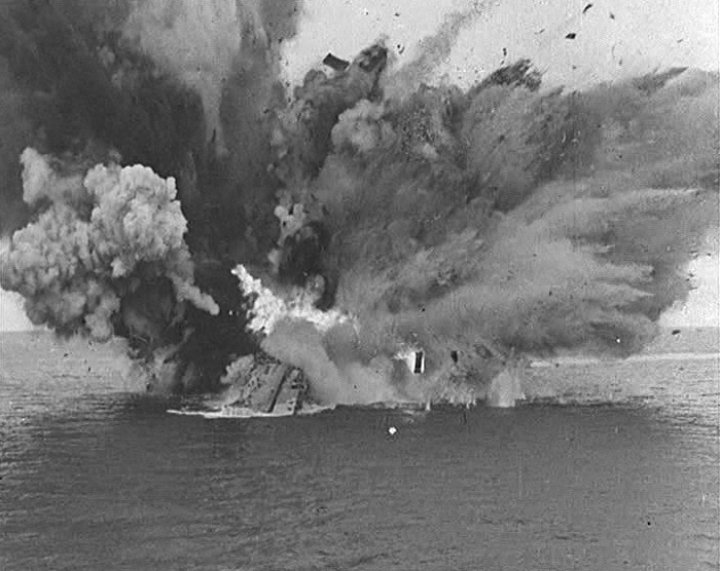
                                                 The Death of HMS Barham  
During the war U-Boats of all types sank nearly 3000 Allied ships including 175 warships among which were the carriers HMS Glorious, HMS Ark Royal and HMS Eagle and the Battleships HMS Barham and HMS Royal Oak. The Germans lost nearly 800 U-Boats of all types and over 28,000 U-Boat Sailors, about 75% of the force.

The films Das Boot and The Enemy Below are excellent reminders of the courage of the men that operated these submarines during the war. Though the Nazi Regime was evil the men of the U-Boat Service often displayed courage and ingenuity in the face of overwhelming odds and they nearly won the war for the Germans.

Peace,

Padre Steve+

1 Comment

Filed under germany, History, Military, Navy Ships, nazi germany, World War II at Sea

Courage is Not the the Province of Ideologues, Right or Left: The Attack of the Ideological and Religious Zealots

Friends of Padre Steve’s World,

Salman Rushdie once wrote: “The moment you say that any idea system is sacred, whether it’s a religious belief system or a secular ideology, the moment you declare a set of ideas to be immune from criticism, satire, derision, or contempt, freedom of thought becomes impossible.”

We seem to be at another crossroads in Western civilization, a crossroads where the classic liberalism that was the basis for democratic societies is being stampeded by zealots of various persuasions who guided by the supposed infallibility of their ideological belief systems, deliberately and without remorse seek to destroy the institutions that are the guardians of liberty.

We have seen the results of such movements in history before and each time they succeed in gaining power they have brought disaster to nations, and sometimes the world.

Proponents of ideological purity assume that their ideological bias is equivalent to sacred truth, be it a religious or secular truth. The promoters of such systems promote something more than their opinion, as Hannah Arendt noted: “For an ideology differs from a simple opinion in that it claims to possess either the key to history, or the solution for all the “riddles of the universe,” or the intimate knowledge of the hidden universal laws which are supposed to rule nature and man.”  As such, ideology is not based on knowledge, but is distinct from it and the enemy of knowledge for it binds the mind in a straitjacket in which all thought must be submitted to the truth of the ideology. As Arendt noted such ideologies must be handled with caution as they “pretend to be keys to history but are actually nothing but desperate efforts to escape responsibility.”  An ideology protects the believer from having to think for himself, it allows the insecure to grasp at the protection that it allegedly provides, and allows the believer to deny reality, and to by definition declare everything that contradicts the ideology to be heretical, and opponents to be aligned with the devil himself, allowing the believer to hate the opponent. As Eric Hoffer noted, “Hatred is the most accessible and comprehensive of all the unifying agents. Mass movements can rise and spread without belief in a god, but never without a belief in a devil.” 

My favorite television character, Raymond Reddington, played by James Spader in The Blacklist once said “I know so many zealots, men and women, who chose a side, an ideology by which to interpret the world. But, to get up every single day and to do the hard work of deciding what to believe. What’s right, today? When to stand up or stand down. That’s courage.” The fact is, no matter how stridently they espouse their beliefs, ideologues are by definition not courageous, because courage takes critical thinking, and even a willingness to admit we are wrong, or somebody else has a better idea, or knows more than we do. This is something that ideologues of any persuasion are incapable of doing.

As for me I consider myself to be a left-leaning progressive. I am pro LGBTQ rights because I believe that they too, like everyone else are created by and loved by God, and as the preamble of the Declaration of Independence states, that we are all “created equal and endowed with certain unalienable rights, among them, life, liberty, and the pursuit of happiness.” I have to believe that Thomas Jefferson and the others who collaborated on that document would be run out of the country on a rail by today’s ideologues, especially those of the Christian Right.

Likewise, despite being against abortion in principle,  I believe that Roe v. Wade and the right of a woman to have an abortion must be upheld. I believe in equality for women, even in the Church, and believe that women are held to a much higher standard than men, especially in politics, religion, and business. I know from experience that women face far greater discrimination in the workplace, academia, and the military than do men.

I believe that racial prejudice, especially against blacks is still a major problem, but it is not certainly not confined to blacks, but Hispanics, Arabs, and Asians. Once again these prejudices are mostly the provence of the political Right, but not confined to it, there are examples of liberal and progressive Whites who intentionally segregate themselves and their families from darker skinned people, especially the less well off ones.

Likewise, there is classic Anti-Semitism, a very specific prejudice and hatred of Jews, and it spans the political and ideological spectrum. I can say that as a historian of the Holocaust and as a gentile Christian.

That being said, to offer criticism of the Government of Israel in its dealings with its Arab and Druse minorities that happen to be Israeli citizens, and to Palestinians who have been the victims of the Pan Arab nationalism of the 1950-1970s is mostly the province far left, who blame all Jews for the actions of the State of Israel, and Neo-Nazis who just hate Jews and would collaborate with anyone to destroy them and Israel.  The sad thing that to state the truth that  most of these Arabs, regardless of their religion find themselves abandoned by Egypt, Syria, Lebanon, Jordan, Saudi Arabia, Iraq, and the Gulf States is not anti-Semitic, but rather an observation of the victimization of people caught in the middle of a far greater political, military, religious, and ideological struggle.

In 2007 I came across a Palestinian refugee camp at the border of Iraq ans Syria at Al Waleed. Thousands of Palestinian Arabs were marooned there, dependent on th U.N. for food and shelter, and the good graces of Americans and Iraqis for security as they had no place left to go. The new Iraqi government didn’t want people who were allies of Saddam Hussein in their country and drove them to their farthest reaches. Syria, Jordan, Egypt, Saudi Arabia, and the Gulf States didn’t want them either. Likewise, the government that should accept them, the Palestinian Authority didn’t want them and they were not welcome anywhere else in the Arab world. Of course, the Israeli government didn’t want them either. This is an irefruable fact. They were abandoned by all.

As far as Anti-Semitism goes, you don’t have to look hard to find it. Neo-Nazis and Holocaust deniers have cottage industries that attemp to disprove or minimize the Holocaust. Most reside on the political Right, such as in France, the Netherlands, Austria, Hungary, Poland, and in some parts of the German political spectrum. But some too make their home of the Left, the Labour Party in Britain has come under the spell of Jeremy Corbin, a Left Wing anti-Semitic leader if one existed at all. Much of the current anti-Jewish and and Israel propaganda from both the Right and Left is often lifted straight out the same source documents, such as The Protoclals Of the Elders Of Zion. Of course the polcies of the Netanyahu government are helping anyone, including most Jews outside of Israel.

I happen to be a liberal and progressive realist, but I cannot be an ideologue. That being said I think that the Presdency and policies of the Trump administration exemplify the worst of American racism and exceptualism. Barely educated racist demagogues hold power over a President whose supporters would support him even if he murdered someone on 5th Avenue. Likewise, I think that there are some progressives who are just as incapable of seeing both sides of an argument and who are as historically as blind, deprived, and ignorant as the most myth bound Christian Conservatives, or other Right Wing anti-Semites. The irony is both sad and rich. I truly must be a progressive realist in wonderland.

It takes no courage to be an ideologue, and once a person surrenders to an ideology as his or her reason for existence, they sacrifice the ability to reason, the ability to think critically, and the capacity to acquire knowledge. That is the danger of the blind ideologies that are consuming our world today. As the late great Manager of the Baltimore Orioles once remarked: “It’s what you learn after you know it all that counts.”  Ideologues never learn that lesson.

Quite obviously, a lot of ideologues from across the spectrum will disagree.

Until tomorrow,

Peace,

Padre Steve+

2 Comments

Filed under anti-semitism, authoritarian government, civil rights, culture, ethics, faith, History, holocaust, laws and legislation, leadership, LGBT issues, middle east, News and current events, Political Commentary, racism, Tour in Iraq

The Clash of the Ironclads: The Battle of Hampton Roads at 158 Years

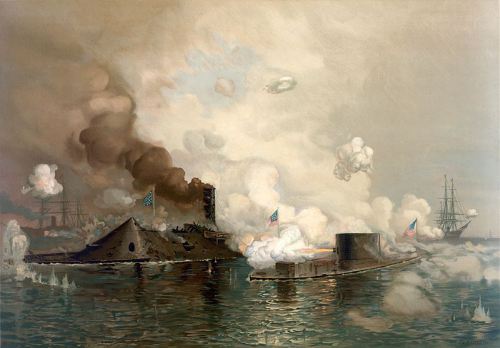
800px-the_monitor_and_merrimac1

Friends of Padre Steve’s World

Yesterday and today mark the 157th  anniversary of an event which changed naval warfare forever, the Battle of Hampton Roads. It was a watershed event which ended the reign of the great wooden ships which plied the oceans of the world under massive fields of canvas sails. 

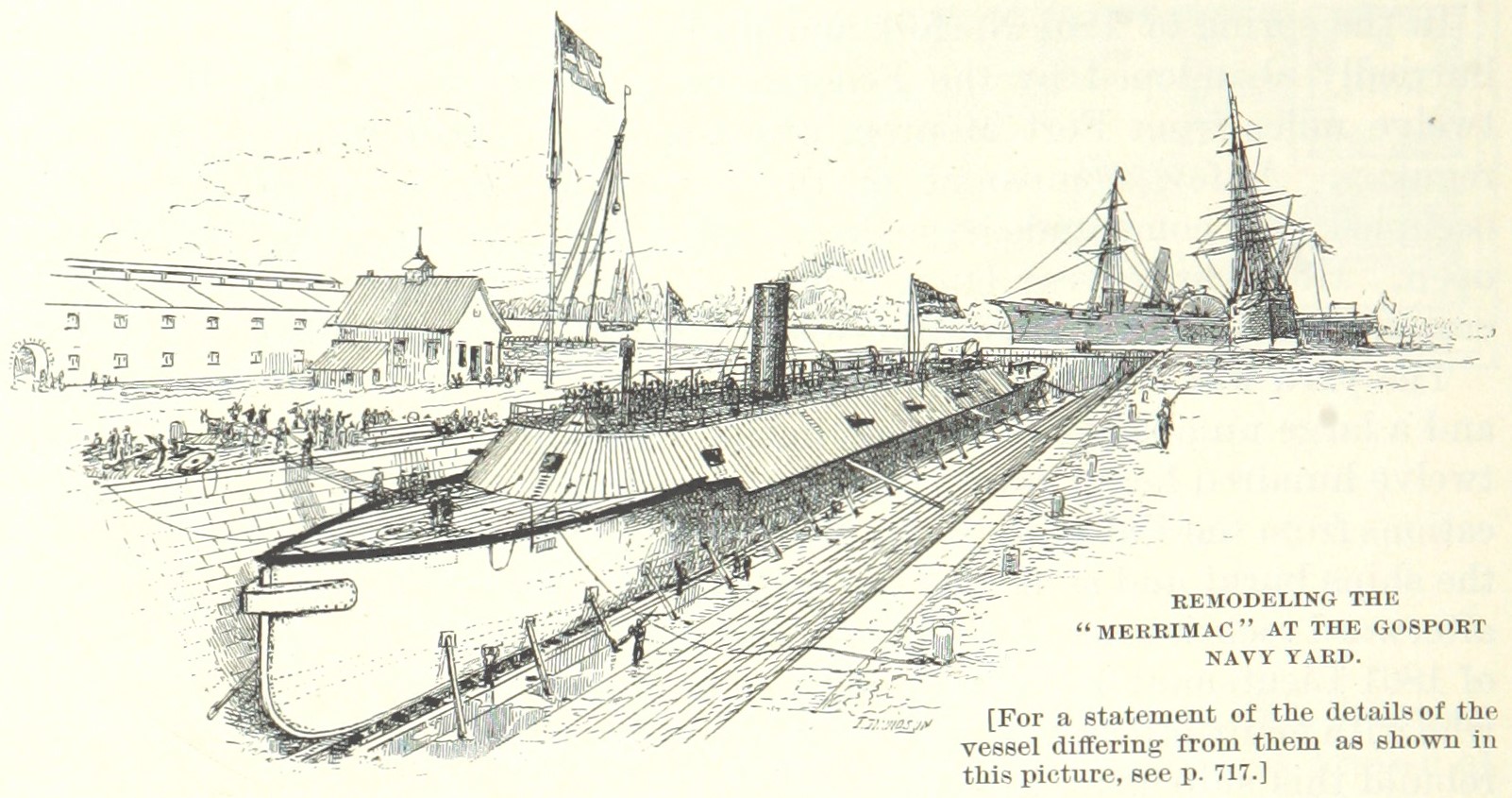
It took place about 10 miles from my current office, which is just a few hundred yards from Drydock Number One, at Naval Station Norfolk, in Portsmouth, Virginia, then called Gosport. It was here that the Confederate Navy, salvaged the wreck of the Steam Frigate USS Merrimac, razed her to the waterline, and constructed an ironclad casemate over her and recommissioned as the CSS Virginia. 

On March 9th 1862, two very strange looking ships joined in battle. This is the story of the Battle of Hanpton Roads and the USS Monitor and CSS Virginia. This is their story, and the story of the men who designed and commanded them. 

Peace

Padre Steve+ 

On the morning of March 8th 1862 the CSS Virginia steamed slowly from her base at at the former US Navy Shipyard, Gosport, in Portsmouth, Virginia into Hampton Roads at the mouth of the Chesapeake Bay. Her mission, break the Union blockade.

Awaiting her was a US Navy squadron of wooden warships including the steam Frigate USS Minnesota, the Sloop of War USS Cumberland and Frigate USS Congress and a number of smaller vessels. Together these ships mounted over 100 heavy guns, and were backed up by the shore batteries at Fort Monroe, on the Hampton side of Hampton Roads.

The Ships, Their Captains, and Designers 

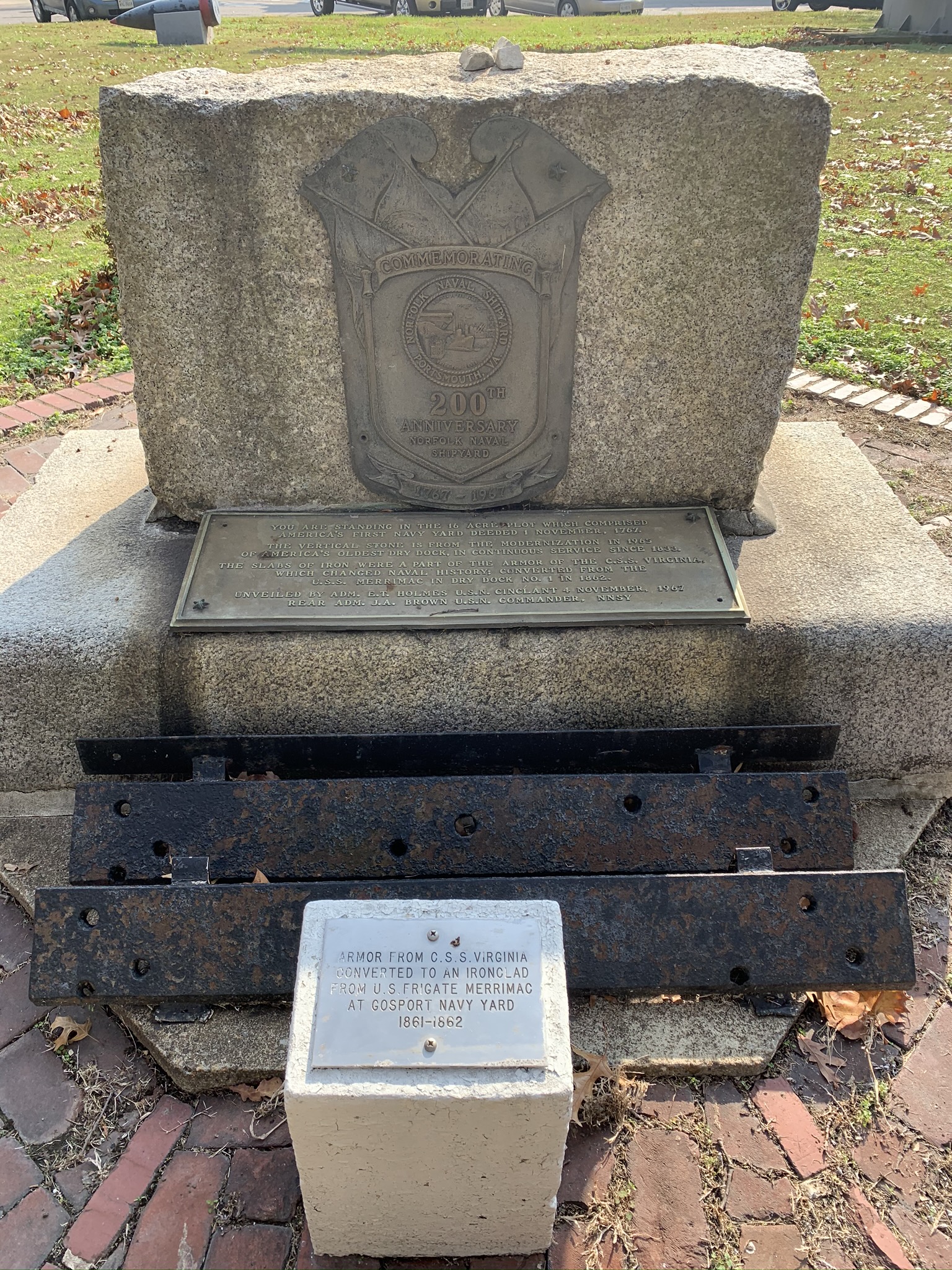
The CSS Virginia was an armored ram built from the salvaged remains of the large steam frigate USS Merrimack, which had been burned at Gosport (Now Norfolk) Naval Shipyard when the Navy abandoned the shipyard to keep her from being captured by the Confederates after Virginia had seceded from the Union on April 20th 1861.  She was raised in May and the wreck was placed in what is now called Drydock Number One, at Norfolk Naval Shipyard, which is the oldest Drydock in the Western Hemisphere, a historic landmark, and still in use on May 30th 1861. Upon inspection it was determined that her hull below the waterline was intact and her engines serviceable. Since Merrimac was the largest ship, wrecked or intact, with serviceable steam engines and boilers; Confederate Secretary of the Navy Stephen Mallory decided that she would be converted into an ironclad.

Her design was that of Lieutenant John Mercer Brooke, a former U.S. Navy officer, and Naval Constructor John L. Porter, who had been a civilian employee of the Navy at Gosport. The design was an ironclad ram, with a massive casemate armored with four inches of Iron and 24 inches of Oak and Pine, which protected her battery of six 9” Dahlgren smoothbores, which were at the Naval Yard, and four 7” Brooke Rifled Guns, designed by LT Brooke and modeled on the design of the Parrot Rifled Gun, used by both sides during the American Civil War.

Her stem and stern nearly underwater, a V Shaped breakwater was mounted forward of the casemate, and an iron ram mounted below the waterline, a throwback in Naval design which had been abandoned since the Middle Ages when cannons became the weapon of choice. This was because the Confederates discover that the guns mounted on her might not be effective against Union ironclads which were being designed. Her design would be the prototype for almost all future Confederate Ironclads.

         Iron Plates from CSS Virginia at the Norfolk Naval Shipyard

However, she was plagued with unreliable engines which had been condemned by the US Navy, even before she was burn and sunk, were scheduled to be replaced during her refit at Gosport. As such, her design limited her to a coastal defense role, and her engines limited her to a speed of 5 to 6 knots. Her turning radius was over a mile and it took her 45 minutes to make a complete circle. Though lethal to wooden ships in enclosed waters, she was hardly a threat to Union maritime supremacy. In heavy seas she would have been a death trap to her crew.

Her Captain, Flag Officer Franklin Buchanan was a former U.S. Navy Captain originally from Maryland. In expectation that Maryland would secede from the Union, he resigned his commission on April 22nd 1861. When Maryland did not secede he attempted to withdraw his resignation but was rebuffed by Abraham Lincoln’s Secretary of the Navy, Gideon Welles. Thus  he left the Navy in May 1861 and joined the Confederate Navy in September 1861. He was appointed commander of the James River Squadron in February 1862 and selected CSS Virginia as his flagship. His Executive Officer was Lieutenant Catsby ap Jones. 

The USS Monitor

However, Virginia’s plans had been leaked to the US Navy by a Union sympathizer at Gosport, and taken to Washington, DC, by a freed slave named Mary Louvestre in February 1862. She met with Welles and sped the efforts of the Navy to complete and commission a number of ironclad ships of different types, but most importantly Welles pushed the Navy and builders to speed up the completion of the USS Monitor. 

Monitor was the brainchild of the Swedish Engineer John Ericsson, who had a troubled history with the US Navy. He invented the Screw Propeller for steamships, an idea rejected by the British Royal Navy, but then recruited by the ambitious American, Captain Robert F. Stockton to come to the United States. His propellers were first used on USS Princeton, for which he also designed a 12” breech loaded, rotating gun named Oregon. The gun which he designed was built in England and used hoop construction, also known as built up construction to pre-tension the breech. This method involved placing red-hot iron hoops around the breech-end of the weapon thereby allowing the gun to take a higher powder charge than previous cast iron weapons, which relied on using thicker iron to take an increased charge, making the weapon larger and heavier without increasing its strength.

However, Stockton moved to ensure that Ericsson was not acknowledged as the primary designer. Likewise, he decided that “his” ship should have two 12” guns, Ericsson’s and his own, which used the older technology and heavier iron, but without the tensile strength of Ericsson’s gun. Its huge size made it the more impressive looking weapon, but with the tendency common to such weapons, to burst.

However, Stockton’s gun was hastily built and had only a few test firings before demonstrating it before President John Tyler, his future wife Julia, former First Lady Dolly Madison and an assortment of cabinet officers, congressmen, and their families, numbering close to 400 on February 27th 1844. While coming back up the Potomac River, Stockton personally fired a shot in honor of George Washington at Mount Vernon. Stockton pulled the lanyard and the left side of the breech blew out, sending large fragments of cast iron, killing Secretary of the Navy Thomas Gilmer, Secretary of State Abel Upshur, Chief of the Navy Board of Construction and Repair, Captain Beverley Kennon. Senator Thomas Hart Benton, Captain Stockton, and another 14-18 crew members and visitors were wounded.

Stockton, who had a benefactor in President Tyler, blamed Ericsson who went on to many other accomplishments, but who refused any dealings with the Navy until Secretary of the Navy Gideon Welles convinced him to design an ironclad in 1861. Ericsson responded with yet another revolutionary design which was at first ridiculed by naval experts. Ericsson based the hull of the ship on that of shallow draft Swedish lumber barges, but constructed completely of iron and not equipped with sails. He armed the ship with a heavily armored turret mounting two powerful 11” Dahlgren guns, which rotated a full 360 degrees. The turret was designed to mount two 15” Dahlgren guns, but they were not yet available. Had those guns been ready, Monitor might have sunk the Virginia.

Monitor was completed in under 100 days as Ericsson had promised. She was laid down on October 25th 1861, launched on January 30th, and commissioned on February 25th 1862. Her Captain was Lieutenant John Worden. Worden had served in the Navy since 1834, and he would go on to many great accomplishments, finishing his career as a Rear Admiral, having commanded another monitor, USS Montauk, Superintendent of the Naval Academy, Commander of the Mediterranean Squadron, and President of the Naval Institute.

However, in February 1862 the relatively old lieutenant took Monitor to sea two days later, but the deployment was cut short by a steering failure, which resulted in the ship returning to New York for repairs. She sailed for Hampton Roads again on March 6th and she would arrive on the evening of March 8th, not long after Virginia had wreaked havoc on the Union ships at Hampton Roads. His Executive Officer was Lieutenant Samuel Dana Greene, son of the future Union General and hero of Culp’s Hill at the Battle of Gettysburg, George Sears Greene. 

The Battle


CSSVirginia1862.2.ws

During the ensuing fight of March 8th Virginia rammed and sank Cumberland which though fatally wounded disabled two of Virginia’s 9” in guns. Virginia destroyed Congress by gunfire which burned and blew up and appeared to be in position to destroy Minnesota the following day as that ship had run hard aground. The losses aboard Cumberland and Congress were severe and included the Captain of the Congress and Chaplain John L. Lenhart of Cumberland, the first US Navy Chaplain to die in battle. During the battle Virginia had several men wounded including her Captain, Franklin Buchanan who during the action went atop the casemate to fire a carbine at Union shore batteries. He was wounded by a bullet in the leg and though he survived he missed the next day’s action.

Cumberland_rammed_by_Merrimac

Due to the coming of darkness and a falling tide the acting commander of Virginia, Lieutenant Catsby Ap Roger Jones her executive officer took her in for the night. During the night Monitor, under the command of Lieutenant John Worden arrived and took up station to defend Minnesota.

603px-Battle_of_Hampton_Roads_Map

The next morning Virginia again ventured out and was intercepted by the Monitor. The ships fought for over three hours, with Monitor using her superior speed and maneuverability to great effect. During the battle Monitor suffered a hit on her small pilothouse near her bow blinding her Captain Worden.  Monitor’s executive officer, Lieutenant Dana Greene, took command. Neither side suffered much damage but the smokestack of Virginia was pierced in several places affecting her already poor engine performance.  Jones broke off the action and returned to Gosport for repairs while Monitor remained on station, still ready for battle.

Gideon Welles wrote after the battle: “the performance, power, and capabilities of the Monitor, must effect a radical change in naval warfare.”

USSMonitor1862.3.ws

It did. The battle showed the world the vulnerability of wooden warships against the new ironclads. Monitor in particular revolutionized naval warfare and warship construction. From that time on the truly modern ships were fully iron and later steel, with revolving turrets, and within twenty years without sails, even as a back up to their steam engines.

Her defining mark was the use of the armored gun turret which over the succeeding decades became the standard manner for large ships guns to be mounted. Turrets like the warships they were mounted upon grew in size and power reaching their apex during the Second World War, only to be superseded by the next revolution in Naval warfare, the Aircraft Carrier.

arizon-main-battery2

Both Virginia and Monitor reached less than glorious ends. Virginia had to be destroyed by her crew to prevent her capture just over two months after the battle on May 11th 1862. Monitor survived until January 31st 1862 when she sank during a heavy storm off Cape Hatteras North Carolina with the loss of 16 of her 62 man crew. The remains of two of those men, recovered during the salvage of Monitor’s engines, turret, guns and anchor were interred at Arlington National Cemetery on March 8th 2012. The relics from Monitor and some from Virginia are displayed at the Mariners Museum in Newport News (http://www.marinersmuseum.org )while one of Virginia’s anchors resides on the lawn of the Museum of the Confederacy in Richmond. Two of her iron plates are on display at Norfolk Naval Shipyard.

Those early ironclads and the brave men who served aboard them revolutionized naval warfare and their work should never be forgotten.

Peace

Padre Steve+

1 Comment

Filed under civil war, History, Military, Navy Ships, US Navy

Coronavirus 19: Just the Facts

Friends of Padre Steve’s World,

I have been working on this article for two days in order to check sources and facts and to try to find the best sources of information for my readers.

The novel Coronavirus, or COVID 19 is now spreading at a rapid rate around the world, after beginning in and wreaking havoc in China, especially Wuhan City and Hudei Province where it began. The first death was reported by China to the World Health Organization on December 31st 2019. By the end of January the total number of infections numbered nearly 12,000, with 259 deaths. The Chinese Communist leadership tried to minimize the outbreak in its official communications, and finally, after delaying, enacted draconian measures to contain the spread of the virus, slowing its advance and buying time for other nations to take action. Even so the outbreak was declared a Public Health Emergency of International Concern on 30 January 2020. https://www.who.int/emergencies/diseases/novel-coronavirus-2019/advice-for-public

Coronaviruses can range from the common cold to more serious diseases, This is a new form of Coronavirus, which can be transmitted from animals to humans. Two of the more recent Coronavirus are  were the Middle East Respiratory Syndrome (MERS) and Severe Acute Respiratory Syndrome (SARS).

Since the World Health Organization declaration at the end of January the total number of cases number nearly 110,000, with over 3800 deaths. Cases have been reported in 103 countries on every continent. However, the numbers are certainly under the actual totals, as many countries, including the United States do not have enough testing kits to detect every case and the incubation period where an asymptotic infected person (someone not showing symptoms but who  is infected) can be up to 14 days, and in a few outlying cases 19 days or more. Depending on the country the average incubation period is 5-6 days. https://www.worldometers.info/coronavirus/

Politics and inept actions in Washington, beginning with the President’s refusal to treat the outbreak as anything serious, and the administration’s initial response to ban non-U.S. residents from China from entering the country helped squander the time bought in China, despite that travelers from the infected region had been traveling around the world for weeks.

This was compounded by flaws in the CDC’s test kits which were discovered by clinicians which led to inconclusive results. It took most of February to troubleshoot the issue and begin deploying the CDC kits. The administration promised a million kits by the beginning of March, but fewer that 100,000 have been issued. Likewise, outside of the CDC the only a dozen research medical centers had the capability to produce their own kits, and the FDA, which is in charge of quality control standards for commercially produced kits and medicines was not brought into the effort until the end of February.

The delay meant that a very stealthy and hard to discover virus, 1/70th the size of a human blood cell, was loose in the United States without means to test for it in the midst of cold and flu symptoms, many of which it mimicked. It is highly contagious and there is no vaccine for it, and most experts don’t believe that there will be one for some time.

The only way to stop the spread is to keep people apart, for weeks because of the slow incubation period. The draconian measures to contain the virus by quarantining a large province have been the only thing that has slowed the rate of new infections. Italy, which has seen a massive spike in infections and deaths has quarantined Lombardy and the 12 nearby provinces. This is the industrial heartland of Italy, and the effect on the Italian economy will be great, as well as on companies which rely on the region for vital products.

As of today the United States has tested less than 2000 people for the virus, but the CDC  removed numbers tested from their website on March 2nd. This was probably a political move as it occurred shortly after Vice President Pence was designated to lead the fight against the virus. Shortly after Pence was named, it was announced that no Federal Government Health agency, civilian or military should release any information without clearing it with the Vice President first. The optics of this make it look like the administration is deliberately withholding information that could prove damaging to it and the President.

Even as the virus spread exponentially over the past week the President and the CDC are underplaying it. According to EU data, COVID-19 has been confirmed in 32 American states. According to CDC, it’s 19. According to Johns Hopkins tracker, there are 516 confirmed cases and 21 deaths. This is in large part due to the few tests conducted in the United States. https://coronavirus.jhu.edu/map

However, according to the CDC there have only been 164 cases and 11 deaths. https://www.cdc.gov/coronavirus/2019-ncov/cases-in-us.html

The President still speaks as if there is no threat and downplays warnings from scientists and doctors. He surrounds himself with yes men who dare not cross him. He has done that in almost every branch of the Executive Branch, and now lives are at stake, as he, as he always does, knows more about the subject than experts. On Friday, Trump commented at Mar-a-Lago:

“I’m not concerned at all,” the president said when asked about Coronavirus getting closer to White House. “We’ll hold tremendous rallies,” he said — rallies will continue.“

Such rallies, while they boast the President’s ego, will endanger the lives of his supporters.

A report by a research group in Washington State suggested that based on genetic similarities between the first person diagnosed in the state and the United States, who had traveled to China, and a teenager in the same county who tested positive recently, that the virus could have been spreading undetected in Washington for up to six weeks. They considered their results “statistically significant.”

The spread of the virus has not been good for the global economy, and after over a month and a half of living in denial the world financial markets have taken major hits. The Dow Jones is down almost 4000 points; and other U.S. and foreign exchanges are losing similar amounts of their value. Likewise, bonds are down, oil is down, and the Federal Reserve dropped the Prime Rate by a quarter of a point to try to prop up the economy and prevent a recession, but there is little else they can do. The rates are nearly as low as they can go, and the Trump tax cuts when the economy was good have ballooned the budget deficit and national debt, so there is little wiggle room to pump up the economy.

However, the real problem is that we now live in a global economy, which is linked via supply chains dependent on the rapid movement of parts, materials, and manufactured goods, because most companies now rely on “just in time” supply systems rather than maintaining large inventories. Supply disruptions will be a major part of any recession, because they will lead to closed factories, stores, and put many people out of work. It will be a recession unlike any other we have experienced. Commerce is based on people coming together, and if governments “pull out all the stops” to contain the virus as the World Health Organization has urged, countries will have to do what China did and Italy is doing. Factories will shut down, entertainment venues will close, stores dependent on delivery of goods from across state or international boundaries will shutter as interstate travel and movement is banned with exception of absolutely essential items, and people will stop going to restaurants. Based on his actions so far I cannot see President Trump taking those kinds of actions.

There are also national security concerns, the virus could hurt American military readiness, and ability to train and deploy forces. Depending on how bad things get, it could cause social and political disruptions in countries where economies are on the edge, and where race based populist movements enjoy significant influence. Such movements often repress racial and religious minorities at home, and seek conflicts with their neighbors to settle old scores, or to take control of contested areas.

Hard decisions have to be made if this outbreak is to be stopped from becoming a major epidemic. The number will certainly be safe.

I will write about my experiences during the AIDs outbreak and dealing with it as both a Medical Service Corps officer in 1987-88, as a civilian hospital chaplain at Parkland Memorial Hospital in Dallas from 1993 to the end of 1995, as well as as an ICU Chaplain during the H1N1 flu pandemic in 2008-2009.

So until tomorrow, be safe, stay informed, and prepare. If you are sick, try not to expose others and seek medical treatment, and by the way, wash your hands.

Peace,

Padre Steve+


12 Comments

Filed under Diseases Epidemics and Pandemics, News and current events, Political Commentary

The End of an Exhausting Week: Community, Coronavirus, and Comparisons to the Past

Friends of Padre Steve’s World,

The past week has been difficult with the corporate destruction of what used to be our version of Cheers, battling the emotions that came with that, as well as a couple day relapse into coughing most of the night and being unable to get any sleep, and obey the directive, that if one was sick one should not go to work. But, even so I was unable to get anything of substance accomplished, tired, and drained both emotionally and physically, by Wednesday night I was on the mend and able to go back to work yesterday and today. However, Thursday was busy but at the same time productive, even though I was running as if my Warp Core had been drained and I could barely get by on Impulse power. I slept fairly well Thursday night and today my propulsion and other systems were nearly back to normal.

Friday evening we were able to reunite with a good number of friends and some of our former bartenders and General Manager of our Gordon Biersch met at a locally owned Irish restaurant and bar, where the management and employees welcomed us, expressing the shock and surprise at what happened. It was a night to reunite with our friends, our extended family and community. It was nice, we were all on the same side on the bar, and the former customers were paying for the meals and drinks of those who over the last decade did so much to take care of us.

I have a number of things I will be writing about over the next few days; the Coronavirus 19 pandemic and our government’s mostly inane response to it, Season Three of Babylon Berlin, and the anniversary of the historic duel between the USS Monitor and the CSS Virginia, as well as the race for the Democratic Party nomination to run against President Trump in November, and the challenges that face the United States and World in light of the Coronavirus. Likewise, I need to update you on my Reading Rainbow. 

There are some interesting historical parallels to now and the events during the years between the First and Second World Wars which are worth exploring, including the Spanish Flu Pandemic of 1918-1919, world economic fluctuations which culminated in the Great Depression, as well as the rise of Left and Right Wing extremist parties that brought about the authoritarian rule of various Fascist, Communist, and Racist parties in Europe and Asia, which also spread to the United States and Great Britain, but in the latter they did not seize control, as they did in Germany, Russia, Italy, Hungary, Poland, Japan, and other smaller, less powerful countries; nor did they destroy the democratic and constitutional underpinnings of government as they did in France in the 1930s. However, as always I digress.

I am tired and need to get to sleep. I promise to get back on schedule, even as I watch Izzy and Pierre having their nightly Papillon war at my feet. So until sometime Saturday night or Sunday morning I wish you all well.

Peace,

Padre Steve+

2 Comments

Filed under Diseases Epidemics and Pandemics, healthcare, History, Loose thoughts and musings, Political Commentary

They are silent with regard to the pernicious effects of their own gains. They complain only of those of other people.” The War Against Workers and a Capitalism that Adam Smith wouldn’t Recognize

Friends of Padre Steve’s World,

It’s not Labor Day, but it might as well be. It is time to speak up for workers. For decades organized labor has been demonized by the descendants of people who died to secure decent working conditions, wages, and benefits for regular hard working people. However, most of us, living in our own work or social media cocoons don’t realize this is going on until it hits people we know personally. I wrote about that in my last post.

The attacks on labor and workers have become much more pronounced under the Trump Administration than any prior administration since that of Herbert Hoover. But must of us who don’t work in big corporations, in the service industry, or in other fields where they have no employment protections and are victimized by CEOs, COOs, and the hedge funds that scoop up businesses and then sacrifice them for profit.

One can look at every economic depression or recession since Capitalism can be traced to the overreach of those who can make a profit out of scamming investors and victimizing workers, using the police power of government if needed. Sadly, the Trump Administration is the worst at doing this since the administration of President Herbert Hoover, who did nothing to help failing business, or unemployed, yet highly skilled workers during the Great Depression, and then ordered the Army, under Douglas MacArthur to attack veterans protesting to get their promised pensions from the First World War. Likewise, Hoover’s praise for the Italian dictator Mussolini was condemned by Marine Major General Smedley Butler, with the result that Hoover attempted to have the great Marine prosecuted and tried by Court Martial, the charges were dismissed, but Butler was denied the chance to become Commandant of the Marine Corps, and forced to retire.

Butler would later write the classic War is a Racket which serves as a reminder of how little many supposedly patriotic business leaders and politicians, would so easily defraud their country and at the same time abandon their employees and the soldiers who they claimed to support. Though not a union member, I marched in support of SEIU employees at Cabell-Huntington Hospital in the fall of 1998, and I have consistently spoken about the way workers have been denied collective bargaining, and been defined as “Human Resources” as if they were no better than any other “resource”.

They are considered fungible assets, easily disposed of when their corporation overreaches and places itself in immense debt. I saw that this week when Craftworks Holdings closed our version of Cheers with no notice, and scant severance for non-managerial employees.

So tonight I finish up with an old article about the struggle for workers and their rights.

Until tomorrow,

Peace,

Padre Steve+

Abraham Lincoln, who was perhaps our only President who was a real working man once said, “If any man tells you he loves America, yet hates labor, he is a liar. If any man tells you he trusts America, yet fears labor, he is a fool.” 

It seems that nothing about humanity ever changes, even so it is hard to believe that at one time American workers had no rights and I am not talking about African American slaves who as slaves didn’t even count as human beings. No I’m talking about the people Mel Brooks called in Blazing Saddles: “the white God fearing citizens of Rock Ridge” and for that matter every place and every race in America.

It was not until the mid-1800s in the United States and Europe that workers began to organize and protest for the right to decent wages and working conditions. But this came at a cost; the loss of jobs, homes, property, prison, deportation, deportation, and death.

There were many instances when this cost workers and labor organizers their lives. Employers, often backed by heavily armed private security contractors like the Pinkerton Agency, used deadly force to break up peaceful strikes. In the days of the Robber Barons, when business ran the government at almost every level, employers frequently called in local and state law enforcement, as well as the National Guard, and occasionally Federal troops to break strikes. They played various ethnic and racial groups off of each in order to divide the labor movement. There are hundreds of instances of such violence being used against workers, in some strikes the dead numbered in the hundreds.

                           Troops Putting Down the Pullman Strike 

Some of these attacks on workers occurred in major cities, others at isolated work sites and factories. Some are famous, the Haymarket Massacre of May 4th 1886 in Chicago, the Pullman Strike Massacre of 1894, the Homestead Strike and Massacre of 1892, the Latimer Massacre of 1897, the Ludlow Massacre of 1914, and the Columbine Mine Massacre of 1927.

Others less so, but there was more. In the Bisbee Deportation of 1917 1300 striking miners and their families were deported from their homes in Bisbee Arizona by 2000 armed deputies, put in box cars and transported 200 miles to the New Mexico desert, where without food, water or money they were left. There was the Triangle Shirtwaist Factory Fire where managers locked the doors in order to ensure that the fleeing women workers did not put anything unauthorized in their purses. One hundred forty-four workers, mostly young women died, many jumping from the burning building to their death.

Police and other Onlookers Looking up at the burning Triangle Shirt Factory with the bodies of Women Workers who jumped from it at Their Feet

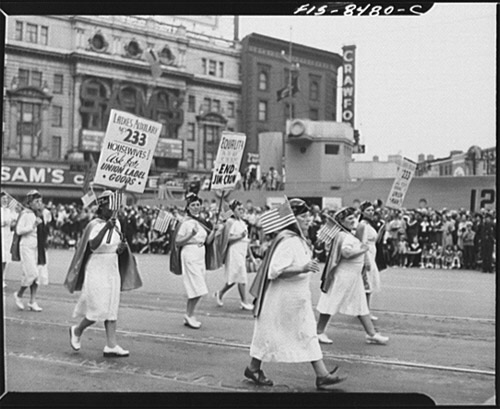
Early labor organizations such as the Knights of Labor led the effort to bring about better conditions. For doing so they were labeled subversive and even called communists. Their meetings were often attacked and the leaders jailed and some lynched.

                                                      Eugene Debs

The sacrifices of those early workers, and organizers are why we have Labor Day. One of the early American labor leaders was a man named Eugene Debs. Debs eventually became a Socialist, but he said something remarkable which still is as timely as when he uttered the words:

“I am opposing a social order in which it is possible for one man who does absolutely nothing that is useful to amass a fortune of hundreds of millions of dollars, while millions of men and women who work all the days of their lives secure barely enough for a wretched existence.”

I wish that wasn’t true but it is. The Social Darwinists who follow Ayn Rand as if she were the Prophet and who populate Wall Street boardrooms and every major school of business ensure that it is. The disparity between wage laborers and CEOs is higher than it has ever been. But I digress…

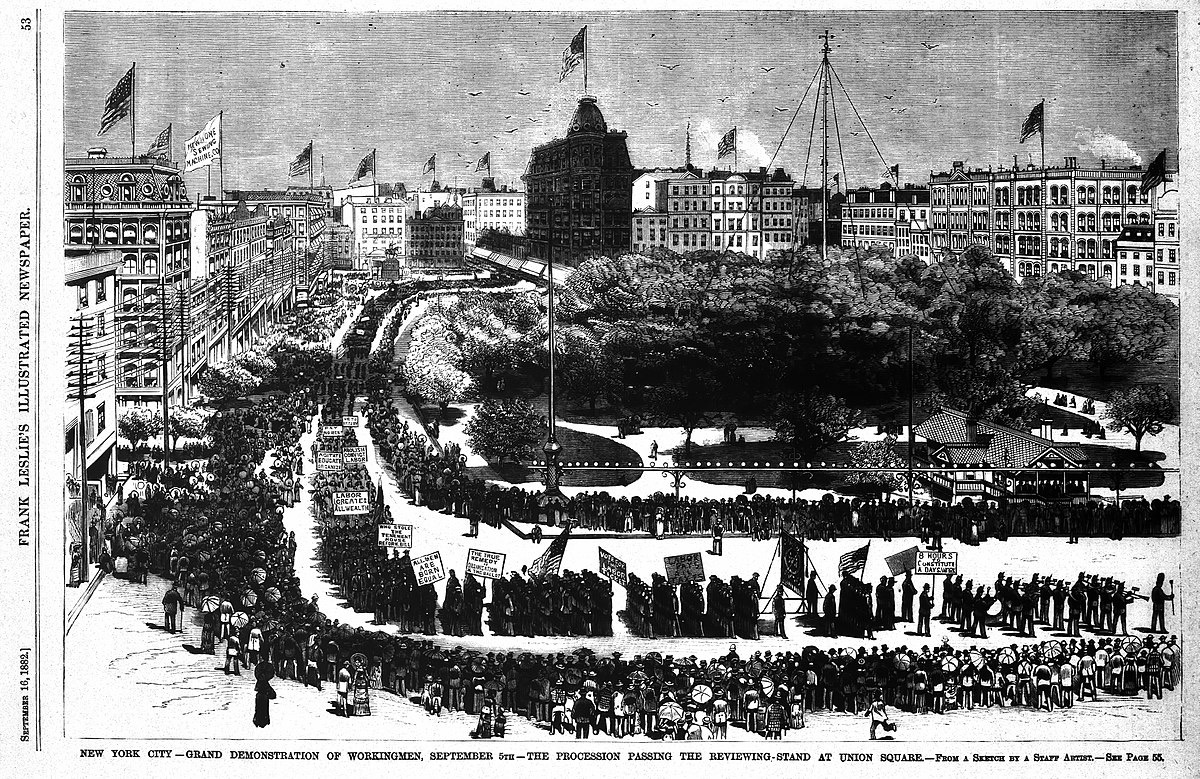
On September 5th 1882 the first Labor Day was observed when members of several Unions in New York City organized the first Labor Day parade. The police came armed and ready to intervene if the workers got out of hand, but the parade was peaceful. It ended and the marchers moved over to Wendell’s Elm Park where they had a party. Twenty-five thousand Union men and their families celebrated, with hundreds of kegs of lager beer.

Within a few years many states began to institute Labor days of their own. In 1894, just days after the violent end of the Pullman strike in which Federal troops and Marshalls killed 30 workers and wounded 57 more, Congress and President Grover Cleveland rushed through legislation to establish a Federal Labor Day.

My Great Aunt Goldie Dundas was a labor organizer for the International Ladies Garment Worker’s Union in West Virginia in the 1920s – 1950s. I wish I had gotten to really know her, but she died when I was about 8 or 9 years old. Sadly the workers represented by that Union have had almost all of their jobs in the textile industry outsourced to China, India, Pakistan, the Caribbean, and Bangladesh where cheaply made garments are produced, and workers abused. The examples of mass deaths due to safety issues and fires in Bangladeshi factories are too numerous to list. But then who cares? The fact is you can drive through many parts of the South and see the poverty created by the exodus of these Union employers, the textile industry, which was part of the fabric of the South is gone. Empty factories and poverty stricken towns dot the countryside. I saw a lot of them living in Eastern North Carolina, towns that once thrived are ghost towns, riddled with crime, unemployment and no hope, unless Wal-Mart opens a store in town. Ironically it sells the clothing made overseas that used to be manufactured by the parents, grandparents and great-grandparents of the people who live there today.

Adam Smith, the father of Capitalism understood it in a very different manner than those who claim to be Capitalists today, especially those who inhabit the Trump Administration. He wrote in his magnum opus, The Wealth of All Nations:

“In regards to the price of commodities, the rise of wages operates as simple interest does, the rise of profit operates like compound interest. Our merchants and masters complain much of the bad effects of high wages in raising the price and lessening the sale of goods. They say nothing concerning the bad effects of high profits. They are silent with regard to the pernicious effects of their own gains. They complain only of those of other people.”

The fact is that today, labor is under threat. Unions have been demonized by politicians and pundits and their power and influence much reduced. Some of this was due to their own success in improving conditions from workers, and not just Union workers. When my dad retired from the Navy in 1974, he went to work at one of the few non-Union warehouses of the John Deere Company in Stockton, California. While they were not union, the workers received every benefit won by the majority of the workers in the company who were members of the United Auto Workers Union. Due to that my dad had high wages, excellent working conditions and benefits. The company had a program for the children of workers, which allowed them to work in the summer in the warehouse and receive incredibly high pay and benefits while in college. I did that for two years, and it helped pay for much of my college. I was not a union member but I benefited because Union men and leaders did the hard work to make that job happen.

However, in many places, Unions and labor are under attack, sometimes not just by corporations, but also by state governments, and now the Federal Government. Job security and stability for most American workers is a thing of the past. Federal and State agencies charged with protecting those rights, including safety in the workplace are being cut in the mad rush to reduce government power. Corporations are offshoring and outsourcing jobs without regard to American workers or the country itself. Part of that is due to globalization and I understand that, but these companies frequently relocate jobs to places where they can exploit workers, deny them benefits, pay them less, and suffer no penalty for ignoring safety procedures or harming the environment. It seems to me that we are returning to the days of the Robber Barons. I wonder when violence against workers and those who support them will be condoned or simply ignored.

Pope Leo XIII wrote in his encyclical Renum Novarum:

“The following duties . . . concern rich men and employers: Workers are not to be treated as slaves; justice demands that the dignity of human personality be respected in them, … gainful occupations are not a mark of shame to man, but rather of respect, as they provide him with an honorable means of supporting life. It is shameful and inhuman, however, to use men as things for gain and to put no more value on them than what they are worth in muscle and energy.”

He also wrote:

“Equity therefore commands that public authority show proper concern for the worker so that from what he contributes to the common good he may receive what will enable him, housed, clothed, and secure, to live his life without hardship. Whence, it follows that all those measures ought to be favored which seem in any way capable of benefiting the condition of workers. Such solicitude is so far from injuring anyone, that it is destined rather to benefit all, because it is of absolute interest to the State that those citizens should not be miserable in every respect from whom such necessary goods proceed.”

But sadly there are far too few church leaders of any denomination who will take the side of workers or the poor, and when they do they are either condemned by the disciples of Ayn Rand or politely thanked and ignored by politicians and corporate leaders.

So please, when you celebrate Labor Day, do not forget that it is important, and that we should not forget why we celebrate it. If we forget that, it will become a meaningless holiday and our children may have to make the same sacrifices of our ancestors.

Labor Day is a day to remember the men and women, some of them former soldiers, workers, labor organizers, and leaders; some of whom were killed by National Guard and Federal troops for their effort, who paved the way for workers today. We cannot forget that. So when you see a politician attacking Labor and seeking to diminish workers rights or benefits ask them what Abraham Lincoln or Adam Smith would think. If they can’t answer, turn your backs on them and start fighting for what is right.


AFP PHOTO/FILES (Photo credit should read AFP/AFP/Getty Images)

Dr. Martin Luther King Jr., who always stood for the rights of workers no-matter what their race, creed, or color, said:

“We must rapidly begin the shift from a “thing-oriented” society to a “person-oriented” society. When machines and computers, profit motives and property rights are considered more important than people, the giant triplets of racism, materialism, and militarism are incapable of being conquered.” 

Likewise, one cannot forget that Dr. King was assassinated when he went to Memphis to support the Memphis Sanitation Worker strike.

This my friends is why Labor and the protection of working people from those who abase them, mistreat them, and exploit them for profit is so important. What passes for Capitalism today is a cruel form Social Darwinism that Adam Smith wouldn’t recognize. It is slavery without chains, called Right to Work which destroys families by making both parents work just to keep afloat, and in ways that separate them from their children. Racial and ethnic minorities pay a higher price than white suburbia, as do poor whites in the South, Midwest, and Appalachia, the latter who due to conservative regions beliefs, and racism, support by electing people bent on killing their jobs, economic, and educational prospects.

The fact is my friends is the truth. It’s an incredibly uncomfortable subject to discuss, but if we have a choice. We can join the perpetrators and use people to advance our own interests; we can be victims, or worse, we can be bystanders, who turn our backs and allow such evils to continue.

7 Comments

Filed under civil rights, economics and financial policy, ethics, History, labor, laws and legislation, leadership, News and current events, Political Commentary, Religion, US Presidents, world war one

The Night Our “Cheers” Closed: How Corporate America Destroys Community


Friends of Padre Steve’s World,

Sunday night was the last night that our version of Cheers for the last fourteen years closed forever. About 5 PM at no notice a representative of the corporate headquarters came in and told our General Manager that our Gordon Biersch Brewery Restaurant would close at the end of the evening for good. The employees were given no notice, one day they had a job, the next day they didn’t. The fault was not theirs, it was an out of touch corporation, which over extended itself by buying up an already bankrupt restaurant chain, Logan’s Roadhouse, and then neglecting its thriving brewery restaurants of the Gordon Biersch, Round Rock, Chicago Pizza chains, and other brands. The CEO is the former CEO and Managing Parter of Logan’s, owned by the venture capital company Centerbridge Partners, L.P.

In fact, rather than a corporate owned operation, our brewery-restaurant had the feel of a local neighborhood bar, like the one called Cheers. It really was a place where everybody knew your name. It became a gathering place for friends, who along with the managers, cooks, bartenders, servers, and hosts became like an extended family. Yes, there were some who were assholes and acted overly entitled, and others that pretty much kept to themselves, but overall the clientele embraced a broad spectrum of people. Everyone from businesspeople and bankers, military personnel, reachers, professors, doctors and dentists, pensioners, day workers, shipyard workers, technicians and IT types, small business owners, retail workers, bartenders, cooks, and servers from other restaurants of a wide variety of races and, ethnicities, nationalities, and religions, straight and gay, with ages from the twenties to the nineties.

For the most part we cared for each other. We looked out for the bartenders and servers. We had each other over for dinner, for holidays, those with building or mechanical skills donated time to help those less proficient or unable due to illness or physical disability. We all pitched in when money needed to be raised for individuals or groups, proceeds from tapping parties went to charities.
In a way I became the unofficial chaplain, performing three marriages, one funeral, providing counseling, or just listening, and making hospital visits.

We gathered to visit, talk, listen, joke, on good days and bad. To watch football, soccer, baseball, hockey, the Olympic Games, the World Cup, to talk about our days, to have a listening ear, over a beer. We had parties there, celebrated Oktoberfest, the New Year, but mostly came together at the end of a day, to download and relax, to share and to care, each in our own way. A few of us, including me got a chance to work with the brewer to brew a beer of our choice. I got a chance to learn the process of how to brew what we called The Padre’s Pilsner, a crystal clear champagne like  German Pilsner, hoppy, but not overly so, crisp without being too bitter.

My wife Judy specialized in making people happy by making them beautiful jewelry and pendants, which she mostly gave to the servers, hosts, and bartenders. When Judy was in the hospital for cancer surgery and knee replacements it was bartenders and servers who visited her, and who came by the house to visit when she was recovering, not people from church or Navy Chaplains. It was our executive Chef who cooked her special menu items which she could eat based on gastrointestinal ailments.

At about 6:00 PM on Sunday we were informed that a representative from corporate had come in, and told our General Manager that the restaurant would close forever that night. Many of us came in for a final last call. There were tears, and laughs as we remembered the good times, tears as we thought of the closing, and friends who had passed away. We shared hugs, stories, and collected our steins, even for friends who couldn’t be there. Sunday night I was so discombobulated and unfocused that I couldn’t think straight, I couldn’t write, I couldn’t even focus on television or books.

But now as I previously mentioned, thanks to the CEO of Craftworks Holdings, a man who has managed restaurants, but never breweries, and the hedge fund managers at Centerbridge Partners. They are sacrificing the jewels of their corporation, the unique craft brewery restaurants to prop of a steakhouse that has been rescued from bankruptcy once, then acquired by Craftworks, whose CEO had been the CEO and managing partner of that steakhouse until 2018. But don’t take my word, just google these things these things and you will find articles in the Wall Street Journal, the Craft Beer Journal Brewbound, and many local papers, and you can see the history and scale of the decline of what were once the trademark brands of Craftworks, which were all once described as growing and innovative have been crushed by cut after cut, even extremely profitable location on Honolulu’s Waikiki, where landlords disputed the reasons Craftworks gave for shutting them down. In our case the restaurant still had over a year left on its lease, the lease was not expensive, and despite the best efforts of Craftworks to make it less competitive, by dropping Happy Hour prices on weekends and when major sporting events were going on, which drove some customers to other restaurants, who carried the NFL package and lowered prices of their drinks and appetizers, it was still profitable. If I was a betting man I would say that since 2018 that corporate has been trying to drive customers and staff away, yet they still came.

Now, our Gordon Biersch Cheers family has lost its home. Thankfully, many of us are still committed to friendships and will meet Tuesday night at another local brewery restaurant. It’s not as fancy, but it will do, and we know that the owners there, local people, not venture capitalists will appreciate our business, as will any number of the other locally owned craft breweries.

The sad thing is that the venture capitalists often back ventures that fail, making vast profits while leaving the businesses the leverage in ruins. Quality, sacrificed for cheapness, loyalty, for the mass market, community, for a mass of unknown and uncared for customers who are rushed in and out of restaurants at a rate slightly slower than fast food operations. The same can be said for almost every business organization that has been taken over by the venture capitalists. They have been destroyed, parted out, and many operations moved overseas to China, India, Malaysia, Pakistan, South Korea, the Philippines, and a host of other nations, whose people, environment, and living conditions we don’t care about while at the same time transferring the worlds wealth to the richest oligarchs.

It’s happening here. We have record employment but wages are still pitifully low, and many work more than one job to make ends meet. Even then, quite a few people are only a paycheck or two from bankruptcy. Our friends, other than management, who worked there did receive a severance, of two weeks pay at $2.13 an hour, the base minimum wage of restaurant workers, without tips, and of course all taxes will be diverted from what the corporate spokesman said was “compensating” the employees, regardless of the fact that quite a few have worked there a decade or more. It’s really shitty how corporate America treats hard workers, as well as those who are loyal to their employers. On Monday when the employees came in the trucks and men from corporate were already there, the move had been planned for some time, but the failed to notify Armada Hoffer, which holds the lease. They didn’t find out that the restaurant had closed until Monday. It’s immoral, it’s evil, and it will destroy our country. I talked to two friends tonight whose corporations are being reorganized even now. Both have their doctorates and the industries that they are in are making huge money, often assisted by agencies controlled by Trump appointees.

We didn’t learn the examples of 2008, and what happened to our little group, will happen again, and probably worse than in 2008, as the Trump Administration has loosed the bonds of the modern Robber Barons. Our little diverse family is now yet another victim of them. I worry more about our employees who are now out looking for jobs. But we will do our best to stay together.

So, until tomorrow,

Peace,

Padre Steve+

2 Comments

Filed under economics and financial policy, ethics, laws and legislation, Loose thoughts and musings, News and current events, Political Commentary

Faith, Doubt, and the Little Things: Thoughts at the End of a Long but Good Week


Friends of Padre Steve’s World,

It has been a long, tiring, yet very good week. For those who have followed me on this blog for so long, I want to say thank you. I left my last assignment broken, dispirited, struggling with my faith and calling, but as a result of a series of events regarding my retirement, my faith has been renewed and my sense of calling and joy to serve as a Priest restored. That doesn’t mean that I don’t experience doubts, or question doctrine, or even wonder about the existence of God. I wish that I can say that that wasn’t the case, but the fact is that all of us, believers or unbelievers alike live in what the German Pastor, theologian, resistier and martyr to Adolf Hitler said:

“Man no longer lives in the beginning–he has lost the beginning. Now he finds he is in the middle, knowing neither the end nor the beginning, and yet knowing that he is in the middle, coming from the beginning and going towards the end. He sees that his life is determined by these two facets, of which he knows only that he does not know them”  

Whether we believe or don’t believe; are fixed in our religious doctrine or non-religious ideology, or doubt as I so frequently do, the fact is that we live in the uncomfortable middle. Truthfully, we come from a beginning that we can only only make ultimately unprovable theological or scientific theories of origins; and move to an end, that while it certainly will happen, either in apocalyptic fury, or where either we ourselves will destroy most of the life of the planet, save the Cockroaches, or the Sun goes supernova and consumes the Earth and the rest of our pitiful solar system, unless the dreams of Gene Roddenberry come true. Truthfully, I have learned in my almost sixty years of earthly existence to be okay with that. Others religious and non-believers alike aren’t okay with that, simply because they require certitude.

The seeds of this idea were planted over 25 years ago during my Clinical Pastoral Education Residency, at Parkland Memorial Hospital confronted me about my “illusion of control” after a case conference. He was frustrated with me, and for him it was a throw away comment, but is penetrated the armored belt that I had surrounded my heart, soul, and intellect with for years, even before I became an Army officer in 1983.

I mentioned a lot of the week last night. I have felt a renewal of faith and call; a joy in ministry and caring for people that I haven’t experienced since my time in Iraq, which was quite literally, “the best of times and the worst of times. At the same time, while I believe, I doubt. As Father Andrew Greeley wrote in his novel The Bishop and the Beggar Girl of St. Germain: 

“Do you exist? I think not. I have never seen you or touched you or felt you. Well, sometimes I think you’re present but that may be wish fulfillment. Intellectually, I have no reason to believe. Yet much of the time I act like I do believe …. Only when I have time to reflect do I feel doubts, and then after the doubts certainty that the universe is cold and lonely. I know that I am a hypocrite and a fool. Then I preside over the Eucharist in my unsteady bumbling way and I know that you are. I don’t believe but I know.”

The words reflected what I was going through. I believed, but I didn’t. Of course that would not only continue as my tour in Iraq progressed but got worse after I returned from Iraq. However, I discovered, much to my surprise that I was not alone. That there were a number of other very good, caring Chaplains, Priests and ministers going through similar doubts, fears and pain.

The irrepressible Bishop Blackie continued:

“Most priests, if they have any sense or any imagination, wonder if they truly believe all the things they preach. Like Jean-Claude they both believe and not believe at the same time.”

The words were and still remain an epiphany to me. Belief and unbelief co-existing simultaneously, yet in a way strangely congruent with the testimony of scripture, the anguished words of a man whose son was possessed by an evil spirit confessing to Jesus: “I believe, help my unbelief.” Maybe that is why in the Liturgy of the Eucharist we proclaim the mystery of faith, or as it is translated from Latin into German Geheimnis des Glaubens. That mystery, is that Christ has died, Christ has risen, Christ will come again. That really is the mystery of what Christians call faith

We can be reasonably certain from non-Christian sources like the Jewish historian Josephus, and the Roman Letter to Trajan, written by Pliny the Younger, that there was a man name Jesus who was crucified by the Romans, and whose followers believed that he had died, been buried, had risen from the dead. Likewise, It was the testimony of those early believers in Scripture and non-canonical writings, that he would come again. Pliny described them as model citizens whose only fault, was that they would not burn incense and proclaim that Caesar was Lord, and sought the advice of Emperor Trajan on what to do with them. Before and after that many gave their lives peacefully as martyrs for this crucified man named Jesus.

That is why as strongly, or as doubtfully we believe as Christians, what we believe is based upon faith, mixed with fact, which until those words become reality, cannot be proven. Which is why some priests, like the fictional Jean Paul in Greeley’s novel and me “ both believe and not believe at the same time.”

I don’t know if that makes any sense, but in this season of Lent where Christians are called to draw near to God in order to be transformed by God’s love, and share it with others through their lives and actions, not just words, platitudes, and certitudes, but being humble servants of others we come to experience a renewal of life which can only be described as mysterious.

So that is it for the night and I hope that no matter what you believe that you experience joy, love, and even come to revel in the mystery that we call life and faith, and share that love, human, and or divine with others. After all, a smile, a friendly greeting, an expression of care from a friend or stranger, looking into someone’s eyes with care and concern, may be the only good thing that a person living a lonely, sad, and anxiety filled life, might experience that day. As my one of my football coaches in high school, Duke Pasquini told me “it’s the little things that count.” 

Peace,

Padre Steve+

2 Comments

Filed under christian life, faith, life, philosophy, Religion, spirituality

“But what is the good of a man being honest in his worship of dishonesty?” Spirituality and Faith in the Trump Era


Father Brown

Friends of Padre Steve’s World,

Just a short thought tonight at the close of Ash Wednesday, or actually deep into the night after Ash Wednesday. Yesterday was a wonderful day, in which I began to really experience a certain joy in faith, of course as always tempered by reason, and the ministry of caring for a diverse workforce. It was probably the busiest and most meaningful Ash Wednesday I have ever experienced in close to 28 years of Chaplain ministry, which include two years where I was for all intents and purposes an agnostic hoping that God still existed after my return from Iraq, followed by another decade of of doubt, depression, and despondency regarding life, and ministry.

However, since November of last year when I was assigned to my final active duty post, that faith has began to return, as well as a renewal of my calling as a Priest and Chaplain. Likewise, Ash Wednesday became a joyous rather than an onerous observance. I was busy all day with walking about caring for people, conducting the first Ash Wednesday service in over a decade at the shipyard and being out and about responding to people who for whatever reason could not attend the service by still wanted to receive the sign of the cross marked in ash upon their foreheads. It was a day of wonderful surprises as instead of saddling people with strict dietary regulations and fretting over what they were going to have to give up I asked them to really experience God’s love by simply accepting the proposition that God loved them, accepted them, and wanted them to do the same to others.

Of course I followed the liturgy for the day, and read the designated scriptures. I did not hammer the points from the Biblical readings home as hard as I once might have been tempted to do. Nor did I try to use my position to convince people to see things my way, as I admitted, I don’t pretend to give God religious instruction, and instead decided to let the Scriptures do the preaching themselves, instead of me since they were so contrary to our materialistic American culture, and the last time I did so a parishioner attempted to have me charged and tried by Court Martial, I didn’t need to hammer home points but let the Holy Spirit of God do his or her job; with the exception of Jesus I do not ascribe gender to the Trinity. My purpose was to invite people to renewing their faith in Jesus through the confession of their sins without condemning them, and in addition make sure than whenever they come to me in whatever capacity, that I greet them and care for them with love and personal care.  I am reminded of the words of Bishop Blackie in The Archbishop Goes to Andalusia, the miscreant Auxiliary Bishop to the Cardinal Archbishop of Chicago goes to Seville Spain.

In the novel Bishop Blackie makes a comment after celebrating Mass in the cathedral at Seville. He said “Every sacramental encounter is an evangelical occasion. A smile warm and happy is sufficient. If people return to the pews with a smile, it’s been a good day for them. If the priest smiles after the exchanges of grace, it may be the only good experience of the week.”  (The Archbishop in Andalusia p.77) Honestly, I think that should be the place of the Priest  in every encounter, even those that are not sacramental. It should be an everyday part of our lives. That being said there are times that a Priest, Minister, Rabbi, Imam, or other clergy person can be beaten down by life, and even by the leaders of the institutions that they serve. I such cases it is often hard to smile or be compassionate to others because we, at that point are empty vessels, at best hoping and praying that we will again find meaning and joy in our vocations, or succumbing to the pain of rejection and evil committed by clerical leaders in the name of God.

Instead of preaching for people to obey rules, I asked them to consider showing love and care to the poor, the lost, the weak, and the lonely, and not be an ass about it by acting arrogant and brag publicly about their allegedly superior spiritual position. I noted, with quite a bit of honesty that when it came to being a Priest, Chaplain, and Husband I have barely stayed at the Mendoza Line, which is basically hitting for a batting average of about .200. This might keep me in the game due to certain skills, but it will not get me to the hall of fame.

In light of that I hardly have the right to preach to people about how they should live their lives, and follow rules that I struggle with; but instead encourage them to seek God’s love, to be honest about their lives, their strengths, and weaknesses; their successes, and failures, and then allow God to work in and through them as instruments of God’s grace and love.

When I was going through my most difficult times of doubt after Iraq it was Father Andrew Greeley’s Bishop Blackie Ryan mysteries that kept a spark of hope and faith alive in my life. In his novel The Bishop and the Beggar Girl of St. Germain, Bishop Blackie noted “Most priests, if they have any sense or any imagination, wonder if they truly believe all the things they preach. Like Jean-Claude they both believe and not believe at the same time.” I can say truthfully that I know what that is like.

More recently we have discovered the latest BBC series based on G.K. Chesterton’s “Father Brown” mysteries. Now that I have seen the series and am watching it a second time, with the addition of previously unaired episodes on Netflix, I am becoming interested in reading Chesterton’s novels, but I digress.

Today was another exceptionally busy day of ministry beginning with an employee who decided to decided to trust me with his marital and spiritual issues based on my Klingon Valentine’s Day article, which I sent out through our Public Affairs Officer to all hands note in a truncated form. He appreciated my openness, and willingness to share my failings as a husband, Priest, and human being in a way that most ministers won’t. It was a long session and I believe that we have built a relationship that will either help save his marriage, or set the stage for a divorce with a soft landing. Sometimes, and sadly, because of how embittered relationship can become, that is the most Christian thing that will happen. I hope we can work to bring reconciliation to this couple. However, I cannot predict what will happen, but promised that I would walk with them through this terrible time.

But just before the appointment I was called because one of our civilian administrative assistants died unexpectedly before work this morning. She was beloved, and what some people don’t realize, that in places like the Naval Shipyard, our civilian employees are like family to each other. They work with each other for decades, it’s not like the active duty military where we transfer every few years. In the case of the shipyard, which is the oldest in the Western Hemisphere, many employees have family connections going back generations to it. So I spent about half of my day with those employees doing grief counseling, and since I hung around to get to know people I ended up answering other people’s questions about faith, religion, and church history. It was wonderful. I didn’t push anything on them, and explained the differences in what different Christian denominations believe without condemning any of them. Of course that is a significant part of my spiritual “Long Strange Trip.” Because of that I am willing to appreciate the differences of different denominations, even as I am able to explain how they differ with other Christian denominations, without condemning them.

So it was a wonderful day, but it was exhausting, as at my heart I am an introvert who chooses to push my boundaries and at work function as an extrovert. Of course that means that when I come home I often withdraw into my emotional bucket in order to regenerated so I can do the next day. By the way that is a Star Trek Deep Space Nice reference. Google it if you must, but for practical purposes I am an emotional changeling, like DS 9’s Chief of Security, Odo, after so long I have to revert to my emotional introvert gelatinous state in order to regenerate at function in the military and the church. That is an odd comparison, but it is the best I can do.

But, where was I?

Oh that’s right, Ash Wednesday ministry; ministry the day following, Father Brown, and Bishop Blackie Ryan, are my inspiration. It is true that they are fictional characters, but the men who wrote their stories were not, they were very real, and their fictional characters have helped me continue to believe, Even when the Bible didn’t,  and likewise brought  a reality and joy to ministry that I didn’t know; even when I knew it all. But, as the late MLB Hall of Fame Baltimore Orioles manager, Earl Weaver noted “it’s what you learn after you know it all that counts.” That is quite true of my spiritual life.

Likewise, there are people who use the Bible as a weapon, in order to justify their misdeeds and hatred for others. It can be a terrible thing. In one of the Father Brown mysteries, Chesterton, writing as his character Father Brown, wrote:

“Sir Arthur St. Clare, as I have already said, was a man who read his Bible. That was what was the matter with him…. Of course, he read the Old Testament rather than the New. Of course, he found in the Old Testament anything that he wanted—lust, tyranny, treason. Oh, I dare say he was honest, as you call it. But what is the good of a man being honest in his worship of dishonesty?”

The problem is, that people of every faith tend to use select parts of their Holy Scriptures as weapons against people who they deem unworthy of the love of God. They are honest people, but as Father Brown noted: But what is the good of a man being honest in his worship of dishonesty?” Sadly, that is all too true of too much of the Christian Church, as well as the clergy of other religions.

Until tomorrow, Peace

Peace,

Padre Steve+


Leave a comment

Filed under books and literature, christian life, faith, life, marriage and relationships, ministry, Religion, spirituality

The “Fire Eaters” those that Make Ordinary Extremists Look Acceptable: the Ante-Bellum South, Reconstruction, the Southern Strategy and Today


Friends of Padre Steve’s World,

Well, here I go again tilting at the very real windmills of that part of American history that we have embellished in the myths of the Noble South and the Lost Cause that still thrive today, only now they have expanded far beyond the bounds of the Old South and the former Confederacy. Like I mentioned yesterday, my study of the Battle of Gettysburg forced me to go beyond the battle, beyond the movements of troops, and decisions of commanders on the battlefield. The dirty little secret, or shall we say, the great outlandish lie was that enslaved Blacks for nearly 250 years, cost the lives of nearly 750,000 military men on both sides, and another 100 after that years of struggle, and bloodshed committed by White Nationalists, including the KKK, before Blacks achieved the basics of Civil and Voting rights.

But within days of the Voting Rights Act of 1964, and the Civil Rights Act of 1965, the backlash began. The Dixiecrats, led by Senator Strom Thurmond and others who could not abide racial equality began to leave the Democratic Party, and by President Ronald Reagan’s second term, the formerly Democrat controlled Solid South, was now Republican, thanks to Richard Nixon’s racist Southern Strategy. But even worse, in the years following the Civil War, White Nationalist Extremists established themselves in the North, where many have formed so called militias, and paramilitary groups ready to fight for White Supremacy to the end. They, and their political, and media supporters, have become the modern day version of what were called the Fire Eaters in the Ante-Bellum South. 

So tonight I will recall the lives of a number of the men who were called “fire eaters,” even by other pro-slavery men. While they took extreme positions, there was little difference between their ideology and the more respectable members of the Southern aristocracy.  You see, all forms of systematic evil, need men who are able to state their support for positions so extreme that they make the mainstream supporters of that position look good by comparison. 

We see this every day in our media where outlandish and evil men build up followings and make others who hold their beliefs, without their character flaws look good by comparison. So here is tonight’s installment from one of my books dealing with the history of slavery, emancipation, and the return of Jim Crow and White Supremacy. I won’t name names, but if one has the slightest bit of imagination, one can probably name at least a dozen political, media, and, religious leaders that embody White Supremacy, oligarchy, and the subjugation of all people who are deemed less than human.

Oh, like I said last night, both sides of my family were slave owning families, and fought for the Confederacy. At one time, when I was under the influence of the twin myths of the Noble South and the Lost Cause that I honored them. I

I admit that it is not a comfortable read and unfortunately it is also all too contemporary for comfort, you see, of all the factors in human history, humanity is is the one constant in history.

Until tomorrow,

Peace

Padre Steve+

The Importance of people: Edmund Ruffin and the Fire-Eaters
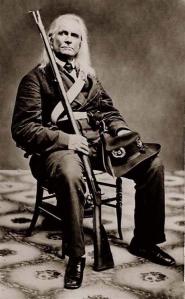
Edmund-Ruffin

Edmund Ruffin 

As important as it is to understand the political, religious and ideological debate around slavery, we cannot adequately do so unless we begin to understand the people involved in the debates and the controversies of the time. As I constantly note, human beings are the one constant in history. Two of these men, there are two that I think stand out from almost all other Southern supporters of slavery. One, Edmund Ruffin, because he can be legitimately called one of the proponents of Confederate nationalism; and the other, Robert Barnwell Rhett, who was so hard line in his beliefs that he could not work within any system that required compromise, even at the end of the war.

Among the people most enraged by Northern opposition to slavery was Edmund Ruffin. Ruffin is one of the more interesting characters who stridently supported slavery, white supremacy, and secession in the ante-bellum south. Ruffin became the face of slaveholding ideology, but he not always pro-slavery, or pro-secession. As a younger man he had been a Jeffersonian Republican who as early as 1816 was concerned about growing federal power, but his writings were considered academic, scholarly, and moderate. However that began to change as the country lurched from one sectional crisis to the next.

As early as 1845 Ruffin was beginning to write about the probability of fighting the North, “We shall have to defend our rights by the strong hand against Northern abolitionists and perhaps the tariffites…” [1] But it was the passage of the Compromise of 1850, a compromise that actually did more to help Southern slaveholders than to harm them, which turned him into an ardent and hardline secessionist.

When he decided on secession he did so with the zeal of a man on consumed by something almost akin to religious conversion:

he promptly threw himself into the new cause, replacing his formerly scholarly approach to issues with a fire-eater’s polemical and emotional style. “I will not pretend,” he now announced, “to restrain my pen, nor attempt to be correct in plan or expression – as is more or less usually the case in my writing.” [2]

Ruffin’s conversion was remarkable because as young man, Ruffin believed that slavery was an evil. But he began to study the works of Thomas Dew he became convinced of the necessity of slavery and its justification. In his tract The Political Economy of Slavery he wrote,

“Slavery… would be frequently… attended with circumstances of great hardship, injustice, and sometimes atrocious cruelty. Still, the consequences and general results were highly beneficial. By this means only–the compulsion of domestic slaves–in the early conditions of society, could labor be made to produce wealth. By this aid only could leisure be afforded to the master class to cultivate mental improvement and refinement of manners; and artificial wants be created and indulged, which would stimulate the desire and produce the effect, to accumulate the products of labor, which alone constitute private and public wealth. To the operation and first results of domestic slavery were due the gradual civilization and general improvement of manners and of arts among all originally barbarous peoples, who, of themselves, or without being conquered and subjugated (or enslaved politically) by a more enlightened people, have subsequently emerged from barbarism and dark ignorance…” [3]

But Ruffin was not a unlearned or unsuccessful man. He was an agricultural reformer who pioneered the use of lime to enhance the effectiveness of other fertilizers. He edited a successful farm paper, and ran a very successful planation outside of Hopewell, Virginia, near Richmond.

Ruffin passionately argued for secession and Southern independence for fifteen years, even before the Compromise Of 1850 hardened him into the most passionate advocate of secession. He “perceived the planter civilization of the South in peril; the source of the peril was “Yankee” and union with “Yankees.” Thus he preached revolution, Ruffin was a rebel with a cause, a secular prophet…” [4] He was the type of man who understood reality far better than some of the more moderate oligarchs that populated the Southern political and social elite. He knew that the only way slavery to survive was for the South to become a nation of its own, and that meant secession. While in the years leading up to the war, these men, including John Calhoun attempted to secure the continued existence and spread of slavery within the Union through the Congress and the courts, Ruffin condemned their efforts.

As early as 1850, Ruffin recognized that in order for slavery to survive the slaveholding South would have to secede from the Union. Ruffin and other radical secessionists believed that there could be no compromise with the north. In 1850 he and James Hammond attempted to use a meeting in Nashville to “secure Cooperative State Secession and wrote to Hammond, against those who sought to use the meeting to preserve the Union, “If the Convention does not open the way to dissolution…I hope it shall never meet.” [5] Ruffin believed that slave holding states had to be independent from the North in order to maintain the institution of slavery.

Ruffin’s views were not unique to him. They formed the basis of how most slave owners and supporters felt about slavery’s economic and social benefits of slavery and the Southern cotton economy. But while many Southerners wrote about the importance and necessity of slavery, Ruffin was one of its most eloquent defenders. He wrote:

“Still, even this worst and least profitable kind of slavery (the subjection of equals and men of the same race with their masters) served as the foundation and the essential first cause of all the civilization and refinement, and improvement of arts and learning, that distinguished the oldest nations. Except where the special Providence and care of God may have interposed to guard a particular family and its descendants, there was nothing but the existence of slavery to prevent any race or society in a state of nature from sinking into the rudest barbarism. And no people could ever have been raised from that low condition without the aid and operation of slavery, either by some individuals of the community being enslaved, by conquest and subjugation, in some form, to a foreign and more enlightened people.” [6]

The most striking thing about Ruffin’s defense of slavery is the distinction that he makes between enslaving people of the same race, which he calls the “worst and least profitable kind of slavery” over the enslavement of inferior races. He did not disapprove of enslaving people of the same race, but he believed that the enslavement of people of the same race was wise, nor profitable. But Ruffin, a true believer in White Supremacy believed that enslavement of inferior races was not only permissible, but in fact the bedrock of civilization. Likewise his understanding that slavery alone was the only thing that prevented “any race or society in a state of nature from sinking into the rudest barbarism,” was common among the Southern planting class.

In 1860 the then 67-year-old Ruffin helped change the world forever when, according to popular legend he pulled the lanyard that fired the first shot at Fort Sumter. While he had joined the Palmetto Guards and was present, he probably did not fire the first shot. Instead, he was probably was given the honor of firing the first shot from his battery; as other guns from other emplacements may have fired first shot.
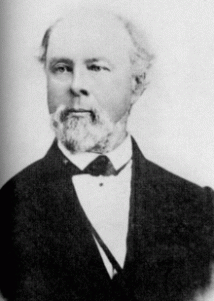

Robert Barnwell Rhett

But Ruffin was not alone, he was numbered with other Fire-Eaters who beginning in the 1840s began urging secession in order to protect the institution of slavery. The real “father” of Southern secession was Robert Barnwell Rhett of South Carolina. Rhett was a lawyer who was born under the name of Robert Barnwell Smith in Beaufort, South Carolina in 1800, but who adopted the surname of a famous ancestor in order to have a name which would befit him more in aristocratic South Carolina.

In a twist of irony, the man who became the father of the secessionist movement studied law under Thomas Grimke, the brother of the two famous abolitionist sisters, and “a leader of South Carolina’s anti-slavery American Colonization Society.” [8] Rhett was a talented attorney with excellent oratorical skills and he was elected to the South Carolina legislature in 1826 as the controversy over nullification began. Rhett, like other opponents of a Federal Tariff led by Senator John C. Calhoun urged secession as early as 1830 he told a crowd that before submitting to the tyranny of Federal Government, that they must be read to destroy the Union:

“Aye – disunion, rather, into a thousand fragments. And why, gentlemen! would I prefer disunion to such a Government? Because under such a Government I would be a slave – a fearful slave, ruled despotically by those who do not represent me … with every base and destructive passion of man bearing upon my shieldless destiny.” [9]

Later, in the face of President Andrew Jackson’s political strength and much congressional opposition led by Henry Clay, South Carolina dropped nullification. Rhett was angry. He told his colleagues in the legislature that “Your “northern brethren,” aye, “the entire world are in arms against your institutions…. Until this Government is made a limited Government… there is no liberty – no security for the South.” [10] He then described disunion as the only way for the South to survive and to escape what he called “unconstitutional legislation.” He described a “Confederacy of the Southern States… [as] a happy termination – happy beyond expectation, of our long struggle for our rights against oppression.” [11]

Rhett worked against compromise at every opportunity, especially compromise which would preserve the Union. Absolutely convinced of the rightness of his cause he distrusted the politicians who favored compromise and had no faith in political parties. He worked from 1833 until the very end in order to support slavery, disunion, and secession, using every crisis as an opportunity. His dream was for “all Southerners – to unite across party lines and unyieldingly defend slavery and Southern interests as he defined them.” [12] 

During the debate over secession following the Compromise of 1850, Rhett resigned his seat in the U.S. Senate which had been elected to following the death of John C. Calhoun, rather than accept the premise that the state convention’s ruling that secession was not justified.

After leaving office he became the editor, and later the full owner of the Charleston Mercury newspaper where he continued to advocate for secession in often the most outrageous ways,  “The more outrageous the Mercury’s charges, the more they were picked up and reprinted by other papers. Rhett’s propaganda technique was part of a larger secessionist strategy. “Men having both nerve and self-sacrificing patriotism,” he wrote, “must lead the movement and shape its course, controlling and compelling their inferior contemporaries.” He worked to push those without sufficient patriotic nerve – that is, moderate leaders – out of the political arena, believing correctly that without a solid middle ground to stand on, Southern voters would rally increasingly to the fire-eaters’ standard.” [13]

In 1860 Rhett “joined a drive to either rule or ruin the 1860 Democratic convention scheduled for Charleston.” [14] His work was successful, he devised the strategy to destroy the Union by first destroying the Democratic Party, and he wrote in January 1860 that “the destruction of the Union must… begin with the “demolition” of the party. So long as the Democratic Party, as a “National” organization exists in power in the South,… our public men” will “trim their sails.” [15] 

When South Carolina seceded from the Union, it was Rhett who drafted South Carolina’s secession ordinance, which claimed that South Carolina was not “perpetrating a treasonous revolution, but… simply taking back… the same powers it had temporarily surrendered… when South Carolina ratified the federal Constitution.” [16] 

Rhett was elected to the Confederate House Of Representative but However, following secession Rhett’s inability to compromise and his intemperate behavior alienated from him from Jefferson Davis and other Southern leaders. He grew increasingly isolated, and become one of Davis’s most bitter critics. As late as March of 1865, with Sherman’s Union armies having overrun South Carolina and Grant’s at the gates of Richmond, Rhett remained defiant and uncompromising. He opposed any move to compromise on the issue of slavery, even the belated attempt of Jefferson Davis and some in the Confederate Congress to grant limited emancipation to African American slaves who enlisted to fight for survival of the Confederacy.

Rhett moved to Louisiana and left the Mercury to his son, he never reentered politics and died in 1876. Ruffin made a more spectacular exit. Two months after the surrender of Robert E. Lee’s Army Of Northern Virginia, Ruffin exited his earthly life.

When the war ended with the Confederacy defeated and the south in ruins, Ruffin still could not abide the result. In a carefully crafted suicide note he sent to his son the bitter and hate filled old man wrote on June 14th 1865:

“I here declare my unmitigated hatred to Yankee rule- to all political, social and business connections with the Yankees and to the Yankee race. Would that I could impress these sentiments, in their full force, on every living Southerner and bequeath them to every one yet to be born! May such sentiments be held universally in the outraged and down trodden South, though in silence and stillness, until the now far-distant day shall arrive for just retribution for Yankee usurpation, oppression and outrages, and for deliverance and vengeance for the now ruined, subjugated and enslaved Southern States! … And now with my latest writing and utterance, and with what will be near my last breath, I here repeat and would willingly proclaim my unmitigated hatred to Yankee rule — to all political, social and business connections with Yankees, and the perfidious, malignant and vile Yankee race.” [17]

There will be more to come.

Notes

[1] Ibid. Potter The Impending Crisis p.463

[2] Abrahamson, James L. The Men of Secession and Civil War, 1859-1861 Scholarly Resources Books, Wilmington DE 2000 pp.43-44

[3] Ruffin, Edmund The Political Economy of Slavery in McKitrick, Eric L. ed. Slavery Defended: The Views of the Old South. Englewood Cliffs, NJ: Prentice Hall/Spectrum Books, 1963.Retrieved from http://www.pbs.org/wgbh/americanexperience/features/primary-resources/lincolns-political-economy/ 24 March 2014

[4] Ibid. Thomas The Confederate Nation p.1

[5] Ibid. Freehling The Road to Disunion Volume One: Secessionists at Bay p.481

[6] Ibid. Ruffin The Political Economy of Slaveryhttp://www.pbs.org/wgbh/americanexperience/features/primary-resources/lincolns-political-economy/

[7] Catton, Bruce The Coming Fury Phoenix Press, London 1961 pp.314-315

[8] Ibid. Abrahamson The Men of Secession and Civil War, 1859-1861 p.33

[9] Goodheart, Adam The Happiest Man in the South in The New York Times Opinionator December 16th 2010 retrieved from http://opinionator.blogs.nytimes.com/2010/12/16/the-happiest-man-in-the-south/?_r=0 26 July 2016

[10] Ibid. Freehling The Road to Disunion Volume One: Secessionists at Bay p.286

[11] Ibid. Abrahamson The Men of Secession and Civil War, 1859-1861 p.34

[12] Ibid. Abrahamson The Men of Secession and Civil War, 1859-1861 p.34

[13] Ibid. Goodheart The Happiest Man in the Southhttp://opinionator.blogs.nytimes.com/2010/12/16/the-happiest-man-in-the-south/?_r=0

[14] Ibid. Abrahamson The Men of Secession and Civil War, 1859-1861 p.34

[15] Freehling, William. The Road to Disunion Volume II: Secessionists Triumphant 1854-1861 Oxford University Press, Oxford and New York 2007 p.295

[16] Ibid. Guelzo Fateful Lightning p.130

[17] Edmund Ruffin (1794-1865). Diary entry, June 18, 1865. Manuscript Division, Library of Congress Retrieved from http://blogs.loc.gov/civil-war-voices/about/edmund-ruffin/ 24 March 2014

2 Comments

Filed under civil rights, civil war, faith, History, laws and legislation, leadership, News and current events, Political Commentary, racism