Category Archives: christian life

Living with Dark Places and Pain

947188_10151670056587059_1172426886_n

“There is nothing that can take the pain away. But eventually, you will find a way to live with it. There will be nightmares. And everyday when you wake up, it will be the first thing you think about. Until one day, it’s the second.” Raymond “Red Reddington (James Spader) The Blacklist

I am haunted by many things, unlike many people who have little self-awareness I might have just a bit too much. I have talked about the nightmares, night terrors and insomnia that I have many times following my return from Iraq. I used to believe, at least back in the first year or so after I returned that I thought that eventually I would get over it. I don’t believe that anymore, now I just believe that I will find a way to live with them.

I guess that is the secret to life. Instead of wishing that something would miraculously take way the pain, I guess that it is better to find a way to live with it because one day something  else will replace it.

Is that an ideal way to deal with life? Probably not, but I know that I am an idealist anymore. I used to be, but that was a while back. It took time, but war and the lies of men that I voted for, men who I trusted because they professed my faith, my love of country, and some who even shared my vocation as a priest and chaplain took that from me.

Experts call this “moral injury.” For me it is connected with my tour in Iraq, PTSD and what I experience when I came home from colleagues, and people in my former church. Betrayal and abandonment is a terrible thing, but I am learning to live with it. It is not pretty but I am learning with every passing night and morning. Alexander Dumas wrote in The Count of Monte Cristo:

“Moral wounds have this peculiarity – they may be hidden, but they never close; always painful, always ready to bleed when touched, they remain fresh and open in the heart.”

My life is full again, there is meaning and purpose, but it is tempered by realism and the expectation that every day I will wake up and still think about those painful memories until finally something else takes their place. 

I guess that the secret to living with darkness and pain is simply to live with it because the saying that “time heals all wounds” is a lie, it is the fabrication of people that don’t want to deal with the real world. God might heal, but then God may not. So I will live with it and in doing so I will continue on and in the process hopefully be there for others that also struggle with pain that does not want to go away and nightmares that never seem to end. As Henri Nouwen wrote:

“Ministry means the ongoing attempt to put one’s own search for God, with all the moments of pain and joy, despair and hope, at the disposal of those who want to join this search but do not know how.”

Peace

Padre Steve+

1 Comment

Filed under christian life, faith, ministry, PTSD

Orange and Black is Back

IMG_0177.JPG

One might say that I have an obsession with baseball, in fact I would dare say that to me it is closer to a religious faith than any of major revealed religions known to humankind. Since coming back from Iraq it is one of the few things in life that center me, more than scripture, prayer or in fact most traditional spiritual disciplines baseball speaks to my heart more than anything. I can truly understand the words of Annie Savoy (Susan Sarandon) in the classic baseball film Bull Durham: 

“I believe in the Church of Baseball. I tried all the major religions and most of the minor ones. I’ve worshipped Buddha, Allah, Brahma, Vishnu, Siva, trees, mushrooms and Isadora Duncan. I know things. For instance, there are 108 beads in a Catholic rosary and there are 108 stitches in a baseball. When I learned that, I gave Jesus a chance.” 

Please do not get me wrong, I am not depreciating religion or my own Christian faith in the slightest by saying this, but it is true that Jesus, I like him very much, but he no help with curveball…

This year my two favorite baseball teams are in the playoffs and look like that have a strong chance of moving on the the National League and American League Championship series. Of course I am talking about the only teams whose uniforms fully are appreciative of the month of October, the Baltimore Orioles and the San Francisco Giants whose orange and black uniforms are distinctive. Entering the playoffs many experts consider them underdogs, and while neither has won their divisional series yet, the odds are that both will.

Last night I was watching the Giants play their usual brand of torture ball against the Washington Nationals in a record setting epic 18 inning playoff game that went longer than any post season game in the history of baseball. As is usual with this kind of game I could not leave it for anything. I remember the 2005 National League Championship Series between the Atlanta Braves and Houston Astros, and the 2005 World Series game between those same Astros and the Chicago White Sox which both went 18 innings. I couldn’t stop watching those games either, but with the Giants and the Orioles it is different. The Orioles like the Giants are really tough in close games and during the regular season were amazing in extra innings games, but I digress…

John Leonard wrote in the New York Times in 1975 that Baseball happens to be a game of cumulative tension but football, basketball and hockey are played with hand grenades and machine guns.” Last night was amazing, that cumulative tension that built throughout the game was high was palpable. Jordan Zimmerman put down 18 Giants in a row before walking Joe Panik with two outs in the top of the ninth, and the rest is history. Buster Posey singled and Pablo “the Panda” Sandoval doubled in to tie the game  It went another nine innings before the appropriately named Brandon Belt “belted” a home run into the second deck in right field at nationals Stadium to give the Giants the winning run.

So tonight, the Orioles who came back against the Detroit Tigers in the bottom of the eighth inning to shock the Tigers and Detroit fans play what might be the deciding game of their divisional series against the Tigers. I think that the Orioles have a strong chance at closing the series out tonight. So be assured I will be watching.

So until tomorrow,

Peace

Padre Steve+


Leave a comment

Filed under Baseball, christian life, faith

We Were Warned about American Religious Extremists

Barry Goldwater - Preachers

It is ironic that back in the late 1970s and early 1980s that most of us were blind to the motivation and goals of the religious right. I can say that back then as a politically conservative Republican and evangelical Christian while I was all for the God and country stuff I really was not impressed by either Jerry Falwell’s Moral Majority or Pat Robertson’s Christian Coalition.

In fact back then it was laughable to think that the leaders of the movement whose words and actions seemed almost ludicrous. But times have changed and they are now a major force in the Tea Party and Republican Party. However, back then I think I can safely say that most people did not take these men too seriously, much less the lesser knowns of the Christian Dominion or Reconstruction movements, the New Apostolic movement, or Global Apostolic Network which is now such a force in the Tea Party and the Republican Party.

Since these people practically own that party today and honestly believe that they should use it as a political means to achieve their theocratic ideal, it is important not to forget that they were not always so powerful and that most of us misjudged them and their movement in the 1970s, 1980s and 1990s.

Back in the late 1970s such people were considered a fringe movement and not taken seriously by most mainline Republicans or liberal Democrats. They were simply a conservative special interest group.

However back then and until 2010 I belonged to churches whose leaders and members took the message of such people quite seriously, and while I might have had reservations about the legitimacy of their message in therms of scripture, reason or tradition, I said nothing. Sadly, I can empathize with Martin Niemoller who countenanced the rise of Hitler only to realize his mistake too late.

But there were those who warned us about this movement. Chief among them was not a liberal or progressive, but a man who epitomized conservative orthodoxy in the Republican Party for decades, the late Senator Barry Goldwater.

Goldwater was certainly a conservative, but he was in favor of many things scorned by his successors in the GOP including a woman’s right to choose, women’s rights, gay rights, and other progressive ideas as he matured from right wing Presidential candidate to the voice of reason and moderation in the Republican Party as he ended his Senate career.

Goldwater may have had his flaws and many progressives rightly criticize his stance on the Civil Rights Act of 1964, but unlike so many politicians Goldwater was able to grow in his beliefs and change as he grew older. Today Goldwater would not be welcome in the GOP or the Tea Party movement, and though an Episcopalian would be labeled as something less than a Christian by many so called conservative Christians.

Goldwater was perhaps the last true “conservative.” He was consistent and rational and had no problem taking on religious extremists in his own party, who he realized were growing in both influence and power. He said in the Senate in 1981:

“There is no position on which people are so immovable as their religious beliefs. There is no more powerful ally one can claim in a debate than Jesus Christ, or God, or Allah, or whatever one calls this supreme being. But like any powerful weapon, the use of God’s name on one’s behalf should be used sparingly. The religious factions that are growing throughout our land are not using their religious clout with wisdom. They are trying to force government leaders into following their position 100 percent. If you disagree with these religious groups on a particular moral issue, they complain, they threaten you with a loss of money or votes or both. I’m frankly sick and tired of the political preachers across this country telling me as a citizen that if I want to be a moral person, I must believe in ‘A,’ ‘B,’ ‘C,’ and ‘D.’ Just who do they think they are? And from where do they presume to claim the right to dictate their moral beliefs to me? And I am even more angry as a legislator who must endure the threats of every religious group who thinks it has some God-granted right to control my vote on every roll call in the Senate. I am warning them today: I will fight them every step of the way if they try to dictate their moral convictions to all Americans in the name of ‘conservatism.’ ” Barry Goldwater 
(1909-1998) US Senator (R-Arizona) Source: Congressional Record, September 16, 1981

Sadly there are no leaders, elected or appointed, in the Republican Party today or the Tea Party movement willing to confront the American Christian equivalent of the Taliban.

After he left the Senate he continued to battle people that he labeled “extremists.” Responding to claims that the Moral Majority and the Christian Coalition were the “new conservatism” Goldwater said:

“Well, I’ve spent quite a number of years carrying the flag of the ‘Old Conservatism.’  And I can say with conviction that the religious issues of these groups have little or nothing to do with conservative or liberal politics.  The uncompromising position of these groups is a divisive element that could tear apart the very spirit of our representative system, if they gain sufficient strength.” 

Goldwater also noted something that most of us missed back in 1981, he said in the same address:

“Being a conservative in America traditionally has meant that one holds a deep, abiding respect for the Constitution.  We conservatives believe sincerely in the integrity of the Constitution.  We treasure the freedoms that document protects. . .  “By maintaining the separation of church and state,” he explained, “the United States has avoided the intolerance which has so divided the rest of the world with religious wars . . .  Can any of us refute the wisdom of Madison and the other framers?  Can anyone look at the carnage in Iran, the bloodshed in Northern Ireland, or the bombs bursting in Lebanon and yet question the dangers of injecting religious issues into the affairs of state?” 

Of course Goldwater was right. Most politicians, regardless of their party are tempted to court religious groups assuming that they are basically benign. Unfortunately that is not always the case. The radical leaders who I have written about the past few nights do not care about the Constitution, nor do they even care about the integrity of Scripture, the Creeds or the Councils, and to whom reason is considered an abomination, but very few people understand this, assuming that religious people are basically good. Philosopher Eric Hoffer, a contemporary of Goldwater wrote:

“The impression somehow prevails that the true believer, particularly the religious individual, is a humble person. The truth is the surrendering and humbling of the self breed pride and arrogance. The true believer is apt to see himself as one of the chosen, the salt of the earth, the light of the world, a prince disguised in meekness, who is destined to inherit the earth and the kingdom of heaven too. He who is not of his faith is evil; he who will not listen will perish.”

Goldwater understood this and warned:

“The religious factions will go on imposing their will on others, unless the decent people connected to them recognize that religion has no place in public policy.  They must learn to make their views known without trying to make their views the only alternatives. . .  We have succeeded for 205 years in keeping the affairs of state separate from the uncompromising idealism of religious groups and we mustn’t stop now. To retreat from that separation would violate the principles of conservatism and the values upon which the framers built this democratic republic.”

Like Goldwater I have grown in my appreciation for basic civil liberties and the rights of others. Despite the fact that I am a Christian, I cannot countenance the evil machinations of those leading the politically motivated preachers, pundits and politicians who seek to run roughshod over the intent of those who authored the Declaration of Independence, the Bill of Rights and even the Gettysburg Address. Those that follow them thinking that they are being taught ideas that are either Christian or part of the American political ideal have been deceived and hopefully will realize it before these leaders drive them and the country over the cliff of religious intolerance and ultimately oppression.

In 1994 Goldwater wrote:

“I am a conservative Republican, but I believe in democracy and the separation of church and state.  The conservative movement is founded on the simple tenet that people have the right to live life as they please as long as they don’t hurt anyone else in the process.”

One does not have to agree with Goldwater on all that he believed.  His economic policies were much akin to Social Darwinism and his 1964 campaign and opposition to the civil rights movement were heavily tainted by racism, so much that baseball great and civil rights pioneer, Jackie Robinson, a longstanding Republican was threatened at the GOP 1964 National Convention where Goldwater was nominated as the GOP Presidential nominee. Those things being said Goldwater did change over time on a number of important civil rights issues and was absolutely correct about the nature and purpose of the leadership of the Religious Right, they seek as Gary North, one of their most eloquent ideologues noted: “The long-term goal of Christians in politics should be to gain exclusive control over the franchise…” 

I spent over 30 years of my life as a Republican before leaving the party in disgust following my return from Iraq in 2008, largely due to the influence of the political preachers that now seem to own the GOP. Pat robertson knew the opportunity the Religious Right had in the early 1990s and his words are still gospel to many religious conservatives. Robertson noted: “With the apathy that exists today, a well organized minority can influence the selection of candidates to an astonishing degree.”

Goldwater spoke of Robertson and others late in life noting: “When you say ‘radical right’ today, I think of these moneymaking ventures by fellows like Pat Robertson and others who are trying to take the Republican Party away from the Republican Party, and make a religious organization out of it. If that ever happens, kiss politics goodbye.”

In that respect Barry Goldwater was a prophet. Goldwater realized the danger and was not hesitant to speak up against men that he knew would destroy the fabric of the country. Since Goldwater is dead, I will say it. These people are dangerous, extremely un-Christian and downright un-American in their approach to government. Their Orwellian doublespeak about “their” religious rights is a facade that they want to use to enforce their own brand of religious intolerance is well documented. 

Well that is all for tonight and until people wake up you can kiss it goodbye.

Peace

Padre Steve+


9 Comments

Filed under christian life, civil rights, faith, Political Commentary

Rafael Cruz and the Dangerous Heresy of the Self-Annointed

pic_giant_082813_A

Rafael Cruz with his son Senator Ted Cruz

“When the pretended friends of religion lead infidel lives; when they carry religion to market and offer it in exchange for luxuries and honors; when they place it familiarly and constantly in the columns of newspapers, manifestly connected with electioneering purposes, and when they are offering it up as a morning and evening sacrifice of the altar of political party- these men are placing a firebrand to every meeting house and applying a torch to every Bible” Abraham Bishop in an oration at Wallingford CT on 11 March 1801

As a historian as well as a theologian I find the modern self-anointed “prophets and apostles” of the Dominionist, Christian Reconstruction or Seven Mountains movement to be quite troubling. I have written about them before, but since they continue to rise to prominence in both conservative Christian churches and the Tea Party movement it is time that I do so again. In reading the words of Abraham Bishop I cannot help but to notice how closely they mirror the self-anointed leaders such as Rafael Cruz, the father of the junior Senator from Texas, Ted Cruz, a likely Presidential candidate in 2016.

The movement itself is profoundly dualistic in nature and prominent leaders include Dr C. Peter Wagner,  Gary North, Rick Joyner, and a host of other leading Evangelicals including notables like Rick Scarborough, Pat Robertson and James Robison, political leaders Rick Perry, Michelle Bachmann, Sarah Palin and Ted Cruz and finally Mike Huckabee who like a rancid peanut butter cup manages to combine his ministry with his perpetual quest for political power.

Larry Huch, a mega-church pastor and evangelist in the Dallas area hosted Rafael Cruz at his church in 2012 and made these comments about the election of Ted Cruz as a U.S. Senator:

“I know that’s why God got Rafael’s son elected – Ted Cruz, the next Senator. But here’s the exciting thing – and that’s why I know it’s timely for him to teach this, and bring this anointing. This will begin what we call the “End Time Transfer of Wealth.”

“And that when these gentiles begin to receive this blessing, they will never go back financially through the valley again. God is looking at the church, and everyone in it, and deciding, in the next 3 and 1/2 years, who will be his bankers. And the ones that say, ‘Here am I, Lord, you can trust me’, we will become so blessed that we will usher in the coming of the Messiah.”

The elder Cruz, a leader in the Dominionist movement in his own right said at that meeting:

“The pastor [Huch] referred to Proverbs 13:22, a little while ago, which says that the wealth of the wicked is stored for the righteous. And it is through the kings, anointed to take dominion, that that transfer of wealth is going to occur. God, even though he’s sovereign, even though he’s omnipotent, he doesn’t let it rain out of the sky – he’s going to use people to do it.” 
How these men get this from scripture is beyond me but the late John Wimber who founded the Vineyard churches after leaving the very conservative Calvary Chapel which is basically fundamentalist in its understanding of scripture, but which under the direction of the late Chuck Smith was relatively politically innocuous, focusing more on evangelism and bringing people to Christ. Wimber said of the folks at Calvary Chapel:“Calvaryites are sometimes a little too heavily oriented to the written Word.” This should say something to any conservative Bible Christian about the people leading the Dominionist movement, they don’t care about scripture and will pervert it into whatever they want it to say. That is why Latty Huch can blather on about God looking for his “bankers” who will “usher in the Messiah.” 
C. Peter Wagner is an exponent of this end time transfer of wealth, he wrote to his supporters in 2007:
“nine of the components of GAN {Global Apostolic Network} are on my heart, but especially those related to wealth and wealth transfer. I am in touch with 17 potential wealth transfer brokers, some of them expecting release momentarily. It is hard to comprehend, but some of them go to multiple millions, billions, and more. My task is to prepare a high integrity infrastructure for distributing these funds when they begin to flow. Zion Apostolic Network and The Hamilton Group are in place as agencies to carry this out. Our motto is “Sophisticated Philanthropy for Apostolic Distribution.” Letter from Global Harvest Ministries dated August 20, 2007
If the issue was just about Elmer Gantry type money-grubbing these people might be written off, but it is not. They are also about violent social and political revolution if they cannot get their way at the ballot box. Cindy Jacobs another one of these politically connected self-anointed prophets, who is still around pushing even more radical comments made this claim on the internet back in 2000:“For there is a radical sound that I have issued – there is a sound that has come from heaven, and it even now has come to earth. And the Lord says, these are going to be days where I am going to trouble the enemy through you. These are going to be different days than you have ever known, and I am going to require sacrifice of you that you cannot imagine. I am going to require a sacrifice of your children, says the Lord. And the Lord says, I’m going to shake everything that can be shaken…” and that “There are churches that will be command posts for revolution, and to these command posts I would say, I am going to bring a revolution. Look and see; I am calling radical revolutionaries to the church.”

Rick Joyner, who has continued to gain influence among these people and was one of the early exponents of this type of thought in his Morning Star Prophetic Bulletin wrote about what was going to happen to Christians that didn’t agree with his understanding of his prophecy threatening to change “the very definition of Christianity….for the better….”

“On February 23rd of this year I was shown for the third time that the church was headed for a spiritual civil war … the definition of a complete victory in this war would be the complete overthrow of the accuser of the brethens’ strongholds in the church … this will in fact be one of the most cruel battles the church has ever faced. Like every civil war brother will turn against brother like we have never witnessed in the church before … this battle must be fought. It is an opportunity to drive the accuser out of the church and for the church then to come into unity that would otherwise be impossible … what is coming will be dark. At times Christians almost universally will be loath to even call themselves Christians.Believers and unbelievers alike will think it is the end of Christianity as we know it and it will be through this the very definition of Christianity will be changed for the better.”  Morning Star Prophetic Bulletin May 1996

Joyner is a close associate of former Senator and head of the Heritage Foundation, Jim DeMint so he should not be taken lightly, and last year he advocated for a military coup to remove President Obama, a military coup to “protect the Constitution.”

These are very dangerous and scary people whose goal is the establishment of their brand of theocracy. Thus they must be exposed for what they are, because the closer they move to political power the closer we come to real tyranny. This is not a benign movement led by peaceful people who want to mind their faith and get along with others, they are extremists and Christians who actually care about the faith and care about the Bible should flee from them.

As Thomas Jefferson so wisely noted:

History I believe furnishes no example of a priest-ridden people maintaining a free civil government. This marks the lowest grade of ignorance, of which their political as well as religious leaders will always avail themselves for their own purpose.” (letter to Baron von Humboldt, 1813)

Peace

Padre Steve+

3 Comments

Filed under christian life, History, News and current events, Political Commentary, Religion

The Fever and the Fear: Conservative American Christians and Judgment at Nuremberg

IMG_0493.JPG

http://movieclips.com/FkTn-judgment-at-nuremberg-movie-dr-janning-explains-his-actions/

Yesterday I wrote about the lack of empathy among conservative American Christians and I drew some comparisons to the German Christians of the 1920s and 1930s who despite their reservations supported ultra-right wing parties and later the Nazi Party. As I mentioned yesterday this was brought about by the fear and hate propagated by those who had lost their favored status after the collapse of the Kaiser Reich, and especially the fear of what many Christians believed was the threat of atheistic Socialists and Communists. Their brief experiment with democracy which was devastated by political battles amid the 1919-1920 Weimar Inflation which destroyed the financial security of most Germans as well as the Stock Market Crash of 1929 which brought about the Great Depression made many receptive to the “Nazi Gospel.”

I think that conservative American Christians are going the same direction as they get swept up in the climate of fear, hate, distrust and perceived persecution at the hands of liberals, atheists, socialists and their own government. As I noted yesterday much of this stems not from actual persecution but from the loss of their privileged position as the dominant force in society.

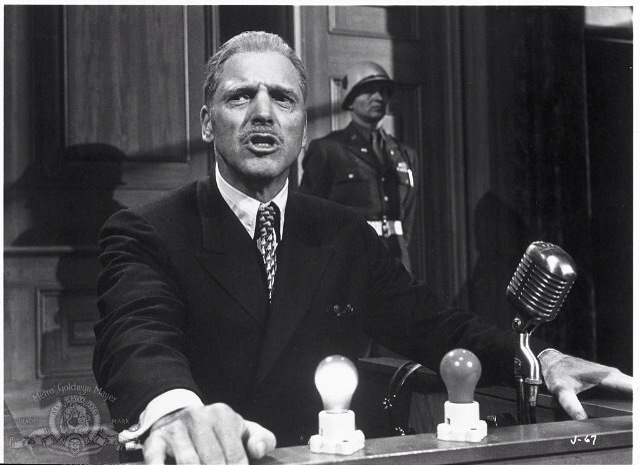
I love the film Judgment at Nuremberg, because I think that it really does reflect how many prominent Germans who should have known better followed Hitler, and reflects how many conservative Christians see the political right as their standard bearers.. In the film Burt Lancaster plays a prominent German legal scholar and jurist named Ernst Janning.

“There was a fever over the land. A fever of disgrace, of indignity, of hunger. We had a democracy, yes, but it was torn by elements within. Above all, there was fear. Fear of today, fear of tomorrow, fear of our neighbors, and fear of ourselves. Only when you understand that – can you understand what Hitler meant to us. Because he said to us: ‘Lift your heads! Be proud to be German! There are devils among us. Communists, Liberals, Jews, Gypsies! Once these devils will be destroyed, your misery will be destroyed.’ It was the old, old story of the sacrificial lamb. What about those of us who knew better? We who knew the words were lies and worse than lies? Why did we sit silent? Why did we take part? Because we loved our country! What difference does it make if a few political extremists lose their rights? What difference does it make if a few racial minorities lose their rights? It is only a passing phase. It is only a stage we are going through. It will be discarded sooner or later. Hitler himself will be discarded… sooner or later. The country is in danger. We will march out of the shadows. We will go forward. Forward is the great password. And history tells how well we succeeded, your honor. We succeeded beyond our wildest dreams. The very elements of hate and power about Hitler that mesmerized Germany, mesmerized the world! We found ourselves with sudden powerful allies. Things that had been denied to us as a democracy were open to us now. The world said ‘go ahead, take it, take it! Take Sudetenland, take the Rhineland – remilitarize it – take all of Austria, take it! And then one day we looked around and found that we were in an even more terrible danger. The ritual began in this courtoom swept over the land like a raging, roaring disease. What was going to be a passing phase had become the way of life. Your honor, I was content to sit silent during this trial. I was content to tend my roses. I was even content to let counsel try to save my name, until I realized that in order to save it, he would have to raise the specter again. You have seen him do it – he has done it here in this courtroom. He has suggested that the Third Reich worked for the benefit of people. He has suggested that we sterilized men for the welfare of the country. He has suggested that perhaps the old Jew did sleep with the sixteen year old girl, after all. Once more it is being done for love of country. It is not easy to tell the truth; but if there is to be any salvation for Germany, we who know our guilt must admit it… whatever the pain and humiliation.”

Hannah Arendt talked about this in her book Eichmann in Jerusalem: A Report on the Banality of Evil,  her treatment of the trial of Adolf Eichmann, one of the mid-level Nazi officers who sent millions of people to their deaths. In describing Eichmann and other ordinary people Arendt said:

“The trouble with Eichmann was precisely that so many were like him, and that the many were neither perverted nor sadistic, that they were, and still are, terribly and terrifyingly normal. From the viewpoint of our legal institutions and of our moral standards of judgment, this normality was much more terrifying than all the atrocities put together.”

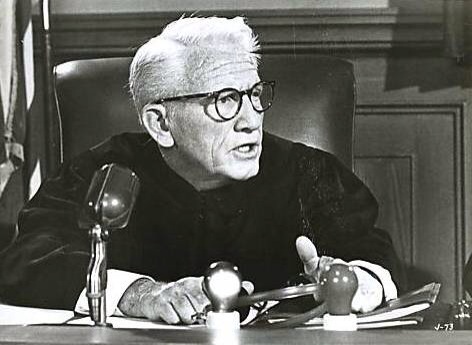
At the end of the movie Judgment at Nuremberg Spencer Tracy as Presiding Judge Dan Haywood concluded his sentencing remarks with this statement. It is perhaps one of the most powerful statement and something to remember as the Unholy Trinity of Politicians, Pundits and Preachers urge us to hate one another and those different than us. It is something that is especially needed in times of great societal stress as well as real and perceived dangers from without and within.

IMG_2182.JPG

http://www.youtube.com/watch?v=N3BwK51YFgQ

“Janning, to be sure, is a tragic figure. We believe he loathed the evil he did. But compassion for the present torture of his soul must not beget forgetfulness of the torture and the death of millions by the Government of which he was a part. Janning’s record and his fate illuminate the most shattering truth that has emerged from this trial: If he and all of the other defendants had been degraded perverts, if all of the leaders of the Third Reich had been sadistic monsters and maniacs, then these events would have no more moral significance than an earthquake, or any other natural catastrophe.

But this trial has shown that under a national crisis, ordinary – even able and extraordinary – men can delude themselves into the commission of crimes so vast and heinous that they beggar the imagination. No one who has sat through the trial can ever forget them: men sterilized because of political belief; a mockery made of friendship and faith; the murder of children. How easily it can happen. There are those in our own country too who today speak of the “protection of country” – of ‘survival’. A decision must be made in the life of every nation at the very moment when the grasp of the enemy is at its throat. Then, it seems that the only way to survive is to use the means of the enemy, to rest survival upon what is expedient – to look the other way. Well, the answer to that is ‘survival as what’? A country isn’t a rock. It’s not an extension of one’s self. It’s what it stands for. It’s what it stands for when standing for something is the most difficult! Before the people of the world, let it now be noted that here, in our decision, this is what we stand for: justice, truth, and the value of a single human being.”

This is an unsettling subject and people on the political right and left in this country are apt to compare their opponents to those that were tried at Nuremberg and those that led them. This has been an increasingly disturbing trend in the case of hyper-partisan Right Wing and so called Conservative Christians who blatantly demonize those who they hate and urge the use of the police powers of the state to enforce their political-religious agenda. For all intents and purposes they no longer care about “Justice, truth, or the value of a single human being” especially if those human beings are not Christians. That may seem harsh, but sadly it is all too often the truth.

The terrible truth is that it is possible that any parties in any society, including ours, when divided by fear, hate and the desire for power can behave exactly as the industrialists, financiers, doctors, soldiers, jurists, civil servants, pastors and educators who oversaw the heinous crimes committed by the Third Reich.

Again, I am not calling anyone, even the people that I am criticizing today Nazis. I am only trying to show the logical end of the thinking that permeates much of the political right, particularly conservative Christians who are following a path that is destructive to the church and for the world. As Dietrich Bonhoeffer said: “if you board the wrong train, it is no use running along the corridor in the other direction.” By selling their birthright to right wing radical politicians and special interest groups who only seek to exploit them for their own power, conservative Christians, like those in the Weimar Republic have boarded the wrong train, and unless they get off that train they will find that they have no redemptive value in society.

Sadly, I doubt that Sarah Palin, Ted Cruz, Mike Huckabee, Michelle Bachmann, Tony Perkins or any of the myriad of pundits, politicians and preachers driving conservative Christians off the rails will ever understand this. Thinking themselves wise, they became fools. Fools who in their quest for temporal power destroyed more lives and souls than they ever could have imagined.

Unlike Janning, I doubt if any of them have the capacity to reflect upon their words and actions and realize what they did and are doing are morally, ethically and by every measure of humanity are wrong, and are evil masquerading as righteousness, and thus doubly worthy of condemnation, for if they are Christians they should know better. I only hope that the vast number of conservative Christians who have not completely fallen for their hateful propaganda; men and women who have doubts about the message of such leaders are able to discern the truth will pause for just a moment, and like Bonhoeffer and others like him stand for justice, truth, or the value of a single human being.

Those who stood trial at Nuremberg were all people that should have known better, as should we, especially those who claim the name of Christ and presume to be bearing his good news. I think I will be continuing this line of thought through much of the coming week, although there may be a detour into baseball or Gettysburg; so I will stop for now.

Peace

Padre Steve+

4 Comments

Filed under christian life, civil rights, ethics, faith, film, History, movies, News and current events, philosophy, Political Commentary

Thursday Thoughts on Life, Faith, Doubt and Beer

1622612_10152232336042059_727365308_n

“There are moments, sure, where you think ‘Is there a God? Where is God?” Archbishop Justin Welby

Friends of Padre Steve’s World. Yesterday I promised you part two of the revised article on the American Civil War as the first modern war. I tried to get it done but since I am so unhappy with the previous edition of it I am tearing it apart and get it logically sorted out. I have been doing this for a while and finally got the first part of it done yesterday. I thought that I could get the rest done today but between a very busy day with multiple meetings and presentations at work as well as securing help for a sailor in a difficult crisis couldn’t get it done. Not only that I am busy getting ready to travel to Munich and the real Oktoberfest tomorrow. That will be fun, we have lived there before and travelled there many times, but never to Oktoberfest. In the week there my wife and plan on going to Salzburg and possibly Nuremberg or Wurzburg. We’ll get back next weekend and then I will get back to work on it.

But anyway, we are so looking forward to this trip, which we are making with a good number of friends from the Gordon Biersch Brewery Restaurant Stein Club. The trip is paid for by the Gordon Biersch Passport rewards program. Trust me it is the best rewards program of any restaurant anywhere, not only do they have great craft beer and food, but they reward you well, but I digress.

Just a few thoughts on the words of the Archbishop of Canterbury, Justin Welby who in an interview at the Bristol Cathedral. You can watch that interview here:

https://www.youtube.com/watch?v=exmHYXNEt9A&feature=youtu.be&t=11m52s 

The remarks shocked some because he quite honestly noted how: “There are moments, sure, where you think ‘Is there a God? Where is God?”

Of course clergy are no supposed to doubt but as I have noted before that I went through almost two years following my tour in Iraq suffering a complete emotional, spiritual and physical collapse from PTSD where I was for all intents and purposes an agnostic just praying that God still existed. So Archbishop Welby’s comments were absolutely refreshing to hear, because for a church leader to do so upsets the apple cart of blind certitude in doctrines that because they deal with God we cannot prove. As Dietrich Bonhoeffer said: “a God who would let us prove his existence is an idol.”

Archbishop Welby did note something that I also, at least, most of the time agree: “It is not about feelings, it is about the fact that God is faithful and the extraordinary thing about being a Christian is that God is faithful when we are not.”  Honestly I still doubt every day, but I also believe. Andrew Greeley’s fiction Bishop Blackie Ryan noted: “Most priests, if they have any sense or any imagination, wonder if they truly believe all the things they preach. Like Jean-Claude they both believe and not believe at the same time.”

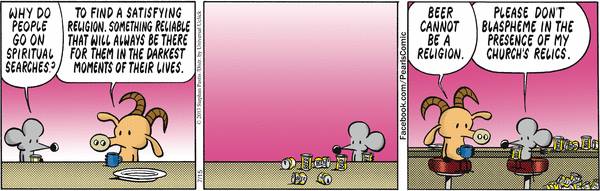
But since I am going to Oktoberfest one last thought on faith and beer.

church relics

So, since I am still busy and unlike my wife have done nothing to pack for the trip, I wish you a good night.

Peace

Padre Steve+

2 Comments

Filed under christian life, faith

The Fallacy of Reductionist Fundamentalism: You Cannot be Competent in God

galaxy_universe-normal1

Today is a day for something a bit more theological in nature. A couple of days ago I wrote about the dangers of reductionist fundamentalism. One of the issues that fundamentalists of all stripes wrestle with is the issue of certitude. For them life has to be bounded by certainty. For them, whether in the matter of origins, or how life came about, in the matter of faith and morals, how life is lived in the present; or how the world ends, life must be certain. In fact, fundamentalism in all its forms inculcates believers that there is only one way of thinking, one way of knowing, one way of understanding things that are unknowable. 

Because of this need for certitude, Christians, Moslems, Jews and others of various persuasions have attempted to define the beginning and the end, as well as to dictate what is acceptable to believe, or acceptable behavior. However, this actually says more about their insecurity than reflects the strength of their beliefs. I can speak to this need for certitude from a Christian point of view, and from my study of other faiths make what I think is informed commentary.

But for people who supposedly believe in God, the reality is that in presuming certitude in what we think that we know  is actually a denial of faith. Dietrich Bonhoeffer wrote that “a God who would let us prove his existence is an idol.” Bonhoeffer was right, not only do those that presume to know exactly how creation came about, how the universe will end or say with unrequited certitude what constitutes proper belief or behavior in the eyes of God make an idol of their God, they also, whether they intend to or not, put themselves in the place of God.

According to the writer of the Book of Hebrews, “faith is the essence of things hoped for, the evidence of things unseen.” That writer, who I think is Priscilla (see Acts Priscilla and Aquila) understood that faith was not the same as empirical knowledge, otherwise it would not be faith. To understand faith in a modern sense it means that faith is something that we admittedly cannot prove. That is why it is faith.

I am admittedly a skeptic. I am. Christian, I do believe, but I doubt as much as I believe. In fact for nearly two years I lived as an agnostic, a priest praying that God still existed, thus is believe but even now doubt. That being said I have seen things that cannot be explained by science or anything rational, and there are physicians that I have worked with that can attest to those things. That being said I think there are a lot of events claimed by some as “miraculous” that are explainable and are not miraculous at all.

The fact is, whether it it about creation and the questions of origins, an exact definition by which to judge absolute truth for living or belief, or the manner of how creation will end; every single statement of such absolutes is contradicted by the fact that we live as Bonhoeffer wrote, and I like to call “the uncomfortable middle. Bonhoeffer wrote in his book Creation, Fall and Temptation that:

“Man no longer lives in the beginning–he has lost the beginning. Now he finds he is in the middle, knowing neither the end nor the beginning, and yet knowing that he is in the middle, coming from the beginning and going towards the end. He sees that his life is determined by these two facets, of which he knows only that he does not know them.”  

The reality for Christians is that we have to admit is that our belief is rooted in our faith, faith which is given to us through the witness of very imperfect people influenced by their own culture, history, traditions as well as limitations in terms of scientific knowledge. Even scripture does not make the claim to be inerrant, though some Christian Fundamentalist make that claim. Because of that, the Bible cannot be understood like the Koran or other texts which make the claim to be the infallible compendium of faith delivered by an angel or dictated by God himself. The Bible, of we actually believe it, is a Divine-human collaboration so symbolic of the relationship that God has with his people, often confusing and contradictory yet inspiring. As Hans Kung so rightly wrote:

“Christians are confident that there is a living God and that in the future of this God will also maintain their believing community in life and in truth. Their confidence is based on the promise given with Jesus of Nazareth: he himself is the promise in which God’s fidelity to his people can be read.” 

Does that mean that we fully comprehend the nature of Christ, or the doctrinal formulation of the Hypostatic Union which defines Christ as being fully human and fully God? Or does it mean that we fully comprehend or understand the doctrine of the Trinity encapsulated in either the Nicene or Athanasian Creed? Certainly not, none of those doctrines are provable by science, or for that manner even history, for there were and are people who consider themselves Christians who do not believe and who reject those doctrinal formulations. Thus for Christians to attempt to argue such matters as fact to those who do not believe is not productive at all. We must understand that faith in the living Christ is not in a doctrine but  a promise that we believe, by faith, is given given by God through Jesus of Nazareth.

The real fact of the matter is that fixed doctrines are much more comfortable than living with difficult questions or honestly examining the contradictions that exist within Scripture, history and tradition. The fact is this makes many people uncomfortable and thus the retreat into the fortress of fixed and immutable doctrine found in the various incarnations of Fundamentalism.

The fact is the world is not a safe place, and our best knowledge is always being challenged by new discoveries many of which make people nervous and uncomfortable, especially people who need the safety of certitude. So in reaction “true believers” become even more strident and sometimes even violent when confronted with issues that question immutable doctrine.

I wish it were otherwise but Christianity cannot get away unscathed by such criticism. At various points in our history we have had individuals, churches and Church controlled governments persecute and kill those that have challenged their particular orthodoxy. Since Christian fundamentalists are human they like others have the capacity for violence if they feel threatened, or the cause is “holy” enough. Our history is full of sordid tales of the ignorance of some Christians masquerading as absolute truth and crushing any opposition. Doctrinal certitude is comforting. It is as Eric Hoffer wrote:

“A doctrine insulates the devout not only against the realities around them but also against their own selves. The fanatical believer is not conscious of his envy, malice, pettiness and dishonesty. There is a wall of words between his consciousness and his real self.”

This is the magnetic attraction of fundamentalism in all of its forms, not just Christian fundamentalism.  Yet for me there is a comfort in knowing that no matter how hard and fast we want to be certain of our doctrines, that God has the last say in the matter in the beginning and the end.

But there some Christians who now faced with the eloquence of men like Neil DeGrasse Tyson and Bill Nye who make legitimate challenges respond in the most uncouth and ignorant manners. The sad thing is that their response reveals more about them and their uncertainty and insecurity than it does the faith that they boldly proclaim.

themiddle1

Our doctrines, the way we interpret Scripture and the way we understand God are limited by our humanity and the fact that no matter how clever we think we are that our doctrines are at best expressions of faith. We were not there in the beginning  and we will not be present at the end, at least in this mortal state. We do live in the uncomfortable middle. Our faith is not science, nor is it proof. That is why it is called faith, even in our scriptures where as Paul the Apostle says “If Christ is not raised your faith is worthless”  and we “are to be pitied among men.” (1 Cor. 15:17-18)

We are to always seek clarity and understanding. However it is possible that such understanding and the seeking of truth, be it spiritual, historical, scientific or ethical could well upset our doctrines about God and that is not heresy, it is an admission that God will not allow us to put hi m in our theological box. As Henri Nouwen wrote: “Theological formation is the gradual and often painful discovery of God’s incomprehensibility. You can be competent in many things, but you cannot be competent in God.”

With that I will close for tonight.

Peace

Padre Steve+

Leave a comment

Filed under christian life, faith, philosophy, Religion

Faith and Doubt on a Sunday Afternoon

shakethefinger


“Most priests, if they have any sense or any imagination, wonder if they truly believe all the things they preach. Like Jean-Claude they both believe and not believe at the same time.” Andrew Greeley “The Bishop and the Beggar Girl of St Germain”

Many off my readers as well as people I deal with on a regular basis struggle with faith and doubt. Today I was reading a column in the New York Times that brought up a very interesting article called Where Reason Ends and Faith Begins  by T.M. Luhrmann, http://www.nytimes.com/2014/07/27/opinion/sunday/t-m-luhrmann-where-reason-ends-and-faith-begins.html?hp&action=click&pgtype=Homepage&module=c-column-top-span-region&region=c-column-top-span-region&WT.nav=c-column-top-span-region a professor at Stanford. It talked about the point in different where individuals make a decision of what they chose to believe because it is reasonable and what they chose to believe by faith. I also read an article by Bishop Gene Robinson called Hope When the World’s Gone off the Rails  http://www.thedailybeast.com/articles/2014/07/27/hope-when-the-world-s-gone-off-the-rails.html Both were excellent articles because they deal with a reality that many religious people don’t want to deal with. Something that I have struggled with most of my life, but especially after I returned from Iraq in 2008.

When I returned from Iraq in 2008 I was a mess. I had gone to Iraq thinking that I had the answers to about anything and that I was invincible. I felt that with years of experience in the military and in trauma departments of major trauma centers that I was immune to the effects of war and trauma. Likewise I had spent years studying theology, pastoral care and ethics as well as military history, theory and practice. I had studied PTSD and Combat Stress and had worked with Marines that were dealing with it. If there was anyone who could go to Iraq and come back “normal” it had to be me.

Of course as anyone who knows me or reads this website regularly knows I came back from Iraq different. I collapsed in the midst of PTSD induced depression, anxiety and a loss of faith. For nearly two years I was a practical agnostic.
During those dark days, particularly the times where I was working in the ICU and Pediatric ICU at Naval Medical Center Portsmouth attempting to have enough faith to help others in crisis, be they patients at the brink of death or families walking through that dark valley even though I did not have any faith to even believe that God existed.

It was during those dark days that the writings of Father Andrew Greeley, mainly his Bishop Blackie Ryan mysteries that provided me with one of the few places of spiritual solace and hope that I found. Baseball happened to be the other.
During those dark times when prayer seemed futile and the scriptures seemed dry and dead I found some measure of life and hope in the remarkable lives of the people that inhabited the pages of the Bishop Blackie Ryan novels. Through them I learned that doubt and faith could co-exist and that there was a mystery to faith in Jesus that defied doctrinal suppositions as well as cultural, political and sociological prejudices.

I did learn something else, something that makes many people uncomfortable and that took me a long time to accept. That was that doubt and faith could co-exist and as I read Greeley’s stories I began to see scripture in a new light, especially the stories of men and women that we venerate for their faith who doubted and even when they believed often disputed God. The Old Testament is full of their stories and there are even some in the New Testament. Greeley wrote that is was possible for a priest to lose their faith “no more often than a couple of times a day.”

Thus I find it hard to deal with preachers and others who are so full of certitude that they are full of shit, no matter what their faith tradition. God is too big for that.

I rediscovered faith and life as I anointed that man in our emergency room in December 2009. To my surprise faith returned. I believe again but I also doubt, at least a couple of times a day, it keeps me humble. And for that I’m grateful.

Peace and have a wonderful rest of your weekend,

Padre Steve+

1 Comment

Filed under christian life, faith, Pastoral Care, PTSD

Churches that Ignore: The Mega-Church and the Least, the Lost and the Lonely

Lakewood-Church-1024x768-2

“Every sacramental encounter is an evangelical occasion. A smile warm and happy is sufficient. If people return to the pews with a smile, it’s been a good day for them. If the priest smiles after the exchanges of grace, it may be the only good experience of the week.”  (The Archbishop in Andalusia p.77)

Back when I was doing my Clinical Pastoral Education Residency at Parkland Memorial Hospital I was astounded to hear my pastor make a comment which I think was one of the most heartless that I have ever heard said from a pulpit.  The church was a large and trendy Evangelical-Charismatic Church which I had attended throughout seminary and had ordained my in October 1991.  The Pastor was recounting an incident where one of our members had been critically ill in hospital and had not been visited by him.  After the parishioner was released from hospital he asked the pastor: “How sick do I have to be for you to visit me in the hospital?”  The pastor told us his response: “Sir, you don’t want to be that sick.”

The congregation laughed at the pastor’s story and he went on to talk about how he and other senior pastors should not be doing that kind of work because it “distracted them from bigger Kingdom tasks.”  You see according to the pastor the care of sick parishioners did not contribute to the “growth” of the church and thus was a “distraction and better left to others.”

The comment struck a raw nerve now that I was dealing with the suffering and death every day of people who had been abandoned by the churches and pastors.  I lost all respect for him as a man and pastor during that sermon.  My philosophy of religion professor at Southwestern Baptist Seminary, Dr. Yandall Woodfin said: “You have not done Christian theology until you have dealt with suffering and death.”

Unfortunately my old pastor, and many more like had stopped doing Christian theology in order to be an “Apostle” and CEO.  He was “growing” the church and managing programs, but had for the most part stopped caring as in being a pastoral care giver.

Now this pastor is not alone and nor is the issue of the lack of care confined to Evangelical or Charismatic churches. The trend has has found its way across the denominational spectrum.  Sometimes this is by design as is the case of the Mega-churches.

Pastors of mega-churches are for all practical purposes CEOs of large organizations and have a multiplicity of specialized staff, but often which do little for pastoral care. Having attended a number of these churches, and worked for a prominent television evangelist I can sadly report seeing this first hand many times.

Sometimes this problem it is by default in cases such as the Roman Catholic Church.  In that church the ever worsening shortage of Priests is forcing the closure of smaller parishes and the increase of large parishes with a corresponding decrease in what Priests can do for their people.   Even very good Priests cannot keep pace with the demand of both Sacramental needs as well as pastoral care.

No matter if it is by design or default the result is similar.  The least, the lost and the lonely those “lambs” that Jesus talks about who need care and feeding are shunted aside.  In one case, that of the Catholic Church it is primarily a lack of Priests, Deacons and Sisters to provide this care, although sadly there are Catholic priests who do not see themselves as care givers.

The “by design” issue is more far more troubling as the focus of the church is growth, sustaining numbers, programs and buildings.  This requires that pastors spend their time with members who can supply the vast financial need that those plans require.  I have seen this in numerous congregations across the spectrum, which sometimes as was the case at a church that I attended in Florida results in a financial meltdown and collapse of the congregation, many of whom gave up and went elsewhere when the extent of the scandal became known.  Likewise the ripple effects that this caused in the denomination were like a Tsunami, it was disastrous and the church is still in recovery mode.  Going back to my pastor back when I was in residency I got the feeling that had he been the shepherd in the Parable of the lost sheep (Luke 15) that he would have let it go as hunting for it might have distracted him from the others.

When I was in seminary there were quite a number of my fellow students who chafed about having to take courses on pastoral care.  I remember friends and fellow students complaining that what they needed were more “practical courses” such as “church growth, evangelism and Sunday School program management.”  Courses dealing with Pastoral Care were seen as a bother and distraction.  Not to mention academic courses such as Systematic Theology, Philosophy of Religion and Church History which offer timeless lessons for pastors.  One friend talked about his Master of Divinity only having a “shelf-life of 5 years” because what he learned would be outdated.

Well in a way he was right.  His focus was on classes that dealt with programs and methods of church growth, programs and management.   From that perspective his degree would rapidly be obsolescent as soon as the next trend in church growth came along and everyone jettisoned the last method in favor of the new.

With the ubiquity of the Mega-church which unlike the Leisure Suit is not going away anytime soon.  The rise of the “Superstar” Pastors such as Bill Hybels, Joel Osteen and Rick Warren and the proliferation of massive “Ministry Media” conglomerates and stand-alone television ministries are actually dangerous to the vitality and health of the Christian Church in the United States.  They propagate methods which have the sole intent of getting people into church or giving to a ministry and keeping them there, doctrine, worship, sacraments or ordinances, and pastoral care of the least, lost and lonely be damned.  The methods are pragmatic and impersonal.   Numbers and crowds define expertise, credibility and worth. The bigger the church the better the church, it’s that simple.

Unlike others who pick these ministers apart for their theology or business practices my problem with what is happening is what happens to regular people in these large and often very impersonal churches.  It is easy for people to get lost, forgotten and when they are going through difficulty abandoned when the church stops making a conscious effort to do real pastoral care and focus purely on the programs which lend to growth.  Often the substitute for pastoral care is found in the home cell group, or care group or whatever cute name a church can pin on a meeting at a member’s house.
The home groups or cell groups have a noble intention.  They attempt to build community in an otherwise very impersonal organization.  There are some really good things that can come out of healthy home groups as well as long lasting friendships.  We have a couple from our time in San Antonio that is still a very real part of our lives, they showed us genuine love and care and we remain friends.  Of course this couple had an advantage over most home group leaders; he was a clinical social worker by trade who was heading off to seminary.

Most home groups are not that fortunate.  There are unhealthy groups which are led by people who are poorly trained and equipped to deal with broken people.  The good group leaders recognize their limitations and try to get help for those who are really hurting.  Others who do not know their limitations end up abusing these dear lambs of God. Often this is because sick, depressed or lonely people take too much time, are too needy, or that their problems don’t match up with their church theology.

My wife and I know this from personal experience as my wife suffered from a number of ailments throughout seminary and we were going through tremendous health and financial difficulties and in some places we felt cast aside and like we did not matter.  We were fortunate that some people did care and we did make it through, however it was not something that I would ever want to repeat.  I have heard similar stories from hundreds of people that I have come across in my life and work over the years.

I don’t care what you call it, but any church which has multiple services of several thousand or a major service of close to 20,000 as occurs at Osteen’s Lakewood Church is no longer focused on caring for people but sustaining their growth and market share.

I remember reading Charisma Magazine back in the mid-1990s when I still read it regularly about a church in North Dallas that has a period of incredible church growth in which it grew from 1,200 members to well over 7,000.  In the article the pastor touted the church programs which drew people to the church.  What the dirty little secret which was not mentioned was that two exits south of this church a Mega-church of some 10,000 members imploded when the Pastor, one Bob Tilton got caught doing some pretty bad stuff.  This church despite its claims of great programs simple picked up about 6,000 of these people because they were close by and a similar type of church.

All of this is dangerous as to its impact on people.  One only has to look at the latest Barna Polls about what is going on in churches to see that these large churches are alienating people even as they grow.  People come, but others either burn out trying to keep pace with the manic pace of programs proliferated by these churches or they get lost in the crowd and forgotten.  I meet a least a person every day who is a displaced Christian, often hurt, lonely and broken, not only by what they have experienced in life, but by the cold emptiness that they feel when a church surrounded by thousands of people who don’t even know their name.

Some churches do recognize that people have issues that need to be addressed and have in-house Christian counseling programs or refer members to Christian counseling services.   I think that there certainly is a place for clinically trained therapists in the life of a church; however this is not really pastoral care, even when they use “Biblical” methods.   In a sense it is the outsourcing by pastors of one of the most vital missions entrusted to a church, the pastoral care of the flock of God to others, in a sense, “hirelings.”  Again my issue is not with the therapists or Christian counselors, but rather pastors who refuse to do pastoral care as part of their ministry.

Ultimately it is people that are important, even those who are not rich, powerful and who have problems that don’t fit nicely into theological boxes or paradigms promoted by church growth experts. It is high time that churches start reclaiming one of the most vital missions given by Jesus to his Disciples, to care for the least, the lost and the lonely.
The onus for this falls on pastors who cannot simply outsource one of their primary missions as given by Jesus himself to others.  If pastors do not set the example of being caring pastoral care givers, it will not matter that they are supposedly “empowering” laypeople to do ministry.  Instead it sends another more ominous message, that if it is not important for the pastor, why should it be important to me?

Every member of the church at some time goes through a crisis when their faith, family, health or vocation.  Sometimes these are not isolated events but rather prolonged periods of anguish, as what Saint John of the Cross described as “the Dark Night of the Soul” where it seems that God has even abandoned the person.  Unfortunately people in this situation are often abandoned by their church as things fail to improve.  Despairing they become the lost sheep whose shepherd has abandoned.  This is the hardest time for pastoral care, the times where we as pastors are called to stand with someone as Mary the Mother of Jesus did at the Cross, just simply being there though nothing else can be done.

Now do I understand that the demands of running a large church can be sometimes become such that pastors have difficulty making time for pastoral care?

Of course I understand this, at the same time pastors, even those who function primarily as pastor-teacher/CEOs still have the responsibility of caring for people, not simply administering programs and preaching.  Pastors need to set the example of care for people, real people, the regular people who populate their pews, by their books and give to their ministry, even if it is only in small ways, not just the super-givers or the wealthy and powerful.

James’s “right strawy epistle” (Martin Luther’s words) has much to say about favoring the rich and powerful and neglecting the poor and seemingly insignificant people hanging about the peanut galleries of their large “Worship Centers.”  Even if the pastor has limited time he or she must be about the flock, or they will forget what the needs of the flock really are and instead of the People of God, the lambs who Jesus says to care for they will simply be the consumers of a religious message who we have to keep coming back to keep the operation going.

Peace,

Padre Steve+

2 Comments

Filed under christian life, faith, leadership, Pastoral Care

The Journey of a Christian Agnostic: Remembering 18 Years of Priestly Ministry

“Do you exist? I think not. I have never seen you or touched you or felt you. Well, sometimes I think you’re presen163017_10150113444907059_3944470_nt but that may be wish fulfillment. Intellectually, I have no reason to believe. Yet much of the time I act like I do believe …. Only when I have time to reflect do I feel doubts, and then after the doubts certainty that the universe is cold and lonely. I know that I am a hypocrite and a fool. Then I preside over the Eucharist in my unsteady bumbling way and I know that you are. I don’t believe but I know.” Andrew Greeley in The Beggar Girl of St Germain

Eighteen years ago, on a warm and sultry night in Libertytown Maryland I was ordained as a Priest. I had been graduated from seminary in 1992 and been ordained as a minister in an Evangelical Protestant church in 1991 and served as a chaplain in the Army National Guard and Reserve as well as civilian hospital ministry, but in the course of my studies and subsequent study I came to a more Anglican and Catholic understanding of life and ministry.

Since that time the world has changed and I have changed. Back then I lived my life with a fair amount of certitude, hubris and arrogance, a trait that many, maybe even most young ministers regardless of their denomination or religion often fall into, and unfortunately many who seek to climb the ecclesiastical ladder to power, influence and sometimes fortune never forsake. At one time I believed that church and church leaders should not be questioned, until I found that they like many others were just as prone to cruelty, injustice and desire for power and authority as anyone I knew in the secular world.

After encountering this lack of care, cruelty and and injustice, both in the church and among some senior military chaplains my eyes were opened. I should have known better because just before I left the active duty Army to go to seminary I was told by my brigade executive officer “Steve, you think that the Medical department is too political, cutthroat and vicious, we can’t hold a candle to the Chaplain Corps.”

Unfortunately he was right, not only the Chaplain Corps, but many churches and denominations. I know far too many ministers and other ordained clergy who have been crushed by the burdens placed on them by their faith groups as well as various chaplain ministries, military and civilian. When I was in seminary I was shocked by the number of “former ministers” that I encountered, many who had real, earned academic theological degrees, as well as a wealth of pastoral experience, but the common thing that must shared was being abused, abandoned and sometimes even persecuted by their faith communities, often for the most trivial of reasons.

While I do not have any regrets about following the call to ministry and the priestly vocation, and would do it again, I do not recommend it to most people, it is an incredibly difficult life .

Since that night in 1996 my life has experienced twists and turns that I could never have imagined. Like Jerry Garcia of the Grateful Dead wrote in his song “Truckin’” 
“what a long strange trip it’s been.” That being said most of my time as a priest has been spent serving in some capacity on active duty as a military chaplain, first in the Army, but since 1999 in the Navy.

After Iraq, my life changed, afflicted with severe PTSD and what also might be considered “moral injury” I collapsed, psychologically, physically and spiritually. For all practical purposes I was an agnostic, praying that God just might still exist. When faith, seemingly miraculously returned it ended the hubris and certitude. I became much more willing to ask questions, express my doubts and publicly disagree with the church that I was first ordained as a priest. That got me thrown out of that church, as my bishop accused me of being “too liberal,” and thankfully I am now in a faith community where I am a good fit.

Faith has returned, at least part of the time and to be honest I still doubt, and that is not a bad thing. Andrew Greeley, speaking as Bishop Blackie Ryan in the novel The Bishop and the Beggar Girl of St Germain wrote: “Most priests, if they have any sense or any imagination, wonder if they truly believe all the things they preach. Like Jean-Claude they both believe and not believe at the same time.”

I still serve as a priest and Navy Chaplain. I am happy and like Father Jean-Claude in Andrew Greeley’s novel I believe and do not believe at the same time. I have the honor of serving a small chapel for our students at the Joint Forces Staff College as well as teaching ethics, military history and leading the Gettysburg Staff Ride. I also find a great deal of meaning in writing on this website, something that was begun out of the anguish of what I was going through after Iraq. In this website I serve people that I may never meet, and when they write, share their own stories and seek and encourage me it renews my faith and hope. As Andrew Greeley said: “I wouldn’t say the world is my parish, but my readers are my parish. And especially the readers that write to me. They’re my parish. And it’s a responsibility that I enjoy.”

My politics and views on many social issues have changed significantly since I was ordained, they are significantly more liberal and I think better grounded in the grace and love of God than they were before. As far as the people I encounter, both in the chapel setting, at the Staff College and among people I meet in town I find that I am much more comfortable listening to and being there for others, especially struggling clergy and others who find church not a place of solace, but a place of fear where they are neither cared for or accepted, the outcasts. Thus I feel strongly that eery encounter, especially sacramental ones are times to show care for others. As Andrew Greeley wrote in his final Bishop Blackie novel The Archbishop Goes to Andalusia:

“Every sacramental encounter is an evangelical occasion. A smile warm and happy is sufficient. If people return to the pews with a smile, it’s been a good day for them. If the priest smiles after the exchanges of grace, it may be the only good experience of the week.” 

That was something that I experienced this weekend with a visitor to my chapel. That makes it all worth it, despite that I believe and do not believe at the same time and I will live with this tension and trust that the Jesus the Christ, God who took on the fullness of humanity for the life of the world will somehow understand.

Peace

Padre Steve+

4 Comments

Filed under christian life, faith, ministry