Category Archives: civil rights

The Fight for Suffrage: the 19th Amendment, Justice Sacrificed to Political Expediency

Friends of Padre Steve’s World,

For the last few days I have going back to a part of my Civil War text dealing with women’s rights. This is the conclusion of that series of articles. I have spent a lot of time working on this section recently, and will plan on writing some more based on more recent legal and societal developments, and I will do some more in the coming weeks, but I think that you will find this interesting, and still relevant in our society. Likewise I started another article this evening on the anti-semitism of President Trump and its historical antecedents. It won’t be a pleasant read, so I need to take my time on it. 

Until tomorrow,

Peace

Padre Steve+

The struggle for Women’s rights continued after the war, which neither advanced nor reduced the rights of women, but the end of the war marked a change in the relationship with women’s rights advocates and their former allies in Congress. Likewise, the same evangelical churches which many of the women’s rights leaders had begun their crusades “which had been in the forefront of ante-bellum reform upheld the status quo.” [1] This was true of their support for women’s rights, as well as civil rights for blacks, and supported the use of force against strikers.

After laboring alongside abolitionists to abolish slavery and pass the Thirteenth Amendment, women’s rights leaders lobbied to have women’s suffrage linked to that of black suffrage and asked Congress to include universal suffrage as parts of the Fourteenth, and then the Fifteenth Amendments. However, Radical Republicans were fearful that including women’s rights in either measure could lead to black citizenship and suffrage to be rejected, and was a bitter disappointment to Stanton, Anthony and other Women’s rights leaders.

Stanton responded to one of the Congressmen who refused to support it by noting that failing to include women in these measures actually hurt the cause of African Americans and would doom Reconstruction because it would exclude black women from suffrage,, “our former champions forsook principle for policy, and in giving women the cold shoulder raised a more deadly opposition to the negro than we had yet encountered, creating an antagonism between him and the element most needed to be propitiate do on his behalf…. But Mr. Smith abandons the principle clearly involved and I trenches himself on policy. He would undoubtedly please the necessity of the ballot for the negro at the south for his protection, and to point to innumerable acts of cruelty he suffers to-day. But all of these things fall as heavily on the women of the black race, yea, far more so, for no man can ever know the damning degradation to which woman is subject in her youth, in helplessness and poverty…. Women everywhere are waking up to their God-given rights, to their true dignity as citizens of a republic, as mothers of the race…” [2]


Susan B. Anthony was arrested with a number of other women and convicted of trying to vote in the 1872 elections. After her conviction she condemned the resistance of white male politicians to universal suffrage, and of attempts throughout the country to limit and even role back suffrage rights which had been granted to African Americans after the war. After her trial and conviction she proclaimed, “This government is no democracy…. It is an odious aristocracy; a hateful oligarchy of sex” that placed “father, brothers, husbands, sons… over the mother and sisters, of every household.” [3]

Despite the setbacks suffered by women, the cause of women’s rights continued to grow as women asserted themselves in the workplace, in the press, in lobbying for workplace safety, and taking up leadership roles in the labor movement. Likewise the opportunities for women working in Federal Government agencies which had opened during the war continued to grow. “By 1875 the number in Washington had doubled. Federal, State, and local agencies were employing women clerks, bookkeepers, stenographers, and receptionists…. Competition for jobs was keen because wages were higher and workdays shorter than most other lines of work, and it was exciting to live in the nation’s capital.” [4] even so there was a certain amount of insecurity in such work as many Civil Service jobs were dependent on the patronage of elected officials. It was not until the first civil service acts in the 1880s that the danger of job loss from political change was minimized.

In the 1890s educational opportunities for women advanced as women’s colleges and land grant colleges open their doors to women as students, and later professors. Likewise, the establishment of teacher’s colleges and vocational training institutions expanded opportunities for women as the need for teachers and other specialists grew as the nation expanded. The women nurses of the war continued to find employment, and some went to Europe where they let their service to the French and Prussians during the Franco-Prussian War. After the war new nursing schools were opened, and medical colleges that allowed women to attend were established. By the 1890s “more than a dozen medical colleges were co-educational, including those of Syracuse, California, Iowa, and Harvard University.” [5] Medical societies began opening their doors to women as well, but in many cases the walls fell slowly as prejudice against women remained as strong as it ever was.

Even so, none of these efforts went without opposition, and in the face of it the movement itself split into a radical faction headed by Susan B. Anthony “which continued to press for a national constitutional amendment and a moderated wing led by Mary Livermore and Henry Ward Beecher which wanted to limit the campaign to what could be accomplished in state legislatures.” [6]

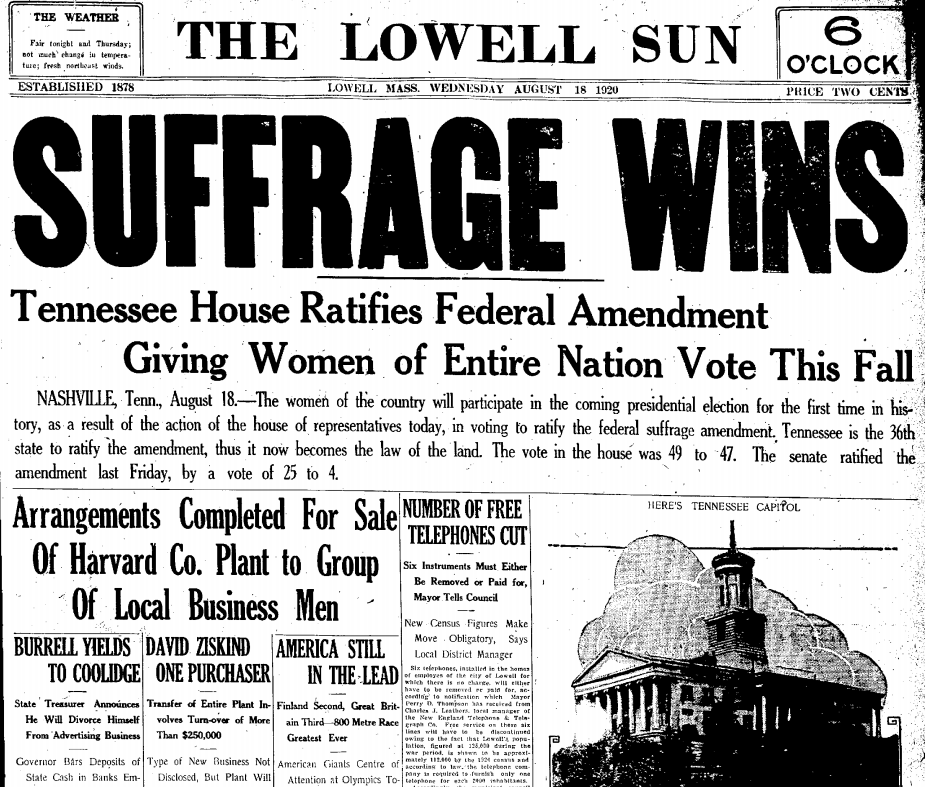
Sadly, none of the pioneers of women’s rights would live to see the passage and ratification of the Nineteenth Amendment which gave women the right to vote in 1920. The Equal Pay Act, which mandated the equal pay for Federal employees did not pass until 1963, and the ill-fated Equal Rights Amendment which simply stated “That equality of rights under the law shall not be abridged by the United States or by any State on account of sex” was introduced in 1923, but not passed by Congress in 1972,  but was never ratified falling three states short of ratification, mainly due to the opposition of religious conservatives who propagandize diet as a threat to traditional gender roles, citing in particular that the amendment might result in women being subject to the draft.

Even so, in the years following the failure of the amendment, women have continued to advance in the private sector, government, and the military, with women rising to be Chief Executive Officers of Fortune 500 companies, in elected office, as Cabinet Secretaries and on the Supreme Court, and even as four-star Generals and Admirals in the U.S. Military. Today women make up over half of college graduates and nearly half of the work force. To further increase opportunity the Department of Defense decided to open military occupational combat arms specialties previously restricted to men to women in 2015. Even so women can still be legally paid less, and discriminated against based on their gender in many states.

Notes

[1] Ibid. Goldfield America Aflame: How the Civil War Created a Nation p.468

[2] Stanton, Elizabeth Cady, Letter to Congressman Gerrit Smith, from The Revolution 14 January 1869 in The Civil War and Reconstruction: A Documentary Collection edited by William E. Gienapp, W.W. Norton and Company, New York and London. 2001 p.361

[3] Ibid. Goldfield America Aflame: How the Civil War Created a Nation p.468

[4] Ibid. Massey Women in the Civil War pp.340-341

[5] Ibid. Massey Women in the Civil War p.352

[6] Ibid. Guelzo Fateful Lightning p.403  

1 Comment

Filed under civil rights, ethics, faith, History, Political Commentary, women's rights

The Continuing Struggle, Part Three: Harriett Tubman “The General” and Women’s Rights Today


Friends of Padre Steve’s World,

Over the past few days I have been going back to the theme of Women’s rights following the 99th anniversary of the ratification of the Nineteenth Amendment.

So today I am posting a section of the portion of my text dealing with a most amazing woman, Harriet Tubman. The more I read about her the more I stand I awe. This section was a lot less detailed that in is now. I have spent a lot of time working on this section recently, and will probably do some more in the coming weeks, but I think that you will find it interesting, and still relevant in our society.

Her image was to be featured on the $20 bill beginning next year, replacing that of Andrew Jackson, but the Trump administration has put this off until at least 2028. Her story should not be forgotten. Maybe after I retire I can write an in depth biography of this remarkable woman and American Patriot.

So until tomorrow, I with you peace, health, and safety,

Peace

Padre Steve+

The innate prejudices of many military and political leaders about the abilities and limitations of women in military service, often caused them to overlook how women could use that prejudice to their advantage, especially as spies. “African American women were generally dismissed as militarily harmless, a miscalculation that Harriet Tubman…used to immense advantage. Tubman, who had escaped from slavery in Maryland twenty years before the war and who had amassed considerable experience venturing into the south to guide runaways to the North undertook spying expeditions for the Federal troops on the South Carolina Sea Islands.” [1] The incredibly brave woman served throughout the war accompanying Union forces and securing vital information even as she worked to set other slaves free. Tubman’s “spying activities included convincing slaves to trust the Union invaders,” [2] many of whom would join the ranks of the newly raised regiments of U.S. Colored Troops.


Tubman had been fighting her personal civil war for over twenty years before the war began. As an escaped slave she returned to the South time and time again as a “conductor” on the Underground Railroad, smuggling escaped slaves out of the South and to freedom. She “successfully returned nineteen more times, bringing out an estimated 300 to 400 people…. She worked with a determination bordering on ruthlessness: if an escaped slave tarried, she pushed him in; if a baby cried she muffled the sound.as she herself said later…. “I was the conductor on the Underground Railroad for eight years, and I can say what most conductors can’t say – I never ran my train off the track and I never lost one passenger.” [3]

In early 1863, Union commanders in South Carolina decided that Tubman would be valuable as a covert operative to lead reconnaissance missions behind Confederate lines and along contested waterways where Confederate personnel had laid torpedoes, what we now know as sea mines, and she organized a small unit of nine men who used small boats to find the torpedoes and warn the captains of Union vessels operating in those streams and rivers.

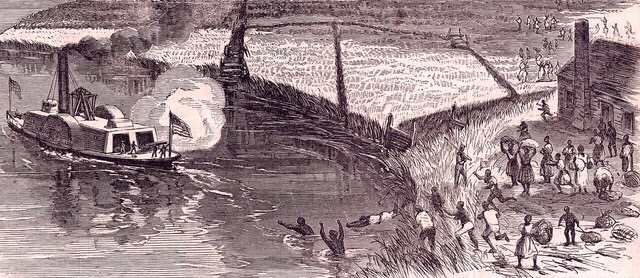
Eventually, Tubman’s actives “evolved into a kind of special forces operation under Colonel James Montgomery. A fervent believer in guerrilla warfare, Montgomery was a veteran of antislavery border fighting in Kansas.” The pair developed some of the most effective operations mounted by irregular and regular forces conducted by the Union in the war. In July 1863, Tubman came up with a plan for a raid, and in it acted as “Montgomery’s second-in-command during a night raid up the Combahee River, near Beaufort, South Carolina. The Union gunboats, carrying some 300 black troops, slipped up the river, eluding torpedoes that Tubman’s men had spotted. Undetected, the raiders swarmed ashore, destroyed a Confederate supply depot, torched homes and warehouses, and rounded up more than 750 rice plantation slaves.” [4]

The Confederate report on the raid unwittingly ended up praising the work of Tubman and the freed slaves of her unit. It noted that the enemy “seems to have been well posted as to the character and capacity of our troops… and seems to have been well guided with persons thoroughly acquainted with the river and country.” Union Brigadier General Rufus Saxton wrote to Secretary of War Stanton praised Tubman’s work, noting, “This is the only military command in American history wherein a woman, black or white, led to raid, and under whose inspiration, it was originated and conducted.” [5]

Tubman continued her work for the duration of the war and after it continued to assist freed slaves and black veterans and continued her work with campaign for women’s suffrage. In 1890 she was awarded a pension for her work as a spy, nurse, and combat leader. The valiant pioneer of abolition, women’s suffrage, and combat in war who was nicknamed “the General” by Frederick Douglass, died in 1913, and was buried with full military honors.

Other women served in various roles caring for the wounded. In the North, “Dorothea Dix organized the Union’s army nurses for four years without pay; Mary Livermore headed the Union’s Sanitary Commission, inspecting army camps and hospitals….Scores of others like Clara Barton, volunteered to be nurses.” [6] All of these women did remarkable service, mostly as volunteers, and many witnessed the carnage of battle close up as the cared for the wounded and the dying which often created ethic concerns for the women nurses:

“Clara Barton described her crisis of conscience when a young man on the verge of death mistook her for his sister May. Unable to bring herself actually to address him as “brother,” she nonetheless kissed his forehead so that, as she explained, “the act had done the falsehood the lips refused to speak.” [7]

The very existence of so many women who served in the ranks during the Civil War, and their “demonstrated competence as combatants, challenge long-held assumptions about gender roles…. From a historical perspective, the women warriors of the Civil War were not just ahead of their time. They were ahead of our time.” [8]

Of the women that served in the ranks during the war, some were discovered, and many of them remained protected by their fellow soldiers. Quite a few of these closeted women soldiers received promotions and even served as NCOs or junior officers. With women now serving in combat or combat support roles in the U.S. Military since Operation Desert Storm in 1991, the stigma and scandal that these cross-dressing women soldiers of the Civil War has faded and as scholars and the public both “continue probing cultural notions of gender and identity, the reemerging evidence that women historically and successfully engaged in combat has met with less intellectual resistance and has taken on new cultural significance.” [9] As the United States military services examine the issues surrounding further moves to integrate the combat arms we also should attempt to more closely examine the service of the brave and often forgotten women who served on both sides of the Civil War.

In addition to these tasked many other women were engaged in the war as “supply organizers, relief workers, pamphleteers all aided the cause, and female journalists covered it. Dorothea Dix and Clara Barton became powerful forces helping soldiers; Anna Carroll provided the propaganda. And the Civil War boasted its own version of Rosie the Riveter, women who did the dangerous work of making munitions at arsenals, many losing their lives in awful accidents.” [10]

Likewise, the war caused many educated women to take much more interest in “political and military issues and led many women to articulate a sharper consciousness of national affairs…. The feminist paper The Mayflower commented that “nearly every letter we receive breathes a spirit of deep feeling on the war question.” The editorial added that among women, “There seems to be little disposition to think, speak, read or write of anything else.” [11] In particular one women, Anna Ella Carroll, the daughter of Thomas King Carroll, a former governor of Maryland, “was interested in political theory and practice and was a profound logical thinker as well as an effective propagandist for the Union.” [12]  During the war she was in part responsible for persuading the governor of Maryland to keep the pro-secession legislature from meeting in 1861, defended Lincoln’s suspension of habeas corpus in that state, and is believed to have originated the military strategy in the Tennessee River Campaign, for which she was never given full credit even though there is documentary evidence that many leaders knew of her involvement. A recent biographer concluded that she “was a “tragic victim of reconstruction,” for if a military strategist, she was not given due credit.” [13] In the South it was often the same, the diaries of many educated Southern women show a tremendous interest and discernment of what was happening during the war, and in domestic politics, and frequently expressed their criticism of government and military strategy as the war continued.

                                                      Notes

[1] Ibid. Guelzo Fateful Lightning p.394

[2] Sizer, Lyde Cullen Acting Her Part: Narratives of Union Women Spies in Divided Houses: Gender and the Civil War Oxford University Press, New York and Oxford 1992 p.130

[3] Ibid. Sizer Acting Her Part: Narratives of Union Women Spies  p. 127

[4] Ibid. Central Intelligence Agency, Intelligence in the Civil War location 481 of 991

[5] Ibid. Central Intelligence Agency, Intelligence in the Civil War location 481-482 of 9911

[6] Ibid. Silvey I’ll Pass for Your Comrade p.10

[7] Faust, Drew Gilpin, This Republic of Suffering: Death and the American Civil War Vintage Books, a division of Random House, New York 2008 p.12

[8] Ibid. Blanton and Cook They Fought Like Demons p.208

[9] Ibid. Blanton and Cook They Fought Like Demons p.204

[10] Ibid. Roberts Capital Dames: The Civil War and the Women of Washington 1848-1868 p.3

[11] Attie, Jeanie Warwork and the Crisis of Domesticity in the North in Divided Houses: Gender and the Civil War edited by Catherine Clinton and Nina Silber, Oxford University Press, Oxford and New York 1992 p.253

[12] Ibid. Massey Women in the Civil War p. 168

[13] Ibid. Massey Women in the Civil War p.169

2 Comments

Filed under civil rights, civil war, History, News and current events, Political Commentary, racism, women's rights

The Continuing Struggle: The Nineteenth Amendment at 99 Years

Friends of Padre Steve’s World,

Today is the 99th Anniversary of the ratification of Nineteenth Amendment to the Constitution which gave women the right to vote. It was a watershed moment brought about through close to 8 decades of women fighting for the right to vote and for equality in general.

However, that decision was just a point of a long struggle for equality that  continues today. Despite the gains made since the past century women continue to have few rights than men, and when successful in business, sports, politics, the media, academia, or for that matter almost anything outside the traditional household remain second class citizens in most countries, even the United States, and all too sadly that is due to misogyny and religious prejudices which favor men and no matter how talented, intelligent, and brilliant many women are are consigned to a second place in the workplace, in the church, and almost everywhere else. 

So, tonight and for the next few nights I am going to repost a series of articles from one of my yet unpublished books which deal with the American Civil War, the Abolition Movement, and the post-War movement for women’s rights. 

So until tomorrow, 

Peace

Padre Steve+

Another development, which in large part is related to the abolition movement, was the campaign for women’s rights. The Civil War was also revolutionary because it was instrumental in propelling women into positions in American society that they had never before been allowed. The war Some of this was because many women decided to like those who campaigned for the end of slavery and the rights of African Americans to turn the world upside down. The war allowed the women who served, “in uniform or not, war permitted these women to experiment with a series of role reversals in gender,” [1] and in some cases gender and race. These experiments were the beginning of the struggle for women’s equality and to women serving in the military.

In much of the country and in particular the South women’s rights were the same as granted in English Common Law. Common law held to the more archaic understanding of the Christian Church that women were the property of their husbands, especially in cases of infidelity including during the trial of Dan Sickles for killing Barton Key. But the war “imposed on American society as such social disruption as it did physical destruction. Within that disruption, for one brief and bloody historical moment, an entirely new way of ordering of race and gender within a republican society became possible,” [2]however, in the end it would take another century or more for much of this change to be realized.

Southern culture and law ensured that women had even few rights than the women in the North.  In the North women were making some gains in the workplace and in various professions such as teaching and nursing, and as the industrial revolution modernized the workplace and required more skilled workers, particularly in the textile industries, the availability of work for women who wanted to work outside the home increased. Even uneducated Northern women sought work in the growing number of factories and by 1860 “there were more than 270,000 female operatives, the vast majority being employed in Northern textile, shoe, clothing, printing, and publishing establishments. Over 135,000 worked in New England factories and composed 65 percent of the region’s industrial labor.” [3]  Educated Northern women, while excluded from most professions, found their way into teaching, nursing, non-ordained religious work, and writing. Some found work in Federal government agencies in Washington DC, including “Clara Barton, a successful teacher who had trouble landing a position because she was a women, found work in the Patent Office, where she briefly made the same salary as her male colleagues.” [4]

But in the South women were continued to be held back. This was in large part due to the understanding that the “household was a spatial unit, defined by the property to which the owner not only held legal title over, but over which he exercised exclusive rights.” [5] As such Southern men had nearly unlimited rights and power over what occurred on his property, for “in societies in which landed property comprised the chief means of subsistence…legal title to the land had historically incorporated claims over the persons and labor of those who were dependents on it.” [6] In the South, as opposed to the North comparatively few women entered the Southern labor market, in large part because of the region’s emphasis on agriculture, dependence on slave labor, and a culture that frowned on women working outside the home.  1860 when Northern women were becoming a force to be reckoned with in the labor market, “only 12,000 women worked in factories, 10 percent of the regions wage earners.” [7] The lack of trained and experienced women workers would be a crippling impediment to the Confederate War effort.

For Southern men the stakes of ensuring slavery’s continuation and expansion were high, the culture of the South ante-bellum South was deeply patriarchal and “The possibility that the black man might be empowered like any other was such a threat to the southern social hierarchy that some white southerners were inclined to fear not only for their position as slaveowners but for the entire basis of their claim to patriarchal power. They feared for their power not only over their slaves but over their women as well.[8]

The Gimke Sisters, Abolitionists and Suffragettes 

William Lloyd Garrison and the leaders of the abolitionist movement came into contact with two southern women who had converted to the abolitionist cause; South Carolina cotton heiresses, Sarah and Angelina Grimke. The two women were passionate as well as eloquent and became popular lecturers on the abolitionist speaking circuit. Angelina Grimke was a powerful speaker linked to abolition and women’s rights, she made herself unwelcome in her native Charleston South Carolina “with the publication of An Appeal to the Christian Women of the South. She urged Southern women, many of whom opposed slavery, to speak out, and despite her failure to reach the audience to which she spoke, hers is one of the most significant abolitionist writings.” [9] She proclaimed:

“We cannot push Abolitionism forward with all our might until we take up the stumbling block out of the road…. If we surrender the right to speak in public this year, we must surrender the right to petition next year, and the right to write the year after, and so on. What then can the woman do for the slave, when she herself is under the feet of man and shamed into silence?” [10]

Her sister Sarah was also active in writing, but she focused her attention not just on abolition, but “on the inferior status of both woman and the Negro in The Equality of the Sexes and the Condition of Women.” [11] The Grimke sisters and other women like them brought Garrison and others in the abolitionist movement into contact with the early leaders of the new women’s rights movement. The leaders of the movement, Elizabeth Cady Stanton, Abby Kelley, and Lydia Maria Child were outspoken in their belief that “a campaign to emancipate slaves could not avert its eyes from the need to emancipate American women from social conventions and legal restraints that prevented them, like the slave, from owning property and voting, and kept them altogether subservient to the interests of white males.” [12]

The principals involved in the abolitionist and the women’s movements, those of freedom, emancipation and equality eventually forged a bond between them, and have provided inspiration to others in their quest for political and social equality. For William Lloyd Garrison “the woman question clearly demonstrated how the logic of reform united all good causes and carried them to new ground. If in their endeavors to break the chains of slavery women discovered, as Abby Kelley put it, that “we were manacled ourselves,” the abolitionist principle required a defense of equal rights without regard to race or sex.” [13]

While women and blacks were “being brought together in a dual crusade, often behind the same leaders,” [14] that did not mean that both parties were given equal consideration, even among the supporters of abolition and women’s rights. All to often, women found that their rights were not considered as important by the political leadership fighting for the rights of black men. Few in Congress “responded sympathetically to feminists’ demands. Reconstruction they insisted, was the “Negro’s hour,”  [15] a view shared by Frederick Douglass. Though the economic situation of women began to improve, especially through women being admitted to the Civil Service, much else remained unchanged, women were still second class citizens without the right to vote, with few legal rights, and few opportunities to move up in society apart from her husband.

But change was beginning to occur as women began to have more educational opportunities in the post-war years, and began to find employment opportunities with the expansion of industry. Women’s suffrage was not included in the Fifteenth Amendment, which caused a split between women’s groups and their long-time abolitionist allies who told them “If put on the same level and urged in the same connection, neither will soon be accomplished.” [16]   Even so in some territories women were granted the right to vote in territorial elections, “women were given the vote in Wyoming Territory in 1869. However, Wyoming’s admission as a state twenty years later came only after a heated debate on the women’s suffrage article in the state constitution.” [17]

In the 1800s women in the United States found themselves bound by two major factors, law and culture. English common law and early in the life of the Republic it was determined by John Adams that women should be exclude from political life as they were “unsuited by nature for the businesses of life or the hardy enterprises of war, they had nothing of value to offer the state.” [18] Women had no claim to property, wages, or even their children. Thomas Jefferson had “defined the essence of liberty as independence, which required ownership of productive property. A man dependent on others for a living could never truly be free, nor could a dependent class constitute the basis of republican government. Women, children, and slaves were dependent; that defined them out of the polity of republican freedmen.” [19] This understanding of the rights and citizenship of women persisted as the official law of the nation throughout the ante-bellum era, through and after the Civil War, and up until the passage and ratification of the Nineteenth Amendment.

As such, single women had few rights while married women had even fewer as, married women could not “own property in her own right, make contracts or otherwise conduct business of her own. She was supposed to be modest and submissive. The married woman, in fact, was for all intents and purposes the chattel of her husband.” [20] The reality was stark for women, but especially married women for as one historian noted: “marriage very nearly meant the legal annihilation of a woman…once a woman was married all property and property rights were transferred to her husband, and she was permitted to own nothing in her own name. Married women could not make contracts, could not sue, could not buy or sell, except over their husband’s signatures.” [21] Adult white women were citizens in a constitutional sense, but in the North and South alike their terms “of their citizenship had always been set by the perceived necessities of marriage and its gender asymmetries between man and woman, husband and wife.” [22]

The role of culture and religion was another major constraint on women’s rights during the ante-bellum period and much of this centered on Victorian social and cultural ideals which brought about what can be safely called a “a cult of true womanhood” which “dictated that women always appear demure, submissive, pious, and concerned with the home and family.” [23] In the Victorian ideal, it was the man whose sphere of life was in worldly pursuits, while women were limited to the task of bearing and raising children and maintaining the traditional private domain of hearth and home. This understanding of separate spheres was supported was often supported by the churches, especially those the conservative and evangelical variety.

While this was true in the North it was especially prevalent in the South and promoted by southern evangelical churches. The “explicit goal of southern evangelicalism was to keep the religious role of white women within narrow and carefully policed bounds. Evangelical Southerners clearly designated men as society’s (and women’s) rightful rulers and ultimate authorities. They were, in the 1830 words of Southern writer Virginia Carey, “the anointed lords of creation”; St. Paul’s injunction that wives “submit yourself to your own husbands as to the Lord” provided the text for many a Sunday sermon.” [24]

In matters of sexual behavior there was a pronounced double standard between men and women. If a man was an adulterer it was frowned upon, but not necessarily a condition that would invoke the scorn of the community unless an aggrieved husband took the law into his own hands and killed the adulterer, in which case the murderer could easily be forgiven. However, for the married adulteress, the social damnation was all too real, even from other women, who often believed that there was no excuse for such behavior and that the adulteress “deserved the most stringent fate for her violation of the dictates of virtue.” [25]

A married woman’s position was as close to being a slave as could be, and only the plight of black female slaves was worse, for they were simply chattel. The few free black women mainly stayed unmarried “in order to maintain what few property rights they were entitled to.”  [26] As they also did over blacks, white men ruled over women in all spheres of life. While the eventual emancipation of blacks provided more rights for black men, those did not help many black women as Sojourner Truth, a pioneering African-American abolitionist who spent forty-years as a slave said toward the end of her long life:

“There is a great stir about colored men getting their rights, but not one word about colored women; and if colored men get their rights, and not colored women theirs, you see colored men will be master over the women, and it will be just as bad as it was before. So I am for keeping the thing going while things are still stirring because if we wait till it is still, it will take a great while to get it going again….I suppose I am the only colored woman that goes on to speak for the rights of the colored women. I want to keep the thing stirring, now that the ice is cracked…” [27]

Elizabeth Cady Stanton was among the most vocal of women’s rights advocates. She was the daughter of a leading Federalist lawyer, who served a term in the House of Representatives and on the New York Supreme Court. Her father planted in her the desire to learn, a love for law, and a passion for civil rights which she was able to pursue. Unlike many women of her day, Stanton was able to graduate from the Johnstown Academy and the Troy Female Academy in Troy, New York, before she was married to Henry Brewster Stanton, a journalist, anti-slavery orator and attorney, with who she had seven children.

Stanton believed that a woman’s place in the home was ultimately destructive and “reflected her subordinate position in society and confined her to domestic duties that served to “destroy her confidence in her own powers, lessen her self respect, and to make her willing to lead a dependent and abject life.” [28] Stanton noted how the condition of women of her day was “more fully identified with the slave than man possibly can be… For while the man is born to do whatever he can, for the woman and the negro the is no such privilege.”  [29] It was a key observation and something even today, a state that some politicians, pundits and preachers would like to return women.

Since nearly all of the most “outspoken feminists had been schooled in abolitionist movement” they were “suspect in the South, where society was conservative, patriarchal, and insistence that ladies live in a kind of earthly limbo.”  [30]  Such women posed a threat to the pillars of Southern society. Since the South was now fighting tooth and nail against the abolitionist movement, anything closely connected with that movement, including the women who advocated abolition and women’s rights were shunned and their message rejected and inflammatory and revolutionary. It was not until the crisis caused by the Civil war that Southern women began to seize “the opportunity to lay claim to an increased reciprocity in gender relations.” [31]

But even with the abolition movement there was opposition the women’s rights, the 1839 meeting of the American Anti-Slavery Society witnessed a debate over including women in the membership. Conservative Evangelicals recoiled in disgust, and when the convention voted to allow women into the membership Lewis Tappan “got up a starchy “protest” which condemned the “repugnant” admission of women as an ‘expression of local and sectarian feelings…well suited to the unnecessary reproach and embarrassment to the cause of the enslaved as [it] is at variance with the general usage and sentiments of this and other nations.” [32] In May of 1840 the American Anti-Slavery Society split among religious lines when leading evangelicals led by the Tappan brothers withdrew from it.
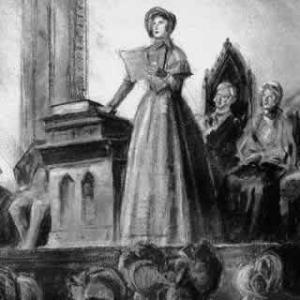
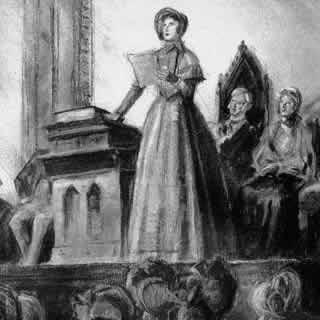
senecafalls-womanspeaking

Elizabeth Candy Stanton at the Seneca Conference, 1848

But that neither stopped Garrison from working with women, nor kept Frederick Douglass from embracing them as part of the abolitionist movement. From this rather inauspicious beginning, the women’s rights movement began to infiltrate society, especially in the field of education. In 1848 at Seneca New York there was a convention that launched the modern women’s rights movement. Led by Stanton and Elizabeth Mott the delegates published a “Declaration of Sentiments, modeled on the Declaration of Independence, proclaimed “that all men and women are created equal” and deserved their “inalienable rights” include the right to elective franchise.” [33] The declaration was bold and its denunciation of the place of women in society to be considered revolutionary in character. Part read:

“He has never permitted her to exercise her inalienable right to elective franchise. He has compelled her to submit to laws, in the formation of which she had no voice. He has withheld from her rights which are given to the most ignorant and degraded men – both natives and foreigners… He has made her, if married, in the eye of the law, civilly dead. He has taken from her all right to property, even to the wages that she earns…. After depriving her of all her rights as a married woman, if single, and the owner of property, he has taxed her to support a government which recognizes her only when her property can be made profitable to it. He has monopolized nearly all the profitable employments, and from those she is permitted to follow she receives but a scanty remuneration. He closes against her all the avenues to wealth and distinction which he considers honorable to himself. As a teacher of theology, medicine of the law, she is not known… He has created a false public sentiment by giving the world a different code of morals for men and women, by which moral delinquencies which exclude women from society, are not only tolerated, but deemed of little account in man. He has usurped the prerogative of Jehovah alone, claiming his right to assign for her a sphere of action, when that belongs to her conscience and to her God. He has endeavored, in every way that he could, to destroy her confidence in her own powers, lessen her self-respect, and to make her willing to lead an abject and dependent life.” [34]

The declaration also stated, in words which inflamed many men that: “the history of mankind is a history of repeated injuries and usurpations on the part of man toward woman, having in direct object of an absolute tyranny over her.” [35] In the years following this meeting women took up an even more important place in the abolitionist movement, Abby Kelly Foster returned to head the work and recruited many talented women agents including Sallie Holley, Lucy Stone and Susan B. Anthony who “often made five or six appearances a week”in various abolitionist meetings and in 1850-1851 they were joined by the “black evangelist Sojourner Truth, whom Garrison had met and the Northampton colony in 1843 and for whom he had printed an autobiographical narrative.”[36] These women contributed greatly to the abolitionist cause and would in the years to come be among those who continued to fight not only for the rights of blacks, but the rights of women.

The new women’s rights groups continued to work hand in hand with the abolitionist groups but also began a campaign for the rights of women. In the mid-1850s primarily focused on “obtaining state laws guaranteeing women’s right to control their property and wages, to be legal guardians of their children, and to be paid salaries commensurate with their labors, while a few women advocated for more liberal divorce laws so that they could rid themselves of alcoholic, insane, criminal, or brutal husbands.” [37]These efforts secured some modest gains and by 1861 most states had granted women some type of property rights or had changed their laws to follow the community property principle.

While the movement made modest progress regarding property rights for women in some states, they made little progress in terms of elective franchise and better wages and working conditions. During the ante-bellum period, women who lobbied for such rights were met with open opposition and scorn. The press “frequently denounced and ridiculed the “strong-minded women…” [38] Despite such attitudes women did make some significant advancements, particularly in lay aspects of the church, such as Bible societies, moral reform organizations, as well as the abolition and temperance movements, which had gained prominence during the Second Great Awakening.

During the ante-bellum period women made great progress in education. By 1850 the United States was the only country where “girls went to elementary school and achieved literacy in virtually the same proportion as boys.” [39] Likewise a few women entered higher education, particularly at women’s seminaries, which were for all practical purposes boarding schools that produced teachers and writers, as well as the Oberlin College, which was founded by Christian abolitionists and welcomed students of both genders as well as of any racial minority. During the three decades prior to the war women made some specific gains, but more important “was the development to their talents for organization, cooperation, leadership, and self expression. It was a time of beginnings and not fulfillment, a time when most women realized and accepted the fact that they lived in a man’s world, a time when a few dedicated but belligerent visionaries were frustrated in their attempt to remake the social order “overnight.” [40]

However, the war would help bring about many more opportunities for women. In 1850 a follow on conference to the Seneca conference, the National Women’s Rights Convention denied the right of anyone to dictate what women could do with their lives:

“The right of any portion of the species to decide for another portion, of any individual to decide for another Individual what is not their “proper sphere”; that the proper sphere for all human beings is the largest and highest to which they are able to attain; what this is, can not be ascertained without complete Liberty of choice; women therefore, ought to choose for herself what sphere she will fill, what education she will seek, and what employment she will follow, and will not be bound to accept, in submission, the rights, the education, and the place which man thinks proper to allow her.”  [41]

To be continued…

Notes

[1] Ibid. Guelzo Fateful Lightning  p.395

[2] Ibid. Guelzo Fateful Lightning p.374

[3] Massey, Mary Elizabeth, Women in the Civil War University of Nebraska Press, Lincoln NE 1966 p.5

[4] Roberts, Cokie Capital Dames: The Civil War and the Women of Washington, 1848-1868 Harper Collins Publishers, New York 2015 p.18

[5] McCurry, Stephanie The Politics of Yeoman Households in South Carolina  in  Divided Houses: Gender and the Civil War Oxford University Press, Oxford and New York 1992 p.23

[6] Ibid. McCurry The Politics of Yeoman Households in South Carolina p.23

[7] Ibid. Massey Women in the Civil War p.5

[8] Whites, Leeann The Civil War as a Crisis in Gender in Major Problems in the Civil War and Reconstruction, 3rd Edition Edited by Michael Perlman and Murrell Taylor Wadsworth Centage Learning, Boston 2011 p.16

[9] Ibid. Massy Women in the Civil War p.15

[10] Ibid. Zinn The Other Civil War p.121

[11] Ibid. Massey Women in the Civil War p. 16

[12] Ibid. Guelzo Fateful Lightening pp.49-50

[13] Mayer, Henry All on Fire: William Lloyd Garrison and the Abolition of Slavery  W.W. Norton and Company, New York and London 1998 p.265

REPORT THIS AD

[14] Ibid. Massey Women in the Civil War p.16

[15] Ibid. Foner Forever Free p.124

[16] Ibid. Foner Forever Free p.125

[17] Ibid. Massey Women in the Civil War p. 358

[18] Ibid. McCurry Confederate Reckoning p.24

[19] Ibid. McPherson Battle Cry of Freedom p.23

[20] Brant, Nat The Congressman Who Got Away with Murder Syracuse University Press, Syracuse New York 1991 p.67

[21] Ibid. Guelzo Fateful Lightening p.391

[22] Ibid. McCurry Confederate Reckoning p.23

[23] Blanton, DeAnne and Cook, Lauren M. They Fought Like Demons: Women Soldiers in the Civil War Vintage a books, a Division of Random House New York 2002 p.3

[24] Ibid. Levine, Bruce Half Slave and Half Free: The Roots of the Civil War Revised Edition p.114

[25] Ibid. Brant The Congressman Who Got Away with Murder p.141

[26] Ibid. Guelzo Fateful Lightening p.391

[27] Ibid. Zinn The Other Civil War pp.53-54

[28] Ibid. Goldfield America Aflame p.74

[29] Ibid. Guelzo Fateful Lightening p.50

[30] Ibid. Massey Women in the Civil War p. 19

[31] Ibid. Whites The Civil War as a Crisis in Gender p.21

[32] Ibid. Mayer All on Fire p.267

[33] Ibid. McPherson Battle Cry of Freedom p.36

[34] Ibid. Blanton and Cook They Fought Like Demons: Women Soldiers in the Civil War pp.3-4

[35] Ibid. Guelzo Fateful Lightening p.392

[36] Ibid. Mayer All on Fire p.424

[37] Ibid. Massey Women in the Civil War p.21

[38] Ibid. Massey Women in the Civil War pp.21-22

[39] Ibid. McPherson The Battle Cry of Freedom p.36

[40] Ibid. Massey Women in the Civil War p.23

[41] Ibid. Guelzo Fateful Lightning p.392

2 Comments

Filed under civil rights, civil war, faith, History, labor, laws and legislation, leadership, News and current events, Political Commentary, women's rights

“A Country that Will Tolerate Evil Means – Evil Manners, and Standards Of Ethics… Will be So Poisoned that it Never Have Any Good End”

1_PdtRL0EWQD_TJZdqE8BzQg

Friends of Padre Steve’s World,

Tonight I am re-posting an older article that I think is even more pertinent than it was when I first wrote it. I am doing this because I haven’t slept well for the past few weeks. My sleep doctor ordered me a BIPAP machine, replacing my CPAP. Hopefully it will help me sleep better. It may not stop all the crazy PTSD dreams and nightmares, but maybe I will sleep better, but I digress.

Thew fact is that many of Trump’s followers were prepared for his advent by years of highly politicized propaganda nationalistic covered with a very thin veneer of Christian jibber-jabber, most of which is at odds with 2000 years of the teachings of the Church going back to Jesus. But this propaganda has brought about a wave of hatred that consumes many toward those that they identify as enemies, and indifference to the victims of the policies that their political and clerical leaders espouse.

Historian Ian Kershaw wrote: “The road to Auschwitz was built by hate, but paved with indifference.” I find that comment all too real today when I look at the President, his propagandists, and those who follow him without question even when they know that he is lying to them.

The longer that I live the more that I understand how this happens. Today, as there were in 1930s and 1940s Nazi Germany, there are all too many hate-filled ideologues who desire to destroy or subjugate entire races and ethnic groups, or members of different religions or political ideologies. In the United States they have free reign to do speak and write freely about their goals and for many years we have regarded most of them as fringe characters who had no chance of ever enacting anything that they proposed.

Barry Goldwater, the true conservative scion of the GOP was frightened by the Christians who now form the core of the Trump personality cult. Goldwater said:

“Mark my word, if and when these preachers get control of the [Republican] party, and they’re sure trying to do so, it’s going to be a terrible damn problem. Frankly, these people frighten me. Politics and governing demand compromise. But these Christians believe they are acting in the name of God, so they can’t and won’t compromise. I know, I’ve tried to deal with them.” 

Many of these were and continue to be the most vocal supporters of President Trump, and see in him a man who will help them accomplish their desires as no President has done before. One of them, Steve Bannon who served as his chief policy adviser and strategist. Likewise, there are no shortage of civil rights opponents and proponents of a police state in his cabinet, including his first, Attorney General, Jeff Sessions, and his current AG, William Barr. While serving. As AG before he was fired, Sessions, the top law enforcement official in the country joined a chorus of Republican youth chanting “lock her up” meaning former First Lady, Senator, and Secretary of State Hillary Clinton. More recently Mr. Barr has moved to ensure that the Executive Branch achieves the primacy over the legislative and judicial branches that it is denied in the Constitution. Ken Cuccinelli said that the words on the Statue Of Liberty only applied to those of European descent.

e5b0006d86d35ad18a117e40a2e528af

Despite the myriad of actions taken by the Trump administration, its abuses of power, its probable connections to a hostile power, its attempts to shut down law enforcement probes of the Russia connections, its unabashed attempts to silence the press and all other opponents, and its nearly uncountable number of lies and distortions that it makes on a daily basis is that the vast majority of Congressional Republicans nor his supposedly Christian followers seem to care.

Don’t get me wrong, there is plenty of opposition, but among his followers and the great number of people in the middle who prefer not to get involved there is little real opposition; moral, religious, ethical, or political to anything that he says or does, mostly because they do not understand how it effects them or their liberties, nor how toxic it is to the nation. It seems to me that they are not only apathetic to the abuses of power, but have no empathy towards the people that they are directed against.

But as I said at the opening of this article, the were prepared by decades of political propaganda covered with a veneer of Christian jibber-jabber. I know this because for a bit over two decades I was exposed to it and and believed it. Years ago I knew and went to church with Randall Terry, the former head Operation Rescue. He once said: “Let a wave of intolerance wash over you. I want you to let a wave of hatred wash over you. Yes, hate is good…” I have walked in the shoes of Trump’s “Christian” personality cult, and at one time I was as whipped into a frenzy of hate by those preachers, and their colleagues in right wing talk radio. That was before I went to and returned from Iraq. Thus I fully understand them and now I reject them and their intolerant creeds.

img_0476

For the Trump supporters this is not a problem. He represents a chance for them to recover their greatness, just as Hitler did for many of his followers in the 1930s, including those who joined the Party late. One of the greatest film monologues that illustrated this phenomenon is that of Burt Lancaster in his portrayal of a Nazi judge who is on trial in the movie Judgment at Nuremberg. His comments remind me so much of what I see among many Trump supporters today:

“There was a fever over the land. A fever of disgrace, of indignity, of hunger. We had a democracy, yes, but it was torn by elements within. Above all, there was fear. Fear of today, fear of tomorrow, fear of our neighbors, and fear of ourselves. Only when you understand that – can you understand what Hitler meant to us. Because he said to us: ‘Lift your heads! Be proud to be German! There are devils among us. Communists, Liberals, Jews, Gypsies! Once these devils will be destroyed, your misery will be destroyed.’ It was the old, old story of the sacrificial lamb. What about those of us who knew better? We who knew the words were lies and worse than lies? Why did we sit silent? Why did we take part? Because we loved our country! What difference does it make if a few political extremists lose their rights? What difference does it make if a few racial minorities lose their rights? It is only a passing phase. It is only a stage we are going through. It will be discarded sooner or later. Hitler himself will be discarded… sooner or later. The country is in danger. We will march out of the shadows. We will go forward. Forward is the great password. And history tells how well we succeeded, your honor. We succeeded beyond our wildest dreams. The very elements of hate and power about Hitler that mesmerized Germany, mesmerized the world! We found ourselves with sudden powerful allies. Things that had been denied to us as a democracy were open to us now. The world said ‘go ahead, take it, take it! Take Sudetenland, take the Rhineland – remilitarize it – take all of Austria, take it! And then one day we looked around and found that we were in an even more terrible danger. The ritual began in this courtoom swept over the land like a raging, roaring disease. What was going to be a passing phase had become the way of life. Your honor, I was content to sit silent during this trial. I was content to tend my roses. I was even content to let counsel try to save my name, until I realized that in order to save it, he would have to raise the specter again. You have seen him do it – he has done it here in this courtroom. He has suggested that the Third Reich worked for the benefit of people. He has suggested that we sterilized men for the welfare of the country. He has suggested that perhaps the old Jew did sleep with the sixteen year old girl, after all. Once more it is being done for love of country. It is not easy to tell the truth; but if there is to be any salvation for Germany, we who know our guilt must admit it… whatever the pain and humiliation.”

img_0178

While we have not reached the point that the Third Reich did between 1933 and 1938, it will not take much for us to get there. Trump is certainly not Hitler, but he is escalating his words and actions toward the establishment of an authoritarian state. We misjudge ourselves if we belief that such things cannot happen here.

Sinclair Lewis, who wrote the book It Can’t Happen Here as a response to authoritarian and Fascist movements in the 1930s wrote in it:

“A country that tolerates evil means—evil manners, standards of ethics—for a generation, will be so poisoned that it never will have any good end.”

Timothy Snyder wrote:

“The European history of the twentieth century shows us that societies can break, democracies can fall, ethics can collapse, and ordinary men can find themselves standing over death pits with guns in their hands. It would serve us well today to understand why.”

Reinhold Niebuhr, the great American theologian noted: “Ultimately evil is done not so much by evil people, but by good people who do not know themselves and who do not probe deeply.”

We should heed their warnings before we cross that precipice and head into the abyss.

Until tomorrow,

Peace

Padre Steve+

3 Comments

Filed under books and literature, civil rights, ethics, History, holocaust, laws and legislation, leadership, nazi germany, News and current events, Political Commentary

It’s Not the Video Games Stupid, It’s the Ideology and Easy Access to Military Grade Weaponry

Friends of Padre Steve’s World,

Today President Trump, sounding according to Washington Post Columnist, Helen Olen like he was “like a hostage making a video.” The President, attempting to be the best consoler that he has the Reality Show in Chief tried to present some sort of empathy for the victims. He also placed the blame on violent video games, entertainment, and promising an emphasis on mental health care. Despite being on a TelePrompTer he got the name of the site of the second mass murder wrong, he called it Toledo, not Dayton.

Of course for years conservative politicians and pundits, as well as reputable physiological professionals have blamed violent video games for desensitizing their users into being able to move from virtual killing to real killing. I don’t dispute that such things occur. But I have to say that those games, readily available around the world, and those movies and television series, also readily available and popular around the world don’t seem to trigger the kinds of mostly race and religious based mass killings.

I propose that most of the people who engage in such killings have some kind of ideological belief, or personal grievance against others that motivated their attacks. A few like the teenager who shot and killed all the children at Sandy Hook had mental problems, but in his violence was ensured by a mother who got him as much weapons and familiarization as possible. He killed her too.

But most were motivated by any numbers of political ideologies, and racial and religious hatreds that go beyond violent popular entertainment. They are ideologically motivated terrorists (political, racial, religious) who have easy access to military grade weaponry and body armor. Some, like the Unibomber and Timothy McVeigh and his associates who killed almost 200 innocent people at the Murrah Federal Building were trained or self-trained in the use of explosives.

The real problem is that unlike most countries that share our Western, Jude-Christian, and Pluralistic ideals, we allow the easiest of access to the most lethal weapons and military type hardware for almost anyone. State standards vary, background checks are not always required, and the Supreme Court emasculated the original intent of the Founders regarding the Second Amendment. The only other countries that allow such access are places that we tend to label terrorist states. 

It is not enough to utter platitudes about violent entertainment, and mental health care that neither the government or private insurers wish to pay. In fact “inpatient mental health” is pretty much limited to warehousing troubled people until they are deemed not a risk to themselves or others. There are no real mental health rehabilitation programs in this country because nobody wants to pay for them. You can’t make a profit off the mentally ill, and that is what our medical system is about.

Countries with tighter gun controls and easier access to mental heath care do not have our epidemic of violence, unless they are in the middle of religious, racial, or ideological driven civil wars. It’s the ideology and the dehumanizing of others that leads to the terrorist killings we are seeing in our country today.

Take away the easy access to military grade weaponry, and pay for real mental health care treatment, even long term care. We have to stop carding more about people than profit. It is also necessary for the Congress and the Courts to revisit the case where the late Associate Justice Antonin Scalia wrote for the majority that the entire first section of the Second Amendment related to its necessity to “the maintenance of a well disciplined militia” which at the time was the basis of our new nation’s land based defense; into an individual right to own whatever weapon they need to protect them from the government.

Regardless of the ideology of the terrorists, you shut down their ability to get such weapons and gear, they have a much tougher time committing such crimes.

I’m not anti-gun. As I have written many times before I have qualified or familiarized on most individual or crew based weapons used by the United States military. That being said, there is no reason for anyone with any competence to own an AR-15 type weapon with more than the original 10 round magazine that came with the military version of the military issued M-16. No one needs more than that for self defense. Flash suppressors, silencers, bump stocks, and extended magazines serve no reason other than to kill.

Pour crisis is not a crisis made by the entertainment industry, through I don’t deny that it could be partially to blame. At its heart the true problem is political, ideological, religious. It is founded on hatred of the other and encouraged by all sorts of politicians, preachers, and pundits, including the President. The ease of obtaining such weaponry and protective gear simply makes it a greater problem.

As a nation we are dooming ourselves and our prodigy to many more of these events. That cannot all be blamed on President Trump, and it would be foolish to do that. Sadly, he is one of the least emotionally, and intellectually able men to handle such a crisis as has ever been elected to his office.

His words are empty. I wish that wasn’t so. I wish he would rise to the measure of someone like Theodore Roosevelt, and that is my prayer for him.

Think about that.

Until tomorrow,

Peace,

Padre Steve+


2 Comments

Filed under civil rights, ethics, History, laws and legislation, leadership, national security, News and current events, Political Commentary

A Second Mass Murder this Weekend: now 30 killed, nearly 50 wounded in Two Attacks

Friends of Padre Steve’s World,

I am shaking my head at the mass killing in Dayton, Ohio last night. Another nine people killed and 20 more wounded in the space of 30 seconds. Using a AR-15 type weapon equipped with a 100 round drum magazine while dressed in black clothing, and wearing body armor, the murderer was killed by Dayton police just before he could enter a crowded bar. Had he gotten in his already his already gruesome toll in human lives would have skyrocketed. He even killed his sister.

His history as a student in high school records that he was expelled once and re-admitted. At the same time he was reported as having been a bully, a misogynist, and to have had a “hit list” of people that he wanted to kill or rape. He also used social media to say that he was a “Satanist” and a “Leftist” who railed against the radicals of the extreme Right and President Trump, although he gloated over the death of Senator John McCain, which would be unusual for someone who despised Trump, McCain for his faults was admired by many on the left. So I wonder, if his was a false flag, especially with his earlier violent history.

However, violent sociopaths are not limited to the political Right. The Left, especially in Europe, Asia, and South and Central America his its share, not so many in the United States, especially since the end of Vietnam, but not unknown.

The killer obtained his weapons by mail from Texas through a local dealer. He drove his sister and others to the site of his massacre, then disappeared until he came back to kill. What is motivation was is undetermined, but he was a violent sociopath who masqueraded as a nice guy. Evil knows no boundaries. People forget that many of Stalin’s secret police and military officers had once been loyal servants of the Czar, and that many of Hitler’s most ruthless killers had at one time been Communists, Socialists, or members of the political Center. They just shifted their loyalties.

But the one common thing between the last two, and if you extend it to the killer at the Garlic Festival early last week, the real problem is not just the evil of these killers. But, that the problem also resides in our nation’s lax gun laws. There are so many loopholes that make it easy for any person to acquire military grade weapons, extended magazines, flash suppressors, silencers, body armor and Kevlar helmets, with little to no restrictions. In fact, these terrorists and criminals no matter what their persuasion or ideology are aided by the gun lobby and its army of lawyers, and are often more heavily armed and protected than law enforcement officers. Please, try to tell me how that makes any sense at all.  If you can I’ll give you a cookie.

Until we as a people, regardless of our political beliefs regarding the Second Amendment are willing to face that fact there will be more carnage. There will by hundreds, if not thousands of deaths. Empty words from the President or members Congress, without bipartisan legislation that gives law enforcement agencies the authority to enforce those laws is simple bullshit, regardless if it comes from a Republican or Democrat.

I have qualified or familiarized with almost every individual or team fired weapon in the current and past United States military inventory dating back to 1981. My favorites were the M1911A1 .45 caliber pistol, and the M203 Grenade Launcher. It was an M16A1 with a 40mm grenade launcher below the muzzle. I also used to call for fire for 155mm field artillery. To be sure putting those rounds on target gave me a woody. Once we finalize the final renovations to our townhome and move to a ranch house, my wife and I plan on getting matching bolt action carbines. She shoots like Annie Oakley, she’s a much better shot than me.

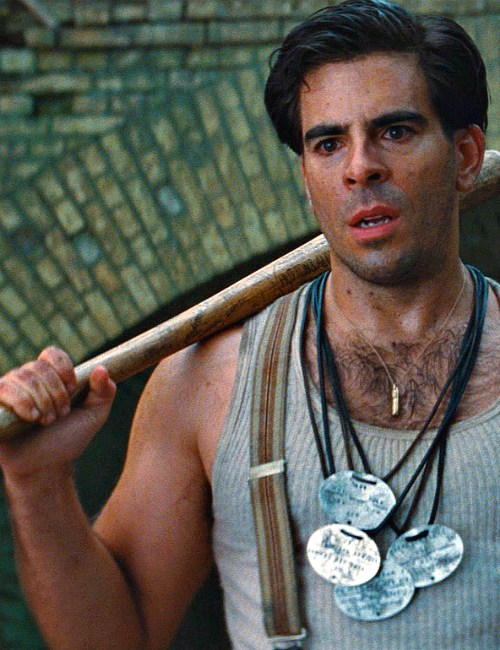
That being said neither of us needs an AR-15 or AK 47, or for that matter any of their derivatives. For that matter, I don’t believe anyone needs that kind of weaponry unless they are willing to use the basic 10 round magazines that were the original standard magazine for the M16 and AR15. My opinion, is that if you cannot protect yourself with such a weapon with the standard magazine you are either an incompetent, or have malevolent intentions. In fact most people could easily defend their home with a fully automatic and non-lethal paint gun rifle. The intruder would be immobilized and marked for law enforcement, even if he or she managed to flee the scene. Until I get my paint gun or bolt action carbine I will glades used any of my collection of baseball bats, swords, and cunning to defend my home against any intruder. I would be like the character played by Eli Roth in the film Inglorius Basterds, Donny Donowitz, the Bear Jew. My bat would knock their brains out of the park like “Teddy Fucking Williams.”  

I realize that such an attitude is inconsistent with my relatively passive interpretations of a Christian’s response to violence. But having been physically threatened by White Supremacists and neo-Nazis in the past, I have to say that if any showed up at my house, they better be prepared.

As far as assault weapons, magazines, and protective gear that gives a terrorist of any belief or ideology the ability to engage in mass killings and match up evenly or give them tactical superiority over law enforcement officers, I totally oppose it as I do believe the men who wrote the Second Amendment would of they could foresee the carnage of our time.

I believe that more now than ever.

Until tomorrow,

Peace,

Padre Steve+


3 Comments

Filed under civil rights, ethics, faith, film, History, laws and legislation, Loose thoughts and musings, News and current events, Political Commentary

Dare Call it What it Is: Race Hatred Blessed By the President

Friends of Padre Steve’s World,

Another day, another race based mass killing, another fake message of support from the President.

This time it was El Paso, Texas. A young white man from Dallas, an admitted White Supremacist went to a Walmart at a mall. Using an AK-47 he went on a killing spree. When police confronted him he offered no resistance.  The latest casualty count is 20 dead and 26 wounded, but the count is still fluctuating.  In his manifesto retrieved from the 8Chan site preferred by violent White Supremacists, he wrote:

“This attack is a response to the Hispanic invasion of Texas. They are the instigators, not me. I am simply defending my country from cultural and ethnic replacement brought on by an invasion.” 

There was a lot more damning information in the manifesto, but this stuck out to me because he used the exact same language to describe Hispanics that President Trump has done since he came down the escalator at Trump Tower to declare his candidacy for President in 2015. The same man who at his rallies mocks the disabled, urges his followers to violence against any opponent, and threatens members of the press and the opposing party by name. He is the President who wants a fortress like military solution to the border crisis, whose administration promotes policies which separate families and imprison children in cages.

Sadly, as much as we would not like to admit it this is nothing new in American history, and I will not make any Nazi comparisons because the American precedents helped to inspire the Nazis. The extermination of the Native American tribes; the invasion and takeover of over 40% of Mexico; American slavery, Jim Crow, segregation, “Sundown Towns,” the KKK in its various iterations, the Know Nothings, violence against Irish, German, Italian, Easter European, Jewish, Arab, and Asian immigrants. Medical experiments on African Americans and the disabled, Eugenics, the list can go on and on. Hitler’s lawyer’s loved U.S. precedents, but didn’t think they went far enough.

I could go on but a won’t. Another racially motivated mass murder, more wringing of hands, and nothing will change.

I hate that it is that way, but it is the truth. These racist movements predate the President, he is not directly responsible for any of them. That being said, he has opened the floodgates for these open displays of violent race hatred through his tweets and his rallies.

Until tomorrow,

Peace,

Padre Steve+

4 Comments

Filed under civil rights, crime, culture, History, leadership, nazi germany, News and current events, Political Commentary

Trump Tweets About a Domestic Nacht und Nebel Decree

Friends of Padre Steve’s World,

Today President Trump tweeted something against the ANTFA which could be used against any domestic opponents if he tried to implement it. The tweet read:

”Conisteration is being given to declaring ANTIFA, the gutless Radical Left Wack Jobs who go around hitting (only non-fighters) people over the heads with baseball bats, a major Organization of Terror (along with MS-13 & others). Would make it easier for police to do their job!”

Please note, I support the ANTIFA as much as I do White Supremacists, Neo-Nazis, and the KKK. That means I don’t. That being said ANTIFA efforts are always directed at events where the White Supremacy groups are gathered, and usually threading racial or religious, and LGBTQ supporters.

Most of their protests are peaceful, and unlike their opponents on the Right they are not a unified body and have no national organization. The political Right, especially the President tend to lump any opponent as ANTIFA. Likewise, unlike White Supremacist groups, which the FBI have labeled as extremist groups, the ANTIFA, which began as an Anti-Fascist and Anti-Nazi movement in the 1920s and 1930s, has not been labeled as such and despite my best efforts to find recent deaths attributed to them I cannot. On the other hand White Nationalist and Supremacist groups have killed far more Americans than any domestic terror organization. Thousands, dating back from Reconstruction, Jim Crow, the Civil Rights movement to Charlottesville have been systematical murdered by them.

But seriously, Senator Ted Cruz and GOP Representative Bill Cassidy Of Louisiana introduced legislation to label the ANTIFA as a Domestic Terror Organization. In fact they are nothing of the such, they are a disparate group of individuals with no national or statewide organization, unlike their opponents on the right. To be sure the last sentence of the Cruz-Cassidy legislation mentioned White Supremacist groups, but when the President and high administration officials defend those group daily it is hard to believe that such a law would be uniformly enforced.

I am sorry, unless one is willing to label the violent racist groups of the Right as domestic terror groups, and implement harsh policies against their violence and intimidation then this smacks of a Hitlerian Decree. It is a Reichstag Fire Decree and Night and Fog Decree wrapped into one unwholesome package, with dire impact for any person who writes or protests against the policies and actions of the Trump Administration.

Trump’s tweets and the legislation of Cruz and Cassidy are dangerous. They are going to lead to far worse. Do I think that the Cruz-Cassidy legislation ever being signed, but the President can do a lot with previously issued legislation and executive orders should he make the decision.

In Hitler’s Germany the Reichstag Fire Decree allowed his government under the Weimar Constitution to rule by decree and jail political opponents.   On March 10th 1933 the Malicious Practices Act made even the slightest dissent, including joking about or criticizing members of the Nazi government a crime, punishable by being sent to a Concentration Camp. On July 14th 1933 the Hitler government declared the Nazi Party to be the only legal political party. The previous Conservative and Center parties had either already dissolved themselves while the Communists and Socialists were outlawed. Formation of any new political parties was outlawed.

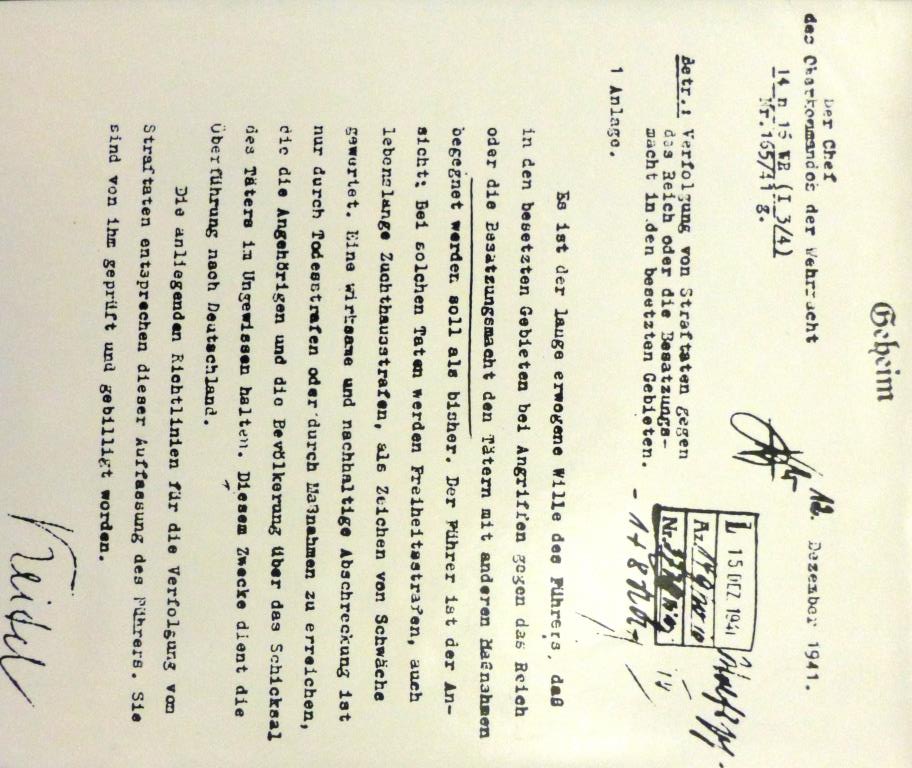
The Nuremberg Laws Of 1935 stripped the Jews of citizenship rights. The Nacht and Nebel Decree of December 7th 1941 was used as a way to eliminate resistance members and dissenters in occupied countries by either murdering them or shipping them to Concentration Camps.

Heinrich Himmler wrote on that day:

“After lengthy consideration, it is the will of the Führer that the measures taken against those who are guilty of offenses against the Reich or against the occupation forces in occupied areas should be altered. The Führer is of the opinion that in such cases penal servitude or even a hard labor sentence for life will be regarded as a sign of weakness. An effective and lasting deterrent can be achieved only by the death penalty or by taking measures which will leave the family and the population uncertain as to the fate of the offender. Deportation to Germany serves this purpose.”

Less than a week later Field Marshal Wilhelm Keitel ordered the German military:

“Efficient and enduring intimidation can only be achieved either by capital punishment or by measures by which the relatives of the criminals do not know the fate of the criminal.” 

The President’s continued ill-regard for the Constitution, our laws, our system of government and the long established guardrails to prevent tyranny are increasing. The danger is real.

It is true that this is not Germany of 1933, and that Trump, despite some of his similarities is not Hitler, Mussolini, or Stalin, but he is getting more dangerous with every passing day. The frightening thing is that he may find an already existing law or executive order to outlaw any opposition to him, and willing accomplices to enable him to do it.

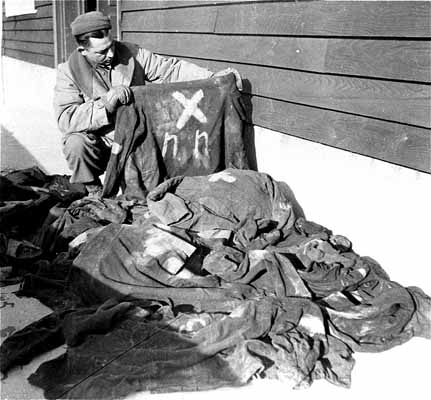
After the Liberation, a Nacht und Nebel Prisoner’s Uniform 

Historian Timothy Snyder noted:

“The European history of the twentieth century shows us that societies can break, democracies can fall, ethics can collapse, and ordinary men can find themselves standing over death pits with guns in their hands. It would serve us well today to understand why.” 

That is something we must ask ourselves today.

Until tomorrow,

Peace,

Padre Steve+


3 Comments

Filed under civil rights, ethics, History, holocaust, nazi germany, News and current events, Political Commentary

Freedom of Religion and the Yuck Factor: American Religious Theocrats

dyer-hanging1

Friends of Padre Steve’s World,

The distinguished British Mathematician and Philosopher Alfred North Whitehead wrote:

“Religion carries two sorts of people in two entirely opposite directions: the mild and gentle people it carries towards mercy and justice; the persecuting people it carries into fiendish sadistic cruelty…” 

I fully agree with him based on my knowledge of human history and behavior. I strongly support religious freedom, so long as it is not abused by people to harm others. I get sick of religious liberty hyperbole when it is used by theocrats of all religious stripes. I am kind of like James Spader’s character, Alan Shore in Boston Legal; but then, maybe there is a valid reason that my seminary classmates at Southwestern Baptist Theological Seminary asked me why I wasn’t in law school. They did not mean it as a compliment.

During one episode dealing with a case regarding religious liberties Spader’s character (Whose God is it Anyway, Season Three Episode 5) said:

“I don’t know about you but I’m getting a little tired of the religious freedom thing. When did religion get such a good name anyway. Be it the Crusades, the reformation genocides, the troubles in Northern Ireland, the Middle East, mass slaughters in the name of Allah, the obligatory reciprocal retributions. Hundreds of millions have died in religious conflicts. Hitler did his business in the name of his creator. Religious extremism, it’s our greatest threat today, a holy jihad. If we’re not ready to strip religion of its sacred cow status, how about we at least scale back on the Constitutional dogma exalting it as all get out….

Everyone should get to believe in his God, pray to his God, worship his God of course. But to impose him on others, to victimize others in his name?  The founding fathers set out to prevent persecution, not license it…

At a certain point we have to say “enough with this freedom of religion crap. Yuck, yuck, yuck. I know, I’ll get letters….” 

At this time though I am doing my best to fight budget cuts that could harm the rights of Navy and Marine Corps personnel of their rights to practice their religion in base chapels, cuts that will harm the religious rights of the most vulnerable service members and their families. I don’t have to agree with their religion, politics or theology, but I follow the Constitution, and legal precedent, not my own opinions on faith.

Let me explain.

Those who follow my writings know how much I struggle with faith and doubt on a daily basis. I believe, but as the man told Jesus when he asked Jesus to heal his child “I believe, help my unbelief.” I no longer believe in the “absolute truths” that I once believed. Of course to some this makes me a heretic or worse. That being said, I have faith in a God I cannot see. I have faith in a God who clothes himself in human weakness and allows himself to be killed as a state criminal.

That being said I see many of my fellow Christians, not to mention those of other faiths who attempt to use their interpretation of what they believe are absolute truths and attempt to impose them on others. Using their houses of worship they indoctrinate believers into believing the “truth” including the judgment on non-believers.

I remember going through classes in my previous denomination which were entitled “The Government of God” and utilized Robert Bork’s book Slouching Towards Gomorrah: Modern Liberalism and American Decline as its primary text. Obviously the class had little to do with faith, but was a tool by which we were indoctrinated to believe the political-religious ideology of our church leaders. There were several more texts, which basically echoed Bork’s thought, but they were taught in a manner is if they were as important as the often contradictory Biblical tests or the writings of the church Fathers, the great saints, scholastics or Protestant Reformers. It was an exercise in political indoctrination based on religious ideology. At the time I had no idea that what the church leaders were appealing to was nothing more than a variation on Christian Dominionism. I will not mention it’s name because most of those who taught this are not alive to defend themselves, and one, though I disagreed with his theology, I knew that he really did love people.

However, such ideology is incredibly dangerous, even when it is taught by well meaning people, because when people in power take it to heart and act upon it, all pretense of fairness, justice and integrity is lost. Those who are simply different are persecuted, those who do not tow a particular party or religious line are suspect, and the innocent are presumed guilty. It has happened throughout human history in every corner of the world, and it still goes on today.

I ended up rejecting that view of faith and life after coming home from Iraq, and for voicing my disagreement on a number of issues was asked to leave that denomination in 2010.

I believe again, but my doubts are real. But even more I have a belief in justice, and I believe that that justice itself cannot be built on absolutes. As Captain Jean Luc Picard (Patrick Stewart) noted in the Star Trek the Next Generation episode Justice: 

“I don’t know how to communicate this, or even if it is possible. But the question of justice has concerned me greatly of late. And I say to any creature who may be listening, there can be no justice so long as laws are absolute. Even life itself is an exercise in exceptions.”

I have found that as Picard said, “that life itself is an exercise in exceptions.”  We all make them, and the Bible and the history of the church is full of them. So I have a hard time with those who claim an absolute certitude in beliefs that are built on faith and treat them as fact, despite the fact that they are not provable. Dietrich Bonhoeffer noted the problem well when he talked of this problem and described the dilemma of so many believers:

“Man no longer lives in the beginning–he has lost the beginning. Now he finds he is in the middle, knowing neither the end nor the beginning, and yet knowing that he is in the middle, coming from the beginning and going towards the end. He sees that his life is determined by these two facets, of which he knows only that he does not know them”

Even so believers of all faiths wrap themselves in the certitude of their faith. They espouse doctrines that at best are humanity’s best attempts to describe a God that is infinitely bigger and more complex than they believe. The contest then becomes not about God himself, but the manner that the human being who interprets God espouses as incontrovertible doctrine. Eric Hoffer wrote:

“A doctrine insulates the devout not only against the realities around them but also against their own selves. The fanatical believer is not conscious of his envy, malice, pettiness and dishonesty. There is a wall of words between his consciousness and his real self.”

That certitude and the belief that we absolutely know the mind of a God who claims that we cannot know is the height of arrogance and it ensures that when we speak in terms of absolutes that we do not understand God, nor do we believe in justice, because as Captain Picard so wisely noted “life itself is an exercise in exceptions.” Even the most devout of believers make exceptions, simply because they are human and can’t avoid it, unless they are sociopaths.

Henri Nouwen wrote something very profound that all who claim to know God’s absolute will or truth need to consider. Nouwen wrote: “Theological formation is the gradual and often painful discovery of God’s incomprehensibility. You can be competent in many things, but you cannot be competent in God.”

The fact is that no one can be competent in God, and that those who claim to are either hopelessly deluded b their ignorance, or worse, are evil men masquerading as good. Those who pro port to know absolutes and want to use the Bible or any other religious text as some sort of rule book that they alone can interpret need to ask themselves this question, posed by Commander Riker to Captain Picard when he talked about absolutes and life: “When has justice ever been as simple as a rulebook?” 

Sadly too many people, Christians, Moslems, Jews, Hindus, and others apply their own misconceptions and prejudices to their scriptures and use them as a weapon of temporal and divine judgement on all who they oppose. However, as history, life and even our scriptures testify, that none of us can absolutely claim to know the absolutes of God. As Captain Picard noted “life itself is an exercise in exceptions.” 

Thus our human justice, as feeble as it often is must take this into account: It takes true wisdom to know when and how to make these exceptions, wisdom based on reason, grace and mercy. Justice, is to apply the law in fairness and equity, knowing that even our best attempts can be misguided and if based on emotion, hatred, racism or vengeance all clothed in the language of righteousness can be more evil than any evil it is supposed to correct.

Does it matter if we are doing it the sake of law and order, or for love of country, or to defend the faith; if at the heart of it what we call justice, or moral absolutes is nothing more than the implementation of an agenda to crush the powerless under our heel and promote even more injustice? If we lean toward the view that we are implementing the absolute law and will of God then we had better be sure, as Nouwen so well noted we can be competent in many things, but we cannot, as much as we deceive ourselves, be competent in God.

But we see it all too often, religious people and others misusing faith to condemn those they do not understand or with whom they disagree. As Patrick Stewart playing Captain Jean Luc Picard noted in the Start Trek Next Generation episode The Drumhead:

“We think we’ve come so far. Torture of heretics, burning of witches it’s all ancient history. Then – before you can blink an eye – suddenly it threatens to start all over again.”

Believe me, American religious theocrats, who have the ear of President Trump are using those rights to persecute and restrict the liberties of fellow citizens. That I cannot abide, because last year I was on the receiving end of it. I try not to go there because it brings up so many unpleasant memories, but I was reminded of them as I wrote this post. I will not revisit them as I wrote about them last July after I had been exonerated of the false charges.

But I will not stop fighting for the religious liberties of all, including the rights of non-believers. I admire the work of Mikey Weinstein and the Military Religious Freedom Foundation. Despite how they are characterized by many Christian theocrats, they supported me when I was under attack and well over 90% of their clients are Christians.

Until tomorrow,

Peace

Padre Steve+

6 Comments

Filed under christian life, civil rights, faith, History, laws and legislation, leadership, LGBT issues, Military, philosophy, Religion, star trek

Give Every Human Being the Right You Claim For Yourself


Friends of Padre Steve’s World,

Another day goes by and I finally hit a wall yesterday. It was physically, spiritually, emotionally, and intellectually draining. This morning my left leg was  completely locked up, though later in the day it loosened up.

By the end of Wednesday I had dealt with legal, constitutional, and ministerial issues in the Chaplain Corps, cared for the emotional and physical needs of several sailors, and helped a friend going through I difficult time. I was out from 5:30 AM until 8:30 PM. Likewise between walking and swimming I had done 9.6 miles., the most I have done since the fall that injured both of my knees last August.

I was so tired that I couldn’t out of bed. But, tomorrow is another day. I will be getting up early, doing a lot of walking, going to the Physical Therapy Doctor and then swimming before going back to work to see what has shat in my email inbox and taking care of administrative duties.

Theodore Roosevelt, the Republican that modern Republicans love to hate said: “I am an American; free born and free bred, where I acknowledge no man as my superior, except for his own worth, or as my inferior, except for his own demerit.” 

After Trump’s announcement in which he said that he was going to bar transgender men and women from military service, including combat vets, I am fighting back in every legal way that I can as an active duty officer. Thankfully I am senior enough that I don’t have to deal with the threats that a number of junior Army chaplain friends are dealing with from their fundamentalist Christian supervisory chaplains.

I cannot believe who quickly these people will throw fellow servicemen and women under the bus for a President who despises them and what they believe all because he hates LGBTQ people more than them.

Likewise, I have been fighting against potential budget cuts that could affect the religious liberties of thousands of Navy personnel and their families.

I am getting ready to retire next spring. It is a mandatory retired based on my age and rank. I will have served 38 years and seven months of service in peace and war so I don’t have to serve under what if left unchecked will become a fascist dictatorship, in large part due to fundamentalist Christians, so I guess that it the right time, even though I will always protect the religious liberties of people that I might have significant disagreement.  That being said, I will never surrender my honor to willingly prostitute myself to a regime that rejects the rule of law, the Constitution, and the principles of the Declaration of Independence that so many people have fought to preserve. Nor will I stop fighting for the religious rights of others which are threatened by budget cuts in the age of a exponentially growing defense budget, even the rights of people who I profoundly oppose.

This is about the Constitution, and a Supreme Court Decision (Katkoff v. Marsh 1985) that matter far more than me or my religious opinion, which happen to mirror those of the great Virginia Baptist, John Leland who wrote:

“Is conformity of sentiments in matters of religion essential to the happiness of civil government? Not at all. Government has no more to do with the religious opinions of men than it has with the principles of mathematics. Let every man speak freely without fear–maintain the principles that he believes–worship according to his own faith, either one God, three Gods, no God, or twenty Gods; and let government protect him in so doing, i.e., see that he meets with no personal abuse or loss of property for his religious opinions. Instead of discouraging him with proscriptions, fines, confiscation or death, let him be encouraged, as a free man, to bring forth his arguments and maintain his points with all boldness; then if his doctrine is false it will be confuted, and if it is true (though ever so novel) let others credit it. When every man has this liberty what can he wish for more? A liberal man asks for nothing more of government.”

This will have to suffice for now. But for me the issue is liberty for all. As Robert Ingersoll, a Civil War hero and prominent atheist said: “This is my doctrine: Give every other human being every right you claim for yourself.”  If you can’t do then don’t claim to support the Constitution or revere the Declaration of Independence, because you are simply a liar. Enough said.

Until tomorrow,

Peace,

Padre Steve+

Leave a comment

Filed under civil rights, ethics, faith, laws and legislation, leadership, Military, Religion, US Navy