Category Archives: civil rights

A Descent into Collective Madness: When All You have Left is Hate…


Friends of Padre Steve’s World,

The great American philosopher Eric Hoffer once wrote, “Mass movements can rise and spread without belief in a God, but never without belief in a devil. Usually the strength of a mass movement is proportionate to the vividness and tangibility of its devil.” Last night the Republican convention managed to sink deeper into the realm of collective madness than any American political party ever has. 

A no point in the evening was a case made for the positive merits of the GOP nominee, Donald Trump. Instead the headlining speakers,mNew Jersey governor Chris Christie and retired neuro-surgeon, failed presidential candidate religious fanatic Ben Carson set the tone for not just the convention, but the campaign. Without a positive message all they had left was to stoke a white-hot inferno of hatred toward Hillary Clinton and the Democratic Party. Christie used his speech not to promote Trump, but to turn policy decisions made in part by Clinton into crimes and soon he had the delegates, conditioned by over twenty years of anti-Hillary hate and propaganda preached by right-wing talk radio and conspiracy theorists like Alex Jones, Ruch Limbaugh, Sean Hannity and the entirety of the Fox News network worked into a frenzy, arms outstretched like Nuremberg rally attendees dying out “lock her up!” Not to be outdone, Carson went off script and related Hillary to Lucifer through Saul Alinsky proving Hoffer correct. To continue the madness a Trump delagate and a leader of the Veterans for Trump said today that “Hillary should be taken to a firing line and shot.” 

The fact that many in the media are treating this a politics as usual miss the all too important insight that these are the exact phrases used by Nazi to demonize their opponents as they marched toward power, which they then later put into action once power was gained. Those who believed that the Nazi’s words were hyperbole found out too late that they actually meant them. 

The troubling thing as that of vein before he won the nomination Trump has endorsed physical violence against opponents and even promised to pay the legal fees of supporters who assault opponents, tried to shut down judges, and banned reporters who criticize him from his campaign events. The fact that he is doing this should send shivers into anyone concerned with civil liberties, and not just liberals. Already the Republicans who have voiced opposition to Trump are being run out of the party and demonized as traitors. 

Once ensconced in power Trump will use his executive powers in ways never imagined by the Founders. He has no respect for the separation of powers and will ignore the Constitution, Congress, and the Courts anytime that he desires, and sadly, if he has a Republican majority in Congress, he will get all that desires. Like the Nazi dominated Reichstag, Congress will become nothing more than a rubber stamp for Trump’s edicts. Those conservatives who thought they would be able to restrain Trump will, like the German conservatives of the 1930s will be disappointed. Those who don’t support him will be purged. 

Hatred has become the sole motivation for anyone to support Trump, and it is no wonder. Hoffer correctly noted, 

“Hatred is the most accessible and comprehensive of all unifying agents. It pulls and whirls the individual away from his own self, makes him oblivious of his weal and future, frees him of jealousies and self-seeking. He becomes an anonymous particle quivering with a craving to fuse and coalesce with his like into one flaming mass.” 

But then hatred is all the GOP has left to offer. As a former lifelong Republican the spectacle is profoundly disturbing.

Until tomorrow.

Peace,

Padre Steve+

Leave a comment

Filed under civil rights, History, nazi germany, News and current events, Political Commentary

“Darkness Cannot Drive Out Darkness” an Assassination in Baton Rouge


Friends of Padre Steve’s World,

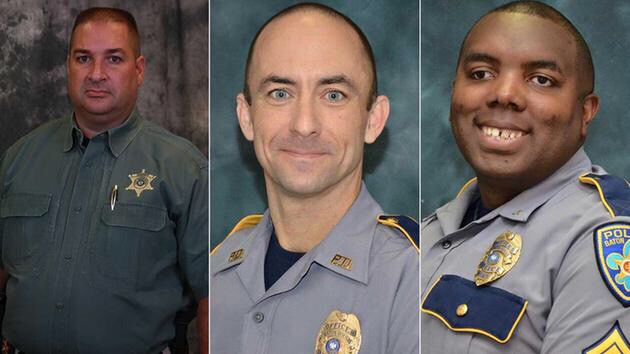
Yesterday in Baton Rouge three more police officers were assassinated, and another three were wounded, one critically. Once again the assassin was a young black military veteran armed with a killing machine, an assault rifle designed with only one purpose, killing large numbers of people with the utmost of efficiency. Like the man who assassinated five police officers that were guarding a peaceful Black Lives Matter protest in Dallas, this man, a former Marine Corps Sergeant named Gavin Eugene Long was interested not in justice, but vengeance. One of the men that he killed was an African American police officer, named Montrell Jackson, a father who talked of how people in the wake of the police killing of Alton Sterling, “I swear to God that I love this city but I wonder if this city loves me. In uniform I get nasty hateful looks and out of uniform some consider me a threat.” Two others, Baton Rouge officer Matthew Gerald, who was also a veteran of Iraq, and East Baton Rouge Sheriff Deputy Brad Garafola. The murders were inexcusable, and the killers, well, they put more innocent lives at risk. 

Neither Long, nor Micah Johnson was a freedom fighter, nor were they heroes. They were terrorists and murderers. The men that they killed and wounded were ambushed and assassinated simply because they were police. While Johnson said that he wanted to killed “white people,” Long simply wanted to kill police. Neither helped the cause of African Americnas who have been brutalized by other police officers, they did not bring any lives back, they killed to kill without thought of the repercussions that other African Americans might experience. While others protested peacefully, some even being harassed and others arrested in the name of principled non-violent protest, Johnson and Long used their military training to serve as judge, jury, and executioner of men who had done nothing to them. 

I am angry because these men have only helped the critics of of the Black Lives Matter movement, they have proved that for them no lives matter. Filled with hate Johnson and Long did what countless other nihilistic hate driven assassins have done before them, they killed in order to destroy. Dr. Martin Luther King Jr. said “The old law about ‘an eye for an eye’ leaves everybody blind. The time is always right to do the right thing.” Sadly, these two men were probably too ignorant to remember or even care about what Dr. King said, and now because of their crimes they have enabled white supremacists and other racists to change the narrative and blame African Americans for violence committed against other African Americans. 

Their actions did nothing to help African Americans, nor did it do anything to end the scourge of violence that has led to so many African Americans dying at the hands of some police. Instead their actions have only ensured that more violence against African Americans as well as law enforcement officers will continue. No words from elected officials or celebrities will change that until people’s hearts change, and sadly, I cannot believe that will happen anytime soon.

Dr. King said, “Darkness cannot drive out darkness: Only light can do that. Hate cannot drive out hate: Only love can do that.” 

If only these two men had heeded his words. When will we ever learn? 

Until tomorrow,

Peace,

Padre Steve+ 


Leave a comment

Filed under civil rights, crime, News and current events

Becoming What We Should Be


Friends of Padre Steve’s World,
Having completed, with the exception of editing and circulating some hard copies of the first volume of my Civil War text A Great War in a Revolutionary Age of Change, I have gone back to work on the second volume of my Civil War text “Mine Eyes Have Seen the Glory” Religious Ideology, Race, and Politics in the Civil War Era. Beginning yesterday I began to go through the approximately 160 pages of text, which had been the second chapter of my Gettysburg Staff Ride text, but like A Great War really needed to be split off and turned into its own separate book. 

Yesterday I went back to figure the natural chapter breaks and to begin some minor editing and creating a bibliography and working table of contents as I prepare to really dig in on it. The good thing is that I have continued to research this section even as I concentrated on work on A Great War and major chapter revisions to the book dealing with the campaign of 1863 and the Battle of Gettysburg. 

As I have done this I become more and more convinced that what I am writing about needs to be told. As I look at responses to the Black Lives Matter movement I am appalled by the willing historical ignorance of much of the country, including white America, which has erased from its collective memory the terrible injustices of slavery, the black codes, Jim Crow, segregation, and violence directed at African Americans over nearly three hundred year period before the Supreme Court stuck down the Jim Crow era segregation laws, and the Congress passed the 1964 Civil Rights Act, and 1965 Voting Rights Act, and less than three years later Dr. Martin Luther King Jr., the champion of peace protest and civil rights was gunned down and assassinated. 

But it is easy for some people to condemn the Black Rights Movement, it is called racist by some, and it is blamed for a host of issues that it is simply exposing and demanding action to solve. Some people respond to criticism of police with the saying that Blue Lives Matter, and I agree that they do, police officers do dangerous work, and with the proliferation of high powered weaponry in the hands of irresponsible and angry people, their lives are always in danger. But that is no reason not to say that Black Lives Matter is wrong in its intent. Some say that All Lives Matter, and I agree with that in principle, but I would challenge the people that flippantly say that in order to dismiss the validity of Black Lives Matter, while doing nothing to work for the rights of people different than themselves, that they need to put their money where their mouth is. 

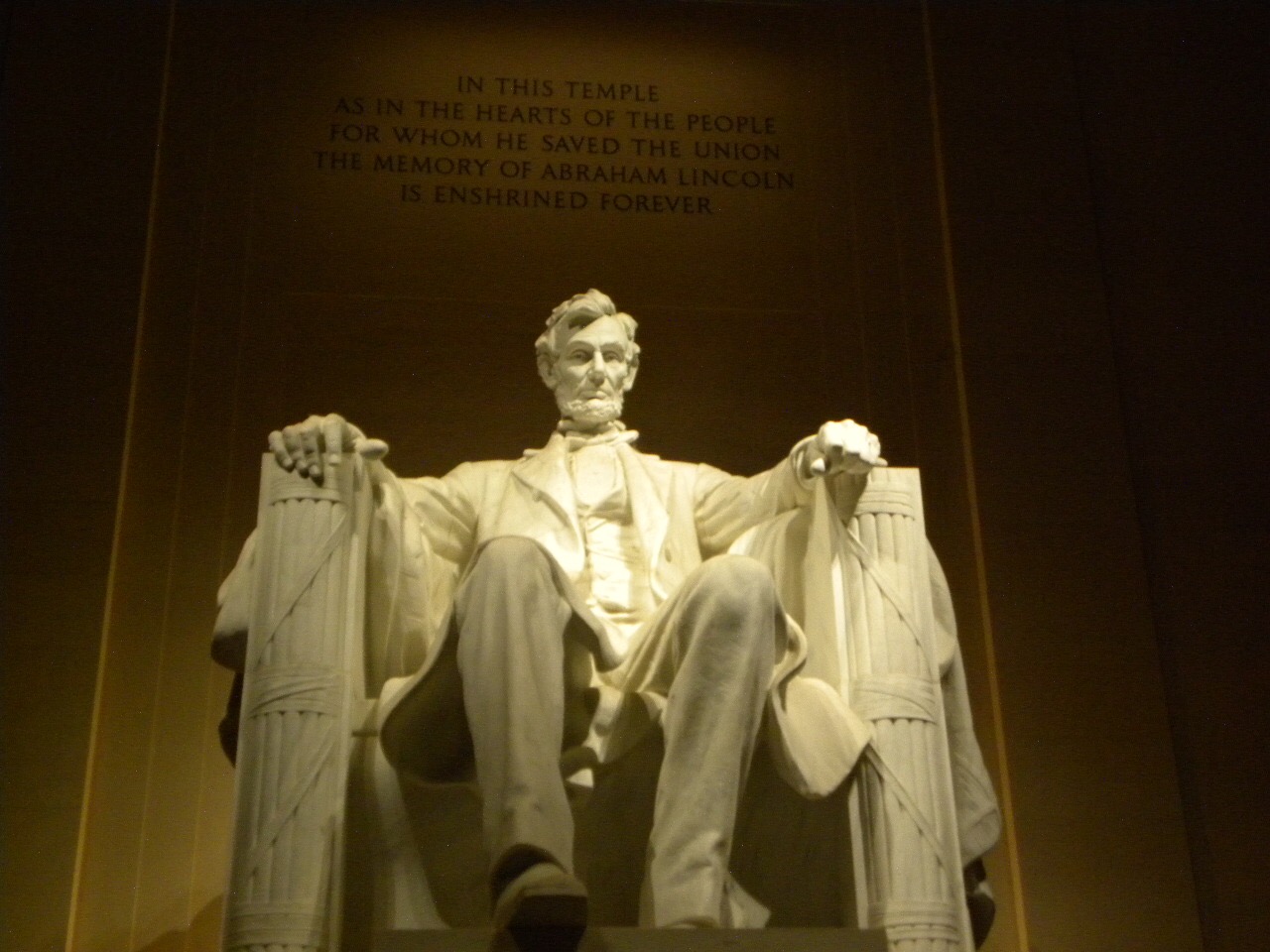
In the 1850s and 1860s Abraham Lincoln struggled with this in a country that was becoming increasingly diverse due to massive immigration from Ireland and Germany, and in which Congress and the Courts were making decisions which would allow for the expansion of slavery and the definition of African Americans as a subordinate race without any citizenship rights. Lincoln was worried that America was becoming like a plow horse with blinders fastened to the sides of its eyes, capable of seeing only in one direction: ahead of it. He saw Americans as people increasingly interested only with their present and their future, the things still before them, but disinterested with their own historical past, the things already behind them. A condition that is not much different that what we see today. Maybe because I am a historian I am more sensitive to this, but it is concerning. 

Lincoln realized that people had forgotten the heart and soul of America, the secular scripture found in the preamble of the Declaration of Independence. “We hold these truths to be self-evident, that all men are created equal, that they are endowed by their Creator with certain unalienable Rights, that among these are Life, Liberty and the pursuit of Happiness,—That to secure these rights, Governments are instituted among Men…” He realized that for most people of his era the proposition that all men are created equal was in the process of dying. He knew that freedom without equality was no freedom at all, and beginning with the Emancipation Proclamation he began the first step to universalize that proposition. Les than a year later he gave a short speech of under three hundred words at Gettysburg in which he went back to the Declaration noting “Four score and seven years ago our fathers brought forth on this continent, a new nation, conceived in Liberty, and dedicated to the proposition that all men are created equal,” and he called on Americans to renew themselves to that proposition: “It is for us the living, rather, to be dedicated here to the unfinished work which they who fought here have thus far so nobly advanced. It is rather for us to be here dedicated to the great task remaining before us—that from these honored dead we take increased devotion to that cause for which they gave the last full measure of devotion—that we here highly resolve that these dead shall not have died in vain—that this nation, under God, shall have a new birth of freedom—and that government of the people, by the people, for the people, shall not perish from the earth.”

In a book that I just finished on the Gettysburg Address the author noted something that I find quite true. He said: “We should read the Preamble to the Declaration of Independence, and then, the Gettysburg Address. They are, together, our American scriptures. And we should read them aloud, the way they were meant to be. They are words which are most powerful when they are spoken. Their words remain fresh and alive, no matter how many times they are read. All we need to know about what American democracy should be, is found there, among the words of these two ancient manuscripts.”

Now I do not arrogantly claim that we as Americans exemplify those words, or that we even live up to them, but they are something that we need to keep in the forefront of our minds, and strive to achieve if we are to become a better nation. 

I was talking with one of our international officers at the staff college today who has been studying at the Naval War College for the past year before he came to us, and as we talke we agreed that what makes America great is not our military might, nor our economic power, but that proposition of Liberty, the proposition that is so radical that few countries include it in any of their political documents, that proposition, that all men are created equal. It was something that a number of my Korean officers noted at Gettysburg back in May. They all understood something that so many Americans have forgotten. 

So I will continue to read, research, and write, and I am excited about it, especially during this critical time in our nation’s history. I’m sure that in the coming month or two that you will see some of that work appear on this site as I work on Mine Eyes Have Seen the Glory. 

Until tomorrow I wish you peace,

Padre Steve+

Leave a comment

Filed under civil rights, civil war, Gettysburg, History, News and current events, Political Commentary

Celebrating an Achievement 


Friends of Padre Steve’s World,

Things have been very busy, I have been putting the finishing touches on the draft of what used to be the first chapter of my Gettysburg Staff Ride text. The chapter grew to be about 260 pages, far more than a chapter should be. For at least six months I have been planning on splitting it off into its own book, and yes it is a book; but I did not get around to it, instead I kept working on it. 

So about two weeks ago I made the decision to turn all this work into a book. So I spent my time the last two weeks, day and night, at work and at home working on getting it exactly the way I want it to be. I still need to go back and re-read it a number of times to catch mistakes that might have slipped through, as well as re-checking my sources, but when I finished it up this afternoon and sent the draft to m students I was elated. I will have some other people look at it to see if they think I need to do anything differently, but I am pretty sure that this is at least the 90% solution before seeking a publisher. 

One thing I had been stuck on was an appropriate title. For the longest time I was stuck with the rather boring Foundations of the First Modern War. It is accurate in some ways,nut it never really got me. But while working on turning this into a book was just how revolutionary the Civil War really was, and just how many times I had written about the revolutionary nature of the entire era, not just the war. So today I came up with the title: A Great War in a Revolutionary Age of Change. I think that it works as the text deals with change, military, political, social, economic, informational, and diplomatic. In fact if you want to understand who we are as Americans you have to understand the Civil War era. Of course this book is just a small part of understanding it, and I am indebted to so many historians who have worked to unravel, sorting fact from fiction, truth from myth. For so many of these men and women this has been a life’s work, and many of them have been accused of being “revisionists”  especially those who contradicted the myths of the Lost Cause and the Noble South  which were for two many decades the accepted “history”  of the Civil War era. Like them I have taken my share of heat from unrepentant secessionists and Lost Causers, and I don’t care so long as what I write is as truthful and unbiased as possible. 

Over the past couple of weeks I have taken the time to turn the massive chapter into a book. I was able to divide it up into an introduction and twelve chapters in which I try to connect the dots between the development of the Army and developments in society in the years before the war, during the war, and following the war during Reconstruction, Jim Crow, and the Civil Rights movement. I explore the continuum of history and war, war in an age of change, and the context of war. Then I move to talk about how war is more than fighting, and the development of American military culture and theory. Then I shift to technology how technology matters, building armies from scratch, the changing character of armies and society, looking at the effect of conscription on Northern and Southern society. Then I move to the social change regarding Emancipation and Black soldiers, and the beginnings of the Women’s Rights movement, before I move back to discussing how technology pioneered before and during the Civil War set the stage for many things we know today. Then I think I go on to discuss a topic that many people fail to remember, the importance of what happens when the fighting stops, before finishing up talking about the timeless importance of this era today, and how so often we fail to learn the lessons of war. 

Tomorrow I will begin taking my second chapter, another book in its own right and separate it from the bulk of the text that deals with the strategic situation at the beginning of 1863, the Gettysburg campaign, and the Battle of Gettysburg. My regular readers have seen much of this develop from a very embryonic form in 2012 to what it is becoming now, over 1100 pages of text. There is still more work to be done and I am totally motivated to push forward and complete the rest of this work before I move on to other things that I want to write about, some topics that I have written about on this site. 

But tonight is a time to rest and watch the MLB All-Star Game, one of my favorite mid-summer things to do, an event that takes me back to childhood when things were so much simpler. I’ll write about that tomorrow before I move on to other subjects. 

Have a great night,

Peace,

Padre Steve+

2 Comments

Filed under civil rights, civil war, History

A Moment in Time Part Four: The Ongoing Struggle from Women’s Rights


Friends of Padre Steve’s World,

For the last few days I have going back to a part of my Gettysburg and Civil War text dealing with women’s rights. This is the conclusion of that series of articles. I have spent a lot of time working on this section recently, and will probably do some more in the coming weeks, but I think that you will find it interesting, and still relevant in our society.

Peace

Padre Steve+

The struggle for Women’s rights continued after the war, which neither advanced nor reduced the rights of women, but the end of the war marked a change in the relationship with women’s rights advocates and their former allies in Congress. Likewise, the same evangelical churches which many of the women’s rights leaders had begun their crusades “which had been in the forefront of ante-bellum reform upheld the status quo.” [1] This was true of their support for women’s rights, as well as civil rights for blacks, and supported the use of force against strikers.

After laboring alongside abolitionists to abolish slavery and pass the Thirteenth Amendment, women’s rights leaders lobbied to have women’s suffrage linked to that of black suffrage and asked Congress to include universal suffrage as parts of the Fourteenth, and then the Fifteenth Amendments. However, Radical Republicans were fearful that including women’s rights in either measure could lead to black citizenship and suffrage to be rejected, and was a bitter disappointment to Stanton, Anthony and other Women’s rights leaders.

Stanton responded to one of the Congressmen who refused to support it by noting that failing to include women in these measures actually hurt the cause of African Americans and would doom Reconstruction because it would exclude black women from suffrage,, “our former champions forsook principle for policy, and in giving women the cold shoulder raised a more deadly opposition to the negro than we had yet encountered, creating an antagonism between him and the element most needed to be propitiate do on his behalf…. But Mr. Smith abandons the principle clearly involved and I trenches himself on policy. He would undoubtedly please the necessity of the ballot for the negro at the south for his protection, and to point to innumerable acts of cruelty he suffers to-day. But all of these things fall as heavily on the women of the black race, yea, far more so, for no man can ever know the damning degradation to which woman is subject in her youth, in helplessness and poverty…. Women everywhere are waking up to their God-given rights, to their true dignity as citizens of a republic, as mothers of the race…” [2]


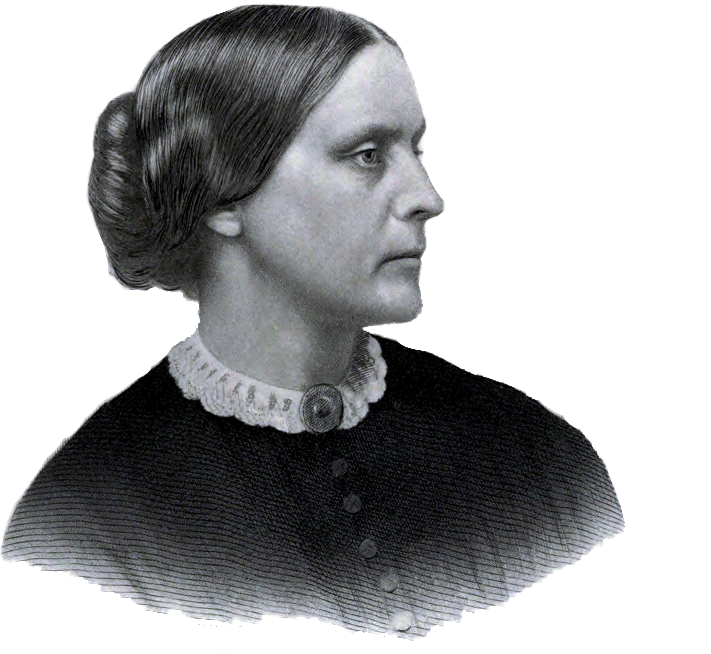
Susan B. Anthony was arrested with a number of other women and convicted of trying to vote in the 1872 elections. After her conviction she condemned the resistance of white male politicians to universal suffrage, and of attempts throughout the country to limit and even role back suffrage rights which had been granted to African Americans after the war. After her trial and conviction she proclaimed, “This government is no democracy…. It is an odious aristocracy; a hateful oligarchy of sex” that placed “father, brothers, husbands, sons… over the mother and sisters, of every household.” [3]

Despite the setbacks suffered by women, the cause of women’s rights continued to grow as women asserted themselves in the workplace, in the press, in lobbying for workplace safety, and taking up leadership roles in the labor movement. Likewise the opportunities for women working in Federal Government agencies which had opened during the war continued to grow. “By 1875 the number in Washington had doubled. Federal, State, and local agencies were employing women clerks, bookkeepers, stenographers, and receptionists…. Competition for jobs was keen because wages were higher and workdays shorter than most other lines of work, and it was exciting to live in the nation’s capital.” [4] even so there was a certain amount of insecurity in such work as many Civil Service jobs were dependent on the patronage of elected officials. It was not until the first civil service acts in the 1880s that the danger of job loss from political change was minimized.

In the 1890s educational opportunities for women advanced as women’s colleges and land grant colleges open their doors to women as students, and later professors. Likewise, the establishment of teacher’s colleges and vocational training institutions expanded opportunities for women as the need for teachers and other specialists grew as the nation expanded. The women nurses of the war continued to find employment, and some went to Europe where they let their service to the French and Prussians during the Franco-Prussian War. After the war new nursing schools were opened, and medical colleges that allowed women to attend were established. By the 1890s “more than a dozen medical colleges were co-educational, including those of Syracuse, California, Iowa, and Harvard University.” [5] Medical societies began opening their doors to women as well, but in many cases the walls fell slowly as prejudice against women remained as strong as it ever was.

Even so, none of these efforts went without opposition, and in the face of it the movement itself split into a radical faction headed by Susan B. Anthony “which continued to press for a national constitutional amendment and a moderated wing led by Mary Livermore and Henry Ward Beecher which wanted to limit the campaign to what could be accomplished in state legislatures.” [6]

Sadly, none of the pioneers of women’s rights would live to see the passage and ratification of the Nineteenth Amendment which gave women the right to vote in 1920. The Equal Pay Act, which mandated the equal pay for Federal employees did not pass until 1963, and the ill-fated Equal Rights Amendment which simply stated “That equality of rights under the law shall not be abridged by the United States or by any State on account of sex” was introduced in 1923, but not passed by Congress in 1972,  but was never ratified falling three states short of ratification, mainly due to the opposition of religious conservatives who propagandize diet as a threat to traditional gender roles, citing in particular that the amendment might result in women being subject to the draft.

Even so, in the years following the failure of the amendment, women have continued to advance in the private sector, government, and the military, with women rising to be Chief Executive Officers of Fortune 500 companies, in elected office, as Cabinet Secretaries and on the Supreme Court, and even as four-star Generals and Admirals in the U.S. Military. Today women make up over half of college graduates and nearly half of the work force. To further increase opportunity the Department of Defense decided to open military occupational combat arms specialties previously restricted to men to women in 2015. Even so women can still be legally paid less, and discriminated against based on their gender in many states.

Notes

[1] Ibid. Goldfield America Aflame: How the Civil War Created a Nation p.468

[2] Stanton, Elizabeth Cady, Letter to Congressman Gerrit Smith, from The Revolution 14 January 1869 in The Civil War and Reconstruction: A Documentary Collection edited by William E. Gienapp, W.W. Norton and Company, New York and London. 2001 p.361

[3] Ibid. Goldfield America Aflame: How the Civil War Created a Nation p.468

[4] Ibid. Massey Women in the Civil War pp.340-341

[5] Ibid. Massey Women in the Civil War p.352

[6] Ibid. Guelzo Fateful Lightning p.403  

2 Comments

Filed under civil rights, History, Political Commentary

One Brief Moment Part Three: Harriet Tubman, Soldier and Spy


Friends of Padre Steve’s World,

Over the past few days I have been going back to a part of my Gettysburg and Civil War text dealing with women’s rights. I took a break from that yesterday to share a few thoughts on the 20th anniversary of my ordination to the priesthood. Sadly I had already posted that and was far too busy to spend any time on the terribly tragic events of the past few days in Dallas, St. Paul, and Baton Rouge. These senseless killings have left me stunned, I cannot believe that we have come to this. The carefully executed assassination of the Dallas Police officers who were marching with and providing security for Black Lives Matter marchers, and the video recorded killings of black men in St. Paul and Shreveport by police have left me wondering about our future as a nation. I don’t think that we can keep going on like this and survive. I will write more about this and post it Sunday or Monday as I want to be as objective as possible. 

So today I am posting a section of the portion of my text dealing with a most amazing woman, Harriet Tubman. The more I ready about her the more I stand I awe. This section was a lot less detailed that in is now. I have spent a lot of time working on this section recently, and will probably do some more in the coming weeks, but I think that you will find it interesting, and still relevant in our society.

So until tomorrow, I with you peace, health, and safety,

Peace

Padre Steve+

The innate prejudices of many military and political leaders about the abilities and limitations of women in military service, often caused them to overlook how women could use that prejudice to their advantage, especially as spies. “African American women were generally dismissed as militarily harmless, a miscalculation that Harriet Tubman…used to immense advantage. Tubman, who had escaped from slavery in Maryland twenty years before the war and who had amassed considerable experience venturing into the south to guide runaways to the North undertook spying expeditions for the Federal troops on the South Carolina Sea Islands.” [1] The incredibly brave woman served throughout the war accompanying Union forces and securing vital information even as she worked to set other slaves free. Tubman’s “spying activities included convincing slaves to trust the Union invaders,” [2] many of whom would join the ranks of the newly raised regiments of U.S. Colored Troops.


Tubman had been fighting her personal civil war for over twenty years before the war began. As an escaped slave she returned to the South time and time again as a “conductor” on the Underground Railroad, smuggling escaped slaves out of the South and to freedom. She “successfully returned nineteen more times, bringing out an estimated 300 to 400 people…. She worked with a determination bordering on ruthlessness: if an escaped slave tarried, she pushed him in; if a baby cried she muffled the sound.as she herself said later…. “I was the conductor on the Underground Railroad for eight years, and I can say what most conductors can’t say – I never ran my train off the track and I never lost one passenger.” [3]

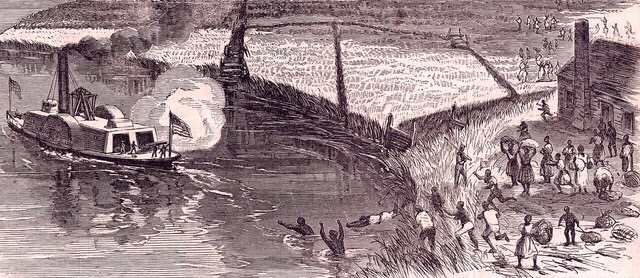
In early 1863, Union commanders in South Carolina decided that Tubman would be valuable as a covert operative to lead reconnaissance missions behind Confederate lines and along contested waterways where Confederate personnel had laid torpedoes, what we now know as sea mines, and she organized a small unit of nine men who used small boats to find the torpedoes and warn the captains of Union vessels operating in those streams and rivers.

Eventually, Tubman’s actives “evolved into a kind of special forces operation under Colonel James Montgomery. A fervent believer in guerrilla warfare, Montgomery was a veteran of antislavery border fighting in Kansas.” The pair developed some of the most effective operations mounted by irregular and regular forces conducted by the Union in the war. In July 1863, Tubman came up with a plan for a raid, and in it acted as “Montgomery’s second-in-command during a night raid up the Combahee River, near Beaufort, South Carolina. The Union gunboats, carrying some 300 black troops, slipped up the river, eluding torpedoes that Tubman’s men had spotted. Undetected, the raiders swarmed ashore, destroyed a Confederate supply depot, torched homes and warehouses, and rounded up more than 750 rice plantation slaves.” [4]

The Confederate report on the raid unwittingly ended up praising the work of Tubman and the freed slaves of her unit. It noted that the enemy “seems to have been well posted as to the character and capacity of our troops… and seems to have been well guided with persons thoroughly acquainted with the river and country.” Union Brigadier General Rufus Saxton wrote to Secretary of War Stanton praised Tubman’s work, noting, “This is the only military command in American history wherein a woman, black or white, led to raid, and under whose inspiration, it was originated and conducted.” [5]

Tubman continued her work for the duration of the war and after it continued to assist freed slaves and black veterans and continued her work with campaign for women’s suffrage. In 1890 she was awarded a pension for her work as a spy, nurse, and combat leader. The valiant pioneer of abolition, women’s suffrage, and combat in war who was nicknamed “the General” by Frederick Douglass, died in 1913, and was buried with full military honors.

Other women served in various roles caring for the wounded. In the North, “Dorothea Dix organized the Union’s army nurses for four years without pay; Mary Livermore headed the Union’s Sanitary Commission, inspecting army camps and hospitals….Scores of others like Clara Barton, volunteered to be nurses.” [6] All of these women did remarkable service, mostly as volunteers, and many witnessed the carnage of battle close up as the cared for the wounded and the dying which often created ethic concerns for the women nurses:

“Clara Barton described her crisis of conscience when a young man on the verge of death mistook her for his sister May. Unable to bring herself actually to address him as “brother,” she nonetheless kissed his forehead so that, as she explained, “the act had done the falsehood the lips refused to speak.” [7]

The very existence of so many women who served in the ranks during the Civil War, and their “demonstrated competence as combatants, challenge long-held assumptions about gender roles…. From a historical perspective, the women warriors of the Civil War were not just ahead of their time. They were ahead of our time.” [8]

Of the women that served in the ranks during the war, some were discovered, and many of them remained protected by their fellow soldiers. Quite a few of these closeted women soldiers received promotions and even served as NCOs or junior officers. With women now serving in combat or combat support roles in the U.S. Military since Operation Desert Storm in 1991, the stigma and scandal that these cross-dressing women soldiers of the Civil War has faded and as scholars and the public both “continue probing cultural notions of gender and identity, the reemerging evidence that women historically and successfully engaged in combat has met with less intellectual resistance and has taken on new cultural significance.” [9] As the United States military services examine the issues surrounding further moves to integrate the combat arms we also should attempt to more closely examine the service of the brave and often forgotten women who served on both sides of the Civil War.

In addition to these tasked many other women were engaged in the war as “supply organizers, relief workers, pamphleteers all aided the cause, and female journalists covered it. Dorothea Dix and Clara Barton became powerful forces helping soldiers; Anna Carroll provided the propaganda. And the Civil War boasted its own version of Rosie the Riveter, women who did the dangerous work of making munitions at arsenals, many losing their lives in awful accidents.” [10]

Likewise, the war caused many educated women to take much more interest in “political and military issues and led many women to articulate a sharper consciousness of national affairs…. The feminist paper The Mayflower commented that “nearly every letter we receive breathes a spirit of deep feeling on the war question.” The editorial added that among women, “There seems to be little disposition to think, speak, read or write of anything else.” [11] In particular one women, Anna Ella Carroll, the daughter of Thomas King Carroll, a former governor of Maryland, “was interested in political theory and practice and was a profound logical thinker as well as an effective propagandist for the Union.” [12]  During the war she was in part responsible for persuading the governor of Maryland to keep the pro-secession legislature from meeting in 1861, defended Lincoln’s suspension of habeas corpus in that state, and is believed to have originated the military strategy in the Tennessee River Campaign, for which she was never given full credit even though there is documentary evidence that many leaders knew of her involvement. A recent biographer concluded that she “was a “tragic victim of reconstruction,” for if a military strategist, she was not given due credit.” [13] In the South it was often the same, the diaries of many educated Southern women show a tremendous interest and discernment of what was happening during the war, and in domestic politics, and frequently expressed their criticism of government and military strategy as the war continued.

Notes

[1] Ibid. Guelzo Fateful Lightning p.394

[2] Sizer, Lyde Cullen Acting Her Part: Narratives of Union Women Spies in Divided Houses: Gender and the Civil War Oxford University Press, New York and Oxford 1992 p.130

[3] Ibid. Sizer Acting Her Part: Narratives of Union Women Spies  p. 127

[4] Ibid. Central Intelligence Agency, Intelligence in the Civil War location 481 of 991

[5] Ibid. Central Intelligence Agency, Intelligence in the Civil War location 481-482 of 9911

[6] Ibid. Silvey I’ll Pass for Your Comrade p.10

[7] Faust, Drew Gilpin, This Republic of Suffering: Death and the American Civil War Vintage Books, a division of Random House, New York 2008 p.12

[8] Ibid. Blanton and Cook They Fought Like Demons p.208

[9] Ibid. Blanton and Cook They Fought Like Demons p.204

[10] Ibid. Roberts Capital Dames: The Civil War and the Women of Washington 1848-1868 p.3

[11] Attie, Jeanie Warwork and the Crisis of Domesticity in the North in Divided Houses: Gender and the Civil War edited by Catherine Clinton and Nina Silber, Oxford University Press, Oxford and New York 1992 p.253

[12] Ibid. Massey Women in the Civil War p. 168

[13] Ibid. Massey Women in the Civil War p.169

3 Comments

Filed under civil rights, civil war, History, leadership

One Brief Moment Part Two: Women Soldiers, Spies and Nurses in the Civil War

Clayton-Francis-L

Friends of Padre Steve’s World,

Today and for the next few days I am going back to a part of my Gettysburg and Civil War text dealing with women’s rights. This one continues yesterday’s article, and deals with some of the facts about women who masqueraded as men in order to serve as soldiers. I have spent a lot of time working on this section recently, and will probably do some more in the coming weeks, but I think that you will find it interesting, and still relevant in our society.

Peace

Padre Steve+

women-civil-war-sarah-edmonds-frank-thompson-631

Of course when war broke out the logical end of this train of thought was should women be allowed to serve in the military. Legally and socially it was not possible for women to serve in the military in 1861, but this did not stop women from doing so. Even so, “women were not expected to defend their country, and when they did nevertheless and were found out, they learned that they were not necessarily a welcome addition to the military. Women who returned home after the Civil War as veterans reaped few of the societal rewards for having rendered such service.” [1] Quite a few women on both sides of the conflict chaffed about not being allowed to fight for their countries, their families and their causes, and despite official prohibitions that kept women from serving in any capacity but nursing, a good number of women found their way to go to war. While men in the North and South “were expected to enlist, any woman actively participating in the Civil War was an oddity if not a renegade.” [2] In some cases this involved hundreds of women taking male identities in order to fulfill their desires to serve their countries.

The motives of these women varied. In some cases women wanted gain the economic privileges of full citizenship, and for others the glory reserved to only to men. In our modern parlance those that took male identities would be considered transvestites or possibly transgender, but for them “transvestitism was a private rebellion against public conventions. By taking a male social identity, they secured for themselves male power and independence, as well as full status as citizens of their nation. In essence the Civil War was an opportunity for hundreds of women to escape the confines of their sex.” [3]

During the war hundreds of women went to war, dreaming of being a second Joan of Arc, taking on the identity of men, however, their idealistic vision of wanting to serve the cause of their country, was not viewed favorably by many, men and women alike, as “they were usually viewed by contemporaries as mentally unbalanced or immoral.” [4] Their morality was question, their motivation was questioned, and their character was questioned, all because they broke long held social, and religious barriers in order to fight for what they believed.

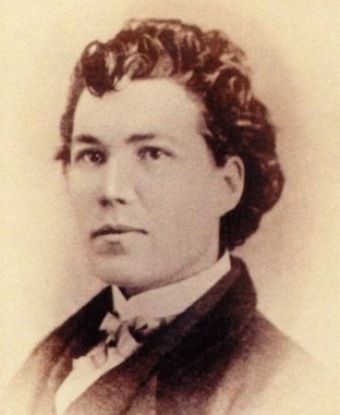
These brave and socially progressive women enlisted under male names and pretended to be men. Unless they were discovered to be women, or unless they confessed to their wartime service either during or after the war, most of their records were lost. In 1861 Private Franklin Thompson “enlisted in Company F of the 2nd Michigan Infantry…unknown to comrades, Thompson actually was Sarah Emma Edmonds.” [5] Edmonds served in the illustrious Iron Brigade until the disaster at Fredericksburg. Well known for her courage as Franklin Thompson, Edmonds participated in some of the bloodiest combats of the war. At Antietam she was caring for the wounded when she came upon a soldier who had been wounded in the neck. That soldier informed Edmonds that she was dying and after a surgeon came by and confirmed what the soldier said the dying soldier told Edmonds:

“I am not what I seem, but I am female. I enlisted from the purest motives, and I have remained undiscovered and unsuspected. I have neither father, mother nor sister. My only brother was killed today. I closed his eyes about an hour before I was wounded….I am Christian, and have maintained the Christian character ever since I entered the army. I have performed the duties of a soldier faithfully, and am willing to die for the cause of truth and freedom….I wish you to bury me with your own hands, that none may know after my death that I am other than my appearance indicates.” [6]

That unknown woman was not alone, at least nine women, eight Union and one Confederate, fought at Antietam and of those five were casualties. Five women, two Federal and three Confederate took part at Gettysburg. All three Confederate women at Gettysburg were either killed or wounded, or captured, including two women who took part in Pickett’s Charge. [7]

Edmonds_inline

Sarah Edmonds

Sarah Edmonds published a book Nurse and Spy in the Union Army while recovering from malaria in 1863. The book, which was published the following year, sold 175,000 copies, the proceeds that she donated to care for sick and wounded Union veterans. After the war, Edmonds attended Oberlin College, married, had three of her own children and adopted two more. She “became a member of the Grand Army of the Potomac, the organization for Union veterans of the Civil War. She applied for, and received, a military pension, and upon her death in 1898 was buried with full military honors.” [8] She was the only women admitted to the Grand Army of the Republic.

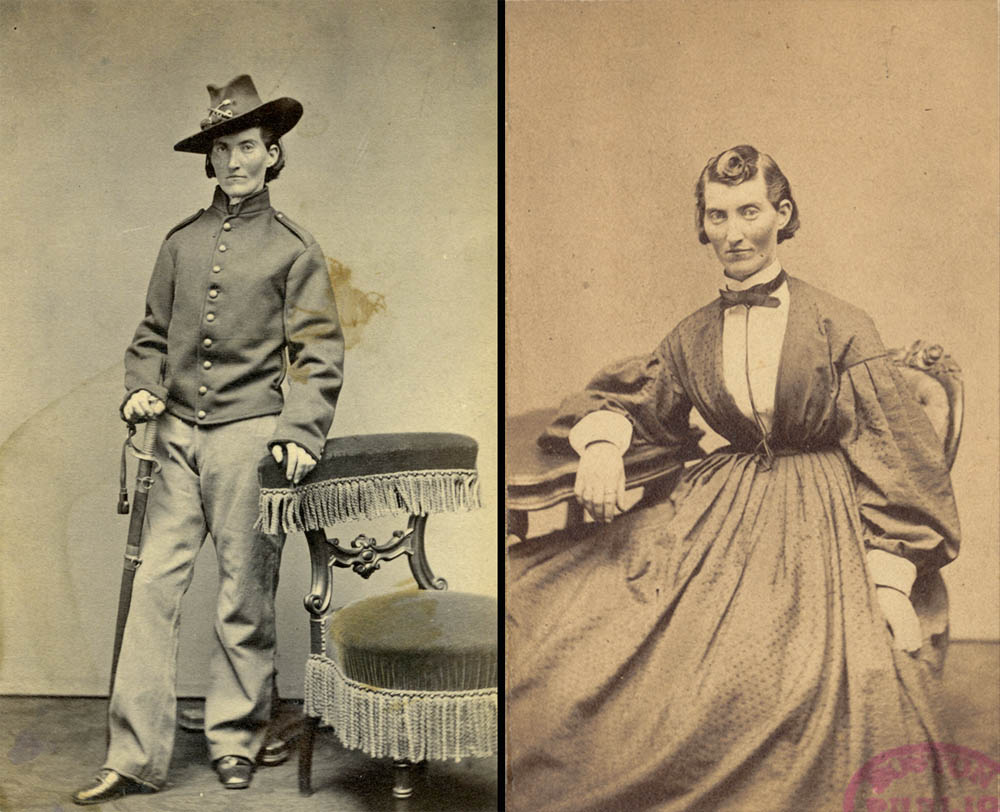
Another of the women to serve was Frances Louisa Clayton. Fighting for the Union as a member of the Minnesota State Militia Cavalry and 2nd Minnesota Battery, serving under the command of Ulysses S. Grant she was wounded at Fort Donelson. Like many other women soldiers, Clayton mastered the art of behaving as a man. She “became “a capital swordsman,” but also commanded attention with her “masculine stride in walking” and “her erect and soldierly carriage.” [9]

Albert-Cashier

However, most women were more discreet during and after the war regarding their true sexuality. Private Albert Cashier hid his sexuality identity for his entire term of service. He enlisted in August 1862 as a member of the 95th Illinois. Cashier was born in Ireland as a woman, Jennie Hodgers. He fought in forty battles and was discharged with the regiment in August 1865. At Vicksburg he was briefly captured by the Confederates while conducting a reconnaissance “but managed to escape by seizing a gun from one of her guards, knocking him down, and outrunning others. Comrades recalled Private Cashier climbing to the top of their fieldworks to taut the enemy into showing themselves.” [10]

After the war “Albert” returned home and lived as a “farmer and handyman and served as a caretaker in his church. He never married.” In 1890 he applied for and received a military pension and in 1911 the now elderly “man” was struck by a car and suffered a broken leg. The doctor treating him discovered that Albert was not a man, but a woman. But the doctor kept his confidentiality and without revealing “Albert’s” secret had the Union veteran admitted to the local Soldier’s and Sailors’ Home at Quincy, Illinois.” [11] A few years later the elderly “man” began to exhibit erratic behavior and was “committed to a public mental hospital and the word was out.” [12] With her story now sensational front page news and “old comrades in arms came to her defense.” [13] Her comrades had never known that “Albert” was a man during or after the war, while the news was a surprise to them they came to her defense. To combat some of the sensationalism in the media Albert’s fellow soldiers testified “to Albert’s bravery in combat and public good works in later life. Albert/Jennie died at Watertown State Hospital in 1915 at age seventy-one. The local post of the Grand Army of the Republic arranged for her burial. Her headstone reads: “Albert D.J. Cashier, Company G, 95th Illinois Infantry.” [14]

There are similar accounts of women who served as soldiers in the Confederate army including Mrs. Amy Clarke who enlisted with her husband and continued to serve until after his death at the Battle of Shiloh. Her gender remained secret until she was wounded and captured by Union forces. As “soon as she had recovered they gave her a dress and sent her back into Confederate lines; but a short time later she was seen in Mississippi making plans to re-enlist.” [15]

Wartime records are sketchy but as a minimum it is believed that “between 250 and 400 women disguised as men found their way into either the Federal or Confederate armies.”  [16] A more recent estimate is that in the Confederate army alone there were some 250 women who served as soldiers during the war. [17] Casualties were high for the women that are known to have served as soldiers, they had a “combined casualty rate of 44 percent” including the fact that fully “eleven percent of women soldiers died in the military.” [18] Some of those women are now well known but many others are lost to history. Most women tried to keep their sexual identities secret, even to the point of their death on the battlefield. Most of the women who served in the armies returned home to resume relatively normal lives after the war.

Other women would serve as spies for both sides, often rendering valuable assistance to their countries. The women who served as spies often took their lives into their hands; however, they often provided vital information to the Union or Confederate officers that they served. Pauline Cushman “parlayed her acting talents into a series of elaborate ruses that allowed her to pry information out of admiring and complaisant Confederate officers; Belle Boyd used an equal measure of talent in as a northern Virginia coquette to elide the same kind of information out of Federal officers.[19]

0065747

Elizabeth Van Lew

Even those women who were successful often suffered for their service during and after the war as they learned “that few people completely trusted or respected a spy, not even a “friend.” [20] Many, especially Southern women who spied for the Union were ostracized and persecuted in their communities after the war, and found little support from Northern politicians. Rebecca Wright, a young Quaker schoolteacher in Winchester, Virginia provided information that “enabled him to defeat General Early’s forces” in the Valley of 1864. She lost her job, and her former friends and neighbors boycotted her family’s businesses. Rejected for a pension, Sheridan helped Wright obtain “an appointment in a government office, remaining there for the rest of her days.” [21] Elizabeth Van Lew was a lifelong resident of Richmond and daughter of a wealthy businessman.  She helped Union prisoners escape from Richmond’s notorious Libby prison and when Grant besieged Petersburg, Miss Van Lew “supplied him with a steady stream of information” [22]

To be continued….

Notes

[1] Ibid. Blanton and Cook They Fought Like Demons p.209

[2] Silvey, Anita I’ll Pass for Your Comrade Clarion Books, New York 2008 p.9

[3] Ibid. Blanton and Cook They Fought Like Demons p.5

[4] Ibid. Massey Women in the Civil War p.79

[5] Ibid. Lowry The Stories the Soldiers Wouldn’t Tell  p.119

[6] Ibid. Silvey I’ll Pass for Your Comrade p.68

[7] Ibid. Blanton and Cook They Fought Like Demons pp. 15-16

[8] Ibid. Silvey I’ll Pass for Your Comrade p.90

[9] Ibid. Blanton and Cook They Fought Like Demons p.58

[10] Ibid. Blanton and Cook They Fought Like Demons pp. 16-17

[11] Ibid. Lowry The Stories the Soldiers Wouldn’t Tell p.121

[12] Ibid. Lowry The Stories the Soldiers Wouldn’t Tell p.121

[13] Ibid. Silvey I’ll Pass for Your Comrade p.90

[14] Ibid. Lowry The Stories the Soldiers Wouldn’t Tell p.121

[15] Ibid. Massey Women in the Civil War p.81

[16] Ibid. Guelzo Fateful Lightning p.394

[17] Ibid. McCurry Confederate Reckoning  p.87

[18] Ibid. Blanton and Cook They Fought Like Demons pp.206-207

[19] ibid. Guelzo Fateful Lightning p.395

[20] Ibid. Massey Women in the Civil War p.87

[21] Ibid. Massey Women in the Civil War pp. 103-104

[22] Ibid. Massey Women in the Civil War p.102

3 Comments

Filed under civil rights, civil war, History

One Brief Moment: The Beginning of the Women’s Rights Movement

youngecs

Elizabeth Cady Stanton

Friends of Padre Steve’s World,

Today and for the next few days I am going back to a part of my Gettysburg and Civil War text dealing with women’s rights. As you might have noticed I frequently write about civil rights and history. This is important to me and I cannot imaging not trying to continually write and educate people about subjects that matter as much now as they did 150 years ago or more. I have spent a lot of time working on this section recently, and will probably do some more in the coming weeks, but I think that you will find it interesting, and still relevant in our society.

Peace

Padre Steve+

Another development, which in large part is related to the abolition movement, was the campaign for women’s rights. The Civil War was also revolutionary because it was instrumental in propelling women into positions in American society that they had never before been allowed. The war Some of this was because many women decided to like those who campaigned for the end of slavery and the rights of African Americans to turn the world upside down. The war allowed the women who served, “in uniform or not, war permitted these women to experiment with a series of role reversals in gender,” [1] and in some cases gender and race. These experiments were the beginning of the struggle for women’s equality and to women serving in the military.

In much of the country and in particular the South women’s rights were the same as granted in English Common Law. Common law held to the more archaic understanding of the Christian Church that women were the property of their husbands, especially in cases of infidelity including during the trial of Dan Sickles for killing Barton Key. But the war “imposed on American society as such social disruption as it did physical destruction. Within that disruption, for one brief and bloody historical moment, an entirely new way of ordering of race and gender within a republican society became possible,” [2] however, in the end it would take another century or more for much of this change to be realized.

Southern culture and law ensured that women had even few rights than the women in the North.  In the North women were making some gains in the workplace and in various professions such as teaching and nursing, and as the industrial revolution modernized the workplace and required more skilled workers, particularly in the textile industries, the availability of work for women who wanted to work outside the home increased. Even uneducated Northern women sought work in the growing number of factories and by 1860 “there were more than 270,000 female operatives, the vast majority being employed in Northern textile, shoe, clothing, printing, and publishing establishments. Over 135,000 worked in New England factories and composed 65 percent of the region’s industrial labor.” [3]  Educated Northern women, while excluded from most professions, found their way into teaching, nursing, non-ordained religious work, and writing. Some found work in Federal government agencies in Washington DC, including “Clara Barton, a successful teacher who had trouble landing a position because she was a women, found work in the Patent Office, where she briefly made the same salary as her male colleagues.” [4]

But in the South women were continued to be held back. This was in large part due to the understanding that the “household was a spatial unit, defined by the property to which the owner not only held legal title over, but over which he exercised exclusive rights.” [5] As such Southern men had nearly unlimited rights and power over what occurred on his property, for “in societies in which landed property comprised the chief means of subsistence…legal title to the land had historically incorporated claims over the persons and labor of those who were dependents on it.” [6] In the South, as opposed to the North comparatively few women entered the Southern labor market, in large part because of the region’s emphasis on agriculture, dependence on slave labor, and a culture that frowned on women working outside the home.  1860 when Northern women were becoming a force to be reckoned with in the labor market, “only 12,000 women worked in factories, 10 percent of the regions wage earners.” [7] The lack of trained and experienced women workers would be a crippling impediment to the Confederate War effort.

For Southern men the stakes of ensuring slavery’s continuation and expansion were high, the culture of the South ante-bellum South was deeply patriarchal and “The possibility that the black man might be empowered like any other was such a threat to the southern social hierarchy that some white southerners were inclined to fear not only for their position as slaveowners but for the entire basis of their claim to patriarchal power. They feared for their power not only over their slaves but over their women as well.[8]

William Lloyd Garrison and the leaders of the abolitionist movement came into contact with two southern women who had converted to the abolitionist cause; South Carolina cotton heiresses, Sarah and Angelina Grimke. The two women were passionate as well as eloquent and became popular lecturers on the abolitionist speaking circuit. Angelina Grimke was a powerful speaker linked to abolition and women’s rights, she made herself unwelcome in her native Charleston South Carolina “with the publication of An Appeal to the Christian Women of the South. She urged Southern women, many of whom opposed slavery, to speak out, and despite her failure to reach the audience to which she spoke, hers is one of the most significant abolitionist writings.” [9] She proclaimed:

“We cannot push Abolitionism forward with all our might until we take up the stumbling block out of the road…. If we surrender the right to speak in public this year, we must surrender the right to petition next year, and the right to write the year after, and so on. What then can the woman do for the slave, when she herself is under the feet of man and shamed into silence?” [10]

Her sister Sarah was also active in writing, but she focused her attention not just on abolition, but “on the inferior status of both woman and the Negro in The Equality of the Sexes and the Condition of Women.” [11] The Grimke sisters and other women like them brought Garrison and others in the abolitionist movement into contact with the early leaders of the new women’s rights movement. The leaders of the movement, Elizabeth Cady Stanton, Abby Kelley, and Lydia Maria Child were outspoken in their belief that “a campaign to emancipate slaves could not avert its eyes from the need to emancipate American women from social conventions and legal restraints that prevented them, like the slave, from owning property and voting, and kept them altogether subservient to the interests of white males.” [12]

The principals involved in the abolitionist and the women’s movements, those of freedom, emancipation and equality eventually forged a bond between them, and have provided inspiration to others in their quest for political and social equality. For William Lloyd Garrison “the woman question clearly demonstrated how the logic of reform united all good causes and carried them to new ground. If in their endeavors to break the chains of slavery women discovered, as Abby Kelley put it, that “we were manacled ourselves,” the abolitionist principle required a defense of equal rights without regard to race or sex.” [13]

While women and blacks were “being brought together in a dual crusade, often behind the same leaders,” [14] that did not mean that both parties were given equal consideration, even among the supporters of abolition and women’s rights. All to often, women found that their rights were not considered as important by the political leadership fighting for the rights of black men. Few in Congress “responded sympathetically to feminists’ demands. Reconstruction they insisted, was the “Negro’s hour,”  [15] a view shared by Frederick Douglass. Though the economic situation of women began to improve, especially through women being admitted to the Civil Service, much else remained unchanged, women were still second class citizens without the right to vote, with few legal rights, and few opportunities to move up in society apart from her husband.

But change was beginning to occur as women began to have more educational opportunities in the post-war years, and began to find employment opportunities with the expansion of industry. Women’s suffrage was not included in the Fifteenth Amendment, which caused a split between women’s groups and their long-time abolitionist allies who told them “If put on the same level and urged in the same connection, neither will soon be accomplished.” [16]   Even so in some territories women were granted the right to vote in territorial elections, “women were given the vote in Wyoming Territory in 1869. However, Wyoming’s admission as a state twenty years later came only after a heated debate on the women’s suffrage article in the state constitution.” [17]

In the 1800s women in the United States found themselves bound by two major factors, law and culture. English common law and early in the life of the Republic it was determined by John Adams that women should be exclude from political life as they were “unsuited by nature for the businesses of life or the hardy enterprises of war, they had nothing of value to offer the state.” [18] Women had no claim to property, wages, or even their children. Thomas Jefferson had “defined the essence of liberty as independence, which required ownership of productive property. A man dependent on others for a living could never truly be free, nor could a dependent class constitute the basis of republican government. Women, children, and slaves were dependent; that defined them out of the polity of republican freedmen.” [19] This understanding of the rights and citizenship of women persisted as the official law of the nation throughout the ante-bellum era, through and after the Civil War, and up until the passage and ratification of the Nineteenth Amendment.

As such, single women had few rights while married women had even fewer as, married women could not “own property in her own right, make contracts or otherwise conduct business of her own. She was supposed to be modest and submissive. The married woman, in fact, was for all intents and purposes the chattel of her husband.” [20] The reality was stark for women, but especially married women for as one historian noted: “marriage very nearly meant the legal annihilation of a woman…once a woman was married all property and property rights were transferred to her husband, and she was permitted to own nothing in her own name. Married women could not make contracts, could not sue, could not buy or sell, except over their husband’s signatures.” [21] Adult white women were citizens in a constitutional sense, but in the North and South alike their terms “of their citizenship had always been set by the perceived necessities of marriage and its gender asymmetries between man and woman, husband and wife.” [22]

The role of culture and religion was another major constraint on women’s rights during the ante-bellum period and much of this centered on Victorian social and cultural ideals which brought about what can be safely called a “a cult of true womanhood” which “dictated that women always appear demure, submissive, pious, and concerned with the home and family.” [23] In the Victorian ideal, it was the man whose sphere of life was in worldly pursuits, while women were limited to the task of bearing and raising children and maintaining the traditional private domain of hearth and home. This understanding of separate spheres was supported was often supported by the churches, especially those the conservative and evangelical variety.

While this was true in the North it was especially prevalent in the South and promoted by southern evangelical churches. The “explicit goal of southern evangelicalism was to keep the religious role of white women within narrow and carefully policed bounds. Evangelical Southerners clearly designated men as society’s (and women’s) rightful rulers and ultimate authorities. They were, in the 1830 words of Southern writer Virginia Carey, “the anointed lords of creation”; St. Paul’s injunction that wives “submit yourself to your own husbands as to the Lord” provided the text for many a Sunday sermon.” [24]

In matters of sexual behavior there was a pronounced double standard between men and women. If a man was an adulterer it was frowned upon, but not necessarily a condition that would invoke the scorn of the community unless an aggrieved husband took the law into his own hands and killed the adulterer, in which case the murderer could easily be forgiven. However, for the married adulteress, the social damnation was all too real, even from other women, who often believed that there was no excuse for such behavior and that the adulteress “deserved the most stringent fate for her violation of the dictates of virtue.” [25]

A married woman’s position was as close to being a slave as could be, and only the plight of black female slaves was worse, for they were simply chattel. The few free black women mainly stayed unmarried “in order to maintain what few property rights they were entitled to.”  [26] As they also did over blacks, white men ruled over women in all spheres of life. While the eventual emancipation of blacks provided more rights for black men, those did not help many black women as Sojourner Truth, a pioneering African-American abolitionist who spent forty-years as a slave said toward the end of her long life:

“There is a great stir about colored men getting their rights, but not one word about colored women; and if colored men get their rights, and not colored women theirs, you see colored men will be master over the women, and it will be just as bad as it was before. So I am for keeping the thing going while things are still stirring because if we wait till it is still, it will take a great while to get it going again….I suppose I am the only colored woman that goes on to speak for the rights of the colored women. I want to keep the thing stirring, now that the ice is cracked…” [27]

Elizabeth Cady Stanton was among the most vocal of women’s rights advocates. She was the daughter of a leading Federalist lawyer, who served a term in the House of Representatives and on the New York Supreme Court. Her father planted in her the desire to learn, a love for law, and a passion for civil rights which she was able to pursue. Unlike many women of her day, Stanton was able to graduate from the Johnstown Academy and the Troy Female Academy in Troy, New York, before she was married to Henry Brewster Stanton, a journalist, anti-slavery orator and attorney, with who she had seven children.

Stanton believed that a woman’s place in the home was ultimately destructive and “reflected her subordinate position in society and confined her to domestic duties that served to “destroy her confidence in her own powers, lessen her self respect, and to make her willing to lead a dependent and abject life.” [28] Stanton noted how the condition of women of her day was “more fully identified with the slave than man possibly can be… For while the man is born to do whatever he can, for the woman and the negro the is no such privilege.”  [29] It was a key observation and something even today, a state that some politicians, pundits and preachers would like to return women.

Since nearly all of the most “outspoken feminists had been schooled in abolitionist movement” they were “suspect in the South, where society was conservative, patriarchal, and insistence that ladies live in a kind of earthly limbo.”  [30]  Such women posed a threat to the pillars of Southern society. Since the South was now fighting tooth and nail against the abolitionist movement, anything closely connected with that movement, including the women who advocated abolition and women’s rights were shunned and their message rejected and inflammatory and revolutionary. It was not until the crisis caused by the Civil war that Southern women began to seize “the opportunity to lay claim to an increased reciprocity in gender relations.” [31]

But even with the abolition movement there was opposition the women’s rights, the 1839 meeting of the American Anti-Slavery Society witnessed a debate over including women in the membership. Conservative Evangelicals recoiled in disgust, and when the convention voted to allow women into the membership Lewis Tappan “got up a starchy “protest” which condemned the “repugnant” admission of women as an ‘expression of local and sectarian feelings…well suited to the unnecessary reproach and embarrassment to the cause of the enslaved as [it] is at variance with the general usage and sentiments of this and other nations.” [32] In May of 1840 the American Anti-Slavery Society split among religious lines when leading evangelicals led by the Tappan brothers withdrew from it.
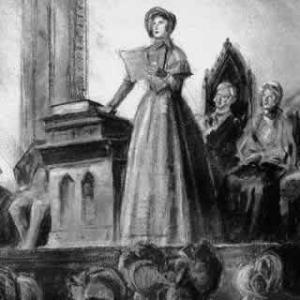
senecafalls-womanspeaking

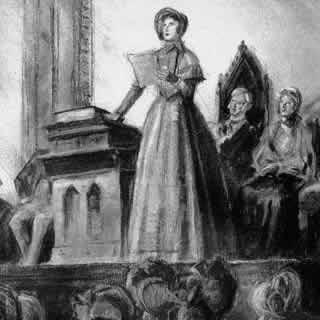
But that neither stopped Garrison from working with women, nor kept Frederick Douglass from embracing them as part of the abolitionist movement. From this rather inauspicious beginning, the women’s rights movement began to infiltrate society, especially in the field of education. In 1848 at Seneca New York there was a convention that launched the modern women’s rights movement. Led by Stanton and Elizabeth Mott the delegates published a “Declaration of Sentiments, modeled on the Declaration of Independence, proclaimed “that all men and women are created equal” and deserved their “inalienable rights” include the right to elective franchise.” [33] The declaration was bold and its denunciation of the place of women in society to be considered revolutionary in character. Part read:

“He has never permitted her to exercise her inalienable right to elective franchise. He has compelled her to submit to laws, in the formation of which she had no voice. He has withheld from her rights which are given to the most ignorant and degraded men – both natives and foreigners… He has made her, if married, in the eye of the law, civilly dead. He has taken from her all right to property, even to the wages that she earns…. After depriving her of all her rights as a married woman, if single, and the owner of property, he has taxed her to support a government which recognizes her only when her property can be made profitable to it. He has monopolized nearly all the profitable employments, and from those she is permitted to follow she receives but a scanty remuneration. He closes against her all the avenues to wealth and distinction which he considers honorable to himself. As a teacher of theology, medicine of the law, she is not known… He has created a false public sentiment by giving the world a different code of morals for men and women, by which moral delinquencies which exclude women from society, are not only tolerated, but deemed of little account in man. He has usurped the prerogative of Jehovah alone, claiming his right to assign for her a sphere of action, when that belongs to her conscience and to her God. He has endeavored, in every way that he could, to destroy her confidence in her own powers, lessen her self-respect, and to make her willing to lead an abject and dependent life.” [34]

The declaration also stated, in words which inflamed many men that: “the history of mankind is a history of repeated injuries and usurpations on the part of man toward woman, having in direct object of an absolute tyranny over her.” [35] In the years following this meeting women took up an even more important place in the abolitionist movement, Abby Kelly Foster returned to head the work and recruited many talented women agents including Sallie Holley, Lucy Stone and Susan B. Anthony who “often made five or six appearances a week” in various abolitionist meetings and in 1850-1851 they were joined by the “black evangelist Sojourner Truth, whom Garrison had met and the Northampton colony in 1843 and for whom he had printed an autobiographical narrative.” [36] These women contributed greatly to the abolitionist cause and would in the years to come be among those who continued to fight not only for the rights of blacks, but the rights of women.

The new women’s rights groups continued to work hand in hand with the abolitionist groups but also began a campaign for the rights of women. In the mid-1850s primarily focused on “obtaining state laws guaranteeing women’s right to control their property and wages, to be legal guardians of their children, and to be paid salaries commensurate with their labors, while a few women advocated for more liberal divorce laws so that they could rid themselves of alcoholic, insane, criminal, or brutal husbands.” [37] These efforts secured some modest gains and by 1861 most states had granted women some type of property rights or had changed their laws to follow the community property principle.

While the movement made modest progress regarding property rights for women in some states, they made little progress in terms of elective franchise and better wages and working conditions. During the ante-bellum period, women who lobbied for such rights were met with open opposition and scorn. The press “frequently denounced and ridiculed the “strong-minded women…” [38] Despite such attitudes women did make some significant advancements, particularly in lay aspects of the church, such as Bible societies, moral reform organizations, as well as the abolition and temperance movements, which had gained prominence during the Second Great Awakening.

During the ante-bellum period women made great progress in education. By 1850 the United States was the only country where “girls went to elementary school and achieved literacy in virtually the same proportion as boys.” [39] Likewise a few women entered higher education, particularly at women’s seminaries, which were for all practical purposes boarding schools that produced teachers and writers, as well as the Oberlin College, which was founded by Christian abolitionists and welcomed students of both genders as well as of any racial minority. During the three decades prior to the war women made some specific gains, but more important “was the development to their talents for organization, cooperation, leadership, and self expression. It was a time of beginnings and not fulfillment, a time when most women realized and accepted the fact that they lived in a man’s world, a time when a few dedicated but belligerent visionaries were frustrated in their attempt to remake the social order “overnight.” [40]

However, the war would help bring about many more opportunities for women. In 1850 a follow on conference to the Seneca conference, the National Women’s Rights Convention denied the right of anyone to dictate what women could do with their lives:

“The right of any portion of the species to decide for another portion, of any individual to decide for another Individual what is not their “proper sphere”; that the proper sphere for all human beings is the largest and highest to which they are able to attain; what this is, can not be ascertained without complete Liberty of choice; women therefore, ought to choose for herself what sphere she will fill, what education she will seek, and what employment she will follow, and will not be bound to accept, in submission, the rights, the education, and the place which man thinks proper to allow her.”  [41]

To be continued…

Notes

[1] Ibid. Guelzo Fateful Lightning  p.395

[2] Ibid. Guelzo Fateful Lightning p.374

[3] Massey, Mary Elizabeth, Women in the Civil War University of Nebraska Press, Lincoln NE 1966 p.5

[4] Roberts, Cokie Capital Dames: The Civil War and the Women of Washington, 1848-1868 Harper Collins Publishers, New York 2015 p.18

[5] McCurry, Stephanie The Politics of Yeoman Households in South Carolina  in  Divided Houses: Gender and the Civil War Oxford University Press, Oxford and New York 1992 p.23

[6] Ibid. McCurry The Politics of Yeoman Households in South Carolina p.23

[7] Ibid. Massey Women in the Civil War p.5

[8] Whites, Leeann The Civil War as a Crisis in Gender in Major Problems in the Civil War and Reconstruction, 3rd Edition Edited by Michael Perlman and Murrell Taylor Wadsworth Centage Learning, Boston 2011 p.16

[9] Ibid. Massy Women in the Civil War p.15

[10] Ibid. Zinn The Other Civil War p.121

[11] Ibid. Massey Women in the Civil War p. 16

[12] Ibid. Guelzo Fateful Lightening pp.49-50

[13] Mayer, Henry All on Fire: William Lloyd Garrison and the Abolition of Slavery  W.W. Norton and Company, New York and London 1998 p.265

[14] Ibid. Massey Women in the Civil War p.16

[15] Ibid. Foner Forever Free p.124

[16] Ibid. Foner Forever Free p.125

[17] Ibid. Massey Women in the Civil War p. 358

[18] Ibid. McCurry Confederate Reckoning p.24

[19] Ibid. McPherson Battle Cry of Freedom p.23

[20] Brant, Nat The Congressman Who Got Away with Murder Syracuse University Press, Syracuse New York 1991 p.67

[21] Ibid. Guelzo Fateful Lightening p.391

[22] Ibid. McCurry Confederate Reckoning p.23

[23] Blanton, DeAnne and Cook, Lauren M. They Fought Like Demons: Women Soldiers in the Civil War Vintage a books, a Division of Random House New York 2002 p.3

[24] Ibid. Levine, Bruce Half Slave and Half Free: The Roots of the Civil War Revised Edition p.114

[25] Ibid. Brant The Congressman Who Got Away with Murder p.141

[26] Ibid. Guelzo Fateful Lightening p.391

[27] Ibid. Zinn The Other Civil War pp.53-54

[28] Ibid. Goldfield America Aflame p.74

[29] Ibid. Guelzo Fateful Lightening p.50

[30] Ibid. Massey Women in the Civil War p. 19

[31] Ibid. Whites The Civil War as a Crisis in Gender p.21

[32] Ibid. Mayer All on Fire p.267

[33] Ibid. McPherson Battle Cry of Freedom p.36

[34] Ibid. Blanton and Cook They Fought Like Demons: Women Soldiers in the Civil War pp.3-4

[35] Ibid. Guelzo Fateful Lightening p.392

[36] Ibid. Mayer All on Fire p.424

[37] Ibid. Massey Women in the Civil War p.21

[38] Ibid. Massey Women in the Civil War pp.21-22

[39] Ibid. McPherson The Battle Cry of Freedom p.36

[40] Ibid. Massey Women in the Civil War p.23

[41] Ibid. Guelzo Fateful Lightning p.392

3 Comments

Filed under civil rights, culture

We Hold These Truths… A Proposition of Liberty and Equality


Friends of Padre Steve’s World,

Today is the 240th anniversary of the signing of the Declaration of Indpendence. For me it is the truth both of a concept of Liberty which must continuously be advanced or expanded, and the still imperfect embodiment of that concept in the land that it was born. The authors of the declaration wrote, “we hold these truths to be self-evident, that all men are created equal, and that they are endowed by their creator with certain unalienable Rights, that among these are life, Liberty, and the pursuit of happiness…”  Eighty-seven years later while dedicating the Soldier’s Cemetery at Gettysburg noted that the new nation was “conceived in Liberty and dedicated to the proposition that all men are created equal.” 

Lincoln understood from the reality of war, and the statements of European leaders that the whole concept of a country being founded on a proposition like this, not race, not class, not religion, not station in life, was bound to be opposed, and was incredibly fragile. He confronted a rebellion which based itself on the belief that African Americans were less than equal, in fact subhuman and deserving of being enslaved by a superior race. Likewise, there were those in Europe who cheered the rebellion and believed that it proved that such experiments were doomed to failure, a belief that is still widely held, but more often by American elites than others. 

But like it or not, the proposition that all men are created equal, and endowed by their creator with certain unalienable Rights; a concept so imperfectly practiced by the very men who drafted it and those who followed them, still is right. That proposition was universalized as a political philosophy by Abraham Lincoln, is the basis of all hope for humanity. Tyrants, despots, dictators, terrorists, religious zealots of every sect filled with messianic visions, as well as madmen all desire to trample this proposition. Some desire to believe that those rights can simply be maintained by the power of a Constitution, but unless the people who swear to uphold that Constitution are dedicated to the proposition that all men are created equal that very Constitution can be perverted and used to enslave people, as it was by the men who drafted the Kansas-Nebraska Act, the Fugitive Slave Laws, and the Supreme Court decisions in Dred Scott and Plessy v. Ferguson cases ruled that African Americans were less than equal as human beings, and therefore not entitled to the same rights and liberties as were white people. It is the same constitution and laws that were used to deny citizenship and rights to Chinese immigrants until 1942, that were used by the government to interr native born Japanese American citizens in concentration camps during the Second World War, which drove Native Americans off their ancestral homelands, massacred them by the tens of millions, and placed them on reservations without any rights of American citizens until 1924; and which denied suffrage to women until 1919, and denied basic civil rights to LGBTQ people until recently; rights that in many states are still denied by state legislatures. But without equality, freedom is an illusion. 

Judge Learned Hand, perhaps the best qualified man ever to not serve on the Supreme Court wrote,

“Liberty lies in the hearts of men and women; when it dies there, no constitution, no law, no court can even do much to help it. The spirit of Liberty is the spirit which is not too sure that it is right; the spirit of Liberty is the spirit which seeks to understand the minds of othe men and women; the spirit of Liberty is that which weighs their interests alongside its own without bias.” 

That is why the proposition in the Declaration which was universalized by Lincoln in the Gettysburg Address is still of the utmost importance. It is why it must be fought for, especially when politicians like Donald Trump and others threaten its very existence, and whose followers see it as only as Liberty for themselves and their interests. That proposition is under duress today, there are millions of followers of Trump and othe demagogues who would deny Liberty to others based on race, religion, ethnicity, economic status, gender, or by them being LGBTQ. But, Liberty is a perilous thing, but once that proposition of Liberty dies in our hearts, there is nothing that can save it, no constitution, no law, no court; and those who place their trust in it the demagogues will find that they will eventually lose their Liberty as well. 

In 1858 Lincoln spoke in Chicago, and in that speech he linked the common connection of all Americans share, even recent immigrants, through the Declaration. It was an era of intense anti-immigrant passions, the  American Party, which sprang from the Know Nothing movement which founded upon extreme hatred of immigrants, and Roman Catholics, and violence against them, had run former President Millard Fillmore for election as at heir candidate in 1856 following the collapse of the Whig Party. 

In opposition to this party and movement  Lincoln proclaimed that immigrants, “cannot carry themselves back into that glorious epoch and make themselves feel a part of us, but when they look through that old Declaration of Independence, they find those old men say that “we hold these truths to be self evident, that all men are created equal,… That is the father of all moral principle to them, and they have a right to claim it as if they were blood of the blood, and flesh of the flesh of the men who wrote the Declaration, and so they are. That is the electric cord in the Declaration that links the hearts of patriotic and Liberty-loving men together, that will link those patriotic hearts as long as the love of freedom exists in the minds of men throughout the world.” 

Lincoln was absolutely correct, it is that love of freedom, liberty, and equality that echoes in the Declaration, and it is still a revolutionary idea. We hold these truths to be self evident…

As a historian I cannot get away from this. Whether it is in my study of European history, particularly the Weimar Republic and the Nazi takeover, or the American Civil War, especially the times I visit the Soldier’s Cemetery at Gettysburg and talk about the Gettysburg Address with my students. The breadth of my experience, having visited Dachau and Bergen Belsen, having watched the unadulterated adulation of crowds of Germans chanting Seig Heil!,  having grown up in this country at the height of the Civil Rights Movement, and having walked so many battlegrounds where American men have died fighting such tyranny makes me all too sensitive to why this proposition is so important. 

That is why the quest for the fulfillment of that proposition is something that cannot be given up, it is in the words of Lincoln, “it is for us the living rather to be dedicated here to the unfinished work which they who have fought for have thus far so nobly advanced. That it is for us to be dedicated to the great task remaining before us – that from these honored dead we take increased devotion to that cause for which they gave the last full measure of devotion – that we here highly resolve that these dead should not have died in vain, that this nation under God shall have a new birth of freedom, and that government of the people, by the people, and for the people shall not perish from the earth.” 

For me it is this proposition, the proposition mocked by the elites of Europe, the proposition that any republic founded on such a proposition was doomed to fail, this proposition that says “we hold these truths to be self evident that all men are created equal” is what Independence Day is about. That is why in my remaining service to this country I will rededicate myself to seeing that “new birth of freedom” is fulfilled for every American. 

That may seem a pipe dream to some people, and even impossible to others; but it is what far too many of the men and women who served before me gave the last full measure of devotion to duty to bring to fulfillment. Learned Hand was right, if Liberty dies in our hearts, no law, no constitution, no court, can save us. 

Have a great Independence Day and please remember it is not about the day off, the picnics, or displays of military might, it is about that proposition; the one that is so easy to forget, the proposition that all men are created equal. 

Peace

Padre

Steve+

Leave a comment

Filed under civil rights, Gettysburg, History, Political Commentary

To be Dedicated to the Task Remaining: Gettysburg and the 33rd Anniversary of My Commissioned Service

staffride

Friends of Padre Steve’s World,

I spent the 33rd anniversary of being a commissioned officer in the United States Military leading the last portion of a Staff Ride at Gettysburg with the officers, Command Sergeant Major and First Sergeants of the Army Recruiting Battalion based in Cleveland Ohio. In fact today was the portion dealing with Pickett’s Charge and Lincoln’s Gettysburg Address. It was a fitting thing to be doing today.

Thirty-three years ago I was commissioned as a Second Lieutenant in the United States Army at UCLA. I spent 17 1/2 years in the service, including some National Guard enlisted service before I was released by the Army Reserve to enter the active duty Navy.

commissioning

Commissioning Ceremony at UCLA

I am not going to talk about the long strange trip that my life has been since I was commissioned as I have done that before a number of times. Today I think was fitting because I talked about the defeat of the Confederate invasion that was meant to permanently rip the country that I serve now apart. And frankly, as a commissioned officer I have no doubt that the defeat of the Confederacy and all that it stood for was absolutely necessary for the proposition in the Declaration of Independence that “we hold these truths to be self evident, that all men are created equal….” 

These were words which Abraham Lincoln began to universalize beginning with the Emancipation Proclamation which were echoed in his Gettysburg Address. I always finish the Staff Ride at the Soldier’s Cemetery and conclude by reading Lincoln’s “brief remarks.” For me they are the proposition, the spirit that guides the United States, and Lincoln’s words at Gettysburg, that It is for us the living rather to be dedicated here to the unfinished work which they who fought here have thus far so nobly advanced. “It is rather for us to be here dedicated to the great task remaining before us–that from these honored dead we take increased devotion to that cause for which they gave the last full measure of devotion–that we here highly resolve that these dead shall not have died in vain, that this nation under God shall have a new birth of freedom, and that government of the people, by the people, for the people shall not perish from the earth.”

Those words for the basis of so much that has happened since Gettysburg; the 13th Amendment which abolished slavery, the 14th Amendment which overturned the travesty of the Dred Scott Decision and and the Fugitive Slave Act by ensuring that anyone born in this county is a citizen with full citizenship rights, and the 15th Amendment which gave Blacks the Right to vote. Those were the beginning, and the 14th Amendment was the most important, for it was the first Constitutional Amendment which extended rights to peoples formerly enslaved, and formed the basis for, and legal precedent for further extensions of civil rights. They were followed by the 19th Amendment which gave women the right to vote, the American Indian Citizenship Act of 1924, and the repeal of the Chinese Exclusion Act of 1943, continued them. Laws meant purely to discriminate against the rights of African Americans and other minorities were overthrown by Supreme Court decisions such and Brown v. Board of Education in 1954, which overturned the “separate but equal” Jim Crow laws which had been upheld by the Plessy v. Ferguson decision of 1894. These were joined by the Voting Rights Act of 1964, and the Civil Rights Act of 1965, the revocation of laws which banned homosexuals from serving in the military, and most recently the Obergfell v. Hodges decision that allowed LGBTQ people to marry and receive the same rights as heterosexual couples anywhere in the country.

Of course there is still so much to be done. People whose political ideology is rooted in the same limits on freedom as were the foundation of the Confederacy still fight basic civil rights for people that they despise at every opportunity.

The oath that I swore when I was commissioned thirty-three years ago, and which I have repeated with every promotion, and when I transferred to the Navy in 1999 states that “I will support and defend the Constitution of the United States against all enemies, foreign and domestic; that I will bear true faith and allegiance to the same; that I take this obligation freely, without any mental reservation or purpose of evasion; and that I will well and faithfully discharge the duties of the office on which I am about to enter.”

img_0471

I take that seriously, and every time I go to Gettysburg I have the importance of that reaffirmed as I walk the battlefield and stand in the Soldier’s Cemetery, and ponder what those men who stood in the path of Robert E. Lee’s Army of Northern Virginia fought for, and which I have both fought for and swear to maintain, against all enemies, foreign and domestic. My task is also to continue to labor for and be dedicated to the task remaining; that from the honored dead who lay at Gettysburg and so many other places, that I take increased devotion to that cause for which they gave the last full measure of devotion–that I here highly resolve that these dead shall not have died in vain, that this nation under God shall have a new birth of freedom, and that government of the people, by the people, for the people shall not perish from the earth.”

For me those words are personal, and that my friends is why I continue to serve, and why what was done and said at Gettysburg means so much to me.

Until tomorrow,

Peace

Padre Steve+

Leave a comment

Filed under civil rights, civil war, Gettysburg, History, Military, Political Commentary