Category Archives: civil war

The Bible on Our Side: Southern Religious Support of Slavery

Friends of Padre Steve’s World,

This week I have been relating religion to civil rights through the lens of the slavery, abolition, and the ante-bellum United States and today I will continue that with another section of my Civil War and Gettysburg Staff Ride text. It comes from the same chapter as my past few posts dealing with the role of religion and ideology in the period and its effect on the antagonists before, during and after the war. 

It is a lens through which we can view other topics that divide us today including the continuing battle against racism, Women’s rights and Gay rights. The fact is that we cannot isolate these issues from the understanding that the defense of liberty for all safeguards liberty for all. Sadly, there are a substantial number of Christians in the United States who do not believe that and through the legislative process seek to limit, role back, or completely deny rights to groups that they despise, especially Gays, but also women, and racial and religious minorities. We cannot get around that fact. It is happening with new instances occurring almost every week, and much of these laws are being passed due to the “sincerely held religious beliefs” of Christians to deny other people’s rights based on their interpretation of Biblical texts.

The words of the current politicians, preachers and pundits who fight to limit the rights of others is strikingly similar to those who defended slavery and attacked those who fought against it.   

This is not new, it has happened many times in our history, but the most notorious and injurious to American society was the defense of the institution of Slavery by American Christians, particularly those in the South. This article discusses that defense of slavery which arose in response to the tiny, but vocal number of Christians who helped lead the abolition movement.

Have a great day,

Peace

Padre Steve+
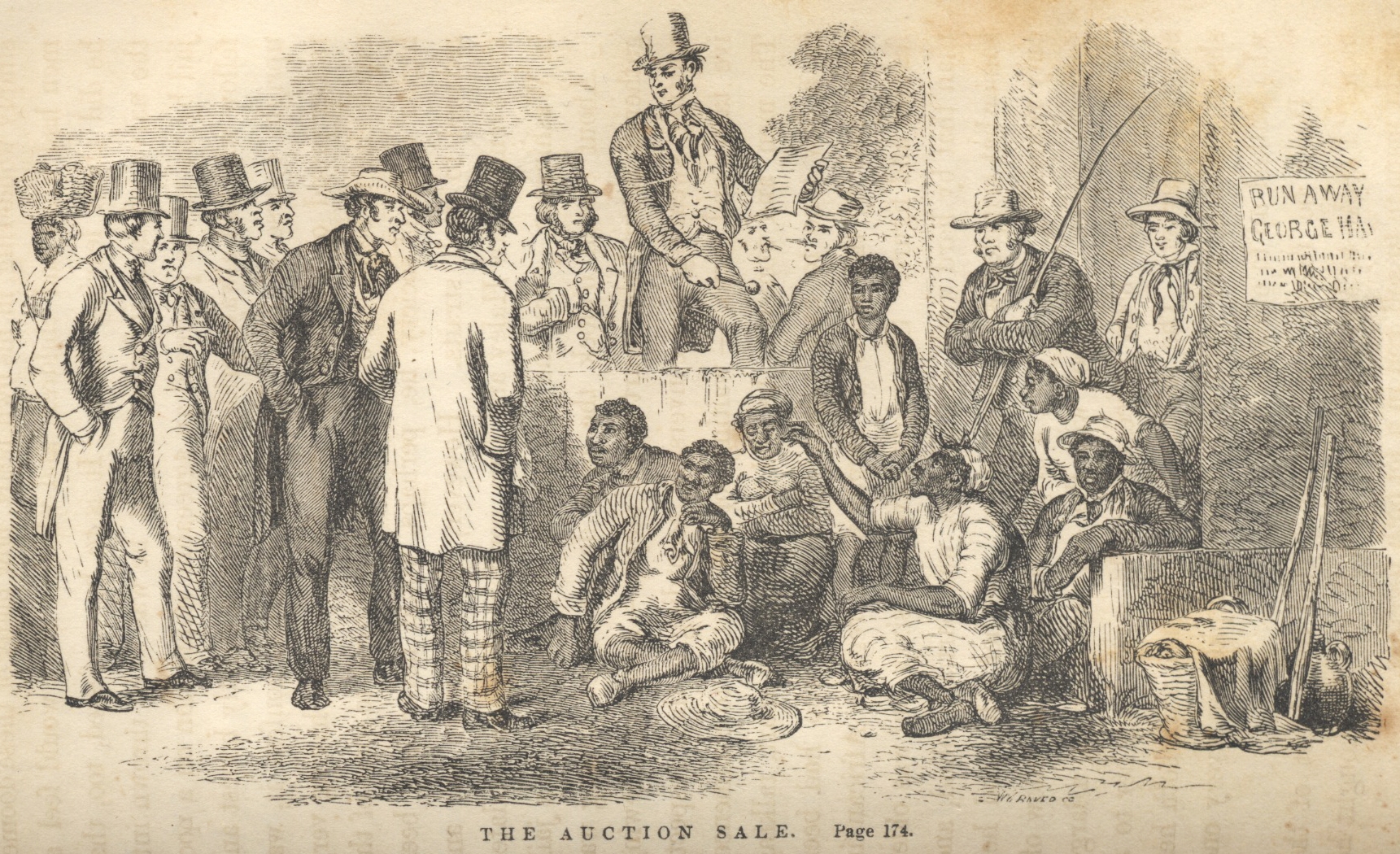
OTCauction

Southern Religious Support of Slavery

“we must go before the nation with the Bible as the text and ‘Thus saith the Lord’ as the answer….we know that on the Bible argument the abolition party will be driven to reveal their true infidel tendencies. The Bible being bound to stand on our side…” Reverend Robert Lewis Dabney on defending slavery and condemning its critics

In light of the threat posed to slavery by the emerging abolitionist movement, slaveholders were forced to shift their defense of slavery away from it being simply a necessary evil to a positive good. The institution of slavery became “in both secular and religious discourse, the central component of the mission God had designed for the South.” [1] Like in the North where theology was at the heart of many abolitionist arguments, in the South theology was used to enshrine and defend the institution of slavery. British Evangelical-Anglican theologian Alister McGrath notes how “the arguments used by the pro-slavery lobby represent a fascinating illustration and condemnation of how the Bible may be used to support a notion by reading the text within a rigid interpretive framework that forces predetermined conclusions to the text.” [2]

Southern religion was a key component of something bigger than itself and played a role in the development of an ideology much more entrenched in the Southern culture than the abolitionist cause did in the North. This was in large part due to the same Second Great Awakening that brought abolitionism to the fore in the North. “Between 1801 when he Great Revival swept the region and 1831 when the slavery debate began, southern evangelicals achieved cultural dominance in the region. Looking back over the first thirty years of the century, they concluded that God had converted and blessed their region.” [3] The Southern ideology which enshrined slavery as a key component of all areas of life was a complete worldview, a system of values, culture, religion and economics, or to use the more modern German term “Weltanschauung.” The Confederate worldview was the Cause. As Emory Thomas wrote in his book The Confederate Nation:

“it was the result of the secular transubstantiation in which the common elements of Southern life became sanctified in the Southern mind. The South’s ideological cause was more than the sum of its parts, more than the material circumstances and conditions from which it sprang. In the Confederate South the cause was ultimately an affair of the viscera….Questions about the Southern way of life became moral questions, and compromises of Southern life style would become concession of virtue and righteousness.” [4]

Despite the dissent of some, the “dominant position in the South was strongly pro-slavery, and the Bible was used to defend this entrenched position.” [5] This was tied to a strongly Calvinistic theology which saw slavery in context with the spread of the evangelical Protestant faith that had swept through the South as slavery spread. For many, if not most Southern ministers “the very spread of evangelical religion and slave labor in the South was a sign of God’s divine favor. Ministers did not focus on defending slavery in the abstract but rather championed Christian slaveholding as it was practiced in the American South. Though conceding that some forms of slavery might be evil, Southern slavery was not.” [6]

The former Governor of South Carolina, John Henry Hammond, led the religiously based counter argument to the abolitionists. Hammond’s arguments included biblical justification of blacks being biologically inferior to whites and slavery being supported in the Old Testament where the “Hebrews often practiced slavery” and in the New testament where “Christ never denounced servitude.” [7] Hammond warned:

“Without white masters’ paternalistic protection, biologically inferior blacks, loving sleep above all and “sensual excitements of all kinds when awake” would first snooze, then wander, then plunder, then murder, then be exterminated and reenslaved.” [8]

Others in the South, including politicians, pundits and preachers were preaching “that slavery was an institution sanction by God, and that even blacks profited from it, for they had been snatched out of pagan and uncivilized Africa and been given the advantages of the gospel.” [9] The basic understanding was that slavery existed because “God had providential purposes for slavery.” [10]

At the heart of the pro-slavery theological arguments was in the conviction of most Southern preachers of human sinfulness. “Many Southern clergymen found divine sanction for racial subordination in the “truth” that blacks were cursed as “Sons of Ham” and justified bondage by citing Biblical examples.” [11] But simply citing scripture to justify the reality of a system of which they reaped the benefit, is just part of the story. The real issue was far greater than that. The theology that justified slavery also, in the minds of many Christians in the north justified what they considered “the hedonistic aspects of the Southern life style.” [12] This was something that abolitionist preachers continually emphasized, criticizing the greed, sloth and lust inherent in the culture of slavery and plantation life, and was an accusation of which Southern slaveholders, especially evangelicals took umbrage, for in their understanding good men could own slaves. Their defense was rooted in their theology. The hyper-individualistic language of Southern evangelicalism gave “new life to the claim that good men could hold slaves. Slaveholding was a traditional mark of success, and a moral defense of slavery was implicit wherever Americans who considered themselves good Christians held slaves.” [13] The hedonism and fundamentalism that existed in the Southern soul, was the “same conservative faith which inspired John Brown to violence in an attempt to abolish slavery…” [14]

Slave owners frequently expressed hostility to independent black churches and conducted violence against them, and “attacks on clandestine prayer meetings were not arbitrary. They reflected the assumption (as one Mississippi slave put it) “that when colored people were praying [by themselves] it was against them.” [15] But some Southern blacks accepted the basic tenets of slave owner-planter sponsored Christianity. Frederick Douglass later wrote “many good, religious colored people who were under the delusion that God required them to submit to slavery and wear their chains with weakness and humility.” [16]

The political and cultural rift began to affect entire church denominations. The heart of the matter went directly to theology, in this case the interpretation of the Bible in American churches. The American Protestant and Evangelical understanding was rooted in the key theological principle of the Protestant Reformation, that of Sola Scripura, which became an intellectual trap for northerners and southerners of various theological stripes. Southerners believed that they held a “special fidelity to the Bible and relations with God. Southerners thought abolitionists either did not understand the Bible or did not know God’s will, and suspected them of perverting both.” [17]The problem was then, as it is now that:

“Americans favored a commonsense understanding of the Bible that ripped passages out of context and applied them to all people at all times. Sola scriptura both set and limited terms for discussing slavery and gave apologists for the institution great advantages. The patriarchs of the Old Testament had owned slaves, Mosaic Law upheld slavery, Jesus had not condemned slavery, and the apostles had advised slaves to obey their masters – these points summed up and closed the case for many southerners and no small number of northerners.” [18]

In the early decades of the nineteenth century there existed a certain confusion and ambivalence to slavery in most denominations. The Presbyterians exemplified this when in 1818 the “General Assembly of the Presbyterian Church, while opposing slavery against the law of God, also went on record as opposing abolition, and deposed a minister for advocating abolition.” [19] There were arguments by some American Christians including some Catholics, Lutherans, Episcopalians and others to offer alternative ways to “interpreting and applying scripture to the slavery question, but none were convincing or influential enough to force debate” [20] out of the hands of literalists.

However the real schisms between the Northern and Southern branches of the major denominations which began to emerge in the mid to late 1830s continued to grow with the actual breakups of the major denominations coming in the 1840s. The first denomination to split were the Methodists. This occurred in 1844 when “the Methodist General Conference condemned the bishop of Georgia for holding slaves, the church split and the following year saw the birth of the Methodist Episcopal Church.” [21] Not all Methodists in the South agreed with this split and a few Methodist abolitionists in the South “broke away from mainline Methodism to form the Free Methodist Church.” [22]

The Baptists were next, when the Foreign Mission Board “refused to commission a candidate who had been recommended by the Georgia Baptist Convention, on the ground that he owned slaves” [23] resulting in the formation of the Southern Baptist Convention. The Baptist split is interesting because until the early 1800s there existed a fairly strong anti-slavery movement in states such as Kentucky, while in 1790 the General Committee of Virginia “adopted a statement calling slavery “a violent deprivation of the rights of nature, and inconsistent with a republican government; and therefore [we] recommend it to our brethren to make use of every legal measure, to extirpate the horrid evil from the land.” [24]

However, in many parts of the Deep South there existed no such sentiment and in South Carolina, noted Baptist preachers including “Richard Furman, Peter Bainbridge, and Edmund Botsford were among the larger slaveholders.” [25] Furman wrote a defense of slavery in 1822 where he made the argument that “the right of holding slaves is clearly established in the Holy Scriptures by precept and example.” [26] After a number of slave uprisings, including the Nat Turner Revolt in Virginia, pro-slavery voices “tended to silence any remaining antislavery voices in the South.” [27]

These voices grew more ever more strident and in 1835 the Charleston Association “adopted a militant defense of slavery, sternly chastising abolitionists as “mistaken philanthropists, and denuded and mischievous fanatics.” [28] Those who met in Augusta Georgia to found the new Southern Baptist Convention indicated that “the division was “painful” but necessary because” our brethren have pressed upon every inch of our privileges and our sacred rights.” [29] Since the Baptist split was brought about by the refusal of the Triennial Convention to appoint slaveholders as foreign missionaries the new convention emphasized the theological nature of their decision:

“Our objects, then, are the extension of the Messiah’s kingdom, and the glory of God. Not disunion with any of his people; not the upholding of any form of civil rights; but God’s glory, and Messiah’s increasing reign; in the promotion of which, we find no necessity for relinquishing any of our civil rights. We will never interfere with what is Caesar’s. We will not compromit what is God’s.” [30]

Of course, to the Baptists who met at Augusta, “what was Caesar’s” was obviously the institution of slavery.

The last denomination to officially split was the Presbyterians in 1861 who, “reflecting the division of the nation, the Southern presbyteries withdrew from the Presbyterian Church and founded their own denomination.” [31] The split in the Presbyterian Church had been obvious for years despite their outward unity. Some Southern pastors and theologians were at the forefront of battling their northern counterparts for the theological high ground that defined just whose side God was on. James Henley Thornwell presented the conflict between northern evangelical abolitionists and southern evangelical defenders of slavery in Manichean terms. He believed that abolitionists attacked religion itself.

“The “parties in the conflict are not merely abolitionists and slaveholders,…They are atheists, socialists, communists, red republicans, Jacobins, on one side, and friends of order and regulated freedom on the other. In one word, the world is the battle ground – Christianity and Atheism as the combatants; and the progress of humanity at stake.” [32]

Robert Lewis Dabney, a southern Presbyterian pastor who later served as Chief of Staff to Stonewall Jackson in the Valley Campaign and at Seven Pines and who remained a defender of slavery long after the war was over wrote that:

“we must go before the nation with the Bible as the text and ‘Thus saith the Lord’ as the answer….we know that on the Bible argument the abolition party will be driven to reveal their true infidel tendencies. The Bible being bound to stand on our side, they have to come out and array themselves against the Bible. And then the whole body of sincere believers at the North will have to array themselves, though unwillingly, on our side. They will prefer the Bible to abolitionism.” [33]

Southern churches and church leaders were among the most enthusiastic voices for disunion and secession. They labeled their Northern critics, even fellow evangelicals in the abolition movement as “atheists, infidels, communists, free-lovers, Bible-haters, and anti-Christian levelers.” [34] The preachers who had called for separation from their own national denominations years before the war now “summoned their congregations to leave the foul Union and then to cleanse their world.” [35] Thomas R.R. Cobb, a Georgia lawyer, an outspoken advocate of slavery and secession who was killed at the Battle of Fredericksburg, wrote proudly that Secession “has been accomplished mainly by the churches.” [36]

The Reverend William Leacock of Christ Church, New Orleans declared in his Thanksgiving sermon:

“Our enemies…have “defamed” our characters, “lacerated” our feelings, “invaded “our rights, “stolen” our property, and let “murderers…loose upon us, stimulated by weak or designing or infidel preachers. With “the deepest and blackest malice,” they have “proscribed” us “as unworthy members… of the society of men and accursed before God.” Unless we sink to “craven” beginning that they “not disturb us,…nothing is now left us but secession.” [37]

The fact that so many Protestant ministers, intellectuals, and theologians, not only Southerners, but men like “Princeton’s venerable theologian Charles B. Hodge – supported the institution of slavery on biblical grounds, often dismissing abolitionists as liberal progressives who did not take the Bible seriously” leaves a troubling question over those who claim to oppose issues on supposedly Biblical grounds. Such men in the North spoke out for it “in order to protect and promote interests concomitant to slavery, namely biblical traditionalism, and social and theological authority.” [38] The Northern clerical defenders of slavery perceived the spread of abolitionist preaching as a threat, not just to slavery “but also to the very principle of social and ecclesiastical hierarchy.” [39] Alistair McGrath asks a very important question for modern Christians who might be tempted to support a position for the same reasons today, “Might not the same mistakes be made all over again, this time over another issue?” [40]

Notes

[1] Gallagher, Gary W. The Confederate War: How Popular Will, Nationalism and Military Strategy Could not Stave Off Defeat Harvard University Press, Cambridge MA and London 1999 p.67

[2] Ibid. McGrath Christianity’s Dangerous Idea p.324

[3] Ibid. Daly When Slavery Was Called Freedom p.69

[4] Thomas, Emory The Confederate Nation 1861-1865 Harper Perennial, New York and London 1979 p.4

[5] Ibid. McGrath Christianity’s Dangerous Idea p.324

[6] Ibid. Varon Disunion! p.109

[7] Ibid. Freehling The Road to Disunion Volume One p.29

[8] Ibid. Freehling The Road to Disunion Volume One p.29

[9] Gonzalez, Justo L. The History of Christianity Volume 2: The Reformation to the Present Day Harper and Row Publishers San Francisco 1985 p.251

[10] Ibid. Daly When Slavery Was Called Freedom p.54

[11] Ibid. Thomas The Confederate Nation p.22

[12] Ibid. Thomas The Confederate Nation p.22

[13] Ibid. Daly When Slavery Was Called Freedom p.30

[14] Ibid. Thomas The Confederate Nation p.22

[15] Ibid. Levine Half Slave and Half Free p.116

[16] Ibid. Levine Half Slave and Half Free p.116

[17] Ibid. Daly When Slavery Was Called Freedom p.60

[18] Ibid. Rable God’s Almost Chosen Peoples p.14

[19] Ibid. Gonzalez The History of Christianity Volume 2 p.251

[20] Ibid. Rable God’s Almost Chosen Peoples p.14

[21] Ibid. Gonzalez The History of Christianity Volume 2 p.251

[22] Ibid. McGrath Christianity’s Dangerous Idea p.324

[23] Ibid. Gonzalez The History of Christianity Volume 2 p.251

[24] Ibid. McBeth The Baptist Heritage p.383

[25] Ibid. McBeth The Baptist Heritage p.384

[26] Ibid. McBeth The Baptist Heritage p.384

[27] Ibid. McBeth The Baptist Heritage p.384

[28] Ibid. McBeth The Baptist Heritage p.384

[29] Shurden, Walter B Not a Silent People: The Controversies that Have Shaped Southern Baptists Broadman Press, Nashville TN 1972 p.58

[30] Ibid. Shurden Not a Silent People p.58

[31] Ibid. Gonzalez The History of Christianity Volume 2 p.251

[32] Ibid. Rable God’s Almost Chosen Peoples p.13

[33] Ibid. Rable God’s Almost Chosen Peoples p.14

[34] Ibid. Daly When Slavery Was Called Freedom p.97

[35] Freehling, William. The Road to Disunion Volume II: Secessionists Triumphant 1854-1861 Oxford University Press, Oxford and New York 2007 p.460

[36] Ibid. Rable God’s Almost Chosen Peoples p.39

[37] Ibid. Freehling The Road to Disunion Volume II p.462

[38] Ibid. Daly When Slavery Was Called Freedom p.38

[39] Ibid. Varon Disunion! P.108

[40] Ibid. McGrath Christianity’s Dangerous Idea p.324
2 Comments

Filed under christian life, civil rights, civil war, faith, History, LGBT issues, News and current events, Political Commentary

Christian Abolitionists: The Spirit of the Gospel

Friends of Padre Steve’s World

The past few days I have written a number of articles dealing with how Southern Christians used faith to justify slavery. I have also written about how many American Christians since the 1840s have used the concept of Manifest Destiny to justify many actions that have no support in the teachings of Jesus or the early church and to promote the concept of American exceptionalism which basically asserts that the United States occupies a place in history like that of Israel in the Old Testament. Much of this has come out of my Civil War and Gettysburg Staff Ride text. 

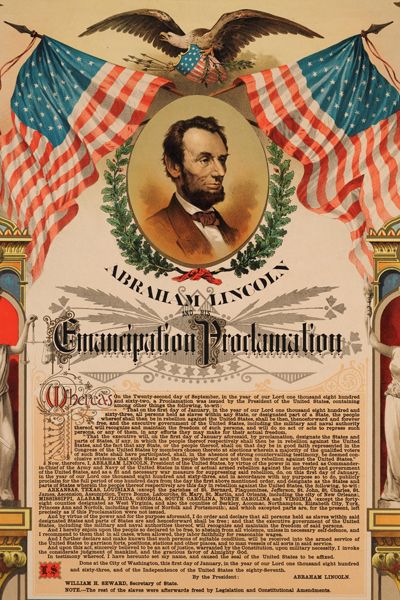
AS such I have been critical of Christians. However, today I am posting another section of the same chapter dealing with religion, ideology and the Civil War, this time one that is more positive on the Christian influence and participation in the abolitionist movement. The Christian abolitionists were condemned throughout Southern churches and liberals, communists, jacobins and heretics. They were also condemned by many Northern churchmen who saw them as upsetting the divine order. For decades they fought an uphill battle until Abraham Lincoln was able to pull together the disparate parts of the Republican party, including the abolitionists to give them a voice that eventually would help bring Lincoln to issue the Emancipation Proclamation and push through the 13th Amendment which banned slavery in the United States. 

It is important to remember that such men and women gave voice to those who many of the “Christian” brothers enslaved and exploited. Likewise, it is important to remember Christians and other people of faith who labor for justice, peace and care for the least, the lost and the lonely in our world. 

Peace

Padre Steve+

70787-004-784C0452

Christians and Abolitionism in the North

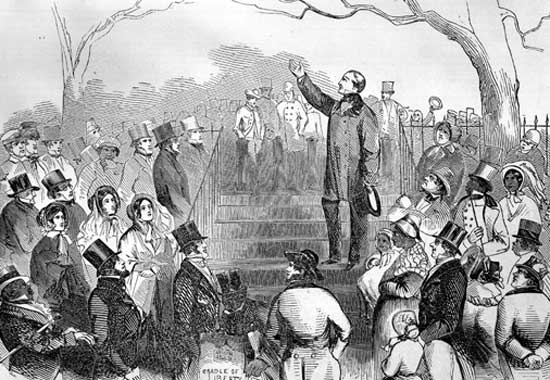
In the North a strident abolitionist movement took root and with each failed compromise, with each new infringement on the rights of northern free-states by the Congress, Courts and the Executive branch to appease southern slaveholders the movement gained added support. The movement developed during the 1830s in New England as a fringe movement among the more liberal elites. One wing of the movement “arose from evangelical ranks and framed its critique of bound labor in religious terms.” [1] The polarization emerged as Northern states abolished slavery as increasing numbers of influential “former slave owners such as Benjamin Franklin changed their views on the matter.” [2]

Many in the movement were inspired by the preaching of revivalist preacher Charles Finney who “demanded a religious conversion with a political potential more radical than the preacher first intended.” [3] Finney and other preachers were instrumental in the Second Great Awakening “which rekindled religious fervor in much of the nation, saw new pressure for abolition.” [4] In fact the “most important child of the Awakening, however, was the abolitionist movement, which in the 1830s took on new life, placed the slavery issue squarely on the national agenda, and for the next quarter century aroused and mobilized people in the cause of emancipation.” [5]

The evangelical proponents of abolition understood this in the concept of “free will.” They believed and pointed out repeatedly that slavery “denied one group of human beings the freedom of action necessary to free will – and therefore moral responsibility for their behavior. Meanwhile, it assigned to other human beings a degree of temporal power that virtually guaranteed their moral corruption. Both master and slave were thus trapped in a relationship that inevitably led both down the path of sin and depravity” [6]

4.0.4

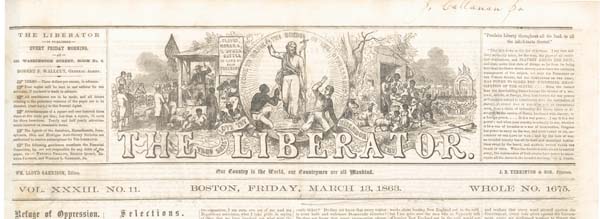
Finney’s preaching was emboldened and expanded by the American Anti-Slavery Society founded by William Lloyd Garrison “which launched a campaign to change minds, North and South, with three initiatives, public speeches, mass mailings and petitions.” [7] Many of the speakers were seminary students and graduates of Lane Seminary in Cincinnati, who became known as “the Seventy” who received training and then “fanned out across the North campaigning in New England, Pennsylvania, New York, Ohio, Indiana and Michigan[8] where many received hostile receptions, and encountered violence. Garrison used his newspaper, The Liberator to “pledge an all-out attack on U.S. slavery.” [9] Many of the articles in the Liberator, as in many other religiously based abolitionist publications “based their call for the immediate abolition of slavery on their belief that it was a sin.” [10] Likewise other churches such as the Presbyterians founded new educational institutions such as “Oberlin College in Ohio” which “was founded as an abolitionist institution” [11]

Theodore Parker, a Unitarian pastor and leading Transcendentalist thinker enunciated a very important theological-political analogy for many in the religious wing of the abolitionist movement which concentrated less on using chapter and verse but appealing to “the spirit of the Gospel,” [12] in as Parker’s analogy: as Jesus is to the Bible, so is the Declaration to the Constitution:

“By Christianity, I mean that form of religion which consists of piety – the love of God, and morality – the keeping of His laws. That Christianity is not the Christianity of the Christian church, nor of any sect. It is the ideal religion which the human race has been groping for….By Democracy, I mean government over all the people, by all the people and for the sake of all….This is not a democracy of the parties, but it is an ideal government, the reign of righteousness, the kingdom of justice, which all noble hearts long for, and labor to produce, the ideal whereunto mankind slowly draws near.” [13]

The early abolitionists who saw the issue framed in terms of their religious faith declared slavery a sin against God and man that demanded immediate action.” [14] For them the issue was a matter of faith and belief in which compromise of any kind, including the gradual elimination of slavery or any other halfway measures were unacceptable. “William Lloyd Garrison and his fellow abolitionists believed the nation faced a clear choice between damnation and salvation,” [15] a cry that can be heard in much of today’s political debate regarding a number of social issues with religious components including abortion, gay rights and immigration. Harrison wrote that “Our program of immediate emancipation and assimilation, I maintained, was the only panacea, the only Christian solution, to an unbearable program.” [16] The abolitionists identified:

“their cause with the cause of freedom, and with the interests of large and relatively unorganized special groups such as laborers and immigrants, the abolitionists considered themselves to be, and convinced many others that they were, the sole remaining protectors of civil rights.” [17]

The arguments were frequently and eloquently rooted in profoundly religious terms common to evangelical Christianity and the Second Great Awakening. One of the leading historians of the era, Henry Wilson of Massachusetts, a Radical Republican and Abolitionist who served as a United States Senator and Vice President in Ulysses Grant’s second administration provides a good example of this. He wrote in his post war history of the events leading to the war explaining basic understanding of the religiously minded abolitionists during the period:

“God’s Holy Word declares that man was doomed to eat his bread in the sweat of his face. History and tradition teach that the indolent, the crafty, and the strong, unmindful of human rights, have ever sought to evade this Divine decree by filching their bread from the constrained and unpaid toil of others…

American slavery reduced man, created in the Divine image, to property….It made him a beast of burden in the field of toil, an outcast in social life, a cipher in courts of law, and a pariah in the house of God. To claim for himself, or to use himself for his own benefit or benefit of wife and child, was deemed a crime. His master could dispose of his person at will, and of everything acquired by his enforced and unrequited toil.

This complete subversion of the natural rights of millions…constituted a system antagonistic to the doctrines of reason and the monitions of conscience, and developed and gratified the most intense spirit of personal pride, a love of class distinctions, and the lust of dominion. Hence a commanding power, ever sensitive, jealous, proscriptive, dominating, and aggressive, which was recognized and fitly characterized as the Slave Power…” [18]

The religious abolitionists took aim at the Southern churches and church leaders who they believed only buttressed slavery but “had become pawns of wealthy slaveholders and southern theologians apologists for oppression.” [19] As the abolitionist movement spread through Northern churches, especially those with ties to the evangelicalism of the Great Awakenings, and for “Evangelical northerners, the belief in individual spiritual and personal rights and personal religious activism made such involvement necessary.” [20]

For Baptists the issue created a deep polarization with northern Baptists mobilizing around abolitionist principles which came out of their association with English Baptists who had been at the forefront of the abolitionist movement in England where the Reverend William Knibb, who also led the fight to end slavery in Jamaica “became an impassioned defender of the human rights of blacks….his flamboyant speeches aroused the people against slavery.” [21] The Baptist Union in England sent a lengthy letter to the Baptist Triennial Convention in the United States on December 31st 1833 in which they condemned “the slave system…as a sin to be abandoned, and not an evil to be mitigated,” and in which they urged all American Baptists to do all in their power to “effect its speedy overthrow.” [22]

In 1835 two English Baptists, Francis Cox and James Hoby, who were active in that nation’s abolitionist movement with William Wilberforce came to the United States “to urge Baptists to abandon slavery. This visit and subsequent correspondence tended to polarize Baptists.” [23] In the north their visit encouraged faith based activism in abolitionist groups. In 1849 the American Baptist Anti-Slavery Convention was formed in New York and launched a polemic attack on the institution of slavery and called southern Baptists to repent in the strongest terms. They urged that the mission agencies be cleansed from “any taint of slavery…and condemned slavery in militant terms.” They called on Southern Baptists to “confess before heaven and earth the sinfulness of holding slaves; admit it to be not only a misfortune, but a crime…” and it warned that “if Baptists in the South ignored such warnings and persisted in the practice of slavery, “we cannot and dare not recognize you as consistent brethren in Christ.” [24] Such divisions we not limited to Baptists and as the decade moved on rose to crisis proportions in every evangelical denomination, provoking Kentucky Senator Henry Clay to wonder: “If our religious men cannot live together in peace, what can be expected of us politicians, very few of whom profess to be governed by the great principles of love?” [25]

The abolition movement aimed to not only stop the spread of slavery but to abolish it. The concept of totally abolishing slavery was something that even many northerners who exposed its expansion were either indifferent or opposed to. For such people the abolitions of slavery only became an issue for many after the passage of the Fugitive Slave Act of 1850. So long as slavery was regulated to the South, most northerners showed little concern. In fact many northerners profited by slavery, or otherwise reaped its benefits. However, their involvement with slavery was indirect. While they may have worn clothes made of cotton harvested by slaves, while the profits of corporations that benefited from all aspects of the Southern slave economy paid the wages of northern workers and shareholders, few thought of the moral issues until they were forced to participate or saw the laws of their states overthrown by Congress.

Uncle Tom’s Cabin and the Popularization of Abolitionism in the North

cover22

It was only after this act that the abolitionist movement began to gain traction among people in the North. Angelina Grimke Weld confronted the indifference of people in the North in regard to slavery in her book American Slavery as it Is in 1838. The book was a harsh criticism of Northern hypocrisy and indifference and sought to confront its readers that to “deny man’s capacity to for cruelty is to betray a shameful ignorance of human history and, in particular, of America’s past.” [26] Noting the Salem Witch Trials, the persecution of Quakers and Baptists, the transatlantic salve trade and even violent attacks on Northern abolitionists in northern cities the book sold over 100,000 copies.

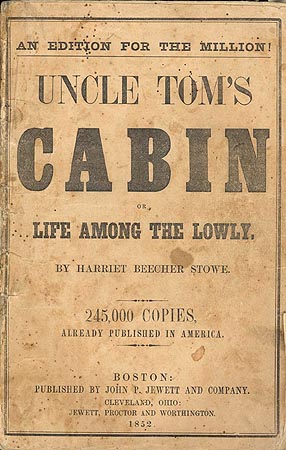
The abolitionist movement was given a large boost by the huge popularity of Harriet Beecher Stowe’s 1852 novel Uncle Tom’s Cabin, “a vivid, highly imaginative, best-selling, and altogether damning indictment of slavery” [27]

Stowe was a well-educated writer, the daughter of the President of Lane Seminary, Lyman Beecher and wife of Calvin Ellis Stowe, a professor at the seminary. She and her family were deeply involved in the abolitionist movement and supported the Underground Railroad, even taking fugitive slaves into her home. These activities and her association with escaped slaves made a profound impact on her. She received a letter from her sister who was distraught over the passage of the Fugitive Slave Law. He sister challenged Stowe to write: “How, Hattie, if I could use a pen as you can, I would write something that would make this whole nation feel what an accursed thing slavery is.” [28]

One communion Sunday she:

“sat at the communion table of Brunswick’s First Parish Church, a vision began playing before my eyes that left me in tears. I saw an old slave clad in rags, a gentle, Christian man like the slave I had read about in American Slavery as It Is. A cruel white man, a man with a hardened fist, was flogging the old slave. Now a cruel master ordered two other slaves two other slaves to finish the task. As they laid on the whips, the old black man prayed for God to forgive them.

After church I rushed home in a trance and wrote down what I had seen. Since Calvin was away, I read the sketch to my ten- and twelve-year-old sons. They wept too, and one cried, “Oh! Mamma, slavery is the most cursed thing in the world!” I named the old slave Uncle Tom and his evil tormenter Simon Legree. Having recorded the climax of my story, I then commenced at the beginning….” [29]

Many of Stowe’s characters were fiction versions of people that she actually knew or had heard about and the power of her writing made the work a major success in the United States and in Britain. The abolitionist movement gained steam and power through it and the play that issued from it. The publication of the book and its success “raised a counter indignation among Southerners because they thought Mrs. Stowe’s portrait untrue and because the North was so willing to believe it.” [30]

But despite the furor of many southerners, the book gained in popularity and influenced a generation of northerners, creating a stereotype of Southern slaveholders, causing people “to think more deeply and more personally about the implications of slavery for family, society and Christianity.” [31] The book drew many people previously ambivalent to the writings of the abolitionists and who did not normally read the accounts of escaped slaves. The vivid images in Stowe’s book “were irredeemably hostile: from now on the Southern stereotype was something akin to Simon Legree.” [32] But those images transformed the issue in the minds of many in the north as they “touched on all these chords of feeling, faith, and experience….The genius of Uncle Tom’s Cabin was that it made the personal universal, and it made the personal political as well. For millions of readers, blacks became people.” [33] One northern reader said, “what truth could not accomplish, fiction did” [34] as it “put a face on slavery, and a soul on black people.” [35]

The book had a transatlantic impact, over a half million women in Great Britain “signed a massive petition advocating emancipation in the United States; this, in turn, encouraged American women to step up their petitioning.” [36] The book ended up touching the conscience of many Americans and it caused many to “think more deeply and more personally about implications of slavery for family, society, and Christianity.” [37]

George Fitzhugh, a defender of benevolent paternalistic slavery noted Stowe’s book “was “right” concerning the “bitter treatment of slaves….Law, Religion, and Public Opinion should be invoked to punish and correct those abuses….” [38] However, such thoughts could not be spoken too openly for fear of other slaveholders who “could not calmly debate internal correction…while outside agitators advertised their supposed monstrosities.” [39] The inability to debate the issue internally made the visceral response in the South to Uncle Tom’s Cabin look petty and impotent. Despite the fact that Stowe steered clear of the more radical abolitionist groups and shied away from the nascent women’s rights movement Stowe was denounced by Southerners as a threat to the established order, they saw “her as the embodiment of radicalism, as an emissary of both abolitionism and women’s rights.” [40]

Notes 

[1] Ibid. Levine Half Slave and Half Free p.93

[2] McGrath, Alister Christianity’s Dangerous Idea: The Protestant Revolution A History from the Sixteenth Century to the Twenty-First Harper Collins Publishers, New York 2007 p.324

[3] Ibid. Freehling The Road to Disunion Volume One p.289

[4] Ibid. McGrath Christianity’s Dangerous Idea p.324
[5] Huntington, Samuel P. Who Are We? America’s Great Debate The Free Press, Simon and Schuster Europe, London 2004 p.77

[6] Ibid. Levine Half Slave and Half Free p.93

[7] Ibid. Egnal Clash of Extremes:pp.125-126

[8] Ibid. Egnal Clash of Extremes p.125

[9] Ibid. Freehling The Road to Disunion Volume One p.12

[10] Ibid. Deyle The Domestic Slave Trade p.57

[11] Ibid. McGrath Christianity’s Dangerous Idea p.324
[12] Ibid. Rable God’s Almost Chosen Peoples p.14

[13] Wills, Garry Lincoln at Gettysburg: The Words that Remade America Simon and Schuster Paperbacks, New York 1992

[14] Ibid. Rable God’s Almost Chosen Peoples p.13

[15] Ibid. Rable God’s Almost Chosen Peoples p.13

[16] Oates, Stephen B. Editor The Approaching Fury: Voices of the Storm, 1820-1861 University of Nebraska Press, Lincoln and London 1997 p.36

[17] Stampp, Kenneth M. editor The Causes of the Civil War 3rd Revised Edition A Touchstone Book published by Simon and Schuster, New York and London 1991 p.23

[18] Ibid. Stampp The Causes of the Civil War p.29

[19] Ibid. Rable God’s Almost Chosen Peoples p.13

[20] Ibid. Goldfield America Aflame p.35

[21] McBeth, H. Leon The Baptist Heritage Broadman Press, Nashville TN 1987 p.301

[22] Ibid. McBeth The Baptist Heritage p.301

[23] Ibid. McBeth The Baptist Heritage p.384

[24] Ibid. McBeth The Baptist Heritage pp.384-385

[25] Ibid. Goldfield America Aflame p.35

[26] Varon, Elizabeth R. Disunion! The Coming of the American Civil War 1789-1858 University of North Carolina Press, Chapel Hill NC 2008 p.140

[27] Ibid. Catton Two Roads to Sumter p.94

[28] Ibid. Goldfield America Aflame p.75

[29] Ibid. Oates The Approaching Fury p.120

[30] Ibid. Catton Two Roads to Sumter p.94

[31] Ibid. Goldfield America Aflame p.83

[32] Ibid. Catton Two Roads to Sumter p.94

[33] Ibid. Goldfield America Aflame p.79

[34] Ibid. Goldfield America Aflame p.79

[35] Ibid. Goldfield America Aflame p.83

[36] Ibid. Varon Disunion! p.245

[37] Ibid. Goldfield America Aflame p.83

[38] Ibid. Freehling The Road to Disunion Volume One p.48

[39] Ibid. Freehling The Road to Disunion Volume One p.49

[40] Ibid. Varon Disunion! p.245

2 Comments

Filed under christian life, civil rights, civil war, faith, History, Political Commentary

God’s Not Quite Chosen People: The Confederate Union of Church and State

Friends of Padre Steve’s World

Unlike many areas of study, history never goes out of date. While I do not think that history necessarily repeats itself, I do believe that essentially humans never real change. Yes we sometimes do get better, but we often instead of rising to our best, we repeat the errors of those who have gone before us. 

This is especially true in he arenas of politics and religion, especially when societies decide to merge the two. I have written about this good number of times citing contemporary and historical examples, but today I am pulling out yet another section of the chapter of my Civil War and Gettysburg Staff Ride text dealing with how the Southern Confederacy for all practical purposes merged church and state during the Civil War. Now it did not become a full fledged theocracy, but I have no doubt that it would have had the Confederacy succeeded in its quest to become independent. The philosophical and religious thought that undergirded so much of what the Confederacy stood for almost demanded this.

And so today when we look at the fracturing of religion along political and ideological lines political resurgence of the Christian Right in the Republican Party we see many of the themes of the Confederacy being recast and broadcast as what it is to be authentically American and even more dangerously, that only Christians can be real Americans. That it what almost all the current field of Republican candidates cow-tow to the most extreme leaders and spokesmen of the Christian Right, some of whom are openly neo-Confederate in their beliefs and have ties to neo-Confederate and White Supremacist organizations.  

Since those supposedly Christian leaders seek to use their influence to force their religion on others, this subject remains very important. 

Have a great day.

Peace

Padre Steve+

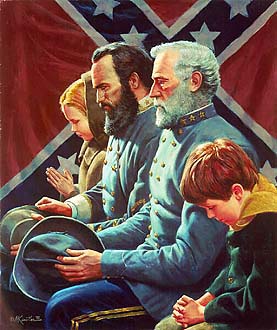
lee-jackson-in-prayer

Perhaps more than anything, the denominational splits helped prepare the Southern people as well as clergy for secession and war. They set precedent by which Southerners left established national organizations. When secession came, “the majority of young Protestant preachers were already primed by their respective church traditions to regard the possibilities of political separation from the United States without undue anxiety.” [1]

One of the most powerful ideological tools since the days of the ancients has been the linkage of religion to the state. While religion has always been a driving force in American life since the days of the Puritans in the Massachusetts Bay Colony, especially in the belief about the destiny of the nation as God’s “Chosen People,” it was in the South where the old Puritan beliefs took firm root in culture, society, politics and the ideology which justified slavery and became indelibly linked to Southern nationalism. “Confederate independence, explained a Methodist tract quoting Puritan John Winthrop, was intended to enable the South, “like a city set on a hill’ [to] fulfill her God given mission to exalt in civilization and Christianity the nations of the earth.” [2]

Religion and the churches “supplied the overarching framework for southern nationalism. As Confederates cast themselves as God’s chosen people.” [3] the defense of slavery was a major part of their mission. A group of 154 clergymen calling themselves “The Clergy of the South” “warned the world’s Christians that the North was perpetuating a plot of “interference with the plans of Divine Providence.” [4] A Tennessee pastor bluntly stated in 1861 that “In all contests between nations God espouses the cause of the Righteous and makes it his own….The institution of slavery according to the Bible is right. Therefore in the contest between the North and the South, He will espouse the cause of the South and make it his own.” [5]

The effect of such discourse on leaders as well as individuals was to unify the struggle as something that linked the nation to God, and God’s purposes to the nation identifying both as being the instruments of God’s Will and Divine Providence:

“Sacred and secular history, like religion and politics, had become all but indistinguishable… The analogy between the Confederacy and the chosen Hebrew nation was invoked so often as to be transformed into a figure of everyday speech. Like the United States before it, the Confederacy became a redeemer nation, the new Israel.” [6]

This theology also motivated men like the convinced hard line Calvinist-Presbyterian, General Stonewall Jackson on the battlefield. Jackson’s brutal, Old Testament understanding of the war caused him to murmur: “No quarter to the violators of our homes and firesides,” and when someone deplored the necessity of destroying so many brave men, he exclaimed: “No, shoot them all, I do not wish them to be brave.” [7]

In effect: “Slavery became in secular and religious discourse, the central component of the mission God had designed for the South….The Confederates were fighting a just war not only because they were, in the traditional framework of just war theory, defending themselves against invasion, they were struggling to carry out God’s designs for a heathen race.” [8]

From “the beginning of the war southern churches of all sorts with few exceptions promoted the cause militant” [9] and supported war efforts. The early military victories of Robert E. Lee’s Army of Northern Virginia and the victories of Stonewall Jackson in the Shenandoah Valley   were celebrated as “providential validations of the cause that could not fail…” Texas Methodist minister William Seat wrote: “Never surely since the Wars of God’s ancient people has there been such a remarkable and uniform success against tremendous odds. The explanation is found in the fact that the Lord goes forth to fight against the coercion by foes of his particular people. Thus it has been and thus it will be to the end of the War.” [10]

This brought about a intertwining of church and state authority, a veritable understanding of theocracy as “The need for the southern people to acknowledge God’s authority was bound up with a legitimation of the authority of clerical and civil rulers. Christian humility became identified with social and political deference to both God and Jefferson Davis.” [11]

Jefferson Davis and other leaders helped bolster this belief:

“In his repeated calls for God’s aid and in his declaration of national days of fasting, humiliation, and prayer on nine occasions throughout the war, Jefferson Davis similarly acknowledged the need for a larger scope of legitimization. Nationhood had to be tied to higher ends. The South, it seemed, could not just be politically independent; it wanted to believe it was divinely chosen.” [12]

Davis’s actions likewise bolstered his support and the support for the war among the clergy. A clergyman urged his congregation that the people of the South needed to relearn “the virtue of reverence- and the lesson of respecting, obeying, and honoring authority, for authority’s sake.” [13]

Confederate clergymen not only were spokesmen and supporters of slavery, secession and independence, but many also shed their clerical robes and put on Confederate Gray as soldiers, officers and even generals fighting for the Confederacy. Bishop Leonidas Polk, the Episcopal Bishop of Louisiana, who had been a classmate of Jefferson Davis at West Point was commissioned as a Major General and appointed to command the troops in the Mississippi Valley. Polk did not resign his ecclesiastical office, and “Northerners expressed horror at such sacrilege, but Southerners were delighted with this transfer from the Army of the Lord.” [14] Lee’s chief of Artillery Brigadier General Nelson Pendleton was also an academy graduate and an Episcopal Priest. By its donations of “everything from pew cushions to brass bells, Southern churches gave direct material aid to the cause. Among all the institutions in Southern life, perhaps the church most faithfully served the Confederate Army and nation.” [15] Southern ministers “not only proclaimed the glory of their role in creating the war but also but also went off to battle with the military in an attempt to add to their glory.” [16]

Sadly, the denominational rifts persisted until well into the twentieth century. The Presbyterians and Methodists both eventually reunited but the Baptists did not, and eventually “regional isolation, war bitterness, and differing emphasis in theology created chasms by the end of the century which leaders of an earlier generation could not have contemplated.” [17] The Southern Baptist Convention is now the largest Protestant denomination in the United States and many of its preachers are active in often divisive conservative social and political causes. The denomination that it split from, the American Baptist Convention, though much smaller remains a diverse collection of conservative and progressive local churches. Some of these are still in the forefront of the modern civil rights movement, including voting rights, women’s rights and LGBT issues, all of which find some degree of opposition in the Southern Baptist Convention.

But the religious dimensions were far bigger than denominational disagreements about slavery; religion became one of the bedrocks of Confederate nationalism. The Great Seal of the Confederacy had as its motto the Latin words Deo Vindice which can be translated “With God as our Champion” or “Under God [Our] Vindicator.” The issue was bigger than independence itself; it was intensely theological. Secession “became an act of purification, a separation from the pollutions of decaying northern society, that “monstrous mass of moral disease,” as the Mobile Evening News so vividly described it.” [18]

The arguments found their way into the textbooks used in schools throughout the Confederacy. “The First Reader, For Southern Schools assured its young pupils that “God wills that some men should be slaves, and some masters.” For older children, Mrs. Miranda Moore’s best-selling Geographic Reader included a detailed proslavery history of the United States that explained how northerners had gone “mad” on the subject of abolitionism.” [19] The seeds of future ideological battles were being planted in the hearts of white southern children by radically religious ideologues, just as they are today in the Madrassas of the Middle East.

While the various theological and ideological debates played out and fueled the fires of passion that brought about the war, they also provided great motivation to their advocates. This was true especially to Confederates during the war, that their cause was righteous. While this fueled the passion of the true believers, other very real world decisions and events in terms of politics, law and lawlessness, further inflamed passions.

Notes

[1] Brinsfield, John W. et. al. Editor, Faith in the Fight: Civil War Chaplains Stackpole Books, Mechanicsburg PA 2003 p.67

[2] Ibid. Faust The Creation of Confederate Nationalism p.27

[3] Ibid. Gallagher The Confederate War pp.66-67

[4] Ibid. Daly When Slavery Was Called Freedom p.145

[5] Ibid. Daly When Slavery Was Called Freedom p.138

[6] Ibid. Faust The Creation of Confederate Nationalism p.29

[7] Fuller, J.F.C. Grant and Lee: A Study in Personality and Generalship, Indiana University Press, Bloomington IN 1957

[8] Ibid. Faust, The Creation of Confederate Nationalism: Ideology and Identity in the Civil War South p.60

[9] Ibid. Thomas The Confederate Nation 1861-1865 pp.245-246

[10] Ibid. Daly When Slavery Was Called Freedom pp.145 and 147

[11] Ibid. Faust The Creation of Confederate Nationalism p.26

[12] Ibid. Faust The Creation of Confederate Nationalism p.33

[13] Ibid. Faust The Creation of Confederate Nationalism p.32

[14] Foote, Shelby, The Civil War, A Narrative. Volume One: Fort Sumter to Perryville Random House, New York 1963 1958 p.87

[15] Ibid. Thomas The Confederate Nation p.246

[16] Ibid. Daly When Slavery Was Called Freedom p.142

[17] Ibid. McBeth The Baptist Heritage pp.392-393

[18] Ibid. Faust The Creation of Confederate Nationalism p.30

[19] Ibid. Faust The Creation of Confederate Nationalism p.62


9 Comments

Filed under civil rights, civil war, faith, History, Political Commentary

Fiery Trials: Emancipation & Equality Today

c91f46b3ce5943b9e213e3cd306c6348_f3094

Friends of Padre Steve’s World

Just a coupled of thoughts on this Sunday night. Like yesterday I have been spending a lot of time on my Civil War-Gettysburg Staff Ride text. I have been working on re-writing the chapter on ideology and religion as they related to the causes of the war, its conduct and its aftermath. One thing that caught my attention was something that I think is profoundly important today.

In December of 1862 as he spoke to Congress prior to the the signing of the Emancipation Proclamation Lincoln spoke these profound words:

“Fellow citizens, we cannot escape history….This fiery trial through which we pass, will light us down, in honor or dishonor, to the latest generation….In giving freedom to the slave, we assure freedom to the free – honorable alike in what we give, and what we preserve.”

His words in giving freedom to the slave, we assure freedom to the free are part of an understanding of freedom, especially Lincoln’s radical understanding that the Declaration of Independence actually meant what it said that “all men are created equal.” For Lincoln this meant African Americans, inlacing those that labored as slaves. Lincoln understood the Declaration in its most broad understanding, he saw it as a universal liberty. As early as 1854 Lincoln posed the idea that the Declaration of Independence was the standard maxim of free society …constantly spreading and deepening its influence,” ultimately applicable “to peoples of all colors everywhere.”

Today there are a lot of people, especially the loudly political preachers, pundits and politicians of the Christian right and their allies who are committed to rolling back the rights of blacks, but also of women, and to prevent Gays, Lesbians and others of the LGBTQ community from having any rights commensurate with their status as citizens. In many states we have seen the protections of the Voter’s Rights Act being eroded as state legislatures enact laws to restrict voting rights and make it more difficult for people to exercise their right to vote. State legislatures are enacting laws that allow people to discriminate against others based on “a sincerely held religious belief” and while those laws are targeted against Gays they are in many cases written so broadly that they will protect just about any form of discrimination based on religion, even by public officials in the conduct of their duties as happened in  North Carolina last week. 

That is why what Lincoln said as he was preparing to sign the Emancipation Proclamation matters today. When we give freedom to people, we protect the freedom of everyone, but that my friends is not how many people in the so-called Christian Right see it. For them it is their freedom to discriminate in God’s name, because they like the anointed lords of the Southern Aristocracy believe that it is God’s will for them to do this. Sounding like a Southern planter, preacher or politician of the 1850s the founder of the movement known and Christian Dominionism R.J. Rushdooney wrote: “One faith, one law and one standard of justice did not mean democracy. The heresy of democracy has since then worked havoc in church and state . . . Christianity and democracy are inevitably enemies.”

British Evangelical-Anglican theologian Alister McGrath notes how “the arguments used by the pro-slavery lobby represent a fascinating illustration and condemnation of how the Bible may be used to support a notion by reading the text within a rigid interpretive framework that forces predetermined conclusions to the text.”

That my friends are what we are dealing with today. There is a party of Christians who have tremendous political power who are using it for the most nefarious of purposes, using the law and the police power of the state to deny rights to others while preserving their own while claiming to be the victims of persecution, just as did Southern slaveholders in the 1830s to 1861.

So, that is all for the night. I expect to put out something related to this topic again tomorrow, perhaps a full section of the chapter on religion and ideology from my text.

Peace

Padre Steve+

Leave a comment

Filed under civil rights, civil war, faith, History, laws and legislation, LGBT issues, News and current events, Political Commentary

Saturday Musings: The Same Mistakes

IMG_0535

Friends of Padre Steve’s World

Not much to write tonight, mainly because I have been avoiding the heat and humidity here in the Virginia Tidewater by doing little but staying inside and working on my Gettysburg and Civil War book, but then as Yogi Berra once said “it’s not the heat, it’s the humility.” 

But really, I have been continuing to do research and work on the text and that continues to lead me to pure gold in the pursuit for truth, historical truth that is as relevant today as it was when it happened over a century and a half ago.

Sadly, the same issues that dominated America in the 1840s, 1850s, 1860s and later following Reconstruction still dominate so much of our social, political and religious debate. Whether it is the voting franchise which many on the political right seek to restrict, the rights of women, blacks and other minorities, immigrants and the LGBT community, to any semblance of political, economic equality or social justice very little has changed. Not only that there are some political, media and religious leaders who argue for the unabashed imperialism of Manifest Destiny and American Exceptionalism.

Sadly, as it was then, much, if not most of this can be laid squarely at the feet of Evangelical Protestant and other conservative Christian leaders. A century and a half ago men who claimed to be Christian leaders led the efforts to support slavery, discriminate against women, persecute gays and promote imperialistic policies that would have embarrassed the founders of the United States. After the defeat of the Confederacy most of the same people used the same theology to disenfranchise and discriminate against African Americans through Jim Crow laws, as well as discriminate against minorities, women and gays all the while claiming to be the victims of persecution.

Before the Civil War many Protestant ministers, intellectuals, and theologians, not only Southerners, but men like “Princeton’s venerable theologian Charles B. Hodge – supported the institution of slavery on biblical grounds, often dismissing abolitionists as liberal progressives who did not take the Bible seriously.”  This leaves a troubling question over those who claim to oppose other issues on supposedly Biblical grounds. Conservative Anglican theologian Alistair McGrath asks, “Might not the same mistakes be made all over again, this time over another issue?”

In the next few days I will be publishing excerpts of the text relating to those issues here.

I thank all of those who subscribe to this site, as well as those who follow my writings through Twitter or Facebook. The fact that so many people are doing this humbles me, and to repeat what Yogi Berra said, “it’s not the heat, it’s the humility.”

Peace

Padre Steve+

1 Comment

Filed under civil rights, civil war, History, LGBT issues, News and current events, Political Commentary

ISIL, the Caliphate and Manifest Destiny: Two sides of the Same Coin

Friends of Padre Steve’s World

Today another section of my Gettysburg Staff Ride text, taken from the second introductory chapter which deals with how religion and ideology plays a huge role in conflict and how it was used during the American Civil War.  This section discusses how a people’s worldview is strongly linked to culture and religion. It deals with the rather uncomfortable truth that the Islamic concept of the Caliphate differs little from the American idea of Manifest Destiny, a concept which may have created our nation as we know it but in practice was as barbaric and dishonorable as nearly conquering power has ever done, in fact there are many on the political right in this country, especially the Christian Right who are apologists for what occurred in the past and who advocate more of the same now. 

This might be an uncomfortable read for some people, and I hope that is the case. Of course in no way am I condoning anything that the Islamic State is doing in its quest to create a Caliphate, that needs to be condemned and fought wherever possible, preferably by the people most affected by it, the Arabs. 

But the truth is, religiously based imperialism, be it Manifest Destiny or the Islamic State’s dream of a Caliphate are two sides of the same coin of evil. 

So with that I bid you a happy Friday.

Peace

Padre Steve+ 

Manife4

One can never separate war and the means by which it is fought from its political ends. According to Clausewitz, war is an extension or continuation of politics. Of course Clausewitz understood the term politics or policy in the light of the concept of a “World View” or to use the German term Weltanschauung. The term is not limited to doctrine or party politics, but it encompasses the worldview of a people or culture. The world view is oft used by the political, media and religious leadership of countries and can be quite instrumental in the decision by a people to go to war; who they war against, their reasons for going to war, the means by which they fight the war, and the end state that they envision. This concept includes racial, religious, cultural, economic and social dimensions of a worldview.

One of the problems that modern Americans and Western Europeans have is that we tend to look at the world, particularly in terms of politics and policy, be it foreign or domestic, through a prism from which we cannot see the forest for the trees. We look at individual components of issues such as economic factors, military capabilities, existing political systems, diplomatic considerations and the way societies get information in isolation from each other. We dissect them, we analyze them, and we do a very good job in examining and evaluating each individual component; but we often do this without understanding the world view and ideological factors that link how a particular people, nation or party understand these components of policy.

Likewise policy makers tend to take any information they receive and interpret it through their own worldview. This is true even if they have no idea what their world-view is or how they came to it. Most often a worldview is absorbed over years. Barbara Tuchman wrote “When information is relayed to policy-makers, they respond in terms of what is already inside their heads and consequently make policy less to fit the facts than to fit the notions and intentions formed out of the mental baggage that has accumulated in their minds since childhood.” [1]

Policy makers often fail to see just how interconnected the most primal elements of the human experience are to the worldview of others as well as their own.

Because of this, many policy makers, be they military or civilian do not understand how critical the understanding of worldview is to designing effective polices. Likewise, many fail to see how the world view of others influence their application of economic, political, diplomatic and military power as well as the use and dissemination of information in their nation or culture. This is true no matter which religion or sect is involved, even if a people or nation is decidedly secular, or at least outwardly non-religious.

Perhaps this is because we do not want to admit that our Western culture itself is very much a product of primal religious beliefs which informed politics, philosophy, ethics, law, economics, views of race, and even the arts for nearly two millennia. Perhaps it is because we are justifiably appalled and maybe even embarrassed at the excesses and brutality of our ancestors in using religion to incite the faithful to war; to use race and religion justification to subjugate or exterminate peoples that they found to be less than human; or to punish and conquer heretics.

The United States Military made a belated attempt to address ideology, culture and religion in terms of counter-insurgency doctrine when it published the U.S. Army/Marine Counterinsurgency Manual. The discussion of these issues is limited to two pages that specifically deal with various extreme Moslem groups that use that religion as a pillar of their ideology, strategy and operations. But the analysis in the counterinsurgency manual of is limited because its focus is very general and focused at a tactical level.

Likewise the analysis of world view, ideology and religion in the counterinsurgency manual is done in an “us versus them” manner. While the manual encourages leaders to attempt to understand the cultural differences there is little in it to help leaders to understand why this understanding of religion and ideology is important at the strategic and operational levels of war.

ISIS-MAP

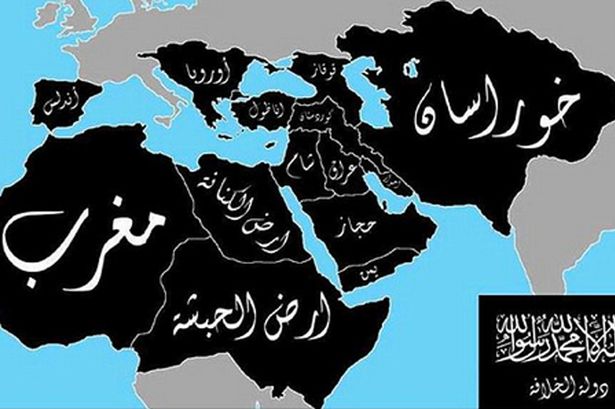
Commendably, the manual discusses how terrorist and insurgent groups use ideology, which is frequently based on religion to create a narrative. The narrative often involves a significant amount of myth presented as history, both Al Qaida and ISIL use the idea of the Caliphate as a religious and political ideal to achieve, because for many Moslems the idea of the Caliphate “produces a positive image of the golden age of Islamic civilization.” [2]

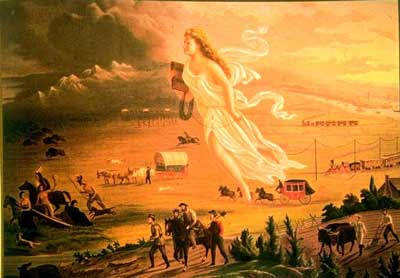
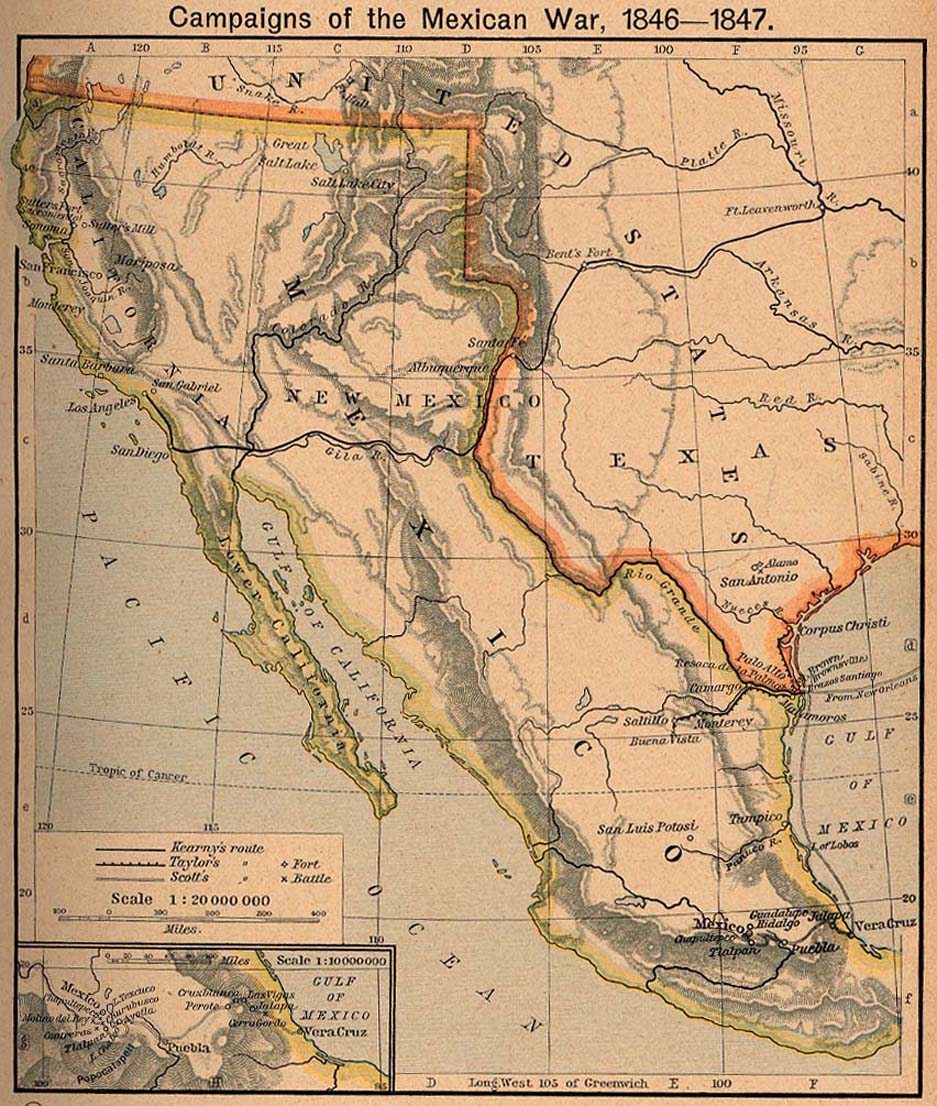
But Islam is not the only religion to do this. Most Americans are blind as to how previous generations Americans have used the Christian religion and race as a theological tool to justify subjugating other peoples and how that impacts us today. Beginning with the “landing of the Mayflower Pilgrims, the notion that the British colonies in the New World had been founded with divine assistance, in order to fulfill a providential mission, was commonly accepted.[3] The idea that it was God’s will for White Protestant settlers to push west, conquer and settle the continent of North America crystalized in the term Manifest Destiny. This concept was what motivated Americans to move into lands claimed by Britain as well as those which belonged to Mexico. The fact that the lands belong to other nations “was a small matter…Because most Americans considered it their “manifest destiny” to absorb these regions into the United States.” [4] There was a hunger in the land for more and Congressman John L. O’Sullivan, the inventor of the phrase proclaimed “Yes, more, more, more!….More…till our national destiny is fulfilled and…the whole boundless continent is ours.” [5]

mex_war_cam_1846_1847

The issue came to a head when American settlers moved into Mexican territory in what is not Texas. The Mexican government allowed the settlers on the provision that they would become Catholic and swear allegiance to Mexico. The settlers did this but had no intention of honoring their word for they believed that their race and the Protestant religion they had denied to settle in Mexico “made them naturally superior to the mestizos – people of mixed Indian and European blood – who governed in the name of Mexico.” [6] This caused serious issues. Especially when the settlers, many of who were Southerners refused to give up their slaves when Mexico abolished slavery in 1829. The American colonists disregarded every agreement they had made with the Mexican government, they flouted the Catholic Church, and they refused to learn Spanish and refused to obey Mexican law. Eventually “their numbers dwarfed the tiny Mexican population of Texas.” [7]

One of the most prominent of the early settlers, Stephen Austin declared “for fifteen years, I have been laboring to Americanize Texas” noting that his enemies were a “population of Indians, Mexican and renegados, all mixed together, and all the natural enemies of white men and civilization.” [8] Eventually General Santa Anna attempted to seal the border between Texas and Louisiana to forestall the movement of any new settlers into the territory, but the move backfired and the Texans revolted and in the ensuing war secured their independence. The agreement pledged that Texas would remain an independent nation and not become part of the United States, but this agreement was broken as well and in 1845 Texas was admitted to the Union as a Slave State, furthering the cries of those advocating Manifest destiny for more. One Congressman asserted that:

“When God crowned American arms with success in the Revolution…he had not “designed the original States should be the only abode of liberty on earth. On the contrary, He only designed them as the great center from which civilization, religion, and liberty should radiate and radiate until the whole continent shall bask in their blessing.” [9]

The year after Texas joined the Union the administration of President James K. Polk provoked a war with Mexico which secured most of the rest of what we now know as the United States. In the process the Americans decided to violate treaties they had made with Native American tribes, and the “manifest destiny that represent hope for white Americans thus spelled doom for red Americans,” [10] and through war and disease the Americans decimated the Indian populations over the next fifty years.

A few voices were raised against the war with Mexico, former President John Quincy Adams said in the House of Representatives that in a war with Mexico “the banners of freedom will be the banners of Mexico; and your banners, I blush to speak the word, will be the banners of slavery.” [11] Abraham Lincoln doomed his reelection prospects in 1848 by condemn the war and criticizing President Polk. Alexander Stephens, a Southern Whig and later Vice President of the Confederacy assailed the President:

“The principle of waging war against a neighboring people to compel them to sale their country, is not only dishonorable, but disgraceful and infamous. What. Shall it be said that American honor aims at nothing higher than land…..never did I expect to live to see the day when the Executive of this country should announce that our honor was such a loathsome, beastly thing, that it could be satisfied with any achievements in arms, however brilliant and glorious, but must feed on the earth – gross, vile, dirt!” [12]

Walt Whitman prophetically noted that “the United States may conquer Mexico, but it will be as the man who swallows arsenic, which brings him down in turn. Mexico will poison us.” [13] Whitman would be proven right as it was the territorial acquisitions gained in the war with Mexico which lit the fuse which ignited the Civil War.

images-4

The deeply Christian and imperialist civil-religious concept of Manifest Destiny of can still be seen in pronouncements of some politicians, pundits and preachers who believe that that this is America’s mission in the world. Manifest Destiny is an essential element of the idea of American Exceptionalism which often has been the justification for much American foreign policy from the time of President McKinley. Former President George W. Bush alluded to this in his 2003 State of the Union Address, “that freedom is the right of every person and the future of every nation. The liberty we prize is not America’s gift to the world, it is God’s gift to humanity.” [14] Throughout the Bush presidency the idea that God undergirded the policy of the United States led to a mismatch of policy ends and the means to accomplish them. Former Israeli Ambassador to the U.S. and historian Michael Oren wrote:

“Not inadvertently did Bush describe the struggle against Islamic terror as a “crusade to rid the world of evildoers.” Along with this religious zeal, however, the president espoused the secular fervor of the neoconservatives…who preached the Middle East’s redemption through democracy. The merging of the sacred and the civic missions in Bush’s mind placed him firmly in the Wilsonian tradition. But the same faith that deflected Wilson from entering hostilities in the Middle East spurred Bush in favor of war.” [15]

Policy makers and military leaders must realize that if they want to understand how culture and religious ideology drive others to conquer, subjugate and terrorize in the name of God, they first have to understand how our ancestors did the same thing. It is only when they do that that they can understand that this behavior and use of ideology for such ends is much more universal and easier to understand.

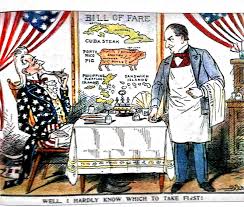
If one wants to see how the use of this compulsion to conquer in the name of God in American by a national leader one needs to go no farther than to examine the process whereby President McKinley, himself a veteran of the Civil War, decided to annex the Philippine in 1898 following the defeat of the Spanish. That war against the Filipinos that we had helped liberate from Spanish rule saw some of the most bloodthirsty tactics employed in fighting the Filipino insurgents, who merely wanted independence. It was a stain on our national honor which of which Mark Twain wrote: “There must be two Americas: one that sets the captive free, and one that takes a once-captive’s new freedom away from him, and picks a quarrel with him with nothing to found it on; then kills him to get his land. . .” [16]

A doubtlessly sincere McKinley sought counsel from God about whether he should annex the Philippines or not.

“He went down on his knees, according to his own account, and “prayed to Almighty God for light and guidance.” He was accordingly guided to conclude “that there was nothing left to do for us but to take them all, and to educate the Filipinos. And uplift and civilize and Christianize them, by God’s grace to do the very best we could by them, as our fellowmen for whom Christ died.” [17]

On the positive side the counterinsurgency manual does mention how “Ideology provides a prism, including a vocabulary and analytical categories, through which followers perceive their situation.” [18] But again it does so at a micro-level and the lessons of it are not applied at the higher levels of strategic thinking and policy. This is often due to the fact that American and other Western policy makers “as a set of theological issues rather than as a profoundly political influence in public life.” [19] Even after nearly a decade and a half of unremitting war against enemies for whom religion is at the center of their politics policy makers still misread or neglect the importance of religion and religiously based ideology in the political motivations of their opponents. In many cases the religion of a people is stronger part of their identity than that of the state. Nations which were created during the post-colonial era “continue to see religion, clan, ethnicity, and other such factors as the markers of community identity.” [20]

Thus when faced with cultures for which religion provides the adhesive which binds each of these elements, such as the Islamic State or ISIL we attempt to deal with each element separately, as if they have no connection to each other. But that is where we err, for even if the religious cause or belief has little grounding in fact, science or logic, and may be the result of a culture’s attempt to seize upon mythology to build a new reality, it is, in the words of Reggie Jackson the “straw that stirs the drink” and to ignore or minimize it is to doom our efforts to combat its proponents.

Perhaps that is because people do not like to look at themselves and their own history in the mirror. People tend to be uncomfortable when the face that they see in the mirror is face too similar to those they oppose, especially those who are perfectly willing to commit genocide in the name of their God. It really does not matter if one holds a predominantly secularist worldview and lives a secular lifestyle, or if one is religious yet embarrassed by the religiously motivated criminal actions of their forefathers, the result is strikingly and tragically similar; it makes them blind to the religious motivations of others and causes them to misread events in often tragic ways.

Notes

[1] Tuchman, Barbara W. Practicing History Alfred A. Knopf, New Your 1981 p.289

[2] ___________ U.S. Army/ Marine Counterinsurgency Field Manual FM 3-24 MCWP 3-33.5 15 December 2006 with and forward by General David A Petraeus and General James Amos, Konecky and Konecky, Old Saybrook CT 2007 p.26

[3] Gonzalez, Justo L. The History of Christianity Volume 2: The Reformation to the Present Day Harper and Row Publishers San Francisco 1985 p.246

[4] McPherson, James. The Battle Cry of Freedom: The Civil War Era Oxford University Press, Oxford and New York 1988 p.42

[5] Ibid. McPherson The Battle Cry of Freedom p.48

[6] Ibid. Gonzales The History of Christianity Volume 2 p.248

[7] Guelzo Allen C. Fateful Lightening: A New History of the Civil War Era and Reconstruction Oxford University Press, Oxford and New York 2012 p.59

[8] Ibid. Gonzales The History of Christianity Volume 2 p.248

[9] Ibid. McPherson The Battle Cry of Freedom p.48

[10] Ibid. McPherson The Battle Cry of Freedom p.48

[11] Ibid. Gonzales The History of Christianity Volume 2 p.249

[12] Ibid. Guelzo Fateful Lightening: p.63

[13] Ibid. McPherson The Battle Cry of Freedom p.51

[14] Bush, George W. State of the Union Address Washington D.C. January 28th 2003 retrieved from Presidential Rhetoric.com http://www.presidentialrhetoric.com/speeches/01.28.03.html 10 June 2015

[15] Oren, Michael Power, Faith and Fantasy: America and the Middle East 1776 to the Present W.W. Norton and Company, New York and London 2007 p.584

[16] Twain, Mark To the Person Sitting in Darkness February 1901 Retrieved from The World of 1898: The Spanish American War The Library of Congress http://www.loc.gov/rr/hispanic/1898/twain.html 12 December 2014

[17] Ibid. Tuchman Practicing History p.289

[18] Ibid. U.S. Army/ Marine Counterinsurgency Field Manual p.27

[19] Rubin, Barry Religion in International Affairs in Religion: The Missing Dimension of Statecraft Oxford University Press, Oxford and New York 1994 p.20

[20] Ibid. Rubin Religion in International Affairs p.22

2 Comments

Filed under civil war, History, middle east, national security, News and current events, Political Commentary, Religion

Lincoln and the Importance of Civilian Leadership

Friends of Padre Steve’s World

I am posting another section of the first chapter of my Gettysburg text tonight. It is about the importance of civilian leadership in regard to the military and the importance of not just relying on military power to win wars. The American Civil War gives us a good example of civilian leaders who grasped both of these elements of leadership and national power. Of course the article is just a part of a text that goes into a lot more depth on both subjects., but it is a part of the introductory chapter. 

I expect that I will be writing about the three latest attacks on the LGBT community by the governors of Texas, Michigan and the legislature of North Carolina which occurred today in the next couple of days. I am doing some more work on my Gettysburg test and the chapter dealing with religion, ideology and politics which dovetail nicely with these events, I just have to put everything together, and I would rather do it right than to do a half-assed job. 

Have a great evening,

Peace

Padre Steve+

lincoln-selfstanding

Abraham Lincoln

Over time the Union developed what we would now refer to as a “whole of government approach” to the war. This included not only the military instrument but the use of every imaginable means of national power, from the diplomatic, the economic and the informational aspects of the Union in the effort to subdue the Confederacy. The understanding and use of the “whole of government approach” to war and conflict is still a cornerstone of United States military policy in “unified action, to achieve leverage across different domains that will ensure conditions favorable to the U.S. and its allies will endure.” [1]

Over the United States Government and that of the Confederacy sat two men whose backgrounds were widely different, Abraham Lincoln and Jefferson Davis. Lincoln had no real military experience, training or background. Davis, seemed to be a man fully ready based on his background as a West Point graduate, Army officer and Secretary of War to be a wartime commander in chief. However, it was Lincoln who learned how to be an effective wartime leader, while Davis, despite his background floundered in that capacity. James McPherson notes that:

“In all five functions as commander in chief – policy, national strategy, military strategy, operations, and tactics – Lincoln’s conception and performance were dynamic rather than static. He oversaw the evolution of the war from one of limited ends with limited means to be a full-scale effort that destroyed the old Union and built a new and better one on its ashes.” [2]

Not only was Lincoln’s evolution in military affairs remarkable, but he had a far better grasp of people than his prickly Confederate counterpart. “Lincoln was more eloquent than Davis in expressing war aims, more successful in communicating with people, more skillful as a political leader in keeping factions together for the war effort, better able to work with his critics to achieve a common goal. Lincoln was flexible, pragmatic, with a sense of humor to smooth relationships and help him survive the stress of his job.” [3] On the other hand Davis was none of these. He had a hard time getting along with people, as was evidenced by the rate that he went through secretaries of war, five in four years and his bad relations with two of his premier generals, Joseph Johnston and P.T.G. Beauregard. Quarrelsome and disputatious, “Davis seemed to prefer winning an argument to winning the war; Lincoln was happy to lose an argument if it would help win the war.” [4] The example of Davis is ample evidence that just because someone has military experience does not mean that they are able to assume the duties of commander-in-chief.

MTE4MDAzNDEwOTA2OTQwOTQy

Edwin Stanton

One of the key aspects of a successful whole of government approach to war, crisis and national emergency is effective civilian leadership at the cabinet level, especially the Secretary of State and the Secretary of Defense. In 1861 the later was split between Secretary of War, who headed the War Department and the Secretary of the Navy who headed the Department of the Navy. When he was elected Lincoln chose Simon Cameron as Secretary of War and Gideon Welles as Secretary of the Navy. Welles’s solid leadership of the Navy was never in question was both efficient and competent in managing the affairs of the rapidly expanding Navy.

However, Lincoln’s first Secretary of War, Simon Cameron was incompetent. Under Cameron the War Department lacked direction and within months was engulfed in controversy and charges of corruption and inefficiency. Though he was a skillful politician who “maintained his power base in Pennsylvania through the skillful use of patronage to reward loyalists and punish opponents” [5] Cameron was incompetent corrupt, and he was not equal to the task of managing the rapidly expanding war effort. Congress began to investigate and a number of Cameron’s political allies were found to have made great profits off of war contracts, which public funds had been wasted and the men who had volunteered to serve endangered. Lincoln and Secretary of State William Seward “agreed that Cameron should be removed and that Edwin Stanton – the diligent lawyer who had served as Seward’s window into the late Buchannan administration – would be a good successor.” [6]

Stanton and Lincoln’s relationship went back to an incident where the former, a very powerful and successful lawyer had humiliated Lincoln in Cincinnati before the Reaper lawsuit of 1855 where after a change of venue Stanton got Lincoln kicked off the case. It was an incident that Lincoln found humiliating, and that he vowed never to again return to Cincinnati. That being said, Lincoln had a keen appreciation for Stanton’s abilities. During the final days of the Buchannan administration it was Stanton as attorney general provided the intelligence that “had helped root out traitors and keep Washington safe from capture.” [7] Lincoln removed Cameron and as consolation sent him off to serve as Ambassador to Russia in St. Petersburg rather than humiliating Cameron, who still had a loyal base in Pennsylvania. Cameron’s reputation remained intact until the “House Committee on Contracts published its 1,100-page report in February 1862, detailing the extensive corruption in the War department that led to the purchasing of malfunctioning weapons, diseased horses, and rotten food.” [8] The act humiliated Cameron, and Lincoln took the unusual step of writing a long public letter to Congress to somewhat protect Cameron’s reputation by declaring that he and the entire cabinet “were at least equally responsible with [Cameron] for whatever error, wrong, or fault was committed.” [9] This was the first of many times where Lincoln chose to share the blame rather than further humiliate disgraced members of his administration, and it was a characteristic that

Cameron’s replacement as Secretary of War, Edwin Stanton was an entirely different type of man than Cameron. He was hard driving and ruthless in his pursuit of policies that would win the war. Stanton “drove himself as his staff of undersecretaries with maniacal fury and animation, auditing army contracts, reviewing and digesting military data for Lincoln’s use, intimidating army contractors, barking orders, and banging on his stand-up writing desk to make his point.” [10] Stanton’s brusque and brutally honest nature offended many people, but “he brought efficiency and integrity to the business of war contracts.” [11]

Likewise Stanton forced Union generals to adhere to administration policies, sacking those who were incompetent or recalcitrant and making a key change to the high command by replacing George McClellan as General-in-Chief with Major General Henry Wager Halleck. He also redefined the duties of the office making Halleck an advisor to the administration and liaison with the armies in the field. Halleck was perfectly suited to this position as “there was a need, in a civilian-run republic, fore a reliable and competent organizer who could serve as that kind of liaison  between the civilian leadership at the War Department and the military at the front.” [12] When Lincoln and Stanton brought in Ulysses Grant to serve as General-in Chief in March 1864, Halleck remained in Washington where he continued his staff and liaison work allowing Grant to command the armies in the field.

Stanton tolerated no inefficiency and immediately went to work to clear out corrupt officials and deny office seekers whose only claim to office was the patronage of elected officials or even their families. He denied one such man who came with the recommendation of Mary Todd Lincoln and then paid her a visit. Stanton “told her that “in the midst of a great war for national existence,” his “first duty is to the people,” and his next duty is to protect your husband’s honor, and your own. If he appointed unqualified men simply to return favors, it would “strike as the very root of all confidence.” [13] Mrs. Lincoln agreed and never asked Stanton for such favors again.

MeigsMontgomery

Major General Montgomery Meigs 

The working staff of the Stanton and Halleck’s War Department developed rapidly. Major General Montgomery Meigs served as Quartermaster General and effectively coordinated with railroads, weapons manufacturers and suppliers of clothing, food and other necessities to supply the army and navy so well that Union forces never lacked for what they needed to win the war. Like Stanton, Meigs was incorruptible and unlike Cameron, “a congressional audit could not find so much as one penny unaccounted for in any major contract authorized by Meigs.” [14]

Stanton and Meigs were “aided by the entrepreneurial talent of northern businessmen” which allowed that “the Union developed a superior managerial talent to mobilize and organize the North’s greater resources for victory in the modern industrialized conflict that the Civil War became.” [15] The other two major players in the War department were Commissary General Joseph P. Taylor and Chief of Ordnance James Wolfe Ripley. Neither man had the same talent as Meigs, but both turned into excellent administrators who ensured that Union forces always had ample supplies of provisions, weapons and ammunition.

The Confederacy never achieved anything like this, with the exception of his Chief of Ordnance, Josiah Gorgas the men in charge of ensuring that the Confederate armies had adequate supplies of food, clothing and equipment were inept, incompetent and utterly incapable of running a way.

The understanding of this eternal nature and ever changing character of war to leaders of nations as well as military commanders and planners has been very important throughout history. It can be seen in the ways that Jefferson Davis and Abraham Lincoln conducted the war. Lincoln, though he did not have the previous military experience of Davis, was the better learner and leader who came to understand the nature of modern war, including its logistic, political and diplomatic, and social-cultural contexts.

jeffdavis

Jefferson Davis

The contrast between Lincoln and Davis “directs attention to the difficulties of translating political judgment into effective warmaking.” [16] As such military leaders, understanding their relationship with the civil government should be the people to advise and instruct policy makers in aligning their policies to what is actually feasible based on the ends ways and means, as well as the strengths and limitations of the military to carry out policy decisions. History reminds us “that policymakers committed strongly to their political desires are not easily deflected by military advice of a kind that they do not want to hear.” [17] Too many times in history military leaders for many reasons have failed to raise their voice and to speak unpleasant truths regarding what is possible and what is not, often with catastrophic results for their nations. Likewise political leaders bent upon their own goals, even those goals that are at odds with their nation’s interests can ensure that their nation ends up on the ash heap up history.

Notes

[1] ________ JCWS Student Text 1 3rd Edition, 14 June 2013 p.2-4

[2] McPherson, James M. Tried by War: Abraham Lincoln as Commander in Chief Penguin Books, New York and London 2008 p.267

[3] McPherson, James M. American Victory, American Defeat in Why the Confederacy Lost edited by Gabor S. Boritt Oxford University Press, Oxford and New York 1992 p.37

[4] Ibid. McPherson American Victory, American Defeat p.37

[5] Goodwin, Doris Kearns Team of Rivals: The Political Genius of Abraham Lincoln Simon and Schuster, New York 2005 p.403

[6] Stahr, Walter Seward: Lincoln’s Indispensable Man Simon and Schuster, New York 2012 p.325

[7] Ibid. Goodwin Team of Rivals p.410

[8] Ibid. Goodwin Team of Rivals p.413

[9] Ibid. Goodwin Team of Rivals p.413

[10] Guelzo Allen C. Fateful Lightening: A New History of the Civil War Era and Reconstruction Oxford University Press, Oxford and New York 2012 p.312

[11] Ibid. McPherson Tried by War p.69

[12] Ibid. Guelzo Fateful Lighteningp.315

[13] Ibid. Goodwin Team of Rivals p.414

[14] Ibid. Guelzo Fateful Lighteningp.315

[15] Ibid. McPherson. The Battle Cry of Freedom p.857

[16] Ibid. Gray Fighting Talk p.38

[17] Ibid. Gray Fighting Talk p.38

Leave a comment

Filed under civil war, History, leadership

The First Modern War – Introduction

Friends of Padre Steve’s World

Those who are habitual readers here know that I teach military history and ethics. One of the things that I lead is a Staff Ride at Gettysburg for which I am in the process of writing a text which will probably when I am done will be two, maybe even three books. The text is massive and I have been done a lot of editing, revising and even expanding it as I come to realize just how limited my previous vision was for producing it.

I have been writing about the pursuit of truth for several months, and one of those truths is that war cannot be separated from its contexts and that military power alone does not win wars or establish a just and equitable peace. That is one of the problems with many who write popular military history, they are so focused on the battles, campaigns, tactics and technology that they focus so much on the military aspects, that the miss the other contexts that are so important.

A few days ago I released a section of this same chapter dealing with women in the Civil War. Today is the introduction to that chapter, appropriately titled “The First Modern War.” It deals with the political, social-cultural, economic, technological, military strategic, geographical, and historical contexts of the war and introduces us to the importance of capable and competent civilian leadership as was exhibited by Lincoln and his advisers; and that how that knowing understanding the contexts keeps leaders from seeking short-cuts from the snake oil salesmen who promise a “silver bullet” with which all war can be won.

I’ll be releasing the second section of this chapter dealing with the importance of civilian leadership either tomorrow or Wednesday because I need to get my opinion piece that deals with the Duggaring of the Religious Right.

So, have a wonderful evening.

Peace

Padre Steve+

Hancock doncemeteryhilljuly1_zps512a40fa

The American Civil War was the first modern war. It was a watershed event in an era, which introduced changes in new types of weapons, more lethal versions of older weapons, tactics, army organization, logistics, intelligence and communications. Though the war did not change the essential nature of war, which Clausewitz says is “is an act of violence to compel our opponent to fulfill our will” [1] it expanded the parameters of war and re-introduced the concept of “total war” to the world and “because its aim was all embracing, the war was to be absolute in character.” [2] In a sense it was a true revolution in military affairs.

The Civil War was truly a revolution in military affairs. The war changed the character of war, as it had been known for centuries, since the Peace of Westphalia and the end of the Thirty Years War. In the American Civil War, the character of war changed from a limited war waged between opposing armies to a total war, waged between two people who shared much in common but were divided by an ideology which encompassed politics, economics, society, law, and even religion.

The war was revolutionary in other ways, and brought about a host of social, philosophical, economic, and political changes which continue to impact the lives of people in the United States and around the world even today. Some of these, especially those regarding the abolition of slavery and emancipation, as well as the beginnings of the Women’s Rights movement have had a ripple effect in matters of political and social equality for other previously disenfranchised groups of citizens. As one author noted “The Civil War uprooted institutions, transformed our politics, influenced social relationships of half a continent, and wrought changes that echo down the generations.” [3]

In a sense, when Abraham Lincoln proclaimed “a new birth of freedom” in his Gettysburg address it served as a watershed moment in American history because it brought to the forefront the understanding of Jefferson and the other signers of the Declaration of Independence that all men are created equal.

Thus it is important to study the Gettysburg campaign in the context of the Civil War because the campaign of 1863 in the east cannot be divorced from what was happening in the west at Vicksburg, nor the Union blockade, nor the diplomatic, economic and informational aspects of the war. Likewise the Gettysburg campaign cannot be separated from its relationship to the broader understanding of the nature and character of war. To do this one must examine the connection between them and policies made by political leaders; to include the relationship of political to military leaders, diplomats, the leaders of business and industry and not to be forgotten, the press and the people. Likewise we must understand the various contexts of war, to include the social, political, ideological and even the religious components of war, how they impacted Civil War leaders and why civilian policy makers and military leaders must understand them today.

While the essential nature of war remains constant, wars and the manner in which they are fought have changed in their character throughout history, and this distinction matters not only for military professionals, but also policy makers. The changing character of war was something that military leaders as well as policy makers struggled with during the American Civil War much as today’s military leaders and policy makers seek to understand the character of warfare today. British military theorist Colin Gray writes “Since the character of every war is unique in the details of its contexts (political, social-cultural, economic, technological, military strategic, geographical, and historical), the policymaker most probably will struggle of the warfare that is unleashed.” [4] That was not just an issue for Abraham Lincoln and Jefferson Davis, both of whom struggled with the nature of the war which had been unleashed, but it is one for our present political leaders, who as civilian politicians are “likely to be challenged by a deficient grasp of both the nature of war as well as its contemporary context-specific character.” [5]

In addition to being the first modern war, or maybe I should say, the first war of the Industrial Age, the Civil War became a “total war.” It was the product of both the massive number of technological advances which both preceded and occurred during it, in which the philosophical nature of the Industrial Revolution came to the fore. Likewise, the enmity of the two sides for one another which had been fostered by a half century of relentless and violent propaganda which ushered from the mouths of politicians, the press and even from the pulpit, even to the point of outright armed conflict and murder in “Bleeding Kansas” during the 1850s.

As a total war it became a war that was as close to Clausewitz’s understanding of absolute war in its in character waged on the American continent, and it prefigured the great ideological wars of the twentieth century, as J.F.C. Fuller noted “for the first time in modern history the aim of war became not only the destruction of the enemy’s armed forces, but also of their foundations- his entire political, social and economic order.” [6] It was the first war where at least some of the commanders, especially Ulysses S. Grant and William Tecumseh Sherman were men of the Industrial Age, in their thought and in the way that they waged war, in strategy, tactics even more importantly, psychologically. Fuller wrote:

“Spiritually and morally they belonged to the age of the Industrial Revolution. Their guiding principle was that of the machine which was fashioning them, namely, efficiency. And as efficiency is governed by a single end- that every means is justified- no moral or spiritual conceptions of traditional behavior must stand in its way.” [7]

Both men realized in early 1864 that “the South was indeed a nation in arms and that the common European practice of having standing armies engaged each other in set-piece battles to determine the outcome of a war was not enough to win this struggle.” [8] Though neither man was a student of Clausewitz, their method of waging war was in agreement with the Prussian who wrote that “the fighting forces must be destroyed; that is, they must be put in such a position that they can no longer carry on the fight” but also that “the animosity and the reciprocal effects of hostile elements, cannot be considered to have ended so long as the enemy’s will has not been broken.” [9]

William Tecumseh Sherman told the mayor of Atlanta after ordering the civilian population expelled that “we are not only fighting hostile armies, but a hostile people, and must make the old and young, the rich and poor, feel the hard hand of war.” [10] Sherman was one of the first American military leaders to understand that a civil war could not be waged according to the limited war doctrines most American officers had been taught. He not only “carried on war against the enemy’s resources more extensively and systematically than anyone else had done, but he developed also a deliberate strategy of terror directed against the enemy’s minds.” [11] While some might find this troubling, the fact remains that it was Sherman’s Southern sweep of all that lay before him that broke the back of the Confederacy.

Abraham Lincoln came to embrace the eternal nature of war as well as the change in the character of the war over time. Lincoln had gone to war for the preservation of the Union, something that for him was almost spiritual in nature, as is evidenced by the language he used in both of his inaugural addresses and the Gettysburg Address. Instead of a war to re-unite the Union with the Emancipation Proclamation the war became a war for the liberation of enslaved African Americans, After January 1st 1863 when the Emancipation Proclamation went into effect, Lincoln “told an official of the Interior Department, “the character of the war will be changed. It will be one of subjugation…The [old] South is to be destroyed and replaced by new propositions and ideas.” [12] That too was a modern understanding of war.

Of course, the revolution in military affairs that characterized the Civil War took time, but it was the political and military leaders of the North who better adapted themselves and their nation to the kind of war that was being fought. “Lincoln’s remarkable abilities gave him a wide edge over Davis as a war leader, while in Grant and Sherman the North acquired commanders with a concept of total war and the determination to make it succeed.” [13]

At the beginning of the war the leaders and populace of both sides still held a romantic idea of war. The belief that the war would be over in a few months and that would be settled by a few decisive battles was held by most, including many military officers on both sides. There were some naysayers like the venerable and rather corpulent General Winfield Scott, but politicians and the press mocked Scott and those who even suggested that the war would be long, hard, and bloody. Of course those who predicted a short, easy, and relatively bloodless war who were proven wrong, and the war became the bloodiest war ever waged by Americans, and it was against other Americans.

The Civil War became an archetype of the wars of the twentieth century, and I believe will be so for the twenty-first century as well because of the emphasis on competing ideologies often buttressed with near fanatical religious extremism. The American Civil War evolved into a clash between peoples with radically different ideologies, which extended beyond the province of purely military action. The war “was preceded by years of violent propaganda, which long before the war had obliterated all sense of moderation, and awakened in the contending parties the primitive spirit of tribal fanaticism.” [14]

Those who conducted the American Civil War added new dimensions to war, and the technology they embraced increased war’s lethality in ways that they did not anticipate. For the first time since the 30 Years’ War, this war on the American continent saw opponents intentionally target the property, homes and businesses of the opposing civilian populations as part of their military campaign. The Civil War was a precursor to the wars that followed, especially the First World War that it prefigured in so many ways.

British general and military theorist J.F.C. Fuller encapsulated the massive amount of change brought about by the Civil War quite well in his book A Military History of the Modern World:

The war fought by Grant and Lee, Sherman and Johnston, and others closely resembled the First of the World Wars. No other war, not even the Russo-Japanese War of 1904-1905, offers so exact a parallel. It was a war of rifle bullets and trenches, of slashings, abattis, and even of wire entanglements- an obstacle the Confederates called “a devilish contrivance which none but a Yankee could devise” because at Drewry’s Bluff they had been trapped in them and slaughtered like partridges.” It was a war of astonishing in its modernity, with wooden wire-bound mortars hand and winged grenades, rockets, and many forms of booby traps. Magazine rifles and Requa’s machine guns were introduced and balloons were used by both sides although the confederates did not think much of them. Explosive bullets are mentioned and also a flame projector, and in June, 1864, General Pendleton asked the chief ordnance officer at Richmond whether he could supply him with “stink-shells” which would give off “offensive gases” and cause “suffocating effect.” The answer he got was “stink-shells, none on hand; don’t keep them; will make them if ordered.” Nor did modernity end there; armoured ships, armoured trains, land mines and torpedoes were used. A submarine was built by Horace H. Hundley at Mobile….” [15]

However, like all in nearly all wars, the many lessons of the American Civil War were forgotten, or even worse, completely dismissed by military professionals in the United States as well as in Europe. Thus 50 years later during First World War, the governments Britain, France, Imperial Germany, Austria-Hungary and Imperial Russia wasted vast amounts of manpower and destroyed the flower of a generation because they did not heed the lessons of the Civil War. For that matter neither did General John Pershing, commander of the American Expeditionary Force who three and a half years after those countries destroyed the flower of their nation’s manhood and repeated all of their mistakes with the lives of American soldiers. Fuller noted:

“Had the nations of Europe studied the lessons of the Civil War and taken them to heart they could not in 1914-1918 have perpetuated the enormous tactical blunders of which that war bears record.” [16]

The lessons of the war are still relevant today. Despite vast advances in weaponry, technology and the distances with which force can be applied by opponents, war remains an act of violence to compel an enemy to fulfill our will. War according to Clausewitz is “more than a chameleon that slightly adapts its characteristics to the given case.” [17] but it is always characterized by the violence of its elements, the province of chance and its subordination to the political objective and as such forces political and military leaders as well as policy makers to wrestle with “the practical challenge of somehow mastering the challenge of strategy in an actual historical context.” [18]

Colin Gray in his book Fighting Talk emphasizes that the “contexts of war are all important.” Gray makes a case for seven essential contexts that must be understood by policy makers and military leaders regarding war, which if ignored or misunderstood “can have strong negative consequences.” [19] Gray enunciates seven contexts of war that policy makers as well as military professionals ignore at the own peril: There is the political context, the social context, the cultural context, the economic context; the military-strategic context, the geographic context and the historical context. Gray notes these seven contexts “define all the essential characteristics of a particular armed conflict.” [20]

Gray discusses the importance of this. Noting that strategists are “ever on the look out for shortcuts” [21] and because they are pragmatic, wanting simple and well defined solutions they tend not to want to deal with complexities that muddy the water, that those who decide on strategy are “eternally at hazard to the siren call of the technological solution, the cultural fix, the promise of historical understanding and so forth.” [22] He notes that there are always those trying to sell strategists catalogs, which promise “products that answer the strategist’s questions” turning “the base metal of confusion of information into the pure gold of comprehension.” [23] But such easy answers are often little more than snake oil. The virtue of seeing war through all of these contexts “obliges strategists to examine holistically, in the round,” [24] that the “recognition of war’s multiple contexts helps immunize the strategist against getting captured by such fantasies.” [25]

The study of the Civil War can be helpful to political leaders, military strategists, joint planners and commanders because it so wonderfully shows just how important understanding the context of wars is. Likewise it gives us an American context where we can see the interplay of how Clausewitz’s “paradoxical trinity- composed of primordial violence, hatred, and enmity, which are to be regarded as a blind natural force; of the play of chance and the element of subordination, as an instrument of policy, which makes it subject to reason alone.” [26]

This is especially important, because we live during an era of great technological, social, geopolitical and philosophical change, just as did the leaders of the United States and the Rebel Confederates States did in the ante-bellum and the war years. The importance of this cannot be underestimated, for in this era of change, like in every era, some leaders and commanders were either resistant to, or failed to understand the changes being forced upon them in their conduct of war by the industrialization of war and its attendant technology.

Examples of this are found in the actions of so many leaders and commanders in the Civil War. Like the American political and military leaders who in Iraq “were ignorant of how to conduct themselves in a military and social-cultural context of irregular warfare” [27] many of the officers who fought the Civil War completely ignorant of what they were facing. Educated in Napoleonic the principles of Henri Jomini, officers who only knew limited war in Mexico and irregular warfare against Indians were faced with fighting a total war on a continental scale. The war witnessed a host of new technologies and “many officers found themselves wholly unprepared for what they faced, in effect, compelled to purchase learning with lives.” [28]

However, unlike many political leaders, Abraham Lincoln came to understand the radical and revolutionary nature of the war and had to find military leaders who understood the same. In frustration Lincoln rebuked those who urged limited war saying “The government cannot much longer play a game in which it stakes all, and its enemies stake nothing. Those enemies must understand that they cannot experiment for ten years trying to destroy the government, then if the fail still come back into the Union unhurt.” [29]

Eventually Lincoln found Ulysses Grant and his lieutenants William Tecumseh Sherman and Philip Sheridan. These me not only understood the military aspects of the contexts of the war, but embraced them and applied them with ruthless skill and vigor that stunned the leaders and the people of the South. When John Bell Hood wrote Sherman a letter in which he condemned the Union commander for the destruction of Atlanta, and the forced evacuation of its inhabitants, even invoking God’s judgment Sherman would have nothing of it. Sherman wrote back that “Hood’s appeal to a “just God” was “sacrilegious,” Sherman insisted, for it was the South which had “plunged a nation into war, dark and cruel war, who dared and badgered us to battle.” Having created the war, the South would now experience it.” [30]

Strategists and planners must develop a philosophical foundation that they must seek to understand the contexts of war matters now more than ever. By looking at the Gettysburg campaign in context we can begin to draw lessons that we can apply today. Not that our situation is the same as the leaders who led the Union and Confederacy in the Civil War, but exploring these issues is vital to us understanding the contexts of the wars that we fight today and the world in which we live.

Notes

[1] Clausewitz, Carl von. On War Indexed edition, edited and translated by Michael Howard and Peter Paret, Princeton University Press, Princeton NJ 1976 p.75

[2] Fuller, J.F.C. The Conduct of War 1789-1961 Da Capo Press, New York 1992. Originally published by Rutgers University Press, New Brunswick N.J p.99

[3] Lowry, Thomas P. The Stories the Soldiers Wouldn’t Tell: Sex in the Civil War Stackpole Books, Mechanicsburg PA 1994 p.176

[4] Gray, Colin S. Fighting Talk: Forty Maxims on War, Peace, and Strategy Potomac Book, Dulles VA 2009 p.36

[5] Ibid. Gray Fighting Talk p.36

[6] Fuller, J.F.C. A Military History of the Modern World, Volume Three: From the Seven Days Battle, 1862, to the Battle of Leyte Gulf, 1944 Minerva Press 1956 p.88

[7] Ibid. Fuller A Military History of the Modern World, Volume Three p.88

[8] Flood, Charles Bracelen, Grant and Sherman: The Friendship that Won the War, Harper Perennial, New York 2005 p.238

[9] Ibid. Clausewitz p.90

[10] McPherson, James. The Battle Cry of Freedom: The Civil War Era Oxford University Press, Oxford and New York 1988 p.809

[11] Weigley, Russell F. The American Way of War: A History of United States Military History and Policy University of Indiana Press, Bloomington IN, 1973 p.149

[12] Ibid. McPherson The Battle Cry of Freedom p.558

[13] Ibid. McPherson The Battle Cry of Freedom p.857

[14] Ibid. Fuller The Conduct of War 1789-1961 p.99

[15] Ibid. Fuller A Military History of the Modern World, Volume Three p.89

[16] Ibid. Fuller A Military History of the Modern World, Volume Three p.89

[17] Ibid. Clausewitz On War p.89

[18] Ibid. Gray Fighting Talk p.38

[19] Ibid. Gray Fighting Talk p.5

[20] Ibid. Gray Fighting Talk p.3

[21] Ibid. Gray Fighting Talk p.5

[22] Ibid. Gray Fighting Talk pp. 5-6

[23] Ibid. Gray Fighting Talk p.5

[24] Ibid. Gray Fighting Talk p.5

[25] Ibid. Gray Fighting Talk p.5

[26] Ibid. Clausewitz On War p.89

[27] Ibid. Gray Fighting Talk pp.38-39

[28] Sinnreich, Richard Hart Awkward Partners: military history and American military education in The Past as Prologue: The Importance of History to the Military Profession edited by Williamson Murray and Richard Hart Sinnreich Cambridge University Press, Cambridge and New York 2006 p.56

[29] McPherson, James M. Drawn With the Sword: Reflections on the American Civil War Oxford University Press, Oxford and New York 1996 p.80

[30] Fellman, Michael. Lincoln and Sherman in Lincoln’s Generals edited by Gabor S. Boritt University of Nebraska Press, Lincoln NE 1994 p.153

4 Comments

Filed under civil war, History, Military

Chasing Rabbits in Pursuit of Truth

bugs-bunny-whats-up-doc

Friends of Padre Steve’s World

I have been thinking about new articles write and you will see some in the next few days. I have been very busy this weekend working on my Gettysburg text and the usual weekend activities. Even so, I have found that in the Gettysburg text and other things that I have been working on I have been often engaged in the very productive activity of chasing rabbits in pursuit of truth.

Some would say that this is a bad thing but I would choose to disagree. I think that we miss a lot by not chasing rabbits, especially those that lead us to truth, knowledge and wisdom that we would otherwise never come to know.

I think that I learned the value of chasing rabbits from my Professor of New Testament at Southwestern Baptist Theological Seminary back in 1991-1992, Dr. Tom Urrey. Dr. Urrey was a fascinating character, a brilliant mind, gifted teacher and someone who never lost his sense of being able to connect theology with life. I had him for a year of New Testament survey courses. The first semester was devoted to the Gospels and the Book of Acts, and the second semester to the remainder of the New Testament.

One thing about Dr. Urrey was that he tended to go off script and chase rabbits, and we students were very good at encouraging this behavior by the questions that we raised. As such we did not even finish the Gospel of Matthew the first semester, and only made it through Romans, First Corinthians and a bit of Second Corinthians the second semester. However, I do not feel that I missed much because what Dr Urrey did do was to lead us to truth by chasing rabbits, truth that we would never had seen had he insisted on driving us through the text at ludicrous speed. (please note the gratuitous Mel Brooks Spaceballs reference)

Now you have to understand something about me. Back then such behavior was frustrating to me because I had the misconception from my time in the that in order to learn something you had to ram your way through it no matter what the cost. Now a quarter century later, I really appreciate what Dr. Urrey allowed us to do in class by enabling him to chase rabbits, and for that I am forever grateful.

For me now it is important, be it in teaching, writing, or research to follow the rabbit wherever he may lead. In doing so I find that I am discovering knowledge that I would have never before attained had I stayed between the lines. I know that by following the rabbit regarding the subject matter in my Gettysburg texts that I have been led to so much new knowledge about contemporary subjects only tangentially related to the Battle of Gettysburg or the Civil War.

Some of this you will see when I put out a major revision to something that I have written and posted here before, especially in my work on Gettysburg and the Civil War. Of course I do this with other subjects as well, but since so much of my time over the past two years has been devoted to Gettysburg and the Civil War era it is those subjects have captivated me and brought me so much more understanding, not just of them in isolation, but for what is going on today.

Now over the coming week I plan on publishing some new material here, some of it relating to the ongoing implosion of the politically minded Christian Right and their political allies related to the Duggar family and their cover up of the admitted criminal activity of their son Josh. I have been spending some time on thinking how to approach that subject, especially because for me truth matters too much to jump the gun and get things wrong in the process.

Apart from that subject we will see where chasing the rabbit leads me. So until tomorrow, I wish you a good evening and pleasant dreams.

Peace

Padre Steve+


Leave a comment

Filed under civil war, History, philosophy, Teaching and education

Soldiers, Spies & Nurses Remarkable Women of the Civil War

women-civil-war-sarah-edmonds-frank-thompson-631

Friends of Padre Steve’s World

I have been doing a lot of work on my Gettysburg and Civil War text and as I was doing so I have been working on my introductory chapter. In my last revision of it I had finally decided to add a section on how the war began the process of changing our society in terms of the rights of women.

Like I said I have been revising that chapter and when I got to the section on women I was unsatisfied. This resulted in me deciding to chase some rabbits and see where they led.

The results were amazing enough that I decided to significantly expand that section of the chapter. As I looked at the lives of these women I decided that the revision needed to include at least some of these remarkable women’s stories. The sad thing is in so many histories the role of women, like that of African Americans and other minorities is so often overlooked, and that is a tragedy because all of these things mattered so much then, but also today.

Right now this is kind of a “wave top” view of these women, and for me there is much more to look into.

I do hope that you enjoy this.

Peace

Padre Steve+

civilwar-07-patient1

Sarah Edmonds as Frank Thompson tending a Mortally Wounded woman fighting as a Man at Antietam

Another development, which in large part is related to the abolition movement was the campaign for women’s rights. “The Civil War uprooted institutions, transformed our politics, influenced social relationships of half a continent, and wrought changes that echo down the generations.” [1]

The Civil War was also revolutionary because it was instrumental in propelling women into positions in American society that they had never before been allowed. The war Some of this was because many women decided to like those who campaigned for the end of slavery and the rights of African Americans to turn the world upside down. The war allowed the women who served, “in uniform or not, war permitted these women to experiment with a series of role reversals in gender,” [2] and in some cases gender and race. These experiments are the beginning of women’s’ equality and to women serving in the military.

William Lloyd Garrison and the leaders of the abolitionist movement came into contact with two southern women who had converted to the abolitionist cause; South Carolina cotton heiresses, Sarah and Angelina Grimke. The two women were passionate as well as eloquent and became popular lecturers on the abolitionist speaking circuit. These women brought Garrison and others in the abolitionist movement into contact with the early leaders of the new women’s rights movement. The leaders of the movement, Elizabeth Cady Stanton, Abby Kelley, and Lydia Maria Child were outspoken in their belief that “a campaign to emancipate slaves could not avert its eyes from the need to emancipate American women from social conventions and legal restraints that prevented them, like the slave, from owning property and voting, and kept them altogether subservient to the interests of white males.” [3] The principals involved in the abolitionist and the women’s movements, those of freedom, emancipation and equality eventually forged a bond between them, and have provided inspiration to others in their quest for political and social equality.

In the 1800s women in the United States were bound by English common law. Single women had few rights while married women had even fewer as:

“marriage very nearly meant the legal annihilation of a woman…once a woman was married all property and property rights were transferred to her husband, and she was permitted to own nothing in her own name. Married women could not make contracts, could not sue, could not buy or sell, except over their husband’s signatures.” [4]

A married woman’s position was as close to being a slave as could be, and only the plight of black female slaves was worse, for they were simply chattel. The few free black women mainly stayed unmarried “in order to maintain what few property rights they were entitled to.” [5] As they also did over blacks, white men ruled over women in all spheres of life.

MTE1ODA0OTcxODA3OTY2NzMz

Sojourner Truth

While the eventual emancipation of blacks provided more rights for black men, those did not help many black women as Sojourner Truth, a pioneering African-American abolitionist who spent forty-years as a slave said toward the end of her long life:

“There is a great stir about colored men getting their rights, but not one word about colored women; and if colored men get their rights, and not colored women theirs, you see colored men will be master over the women, and it will be just as bad as it was before. So I am for keeping the thing going while things are still stirring because if we wait till it is still, it will take a great while to get it going again….I suppose I am the only colored woman that goes on to speak for the rights of the colored women. I want to keep the thing stirring, now that the ice is cracked…” [6]

youngecs

Elizabeth Cady Stanton

Elizabeth Cady Stanton was among the most vocal of women’s rights advocates. She believed that a woman’s place in the home was ultimately destructive and “reflected her subordinate position in society and confined her to domestic duties that served to “destroy her confidence in her own powers, lessen her self respect, and to make her willing to lead a dependent and abject life.” [7] Stanton noted how the condition of women of her day was “more fully identified with the slave than man possibly can be… For while the man is born to do whatever he can, for the woman and the negro the is no such privilege.” [8] It was a key observation and something even today, a state that some politicians, pundits and preachers would like to return women.

Since nearly all of the most “outspoken feminists had been schooled in abolitionist movement” they were “suspect in the South, where society was conservative, patriarchal, and insistence that ladies live in a kind of earthly limbo.” [9] Since the South was turning away from anything closely connected with the abolitionist moment, many there also rejected any form of women’s rights.

But even with the abolition movement there was opposition the women’s rights. In May of 1840 Garrison’s American Anti-Slavery Society split when leading evangelicals led by the Tappan brothers withdrew from it. But that neither stopped Garrison from working with them, nor Frederick Douglass from embracing them. From this rather inauspicious beginning, the women’s rights movement began to infiltrate society, especially in the field of education. In 1848 at Seneca New York there was a convention that launched the modern women’s rights movement. Led by Stanton and Elizabeth Mott the delegates published a “Declaration of Sentiments, modeled on the Declaration of Independence, proclaimed “that all men and women are created equal” and deserved their “inalienable rights” include the right to elective franchise.” [10] The declaration was bold and its denunciation of the place of women in society to be considered revolutionary in character. Part read:

“He has never permitted her to exercise her inalienable right to elective franchise. He has compelled her to submit to laws, in the formation of which she had no voice. He has withheld from her rights which are given to the most ignorant and degraded men – both natives and foreigners… He has made her, if married, in the eye of the law, civilly dead. He has taken from her all right to property, even to the wages that she earns…. After depriving her of all her rights as a married woman, if single, and the owner of property, he has taxed her to support a government which recognizes her only when her property can be made profitable to it. He has monopolized nearly all the profitable employments, and from those she is permitted to follow she receives but a scanty remuneration. He closes against her all the avenues to wealth and distinction which he considers honorable to himself. As a teacher of theology, medicine of the law, she is not known… He has created a false public sentiment by giving the world a different code of morals for men and women, by which moral delinquencies which exclude women from society, are not only tolerated, but deemed of little account in man. He has usurped the prerogative of Jehovah alone, claiming his right to assign for her a sphere of action, when that belongs to her conscience and to her God. He has endeavored, in every way that he could, to destroy her confidence in her own powers, lessen her self-respect, and to make her willing to lead an abject and dependent life.” [11]

The declaration also stated, in words which inflamed many men that: “the history of mankind is a history of repeated injuries and usurpations on the part of man toward woman, having in direct object of an absolute tyranny over her.” [12]

While the movement made modest progress regarding property rights in some states, they made little progress in terms of elective franchise and better wages and working conditions. During the ante-bellum period, women who lobbied for such rights were met with open opposition and scorn. The press “frequently denounced and ridiculed the “strong-minded women…” [13] Despite such attitudes women did make some significant advancements, particularly in lay aspects of the church, such as Bible societies, moral reform organizations, as well as the abolition and temperance movements, which had gained prominence during the Second Great Awakening.

During the ante-bellum period women made great progress in education. By 1850 the United States was the only country where “girls went to elementary school and achieved literacy in virtually the same proportion as boys.” [14] Likewise a few women entered higher education, particularly at women’s seminaries, which were for all practical purposes boarding schools that produced teachers and writers, as well as the Oberlin College, which was founded by Christian abolitionists and welcomed students of both genders as well as of any racial minority. During the three decades prior to the war women made some specific gains, but more important “was the development to their talents for organization, cooperation, leadership, and self expression. It was a time of beginnings and not fulfillment, a time when most women realized and accepted the fact that they lived in a man’s world, a time when a few dedicated but belligerent visionaries were frustrated in their attempt to remake the social order “overnight.” [15]

However, the war would help bring about many more opportunities for women. In 1850 a follow on conference to the Seneca conference, the National Women’s Rights Convention denied the right of anyone to dictate what women could do with their lives:

“The right of any portion of the species to decide for another portion, of any individual to decide for another Individual what is not their “proper sphere”; that the proper sphere for all human beings is the largest and highest to which they are able to attain; what this is, can not be ascertained without complete Liberty of choice; women therefore, ought to choose for herself what sphere she will fill, what education she will seek, and what employment she will follow, and will not be bound to accept, in submission, the rights, the education, and the place which man thinks proper to allow her.” [16]

Of course when war broke out the logical end of this train of though was should women be allowed to serve in the military. Legally and socially it was not possible for women to serve in the military in 1861, but this did not stop women from doing so. Quite a few women on both sides of the conflict chaffed about not being allowed to fight for their countries, their families and their causes, and despite official prohibitions that kept women from serving in any capacity but nursing, a good number of women found their way to go to war. While men in the North and South “were expected to enlist, any woman actively participating in the Civil War was an oddity if not a renegade.” [17] In some cases this involved hundreds of women taking male identities in order to fulfill their desires to serve their countries.

The motives of these women varied. In some cases women wanted gain the economic privileges of full citizenship, and for others the glory reserved to only to men. In our modern parlance those that took male identities would be considered transvestites or possibly transgender, but for them “transvestitism was a private rebellion against public conventions. By taking a male social identity, they secured for themselves male power and independence, as well as full status as citizens of their nation. In essence the Civil War was an opportunity for hundreds of women to escape the confines of their sex.” [18]

Edmonds_inline

Frances Clayton (aka Private Franklin Thompson)

During the war hundreds of women went to war, taking on the identity of men. They enlisted under male names and pretended to be men. Unless they were discovered to be women, or unless they confessed to their wartime service either during or after the war, most of their records were lost. In 1861 Private Franklin Thompson “enlisted in Company F of the 2nd Michigan Infantry…unknown to comrades, Thompson actually was Sarah Emma Edmonds.” [19] Edmonds served in the illustrious Iron Brigade until the disaster at Fredericksburg. Well known for her courage as Franklin Thompson, Edmonds participated in some of the bloodiest combats of the war. At Antietam she was caring for the wounded when she came upon a soldier who had been wounded in the neck. That soldier informed Edmonds that she was dying and after a surgeon came by and confirmed what the soldier said the dying soldier told Edmonds:

“I am not what I seem, but I am female. I enlisted from the purest motives, and I have remained undiscovered and unsuspected. I have neither father, mother nor sister. My only brother was killed today. I closed his eyes about an hour before I was wounded….I am Christian, and have maintained the Christian character ever since I entered the army. I have performed the duties of a soldier faithfully, and am willing to die for the cause of truth and freedom….I wish you to bury me with your own hands, that none may know after my death that I am other than my appearance indicates.” [20]

That unknown woman was not alone, at least nine women, eight Union and one Confederate, fought at Antietam and of those five were casualties. Five women, two Federal and three Confederate took part at Gettysburg. All three Confederate women at Gettysburg were either killed or wounded, or captured, including two women who took part in Pickett’s Charge. [21]

Sarah Edmonds published a book Nurse and Spy in the Union Army while recovering from malaria in 1863. The book, which was published the following year, sold 175,000 copies, the proceeds that she donated to care for sick and wounded Union veterans. After the war, Edmonds attended Oberlin College, married, had three of her own children and adopted two more. She “became a member of the Grand Army of the Potomac, the organization for Union veterans of the Civil War. She applied for, and received, a military pension, and upon her death in 1898 was buried with full military honors.” [22] She was the only women admitted to the Grand Army of the Republic.

Clayton-Francis-L

Frances Clayton 

Another of the women to serve was Frances Louisa Clayton. Fighting for the Union as a member of the Minnesota State Militia Cavalry and 2nd Minnesota Battery, serving under the command of Ulysses S. Grant she was wounded at Fort Donelson. Like many other women soldiers, Clayton mastered the art of behaving as a man. She “became “a capital swordsman,” but also commanded attention with her “masculine stride in walking” and “her erect and soldierly carriage.” [23] After the war she promoted her service becoming a minor celebrity as she told her story.

Albert-Cashier

Albert Cashier (aka Jennie Hodgers)

However, most women were more discreet during and after the war regarding their true sexuality. One of the first true cases of what we would now call transvestism was that of Jennie Hodgers, who became Private Albert Cashier. Jennie/Albert hid her sexuality identity for his entire term of service. He enlisted in August 1862 as a member of the 95th Illinois. Cashier was born in Ireland as a woman, Jennie Hodgers. He fought in forty battles and was discharged with the regiment in August 1865. At Vicksburg he was briefly captured by the Confederates while conducting a reconnaissance “but managed to escape by seizing a gun from one of her guards, knocking him down, and outrunning others. Comrades recalled Private Cashier climbing to the top of their fieldworks to taut the enemy into showing themselves.” [24]

After the war “Albert” returned home and lived as a “farmer and handyman and served as a caretaker in his church. He never married.” In 1890 he applied for and received a military pension and in 1911 the now elderly “man” was struck by a car and suffered a broken leg. The doctor threating him discovered that Albert was not a man, but a woman. But the doctor kept his confidentiality and without revealing “Albert’s” secret had the Union veteran admitted to the local Soldier’s and Sailors’ Home at Quincy, Illinois.” [25] A few years later the elderly “man” began to exhibit erratic behavior and was “committed to a public mental hospital and the word was out.” [26] With her story now sensational front page news and “old comrades in arms came to her defense.” [27] Her comrades had never known that “Albert” was a man during or after the war, while the news was a surprise to them they came to her defense. To combat some of the sensationalism in the media Albert’s fellow soldiers testified “to Albert’s bravery in combat and public good works in later life. Albert/Jennie died at Watertown State Hospital in 1915 at age seventy-one. The local post of the Grand Army of the Republic arranged for her burial. Her headstone reads: “Albert D.J. Cashier, Company G, 95th Illinois Infantry.” [28]

Wartime records are sketchy but as a minimum it is believed that “between 250 and 400 women disguised as men found their way into either the Federal or Confederate armies.” [29] Women known to have served had a “combined casualty rate of 44 percent” including the fact that “eleven percent of women soldiers died in the military.” [30] Some of those women are now well known but many others are lost to history. Most women tried to keep their sexual identities secret, even to the point of their death on the battlefield. Most of the women who served in the armies returned home to resume relatively normal lives after the war.

Cushman_teaser

Pauline Cushman, Union Spy (above) Belle Boyd Confederate Spy (below)

belle-boyd

Other women would serve as spies for both sides, often rendering valuable assistance to their countries. Those who served as spies took their lives into their hands and often provided vital information to the Union or Confederate officers that they served. Pauline Cushman “parlayed her acting talents into a series of elaborate ruses that allowed her to pry information out of admiring and complaisant Confederate officers; Belle Boyd used an equal measure of talent in as a northern Virginia coquette to elide the same kind of information out of Federal officers.[31]

Wright-Rebecca

Rebecca Wright

Even those women who were successful often suffered for their service during and after the war as they learned “that few people completely trusted or respected a spy, not even a “friend.” [32] Many, especially Southern women who spied for the Union were ostracized and persecuted in their communities after the war, and found little support from Northern politicians. Rebecca Wright, a young Quaker schoolteacher in Winchester, Virginia provided information that “enabled him to defeat General Early’s forces” in the Valley of 1864. She lost her job, and her family’s businesses were boycotted by her former friends and neighbors. Rejected for a pension, Sheridan helped Wright obtain “an appointment in a government office, remaining there for the rest of her days.” [33]

0065747

0065747

Elizabeth Van Lew (National Park Service)

Elizabeth Van Lew who was a lifelong resident of Richmond and daughter of a wealthy businessman. She helped Union prisoners escape from Richmond’s notorious Libby prison and when Grant besieged Petersburg, Miss Van Lew “supplied him with a steady stream of information” [34]

01302012_harriet-tubman2-library-of-congress-600

Harriet Tubman

Harriet Tubman, the escaped slave who had done so much before the war to help slaves escape captivity served throughout the war accompanying Union forces and securing vital information even as she worked to set other slaves free. Her “spying activities included convincing slaves to trust the Union invaders,” [35] any of whom would join the ranks of the newly raised regiments of U.S. Colored Troops.

dix

Dorothea Dix

Other women served in various roles caring for the wounded. In the North, “Dorothea Dix organized the Union’s army nurses for four years without pay; Mary Livermore headed the Union’s Sanitary Commission, inspecting army camps and hospitals….Scores of others like Clara Barton, volunteered to be nurses.” [36] All of these women did remarkable service, mostly as volunteers, and many witnessed the carnage of battle close up as the cared for the wounded and the dying which often created ethic concerns for the women nurses:

“Clara Barton described her crisis of conscience when a young man on the verge of death mistook her for his sister May. Unable to bring herself actually to address him as “brother,” she nonetheless kissed his forehead so that, as she explained, “the act had done the falsehood the lips refused to speak.” [37]

Clarabartonwcbbrady

Clara Barton

Of the women that served in the ranks, some were discovered, and many remained protected by their fellow soldiers. Quite a few received promotions and even served as NCOs or junior officers. With women now serving in combat or combat support roles in the U.S. Military since Operation Desert Storm in 1991, the stigma and scandal that these cross-dressing women soldiers of the Civil War has faded and as scholars and the public both “continue probing cultural notions of gender and identity, the reemerging evidence that women historically and successfully engaged in combat has met with less intellectual resistance and has taken on new cultural significance.” [38] As the United States military services examine the issues surrounding further moves to integrate the combat arms we also should attempt to more closely examine the service of the brave and often forgotten women who served on both sides of the Civil War.

Notes

[1] Lowry, Thomas P. The Stories the Soldiers Wouldn’t Tell: Sex in the Civil War Stackpole Books, Mechanicsburg PA 1994 p.176

[2] ibid. Guelzo Fateful Lightening p.395

[3] Ibid. Guelzo Fateful Lightening pp.49-50

[4] Ibid. Guelzo Fateful Lightening p.391

[5] Ibid. Guelzo Fateful Lightening p.391

[6] Ibid. Zinn The Other Civil War pp.53-54

[7] Ibid. Goldfield America Aflame p.74

[8] Ibid. Guelzo Fateful Lightening p.50

[9] Massey, Mary Elizabeth, Women in the Civil War University of Nebraska Press, Lincoln NE 1966 p. 19

[10] Ibid. McPherson Battle Cry of Freedom p.36

[11] Blanton, DeAnne and Cook, Lauren M. They Fought Like Demons: Women Soldiers in the Civil War Vintage a books, a Division of Random House New York 2002 pp.3-4

[12] Ibid. Guelzo Fateful Lightening p.392

[13] Ibid. Massey Women in the Civil War pp.21-22

[14] Ibid. McPherson The Battle Cry of Freedom p.36

[15] Ibid. Massey Women in the Civil War p.23

[16] Ibid. Guelzo Fateful Lightening p.392.

[17] Silvey, Anita I’ll Pass for Your Comrade Clarion Books, New York 2008 p.9

[18] Ibid. Blanton and Cook They Fought Like Demons p.5

[19] Ibid. Lowry The Stories the Soldiers Wouldn’t Tell p.119

[20] Ibid. Silvey I’ll Pass for Your Comrade p.68

[21] Ibid. Blanton and Cook They Fought Like Demons pp. 15-16

[22] Ibid. Silvey I’ll Pass for Your Comrade p.90

[23] Ibid. Blanton and Cook They Fought Like Demons p.58

[24] Ibid. Blanton and Cook They Fought Like Demons pp. 16-17

[25] Ibid. Lowry The Stories the Soldiers Wouldn’t Tell p.121

[26] Ibid. Lowry The Stories the Soldiers Wouldn’t Tell p.121

[27] Ibid. Silvey I’ll Pass for Your Comrade p.90

[28] Ibid. Lowry The Stories the Soldiers Wouldn’t Tell p.121

[29] ibid. Guelzo Fateful Lightening p.394

[30] Ibid. Blanton and Cook They Fought Like Demons pp.206-207

[31] ibid. Guelzo Fateful Lightening p.395

[32] Ibid. Massey Women in the Civil War p.87

[33] Ibid. Massey Women in the Civil War pp. 103-104

[34] Ibid. Massey Women in the Civil War p.102

[35] Sizer, Lyde Cullen Acting Her Part: Narratives of Union Women Spies in Divided Houses: Gender and the Civil War Oxford University Press, New York and Oxford 1992 p.130

[36] Ibid. Silvey I’ll Pass for Your Comrade p.10


[37] Faust, Drew Gilpin, This Republic of Suffering: Death and the American Civil War Vintage Books, a division of Random House, New York 2008 p.12

[38] Ibid. Blanton and Cook They Fought Like Demons p.204


1 Comment

Filed under civil war, History