Category Archives: civil war

I Will Fight Them: John Reynolds at Gettysburg

IronBrigade10161001

Friends of Padre Steve’s World

This is another part of my Gettysburg text Chapter on John Reynolds. I have divided it up into three sections. The first was the biographic section, the second, published yesterday was about Kate Hewitt, the girl he left behind.  Today is an expanded version of what was the original chapter which focused almost exclusively on Reynolds’s and his actions at Gettysburg on the morning of July 1st 1863.

I hope that you enjoy.

Peace

Padre Steve+

On the night of June 30th Reynolds was awash in reports, some of them conflicting and even though he was without Meade’s course of action for the next day “concluded that Lee’s army was close by and in force.” [1] He spent the night at his headquarters “studying the military situation with Howard and keeping in touch with army headquarters.” [2] Howard noted Reynolds anxiety and “received the impression that Reynolds was depressed.” [3] After Howard’s departure Reynolds took the opportunity to get a few hours of fitful sleep before arising again at 4 a.m. on July 1st.

When morning came, Reynolds was awakened by his aide Major William Riddle with Meade’s order to “advance the First and Eleventh Corps to Gettysburg.” [4] Reynolds studied the order and though he expected no battle that morning, expecting “only moving up to be in supporting distance to Buford” [5] took the prudent and reasonable precautions that his Confederate opponents A.P. Hill and Harry Heth refused to take as they prepared to move on Gettysburg.

His troops were in fine spirits that morning even though it had been busy. After a breakfast of hardtack, pork and coffee the troops moved out. An officer of the Iron Brigade noted that the soldiers of that brigade were “all in the highest spirits” while Lieutenant Colonel Rufus Dawes of the “placed the fifes and drums at the head of the Sixth Wisconsin and ordered the colors unfurled” as the proud veterans marched forward into the sound of the raging battle to the tune of “The Campbell’s are Coming.” [6]

Though Reynolds was not expecting a fight he organized his march in a manner that ensured if one did happen that he was fully prepared. The precautionary measures that he took were those that any prudent commander having knowledge that strong enemy forces were nearby would take. Reynolds certainly took to heart the words of Napoleon who said “A General should say to himself many times a day: If the hostile army were to make its appearance in front, on my right, or on my left, what should I do?” [7]

This was a question that A.P. Hill and Harry Heth seemed not to consider on that warm and muggy July morning when Heth was committing Lee’s army to battle on his own authority. Reynolds was also about to commit the Army of the Potomac to battle, but unlike Heth who had no authority to do so, Reynolds “had at least been delegated the authority for making such a decision” [8] by his army commander George Meade. Though Meade was unaware of what was transpiring in the hills beyond Gettysburg he implicitly trusted the judgement of Reynolds, and Meade been with the advanced elements of Reynold’s wing he too “probably would have endorsed any decision he made.” [9]

Reynolds placed himself with the lead division, that of Wadsworth, and “directed Doubleday to bring up the other divisions and guns of the First Corps and had ordered Howard’s Eleventh Corps up from Emmitsburg.” [10] Reynold’s also understood the urgency of the situation and “wanted all the fighting troops to be up front, so he instructed Howard not to intermingle his supply wagons with his infantry. Similar instructions had been given to Abner Doubleday; to ensure that the First Corps wagons would wait until the Eleventh Corps foot soldiers had passed.” [11]

Instead operating in the normal fashion of rotating units on the march, Reynolds opted to save time. Since Wadsworth’s First Division was further advanced than his other First Corps divisions, Reynolds instructed it to move out first with Cutler’s brigade in the lead followed by the Iron Brigade under Brigadier General Solomon Meredith. In doing so Reynolds countermanded the order of the acting corps commander Doubleday who had ordered Wadsworth’s division to allow the other divisions of First Corps to pass his before advancing. Reynolds told Wadsworth that Doubleday’s order “was a mistake and that I should move on directly.” [12]

He went forward with Wadsworth’s division and gave Doubleday his orders for the coming engagement. Doubleday later recalled that when Reynolds arrived to discuss the situation that Reynolds:

“read to me the various dispatches he had received from Meade and Buford, and told me that he should go at once forward with the leading division – that of Wadsworth – to aid the cavalry. He then instructed me to draw in my pickets, assemble the artillery and the remainder of the corps and join him as soon as possible. Having given me these orders, he rode off at the head of the column, and I never saw him again.” [13]

Reynolds ordered Howard’s Eleventh Corps to follow First Corps and according to Doubleday directed an aid of Howard to have Howard “bring his corps forward at once and form them on Cemetery Hill as a reserve.” [14] Howard received the order and since his troops were ready to move out “no time was lost in setting them in motion.” [15] While some writers believe that Reynolds directed Oliver Howard to prepare Cemetery Hill as a fallback position [16] there is more evidence that points to Howard selecting the that commanding hill himself. [17] Regardless of which is correct the result was that both Reynolds and Howard recognized the importance of the position and took action to secure it.

Likewise Reynolds ordered Sickles’ III Corps to come up from Emmitsburg where that corps had bivouacked the previous night. [18] Sickles had heard the guns in the distance that morning and sent his senior aide, Major Henry Tremain to find Reynolds. Reynolds told Tremain “Tell General Sickles I think he had better come up” but the order left Sickles in a quandary. He recalled “he spend an anxious hour deciding what to do” [19] for he had “been ordered by Meade to hold his position at Emmitsburg” [20] and Sickles sent another rider to Reynolds and awaited the response of his wing commander instead of immediately advancing to battle on 1 July and it would not be until after 3 P.M. that he would send his lead division to Gettysburg.

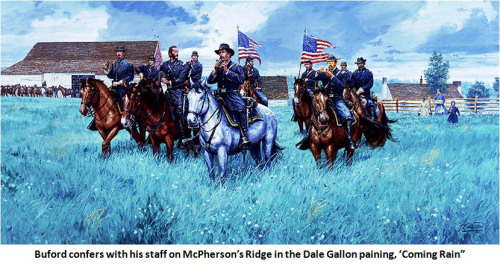
According to Doubleday Reynolds’s intention was “to fight the enemy as soon as I could meet him.” [21] Reynolds rode forward with some of his staff into the town as the infantry of the First Corps and the Eleventh Corps moved advanced. As they rode through the town Reynolds and his party were met by “a fleeing, badly frightened civilian, who gasped out the news that the cavalry was in a fight.” [22] When he came to the Lutheran Seminary he came across Buford. It was a defining moment of the Civil War, a moment that shaped the battle to come. It has been recounted many times and immortalized on screen in the movie Gettysburg, a time “when the entire battle would come down to a matter of minutes getting one place to another.” [23]

As the rough and tumble Kentuckian, Buford, and Reynolds, the dashing Pennsylvanian, discussed the situation they had to know that odd that they were facing. With close to 32,000 rebels from the four divisions of Hill’s and Ewell’s corps closing in from the west and the north and with only about 18,000 men of First Corps, Eleventh Corps and Buford’s cavalry division to meet them, the odds were not in his favor, but unlike other battles that the army of the Potomac faced, this time the army and its commanders were determined not to lose the battle and not to retreat and for the first time John Reynolds “led the advance” and for the first time in the war “might have some say about fighting.” [24]

Reynolds and Buford committed their eighteen thousand men against Lee’s thirty-two thousand in a meeting engagement that develop into a battle that would decide the outcome of Lee’s invasion. Likewise it was a battle for the very existence of the Union. Abner Doubleday noted the incontestable and eternal significance of the encounter to which Buford and Reynolds were committing the Army of the Potomac on July 1st 1863:

“The two armies about to contest on the perilous ridges of Gettysburg the possession of the Northern States, and the ultimate triumph of freedom or slavery….” [25]

Even though they understood that they were outmanned and outgunned by the advancing Confederates, both Buford and Reynolds knew that this was where the battle must be waged. It was here on this spot, for the ground gave them an advantage that they would not have elsewhere; but only if they could hold on long enough for the rest of the army to arrive. As Alan Nolan wrote: “this Pennsylvania ground – was defensible, and behind it, through the town, loomed Cemetery Hill, another natural point of defense if the battle at Seminary Ridge went against the Federals.” [26]
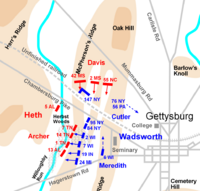
200px-Gettysburg_Day1_1045

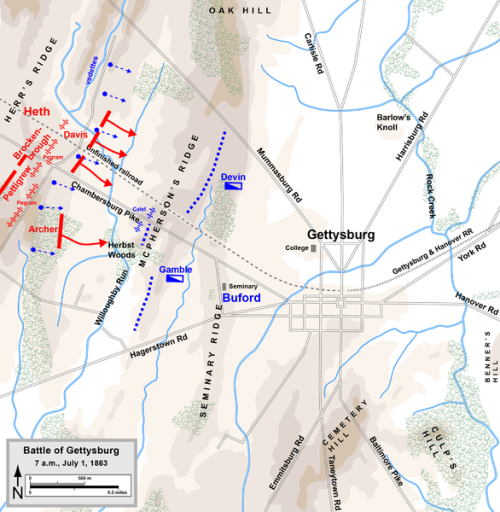
Reynolds vs. Heth July 1st

When John Buford saw Reynolds infantry advancing as the Confederates increased the pressure on his outnumbered cavalry, he remarked to a staff member “now we can hold this place.” [27] Buford was not mistaken, when Reynolds rode up to the scene of the battle on Seminary Ridge he greeted Buford, who was in the cupola of the seminary. He called out “What’s the matter John?” to which Buford replied “The devil’s to pay” before he came down to discuss the tactical situation with Reynolds. [28] Buford explained the situation noting that “I have come upon some regiments of infantry…they are in the woods…and I am unable to dislodge them.” [29]

Reynolds needed no other convincing. He asked Buford if he could hold and quickly sent off a number of messages. One officer wrote: “The Genl ordered Genl Buford to hold the enemy in check as long as possible, to keep them from getting into town and at the same time sent orders to Genl Sickles…& Genl Howard to come as fast as possible.” [30] Additionally, Reynolds sent a message to Meade stating: “The enemy are advancing in strong force. I fear they will get to the heights beyond the own before I can. I will fight them inch by inch, and if driven into the town, I will barricade the streets and hold them back as long as possible.” [31] He directed Major Weld of his staff to take it to Meade with all haste as Weld recalled: “with the greatest speed I could, no matter if I killed my horse.” [32] When Meade received the report he was concerned, but with great confidence in Reynolds’s ability he remarked “Good!…That is just like Reynolds; he will hold on to the bitter end.[33]

After dictating his instructions and sending off his messengers, Reynolds then did what no senior Confederate commander did during the entirety of the battle, he rode back and took personal charge of the movements of his troops to hurry them forward. Unlike Heth who so badly misjudged the tactical situation, he had taken note of the ground and recognized from Buford’s reports that “the Confederates were marching only on that single road and thus would not be able to push their forces to the front any faster than Reynolds could reach the battlefield with his First Corps divisions.” [34] It was a key observation on his part which again allowed him to make appropriate decisions as to how he shaped the battle.

explorepahistory-a0h4p1-a_349

Reynolds leadership at this point might be considered reckless by the standards of our day when senior commanders control battles from miles away with the help of real time intelligence and reporting, including live video feeds, or even the standards of the Second World War. But then in the Civil War a commander in combat could only really control the actions of troops that he could see and because of the time that it took to get messages to subordinate commanders, and the real possibility that verbal orders could be badly misinterpreted in the heat of battle.

Reynolds exercised command directing infantry formations into battle and assisting his artillery battery commanders in the placement of their guns. This was far different than the way that most senior Confederate leaders, including Lee, Longstreet, Hill and Ewell directed their units during the battle of Gettysburg. But such action such action was in keeping with Reynolds’s character, especially in the defense of his home state. Reynolds’ philosophy of command regarding volunteer troops was that they “were better led than driven” [35] and as such he led from the front and Abner Doubleday noted that Reynolds was “inflamed by at seeing the devastation of his native state, was most desirous of getting at the enemy as soon as possible.” [36]

iron brigade forward

“For God’s Sake Forward!” McPherson’s Ridge

John Reynolds recognized that time was of the essence if his forces were to hold the ground west of the town selected a shortcut around the town for First Corps. Those forces were directed across the fields near the Condori farm toward the back side of Seminary Ridge, with Reynolds’ staff helping to remove fences to speed the advance. [37] It was not an easy advance as the troops had to move across the farm fields at an oblique and have to “double-quick for a mile and a quarter in the thick humidity just to reach the seminary.” [38] One member of the corps recalled “I never saw men more willing to fight than they were at Gettysburg.” [39]

Recognizing that “after two full hours of fighting, Buford’s troopers” fighting on McPherson’s Ridge, were “at the limits of their endurance,” Reynolds ordered Wadsworth’s brigades “to bolster the cavalry and oppose the rebel infantry coming at them.” [40]

As troops arrived Reynolds directed them into position. He directed the artillery of Captain James Hall’s 2nd Maine Battery to McPherson’s Ridge instructing Hall “I desire you to damage their artillery to the greatest possible extent, and to keep their fire from our infantry until they are deployed….” [41]

The leading infantry of First Corps was Major General James Wadsworth’s understrength division containing just two brigades, just over 3000 soldiers, its losses from Chancellorsville not being made good and as the result of the loss of regiments discharged because their enlistments had expired. [42] Wadsworth was not a professional soldier, but like many generals on both sides was a political general who despite his lack of military experience was a natural leader of men. Wadsworth was “a vigorous white-haired old man who had been a well-to-do gentleman farmer in New York State before the war” [43] and he “had interrupted his service in the war to run for and lose his state’s governorship the preceding fall.” [44] He ran against the anti-war, anti-administration and frequently pro-Southern Copperhead Horatio Seymour, but he did not leave the army in order return to the state to mount a personal campaign “on the ground that it did not befit a soldier.” [45]

“What the gray haired general lacked in experience and skill, he compensated with a fighting spirit.” [46] Oliver Howard of Eleventh Corps said that Wadsworth was “always generous and a natural soldier” [47] and while Wadsworth was no professional but he performed admirably on July 1st 1863. Wadsworth was beloved by his men because he demonstrated true concern and care for their living conditions and training and on that morning Wadsworth was commanding his division leading it into action with “an old Revolutionary War saber in his hand.” [48] The gallant Wadsworth would be mortally wounded ten months later leading a division of Gouverneur Warren’s Fifth Corps in the opening engagements of the Wilderness. Secretary of the Navy Gideon Welles noted in his diary when Wadsworth died that Wadsworth “should, by right and fair-dealing, have been at this moment Governor of New York…No purer or single-minded patriot than Wadsworth has shown himself in this war. He left home and comforts and wealth to fight the battles of the Union.” [49]

With their gallant commander at their head the division may not have had much in force in the way of numbers, but the units of the division were “good ones,” composed of hardened combat veterans that went into battle with an eye to victory. In the van was Brigadier General Zylander Cutler’s brigade of New Yorkers and Pennsylvanians, the “celebrated Bucktails.” [50] When they were mustered into service the soldiers of the 13th Pennsylvania had adopted a “bucktail” attached to their service caps as a distinctive insignia, a practice that spread to other regiments of the brigade and for which the brigade became known throughout the army.

Cutler had spent much of his early life in Maine working in a number of fields and businesses. He made a fortune several times and lost it, first when his mill burned down, but he rebuilt his businesses and diversified and “as a leading businessman, Cutler was elected to the Maine senate, college trusteeships and a railroad directorship, but he was financially ruined by the panic of 1866 and moved to Milwaukee to start his career over again.” [51] The tough-minded Cutler had some previous military experience fighting Indians as a member of the Maine militia and was made Colonel of the 6th Wisconsin. Cutler was described by one of his soldiers as “being as “rugged as a wolf” and was “a tenacious fighter, a trait that endeared him to the tough-minded Gibbon.” [52] After Antietam Gibbon recommended Cutler for promotion to Brigadier General and command of the Iron Brigade, but Cutler had been wounded at the bloody Battle of Brawner’s Farm and Solomon Meredith gained a promotion and command of that celebrated brigade. However, in on November 29th 1862 having recuperated from his wounds Cutler was promoted to brigadier general and received command of his Bucktails in March of 1863. The brigade saw only minor action at Chancellorsville and Gettysburg would be the fierce brigadier’s first chance since being wounded to command in combat.

This fine brigade was followed by Brigadier General Solomon Meredith’s “Iron Brigade” composed of westerners in their distinctive black “Jefferson Davis” or “Hardie” hats. The brigade had been initially commanded by Major General John Gibbon, now commanding a division in Winfield Scott Hancock’s Second Corps. Gibbon turned the brigade into one of the finest in the army. At the Battle of Turner’s Gap on South Mountain during the Antietam campaign, the brigade earned its name.

After that bloody battle George McClellan exclaimed “They must be made of Iron!” and Hooker replied, “By the Eternal, they are iron! If you had seen them at Bull Run as I did, you would know them to be iron.” [53] In the fierce battle at South Mountain the brigade had lost over a quarter of its strength, but had gained a share of immortality among the ranks of the United States Army. “The Western soldiers immediately seized on this as their title, and the reputation of the brigade and its new name were soon broadcast around Federal campfires.” [54] The regiments of the brigade rivalled many Regular Army units in effectiveness and discipline and “the black hats became their trademark.” [55] Often committed to the fiercest battles the brigade had been decimated, but now along with the Bucktails it advanced up down Seminary Ridge and up the back side of McPherson’s Ridge. A member of an artillery battery who saw the Bucktails and the Iron Brigade advance recalled:

“No one…will ever again see those two brigades of Wadsworth’s Division – Cutler’s and the Iron Brigade – file by as they did that morning. The little creek made a depression in the road, with a gentle ascent on either side, so that from our point of view the column, as it came down the slope and up the other, had the effect of huge blue billows of men topped with a spray of shining steel, and the whole spectacle was calculated to give nerve to a man who never had one before.[56]

Reynolds directed Cutler’s Bucktails to proceed north of the Cashtown Pike and then “called the Iron Brigade into action on the south side” [57] leading the hearty Westerners himself. Reynolds directed then Wadsworth to take change of the action on the north side of the road while he looked after the left. [58] When Reynolds made that decision he made another. He ordered the 6th Wisconsin of the Iron Brigade into reserve, leaving the Iron Brigade a regiment short but giving him the advantage of having a ready reserve which “permitted them to take full advantage of their interior lines, shift their strength about, and apply it where most needed.” [59]

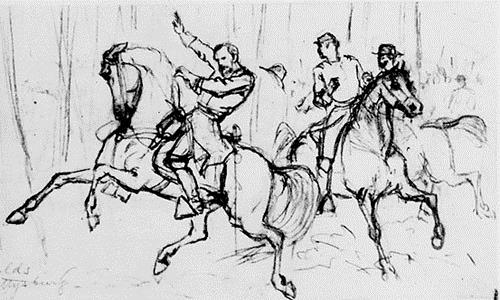
At about 10:30 the 2nd Wisconsin advanced into the woods Reynolds urged them forward: “Forward men, for God’s sake and drive those fellows out of those woods….” [60] As he looked around toward the seminary to see the progress of reinforcements, Reynolds was struck in the back of the neck by a bullet and fell dead. “Had it come a short time earlier, Reynolds’s death might have thrown the I Corps into fatal confusion.” [61] But Doubleday, who command now fell was up to the task on that sultry July morning.

MenBrooklyn

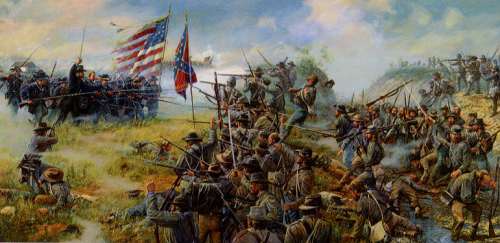
Cutler’s brigade moved north and engaged Davis’ men near the railroad cut. Here the Cutler’s line was “hardly formed when it was struck by Davis’s Confederate brigade on its front and right flank.” [62] His troops were heavily outnumbered by the advancing Confederates and Davis’ troops initially had the upper hand. In a savage fight they inflicted massive casualties on Cutler’s regiments which outnumbered and being flanked were ordered to withdraw by Wadsworth in order to save them, with the exception of one regiment, the 147th New York nicknamed the Ploughboys which “did not get the order” [63] and though isolated held its ground, “with the support of a fresh six-gun battery whose gunners simply refused to quit.” [64] This was the 2nd Maine Battery under the command of Captain James Hall. Though caught in a cross fire of Rebel artillery and assailed by skirmishers Hall’s artillerymen gamely continued the fight withdrawing by sections, “fighting a close canister range and suffering severely.” [65] The New Yorkers and Hall’s battery battled the Mississippians and the “Ploughboys fell “like autumn leaves; the air was full of lead.” [66]
railroad_cut

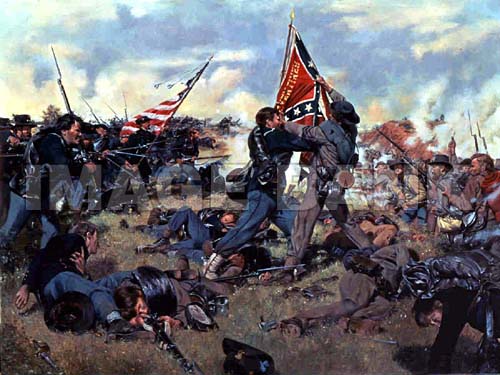
The inexperienced Davis and his green troops were buoyed by this “gratifying local success” [67] and attempted to exploit it. At this point the Confederates were fatigued by the long march and the fighting and the troops of the 2nd Mississippi and 55th North Carolina “were all jumbled together without regiment or company.” [68] Davis attempted to use the unfinished railroad cut “as cover for getting on the enemy’s flank without exposure.[69] It was a decision that Davis lived to regret. As his troops his units crowed into it, the two regiments of Cutler’s brigade south of the turnpike, the 14th Brooklyn and the 95th New York turned to meet them and were joined by the reserve regiment of the Iron Brigade, the 6nd Wisconsin under Lieutenant Colonel Rufus Dawes. Dawes ordered an immediate advance and called out to Major Edward Pye of the 95th “Let’s go for them Major.” The 6th Wisconsin and the New Yorkers took the Confederates in the flank with enfilade fire, “it was like shooting fish in a barrel.” [70] Dawes’ men slaughtered many of those unfortunate soldiers, and the battle soon became a hand to hand struggle as North Carolinians and Mississippians struggled with the Wisconsin men and New Yorkers.
fightforthecolors2la

The melee in and around the cut did not last long:

“for the Confederates were unable to resist their attackers….From the brow of the cut Dawes shouted down to the Confederates below him: “Where is the colonel of this regiment?” A Confederate field officer heard him and replied, “Who are you?” Dawes answered, “I command this regiment. Surrender or I will fire.” [71] Dawes’s men took over 200 prisoners, [72] and the battle flag of the 2nd Mississippi. [73]

The charge had last but minutes yet had shattered Joe Davis’s brigade. Davis was wholly unprepared for this reverse and signaled his forces to pull back convinced that “a heavy force was…moving rapidly to our right.” [74] However, the cost to the 6th Wisconsin was great, “Dawes estimated that 160 men of the 6th fell, not including the brigade guard, whose casualties he did not know.” [75]

Brigadier General Solomon Meredith’s Iron Brigade, which had been brought forward by Doubleday hit Archer’s brigade in the front in the woods on McPherson’s Ridge. Meredith was an unmarried North Carolina Quaker who had moved to Indiana in 1840 owning little more than the clothes that he was wearing. He became a farmer but found politics more to his liking and was elected as a county sheriff and to the state legislature. When the war came he was serving as the Clerk of Wayne County. Meredith, like so many volunteer officers on both sides owed much of his advancement in the army to his political connections. In Meredith’s case this was to Meredith’s friend Governor Oliver Morton. Critics of Meredith decried his appointment as Colonel of the 19th Indiana as “a damnable swindle.” [76] Yet Meredith commanded the regiment effectively and received command of the brigade in November 1862. John Gibbon, the regular officer who initially commanded the brigade was critical of Meredith’s appointment but the soldiers appreciated their kind, six-foot seven-inch tall commander who they affectionately knew as “Long Sol.” But despite the carping of his political enemies and the opposition of Gibbon, Meredith like so many others like him who, “extroverted and ambitious by nature, accustomed to asserting themselves, these men did the best that they could, for themselves and their responsibilities, and they somehow sufficed” [77] though they had no formal military training or experience.

As the Iron Brigade advanced toward McPherson’s Ridge and engaged the enemy, Doubleday “urged the men…to hold it all hazards.” Doubleday later wrote that the troops of the brigade, “full of enthusiasm and the memory of their past achievements they said to me proudly, “If we can’t hold it, where will you find men who can?” [78]

Animated by the leadership of Reynolds and now Doubleday they “rushed to the charge, struck successive heavy blows, outflanked and turned the enemy’s right, captured General Archer and a large portion of his brigade, and pursued the remainder across Willoughby Run.” [79] The effect was dramatic as the Iron Brigade overwhelmed Archer’s brigade, whose soldiers now realized they were facing “the first team.” Members of the Iron Brigade recalling the voices of Confederate soldiers exclaiming “Here are those damned black-hat fellers again…’Taint no militia-that’s the Army of the Potomac.” [80] As they attempted to withdraw they piled up at a fence near Willoughby Run and were hit in the flank by “a Michigan regiment that had worked its way around through the woods to the south.” [81] Archer’s Confederates were unable to resist the assault of the Iron Brigade, “Some fled; others threw down their arms and trembling asked where they should go, while others simply dropped their rifles and ducked through the Union formations to the Union rear.” [82]

As for their commander, Archer the ignominy only got worse. “A muscular Irish private in the 2nd Wisconsin ran forward and seized General Archer bodily and made a prisoner of him.” [83] Coddington wrote: “It was a bad moment for the Army of Northern Virginia, and Archer gained the unenviable distinction of being the first of its general officers to be captured after Lee took command.” [84] Doubleday, who knew Archer from the old army, wrote of meeting Archer after that very angry general after had been taken prisoner and roughed up by the aforementioned Private Maloney. Doubleday greeted his old comrade saying: “Archer! I’m glad to see you,” and reached out his hand to greet his friend, to which Archer replied “Well, I’m not glad to see you by a damn sight” and refused to shake Doubleday’s hand. [85]

With the Archer’s brigade whipped and Davis’s in flight Solomon Meredith pulled back the brigade and “was reforming his lines when a shell exploded near him.” [86] Meredith’s horse was killed and fell on him and the tall general was struck in the head by a shell fragment which fractured his skull and rendered him hors d ’combat for the rest of the battle.

Contrary to the reports of many of the Confederates involved, stating that they were outnumbered, some of which have achieved nearly mythic status in some accounts of the battle, the forces engaged were relatively evenly matched. [87] Clifford Dowdey says that the Iron Brigade “heavily outnumbered the one brigade they met. Archer’s….” [88] Such accounts are usually based on the reports of Heth and other confederate commanders. Heth in his after action report wrote that “Archer, encountered heavy masses in his front, and his gallant little brigade, after being almost surrounded by overwhelming forces in front and on both flanks, was forced back….” [89]

However, such was not the case. The reason for this repulse was not that the Union forces had “overwhelming forces” or “greatly superior numbers.” Instead the Archer’s brigade and the Iron Brigade were fairly evenly matched with Archer having about 1,130 men and the Iron Brigade 1,400 while Davis outnumbered Cutler nearly two to one having between 2,400 and 2,600 men in the battle to Cutler’s 1,300. [90]

Following the repulse of Archer and Davis’s brigades by Reynolds’s First Corps, Heth withdrew his badly mauled brigades back to Herr’s Ridge in order to reform them and bring up the brigades of Brockenbrough and Pettigrew before he could resume his attack. In his next assault he would also be supported by Pender’s fresh division which was now coming up.

Coddington notes that the outcome of the opening engagement came down to leadership and “the superior tactical skills of the Northern generals,” who “created a reserve force” with one regiment of the Iron Brigade which “permitted them to take full advantage of their interior lines, shift their strength about, and apply it where most needed.” [91] It was a “calculated risk,” for it assumed that the depleted Iron Brigade could handle Archer’s brigade effectively with only four of their five assigned regiments. [92] Again, even with the loss of Reynolds it was a case of Harry Heth being out-generaled, this time by Abner Doubleday. Heth “had not exercised the close field command by means of which Doubleday had won the brief, furious action.” [93]
death of reynolds

The Death of Reynolds

Reynolds was dead, but the series of command decisions reached by Reynolds under the pressure of a meeting engagement “where neither side held an immediate advantage” [94] were critical to the army. Likewise, because he had effectively communicated his intent to his subordinate commanders they were able to continue the fight despite his death, and his superiors and successors were able to effectively continue the battle that he had initiated. When he went into action he had “barely a third of his corps available, and confronting a force of unknown size, he had put himself at the head of his troops to lead them in a vigorous attack.” [95]

Though shaken by Reynolds’ loss, the Union troops fought on at McPherson and Seminary Ridge under the command of Doubleday until the assault of Ewell on their left and the arrival of Pender’s fresh division forced them from their positions. However Reynolds’s death was a major blow for the Federal forces for it “removed from the equation the one person with enough vision and sense of purpose to manage this battle.” [96] Despite this Reynolds, by pushing forward with his troops on McPherson’s Ridge ensured that Howard was able to secure Cemetery Hill and Cemetery Ridge, without which Gettysburg would have been lost.

The contrast between Reynolds and his opponents was marked. Hill was ten miles away from the action. Heth was too far to the rear of his troops to direct their advance when they ran into trouble and did not begin to take control until after the brigades of Davis and Archer had staggered “back up the ravine, with Davis’s temporarily wrecked.” [97] In contrast to Heth, Reynolds “hurried to the front, where he was able to inspirit the defense and throw troops into the decisive zone.” [98] At every point in the brief encounter John Reynolds showed himself superior to his opponents as he directed the battle. “Dedicated to an aggressive forward defense in the vanguard of the entire Army of the Potomac, Reynolds, at the cost of his own life had blunted the Rebel thrust and bought valuable time that permitted the balance of Meade’s army to take possession of the coveted high ground….” [99]

Though he paid for his efforts with his life but his sacrifice was not in vain. Reynolds’s tactics “gave the First Corps room for maneuver in front of Gettysburg and upset General Hill’s timetable.” [100] Harry Hunt noted: “…by his promptitude and gallantry he had determined the decisive field of the war, and he opened brilliantly a battle which required three days of hard fighting to close with a victory.” [101]

Notes

[1] Ibid. Pfanz Gettysburg: The First Day p.48

[2] Ibid. Coddington The Gettysburg Campaign: A Study in Command p.261

[3] Ibid. Pfanz Gettysburg: The First Day p.48

[4] Ibid. Coddington The Gettysburg Campaign: A Study in Command, p.261

[5] Ibid. Sears, Gettysburg. p. 158

[6] Nolan, Alan T. The Iron Brigade: A Military History Indiana University Press, Bloomington IN, 1961 and 1994 pp.233-234

[7] Napoleon Bonaparte, Military Maxims of Napoleon in Roots of Strategy: The Five Greatest Military Classics of All Time edited by Phillips, Thomas R Stackpole Books Mechanicsburg PA 1985 p.410

[8] Ibid. Sears, Gettysburg. p. 165

[9] Ibid. Pfanz Gettysburg: The First Day p.49

[10] Ibid. Nolan The Iron Brigade p.233

[11] Trudeau, Noah Andre. Gettysburg: A Testing of Courage, Harper Collins Publishers, New York 2002 p.159

[12] Ibid. Trudeau, Gettysburg: A Testing of Courage p.156

[13] Doubleday, Abner Chancellorsville and Gettysburg: Campaigns of the Civil War VI Charles Scribner’s Sons, Bew York 1882 pp.70-71

[14] Ibid. Doubleday Chancellorsville and Gettysburg p.71

[15] Carpenter, John A. Sword and Olive Branch: Oliver Otis Howard Fordham University Press, New York 1999 p.51

[16] Ibid. Pfanz Gettysburg: The First Day p.76

[17] Green, A. Wilson. From Chancellorsville to Gettysburg: O. O. Howard and Eleventh Corps Leadership in The First Day at Gettysburg edited by Gallagher, Gary W. Kent State University Press, Kent Ohio 1992 p. 70

[18] Ibid. Sears, Gettysburg. p. 158

[19] Keneally, Thomas American Scoundrel: The Life of the Notorious Civil war General Dan Sickles Anchor Books, a Division of Random House, New York 2003 p.275

[20] Swanberg, W.A. Sickles the Incredible Copyright by the author 1958 and 1984 Stan Clark Military Books, Gettysburg PA 1991 p.202

[21] Ibid. Trudeau, Gettysburg: A Testing of Courage p.156

[22] Ibid. Sears, Gettysburg. p. 165

[23] Ibid. Guelzo, Gettysburg: The Last Invasion p.142

[24] Ibid. Nichols Toward Gettysburg p.200

[25] Ibid. Doubleday Chancellorsville and Gettysburg p.68

[26] Ibid. Nolan The Iron Brigade p.235

[27] Ibid. Guelzo, Gettysburg: The Last Invasion p.142

[28] Ibid. Sears, Gettysburg. p. 172

[29] Ibid. Guelzo, Gettysburg: The Last Invasion p.143

[30] Ibid. Trudeau, Gettysburg: A Testing of Courage p.172-173

[31] Schultz, Duane The Most Glorious Fourth: Vicksburg and Gettysburg July 4th 1863. W.W. Norton and Company New York and London, 2002 p.202

[32] Ibid. Trudeau, Gettysburg: A Testing of Courage p.173

[33] Huntington, Tom Searching for George Gordon Meade: The Forgotten Victor of Gettysburg Stackpole Books, Mechanicsburg PA 2013 p.154

[34] Ibid. Sears, Gettysburg. p. 166

[35] Ibid. Coddington The Gettysburg Campaign: A Study in Command, p.277

[36] Doubleday, Abner. Chancellorsville and Gettysburg: Campaigns of the Civil War – VI Charles Scribner’s Sons, New York 1882 p.68

[37] Ibid. Pfanz Gettysburg: The First Day p.75

[38] Ibid. Guelzo, Gettysburg: The Last Invasion p.145

[39] Ibid. Wert The Sword of Lincoln p.275

[40] Foote, Shelby, The Civil War, A Narrative. Volume Two Fredericksburg to Meridian Random House, New York 1963 p.469

[41] Gottfried, Bradley The Artillery of Gettysburg Cumberland House Publishing, Nashville TN 2008 pp.28-29

[42] Ibid. Sears, Gettysburg. p. 34 Sears notes that in between Chancellorsville and Gettysburg, First Division of I Corps had lost a full brigade due to the expiration of enlistments.

[43] Catton, Bruce The Army of the Potomac: Glory Road Doubleday and Company, Garden City New York, 1952 p.270

[44] Ibid. Sears, Gettysburg. p. 34

[45] Ibid. Catton The Army of the Potomac: Glory Road p.271

[46] Ibid. Wert The Sword of Lincoln p.275

[47] Ibid. Howard Autobiography of Oliver Otis Howard 5995 of 9221

[48] Ibid. Catton The Army of the Potomac: Glory Road p.271

[49] Girardi, Robert I. The Civil War Generals: Comrades, Peers, Rivals in Their Own Words Zenith Press, MBI Publishing, Minneapolis MN 2013 p.184

[50] Ibid. Sears, Gettysburg. p. 34

[51] Ibid. Nolan The Iron Brigade p.16

[52] Tagg, Larry The Generals of Gettysburg: The Leaders of America’s Greatest Battle Da Capo Press Cambridge MA 1998 Amazon Kindle Edition p.19

[53] Hebert, Walter H. Fighting Joe Hooker University of Nebraska Press, Lincoln and London 1999. Originally published by Bobbs-Merrill, New York 1944 p.137

[54] Ibid. Nolan The Iron Brigade p.130

[55] Ibid. Nolan The Iron Brigade p. 54

[56] Ibid. Nolan The Iron Brigade p. 234

[57] Ibid. Catton The Army of the Potomac: Glory Road p.271

[58] Ibid. Pfanz Gettysburg: The First Day pp.75-76

[59] Ibid. Coddington The Gettysburg Campaign: A Study in Command, p.275

[60] Ibid. Coddington The Gettysburg Campaign: A Study in Command, p.271

[61] Longacre, Edward G. John Buford: A Military Biography Da Capo Press, Perseus Book Group, Cambridge MA p.194

[62] Ibid. Hunt, The First Day at Gettysburg in Battles and Leaders of the Civil War Volume III, The Tide Shifts p.277
[63] Ibid. Catton The Army of the Potomac: Glory Road p.272

[64] Dowdy, Clifford. Lee and His Men at Gettysburg: The Death of a Nation Skyhorse Publishing, New York 1986, originally published as Death of a Nation Knopf, New York 1958 p.96

[65] Ibid. Hunt, The First Day at Gettysburg in Battles and Leaders of the Civil War Volume III, The Tide Shifts p.277
[66] Ibid. Pfanz Gettysburg: The First Day p.86

[67] Ibid. Dowdy Lee and His Men at Gettysburg p.96

[68] Ibid. Pfanz Gettysburg: The First Day p.104

[69] Ibid. Dowdy Lee and His Men at Gettysburg p.96

[70] Ibid. Dowdy Lee and His Men at Gettysburg p.97

[71] Ibid. Pfanz Gettysburg: The First Day p.112

[72] Ibid. Guelzo, Gettysburg: The Last Invasion p.153

[73] Ibid. Sears, Gettysburg. p. 178

[74] Ibid. Guelzo, Gettysburg: The Last Invasion p.153

[75] Ibid. Pfanz Gettysburg: The First Day p.109

[76] Ibid. Nolan The Iron Brigade p.20

[77] Ibid. Nolan The Iron Brigade p.173

[78] Ibid. Doubleday Chancellorsville and Gettysburg p.73

[79] Hunt, Henry. The First Day at Gettysburg in Battles and Leaders of the Civil War Volume III, The Tide Shifts. Edited by Robert Underwood Johnson and Clarence Clough Buel Castle, Secaucus NJ p.277

[80] Ibid. Catton The Army of the Potomac: Glory Road p.273

[81] Foote, Shelby, The Civil War, A Narrative. Volume Two Fredericksburg to Meridian Random House, New York 1963 pp.470-471

[82] Ibid. Pfanz Gettysburg: The First Day p.99

[83] Ibid. Catton The Army of the Potomac: Glory Road p.274

[84] Ibid. Coddington The Gettysburg Campaign: A Study in Command, p.271

[85] Ibid. Foote The Civil War, A Narrative. Volume Two Fredericksburg to Meridian p.470

[86] Ibid. Tagg The Generals of Gettysburg p.17

[87] Ibid. Foote The Civil War, A Narrative. Volume Two Fredericksburg to Meridian p.469 Even Foote in his account of Archer’s brigade makes the comment “Staggered by the ambush and outnumbered as they were….”

[88] Dowdy. Lee and His Men at Gettysburg: The Death of a Nation p.95

[89] Luvaas, Jay and Nelson Harold W editors. The U.S. Army War College Guide to the Battle of Gettysburg South Mountain Press, Carlisle PA 1986 p.9

[90] Ibid. Coddington The Gettysburg Campaign: A Study in Command, p.274

[91] Ibid. Coddington The Gettysburg Campaign: A Study in Command, p.274

[92] Ibid. Coddington The Gettysburg Campaign: A Study in Command, p.274

[93] Ibid. Dowdy Lee and His Men at Gettysburg: The Death of a Nation p.97

[94] Ibid. Sears, Gettysburg. p. 168

[95] Ibid. Coddington The Gettysburg Campaign: A Study in Command, p.277

[96] Ibid. Trudeau, Gettysburg: A Testing of Courage p.171

[97] Ibid. Dowdy. Lee and His Men at Gettysburg: The Death of a Nation p.97

[98] Krick, Robert K. Three Confederate Disasters on Oak Ridge: Failures of Brigade Leadership on the First Day of Gettysburg in The First Day at Gettysburg edited by Gallagher, Gary W. Kent State University Press, Kent Ohio 1992 p.113

[99] Ibid. Tagg The Generals of Gettysburg p.12

[100] Ibid. Coddington The Gettysburg Campaign: A Study in Command, p.277

[101] Ibid. Hunt, The First Day at Gettysburg in Battles and Leaders of the Civil War Volume III, The Tide Shifts p.277
4 Comments

Filed under civil war, Gettysburg, History, leadership, Military

A Mystery, a Medal & a Ring: Lost Love & War

katehewitt

Kate Hewitt: The Girl John Reynolds Left behind

Friends of Padre Steve’s World

In doing my research on the life of Major General John Fulton Reynolds for my Gettysburg text I began to read about his relationship with Kate Hewitt. It adds a dimension to this man’s life that we miss if we only look at his actions on the battlefield or his military career. I added this to the end of the chapter on Reynolds and I hope that you are touched by it. As I read the story of this couple I found myself in tears on a number of occasions, and as I wrote this part of the chapter I kept crying.

Tragedy is implicit in war, and the tragedy of people who lose those that they love cannot be casually tossed aside in our quest to examine yet another battle.

Peace

Padre Steve+

220px-GenJFRenyolds

Major General John Fulton Reynolds

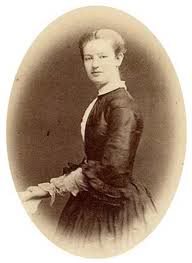
Those who die in war often leave behind those that they love, and sometimes those stories are shrouded in mystery themselves. When Reynolds’s body was removed from the battlefield he was found to be wearing a Catholic religious medal around his neck on a chain on which also hung a “gold ring joined in the shape of clasped hands. On the inner band were inscribed the words “Dear Kate.” [1] Additionally his West Point ring was missing. His family was stunned as Reynolds’s had never breathed a word to them about any woman in his life.

It turned out that Kate, was a young woman named Katherine Mary Hewitt who Reynolds had met when travelling by steamship from San Francisco to Philadelphia on his way to West Point in 1860. The couple kept the relationship secret, possibly because Reynolds and his family were Protestant and she was a recent convert to the Catholic faith and at the time there was still a tremendous prejudice against Catholics in the country. Despite the fact that the anti-immigrant and virulently anti-Catholic Know Nothing Party had disappeared many of their anti-immigrant and anti-Catholic prejudices remained strong.

On September 15th 1861 Reynolds visited his family in Philadelphia at which time he visited Kate and proposed. They exchanged rings, she getting his West Point Ring, which she used to imprint the wax seals on the letters she would send to him. In the winter of 1863 he again visited his family in Philadelphia and made a clandestine visit to Kate. At that time “they set July 8th as the date to announce the engagement to his family.” [2]

Reynolds’s family wondered who this mystery woman was and his sister Jennie wrote a letter to his brother Will “we all thought a lady was the donor and must be prized and wished we could only know who and where she was.” [3] With Reynolds’s body lying in repose at his sister Catherine Landis’s home on July 3rd prior to it being taken by train to his home town of Lancaster the family discovered the identity of the mystery woman. On that morning there was a knock at the door and a young woman presented herself, asking if she could view Reynolds’s body. Reynold’s sisters and brother in law immediately fell in love with her. Their only regret was not having known her prior to Reynolds’s death. She announced that “in the event of his death, she would enter a Catholic convent.” [4] As Kate viewed the body she wept, sometimes uncontrollably. Eventually she placed his West Point Ring in his coffin and took back her religious medal. She left that day and on July 12th entered the convent of the Sisters of Charity at Emmitsburg where she took the name Sister Hildegarde. His sister Ellie wrote:

“Poor girl she has been a heroic mourner and most worthy of our dear one. I cannot tell you all she said of him but she was in his heart and from her I learned much of him, of his feelings and inner life that I never knew before….She made no parade of her religion, nor in any way that was the least disagreeable….” [5]

The Reynolds’s family treated Kate as family and they remained in touch with her as they did his faithful orderly Sergeant Veil who had been with him when he fell at Gettysburg. However, in 1868 in poor health Kate left the Sisters of Charity while serving as a teacher in Albany New York without having taken her final vows. Evidently the “sisters at Emmitsburg, according to Kate’s biographer and author of “Is She Kate?” Marian Latimer, found Kate “unsuitable for community life.” [6] After leaving the order she “remained in Albany working as a teacher for several years and in fact, living for some time with another sister who left the order.” [7]

About that time the correspondence between her and Reynolds’s family stopped. All subsequent attempts of the Reynolds family to regain contact with their brother’s true love failed. Still mourning her one true love, a man who was neither her husband nor a blood relative, Kate gave up her Catholic faith and alone in the world returned to her hometown of Stillwater New York where she continued to teach. She never remarried and died in Stillwater of pneumonia there in 1895. She was buried there and her stone is an octagon and symbolic of rebirth and resurrection. The word Mizpah is carved on the stone and is a Hebrew benediction meaning, ‘May God watch over you until we are together again.’ [8]

[1] Ibid. Nichols Toward Gettysburg p.212

[2] Wilson Robert and Clair, Carl They Also Served: Wives of Civil War Generals Xlibris Corporation 2006 p.79

[3] Ibid. Nichols Toward Gettysburg p.212

[4] Ibid. Wilson and Clair They Also Served p.79

[5] Ibid. Nichols Toward Gettysburg p.212

[6] Carey, John E. On War and Love: From the 1860s — General John Reynolds and “Kate” 10/25/2006 retrieved from https://johnib.wordpress.com/category/kate-hewitt/ 29 May 2015

[7] Loeffel, Bernadette Catharine (Kate) Mary Hewitt 9/20/2005 retrieved from http://www.findagrave.com/cgi-bin/fg.cgi?page=gr&GRid=11784763 29 May 2015

[8] McLean, Maggie Kate Hewitt: Fiancée of General John Reynolds 12/20/2008 retrieved from http://civilwarwomenblog.com/kate-hewitt/ 29 May 2015

3 Comments

Filed under civil war, Gettysburg, History, marriage and relationships, Military

The Memorial Day Order

memorial-day-traditions_1399868491

“It is rather for us to be here dedicated to the great task remaining before us — that from these honored dead we take increased devotion to that cause for which they gave the last full measure of devotion — that we here highly resolve that these dead shall not have died in vain — that this nation, under God, shall have a new birth of freedom — and that government of the people, by the people, for the people, shall not perish from the earth.” Abraham Lincoln the Gettysburg Address 

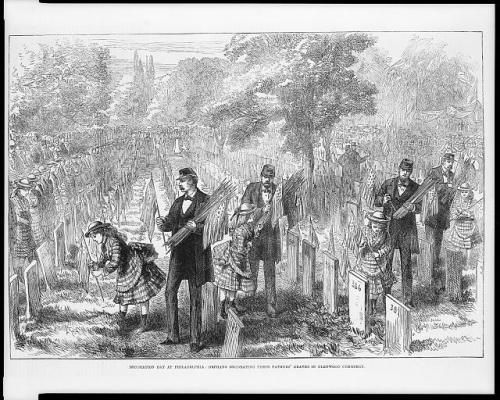
As we contemplate the importance of Memorial Day and remember the men and women who gave their lives for this country it is important to remember why we do this. Memorial Day grew out of local observances following the Civil War, a war that claimed the lives of over 620,000 American Soldiers from the Union and the Confederacy. New demographic studies by historians estimate the losses at closer to 750,000. Hundreds of thousands of other people had they lives shattered by the war, killed, wounded, maimed, crippled, shattered in mind and spirit, the country in many places devastated by war’s destruction. Using the 620,000 number that would have meant that 2.5% of the population of the country died in the war. People needed to make sense of the losses.

To put this in perspective, if the same number of Americans were to die today in a way the total would be over seven million people. Seven million my friends. War reached into every home in some way, and sadly or perhaps thankfully we have no concept of such losses today.

logan_engraving

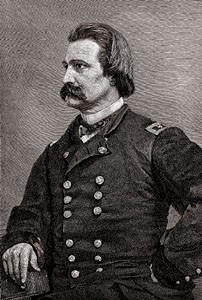
In 1868, Major General John Logan who had been an excellent corps commander during the war was serving as the Commander of the nation’s first true Veterans organization, the Grand Army of the Republic which gave those veterans a place of refuge in a country that was leaving them behind and forgetting their sacrifice in the name of westward expansion and a growing economy. Let’s face it, money has almost always been more important to Americans than the troops who sacrificed their lives for the nation, but I digress…

Anyway General Logan issued this order on May 5th 1868:

HEADQUARTERS GRAND ARMY OF THE REPUBLIC, General Orders No.11, WASHINGTON, D.C., May 5, 1868

I. The 30th day of May, 1868, is designated for the purpose of strewing with flowers or otherwise decorating the graves of comrades who died in defense of their country during the late rebellion, and whose bodies now lie in almost every city, village, and hamlet church-yard in the land. In this observance no form of ceremony is prescribed, but posts and comrades will in their own way arrange such fitting services and testimonials of respect as circumstances may permit.

We are organized, comrades, as our regulations tell us, for the purpose among other things, “of preserving and strengthening those kind and fraternal feelings which have bound together the soldiers, sailors, and marines who united to suppress the late rebellion.” What can aid more to assure this result than cherishing tenderly the memory of our heroic dead, who made their breasts a barricade between our country and its foes? Their soldier lives were the reveille of freedom to a race in chains, and their deaths the tattoo of rebellious tyranny in arms. We should guard their graves with sacred vigilance. All that the consecrated wealth and taste of the nation can add to their adornment and security is but a fitting tribute to the memory of her slain defenders. Let no wanton foot tread rudely on such hallowed grounds. Let pleasant paths invite the coming and going of reverent visitors and fond mourners. Let no vandalism of avarice or neglect, no ravages of time testify to the present or to the coming generations that we have forgotten as a people the cost of a free and undivided republic.

If our eyes grow dull, other hands slack, and other hearts cold in the solemn trust, ours shall keep it well as long as the light and warmth of life remain to us.

Let us, then, at the time appointed gather around their sacred remains and garland the passionless mounds above them with the choicest flowers of spring-time; let us raise above them the dear old flag they saved from dishonor; let us in this solemn presence renew our pledges to aid and assist those whom they have left among us a sacred charge upon a nation’s gratitude, the soldier’s and sailor’s widow and orphan.

II. It is the purpose of the Commander-in-Chief to inaugurate this observance with the hope that it will be kept up from year to year, while a survivor of the war remains to honor the memory of his departed comrades. He earnestly desires the public press to lend its friendly aid in bringing to the notice of comrades in all parts of the country in time for simultaneous compliance therewith.

III. Department commanders will use efforts to make this order effective.

By order of

JOHN A. LOGAN,
Commander-in-Chief

N.P. CHIPMAN,
Adjutant General

Official:
WM. T. COLLINS, A.A.G.

decoration-day1

General Logan’s order is remarkable in its frankness and the understanding of the war in the immediate context of its conclusion. In 1868 the day would be observed at 183 cemeteries in 27 States and the following year over 300 cemeteries. Michigan was the first state to make the day a holiday and by 1890 all states in the North had made it so. In the South there were similar observances but the meaning attributed to the events and the sacrifices of the Soldiers of both sides was interpreted quite differently. In the North the Veterans overwhelmingly saw themselves as the saviors of the Union and the liberators of the Slaves. In South it was about the sacrifices of Confederate soldiers in what became known as the “Lost Cause.” But in both regions and all states, the surviving Soldiers, family members and communities honored their dead.

1-oliver-wendell-holmes-jr-1841-1935-everett

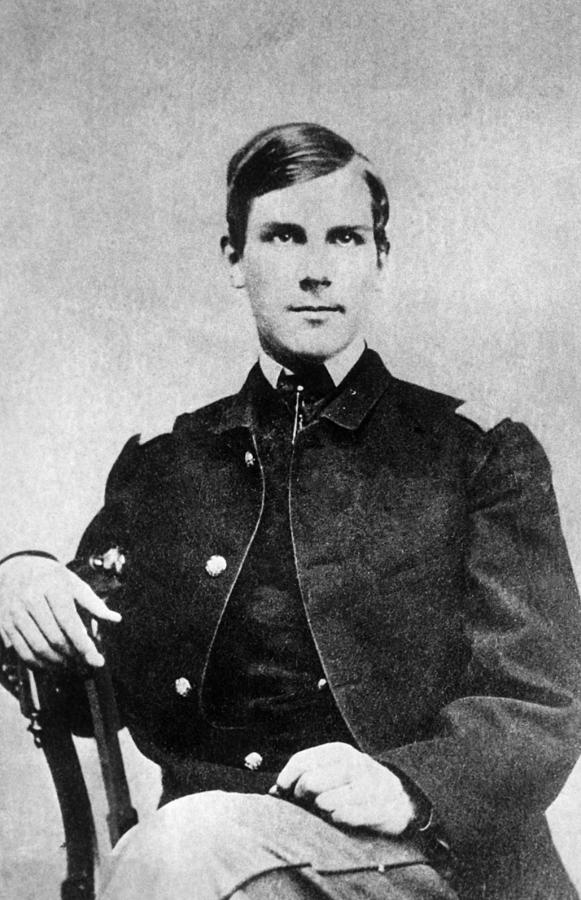
In 1884 Oliver Wendell Holmes Jr. and Frederick Douglass both spoke about the meaning of the sacrifice made by so many.

Holmes, a veteran of the war who had been wounded at Antietam ended his Decoration Day 1884 speech:

“But grief is not the end of all…Our dead brothers still live for us, and bid us think of life, not death, — of life to which in their youth they lent the passion and glory of the spring. As I listen, the great chorus of life and joy begins again, and amid the awful orchestra of seen and unseen powers and destinies of good and evil our trumpets sound once more a note of daring, hope, and will.”

Douglass.JPG

Douglass, the former slave and abolitionist who lobbied Lincoln for emancipation and to give Blacks the chance to serve their country had two of his sons serve in the war spoke these wars:

“Dark and sad will be the hour to this nation when it forgets to pay grateful homage to its greatest benefactors. The offering we bring to-day is due alike to the patriot soldiers dead and their noble comrades who still live; for, whether living or dead, whether in time or eternity, the loyal soldiers who imperiled all for country and freedom are one and inseparable.”

It is important for the country not to forget those who served and the cost of those who have given the last full measure of devotion to duty and those who still carry the scars of war on their bodies and in their minds and spirits. I am one of the latter and I have known too many of the former.  Maybe that is why am so distrustful of those who advocate for war but have no skin in the game.

An Alsatian-German Soldier named Guy Sager wrote in his book The Forgotten Soldier: 

“Too many people learn about war with no inconvenience to themselves. They read about Verdun or Stalingrad without comprehension, sitting in a comfortable armchair, with their feet beside the fire, preparing to go about their business the next day, as usual…One should read about war standing up, late at night, when one is tired, as I am writing about it now, at dawn, while my asthma attack wears off. And even now, in my sleepless exhaustion, how gentle and easy peace seems!”

I agree with him and pray that those who direct the course of this nation will take the words of General Logan, Oliver Wendell Holmes Jr., Frederick Douglass and Guy Sager to heart before they embark on war, and when they remember those that have served.

May we never forget.

Peace

Padre Steve+


6 Comments

Filed under civil war, Gettysburg, History, iraq,afghanistan, Military, Political Commentary

Obedience to the Powers that Be: John Reynolds

220px-GenJFRenyolds

Friends of Padre Steve’s World

I am continuing to periodically intersperse and publish short articles about various commanders at Gettysburg on the site. These all are drawn from my student text and may become a book in their own right.  The reason is I am going to do this is because I have found that readers are often more drawn to the lives of people than they are events. As I have noted before that people matter, even deeply flawed people, and we can learn from them.

This article deals with Major General John Fulton Reynolds who in large part is responsible for bringing about the Battle of Gettysburg and whose actions on that field in the opening hours of the engagement helped decide the course of the Civil War. This segment does not include the details of that battle, those are reserved for the rest of this chapter which I am currently revising for the student text.

I have come to admire Reynold’s more and more and I hope that in this brief treatment of his life and career leading to Gettysburg that you will be inspired by his single dovotion to the Union and the humanity compassion that he treated the victims of war.

Peace

Padre Steve+

There is much written about the supposed superiority of Robert E. Lee and the generals of the Army of Northern Virginia over those of the Army of the Potomac. Their eventual defeat is often blamed on the Union’s superior manpower and attrition with scant recognition of times where the Union commanders, particularly at Gettysburg out-generaled them. Not only did Harry Heth have the misfortune of battling John Buford and John Reynolds, but division, brigade and regimental leaders who performed their duties magnificently. Despite being greatly outnumbered by the Confederates these men and their soldiers turned back the initial Confederate assaults and shattering Confederate infantry formations.

Likewise if chance plays a role in war, the Army of the Potomac had good fortune smiling upon it that fateful morning of July 1st 1863. Part of that good fortune was having Major General John Fulton Reynolds, one of the finest commanders on either side during the Civil War directing its operations. During the engagement Reynolds, his subordinates and his successor in command Abner Doubleday dealt with the unforeseen elements of this engagement far better than any Confederate General on the battlefield that morning. Reynolds exemplified the indispensable qualities described by Clausewitz regarding commanders who must deal with the role of chance and the unforeseen elements that so often cloud the battlefield:

“first, an intellect that, even in the darkest hour, retains the glimmerings of the inner light which leads to truth; and second, the courage to follow this faint inner light wherever it may lead.” [1]

John Reynolds was a native Pennsylvanian, born in Lancaster to descendants of Irish Protestants. His maternal grandfather, Samuel Moore fought as a Captain in the Continental Line during the American Revolution. Reynold’s father, was a lawyer and moved to Lancaster where he “owned and published the Journal.” The elder Reynolds had served two terms in the Pennsylvania legislature and in the early 1830s was a political ally and friend of Senator and later President James Buchannan for whom “he was attending to local business affairs” in Lancaster. [2] Buchannan helped one of Reynold’s brother William gain an appointment to the Naval Academy and in 1837 obtained the appointment to West Point.

The young Pennsylvanian graduated from West Point in 1841, twenty-sixth in a class of fifty-two and was commissioned as a Brevet Second Lieutenant in the artillery. Among his classmates were the future Union generals Israel Richardson, Don Carlos Buell and Horatio Wright and Confederate generals Richard Garnett and J.M. Jones. Graduating in the class ahead of him was a man who would become a lifelong friend, William Tecumseh Sherman. He graduated at a time of military cutbacks, the Army was about to be reduced from 12,000 to 9,000 the following year. Chances for promotion were so bad, especially from First Lieutenant to Captain, “so unlikely that in a single year 117 officers resigned.” [3] Many of these officers would find their way back to the army but even so, army life did not promise much.

Despite this Reynolds found army life to his liking. He served in Florida during the Seminole War, as well as in Mexico “where he was cited for bravery at Monterey and Buena Vista.” [4] During the campaign in Mexico he served with the army commanded by General Zachary Taylor and in the artillery battery commanded by the future Confederate general, Captain Braxton Bragg. He acquitted himself well and also had compassion for the Mexican soldiers that he fought against. Visiting Mexican wounded who had been left with “little medical care and less food” he gave them money to help with their needs. At Buena Vista a number of senior officers wrote official citations praising the artillery and Reynolds by name. General John Wool wrote

“Without our artillery,” he said, “we could not have maintained our position a single hour,” and also: “…a section of artillery, admirably served by Lieutenant Reynolds, 3rd Arty, played an important part in checking and dispersing the enemy in the rear of our left. They retired before him whenever he approached them.” [5]

Those actions brought him fame and two brevet promotions for bravery, [6] to Captain at Monterrey and Major at Buena Vista. However, Reynolds saw little value in them if the army’s promotion system was not fixed. He wrote his brother Jim “The system is a complete humbug and until it changes I believe it is to be rather more of a distinction to be passed over than to be breveted…that is, amongst us who know facts.” [7]

Reynold’s skill as an artilleryman would be used to great effect on the morning of July 1st 1863 on McPherson’s Ridge at Gettysburg. Following the war he remained in the army predominantly with the artillery. He served in field and coastal batteries and like John Buford had “participated in the Utah Expedition.” [8] The Utah expedition is little known and nearly forgotten incidents in United States history which involved the territory of Utah, and it left a bitter taste in the mouths of many of the officers and soldiers who served in it, including John Reynolds.

The Territory of Utah had been created after the Compromise of 1850 and President Millard Fillmore named Mormon leader Brigham Young as Governor. The Mormons settled Utah after having been driven out of Illinois and Missouri as a result of their religious beliefs which included polygamy and well as the political concept Theodemocracy, which had been formulated by Mormon founder Joseph Smith Jr. Theodemocracy was a concept which is a blend of theocracy and republican principles. Though it largely died out after the replacement of Young as Governor it has many similarities with theology, political ideology and goals of the leaders of the current Christian Dominion concepts of the leaders of what is called The New Apostolic Reformation which has gained much power among the leadership of the current Republican Party.

In Illinois Smith had “founded an autonomous community, with its own militia, where Smith was eventually called “King of the Kingdom of God.” [9] Smith believed that it was a necessary step until a true theocracy could be established. Smith had taught his ruling Council of Fifty, which included a few non-Mormons “that in the initial stages of the millennium the council would participate in concert with men of differing religious and political persuasions” and the earth would still have a pluralism of governments and religions in the early part of those thousand years…” [10] Tensions between Smith, the Mormon community and surrounding communities grew and “eventually, an unruly mob lynched the prophet and one of his followers.” [11]

Two years after the territory was formed Young “declared that Smith had a vision, until then kept secret, reinstituting polygamy.” [12] To be fair, Young did not require this of his followers, but the introduction produced a furor among many Americans. The situation with Utah was complicated further by the actions of Congress which in throwing out the Missouri Compromise that Utah and New Mexico “when admitted as a State or States…shall be received into the Union, with or without slavery, as their constitution may prescribe at the time of their admission.” [13]

The combination of a growing theocracy, the introduction of polygamy and the possibility of slavery brought many tensions. The 1856 convention of the new Republican Party condemned “the twin relics of barbarism” – slavery and polygamy.” Midwesterners who joined that part remembered their clashes with the Mormons and “few voters were sympathetic to the Mormons” [14] or their growing power in the Utah Territory. In 1857 this tension led to President James Buchannan to appoint a non-Mormon Governor for the territory which led to conflict between Young’s government and its militias and the United States. Young considered U.S. Troops to be those of a “foreign power” and prepared for war “insisting as strongly on the independence of his people from Washington as the capital insisted on its jurisdiction over the territory.” [15]

Like many officers and Americans in general, Reynolds had negative views of the Latter Day Saints. Some were gained in his introduction to the territory, where he found that as a “gentile” he was treated as an outsider by the Mormon community. His initial bad disposition was only deepened through his interactions with Governor Brigham Young. The most important of these to Reynolds was an attempt to bring to justice the Indians who had massacred a party of army engineers under the command of Captain Gunnison the previous summer. Reynolds for that the Mormon led government, particularly Governor Young had convicted the Indians of manslaughter and sentenced them to prison for manslaughter. This act angered Reynolds. He wrote his sisters:

“They have been since tried by the Mormons and found guilty of manslaughter, tho’ the proof was positive and clear. But their jury was counseled by Brigham Young as to their verdict and perjured themselves. May God have mercy upon them, they would hang two Indians for killing two Mormon boys last summer when there was scarcely any proof at all, but when a Gentile is murdered it is only manslaughter!! I cannot write the truth about these people here – but will sometime later.” [16]

After Utah Reynolds served in Kansas and briefly in the Pacific Northwest. During that time he developed a dislike for radical abolitionists who he believed were responsible for much of the division of the country.

But with tensions growing in 1860 Reynolds was appointed as Commandant of the Corps of Cadets at West Point. During the interregnum of the election of Abraham Lincoln and his inauguration he “hoped for a moderate course that might avoid war.” [17] However, the Confederate seizure of U.S. facilities and siege of Fort Sumter and the tensions building between Southerners and Northerners at the Academy weighed on Reynolds and soon brought about a break with his family’s longtime political ally and benefactor President James Buchannan. Though normally not outspoken about his political beliefs on thing was sure, he valued the Union and as with the Mormons opposed those who sought to undermine it. He wrote his sister Ellie about his feelings for the President at his administration:

“What will history say of us, our Government, and Mr. B’s Administration makes one wish to disown him….”I have said but little, except among ourselves here, on the present difficulties that surround the Government but a more disgraceful plot, on the part of our friend B’s cabinet and the leading politicians of the South, to break up our Government, without cause, has never blackened the pages of history in any nation’s record.” [18]

However, Reynolds’s harshest and most bitter words were reserved for Jefferson Davis who he had served with in Mexico:

“…Who would have believed that when I came here last September and found Mr. Jeff Davis laboring with a Committee of Congress and civilians to re-organize the Academy; our national school! Whose sons, never until the seeds sown by his parricidal hand had filled it with the poisonous weed of secession, had known any other allegiance than the one to the whole country, or worshipped any other flag, than that which has moved our own youthful hopes and aspirations and under which we marched so proudly in our boyish days – who! I dare say, would have believed, that he was brooding over his systematic plans for disorganizing the whole country. The depth of his treachery has not been plumbed yet, but it will be.” [19]

Reynolds served at the Academy until June of 1861 when it graduated its final class before the war began. Departing West Point he was initially appointed as Lieutenant Colonel of the 14th U.S. Infantry regiment. [20] He would have preferred the artillery but wrote that he “could not refuse this promotion offered me under any circumstances, much less at this time, when the Government has a right to my services in any capacity.” [21] How much different was Reynolds than another politically moderate and illustrious soldier, Robert E. Lee, who barely a month after accepting a promotion to full Colonel in the Regular Army resigned his commission to serve his state of Virginia and the Confederacy rather than lead an army “in an invasion of the Southern States” whatever Virginia decided.” [22]

Before Reynolds could take command of the 14th United States, he was promoted to Brigadier General. He commanded a brigade of Pennsylvania volunteers during the Peninsula Campaign and was captured on June 28th after leading his troops successful at Gaines Mill, as McClellan began his withdraw from the gates of Richmond. He spent six weeks in Confederate captivity but was released in a general prisoner exchange on August 15th 1862. [23] Despite being captured Reynolds’s performance during the Seven Days was praised by friend and foe alike and even his Confederate enemies in the city of Fredericksburg petitioned Richmond to release Reynolds who they said:

“when inasmuch as we were prisoners in the hands of General Reynolds we received from him a treatment distinguished by a marked and considerable respect for our opinions and feelings, it becomes us to use our feeble influence in invoking for him, now a prisoner of our Government as kind and as considerate as was extended by him to us. We would therefore hope that he might be placed on parole…” [24]

In doing so they returned to the Army of the Potomac the man who would help decide the fate of the Confederacy barely ten months later.

Reynolds returned to command a division at Second Bull Run where his division held firm as much of the army retreated. Reynolds missed the battle of Antietam as he was called to “the fruitless and frustrating task of trying to organize Pennsylvania’s militia” [25] by Governor Curtin. He returned to the Army of the Potomac and again commanded First Corps at Fredericksburg and again at Chancellorsville.

Reynolds was reportedly offered command of the Army of the Potomac by Lincoln in early June of 1863 but declined it. He went to the White House when he heard that he was under consideration for the post and ensured that he would not get the job by stating the his conditions for taking it. However, he did “urge the president to appoint Meade in Hooker’s place.” [26] He told his artillery chief Colonel Wainwright that he “refused it because he would have been under the same constraints as Burnside and Hooker.” [27] Colonel Wainwright believed that it was in large part due to “Reynolds’s recommendation that General Meade received his appointment.” [28]

The Army of the Potomac’s senior leadership had been the source of much political consternation during 1862 and 1863 for Abraham Lincoln. It was split among Lincoln’s supporters and detractors, Radical Republican abolitionists and moderate Democrats. To complicate matters some of senior leaders of the Army of the Potomac including McClellan, Hooker and Sickles had their own, scarcely hidden aspirations for the presidency.

However, Reynolds was of a different character than the politically connected and conniving commanders who used their position in the army to advance their career. Reynolds was a moderate Pennsylvania Democrat and prior to the war had been no supporter of Lincoln, once comparing him to a “baboon.” That opinion being noted, Reynolds did not allow his political beliefs and opinions to influence the manner in which he upheld his oath to the nation in time of civil war. Lincoln was President and was attempting to hold the Union together against forces that Reynolds found decidedly treacherous. It was a tribute to Reynold’s personal manner of keeping politics out of his command, which allowed him, a moderate Democrat to successfully command a corps whose divisions “were commanded by some of the Army’s most fervent abolitionists – Abner Doubleday, James S. Wadsworth, and John Cleveland Robinson.” [29]

Reynolds was “a serious unbending professional, who unlike McClellan, actually lived by the principle of “obedience to the powers that be.” [30] The Pennsylvanian was “universally respected” in the army “for his high character and sterling generalship” [31] it was noted that unlike others who so quickly interjected themselves into the political turmoil which had embroiled the nation that Reynolds had a policy of holding back. He stood “stoutly aloof from all personal or partisan quarrels, and keeping guardedly free from any of the heart-burnings and jealousies that did so much to cripple the usefulness and endanger the reputation of many gallant officers.” [32]

Oliver Howard noted that unlike many commanders that Reynolds was a commander “who had a steady hand in governing, were generous to a fault, quick to recognize merit, trusted you and sought to gain your confidence, and, as one would anticipate, were the foremost in battle.” [33] George McClellan noted that Reynolds was “remarkably brave and intelligent, an honest, true gentleman.” [34] In his autobiography Howard wrote about Reynolds:

“From soldiers, cadets, and officers, junior and senior, he always secured reverence for his serious character, respect for his ability, care for his uniform discipline, admiration for his fearlessness, and love for his unfailing generosity.” [35]

On the night of June 30th Reynolds was awash in reports, some of them conflicting and even though he was without Meade’s course of action for the next day “concluded that Lee’s army was close by and in force.” [36] He spent the night at his headquarters “studying the military situation with Howard and keeping in touch with army headquarters.” [37] Howard noted Reynolds anxiety and “received the impression that Reynolds was depressed.” [38] After Howard’s departure Reynolds took the opportunity to get a few hours of fitful sleep before arising again at 4 a.m. on July 1st.

When morning came, Reynolds was awakened by his aide Major William Riddle with Meade’s order to “advance the First and Eleventh Corps to Gettysburg.” [39] Reynolds studied the order and though he expected no battle that morning, expecting “only moving up to be in supporting distance to Buford” [40] took the prudent and reasonable precautions that his Confederate opponents A.P. Hill and Harry Heth refused to take as they prepared to move on Gettysburg.

His troops were in fine spirits that morning even though it had been busy. After a breakfast of hardtack, pork and coffee the troops moved out. An officer of the Iron Brigade noted that the soldiers of that brigade were “all in the highest spirits” while Lieutenant Colonel Rufus Dawes of the “placed the fifes and drums at the head of the Sixth Wisconsin and ordered the colors unfurled” as the proud veterans marched forward into the sound of the raging battle to the tune of “The Campbell’s are Coming.” [41]

Though Reynolds was not expecting a fight he organized his march in a manner that ensured if one did happen that he was fully prepared. The precautionary measures that he took were those that any prudent commander having knowledge that strong enemy forces were nearby would take. Reynolds certainly took to heart the words of Napoleon who said “A General should say to himself many times a day: If the hostile army were to make its appearance in front, on my right, or on my left, what should I do?” [42]

This was a question that A.P. Hill and Harry Heth seemed not to consider on that warm and muggy July morning when Heth was committing Lee’s army to battle on his own authority. Reynolds was also about to commit the Army of the Potomac to battle, but unlike Heth who had no authority to do so, Reynolds “had at least been delegated the authority for making such a decision.” [43] While Meade was unaware of what was transpiring in the hills beyond Gettysburg he implicitly trusted the judgement of Reynolds, and he been with the advanced elements of Reynold’s wing Meade too “probably would have endorsed any decision he made.” [44]

Reynolds placed himself with the lead division, that of Wadsworth, and “had directed Doubleday to bring up the other divisions and guns of the First Corps and had ordered Howard’s Eleventh Corps up from Emmitsburg.” [45] Reynold’s also understood the urgency of the situation and “wanted all the fighting troops to be up front, so he instructed Howard not to intermingle his supply wagons with his infantry. Similar instructions had been given to Abner Doubleday; to ensure that the First Corps wagons would wait until the Eleventh Corps foot soldiers had passed.” [46]

Instead operating in the normal fashion of rotating units on the march, Reynolds opted to save time. Since the First Division under the command of James Wadsworth was further advanced than other I Corps divisions, Reynolds instructed it to move first with Cutler’s brigade in the lead followed by the Iron Brigade under Colonel Solomon Meredith. In doing so he countermanded the order of the acting corps commander Doubleday who had ordered that division to allow the other divisions of First Corps to pass his before advancing. Reynolds told Wadsworth that Doubleday’s order “was a mistake and that I should move on directly.” [47]

He went forward with Wadsworth’s division and gave Doubleday his orders for the coming engagement. Doubleday later recalled that when Reynolds arrived to discuss the situation that Reynolds:

“read to me the various dispatches he had received from Meade and Buford, and told me that he should go at once forward with the leading division – that of Wadsworth – to aid the cavalry. He then instructed me to draw in my pickets, assemble the artillery and the remainder of the corps and join him as soon as possible. Having given me these orders, he rode off at the head of the column, and I never saw him again.” [48]

Reynolds ordered Howard’s XI Corps to follow and according to Doubleday directed an aid of Howard to have Howard “bring his corps forward at once and form them on Cemetery Hill as a reserve.” [49] While some writers that he directed Oliver Howard to prepare Cemetery Hill as a fallback position [50] there is more evidence that points to Howard selecting the that commanding hill himself. [51]

Likewise Reynolds ordered Sickles’ III Corps to come up from Emmitsburg where that corps had bivouacked the previous night. [52] Sickles had heard the guns in the distance that morning and sent his senior aide, Major Henry Tremain to find Reynolds. Reynolds told Tremain “Tell General Sickles I think he had better come up” but the order left Sickles in a quandary. He recalled “he spend an anxious hour deciding what to do” [53] for he had “been ordered by Meade to hold his position at Emmitsburg” [54] and Sickles sent another rider to Reynolds and awaited the response of his wing commander instead of immediately advancing to battle on 1 July and it would not be until after 3 P.M. that he would send his lead division to Gettysburg.

Reynolds’ intention according to Doubleday was “to fight the enemy as soon as I could meet him.” [55] Reynolds rode forward with some of his staff into the town as the infantry of I Corps and XI Corps moved advanced. In the town they were met by “a fleeing, badly frightened civilian, who gasped out the news that the cavalry was in a fight.” [56] When he came to the Lutheran Seminary he came across Buford. It was a defining moment of the Civil War, a moment that shaped the battle to come. It has been recounted many times and immortalized on screen in the movie Gettysburg, a time “when the entire battle would come down to a matter of minutes getting one place to another.” [57]

As the rough and tumble Kentuckian, Buford, and Reynolds, the dashing Pennsylvanian, discussed the situation they had to know that odd that they were facing. With close to 32,000 rebels from the four divisions of Hill’s and Ewell’s corps closing in from the west and the north with only about 18,000 men of First Corps, Eleventh Corps and Buford’s cavalry division the odds did not favor them, but unlike other battles that the army of the Potomac faced, this time the army and its commanders were determined not to lose and not to retreat.

Reynolds and Buford committed their eighteen thousand men against Lee’s thirty-two thousand in a meeting engagement that develop into a battle that would decide the outcome of Lee’s invasion. Likewise it was a battle for the very existence of the Union. Abner Doubleday noted the incontestable and eternal significance of the encounter to which Buford and Reynolds were committing the Army of the Potomac:

“The two armies about to contest on the perilous ridges of Gettysburg the possession of the Northern States, and the ultimate triumph of freedom or slavery….” [58]

Notes

[1] Ibid. Clausewitz On War p.102

[2] Nichols, Edward J. Toward Gettysburg: A Biography of John Fulton Reynolds Pennsylvania State University Press, Philadelphia 1958. Reprinted by Old Soldier Books, Gaithersburg MD 1987 p.4

[3] Ibid. Nichols Toward Gettysburg p.13

[4] Tagg, Larry The Generals of Gettysburg: The Leaders of America’s Greatest Battle Da Capo Press Cambridge MA 1998 Amazon Kindle Edition p.10

[5] Ibid. Nichols Toward Gettysburg pp.43-44

[6] Pfanz Harry W. Gettysburg: The First Day University of North Carolina Press, Chapel Hill and London 2001pp.47-48

[7] Ibid. Nichols Toward Gettysburg p.46

[8] Ibid. Pfanz Gettysburg: The First Day p.48

[9] Gonzalez, Justo L. The History of Christianity Volume 2: The Reformation to the Present Day Harper and Row Publishers San Francisco 1985 p.259

[10] Ehat, Andrew” It Seems Like Heaven Began on Earth”: Joseph Smith and the Constitution of the Kingdom of God in BYU Studies Vol 20. No 3 1980) retrieved from https://ojs.lib.byu.edu/spc/index.php/BYUStudies/article/view/5144/4794 20 May 2015 p.258

[11] Ibid. Gonzales p.259

[12] Ibid. Gonzales p.259

[13] Potter, David M. The Impending Crisis: America before the Civil War 1848-1861 completed and edited by Don E. Fehrenbacher Harper Collins Publishers, New York 1976 p.158

[14] Goldfield, David. America Aflame: How the Civil War Created a Nation Bloomsbury Press, New York 2011 p.122

[15] Ibid. Nichols Toward Gettysburg p.58

[16] Ibid. Nichols Toward Gettysburg p.58

[17] Ibid. Nichols Toward Gettysburg p.73

[18] Ibid. Nichols Toward Gettysburg p.73

[19] Ibid. Nichols Toward Gettysburg p.73

[20] Ibid. Pfanz Gettysburg: The First Day p.48

[21] Ibid. Nichols Toward Gettysburg p.75

[22] Korda, Michael. Clouds of Glory: The Life and Legend of Robert E. Lee Harper Collins Publishers, New York 2014 p.228


[23] Foote, Shelby, The Civil War, A Narrative. Volume One Fort Sumter to Perryville Random House, New York 1958 p.493

[24] Ibid. Nichols Toward Gettysburg p.100

[25] Ibid. Pfanz Gettysburg: The First Day p.48

[26] Sears, Stephen W. Controversies and Commanders Mariner Books, Houghton-Mifflin Company, Boston and New York 1999 p.162

[27] Sears, Stephen W. Gettysburg. Houghton Mifflin Co. Boston and New York 2003 pp. 40-42

[28] Nevins. Allan editor. A Diary of Battle: The Personal Journals of Colonel Charles Wainwright 1861-1865 with an introduction by Stephen W. Sears Da Capo Press, New York 1998 p.229

[29] Guelzo, Allen C. Gettysburg: The Last Invasion Vintage Books a Division of Random House, New York 2013 p.30

[30] Ibid. Guelzo Gettysburg: The Last Invasion pp.29-30

[31] Ibid. Sears, Gettysburg. p. 34

[32] Ibid. Guelzo, Gettysburg: The Last Invasion p.30

[33] Howard, Oliver O. Autobiography of Oliver Otis Howard, Major General, U.S. Army Volume 1 The Baker and Taylor Company, New York 1907 Made available by the Internet Achieve through Amazon Kindle location 5908 of 9221

[34] Wert, Jeffry D. The Sword of Lincoln: The Army of the Potomac Simon and Schuster, New York and London 2005 p.101

[35] Ibid. Howard Autobiography of Oliver Otis Howard location 5908 of 9221

[36] Ibid. Pfanz Gettysburg: The First Day p.48

[37] Ibid. Coddington The Gettysburg Campaign: A Study in Command p.261

[38] Ibid. Pfanz Gettysburg: The First Day p.48

[39] Ibid. Coddington The Gettysburg Campaign: A Study in Command, p.261

[40] Ibid. Sears, Gettysburg. p. 158

[41] Nolan, Alan T. The Iron Brigade: A Military History Indiana University Press, Bloomington IN, 1961 and 1994 pp.233-234

[42] Napoleon Bonaparte, Military Maxims of Napoleon in Roots of Strategy: The Five Greatest Military Classics of All Time edited by Phillips, Thomas R Stackpole Books Mechanicsburg PA 1985 p.410

[43] Ibid. Sears, Gettysburg. p. 165

[44] Ibid. Pfanz Gettysburg: The First Day p.49

[45] Ibid. Nolan The Iron Brigade p.233

[46] Trudeau, Noah Andre. Gettysburg: A Testing of Courage, Harper Collins Publishers, New York 2002 p.159

[47] Ibid. Trudeau, Gettysburg: A Testing of Courage p.156

[48] Doubleday, Abner Chancellorsville and Gettysburg: Campaigns of the Civil War VI Charles Scribner’s Sons, Bew York 1882 pp.70-71

[49] Ibid. Doubleday Chancellorsville and Gettysburg p.71

[50] Ibid. Pfanz Gettysburg: The First Day p.76

[51] Green, A. Wilson. From Chancellorsville to Gettysburg: O. O. Howard and Eleventh Corps Leadership in The First Day at Gettysburg edited by Gallagher, Gary W. Kent State University Press, Kent Ohio 1992 p. 70

[52] Ibid. Sears, Gettysburg. p. 158

[53] Keneally, Thomas American Scoundrel: The Life of the Notorious Civil war General Dan Sickles Anchor Books, a Division of Random House, New York 2003 p.275

[54] Swanberg, W.A. Sickles the Incredible Copyright by the author 1958 and 1984 Stan Clark Military Books, Gettysburg PA 1991 p.202

[55] Ibid. Trudeau, Gettysburg: A Testing of Courage p.156

[56] Ibid. Sears, Gettysburg. p. 165

[57] Ibid. Guelzo, Gettysburg: The Last Invasion p.142

[58] Ibid. Doubleday Chancellorsville and Gettysburg p.68


Leave a comment

Filed under civil war, History, leadership, Military

The Most Scientific and Resourceful of All: General Edward Porter Alexander

alexander

Friends of Padre Steve’s World

I am getting ready to conclude my latest Gettysburg Staff Ride with my students from the Staff College. It has been a fantastic experience again. Right now I am getting ready to turn in for the night after having dinner and drinks with my students. In the morning we will be walking the ground of Pickett’s Charge before heading to General Meade’s headquarters and the Soldier’s Cemetary where President Abraham Lincoln delivered the Gettysburg Address.

As part of what I have been doing on the site I have been periodically interspersing and publishing short articles about various commanders at Gettysburg. I did one on The Union cavalry commander, John Buford yesterday. 

These articles are all are drawn from my student text and will likely become a book in their own right when I finish the chapter on the Union commanders.  The reason is I am going to do this is because I have found that readers are often more drawn to the lives of people than they are events. As I have noted before that people matter, even deeply flawed people, and we can learn from them. Sometimes good and even honorable people serve malignant causes, while bad or even wicked people support good causes, usually for selfish reasons, but that is the constant quandary that human beings find themselves.

Today’s article is about Confederate General Edward Porter Alexander. Alexander directed the Confederate artillery during Pickett’s Charge and because he was not a terribly high ranking officer is comparatively little known.

However, Alexander is another interesting character. He was one of the most gifted and brilliant artillery commanders of the war and after the war went on to serve the country with distinction after following his re-integration back into the ranks of American citizens.

Alexander wrote a narrative of the war that is considered by historians to be one of the best and most objective accounts written by any Confederate. However, he was very much a military man and never fully grasped the political and ideological nature of the war, not the profound social effects of the Union victory. I hope you enjoy. Until tomorrow. 

Peace

Padre Steve+ 

Though he was only a Colonel commanding an artillery battalion in Longstreet’s First Corps at Gettysburg, Edward Porter Alexander needs to be mentioned in this text because during the battle he assumed tactical command of the largest concentration of Confederate artillery during the entire war. Likewise his contributions to the writing history of the war are incredibly important and provide some of the most balanced views of the war written by any participant on the Confederate side.

Alexander was born in Washington Georgia in 1835. He attended West Point and graduated third in his class in 1857. One of his classmates was Marcus Reno who was second in command of the ill-fated fight of Custer’s 7th Cavalry at Little Big Horn.

Alexander was commissioned in the Corps of Engineers and served as an instructor at West Point. He realized after the John Brown raid that if war came he would fight for the Confederacy. He was married to Bettie Mason in April 1860 and was thereafter assigned to duty at Fort Steilacoom, Washington. He wrestled with his the decision to leave the army, his father was one of the Georgia legislators who voted for secession and like many Southern officers he decided to resign. He wrote about Lincoln, “If he is elected I believe that in the interests of humanity, civilization, and self-preservation call on the South to secede, I’ll go my arm, leg, or death on it.” [1]

His commander Major James McPherson who later had a prominent part in Sherman’s campaigns attempted to talk Alexander into remaining in the army on the west coast, but Alexander refused. McPherson graciously allowed Alexander and his bride to return to the East in a leave status. Bettie too was “upset by this decision and seriously questioned whether other alternatives were possible.” [2] But Alexander saw no other option. McPherson graciously allowed Alexander and his bride to return to the East in a leave status. When he got back to the South he resigned his commission after the election of Lincoln and on July 2nd 1861 Captain Alexander reported for duty at Manassas as an artillery officer. The professional artillerymen believed that Alexander “was the most scientific and resourceful of all.” [3]

Promotion came at regular intervals for Alexander. Initially he served as Beauregard’s Signals officer, and was appointed as the Chief of Ordnance for the Army of Northern Virginia, with the rank of Lieutenant Colonel. He was made an artillery battalion commander after Antietam, and at Fredericksburg his battalion was in the thick of the fighting along Marye’s Heights. With each new battle Lee and Longstreet “had come to rely increasingly on Alexander’s eager intelligence, regularly assigning him duties more properly those of Col. James Walton, Longstreet’s nominal chief of artillery, or even Brig. Gen, William N. Pendleton, the artillery chief of the Army of Northern Virginia.” [4] So trusted was he that he “had nearly a free hand in organizing the Fredericksburg defenses” [5] and his work was instrumental in turning back the Army of the Potomac in its bloody repulse.

During the winter of 1862-63 Alexander worked with Pendleton and Colonel Stapleton Crutchfield to reorganize the artillery in February 1863. He and his battalion were in the thick of the fighting at Chancellorsville where he also assumed command of Second Corps artillery when Crutchfield was wounded. [6] He was promoted to Colonel prior to Gettysburg and then Brigadier General of Artillery in February 1864. He was in the action in the Wilderness campaign and at Petersburg where he was badly wounded.

After recovering he rejoined the army and was present at the surrender at Appomattox where in the hours before the surrender he advocated beginning a guerrilla campaign in order to continue the war. This Lee was unwilling to do and Lee reminded Alexander and the other officers present that such was not an honorable course of action. Lee told Alexander:

“We have simply now to face the fact that the Confederacy has failed. And as Christian men, Gen. Alexander, you & I have no right to think for one moment of our personal feelings or affairs. We must consider only the effect which our action will have upon the country at large.” [7]

After Lee’s monologue Alexander later wrote “I was so ashamed of having proposed such a foolish and wild cat scheme that I felt like begging him to forget he had ever heard it.” [8] When Alexander saw the gracious terms of the surrender he was particularly impressed with how non-vindictive the terms were, especially in terms of parole and amnesty for the surrendered soldiers.

Sadly, Alexander really did not have any political vision or understanding of the meaning of the war. When asked about his “Confederate allegiance, Alexander had a straightforward explanation. “We didn’t go into our cause,” he said; “we were born into it.” [9] This is something that men like Virginian George Thomas who remained loyal to the Union would have certainly contested. Thomas’s loyalty resulted in him being rejected and disowned by his family during and after the war.

Alexander adjusted to peace and went into railroads, becoming highly successful railroad president as well as one of the more circumspect of the Confederate officers who wrote histories of the Civil War. His book Military Memoirs of a Confederate published in 1907 infuriated many associated with the myth of the lost cause for he dared to criticize the generalship of both Lee and Jackson. However, the book gained the praise of many reviewers for Alexander’s objectivity. The Nation wrote of it “No preceding book by a Southern officer surpasses this in good temper wise discrimination and graphic portrayal.” But the review also noted that Alexander “all but ignored social issues and barely touched on the merits and questions in dispute.” [10] A reviewer in the American Historical Review wrote: “He criticizes alike Confederate friend and Federal foe, the justice for which, in some cases, may be disputed, but the good temper showed must be conceded.” [11]

Alexander became a close friend of President Grover Cleveland and the President, recognizing Alexander’s talent sent him to “be the U.S. boundary arbitrator between Nicaragua and Costa Rica; a job that needed to be done prior to going ahead with plans for building the Panama Canal.” [12] As in nearly everything he did he was successful, but the cost was great. Bettie was experiencing severe health problems and died a month after he returned in 1899. He remarried in 1901 but his health continued to decline. He suffered a series of strokes, and he died in 1910 in Savannah.

Notes

[1] Golay, Michael To Gettysburg and Beyond: The Parallel Lives of Joshua Lawrence Chamberlain and Edward Porter Alexander Crown Publishers, New York 1994 p.74

[2] Ibid. Wilson and Clair They Also Served p.116

[3] Ibid. Freeman Lee p.44

[4] Ibid. Golay To Gettysburg and Beyond p.109

[5] Ibid. Golay To Gettysburg and Beyond p.109

[6] Ibid. Freeman Lee p.486

[7] Alexander, Edward Porter. Fighting for the Confederacy: The Personal Recollections of General Edward Porter Alexander edited by Gary Gallagher University of North Carolina Press, Chapel Hill 1989 p.532

[8] Ibid. Golay To Gettysburg and Beyond p.262

[9] Ibid. Golay To Gettysburg and Beyond p.vii

[10] Ibid. Golay To Gettysburg and Beyond p.329

[11] Ibid. Golay To Gettysburg and Beyond p.329

[12] Ibid. Wilson and Clair They Also Served p.117

Leave a comment

Filed under civil war, Gettysburg, History, leadership, Military

The Best Cavalry General We Had: John Buford


Friends of Padre Steve’s World

I am at Gettysburg this weekend leading my students on our spring “staff ride.” Since the morning begins with the delaying action fought by General John Buford’s Union cavalry I have included one of my short biographic articles about the leaders who fought at Gettysburg, this one about an amazing patriot and military leader who when push came to shove remained loyal to the Union, and whose military abilities as a modern leader were unmatched in his day. 

I hope you enjoy this little piece about a most amazing man. 

Peace

Padre Steve+

buford

“He was decidedly the best cavalry general we had, and was acknowledged as such in the army, though being no friend to newspaper reporters…In many respects he resembled Reynolds, being rough in the exterior, never looking after his own comfort, untiring on the march and in the supervision of all the militia in his command, quiet and unassuming in his manners.” Colonel Charles Wainwright on Buford (Diary of Battle, p.309)

John Buford was born in Kentucky and came from a family with a long military history of military service, including family members who had fought in the Revolutionary War and War of 1812. In fact according to some the family military pedigree reaches back to England’s War of the Roses.

Buford’s family was well off with a spacious plantation near Versailles on which labored forty-five slaves, and his father also established a stage line which carried “passengers and freight between Frankfort and Lexington.” His father divested himself of his property, selling his home, business and slaves and moved to Stephenson Illinois in 1838. [1] The young Buford developed an interest in military life which was enlivened by his half-brother Napoleon Bonaparte Buford who graduated from West Point in 1827, and his brother would be influential in helping John into West Point, which he entered in 1844.

Buford graduated with the class of 1848 which included the distinguished Union artilleryman John Tidball, and the future Confederate brigadier generals “Grumble Jones and “Maryland” Steuart. Among his best friends was Ambrose Burnside of the class of 1847. He did well academically but his conduct marks kept him from graduating in the top quarter of his class.

Upon graduation he was commissioned as a Brevet Second Lieutenant of Dragoons, however too late to serve in Mexico. Instead he was initially assigned to the First United States Dragoons but less than six months after joining was transferred to the Second Dragoons when he was promoted to full Second Lieutenant.

Instead of going to Mexico Buford “spent most of the 1850s tracking and fighting Indians on the Plains.” [2] During this period, the young dragoon served on the Great Plains against the Sioux, where he distinguished himself at the Battle of Ash Creek and on peacekeeping duty in the bitterly divided State of Kansas and in the Utah War of 1858.

His assignments alternated between field and staff assignments and he gained a great deal of tactical and administrative expertise that would serve him well. This was especially true in the realm of the tactics that he would employ so well at Gettysburg and on other battlefields against Confederate infantry and cavalry during the Civil War. Buford took note of the prevailing tactics of the day which still stressed a rigid adherence to outdated Napoleonic tactics which stressed mounted charges and “little cooperation with units of other arms or in the taking and holding of disputed ground.” [3] While he appreciated the shock value of mounted charges against disorganized troops he had no prejudice against “fighting dismounted when the circumstances of the case called for or seemed to justify it.” [4] Buford’s pre-war experience turned him into a modern soldier who appreciated and employed the rapid advances in weaponry, including the repeating rifle with tremendous effect.

Despite moving to Illinois Buford’s family still held Southern sympathies; his father was a Democrat who had opposed Abraham Lincoln. Buford himself was a political moderate and though he had some sympathy for slave owners:

“he despised lawlessness in any form – especially that directed against federal institutions, which he saw as the bulwark of democracy…..He especially abhorred the outspoken belief of some pro-slavery men that the federal government was their sworn enemy.” [5]

After the election of Abraham Lincoln, the officers of Buford’s regiment split on slavery. His regimental commander, Colonel Philip St. George Cooke, a Virginian and the father-in-law of J.E.B. Stewart announced that he would remain loyal to the Union, others like Beverly Robertson who would command a brigade of cavalry during the Gettysburg campaign resigned their commissions.

For many officers, both those who remained loyal to the Union and those who joined the Confederate cause the decision was often difficult, and many anguished over their decisions as they weighed their allegiance to the Union against their loyalty to home and family. Buford was not one of them.

Since Buford’s family had longstanding ties to Kentucky, the pro-secession governor of Kentucky, Beriah Magoffin offered Buford a commission in that states’ militia. At the time Kentucky was still an “undeclared border slave state” and Buford loyal to his oath refused the governor’s offer. He wrote a brief letter to Magoffin and told his comrades that “I sent him word that I was a Captain in the United States Army and I intend to remain one.” [6] Around the same time the new provisional government of the Confederacy “offered Buford a general officer’s commission, which reached him by mail at Fort Crittenden.” [7] According to Buford’s biographer Edward Longacre “a well-known anecdote has him wadding up the letter while angrily announcing that whatever future had in store he would “live and die under the flag of the Union.” [8]

However Buford’s family’s southern ties, and lack of political support from the few remaining loyal Kentucky legislators initially kept him from field command. Instead he received a promotion to Colonel and an assignment to the Inspector General’s Office, although it was not the field assignment that he desired it was of critical importance to the army in those early days of the war as the Union gathered its strength for the war. Buford was assigned to mustering in, and training the new regiments being organized for war. Traveling about the country he evaluated each unit in regard to “unit dress, deportment and discipline, the quality and quantity of weapons, ammunition, equipment, quarters, animals and transportation; the general health of the unit and medical facilities available to it; and the training progress of officers and men.” [9] Buford was a hard and devastatingly honest trainer and evaluator of the new regiments. He was especially so in dealing with commanding officers as well as field and company officers. Additionally he was a stickler regarding supply officers, those he found to be incompetent or less than honest were cashiered.

Buford performed these duties well but desired command. Eventually he got the chance when the politically well-connected but ill-fated Major General John Pope who “could unreservedly vouch for his loyalty wrangled for him command of a brigade of cavalry.” [10] After Pope’s disastrous defeat at Second Bull Run in August 1862 Buford was wounded in the desperate fighting at Second Manassas and returned to staff duties until January 1863 when he was again given a brigade. However, unlike many of the officers who served under Pope, Buford’s reputation as a leader of cavalry and field commander was increased during that campaign.

Buford was given the titular title of “Chief of Cavalry of the Army of the Potomac” by George McClellan, a title which sounded impressive but involved no command during the Antietam campaign. Following that frustrating task he continued in the same position under his old West Point friend Ambrose Burnside during the Fredericksburg campaign. Buford lost confidence in his old friend and was likely “shocked by his friend’s deadly ineptitude, his dogged insistence on turning defeat into nightmare.” [11]

When Burnside was relieved and Fighting Joe Hooker appointed to command the army, Buford’s star began to rise. While he was passed over by Hooker for command of the newly organized First Cavalry division in favor of Alfred Pleasanton who was eleven days his senior, he received command of the elite Reserve Brigade composed of mostly Regular Army cavalry regiments. When Major General George Stoneman was relieved of command following the Chancellorsville campaign, Pleasanton was again promoted over Buford.

In later years Hooker recognized that Buford “would have been a better man for the position of chief” [12] but in retrospect Buford’s pass over was good fortune for the Army of the Potomac on June 30th and July 1st 1863. Despite being passed over for the Cavalry Corps command, Buford, a consummate professional never faltered or became bitter. Despite the Pleasanton’s interference and “lax intelligence-gathering” [13]   During the Gettysburg campaign he led his brigade well at Brandy Station as it battled J.E.B. Stuart’s troopers, after which he was recommended for promotion and given command of the First Cavalry division of the Cavalry Corps. [14]

Following Brandy Station Buford led his troopers aggressively as they battled Stuart’s troopers along the Blue Ridge at the battles of Aldie, Philmont, Middleburg and Upperville. It was at Upperville while fighting a hard action Confederate Brigadier general “Grumble Jones’s brigade that Buford’s troopers provided Hooker with the first visual evidence that Lee’s infantry was moving north into Maryland and Pennsylvania.

burford reynolds monuments

When Hooker was relieved on the night of June 27th and 28th George Meade gave Buford the chance at semi-independent command without Pleasanton looking over his shoulder. Meade appreciated Pleasanton’s administrative and organizational expertise and took him out of direct field command. Meade had his Cavalry Corps commander “pitch his tent next to his own on almost every leg of the trip to Pennsylvania and rarely let him out of sight or earshot.” [15]

One of Meade’s staff officers, Theodore Lyman gave this description of Buford:

“He is one of the best of the officers…and is a singular looking party. Figurez-vous a compactly built man of middle height, with a tawny mustache and a little, triangular gray eye, whose expression is determined, not to say sinister. His ancient corduroys are tucked into a pair of ordinary cowhide boots, his blue blouse is ornamented with holes; from which one pocket thereof peeps a huge pipe, while the other is fat with a tobacco pouch. Notwithstanding this get-up he is a very soldierly looking man. Hype is of a good natured disposition, but is not to be trifled with.” [16]

When he was ordered to screen the army as it moved into Pennsylvania, Buford was confident about his troopers and their ability and he and his men performed their duties admirably. On June 29th Buford’s men skirmished with two of Harry Heth’s regiments near the town of Fairfield, which Buford promptly reported to Meade and John Reynolds after ascertaining their size and composition.

The Battle of Gettysburg would be the zenith of Buford’s career. His masterful delaying action against Harry Heth’s division on July 1st 1863 enabled John Reynold’s wing of the army to arrive in time to keep the Confederates from taking the town and all of the high ground which would have doomed any union assault against them. Following Gettysburg Buford continued to command his cavalry leading his division in a number of engagements. In early November the worn out cavalryman who had been in so many actions over the past year came down with Typhoid. In hopes that he would recover he was told that he would be appointed to command all the cavalry in the West, however his health continued to decline. He was officially promoted to Major General of Volunteers by President Lincoln, over the objection of Secretary of War Stanton who disliked deathbed promotions. “Upon learning of the honor. Buford is supposed to have whispered, “I wish I could have lived now.” [17] He died later that evening, the last words warning his officers “patrol the roads and halt fugitives at the front.” [18]

John Pope wrote of Buford:

“Buford’s coolness, his fine judgment, and his splendid courage were well known of all men who had to do with him… His quiet dignity, covering a fiery spirit and a military sagacity as far reaching as it was accurate made him…one of the best and most trusted officers in the service.” [19]

Sam Elliot as Buford

Buford was buried at West Point and he is immortalized in the monument dedicated to him on McPherson’s Ridge at Gettysburg where he with binoculars in hand looks defiantly west in the direction of the advancing Confederates. The monument is surrounded by the gun tubes of four Union 3” Rifles, three of which were part of Lieutenant John Calef’s Battery which he directed on the fateful morning of July 1st 1863. He was portrayed masterfully portrayed by Sam Elliott in the movie Gettysburg.

Notes

[1] Longacre, Edward G. John Buford: A Military Biography Da Capo Press, Perseus Book Group, Cambridge MA p.17

[2] Ibid. Guelzo. Gettysburg: The Last Invasion p.121

[3] Ibid. Longacre John Buford p.36

[4] Ibid. Longacre John Buford p.36

[5] Ibid. Longacre John Buford p.54

[6] Ibid. Guelzo. Gettysburg: The Last Invasion p.121

[7] Ibid. Longacre John Buford p.70

[8] Ibid. Longacre John Buford p.70

[9] Ibid. Longacre John Buford p.78

[10] Ibid. Guelzo. Gettysburg: The Last Invasion p.121

[11] Ibid. Longacre John Buford p.122

[12] Ibid. Coddington The Gettysburg Campaign, A Study in Command p.44

[13] Ibid. Longacre John Buford p.173

[14] Ibid. Coddington The Gettysburg Campaign, A Study in Command p.64

[15] Longacre, Edward G. The Cavalry at Gettysburg: A Tactical Study of Mounted Operations during the Civil War’s Pivotal Campaign, 9 June-14 July 1863 University of Nebraska Press, Lincoln and London 1986 p.168

[16] Girardi, Robert I. The Civil War Generals: Comrades, Peers, Rivals in Their Own Words Zenith Press, MBI Publishing, Minneapolis MN 2013 p.38

[17] Ibid. Longacre John Buford p.245

[18] Ibid. Longacre John Buford p.246

[19] Ibid. Girardi The Civil War General p.38


1 Comment

Filed under civil war, Gettysburg, History, leadership, Military

Gettysburg: The Opening Engagement

Friends of Padre Steve’s World

The latest major chapter revision to my Gettysburg text, this one about the opening of the battle and two men, Confederate Major General Harry Heth and Union Major General John Buford whose actions that morning set in motion the greatest battle ever fought on the American Continent.

Peace

Padre Steve+

burford june 30th

The principles found in Chairman of the Joint Chief of Staff’s “Desired Leader Attributes” are something that we can learn about from both practical experience and history. The study of commanders and leaders throughout the Gettysburg campaign provide historical examples of commanders and other leaders that the best and the worst examples of some of those concepts. One of these is the ability to “anticipate and adapt to surprise and uncertainty.” The meeting engagement on the morning of July 1st 1863 between Harry Heth’s division of A.P. Hill’s corps and John Buford’s First Cavalry Division shows a very clear example of a commander, Heth, not anticipating or adapting to surprise and uncertainty. Heth was surprised by the presence of experienced Federal cavalry on his front and the uncertainty of not knowing what lay just beyond McPherson and Seminary Ridge.

Despite the warnings of Brigadier General Johnston Pettigrew, Major General Harry Heth and his corps commander Lieutenant General A.P. Hill decided that they would advance into Gettysburg. Hill and Heth dismissed Pettigrew’s warnings out of hand. Pettigrew should have been listened to, he was “was one of those natural leaders of a privileged background who, without military ambitions, had been advanced on the application of native intelligence and contagious courage.” [1] To help state his case Pettigrew brought Captain Louis G. Young of his staff, who had served under Hill and was a professional soldier “with the hope that his testimony as to Union numbers might be more convincing.” [2] Young “insisted that the troops he saw were veterans rather than Home Guards,” [3] but Hill refused to believe telling Young and Pettigrew “I still cannot believe that any portion of the Army of the Potomac is up,” he declared. Then he added: “I hope that it is, for this is the place I want it to be.” [4] Hill told Heth and Pettigrew that “I am just from General Lee, and the information he has from his scouts corroborates what I have received from mine – that is, the enemy is still at Middleburg and have not yet struck their tents.” [5]

How Hill could make such a statement neither knowing the ground nor the location and strength of the Federal troops to his front is stunning. How Hill’s “scouts” could miss the massive force heading their way is beyond belief and indicates that Hill wanted to believe what he wanted to believe and disregarded any evidence to the contrary, especially that which came from a subordinate that he did not know who was not a professional soldier. Hill’s attitude also demonstrates the profound lack of respect given to the Army of the Potomac by Hill and many other Confederate commanders.

Hill sent a message to Lee, as well as Ewell of Second Corps telling them that “I intended to advance the next morning and discover what was in my front.” [6] He also sent word of the discovery of cavalry to Lee’s headquarters, but his warning apparently gave Lee little cause for concern as Lee believed that “Meade’s army was still some distance to the south.” [7] Likewise, Hill sent a courier to Richard Anderson instructing him to bring up his division on July 1st and instructed Heth that “Pender’s division also would be ordered through Cashtown as a reserve to be available if Heth ran into serious trouble.” [8]

During the night the actions of A.P. Hill show a commander who confused and uncertain. The confidence that he and Heth showed in rejecting Pettigrew and Young’s reports of Federal troops in Gettysburg had left “most, if not all the commanding officers in Hill’s corps…unprepared for what happened.” [9] Lieutenant Lewis Young wrote “I doubt if any of the commanders of brigades, except General Pettigrew, believed that we were marching to battle, a weakness on their part which rendered them unprepared for what was about to happen.” [10]

A major part of Hill’s uncertainly can be laid on his and his subordinate commander’s lack of experience at their current level of command. “Pettigrew new to the army, Heth to division command, and Hill to corps command.” [11] One could not ask for such an untested chain-of-command as the army advanced blindly forward not knowing what lay before it. James Longstreet said “The army…moved forward, as a man might walk over strange ground with his eyes shut.” [12]

Lieutenant Colonel Porter Alexander noted that on the night of June 30th that he visited Lee’s headquarters and found conversation to be “unusually careless & jolly. Certainly there was no premonition that the next morning was to open a great battle of the campaign.” [13] The attitude that all exhibited according to Alexander was “when all our corps were together what could successfully attack us? So naturally we were all in good spirits.” [14] The Confederates believed that they were invincible. Walter Taylor of Lee’s staff admitted “An overweening confidence possessed us all.” [15] Clifford Dowdey wrote:

“Considering their unprecedented assignment to act, in the absence of cavalry, as reconnaissance troops in a country they had never seen, the men were unrealistically relaxed – from the privates of the 1st South Carolina, the oldest unit in point of organization, to the corps commander.” [16]

The British observer, Lieutenant Colonel Arthur Fremantle wrote in his diary: “The universal feeling in the army was one of profound contempt for an enemy whom they had beaten so consistently, and under so many disadvantages.” [17] That contempt would cost Lee’s army dearly in the coming battle.

Harry Heth arose on the morning of July 1st 1863 and formed his division for its march to Gettysburg. He had been ordered by Hill to “be ready to march at 5:00 A.M; and by an unusual directive from the corps commander, each man who wanted an issue of whisky at that early hour was to receive one.” [18] Heth should have spent the night making detailed plans for his advance but since neither he, nor any other senior officer in Hill’s corps “anticipated real action in the immediate area, Harry Heth kept uppermost in his mind the quartermaster aspects of the invasion,” [19] thus his overriding concern to get the shoes that supposedly were there in abundance, rather than “all the little details involved in an operation as tricky as a reconnaissance in force.” [20] The lack of attention to detail became evident the first thing that morning and that brought about an inauspicious start to a very bad day for Heth and his division. His troops were up early with the sunrise but somehow orders had not gotten to them to begin the advance at 5 a.m. and as a result “there was haste to the early morning’s preparations that caught some off guard” even regimental commanders. [21]

Several critics have made this point, among them Major John Mosby, the Confederate cavalry leader and guerrilla fighter who wrote: “Hill and Heth in their reports, to save themselves from censure, call the first day’s action a reconnaissance; this is all an afterthought….They wanted to conceal their responsibility for the defeat.” [22] A more contemporary writer, Jennings Wise, noted that Hill’s orders “were specific not to bring on an action, but his thirst for battle was unquenchable, and…he rushed on, and…took the control of the situation out of the hands of his commander-in-chief.” [23]

Years later Heth made an unsubstantiated claim that “A courier came from Gen. Lee, with a dispatch ordering me to get those shoes even if I encountered some resistance.” [24] That appears unlikely as Mosby noted that no one ordered Hill to advance and Lee “would never have sanctioned it.” [25] The ever judicious Porter Alexander who had been in Lee’s headquarters the night of June 30th wrote that: “Hill’s movement to Gettysburg was made on his own accord, and with knowledge that he would find the enemy’s cavalry in possession.” [26]

The advance to contact was marred by Heth’s inexperience compounded by the illness of A.P. Hill which caused Hill to be absent at the critical point where contact was made with the Federal forces. Hill “awakened feeling very ill, too sick to mount his horse…although no diagnosis was made, he was probably suffering from overstrained nerves.” [27] While it is possible that Hill’s “malady could have been upset stomach, diarrhea, simple exhaustion or a flair up of the old prostate problem” [28] his history of illness at critical times throughout the war lends credence to the possibility that whatever he was suffering could have been brought about by his emotional state. The result was that Hill’s “disability made it impossible for him to assume personal responsibility on July 1, 1863.” [29]

Hill gave Heth the responsibility to lead the advance, not based on experience or command ability, but because his division was closest to Gettysburg. However, during the night Hill decided to augment Heth’s division by ordering Dorsey Pender’s division to support Heth, and thus committed two thirds of his corps to what was supposedly a reconnaissance mission to find shoes. Since a reconnaissance is normally conducted by small elements of one’s force, the fact that Hill committed his two divisions present to such a mission demonstrated his “own confusion and uncertainty” [30] regarding the nature of what he might face and to his own understanding of the mission that he was assigning Heth. Whatever Hill’s intentions “he ordered Pender to support Heth while he awaited Anderson in Cashtown.” [31]

Disregarding the only solid intelligence he had, Hill put the majority of his corps into a “reconnaissance” which he would not be able to lead, instead turning over command to Heth. Hill gave Heth strict instructions not to bring on an engagement. The admonition was clear: “Do not bring on an engagement.” [32]

Likewise it is distinctly possible that Heth, despite orders to the contrary “may have had more on his mind than shoes and information when he made his advance towards Gettysburg.” [33] This is the allegation of Confederate cavalryman John Singleton Mosby who: “charged Hill with planning a “foray” and calling it a “reconnaissance.” Both Hill and Heth, Mosby asserted “evidently expected to bag a few thousand Yankees, return to Cashtown, and present them to General Lee that evening. But…”they bit off more than they could chew.” [34] Mosby’s claim does lend some explanation as to why Hill committed such a large force to his “reconnaissance” however, since Hill was killed in the closing days of the war and because Mosby was a partisan of J.E.B. Stuart. Mosby’s claim, even if true cannot be verified. But the fact remains that Hill’s force “was too large for a reconnaissance mission…and too large of force to back away from any Yankee challenge.” [35]The result was that Hill’s large force “if opposed, might well commit Lee’s army to battle on a field that Lee had not seen and before his army was assembled.” [36]

Hill’s absence left Heth, an inexperienced division commander “without any sage counsel” [37] and Heth began to commit a series of costly errors. Hill’s instructions to Heth to aggressively execute the mission but at the same time to avoid a major action put his subordinate in a hard place that even more experienced commanders might have struggled to find the appropriate balance. However, Heth was not at the level of experience or battlefield savvy.

Heth stated after the war that he understood from Hill that his mission was a job that normally would be assigned to cavalry and the restraints that he was employ: “to ascertain what force was at Gettysburg, and if he found infantry opposed to him, to report the fact immediately, without forcing an engagement.” [38] However, when the action began Heth did not heed those instructions.

Heth advanced without the caution of a commander who had been told that enemy forces were likely opposing him. Even though Heth disbelieved the reports made by Pettigrew the previous day, some amount of judicious caution on his part should have been indicated. Instead, for reasons unknown Heth had his men advance as if it was a routine movement. “Rather than placing his strongest brigades in the lead, Heth simply determined order of march based on where the troops had bivouacked along the road the previous night.” [39]

Heth “pushed out his four brigades in routine deployment for contact. In taking elementary precautions, Heth gave no indication of sensing an impending clash of any consequence.” [40] He placed Archer’s veteran but depleted brigade and Davis’s newly organized and inexperienced brigade in the lead of the advance. They were accompanied by the division’s artillery battalion commanded by Major William Pegram. Behind the lead units came the brigades of Pettigrew and Brockenbrough.

It was a curious order of march, for it left Johnston’s Pettigrew’s brigade behind both Archer and Davis’s brigades despite the fact that it was closer to Gettysburg than any other brigade. Likewise it was the only unit in the division that had recent eyes on contact with the enemy and knew the ground and what was ahead of them. It is hard to understand why Heth did this but one can speculate that it might have been because of Pettigrew’s insistence of the type of Federal forces in their front the previous day which caused Heth to do this.

The attitude of the soldiers was good, but most of the soldiers and their leaders “assumed that this morning’s movement was simply one more part in the army’s overall concentration of forces” [41] and the troops many expected to meet were those of Ewell or Stuart, Colonel John Brockenbrough told the commander of the 55th Virginia that “we might meet some of Ewell’s command or Stuart’s. [42] No one, with the possible exception of Johnston Pettigrew seemed to believe that experienced Federal troops lay before them, and Pettigrew had been ignored. This “spirit of unbelief” seemed to cloud the thinking of most, if not all of the commanding officers in Hill’s corps and left them unprepared for what happened.” [43]

Heth’s infantry brigades were deployed alongside the road and were led by several lines of skirmishers while the artillery battalion rumbled down the road between the infantry brigades, few expected any battle. Gunners from Pegram’s four-gun Fredericksburg battery leading his battalion’s advance recalled “We moved forward leisurely smoking and chatting as we rode along, not dreaming of the proximity of the enemy.” [44] Heth should have better anticipated the situation based on Pettigrew’s reports of the previous day and should have prepared his troops to expect combat. He demonstrated why one author called him “an intellectual lightweight.” [45] After the war when Heth told an officer from the Army of the Potomac “I did not know any of your people were north of the Potomac.” [46]

While Archer was highly experienced and had the advantage of commanding experienced veteran troops during this advance he was not well. Though he led his troops into combat “on that morning he was suffering from some debilitating ailment.” [47] The other commander leading the Confederate advance was the inexperienced Joseph Davis. Davis’s inexperience caused him to put the new and untested 42nd Mississippi and 55th North Carolina in the van of his advance and left his veteran regiments the 2nd and 11th Mississippi in the rear guarding army stores. [48] It was an unfortunate choice, the 11th Mississippi was seasoned and had “fought with distinction” [49] as part of the Army of Northern Virginia over the previous year.

The advance of the brigades of Archer and Davis was uneventful until they reached Marsh Creek they encountered the cavalry vedettes or pickets of the 8th Illinois Cavalry of John Buford’s First Cavalry Division posted on the high ground just east of the creek. [50] Despite the fact that Pettigrew had repeatedly warned Heth and Hill about the presence of Union cavalry, the discovery of these forces was unanticipated by the Confederates leading the column. Early in the morning Pettigrew attempted to warn Archer of the topography of the area and the presence of Union troops. Lieutenant Young recorded that Pettigrew “told General Archer of a ridge some distance west of Gettysburg on which he would probably find the enemy, as this position was favorable for defense.” [51] Pettigrew also warned Archer of “a certain road which the Yankees might use to hit his flank, and the dangers of McPherson’s Ridge. Archer listened, believed not, marched on unprepared…” [52]

Enter John Buford

If Heth was inexperienced and knew little of the Federal forces arrayed before him and what forces were moving towards Gettysburg, his opponent Brigadier General John Buford was his opposite in nearly every respect. Buford was born in Kentucky and like Heth, came from a family with a long military history of military service, including family members who had fought in the Revolutionary War and War of 1812. His family was well off with a spacious plantation near Versailles on which labored forty-five slaves, and his father also established a stage line which carried “passengers and freight between Frankfort and Lexington.” His father divested himself of his property, selling his home, business and presumably his slaves and moved to Stephenson Illinois in 1838. [53] The young Buford developed an interest in military life which was enlivened by his half-brother Napoleon Bonaparte Buford who graduated from West Point in 1827, and his brother would be influential in helping John into West Point, which he entered in 1844.

Buford graduated with the class of 1848 which included the distinguished Union artilleryman John Tidball, and the future Confederate brigadier generals William “Grumble” Jones, with whose troops he would do battle during the Gettysburg campaign and George “Maryland” Steuart. Among Buford’s best friends was Ambrose Burnside of the class of 1847. He did well academically but his conduct marks kept him from graduating in the top quarter of his class.

Upon graduation he was commissioned as a Brevet Second Lieutenant of Dragoons, however this came too late to serve in Mexico. Instead he was initially assigned to the First United States Dragoons but less than six months after joining was transferred to the Second Dragoons when he was promoted to full Second Lieutenant.

Instead of going to Mexico Buford “spent most of the 1850s tracking and fighting Indians on the Plains.” [54] During this period, the young dragoon served on the Great Plains against the Sioux, where he distinguished himself at the Battle of Ash Creek and on peacekeeping duty in the bitterly divided State of Kansas and in the Utah War of 1858.

His assignments alternated between field and staff assignments and he gained a great deal of tactical and administrative expertise that would serve him well. This was especially true in the realm of the tactics that he would employ so well at Gettysburg and on other battlefields against Confederate infantry and cavalry during the Civil War. Buford took note of the prevailing tactics of the day which still stressed a rigid adherence to outdated Napoleonic tactics which stressed mounted charges and “little cooperation with units of other arms or in the taking and holding of disputed ground.” [55] While he appreciated the shock value of mounted charges against disorganized troops he had no prejudice against “fighting dismounted when the circumstances of the case called for or seemed to justify it.” [56] Buford’s pre-war experience turned him into a modern soldier who appreciated and employed the rapid advances in weaponry, including the breech loading carbine and repeating rifle with tremendous effect.

Despite moving to Illinois Buford’s family still held Southern sympathies; his father was a Democrat who had opposed Abraham Lincoln. Buford himself was a political moderate and though he had some sympathy for slave owners:

“he despised lawlessness in any form – especially that directed against federal institutions, which he saw as the bulwark of democracy…..He especially abhorred the outspoken belief of some pro-slavery men that the federal government was their sworn enemy.” [57]

After the election of Abraham Lincoln, the officers of Buford’s regiment split on slavery. His regimental commander, Colonel Philip St. George Cooke, a Virginian and the father-in-law of J.E.B. Stuart announced that he would remain loyal to the Union, others like Beverly Robertson who would command a brigade of cavalry during the Gettysburg campaign resigned their commissions.

For many officers, both those who remained loyal to the Union and those who joined the Confederate cause the decision was often difficult, and many anguished over their decisions as they weighed their allegiance to the Union against their loyalty to home and family. Buford was not one of them.

Since Buford’s family had longstanding ties to Kentucky, the pro-secession governor of Kentucky, Beriah Magoffin offered Buford a commission in that states’ militia. At the time Kentucky was still an “undeclared border slave state” and Buford loyal to his oath refused the governor’s offer. He wrote a brief letter to Magoffin and told his comrades that “I sent him word that I was a Captain in the United States Army and I intend to remain one.” [58] Around the same time the new provisional government of the Confederacy “offered Buford a general officer’s commission, which reached him by mail at Fort Crittenden.” [59] According to Buford’s biographer Edward Longacre “a well-known anecdote has him wadding up the letter while angrily announcing that whatever future had in store he would “live and die under the flag of the Union.” [60]

However Buford’s family’s southern ties, and lack of political support from the few remaining loyal Kentucky legislators initially kept him from field command. Instead he received a promotion to Colonel and an assignment to the Inspector General’s Office, although it was not the field assignment that he desired it was of critical importance to the army in those early days of the war as the Union gathered its strength for the war. Buford was assigned to mustering in, and training the new regiments being organized for war. Traveling about the country he evaluated each unit in regard to “unit dress, deportment and discipline, the quality and quantity of weapons, ammunition, equipment, quarters, animals and transportation; the general health of the unit and medical facilities available to it; and the training progress of officers and men.” [61] Buford was a hard and devastatingly honest trainer and evaluator of the new regiments. He was especially so in dealing with commanding officers as well as field and company officers. Additionally he was a stickler regarding supply officers, those he found to be incompetent or less than honest were cashiered.

Buford performed these duties well but desired command. Eventually he got the chance when the politically well-connected but ill-fated Major General John Pope who “could unreservedly vouch for his loyalty wrangled for him command of a brigade of cavalry.” [62] After Pope’s disastrous defeat at Second Bull Run in August 1862 Buford was wounded in the desperate fighting at Second Manassas and returned to staff duties until January 1863 when he was again given a brigade. However, unlike many of the officers who served under Pope, Buford’s reputation as a leader of cavalry and field commander was increased during that campaign.

Buford was given the titular title of “Chief of Cavalry of the Army of the Potomac” by George McClellan, a title which sounded impressive but involved no command during the Antietam campaign. Following that frustrating task he continued in the same position under his old West Point friend Ambrose Burnside during the Fredericksburg campaign. Buford lost confidence in his old friend and was likely “shocked by his friend’s deadly ineptitude, his dogged insistence on turning defeat into nightmare.” [63]

When Burnside was relieved and Fighting Joe Hooker appointed to command the army, Buford’s star began to rise. While he was passed over by Hooker for command of the newly organized First Cavalry division in favor of Alfred Pleasanton who was eleven days his senior, he received command of the elite Reserve Brigade composed of mostly Regular Army cavalry regiments. When Major General George Stoneman was relieved of command following the Chancellorsville campaign, Pleasanton was again promoted over Buford.

In later years Hooker recognized that Buford “would have been a better man for the position of chief” [64] but in retrospect Buford’s pass over was good fortune for the Army of the Potomac on June 30th and July 1st 1863. Despite being passed over for the Cavalry Corps command, Buford, a consummate professional never faltered or became bitter. Despite the Pleasanton’s interference and “lax intelligence-gathering” [65]   During the Gettysburg campaign he led his brigade well at Brandy Station as it battled J.E.B. Stuart’s troopers, after which he was recommended for promotion and given command of the First Cavalry division of the Cavalry Corps. [66]

Following Brandy Station Buford led his troopers aggressively as they battled Stuart’s troopers along the Blue Ridge at the battles of Aldie, Philmont, Middleburg and Upperville. It was at Upperville while fighting a hard action Confederate Brigadier general “Grumble” Jones’s brigade that Buford’s troopers provided Hooker with the first visual evidence that Lee’s infantry was moving north into Maryland and Pennsylvania.

When Hooker was relieved on the night of June 27th and 28th George Meade gave Buford the chance at semi-independent command without Pleasanton looking over his shoulder. Meade appreciated Pleasanton’s administrative and organizational expertise and took him out of direct field command. Meade had his Cavalry Corps commander “pitch his tent next to his own on almost every leg of the trip to Pennsylvania and rarely let him out of sight or earshot.” [67]

The result was that when ordered to screen the army as it moved into Pennsylvania Buford was confident of his troopers and their ability and he and his men performed their duties admirably. On June 29th Buford’s men skirmished with two of Harry Heth’s regiments near the town of Fairfield, which Buford promptly reported to Meade and John Reynolds after ascertaining their size and composition. The following morning Buford and his troopers arrived in Gettysburg and were greeted by the townspeople who “thronged the streets, waving, shouting, and singing patriotic songs as Buford’s advance pushed through.” [68] Marching through the town they took up positions on the ridges west of the town. As they moved west the advance elements of Buford’s brigade discovered the presence of Johnston Pettigrew’s North Carolina brigade which promptly withdrew when it discovered that it was facing regular Federal cavalry.

Despite the welcome of the townsfolk, Buford’s troopers were tired from the weeks of incessant marching and combat. Their horses needed fodder, which was barely adequate, and most needed to be reshod, but because Early’s division had “seized nearly every shoe and nail”…”he had neither materials nor facilities for reshoeing them.” [69] Despite their fatigue Buford’s men had one distinctive advantage over the Confederates that they would face, this was in their weaponry. With few exceptions the Union cavalry at Gettysburg went into battle with “the finest equipment and arms obtainable. The troopers in almost every regiment carried breech-loading carbines (usually Sharp’s singe shot) hitched to their belts; they also carried revolvers (usually Colt army) and cavalry sabers.” [70] Though outnumbered their weapons gave them an edge in maintaining a heavy fire against the Confederate infantry which was armed with a variety of muzzle-loaded rifled muskets.

Based on all the intelligence available to him, that of George Sharpe’s Bureau of Military Information and that of his own scouts Buford “gathered that the whole of Hill’s Corps was “massed back of Cashtown” to the west, but there was also clear indication that Ewell’s Corps was “coming over the mountains from Carlisle,” to the north.” [71] Buford sent that news to Reynolds and to Meade by way of Pleasanton by mounted courier the evening of June 30th. The report caused Reynolds to realize the importance of Gettysburg and he immediately sent orders for Buford “to hold onto it to the last.” If Buford could buy enough time, he might get his infantry into line “before the enemy could seize the point.” [72]

Since Buford suspected that Ewell’s troops might also arrive he posted forces a few miles to the north of Gettysburg to provide warning and to delay them if needed, however since Buford determined that “Hill represented the more immediate threat, Buford resolved to concentrate most of his strength west of the town along MacPherson’s Ridge.” [73]

 buford

Brigadier General John Buford U.S.A.

On the night of June 30th Buford prepared for battle. Unlike Hill and Heth he understood exactly what he was facing. He met with “reliable men” most likely from the Bureau of Military Intelligence operated by David McConaughy as to the composition of Lee’s forces. [74] Buford knew his business; he took the time to reconnoiter the ridges west of Gettysburg and posted videttes as far was as Marsh Creek. He deployed one brigade under Colonel Thomas Devin to the north and west of the town, Colonel William Gamble’s brigade was deployed to the west, its main line being on McPherson’s Ridge.

As he deployed his forces Buford formulated his plan. Riding with his brigade commanders and staff “Buford, puffing away on his pipe, peering through field glass, studied the road network and lay of the land. He calculated distance to physical landmarks and tried to determine how long it would take those Confederates massing behind South Mountain to come within carbine range.” [75] Buford’s composure and confidence inspired his troopers as well as local civilians who observed him as he surveyed the ground on which the greatest battle ever waged on American soil would be fought.

Considering that he had fewer than three-thousand troopers available at Gettysburg because the Reserve Brigade was still further south guarding the army’s trains, and that he was facing a foe many times larger, it was a bold plan. Buford seems to have convinced himself that “he could pull off something never achieved in this war: a defense in depth by dismounted cavalry against a force of foot soldiers with full artillery support.” [76] As such the crafty Buford planned “a defense in depth, fighting his men dismounted, using the series of ridgelines west of Gettysburg to hamper and delay the Rebel infantry he was certain would come “booming along” the Chambersburg Pike in the morning.” [77]

Noting that the ground was favorable to defense and giving battle Buford sent messages to Reynolds as to the situation. He warned Reynolds that “A.P. Hill’s corps is massed just back of Cashtown, about 9 miles from this place.” He also noted the location of Confederate pickets “only four miles west of Gettysburg.” [78] Devin’s troops also identified elements of Ewell’s corps north of the town. Buford had accurately informed his superiors of what was before him, information that they needed for the day of battle.

Buford set up his headquarters at the Eagle Hotel in Gettysburg where he spent the night and according to his signals officer was “anxious, more so than I ever saw him” [79] Buford discussed the tactical situation with Colonel Devin, commanding the brigade on Herr’s and McPherson’s Ridge. Devin did not yet believe that the Confederates would move on Gettysburg in the morning. Devin thought if there were any threats that “he could handle anything that could come up in the next 24 hours.” [80] Buford rejected Devin’s argument and told him bluntly “No you won’t…. They will attack you in the morning and they will come booming – skirmishers three deep. You will have to fight like the devil to hold your own.” [81]

In preparation for the Confederate advance Buford deployed about seven hundred of his men in videttes, or pickets several miles in advance of the main force of his division. These videttes stretched from the Blackhorse Tavern south and west of Gettysburg, across the Mummasburg and Carlisle Roads, ending east of town on the York Pike. The center of this line was along the Chambersburg or Cashtown Pike along Marsh Creek about five miles west of Gettysburg. These videttes were critical in ascertaining the direction and composition of any advancing Confederate forces.

Reynolds immediately saw the importance of the position elected to fight. He “ordered Buford to hold onto it to the last” believing that if Buford could “buy enough time, he might get his infantry into line “before the enemy should seize the point.” [82] Buford knew that against the odds he would face that he would only be able to hold for a few hours at best and since by “refusing to flee from Lee’s path, by committing himself to fight in an advanced position however favorable, he risked not only his division’s annihilation but the disarranging of Meade’s plans” [83] to fight a defensive battle along the Pipe Creek line. Buford and Reynold’s bold decisions on that last night of June 1863 committed the Army of the Potomac to battle Lee’s hearty veterans at Gettysburg.

gburg delaying action

Buford’s Delaying Action July 1st

For Buford’s troopers the night and morning of June 30th and July 1st 1863 was spent in grim anticipation that they would meet a good portion of Lee’s army in battle. “It was a jumpy night, and the lowering clouds “poured down a drenching rain” [84] even as Buford’s advanced videttes observed the camp fires of the advanced Confederate outposts left by Pettigrew on the 30th   of June.

As the over-confident and lackadaisical Confederates advanced in the pre-dawn early morning mist they had a hard time determining what lay ahead of them and they “halted as they got to the swampy land fringing Marsh Creek, beyond which the ground angled up into a single swell to a ridge line.” [85] Pegram’s artillerists surveyed the ground to their front and noted mounted troops, but the limited visibility made it impossible to identify them, some even thought that they might belong to Longstreet’s corps, however Pegram knowing Longstreet’s corps was well the west, stopped his advance and unlimbered is guns. This caused the commander of Archer’s lead brigade, Colonel Birkett D. Fry of the 13th Alabama to ask Pegram what was going on and why he had stopped his advance. Upon seeing the artillery readying for action Fry “rode back to the color bearer and ordered him to uncase the colors.” [86] This was the first indication that the enemy was near and Fry quickly ordered his regiment to establish a skirmish line.

With the sun coming up the Union troops saw the now uncased colors of the Confederate battle flags to their front. Lieutenant Marcellus Jones of the 8th Illinois, commanding one of the detachments along Marsh Creek, expecting such rode to one of his advanced posts. He took a carbine from one of his sergeants and said “Hold on George, give me the honor of opening this ball” and at about 7:30 a.m. Jones fired the first shot of the battle of Gettysburg. [87]

Heth had wanted to advance in column as long as possible “but the Yankee cavalry’s stiff resistance had ended that hope.” [88] Heth rode forward and ordered Archer and Davis’s troops to advance skirmishers with the support of Pegram’s artillery. This slowed the Confederate advance considerable and Heth wrote in his after action report that “it became evident that there were infantry, cavalry and artillery in and around the town.” [89] At this point, Heth should have stopped and sought guidance on what to do next, however, instead of “feeling out the enemy” as directed by Hill, Heth “ordered Archer and Davis “to move forward and occupy the town.” [90] A chaplain in Brockenbrough’s brigade reported that one of Heth’s aide’s came up and reported “General Heth is ordered to move on Gettysburg, and fight or not as he wishes.” The chaplain heard one of the officers near him say “We must fight them; no division general will turn back with such orders.” [91]

Heth obviously expected small detachments of cavalry to give way at the sight of massed infantry, but Buford and his men had other plans. Instead of withdrawing the small cavalry detachments dismounted and used trees, bushes and fence lines for cover and poured forth a rapid fire with their Sharps carbines. This forced Heth’s skirmishers to advance slowly and deliberately, and forced the main body of his advanced brigades to deploy into battle formation supported by Pegram’s artillery.

About 8:00 A.M. Colonel Gamble who commanded the Buford’s First Brigade to which the videttes belonged “received a report that a strong enemy force was driving in his pickets.” [92] Gamble promptly reported this to Buford who in turn directed Gamble to deploy his “1,600 troopers to form a battle line on Herr’s Ridge a mile west of the seminary” [93] from which Buford was now directing his division. Likewise Buford ordered Devin’s Second Brigade to take up positions north of the Pike. He likewise order Lieutenant John Calef who commanded Battery “A” Second United States Horse Artillery to deploy his six three inch rifles along the ridge. However, instead of deploying them in an orthodox manner Buford ordered Calef to “spread his pieces wide apart to deceive the enemy into thinking his battery was actually two artillery units.” [94]

Everything that Buford did served to further confuse Heth, who now because of the heavy volume of fire his troops were receiving and his inability to see the horses of the dismounted cavalry believed that he was facing Federal infantry and artillery for Buford’s troopers “surely acted like infantry.” [95] Captain Amasa Dana of Company E. of the 8th Illinois “ordered his men to “throw up their carbine sights and [we] gave the enemy the benefit of long range practice [;] the firing was rapids from our carbines, and at the distance induced the enemy to the belief of four times our number actually present….” [96]

Instead of driving the cavalry out by force of numbers the Confederates had to advance deliberately to drive out the Union troopers, forcing Archer’s men to “undertake the time-consuming task of fixing the enemy in place, and then working parties around its flanks or any other chinks they could find.” [97] As they did this the veteran Union troopers withdrew and formed again, each time forcing the Confederates to slow their advance on Gettysburg.

Buford’s defense in depth was unlike anything that the Confederates had experienced at the hands of the Army of the Potomac. At each position Gable’s troopers continued to hold and his “carbineers continued to blast away as fast as they could reload, Calef’s shells thundering over their heads to burst in the fields beyond.” [98] That defense gave Buford an extra two hours and at 9:00 he directed his brigades to fall back to the next line of defense that of McPherson’s Ridge, where Buford’s troopers established another line.

Seeing the enemy before him Harry Heth committed yet another error. He was not going to let the Federal force stop him from reaching Gettysburg. On Herr’s Ridge he made a fateful decision. He spend over half an hour, from 9:00 until just past 9:30 deploying Archer’s Brigade in line of battle “and extending its left flank with the next brigade in line, that of Brigadier General Joseph R. Davis.” [99] Once that was accomplished Heth ordered Archer and Davis’s brigades forward toward Buford’s troops. It was a deadly mistake for Heth had no idea that the advance elements of John Reynold’s First Corps were rapidly moving to support Buford and that his troops were about to experience a fight like which they had never seen or expected. Despite this the Confederates pushed on and were threatening to force Buford’s troops from McPherson’s Ridge and “victory seemed to be at hand, but as the 13th Alabama climbed from the Willoughby Run ravine into a field south of McPherson Wood’s its men saw a Union line of battle a hundred yards to the front.” [100] John Reynold’s First Corps led by the famous Iron Brigade of Abner Doubleday’s First Division had arrived on the field.

The fight that Harry Heth and A.P. Hill had been directed not to precipitate was now on. Heth’s inexperience was more than matched by the cunning and brilliant Buford, whose troopers had fought a masterful delaying action, one which prefigured the later use of cavalry and eventually armored cavalry and motorized reconnaissance in later wars. Buford’s masterful defense along Marsh Creek, and Herr’s and McPherson’s Ridge enabled Reynolds’s infantry to come up before the Confederates could seize the key high ground to the west of Gettysburg.

Notes

[1] Dowdy, Clifford. Lee and His Men at Gettysburg: The Death of a Nation Skyhorse Publishing, New York 1986, originally published as Death of a Nation Knopf, New York 1958 p.78

[2] Robertson, James I. Jr. General A.P. Hill: The Story of a Confederate Warrior Random House, New York 1987 p.206

[3] Gallagher, Gary. Confederate Corps Leadership on the First Day at Gettysburg: A.P. Hill and Richard S. Ewell in a Difficult Debut in The First Day at Gettysburg edited by Gallagher, Gary W. Kent State University Press, Kent Ohio 1992 p.44

[4] Ibid Robertson General A.P. Hill p.206

[5] Sears, Stephen W. Gettysburg. Houghton Mifflin Co. Boston and New York 2003 p. 137

[6] Ibid. Gallagher Confederate Corps Leadership on the First Day at Gettysburg p.44

[7] Ibid Robertson General A.P. Hill p.206

[8] Ibid. Dowdy. Lee and His Men at Gettysburg p.92

[9] Coddington, Edwin B. The Gettysburg Campaign, A Study in Command A Touchstone Book, Simon and Shuster New York 1968 p.264

[10] Pfanz Harry W. Gettysburg: The First Day University of North Carolina Press, Chapel Hill and London 2001 p.51

[11] Ibid. Dowdy. Lee and His Men at Gettysburg p.79

[12] Pryor, Elizabeth Brown. Reading the Man: A Portrait of Robert E. Lee Through His Private Letters Penguin Books, New York and London 2007 p.352

[13] Ibid. Coddington The Gettysburg Campaign, A Study in Command p.264

[14] Alexander, Edward Porter. Fighting for the Confederacy: The Personal Recollections of General Edward Porter Alexander edited by Gary Gallagher University of North Carolina Press, Chapel Hill 1989 p.230

[15] Wert, Jeffry D. A Glorious Army: Robert E. Lee’s Triumph 1862-1863 Simon and Schuster, New York and London 2011 p.234

[16] Ibid. Dowdy. Lee and His Men at Gettysburg p.90

[17] Ibid. Wert A Glorious Army p.234

[18] Ibid Robertson General A.P. Hill pp.206-207

[19] Ibid. Dowdy. Lee and His Men at Gettysburg p.91

[20] Trudeau, Noah Andre. Gettysburg: A Testing of Courage, Harper Collins Publishers, New York 2002 p.147

[21] Ibid. Trudeau Gettysburg: A Testing of Courage p.153

[22] Ibid. Gallagher Confederate Corps Leadership on the First Day at Gettysburg p.32

[23] Ibid. Gallagher Confederate Corps Leadership on the First Day at Gettysburg p.32

[24] Ibid. Trudeau Gettysburg: A Testing of Courage, p.153

[25] Ibid. Gallagher Confederate Corps Leadership on the First Day at Gettysburg p.32

[26] Alexander, Edward Porter Military Memoirs of a Confederate: A Critical Narrative 1907 republished 2013 by Pickle Partners Publishing, Amazon Kindle Edition location 7342 of 12968

[27] Dowdy. Lee and His Men at Gettysburg: The Death of a Nation pp.91-92

[28] Ibid Robertson General A.P. Hill p.206

[29] Ibid. Dowdy. Lee and His Men at Gettysburg p.92

[30] Ibid. Trudeau Gettysburg: A Testing of Courage, p.153

[31] Ibid. Gallagher Confederate Corps Leadership on the First Day at Gettysburg p.44

[32] Ibid. Trudeau Gettysburg: A Testing of Courage, p.153

[33] Ibid. Coddington The Gettysburg Campaign, A Study in Command p.274

[34] Ibid. Coddington The Gettysburg Campaign, A Study in Command p.274

[35] Ibid. Sears Gettysburg p. 161

[36] Ibid. Pfanz Gettysburg: The First Day p.52

[37] Ibid. Trudeau Gettysburg: A Testing of Courage, p.153

[38] Guelzo, Allen C. Gettysburg: The Last Invasion Vintage Books a Division of Random House, New York 2013 p.131

[39] Ibid Robertson General A.P. Hill p.207

[40] Ibid. Dowdy. Lee and His Men at Gettysburg p.93

[41] Ibid. Guelzo. Gettysburg: The Last Invasion p.135

[42] Ibid. Guelzo. Gettysburg: The Last Invasion p.134

[43] Ibid. Coddington The Gettysburg Campaign, A Study in Command p.264

[44] Ibid. Sears Gettysburg p. 162

[45] Ibid. Guelzo. Gettysburg: The Last Invasion p.134

[46] Ibid. Sears Gettysburg p. 162

[47] Ibid. Dowdy. Lee and His Men at Gettysburg p.93

[48] Ibid. Trudeau Gettysburg: A Testing of Courage, p.156

[49] Ibid. Dowdy. Lee and His Men at Gettysburg p.93

[50] Pfanz. Gettysburg: The First Day p.53

[51] Ibid. Trudeau Gettysburg: A Testing of Courage, p.158

[52] Ibid. Coddington The Gettysburg Campaign, A Study in Command p.264

[53] Longacre, Edward G. John Buford: A Military Biography Da Capo Press, Perseus Book Group, Cambridge MA p.17

[54] Ibid. Guelzo. Gettysburg: The Last Invasion p.121

[55] Ibid. Longacre John Buford p.36

[56] Ibid. Longacre John Buford p.36

[57] Ibid. Longacre John Buford p.54

[58] Ibid. Guelzo. Gettysburg: The Last Invasion p.121

[59] Ibid. Longacre John Buford p.70

[60] Ibid. Longacre John Buford p.70

[61] Ibid. Longacre John Buford p.78

[62] Ibid. Guelzo. Gettysburg: The Last Invasion p.121

[63] Ibid. Longacre John Buford p.122

[64] Ibid. Coddington The Gettysburg Campaign, A Study in Command p.44

[65] Ibid. Longacre John Buford p.173

[66] Ibid. Coddington The Gettysburg Campaign, A Study in Command p.64

[67] Longacre, Edward G. The Cavalry at Gettysburg: A Tactical Study of Mounted Operations during the Civil War’s Pivotal Campaign, 9 June-14 July 1863 University of Nebraska Press, Lincoln and London 1986 p.168

[68] Ibid. Longacre John Buford p.181

[69] Ibid. Guelzo. Gettysburg: The Last Invasion p.133

[70] Ibid. Coddington The Gettysburg Campaign, A Study in Command p.258

[71] Ibid. Trudeau Gettysburg: A Testing of Courage, p.142

[72] Ibid. Guelzo. Gettysburg: The Last Invasion pp.122-123

[73] Ibid. Trudeau Gettysburg: A Testing of Courage, pp.142-143

[74] Ibid. Trudeau Gettysburg: A Testing of Courage, p.141

[75] Ibid. Longacre John Buford p.184

[76] Ibid. Longacre The Cavalry at Gettysburg p.185

[77] Ibid. Sears Gettysburg p. 157

[78] Ibid. Guelzo. Gettysburg: The Last Invasion p.122

[79] Ibid. Sears Gettysburg p. 157

[80] Catton, Bruce The Army of the Potomac: Glory Road Doubleday and Company, Garden City New York, 1952 p.266

[81] Ibid. Guelzo. Gettysburg: The Last Invasion p.123

[82] Ibid. Guelzo. Gettysburg: The Last Invasion pp.122-123

[83] Ibid. Longacre The Cavalry at Gettysburg p.185

[84] Ibid. Guelzo. Gettysburg: The Last Invasion p.132

[85] Ibid. Trudeau Gettysburg: A Testing of Courage, p.158

[86] Ibid. Trudeau Gettysburg: A Testing of Courage, pp.158-159

[87] Pfanz. Gettysburg: The First Day p.53

[88] Ibid. Sears Gettysburg p. 163

[89] Luvaas, Jay and Nelson Harold W editors. The U.S. Army War College Guide to the Battle of Gettysburg South Mountain Press, Carlisle PA 1986 p.7

[90] Ibid. Sears Gettysburg p. 165

[91] Ibid. Trudeau Gettysburg: A Testing of Courage, p.163

[92] Ibid. Coddington The Gettysburg Campaign, A Study in Command p.266

[93] Ibid. Coddington The Gettysburg Campaign, A Study in Command p.266

[94] Ibid. Longacre John Buford p.191

[95] Ibid. Sears Gettysburg p. 164

[96] Ibid. Trudeau Gettysburg: A Testing of Courage, p.162

[97] Ibid. Trudeau Gettysburg: A Testing of Courage, p.162

[98] Ibid. Longacre The Cavalry at Gettysburg p.187

[99] Ibid. Longacre John Buford p.191

[100] Ibid. Pfanz. Gettysburg: The First Day p.68

2 Comments

Filed under civil war, Gettysburg, History, leadership, Military

God Bless My People, Black and White: The Complex Life of General Wade Hampton

Hampton_inline

Lieutenant General Wade Hampton, C.S.A.

Friends of Padre Steve’s World 

I will be taking my students to Gettysburg this weekend and likewise I am continuing to periodically intersperse and publish short articles about various commanders at Gettysburg on the site. These all are drawn from my student text and may become a book in their own right.  The reason is I am going to do this is because I have found that readers are often more drawn to the lives of people than they are events. As I have noted before that people matter, even deeply flawed people, and we can learn from them.

Today’s article is about Lieutenant General Hade Hampton who commanded one of J.E.B. Stuart’s cavalry brigades at Gettysburg. Hampton is one of the most fascinating men I think of the entire Civil War period. Before the war he was one of the richest planters and largest owners of slaves in the South and after the war was a stalwart supporter of the rights of African Americans in South Carolina where he served as the first post-Reconstruction governor of that state. He was not a professional soldier but became one of the finest commanders of cavalry on either side during the war. Tomorrow I will be posting a completely revised, expanded and updated chapter of my text on the opening of the Battle of Gettysburg when Major General John Buford’s Cavalry conducted a heroic delaying action against the vastly superior numbers of Confederate Major General Heth’s division as it attempted to advance into Gettysburg on the morning of July 1st 1863. 

I do hope that you enjoy this.

Peace

Padre Steve+

Brigadier General Wade Hampton is one of the fascinating and complex characters in either army who served at Gettysburg. He defies a one dimensional treatment or stereotype. His complexities, contradictions and character make him one of the most interesting men that I have written about during my study of this battle.

Wade Hampton III was born in Charleston, South Carolina in 1828. He one of the richest, if not the richest man in the Confederacy when the war broke out. Hampton inherited his family’s expansive plantation and many slaves and studied law at the College of South Carolina.

As a slave owner, he expressed an aversion for the institution and ensured that his slaves were well cared for by the standards of his day, including medical care. He never condemned slavery or worked for the abolition of a system that had made him and his family quite prosperous. He served in the South Carolina legislature and Senate, where he took an “active and prominent role in the public debate on many issues. He was vocal not only on the perils of reopening the African slave trade but also on whether and how his state should seek redress of wrongs, real and imagined, by the federal government.” [1]

As a state senator, Hampton was pragmatic, and while he defended the South’s economic interests in slavery, Hampton cautioned against the rhetoric of secessionist fire-breathers. His argument was about “the preservation of the South’s political power and her social and economic institutions, now threatened by the short sighted policies of otherwise good and decent men.” [2] He did not wish to do anything that would lead to the destruction of the South, and he felt that the “only viable course was moderation, conciliation, compromise….” [3]

Hampton was a classic rich “Southern moderate He had opposed secession, and the fire eaters repulsed him.” [4] However, when Lincoln called for volunteers Hampton volunteered to serve in a war that he did not want, which would cost him dearly, and change him from a moderate to a vociferous opponent of most Reconstructionist policies.

Volunteering at the age of forty-three, Hampton had no prior military training. However, he had great organizational skill, leadership ability and a tremendous care and compassion for those who served under his command. Using his own money Hampton organized what would now be called a combined arms unit, the Hampton Legion, which comprised eight companies of infantry, four of cavalry and a battery of light artillery. He was careful in the appointment of the Legion’s officers choosing the best he could find.

Hampton rapidly rose to prominence as a respected officer and commander despite his lack of military training or experience. His soldiers fought well and took over command of an infantry brigade on the Peninsula, and was promoted to Brigadier General in May of 1862 and given command of a cavalry brigade serving under J.E.B. Stuart in July. Hampton “became Stuart’s finest subordinate.” [5] The contrast between the two men was remarkable. “Hampton and Stuart forged a professional relationship but not a friendship. They shared an adherence to duty and to the cause. But the contrasts between them in style and personality were undeniable.” [6] Stuart’s flamboyance, love of pageantry, and ambition clashed with Hampton’s simplicity and calm self-assurance. Serving as a brigade, and later division commander, Hampton had “little fondness or respect for Stuart. He regularly criticized Stuart for pampering the Virginia regiments and assigning his South Carolinians to the more arduous tasks.” [7]

During the war he was wounded several times, including at             Gettysburg where he took two saber cuts to the head. Eventually, he took command of the Cavalry Corps after Stuart was killed in action. This was something that Stuart in life would not have abided. When Stuart was scheming to get a promotion to Lieutenant General in another military department, he wrote that if he was to serve elsewhere he did not want Hampton to Command. In a curious post-script to a letter to Custis Lee Stuart wrote:

“Hampton is not the man for such a command, and I know he will not suit Gen’l Lee, nor the particular requirements of such a station. Hampton is a gallant officer, a nice Gentleman, and has done meritorious service, but there you must stop.” [8]

He fought in nearly every cavalry engagement under Stuart and led his own raids deep into Union territory. He fought well, but “hated the war.” In October 1862 he wrote home: “My heart has grown sick of the war, & I long for peace.” [9] Hampton’s Confederate service was unusual, especially for an officer of Lee’s Army of Northern Virginia which favored those who had prior service, especially West Point graduates. As such Hampton was “one of only three civilians to attain the rank of Lieutenant General in Confederate service.” [10] At Petersburg, his son Preston was mortally wounded and died in his arms even as his other son Wade IV was wounded while coming to Preston’s aid. Douglass Southall Freeman wrote of Hampton:

“Untrained in arms and abhorring war, the South Carolina planter had proved himself the peer of any professional soldier commanding within the same bounds and opportunities. He may not have possessed military genius, but he had the nearest approach to it.” [11]

The war that he opposed cost him the life of his brother, one of his sons and his livelihood. “His property destroyed, many of his slaves gone, and deep in debt from which he would never recover, Hampton faced the future with $1.75 in his pocket.” [12] The war changed the former moderate into a man who sought vindication in some ways, but reconciliation with the black population.

Hampton again entered politics and became the first post-Reconstruction Governor of South Carolina when President Rutherford Hayes withdrew the Federal troops which had supported the Reconstructionist governor. Initially he was “hailed as a redeemer by white constituents desperate to throw off the yoke of Reconstruction” [13] yet Hampton stood stalwartly against White Supremacy and White Supremacists. He acted on the belief that whites and African Americans could live, work and prosper together.

During his campaign and during his terms as Governor, Hampton “opposed the South’s imposition of so-called “black codes” which so restricted the freedom of former slaves as virtually to return them to civility.” [14] Unlike many in the post-reconstruction South, Hampton won the thanks of African Americans for condemning whites that would vote for him if they thought that he would “stand between him and the law, or grant him any privileges or immunities that shall not be granted to the colored man.” [15] Over his term, the former slave owner “extended more political benefits to African Americans than any other Democratic governor in the post-war South.” [16]

Hampton came to dominate South Carolina politics for fifteen years. After two terms as Governor, he served as a U.S. Senator until 1891 when a political enemy won the governorship and forced him from the Senate. When he died on April 11th 1902 his final words were “God bless my people, black and white.” [17]

Like so many leaders of so many tumultuous eras, Hampton was complex, contradictory and cannot be easily classified. He was certainly not perfect, but in war and in peace gave of himself to his state and community.

Notes

[1] Ibid. Longacre, Gentleman and Soldier pp.26-27

[2] Ibid. Longacre, Gentleman and Soldier p.28

[3] Ibid. Longacre, Gentleman and Soldier p.28

[4] Goldfield, David. America Aflame: How the Civil War Created a Nation Bloomsbury Press, New York 2011 p.399

[5] Ibid. Wert A Glorious Army p.64

[6] Ibid. Wert Cavalryman of the Lost Cause p.116

[7] Ibid. Glatthaar, General Lee’s Army p.352

[8] Ibid. Wert Cavalryman of the Lost Cause p.333

[9] Ibid. Goldfield, America Aflame p.399

[10] Ibid. Warner Generals in Gray p.123

[11] Ibid. Freeman Lee’s Lieutenants p.770

[12] Ibid. Goldfield, America Aflame p.399

[13] Ibid. Longacre, Gentleman and Soldier p.xv

[14] Ibid. Longacre, Gentleman and Soldier p.265

[15] Ibid. Longacre, Gentleman and Soldier p.265

[16] Ibid. Longacre, Gentleman and Soldier p.xv

[17] Ibid. Longacre, Gentleman and Soldier p.276


Leave a comment

Filed under civil rights, civil war, History, laws and legislation, leadership, Military

As Brave & Dashing as Any Officer: John Bell Hood and the Limitation of Ability

Friends of Padre Steve’s World

I am continuing to periodically intersperse and publish short articles about various commanders at Gettysburg on the site. These all are drawn from my student text and may become a book in their own right.  The reason is I am going to do this is because I have found that readers are often more drawn to the lives of people than they are events. As I have noted before that people matter, even deeply flawed people, and we can learn from them.

Today’s article is about Major General John Bell Hood who commanded a division in Longstreet’s First Corps at the Battle of Gettysburg. As a brigade and division commander he was as good as any in either army. However, after Gettysburg he was promoted, eventually to army command in Georgia and Tennessee in which position he failed miserably. His story is interesting because it shows that all of us probably have some limitations, that while we may excel in one arena or level, that we may very well not be suited for other things, especially high command or senior management. As Harry Callahan so wisely noted “A man’s got to know his limitations.” I do hope that you enjoy this.

Peace

Padre Steve+

HD_hoodJB1

Lieutenant General John Bell Hood. C.S.A.

John Bell Hood was born in Owingsville Kentucky in 1831. He attended West Point where he was a classmate of the future Union Generals James McPherson and Phillip Sheridan, and graduated fortieth of the fifty-one in the class of 1853. Hood desired a commission in the newly formed cavalry but “his low class standing resulted him entering service as a second lieutenant in the 4th U.S. Infantry Regiment.” [1] However, Hood was persistent and continued to lobby for an appointment to the cavalry service, even directly corresponding with then Secretary of War Jefferson Davis. The young officer’s perseverance paid off and in 1855 he received orders to serve with the 2nd U.S. Cavalry.

Hood served as a cavalry officer under Lee’s command with the 2nd Cavalry in Texas. There he gained a stellar reputation as a leader and Indian fighter, though he only fought in one minor engagement. He was physically imposing and “stood six feet, two inches and had a powerful chest and a giant’s shoulders.” [2]

In 1860 “he received orders to report to West Point to serve as an instructor of cavalry.” [3] His secessionist sympathies were displayed when upon receipt of the orders and went5 directly to the War Department where he told the Adjutant General that “he did not want the position, since he “feared that was would soon be declared between the States, in which event I preferred to be in a position to act with complete freedom.” [4]

When his home state of Kentucky did not secede he attached himself to his adopted state of Texas. He resigned his commission and began the war as a lieutenant of cavalry in the Confederate army. In his resignation the officer was something of a realist concerning the coming war, noting, “seeing no hope of reconciliation or adjustment, but every indication of a fierce and bloody war.” [5] Lee assigned him to Magruder on the Peninsula where he quickly developed as a reputation as a fighter and was given the task of tasking independent cavalry companies into a regiment. He was soon was given the task of forming Texans then in Virginia into a fighting regiment, the 4th Texas, which was assigned to “join a Texas brigade under ex-Senator Louis T. Wigfall.” [6] After Manassas Hood was promoted to Brigadier General and given command of Wigfall’s brigade, the only Texas brigade in the east. He took temporary command of a division during the reorganization of the army that followed the Seven Days.

Over the course of the next year he had built a “combat record unequalled by any in the army at his level.” [7] And the “reputation gained as commander of the Texas Brigade and as a division commander made him both a valuable general officer and a celebrity who transcended his peers.” [8] After his performance at Antietam Lee worked the personnel system to get Hood promoted to Major General and assigned to command of an enlarged division which he would command at Gettysburg. Lee wrote of him “Hood is a good fighter, very industrious on the battle field, careless off, & I have had no opportunity of judging his action, when the whole responsibility rested on him. I have a high opinion of his gallantry, earnestness & zeal.” [9]

After Gettysburg Hood went on to succeed Joseph E. Johnston in Georgia as an army commander, but in this capacity he was out of his league. Johnston had fought a defensive campaign and was deemed by Jefferson Davis to be not aggressive enough in battling the combined armies of William Tecumseh Sherman.

However, Hood’s new responsibilities were beyond his capacity, at heart he “was an executive officer, not a strategist.” [10] Hood was overly aggressive and his offensive campaigns were all marked by failure. Hood saw his army shattered at the Battles of Franklin and Nashville. Afterward he asked to be relieved of command and “reverted to his permanent rank of Lieutenant General” in January 1865. [11]

He returned to Richmond to draft his reports on his campaigns and foreseeing the collapse and defeat of the army around Richmond “advocated that the three Confederate filed armies concentrate in central Tennessee and Kentucky.” [12] Though it was a reasonable suggestion from a strategic point of view, it was impossible for a number of reasons and rejected by Jefferson Davis. He requested another field command but instead was ordered to return to Texas. While on the way he learned of the surrenders of the various Confederate armies and “surrendered himself at Natchez, Mississippi.” [13]

After the war Hood married Anna Maria Henson and their marriage produced eleven children, who some jokingly referred to as “Hood’s brigade.” He remained in contact with James Longstreet and when Longstreet spoke to him about supporting Reconstruction and Negro suffrage Hood warned his former commander “that if he supported the congressional program that “the Southern press and people will vilify you and abuse you.” [14] While nothing is known about his own views on the subject Longstreet believed that the mirrored his own, though Hood would not publicly utter them.

He began working in the insurance business and writing his memoirs and campaign narratives, but in 1879 he business interests failed and in August of that year he, his wife and one of his children died in a Yellow Fever outbreak, he was just forty-eight years old.

As good of Brigade and division commander as he was under the direction of Longstreet, Hood was out of his league as an Army commander. John B. Gordon, as judicious of judge of command ability of any on the Confederate side noted:

“To say he was as brave and dashing as any officer of any age would be the merest commonplace tribute to such a man; but courage and dash are not the only or even the prime requisites of the commander of a great army.” [15]

Hood is highly regarded in Texas to this day. Units of the Texas Army National Guard including some that I served in during the 1980s and 1990s trace their lineage to the regiments of Hood’s Brigade. Likewise, Fort Hood, the largest post in the United States Army is named after him.

Notes

[1] Bohannon, Keith S. “A Bold Fighter” Promoted Beyond His Abilities: John Bell Hood in Leaders of the Lost Cause: New Perspectives on the Confederate High Command edited by Gallagher, Gary W. and Glatthaar, Joseph T. Stackpole Books, Mechanicsburg PA 2004 p.250

[2] Ibid. Freeman Lee’s Lieutenants p.121

[3] Ibid. Bohannon “A Bold Fighter” p.251

[4] Ibid. Bohannon “A Bold Fighter” p.251

[5] Ibid. Bohannon “A Bold Fighter” p.252

[6] Ibid. Freeman Lee’s Lieutenants p.121

[7] Ibid. Tagg The Generals of Gettysburg p.224

[8] Pfanz, Harry F. Gettysburg: The Second Day. University of North Carolina Press, Chapel Hill 1987 p.161

[9] Girardi, Robert I. The Civil War Generals: Comrades, Peers, Rivals in Their Own Words Zenith Press, MBI Publishing, Minneapolis MN 2013 p.219

[10] Ibid. Freeman Lee’s Lieutenants p.38

[11] Ibid. Warner Generals in Gray: Lives of Confederate Commanders p.143

[12] Ibid. Bohannon “A Bold Fighter” p.276

[13] Ibid. Warner Generals in Gray: Lives of Confederate Commanders p.143

[14] Ibid. Bohannon “A Bold Fighter” p.278

[15] Ibid. Girardi The Civil War Generals p.219

Leave a comment

Filed under civil war, Gettysburg, History, leadership, Military

Dred Scott: A Warning for Today

Friends of Padre Steve’s World

I am a historian, and as such I look to history to understand people and current events. As such I am looking at the upcoming Supreme Court hearing in the case of Obergefell v. Hodges and thinking about it in relation to the Dred Scott Ruling of 1856.

This case deals with Gay marriage and the attempts of mainly Christian Conservatives to roll back the rights of those in the LBGTQ community to marry. Not only does they seek to prevent Gay marriage where it is not permitted but they seek to roll back those rights in states where the majority of voters through their legislators have passed those laws, and negate the traditional understanding of reciprocity between states concerning recognition of marriages performed in other states. As such it is a major case with big ramifications. 

On one hand if the justices rule in favor of those challenging the laws which allow gays to marry it will strike at the very heart of the meaning of the Declaration of Independence’s  central message that “all men are created equal.” Likewise such a ruling will return LBGTQ citizens to a second class status in which though they pay taxes and serve their country in many ways, and contribute to the positive good of all Americans, they will not enjoy the liberties of other citizens and can be denied basic services, or even the right to be at the bedside of a dying spouse. 

Though Gay marriage harms no one its opponents have announced that it will have apocalyptic consequences and will result in a massive persecution of Christians who oppose it. The legal arguments espoused by the opponents of Gay marriage are similar to those who supported the both the protection and expansion of slavery in the 1850s, and those who after emancipation and the Thirteenth Amendment enacted “Black” or “Jim Crow” laws. Sadly, if Gay marriage is upheld by the Court, a number of States are pledging to enact similar laws regarding Gays, and some states are already doing so. 

From more recent Court rulings it appears that the Gay marriage will be upheld, but you never know with the Roberts Court. Several members, Justices Thomas, Alito and Scalia have long histories of opposing and ruling against the rights of gays.  

Today I am looking at the effects of the Dred Scott decision of the Supreme Court. The decision was one of the worst, if not the worst ever enacted by the Supreme Court. The consequences were chilling as it proclaimed that Blacks were a “subordinate and inferior class of beings” who had no rights. It also in combination with the Compromise of 1850 opened territories to slavery and put Blacks in Free States at jeopardy of being re-enslaved.

I ask my readers to imagine what it will be like for Gays if the Supreme Court rules against Gay marriage. I will probably post something tomorrow about the use of the “Black laws” and “Jim Crow” and relate that to the “Gay laws” that are being enacted in many states and locales, laws which serve no purpose than to deprive citizens of basic rights, services and freedoms enjoyed by other citizens. 

This article is an edited part of one of the chapters of my Gettysburg/ Civil War text. I have worked it so that here it is a stand alone article. So please read this and share, it is important and none of us can be complacent.

Peace,

Padre Steve+

the-dred-scott-case-1846-1857-402x618

As the 1850s wore on, the divisions over slavery became deeper and voices of moderation retreated. The trigger for the worsening of the division was the political battle regarding the expansion of slavery; even the status of free blacks in the north who were previously slaves, over whom their owners asserted their ownership. Southerners considered the network to help fugitive slaves escape to non-slave states, called the Underground Railroad “an affront to the slaveholders pride” and “anyone who helped a man or woman escape bondage was simply a thief” who had robbed them of their property and livelihood, as an “adult field hand could cost as much as $2000, the equivalent of a substantial house.” (1)

In 1856 the Supreme Court, dominated by southern Democrats ruled in favor of southern views in the Dred Scott decision, one pillar of which gave slavery the right to expand by denying to Congress the power to prohibit slavery in Federal territories. Taney’s ruling in the case insisted that “Neither the Declaration of Independence nor the Constitution had been intended to apply to blacks he said. Blacks were “so far inferior that they had no rights which the white man was bound to respect.” Taney did not stop with this but he declared the Missouri Compromise itself unconstitutional for “Congress had exceeded its authority when it forbade slavery in the territories by such legislation as the Missouri Compromise, for slaves were private property protected by the Constitution.” (2)

The decision was momentous, but the judicial fiat of Taney and his court majority was a disaster for the American people. It solved nothing and further divided the nation:

“In the South, for instance, it encouraged southern rights advocates to believe that their utmost demands were legitimatized by constitutional sanction and, therefore, to stiffen their insistence upon their “rights.” In the North, on the other hand, it strengthened a conviction that an aggressive slavocracy was conspiring to impose slavery upon the nation, and that any effort to reach an accommodation with such aggressors was futile. While strengthening the extremists, it cut the ground from under the moderates.” (3)

The decision in the case is frightening when one looks upon its tenor and implications. The majority opinion which was written by Chief Justice Roger Taney was chilling, not only in its views of race, but the fact that blacks were perpetually property without the rights of citizens. Taney wrote:

“Can a negro, whose ancestors were imported into this country, sold as slaves, become a member of the political community formed and brought into existence by the Constitution of the United States, and as such become entitled to all the rights, and privileges, and immunities, guaranteed by that instrument to the citizen?…It is absolutely certain that the African race were not included under the name of citizens of a state…and that they were not included, and were not intended to be included, under the word “citizens” in the Constitution, and therefore claim none of the rights and privileges which that instrument provides for and secures to citizens of the United States. On the contrary, they were at that time considered as a subordinate and inferior class of beings, who had been subjugated by the dominant race, and, whether emancipated or not, yet remain subject to their authority, and had no rights or privileges but those who held the power and the Government might choose to grant them” (4)

The effect of the ruling on individuals and the states was far reaching. “No territorial government in any federally administered territory had the authority to alter the status of a white citizen’s property, much less to take that property out of a citizen’s hands, without due process of law or as punishment for some crime.” (5) Free slaves were no longer safe, even in Free States, from the possibility of being returned to slavery, because they were considered property. The tens of thousands of free blacks in the South were effectively stripped of citizenship, and became vulnerable to either expulsion or re-enslavement, something that the legislatures in Virginia, North Carolina and Missouri debated in 1858. Likewise the decision “cast doubt on the free status of every African American regardless of residence.” (6) 

But the decision had been influenced by President-Elect James Buchanan’s secret intervention in the Supreme Court deliberations two weeks before his inauguration. Buchanan hoped by working with the Justices that he would save the Union from breaking apart by appeasing slave owners and catering to their agenda. “The president-elect wanted to know not only when, but if the Court would save the new administration and the Union from the issue of slavery in the territories. Would the judges thankfully declare the explosive subject out of bounds, for everyone who exerted federal power? The shattering question need never bother President Buchanan.” (7) In his inaugural address he attempted to camouflage his intervention and “declared that the Court’s decision, whatever it turned out to be, would settle the slavery issue forever.” (8) 

But Buchanan was mistaken. The case made the situation even more volatile as it impaired “the power of Congress- a power which had remained intact to this time- to occupy the middle ground.” (9)  Taney’s decision held that Congress “never had the right to limit slavery’s expansion, and that the Missouri Compromise had been null and void on the day of its formulation.” (10)

The Court’s decision “that a free negro was not a citizen and the decision that Congress could not exclude slavery from the territories were intensely repugnant to many people in the free states” (11)  and it ignited a firestorm in the north where Republicans now led by Abraham Lincoln, decried the decision and southerners basked in their judicial victory. Southerners were exultant, the Richmond Enquirer wrote that the Court had destroyed “the foundation of the theory upon which their warfare has been waged against the institutions of the South.” (12) Northerners now quite rightly feared that an activist court would rule to deny their states the right to forbid slavery. As early as 1854 Lincoln posed the idea that the Declaration of Independence was “the standard maxim of free society …constantly spreading and deepening its influence,” ultimately applicable “to peoples of all colors everywhere.” (13) 

After the Dred Scott decision Lincoln warned that the Declaration was being cheapened and diluted, he remained insistent on this point, he noted:

“Our Declaration of Independence was held sacred by all, and thought to include all” Lincoln declared, “but now, to aid in making the bondage of the Negro universal and eternal, it is assaulted, and sneered at, and construed, and hawked at, and torn, till, its framers could ride from their graves, they could not recognize it at all.” (14)

Lincoln attacked the decision noting that Taney “insists at great length that negroes were no part of the people who made, or for whom made, the declaration of Independence or the Constitution.” But as Doris Kearns Goodwin notes “in at least five states, black voters action on the ratification of the Constitution and were among the “We the People” by whom the Constitution was ordained and established.” Lincoln acknowledged that the founders “did not declare all men equal in all respects. They did not mean to say that all were equal in color, size, intellect, moral developments, or social capacity.” But they dis declare all men “equal in ‘certain inalienable rights, among which are life, liberty, and the pursuit of happiness.’…They meant simply to declare the right, so the enforcement of it might follow as circumstances permit.” (15)

Not only that, Lincoln asked the logical question regarding Taney’s judicial activism. Lincoln and other Republican leaders “noted that all slavery needed was one more Dred Scott decision that a state could not bar slavery and the objective of Slave Power to nationalize slavery would be accomplished.” (16) How long would it be, asked Abraham Lincoln, before the Court took the next logical step and ruled explicitly that the:

“Constitution of the United States does not permit a state to exclude slavery from its limits?” How far off was the day when “we shall lie down pleasantly thinking that the people of Missouri are on the verge of making their State free; and shall awake to the reality, instead, that the Supreme Court has made Illinois a slave State?” (17)

Lincoln discussed the ramification of the ruling for blacks, both slave and free:

“to aid in making the bondage of the Negro universal and eternal….All the powers of the earth seem rapidly combining against him. Mammon is after him; ambition follows, and philosophy follows, and the theology of the day is fast joining the cry. They have him in his prison house;…One after another they have closed the heavy doors upon him…and they stand musing as to what invention, in all the dominions of mind and matter, can be produced the impossibility of his escape more complete than it is.” (18)

Frederick Douglass noted that “Judge Taney can do many things…but he cannot…change the essential nature of things – making evil good, and good, evil.” (19)

Lincoln was not wrong in his assessment of the potential effects of the Dred Scott decision on Free States. State courts in free-states made decisions on the basis of Dred Scott that bode ill for blacks and cheered slave owners. In newly admitted California the state supreme court ominously “upheld a slaveowner’s right to retain his property contrary to the state’s constitution.” (20)

A similar decision by a New York Court was being used by slave-states to bring that issue to the Taney Court following Dred Scott. “In 1852 a New York judge upheld the freedom of eight slaves who had left their Virginia owner while in New York City on their way to Texas.” (21) The Dred Scott decision brought that case, Lemon v. The People back to the fore and “Virginia decided to take the case to the highest New York court (which upheld the law in 1860) and would have undoubtedly appealed it to Taney’s Supreme Court had not secession intervened.” (22) Even non-Republican parties such as the Democrats could see the writing on the wall. The national publication of the Democratic Party, the Washington Union “announced that the clear implication of the Dred Scott decision was that all state laws prohibiting a citizen from another state, either permanently or temporarily, were unconstitutional.” (23)

Notes

1. Goodheart, Adam. Moses’ Last Exodus in The New York Times: Disunion, 106 Articles from the New York Times Opinionator: Modern Historians Revisit and Reconsider the Civil War from Lincoln’s Election to the Emancipation Proclamation Edited by Ted Widmer, Black Dog and Leventhal Publishers, New York 2013 p.15

2.  Goodwin, Doris Kearns Team of Rivals: The Political Genius of Abraham Lincoln Simon and Schuster, New York 2005 p. 189

3.  Potter, David M. The Impending Crisis: America before the Civil War 1848-1861 completed and edited by Don E. Fehrenbacher Harper Collins Publishers, New York 1976Ibid. Potter The Impending Crisis p.291

4. Guelzo Allen C. Fateful Lightening: A New History of the Civil War Era and Reconstruction Oxford University Press, Oxford and New York 2012 p.91

5. Ibid. Guelzo Fateful Lightening pp.91-92

6. Goldfield, David America Aflame: How the Civil War Created a Nation Bloomsbury Press, New York, London New Delhi and Sidney 2011p.142

7. Freehling, William. The Road to Disunion Volume II: Secessionists Triumphant 1854-1861 Oxford University Press, Oxford and New York 2007 p.115

8. Ibid. Freehling, The Road to Disunion Volume II: Secessionists Triumphant 1854-1861 p.109

9. Ibid. Potter The Impending Crisis p.291

10. Levine, Bruce Half Slave and Half Free: The Roots of the Civil War Revised Edition, Hill and Wang, a division of Farrar, Strauss and Giroux, New York 1992 and 1995   p.210

11. Ibid. Potter The Impending Crisis p.279

12. Ibid. Goodwin Team of Rivals p. 190

13.  Catton, William and Bruce, Two Roads to Sumter: Abraham Lincoln, Jefferson Davis and the March to Civil War McGraw Hill Book Company New York 1963, Phoenix Press edition London p.139

14. Ibid. Guelzo Fateful Lightening p.93

15. Ibid. Goodwin Team of Rivals p. 190

16. Gienapp, William The Republican Party and Slave Power in The Civil War and Reconstruction Documents and Essays Third Edition edited by Michael Perman and Amy Murrell Taylor Wadsworth Cengage Learning Boston MA 2011 p.81

17. Ibid. Levine Half Slave and Half Free p.211

18. Ibid. Catton Two Roads to Sumter p.139

19. Ibid. Goodwin Team of Rivals p. 190

20. Ibid. Gienapp The Republican Party and Slave Power p.81

21. McPherson, James. The Battle Cry of Freedom: The Civil War Era Oxford University Press, Oxford and New York 1988 p.181

22. Ibid. McPherson The Battle Cry of Freedom p.181

23. Ibid. Gienapp The Republican Party and Slave Power p.82

2 Comments

Filed under civil rights, civil war, History, laws and legislation, LGBT issues, marriage and relationships, Political Commentary