Category Archives: Foreign Policy

The Day the Ghost Got Out of the Bottle: Reflections on Hiroshima 


Friends of Padre Steve’s World,

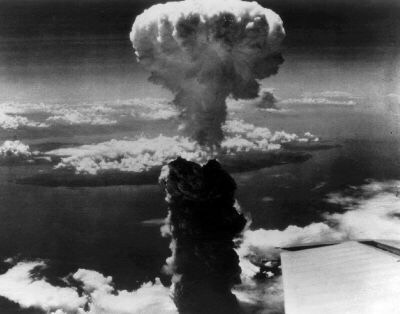
Seventy-two years ago the world changed. A remarkably destructive weapon was introduced in combat, a single bomb that annihilated the city of Hiroshima Japan. The effects were immediate, 70,000 to 80,000 people were killed, tens of thousands of others wounded, many of whom would suffer from the effects of radiation and radiation burns the rest of their lives. Within days a second bomb was dropped on Nagasaki with similar results, and Japan sued for peace. The Second World War was over and a new world was born, a world under the shadow of nuclear weapons.

The anniversary of that event yesterday is something that all of us should ponder with great trepidation as the world seems to lurch towards a day when such a weapon will be used again. The question should not be one of mere military or tactical expediency, but must consider the moral dimension of the use of these weapons as well as the whole concept of total war. 

In his book Hiroshima, John Hershey wrote: “The crux of the matter is whether total war in its present form is justifiable, even when it serves a just purpose. Does it not have material and spiritual evil as its consequences which far exceed whatever good might result? When will our moralists give us an answer to this question?” His question is worth considering. 

Up until April of this year I spend the last three and a half years teaching the ethics of war to senior military officers at a major U.S. Military Staff College. One of the things that we do in the class is to have the officers do presentations on different historical, or potential ethical problems faced by national policy makers, military commanders and planners. The goal is to have these men and women dig deep and examine the issues, and think about the implications of what they will do when they go back out to serve as commanders, staff officers, advisors to civilian leaders and planners.

In each class that I taught, at least one student dealt with the use of the Atomic bombs.  Most were Air Force or Navy officers who have served with nuclear forces. Unlike the depiction in the classic movie Dr. Strangelove or other depictions that show officers in these forces as madmen, the fact is that I was always impressed with the thoughtfulness and introspective nature of these men and women. They sincerely wrestle with the implications of the use of these weapons, and many are critical of the use of them at Hiroshima and Nagasaki. It is comforting to me to know that at least in the U.S. military that there are many who can reflect and do try to look at things not just from a purely military standpoint. Of course since I know humanity I figure that there are others in our ranks who are not so reflective or sensitive to the moral implications of the use of these weapons, among whom is our current President. The fact that the President acts on impulse and seems to have no moral compass, strategic sense, or anything apart than what benefits him causes me to shudder, especially when he has to actually confront North Korea on their ICBM and nuclear programs, not to mention the use of weapons of mass destruction by a terrorist group. As Barbara Tuchman wrote: “Strong prejudices and an ill-informed mind are hazardous to government, and when combined with a position of power even more so.”

I am no stranger to what these weapons, as well as chemical and biological weapons can do. Thirty years ago when I was a young Army Medical Service Corps lieutenant I was trained as a Nuclear, Chemical and Biological Defense Officer. I learned the physical effects of exposure to these weapons, how many Rads of radiation a person could receive before they became sick and died. I learned what radiation exposure does to people at each stage. We trained with maps to chart fallout patterns, and the maps had the cities and towns that we lived in, this was Cold War Germany and yes both NATO and the Warsaw Pact expected that tactical nuclear weapons and chemical weapons would be used and we had to be able to operate in contaminated environments. We operated under the idea of Mutual Assured Destruction or MAD as a deterrent to war. It was chilling and made me realize that the use of these weapons today would be suicidal. When Chernobyl melted down we were in the fallout zone and were given instructions on what we could and could not do in order to minimize any possible exposure to radiation poisoning.

So when it comes to the first use of the Atomic bomb I am quite reflective. As a historian, military officer, chaplain and priest who has been trained on what these weapons can do I have a fairly unique perspective. Honestly, as a historian I can understand the reasons that President Truman ordered its use, and I can understand the objections of some of the bomb’s designers on why it should not be used. I’ve done the math and the estimates of casualties had there been an invasion of the Japanese home islands is in the millions, most of which would have been Japanese civilians. 
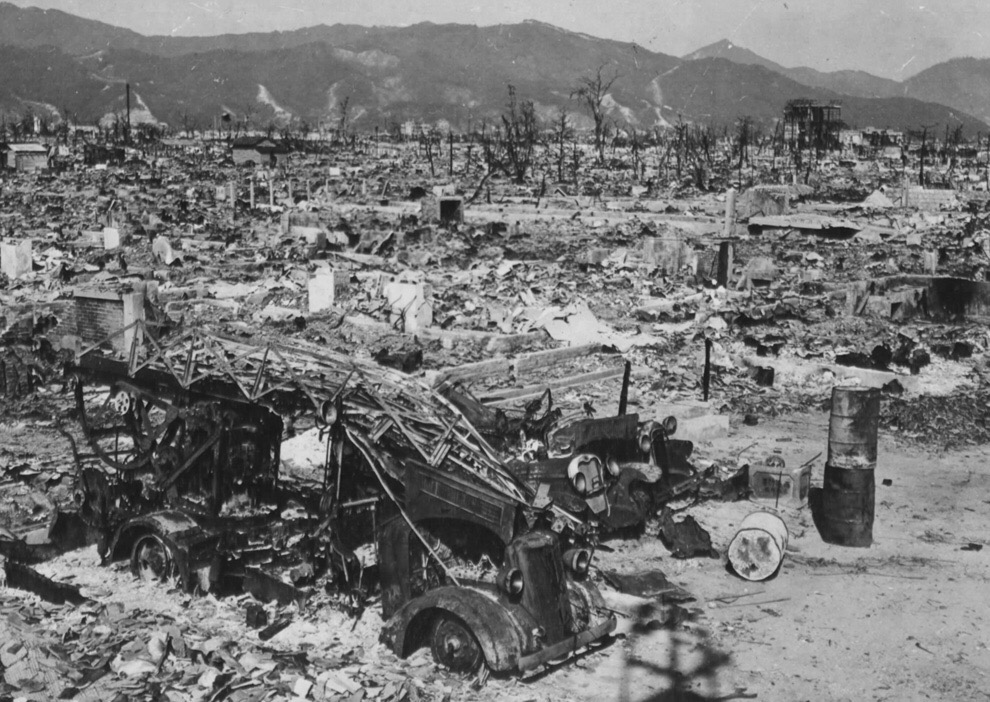

My inner lawyer can argue either point well, that being said the manner in which it was used at Hiroshima and Nagasaki troubles me. Hiroshima did have military targets, but a big part of the choice was its location, surrounded by hills, which created a bowl that would focus the explosion and maximized its effect. Many of the larger military and industrial targets lay outside the kill zone. The designers and officers on the committee wanted to show the Japanese, as well as the world the destructive power of the weapon. Those who opposed its use hoped that it would convince the leaders of nations that war itself needed to be prevented. These men wrestled with the issue even as they prepared the first bombs for deployment against Japan. The recommendations of the committee can be found here:

http://www.atomicarchive.com/Docs/ManhattanProject/Interim.shtml
Of the 150 scientists who were part of the bomb’s design team only 15% recommended the military use without a demonstration to show the Japanese the destructive power of the bomb and a chance to end the war. The poll of the scientists can be found here:

http://www.atomicarchive.com/Docs/ManhattanProject/Poll.shtml
Leo Szilard wrote a letter to Edward Teller seeking his support in sending a petition to President Truman regarding his opposition to the use of the weapon based on purely moral considerations. Szilard wrote:

“However small the chance might be that our petition may influence the course of events, I personally feel that it would be a matter of importance if a large number of scientists who have worked in this field want clearly and unmistakably on record as to their opposition on moral grounds to the use of these bombs in the present phase of the war.

Many of us are inclined to say that individual Germans share the guilt for the acts which Germany committed during this war because they did not raise their voices in protest against those acts, Their defense that their protest would have been of no avail hardly seems acceptable even though these Germans could not have protested without running risks to life and liberty. We are in a position to raise our voices without incurring any such risks even though we might incur the displeasure of some of those who are at present in charge of controlling the work on “atomic power.”

The entire text of Szilard’s letter can be found here:

http://www.atomicarchive.com/Docs/ManhattanProject/SzilardTeller1.shtml
The two petitions of the scientists to the President are here, the second letter concludes with this recommendation:

“If after the war a situation is allowed to develop in the world which permits rival powers to be in uncontrolled possession of these new means of destruction, the cities of the United States as well as the cities of other nations will be continuous danger of sudden annihilation. All the resources of the United States, moral and material, may have to be mobilized to prevent the advent of such a world situation. Its prevention is at present the solemn responsibility of the United States–singled out by virtue of her lead in the field of atomic power.

The added material strength which this lead gives to the United States brings with it the obligation of restraint and if we were to violate this obligation our moral position would be weakened in the eyes of the world and in our own eyes. It would then be more difficult for us to live up to our responsibility of bringing the unloosened forces of destruction under control.

In view of the foregoing, we, the undersigned, respectfully petition: first, that you exercise your power as Commander-in-Chief to rule that the United States shall not resort to the use of atomic bombs in this war unless the terms which will be imposed upon Japan have been made public in detail and Japan knowing these terms has refused to surrender; second, that in such an event the question whether or not to use atomic bombs be decided by you in the light of the consideration presented in this petition as well as all the other moral responsibilities which are involved.”

http://www.atomicarchive.com/Docs/ManhattanProject/SzilardPetition.shtml

http://www.atomicarchive.com/Docs/ManhattanProject/Petition.shtml

Ralph Bard, Undersecretary of the Navy wrote to Secretary of War Stimson his opinion on July 17th 1945:

“Ever since I have been in touch with this program I have had a feeling that before the bomb is actually used against Japan that Japan should have some preliminary warning for say two or three days in advance of use. The position of the United States as a great humanitarian nation and the fair play attitude of our people generally is responsible in the main for this feeling.”

I think that those who debate the history of this need to look at the entire picture and read the letters, the documents and take into account everything. My hope is that leaders, policy makers, legislators and we the people continue to work to eliminate nuclear weapons. It is true that the nuclear stockpiles of the United States and Russia are significantly smaller than when the Cold War ended, but even so what remain are more than enough to extinguish human life on the planet. Add to these the Chinese, French, British, Indian, Pakistani and the hundreds of undeclared weapons of Israel the fact is that there remains the possibility that they could be used. Likewise there are nuclear programs in other nations, especially North Korea, which given enough time or believing them necessary could produce weapons. But the North Koreans are not alone, they could easily be joined by others including Iran and Saudi Arabia. Add to this the possibility of a terrorist group producing or acquiring a weapon the world is still a very dangerous place.

That is the world that we live in and the world in which policy makers, legislators and educated people who care about the world must attempt to make safe. If you asked me I would say outlaw them, but that will never happen. Edward Teller wrote Leon Szilard:

“First of all let me say that I have no hope of clearing my conscience. The things we are working on are so terrible that no amount of protesting or fiddling with politics will save our souls…. Our only hope is in getting the facts of our results before the people. This might help to convince everybody that the next war would be fatal. For this purpose actual combat use might even be the best thing…. But I feel that I should do the wrong thing if I tried to say how to tie the little toe of the ghost to the bottle from which we just helped it to escape…”

The ghost is out of the bottle, and nothing can ever get it back in. We can only hope and pray that reasonable people prevent any of these weapons from ever being used and that war itself would end.

Until tomorrow, 

Peace

Padre Steve+
2 Comments

Filed under ethics, Foreign Policy, History, Military, national security, Political Commentary, world war two in the pacific

Arrogance, Ignorance, Incompetence, and Dangers to National Insecurity 


Friends of Padre Steve’s World,

Barbara Tuchman wrote: “Strong prejudices in an ill-formed mind are hazardous to government, and when combined with a position of power even more so.” 

Just a few words today as the dealings of the closest family members and associates of President Trump continue to ensure that his campaign’s relationships with multiple Russian contacts likely connected to the Putin regime will dominate our lives for quite a while. I’m not going to write much today because this story is going to gain traction until the President is either impeached or resigns from office, unless he blunders us into a big war, or there is a terrorist attack that allows him to get his own Reichstag Fire opportunity. 

Columnist Bob Herbert once wrote: ”

“There are few things more dangerous than a mixture of power, arrogance and incompetence. We are seeing that today with the members of the Trump administration and their true believer followers. The revelation of Donald Trump Jr.’s emails with Russian contacts and his meeting with them along with Trump’s campaign manager and son-in-law at a time when the President and all of his advisers denied all contacts with anyone related to Russia are astounding and reveal more than a smoking gun, but a complete disregard of American national security. Winning an elected appears to have mattered more to them than their county, the principles of our democracy, and our national security. 

Personally I am hard pressed as a former Reagan Republican and Cold Warrior to believe how anyone can defend the President’s proclivity to prefer Putin to our allies in NATO, and his willingness to throw NATO, American Intelligence agencies, diplomats, and law enforcement under the bus to defend Putin and his dictatorship. But they are and paradoxically had a Democrat been accused of one iota of what is being revealed about Trump’s family connections to the Russian interference in the American electoral process these same people would be calling for immediate impeachment. But they don’t care because they have so linked their fortunes to Trump that they cannot back down. As things get worse they will become more desperate but few of the True believers, mostly Evangelical Christians, will defect. They will fight to the end. 

That makes him and them very dangerous. They will create such chaos that it will undermine national security and leave us vulnerable to whatever the Russians or any other enemy might want to do, because the President will be so compromised that nobody will believe a word that he says. That poses danger to Americans around the world, our various allies, and to us at home. Well before there was any smoking gun I have been warning about the dangers posed by the arrogant, ignorant, and incompetence shown by the President and his closest advisors. 

Isaac Asimov wrote something that we should pay close attention to. He said “Violence is the last refuge of the incompetent.” 

I worry that this administration and its true believer followers will resort to violence backed by the power of the state to maintain power. I would very much like to be wrong but there is nothing that the administration has done to assuage my fears. This is not good, it is not normal, and it is dangerous for all of us.

Until tomorrow,

Peace

Padre Steve+
3 Comments

Filed under ethics, Foreign Policy, leadership, national security, News and current events, Political Commentary

Troop Increases with No Plan: Afghanistan and Dien Bien Phu

Friends of Padre Steve’s World,

As always back from Gettysburg on Monday brought to my mind the terrible human cost of war and the consequences of poor choices in matters of strategic and operational military decision making.

Tuesday morning I left my house to read the headline of the Virginia Pilot which stated that a decision had been made to increase troop strength in Afghanistan yet again after over 15 years of war in which the United States and its allies have lost over 3500 troops killed in action and the United States alone over 17,000 wounded without destroying the ability of the Taliban to recover from military defeats, or to ensure that the government of Afghanistan and its military could survive without massive US and NATO support.

The numbers of this new “surge” are massively smaller than that of President Obama, 3000 as compared to 100,000, and even the number of troops committed to the Afghanistan surge of Obama were insufficient to force the Taliban to the negotiating table. Once the US and NATO troops were withdrawn the corrupt Afghan government and military forces were unable to keep the Taliban down even as elements of the Islamic State moved into Afghanistan.

The situation reminded me of what the French faced in Indochina in 1953, and the battle of Dien Bien Phu which sealed the doom of the French colonial efforts in Indochina, at a terrible human cost. I wonder if we will even learn anything from history, but at least the French had a plan, albeit a terribly flawed one in 1953 and early 1954 where since 2002 the United States has had no real plan in Afghanistan.

Dien Bien Phu was an epic battle in a tragic war and most people neither know or care what happened in the valley where a small border post named Dien Bien Phu became synonymous with forgotten sacrifice. This year fewer remembrances are taking place. Some are in Vietnam and others in France.


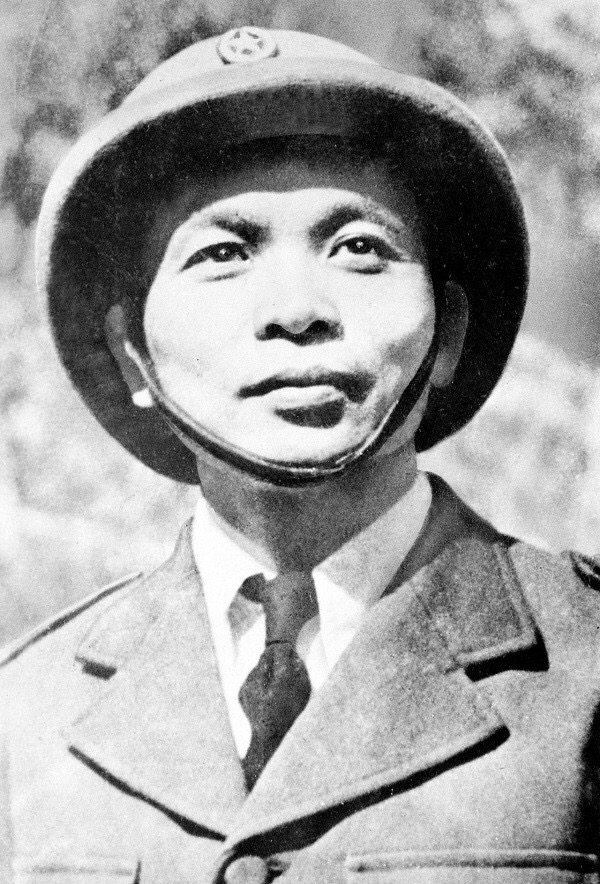
General Vo Nguyen Giap

On May 7th 2011 in Hanoi a small remembrance was held to mark the fall of Dien Bien Phu and honor the victor, 101 year old General Vo Nguyen Giap at his home. Until his death in 2013 at the age of 102. That 2011 ceremony was one of the few remembrances held anywhere marking that battle which was one of the watersheds of the 20th Century. A half a world away in Houston Texas a small group of French veterans, expatriates and historians laid a wreath at the Vietnam War Memorial.  In Paris an ever shrinking number of French survivors gather each year on May 7th at 1815 hours for a religious service at the Church of Saint Louis des Invalides to remember the dead and missing of the French Expeditionary Corps lost in Indochina. A small number of other small ceremonies have been in the following years.

This battle is nearly forgotten by time even though it and the war that it symbolized is probably the one that we need to learn from before Afghanistan becomes our Indochina.

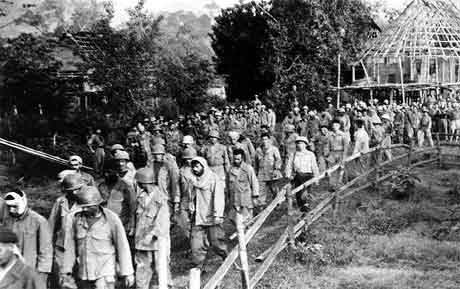
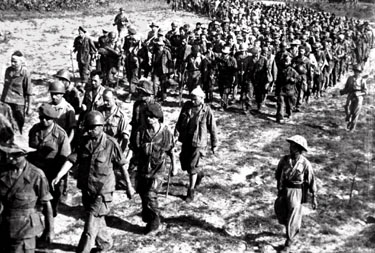
French Prisoners

On May 8th 1954 the French garrison of Dien Bien Phu surrendered to the Viet Minh.  It was the end of the ill-fated Operation Castor in which the French had planned to lure the Viet Minh Regulars into open battle and use superior firepower to decimate them.  The strategy which had been used on a smaller scale the previous year at Na Son.

The French had thought they had come up with a template for victory based on their battle at Na Son in how to engage and destroy the Viet Minh. The plan was called the “Air-land base.”  It involved having strong forces in a defensible position deep behind enemy lines supplied by air.  At Na Son the plan worked as the French were on high ground, had superior artillery and were blessed by General Giap using human wave assaults which made the Viet Minh troops fodder for the French defenders.  Even still Na Son was a near run thing for the French and had almost no effect on Viet Minh operations elsewhere while tying down a light division equivalent and a large portion of French air power.

Viet Minh Regulars

The French took away the wrong lesson from Na-Son and repeated it at Dien Bien Phu.  The French desired to use Dien Bien Phu as a base of operations against the Viet Minh.  Unfortunately the French chose badly. The elected to occupy a marshy valley surrounded by hills covered in dense jungle. They elected to go light on artillery and the air head was at the far end of the range of French aircraft, especially tactical air forces which were in short supply.  To make matters worse the General Navarre, commander of French forces in Indochina informed that the French government was going to begin peace talks and that he would receive no further reinforcements elected to continue the operation.

French Paras Drop into Dien Bien Phu

Likewise French logistics needs were greater than the French Air Force and American contractors could supply.  French positions at Dien Bien Phu were exposed to an an enemy who held the high ground and were not mutually supporting. The terrain was so poor that French units were incapable of any meaningful offensive operations against the Viet Minh. As such they could only dig in and wait for battle. Despite this many positions were not adequately fortified and the artillery was in exposed positions.

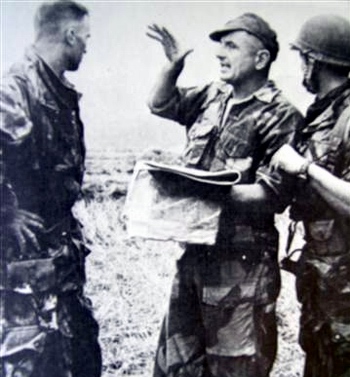
Major Marcel Bigeard 

The French garrison was a good quality military force composed of veteran units. It was comprised of Paras, Foreign Legion, Colonials (Marines), North Africans and Vietnamese troops. Ordinarily in a pitched battle it would have done well, but this was no ordinary battle and their Viet Minh opponents were equally combat hardened, well led and well supplied and fighting for their independence.

Many of the French officers including Lieutenant Colonel Langlais and Major Marcel Bigeard commander of the 6th Colonial Parachute Battalion were among the best leaders in the French Army. Others who served in Indochina including David Galula and Roger Trinquier would write books and develop counter-insurgency tactics which would help Americans in Iraq. Unfortunately the French High Command badly underestimated the capabilities and wherewithal of the Giap and his divisions.

Viet Minh Supply Column

Giap rapidly concentrated his forces and built excellent logistics support.  He placed his artillery in well concealed and fortified positions which could use direct fire on French positions. Giap also had more and heavier artillery than the French believed him to have.  Additionally he brought in a large number of anti-aircraft batteries whose positions enabled the Viet Minh to take a heavy toll among French Aircraft.  Giap also did not throw his men away in human assaults.  Instead he used his Sappers (combat engineers) to build protective trenches leading up to the very wire of French defensive positions.  In time these trenches came to resemble a spider web.

Without belaboring this post the French fought hard as did the Viet Minh. One after one French positions were overwhelmed by accurate artillery and well planned attacks.  The French hoped for U.S. air intervention, even the possibility of using nuclear weapons against the Viet Minh. They were turned down by a US Government that had grown tired of a war in Korea.

French Wounded Awaiting Medivac from Dien Bien Phu 

Relief forces were unable to get through and the garrison died, despite the bravery of the Paratroops. Colonials and Legionaries. The French garrison was let down by their high command and their government and lost the battle due to inadequate logistics and air power. The survivors endured a brutal forced march of nearly 400 miles on foot to POW camps in which many died. Many soldiers who survived the hell of Dien Bien Phu were subjected to torture, including a practice that we call “water boarding.” General Georges Catroux who presided over the official inquiry into the debacle at Dien Bien Phu wrote in his memoirs: “It is obvious that there was, on the part of our commanding structure, an excess of confidence in the merit of our troops and in the superiority of our material means.”

Few French troops caved to the Viet Minh interrogations and torture but some would come away with the belief that one had to use such means to fight the revolutionaries.  Some French troops and their Algerian comrades would apply these lessons against each other within a year of their release. French soldiers and officers were shipped directly from Indochina to Algeria to wage another protracted counterinsurgency often against Algerians that they had served alongside in Indochina. The Algerian campaign proved to be even more brutal and it was lost politically before it even began.

The March to Captivity

The wars in Indochina and Algeria tore the heart out of the French Army. The defeats inflicted a terrible toll. In Indochina many French career soldiers felt that the government’s “lack of interest in the fate of both thousands of missing French prisoners and loyal North Vietnamese…as dishonorable.” Divisions arose between those who served and those who remained in France or Germany and created bitter enmity between soldiers. France would endure a military coup which involved many who had fought in Vietnam and Algeria. Having militarily won that war these men called The Centurions by Jean Lartenguy had been turned into liars by their government.  They were forced to abandon those who they had fought for and following the mutiny, tried, imprisoned, exiled or disgraced. Colonial troops who remained loyal to France were left without homes in their now “independent” nations. They saw Dien Bien Phu as the defining moment. “They responded with that terrible cry of pain which pretends to free a man from his sworn duty, and promises such chaos to come: ‘Nous sommes trahis!’-‘We are betrayed.’

The effects of the wars in French Indochina, Algeria and Vietnam on the French military establishment were long lasting and often tragic. The acceptance of torture as a means to an end sullied even the hardest French officers. Men like Galula and Marcel Bigeard refused to countenance it, while others like Paul Aussaresses never recanted.

One of the most heart rending parts of the Dien Bien Phu story for me is that of Easter 1954 which fell just prior to the end for the French:

“In all Christendom, in Hanoi Cathedral as in the churches of Europe the first hallelujahs were being sung. At Dienbeinphu, where the men went to confession and communion in little groups, Chaplain Trinquant, who was celebrating Mass in a shelter near the hospital, uttered that cry of liturgical joy with a heart steeped in sadness; it was not victory that was approaching but death.” A battalion commander went to another priest and told him “we are heading toward disaster.” (The Battle of Dienbeinphu, Jules Roy, Carroll and Graf Publishers, New York, 1984 p.239)

As a veteran of Iraq whose father served in Vietnam I feel an almost a spiritual link to our American and French brothers in arms who fought at Dien Bien Phu, the Street Without Joy, Algiers and places like Khe Sanh, Hue City, the Ia Drang and the Mekong. When it comes to this time of year I always have a sense of melancholy and dread as I think of the unlearned lessons and future sacrifices that we may be asked to make.

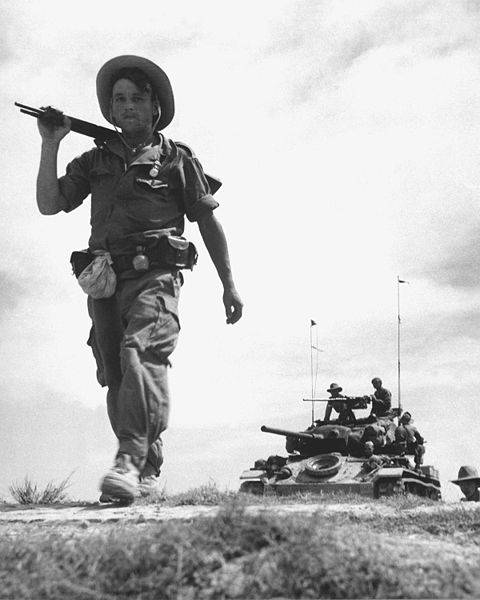
Legionaires on the Street Without Joy

The lessons of the French at Dien Bien Phu and in Indochina were not learned by the United States as it entered Vietnam, Iraq or Afghanistan. Nor were the lessons of Algeria. It was an arrogance for which we paid dearly and I do not think that many in our political, media and pundits or military have entirely learned or that we in the military have completely shaken ourselves. We lost 54,000 dead in Vietnam, nearly 4500 in Iraq and close to 3500 in Afghanistan, not counting vast numbers of wounded. There are those even as we have been at war for 15 years who advocate even more interventions in places that there is no good potential outcome, only variations on bad. How many more American Soldiers, Sailors, Marines and Airmen and our allies will need die without “victory” however badly we might try to define it?

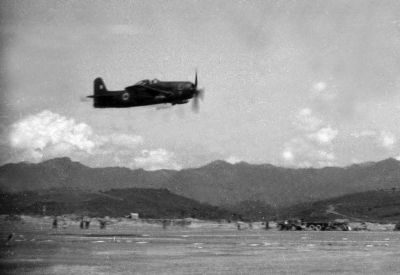
French Navy F-8 Bearcat at Dien Bien Phu

Like the French our troops who returned from Vietnam were forgotten.The U.S. Army left Vietnam and returned to a country deeply divided by the war. Vietnam veterans remained ostracized by the society until the 1980s. As Lieutenant General Harold Moore  who commanded the battalion at the Ia Drang immortalized in the film We Were Soldiers recounted “in our time battles were forgotten, our sacrifices were discounted, and both our sanity and suitability for life in polite American society were publicly questioned.”

For those interested in the French campaign in Indochina it has much to teach us. Good books on the subject include The Last Valley by Martin Windrow, Hell in a Very Small Place by Bernard Fall; The Battle of Dienbeinphu by Jules Roy; and The Battle of Dien Bien Phu- The Battle America Forgot by Howard Simpson. For a history of the whole campaign, read Street Without Joy by Bernard Fall. I always find Fall’s work poignant, he served as a member of the French Resistance in the Second World War and soldier later and then became a journalist covering the Nuremberg Trials and both the French and American wars in Vietnam and was killed by what was then known as a “booby-trap” while covering a platoon of U.S. Marines.

I do pray that we will learn the lessons before we enter yet another hell. But I don’t think it is possible for us to learn anymore, only send more young men and women to die in an already lost cause. As the late Edwin Starr sang in his song War, what is it good for? 

Peace, love and understanding. Tell me, is there no place for them today. They say we must fight to keep our freedom, But lord knows there’s got to be a better way. War, what is it good for? Absolutely nothing, say it again… 

Peace

Padre Steve+

3 Comments

Filed under afghanistan, Foreign Policy, History, Military, News and current events, War on Terrorism

Missiles and Messages: What is Trump trying to Convey?

Friends of Padre Steve’s World,

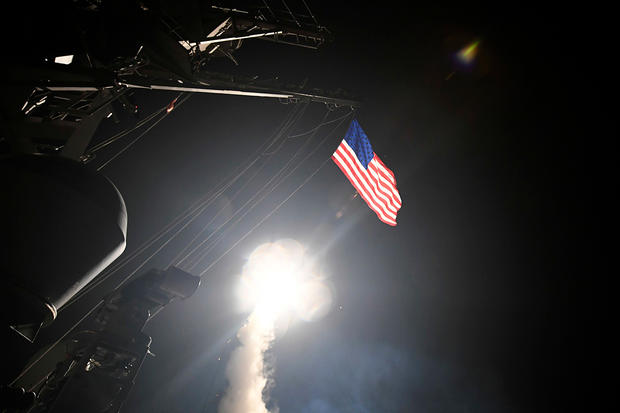
If nothing else the events of last week, in particular President Trump’s decision to launch missiles at a Syrian airbase in response to Syria’s renewed use of poison gas on its own population sent a message to different leaders around the world. What that message is and how effective that it is depends on who heard it and how they interpreted it.

The actual type of strike was nothing new and it certainly was justified in relation to war crimes of the Assad regime. President Clinton used similar strikes as punitive measures against Iraq in the 1990s, President Bush used them against various targets outside of Iraq, and opting for a full invasion of that country. While President Obama tended to be more hesitant about the missile strikes he often used Special Forces and drones in many countries pursuant to the 2001 Authorization for the Use of Force pertaining to the War on Terror, he did use missile and air strikes in conjunction with NATO to help Libyan rebels overthrow the Ghaddafi regime.

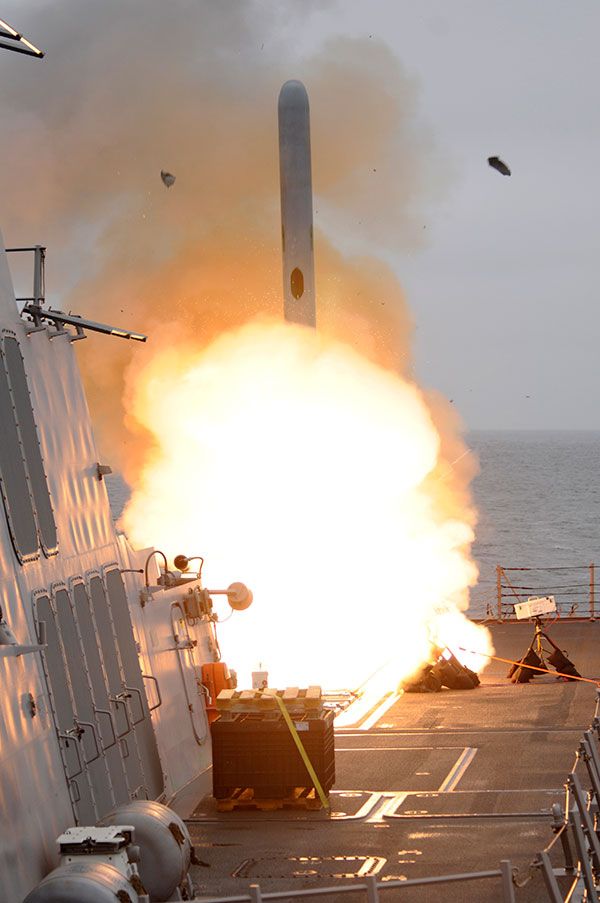
That being said what is the message that the President was attempting to send, and how does it fit into a larger foreign policy and national security strategy? That is where my concerns lie in regard to this strike. As for me I would have loved to see a Tomahawk fly up Bashir Assad’s ass and blow him to the Hell of his choice, if Ghaddafi and Saddam deserved death, then Assad deserves it many times more. It’s probably a good thing that I’m not President because I think that those 60 Tomahawks would have been much more wisely employed by taking out Assad’s Presidential Palace and maybe taking out him in the process, but there would have been a much bigger blowback to that than striking the airfield, but I digress…

Going back to what I was saying, how does this fit into a broader foreign policy and national security strategy?

The timing of the strike, minutes after the final dinner between President Trump and Chinese President Xi Jinping certainly sent a message to China and North Korea who it might have been the real audience. If the strike forces China to take stronger action to assist the United States in reducing the building North Korean nuclear threat, then it will have served a worthwhile purpose. A Chinese newspaper reported that this was the intent of the strike just yesterday.

But the effect depends on the rationality of the targeted audience. The Chinese are a rational actor, but the North Koreans may not be, so we have to wait and see. In the meantime the Administration dispatched the USS Carl Vinson carrier strike group to Korea waters to coincide with a time of the year when the North Koreans typically become more active.

There is also the possibility that the message was also intended for Putin’s Russia, the Assad regime, and even Iran, but right now other than a few statements by U.N. Ambassador Nikki Haley there has not been any real follow up to the strike. Secretary of State Tillerson is going to Moscow this week so we may glean more from that meeting.

Of course there is the domestic political audience and based on how the Trump campaign and administration has dealt with truth there is the possibility that this is much more to do about Trump’s plunging poll ratings and as a distraction from the ballooning Russia-Trump election scandals.

Regardless of what message the missile strike was intended to convey, we still don’t know how it will play out and it could play out in any number of ways, good or bad, and it might even turn out to be an act of genius, I doubt the latter but it is a possibility.

That is why the Trump and his administration must determine what its policy will be, especially its diplomatic policy. The President must keep all options on the table, diplomatic, informational, military, and economic, but he must be very judicious in how he uses them. Believe me, I can disagree with and distrust the President all day long, but I don’t want him to screw this up. Too much is at stake.

Peace

Padre Steve+

1 Comment

Filed under Foreign Policy, middle east, Military, national security, News and current events, Political Commentary

The Importance of not Letting Political Problems become Military Problems: The Example of George Marshall and Omar Bradley

George Marshall 

Friends of Padre Steve’s World,

A short thought for this Sunday. General Omar Bradley said, “Wars can be prevented just as surely as they can be provoked, and we who fail to prevent them, must share the guilt for the dead.”

I wrote yesterday about my concerns with the leaders of the major world powers in relation to the crises in Syria and North Korea, in which the military option seems to be spoken of more often than any other. But ultimately these are political problems that will require much more than a military solution, for an ill-thought out through military action almost always results in worse problems. If these political problems in Syria and North Korea are not addressed as that, they will end by opening a Pandora’s Box of unintended consequences that will most likely be worse than we could imagine. If military action is necessary, it must be thought through and done in conjunction with a plan to not only win the war, but to win the peace as well. General George Marshall, whose guiding hand helped the Allies win the Second World War, and whose leadership as Secretary of State helped Europe recover from that war, paving the way to decades of peace and prosperity so correctly noted: “A political problem thought of in military terms eventually becomes a military problem.” It is kind of like Abraham Maslow’s “law of the instrument” in which he noted “I suppose it is tempting, if the only tool you have is a hammer, to treat everything as if it were a nail.”

So far the words coming out of the mouth of President Trump and his Secretary of State are all about the military option, and the President’s proposed cuts to the State Department and other agencies of “soft power” will ensure that when push comes to shove that the only tool he will have will be that of the military.

Until Tomorrow

Peace

Padre Steve+


1 Comment

Filed under Foreign Policy, History, Military, national security, Political Commentary

Nuclear Giants and Ethical Infants: Do Dodging the Hard Alternatives

Friends of Padre Steve’s World,

General Omar Bradley once said: “Ours is a world of nuclear giants and ethical infants. We know more about war that we know about peace, more about killing that we know about living.”

As I hear President Trump rattling the saber in Asia and the Middle East, as I look at his incoherent and dangerous policy of “America First,” and his almost total disregard for the importance of diplomacy and soft power I began to think about the possibility of nuclear, chemical, or biological war. While the Sword of Damocles represented by the massive stocks of already existing nuclear, chemical, and biological weapons, has hung over our heads for decades, the current era seems more dangerous.

We have seen the persistent use of chemical weapons, including Sarin nerve agent in Syria by the regime of Bashir Al Assad, and the growing advancement of nuclear weapons technology, combined with bellicose rhetoric threatening the use of such weapons coming from North Korea’s leader, Kim Jong Un.

The problem is with both of these situations is that there are no easy or even good answers. The branches and sequels to any military action, the possibilities of a limited military action escalating into a regional or even worldwide conflict are all too real. It is in times like these that one wishes for cool heads and steady leadership, especially among the great powers. But I fear that that might not be the case today. The saber rattling, and the quest for regional dominance by Russia in Eastern Europe, and China in Asia are unnerving their neighbors, and becoming more dangerous with every passing year. But even more important is the dangerous attitude of the Russians in backing the Assad regime and the Chinese not doing much to control North Korea that are very concerning, not to mention the Trump administration’s lack of any coherent foreign policy or military strategy.

During the Cuban Missile Crisis of 1963 President John F. Kennedy and Soviet Premier Nikita Khrushchev were able to pull back from the brink of nuclear war. During the height of the Cold War President Ronald Reagan and Soviet Premier Mikhail Gorbachev were able to begin the process of reducing nuclear weapons and the numbers of intermediate range nuclear missiles.

I don’t know if President Trump, President Putin, or Chinese President Xi Jinping are able to curb their own sense of nationalism, nor the actors using or threatening to use these terrible weapons. There are hard choices to be made, but all too often leaders throughout history have shown a decided inability to make them. As Barbara Tuchman noted:  “One constant among the elements of 1914—as of any era—was the disposition of everyone on all sides not to prepare for the harder alternative, not to act upon what they suspected to be true.” 

It feels as if we are sliding into an abyss, I just hope that one or all of these leaders acts with a measure of prudence and wisdom to keep us from sliding in to it.

The President’s decision to remove Steve Bannon from the NSC was a good start, and hopefully men like General McMasters and Secretary of Defense Mattis prove to be men like George C. Marshall, Omar Bradley, and Dwight Eisenhower, men who understand the precious nature of peace and the tragedy of war.

Until tomorrow,

Peace

Padre Steve+

1 Comment

Filed under Foreign Policy, History, national security, Political Commentary

War is the Unfolding of Miscalculations… Assad, Trump, Putin, and Syria 2017

Friends of Padre Steve’s World,

The die has been cast. Last week the Trump administration signaled that the regime of Bashir Al Assad was not a priority for American policy in the Middle East. The comment was perplexing as the Assad regime has worked with the Iranians, and Hezbollah, both enemies of the United States to crush a revolt against his regime that began during the Arab Spring. Assad’s methods included the use of Sarin nerve agent and relentless attacks on civilians and were condemned by much of the world. In 2013 President Obama attempted to gain political support for military action against the Assad regime but was rebuffed by congressional Republicans as well as anti-war Democrats. The Syrian rebels were joined by radical Sunni Muslims of various Al Qaeda affiliates and later joined by the so called Islamic State. The Syrian army was on the point of collapse when the Russians intervened in 2015.

From 2013 on President Trump constantly said that military action in Syria was against U.S. national interests, something that continued until last week. Then Assad, apparently emboldened by the Trump Administration’s statement that changing his regime was not a priority for the U.S. launched a aerial attack using chemical weapons against civilians. The images which were shown throughout the 24 hour cable news cycle evidently made an impression on the President. Within hours of suggesting that military action was possible it began.

From Mar-a-Largo where the President is hosting Chinese President Xi Jinping, the President said:

“Tonight, I ordered a targeted military strike on the air base in Syria from where the chemical attack was launched… It is in this vital national security interest of the United States to prevent and deter the spread and use of deadly chemical weapons.”

I agree that it is the vital interests of the United States to prevent and deter the use of chemical weapons, but why this and why now especially since it did not seem to be a priority less than a week ago?

Right now we know precious little about the action, except that it was sudden and done without any congressional consultation, and little consultation with allies. Will Congress do its duty and demand details before allowing the administration to commit us to another war that in no way is covered by the 2001 authorization for use of force that has been used for all the actions involving the war on terrorism conducted by the Bush and the Obama Administrations, or will Congress roll over and do nothing, thus allowing the executive branch to take the nation to war with no oversight?

The genie of war is now out of the bottle. We do not know what will happen next, the potential branches and sequels to this action are many, and few of them promise anything in the way of peace in Syria. There is now danger that the U.S. will become entangled in a complex war that has no good outcome.

The question, what will happen next is unknown. Can President Trump work with Russia’s President Putin, Turkey’s President Erdrogan, as well as well as other regional leaders to bring something resembling peace to the region? I hope that can happen but I wouldn’t bet on it as history shows that all too often that these things take on a life of their own.  As Barbara Tuchman noted: “War is the unfolding of miscalculations.”

I have a couple of articles that I will post soon about the dangerous nature of what we are witnessing. But for tonight I will pause and try to get some sleep.

Peace

Padre Steve+

5 Comments

Filed under Foreign Policy, middle east, Military, national security, News and current events, Political Commentary, US Navy

Committing Suicide out of Fear of Death: The Possibility of Preventive War on the Korean Peninsula

Friends of Padre Steve’s World,

Otto von Bismarck, the “Iron Chancellor” of Prussia and Germany once noted that “preventive war is like committing suicide out of fear of death.” Sadly, most Americans, do not seem to understand this, nor the distinctions of what is and is not permissible and how preventive war is different from the concept of pre-emptive actions.

While in Korea this week Secretary of State Rex Tillerson, most likely acting on behest of President Trump spoke of the real possibility that the United States could embark on a preventive war against North Korea. Tillerson said: “Let me be very clear: The policy of strategic patience has ended,” and “We’re exploring a new range of diplomatic, security and economic measures. All options are on the table.” He also said “If they elevate the threat of their weapons program to a level that we believe requires action, that option is on the table.” 

Now let me be clear, the military option is always on the table when dealing with North Korea, but that military option has always been focused on deterrence and the ability to deter, defend, and respond to any North Korean military action, not by the open threat of preventive war. The latter is something that could well push the paranoid regime of Kim Jung Un into actual military action, rather than the provocative actions they make in defiance of the United Nations most of the world. However, that threshold, which successive American administrations have not crossed since the Korean Armistice of 1954 has been crossed.

That being said the North Korean nuclear threat and ability to strike distant targets is growing and may reach a point that it could hit the United States. The question is, when, or if, the North Korean threat justifies either a pre-emptive military strike or launching a preventive war. In the run up to the invasion of Iraq the United States used the supposed threat of Iraqi weapons of mass destruction and connections to Al Qaeda to justify a preventive war against Iraq to eliminate the threat and overthrow Saddam Hussein. That war has been shown to be both in violation of the standards of the Just War Theory and international law concerning preventive war.

Michael Walzer, the foremost expert on Just War Theory today wrote in his book Just and Unjust Wars:

Now, what acts are to count, what acts do count as threats sufficiently serious to justify war? It is not possible to put together a list, because state action, like human action generally, takes on significance from its context. But there are some negative points worth making. The boastful ranting to which political leaders are often prone isn’t in itself threatening; injury must be “offered” in some material sense as well. Nor does the kind of military preparation that is a feature of the classic arms race count as a threat, unless it violates some formally or tacitly agreed-upon limit. What the lawyers call “hostile acts short of war,” even if these involve violence, are not too quickly to be taken as signs of an intent to make war; they may represent an essay in restraint, an offer to quarrel within limits. Finally, provocations are not the same as threats. “Injury and provocation” are commonly linked by Scholastic writers as the two causes of just war. But the Schoolmen were too accepting of contemporary notions about the honor of states and, more importantly, of sovereigns. The moral significance of such ideas is dubious at best. Insults are not occasions for wars, any more than they are (these days) occasions for duels.

For the rest, military alliances, mobilizations, troop movements, border incursions, naval blockade~-all these, with or without verbal menace, sometimes count and sometimes do not count as sufficient indications of hostile intent. But it is, at least, these sorts of actions with which we are concerned. We move along the anticipation spectrum in search, as it were, of enemies: not possible or potential enemies, not merely present ill-wishers, but states and nations that are already, to use a phrase I shall use again with reference to the distinction of combatants and noncombatants, engaged in harming us (and who have already harmed us, by their threats, even if they have not yet inflicted any physical injury). And this search, though it carries us beyond preventive war, clearly brings us up short of Webster’s pre-emption. The line between legitimate and illegitimate first strikes is not going to be drawn at the point of imminent attack but at the point of sufficient threat. That phrase is necessarily vague. I mean it to cover three things: a manifest intent to injure, a degree of active preparation that makes that intent a positive danger, and a general situation in which waiting, or doing anything other than fighting, greatly magnifies the risk. The argument may be made more clear if I compare these criteria to Vattel’s. Instead of previous signs of rapacity and ambition, current and particular signs are required; instead of an “augmentation of power,” actual preparation for war; instead of the refusal of future securities, the intensification of present dangers. Preventive war looks to the past and future, Webster’s reflex action to the immediate moment, while the idea of being under a threat focuses on what we had best call simply the present. I cannot specify a time span; it is a span within which one can still make choices, and within which it is possible to feel straitened.

I know that is a lot to digest, but the fact of the matter it takes a lot to justify pre-emptive military strikes, or a preventive war, and that in doing so we have not simply to look to the present moment but to the past and the as yet unwritten future. President Dwight D. Eisenhower noted that “Preventive war was an invention of Hitler. I would not even listen to anyone seriously that came and talked about such a thing.” But now, it is being talked about, and as surely as the sun will rise tomorrow, Kim Jong Un will raise the ante, and then question will be, then what?

Peace

Padre Steve+

2 Comments

Filed under Foreign Policy, Korean Conflicts, national security, News and current events, Political Commentary

The World’s Guilt: The Flaw in Character that Allows us to Look the Other Way

Friends of Padre Steve’s World,

rolfe

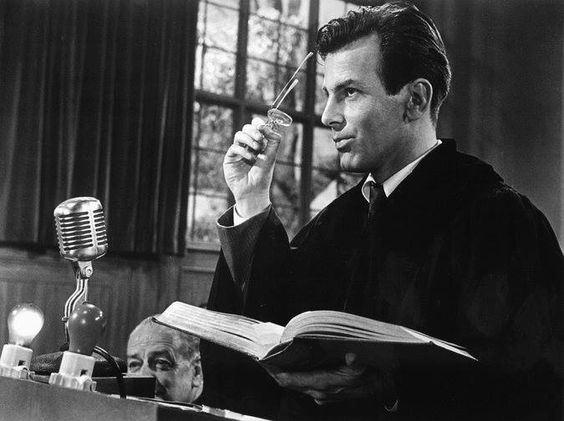
Today just a short follow up to my last few posts about the Holocaust and the other crimes of the Nazi state. A couple of those dealt with the film Judgment at Nuremberg. The film is profoundly disturbing when one looks at the time that we live. This is one of the more disturbing sections because in it, Maximillian Schell who played Hans Rolfe, the defense counsel for Burt Lancaster.

His summation of the defense following his client’s admission of guilt is damning. It is something that when we, and by we I mean people around the world, look at the atrocities of genocide, war crimes, ethnic cleansing, the willful starvation of millions by criminal regimes; and then stand by saying little or nothing and doing nothing, sometimes even supporting the regimes that commit these actions.

Please, no matter what your political point of view, take the time to watch the film, and read the transcript of Schell’s speech below:

“Your Honor, it is my duty to defend Ernst Janning, and yet Ernst Janning has said he is guilty. There’s no doubt, he feels his guilt. He made a great error in going along with the Nazi movement, hoping it would be good for his country. But, if he is to be found guilty, there are others who also went along, who also must be found guilty. Ernst Janning said, “We succeeded beyond our wildest dreams.” Why did we succeed, Your Honor? What about the rest of the world? Did it not know the intentions of the Third Reich? Did it not hear the words of Hitler’s broadcast all over the world? Did it not read his intentions in Mein Kampf, published in every corner of the world? Where’s the responsibility of the Soviet Union, who signed in 1939 the pact with Hitler, enabled him to make war? Are we not to find Russia guilty? Where’s the responsibility of the Vatican, who signed in 1933 the Concordat with Hitler, giving him his first tremendous prestige? Are we not to find the Vatican guilty? Where’s the responsibility of the world leader, Winston Churchill, who said in an open letter to the London Times in 1938 – 1938! Your Honor – “were England to suffer national disaster should pray to God to send a man of the strength of mind and will of an Adolf Hitler!” Are we not to find Winston Churchill guilty? Where is the responsibility of those American industrialists, who helped Hitler to rebuild his armaments and profited by that rebuilding? Are we not to find the American industrialists guilty? No, Your Honor. No! Germany alone is not guilty: The whole world is as responsible for Hitler’s Germany. It is an easy thing to condemn one man in the dock. It is easy to condemn the German people to speak of the basic flaw in the German character that allowed Hitler to rise to power and at the same time positively ignore the basic flaw of character that made the Russians sign pacts with him, Winston Churchill praise him, American industrialists profit by him! Ernst Janning said he is guilty. If he is, Ernst Janning’s guilt is the world’s guilt – no more and no less.”

Sadly, little has changed in the character of humanity. If we do or say nothing, if we support those who do such things, if we close our eyes and pretend that it is not our problem, then we are the guilty party.  As Hannah Arendt wrote: “The sad truth is that most evil is done by people who never make up their minds to be good or evil.”

Peace

Padre Steve+
1 Comment

Filed under ethics, film, Foreign Policy, History, holocaust, nazi germany, News and current events, Political Commentary

Holocaust Remembrance 2017: “Most evil is done by People who never make up their minds to be Good or Evil”

1483285_10152114931522059_1612934841_n

Friends of Padre Steve’s World,

I normally don’t post twice in a day but this I thought was important, for I believe that we are at a point in world history where the not so distant specter of a horrifying past is is rising before our eyes and all too many people cannot see it.

Friday, January 27th 2017 was Holocaust Remembrance Day. On that day seventy-two years ago the Soviet Red Army liberated the Auschwitz Concentration Camp, the centerpiece of the Nazi Death Camp machine. To be sure, in his panic to save his neck, in late 1944 Heinrich Himmler had begun to switch from his tactic of extermination to using the Jews as bargaining chips., but by then most of the Jews under Nazi control were dead. Those that remained, emaciated and dying by the thousands to starvation, and unchecked disease, as they were marched in ghastly conditions to camps deeper inside Nazi controlled areas.

On Friday two things happened in the United States that caused me to shake my head and wonder if we are becoming a place that will turn its eyes away from current atrocities, genocide, ethnic and religious cleansing, and walk away. President Trump issued a proclamation to observe Holocaust Remembrance Day, a statement that did not mention the Jews. How one remembers the Holocaust without mentioning the Jews is beyond me, but some of the President’s closest advisers, including Steve Bannon, are closely connected to the self-proclaimed Alt-Right, a movement of white supremacists and neo-Nazis looking for respectability. The second thing the President did was to issue an Executive Order halting the immigration of refugees from certain Muslim majority countries, and to cap the number entering. I’m not going to go into details about that but it is not the first time that the United States stopped refugees from entering the country on national security grounds, as in the 1930s and 1940s one of the reasons used to keep German Jewish refugees out of the country was exactly that, they might be Nazi spies and saboteurs, but I digress…

However, this is a day that we should never forget. The horrors perpetrated by the Nazi regime, all in the name of “race purity” and the extermination of the Jews and others deemed by the Nazis to be “sub-human” or untermenschen is something that is hard for most to imagine. Last year about this time I finished reading Bettina Stangneth’s book, Eichmann Before Jerusalem: The Unexamined Life of a Mass Murderer. While I am very well informed and educated on the lives, writings, actions, and statements of many of the Nazi war criminals, this new book on Eichmann is the most troubling that I have ever read. In particular it is the accounts of his writings and interviews with other pro-Nazi, or former Nazis in Argentina, particularly the Sassen Interviews, which span hundreds of hours of tape and thousands of pages of transcripts.

I am a Christian, a gentile, and a historian, as well as a thirty-five year military who served alongside our advisors and the Iraqis who fought alongside of us. I have lived in Germany, read, speak and write German and have many friends in that country, including members of the German military, retired and active duty.  My study and association with Holocaust survivors goes back to my college days at California State University Northridge when as an undergraduate history major I spent much of my time studying Germany from the first unification and the Kaiser Reich, the First World War, Versailles, Weimar and the Hitler Regime. My professor, Dr. Helmut Heussler, whose family left Germany in the late 1920s, served in the U.S. Army in World War II and was an interrogator at Nuremberg. I took a number of classes from Dr. Heussler, including Hitler’s Germany and the Holocaust. In the latter I had the chance to meet Holocaust survivor Mel Mermelstein, who was later played by Leonard Nimoy in the TV movie Never Forget. 

Since my college days I have continued to read and study, and to get a second Masters Degree in History in which much of my work dealt with the Nazi regime. I have visited the sites of former concentration camps including Dachau and Bergen-Belsen. I have been to the sites of the Nazi Party rallies in Nuremberg, as well as to the courtroom where the Nuremberg Trails were conducted. One day, God willing I will get to Auschwitz.

The Nazis had begun their persecution of the Jews shortly after Hitler took power in 1933. Later in the year the Enabling Act gave Hitler and his henchmen the legal means to begin their persecution of the Jews and others. These were followed by the Nuremberg Laws and other laws that targeted the Jews. Persecution increased throughout the 1930s, and sadly most countries refused to accommodate increased Jewish immigration. Then came Kristallnacht, or the Night of Broken Glass, when on 9-10 November 1938, a series of orchestrated attacks on Jewish businesses, Synagogues, institutions and individuals. On that night close to 200 synagogues, 7000 Jewish businesses and 29 major department stores were destroyed or damaged. Over 30,000 Jews, mostly men, were arrested and sent to concentration camps, 91 people were killed outright, and several thousand died in the aftermath.

mass killing einsatzgruppen

When the Nazis invaded Poland, its Jews were rounded up and placed into ghettos where many died of starvation and abuse even before the ghettos were liquidated and the people who lived in them were deported to the extermination camps. In 1941 as the German military seemed to be assured of victory in the Soviet Union the Nazis decided to exterminate the Jews of Europe. In the Soviet Union four Einsatzgruppen followed each of the German Army Groups and systematically began to massacre the Jews of every city and village which German soldiers captured. Over a million and a half Soviet Jews were killed by the Einsatzgruppen, Ordungspolizei battalions, Army Security Divisions and locally recruited units.

At the Wansee Conference of January 20th 1942 the specifics of the “Final Solution” were mapped out by Himmler’s number two man, SS General Reinhard Heydrich. What followed is beyond the comprehension of most people, but the perpetrators were for the most part men and women who were terrifyingly normal.

The truly terrifying thing about the Nazi perpetrators of the Holocaust to me is that most of the men at Wansee, men that commanded the Concentration camps and the Einsatzgruppen were very ordinary men who simply believed that they were doing their jobs. Very few could be described as psychopathic killers by nature. They were lawyers, doctors, career police officials, businessmen, and bureaucrats who carried out an extermination campaign that killed by their own numbers between 5.5 and 6 million Jews, not to mention others deemed to be subhuman including the handicapped, the mentally ill, homosexuals, and other non-Jewish minorities like the Gypsies not to mention the wide variety of those considered political enemies. But it was the Jews that bore the most tragic fate.

When you read their writings, listen to them when they were interviewed, or watch footage of them during or after the war, you find that they had absolutely no empathy for their victims. When confronted about the evil that they engineered they invariably blamed their victims, just as many like them do today.

Most of the men who coordinated the massive effort to exterminate the Jews of Europe following the Wansee Conference of January 20th 1942 approached their jobs dispassionately. This was a common attitude among the civil service, military and police officials that oversaw the Holocaust. They simply did their jobs and followed the law, and for most of them, their victims meant nothing.

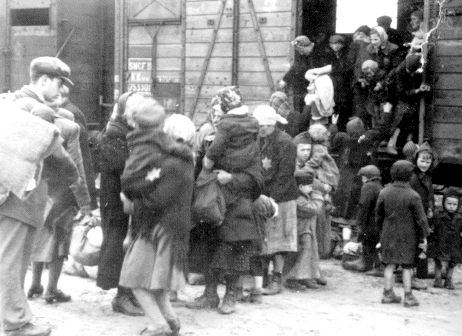
ChildrenBirkenau

Hungarian Jews being sent to Extermination Camps

Adolf Eichmann summed up the attitude of many when he said regarding his work to deport hundreds of thousands of Hungarian Jews to Auschwitz in in just a few weeks during the fall of 1944, “Whether they were bank directors or mental cases, the people who were loaded on those trains meant nothing to me.” Speaking to Willem Sassen in 1957 Eichmann reveled in that accomplishment, “It was an achievement that was never matched before or since.” Eichmann also enjoyed leading his victims on, pretending that he might listen, and they might change his mind. Eichmann was proud of what he did. He told his staff, “I will leap into my grave laughing because the feeling that I have five million human beings on my conscience is for me a source of extraordinary satisfaction.”

Hannah Arendt wrote of Eichmann:

“The trouble with Eichmann was precisely that so many were like him, and that the many were neither perverted nor sadistic, that they were, and still are, terribly and terrifyingly normal. From the viewpoint of our legal institutions and of our moral standards of judgment, this normality was much more terrifying than all the atrocities put together.”

This was what made the Holocaust committed against the Jews of Europe by Nazi Germany a phenomenon different than other genocides. Many of the perpetrators were not driven by centuries old hate as in the Balkans, tribal blood lust as occurred in Rwanda, or the products of Soviet Communism or Communist Chines Maoist regimes.

dachaumorgue1945

It was the racial ideology of the Nazis which deemed the Jews and other non-Aryans to be sub-human. That ideology undergirded the German treatment of the Jews, and the conduct of the war, especially in the East. But the execution of the plan required the bureaucratic, administrative, technical and legal skills brought to the table by ordinary men. Men who sought promotion, advancement and economic security for their families. Individually many would have never killed, but in their positions they ran the rail network, the factories, the banking and finance industries and supported the war effort, most not thinking much about the evil that they abetted or if they did finding a way, be it social, scientific, religious, patriotic, legal or simply in the name of efficiency.

Survivors of Auschwitz

That is what makes the evil committed by them so terrifying. It is the product of “normal” people in an advanced Western nation. Make no bones about it, their actions were evil. They aided and abetted the genocide of the Jews, the disabled, other “sub-human” races, particularly Slavs, as well as those that they deemed less than suitable.

I think that the most chilling thing about the Holocaust was that the greatest atrocities were committed by ordinary men, sometimes well educated, decent family men. These were men who simply executed orders and often went home at night. Arendt wrote that “The sad truth is that most evil is done by people who never make up their minds to be good or evil.” She was right, there was an ordinariness to the evil perpetrated by the Nazis, at the same time there are those who consciously decide to participate in evil.

It is important that we do not forget the Holocaust. It is also important to recognize that the instruments of that horror were on the whole “ordinary” men who as they saw it were simply doing their job. It is something that everyone needs to remember. Bettina Stangneth wrote “Systematic mass murder is not just the sum of isolated instances of sadism but the result of a political thinking that is perverted from the ground up.”

So many of the perpetrators saw nothing wrong in what they were doing, in fact at his trial in Jerusalem Eichmann said, “To sum it all up, I must say that I regret nothing.”

They believed that their victims were less than human and like so many people even today, they had no empathy. Gustave Gilbert, an American Army Psychologist at the major War Criminal Trials at Nuremberg said it so well: “Evil is the absence of empathy.”

It is important that we never forget, especially now when we could be watching it begin all over again.

Peace

Padre Steve+

3 Comments

Filed under civil rights, ethics, Foreign Policy, History, holocaust, iraq,afghanistan, laws and legislation, national security, nazi germany, News and current events, Political Commentary