Category Archives: Gettysburg

July 2nd at Gettysburg: Part 1, Preparations

The Enemy is There

Friends of Padre Steve’s World

For those that have followed my writing for some time you know that I teach military history and ethics at the Joint Forces Staff College. One of the great joys that I have is leading the Gettysburg Staff Ride, which is an optional event for students that want to participate. When I took the position here I took some of my older writings on Gettysburg and put them into a student study guide and text. That was two years ago. Then the text was about 70 pages long. It is now about 925 pages long and eventually I hope to get it published. When and if that happens I expect it to become two, and possibly three books.

This is the first of a series of articles that I will be posting potions of a chapter that I have rewritten about the critical battles on the south side of the battlefield on July 2nd 1863, the battle for Devil’s Den, the Wheatfield, the Peach Orchard, and the final repulse on Cemetery Ridge.

As you read this don’t just look at the events, but look at the people, and their reaction to the what they encountered on the battlefield, for that understanding of people is where we come to understand history.

So even if you are not a Civil War buff, or even a history buff, take the time to look at the people, their actions, and the things that made them who they were, and influenced what they did. History is about people.

So please enjoy,

Peace

Padre Steve+

Preparations

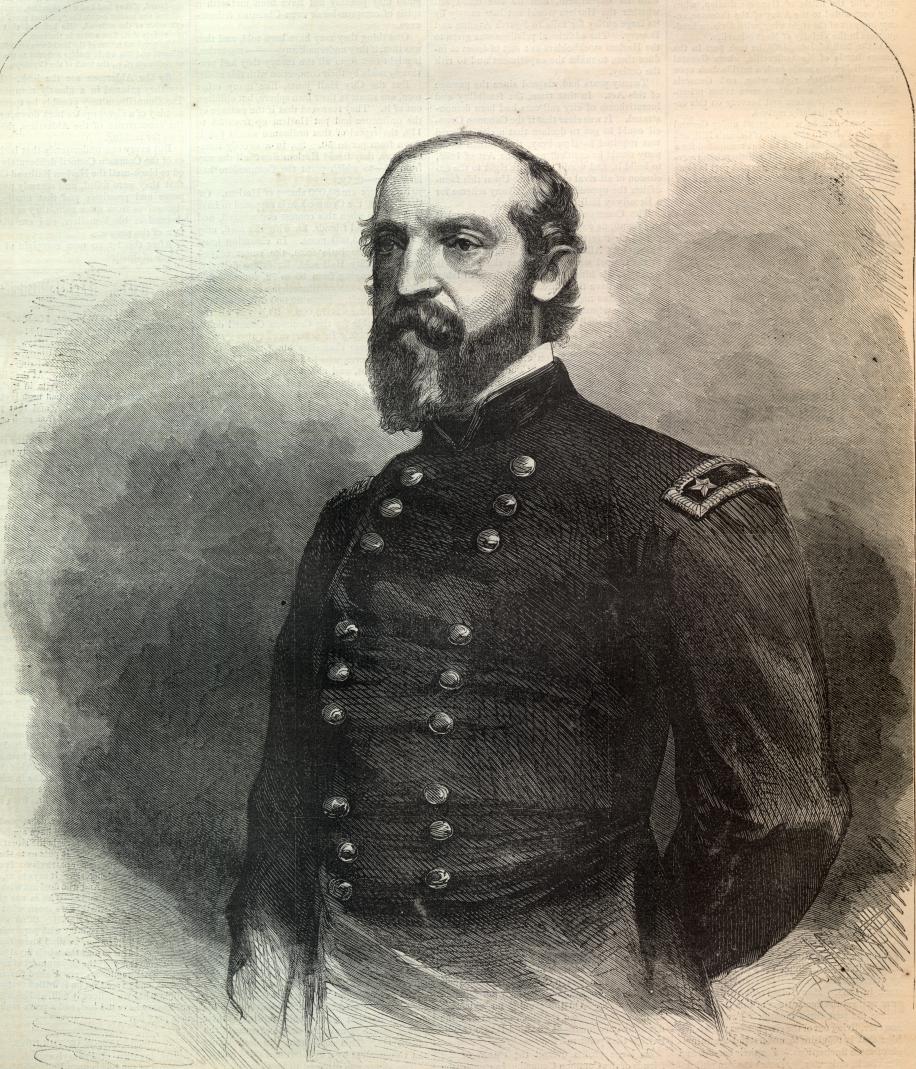
On July 2nd 1863 as on the first day of battle and throughout the Gettysburg campaign issues of command and control would be of paramount importance to both armies. On the second day the glaring deficiencies of Robert E Lee and his corps commanders command and control at Gettysburg would again be brought to the fore. Likewise the exemplary command of the Army of the Potomac by George Meade, Winfield Scott Hancock, staff artillery officer Henry Hunt and staff engineer Gouverneur Warren exemplified the best aspects of what we now define as Mission Command.

The definition of mission command as currently defined in American doctrine helps us in some ways to understand what happened on July 2nd 1863. Without imposing current doctrine on the leaders at Gettysburg, the definition describes the timeless aspect of leadership in battle and the importance of the human dynamic in war.

“Mission command is the conduct of military operations through decentralized execution based upon mission-type orders. Successful mission command demands that subordinate leaders at all echelons exercise disciplined initiative, acting aggressively and independently to accomplish the mission. Essential to mission command is the thorough knowledge and understanding of the commander’s intent at every level of command.” [1]

It is with this in mind that we look at the actions of various commanders during the critical second day of the battle of Gettysburg, and as we do so we also try to examine their lives and in a sense try to bring them to life. It is important because the actions of a number of commanders, including Robert E. Lee, George Meade, James Longstreet, Dan Sickles, and to a lesser degree A.P. Hill would be the subject of a great amount of controversy and partisan bickering that still lingers a century and a half later.

Confederate Consternation

Before the sun rose on July 2nd James Longstreet took stock of the situation. The burly commander of First Corps was now working to bring the divisions of McLaws and Hood from their bivouac sites west of Herr’s Ridge and onto the battlefield. While his divisions moved out, Longstreet met with Lee to again express his opposition to taking the offensive. He again brought up the subject of making a “broad turning movement around the enemy’s left flank that would place the Confederate army between the Federal capital and George Meade’s army.” [2] As he did the previous night, Lee again rebuffed Longstreet’s suggestion and apparently frustrated by Longstreet’s continued resistance to his decision Lee “walked off by himself, away from the conflict.” [3] Lee then left Longstreet and went to confer with Dick Ewell to discuss the possibility of attacking the Federal right, and he sent his staff topographical engineer, Captain Samuel Johnson to reconnoiter the Federal left.

At this point Lee had not yet decided where to attack. Again he conferred with Ewell about the possibility of attacking the Federal right, but Ewell again dissuaded him from doing so. Ewell insisted that a “daylight attack on Culp’s Hill or Cemetery Hill would be costly and of doubtful success.” [4] For a second time Lee brought up the possibility of Ewell redeploying his corps from its positions around the “fishhook” of the Federal line to the west where they could better support an assault on the Federal left, but as he had the previous night “Ewell persuaded the general commanding to leave his corps where it was.” [5] In doing so Ewell promised to create a demonstration on the Federal right when he heard Longstreet’s attack commence. But, “according to Fitzhugh Lee, He decided to turn Meade’s left with Longstreet’s corps, demonstrate against his centre and right with Hill’s and Ewell’s corps, and then convert this demonstration into a real attack directly Longstreet’s attack succeeded.” [6] Ewell’s corps was to be the “anvil against which Longstreet would smash whatever was left of the 1st and 11th Corps, or any other Union reinforcements might have arrived overnight.” [7] However, the position of Second Corps around the fishhook was a poor position. “It greatly extended the army’s lines, and confronted the most defensible part of the Federal lines.” [8] Likewise, the position offered little advantage for Ewell’s artillery.

By the time Lee returned to his headquarters the divisions of Hood and McLaws, with the exception of Law’s brigade of Hood’s division, “which had been “left by Hood on picket” below the pike stretching back to Chambersburg, and was far behind the others” [9] were marching onto the field and halted just west of Seminary Ridge while the Confederate leaders conferred. But Longstreet was also troubled by the absence of George Pickett’s division of Virginians, which due to the lack of cavalry had been left at Chambersburg to guard the Confederate supply trains and would not be available for action until late in the evening.

Captain Johnson returned to the headquarters following his reconnaissance of the Federal left. He reported that the Federal left was weakly held and that there were no Federal troops on the Round Tops. But Johnson’s reconnaissance was not nearly as thorough or accurate as he reported. Johnson made “no detailed sketches of the hazardously rough ground at the southern end of the Federal line” and gave “an inadequate picture of the obstacles to mass troop movement.”[10] Despite getting up to the Round Tops he did not observe the large number of Union troops from Sickles’ Third Corps in the woods to the north and northwest of Little Round Top. The latter omission appears to be more to bad timing, lack of attention, Johnson’s lack of familiarity with the terrain and lack of experience in conducting a reconnaissance that should have been undertaken by cavalry scouts.

Johnson arrived with his report as Lee was conferring with Hill and Longstreet. He traced his route on the map. Johnson’s replies to Lee’s questions satisfied Lee that the Federal left was again up in the air and unprotected as it had been at Chancellorsville. However, this was not the case. First, had Johnson taken the route that he described he “would have come upon the encampments of the Third Corps, located north and west of Little Round Top. He would have also encountered trouble from John Buford’s cavalry vedettes, some of whom were posted about Sherfy’s peach orchard.” [11] Johnson claimed to have gotten up to Little Round Top, and if he did the only way he could not have seen Federal troops was if he had gotten there “just after the guarding troops of the night had been withdrawn and just before their replacements had arrived.” [12] Even if that was the case it would have been hard for Johnson to miss the Third Corps troop bivouacs. The Federals might have been obscured from the Captain’s view by the morning mist, but “Johnson should have detected the noise of men and animals, drums and bugles.” [13] A more likely scenario is that the inexperienced Johnson went further south and scaled Big Round Top from which his report of seeing no troops would have been completely accurate, but the inaccuracies of Johnson’s report were to cause serious complications and consequences for Lee’s plan.

Johnson’s report convinced Lee of the soundness of his plan to roll up the Federal left. He again conferred with Longstreet and announced his intention to attack Meade’s left flank with Hood and McLaws divisions. Lee went directly to McLaws and described his plan. He desired McLaws division to move south to a position perpendicular to the Emmitsburg Road south of the Peach Orchard. McLaws said it was possible but wanted to make a personal reconnaissance and Longstreet objected to the position that Lee indicated for McLaws division. Longstreet said “No, sir, I do not want wish for you to leave your division,” and tracing with his finger a line perpendicular to that drawn on the map, said, “I wish your division placed so.” “No, General,” Lee objected, “I wish it placed just so.” [14] Lee’s statement ended the conversation and after another consult with Ewell, Lee returned to lay out his plan. As he left for his division McLaws recalled that “General Longstreet appeared if he was irritated and annoyed,… but the cause I did not ask.” [15]

The divisions of Hood and McLaws were still about a mile and a half to the rear of the Confederate line. As soon as those divisions were in position they would march south while attempting to remain unseen by Federal troops on the high ground to the east, and then wheel left and come up the Emmitsburg Road into what Lee believed was the rear of the Federal position. After his brief consultation with Ewell regarding the security of his left flank, Lee returned to check the progress of Longstreet. Longstreet had not been completely inactive. He had already sent out his artillery led by Porter Alexander to find a suitable position to support the impending attack, but he did not make any further consultations with Hood of McLaws, nor send any officers to make a further reconnaissance until receiving definitive orders from Lee to launch the attack. For some reason, perhaps his misunderstanding with Lee concerning the nature of the campaign, or Lee’s rejection of his course of action, Longstreet did not demonstrate his usual energy and the careful preparation that he showed in previous actions. His biographer, Jeffry Wert noted “He allowed his disagreement with Lee to affect his conduct….The concern for detail, the regard for timely information, and the need for preparation were absent. Or, as Moxley Sorrell admitted, “there was apparent apathy in his movements. They lacked the fire and point of his usual bearing on the battlefield.” [16]

Like all movements to contact made by large armies was fraught with logistical complications and irritating, yet unavoidable delays in moving large numbers of troops over unfamiliar terrain. Even if Longstreet had acted with greater alacrity, and if the Confederates at all levels had been more efficient managers, “it would take several hours for to march them a distance of four miles or more to the place where they would be deployed for battle.” [17] Lee desired for McLaws division to lead the assault. However, McLaws division was trailing Hood’s troops on the Chambersburg Pike west of town, and would have to pass around Hood’s division to take up its position in the Confederate van. Another delay occurred when Longstreet requested additional time for Law’s brigade of Hood’s division, marching up from Guilford to rejoin Hood before he began his movement. Lee acquiesced to Longstreet and Law’s men reached Hood about an hour later.

Lee’s plan required that Anderson’s division of Hill’s Corps would have to move first to take up a supporting position along Seminary Ridge so it could launch a supporting attack as Longstreet’s corps advanced up the Emmitsburg Road. However, elements of Anderson’s division had become embroiled in a firefight at the Bliss farm which delayed his movement to reach his start position for the attack. But in addition to this, lee complicated matters by not removing Anderson from Hill’s command and giving Longstreet operational control. Instead Lee, possibly to avoid hurting the “sensitive Hill by removing a division that had not yet fought with his corps, and yet allow Longstreet to call on Anderson without going through Hill, Lee instructed Anderson “to cooperate…in Longstreet’s attack.” [18] It was another example of Lee’s vague orders which plagued the campaign, as one historian observed, “This order was the vaguest he ever gave. He did not specify whether Anderson was to act under the orders of Longstreet, or of Hill. His new corps commander, or Lee’s own. He seemed to be reverting to the loose structure of his early days in command.” [19]

But even more importantly it was an offensive that required “careful coordination and expert timing. If his plan was sound, which is debatable, there was still the question of whether the army was equal to the task.” [20]

As the various Confederate commands struggled to get in position to attack, without being observed, the Army of the Potomac readied itself for action. After the near disaster of July 1st, the army had recovered its “operational balance, setting in place the systems necessary for command and control.” [21] Meade and his subordinates had chosen a strong position from which they could maximize their strengths, and in addition to this they ensured that each corps had established headquarters and reported their position to the army staff. Wireless was set up to allow Meade to communicate directly to Washington, while the army’s Signal Corps detachments set up observation points on every bit of high ground under Federal control, including Little Round Top, which allowed them communicate with Meade’s headquarters by semaphore. Meanwhile, Henry Hunt had brought up the reserve artillery and began refitting damaged guns while supervising the emplacement of newly arrived batteries along the Federal line. Even more importantly, unlike Lee whose exterior lines refusal to use semaphore created undue delays in communications, Meade’s little headquarters at the Leister house was “almost up to the line of battle and little time would be wasted in the transmittal of orders.” [22]
general-george-meade

Meade’s Defensive Preparation

On the morning of July 2nd the Army of the Potomac was mostly assembled on the high ground from Culp’s Hill to Cemetery Hill and along Cemetery Ridge. In the north and east, the Twelfth Corps under the command of Major General Henry Slocum held Culp’s Hill and protected the Federal right. His troops began fortifying the already formidable position as soon as they arrived on the night of July 1st and continued to strengthen their positions throughout the day.

413px-Gettysburg_Battle_Map_Day2

The battered remnants of the First and Eleventh Corps held Cemetery Hill where they had made their final stand on the night of July 1st. Oliver Howard retained command of Eleventh Corps, while Meade returned Doubleday to command of his division and brought John Newton from Sixth Corps to command the remnants of the battered First Corps. Winfield Scott Hancock’s crack Second Corps extended the line down southward down Cemetery Ridge. To Second Corps right was Dan Sickles’ Third Corps. George Sykes Fifth Corps was in reserve just to the north and east of Little Round Top, while John Sedgwick’s massive Sixth Corps was still enroute, marching up the Baltimore Pike. “The convex character of the Union line facilitated the rapid movement of troops to reinforce any threatened section.” [23] Unlike Lee’s troops who had to make long marches to support each other, the Union men “never had to march more than two and half miles, usually less.” [24]This would provide Meade with a vital advantage during the viscous battle that was to ensue on July 2nd and as the ever observant Porter Alexander noted, “Communication between our flanks was very long – roundabout & slow while the enemy were practically all in one convenient sized bunch. Reinforcements from their extreme right marched across in ample time to repulse our attack on their extreme left. But Ewell’s men could hardly have come to our help in half a day – & only under view & fire.” [25]

The Army of the Potomac now occupied a solid and well laid out position which commanded the battlefield. Meade and Warren were worried that Lee might attempt to turn them out of their position by moving south, as Longstreet was begging Lee to do, but in reality there was little threat. Even so, Major General Gouverneur Warren, the Army’s Staff Engineer Officer who had been sent by Meade to assist Hancock the night of the first wrote his wife that morning: “we are now all in line of battle before the enemy in a position where we cannot be beaten but fear being turned.” [26]

There was one notable problem, the commander of the Third Corps, Major General Dan Sickles did not like the position assigned to his corps on the south end of Cemetery Ridge.

To be continued…

Notes

[1] __________ Mission Command White Paper and JP 3-31

[2] Wert, Jeffry D. General James Longstreet The Confederacy’s Most Controversial Soldier, A Touchstone Book, Simon and Schuster, New York and London 1993 pp. 260-261

[3] Thomas, Emory Robert E. Lee W.W. Norton and Company, New York and London 1995 p.297

[4] Pfanz, Donald. Richard S. Ewell: A Soldier’s Life University of North Carolina Press, Chapel Hill and London 1998 p.315

[5] Sears, Stephen Gettysburg Houghton Mifflin Company Boston and New York 2004 p.256

[6] Fuller, J.F.C. Grant and Lee: A Study in Personality and Generalship, Indiana University Press, Bloomington IN 1957 p.197

[7] Guelzo, Allen C. Gettysburg: The Last Invasion Vintage Books a Division of Random House, New York 2013 p.236

[8] Ibid. Sears Gettysburg p.256

[9] Ibid. Guelzo, Gettysburg The Last Invasion p.237

[10] Dowdy, Clifford. Lee and His Men at Gettysburg: The Death of a Nation Skyhorse Publishing, New York 1986, originally published as Death of a Nation Knopf, New York 1958 p.186

[11] Trudeau, Noah Andre Gettysburg a Testing of Courage Perennial Books, Harper Collins Publishers, New York 2002 p.289

[12] Ibid. Dowdy Lee and His Men at Gettysburg p.186

[13] Ibid. Wert General James Longstreet p.262

[14] Pfanz, Harry W. Gettysburg the Second Day University of North Carolina Press, Charlotte and London, 1987 p.110

[15] Ibid. Trudeau Gettysburg a Testing of Courage p.290

[16] Ibid. Wert General James Longstreet p.268

[17] Coddington, Edwin B. The Gettysburg Campaign a Study in Command A Touchstone Book, Simon and Schuster, New York 1968 p.376

[18] Ibid. Dowdy Lee and His Men at Gettysburg p.193

[19] Ibid. Dowdy Lee and His Men at Gettysburg p.193

[20] Ibid. Coddington The Gettysburg Campaign p.384

[21] Ibid. Trudeau Gettysburg a Testing of Courage p.292

[22] Cleaves, Freeman Meade of Gettysburg University of Oklahoma Press, Norman and London 1960 p.142

[23] Ibid. Coddington The Gettysburg Campaign a Study in Command p.332

[24] Ibid. Coddington The Gettysburg Campaign a Study in Command p.332

[25] Alexander, Edward Porter. Fighting for the Confederacy: The Personal Recollections of General Edward Porter Alexander edited by Gary Gallagher University of North Carolina Press, Chapel Hill 1989 p242

[26] Jordan, David M. Happiness is Not My Companion: The Life of G.K. Warren Indiana University Press, Bloomington Indiana 2001 p.89

Leave a comment

Filed under civil war, Gettysburg, History, Loose thoughts and musings, Military

Incredible Scoundrel Pt.2: A Murder in Washington

philip-barton-key-granger

Friends of Padre Steve’s World

I am a historian as well as a chaplain and priest. I do a lot of work with the Battle of Gettysburg and much of my work involves biography as I believe that the one constant in history is people. Technology and many other things may change, but people and human nature are constant, for good and for bad, and frankly I find people fascinating.

One of the most fascinating people of the Battle of Gettysburg is Union Major General Daniel E. Sickles, a man who was one of the most fascinating, salacious, scandalous, and incredible figures ever to grace and disgrace American history.

This is the second of a three part series taken from my Gettysburg and Civil War text. I hope that you enjoy.

Peace,

Padre Steve+

Within a year of his assignment Sickles returned to the United States to help prepare the Democratic nomination for his friend Buchanan who had long desired the office, and return to his lucrative post in New York. In the spring of 1856 Sickles began to work on Buchanan’s nomination for the Presidency and while doing so began his own campaign for New York’s Third District’s Congressional seat. Buchanan won the election of 1856 against an opposition divided between the Know Nothing candidacy of former President Millard Fillmore and the candidate of the new Republican Party, John C. Fremont.

In the election of 1856, Sickles carried the district easily. For Sickles it was a triumph, he was “riding a flood tide of political fortune that might carry him far,” [1] and like any wife Teresa too was delighted with the result. Even so, Teresa must have wondered if her husband would mend his ways now that he was on the national spotlight, or if he would continue his extramarital romps around the nation’s capital. Following the election Dan and Teresa moved to Washington D.C. where they took up a fashionable residence, the Stockton Mansion, on Lafayette Square, not far from the White House and Sickles friend, James Buchanan.

Once he was established in Washington Sickles was in his element, politics at its grandest. It was a different style than of politics than Tammany, where brass knuckled force often ruled, but it suited Sickles, who was “a fixer who knew all the tricks of Tammany at its crookedest but who seems not to have taken graft himself. He had his sights fixed on the presidency, and he was making about as much progress in that direction as a Tammany man can,” [2]   until a strange combination of unrequited love, infidelity, the personal betrayal of a friend, and a murder intervened.

HarpersMagazineMrs.Sickles

Teresa Sickles

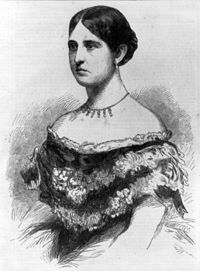
While her husband politicked along the Potomac, the new congressman’s wife was adapting to her life in Washington D.C. The wives were expected to entertain and host parties on a regular basis at their residences, but they also knew their share of loneliness and neglect. Since legislators routinely were “busy with night sessions, committee meetings, and plain nocturnal politicking over whiskey punch, that their wives either accepted other escorts or spent lonely evenings at home with fancywork or a book.” thus it was not surprising that Teresa, “should seek the gayety of the capital in her first year there.” [3] In the absence of their husbands it “was not uncommon for available bachelors to act as escorts for married women when their husbands were unavailable.” [4] Since Dan Sickles was frequently unavailable and since Teresa probably still suspected that Dan was still engaged in extramarital affairs, it is not surprising that the young Mediterranean beauty found comfort in another man.

The years of 1857 and 1858 would be a tumultuous time for the nation as well as the Sickles. Buchanan had been elected because of his stability and moderation in an age of pro and anti-slavery radicalism. However, over the next year his presidency, and his would be overwhelmed by events and Buchanan’s decisions supporting the expansion of slavery. While Sickles was neither a slave owner, nor himself fond of the institution, it was part of life, and many of his friends in Washington D.C. and in Congress were slave holders. Buchanan had schemed before his inauguration with Chief Justice of the Supreme Court Roger Taney in the Dred Scott decision, which was handed down in the days following Buchanan’s inauguration, followed by the fiasco over the Lecompton constitution and the attempted admission of Kansas as a Slave State, an event which split the Democratic party in the 1860 election, ensuring Abraham Lincoln’s defeat of Buchanan’s Lecompton foe in the Senate, Senator Stephen A. Douglas who would have been the prohibitive favorite in the election had the split not occurred.

Likewise, Sickles and his beautiful young wife would become part of one of the most sensational trials of American history, rivaling the Lindbergh kidnapping trial, the trial of O.J. Simpson, the Scopes Monkey Trial, and the Impeachment of President Bill Clinton in its captivation of America. As in London, Teresa became popular and she and Dan were much sought after and their home “became the scene of a gradual number of and entertainments,” [5] and even as Sickles continued his robust politicking and philandering Teresa became the object of another’s affection, the District of Attorney for the District of Columbia, Philip Barton Key, the son Francis Scott key, the writer of the Star Spangled Banner. Interestingly enough it was Sickles who had helped Key the troubled man to be reappointed to his office in early 1857 after Key had helped Sickles overcome legal and financial difficulties to secure Sickles in the Stockton Mansion and the two men developed a warm friendship.

Philip Key was extraordinarily handsome, especially when outfitted in his green and gold militia uniform of the Montgomery Guards, and was considered one of the most desirable men in Washington. An accomplished horsemen he rode about town on his “horse Lucifer – a nobly bred, dapple gray hunter.” [6] When he gained Sickles’ friendship many of his well to do political and society friends became frequent visitors to the Sickles household. After Sickles had helped Key to be reappointed to his office, Key was instrumental in helping make the arrangements for Sickles to rent the Stockton Mansion.

During his first term in office Key was not known for being a particularly good District Attorney and spent much time away from the office complaining about his allegedly poor health. But his health did not keep him away from Washington’s party scene and “One hostess called him “the handsomest man in all Washington… he was a prominent figure at all the principle functions; a graceful dancer, her was a favorite of every hostess of the day.” [7] When he met Teresa, the dashing bachelor took an intense interest in the wife of the man who had helped him retain his job. The two were soon attending many functions together that Sickles, due to his work schedule could seldom attend.

Within weeks Key became a frequent guest at the Sickles home and few were surprised at this, as most observers knew that Sickles was responsible for Key’s reappointment. With Sickles now fully engaged in the dramatic political battles of late 1857, Teresa and Key began to spend much more time together. The two were seen together at the “theater, at teas, at hops. But most of all they went riding together.” [8] The frequency of these visits was noted and became the source of much gossip but Sickles was unaware of it and entertained no suspicions that his new friend was becoming deeply involved with his wife, and that Key had rented a room where the two could intimate.

That was until a young man equally smitten by Teresa had a few drinks with a colleague and the colleague shared the information with a loyal Sickles ally who then told Sickles. Sickles was shocked and called for a meeting with Key, however, after a brief conversation, Key convinced Sickles that there was nothing to the rumors, and Sickles was satisfied.

Though Sickles had been satisfied by the explanation, “despite his own well-publicized moral lapses, Daniel Sickles was a man of intense personal pride who would not countenance the breath of scandal attaching to his wife.” [9] He took the time to warn her to make sure that she was not involved in any other indiscretions, and left the subject. However, Key and Teresa continued to see each other, and “she and Barton thought that they were taking more care, and being less observed by people than they were.” [10] Yet as they pursued one another their affair became increasingly public, and seen by too many people not to go unnoticed. The two were seen together in at the Congressional Cemetery, and frequently at a house at “385 15th Street where he would enter the by the front door – and she the back.” [11] When a mutual friend expressed his concerns, Key shrugged off the warning, and “with the bravado of a proud weakling, he still held his course. And Teresa, ductile, enamored, blindly followed his lead.” [12] Another friend of Key suggested to him that he could be in danger, but Key “bridled and patted the breast of his coat. “I am prepared for any emergency,” he snapped. Key was a crack pistol shot and his friend believed that Key was preparing for a possible confrontation. [13]

Like so many people young spouses who find their needs unfulfilled at home, and who suspect their spouse of infidelity, , “Teresa did not see this love affair as tragic and dangerous. She lived within it as a secret fantasy, as in a virtual and time-consuming experience that lacked any power to inflict damage on other areas of her life.” [14] She became less discreet, Key would signal to her from across the street to confirm their dalliances and despite their insipidly inept attempt to hide the affair it became clear to Sickles’ coachman and household maids that the two were engaged in sexual encounters in the Sickles carriage and in the Stockton Mansion itself.

The situation finally came to a head in February 1859 following Sickles reelection and return to Washington. “Made more reckless than ever by their recent separation, Barton and Teresa now again were seen everywhere together.” [15] The couple were now making clandestine liaisons on a nearly daily basis, and eventually, one of the observers decided to tell Sickles. The anonymous source, using the initials of R.P.G. sent Sickles a letter detailing the affair. Sickles received the letter from a butler on the night of Thursday February 24th as he was leaving the usual dinner party at his house for the traditional hop that followed at the Willard Hotel.

Sickles did not read the letter until after the couple returned home and Teresa had gone to bed. Sickles was stunned and at first did not believe the contents as he placed little stock in anonymous messages. So he had George Wooldridge, a longtime friend and congressional clerk investigate, and on Saturday February 26th Wooldridge confirmed Sickles worst fears. That evening at their home Sickles confronted Teresa about the letter and as he stormed about angrily in their bedroom she confessed, after which Sickles had her write out her confession detailing everything. He may have been desolate and angry, but he was a lawyer, and he got his written proof.

But scandal was the last thing that Sickles wanted, as he had higher aspirations in politics, so he immediately called his friends for counsel and by Sunday morning several, including Wooldridge and Samuel Butterworth were at the Stockton Mansion with Sickles. As always, Sickles’ “first thoughts were for himself, and he melodramatically”[16] exclaimed to Butterworth, “I am a dishonored and ruined man…I cannot look you in the face.” [17]

4P8V9475

Murder

His friends “were profoundly touched by the depth of his feeling, and were convinced that he needed to be saved from a severe derangement of his senses; from lunacy, that is.” [18] his friends attempts to calm him, Sickles was beside himself with anger, and his anger now swirled around his marriage and what he believed was the scandal that would cost hi his career. That afternoon, Key again tempted fate, this time, for the last time. He had been tipped off by an anonymous letter that the affair was public, but he was determined to see Teresa. He made several passes by the house, each time signaling with a handkerchief, until Sickles observed him. Sickles called out to Butterworth “That villain has just passed my house! My God, this is horrible!” [19]

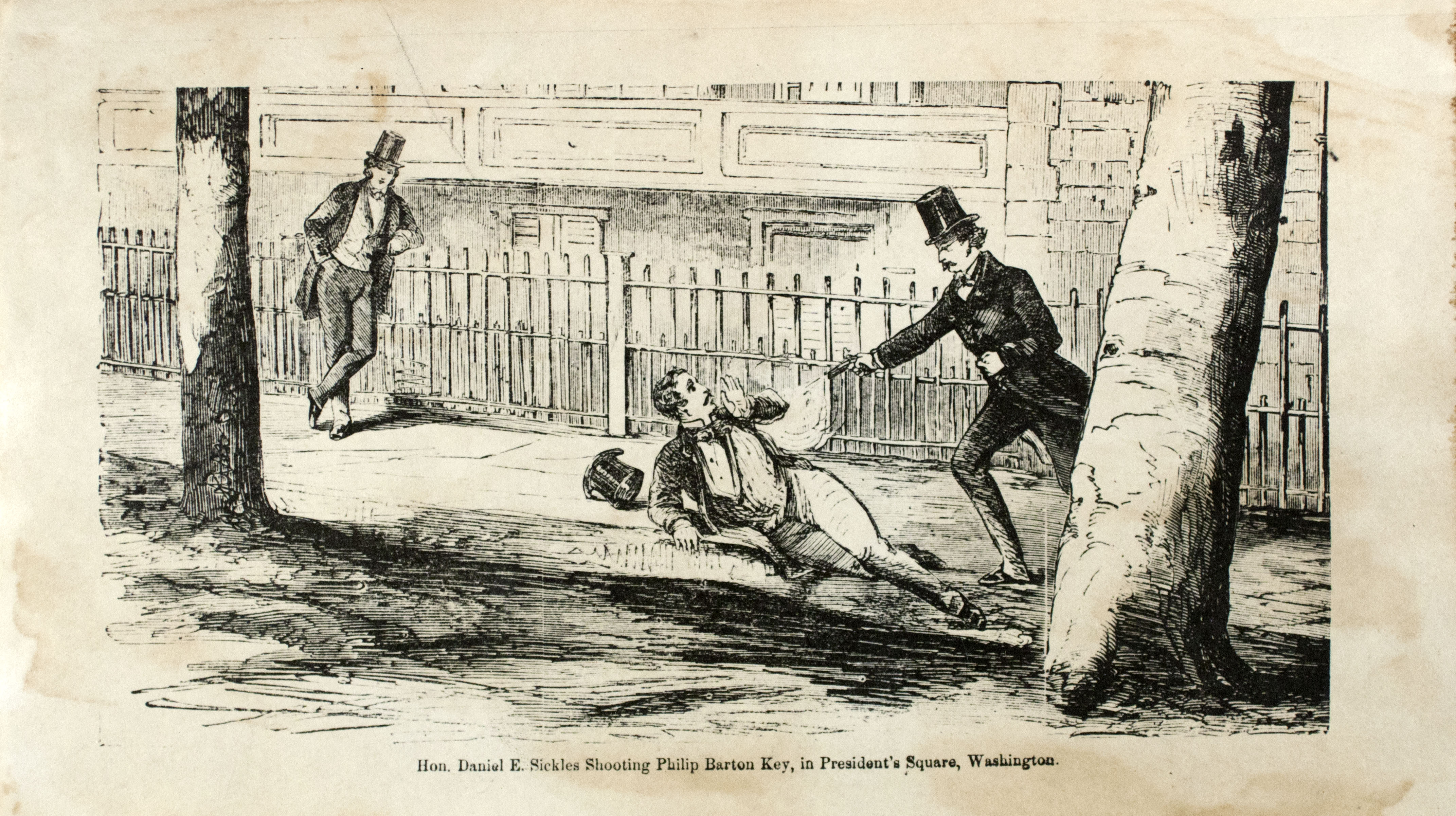
Butterworth left the house first and met Key at the southeast corner of Lafayette Square across from the White House. Allegedly not knowing Sickles intended any harm, Butterworth walked with Key to for a few minutes and then left. The exchange delayed Key and gave Sickles, who had armed himself with a single shot large caliber Derringer, and a muzzle-loading Colt revolver, enough time to catch up with Key near the Club House on Madison on the east side of the square. Sickles was raving but Dan’s fury transcended reality,” [20] as at least a dozen witnesses were nearby as he screamed, “Key, you scoundrel, … you have dishonored my bed – and you must die!” [21] Sickles pulled out the revolver, the first shot from which grazed Key, and the second which misfired. A brief scuffle ensued as Key lunged at his assailant, but Sickles flung him to the ground, and drew the Derringer as Key threw the opera glasses that he viewed Teresa at Dan. A third shot hit Key in the groin and he slumped to the ground screaming “Murder! Murder!… Don’t shoot!” [22]

If there was a chance for Sickles to prove that he acted in self-defense it was now, but he could not control himself. He fired the revolver yet again and it misfired. He placed the weapon in his pocket and drew the Derringer, and fired a shot which hit Key in the Liver. As Key writhed on the ground Sickles tossed the Derringer to the ground and he again drew the Colt. As the stunned witnesses to the attack looked on, Sickles advanced toward the fallen Key and placed the gun at his head and pulled the trigger, but again the weapon misfired. As Sickles attempted to place another cap in the pistol, a number of witnesses began to intervene. One man, “a member of the club, running up, stopped him. Mr. sickles – for God’s sake!” And Butterworth, coming forward, took Dan by the arm. Without a word, they walked away together.” [23] Witnesses took the mortally wounded Key away to the Club, where he expired.

President Buchanan was almost immediately told of the murder by a White House page boy, was aware of the implications of the scandal, Sickles was a friend and political ally with much promise. Buchanan told the boy leave town and gave him a sum of money to facilitate his departure. Soon after Sickles and Butterworth went by carriage “to the home of Attorney General Black, where the Congressman formally surrenders himself to the silver-haired Cabinet member who had regarded him as a protégé.” [24] He declined bail in favor of a speedy trial, was allowed to go home where he told Teresa that he had killed her lover, retrieved some personal items and then went to the District jail, “a foul hole, swarming with vermin, destitute of sewage, bath, water, ventilation, and so inadequate to its purpose that often a dozen or more prisoners were herded into a single narrow cell.” [25] When he arrived he reportedly asked the jailer if they were the best accommodations available, to which the jailer responded “this is the best place you members of Congress have afforded us.” [26] Dejected, but undeterred Sickles sent a message to the public, “In doing what I had to do I have broken the law. Therefore I place myself behind bars. It is for you to set me free.” [27] The stage was now set for the one of the most unbelievable and storied trials in American history.

Notes

[1] Ibid. Swanberg Sickles the Incredible p.4

[2] Ibid. Catton The Army of the Potomac: Glory Road p.151

[3] Ibid. Swanberg Sickles the Incredible p.15

[4] Ibid. Hessler Sickles at Gettysburg p.8

[5] Ibid. Swanberg Sickles the Incredible p.16

[6] Ibid. Pinchon Dan Sickles p.74

[7] Ibid. Hessler Sickles at Gettysburg p.9

[8] ibid. Swanberg Sickles the Incredible p.20

[9] Ibid. Swanberg Sickles the Incredible p.25

[10] Ibid. Keneally American Scoundrel p.92

[11] Ibid. Wilson and Clair They Also Served p.99

[12] Ibid. Pinchon Dan Sickles p.94

[13] Ibid. Swanberg Sickles the Incredible p.44

[14] Ibid. Keneally American Scoundrel p.92

[15] Ibid. Pinchon Dan Sickles p.93

[16] Ibid. Hessler Sickles at Gettysburg p.10

[17] Ibid. Swanberg Sickles the Incredible p.53

[18] Ibid Keneally American Scoundrel p.121

[19] Ibid. Hessler Sickles at Gettysburg p.10

[20] Ibid. Keneally American Scoundrel p.127

[21] Ibid. Swanberg Sickles the Incredible p.54

[22] Ibid. Hessler Sickles at Gettysburg p.11

[23] Ibid. Pinchon Dan Sickles p.112

[24] Ibid. Swanberg Sickles the Incredible p.55

[25] Ibid. Pinchon Dan Sickles p.114

[26] Ibid. Keneally American Scoundrel p.135

[27] Ibid. Swanberg Sickles the Incredible p.114

3 Comments

Filed under civil war, crime, Gettysburg, History, laws and legislation, Political Commentary

The Road to Gettysburg: Lee is Puzzled as Meade Acts

Lee1

General Robert E. Lee

Friends of Padre Steve’s World

For those that have followed my writing for some time you know that I teach military history and ethics at the Joint Forces Staff College. One of the great joys that I have is leading the Gettysburg Staff Ride, which is an optional event for students that want to participate. When I took the position here I took some of my older writings on Gettysburg and put them into a student study guide and text. That was two years ago. Then the text was about 70 pages long. It is now about 870 pages long and eventually I hope to get it published. When and if that happens I expect it to become two, and possibly three books.

This is the third of a series of articles that I will be posting potions of a chapter that I have rewritten about the surprises that various commanders experienced on June 28th 1863. The lessons for today are that war, any war, is the realm of chance, as such, surprises always happen. It is said that no plan survives first contact with the enemy, but some plans don’t survive that long. As you read this don’t just look at the events, but look at the people, and their reaction to the surprises that they encountered, for that is where we come to understand history.

So even if you are not a Civil War buff, or even a history buff, take the time to look at the people, their actions, and the things that made them who they were, and influenced what they did. History is about people.

So please enjoy,

Peace

Padre Steve+

Any commander that embarks on a high risk offensive operation in enemy territory must do so with great care, especially in regard to command and control of his forces. This is especially true regarding reconnaissance. By June 28th Lee had been operating blind for well over a week, and this was in large part his own fault.

There are two reasons for this. The first of these was his decision regarding Stuart’s cavalry. The orders that Lee issued were so vague that Stuart was free to interpret them in any way that suited him. The result was that Stuart and the cavalry that Lee was counting on to screen his own army and keep tabs on the Federal army was well to the east and completely useless to Lee. Now Lee was reaping the fruit of his carelessness and overconfidence as he bemoaned his lack of contact with Stuart.

The second reason is that Lee failed to wisely employ the cavalry that he did have available, which by all means should have been enough to provide what Lee needed. After all, Lee still had three brigades of Stuart’s Cavalry Division available, but none were in a position to assist his reconnaissance needs. Some of this is Stuart’s fault, and some the fault of the commander of the forces left behind to screen Lee, but at least some of the blame for this has to be laid at the feet of Lee. Robertson’s and Jones’ brigades were still deep in Virginia guarding Snicker’s and Ashby’s Gap. Imboden’s Brigade was to the west at Hancock Maryland. Jenkins’ brigade, which was not a part of Stuart’s division, was far to the front with Ewell’s Corps.

Had Robertson followed Stuart’s orders “Lee would not have felt the want of adequate cavalry support” [1] but since Robertson had remained stationary Lee had nothing available when he needed it and made no effort to bring these units up to help.

In selecting Jones’ and Robertson’s brigades for the mission of screening Lee, Stuart made a critical mistake. Jones and Robertson both had serious deficiencies as leaders and proved that neither had Lee’s “confidence or understood his expectations…and Stuart badly misread the amount of personal connection his superior required.” [2] Jones was actually the better officer, but was junior to Robertson who failed miserably.

While Lee’s orders to Stuart allowed him to go off on his mission, Lee still had plenty of cavalry available had he employed it well. However, Lee employed it in a woeful manner and did not take the steps necessary to ensure that the commanders assigned understood his expectations. This was another critical mistake made by Lee. Alan T. Nolan wrote: “There seems to be no excuse for Lee’s finding himself at Chambersburg on the 28th without a single regiment of cavalry” [3] The tragic thing for the Confederacy was that Lee would make this same mistake in failing to communicate his intent with other subordinates throughout the campaign.

Late on the night of June 28th Lieutenant General James Longstreet “was woken by someone banging on his tent pole.” [4] It was his assistant Inspector General, Major John W. Fairfax. Fairfax had with him a man claiming to have information on the movement and location of the Army of the Potomac. The man’s name was Henry Thomas or “Harry” Harrison and he was an actor. Longstreet hired him as a “scout” or what we would now term a spy during the Suffolk campaign. Longstreet paid Harrison in U.S. dollars versus Confederate money, something that Moxey Sorrel said was worth it because he “always brought us true information.” [5]

Harrison was described as an “altogether an extraordinary character” [6] by Sorrel, and was one of those mysterious figures that occasionally show up in the context of a historical event and make it even more interesting. Very few senior Confederate commanders employed spies, “but Longstreet, with his usual care for detail, saw that his spies were well chosen and diligent.” [7] On this expedition Longstreet paid Harrison in gold and instructed him “to travel to Washington and secure any information he could obtain.” [8] He gave the spy a long leash and told him “I did not care to see him again till he could bring me information of importance.” [9]

Harrison arrived at Longstreet’s headquarters having been detained by men of Pickett’s division “dirt-stained, travel-worn, and very broken down.” [10] The spy brought Longstreet the first information about the whereabouts and situation of the Army of the Potomac that the army had since before Brandy Station.

Harrison brought news of Hooker’s relief and replacement by Meade as well as the location of the Federal army. He noted the location of John Buford’s Cavalry division as well as the location of five of the Army of the Potomac’s seven army corps, all of which were too close for comfort. Though his information was now almost two days old it was shocking. While Lee and his subordinates believed that the Army of the Potomac was still south of the Potomac, Harrison reported that “Hooker’s army had begun crossing the river three days before and was now well up into Maryland.” [11] The information was

Questioned by Longstreet about the location and activities of Stuart, Harrison could give no information, but the news that he brought was electrifying, and Longstreet immediately sent Harrison accompanied either by Sorrel or Fairfax to Lee’s headquarters.

Lee’s aide Walter Taylor noted “Great was his surprise and annoyance, therefore, when on June 28th he received information from one of the scouts to the effect that the Federal army had crossed the Potomac…” [12] Lee distrusted spies and did not employ them, but when whichever aide was present “vouchsafed for Longstreet’s confidence in him” [13] Lee “listened to Harrison’s report with “great composure and minuteness.” [14] The “contents, timing, and source of the spy’s report bothered Lee.” It was upsetting, especially since it “was brought by a person unknown to him whose word had to be taken on faith” [15] rather than from Stuart who he implicitly trusted.

However, Lee was “very reluctant to make a move without confirmation of his cavalry.” [16] Lee was skeptical of the report given by Harrison, especially because Stuart had not reported anything. He told Fairfax “I do not know what to do….I cannot hear from General Stuart, the eye of the army. What do you think of Harrison? I have no confidence in any scout, but General Longstreet thinks a good deal of Harrison.” [17]

Lee’s puzzlement at finding the federal army across the Potomac is curious. As early as June 23rd he had known of the pontoon bridge being built over the Potomac. However, Lee decision making process seemed paralyzed by the absence of Stuart. The surprise of the Union Army being concentrated so near him took away Lee’s ability to retain the initiative of a campaign of maneuver.

Because his army was so scattered he was now in danger of being hit and defeated in detail by the Federal army, “Meade, in short, might be able to do what he had planned to do to Hooker- defeat him in detail.” [18] It was a dangerous position for him to be in and he knew it. In a sense he was fortunate that on June 28th the Army of the Potomac was in the midst of changing command and thus unable to strike while his army was so vulnerable.

With the knowledge that the Federal army was near Lee acted with alacrity to concentrate his army in the Cashtown and Gettysburg area. “Within eight hours of Harrison’s report to Lee” [19] Lee had set in motion orders to all commands of his scattered army. Lee still had “no idea of the whereabouts of the enemy’s forces beyond what Longstreet’s spy had just told him- information that was already twenty-four hours old,” and he did have “any idea of how to remedy this intelligence gathering void.” [20]

Lee knew precious little other than the fact that “Hooker’s army, now under Meade, was across the mountain from him and that it was Stuart who was still in Virginia.” [21] He had learned the latter information from Captain James Power Smith who informed Lee that he had met two troopers of Stuart’s division who:

“casually told him that on the preceding day (Saturday the 27th) that they had left the main body of cavalry under Stuart in Prince William County back in northern Virginia. When Smith passed on this information, General Lee, he said, “was evidently surprised and disturbed.” [22]

Another consequence of his lack of available cavalry was that he had to leave Pickett’s division to guard the rear until Imboden’s cavalry could arrive to take up the task. Imboden’s troops had been far to the west completely away from the army when Lee discovered their location. Because of this Pickett’s division was detained to guard the army’s trains far to the rear of the march. This would be another unfortunate consequence of Stuart’s absence that would plague Lee during the battle, especially on July 2nd, when Longstreet’s corps would be without Pickett’s troops as they assaulted the Federal left.

On the afternoon of June 29th Lee met with a number of officers and his outward calm was still present. He told them “Tomorrow, gentlemen, we will not move to Harrisburg, as we expected, but will go over to Gettysburg and see what General Meade is after.” [23] When questioned by his subordinates about the relief of Hooker, and by his replacement by Lee’s former subordinate, Meade, Lee noted “General Meade will commit no blunder in my front, and if I make one he will make haste to take advantage of it.” [24]

Despite his surprise Lee was still confident. He had not fully appreciated Harrison’s information. He believed that instead of concentrating for battle that “the Army of the Potomac was shaking itself into pieces that Lee could turn upon and beat one by one, with the all the odds in his favor.” [25] Likewise he was confident that Meade would be so cautious as to not seek out an engagement, or would if forced by Washington attack him on ground of his choosing.

Implicit in Lee’s orders to concentrate east of the South Mountain range near Gettysburg was “his deliberate challenge to the enemy.” [26] Rather than waiting for the Federals to come after him he would seek them out. When John Bell Hood visited Lee, Lee remarked “Ah! General, the enemy is a long time in finding us….If he does not succeed soon, we must go in search of him.” [27] In moving his army east, “he gave away his exact location….By June 29th the approach of the Confederate army was evident to the people of Gettysburg.” [28]

Meade too had recognized the importance of Gettysburg and began to move his forces toward the town even as Lee tried to concentrate his army. On the evening of June 29th Meade sent the 1st Cavalry Division under the command of Brigadier General John Buford, a seasoned Indian fighter ahead to Gettysburg. In Buford Meade had something that Lee currently was missing, an outstanding cavalry officer in the time and place that he needed one. “Buford was a supremely confident and tenacious soldier” [29] who would provide Meade with the information that he needed to enter the battle, while Lee was practically blind due to the absence of Stuart and the mishandling of the cavalry that he should have had available.

While Lee’s army was still greatly scattered and few divisions in a place that they could provide support to each other, Meade was concentrating his army. After ordering Buford to Gettysburg he stopped the advance towards the Susquehanna and “redirected the 1st, 3rd and 11th Corps north toward Emmitsburg and the Pennsylvania state line, and the 2nd, 5th, 6th and 12th Corps to the northeast toward Pipe Creek and Taneytown.” [30]

Buford arrived and survey the ground around Gettysburg. He reconnoitered all the ridges to the front as well as Cemetery Hill and Ridge and there was nothing that his trained eye missed. Noting how the Schoolhouse Ridge, Herr’s Ridge, McPherson’s Ridge and Seminary Ridge offered successive lines of good ground for defense, and that Cemetery Hill provided a rally point he thought his plan through. He realized that the Confederates would have to come up to Gettysburg along the Cashtown Pike and that even a small force such as his could delay the enemy advance.

With that in mind, Buford made his decision. He convinced himself that “he could pull off something never achieved in this war: a defense in depth by dismounted cavalry against a large force of foot soldiers with artillery support.” [31] He also took into account the approach of Ewell’s troops from the north, and deployed one of his brigades to watch it. It was a calculated risk, if the Federal infantry did not come up to support him in time, it would risk the annihilation of his division, but if successful it would ensure that Meade’s army would hold excellent defensive ground.

Buford had a keen eye for terrain and instantly recognized that the area around Gettysburg was favorable ground. He also through the hard work of his troops surmised that Hill’s Third Corps with the divisions of Heth, Anderson and Pender would approach from the west, while Ewell’s Second Corps with the divisions of Rodes, Early and Johnson would come to Gettysburg from the north and east and provided that information to Reynolds and Meade. He again proved his “reputation as an expert gather of intelligence.” As one historian observed “this was cavalry scouting and reporting at their best, a model of precision and accuracy, with fact carefully separated from rumor.” [32]

On the morning of June 30th, Buford detected the Confederate infantry of Pettigrew’s brigade to the west of the town. Buford knew that the battle was to be there and sent word back to John Reynolds, commander of I Corps:

“Have Occupied Gettysburg. Contacted large force of Reb infantry. I think they are coming this way. Expect they will be here in force in the morning.”[33]

Notes

[1] Ibid. The Gettysburg Campaign, A Study in Command p.184

[2] Ibid. Trudeau Gettysburg, A Testing of Courage. p.69

[3] Nolan, Alan T. R.E. Lee and July 1 at Gettysburg in The First Day at Gettysburg, Gallagher, Gary W. Editor, Kent State University Press, Kent Ohio 1992 p. 20

[4] Korda, Michael. Clouds of Glory: The Life and Legend of Robert E. Lee Harper Collins Publishers, New York 2014 p.542

[5] Wert, Jeffry D. General James Longstreet: The Confederacy’s Most Controversial Soldier, A Touchstone Book, Simon and Schuster, New York and London 1993 p.237

[6] Ibid. Wert General James Longstreet p.237

[7] Ibid. Freeman Lee’s Lieutenants p.551

[8] Ibid. Wert General James Longstreet p.254

[9] Ibid. Guelzo Gettysburg: The Last Invasion p.113

[10] Ibid. Wert General James Longstreet p.237

[11] Ibid Sears. Gettysburg. p.124

[12] Taylor, Walter. General Lee: His campaigns in Virginia 1861-1865 With Personal Reminiscences University of Nebraska Press, Lincoln Nebraska and London, 1994 previously published 1906 p.184

[13] Ibid. Wert General James Longstreet p.255

[14] Ibid. Guelzo Gettysburg: The Last Invasion p.113

[15] Ibid. Coddington The Gettysburg Campaign, A Study in Command p.181

[16] Ibid. Wert A Glorious Army p.237

[17] Ibid. Freeman Lee p.320

[18] Ibid. Foote The Civil War, A Narrative. Volume Two pp.462-463

[19] Ibid. Foote The Civil War, A Narrative. Volume Two p. 463

[20] Ibid. Sears Gettysburg p.124

[21] Dowdy, Clifford. Lee and His Men at Gettysburg: The Death of a Nation Skyhorse Publishing, New York 1986, originally published as Death of a Nation Knopf, New York 1958 p.49

[22] Ibid. Dowdy Lee and His Men at Gettysburg p.48

[23] Ibid. Freeman Lee p.321

[24] Ibid. Freeman Lee p.321

[25] Ibid. Guelzo Gettysburg: The Last Invasion p.114

[26] Ibid. Sears Gettysburg p.133

[27] Ibid. Sears Gettysburg p.114

[28] Ibid. Coddington The Gettysburg Campaign, A Study in Command p.195

[29] Ibid. Korda Clouds of Glory p.544

[30] Ibid. Guelzo Gettysburg: The Last Invasion pp.115-116

[31] Longacre, Edward G. John Buford: A Military Biography Da Capo Press, Perseus Book Group, Cambridge MA p.185

[32] Ibid. Longacre John Buford p.187

[33] Shaara, Michael. The Killer Angels. Ballantine Books, New York. 1974 p.40


Leave a comment

Filed under civil war, Gettysburg, History, leadership, Military

The Road to Gettysburg: Meade Takes Command

general-george-meade

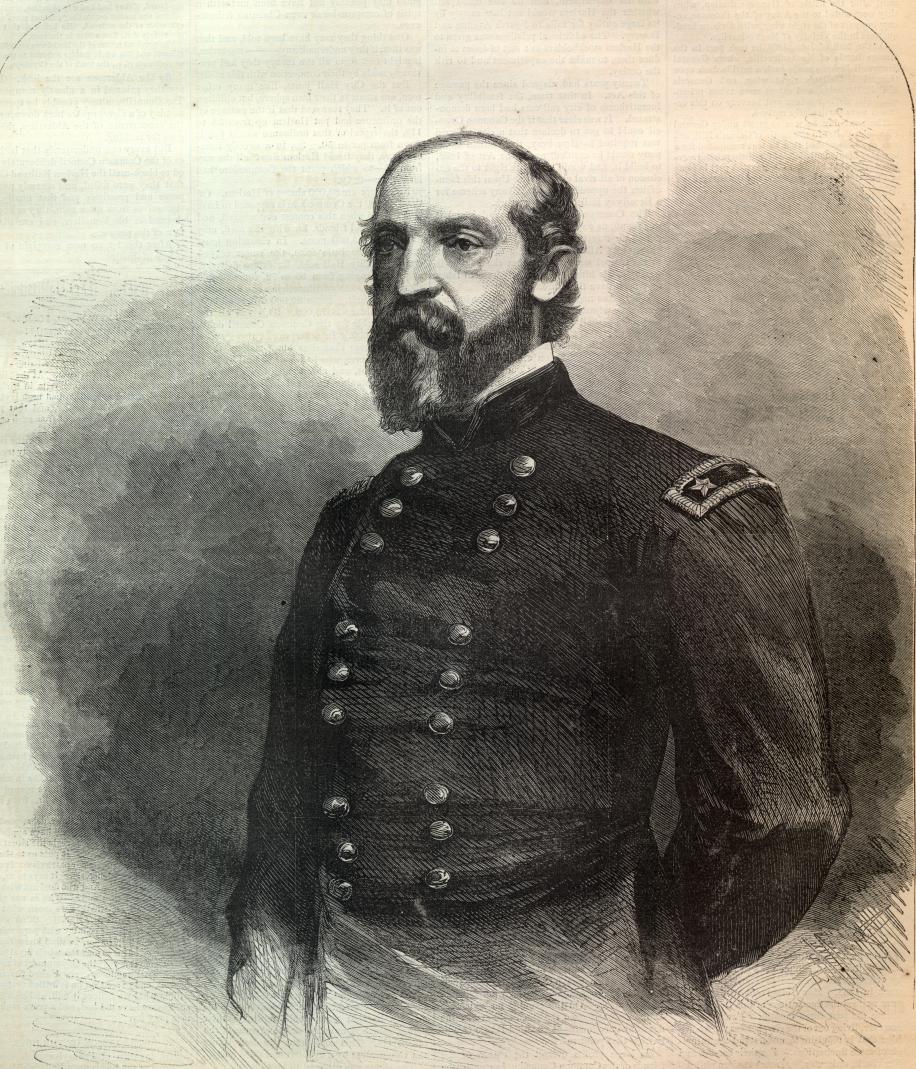
Major General George Gordon Meade

Friends of Padre Steve’s World

For those that have followed my writing for some time you know that I teach military history and ethics at the Joint Forces Staff College. One of the great joys that I have is leading the Gettysburg Staff Ride, which is an optional event for students that want to participate. When I took the position here I took some of my older writings on Gettysburg and put them into a student study guide and text. That was two years ago. Then the text was about 70 pages long. It is now about 870 pages long and eventually I hope to get it published. When and if that happens I expect it to become two, and possibly three books.

This is the second of a series of articles that I will be posting potions of a chapter that I have rewritten about the surprises that various commanders experienced on June 28th 1863. The lessons for today are that war, any war, is the realm of chance, as such, surprises always happen. It is said that no plan survives first contact with the enemy, but some plans don’t survive that long. As you read this don’t just look at the events, but look at the people, and their reaction to the surprises that they encountered, for that is where we come to understand history.

So even if you are not a Civil War buff, or even a history buff, take the time to look at the people, their actions, and the things that made them who they were, and influenced what they did. History is about people.

So please enjoy,

Peace

Padre Steve+

About the time that Lee was confidently discussing the campaign with Isaac Trimble Major General George Meade, commander of V Corps the night of June 27th George Meade was simply one of seven Corps Commanders in the Army of the Potomac, but before the night was over he would be its commander on the eve of the most decisive battle of the war in the east.

George Gordon Meade was the son of an American merchant who served as the naval agent for the U.S. government in that country until 1817. Meade was born in Cadiz on December 31st 1815 and grew up in Pennsylvania and Maryland. His father had been ruined financially in Spain when supporting the Spanish government by loaning it over $375,000 in the Peninsular War against Napoleon. Meade’s father remained in Spain to try to recover his lost fortune he sent his wife and children back to the United States where the family lived on the margins of poverty. The money should have been reimbursed to him under the terms of the Treaty of Florida “which obligated the American government to assume any Spanish obligations to American citizens.” However “the U.S. government discovered loopholes that it allowed it to dodge all responsibility to an increasingly bitter and disappointed Richard Meade.” [1] It was a crushing blow to the elder Meade.

Meade’s father returned to the U.S. and the family moved from Philadelphia to Washington D.C. were Richard Meade, “worn down physically and mentally by his struggles” [2] died in 1828 when George was just 12 years old and attending “a boarding-school at Mount Airy, a few miles from Philadelphia, known as the American Classical and Military Lyceum.” [3] It was here that Meade got his first taste of military discipline as the school was modeled after West Point and in addition to their studies the students participated in military drill.

At the Lyceum, Meade was known for being “an amiable boy, full of life, but rather disposed to avoid the rough-and-tumble frolics of youths his age; quick at his lessons, and popular with both teachers and scholars.” [4] The family ran out of money to keep him at the school and he returned to Baltimore where he was enrolled in the Mount Hope School in Baltimore as his mother sought to gain him an appointment at West Point. At Mount Hope he studied Latin, English composition and mathematics. A certificate from the headmaster of the school obtained by his mother discussed Meade’s academic acumen.

“The knowledge he has gained…is far greater than is usually acquired by young men of his age in a single year. He possesses an uncommon quickness of perception and is, therefore, capable of acquiring knowledge with great rapidity….” [5]

Meade entered West Point in 1831 when he was just sixteen years old after being nominated by Andrew Jackson. The financial condition of his family was mostly responsible for this as “West Point was the one place where the young Meade could obtain a free college education.” [6] At West Point Meade did not excel in his studies and due to “his lack of attention to details of dress and equipment and apparent disinterest in drill, demerits began to pile up in his third year.” [7] While he graduated in the top half of his class his performance in some subjects such as military engineering gave no indication of how he would excel later in life. He graduated nineteenth of fifty-six in the class of 1835.

Unlike many classes which were crowded with men destined for greatness, there were few notables in this class. Other than Meade there was Lincoln’s Postmaster General Montgomery Blair, Brigadier General Herman Haupt, who directed the transportation system of the Union army in the East during the war and John Pemberton, who as a Confederate general would surrender Vicksburg to Grant as Meade was defeating Lee.

Meade was commissioned as a Brevet Second Lieutenant and assigned to the artillery. He spent most of that year in Florida where he was sick and assigned less demanding duties. He resigned his commission after serving his one year obligation and entered civilian life as a topographic engineer. Such was not an unusual occurrence in the tiny army of that era, as “over the previous two years more than a hundred West Point graduates had left the army.[8]

He found civilian employment with the Bureau of Topographical Engineers and over the next five years took part in surveying the Texas-Louisiana boundary line, followed by an assignment on the Mississippi River Delta. He finally worked on the survey of the Canadian-United States boundary, an area of perpetual dispute from the time of American independence.

It was during his time of civilian work with the Bureau that he met and married his wife Margaret Sergeant Wise, the daughter of Congressman John Sergeant, who had been the running mate of Henry Clay in the 1832 presidential election. The young woman was well educated and “developed a wide range of cultural interests including facility in four languages and proficiency at the piano.” [9] They had had seven children together, three sons and four daughters and through much of his career was forced to raise the children alone. Despite this, the marriage appeared to be happy and would last until his death in 1872.

In 1842 Congress passed a measure which limited topographic survey to officers of the Topographic Engineer Corps. For Meade this was a godsend, for with the assistance of Margaret’s brother-in-law Congressman Henry A. Wise of Virginia Meade was reappointed as a Second Lieutenant in the Topographic Engineers on May 19th 1842. He had lost nearly six years of seniority, but “he had fairly earned his rank of Second Lieutenant of Topographic Engineers.” [10] His first assignments included surveying the Aroostook River in Maine and the design and construction of a lighthouse for Brandywine Shoals, Delaware.

In 1845 with a war with Mexico looming due to the annexation of Texas, Lieutenant Meade reported to the headquarters of General Zachary Taylor in Corpus Christi. Here he conducted surveys of the Nueces River and other inland waterways. Meade accompanied Taylor to the disputed border area around between the Nueces and the Rio Grande where some of the first actions of the war took place in 1846. During the war he served in Mexico “principally with Taylor’s army, where he won a brevet for gallantry at Monterrey.” [11] During his time in Texas and Mexico Meade became disgusted with the political machinations that surrounded the war and in a letter home he wrote “the mighty engine of influence, that curse of our country, which forces party politics into everything.” [12]

Meade was transferred to the army of Winfield Scott where he was no longer the senior Topographic Engineer but the junior. He chafed at his inactivity with Scott and complained about it. Major Turnbull, the senior Topographic Engineer told Scott that Meade was “Meade was unexpectedly with the army and that he had quite enough officers without him.” [13] In light of this Scott sent Meade back, where he returned to building lighthouses missing the bulk of the campaign. That assignment was cut short in 1849 when Meade was ordered to Florida “amid an outbreak of violence by the Seminoles.” [14] In Florida he survey a line of forts and upon completion returned to lighthouse work at Brandywine Shoals and then in Key Largo.

When the Army established the Lighthouse Board, Meade was appointed t the Seventh District where he continued his work in Florida. Among the lighthouses that he built was the Sand Key lighthouse at Key West which stands to this day. Meade was still just a First Lieutenant but he was rising in terms of the work that he was doing and was “promoted to superintendent of the Seventh Lighthouse District.” [15] He took over the Fourth District as well when its superintendent was transferred to the West Coast. In this work Meade prospered. The most impressive monument to Meade’s work is the 163 foot tall Barnegat Bay Light in New Jersey. Meade was justifiably proud of his accomplishments and after the war noted that “I have always thought my services in the construction of lighthouses, and subsequently on the Lake Survey were of considerable importance.” [16]

In 1856 Meade was promoted to Captain and given charge over the vast Great Lakes survey. In Meade’s words he work involved:

“the delineation of the shores, and bottom of the lakes, bringing to light the hidden dangers; obtaining the evidence and capacity and depth of water in all the harbors and rivers and consequently the most practical mode of improving them; furnishing the evidence of the wants of navigation in reference to lighthouses, beacons and buoys and the proper sites for same.” [17]

Meade had to lobby Congress for funding and expanded the number of officers and personnel involved until by 1860 he had ten teams, some working on land and some aboard ships with a budget which he expanded from $25,000 to $75,000 in three years. It was a remarkable job, but then Meade had matured as an officer and as a leader.

Meade was still involved with this mission when Fort Sumter was attacked. To the consternation of local leaders in Detroit, he and his officers refused to be part of a mass meeting where the locals were insisting the Federal officers publically renew their oaths. This decision was part of Meade’s innate conservatism. Meade felt that doing so without the order of the War Department was not within his prevue.

Meade was not a firebrand, conservative and logical thought that the best course would for both sides to step back and catch their breath. He was “dismayed at the arrogance of the fire-eaters, to whom Southern secession seemed like a simple riot which would be suppressed by the mere appearance of Federal troops.” [18] The decision angered Senator Zach Chandler who had organized the event and Chandler would remain an opponent of Meade throughout the war.

He had never been a political officer and was determined to avoid becoming one, he wrote “as a soldier, holding a commission, it has always been my judgement that duty required that I should disregard all political questions, and obey orders.” [19] Thus he avoided some of the more overtly political displays in Michigan but wrote:

“I have ever held it to be my duty…to uphold and maintain the Constitution and resist the disruption of this Government. With this opinion I hold the other side responsible for this existing condition of affairs.” [20]

He was viewed with suspicion by Radical Republicans as “another politically unreliable McClellan Democrat” and William Lloyd Garrison’s The Liberator noted that his look “reveals a character that never yet efficiently and consistently served a liberal cause.” [21]

He immediately volunteered for field duty, but it his request was not answered due to resistance in the Corps of Topographic Engineers. It was not until after the debacle at Bull Run when he would be appointed a Brigadier General of Volunteers, even as he was preparing to resign his commission to take command of a Michigan Regiment.

Meade was appointed to command a brigade of the Pennsylvania Reserves and saw much action at the head of his brigade on the Peninsula, serving alongside his friend John Reynolds who commanded another brigade in the division. Meade exhibited a coolness under fire that earned the respect of his soldiers and officers. His fearless nature had “resulted in his being wounded twice by bullets almost simultaneously at the Battle of Glendale on the Peninsula” [22] and incurring other wounds and close calls at South Mountain, Antietam and Fredericksburg.

In September 1862 he was promoted to command the division and after Fredericksburg he was promoted to command Fifth Corps. His promotions “from brigade commander in the Pennsylvania Reserve Division to corps command had been earned on battlefields.” [23] Serving in almost all of the army’s campaigns in the East Meade “gained increasing distinction as a highly competent and skillful officer. At Fredericksburg his division was the only unit to achieve any kind of success in a battle that otherwise was known as the worst fiasco in the history of the Army of the Potomac.” [24]

Like many of the commanders at Gettysburg Meade’s personality, temperament and character were complex, leading to people who met him or served with him to different conclusions. He possessed little flair for the dramatic or the theatrical. He was quietly religious and modest and “he usually kept aloof and made no effort to make himself popular” especially with reporters and “they exacted a toll for this treatment, and as a result Meade’s reputation suffered from a poor press.” [25]

He did not fit the stereotype of a commanding general of an army, he possessed none of McClellan’s style, Hooker’s dash or Reynold’s handsomeness. Some of his critics in the ranks referred to him as “a damned old goggle-eyed snapping turtle” while others called him “Old Four Eye” based on the glasses that he wore.[26] Meade handled such comments well for he had few delusions about himself, he remarked to an officer “I know they call me a damned old snapping turtle.” [27] As for his physical appearance a reporter noted that Meade “is colorless, being of a ghostly pale,” and “his nose of the antique bend.” [28] Another noted that he looked more like “a learned pundit than a soldier” [29] while his attire did not help, an aide noted “as for clothes, General Meade was nowhere.” Another officer remarked, “it would be rather hard to make him look well dressed.” [30]

Meade was sharp minded and quick tempered, “irritable and touchy in camp, possessed of a famous temper and imperfect means of controlling it.” [31] His temper was rooted in his sense of perfectionism and truthfulness. Theodore Lyman wrote that “I never saw a man in my life who was so characterized by straightforward truthfulness as he is.” [32] But Meade’s often volcanic temper and abject truthfulness were that of a logical man who could not abide “stupidity, negligence or laziness.” [33] Lyman observed “I don’t know any thin old gentleman, with a hooked nose and cold blue eye, who, when he is wrathy, exercises less of Christian charity than my well-beloved Chief!” [34]

Unlike some leaders whose temper led them to make unwise decisions with the lives of their troops, “in matters involving the safety of the army or the lives of thousands of men he exercised self-control and showed great moral courage in his decisions.” [35] At the same time he was a man who if after an angry outburst was full of regret, and as introspective as he was had “a cordial desire, if he had been wrong to make amends.” [36]

He was a man who in the war did not lose his humanity either towards the soldiers that he commanded or the victims of war. He was moved to acts of compassion when he saw suffering women and children whose lives had been upended by war. During the campaign of 1864 Meade:

“happened upon a poorly dressed woman fringed by several crying children – a family which the cavalry had robbed – he pulled out a five-dollar bill and also saw that food was provided for the day’s neediest. “The soft-hearted General…though of his own small children,” Colonel Lyman reflected. “He is a tender hearted man.” [37]

It was this complex man, a modest, conservative perfectionist, prone to volcanic eruptions of temper, but possessing of a strong sense of honesty even in regard to himself, who in the early morning hours of June 28th 1863 would have the fate of the Union thrust upon his shoulders.

“I Bring You Trouble” Meade Takes Command

As Trimble left and Lee settled in for the night, Meade, Commander of V Corps, was at his new headquarters located at Robert McGill’s farm outside of Frederick. Meade was asleep in his tent, was unaware that Colonel James A. Hardie, Halleck’s Assistant Adjutant General, was on a train from Washington with orders that would change the course of the war. Hardie arrived in Fredericksburg after midnight and instead of remaining for the night rented a carriage and made his way directly to Meade’s headquarters, bearing in his hand “General Orders 194…relieving General Hooker as commander of the Army of the Potomac and appointing General Meade in his place.” [38]

Meade, though he desired the appointment as commander of the Army did not expect it. Meade, a career soldier “possessed ambition but had never allowed it to consume him as Joseph Hooker had.” [39] Meade believed that if Hooker was relieved of command that John Reynolds of First Corps or another would receive it. Meade was outranked by his fellow Corps commanders Reynolds and John Sedgwick of VI Corps, and he felt that Reynolds was the ideal man to command the army.

Meade wrote to his wife the reasons he believed that he would not get command a few days before: “because I have no friends, political or others, who press or advance my claims or pretentions.” [40] The latter was not because Meade did not have friends, but because unlike Hooker, Sickles and so many others he stayed out of the various political cabals in the army and their constant intrigues. Meade, though on bad terms with Hooker was not one of the Generals who conspired against Hooker in the weeks following Chancellorsville. He told Governor Andrew Curtain of Pennsylvania that “I should be very sorry to see him removed, unless a decidedly better man is substituted.” [41]

On June 25th Meade had written his wife Margaret, who was uneasy with the rumors that her husband might be named head of the army. Earlier in the month when it was rumored that he might be offered command she “reacted to the news with vigor and urgency: “Do not accept it!” She was convinced that it would ruin his career.” [42] Reiterating his belief that he did not have the necessary political connections, and that there were others at least as competent or more to lead the army, he wrote:

“For these reasons I have never indulged in any dreams of ambition, contented to await events, and do my duty in the sphere it pleases God to place me in…and I really think that it would be well for you to take the same philosophical view; but do you know, I think your ambition is being roused and that you are beginning to be bitten with the dazzling prospect of having for a husband a commanding general of an army. How is this?” [43]

At 3:00 A.M. Hardie arrived. “Led to Meade’s tent, Hardie greeted the suddenly awakened general by saying he brought “trouble.” [44] Meade wrote his wife:

“At 3:00 A.M. I was roused from my sleep by an officer from Washington entering my tent…and after waking me up, saying he had come to give me trouble. At first I thought that it was to either relieve or arrest me, and promptly replied to him, that my conscience was clear, void of offense towards any man; I was prepared for his bad news. He then handed me a communication to read: which I found was an order relieving Hooker from the command and assigning me to it.” [45]

Meade was “given a brief order from Lincoln assigning him the high command, and a detailed message outlining his course. The army was to cover Washington and Baltimore; Harpers Ferry and its garrison would come under Meade’s own jurisdiction, etc.” and Halleck noted that “the transfer was being made at a critical time.” [46]

Meade agitatedly stated his objections to Hardie, again reiterating his belief that Reynolds should command the army but Hardie explained that the decision had been made and that Meade had no choice but to obey his orders or resign. Hardie provided Meade a letter from Halleck which said “Considering the circumstances…no one ever received a more important command; and I cannot doubt that you will firmly justify the confidence that the Government has reposed in you.” [47]

The order gave Meade command of the troops at Harper’s Ferry which had been denied to Hooker just days before. It also gave him freedom of command. It read: “You will not be hampered by any minute instructions from these headquarters” and “you are free to act as you deem proper under the circumstances as they arise.” [48] Likewise Meade was authorized to take command General Couch’s forces along the Susquehanna. A further power given to Meade which had not been given to previous commanders of the Army of the Potomac was the authority to relieve from command and dismiss officers from the army, or appoint to command officers regardless of seniority as he saw fit. It was a power that during the tumult of battle that he would use well in the coming days.

Meade went by horseback with Hardie and his son Captain George Meade to Hooker’s headquarters at Prospect Hall.

The previous night Hooker, who after hearing nothing after Halleck’s terse response to his request to be relieved “had convinced himself that the ensuing silence meant that he had beaten Halleck.” [49] But now, Hooker, aware that Hardie was in the camp, correctly assumed that he was through as the commander of the Army of the Potomac. Hooker greeted his visitors in his full dress uniform and with “much effort he tried to hide his feelings and by extreme courtesy to relieve the situation of embarrassment.” [50]

Meade had not seen Hooker in two weeks and had no idea how scattered the army was. When Hooker and Dan Butterfield his Chief of Staff briefed Meade, and Meade learned of the army’s disposition he “unguardedly expressed himself.” Hooker “retorted with feeling.[51] There was also disagreement on what the two generals believed Lee’s intentions were regarding crossing the Susquehanna. Hooker insisted that since Lee had no bridging equipment that he would not cross the river or threaten Harrisburg. Instead Hooker believed that Lee would proceed down the right bank of the river towards Baltimore and Washington. Meade disagreed that “the enemy would not attempt to cross at low water. In point of fact, Lee had already issued orders to move,” [52] while Dick Ewell was already preparing for a river crossing and assault on the weakly held Pennsylvania Capital.

Despite the uncomfortableness of the situation Hooker and Meade were able to successfully pass command of the army and Hooker issued General Order 66 in which “he praised his successor and asked the army to extend the hearty support it had given him. He added:

“Impressed with the ability that my usefulness as the commander of the Army of the Potomac is impaired I part from it; yet not without the deepest emotion.

The sorrow of parting with comrades of so many battles is relieved by the conviction that the courage and devotion of this army will never cease to fail.” [53]

Meade’s words in his General Order 67 are indicative of his feelings on assuming command of the army:

“By direction of the President of the United States, I hereby assume command of the Army of the Potomac…. As a soldier obeying this order- an order totally unexpected and unsolicited- I have no promises to make.”

‘The country looks to this army to relieve it from the devastation and disgrace of a foreign invasion. Whatever fatigues and sacrifices we may be called to undergo, let us have in view, constantly the magnitude of the interests involved, and let each man determine to do his duty, leaving to an all-controlling Providence the decision of the contest.

“It is with great diffidence that I relieve in the command of this army an eminent and accomplished soldier, whose name must appear conspicuous in the history of its achievements; but I rely on the hearty support of my companions in arms to assist me in the discharge of the duties of the important trust which has been confided to me.” [54]

That afternoon Meade sent a note to Halleck telling him he had received “the order placing me in command of this army” and that “as a soldier, I obey it.” [55] When Lincoln saw the letter which also outlined Meade’s initial plans to give battle, he was overheard to say “I tell you I think a lot of that fine fellow Meade.” [56]

Reynolds was among the first corps commanders to pay his respects to Meade, and Meade “grabbed him by the arm and earnestly told him he wished Reynolds had received the assignment. Reynolds replied that Meade was the right choice and that he would do whatever was necessary to support him.” [57] John Gibbon greeted Meade’s appointment “with a sigh of relief” and Reynold’s artillery commander wrote “For my part, I think that we have got the best man of the two, much as I think of Reynolds….” [58]

Meade had good reason to wish that Reynolds or another had been appointed and certainly welcomed his friend Reynolds’ support. Meade knew that he was not Lincoln’s first choice for the job, partly because of being associated with George McClellan, as well as his own political ties as a Democrat, and the opposition of leading Republicans to his appointment to any command. He had run afoul of the Northern abolitionist “fire eaters” in Detroit when Fort Sumter was fired on, and was distrustful of politicians and politically inclined soldiers.

The new commander of the army was fully aware ware of the fate of other officers who had a similar political bent. One of these officers, Fitz-John Porter, his predecessor at V Corps, was “court-martialed, cashiered and disgraced” [59] after being falsely accused of “disobedience of orders during the Second Battle of Bull Run” [60] by John Pope who had brought about that disaster.

With that in mind Meade understood the political danger that his appointment entailed:

“If he was successful in protecting Washington and Baltimore or if he somehow defeated Lee and drove the Confederates back across the Potomac, he would receive precious little credit from the Lincoln administration; if he failed, even for the most plainly military reasons, he expected to be pilloried without mercy as a halfheart and traitor.” [61]

The appointment of Meade was met with relief by most of his fellow Corps commanders. He was respected by them, despite having “a cold, even irascible, edge to him, particularly when occupied with army business. He was demanding of himself and of aids and subordinates,” [62] but what mattered to them was that Meade “was a thorough soldier, and a “mighty clear headed man”, with “extraordinary courage.” [63] A future staff officer noted that Meade “will pitch himself in a moment, if he thinks he has done wrong; and woe to those, no matter who they are, who do not do right.” [64]

He was viewed as a truthful, honest and caring commander who after a blow- up would do what he could to reconcile. He was passionate about the lives of his troops and whenever possible avoided battles that he believed their sacrifice would be in vain. He knew his trade, paid close attention to detail and knew and understood his troops and commanders. He had earned respect throughout his career and during the battles on the Peninsula, Antietam, Fredericksburg and Chancellorsville proved that he was an excellent leader and commander of troops.

All that being said Meade was virtually “an unknown quantity outside of his corps.” [65] Many in the rank and file wondered about the change of commanders in the middle of the campaign, “What’s Meade ever done?” was a common response among the men- those outside his corps at least- when they heard that he was their new commander. The general himself had few delusions on this score. “I know they call me a damned old snapping turtle….” [66] These soldiers had seen good and bad commanders and seen how Washington had dealt with each one, but by now “their training in the school of hard knocks under fumbling leaders had toughened the soldiers to a flinty self-reliance that left many indifferent to the identity of their commander. [67] On the eve of battle they had a new commanding general and “they were almost within rifleshot of a supremely aggressive enemy…whatever happened during the next week, the one certainty was now that the soldiers themselves would run this next battle. The most that could be expected of Meade was that he would make no ruinous mistakes.” [68] It not only was an army with a new leader, but in its soul, the Army of the Potomac was a different army than Lee had ever faced.

Meade had an immense task to accomplish. When he went to bed on the night of the 27th as commander of V Corps he was unaware of the locations of the bulk of the Federal Army and knew that Lee was already deep in Pennsylvania. Now, Meade was determined to bring Lee to battle, but was cautious as he did not want to take a chance of his forces being split up and defeated in detail, which in fact was what Lee hoped to do to the Army of the Potomac.

With his assumption of command Meade had to make some organizational changes. Against the advice of some Meade kept General Daniel Butterfield as his Chief of Staff despite his personal aversion for him and for Butterfield’s close association with Hooker and his political cabal. He appointed Major General George Sykes to command his old V Corps and wired Halleck with an “unheard of request: to promote in one jump three brilliant young officers from the rank of captain to that of brigadier general. They were Elon J. Farnsworth of the 8th Illinois Cavalry, George A Custer of the 5th United States Cavalry and Wesley Merritt of the 2nd United States Cavalry.” [69] Each was appointed to command brigades in Pleasanton’s Cavalry Corps which was being reorganized that day.

Meade had another great advantage over Lee in in his access to information and intelligence. Colonel George Sharpe of the Bureau of Military Information had provided him with the information that “the enemy force does not exceed 80,000 men and 275 guns,” as well as “a remarkably accurate outline of Lee’s movements.” [70] The information allowed Meade to begin his pursuit of Lee in earnest the following morning.

One thing that Meade understood was that if he was to defeat Lee he had to concentrate his combat power, he could not allow Lee’s forces to engage elements of the army and defeat them in detail. All too often Federal forces had not concentrated or taken advantage of their superiority in men and artillery. Meade wired Halleck that he would “move toward the Susquehanna keeping Baltimore and Washington well covered, and if the enemy is checked in his attempt to cross the Susquehanna or if he turns toward Baltimore, to give him battle.” [71] Meade wrote discussed his intent, noting, “my object being at all hazards to compel him to loose his hold on the Susquehanna and to meet me in battle at some point. It was my firm determination…to give battle wherever and as soon as I could possibly find the enemy.” [72]

Wisely, Meade also prepared a fallback position along Pipe Creek on the Pennsylvania-Maryland border. Knowing that it was possible that a corps could become isolated and face superior forces Meade gave his Corps commanders permission to withdraw back to the Pipe Creek line if they felt threatened by a larger Confederate force.

With his orders given and preparations underway, Meade’s Army of the Potomac began to march north on the morning of June 29th into Pennsylvania where it was fated to do battle with its old nemesis, the Army of Northern Virginia.

Notes

[1] Huntington, Tom Searching for George Gordon Meade: The Forgotten Victor of Gettysburg Stackpole Books, Mechanicsburg PA 2013 p.12

[2] Ibid. Huntington Searching for George Gordon Meade p.12

[3] Meade, George edited by George Gordon Meade The Life and Letters of George Gordon Meade, Major General United States Army Volume I Big Byte Books Amazon Kindle Edition 2014 originally published 1913 location 185 of 7307

[4] Ibid. Huntington Searching for George Gordon Meade p.12

[5] Cleaves, Freeman Meade of Gettysburg University of Oklahoma Press, Norman and London 1960 p.10

[6] Sears, Stephen W. Gettysburg. Houghton Mifflin Co. Boston and New York 2003 p.85

[7] Ibid. Cleaves Meade of Gettysburg p.11

[8] Ibid. Huntington Searching for George Gordon Meade p.13

[9] Wilson Robert and Clair, Carl They Also Served: Wives of Civil War Generals Xlibris Corporation 2006 p.27

[10] Ibid. Cleaves Meade of Gettysburg p.18

[11] Pfanz Harry W. Gettysburg: The First Day University of North Carolina Press, Chapel Hill and London 2001 p.43

[12] Ibid. Huntington Searching for George Gordon Meade p.29

[13] Ibid. Cleaves Meade of Gettysburg p.43

[14] Ibid. Huntington Searching for George Gordon Meade p.31

[15] Ibid. Cleaves Meade of Gettysburg p.49

[16] Ibid. Huntington Searching for George Gordon Meade p.32

[17] Ibid. Cleaves Meade of Gettysburg p.50

[18] Ibid. Catton The Army of the Potomac: Glory Roadp.257

[19] Ibid. Huntington Searching for George Gordon Meade p.39

[20] Ibid. Cleaves Meade of Gettysburg p.52

[21] Ibid. Guelzo Gettysburg: The Last Invasion p.88

[22] Tagg, Larry The Generals of Gettysburg: The Leaders of America’s Greatest Battle Da Capo Press Cambridge MA 1998 Amazon Kindle Edition p.2

[23] Ibid. Wert A Glorious Army p.267

[24] Ibid. Coddington The Gettysburg Campaign pp.213-214

[25] Ibid. Coddington The Gettysburg Campaign p.213

[26] Ibid. Guelzo Gettysburg: The Last Invasion p.87

[27] Ibid. Foote The Civil War, A Narrative. Volume Two p.454

[28] Wert, Jeffry D. The Sword of Lincoln: The Army of the Potomac Simon and Schuster, New York and London 2005 p.268

[29] Ibid. Foote The Civil War, A Narrative. Volume Two p.454

[30] Ibid. Wert The Sword of Lincoln p.268

[31] Ibid. Catton The Army of the Potomac: Glory Roadp.257

[32] Ibid. Coddington The Gettysburg Campaign p.211

[33] Ibid. Coddington The Gettysburg Campaign p.211

[34] Ibid Sears. Gettysburg. Pp.125-126

[35] Ibid. Coddington The Gettysburg Campaign p.211

[36] Ibid. Coddington The Gettysburg Campaign p.212

[37] Ibid. Cleaves Meade of Gettysburg p.247

[38] Ibid Sears. Gettysburg. p.123

[39] Ibid. Wert The Sword of Lincoln p.267

[40] Ibid. Foote The Civil War, A Narrative. Volume Two p.446

[41] Ibid. Huntington Searching for George Gordon Meade p.145

[42] Ibid. Wilson and Clair They Also Served p.28

[43] Ibid. Huntington Searching for George Gordon Meade p.147

[44] Ibid. Wert The Sword of Lincoln p.266

[45] Trudeau, Noah Andre. Gettysburg, A Testing of Courage Harper Collins, New York, 2003. p.102

[46] Ibid. Cleaves Meade of Gettysburg p.125

[47] Ibid. Huntington Searching for George Gordon Meade p.148

[48] Ibid. Foote The Civil War, A Narrative. Volume Two p.451

[49] Ibid. Guelzo Gettysburg: The Last Invasion p.89

[50] Hebert, Walter H. Fighting Joe Hooker University of Nebraska Press, Lincoln and London 1999. Originally published by Bobbs-Merrill, New York 1944 p. 246

[51] Ibid. Huntington Searching for George Gordon Meade p.149

[52] Ibid. Cleaves Meade of Gettysburg p.125

[53] Ibid. Hebert Fighting Joe Hooker p.246

[54] Ibid. Huntington Searching for George Gordon Meade p.150

[55] Ibid. Guelzo Gettysburg: The Last Invasion p.89

[56] Ibid. Cleaves Meade of Gettysburg p.126

[57] Ibid. Huntington Searching for George Gordon Meade p.149

[58] Ibid. Huntington Searching for George Gordon Meade p.150

[59] Ibid. Guelzo Gettysburg: The Last Invasion p.90

[60] Ibid. Wert The Sword of Lincoln p.185

[61] Ibid. Guelzo Gettysburg: The Last Invasion p.90

[62] Ibid. Wert The Sword of Lincoln p.267

[63] Ibid. Wert The Sword of Lincoln p.268

[64] Ibid. Wert The Sword of Lincoln p.267

[65] McPherson, James. The Battle Cry of Freedom: The Civil War Era Oxford University Press, Oxford and New York 1988 p.652

[66] Ibid. Foote The Civil War, A Narrative. Volume Two p.454

[67] Ibid. McPherson The Battle Cry of Freedom p.652

[68] Ibid. Catton The Army of the Potomac p.259

[69] Ibid. Coddington p.220

[70] Ibid. Trudeau Gettysburg, A Testing of Courage p.106

[71] Ibid. Coddington The Gettysburg Campaign, A Study in Command pp. 219-220

[72] Ibid. Trudeau Gettysburg, A Testing of Courage p.112

1 Comment

Filed under civil war, Gettysburg, History, leadership, Military

The Road to Gettysburg: An Army Confident But Blind

on-to-gettysburg-900L

Lee Confers with his Commanders en-route to Gettysburg 

Friends of Padre Steve’s World

For those that have followed my writing for some time you know that I teach military history and ethics at the Joint Forces Staff College. One of the great joys that I have is leading the Gettysburg Staff Ride, which is an optional event for students that want to participate. When I took the position here I took some of my older writings on Gettysburg and put them into a student study guide and text. That was two years ago. Then the text was about 70 pages long. It is now about 870 pages long and eventually I hope to get it published. When and if that happens I expect it to become two, and possibly three books.

Over the next few days I will be posting potions of a chapter that I have rewritten about the surprises that various commanders experienced on June 28th 1863. The lessons for today are that war, any war, is the realm of chance, as such, surprises always happen. It is said that no plan survives first contact with the enemy, but some plans don’t survive that long. As you read this don’t just look at the events, but look at the people, and their reaction to the surprises that they encountered, for that is where we come to understand history.

So even if you are not a Civil War buff, or even a history buff, take the time to look at the people, their actions, and the things that made them who they were, and influenced what they did. History is about people.

So please enjoy,

Peace

Padre Steve+

If you were an ordinary soldier in either the Army of the Potomac or Army of Northern Virginia June 28th 1863 would not have been much different than any of the previous days. In fact the day was relatively “uneventful for men in the ranks.” [1] By now, both armies had been on the march for over three weeks, the soldiers enduring blazing summer heat, as well as torrential rains as the moved north. While there had been cavalry clashes at Brandy Station and along the Blue Ridge, and Ewell had successfully overrun and Milroy’s command at Winchester, the vast bulk of the men in either army had yet to engage in combat.

By the evening of June 27th both the Confederate and Union armies were across the Potomac. Robert E. Lee’s Army of Northern Virginia was now mostly in Pennsylvania. Dick Ewell’s Second Corps was preparing to attack Harrisburg, A.P. Hill’s Third Corps was near Cashtown and James Longstreet’s First Corps was gathering in the vicinity of Chambersburg.

As the Confederate troops advanced into Pennsylvania morale was high, one soldier wrote “Never did soldiers appear more buoyant and cheerful than Lee’s army.” [2] Dorsey Pender commanding a division in Hill’s Third Corps wrote his wife “I never saw troops march as ours do; they will go 15 or 20 miles a day without leaving a straggler and hoop and yell on occasions.” [3]

Unit Quartermasters, acting under Lee’s orders to forage “scoured the countryside in search of foodstuffs, livestock and anything usable.” [4] That bounty was considerable, and “included twenty-six thousand cattle and twenty-thousand sheep” [5] which were promptly driven back to Virginia. In addition to “officially” sanctioned foraging soldiers and officers did some of their own. Some of Dick Ewell’s staff took the opportunity to purchase items hard to come by in the South for their families, one bought “china buttons, calico dress patterns, soaps, and spices for his mother and sister.” [6] In spite of Lee’s prohibition of looting many soldiers took the opportunity to plunder, one soldier wrote “We press every thing that we think that will be beneficial to our cause and cuntry.” [7]

With Lee in Pennsylvania the bulk of the Army of the Potomac, still under the command of Joe Hooker was concentrated in the vicinity of Frederick, Maryland. Despite a slow start and his disagreement with Lincoln and Halleck regarding an attack across the Rappahannock into Lee’s rear, Hooker had handled the army skillfully in its pursuit of Lee. One decision that he made early, based on the recommendation of Major General Henry Slocum, commander of XII Corps, was to pre-stage pontoon bridges near the Potomac in case he had to cross that river. So swift was his movement and he had “completed its crossing only twenty-four hours after the last of Lee’s infantry had crossed, and the whole of it was in Maryland before either Stuart or Lee knew that the crossing had even begun.” [8]

The morale of the soldiers of the Army of Northern Virginia was high, and reflected Lee’s own attitude toward the campaign. One officer recalled that “Lee’s army was never in better spirits than in the days leading up to Gettysburg.” [9] Colonel Eppa Hunton of the 8th Virginia recalled that Lee told him that “the invasion of Pennsylvania would be a great success, and if so, it would end the war, or we would have rest for some time to come.” Hunton added, “General Lee was so enthusiastic about the movement that I threw away my doubts and became as enthusiastic as he was.” [10]

Like its commander the Army of Northern Virginia was superbly confident as it marched north. A Virginian observing the army as it marched through Maryland recalled: “The health of the troops was never better and above all the morale of the army was never more favorable for offensive or defensive operations….Victory will inevitably attend our arms in any collision with the enemy.” [11] Another soldier later recalled “no one ever admitted the possibility of defeat across the Potomac.” [12]

Lee was uneasy regarding his lack of knowledge of the location of the Army of the Potomac or Hooker’s intentions, but he was not overly concerned. Though he had not heard anything from J.E.B. Stuart since June 23rd, when Stuart had begun his ride, Lee was still confident in the success of his operation and the prospects of battle. John Bell Hood, Lee’s companion from his days in Texas visited Lee at Chambersburg and “found the commanding general in “buoyant spirits.” Lee told his former Lieutenant “Ah! General, the enemy is a long time in finding us; if he does not succeed soon, we must go in search of him.” [13] On the night of June 27th Lee “still assumed that the mounted forces were doing their full duty and that all was well; but there was uneasiness, almost exasperation, over the failure of the cavalry to send in any information of the enemy’s movements.” [14]

Not knowing the location of the Federal army Lee met with Major General Isaac Trimble on the evening of June 27th at his headquarters near Chambersburg. Though Trimble had been slated to command to division now commanded by Allegheny Johnson, he had been slow to recover from a leg wound incurred in 1862 and could not take command. A supernumerary Major General without a command, Trimble had caught up with the army as it moved north into Maryland. Trimble told Lee that he “could recruit a division of troops from the ranks of his native Marylanders.” [15] as Lee did not want to lose “the services of so hard a fighter as this veteran of all the Second Corps victories from First through Second Manassas.” [16] That being said Trimble soon became a nuisance to Lee and “after just two days Lee sent him on to Ewell.” [17]

However, Trimble recorded the atmosphere in Lee’s headquarters and just how confident Lee appeared in spite of not knowing the location or the intent of the Army of the Potomac:

“Our army is in good spirits, not overly fatigued, and can be concentrated on any point in twenty-four hours or less. I have not yet heard that the enemy have crossed the Potomac, and I am waiting to hear from General Stuart….They will come up, probably through Frederick, broken down with hunger and hard marching….I shall throw up an overwhelming force on their advance, crush it, follow up the success, [and] drive one corps back on another…create a panic and virtually destroy the enemy.” [18]

Trimble noted that he was “stirred” by Lee’s words and that told Lee that he did “not doubt of the outcome of such a confrontation, especially because the moral of the Army of Northern Virginia had never been higher than it was now.” [19] Lee agreed and “as Trimble rose to go, Lee laid his hand on the map and pointed to a little town east of the mountains, Gettysburg by name, from which roads radiated like so many spikes. “Hereabout,” he said, “we shall probably meet the army and fight a great battle, and if God gives us the victory, the war will be over and we shall achieve the recognition of our independence.” [20]

Notes

[1] Coddington, Edwin B. The Gettysburg Campaign, A Study in Command A Touchstone Book, Simon and Shuster New York 1968 p. 180

[2] Wert, Jeffry D. A Glorious Army: Robert E. Lee’s Triumph 1862-1863 Simon and Schuster, New York and London 2011 p.229

[3] Robertson, James I. Jr. General A.P. Hill: The Story of a Confederate Warrior Random House, New York 1987 p.204

[4] Glatthaar, Joseph T. General Lee’s Army from Victory to Collapse The Free Press, Simon and Schuster, New York and London 2008 p.271

[5] Goldfield, David. America Aflame: How the Civil War Created a Nation Bloomsbury Press, New York 2011 p.284

[6] Pfanz, Donald. Richard S. Ewell: A Soldier’s Life University of North Carolina Press, Chapel Hill and London 1998 p.298

[7] Ibid. Glatthaar General Lee’s Army from Victory to Collapse p.272

[8] Catton, Bruce The Army of the Potomac: Glory Road Doubleday and Company, Garden City New York, 1952 p.255

[9] Taylor, John M. Duty Faithfully Performed: Robert E Lee and His Critics Brassey’s, Dulles VA 1999 p.139

[10] Ibid. Wert A Glorious Army p.226

[11] Guelzo, Allen C. Gettysburg: The Last Invasion Vintage Books a Division of Random House, New York 2013 p.67

[12] Foote, Shelby, The Civil War, A Narrative. Volume Two Fredericksburg to Meridian Random House, New York 1963 p.455

[13] Ibid. Wert A Glorious Army p.230

[14] Freeman, Douglas Southall, Lee’s Lieutenant’s a Study in Command, One volume abridgement by Stephen W Sears, Scribner, New York 1998 p.551

[15] Ibid. Pfanz Richard S. Ewell p.300

[16] Ibid. Foote The Civil War, A Narrative. Volume Two p.445

[17] Ibid. Pfanz Richard S. Ewell pp.300-301

[18] Taylor, John M. Duty Faithfully Performed: Robert E Lee and His Critics Brassey’s, Dulles VA 1999 p.140

[19] Ibid. Foote The Civil War, A Narrative. Volume Two p.446

[20] Freeman, Douglas Southall, Lee an abridgment by Richard Harwell, Touchstone Books, New York 1997 p.320

Leave a comment

Filed under civil war, Gettysburg, History

Where is the Reckoning? Reflections on War

IMG_0463

Friends of Padre Steve’s World,

I finished up my latest Gettysburg Staff Ride and as always I end up in a reflective mood. There was so much this time that caught my attention, both in the actual staff ride and my run up and down Cemetery Ridge on Friday evening. I guess the one thing that continues to strike me is a theological question that I began to wonder about after my return from Iraq.

The question is more theological, philosophical, and sociological in nature, and it goes to a place that most of us are unwilling or unable to go. I say this because so many Americans have no idea what war is really about. We tend to exalt the military, say that we “support the troops” but no one asks the hard questions of whether the wars that we are fighting, and the vast amounts of money we are spending are worth it. Frankly I think that the reason is that because for the vast majority of Americans that war is an abstract concept, and they are so disconnected from the military that they do not understand. As such the military is idolized and even mythologized by a public that is willing to send them to war, but unwilling to understand or question decisions of policy that begin and perpetuate war without end.

I see the sacrifice, the broken lives, bodies, minds and families of our military personnel who have deployed so many times. With the expansion of the war against the self-proclaimed Islamic State the wars will probably continue indefinitely. Do I think that the war against ISIS/ISIL is worth it? I have to admit I do, they are thugs who have commandeered a religion to justify their crusade against all who do not agree with them and who seek to obliterate all history and culture that they do not agree, and to paraphrase Vice President Biden, Hell is where they will reside.

At the same time I cannot support a war in which a tiny minority of citizens have skin in the game while those who send them to war do so with no cost to themselves. In fact it wearies me to think that those who so loudly call for war refuse to support those who fight with increased taxes, or even war bonds. I have no doubt that those who send people to war, and those who allow them to do so without question, have no interest in actually putting their lives, or the lives of their sons and daughters on the line.

Joshua Chamberlain, the hero of Little Round Top asked the question that I think needs to be asked by all of us today:

“…men made in the image of God, marred by the hand of man, and must we say in the name of God? And where is the reckoning for such things? And who is answerable? One might almost shrink from the sound of his own voice, which had launched into the palpitating air words of order–do we call it? – fraught with such ruin. Was it God’s command that we heard, or His forgiveness that we must forever implore?”

My question for those who advocate war without end, who refuse to serve, and even refuse to sacrifice a wooden nickel to support those wars, is, whose forgiveness will you implore?

Peace

Padre Steve+

3 Comments

Filed under civil war, Gettysburg, History, national security, Political Commentary

The Power of the Vision: A Weekend in Gettysburg

chamberlain lrt

Friends of Padre Steve’s World

I have been in Gettysburg this weekend with my students from the Staff College and as always it has been a good trip so far. Yesterday we did the first two days of the battle ending at Culp’s Hill. We spent a good amount of time on Little Round Top, not just talking about the battle itself, but the impact of war on people, the souls of the people who fought it and their families. I always remind my students that the one constant in history, even military history, where so many people, particularly history “buffs” focus on tactics, weapons, and technology, is humanity.

Today we will finish and do the third day of battle, walking the route of Pickett’s Charge, going to General Meade’s headquarters before finishing at the Soldier’s Cemetery and discussing the Gettysburg Address and its importance to our history as Americans.

We drove up here yesterday making the best time we have ever made on one of these trips, no bad traffic in the Hampton Roads Bridge Tunnel, no bad traffic of major accidents to tie things up, and miraculously an easy trip around the DC Beltway. Thus we arrived early which allowed me to get a run in from Cemetery Hill, down, Cemetery Ridge, almost to Little Round Top before I turned around went back to the hotel. I was an awesome run. I used to run a lot and fell out of it with a number of physical, as well as emotional issues over the past 15 months. I fell out of shape and gained a lot of weight. I have started running again and my run Friday on the battlefield was the furthest I have ran in those 15 months. There is something inspiring about running here that I cannot explain. First there is the natural beauty of the area, especially during the fall and the beauty of the foliage, then there is the sense of running through an area where so many men made gave the last full measure of devotion, to save the Union.

When I come here I am always reminded of the words of Colonel Joshua Lawrence Chamberlain whose 20th Maine held back the Confederate tide on the extreme left of the Union position on Little Round Top. Those words always inspire me because they remind me of the deeds of men who came before me, men whose sacrifice and devotion helped bring about a new birth of freedom.

Chamberlain spoke these words at the dedication of the Maine monument in 1888, “In great deeds, something abides. On great fields, something stays. Forms change and pass; bodies disappear; but spirits linger, to consecrate ground for the vision-place of souls… generations that know us not and that we know not of, heart-drawn to see where and by whom great things were suffered and done for them, shall come to this deathless field, to ponder and dream; and lo! The shadow of a mighty presence shall wrap them in its bosom, and the power of the vision pass into their souls.”

Every time I come to Gettysburg I sense that mighty presence and the power of that vision embraces my soul.

Peace,

Padre Steve+

Leave a comment

Filed under civil war, Gettysburg, Military

The Unappreciated Hero of Gettysburg

Friends of Padre Steve’s World

I am up at Gettysburg with my students today, so I am posting the final excerpt from the chapter of my Gettysburg text that I have been posting throughout the week. This section wraps up that chapter and discusses the treatment that Abner Doubleday received from George Meade and the subsequent myth surrounding Doubleday and the invention of baseball. The irony about Doubleday is that he is best remembered for a game that he did not invent, and his most heroic performance is forgotten and dismissed. I hope you enjoy.

Peace

Padre Steve+

GettysburgIdols

Abner Doubleday’s Best Performance and Disgraceful Treatment

On the other hand Abner Doubleday proved himself as a capable commander who was able to provide effective leadership during a crisis situation. Although he is one of the most under-appreciated Union commanders at Gettysburg he “ably rose to the occasion, as did divisional commanders James Wadsworth and John Robinson.” [1] Though his abilities were suspect, especially by George Meade and Colonel Wainwright, the Corps artillery commander Doubleday managed to hold off superior Confederate forces, and even inflicted a significant defeat on the divisions of Harry Heth and Robert Rodes. During the fighting against ever increasing numbers of Confederates, First Corps inflicted massive casualties on their opponents. “Seven of the ten Southern brigades incurred casualties from 35 to 50 percent, and the total for all brigades came to an estimated 6,300 officers and men, or about 40 percent of their strength.” [2] Doubleday’s troops held on long enough to support the left flank of Eleventh Corps as it was being assaulted by Early’s division.

When Winfield Scott Hancock arrived on Meade’s behest to take command at Gettysburg Oliver Howard informed him that First Corps “had given way at first contact” [3] implicitly blaming Doubleday for the collapse of the Federal line. Hancock delivered the report in a note to Meade which said “Howard says that Doubleday’s command gave way” [4] This false report fixed in Meade’s mind that his doubts about Doubleday’s ability were correct. To Doubleday’s amazement Meade then cancelled his order appointing Doubleday to command First Corps and ordered John Newton, a division commander, far junior to Doubleday in Sedgwick’s Sixth Corps to replace Doubleday. A badly disappointed Doubleday resumed command of his division. In large part Meade’s appointment of Newton over Doubleday was also political. Doubleday’s fellow abolitionist division commander in First Corps, James Wadsworth said that “Meade’s “animosity” toward Doubleday rested in a “past political difference.” [5] Doubleday, the abolitionist Republican was not acceptable to Meade, the conservative Unionist Democrat and ally of Gorge McClellan. The fact that Newton “was not regarded as daring or brilliant” [6] and was regarded by many as a “pet” of Meade, did not matter. Meade’s volcanic temper and temptation to allow politics to cloud his military judgement meant that “Newton was the only other major general he could trust politically.” [7] When Doubleday formally protested to Meade he was dismissed from Army of the Potomac.

He left the Army of the Potomac never held a field command during the war, however, he was brevetted in the Regular Army to both brigadier and major general. Doubleday served in administrative capacities in Washington D.C. until the end of the war and testified against Meade during the politically charged hearings of the Committee on the conduct of the War. Doubleday remained bitter toward Meade and he “was never reconciled to Meade’s relieving him as acting commander of First Corps in Favor of Maj. Gene. John Newton, who was his junior in rank and the reproach that it implied.” [8] After the war Doubleday reverted to his rank as a Colonel in the Regular Army and was made Colonel of the 35th U.S. Infantry in San Francisco. From 1871 until his retirement in 1873 Doubleday commanded the African American “Buffalo Soldier” 24th Infantry Regiment in Texas. He died in New York on January 25th 1893, and was buried in Arlington National Cemetery. Among the members of the honor guard at his funeral in New York was a man named Abraham Mills who would play a major role in Doubleday’s future fame.

Baseball_article_large

A Myth and Legend Greater than Gettysburg: Abner Doubleday and Baseball

Interestingly enough Doubleday, who was unappreciated as a general became linked forever to the game known as America’s national pastime and to Cooperstown New York, the home of Baseball’s Hall of Fame. As such he is probably better known to most Americans, particularly baseball fans than any Union general who fought at Gettysburg.

Like the Civil War, Baseball too is filled with myths which connect it to our culture, and one “is the myth that Abner Doubleday invented the sport one fine day in 1839 at the farmer Phinney’s pasture at Cooperstown.” [9] It was early American baseball star Albert G. Spaulding who linked the creation of baseball to the Civil War and in particular to Abner Doubleday by way of an apocryphal story of one of Doubleday’s childhood friends, years after Doubleday’s death. In 1907, Spaulding worked with Abraham G. Mills the fourth President of the National League, the same man who had served in Doubleday’s funeral honor guard to conclude that “that the first scheme for playing it, according to the best evidence obtained to date, was devised at Cooperstown New York, in 1839.” [10] But this is simply myth and the under-appreciated hero of the first day of battle at Gettysburg is much better known for something that he did not do.

The ironies of history and myth are fascinating. Interestingly Mills paid homage to Doubleday noting, “in the years to come, in the view of hundreds of thousands of people who are devoted to baseball, Abner Doubleday’s fame will rest evenly, if not quite so much that he was its inventor…as upon his brilliant and distinguished career as an officer in the Federal Army.” [11]

Notes

[1] Ibid. Sears Gettysburg p.245

[2] Ibid. Coddington, The Gettysburg Campaign: A Study in Command, p.307

[3] Ibid. Wert The Sword of Lincoln p.294

[4] Ibid. Guelzo Gettysburg: The Last Invasion p.224

[5] Ibid. Wert The Sword of Lincoln p.294

[6] Ibid. Cleaves Meade of Gettysburg p.143

[7] Ibid. Guelzo Gettysburg: The Last Invasion p.224

[8] Ibid. Pfanz Gettysburg: The First Day p.355

[9] Will, George F Men at Work: The Craft of Baseball Harper Collins Publishers, New York 1990 p.294

[10] Kirsch, George B. Baseball in Blue and Gray: The National Pastime in the Civil War Princeton University Press, Princeton and Oxford, 2003 p.xiii

[11] Ibid.. Kirsch Baseball in Blue and Gray p.xii

Leave a comment

Filed under Baseball, civil war, Gettysburg, History, leadership, Military

Bungled from the Start: Confederate Disaster at Oak Ridge

Friends of Padre Steve’s World

Since I taking a group of my students from the Staff College to Gettysburg this weekend another excerpt from a chapter of my Gettysburg text. This deals with the badly bungled Confederate attack on Oak Ridge on the afternoon of July 1st 1863. I hope that you enjoy.

Peace

Padre Steve+

88thPAcharge

The 88th Pennsylvania Charging Rodes’ Division

The arrival of Rodes’s division as on the field in the van of the Confederate Second Corps was decisive in turning the tide of the battle toward the Confederates that afternoon. When Rodes arrived with Ewell, the Federal First Corps was facing west against Heth and Pender’s divisions and its line only extended about a quarter mile north of the Railroad Cut.

The Union First Corps and Buford’s cavalry division had fought Heth’s poorly coordinated and led attacks to a standstill, but when Rodes arrived he found “a golden opportunity spread before him.” [1] From his position at Oak Ridge he saw the opportunity to take the Federal troops opposing Hill in the flank though his position did not “provide him as comprehensive view as he thought.” [2] His desire was to advance south along Oak Ridge using it to screen his movements in order to execute an attack on the Federal right flank. But before he could do this “the First Corps Generals had made preparations to oppose him.” [3] Robinson’s two brigades under Baxter and Paul deployed and “hurried in line stone and wood fences approximately at right angles to Rodes proper line of advance.” [4] Rodes could see the deployment but the fences obscured the exact positions of Robinson’s troops from him. Seeing the advance of the First Corps units as well as the emergence of Schurz’s troops from Eleventh Corps advancing out of the town the aggressive Confederate commander decided to launch an immediate attack.

dilger

Captain Hubert Dilger

Carter’s artillery, which had deployed in the open and was had “opened an enfilading fire all along the line to the Fairfield road” [5] now drew the fire of Captain Hubert Dilger’s Battery I First Ohio Artillery from Howard’s XI Corps which had just arrived near Oak Ridge. Dilger commanded one of the best artillery units in the army. He was a German immigrant and professional artilleryman who had served in the Grand Duke of Baden’s Horse Artillery. He came to the United States at beginning of the war at the invitation of a distant uncle, to “practice the war-making he had only previously rehearsed.” [6] Dilger was “blunt and a bit arrogant…loved by his men but not by his superiors.” At Chancellorsville he and his battery had helped save the Federal right “when it used a leapfrogging technique to keep the victorious Confederate infantry at bay.” [7] At Gettysburg Dilger again displayed his talent.

Upon its arrival Dilger’s battery opened “a storm of counter-battery fire” [8] on Carter’s battalion as well as the infantry brigade of O’Neal which was near it. The effect of Dilger’s fire on Carter’s artillery disrupted its operation and was successful in blowing up several caissons and guns causing significant numbers of casualties among the men. [9] Seeing the carnage to one battery that he had not placed, Carter “accosted Rodes and asked, “General, what fool put that battery up yonder?” Only to realize after an “awkward pause and a queer expression on the face of all Rodes’ staffers that Rodes himself had placed it there.” [10] In response, the chastised division commander replied “You had better take it away, Carter.” [11] Throughout the rest of the engagement Dilger’s battery would make itself known, shattering Confederate infantry assaults and damaging Southern artillery batteries.


battle-of-gettysburg-oak-ridge-july-1

Rodes’ Division attacks Oak Ridge July 1st

The young division commander was overconfident as he ordered the attack. Thinking he had an adequate grasp of the situation he did not order a reconnaissance before launching the attack, nor did the commanders of the brigades spearheading the attack put out skirmishers, the normal precaution when advancing in the face of the enemy. [12] Rodes deployed his troops over the rough ground of the ridge as quickly as he could and dashed off a note to Jubal Early stating “I can burst through the enemy in an hour.” [13] He was to be badly mistaken, and “like Heth in the south, he paid in disproportionate blood for the ready aggressiveness which in the past had been the hallmark of the army’s greatest victories, but now seemed mere rashness and the hallmark of defeat.” [14]

Rodes deployed George Doles’ excellent brigade to guard his left against the advancing Eleventh Corps units until Early’s division could arrive, something he expected momentarily. Doles and his brigade conducted this task admirably until the arrival of Jubal Early’s division, which enabled it to join the attack on Eleventh Corps divisions north of the town. Initially the movement of the brigade opened a potentially dangerous gap between Doles brigade and O’Neal’s brigade to its right, but this could not be exploited by the Federals. To hold this gap between Doles and O’Neal Rodes pulled one regiment, the 5th Alabama from O’Neal.

To make his main attack Rodes initially deployed his division on a one brigade front as they arrived on the battlefield in line-of-march. As the leading elements of the division neared the Federal positions Rodes, made what appeared to be a simple change of plan to “attack on a two brigade front, sending in O’Neal’s and Iverson’s men simultaneously, then following up with Daniel’s brigade in echelon on the right.” [15] Ramseur’s brigade was held in close reserve. In theory it was a sound plan, but everything is more complicated when bullets start flying. The execution of this change in plan was “bungled right at the start.” [16] None of “the three brigade commanders was sure what the signal for the advance would be” [17] and since Rodes had made no reconnaissance, and none of the brigades put out skirmishers the direction of the attack was faulty, units were mingled and a gap developed between O’Neal and Iverson. [18] The attack “though vigorous, was a disaster” [19] and the plan floundered due to the stout resistance of Robinson’s troops and the “nicely matched incompetence of O’Neal and Iverson” [20] neither of who advanced with their assaulting troops.

O’Neal’s brigade became disoriented and “went in with only three regiments and at an angle different from that indicated by Rodes. Instead of leading his troops in the attack O’Neal remained in the rear with the Fifth Alabama, a reserve regiment,” [21] the regiment Rodes had left behind to guard the gap between O’Neal and Doles’s brigades. The last regiment, the Third Alabama had been aligned on the flank of Doles’s brigade and since Rodes had moved it “evidently concluded…that it was no longer his to direct.” [22] When Rodes discovered this he had to send a staff officer to ensure that the regiment was properly attached to Daniel’s brigade. That regiment was thus left out of the initial advance. The attack stalled almost immediately when O’Neal’s three attacking regiments were fired upon by Union troops of Robinson’s division who had been hidden by a wall which had obscured them from Rodes’s view.

Striking O’Neal’s advancing troops at the oblique, Robinson’s battle hardened Union troops slaughtered the unsuspecting Confederates. Though they were outnumbered the Union men were solid veterans from Henry Baxter’s brigade who were aided by Dilger’s artillery which delivered “effective canister fire at O’Neal’s brigade.” [23] The combined fire of Baxter’s troops as well as Dilger’s artillery “killed or wounded about half of the advancing men with a series of point blank volleys pumped directly into their flank.” [24] O’Neal’s decision to remain back with his reserve regiment rather than “going forward to direct the advancing regiments” [25] caused further problems because there was no officer on the spot to direct the action of the three regiments.

Rodes noted in his after action report that O’Neal’s three attacking regiments “moved with alacrity (but not in accordance with my orders as to direction)” and that when he ordered the 5th Alabama up to support “I found Colonel O’Neal, instead of personally superintending the movements of his brigade, had chosen to remain with his reserve regiment. The result was that the whole brigade was repulsed quickly and with loss….” [26] As O’Neal’s troops fell back in confusion they exposed Iverson’s brigades flank to the Federal fire.

As Rodes’s continued bad luck would have it, Iverson, like O’Neal on his right did not advance simultaneously with O’Neal or on the same axis, but instead waited to see O’Neal’s advance. [27] When it advanced, the brigade “about 1,450 strong, kept on under artillery fire through the open field “as evenly as if on parade.” Then its alignment became faulty, and without Iverson on hand to correct it, the brigade with strange fatality began to bear left toward the stone wall…” [28] As a result the brigade drifted right it’s exposed left was subject to attack from Baxter’s and Gabriel Paul’s brigades of Robinson’s division still hidden behind the stone wall.

When the Confederates got to about fifty yards of Baxter’s troops the commander of the 83rd New York, the Swiss born lieutenant Colonel Joseph A. Moesch shouted: “Up men, and fire.” Moesch rode behind his line cheering his men on, but they needed no urging. In the words of one of one, “The men are no longer human, they are demons; a curse from the living here, a moan from the dying there. ‘Give them —- shouts one.’ See them run’ roars another.” [29] The well concealed veterans of Baxter regiments slaughtered them as they had O’Neal’s men just minutes before. “One regiment went down in such a neat row that when its survivors waves shirt tails, or any piece of cloth remotely white, Iverson thought that the whole regiment of live men were surrendering.” [30] As the Confederate attack collapsed some “of the regiments in Robinson’s division changed front again, charged, and captured nearly all the men who were left unhurt in three of Iverson’s regiments.” [31] Official Confederate reports list only 308 missing but that number differs from the Union reports, Robinson reporting 1000 prisoners and three flags and Baxter’s brigade nearly 400. [32] As Robinson’s troops smashed the brigades of O’Neal and Iverson, they were joined by the remnants of Cutler’s brigade which changed its face from west to north to deliver more devastating fire into the Confederates.

iverson

Brigadier General Alfred Iverson CSA

Iverson was badly shaken by the slaughter and “went to pieces and became unfit for further command,” [33] after being just close enough to the action to observe it. He panicked and notified Rodes that one of his regiments had surrendered in masse though Iverson later retracted that in claim in his official report where he noted “when I found afterward that 500 of my men were left lying dead and wounded on a line as straight as a dress parade, I exonerated …the survivors.” [34] His brigade had lost over two-thirds of its strength in those few minutes, one regiment the 23rd North Carolina lost 89 percent of those it took into battle, and at the end of the day would “count but 34 men in its ranks.” [35] Iverson’s conduct during the battle was highly criticized by fellow officers after it. Accused of cowardice, drunkenness and hiding during the action he was relieved of his command upon the army’s return to Virginia “for misconduct at Gettysburg” [36] and sent back to Georgia. Some complained after the war that Iverson was helped by politicians once he returned to Richmond and instead of facing trial “got off scot free & and had brigade of reserves given to him in Georgia.” [37]

With the center of his attacking forces crushed the brigades of Junius Daniels and Stephen Ramseur entered the fray to the right of Iverson’s smashed brigade. These capable officers achieved a link up with the battered brigades of Harry Heth at the Railroad cut after Daniel’s brigade had fought a fierce battle with Culter’s and Stone’s brigades in the area [38] and allowed the Confederates of A.P. Hill and Dick Ewell’s Corps to form a unified front from which they were able to resume their attack in even greater numbers against the battered remnants of First Corps.

To the east Doles’s brigade advanced with Jubal Early’s division smashed the outnumbered and badly spread out divisions of Oliver Howard’s Eleventh Corps. The timely arrival of that division coupled with the skillful work of Daniel and Ramseur saved Rodes from even more misfortune on that first day of battle, but Rodes’ plan “to burst through the enemy” with his division had evaporated. [39] By the end of the day his division had lost nearly 3000 of the 8000 that it had begun the afternoon.

The battle at Oak Ridge was a series of tactical debacles within a day of what appeared to be a “Confederate strategic bonanza.” [40] Despite the mistakes Rodes never lost his own self-control. He recovered from each mistake and continued to lead his division. He “kept his men on the ridge driving forward until with Hill, and on the flats left joined Early’s right to form a continuous line into Gettysburg.” [41] It was a hard lesson for the young Major General, but one that he learned from. Rodes continued to serve with distinction as a division commander would be killed in action while leading a counterattack by his division against Philip Sheridan’s army at the Third Battle of Winchester on September 19th 1864.

Notes

[1] Ibid. Foote, Shelby, The Civil War, A Narrative. Volume Two p.472

[2] Ibid. Guelzo Gettysburg: The Last Invasion p.170

[3] Ibid. Coddington The Gettysburg Campaign p.286

[4] Ibid. Krick Three Confederate Disasters on Oak Ridge p.119

[5] Ibid. Coddington The Gettysburg Campaign p.286

[6] Ibid Trudeau, Gettysburg: A Testing of Courage p.208

[7] Gottfried, Bradley The Artillery of Gettysburg Cumberland House Publishing, Nashville TN 2008 pp.59-60 Dilger was awarded the Medal of Honor for his actions at Chancellorsville in 1893, part of the citation stating that Dilger: “fought his guns until the enemy were upon him, then with one gun hauled in the road by hand he formed the rear guard and kept the enemy at bay by the rapidity of his fire and was the last man in the retreat.”

[8] Ibid. Krick Three Confederate Disasters on Oak Ridge p.118

[9] Ibid Trudeau, Gettysburg: A Testing of Courage p.210

[10] Ibid. Guelzo Gettysburg: The Last Invasion p.170

[11] Ibid. Gottfried The Artillery of Gettysburg p.61

[12] Ibid. Guelzo Gettysburg: The Last Invasion p.170

[13] Ibid. Guelzo Gettysburg: The Last Invasion p.170

[14] Ibid. Foote, Shelby, The Civil War, A Narrative. Volume Two p.473

[15] Ibid. Sears Gettysburg p.197

[16] Ibid. Sears Gettysburg p.197

[17] Ibid. Guelzo Gettysburg: The Last Invasion p.170

[18] Ibid Freeman, Lee’s Lieutenant’s a Study in Command p.565

[19] Ibid. Pfanz, Donald Richard S. Ewell p.305

[20] Ibid. Krick Three Confederate Disasters on Oak Ridge p.120

[21] Ibid. Pfanz, Donald Richard S. Ewell p.305

[22] Ibid. Krick Three Confederate Disasters on Oak Ridge p.124

[23] Ibid. Sears Gettysburg p.198

[24] Ibid. Foote, Shelby, The Civil War, A Narrative. Volume Two p.473

[25] Ibid Freeman, Lee’s Lieutenant’s a Study in Command p.565

[26] Ibid Luvaas The U.S. Army War College Guide to the Battle of Gettysburg p.36

[27] Ibid. Krick Three Confederate Disasters on Oak Ridge p.132

[28] Ibid. Coddington The Gettysburg Campaign p.289

[29] Ibid. Pfanz Gettysburg: The First Day p.172

[30] Ibid. Dowdy, Lee and His Men at Gettysburg: The Death of a Nation p.134

[31] Ibid. Coddington The Gettysburg Campaign p.290

[32] Ibid Pfanz Gettysburg: The First Day p.175

[33] Ibid. Coddington The Gettysburg Campaign: A Study in Command p.290

[34] Ibid Luvaas The U.S. Army War College Guide to the Battle of Gettysburg p.37

[35] Ibid. Sears Gettysburg p.201

[36] Ibid. Guelzo Gettysburg: The Last Invasion p.173

[37] Ibid. Krick Three Confederate Disasters on Oak Ridge p.136

[38] Ibid. Coddington, The Gettysburg Campaign: A Study in Command, p.292

[39] Ibid. Guelzo Gettysburg: The Last Invasion p.173

[40] Ibid. Krick Three Confederate Disasters on Oak Ridge p.138

[41] Ibid. Dowdy Lee and His Men at Gettysburg: The Death of a Nation p.138

Leave a comment

Filed under civil war, Gettysburg, History, leadership, Military

From the Pages of Beowulf: Robert Rodes & His Division

Friends of Padre Steve’s World

Since I am taking at group of students from the Staff College to Gettysburg this weekend I am continuing to post excepts from a chapter of my Gettysburg text.  This section deals with the entrance of the leading division of the Confederate Second Corps onto the battlefield. The focus is primarily on the Division’s commander, Major General Robert Rodes and his subordinate commanders. It deals with the disparity of leadership that led to a Confederate disaster. I hope you enjoy.

Peace

Padre Steve+

On June 30th Rodes’ division marched about twenty miles and bivouacked at Heidlersburg where he met with his corps commander Ewell, fellow division commander Jubal Early and Isaac Trimble who was accompanying Second Corps where they puzzled over Lee’s orders as to the movement of Second Corps the following day, which indicated that Ewell should march to Gettysburg or Cashtown “as circumstances may dictate.” [1] Neither Rodes nor Early gave favorable opinions of the order and Ewell asked the rhetorical question “Why can’t a commanding General have someone on his staff who can write an intelligible order?” [2]

Ewell assumed that Cashtown was the desired junction of the army ordered his to march from on the morning of July 1st 1863 toward Cashtown to join with Hill’s corps. His choice of routes was good as it gave him the opportunity to turn south towards Gettysburg “as circumstances” dictated in compliance with Lee’s rather vague order of the day before.[3]

Rodes’s division was at Middletown (modern Biglerville) when Ewell received A.P. Hill’s message that he was moving on Gettysburg between eight and nine in the morning. Ewell immediately directed Rodes onto the “Middletown-Gettysburg road and instructed Early to march directly toward Gettysburg on the Heidlersburg road.” [4] As he did so he sent a note to Lee informing him of the situation and about noon he received Lee’s response that Lee “did not want a general engagement brought on till the rest of the army came up.” [5] But by the time Ewell received that instruction events were beginning to spiral out of control on his front just as they had on Harry Heth front just a few hours before.

robert-rodes

Major General Robert Rodes, C.S.A.

Enter Second Corps

Although Ewell was closer to Rodes than Hill was to Heth at the beginning of the battle, Rodes like Heth was also operating somewhat independently as Ewell “preferred to ride near the tail of his column in his buggy.” [6] Like Heth when confronted with the opportunity for battle, he ignored the instruction “to avoid a general engagement, if practicable.” [7] The operation was Rodes’ first as a Major General and he like his fellow division commanders, Jubal Early and Allegheny Johnston, the young and aggressive Rodes was operating independently “as Ewell preferred” until the corps was reunited in the evening. [8] During the early part of the march to Gettysburg he had performed well but July 1st 1863 “would never be remembered as a great day for Robert Rodes.” [9] As he moved his division south he, like Ewell was unaware that a battle was developing to their front and both were surprised when they heard the sound of artillery about four miles north of the town. Rodes later wrote that “to my surprise, the presence of the enemy there in force was announced by the sound of a sharp cannonade, and instant preparations for battle were made.” [10]

Rodes deployed his infantry brigades and “posted Lt.Col. Thomas H. Carter’s battalion of artillery along the nose of the ridge, where it opened with “fine effect” on the Union line stretched across McPherson’s Ridge.” [11] As Rodes set about deploying his troops for his assault on Oak Ridge, Ewell could see Robinson’s division moving up to Oak Ridge and the Mummasburg road facing his troops. He also observed the advance of the two divisions of Eleventh Corps which Carl Schurz was moving into position north of the town. Seeing the developments to his front and right Ewell considered Lee’s order obsolete and noted that “it was already too late to avoid an engagement without abandoning the position already taken up…and I determined to push the attack vigorously.” [12] Likewise he sent an aide to contact Jubal Early and enjoin that General to move to battle.

Rodes’s Division and His Commanders

Robert Rodes was new to commanding a division. The big, blond and charismatic Rodes was one of the most popular leaders in the Army of Northern Virginia. Rodes had a great ability to inspire his subordinates. This was in large part due to his handsome physical appearance which made him look “as if he had stepped from the pages of Beowulf” [13] but also due to his “bluff personality featuring “blunt speech” and a tincture of “blarney.” [14]

Rodes graduated at the age of 19 from the Virginia Military Institute and remained at the school as an assistant professor for three years. He left VMI when Thomas “Stonewall” Jackson received the full professorship he desired and became a successful civil engineer working with railroads in Alabama. He had just been appointed a full professor at VMI as the war was declared. [15]

His career had been remarkable. Rodes was “tough, disciplined and courageous; he was one of those unusual soldiers who quickly grew into each new assignment.” [16] In just two years he had “risen from captaining a company of “Warrior Guards” in Alabama in 1861 to earning the equivalent of a battlefield promotion to major general for the fight he made at Chancellorsville.” [17] As a brigadier he had shown remarkable leadership on the battlefield and off, taking care of the needs of his soldiers and worked to have “at least one company per regiment to drill on a field gun and to keep up that training from time to time, so that his men could service a cannon in a crisis.” [18]

With the coming of war Rodes abandoned his academic endeavors returned to his recent home of Alabama where he was appointed Colonel of the 5th Alabama regiment of infantry. Early in the war Rodes distinguished himself as the commander of that regiment and later as brigade commander of Ewell’s former brigade, a promotion that Ewell recommended. His brigade was one of the spearheads of Jackson’s attack on Eleventh Corps at Chancellorsville, where he “was a brilliant presence on the field, exhorting his men with mustache flying. Jackson personally congratulated him on his gallant performance.” [19] He took acting command of Major General D. H. Hill’s former division during that battle and handled that unit well. Following Chancellorsville, Rodes was recommended for promotion to Major General and permanent command the division by Stonewall Jackson. The act was one of Jackson’s last acts before his untimely death from pneumonia while recovering from his wounds sustained at Chancellorsville. With his appointment Rodes became the first non-West Point graduate to command a division in the Robert E. Lee’s Army of Northern Virginia.

Rodes’s division was the largest in the army with five brigades and approximately 8,000 soldiers present at Gettysburg, almost as many as the First Corps of the Army of the Potomac. His brigade commanders were a mixed bag, ranging from the excellent to the incompetent. Among the former he had George Doles, Stephen Ramseur and Junius Daniel. However, Rodes was saddled with two commanders of dubious quality, Brigadier General Alfred Iverson, who was hated by his men and Colonel Edward O’Neal, a leading secessionist politician “who had absolutely no military experience before the war” [20] and who had been ineffective as an acting brigade commander when he took over for Rodes at Chancellorsville. However, Lee was forced to leave O’Neal at the head of his brigade for lack of other senior leaders over Rodes’ objections. It would be a mistake that would come to haunt him.

However, Rodes was fortunate to have Brigadier Generals Stephen Ramseur and George Doles in command of two of his brigades. Both had led their units well at Chancellorsville under Rodes direction, and would fight well in Gettysburg and subsequent actions. [21] Brigadier General Junius Daniel, though an experienced West Point graduate with a solid record was new to the Army of Northern Virginia, unfamiliar with his commander, while and his brigade was untested in combat.

Brigadier General George Doles commanded a brigade. Doles was not a professional soldier but a former Georgia militia where he commanded a company, “the Baldwin Blues,” one of the oldest and best-trained military units in the state.” [22] As a Colonel he “had shown fiber and vigor” [23] as commander of the 4th Georgia regiment which he commanded at South Mountain and Antietam. Doles was promoted to Brigadier General after Antietam, and commanded the brigade at Chancellorsville. At Chancellorsville his brigade was part of Jackson’s attack against the Federal XI Corps and in the thick the action throughout the battle. Doles was noted for his leadership and valor. By Gettysburg he had a reputation for “being among the Southern army’s most daring, hard fighting brigadiers.” [24]

Stephen Ramseur was the youngest General in the Army of Northern Virginia, he had graduated from West Point in 1861, immediately resigned to join the Confederate cause and within seven months he would be a Brigadier General. He was elected captain of the Ellis Light Artillery of Raleigh North Carolina, and became colonel of the 49th Alabama in 1862. He led the regiment “with distinction during the Seven Days.” [25] While leading his troops at Malvern Hill he was severely wounded. Ramseur was noted for “being a fighter and for his skill in handling troops in battle.” [26]

The young Colonel was promoted to Brigadier General in November 1862 following the Battle of Antietam. He led a North Carolina brigade with great daring at Chancellorsville where he was wounded in the shin by a shell fragment. Along with his division commander Robert Rodes, the still injured Ramseur was “one of the brightest lights in Lee’s army as it approached the field at Gettysburg.” [27]

Junius Daniel was an 1851 graduate of West Point who served seven years before resigning to run his family plantation in 1858. When war came he Daniel volunteered for service and was appointed commander of the 14th North Carolina. He had much brigade command time but little combat experience, as his brigade had been posted in North Carolina and the Virginia Tidewater, thus, not sharing in the Army of Northern Virginia’s year of glory and slaughter. “Daniel’s brigade joined Rodes division in Virginia as a result of the army’s reorganization after Chancellorsville and in time for it to take part in the invasion of Pennsylvania.” [28] Despite his lack of combat experience Junius Daniel was well respected and “had the essential qualities of a true soldier and successful officer, brave, vigilant, honest…gifted as an organizer and disciplinarian, skilled in handling troops.” [29] At Gettysburg he “proved himself a valiant soldier and capable leader….” [30]

This left Rodes with two brigades under questionable leadership, and both would cause him immense grief on the morning of July 1st 1863.

One North Carolina brigade was commanded by Brigadier General Alfred Iverson. Iverson who was considered a “reliable secession enthusiast” was appointed to command the North Carolina troops whose political steadiness and loyalty was questioned by Richmond. [31] Because of this Iverson became “embroiled in bitter turmoil with his North Carolinians.” [32] Iverson had served in the Mexican War and in the army of the 1850s. However, he owed his appointments in both the U.S. Army and that of the Confederacy to political patronage, his father being a prominent U.S. Senator.

Though Iverson was from Georgia he helped raise the 20th North Carolina regiment of infantry and became its first Colonel. However he was constantly at war with his officers and his regiment never bonded with him. As a regimental commander he did see a fair amount of action but his leadership was always a question mark. After he took command of the brigade Iverson “sent an aide to the camp of his former regiment to arrest all twenty-six of its officers.” [33] Those officers responded in kind and “retained a powerful bevy of counsel including…Colonel William Bynum who would later become a member of the Supreme Court.” [34] Iverson then refused promotions to any officer who had opposed him. One of the aggrieved officers of the 20th North Carolina “wrote an outraged letter home insisting that resistance to Iverson was every reasonable man’s duty and asserting that he would oppose him again “with great pleasure” if the occasion offered.” [35] In his previous action at Chancellorsville Iverson “had not distinguished himself.” [36] After Chancellorsville he had “been stigmatized for his conspicuous absence at the height of the fighting.” [37]

Rodes’s old brigade was in the worst hands all. Due to the lack of qualified officers it was commanded at Gettysburg by its senior regimental commander Colonel Edward A. O’Neal. O’Neal was another political animal, who unlike Iverson had no prior military training and nothing he had done before the war “had prepared him for command at any level.” [38] As an Alabama lawyer O’Neal was however well connected politically which gained him rapid rank and seniority over other officers, this eventually led to his command of the 26th Alabama which was a part of Rodes brigade. Rodes had reservations about O’Neal’s ability to command the brigade and recommended two other officers, John Gordon and John T. Morgan who instead were assigned to command other brigades. [39] The Confederate War Department in Richmond forwarded a commission to Lee for O’Neal to be promoted to Brigadier General before Gettysburg, but Lee, who had serious reservations about O’Neal’s capabilities blocked the promotion. [40]

Notes

[1] Ibid Pfanz Gettysburg: The First Day p.148

[2] Ibid Pfanz Gettysburg: The First Day p.149

[3] Ibid. Sears Gettysburg p.160

[4] Ibid. Coddington The Gettysburg Campaign: A Study in Command p.281

[5] Gallagher, Gary. Confederate Corps Leadership on the First Day at Gettysburg: A.P. Hill and Richard S. Ewell in a Difficult Debut in The First Day at Gettysburg edited by Gallagher, Gary W. Kent State University Press, Kent Ohio 1992 p.49

[6] Foote, Shelby, The Civil War, A Narrative. Volume Two Fredericksburg to Meridian Random House, New York 1963 p.472

[7] Ibid Freeman, Lee’s Lieutenant’s a Study in Command p.564

[8] Ibid. Foote The Civil War, A Narrative. Volume Twop.472

[9] Ibid. Dowdy Lee and His Men at Gettysburg: The Death of a Nation p.138

[10] Luvaas, Jay and Nelson Harold W editors. The U.S. Army War College Guide to the Battle of Gettysburg South Mountain Press, Carlisle PA 1986 p.35

[11] Pfanz, Donald. Richard S. Ewell: A Soldier’s Life University of North Carolina Press, Chapel Hill and London 1998 p.305 Pfanz credits Ewell for this but nearly every other source lists Rodes as having placed Carter’s artillery battalion on Oak Hill.

[12] Ibid. Pfanz, Donald Richard S. Ewell p.305

[13] Freeman, Douglas Southall, Lee’s Lieutenant’s a Study in Command, One volume abridgement by Stephen W Sears, Scribner, New York 1998 p.39

[14] Krick, Robert K. Three Confederate Disasters on Oak Ridge: Failures of Brigade Leadership on the First Day of Gettysburg in The First Day at Gettysburg edited by Gallagher, Gary W. Kent State University Press, Kent Ohio 1992 p.115

[15] Dowdy, Clifford. Lee and His Men at Gettysburg: The Death of a Nation Skyhorse Publishing, New York 1986, originally published as Death of a Nation Knopf, New York 1958 p.123

[16] Glatthaar, Joseph T. General Lee’s Army from Victory to Collapse The Free Press, Simon and Schuster, New York and London 2008 p.243

[17] Ibid. Sears, Gettysburg p.53

[18] Ibid. Glatthaar General Lee’s Army from Victory to Collapse p.244

[19] Gwynne, Samuel C. Rebel Yell: The Violence, Passion, and Redemption of Stonewall Jackson Scribner, a Division of Simon and Schuster New York 2014 p.537

[20] Ibid. Tagg The Generals of Gettysburg p.299

[21] Ibid. Krick Three Confederate Disasters on Oak Ridge p.117

[22] Ibid. Tagg The Generals of Gettysburg p.287

[23] Ibid. Freeman Lee’s Lieutenants p.386

[24] Ibid. Tagg The Generals of Gettysburg p.288

[25] Ibid. Warner Generals in Gray p.251

[26] Pfanz Harry W. Gettysburg: The First Day University of North Carolina Press, Chapel Hill and London 2001

[27] Ibid. Tagg The Generals of Gettysburg p.290

[28] Ibid. Pfanz Gettysburg: The First Day p.179

[29] Ibid. Tagg The Generals of Gettysburg p.292

[30] Ibid. Coddington The Gettysburg Campaign p.21

[31] Ibid. Guelzo Gettysburg: The Last Invasion p.25

[32] Ibid. Sears Gettysburg p.53

[33] Ibid. Krick Three Confederate Disasters on Oak Ridge p.129

[34] Ibid. Krick Three Confederate Disasters on Oak Ridge p.131

[35] Ibid. Krick Three Confederate Disasters on Oak Ridge p.130-131

[36] Ibid Freeman, Lee’s Lieutenant’s a Study in Command p.564

[37] Ibid. Trudeau, Gettysburg: A Testing of Courage p.145

[38] Ibid. Krick Three Confederate Disasters on Oak Ridge p.120

[39] Ibid. Krick Three Confederate Disasters on Oak Ridge p.123

[40] Ibid. Pfanz Harry Gettysburg: The First Day p.162 Also see Krick pp.123-124 Following Gettysburg Lee continued to block O’Neal’s promotion and that officer went to extraordinary lengths to obtain a General’s commission using every political ally he had in Alabama and in Richmond. Finally Lee settled the matter before the Wilderness campaign writing that he made “more particular inquiries into his capacity to command the brigade and I cannot recommend him to the command.” Krick pp.123-124

Leave a comment

Filed under civil war, Gettysburg, History, leadership, Military