Category Archives: History

A Centurion’s Sunday in Jerusalem: The Story of Longinus

triumphal-entry


This article is the prequel to a trilogy that I wrote about Longinus the Centurion who according to tradition commanded the detail in charge of the crucifixion of Jesus. I find a special affinity to this soldier who while serving his country in a land far from home whose people detested the occupiers of their country by a foreign power that most considered infidels. I don’t think that anyone can really understand the plight of the Roman officers assigned to the occupation of Judea and Samaria in the First Century until they have  done their time in Iraq or Afghanistan. These peoples, though not Jewish have similar divisions,  contradictions and prejudices against foreigners as those that lived in First Century Palestine. Those American, NATO or coalition troops that served in Iraq or Afghanistan, especially those who actually worked alongside or came to know the people in those countries understand the plight of the Roman soldiers assigned to occupation duty throughout the Empire, but especially in the volatile provinces of Judea and Samaria like Longinus. 

The others in the trilogy are linked below: 

Good Friday Special: The Long Good Friday of Longinus the Centurion

Holy Saturday Special: A Centurion Reflects on a Days Work

Easter Special: Trouble in River City the Centurion’s Easter: An Empty Tomb, Duplicitous Politicians and a Lingering Question

MLPPT_CenturionCross_1

Longinus and his men were tired. Pilate, the Governor had decided that he would travel from his Provincial capital of Caesarea in order to maintain a close watch on the Jews of Jerusalem during the annual celebration of Passover. During such times that city, the largest in the province would see its population expand exponentially as Jews from the diaspora, that is those living around the known world would make pilgrimage to the holy city.

Longinus’s men had helped provide the escort as Pilate travelled the nearly 80 miles moving up from the coastal plain where Caesarea was up to the hill country of Judea. The trip took three days as Pilate wanted to be in the city in plenty of time. The weather was conducive to the march, but though well trained Longinus’ men were not Romans but primarily recruited locally from drafts of Syrian’s and Samaritans.

Longinus never really enjoyed this assignment. He had served in other areas as a young officer and much preferred serving with and commanding Italians, Greeks, Macedonians and others to the men that he now commanded, but his duty was to serve wherever he was sent. He thought at times of his family in Italy near his home in Lanciano in the Abruzzo region near the Adriatic, missing his wife and children.
vespasian-judea-capta-sestertius

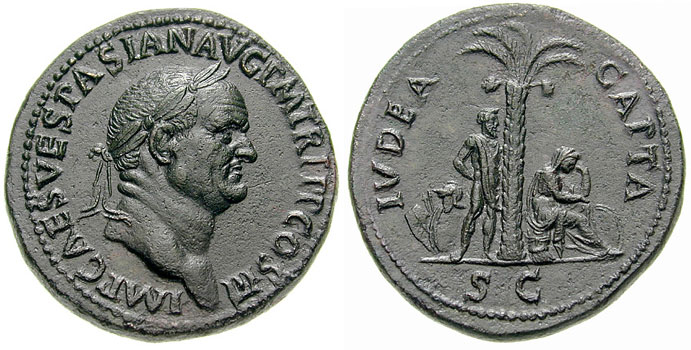
The duty of Longinus and other Romans in the region chiefly consisted of helping police the region and protecting the much despised tax collectors. One of those tax collectors, a Jewish man named Matthew had left the employ of Caesar a few years back and was now a “disciple” of some itinerant Jewish preacher named Jesus. He had heard a story from another Centurion about this preacher that made him chuckle. Evidently some Jews of the sect know as the Pharisees, a particularly strict group tried to trap the Jesus with the question of whether it was lawful to pay taxes to the Romans. They thought that they had trapped him because if he answered in the affirmative he would be rejected by them and discredited among the people, while if he answered that it was not they would have him on record as urging the people to disobey Caesar. The Centurion who told the story said how with him standing in the background watching and listening that Jesus asked one of the Pharisees to bring him a coin. Looking at the coin he asked the man whose image was on it. The Pharisee, a bit hesitantly replied that it was “Caesar” to which Jesus, who supposedly was an unlearned but charismatic bumpkin from Galilee replied “give to Caesar what is Caesar and to God that which was God’s.” Longinus’ colleague, an outsider looking in at this curious religious dispute was amazed with the acumen of Jesus in dealing with a question that someone less intuitive could have botched with potentially fatal consequences.
images-35

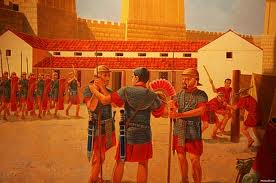
The march through Samaria was particularly uneventful but as the Legionaries entered Judea, a region seething with hostility toward the Romans he and his men became more guarded, very aware of the hostility that sometimes invited violence.

They arrived about noon on Friday in order not to stir up the Jewish faithful on their sabbath and took up residence in the Fortress Antonia, the symbol of Roman might in this always rebellious city. That evening and the next day were uneventful, but on Sunday, Longinus was told to have his troops stand by in case of violence. The man named Jesus was entering the city and pandemonium was expected. According to rumor this Jesus had raised a many from the dead in Bethany the day before and was being greeted as a potential King and liberator.

The Roman presence was muted, Pilate and senior commanders not wanting to do anything that might provoke an insurrection. The troops remained on alert at the fortress while Longinus and a number of other officers went to observe events at a distance.

Longinus was amazed at what he saw. Thousands of people singing and throwing cloaks and palms along the street as Jesus, mounted on a white donkey accompanied by his disciples as well as numerous people from Bethany where he had been staying paraded down the street.

The procession moved toward the Temple where an understandably nervous delegation of Pharisees and the Priests of the Temple wondered what Jesus might do. If he was the “Messiah” that they preached about it could be a direct threat to their positions of power and provoke a Roman crackdown against them.

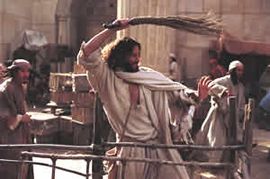
Jesus dismounted from the donkey and entered the Temple area, now crowed with thousands of pilgrims coming to offer sacrifice where he began to condemn the moneychangers. The moneychangers were in charge of selling animals for sacrifice to pilgrims, many of whom who could not bring their own animals for sacrifice. They were not according to what Longinus knew from his previous visits to the city at Passover and other Holy days men of good repute. They were believed to make their profit off the poor and widows and even the Romans that knew of the practice considered it less than honorable, and certainly the religious authorities were making money from their efforts.
Jesus_temple

As Jesus went into the Temple Longinus and his fellow officers stayed back. As Gentiles their presence would create a crisis so they remained outside entrusting a Jew who worked with them to make the observation. They could hear commotion in the Temple and as they watched money changers and others came spilling out of the Temple grounds, many surrounded by their animals, lambs, doves and oxen. Longinus wondered what in the name of Jupiter was going on and soon his spy came running out of the Temple to make his report.

Slowing down as he approached Longinus he breathlessly gave his report. Jesus had taken a whip and driven out the moneychangers, condemning their activities and those of the religious leaders. Longinus had never heard of Jesus ever doing anything remotely violent before and this shocked him. He asked what else had happened and the spy reported that the Temple police and authorities did nothing and that Jesus left without further incident.

Pontius-Pilate

Longinus knew that the coming days could prove interesting. Going to Pilate that evening he gave his report. Pilate was quite concerned about the situation and considered it volatile. He ordered Longinus and the other officers to maintain an elevated state of readiness in case there was some sort of protest or even civil strife between the followers of Jesus and the Jewish authorities.

Longinus left Pilate and he and his fellow officers discussed the situation, briefed their subordinates and as night fell met in the tavern in the fortress where they quietly drank and wondered what the coming days might bring.
5 Comments

Filed under faith, History, Religion

Reflections on the Invasion of Iraq: 10 Years Later in Light of Nuremberg

saddam0978

“If certain acts of violation of treaties are crimes, they are crimes whether the United States does them or whether Germany does them, and we are not prepared to lay down a rule of criminal conduct against others which we would not be willing to have invoked against us.” Justice Robert Jackson International Conference on Military Trials, London, 1945, Dept. of State Pub.No. 3080 (1949), p.330.

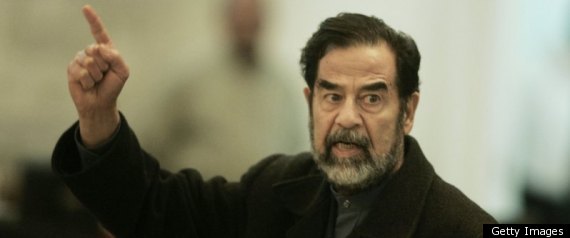
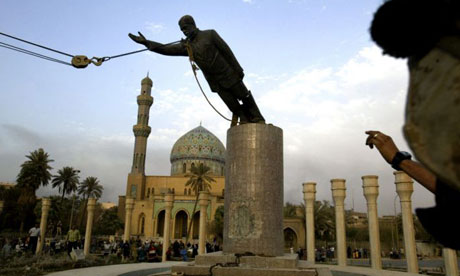
In March 2003 I like many of us on active duty at the time saw the nation embark on a crusade to overthrow an admittedly thuggish criminal head of state, Saddam Hussein. The images of the hijacked airliners crashing into the Twin Towers of the World Trade Center and the Pentagon were still relatively fresh in our minds. The “evidence” that most of us had “seen,” the same that most Americans and people around the world were shown led many of us to believe that Saddam was involved in those attacks in some manner and that he posed a threat to us.

Now it wasn’t that we didn’t have doubts about it or even the wisdom of invading Iraq. It didn’t matter that there was also credible evidence that maybe what we were being told was not correct, and it didn’t matter that some of our closest allies voted against a mandate to invade Iraq in the United Nations Security Council. We were emotionally charged by the events of 9-11 and “we knew” that Saddam was a “bad guy.” We also believed that we could not be defeated. We had defeated the Iraqis in 1991 and we were stronger and they weaker than that time.

We really didn’t know much about Iraq, its history, people, culture and certainly we paid little attention to the history of countries that had invaded and occupied Iraq in the past. T.E. Lawrence, the legendary Lawrence of Arabia wrote in August of 1920 about his own country’s misbegotten invasion and occupation of Iraq, or as it was known then Mesopotamia.

“The people of England have been led in Mesopotamia into a trap from which it will be hard to escape with dignity and honour. They have been tricked into it by a steady withholding of information. The Bagdad communiqués are belated, insincere, incomplete. Things have been far worse than we have been told, our administration more bloody and inefficient than the public knows. It is a disgrace to our imperial record, and may soon be too inflamed for any ordinary cure. We are to-day not far from a disaster.”

The sad thing is that the same could have been written of the United States occupation by 2004.

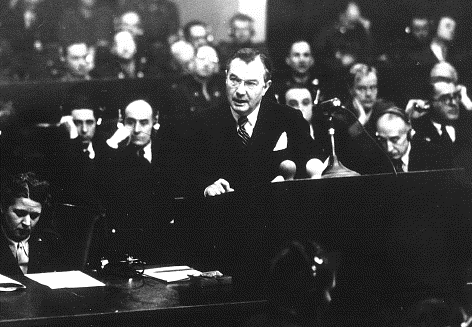
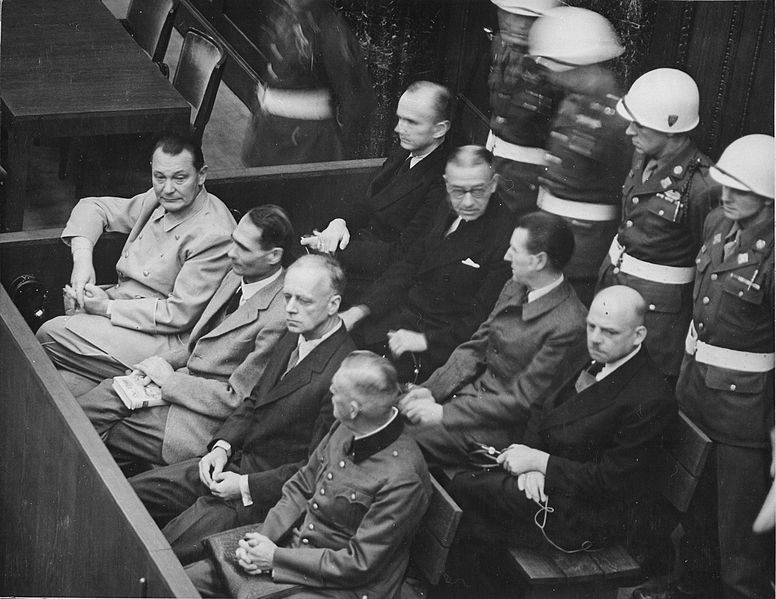
But even more troubling than the words of Lawrence are the Nuremberg War Crimes Trials. Somehow as a historian who has spent a great deal of time studying the Nazi period and its aftermath I cannot help but look back in retrospect and wonder what Supreme Court Justice Robert Jackson and the other Nuremberg prosecutors would have done had they had some of our leaders in the dock instead of the Nazis.

776px-Nuremberg-1-

The indictments against the Nazis at Nuremberg are chilling if we were to be held to the same standard that we held the Nazis leaders at Nuremberg. True, we did not have massive death camps or exterminate millions of defenseless people, nor did we run slave labor factories, but we did like they launched a war of aggression under false pretense against a country that had not attacked us.

At Nuremberg we charged twenty top Nazi political officials, as well as police and high ranking military officers with war crimes. The indictments included:

Count One: Conspiracy to Wage Aggressive War: This count addressed crimes committed before the war began, showing a plan by leaders to commit crimes during the war.

Count Two: Waging Aggressive War, or “Crimes Against Peace” which included “the planning, preparation, initiation, and waging of wars of aggression, which were also wars in violation of international treaties, agreements, and assurances.”

Count Three: War Crimes. This count encompassed the more traditional violations of the law of war already codified in the Geneva and Hague Conventions including treatment of prisoners of war, slave labor, and use of outlawed weapons.

Count Four: Crimes Against Humanity, which covered the actions in concentration camps and other death rampages.

While count four, Crimes Against Humanity would be difficult if not impossible to bring to trial because there was nothing in the US and Coalition war in Iraq that remotely compares to that of what the Nazis were tried, some US and British leaders could probably have been successful prosecuted by Jackson and the other prosecutors under counts one through three.

The fact is that none of the reasons given for the war by the Bush Administration were demonstrated to be true. Senior US and British officials knowing this could be tried and very probably convicted on counts one and two. We also know that some military and intelligence personnel have been convicted of crimes that would fall under count three.

r-SADDAM-HUSSEIN-large570

Saddam Hussein was a war criminal. He was also a brutal dictator who terrorized and murdered hundreds of thousands of his own people. But we went to war over his alleged ties to Al Qaeda and WMDs and he had not attacked us. Looking back at history and using the criteria that we established at Nuremberg I have no doubt that had Dick Cheney or Donald Rumsfeld been in the dock that Justice Jackson would have destroyed them and the court would have convicted them.

So 10 years, nearly 5000 US military personnel dead, 32,000 wounded, over 100,000 afflicted with PTSD, and other spiritual and psychological injuries, with an estimated 22 veterans committing suicide every day; somewhere between 1 and 2 trillion dollars spent, hundreds of thousands of Iraqis dead, wounded and displaced from their homes and a country destroyed and still in turmoil. And somehow those that decided to take us to war roam free. They write books defending their actions and appear on “news” programs hosted by their media allies who 10 years ago helped manipulate the American public, still traumatized by the events of 9-11-2001 to support the war.

nuremberg-jackson-10400

http://www.youtube.com/watch?v=No06Lwk_TAg

Saddam and many of his henchmen are dead or rotting in Iraqi prisons for their crimes against the Iraqi people. However good this may be one has to ask if how it happened was legal or justified under US or International Law, if it was worth the cost in blood, treasure or international credibility. Likewise why have none of the men and women who plotted, planned and launched the war been held the standard that we as a nation helped establish and have used against Nazi leaders and others?

If we cannot ask that and wrestle with this then we as a nation become no better than the Germans who sought minimize their responsibility for the actions of their leaders, and in doing so enable future leaders to feel that they can do the same with impunity. That is a terrible precedent.

Peace

Padre Steve+

1 Comment

Filed under History, iraq,afghanistan, middle east

“Et Tu Brute” Beware of the Ides of March

murder_julian_cesar_b

Et tu Mitch? I mean Brute

Well it is March 15th, the Ides of March according to the Ancient Romans. It was a day sacred to them as the big uber-feast day of the Roman God Jupiter, where the Ides sheep was sacrificed to make all things right in the universe, or something like that.

It was also a day where Julius Caesar, long before he had an Orange drink named after him was warned about by a seer. Never ignore a seer or the machinations of political opponents is what I say, but that’s just me.

orange-julius-free-smoothie

However old Julius Caesar never quite got this, after all he had been named Dictator in Perpetuato, which is kind of like for all time by the Roman Senate. He also forgot that no matter what that definition of “for all time” actually means, that for Senators it generally equates to “until the next election cycle.” Since an election was coming up the Senators realized that “for all time” was rapidly running out and decided to act.

So on March 15th of 44 BC Julius Caesar ignored the warnings of a seer and went to see a gladiator match in the well of the Roman Senate. Eight Senators, sometimes referred in Roman history as the Group of Eight concocted a bi-partisan plan to rid themselves of Caesar. It was a very “pointed” plan if you get my drift by which they would stab Julius to death when he came to see them and the gladiator match that they were hosting. When Caesar passed the seer on the way to the Senate he basically dissed him saying something like “dude it’s the Ides of March baby and I’m still standing” and thumbed his nose giving a Bronx jeer. The seer’s response was not recorded but if one can assume, and I will, he probably said something like” up yours buddy, rot in hell” and gave him the evil eye.

william_shakespeare1

William Shakespeare: Trust him because he’s English

Needless to say Julius Caesar ended up getting the Senator’s point, or actually 23 points based on the number of stab wounds on his cold dead body. Caesar’s last words are disputed, but William Shakespeare, who must be believed because he was English and not Italian and who lived over 1500 years after the events has to have the most accurate account. Shakespeare, who depended on Wikipedia for his knowledge of the time declared that Caesar said to Brutus, a Senator Et tu Brute?” which means something like “Dude how could you?” when he saw Brutus sticking his K-Bar into him. Shakespeare however does not record what he said to Mitch McConnell.

Of course historians will debate this, but if you can’t believe an Englishman why would you believe and Italian when it comes to knowing how do get rid of a head of state? The English, despite the quaint accent have proven themselves to be experts at this.

godfather_2111499i

Likewise, there is something else to be said about the Ides of March and the assassination of Julius Caesar. That is this. The assassination was a community thing. There wasn’t a lone assassin with a curious name like Lee Harvey, James Earl or John Wilkes, no this was a real live Italian style mob it, sans automatic weapons. Imagine if they had guns, Julius Caesar would have ended up like Sonny Corleone in The Godfather. The fact is that we are lacking in community now days and if there is anything about the Ides of March that we need to remember is that community matters. Lone gunmen, they are kind of boring, but mobs of enraged people or Senatorial conspirators, that is hard to do now days.
So now with less than an hour left on the Ides of March, I have made sure that I have not let the Senate or anyone else name me a dictator for life and have avoided sharp pointy objects and Senators of any kind. So far I am doing well. I haven’t seen a seer and have settled in for the evening on the eve of the eve of St Patrick’s Day.

So until tomorrow, Happy Ides of March!

Peace

Padre Steve+

1 Comment

Filed under History, Just for fun, purely humorous

The Battle of Hampton Roads: 9 March 1862: The Epic Beginning of Modern Naval Warfare

800px-The_Monitor_and_Merrimac

On the morning of March 8th 1862 the CSS Virginia steamed slowly from her base at Portsmouth Virginia into Hampton Roads at the mouth of the Chesapeake Bay. Awaiting her was a US Navy squadron of wooden warships including the steam Frigate USS Minnesota, the Sloop of War USS Cumberland and Frigate USS Congress and a number of smaller vessels. The Virginia was an armored ram built from the salvaged remains of the large steam frigate USS Merrimack which had been burned at Gosport (Now Norfolk) Naval Shipyard. Her plans had been leaked to the US Navy which was also in the process of constructing a number of ironclad ships of different types. The first of these ships to be ready was the USS Monitor, a small ship mounting a single heavily armored turret mounting two powerful 11” Dalghren smoothbore guns was still steaming to Hampton Roads when Virginia came out for battle.

CSSVirginia1862.2.ws

During the ensuing fight of March 8th Virginia rammed and sank Cumberland which though fatally wounded disabled two of Virginia’s 9” in guns. She destroyed Congress by gunfire which burned and blew up and appeared to be in position to destroy Minnesota the following day as that ship had run hard aground. The losses aboard Cumberland and Congress were severe and included the Captain of the Congress and Chaplain John L. Lenhart of Cumberland, the first US Navy Chaplain to die in battle. During the battle Virginia had several men wounded including her Captain Franklin Buchanan.

Cumberland_rammed_by_Merrimac

Due to the coming of darkness and a falling tide the acting commander of Virginia, Lieutenant Catsby Ap Roger Jones her executive officer took her in for the night. During the night Monitor, under the command of Lieutenant John Worden arrived and took up station to defend Minnesota.

603px-Battle_of_Hampton_Roads_Map

The next morning Virginia again ventured out and was intercepted by the Monitor. The ships fought for over three hours, with Monitor using her superior speed and maneuverability to great effect. During the battle Monitor suffered a hit on her small pilothouse near her bow blinding her Captain. Neither side suffered much damage but the smokestack of Virginia was pierced in several places affecting her already poor engine performance.  Jones broke off the action and returned to Gosport for repairs and Monitor remained on station.

USSMonitor1862.3.ws

The battle showed the world the vulnerability of wooden warships against the new ironclads. Monitor in particular revolutionized naval warfare and warship construction. Her defining mark was the use of the armored gun turret which over the succeeding decades became the standard manner for large ships guns to be mounted. Turrets like the warships they were mounted upon grew in size and power reaching their apex during the Second World War.

arizon-main-battery2

Both Virginia and Monitor reached less than glorious ends. Virginia had to be destroyed by her crew to prevent her capture just over two months after the battle on May 11th 1862. Monitor survived until January 31st 1862 when she sank during a heavy storm off Cape Hatteras North Carolina with the loss of 16 of her 62 man crew. The remains of two of those men, recovered during the salvage of Monitor’s engines, turret, guns and anchor were interred at Arlington National Cemetery yesterday. The relics from Monitor and some from Virginia are displayed at the Mariners Museum in Newport News (http://www.marinersmuseum.org )while one of Virginia’s anchors resides on the lawn of the Museum of the Confederacy in Richmond.

Those early ironclads and the brave men who served aboard them revolutionized naval warfare and their work should never be forgotten.

Peace

Padre Steve+

Leave a comment

Filed under civil war, History, Navy Ships, US Navy

The Toxic Faith of “Americananity” and its Antidote

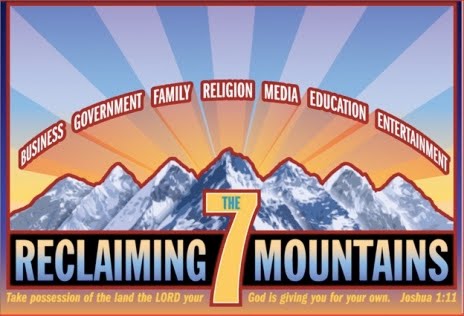
seven-mountains

“The notion of a Christian commonwealth should be exploded forever. … Government should protect every man in thinking and speaking freely, and see that one does not abuse another. The liberty I contend for is more than toleration. The very idea of toleration is despicable; it supposes that some have a pre-eminence above the rest to grant indulgence, whereas all should be equally free, Jews, Turks, Pagans and Christians.” John Leland 

There is a form of religion and indeed the “Christian” faith that is toxic and if not treated leads to the spiritual and sometimes the physical and emotional death of the infected person.

There is a nationalized version of this faith which in this country with respect to the Christian tradition I will call “Americananity.” It is a bastardized version of the Christian faith overlaid with the thin veneer of a bastardized version of American history. Its purveyors are quite popular in the world of “conservative” American Evangelicalism and Catholicism.  Supreme Court Justice Robert Jackson wrote “[I]n our country are evangelists and zealots of many different political, economic and religious persuasions whose fanatical conviction is that all thought is divinely classified into two kinds — that which is their own and that which is false and dangerous.”

Pat Robertson, evangelist and founder of the Christian Broadcasting Network is an example of what Leland and Jackson warned us about. Robertson said on his program that “You say you’re supposed to be nice to the Episcopalians and the Presbyterians and the Methodists and this, that, and the other thing. Nonsense, I don’t have to be nice to the spirit of the Antichrist.” — Pat Robertson, The 700 Club, January 14, 1991. The late David Chilton was another. He wrote: “We believe that institutionally Christianity should be the official religion of the country, that its laws should be specifically Christian”

It is quite fascinating when you look at it. This faith is a combination of a selective reading of American history, Christian teaching and Biblical interpretation which mixes and matches a wide variety of mutually conflicting and contradictory traditions. This Toxic Americananity is based on a reading of American and Western History which negates, marginalizes or willingly distorts the views or contributions of those who were not Christian or who like Baptists, John Leland and Roger Williams due to their own experiences of religious persecution refused to buy into any form of state sanctioned religion.

I find it interesting that Conservative Icon and champion of limited government Barry Goldwater had great reservations about those that sought to establish the superiority of any religion. Goldwater said on the Senate floor: “The religious factions that are growing throughout our land are not using their religious clout with wisdom. They are trying to force government leaders into following their position 100 percent.”

The leaders of this new and quasi “Christian faith” are many and include some of the most popular religious leaders in the United States such as Pat Robertson, the pseudo-historian David Barton, James Robison, Gary North, Bryan Fischer, James Dobson, Gary Bauer Phyllis Schafley and a host of others. For them the Gospel has been equated with government legislation of “Christian” values which conveniently are defined by them and their political allies often in complete contradiction to the Gospel and to nearly 2000 years of Christian experience. North, one of the most eloquent expositors of the Dominionist movement wrote:

“The long-term goal of Christians in politics should be to gain exclusive control over the franchise. Those who refuse to submit publicly to the eternal sanctions of God by submitting to His Church’s public marks of the covenant–baptism and holy communion–must be denied citizenship, just as they were in ancient Israel.”

That is quite a statement and those who think that they can co-opt people like North, Robertson or others are quite mistaken. Goldwater realized this. What is fascinating to me is to watch these men and women advocate religious and political positions in regard to Church-State relations that completely opposite of what early American Christian and non-Christian civil libertarians imagined when our country was founded. Positions that quite often are at odds with even the historical tenants of their own faith. Their only claim to innocence can be because not a one of them have any training in history and often are even worse when it comes to their understanding of the Christian tradition, which did not begin in and will not end in the United States.

In this confused and often hateful “faith’ we see men and women who hate centralized government but extol a centralized religion. I was talking with a friend who is adamantly opposed to a powerful Federal Government but extols the perfection of the centralized bureaucracy of his Roman Catholic Faith. He could not see the contradiction. I watch others who extol an almost Libertarian understanding of the government and the Constitution who supposedly in their religious tradition are from the “Free Church” who advocate the supremacy of the Church over the State and in doing so their particular and limited understanding of Church over that of the Church Universal.

In this confused and contradictory setting there are Catholics espousing political views that are in direct opposition to the understanding of government supported by the Magisterium of the Church. There are Evangelical and Charismatic Protestants that mix and match the untenable and contradictory beliefs of Dominionism and Millennialism which involve on one hand the takeover of earthly power by the Church and the ushering in of the Kingdom of God and the understanding that earthly power is ultimately under the dominion of Satan and must be overcome by the Second Coming of Christ.

Leland wrote:

“These establishments metamorphose the church into a creature, and religion into a principle of state, which has a natural tendency to make men conclude that Bible religion is nothing but a trick of state.”

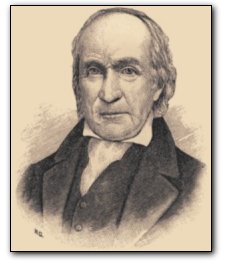
leland-1

John Leland

Leland was one of the most important persons in regards to the relationship of the Christian Churches to the American Government. He was a champion of the religious liberty enshrined in the Bill of Rights and helped influence both James Madison and Thomas Jefferson. He noted in 1791:

“Is conformity of sentiments in matters of religion essential to the happiness of civil government? Not at all. Government has no more to do with the religious opinions of men than it has with the principles of mathematics. Let every man speak freely without fear–maintain the principles that he believes–worship according to his own faith, either one God, three Gods, no God, or twenty Gods; and let government protect him in so doing, i.e., see that he meets with no personal abuse or loss of property for his religious opinions. Instead of discouraging him with proscriptions, fines, confiscation or death, let him be encouraged, as a free man, to bring forth his arguments and maintain his points with all boldness; then if his doctrine is false it will be confuted, and if it is true (though ever so novel) let others credit it. When every man has this liberty what can he wish for more? A liberal man asks for nothing more of government.” John Leland, “Right of Conscience Inalienable, and Therefore, Religious Opinions Not Cognizable By The Law”

When the adherents of a faith, any faith, but especially the Christian faith enlist the government to enforce their understanding of faith they introduce a toxicity that is eventually fatal when consumed and acted on.

I think that much of what we are witnessing today is much more the product of fear mongering preachers that see opportunity in their political alliances and that are willing to reduce the Gospel to a number of “Christian values” in order to achieve a political end; even if that end is ultimately destructive to the Church and to the Gospel.

The message of the Apostle Paul to the Church in Corinth was this: “All this is from God, who reconciled us to himself through Christ, and has given us the ministry of reconciliation; that is, in Christ God was reconciling the world to himself, not counting their trespasses against them, and entrusting the message of reconciliation to us.” (2 Cor 5:18-19 NRSV) 

The early church thrived when it had no early power. It thrived when it was persecuted and when the Roman government openly supported almost every religion but it. However, once it became powerful and worldly it became ensnared in affairs far from that simple message of reconciliation.

It was in this country that the various sects of the Christian faith had the opportunity to make a new start, unencumbered by the trappings of power. But instead, like those that came before us we have all too often been seduced by the toxin of power. John Leland understood this and fought to ensure that all people of faith were free and unencumbered by state supported religion. He wrote:

“The liberty I contend for is more than toleration. The very idea of toleration is despicable; it supposes that some have a pre-eminence above the rest to grant indulgence; whereas all should be equally free, Jews, Turks [Muslims], Pagans and Christians. Test oaths and established creeds should be avoided as the worst of evils.”

Leland’s friend James Madison wrote to Edward Everett toward the end of his life:

“The settled opinion here is, that religion is essentially distinct from civil Government, and exempt from its cognizance; that a connection between them is injurious to both; that there are causes in the human breast which ensure the perpetuity of religion without the aid of the law; that rival sects, with equal rights, exercise mutual censorships in favor of good morals; that if new sects arise with absurd opinions or over-heated imaginations, the proper remedies lie in time, forbearance, and example; that a legal establishment of religion without a toleration could not be thought of, and with a toleration, is no security for and animosity; and, finally, that these opinions are supported by experience, which has shewn that every relaxation of the alliance between law and religion, from the partial example of Holland to the consummation in Pennsylvania, Delaware, New Jersey, &c., has been found as safe in practice as it is sound in theory. Prior to the Revolution, the Episcopal Church was established by law in this State. On the Declaration of Independence it was left, with all other sects, to a self-support. And no doubt exists that there is much more of religion among us now than there ever was before the change, and particularly in the sect which enjoyed the legal patronage. This proves rather more than that the law is not necessary to the support of religion” (Letter to Edward Everett, Montpellier, March 18, 1823).

That is the antidote to the toxic faith of what I now call “Americanity.” It stands against any idea of a state sanction or religion or a religion that like in Saudi Arabia or Iran controls the state. It stands in opposition to the beliefs of so many “Christian” religious leaders work to  ensure that they control the powers of government. Attempts that try to proclaim their superiority above even the ultimate message of the Gospel which proclaims “for God so loved the world….” 

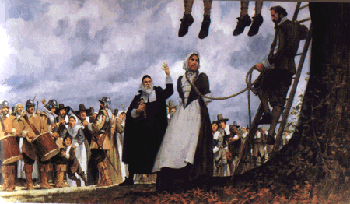
By the way there are always results. The Puritans who many extoll were some of the most intolerant of dissenters of any group that has every held the reigns of power over the state and religion ever known in this country. Their victims included Quakers as well as American Indian converts to Christianity. The picture below of the Puritans hanging Quakers in the Massachusetts Bay Colony should give pause to anyone who thinks that such actions are not possible today should any religion gain control of political power.

dyer-hanging

Peace

Padre Steve+

PS. I do not expect some people to agree with me. It is a free country and I am not God, the Pope or Bill O’Reilly and thus quite fallible. While I welcome opposing viewpoints and comments I do expect them to be civil and respectful and done in a spirit of dialogue. Those that are not civil, respectful or which simply attempt to beat me down or which are sermons will not be approved and I will not answer them. It gets really old and I have learned that in some cases no matter how hard I try to respect the beliefs of others are treat others as I would want to be treated that some people just love to destroy everything and everyone in their path. I don’t have time for that and having allowed people to do it on this site in the past I won’t do it again. If you are that kind of person feel free to start your own website and attack my viewpoints on it and not here. After all it is a free country and you have that right. I promise not to come on your site and attack you. Like I said, I don’t have time for that kind of stuff. 

7 Comments

Filed under christian life, faith, History, laws and legislation, News and current events, Religion

Padre Steve Remembers the Alamo

alamo

“I Messed With Texas and Now I Have a Rash” General Antonio López de Santa Anna

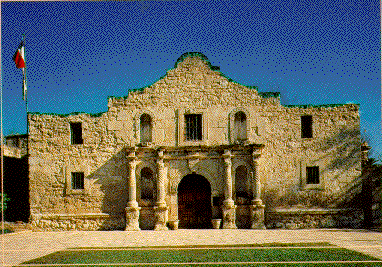
I remember the Alamo.  I have seen the movie, at least a couple of them and been to the Alamo. Needless to say the actual Alamo did not live up to the movie billing.

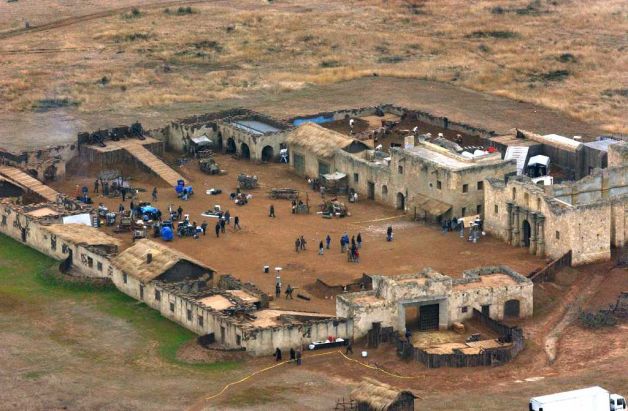
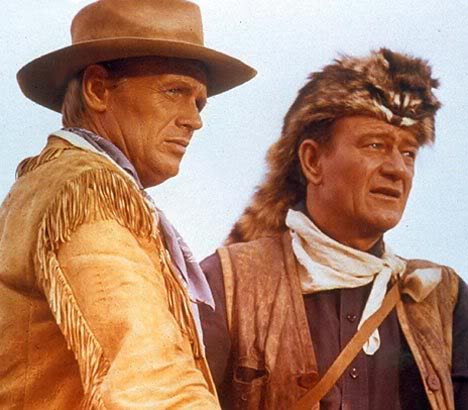
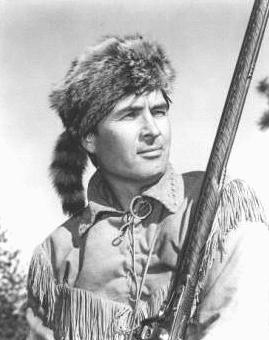
It was on this day in 1836 that the garrison of Texans defending the outpost across from te Burger King and Walgreens in downtown San Antonio was overwhelmed by the Mexican Army. Led by William Travis, James Bowie and his brother David, Fess Parker or John Wayne playing David (Davy) Crockett the other 133 Texians as the called themselves, outnumbered and outgunned by about one million Mexican troops finally succumbed to the inevitable after a 13 day siege. They were slaughtered but the cry “Remember the Alamo!” reverberates to this day.

628x471-7

I always felt misled by the media about the Alamo. From my time watching Disney and John Wayne movies about the Alamo I assumed that the fortress was well out of town, preserved for the sake of posterity and surrounded by parking lots and souvenir stands. However that was not the case and I found out this bitter truth in the summer of 1983 while going through my Medical Service Corps Officer Basic Course at Fort Sam Houston.

8e1f140790a405289b58e512ed3e8bdf

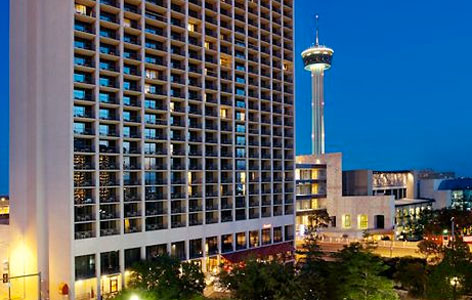
Those were the times of the heady Reagan military build up and my class had no room to stay on the base. We were billeted in amid the squalor of the Riverwalk Marriott Hotel in downtown San Antonio. Having to take a lowest bidder Bluebird school bus to and from the base every day was a difficult task for we newly commissioned officers however, we made do.

alamobig

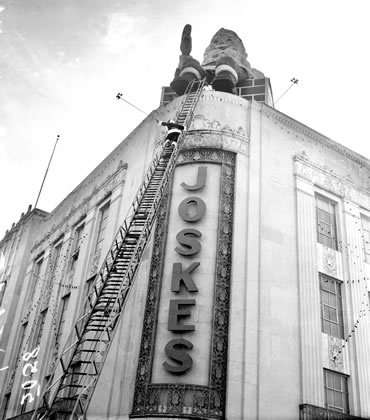
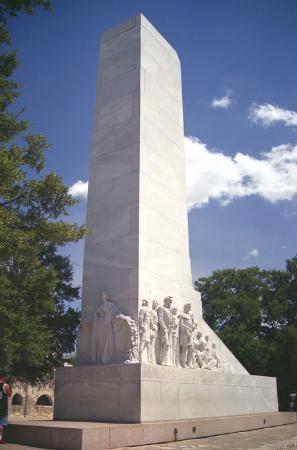
One day I had to stay late to do some research and missed the Army bus. I had to take a city bus from the base to the hotel. However the bus did not drop me off at the hotel. It dropped me off in Centennial Square, near a large granite phallic symbol which I later learned is called a “Centopath” a now extinct life form from the late Neosporin era. As I got my bearings I noticed the Walgreens, the Burger King and the venerable Joske’s department store. But nestled among them was a small and less than impressive building. I thought to myself that “that looks like the Alamo.” However I immediately dismissed the thought because I knew from the movies and Disney TV shoes that I had seen that the Alamo was on the outskirts of town and surrounded by parking lots. I then thought, “what a stupid place to put a replica of the Alamo” and proceeded to my hotel.

alamo-cenotaph

When I got to my room I told my roommate, then 2nd Lieutenant Barry Mitchell, now a retired Lieutenant Colonel about my discovery of this “fake” Alamo. Barry looked at me like I had grown a third head. He knew that I was a history major. However, in my defense I studied Europe and Nazi Germany, choosing to learn my American history from the movies and the Bible like everyone else.

6983589351_5a61f8dbff_z

As I looked at the expression on his face I realized that I had been had by the media. Barry said “that is the Alamo” and I replied “but the Alamo is out of town surrounded by parking lots…” Barry looked at me and told me that indeed that this was the real Alamo. It was humiliating.

davy-crockett-wayne-widmark

So the next weekend after I had drank too much at Dirty Nelly’s tavern on the Riverwalk I went and made pilgrimage to the Alamo. I was supervised on the tour by some women from the Daughters of the Republic of Texas, who had seen the battle in person and shepherded through the exhibits, maintaining a certain reverence for the site of this battle.

6fb4c43748acfe253dffcc74fbd6a3d6_1M.png

Now since then I have been to the sites of many battles in the United States, Europe and Asia and never seen a site so unremarkable as the Alamo. The fault is not that of the building, or the brave men that died defending it, but by the callousness of the citizens of San Antonio who allowed the hallowed ground to be reduced to about a city block surrounded by crappy looking commercial structures and an horrible monument.

san_antonio_marriott_riverwalk_meetings_l

Now the fact that the Mission building remains at all is because of these very long lived women that supervised my tour. Those brave women, who echoing the Isley Brother’s song “Fight the Powers that Be” fought the powers that be to preserve the site much as had Colonels Travis, Bowie and Crockett in 1836.

Fess Parker

Now admittedly the Alamo holds a special place in the hearts of all that love Texas, Fess Parker and John Wayne. I will also never forget to “Remember the Alamo” but not for the reasons of so many Texas patriots. I will remember it because it wasn’t what I thought it would be.

So my friends, Remember the Alamo!

Peace

Padre Steve+

Leave a comment

Filed under History, Just for fun, movies, purely humorous

Capital of the World: The Race to Host the United Nations: A TLC Book Tour Review

Capital of the World200

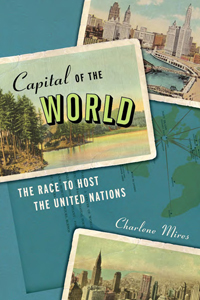
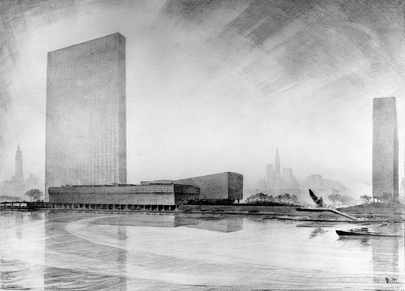
Professor Charlene Mires’ Capital of the World: The Race to Host the United Nations, NYU Press 4 March 2013 is the fascinating story of the competition by numerous cities in the United States to become the host of the United Nations.

Professor Mires’ account of the story of how the UN came to be located in New York City, over the objections of many members is highly informative, readable and enjoyable. It is about an America that once welcomed engagement with the world in the heady days following the Second World War before signs sponsored by the John Birth Society and others popped up across the country demanding “Get us out of the United Nations.”

Mires traces the stories of a number of major cities including San Francisco, Chicago, St Louis, New Orleans, Philadelphia and Detroit as well as the Rapid City South Dakota, Sault Ste. Marie Michigan, Niagara Falls New York, Stillwater Oklahoma and a host of other cities and towns that sought to host the UN.

36640

The story which includes the attempts of various individuals, politicians and civic groups to lobby the UN to become its headquarters and thus the storied “Capital of the World” is fascinating. Though the campaign to host the UN happened over 60 years ago and we know the history of its location in New York the back story to how it came to located there is worth the read. Professor Mires tells the story of how the United States became the chosen nation of the location of the UN based on the history of Europe and questions of the emerging Cold War.

1326

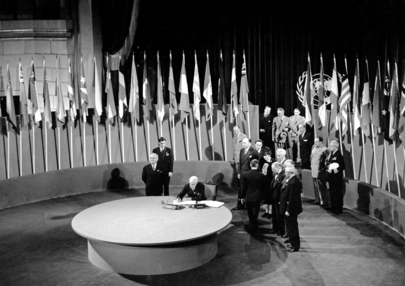
What I found interesting was how the members of the UN finally settled on New York, despite the fact that many did not wish the UN to be in the United States and if it was not to be in a major city. The story of how San Francisco, a city close to my heart which hosted the inaugural meeting of the UN in 1945 was cut out of the running when a UN committee decided that no locations in the western part of the United States would be considered. That decision, which was based more on European objections to the geographic location was difficult to read. I cannot think of a better city and thankfully the mistake was rectified by the late Gene Roddenberry in Star Trek when the United Federation of Planets located Starfleet Headquarters and Starfleet Academy in San Francisco.

0aaunitednation

That aside the story that Professor Mires paints of how the committee and the UN decided on New York is compelling. The process which included geographic, political and social concerns. Politically the influence of the American government should the location be too close to Washington DC prompted conferees to seek a location at least 300 miles from Washington. The real effects of Racism and Jim Crow laws eliminated all Southern cities and towns south of the Mason Dixon Line from the competition. Issues regarding crime, graft and corruption eliminated Philadelphia as well as other cities leading to the eventual selection of New York as the location for the nascent United Nations.

Overall I enjoyed the book. It was a quick, informative and enjoyable read. As a person who genuinely appreciates the work and promise of the UN, despite its shortcomings and failures I found it a story that caught my imagination and made me wonder the “what if” scenarios and what might have been if…

To me those are fascinating questions. What would have happened had the UN been located in San Francisco? Could it have led to the emergence of a stronger and move toward the Pacific Rim becoming the economic and political center of the world? Could the location of the UN in a place like Rapid City brought Middle America more global perspective and perhaps a larger population and economy? Could the selection of a Southern city led to a quicker end to Jim Crow and beginning of equal rights?

Those are questions for those that write alternative histories. They are speculation. Professor Mires work made me think of all of the possibilities that did not happen.

images-30

I recommend this book for those interested in the development of the United States in the late 1940s and early 1950s as well as those that like to have their eyes opened to possibilities that they never before had imagined. Perhaps in an alternate timeline San Francisco not only has the Giants, but the United Nations. I would like to visit that city.

tlc tour host

Peace

Padre Steve+

11 Comments

Filed under History

Sequester, Lent and Hope

198177_10151361204842059_1890411795_n

“As lousy as things are now, tomorrow they will be somebody’s good old days.” Gerald Barzan

Sequester is here and with it the era of mutual assured destruction by our political, economic and media elites continues in an unabated form.

At the same time sequester occurs during the season of Lent when Christians are called on to make voluntary sacrifices of things that are important to them in the forms of fasting and abstinence. Lent is a season of penitence which hopefully builds in the heart of the believer a new love for God and neighbor, a season that changes a person from a “me first” attitude to an attitude of thanksgiving, gratitude and service to those in distress. That being said, the season of Lent should be a season of hope.

However it is difficult at times to be hopeful when all around there is bad news. We seem to be living the ancient Chinese curse that says “May you live in interesting times.” The times are certainly interesting with lots going on of historic significance that may years from now be remembered as one of those tumultuous times where the world changed before our eyes.

History of course is replete with such times, the rise and fall of ancient empires, the age of exploration, the Reformation, the French and American Revolutions, the Napoleonic era, the American Civil War, the Industrial Revolution, the First and Second World War with the Great Depression sandwich, the 1960’s, the post Cold War era and the post-911 era just for a start.

I could go back further in history for other epochal periods, but I think that the reason that today’s crisis seem so much more dire is that we are both the beneficiaries and the victims of the instantaneous communication revolution in which common people have real time access to events that are impacting their lives.  This causes many a great deal of anxiety both real and imagined, anxiety which usually finds expression in a desire for the good old days as well as seeks solace and security from those who feverishly exploit that anxiety.  It does not matter if the security comes from religion, political ideology and matters neither if it comes from the left or the right so long as the call resonates with them they will follow it. They will faithfully follow even as the purveyors of the message drive up their worry and anxiety that they no longer can actually enjoy life or be thankful because they are so consumed with how “lousy” things are or “evil” their opponents are.

Thus even during the season of Lent it is hard for many people to grasp the meaning of it when all around them appears to be falling apart and in chaos.

It is in times like these that one has to take a deep breath, look around at all that they have to be thankful for and just really examine of the nostalgia that they feel for “better times” is that or an escape from an unpleasant present and fear of the future if the other side wins.

The fact is that we have seen such times before and somehow made it through.  I hear from friends and relatives who lived through the Great Depression and World War II that those were good times in spite of everything happening, much of which is present today but somehow things are worse now.  Even I fall into the trap about somehow thinking that the times that I grew up in were somehow better than the present, this may be true for music but overall things were not that good for a lot of people but somehow we made it through them.  Lent is a time to step back from the brink, take stock and renew our life with God and our neighbor.

When I returned from Iraq back in February 2008 I soon discovered that the bombardment of bad news and über-partisan political battles took its toll on me.  I was neither as resilient as I thought that I was nor as consumed by the need to continue to ratchet up rhetoric on one side or the other as the more extreme elements on the right or left were doing.  PTSD or not I realized that the purveyors of the 24/7 bad news cycle were driving people with legitimate ideological differences to extremes that I had never seen, but which I recognized from history have a lot of precedent and can lead to making things even worse.  One only has to look at Weimar Germany to realize how things can go so very wrong when extremes on both sides of the ideological spectrums squeeze out those in the middle or chance at mutually beneficial solutions and that was in the days before type of information overload that is the bedrock of the political and ideological landscape of today.

I am not attacking those who get caught up in this but I do question the politicians, pundits, “news-networks” and talk show hosts who continue to ratchet up rhetoric to the point that many feel that the only alternative is some kind of “revolution.”  Again those that call for “radical change” or revolt against those who are in favor of that kind of change are both calling for revolution when revolutionary talk reaches a point where one side or the other does not see a way to resolve things in a civil manner then the those alternatives slip away and the only recourse is violence.

It is not the fault of one side or the other as those that stoke this talk are found on both sides of the American as well as other nations political and ideological spectrum testify to daily.  In the United States we also have a long history of apocalyptic thought which presents the lousy state of current events in any generation as something that will certainly bring the end of life as we know it or the return of the Lord, the Great Tribulation or whatever you chalk it up to. There are those on both the religious and secular side of the spectrum who have apocalyptic visions related to their world view.  For some reason we Americans do the apocalyptic quite well whether we believe in God or not.

The thing that has been most on my mind this Lent, as it has been the past several years has been the idea of being reconciled both to God and to one another.  Lent is a season of self examination, repentance and forgiveness.  The call to “be reconciled to one another” is a never ending command and applies across the variety and spectrum of life.

cross-ash-wednesday

Lent reminds us that that “we are dust and to dust we shall return” but that we are also all made in the image of the God who created us, redeems us and sanctifies us who calls us to himself and reminds us that mercy triumphs over judgment and “not be conformed to this world, but be transformed by the renewing of your minds, so that you may discern what is the will of God—what is good and acceptable and perfect.” I am afraid that in times like these even the best intentioned of people can find themselves pulled into the orbit of those that in less stressful or trying times that they would never be involved with.

The German martyr Dietrich Bonhoeffer once wrote: “Our enemies are those who harbor hostility against us, not those against whom we cherish hostility… As a Christian I am called to treat my enemy as a brother and to meet hostility with love. My behavior is thus determined not by the way others treat me, but by the treatment I receive from Jesus.”

I know for some that call themselves “Christians” this message is lost. However, I believe that it is not because they are consciously rejecting the message of the Gospel but because that have become so deeply involved in whatever cause they endorese that they have lost the ability at least temporarily to see the good that may rest in their opponents and their ideas.

As Bonhoeffer also wrote “Judging others makes us blind, whereas love is illuminating. By judging others, we blind ourselves to our own evil and to the grace which others are just as entitled to as ourselves.”  Now of course Bonhoeffer knew the evil that was the Nazis and eventually gave his life by supporting the German resistance to Hitler.  Loving our enemies does not absolve us from public responsibility but in ensuring that we do not ensnare ourselves in ideology that restricts our ability to love them as Christ has commanded.

I think in the past few years that I have gained a new perspective on life that has changed the way that I look at the world.  I know that things are not good right now and that there are a lot of things to be legitimately concerned. That said I know too that somehow our country as well as much of humanity have weathered worse and like Barzan said that for some these will be the good old days someday.

That thought helps me to live in the present knowing that the future is not yet written and known only to God who in his grace condescends to love us and desires that we better love him and one another and not be conformed to any ideology that would prevent that. Sequestration and political division aside I do pray that we will both see better days as well as be reconciled to God and to one another.

It is in times like this that I think of Bonhoeffer’s words:

“God loves human beings. God loves the world. Not an ideal human, but human beings as they are; not an ideal world, but the real world. What we find repulsive in their opposition to God, what we shrink back from with pain and hostility, namely, real human beings, the real world, this is for God the ground of unfathomable love.”

That is my Lenten prayer.

Peace,

Padre Steve+

1 Comment

Filed under christian life, faith, History, News and current events, Political Commentary

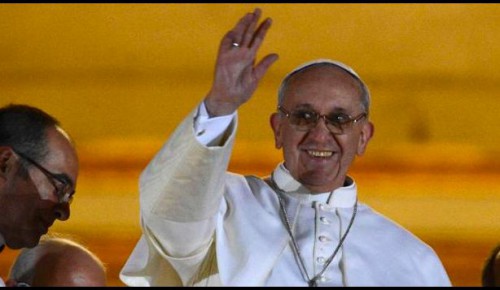
The Pope has Left the Building: Benedict XVI Gracefully Departs Amid Cloud of Scandal and Speculation

ITALY-VATICAN-POPE-HELICOPTER

Pope Benedict XVI, Joseph Ratzinger of Bavaria, the first German Pope since Victor who died in 1057 left office in a less than customary manner today. Unlike every one of his predecessors dating back to Celestine V who resigned in 1294 Gregory XII who resigned in 1414 to help end the Avignon schism he did not die in office.

Pope Benedict announced his resignation on February 11th and it stunned the Church and the world. Such an event had not occurred in nearly 600 years, over 700 years for one that resigned that was not under duress. Popes do not resign every day, it is not “normal” for those of us in the modern era. Benedict in his resignation letter cited his “lack of strength of mind and body” as his reason for resigning. After the lengthly suffering of his predecessor Pope John Paul II, who spent the last years of his papacy crushed under the weight of Parkinson’s disease and other illnesses leaving much of the day to day operations of the Church to the Curia led by Ratzinger, his friend and the head of the Office of the Congregation for the Faith, one could understand.

Benedict, now 85 years old, battling health concerns and under the increasing weight of scandals involving sexual abuse by clergy including Cardinal Roger Mahoney and Cardinal Michael Patrick O’Brien of the United Kingdom, the Vatican bank corruption and the “Vatileaks” scandal involving his butler resigned.

We probably know all of the factors that went into the resignation of Benedict. He is both lionized by Roman Catholic conservatives and vilified by those who resented his approach to the Church and its relation to the world. He seemed like a man out of his element as Pope, a contemplative theologian thrust by his office and relationship to his predecessor into the most high profile position in Christendom and for that matter in the religious world.

His legacy and impact will be debated and not really known for years because though no longer Pope he lives and his life story is not yet complete. The verdict of history and faith in the case of Pope Benedict XVI is not complete and it is foolhardy for one to attempt to access his Papacy until that life on this earth is ended. Likewise, it is unlikely baring the release of all information concerning Benedict as well as the various scandals in the church and his relationship to them and actions concerning them that we can know the full story.

I hope that Pope Benedict is able to continue his ministry as a former Pope in a manner that helps the Church heal and also be transparent. In this capacity it is possible that Benedict will have the chance to be a force for good that no Pope has ever had the chance, being the first to resign in so long.

Italy Vatican Pope

A Final Blessing at Castel Gandolfo 

Perhaps his resignation will be an inspiration to his successors as well as his fellow bishops not to simply remain in office because they can but instead attempt to listen to the Holy Spirit and the the people of God have to say. That being said there is the possibility that Benedict will become a “shadow Pope” influencing and dictating the course of the church remaining in a covent in Vatican City. I hope that will not happen. His words on his departure today and arrival at Castel Gandolfo if taken at face value indicate that he will be content to remain on the sidelines, but only time will tell. His story is not yet complete. As of now it appears that his departure is one of graceful humility and I pray that will be his legacy.

That being said it is up to the men that lead the Roman Catholic Church to be honest in dealing with the seemingly unending waves of scandal and corruption that seem to plague the Church. The time for cover ups has to end and the time for new beginnings, starting with repentance and renewal to begin.

Though I am not a Roman Catholic I will pray for Benedict and whoever his successor may be. I do hope that whoever that man is will be able to lead the church through the coming difficult days in an open and transparent manner and help lead the church to the renewal promised by the Gospel and opened again in Vatican II. There are far too many crisis in the Church and the world not to pray for this.

I hope that the next Pope, like Father Andrew Greeley’s fictional contender for the Papacy Luis Emilio Cardinal Menendez y Garcia says in the novel White Smoke: a Novel About the Next Papal Conclave (New York: Tom Doherty, 1996; pp. 140-143)

“It must be admitted honestly that many of our people have a negative impression of our institution, as of course do many who know us only from outside the Church. They view us as harsh and unbending, as narrow and uninformed, as arrogant and unsympathetic. Are we prepared to say that there are no reasons to justify that view of us? Are we prepared to say that there is nothing in our manner, our style, our institutional organization, our narrowness of vision which has given them that impression?

I for one am not ready to say those things. I candidly believe that we are our own worst enemies because we have often seem to worship not the Father in heaven but our own institutional being. We should not, my fellow Catholics, worship the Church, we should not make the Church an end in itself. The Church clearly is only a means. When the means gets in the way of the end it has become the object of idolatry. When we seem to want to impose that idolatry on others, we appear to many to be religious imperialists. Are we so sure that we never act like idolaters and religious imperialists?”

I think that the new Pope needs to be able to admit this and in doing so liberate the Church to do the work of the Gospel.

Peace

Padre Steve+

1 Comment

Filed under faith, History, News and current events, Religion