Category Archives: History

The Pacific Part Three: Tarawa Paving the Way to Peleliu, Iwo Jima and Okinawa

Introduction to Part Three

While the First Marine Division slogged its way through the hell of the New Britain campaign the battle for the Pacific’s primary focus became the Central Pacific which was a far different sort of war than had been fought in  the South Pacific including the Guadalcanal and New Britain campaigns.  Instead of the steaming nearly impenetrable jungles and muck of the Solomons battles shifted to small heavily fortified and defended atolls and islands garrisoned by elite Imperial Naval infantry or veteran Imperial Army units.  The battle of Tarawa in the Gilbert islands was the first step in pushing across the Central Pacific and eventually on to the Japanese home islands.

Tarawa was the combat test bed of many of the weapons and tactics that would be featured in the key battles of the drive across the Central Pacific.  Weapons and tactics that would be applied by the First Marine Division at Peleliu and Okinawa.  Tarawa was a battle that shocked the American public. On this island which was  barely one square mile of coral and sand the Marines of the Second Marine Division suffered over 1000 dead and 2300 wounded while annihilating the Japanese garrison of over 4000 troops.  The carnage of Tarawa would be seen again at Peleliu where the First Marine Division as depicted in the series “The Pacific” fought a no-quarter battle against a determined and well prepared enemy.

This is the story of that battle.

The Decision: Operation Galvanic
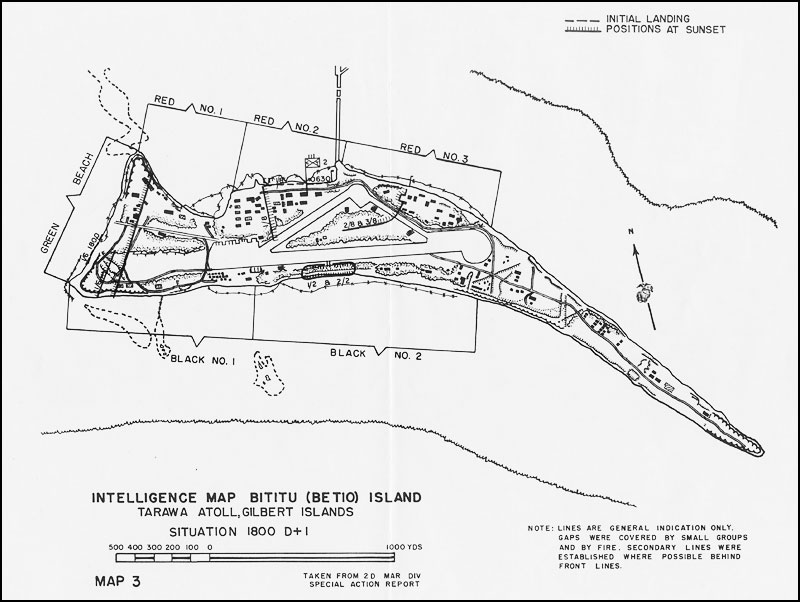
The Target: Betio Island at Tarawa Atoll

Following Guadalcanal and the shift of significant naval forces from the Solomons the focus of the US shifted to the thrust across the Central Pacific.  Unlike the Solomons which were initially a Navy and Marine Corps Operation and shifted to the Army under MacArthur as the campaign shifted to Borneo, despite the participation of the 1st Marine Division in the New Britain campaign the operations here would be an almost total Navy and Marine Corps operation.Operation Galvanic, the first offensive operation in the Central Pacific, came about as a result of the Joint U.S. Strategic Committee decision in April 1943 to favor an advance in the Central Pacific while maintaining the offensive in the South Pacific.[i] The driving force behind this strategy was Admiral King who fought for the plan and “insisted that any campaign should focus on the destruction of Japan’s overseas resources, which meant an offensive directed only toward the Western Pacific sea lanes.”[ii] The Joint Chiefs believed that a simultaneous attack by Nimitz in the Central Pacific and MacArthur in the South Pacific would “keep the Japanese guessing.”[iii] The decision was presented to the British at the TRIDENT meetings in May 1943 and though the British resisted the American plans a compromise was reached allowing the Americans to “simultaneously…maintain and extend unremitting pressure against Japan….”[iv]

The decision to begin operations in the Central Pacific meant that MacArthur’s priority in logistics and personnel would be reduced in order to launch the Central Pacific operation.  MacArthur protested, to no avail and the Joint Chief’s stood firm in their decision that the Central Pacific operation “would make it easier to isolate Japan from her domain in the south.”[v] MacArthur was allowed to continue OPERATION CARTWHEEL while Nimitz seized the Marshall and Caroline islands.[vi] Nimitz’s staff began preparations and decided on a conservative course to capture the Gilberts first before taking the more heavily defended Marshalls.[vii] This was in part due to the “need to minimize the risks to his untried amphibious forces against such heavily fortified enemy bases out of reach of air cover.”[viii]

Several factors were considered by Nimitz and his planners considerations in this choice.  Nimitz did not have enough troops to capture all of the vital heavily defended locations in the Marshalls without dividing his forces.[ix] Additionally the Gilbert operation could be supported by land based bombers.[x] A final consideration was the Joint Chief’s decision to allow MacArthur to retain control of 1st Marine Division which Nimitz had hoped would be available for operations in the Central Pacific.[xi] CINCPAC did a thorough photo reconnaissance of the Gilbert’s convinced the Joint Chiefs that Tarawa and Makin needed to be taken to provide air bases for the assault on the Marshalls.  Finally the order forGalvanic was issued on 20 July 1943 with its execution planned for November 1943.[xii]

Japanese Preparations
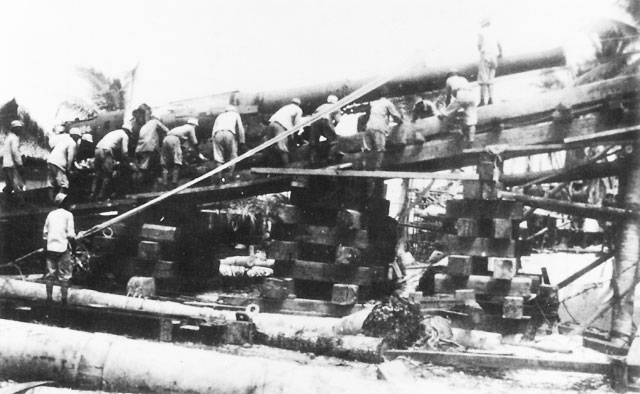
Japanese emplacing 8″ Naval Gun on Tarawa

The Japanese did little to prepare against potential American offensive operations against the Gilbert’s until Makin Island was raided by elements of 2ndRaider Battalion in August 1942.  The Makin raid shook the Japanese and at which time they reinforced Makin and occupied Betio.[xiii] The Japanese occupied Betio with the Yokosuka 6th Special Landing Force, essentially Naval Infantry or Marines[xiv] and the 111th Construction Battalion on 15 September 1942, over nine months after they attacked Pearl Harbor.[xv] These forces were commanded by Admiral Tomanari, who at once began to fortify Betio. Recognizing his need for more troops  Tomanari asked Tokyo for reinforcements.  The reinforcements came in the form of Commander Sugai’s 7th Sasebo Special Naval Landing Force, which landed on 14 March.[xvi]Commander Sugai’s troops were the Rikusentai, the best of the Japanese Navy’s land forces.
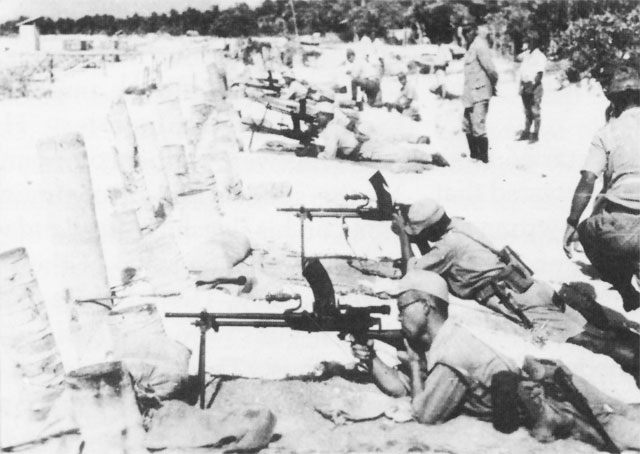
Japanese Naval Infantry conducting live fire exercise on Tarawa

The fortification of Betio proceeded slowly until the arrival of Rear Admiral Shibasaki, who relieved Tomanari who returned to Japan.[xvii] Shibasaki, a tough veteran of service at sea and ashore including 19 months as aRikusentai[xviii] officer in China was chosen by Admiral Koga to instill a better fighting spirit on the island.  The Imperial General Headquarters “New Operations Plan” ordered the outer defensive islands, such as Tarawa, to “hold up any American advance while an inner line of fortresses was constructed….”[xix]

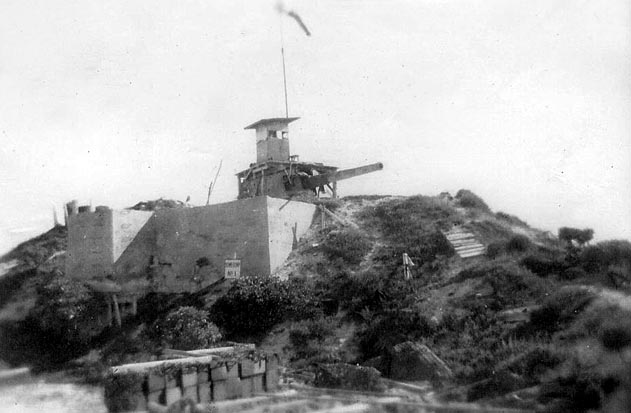
Fortified 8″ gun position on Tarawa

Shibasaki drove the garrison hard, inspiring them to “extraordinary heights of labor that resulted in Betio’s superb defenses.”[xx]Betio mounted four 8” Naval guns[xxi], four 14 cm guns, four dual mount 5.5” dual purpose guns[xxii] six 80 mm anti-boat guns, eight 75 mm dual purpose guns, ten 75 mm mountain guns, six 70 mm guns and nine 37 mm anti-tank guns, numerous machine guns and light AA guns and 14 light tanks.[xxiii] These weapons were mounted in well camouflaged armored or reinforced pillboxes.[xxiv] In accordance with the directives of the high command Shibasaki ordered his troops “to defend to the last man all vital areas and destroy the enemy at the waters’ edge.”[xxv]

Admiral Shibasaki boasted that it would take a million men a thousand years to take Betio

The Japanese records note that Shibasaki “immediately began to strengthen morale and carried out advanced training, and as a result…the garrison remarkably enhanced its fighting capability and they were full of confidence.”[xxvi] Even the service troops were thoroughly trained to fight from their superb defensive positions.[xxvii]Shibasaki reportedly told his men that it would take a million men a thousand years to take Betio.

Japanese conducting gunnery exercise prior to the invasion

American Preparations

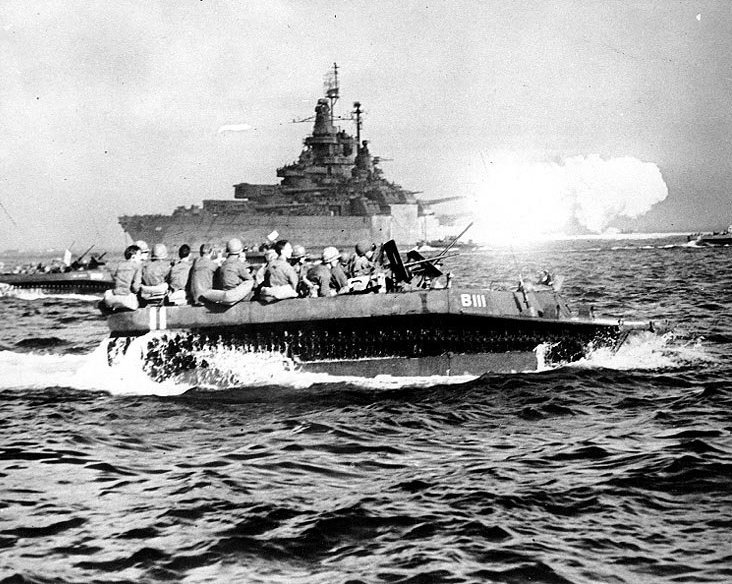
The LVT- Landing Vehicle Tracked or the Amtrack

Nimitz organized his forces into three major commands, the 5th Fleet, commanded by Admiral Raymond Spruance, the 5th Amphibious Force under Admiral Richmond “Kelly” Turner and the V Amphibious Corps under Major General Holland “Howlin’ Mad” Smith, USMC.[xxviii] The 2nd Marine Division which would make the assault at Tarawa was commanded by Major General Julian Smith. The force that sustained in this operation and subsequent amphibious operations was the Service Force Pacific Fleet.[xxix] This was a collection of ships whose mission it was to sustain the fleet in mobile operations,[xxx] which greatly “increased the range and power of the Navy in amphibious operations.”[xxxi] The planned assault called for the Army’s 27thDivision take Makin and the veteran 2nd Marine Division which had been blooded at Guadalcanal to take Tarawa supported by the carriers and battleships of 5th Fleet.

Tarawa marked the first use of dedicated amphibious ships such as theUSS Ashland LSD-1

This was the first application of new amphibious tactics developed for the Pacific war.[xxxii] Air and sea bombardment would precede the actual assault. The Marines would be transported ashore in a new vehicle called an LVT (Landing Vehicle Tracked) and other amphibious ships and craft including the LSD (Landing Ship Dock), LCM (Landing Craft Mechanized) and LCVP (Landing Craft Vehicle Personnel).  The LVTs were absolutely vital, nicknamed “Amtracks” or “Amphtracks” they were essentially a tracked amphibious personnel carrier. They were developed from a commercial vehicle used by U.S. Forrest Service Rangers in the Florida Everglades and were capable of crossing coral reefs that would cause other craft to go aground.  The early LVTs had retrofitted armor and mounted a .50 cal. machine gun.  At Tarawa the Marines deployed 75 LVT-1s[xxxiii] and 50 LVT-2s. 93 LVTs would be part of the first wave of the Marine assault.[xxxiv] The LVTs were transported to Tarawa aboard LSTs (Landing Ship Tanks.)  Other innovations included the assignment of Naval Gunfire Support teams to the Marine Regiments and some battalions,[xxxv] and the first use of the M4 Sherman tank by the Marines.[xxxvi] Tarawa was a proving ground for the tactics and equipment which would be improved on and used in every subsequent amphibious operation in the Pacific.  Tarawa would also mark the last major use of rubber landing craft by the Marine Corps in an opposed landing.[xxxvii]

Shipboard Briefing

There were limitations to American preparations. First the size of the force meant that it could not be assembled in one place for rehearsals or to train as a team.[xxxviii] A second problem for the Americans was the assumption that high and low tides would be sufficient to get their landing craft across the reef in spite of warnings to the contrary.[xxxix] Likewise the Americans failed to completely anticipate the scope to which the Japanese had fortified the island. This was despite good intelligence that they had done so. In particular aerial photos taken by the air force and ULTRA intercepts provided good information on the Japanese units on the island and the layout of the defenses.[xl]Additionally some equipment shortages were not remedied. The Marine Bazooka’s did not arrive, and neither the 6th or 8th Marines had made an actual amphibious assault.  At Guadalcanal they made an administrative landing and few field-grade officers remained from the 2nd Marine Regiment who had landed at Tulagi.[xli] They were far from “amphibious experts” that they would become.[xlii] However, they made up for their lack of experience by their cohesiveness, high morale and esprit, being well armed and equipped, in top physical condition and knowing the basic tools of their trade: “weapons proficiency and field firing, close combat techniques, fire and maneuver, tactical leadership, fire discipline.”[xliii]

The most critical aspect of the operation was to get across the reef onto the island.  There were few good landing sites and it was decided to make the landings from inside the atoll’s lagoon onto the Betio’s north shore.  This decision meant that transports embarking the Marines would unload outside of the lagoon and that the landing craft would have to make a 10 mile trip.[xliv]There was only one entrance into the lagoon and it was not deep enough for heavy ships to enter.[xlv]This meant that heavy ships such as battleships and cruisers would not be able to have direct fire on the Japanese positions best situated to disrupt the Marines.

The execution of the plan involved land based bomber strikes beginning on D minus 7. Carrier aircraft would begin their operations on D minus 2.  Cruisers and destroyers joined the cacophony of destruction on D minus 1 and the battleships on D Day itself.[xlvi] On D-Day itself Navy planned to bombard the island with 3,000 tons of shells in 2 ½ hours.[xlvii] The Navy was confident in the bombardment plans. Rear Admiral Kingman commanding the fire support group declared “We will not neutralize; we will not destroy; we will obliterate the defenses on Betio!”[xlviii] Four battalions of Marines would land in the first wave, the three battalions of the 2nd Marines and 2nd Battalion 8th Marines all commanded by Colonel David Shoup. Colonel Shoup who would win the Medal of Honor on Betio and later became the Commandant of the Marine Corps assumed command of 2nd Marines when its Regimental commander fell ill on the journey to Efate.[xlix] The division reserve was the remaining 8th Marine Regiment battalions. The 6th Marine Regiment served as the corps reserve.[l]The assault units would be reinforced by tanks and the 1st and 2nd Battalions 18th Marine Regiment, the division’s combat engineers.

Invasion: Day One

Landing craft going ashore at Tarawa

The naval gunfire bombardment commenced at 0542 on 20 November, and the assault waves began their trek to the beaches.  The transports were out of range of Japanese guns but ththat ensured boats would have to make a 10 mile trip.[li]At this point things began to go wrong.
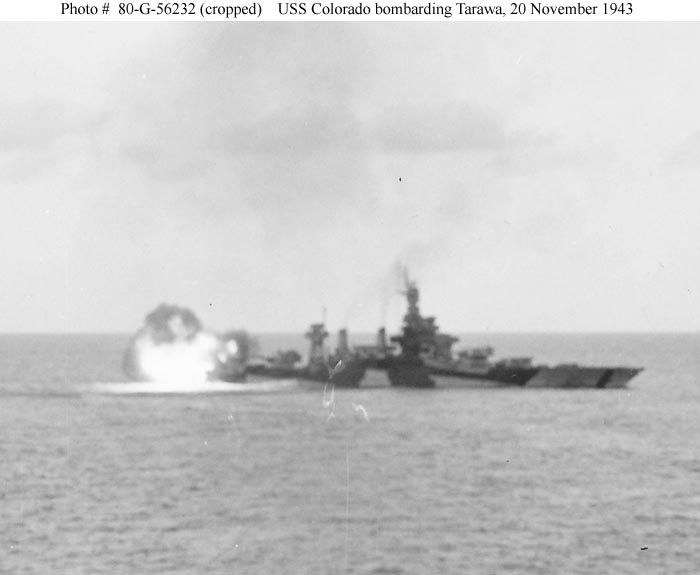
USS Colorado at Tarawa

The Navy had “badly miscalculated the amount of softening-up that could be done in two and a half daylight hours bombardment.” Although major coast defense guns were silenced not enough damage was done to the Japanese defenses.[lii] The Japanese helped the Marines by firing their larger guns at warships, identifying their positions to Navy gunners.[liii] The bombardment lifted to allow an attack by carrier based aircraft. However the aircraft were late to arrive and the ships did not resume fire, allowing the Japanese to emerge and re-train their weapons.[liv] Likewise the destroyers Ringgold and Dashiell inside the lagoon had to cease fire, knowing the Japanese gunners along the shore were still active.[lv] Some believe that an extra half hour of direct fire from the destroyers would have saved many lives.[lvi] The LVTs in the first three waves were delayed by heavy chop and did not make landfall until 0913 throwing off the landing schedule.[lvii] The expect and planned for rise in tides did not materialize and they remained unpredictably low for the first 48 hours. No landing boats could cross the reef and the Marines were forced to wade ashore from 600 to 1000 yards.[lviii]

LCM sinking at Tarawa

Shoup’s Marines landed on three beaches.  Red one and two lay to the west of a 500 yard long pier and Red three lay to the east.  3/2 landed on Red-1, 2/2 on Red-2, 2/8 on Red-3, elements of 1/18 and the scout snipers on the pier, with 1/2 in reserve to land behind the battalion making the best progress.[lix] As soon as the Amtracks hit the reef the Japanese began firing.  Every “working weapon along the north and west shorelines….blazed forth in fierce, interlocking fields of fire.”[lx] As they watched the Amtracks craw over the reef that Japanese knew they were in for a tough fight, one of Warrant Officer Ota’s men exclaimed “Heavens! The God of Death has come!”[lxi] The Marines of 3/2 on Red-1 received enfilade fire from Japanese guns emplaced in a U around the beach.  Before the Marines landed they began to take causalities, Amtracks were hit in the lagoon and most that were not sunk or destroyed were unfit for further use.[lxii] The 2000 Marines who landed in the first hour were badly disorganized, the commanding officer’s of 2/2 and the Amtracks were killed, 3/2’s commander was isolated on the reef and only 2/8’s commander was with his troops. 2/8 was the only battalion being to reach the shore relatively intact.[lxiii] 3/2 was down to 65% of its strength and K/3/2 had taken over 50% casualties.[lxiv] The Marines in the fourth to sixth waves were struggling to wade ashore from the reef. Landing craft “ran aground or milled about helplessly outside the reef, which was swept by crossfire from behind the beaches and from a grounded hulk northwest of the pier.”[lxv] Most of the tanks were put out of action either through accurate fire by Japanese guns or by sinking in deep areas of the lagoon, the Tank battalion commander was blown out of his Amtrack, wounded and survived 24 hours by clinging to a pile of dead bodies to keep from drowning.[lxvi]

Marines wading ashore at Tarawa, since many landing craft could not cross the reef many waded hundreds of yards under constant Japanese fire

Shoup himself landed at Red-2 and began directing operations on the beach.  He knew that he had to get more troops ashore to exploit the minimal gains his Marines had made.  The news from Red-1 and Two was bad; he decided to bring 1/2 in at Red-2 thought that 3/8 should go in at Red-3.[lxvii]
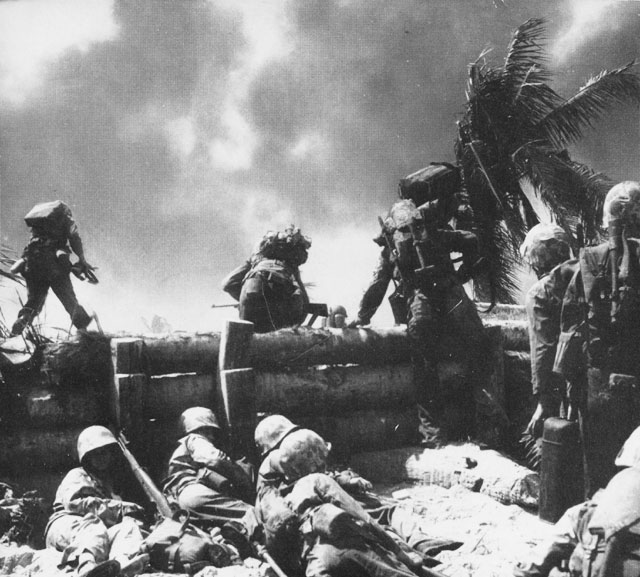
Marines attempting to advance from behind sea wall

At 1018 General Julian Smith ordered the 8th Marines to dispatch 3/8 to Red-3.[lxviii] 3/8 had to make their way across 700 yards through the water to get to the beach.  It was a slaughter, only 30 percent of the first wave got ashore, in the second less and the third “were practically wiped out.”[lxix]
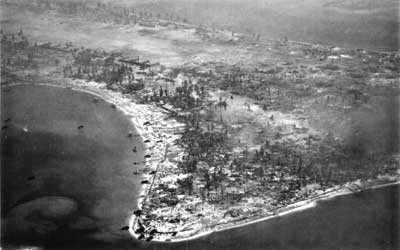
Aerial view of Tarawa on D-Day

As his Marines struggled ashore those who had gotten ashore engaged the Japanese at point blank range.  Lt. Hawkins of the 2nd Marine Scout and Sniper platoon and 5 of his men engaged the Japanese on the pier in vicious hand to hand fighting,[lxx] Sergeant Bordelon of the Engineers on Red-2 though grievously wounded knocked out four gun positions, some by lobbing dynamite charges into them and galvanizing survivors into action, finally being killed while taking on a Japanese position alone.  He would be awarded the Medal of Honor.[lxxi]

SSGT William Bordelon a Combat Engineer won the Medal of honor posthumously at Tarawa

By afternoon Julian Smith realized that he needed more troops, his last battalion, 1/8 waited to go ashore.[lxxii] Smith asked for the 6th Marines and had Admiral Hill send a message to Admiral Turner stating “Issue in doubt. I concur.” This sent a chill through the listening Naval Staff.[lxxiii] Ashore Shoup brought howitzers from 1st Battalion 10th Marines on surviving Amtracks to the eastern edge of Red-2 near the pier,[lxxiv] which landed in the early evening.[lxxv] He sent Lieutenant Colonel Carlson to make a personal report to General Smith that he would hold his beachhead no matter what happened. Shoup ordered his Catholic Chaplain to lay out a cemetery and begin burying the dead who were already decomposing in the tropical heat.[lxxvi] As this transpired 2/8 got two 37mm anti-tank guns into position to drive off Japanese tanks approaching the beachhead.[lxxvii] The Division Band assisted corpsmen in bringing back wounded Marines.[lxxviii]
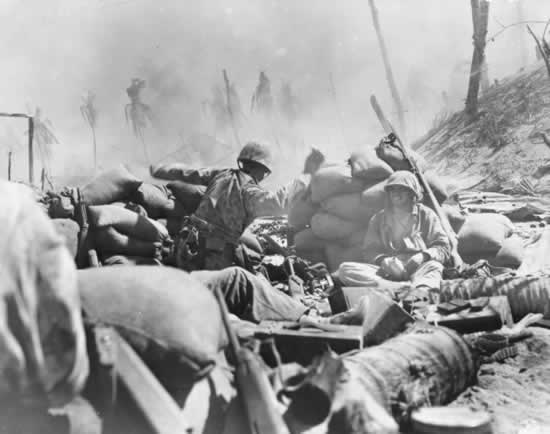
Close Combat on Tarawa

The rest of the day the Marines continued to eke out a beachhead; Shoup’s Marines on Red-2 and Red-3 managed to advance about halfway across the island, 3/2 and elements 1/2 and 2/2 was isolated and Major Ryan of Lima Company pulled them back to meet an expected Japanese counter-attack.[lxxix] The Marines had taken over 1500 casualties of 5000 men landed the first day.[lxxx] There is no evidence that Shoup considered withdraw that night.[lxxxi] No counterattack occurred due to Japanese command and control problems, Admiral Shibasaki and his staff were killed while shifting headquarters during the afternoon,[lxxxii] and their communications were in shambles.
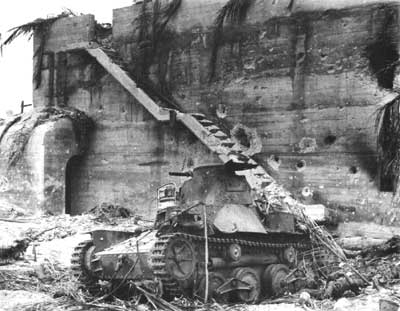
Admiral Shibasaki’s HQ and a knocked out light tank

A counterattack would have been disastrous in their condition,[lxxxiii] yet they assembled over 1000 men to oppose the Marines on day two.[lxxxiv] Had Shibasaki lived and communications survived a counterattack might have had ramifications far beyond Tarawa.[lxxxv]

Day Two: D+1
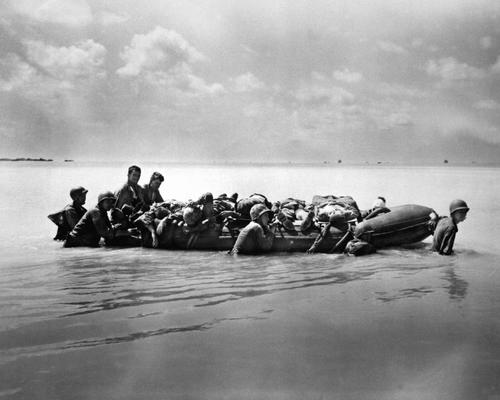
Wounded Marines at Tarawa being moved on rubber raft

The second day began with 1/8 landing on Red-2 and the 6th Marines began to land on Green Beach at the far western tip of Betio.  1/8’s landing turned into a bloodbath, the tide fell even lower than the previous day and as they hit the reef and waded ashore drifted into some of the heaviest Japanese defenses. Japanese guns, including the dual 5.5” guns took direct aim at the boats, and Marines ashore watched helplessly, and correspondent Robert Sherrod noted: “This is worse, far worse than it was yesterday.”[lxxxvi] Only half of 1/8 reached the beach with none of their heavy weapons or equipment.  Shoup ordered the remnants of the battalion into line on his western flank in preparation for an advance inland.[lxxxvii] During five hours of landings on day two, the “Marine casualties reached a higher rate than that sustained on the first morning.”[lxxxviii]

Marines advancing

Meanwhile, Shoup ordered Ryan’s “orphans” to make an attack down the right flank of the Japanese positions on Green beach and the “ultimate American victory at Betio evolved from the attack during one intense hour the second morning.”[lxxxix] Taking every available Marine, two surviving Shermans and some mortars, Ryan gathered his force and coordinated Naval Gunfire support.  The area contained a number of heavy guns including two of the 8” mounts.  A destroyer blanked the Japanese positions with 5” shells and fire from her light AA guns.[xc] Attacking behind the beach, Ryan’s Marines isolated and destroyed everyone and everything that looked hostile.[xci] Against minimal opposition Ryan’s Marines quickly seized the gun positions and the western end of the airfield.  Within an hour his Marines occupied the entire western side of Betio up to a 200 yard depth by 1200 and he radioed to let Shoup know the good news and that he intended to advance east against the airfield.[xcii] The attack allowed the Marines to be able to land intact battalions with supporting arms for the first time battle.[xciii]

Marines in action at Tarawa

To the east behind Red-2 and Red-3 The 8th Marines and survivors of 1/2 and 2/2 attacked against fierce Japanese opposition near Shibasaki’s former command bunker and two other large bunkers which were mutually supporting.  The attack by the 2nd Marine survivors eventually succeeded in getting completely across the south side of the island.[xciv] During the attack Lt. Hawkins of the Scout Snipers was mortally wounded.  He too would win the Medal of Honor.  The attack cut the island in two but the Japanese launched a counterattack on the Marine positions which was beaten back.[xcv]
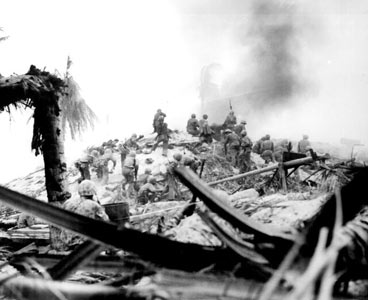
Marines moving inland against tough resistance

The 8thMarines faced a more difficult task going against what was now the heart of the Japanese defense, as its defenders had been reinforced by Lt. Minami and his third company of the 7th Special Naval Landing Force.  Vicious fighting ensued and by nightfall “the Marines had little to show for their heavy losses,[xcvi] but they did make significant inroads against the Japanese to warrant optimism for D+2.[xcvii] By evening the Marines on Red-1 and Red-2 had consolidated their beachhead so that reinforcements were landing, including jeeps, artillery and heavy equipment, and other Marines noted that Japanese defenders were beginning to commit suicide and they began to feel that Japanese morale had broken.  By late afternoon Shoup transmitted the message: “Casualties many. Percentage of dead unknown. Combat efficiency-We are winning.”[xcviii] By late afternoon Major Jones’ 1/6 landed on Green beach in their rubber boats, reinforcing Ryan’s orphans, it was the first of the 7 battalions landed to get ashore intact and the two officers coordinated their units for a night defense and an early attack the next morning.[xcix] 2/6 cleared the nearby island of Bairiki allowing 2/10 to land its howitzers on the island.  This in effect cut off any line of retreat for the defenders of Betio.[c] Colonel Edson came ashore during the evening to relieve Shoup[ci], who remained ashore to help coordinate the next day’s attack.  Again there were no coordinated Japanese counterattacks, the only senior officer, Sugai was isolated in the pocket between the Red and Green beaches and no senior officer could coordinate any attacks.[cii]

Day Three and Four: D+2 and D+3
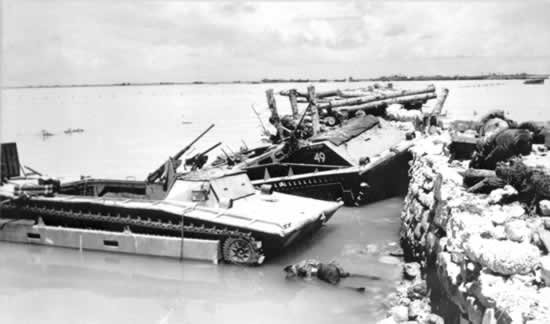
Wrecked LVTs and dead bodies

Day three began with attacks against Japanese strong points and the arrival of more reinforcements including 3/6 which landed on Green beach and three light tank platoons which landed on Red-2.[ciii] The Marines attacked off of Green beach sweeping east to join the 2nd Marines who had cut the island in two the day before.  The 8th Marines continued to attack the heavily fortified bunker complex eventually taking these heavily fortified and defended positions.  During the assault Lt Sandy Bonnyman of 1/18 won the Medal of Honor for leading the assault on these positions.[civ] Fighting remained fierce throughout the day and General Smith arrived to take command on shore.  The Marines attacked supported by tanks, artillery and naval gunfire.
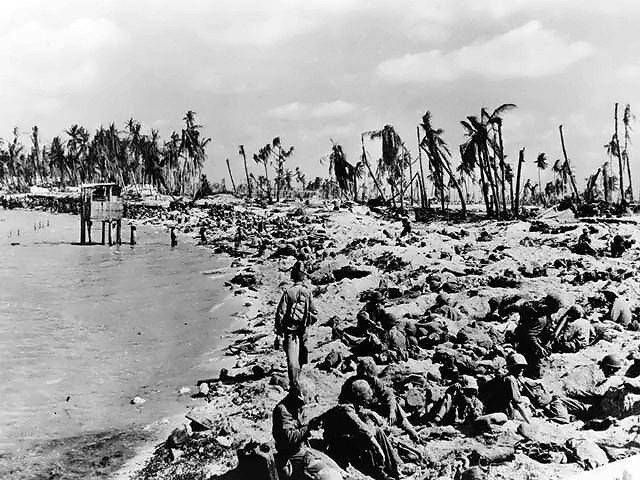
Tarawa beach after the fight

By the evening they were established at the east end of the airfield.  The Japanese launched a series of Banzai charges which beginning about 1930 hours and ending about 0400 when the Marines annihilated the last attack with the assistance of artillery.[cv]The attack, which could have succeeded the first or early the second day, now aided the Marines by sacrificing strength that might have been used to exact a higher price for the tail of the island.[cvi] The next morning the Marines pushed forward and eliminated the last Japanese defenders and by 1200 Betio was secured.  Of about 5000 defenders only 17 Japanese and some Korean laborers were taken prisoner.[cvii] The Marines lost over 1000 killed and 2300 wounded.[cviii]

One of the few Japanese prisoners being interrogated

Epilogue

The Marines paid a heavy price for Betio, but it was not to be a useless sacrifice, though it was a source of great controversy especially among politicians.[cix]Spector wonders if waiting for better tides or a full moon would have saved lives.[cx] Holland Smith later argued that Tarawa should have been bypassed, but Nimitz’s biographer Potter notes “if the lessons of the amphibious assault had not been learned at Tarawa, they would have to be learned elsewhere, probably at greater cost.”[cxi]The lessons learned alone aided all future amphibious operations in the Central Pacific and elsewhere.  Timing and coordination of naval gunfire support, air strikes and combat loading of transports were all refined in future operations. Large numbers of armored and up-gunned Amtracks would be part of every future operation.[cxii] Intelligence was emphasized and replicas of the Japanese fortifications were built and tested to determine the best way of destroying them.[cxiii] The Marines shocked the public by releasing photos and films of the carnage on Tarawa to awaken them to the challenges ahead.[cxiv]

Today the battle is remembered annually by the 2nd Marine Division at Camp LeJeune, an ever shrinking number of veterans of the battle attend the ceremonies.  Samuel Eliot Morison put it best: “All honor, then, to the fighting heart of the United States Marine. Let the battle for that small stretch of coral sand called Betio of Tarawa be remembered as terrible indeed, but glorious, and the seedbed for victory in 1945.”[cxv]

Appendix: Leaders on Tarawa
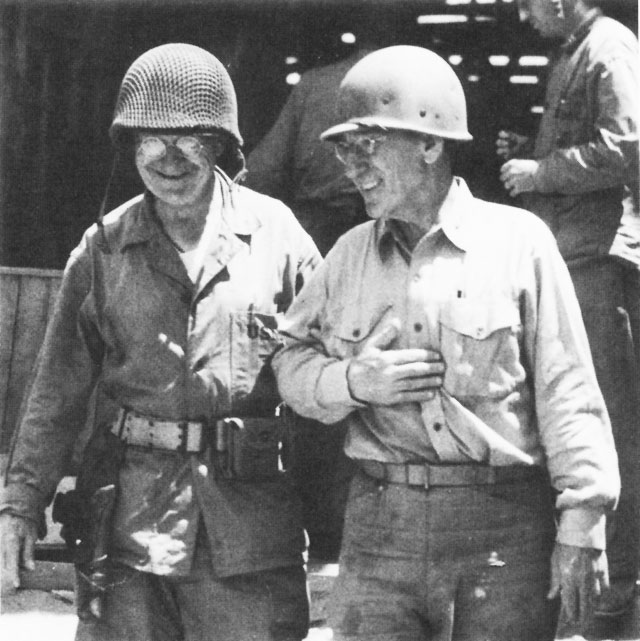
General H.M. Smith and General Julian Smith at Tarawa

General Holland M. “Howling Mad” Smith USMC: (1882-1967) Lieutenant General Holland M. Smith command V Amphibious Corps during the Gilberts operation.  Prior to the war he had worked extensively on amphibious warfare doctrine for both the Marine Corps and Navy. Unlike many senior officers Smith was not a Academy graduate having matriculated from the Alabama Polytechnic Institute (now Auburn University) in 1903 and law school in 1903.  Smith served as Adjutant of the 4th Marine Brigade in the First World War and served in Panama and the Dominican Republic in addition to other Marine tours afloat and ashore.  He served well and had many key assignments between the wars culminating in as the Assistant Commandant of the Marine Corps.  Subsequent to the Gilbert campaign he served as Commanding General of the Fleet Marine Force, Pacific and later commanded the Marines at Iwo Jima.  He retired in 1946.

Major General Julian Smith USMC: (1885-1975) Major General Julian Smith served as Commanding General 2nd Marine Division at Tarawa.  He graduated from the University of Delaware and was commissioned as a Second Lieutenant in 1909.  He served in Haiti, Santo Domingo and the Vera Cruz expedition. During the First World War he served as an instructor in the Marine Officer training camps at Quantico. After the war he served in Cuba, Nicaragua and various command and staff posts including the Army Command and General Staff College.  He commanded 5th Marines in 1938 and in 1942 was promoted the Major General serving as director of Fleet Marine Force Schools, New River, NC.  He took command of 2nd Marine Division in May 1943 and served there until April 1944 when he became Commanding General, Expeditionary Troops, Third Fleet and in December 1944 took command of the Military Department of the Pacific.  He retired in 1946.
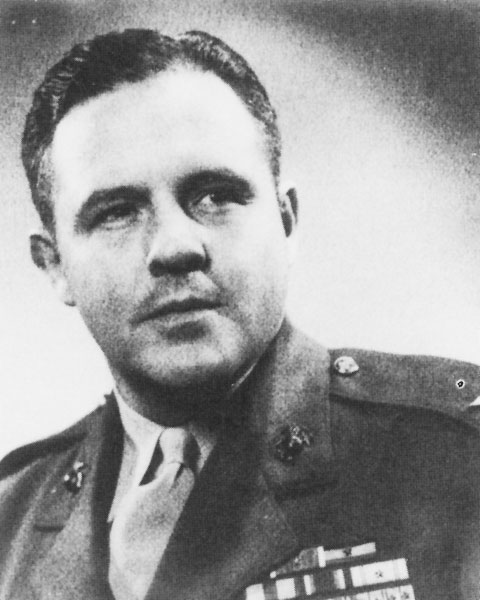
Colonel David Shoup of the 6th Marines won the Medal of Honor at Tarawa and would rise to become the Commandant of the Marine Corps

Colonel David Shoup USMC: (1904-1983) Colonel David Shoup commanded the 2nd Marines at Tarawa, being appointed as commander when its commander fell ill.  Shoup won the Congressional Medal of Honor for his actions on Tarawa.  A 1926 graduate of DePauw University, Shoup was commissioned a Second Lieutenant through the ROTC program that year.  He served in various assignments to include service in China, at sea on the battleship Maryland and Marine Barracks Puget Sound Navy Yard. He joined the staff of 6th Marines in October 1940 and assumed command of 2/6 in February 1942.  He was assigned as the Assistant Operations Officer for 2nd Marine Division in July 1942 and promoted the Lieutenant Colonel.   He went with the Division to New Zealand where he became the G-3 and from which he was fleeted up to command 2ndMarines at Tarawa.  After Tarawa he served as the Division Chief of Staff at Saipan and Tinian.  After the war Shoup continued to be assigned in key billets at the Pentagon and as commanding General, 1st Marine Division and then the Third Marine Division.  He became Chief of Staff, HQMC in 1958 and was appointed as the 22nd Commandant of the Marine Corps by President Eisenhower, a post that he retained until his retirement in 1963.

Admiral Tomanari Sachiro IJN: (1887-?) Commander of Tarawa garrison until relieved by Rear Admiral Shibasaki.   Graduate Naval Academy 1910, initially a communications officer he held various commands including Heavy Cruiser Haguro and Battleship Kirishima and two smaller ships.  Assigned to Tarawa in February 1943 he helped design and supervised the initial construction of Tarawa Defenses until relieved by Admiral Shibasaki on 20 July1943.  He returned to Japan and served the remainder of the war on Navy Division of Imperial General Headquarters.  Tomonari survived the war though nothing is mentioned as to his postwar fate.
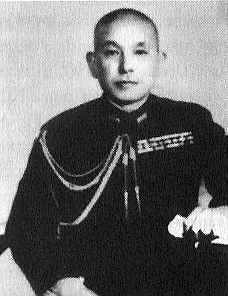
Rear Admiral Shibasaki Keiji IJN: (1894-1943) Commanded Tarawa Garrison until his death during the battle.  He graduated from the Naval Academy in 1915 and he was a skilled navigator and instructor.  Prior to the war he had served afloat and ashore and ashore and had commanded a ship and naval station and served as a naval attaché to a member of the Imperial Family.  Among his assignments was 19 month combat tour with the special Naval Landing Forces in China, where he served as Chief of Staff of Shanghai Special Naval Landing Force.  Shibasaki’s leadership helped the garrison improve their defensive capabilities and combat skills as he inspired them to great heights and executed an intense training program. He was killed in the battle.

A Personal Note

I have not been to Tarawa but feel that I know it well.  I served in Second Marine Division from April 1999 through December 2001.  Due to my prior service experience I was used to fill gaps where chaplains were needed and ended up serving in four different battalions.  I served in 2nd Combat Engineer Battalion, the descendant of 1/18, the combat engineers.  We had a WWII Bulldozer outside our command post named after Sergeant Bordelon, the Medal of Honor Citations for Bordelon and Boonyman were prominently displayed.  I also served in 1/8 and 3/8.  I knew the accounts of the slaughter of these Marines as they attempted to land but as I re-read the accounts I was moved by their courage under fire.  The CPs of these battalions are also adorned with citations of their heroes lost at Tarawa.  Veterans would visit our units during Tarawa Days at Camp LeJeune, worn by the battle and the years they always made an impression. There is almost a mystical connection between the Second Marine Division and the Marines of Tarawa; it was a crucible that defined the division, whose motto is the same as the Army Infantry School. “Follow Me!”

Semper Fidelis,

Padre Steve

[i] Spector, Ronald H. Eagle Against the Sun: The American War with Japan.  The Free Press, New York, NY 1985. p.253

[ii] Murray, Williamson and Millett, Allan R. A War to Be Won: Fighting the Second World War, The Belknap Press of Harvard University Press, Cambridge, MA 2000. p.338

[iii] Ibid. Spector. p.253

[iv] Ibid. p.255 The conference also set a date for the invasion of France.

[v] Toland, John. The Rising Sun: The Decline and Fall of the Japanese Empire, 1936-1945. Random House, Inc. New York, NY 1970. p.468

[vi] Ibid. Spector. p.255

[vii] Costello, John. The Pacific War 1941-1945. Quill Publishing, New York, NY 1982. p.430

[viii] Ibid.

[ix] Potter, E.B. Nimitz. Naval Institute Press, Annapolis, MD, 1976, Third Printing with Revisions 1979. p.243. Nimitz’s forces would have had to seize 5 major Japanese bases and his staff was not sure that the Pacific carrier force would be strong or experienced enough to provide the necessary air cover for the operation.

[x] Ibid.

[xi] Ibid. pp.243-245

[xii] Morison, Samuel Elliott. The Two Ocean War: A Short History of the United States Navy in the Second World War. Little Brown and Company, Boston and Toronto, 1963. p.296.

[xiii] Hammell, Eric and Lane, John E. Bloody Tarawa: The 2nd Marine Division, November 20-23, 1943. The Zenith Press, St. Paul MN 2006.  Text copyright 1998 Eric Hammell and John E. Lane. p.4

[xiv] See Alexander, Joseph H. Utmost Savagery: The Three Days of Tarawa.Ivy Books, published by Ballantine Books, New York, NY. 1995. pp. 39-40.  This unit became the Third Special Base Unit on its deployment and was joined by the 111th Construction Battalion.

[xv] Ibid. Hammell. p.4

[xvi] See Alexander pp.39-40. This unit was basically a reinforced infantry battalion with 3 rifle companies, a weapons battery, anti-aircraft battery, a light tank company and support units numbering about1600 men.

[xvii] Ibid. Alexander. p.43

[xviii] Alexander p.27 The Rikusentai was the Japanese equivalent of Marines, who numbered about 50,000 men.  The officers attended Army schools and qualified enlisted men attended additional Army specialist training.

[xix] Ibid. Costello. p.431

[xx] Ibid. Hammell. p.22

[xxi] See Alexander p.77. While most writers say that these guns were brought from Singapore, Alexander notes that British writer William H Bartsch submitted proof (serial numbers) that the guns were sold by Vickers to Japan in 1905 as a legitimate business transaction.

[xxii] These are the same guns (127mm) mounted as the secondary armament of Nachi and Takao Class Heavy Cruisers and later mounted on light cruisers to replace the main battery with a more effective anti-aircraft armament.

[xxiii] Ibid. Hammell. p.22

[xxiv] Hammell notes that many of these bunkers and pillboxes were so well concealed that they could not be seen.

[xxv] Ibid. Toland. p.469.

[xxvi] Ibid. Alexander. p.43.

[xxvii] Ibid. Hammell. p.28

[xxviii] Ibid. Morison. p.297

[xxix] Ibid. Costello. p.429

[xxx] At this point the force could provide everything except major permanent repairs to warships.

[xxxi] Liddell-Hart, B.H.  History of the Second World War. G.P. Putnam’s Sons, New York, NY 1970. p.511

[xxxii] Ibid. Costello. p.431

[xxxiii] The older LVT-1s had boiler plate armor added as a field modification and were given a heavy machine gun. Prior to this they were unarmored and had two light machine guns.

[xxxiv] Ibid. Morison. p.303

[xxxv] Hammell includes a by name list of these officers in Appendix B.  Of note for today, each MEUSOC (Marine Expeditionary Unit, Special Operations Capable) has an assigned Naval Gunfire Support Team.

[xxxvi] Ibid. Alexander. pp. 61-62.  The Shermans had to be transported aboard pre-loaded LCM-3s carried in the well decks of the LSDs.

[xxxvii] Ibid. Alexander. pp.58-59

[xxxviii] Ibid. Morison. p.297.  As a sidebar discussion it should be noted that Galvanic helped provide the model for the organization of all further Marine Corps amphibious doctrine now known by the acronym PERMA; Planning, Embarkation, Rehearsal, Movement and Assault, which describes the 5 phases of a amphibious assault.

[xxxix] Ibid. Hammell details the intricacies of the particular tides seen at Tarawa and the knowledge that the Marines had from the former Resident Commissioner of the Island, Major Frank Holland who warned the division staff that he knew that there would not be enough water over the reef to get landing craft across it. (pp.18-20)

[xl] Ibid. Alexander. pp.75-77

[xli] Ibid. Alexander. pp.67-68.

[xlii] Ibid. p.70

[xliii] Ibid. p.71

[xliv] Ibid. Morison. p.302

[xlv] Ibid. Hammell. p.16

[xlvi] Johnston, Richard W. Follow Me! The Story of the Second Marine Division in world War II.  Copyright 1948 by the Second Marine Division History Board and published by Random House Publishers, New York, NY 1948. p.106

[xlvii] Ibid. Liddell-Hart. p.511  Johnson says 2,700 tons. (p.106)

[xlviii] Ibid. Johnston. p.106

[xlix] Ibid. Hammell. p.17

[l] Ibid.

[li] Ibid.. Hammell. 46-47

[lii] Ibid. Morison. p.303

[liii] Ibid. Alexander. p.113.  Alexander notes that the Japanese would have been better served by using these guns on the stalled out landing craft.

[liv] Ibid. Hammell. p.47.

[lv] Ibid. Hammell. p.58

[lvi] Ibid.

[lvii] Ibid. Morison. p.303

[lviii] Ibid. Alexander. p.79

[lix] Ibid. Hammell. p.17

[lx] Ibid. Alexander. p.121

[lxi] Wukovits, John. One Square Mile of Hell: The Battle for Tarawa. NAL Caliber, published by New American Library, a division of Penguin Group USA, New York NY, 2006. p.112

[lxii] Ibid. Johnston. p.116

[lxiii] Ibid.

[lxiv] Ibid. Wukovits. P.119  Other companies suffered as grievously, K/3/2 was not alone in its suffering.

[lxv] Ibid. Spector. pp.263-264

[lxvi] Ibid. Alexander. pp.136-138

[lxvii] Ibid. Hammell. p.90

[lxviii] Ibid. p.95

[lxix] Ibid. Spector. p.264

[lxx] Ibid. Wukovits. p.114

[lxxi] Ibid. Alexander. pp.139-140

[lxxii] 1/8 did not arrive on the beach due to botched communications until D plus 1.

[lxxiii] Ibid. p.150  The last time this signal had been sent it was by Major Devereaux at Wake Isalnd

[lxxiv] Ibid. p.151

[lxxv] Ibid. Johnston. p.132

[lxxvi] Ibid. Hammell. p.112

[lxxvii] Ibid. p.130

[lxxviii] Ibid. Johnston. p.122

[lxxix] Ibid. Johnston. p.122

[lxxx] Ibid. Costello. p.436

[lxxxi] Ibid. Alexander. p.163

[lxxxii] Ibid. Alexander. pp.157-158  Hammell notes that Shibasaski was most likely killed by fire from Ringgold or Dashiell.

[lxxxiii] Ibid. Hammell.pp.139-140

[lxxxiv] Ibid. Alexander. p.162

[lxxxv] Ibid.  Wukovits. p.176. Wukovits notes how this could have affected the planning for the Normandy invasion.

[lxxxvi] Ibid. Alexander. p.173

[lxxxvii] Ibid. Hammell. p.160

[lxxxviii] Ibid. Costello. p.437

[lxxxix] Ibid. Alexander. p.170

[xc] Ibid. Hammell. p.163

[xci] Ibid. Hammell. p.166

[xcii] Ibid. Wukovits. p.178

[xciii] Ibid. Alexander. p.170 Ryan would be awarded the Navy Cross for his efforts.

[xciv] Ibid. Hammell. p.172

[xcv] Ibid. Alexander. p.179

[xcvi] Ibid. Alexander. p.181

[xcvii] Ibid. Hammell. p.178

[xcviii] Ibid.. Wukovits. p.194

[xcix] Ibid. Hammell. p.202

[c] Ibid. Hammell. p.212

[ci] Shoup would be awarded the Medal of Honor and eventually go on to be the Commandant of the Marine Corps.

[cii] Ibid. Alexander. pp.191-192

[ciii] Ibid. Johnston. p.134  2 platoons landed on Red-2 and one on Green Beach.

[civ] Ibid. Alexander. pp.202-205

[cv] Ibid. Johnston. pp.145-146

[cvi] Ibid. Johnston. p.147

[cvii] Ibid. Toland. p.470

[cviii] Ibid. Murray and Millett. p.345

[cix] Ibid. Liddell-Hart. p.511

[cx] Ibid. Spector. p.266

[cxi] Ibid. Potter. P.264

[cxii] Ibid. Murray and Millett. p.347  The Amtrack in improved forms has been part of the Marines ever since. The current model serves in a traditional amphibious role as well as a Armored Personnel Carrier for Marines involved in ground combat operations ashore.

[cxiii] Ibid. Costello. p.439. The method found to work best was long range plunging fire by heavy guns found on battleships and heavy cruisers.

[cxiv] Ibid. Murray and Millett. p.346

[cxv] Ibid. Morison. p.306

Bibilography

Alexander, Joseph H. Utmost Savagery: The Three Days of Tarawa. Ivy Books, published by Ballantine Books, New York, NY. 1995.

Costello, John. The Pacific War 1941-1945. Quill Publishing, New York, NY 1982

Morison, Samuel Elliott. The Two Ocean War: A Short History of the United States Navy in the Second World War. Little Brown and Company, Boston and Toronto, 1963

Hammell, Eric and Lane, John E. Bloody Tarawa: The 2nd Marine Division, November 20-23, 1943. The Zenith Press, St. Paul MN 2006.

Johnston, Richard W. Follow Me! The Story of the Second Marine Division in world War II.  Copyright 1948 by the Second Marine Division History Board and published by Random House Publishers, New York, NY 1948

Murray, Williamson and Millett, Allan R. A War to Be Won: Fighting the Second World War, The Belknap Press of Harvard University Press, Cambridge, MA 2000

Potter, E.B. Nimitz. Naval Institute Press, Annapolis, MD, 1976, Third Printing with Revisions 1979

Spector, Ronald H. Eagle Against the Sun: The American War with Japan.  The Free Press, New York, NY 1985 Toland, John. The Rising Sun: The Decline and Fall of the Japanese Empire, 1936-1945. Random House, Inc. New York, NY 1970
4 Comments

Filed under History, Military, world war two in the pacific

Adjusting Strategy to Reality: The Pacific War- Why the Japanese Lost

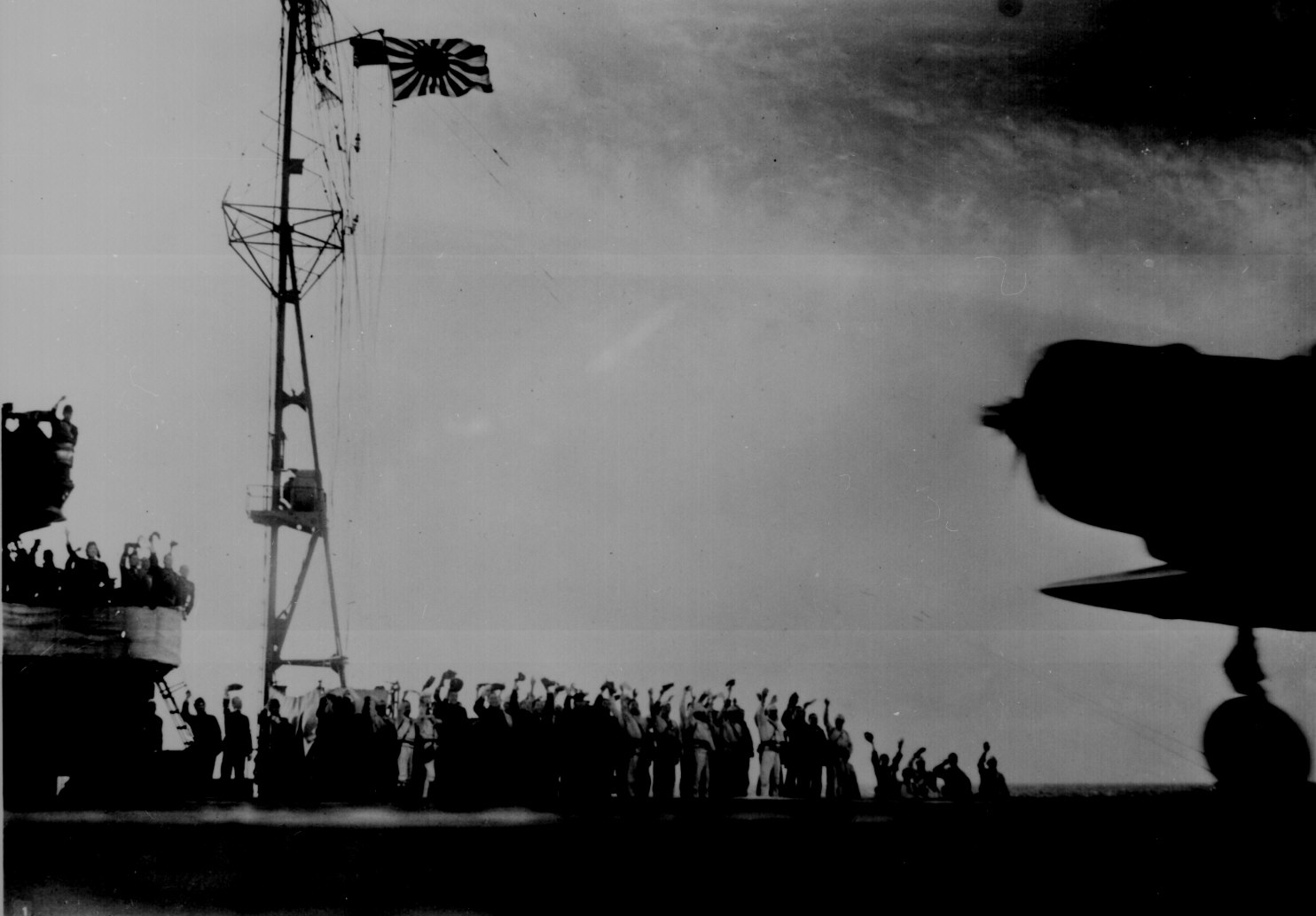
Lead aircraft ready to take off of IJN Carrier Akagi to attack Pearl Harbor beginning a 6 month chain of Japanese victories in the Pacific

The outcome of the Pacific war was directly related to the ability of the Americans to adjust strategy to the realities of the Pacific war, a unity of effort directed by the National Command Authority and superior industrial, technological and logistical capabilities. The Japanese after initial success did little to adapt and were hamstrung by inter-service rivalries and inadequate industrial capacity and limited natural resources.

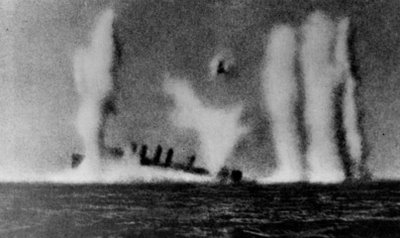
US Destroyer USS Pope being blasted out of the water by Japanese Cruisers at the Battle of Java Sea

The Japanese and the Americans each had war plans in place for the Pacific campaign.  The American plans, Plan Orange had been developed since the early part of the 20th Century after the Spanish-American War and Russo-Japanese War.  Predicated on holding the Philippines until relief could arrive Orange assumed that the US Pacific Fleet would sail across the Pacific and fight the Japanese Navy in a manner written about by Alfred Thayer Mahan; see Weigley in The American Way of War and Ronald Spector in “Eagle Against the Sun: The American War Against Japan.”

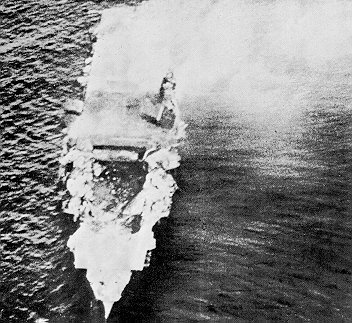
IJN Carrier Hiryu heavily damaged and abandoned at Midway. Hiryu, Akagi, Kaga and Soryu the creme of the Japanese carrier fleet were lost at Midway, the Japanese found it hard to replace them or their decimated air crews

The Japanese were conflicted.  The Navy desired a campaign that would destroy the American Navy and expand the Empire to the East and to Southeast Asia and the Indian Ocean. The Army was fixated on the China strategy having been embroiled on the Asian continent since the early 1930s. John Toland discusses this in good detail in his book “Rising Sun: The Decline and Fall of the Japanese Empire 1936-1945” In addition other Japanese Army leaders had designs on Siberia and fought a brief campaign against the Soviets which ended in a defeat.

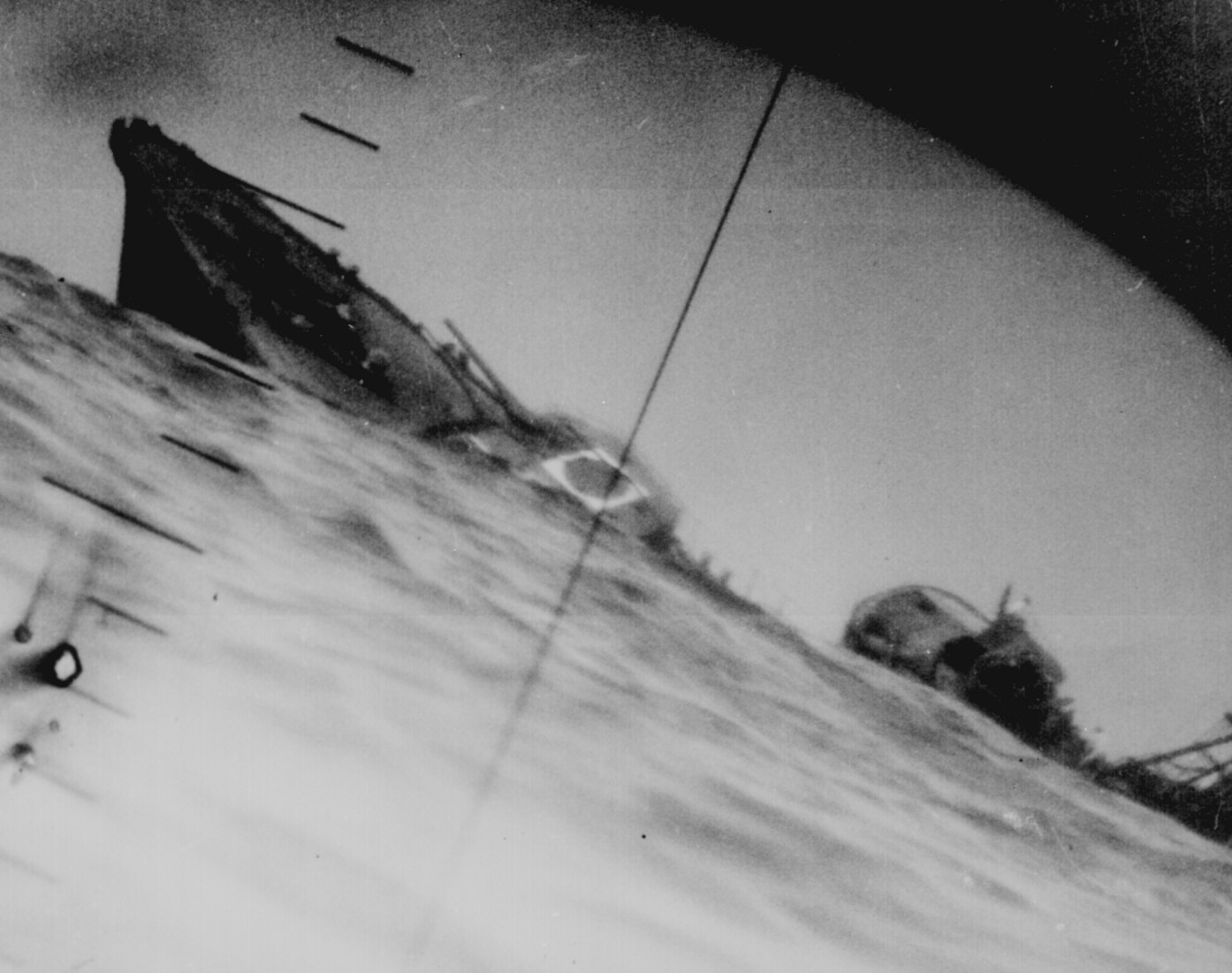
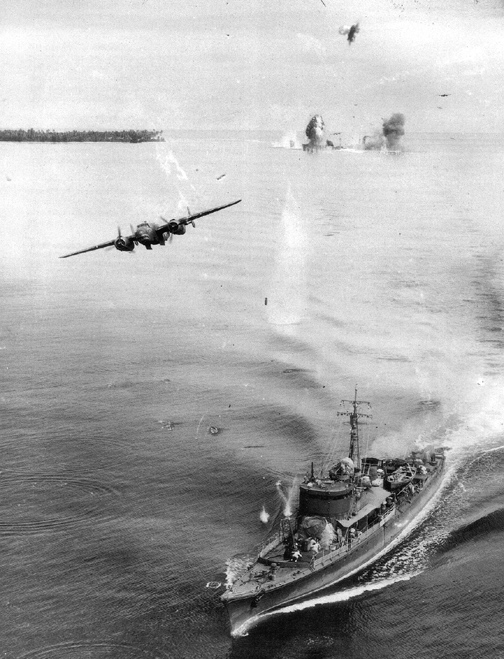
Japanese destroyer shown sinking after being torpedoed by a US submarine

When the Japanese attacked Pearl Harbor as well as the Philippines and Southeast Asia defeating American and Allied forces in detail, crippling the American Navy and dooming the Philippines the Americans were able to adjust strategy to first a defensive one supplemented by raids against the Japanese perimeter by carrier forces and the beginnings of a nascent submarine campaign against Japanese merchant shipping.  The Americans were able to parry the Japanese thrust at the Coral Sea and inflict a major defeat on the Japanese Carrier Forces at Midway prior to launching the first limited offensive by the Navy and the Marines at Guadalcanal.

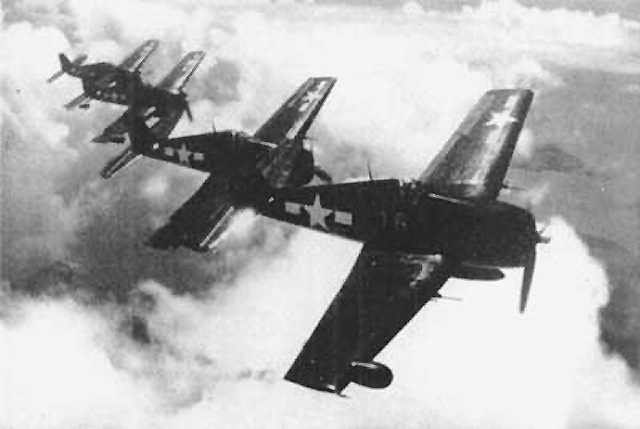
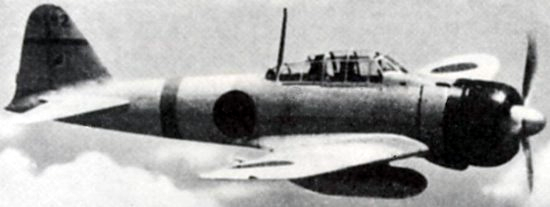
Aircraft like the F6F Hellcat drove Japanese aircraft such as the A6M2 Zero from the skies in the Pacific


The Japanese remained mired in their conflicting strategies with the Navy primarily fighting the Pacific campaign aided by limited Army and Army Air Forces on the islands Japan had occupied or fortified while the bulk of the Army was engaged in China, Southeast Asia or sitting on the Manchurian-Soviet border.

Heavily fortified Japanese islands were either bypassed or taken in bloody assaults, here a 8″ gun on Tarawa

Once the Americans shifted to the offensive a campaign of island hopping coordinated between the Southwest Pacific Area under General MacArthur and the Central Pacific Area under Admiral Nimitz focused on gaining control of islands which contained airbases and anchorages capable of sustaining the American advance while bypassing islands not necessary for this along with their Army garrisons. Both American advances in the South Pacific and Central Pacific focused on retaking the Philippines and cutting the Japanese lines of communication and supply with Southeast Asia. From late 1942 on the Japanese strategy was focused on individual areas of danger versus a overall coordinated defensive effort.

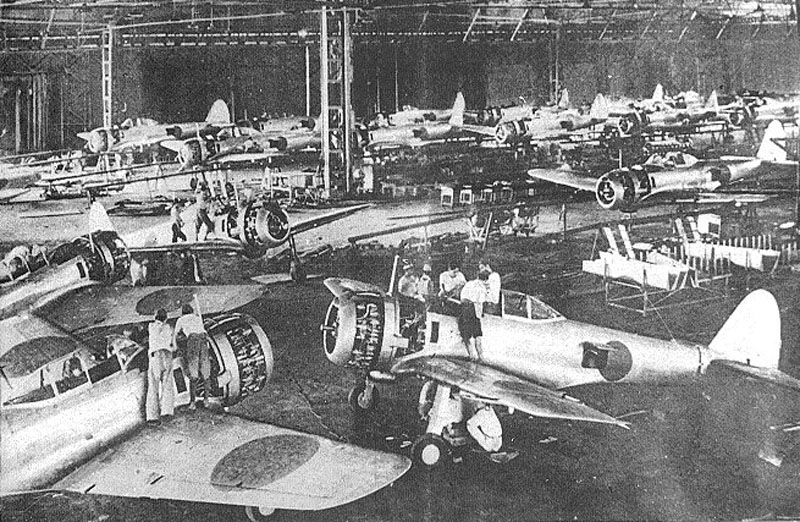
Japanese war industries were woefully ill equipped to match US war production. Here a factory producing Oscar fighter planes

The Japanese were hamstrung from the beginning of the war by limited natural resources, especially oil and oil refining capacities, limited industrial capacity, especially in the realm of the manufacture of steel and machining tools.  All of these were supplied in large part by their opponents and were cut off once the war began.

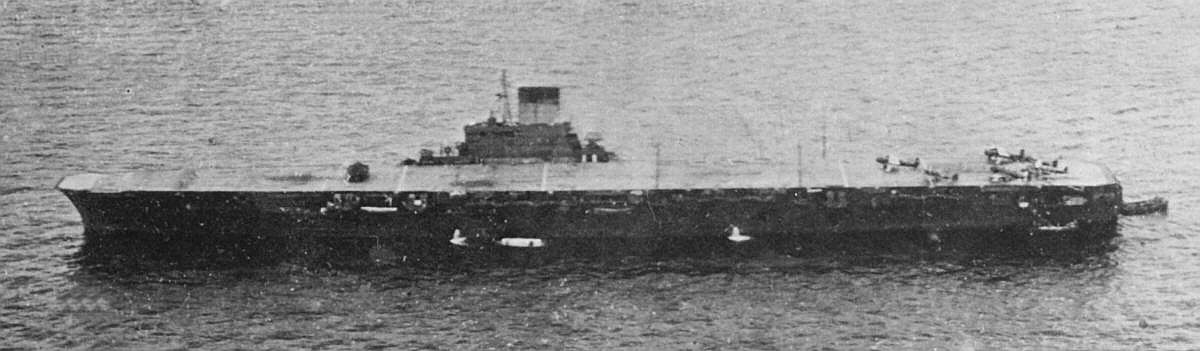
The Carrier Taiho was the equivalent of the Essex Class but the Japanese could only produce one unit

Michael Barnhart in his book Japan Prepares for Total War” has an excellent account of the limitations of Japanese economic, industrial and natural resource capacities, as well as the continual struggle by the Army and the Navy for priority in access to them and the inability of Japanese planners, both civilian and military to resolve this conflict. The Americans had a different situation; although American industrial capacity was enormous it had to be split between to Theaters of Operations and support the needs of American Allies, Britain, the Soviet Union, Canada and China.

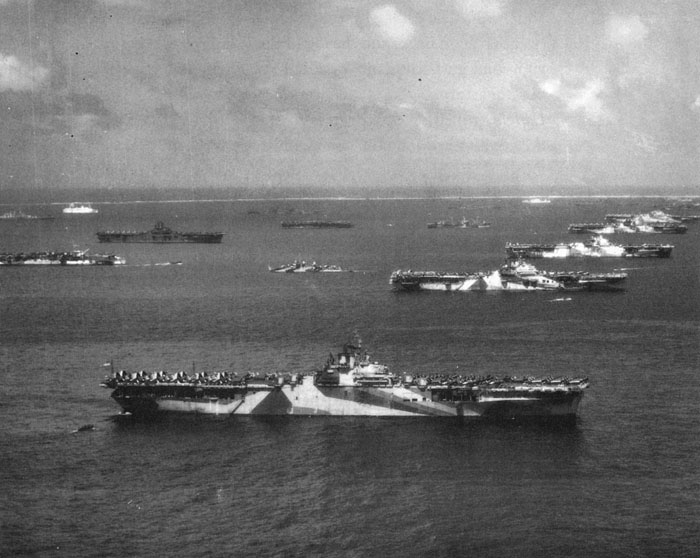
An Armada of US Essex Class Carriers in 1944 the Japanese could not keep pace with US Naval production

Despite this the Americans in a relatively short time were able to amass forces equal to or great than the Japanese who were unable to replace losses in ships, aircraft or the highly trained personnel needed to man them.  At the beginning of the war Japanese Air and Naval forces in the Pacific outmatched everything the Allies could offer, however once they began to experience significant losses at Midway and during the Guadalcanal Campaign their air and naval capabilities diminished to the point that they had to conserve ships and aircraft hoping to be able to gain local advantage in critical defensive areas.

The US Amphibious warfare capacity was a key factor in the ability of the United States to take the war to Japan

New American ships and aircraft introduced during the war were superior to Japanese designs, many of which had reached their apex by 1942.  American advantages in radar, communications equipment added to American advantages throughout the war.  Japanese ground forces in the Pacific were dependant on the Navy and merchant marine for supply and reinforcements. As the American submarine campaign became better organized this became more difficult as the American submarines copying German Wolf pack tactics decimated the Japanese merchant Marine. I particularly like Samuel Elliott Morrison’s account of this in “The Two Ocean War” and “The History of US Navy Operations in World War II” which has a volume devoted to this subject.

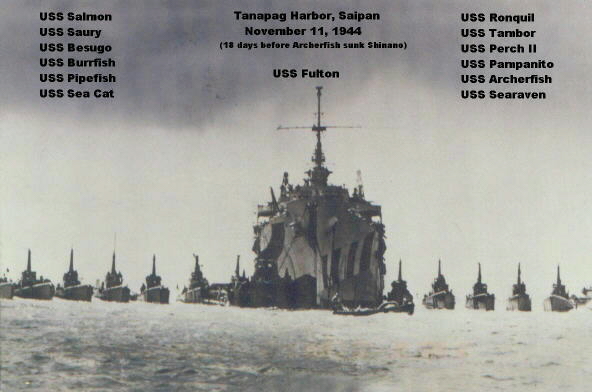
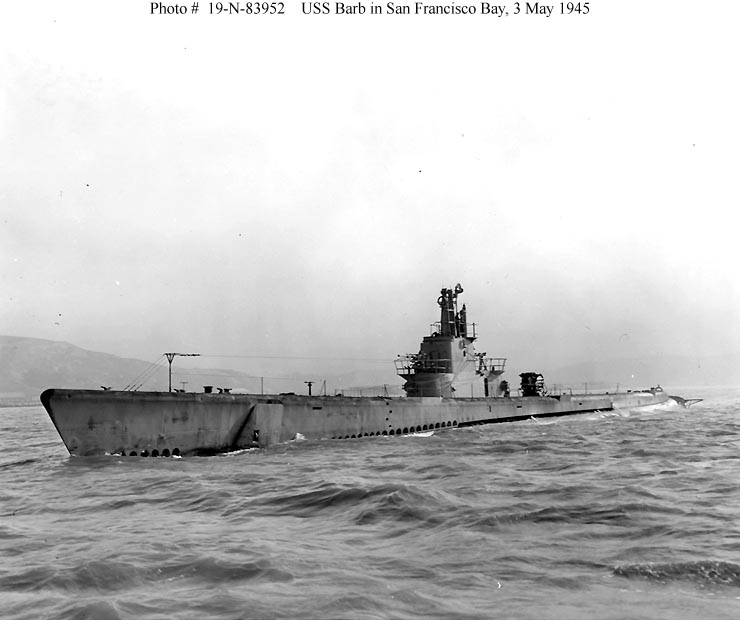
US Navy Submarines cut off Japan from its vital natural resources in Southeast Asia. A Sub Squadron above and USS Barb below

Japanese forces would always fight determined battles but they often expended great amounts of manpower in senseless Banzai charges rather than make the Americans force them out of well prepared positions.  Where the Japanese maintained excellent defense such as at Tarawa and Iwo Jima they made the Americans pay greatly for their gains.  American Marines were apart from the 82nd and 101st Airborne Divisions were the best infantry in the US Military and their skill at amphibious operations and integrated air-ground and naval warfare increased as the war went on.  The Americans were well equipped with modern weapons while the Japanese operated antiquated tanks and often substandard artillery.

Japanese leadership at the strategic and political level was inept throughout the war. They failed to coordinate any strategy with the Germans and failed to enunciate any sort of Grand Strategy.  On the operational and tactical levels the Japanese forces, especially the surface navy performed well, however as the American numeric and technologic advantage increased the Navy became less effective.  After the death of Admiral Yamamoto in 1943 Japanese Naval Leadership became far less effective. The Americans as mentioned before were able to devise a Grand Strategy which not only dealt with Japan but also Germany and coordinated the efforts of forces, war production, planning and logistics to advance their war aims.  At the operational and tactical level American forces, especially the Navy and Marines and later the Army Air Forces and Army became more skilled and than their Japanese counterparts with the possible exception of General Simon Bolívar Buckner at Okinawa. See Spector and Thomas Costello “The Pacific War.” In the air the Americans continued to increase their combat capabilities at the tactical and strategic level and used massed fire bombing raids to devastate the Japanese homeland.  The Japanese in contrast due to inexperienced pilots and fewer competitive aircraft were forced into suicide or Kamikaze missions as the war neared Japan.

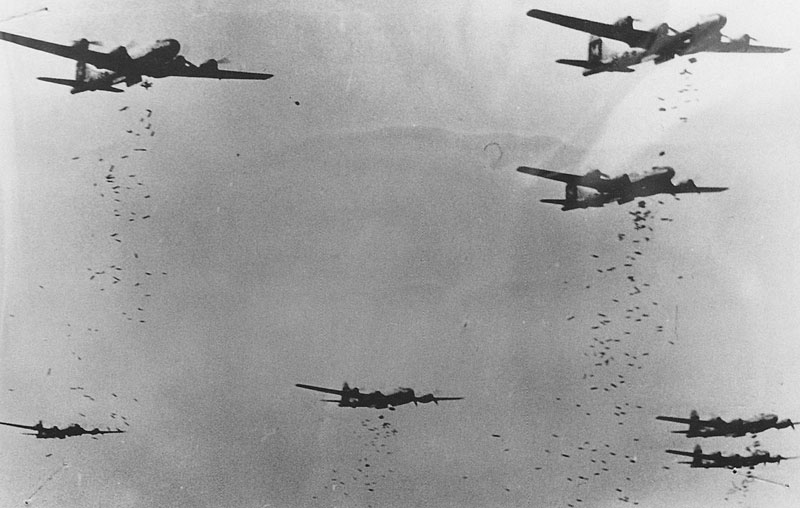
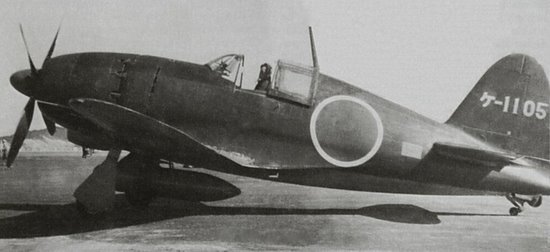
B-29 Super-fortresses leveled Japanese cities and even excellent fighters like the Mitsubishi J2M Raiden could not stop them


The outcome of the Pacific war was directly related to the ability of the Americans to adjust strategy to the realities of the Pacific war as well as the unity of effort which enabled the American superiority in industrial, technological and logistical capabilities to overwhelm the Japanese. The Japanese after initial success did little to adapt and were hamstrung by inter-service rivalries and inadequate industrial capacity and limited natural resources, fell behind in technology and were unable to replace losses among the ships, men and aircraft that they needed to fight an effective war.  Japanese leaders at many levels failed to adapt strategy, tactics or methods to match the reality of the war and the places that they did do so were done by local commanders and never instituted throughout the Japanese military.

2 Comments

Filed under History, Military, world war two in the pacific

Going to War: Flying in Al Anbar on C-130s

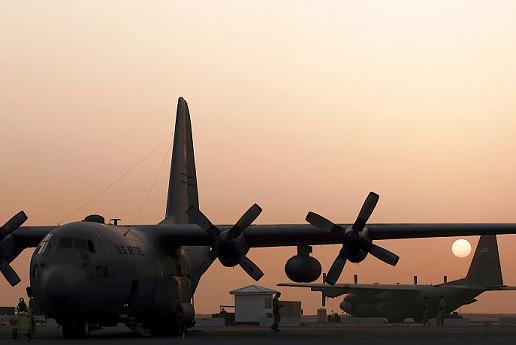
C-130’s in Iraq

This is another installment of my “Going to War” Series that I began last year.  In the Fall I had to take a break from posting anything more on the story of my deployment to Iraq in 2007 and 2008 due to issues that I was having dealing with the effects of PTSD. I have reached the point that I can again write about this so on occasion I will post these articles which now deal with our actual operations and experiences supporting our Marine Corps, Army and Joint Service advisor teams in the province. The previous posts as well as others dealing with Iraq are filed in the “Tour in Iraq” link on the home page. The direct link to these articles is here: https://padresteve.wordpress.com/category/tour-in-iraq/

Nelson and I continued to prepare in the days leading up to our first mission to the Border Port of Entry at Waleed on the Syrian border with a planned follow on to the teams of the 3rd Brigade, 7th Iraqi Division at Al Qaim about a hundred miles to the north .  Waleed is about 350 miles west of TQ and 70 miles from the nearest FOB with any substantial American presence. We were in constant communication with the team that we to visit via VOIP and SVOIP telephone and secure and non-secure e-mail. The commander of the Border teams, which included Border and Port of Entry adviser teams was Lieutenant Colonel Bien.  Our mission in getting out to the furthest point west was to meet up with an incoming and an outgoing Port of Entry team and see what we could do to get out to other posts along the border.

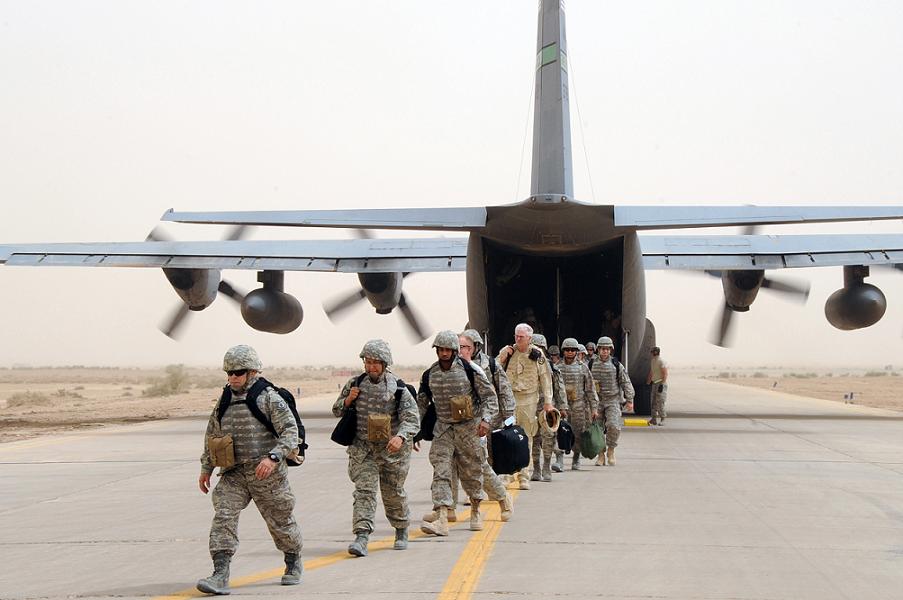
C-130 unloading its passengers

Nothing in Iraq is easy.  The get out to Waleed we had to make a two day trip from TQ, through Al Asad out to Waleed.  Our flight out was a day flight on an Air Force C-130 to Al Asad.  Our contacts in the G3-Air at 2nd MLG were good in helping me figure out the Air Force flight request which was different than the normal Marine Air Support Request.  For this mission I had to submit 2 Air Force and 3 Marine Air Support requests.    Simply submitting a request does not guarantee a flight. Flights are based on precedence dictated by the overall mission.  Religious support was pretty high on the list but there was no telling that your flight would go until you had your approval message and even then things could change.  The actual missions were not known until about midnight the night prior to the flight. So if you were a frequent flyer it meant no sleep the night before a mission as you waited to see if you were approved.  This was my first time actually having to do this for real so I sat at my secure laptop in my office in the back of the TQ plywood Cathedral waiting for the flight list to be posted on the MLG G3 Air Secure Website.  Finally about 0100 the list popped and our first flight was on in.  It was a mid day flight which meant that we needed to be at the passenger terminal about 0930.  This entailed getting our ride from the Chapel to the terminal by 0900.

I told Nelson who was checking his e-mail on a computer in the RP office that it was a go and then headed off to my can to prepare.  Since most of my gear for the 10 day trip was already packed I tried to actually get ready to sleep.  I quickly found that simply being tired because I was up late was not enough to help me go to sleep.  I was really tired but the adrenaline was coursing through my body making it impossible to sleep.  I prayed the office of Compline and then played computer Ma-Jong until at least 0300 before I could finally pass out.  I was up early to shower and get breakfast before lugging my gear over to the chapel.  The weather as usual was about 100 degrees by the time I got back from the chow hall; I gathered my gear and went to the chapel.  I took my back pack, my laptop and a flight bag. I would learn on this mission that I would need to pack lighter the next time around, but live and learn.

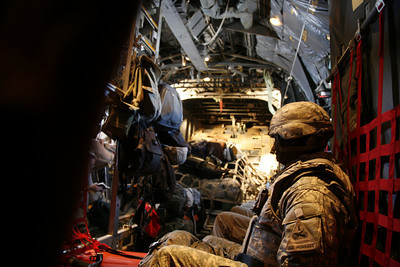
The first leg of our trip was on an Air Force C-130 from TQ to Al Asad which we shared with a large number of previously unknown friends from every branch of service in the US military as well as various civilians and contractors.  All of us had our personal protective equipment as well as our bags. The bags that we did not want to lug were placed on pallets and transported with a large fork lift to the aircraft.  When you make one of these trips you are accounted for a good number of times before ever getting on the aircraft.  This first mission was still in the heat of the Iraqi summer and thus the temperature inside and outside of the aircraft was stifling.  We staged off the tarmac in the sun for a final role call and then in two lines who guided out to our aircraft which had just landed.  As we were trudging out to the aircraft two lines of assorted passengers primarily Soldiers and Marines passed us mid way to the aircraft.  As we neared the aircraft the propeller blast blew the hot air into our faces and I thanked God for the high speed ballistic sunglasses that I had been issued by EOD.  Entering into the aircraft we had to step up onto the cargo ramp and then took our seat in the narrow canvas mesh jump seats that lined both the side of the aircraft and the center.  The rear of the aircraft including the cargo ramp was used for several pallets of cargo including the bags that we elected not to carry.  Sitting in the aircraft and waiting for the pallets to be loaded I thought back to my early career as an Army Officer where I became an air-load planner and embarked my soldiers on six C-130s during Winter REFORGER 1985.  Back then instead of the 130 degree heat of Iraq we faced the coldest winter in 40 years in Europe in which the Rhine froze over.  Although the use of computers has become routine in load plans the principles are the same as they were 25 years ago and everything on the aircraft needs to be properly balanced to ensure the stability and safety of the aircraft and that weight limits are not exceeded.  As the sweat poured off of me I took off my helmet and downed part of the one liter bottle of water that I carried onto the aircraft and threw some on my face, though warm it was refreshing and I reattached my helmet as the aircrew came through the cabin giving a final safety brief.

Interior shot of a C-130

As the last of the cargo pallets were loaded about the aircraft the cargo ramp was raised, the entire time that the aircraft was on the ground was under 15 minutes, it is amazing what the Marine and Air Force ground crews and cargo handlers can accomplish.  With the ramp raised the aircraft’s air conditioning began to take effect and though not the coolest air conditioning it was better than what we had up to that point. The aircraft began to roll and move down the taxiway and when it reached the end of the taxiway it made a fast turn and began its take off.  Since there was a real and present danger of possible missile or gun attacks on low flying aircraft the C-130 made a steep lift off and banked right over Lake Habbinyah and continued its ascent until it reached its cruise altitude.  The C-130, like any cargo aircraft is extremely loud and because of this hearing protection is worn by passengers and crew and conversation is nearly impossible.

The flight from TQ to Al Asad is only about 30 to 45 minutes depending on the route taken so most of the passengers took the opportunity to grab a bit of sleep or read.  Nelson and I sat together on the starboard side of the aircraft not far from the palletized cargo.  Nelson who can sleep almost anywhere on a moment’s notice was out quickly; and although I was tired I could do little more than close my eyes and try to clear my mind.  When we neared Al Asad the aircraft banking nearly perpendicular to the ground made a steep and fast approach.  As we landed I could see other aircraft on the ground including F-18’s, various transports and rotor wing aircraft.  The C-130 taxied to a spot on the tarmac where the ramp was dropped and we were instructed to exit the aircraft and led to the rear of the aircraft about 50 yards and then led between it and another aircraft to a group of tiny Japanese made Nissan and Mitsubishi buses in which we were loaded until every seat was full including the in aisle jump seats.  Packed into the bus like sardines and smelling almost as bad we sucked in the stench, which was somewhat like a European elevator in the 1980s.

Padre Steve Chillin’ at Al Asad Terminal

After a short ride to the terminal we picked up our gear which had been delivered on the pallets by forklifts.  Another muster was taken and after all personnel were accounted for those of us waiting on follow on flights checked in at the terminal and got our temporary billeting in large tents about a hundred yards from the terminal where we each found a bunk grounded our gear and settled in for a bit to clean up before trying to go get some chow.

Next: Air Travel In Al Anbar the California Line.

Leave a comment

Filed under History, iraq,afghanistan, Military, Tour in Iraq

The Last Week of Lent: Mediation on Life, Love and Public Witness

Lent is drawing to a close and Sunday begins Holy week where the Church remembers the last week in the early life of Jesus the Christ.  While I will write about the various aspects of Holy week to include Passion or Palm Sunday, Holy or Maundy Thursday, Good Friday and Easter but tonight a short meditation on the final week of this Lenten season.

I have discussed how this Lent has been different than previous observances of Lent.  In the past I was constantly trying to observe certain spiritual disciplines to include fasting, abstinence and prayer in a formal and legalistic manner.  Last year as I was “melting down” in my spiritual, psychological and physical life facing an existential crisis where after my tour in Iraq, experience of forsakenness, disillusionment concerning the Church, political institutions and the media and doubt about the existence of God I attempted to change the way that I observed Lent.  For the most part that attempt was an abysmal failure, however out of it came an association with the Pastor and people of Saint James Episcopal Church in Portsmouth which has been a place where at least part of me began to experience community and healing again.

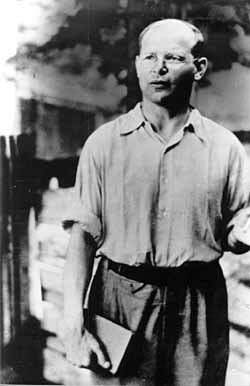
This Lenten season has been one filled with an experience of God’s grace and love as well as a connection to others that I have missed for a long time.  It has been a time of continued healing, self discovery in the light of God’s grace and change in the way that I do life.  Admittedly this has been a gradual process that began back during Advent but has become more a part of my life.  The rediscovery of God’s grace in Jesus and a life in community with others has been a key factor in this experience.  I certainly have not figured everything out, far be it, I am re-learning my faith and it has been a time of refreshment.  Part of this is the experience of Christ in Scripture and sacred Tradition, but also in reason.  As such it has been a time where I have been able to enunciate how my Christian faith addresses the trying times that we are living in often through the witness of men like Dietrich Bonhoeffer and Karl Barth.

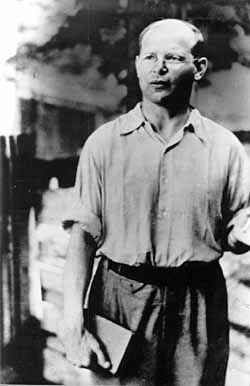
One thing that Bonhoeffer said has a particular resonance in my life because it aptly describes how I feel.  In prison Bonhoeffer wrote: “I often ask myself why a ‘Christian instinct’ often draws me more to the religionless people than to the religious, by which I don’t in the least mean with any evangelizing intention, but, I might almost say, ‘in brotherhood’. While I’m often reluctant to mention God by name to religious people – because that name somehow seems to me here not to ring true, and I feel myself to be slightly dishonest (it’s particularly bad when others start to talk in religious jargon; I then dry up almost completely and feel awkward and uncomfortable) – to people with no religion I can on occasion mention him by name quite calmly and as a matter of course.” Dietrich Bonhoeffer – Letters and Papers from Prison

In fact I find it easier on many occasions to have free flowing, intellectual, spiritual discussions with people who have a faith far different than mine than I do with many people in my own denomination. I am making no judgment on them as I have been the one going through a fundamental change in the way that I do life, theology and relationships.

As this has occurred I have rediscovered just how much God loves and cares for real people, as Bonhoeffer wrote:

“God loves human beings. God loves the world. Not an ideal human, but human beings as they are; not an ideal world, but the real world. What we find repulsive in their opposition to God, what we shrink back from with pain and hostility, namely, real human beings, the real world, this is for God the ground of unfathomable love.”

As I interact more with those “outside” the church I often find deep faith and integrity which sometimes I find to be more “real” than some of the Christians that I know. I am not saying that somehow the non-Christian is superior to the Christian but that God has also made them in his image and as such they are not the enemies of God. As Paul the Apostle wrote “Therefore, if anyone is in Christ, he is a new creation; the old has passed away, behold, the new has come. All this is from God, who through Christ reconciled us to himself and gave us the ministry of reconciliation; that is, in Christ God was reconciling the world to himself, not counting their trespasses against them, and entrusting to us the message of reconciliation.  So we are ambassadors for Christ, God making his appeal through us. We beseech you on behalf of Christ, be reconciled to God.  For our sake he made him to be sin who knew no sin, so that in him we might become the righteousness of God.” 2nd Cor. 5:17-21 NRSV and “For to this end we toil and struggle, because we have our hope set on the living God, who is the Savior of all people, especially of those who believe.” 1 Tim. 4:10 NRSV

Likewise I also have found it harder to deal with people who spout religious jargon and throw out Bible verses without any sense of context, history and or concern for their hearers.  It seems to me that many parts of American Christianity have substituted cultural and political issues for the preaching of the Gospel of life.  I recently saw some posts by religious leaders on social networking sites, websites and media outlets that accused pro-life Democrats of “betraying their faith” by voting for the Health Care Bill.  Now I am not thrilled with the bill and have major concerns about it.  However, if I decide to accuse someone of “betraying their faith” I had better be sure that I am on solid ground and stick to what is in the Creed over a particular interpretation of any moral or social issue on which even Christians disagree. Saying this will win me no friends in certain parts of the Church but I wonder the utility of alienating people and in our condemnation of them ensure that they will turn off anything that we say about Jesus who despite what they (and we) do still loves humanity with an undying and passionate love that is demonstrated by his death on the Cross as Paul wrote “But God proves his love for us in that while we still were sinners Christ died for us.”   Romans 5:8 NRSV

In all of the turmoil that has embroiled the country I still find myself at peace because of what has happened to me over the past couple of years. Going to war and seeing the tragedy of a people engulfed in civil war has given me an appreciation of seeking peaceful dialogue with those that I have disagreement rather than attacking them at the center of their being.  I believe the Gospel lived authentically and not wrapped in the incestuous embrace of venomous and often hate filled political ideologies which seems to be increasingly the case in United States is far more powerful than that of a political movement of any kind.  The church surrenders its authority and legitimacy by allowing itself to be a party organ of any political party or ideology.  Unfortunately simply because political parties and movements pay lip service to certain “Christian” values many Christians and churches lose themselves and endorse power for power sake hoping that the party will implement their beliefs.  Unfortunately history proves that more often than not when their party returns to power it will again sell them short with no return for their support.  The unintended consequence is that people who need the Gospel identify it with the political ideology of the party that the church supported.  This was not the witness of the early church, the Apostles and those that followed them.

The mimicking of ideologues by Christians gives credence and support to violent people who under the cover of God have no problem with praying for the death of their opponents and in some cases taking the responsibility of that in their own hands.  Should bloodshed arise out of this latest partisan political struggle the religious leaders who urged violence and prayed for death will have blood on their hands.  Having been threatened with violence on this website by a supposedly “Christian” person I take a deeply personal interest in just how violent some Christians have become and with actions and violent threats against members of the House of Representatives I wonder what will happen when someone assassinates one of these men or women or a religious leader who dares to oppose them.

The alternative to this is to cry “NO!” to the calls for violence and judgment no matter from what side of the political or ideological spectrum that they emerge.  The alternative is to in thought word and deed demonstrate the truth of the Gospel in love even to those that we have strong disagreement on very important issues.

Anyway I must close for the night.

Peace

Padre Steve+

Leave a comment

Filed under christian life, History, philosophy, Political Commentary, Religion

Tom Hanks on the Pacific War and the Impact of Race in the Pacific War

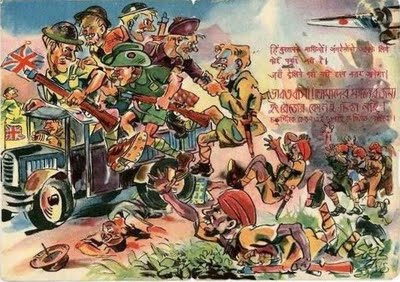
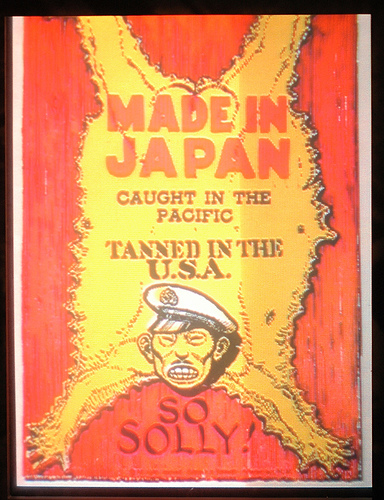
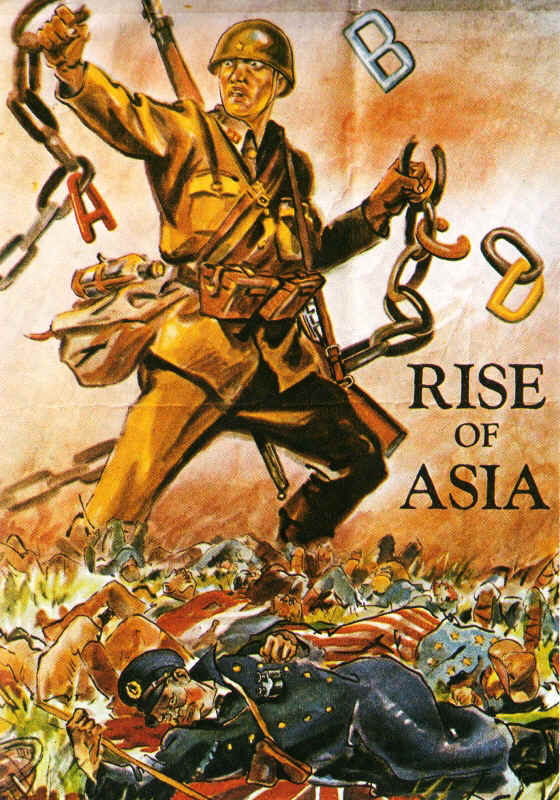
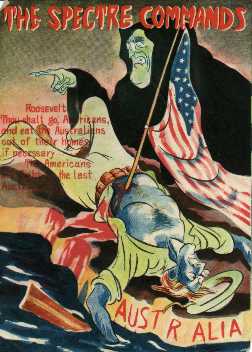
Anti US Japanese Propaganda

This is my third installment of my series background for the new HBO series “The Pacific.” The producer of this series is actor and producer Tom Hanks. Hanks has also acted in “Saving Private Ryan” and produced “Band of Brothers” both of which have been critically acclaimed. Hanks recently ran afoul of his most loyal audience for these productions when he made a very inaccurate comment about the role of racism in the American-Japanese war in the Pacific which he repeated.  Hanks is a great film maker and his work on “Saving Private Ryan” and “Band of Brothers” helped show a new generation the courage and sacrifice of the generation that fought World War Two.

Hanks comments had a bit of truth in them, as racism did play a role in the propaganda of both sides during the war and the manner in which some leaders and soldiers fought it.  However Hanks demonstrated a true lack of objective historical balance as he skewed this into an overall condemnation of the way that the United States prosecuted the War against Japan. Hanks ignored Japanese conduct and responsibility in the conduct of the war and drew a straw man analogy to the current wars in Iraq and Afghanistan. Yes there was racism at work in the Pacific war; it did influence the conduct of the war and the actions of individual leaders and soldiers, but both the American and Japanese were both part of it, this was not a one way street as Hanks seems to indicate.

But what did Hanks say?  Hanks first comment came in an interview with Time magazine:

“Back in World War II, we viewed the Japanese as ‘yellow, slant-eyed dogs’ that believed in different gods,” he told the magazine. “They were out to kill us because our way of living was different. We, in turn, wanted to annihilate them because they were different. Does that sound familiar, by any chance, to what’s going on today?”

Hanks then followed this on MSNBC’s “Moring Joe” with Joe Scarborough where he said:

“‘The Pacific’ is coming out now, where it represents a war that was of racism and terror. And where it seemed as though the only way to complete one of these battles on one of these small specks of rock in the middle of nowhere was to – I’m sorry – kill them all. And, um, does that sound familiar to what we might be going through today? So it’s– is there anything new under the sun? It seems as if history keeps repeating itself.”

To be fair there was a significant amount of racism but involved but it was rampant on both sides and Japan’s racism not only included American and British but most of the rest of Asia and in many places they waged a war of extermination against the Chinese and others who resisted them.  Much of the American attitude was based upon the widespread publicity of Japan’s brutal campaign against the Chinese, a people that many Americans harbored an affinity for at that time.  Likewise the attack on Pearl Harbor influenced the way that Americans thought of Japan. The Japanese frequently appealed to anti-colonial feelings of territories that the conquered ignoring their own subjugation of local populations.

Since the subject of race has been broached I have re-posted a review of John Dower’s book “War without Mercy: Race and Power in the Pacific War.” The book shows how much racism played a role in the conduct of the war on both sides. However it was not in the manner in which Hanks portrayed it in his interviews as it was a two way street. The war in the Pacific was one of the most brutal “no-quarter” conflicts ever fought and much of this was directly related to the Japanese concept of honor which considered personal surrender cowardly and a loss of face, or believing that showing mercy or treating defeated enemies who surrendered with honor was undeserved.

The comparison of this war by Hanks to the current wars in undeserved. With few exceptions the American military has conducted itself with tremendous restraint often risking its own to ensure that non-combatants are not killed even during firefights and battles.  There are some in the United States who advocate the type of war that we had with the Japanese against Moslems extremist or otherwise and they are among the loudest critics of the military’s prosecution of these wars. Depending on what happens racism has the potential to reemerge as a major factor in this conflict, but at the present Hanks remark can only be called ill-informed and prejudiced in its own right. By doing this Hanks sullies his reputation among the surviving veterans of the “Great Generation” who had to battle a tenacious and proud foe on the “little specks of sand and rock” in the Pacific.

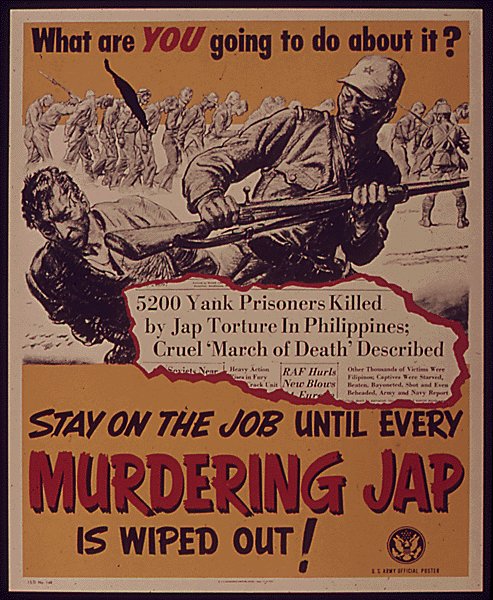
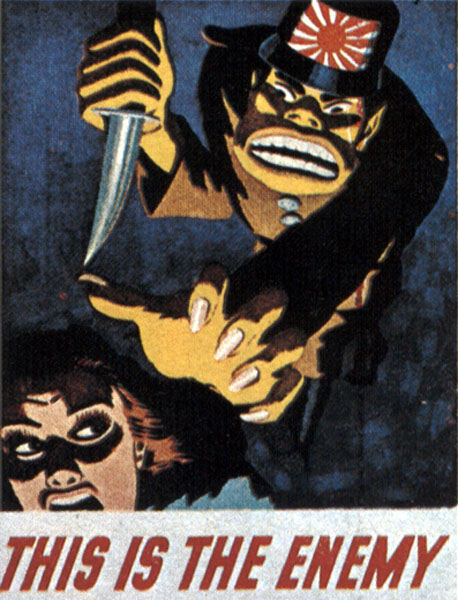
Anti-Japanese propaganda sometimes encouraged “wiping out” every “murdering Jap”

This is a review of John Dower’s “War without Mercy” which I published on this site last year.  It is a book that raises troubling questions about the Pacific war but one that is not one sided.

Peace,

Padre Steve+

Dower, John W. War without Mercy: Race and Power in the Pacific War.” Pantheon Books, a Division of Random House, New York, NY 1986.

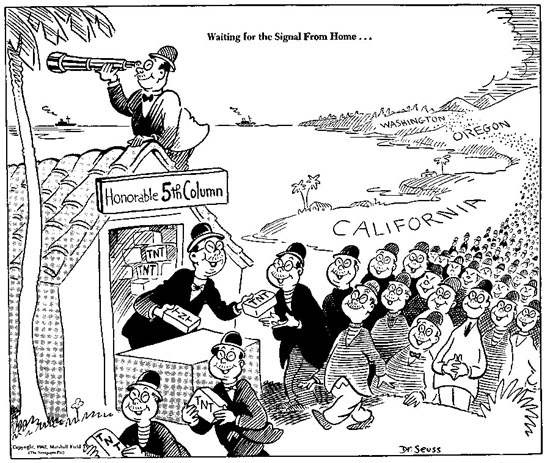
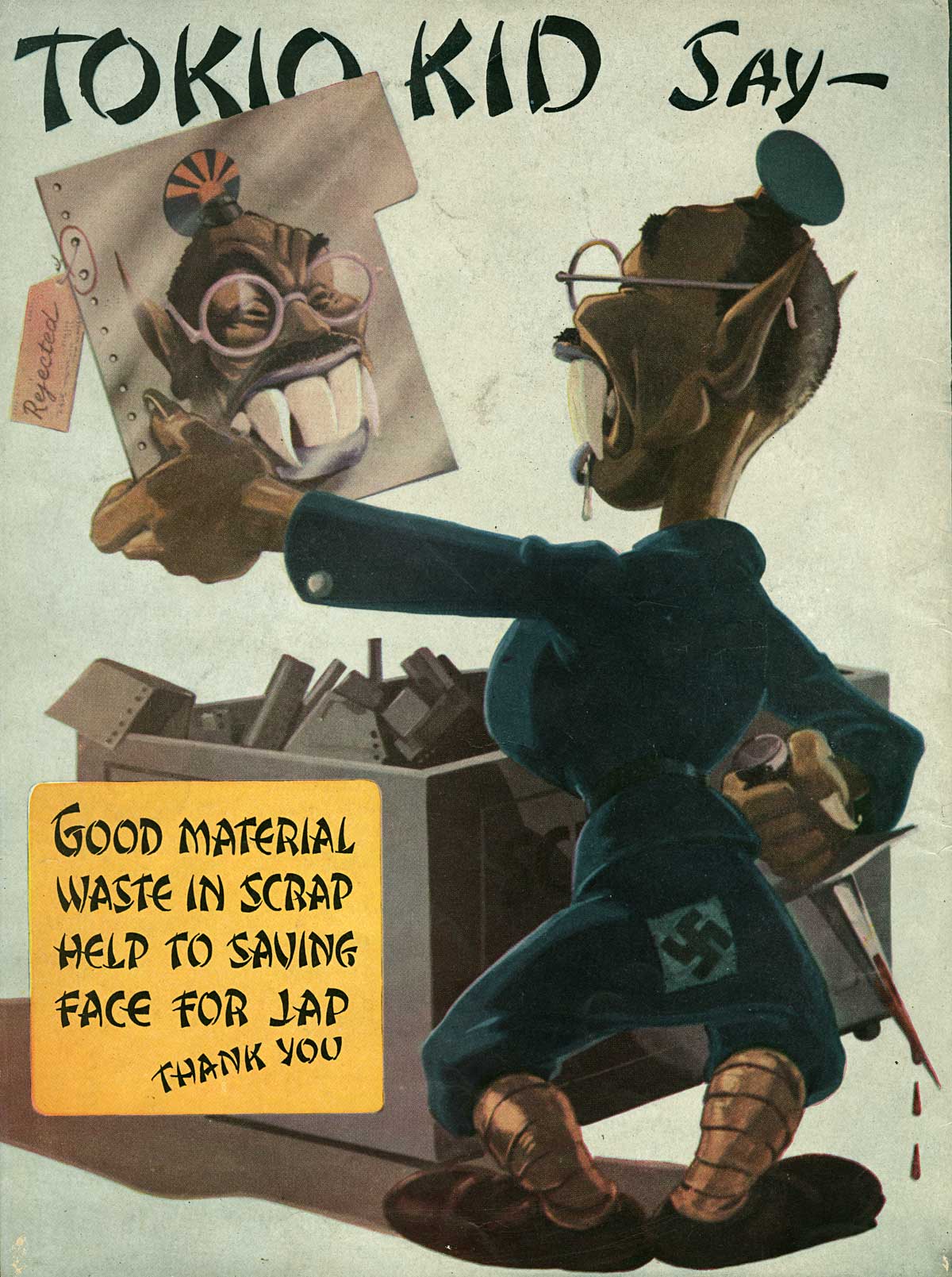
Even Dr Seuss was used to paint the picture of Japanese Americans as traitors

The study of war cannot simply be confined to the study of battles, weapons and leaders. While all of these are important one must as Clausewitz understood examine the human element of policy, ideology and the motivations of nations as they wage war. Clausewitz understood that war could not be reduced to formulas and templates but involved what he called the “remarkable trinity” which he described in on war as (1) primordial violence, hatred, and enmity; (2) the play of chance and probability; and (3) war’s element of subordination to rational policy. Clausewitz connects this with the people being connected to the primordial forces of war, the military with the non-rational elements of friction, chance and probability and the government.

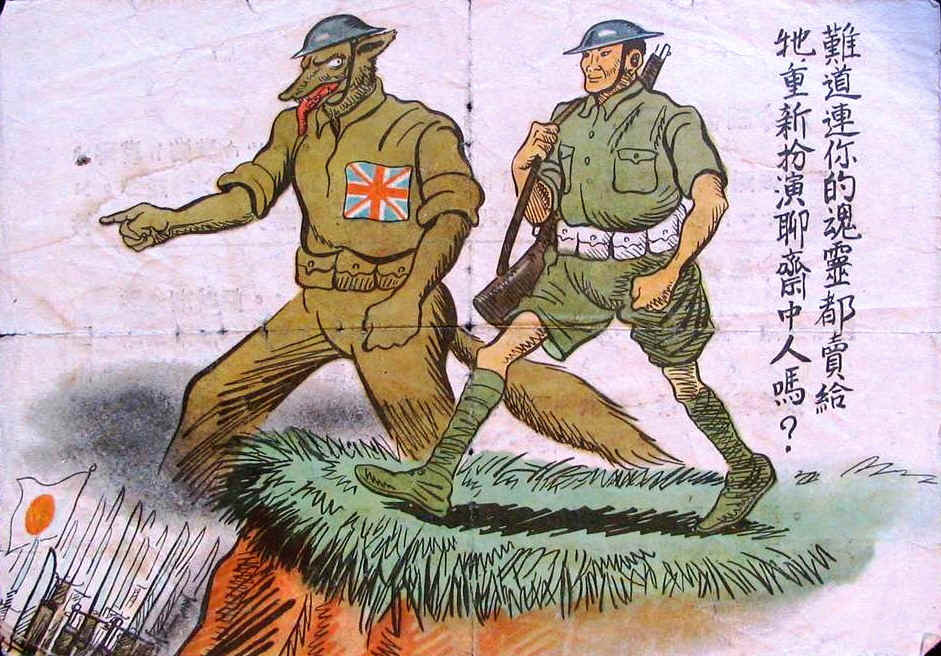
Anti-British Japanese Propaganda leaflet

The Clausewitzian understanding of war is rooted in the Enlightenment and classic German Liberalism, born out of his experience in the Napoleonic Wars, which forever changed the face of warfare.  From the defeat of Prussia and its liberation from Napoleonic rule under Scharnhorst and Gneisenau Clausewitz developed the understanding that war was more than simply tactics and weapons.  Thus when we examine war today we deprive ourselves of properly understanding the dynamic of war if we fail to appreciate the human factor which is frequently not rational.  Such is especially the case when one fights an enemy who wages war on religious, racial or ideological grounds as is the case in the current war against Al Qaida and other extremist Moslem groups. Such groups would like to turn this war into such a conflict as do certain figures in the American political milieu who repeatedly label all of Islam as the enemy.  In such a climate it is imperative to look at history to show us the results of such primal passions.


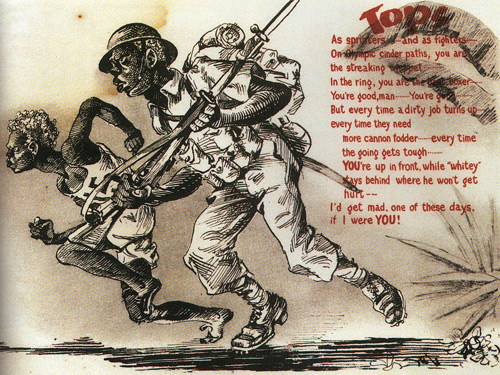
The Japanese made a conscious but unsuccessful attempt to incite African Americans to rise against white America

It is in such conflict as we are engaged in today it is good to look at previous wars from the human experiential component and not simply military operations.  If one wants to look at how inflamed passion driven by racial prejudice and hatred took war to a level of barbarity and totality that defy our comprehension we only need to look back to the Pacific war between Japan and the United States.  In another post I dealt with the how racial ideology influenced Nazi Germany’s conduct of the war against Poland and the Soviet Union.  https://padresteve.wordpress.com/2009/09/14/the-ideological-war-how-hitlers-racial-theories-influenced-german-operations-in-poland-and-russia/

To do this I will look at John Dower’s “War Without Mercy.” In this book Dower examines World War Two in the Pacific from the cultural and ideological viewpoints of the opposing sides.  He looks at the war as a race war, which he says “remains one of the great neglected subjects of World War Two.”[i] Dower examines race hated and its influence on both the Japanese and the Allies, particularly in the way that each side viewed one another and conducted the war.  He examines the nature of racial prejudice and hate in each society, including its religious, psychological, ideological, scientific and mythological components.  He also examines the use of media and propaganda, and how racial attitudes not only influenced national and individual attitudes, but also the military and intelligence operations of both sides.  This book is not about military campaigns, thus it is much more like “In the Name of War” by Jill Lepore[ii] than any history of the Pacific war.

Dower uses sources such as songs, movies, cartoons and various writings of the times to demonstrate the totality of the war.  Dower admits many of these are difficult to handle and “not respectable sources in some academic sources.”[iii] Despite this he puts together a work that is sometimes chilling, especially when one looks at the current war that our country is engaged in. He also endeavors to explain how after a war where “extraordinarily fierce and Manichean”[iv] race hate predominated, it could “have dissipated so easily”[v] after the war was over.

Dower divides his work into three major sections.  The first which examines how the aspect of race effected the fighting of the war, the second, the war through Western eyes and the third the war through Japanese eyes.  The first section begins with how racial attitudes in Western and Japanese societies helped fuel the war and compares similar attitudes and concepts in Western and Japanese thought, including how “prejudice and racial stereotypes frequently distorted both Japanese and Allied evaluations of the enemy’s intentions and capabilities.”[vi] He looks at the language of the conflict; at how war words and race words came together “in a manner which did not reflect the savagery of the war, but truly contributed to it….”[vii] the result being “an obsession with extermination on both sides.”[viii] He comes back to this theme throughout the book comparing the two sides and occasionally contrasting these attitudes with corresponding attitudes of the Allies to their German and Italian foes in Europe.[ix]

In the first chapter Dower examines the role played by the propaganda used by both sides.  In particular he explains how the “Know Your Enemy: Japan” movies commissioned by the War Department and directed by Frank Capra, and the Japanese works “Read this and the War is Won” and “The Way of the Subject” helped shape the view of each side. Propaganda developed the idea of the war in terms of good versus evil and the mortal threat posed to their respective cultures by the enemy.

From this he looks at the visceral emotions that the war engendered and how those emotions spilled over into the conduct of the war especially in regard to its ferocity and the war crimes that were spawned by the unbridled hatred of both sides.  He notes the targeted terror bombings of civilians by both sides and how those actions were portrayed as “barbaric” by the other side when they were the victim.[x] He notes the viciousness of the war and how for the Americans the war brought forth “emotions forgotten since our most savage Indian wars.”[xi] He contrasts this with European war in particular how the Japanese and their actions were portrayed in Western media, and how similar actions by the Germans, such as the Holocaust, were ignored by Western media until the war was over.[xii] He traces some of this to the understanding of the psychological effects of the defeats and humiliations of the Allies at the hands of the Japanese, and the corresponding brutality toward Allied prisoners by the Japanese as compared to that of the Germans.[xiii] He uses this section to also examine the prevailing attitudes of the Japanese toward the Allies as being weak and “psychologically incapable of recovery” from blows such as the Pearl Harbor attack, and the Allied view of the Japanese as “treacherous.”[xiv]

Dower’s second major section describes the attitudes and actions of the Americans and British toward their Japanese enemy.  He looks at the view that the Japanese were less than human and often portrayed as apes or other primates such as monkeys.  To do this he examines cartoons and illustrations in popular magazines and military publications, and includes those cartoons in the book.   The sheer vulgarity of these cartoons is easily contrasted with those promoted and published by Nazis such as Julius Streicher in Der Stürmer, something often overlooked or ignored in other histories.[xv] The early Western views of Japan as sub-human continued throughout the war, while at the same time, especially after the rapid series of Allied defeats and Japanese victories they were viewed as almost “super-human.”  Paradoxically some allied leaders turned the Japanese from “the one time “little man” into a Goliath.”[xvi] They were now “tough, disciplined and well equipped.”[xvii] Ambassador Joseph Grew, reported on his return from Japan, that the Japanese were; “”sturdy,” “Spartan,” “clever and dangerous,” and that “his will to conquer was “utterly ruthless, utterly cruel and utterly blind to the values that make up our civilization….””[xviii] The juxtaposition of such conflicting attitudes is curious, although understandable, especially in light of other Western wars against Asians or Arabs.[xix]

Dower then examines how some Americans and British explained the Japanese “National Character,” their approach to war, and actions during the war from Freudian psychiatry as well as Anthropology and other social and behavioral sciences.   Beginning with the widespread Allied understanding that the Japanese were “dressed-up primitives-or “savages” in modern garb…”[xx] he notes that these interpretations of the Japanese national character stemmed from “child-rearing practices and early childhood experiences,”[xxi] including toilet training and Freudian interpretations that saw an arrested psychic development at the “infantile (anal or genital) stage of development.”[xxii] Dower deduces that it was not hard to see how “Japanese overseas aggression became explicable in terms of penis envy or a castration complex….”[xxiii] The views were widespread and emphasized  that the “Japanese were collectively unstable.”[xxiv] Dower notes that the “very notion of “national character”-was the application to whole nations and cultures of an analytical language that had been developed through personal case studies…”[xxv] which he is rightly critical in suggesting that this premise “was itself questionable.”[xxvi] In addition to this was the understanding of Margaret Mead and others of the Japanese as “adolescents” and “bullies,”[xxvii] and notes that from “the diagnosis of the Japanese as problem children and juvenile delinquents, it was but a small step to see them as emotionally maladjusted adolescents and, finally as a deranged race in general.”[xxviii] Dower cites numerous other “experts” of the time and their interpretations of the Japanese national character, but the overwhelming message is that the application of these theories, regardless of their validity had a major impact on the Allied war against Japan.

He follows this chapter with one with much importance in explaining the similarities in how Americans and Westerners in general viewed the Japanese in relationship to other races that they had dealt with including Blacks, Chinese, Filipinos, and American Indians.  Common themes include the views of each as primitives, children and madmen and the view of the Japanese as part of the “Yellow Peril.”  Of particular note is his analysis of the work of Homer Lea’s 1909 book The Valor of Ignorance and the vision of Japanese supermen which enjoyed a revival after Pearl Harbor.[xxix] Dower examines depictions of Asians in general in the Fu Manchu and Charlie Chan series of films and other racial aspects hearkening back to the “specter of Genghis Khan and the prospect that the white races “may be liquidated.”[xxx] He notes how Japanese propagandists attempted to use Allied prejudice to influence the Chinese and other Asians against the Allies[xxxi] and American blacks against whites,[xxxii] while attempting to maintain their own racial superiority which is the subject of the next section.

The chapters dealing with the Japanese view of themselves and their opponents tie together neatly.  These deal with the Japanese view of themselves as the leading race in Asia and the world.  Dower talks about symbols and the understanding of racial purity that motivated the Japanese from the 1800s to the rejection of Japan’s request for a declaration of “racial equity” at the League of Nations.[xxxiii] He notes the “propagation of an elaborate mythohistory in Japan and the time spent “wrestling with the question of what it really meant to be “Japanese” and how the “Yamato race” was unique among races….”[xxxiv] He notes the relationship of Shinto with whiteness and purity and connotations of how the Japanese indulged in “Caucasianization” of themselves vis-à-vis other Asians during World War Two,”[xxxv] and their emphasis on a Japanese racial worldview.[xxxvi] He also tackles the way in which the Japanese wrestled with evolution and its relationship to other racial theories contrasting books such as A History of Changing Theories about the Japanese Race and Evolution of Life with Cardinal Principles of the National Polity published by the Thought Bureau of the Ministry of Education in1937.  These declared that the Japanese were “intrinsically different from the so-called citizens of Occidental countries.”[xxxvii] He also deals with the Kyoto school and the Taiwa concept.[xxxviii] In Chapter Nine Dower looks at how the Japanese viewed themselves and outsiders, in particular the characterization of Westerners as nanbanjin or  barbarians and how this eventually train of thought carried through the war led to the “Anglo-American foe emerged full blown as the demonic other.”[xxxix] Dowers final chapter deals with how quickly the race hatred dissipated and genuine goodwill that developed between the Japanese and Americans after the war.[xl]

This book holds a unique place in the literature of the Pacific war.  It is not a comfortable book, it is challenging. No other deals with these matters in any systemic way.  If there is a weakness in Dower is that he does not, like Lepore in “In the Name of War” deal with the attitudes of soldiers and those who actually fought the war.  His examples are good and go a long way in explaining the savagery with which the war was conducted, but could have been enhanced with reflections and accounts of those who fought the war and survived as well as the writings of those who did not, and the way those attitudes were reflected in different services, times and theaters during the war, including adjustments that commanders made during the war.[xli] His description of how Japanese “reluctance to surrender had meshed horrifically with Allied disinterest …in contemplating anything short of Japan’s “thoroughgoing defeat.”[xlii]

The lessons of the book are also contemporary in light of the cultural and religious differences between the West and its Moslem opponents in the current war. Possibly even more so than the war between the United States and Japan which was fought by nation states that still were signatories to international conventions, not nation states against terrorists unbound by any Western code or law or indigenous forces engaged in revolutionary war against the west such as the Taliban.[xliii] The temptation is for both sides to demonize one’s opponent while exalting one’s own way of life through official propaganda and popular media, with a result of increased viciousness and inhumanity in pursuit of ultimate victory.   In today’s world with the exponential rise in the radicalization of whole people groups and the availability of weapons of mass destruction, it is possibility that the war could develop into one that is a racial as well as religious and ideological war that would make the War in the Pacific look like a schoolyard brawl.

Bibliography

Alexander, Joseph H. Utmost Savagery: The Three Days of Tarawa. Ivy Books, Published by Ballantine Books, New York, NY 1995

Dower, John W. War without Mercy: Race and Power in the Pacific War.” Pantheon Books, A Division  of Random House, New York, NY 1986.

Leckie, Robert. Okinawa. Penguin Books USA, New York NY, 1996

Lepore, Jill  The Name of War Vintage Books a Division of Random House, New York, NY 1998

Tregaskis, Richard Guadalcanal Diary Random House, New York NY 1943, Modern Library Edition, 2000.

Notes


[i] Dower, John W. War without Mercy: Race and Power in the Pacific War.” Pantheon Books, A Division  of Random House, New York, NY 1986. p.4

[ii] Lepore, Jill  The Name of War Vintage Books a Division of Random House, New York, NY 1998.  Lepore’s book deals with King Phillip’s War and how that war shaped the future of American war and how it shaped the views of Indians and the English Colonists and their later American descendants both in the language used to describe it, the histories written of it and the viciousness of the war.

[iii] Ibid. p.x

[iv] Ibid. p.ix

[v] Ibid. p.x

[vi] Ibid. p.11

[vii] Ibid.

[viii] Ibid.   Also see Alexander, Joseph H. Utmost Savagery: The Three Days of Tarawa. Ivy Books, Published by Ballantine Books, New York, NY 1995 Alexander notes an incident that shows a practical application of the Japanese views and the ruthlessness inflicted on their enemies, in this case prisoners in response to an American bombing raid. In 1942 the commander of the Japanese Garrison of Makin Island ordered 22 prisoners beheaded after one cheered following a bombing raid. (p.32)

[ix] An interesting point which Dower does not mention but is interesting for this study is how the Germans referred to the British and Americans as “Die gegener” (opponents) and the Soviets as “Die Feinde” (the enemy), the implication being that one die gegener was a common foe, much like an opposing team in a sport, and the other a mortal enemy, the implication of Feinde being evil, or demonic.

[x] In particular he makes note of the Japanese actions during the “Rape of Nanking,” and the 1945 sack of Manila, as well as the fire bombing of Japanese cities by the US Army Air Corps in 1945.

[xi] Ibid. Dower. p.33

[xii] Ibid. p.35

[xiii] Ibid.  This is important in the fact that the Allies tended not to make much of German brutality to the Jews, Russians and other Eastern Europeans.

[xiv] Ibid. p.36.

[xv] Dower does not make this implicit comparison, but having seen both and studied the Nazi propaganda directed toward the Jews, Russians and other Slavic peoples considered to be Untermenschen (sub-humans) by the Nazis the similarities are striking.

[xvi] Ibid. pp.112-113.

[xvii] Ibid. p.113

[xviii] Ibid.

[xix] In the 2006 Israeli invasion of Lebanon, Israeli soldiers who previously showed no respect to any Arab fighter described their Hezbollah opponents as “soldiers and warriors.”  Similar attitudes were voiced by American soldiers in Vietnam when they fought NVA regulars.

[xx] Ibid. p.123

[xxi] Ibid.

[xxii] Ibid.

[xxiii] Ibid.

[xxiv] Ibid. p.124

[xxv] Ibid.

[xxvi] Ibid.

[xxvii] Ibid. p.129

[xxviii] Ibid. p.143

[xxix] Ibid. P.157.  Lea is interesting because he predicts a decline in the stature of the British Empire and softness of both the Americans and British as peoples.  Also see John Costello in The Pacific War 1941-1945 Quill Books, New York, NY 1982 pp.31-32 notes Lea’s concerns and how they drove the American Pacific strategy until the outbreak of World War Two.

[xxx] Ibid. p.161

[xxxi] Ibid. p.169

[xxxii] Ibid. pp.174-180.  This is an interesting section.  One of the most interesting topics being the reaction of the NAACP’s Walter White’s book A Rising Wind published which “suggested a sense of kinship with other colored-and also oppressed-peoples of the world….he senses that the struggle of the Negro in the United States is part and parcel of the struggle against imperialism and exploitation in India, China, Burma….” (p.177-178)

[xxxiii] Ibid. p.204

[xxxiv] Ibid. p.205

[xxxv] Ibid. p.209  This is interesting when one compares the Japanese emphasis on “Pan-Asianism” and the inherent contradiction between the two.

[xxxvi] Ibid. p.211  Dower notes that the article Establishing a Japanese Racial Worldview in the monthly Bungei Shunju “clarified the Japanese character, whose basic traits were brightness, strength and uprightness.  These qualities made the Japanese “the most superior race in the world.”

[xxxvii] Ibid. p.221

[xxxviii] Ibid. p.227 This was the theory of Zen Buddhism’s Suzuki Daisetsu (D.T. Suzuki) in his teaching of the struggle for the Great Harmony “Taiwa” which attempted to identify “an intuitive sense of harmony and oneness that he declared to be characteristic of Oriental thought.”

[xxxix] Ibid. p.247.  Descriptions of the Allies as Barbarians, Gangsters and Demons permeated Japanese propaganda.

[xl] Ibid. Dower makes a number of observations relating to how the Japanese were able to use their own self concept to adapt to their defeat.  He also notes that the Japanese were able to transfer their self concept to a peaceful orientation.

[xli] See Leckie, Robert. Okinawa. Penguin Books USA, New York NY, 1996 p.35.  Leckie quotes General Ushijima “You cannot regard the enemy as on par with you,” he told his men. “You must realize that material power usually overcomes spiritual power in the present war. The enemy is clearly our superior in machines. Do not depend on your spirits overcoming this enemy. Devise combat method [sic] based on mathematical precision-then think about displaying your spiritual power.”  Leckie comments: “Ushijima’s order was perhaps the most honest issued by a Japanese commander during the war. It was Bushido revised, turned upside down and inside out-but the revision had been made too late.”

[xlii] Ibid. Dower. p.37

[xliii] See Tregaskis, Richard Guadalcanal Diary Random House, New York NY 1943, Modern Library Edition, 2000. p.95.  Tregaskis notes when commenting on Japanese POWs on Guadalcanal “We stared at them and they stared back at us. There was no doubt what we or they would have liked to do at that moment-if we had not remembered our code of civilization or if they had not been unarmed.”

2 Comments

Filed under History, world war two in the pacific

Background on the Pacific Part Two: Guadalcanal the Marines take the Offensive

This is the second “backgrounder” that I am posting to help my readers not acquainted with the War in the Pacific who desire to whet their whistle so to speak get an introduction to this war. While the series appears to be very well done it cannot provide the broad overview and references needed if a person really wants to know more. I believe that those who appreciate the story of the Marines portrayed in the series can help pass this on to others by learning more themselves about the subject.  I hope that this will encourage you  my readers never to forget the Marines depicted in “The Pacific.”


Decision

Guadalcanal came to American attention in early 1942 as a result of the Japanese South Pacific advance, which “threatened the Allied line of communications with Australia.”[1] Admiral King believed that “the Japanese must not be permitted to consolidate the formidable prizes” that they were then in the course of gathering.”[2] General MacArthur and Admiral Nimitz both wanted to “exploit the Midway victory by a speedy change-over from the defensive to the counter offensive.”[3] MacArthur wanted to strike Rabaul directly using Navy carriers. The Navy, not wanting to give up control of its carriers proposed a strategy of working up through the Solomon Islands, under Navy control.[4] The debate was at times acrimonious.  Eventually King and General Marshall worked out a compromise that divided the campaign between the Navy and MacArthur,[5] the Navy in charge of taking Guadalcanal and Tulagi.[6] OPERATION WATCHTOWER was approved in a Joint Chief’s of Staff directive on July 2nd 1942.[7]

Partners Rear Admiral Richmond K. Turner and Major General Alexander Vandegrift

The Japanese had not initially placed a high priority on the Solomons, “as they did not expect a counteroffensive in the Pacific for months.”[8] However, after Coral Sea and Midway, they authorized operation “SN” to “strengthen the outer perimeter of Japan’s advance by constructing airfields at key strategic points….”[9] The Japanese sent a contingent of troops, which arrived on June 8th[10] to build an airfield on Guadalcanal, in addition to the seaplane base on Tulagi, as part of a strategy to take the offensive in the South Pacific with an attack on Port Moresby in mid-August.[11]

Coastwatchers

Japanese commanders were impatient for the airstrip to be completed, yet work began at a leisurely pace, with the Japanese unaware that every move was being “watched and reported to Allied headquarters in Australia,” by coast-watchers.[12] As the Japanese on Guadalcanal dithered the Americans rushed their preparations for the invasion[13] nicknamed “SHOESTRING” by American officers.

The Landings and Initial Actions through the Ilu (Tenaru) River

Marines coming ashore at Guadalcanal

Preparations, though rushed enabled the 1st Marine Division under General Vandegrift to embark on transports for Guadalcanal, despite not being combat loaded and having been assured that they “need not expect a combat mission before 1943.”[14] The invasion force under the overall command of Admiral Fletcher and Admiral Richmond “Kelly” Turner set sail on July 25th and cloaked by heavy rain and clouds[15] remained undetected by the Japanese until they arrived in the waters off Guadalcanal, achieving complete surprise.[16] The invasion force landed on both Tulagi and Guadalcanal.  On Tulagi, 1st Raider Battalion under Colonel Edson and 2nd Battalion 5th Marines quickly drove off the 350 Japanese defenders of the 3rd Kure Special Naval Landing Force,[17] and in three days eliminated the Japanese garrison which resisted to the death, with only 23 prisoners.[18] On nearby Gavutu-Tanambogo 1st Parachute Battalion subdued the Japanese personnel operating the seaplane base, though not without difficulty, the naval bombardment was ineffective[19] and the Parachutists suffered heavy casualties[20] and forcing the commitment of the 1st and 3rd Battalions, 2nd Marines.[21] Across the sound the main force of 1st Marine Division went ashore near Lunga Point with 5 infantry battalions.  The Marines rapidly ran into difficulty, not due to the Japanese garrison, which melted into the jungle,[22] but to a lack of maps, the thick jungle and kuni grass, their own “deplorable physical condition” from being shut up in the holds of the transports for two weeks and overburdened with full packs and extra ammunition.[23]

Japanese “Betty” Bombers attacking US Transports

While the Marines advanced inland, supplies built up on the landing beaches due to the limited number of cargo handlers.  Additionally, the Japanese launched a number of heavy air raids which caused minimal damage to the destroyer Mugford on the 7th but were more successful on the 8th damaging a transport badly enough that it had to be abandoned.

Marine M3 Stuart Light Tank and Crew at Guadalcanal

The Marines on Guadalcanal, comprised of the 1st and 5th Marine Regiments consolidated a bridgehead around the captured airfield on the 8th, but the next day found that their situation had changed dramatically.  The Japanese Navy had attacked and mauled the covering force, sinking four cruisers and damaging one at the Battle of Savo Island.[24] The destruction of the covering force and Admiral Fletcher’s withdraw of the carriers forced the transports to depart on the 9th, still bearing much equipment, supplies and nearly 1800 men of the 2nd Marines.[25] Vandegrift was left with only 5 infantry and 3 artillery battalions, and the 3rd Defense battalion on the island as well as some tanks, engineers and Navy “Seabees.”[26] When the Navy left Vandegrift went over to the defensive and organized a line from the Ilu river on the east to Lunga point and the airfield to a point about 1000 yards past Kukum.[27] Defenses were prepared to defend against potential Japanese amphibious attacks.  1st Marines held the eastern perimeter and 5th Marines (-) the west. One battalion with tanks and half-tracks was reserve.  The line was thin and not continuous, thus Vandegrift could only watch and wait for the Japanese strike and move “part of his mobile reserve to meet it when it came.”[28] On the 12th a prisoner reported that Japanese near Matanikau were willing to surrender and LtCol Goettge the G-2 led a 25 man patrol to investigate.  The patrol was ambushed and decimated with only three survivors.[29] The Japanese landed the advance party of the 5th Special Naval Landing Force in broad daylight on the 16th, and Vandegrift decided to bring 2/5, and the Raider and Parachute battalions from Tulagi as soon as he had ships to do it.[30] On the 20th the airfield was opened and a squadron each of Marine Fighters and Dive Bombers landed on Guadalcanal.[31]

Makeshift Obstacles: With no barbed wire the Marines used the ingenuity

General Hyakutake of the 17th Army was allotted 6,000 men of the Special Naval Landing Force, and the Kawaguchi and Ichiki detachments to re-take Guadalcanal.   17th Army also had the Sendai 2nd and the 38th Divisions, tank and artillery units, but they were scattered from Manchuria, to Borneo and Guam.[32] Hyakutake was ordered to use only the Ichiki detachment, a move which some at Imperial GHQ vigorously opposed.[33] Kawaguchi, recognized Guadalcanal’s importance and told a reporter that “the island would be a focal point in the struggle for the Pacific.”[34] On the 18th Colonel Ichiki landed with half of his unit, 915 men, 25 miles east of the Marines.  Overconfident, he disobeyed orders to wait for the rest of his troops, left 125 men behind to guard his bridgehead and set off to attack.[35]

Colonel Ichiki whose elite 5th Special Naval Landing Force was annihilated at the Tenaru River

Ichiki’s force attacked shortly after 0100 on the 21st.  He thought that he had achieved surprise[36], but, opposing him was 2nd Battalion 1st Marines under LtCol. Al Pollock.  Warned by patrols that encountered the oncoming Japanese, and by Sergeant Major Vouza,[37] the Marines were on alert, well dug in, though lacking barbed wire, of which a single strand was emplaced across their front.  The Japanese ran into the barbed wire and were mowed down as they attempted to cross the sandspit against G/2/1 and a weapons platoon. About 0300 artillery joined the action, catching the Japanese bunched together near the sandspit inflicting heavy casualties.[38] Around 0500 Ichiki made another attempt, sending a company through the surf, which was engulfed in machine gun and artillery fire.[39] At daylight the Marines counter attacked. Colonel Cates ordered Lt.Col. Cresswell’s 1st Battalion 1st Marines, to envelop the Japanese along the beach.  Pollock’s Marines ranged mortars and small arms fire on Japanese survivors to their front, picking them off “like a record day at Quantico”

Dead Japanese of the Ichiki Detachment at the Tenaru

[40] Marine aircraft made their first appearance, strafing the Japanese survivors.  A light tank platoon crossed the Ilu and began to mop up the Japanese with 1/1 at 1530.  At 1630 Ichiki burned his regimental colors and committed suicide.  The Battle of the Ilu was over, the Japanese suffering at least 777 dead,[41] 15, 13 of whom were wounded were captured, only a Lt. Sakakibara and one soldier escaped to join those at the landing site.[42] The Marines suffered 35 dead and 74 wounded.[43] Ichiki made critical mistakes; he failed to reconnoiter, made a frontal attack against a dug in enemy and repeated it, with disastrous results.[44] Hyakutake informed Tokyo: “The attack of the Ichiki detachment was not entirely successful.”[45] The Americans were shocked at the Japanese fight to the death, and Griffith would note: “from this morning until the last days on Okinawa, the fought a ‘no quarter’ war. They asked none for themselves. They gave none to the Japanese.”[46]

Bloody Ridge

Artists depiction of Sgt Mitchell Paige assaulting attacking Japanese units at Bloody Ridge

A round of minor engagements was fought in late August and early September as each side sent reinforcements.  Kawaguchi’s brigade landed between August 29th and September 4th, but many troops were lost due to air attacks on the destroyers, transports and barges.  Kawaguchi received the remainder of Ichiki’s force, bringing his force to 6200 men. He refused Hyakutake’s offer of an additional infantry battalion, believing intelligence that only 2000 Marines remained on Guadalcanal.[47] In fact Vandegrift had already moved the Raiders, Parachutists from Tulagi to Guadalcanal.  Most of Kawaguchi’s force was east of the Marines; elements of 4th Regiment under Colonel Oka were on the Matanikau.[48] Vandegrift used the Raiders to attack Kawaguchi’s rear areas, capturing Tasimboko and killing 27 Japanese, destroying many of his troop’s supplies and foodstuffs.[49] Kawaguchi was infuriated by the attack and 17th Army prepared to send troops from the Sendai 2nd Division to the island.

Vandegrift and Key Marine Leaders

The Raiders and Parachutists took positions on a ridge south of Henderson field on their return from the raid against Kawaguchi’s rear.  Vandegrift placed his “Amtrackers” to the west of the ridge with 1st Pioneer Battalion.[50] Colonel deValle’s artillery was emplaced to give close support and observers attached to Edson’s battalion.  The artillery was registered on pre-plotted points.[51] Edson’s force had little time to prepared defenses and due to the ridge and jungle prevented him from having “anything like a continuous line.”[52] First Marines held the line from Edson’s left to the sea along the Ilu.  Unlike Ichiki, Kawaguchi avoided an attack on the strong 1st Marines position, and headed across the jungle to attack the airfield from the south with the 124th Infantry Regiment.  Due to the difficult approach his battalions had a hard time reaching their start positions, two of the three reached the assembly areas two and three hours after the start time.  When they did attack they lost their way, became scattered and intermingled; and Kawaguchi his battalion commanders lost all control.[53] The attack on the 12th was frustrating to Kawaguchi who later wrote “In all my life I have never felt so helpless.”[54] The attack was so ineffective that Edson thought the Japanese were “testing” him.[55]

Marine Artillery on Guadalcanal

Kawaguchi regrouped as did Edson, who pulled back his line 200 yards to a stronger point on the ridge, reorganizing the line and command and control.[56] This improved fields of fire for his automatic weapons.[57] 2nd Battalion 5th Marines, the only reserve was moved south of the airfield so it could relieve Edson on the 14th.[58] As darkness fell, the Japanese attacked. I/124 attacked the ridge and the area to the west.  Marines withdrew up the ridge under heavy pressure supported by artillery, which dropped fires almost on top of the Raider positions.[59] During the withdraw the Parachutists became confused and continued to withdraw, and only stopped when Edson’s operations officer, Major Bailey stepped in and halted it.

Artists depiction of the Battle of Bloody Ridge

Artillery pounded I/124 and halted its attack even as companies of the reserve, 2nd battalion 4th Regiment attacked forcing the Raiders back to a knoll, the last defensive position before Henderson Field.[60] Edson exhorted the Marines who threw the Japanese back, and parachutists under Captain Torgerson counterattacked. Two more attacks were repulsed with assistance from 2/5 which had moved up in support.[61] The third Japanese battalion did not get into action[62] and Colonel Oka in the west made a weak attack that was handily defeated. The Japanese lost over 1200 men in their attack on the ridge.[63] The demoralized Japanese retreated west to join Oka’s men, taking a week and costing even more casualties.[64] Short on food, Oka pushed the survivors west and so he could defend the river line.[65]On the 18th Vandegrift was reinforced with 4700 men of the 7th Marines along with trucks, heavy equipment and supplies.[66] Edson was promoted to command 5th Marines.[67]

Matanikau Battles and the Fight for Henderson Field

Marine F4F Wildcat on Henderson Field

The Japanese now decided to send the Sendai and 38th divisions and heavy artillery to the island. Hyakutake went to the island to direct the campaign. The decision resulted in the suspension of 17th Army’s offensive against Port Moresby.[68] Admiral Yamamoto committed the fleet to cover the operations[69] setting up a major air, land and sea confrontation with the Americans.  However before these forces could reach the island Vandegrift launched a series of attacks against Oka’s force on the Matanikau using the Raiders, and elements of 5th and 7th Marines.[70] The first attacks took place 24-27 September.  The Matanikau position was important to future Japanese operations as their artillerymen stressed that they could not effectively shell the airfield unless guns were emplaced across the river.[71] The Raiders attacked at the log bridge[72] supported by C/1/7 and were repulsed by Oka’s 12th Company with heavy casualties.[73] Puller’s attack by 2/5 and parts of 1/7 at the mouth of the river was rebuffed by 9th Company.  An amphibious assault by three companies of 1/7 was ordered by Edson who mistakenly believed that his Marines had crossed the river.[74] The force isolated by Oka’s II/124 and 12th Company, its commander killed and the Marines had to be rescued by Navy units.[75]

Navy Corpsmen preparing to evacuate a wounded Marines (above) and the 1st Marine Divsion Field  Hospital

A second attack by the Marines on the Japanese, now reinforced by 4th Infantry Regiment on 6-9 October dealt them a crushing blow.  An attack by 2/5 and 3/5 along the coast met heavy Japanese resistance and General Nasu decided to push across the river. While this was taking place, 7th Marines and the Whaling Group[76] outflanked the Japanese on the river and pushed to the coast.  The Marines mauled the 4th Infantry, a Japanese report noting at least 690 casualties.[77] The action had decisive impacts on the next phase of Japanese operations.

General Hyakutake Commander of the Japanese 17th Army defending Guadalcanal

7th Marines and the 164th Regiment of the Americal Division arrived allowing Vandegrift to mount a full perimeter defense while Admiral Halsey replaced Ghormley as COMSOPAC.[78] Arriving on 10 October with the Sendai Division and 17th Army Artillery, Hyakutake, was notified that “American artillery had ‘massacred” the Fourth Infantry Regiment”[79] and found Ichiki and Kawaguchi’s units in an emaciated condition, the total effectives of the 6 battalions numbering less than a full strength battalion.[80] He radioed Rabaul “SITUATION ON GUADALCANAL IS MUCH MORE SERIOUS THAN ESTIMATED, and asked for more reinforcements and supplies at once.”[81] The Navy turned back a Japanese bombardment group on the 12th, but battleships and cruisers blasted Henderson Field on the 13th, 14th and 15th, destroying many aircraft.[82]

The 14″ guns of the Japanese Battleship Kongo and her sister Haruna pounded Henderson Field

Hyakutake received reinforcements including tanks and an infantry-artillery group and prepared to attack.  General Sumiyoshi[83] was to make a diversionary attack along the coast with Army artillery and 5 infantry battalions.  The Sendai Division under General Maruyama[84] with 9 infantry battalions moved inland along a route “the Maruyama road,”[85] to make the main effort to attack the airfield from the south.  Sumiyoshi divided his artillery to support the bombardment of Henderson Field and support his infantry attacks, but was short ammunition.[86] The Marines had fortified the eastern side of the Matanikau and Sumiyoshi probed the Marines with infantry and tanks and artillery fire on the 20th and 21st, giving the Marines their first taste of concentrated artillery.[87] Sumiyoshi’s demonstration on the coast was effective, and Maruyama’s division remained undetected throughout its advance avoiding Marine and native patrols.[88]

Japanese dead after the failed attack on Henderson Field

The attack began on the 23rd with Sumiyoshi attacking on the Matanikau; but he did not get the word that the attack for that night had been postponed until the 24th since Kawaguchi’s units had not gotten to assembly areas on the right of Sendai division.[89] His tanks advanced at 1800 and all but one were destroyed by deValle’s artillery as soon as they moved across the sandspit. The supporting infantry withdrew, and most never went forward as they were hit hard in assembly areas by Marine artillery losing over 600 men.[90] The action succeeded in the Marines shifting 2/7 and 3/7 north leaving Puller’s 1/7 alone on “Bloody Ridge.”[91] Fortunately for the Marines these Japanese forces were detected by Scout-Sniper’s[92] and Puller dug in his battalion deeper and set out a platoon in an outpost 1500 meters south of his position.[93]

Chesty Puller

On the 24th Maruyama’s Sendai troops attacked the ridge.  He divided his force into two wings each of three infantry battalions commanded by General Nasu on the left and Colonel Shoji[94] on the right, three battalions served as a reserve. He advanced at 1900 but a storm turned the jungle into a vast mud bog exhausting the Japanese.  Shoji’s wing advanced tangential to the Marine line and only one battalion made contact with Puller’s battalion.[95] Nasu’s troops hit Puller’s who realized that he was facing a major attack; he fed platoons from 3rd Battalion 164th Infantry, a National Guard unit into his lines and requested reinforcements.[96] The Marines and Guardsmen beat back all but one attack, that of LtCol. Furimiya of III/29 who got into the Marine perimeter and held out 48 hours, colors flying, leading Hyakutake to believe that they had captured the airfield.[97] The Japanese were driven off 9th Company of the 29th Regiment was wiped out primarily by the efforts of Sgt. John Basilone’s machine gun section.[98]

Wrecked Aircraft on Henderson Field

The next day was known as “Dugout Sunday”[99] and that night the Japanese renewed the attack.   This was better coordinated, but the Marines, reinforced by 3/164 and 3/2, and backed by artillery, devastated the Sendai division.  Nasu and the commander of 16th Infantry were killed with at least 2000 of their soldiers.[100] Colonel Oka attacked 2/7 and was driven off with heavy casualties. Marine Sgt. Mitchell Paige won the Medal of Honor for single handedly manning his platoon’s machine guns after his troops became casualties, going gun to gun.[101] The attacks were crushed leaving more than 3000 dead or dying Japanese on the battlefield.[102]

On the Offensive

Marines pause during advance

As the Japanese struggled out of jungle to the coast the Marines began preparations to attack as each side brought in reinforcements, the Americans receiving the 8th Marine Regiment and 2nd Raider Battalion of 2nd Marine Division, as well as the 2nd Marines who had been on Tulagi and more of the Americal Division.[103] On November 1st and  5th Marines attacked across the Matanikau and by the 4th had eliminated a Japanese pocket on Point Cruz.[104] To the east 1/7 and 2/7 along with 2/164 and 3/164 attacked Col. Shoji’s force and fresh troops sent to relieve him near Koli Point. The battle lasted until the 9th when Shoji broke through the American cordon with 3000 men pursued by 2nd Raider Battalion. Shoji eventually made it back to 17th Army with 700-800 soldiers, most unfit for combat after battling the Raiders and the jungle.[105] The Japanese attempted to reinforce the island during the Naval Battle of Guadalcanal from 13-15 November.  Out of 11,000 troops of 38th Division on 11 transports only 2000 got ashore after 7 of the 11 were sunk enroute by Henderson Field aircraft and the surviving ships beached.[106]

The Americans received the rest of 2nd Marine and Americal Divisions and parts of 25th Division and Vandegrift decided to attack, his command now being a de-facto Corps.[107] Though they still numbered 30,000 the Japanese were incapable of offensive operations but still full of fight.[108]On 18 November the 8th Marines and the Army and elements of the 164th and 182nd regiments attacked on the Matanikau. They met heavy resistance from Col. Sakai’s 16th Infantry and in a 6 day battle and lost 134 dead with minimal gains.[109] The new arrivals allowed 1st Marine Division to be withdrawn[110] as it was no longer combat effective.[111] On 9 December Vandegrift[112] turned over command to General Alexander Patch of the Americal Division.

Advancing across a improvised pontoon bridge

Patch used early December to conduct aggressive patrolling[113] and decided to clear the Japanese from Mt Austen, which they had nicknamed “Gifu” and in a 22 day battle the 132nd Infantry eliminated the 38th Infantry Group.[114] With the 25th, Americal and 2nd Marine Division Patch now headed XIV Army Corps.[115] Although the Americans were unaware the Japanese had decided to withdraw from Guadalcanal on 31 December, after a heated debate.[116]

Major General Vandegrift, Colonel Edson, 2nd Lt Mitchell Paige and Sgt John Basilone all awardees of the Medal of Honor

The final offensive began on 10 January.  Patch hoped to clear out the Japanese by April.[117] The 2nd Marine Division attacked along the coast while General Lawton Collins led his 25th Division in a flanking movement heavily supported by artillery and air. 6th Marine Regiment relieved 2nd Marines flanking the Japanese enveloped the majority of the 4th and 16th Regiments.[118] The Japanese began withdrawing on the 17th moving west shielded by the Yano battalion.[119] Collins troops finally reduced and eliminated the Japanese on the Gifu by the 23rd.[120] “The annihilation of Japanese detachments from regimental size down” characterized operations over the final phase of the command.[121] A characteristic of American operations now included the use of heavy massed artillery including time on target or “TOT” missions.[122] On the 22nd the Japanese began to extricate their troops via the Tokyo Express at Cape Esperance.[123] On 1 February Patch landed 2/132 at Verahue on the southwest tip of the island and the 25th and Americal Divisions continued their push to the west against the rearguards of 17th Army.  On the 8th of February the last survivors were withdrawn[124] in a move described by the Chief of Staff 17th Army as a “minor miracle.”[125] The Japanese were shocked that the Americans “press them hard” and turn the withdraw “into a bloody rout.”[126] Still expecting a fight Patch’s troops found nothing on Cape Esperance but abandoned boats and supplies.[127]

Japanese Prisoners

The Guadalcanal campaign had ended with the loss of nearly 30,000 Japanese. Japan lost the psychological advantage it had possessed from the beginning of the war.[128] It was an action that was an offensive won with defensive actions. The Americans seized a strategic point that the Japanese could not afford to lose and then fought a defensive battle of attrition to grind the Japanese down.  The American Marines and Soldiers showed themselves to be the equals of the Japanese in one of the most demanding campaigns of the war. Kawaguchi would comment to a reporter in Manila; “We lost the battle. And Japan lost the war.”[129]

Appendix: Leaders On Guadalcanal

Major General Alexander A. Vandegrift: (1887-1973) Commander of 1st Marine Division on Guadalcanal.  He served in the Corps 40 years and retired in 1949 as Commandant of the Marine Corps.  After Guadalcanal he commanded 1st Marine Amphibious Corps at Empress Augusta Bay.  He was a key player in the congressional debates regarding the Marine Corps in 1946 when President Truman supported by the Army pushed to eliminate the Marine Corps as a ground combat force.  He was awarded the Medal of Honor for his service at Guadalcanal.  USS Vandegrift FFG-48 was named after him.  That ship made the first visit of a US warship to Vietnam since the Vietnam War in 2003.

Major General Alexander Patch: (1889-1945) Commander of XIV Army Corps at Guadalcanal.  He assumed command of forces on island from Vandegrift on 9 December 1942.  General Marshall ordered him to Europe in 1943 to take command of 7th Army from General Patton.  He commanded 7th Army in the south France and the Rhone campaign of 1944, leading that army across the Rhine in 1945.  He was to take command of 4th Army in the United States but died of Pneumonia.  He was considered a very good commander in both the Pacific and Europe.  Patch Barracks in Stuttgart Germany is named after him.

Major General Lawton Collins: (1896-1987) “Lightning Joe” Collins commanded 25th Infantry Division (Tropical Lightening) at Guadalcanal.  He commanded VII Corps and distinguished himself in France and was instrumental in Operation COBRA and the breakout from Normandy.  He was considered by many to be one of the outstanding Corps commanders in the Second World War. During Korea he was Army Chief of Staff and later served with NATO and as a special representative to Vietnam.

Lieutenant Colonel Lewis B. “Chesty” Puller: (1898-1971) “Chesty Puller commanded 1st Battalion 7th Marines at Guadalcanal and was instrumental in the fight for Henderson Field against the Sendai Division.   His early career was marked by much time in Haiti and Nicaragua where he was awarded his first and second Navy Crosses. He served with the “China Marines” (the 4th Marines) He was wounded on Guadalcanal and later served as Executive Officer 1st Marine Regiment and commanded that Regiment at Peleliu.  In Korea he again commanded 1st Marines at the epic Battle of the Chosin Reservoir. He was promoted to Brigadier General and served as Assistant Division Commander for that Division.  He was promoted to Major General and Lieutenant General prior to his retirement in 1955.  He is considered one of the most iconic and beloved Marines who have ever lived earning 5 Navy Crosses and numerous other awards for valor in combat include the Bronze and Silver Stars and Distinguished Service Medal and the Purple Heart.  The USS Puller (FFG-23) a Perry Class Frigate was named after him.  His uniforms and many of his medals and citations were displayed at the former Marine Corps Barracks, Naval Weapons Station Yorktown until 2006 when they were transferred to the custody of the Marine Corps Museum following the death of his wife Virginia who insisted that they be displayed in Yorktown.

General Harukichi Hyakutake: (1888-1947) Commanded 17th Army on New Guinea and Guadalcanal.  He was an infantry officer who studied crypto analysis and served with the Kwantung Army in Manchuria before the war and following Guadalcanal he remained in command of Japanese Troops in the Solomons.  He returned to Japan at the end of the war and died in 1947.

Major General Kiyotake Kawaguchi: (1892-1961) Commanded 35th Infantry Brigade on Guadalcanal and was senior officer until the arrival of General Hyakutake and the Sendai Division.  Led the unsuccessful battle at “Bloody Ridge” and was relieved of his command just prior to the October attack on Henderson Field.  Was one of the few Japanese officers who expressed an early understanding of the importance of Guadalcanal to the overall war effort.  Following his evacuation from Guadalcanal and return to Japan he was transferred to the reserve. Convicted of war crimes in 1946 for actions committed in the Philippines in 1941-42  he was released in 1953 and died in 1961.

Notes


[1] Spector, Ronald H. Eagle Against the Sun: The American War With Japan, The Free Press, New York, NY p.185

[2] Morison, Samuel Elliott, The Two Ocean War: A Short History of the United States Navy in the Second World War, Little, Brown and Company, Boston and Toronto, 1963. p.164

[3] Liddle-Hart, B.H. History of the Second World War G.P. Putnam’s Son’s. New York, NY 1970. 356

[4] Ibid. Spector. p.185

[5] Ibid. Spector comments that “MacArthur declared that the navy’s obstinacy was part of a long time plot to bring about ‘the complete absorption of the national defense function to the Navy, the Army being regulated to merely base, training, garrisoning, and supply purposes.’” (p.185)

[6] Toland, John. The Rising Sun: The Decline and Fall of the Japanese Empire 1936-1945, Random House Publishers, New York, 1970. p.346

[7] Ibid. Morison. p.165

[8] Ibid. p.350

[9] Frank, Richard B. Guadalcanal: The Definitive Account of the Landmark Battle, Penguin Books, New York, NY 1990. p.30

[10] Ibid. p.31

[11] Ibid. Morison. p.166

[12] Griffith, Samuel B II. The Battle for Guadalcanal originally published by Lippincott, New York, 1963, University of Illinois Press, Champaign IL, 2000. p.19

[13] Costello, John. The Pacific War 1941-1945, Quill Publishers, New York, NY. 1981. p.320.

[14] Ibid. Spector. p.186

[15] Ibid. Frank. p.60

[16] Ibid. Spector. p.191

[17] Ibid. Frank. p.72

[18] Ibid. Costello. p.323

[19] Ibid. Griffith. p.49

[20] Ibid. Frank. p.72. 1st Raider Battalion took 22% casualties and 1st Parachute Battalion 50-60%.

[21] Ibid. Frank. p.74.  Frank notes that of the 536 Japanese defenders that only about 50, a platoon from the 3rd Kure Naval Landing force were trained for ground combat.

[22] Ibid.

[23] Ibid. Griffith. p.45

[24] Savo Island was the worst defeat suffered by the US Navy.  In a short engagement the heavy cruisers Astoria, Quincy and Vincennes and the RAN Canberra were sunk and the Chicago badly damaged, leaving the covering force but one heavy cruiser and some AA Cruisers and Destroyers to cover the transports. Over 1000 sailors lost their lives.

[25] Ibid. Frank. p.125

[26] Costello notes the presence of the Seabees, but neither Franks nor Griffith mentions them by name.  The discrepancy appears to be the date of their arrival on the island. Morrison notes that 387 men of the 6th Seabee Battalion landed on September 1st with 2 bulldozers and other equipment and that they then took over the improvement of Henderson Field. Morison, Samuel Elliott. The Struggle for Guadalcanal: August 1942-February 1943, Volume V of History of United States Naval Operations in World War II, Copyright 1949, Samuel Elliott Morison, Castel, Books New York, NY 2001, published in arrangement with Little Brown and Company. p.76

[27] Ibid. Griffith.  p.68

[28] McMillan, George. The Old Breed: A History of the First Marine Division in WWII, The Infantry Journal Incorporated, Washington DC. 1949. p.50

[29] Ibid. Frank. p130, Griffith. p.70. McMillan pp.52-56.  This incident is still shrouded in mystery as no Japanese records survive to record the outcome of the incident. According to McMillan, when Goettge went out he believed he was also on a humanitarian mission and took the assistant division surgeon and a language officer.  The Goettge Field House at Camp LeJeune NC is named in his honor.

[30] Ibid. Griffith. p.74

[31] Ibid. McMillan. pp.56-57

[32] Ibid.. p.59

[33] Ibid. Griffith. pp.79-80 some believed the commitment of small numbers inadequate to the task would repeat the defeats suffered at the hands of the Russians and in China.  Ichiki himself was given poor intelligence stating that there were only about 2000 Americans on the Island and that they suffered from low morale and were trying to flee Guadalcanal to Tulagi. (p.81)

[34] Ibid. Toland. p.364

[35] Ibid. p.365

[36] Ibid. p.366

[37] Ibid. McMillan. p.61. Vouza, a native constable had actually been captured and interrogated by the Japanese, who bayoneted him and left him for dead.

[38] Ibid. pp.61-62

[39] Ibid. Griffith. p.84

[40] Ibid. p.86

[41] Ibid. Frank. p.156. Richard Tregaskis in Guadalcanal Diary reports that he heard there were 871 Japanese dead in the battle area.   Tregaskis, Richard, Guadalcanal Diary, Originally published by Random House, 1943. Modern Library Paperback edition, Random House Publishers, NY 2000, with an introduction by Mark Bowden.  p.130

[42] Ibid. Toland. p.367  Griffith reports that a Captain Tamioka survived. (p.87)

[43] Various accounts give slightly different figures for the Marine casualties. This number is taken from McMillan.

[44] Ibid. Griffith. pp.87-88.  Griffith comments: “there was something more fundamental involved here than action taken on the basis of poor information, a reckless and stupid colonel, dedicated soldiers, and a disparity in weapons. This was ‘face.’ Once committed to the sword, Ichiki must conquer or die. This was the code of the Samurai, ‘The Way of the Warrior’: Bushido. (p.88)

[45] Ibid. McMillan. p.64

[46] Ibid. Griffith. p.88

[47] Ibid. Frank. p.218. Toland reports that he received intelligence that 5000 Marines were on the island but he believed that he could be victorious. (p.378)

[48] Ibid. Toland. p.376. Oka’s force was particularly hard hit by the air attacks during transit, losing 650 out of 1000 men, and his survivors had little food and ammunition and were not in good condition to attack.

[49] Ibid. Frank. pp.221-222. They also brought back documents, Kawaguchi’s dress uniforms and beer.

[50] Vandegrift rusted in the understanding that every Marine is a rifleman.

[51] Ibid. Griffith. p.115

[52] Ibid. Frank. p.229

[53] Ibid. p.231

[54] Ibid. p.232

[55] Ibid. Griffith. p.117

[56] Ibid. Frank. p.235 He still lacked the manpower to form a continuous line.

[57] Ibid. Griffith. p.117

[58] Ibid. Frank. p.235

[59] Ibid. Griffith. p.119

[60] Ibid. Frank. p.239

[61] Ibid. p.240

[62] This was III/124 under Colonel Wanatabe, suffering from old war wounds he failed to get his unit into the fight and Kawaguchi told him to commit Hari-Kari. (Griffith .121)

[63] Ibid. Griffith. p.121. The Marines lost 263 men of which 49 were killed and 10 missing. The Parachute battalion which began the campaign with 397 men had only 86 ambulatory after “Bloody Ridge” and were withdrawn. (Frank. p.241)

[64] Ibid. Costello. p.346  Frank also notes that another of Kawaguchi’s battalions, the Kuma battalion and his artillery fared even worse while trying to move to the west, becoming lost in the jungle for three weeks, losing all their weapons and becoming severely malnourished. (Frank. p.246)

[65] Ibid. Griffith. p.125

[66] Ibid. Toland. p.385 The Japanese began to call the island Starvation Island.

[67] Edson and Bailey both were awarded the Congressional Medal of Honor for their actions on the ridge. (McMillan p.81)

[68] Ibid. Griffith. pp.126-127

[69] Ibid. Spector. p.199 and Costello. p.348

[70] Ibid. Frank. p.269.

[71] Ibid.

[72] Ibid. Griffith. p.135. Griffith refers to this as the “Jap bridge.” I use Frank’s the name given by Frank.

[73] Ibid. Frank. p.272

[74] Ibid. Toland.p.390

[75] Ibid. Frank p.273-274.  Frank analyzes: “In a retrospective assessment, the Marines found that the operation had an improvised purposeless flavor. It had been initiated without meaningful intelligence on the enemy situation or the terrain, and the attack was characterized by the commitment of battalions along unreconnoitered axes, beyond mutual support range, and without coordination of movements or of air and artillery support.” (p.274)Griffith comments: “Here Edson, as always supremely confident, had dispersed his force haphazardly to assault an enemy well armed, well concealed, and at each pointing superior strength. Second Matanikau hammered home to Vandegrift that a commander who allows himself or a subordinate, to drift aimlessly into any action will pay the price. (Griffith p.137)

[76] Ibid. Griffith. p.283. The Whaling Group consisted of 3rd Bn 6th Marines and the Scout Sniper detachment.

[77] Ibid. 289.  The Division history of 1st Marine Division reported over 900 Japanese killed. (McMillan p.96)

[78] Ibid. McMillan. p.99

[79] Ibid. Griffith. p.148

[80] Ibid. p.338

[81] Ibid. Toland. p.392

[82] Ibid. Griffith. p.157. By the 15th the Marines only had 27 aircraft left, but by the evening a Navy fighter squadron had reinforced them.

[83] Artillery commander 17th Army.

[84] Ibid. Toland. p.393. Maruyama noted before the division departed from Japan that Guadalcanal was the “Decisive battle between Japan and the United States, a battle in which the fate of the Japanese Empire will be decided.”

[85] Ibid.p.340 Toland notes how this “road” had been hacked out of the jungle in the proceeding month. (Toland. p.393)

[86] Ibid. p.342.  The 15 150mm guns targeted the airfield and the remaining 17, 75mm and 100mm guns and howitzers targeted the infantry.

[87] Ibid. Griffith. p.165-166

[88] Ibid. Frank. p.348

[89] Ibid. Griffith. pp.166-167. Sumiyoshi was not at fault as he had fallen into a coma brought on by Malaria.  Kawaguchi was relieved by Hyatutake for this failure.

[90] Ibid. p.167

[91] Ibid. McMillan. p.105

[92] Ibid. Toland. p.401. Frank notes that even this discovery did not alert the Marine command to the Japanese presence south of the ridge and he credit’s Puller’s lack of complacency.

[93] Ibid. Frank. p.352

[94] Ibid. Frank. Shoji had relieved Kawaguchi.

[95] Ibid. Frank. pp.352-353

[96] Ibid.. p.355-356

[97] Ibid. p.356.  Furimiya would eventually commit suicide when he had lost the rest of his troops.  His diary, found by the Americans made a note that “we must not overlook firepower.” (p.366)  Griffith notes the officer as Ishimiya and notes that only 9 men were with him. (p.169)

[98] Ibid. p.356. Basilone won the Congressional Medal of Honor.

[99] The day was marked by a fierce air-sea battle between American aircraft and a Japanese naval task force sent to shell Henderson Field and supporting fighters.  A number of Japanese ships were damaged and the light cruiser Yura sunk. See Morison. History of Naval Operations in WWII vol V. pp.197-198

[100] Ibid. Frank. pp.364-365

[101] Ibid. pp.363-364.  I met Paige in 2000 at Camp LeJeune.  This icon of the Corps remained an outspoken Marine until the day that he died.

[102] Ibid. Toland. p.404

[103] Ibid. Liddle-Hart. p.361

[104] Ibid. Griffith. p.184

[105] Ibid. Frank. pp.421-424.

[106] Ibid. Morison. History of Naval Operations. p.182. Frank backs this number and Liddle-Hart gives 4000.

[107] Ibid. McMillan. p.135

[108] Ibid. Griffith. p.212-213

[109] Ibid. Frank. pp.495-497.

[110] The 1st Marine Division lost 621 KIA, 1,517 WIA and 5601 Malaria cases. Its Marines earned 5 Congressional Medals of Honor, 113 Navy Crosses and 4 Distinguished Service Medals. (McMillan pp.138-139)

[111] Ibid. Griffith. p.216

[112] Vandegrift would become Commandant of the Marine Corps in 1944.

[113] Johnston, Richard W. Follow Me! The Story of the Second Marine Division in World War II, Copyright 1948 by the 2nd Marine Division Historical Board and published by Random House, New York, NY. 1948.  p.69

[114] Ibid. Frank. pp.528-534.

[115] Ibid. Johnston. p.72

[116] Ibid. Toland. pp. 421-426.  Generals Sato and Tanaka engaged in a fist-fight ended by Tojo and the Emperor himself probed the High Command about the defeat and personal approved the Japanese withdraw.

[117] Ibid. Spector. p.213

[118] Ibid. Frank. p.557

[119] Ibid. p.560

[120] Ibid. p.566

[121] Ibid. p.567

[122] Bergerud, Eric. Touched With Fire: The Land War in the South Pacific,  Penguin Books, New York, NY 1996. p.192

[123] Ibid. p.570

[124] Ibid. p.595 Depending on the source the Japanese withdrew anywhere from 10,000 to 13,000 troops from the island.

[125] Ibid. Griffith. p.244

[126] Ibid.

[127] Ibid. Morison. History of Naval Operations, p.371.

[128] Murray, Williamson and Millett, Allan R. For the Common Defense: Fighting the Second World War, The Belknap Press or Harvard University Press, Cambridge, MA 2000. p.215

[129] Ibid. Toland. p.431

Bibliography

Bergerud, Eric. Touched With Fire: The Land War in the South Pacific,  Penguin Books, New York, NY 1996

Costello, John. The Pacific War 1941-1945, Quill Publishers, New York, NY. 1981

Frank, Richard B. Guadalcanal: The Definitive Account of the Landmark Battle, Penguin Books, New York, NY 1990

Griffith, Samuel B II. The Battle for Guadalcanal originally published by Lippincott, New York, 1963, University of Illinois Press, Champaign IL, 2000

Johnston, Richard W. Follow Me! The Story of the Second Marine Division in World War II, Copyright 1948 by the 2nd Marine Division Historical Board and published by Random House, New York, NY. 1948

Liddle-Hart, B.H. History of the Second World War G.P. Putnam’s Son’s. New York, NY 1970
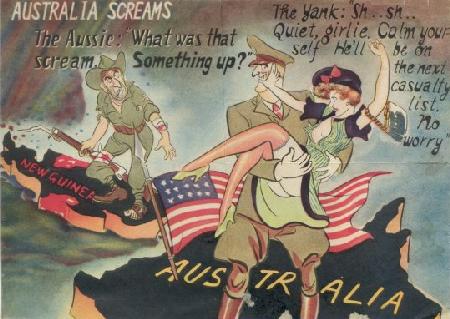
McMillan, George. The Old Breed: A History of the First Marine Division in WWII, The Infantry Journal Incorporated, Washington DC. 1949

Morison, Samuel Elliott, The Two Ocean War: A Short History of the United States Navy in the Second World War, Little, Brown and Company, Boston and Toronto, 1963

Murray, Williamson and Millett, Allan R. For the Common Defense: Fighting the Second World War, The Belknap Press or Harvard University Press, Cambridge, MA 2000

Spector, Ronald H. Eagle Against the Sun: The American War With Japan, The Free Press, New York, NY

Toland, John. The Rising Sun: The Decline and Fall of the Japanese Empire 1936-1945, Random House Publishers, New York, 1970

Tregaskis, Richard, Guadalcanal Diary, Originally published by Random House, 1943. Modern Library Paperback edition, Random House Publishers, NY 2000, with an introduction by Mark Bowden

1 Comment

Filed under History, Military, world war two in the pacific

Background to “The Pacific” Part One: The Guadalcanal Campaign and the Beginning of Joint Operations

The Battle of Bloody Ridge

Note: This is the first of a series that I will post on the campaign in the Pacific.  Some are older articles that I wrote for my Masters Degree program and others will be new material dealing with specific topics in this long neglected campaign.  I was watching the second episode this evening and found it quite powerful…so much that I was in tears as the Marines of 1st Marine Division and John Basilone came aboard the troop transport and went to the Mess Deck.  I have served with the Marines for around six years including with Marine advisers in Iraq and been the Chaplain for the USS HUE CITY which is named after the Battle of Hue City.  I love the Marines and this series has touched me already.  I hope everyone watches it on HBO.

The Guadalcanal Campaign and the Beginning of Joint Operations

Marines on Guadalcanal

The Guadalcanal campaign was the first experiment by the United States of conducting a “joint” campaign in modern warfare involving Naval and Naval Air, Ground combat units, Army air assets and amphibious operations. The campaign involved numerous land, sea and air battles. It was under the command of Admiral Nimitz as CINCPACFLT and included commanders for ground, air and sea forces engaged.  For brevity and simplicity sake I will discuss the campaign and sea even though they are interconnected with the sea and air campaigns directly affecting the outcome of the land campaign.

Designated OPERATION WATCHTOWER and aptly called OPERATION SHOESTRING the campaign was launched on short notice, approved on 2 July the commanders of the operation first learned of it on 7 July. Utilizing the 1st Marine Division, which would later be reinforced by the Americal Division, landed on Guadalcanal and the neighboring island of Tulagi on 7 August.  The Marines took Tulagi after a brief but bloody fight and the few Japanese troops on Guadalcanal fled inland allowing the Marines to seize the airfield.  Unfortunately, the commander of the supporting US carrier task force, Admiral Frank Fletcher fearing danger to his carriers and withdrew following the landings. The forces in direct support were surprised by a Japanese cruiser force under Admiral Mikawa losing 3 American and 1 Australian heavy cruiser in one of the worst American naval defeats in history at the Battle of Savo Island. The next morning the transports, many still full of supplies left the Marines.  Admiral Fletcher’s action, which left the Marines without air cover and carrier support gave the Marines a new term, still in use today, for being left high and dry: “to be Fletchered.”

Japanese dead of the Ichiki Detachment after the Battle of the Tenaru (Ilu) River

The Land Battles: The Japanese quickly responded sending in Naval Landing forces which went in light without all their troops or equipment. The Ichiki detachment was wiped out in the battle of the Tenaru (Ilu) river on 20 August.  The Kawaguchi detachment of 3,500 men landed in two groups, again short of men, material and equipment landed in the closing days of August and attempted to seize the now operational “Henderson” field on September 13 to 14th after one of its supporting units had been destroyed by the 1st Raider Battalion in a small amphibious assault.  Kawaguchi’s attack was disjointed and his units dispersed.  He was defeated in detail by the Marines in the Battle of “Edson’s ridge” or “Bloody Ridge.”
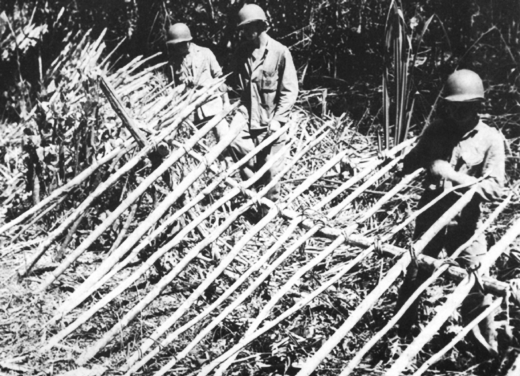
Chesty Puller

The Marines attacked and destroyed another Japanese force at the Mataniko river on 9 October.  The Marines were further reinforced by the 7th Marine Regiment while Kawaguchi was reinforced by the HQ of 17th Army under General Hyakutake who brought the 2nd Division onto the Island under the command of General Maruyama.  Kawaguchi would then be relieved and sent home following disagreements with Maruyama and his chief of staff prior to the next major Japanese attack which took place 23-25 October along the same ridgeline that Kawaguchi had assaulted. Though the Japanese now had 15,000 troops with good artillery support, the attacks were fierce but uncoordinated. Defended by 7th Marines under Chesty Puller as well as troops from the recently arrived Americal, the Marines again effectively destroyed the attacking Japanese force.

Sergeant John Basilone USMC with Medal of Honor

Despite additional reinforcements of the 38th Division, the Japanese, due to severe food, supply and ammunition shortages would not make any more major attempts to take the airfield.  The Americans would shift to the offensive with the Army XIV Corps composed of the 25th Division, Americal Division and Second Marine Division under Major General Lawton J “Lightening Joe” Collins commanding in December.

The US Navy paid a heavy price for the victory at Guadalcanal. Here the USS Wasp sinks after being hit by Japanese torpedoes

The Sea Battles: The sea campaign in the waters surrounding Guadalcanal would be marked by some of the bloodiest sea battles in the history of the US Navy.  So many ships from both navies would be sunk offshore that the waters would become known as “Ironbottom Sound.” Following the previously mentioned “Battle of Savo Island” the Americans lost the carrier Saratoga to torpedo damage and the Wasp was sunk while escorting a convoy. In the Battle of Eastern Solomon’s of 24 August the Americans have the Enterprise knocked out of action for 2 months and while sinking a Japanese light carrier and inflicting heavy aircraft losses on the Japanese. The Americans surprised a Japanese force on 11 October off Cape Esperance sinking a heavy cruiser and destroyer and heavily damaging a second heavy cruiser. The Japanese effort, now directed by Yamamoto brought battleships to support operations around Guadalcanal, including bombardments of the airfield on 13-14October in support of Maruyama. The attacks damaged but did not close Henderson field which was able to continue air support to the Marines and soldiers.  On 26 October a carrier engagement would be fought, the Battle of Santa Cruz Islands would be a tactical Japanese victory sinking the Hornet and damaging Enterprise, while losing no ships. Two Japanese carriers were damaged but they lost a large number of pilots and aircrews who could not be readily replaced. They also not succeed in their amphibious efforts to retake the island or Henderson field, gaining the Americans badly needed time.  On 13 November the Japanese attempted to repeat the bombardment of Henderson field but would be stopped from doing so by a task force under Admiral Daniel Callaghan.  The First Naval Battle of Guadalcanal cost the Japanese the battleship Hiei and two destroyers, additionally many of the transports bringing Japanese reinforcements would be sunk by aircraft from Henderson field and Enterprise.  The Americans lost 2 cruisers and 4 destroyers sunk and every other ship save the destroyer Fletcher damaged. Admiral Callaghan and Admiral Norman Scott, the victor of Cape Esperance were both killed.  The following night the Japanese would lose the battleship Kirishima to the USS Washington task group under the command of Admiral Willis Lee.  Further Japanese naval activity would be limited to attempts to reinforce the island with destroyers; during one of these operations on 29 November they would clash with a force of American cruisers and destroyers at Cape Tassafaronga, sinking 1 cruiser and badly damaging three more at the cost of one destroyer, but was unable to complete his supply run.  Though the Americans lost more total warships, the Japanese could not replace what they lost.

USAAF B-17E over the Solomons

Air Operations: The air operations would be decisive to the effort, land based aircraft of the Japanese played a key role in destroying some US shipping and sinking warships in waters off Guadalcanal however they could not maintain air superiority over the island which was maintained and increased by the Americans as Henderson field’s capacity grew and additional Army, navy and Marine aircraft were stationed there.  Naval air was extremely important in the sea battles around the island.

Beached and destroyed Japanese transport ship at Guadalcanal

Japanese Reaction: The Japanese reaction was one of dismay; they could not fulfill their promise to the emperor to retake the island.  They had lost many ships and aircraft as well as ground troops. From this time on the Japanese would go over to a strategic defensive in the Pacific.  Japanese losses were devastating as they could not be made up.

Importance for the Americans: This was important in a number of ways. For the navy it showed that they could defeat Japanese surface ships in night engagements and gave the navy great experience as it moved forward in the South and Central Pacific. American carrier air crews had become experienced and gained superiority over the Japanese.  On the ground the myth of the Japanese “superman” was destroyed, yet American commanders also began to appreciate the skill, endurance and tenacity of the Japanese soldier in future operations.

Importance for Joint Operations: The campaign also was a triumph for the Americans in the fact that they were able to overcome inter-service rivalries undertake a difficult operation against a stronger opponent far from major fleet logistics and support basis.  To be sure this was Joint Operations in its infancy and until the arrival of significant Army forces on the island to relieve the Marines was for the most part a Navy, Marine Corps and Army Air Corps operation.  When Major General Lawton “Lightning Joe” Collins assumed command of the island from Marine Major General Alexander Vandergrift it became a true-inter service operation and the beginning of Joint Operations.

12 Comments

Filed under History, world war two in the pacific

God Loves the Real World

“God loves human beings. God loves the world. Not an ideal human, but human beings as they are; not an ideal world, but the real world. What we find repulsive in their opposition to God, what we shrink back from with pain and hostility, namely, real human beings, the real world, this is for God the ground of unfathomable love.” — Dietrich Bonhoeffer

“For God so loved the world that he gave his only Son, so that everyone who believes in him may not perish but may have eternal life.” John 3:16 NRSV

“For to this end we toil and struggle, because we have our hope set on the living God, who is the Savior of all people, especially of those who believe.” 1 Timothy 4:10

I had an interesting encounter with another blogger this week after I posted my warning about the danger that Glenn Beck and people like pose to religious liberty.  I was not really surprised at the encounter I figured that I might get a bit of hate mail but this was interesting.  This blogger who evidently thinks that he has the absolute lock on God’s truth had this as one of his replies on the post:

“My Jesus is ANGRY at His children who promote false doctrines and pervert the Word of God. The reason I know this is because Yeshua IS the Word of God, these things recorded in holy scripture for all to see and read.” 777Denny

Now Denny is a bit off and seems to me a very angry person who has so conflated the Gospel of Jesus Christ with his own incredibly narrow and hateful theology and politics.  These  lie slightly to the right of the Taliban so that it is hard to understand where his faith ends and politics begin. Maybe that is why Bonhoeffer commented that “Politics are not the task of a Christian.”

Denny seems to think that about all Christians and for that matter people in general are pretty worthless.  Of course I have treated Denny pretty well. I have offered to and will pray for him because he is so trapped in his own legalism and hatred of his former Roman Catholic faith.  I want to keep a dialogue with him.  His anger, legalism and ideas about sex and the role of women cause me believe that he must be a physical or sexual assault victim.  While his tirades are pretty extreme, not very creative and full of nuttiness they do speak to a general contempt for the world that is the creation of God and the people that he has redeemed through Christ’s incarnation, life, death, burial, resurrection and ascension.

Now I know that Christians can be and often are intolerant…we can be somewhat surly at times and our history in many cases is rather ugly and not very reflective of Christ, unless it is Denny’s “Angry Jesus.” I cannot say that I have not had my moments of ugliness and more than I have been  pretty obnoxious and well, just a jerk regarding my faith.  However even so I can’t blame God for things that I get angry at. I have only my occasionally bad temperament to blame, maybe some genetics too.  As George and Frank Costanza say “serenity now!”  Denny represents as aberrant as his view of Jesus is, a segment of the Christian world that really does despise the world and the people that God created and has redeemed.  Denny is obviously a troubled soul and needs help but until he sees this he will hurt a lot of people and most of all himself.

Part of my Lenten journey has meant slowing down and taking stock of things in my life and faith.  This was actually enforced on me when Adolf the Kidney stone stopped me in my tracks for about three weeks.  Now I haven’t had any “new revelations” or in fact not much more than realizing that I need to focus on some aspects of my spiritual life that I have neglected and just take a bit more time to appreciate all that God has done as well as the people and world that I live in.

As I have mentioned in other posts the passage from 2nd Corinthians 5:17-21 has been on my mind a lot since my  “Christmas miracle.” So you don’t have to look it up I have posted it below highlighting verse 19 which has really speaks to me:

17So if anyone is in Christ, there is a new creation: everything old has passed away; see, everything has become new! 18All this is from God, who reconciled us to himself through Christ, and has given us the ministry of reconciliation; 19that is, in Christ God was reconciling the world to himself, not counting their trespasses against them, and entrusting the message of reconciliation to us. 20So we are ambassadors for Christ, since God is making his appeal through us; we entreat you on behalf of Christ, be reconciled to God. 21For our sake he made him to be sin who knew no sin, so that in him we might become the righteousness of God.  2nd Corinthians 5:17-21

This I think is one of the key passages in the New Testament in relation to God’s relationship to humanity, real humanity.  As I have mentioned my Lenten journey has taken me back to re-reading and pondering the life and work of Dietrich Bonhoeffer.  I think that living in the tumultuous times of the First World War, the collapse of the German monarchy, the German civil war, the Kapp Putsch and the Nazi rise to power and takeover and the Second World War has insights that are very applicable for the tumultuous times that we now live.

Bonhoeffer lived in some of the darkest times, where his own countrymen turned on one another and extremist politicians of the Left and Right stoked the fires of resentment, fear and desperation through the newspapers and periodicals that they owned. Fiery speakers instigated crowds to violence against their opponents and undermined the weak government at every opportunity even with actual force.  Bonhoeffer was someone who did not lose sight of the Gospel nor the people that Christ died to redeem during that time.  The passage that I cited at the beginning of this article is something that leapt out at me this week.

“God loves human beings. God loves the world. Not an ideal human, but human beings as they are; not an ideal world, but the real world. What we find repulsive in their opposition to God, what we shrink back from with pain and hostility, namely, real human beings, the real world, this is for God the ground of unfathomable love.”

It is so easy today immersed as we are in a 24/7 information barrage of television, talk radio and the internet where politicians, pundits, journalists to see why regular folks like Denny have been whipped into a frenzy against their neighbors and fellow citizens for matters completely disconnected to the Gospel.  This becomes even more of a problem when it takes faith which should be focused to reconciliation and redemption and turns it into just another way of despising the people and the world that God loves.  In essence the “Gospel” has been turned into a weapon against the very people and world that Christ died to save and made a prostitute to crass political ideology.  However as Christians we cannot allow ourselves to be trapped by the hatred espoused by so many who daily work in the modicum of “speaking the truth” must realize as Bonhoeffer said that “God’s truth judges created things out of love, and Satan’s truth judges them out of envy and hatred.” The pundits and politicians who prey on the people of faith and exploit their fears not for the sake of God, but for their profits as some of the most popular of these people readily admit on the air.

God loves real people; not only the ones that we choose to love or those that we prefer to hang out with. He loves people who are not perfect, the Church was not intended to be a social club where we get our “God fix.”  It is instead to be a community in relationship with one another and the world in which we live. The Gospel is not just a message that we offer to fill the pews and keep the bills paid.  The Gospel is all about the love, mercy and even justice of God, which is not to be confused with the “justice” that we desire.  The Gospel is about integrity as the people of God.  “God was in Christ reconciling the world to himself….” It is the message of reconciliation that allows us to have community with one another and the world and as we do so grow into the kind of humanity that is transformed by the Gospel so that we might be really human.  Bonhoeffer wrote: “While we exert ourselves to grow beyond our humanity, to leave the human behind us, God becomes human; and we must recognize that God wills that we be human, real human beings. While we distinguish between pious and godless, good and evil, noble and base, God loves real people without distinction. ”

The call is not to be immersed in the anger of the day but transformed by the love of Christ.  Certainly the hope of the world is not found in the unending media barrage but in the Gospel that reminds us that “we have our hope set on the living God, who is the Savior of all people, especially of those who believe.”

Peace

Padre Steve+

5 Comments

Filed under History, philosophy, Religion

Glenn Beck Attacks the Churches and Threatens Religious Liberty

Glenn Beck “Am I advising people to leave their church? Yes!”  (Fox News Photo)

Preface: This post comes in the midst of my Lenten journey in which I have become reacquainted with the works of those who confronted Nazi policies that placed their ideology over the Christian faith. During this time I was not expecting to begin to see certain commentators actually attempt to blatantly attack a key part of the witness of the Christian Church in telling Christians to place political ideology over faith and recommend that church members leave their church if it does not conform to those commentators’ political ideology.  As a historian as well as a Priest I can only draw parallels to the Nazis who placed their ideology above the Church and persecuted those who stood against them, even before they took power. Glenn Beck did just that this week, though not in power he has thrown down a gauntlet to the Church which does not agree with his ideology and strikingly urged church members to leave their churches if those churches had “social justice” as one of their belief’s equating it with Communism and Fascism. This is an attack on the church and as a Priest I cannot be silent. There would be some that will disagree saying that the Left is more of a threat and I do not disagree that ideologues on any part of the spectrum can threaten religious liberty, however I have never seen anyone as popular as Beck is with the Right, who on the Left propose what Beck has this past week.  That is why I must oppose Beck on this issue now. I do hope that my readers understand that this is not an attack on conservatives or conservative principles but rather against a man whose ideas if carried to their logical conclusion would be dangerous. Beck talks a lot about faith and religion on his show which attracts many listeners but he seems to believe that religious expression is one in the same with political ideology.

Peace,

Padre Steve+

“It is not God who divides us but human beings. The Almighty has blessed our work; therefore it cannot be destroyed. No power within or without the Reich will keep us from going our way into the future.” Adolf Hitler speaking in an address at Regensburg July 7th 1937 referring to the arrests of 11 Catholic Priests who condemned Nazi policies.

“We have been silent witnesses of evil deeds; we have been drenched by many storms; we have learnt the arts of equivocation and pretence; experience has made us suspicious of others and kept us from being truthful and open; intolerable conflicts have worn us down and even made us cynical. Are we still of any use?” Dietrich Bonhoeffer

“First they came for the Communists, but I was not a Communist so I did not speak out. Then they came for the Socialists and the Trade Unionists, but I was neither, so I did not speak out. Then they came for the Jews, but I was not a Jew so I did not speak out. And when they came for me, there was no one left to speak out for me.” Martin Niemöller

“Silence in the face of evil is itself evil: God will not hold us guiltless. Not to speak is to speak. Not to act is to act.” Dietrich Bonhoeffer

“Rather, speaking the truth in love, we are to grow up in every way into him who is the head, into Christ, from whom the whole body [is] joined and knit together.” (Eph. 4:15,16)

The Christian Church is the congregation of the brethren in which Jesus Christ acts presently as the Lord in Word and sacrament through the Holy Spirit. As the Church of pardoned sinners, it has to testify in the midst of a sinful world, with its faith as with its obedience, with its message as with its order, that it is solely his property, and that it lives and wants to live solely from his comfort and from his direction in the expectation of his appearance.

We reject the false doctrine, as though the Church were permitted to abandon the form of its message and order to its own pleasure or to changes in prevailing ideological and political convictions.” The Barmen Declaration Article Three.

I do not think that people learn anything from history.  This week Glenn Beck called his own church, the Church of Jesus Christ of Latter Day Saints “Communist or Fascist” its official statements of beliefs regarding social justice.  Now I may disagree with LDS theology but I hardly think them to be Communist or Fascist in fact I think for the most part they are to be commended for their love of this country as well as their ethic of doing good and taking care of needy LDS members.  Not only did Beck call his own church these rather pejorative names but he recommended that people not only leave the church but urged the same for any member of any church that espouses social justice in their official beliefs.  To quote Beck:

“I’m begging you, your right to religion and freedom to exercise religion and read all of the passages of the Bible as you want to read them and as your church wants to preach them . . . are going to come under the ropes in the next year. If it lasts that long it will be the next year. I beg you, look for the words ’social justice’ or ‘economic justice’ on your church Web site. If you find it, run as fast as you can. Social justice and economic justice, they are code words. Now, am I advising people to leave their church? Yes!”

Beck went on the attack this week against churches who teach social justice.  The reason according to Beck is that “Social justice was the rallying cry—economic justice and social justice—the rallying cry on both the communist front and the fascist front….” He went on and attacked his own church saying “Where I go to church, there are members that preach social justice as members–my faith doesn’t–but the members preach social justice all the time. It is a perversion of the gospel….” When called out had to try to reframe his very clear attack on his own church’s official doctrine as well as so many other churches and religions groups.  Speaking as a Christian I cannot answer for other religions but Beck has attacked the clear commands of Scripture and the Christian tradition of caring for the least and the lost in elevating his ideology above both his own church as well as the vast majority of Christian faith and belief that goes back 2000 years.  He has sought to divide people from their churches and from the faithful of their traditions for political expediency.  However Beck is not the first to do so.  Let us take a trip back to the end of the Weimar Republic and Nazi era….

Niemöller in WWI Inperial Navy Uniform

Martin Niemöller was a war hero.  He had served on U-Boats during the First World War and commanded a U-Boat in 1918 sinking a number of ships.  After the war he resigned his commission in the Navy in opposition to the Weimar Republic and briefly was a commander in a local Freikorps unit. His book Vom U-Boot zur Kanzel (From U-boat to Pulpit) traced his journey from the Navy to the pastorate. He became a Pastor and as a Christian opposed what he believed to be the evils of Godless Communism and Socialism.  This placed him in the very conservative camp in the years of the Weimar Republic and he rose in the ranks of the United Evangelical Church of the Old Prussian Union.  Active in conservative politics, Niemöller initially support the appointment of Adolf Hitler as Chancellor.  However, he quickly soured on Hitler due to his insistence on the state taking precedence over the Church.  Niemöller was typical of many Germans of his era and harbored ant-Semitic sentiments that he only completely abandoned his anti-Semitic views until after he was imprisoned.  He would spend 8 years as a prisoner of the Nazis a period hat he said changed him including his views about Jews, Communists and Socialists.  Niemöller was one of the founding members of the Pfarrernotbund (Pastor’s Emergency Federation) and later the Confessing Church. He was tried and imprisoned in concentration camps due to his now outspoken criticism of the Hitler regime.

Herman Maas was another Evangelical Pastor.  Unlike Niemöller, Maas was a active participant in the ecumenical movement, built bridges to the Jewish community and defended the rights of Jews as German citizens.  He received a fair amount of criticism for his attendance of Reichspräsident Friedrich Ebert’s funeral.  Ebert was both a Socialist and avowed atheist.  Maas too was active in the Pfarrernotbund and the Confessing church, and unlike Niemöller maintained his opposition to anti-Semitism and the Nazi policies against the Jews. He would help draft the Barmen declaration.  He too would be imprisoned and survive the war.  Maas was the first non-Jewish German to be officially invited to the newly formed state of Israel in 1950. In July 1964 Yad Vashem recognized the Maas as one of the Righteous Among the Nations.

Bonhoeffer in Nazi Prison in 1944

Dietrich Bonhoeffer a young Pastor and theologian would also step up to oppose the Nazis and offer support for the Jews.  He helped draft the Bethel Confession which among other things rejected “every attempt to establish a visible theocracy on earth by the church as a infraction in the order of secular authority. This makes the gospel into a law. The church cannot protect or sustain life on earth. This remains the office of secular authority.”  He also helped draft the Barmen declaration which opposed and condemned Nazi Christianity.  Bonhoeffer would eventually along with members of his family take an active role in the anti-Nazi resistance as a double agent for Admiral Canaris’ Abwehr.  For this he would be executed after his final sermon in the concentration camp at Flossenburg just a month prior to the end of the war.

Karl Barth convicted of “Seducing the German people” and exiled to his native Switzerland

Another opponent of the Nazis in the Confessing Church was Swiss-German theologian Karl Barth.  Barth angrily denounced Naziism when it attempted to create new “German Christian” churches in which National Socialist political theories were given the same sanctity as theological dogma.  Barth went into exile as a Swiss citizen after being removed from his professorship at the University of Bonn for refusing to take the mandatory oath to Adolf Hitler, alter his teaching to meet Nazi standards or begin class with the customary “Heil Hitler!” He would say that it would be in bad taste “to begin a commentary on the Sermon on the Mount with Heil Hitler.” For his efforts he was found guilty by a Nazi court of “seducing the minds” of German students.  For an excellent short article on Barth see “Witness to an Ancient Truth” Time Magazine April 20th 1962 online at http://www.time.com/time/magazine/article/0,9171,873557-1,00.html

Fr Rupert Meyer the “Apostle of Munich” and steadfast opponent of Hitler

Bishop Galen of Münster and Father and others including Father Rupert Meyer in Munich who opposed Hitler in the early 1920s would also oppose the Nazi policies toward the Church, the Jews and Nazi policies on euthanasia.  They would also end up in concentrations camps with some dying at the hands of the Nazis, in fact over 2000 priests and Protestant ministers from Germany and occupied countries were housed at Dachau.

All these men took risks to defend the Jews who were religious minority group that had been traditionally discriminated against in Germany as well as other groups, political and religious.  They opposed the Nazi policies which were widely supported by much of the German populace making them unpopular in their own churches as well as among the traditionally conservative supporters of the Evangelical and Catholic Churches.  Since I have dealt with the Nazi persecution and atrocities against the Jews and others in other posts I will not elaborate further here.

General Wilhelm Groener, despised by the Nazis for saving the by working with Socialists to prevent a Communist takeover

Not only were Jews the enemy but so were any parties that disagreed with the Nazi policies including the church or rather the church that refused to surrender to them.  Likewise military officers who stood by the Republic against Nazi and other right-wing putsches during the 1920s, men who risked all to defend the rights of people on both sides of the political chasm that divided the country.

Deposed after the Nazi seizure of power General Kurt von Hammerstein-Equord was deposed as head of the German Army and in retirement worked against the Nazis including the Valkyrie plot until his death from Cancer in 1944

Leftist accused them of being reactionaries and Monarchists while the right did whatever they could to discredit men like General Wilhelm Groener, General Major Walther Reinhardt, General der Infantrie Georg Maerker, General der Infrantie Kurt von Hammerstein-Equord and General Kurt von Schleicher were either driven from office and ostracized, forced out of the military or in the case of von Schleicher killed by the SS during the “night of the long knives.”

Confidant of President Hindenburg, opponent of the Nazis and briefly Chancellor of the Weimar Republic General Kurt von Schleicher would be assassinated by the Nazis during the Night of the Long Knives

Additionally other men who kept the German Republic from becoming a Communist state notably Gustave Noske of the Social Democratic Party who was the first Reichswehr Minister and who with his successor Otto Geßler of the German Democratic Party worked with the military leadership to keep both the extreme left in the form of the Spartacist League, the Independent Socialists and from the extreme Right who attempted to overthrow the government in the Kapp Putsch.  All were treated shamefully by the Nazis and even their successors did not fare well, to consolidate power Hitler had the General Leutnant Werner Freiherr von Fritsch falsely accused of homosexual acts and disgraced and evidence points to his murder on the Polish front in 1939 as the “honorary colonel” of his old Regiment.  Those who opposed Hitler and the Nazis later in the war, even those who were genuine heroes were put to death before Nazi “People’s Courts.”  They did the same with politicians who they viewed to be threats to their rule, even conservatives not just Socialists or Communists.  Religious leaders who resisted both Protestant and Catholic were sent to concentration camps where many did not return from.

Too frequently we here Beck and others call Americans with views different from their ideology “traitors” or “un American.” Before Iraq I listened to talk radio almost every day and when I came back I could no longer stomach the invective and malice that is so widespread among these commentators.  If they continue to dominate “conservative” politics then I fear that they will use the power of the government and media to silence those that oppose them and it will not matter if the opponent has served in the military as they routinely condemn former high ranking military officers who disagree with them such. These propagandists are not patriots and neither Beck nor any of the major conservative talk show hosts have served a day in the military yet they influence “conservative” opinion more than anyone else and dare to slander those in the military or those who have served honorably including Senator John McCain who dare to disagree with them. The Nazis did the same thing.

Today we face a similar movement by some “conservative” voices in the United States.  Many influential members of the “conservative” media, including Rush Limbaugh and most recently Glenn Beck who I have previously referred to own the airwaves, their words listened to often more than those of the Gospel.  They derive some of their popularity from voicing support for “Christian moral values” such as being against abortion.  This has endeared them to many conservative Christians who listen to them more than their faith or religious institutions.  Unfortunately many “conservative” Christians cannot differentiate between the vitriolic and un-Christian rage of these talkers against anyone identified as the enemy that they have forgotten the Gospel and become simply an appendage to Republican or “conservative” politicians.  It is not uncommon to see Christians on the web or on the call in talk radio programs agree lock stock and barrel Beck and others on the crass materialism and social Darwinism of “pure” Capitalism and the anti-Christian policy of pre-emptive war, even when they attacked Pope John Paul II when he refused to countenance the invasion of Iraq. Beck uses Scripture only to give his ideology, whatever it may be some semblance of decency.  What Karl Barth said of Nazi ideology can be said of Beck’s ideology: “This was a nationalist heresy…. confusion between God and the spirit of the German nation.” Pundits and politicians on the Left may also place ideology over religion however they seldom espouse the heresy of linking the Christian faith with the spirit and destiny of the United States.

That may seem harsh, but there is a group led by Andrew Schlafly the “Conservative Bible project” that seek to re-translate the Bible into their own political, social and economic policies even seeking to change or minimize any Scripture that might be equated with to the “Social Gospel.” I guess if Beck wants he can get a copy when it comes out.  If you don’t like what Scripture says change it…right?

I cannot sit by while Beck and others smear people including churches who disagree with their ideology which does not rest on Scripture or but merely uses it to inflame people into actions that turn them against the members of their own churches.  This unfortunately is evil masquerading as good.  Too many turned their eyes away from the Nazi menace thinking that Hitler could be reasoned with and that he really stood for their values.  Too few stood up early to sound a warning.  My issue with Beck and others like him be they pundits, talk show hosts, media personalities or politicians of any stripe regardless of whether they come from the right or the left do what Beck did this week I will call them on it.  People can play political games and fight all they want but when they attack the Church for political and ideological gain, seek to divide it against itself or co-opt churches to do their bidding then I have a problem.  I do not care if that threat comes from the Left as it sometimes does or the Right where a few years ago I would not think it was possible to come from. Unfortunately Beck’s message is main stream to many of his followers regardless of their faith and this is a threat to religious freedom for if those like Beck gained power then religious freedom would only be for those who agree not with Scripture or 2000 years of the Christian tradition but for those who agree with the ideology espoused by Beck and those like him.  It would be the “freedom” of the German Christians who gave themselves to the Nazi ideology to be “free.”  Ideas have consequences and when one advocates revolution and for people to leave their churches for any political ideology it is a grave threat to religious freedom.

Beck and those like him are enemies of freedom of religion. For Beck that cannot be blamed on being a Mormon. In fact he has attacked, perverted and misconstrued the doctrine of that church as well as the Roman Catholic Church and numerous Protestant denominations spanning the theological spectrum simply because he paints them “progressives” which is simply another word for Communist or Fascist. Beck is an enemy of religious liberty because he places his political ideology over that of the Gospel, not just that of his own church, but others.  That is why he should be opposed and confronted every time that he makes such statements. They reveal his true heart, ideology and intentions and no amount of backtracking, excuses or attempts to change the subject can alter that hard cold and brutal fact. His sleight of hand to go on the attack and criticize offenders on the left, notably Jeremiah Wright only clouds the issue and does not change the fundamental truth of Beck’s worldview. Likewise his attempt to separate the Church from the poor is destructive and if Christians want to follow Beck’s teaching then they chose evil over truth. As Father James Martin SJ said in America “Glenn Beck’s desire to detach social justice from the Gospel is a subtle move to detach care for the poor from the Gospel.  But a church without the poor, and a church without a desire for a just social world for all, is not the church.  At least not the church of Jesus Christ.” http://www.americamagazine.org/blog/entry.cfm?blog_id=2&id=21159420-3048-741E-7761300524585116

To again quote the Barmen Declaration”

“Lo, I am with you always, to the close of the age.” (Matt. 28:20.) “The word of God is not fettered.” (2 Tim. 2:9.)

The Church’s commission, upon which its freedom is founded, consists in delivering the message of th free grace of God to all people in Christ’s stead, and therefore in the ministry of his own Word and work through sermon and sacrament.

We reject the false doctrine, as though the Church in human arrogance could place the Word and work of the Lord in the service of any arbitrarily chosen desires, purposes, and plans.” The Barmen Declaration Article 6

I am afraid of the Glenn Beck’s of the world.  We appear to be at a precipice that we may or may not be able to pull back from. The Nazis used the same kind of language to attack the Christian faith and co-opt the vast majority of them. Men like Niemöeller, Bonhoeffer and many others were sent to the concentration camps, tried by kangaroo courts and some killed.  I was on another blog where the discussion of this has been heated. I don’t like getting called a communist by allegedly “Christian” people who have bought Beck’s vision hook, line and sinker. If this is Beck’s version of the faith he can keep it.  Unfortunately the rhetoric is so high, the division so deep and the anger so real that I am afraid that the fuse of violence may have been laid and that nothing will stop it especially with Beck  and others stoking the fire on a daily basis on television and radio. Beck seems to be predicting and almost hoping for some kind of violent revolution seizing upon the now boiling anger on the Right and to some extent on the Left, anger that has consumed and co-opted so many conservative Christians is so great that at sometimes I wonder if this can end well though I do not predict civil war or revolution like Beck.

While I criticize Beck I cannot exclude from criticism those on the Left who have used angry, inflamed and hateful language and actions which also raises ante in ideological clash because it does take more than one faction to stir the witches’ cauldron of hatred which threatens not just religious liberty, but all liberty in this nation.  I will pray for peace, respect and mutual understanding and I will not give up hope or resign myself to despair as my faith is in Christ crucified and resurrected.  I will maintain the faith and remember the words of Bonhoeffer which help to undergird me in times like these:

“The essence of optimism is that it takes no account of the present, but it is a source of inspiration, of vitality and hope where others have resigned; it enables a man to hold his head high, to claim the future for himself and not to abandon it to his enemy.” Dietrich Bonhoeffer

24 Comments

Filed under faith, History, philosophy, Religion

Difficult Days: A Lenten Meditation

“As lousy as things are now, tomorrow they will be somebody’s good old days.” Gerald Barzan

The Good Old Days to Some…the Bad Old Days to Otehrs

The past few weeks being laid up dealing with Adolf the Kidney stone and his remove this week have been unusual for me.  I have been in pain and even now am dealing with the aftereffects of the procedure to remove Adolf I find that it has given me a pause during Lent that I seldom get.  The pause to look at life, mortality and what is and is not important. Now a Kidney stone is not normally a life threatening condition and was not in my case, but the condition has slowed me down from my normal hyperactive manner of doing things, even slowed down the pace of my writing.  It has not been fun but I have gained some spiritual grace that I think that I needed.  Tonight I am not feeling as well as I was this morning and hopefully this too will pass so I can get back to getting well.

It is difficult at times to be hopeful when all around there is bad news. We seem to be living the ancient Chinese curse that says “May you live in interesting times.” The times are certainly interesting with lots going on of historic significance that may years from now be remembered as one of those tumultuous times where the world changed before our eyes.  History of course is replete with such times, the rise and fall of ancient empires, the age of exploration, the Reformation, the French and American Revolutions, the Napoleonic era, the American Civil War, the Industrial Revolution, the First and Second World War with the Great Depression sandwich, the 1960’s, the post Cold War era and the post-911 era just for a start.  I could go back further in history for other epochal periods, but I think that the reason that today’s crisis seem so much more dire is that we are both the beneficiaries and the victims of the instantaneous communication revolution in which common people have real time access to events that are impacting their lives.  This causes many a great deal of anxiety both real and imagined, anxiety which usually finds expression in a desire for the good old days as well as seeks solace and security from those who feverishly exploit that anxiety.  It does not matter if the security comes from religion, political ideology and matters neither if it comes from the left or the right so long as the call resonates with them they will follow it.  They will faithfully follow even as the purveyors of the message drive up their worry and anxiety that they no longer can actually enjoy life or be thankful because they are so consumed with how “lousy” things are or “evil” their opponents are.

Fun and Games in the Good Old Days…

It is in times like these that one has to take a deep breath, look around at all that they have to be thankful for and just really examine of the nostalgia that they feel for “better times” is that or an escape from an unpleasant present and fear of the future if the other side wins.  The fact is that we have seen such times before and somehow made it through.  I hear from friends and relatives who lived through the Great Depression and World War II that those were good times in spite of everything happening, much of which is present today but somehow things are worse now.  Even I fall into the trap about somehow thinking that the times that I grew up in were somehow better than the present, this may be true for music but overall things were not that good for a lot of people but somehow we made it through them.  Lent is a time to step back from the brink, take stock and renew our life with God and our neighbor.

When I returned from Iraq back in February 2008 I soon discovered that the bombardment of bad news and über-partisan political battles took its toll on me.  I was neither as resilient as I thought that I was nor as consumed by the need to continue to ratchet up rhetoric on one side or the other as the more extreme elements on the right or left were doing.  PTSD or not I realized that the purveyors of the 24/7 bad news cycle were driving people with legitimate ideological differences to extremes that I had never seen, but which I recognized from history have a lot of precedent and can lead to making things even worse.  One only has to look at Weimar Germany to realize how things can go so very wrong when extremes on both sides of the ideological spectrums squeeze out those in the middle or chance at mutually beneficial solutions and that was in the days before type of information overload that is the bedrock of the political and ideological landscape of today.

I am not attacking those who get caught up in this but I do question the politicians, pundits, “news-networks” and talk show hosts who continue to ratchet up rhetoric to the point that many feel that the only alternative is some kind of “revolution.”  Again those that call for “radical change” or revolt against those who are in favor of that kind of change are both calling for revolution when revolutionary talk reaches a point where one side or the other does not see a way to resolve things in a civil manner then the those alternatives slip away and the only recourse is violence.  It is not the fault of one side or the other as those that stoke this talk are found on both sides of the American as well as other nations political and ideological spectrum testify to daily.  In the United States we also have a long history of apocalyptic thought which presents the lousy state of current events in any generation as something that will certainly bring the end of life as we know it or the return of the Lord, the Great Tribulation or whatever you chalk it up to. There are those on both the religious and secular side of the spectrum who have apocalyptic visions related to their world view.  For some reason we Americans do the apocalyptic quite well whether we believe in God or not.

I am not a radical, my temperament is such that I may have strong beliefs but realize that there are many other opinions out there than mine and that even if I do not agree with one side or the other on every issue it does not mean that I cannot find common ground.  I think this is part of the reason for the diversity of friends that I have from across the religious, political and ideological spectrum, we can agree to disagree and in the process still value one another and our opinions and remain friends who care about one another.

Dietrich Bonhoeffer in the Courtyard of the Tegel Strasse Prison

The thing that has been most on my mind this Lent has been the idea of being reconciled both to God and to one another.  Lent is a season of self examination, repentance and forgiveness.  The call to “be reconciled to one another” is a never ending command and applies across the variety and spectrum of life.  Lent reminds us that that “we are dust and to dust we shall return” but that we are also all made in the image of the God who created us, redeems us and sanctifies us who calls us to himself and reminds us that mercy triumphs over judgment and “not be conformed to this world, but be transformed by the renewing of your minds, so that you may discern what is the will of God—what is good and acceptable and perfect.” I am afraid that in times like these even the best intentioned of people can find themselves pulled into the orbit of those that in less stressful or trying times that they would never be involved with.  The German martyr Dietrich Bonhoeffer once wrote: “Our enemies are those who harbor hostility against us, not those against whom we cherish hostility… As a Christian I am called to treat my enemy as a brother and to meet hostility with love. My behavior is thus determined not by the way others treat me, but by the treatment I receive from Jesus.”

I know for some this message is lost and not because they are rejecting the message of the Gospel but because that have become so deeply involved in whatever cause they or their champions espouse that they have lost the ability at least temporarily to see the good that may rest in their opponents and their ideas.  As Bonhoeffer also wrote “Judging others makes us blind, whereas love is illuminating. By judging others, we blind ourselves to our own evil and to the grace which others are just as entitled to as ourselves.”  Now of course Bonhoeffer knew the evil that was the Nazis and eventually gave his life by supporting the German resistance to Hitler.  Loving our enemies does not absolve us from public responsibility but in ensuring that we do not ensnare ourselves in ideology that restricts our ability to love them as Christ has commanded.

I think in the past few years that I have gained a new perspective on life that has changed the way that I look at the world.  I know that things are not good right now and that there are a lot of things to be legitimately concerned about, but I know too that somehow our country as well as much of humanity have weathered worse and like Barzan said that for some these will be the good old days someday and that helps me to live in the present knowing that the future is not yet written and known only to God who in his grace condescends to love us and desires that we better love him and one another and not be conformed to any ideology that would prevent that.  I do pray that we will both see better days as well as be reconciled to God and to one another that is my Lenten prayer.

Peace,

Padre Steve+

1 Comment

Filed under History, philosophy, Political Commentary, Religion