Category Archives: History

More about Why I Miss the Music of the 70’s and 80’s

The Carptenters

A few weeks back I posted an essay that looked back a the music of the 1970s and early 1980s that dealt with some of the historic context of the era as well as a bunch of videos and pictures of some of my favorite groups and their music.  As I mentioned in that essay the time was somewhat tumultuous a lot of social unrest, economic crisis, terrorism, communist expansion, a lost war and political crisis culminating in the resignation of a President.

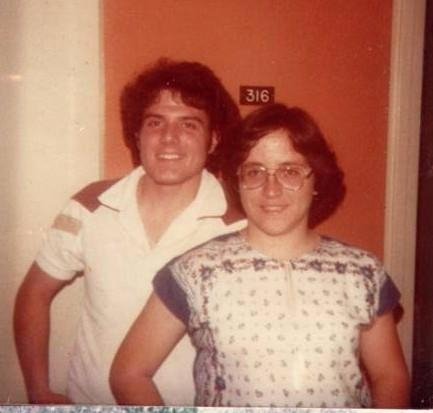
Padre Steve and the Abbess at Mission San Fernando Fall 1980

The time was also one where people were also attempting to return to some semblance of normalcy in the post Vietnam and Nixon era.  The 1960s were a time of social revolution which impacted almost every area of life and a time where almost everything was reduced to some sort of “message.”  By about 1973 the new younger generation which was entering high school and junior high school were less bent on activism and more on having fun as well as more inward discoveries.  The 1970s were certainly not a return to “traditional values” although there was a recovery of nostalgia for the 1950s with the movies American Graffiti, Grease and the sitcom Happy Days. This desire to feel better was partly in reaction to the turbulence of the 60’s and the reality that things were not good in the 1970s and as a result my generation sought entertainment and diversions for the nearly endless litany of bad news.  Much social change was still underway spurred on by the civil rights movement, the women’s rights movement and reproductive rights, the end of the draft and change in law which allowed 18 year olds to vote.  Like the 1960s there was experimentation with drugs as well sex.

Fashions morphed from bell bottoms and t-shirts and long hair to double knit polyester, silk shirts, leisure suits and tight fitting designer jeans. Tie-dye gave way to earth tones which were followed by bright colors and finally in the early 80s leather and pastels.  Classic styles began to return by the early 80’s “Preppy” was in, Oxford shirts, khakis and natural fibers such as cotton replaced the polyester double knits.
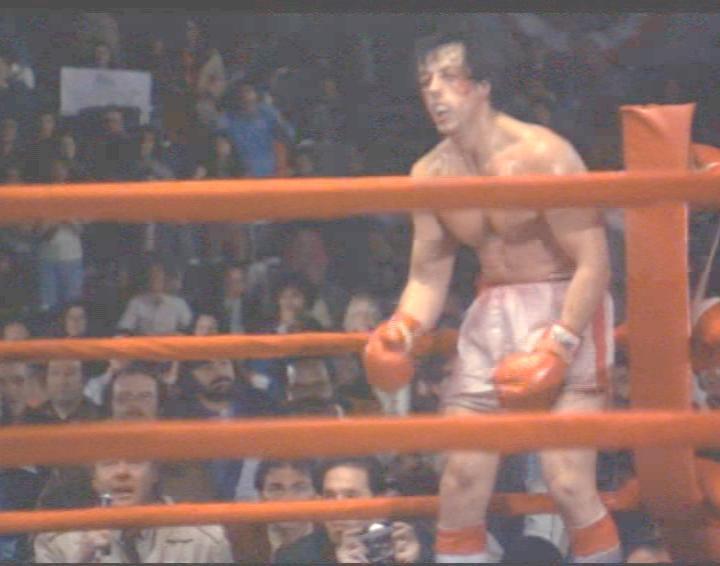
Rocky

Movies too began to change films like Star Wars and Star Trek launched people into undreamed of worlds even as NASA worked on the Space Shuttle.  Gritty films like Clint Eastwood’s Dirty Harry and Sylvester Stallone’s Rocky featured everymen who battled either crime or took on superior adversaries in the ring.  On television a team of young comics launched a comedy franchise, Saturday Night Live which is still with us today and which spun off a generation of comics who have made their own impact on American entertainment.  The musical returned in movies such as Grease and Xanadu while Disco rode the wave of Saturday Night Fever and country music returned with Urban Cowboy.

Here are some more of my favorites as well as some songs that helped make the 70’s and 80’s what they were.  Enjoy.

Three Dog Night

Three Dog Night, Joy to the World This was a fun song that came out in the early 1970s and when I hear it I can still find me singing along.

http://www.dailymotion.com/video/x2x3af_three-dog-night-joy-to-the-world_people

Credence Clearwater Revival Credence was one of the great groups of the 60s and early 70’s, members such as John Foggarty would go on to successful solo careers.

http://www.youtube.com/watch?v=UYnySGM9dQA

The Carpenters Possible the most precise and skilled musical group of the late 60’s and the 70’s the Carpenters were middle America’s sweet hearts.  Karen would die tragically from a heart attack induced in part due to her struggles with depression and subsequent Anorexia Nervosa.

http://www.youtube.com/watch?v=n53E_J9a_Fo&feature=PlayList&p=F02D8CA7FF8AA675&index=12

http://www.youtube.com/watch?v=dPmbT5XC-q0

Helen Reddy’s “I am Woman” become the anthem of the Women’s Rights movement

Helen Reddy: I am Woman My mom absolutely loved Helen Reddy while my dad hated “I am Woman.” She had quite a few other major hits through the 70’s and I saw her in concert in Stockton CA back in 78 or 79.

http://www.youtube.com/watch?v=bmExAiCcaPk

Paul McCartney and Wings: Band on the Run Paul McCartney was the most successful of the Beatles in his solo career.  Wings was an outstanding group centered around McCartney and his beautiful wife Linda.

http://www.youtube.com/watch?v=7Qx2jEfBsqY

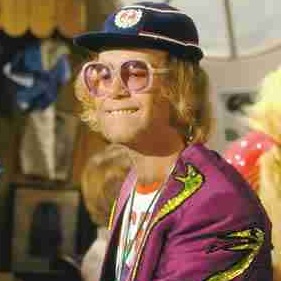
Elton John: Goodbye Yellow Brick Road Elton John had one of the most successful careers of any solo artist, his flashy clothes and wild glasses coupled with a high energy live performance made him a crowd favorite.

http://www.youtube.com/watch?v=43Ho_6C_fM4

I Guess that’s Why they Call it the Blues

http://www.youtube.com/watch?v=uc4ZRdPGGTI&feature=PlayList&p=7B1E53DD1B27118D&playnext=1&playnext_from=PL&index=39

Ringo Starr: The Non No Song Ringo did not have the same success as either Paul or John Lennon but this song was fun to listen to on the school bus.

http://www.youtube.com/watch?v=2-PirP4LiFo
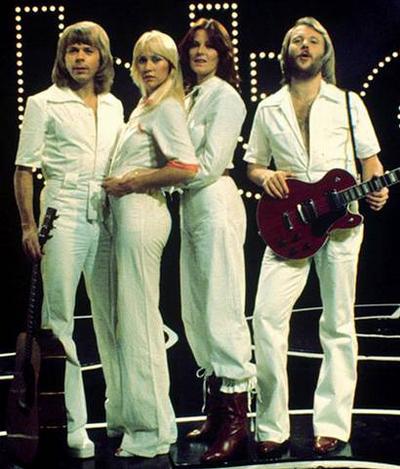
Abba

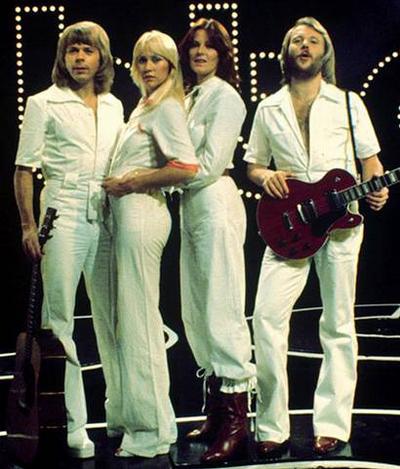
Abba: I do, I do I do Abba who broke into the international music scene in 1972 remained incredibly popular throughout the 70s and the 80s before disbanding in 1989.   They survived and thrived through every major musical swing of the era.

http://www.youtube.com/watch?v=PjgxxeA83FQ&feature=PlayList&p=11B0CC8778FA9A05&index=15

Honey Honey

http://www.youtube.com/watch?v=qeGtaSWzFRA&feature=PlayList&p=11B0CC8778FA9A05&index=4

Dancing Queen

http://www.youtube.com/watch?v=ctzIEjjOfd4

Eagles: Already Gone The Eagles have been and always will be one of my favorite groups.  Known for their stellar guitars and five part harmonies they have endured and their music has not been duplicated.

http://www.youtube.com/watch?v=JHk2em4ZNwA&feature=PlayList&p=8A2216020416503A&index=16

Lying Eyes

http://www.youtube.com/watch?v=iYQgPTsiZIU

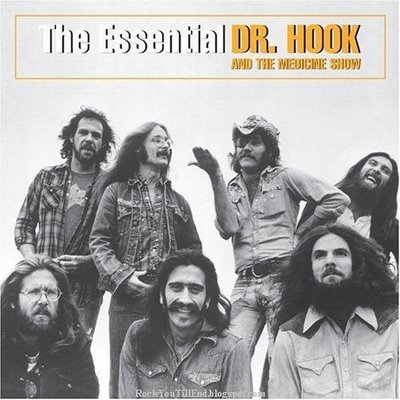
Dr Hook: Walk Right In One of the lesser known but still successful groups of the 70’s and 80’s this group teamed with poet and children’s writer Shel Silverstein to come up with some of the most unusual, quirky and funny songs of the era.  Having a country rock style they regularly sung about sex, drugs and alcohol they morphed into a less controversial stance in the 1980s.

http://www.youtube.com/watch?v=WPj5O3AMGDA&feature=PlayList&p=54CD692E585AE055&index=13

Years from Now

http://www.youtube.com/watch?v=EfsPeVVL8zE&feature=PlayList&p=AF906570E242A626&index=18

The Trammps: Disco Inferno Probably the group that had the signature Disco song, the Trammps were from Philadelphia.

http://www.youtube.com/watch?v=A_sY2rjxq6M

Bee Gees

Bee Gee’s: Tragedy While the Trammps may have produced the anthem of the era but the Bee Gees were the group that best personified the era with their harmonies and passion.

http://www.youtube.com/watch?v=O1_DdIxfpIU
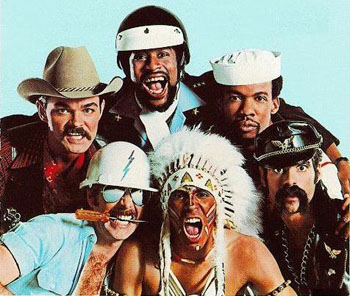
The Village People

The Village People: YMCA While the Bee Gees may have personified the music of hte era the Village People were iconic with thier signature costumes and appeal to the gay community and their crossover into the mainstream with hits such as Macho Man, YMCA and in the Navy.

http://www.youtube.com/watch?v=CS9OO0S5w2k

In the Navy

http://www.youtube.com/watch?v=InBXu-iY7cw

Donna Summer: She Works Hard for the Money The beautiful Donna Summer would be the queen of Disco and transition to a more pop and R&B sound in the 80s.

http://www.youtube.com/watch?v=1TKQcWEXSKU
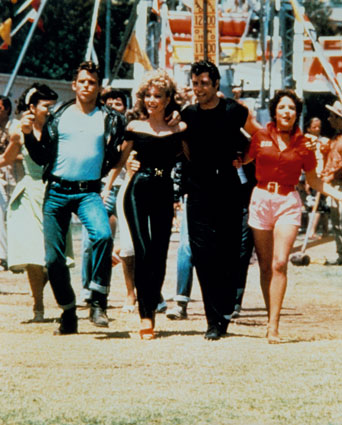
The Cast of Grease

Travolta and Olivia in Grease: You’re the One that I Want The musical Grease starring Olivia Newton John and John Travolta had an appeal that spanned generations and was wildly popular.

http://www.youtube.com/watch?v=1TKQcWEXSKU

Olivia Newton John and ELO: Xanadu The musical Xanadu was not a strong performer at the box office and was panned by most critics but birthed a host of top ten hits.  It was notable for is choreography and costumes which place it solidly in the middle of the era.

http://www.youtube.com/watch?v=7m1UWSD-FaA

Charlie Daniels Band: The Devil Went Down to Georgia As country music found a new appeal among younger people artists like Charlie Daniels careers took off crossing over to the pop charts from the country charts.

http://www.youtube.com/watch?v=7m1UWSD-FaA

Willie Nelson

Willie Nelson: You Were Always on My Mind Possibly the most prolific of the country artists to cross over into the pop world was Willie Nelson who along with Waylon Jennings produced hit after hit and also had a solid social conscience.

http://www.youtube.com/watch?v=CsLL6bIUs6M

A Young Barry Manilow

Barry Manilow: Mandy Barry Manilow was a one man hit machine in the 70’s and 80’s and while rockers, disco fans and others would scoff at his music he had an enduring appeal that spanned generations. I can remember many girls in high school who had their Mailow t-shirts and his songs wee always on the radio.

http://www.youtube.com/watch?v=9E5R6dunFOc&feature=related

Weekend in New England

http://www.youtube.com/watch?v=xpkOz-zJiq0&feature=PlayList&p=A0D84ADACA5F5E08&index=0
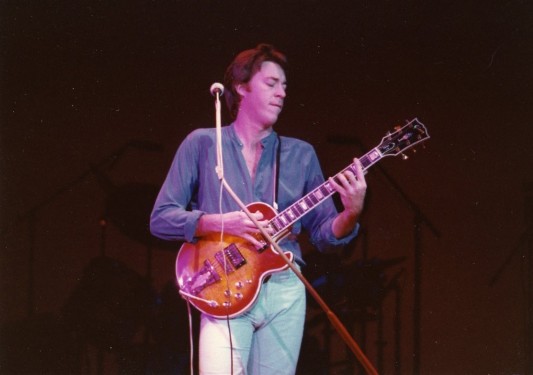
Boz Skaggs

Boz Skaggs: Lido Shuffle Boz Skaggs had a unique sound and was hard to pin down but again was an artist who was solid throughout the era.

http://www.youtube.com/watch?v=DIu0jQ5TaRQ&feature=PlayList&p=8201408B8B6E42C8&index=2
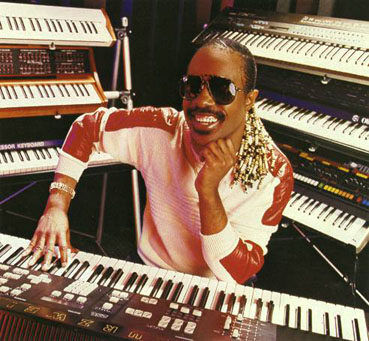
Stevie Wonder

Stevie Wonder: I Just Called to Say I Love You: R&B singer Stevie Wonder was popular throughout the era and successfully crossed over to the pop charts with I Just Called to Say I Love You from the movie Woman in Red and his duet with Paul McCartney Ebony and Ivory.

http://www.youtube.com/watch?v=PY45DkaP9Ls&feature=PlayList&p=3C966AE64CF668CB&index=10

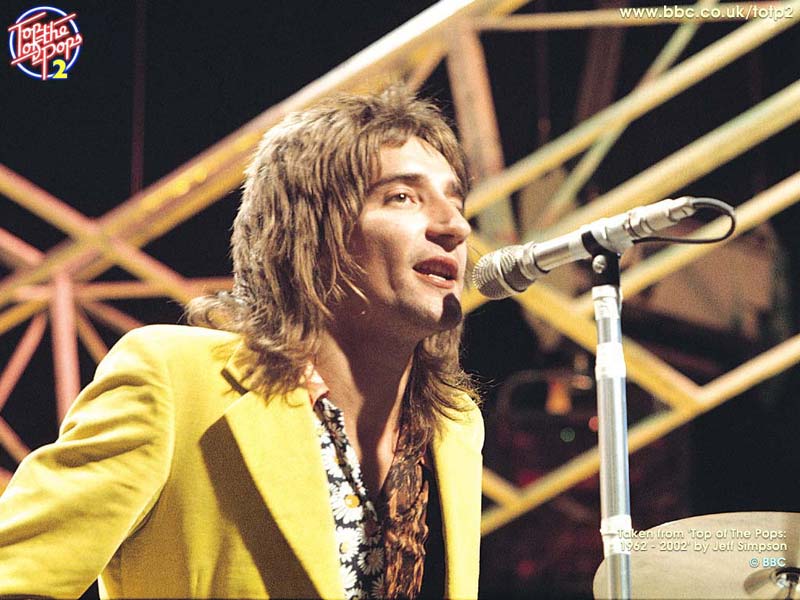
Rod Stewart” Maggie May Rocker Rod Stewart lived on the wild side in the 70’s and 80’s but by the 90’s and 2000’s had transformed himself into a classic crooner.

http://www.youtube.com/watch?v=h9dlG-iq3F8

Commodores: Brick House Lionel Ritchie and the Commodores from Motown we electric in the 70’s and Ritchie would cross over into a even more successful pop career in the late 70s beginning with the theme to the movie Endless Love.

http://www.youtube.com/watch?v=-5EmnQp3V48

Kermit the Frog with Blondie’s Debby Harry

Kermit the Frog and Debbie Harry: Rainbow Connection The Muppet Show led by Kermit the Frog featured a wide number of popular music artists who would ham it up often singing duets with Kermit of Miss Piggy. The Muppets had thier own top ten hit The Rainbow Connection from the Muppet Movie.

http://www.youtube.com/watch?v=lRvhRhWWE44

Debbie Harry of Blondie

Blondie: Heart of Glass Sexy former Playboy centerfold Debbie Harry and Blondie were a dominant influence on the rock and pop charts in the late 70s and 1980s.

http://www.youtube.com/watch?v=lRvhRhWWE44

Sunday Girl

http://www.youtube.com/watch?v=obwanhb6kww&feature=PlayList&p=F2ED8F30DB2943CD&index=10

Kim Carnes

Kim Carnes’  Betty Davis Eyes and Debbie Boone’s You Light up My Life would hold the Billboard Pop Single number one record of 9 weeks in the late 1970s. Carnes, a singer songwriter for Kenny Rogers launched a successful solo career of her own with the quirky Betty Davis Eyes while the wholesome Boone, the daughter of pop icon Pat Boone would gain fame with You Light up My Life

http://www.youtube.com/watch?v=EPOIS5taqA8
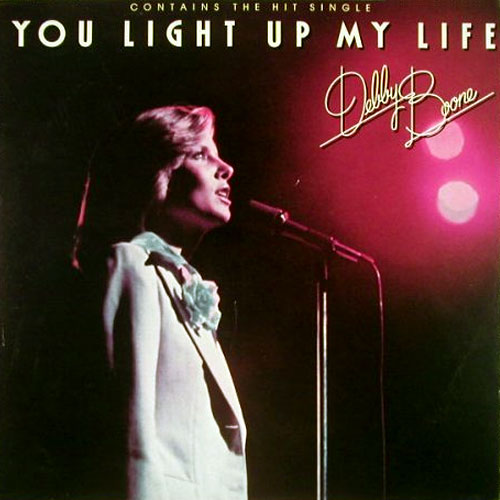
Debbie Boone

Debbie Boone: You Light up My Life

http://www.youtube.com/watch?v=nC9sEAqEjxs

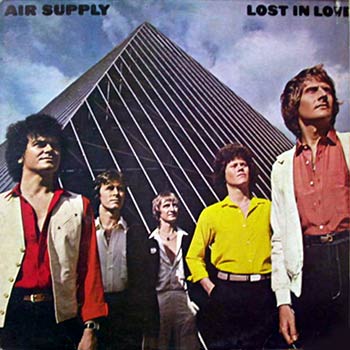
Air Supply: Lost in Love One of the bands from down under Air Supply would make its mark on the pop scene with a number of popular love songs.

http://www.youtube.com/watch?v=HpntNDAYltM

Boston: More than a Feeling The rock group Boston and their driving rhythm and guitar solos would compete with other classic rock groups of the era and help define the “death before disco” movement.

http://www.youtube.com/watch?v=IcsVPis1iNs

Supertramp: Breakfast in America One of the more overlooked groups of the era was Supertramp.

http://www.youtube.com/watch?v=Jh2TJ2DAy_o
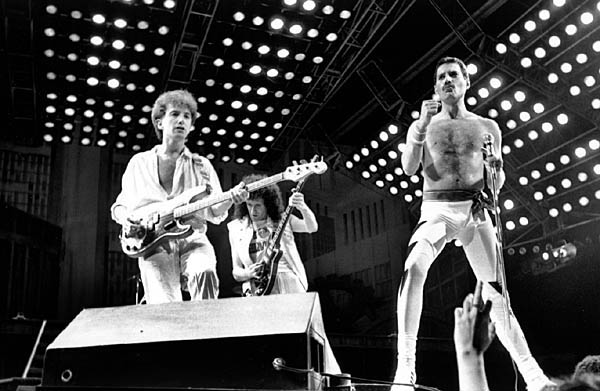
Freddy Mercury and Queen

Queen: We are the Champions Freddy Mercury and Queen easily moved between the rock and pop charts with powerful ballads and rong songs with a quircky edge. Mercury’s vocals and stage presence were amazing.

http://www.youtube.com/watch?v=hSTivVclQQ0

Billy Idol: Dancing with Myself Billy Idol a rocker also helped symbolize some of the New Wave movement his ghoulish Dancing with Myself was an early hit on MTV.

http://www.youtube.com/watch?v=0VNx78SAq8M

Katrina and the Waves: Walking on Sunshine Another 80s group with lasting appeal was Katrina and the Waves.

http://www.youtube.com/watch?v=iPUmE-tne5U

The Bangles: Manic Monday The Girl Group The Bangles had a number of hits in the 80s.

http://www.youtube.com/watch?v=lAZgLcK5LzI

Madonna: Lucky Star Pop legend Madonna broke into the music scene in this era and really until recently has never left.

http://www.youtube.com/watch?v=ThHz9wlBeLU

Kenny Loggins: Danger Zone Kenny Loggins solo career really took off with the movie Top Gun

http://www.youtube.com/watch?v=Y1a_ikfUico

Billy Joel: Uptown Girl Billy Joel was another solo artist with hit after hit in the 70s and 80s.

http://www.youtube.com/watch?v=hCuMWrfXG4E
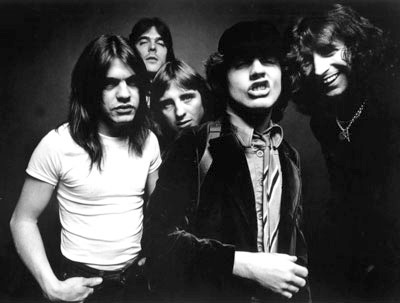
AC/DC: You Shook Me All Night Long AC/DC never failed to shock but produced some of the most enduring, if not occasionally controversial hits of the era and still have a large following today.

http://www.youtube.com/watch?v=z5FWXSnCEZE&feature=PlayList&p=66074A5666DBAB87&index=2

Berlin: Take My Breath Away Berlin produced a large number of sultry hits but it was Take My Breath Away from Top Gun put them on most people’s radar.

http://www.youtube.com/watch?v=DARX9nzNE3E

Well, they were interesting times and despite everything I still enjoy the music of these groups.  Diverse and unpredictable as to what would find its way onto different charts the artists of the 70’s and 80s and their music is still popular today.

Peace

Padre Steve+

4 Comments

Filed under History, music

The Caine Mutiny: A Lesson in Leadership

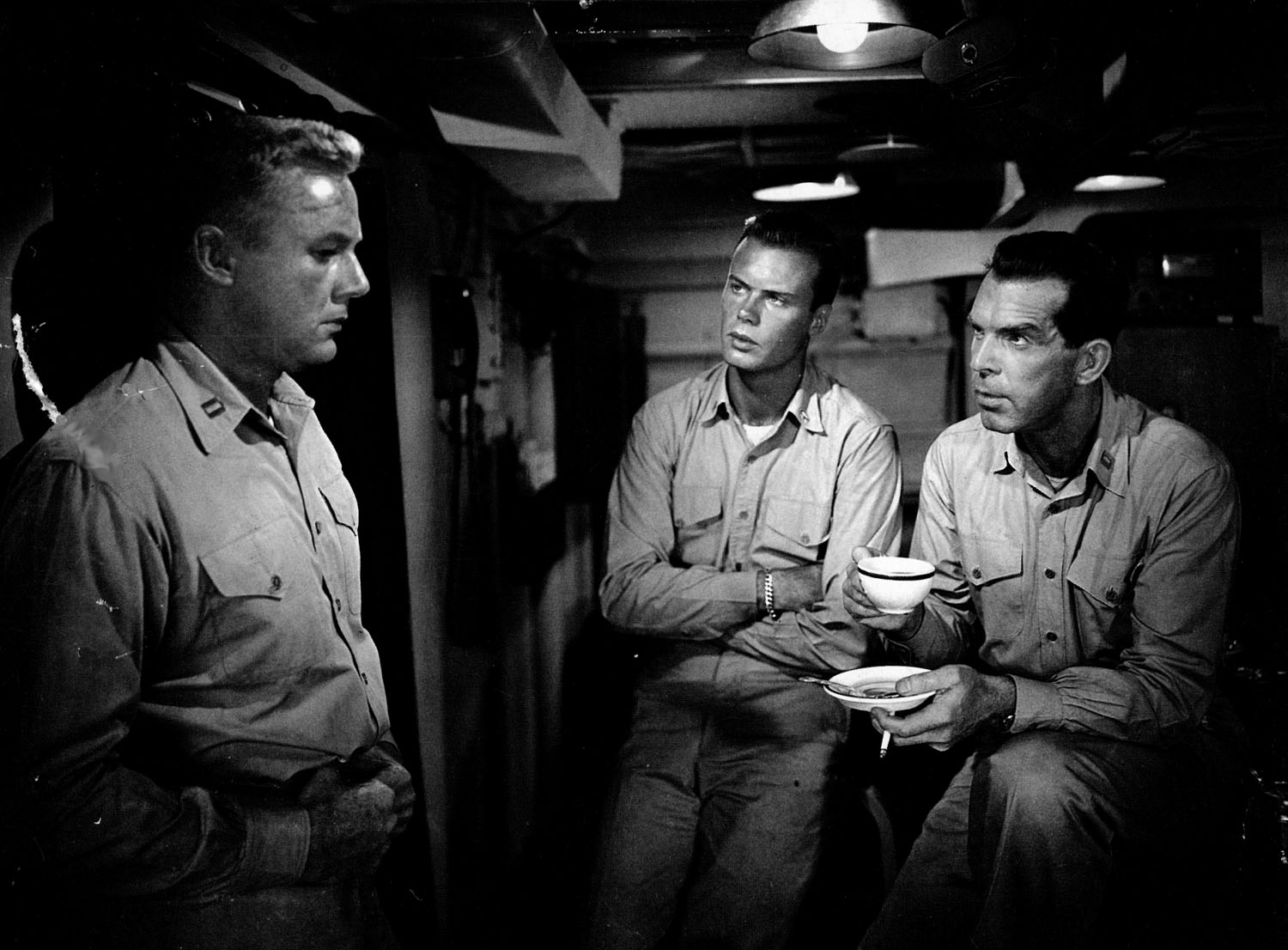
“Now you’re learning, Willie. You don’t support your captain because you like him; you support because he’s got the job or you’re no good!” Jose Ferrer as Lieutenant Barney Greenwald

I write this after seeing a number of officers do some really dumb things in my 28 year career in the manner in which they supported their commanders or chain of command in trying times.  While none of these incidents could be described as mutiny they were certainly acts which undermined the chain of command, endangered the mission and had they occurred in a combat zone or in emergent conditions could have gotten soldiers or sailors killed.  The Caine Mutiny is a classic on leadership either in book or movie form.  I prefer the book but I am captivated by the performances of Humphrey Bogart and Jose Ferrer. In this essay I go through the movie and book and illustrate my point with quotations from it.

There has never been a mutiny on a United States Navy ship yet the book and later the movie The Caine Mutiny by Herman Wouk is one of the most poignant books on leadership in existence. The book gained popular success and was made into a movie in 1954 starring Humphrey Bogart, Van Johnson and Fred MacMurray, Jose Ferrer and Robert Francis.

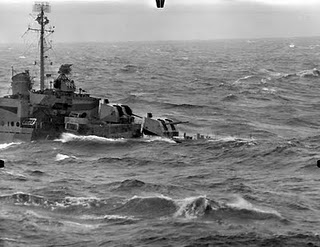
The story centers around the officers or the wardroom of the USS Caine, an elderly Destroyer Minesweeper which had been in continuous combat in the South Pacific.  In the book she is a First World War One 1250 ton Wickes or Clemson class four piper.  In the movie she is played by the USS Thompson DD-627/DMS-38 a 2500 ton Gleaves class destroyer converted into a Destroyer Minesweeper since by the time the movie was made no “four pipers” were left in existence.  It took the film’s producers many months to convince the Navy to endorse the film because of the subject matter with the Navy only relenting when the producers agreed to place a disclaimer at the beginning of the film that there has never been a mutiny aboard a US Navy ship.

In the book and film the ship has returned to Pearl Harbor and in the process picked up a couple of newly assigned Ensigns fresh out of Officer Candidate School, what back in World War II were known as “90 Day Wonders.”  The young and impressionable Ensign Willis Seward Keith a Princeton grad and scion of old money and political contacts is one of those officers and while the story focuses on “Willie” Keith the true drama comes with the assignment of a new Commanding Officer, Lieutenant Commander Phillip Francis Queeg, a career officer and Naval Academy graduate.  The Executive officer, Lieutenant Steve Maryk, another OCS officer from humble means is played by Van Johnson while Fred MacMurray plays the ship’s communications officer, Lieutenant Tom Keefer another reservist and a writer by trade who remarks early in the story: “There is no escape from the Caine, save death. We’re all doing penance, sentenced to an outcast ship, manned by outcasts, and named after the greatest outcast of them all.”


Keith is disappointed in his new assignment and his mother and uncle try to pull strings to have him assigned to an Admiral’s staff.  The initial commanding officer, Lieutenant Commander DeVriess questions the new officer on his feelings about being assigned to the Caine:

http://www.youtube.com/watch?v=WTt5iVP8-GM

DeVriess: Disappointed they assigned you to a minesweeper, Keith?
Keith: Well, sir, to be honest, yes, sir.
DeVriess: You saw yourself on a carrier, or a battleship, no doubt.
Keith: Yes, sir, I had hoped…
DeVriess: Well, I only “hope” that you’re good enough for the Caine.
Keith: I shall try to be worthy of this assignment, sir.
DeVriess: She’s not a battleship or a carrier; the Caine is a beaten-up tub. After 18 months of combat it takes 24 hours a day just to keep her in one piece.

Queeg on his arrival insists on strict military discipline on a ship that has little outward appearance of such qualities. He remarks to his officers: “Aboard my ship, excellent performance is standard, standard performance is sub-standard, and sub-standard performance is not permitted to exist – that, I warn you.” Keefer a malcontent with a cynical attitude about the Navy takes an immediate dislike of Queeg and goes out of his way to poison the wardroom against the new Captain and is aided by various quirky and even neurotic actions of the new commander.  In the next few months he creates an air of disrespect, distrust toward Queeg even to plant questions about Queeg’s sanity and emotional stability among his fellow officers, including the Executive Officer who begins a “medical log” on the Captain.  One remark when pushing the Executive Officer demonstrates how far he was willing to go in trying to plant the idea that the Captain is mentally ill: “Will you look at the man? He’s a Freudian delight; he crawls with clues!”


http://www.youtube.com/watch?v=TiGVMshkwrY&feature=PlayList&p=6E5FDB52D2DC4238&index=6

After a number of incidents Queeg attempts to reconcile with his officers who reject him but his words are true: “As I always say, a command is a lonely job. It isn’t easy to make decisions. Sometimes the captain of a ship needs help. And by help, I mean constructive loyalty. What I’m trying to say is, uh, a ship is like a family. We all have our ideas of right and wrong but we have to pitch in for the good of the family. If there was only some way we could help each other.”

http://www.youtube.com/watch?v=vtqf0CCVUek

When the ship is caught in the great typhoon, sometimes known as “Halsey’s typhoon” which in actuality caused the loss of three destroyers and heavy damage to numerous ships, Queeg freezes on the bridge in a dispute with his officers over the action that needs to be taken.  Queeg wants to maintain the fleet course and speed while the bridge watch including the Executive Officer and Ensign Keith want him to steer an opposite course.  In the exchange Queeg apparently frozen by fear insists on following fleet course and when Queeg freezes relieve him under Article 184 of Naval Regulations.  The ship survives the storm and upon the ship’s return to San Francisco a Court Martial is convened charging Maryk and Keith with mutiny.

In the trial they are defended by Lieutenant Barney Greenwald, a lawyer in civilian life and Naval Aviator on convalescent leave. While the prosecution breaks Maryk and makes Keith look foolish Keefer aids the prosecution’s case to keep his reputation untarnished and after pushing his shipmates into mutiny leaves them to hang.  Greenwald then gets to work.  He pushes the psychiatrist who certified Queeg as sane and fit for duty hard planting doubts about the diagnosis:

“Doctor. You have testified that the following symptoms exist in Lieutenant-Commander Queeg’s behavior. Rigidity of personality, feelings of persecution, unreasonable suspicion, a mania for perfection, and a neurotic certainty that he is always in the right. Doctor isn’t there one psychiatric term for this illness?”

He then causes Queeg to have a breakdown on the witness stand.  The scene is dramatic as Queeg begins to fall apart:

http://www.youtube.com/watch?v=9esAr7gLapE&feature=PlayList&p=6E5FDB52D2DC4238&index=12

“They were all disloyal. I tried to run the ship properly by the book, but they fought me at every turn. If the crew wanted to walk around with their shirttails hanging out, that’s all right, let them! Take the towline – defective equipment, no more, no less. But they encouraged the crew to go around, scoffing at me and spreading wild rumors about steaming in circles and then ‘Old Yellowstain.’ I was to blame for Lieutenant Maryk’s incompetence and poor seamanship. Lieutenant Maryk was the perfect officer, but not Captain Queeg. Ah, but the strawberries! That’s, that’s where I had them. They laughed at me and made jokes, but I proved beyond the shadow of a doubt, and with, with geometric logic, that, that a duplicate key to the wardroom icebox did exist. And I would have produced that key if they hadn’t pulled the Caine out of action. I, I know now they were only trying to protect some fellow officer. (He pauses – looks at all the questioning faces that stare back at him, and realizes that he has been ranting and raving.) Naturally, I can only cover these things from memory…”

The scene ends with everyone knowing that Maryk and Keith will be acquitted. Greenwald’s clients are exonerated but the story does not end there.  While the officers celebrate the acquittal a drunken Greenwald arrives announces that he feels guilty for “torpedoing Queeg” and excoriates the wardroom and brutally identifies Kiefer as the “author of the Caine mutiny” and makes very pointed comments that any officer would be wise to heed.

http://www.youtube.com/watch?v=EKeISsYKROI

Greenwald: When I was studying law, and Mr. Keefer here was writing his stories, and you, Willie, were tearing up the playing fields of dear old Princeton, who was standing guard over this fat, dumb, happy country of ours, eh? Not us. Oh, no! We knew you couldn’t make any money in the service. So who did the dirty work for us? Queeg did! And a lot of other guys, tough, sharp guys who didn’t crack up like Queeg.
Keith: But no matter what, Captain Queeg endangered the ship and the lives of the men.
Greenwald: He didn’t endanger anybody’s life! You did! All of you! You’re a fine bunch of officers.

Greenwald: Tell me, Steve, after the Yellowstain business, Queeg came to you guys for help and you turned him down, didn’t you?
Maryk: Yes, we did.
Greenwald: You didn’t approve of his conduct as an officer. He wasn’t worthy of your loyalty. So you turned on him. You ragged him. You made up songs about him. If you’d given Queeg the loyalty he needed, do you suppose the whole issue would have come up in the typhoon?

Greenwald: And now we come to the man who should have stood trial. The Caine’s favorite author. The Shakespeare whose testimony nearly sunk us all. Tell ’em, Keefer.
Keefer: No, you go ahead. You’re telling it better.
Greenwald: You ought to read his testimony. He never even HEARD of Captain Queeg!
Maryk: Let’s forget it, Barney.
Greenwald: Queeg was sick, he couldn’t help himself. But you, you’re real healthy. Only you didn’t have one-tenth the guts that he had.
Keefer: Except I never fooled myself, Mr. Greenwald.
Greenwald: I wanna drink a toast to you, Mr. Keefer. From the beginning you hated the Navy. And then you thought up this whole idea and you managed to keep your skirts nice and starched and clean, even in the court martial. Steve Maryk will always be remembered as a mutineer. But you, you’ll publish your novel, you’ll make a million bucks, you’ll marry a big movie star, and for the rest of your life you’ll live with your conscience, if you have any. Here’s to the real author of the Caine mutiny. Here’s to you, Mr. Keefer.
[Splashes wine in Keefer’s face]
Greenwald: If you wanna do anything about it, I’ll be outside. I’m a lot drunker than you are – so it’ll be a fair fight.

The movie ends with Keefer alone as his fellow officer leave the party and Keith receiving orders to a new destroyer commanded by Captain DeVriess.  However the book has another ending.  In it Keefer becomes the commanding officer of the Caine and Keith the XO. The ship is hit by a Kamikaze and Keefer loses his nerve and in a truly cowardly fashion abandons the ship and his crew leaving Keith to save the Caine which he does.

As a leader it is important to support the commanding officer, especially if he or she is going through a difficult time.  While this does not mean that subordinates should ignore illegal actions of a commander as the XO of a ship did recently resulting in his and the CO’s relief for cause, but officers from any service do not have the luxury of subverting their commander or chain of command based on any personal like, dislike or any ideological, political or religious agenda.  A prime example of the latter was former Chaplain Gordon Klingenschmitt who waged a vicious campaign against every Commanding Officer that he worked for and the Navy in order to push his own political-religious views on his sailors and in the media.  There are certainly other examples but no to belabor the point I will end here.

Peace,

Padre Steve+

6 Comments

Filed under History, leadership, world war two in the pacific

Mission Accomplished in Al Anbar: The Marines Turn Over the Mission to the Iraqis

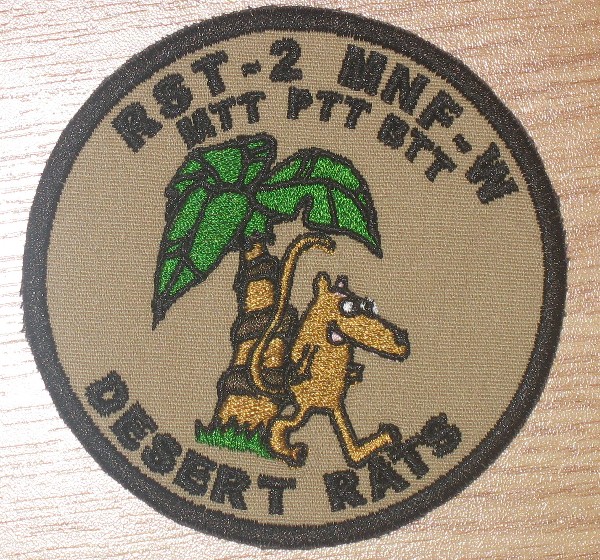
Religious Support Team 2 MNF-W the Desert Rats at Al Waleed August 2007

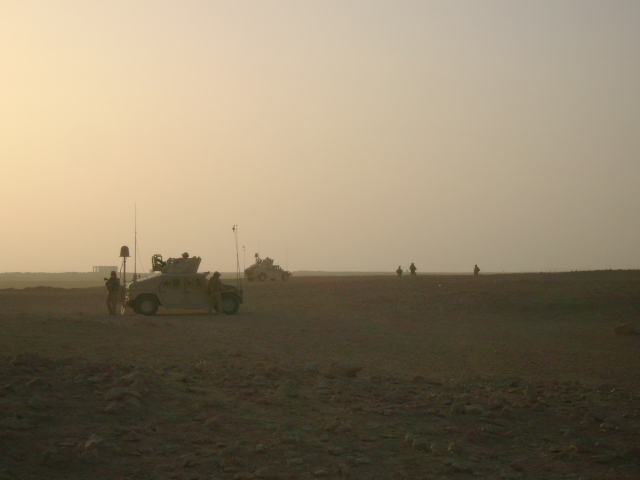
There was a time not very long ago that names like Al Anbar, Fallujah and Ramadi were synonymous with futility and humiliation.  But that was before a long time ago in a galaxy far far away. In late 2007 the Marines and our Iraqi Allies aided in large part by the “Anbar Awakening” where the Sunni in the province realized that Al Qaida Iraq’s motives were not in the best interest of the people gained the upper hand in a very short time.  The success was heralded as part of the “surge” but was in large part due to the effort made by the Marines to be seen as something other than occupiers but allies in a fight against foreigners that would brutally kill Iraqis to achieve their goals.

Iraqi Children Happy to see us near Baghdadi

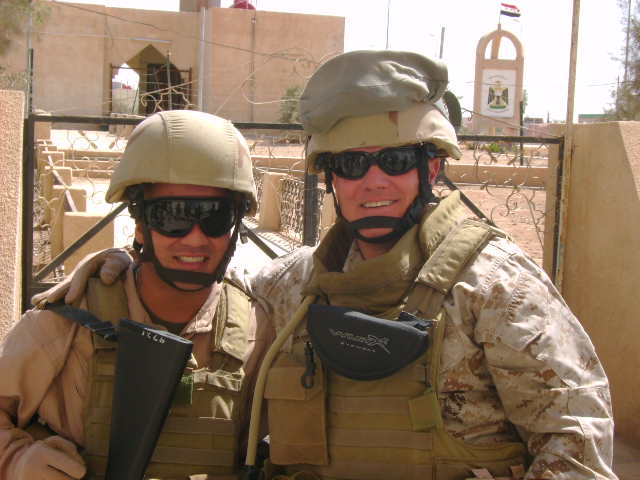
I arrived in Al Anbar in August of 2007 and spent my tour as the Chaplain to the Marine, Army and other advisers in the province which at the time of my arrival were still very much in play.  Within days of arriving at our base of operations I took part in a number of mass casualty situations at the Shock Surgery Trauma center at Ta Qaddum where I prayed for, anointed and looked after Marines wounded when their vehicles were destroyed by improvised explosive devices during combat missions.  My tour was the highlighter of my military career.  In my tour with the advisors as well as the Iraqis of the 1st and 7th Iraqi Army divisions, Second Border Brigade and Iraqi Police, Highway Patrol and even a reconstruction team or two.

Allies: Colonel Cottrell and General Murthi of the 7th Iraqi Division at the Marine Corps Birthday 10 November 2007

During my time there I was privileged to serve with great Marines, Soldiers and even a number of Navy, Air Force, US Border Patrol and Customs personnel and contractors working with the Iraqis.  The Iraqis in many cases were valiant men who while serving against the insurgency and Al Qaida knew that their families were in danger from retaliation as were their own lives.

Friendship: Dinner with General Sabah

While Marines and Army forces took the battle to the insurgents the Iraqi Sunni Muslims in Al Anbar suddenly turned on the insurgents and Al Qaida Iraq.  Soon Iraqi civilians who had been either hostile or neutral towards the Marines and their own Iraqi Army and Police units turned on the Al Qaida and their allies.  Suddenly violence began to subside; Iraqi civilians began to report insurgents, weapons caches and IEDs.

Near COP South waiting to clear suspected IED

By the time that I left Iraq in February 2008 the situation in the province was such that the 1st Iraqi Division was able to be dispatched to Basra and Diyala where they in conjunction they would take the lead in driving the insurgents from these regions. Just before I left an Iraqi General, General Ali in Habbinya told me that I should come back in 5 years as a tourist because everything would be alright. Another Iraqi officer told me that if anything ever happened between us and “the Persians” that the Iraqis would be on our side.  I knew when I left that Iraq would be okay in the long run and I still believe that to be true.

Me with General Ali January 2008

Thursday the Sergeant Major of what used to be Multinational Force West or MNF-West announced the Marines of II Marine Expeditionary Force (Forward) would be conducting a transfer of authority for the American mission to the 1st Armored Division of the US Army as part of the US drawdown in Iraq without a relief in place.   For most people in the United States this will be an event of little significance Iraq is now despite the continued presence of US forces has been forgotten by most.

With Advisers and Leaders of a Company of the Iraqi 2nd Border Brigade

Concern is now focused on US military actions in Afghanistan and the humanitarian relief operations in Haiti.  However, it was in Iraq that an insurgency was defeated, the first time since the British defeated the Malayan insurgency sponsored by Chinese Communists, and the French had militarily defeated the Algerian insurgency before the French government under DeGaulle surrendered the hard fought success of the Paras and Legionnaires betraying them even as he looked after what he viewed as the future of France.

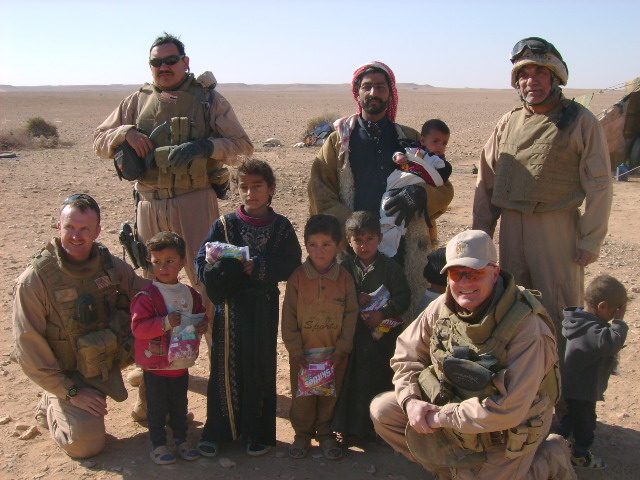
With Bedouin Family and Advsiers near Syria

In the summer of 2007 Iraq was viewed as a lost cause by much of the American body-politic, politicians of both parties and the media.  Now it is becoming a functional state, in large part due to the sacrifices of US Military personnel and the Iraqi Army and security forces.  U.S. Forces are disengaging and exiting the country. While it is likely that and advisory and support mission will remain as the Iraqis continue to rebuild and their Army and security forces continue to expand their capabilities.  The Iraqis recently showed their metal by facing down an Iranian incursion into Iraqi territory on a strategic oil field.

The text of the Sergeant Major’s message describing the transfer is posted below:

From: Carpenter SgtMaj Kiplyn (USF-W SGTMAJ)

Sent: Thursday, January 21, 2010 15:55

Subject: FAREWELL OF THE MARINES FROM IRAQ

UNCLASSIFIED

Please pass on,

SgtsMaj, MGySgts, CMDCMs, Marines and Sailors, Saturday, 23 January at 1100 will mark the end of the Marines in Iraq as an organization.  II MEF (fwd) will conduct a Transfer of Authority Ceremony with the First Armored Division without a Relief in Place from any incoming unit. USF-W (formally MNF-W) will merge with USD-C (formally MND-Baghdad) and will cease to exist.

After 6 years, over 850 Marines and Sailors killed in combat and another 8800 wounded we have completed our mission.  At our peak, we had almost 26,000 Marines and Sailors on deck, close to 200 aircraft, over 380,000 pieces of ground equipment, and were averaging close to 2000 significant events a month.  We have added a whole new generation of Heros; and names like Al Nasiriyah, Fallujah and Ramadi will be added to our History books.

Words can’t begin to explain the magnitude of effort and sacrifice our Marines and Sailors have gone through to help the Iraqi people.  Each year since the initial invasion, Marines and Sailors from all over the Corps have been a part of the revolving I MEF (fwd) and II MEF (Fwd) Commands.  Each year has been different with its own sets of unique challenges and each successive year, the incoming organization has built upon the successes of the outgoing organization.

This year was no different, we didn’t have anywhere near the level of fighting that previous MEFs have done.  However, we did conduct many operations, maintained security, continue to professionalize the Iraqi Security Forces, develop good governance and economics, assisted with the continued establishment of the Rule of Law and oversaw the peaceful transition of the provincial government.  We also had one unique mission that we can call our own. That was to finally bring the Marine Corps home. Over the past year, we have simultaneously conducted the responsible drawdown of 24,000 Personnel, over 34 COPs and FOBs, including Baharia, Rawah, and TQ and sent six years worth of equipment out of theater.

For those of you who served with me this year, thank you.  It was long and difficult at times, with our own set of challenges, but we did it.

It has been an honor to serve with you.

For those of you who have left your boot prints over here at least once during the last six years; thanks to you too. You set the stage for us to finish the job.  It has been costly, it has been challenging, it has taken a while with quite a few dark days. But, in the end, it was worth it.

All Marines and Sailors, including those who remained stateside have contributed to the overall success of the Marines and Sailors in Iraq and; all of us have known someone who didn’t make it back alive or has permanent injuries. It is up to us to ensure that those who follow never forgot their sacrifice or what we did here.

Collectively, we have added another illustrious chapter to the successful story of our Marine Corps.  One that all of us can be proud of.

Semper Fidelis,

K. Carpenter

Sergeant Major

United States Force – West, Iraq

(Previously Multi National Force – West) II Marine Expeditionary Force (Fwd)

21 January 2010

UNCLASSIFIED

Iraqi Recruits going through Basic Training

I am proud today to have been part of a mission that appears to have ended in success, at least in Al Anbar Province.  Semper Fidelis to the Marine Corps and the Sailors, Soldiers and Airmen who served alongside of us in Al Anbar as well as the Iraqi Army and security forces who despite the odds set the stage for the Iraqis and US Forces in the rest of the country to begin to re-establish order and normalcy to a country that has known little but war, dictatorship and tragedy over the past 40 years. I look forward to going back to Iraq someday and maybe visit some of those Iraqis that I was privileged to serve alongside.  May God bless all those who served honorably in Iraq and the Iraqi Army, security forces and the people of Iraq.

Peace,

Padre Steve+
Leave a comment

Filed under History, iraq,afghanistan, Military

German Tanks of World War II: The Panzer IV

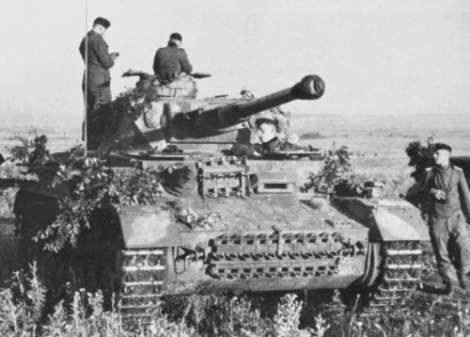
Panzer IVF2 in Russia 1942

This is the first in a series of articles on German tanks of World War II.  I’m starting with the Panzer IV which was the mainstay of Wehrmacht and Waffen SS Panzer Formations throughout the war. The series will appear periodically over the next month.

Panzer IV E

The Panzer IV tank was unique among the Armored Fighting Vehicles of the Second World War in that it served in a front line role throughout the entire conflict.  No other tank in service in 1939 was still in front line service in 1945, a fact that shows the dependability, versatility and quality of the Panzer IV.

The Panzer IV was developed in 1934 out of a requirement for a medium tank to operate in a support and anti-infantry role.  It was meant to compliment the lighter Panzer II and Panzer III and the design requirements did not require the new tank engage enemy tanks on equal terms.  The Wehrmacht submitted its requirements and Krupp, Rheinmetall and MAN produced prototypes for evaluation and testing following which the Krupp version was selected for production.

PZ IV D in France

The new tank mounted a low velocity L24/ 75mm gun had a crew of 5. The Panzer IV had a maximum speed of 35 km/hour. The first three variants of the Panzer IV the Ausf A, B and C were developmental models. These limited production models with a total production of just over 200 vehicles were primarily used for training the fledgling Panzerwaffe. As the Wehrmacht had a need for more tanks many of  these were provided additional armor and placed in front line units until phased out of service.  The Panzer IV  D which was first produced in 1939-1940 was the first of the series designed for combat and issued to the Panzer Divisions.  One drawback of this model was that it had weak armor protection.  This deficiency was corrected to some degree in the next model, the Ausf E which was produced from 1940-1941.  Neither the Panzer IV D or E variants were produced in great numbers with fewer than 500 units produced.

Panzer IV G in North Africa

Limited numbers were used in the annexation of Austria and it first saw combat in Poland followed by the Blitzkrieg across France, North Africa, the Balkans and the Soviet Union.  It was in France and North Africa where the Germans ran up against French Char B heavy tanks and British Matilda Infantry tanks that they found that the gun power of the Panzer IV was inadequate to penetrate the heavy armor of these opponents.  Despite this the Germans maintain the low velocity gun on the next model, the Panzer IV F1 when it was introduced in 1941. When the Germans encountered the Red Army’s T-34 and KV-1 tanks during Operation Barbarossa they finally decided to equip the tank with a L43/ 75mm gun. This was sufficient to deal with any allied tank.  The first model to use this was the Panzer IV F-2 which rolled out in late 1941, of which nearly 500 were produced.

Panzer IV H with Additional Side and Turret Armor to protect against shaped projectiles

The continued need for improvements in response to combat conditions on the Eastern Front and North Africa meant that the F-2 was further refined in the Panzer IV G in 1942. The Mark IV G was the first model to be produced in large numbers with over 1600 units produced. The Mark IV G was superseded by the Panzer IV H which had a more powerful L/48 75mm gun.

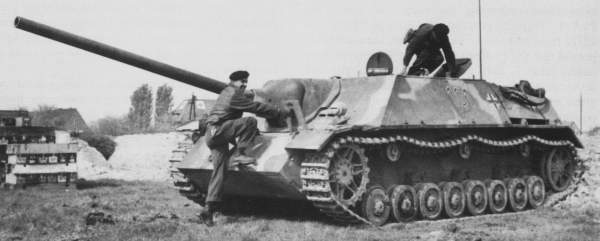
Jagdpanzer IV with Long L/70 75mm gun

Each succeeding models armor protection was improved and beginning with the Mark IV G turret and side skirt armor was applied as protection against hollow charge projectiles.  The Mark IV H which was produced from1943 to1944 had a production run of nearly 3800 units.  The final model, the Mark IV J was produced in 1944-1945 with a total production run of about 1750 units.

Flak Pz IV Wirbelwind with 4x 20mm Flak

The Panzer IV served on every Front and was provided to Romania, Hungary and Finland in limited numbers.  It remained a formidable opponent to allied armor and was found in elite formations of the Wehrmacht and Waffen SS until the end of the war, despite being superseded by the newer and more powerful Panther. It was prized for its reliability and could engage or almost every allied tank on equal or superior terms up to the end of the war.  The long L 43/48 gun and side armor on the turret sometimes led the Panzer IV G, H and J to be confused by allied tank crews with the Tiger I. The chassis was modified to serve in a number of roles including the Jadgpanzer IV, a tank killer equipped with the Panther’s L/70 75mm gun forward mounted in a limited traverse mount.

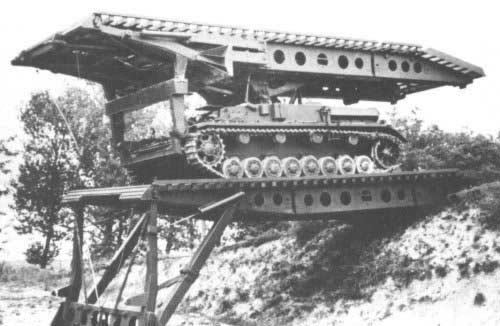
Bruckenpanzer IV

Likewise the Sturmgeschutz IV assault gun was developed by the Artillery as a infantry support and anti-tank vehicle. Several FLAK versions including the Wirbelwind quad 20mm anti-aircraft tank were introduced to provide anti-aircraft support to the Panzers against allied fighter bombers while and a number of other specialized support versions, bridge layers, artillery support vehicles, command vehicles and some designed to support very esoteric super-weapon projects like the “Land Cruiser”  were produced in limited numbers.  After the war some Panzer IVs saw continued service in Finland, Hungary, and Romania and well after the war by Syria where they served in a dug in defensive mode during the Six Day War.

Syrian Panzer IV

2 Comments

Filed under armored fighting vehicles, History, Military

Jackie Robinson and Dr. Martin Luther King they Changed America

“He led America by example. He reminded our people of what was right and he reminded them of what was wrong. I think it can be safely said today that Jackie Robinson made the United States a better nation.” – American League President Gene Budig

“He knew he had to do well. He knew that the future of blacks in baseball depended on it. The pressure was enormous, overwhelming, and unbearable at times. I don’t know how he held up. I know I never could have.”Duke Snider

“Life is not a spectator sport. If you’re going to spend your whole life in the grandstand just watching what goes on, in my opinion you’re wasting your life.”  Jackie Robinson

“There’s not an American in this country free until every one of us is free.” Jackie Robinson

Today is a day that we rightfully remembered the life, message, martyrdom and legacy of Dr. Martin Luther King Jr. However as much as Dr. King matters, there were a long line of African American heroes who in their own way helped bring about racial equality in this country.  While many toiled in obscurity one, a baseball player named Jackie Robinson would forever alter the playing field of racial relations and how African Americans were perceived and received in the United States.  April 15th 2010 will be the 63rd anniversary of Jackie Robinson’s first game in the Major Leagues with the Brooklyn.  Robinson is not remembered with a National holiday but then again that takes noting away from this giant of American history. When Robinson stepped onto Ebbett’s Field in April 15th 1947 it was a watershed moment and while racial discrimination and prejudice remained they would be fighting a losing battle from that time on. Dr King in life and in death would be the one who drove the stake into the heart of the evil of racism and discrimination it was Jackie Robinson who helped place that stake above the heart of this evil.

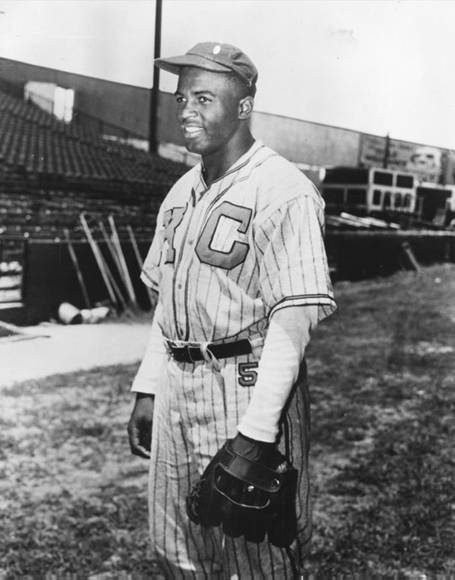
The Negro Leagues: Jackie in his Kansas City Monarch Uniform

We celebrate Dr King’s legacy today. However, without Jackie Robinson and the other African American baseball players who broke into the big leagues in the late 1940s and early 1950s it is conceivable that Dr, King would never have had the opportunity not only to be heard by African Americans, but to have his message heard and taken to heart by white America.

By the time Dr. King arrived on the scene much had already been done, and much due to Robinson and the owner of the Brooklyn Dodgers, Branch Rickey. Robinson’s first game with the Dodgers came a full year before President Truman integrated the military and a full seven years before the Supreme Court ruled school segregation unconstitutional.  It was not until 1964 that the Voters Rights act passed in Congress.  Jackie Robinson paved the way for a change in American society that has continued for 62 years since his debut at Ebbett’s Field on April 15th 1947.

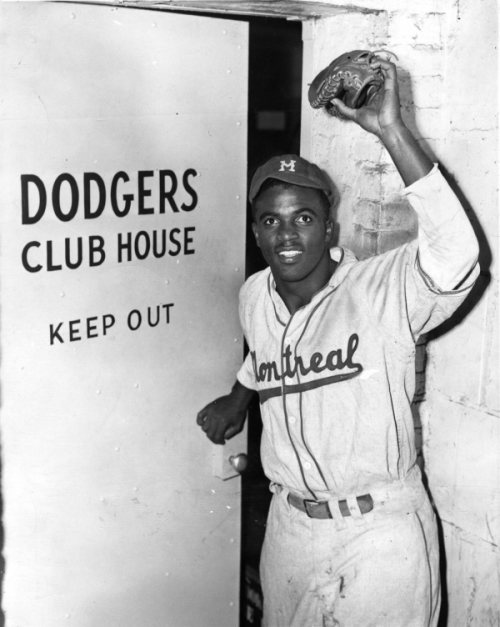
Even before he stepped onto the field Jackie Robinson was a pioneer in equal rights where at UCLA he was the first student to letter in four varsity sports and in the Second World War where in an action that was a precursor to later civil rights battles the young Lieutenant Jackie Robinson was arrested and tried for not moving to the back of a bus at Fort Hood Texas.  He would be acquitted and given an honorable discharge before beginning his professional baseball career with the Kansas City Monarchs of the Negro League prior to Rickey signing him to a minor league contract with the Montreal Royals of the International League. Although he was met with scorn my many white baseball fans and some players and had to endure the ignominy of hostility from white fans and media, having to live in separate hotels and eat at separate restaurants Robinson developed a loyal fan base in Montreal and over a million people saw him play in his year in the International League.

Jackie in his Montreal Royals Uniform outside the Dodger’s Clubhouse

When Branch Rickey talked with Robinson before the season he said: “Jackie (Robinson), we’ve got no army. There’s virtually nobody on our side. No owners, no umpires, very few newspapermen. And I’m afraid that many fans will be hostile. We’ll be in a tough position. We can win only if we can convince the world that I’m doing this because you’re a great ballplayer, a fine gentleman.”

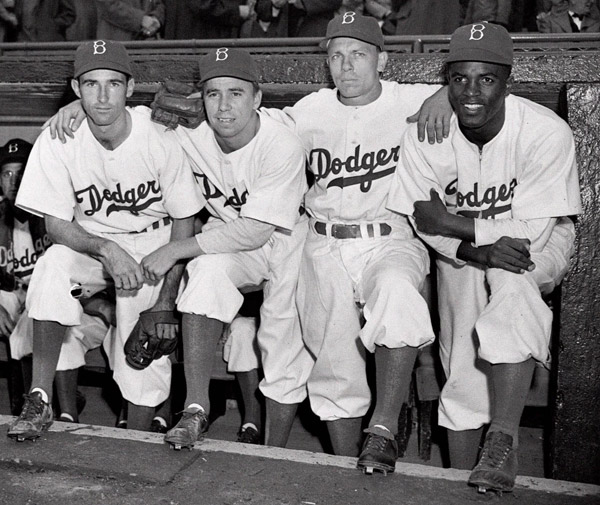
John Jorgensen, Pee Wee Reese, Ed Stanky and Jackie Robinson on opening day 1947

Jackie’s feat was a watershed moment in the history of our country.  Blacks had struggled for years against Jim Crow laws, discrimination in voting rights, and even simple human decencies such as where they could use a rest room, what hotels they could stay in or what part of the bus that they could sit.  In baseball many white fans were upset that blacks would be coming to see Robinson in stadiums that they would not have been allowed in before.  Players from other teams heckled Robinson, he received hate mail, people sent made death threats, and he was spiked and spit on.  But Jackie Robinson kept his pledge to Dodgers owner Branch Rickey not to lash out at his tormentors, as Rickey told him that he needed a man “with enough guts not to strike back.” In doing so his on field performance and poise under pressure won him the National League Rookie of the Year honor in 1947.

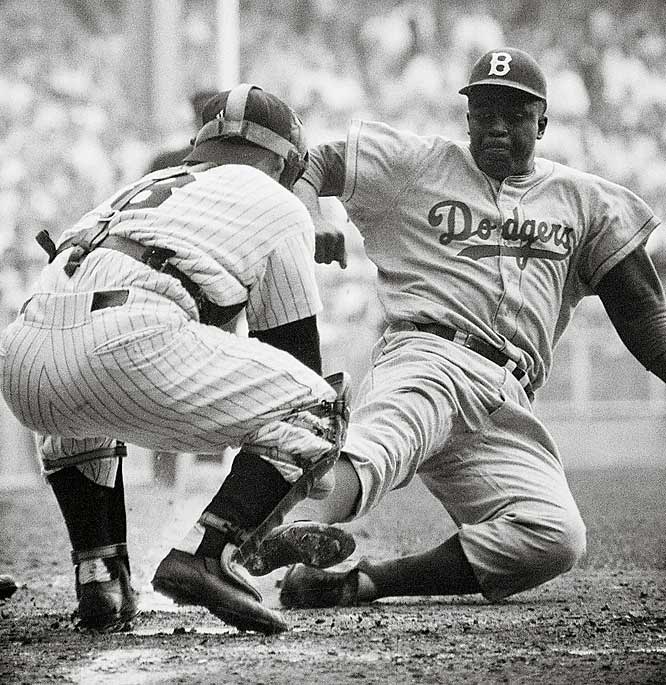
Jackie Stealing Home against the Yankees, the catcher is Yogi Berra

Jackie Robinson played the game with passion and even anger.  He took the advice of Hank Greenberg who as a Jew suffered continual racial epithets throughout his career “the best ways to combat slurs from the opposing dugout is to beat them on the field.” He would be honored as Rookie of the Year, was MVP, played in six World Series and six All Star Games.  He had a career .311 batting average, .409 on base percentage and a .474 Slugging percentage. He was elected to Baseball’s Hall of Fame in 1962. His teammate Pee Wee Reese would say: “Thinking about the things that happened, I don’t know any other ball player who could have done what he did. To be able to hit with everybody yelling at him. He had to block all that out, block out everything but this ball that is coming in at a hundred miles an hour. To do what he did has got to be the most tremendous thing I’ve ever seen in sports.”

Today Jackie Robinson’s feat is history, but it should not be forgotten.  He was a pioneer who made it possible for others to move forward.  He would be followed by players like Roy Campinella, Satchel Paige, Don Larson, Larry Dobie and Willie Mays.  His breakthrough had an effect not just on baseball but on society and helped make possible the later civil rights movement.  Dr. King would say of Jackie that he was “a legend and a symbol in his own time”, and that he “challenged the dark skies of intolerance and frustration.”  Historian Doris Kearns Godwin noted that Jackie’s “efforts were a monumental step in the civil-rights revolution in America” and that his “accomplishments allowed black and white Americans to be more respectful and open to one another and more appreciative of everyone’s abilities.” Time Magazine named him as one of the 100 most influential people of the 20th Century.

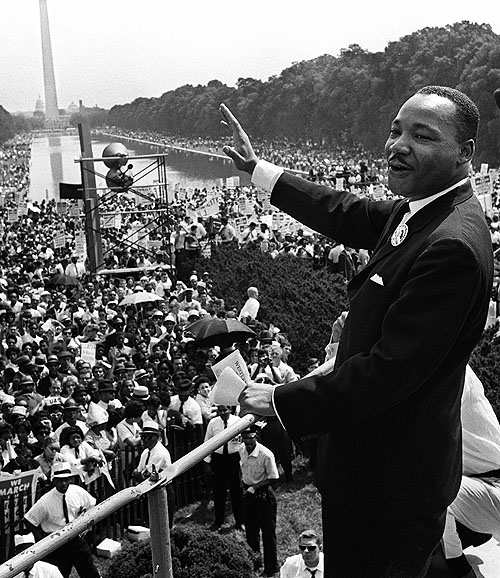
Dr Martin Luther King Jr “I have a dream”

We honor Dr King today and rightly so, but one can never forget those who paved the way so that we could all have the blessing of seeing Dr King’s dream come one step closer to fruition the dream that:

“one day this nation will rise up and live out the true meaning of its creed: ‘We hold these truths to be self-evident, that all men are created equal, that “children will one day live in a nation where they will not be judged by the color of their skin, but by the content of their character,” and that “one day on the red hills of Georgia the sons of former slaves and the sons of former slave owners will be able to sit down together at a table of brotherhood.”

Dr King would die by an assassin’s bullet in Memphis on the night of April 4th 1968 the day after finishing his final speech with these immortal remarks:

“And then I got to Memphis. And some began to say the threats, or talk about the threats that were out. What would happen to me from some of our sick white brothers? Well, I don’t know what will happen now. We’ve got some difficult days ahead. But it doesn’t matter with me now. Because I’ve been to the mountaintop. And I don’t mind. Like anybody, I would like to live a long life. Longevity has its place. But I’m not concerned about that now. I just want to do God’s will. And He’s allowed me to go up to the mountain. And I’ve looked over. And I’ve seen the Promised Land. I may not get there with you. But I want you to know tonight, that we, as a people, will get to the Promised Land. And I’m happy, tonight. I’m not worried about anything. I’m not fearing any man. Mine eyes have seen the glory of the coming of the Lord.”

Let us never forget Dr King nor those like Jackie Robinson who helped pave the way for Dr King.

Peace,

Padre Steve+
6 Comments

Filed under Baseball, History, Political Commentary

They Held the Line: The USS Yorktown CV-5, USS Enterprise CV-6 and USS Hornet CV-8, Part Three the Enterprise

Enterprise CV-6 circa 1940

This is the last of a three part series about the USS Yorktown Class Aircraft Carriers. It is the story of the USS Enterprise CV-6, the legendary “Big E” and possibly the most celebrated American warship of the Second World War.

The USS Enterprise CV-6, the second ship of the Yorktown class was ordered by the Navy on 3 August 1933 as authorized under the National Industrial Recovery Act of 16 June 1933.  She was laid down just under a year later and launched on 3 October 1936 at Newport News Shipbuilding and Drydock Company, Newport News Virginia.  She was commissioned on May 12th 1938 to begin one of the most celebrated careers of any US Navy ship in history.  Displacing 25,500 tons full load Enterprise like her sister ships were designed for fast carrier operation working in conjunction with other carriers not tied to the battle line.  With good protection and speed the Enterprise incorporated the lessons learned in the preceding carriers.

Pre-War photo of Enterprise

After her shakedown cruise she operated in the Atlantic and Caribbean until April 1939 when she was transferred to the Pacific Fleet and based a Pearl Harbor. As the flagship of Task Force 16 under Rear Admiral Bill “Bull” Halsey Enterprise conducted training operations and shuttled aircraft to various US island bases in the Central Pacific one such mission to Wake Island which had her out of Pearl Harbor when the Japanese attacked on December 7th 1941.  Following the attack Enterprise and Task Force 16 would cover the Hawaiian Islands and then be used to conduct raids against Japanese bases in the Marshalls and protect convoys bound for Samoa.

Rare photo of the Enterprise at Midway

In April she escorted the newly arrived USS Hornet CV-8 to conduct the famed “Doolittle Raid” on Tokyo.  Five days after returning to Pearl Harbor Enterprise was dispatched to the Coral Sea but could not arrive before that historic carrier battle.  She returned to Pearl Harbor on May 26th and with Halsey sick departed two days later as flagship of TF-16 under the command of Rear Admiral Raymond A Spruance in company with Hornet, 6 cruisers and 10 destroyers with orders “to hold Midway and inflict maximum damage on the enemy by strong attrition tactics.”

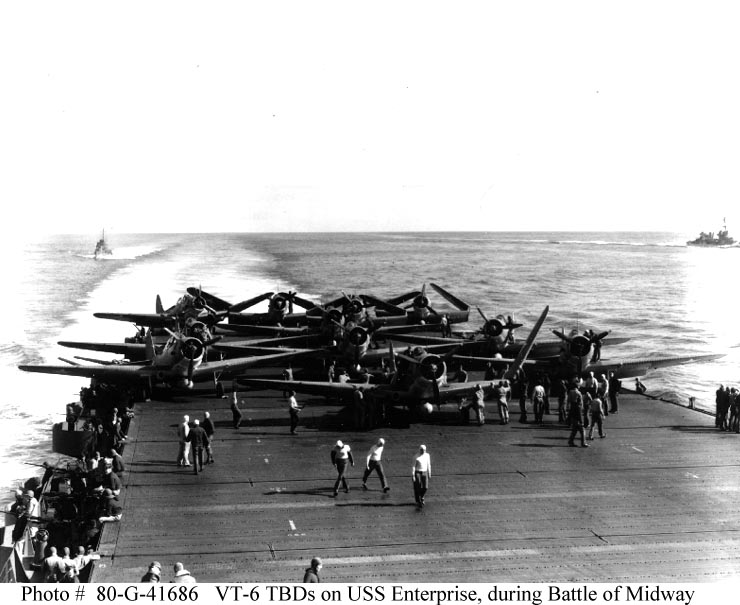
TBD Devastator landign on Enterprise May 1942

They would be joined 2 days later by the hastily repaired USS Yorktown flagship of Rear Admiral Frank “Jack” Fletcher and TF-17 escorted by 2 cruisers and 6 destroyers.  Fletcher the senior officer assumed tactical command of this comparatively small force which represented the bulk of US naval power in the Pacific.

This tiny force would face 4 fleet (CV) and 2 light fleet (CVL) carriers, 7 battleships, 10 heavy (CA) and 2 light (CL) cruisers and 42 destroyers.  Additionally the Japanese had an additional 2 carriers, 4 battleships, 3heavy cruisers 4 light cruisers and 23 destroyers involved in some way the simultaneous invasion of the Aleutian Islands which could be called into the fight if Admiral Yamamoto desired.

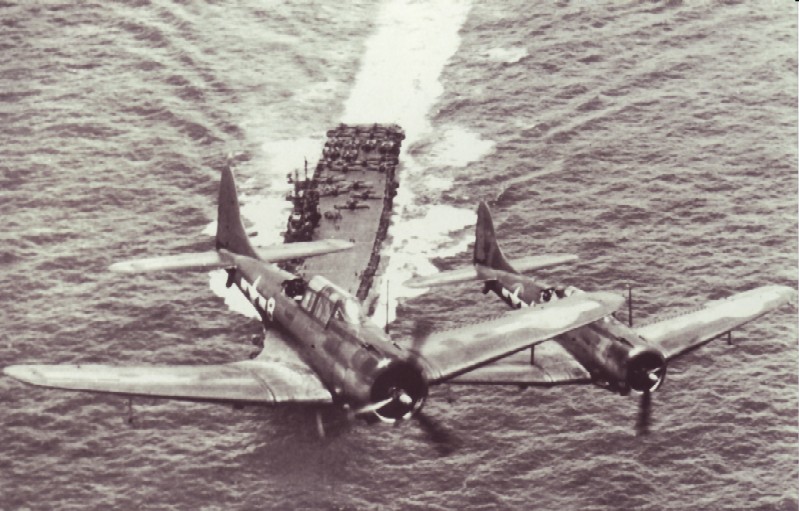
SBD Dauntless Dive Bombers over Enterprise

The Battle of Midway was an epic of warfare and Enterprise and her Air Group 6 would play a pivotal role. Torpedo Six under LCDR Max Leslie in its obsolete, underpowered and under armored TBD Devastators was chopped to pieces as they attempted torpedo attacks on the First Carrier Strike Force of Admiral Nagumo losing 10 of 14 aircraft.  As the gallant air crews of Torpedo Six along with Yorktown’s Torpedo 3 and Hornet’s ill-fated Torpedo Eight made their attacks Bombing Six under the command of CDR Wade McCloskie and Scouting Six under the command of  LT Dick Best attacked and mortally wounded the Japanese Flagship Akagi and the Soryu.  Later in the day aircraft from Enterprise would help sink the Hiryu and the following day helped mortally wound the Heavy Cruiser Mikuma. The Enterprise was not damaged by the Japanese at Midway.

Flight Operations on Enterprise

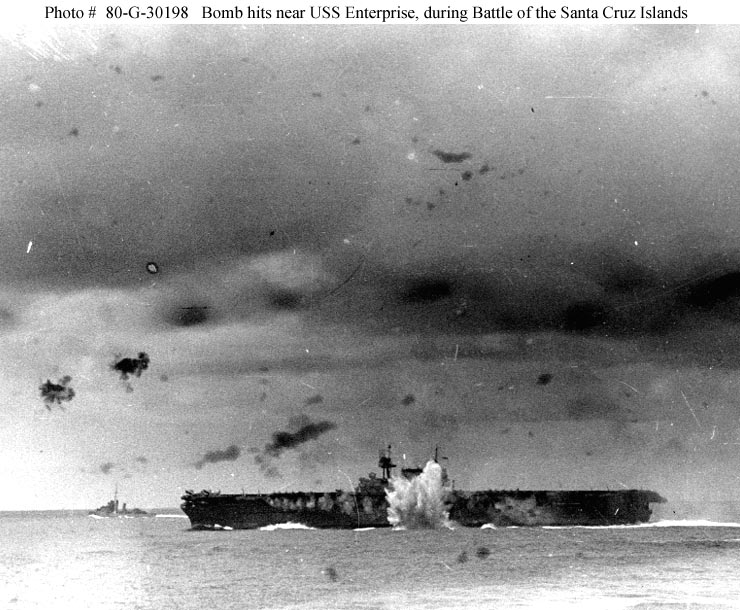
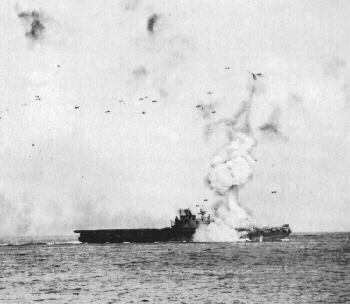
Following the Miracle at Midway the Enterprise took part in the Guadalcanal campaign participating in the invasion as well as the Battles of Santa Cruz and the Eastern Solomons.  In each of these actions she was seriously damaged but her air group was instrumental in the campaign at sea and ashore.   Following the sinking of the Wasp, Hornet and damage to Saratoga Enterprise was the only US carrier in action in the fall of 1942.

Enterprise under attack at the Battle of Santa Cruz Islands

Bomb Explosion on Enterprise at the Battle of Eastern Solomons

In November she took part in the Naval Battle of Guadalcanal where her aircraft helped to finish off the Japanese battleship Hiei and participated in the sinking of 16 Japanese ships including transports which carried troops, equipment and supplies to the Japanese defenders of Guadalcanal. After another 6 months of action in the Solomons supporting the US advance Enterprise returned first to Pearl Harbor at which time she was awarded the Presidential Unit Citation by Admiral Chester Nimitz, the first carrier awarded the citation in the Second World War and then to Bremerton for a badly needed overhaul.

Emterprise struck by Kamikaze

Enterprise was back in action by November 1943 and participated in the US offensives in the Gilberts, Marshalls and the Marianas taking part in numerous raids, support to Marines ashore and in the Battle of the Philippine Sea, the Marianas Turkey Shoot.  After a month long refit at Pearl Harbor she participated in the attacks on the Volcano, Bonin and Palau including strikes on Yap and Ulithi followed by the fast carrier raids on Japanese facilities on Okinawa, Formosa and the Philippines which culminated in her participation in the Battle of Leyte Gulf, the largest naval battle in history.  Her aircraft would participate in strikes on each of the Japanese surface forces hitting battleships, cruisers and other Imperial Navy units in the epic naval battle.

Enterprise made a short return trip to Pearl Harbor in December 1944 where she embarked an air group trained in night operations. Rejoining the fleet she took part in sweeps against Japanese bases, ships and facilities in Indochina, the Philippines, Formosa and Okinawa prior to the invasion of Iwo Jima.

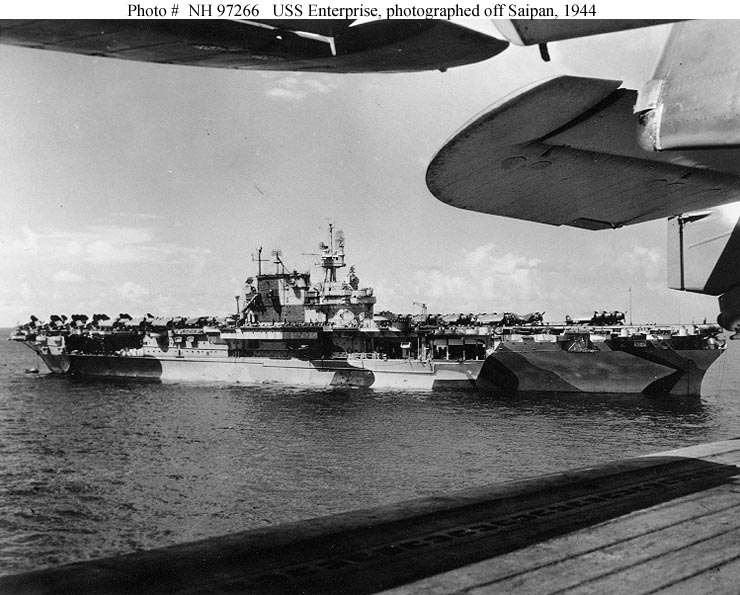
Enterprise at Saipan

During this operation her aircraft worked night and day to provide air strikes and air defense to the fleet.  She then joined the raids against Honshu, Kyushu and the Inland Sea where her aircraft provided night strikes against Japanese targets ashore as well as air defense to fleet units. She was damaged by a Japanese bomb on the 18th of March and on 11 April damaged by Kamikazes off Okinawa and again on 5 May prior to her last wound of the war on 14 May when a Kamikaze struck forward elevator necessitating repairs at Bremerton.

Kamikaze Damage or forward elevator

Returning to the fleet to late for the final actions of the war Enterprise took part in Operation Magic Carpet returning US troops to the United States at the end of hostilities.  She was decommissioned on February 17th 1947.  While she was in reserve the Enterprise was redesignated first as an Attack Aircraft Carrier (CVA), and then as Anti-submarine Carrier (CVS).

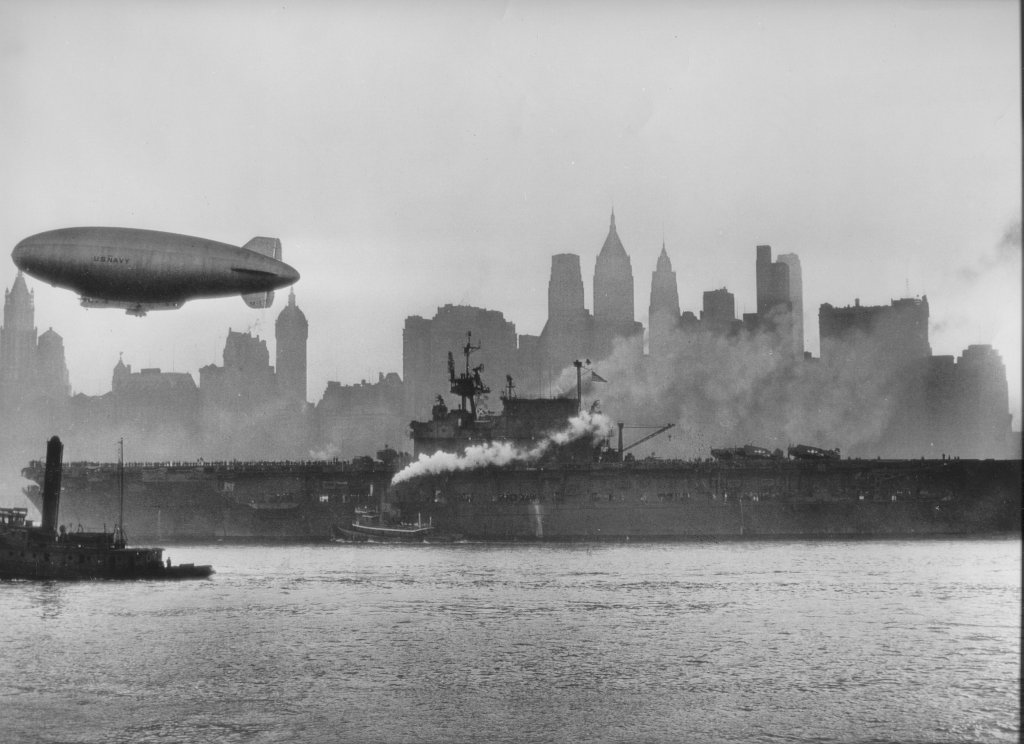
Enterprise Fleet Week New York 1945

As the super-carrier entered the scene and the Essex and Midway Classes were modernized to accommodate jet aircraft the Enterprise was determined to be in excess of Navy needs.  Despite attempts by some to save her as a Naval Museum the money could not be raised, even with the support of the dying Fleet Admiral Bill Halsey.  Enterprise which Secretary of the Navy Forrestal said was “the one vessel that most nearly symbolizes the history of the Navy in this war” was sold for scrap on 1 July 1958 and scrapped at Kearney New Jersey from September 1958 to March 1960.  Like so many ships which serve their country so well she was casually disposed of by a nation which had forgotten its past.

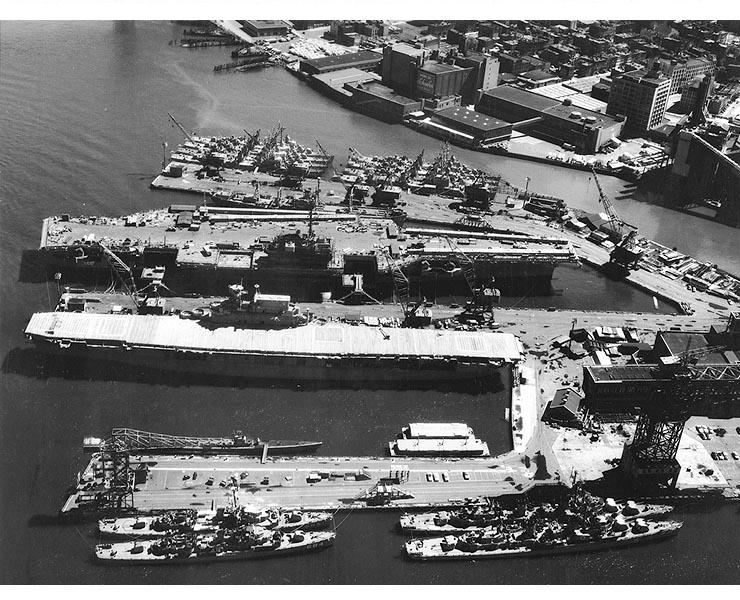
Enterprise alongside new CVA 1958

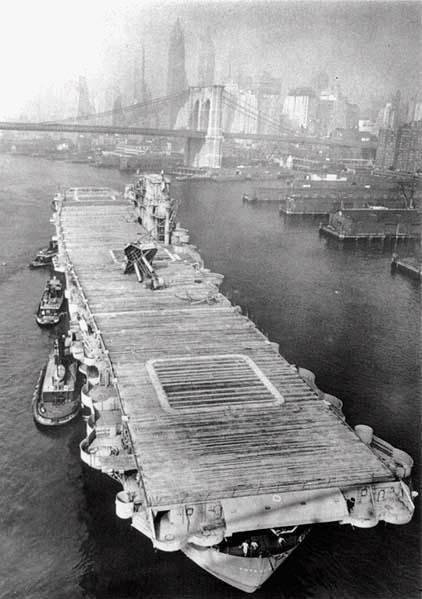
Enterprise on the way to the breakers

Enterprise was the only ship to receive both the Presidential and Naval Unit Citations for her service in World War Two and she was awarded the Asiatic-Pacific Campaign Medal with 20 battle stars.  Her place in the carrier force would be taken by a new Enterprise, CVN-65, the First Nuclear carrier which after nearly 50 years of service is still in commission. The Enterprise is so significant that her legacy continues in Hollywood Science fiction in the various Star Trek series as the Federation Starship Enterprise NCC-1701, 1701-A, 1701-B, 1701-D and 1701-E, so much so that NASA named the first experimental Space Shuttle Enterprise.

Never Forgotten USS Enterprise NCC-1701-B

2 Comments

Filed under History, Navy Ships, world war two in the pacific

The Alaska Class Battle Cruisers: The Last of the Line

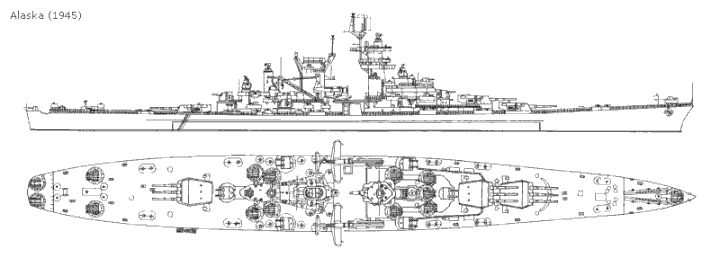
Line drawing of Alaska in 1945

The three ships of the Alaska Class though classed as “Large Cruisers” by the US Navy were actually the last Battle Cruisers designed, built and put into operation by any Navy.  Designed as a counter to the German Scharnhorst and Gneisenau which in 1939 and 1940 had created havoc in the Atlantic raiding convoys and sinking the Royal Navy Aircraft Carrier Courageous, the ships were 809 feet long and 91 feet wide, displaced 27,000 tons, mounted 9 12” guns mounted in three turrets and were capable of 33 knots.  The ships mounted a large anti-aircraft battery of 12 5” 38 Dual Purpose guns, 56 40mm cannon and 34 20mm light anti-aircraft guns.

The Scharnhorst: She and the Gneisenau were the threat that the Alaska’s were designed to counter

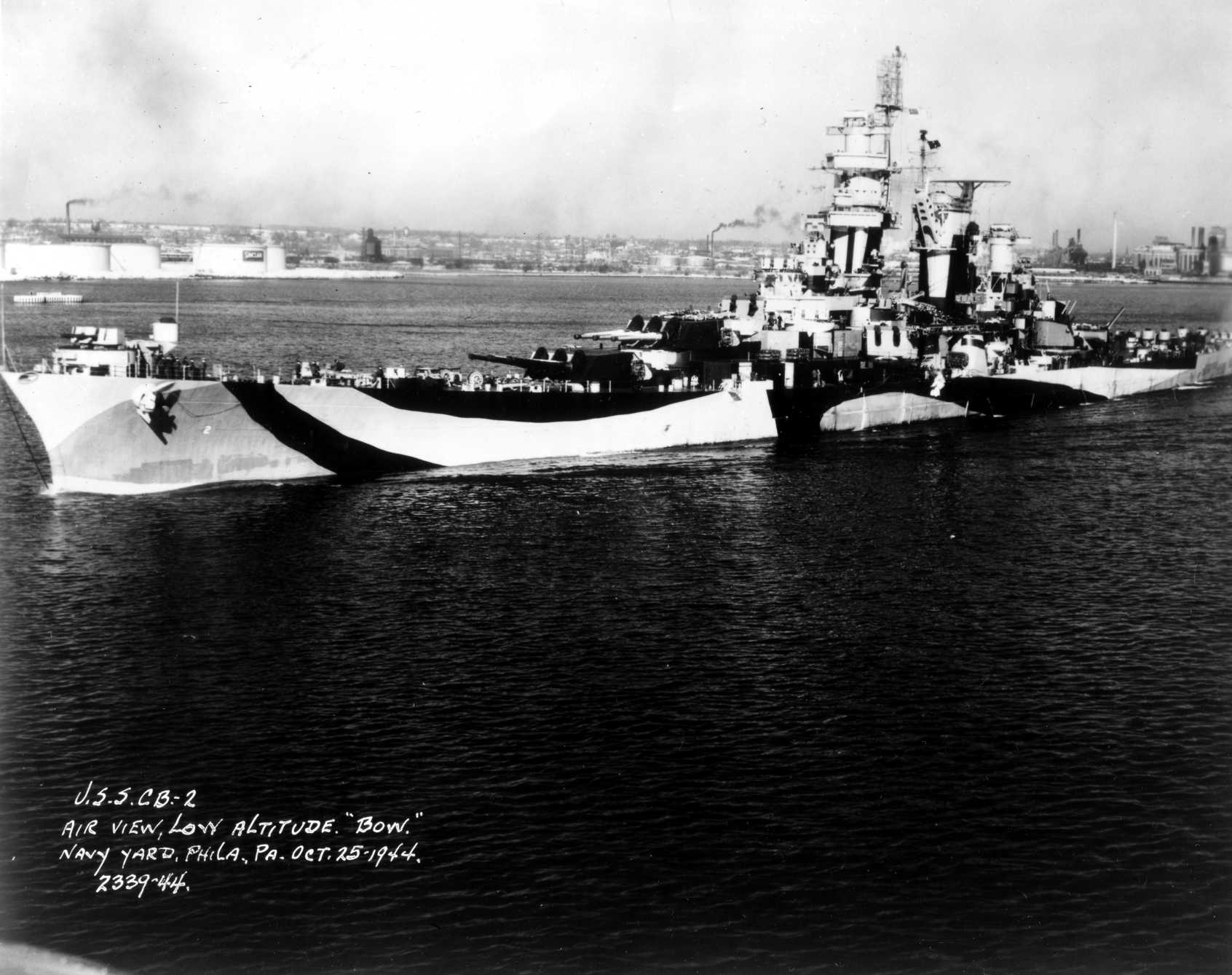
Alaska was laid down in December 1941 shortly after Pearl Harbor, launched 15 August 1943 and commissioned on 17 June 1944. Her sister ship, Guam was launched on 12 November 1943 and commissioned 17 September 1944.  The final ship of the class to be built the Hawaii was launched after the war in November 1945 with her construction halted when she was 84% complete in 1947. Three planned ships, the Philippines, Puerto Rico and Samoa were never laid down.

Aerial View of USS Alaska

While fast and large with more than adequate firepower the purpose that they created for no longer existed by the time that they were commissioned.  The German Scharnhorst had been sunk by a 12 ship British task force led by the HMS Duke of York on December 26th 1943 after mounting an attack on a Murmansk convoy at the Battle of North Cape.  Her sister Gneisenau had been heavily damaged in the “channel dash” and bombing in Kiel and while being refitted had the work discontinued after the sinking of the Scharnhorst.

The USS Guam in 1945

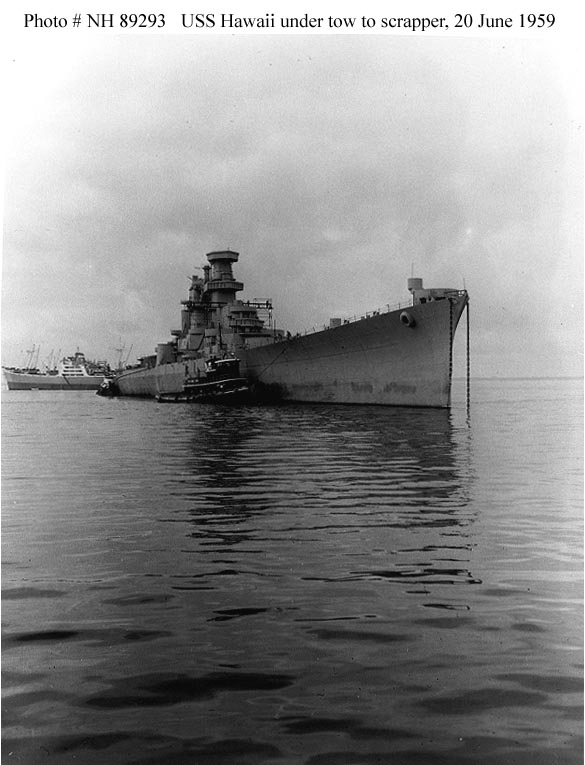
With their natural opponents no longer a factor in the war the Alaska and Guam were sent to the Pacific where they spent their time escorting fast carrier task forces, conducting naval gunfire support missions off Okinawa and conducting sweeps in Japanese waters as part of the initial blockade of Japan.  Following the war Alaska and Guam were active in Operation Magic Carpet the return of US servicemen from the Far East to the United States. Alaska and Guam decommissioned in February 1947 remaining in reserve until stricken from the Naval List and Alaska was scrapped in 1960 with Guam being scrapped in 1961 each having spent slightly over two years each in active service.   The fate of Hawaii would be debated including plans to complete her as the first guided missile cruiser (CG) and later Command Cruiser (CC).  Neither plan for Hawaii’s conversion and completion came to fruition and she was sold for scrap in 1959.

Incomplete and undervalued the Hawaii being towed to the breakers in 1959

The era of the Battle Cruiser which began with the launching of the HMS Invincible in 1907 and culminated in with launching of the HMS Hood ended with the Alaska Class. In a way it was an ignominious ending with practically unused ships being broken up when they would have been ideally suited for conversion to new missions.

In light of the need for a combination of substantial naval gunfire support on a platform large enough to support the latest air defense and, theater air defense and independent operations with substantial protection it seems to me that a new class of Battle Cruisers, in effect a new Alaska Class would be in order.  tried and true 8″, 12″ or 16″ guns Nuclear powered with the latest in Aegis missile defense systems and their own air group  they would be the most v versatile platform that the Navy has had in decades.

Peace

Steve+

26 Comments

Filed under History, Military, Navy Ships, world war two in europe, world war two in the pacific

I Miss the Music of the 70’s and 80’s

The Abbess and I in 1980 at Cal State Northridge

Note: Many of the links on this page are now dead. I have done a new article about this which is linked here: 

Spendin’ the Nighttime Reminiscing: Padre Steve Remembers the Music of the 1970s and Early 1980s

If you like this post please see the sequel:  More about Why I Miss the Music of the 70’s and 80’s unfortunately many of the links are dead on this one too, but the article is interesting.

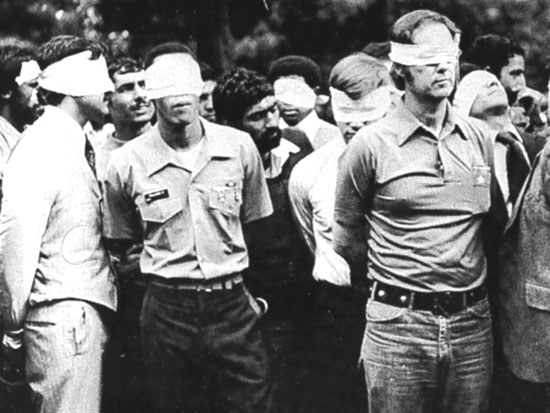
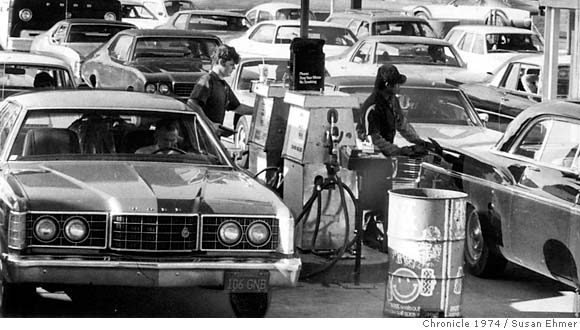
I don’t know about you but the music that I really enjoy is the music that was popular when I was in Junior High, High School and College.  For that period spanned the years 1971-1983.  For those of that were alive back then it was a turbulent era, Vietnam was ending, Nixon was resigning due to the Watergate break in cover-up, assassination attempts both successful and unsuccessful were common, two attempts on Gerald Ford, Aldo Moro of Italy and Anwar Sadat of Egypt fell to terrorists and both Ronald Reagan and Pope John Paul II were felled by bullets which did not prove fatal. The Cold War was tense, the Middle East a mess, and the economy…well kind of like now in a lot of ways.  There was a major recession the auto industry needed bailouts, inflation was running in double digits as was the unemployment rate, the dollar was weak and OPEC wreaked havoc on world oil markets. Jimmy Carter was ridiculed worldwide for his “malaise” speech and the Iranian revolution led by the Ayatollah Khomeini swept into power and with it the seizure of the US Embassy and the 444 day hostage crisis punctuated by a failed rescue attempt demoralized the United States.

The 444 Day Iranian Hostage Crisis Helped End the Carter Presidency

The Soviets invaded Afghanistan which became their Vietnam.  In Lebanon 247 Marines were killed in the bombing of their barracks, Cubans were fighting in Angola and well. Terrorist groups killed Israeli athletes at the Munich Olympics and the Red Brigades, the Bader Meinhof gang, the Weather Underground and the Irish Republican Army provided a constant string of terrorist attacks even as Middle Eastern terrorist groups highjacked airliners in daring fashion, matched at times by equally rescues by Israeli and German anti-terrorist units. As you can imagine there was a lot to be down about.

Gas Lines 1974

However with the passing of the 60’s the music of the 1970s and early 1980s provided a diversion for many people looking for respite from all the bad news that echoed around the airwaves and in the newspapers.  Thankfully there wasn’t a 24 hour cable news cycle yet and had there been people would have probably been jumping off of buildings.  As for me I had countless 45s and LPs of my favorite groups and artists, Doctor Donald D Rose of KFRC in San Fransisco was my favorite DJ and my car had a retro-fitted 8-Track tape player.

Today while much of the population gathered around TVs to watch NFL Wild Card playoff games, I needed some peace, so I started putting music DVDs on as the Abbess and I worked about the house.  First was Blondie’s Greatest Hits and Abba Gold followed by the Eagle’s Farewell Tour I concert album.

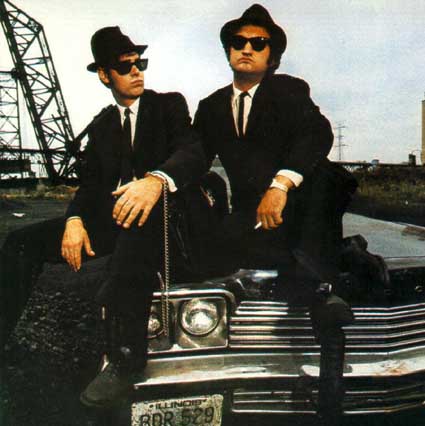
Great groups and artists ruled the pop and rock airwaves and save for the disaster known as disco the 70’s and early 80’s produced some of the more memorable music of a generation.  It was not “message music” like much of the music in the 60’s but focused on entertainment.  Power groups like Journey, Starship, REO Speedwagon and Boston made power ballads, while AC/DC and KISS shocked and entertained at the same time.  Groups like the Blondie, the Eagles, Chicago, Paul McCartney and Wings, Abba and the Commodores dominated the pop charts while individual artists such as Olivia Newton-John, Elton John, Carly Simon, John Denver, Lionel Ritchie, Barry Manilow and others satisfied the more mainstream pop crown.  R&B enjoyed a renaissance due to the unlikely duo of the Blues Brothers who helped re-launch the careers of Aretha Franklin, Johnny Lee Hooker, Cab Calloway and a host of others.  As the 80’s came along new groups and styles were introduced including New Wave and Rap. It was music that helped us through those times.

As I listened and watched I mentioned to the Abbess that I missed those times.  It certainly wasn’t the fact that things were great in the world, but despite all of what was going on there was still some sense of that things would work out okay.  Music helped provide part of that sense of hope, even disco as much as I would hate to admit that. It was an escape and the music of that time is still with us, somehow those groups haven’t gone away and people look back with fondness to the music of the era.

Here are some of my favorites with links to the videos, they are in no particular order nor are the representative of all the groups that I have in my library of CDs and DVDs, but I enjoy the heck out of them.  Have fun and enjoy.

Peace,

Padre Steve+
The Eagles “Take it Easy”

http://www.youtube.com/watch?v=ScG0ilS0dgI

“Heartache Tonight”

http://www.youtube.com/watch?v=nvJqdudx8cg

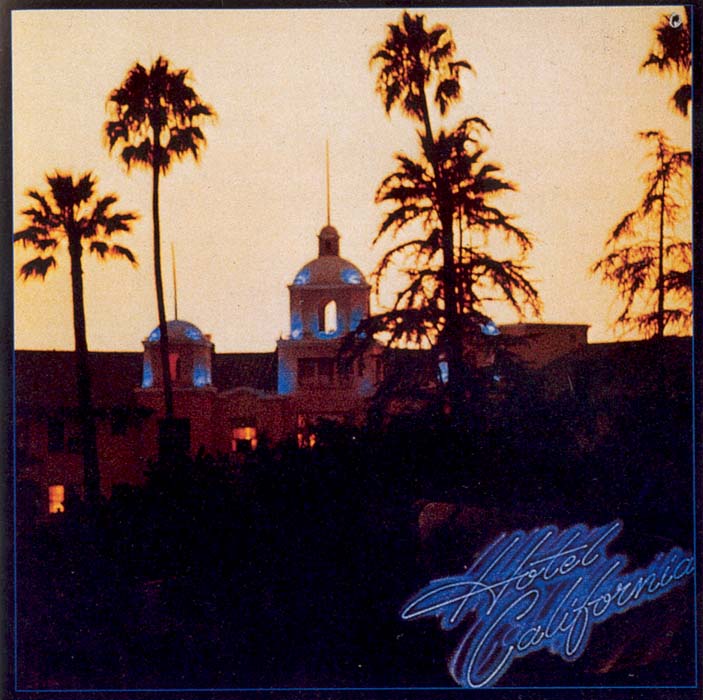
and “Hotel California”

http://www.youtube.com/watch?v=FbjKMobts5U


Olivia Newton-John “Magic”

http://www.youtube.com/watch?v=r7WPwH8Rd6g

and “I Honestly Love You”

http://www.youtube.com/watch?v=6zGLSnZGZts

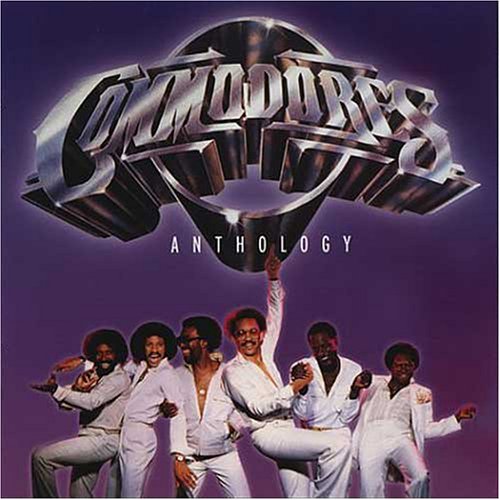
The Commodores “Sail On”


http://www.youtube.com/watch?v=zg-ivWxy5KE

Rod Stewart “Tonight’s the Night”

http://www.dailymotion.com/video/x1p96h_rod-stewarttonights-the-nightgonna_music


Dr Hook and the Medicine Show “On the Cover of the Rolling Stone”

http://www.youtube.com/watch?v=0-XzGOZHYdA&feature=PlayList&p=AF906570E242A626&index=1

and “Sharing the Night Together”

http://www.youtube.com/watch?v=ECyAATeNH3E


Abba “Waterloo”

http://www.youtube.com/watch?v=wGs7dTjUsXw

and The Winner Takes it All

http://www.youtube.com/watch?v=92cwKCU8Z5c


Fleetwood Mac “Don’t Stop Thinking About Tomorrow”

http://www.youtube.com/watch?v=a8arvEzHsA8


Journey “Don’t Stop Believing”

http://www.youtube.com/watch?v=CNB1EUJg1-w


Laura Branigan “Gloria”

http://www.youtube.com/watch?v=1tVutw8rjFk


Bonnie Tyler “Total Eclipse of the Heart”

http://www.youtube.com/watch?v=840B27zYfOk&feature=related

Carly Simon “You’re So Vain”

http://www.youtube.com/watch?v=mQZmCJUSC6g


Blondie “Dreaming”

http://www.youtube.com/watch?v=yIjxGKLTADE

“Rapture”

http://www.youtube.com/watch?v=xHPikUPlRD8&feature=PlayList&p=F2ED8F30DB2943CD&index=1

and “Island of Lost Souls”

http://www.youtube.com/watch?v=wEpPjBG4CJY


Chicago “Saturday in the Park”

http://www.youtube.com/watch?v=nWxA3e9f6rY

Linda Ronstadt “When Will I Be Loved”

http://www.youtube.com/watch?v=OmE7tTzJkbU


Air Supply “Making Love Out of Nothing at All”

http://www.youtube.com/watch?v=6lE6Htee0sA

Foghat “Third Time Lucky”

http://www.youtube.com/watch?v=Fj1O2KtH4kE


Elton John “Bennie and the Jets”

http://www.youtube.com/watch?v=j0WCQadt864

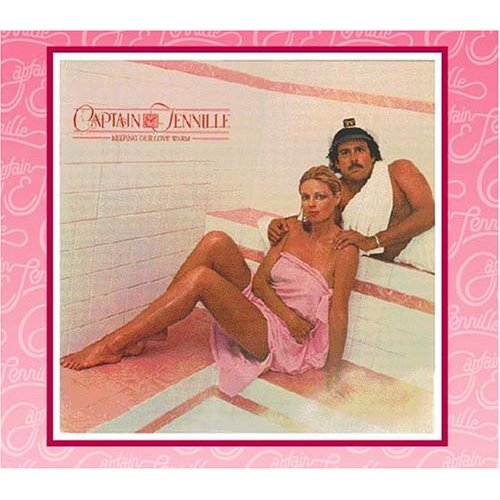
The Captain and Tennille “Do that to Me One More Time”

http://www.youtube.com/watch?v=KNHcgk5bf7o&feature=related

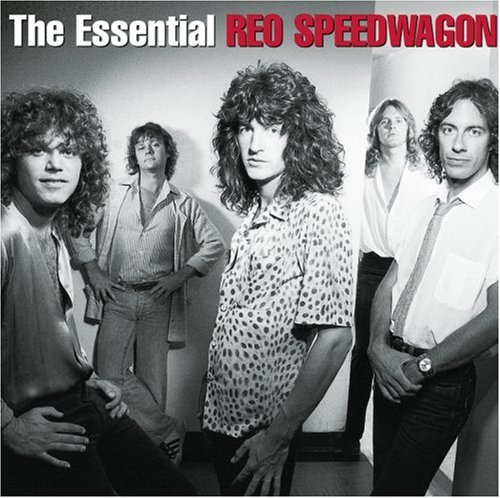
REO Speedwagon “Keep on Loving You”

http://www.youtube.com/watch?v=u-mw1HGJjdA&feature=related

Joan Jett and the Blackhearts “I Love Rock and Roll”

http://www.youtube.com/watch?v=0SOJxNOP37I

Starship “Nothing’s Gonna Stop Us Now”

http://www.youtube.com/watch?v=5PP1HEFlkdY

and “We  Built this City”

http://www.youtube.com/watch?v=7flrwE-bZVo

Finally, the Blues Brothers “Everybody Needs Somebody”

http://www.mojvideo.com/video-the-blues-brothers-everybody-needs-somebody-to-love/ac0b631b54ff095fd5c0

14 Comments

Filed under History, music

Learning to Apply the Principles of Counterinsurgency Part One: Introduction to the Soviet-Afghan War

Soviets Enter Afghanistan

Note: This is the First Part of a Series which I will be writing on Afghanistan and Counterinsurgency strategy in that country. Part of this will be a review of various historical materials especially from Russian sources as well as analysis of the Afghan insurgency and its foreign supporters including Al Qaeda. I have written a number of other articles on the Afghan War and associated topics.  Links are provided at the end of this article.

Counterinsurgency is not just thinking man’s warfare—it is the graduate level of war. Special Forces Officer in Iraq, 2005

“Protracted conflicts favor insurgents, and no approach makes better use of that asymmetry than the protracted popular war. The Chinese Communists used this approach to conquer China after World War II. The North Vietnamese and Algerians adapted it to fit their respective situations. And some Al Qaeda leaders suggest it in their writings today. This approach is complex; few contemporary insurgent movements apply its full program, although many apply parts of it. It is, therefore, of more than just historical interest. Knowledge of it can be a powerful aid to understanding some insurgent movements.”[i]

Introduction

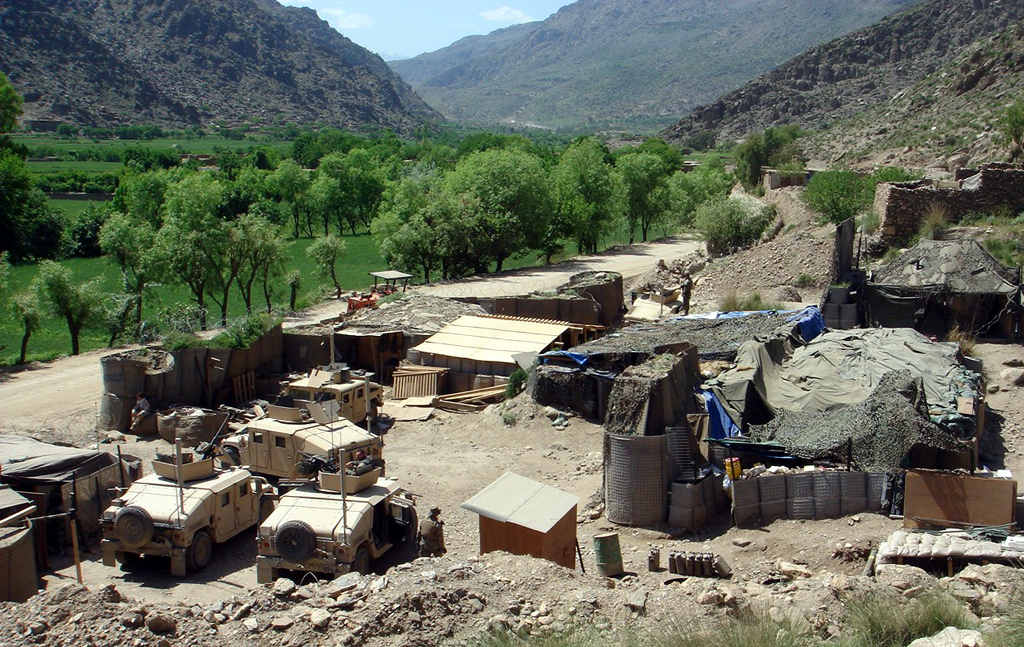
US Training Team Base

The United States has entered its 9th year of military involvement in Afghanistan following the October 2001 invasion that came as a response to the attacks on the World Trade Center and Pentagon of September 11th 2001.  In that time the United States, its NATO allies and the United Nations have endeavored to bring stability as well as a more democratic and accountable government to the country in the face of resistance from various political, religious and tribal groups with a diverse and sometimes conflicting agendas.  The foremost of these resistance groups was and is the Taliban which arose during the Soviet occupation of the country and eventually took power after winning a civil war against a number of other Mujahidin groups.   As the United States diverted force and focused its efforts on Iraq’s insurgency the Taliban using bases in remote areas along the Pakistani border and monetary and political support from Moslem groups with similar goals rehabilitated and reorganized its forces and began the process of regaining influence in Afghanistan.  By 2008 it was apparent that the situation had reached a crisis point.  The vast majority of Afghans as well as many in the international community came to view the Karzai government as corrupt, weak and unpopular.  The Taliban and other groups began to work more closely together despite differing agendas and the political and military situation deteriorated to the point that the incoming Obama administration appointed a new commander, General Stanley McChrystal to evaluate the situation and based on his recommendations and those of General David Petreus, Secretary of Defense Robert Gates and others announced a “surge” to try to regain the initiative in the country.  That troop buildup is currently underway. By the time it reaches its maximum the United States will have approximately 100, 000 troops in Afghanistan and the NATO and ISAF allies approximately another 38,000.  These are supporting and training the Afghan National Army and Police which number approximately 97,000 in the Army and another 98,000 in the National Police.  The Afghan forces have not proven to be reliable and have been infiltrated by Taliban and Al Qaeda members and the NATO and ISAF allies are often limited in the scope of their mission and have restrictive rules of engagement.  Thus the bulk of the fight rests on the United States and some allies with more robust rules of engagement such as Canada, Britain and France.  The lack of internal credibility of the Afghan Government, the weakness of its army and security forces coupled with the numerical weakness of US and ISAF forces has given the various indigenous insurgent groups, especially the Taliban to make a comeback that threatens the mission.  General McChrystal noted:

“The situation in Afghanistan is serious; neither success nor failure can be taken for granted. Although considerable effort and sacrifice have resulted in some progress, many indicators suggest the overall situation is deteriorating. We face not only a resilient and growing insurgency; there is also a crisis of confidence among Afghans—in both their government and the international community—that undermines our credibility and emboldens the insurgents. Further, a perception that our resolve is uncertain makes Afghans reluctant to align with us against the insurgents.”[ii]

Taliban Insurgents

The situation is such in Afghanistan that many Americans are struggling how the “good war” could go “bad.”  Many armchair strategists, many political and media figures and even some in the military fail to understand the nature of Counterinsurgency and its complexity as opposed to conventional warfare. In fact many of these assume that the simple application of combat force using conventional tactics is the cure for the situation, however history shows that such is not the case especially in Afghanistan.

This introduction to this study will focus on some commonalities of the Soviet and American experiences in Afghanistan.

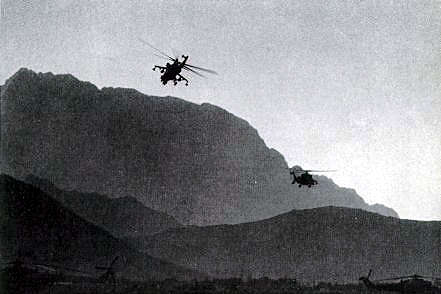
Soviet Mi-24s

The Soviets invaded Afghanistan in 1979 they used their 40th Army which initially was composed of “two motorized rifle divisions, an airborne division, an air assault brigade and separate motorized rifle regiments.”[iii] These forces totaled about 52,000 troops and were “considered sufficient to guarantee the viability of Afghanistan.”[iv] The 40th Army was a standard Cold War Soviet Combined Arms Army designed for high tempo conventional operations.  It was not designed for nor trained in counterinsurgency operations or what the Soviets and Russians class as “anti-guerilla operations.” It was poorly suited to mountain and dessert combat and at the beginning “not only had no practical skills in the conduct of counter-guerilla warfare, they also did not have a single well-developed theoretical manual, regulation or tactical guideline for fighting such a war.”[v]

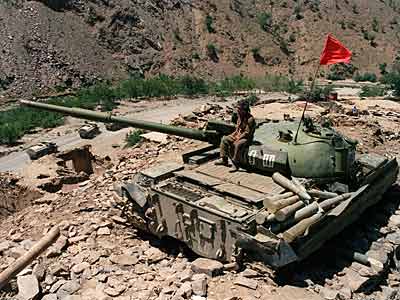
Soviet Tank Guarding Convoy

The Soviets did not expect to be involved in combat operations and the Afghan population reacted to their presence with resistance which spread across the country both against their own government which they viewed as a puppet of the Soviets but also against the Soviet Forces.  As time went on the Soviets attempted to use raids and large scale operations to attempt to bring Mujahidin forces to battle, however the insurgents were very skillful and the Soviets attempted to increase the training of their forces as well as their numbers.  By 1986 the numbers on the ground had increased to 108,000 personnel in four divisions, five separate brigades, four separate regiments and six separate battalions.[vi] In the nearly 10 years of operations over a half million Soviet soldiers and support personnel served in Afghanistan. Tours for enlisted personnel who were primarily conscripts served 12-18 months in country and officers 2 years.  Few returned for subsequent tours meaning that the 40th Army had few personnel very familiar with the country, its people and the challenges faced by Soviet forces.  According to official sources the 40th Army suffered 13,833 killed in action or died of wounds, 49,985 wounded and 311 missing in action a figured of 1 in 8 Soviet Soldiers being casualties.  14.3 percent of the casualties were officers.[vii] Of course the official figure is doubted many believing the number killed in action or died of wounds to be closer to 26,000.[viii]

Soviet Troops Preparing to Leave Afghanistan 1989

The Soviet Forces supported the Army of the Democratic Republic of Afghanistan which numbered at their peak on average between 120,000-150,000 soldiers.[ix] The Afghan forces, then as now were at the mercy of tribal, familial and communist party affiliations. Over 70 percent of the DRA was conscripted, desertions averaged 1,500 to 2,000 soldiers a month and units were usually optimistically 25-40 percent under their TO&E strength.[x] Limitations on training and leadership meant that typically DRA units could not conduct large scale missions without Soviet help. As such most of the fighting was done by Soviet formations.

Many of these problems have plagued the United States and ISAF throughout the first 8 years of the current Afghan War.  As General McChrystal has noted in his assessment “ISAF is a conventional force that is poorly configured for COIN, inexperienced in local languages and culture, and struggling with the challenges inherent to coalition warfare. These intrinsic disadvantages are exacerbated by our current culture and how we operate.”[xi]

End of part one to be continued…

Links:

Lessons on Coalition Warfare: The Dysfunctional Coalition German and the Axis Partners on the Eastern Front

The Afghan War 2009-2012: Lessons from Algeria 1954-1960 A Review of “A Savage War of Peace

Unequal Allies: Lessons from The German’s and Their Allies on the Eastern Front for Today

The Effects of Counter-Insurgency Operations on U.S. and French Forces in Vietnam and Algeria and Implications for Afghanistan

Brothers to the End…the Bond between those Who Serve Together in Unpopular Wars


[i] ______________ “The Army/Marine Corps Counterinsurgency Manual FM 3-24 MCWP 3-33.5,” HQ Department of the Army and HQ Marine Corps Combat Development Command, Washington DC 2006.  p. 1-6

[ii] MCChrystal, Stanley. “Commander’s Initial Assessment Commander International Security Assistance Force Afghanistan” dated 30 August 2009 p. 1-1

[iii] The Russian General Staff. The Soviet Afghan War: How a Superpower Fought and Lost” translated and edited by Lester A. Grau and Michael A. Gress, University Press of Kansas, Lawrence KS 2002 p.17.

[iv] Ibid. p.18

[v] Ibid. p.43

[vi] Ibid. p.28

[vii] Ibid. p.309

[viii] Ibid. p.xix

[ix] Ibid. p.48

[x] Ibid. pp.48-51

[xi] McChrystal. p.1-2

1 Comment

Filed under counterinsurency in afghanistan, History, iraq,afghanistan, Military

The American Civil War and the Origins of Modern Warfare

Hagerman, Edward. The American Civil War and the Origins of Modern Warfare. Midland Book Editions, Indiana University Press. Bloomington IN. 1992

Pickett’s Charge Displayed the Futility of Napoleonic Tactics Against Modern Weaponry

Edward Hagerman postulates in The American Civil War and the Origins of Modern Warfare that the American Civil War is the first modern war. He examines developments in tactics, logistics and the concept of total war and looks specifically how tactical and strategic thought impacted the war.  Specifically Hagerman examines how Henri Jomini’s interpretation of Napoleonic warfare and the theories of Dennis Hart Mahan and Henry Halleck which were the prevalent military thought in America were challenged by advances in weaponry and the vastness of the American continent.  He surveys how the Union and Confederate armies learned the value and application of field fortifications and the limitations of artillery in the offense.  Even more importantly Hagerman argues how logistics influenced campaigning on the American continent as opposed to earlier European wars. Likewise he examines how the 20th Century concept of total war found its first application in the campaigns of General Sherman and how Robert E. Lee’s use of defensive maneuver and fortifications in positional warfare heralded a new era in warfare.

Dennis Hart Mahan’s Book: The First American Book on Military Theory

Hagerman examines how these factors influence and affected the Union and Confederate armies.  His initial focus is the tactical conundrum posed by the advances weaponry particularly the rifled musket to the Napoleonic tactics that both armies began the war. Napoleonic tactics were developed at a time when the maximum effective range of muskets was barely 100 meters and how despite the increase in range and accuracy that came with the rifled musket how tactical formations and tactics were slow to change.

Hagerman spends the first part of his book examining how the ante-bellum US Army leadership was influenced by the theories of Henri Jomini. He discusses the challenge to Jominian orthodoxy by Dennis Hart Mahan, who modified “the current orthodoxy by rejecting its central tenants-primarily offensive assault tactics.”[i] He examines the tension in American military thought between the conservative Jominian thinking which predominated much of the Army, noting that within the army “Mahan’s decrees failed to win universal applause.”[ii] However, Mahan influenced many future leaders of both the Union and Confederate armies in his “Napoleon Club” a military round table at West Point.[iii] Hagerman notes that Mahan’s greatest contributions were his development of the active defense and emphasis on victory through maneuver. Unlike Jomini, who thought maneuver as risky with the purpose of the “defeat of the enemy’s army,” Mahan emphasized “maneuver to occupy the enemy’s territory or strategic points.”[iv] In the book Hagerman wrestles with disjointed developments in infantry, artillery and cavalry tactics of the ante-bellum Army which and surmises that “Military thinking, and even more strategic organization, remained essentially within the Napoleonic tradition filtered through an eighteenth-century world view….” He asserts that “A broader vision was necessary to pose an alternative to the mechanistic program.”[v]

The 2nd Michigan Regiment: Most Civil War Units on both sides were State Regiments

Hagerman then discusses wartime developments in strategy, tactics and organization as they developed in both the Eastern and Western theaters.  He focuses on the themes of organization, logistics, communications, weaponry, field fortifications and maneuver. In each chapter he weaves these themes to show how they affected campaigns or were modified during the war based on experience.  He deals with leadership, but mostly in the context of how leaders responded to challenges posed in these arenas.  Of particular interest to him are the early efforts of successive commanders of the Army of the Potomac including McClellan, Burnside and Hooker to deal with these problems as well as the responses of Grant, Sherman and Rosecrans in the West to the same issues.

Hagerman’s discussion of army organization focuses on how each army developed sociologically as well as professionally prior to and during the war. He examines the ways that commanders educated at West Point initially dealt with large armies made up of militia units and volunteers and how these armies would be changed by the war.  He includes in the discussion i the institution of the draft in both the North and South.  His discussion of how McClellan successful fought the break-up of the Regular Army keeping it separate from the militia units organized by the States was important to development of the Army. He notes their importance and points out the problems of the militia units raised by the various states particularly in the early part of the war.

The Integration of Sea and Land Logistics Systems in the Civil War Revolutionized the Way that Modern War is Supplied

More significant to Hagerman’s narrative is his emphasis on logistics, and how each Army responded to the challenges of supplying their armies in the field.  Hagerman examines how the ante-bellum Army developed its logistic doctrine from the Napoleonic examples and how that doctrine had to be modified in light of the American reality of a less developed continent with far greater distances involved.

Hagerman’s discussion of logistics is quite detailed.  He examines topics such as the number of wagons per regiment and how army commanders, modified that number at various points during the war based on their situation. He discusses the development of the “flying column” as a response to the dependency on wagons and basic load of food and ammunition carried by each soldier in order to increase strategic maneuverability.  He details the forage requirements for people and animals in each theater of operations and how each army responded to requirement of living off the land for much of their forage requirements and their relative successes and failures in supplying their soldiers in this fashion.

Railways Meant the Ability to Move Troops and Supplies Great Distances very Quickly

Hagenman discusses the use of railroads and the use of naval forces to both assist the ground forces and to move supplies and troops.  In each of these areas he provides a detailed examination of the effect of logistical considerations on each army.  He notes that of all the areas of development that the Army of the Potomac was successful at putting logistic theory into practice. By late 1863 the Army of the Potomac demonstrated “the close integration of operational planning and that of the general in chief and supply bureaus. In this one area, the development of a mature and modern staff was evident.”[vi]

Hagerman’s discussion of the development of communications in both armies focuses on the fact that the size of the armies and the distances involved on the battlefield made command and control difficult.  As such each army experimented with signals organizations that used tradition visual signals and couriers but began to rely on the telegraph for rapid communications.  He deals with the conflict in the North between the Signal Corps and the Military Telegraph Service.  He discusses the use of wire telegraph equipment and the new Beardslee wireless telegraphs by the Signal Corps and how the Army eventually favored the traditional wire bound networks operated by the Military Telegraph.  Though the Army rejected the Beardslee equipment some commanders requested it for their operations.[vii] As they became more dependent on such communications armies feared that their signals could be compromised through wire tapping and made efforts to encode transmissions.

Signal Corps Soldiers and Wire Communications

Hagerman’s discusses the evolution of the Union and Confederate armies use of field fortifications including their use in offensive campaigns.  He discusses their use by McClellan on the Peninsula in 1861 and Lee’s sporadic use of them[viii] until 1864 beginning in the Wilderness campaign and culminating in the defense and siege of Petersburg.  Hagerman’s thesis is that the developments in field works and firepower gave the advantage to the defense when armies made the frontal attacks which were at the heart of Jominian theory.  He notes how various commanders including Grant failed at Shiloh and Lee at Antietam failed to dig in, but how both the Union and Confederate armies learned to dig hasty field works as a matter of course.[ix]

Both sides also learned to use maneuver in combination with positional warfare to force the enemy to battle. Hagerman examines the campaigns in the West of Grant, Sherman and Rosecrans, particularly Stone’s River, the Vicksburg Campaign, and the campaign in middle Tennessee.[x] The last two chapters mention these issues in the context of the 1864-65 campaign around Richmond and Sherman’s campaigns in Georgia and the Carolinas.  Of particular note is how Sherman’s forces routinely entrenched on the offensive[xi] and how Confederate forces under Joseph Johnston employed entrenchments on the defensive. Hagerman notes how Confederate Cavalry “perhaps best displayed the growing intensity of trench warfare” noting General Joe Wheeler’s use of them at the close of the war.[xii]

Massive Siege Mortar outside Petersburg

A sidebar to Hagerman’s discussion of fortification is his examination of the Corps of Engineers.  He discusses the development of Engineering or Pioneer units from nothing in 1861 to organized units by the middle of the war.  He examines the problems of the Engineering Corps in adjusting to the war. He notes its dispersion among the line and its civil duties as impediments to responding to the needs of war and both the hesitancy and resistance to creating engineering units by Congress, despite the pleas of McClellan and Lincoln.[xiii] He then looks at the institutional irony of the how newly organized engineer units had few West Point trained Corps of Engineers officers, but were primarily staffed and commanded by officers detailed from the line. The effect was a “decline in the antebellum definition of professionalism embodied in the Corps of Engineers.”[xiv]

Engineering Units were Built from Scratch and Accomplished Many Feats

Petersburg Fortifications a Harbinger of World War One

Hagerman’s last two chapters focus on the developments in the strategies of attrition and exhaustion in relation to positional and maneuver warfare.  He examines how this was by Grant in Virginia and Sherman in Georgia and the Carolinas.  He discusses the “ascendancy of positional warfare” which allowed Lee to hold out and force Grant into winter quarters at Petersburg.[xv] This demonstrated that “an army fighting on interior lines, even under nearly overwhelming conditions of deprivation and against vastly superior numbers, could sustain a prolonged existence by use of field fortification and defensive maneuver.”[xvi] Sherman’s campaign demonstrated how an army could exploit “diversion, dispersion, and surprise to successfully pursue a modern total-war strategy of exhaustion against the enemy’s resources, communications and will.”[xvii]

Sherman’s March to the Sea

Hagerman’s book is particularly strong in the discussion of tactical developments and logistics and how those were developed over the course of the war.  It is strong because it allows the serious student to trace the developments in each of the areas he examines to future wars fought by the US Army.  Russell Weigley picks up the effect of what Hagerman describes in his books The American Way of War discussing both Grant’s strategy of annihilation and its costs, and in Sherman’s campaign against Johnston and attack upon Southern resources.[xviii] His discussion of tactics reflects that of J.F.C. Fuller notes that “the tactics of this war were not discovered through reflection, but through trial and error.”[xix] The events described by Hagerman, especially the campaigns of Grant and Sherman influence modern strategy including that of the Marine Corps which discusses maneuver and attrition warfare continuum in MCDP 1 Warfighting.[xx] Hagerman’s work is best at helping tie the elements of war often ignored by other Civil War historians into a coherent whole that allows the reader to see the logical development of each of these elements in modern war.

Irregular Formations Such as Mosby’s Raiders Would Create Problems Behind Union Lines

Hagerman’s value to the literature is that he fills a void among many Civil War writers who often focus simply on the battles and campaigns and not arcane but important subjects such as transportation, logistics, communications and fortifications.  Hagerman makes an astute observation on how change comes to military organizations at the end of his discussion of the Corps of Engineers and the Army following the war.  He notes “that change in war requires time for digestion before lessons are converted-if they are converted-into theory and doctrine.” [xxi] In the light of the Pershing’s strategy in the First World War One, which revisited some of the worst mistakes of the Civil War one wonders if those lessons were ever fully digested by the Army. Such an observation can be made about our present war.  We need to ask if the lessons of previous insurgencies in conquered areas have been digested, even going back to the lessons of the Union Army operating in the hostile lands of the conquered Confederacy.[xxii] Likewise how an Army adjusts to developments in weaponry, technology and tactics are fair game when one analyzes past campaigns in relation to current wars.  Thus when we look at Hagerman it is important to use his work to understand the timeless aspects of military history, theory, doctrinal development, logistics, communications and experiential learning in war that are with us even today.


[i] Hagerman, Edward. The American Civil War and the Origins of Modern Warfare. Midland Book Editions, Indiana University Press. Bloomington IN. 1992. p.9

[ii] Ibid. p.13.

[iii] Hagerman also notes the contributions of Henry Halleck and his Elements of Military Art and Science published in 1846 (p.14) and his influence on many American Officers.  Weigley in his essay in Peter Paret’s Makers of Modern Strategy would disagree with Hagerman who notes that in Halleck’s own words that his work was a “compendium of contemporary ideas, with no attempt at originality.” (p.14) Weigley taking exception gives credit to Halleck for “his efforts to deal in his own book with particularly American military issues.” Paret, Peter editor. Makers of Modern Strategy: For Machiavelli to the Nuclear Age Princeton University Press, Princeton NJ 1986 p.416.

[iv] Ibid.

[v] Ibid. p.27.

[vi] Ibid. p.79.

[vii] Ibid. p.87.

[viii] The most notable use of them between the Peninsula campaign and the Wilderness was at Fredericksburg by Longstreet’s Corps. Many wonder why Lee failed to entrench at Antietam.

[ix] Fuller, J.F.C. Grant and Lee: A Study in Personality and Generalship, Indiana University Press, Bloomington IN 1957.  Fuller comments “Thus over a year of bitter fighting was necessary to open the eyes of both sides to the fact that the trench was a by product of the rifle bullet, and like so many by-products, as valuable as the product itself.” (p.269) He calls it “astonishing that Lee, an engineering officer, made no use of entrenchments at the battle of Antietam.” (pp.269-270)

[x] Ibid. pp. 198-219.

[xi] Ibid. p.295.  Hagerman comments how Sherman’s troops outside Atlanta began to entrench both the front and rear of their positions.

[xii] Ibid. p.297-298.

[xiii] Ibid. p.238.

[xiv] Ibid.

[xv] Ibid. p.272

[xvi] Ibid. p.274.

[xvii] Ibid. p.293.  B.H. Liddell-Hart in comparing the campaigns of Grant and Sherman makes an important note that Sherman’s strategy is more “suited to the psychology of a democracy…” and “ he who pays the piper calls the tune, and that strategists might be better paid in kind if they attuned their strategy, so far as rightly possible, to the popular ear.” Liddell-Hart, B.H. Strategy Faber and Faber Ltd, London 1954 and 1967, Signet Edition, The New American Library, New York 1974 p.132

[xviii] Weigley, Russell F. The American Way of War: A History of United States Military History and Policy University of Indiana Press, Bloomington IN, 1973. pp.145-146.

[xix] Ibid. Fuller. P.269  A similar comment might be made of most wars including the current Iraq war.

[xx] ___________. MCDP-1 Warfighting. United States Marine Corps, Washington D.C. 1997. pp. 36-39

[xxi] Ibid. Hagerman. P.239

[xxii] Ibid. Fuller. Fuller’s comments on the situation of the Northern Soldier are eerily similar to our current conflict in Iraq : “Consequently, minor tactics were definitely against the Northern soldier, because his major tactics demanded the offensive; for without the offensive the South could not be brought to heel.  It was the problem which had faced the French in LaVendee and in the Peninsula of Spain, which faced Napoleon in Russia, and the British in South Africa during the Boer War of 1899-1902. Not only was the Northern soldier, through force of circumstances, compelled to fight in the enemy’s country, but he was compelled to devastate it as well as conquer it, in order to protect himself against the bands of irregular troops which were here, there and everywhere.” pp.247-248

Bibliography

Fuller, J.F.C. Grant and Lee: A Study in Personality and Generalship, Indiana University Press, Bloomington IN 1957

Hagerman, Edward. The American Civil War and the Origins of Modern Warfare. Midland Book Editions, Indiana University Press. Bloomington IN. 1992

Liddell-Hart, B.H. Strategy Faber and Faber Ltd, London 1954 and 1967, Signet Edition, The New American Library, New York 1974

Paret, Peter editor. Makers of Modern Strategy: For Machiavelli to the Nuclear Age Princeton University Press, Princeton NJ 1986

Weigley, Russell F. The American Way of War: A History of United States Military History and Policy University of Indiana Press, Bloomington IN, 1973

___________. MCDP-1 Warfighting. United States Marine Corps, Washington D.C. 1997

1 Comment

Filed under History, Military