Category Archives: History

 “Sound the loud timbrel o’er Egypt’s dark sea, Jehovah hath triumphed, his people are free.” The Emancipation Proclamation

Friends of Padre Steve’s World

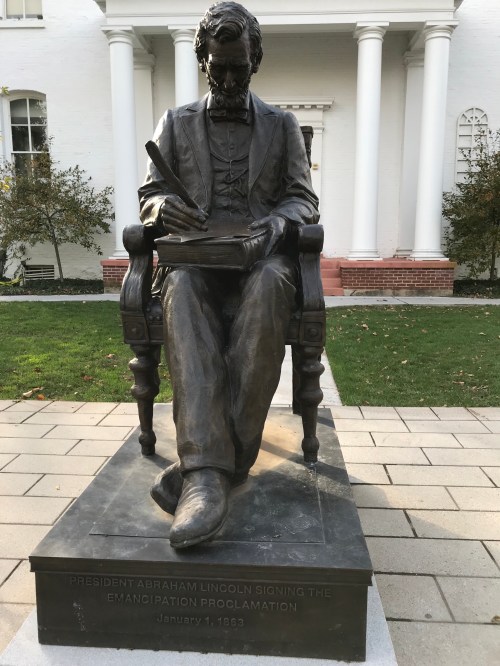
Today is the 156th  anniversary of the Emancipation Proclamation. The proclamation made by Abraham Lincoln when the outcome of the rebellion of the Southern slave states against the Union was still up in the air was a watershed for civil rights in the United States. Though it was a military order that only affected slaves in the rebellious states, it also set the stage for the 13th, 14th, and 15th Amendments and other legal rulings that affected not only African Americans and former slaves, but also Native Americans, Women, other racial minorities and LGBTQ people. It is something that in our era when so many civil rights are under threat that we must remember and continue to fight for in the coming years. Freedom is never free.

As you read this compare the words of Lincoln with those of his Copperheads, or Peace Democrat opponents it would seem that the modern Republicans led by President Trump, have become the new day Copperheads, a party of White Supremacy, willing to destroy the country in order to do so. Thus the fight goes on.

This article is a part of my hopefully soon to be published book “Mine Eyes Have Seen the Glory!” Race, Religion, Ideology, and Politics in the civil War Era. 

Peace

Padre Steve+

From the beginning of the war many Northerners, especially abolitionists and radical Republicans believed that “as the “cornerstone” of the confederacy (the oft-cited description by the South’s vice-president, Alexander H. Stephens) slavery must become a military target.” [1]When some Union generals made their own attempts at issuing emancipation orders, Lincoln countermanded them for exceeding their authority. Lincoln resisted the early calls of the abolitionists to make that a primary war goal for very practical reasons, he had to first ensure that the Border Slave States did not secede, something that would have certainly ensured that the Union would not survived. As a result in the first year of the war, Lincoln “maneuvered to hold Border South neutrals in the Union and to lure Union supporters from the Confederacy’s Middle South white belts. He succeeded on both scores. His double success with southern whites gave the Union greater manpower, a stronger economy, and a larger domain. These slave state resources boosted free labor states’ capacity to should the Union’s heavier Civil War burden.” [2] His success in doing this was instrumental in enabling him to turn to emancipation in 1862.

Finally, some twenty months after Fort Sumter fell and after nearly two years of unrelenting slaughter culminating in the bloody battle of Antietam, Abraham Lincoln published the Emancipation Proclamation. Emancipation was a tricky legal issue for Lincoln as “an executive order of emancipation would be beyond the powers of the president, but not, Lincoln concluded, if such an order were issued as furtherance of the executive’s war powers.” [3] Lincoln had desired to issue the order during the summer and sounded out elected officials and soldiers as to his plan.

Lincoln discussed his views with General George McClellan during a visit to the latter’s headquarters. McClellan stated his strident opposition to them in writing. McClellan did not admire slavery but he despised abolitionists and he wrote one of his political backers “Help me to dodge the nigger – we want nothing to do with him. I am fighting for the Union…. To gain that end we cannot afford to mix up the negro question.”  [4]

Lincoln then called border state Congressmen to sound them out on the subject on July 12th 1862 only to be met with opposition. Such opposition caused Lincoln “to give up trying to conciliate conservatives. From then on the president tilted toward the radical position, though this would not become publicly apparent for more than two months.” [5]

Lincoln’s cabinet met to discuss the proclamation on July 22nd 1862 and after some debate decided that it should be issued, although it was opposed by Postmaster General Montgomery Blair who believed that “the Democrats would capitalize on the unpopularity of such a measure in the border states and parts of the North to gain control of the House in the fall elections.” [6] Wisely, Lincoln heeded the advice of Secretary of State Seward to delay the announcement until military victories ensured that people did not see it as a measure of desperation. Seward noted: “I approve of the proclamation, but I question the expediency of its issue at this juncture. The depression of the public mind, consequent on our repeated reverses, is so great I fear…it may be viewed as the last measure of an exhausted government, a cry for help…our last shriek on the retreat.” Seward suggested that Lincoln wait “until the eagle of victory takes his flight,” and buoyed by military success, “hang your proclamation about his neck.” [7]

After the Battle of Antietam, President Lincoln issued the Preliminary Emancipation Proclamation. This document served as a warning to the leaders of the South, and insisted that there was much more at stake in their rebellion unless they surrendered; their slaves, the very “property” for which the seceded. The document “warned that unless the South laid down its arms by the end of 1862, he would emancipate the slaves.” [8] This was something that they could not and would not do, even as their cities burned and Confederacy collapsed around them in 1864.

The proclamation was a military order in which Lincoln ordered the emancipation of slaves located in the Rebel states and areas of those states occupied by Union troops. It was not designed to change law, which would have to wait until Lincoln felt he could have Congress amend the Constitution.  Instead of law it was “the doctrine of military necessity justified Lincoln’s action.” [9] The concept emanated from Boston lawyer William Whiting who argued “the laws of war “give the President full belligerent rights” as commander and chief to seize enemy property (in this case slaves) being used to wage war against the United States.” [10] There was a legitimate military necessity in the action as Confederate armies used slaves as teamsters, laborers, cooks, and other non-combatant roles to free up white soldiers for combat duty, and because slaves were an important part of the Southern war economy which could not function without them. The proclamation gave inspiration to many slaves throughout the South to desert to the Union cause or to labor less efficiently for their Confederate masters. A South Carolina planter wrote in 1865:

“the conduct of the Negro in the late crisis of our affairs has convinced me that we were all laboring under a delusion….I believed that these people were content, happy, and attached to their masters, But events and reflection have caused me to change these positions….If they were content, happy and attached to their masters, why did they desert him in the moment of need and flocked to the enemy, whom they did not know….” [11]

The proclamation authorized that freed blacks be recruited into the Federal army and it ensured that freed slaves would not again be surrendered back into slavery. As Montgomery Blair had warned Lincoln and the Republicans suffered sharp electoral reverses as “Democrats made opposition to emancipation the centerpiece of their campaign, warning that the North would be “Africanized” – inundated by freed slaves competing for jobs and seeking to marry white women.”  [12]

Lincoln’s response was to continue on despite the opposition and issue the Proclamation in spite of electoral reverses and political resistance. The vehemence of some Northern Democrats came close to matching that of white Southerners. The “white Southerner’s view of Lincoln as a despot, hell-bent on achieving some unnatural vision of “equality,” was shared by Northern Democrats, some of whom thought the president was now possessed by a “religious fanaticism.” [13] But Lincoln was not deterred and he understood “that he was sending the war and the country down a very different road than people thought they would go.” [14] He noted in December 1862:

“Fellow citizens, we cannot escape history….This fiery trial through which we pass, will light us down, in honor or dishonor, to the latest generation….In giving freedom to the slave, we assure freedom to the free – honorable alike in what we give, and what we preserve.”[15]

For Lincoln the Emancipation Proclamation was something that he believed was something that he had to do, and he believed that it would be the one thing that he did in life that would be remembered. He had long been convicted of the need for it, but timing mattered, even six months before it might have created a political backlash in the North which would have fractured support for the war effort, and in this case timing and how he made the proclamation mattered.

The Emancipation Proclamation had military, domestic political, and diplomatic implications, as well as moral implications for the conduct of the war.

 Soldiers of the 1st South Carolina (colored) Infantry announcing emancipation near Port Royal S.C on January 1st 1863 

The military implication would take some time to achieve but were twofold. First, Lincoln hoped that the Emancipation Proclamation would encourage former slaves, as well as already free blacks in the North to join the Union cause and enlist to serve in the Federal Army. The act would vest African Americans in the Union’s cause as little else could, and at the same time begin to choke-off the agricultural labor force that provided the backbone of the Confederate economy. Frederick Douglass eloquently made the case for African Americans to serve in July 1863, telling a crowd in Philadelphia:

 “Do not flatter yourself, my friends, that you are more important to the Government than the Government is to you. You stand but as a plank to the ship. This rebellion can be put down without your help. Slavery can be abolished by white men: but Liberty so won for the black man, while it may leave him an object of pity, can never make him an object of respect…. Young men of Philadelphia, you are without excuse. The hour has arrived, and your place is in the Union army. Remember that the musket – the United States musket with its bayonet of steel – is better than all the parchment guarantees of Liberty. In you hands the musket means Liberty…” [16] By the end of the war over 180,000 African American men would serve as volunteers in the United States Army.

                                                    Frederick Douglass
Politically the proclamation would the diplomatic purpose by isolating the Confederacy from European assistance. This it did, after the proclamation public sentiment, especially among Europe’s working classes turned solidly against the Confederacy. Domestically it would break-ground for the Thirteenth Amendment, which Lincoln, the pragmatic lawyer was needed to actually abolish slavery. Morally, it  would serve as the guarantee of The United States Government’s public, irrevocable pledge of freedom to African Americans if the North won the war.

Lincoln signed the order on January 1st 1863. As he got ready to sign the document he paused and put down the pen, speaking to Seward he said “I never, in my life, felt more certain that I was doing right, than I do now in signing this paper….If my name ever goes down in history it will be for signing this act, and my whole soul is in it.” [17] The opening paragraph read:

“That on the first day of January, in the year of our Lord one thousand eight hundred and sixty-three, all persons held as slaves within any State or designated part of a State, the people whereof shall then be in rebellion against the United States, shall be then, thenceforward, and forever free; and the Executive Government of the United States, including the military and naval authority thereof, will recognize and maintain the freedom of such persons, and will do no act or acts to repress such persons, or any of them, in any efforts they may make for their actual freedom.” [18]

At the ends of the proclamation he added the words suggested by his devoutly Christian Secretary of the Treasury Salmon Chase: “And upon this act, sincerely believed to be an act of justice, warranted by the Constitution, upon military necessity, I invoke the considerate judgment of mankind, and the gracious favor of Almighty God.” [19]

The response throughout the North was euphoric as celebrations took place throughout the North. In some cities one hundred gun salutes were fired. At Boston’s Tremont Temple people broke out singing a hymn “Sound the loud timbrel o’er Egypt’s dark sea, Jehovah hath triumphed, his people are free.” [20] The Boston Daily Evening Telegraph predicted, “Slavery from this hour ceases to be a political power in this country…such a righteous revolution as it inaugurates never goes backward.” [21]

Frederick Douglass wrote about his reactions to the Emancipation proclamation as he had nearly despaired wondering if the Lincoln administration would actually take up the fight for emancipation:

“The fourth of July was great, but the first of January, when we consider it in all of its relations and bearings in incomparably greater. The one we respect to the mere political birth to a nation, the last concerns national life and character, and is to determine whether that life and character shall be radiantly and glorious with all high and noble virtues, or infamously blackened, forevermore, with all the hell-darkened crimes and horrors which we attach to Slavery.” [22]

The proclamation was not all some had hoped for and it was certainly provoked a negative response in the South and among many Northern Democrats. Southerners accused Lincoln of inciting racial warfare and Jefferson Davis responded “The day is not so distant when the old Union will be restored with slavery nationally declared to be the proper condition of all of African descent.” [23]

But the proclamation did something that politicians, lawyers did not comprehend, that “the details of the emancipation decree were less significant than the fact that there was an emancipation decree, and while the proclamation read like a dull legal brief, filled with qualifying clauses and exceptions, it was not language made for this, finally, a moral document. It was its existence, its title, its arrival into this world, its challenge to the accepted order, and from that there was no turning back. In this sense it was a revolutionary statement, like the Declaration itself, and nearly as significant.” [24]

 That the proclamation most certainly was and it was a watershed from which there was no stepping back. “It irrevocably committed the government of the United States to the termination of slavery. It was an act of political courage, take at the right time, in the right way.” [25]

However, it would take another two years, with the Confederacy crumbling under the combined Federal military onslaught before Lincoln was able to secure passage of the Thirteenth Amendment to the Constitution in January 1865.  The amendment abolished slavery and involuntary servitude throughout the country, as well as nullified the fugitive slave clause and the Three-Fifths Compromise. It would be followed after Lincoln’s death by the Fourteenth Amendment which reversed the result of the Dred Scott decision and declared that all people born in the United States were citizens and entitled to the rights of citizenship. During the Grant administration the Fifteenth Amendment was passed, and this finally extended to African American men, the right to vote in every state.

Though limited in scope, the Emancipation Proclamation had more than a domestic military, social and political effect. It also had an effect on foreign policy which ensured that Britain, and thereby France would not intervene in the war on behalf of the Southern Confederacy. It stopped all British support for the Rebels to include seizing warships that had been contracted for by Confederate agents that were building or being fitted out in British Yards. Likewise the British rejected various proposals of Emperor Napoleon III to intervene in the war in late 1862 and during the summer of 1863.

Effects of the Emancipation Proclamation on Military Law

The Emancipation Proclamation and the elimination of slavery also impacted the Union war effort in terms of law, law that eventually had an impact around the world as nations began to adapt to the changing character of war. It was important because for the first time slavery was accounted for in the laws of war. The “Instructions for the Government of Armies of the United States in the Field, General Orders No. 100 by President Lincoln, April 24, 1863; Prepared by Francis Lieber, LLD noted in Article 42 of that Code:

“Slavery, complicating and confounding the ideas of property, (that is of a thing,) and of personality, (that is of humanity,) exists according to municipal or local law only. The law of nature and nations has never acknowledged it. The digest of the Roman law enacts the early dictum of the pagan jurist, that “so far as the law of nature is concerned, all men are equal.” Fugitives escaping from a country in which they were slaves, villains, or serfs, into another country, have, for centuries past, been held free and acknowledged free by judicial decisions of European countries, even though the municipal law of the country in which the slave had taken refuge acknowledged slavery within its own dominions.” [26]

It continued in Article 43:

“Therefore, in a war between the United States and a belligerent which admits of slavery, if a person held in bondage by that belligerent be captured by or come as a fugitive under the protection of the military forces of the United States, such person is immediately entitled to the rights and privileges of a freeman To return such person into slavery would amount to enslaving a free person, and neither the United States nor any officer under their authority can enslave any human being. Moreover, a person so made free by the law of war is under the shield of the law of nations, and the former owner or State can have, by the law of postliminy, no belligerent lien or claim of service.” [27]

The Continued Fight for Emancipation: Dealing with the Copperheads and the Passage of the Thirteenth Amendment

But there were still legitimate concerns that slavery might survive as the war continued. Lincoln knew that in issuing the Emancipation Proclamation raised the stakes of the war far higher than they had been. He noted, “We shall nobly save, or meanly lose, the last best hope on earth.” [28] The threat of the destruction of the Union and the continuance of slavery in either the states of the Confederacy, the new western states, territories, or the maintenance of the Union without emancipation was too great for some; notably, the American Freedmen’s Commission to contemplate. With Grant’s army stalled outside Richmond the Copperheads and the peace party gained influence and threatened to bring about a peace that allowed Confederate independence and the continuance of slavery; members of that caucus they Edwin Stanton in the spring of 1864:

“In such a state of feeling, under such a state of things, can we doubt the inevitable results? Shall we escape border raids after fleeing fugitives? No man will expect it. Are we to suffer these? We are disgraced! Are we to repel them? It is a renewal of hostilities!…In the case of a foreign war…can we suppose that they will refrain from seeking their own advantage by an alliance with the enemy?”[29]

The effort of the Copperheads and the peace party to was soon crushed under the military successes of William Tecumseh Sherman’s armies in Georgia. This was especially true of the capture of Atlanta, which was followed by Sherman’s march to the sea and the Carolinas. Additionally the naval victory of David Farragut’s fleet at the Battle of Mobile Bay served to break the stranglehold that the Copperheads were beginning to wield in Northern politics.  These efforts helped secure Lincoln’s reelection by a large margin in the 1864 presidential election over a divided Democratic opposition, whose presidential nominee McClellan could not even endorse his party’s platform.

In his Second Inaugural Address, Abraham Lincoln discussed the issue of slavery as the chief cause of the war. In it, Lincoln noted that slavery was the chief cause of the war in no uncertain terms and talked in a language of faith that was difficult for many, especially Christians, who “believed weighty political issues could be parsed into good or evil. Lincoln’s words offered a complexity that many found difficult to accept,” for the war had devastated the playground of evangelical politics, and it had “thrashed the certitude of evangelical Protestantism” [30] as much as the First World War shattered Classic European Protestant Liberalism.  Lincoln’s confrontation of the role that people of faith brought to the war in both the North and the South is both illuminating and a devastating critique of the religious attitudes that so stoked the fires of hatred.  His realism in confronting facts was masterful, and badly needed.  He spoke of “American slavery” as a single offense ascribed to the whole nation.” [31]

“One-eighth of the whole population were colored slaves, not distributed generally over the Union, but localized in the southern part of it. These slaves constituted a peculiar and powerful interest. All knew that this interest was somehow the cause of the war. To strengthen, perpetuate, and extend this interest was the object for which the insurgents would rend the Union even by war, while the Government claimed no right to do more than to restrict the territorial enlargement of it. Neither party expected for the war the magnitude or the duration which it has already attained. Neither anticipated that the cause of the conflict might cease with or even before the conflict itself should cease. Each looked for an easier triumph, and a result less fundamental and astounding. Both read the same Bible and pray to the same God, and each invokes His aid against the other. It may seem strange that any men should dare to ask a just God’s assistance in wringing their bread from the sweat of other men’s faces, but let us judge not, that we be not judged. The prayers of both could not be answered. That of neither has been answered fully. The Almighty has His own purposes. “Woe unto the world because of offenses; for it must needs be that offenses come, but woe to that man by whom the offense cometh.” If we shall suppose that American slavery is one of those offenses which, in the providence of God, must needs come, but which, having continued through His appointed time, He now wills to remove, and that He gives to both North and South this terrible war as the woe due to those by whom the offense came, shall we discern therein any departure from those divine attributes which the believers in a living God always ascribe to Him? Fondly do we hope, fervently do we pray, that this mighty scourge of war may speedily pass away. Yet, if God wills that it continue until all the wealth piled by the bondsman’s two hundred and fifty years of unrequited toil shall be sunk, and until every drop of blood drawn with the lash shall be paid by another drawn with the sword, as was said three thousand years ago, so still it must be said “the judgments of the Lord are true and righteous altogether.” [32]

Notes 

[1] Ibid. Foner Forever Free: The Story of Emancipation and Reconstruction p.42

[2] Ibid. Freehling The South vs. The South p.47

[3] Brewster, Todd. Lincoln’s Gamble: The Tumultuous Six Months that Gave America the Emancipation Proclamation and Changed the Course of the Civil War Scribner a Division of Simon and Schuster, New York and London p.59

[4] Ibid. McPherson The Battle Cry of Freedom p.364

[5] Ibid. McPherson The Battle Cry of Freedom p.504

[6] McPherson, James M. Tried by War: Abraham Lincoln as Commander in Chief Penguin Books, New York and London 2008 p.109

[7] Ibid. Goodwin Team of Rivals p. 468

[8] Ibid. Foner Forever Free p.49

[9] McGovern, George Abraham Lincoln Times Books, Henry Holt and Company, New York 2009 p.70

[10] Ibid. McPherson Tried by War: p.108

[11] Ibid. Zinn The Other Civil War p.39

[12] Ibid. Foner Forever Free p.49

[13] Ibid. Brewster Lincoln’s Gamble p.169

[14] Ibid. Guelzo Fateful Lightning p.184

[15] Ibid. Foner Forever Free p.49

[16] Douglass, Frederick. Philadelphia Speech of July 6th 1863 recorded in the Liberator in The Civil War and Reconstruction: A Documentary Collection edited by William E. Gienapp, W.W. Norton and Company, New York and London 2001 p.221

[17] Ibid. Goodwin Team of Rivals p. 499

[18] Lincoln, Abraham The Emancipation Proclamation The National Archives & Records Administration retrieved from http://www.archives.gov/exhibits/featured_documents/emancipation_proclamation/transcript.html 14 June 2014

[19] Ibid. Lincoln The Emancipation Proclamation

[20] Ibid. Brewster Lincoln’s Gamble p.244

[21] Ibid. McPherson The Battle Cry of Freedom p.501

[22] Ibid. Guelzo Fateful Lightning pp. 180-181

[23] Ibid. Goldfield America Aflame p.263

[24] Ibid. Brewster Lincoln’s Gamble p.245

[25] Ibid. McGovern Abraham Lincoln p.78

[26] Reichberg, Gregory M, Syse Henrik, and Begby, Endre The Ethics of War: Classic and Contemporary Readings Blackwell Publishing Ltd, Malden, MA and Oxford UK 2006 p.570

[27] Ibid. Reichberg et al. The Ethics of War p.570

[28] Ibid. Goldfield America Aflame p.263

[29] Ibid. Guelzo Fateful Lightning p.534

[30] Ibid. Goldfield  America Aflame p.358

[31] Ibid. Wills Lincoln at Gettysburg p.186

[32] Lincoln, Abraham Second Inaugural Address March 4th 1865 retrieved from www.bartleby.com/124/pres32.html 24 March 2014

Leave a comment

Filed under civil rights, civil war, History, laws and legislation, leadership, Military, News and current events, Political Commentary, White nationalism

“How Did it Get So Late So Soon?” The End of 2019 and the Uncertainty of 2020


Friends of Padre Steve’s World,

It is the last day of 2019 and the year has gone by like a whirlwind, some of this is personal and the rest because of the chaos that has become the new normal in our country and much of the world. Dr. Seuss wrote:

“How did it get so late so soon? It’s night before it’s afternoon. December is here before it’s June. My goodness how the time has flewn. How did it get so late so soon?”

Being that I am neither the prophet nor the son of the prophet, but a priest and historian I cannot predict what will happen in the coming year, only that it will be chaotic and dangerous. I try to be optimistic but I can see the threads of our Republic unraveling and regardless of how President Trump’s time in office ends, I do not expect a soft landing. Without sounding too pessimistic, I think it is wise to live by the words of George Washington when he commanded the Colonial Army during the Revolution:

“If we are wise, let us prepare for the worst.”

Of course many others have said things like hope for the best and prepare for the worst, but in such an world as ours I think that wisdom lies in preparing for the worst, even though I do hope, pray, and work for the best. The last three years have shown us that we can take nothing for granted, that institutions can be corrupted, Constitutional guardrails overcome, and tyranny arise. Historian Timothy Snyder warned us of this in his book On Tyranny: “The mistake is to assume that rulers who came to power through institutions cannot change or destroy those very institutions—even when that is exactly what they have announced that they will do.” 

Snyder was right, and while we can all work, pray and hope for the best in 2020, we must also prepare for the worst. Given the words of the President, the policies of his administration, that the absolute nearly worshipful actions and words of his followers, who threaten violence and civil war should he be turned out of office by impeachment or failure to win re-election. That is something to be to be concerned about.

That being said, tonight to all of my friends I wish you the best, and in the words of Auld Lang Syne:

And surely you’ll buy your pint cup !
and surely I’ll buy mine !
And we’ll take a cup o’ kindness yet,
for auld lang syne.

Peace,

Padre Steve+

6 Comments

Filed under ethics, faith, History, life, Loose thoughts and musings, News and current events, Political Commentary

Study the Past, Fight, and Live for the Future: Advice Entering the 4th Year of Trump

Matt-Frewer-as-Berlingoff-Rasmussen-TNG-A-Matter-of-Time-7

Friends at Padre Steve’s World

I tend to become somewhat reflective as the New Year approaches. I am reminded of Peter Benchley, who wrote, “The past always seems better when you look back on it than it did at the time. And the present never looks as good as it will in the future.” Likewise, St Augustine of Hippo once asked “How can the past and future be, when the past no longer is, and the future is not yet?”

Augustine’s question is interesting, but I think that his question is flawed. I think that the past lives in the present much more than we would like to think and that our future, though unwritten can unfold in a multitude of ways and possibilities.

Many of us live in the past as if it were today. We, individually and collectively, as individuals and nations live in the past and look to it much more fondly than when it was our present. I think that historian Will Durant possibly said it the best: “The past is not dead. Indeed, it is often not even past.”

As a historian myself I value the past and seek answers and wisdom from it to use in the present because what we do in the present does, for better or worse defines our future. Confucius said “study the past if you would define the future.” He was quite wise, he said to study the past, did he did not say to live in it.

That is something that I have been learning for over 20 years now when my Clinical Pastoral Education Supervisor, used a Star Trek Next Generation metaphor from the episode A Matter Of Time in order to teach me how my past was influencing the way I was living my life.In the episode a shadowy visitor who claimed to be from the future refuses to help the crew of the Enterprise save an endangered world, claiming that if he were to help them, that his “history – would unfold in a way other than it already has.”

Finally, after other all other possibilities were exhausted, Captain Picard was forced to make a decision and confronted the visitor, who as it turned out to be a thief from the past, using time travel to collect technology to enrich himself by bringing it back in time. Picard makes a comment which I think is pertinent in a time like ours.

“A person’s life, their future, hinges on each of a thousand choices. Living is making choices! Now, you ask me to believe that if I make a choice other than the one that appears in your history books, then your past will be irrevocably altered. Well… you know, Professor, perhaps I don’t give a damn about your past, because your past is my future, and as far as I’m concerned, it hasn’t been written yet!”

When my supervisor told me that my past did not have to be my future, it opened a door of life and faith that I had never experienced before and which showed me that life was to be boldly lived in the present. While it meant a lot then, it means more now for the past according to William Shakespeare “is prologue.”

We cannot help being influenced by the past. We should indeed learn from it, but we cannot remain in it or try to return to it. Kierkegaard said that “Life can only be understood backwards; but it must be lived forwards.”

Since I am a Christian, at least by profession, my faith in that future is in the God who is eternal, the God of love. Victor Hugo in Les Miserables said “Love is the only future God offers.” That is the future that I want to envision.

Unfortunently there are many people who claim the same Christian faith that I claim who attempt to return to an imaginary past and to try to legislate that past onto others who do not share their beliefs, if necessarily using the police powers of the state to do so. Such is neither honest because it attempts to enforce a mythologized past on others, nor Christian, because ultimately the Christian hope is focused on the yet to be realized future and not the past, it has nothing to do with establishing some kind of theocratic Christian state that denies rights and a future to all but like minded Christians.

Living is making choices and the future hinges on thousands of them. Many of these choices we make automatically without thought simply because we have always done them that way, or because that is how it was done in the past. However, if we want to break the cycle, if we want to live in and envision that future of the God of love then we have to live in the present though the past lives in us.

T.S. Elliot penned this verse:

“For last year’s words belong to last year’s language
And next year’s words await another voice.
And to make an end is to make a beginning.”

The coming year promises to be challenging, and the tensions between those who want to return to the past, especially the predominantly Christian cult  devoted to President Trump and making America great again and those who believe in an inclusive hope and future for all will be on full display.

As for me, I choose the path of Picard; because my future, and our future, hasn’t been written yet. Likewise I cannot surrender to those who want to return us to a mythologized past that never existed in history, except in authoritarian States. But the Trump Cult, led by those in elected or appointed office at every level of government are attempting to create an authoritarian state, appealing to a mythological past to write the future. If that is the future they imagine, and want to legislate, I will fight.

I am reminded of the words of the late British military historian B.H. Liddell-Hart who wrote in his final book Why Don’t We Learn From History, wrote something that is quite descriptive of the actions of President Trump and his Cult.

“We learn from history that self-made despotic rulers follow a standard pattern. In gaining power: They exploit, consciously or unconsciously, a state of popular dissatisfaction with the existing regime or of hostility between different sections of the people. They attack the existing regime violently and combine their appeal to discontent with unlimited promises (which, if successful, they fulfil only to a limited extent). They claim that they want absolute power for only a short time (but “find” subsequently that the time to relinquish it never comes). They excite popular sympathy by presenting the picture of a conspiracy against them and use this as a lever to gain a firmer hold at some crucial stage.” 

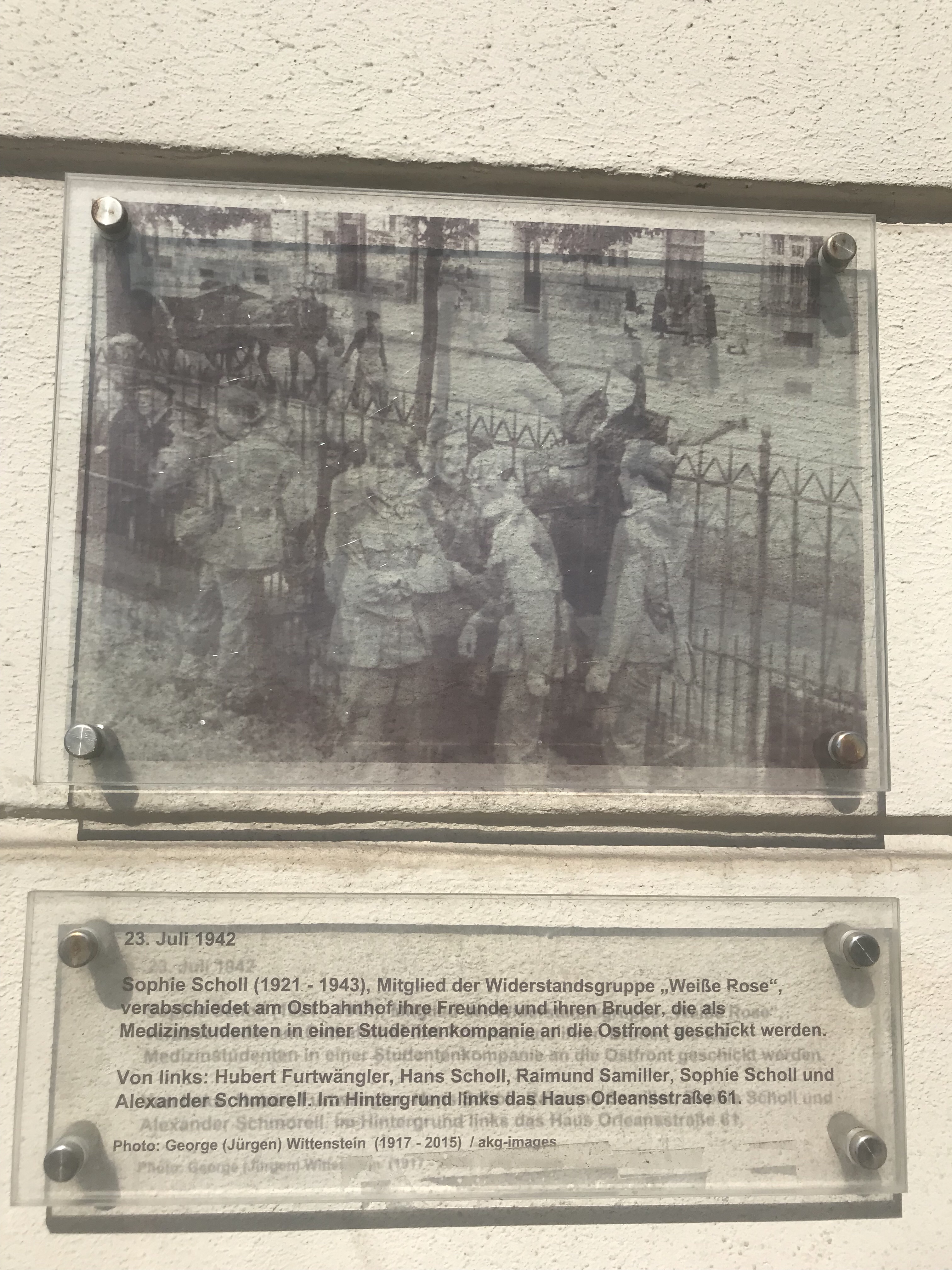
My choice in our time is to resist, and to fight for a future that includes everyone.  I close with the words of Sophie Scholl, a leader of the anti-Nazi White Rose resistance:

The real damage is done by those millions who want to ‘survive.’ The honest men who just want to be left in peace. Those who don’t want their little lives disturbed by anything bigger than themselves. Those with no sides and no causes. Those who won’t take measure of their own strength, for fear of antagonizing their own weakness. Those who don’t like to make waves—or enemies. Those for whom freedom, honour, truth, and principles are only literature. Those who live small, mate small, die small. It’s the reductionist approach to life: if you keep it small, you’ll keep it under control. If you don’t make any noise, the bogeyman won’t find you. But it’s all an illusion, because they die too, those people who roll up their spirits into tiny little balls so as to be safe. Safe?! From what? Life is always on the edge of death; narrow streets lead to the same place as wide avenues, and a little candle burns itself out just like a flaming torch does. I choose my own way to burn.

Such a course is not safe because the fact is, that too many ordinary people who have sold their souls to the Cult of Trump and who would if given the choice, would, just like the janitor at Munich University who identified and turned Sophie and her brother to the Gestapo and death at the hands of Roland Freisler and the extra-judicial Volksgericht (People’s Court).

So, until tomorrow,

Peace

Padre Steve+

1 Comment

Filed under civil rights, faith, History, laws and legislation, nazi germany, News and current events, Political Commentary, Religion, star trek

The Pinnacle of Naval Superiority or Obsolescence: The Battle Cruisers of 1920 and the Aircraft Carriers of 2020

artist

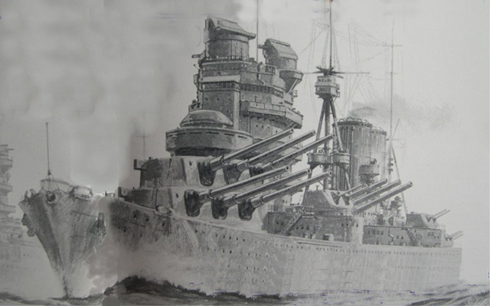
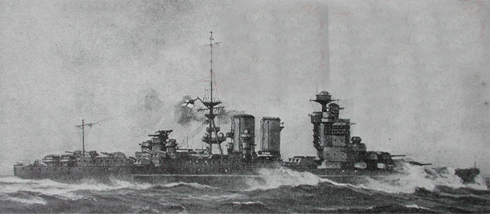
Artists Depiction of G3 Battlecruiser 

Friends of Padre Steve’s World,

The next few days I will be reflecting on the old year and the coming new year, but tonight I decided to tweak and republish an article from about four years ago dealing with the battle cruisers being built by Great Britain, Japan, and the United States after the First World War. They represented the pinnacle of naval design for their era and would have been far superior to their adversaries had technology and war remained static. As Admiral Ernest King noted:

“Nothing remains static in war or military weapons, and it is consequently often dangerous to rely on courses suggested by apparent similarities in the past.”

As the First World War ended a new Naval Race was heating up. The United States had announced its intention during the war to build a navy second to none while Imperial Japan was making plans for a fleet that would give it superiority in the Western Pacific. The British, though still be far the largest naval power in the world were burdened by the massive costs of war and empire, but also seeking to maintain their naval dominance and to that end they were in the process of building a class of massive super-Dreadnought battleships, and Battle Cruisers.

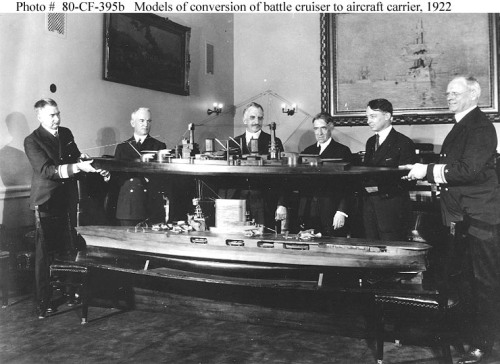
Much of each powers actions in the coming years would be based on internal politics, foreign policy, and the simple economics of how much each power could afford to spend on their militaries after such a costly war. The result was the Washington Naval Treaty of 1922 which limited the signatories to specific numbers, tonnage, and armaments each Navy would be allowed. Do to those reasons the massive Battle Cruisers planned by Britain, the United States and Japan were canceled. The Japanese and Americans would choose to convert two of their incomplete ships to aircraft carriers, while the British would convert the already completed ships of the Courageous Class battlecruisers (Courageous, Glorious, and Furious) into aircraft carriers as though none of the G3 ships had been laid down.

The ships known as the G3 battle cruisers were first designed by the British Royal Navy as a compliment to the all big gun Dreadnought battleships. The Battle Cruiser concept was for a ship of roughly the same size and firepower as a Battleship, but sacrificed armor protection for greater speed, endurance and range.  The United States and Japan joined in the Battle Cruiser race before and during the war. However, Britain the United States had concentrated on building battleships during the war but following the war began to design and build its own classes of massive battle cruisers.

800px-InvincibleBlowingUpJutland1916

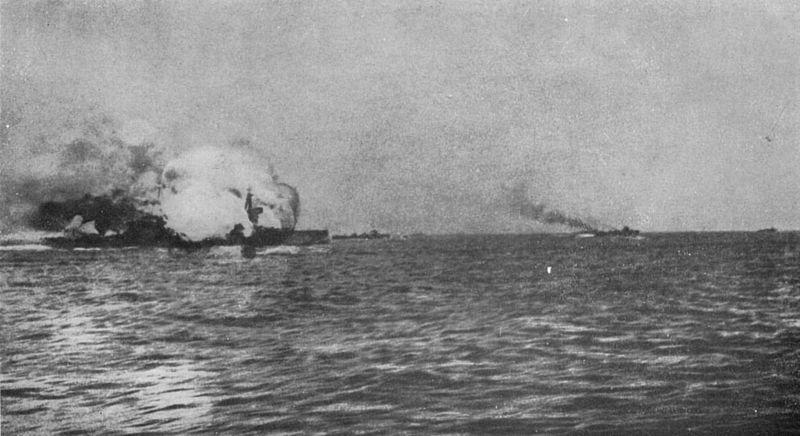
HMS Invincible Blowing Up at Jutland 

During the war the weaknesses of the battlecruisers as a type were exposed during the Battle of Jutland where three British Battle Cruisers, the HMS InvincibleHMS Indefatigable and HMS Queen Mary blew up with the loss of most of their crews; of the 3311 officers and sailors on the ships only 26 survived. The HMS Lion was almost lost in a similar manner but the heroic actions of her crew saved her from her sisters fate. The British ships had glaring deficiencies in armor protection and the arrangement of their ammunition magazines and hoists which certainly contributed to their loss. Their German counterparts on the other hand proved much tougher and though all sustained heavy damage while engaging British Battleships and Battle Cruisers, only one the Lützow was lost. She absorbed over 30 hits from large caliber shells and only lost 128 crew members. However, though a battle cruiser Lützow, and other German battle cruisers wer designed for relatively short range operations which meant they neither sacrificed armor protection, speed, or firepower as did the British ships which were designed for missions far and wide, needing more displacement for fuel and crew supplies, often sacrificing armor protection in order to maintain their high speed capabilities.

h60404

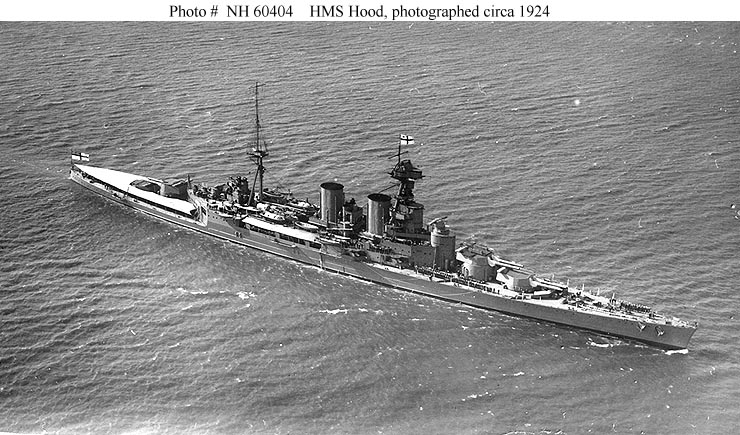
HMS Hood

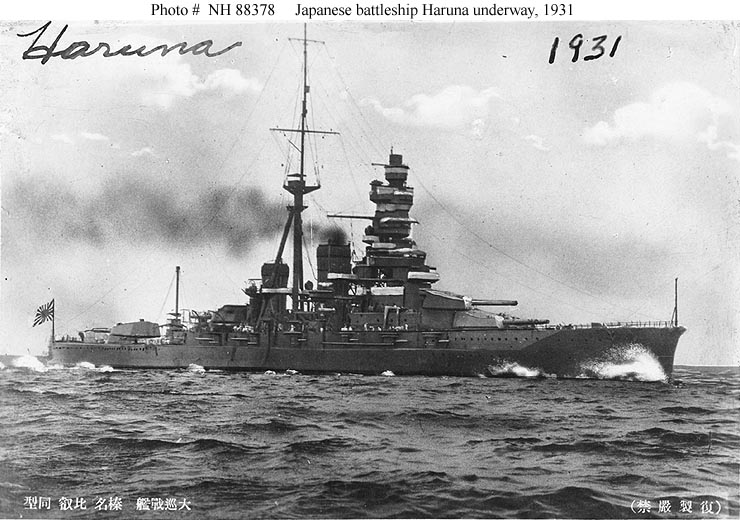
As the war progressed other Battle Cruisers were built, the British launched the HMS Repulse and HMS Renown and completed the HMS Hood shortly after the war was over. The Japanese built the four ship Kongo class from a British design, the first of which, the Kongo was completed in a British yard, the others Haruna, Hiei, and Kirishima were built in Japanese yards. The Kongo Class would prove to be the workhorses of the Battle Force of the Imperial Japanese Navy, all seeing significant combat action.

As the powers embarked on the next Naval Race planners and naval architects designed ships of massive firepower, better protection and higher range and speed. All would have been better classed as Fast Battleships, a better description of the Kongo Class or the Hood than previous ships.

The British designed and funded the G3 class in 1921, while the Japanese began work on the Amagi Class, and the United States the Lexington Class. However the construction and completion of these ships as Battle Cruisers was prevented by the Washington Naval Treaty.

invincible 490

The treaty, which was ratified in 1922 limited the United States and Great Britain to a maximum of 525,000 tons in their battle ship fleets and 125,000 tons in aircraft carriers.  The Japanese agreed to a limit of 315,000 tons and the French and Italians 175,000 tons each. Tonnage for battleships was limited to a maximum of 35,000 tons with a limitation on guns size to 16 inches.  Since the bulk of the ships planned or being built by the US and Japan exceeded those limits they would be effected more than the British whose post war shipbuilding program had not begun in earnest, in fact the G3 Class had just been approved for construction and there is no proof that construction had begun on any of the ships.

The G3 class would have comprised four ships and been similar to the N3 Class Battleships. They were very well balanced ships and would have mounted nine 16” guns in three turrets on a displacement of 49,200 tons and deep load of 54,774 tons. They had an all or nothing protection plan meaning that the armored belt was concentrated in vital areas around the armored citadel, conning tower, turrets and magazines and engineering spaces. Their armor belt would have ranged from 12-14 inches, deck armor from 3-8 inches, conning tower 8 inches, barbettes 11-14 inches, turrets 13-17 inches and bulkheads 10-12 inches. Their propulsion system of 20 small tube boilers powering 4 geared steam turbines connected to 4 propeller shafts would have produced 160,000 shp with a designed speed of 32 knots.

The four ships, none of which were named were ordered between October and November of 1921. Their construction was suspended on November 18th 1921 and they and the N3 Battleships were cancelled in February 1922 due to the limitations of the Washington Naval Treaty. Many concepts of their design were incorporated in the Nelson Class battleships which were a compromise design built to stay within the limits of the treaty.

rys-amagi

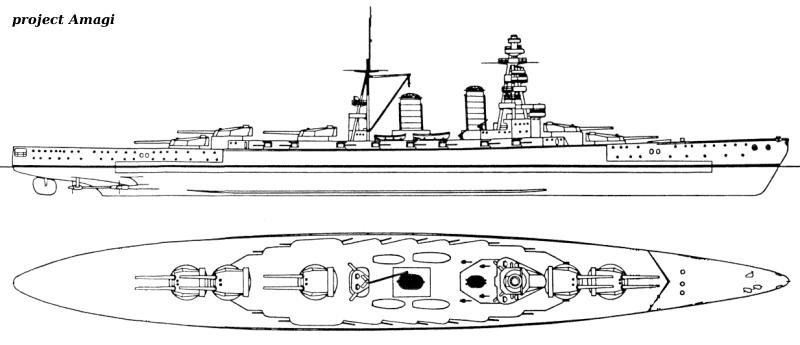
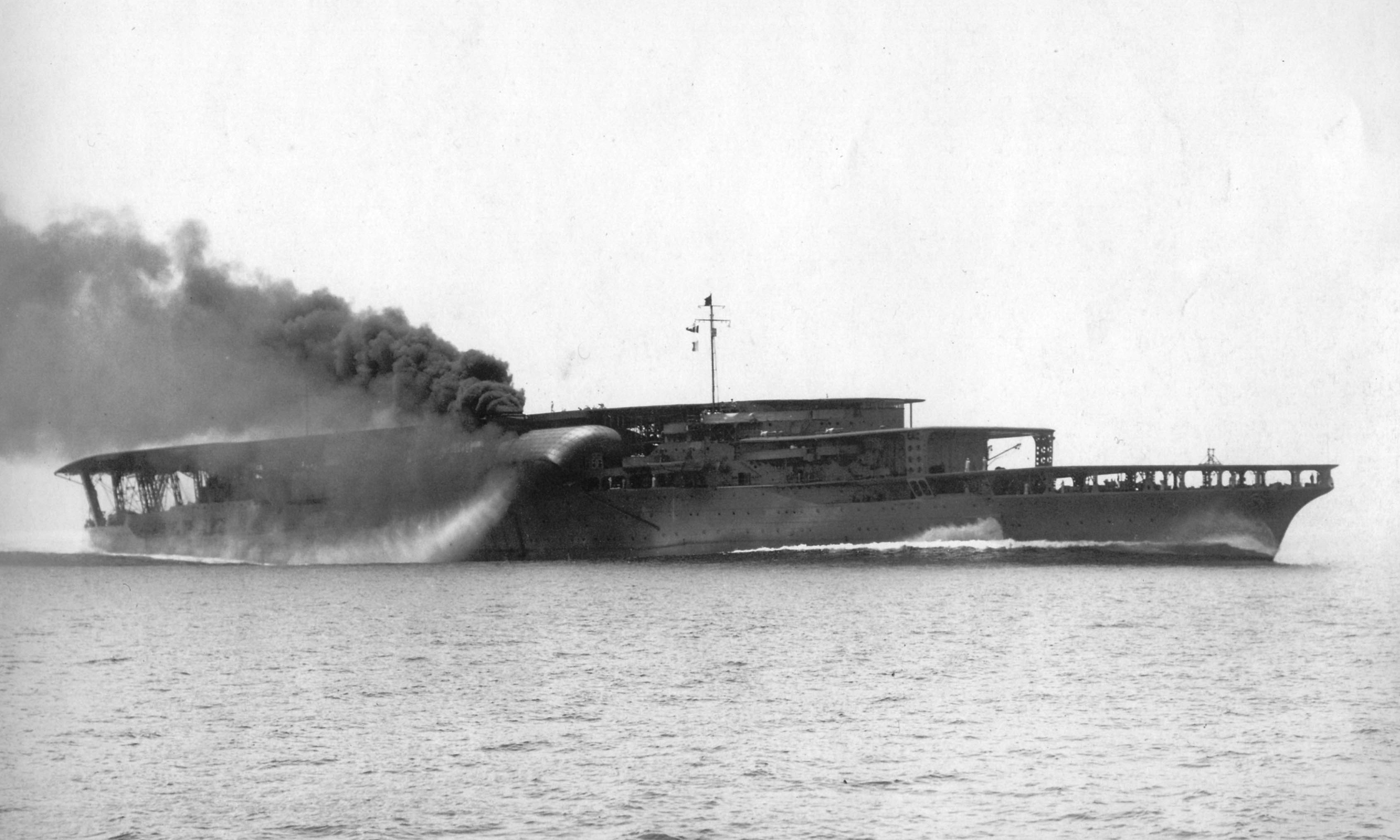
Amagi Class as Designed, Akagi as Completed (below) 

JapaneseAircraftCarrierAkagi3Deck_cropped

The four planned Japanese Amagi Class ships would have mounted ten 16” guns on a displacement of 47,000 tons at full load. Their propulsion system 19 Kampon boilers powering four Gihon turbines would have given them a maximum speed of 30 knots, They would have had less protection than the G3 ships being more of a traditional Battle Cruiser design. As a result of the Washington Naval Treaty the Japanese elected to convert two of the ships, the Amagi and Akagi to aircraft carriers. Amagi was destroyed on the ways during the great Tokyo earthquake and Akagi was completed as a carrier. The other two vessels were scrapped on the ways. To replace Amagi the Imperial Navy selected the incomplete Tosa Class battleship Kaga. 

Lexington_battlecruiser_conversion_models

lexington-class-battle-cruisern11978

Lex4259BrassDraw

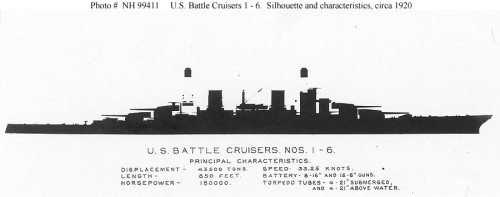
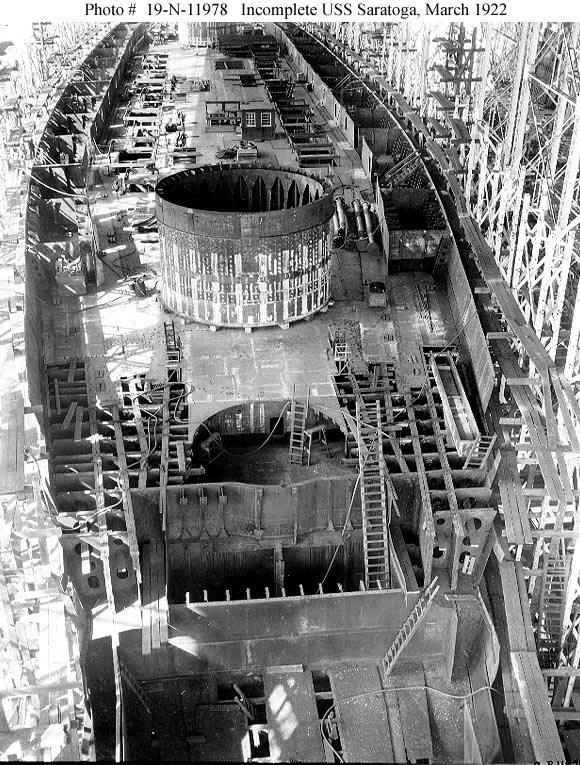
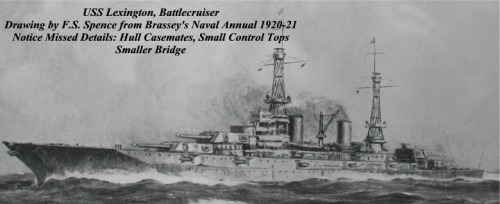
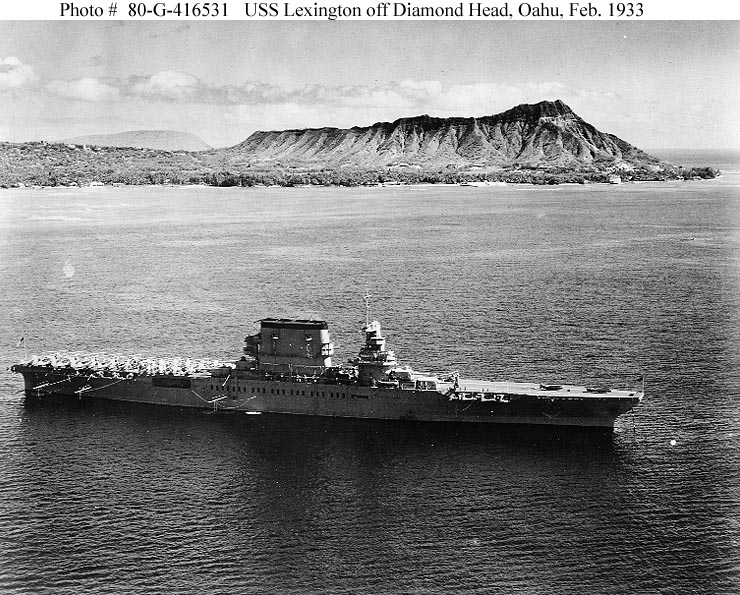
The United States Navy planned the six ship Lexington Class. These ships would have mounted eight 16” guns on a ship measuring 874 feet long and 105 feet in beam, displacing 43,254 tons at full load, or nearly the size of the Iowa Class battleships. They would have had a maximum speed of 33 knots being powered by 16 boilers which drove 4 GE electric turbines producing 180,000 shaft horse power. Theirs was a massive engineering plant and while the class did not have as heavy armor protection as either the G3 or Amagi classes, they were superior to them in speed as well as endurance. Upon ratification of the Washington Naval Treaty four of the six ships were cancelled and the remaining two, the Lexington and Saratoga competed as aircraft carriers.  Had any of the ships been completed as Battle Cruisers it is likely due to their speed that they would have operated primarily with the the carriers that the US Navy built during the 1930s.

g416531

One can only speculate what the navies of World War II would have looked like had the Washington and the subsequent London Naval Treaties not been ratified. One can also only imagine how the war at sea would have been different had the ships completed as carriers been completed as Battle Cruisers. It is certain had the Royal Navy, the Imperial Japanese Navy, and the United States Navy Not Converter These ships, that Naval Aviation would have take years, or maybe more than decades to reach its potential.

However that was not to be, of the planned 14 ships of these three classes only three were completed, all as aircraft carriers, ships that helped to forge the future of naval operations and warfare for nearly a century. Thus the uncompleted ships are an interesting footnote in naval history yet have their own mystique.

                 HMS Queen Elizabeth 

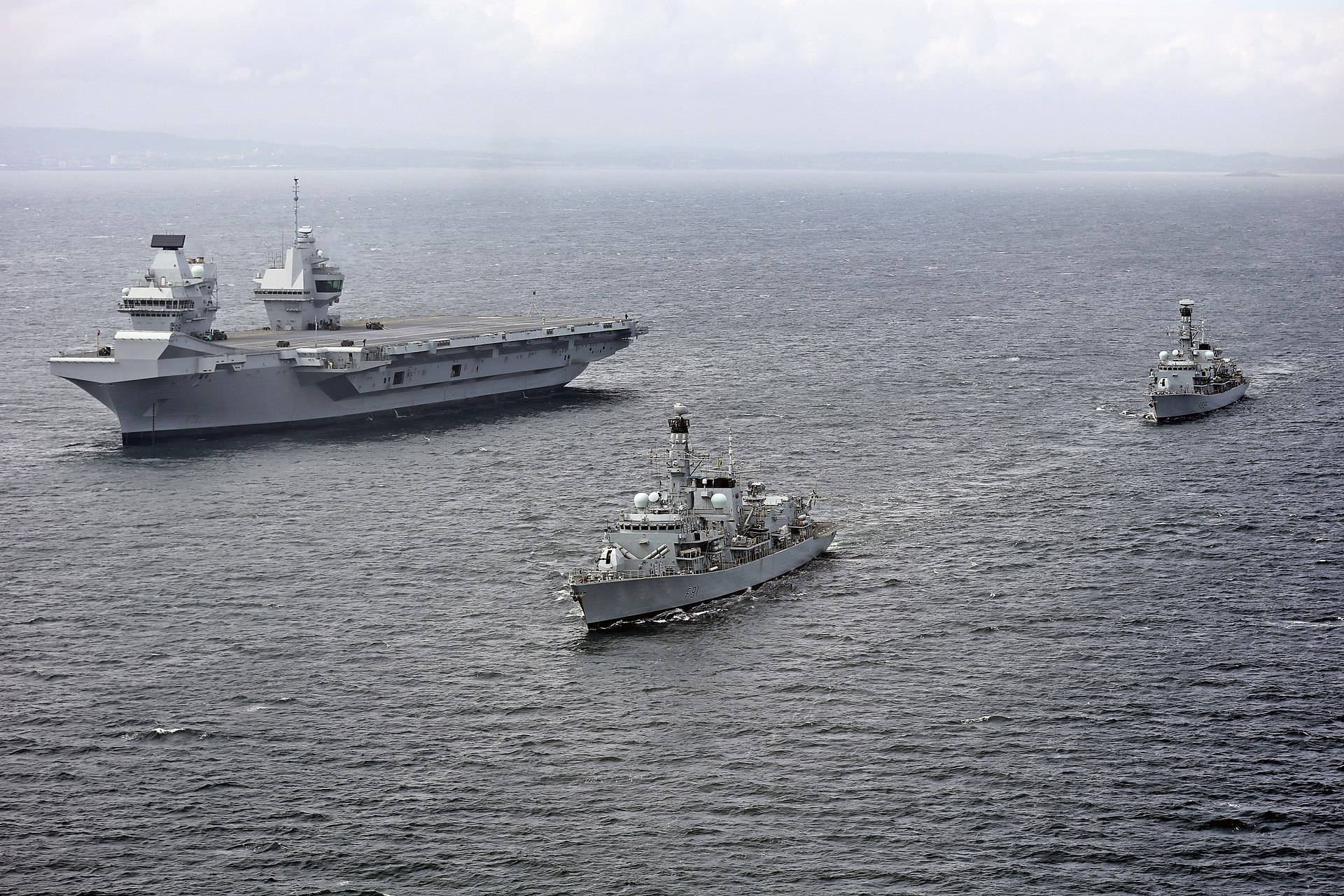
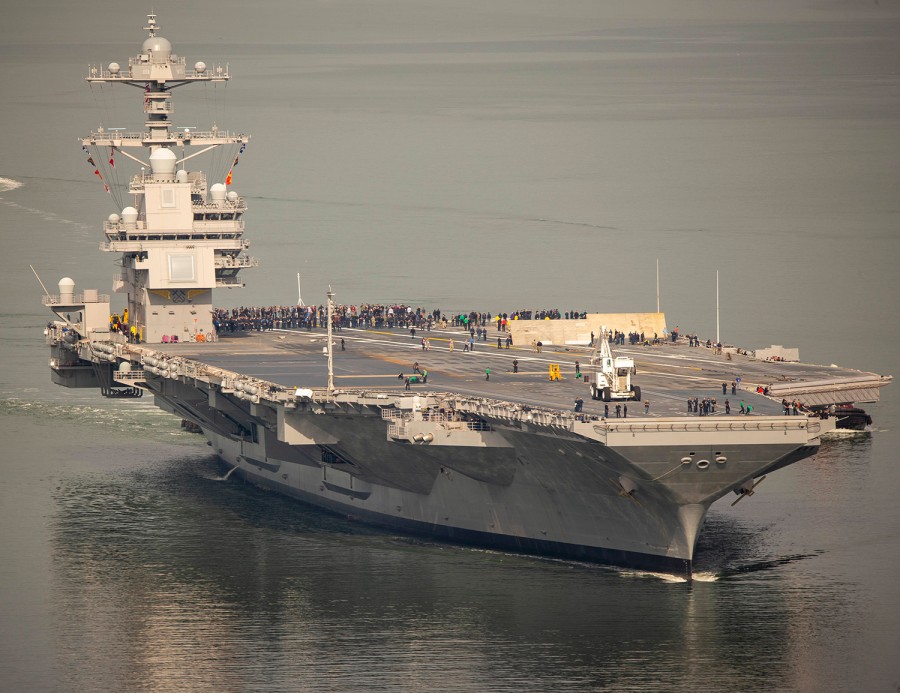
Yet nothing remains static. The carriers have ruled the waves since December 7th 1941. But the massive aircraft carriers which have ruled the seas since the Second World War are not necessarily invincible and depending on how technology progresses could be heading into obsolescence, and may end up serving in support roles or being paid off. Yet that being said the United States is continuing to construct carriers of the Ford Class, the British the Queen Elizabeth Class, while the Chinese and Indian Navies pursue the development of new super carriers, while the French Navy operates the CVN Charles De Gaulle.  

But with the development of more and more relatively cheap, long range, and maneuverable land based anti-ship missile systems, and the capabilities of modern submarines we have to ask the legitimate question, is the aircraft carrier’s reign of the seas in jeopardy? This is a good question, but not the only one because since World War II there have been no carrier versus carrier engagements on the high seas. There are some places that are outside the range of land based anti-ship weapons, although submarines may prove a problem for surface forces to deal with, and for carriers their survival.

But since there have been no carrier versus carrier actions since the Second World War it would be interesting to see how the current carriers now operational or being developed would fare against each other if such an encounter occurred. It would be a test of air wings, ship design, and the protective capabilities of their escorts, as well as the cyber realm, on, above, and below the surface. Until such an engagement occurred all opinions, even those done in computer simulations are at best guesses as most of the weapons systems have never been tried in actual combat against peer competitors. Thus, like the carriers and their escorts designed before the Second World War, they will have to be tested in combat to see if they are still relevant in their designed role, or if they will be relegated to support roles which could be done by less costly alternatives such as the LHA/LHD type ships of the United States, France, Japan, and South Korea, or the the Sea Control Ship derivations in other smaller Navies in Europe and Asia.

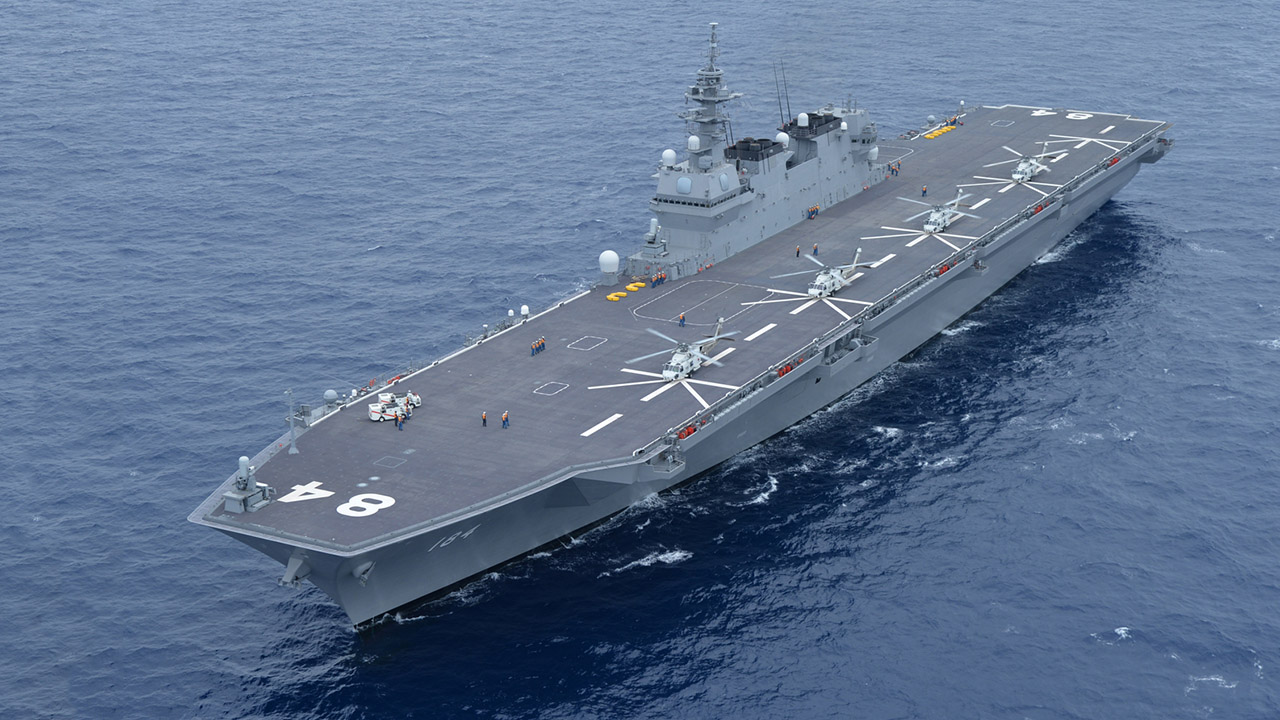
Perhaps to meet some missions smaller and cheaper carriers will be developed, or existing platforms modified to carry more capable aircraft as the Japanese are doing with their Izumo and Hyuga Class “Helicopter Destroyers,” and the South Koreans are doing with their two Dokto Class LPH (Landing Platform Helicoptor) both of which may soon begin to operate the F35B fighter aircraft purchased from the United States, the same aircraft with will operate from United States Navy LHAs and LHDs as well as the British Queen Elizabeth Class. 

JMSDF “Helicopter Destroyer” Kaga 

Thus, one might wonder if the large new aircraft carriers currently being built by the United States, Britain, China, India, and other nations will also be displaced by advancing technology as were the battlecrusiers of the 1920s. It is a question that must be asked. There are certainly arguments for them, but what would the effect be on the United States Navy if one of the Nimitz or Ford Class carriers was sunk by the Chinese, or evening the Iranians? My guess is that it would be the same kind of shock that hit the Royal Navy after Jutland, and the U.S. Navy after Pearl Harbor.

I still believe in the aircraft carrier, as a weapon of deterrence, support of operations ashore, and against enemy ships on the high seas. But eight decades is a long run for any weapons system, and it is possible that despite the major power’s investment in carriers, that their reign may be coming to an end, at the same time it may be too early to count out the Super Carriers. Perhaps their mission will be modified to support smaller ships in sea control missions and reserved for potential combat with countries which have no answer to them, or against similar platforms in open ocean battles.

USS Gerald R. Ford 

I believe that the future has not been decided in relation to the aircraft carrier and much of that will have to do with how the operators of such vessels adapt to a changing world with many more threats, in order to maximize their capabilities while minimizing the dangers to such expensive national security assets. This is the aspect of war and national security that is within the control of human beings. I think of Admiral Arleigh Burke’s words at times like this:

“For in this modern world, the instruments of warfare are not solely for waging war. Far more importantly, they are the means for controlling peace. Naval officers must therefore understand not only how to fight a war, but how to use the tremendous power which they operate to sustain a world of liberty and justice, without unleashing the powerful instruments of destruction and chaos that they have at their command.”

he other possibility is that the navies that operate them decide that they are too expensive, and that their vulnerabilities outweigh their capabilities. This was the case in the 1920s with the battlecruisers then under construction.

Until tomorrow,

Peace

Padre Steve+

2 Comments

Filed under History, Military, national security, Navy Ships, News and current events, US Navy, World War II at Sea

Christmas Tragedy: The Senseless Loss of the Scharnhorst at North Cape

Friends of Padre Steve’s World,

Today is the Second Day of Christmas or as it is also known, the Feast of St. Stephen; and Boxing Day, oh for the days of Ali and Frazier… but I digress…

Christmastide is a joyous time for many, but in the course of history there have been times that military men have fought and died in hopeless battles far from their families. Thus it is often a time of sorrow, especially for those that die alone. Among those who died alone in the Arctic darkness of December 26th 1943 were the officers and crew of the German battlecruiser Scharnhorst.

Schlachtschiff

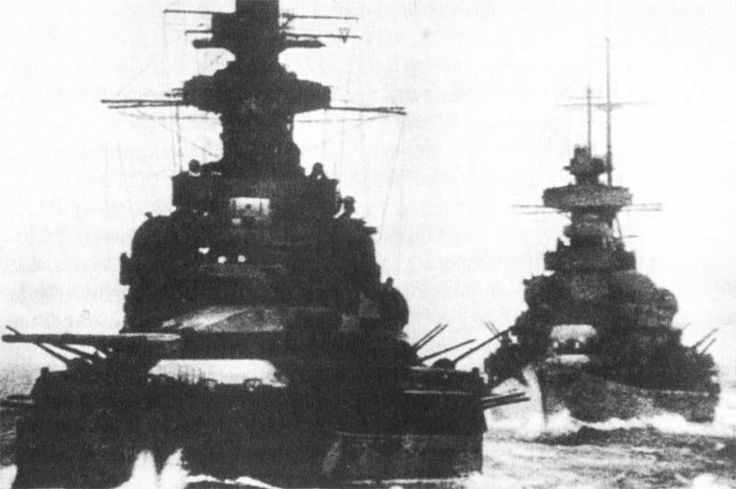
The Scharnhorst along with her sister ship Gneisenau were the product of the naval architects of Germany who in the early 1930s designed some of the most beautiful as well as deadly warships of the Second World War.  Following Germany’s rejection of the provisions of the Treaty of Versailles the Kreigsmarine enacted a building program to enlarge and modernize the German Navy which then was composed of obsolete pre-Dreadnaught battleships and a few modern light cruisers and destroyers.   The first major units constructed were actually begun by the predecessor to the Kreigsmarine, the Reichsmarine Of the Weimar Republic.  These were the Deutschland class Armored Ships, sometimes called “Pocket Battleships” and later reclassified as Heavy Cruisers. These ships were designed to replace the old pre-Dreadnaught battleships and incorporated electric welds to reduce displacement, diesel engines for extended cruise range to enable them to serve as commerce raiders and a battery of six 11” guns.  While an advance over anything in the German inventory they were outclassed by the British battle cruisers Hood, Renown and Repulse.

However, the first true capital ships built by the Kriegsmarine were the Scharnhorst and Gneisenau They were classed as battleships by the Germans, but in reality they were battle cruisers because of their light main battery of 11” guns as opposed to the 14”, 15” or 16” batteries of other nations battleships.  In fact, their main battery was Despite this in displacement and armor protection of the ships was comparable to other battleships of the era and their designed speed of 31.5 knots was superior to almost all other battleships of the era including the British King George V Class and the US Navy’s  North Carolina class.  Only the massive battlecruiser HMS Hood was their superior in speed and firepower.

As built Scharnhorst and Gneisenau displaced 31,000 toms, however at full combat load they both weighed in at nearly 38,000 tons and were 772 feet long.  They had an armor belt that was nearly 14 inches thick.  Armed with a main battery of nine 11” guns and a secondary armament of twelve 5.9 inch guns they also mounted a powerful for the time anti- aircraft battery of fourteen 4.1 inch guns, 16 37mm and 16 20mm anti-aircraft cannons.  Additionally they mounted six 21” torpedo tubes and carried three Arado 196 A3 scout planes.  The main battery was eventually to be replaced by six 15” guns but this never occurred; Gneisenau was taken in hand to mount the new weapons but the conversion was never completed due to Hitler’s anger after the failure of a German task force during the Battle of the Barents Sea in December 1942.

scharnhorst2

Scharnhorst firing at HMS Glorious 

Laid down on 15 June 1935 and launched 3 October 1936 Scharnhorst was commissioned 7 January 1939.  Her sister Gneisenau was laid down 6 May 1935, launched 8 December 1936 and commissioned 21 May 1938.  Upon the commencement of the Second World War the two sisters began a reign of destruction on British shipping. In November they sank the Armed Merchant Cruiser HMS Rawalpindi During Operation Weserübung the pair surprised sank the aircraft carrier HMS Glorious and her two escorting destroyers, the only time a Fleet carrier was caught and sunk by battleships during the war.   From January to March 1941 they conducted Operation Berlin against British merchant shipping in the North Atlantic sinking 22 ships before returning to base.

eeb893a0b92de4ae595de56fe0fd90ca

Scharnhorst and Gneisenau during Operation Cerebus

While in the port of Brest Gneisenau was bombed and torpedoed requiring extensive repairs.  Due to the exposed location of the port the German high command decided to return the ships to Germany along with the Heavy Cruiser Prinz Eugen.  The operation was called Operation Cerberus and it took place from 11-13 February 1942. The ships made a dash up the English Channel which was unsuccessfully contested by the British Royal Air Force and Royal Navy. However, both Scharnhorst and Gneisenau were damaged by mines and needed subsequent repairs.  While undergoing repairs in Kiel Gneisenau was further damaged by the Royal Air Force requiring repairs in or to steam to the port of Gotenhafen for repair and conversion.  Although some work was completed she was decommissioned and sunk as a blockship on 23 March 1945.  Following the war she was raised by the Poles and scrapped.

Scharnhorst was repaired following Operation Cerberes and in March 1943 was transferred to Norway where along with Tirpitz, Admiral Scheer, Lutzow (the former Deutschland), Admiral Hipper and Prinz Eugen she became part of a “fleet in being” poised to strike the Allied convoys bound for Russia.

Admiral_Bruce_Fraser_1943_IWM_A_16489

Admiral Bruce Fraser

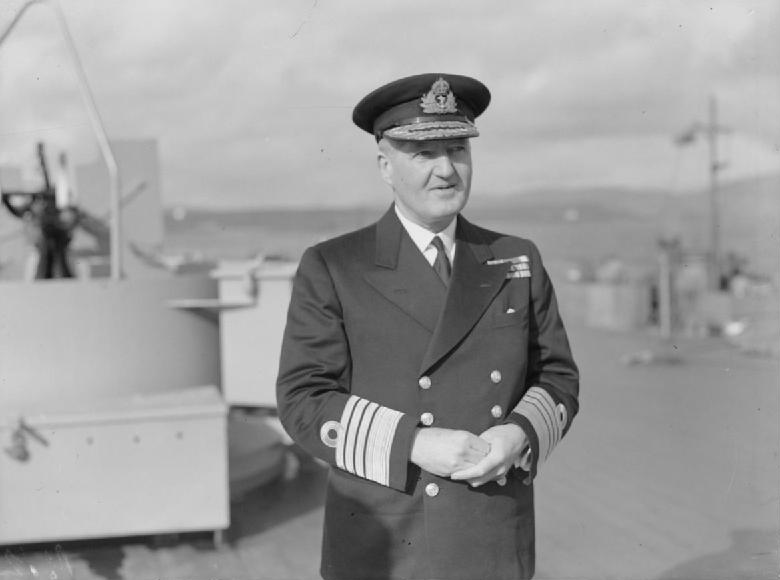
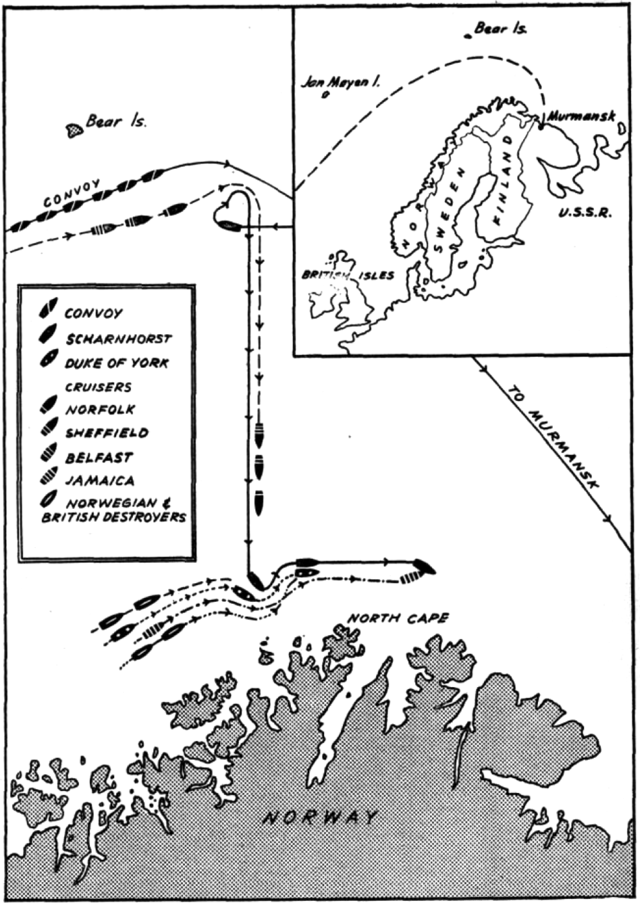
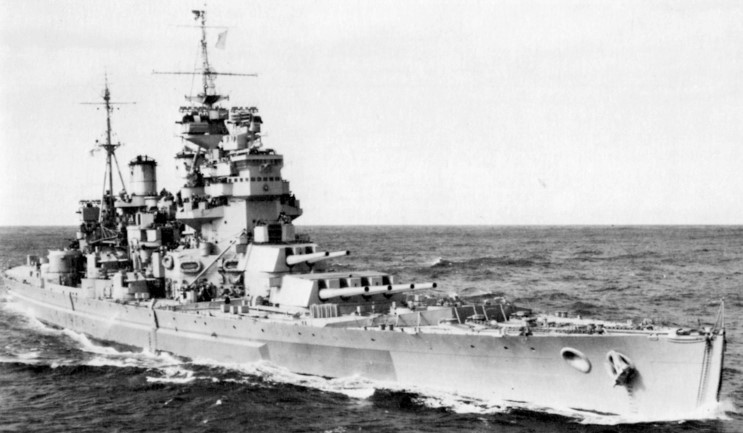
The German surface ships were a potent force that if the circumstances allowed could devastate the Russia bound convoys and the Commander of the British Home Fleet, Admiral Bruce Fraser was determined to entrap and destroy any of these ships that threatened any convoy. As such in December 1943 Fraser formed a task group built around the HMS Duke of York to be ready to pounce on any German raider that threatened the convoys. His intent was to catch any of these ships, especially Scharnhorst and trap them between the convoys and their base, in conduction with a second task group centered around the cruisers HMS Belfast, HMS Norfolk, and HMS Sheffield, Known as Force One, and destroy the German battleship.

The key to British the British operation was Enigma the German code machine and cipher system which they had acquired from captured U-Boats, and which British code-breakers had mastered. The Germans decided to send Scharnhorst and five destroyers to locate and destroy convoy JW-55B which had been spotted by Luftwaffe reconnaissance aircraft. Because of Enigma, Fraser knew that Scharnhorst would attempt to intercept the convoy and put his plan to set the trap in motion.

Battle_of_North_Cape_26_December_1943_map

Scharnhorst and her escorts set sail on Christmas Day 1943 under the command of Rear Admiral Erich Bey to conduct Operation Ostfront. But Bey was new to command, he had been promoted to Konteradmiral on the day the force sailed, having taken the place of Admiral Oskar Kummetz who had left for Germany to take a long convalescent leave. Bey was an experienced commander, but all of his experience was on destroyers. He was a torpedo expert, but had never served aboard a battleship, or even a cruiser, and he was a a novice when it came to the large caliber guns aboard the Scharnhorst. His position was made worse by the fact that the task force staff had been thinned out by the Navy, for few expected it to be sent in combat.

However, Grand Admiral Karl Dönitz, had decided that given the right conditions, specifically that an exposed convey without heavy support which could be engaged with a high degree of success could be attacked. This convoy was JW-55B, which had been spotted by a German weather observation aircraft on the 22nd Of December. However, the weather was so foul that no further spotting of it or any other British ships was made. There was no question that further air reconnaissance was possible, Berlin was satisfied that the convoy had no support, as German Historian Wolfgang Zank wrote that Berlin followed its motto: “Was nicht gemeldet wird, ist auch nicht da” or “What isn’t reported, isn’t there.” 

Bey wasn’t convinced while still transiting Alta Fjord, he radioed Berlin to inform the high command of how the weather would interfere with the operations of his five destroyers, after all he was a destroyerman and had commanded destroyers in such weather. He was attempting to get the mission called off, but Berlin insisted on the attack. Dönitz replied “I believe in your attacking spirit. Sieg Heil!” With no recourse, Bey put to sea.

However, his destroyers could not keep pace with Scharnhorst so Bey detached them and sailed alone to fight the enemy.

Since Fraser knew that the Germans were coming he had the convoy to temporarily reverse course. This action caused Bey to find nothing where he expected the convoy to be, but he did encounter and engage at long range Fraser’s cruisers including HMS Norfolk, HMS Sheffield both veterans of the the hunt for and sinking of the Bismarck and the HMS Belfast. Scharnhorst’s guns damaged the heavy cruiser Norfolk, but the radar directed fire of the British cruisers landed a hit which knocked out her search radar leaving the German ship virtually blind as the weather worsened and darkness set in.

Bey, thinking he had shaken his pursuers, set course for Alta Fjord at full speed, however, Belfast had maintained contact and Fraser with Duke of York closed the distance and at 1617 her radar picked up the German at a range of 45,500 yards. By 1632 she was 29,700 yards away. Scharnhorst was oblivious to the danger, and at 1648 Belfast illuminated the German ship and Duke of York opened fire at just under 12,000 yards scoring hits which disabled Scharnhorst’s forward turrets and destroyed her airplane hanger. Bey changed course and increased speed, briefly opening the range and momentarily giving the Germans hope, but that was not to be.

At 1820 Duke of York struck a devastating blow on the German ship. A 14” shell pierced the armored belt and exploded in Scharnhorst’s number one boiler room reducing her speed to just 10 knots. Quick repairs were made enabling the ship to steam at 22 knots, but now she was vulnerable to torpedo attacks by the British destroyers.

When he did not find the convoy in the expected location Bey detached his destroyers to expand the search area, leaving Scharnhorst alone to face the enemy.

Rear Admiral Erich Bey

At about 0900 on December 26th 1943 the cruisers of Force One discovered Scharnhorst and the  Battle of North Cape was on. Though little damage was suffered in the first engagement, the radar of Scharnhorst was knocked out, leaving her not only without air support or escort, but blind.

HMS Duke of York underway, and firing her main battery

Scharnhorst attempted to flee, but Fraser’s Duke of York  and her four escorting destroyers destroyers intercepted her. Without radar in the blinding snow squalls Scharnhorst was surprise by their appearance. Duke of York’s first radar direct salvos knocked out her forward main battery but the German ship appeared to be making a getaway when a shell from Duke of York hit her number one boiler room and reduced her speed to barely ten knots. Although the German engineers and damage control teams made some repairs and were able to bring her speed back up to 22 knots, the British ships rapidly made up the distance enabling the British destroyers to launch torpedo attacks.

Knowing the ship was doomed Admiral Bey dispatched a message to the high command of the Kriegsmarine: “We will fight on until the last shell is fired.” 

While Scharnhorst attempted to fight off her attackers and escape she was struck by torpedoes from several destroyers as being punished at distance of under 10,000 yards by Duke of York’s 14″ shells, as well as the 6″ shells of HMS Belfast and HMS Jamaica. Savaged by at least 13 hits by Duke of York’s 14” shells and numerous torpedo hits, incapable of further resistance, the German ship capsized and sank, her massive screws still turning at 1945 hours with the loss of all but 36 of her 1968 man crew. Admiral Bey was not among the survivors, though he was spotted in the water

As she sank bow first survivors attempted to abaneon ship. Günter Sträter, who survived amd was rescued noted:

“In the water now the sailors were looking to get the rafts”,… those  who found a place on the rafts sang both verses of the song: ‘On a sailor’s grave, there are no roses blooming.’ I did not hear cries for help. It all happened exactly and without panic. “

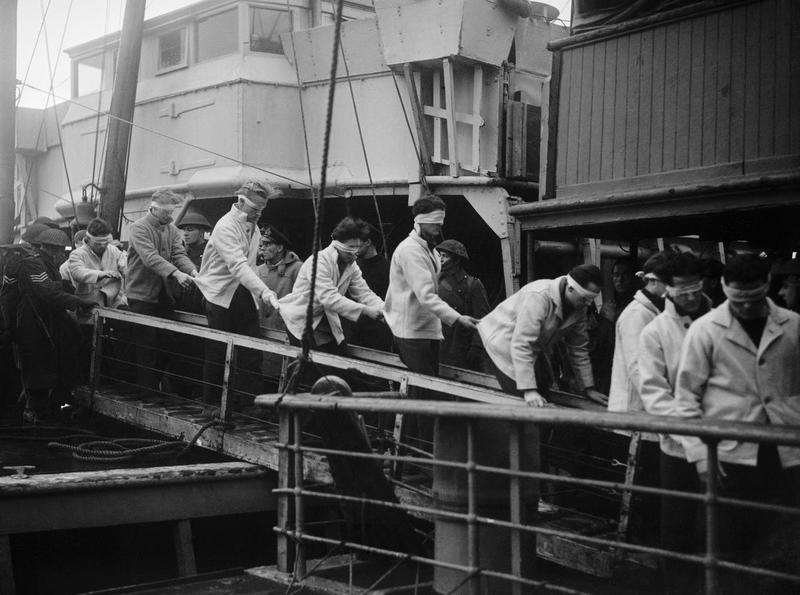
Survivors were rescued by the British destroyers HMS wreck was discovered on October 3rd 2000 some 70 miles north of North Cape Norway. Of the ships engaged, only HMS Belfast survives, as a museum ship in the Thames River in London.

Scharnhorst_survivors_A_021202

Survivors of Scharnhorst 

Admiral Fraser praised the gallantry of the German ship to his officers later that night saying: “Gentlemen, the battle against Scharnhorst has ended in victory for us. I hope that if any of you are ever called upon to lead a ship into action against an opponent many times superior, you will command your ship as gallantly as Scharnhorst was commanded today”

After the battle Grand Admiral Erich Raeder who had authorized the sortie was relieved as commander in chief of the navy and was replaced by Grand Admiral Karl Donitz who commanded the U-Boat forces. Hitler was furious and ended most surface naval operations.

800px-Scharnhorst-WHV-April-2011

Memorial to Scharnhorst and her crew at Kiel and the HMS Belfast moored as a Museum ship in the Thames River, London 

I have written many times about the tragedy of war, on land and at sea. Having served in combat zones on land and having been shot at by the enemy, as well as having served at sea on a cruiser I have a sense of what these men must have gone through on that final day of their lives. Though I am a realist and know that such tragedies will likely occur again, in fact I expect them and predict that the United States Navy will see its share of nautical disasters when it faces well equipped and trained opponents.

All that being said, I really do pray for the day that war will be no more and that those who serve in harm’s way will never have to do so again.

Peace

Padre Steve+

1 Comment

Filed under History, Military, Navy Ships, nazi germany, World War II at Sea, world war two in europe

Light, Life, and Love: Christmas in the Hell of Stalingrad, Kurt Reuber and the Madonna of Stalingrad

Bundeswehr zeigt "Stalingrad"-Ausstellung

Friends of Padre Steve’s World,

Tomorrow is Christmas Eve and I am reflecting about the true meaning of Christmas in a world where hope seems to be dying before our eyes. In such an environment I reflect on men who lived in a human made hell, a hell made by hate filled ideologues who launched the world into its bloodiest war, and I wonder, could it happen again? A decade ago I would have said it never could again happen, but now I am not so sure. So, in the age of Donald Trump, I must try to find hope wherever I can find it.

I think most of my readers know that I am a career military officer and have served in peace and war as a chaplain. That service includes a tour in Iraq, a war, which by almost any standard would have been considered unjust and illegal, yet I served there, and came back a changed man. As such the stories of those who served in war, especially those who serve in hopeless battles, and even in evil causes during Christmas have a special place in my heart. One of those men was a German pastor and medical doctor named Kurt Reuber.

k_reuberl

As I said, Reuber was a theologian, pastor and medical doctor, likewise he was an accomplished artist and used that medium to convey his own faith, and doubts. He was a friend of Albert Schweitzer and in 1939 he was conscripted to serve as a physician in the Germany Army. By November 1942 he was a seasoned military physician serving with the 16th Panzer Division, part of the German 6th Army, which had been fighting in the hell of Stalingrad. When his division along with most of 6th Army was surrounded by the Soviets, cut off from most supply and without real hope of relief, he like other physicians continued to serve the soldiers committed to his care.

pg-34-stalingrad-2-getty

However, unlike most physicians, the care Reuber offered care included spiritual matters, as he sought to help his soldiers deal with the hopelessness of their situation. As Reuber reflected on the desperation of the German soldiers in the Stalingrad pocket. He wrote to his family.

“I wondered for a long while what I should paint, and in the end I decided on a Madonna, or mother and child. I have turned my hole in the frozen mud into a studio. The space is too small for me to be able to see the picture properly, so I climb on to a stool and look down at it from above, to get the perspective right. Everything is repeatedly knocked over, and my pencils vanish into the mud. There is nothing to lean my big picture of the Madonna against, except a sloping, home-made table past which I can just manage to squeeze. There are no proper materials and I have used a Russian map for paper. But I wish I could tell you how absorbed I have been painting my Madonna, and how much it means to me.”

“The picture looks like this: the mother’s head and the child’s lean toward each other, and a large cloak enfolds them both. It is intended to symbolize ‘security’ and ‘mother love.’ I remembered the words of St. John: light, life, and love. What more can I add? I wanted to suggest these three things in the homely and common vision of a mother with her child and the security that they represent.”

The picture was drawn on the back of a captured Soviet map and when he finished it he displayed it in his bunker, which became something of a shrine. Reuber wrote:

“When according to ancient custom I opened the Christmas door, the slatted door of our bunker, and the comrades went in, they stood as if entranced, devout and too moved to speak in front of the picture on the clay wall…The entire celebration took place under the influence of the picture, and they thoughtfully read the words: light, life, love…Whether commander or simple soldier, the Madonna was always an object of outward and inward contemplation.”

drkrop

As the siege continued men came to the bunker for both medical care and spiritual solace.  On Christmas Eve Reuber found himself treating a number of men wounded by bombs outside the bunker. Another soldier lay dying, just minutes before the soldier had been in the bunker singing the Christmas hymn O Du Froehliche.  Reuber wrote:

“I spent Christmas evening with the other doctors and the sick. The Commanding Officer had presented the letter with his last bottle of Champagne. We raised our mugs and drank to those we love, but before we had had a chance to taste the wine we had to throw ourselves flat on the ground as a stick of bombs fell outside. I seized my doctor’s bag and ran to the scene of the explosions, where there were dead and wounded. My shelter with its lovely Christmas decorations became a dressing station. One of the dying men had been hit in the head and there was nothing more I could do for him. He had been with us at our celebration, and had only that moment left to go on duty, but before he went he had said: ‘I’ll finish the carol with first. O du Frohliche!” A few moments later he was dead. There was plenty of hard and sad work to do in our Christmas shelter. It is late now, but it is Christmas night still. And so much sadness everywhere.”

On January 9th 1943 with all hope of escape or reinforcement gone Reuber gave the picture to the battalion commander as the officer was too ill to carry on and that man was one of the last soldiers to be evacuated from the pocket. Reuber’s commander carried the Madonna out of the pocket and returned it delivered it to Reuber’s family, preserving it for all.

Reuber was taken prisoner and survived the harrowing winter march to the Yelabuga prison camp. In late 1943 Reuber wrote his Christmas Letter to a German Wife and Mother – Advent 1943. It was a spiritual reflection but also a reflection on the hope for life after the war, when the Nazi regime would be defeated, and Germany given a new birth. I wonder if the Christians currently swearing their fealty to President Trump will be capable of such reflection when his regime finally collapses, regardless of how and when it does. Twenty or so years ago I would have likely been part of Trump’s cult of “Christian” followers.

Reuber wrote:

“The concatenation of guilt and fate has opened our eyes wide to the guilt. You know, perhaps we will be grateful at the end of our present difficult path yet once again that we will be granted true salvation and liberation of the individual and the nation by apparent disappointment of our “anticipation of Advent”, by all of the suffering of last year’s as well as this year’s Christmas. According to ancient tradition, the Advent season is simultaneously the season of self-reflection. So at the very end, facing ruin, in death’s grip – what a revaluation of values has taken place in us! We thus want to use this period of waiting as inner preparation for a meaningful new existence and enterprise in our family, in our vocation, in the nation. The Christmas light of joy is already shining in the midst of our Advent path of death as a celebration of the birth of a new age in which – as hard as it may also be – we want to prove ourselves worthy of the newly given life.”  (Erich Wiegand in Kurt Reuber, Pastor, Physician, Painter, Evangelischer Medienverb. Kassel 2004. )

prisoner's madonna

Reuber did not live to see that day. He died of Typhus on January 20th 1944, not long after writing this and just a few weeks after painting another portrait of the Madonna, this one entitled The Prisoner’s Madonna. He was not alone, of the approximately 95,000 German POWs taken at Stalingrad only about 6,000 returned home.

His paintings survived the war and his family gave The Madonna of Stalingrad to the Kaiser Wilhelm Memorial Church in Berlin after it was restored as a symbol of hope and reconciliation. Copies are also displayed in Coventry Cathedral and the Russian Orthodox Cathedral in Volgograd, the former Stalingrad. A copy of The Prisoner’s Madonna is now displayed at the Church of the Resurrection in Kassel.

I have a print of the Madonna of Stalingrad in my office since then, until I moved to my new assignment. It is now in my storage space. I will have to bring it and a few other items to my new office at the shipyard. It has become one of the most meaningful pictures I have since I returned from Iraq in 2008. I miss looking on it every day. To me the print is a symbol of God’s presence when God seems entirely absent.

Praying for an end to war.

Peace

Padre Steve+

Leave a comment

December 23, 2019 · 23:45

Joyeux Noel: the Christmas Truce of 1914, and the Personal Reflections of an Old Chaplain

palmer

Friends of Padre Steve’s World

As a veteran who served in the badlands of Al Anbar Province during Christmas of 2007 I can relate to Father Palmer, the British priest and chaplain in the film Joyeux Noel (Merry Christmas) when he makes the comment “I belong with those who are in pain, and who have lost their faith, I belong here.”

I again watched that film tonight. The film is the story of the amazing and exceptional Christmas Truce of 1914. It is a film that each time I see it that I discover something new, more powerful than the last time I viewed it. It reminds me of serving in Iraq, at Christmas from my perspective as a Chaplain, and thereby giving voice to those who serve now, as well as those who served God’s people in hellish places before me. It reminds me of how much I hate war, and how much I often hate the clergy who are all too often, bloodthirsty

As a Chaplain I am drawn to the actions of the British Padre in the film, who during the truce conducts a Mass for all the soldiers, British, French and German in no-man’s land, who goes about caring for the soldiers both the living and the dead. His actions are contrasted with his Bishop who comes to relieve him of his duties and to urge on the replacement soldiers to better kill the Germans.

As the Chaplain begins to provide the last Rites to a dying soldier the Bishop walks in, in full purple cassock frock coat and hat and the chaplain looks up and kisses his ring.

As the chaplain looks at his clerical superior there is a silence and the Bishop looks sternly at the priest and addresses him:

“You’re being sent back to your parish in Scotland. I’ve brought you your marching orders.”

Stunned the Priest replies: “I belong with those who are in pain, and who have lost their faith, I belong here.”

The Bishop then sternly lectures the Priest: “I am very disappointed you know. When you requested permission to accompany the recruits from your parish I personally vouched for you. But then when I heard what happened I prayed for you.”

The Priest humbly and respectfully yet with conviction responds to his superior: “I sincerely believe that our Lord Jesus Christ guided me in what was the most important Mass of my life. I tried to be true to his trust and carry his message to all, whoever they may be.”

The Bishop seems a bit taken aback but then blames the Chaplain for what will next happen to the Soldiers that he has served with in the trenches: “Those men who listened to you on Christmas Eve will very soon bitterly regret it; because in a few days time their regiment is to be disbanded by the order of His Majesty the King. Where will those poor boys end up on the front line now? And what will their families think?”

They are interrupted when a soldier walks in to let the Bishop know that the new soldiers are ready for his sermon. After acknowledging the messenger the Bishop continues: “They’re waiting for me to preach a sermon to those who are replacing those who went astray with you.” He gets ready to depart and continues: “May our Lord Jesus Christ guide your steps back to the straight and narrow path.”

The Priest looks at him and asks: “Is that truly the path of our Lord?”

The Bishop looks at the Priest and asks what I think is the most troubling question: “You’re not asking the right question. Think on this: are you really suitable to remain with us in the house of Our Lord?”

With that the Bishop leaves and goes on to preach. The words of the sermon are from a 1915 sermon preached by an Anglican Bishop in Westminster Abbey. They reflect the poisonous aspects of many religious leaders on all sides of the Great War, but also many religious leaders of various faiths even today, sadly I have to say Christian leaders are among the worst when it comes to inciting violence against those that they perceive as enemies of the Church, their nation or in some cases their political faction within this country.

I was reminded of that last night and today as the now Impeached President called upon and received the fealty and obedience of his Imperial Court Clergy, and the ever faithful cult of conservative and Evangelical Christians while pledging to destroy his enemies. In such a time I cannot

The Bishop who relieved Father Palmer went on to preach a sermon to newly arrived troops.

“Christ our Lord said, “Think not that I come to bring peace on earth. I come not to bring peace, but a sword.” The Gospel according to St. Matthew. Well, my brethren, the sword of the Lord is in your hands. You are the very defenders of civilization itself. The forces of good against the forces of evil. For this war is indeed a crusade! A holy war to save the freedom of the world. In truth I tell you: the Germans do not act like us, neither do they think like us, for they are not, like us, children of God. Are those who shell cities populated only by civilians the children of God? Are those who advanced armed hiding behind women and children the children of God? With God’s help, you must kill the Germans, good or bad, young or old. Kill every one of them so that it won’t have to be done again.”

The sermon is chilling and had it not been edited by the director would have contained the remark actually said by the real Bishop that the Germans “crucified babies on Christmas.” Of course that was typical of the propaganda of the time and similar to things that religious leaders of all faiths use to demonize their opponents and stir up violence in the name of their God.

When the Bishop leaves the Priest finishes his ministration to the wounded while listening to the words of the Bishop who is preaching not far away in the trenches. He meditates upon his simple cross, takes it off, kisses it hand hangs it upon a tripod where a container of water hangs.

The scene is chilling for a number of reasons. First is the obvious, the actions of a religious leader to denigrate the efforts of some to bring the Gospel of Peace into the abyss of Hell of earth and then to incite others to violence dehumanizing the enemy forces. The second and possibly even more troubling is to suggest that those who do not support dehumanizing and exterminating the enemy are not suitable to remain in the house of the Lord. Since I have had people, some in person and others on social media say similar things to what the Bishop asks Palmer the scene hits close to home.

When I left Iraq in February 2008 I felt that I was abandoning those committed to my spiritual care, but my time was up. Because of it I missed going with some of my advisors to Basra with the 1st Iraqi Division to retake that city from insurgents. It was only a bit over a month after I had celebrated what I consider to be my most important Masses of my life at COP South and COP North on December 23rd as well as Christmas Eve and Christmas Day. In fact until very recently they were really the last masses that I felt the mystery and awe of the love of God that I used to so much feel.

When I left Iraq the new incoming senior Chaplain refused to take my replacement leaving our advisers without dedicated support. He then slandered me behind my back because what I was doing was not how he would do things and because I and my relief were under someone else’s operational control. It is funny how word gets back to you when people talk behind your back. Thankfully he is now retired from the Navy and I feel for any ministers of his denomination under his “spiritual” care. So I cannot forget those days and every time I think about them, especially around Christmas I am somewhat melancholy and why I can relate so much to Father Palmer in the movie. While I cannot prove it I do believe, and have heard from others who used to work at the Chief of Chaplains office that I have been shunned and punished by past and present leaders of the Chaplain Corps because of my witness in being open about my struggles with faith and PTSD. A can recount a number of incidents that would be of circumstantial evidence, but I digress. That being said I am much better off for that experience than I would be had it not occurred.

It has been twelve years since those Christmas Masses and they still feel like yesterday. In the intervening years my life has been different. Just a year later I was walking home from church where my wife was to sing in the choir during the Christmas vigil mass. I couldn’t handle the crowds, the noise, and I felt so far away from God. That night I walked home in the dark looking up into the sky asking God if he still was there. If there had been a bar on the way home I would have stopped by and poured myself in.

Since Iraq I have dealt with severe and chronic PTSD, depression, anxiety and insomnia were coupled with a two year period where due to my struggles I lost faith, was for all practical purposes an agnostic. I felt abandoned by God, but even more so and maybe more importantly by my former church and most other Chaplains. It was like being radioactive, there was and is a stigma for Chaplains that admits to PTSD and go through a faith crisis, especially from other Chaplains and Clergy. It was just before Christmas in late 2009 that faith began to return in what I call my Christmas Miracle. But be sure, let no one tell you differently, no Soldier, Sailor, Marine or Airman who has suffered the trauma of war and admitted to PTSD does not feel the stigma that goes with it, and sadly, despite the best efforts of many there is a stigma.

Now that faith is different and I have become much more skeptical of the motivations of religious leaders, especially those that demonize and dehumanize those that do not believe like them or fully support their cause or agenda. Unfortunately there are far too many men and women who will use religion to do that, far too many. Unlike a few years ago they now occupy the seat of political power as sycophants of the President, offering no prophetic voice but speaking the words of death covered in the veneer of the Christian faith.

As for me I had the floor kicked from out from under me in the summer of 2014 and it has been a hard fight and while I am beginning to get back to some sense of normal it is a day to day thing. I still suffer the effects of the PTSD, especially the insomnia, nightmares and the nightmares which came back with a vengeance that summer. I also still have the anxiety in crowded places and bad traffic, but working with my new therapist I am coming up with some effective coping mechanisms. As for faith, I do believe again, more often than not, though at the same time I doubt. Though I believe I think I still consider myself to be a Christian Agnostic who echoes the cry of the man who cried out to Jesus, “Lord I believe, help my unbelief!” I believe and yet, I don’t and I don’t think that is a bad thing, I think it helps me understand those who no longer believe, those that struggle, and those who raised as Christians have left the faith.

Like the Priest in Joyeux Noel I know that my place is with those who are “in pain, and who have lost their faith.” For me this may no longer be on the battlefield as I will retire from the Navy in a few years, unless as I expect a major war breaks out with North Korea, and maybe China, and Iran too.

However, that being said I will strive to be there for those that struggle with faith and believe, especially those who struggle because of what they saw and experienced during war and when they returned home. Two years ago I hosted the NATO contingent at my former chapel, and had the honor of preaching an Advent message in German.

533506_10151366982457059_868388211_n

I expect that in the final months of my service before I retire in August of 2020, I will do my best to speak truth to those in power and those whose faithfulness is more a product of their comfort with the God that they create in their own mind rather than the Crucified God wise death on the Cross s a scandal. For many Christians the scandal of the cross is too easy to avoid by surrounding ourselves with pet theologies that appeal to our pride, prejudice and power. The kind of malevolent power represented by the bishop in Joyeux Noel as well as the leaders of the so called “Conservative Evangelicals” who support a President who says “Merry Christmas” even as he defecates on all who believe in the God who became incarnate as a helpless babe in a manger and who died on a cross.  In fact I saw a mocking meme of Trump saying “Merry Christmas” as he holds a bigger than life Bible to his chest from a very conservative evangelical friend on Facebook, it was blasphemous. Those people remind me of the hate filled nationalist British Bishop.

The French mystic Simone Weil said “He who has not God in himself cannot feel His absence.” I think that sums up the President and his ardent Evangelical supporters. I don’t think they would recognize Christ if he walked among them and would have been among those shouting “Crucify him!” but of course I could be wrong in some individual cases.

So, this Christmas, like the theologian Paul Tillich I have come to believe  that “Sometimes I think it is my mission to bring faith to the faithless, and doubt to the faithful.”  In other words I am going to be faithful to the Crucified Christ and remain a complete pain in the ass to them until the day that I die. Likewise I will do what I can to be a vessel of God’s love to all that I serve, many of whom have not seen a chaplain of any kind in their work areas for over a decade.

I am watching that film again tonight, and praying for the peace that it hopes will become real. It is hard to stop the tears as I watch it.

So until tomorrow,

Praying for Peace this Christmas,

Padre Steve+

6 Comments

Filed under christian life, faith, film, History, Military, Political Commentary, spirituality, Tour in Iraq, world war one

I Heard the Bells on Christmas Day: a Haunting Song of Hope in Trump’s America

Friends of Padre Steve’s World,

I could be writing about the travails being inflicted on the country and the world by President Donald Trump, but I do enough of that. Christmas is coming and even when I don’t explicitly write about Trump the message of the season stands against him and against all that he stands, despite his Court Following of Evangelical Christian Leaders, and his Cult of badly compromised Conservative, Evangelical, Charismatic, Pentecostal, and Catholic followers, who choose him over Christ on a daily basis.

I cannot be part of that despite what such people call me on social media and in comments I will not approve on this blog. Christmas of 2019 comes amid social and religious turmoil not seen since the 1850s that led up to the American Civil War. The rhetoric across the politic spectrum is becoming more uncompromising, and especially in the case of Trump supporters tinged by threats of violence, and even killing political opponents, and this is condoned by supposedly Christian people. Trump demands their fealty and they willingly give it.

I such times I reach back to history and often music that came out of that tumult.

The great American poet Henry Wadsworth Longfellow penned these words of hope on Christmas Day, 1863:

“God is not dead, nor doth He sleep; The wrong shall fail, the right prevail With peace on earth, good will to men.”

Christmas is coming and I feel that Longfellow’s words are as pertinent today as when he first penned them. The thought of what is to come in the next few years, in the United States and in many other liberal democracies bodes ill for our future as authoritarian and often xenophobic leaders like Trump rise to power. The world that we grew up is is passing away, and what comes in its place, a dystopian world where hope will be a rare commodity beckons.

Longfellow’s words became the heart of the song I Heard the Bells on Christmas Day.  I have heard it a number of times in the past few days and each time it really touches me.

The song has been recorded in a number of versions by different artists over the years. However, the words of the song go back to the American Civil War. Longfellow on Christmas Day 1863 following the serious wounding of his son Charles, a Lieutenant in the Union Army at the Battle of New Hope Church during the Mine Run Campaign (not to be confused with a battle of the same name outside Atlanta in 1864) and the death of his wife in a fire two years before. Longfellow had much to despair about, but he maintained a faith in God, as well as the founding principles of the United States.

Longfellow’s words are haunting. Probably because they demonstrate the profound tension that lies at the heart of the Incarnation, which is the heart of Christmas and the Christian faith. the tension, played out so well in the song is the existence of a message of peace and reconciliation in a world where war and hatred of many kinds rip human beings apart coupled with the tragic inability of Christendom, especially American Conservative Evangelicalism to even come close to the message of Christmas.

I heard the bells on Christmas day

Their old familiar carols play,

And wild and sweet the words repeat

Of peace on earth, good will to men.

I thought how, as the day had come,

The belfries of all Christendom

Had rolled along th’ unbroken song

Of peace on earth, good will to men.

gburg dead2

The reality of this is seen in the third verse. It is a verse that echoes throughout history and seems to be true even today, in fact it seems to be the most real as we deal with war, hatred, terrorism, killing in the name of God, and political fratricide.

And in despair I bowed my head

“There is no peace on earth,” I said,

“For hate is strong and mocks the song

Of peace on earth, good will to men.”

The interesting part about the songs as opposed to the poem is that they omit three of Longfellow’s verses that admittedly in a reunited country would not help record sales. Those verses speak to the heart of the Civil War.

Till ringing, singing on its way,
The world revolved from night to day,

A voice, a chime,

A chant sublime

Of peace on earth, good-will to men!

Then from each black, accursed mouth
The cannon thundered in the South,

And with the sound

The carols drowned

Of peace on earth, good-will to men!

It was as if an earthquake rent
The hearth-stones of a continent,

And made forlorn

The households born

Of peace on earth, good-will to men!

But Longfellow hears in the bells something more powerful. It is the message of Christmas and the incarnation. The message that justice and peace will finally embrace.

Then pealed the bells more loud and deep:

“God is not dead, nor doth He sleep;

The wrong shall fail, the right prevail

With peace on earth, good will to men.”

Till ringing, singing on its way

The world revolved from night to day,

A voice, a chime, a chant sublime

Of peace on earth, good will to men.

The song has been recorded many times by many artists. I like the version sung by Frank Sinatra, which the music was composed by Johnny Marks, composer of Rudolph the Red Nosed Reindeer. Another earlier version composed by John Baptiste Calkin has been recorded by Elvis Presley and Johnny Cash among others.

As wars rage in the Middle East, tensions rise in Asia, Africa and even Eastern Europe while the Unholy Trinity of Politicians, Pundits and Preachers, led by the American President rage as we go into another, and even more perilous year with the possibility of nuclear war more probably than not, people still look for hope.

Longfellow, who lost so much in a short time in the midst of a terrible Civil War, reminds us that in such times, “God is not dead, nor doth He sleep; The wrong shall fail, the right prevail With peace on earth, good will to men.”

In a time like this when the world led by the American President seems to be hurtling into the abyss, it is important to remember Longfellow’s words and the message of Christ and the Incarnation. The child born as an outcast in a manger would die as a criminal, crucified by an occupying power with the full support of the leaders of the occupied country. As the German theologian Jurgen Moltmann wrote:

“He humbles himself and takes upon himself the eternal death of the godless and the godforsaken, so that all the godless and the godforsaken can experience communion with him.” 

Yes, the wrong shall fail, and the right prevail, but it in the age of Trump it will certainly involve much travail. As for the travail, it is just beginning.

Until tomorrow,

Peace

Padre Steve+

6 Comments

Filed under civil war, History, music, Political Commentary

“We will not be silent. We are your bad conscience. The White Rose will not leave you in peace!” A Lesson from the Past for the Present

Friends of Padre Steve’s World,

This evening the House of Representatives voted impeachment articles against President Trump, only the third time that any President has been stained with articles of impeachment. No other President charged with impeachable offenses has not been stained for life with those charges, in which both of the previous Presidents, Andrew Johnson and Bill Clinton were acquitted in the Senate, and Richard Nixon, without a band of followers best described as a cult, resigned when members of his Party’s Senate told him to resign or be impeached and convicted. Sadly, the leaders of the Republican Senate, like Lindsey Graham and Mitch McConnell, have, despite the oath that they will have to swear during an impeachment trial that they are not impartial jurors, which demonstrates their contempt for the Constitution.

I cannot have ever imagined such a situation. Yesterday, the President sent a six page letter that can only generously describe as the thoughts of someone suffering from some kind of dementia. Less than generously the letter can be described as the screed of a madman, but regardless the Republican Party is now Trump’s Party, even more than the Nazi Party was that of Hitler; but then not long after taking power Hitler murdered his party rivals on the Night of the Long Knives. I actually believe that most GOP are willing to support him because they are afraid that his more violent cult members will kill them. Since his nomination they have shown no moral or political courage. The last GOP Senator to do so was the late John McCain. I do not know if the House will send the articles to the Senate unless the Senate agrees to a fair trial. Some Democrats are urging that the articles are not sent until there is the promise of a fair trial, while conducting more investigation and simply hold the charges over Trump’s head like the Sword of Damocles. I think that there is wisdom in that course of action. But I digress, that is just my comment on the big news of the day, and my intent when I started was to proceed with the fourth letter of the anti-Nazi White Rose Resistance.

That letter was written in a time that the lies of the Hitler regime were being exposed, millions of Jews being exterminated, and Nazi Armies being halted in the Soviet Union and North Africa, and the Nazi homeland was beginning to be hit with large aerial attacks by British and American strategic bombers. The war was coming home to roost as well over a million German soldiers had already been sacrificed on the altar of a madman.

Unlike Trump, Hitler’s madness would not be exposed until 1944, and would get worse and worse until with the Red Army on the doorsteps of the Reich Chancellory in Berlin he killed himself. Sophie Scholl and the members of the White Rose movement. This letter was published as the German advance in North Africa was stopped and Army Group South in the Soviet Union was failing in its mission to capture Stalingrad and seize the oil fields of the Caucasus. Had German leaders paid attention to the truths of this letter instead of remaining as members of the Hitler Cult, the war might have ended differently, and permanently changing the the future.

So in light of that I give you the English translation of the fourth letter of the White Rose as done by the Holocaust Education Archival Research Team. So until tomorrow I wish you all the best.

The Fourth Leaflet

There is an ancient maxim that we repeat to our children: “He who won’t listen will have to feel.” But a wise child will not burn his fingers the second time on a hot stove. In the past weeks Hitler has choked up successes in Africa and in Russia. In consequence, optimism on the one hand and distress and pessimism on the other have grown within the German people with a rapidity quite inconsistent with traditional German apathy. On all sides one hears among Hitler’s opponents – the better segments of the population – exclamations of despair, words of disappointment and discouragement, often ending with the question: “Will Hitler now, after all…?”

Meanwhile, the German offensive against Egypt has ground to a halt. Rommel has to bide his time in a dangerously exposed position. But the push into the East proceeds. This apparent success has been purchased at the most horrible expense of human life, and so it can no longer be counted an advantage. Therefore we must warn against all optimism.

Neither Hitler nor Goebbels can have counted the dead. In Russia thousands are lost daily. It is the time of the harvest, and the reaper cuts into the ripe grain with wide strokes. Mourning takes up her abode in the country cottages, and there is no one to dry the tears of the mothers. Yet Hitler feeds with lies those people whose most precious belongings he has stolen and whom he has driven to a meaningless death.
Every word that comes from Hitler’s mouth is a lie. When he says peace, he means war, and when he blasphemously uses the name of the Almighty, he means the power of evil, the fallen angel, Satan. His mouth is the foul-smelling maw of Hell, and his might is at bottom accursed. True, we must conduct a struggle against the National Socialist terrorist state with rational means; but whoever today still doublts the reality, the existence of demonic powers, has failed by a wide margin to understand the metaphysical background of this war. Behind the concrete, the visible events, behind all objective, logical considerations, we find the irrational element: The struggle against the demon, against the servants of the Antichrist.

Everywhere and at all times demons have been lurking in the dark, waiting for the moment when man is weak; when of his own volition he leaves his place in the order of Creation as founded for him by God in freedom; when he yields to the force of evil, separates himself from the powers of a higher order; and after voluntarily taking the first step, he is driven on to the next and the next at a furiously accelerating rate.

Everywhere and at all times of greatest trial men have appeared, prophets and saints who cherished their freedom,who preached the One God and who His help brought the people to a reversal of their downward course. Man is free, to be sure, but without the true God he is defenseless against the principle of evil. He is a like rudderless ship, at the mercy of the storm, an infant without his mother, a cloud dissolving into thin air.

I ask you, you as a Christian wrestling for the preservation of your greatest treasure, whether you hesitate, whether you incline toward intrigue, calculation, or procrastination in the hope that someone else will raise his arm in your defence? Has God not given you the strength, the will to fight? We must attack evil where it is strongest, and it is strongest in the power of Hitler.

So I returned, and considered all the oppressions that are done under the sun: and behold the tears of such as were oppressed, and they had no comforter; and on the side of their oppressors there was power; but they had no comforter. Wherefore I praised the dead which are already dead than the living which are yet alive. Ecclesiastes 4

True anarchy is the generative element of religion. Out of the annihilation of every positive element she lifts her gloriously radiant countenance as the founder of a new world… If Europe were about to awaken again, if a state of states, a teaching of political science were at hand! Should hierarchy then… be the principle of the union of states? Blood will stream over Europe until the nations become aware of the frightful madness which drives them in circles. And then, struck by celestial music and made gentle, the approach their former altars all together, hear about the works of peace, and hold a great celebration of peace with fervent tears before the smoking altars. Only religion can reawaken Europe, establish the rights of the peoples, and install Christianity in new splendour visibly on earth in its office as guarantor of peace. Novalis.

We wish expressly to point out that the White Rose is not in the pay of any foreign power. Though we know that National Socialist power must be broken by military means, we are trying to achieve a renewal from within of the severely wounded German spirit. This rebirth must be preceded, however, by the clear recognition of all the guilt with which the German people have burdened themselves, and by an uncompromising battle against Hitler and his all too many minions, party members, Quislings, and the like. With total brutality the chasm that separates the better portion of the nation from everything that is opened wide. For Hitler and his followers there is no punishment on this Earth commensurate with their crimes.

But out of love for coming generations we must make an example after the conclusion of the war, so that no one will ever again have the slightest urge to try a similar action. And do not forget the petty scoundrels in this regime; note their names, so that none will go free! They should not find it possible, having had their part in these abominable crimes, at the last minute to rally to another flag and then act as if nothing had happened! To set you at rest, we add that the addresses of the readers of the White Rose are not recorded in writing. They were picked at random from directories.

We will not be silent. We are your bad conscience. The White Rose will not leave you in peace!


2 Comments

Filed under christian life, civil rights, ethics, History, holocaust, nazi germany, News and current events, Political Commentary, war crimes, world war two in europe

Patriotism or Treason? Rule of Law of Law of the Tyrny of One.

Friends of Padre Steve’s World,

Well, after a brief divergence into the Battle of the Bulge I am back to the letters of Sophie Scholl and the Anti-Nazi White Rose Resistance movement. The members of White Rose were University students, professors, and medical students, many had served on the Russian Front, some like Sophie and her brother were Lutheran Christians, others were Catholic or Orthodox Christians, and still others whose beliefs are not known. Yet they resisted a totalitarian dictatorship built upon lies, violence, and racism.

They are an interesting group, because they believed in non-violent resistance and speaking the uncomfortable truth. They had no political or military power, but they had the power of the truth, which they spoke openly, knowing that such resistance could lead to their deaths. For many, including Sophie this would mean exactly that. At the same time they were willing to encourage violent acts against the tyrannical rule of their nation.

Their writings are full of references to Ancient Greek, Roman, and Chinese philosophers, as well as the Christian and Jewish scriptures. I have already share the first two letters of the White Rose. This is the third, written at the end of 1942.

The principles and truths of these letters are timeless. They are every bit as important today as when they were written. The problem is that most people want the past to remain in the past, even as its ghosts reveal themselves in the actions of political leaders in the present.

Once again I give credit to the scholars of the Holocaust Education Archive Research Team for their translation of this letter. This is something that cannot be forgotten, and regardless of whom these evils are deployed against ”

So until tomorrow, I leave you with the third letter of Sophie Scholl and the White Rose.

Peace,

Padre Steve+

The Third Leaflet

Salus publica suprema lex ( “The welfare of the people shall be the supreme law”) Cicero 

All ideal forms of government are utopias. A state cannot be constructed on a purely theoretical basis; rather, it must grow and ripen in the way an individual human being matures. But we must not forget that at the starting point of every civilization the state was already there in rudimentary form. The family is as old as man himself, and out of this initial bond man, endowed with reason, created for himself a state founded on justice, whose highest law was the common good. The state should exist as a parallel to the divine order, and the highest of all utopias, the civitas dei, is the model which in the end it should approximate. Here we will not pass judgment on the many possible forms of the state – democracy, constitutional monarchy, and so on. But one matter needs to be brought out clearly and unambiguously. Every individual human being has a claim to a useful and just state, a state which secures freedom of the individual as well as the good of the whole. For, according to God’s will, man is intended to pursue his natural goal, his earthly happiness, in self-reliance and self-chosen activity, freely and independently within the community of life and work of the nation.

But our present “state” is the dictatorship of evil. “Oh, we’ve known that for a long time,” I hear you object, “and it isn’t necessary to bring that to our attention again.” But, I ask you, if you know that, why do you not bestir yourselves, why do you allow these men who are in power to rob you step by step, openly and in secret, of one domain of your rights after another, until one day nothing, nothing at all will be left but a mechanized state system presided over by criminals and drunks? Is your spirit already so crushed by abuse that you forget it is your right – or rather, your moral duty – to eliminate this system? But id a man no longer can summon the strength to demand his right, then it is absolutely certain that he will perish. We would deserve to be dispersed through the earth like dust before the wind if we do not muster our powers at this late hour and finally find the courage which up to now we have lacked. Do not hide your cowardice behind a cloak of expediency, for with every new day that you hesitate, failing to oppose this offspring of Hell, your guilt, as in a parabolic curve, grows higher and higher. Many, perhaps most, of the readers of these leaflets do not see clearly how they can practice an effective opposition. They do not see any avenues open to them. We want to try to show them that everyone is in a position to contribute to the overthrow of this system. It is not possible through solitary withdrawal, in the manner of embittered hermits, to prepare the ground for the overturn of this “government” or bring about the revolution at the earliest possible moment. No, it can be done only by the cooperation of many convinced, energetic people – people who are agreed as to the means they must use to attain their goal. We have no great number of choices as to these means. The only one available is passive resistance.

The meaning and the goal of passive resistance is to topple National Socialism, and in this struggle we must not recoil from any course, any action, whatever its nature. At all points we must oppose National Socialism, wherever it is open to attack. We must soon bring this monster of a state to an end. A victory of fascist Germany in this war would have immeasurable, frightful consequences. The military victory over Bolshevism dare not become the primary concern of the Germans. The defeat of the Nazis must unconditionally be the first order of business, the greater necessity of this latter requirement will be discussed in one of our forthcoming leaflets.

And now every convinced opponent of National Socialism must ask himself how he can fight against the present “state” in the most effective way, how he can strike it the most telling blows. Through passive resistance, without a doubt. We cannot provide each man with the blueprint for his acts, we can only suggest them ingeneral terms, and he will find the way of achieving this end:

Sabotage in armament plants and war industries, sabotage at all gatherings, rallies, public ceremonies, and organizations of the National Socialist Party. Obstruction of the smooth functioning of the war machine (a machine for war that goes on solely to shore up and perpetuate the National Socialist Party and its dictatorship).

Sabotage in all the areas of science and scholarship which further the continuation of the war – whether in universities, technical schools, laboratories, research institutes, or technical bureaus. Sabotage in all cultural institutions which could potentially enhance the “prestige” of the fascists among the people. Sabotage in all branches of the arts which have even the slightest dependence on National Socialism or render it service.

Sabotage in all publications, all newspapers, that are in the pay of the “government” and that defend its ideology and aid in disseminating the brown lie. Do not give a penny to public drives (even when they are conducted under the pretense of charity). For this is only a disguise. In reality the proceeds aid neither the Red Cross nor the needy. The government does not need this money; it is not financially interested in these money drives. After all, the presses run continuously to manufacture any desired amount of paper currency. But the populace must be kept constantly under tension, the pressure of the bit must not be allowed to slacken! Do not contribute to the collections of metal, textiles, and the like. Try to convince all your acquaintances, including those in the lower social classes, of the senselessness of continuing, of the hopelessness of this war; of our spiritual and economic enslavement at the hands of the National Socialists; of the destruction of all moral  and religious values; and urge them to passive resistance!

Aristotle, Politics: “… and further, it is part [of the nature of tyranny] to strive to see to it that nothing is kept hidden of that which any subject says or does, but that everywhere he will be spied upon, … and further, to set man against the privileged and the wealthy. Also it is part of these tyrannical measures, to keep the subjects poor, in order to pay the guards and soldiers, and so that they will be occupied with earning their livelihood and will have neither leisure nor opportunity to engage in conspiratorial acts…. Further, [to levy] such taxes on income as were imposed in Syracuse, for under Dionysius the citizens gladly paid out their whole fortunes in taxes within five years. Also, the tyrant is inclined constantly.

Please duplicate and distribute!

1 Comment

Filed under civil rights, ethics, faith, Foreign Policy, History, holocaust, Loose thoughts and musings, nazi germany, Religion