Category Archives: History

Maintaining the Facade of Legality: Friedrich Kritzinger, and Men Who Try to Walk the Totalitarian Tightrope

Friends of Padre Steve’s World,

Saint Augustine wrote: “Justice being taken away, then, what are kingdoms but great robberies.”

I saw that quote in relation to Friedrich Kritzinger, a lawyer, and Prussian civil servant who served as State Secretary for the Reich Chancellery during the Third Reich and was a participant at the Wannsee conference. The authors of that article noted something that should serve as a reminder to us: “by working as a lawyer for a regime, which he had known from the start to be criminal, he made himself a stooge.” (Stefan Paul-Jacobs and Lore Kleiber in The Participants: the Men of the Wannsee Conference edited by Hans-Christian Jasch and Christoph Kreutzmüller, p.217)

Kritzinger was not what I would call an evil man. He was a traditional German conservative and Nationalist who agreed with many Nazi policies, albeit not to their extremes. But he also had strong moral and religious convictions that caused him to question and at times attempt to mitigate those policies. He was a member of the Confessing Church which condemned the Nazified faith of Reichsbishof Müller and the German Christian movement, but even many of them were receptive to the nationalism and anti-Communist stances of the Nazis. Otto Dibelius, the General Superintendent of the Confessional Lutherans was a hard line conservative and in 1933 at a service for the new Reichstag: “We have learned from Martin Luther that the Church cannot get in the way of State power when it does what it is called to do. Not even when [the state] becomes hard and ruthless…. When the state carries out its office against those who destroy the foundations of state order, above all against those who destroy honor with vituperative and cruel words that scorn faith and vilify death for the Fatherland, then [the state] is ruling in God’s name!” (Richard Seigman-Gall, the Holy Reich: Nazi Conceptions of Christianity 1933-1945 p.68)

Kritzinger himself did not join the Party until 1938 when he was recruited by Hans Lammers to fill a vacancy in the Reich Chancellery for which Party membership was required. Kritzinger was concerned. He only accepted the job and membership in the when assured that he did not have to be politically active and did not have to hire ardent Nazis for jobs in the Chancellery.

At Wannsee he was the only participant who demonstrated any sense of concern about the Final Solution of the Jewish Problem. After the conference he headed the only agency not to sign off on Reinhard Heydrich’s policies against the Jews. According to some he worked inside the system to try to mitigate the worst aspects of Hitler’s policy decisions. He felt shame for what the regime did. That being said “from 1933 on, Kritzinger held positions of responsibility and colluded in disgusting breeches of law and maintaining the illusion that the Nazi dictatorship was a constitutional state.”

The fact is that the Nazi regime believed that it was a functioning constitutional state and attempted to preserve the illusion of legality and the rule of law. Men like Kritzinger helped them to do just that. In his positions, first at the Ministry of Justice and then at the Reich Chancellery, “was held in high esteem… not as an ideological acolyte of the new leader but as an expert on law. Responsible for matters of state law, he was directly complicit in Nazi atrocities.” This included his legal justification for the Night of the Long Knives.

At the Reich Chancellery Kritzinger made sure that the administrative apparatuses the State functioned smoothly. “The facade of legality helped ensure that the Nazi regime and its crimes were accepted even by its detractors, and their participation in the system thereby facilitated.”

After Wannsee, when Kritzinger began to fully grasp what was happening in regard to the Jews he attempted to resign but his resignation was refused. His boss, Hans Lammers refused and rejected his dismissal with the remark that without Kritzinger things would run even worse. In fact, men like Kritzinger were often able to delay or hinder decisions by not passing along memos as they saw fit. Conversely they could speed decisions by ensure that information reached Hitler.

When questioned after the war Kritzinger stated:

My consultations with Hitler were of course tailored to his mentally. It goes without saying that it would have been insane to say that such and such a decision would adversely affect Jews. One had to phrase it differently, and say that it would trigger serious public unrest. Obviously we could not say anything to Hitler he did not want to hear. Especially when it came to those decisions.

I wonder how many people in the American government and in the upper echelons of the Trump administration justify and equivocate their participation in it just as Kritzinger and others like him did his under the Nazis.

Until tomorrow,

Peace

Padre Steve+

Leave a comment

Filed under ethics, History, laws and legislation, leadership, nazi germany, Political Commentary

“A Strange Patriotism”

Friends of Padre Steve’s World,

I have been spending less time of social media lately and more time reading and reflecting.

This doesn’t mean that I am not paying attention to what is going on in our country and the world. In fact I am, except that I am not wasting my energy on trolls.

One of my big concerns of late has been the murder of the American based Saudi Arabian journalist Jamal Khashoggi in the Saudi consulate in Istanbul by a team of Saudi agents sent by the Saudi government. Now I have never put such antics beyond the Saudis, but to see an American President and his Secretary of State callously sweep it under the rug was beyond disheartening, it was disgusting and repugnant. To think that the Trump administration would choose to align itself with the House of Saud in the Muslim Sunni-Shi’a conflict that will likely end up in a war that can only harm the United States is mind numbing.

Such a war would end up costing the Middle East hundreds of thousands, if not millions of lives, and that war would most certainly claim thousands of American lives, even if the United States was victorious. But if victory meant the strengthening of the authoritarian Trump regime and the suppression of Constitutional rights and the trampling of the proposition of the Declaration that “all men are created equal…” then I wonder if it were better that the United States suffer a humiliating defeat by allying itself with a regime that was most likely complicit in the 9-11-2001 attacks and that has either aided or looked the other way when radical Sunni terrorist organizations headed by Saudis have attacked the United States and killed thousands of Americans.

Of course American Presidents of both political parties have looked the other way when it comes to the Saudis for decades, but none have been so in the pocket of the Saudis as the Trump administration. The events of the past few days have shown that there is no amount of sandal licking that this President will not do in order to keep Saudi money flowing into his properties, even if that sandal licking harms American interests, national security, and more importantly drags the ideals of the United States through the sewer of the President’s personal need for adulation and profit.

Sadly, I have come to believe that the President’s actions which prostitute the United States to a one of the most repressive and inhuman regimes on the planet are of themselves treasonous.

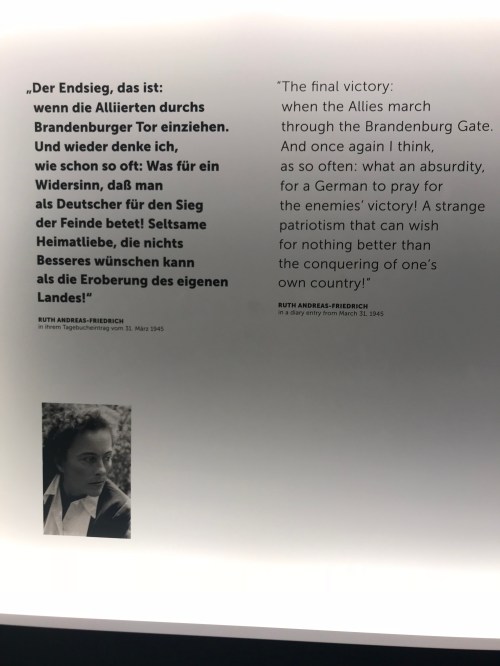
As I read the words of Frau Andreas-Friedrich at the Museum to the German Resistance in Berlin I was struck by their honesty, and that was before the murder of Jamal Khashoggi and the Trump administration’s inability to be honest with the American people and the world.

If somehow asking those questions means that I am not a loyal American then I wonder just what a loyal American is.

Until tomorrow,

Peace

Padre Steve+

1 Comment

Filed under ethics, History, holocaust, Loose thoughts and musings, middle east, national security, nazi germany, News and current events, Political Commentary

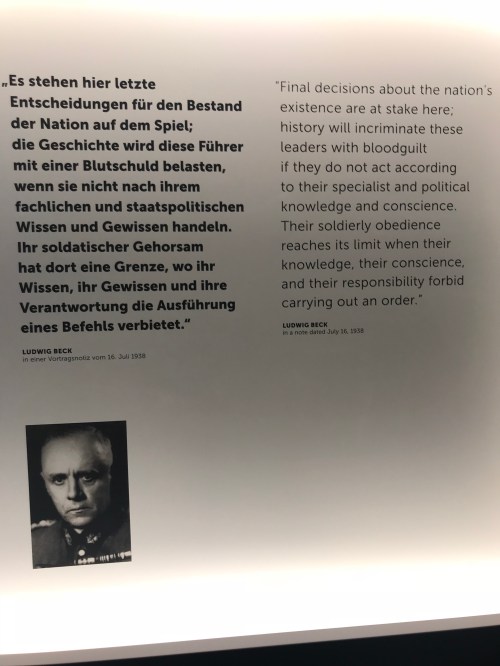
The Limit of Soldierly Obedience: Ludwig Beck and a Lesson for Officials in Authoritarian States

Friends of Padre Steve’s World,

While we were in Berlin I visited the German Resistance Memorial Center. The museum is located in what was the headquarters of the German Army in World War One, the Weimar Republic, and during the Nazi Era. On July 20th 1944, German Army officers attempted to kill Adolf Hitler, overthrow the Nazi regime, and end the war. Sadly, they failed in their attempt and most of those involved were tried and executed for what their criminal government considered treason.

Of course by the law of their times their act was treasonous, but morally it was all that men and women committed to the rule of law and human rights could do. The officers involved had all sworn a personal oath of obedience to Adolf Hitler as the Führer and Reichskanzler of Germany in 1934. At the time most of the men who swore that oath did not anticipate what would come. Many of the older officers had served in the Imperial Army and sworn an oath to the Kaiser and their dynasties of the lands where they entered service. That changed in 1918 when the Weimar Republic came into existence and military officers as well as civil servants swore an oath to the constitution rather than a person.

A year after Hitler came to power as Reichskanzler, President Hindenburg died. Hitler, seized the opportunity used the occasion to swear the military, as well as the civil service to a new oath. This oath was not to the Constitution, or to Office of thePresidency or Chancellor, but to him personally as the Führer and Reichskanzler.

Most officers and civil servants, even those uncomfortable with Hitler’s policies obeyed their oaths and simply stayed in their lanes and did their jobs, even when they had incontrovertible evidence of Nazi atrocities.

Yet there were others who for a number of reasons, in some cases noble, and in others pragmatic, or even base, decided to break the oath they had sworn to Hitler in 1934. Among these men was General Ludwig Beck. Beck noted:

“It is a lack of character and insight, when a soldier in high command sees his duty and mission only in the context of his military orders without realizing that the highest responsibility is to the people of his country.”

With the rise of legally elected authoritarian rulers in Europe and the Americas should concern men and women who have sworn to uphold the constitutions of their countries. These leaders campaigning against democratic institutions, and upon gaining power purge those institutions of opponents and use them to solidify their own power. The veneer of democracy is maintained while the soul of it is crushed. Too often those charged with guarding it are willing participants in its death, soldiers, civil servants, judges, and legislators.

That is what Beck understood. He resigned his office as Chief of Staff of the German Army in 1938 over Hitler’s plan to invade Czechoslovakia, became a member of the anti-Hitler resistance and died in the failed attempt on Hitler’s life on July 20th 1944. He was a career Army officer and a conservative, but he realized that there are limits to obedience in the face of evil.

I fear that there are many men and women in nations whose democratic institutions are being subordinated to authoritarian rulers who will not rise to the occasion and allow those institutions and eventually their nations to perish. Sadly, that also includes those in the United States.

I will leave you with that thought for the evening.

Until tomorrow,

Peace,

Padre Steve+

2 Comments

Filed under ethics, History, Military, nazi germany, News and current events, Political Commentary

“One Learns more from Adversity than from Success” The Battle of Cape Esperance 11-12 October 1942

Friends of Padre Steve’s World,

Naval battles between U.S. Navy and Imperial Japanese Navy surface forces around Guadalcanal in 1942 were almost always brief and bloody. The number of ships from both sides sunk in the waters around Guadalcanal, and the islands near it: Tulagi and Savo Island, led to the area being nicknamed “Iron Bottom Sound.” Over fifty ships and craft would be interred in the waters around Guadalcanal by the end of the campaign. These numbers included 2 battleships, 8 cruisers, and 22 destroyers.

The battles around Guadalcanal occurred in a time of technical transition for the United States Navy as its radar became better at detecting ships and fire direction systems advanced in their accuracy and targeting ability. While almost all U.S. warships had radar primarily the SC search radar and FC Fire Control radar, not many U.S. Navy warships had the advanced SG surface search radar. But it was not just a matter of technology, it was a matter of training and experience. Their opponents, the Imperial Japanese Navy had very few ships equipped with radar, but their training for surface actions, especially night fighting where their superior optics, gunnery skills, and torpedoes proved deadly during the first year of the war before U.S. Navy crews mastered their technology edge.

By October 1942 the U.S. Marines battling on Guadalcanal were fighting an enemy growing in numbers on the ground even as they felt the effects of the the predatory Japanese surface raiders that routinely bombarded their positions and endangered U.S. resupply efforts.

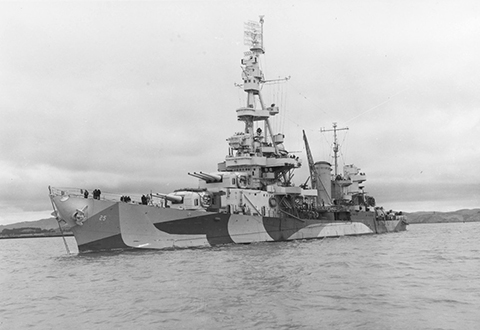
USS Helena

Since the Marine, Navy and Army Air Force Squadrons based on Guadalcanal maintained air superiority in the nearby waters during the day the Japanese were limited to night surface operations against the island. These operations involving the reinforcement and resupply of Japanese Forces on the island as well as offensive naval gunfire operations to aid the land forces in which Japanese warships attempted to destroy or degrade Henderson Field.

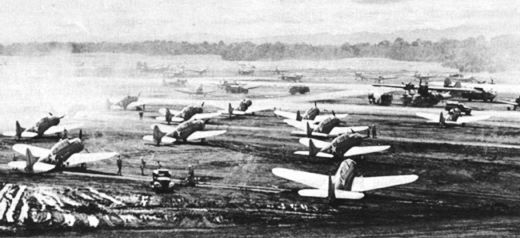
Henderson Field

The first major operations mounted by the Japanese was in early August when a Japanese cruiser destroyer force ravaged the U.S. cruiser forces off Savo Island. The Japanese inflicted the worst defeat of an American naval squadron, sinking 3 American and one Australian Heavy cruiser while damaging another. The battle was a disaster for the U.S. forces and led to the early withdraw of transport and supply ships of the invasion force before many could finish unloading the equipment and supplies that were critical to the operation. In that operation radar played no role for U.S. forces, and sets were either turned off or not relied upon by commanders. Admiral Richmond Turner noted:

“The Navy was still obsessed with a strong feeling of technical and mental superiority over the enemy. In spite of ample evidence as to enemy capabilities, most of our officers and men despised the enemy and felt themselves sure victors in all encounters under any circumstances. The net result of all this was a fatal lethargy of mind which induced a confidence without readiness, and a routine acceptance of outworn peacetime standards of conduct. I believe that this psychological factor, as a cause of our defeat, was even more important than the element of surprise”

Despite this admission it would take several more engagements in the waters around Guadalcanal before the U.S. Navy fully appreciated the superiority of Japanese optics, training in night fighting, and their deadly 24″ “Long Lance” torpedoes. It would not be until 1943 that the U.S. Navy began to exploit its advantage in radar and use it to their advantage in night surface actions.

The Tokyo Express Route along the Slot

Japanese resupply and reinforcement operations to Guadalcanal were so frequent that the Japanese forces were nicknamed the Tokyo Express by the Americans. Knowing that the Marines who had been in bitter combat with the Japanese needed reinforcements the U.S. sent a convoy to land the 164th Infantry Regiment of the Americal Division on October 13th.  To protect the convoy the U.S. Navy dispatched a surface task force, TF-64 composed of the Cruisers USS San Francisco, USS Boise, USS Salt Lake City and USS Helena and 5 destroyers under the command of Rear Admiral Norman Scott to protect it from any Japanese surface threats.

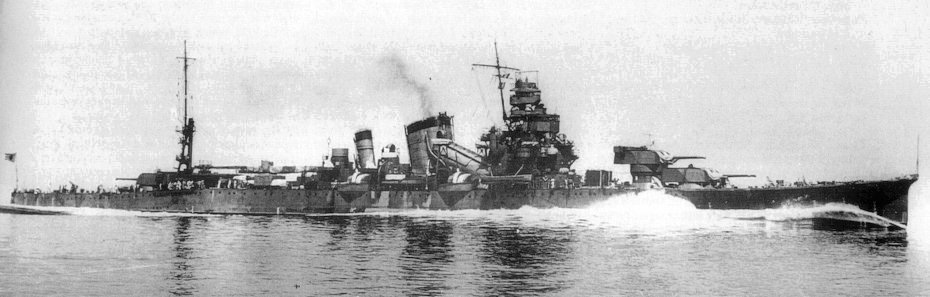
IJN Heavy Cruiser Aoba after the battle

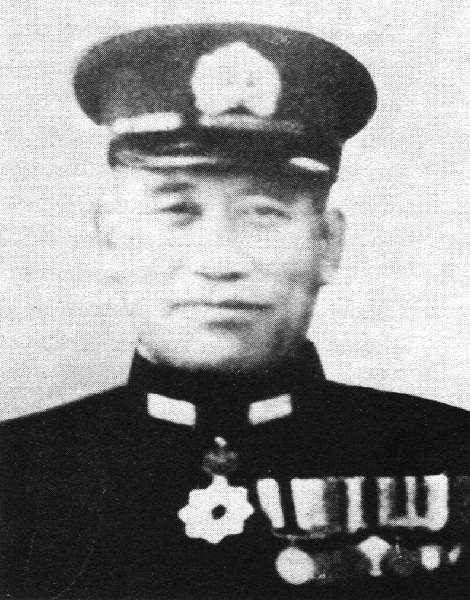
The U.S. move to reinforce Guadalcanal coincided with a Japanese effort to reinforce their forced on the island. They Imperial Navy sent a covering force of three heavy cruisers, the Aoba, Furutuka and Kinugasa and two destroyers under the command of Rear Admiral Arimoto Goto. The Japanese cruisers were to bombard Henderson Field as the Japanese were not expecting any American surface forces to oppose their effort.

Rear Admiral Arimoto Goto

The Japanese were detected by aerial reconnaissance on the afternoon of the 10th when they were still about 200 miles from Guadalcanal. Scott, whose forces lacked experience in night surface combat made a simple plan to “cross the T” of the enemy force in a single line formation with three destroyers in the van, the cruisers in the center and two destroyers in the rear.

Rear Admiral Norman Scott

U.S. floatplanes from the American cruisers detected the Japanese at 2300 hours. At 2322 the radar of the USS Helena picked up the Japanese force at a range of about 27,000 yards. However misunderstandings of Scott’s orders by his flagship broke his formation and put the van destroyers out of position in the poor visibility of the moonless night. The confusion caused Scott to believe that the radar contacts were his own destroyers.

The Japanese still did not realize that an American force was near them and continued on. At 2345 the ships were only about 5,000 yards apart when Helena radioed Scott asking permission to fire. The message was received by Scott who acknowledged his receipt of the message did not grant permission open fire. However, his response of “roger” was mistaken as permission to open fire by Helena. The American cruiser opened fire on the Japanese aided by her SG and FC radars. She was followed by the other cruisers which opened a devastating fire on the Japanese force.

The Japanese task force was completely surprised, they had not expected to encounter American surface ships and failed to be on alert. Goto’s lookouts had sight the Americans at 2343 but assumed that they were friendly Japanese ships. The result was that the Americans inflicted heavy damage to the Japanese flagship, the heavy cruiser Aoba and left Goto mortally wounded.

IJN Heavy Cruiser Furutaka

Scott was taken by surprise by the action of his cruisers and ordered ceasefire at 2347 thinking that he was shooting at his own destroyers. Four minutes later he ordered his ships to resume fire at 2351. At 2349 the heavy cruiser Furutaka was heavily damaged by American fire and at 2358 she was was hit by a torpedo fired by the destroyer Buchanan. The Japanese destroyer Fubuki was mortally wounded about the same time and began to sink. The U.S. destroyers Duncan and Farenholt were both damaged in the crossfire with Duncan so badly damaged that she would be abandoned and sunk.

USS Duncan

Instead of continuing to rely on radar the American cruisers turned on their searchlights which provided the last Japanese cruiser, Kinugasa the opportunity to hit them hard. Kinugasa’s gunners heavily damaged Boise and but for a certain amount of luck would have sunk the American ship. One shell hit the number one turret setting fires in it, while another hit below the waterline and detonated in the forward 6″ magazine threatening to blow the ship to pieces but the onrushing water from the hit doused the flames and saved the ship. Despite that Boise was out of action with over 100 casualties, all of the forward magazine and handling crews were all killed.

As Boise sheared away from the action, Kinugasa and Salt Lake City exchanged fire, each hitting each other before the Japanese cruiser broke off the action.

The commander of the Japanese reinforcement group, his mission completed dispatched his destroyers to assist Goto’s force at it withdrew and rescue survivors. However these ships were caught by U.S. aircraft from Henderson Field as the light of the dawn lit the sky. The destroyers Murakumo and Natsugumo were heavily damaged, abandoned, and scuttled by the Japanese.

On the 13th the American reinforcement convoy arrived, as did Japanese reinforcements later that night. On the night the 13th, the Japanese battleships Kongo and Haruna  conducted an attack which most destroyed Henderson Field. However, the resilient Marines kept the airfield operational as the Marines of the 1st Marine Division and the nearly arrived soldiers of the 164th Regiment held off a major Japanese assault from 23-26 October, known as the Battle of Henderson Field or Bloody Ridge.

Scott’s Task Force 64 lost one destroyer sunk and two cruisers damaged while the Japanese lost one cruiser and three destroyers sunk, with two cruisers damaged in the action.

The Japanese flagship Aoba was severely damaged by nearly 40 6” and 8” shells fired by the American cruisers. Her bridge was shattered and her number three turret destroyed. The damage knocked her out of the war for four months and the number three turret would not be replaced. On the American side the heavily damaged Boise was sent to the East Coast for repairs while Salt Lake City was repaired at Pearl Harbor. The battle had lasted less than 50 minutes from the time Helena picked up the Japanese force on her radar.

http://ww2db.com/

USS Salt Lake City

The battle was a tactical victory for the U.S. Navy. However, the Navy did not learn  but the lessons of the battle about the power of Japanese torpedoes and effectiveness in night combat. While he Scott maintained a cool head and reacted to the situation with great courage he assumed that his deployment of his ships in a line formation coupled with superior American gunnery had won the battle. However, his ignorance on the proper use of the various types of radar used by the U.S. Navy meant that he and other American commanders would continue to misuse it and rely on searchlights and recognition lights during night surface actions. Likewise, he made the false assumption that Japanese torpedoes were no longer a threat.

This caused other U.S. task forces to have to learn the hard way in the subsequent engagements of the Naval Battle of Guadalcanal and the Battle of Tassafaronga. Rear Admiral Scott would not long survive his victory. He was killed in action aboard the USS Atlanta during the Naval Battle of Guadalcanal just a month later. The great American naval historian of the Second World War, Samuel Elliott Morrison wrote:

“So, because we won the Battle of Cape Esperance, serious tactical defects were carried over into subsequent engagements with unfortunate results. One learns more from adversity than from success.” 

While the battle helped inspire American confidence, it was not a strategic victory. Japanese forces nearly destroyed Henderson Field on the night of the 13th, and the the most decisive battles were yet to come.

Peace

Padre Steve+

Leave a comment

Filed under History, leadership, Military, Navy Ships, US Navy, World War II at Sea, world war two in the pacific

Back in the Fight

Friends of Padre Steve’s World,

So, it has been just over 50 hours since I returned from our trip to Germany and I am back in the game and ready to fight.

My travel overseas gave me time to clear my head and take stock of my life right now, personally and professionally. It was what I needed.

I have many challenges where I work. I won’t go into details here but they do not involve my staff. In 10 and 1/2 months I will be retired from the Navy after a combined 38 years of enlisted and officer service, active and reserve in the Army, Army Reserve, Army National Guard, and the Navy.

That being said for the past year I have been depressed about work, so much so that I hated to get up in the morning to go there. The work I did to support the congregations of my chapels despite lack of funding, loss of personnel, and other factors that I cannot go into now made things almost unbearable had it not been for the support of my staff. I can only be thankful for them.

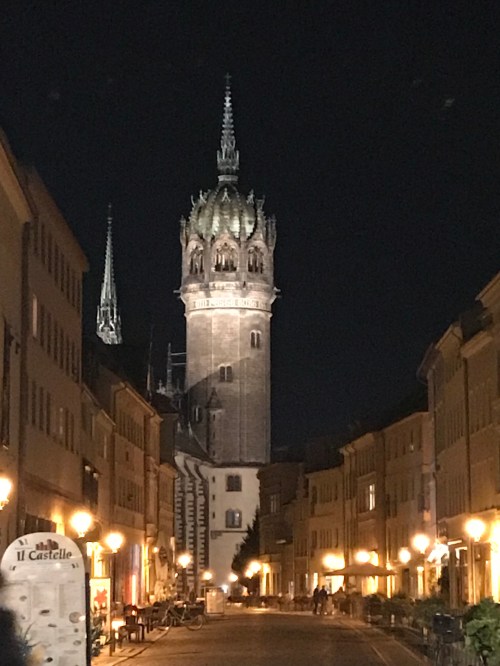
Likewise, I came to realize again that actions mean more than words in many if not most aspects of life. Standing at the graves of Sophie and Hans Scholl, the site where Clause Con Stauffenberg, General Ludwig Beck and others were executed, and were Martin Luther nailed his 95 Thesis’s to the door of the Schlosskirche in Wittenberg gave me new life to fight for what I believe in.

Anyway, I will write more about this tomorrow.

Until then,

Peace,

Padre Steve+

Leave a comment

Filed under christian life, faith, History, holocaust, Military, Political Commentary

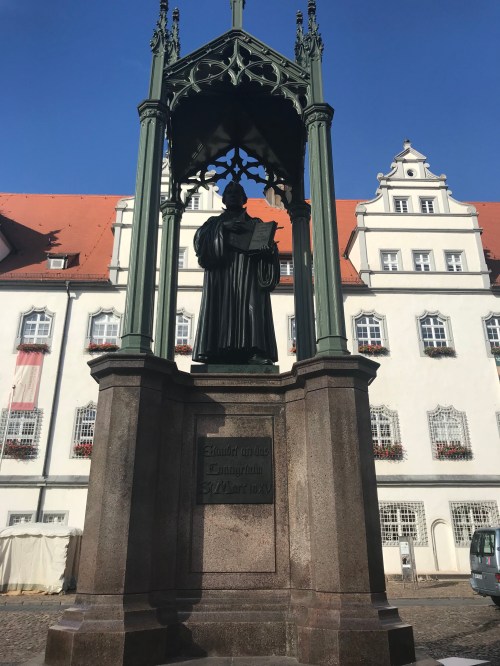
A Visit to Lutherstadt Wittenberg

Friends of Padre Steve’s World,

For the first time in 22 years during our recent trip to Germany I returned to the city where a little known Augustinian Monk and Professor of Theology, Dr. Martin Luther began the Protestant Reformation and changed the world forever. There had been other revolts against the Catholic Church by various dissenters but none of them had ever found and ear with rulers who by their support could change the status quo and protect them from being tried as heretics.

To be tried as a heretic meant that you were also in violation of the law of the local monarch or the Emperor of the Holy Roman Empire, and likewise an enemy of the State. Once convicted of heresy the the opponents of the regime were then executed in whatever way the Church and State deemed to be the most effective way of discouraging future dissenters.

Luther was not only a keen theologian, he knew how to gain the support of common people, as well as the princes and other members of the nobility who knew that they were getting screwed by both the Church and the Empire. Thus while his theological motives based on his experience of the grace of God were genuine, he understood the political implications of his theology which broke the chains of Germans Protestants to Rome.

The result would lead Luther’s political supporters into multiple wars against Rome and the Holy Roman Empire, and then against German dissenters who dissented from Luther. It would also set the stage for successful breaks from Rome in England, and in Geneva, where John Calvin proclaimed a harsh and cold version of Protestantism. In many ways Luther never fully rejected parts of Catholic doctrine such as the Eucharist as the Body and Blood of Christ, and the efficacy of Baptism for the forgiveness of sins, despite writing circles around himself to show his differences with Rome. He would never be Protestant enough for Calvin, or Ulrich Zwingli of Zurich, or the later more radical Calvinist separatists in France, Holland, England, and Scotland. Of course none of those were acceptable to the Radical Reformers of the Anabaptist-Mennonite movement in Holland which spread to England in the guise of the early English Baptists, who were simply Anabaptists who had thrown out pacifism.

Luther was a remarkable man with many flaws. His theology led to married clergy, the Bible being translated into German and then many other languages. In fact Luther’s translation of the Bible into German helped birth the modern German language as much as the later King James Bible did for English some 80years later.

Likewise, through his emphasis on the Three Solas, Sola Gratia, Sola Fides, and Sola Scriptura he opened the door for individuals to have more say in their spiritual lives and interpretation of the Christian faith, which led to many more breaks with the Church, his Church within a few years. Luther opened the door to a Christianity which has never stopped splitting, often with ugly consequences, and sometimes reforming for the better. Luther was a huge influence on John Wesley who influenced me like William Wilberforce and John Newton who helped abolish slavery in England and it’s colonies. At the same time one cannot overlook just how Luther’s vehement denunciations and demonizations of the Jews helped set the stage for the German anti-Semitism that brought about the Holocaust.

But all that being said from a theological point of view Luther shattered the theological oneness of the western church. Instead of one Pope, Luther opened the door for everyone to be his own Pope.

His theology also allowed rulers to break from Rome and still support their own State Church. In the various fiefdoms of Germany some went with Luther, others Calvin, and still others Zwingli. In England, Henry VIII took the Church of England out of Rome and that church recognized the English King, or at times the Queen the head of the Church.Without Luther to shatter the barrier between Church and State, there would likely never have been the freedom granted to the great

This when the men who wrote the Declaration of Independence and the Constitution of the United States wrote those documents they were absolutely opposed to the government of the United States having a State religion or for that matter even endorsing any sect of Christianity. The great Virginia Baptist and friend of Thomas Jefferson and James Madison, John Leland wrote:

“The notion of a Christian commonwealth should be exploded forever. … Government should protect every man in thinking and speaking freely, and see that one does not abuse another. The liberty I contend for is more than toleration. The very idea of toleration is despicable; it supposes that some have a pre-eminence above the rest to grant indulgence, whereas all should be equally free, Jews, Turks, Pagans and Christians.”

Luther certainly would not have agreed with that, but he opened the door to it and we should all be grateful that he did. One wishes that the Christian Nationalists of the United States would read their United States history because they are try to establish a particular minority sect of Christianity, a fundamental evangelicalism rooted in the political theology of John Calvin as the official State religion. To do so they are using a man who would shame the Medici Popes in his profound disregard and disrespect of anything resembling the Christian faith; for his carnal indulgence, his wanton greed, vain pomposity, and his narcissism which borders on self-deification. Luther would have recognized him and them as frauds of the most odious kind.

Luther’s flaws are many. He suffered severe, probably clinical depression, and many PTSD from the beatings administered by his father. That was not helped by his understanding as a young man, theology student, and monk of a very punitive and angry God who he could never please. His life crisis came at a time in his life, between 28 and 32 years old, when developmental psychologists tell us that many great thinkers, intellects, and leaders have their breakthroughs.

He was also at times terribly sarcastic, vindictive, and angry. He could turn on friends and former students who broke with him in a visceral manner. He was also beset by an anti-Semitic streak that while it was a part of the times that he lived was used by other German anti-semites, especially Hitler’s Nazis in their persecution, and later extermination of the Jews. He was also prone to see the religious wars of his time, be they against the Turks, the Roman Catholics, or the Radical Reformers, through the lens of an apocalyptic worldview.

Despite all his flaws he is one of the most important men in history. Without his break with Rome and the support of European nobility there probably would have been no Enlightenment as we know it for the great artists, writers, scientists, and others of that period would likely have never had safe places to go beyond the limits of Medieval Scholasticism and Aristotelian philosophy.

Likewise the principle of the Reformation is that Reformation never ends. The Church must continually reform or die. Unfortunately, that is seldom the case, the Christian Church has always been resistant to change and frequently is the last holdout against truly evil movements. Christians, not just in the United States, frequently heed the call of racism, nationalism, and misogyny more than any other group. Of course there are other religions where many of the faithful and their leaders do the same thing, but today’s post is about Luther and the the Christian faith.

Luther understood that the Gospel must speak to the issues of the day. He said: A gospel that doesn’t deal with the issues of the day is not the gospel at all. In our day those issues are ones that I think that had he lived among us that Luther would see and preach about. I could see him boldly condemning the court preachers of Donald Trump, (yes I see the split infinitive and I don’t care – to “boldly go” as someone we’ll know has said). Men like Robert Jeffress, Jerry Falwell Jr., and Franklin Graham wouldn’t stand a chance against the Monk from Wittenberg. Neither would the Medici President and his sycophant supporters who scream in indignation when he or they are exposed for who they are.

So, until tomorrow,

Peace,

Padre Steve+

Leave a comment

Filed under christian life, culture, ethics, faith, History, ministry, Political Commentary

“The Most Appalling Site Imaginable” George Patton’s Experience at the Ohrdorf Subcamp of Buchenwald

Friends of Padre Steve’s World,

In our day there are fewer and fewer people who lived through or personal saw or documented the evils of the Nazi Concentration Camps. Likewise, there are a host of Holocaust deniers who produce a plethora of pseudo-scholarly articles claiming to be legitimate historians. Even more frighteningly the rise of apologists for the Nazi regime including those who are active members of allegedly conservative parties in the United States and the European Union is beginning to influence politics. The abject racism, rejection of anyone considered racially inferior, and quite often their unhidden anti-Semitism show that what lies in the dark heart of Naziism is not dead and in fact is rising.

In the United States its rise is being fueled and legitimized by the Presidency of Donald Trump who has referred to American Nazis and White Supremacists as “very good people” after one of their protests where an anti-Nazi demonstrator was murdered and others brutally attacked. In the same time frame a good number of Republican candidates have exposed themselves as White Supremacists and actual Nazis while running for office. A host of new-Nazi and White supremacist organizations openly meet and flood the internet with their race hatred.

The fact is that anyone who denies the Holocaust, attempts to minimize it, or advocates the same policies of race hatred and violence against political, religious, or other opponents is no better than the perpetrators of the Holocaust. Likewise, those who stand by and say nothing are worse. As Yehuda Bauer wrote:

“The horror of the Holocaust is not that it deviated from human norms; the horror is that it didn’t. What happened may happen again, to others not necessarily Jews, perpetrated by others, not necessarily Germans. We are all possible victims, possible perpetrators, possible bystanders.”

The good thing is that there were people who took the time to record what they saw in the Nazi Concentration Camps and exposed those deeds to the world in such a way that only perverted and evil people could brazenly deny those facts.

One of the most detailed descriptions of a liberated Concentration Camp was written by General George Patton in his memoirs entitled War as I Knew It.

… we drove to Ohrdruf and visited the first horror camp any of us had ever seen. It was the most appalling sight imaginable.

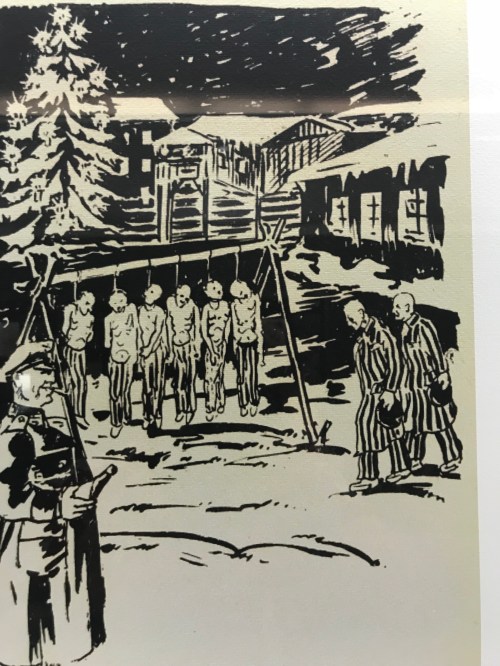
A man who said he was one of the former inmates acted as impresario and showed us first the gallows, where men were hanged for attempting to escape. The drop board was about two feet from the ground, and the cord used was piano wire which had an adjustment so that when the man dropped, his toes would just reach the ground and it would take about fifteen minutes for him to choke to death, since the fall was not sufficient to break his neck. The next two men to die had to kick the board out from under him. It was stated by some of the Germans present that the generals who were executed after the Hitler bomb incident were hanged in this manner.

Our guide then took us to the whipping table, which was about the height of the average man’s crotch. The feet were placed in stocks on the ground and the man was pulled over the table, which was slightly hollowed, and held by two guards, while he was beaten across the back and loins. The stick which they said had been used, and which had some blood on it, was bigger than the handle of a pick.

Our guide claimed that he himself had received twenty-five blows with this tool. It later developed that he was not a prisoner at all, but one of the executioners. General Eisenhower must have suspected it, because he asked the man very pointedly how he could be so fat. He was found dead next morning, killed by some of the inmates.

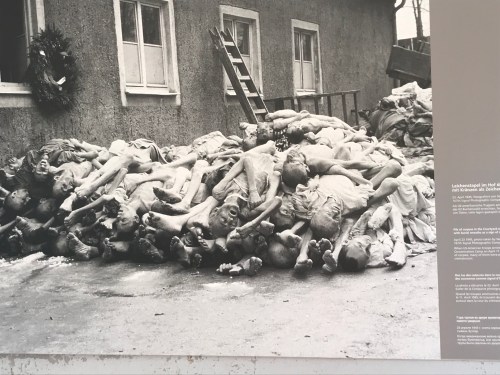
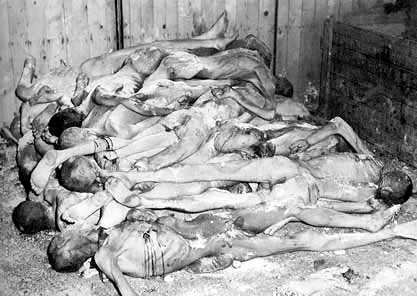
Just beyond the whipping table there was a pile of forty bodies, more or less naked. All of these had been shot in the back of the head at short range, and the blood was still cooling on the ground.

In a shed near-by was a pile of forty completely naked bodies in the last stages of emaciation. These bodies were lightly sprinkled with lime – not, apparently, for the purpose of destroying them, but to reduce the smell. As a reducer of smell, lime is a very inefficient medium.

The total capacity of the shed looked to me to be about two hundred bodies. It was stated that bodies were left until the shed was full and then they were taken out and buried. The inmates said some three thousand people had been buried from this shed since January 1, 1945.

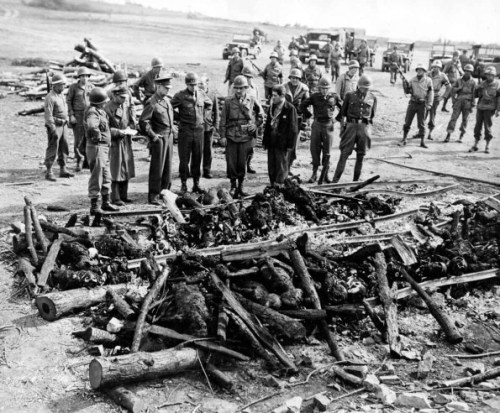
When our troops began to draw near, the Germans thought it expedient to remove the evidence of their crimes. They therefore used the inmates to exhume the recently buried bodies and to build a sort of mammoth griddle of 60 cm. railway tracks laid on a brick foundation. The bodies were piled on this and they attempted to burn them. The attempt was a bad failure. Actually, one could not help but think of some gigantic cannibalistic barbecue. In the pit itself were arms and legs and portions of bodies sticking out of the green water which partially filled it.

General Walker and General Middleton had wisely decided to have as many soldiers as possible visit the scene. This gave me the idea of having the inhabitants themselves visit the camp. I suggested this to Walker, and found that he had already had the mayor and his wife take a look at it. On going home those two committed suicide. We later used the same system in having the inhabitants of Weimar go through the even larger slave camp (Buchenwald) north of that town. (Excerpted for G. Patton War as I Knew It)

Dwight D. Eisenhower wrote after seeing the camp:

The same day [April 12, 1945] I saw my first horror camp. It was near the town of Gotha. I have never felt able to describe my emotional reactions when I first came face to face with indisputable evidence of Nazi brutality and ruthless disregard of every shred of decency. Up to that time I had known about it only generally or through secondary sources. I am certain, however that I have never at any other time experienced an equal sense of shock.

Eisenhower was so moved that he ordered that the best reporters and newsmen come and record what he had seen. He did not want the horrors to be denied by history. He wrote:

I visited every nook and cranny of the camp because I felt it my duty to be in a position from then on to testify at first hand about these things in case there ever grew up at home the belief or assumption that `the stories of Nazi brutality were just propaganda.’ Some members of the visiting party were unable to through the ordeal. I not only did so but as soon as I returned to Patton’s headquarters that evening I sent communications to both Washington and London, urging the two governments to send instantly to Germany a random group of newspaper editors and representative groups from the national legislatures. I felt that the evidence should be immediately placed before the American and British publics in a fashion that would leave no room for cynical doubt.

The fact is that as much as we want to pretend that what happened a Buchenwald, Flossenbürg, Dachau, Bergen-Belsen, Auschwitz, Soribor, Belzec, and Treblinka are images from history that cannot happen again, however, they are an ever present reality and they cannot be ignored. Sadly, I cannot help but to imagine that this can and will happen again in my lifetime.

I go to a quote from one of my favorite episodes of Star Trek the Next Generation called The Drumhead uttered by Jean Luc Picard:

We think we’ve come so far. Torture of heretics, burning of witches it’s all ancient history. Then – before you can blink an eye – suddenly it threatens to start all over again.

That is our reality. There are people, even neighbors and those that we think are friends who would be perpetrators or bystanders when those that transgress the way of Trump are take us from our homes and families because of our beliefs. I would love to be wrong about this, but I am a historian and a theologian and I know the human condition far too well to sit back and remain silent, no matter what the cost.

I had a Facebook exchange with a friend who is a retired Navy Chaplain. He is very much a Trump supporter and apologist. He is very happy about Justice Kavanaugh being in the Supreme Court. The stories of the victims and their claims did not matter to him. Despite that I do not believe that he is a bad man or an evil person. I simply believe that like Martin Niemöller that he has made a bad choice in the man and party that he currently supports and that he will eventually regret it. I could be wrong, he might not turn out to be a Niemöller, but a Reichsbishof Müller. Sincerely hope that he does not become the latter.

I keep quoting historian Timothy Snyder, but he was all too correct when he wrote these words less than two years ago:

The European history of the twentieth century shows us that societies can break, democracies can fall, ethics can collapse, and ordinary men can find themselves standing over death pits with guns in their hands. It would serve us well today to understand why.

If you don’t believe me read the words of the President, his closest supporters, the prominent political preachers of the Christian Right, and any number of Trump leaning columnists, pundits, and politicians. There are some who are so far gone that they will accuse any opponent of being disloyal, not the the Constitution or the law but to President Trump. One of those people tried to get my commanding officer to have me tried by Court Martial for a sermon in which he lied about what I said. I had to spend my money to hire a lawyer to defend me from the false charges and have them dismissed during the preliminary investigation.

Trust me, I know what resistance will mean if this President and his cult like followers are not stopped. Our fate will be worse than that of Nazi Germany because we should have known better. We should have learned from Dwight Eisenhower and George Patton. We should have learned fro Dietrich Bonhoeffer and Martin Niemöller, we should have learned from the Nuremberg trials, but we have not.

For the next four months, and maybe more should the Democrats fail to gain a majority in the House or Senate, President Trump will have all the branches of the Federal government in his power. With the laws already enacted in the Patriot Act and numerous executive orders there is little to stop a President who has no respect for the law or the Constitution from declaring full emergency powers should any war, terrorist act, or natural disaster be declared.

So with all of that happy commentary I will leave you until tomorrow when, God willing, I will be back in the United States.

Until then have a good night, and please, never forget.

Peace

Padre Steve+

3 Comments

Filed under civil rights, ethics, faith, History, holocaust, leadership, News and current events, Political Commentary

“If These Trees Could Talk” A Visit to Buchenwald

Friends of Padre Steve’s World,

We are beginning to wind up our trip to Germany staying with our friends Linda and Holger near Karlsruhe. As do so I am beginning to catch up on writing about some of the places that we have been to and things that we have experienced.

Last Saturday while driving from Wittenberg to Eisenach to meet our friends Gottfried and Hannelore we stopped at Buchenwald, a notorious Concentration Camp located on the Ettersburg hill and the Buchenwald Forrest near Weimar. The area is beautiful and serene, it is hard to imagine the evil that took place here. The deaths of over 50,000 people who died from being executed by hanging or with a shot to the base of the neck, being worked to death, starved, maltreated, and being used as Guinea Pigs for medical experiments cannot be removed by the scenery in the local area.
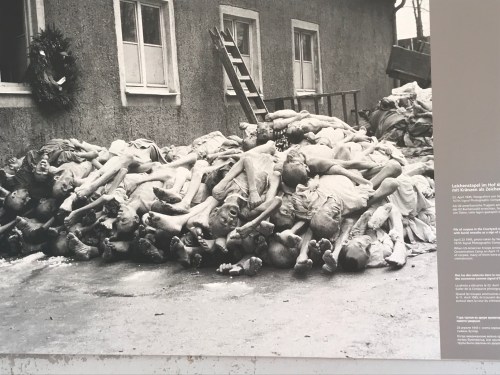
If you visit Buchenwald you will be surprised at how vast the camp is. The area most visited is the main camp, but two others adjoin it, though the visible markers are less numerous or obvious than at the main camp. Unless you have more than a couple of hours you cannot do it all. Had I had the time I would have liked to walk the entire perimeter, which you can do, but due to our schedule I could only spend about an hour and a half there.
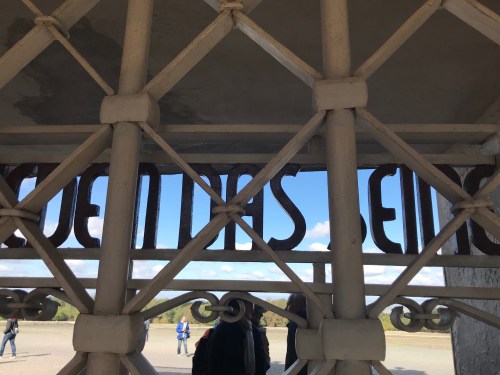
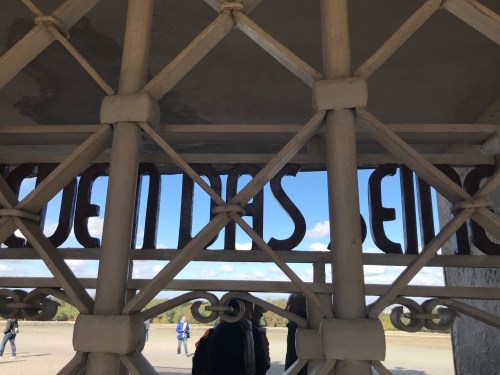
At the gate there is an inscription which must be read from the inside of the camp. It states Jedem das Seine or to each their own, which the SS interpreted to mean that the Master Race had the right to humiliate and destroy all others.

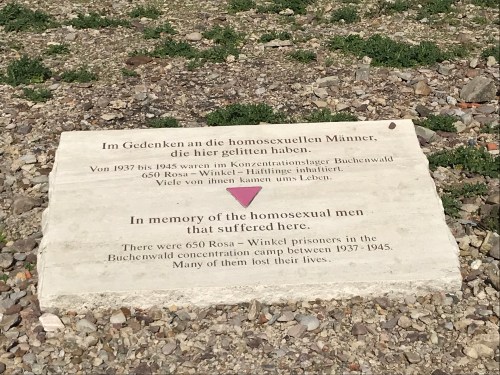
Buchenwald was opened in 1937 as a place where the Nazi regime could imprison political prisoners as well as members of what they called untermenschen or sub-human. The former included Communists, Socialists, other political opponents, of course Jews, as well as people deemed “asocial” which could mean almost anything. Repeat offenders and habitual criminals, Roma and Sinti, Homosexuals, Freemasons, Jehovah’s Witnesses, the mentally, and the mentally or physically disabled. As the Nazi occupation of Europe grew to encompass most of the continent the list expanded to include the former as well as political, military, social, religious and intellectual leaders of those countries, and anyone else deemed a threat the Reich.
But Buchenwald was not a Death Camp. It had no gas chambers and those executed were killed up close and personal with a bullet to the base of the neck, being hanged in some manner, and in a few cases of Catholic clergy, crucified upside down. Yet it was a place of horror. General Dwight Eisenhower wrote after visiting the Ohrdorf sub-camp of Buchenwald subsequent to its liberation wrote:

The same day [April 12, 1945] I saw my first horror camp. It was near the town of Gotha. I have never felt able to describe my emotional reactions when I first came face to face with indisputable evidence of Nazi brutality and ruthless disregard of every shred of decency. Up to that time I had known about it only generally or through secondary sources. I am certain, however that I have never at any other time experienced an equal sense of shock.

Eisenhower was so moved that he ordered that the best reporters and newsmen come and record what he had seen. He did not want the horrors to be denied by history. He wrote:

I visited every nook and cranny of the camp because I felt it my duty to be in a position from then on to testify at first hand about these things in case there ever grew up at home the belief or assumption that `the stories of Nazi brutality were just propaganda.’ Some members of the visiting party were unable to through the ordeal. I not only did so but as soon as I returned to Patton’s headquarters that evening I sent communications to both Washington and London, urging the two governments to send instantly to Germany a random group of newspaper editors and representative groups from the national legislatures. I felt that the evidence should be immediately placed before the American and British publics in a fashion that would leave no room for cynical doubt.

One of those reporters was Edward R. Murrow who broadcast his visit to Buchenwald:

There surged around me an evil-smelling stink, men and boys reached out to touch me. They were in rags and the remnants of uniforms. Death already had marked many of them, but they were smiling with their eyes. I looked out over the mass of men to the green fields beyond, where well-fed Germans were ploughing….

[I] asked to see one of the barracks. It happened to be occupied by Czechoslovaks. When I entered, men crowded around, tried to lift me to their shoulders. They were too weak. Many of them could not get out of bed. I was told that this building had once stabled 80 horses. There were 1200 men in it, five to a bunk. The stink was beyond all description.

They called the doctor. We inspected his records. There were only names in the little black book — nothing more — nothing about who had been where, what he had done or hoped. Behind the names of those who had died, there was a cross. I counted them. They totaled 242 — 242 out of 1200, in one month.

As we walked out into the courtyard, a man fell dead. Two others, they must have been over 60, were crawling toward the latrine. I saw it, but will not describe it.

In another part of the camp they showed me the children, hundreds of them. Some were only 6 years old. One rolled up his sleeves, showed me his number. It was tattooed on his arm. B-6030, it was. The others showed me their numbers. They will carry them till they die. An elderly man standing beside me said: “The children — enemies of the state!” I could see their ribs through their thin shirts….

We went to the hospital. It was full. The doctor told me that 200 had died the day before. I asked the cause of death. He shrugged and said: “tuberculosis, starvation, fatigue and there are many who have no desire to live. It is very difficult.” He pulled back the blanket from a man’s feet to show me how swollen they were. The man was dead. Most of the patients could not move.

I asked to see the kitchen. It was clean. The German in charge….showed me the daily ration. One piece of brown bread about as thick as your thumb, on top of it a piece of margarine as big as three sticks of chewing gum. That, and a little stew, was what they received every 24 hours. He had a chart on the wall. Very complicated it was. There were little red tabs scattered through it. He said that was to indicate each 10 men who died. He had to account for the rations and he added: “We’re very efficient here.”

We proceeded to the small courtyard. The wall adjoined what had been a stable or garage. We entered. It was floored with concrete. There were two rows of bodies stacked up like cordwood. They were thin and very white. Some of the bodies were terribly bruised; though there seemed to be little flesh to bruise. Some had been shot through the head, but they bled but little.

I arrived at the conclusion that all that was mortal of more than 500 men and boys lay there in two neat piles. There was a German trailer, which must have contained another 50, but it wasn’t possible to count them. The clothing was piled in a heap against the wall. It appeared that most of the men and boys had died of starvation; they had not been executed.

But the manner of death seemed unimportant. Murder had been done at Buchenwald. God alone knows how many men and boys have died there during the last 12 years. Thursday, I was told that there were more than 20,000 in the camp. There had been as many as 60,000. Where are they now?

I pray you to believe what I have said about Buchenwald. I reported what I saw and heard, but only part of it. For most of it, I have no words.

If I have offended you by this rather mild account of Buchenwald, I’m not in the least sorry….

Allied prisoners of war, especially Russians and Poles were brought to Buchenwald. While many Red Army POWs were assigned to the work camps, thousands of other Soviet POWs were summarily executed upon their arrival and thus were never registered as inmates and are not counted in the official German numbers of those who died at the Camp.
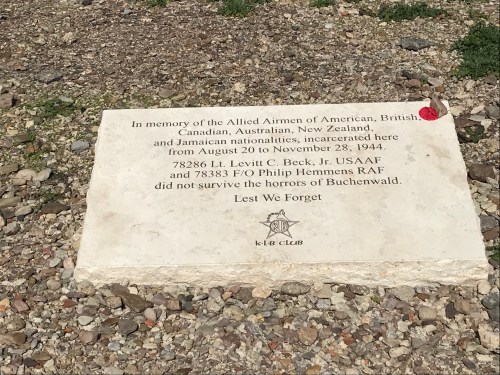
In one of the more unusual instances, 168 Allied aviators from the United States, Britain, Canada, and other Commonwealth nations were transported to Buchenwald by the SS from France in August 1944. Normally such prisoners were the responsibility of the Luftwaffe. The men arrived at Buchenwald and remained for two months in the same conditions as the other inmates. During that time three died. The Luftwaffe found out about the prisoners and had them transferred to Stalag Luft III, a regular POW Camp in Silesia from which the legendary Great Escape had been made in March 1944.

One of the Canadians wrote of their arrival at Buchenwald:

As we got close to the camp and saw what was inside… a terrible, terrible fear and horror entered our hearts. We thought, what is this? Where are we going? Why are we here? And as you got closer to the camp and started to enter [it] and saw these human skeletons walking around—old men, young men, boys, just skin and bone, we thought, what are we getting into?

As for me the the cruelty of the SS to their inmates is horrible enough, but I think for me it was the larger scale use of the camp and it’s inmates for medical experiments by physicians that affected me the most. I have Robert Jay Lifton’s book The Nazi Doctors, but to see where and stand where these practitioners of evil did their work was difficult. Lifton wrote:

In all fundamentalisms, and they are usually religious or political, there is the sense of profound threat to what are considered fundamental beliefs and symbols, and a compensatory invocation of a sacred text (the Bible, the Koran, Mein Kampf) as a literal guide to every form of action. History stops so that murderous therapy can be applied. While medicine does not provide the sacred text, one can revert to ancient practices of shamans, witch doctors, and tricksters who could be expected to kill in order to heal. For physicians as well as charismatic spiritual physicians, there is a release from Hippocratic restraint.

Hundreds of inmates were injected with Typhus in order to test treatments for the disease. To test balms which could help victims of incendiary bombs, prisoners were exposed to White Phosphorus which caused massive and incredibly painful burns in order to test the treatments. Many other experiments were conducted by the SS Doctors of Buchenwald.

Almost all of the prisoners at Buchenwald and its sub-Camps were used as slave laborers for German industrial plants and armaments plants. The sub- Camp at Mittelbau-Dora (Nordhausen) which became independent from Buchenwald in 1944 was a key production facility for the V-1 and V-2 rockets. Under the direction of SS Gruppenführer Oswald Pohl and the Verwaltung und Wirtschaft Hauptamt, the Administrative and Economics Main Office, Fritz Sauckel, General Plenipotentiary for Labour Deployment who oversaw the efforts to bring extra laborers to the Reich, and Armaments Minister Albert Speer.
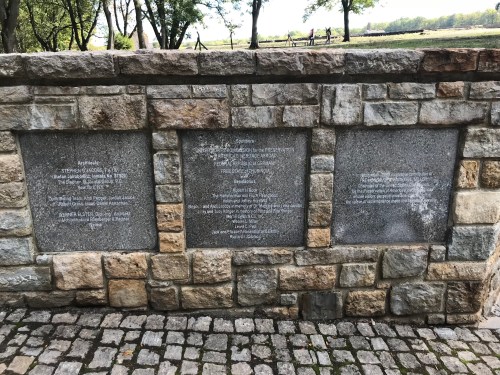
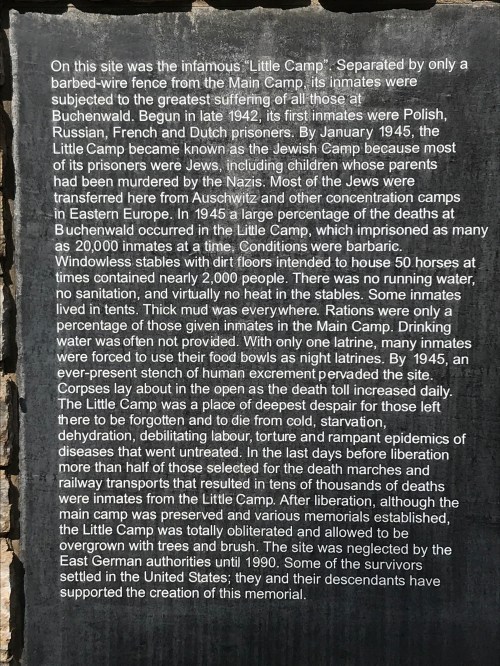
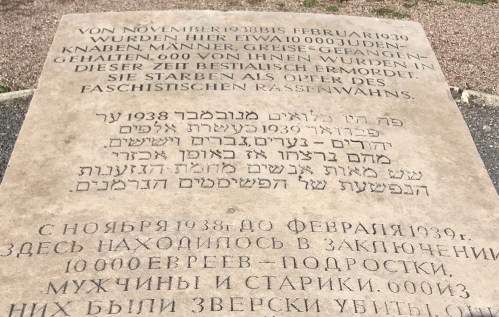
Buchenwald is both historical reality that cannot be denied, as well as an everlasting reminder of the capacity of supposedly advanced human beings can do to others. Man’s capacity for evil is limitless and Buchenwald is one of the great reminders of it.

As I listen to and read the opinions of many American supporters of President Trump I believe that such evil could happen again, this time in my country and at the hands of my countrymen. Honestly, I don’t think that most of these people are really evil. I think that most are simply deluded by years of propaganda put forth by the politicians, pundits, and preachers of the political right who play upon their fears of being displaced economically and socially by minorities, women, foreigners, and others deemed less deserving of having a chance to live the American Dream. In their fear they would excuse the actions of a government that would run Buchenwald and the other components of the Concentration Camp system, not only for punishing political opponents, but also using that system to exploit victims for economic gain without any consideration of them as human beings.

This is something that we have to remember now more than ever. For at least a few months the American President who is an admirer of everything authoritarian now controls all three branches of the Federal Government. With such power at his disposal, a compliant executive branch, a subservient legislative branch, and a Supreme Court in the hands of Right Wing ideologues it would be incredibly easy to pass something like the Reichstag Fire Decree or the Enabling Act giving the President unlimited power.
Historian Timothy Snyder wrote these words not even two years ago.

The European history of the twentieth century shows us that societies can break, democracies can fall, ethics can collapse, and ordinary men can find themselves standing over death pits with guns in their hands. It would serve us well today to understand why.

I do not want to sound like an alarmist but I am beginning to doubt that the institutions so well designed by our Founders to withstand assaults on the Constitution by one or two branches of government can survive this. There is no going back from what has happened over the past few weeks and we will be very fortunate if our institutions survive in the manner that our Founders intended. The outward structure may survive, but the heart of those institutions will be destroyed, even if the Democrats regain control of the House and Senate.

Tomorrow we travel to Munich to spend the night before flying home Monday. Our trip has allowed me to me more reflective about the current American crisis without being immersed in it on a minute to minute basis.

I expect to post something from Munich so until tomorrow,

Peace,

Padre Steve+

4 Comments

Filed under historic preservation, History, holocaust, nazi germany, News and current events, Political Commentary

The Businesslike Execution of Punishment adjusted for the Development of the Nation: A Visit to Flossenbürg Concentration Camp

Friends of Padre Steve’s World,

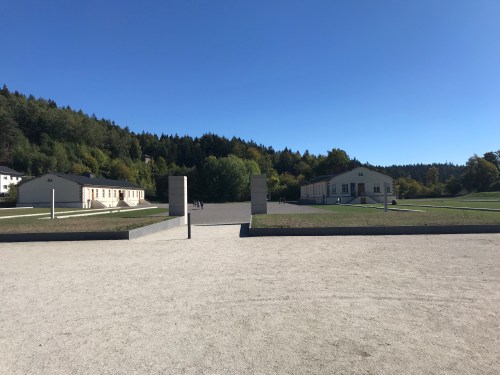
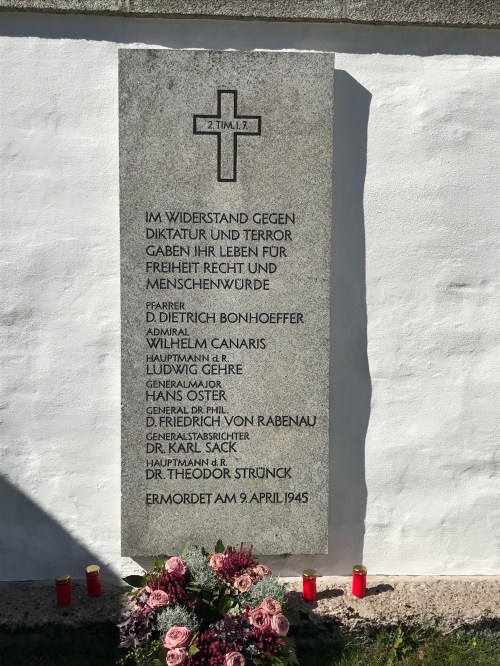
Last week on our way from Munich to Berlin we stopped to visit the memorial at the site of the former Flossenbürg Concentration Camp. For most people it is best known as the site where Dietrich Bonhoeffer, Admiral Wilhelm Canaris, General Hans Oster and others implicated in the 20th of July plot to assassinate Hitler. However, the evil committed there was far greater than the execution of these outstanding men.

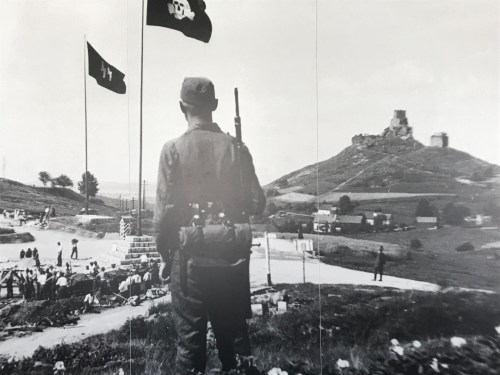
In May of 1938 the SS-Wirtschafts- und Verwaltungshauptamt or the SS Main Economic and Administrative Office constructed a labor camp for German political and other prisoners at the town of Flossenbürg near the Czech border in northern Bavaria. Directed by SS Gruppenführer Oswald Pohl, a former German Navy officer and paymaster. Already a dedicated Nazi, Pohl gave up his Navy career in 1933 to take a commission in the SS at the behest of Heinrich Himmler who desired to use Pohl’s military administrative experience to set up a more professional and efficient administrative branch.

Pohl was the man for the job, and over time his influence grew. He was appointed to head the Hauptamt Haushalt und Bauten or the Main Office for Budget and Construction, and over time his responsibility continued to grow. German historian Heinz Höhne who wrote of Pohl:

Four potent departments placed Pohl’s hand firmly on the levers of power in the SS empire: he was in charge of the entire administration and supply of the Waffen-SS; he controlled the 20 concentration camps and 165 labor camps; he directed all SS and Police building projects; he was in charge of all SS economic enterprises.

But in 1938 Pohl was just beginning his rise in the SS. He realized that the Concentration Camps could be used for economic reasons as well as the punishment of the Reich’s enemies. Himmler appointed Pohl to oversee the economic and business operations of the camps. In March of 1938 they began at Mauthausen in Austria by partnering with the SS operated German Earth and Stoneworks Corporation (DEST) excavate Granite using Slave labor. In May they did the same at Flossenbürg.

Pohl’s understanding of labor was thoroughly Nazi, he wrote:

“SS industries [Unternehmen] have the task…to organize a more businesslike (more productive) execution of punishment and adjust it to the overall development of the Reich.”

Flossenbürg’s prisoners initially worked in the granite quarry above the town. They, like other slave laborers were exploited and even the more pragmatic views of Pohl’s office in terms of exploitation were based on the policies of extermination. As time went on Pohl developed a formula to base the economic profits of each prisoner. This was based on the “rental” of each prisoner to industry, minus food and clothing, the profits from anything left by them when they died, minus the expense of the cremation, based on an expected lifespan of nine months as a slave laborer. Pohl expected a profit of about 1,630 Reichsmarks per inmate employed as a slave laborer.

Flossenbürg was one of the second generation camps designed to be more than a place of extrajudicial punishment for enemies of the Nazi regime. It was designed for economic exploitation and extermination through work. While the initial inmates were Germans it would become a place where people from eighteen nations were worked to death.

Like Mauthausen, Flossenbürg supplied laborers to DEST which ran the quarry. The quarry is still in operation, though most of the work is done by machines run by very few actual well paid workers. The machines can be heard from the grounds of the former camp.

The camp grew and so did the numbers of prisoners, especially from countries conquered by the Nazis. Germans who made up the majority of the prisoners from its opening until late 1940 were eclipsed by Poles, Russians, and Hungarians. By the end of the war the camp had housed about 100,000 prisoners, of which about 30,000 died or were executed there.

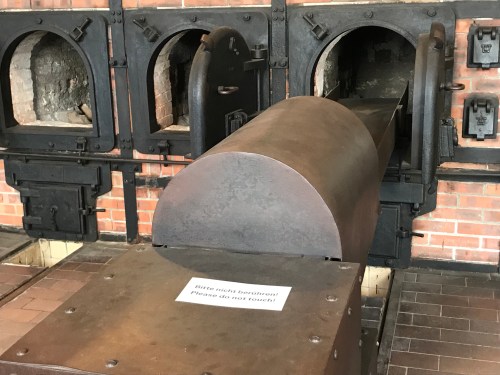
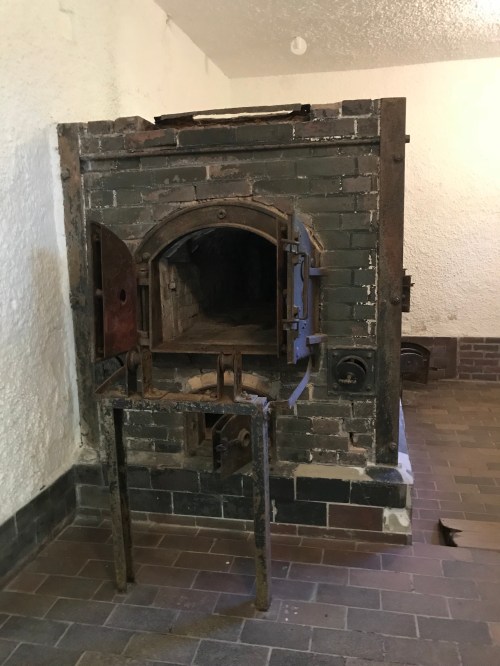
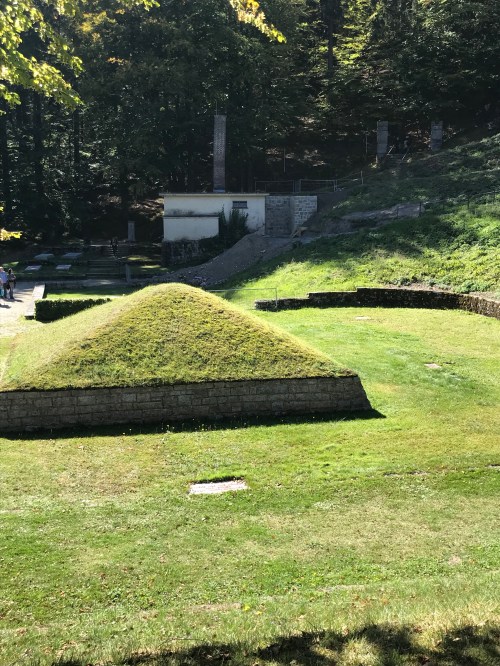
As the number of deaths rose the process to dispose of the remains of the victims required that a crematorium be constructed. It was built in a valley at the base of the camp and ashes were disposed of near it in what is known as The Valley of Death. Those killed not only included those inmates who were worked to death, died of starvation or disease, but also the Polish and Soviet prisoners of war killed on the orders of the regime.

In 1943 the Messerschmitt facility in Regensburg moved parts production for the Bf-109 fighter plane to Flossenbürg. Camp inmates became part of the workforce producing those parts as well as other munitions for the German armaments industry.

The camp was liberated by the American 90th Infantry Division on April 23rd 1943.

The camp memorial is off the beaten track for most people. Visitors must make a special point to visit it. Unlike Buchenwald, Dachau, or Bergen-Belsen it is quite isolate from places that most people would go. Even so there are a significant number of Germans, and other Europeans, especially young people, who go to the camp to learn. In addition to the museum there is an education program with seminar rooms, guest speakers, and speak alike programs. A number of buildings have been preserved including the Camp Administration building, the Detention building where the special prisoners were housed, the laundry and camp kitchen which house the museum and special exhibits, the crematorium, two guard towers, and the SS Officer Club, or Casino. The last houses the education center as well as a small cafe for visitors.

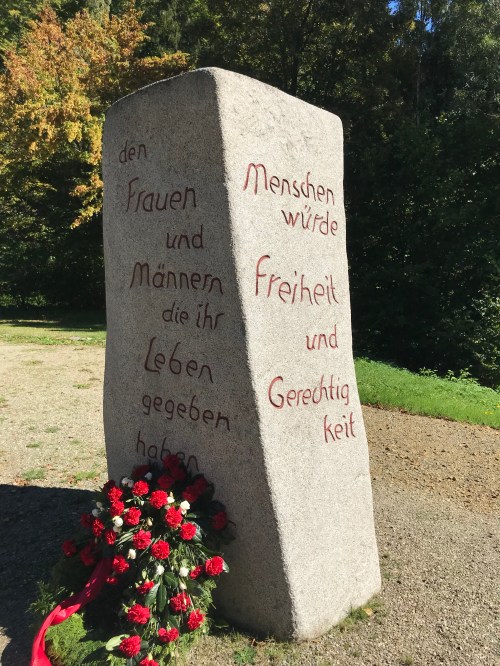
In The Valley of Death near the crematorium there is what is called the Pyramid of Ashes, the Square of the Nations, and a cemetery. Above them are a chapel dedicated to the victims and a Jewish memorial.

For me I think that the most powerful images I will remember are The Valley of Death and the courtyard outside of the Detention barracks where Bonhoeffer, Oster, and Canaris were executed. The SS Camp doctor wrote the only account of the death of these men:

“On the morning of that day between five and six o’clock the prisoners, among them Admiral Canaris, General Oster, General Thomas and Reichgerichtsrat Sack were taken from their cells, and the verdicts of the court martial read out to them. Through the half-open door in one room of the huts I saw Pastor Bonhoeffer, before taking off his prison garb, kneeling on the floor praying fervently to his God. I was most deeply moved by the way this lovable man prayed, so devout and so certain that God heard his prayer. At the place of execution, he again said a short prayer and then climbed the steps to the gallows, brave and composed. His death ensued after a few seconds. In the almost fifty years that I worked as a doctor, I have hardly ever seen a man die so entirely submissive to the will of God.”

That being said, while Bonhoeffer, Oster, and Canaris resonate with me I cannot ignore the fate of the 30,000 other men and women who died at Flossenbürg. They were victims of the Nazi policies on race and men like Pohl who extracted the last bit of profit they could make off of the lives and labor of their prisoners before they killed them.

Unfortunately with humanity being what it is and the desire to seek profit and power over the good of people what happened at Flossenbürg could happen again. There are men like Oswald Pohl today who would not hesitate to try to make a profit off of so called enemies of the state.

That is why we always have to remember what happened there and fight to ensure that it can never happen again.

So until tomorrow,

Peace,

Padre Steve+
4 Comments

Filed under economics and financial policy, ethics, faith, historic preservation, History, holocaust, Loose thoughts and musings, nazi germany

The Price of Resistance: Remembering the Men of Operation Valkyrie

Friends of Padre Steve’s World,

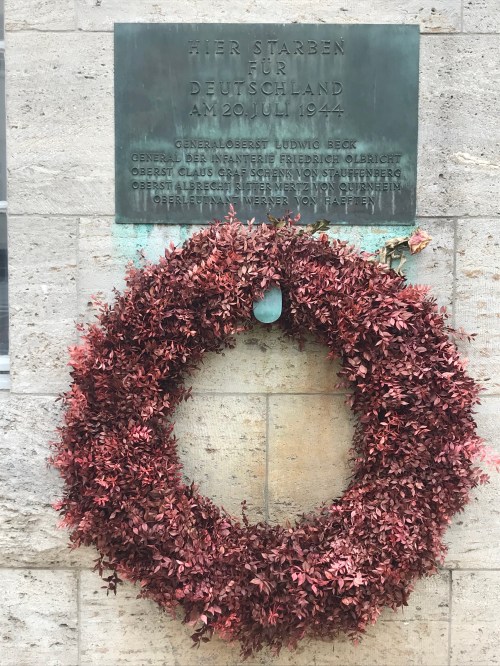
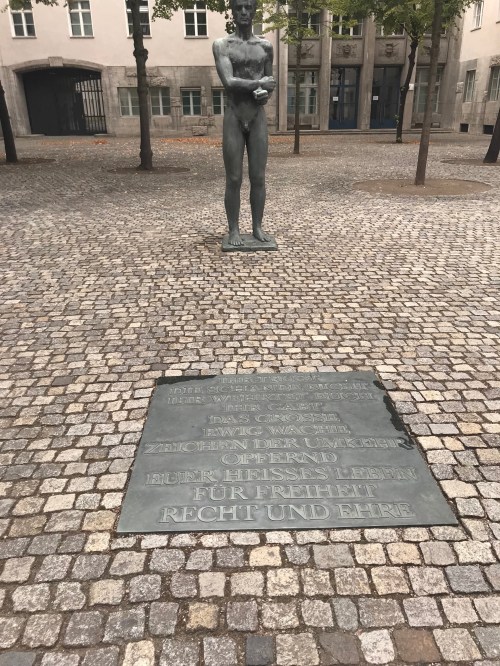
Three days ago in Berlin I visits the memorial to the men of the German resistance movement who attempted to remove Hitler from power a number of times, and then resorted to attempted assassination. Their final attempt occurred on July 20th 1944. The building from which they attempted to seize power was the headquarters of the German Army, the Oberkommando des Heeres, located on Bendlerstraße.

I am not going to retell the story of those men. I have written about the event and some of the men a number of times. Among them at the headquarters were Colonel Claus von Stauffenberg, who had planted the bomb, General Ludwig Beck, General Friedrich Olbricht, Lieutenant Colonel Merz von Quirnheim, and Stauffenberg’s aide, Lieutenant Werner Von Haeften. All were captured by Wehrmacht Guard forces commanded by Major Remer when it was clear that Hitler was still alive.

Beck was given the opportunity to kill himself but failed and was shot where he lay while Stauffenberg, Olbricht, Quirnheim, and Haeften were tried by a drumhead Court convened by General Friedrich Fromm and executed in the square in the middle of the complex. Fromm had known about the plot but had refused to commit himself to it. When it was clear that Hitler was alive he overcompensated and had them executed to cover up his involvement. This did not save him, he was arrested soon after, tried by the Volksgericht headed by Roland Freisler, and executed in 1945.

I stood in that square where they were executed and I was moved. They paid paid the ultimate price for their act of resistance and I wonder if Americans who claim to be resisters would be willing to pay that price if that was the only remaining option.

Other plotters not in Berlin or at the Bendlerstrasse complex were either arrested and later executed, or committed suicide. One of those men, General Henning von Tresckow said the following shortly before his death:

The whole world will vilify us now, but I am still totally convinced that we did the right thing. Hitler is the archenemy not only of Germany but of the world. When, in few hours’ time, I go before God to account for what I have done and left undone, I know I will be able to justify what I did in the struggle against Hitler. God promised Abraham that He would not destroy Sodom if just ten righteous men could be found in the city, and so I hope that for our sake God will not destroy Germany. None of us can bewail his own death; those who consented to join our circle put on the robe of Nessus. A human being’s moral integrity begins when he is prepared to sacrifice his life for his convictions.

In the United States we still have the option of elections and for the moment most of our institutions are still holding out against a lawless administration. How long that will remain I do not know. Every day that I wake up without discovering that the United States has not experienced its Reichstag Fire moment I am relieved and say a prayer of thanks; but I worry, especially after a chapel member and strong supporter of President Trump tried to get me tried by Court Martial for a sermon in my chapel. I had to hire a lawyer to fight the charges during the preliminary investigation.

Thankfully, I was exonerated and did not have to face a trial because what the man had said was a bold faced lie. Despite that, the comments of some people who said I did not do what I was accused of doing were still quite harrowing in how they portrayed me and my beliefs. It was as if I was a caricature of a raving leftist. The fact is that I do not blindly follow any political party line. I have been a military officer and chaplain for almost all of my adult life, I have served under six Presidents and there are none who I agreed with on every issue, but my oath is to the Constitution, not any President or party despite my current party affiliation.

On some issues I am very liberal or progressive, and others quite conservative, but in each case I try my best to base those positions with my Christian faith, as well as my belief in the great proposition of the Declaration of Independence that “all men are created equal…” and my belief that Abraham Lincoln was correct when he said in the Gettysburg Address “that this nation, under God, shall have a new birth of freedom — and that government of the people, by the people, for the people, shall not perish from the earth.”

However, history shows that when authoritarian leaders seize power that most people, even opponents find a way to make peace with the regime. This is a fair question to ask of anyone.

A hashtag, tweet, or Facebook like or dislike does not define integrity or strength of character, it is what they do in the crisis when the personal costs are factored in. I have already experienced that to a degree, and I know what I will do because I have already had to do it. Yet most people have not hit that point, and honestly I pray that they never do.

Many of the men who acted on July 20th 1944 did so knowing that if they failed in their attempt that they would die and that their families too would be condemned. Of course they no longer had the opportunity that Americans today have to vote or to speak out publicly. They and their country had sacrificed that when sat silently when Hitler dismantled the Republic and the opposition parties, with the exception of the Social Democrats, voted themselves out of existence and allowed Hitler to rule as a dictator. Likewise, many Social Democrats and Communists converted to the NDSAP or minded their own business and looked the other way after the Nazis seized power. The same was true of most German Conservatives.

The German pastor Dietrich Bonhoeffer who was a part of the plot, but who had been arrested earlier through his association with leaders of the resistance in the German military intelligence service, wrote:

“If I sit next to a madman as he drives a car into a group of innocent bystanders, I can’t, as a Christian, simply wait for the catastrophe, then comfort the wounded and bury the dead. I must try to wrestle the steering wheel out of the hands of the driver.”

The men of the German resistance tried and failed more than once to stop Hitler. They were not perfect men, but in the end they made a stand that they knew would cost them, their family members, and their friends dearly.

I wonder if we would have the courage to do it should the institutions of the Republic fail and Trump or any other would be authoritarian leader of any party gain absolute power. By and large the leaders of the GOP, even those who fought his nomination and warned about the danger he posed, have already surrendered to Trump. The most notable is Senator Lindsey Graham.

Stauffenberg was right about men like Graham and the GOP leadership when he made this observation about most German military leaders and government officials:

“You cannot expect people who have broken their spine once or twice to stand up straight when a new decision has to be made.”

Likewise I wonder about the many people that claim to be resisters when the cost is still relatively low. Will they stand when their social or economic status, career, family, or lives are in danger? As I said earlier it is a fair question. People are people no matter what and history too often shows that even resisters often find ways to adjust to authoritarian governments.

Tresckow said:

It is almost certain that we will fail. But how will future history judge the German people, if not even a handful of men had the courage to put an end to that criminal?

There are many lessons to be learned in this. Will we learn them?

Until tomorrow,

Peace,

Padre Steve+
Leave a comment

Filed under christian life, ethics, faith, History, Loose thoughts and musings, nazi germany, Political Commentary, world war two in europe