Category Archives: iraq,afghanistan

Suicide isn’t Painless: The Epidemic of Suicide in the Military

I leave the Naval Medical Center Portsmouth Virginia tomorrow and toward the end of October report as the Command Chaplain for Naval Hospital Camp LeJeune North Carolina. My last time at Camp LeJeune was as part of the Portsmouth SPRINT (Special Psychiatric Rapid Intervention Team) mission to care for Emergency Department personnel at the Naval Hospital and Base Fire/EMS responders to a particularly gruesome suicide of a young Marine who had recently served in Iraq and was preparing for another tour.

As a Chaplain and in my previous life as a Medical Service Corps officer commanding a Medical Company in Germany and Brigade Adjutant in Texas I have dealt with a lot of suicides, attempted suicides and the lives left shattered by suicide.  Likewise I have seen the results of suicide attempts as a trauma, emergency and critical care chaplain in major medical centers. I have attended the DOD Suicide Prevention Conference on a number of occasions and gotten to know many of the experts working in the field.

As I said I began my career as an officer in the Army Medical Service Corps. We had a close connection to the movie and television series M*A*S*H and the theme music to that movie is emblematic of the feelings of many combat vets who continue to deploy even after making many combat deployments. http://www.metacafe.com/watch/3444418/suicide_is_painless_johnny_mandel/

Through early morning fog I see
visions of the things to be
the pains that are withheld for me
I realize and I can see…
[chorus]:

That suicide is painless
It brings on many changes
and I can take or leave it if I please.

I try to find a way to make
all our little joys relate
without that ever-present hate
but now I know that it’s too late, and…
[Chorus]

The game of life is hard to play
I’m gonna lose it anyway
The losing card I’ll someday lay
so this is all I have to say.
[Chorus]

The only way to win is cheat
And lay it down before I’m beat
and to another give my seat
for that’s the only painless feat.
[Chorus]

The sword of time will pierce our skins
It doesn’t hurt when it begins
But as it works its way on in
The pain grows stronger…watch it grin, but…
[Chorus]

A brave man once requested me
to answer questions that are key
‘is it to be or not to be’
and I replied ‘oh why ask me?’

‘Cause suicide is painless
it brings on many changes
and I can take or leave it if I please.
…and you can do the same thing if you choose.

Last week four soldiers, one a highly decorated senior NCO and all combat veterans are believed to have committed suicide at Fort Hood Texas.  The base which has already seen more than its fair share of tragedy with 14 confirmed suicides this year is stunned that these occurred in one weekend.

Defense Secretary Robert Gates commented about the stress on the all-volunteer force: “No major war in our history has been fought with a smaller percentage of this country’s citizens in uniform full-time — roughly 2.4 million active and reserve service members out of a country of over 300 million, less than 1 percent,” as a result the wars have been fought by a small proportion of the country, for many they are “a distant and unpleasant series of news items that does not affect them personally.” While the distance grows between those that serve and the general population military families are under even more stress, with anxiety and disruption inflicted on children, increased domestic strife and a growing number of suicides. Divorce rates in the Army have doubled since the wars in Afghanistan and Iraq began.

In the years prior to about 2004-2005 the military suicide rate was almost always below civilian rates in all demographics.  This is something that we took legitimate pride in.  That began to change as the war in Iraq shifted from a “Shock and Awe” campaign to a rather nasty and intractable insurgency this began to change as the deployment tempo increased and the Army increased its “boots on ground” time from a year to 15 months with a one year dwell time between deployments. Even as Iraq calmed down and the US role shifted many troops remain and Afghanistan has become a much more difficult war than it was even a few years ago. The Marines retained a 6-7 month deployment schedule but as the war went on and personnel requirements increased many Marine units were doing 6 months in country and 6 months home.  The difficult of what was described as “dwell time” for the Army and Marines was that for all intents and purposes it wasn’t. The units would get a few weeks leave and stand down time on their return home and then begin preparing for their next deployment. These preparations out of necessity entailed much time in the field training including trips to the Fort Irwin National Training Center (NTC) or the Marine Corps Air Ground Combat Training Center at 29 Palms.  Speaking from experience before 9-11 I can say that a Marine battalion going to 29 Palms in reality makes a short but intense deployment which is taxing on the organization even as it sharpens combat skills.  The same can be said for Army units going to NTC.  Thus the time that is nominally considered time at home to recuperate is not that and instead serves to keep the pressure on already stressed units, leaders and soldiers/Marines.  In the intervening time those that present to mental health providers or chaplains are provided with care to get them back in shape for the next deployment but never really get to deal with the deeper psychological and spiritual wounds. These include “moral injury”  which often involves unresolved grief for the loss of comrades and real or imagined guilt for their own actions in war.  Such wounds ultimately create despair, loss of faith and eventually cause some service members to make attempts on their life with varying degrees of “success” in “completing” the suicide.

The result is that those who have experienced the moral injuries that come as a result of combat, seeing comrades killed and wounded, participating in actions where they are directly or indirectly involved in killing the enemy, see the “collateral damage” of civilians, including children killed and maimed go right back into to fight.  Since this war has now gone on longer than any war in US history and we are fighting it with an all volunteer force of limited numbers with many making multiple deployments, some as many as 5 or more these wounds are pushed aside.  The effect of this is a cumulative grinding down of those that serve in harm’s way. Many suffer from some form of psychological, neurological or even spiritual injury that in combination with other life stressors make them particularly vulnerable to taking their lives.  In regard to moral injury “Many of the troops kill themselves because they feel that those kinds of experiences have made them unforgivable,” said Dr. William Nash, a top PTSD researcher. “It’s a lot harder for most people to forgive themselves than to forgive others.”

Unfortunately there is a stigma attached to seeking treatment or admitting that one is suffering from depression, anxiety or any other condition associated with either seeking help on their own or being “command referred” for psychological/psychiatric help.  Since that stigma is real many war fighters don’t seek help and take “refuge” in destructive behaviors such as alcohol abuse, drug abuse (to include prescription drugs) and risky behaviors.  One wonders how many of the single vehicle accident fatalities that occur late at night to combat vets are not accidental at all but are suicides by another more “socially acceptable” means.  If a forensic psychological profile was done on every service member that dies in such events I would guess that the finding would be a lot more suicides not an accidental deaths as we would like to believe. Yes all of these deaths are tragic but it is far easier to rationalize death in an auto accident than death by gunshot, knife wounds, overdose or hanging.

I am not proposing any solutions for this problem.  I do believe that somehow the deployment tempo needs to be slowed down to allow troops to actually recover and get help.  This is one of the suggestions of the DOD Suicide Prevention Task Force.  Their report is linked here: http://www.health.mil/dhb/downloads/Suicide%20Prevention%20Task%20Force%20report%2008-21-10_V4_RLN.pdf

When I go to LeJeune I know that as a Chaplain at the Naval Hospital I will be collaborating with our mental health professionals to provide care to Marines, Sailors and their families that are living this daily.  The Marine situation is poignantly show in this article: http://www.nctimes.com/news/local/military/article_3dc03ec3-6a37-5608-8563-aca88f635271.html

I have served with the Marines almost 6 years and from what I see the Corps has changed.  It is battle hardened but less resilient than it used to be.  The Marine Corps’ suicide rate has reached 24 per 100,000, a rate that surpasses all the other services. The rate was 13 per 100,000 in 2006 when I finished my tour at Marine Security Forces. The latest available figures put the civilian suicide rate at 20 per 100,000.  The problem extends past active duty as Veterans Affairs Secretary Eric Shinseki, the former Army chief of staff, said the suicide rate for men aged 18-29 who have been discharged had gone up by 26% from 2005-07. Likewise, “of the more than 30,000 suicides in this country each year, fully 20% of them are acts by veterans.” This means as Shinseki said “on average 18 veterans commit suicide each day. Five of those veterans are under our care at VA. So losing five veterans who are in treatment every month, and then not having a shot at the other 13 who for some reason haven’t come under our care, means that we have a lot of work to do.”

There is also an effect on military health care providers of all kinds and chaplains. These individuals not only have to deal with their trauma but the trauma and hopelessness that they see in many of their patients or parishioners. These caregivers have no respite between deployments because their reason for being is to care for the Soldiers, Marines, Airmen and Sailors that present to them be they deployed or back in a military hospital or clinic.

The work will be hard and long after the last Marine, Sailor, Soldier or Airman leaves Iraq and Afghanistan we will be dealing with this for years to come.

Peace

Padre Steve+
3 Comments

Filed under healthcare, iraq,afghanistan, Military, Pastoral Care, PTSD

Fighting a World Wide Insurgency: The Problem Fighting Revolutionary Terrorists and Insurgents- Part One

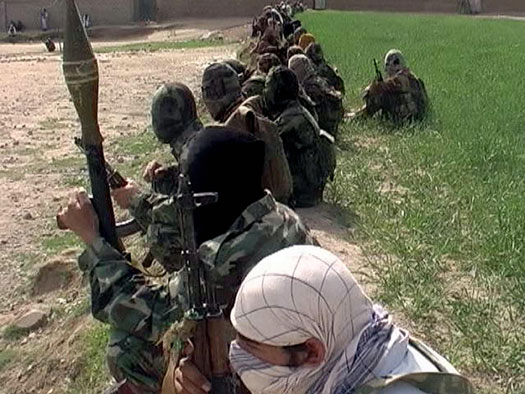
Taliban Insurgents

“Warfare is now an interlocking system of actions political, economic, psychological; military that aims at the overthrow of the established authority in a country and its replacement by another regime.  To achieve this end, the aggressor tries to exploit the internal tensions of the country attacked ideological, social, religious, economic, any conflict liable to have a profound influence on the population to be conquered.” Roger Trinquier Modern Warfare

The United State and our allies have been at war with Islamic terrorists as well as nationally based insurgencies for over nine years.  The war that we are fighting is not like the Second World War where we fought a conventional war against enemies that were defined by national, political and geographic boundaries.  That war as well as the First World War and most recently the 1991 Gulf War but rather is a global insurgency in which we are pitted against a number of sometimes disparate groups One of the things that seems to be misunderstood by much of the media as well as the public

Muslim terrorist groups they use some tenants of Islam, mostly from the Wahabi school that emerged on the Arabian Peninsula in the late 1700s to justify what they do. Hezbollah and the Iranian Revolutionary Guard use the Islam taught by the school of the Ayatollah to do the same.

However that being said there are a sizable number of Muslims worldwide that oppose the terrorists and their brands of Islam but still can be offended and driven to the other side by Americans doing just what pastor Jones got started. The radicals take this and use it as propaganda against us.

The fact is that it is all about using propaganda effectively and not giving the terrorists the grist they need to use against us. The terrorist or the insurgent has no need to tell the truth and usually will not and will twist any “truth” to his own end. This is true in every revolutionary war, which is what all of these groups are waging. They are fighting to turn all of Islam and anyone else they can against us. This is the case since the beginning of time and not limited to Muslims.

We as Americans have been pretty lousy at this except when we were the revolutionaries. It is a fact, not just with the Muslims but all revolutionaries that since they are on the weak side of the military equation that they use propaganda, especially what any of our people do to radicalize people on the fence against us. Jones and others played into their hands and by doing so jeopardize the mission and endanger our troops. The fact is that we neither have the resources or people to allow this to become a war against all of Islam. Thus we have to exploit natural divisions and cultural divides in the Moslem world to isolate and neutralize the radicals of Al Qaeda, Hamas, the Taliban, Hezbollah and the Iranian Revolutionary Guard.

It may seem on the surface to be politically correct appeasement but a true strategic purpose is served. The counter-insurgent cannot do what the insurgent can as they will lose the propaganda war and with it the broader war. We are fighting a world-wide revolutionary war against Moslem fundamentalist extremists that want us to make it a war against all of Islam. If that were to be the case we would have to go to a total war footing, ignore our own economy renew the draft and prepare for a war that in the long run we cannot win and will leave us as broken as Germany after WWII.

The problem with Islam as that for the most part much of Islam especially in the Middle East still lives in the 14th century with fancy technology. They did not have the Renaissance, Reformation or the enlightenment thus the appeal of the fundamentalist sects and radical Islam. That makes our job hard and that of Bin Laden easy as their world-view  promotes a black and white understanding of the world which makes recruitment of youthful idealists easy especially when the conflict is framed as against “Crusaders” or “Imperialists” opposed to Islam.

The war that we are engaged in is not conventional and we do not have a good record in recent times of fighting this kind of war. We lost in Vietnam because we ignored this. We won all the battles and lost the war. Despite what some pundits believe this is not like WWII and no new incarnation of George Patton will win it.

As I said we are engaged in a revolutionary war which is different than other types of war. In revolutionary wars the revolutionary no matter what his cause is able to use propaganda to influence opinion, usually of people that they are trying to bring to their side. Our founders were very good in portraying the British as violent and brutal occupiers. We used British excess especially in Boston and in the South against them very well. The Jihadists are promoting a revolutionary cause, that cause being the overthrow of established governments in the Middle East and bringing about a radical and fundamental brand of Islamic rule. This happened in Iran and after 30 years the young people are beginning to revolt against the Ayatollahs. It is also revolutionary because they are actively promoting the overthrow of established states and have a goal of establishing their brand of Islam over the entire world. The use revolutionary techniques and strategies used successfully by other revolutionaries attempting to control the populations where they operate through both terror and by discrediting unpopular or corrupt governments.

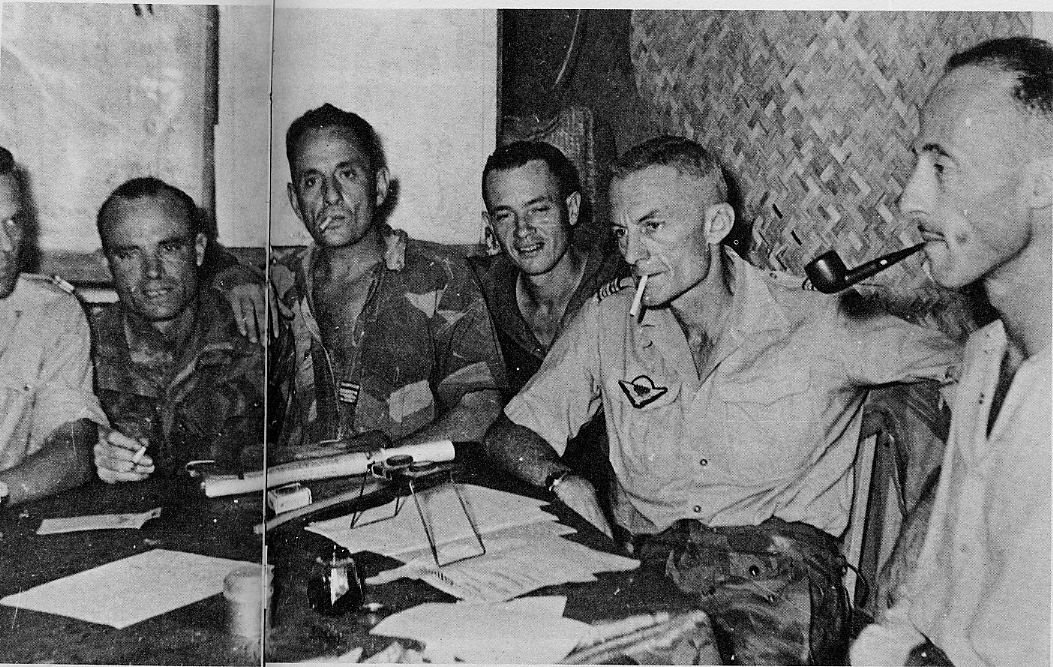
One of the problems that we in the United States have in understanding Al Qaida and other Islamic groups that rely on terrorism as their primary means of conducting warfare is the nature of the terrorist himself.  Roger Trinquier who observed and fought against such groups in the 1940s and 1950s wrote one of the fundamental books on this type of warfare.  Trinquier said something that will undoubtedly be taken wrong by some readers of this essay but if one understands the nature of Revolutionary war has been true going back for centuries and is not confined to militant Islamic Fundamentalism.   Trinquier observed that “the terrorist should not be considered an ordinary criminal.  Actually he fights within the framework of his organization, without personal interest, for a cause he considers noble and for a respectable ideal, the same as soldiers in the armies confronting him.”

One can see how this is demonstrated in history in such disparate groups as the Israeli Irgun fighters who used terrorist tactics from 1931 until the founding of the state of Israel in 1948 against the British occupiers, the Irish Republican Army.  This is even part of the American experience in the post Civil War South of the Reconstruction era.  Then many Southern whites organized into guerrilla terrorist units such as the Klan in Tennessee, the Red Shirts in South Carolina, the Knights of the White Camellia in Louisiana, the Young Men’s Democratic Club in Florida in order to attack anyone associated with Reconstruction. Their targets included newly free blacks, carpetbaggers, Scalawags, teachers from the North, Freedmen Bureau officials, northern troops, and Republicans.  If you read their writings or even query their current day descendants you will find that none believed that they were criminals and their actions, while unacceptable to many were justified.  One does not have to agree that the terrorists cause is right to acknowledge that terrorists believe this to be true.  Thus in fighting the terrorist organizations one has to employ a wide variety of tactics to protect the populations targeted by terrorists to include police, limited military involvement, the use of propaganda, and “soft” methods to provide aid to these populations and isolate the terrorists from them.

The current batch of Jihadists are actually fairly disparate and not necessarily allies as we found out in Iraq where Al Qaeda and the foreign fighters turned the population of Al Anbar Province against them and brought that Sunni population to our side. They also have sometimes conflicting goals or limit their cause to local areas. The Sunni and the Shi’a have a hard time working together so while this is a global revolution it is not monolithic. Thus if we are smart we can exploit natural divisions in these groups. To do so we have to play smart in how we fight them recognizing that the “soft” approach often is better as the French found out too late in Vietnam but did well with in Algeria. See books by David Galula “Counterinsurgency in Algeria 1956-1954” “Counterinsurgency Warfare”, Roger Trinquier’s “Modern Warfare” as well as the book by Alister Horne “A Savage War of Peace” all are excellent reads. Bernard Fall’s book “Street Without Joy” is a good study of how this happened in French Indochina. The US Counterinsurgency Manual is available online or in bookstores as is “Learning to Eat Soup with a Knife” by John Nagl, a major writer of US Counterinsurgency doctrine.

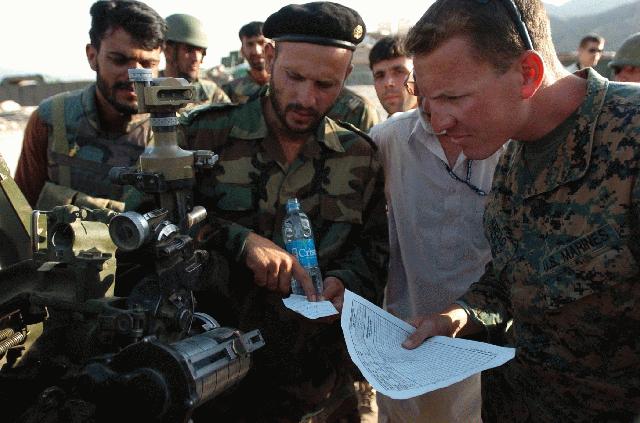
US Advisors with Afghan Army Officers

In a world-wide insurgency even actions which seem logical to Americans at home can be detrimental to US Forces and political goals in Afghanistan, Pakistan, and Iraq and throughout the Muslim world. I’m not a fan of the Mosque near the World Trade Center even though it is the equivalent of 6 normal city blocks away and not visible from the site. Many Americans if not an outright majority oppose this building project yet the builders don’t seem to understand the raw wounds that the project has opened for many Americans. I’m sure for them that much of it is a business, they are developers in New York City and the land was available. Yet the project can quite rightly be seen as insensitive because of what it means to the victims.

At the same time politicians and protesters by naming it the “Ground Zero Mosque” has raised its propaganda value exponentially, that is why Hamas and Hezbollah have also raised the ante in their talk about it. Thus what was an annoyance and hurtful to the victims has become a propaganda victory for the terrorists. In a sense we have let our collective outrage play into the terrorist’s hands. When he pastor of a small church in Florida threatened to burn a large number of copies of the Koran he helped ignite a firestorm of protest in many parts of the Islamic world especially in the epicenter of our current struggle in Afghanistan and neighboring Pakistan.

We are at war with the warlike highly militant strains of Islam and trying to keep the more Western leaning peaceful variants on the sidelines or enlist them to our side. This is a hard path for our leaders to walk as President Bush found out and President Obama is finding out is that most Americans don’t see it that way.  To many Americans all of Islam is the enemy and nothing can change that and the heated passion of our population often plays into the hands of our enemies.  Thus both Presidents’ comments about Islam have usually fallen on deaf ears and both have been excoriated for straddling this fence.

Anyway as you gather I have spent a considerable amount of time studying this type of warfare. I admit that this is pretty unusual for a chaplain, but I also have a Masters degree in Military History as well as the Marine Corps Command and Staff College. When I was in Iraq I knew more than many Marine and Army officers about fighting this type of war. Kind of weird I know but what can I say?

One of the most famous and successful practitioners of Counterinsurgency Warfare was French Colonel David Galula.  Galula in a sense is the “voice crying in the wilderness” of counterinsurgency doctrine and his methods have been used with some measure of success during the “Surge” in Iraq and the “Anbar Awakening” which turned the tide of the Iraqi insurgency.  Galula commented about terrorist tactics, tactics that have not changed in either Iraq or Afghanistan:

“The rebels realized that they could achieve the greatest psychological effect on the French and on world opinion at the cheapest price by stepping up terrorism in the main cities, notably in Algiers, which served as headquarters to most French and foreign correspondents and thus acted as a natural amplifier. A grenade or a bomb in a café there would produce far more noise than an obscure ambush against French soldiers in the Ouarsenis Mountains.” Galula “Counterinsurgency in Algeria”

One of the most frustrating aspects for military and police personnel fighting insurgencies that employ terrorist tactics is that quite often superior forces cannot finish off the insurgents. Galula provides an answer to this question.

“Our forces were vastly superior to the rebels. Then why couldn’t we finish with them quickly? Because they managed to mobilize the population through terror and persuasion . . . It was therefore imperative that we isolate the rebels from the population and that we gain the support of the population.  This implied that under no circumstances could we afford to antagonize the population even if we had to take risks for ourselves in sparing it.”

This is a lesson that we have not always learned as incidents such as the Abu Ghraib torture and most recently a series of targeted killings of Afghan civilians by a squad of Army Soldiers in Afghanistan in which they allegedly planned the killings in advance and kept body parts of their victims.  Unfortunately atrocities like this as was demonstrated at Mei Lai in Vietnam do little to the enemy and everything to turn the populations that we are trying to protect and world opinion against us. It also provides grist for the terrorist propaganda purposes and aids him in recruiting more insurgents to his cause.

Galula recognized the quandary that commanders of police and military units involved in counterinsurgency operations face when dealing with populations where terrorists operate. Galula was a realist about this and noted “If we distinguish between people and rebels, then we have a chance. One cannot catch a fly with vinegar. My rules are this: outwardly treat every civilian as a friend; inwardly you must consider him as a rebel ally until you have positive proof to the contrary.” This may seem contradictory but the concept was used by Ronald Reagan during the Cold War using the term “trust but verify” in relationship to the Soviet Union and arms control.

David Kilcullen an Australian Army Lieutenant Colonel and counterinsurgency expert and advisor to General David Petreus noted

Colonel Dennis Drew writing in 1988 understood the linkage of all parts of insurgency and how well an insurgency represents the essence of the thought of Prussian theorist Carl von Clausewitz: “Although theorists consider insurgent warfare to be anti-Clausewitzian, such warfare is the very embodiment of the Prussian master’s most famous dictum. Insurgency represents the total integration of political and military factors, but with political factors always in complete domination.” (INSURGENCY AND COUNTERINSURGENCY American Military Dilemmas and Doctrinal Proposals- Air University Press Maxwell Air Force Base, Alabama 1988)

Thus attempting to fight an insurgency and terrorist groups thinking that one can defeat them in the style of world War Two, as is so often espoused by pundits and amateur military theorists that crowd the airwaves and cyber space is foolish and only leads to the defeat of the counter-insurgent and the loss of the population targeted by the insurgent. The wars in Afghanistan and Iraq are not conventional wars and the political outweighs the military in every respect.  As Drew noted:

“Although the military aspect of the struggle may ebb and flow, the source of insurgent strength–a covert political infrastructure–remains constant. This infrastructure, the bitter fruit resulting from the perceived political and economic inequities sown much earlier, is the most important ingredient in the insurgent recipe for success. The political infrastructure performs at least six major functions vital to the survival, growth, and eventual success of the insurgency: (1) intelligence gathering and transmission; (2) provision of supplies and financial resources; (13) recruitment; (4) political expansion and penetration; (5) sabotage, terrorism, and intimidation; and (6) establishment of a shadow government.”

This is exactly what has happened in Afghanistan and why we have such difficulty in fighting the insurgency.

One of the most common tactics that the United States has attempted in attacking the insurgents is the strategy of decapitation. In this the U.S. has attempted to kill the leaders at the top echelons of the insurgency with limited success. Even when we kill off a senior Al Qaida or Taliban leader others rapidly take their place with little affect in their operations against us. Galula recognized the fallacy of this approach in Algeria when the French government succeeded in capturing five top leaders of the Algerian rebellion. “Then, five top leaders of the rebellion, including Ben Bella, had been neatly caught during a flight from Rabat to Tunis. Their capture, I admit, had little effect on the direction of the rebellion, because the movement was too loosely organized to crumble under such a blow.” The lesson here is that should we ever succeed in capturing or killing Osama Bin Laden or Mullah Omar that this will not lead to victory unless we are able to protect the population of Afghanistan.

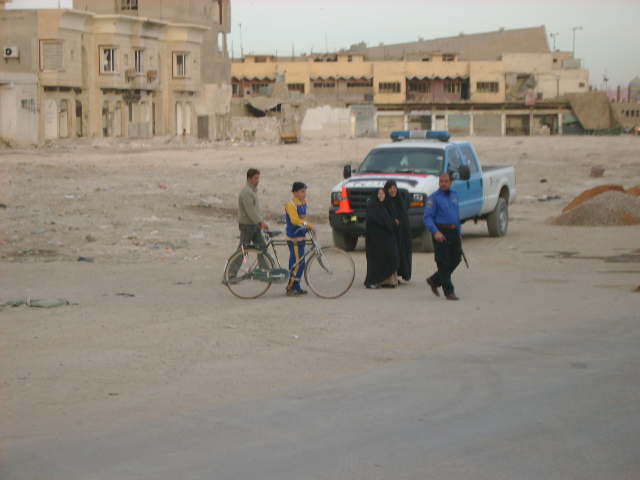
Protecting the population Iraqi Police and Civilians in Ramadi

To do this the population must come to our side because they know that we will stay the course and that we can be counted on to help them.  This cannot just be the military aspect of protecting them against the terrorists as well as economic and political reforms that is consistent with their traditional way of life which is not necessarily consistent with Western political and social traditions or practices. In fact the difficulty for the United States and NATO in Afghanistan is the political struggle on the home front where as Drew states:

“American military dilemma concerns time, public support, and image. Time is the ally of the insurgent; the longer an insurgent survives, the stronger its chances of growing. Meanwhile, as time drags on, the American military position is weakened by declining support, impatience, and war weariness at home, particularly if there is no perceived progress in the struggle. Maintaining public support is clearly a responsibility of the political side of the equation and involves factors far beyond the battlefield–although military progress is a key ingredient. The connection between the duration of the struggle and public support is the image of the insurgency presented to the American body politic.”

To be continued….

Peace

Padre Steve+

1 Comment

Filed under counterinsurency in afghanistan, History, iraq,afghanistan, Military, national security, Political Commentary

Raw Edges: Are there other Chaplains out there Like Me?

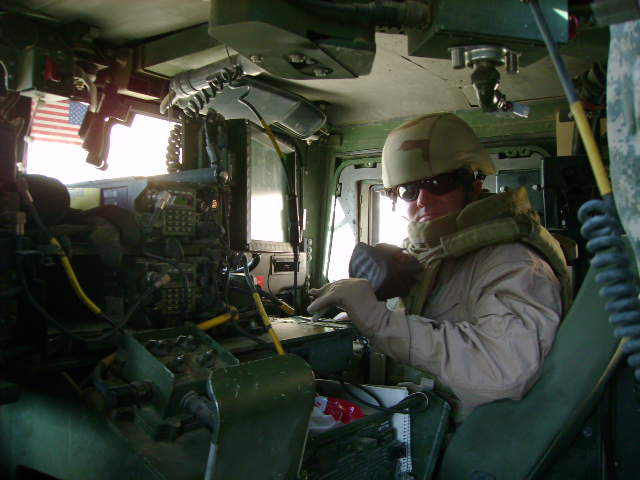
Before a Convoy

The past week or so I have had to go back and revisit my Iraq experience. Part of this is due to work, we have had seminars on the spiritual and moral affects of trauma, the challenge of forgiveness and most recently discussing best spiritual care practices for those who suffer from PTSD or Traumatic Brain Injury (TBI).  The training has been excellent but has kicked up a lot of stuff in me.  Added to this have been reports out of Afghanistan about more casualties in particular of a helicopter that crashed that killed 9 Americans, the Taliban claim credit for downing the aircraft but the circumstances are not fully known.

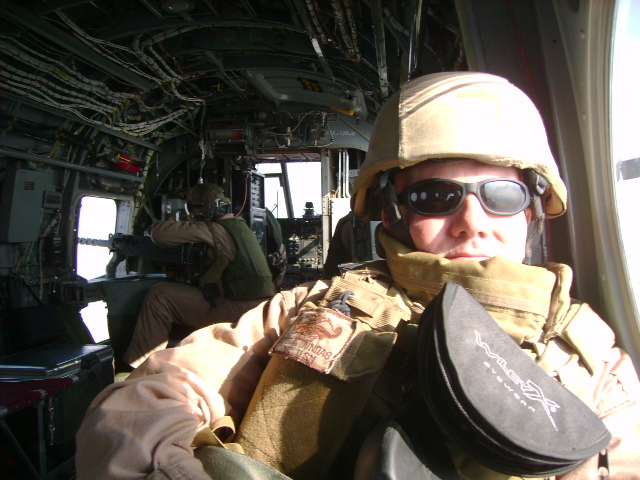
One of many helicopter flights, this a daylight flight in a Marine CH-46

The course last week on the spiritual and moral affect of trauma and the challenge of forgiveness brought up issues from Iraq but not upsetting.  In fact the seminar taught by Dr. Robert Grant author of The Way of the Wound was helpful to me in sorting out what I have been going through for the past couple of years.  The training this week is also good, good information but for me it is more unsettling because it deals with images, videos of convoys, burning vehicles and other things like that.  The convoy images coupled with the news of the helicopter crash actually had me pretty shaken as I spent a large amount of time in small convoys with small groups of Americans and Iraqis in pretty dangerous areas of Al Anbar Province stretching from Fallujah to the Syrian border as well as a couple of hundred hours in the air, usually at night in various Marine and Army helicopters as well as the MV-22 Osprey.  During those experiences we took fire a couple of times and had a few experiences on some of our flights that were a bit sporty.  So for a while I was lost in my own stuff but was able to pull out in not too long of time.

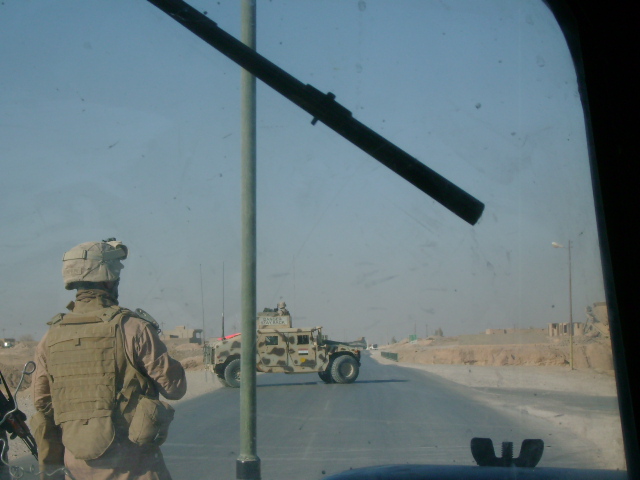
Convoy stopped near Al Qaim

Some of our discussions revolved around how trauma and war can impact a person’s image and relationship with God, whatever that may be.  The focus was on us as pastoral care givers caring for those in our charge.  Once again this really good information for me as I will be dealing with a lot of PTSD and TBI cases are Camp LeJeune.  But there was one thing that got me.  I came back from Iraq as most of my readers know in pretty bad shape dealing with PTSD and issues of abandonment feeling disconnected with the Navy and my church.  Part of that was what amounted to be a loss of faith so severe that I was for all practical purposes an agnostic for almost two years because I couldn’t make sense of anything to do with God, I felt God forsaken it was to use the image of St. John of the Cross, my Dark Night of the Soul.  I am doing better now and feel like my faith has returned to some degree, certainly not like it was before but while I have doubts I am okay with that part of the journey now.

Christmas Eve not far from Syria

I know a number of military Chaplains from the Navy and Army that have returned from Iraq or Afghanistan in some sort of faith crisis many suffering from PTSD or TBI.  I am actually wondering how many are out there.  I know that I am not alone, but I need to know if others are going through this experience too.  It was for me a desperate feeling to be the Chaplain, Priest, Pastor and spiritual care giver when I was struggling having no answers and only questions, when people asked me about God and I didn’t even know if God existed.  This is the unspoken cry of at least some and possibly quite a few Chaplains and other ministers who have experienced trauma and moral injury.  One thing my incoming CO at my old unit asked me was “where does the Chaplain go for help?”  At that point I said that I didn’t know.  The sad thing is that I know many chaplains and ministers that have a basic lack of trust in their fellow clergy and do not feel safe confiding in them because they feel that they will be judged, not listened to or blown off.

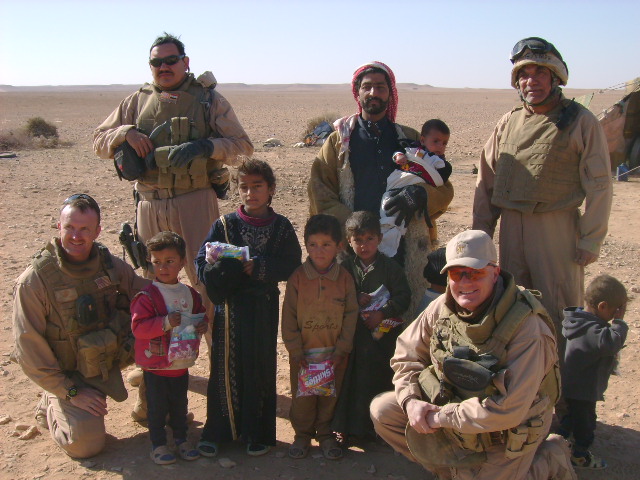
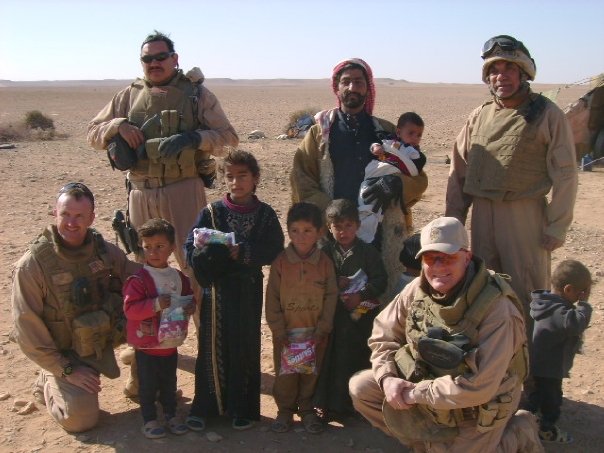
A different war with the Bedouin in the western desert of Iraq about 5 km from Syria.

When I was diagnosed with PTSD in the summer of 2008 I made it my goal to grow through this and hopefully as I go through this to be there for others. Part of my recovery came through sharing experiences, the good and the bad on this site.  Elmer the Shrink asked me back when I started this if I thought that it would be helpful to me in my recovery, but he also asked if I was okay in opening up about this topic.  Since I didn’t see many people writing about this from the perspective of being a “wounded healer” I told him that I thought that I had to do it.  The experience has been terribly painful but at the same time I think that it has been worth it because as a Priest and Chaplain I think now more than ever in my weakness I can be with people in their difficult times without trying to “fix” them.

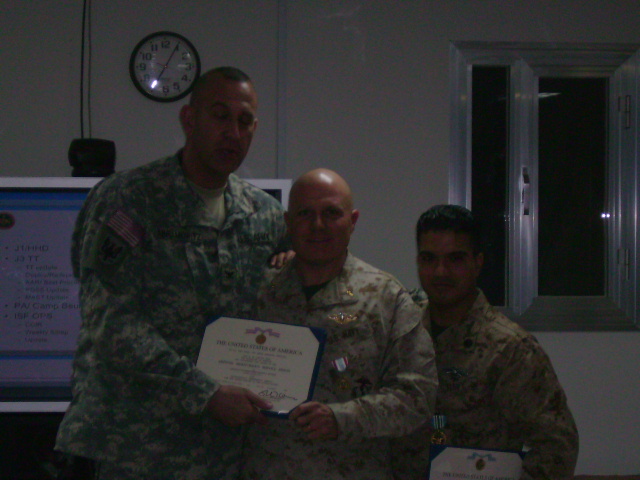
Colonel David Abramowitz with me and RP2 Nelson Lebron after presenting me with the Defense Meritorious Service Medal and Nelson the Joint Service Commendation Medal for our service with our advisors and Iraqis in Al Anbar with the Iraq Assistance Group. After this we both dealt with abandonment and other issues on our return home.

So who is there for “damaged” Chaplains? Who takes care of us? I was lucky or maybe blessed. I had Dr Chris Rogan ask me if I was okay. I had Elmer the Shrink do a lot of the hard work with me. At Naval Medical Center Portsmouth I had a Command Chaplain that was wise enough to protect me while I went through the deepest and darkest valley of my life.   As I recovered he challenged much like a Baseball Manager would challenge a pitcher who had been very successful on other clubs coming off the disabled list to regain his self confidence and ability to get back on the mound with a winning attitude. Not every Chaplain gets what I got and I am blessed.  I still have work to do and I need to recognize my limits, much as a pitcher who has recovered from Tommy John surgery makes adjustments.

So this is my question:  Are there others other there like me?  Are there other Chaplains experiencing such feelings after Iraq or Afghanistan? I’d really like to know because I believe that in what might be termed “a fellowship of the forsaken” that we can rediscover faith, belief and hope again and in doing so be there for others.

If you want please let me know if this encourages you or feel free to comment. Prayer is still hard for me but I promise that if someone asks that I will pray and to the best of my ability be available for them as others were for me because I don’t want any Chaplain to experience the abandonment that I felt went I returned from Iraq having felt that it was the pinnacle of my military career. To those Chaplains I just want to say that you are not alone.

Peace

Padre Steve+

4 Comments

Filed under faith, iraq,afghanistan, Military, Pastoral Care, philosophy, PTSD, Religion, Tour in Iraq, US Navy

A Sea of Contradictions: My Life and Faith since returning from Iraq

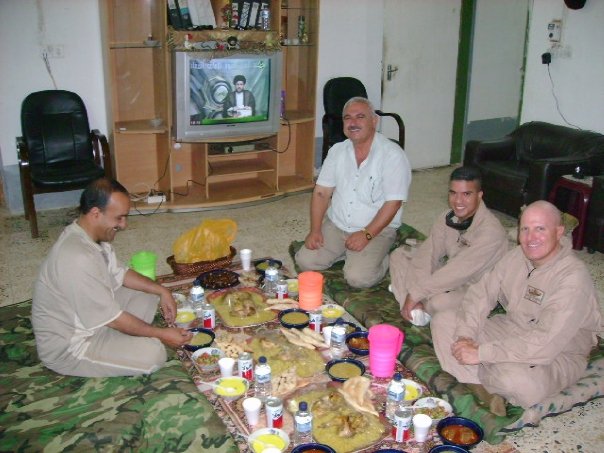
Dinner with my Friend, Major General Sabah in Ramadi

“Many people are looking for an ear that will listen. They do not find it among Christians, because these Christians are talking where they should be listening.But he who can no longer listen to his brother will soon be no longer listening to God, either; he will be doing nothing but prattle in the presence of God, too. This is the beginning of the death of the spiritual life, and in the end there will be nothing left but spiritual chatter and clerical condescension arrayed in pious words… never really speaking to others.” Dietrich Bonhoeffer

Since I returned from Iraq I have grown weary of Christians that have all the answers and are more interested in promoting their agenda than actually listening or caring for those wounded in spirit from various forms of trauma including war. Since I returned from Iraq and going through what amounted to a crisis in faith, belief and experience of what I felt to be abandonment by God and many Christians.  I have elected to travel down a path that has been of great benefit but has been filled with difficulty and pain as I both walked through the psychological, spiritual and physical effects of my time in Iraq and, the moral injuries that I incurred and the practical ways that these crisis’ have had on my life and relationships.

On Monday at work we had some of our pastoral care residents presented their research projects which they had worked on during their residency year.  All were well done but one struck me because of its subject and home much I could relate to it.  The subject was “Writing our Way Home” and dealt with how the use of poetry and narrative could help some combat veterans make sense of their world and deal with the trauma that they have experienced.  After Iraq I began to write, initially because it was therapeutic and helped me to begin to start sorting out what was going on with me. It also helped me, especially when I went public on this site about my experience to get outside of my normally severely introverted self. As I began to write regularly it became a part of my life as I struggled to deal with PTSD as well as  spiritual and emotional crises following my tour in Iraq, alienation on my return as well as various family crisis’s.

The understanding that resonated with me was that our stories, the good and the bad, what we believe to be true and what really is true about ourselves and our experiences is all part of who we are. This is something that I experienced in my own pastoral care residency at Parkland Memorial Hospital in the 1990s when my supervisor challenged be to stop living in the past and begin to imagine a future that was not a prisoner of my past disappointments and failures.  That was a watershed experience for me and as I began to sort through all of the crap that I was dealing with in CPE and family of origins issues I began to realize that I did not need to live my life in a constant repetition of the past.  Now that realization did not always find a place in my life but in a gradual process I began to escape that past and begin to live in the moment with an eye to the future.

Of course Iraq changed that to some degree, in fact to a large degree. What I experienced there and upon my return to the States shook many of my beliefs about the world, faith and life. The images of American Marines wounded by IED attacks, wounded children and destruction of vast areas of cities, towns and villages coupled with having HUMMVs and Helicopters that I traveled on shot at and having rockets fly over my head changed me, especially when I saw how the war was being covered by both the liberal and conservative media which bore little resemblance to my first hand observations. Even worse was the feeling of being isolated and abandoned when I returned home.  I experienced a crisis in faith that left me a practical agnostic even as I desperately prayed for God to show up.  In fact it was psychotherapist that was the first person to even address my spiritual life after I returned.

When Elmer Maggard asked me: “How are you and the big guy?” I could only say “I don’t know I don’t even know if he exists.”  For a priest and chaplain that was a harrowing admission.  I had entered a world of darkness that I did not believe was possible. I would struggle for another year and a half until during Advent of 2009 things began to change and I began to sense the presence of a loving God again.  My faith began to return but I have to say it is not the same as before I went to Iraq.  I still struggle though most of the time I cannot say that I am a practical agnostic as I do have faith and faith which can be considered orthodox but perhaps more negotiable.

You may ask what I mean by this so I will briefly explain.  First I admit that I do not have the answers that I used to think that I had. Likewise I am a lot more apt to say “I don’t know” or “I struggle with that too” when people tell me of their experiences when struggling with faith or even the existence of God.  I refuse to pass judgment on someone’s faith journey or even if they question God’s existence because I have been there and it is not a comfortable place to live.  I am far more willing to walk with someone thorough that valley of doubt or unbelief because I lived in that valley for over a year. As far as who I frame my world, I am far less likely to pin something as “God’s will” or “an attack of the Devil” than I am to recognize that as human beings that we live in a fallen state and that sometimes things just happen. To quote a popular say “Shit Happens.”  In the middle of this I think the real miracle is that God can give us the grace to go through the most difficult times even when we have no faith at all.  I don’t think that is at all heretical because the experience of Jesus on Good Friday and the scriptural accounts as well as the testimony of 2000 years of Christians tells me that this is true. The miracle in my mind is not being “delivered” from crisis or unbelief but through the grace of God making it though the crisis and return to faith, even if that faith takes a different form.

For me the act of writing both about my experience as well as through fiction or history has been therapeutic and forced me out of my comfort zone.  When I began this site and began to tell my story my friend Elmer the Shrink he asked me if I was really sure that I wanted to open up and become vulnerable as I shared the truth as I believed it to be.  I said that I needed to as I thought people needed to know the reality of what many Iraq and Afghanistan veterans were going through.  He told me that what I was doing was risky but let me make the call. 600 posts later, not all of course dealing with what I and other veterans have gone through I can say that it was the right decision.

Our presenter on Monday gave us a few minutes to write something and for me this came quite easily as I was struck by a section of her presentation about how contradictory our life experiences can be. I began to write about those contradictions and will share a bit of that here.

I am a man of faith, a Christian and Priest. I believe but I also doubt and question, in fact there are some times that I feel somewhat agnostic even after the events of last December when faith began to return.  I am much more prone to give the benefit of the doubt to people especially those who struggle with life, faith and even the existence of God. I figure that God is big enough to handle doubt and unbelief while still loving and caring for the person experiencing doubt or unbelief or whose beliefs that may not fit the definition of Christian orthodoxy.

I am a passionate person who is an introvert in an extroverted world both in ministry and the military. I am an intuitive “out of the box” thinker and sometimes rebel.  Yet in spite of this I willingly volunteer to serve the church and the military.  It is interesting because both institutions prize loyalty to the institution, obedience and staying within the lines of prescribed beliefs and traditions.  I believe yet question, I find cause to not agree with what all of my political party or the other political party espouse to the chagrin of the faithful in both parties.

I have learned that there is a healthy tension in this type of life. I do not for the most part follow those that insist that to be a Christian that I must do this and that even though I fully subscribe to the Creeds, the first 7 Ecumenical Councils an Anglican understanding of the Christian faith. Nor do I think that to be to be a “American patriot” that I should vote a certain way, belong to a particular party or follow the agenda of any political party as if it others believe the agenda to be brought down from the mountain by Moses himself.  I have had people on occasion to criticize me for this.  However I cannot allow any political ideology to hold my faith captive, nor can I cast aside the essence of the Christian faith even when I doubt.

One of the things that I find concerning is how it seems to me that many supposedly “conservative” Christians have almost made what I think is a deal with the devil in terms of their political involvement. I think that they are sacrificing a long term witness to short term expedient political alliances with people, particularly “conservative” political talk show host and pundit Glenn Beck that have an antithetical and antagonistic views of historic Christianity.   My concern is more about the faith and witness of the Church than an alliance with someone that appeals to our more base nationalistic ideas than the faith itself.

I have discovered that for the most part I can comfortably live in this tension, in fact I do not think that I was to fall completely to one side or the other be it in faith, social responsibility or politics that my life would be as full as it is, or as some might be thinking now as “full of it as I am.” Whatever… The fact is that I think that as a Christian and as an American that it is okay to live life in balance and with a health appreciation of creative tension.

I have begun to emerge from the darkness of my post Iraq experience and I know that I am still wounded. I know that I still struggle but I now am beginning to see this as a gift.  My faith is not the same as it was, I am not satisfied with simplistic answers or the party lines of people that only care about their agenda especially when they decide that their agenda is God’s will, even if it has nothing to do with the Gospel. I know that sounds kind of snarky to some but I really want to be an authentic Christian not some caricature that is more a picture of the American perversion of the faith than anything found in Scripture or the 2000 year history of the Church.

I believe but I struggle. I will listen to other points of view, including those of people that are not Christian. In fact I found that my Iraqi Muslim friends were much easier to dialogue with and have deep and respectful theological discussions with than many American Evangelicals.  For me that was a watershed moment.

But anyway, this post was not meant to be a treatise on anything but is for me more of a reflection of a dialogue that has been going on in me since my return.  The thing is I know other Chaplains that have returned from Iraq or Afghanistan who have experienced the same feelings that I have been working through but do not have a safe place in their churches to heal, and are afforded little time to do self care.  I am concerned for our caregivers that care of veterans like me.  I wonder how many can be real in their faith community without having people run away from them as if they were radioactive, a feeling that many veterans and other trauma victims experience when they attempt to tell their story.

I just hope that I will be able to be there for others who are wounded and suffering as a result of what they experienced in war.

That is all for tonight.  Blessings and peace my friends,

Padre Steve+

5 Comments

Filed under christian life, iraq,afghanistan, Loose thoughts and musings, Pastoral Care, philosophy, Religion

Going to War: The First Mission Flying West in a C-130

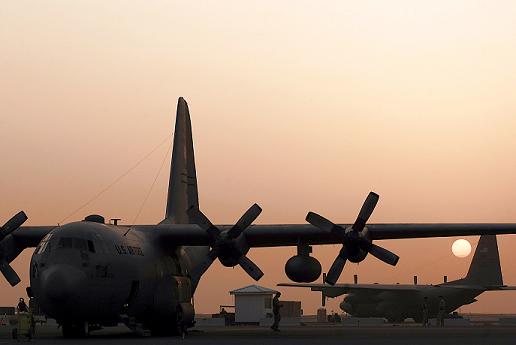
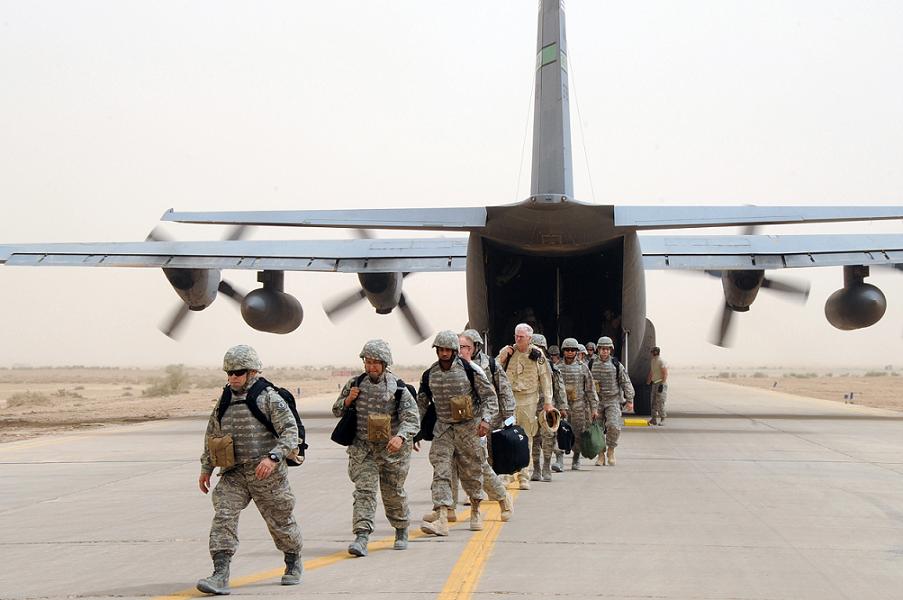
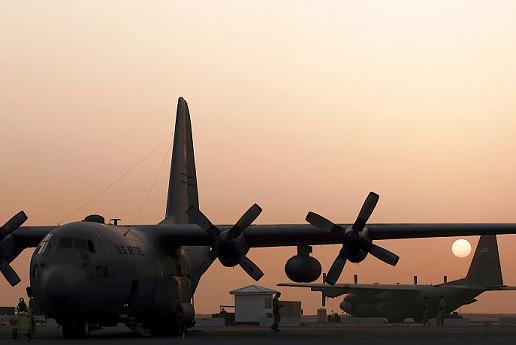
Workhorses: C-130s at an US Base in Iraq

This is another installment of my “Going to War” Series that I began last year.  In the Fall I had to take a break from posting anything more due to issues that I was having dealing with the effects of PTSD. I started this article in the spring but again put it on hold.  I have reached the point that I can again write about this. I will post follow up articles about our operations and experiences supporting our Marine Corps, Army and Joint Service advisor teams in Al Anbar province. The previous posts as well as others dealing with Iraq are filed in the “Tour in Iraq” link on the home page. The direct link to these articles is here: https://padresteve.wordpress.com/category/tour-in-iraq/

Nelson and I continued to prepare in the days leading up to our first mission to the Border Port of Entry at Waleed on the Syrian border with a planned follow on to the teams of the 3rd Brigade, 7th Iraqi Division at Al Qaim about a hundred miles to the north .  Waleed is about 350 miles west of TQ and 70 miles from the nearest FOB with any substantial American presence known as Korean Village or simply KV. We were in constant communication with the team that we to visit via VOIP and SVOIP telephone and secure and non-secure e-mail. The commander of the Border teams, which included Border and Port of Entry adviser teams was Lieutenant Colonel Bien.  Our mission in getting out to the furthest point west was to meet up with an incoming and an outgoing Port of Entry team and see what we could do to get out to other posts along the border.

Nothing in Iraq is easy.  The get out to Waleed we had to make a two day trip from TQ, through Al Asad out to Waleed.  Our flight out was a day flight on an Air Force C-130 to Al Asad.  Our contacts in the G3-Air at 2nd MLG were good in helping me figure out the Air Force flight request which was different than the normal Marine Air Support Request.  For this mission I had to submit two Air Force and three Marine Air Support requests.    Simply submitting a request does not guarantee a flight. Flights are based on precedence dictated by the overall mission.  Religious support was pretty high on the list but there was no telling that your flight would go until you had your approval message and even then things could change.  The actual missions were not known until about midnight the night prior to the flight. So if you were a frequent flyer it meant no sleep the night before a mission as you waited to see if you were approved.  This was my first time actually having to do this for real so I sat at my secure laptop in my office in the back of the TQ plywood Cathedral waiting for the flight list to be posted on the MLG G3 Air Secure Website.  Finally about 0100 the list popped and our first flight was on in.  It was a mid day flight which meant that we needed to be at the passenger terminal about 0930.  This entailed getting our ride from the Chapel to the terminal by 0900.

I told Nelson who was checking his e-mail on a computer in the RP office that it was a go and then headed off to my can to prepare.  Since most of my gear for the 10 day trip was already packed I tried to actually get ready to sleep.  I quickly found that simply being tired because I was up late was not enough to help me go to sleep.  I was really tired but the adrenaline was coursing through my body making it impossible to sleep.  I prayed the office of Compline and then played computer Ma-Jong until at least 0300 before I could finally pass out.  I was up early to shower and get breakfast before lugging my gear over to the chapel.  The weather as usual was about 100 degrees by the time I got back from the chow hall; I gathered my gear and went to the chapel.  I took my back pack, my laptop and a flight bag. I would learn on this mission that I would need to pack lighter the next time around, but live and learn.

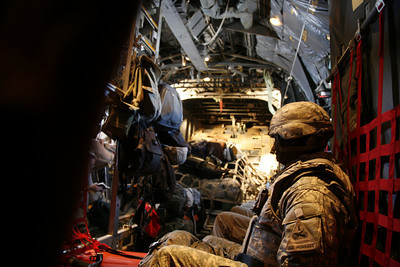
The first leg of our trip was on an Air Force C-130 from TQ to Al Asad which we shared with a large number of previously unknown friends from every branch of service in the US military as well as various civilians and contractors.  All of us had our personal protective equipment as well as our bags. The bags that we did not want to lug were placed on pallets and transported with a large fork lift to the aircraft.  When you make one of these trips you are accounted for a good number of times before ever getting on the aircraft.  This first mission was still in the heat of the Iraqi summer and thus the temperature inside and outside of the aircraft was stifling.  We staged off the tarmac in the sun for a final role call and then in two lines who guided out to our aircraft which had just landed.  As we were trudging out to the aircraft two lines of assorted passengers primarily Soldiers and Marines passed us mid way to the aircraft.  As we neared the aircraft the propeller blast blew the hot air into our faces and I thanked God for the high speed Wiley-X ballistic sunglasses that I had been issued by EOD.  Entering into the aircraft we had to step up onto the cargo ramp and then took our seat in the narrow canvas mesh jump seats that lined both the side of the aircraft and the center.  The rear of the aircraft including the cargo ramp was used for several pallets of cargo including the bags that we elected not to carry.  Sitting in the aircraft and waiting for the pallets to be loaded I thought back to my early career as an Army Officer where I became an air-load planner and embarked my soldiers on six C-130s during Winter REFORGER 1985.  Back then instead of the 130 degree heat of Iraq we faced the coldest winter in 40 years in Europe in which the Rhine froze over.  Although the use of computers has become routine in load plans the principles are the same as they were 25 years ago and everything on the aircraft needs to be properly balanced to ensure the stability and safety of the aircraft and that weight limits are not exceeded.  As the sweat poured off of me I took off my helmet and downed part of the one liter bottle of water that I carried onto the aircraft and threw some on my face, though warm it was refreshing and I reattached my helmet as the aircrew came through the cabin giving a final safety brief.

As the last of the cargo pallets were loaded about the aircraft the cargo ramp was raised, the entire time that the aircraft was on the ground was under 15 minutes, it is amazing what the Marine and Air Force ground crews and cargo handlers can accomplish.  With the ramp raised the aircraft’s air conditioning began to take effect and though not the coolest air conditioning it was better than what we had up to that point. The aircraft began to roll and move down the taxiway and when it reached the end of the taxiway it made a fast turn and began its take off.  Since there was a real and present danger of possible missile or gun attacks on low flying aircraft the C-130 made a steep lift off and banked right over Lake Habbinyah and continued its ascent until it reached its cruise altitude.  The C-130, like any cargo aircraft is extremely loud and because of this hearing protection is worn by passengers and crew and conversation is nearly impossible.

The flight from TQ to Al Asad is only about 30 to 45 minutes depending on the route taken so most of the passengers took the opportunity to grab a bit of sleep or read.  Nelson and I sat together on the starboard side of the aircraft not far from the palletized cargo.  Nelson who can sleep almost anywhere on a moment’s notice was out quickly; and although I was tired I could do little more than close my eyes and try to clear my mind.  When we neared Al Asad the aircraft banking nearly perpendicular to the ground made a steep and fast approach.  As we landed I could see other aircraft on the ground including F-18’s, various transports and rotor wing aircraft.  The C-130 taxied to a spot on the tarmac where the ramp was dropped and we were instructed to exit the aircraft and led to the rear of the aircraft about 50 yards and then led between it and another aircraft to a group of tiny Japanese made Nissan and Mitsubishi buses in which we were loaded until every seat was full including the in aisle jump seats.  Packed into the bus like sardines and smelling almost as bad we sucked in the stench, which was somewhat like a European elevator in the 1980s.

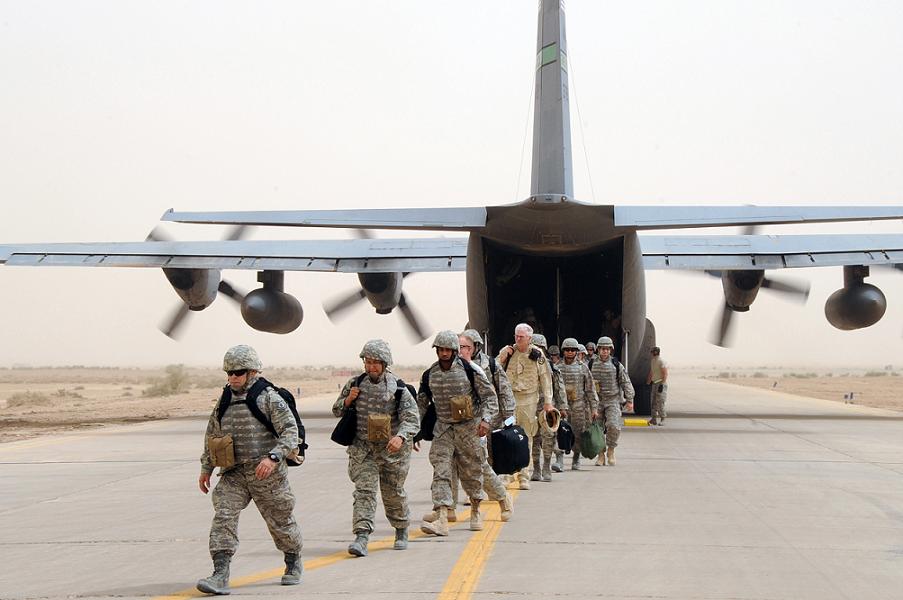
Passengers disembark from a C-130 at Al Asad

After a short ride to the terminal we picked up our gear which had been delivered on the pallets by forklifts.  Another muster was taken and after all personnel were accounted for those of us waiting on follow on flights checked in at the terminal.  After being accounted for we got our temporary billeting in large tents about a hundred yards from the terminal.  The tents were large and poorly lit with plywood floors and several air conditioners built into the sides of the tent.  The bunks were in very poor condition, many broken and even more with dirty worn out mattresses sagging in the middle.  Nelson and I looked at each other and Nelson made some comments about the accommodations and we each found a bunk grounded our gear and settled in for a bit in order to clean up before trying to go get some chow.

Next: Air Travel In Al Anbar: the California Line.

Leave a comment

Filed under iraq,afghanistan, Military, Tour in Iraq

How to Make an Incredibly Difficult War Unwinnable: The Crass Hatred of “Pastor” Terry Jones for Moslems Endangers Americans

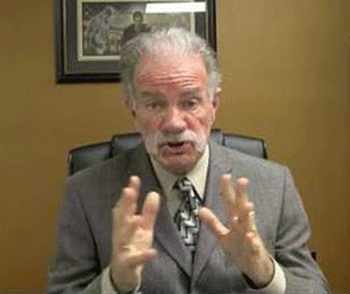
“Pastor” Terry Jones

“Warfare is now an interlocking system of actions-political, economic, psychological, military-that aims at the overthrow of the established authority in a country and its replacement by another regime. To achieve this end, the aggressor tries to exploit the internal tensions of the country attacked-ideological, social, religious, economic -any conflict liable to have a profound influence on the population to be conquered. Moreover, in view of the present-day interdependence of nations, any residual grievance within a population, no matter how localized and lacking in scope, will surely be brought by determined adversaries into the framework of the great world conflict. From a localized conflict of secondary origin and importance, they will always attempt sooner or later to bring about a generalized conflict.” Roger Trinquier

“Pastor” Terry Jones of the Gainesville Florida “Dove World Outreach Center” has crossed a boundary in regard to the abuse of freedom of speech and freedom of religion.  While many may vehemently disagree with this religious zealot’s (I cannot honor him with the title of Christian) hatred and bigotry he has a Constitutional right the express his beliefs under the First Amendment.  Unfortunately while the Reverend Jones may believe his beliefs to be the absolute truth and has the Constitutional right both to hold and express those views in any medium that he wishes it does not mean that those expressed views represent the entirety of the Christian faith much less the body politic of the American nation.  Likewise it does not mean that his views while protected free speech cannot be harmful to the interests of the nation and the people that at least in an earthly state are the guarantors of that liberty.  In fact it has become apparent that some individuals and groups can be so convinced of their own “correctness” that in spite of every warning to the contrary that they do all that they can to inflame tensions and undercut the efforts of the military that seeks to preserve those rights.

There are a couple of major issues that I see here and I will not address the Constitutional issues which regardless of how hateful and devoid of reason one’s beliefs may be they are still protected under the First Amendment.  This is settled law and has been applied to a variety of hateful and actually harmful ideologies on both the right and the left.  Thus as idiotic, ignorant, hateful and strategically harmful an argument be, be it religious, philosophical or political as long as it does not impinge of the physical right to life, liberty and property as it might be it is still protected speech.  What bothers me as well as most of the people I know believe about the stated in intentions of the “Reverend” Jones and his flock to be is that not that he has the right to express them, but that he chooses to do so in the knowledge that his actions will very well cost the American military lives in an ongoing war.

We live in the United States and political or religious thought, even hateful and potentially damaging is protected speech.  At the same time there are times that such speech can harm the interests of the county and cost lives.

The “Reverend” Jones is planning to conduct a protest against Islam, a religion that he believes to be “of the Devil.”  Okay, whatever, he has a right to those beliefs.  However, he insists on pursuing a plan to burn hundreds of copies of the Koran, the most sacred book in the Islamic religion despite the fact that the commander of US and NATO Forces in Afghanistan has asked him not to do so, and against the warnings of other US government officials and even over the protestations of other Christian denominations including the Roman Catholic Church, the National Association of Evangelicals and others.  The plan which he has announced on the internet has unfortunately gained the attention and air time of major television news networks has been reported worldwide and has sparked outrage in moderate Islamic nations that have a history of standing alongside the United States against Islamic radicals. In places where U.S. Forces battle Islamic extremists the statements and planned actions of the “Reverend” Jones and his little apostate “church” place American Solders, Marines, Sailors and Airmen in even more danger because his actions turn those that might be for us against us.

The war against Islamic extremists occurs on numerous fronts and is much larger than military operations. In fact military operations will not will the war of themselves. We do not simple face an insurgency in Iraq and Afghanistan but a world-wide insurgency where as Trinquier recognized everything is connected, political, religious, economic, military and ideological. In fact since the advent of the internet and cheap digital video technology the potential for radicals such as Jones to adversely impact U.S. military operations and broader political goals in the war against Islamic extremists has grown exponentially. Who could believe that a “pastor” of a 50 member church who has what best can be described as a “Braveheart” fantasy and fetish that was kicked out of a church that he founded in Germany in 2008 would be able to cause such a stir?” Unfortunately that is the power of the new media.  The internet has provided muckrakers of hate like Terry Jones unlimited potential to get their message out and into the sights of mainline media that survive and thrive on the controversy of such stories which feed the 24 hour news cycle for days on end. Yes, the mainstream media are prostitutes when it comes to stories like this and hopefully when Jones actually conducts his burning of the Koran will ignore him as Secretary of State Hillary Clinton has asked.  Jones may have the Constitutional right and freedom to do this but he does not need to be given any more attention by the media which would work against U.S. policy and endanger Americans, especially the military in harm’s way.

I find Jones’ actions to be treasonous. He may have the “rights” to do this but his actions endanger Americans, not just the military but all Americans by his actions. He quickly redirects the blame for this against Moslems but the fact is that his actions help stir a witch’s cauldron of hate against his own country. He advocates actions against American Moslems which if they were recommended by others against Christians would be enough to provoke outrage that might result in violence in the current poisonous political climate.  Likewise in burning the Koran he stoops to a level that Moslems will not go to against Christians or Jews, that is burning books that they consider holy, even if they do not believe that they contain the full revelation of the Koran. Islamists may burn effigies of our leaders and our flag and even persecute Christians and Jews, but they will not burn or desecrate our either the Bible or the Torah.  In doing what he is doing Jones sinks to a low that even the most insane Islamic extremist will not do.  The sad thing is that despite the murderous terrorism practiced by Al Qaeda and other Islamic extremists, including the attack on the World Trade Center and Pentagon on September 11th 2001and around the world since then, that the most brutal and murderous Moslem terrorist will not burn or desecrate our holy books.  I am sure that given Jones’ theology that if he even had a chance to do more than issue vile statements about Moslems and condemn all Moslems and their religion for the actions of some that he would do so. A man that would willingly conduct an act that most certainly will inflame the Moslem world against the United States, endanger our people as well as his own Christian brethren worldwide would not hesitate to conduct terrorist actions against Moslems if he had the money, organization and backing to do so.

Despite what he claims “Reverend” Jones embodies everything that is unseemly and even un-Christian. He has no sense of civic responsibility and he twists the Christian message so vilely that it is unrecognizable as Christian in any way shape or form. In his ignorant hatred he endangers U.S. Forces and works to make an already difficult war unwinnable as he further inflames Moslems against us. Unfortunately no amount of denunciations by the U.S. Government, military leaders or Churches will undo what will happen if he conducts this action as he has stated that he will on September 11th.  His actions like those of others that have couched the Christian message in hate to fulfill their political agendas stands in opposition to what Jesus himself would do and against the message proclaimed by the early church. His actions hearken to the times that so called “Christians” conducted their own “terrorism” against other Christians, Moslems, Jews and Pagans throughout history and even in recent times.

There are some in this country that espouse similar views to Jones even if they will not burn the Koran. Some of this I know is because of ignorance and some simply because they are reacting to world events on a totally emotional level. I get that. The vast majority of these people, be they Christians or not do not advocate or support the actions of Terry Jones.  At the same time their ignorance about the Moslem and Arab world, portraying it as a monolithic “Islamofacist” threat works against their own country and our attempts to win this war against terrorists. We can fight a campaign against a limited number of terrorists and other enemies in Iraq and Afghanistan so long as we have the majority of the populations of those nations on our side supporting us. However we cannot win those wars if people like Jones through their actions turn those that support us against us.  This is an interconnected war, and like Trinquier said it is all connected. Even little groups like the Dove World Outreach Center and their hate filled delusional pastor can cause us great problems.  We cannot fight the entire Moslem world. Our military as it is stretched to the limit, the protected wars in Iraq and Afghanistan have spent much of our national treasure as well as cost thousands of the lives of our service men and women, those killed, wounded, maimed and those that have the unseen wounds of PTSD, TBI and moral injury.

I do pray that Jones will turn away from this insanity but based on his words and past actions I believe that he has no regard for American treetops or the security of this country. Jones is a menace. He has the right to do what he is doing but in doing so he endangers American lives and makes the job of winning this war that much harder if not impossible. He is an apostate from the Christian faith and a traitor to his own country. I say this as a Christian and a career military officer that remembers 9-11 well and who has deployed twice in support of Operation Iraqi Freedom or Enduring Freedom. I have seen the sacrifice of our Marines, Sailors, Soldier and Airmen, been with the wounded and worked with Iraqi security forces and know their sacrifices.  Jones should be condemned by Americans of all faiths, especially Christians.

Our enemies will use Jones’ actions against us as we would if the situation were reversed. They will use their propaganda networks to use this to poison others against us. Whenever American “Christians” do such idiotic things it makes our job in the military that much harder. Personally I cannot see how anyone that advocates such actions can believe that they are “supporting the troops.”  I see many e-mails forwarded by family friends and others that attack the loyalty of American citizens that disagree with them and especially question the loyalty of American Moslems.  Somehow I recall back in the early years of the Christian Church that the Roman Empire questioned the loyalty of Christians in the empire because they would not acknowledge Caesar as Lord.  I wonder if we truly were Christians and paid Christ more allegiance than our political parties or ideologies rather than use him to buttress our own political parties or allies if we would be considered to be “loyal” citizens. In our country Catholics were considered suspect until at least the 1960s because of their “allegiance” to Rome. Now we do this to Americans citizens who are Moslems and we wonder why these citizens do not speak out more loudly against Islamic extremists. Many have family in Moslem countries that would be in danger if they spoke out and many feel threatened as relatively new immigrants by people like Terry Jones.  They are damned if they do and damned if they don’t.

Jones has stated that he will go ahead with his Koran burning despite the please of General David Petreus in Afghanistan, the U.S. Government and other Christians.  The blood of Americans will be on his hands.

Peace

Padre Steve+
1 Comment

Filed under faith, Foreign Policy, History, iraq,afghanistan, national security, Religion

Goodbyes and Prayers: Sending Friends off to War

My little war within the war, Christmas with the Bedouin

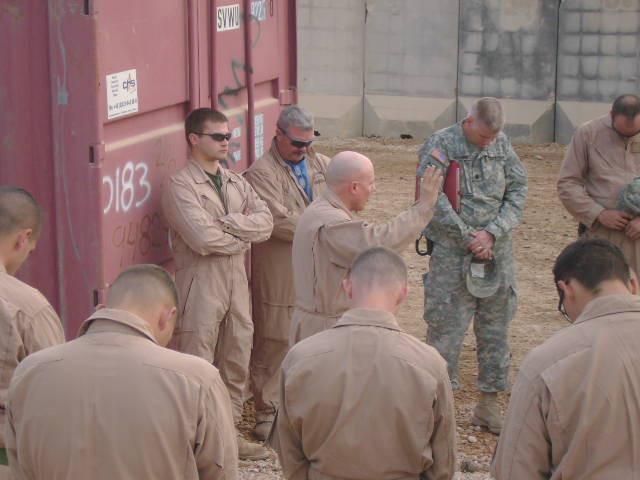
Yesterday I was honored to be at a pre-deployment ceremony for a number of my shipmates from Portsmouth Naval Medical Center about half of I know fairly well.  There were physicians, nurses and hospital corpsmen in the group, some going to Afghanistan with the Marines, NATO or the Army while others were going to Guantanamo Bay or Djibouti, the country rejected by both Eritrea and Ethiopia. I already have seen a good number of friends and colleagues from our Medical Center deploy and in some cases return and I know of one corpsman that came back wounded while serving with the Marines in Afghanistan.

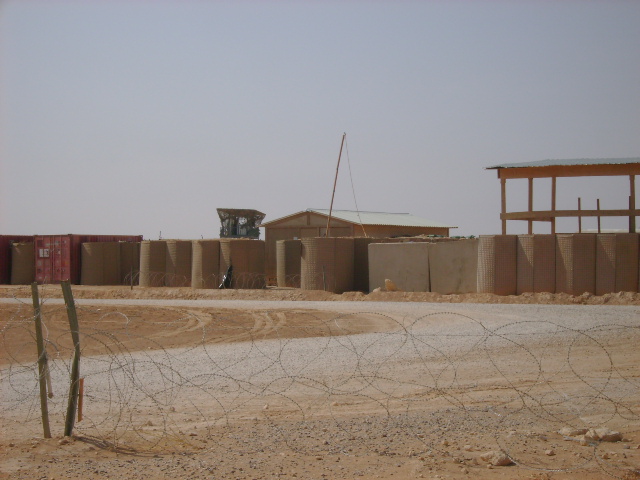
COP South

I have done many of these send offs since coming to Portsmouth but I think that today I knew a higher percentage of the personnel deploying than normally is the case.  At these ceremonies it is customary for the chaplain to pray for our shipmates as well as their family members.  This deployment comes in the midst of monthly casualties reaching their highest point in the war and shortly after two US Navy sailors being killed when for whatever reason they left their base in Kabul in an up armored Toyota Land Cruiser and proceeded to drive alone to one of the most dangerous areas of the country.  With that in mind the safety of our shipmates is something that I and those that serve are ever mindful of when we send our people to deploy.  Yesterday I spent more time with the deploying sailors before and following the ceremony because so many were friends or close colleagues. The goodbyes from me this time were different as I will not be at Portsmouth when my friends return. My assignment as the Command Chaplain at Naval Hospital Camp LeJuene means that I won’t be there but I will continue to keep them in my prayers and stay in contact with as many as I can through e-mail or Facebook.  At LeJuene I will meet old friends from Portsmouth as well as from my Marine tours.  I will also get to deal with a lot more Marines and Sailors dealing with physical as well as psychological injuries resulting from their time in harm’s way in either Iraq or Afghanistan or in many cases both countries.

Pause for possible IED

It has been three years since I deployed to Iraq, in fact three years to the day yesterday that I arrived in Kuwait to complete final training before going into country.  When I was over in Iraq I was blessed my many expressions of support of many people, churches, schools and veterans groups.  At the same time I did not sense the overwhelming support of the people for our troops and that included many members of the political establishment that seemed more interested in using the war to advance their political objectives and unfortunately that was truly a bi-partisan endeavor.  Since we are an all volunteer force it seems to me that the only people really paying attention are people with sons, daughters, mothers or fathers or other family members or friends in harm’s way.  For others supporting the troops is little more than a bumper sticker affirmation, which I appreciate as at least most people aren’t damning us as so many did in Vietnam, a war that my dad served in and which as a Navy dependant experienced in the way that military families were treated by the protest set.

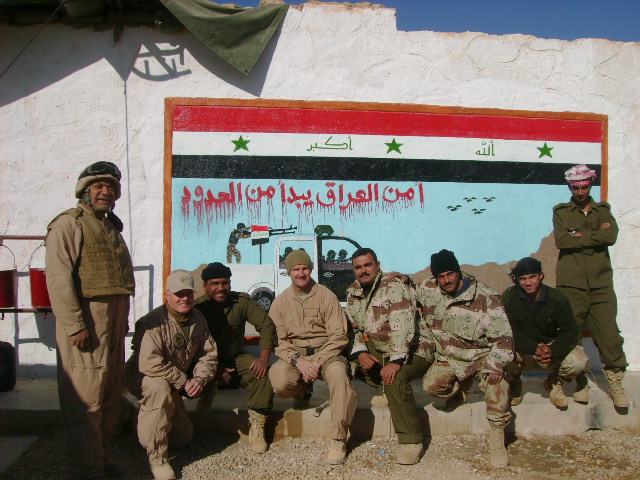
On Syrian Border with Iraqi Border Troops

Today I saw an article about an Army Lieutenant one Christopher Babcock http://gen-reading.blogspot.com/ at a tiny base in Afghanistan.  I often felt this way when in Iraq, especially those times that I came back into the large base that I operated from and saw various news channels on AFN including Fox News, CNN, and MSNBC.  Much of what I saw coming out of the mouths of reporters or politicians, showed me just how out of touch and how little our leaders on both sides of the political divide, the media and the American public understood this war.

Convoy in Ramadi shortly before we took fire

My war experience was different. The places I went were the places most people never heard of or will ever hear about.  My assistant and I travelled thousands of miles in fixed and rotor wing aircraft as well as in many tiny poorly armed convoys in the badlands of Al Anbar Province to the small Iraqi bases where our advisors to the Iraqi Army and security forces worked.  In the assignment I got to know a decent number of Iraqi officers and even spoke to the first class of female Iraqi Police officers in training at Ramadi.  I believed then and now that Iraq will do well in the long run.  Back in 2007 very few people believed that, but having gotten to know many fine Iraqis I know that they will repair their country and move on with life. They have been at war in some way shape or form since 1980 and are war weary and most want to move on to live in peace and raise their children.

Guests of Major General Sabah of 7th Iraqi Division

I do not believe this to be the case in Afghanistan. History tells me that we will have no better outcome than the Soviets.  We lost our opportunity when we let up on the pressure in Afghanistan to concentrate on Iraq. The Taliban were able to rebuild and regain control of much of the country between the Iraq invasion and 2010.  I honestly don’t know if we as a nation have the wherewithal to win this war or the resources to do so.  Many outstanding Soldiers, Sailors, Marines and Airmen as well as personnel from the CIA perform heroic work on a daily basis but they do not have the numbers or resources to fight a successful counter-insurgency campaign when the Afghan people by and large hate the Karzai regime and cast their lot with the Taliban despite their miserable life under that brutal, medieval fundamentalist Islamic regime.

But we go on with each service sacrificing needed equipment and personnel to fund the war. Even now the Navy is going to be cut maybe up to 25,000 sailors without any mission decrease. Likewise there will be no let up of the use of Navy personnel as Individual Augments to Marine, Army or NATO forces in the Middle East and in other locations.  As it is the force seems to be stretched beyond belief with many sailors not only deploying in traditional at seas, Fleet Marine Force, Seabee or Special Operations billets but when they are supposedly on the downhill side in a shore billet are pulled to serve as an Individual Augment.   The Army and the Marines are worn down by constant deployments with no end in sight.  There are no new drafts of personnel, end strength is limited and the same people go back time and time again.  If I was told I needed to head to Afghanistan I would because that is where many of my friends are and as a Priest and Chaplain I could do no other, but I would go with no illusions about the mission, the risk or the likely outcome of the war. It would be the place to care for God’s people serving in harm’s way.

Brotherhood of War

While this is going on there is the ever present threat of war on the Korean Peninsula or with Iran. A war in either location would open yet another front in a worldwide conflict, when we are already stretched to the breaking point elsewhere.  Any conflict in those areas could generate more casualties in a short period of time than all the personnel that we have lost in Iraq or Afghanistan.

Goodbyes and prayers… I am sure that there will be more of both in my future.  I just ask my readers to keep their head in the game when it comes to the wars that we are in.  Don’t leave the troops on a bumper sticker but keep them in your hearts and prayers and serve them through your actions.

Peace

Padre Steve+

Leave a comment

Filed under counterinsurency in afghanistan, iraq,afghanistan, Military, shipmates and veterans, US Navy

Memorial Day Weekend 2010: We Happy Few, We Band of Brothers

On May 27th 2010 the US Military experienced the loss of its 1000th KIA in Afghanistan. The young man killed was Corporal Jacob C Leicht of Kerrville Texas.  Corporal Leicht was assigned to 1st Light Armor Reconnaissance Battalion, 1st Marine Division Camp Pendleton California. Corporal Leicht had previously served in Iraq where he had been badly wounded by an Improvised Explosive Device (IED) that hit the HUMMV that he was traveling in.  Pulled to safety by his Iraqi interpreter Leicht spent the two years recovering from those injuries engaged in a letter and phone call campaign to get back into the fight with his fellow Marines.  He was killed when he stepped on a land mine during that desperately sought after second tour. His younger brother Jesse Leicht who just 10 days ago enlisted in the Marines said “He said he always wanted to die for his country and be remembered, he didn’t want to die having a heart attack or just being an old man. He wanted to die for something.”  Please keep his family and his fellow Marines in your prayers this Memorial Day.

Last year I was very melancholy during Memorial Day and stories of young Marines, Soldiers and Sailors killed in the line of duty usually cause me to reflect on the sacrifice that the young men and women who volunteer to serve our country make on a daily basis while most of the country goes about its business often oblivious to the wars being waged by our sons, daughters, brothers and sisters and mothers and fathers in Afghanistan, Iraq and other lesser known fronts in this war.  Last year I was still very much in the midst of my PTSD crash and struggling with depression and faith.  At the same time I was still remembering all of the veterans who made a difference in my life.  That was covered in the posts Memorial Day 2009- Thoughts and Musings and Remembering the Veterans in My Life…Memorial Day 2009.

As we approach Memorial Day 2010 we must remember that while the war in Iraq is drawing down that the war in Afghanistan is heating up even as U.S. and NATO forces prepare to engage the Taliban in their spiritual home of Khandehar.  Likewise there is are rising tensions on the Korean peninsula where the Heavy Combat Brigade and Air Combat Brigade of the 2nd Infantry Division are based in support of Republic of Korea and UN forces in Korea backed up by Marines of the 3rd Marine Division and 3rd Marine Expeditionary Force in Okinawa and Hawaii that are not currently in Afghanistan. At sea U.S. Navy forces patrol strategic choke points including the Straits of Hormuz where an ascendant Iran continues to build up for forces that could threaten the Freedom of the seas.

How am I different this year? To answer the question I can only say that I have regained some measure of faith and community that had been absent in my life after I returned from Iraq.  This has made a lot of difference however it in no way takes the place of remembering those men and women that I have served with in harm’s way as well as the veterans who made an impact in my life and still do today.

Memorial Day, initially known as Decoration Day is a somber holiday in its truest sense however it is as Paul Reikoff of the Iraq Afghanistan Veterans Association notes is “One Country, Two Holidays.” http://www.huffingtonpost.com/paul-rieckhoff/memorial-day-one-holiday_b_592398.html For those that have served in war going back to our WWII veterans but also those of the not so popular wars, Korea, Vietnam and the current conflicts in Iraq and Afghanistan who have lost friends and sacrificed spending months and even years in combat zones and the work-ups and exercises that part and parcel to deployment.  There are the wounded in body, mind and spirit and those whose physical injuries who have killed them in previous wars but now live in tortured bodies somewhere in between life and death.  Likewise there are those whose injuries are invisible, the injuries of PTSD, TBI and other psychiatric or psychological disorders related to their time in combat.  I spent almost two years in PTSD hell and though I am making a good recovery now still am reminded of the fear, anxiety, depression, hopelessness, loneliness and an existential crisis of faith that came with my return.  I know too many Marines, Soldiers and Sailors that suffer much more than I have whose struggles pass unnoticed by most of society.  I am now working with our Substance Abuse Rehabilitation Program and it is hard to see the young men and women that are in the program whose problems either came in part from their combat experience or their experience upon returning home.  Likewise we are now receiving more of our combat wounded at the medical center and thus I am reminded of the sacrifices made by veterans every day.  For those who work to help these young men and women and in many cases have served alongside them in the combat zones it is a continual reminder of the cost of war.

For those of us that have served, not just in the current conflict but our brothers and sisters that served in previous wars, especially Vietnam and Korea there is one Memorial Day.  While we do attempt to do some things with families and friends the holiday is one of sober reflection as we count the cost of war in human terms, both in our lives as well as our families, the soldiers of our Allies that serve alongside of us and the populations of lands devastated by war.

But then there is another country.  A country consumed with materialism and for whom “heroes” are reality television “stars,” actors and actresses and sports figures.  There are those who while they profess to “support the troops” are the first to want to replace military personnel with contractors such as Halliburton and the company formerly known as “Blackwater” with often disastrous results. Political operatives and lobbyists support paying astronomical sums to corporations that often embarrass the country and make the  job in the military harder in Iraq and Afghanistan having done things that alienate those populations.  Then there is the cost for services delivered and the often terrible way that these corporations treat their employees, especially the third country nationals with working hours and living conditions that would be punishable he in the United States, but also Americans who gain employment but serve driving trucks or other hazardous duties that they have little combat training to do and receive little if the are wounded in action nor for their families if they are killed or disabled. That is part of the “other country.” About 1.8 million Americans have served in Iraq or Afghanistan less than 6/10ths of 1 percent. Unlike World War II where the war was truly a national effort this war is waged by a small minority of the population.

I do not have any problems with people enjoying a holiday but hope and pray that Americans will take at least a few minutes to pay their respects to the Veterans of wars past and present the honored dead as well as the living.  Say a prayer, visit a military or veteran cemetery, and pay a visit on a living vet or the family of one of those killed. Donate to reputable veteran organizations or charities and maybe take a vet out for a bite to eat or buy them a cup of coffee, Coke or a beer.  Don’t let the day pass by simply looking at the faded yellow ribbon “I support the troops” on your car but take a few minutes to thank and remember those that have served our country regardless of race, creed or color and pray that the fallen will rest in peace and the living will recover from all wounds.

Unfortunately for the country the President will not be at the wreath laying ceremony at Arlington Cemetery this year. Unlike some who are vehemently criticizing him I can only say that I am disappointed that the Commander-in-Chief will not be present because of what I feel is the tremendous symbolic importance of his presence at the event when we are at war. At the same time the President’s absence in emblematic of how much of the country “celebrates” Memorial Day.  Unfortunately as the number of men and women who have served our nation in time of war goes down in proportion to the population at large the day will become less significant to many, a curiosity that is quaint and nice but does not impact their lives.  I do not mean this in a bad way or with any malice; it is simply a statement of fact as for most the military and the war is not an everyday part of their lives. I think that the Previous President while understanding the significance of this day did not help the nation when after the September 11th attacks did not marshal the energy of the nation for a war which his administration readily acknowledged would be a “long war” but instead told people to “go shopping” to pump up the economy.  I think that was an act that has limited the personal effect of the human cost of these wars to a very limited segment of the population.

At the same time I as well as most veterans do appreciate the fact that we in the military are treated well by our countrymen even if they do not truly understand what we go through.  I for one am thankful to people who go out of their way to thank us in public places, those that take on hateful groups like the crowd at West Baptist Church that protests outside of military funerals and bases invoking God’s wrath on us.  Likewise there are the volunteers who meet returning servicemen and women at airports as the come home from war, the sports that honor the military before games or as in the case of most of Major and Minor League Baseball in the 7th inning stretch.  At the Church of Baseball, Harbor Park Parish in Norfolk they display the photos of servicemen and women currently serving overseas.  The Raley’s grocery store near my parents’ home in Stockton California has a display of hundreds of 8 x 10 photos of military personnel in the front of their store and a wide range of people and groups try to find ways to help.  This in is stark contrast to the treatment of our brothers and sisters who served in Vietnam and the attitudes and treatment of military personnel on college campuses that lingered far into the 1980s.  Thankfully the vast majority of Americans are appreciative of what we do.  At the same time most are not personally effected and as such will simply see Memorial Day as a three day weekend that kicks off the summer vacation season hardly pausing to think of the cost that has been born to ensure that Americans and people around the world have the opportunity to live in freedom.

Band of Brothers, Above Me and RP2 Nelson Lebron, below Foot Patrol Al Waleed Iraq

This weekend I pause to remember the veterans in my life, my father who remains in a nursing facility with dementia brought about by Alzheimer’s disease, men like my NJROTC instructors Senior Chief John Yarro and Buff Rambo who taught me in our FIST or Fire Support Team, SFC Harry Zilkan and CSM John Butler from my UCLA Army ROTC program and SFC Harry Ball my Drill Instructor in ROTC Advanced Camp. All were Vietnam Vets.  Then there were 1SG Jim Koenig of 557th Medical Company who was my 1st Sergeant when I was a new Lieutenant in Germany and Colonel Donald A Johnson the Commander of the 68th Medical Group and his successor Colonel Jim Truscott a high decorated Medevac or “Dustoff” helicopter pilot.  I cannot forget Chaplain (LTC) Rich Whaley a company commander in Vietnam who saved my ass as an aspiring Chaplain at the Chaplain School in 1990 and 1992.

Then there were the WWII and Vietnam Vets in my Chapel at Fort Indiantown Gap PA. USAF Major General Frank Smoker a B-17 pilot, Colonel Walt Swank who served at Normandy and SSG Henry Boyd one of the 101st Airborne Troopers epitomized by “Band of Brothers.” There were the Vietnam Vets in the congregation, Colonel Ray Hawthorne an artillery officer who served several tours in country including an advisor tour.  Charlie Kosko a helicopter pilot and Major Scotty Jenkes who served as a USAF pilot flying close air support in Vietnam.  Then there was Colonel Tom Allmon the Garrison Commander who served in the Gulf War as well as Iraq.

My life more recently has been impacted by others.  My friends of the veterans of the Battle of Hue City including General Peter Pace, Barney Barnes, Tony “Limey Cartilage” Sergeant Major Thomas and so many others have become close over the years, especially after I did my time in Iraq. They and all the Vietnam vets, including the guys from the Vietnam Veterans of America like Ray and Charlie who used man the beer stand behind the plate at Harbor Park until health issues kept them from continuing all mean a lot to me.  Likewise my friends at Marine Security Forces Colonel Mike Paulovich and Sergeant Major Kim Davis both Iraq Vets mean more than almost any people in the world.  We traveled the globe together visiting our Marines.  Both of these men are heroes to me as well as friends.

There are those that I served with at Navy EOD Group II that performed amazing feats in Iraq and Afghanistan and retired Command Master Chief Bill “Two Feathers” Tyrell an EOD tech that I came to know well working family issues and PTSD issues for our EOD sailors.  Bill was a tremendous help as I struggled with PTSD.  Likewise there are my shipmates and friends from the USS HUE CITY that I served with deployed to the Northern Arabian Gulf and Horn of Africa in 2002 including the men of the boarding team that I served as an advisor to on 75 boarding missions aboard impounded Iraqi Oil Smugglers.  Then there are the men that I served with in Iraq especially my assistant and body guard RP2 Nelson Lebron who is getting ready for his 10th deployment this time another trip to Afghanistan.  There are my friends that served in various locations with the Iraqi security forces that I was able to travel to, serve alongside and serve as a chaplain in remote areas of Iraq with the Iraqis. In my current assignment I have had many friends and colleagues deploy to Iraq and Afghanistan in some very “hot” zones caring for our wounded as well as local nationals and allied soldiers.  This is not stopping anytime soon.

These are my brothers and sisters and I remember all of them with fondness.  My thoughts are much the same as Henry V at Agincourt as depicted in Shakespeare’s Henry V:

What’s he that wishes so?
My cousin Westmoreland? No, my fair cousin;
If we are mark’d to die, we are enow
To do our country loss; and if to live,
The fewer men, the greater share of honour.
God’s will! I pray thee, wish not one man more.
By Jove, I am not covetous for gold,
Nor care I who doth feed upon my cost;
It yearns me not if men my garments wear;
Such outward things dwell not in my desires.
But if it be a sin to covet honour,
I am the most offending soul alive.
No, faith, my coz, wish not a man from England.
God’s peace! I would not lose so great an honour
As one man more methinks would share from me
For the best hope I have. O, do not wish one more!
Rather proclaim it, Westmoreland, through my host,
That he which hath no stomach to this fight,
Let him depart; his passport shall be made,
And crowns for convoy put into his purse;
We would not die in that man’s company
That fears his fellowship to die with us.
This day is call’d the feast of Crispian.
He that outlives this day, and comes safe home,
Will stand a tip-toe when this day is nam’d,
And rouse him at the name of Crispian.
He that shall live this day, and see old age,
Will yearly on the vigil feast his neighbours,
And say ‘To-morrow is Saint Crispian.’
Then will he strip his sleeve and show his scars,
And say ‘These wounds I had on Crispian’s day.’
Old men forget; yet all shall be forgot,
But he’ll remember, with advantages,
What feats he did that day. Then shall our names,
Familiar in his mouth as household words-
Harry the King, Bedford and Exeter,
Warwick and Talbot, Salisbury and Gloucester-
Be in their flowing cups freshly rememb’red.
This story shall the good man teach his son;
And Crispin Crispian shall ne’er go by,
From this day to the ending of the world,
But we in it shall be remembered-
We few, we happy few, we band of brothers;
For he to-day that sheds his blood with me
Shall be my brother; be he ne’er so vile,
This day shall gentle his condition;
And gentlemen in England now-a-bed
Shall think themselves accurs’d they were not here,
And hold their manhoods cheap whiles any speaks
That fought with us upon Saint Crispin’s day.

See the Kenneth Branagh’s rendition here: http://www.youtube.com/watch?v=NA3gOST4Pc8&feature=player_embedded

With crucial battles ahead in Afghanistan against the Taliban, the storm clouds of war gathering over Korea and the threat of terrorism and attacks around the world and at home it is indeed a dangerous world that our Soldiers, Sailors, Marines, Airmen and Coastguardsmen serve in.  Never before in our country have so many owed so much to so few.   Unfortunately there are those of us, men and women that have served our country from before Pearl Harbor to the present who who struggle and will spend this day alone and uncared for in isolation, anonymous to nearly everyone. Please, if you see such a man or woman do not let the opportunity pass to thank them and if need be do something to encourage or thank them for their service. Please remember and thank a Veteran this weekend and if somehow the spirit moves you to do more and you are capable of serving and join this new “Band of Brothers” please see a recruiter.  It is a noble profession that we, we happy few are proud to serve despite the cost.

Peace

Padre Steve+
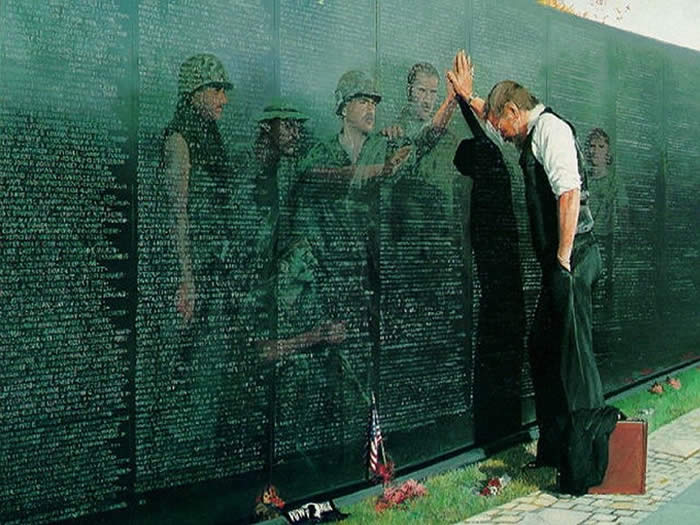
3 Comments

Filed under iraq,afghanistan, Military, PTSD, shipmates and veterans

Going to War: Flying in Al Anbar on C-130s

C-130’s in Iraq

This is another installment of my “Going to War” Series that I began last year.  In the Fall I had to take a break from posting anything more on the story of my deployment to Iraq in 2007 and 2008 due to issues that I was having dealing with the effects of PTSD. I have reached the point that I can again write about this so on occasion I will post these articles which now deal with our actual operations and experiences supporting our Marine Corps, Army and Joint Service advisor teams in the province. The previous posts as well as others dealing with Iraq are filed in the “Tour in Iraq” link on the home page. The direct link to these articles is here: https://padresteve.wordpress.com/category/tour-in-iraq/

Nelson and I continued to prepare in the days leading up to our first mission to the Border Port of Entry at Waleed on the Syrian border with a planned follow on to the teams of the 3rd Brigade, 7th Iraqi Division at Al Qaim about a hundred miles to the north .  Waleed is about 350 miles west of TQ and 70 miles from the nearest FOB with any substantial American presence. We were in constant communication with the team that we to visit via VOIP and SVOIP telephone and secure and non-secure e-mail. The commander of the Border teams, which included Border and Port of Entry adviser teams was Lieutenant Colonel Bien.  Our mission in getting out to the furthest point west was to meet up with an incoming and an outgoing Port of Entry team and see what we could do to get out to other posts along the border.

C-130 unloading its passengers

Nothing in Iraq is easy.  The get out to Waleed we had to make a two day trip from TQ, through Al Asad out to Waleed.  Our flight out was a day flight on an Air Force C-130 to Al Asad.  Our contacts in the G3-Air at 2nd MLG were good in helping me figure out the Air Force flight request which was different than the normal Marine Air Support Request.  For this mission I had to submit 2 Air Force and 3 Marine Air Support requests.    Simply submitting a request does not guarantee a flight. Flights are based on precedence dictated by the overall mission.  Religious support was pretty high on the list but there was no telling that your flight would go until you had your approval message and even then things could change.  The actual missions were not known until about midnight the night prior to the flight. So if you were a frequent flyer it meant no sleep the night before a mission as you waited to see if you were approved.  This was my first time actually having to do this for real so I sat at my secure laptop in my office in the back of the TQ plywood Cathedral waiting for the flight list to be posted on the MLG G3 Air Secure Website.  Finally about 0100 the list popped and our first flight was on in.  It was a mid day flight which meant that we needed to be at the passenger terminal about 0930.  This entailed getting our ride from the Chapel to the terminal by 0900.

I told Nelson who was checking his e-mail on a computer in the RP office that it was a go and then headed off to my can to prepare.  Since most of my gear for the 10 day trip was already packed I tried to actually get ready to sleep.  I quickly found that simply being tired because I was up late was not enough to help me go to sleep.  I was really tired but the adrenaline was coursing through my body making it impossible to sleep.  I prayed the office of Compline and then played computer Ma-Jong until at least 0300 before I could finally pass out.  I was up early to shower and get breakfast before lugging my gear over to the chapel.  The weather as usual was about 100 degrees by the time I got back from the chow hall; I gathered my gear and went to the chapel.  I took my back pack, my laptop and a flight bag. I would learn on this mission that I would need to pack lighter the next time around, but live and learn.

The first leg of our trip was on an Air Force C-130 from TQ to Al Asad which we shared with a large number of previously unknown friends from every branch of service in the US military as well as various civilians and contractors.  All of us had our personal protective equipment as well as our bags. The bags that we did not want to lug were placed on pallets and transported with a large fork lift to the aircraft.  When you make one of these trips you are accounted for a good number of times before ever getting on the aircraft.  This first mission was still in the heat of the Iraqi summer and thus the temperature inside and outside of the aircraft was stifling.  We staged off the tarmac in the sun for a final role call and then in two lines who guided out to our aircraft which had just landed.  As we were trudging out to the aircraft two lines of assorted passengers primarily Soldiers and Marines passed us mid way to the aircraft.  As we neared the aircraft the propeller blast blew the hot air into our faces and I thanked God for the high speed ballistic sunglasses that I had been issued by EOD.  Entering into the aircraft we had to step up onto the cargo ramp and then took our seat in the narrow canvas mesh jump seats that lined both the side of the aircraft and the center.  The rear of the aircraft including the cargo ramp was used for several pallets of cargo including the bags that we elected not to carry.  Sitting in the aircraft and waiting for the pallets to be loaded I thought back to my early career as an Army Officer where I became an air-load planner and embarked my soldiers on six C-130s during Winter REFORGER 1985.  Back then instead of the 130 degree heat of Iraq we faced the coldest winter in 40 years in Europe in which the Rhine froze over.  Although the use of computers has become routine in load plans the principles are the same as they were 25 years ago and everything on the aircraft needs to be properly balanced to ensure the stability and safety of the aircraft and that weight limits are not exceeded.  As the sweat poured off of me I took off my helmet and downed part of the one liter bottle of water that I carried onto the aircraft and threw some on my face, though warm it was refreshing and I reattached my helmet as the aircrew came through the cabin giving a final safety brief.

Interior shot of a C-130

As the last of the cargo pallets were loaded about the aircraft the cargo ramp was raised, the entire time that the aircraft was on the ground was under 15 minutes, it is amazing what the Marine and Air Force ground crews and cargo handlers can accomplish.  With the ramp raised the aircraft’s air conditioning began to take effect and though not the coolest air conditioning it was better than what we had up to that point. The aircraft began to roll and move down the taxiway and when it reached the end of the taxiway it made a fast turn and began its take off.  Since there was a real and present danger of possible missile or gun attacks on low flying aircraft the C-130 made a steep lift off and banked right over Lake Habbinyah and continued its ascent until it reached its cruise altitude.  The C-130, like any cargo aircraft is extremely loud and because of this hearing protection is worn by passengers and crew and conversation is nearly impossible.

The flight from TQ to Al Asad is only about 30 to 45 minutes depending on the route taken so most of the passengers took the opportunity to grab a bit of sleep or read.  Nelson and I sat together on the starboard side of the aircraft not far from the palletized cargo.  Nelson who can sleep almost anywhere on a moment’s notice was out quickly; and although I was tired I could do little more than close my eyes and try to clear my mind.  When we neared Al Asad the aircraft banking nearly perpendicular to the ground made a steep and fast approach.  As we landed I could see other aircraft on the ground including F-18’s, various transports and rotor wing aircraft.  The C-130 taxied to a spot on the tarmac where the ramp was dropped and we were instructed to exit the aircraft and led to the rear of the aircraft about 50 yards and then led between it and another aircraft to a group of tiny Japanese made Nissan and Mitsubishi buses in which we were loaded until every seat was full including the in aisle jump seats.  Packed into the bus like sardines and smelling almost as bad we sucked in the stench, which was somewhat like a European elevator in the 1980s.

Padre Steve Chillin’ at Al Asad Terminal

After a short ride to the terminal we picked up our gear which had been delivered on the pallets by forklifts.  Another muster was taken and after all personnel were accounted for those of us waiting on follow on flights checked in at the terminal and got our temporary billeting in large tents about a hundred yards from the terminal where we each found a bunk grounded our gear and settled in for a bit to clean up before trying to go get some chow.

Next: Air Travel In Al Anbar the California Line.

Leave a comment

Filed under History, iraq,afghanistan, Military, Tour in Iraq

God in the Empty Places…Padre Steve Remembers the Beginnings of Padre Steve’s World

The 16th will be the first anniversary of Padre Steve’s World…Musings of a Passionate Moderate. When I began the site it was about a year after I returned from Iraq.  When I began the site I was running pretty ragged from my PTSD, the deteriorating condition of my father who has end-stage Alzheimer’s disease and from throwing myself so intensely into work in the ICU and PICU at the Medical Center that I was operating on fumes.  This is one of my earliest posts and reflects to a large degree where I was in my life at the time.  It is a reflection on life, ministry and military history and identity.  For me the return from Iraq and the continued wars that we are engaged in bring to mind the experience of the French military in Indo-China and Algeria and as I note here it is my view that the current generation of American Soldiers, Marines, Sailors and Airmen have more in common with the career soldiers of the Foreign Legion, Paratroops and Colonials (Marines) who served in Indo-China and Algeria than we do with the men and women of the “Greatest Generation.”  Unlike those veterans who by and large were draftees and were able to fight a conventional war against nation state actors which they vanquished, the current generation serves against shadowy forces in counterinsurgency campaigns in wars that show no sign of ending soon. I came back feeling isolated and alienated from people who had not served in Iraq, Afghanistan or our predecessors in Vietnam. This is my reflection on that at the beginning of this website a year ago I have added pictures as well as some video links about the Battle of Dien Bien Phu but have not altered the post.

Peace,

Padre Steve+

Foreign Legion Troops in Indochina

I have been doing a lot of reflecting on ministry and history over the past few months. While both have been part of my life for many years, they have taken on a new dimension after serving in Iraq. I can’t really explain it; I guess I am trying to integrate my theological and academic disciplines with my military, life and faith experience since my return.

The Chaplain ministry is unlike civilian ministry in many ways. As Chaplains we never lose the calling of being priests, and as priests in uniform, we are also professional officers and go where our nations send us to serve our Soldiers, Sailors, Marines and Airmen. There is always a tension, especially when the wars that we are sent to are unpopular at home and seem to drag on without the benefit of a nice clear victory such as VE or VJ Day in World War II or the homecoming after Desert Shield and Desert Storm.

VJ Day…It will never happen again

It is my belief that when things go well and we have easy victories that it is easy for us to give the credit to the Lord and equally easy for others to give the credit to superior strategy, weaponry or tactics to the point of denying the possibility that God might have been involved. Such is the case in almost every war and Americans since World War Two have loved the technology of war seeing it as a way to easy and “bloodless” victory. In such an environment ministry can take on an almost “cheer-leading” dimension. It is hard to get around it, because it is a heady experience to be on a winning Army in a popular cause. The challenge here is to keep our ministry of reconciliation in focus, by caring for the least, the lost and the lonely, and in our case, to never forget the victims of war, especially the innocent among the vanquished, as well as our own wounded, killed and their families.

But there are other wars, many like the current conflict less popular and not easily finished. The task of chaplains in the current war, and similar wars fought by other nations is different. In these wars, sometimes called counter-insurgency operations, guerilla wars or peace keeping operations, there is no easily discernable victory. These types of wars can drag on and on, sometimes with no end in sight. Since they are fought by volunteers and professionals, much of the population acts as if there is no war since it does often not affect them, while others oppose the war.

Marines at Hue City

Likewise, there are supporters of war who seem more interested in political points of victory for their particular political party than for the welfare of those that are sent to fight the wars. This has been the case in about every war fought by the US since World War II. It is not a new phenomenon. Only the cast members have changed.

Foreign Legion in Algeria, the ancestral home of the Legion

www.youtube.com/watch?v=8YSsetJU-tU&feature=related

This is not only the case with the United States. I think that we can find parallels in other military organizations. I think particularly of the French professional soldiers, the paratroops and Foreign Legion who bore the brunt of the fighting in Indo-China, placed in a difficult situation by their government and alienated from their own people. In particular I think of the Chaplains, all Catholic priests save one Protestant, at the Battle of Dien Bien Phu, the epic defeat of the French forces that sealed the end of their rule in Vietnam. The Chaplains there went in with the Legion and Paras. They endured all that their soldiers went through while ministering the Sacraments and helping to alleviate the suffering of the wounded and dying. Their service is mentioned in nearly every account of the battle. During the campaign which lasted 6 months from November 1953 to May 1954 these men observed most of the major feasts from Advent through the first few weeks of Easter with their soldiers in what one author called “Hell in a Very Small Place.”

www.youtube.com/watch?v=th7tImvzutc

Another author describes Easter 1954: “In all Christendom, in Hanoi Cathedral as in the churches of Europe the first hallelujahs were being sung. At Dienbeinphu, where the men went to confession and communion in little groups, Chaplain Trinquant, who was celebrating Mass in a shelter near the hospital, uttered that cry of liturgical joy with a heart steeped in sadness; it was not victory that was approaching but death.” A battalion commander went to another priest and told him “we are heading toward disaster.” (The Battle of Dienbeinphu, Jules Roy, Carroll and Graf Publishers, New York, 1984 p.239)

Of course one can find examples in American military history such as Bataan, Corregidor, and certain battles of the Korean War to understand that our ministry can bear fruit even in tragic defeat. At Khe Sahn in our Vietnam War we almost experienced a defeat on the order of Dien Bien Phu. It was the tenacity of the Marines and tremendous air-support that kept our forces from being overrun.

Terrorism and the Battle of Algiers

You probably wonder where I am going with this. I wonder a little bit too. But here is where I think I am going. It is the most difficult of times; especially when units we are with take casualties and our troops’ sacrifice is not fully appreciated by a nation absorbed with its own issues.

French Chaplain and Soldiers Indochina 1950

For the French the events and sacrifices of their soldiers during Easter 1954 was page five news in a nation that was more focused on the coming summer. This is very similar to our circumstances today because it often seems that own people are more concerned about economic considerations and the latest in entertainment news than what is going on in Iraq or Afghanistan. The French soldiers in Indo-china were professionals and volunteers, much like our own troops today. Their institutional culture and experience of war was not truly appreciated by their own people, or by their government which sent them into a war against an opponent that would sacrifice anything and take as many years as needed to secure their aim, while their own countrymen were unwilling to make the sacrifice and in fact had already given up their cause as lost. Their sacrifice would be lost on their own people and their experience ignored by the United States when we sent major combat formations to Vietnam in the 1960s. In a way the French professional soldiers of that era have as well as British colonial troops before them have more in common with our force than the citizen soldier heroes of the “Greatest Generation.” Most of them were citizen soldiers who did their service in an epic war and then went home to build a better country as civilians. We are now a professional military and that makes our service a bit different than those who went before us.

Yet it is in this very world that we minister, a world of volunteers who serve with the highest ideals. We go where we are sent, even when it is unpopular. It is here that we make our mark; it is here that we serve our Soldiers, Sailors, Marines and Airmen. Our duty is to bring God’s grace, mercy and reconciliation to men and women, and their families who may not see it anywhere else. Likewise we are always to be a prophetic voice within the ranks.

Marine Advisers and Afghan Soldiers

When my dad was serving in Vietnam in 1972 I had a Sunday school teacher tell me that he was a “Baby Killer.” It was a Catholic Priest and Navy Chaplain who showed me and my family the love of God when others didn’t. In the current election year anticipate that people from all parts of the political spectrum will offer criticism or support to our troops. Our duty is to be there as priests, not be discouraged in caring for our men and women and their families because most churches, even those supportive of our people really don’t understand the nature of our service or the culture that we represent. We live in a culture where the military professional is in a distinct minority group upholding values of honor, courage, sacrifice and duty which are foreign to most Americans. We are called to that ministry in victory and if it happens someday, defeat. In such circumstances we must always remain faithful.

French Commanders at Dien Bien Phu

For those interested in the French campaign in Indo-China it has much to teach us. Good books on the subject include The Last Valley by Martin Windrow, Hell in a Very Small Place by Bernard Fall; The Battle of Dienbeinphu by Jules Roy; and The Battle of Dien Bien Phu- The Battle America Forgot by Howard Simpson. For a history of the whole campaign, read Street Without Joy by Bernard Fall. I always find Fall’s work poignant, he served as a member of the French Resistance in the Second World War and soldier later and then became a journalist covering the Nurnberg Trials and both the French and American wars in Vietnam and was killed by what was then known as a “booby-trap” while covering a platoon of U.S. Marines.

There is a picture that has become quite meaningful to me called the Madonna of Stalingrad. It was drawn by a German chaplain-physician named Kurt Reuber at Stalingrad at Christmas 1942 during that siege. He drew it for the wounded in his field aid station, for most of whom it would be their last Christmas. The priest would die in Soviet captivity and the picture was given to one of the last officers to be evacuated from the doomed garrison. It was drawn on the back of a Soviet map and now hangs in the Kaiser Wilhelm Memorial Church in Berlin where it is displayed with the Cross of Nails from Coventry Cathedral as a symbol of reconciliation. I have had it with me since before I went to Iraq. The words around it say: “Christmas in the Cauldron 1942, Fortress Stalingrad, Light, Life, Love.” I am always touched by it, and it is symbolic of God’s care even in the midst of the worst of war’s suffering and tragedy.

Peace

Padre Steve+

2 Comments

Filed under History, iraq,afghanistan, Military, PTSD, Religion, vietnam