Category Archives: laws and legislation

What is Freedom ? The 14th Amendment

14-amendment

Friends of Padre Steve’s World,

I am going to be traveling today for a get together tonight celebrating the life of one of my friends in North Carolina. The man who passed away, “New York Mike” was one of the people who brought me into their lives in Emerald Isle when I was stationed away from my wife, and still dealing with terrible depression and other symptoms of PTSD. Mike was great, and he will be missed. When one of my other friends let me know, I was stunned. At the same time I am glad that he was a part of my life, and that he will not suffer anymore. It is good to have friends who care, and I am blessed to have many.

So today I am basically re-running an older post about the 14th Amendment from my Civil War text.

Have a great day and please be safe.

Peace

Padre Steve+

The situation for newly emancipated blacks in the South continued to deteriorate as the governors appointed by President Johnson supervised elections, which elected new governors, and all-white legislatures composed chiefly of former Confederate leaders. Freedom may have been achieved, but the question as to what it meant was still to be decided, “What is freedom?” James A. Garfield later asked. “Is it the bare privilege of not being chained?… If this is all, then freedom is a bitter mockery, a cruel delusion.” [1] The attitude of the newly elected legislatures and the new governors toward emancipated blacks was shown by Mississippi’s new governor, Benjamin G. Humphreys, a former Confederate general who was pardoned by Andrew Johnson in order to take office. In his message to the legislature Humphreys declared:

“Under the pressure of federal bayonets, urged on by the misdirected sympathies of the world, the people of Mississippi have abolished the institution of slavery. The Negro is free, whether we like it or not; we must realize that fact now and forever. To be free does not make him a citizen, or entitle him to social or political equality with the white man.”  [2]

Johnson’s continued defiance of Congress alienated him from the Republican majority who passed legislation over Johnson’s veto to give black men the right to vote and hold office, and to overturn the white only elections which had propelled so many ex-Confederates into political power. Over Johnson’s opposition Congress took power over Reconstruction and “Constitutional amendments were passed, the laws for racial equality were passed, and the black man began to vote and to hold office.” [3] Congress passed measures in 1867 that mandated that the new constitutions written in the South provide for “universal suffrage and for the temporary political disqualification of many ex-Confederates.” [4]  As such many of the men elected to office in 1865 were removed from power, including Governor Humphreys who was deposed in 1868.

These measures helped elect bi-racial legislatures in the South, which for the first time enacted a series of progressive reforms including the creation of public schools. “The creation of tax-supported public school systems in every state of the South stood as one of Reconstruction’s most enduring accomplishments.” [5] By 1875 approximately half of all children in the South, white and black were in school. While the public schools were usually segregated and higher education in tradition White colleges was restricted, the thirst for education became a hallmark of free African Americans across the county. In response to discrimination black colleges and universities opened the doors of higher education to many blacks.  Sadly, the White Democrat majorities that came to power in Southern states after Reconstruction rapidly defunded the public primary school systems that were created during Reconstruction.  Within a few years spending for on public education for white as well black children dropped to abysmal levels, especially for African American children, an imbalance made even worse by the Supreme Court’s ruling in Plessy v. Ferguson which codified the separate but equal systems.

They also ratified the Thirteenth and the Fourteenth Amendments, but these governments, composed of Southern Unionists, Northern Republicans and newly freed blacks were “elicited scorn from the former Confederates and from the South’s political class in general.” [6] Seen as an alien presence by most Southerners the Republican governments in the South faced political as well as violent opposition from defiant Southerners.

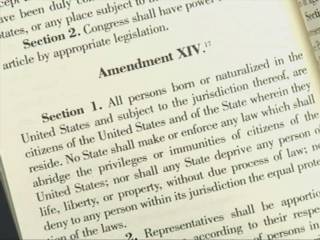
The Fourteenth Amendment was of particular importance for it overturned the Dred Scott decision, which had denied citizenship to blacks. Johnson opposed the amendment and worked against its passage by campaigning for men who would oppose it in the 1866 elections. His efforts earned him the opposition of former supporters including the influential New York Herald declared that Johnson “forgets that we have passed through a fiery ordeal of a mighty revolution, and the pre-existing order of things is gone and can return no more.” [7]

Johnson signed the Amendment but never recanted his views on the inferiority of non-white races. In his final message to Congress he wrote that even “if a state constitution gave Negroes the right to vote, “it is well-known that a large portion of the electorate in all the States, if not a majority of them, do not believe in or accept the political equality of Indians, Mongolians, or Negroes with the race to which they belong.” [8]

When passed by Congress the amendment was a watershed that would set Constitutional precedent for future laws. These would include giving both women and Native Americans women the right to vote. It would also be used by the Supreme Court in the 1954 Brown v. Board of Education decision that ended the use of “separate but equal” and overturned many other Jim Crow laws. It helped lead to the passage of the Voting Rights Act of 1964 and the Civil Rights Act of 1965, and most recently was the basis of the Supreme Court decision in Obergfell v. Hodges, which give homosexuals the right to marry. Section one of the amendment read:

“All persons born or naturalized in the United States, and subject to the jurisdiction thereof, are citizens of the United States and of the state wherein they reside. No state shall make or enforce any law which shall abridge the privileges or immunities of citizens of the United States; nor shall any state deprive any person of life, liberty, or property, without due process of law; nor deny to any person within its jurisdiction the equal protection of the laws.” [9]

Even so, for most white Southerners “freedom for African Americans was not the same as freedom for whites, as while whites might grant the black man freedom, they had no intention of allowing him the same legal rights as white men.” [10] As soon as planters returned to their lands they “sought to impose on blacks their definition of freedom. In contrast to African Americans’ understanding of freedom as a open ended ideal based on equality and autonomy, white southerners clung to the antebellum view that freedom meant mastery and hierarchy; it was a privilege, not a universal right, a judicial status, not a promise of equality.”  [11] In their systematic efforts to deny true freedom for African Americans these Southerners ensured that blacks would remain a lesser order of citizen, enduring poverty, discrimination, segregation and disenfranchisement for the next century.

Notes

[1] Ibid. Foner A Short History of Reconstruction p.30

[2] Ibid. Lord The Past that Would Not Die pp.11-12

[3] Ibid. Zinn The Other Civil War p.54

[4] Ibid. McPherson The War that Forged a Nation p. 178

[5] Ibid. Foner Forever Free p.162

[6] Perman, Michael Illegitimacy and Insurgency in the Reconstructed South in The Civil War and Reconstruction Documents and Essays Third Edition edited by Michael Perman and Amy Murrell Taylor Wadsworth Cengage Learning Boston MA 2011 p.451

[7] Ibid. Foner Forever Free p.121

[8] Ibid. Langguth After Lincoln p.232

[9] _____________ The 14th Amendment to the U.S. Constitution retrieved from https://www.law.cornell.edu/constitution/amendmentxiv 29 June 2015

[10] Ibid. Carpenter Sword and Olive Branch p.93

[11] Ibid. Foner Forever Free p.92

1 Comment

Filed under civil rights, civil war, History, laws and legislation, Political Commentary

The Black Codes

IMG_1879

Friends of Padre Steve’s World,

My wife is having a minor procedure today so I am publishing this article from my Civil War and Gettysburg text. It is not new, but has been updated some. Have a great day,

Peace

Padre Steve+

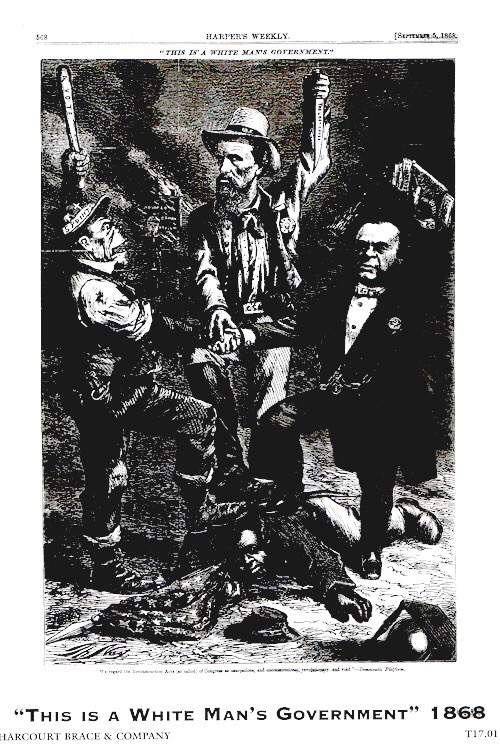
White Southerners including the newly pardoned Confederates enacted black codes that “codified explicit second-class citizenship for freedpeople.” [1] The legislature of Mississippi refused to ratify the Thirteenth Amendment, and did not do so until 1995. One Southerner noted that “Johnson “held up before us the hope of a ‘white man’s government,’ and this led us to set aside negro suffrage…. It was natural that we should yield to our old prejudices.” [2] Former Confederates, including Alexander Stephens the former Vice President of the Confederacy were elected to high office, Stephens to the United States Senate and the aggrieved Republicans in Congress in turn refused to admit the former Confederates. Many Union veterans were incensed by Johnson’s actions, one New York artilleryman noted “I would not pardon the rebels, especially the leaders, until they should kneel in the dust of humiliation and show their deeds that they sincerely repent.” [3] He was not alone, many Northern Veterans who formed the integrated Grand Army of the Republic veterans maintained a patent disregard, if not hatred of what the old South stood for and felt that their efforts in the war had been betrayed by the government.

Johnson’s restoration of property to the former white owners drove tens of thousands of blacks off lands that they had been farming, or left them as laborers for their former slave masters. Johnson countermanded General William Tecumseh Sherman and Secretary of War Edwin Stanton’s Field Order 15 to “divide abandoned and confiscated lands on the Sea Islands and in a portion of the Low Country coast south of Charleston into forty-acre plots for each black family.” [4] As such many freed blacks were now at the mercy of their former white owners for any hope of economic sustenance.

Johnson worked stridently, and often successfully to frustrate the efforts of the Freedmen’s Bureau headed by Major General Oliver Howard to help freed blacks to become landowners and to protect their legal rights. In immediate post-war South states organized all white police forces and state militias composed primarily of Confederate veterans, many still wearing their gray or butternut uniforms. In such a climate blacks had few rights, and officers of the Freedmen’s Bureau lamented the situation. In Georgia one officer wrote that no jury would “convict a white man for killing a freedman,” or “fail to hang” a black man who killed a white in self-defense. Blacks commented another agent, “would be just as well off with no law at all or no Government,” as with the legal system established in the South under Andrew Johnson. “If you call this Freedom,” wrote one black veteran, “what do you call slavery?” [5]

The struggle between Johnson and Congress intensified when the President vetoed the Civil Rights Bill. Congress responded by overriding his veto. Eventually the battle between Johnson and Congress climaxed when Johnson was impeached when he tried to remove Secretary of War Stanton from office. Johnson barely survived the impeachment proceedings and was acquitted by one vote in the Senate in 1868.

The various black codes enacted throughout the South were draconian measures to codify and institutionalize racism and White Supremacy:

“passed labor laws that bound blacks to employers almost as tightly as slavery once bound them to their masters. Other codes established patterns of racial segregation that had been impossible under slavery, barred African Americans from serving on juries or offering testimony in court against whites, made “vagrancy,” “insulting gestures,” and “mischief” offenses by blacks punishable by fines or imprisonment, forbade black-white intermarriage, ad banned ownership by blacks of “fire-arms of any kind, or any ammunition, dirk or bowie-knife.” [6]

Mississippi’s Black Codes were the first of these and among the sections dealt with a change in vagrancy laws, specifically aimed at emancipated blacks and those whites who might associate with them:

“That all freedmen, free Negroes, and mulattoes in this state over the age of eighteen years found on the second Monday in January, 1866, or thereafter, with no lawful employment or business, or found unlawfully assembling themselves together in the day or night time, and all white persons so assembling with freedmen, free Negroes, or mulattoes on terms of equality, or living in adultery with a freedwoman, free Negro, or mulatto, shall be deemed vagrants; and on conviction thereof shall be fined…and imprisoned….”  [7]

The black codes were condoned and supported by President Johnson. While the black codes recognized the bare minimal elements of black freedom, their provisions confirmed the observations of one journalist who wrote “the whites seem wholly unable to comprehend that freedom for the negro means the same thing as freedom for them. They readily admit that the Government has made him free, but appear to believe that the have the right to exercise the old control.” [8] As state after state followed the lead of Mississippi, which was the first state to enact black codes Northern anger grew and some newspapers took the lead in condemn the black codes. “We tell the white men of Mississippi,” exploded the Chicago Tribune on December 1, “ that the men of the North will convert the state of Mississippi into a frog pond before they allow any such laws to disgrace one foot of soil in which the bones of our soldiers sleep and over which the flag of freedom waves.”  [9]

Within weeks of the end of the war, violence against blacks began to break out in different parts of the South and it continued to spread as Johnson and the new Congress battled each other in regard to Reconstruction policy:

“In Memphis, Tennessee, in May of 1866, whites on a rampage of murder killed forty-six Negroes, most of them veterans of the Union army, as well as two white sympathizers. Five Negro women were raped. Ninety homes, twelve schools and four churches were burned. In New Orleans in the summer of 1866, another riot against blacks killed thirty-five Negroes and three whites.” [10]

The hatred of blacks and the violence against them was not limited to adults, children joined in as well. In Natchez Mississippi an incident that showed how deep the antipathy towards blacks was when on a Sunday afternoon, “an elderly freedman protested to a small white boy raiding his turnip patch. The boy shot him dead, and that was that. In Vicksburg the Herald complained that the town’s children were hitting innocent bystanders when using their “nigger shooters.” [11]

Colonel Samuel Thomas, the director of the Freedmen’s Bureau in Mississippi noted the attitudes that he saw in many whites toward the newly emancipated African Americans. He wrote that white public sentiment had not progressed and that whites had not “come to the attitude in which it can conceive of the negro having any rights at all. Men, who are honorable in their dealings with their white neighbors, without feeling a single twinge of honor….And however much they confess that the President’s proclamation broke up the relation of the individual slave to their owners, the still have the ingrained feeling that the black people at large belong to whites at large.” [12] Sadly, the attitude reported by Colonel Thomas not only remained but also grew more violent with each passing month.

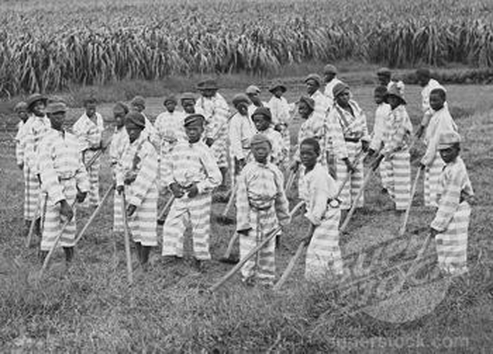
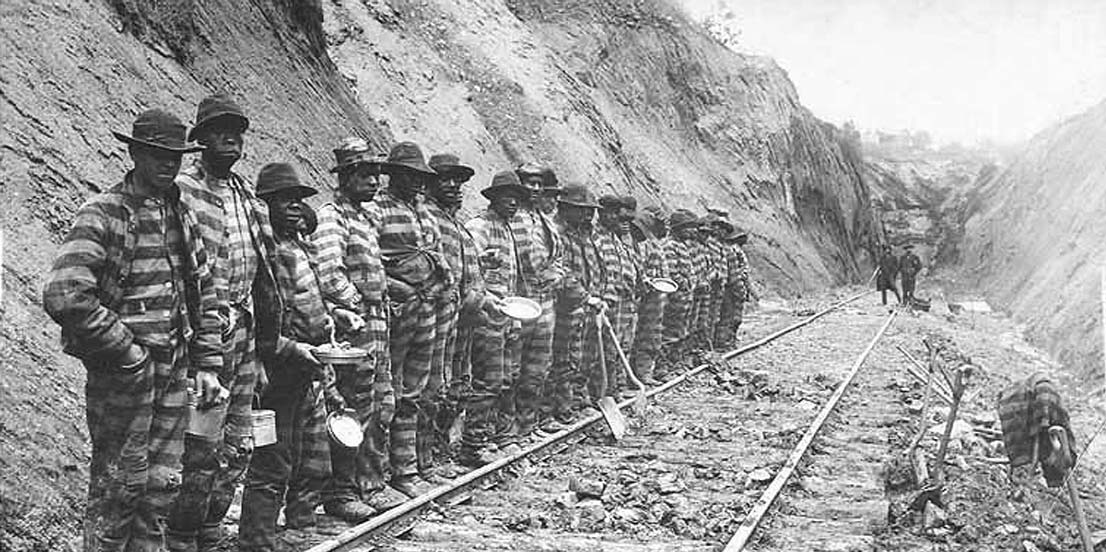
Another lesser-discussed aspect of the Black Codes was their use to return African Americans who had been convicted under the “vagrancy” statutes to a new type of slavery in all but name. The state governments then leased the prisoners to various corporations; railroads, mines and plantations, even former Confederate General and founder of the Ku Klux Klan Nathan Bedford Forrest received his share of prisoners to work his land.

7100338_orig

14-1_Page_43_Image_0001

The practice became a lucrative source of revenue, for not only did the states collect the fees from the companies, but did not have to spend tax dollars to incarcerate, feed or otherwise care for the prisoners. Mortality rates were very high among the prisoners in private custody and the regulations, which stipulated that prisoners would be adequately fed, housed and treated, were not enforced.

By 1877 “every former Confederate state except Virginia had adopted the practice of leasing black prisoners into commercial hands. There were variations among the states, but all shared the same basic formula. Nearly all the penal functions of government were turned over to the companies purchasing convicts. In return for what they paid each state, the companies received absolute control of the prisoners… Company guards were empowered to chain prisoners, shoot those attempting to flee, torture any who wouldn’t submit, and whip the disobedient – naked or clothed – almost without limit. Over eight decades, almost never were there penalties to any acquirer of these slaves for their mistreatment or deeds.” [13]

The profitability of these ventures brought Northern investors, including the owners and shareholders of U.S. Steel into the scheme allowing financial houses and Northern corporations to grow their wealth, as they had during the pre-war days off the backs of slaves. However, the practice was also detrimental to poor Southern Whites who could not compete fairly in the labor market. In 1891 miners of the “Tennessee Coal Company were asked to sign an “iron-clad contract”: pledging no strikes, agreeing to get paid in scrip, and giving up the right to check the weight of the coal they mined (they were paid by weight). They refused to sign and were evicted from their houses. Convicts were brought in to replace them.” [14] The company’s response brought about an insurrection by the miners who took control of the mine and the area around it and freed 500 of the convict-slaves. The leaders were primarily Union Army veterans and members of the Grand Army of the Republic veteran’s organization. The company backed down, but others learned the lesson and began to employ heavily armed Pinkerton agents as well as the state militias to deal with the growing labor movement, not only in the South but also in the North.

Non-convict black laborers as well as poor white “sharecroppers” on the large plantations were forced back into servitude of another manner, where legislatures gave “precedence to a landlord’s claim to his share of the crop over that of the laborer for wages or a merchant for supplies, thus shifting the risk of farming from employer to employee.” Likewise, “a series of court decisions defined the sharecropper not as a partner in agriculture or a renter with a property right in the growing crop, but as a wage laborer possessing “only a right to go on the land to plant, work, and gather the crop.” [15]

The practice did not end until Franklin Delano Roosevelt ordered his Attorney General Francis Biddle to order Federal prosecutors who had for decades looked the other way begin prosecuting individuals and companies involved in this form of slavery. Biddle was the first U.S. Attorney General to admit the fact that “African Americans were not free and to assertively enforce the statutes written to protect them.” [16] Biddle, who later sat as a justice at the Nuremberg trials of major Nazi War Criminals commented during the war “One response of this country to the challenge to the ideals of democracy made by the new ideologies of Fascism and Communism has been a deepened realization of the values of a government based on a belief in the dignity and the rights of man.” [17] Biddle charged the newly formed Civil Rights Division of the Justice Department to shift its focus from organized crime to cases of discrimination and racial abuse. Biddle repudiated the rational that allowed for the practice and wrote that the “law is fixed and established to protect the weak-minded the poor, the miserable” and that the contracts of the states that allowed the practices were “null and void.” [18] It was the beginning of another twenty-year process in which African Americans and their allies in the Civil Rights Movement worked to bring about what Lincoln referred to as “a new birth of freedom.”

Notes

[1] Ibid. McPherson The War that Forged a Nation p. 177

[2] Ibid. Guelzo Fateful Lightening p.491

[3] Jordan, Brian Matthew. Marching Home: Union Veterans and Their Unending Civil War Liveright Publishing Corporation a Division of W.W. Norton and Company Inc. New York and London 2014 p.119

[4] Ibid. Goldfield America Aflame p.411

[5] Ibid. Foner Forever Free p.96

[6] Ibid. Guelzo Fateful Lightening p.491

[7] ____________ Mississippi’s Black Code, November 24-29, 1865 in the Confederate and Neo-Confederate Reader: The “Great Truth” about the “Lost Cause” Loewen, James W. and Sebesta, Edward H. Editors, University Press of Mississippi, Jackson 2010 Amazon Kindle edition location 4505 of 8647

[8] Ibid. Foner Forever Free pp.93-94

[9] Lord, Walter The Past that Would Not Die Harper Collins Publishers, New York 1965 p.12

[10] Ibid. Zinn The Other Civil War p.55

[11] Ibid. Lord The Past that Would Not Die p.8

[12] Ibid. Foner Forever Free p.92

[13] Blackmon, Douglas A. Slavery By another Name: The Re-enslavement of Black Americans from the Civil War to World War II Anchor Books, a Division of Random House, New York 2008 p.56

[14] Ibid. Zinn A People’s History of the United States p.275

[15] Ibid. Foner A Short History of Reconstruction p.250

[16] Ibid. Blackmon Slavery By another Name pp.378-379

[17] Ibid. Blackmon Slavery By another Name p.378

[18] Ibid. Blackmon Slavery By another Name p.379

Leave a comment

Filed under civil rights, History, laws and legislation, Political Commentary

All Should be Equally Free: Recognizing the Terror of the New Religious Liberty Laws

john leland

Friends of Padre Steve’s World,

This may seem a familiar topic for my readers, but due to events in a number of states I feel compelled to talk about it again. The issue of religious liberty and the right to free expression has once again come to the fore in the wake of the Obergfell v. Hodges ruling and the pathetically un-American passage of particularly odious, religiously based anti-LGBT laws in North Carolina, Mississippi, and Tennessee, as well as one that was vetoed by Georgia’s governor. I call these laws pathetic and un-American because they fly in the face of the ideals of the real champions of religious liberty in the United States. One of these early proponents of religious liberty and freedom in the United States was the Virginia Baptist pastor, John Leland.

Sadly, many American Christians either have never heard of him. Likewise, if they have heard of him, as the great pontificator, Mike Huckabee should have in his brief tenure as a student at Southwestern Baptist Theological Seminary; they seem to have ignored his warnings about state religion. I guess that problems in his church history and Baptist history classes were a big reason that he left seminary. Ideologues like the Huckster didn’t last at Southwestern, at least until the fundamentalist takeover in 1994 that helped destroy the academic and scholarly reputation of that once fine school, but I digress….

Leland was a friend of Thomas Jefferson and James Madison and without him it is unlikely that the First Amendment of the Constitution would have mentioned religious faith. Leland had a very personal interest in this as during the 1780s the Anglican Church in Virginia was attempting to again become the official state religion. Anglicans, with the help of local authorities were attacking Baptist congregations and even resorting to physical violence. In defiance of the Anglicans, Leland wrote:

“The notion of a Christian commonwealth should be exploded forever. … Government should protect every man in thinking and speaking freely, and see that one does not abuse another. The liberty I contend for is more than toleration. The very idea of toleration is despicable; it supposes that some have a pre-eminence above the rest to grant indulgence, whereas all should be equally free, Jews, Turks, Pagans and Christians.”

There is a form of religion and indeed the “Christian” faith that is toxic and if not treated leads to the spiritual and sometimes the physical and emotional death of the infected person.

There is a nationalized version of this supposedly Christian faith in the Untied Stats today. It is a bastardized version of the Christian faith overlaid with the thin veneer of an equally bastardized version of American history. Its purveyors are quite popular in the world of “conservative” American Evangelicalism and Catholicism.

Supreme Court Justice Robert Jackson and chief Nuremberg war crimes trials prosecutor warned us about people like them over a half-century ago. Jackson wrote, “[I]n our country are evangelists and zealots of many different political, economic and religious persuasions whose fanatical conviction is that all thought is divinely classified into two kinds — that which is their own and that which is false and dangerous.”

Pat Robertson, evangelist and founder of the Christian Broadcasting Network is an example of what Leland and Jackson warned us about. Robertson said on his program that “You say you’re supposed to be nice to the Episcopalians and the Presbyterians and the Methodists and this, that, and the other thing. Nonsense, I don’t have to be nice to the spirit of the Antichrist.” — Pat Robertson, The 700 Club, January 14, 1991. The late David Chilton was another. He wrote: “We believe that institutionally Christianity should be the official religion of the country, that its laws should be specifically Christian”

It is quite fascinating when you look at it. This faith is a combination of a selective reading of American history, Christian teaching and Biblical interpretation that mixes and matches a wide variety of mutually conflicting and contradictory traditions. This Toxic “faith” if you can call it that; is based on a reading of American and Western History, which negates, marginalizes or willingly distorts the views or contributions of those who they disagree. It does not matter of their opponents are not Christians, or were Christians, including Baptists like John Leland and Roger Williams. Due to their experiences of religious persecution, Williams and Leland refused to buy into any form of state sanctioned religion.

I find it interesting that Conservative Icon and champion of limited government Barry Goldwater had great reservations about those that sought to establish the superiority of any religion. Goldwater said on the Senate floor: “The religious factions that are growing throughout our land are not using their religious clout with wisdom. They are trying to force government leaders into following their position 100 percent.”

The leaders of this new and quasi “Christian faith” are many and include some of the most popular religious leaders in the United States such as Pat Robertson, the pseudo-historian David Barton, James Robison, Gary North, Bryan Fischer, James Dobson, Gary Bauer Phyllis Schafley and a host of others. For them the Gospel has been equated with government legislation of supposedly “Christian” values; which conveniently are defined by their political agenda, often in complete contradiction to the Gospel and to nearly 2000 years of Christian experience. North, one of the most eloquent expositors of the Dominionist movement wrote:

“The long-term goal of Christians in politics should be to gain exclusive control over the franchise. Those who refuse to submit publicly to the eternal sanctions of God by submitting to His Church’s public marks of the covenant–baptism and holy communion–must be denied citizenship, just as they were in ancient Israel.”

That is quite a statement and those who think that they can co-opt people like North, Robertson or others are quite mistaken. Goldwater realized this. What is fascinating to me is to watch these men and women advocate religious and political positions in regard to Church-State relations that completely opposite of what early American Christian and non-Christian civil libertarians imagined when our country was founded. Positions that quite often are at odds with even the historical tenants of their own faith. Their only claim to innocence can be because not a one of them have any training in history and often are even worse when it comes to their understanding of the Christian tradition, which did not begin in and will not end in the United States.

In this confused and often hateful “faith” we see men and women who hate centralized government but extol a centralized religion. I was talking with a friend who is adamantly opposed to a powerful Federal Government but extols the perfection of the centralized bureaucracy of his Roman Catholic Faith. He could not see the contradiction. I watch others who extol an almost Libertarian understanding of the government and the Constitution who supposedly in their religious tradition are from the “Free Church” who now advocate the supremacy of the Church over the State and in doing so their particular and limited understanding of Church over that of the Church Universal.

In this confused and contradictory setting there are Catholics espousing political views that are in direct opposition to the understanding of government supported by the Magisterium of the Church. There are Evangelical and Charismatic Protestants that mix and match the untenable and contradictory beliefs of Dominionism and Millennialism which involve on one hand the takeover of earthly power by the Church and the ushering in of the Kingdom of God and the understanding that earthly power is ultimately under the dominion of Satan and must be overcome by the Second Coming of Christ.

Leland wrote:

“These establishments metamorphose the church into a creature, and religion into a principle of state, which has a natural tendency to make men conclude that Bible religion is nothing but a trick of state.”

Leland was one of the most important persons in regards to the relationship of the Christian Churches to the American Government. He was a champion of the religious liberty enshrined in the Bill of Rights and helped influence both James Madison and Thomas Jefferson. He noted in 1791:

“Is conformity of sentiments in matters of religion essential to the happiness of civil government? Not at all. Government has no more to do with the religious opinions of men than it has with the principles of mathematics. Let every man speak freely without fear–maintain the principles that he believes–worship according to his own faith, either one God, three Gods, no God, or twenty Gods; and let government protect him in so doing, i.e., see that he meets with no personal abuse or loss of property for his religious opinions. Instead of discouraging him with proscriptions, fines, confiscation or death, let him be encouraged, as a free man, to bring forth his arguments and maintain his points with all boldness; then if his doctrine is false it will be confuted, and if it is true (though ever so novel) let others credit it. When every man has this liberty what can he wish for more? A liberal man asks for nothing more of government.” John Leland, “Right of Conscience Inalienable, and Therefore, Religious Opinions Not Cognizable By The Law”

When the adherents of a faith, any faith, but especially the Christian faith enlist the government to enforce their understanding of faith they introduce a toxicity that is eventually fatal when consumed and acted on.

I think that much of what we are witnessing today is much more the product of fear mongering preachers that see opportunity in their political alliances and that are willing to reduce the Gospel to a number of “Christian values” in order to achieve a political end; even if that end is ultimately destructive to the Church and to the Gospel.

The message of the Apostle Paul to the Church in Corinth was this: “All this is from God, who reconciled us to himself through Christ, and has given us the ministry of reconciliation; that is, in Christ God was reconciling the world to himself, not counting their trespasses against them, and entrusting the message of reconciliation to us.” (2 Cor 5:18-19 NRSV) 

The early church thrived when it had no earthly power. It thrived when it was persecuted and when the Roman government openly supported almost every religion but it. However, once it became powerful and worldly it became ensnared in affairs far from that simple message of reconciliation.

It was in this country that the various sects of the Christian faith had the opportunity to make a new start, unencumbered by the trappings of power. But instead, like those that came before us, the toxin of power has all too often seduced us. John Leland understood this and fought to ensure that all people of faith were free and unencumbered by state supported religion.

Leland’s friend James Madison wrote to Edward Everett toward the end of his life:

“The settled opinion here is, that religion is essentially distinct from civil Government, and exempt from its cognizance; that a connection between them is injurious to both; that there are causes in the human breast which ensure the perpetuity of religion without the aid of the law; that rival sects, with equal rights, exercise mutual censorships in favor of good morals; that if new sects arise with absurd opinions or over-heated imaginations, the proper remedies lie in time, forbearance, and example; that a legal establishment of religion without a toleration could not be thought of, and with a toleration, is no security for and animosity; and, finally, that these opinions are supported by experience, which has shewn that every relaxation of the alliance between law and religion, from the partial example of Holland to the consummation in Pennsylvania, Delaware, New Jersey, &c., has been found as safe in practice as it is sound in theory. Prior to the Revolution, the Episcopal Church was established by law in this State. On the Declaration of Independence it was left, with all other sects, to a self-support. And no doubt exists that there is much more of religion among us now than there ever was before the change, and particularly in the sect which enjoyed the legal patronage. This proves rather more than that the law is not necessary to the support of religion” (Letter to Edward Everett, Montpellier, March 18, 1823).

That is the antidote to the toxic faith embodied in the politically motivated Christian Right. It stands against any idea of a state sanction or religion or a religion that like in Saudi Arabia or Iran controls the state. It stands in opposition to the beliefs of so many “Christian” religious leaders work to ensure that they control the powers of government. Attempts that try to proclaim their superiority above even the ultimate message of the Gospel that proclaims, “for God so loved the world….” 

By the way there are always results. The Puritans who many extoll were some of the most intolerant of dissenters of any group that has every held the reins of power over the state and religion ever known in this country. Their victims included Quakers as well as American Indian converts to Christianity. The picture below of the Puritans hanging Quakers in the Massachusetts Bay Colony should give pause to anyone who thinks that such actions are not possible today should any religion gain control of political power.

Peace

Padre Steve+

3 Comments

Filed under christian life, civil rights, faith, History, laws and legislation, LGBT issues, News and current events, Political Commentary, Religion

Atticus v. Antonin: Farewell Harper Lee

mock

Friends of Padre Steve’s World,

Last week we lost a number of people who made a real difference. One of them never held elective office, and she remained a part and parcel of the town that she was born and raised in, that was Harper Lee, the author of the classic novel To Kill a Mockingbird.

In that book she wrote these words:

“We know all men are not created equal in the sense some people would have us believe- some people are smarter than others, some people have more opportunity because they’re born with it, some men make more money than others, some ladies make better cakes than others- some people are born gifted beyond the normal scope of men. But there is one way in this country in which all men are created equal – there is one human institution that makes a pauper the equal of a Rockefeller, the stupid man the equal of an Einstein, and the ignorant man the equal of any college president. That institution, gentlemen, is a court.”

A few days before she died, Supreme Court Justice Antonin Scalia passed away, alone, while at an exclusive hunting lodge in Texas. In a way he too was a prophet, but not of equality before the law, his judicial opinions almost always favored the rich, the elites, those of white European ancestry, as well as those who shared his religious views on the limited rights of women and gays. In fact, Scalia believed in the inherent inequity of people, and his opinions for the most part echoed that idea, for Scalia, law remained fixed in time and could not change, except when he wanted to change it.

I do not read a lot of novels, but this is one that I did, of course after I saw the film by the same name. Harper Lee was an amazing writer as well as a gifted prophet, if you will. She was able to see through the cultural, religious, and racial prejudices of her times and write a novel that echoes though the decades, and will probably remain a classic of literature for centuries to come.

Harper Lee demonstrated something that Scalia, a legal giant by all measure never understood. She actually believed that all people should be equal before the law. Scalia, for all of his brilliance, never really understood that. He held to an interpretation of law and the Constitution that existed before the 13th, 14th and 15th Amendments.

Scalia called himself an “Originalist” in his understanding of the Constitution. He viewed the Constitution in the same way as Roger Taney, the author of the Dred Scott decision, and the Court members who wrote the majority opinion in Plessy v. Fergusson that enshrined Jim Crow as law. Scalia, for all of his oratory, and legal brilliance, honestly believed that not everyone was equal in the eyes of the law, and it showed in opinion after opinion that he wrote from the bench. He never understood the words of Thomas Jefferson who wrote, “I know also, that laws and institutions must go hand in hand with the progress of the human mind. As that becomes more developed, more enlightened, as new discoveries are made, new truths disclosed, and manners and opinions change with the change of circumstances, institutions must advance also, and keep pace with the times. We might as well require a man to wear still the coat which fitted him when a boy, as civilized society to remain ever under the regimen of their barbarous ancestors.” 

Admittedly there are a lot of people who share the opinions of the late Justice Scalia, but I am not one of them. To use the idea of Jefferson that we cannot “as a civilized society remain under the regimen of our barbarous ancestors.” That is the essence of Scalia’s “Originalism,” it is an argument that assumes, much like Fundamentalist religion that there is a point when law is fixed in time and thus immutable, even when the proponents of such views have no problem changing law or religious doctrine to suit their needs, so long as it is done in the name of some kind of faux conservatism.

Presence-To-Kill-a-Mockingbird-Harper-Lee-631.jpg__800x600_q85_crop

I would agree with the words spoke by Atticus Finch in To Kill a Mockingbird in regard to the opinions of others like the late Justice Scalia and his disciples, “They’re certainly entitled to think that, and they’re entitled to full respect for their opinions… but before I can live with other folks I’ve got to live with myself. The one thing that doesn’t abide by majority rule is a person’s conscience.”

I am glad that I encountered the work of Harper Lee, and I mourn her passing. I do hope that many others, inspired by her writing will be the prophets of a new era.

Have a great Monday.

Peace

Padre Steve+

2 Comments

Filed under History, laws and legislation, News and current events

Incredible Scoundrel Pt.2: A Murder in Washington

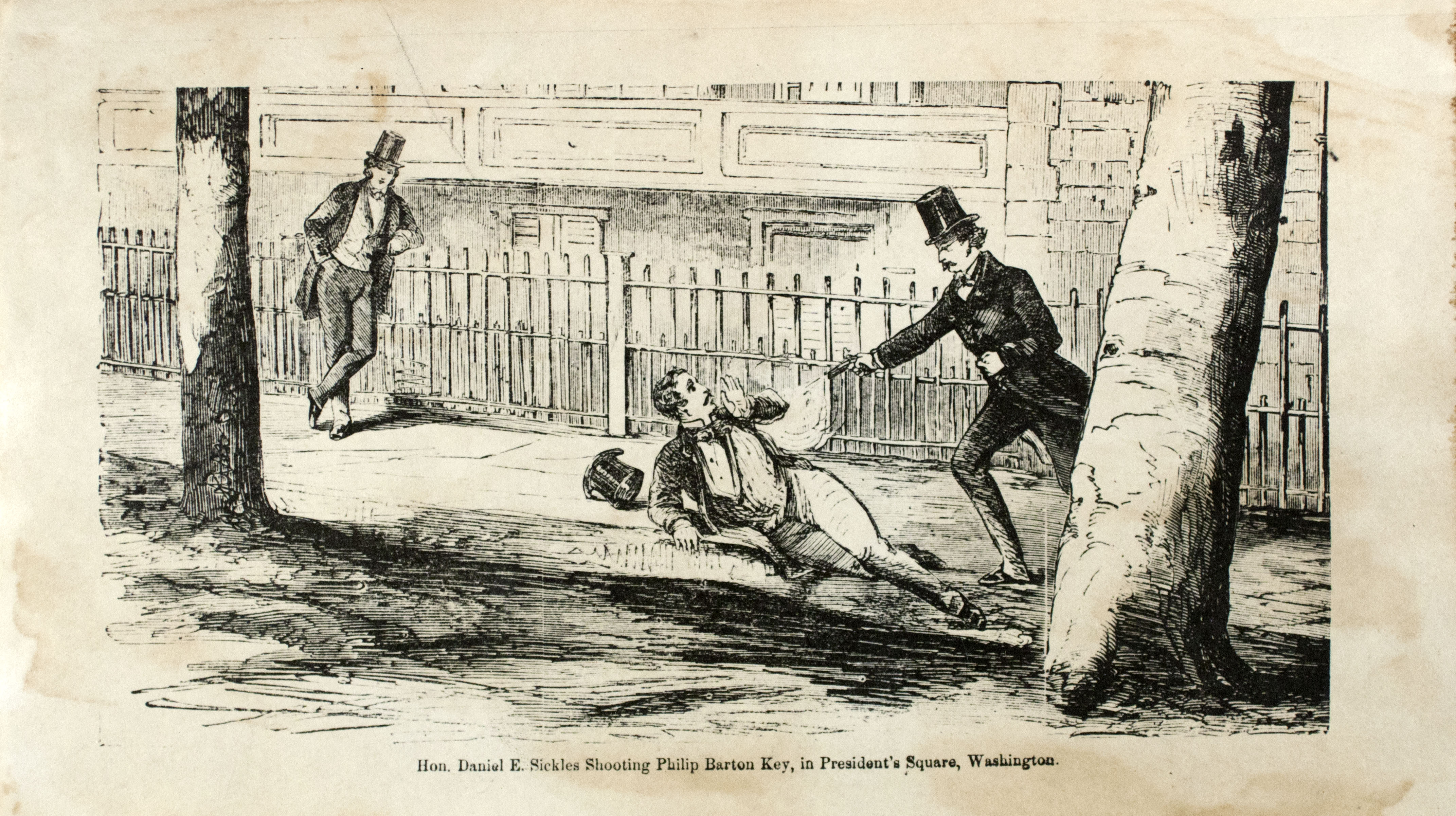
philip-barton-key-granger

Friends of Padre Steve’s World

I am a historian as well as a chaplain and priest. I do a lot of work with the Battle of Gettysburg and much of my work involves biography as I believe that the one constant in history is people. Technology and many other things may change, but people and human nature are constant, for good and for bad, and frankly I find people fascinating.

One of the most fascinating people of the Battle of Gettysburg is Union Major General Daniel E. Sickles, a man who was one of the most fascinating, salacious, scandalous, and incredible figures ever to grace and disgrace American history.

This is the second of a three part series taken from my Gettysburg and Civil War text. I hope that you enjoy.

Peace,

Padre Steve+

Within a year of his assignment Sickles returned to the United States to help prepare the Democratic nomination for his friend Buchanan who had long desired the office, and return to his lucrative post in New York. In the spring of 1856 Sickles began to work on Buchanan’s nomination for the Presidency and while doing so began his own campaign for New York’s Third District’s Congressional seat. Buchanan won the election of 1856 against an opposition divided between the Know Nothing candidacy of former President Millard Fillmore and the candidate of the new Republican Party, John C. Fremont.

In the election of 1856, Sickles carried the district easily. For Sickles it was a triumph, he was “riding a flood tide of political fortune that might carry him far,” [1] and like any wife Teresa too was delighted with the result. Even so, Teresa must have wondered if her husband would mend his ways now that he was on the national spotlight, or if he would continue his extramarital romps around the nation’s capital. Following the election Dan and Teresa moved to Washington D.C. where they took up a fashionable residence, the Stockton Mansion, on Lafayette Square, not far from the White House and Sickles friend, James Buchanan.

Once he was established in Washington Sickles was in his element, politics at its grandest. It was a different style than of politics than Tammany, where brass knuckled force often ruled, but it suited Sickles, who was “a fixer who knew all the tricks of Tammany at its crookedest but who seems not to have taken graft himself. He had his sights fixed on the presidency, and he was making about as much progress in that direction as a Tammany man can,” [2]   until a strange combination of unrequited love, infidelity, the personal betrayal of a friend, and a murder intervened.

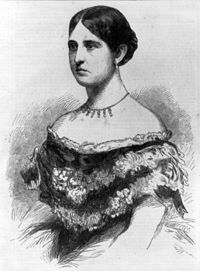
HarpersMagazineMrs.Sickles

Teresa Sickles

While her husband politicked along the Potomac, the new congressman’s wife was adapting to her life in Washington D.C. The wives were expected to entertain and host parties on a regular basis at their residences, but they also knew their share of loneliness and neglect. Since legislators routinely were “busy with night sessions, committee meetings, and plain nocturnal politicking over whiskey punch, that their wives either accepted other escorts or spent lonely evenings at home with fancywork or a book.” thus it was not surprising that Teresa, “should seek the gayety of the capital in her first year there.” [3] In the absence of their husbands it “was not uncommon for available bachelors to act as escorts for married women when their husbands were unavailable.” [4] Since Dan Sickles was frequently unavailable and since Teresa probably still suspected that Dan was still engaged in extramarital affairs, it is not surprising that the young Mediterranean beauty found comfort in another man.

The years of 1857 and 1858 would be a tumultuous time for the nation as well as the Sickles. Buchanan had been elected because of his stability and moderation in an age of pro and anti-slavery radicalism. However, over the next year his presidency, and his would be overwhelmed by events and Buchanan’s decisions supporting the expansion of slavery. While Sickles was neither a slave owner, nor himself fond of the institution, it was part of life, and many of his friends in Washington D.C. and in Congress were slave holders. Buchanan had schemed before his inauguration with Chief Justice of the Supreme Court Roger Taney in the Dred Scott decision, which was handed down in the days following Buchanan’s inauguration, followed by the fiasco over the Lecompton constitution and the attempted admission of Kansas as a Slave State, an event which split the Democratic party in the 1860 election, ensuring Abraham Lincoln’s defeat of Buchanan’s Lecompton foe in the Senate, Senator Stephen A. Douglas who would have been the prohibitive favorite in the election had the split not occurred.

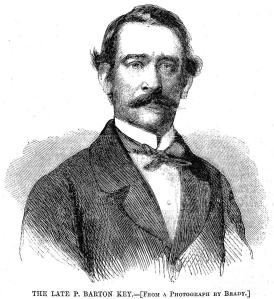
Likewise, Sickles and his beautiful young wife would become part of one of the most sensational trials of American history, rivaling the Lindbergh kidnapping trial, the trial of O.J. Simpson, the Scopes Monkey Trial, and the Impeachment of President Bill Clinton in its captivation of America. As in London, Teresa became popular and she and Dan were much sought after and their home “became the scene of a gradual number of and entertainments,” [5] and even as Sickles continued his robust politicking and philandering Teresa became the object of another’s affection, the District of Attorney for the District of Columbia, Philip Barton Key, the son Francis Scott key, the writer of the Star Spangled Banner. Interestingly enough it was Sickles who had helped Key the troubled man to be reappointed to his office in early 1857 after Key had helped Sickles overcome legal and financial difficulties to secure Sickles in the Stockton Mansion and the two men developed a warm friendship.

Philip Key was extraordinarily handsome, especially when outfitted in his green and gold militia uniform of the Montgomery Guards, and was considered one of the most desirable men in Washington. An accomplished horsemen he rode about town on his “horse Lucifer – a nobly bred, dapple gray hunter.” [6] When he gained Sickles’ friendship many of his well to do political and society friends became frequent visitors to the Sickles household. After Sickles had helped Key to be reappointed to his office, Key was instrumental in helping make the arrangements for Sickles to rent the Stockton Mansion.

During his first term in office Key was not known for being a particularly good District Attorney and spent much time away from the office complaining about his allegedly poor health. But his health did not keep him away from Washington’s party scene and “One hostess called him “the handsomest man in all Washington… he was a prominent figure at all the principle functions; a graceful dancer, her was a favorite of every hostess of the day.” [7] When he met Teresa, the dashing bachelor took an intense interest in the wife of the man who had helped him retain his job. The two were soon attending many functions together that Sickles, due to his work schedule could seldom attend.

Within weeks Key became a frequent guest at the Sickles home and few were surprised at this, as most observers knew that Sickles was responsible for Key’s reappointment. With Sickles now fully engaged in the dramatic political battles of late 1857, Teresa and Key began to spend much more time together. The two were seen together at the “theater, at teas, at hops. But most of all they went riding together.” [8] The frequency of these visits was noted and became the source of much gossip but Sickles was unaware of it and entertained no suspicions that his new friend was becoming deeply involved with his wife, and that Key had rented a room where the two could intimate.

That was until a young man equally smitten by Teresa had a few drinks with a colleague and the colleague shared the information with a loyal Sickles ally who then told Sickles. Sickles was shocked and called for a meeting with Key, however, after a brief conversation, Key convinced Sickles that there was nothing to the rumors, and Sickles was satisfied.

Though Sickles had been satisfied by the explanation, “despite his own well-publicized moral lapses, Daniel Sickles was a man of intense personal pride who would not countenance the breath of scandal attaching to his wife.” [9] He took the time to warn her to make sure that she was not involved in any other indiscretions, and left the subject. However, Key and Teresa continued to see each other, and “she and Barton thought that they were taking more care, and being less observed by people than they were.” [10] Yet as they pursued one another their affair became increasingly public, and seen by too many people not to go unnoticed. The two were seen together in at the Congressional Cemetery, and frequently at a house at “385 15th Street where he would enter the by the front door – and she the back.” [11] When a mutual friend expressed his concerns, Key shrugged off the warning, and “with the bravado of a proud weakling, he still held his course. And Teresa, ductile, enamored, blindly followed his lead.” [12] Another friend of Key suggested to him that he could be in danger, but Key “bridled and patted the breast of his coat. “I am prepared for any emergency,” he snapped. Key was a crack pistol shot and his friend believed that Key was preparing for a possible confrontation. [13]

Like so many people young spouses who find their needs unfulfilled at home, and who suspect their spouse of infidelity, , “Teresa did not see this love affair as tragic and dangerous. She lived within it as a secret fantasy, as in a virtual and time-consuming experience that lacked any power to inflict damage on other areas of her life.” [14] She became less discreet, Key would signal to her from across the street to confirm their dalliances and despite their insipidly inept attempt to hide the affair it became clear to Sickles’ coachman and household maids that the two were engaged in sexual encounters in the Sickles carriage and in the Stockton Mansion itself.

The situation finally came to a head in February 1859 following Sickles reelection and return to Washington. “Made more reckless than ever by their recent separation, Barton and Teresa now again were seen everywhere together.” [15] The couple were now making clandestine liaisons on a nearly daily basis, and eventually, one of the observers decided to tell Sickles. The anonymous source, using the initials of R.P.G. sent Sickles a letter detailing the affair. Sickles received the letter from a butler on the night of Thursday February 24th as he was leaving the usual dinner party at his house for the traditional hop that followed at the Willard Hotel.

Sickles did not read the letter until after the couple returned home and Teresa had gone to bed. Sickles was stunned and at first did not believe the contents as he placed little stock in anonymous messages. So he had George Wooldridge, a longtime friend and congressional clerk investigate, and on Saturday February 26th Wooldridge confirmed Sickles worst fears. That evening at their home Sickles confronted Teresa about the letter and as he stormed about angrily in their bedroom she confessed, after which Sickles had her write out her confession detailing everything. He may have been desolate and angry, but he was a lawyer, and he got his written proof.

But scandal was the last thing that Sickles wanted, as he had higher aspirations in politics, so he immediately called his friends for counsel and by Sunday morning several, including Wooldridge and Samuel Butterworth were at the Stockton Mansion with Sickles. As always, Sickles’ “first thoughts were for himself, and he melodramatically”[16] exclaimed to Butterworth, “I am a dishonored and ruined man…I cannot look you in the face.” [17]

4P8V9475

Murder

His friends “were profoundly touched by the depth of his feeling, and were convinced that he needed to be saved from a severe derangement of his senses; from lunacy, that is.” [18] his friends attempts to calm him, Sickles was beside himself with anger, and his anger now swirled around his marriage and what he believed was the scandal that would cost hi his career. That afternoon, Key again tempted fate, this time, for the last time. He had been tipped off by an anonymous letter that the affair was public, but he was determined to see Teresa. He made several passes by the house, each time signaling with a handkerchief, until Sickles observed him. Sickles called out to Butterworth “That villain has just passed my house! My God, this is horrible!” [19]

Butterworth left the house first and met Key at the southeast corner of Lafayette Square across from the White House. Allegedly not knowing Sickles intended any harm, Butterworth walked with Key to for a few minutes and then left. The exchange delayed Key and gave Sickles, who had armed himself with a single shot large caliber Derringer, and a muzzle-loading Colt revolver, enough time to catch up with Key near the Club House on Madison on the east side of the square. Sickles was raving but Dan’s fury transcended reality,” [20] as at least a dozen witnesses were nearby as he screamed, “Key, you scoundrel, … you have dishonored my bed – and you must die!” [21] Sickles pulled out the revolver, the first shot from which grazed Key, and the second which misfired. A brief scuffle ensued as Key lunged at his assailant, but Sickles flung him to the ground, and drew the Derringer as Key threw the opera glasses that he viewed Teresa at Dan. A third shot hit Key in the groin and he slumped to the ground screaming “Murder! Murder!… Don’t shoot!” [22]

If there was a chance for Sickles to prove that he acted in self-defense it was now, but he could not control himself. He fired the revolver yet again and it misfired. He placed the weapon in his pocket and drew the Derringer, and fired a shot which hit Key in the Liver. As Key writhed on the ground Sickles tossed the Derringer to the ground and he again drew the Colt. As the stunned witnesses to the attack looked on, Sickles advanced toward the fallen Key and placed the gun at his head and pulled the trigger, but again the weapon misfired. As Sickles attempted to place another cap in the pistol, a number of witnesses began to intervene. One man, “a member of the club, running up, stopped him. Mr. sickles – for God’s sake!” And Butterworth, coming forward, took Dan by the arm. Without a word, they walked away together.” [23] Witnesses took the mortally wounded Key away to the Club, where he expired.

President Buchanan was almost immediately told of the murder by a White House page boy, was aware of the implications of the scandal, Sickles was a friend and political ally with much promise. Buchanan told the boy leave town and gave him a sum of money to facilitate his departure. Soon after Sickles and Butterworth went by carriage “to the home of Attorney General Black, where the Congressman formally surrenders himself to the silver-haired Cabinet member who had regarded him as a protégé.” [24] He declined bail in favor of a speedy trial, was allowed to go home where he told Teresa that he had killed her lover, retrieved some personal items and then went to the District jail, “a foul hole, swarming with vermin, destitute of sewage, bath, water, ventilation, and so inadequate to its purpose that often a dozen or more prisoners were herded into a single narrow cell.” [25] When he arrived he reportedly asked the jailer if they were the best accommodations available, to which the jailer responded “this is the best place you members of Congress have afforded us.” [26] Dejected, but undeterred Sickles sent a message to the public, “In doing what I had to do I have broken the law. Therefore I place myself behind bars. It is for you to set me free.” [27] The stage was now set for the one of the most unbelievable and storied trials in American history.

Notes

[1] Ibid. Swanberg Sickles the Incredible p.4

[2] Ibid. Catton The Army of the Potomac: Glory Road p.151

[3] Ibid. Swanberg Sickles the Incredible p.15

[4] Ibid. Hessler Sickles at Gettysburg p.8

[5] Ibid. Swanberg Sickles the Incredible p.16

[6] Ibid. Pinchon Dan Sickles p.74

[7] Ibid. Hessler Sickles at Gettysburg p.9

[8] ibid. Swanberg Sickles the Incredible p.20

[9] Ibid. Swanberg Sickles the Incredible p.25

[10] Ibid. Keneally American Scoundrel p.92

[11] Ibid. Wilson and Clair They Also Served p.99

[12] Ibid. Pinchon Dan Sickles p.94

[13] Ibid. Swanberg Sickles the Incredible p.44

[14] Ibid. Keneally American Scoundrel p.92

[15] Ibid. Pinchon Dan Sickles p.93

[16] Ibid. Hessler Sickles at Gettysburg p.10

[17] Ibid. Swanberg Sickles the Incredible p.53

[18] Ibid Keneally American Scoundrel p.121

[19] Ibid. Hessler Sickles at Gettysburg p.10

[20] Ibid. Keneally American Scoundrel p.127

[21] Ibid. Swanberg Sickles the Incredible p.54

[22] Ibid. Hessler Sickles at Gettysburg p.11

[23] Ibid. Pinchon Dan Sickles p.112

[24] Ibid. Swanberg Sickles the Incredible p.55

[25] Ibid. Pinchon Dan Sickles p.114

[26] Ibid. Keneally American Scoundrel p.135

[27] Ibid. Swanberg Sickles the Incredible p.114

3 Comments

Filed under civil war, crime, Gettysburg, History, laws and legislation, Political Commentary

The Journey to Support Gay Rights

kim davis pastor

Friends of Padre Steve’s World,

As I mentioned yesterday I was overjoyed when the Supreme Court of the United States legalized Marriage Equality for American citizens who are Gay, Lesbian, Bisexual, Queer, and Transgender. That being said, there are still many inequities that people in the LGBTQ community face, and in many places that are movements to legislate laws which are little different than Jim Crow on homosexuals. Thus as a Christian, and as a Priest I will continue to lift up my voice in support of my friends in the LGBTQ community. That being said I think that it is important for my readers to know I got to the place where I have become an advocate for the rights of my friends in the LGBTQ community.

Frankly my journey has been a long strange trip. Most of my life I would have considered myself a conservative Christian and a career military officer, most of that as Pa chaplain. Generally people with similar backgrounds to me do not end up as advocates for Gays and Lesbians. But throughout my life and career I have had problems with the way other Christians and fellow military members treated Gays and Lesbians. Even in the days that I considered homosexual behavior to be sinful, I had a hard time condemning, ridiculing or supporting those who sought to harm homosexuals in any way, including fellow clergy, members of my former church or fellow officers or chaplains.

Now I know that there will vehemently disagree on what I believe and stand for, believe me I have been called everything but a white man by some people, including some that I used to count as friends. Likewise I have been threatened by others. But as I see it I have to stand up for what I believe and defend those whose civil rights are constantly under attack by people who not only condemn them in this world, but to everlasting damnation as well.

But this my friends is my long strange trip. It is what I believe with all my heart, and why I pray that the Supreme Court will legalize Gay marriage throughout this land. though I am not Gay, this matters to me. I have too many Gay and Lesbian friends who have endured hellish persecution for people who call themselves Christians and claim to be defending Christian values when they forget that the most important part of the Christian life is to love, love even your enemies, both real and imagined. But I digress…here is my journey…

I have been in the military coming up on 34 years between the Army and the Navy. That is a long time. When I enlisted and through the first two thirds of my career I can safely say that I fell rather strongly on the conservative-Christian side of the social issues debates. Over the years, especially the last seven since I returned a changed many from my time in Iraq, I have evolved significantly on most of these issues where although I while consider myself to be rather moderate I now fall decidedly on the liberal side of most social issues.

A lot of this has to do with the attitudes that I saw in churches that I was associated. Many people in my former denominations endorsed policies of the Christian Dominionist or Reconstruction movements, that basically upended First and Fourteenth Amendment protections and if enacted would basically turn the country into a theocracy. I have written about those things time and time again so I won’t elaborate on them now.

It was not only the policies, it was the attitude towards the LGBT community that really bothered me. For some reason it seemed that to many of my friends and colleagues that homosexuality was the only unforgivable sin, and not only that that homosexuals were somehow less than human and not entitled to the same rights as any other American citizen. Not only that they were blamed for every economic, social, foreign policy or natural disaster. Hurricane, blame the gays. Stock market crash, blame the gays, the 9-11 attacks, God’s judgment on the United States because of the gays. You name it, blame the gays, and that my friends still happens every day.

But my journey to accepting and fighting for Gays and Lesbians began a lot earlier.

When I first enlisted in the Army in 1981 it was not uncommon for gay slurs to be hurled at soldiers as a matter of course, especially at young men who did not appear manly enough or women who wouldn’t put out sexually when it was demanded of the. They were queers, fags, dykes and worse. There is a scene in the movie Full Metal Jacket where R. Lee Ermey, a man who actually was a Marine Corps Drill Instructor berates one of his recruits:

Gunnery Sergeant Hartman: Where the hell are you from anyway, private?

Private Cowboy: Sir, Texas, sir.

Gunnery Sergeant Hartman: Holy dog shit! Texas? Only steers and queers come from Texas, Private Cowboy, and you don’t look much like a steer to me, so that kinda narrows it down. Do you suck dicks?

Private Cowboy: Sir, no, sir!

Gunnery Sergeant Hartman: Are you a peter puffer?

Private Cowboy: Sir, no, sir!

Gunnery Sergeant Hartman: I bet you’re the kind of guy who would fuck a person in the ass and not even have the goddamn common courtesy to give him a reach-around. I’ll be watching you!

The sad thing is that such behavior was still common even in the 1990s and though not nearly so pervasive still happened on occasion in after the 9-11 attacks. But those taunts really bothered me and when I was commissioned as a Medical Service Corps Officer in 1983 I met gays in my officer training, they were closeted but they were targets. When I served as a company commander in 1985-1986 I had a number of gays and lesbians in my unit. As I mentioned before they were among my best and most trustworthy soldiers, always going the extra mile.

Meanwhile the unit had the highest drug positive rate in Europe when I took command and had so many real disciplinary and criminal cases on the docket I was told by the Group Commander to “clean that company up.” But when I got down to It I realized that I was so overwhelmed with the real criminals that I didn’t want to harass or prosecute my best soldiers, including those gays and lesbians. That was a watershed. While other commanders sought out gays in order to prosecute them and throw them out of the military I was protecting and promoting them, not because they were gay, but because they were excellent soldiers.

When I went to my next assignment as a personnel officer at the Academy of Health Sciences discharges of trainees for being gay was common. I know because I had to sign off on every discharge packet before it was sent for approval. Since we had five to seven thousand students at any time, both officers and enlisted I did not know the details of most of the stories nor meet the individuals concerned.

However, in 1987 I was given the responsibility of helping soldiers diagnosed as HIV positive with their career options. I also helped officers from the Army Medical Department draft the Army’s policies for those infected with the AIDS virus. At the time many of the Christians that I went to church with believed the myths and lies being promoted by leading Evangelicals about AIDS and displayed a tremendous amount of distain and even hatred towards gays and others infected or dying of that disease. I was dumbfounded that people who preached the love of God had neither compassion nor empathy for those suffering.

I left active duty to attend seminary at Southwestern Baptist Theological Seminary. There I knew a few closeted homosexuals and lesbians who had deep faith in Jesus, were outstanding students and potentially outstanding pastors or chaplains but who had to remain closeted. After I graduated when I was going through my Clinical Pastoral Education Residency one of the men I graduate with did a one unit internship. During that time he made the agonizing decision to come out as Gay. For him there was much to lose, but his example was inspiring and I still stay in touch with him. I also met a chaplain from the Metropolitan Community Church who had been raised in a Black Pentecostal church. He was an amazing and compassionate minister.

In the hospital setting I worked with a lot of homosexuals, of which many were Christians who suffered in their churches as their pastors and friends railed against homosexuals. When I served as the installation chaplain of an Army base I hired an organist who was gay. He worked for the National Guard as a civilian and was a Log Cabin Republican. He grew up in a very conservative church and though he had deep faith was not welcome in most civilian churches. At the time I was a fairly new  in a very conservative denomination and my bishops held that giving communion to Gays was forbidden, in fact they called it a sin. However, when he presented himself for communion, knowing his faith I took the advice of a conservative Missouri Synod Lutheran chaplain, don’t ask, just trust the grace of God in the Sacrament. That became my model of ministry from then on. I never mentioned it to my bishop. Thankfully he never asked or I would have had to be honest. This encounter brought more homosexuals to the chapel, and the chapel community which was composed mainly of military retirees and National Guard personnel welcomed them.

In civilian churches of my old denominations I knew Gays and Lesbians who struggled and tried to do everything they could to change, but no-matter how hard they tried, how hard they prayed, how many times well-meaning friends attempted to cast out their demons in rituals similar to exorcisms they struggled and suffered. Most eventually drifted away because they knew that they would not be accepted.  I have had friends in church whose children came out as gay or lesbian. Some loved and accepted them, others turned them away. Judy and I have always done what we can to support them as we would the children of any friend.

That understanding of God’s grace as well as what I believed were the fundamental Constitutional and human rights of Gays and Lesbians brought me to where I am today.

I know that a lot of conservative Christians have and will condemn me for these beliefs and actions, but for me honesty, integrity, empathy and love have to take precedence over hate, blame and prejudice, even when that prejudice is clothed in the words or faith and righteousness. I just figure that once we begin to use religion to condemn others and bolster our own political power that we are no better than people like Al Qaeda, ISIL or the Taliban. We are no better than the Inquisitors or others who destroyed cities and massacred people, even other Christians because they didn’t believe the right way.

I believe that it is just a small step from hateful thoughts and words to actions that end up in genocide. The “German Christians” of the Nazi era demonstrated that to a fine degree. The authors of the Bethel Confession, including Dietrich Bonhoeffer who protested the German Christian alliance with the Nazis noting:

“every attempt to establish a visible theocracy on earth by the church as a infraction in the order of secular authority. This makes the gospel into a law. The church cannot protect or sustain life on earth. This remains the office of secular authority.

That I believe with all my heart and that is why I will support and fight for the rights of the LGBT community in order to ensure that they have the same rights and privileges of any citizen. Otherwise what does the rule of law mean? What does the Constitution mean? What does that sentence in the Declaration of Independence that:

“We hold these truths to be self-evident, that all men are created equal, that they are endowed by their Creator with certain unalienable Rights, that among these are Life, Liberty and the pursuit of Happiness.–That to secure these rights, Governments are instituted among Men…” 

Abraham Lincoln wrote in 1854 concerning the rights of Blacks, something that is certainly applicable as well to homosexuals: “the standard maxim of free society …constantly spreading and deepening its influence,” ultimately applicable “to peoples of all colors everywhere.” 

That my friends, especially my conservative Christian friends who do not understand why I would speak up for the LGBT community, is why I do it. So in the words of my favorite heretic Martin Luther I state today: “Here I stand, I can do no other. So help me God. Amen.”

Peace

Padre Steve+

Leave a comment

Filed under christian life, faith, History, laws and legislation, LGBT issues, ministry

Fighting Anti-Gay Jim Crow Laws

9587864_orig

Friends of Padre Steve’s World

I was overjoyed when the Supreme Court legalized Marriage Equality last summer in its Obergfell v. Hodges decision. Before it was argued I compared the case with the infamous Dred Scott decision of 1856 and commented on its importance to the LGBTQ community in terms of basic civil rights. If the court had ruled against Marriage Equality it would have been very much like the decision reach in Dred Scott, but even more importantly like the case of Plessy v. Ferguson which legalized Jim Crow laws.

Thomas Jefferson wrote in the Declaration of Independence something that is the heart and soul of the American experiment.

“We hold these truths to be self-evident, that all men are created equal, that they are endowed by their Creator with certain unalienable Rights, that among these are Life, Liberty and the pursuit of Happiness.–That to secure these rights, Governments are instituted among Men…” 

It is a concept that has always been practiced imperfectly in the nation, Blacks, Women and others have not always enjoyed the same rights as others, and the same is true for the Gay community today. Sadly, even when civil rights of people who are the targets of legal discrimination are advanced and legislated at the national level, opponents often attempt to use local and state laws to legalize discrimination banned at the federal level.

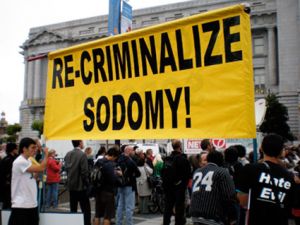
re-criminalize-sodomy

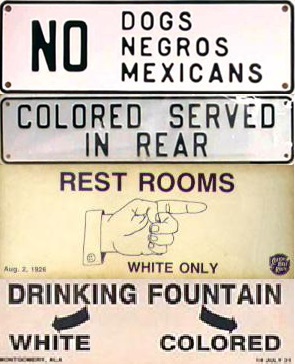
This was done frequently in the post-Reconstruction era, when so called “Black laws” or “Jim Crow” laws were enacted throughout the South. These laws paid lip-service to the Federal law but legalized almost every form of discrimination imaginable and established a culture of legal lawlessness where Blacks were the targets of discrimination, harassment, segregation and violence.

“From the 1880s onward, the post-Reconstruction white governments grew unwilling to rely just on intimidation at the ballot box and themselves in power, and turned instead to systematic legal disenfranchisement.” (1)

In 1896 these codes were upheld by the Supreme Court in the case of Plessy v. Ferguson. That ruling established the “separate but equal” doctrine and ushered in an era of de jure segregation in almost all arenas of life including education, transportation, entertainment and health care. The limited social equity and privileges enjoyed by Blacks were erased with the stroke of the court’s judicial pen. The justices ruled on the concept that only people’s political rights were protected by the Constitution and that in the social arena that African-Americans could not interact with whites and assumed their racial inferiority.

However, Associate Justice Harlan wrote in dissent:

“The destinies of two races, in this country are indissolubly linked together, and the interests of both require that the common government of all should not permit the seeds of race hate to be planted under the sanction of law. What can more certainly arouse race hate, what more certainly create and perpetuate a feeling of distrust between these races, than state enactments, which, in fact, proceed on the ground that colored citizens are so inferior and degraded that they cannot be allowed to sit in public coaches occupied by white citizens? That, as all will admit, is the real meaning of such legislation as was enacted in Louisiana.” (2)

While the case of 1955 Supreme Court ruling in the case of Brown v. Board of Education swept away most of the effects of Plessy v. Ferguson, the underlying attitudes and actions of those who support legal discrimination are still with us. Prejudice and discrimination, not only towards African Americans and other people of color, but also women and even more so the LGBTQ community  has come back with a vengeance in the decades following Brown v. Board of Education.  Opponents of equality hate the sweeping civil rights advances made in the 1960s and 1970s, and more recently the advances made on behalf of the Gay community in the past decade. The end of the Defense of Marriage Act or DOMA, a law which mush like the Black Codes set up legal barriers for gays to marry and enjoy other civil rights brought forth a plethora of new anti-Gay legislation, especially at the local and state levels. Most of these laws are cloaked in the concept of “Religious Liberty” and permit people to discriminate against Gays in almost any arena of life: to refuse to serve them at their place of business, to deny them service in local government offices and even to deny them health care, should the provider determine that he or she will not serve someone who is gay, all based on the amorphous concept that the providers “sincerely held religious beliefs are at stake.”

Since they failed to stop Gay Marriage, the opponents of Obergfell v. Hodges are doing everything that they can to legalize other forms of discrimination mostly on the basis of “protecting” religious liberty. The opponents of equality, including many leading conservative politicians and their supporters in the “Christian Right” are using overt fear tactics to include raising the specter of Christians being put in concentration camps for opposing Gay marriage, and other equally apocalyptic and patently untrue arguments. Justice Harlan was correct about the intent of the Jim Crow laws and the new anti-Gay laws are no different than Jim Crow. The seeds of hate cannot be allowed to be planted under the sanction of law. These are the new Jim Crow laws, and they must be fought at every turn. Opponents of Gay marriage should remember the words of Thomas Jefferson who wrote:

“I know also, that laws and institutions must go hand in hand with the progress of the human mind. As that becomes more developed, more enlightened, as new discoveries are made, new truths disclosed, and manners and opinions change with the change of circumstances, institutions must advance also, and keep pace with the times. We might as well require a man to wear still the coat which fitted him when a boy, as civilized society to remain ever under the regimen of their barbarous ancestors.” 

We must move forward.

Peace

Padre Steve+

  1. Guelzo Allen C. Fateful Lightening: A New History of the Civil War Era and Reconstruction Oxford University Press, Oxford and New York 2012 p.526
  2. LaMorte, Michael W. School Law: Cases and Concepts 9th Edition 2008 p.300

Leave a comment

Filed under faith, History, laws and legislation, LGBT issues, News and current events

The Dream: Remembering Dr. Martin Luther King Jr.

index

Friends of Padre Steve’s World,

Dr. Martin Luther King Jr. has always been one of my heroes. This time of year I always ponder the importance of his life and work for civil rights, and I wonder what might have been had this man of peace not been cut down in cold blood at the young age of 39 by James Earl Ray on April 4th 1968. He was an amazing and courageous man whose memory should not be let to one day a year. We have to ensure, though our words and actions that it is not allowed to die.

King was a man of courage, a man of honor, a man of conviction. But he came of age in a time when many people were willing to maintain the status quo and play things safe, like many clergy, even African-American clergy. Many pastors of the era, remained quiet about the conditions of segregation, and the racism of the day. Their lack of action did not mean they were bad people, they just understood that if they spoke up, their lives, and the lives of their families and congregations could be in danger. As such many pastors just hoped to see things slowly improve, without rocking the boat, and without endangering themselves or their families. They had seen what happened to blacks who spoke up or confronted the evil, lynching’s, cross burnings, threats and murder. They had contented themselves with just trying to get along. At the beginning of the movement, many pastors did not support or gave only lukewarm support to Dr. King, Andrew Young, Fred Shuttlesworth, and Ralph Abernathy going into that critical year of 1963.

lossless-page1-560px-Rosa_Parks_(detail).tiff

King did not start out to become a Civil Rights leader. However, he was inspired to actively join the movement through the example of Rosa Parks, who defiance of the law for blacks to sit “in the back of the bus” in 1955. He led the Montgomery Bus Boycott which lasted for 385 days. The reaction among segregationists to King and his protest was against violent. King’s house was bombed, and his life threatened. But he refused to stand down.

King’s leadership of the boycott brought the young pastor to national prominence. However, by 1963 much of the Civil Rights movement and the African American community was despairing of the lack of progress. Many people had become disenchanted with King, not considering him bold enough despite his rhetorical abilities.

But in April 1963, working with other Civil Rights leaders in Birmingham Alabama King relit the fires of the movement. Montgomery Police Chief “Bull” Conner used his police force to violently attack the demonstrators. Conner ordered his men to unleash their police dogs on the protestors, and used high pressure water cannon against them, including women, children and the elderly. The violent reaction to the protests shocked much of America and the world.

King was arrested and in the Birmingham jail composed one of his most famous works, the Letter from the Birmingham Jail.  The letter was a social, political and theological masterpiece. It was some of his harshest criticism was of white liberals, as well as black moderates:

“I have almost reached the regrettable conclusion that the Negro’s great stumbling block in his stride toward freedom is not the White Citizen’s Councilor or the Ku Klux Klanner, but the white moderate, who is more devoted to “order” than to justice; who prefers a negative peace which is the absence of tension to a positive peace which is the presence of justice; who constantly says: “I agree with you in the goal you seek, but I cannot agree with your methods of direct action”; who paternalistically believes he can set the timetable for another man’s freedom; who lives by a mythical concept of time and who constantly advises the Negro to wait for a “more convenient season”

King continued his activism until his assassination. In August 1963 he led the March on Washington for Jobs and Freedom, where before a crowd of an estimated 200,000-300,000 he gave his I Have a Dream Speech.

http://www.americanrhetoric.com/speeches/mlkihaveadream.htm

The crescendo of the speech was remarkable and is perhaps one of the most remembered speeches in American history.

Let us not wallow in the valley of despair, I say to you today, my friends.

And so even though we face the difficulties of today and tomorrow, I still have a dream. It is a dream deeply rooted in the American dream.

I have a dream that one day this nation will rise up and live out the true meaning of its creed: “We hold these truths to be self-evident, that all men are created equal.”

I have a dream that one day on the red hills of Georgia, the sons of former slaves and the sons of former slave owners will be able to sit down together at the table of brotherhood.

I have a dream that one day even the state of Mississippi, a state sweltering with the heat of injustice, sweltering with the heat of oppression, will be transformed into an oasis of freedom and justice.

I have a dream that my four little children will one day live in a nation where they will not be judged by the color of their skin but by the content of their character.

I have a dream today!

I have a dream that one day, down in Alabama, with its vicious racists, with its governor having his lips dripping with the words of “interposition” and “nullification” — one day right there in Alabama little black boys and black girls will be able to join hands with little white boys and white girls as sisters and brothers.

I have a dream today!

I have a dream that one day every valley shall be exalted, and every hill and mountain shall be made low, the rough places will be made plain, and the crooked places will be made straight; “and the glory of the Lord shall be revealed and all flesh shall see it together.”2

This is our hope, and this is the faith that I go back to the South with.

With this faith, we will be able to hew out of the mountain of despair a stone of hope. With this faith, we will be able to transform the jangling discords of our nation into a beautiful symphony of brotherhood. With this faith, we will be able to work together, to pray together, to struggle together, to go to jail together, to stand up for freedom together, knowing that we will be free one day.

And this will be the day — this will be the day when all of God’s children will be able to sing with new meaning:

My country ’tis of thee, sweet land of liberty, of thee I sing.

Land where my fathers died, land of the Pilgrim’s pride,

From every mountainside, let freedom ring!

And if America is to be a great nation, this must become true.

And so let freedom ring from the prodigious hilltops of New Hampshire.

Let freedom ring from the mighty mountains of New York.

Let freedom ring from the heightening Alleghenies of Pennsylvania.

Let freedom ring from the snow-capped Rockies of Colorado.

Let freedom ring from the curvaceous slopes of California.

But not only that:

Let freedom ring from Stone Mountain of Georgia.

Let freedom ring from Lookout Mountain of Tennessee.

Let freedom ring from every hill and molehill of Mississippi.

From every mountainside, let freedom ring.

And when this happens, and when we allow freedom ring, when we let it ring from every village and every hamlet, from every state and every city, we will be able to speed up that day when all of God’s children, black men and white men, Jews and Gentiles, Protestants and Catholics, will be able to join hands and sing in the words of the old Negro spiritual:

                Free at last! Free at last!

                Thank God Almighty, we are free at last!

King knew the dangers and the risks of appealing to a strategy of non-violence based on love of his enemies. King spoke to the world when he accepted the Nobel Peace Prize in 1964:

“Here and there an individual or group dares to love, and rises to the majestic heights of moral maturity. So in a real sense this is a great time to be alive. Therefore, I am not yet discouraged about the future. Granted that the easygoing optimism of yesterday is impossible. Granted that those who pioneer in the struggle for peace and freedom will still face uncomfortable jail terms, painful threats of death; they will still be battered by the storms of persecution, leading them to the nagging feeling that they can no longer bear such a heavy burden, and the temptation of wanting to retreat to a more quiet and serene life. Granted that we face a world crisis which leaves us standing so often amid the surging murmur of life’s restless sea. But every crisis has both its dangers and its opportunities. It can spell either salvation or doom. In a dark confused world the kingdom of God may yet reign in the hearts of men.”  http://www.nobelprize.org/nobel_prizes/peace/laureates/1964/king-lecture.html 

Dr. King understood how easy hatred could consume people and movements and urged  people not to follow the course of hate, he wrote:

“Returning hate for hate multiplies hate, adding deeper darkness to a night already devoid of stars. Darkness cannot drive out darkness; only light can do that. Hate cannot drive out hate; only love can do that. Hate multiplies hate, violence multiplies violence, and toughness multiplies toughness in a descending spiral of destruction.”

The day before his assassination in Memphis, Dr. King still recognized what he might face. His “I have been to the Mountaintop” speech http://www.americanrhetoric.com/speeches/mlkivebeentothemountaintop.htm recounted many of the things that he had encountered, including an assassination attempt in 1958 which had come close to killing him. It was an amazing speech and one wonders if having lived under threat so long that he almost had a premonition of his death the next day.

And then I got into Memphis. And some began to say the threats, or talk about the threats that were out. What would happen to me from some of our sick white brothers?

Well, I don’t know what will happen now. We’ve got some difficult days ahead. But it really doesn’t matter with me now, because I’ve been to the mountaintop.

And I don’t mind.

Like anybody, I would like to live a long life. Longevity has its place. But I’m not concerned about that now. I just want to do God’s will. And He’s allowed me to go up to the mountain. And I’ve looked over. And I’ve seen the Promised Land. I may not get there with you. But I want you to know tonight, that we, as a people, will get to the promised land!

Dr. King’s dream is not dead and we who live today cannot allow it to die. There is still much work to see justice done for all Americans as well as those suffering from violence, persecution, discrimination and poverty around the world.

It is 2016. It has been 53 years since Dr. King sat in the Birmingham jail. Sadly, there are some who long for a return to the day of Jim Crow. In some states there have been and there are ongoing attempts to return it by stealth, especially through restrictions on voting that predominantly impact African Americans and the poor. Racism is not dead, nor are so many other “isms.” As Dr. King told us, “Now is the time to make real the promises of democracy,” and “It would be fatal for the nation to overlook the urgency of the moment.”

Dr. King and many of the leaders of the Civil Rights Movement have passed on. Likewise, many people today are complacent about the injustices present in our society, injustices experienced by many people. We need a generation of new men and women with hearts like Dr. King’s, who will be the conscience of the nation and confront these injustices.

Birmingham_campaign_dogs

Representative John Lewis, one of the original Freedom Riders was beaten numerous times during those protests. When leading the march across the Pettus Bridge in Selma, Lewis had his skull fractured by a State Trooper when he stopped to pray.  Lewis’s words call us to action today:

“If not us, then who? If not now, then when?” 

We cannot let Dr. King’s dream die.

Peace

Padre Steve+

Leave a comment

Filed under civil rights, laws and legislation, Political Commentary

The Bible in the Hand of One Man…

kim davis pastor

Friends of Padre Steve’s World

One of my favorite films is To Kill a Mockingbird. I am a convinced that many people that call themselves “conservative Christians,” are so busy protecting their place and power in society that they despise anyone not like them. I wrote some about this yesterday, and this is kind of a follow up to that article. In light of that I imagine that some of these folks would “kill the Mockingbird” in order to ensure that they keep their privileged position in society. The Mockingbirds are those that they have condemned to social inferiority and discrimination and eternal punishment, especially gays and the LGBT community, but others as well, and the fact that someone else gets equal rights doesn’t really end their equality before the law seems lost to them.

This is especially the case of the preachers, pundits and politicians that crowd the airwaves and internet with their pronouncements against Gays, immigrants, Arabs, poor blacks, political liberals, progressive Christians, and for that matter anyone who simply wants the same rights enjoyed by these Christians.

In the book there is a line spoken by Miss Maudie Atkinson, a neighbor of Atticus Finch and his children. She says to Atticus’s daughter Scout:

“Sometimes the Bible in the hand of one man is worse than a whiskey bottle in the hand of another… There are just some kind of men who – who’re so busy worrying about the next world they’ve never learned to live in this one, and you can look down the street and see the results.”

As I survey the world of Christian conservatives I become surer of this every day. I’ve often wrote about my own fears in regard to dealing with such people as well as the troubling trends that I see. Last week I wrote five articles on the trends that I see in the church, trends toward greed, political power, social isolation and the active campaign of some to deny basic civil rights to people that they hate on purely religious grounds.

The language of some like Matt Staver of Liberty Counsel, Tony Perkins of the American Family Association and a host of others describe actions of governments and courts to ensure equal treatment of all people under the law as threats to Christians, affronts to them and of course to God. Their words are chilling. Matt Staver commented this week that if the Supreme Court upheld marriage equity for gays that it would be like the Dred Scott decision. Of course that is one of the most Orwellian statements I have heard in a while, for the Dred Scott decision rolled back the few rights that blacks had anywhere in the country and crushed the rights of non-slave states.

Again, as a reminder to readers, especially those new to the site, I spent a large amount of my adult Christian life in that conservative Evangelical cocoon. I worked for a prominent television evangelist for several years, a man who has become an extreme spokesman for the religious political right. I know what goes on in such ministries, I know what goes on in such churches. I know the intolerance and the cold hearted political nature of the beast. I know and have gone to church with Randall Terry, the former head Operation Rescue who once said: “Let a wave of intolerance wash over you. I want you to let a wave of hatred wash over you. Yes, hate is good…” I have walked in those shoes, I have been whipped up by those preachers. I fully understand them.

As Atticus Finch told his children:

“You never really understand a person until you consider things from his point of view… Until you climb inside of his skin and walk around in it.”

Thus I total reject the message of such people now, not out of ignorance, but because I have walked in their shoes. At times I supported their causes, not to any extreme, but all too often my crime was simply said nothing when I knew that what they preached, taught and lived was not at all Christian, but from the pits of Hell.

As far as them being entitled to hold whatever opinion they want, even if I disagree, yes that is their right. But as Atticus said:

“People are certainly entitled to think that I’m wrong, and they are entitled to full respect for their opinions. But before I can live with other folks I’ve got to live with myself. The only thing that doesn’t abide by majority rule is a person’s conscience.”

My conscience will not allow me to be silent when I see men like Staver, Perkins, Franklin Graham and so many others preach hatred towards those who are different than them.

In the movie and the book the Mockingbirds were Tom Robinson, the black man falsely accused of rape and assault and Boo Radley, a shy recluse feared by his neighbors, a man who stories were made up about; stories that turned a simple man into a monster in the eyes of people who did not know him. Today they are others who fit the Mockingbird role, people who just want to get along and live in peace, but who endure discrimination and damnation from those who call themselves Christians.

Jem Finch, the son of Atticus asks his sister a question in the book and the film:

“If there’s just one kind of folks, why can’t they get along with each other? If they’re all alike, why do they go out of their way to despise each other?”

I ask the same question on a daily basis.

Peace

Padre Steve+

1 Comment

Filed under film, laws and legislation, LGBT issues, News and current events, Political Commentary, Religion

Insurrection in Oregon

burns-protest-41aa8aa12b9a6593

Ammon Bundy (Photo the Oregonian) 

Friends of Padre Steve’s World,

It is seldom now that I get this spun up, but I have had it with violent conspiracy theorists using the cover of patriotism to mount an insurrection. Let’s be honest and call what is happening in Oregon what it is. It is armed insurrection and terrorism being perpetrated by extreme right wing, pseudo-Christian, white supremacists, and neo-Nazis. The list of extreme supporters has exploded on the Internet today, and frankly if you actually bother to read something about them even their own materials, they are a violent and dangerous bunch.

Led by Cliven Bundy’s sons Ammon, and Ryan Bundy, and former Army sergeant Ryan Payne who threatened to kill Federal agents during the standoff at the Bundy Ranch in 2014, these people are a threat, not just to society in general, but to the causes that they purport to support. Payne fits the profile of a sociopath and is a bona-fide conspiracy theorist.

The Missoula News profiled Payne and the Bundys in a very detailed article in June of 2014. They noted of Payne:

Payne came to believe the latter, that the government uses regulations to deliberately undermine the average American, “that they are purposely destroying industry, they are purposely taking this land from people.” The more he looked, the more he saw a deliberate and nefarious plan being orchestrated by a small number of people wielding enormous power. He saw a pervasive conspiracy to control all aspects of the media, the financial system, the entertainment industry, the military and the government.

More specifically, he came to believe that slavery never really existed in the United States and that African Americans in the antebellum South “didn’t view themselves as slaves.” He came to believe in “an effort by some Jews to control the world.” He came to believe the founders of the United States intended for the states to act as sovereign countries. He came to believe taxes are a form of “legal plunder.” He came to believe names are spelled in all-caps on driver’s licenses because U.S. citizens are actually “corporate entities.” He came to believe U.S. courts are actually foreign admiralty courts. He came to believe that “in most states you have the lawful authority to kill a police officer that is unlawfully trying to arrest you.” He came to believe when a newborn child’s footprint is made on a birth certificate, that child is effectively entering a life of servitude to the U.S. government, which borrows money from China based on that child’s estimated lifetime earning potential. (The article can be viewed in its entirety here http://missoulanews.bigskypress.com/missoula/freedom-fighter/Content?oid=2054145 )

The Bundy’s and Payne came uninvited to Burns Oregon, and trampled on the desires of the people in that town who were conducting peaceful protests the day that they went out and seized by force the administrative building of the U.S. Forrest Service in one of the oldest national wildlife preserves in the nation.

Map locates Burns, Oregon, where protestors occupied a national wildlife refuge building; 1c x 2 1/2 inches; 46.5 mm x 63 mm;

Since the takeover, neo-Nazis, White Supremacists, as well as other anti-government and anti-liberty groups are taking up their cause. The leader of anti-Muslim protests that have targets Mosques in many cities, Jon Ritzheimer, has called on his followers to take up arms and fight alongside the Bundy clan, Payne and their confederates.

Ritzheimer, a former Marine, whose anti-Muslim acts have given him plenty of headlines, has been spoiling for a fight for a long time. He wrote, “I am 100 percent willing to lay my life down to defend against tyranny in this country… We need real men here… Americans who have the intestinal fortitude to come here and take a stand and say enough is enough…. To my family, just know that I stood for something. Don’t let it be in vain. I love you.”

The leader of this rag tag bunch of pseudo-patriots, Ammon Bundy posted this on his Facebook page:

“We have basically taken over the Malheur Wildlife Refuge. And this will become a base place for patriots from all over the country to come and be housed here and to live here. And we’re planning on staying here for several years.” Bundy called his band the “the point of the spear,” and called other like-minded extremist thugs to “bring your arms.”

Of course Bundy’s brother Ryan, in a statement to the Oregonian clothed the militant’s aims as being constitutional. “The best possible outcome is that the ranchers that have been kicked out of the area… will come back and reclaim their land, and the wildlife refuge will be shut down forever and the federal government will relinquish such control.”

But that is a lie, none of the ranchers have been kicked out, in fact none ever owned any part of the land. The land federal lands that the Bundys and their compatriots argue should be “returned” to the local, overwhelmingly white population were once part of a reservation established by President Ulysses S. Grant for the Northern Paiute, an American Indian tribe. That tribe now is located on a smaller reservation north of Burns.

But, since 1908 the Malheur Wildlife Refuge has been Federal government property when President Theodore Roosevelt set aside unclaimed government lands encompassed by Malheur, Mud and Harney Lakes as a preserve and breeding ground for native birds. He did this because of the encroachment of feather merchants who were sending hunters into the area and wiping out the wild bird populations. The newly established Lake Malheur Reservation was the 19th of 51 wildlife refuges created by Roosevelt during his tenure as president. At the time, Malheur was the third refuge in Oregon and one of only six refuges west of the Mississippi.

The land never was and never has been the property of any ranchers. The arguments of the Bundy’s and their confederates have nothing to do with truth; they are a smokescreen to further a goal of attempting to destroy any semblance of government control in such areas and give it to people who have no claim, by right or ownership.

The mainstream corporate media is not challenging the lie of the Bundy’s and their supporters. None of the major networks has yet to call this exactly what it is, insurrection, sedition, and terrorism. Instead it is called a protest, or occupation. But you can be sure had the Bundy clan been a Muslim group, or other American minority group, including Native Americans, they would be calling them criminals, trespassers, and dare I say, terrorists. It is a double standard, if one is white, and claims to be a patriot; they go unchallenged by the mainstream media. You would think that they were Girl Scouts protesting because they could not sell cookies.

There are laws, long standing ones at that that deal with this kind of thuggery. The big one is the Insurrection Act of 1807 under which:

“The President, by using the militia or the armed forces, or both, or by any other means, shall take such measures as he considers necessary to suppress, in a State, any insurrection, domestic violence, unlawful combination, or conspiracy, if it— so hinders the execution of the laws of that State, and of the United States within the State, that any part or class of its people is deprived of a right, privilege, immunity, or protection named in the Constitution and secured by law, and the constituted authorities of that State are unable, fail, or refuse to protect that right, privilege, or immunity, or to give that protection; or opposes or obstructs the execution of the laws of the United States or impedes the course of justice under those laws.”

It is my opinion since this is land and property under Federal jurisdiction in the State of Oregon that the President should activate the Oregon National Guard (the actual legal militia) to work with other Federal law enforcement agencies to end this insurrection. I personally think that surrounding them with real military forces and cutting off power, fuel, food, and water to the Bundy Clan will end this. It should not have to come to violence, unless a sociopath conspiracy theorist like Ryan Payne decides to open fire on men and women who wear the uniform that he once wore.

These people are deranged and dangerous. Ryan Bundy said, they are “willing to kill and be killed if necessary.” These men are not conservatives or even libertarians, and they are certainly not patriots. They are extremist revolutionaries who are delusional and believe the most unbelievable conspiracy theories.

This has to be ended, hopefully peacefully, and these people sent home and their leaders to prison in disgrace. However, the inflammatory statements of the Bundy’s, Payne, and Ritzenheimer are setting the stage for potential violence. The only thing that I can think is that want this to foment a wider revolt of armed militia groups against the government and that they may even be willing to become martyrs, like the Islamic Jihadists of Al Qaeda and DAESH have been doing for some time now. Honestly I see little difference between any of these people.

Like I said, I seldom get really spun up by something, but what is happening in Oregon is dangerous and could get a lot of people killed. If people believe that Bureau of Land Management policies need to be changed, they should use the legislative process or make court challenges. There is no place for armed bands of people attempting force their will on the rest of the population when they are the only ones who will benefit from such an action.

I mentioned yesterday that there would be a crisis every day of the year, well, welcome to the first of many, and I haven’t even mentioned the twin crises brewing between Saudi Arabia and Iran, or India and Pakistan. But that can be dealt with another time.

Peace

Padre Steve+

17 Comments

Filed under civil rights, History, laws and legislation, News and current events, Political Commentary