Category Archives: leadership

“We Have to Show the World That Not All of Us are Like Him…” Resistance or Acquiescence?

tresckow

Major General Henning Von Tresckow 

Friends of Padre Steve’s World,

I wasn’t planning on writing anything new until sometime next week, but after President Trump’s off the cuff decision to meet with the North Korean dictator Kim Jung Un and the speech that he gave in Pennsylvania on Saturday night I must share a couple of thoughts.

Last night (Saturday) I watched the movie Valkyrie which is about the July 20th 1944 attempt to kill Adolf Hitler, and tonight the movie Conspiracy which is about the bureaucratic workings of the decision to eradicate the Jews from earth by the Nazis in the decision now known as The Final Solution. 

It is interesting the the British actor Kenneth Branagh stars in both. In Valkyrie he plays Major General Henning von Tresckow, a key member of the the anti-Hitler movement; and in Conspiracy he plays SS General Reinhardt Heydrich who helped engineer the Final Solution against the Jews.

In the past few days I have thought of the words of Von Tresckow, Heydrich, and General Ludwig Beck, another of the conspirators who attempted to kill Hitler and lost his life in the process.

Heydrich was the ultimate opportunist, who had he not been assassinated two months after the Wansee Conference might well have been a participant in the anti-Hitler conspiracy; not because of any ethical or ideological purity, but for the sake of his own power and survival. Heydrich was not an ideologue but a pragmatist, and many historians think that he would have joined a movement against Hitler in order to preserve his ideal of Germany. In Valkyrie Branagh played Major General Henning von Tresckow who was a Christian and opponent of the Hitler regime. Branagh played both parts very well, and was believable.

Ever the pragmatist Heydrich told a young SS Major at the Wansee Conference: “Politics is a nasty game. I think soldiering requires the discipline to do the unthinkable and politics requires the skill to get someone else to do the unthinkable for you.” Sadly I have to admit that he was correct. Since I have served in the military for nearly 37 years I can understand the comment, thankfully I have never been a politician so I cannot imagine having the skill to do the unthinkable for me.

That being said I have taken to hear the words of General Ludwig Beck who resigned from his position as the head of the German Army in 1938 over the planned invasion of Czechoslovakia and lost his life in the attempt to overthrow Hitler:

“It is a lack of character and insight, when a soldier in high command sees his duty and mission only in the context of his military orders without realizing that the highest responsibility is to the people of his country.” 

Von Tresckow would note in words that I would hope that Americans would heed today in terms of the current President: “We have to show the world that not all of us are like him. Otherwise, this will always be Hitler’s Germany.”

The question is: Will Americans simply roll over and do the unthinkable or will they decide to show the world that we are not like him?

That is the question. How we answer it is another matter.

Until tomorrow and my third installment of the six part series on Dan Sickles,

Peace

Padre Steve+


1 Comment

Filed under civil rights, ethics, faith, film, History, holocaust, leadership, Military, ministry, nazi germany, News and current events, Political Commentary

Dan Sickles, the Incredible Scoundrel and Patriot: Part One

Friends of Padre Steve’s World,

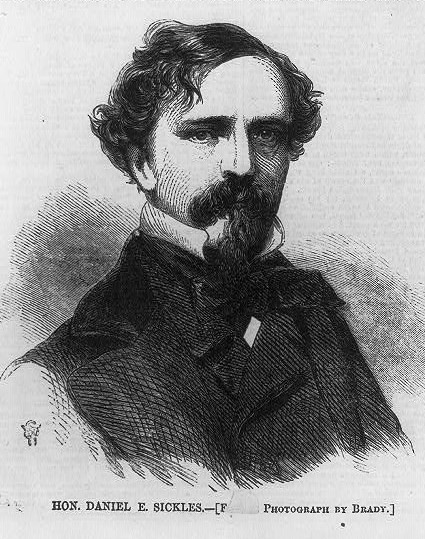
I am taking a break over the next week or so to catch up on some reading and reflection, and I am re-posting some articles from my Gettysburg text.  These deal with a man that I consider one of the most fascinating , salacious, scandalous, heroic, and incredible figures ever to grace and disgrace American history, Congressman, and Civil War General Daniel E. Sickles.

I hope that you enjoy,

Peace

Padre Steve+


6517740_orig


George Meade had made his dispositions on July 2nd 1863 with care, but there was one notable problem, the commander of III Corps, Major General Dan Sickles did not like the position assigned to his corps on the south end of Cemetery Ridge. But before discussing that it is worth chasing the rabbit so to speak and spend some time on the life of a man referred to by one by one biographer as an American Scoundrel and another as Sickles the Incredible. The interesting thing is that lie most complex characters in history that Dan Sickles was both and, “he might have had more faults than virtues, but everything about him was perfectly genuine.” [1] That is one of the reason that he is so fascinating.

Sickles was certainly a scoundrel and at the same time incredible, charming yet terribly vain and often insincere. “He was quick-witted, willful, brash, and ambitious, with pliable moral principles.” [2] But he was also incredibly brilliant, far sighted, patriotic, and civic minded. He was a political general, “flamboyant, impulsive, and brave, some would wonder about his discipline and military judgement.” [3] His notoriety and unpopularity among the West Point trained professional officers in the Army of the Potomac, as well as his tactical decision to move his corps on the afternoon of July 2nd 1863, and his subsequent political machinations ensured that he would be the only corps commander of that army not commemorated with a monument at Gettysburg.

Dan Sickles was one of the most colorful, controversial, and perhaps the most scandalous officer ever to command a corps in the history of the United States Army. While he lacked professional training he had done a fair amount of study of the military arts in his spare time, and he “made up for his lack of military training by acting on the battlefield with reckless courage, and was much admired for it by his men.” [4]

After having served as a brigade and division commander Sickles was promoted to corps command. “Sickles owed his elevation to corps command to the patronage of his friend Joseph Hooker…. And while man of the West Point officer….regarded Sickles military acumen with the greatest skepticism, many in the volunteer ranks were of a different mind. “Sickles is a great favorite in this corps,” asserted Private John Haley of the 17th Maine. “The men worship him. He is every inch a soldier and looking like a game cock. No one questions his bravery or patriotism.” [5] General Alpheus Williams who commanded a division in the Union Twelfth Corps despised Sickles, and after Chancellorsville Williams wrote “A Sickles’ would beat Napoleon in winning glory not earned,,, He is a hero without a heroic deed! Literally made by scribblers.” [6] Likewise, Sickles, the political general was no favorite of George Gordon Meade.

On July 2nd 1863 Sickles would be responsible for an act that threw George Meade’s defensive plan into chaos, and according to most historians and analysts nearly lost the battle, however, there are some who defend his actions and give him credit for upsetting Lee’s plan of attack. However, the truth lays somewhat in the middle as both observations are correct. Sickles’ decision created a massive controversy in the months following the battle as public hearings in Congress, where Sickles, a former congressman from New York had many friends, as well as enemies, sought a political advantage from a near military disaster.

Sickles was a mercurial, vain and scandal plagued man who “wore notoriety like a cloak” and “whether he was drinking, fighting, wenching or plotting, he was always operating with the throttle wide open.” [7]Sickles was born in New York to George and Susan Marsh Sickles in late 1819, though a number of sources, including Sickles himself cite dates ranging from 1819 through 1825. “There is little reliable information about Sickles’ early days,” [8] and he did not talk much about them, especially after the war, when Gettysburg and the Civil War became his main subjects of conversation. His father, a sixth generation American whose family were early Dutch settlers in Manhattan became wealthy through real estate speculation, “and he passed on to his son a pride in being a congenital Knickerbocker,” charming, witty, and clever, in whom “hardheadedness and impulsiveness were combined.” [9]

The young Sickles was an impetuous child and his father’s wealth ensured that Dan Sickles had “the finest of tutors…. And an unceasing bankroll of funding for lascivious escapades.” [10] To get their son special tutoring to prepare him for college, his parents “arranged for him to live in the scholarly house of the Da Pont family…. It was a household like few others in that hardheaded, mercantile city, at a time when New York had little of the Italian character it would later take on.”[11]The home was a place of learning, culture, and unusual relationships. The head of the house was Lorenzo L. Da Pont, a Professor at Columbia, as well as a practicing attorney. Also living in the home was Da Pont’s father, the ninety-year-old Professor Lorenzo Da Pont, who “had been the librettist for three of Mozart’s operas” [12] and “held the chair of Italian and Columbia University” [13] Additionally, the elder Da Pont’s “adopted daughter Maria and her husband, Antonio Bagioli, a successful composer and music teacher” [14] lived under the same roof.

Maria was only about twenty-years-old when Sickles moved in. By this time she and Bagioli already had a child of their own, a three year old daughter named Teresa, which Sickles would eventually marry. While the elder Da Pont claimed Maria as an adopted daughter, it was “widely believed that she was his “natural child” … from an American liaison conducted when he was near the age of seventy.” [15] This spawned rumors, even at the time of Gettysburg that the young Sickles “and his future mother-in-law had a sexual affair.” [16]

Whether the liaison with Maria Bagioli occurred is a matter of innuendo and conjecture, but it would not be out of character for Sickles, who, to put it mildly, had a wild proclivity for the opposite sex. As a young man he frequented brothels, and as his social and political status increased, he moved from the brothels frequented by the middle class to those which catered to the more socially well to do. One of his affairs was with the a prostitute named Fanny White, a woman who was smart, pretty, and upwardly mobile who ran her own bordello. His affair with Fanny was well publicized, but did not prevent him from being elected to the state legislature in 1847. She and Sickles would continue their relationship for years with her asking nothing more than expensive gifts, and there are inklings that Fanny help to fund Sickles’ early political campaigns. There is also speculation that in 1854 following his marriage, that Fanny spent time with him in London while he was working with James Buchanan and that that he “may have brought Fanny to one of the Queens’s receptions and introducing the prostitute to Her Majesty.” [17] But Fanny eventually moved on to a man older and richer than Sickles. Eventually she retired from her business and married another New York lawyer but died of complications of tuberculosis and possibly syphilis in 1860. Her property at the time of her death was conservatively “estimated at $50,000 to $100,000”[18] a considerable fortune for a woman of her day and age.

While he lived with the Da Pont family, Sickles gained an appreciation for foreign languages, as well as theater and opera. The elder Professor Da Pont was a major part of his academic life and quite possibly in the development of Sickles liberal education and his rather libertine morality. Lorenzo had been a Catholic Priest and theologian in Italy, but like his young American admirer had quite the attraction for women, and was a connoisseur of erotic literature and poetry. His activities resulted in him being expelled from his teaching position in the seminary, after which he became fast friends with a man whose name is synonymous with smooth talking, suave, amorous men, Giacomo Casanova, and in Europe “his affairs with women had been almost as notorious as those of his good friend.” [19] Certainly the elder Lorenzo’s tales “of Casanova, the fabled prince of Priapus, did nothing to quell Dan’s adolescent sexual appetite.” [20]

Noted Civil War and Gettysburg historian Allen Guelzo describes the Sickles in even less flattering terms, “Sickles was from the beginning, a spoiled brat, and he matured from there into a suave, charming, pathological liar, not unlike certain characters in Mozart operas.”[21]

Following the deaths of both the elder and younger Professor Da Pont, Sickles was stricken with grief. At the funeral of the younger Professor Da Pont Sickles “raved and tore up and down the graveyard shrieking,” [22] forcing other mourners to take him away by force. Soon after, Sickles left New York University and began to work in the law office of the very formidable New York lawyer and former U.S. Attorney General, Benjamin F. Butler.

While he was studying for the bar under Butler, he was joined by his father who would also become an attorney. It was under the influence of his father, who was now a wealthy Wall Street investor, and the Democrats of Tammany Hall that the incredibly talented Sickles was groomed for political leadership. Tammany was a rough and tumble world of hardnosed politics, backroom deals, corruption and graft.

He passed the bar in 1843 and soon was making a name for himself in the legal world, and in politics, despite his well-known questionable ethics and morality. His political career began in 1844 when “he wrote a campaign paper for James Polk and became involved in the Tammany Hall political machine.” [23] The ever ambitious Sickles “clambered up the city’s Democratic party ladder, on the way collecting allies and enemies with utter disregard for the consequences, attending the typically unruly Tammany meetings armed with bowie knife and pistol.” [24]

Like many of his fellow New York Democrats he was a proponent of “Manifest Destiny, and the right of the United States to acquire and hold Texas, New Mexico, California, perhaps the isthmus of Central American, and certainly Cuba.” [25] He was also a political ally of many states rights Southern Democrats and “largely opposed anti-slavery legislation.” [26] This was in large part due to the commercial interests of New York, which between banking and commercial shipping interests profited from the South’s slave economy.

He was elected to the New York State legislature in 1847 and his political star continued to rise even as his personal reputation sank among many of his peers. An attorney who knew him described Sickles as “one of the bigger bubbles in the scum of the profession, swollen, and windy, and puffed out with fetid gas.” [27] Sickles rivals any American politician, before or since in his ability to rise even as the slime ran down his body, the term “Teflon”applied to politicians like Presidents Ronald Reagan and Bill Clinton comes to mind when one studies Sickles’ career. New York lawyer and diarist George Templeton Strong wrote, “One might as well try to spoil a rotten egg as to damage Dan’s career.” [28]

But there was no denying that Sickles was a brilliant lawyer, politician, and debater. One observed that Sickles was “a lawyer by intuition – careful in reaching his conclusions, but quick and bold in pushing them.” [29]New York Governor “William Marcy grudgingly said that as a debater Sickles excelled any man of his years, and the astute Henry Raymond declared that as a parliamentary leader he was unsurpassed.” [30] Soon Sickles was a delegate to the 1848 Democratic Convention where he helped nominate Franklin Pierce for his unsuccessful run at the democratic nomination. The convention enabled Sickles to enter the world of national politics making friends with many influential politicians and financiers, including Pierce, the Van Burens, and James Buchanan. On his return to New York he received an appointed as a Major in the New York Militia.

Even as Sickles rose in the tumultuous world of American law and politics, and chased Fanny White he became enamored with the now teenage daughter of Antonio and Maria Bagioli, Miss Teresa Bagioli who though only fifteen was beautiful, wise beyond her years, fluent in French and Italian, devoted to the arts, and entirely besotted by Dan Sickles. Both the parents of Sickles and Teresa opposed the relationship, but both were madly in love, and Teresa was as headstrong as Dan regarding the relationship. Though such a relationship would be considered completely scandalous today, such marriages were not uncommon then, though they were certainly less common in the upper society of New York. Sickles “was enchanted by her” and “courted her with the sensibility of being a friend of her parents and he must have suspected that he loved her with a fated and exclusive love.” [31] When she was just sixteen Teresa quit school and married the thirty-three year-old assemblyman in a civil ceremony officiated by New York Mayor Ambrose Kingsland on September 27th1852. Six months later, the two were married in the Catholic Church by Archbishop John Hughes, in a “gala and largely attended affair.” [32]Just three months after the church wedding their daughter, Laura, was born. Though there can be no doubt that Sickles loved Teresa, and she him, it did not stop him from other extramarital affairs, nor did it take much away from his political machinations at Tammany Hall.

Following the 1852 Democratic convention where he again supported Franklin Pierce, Sickles hard fighting and influence at in the Wigwam of was rewarded with political plum prize of being appointed “corporation counsel of New York City, a post that paid a flattering salary with extra emoluments and also left room for profitable legal work on the side.” [33] His political and social acumen were again demonstrated as he convinced the state legislature, through personal force of will, to enable the New York City Corporation “to go ahead with creating a great central park,”[34] a park that we now know today as Central Park. He also helped push forward a proposal to create New York’s first mass transportation system, that of horse drawn omnibuses.

Later in the year Sickles was appointed as secretary of the American legation to the Court of St. James n London, headed by former Secretary of State James Buchanan. The position paid a pittance of what Sickles was earning in New York, but he realized that the serving overseas in such a position could not but help him on the national political stage. Though Buchanan and Pierce wanted Sickles, the new Secretary of State, the former New York Governor William Marcy refused to sign Sickles’ commission for the post. Eventually, Pierce prevailed and Sickles got the job.

As their baby, Laura, was still very young and sea travel still quite hazardous, Teresa remained at home, and joined her husband in London the following year. However, when she arrived in London, the teenage wife of Dan Sickles charmed Americans and Britons alike. Aided by her multilingual gifts, which “were rare among American diplomats’ wives,” [35] she became a great success and the unmarried Buchanan appointed her as hostess for the legation. She rapidly became a celebrity due to her stunning beauty and charm, and like he had Fanny, Sickles had Teresa introduced to the Queen. Her celebrity status evoked different responses from those that observed her. “One contemporary described Teresa as an Italian beauty, warm, openhearted, and unselfish. Another described her as being “… without shame or brain and [having] a lust for men.” [36] That “lust for men” coupled with the neglect of her husband may well have been the catalyst for the scandal which overwhelmed them in Dan’s congressional career.

It was during his service in London with Buchanan that Sickles became embroiled in one of the most embarrassing diplomatic incidents in American history. The proponents of Manifest Destiny and American expansion had long desired to take Cuba from Spain through diplomacy, or if needed force. Following a failed attempt by American “Filibusters” to seize the island in 1852 which ended in the execution of fifty Americans, including the son of U.S. Attorney General John Crittenden by Spanish authorities, and in 1854 President Franklin Pierce authorized Buchanan to attempt to negotiate the acquisition of Cuba.

Pierce authorized Buchanan to meet with James Mason, the United States Ambassador to France and Pierre Soule, the United States Ambassador to Spain secretly in order to draft “a statement on the future of Cuba and the proposed role of the United States.” [37] Soule dominated the meeting and the statement, which was in large part drafted by Dan Sickles, was highly inflammatory. Despite this the statement was released to the press in defiance of the order to maintain the strictest secrecy and it resulted in a diplomatic disaster for the Pierce Administration.

The document was prepared by Soule and Sickles and endorsed by Buchanan and Mason was known as the Ostend Manifesto, and it “was one of the most truly American, and at the same time most undiplomatic, documents every devised.” [38] The manifesto prepared by Soule and Sickles proclaimed that “Cuba is as necessary to the North American Republic as any of its present members, and that it belongs naturally to the great family of states of which the Union is the Providential Nursery.” [39] The authors of the manifesto also threatened Spain should the Spanish fail to accede to American demands. The authors declared that if the United States “decided its sovereignty depended on acquiring Cuba, and if Spain would not pass on sovereignty in the island to the United States by peaceful means, including sale, then, “by every law, human and Divine, we shall be justified in wresting it from Spain.” [40]

The Ostend Manifesto “sent shivers through the chancelleries of Europe, provoked hurried conversations between the heads of the French and British admiralties.” [41] European diplomats and leaders reacted harshly to the statement and Secretary of State William Marcy who had previously supported the ideas in the document immediately distance himself and official American policy from it and the authors. Marcy then “forced Soule’s resignation by repudiating the whole thing, but the damage was done.” For months the Pierce administration was on the defensive, and was condemned “as the advocate of a policy of “shame and dishonor,” the supporter of a “buccaneering document,” a “highwayman’s plea.” American diplomacy, said the London Times, was given to “the habitual pursuit of dishonorable object by clandestine means.”[42] The incident ended official and unofficial attempts by Americans to obtain Cuba by legal or extralegal means until the Spanish American War in 1898.

To be continued…

Notes

[1] Catton, Bruce The Army of the Potomac: Glory Road Doubleday and Company, Garden City New York, 1952 p.151

[2] Wert, Jeffry D. The Sword of Lincoln: The Army of the Potomac Simon and Schuster, New York and London 2005 p.222

[3] Ibid. Coddington The Gettysburg Campaign a Study in Command p.45

[4] Sears, Stephen W. Chancellorsville Houghton Mifflin Co. Boston and New York 1996 p.65

[5] Ibid. Trudeau Gettysburg a Testing of Courage p.110

[6] Ibid. Sears Gettysburg p.35

[7] Ibid. Catton The Army of the Potomac: Glory Road pp.150-151

[8] Hessler, James A. Sickles at Gettysburg Savas Beatie New York and El Dorado Hills CA, 2009, 2010 p.1

[9] Keneally, Thomas American Scoundrel: The Life of the Notorious Civil War General Dan Sickles Anchor Books, a Division of Random House, New York 2003 p.7

[10] Ibid. Guelzo, Gettysburg The Last Invasion p.243

[11] Ibid. Keneally American Scoundrel p.3

[12] Ibid. Hessler Sickles at Gettysburg p.2

[13] Ibid. Keneally American Scoundrel p.3

[14] Ibid. Hessler Sickles at Gettysburg p.3

[15] Ibid. Keneally American Scoundrel p.4

[16] Ibid. Hessler Sickles at Gettysburg p.3

[17] Ibid. Hessler Sickles at Gettysburg p.6

[18] Ibid. Keneally American Scoundrel p.215

[19] Swanberg, W.A. Sickles the Incredible copyright by the author 1958 and 1984 Stan Clark Military Books, Gettysburg PA 1991 p.79

[20] Ibid. Swanberg Sickles the Incredible p.80

[21] Ibid. Guelzo, Gettysburg The Last Invasion p.243

[22] Ibid. Swanberg Sickles the Incredible p.81

[23] Ibid. Hessler Sickles at Gettysburg p.4

[24] Sears, Stephen W. Controversies and Commanders Mariner Books, Houghton-Mifflin Company, Boston and New York 1999 p.198

[25] Ibid. Keneally American Scoundrel p.12

[26] Ibid. Swanberg Sickles the Incredible p.82

[27] Ibid. Wert The Sword of Lincoln p.222

[28] Ibid. Hessler Sickles at Gettysburg p.4

[29] Ibid. Swanberg Sickles the Incredible p.84

[30] Ibid. Swanberg Sickles the Incredible p.84

[31] Ibid. Keneally American Scoundrel p.21

[32] Wilson Robert and Clair, Carl They Also Served: Wives of Civil War Generals Xlibris Corporation 2006 p.98

[33] Ibid. Swanberg Sickles the Incredible p.88

[34] Ibid. Keneally American Scoundrel p.21

[35] Ibid. Keneally American Scoundrel p.39

[36] Ibid. Wilson and Clair They Also Served p.98

[37] Ibid. Keneally American Scoundrel p.44

[38] Pinchon, Edgcumb Dan Sickles: Hero of Gettysburg and “Yankee King of Spain” Doubleday, Doran and Company Inc. Garden City NY 1945 p.48

[39] Ibid. Potter The Impending Crisis p.190

[40] Ibid. Keneally American Scoundrel p.45

[41] Ibid. Pinchon Dan Sickles p.48

[42] Potter, David M. The Impending Crisis: America before the Civil War 1848-1861 completed and edited by Don E. Fehrenbacher Harper Collins Publishers, New York 1976 p.193

1 Comment

Filed under civil war, ethics, History, leadership

Manstein’s Counter Stroke: Turning Certain Defeat into Victory

Friends of Padre Steve’s World,

I’m pullings something out of my archives today. It’s actually a paper I wrote for one of my Masters Degree Classes back in 2009 that I decided to post on the site. I have been reading Paul Carrell’s Unternehem Barbarossa Im Bild (Operation Barbarossa in Pictures) in German I decided to repost it today.  I could probably do more with it but except for more biographical work on Von Manstein I don’t expect that I will. For me character matters more than battlefield brilliance.

The article deals with the crisis that the German armies faced following Stalingrad and how Field Marshal Erich von Manstein succeeded in talking Adolf Hitler out of certain defeat and inflicting a massive defeat on the now overconfident and over extended Soviet armies.

Von Manstein was a brilliant strategist, his bold plan to conquer France in 1940 was a masterpiece, and his conduct of combat operations on the Eastern Front until his relief in March of 1944 for withdrawing (and saving) his armies from Soviet destruction without Hitler’s approval. Von Manstein was a brilliant commander at the operational level of war, but he also gave his approval and support to war crimes committed by the SS Einsatzgruppen against the Jews and others in his area of operations. He believed that Bolshevism and the Jews were linked, thus in his codicil to Von Reichenau’s Severity Order in November 1941 stated:

“Jewish Bolshevik system must be wiped out once and for all and should never again be allowed to invade our European living space … It is the same Jewish class of beings who have done so much damage to our own Fatherland by virtue of their activities against the nation and civilisation, and who promote anti-German tendencies throughout the world, and who will be the harbingers of revenge. Their extermination is a dictate of our own survival.”

He is a complex character, he defended German Jews in the Reichswehr yet went on to cooperate in the deaths of hundreds of thousands of Jews in Russia. There is a decent possibility that he had some Jewish ancestry, he opposed the Aryan Paragraph which banned Jews from serving in the German armed forces telling General Ludwig Beck that anyone who had volunteered to serve had already proved their worth. Though tried and convicted of war crimes he was given an early release from prison at the behest of Winston Churchill, Konrad Adenauer and other notables; and went on to advise the German government on the organization of the new Bundeswehr. His post war writings were highly critical of Hitler and for the most part he succeeded in rehabilitating himself. When he died in 1973 at the age of 85 he was the last surviving German Field Marshal and was buried with full military honors .

He was a brilliant commander and strategist, but he aided and abetted one of the most criminal regimes in history. The German magazine Der Spiegel wrote of him: “He assisted in the march to catastrophe—misled by a blind sense of duty.”

My concern today is if American Generals will be misled by their blind sense of duty and assist in a march to catastrophe.

Until tomorrow,

Peace,

Padre Steve+

Introduction

After Stalingrad the Soviets followed up on their success and attempted to entrap the rest of Army Group South. Field Marshall von Manstein attempted to save the Army Group and perhaps prevent the Soviets from collapsing the entire German front.
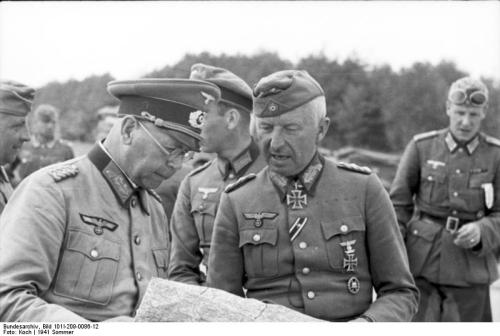
Bild 101I-209-0086-12Manstein (center) planning at the front

Chaos and Peril in the South

As 6th Army died at Stalingrad field Marshall von Manstein was faced with one of the most challenging situations faced by any commander in modern times.  He faced strategic and operational “problems of a magnitude and complexity seldom paralleled in history.”[i] Manstein had to deal with a complex military situation where he had minimal forces to counter the moves of a superior enemy force that was threatening to entrap all German forces in southern Russia. Additionally Manstein had to deal with the “Hitler’s obstinate opposition to a maneuver defense and a Red Army flushed with the victory of Stalingrad.”[ii]Facing him were the six Russian armies of the Voronezh and Southwestern Front’s led by Mobile Group Popov[iii]. These Armies had broken through the Hungarian and Italian armies “making a breach 200 miles wide between the Donetz and Voronezh, and were sweeping westward past Manstein’s flank.”[iv]
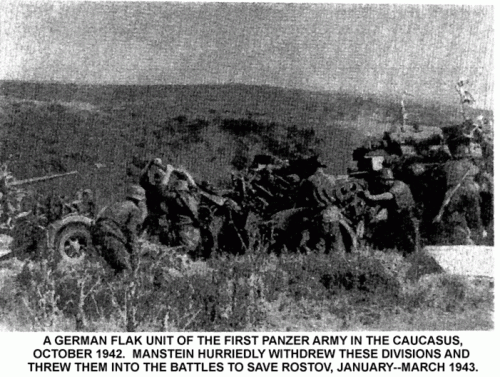
flak in caucasus

The most dangerous threat that Manstein faced was to Army Group A in the Caucasus. This Army Group “found itself in danger of being cut off, forcing an immediate withdraw.”[v] Disaster was averted by the desperate holding actions of Manstein’s meager forces, Army detachment’s Fretter-Pico and Hollidt, and winter conditions that made “offensive operations extraordinarily difficult, even for the hardiest Soviet troops.”[vi] A smart withdraw executed by General von Kleist managed to extricate the Army group “just as the Stalingrad forces collapsed.”[vii] To parry the Soviet thrusts the Germans lacked forces to “establish a deeply echeloned defense” and “instead combined maneuver… with stubborn positional defense to give artificial depth to the battlefield.  In this way the Germans were able to break major Soviet attacks, preventing catastrophic breakthroughs….”[viii] The timely introduction of a battalion of Tiger tanks prevented the Russians from breaking through to Rostov and “cutting the rail and road lines on which First Panzer Army’s retreat depended.”[ix] Even so the escape of the Army Group was narrow. “In terms of time, space, force, and weather conditions it was an astonishing performance-for which Kleist was made a field-marshal.”[x] With the Russians only 70 kilometers from Rostov and his own forces 650 kilometers from that city Kleist executed a withdraw “which had appeared hardly possible to achieve.”[xi] The divisions extricated by Kleist would be instrumental in the coming weeks as Manstein moved to counter the Soviet offensive.

Ostfront, Adolf Hitler, Erich v. Manstein

Hitler and Manstein

Despite the successful withdraw the situation was still precarious in early February, Manstein had no effective contact with his left wing, the bulk of which was tied to Kharkov, The Russians had “virtually complete freedom of action across a fifty-mile stretch of the Donetz on either side of Izyum.”[xii] Manstein was hard pressed to “halt the raids of Mobile Group Popov and other exploiting Soviet tank corps in Operation Gallop.”[xiii] Manstein’s forces in the eastern sector had been divided by Russian penetrations, which threatened 1st Panzer Army’s western flank and blocked the Army Group’s main railway line.[xiv] On 15 February “the SS Panzer Corps withdrew from Kharkov-in spite of orders from Hitler…that the city was to be held to the last.”[xv] SS General Paul Hausser, the corps commander realized that the order to hold Kharkov was impossible and requested permission to withdraw. This was was refused by General Lanz. Under pressure from encircling Russian forces outside and from partisans inside the city, Hausser disobeyed the order and extricated his troops,[xvi] thereby saving thousands of German soldiers and preserved the SS Panzer Corps as a fighting unit.[xvii] Lanz was relieved by Hitler for the loss of Kharkov and although Hausser would escape immediate censure, “Hitler did see it as a black mark against his name.”[xviii] With Kharkov in Soviet hands the gap between Manstein’s army group and Field Marshal von Kluge’s Army Group Center increased to over 100 miles.[xix] It appeared that the entire German southern flank was disintegrating.  Manstein estimated the ratio of German to Soviet forces in his area at 1:8.[xx] He believed that the Soviets could advance and subsequently “block the approaches to the Crimea and the Dnieper crossing at Kherson” which would “result in the encirclement of the entire German southern wing.”[xxi] Popov’s Mobile Group crossed the Donets and reached Krasnoarmeiskaia by 12 February. Vatutin committed two additional fresh tank corps toward Zaporozhe, a critical transport node which was also the location of Manstein’s headquarters.[xxii]
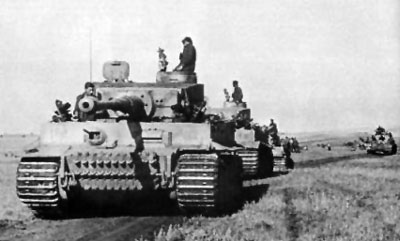
SS-Tiger-LSAH-01Tiger Tanks assigned to 1st SS Panzer Division

Hitler arrived to consult with Manstein on 17 February and remained for three days with Soviet forces perilously close.  Manstein only had some flak units and the Army Group Headquarters Company between him and Popov’s advanced elements. On Hitler’s last day “some T-34’s approached to within gun range of the airfield.”[xxiii]

The conference of Hitler with Manstein at Zaporozhe as well as a previous conference at the Wolfsschanze on 6 February was critical to the development of Manstein’s plan to restore the front. Manstein had now gotten both the 1st and 4th Panzer Armies across the Don, and “with this striking force, he felt confident of smashing the Russian offensive if he was given a free hand to withdraw from the line of the Donetz, evacuate Rostov and take up a much shorter front along the Mius river.”[xxiv] The conference on the 6th was one of the “rare moments in the war where Hitler authorized a strategic withdraw on a major scale.”[xxv] Yet as the Russians continued to advance Hitler became concerned and came to Zaporozhe.  At first Hitler would not concede to Manstein, as he wanted to assemble the SS Panzer Corps for an attack to recapture Kharkov.[xxvi]Manstein explained the need for a counter stroke and through much explanation was able to convince Hitler that the capture of Kharkov was not possible unless “we first removed the danger of the Army Group being cut off from its rear communications.”[xxvii]
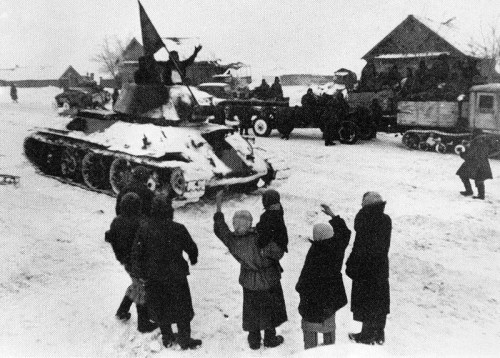
T34_Stalingrad-Offensive-px800Soviet formations advance

The Russian aim was now obvious[xxviii] and Manstein had correctly discerned their strategy.  Manstein knew that his Army Group had to hold the line on the Mius and then quickly defeat the enemy between 1st Panzer Army and Army Detachment Kempf[xxix] in “order to prevent its own isolation from the Dnieper crossings.”[xxx] The Soviets had outrun their logistics support and had suffered heavy losses of their own and had serious equipment shortages.[xxxi] Manstein explained to Hitler the opportunity offered as it was now the Russians who “were worn out” and far from their supply dumps as the Germans had been in November 1942.  Manstein “foresaw an opportunity to seize the operational initiative with a counter offensive of his own.  Manstein’s target was the Soviet armored spearheads, still careening southwestward between Kharkov and Stalino.”[xxxii] Manstein believed that when the Russian “spearhead lunged, as it must toward the crossings on the upper Dnieper,” then Hoth’s Army would be let loose again.  The three SS Panzer divisions could then “play their rightful role as avengers, and strike southeast to meet 4th Panzer Army, catching the Russian armour in a noose.”[xxxiii] Hitler agreed to Manstein’s plan and Manstein shifted 4th Panzer Army to assume control of the SS Panzer Corps, now reinforced by 3rd SS Panzergrenadier Division “Totenkopf.” Hitler reinforced Manstein and released 7 battle worn Panzer and motorized divisions for his attack.[xxxiv]

Soviet Miscalculation

It was now Stalin’s time to miscalculate. He and his subordinates “continued to believe that they were on the verge of a great victory. German defenses in southern Russia appeared to be crumbling and the Stavka sought to expand that victory to include Army Group Center.”[xxxv] To this end they diverted armies to the north and launched attacks in that direction.  However German defenses were stiff and the plan was “predicated on the assumption of continued offensive success further south.”[xxxvi] Reinforcements from Stalingrad failed to deploy and “Army Group Center’s defenses, prepared for the past year and a half proved formidable.”[xxxvii]

In the south Stalin saw the Dnieper and almost “heedlessly drove his armies towards what he thought would be the decisive victory on the banks of this huge Russian river,”[xxxviii] but, Soviet “ambitions exceeded their available resources and the skill of their commanders.”[xxxix] The SS Panzer Corps withdraw from Kharkov “further heightened the Soviet’s intoxication with victory”[xl] and confirmed their beliefs that the Germans were withdrawing.  Stalin believed that “it was inconceivable that Hitler’s Praetorian Guard would abandon Kharkov except as part of a general order to retreat.”[xli] He believed that the encirclement of Army Group South would lead to a chain reaction and quick way to victory over German forces in the east.  Believing that there was no way for the Germans to recover and establish a solid front on the Mius,[xlii] Stalin continued to drive his forces to attack, yet the Russian offensive in the south had reached what Clausewitz had called the “culminating point” and Stalin’s armies were now extremely vulnerable. “The weather, the devastated communications, and their own inexperience in maintaining the traffic density required to support a deep penetration on a narrow front had combined to force a dangerous dispersal of effort on the Russian advance which had broken down into four separate groups.”[xliii]

panzer ivfPanzers assembling to attack

The Soviet forces were now in a dangerous predicament being spread out across the entire south of Russia.  One group, composed of the 69th Army and 3rd Tank Army pushed against Army detachment Kempf west of Kharkov.  To the south the badly depleted 6th Army and 1st Guards Army were now “strung out down a long corridor they had opened between Izyum and Pavlograd,”[xliv] Mobile Group Popov was lagging further east near Krasnoarmeiskaia.   Additional units were isolated behind the front of Army Detachment Fretter-Pico and near Matveyev.  Soviet commanders believed that the Germans were in worse shape and that “the risks of dispersal were justified.”[xlv] They had not anticipated or made allowance for Manstein’s coolness under pressure and actions to preserve his armor while thinning his front “well past the accepted danger limit.”[xlvi]Likewise the Soviets did not know that the Germans had cracked the code used by the Southwest front and from 12 February on “were now privy to Popov’s and Vatutin’s thoughts,” now knowing precisely where the Russians would attack.[xlvii] Manstein had withstood temptation and Hitler’s pressure to use his reserves “for a direct defense of the Dnieper line.”[xlviii] As such he was prepared to launch a devastating counter-stroke against the dispersed and weakened Russian armies which were still advancing into the trap he planned for them. He had managed to “save his counteroffensive plan from Hitler’s shrill demands that the new reserves be thrown into battle piecemeal to prevent further territorial losses.”[xlix] The stage was now set for a two classic mobile operations.[l]

The Destruction of Mobile Group Popov, 6th Army and 1st Guards Army

Manstein launched his counter-stroke on 21 February against Popov’s Mobile Group using XL Panzer Corps under the command of General Henrici composed of the 7th and 11th Panzer Divisions and SS Motorized Division Viking. Popov’s Group was exposed. Popov had “succeed in cutting the railway from Dnepropetrovsk to Stalino and was itching to push further south to Mariupol on the Sea of Azov.”[li] The Soviets once again had failed to discern German intentions, believing that the Germans were retreating.[lii] Likewise the Soviet high command did not fully understand Popov’s situation. His force was weak in tanks and low on fuel and his Mobile Group was defeated in detail by the German Corps.  Popov’s immobilized tank and motorized rifle formations resisted desperately but were bypassed by the panzers.  The 330th Infantry Division mopped up the remnants of these formations.[liii] The key battles took place around the town of Krasnoarmeiskaia and the battle became a running battle between that town and the Donets River.[liv] Popov requested permission to retreat, but still believing the Germans to be retreating Vatutin gave a categorical “no.” The terrain in the area was “almost completely open”[lv] and “Popov’s proud Armoured Group was cut up like a cake.”[lvi] Popov extricated some of his units but “only after serious losses in manpower and equipment.”[lvii] Despite this it would not be until the 24th that Vatutin would order a halt to offensive operations.[lviii]

kharkovSS Panzers in Kharkov

As Popov sought to get his units out of the German scythe Manstein set his sights on 6th Army, 1st Guards Army and 25th Tank Corps which was approaching Zaporozhe.[lix] He assigned the task to Hoth’s 4th Panzer Army and its XLVIII Panzer Corps under General Knobelsdorf composed of the 6th and 17th Panzer Divisions and the SS Panzer Corps comprising SS Divisions LiebstandarteDas Reich and Totenkopf.[lx] Manstein gave Hoth a brief but explicit order: “The Soviet Sixth Army, now racing towards Dnepropetrovsk through the gap between First Panzer Army and Army Detachment Kempf, is to be eliminated.”[lxi] The XLVIII Panzer Corps and SS Panzer Corps were unleashed against the exposed flank of the 6th Army and 1st Guards Army.   XLVIII Panzer Corps quickly “seized bridgeheads over the Samara River, and prepared to move north into the rear of the exhausted Soviet Sixth Army.”[lxii] The two Panzer Corps then made a coordinated concentric attack northwest which “came as a complete surprise to the Russians.”[lxiii] Das Reich thrust deep into the flank of 6th Army supported by Stukas from Richthofen’s 4th Air Fleet.  This attack dislodged one Soviet Rifle Corps and destroyed another allowing the division to capture Pavlograd while XLVIII Panzer Corps led by 17th Panzer Division pushed from the south linking up with the SS Corps. This cut off the Soviet 25th Tank Corps and threatened 6thArmy.[lxiv] What followed was a disaster for the Russians.        Despite overwhelming evidence to the contrary the Stavka and Front commanders still believed that the Germans were retreating.  6th Army was ordered to continue its advance by the front commander who believed that the two German Panzer Corps were withdrawing.[lxv] In a few days the 17th Panzer Division “gained the Izyum-Protoponovka sector on the Donetz River, while the SS Panzer Corps took Losovaya and established contact with Army Detachment Kempf, which had joined the attack from the west.”[lxvi] XL Panzer Corps with the 3rd and 7thPanzer Divisions and 333rd Infantry Division joined in the attack on Popov’s remaining forces completing their destruction.[lxvii] As Hoth and Hausser converged on Pavlograd, Das Reich and Totenkopf “swung left to the east and then wheeled back north again running parallel to the Russian divisions fleeing from Forty-eighth Panzer Corps. What ensured was a turkey shoot.”[lxviii]Fleeing Russian forces on the open steppe were visible and engaged at long range.[lxix] Leibstandarte helped by holding the left flank against Russian counter attacks from the units now isolated in the west,[lxx] and Totenkopf’sgrenadiers fanned out supported by Stukas to “kill or capture as many Russians as possible.”[lxxi] By 1 March the Russian penetrations had been eliminated. Popov’s Mobile Group was smashed, 6th Army and 1st Guards Army badly mauled. 25th Tank Corps and three Rifle divisions had to be completely written off and numerous other corps and divisions took heavy casualties.  Two additional corps, encircled before the offensive began were eliminated by German forces.[lxxii] The Germans counted 23,000 Russian dead on the battlefield, and Manstein noted that “the booty included 615 tanks, 354 field pieces, 69 anti-aircraft guns and large numbers of machine guns and mortars.”[lxxiii] The Germans only took 9,000 prisoners as they were too weak, especially in infantry to seal off the encircled Soviet forces.[lxxiv] Yet the forces that escaped they were in no condition to “block the continued progress of the Panzers and SS.”[lxxv] Now there was a 100 mile gap in the Russian lines with nothing no troops to fill it and only “General Mud” could stop the Germans.[lxxvi] Manstein was not yet finished and the next phase of his operation against the Soviet formations west of Kharkov and that city were about to commence.

The Destruction of 3rd Tank Army

With the immediate threat to his Army Group eliminated and having regained the initiative, Manstein and Army Group South now “proceeded to deliver the stroke against the ‘Voronezh Front’– i.e. the forces located in the Kharkov area.”[lxxvii] But the Russians had not been idle. In order to attempt to assist 6thArmy 3rd Tank Army moved two tank corps and three Rifle divisions south and these ran into Manstein’s advancing panzers.[lxxviii] Manstein’ noted his objective now was “not the possession of Kharkov but the defeat-and if possible the destruction of the enemy units located there.”[lxxix] Between March 1st and 5th his forces advanced on Kharkov. Not knowing the Germans dispositions[lxxx]3rd Tank Army made the mistake of moving between the Leibstandarte’s defensive positions and the attacking divisions of the SS Panzer Corps. Hausser wheeled Totenkopf around and completed an encirclement of these units near Bereka on 3 March.[lxxxi] The Russians made futile attempts to break out but the SS Divisions tightened the noose around them and they were eliminated by the SS Panzer Corps which “engaged in concentric attacks during the three days of hard fighting.”[lxxxii] Even Regimental commanders like Heinz Harmel of Das Reich’s Der Fuhrer regiment became engaged in close combat with the Russians.[lxxxiii] The battle was fought in “snowstorms whose intensity caused the SS severe privations.”[lxxxiv] Totenkopf and Das Reich slammed the Russians “back against the Tiger tanks and assault guns of the Leibstandarte.”[lxxxv] The elimination of these units netted another 12,000 Russians killed,[lxxxvi] knocking “out the last remaining obstacle between the Germans and Kharkov.”[lxxxvii]

Return to Kharkov and Controversy

Manstein turned his attention to Kharkov, supported by Richthofen’s 4th Air Fleet which for the last time in Russia “provided undisputed air superiority for a major German mechanized operation.”[lxxxviii] He decided to “roll up the enemy from the flank and force him away from Kharkov in the process.”[lxxxix]He ordered a “pincer on the town, sending Grossdeutschland around to the north with a reinforced Kempf detachment and the combined force of Hoth and the SS to attack the town from the south and rear.”[xc] Manstein planned to make a wide envelopment to avoid embroiling his panzers in costly urban combat stating “that at all costs the Army Group wished to avoid Kharkov’s becoming a second Stalingrad in which our assault forces might become irretrievably committed.”[xci] To this end he sent Das Reich and Totenkopfapproaching from the south to west of the city[xcii] while XLVIII Panzer Corps swung east toward the Donetz.[xciii] As Hoth’s forces came up from the south to envelope the city, Grossdeutschland and the XI and LI Corps fought the Russians to the north and west,[xciv] eventually moving up to Belgorod.  By 8 March lead elements of the SS Panzer Corps were on the outskirts of the city.

At this point there is some controversy as to German actions. As noted Manstein wished to avoid urban combat and desired to surround the city and force its surrender.  According to one writer Hoth ordered Hausser “to seal off the city from the west and north and to take any opportunity to seize it.”[xcv] Others including Glantz and House and Murray and Millett state that Hausser “ignored a direct order” and attacked into the city.[xcvi] Manstein does not explicitly say that there was a direct order but notes that the Army Group “had to intervene vigorously on more than one occasion to ensure that the corps did not launch a frontal attack on Kharkov.”[xcvii] Sydnor states that Hausser ignored a direct order by Hoth on the 11th by detailing a battalion of Totenkopf to assist Das Reich and Leibstandarte in retaking Kharkov by direct assault. The order entailed pulling Das Reich out of the city and taking it to the east.[xcviii] Lucas adds that this order came in the midst of hard fighting in the city and could not be carried out by the division.[xcix]Carell notes that on 9 March Hoth instructed Hausser that “opportunities to seize the city by a coup are to be utilized,”[c] and goes into detail regarding how Hoth’s 11 March order applied to Das Reich. It was to be pulled out of action and brought east, but division was heavily engaged and in the process of breaking through Soviet defenses “quicker in fact than if he had pulled “Das Reich” out of the operation and led it all the way round the city along those terrible muddy and time wasting roads.”[ci] In the end the SS took Kharkov, Manstein said that the city “fell without difficulty”[cii] while others note the difficulty of the action and the casualties suffered by the SS.  Kharkov’s capture; the defeat of Rokossovsky’s campaign against Orel and the beginning of the spring Rasutitsa ended the winter campaign and stabilized the front.

Analysis

The Russian winter offensive following Stalingrad had great potential.  Manstein said: “the successes attained on the Soviet side, the magnitude of which is incontestable.”[ciii] The greatest Soviet shortcomings were inexperience in conducting deep mobile operations and the inability of their logistics system to keep up with their advance.  Clark notes that this was their “first experience of an offensive war of movement on a large scale.[civ] Glantz and House are not alone in noting that the “Stavka continued to undertake operations that were beyond its resources.”[cv] Murray and Millett state that they “lacked the operational focus that had marked the Stalingrad offensive.”[cvi] Had they had the resources and ability to execute their plans they might have destroyed all German forces in the south.  They misread German intentions based on their own over-optimistic expectations opened their forces to Manstein’s devastating counter stroke.  Von Mellenthin, possibly showing some prejudice commented that the Russian soldier “when confronted by surprise and unforeseen situations he is an easy prey to panic.”[cvii]

The Germans snatched victory out of what appeared to be certain defeat aided by Russian mistakes and operational shortcomings.  Manstein refused to panic and conserved his forces for his counterattack.[cviii] Kleist brought his Army Group out of what might have been encirclement worse than Stalingrad.  Hitler for the most part gave Manstein operational freedom which he had not provided other commanders.  German Panzer forces conducted mobile operations against superior enemy armored forces and bested them.  Landsers held their own in at critical junctures, especially on the Mius and gave Manstein the opportunity to employ the panzers in the mobile defense.[cix] The Luftwaffe recovered its balance and the coordinated operations between it and German ground forces gave them an edge at a point where the Red Air Force was unable to support the Red Army.[cx] Above all the Germans still maintained the edge in both overall quality of generalship, especially that of Manstein and Kleist, but not to exclude Hoth, Hausser and lower level commanders.  Additionally the average German soldier still maintained an edge over his Soviet adversary in the confusion of mobile operations in open terrain.   Manstein and his forces gave Hitler breathing room on the eastern front.[cxi] As Clark notes: “few periods in World War II show a more complete and dramatic reversal of fortune than the fortnight in February and the first in March 1943…it repaired its front, shattered the hopes of the Allies, nipped the Russian spearhead. Above all it recovered its moral ascendancy.”[cxii]

Notes 


[i] Von Mellenthin, F.W. Panzer Battles: A Study of the Employment of Armor in the Second World War. Translated by H. Betzler, Ballantine Books, New York, NY, 1971. Originally Published University of Oklahoma Press, 1956. p245

[ii] Glantz, David M. and House, Jonathan. When Titans Clashed: How the Red Army Stopped Hitler. University Press of Kansas, Lawrence, KS. 1995. p.143

[iii] Ibid. Glantz. P.143. These units include 3rd Tank Army, 1st and 3rd Guards Armies and the 6th, 40th and 69th Armies.

[iv] Liddell-Hart. B.H. Strategy.  A Signet Book, the New American Library, New York, NY 1974, first published by Faber and Faber Ltd. London, 1954 and 1967. p.253

[v] Raus, Erhard. Panzer Operation: The Eastern Front Memoir of General Raus, 1941-1945. Compiled and Translated by Steven H Newton. Da Capo Press a member of the Perseus Book Group, Cambridge, MA 2003. p.185

[vi] Murray, Williamson and Millett, Allan R. A War to Be Won: Fighting the Second World War, The Belknap Press of Harvard University Press, Cambridge MA. 2000. pp.291-292

[vii] Liddell-Hart, B.H. History of the Second World War. G.P. Putnam’s Son’s, New York, NY. 1970  p.478

[viii] Wray, Timothy A. Standing Fast: German Defensive Doctrine on the Russian Front in World War II, Prewar to March 1943. U.S. Army Command and General Staff College, Fort Leavenworth, KS. 1986. p.161

[ix] Ibid. Murray and Millett. p.292

[x] Ibid. Liddell-Hart, Second World War. p.479

[xi] Liddell-Hart, B.H. The German Generals Talk. Quill Publishing, New York, NY. 1979. Copyright 1948 by B.H. Liddell-Hart. pp.211-212.

[xii] Clark, Alan. Barbarossa: The Russian-German Conflict, 1941-45.Perennial, an Imprint of Harper Collins Books, New York, NY 2002. Originally published by William Morrow, New York, NY 1965. pp.299-300

[xiii] Glantz, David M and House, Jonathan. The Battle of Kursk.  University Press of Kansas, Lawrence, KS. 1999. p.11

[xiv] Manstein, Erich von. Lost Victories. Translated by Anthony G. Powell, Zenith Press, an imprint of MBI Publishing Company, St Paul, MN. 2004. First Published as Verlorene Siege Athenaum-Verlag, Bonn, GE 1955, English edition Methuen & Company Ltd. 1958  p.417

[xv] Ibid. Clark. p.300

[xvi] Carell, Paul. Scorched Earth: The Russian German War 1943-1944. Translated by Ewald Osers, Ballantine Books, New York, NY 1971, published in arrangement with Little-Brown and Company. pp.196-199

[xvii] Lucas, James. Das Reich: The Military History of the 2nd SS Division.Cassell Military Paperbacks, London, UK, 1999. First published by Arms and Armour, 1991. p.91  Glantz and House criticize Hausser saying that the SS Panzer Corps Staff lacked the experience to perform its mission.  (Titans Clashed p.144) Most other commentators agree with the necessity of his withdraw.

[xviii] Messenger, Charles. Sepp Dietrich: Hitler’s Gladiator. Brassey’s Defence Publishers, London, 1988. p.113

[xix] Ibid. Clark. p.300

[xx] Ibid. Manstein. p.419

[xxi] Ibid. Manstein. pp.418-419

[xxii] Ibid. Glantz and House. When Titans Clashed. p.144

[xxiii] Ibid. Clark. p.300

[xxiv] Ibid. Von Mellenthin. p.251

[xxv] Ibid. Carell. p.191

[xxvi] Ibid. Manstein. p.424.

[xxvii] Ibid. Manstein. p.428

[xxviii] Ibid. Liddell-Hart. Second World War. p.481

[xxix] This had previously been Army Detachment Lanz, but Lanz had bee relieved over the loss of Kharkov.

[xxx] Ibid. Manstein. p.429

[xxxi] Ibid. Murray and Millet. p.292

[xxxii] Ibid. Wray. p.162

[xxxiii] Ibid. Clark. p.302.

[xxxiv] Ibid. Glantz and House. When Titans Clashed. p.145

[xxxv] Ibid. Glantz and House. When Titans Clashed . pp.144-145

[xxxvi] Ibid. Glantz and House. When Titans Clashed. p.146

[xxxvii] Ibid. Murray and Millett. p.293

[xxxviii] Ibid. Carell. p.191

[xxxix] Ibid. Murray and Millett. p.292

[xl] Ibid. Carell. p.199

[xli] Ibid. Carell. p.199

[xlii] Ibid. Carell. p.193

[xliii] Ibid. Clark. p.303

[xliv] Ibid. Clark. p.304

[xlv] Ibid. Clark. p.304

[xlvi] Ibid. Clark. p.304

[xlvii] Ibid. Carell. p.210

[xlviii] Ibid. Liddell-Hart. Strategy p.253

[xlix] Ibid. Wray. p.163

[l] Ibid. Glantz and House. When Titans Clashed. p.147. Note comments by Glantz and House in footnote 31 on relative strengths of forces involved, especially the weakness of German forces.

[li] Butler, Rupert. SS Wiking: The History of the Fifth SS Division 1941-45.Casemate, Havertown, PA. 2002. p.93

[lii] Ibid. Carell. p.211

[liii] Ibid. Carell. p.210

[liv] Ibid. Glantz and House. When Titans Clashed. p.147

[lv] Ibid. von Mellenthin. p.253

[lvi] Ibid. Carell. p.210

[lvii] Ibid. Murray and Millett. p.293

[lviii] Ibid. Carell. p.213

[lix] Ibid. Glantz and House. When Titans Clashed. p.147

[lx] There is difference in various accounts as to which units composed these Panzer Corps. Von Mellenthin adds 11th Panzer to the XLVIII Panzer Corps and some accounts do not list the Liebstandarte as part of the SS Panzer Corps.

[lxi] Ibid. Carell. p.211

[lxii] Sydnor, Charles W. Soldiers of Destruction: The SS Death’s Head Division 1933-1945. Princeton University Press, Princeton NJ. 1977. p.268

[lxiii] Ibid. Von Mellenthin. p.252

[lxiv] Ibid. Carell. p.212

[lxv] Ibid. Carell. p.212

[lxvi] Ibid. Von Mellenthin. p.252

[lxvii] Ibid. Carell. p.213

[lxviii] Ibid. Sydnor. pp.268-269

[lxix] Ibid. Von Mellenthin. p.253

[lxx] Meyer, Kurt. Grenadiers. Translated by Michael Mende and Robert J. Edwards. J.J. Fedorowicz Publishing Inc. Winnipeg, Manitoba. Canada. 2001. pp.180-181

[lxxi] Ibid. Sydnor. p.269

[lxxii] Ibid. Manstein. p.433

[lxxiii] Ibid. Manstein. p.433. Sydnor lists an addition 600 anti-tank guns and notes that the tanks were almost all T-34s. (Sydnor. p.269)

[lxxiv] Ibid. Glantz and House. When Titans Clashed. p.147

[lxxv] Ibid. Clark. p.306

[lxxvi] Ibid. Carell. p.216

[lxxvii] Ibid. Manstein. p.433

[lxxviii] Ibid. Glantz and House. When Titans Clashed. p.187

[lxxix] Ibid. Manstein. p.433

[lxxx] Ibid. Meyer. p.181

[lxxxi] Ibid. Carell. p.216

[lxxxii] Ibid. Meyer. pp.181-182

[lxxxiii] Ibid. Lucas. p.95

[lxxxiv] Ibid. Lucas. p.95

[lxxxv] Ibid. Sydnor. p.277

[lxxxvi] Ibid. Manstein. p.434

[lxxxvii] Ibid. Sydnor. p.277

[lxxxviii] Ibid. Glantz and House. Kursk. p.13

[lxxxix] Ibid. Manstein. p.435

[xc] Ibid. Clark. p.306

[xci] Ibid. Manstein. p.435

[xcii] Ibid. Sydnor. p.278

[xciii] Weingartner, James. J. Leibstandarte SS Adolf Hitler: A Military History, 1933-45. Battery Press, Nashville, TN.(no publication date listed)  p.75

[xciv] Ibid. Raus. pp.189-192

[xcv] Ibid. Messenger. p.114

[xcvi] See Glantz and House p.187 and Murray and Millett p.293

[xcvii] Ibid. Manstein. p.436

[xcviii] Ibid. Sydnor. p.278

[xcix] Ibid. Lucas. p.96

[c] Ibid. Carell. p.216

[ci] Ibid. Carell. p.219

[cii] Ibid. Manstein. p.436

[ciii] Ibid. Manstein. p.437

[civ] Ibid. Clark. p.303

[cv] Ibid. Glantz and House. p.143

[cvi] Ibid. Murray and Millett. p.292

[cvii] Ibid. Von Mellenthin. p.254

[cviii] A comment by Von Mellenthin commenting on Manstein’s coolness in the conduct of his operations compares him to Robert E. Lee. “To find another example of defensive strategy of this caliber we must go back to Lee’s campaign in Virginia in the summer of 1864. (Von Mellenthin. p.245)

[cix] For some additional comments along these lines see vn Mellenthin who notes four points in regard to the counter stroke: 1. High level commanders did not restrict the moves of armored formations, but gave them long range tasks. 2. Armored formations had no worries about their flanks because the High Command had a moderate infantry force available for counterattacks. 3. All commanders of armored formations, including corps, conducted operations not from the rear, but from the front. 4. The attack came as a surprise regarding the time and place. (Von Mellenthin p.254)

[cx] Ibid. Murray and Millett. p.293

[cxi] Despite his success Hitler was not happy with Manstein in regard to giving up ground for operational purposes and Manstein would lose much of the freedom that he enjoyed by March. Wray has a discussion of this.  See Wray. pp.162-163.  The Nazi hierarchy actively promoted the exploits of the SS Panzer Corps and its leaders, especially the commander of the Leibstandarte Sepp Dietrich. (see Weingartner pp. 76-77) The recognition of Hausser would be delayed, some speculate as a result of his disobedience in giving up Kharkov in February.

[cxii] Ibid. Clark. p.306

Bibliography

Butler, Rupert. SS Wiking: The History of the Fifth SS Division 1941-45.Casemate, Havertown, PA. 2002

Carell, Paul. Scorched Earth: The Russian German War 1943-1944. Translated by Ewald Osers, Ballantine Books, New York, NY 1971, published in arrangement with Little-Brown and Company

Clark, Alan. Barbarossa: The Russian-German Conflict, 1941-45. Perennial, an Imprint of Harper Collins Books, New York, NY 2002. Originally published by William Morrow, New York, NY 1965

Glantz, David M and House, Jonathan. The Battle of Kursk.  University Press of Kansas, Lawrence, KS. 1999

Glantz, David M. and House, Jonathan. When Titans Clashed: How the Red Army Stopped Hitler. University Press of Kansas, Lawrence, KS. 1995

Liddell-Hart, B.H. The German Generals Talk. Quill Publishing, New York, NY. 1979. Copyright 1948 by B.H. Liddell-Hart.

Liddell-Hart, B.H. History of the Second World War. G.P. Putnam’s Son’s, New York, NY.

Liddell-Hart. B.H. Strategy.  A Signet Book, the New American Library, New York, NY 1974, first published by Faber and Faber Ltd. London, 1954 and 1967

Lucas, James. Das Reich: The Military History of the 2nd SS Division. Cassell Military Paperbacks, London, UK, 1999. First published by Arms and Armour, 1991

Manstein, Erich von. Lost Victories. Translated by Anthony G. Powell, Zenith Press, an imprint of MBI Publishing Company, St Paul, MN. 2004. First Published as Verlorene Siege Athenaum-Verlag, Bonn, GE 1955, English edition Methuen & Company Ltd. 1958

Messenger, Charles. Sepp Dietrich: Hitler’s Gladiator. Brassey’s Defence Publishers, London, 1988

Meyer, Kurt. Grenadiers. Translated by Michael Mende and Robert J. Edwards. J.J. Fedorowicz Publishing Inc. Winnipeg, Manitoba. Canada. 2001

Raus, Erhard. Panzer Operation: The Eastern Front Memoir of General Raus, 1941-1945. Compiled and Translated by Steven H Newton. Da Capo Press a member of the Perseus Book Group, Cambridge, MA 2003

Sydnor, Charles W. Soldiers of Destruction: The SS Death’s Head Division 1933-1945. Princeton University Press, Princeton NJ. 1977

Von Mellenthin, F.W. Panzer Battles: A Study of the Employment of Armor in the Second World War. Translated by H. Betzler, Ballantine Books, New York, NY, 1971. Originally Published University of Oklahoma Press, 1956

Weingartner, James. J. Leibstandarte SS Adolf Hitler: A Military History, 1933-45. Battery Press, Nashville, TN.(no publication date listed)

Wray, Timothy A. Standing Fast: German Defensive Doctrine on the Russian Front in World War II, Prewar to March 1943. U.S. Army Command and General Staff College, Fort Leavenworth, KS. 1986

3 Comments

Filed under History, leadership, Military, nazi germany, war crimes, world war two in europe

Sophie Scholl and the White Rose at 75: “Long Live Freedom!”

Friends of Padre Steve’s World,

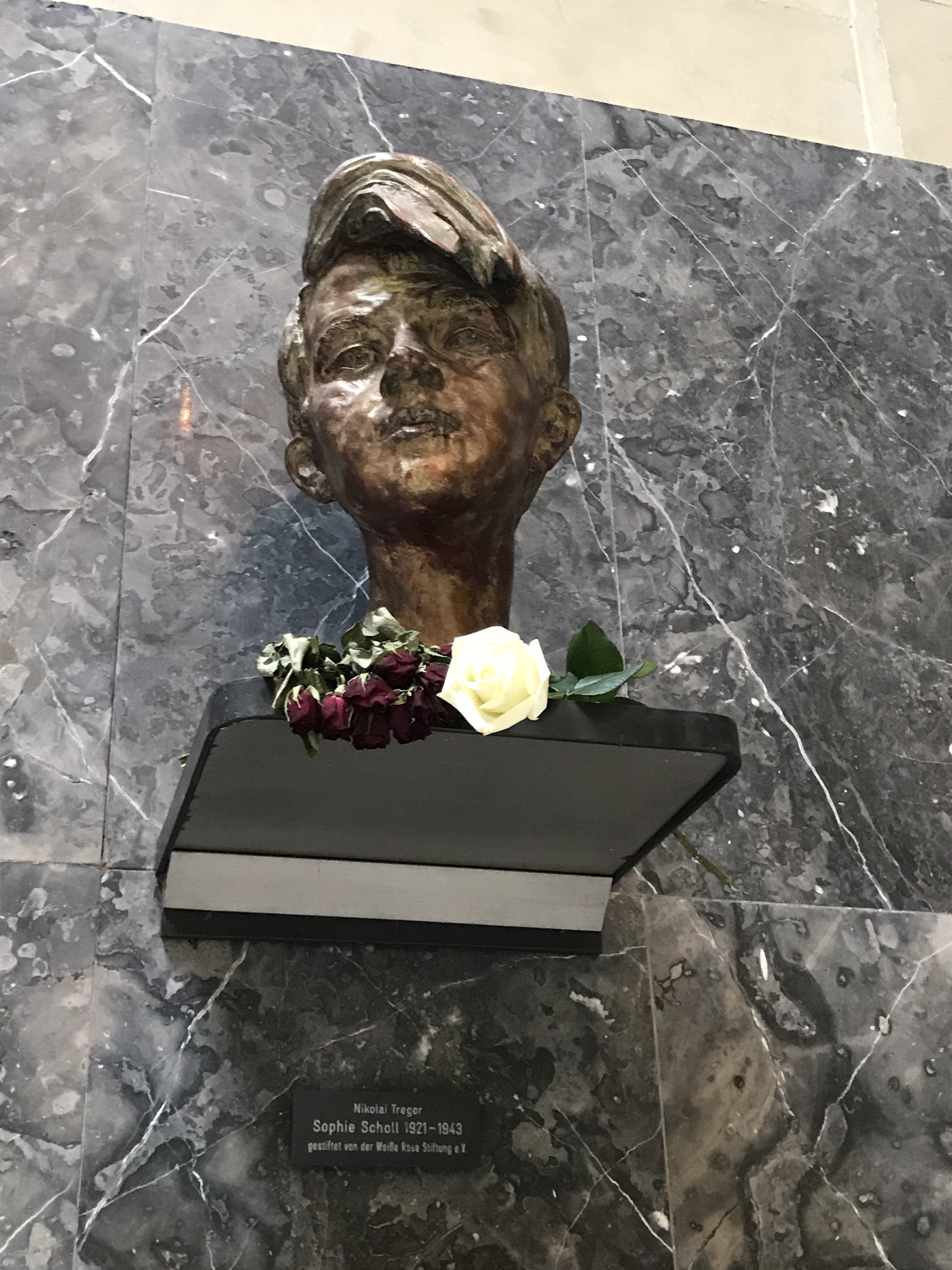
Seventy-five years ago today a young German woman stepped up the the guillotine at Munich’s Stadelheim Prison. She had been tried and convicted of treason for distributing a series of anti-Nazi leaflets by the Nazi Volksgericht or “People’s Court” under the direction of the notorious Judge Roland Freisler who gained further infamy in his show trials of those suspected of participating in or supporting the July 20th Bomb Plot against Hitler.

The woman was Sophie Scholl, a student at the University of Munich she was just 22 years old. Her story and the story of the resistance group that she was at the center of is remarkable for the moral clarity that she and her friends displayed in an era where most people were willing to look the other way, if not unreservedly served Hitler’s Third Reich.


The story of Sophie and the White Rose is a remarkable story because stories like this are often buried by the propaganda machines of totalitarian regimes; but the shock of what these young people did was so great that the Nazi propaganda machine had to publicly confront it with the goal of instilling such fear that no one else’s would dare repeat it. What politicians, generals, and others could not do to shake the Nazi regime a handful of university students accomplished.

There are a number of monuments scattered around Munich to the White Rose movement, but the most remarkable is the monument in front of the university where they studied and where they distributed their leaflets.  Facsimiles of their publications and letters are part of the pavement, looking as if they have been dropped on the ground for someone to pick up.

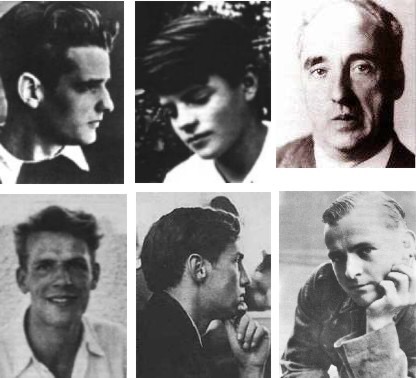
Scholl, as well as her friends were students, some who in the course of their time of study who had been drafted into the Wehrmacht as medics, serving on the Russian front before returning to the University. There were five of them, Sophie, Willi Graf, Alexander Schmorrel, Hans Scholl, and Christoph Probst, plus one of their professors, Professor Dr. Kurt Huber who began a resistance cell that focused on telling the truth about the crimes of the Nazi regime, and the lies of Hitler.

Telling the truth in a dictatorship is dangerous and although Sophie and her companions could have remained silent they had consciences that were guided by reason and human rights, as well as by their Christian faith, a faith which remained despite their aversion to the institutional church for its complicity with the Nazis. As she stood before Freisler and the Volksgericht she was recorded as saying:

“Somebody, after all, had to make a start. What we wrote and said is also believed by many others. They just don’t dare express themselves as we did.”

Too many people lacked the courage to speak as Sophie did in her day as all too many do today. It is far easier to take the path of least resistance. Laurence Rees in his history of Auschwitz wrote:

“…human behavior is fragile and unpredictable and often at the mercy of the situation. Every individual still, of course, has a choice as to how to behave, it’s just that for many people the situation is the key determinate in that choice.”

Sophie and her circle of friends in the White Rose chose how courageous people behave in such abominable conditions. They published a series of six leaflets which they printed themselves and distributed around the university, the city, and to like minded people in a number of other cities. They asked those who got them to make as many copies as they could and distribute them. They were in the process of drafting a seventh when Scholl was spotted distributing them at the university by a maintenance man who was a member of the Nazi Party. She and her friends were arrested on February 21st 1943 by the notorious Nazi People’s Court under the direction of Roland Freisler on the 22nd, and executed by beheading at Munich’s Stadelheim Prison on the 23rd.


The members of the White Rose were bold and defiant in the face of evil, of course those that have that kind of courage usually have short life expectancies in a totalitarian state, but they did not back down. Their pamphlets and graffiti criticizing Hitler garnered the attention of the Gestapo and when they were caught they were brutally tortured, but none backed down.

Their criticisms of Hitler and his Third Reich were hard hitting. Since all of the students had spent much of their childhood teenage years in Nazi organizations which were designed to make loyal little Nazis, their resistance came as a shock to many. All were children who could have easily due to their family background taken the easy road, but chose the more honorable and dangerous road.


Their pamphlets are striking, and each focused on a different part or aspect of the Nazi regime. In their first leaflet they wrote:

“Nothing is so unworthy of a civilized nation as allowing itself to be governed without opposition by an irresponsible clique that has yielded to base instinct.” They urged their readers “Therefore every individual, conscious of his responsibility as a member of Christian and Western civilization, must defend himself as best he can at this late hour, he must work against the scourges of mankind, against fascism and any similar system of totalitarianism.” And to “Offer passive resistance – resistance – wherever you may be, forestall the spread of this atheistic war machine before it is too late, before the last cities, like Cologne, have been reduced to rubble, and before the nation’s last young man has given his blood on some battlefield for the hubris of a sub-human. Do not forget that every people deserves the regime it is willing to endure!”

Such was their beginning, but they went on to attack the Nazi, leaders, the Nazi system, and especially the silence of their countrymen over the extermination of the Jews and Polish intellectuals. They asked in the second leaflet:

“Why do German people behave so apathetically in the face of all these abominable crimes, crimes so unworthy of the human race? Hardly anyone thinks about that. It is accepted as fact and put out of mind. The German people slumber on in their dull, stupid sleep and encourage these fascist criminals; they give them the opportunity to carry on their depredations; and of course they do so…. For through his apathetic behavior he gives these evil men the opportunity to act as they do; he tolerates this “government” which has taken upon itself such an infinitely great burden of guilt; indeed, he himself is to blame for the fact that it came about at all! Each man wants to be exonerated of a guilt of this kind, each one continues on his way with the most placid, the calmest conscience. But he cannot be exonerated; he is guilty, guilty, guilty!”

In each of the letters they asked their readers to offer some form of resistance to Hitler and the Nazi State but urged passive resistance, but in the third missive they went into more detail, including something that anyone who thinks that they are loyal to their country need to appreciate:

“The meaning and the goal of passive resistance is to topple National Socialism, and in this struggle we must not recoil from any course, any action, whatever its nature. At all points we must oppose National Socialism, wherever it is open to attack. We must soon bring this monster of a state to an end. A victory of fascist Germany in this war would have immeasurable, frightful consequences. The military victory over Bolshevism dare not become the primary concern of the Germans. The defeat of the Nazis must unconditionally be the first order of business… And now every convinced opponent of National Socialism must ask himself how he can fight against the present “state” in the most effective way, how he can strike it the most telling blows. Through passive resistance, without a doubt…”

Eventually their tracts became more biting, and in fourth the metaphysical linking Hitler to Satan and Anti-Christ.


They wrote:

“Every word that comes from Hitler’s mouth is a lie. When he says peace, he means war, and when he blasphemously uses the name of the Almighty, he means the power of evil, the fallen angel, Satan. His mouth is the foul-smelling maw of Hell, and his might is at bottom accursed…. I ask you, you as a Christian wrestling for the preservation of your greatest treasure, whether you hesitate, whether you incline toward intrigue, calculation, or procrastination in the hope that someone else will raise his arm in your defence? Has God not given you the strength, the will to fight? We must attack evil where it is strongest, and it is strongest in the power of Hitler.”

In the fifth leaflet they spoke of where the Nazi war effort would end and the responsibility of not only Hitler but the German people for it:

“It has become a mathematical certainty that Hitler is leading the German people into the abyss. Hitler cannot win the war; he can only prolong it. The guilt of Hitler and his minions goes beyond all measure. Retribution comes closer and closer. But what are the German people doing? They will not see and will not listen. Blindly they follow their seducers into ruin. Victory at any price! is inscribed on their banner. “I will fight to the last man,” says Hitler-but in the meantime the war has already been lost…. Do not believe that Germany’s welfare is linked to the victory of national Socialism for good or ill. A criminal regime cannot achieve a German victory. Separate yourselves in time from everything connected with National Socialism. In the aftermath a terrible but just judgment will be meted out to those who stayed in hiding, who were cowardly and hesitant.”

In the aftermath of the disaster at Stalingrad they published their sixth and last issue before being caught. In it they urged Germans to fight against the Nazi Party and regime, and confronted the way that since its inception Hitler and the Party corrupted the meaning of honor and freedom:

“Freedom and honor! For ten long years Hitler and his coadjutor have manhandled, squeezed, twisted, and debased these two splendid German words to the point of nausea, as only dilettantes can, casting the highest values of a nation before swine. They have sufficiently demonstrated in the ten years of destruction of all material and intellectual freedom, of all moral substance among the German people, what they understand by freedom and honor. The frightful bloodbath has opened the eyes of even the stupidest German – it is a slaughter which they arranged in the name of “freedom and honor of the German nation” throughout Europe, and which they daily start anew.”

Just over two weeks later they were caught and in Freisler’s People’s Court convicted and executed. During their trial, if it can be called that, Freisler and others expressed their shock that young Germans could commit treason. Sophie had no problem confronting her accusers:

Her last words before going to the guillotine were unapologetic: “How can we expect righteousness to prevail when there is hardly anyone willing to give himself up individually to a righteous cause? Such a fine, sunny day, and I have to go, but what does my death matter, if through us, thousands of people are awakened and stirred to action?” On the back of the order condemning her to death she wrote the word Freedom.


There are leaders in many nations today intent on destroying freedom and in many places the people and the country’d institutions fall in behind them, usually by painting pictures of threats so imminent that people willingly trade real freedom for a false security. It is a dangerous world and all of us must be alert to changes in society and question what comes out of the mouths of leaders, and even more so their true believer followers.

Sophie Scholl and her companions understood the risk, but they got their message heard at the highest level of government, and most were killed. But their example of courage and belief in freedom and human rights is still stronger that they mightiest despot, and unlike their mighty yet evil rulers, they are the ones that Germany remembers.


I think that there is a lesson for us as well, and I think that it is a lesson that many of our young people will understand better than their elders. That my friends gives me hope for the future.

Until tomorrow,

Peace,

Padre Steve+


1 Comment

Filed under ethics, faith, History, holocaust, leadership, nazi germany, Political Commentary

“I Could Not Afford To Fail” Admiral Samuel Gravely Jr. and Civil Rights

gravely

Vice Admiral Samuel Gravely Jr.

Friends of Padre Steve’s World,

Today in keeping with the theme of Black H“African Americans in Time of War” I am posting an article about a pioneer of civil rights in the United States Navy.

Vice Admiral Samuel Gravely Jr. is among the great pioneers of civil rights in the U.S. Military. The first African-American ever to be promoted to Flag rank he helped pave the way for so many others. Gravely understood the pressures on him at every stage of his career, He wrote:

“I was sure that I could not afford to fail. I thought that would affect other members of my race if I failed anywhere along the line. I was always conscious of that, particularly in midshipman school and any other schools I went to…I tried to set a record of perfect conduct ashore and at sea.”

gravely_young

Fireman Recruit Samuel Gravely Jr. 

Things have changed much since 1942 when following the attack on Pearl Harbor a young black college student from Richmond Virginia enlisted in the Navy. Samuel Gravely Jr. was the son of a postal worker and Pullman porter while his mother worked as a domestic servant for white families in Richmond. His mother died unexpectedly when he was 15 in 1937 and he remained to help care for his siblings as his father continued to work. Balancing the care of his family with his education he enrolled in Virginia Union College, a Baptist school in Richmond.

It is hard to imagine for most of us now to comprehend the world that the young Gravely grew up in. Segregation was the norm. Blacks in the south and many other locations faced personal as well as entrenched institutional racism. Violence against blacks was quite common and the Ku Klux Klan was strong.

The military was still segregated and a great gulf existed between white military personnel and blacks. Though the selective service law of 1940 called for the conscription of people regardless of race, creed or color the services enjoyed much latitude in determining how minorities could serve. The Secretary of the Navy at the time, Frank Knox resisted integration. Knox determined that African Americans would remain segregated and serve only as Mess Stewards to “prevent undermining and disruptive conditions in the Navy.” Knox told President Roosevelt in the presence of black leaders that “because men live in such intimacy aboard ship that we simply can’t enlist Negroes above the rank of messman. “

That sentiment was strong in both the Navy and the Marines, even more so than in the Army and Army Air Corps. The leaders of both the Navy and Marine Corps resisted attempts to broaden the ability for African Americans to serve and urged that blacks serve in the Army, not the Naval Service.  Marine Corps Commandant Major General Thomas Holcomb agreed with this stance. He commented:

“If we are defeated we must not close our eyes to the fact that once in they [Negroes] will be strengthened in their effort to force themselves into every activity we have. If they are not satisfied to be messmen. they will not be satisfied to go into the constriction or labor battalions. Don’t forger the colleges are turning out a large number of well educated Negroes. I don’t know how long we will be able to keep them out of the V-7 class. I think not very long.”

But Roosevelt was not deterred and by April 1942 changes were announced to allow African Americans to serve in other capacities. Even so African Americans selected for ratings other than messman were to be segregated and commanded by White Officers and Petty Officers.

images-18

The USS PC-1264 and its crew, Gravely is the lone black officer

USS_PC-1264_officers_and_crew

Gravely enlisted in the Navy under these conditions. Serving as a Fireman Apprentice after receiving training as a Motor Machinist in San Diego he worked in menial jobs. In 1943 Gravely was one of only three sailors in his unit to be selected for the V-12 officer training program. He was the only black to make the cut. He was commissioned as an Ensign on December 14th 1944 and assigned to train black recruits at Great Lakes though the vast majority of his class went to sea. The was mainly due to the policy set forth by the General Board in 1942 that prescribed:

“(a) the white man will not accept the negro in a position of authority over him; (b) the white man considers that he is of a superior race and will not admit the negro as an equal; and (c) the white man refuses to admit the negro to intimate family relationships leading to marriage. These concepts may not be truly democratic, but it is doubtful if the most ardent lovers of democracy will dispute them, particularly in regard to inter-marriage.”

Despite this by 1945 the Navy was beginning to change. Gravely was chosen to serve on one of two ships assigned to the “experiment” of seeing how blacks in general ratings could serve at sea. The USS Mason (DE 539) and the USS PC-1264 were assigned black crews with majority white officers, except that Gravely was assigned to PC-1264. Though his commander was pleased with his service Gravely, who had been denied admittance to Officer Clubs and many other “white only” facilities resigned from the Navy in 1946. He believed that the inherent discrimination of the Navy left him no place for advancement. He returned to complete his bachelors degree at Virginia Union.

In 1949, following President Truman’s integration of the military Gravely was asked by the Navy to return to active duty. But the end of the old order was foreshadowed by a Navy pamphlet published in 1944 entitled The Guide to the Command of Negro Personnel. That publication included the statement that ”The Navy accepts no theories of racial differences in inborn ability, but expects that every man wearing its uniform be trained and used in accordance with his maximum individual capacity determined on the basis of individual performance.”

images-17

300px-USS_Taussig_(DD-746)_port_side_1965

cg29

Gravely’s commands (top to bottom) USS Theodore E Chandler, USS Taussig and USS Jouett

Gravely accepted the offer to return to active duty and never looked back. He worked hard for respect and used his natural talents, personality and size to command respect. He was a man who would blaze the way for other African Americans, and later women and most recently gays to go on to greater things.

Gravely would go on to command three ships, all surface combatants. He was the first African American Naval Officer to command a Navy warship, the USS Theodore E Chandler (DD 717), the first to command a Navy ship in combat, the USS Taussig (DD 746) and the first to command a major warship, the USS Jouett (CG 29). Promoted to flag rank he eventually became the first to command a Fleet when he took command of 3rd Fleet. He retired in 1980 and passed away in 2004.

h98996

Commander Gravely and his officers on USS Taussig

Gravely gave his parents and conditions of his upbringing much credit for his success. He believed that those conditions which forced him to “capitalize on his strong points, build his weak areas and sustain the positive self-esteem and self-worth that his parents instilled in him as a young child.”

He was a great leader. LCDR Desiree Linson who interviewed him for her Air Command and Staff College project noted that Gravely like many other great military leaders before him learned to manage the image that he presented, be a caretaker for his people, what we would now call a mentor. He said “[If I was CNO] my responsibility would be to make sure enlisted men and families were taken care of. I would do everything in my power to make sure.”

Vice Admiral Gravely’s pursuit of excellence, self confidence and mastery of professional skills empowered him in an institution where he was still an anomaly and where racism still existed. He believed in effective communication, especially verbal communication and in building teams and in being a good follower, listening, learning and proactively anticipating the needs of his superiors. Gravely was also a believer in personal morality and self discipline and preparedness. He said:

“I did everything I could think of to prepare myself. If the opportunity came, I would be prepared for it. [The question would not be] “Why didn’t you prepare for this opportunity.” I would be prepared for whatever opportunity that came. If it came, fine. If it did not, fine, but I would be prepared if it did come.”

USS_Gravely

The USS Gravely DDG 107

Vice Admiral Gravely blazed a trail for those that followed him and set an example for all Naval Officers to follow. He did it under conditions that most of us could not imagine. I am proud to serve in the Navy that he helped to make.  I happen to work for an African-American Admiral at the Staff College, and I have served under African American commanders throughout every stage of my military career, in the Army and in the Navy. Admiral Gravely’s vision, service and memory are carried on in this navy and in the ship that bears his name, the USS Gravely DDG-107. Today that ship and her crew stand watch in defense of our nation and our friends around the world. It is a fitting tribute to such an amazing leader.

Peace

Padre Steve+

3 Comments

Filed under civil rights, History, leadership, Military, US Navy

Courage and Character: The Buffalo Soldier & the Red Tail: Generals Benjamin O. Davis and Benjamin O. Davis Jr.

Benjamin_o_davis

Brigadier General Benjamin O Davis in France 1944

Friends of Padre Steve’s World,

In his I Have a Dream speech Dr. Martin Luther King Jr. gave all of us a vision of what can and in spite of what I see going on today will be the future of the people of this country:

“I have a dream that my four little children will one day live in a nation where they will not be judged by the color of their skin, but by the content of their character.”

American History would not be the same without the life, work and prophetic ministry of Dr. Martin Luther King Jr. Dr. King was born in a time when most of the country was segregated when “separate by equal” was simply façade to cover the lie that in no way did African Americans have equal rights or privileges in the United States.

Dr King was born less than 60 years after the secession of the Southern states from the Union and the beginning of the American Civil War. Though that blood conflict had freed the slaves it had not freed African Americans from prejudice, violence and discrimination.  When Dr. King began his ministry and was thrust upon the national stage as the strongest voice for equal rights and protections for blacks the discrimination and violence directed towards blacks was a very real and present reality in much of the United States.

However there were cracks beginning to appear in the great wall of segregation in the years preceding Dr. King’s ascent to leadership as the moral voice of the country in the matter of racial equality. In baseball Jackie Robinson became the first African American player in Major League Baseball opening a door for others who would become legends of the game as well as help white America begin its slow acceptance of blacks in sports and the workplace.

Likewise the contributions of a father and son Brigadier General Benjamin O. Davis Sr. and General Benjamin O. Davis Jr. were advancing the cause of blacks in the military which eventually led to the desegregation of the military in 1948.  The impact of these two men cannot be underestimated for they were trailblazers who by their lives, professionalism and character blazed a trail for African Americans in the military as well as society.

Benjamin O. Davis Sr. was a student at Howard University when the USS Maine exploded and sank in Havana Harbor.  He volunteered for service and was commissioned as a temporary 1st Lieutenant in the 8th United States Volunteer Infantry. He was mustered out of service in 1899 but enlisted as a private in the 9th United States Cavalry one of the original Buffalo Soldiers regiments.  He enlisted as the unit clerk of I troop of 3rd Squadron and was promoted to be the squadron Sergeant Major.

Davis was commissioned while the unit was deployed to the Philippines and assigned to the 10th Cavalry.  He was assigned in various positions throughout his career including command, staff and instruction duties including as Professor of Military Science and Tactics in various ROTC programs.  He reached the rank of rank of temporary Lieutenant Colonel and Squadron Commander of 3rd and later 1st Squadron 9th Cavalry from 1917-1920 in the Philippines before reverting to the rank of Captain on his return as part of the post World War I reduction in force.

Davis continued to serve during the inter-war years and assumed command of the 369th Infantry Regiment New York National Guard in 1938. He was promoted to Brigadier General on 25 October 1940 becoming the first African American elevated to that rank in the United States Army and was assigned as Commander 4th Brigade 2nd Cavalry Division. He later served in various staff positions at the War Department and in France and was instrumental in the integration of the U.S. Military. He retired after 50 years service in 1948 in a public ceremony with President Harry S. Truman presiding. He was a member of the American Battle Monuments Commission from 1953-1961 and died in 1970.

davis-3

Colonel Davis with his son Cadet Benjamin O Davis Jr.

His son Benjamin O. Davis Jr. was appointed to West Point in 1932.  He graduated and was commissioned in 1936 graduating 35 out of 278, the fourth African American graduate of West Point. During his time at the Academy most of his classmates shunned him and he never had a roommate.  Despite this he maintained a dogged determination to succeed.  The Academy yearbook made this comment about him:

“The courage, tenacity, and intelligence with which he conquered a problem incomparably more difficult than plebe year won for him the sincere admiration of his classmates, and his single-minded determination to continue in his chosen career cannot fail to inspire respect wherever fortune may lead him.”

He was denied entrance to the Army Air Corps because of his race and assigned to the Infantry first to the all lack 24th Infantry Regiment at Ft Benning where he was not allowed in the Officers Club due to his race. Upon his commissioning the Regular Army had just 2 African American Line Officers, 2nd Lieutenant Davis and his father Colonel Davis.

After completion of Infantry School he was assigned as an instructor of Military Science and Tactics and the Tuskegee Institute.  In 1941 the Roosevelt Administration moved to create a black flying unit and Captain Davis was assigned to the first black class at the Tuskegee Army Air Field and in March 1942 one his wings as one of the first 5 African Americans to complete flight training.

In July 1942 he was assigned as Commanding Officer of the 99th Pursuit Squadron which served in North Africa and Sicily flying Curtiss P-40 Warhawks. He was recalled to the United States in September 1943 to command the 332ndFighter Group. However some senior officers attempted to prevent other black squadrons from serving in combat alleging that the 99th had performed poorly in combat. Davis defended his squadron and General George Marshall ordered an inquiry which showed that the 99th was comparable to white squadrons in combat and during a 2 day period over the Anzio beachhead the pilots of the 99thshot down 12 German aircraft.

davis Library of congress   photo public domain

Colonel Benjamin O Davis Jr (left) with one of his Tuskegee Airmen

Davis took the 332nd to Italy where they transitioned to P-47 Thunderbolts and in July 1944 to the P-51 Mustang which were marked with a signature red tail. During the war, the units commanded by Davis flew more than 15,000 sorties, shot down 111 enemy planes, and destroyed or damaged 273 on the ground at a cost of 66 of their own planes.

Tuskegee_01

Their record against the Luftwaffe was outstanding and their protection of the bombers that they escorted was superb with very few bombers lost while escorted by them men that the Luftwaffe nicknamed the Schwarze Vogelmenschen and the Allies the Red-Tailed Angels or simply the Redtails. Davis led his Tuskegee Airmen to glory in the war and their performance in combat helped break the color barrier in the U.S. Military which was ended in 1948 when President Truman signed an executive order to end the segregation of the military. Colonel Davis helped draft the Air Force plan and the Air Force was the first of the services to fully desegregate.

ltgen Benjamindavis

Lieutenant General Benjamin O Davis Jr

Colonel Davis transitioned to jets and let the 51st Fighter Interceptor Wing against Chinese Communist MIGs in the Korean War.  He was promoted to Brigadier General in 1954 and served in numerous command and staff positions. He retired in 1970 with the rank of Lieutenant General and was advanced to General while retired by President Clinton in 1998.  He died in 2002 at the age of 89.

The legacy of Benjamin O. Davis Senior and Benjamin O. Davis Junior is a testament to their character, courage and devotion to the United States of America. They helped pioneer the way for officers such as General Colin Powell and helped change this country for the better.  During times when discrimination was legal they overcame obstacles that would have challenged lesser men.  Benjamin O. Davis Junior remarked:

“My own opinion was that blacks could best overcome racist attitudes through achievements, even though those achievements had to take place within the hateful environment of segregation.”

Such men epitomize the selfless service of so many other African Americans who served the country faithfully and “by the content of their character” triumphed over the evil of racism and helped make the United States a more perfect union. That may seem threatened today with the open display of White Supremacy movements which are now openly being supported by certain Republican politicians, but it was worse before and in the words of the old spiritual, “we shall overcome.” 

Peace

Padre Steve+

3 Comments

Filed under civil rights, History, leadership, Military, Political Commentary, world war one, world war two in europe

“The Time for All Good Men Not to go to the Aid of Their Party, But to Come to the Aid of Their Country” Flake, Douglas, and McCarthy: Profiles In Senatorial Courage

Jeff-Flake-800x430

Friends of Padre Steve’s World,

I’m up late tonight because of a snowstorm that is allowing me to go in to work late in the morning. But that allowed me to spend more time putting this article together and that is not a bad thing.

Yesterday Senator Jeff Flake of Arizona made a speech on the Senate floor. I do not think that I have seen one like it since Stephen A. Douglas opposed President James Buchanan in 1858 regarding the LeCompton Constitution. I am trying to remember the last time I have seen a sitting U.S. Senator compare a President of his own party one of the worst dictators in the history of the world. I both watched it and read it and honestly I don’t think that I have seen anything close to it since Senator Eugene McCarthy destroyed Lyndon Johnson’s hopes for a second term in 1968.

Stephen_A_Douglas_by_Vannerson,_1859

In 1858 Douglas warned his fellow Democrats about Buchanan, saying:

“I warned the anti-Lecompton Democrats of the North that the President intended to put the knife to the throat of every man who dared to think for himself on this question and carry out principles in good faith. “God forbid,” I said “that I ever surrender my right to differ from a President of the United States for my own choice. I am not a tool of any President!”

Events like this are truly rare, they don’t happen often and when they do they are quite remarkable and are portents of bigger things to come. Douglas’s opposition ushered in a split in the Democratic Party and helped elect Abraham Lincoln who through his courage helped to overthrow the institution of slavery that Buchanan had sought to expand. McCarthy’s opposition to Johnson helped to not only torpedo Johnson’s hopes for a second term but helped to galvanize the nation against the Vietnam War, fracture the Democratic Party, and elect Richard Nixon.

mccarthy

McCarthy was equally courageous. He noted: “This is, I say, the time for all good men not to go to the aid of their party, but to come to the aid of their country.”

Senator Flake’s speech was a real watershed, try as they might to shun Flake his Republican opponents like Senator Roger Wicker of Mississippi who said: “I don’t think that sort of speech is helpful, I disagree with those quotes and I don’t know why it’s helpful. … I don’t see any need to further stir that pot.” Richard Shelby of Alabama noted: “He’s certainly crossed the Rubicon with Trump. Strife is not productive.” Jim Inhofe of Oklahoma railed against Flake “He hates him. He doesn’t like the president, I can’t imagine anyone questioning that. As it gets closer to the end of his time here, I think he’s going to accelerate his wrath against the president.” Senator John McCain defended his colleague from Arizona.

In previous times both Douglas and McCarthy were attacked by members of their own Party, McCarthy by men who would later become Republicans answering Nixon’s call to a Southern Strategy, Douglas by those who led the drive for secession and Civil War in 1860 and 1861.

Flake, for all of his flaws, and yes he does have them has been pretty much a loyal Republican voting with the GOP on Trump’s legislation the majority of the time, just like Douglas did with much of Buchanan’s legislation and McCarthy with Johnson’s. But all of them as loyal as they had been to their President and parties found something that they had to stand against.

With Douglas is was Buchanan’s assault on the Constitution and law, McCarthy it was the lies of the Johnson administration about Vietnam. Today it is Jeff Flake comparing President Trump to Josef Stalin. In fact one of his GOP critics pointed out how often that Flake had voted with Trump and asked if he would have done that with Stalin. It is a good question for anyone who ignores so much about a President so long that the legislation that they like gets approved, but that being said what Flake did was big and it demonstrated a moral courage that most politicians of both parties are lacking when they vote for legislation solely based on political expediency. So in the case of Senator Flake I say better late than never.

What the Arizona Senator was big and it is an ominous portent of the future regardless of what happens next. I say that very dispassionately as a historian.

If you have not read it or watched it here is what Senator Flake said:

Mr. President, near the beginning of the document that made us free, our Declaration of Independence, Thomas Jefferson wrote: “We hold these truths to be self-evident.” So, from our very beginnings, our freedom has been predicated on truth. The founders were visionary in this regard, understanding well that good faith and shared facts between the governed and the government would be the very basis of this ongoing idea of America.

As the distinguished former member of this body, Daniel Patrick Moynihan of New York, famously said: “Everyone is entitled to his own opinion, but not to his own facts.” During the past year, I am alarmed to say that Senator Moynihan’s proposition has likely been tested more severely than at any time in our history.

It is for that reason that I rise today, to talk about the truth, and its relationship to democracy. For without truth, and a principled fidelity to truth and to shared facts, Mr. President, our democracy will not last.

2017 was a year which saw the truth — objective, empirical, evidence-based truth — more battered and abused than any other in the history of our country, at the hands of the most powerful figure in our government. It was a year which saw the White House enshrine “alternative facts” into the American lexicon, as justification for what used to be known simply as good old-fashioned falsehoods. It was the year in which an unrelenting daily assault on the constitutionally-protected free press was launched by that same White House, an assault that is as unprecedented as it is unwarranted. “The enemy of the people,” was what the president of the United States called the free press in 2017.

Mr. President, it is a testament to the condition of our democracy that our own president uses words infamously spoken by Josef Stalin to describe his enemies. It bears noting that so fraught with malice was the phrase “enemy of the people,” that even Nikita Khrushchev forbade its use, telling the Soviet Communist Party that the phrase had been introduced by Stalin for the purpose of “annihilating such individuals” who disagreed with the supreme leader.

This alone should be a source of great shame for us in this body, especially for those of us in the president’s party. For they are shameful, repulsive statements. And, of course, the president has it precisely backward – despotism is the enemy of the people. The free press is the despot’s enemy, which makes the free press the guardian of democracy. When a figure in power reflexively calls any press that doesn’t suit him “fake news,” it is that person who should be the figure of suspicion, not the press.

I dare say that anyone who has the privilege and awesome responsibility to serve in this chamber knows that these reflexive slurs of “fake news” are dubious, at best. Those of us who travel overseas, especially to war zones and other troubled areas around the globe, encounter members of U.S. based media who risk their lives, and sometimes lose their lives, reporting on the truth. To dismiss their work as fake news is an affront to their commitment and their sacrifice.

According to the International Federation of Journalists, 80 journalists were killed in 2017, and a new report from the Committee to Protect Journalists documents that the number of journalists imprisoned around the world has reached 262, which is a new record. This total includes 21 reporters who are being held on “false news” charges.

Mr. President, so powerful is the presidency that the damage done by the sustained attack on the truth will not be confined to the president’s time in office. Here in America, we do not pay obeisance to the powerful – in fact, we question the powerful most ardently – to do so is our birthright and a requirement of our citizenship — and so, we know well that no matter how powerful, no president will ever have dominion over objective reality.

No politician will ever get to tell us what the truth is and is not. And anyone who presumes to try to attack or manipulate the truth to his own purposes should be made to realize the mistake and be held to account. That is our job here. And that is just as Madison, Hamilton, and Jay would have it.

Of course, a major difference between politicians and the free press is that the press usually corrects itself when it gets something wrong. Politicians don’t.

No longer can we compound attacks on truth with our silent acquiescence. No longer can we turn a blind eye or a deaf ear to these assaults on our institutions. And Mr. President, an American president who cannot take criticism – who must constantly deflect and distort and distract – who must find someone else to blame — is charting a very dangerous path. And a Congress that fails to act as a check on the president adds to the danger.

Now, we are told via Twitter that today the president intends to announce his choice for the “most corrupt and dishonest” media awards. It beggars belief that an American president would engage in such a spectacle. But here we are.

And so, 2018 must be the year in which the truth takes a stand against power that would weaken it. In this effort, the choice is quite simple. And in this effort, the truth needs as many allies as possible. Together, my colleagues, we are powerful. Together, we have it within us to turn back these attacks, right these wrongs, repair this damage, restore reverence for our institutions, and prevent further moral vandalism.

Together, united in the purpose to do our jobs under the Constitution, without regard to party or party loyalty, let us resolve to be allies of the truth — and not partners in its destruction.

It is not my purpose here to inventory all of the official untruths of the past year. But a brief survey is in order. Some untruths are trivial – such as the bizarre contention regarding the crowd size at last year’s inaugural.

But many untruths are not at all trivial – such as the seminal untruth of the president’s political career – the oft-repeated conspiracy about the birthplace of President Obama. Also not trivial are the equally pernicious fantasies about rigged elections and massive voter fraud, which are as destructive as they are inaccurate – to the effort to undermine confidence in the federal courts, federal law enforcement, the intelligence community and the free press, to perhaps the most vexing untruth of all – the supposed “hoax” at the heart of special counsel Robert Mueller’s Russia investigation.

To be very clear, to call the Russia matter a “hoax” – as the president has many times – is a falsehood. We know that the attacks orchestrated by the Russian government during the election were real and constitute a grave threat to both American sovereignty and to our national security. It is in the interest of every American to get to the bottom of this matter, wherever the investigation leads.

Ignoring or denying the truth about hostile Russian intentions toward the United States leaves us vulnerable to further attacks. We are told by our intelligence agencies that those attacks are ongoing, yet it has recently been reported that there has not been a single cabinet-level meeting regarding Russian interference and how to defend America against these attacks. Not one. What might seem like a casual and routine untruth – so casual and routine that it has by now become the white noise of Washington – is in fact a serious lapse in the defense of our country.

Mr. President, let us be clear. The impulses underlying the dissemination of such untruths are not benign. They have the effect of eroding trust in our vital institutions and conditioning the public to no longer trust them. The destructive effect of this kind of behavior on our democracy cannot be overstated.

Mr. President, every word that a president utters projects American values around the world. The values of free expression and a reverence for the free press have been our global hallmark, for it is our ability to freely air the truth that keeps our government honest and keeps a people free. Between the mighty and the modest, truth is the great leveler. And so, respect for freedom of the press has always been one of our most important exports.

But a recent report published in our free press should raise an alarm. Reading from the story:
“In February…Syrian President Bashar Assad brushed off an Amnesty International report that some 13,000 people had been killed at one of his military prisons by saying, “You can forge anything these days, we are living in a fake news era.”

In the Philippines, President Rodrigo Duterte has complained of being “demonized” by “fake news.” Last month, the report continues, with our President, quote “laughing by his side” Duterte called reporters “spies.”

In July, Venezuelan President Nicolas Maduro complained to the Russian propaganda outlet, that the world media had “spread lots of false versions, lots of lies” about his country, adding, “This is what we call ‘fake news’ today, isn’t it?”

There are more:

A state official in Myanmar recently said, “There is no such thing as Rohingya. It is fake news,” referring to the persecuted ethnic group.

Leaders in Singapore, a country known for restricting free speech, have promised “fake news” legislation in the new year.”

And on and on. This feedback loop is disgraceful, Mr. President. Not only has the past year seen an American president borrow despotic language to refer to the free press, but it seems he has in turn inspired dictators and authoritarians with his own language. This is reprehensible.

We are not in a “fake news” era, as Bashar Assad says. We are, rather, in an era in which the authoritarian impulse is reasserting itself, to challenge free people and free societies, everywhere.

In our own country, from the trivial to the truly dangerous, it is the range and regularity of the untruths we see that should be cause for profound alarm, and spur to action. Add to that the by-now predictable habit of calling true things false, and false things true, and we have a recipe for disaster. As George Orwell warned, “The further a society drifts from the truth, the more it will hate those who speak it.”

Any of us who have spent time in public life have endured news coverage we felt was jaded or unfair. But in our positions, to employ even idle threats to use laws or regulations to stifle criticism is corrosive to our democratic institutions. Simply put: it is the press’s obligation to uncover the truth about power. It is the people’s right to criticize their government. And it is our job to take it.

What is the goal of laying siege to the truth? President John F. Kennedy, in a stirring speech on the 20th anniversary of the Voice of America, was eloquent in answer to that question: “We are not afraid to entrust the American people with unpleasant facts, foreign ideas, alien philosophies, and competitive values. For a nation that is afraid to let its people judge the truth and falsehood in an open market is a nation that is afraid of its people.”

Mr. President, the question of why the truth is now under such assault may well be for historians to determine. But for those who cherish American constitutional democracy, what matters is the effect on America and her people and her standing in an increasingly unstable world — made all the more unstable by these very fabrications. What matters is the daily disassembling of our democratic institutions.

We are a mature democracy – it is well past time that we stop excusing or ignoring – or worse, endorsing — these attacks on the truth. For if we compromise the truth for the sake of our politics, we are lost.

I sincerely thank my colleagues for their indulgence today. I will close by borrowing the words of an early adherent to my faith that I find has special resonance at this moment. His name was John Jacques, and as a young missionary in England he contemplated the question: “What is truth?” His search was expressed in poetry and ultimately in a hymn that I grew up with, titled “Oh Say, What is Truth.” It ends as follows:

Then say, what is truth? ‘Tis the last and the first,
For the limits of time it steps o’er.
Tho the heavens depart and the earth’s fountains burst.
Truth, the sum of existence, will weather the worst,
Eternal… unchanged… evermore.

Thank you, Mr. President. I yield the floor.

Senator Flake’s words reminded me a bit of the closing section of Dr. Martin Luther King Jr.’s Beyond Vietnam speech in which he said:

As that noble bard of yesterday, James Russell Lowell, eloquently stated:

Once to every man and nation comes a moment do decide,
In the strife of truth and Falsehood, for the good or evil side;
Some great cause, God’s new Messiah offering each the bloom or blight,
And the choice goes by forever ‘twixt that darkness and that light.
Though the cause of evil prosper, yet ‘tis truth alone is strong
Though her portions be the scaffold, and upon the throne be wrong
Yet that scaffold sways the future, and behind the dim unknown
Standeth God within the shadow, keeping watch above his own.

And if we will only make the right choice, we will be able to transform this pending cosmic elegy into a creative psalm of peace. If we will make the right choice, we will be able to transform the jangling discords of our world into a beautiful symphony of brotherhood. If we will but make the right choice, we will be able to speed up the day, all over America and all over the world, when justice will roll down like waters, and righteousness like a mighty stream. 

That being said I wish that Flake would be much more like Douglas and fight to remain in the Senate and not retire. Douglas noted about his fight with Buchanan:

“After the Christmas recess, the Administration unleashed its heavy horsemen: Davis, Slidell, Hunter, Toombs, and Hammond, all southerners. They damned me as a traitor and demanded that I be stripped of my chairmanship of the Committee on Territories and read out of the Democratic party. Let the fucking bastards threaten, proscribe, and do their worst, I told my followers; it would not cause any honest man to falter. If my course divided the Democratic party, it would not be my fault. We were engaged in a great struggle for principle, I said, and we would defy the Administration to the bitter end.”

I wish more Republicans had the courage of Flake and even more Douglas who sacrificed his ambitions as the presumed front-runner for the 1860 Presidential election. His opposition to Buchanan and the Slave Power Southern Democrats ensured his defeat. When his opponents led the South to secede Douglas remained with the Union rallying Northern Democrats to the cause. Likewise despite a lot of popular support McCarthy was opposed by the party establishment and lost his bid to be the Democratic nominee in 1968. But he said something about the office of the Presidency that every American should support and defend:

“We do not need presidents who are bigger than the country, but rather ones who speak for it and support it.”

What is going on today is as big if not bigger than the crises that led loyal party men like Douglas and McCarthy to defy their President and Party.

So until tomorrow,

Peace

Padre Steve+


3 Comments

Filed under History, laws and legislation, leadership, News and current events, Political Commentary

“In the Kingdom of the Blind, the One Eyed Man is the King” Musings of a Flawed Man


img_0230-1

Friends of Padre Steve’s World,

Over the past year or so this site has picked up a good number of new subscribers and sadly most of us will never get a chance to sit back and enjoy good intellectual conversation over a good craft or German beer or a nice bottle of wine. So if you would sit back and over whatever your favorite beverage may be take the time to let me wax eloquently about how the writer that you follow here got to be what he is.

I think my favorite character on television is Raymond “Red” Reddington, played by James Spader on the shoe The Blacklist. He is a very complex and troubling character, and the thing is I can understand him. His is a world of gray where he sometimes does the right thing for wrong reasons as well as the wrong thing for right reasons. His loyalties are personal and not ideological, he is a man of contradictions, as am I. Raymond Reddington one said, “Cultural peculiarities notwithstanding, I find cock fighting to be abominable. However, truth be told, I do love fried chicken.” I totally agree with that, sorry Vegan friends.

My regular readers know that I am a complex person as well. I am a Christian, a priest at that, who often doubts. I am also a career military officer who has been to war, come back from war different and hates it. But I also realize that as much of an evil as war is, that there are sometimes worse evils than war itself.  That being said I find the thought of someone, perhaps like President Trump launching the world into a nuclear war with North Korea to be opposed at all costs by anyone with at least half of a functioning brain. My loyalty to the Constitution and the American people far outweigh any need that I might have to ingratiate myself to any would be tyrant.

Likewise I am very liberal and progressive in my political and social beliefs, but I serve in a profoundly conservative institution that is not always welcoming to my beliefs. I wasn’t always this way but it was my experience in Iraq that turned the tide and turned me into a progressive. Usually people get more conservative as they get older, that’s not me. I got liberal, started caring about civil rights for everyone, the growing economic inequity between the richest and everyone else, and rejected the theocratic leanings of some leaders of my former church. At a point in my life where I should by all means have become even more conservative based on my social status, education, and income, I went the opposite direction. I am not alone, I read an article that Tom Ricks wrote in 2014 in which he said very similar things to me. I personally know others who have made the same journey.

But that being said, even though I am a liberal and progressive at heart, my education as a historian and my life experience mitigates against me becoming an ideologue or zealot, and I am certainly not a revolutionary. Thus unlike zealots who I might agree with I tend take the time to wrestle with the issue and not react out of emotion or illogic. Even if I agree with someone I hate it when they through emotion or illogic make stupid arguments that are all to easy to dissect or discredit; not because they are wrong on the issue but because they don’t argue their point well. Let me explain.

I tend to be able to see and appreciate arguments of multiple points of view on almost every issue, and I wrestle with them, doing the best I can to do the right thing. Whether it is for the right reason or not, I don’t pretend to know because I make no pretense of being a saint. Maybe that is one reason I have friends on all sides of the political, religious, and ideological debates that rage about this country and in the world. I live in a world of shades of gray.

I love trying to understand all sides of a position which of course makes me a terrible ideologue, and even worse I love the thrill when I embarrass an ideologue of any kind using reason, logic, and throwing in the appropriate emotional twist to make it sweet. I discovered this as a short, introverted, history nerd in high school and college. I found that in debate classes I could take the opposite side of what I really believed and shred the person advocating for the exact position that I really believed due to my then rather fundamentalist Christian worldview; like my support of pro-life position of being against abortion and for the death penalty at the same time. It was in arguing the opposite side that I discovered how intellectually incoherent those positions were. When I got to seminary after my first active duty tour in the Army I continued my antics in arguing against positions that I actually at the time believed in, with similar results. In fact a number of my fellow students asked me why I wasn’t in law school and it wasn’t a compliment; nonetheless I relished it.

But as always I digress…

In the last episode of season three of The Blacklist, Reddington tells an assistant FBI director who he has been helping solve crimes, “I know so many zealots, men and women, who choose a side, an ideology by which to interpret the world. But, to get up every single day and do the hard work of deciding what to believe. What’s right, today? When to stand up or stand down. That’s courage.” From my experience I believe that to be the truth, and truthfully, I would rather deal with people that wrestle with this difficult world than rather than those whose beliefs are shaped by their ideology first, regardless of facts, divergence of opinions, history, science, reality, and experience.

But what bothers me in what I see going on in this country and around the world is that mass movements of ideologues and zealots of every persuasion, political and religious, those that have seized or are trying to seize power in many nations, and foment revolution. Captivated by ideological purity, they are unwilling to compromise and frequently label anyone that disagrees with them or the leader of their movement, even in the slightest manner as traitors or evil. Many times the zealots take no time to evaluate the quality of the merits of their movement or those that oppose them, their cause is right, their opponents are evil and need to be destroyed. I think the most distressing case is where the Nazis and German Communists worked together to destroy the Weimar Republic in the late 1920s and early 1930s.

Eric Hoffer wrote,  “The quality of ideas seems to play a minor role in mass movement leadership. What counts is the arrogant gesture, the complete disregard of the opinion of others, the singlehanded defiance of the world.” Likewise, Hoffer noted something that I observe almost every day, that the zealots and ideologues of mass movements use anger and hatred to unify their followers. Hoffer noted, “Hatred is the most accessible and comprehensive of all the unifying agents. Mass movements can rise and spread without belief in a god, but never without a belief in a devil.” Believe, me, ask any ideologue of any type, and he or she will tell you who their devil is. But sadly history demonstrates that a mass movements of any type, political, ideological, or religious has achieved power, all opponents, especially those closest to them ideologically or religiously are the enemy, or to use Hoffer’s words “a devil.” The opponents closest to the ideologues ideology have to be destroyed or discredited first, before they can move on to battle their real opposites. Just look at history.

The ideologue cannot lose because he already knows his answer, the classic fundamentalist Christian quote, God said it, I believe it, that settles it”  is very much descriptive of other ideologically driven mass movements be they conservative or liberal. The ideologue’s attitudes are derived from their ideology and are often not subject to facts. I see it every day, especially on social media where partisans of evil persuasion fire broadside after broadside at all opponents, regardless of the facts, or even the fact that there may be more than one equally valid viewpoint on a subject. But then I tend to see everything in various shades of gray and not in black and white absolutes, and ideologues of all types frighten me, even those whose unbending beliefs are sugarcoated with millennial or utopian sentiments of the perfect world that will follow their victory. I know from history that such is not the case, in far too many instances first thing that radical, or self-proclaimed revolutionaries do after achieving absolute power is to kill.

Now as far as the President is concerned he is not a populist, nor an ideologue, and certainly not a revolutionary in the traditional understanding of the term.  The only thing that he believes in is himself; he is certainly a narcissist and he demonstrates daily that he is a paranoid sociopath. His bottom line is himself, everything and everyone else is fungible. He is intellectually lazy and the only time he tells the truth is when he inadvertently reveals who he really is in his Twitter meltdowns.

His most prominent supporters tend to be people who know the truth about the man but through a combination of a lust for temporal power, his conservative Christian base; or greed, the Ayn Rand type libertarian-conservatives whose social-Darwinian greed makes them use him to enrich themselves. The former believe that Trump will help them usher in a theocracy; the latter believe that he will give the government over to them in order to help their profit margin. None of them have any principles and are committed to their respective ideologies as contradictory as they may be. None of them have any courage, and none of them will ever stand for anything.

Maybe that is why I like Raymond Reddington. He’s flawed and so am I. He does bad things. He is a manipulator; but he recognizes his moral and ethical shortcomings and wrestles with his  own shortcomings. He is not always successful but he does make the attempt. I look at his character and I realize that in a different world or maybe an alternate universe I could be him.

All that being said, I really do think that real courage is to wrestle with reality every day and do the hard work of deciding what to believe; and today that may be different then tomorrow, but it will be based on reality and tempered by my often contradictory beliefs. Of course a true political ideologue or religious fundamentalist will condemn me to their version of hell for being that honest, but it is true. That is my uncomfortable reality, it may not be right, and my vision may be skewed and distorted, but it is what it is; and as Reddington said, “In the kingdom of the blind, the one-eyed man is king.”

As for you my readers I do thank you and hope that one day we may sit back and enjoy a drink together, possibly even toasting the “Immortal Lord Nelson.” But until that time thank you for taking time out of your day to read what I write and for your comments.

So until tomorrow,

Peace

Padre Steve+

1 Comment

Filed under ethics, faith, leadership, News and current events, Political Commentary, pro-life anti-abortion

The Cost of Crawling into Bed with Caesar: Base Meanness, a Pliant Church, and Trump

        Bonhoeffer in Prison

Friends of Padre Steve’s World,

The leader of the Protestant Reformation, Martin Luther noted: “When the Church crawls in to bed with Caesar, Caesar hogs the covers and leaves the Church exposed and naked”

Is that not exactly what is happening today?

The writings of some authors are timeless. This year I have taken to reading a collection of the writings of the German pastor, theologian, and martyr Dietrich Bonhoeffer as my spiritual reading on a daily basis for this year. I’m also doing 365 days of Martin Luther in German as part of my spiritual journey for the year.

Luther is interesting, but Bonhoeffer I think is more relevant to our time. In his book Ethics which was written during the reign of the Hitler regime Bonhoeffer wrote something that strike to the heart of our present crisis in the United States and even more particularly that of the conservative Christian Church and its relationship to President Trump:

“The message of God’s becoming human attacks the heart of an era when contempt for humanity or idolization of humanity is the height of all wisdom, among bad people as well as good. The weaknesses of human nature appear more clearly in a storm than in the quiet flow of calmer times. Among the overwhelming majority of people, anxiety, greed, lack of independence, and brutality show themselves to be the mainspring of behavior in the face of unsuspected chance and threats. At such a time the tyrannical despiser of humanity (in the case of Bonhoeffer, Adolf Hitler) easily makes use of the meanness of the human heart by nourishing it and giving it other names. Anxiety is called responsibility; greed is called industriousness; lack of independence becomes solidarity; brutality becomes masterfulness. By this ingratiating treatment of human weaknesses, what is base and mean is generated and increased ever anew. The basest contempt for humanity carries on its sinister business under the most holy assertions of love for humanity. The meaner the business becomes, the more willing and pliant a tool it is in the hands of a tyrant. The small number of upright people will be smeared with mud. Courage is called revolt, their discipline Pharisaism, their independence arbitrariness, and their masterfulness arrogance.” 

We have seen this in our own day among President Trump, his supporters in Congress and the media, and especially among conservative Christians. The worst aspects of human nature have been elevated to virtues over the past two decades and like Germany in 1933 there was someone waiting in the wings to exploit it and make it his own.


I’ll leave you to mull that over and I will continue to post these theological and ethical criticisms of the church and of the President, and yes I will keep making the connections with the Nazi state and other authoritarian regimes as I do so. But for me this is a matter of faith, and for me that means confronting and battling the Christians who have gotten in bed with the Trump regime; in the long term they are at least as dangerous, perhaps more than the President for they serve as his enablers; as Bonhoeffer noted:

“If I sit next to a madman as he drives a car into a group of innocent bystanders, I can’t, as a Christian, simply wait for the catastrophe, then comfort the wounded and bury the dead. I must try to wrestle the steering wheel out of the hands of the driver.”

Until the next time,

Peace

Padre Steve

1 Comment

Filed under civil rights, faith, History, leadership, nazi germany, News and current events, Political Commentary

“Sound Loud the Timbrel” The Emancipation Proclamation at 155 Years

Friends of Padre Steve’s World

Today is the 155th anniversary of the Emancipation Proclamation. The proclamation made by Abraham Lincoln when the outcome of the rebellion of the Southern slave states against the Union was still up in the air was a watershed for civil rights in the United States. Though it was a military order that only affected slaves in the rebellious states, it also set the stage for the 13th, 14th, and 15th Amendments and other legal rulings that affected not only African Americans and former slaves, but also Native Americans, Women, other racial minorities and LGBTQ people. It is something that in our era when so many civil rights are under threat that we must remember and continue to fight for in the coming years. Freedom is never free.

This article is a part of my hopefully soon to be published book “Mine Eyes Have Seen the Glory!” Race, Religion, Ideology, and Politics in the civil War Era. 

Peace

Padre Steve+

From the beginning of the war many Northerners, especially abolitionists and radical Republicans believed that “as the “cornerstone” of the confederacy (the oft-cited description by the South’s vice-president, Alexander H. Stephens) slavery must become a military target.” [1]When some Union generals made their own attempts at issuing emancipation orders, Lincoln countermanded them for exceeding their authority. Lincoln resisted the early calls of the abolitionists to make that a primary war goal for very practical reasons, he had to first ensure that the Border Slave States did not secede, something that would have certainly ensured that the Union would not survived. As a result in the first year of the war, Lincoln “maneuvered to hold Border South neutrals in the Union and to lure Union supporters from the Confederacy’s Middle South white belts. He succeeded on both scores. His double success with southern whites gave the Union greater manpower, a stronger economy, and a larger domain. These slave state resources boosted free labor states’ capacity to should the Union’s heavier Civil War burden.” [2] His success in doing this was instrumental in enabling him to turn to emancipation in 1862.

Finally, some twenty months after Fort Sumter fell and after nearly two years of unrelenting slaughter culminating in the bloody battle of Antietam, Abraham Lincoln published the Emancipation Proclamation. Emancipation was a tricky legal issue for Lincoln as “an executive order of emancipation would be beyond the powers of the president, but not, Lincoln concluded, if such an order were issued as furtherance of the executive’s war powers.” [3] Lincoln had desired to issue the order during the summer and sounded out elected officials and soldiers as to his plan.

Lincoln discussed his views with General George McClellan during a visit to the latter’s headquarters. McClellan stated his strident opposition to them in writing. McClellan did not admire slavery but he despised abolitionists and he wrote one of his political backers “Help me to dodge the nigger – we want nothing to do with him. I am fighting for the Union…. To gain that end we cannot afford to mix up the negro question.”  [4]

Lincoln then called border state Congressmen to sound them out on the subject on July 12th 1862 only to be met with opposition. Such opposition caused Lincoln “to give up trying to conciliate conservatives. From then on the president tilted toward the radical position, though this would not become publicly apparent for more than two months.” [5]

Lincoln’s cabinet met to discuss the proclamation on July 22nd 1862 and after some debate decided that it should be issued, although it was opposed by Postmaster General Montgomery Blair who believed that “the Democrats would capitalize on the unpopularity of such a measure in the border states and parts of the North to gain control of the House in the fall elections.” [6] Wisely, Lincoln heeded the advice of Secretary of State Seward to delay the announcement until military victories ensured that people did not see it as a measure of desperation. Seward noted: “I approve of the proclamation, but I question the expediency of its issue at this juncture. The depression of the public mind, consequent on our repeated reverses, is so great I fear…it may be viewed as the last measure of an exhausted government, a cry for help…our last shriek on the retreat.” Seward suggested that Lincoln wait “until the eagle of victory takes his flight,” and buoyed by military success, “hang your proclamation about his neck.” [7]

After the Battle of Antietam, President Lincoln issued the Preliminary Emancipation Proclamation. This document served as a warning to the leaders of the South, and insisted that there was much more at stake in their rebellion unless they surrendered; their slaves, the very “property” for which the seceded. The document “warned that unless the South laid down its arms by the end of 1862, he would emancipate the slaves.” [8] This was something that they could not and would not do, even as their cities burned and Confederacy collapsed around them in 1864.

The proclamation was a military order in which Lincoln ordered the emancipation of slaves located in the Rebel states and areas of those states occupied by Union troops. It was not designed to change law, which would have to wait until Lincoln felt he could have Congress amend the Constitution.  Instead of law it was “the doctrine of military necessity justified Lincoln’s action.” [9] The concept emanated from Boston lawyer William Whiting who argued “the laws of war “give the President full belligerent rights” as commander and chief to seize enemy property (in this case slaves) being used to wage war against the United States.” [10] There was a legitimate military necessity in the action as Confederate armies used slaves as teamsters, laborers, cooks, and other non-combatant roles to free up white soldiers for combat duty, and because slaves were an important part of the Southern war economy which could not function without them. The proclamation gave inspiration to many slaves throughout the South to desert to the Union cause or to labor less efficiently for their Confederate masters. A South Carolina planter wrote in 1865:

“the conduct of the Negro in the late crisis of our affairs has convinced me that we were all laboring under a delusion….I believed that these people were content, happy, and attached to their masters, But events and reflection have caused me to change these positions….If they were content, happy and attached to their masters, why did they desert him in the moment of need and flocked to the enemy, whom they did not know….” [11]

The proclamation authorized that freed blacks be recruited into the Federal army and it ensured that freed slaves would not again be surrendered back into slavery. As Montgomery Blair had warned Lincoln and the Republicans suffered sharp electoral reverses as “Democrats made opposition to emancipation the centerpiece of their campaign, warning that the North would be “Africanized” – inundated by freed slaves competing for jobs and seeking to marry white women.”  [12]

Lincoln’s response was to continue on despite the opposition and issue the Proclamation in spite of electoral reverses and political resistance. The vehemence of some Northern Democrats came close to matching that of white Southerners. The “white Southerner’s view of Lincoln as a despot, hell-bent on achieving some unnatural vision of “equality,” was shared by Northern Democrats, some of whom thought the president was now possessed by a “religious fanaticism.” [13] But Lincoln was not deterred and he understood “that he was sending the war and the country down a very different road than people thought they would go.” [14] He noted in December 1862:

“Fellow citizens, we cannot escape history….This fiery trial through which we pass, will light us down, in honor or dishonor, to the latest generation….In giving freedom to the slave, we assure freedom to the free – honorable alike in what we give, and what we preserve.”[15]

For Lincoln the Emancipation Proclamation was something that he believed was something that he had to do, and he believed that it would be the one thing that he did in life that would be remembered. He had long been convicted of the need for it, but timing mattered, even six months before it might have created a political backlash in the North which would have fractured support for the war effort, and in this case timing and how he made the proclamation mattered.

The Emancipation Proclamation had military, domestic political, and diplomatic implications, as well as moral implications for the conduct of the war.

The military implication would take some time to achieve but were twofold. First, Lincoln hoped that the Emancipation Proclamation would encourage former slaves, as well as already free blacks in the North to join the Union cause and enlist to serve in the Federal Army. The act would vest African Americans in the Union’s cause as little else could, and at the same time begin to choke-off the agricultural labor force that provided the backbone of the Confederate economy. Frederick Douglass eloquently made the case for African Americans to serve in July 1863, telling a crowd in Philadelphia, “Do not flatter yourself, my friends, that you are more important to the Government than the Government is to you. You stand but as a plank to the ship. This rebellion can be put down without your help. Slavery can be abolished by white men: but Liberty so won for the black man, while it may leave him an object of pity, can never make him an object of respect…. Young men of Philadelphia, you are without excuse. The hour has arrived, and your place is in the Union army. Remember that the musket – the United States musket with its bayonet of steel – is better than all the parchment guarantees of Liberty. In you hands the musket means Liberty…” [16] By the end of the war over 180,000 African American men would serve as volunteers in the United States Army.

Politically the proclamation would the diplomatic purpose by isolating the Confederacy from European assistance. This it did, after the proclamation public sentiment, especially among Europe’s working classes turned solidly against the Confederacy. Domestically it would break-ground for the Thirteenth Amendment, which Lincoln, the pragmatic lawyer was needed to actually abolish slavery. Morally, it  would serve as the guarantee of The United States Government’s public, irrevocable pledge of freedom to African Americans if the North won the war.

Lincoln signed the order on January 1st 1863. As he got ready to sign the document he paused and put down the pen, speaking to Seward he said “I never, in my life, felt more certain that I was doing right, than I do now in signing this paper….If my name ever goes down in history it will be for signing this act, and my whole soul is in it.” [17] The opening paragraph read:

“That on the first day of January, in the year of our Lord one thousand eight hundred and sixty-three, all persons held as slaves within any State or designated part of a State, the people whereof shall then be in rebellion against the United States, shall be then, thenceforward, and forever free; and the Executive Government of the United States, including the military and naval authority thereof, will recognize and maintain the freedom of such persons, and will do no act or acts to repress such persons, or any of them, in any efforts they may make for their actual freedom.” [18]

At the ends of the proclamation he added the words suggested by his devoutly Christian Secretary of the Treasury Salmon Chase: “And upon this act, sincerely believed to be an act of justice, warranted by the Constitution, upon military necessity, I invoke the considerate judgment of mankind, and the gracious favor of Almighty God.” [19]

The response throughout the North was euphoric as celebrations took place throughout the North. In some cities one hundred gun salutes were fired. At Boston’s Tremont Temple people broke out singing a hymn “Sound the loud timbrel o’er Egypt’s dark sea, Jehovah hath triumphed, his people are free.” [20] The Boston Daily Evening Telegraph predicted, “Slavery from this hour ceases to be a political power in this country…such a righteous revolution as it inaugurates never goes backward.” [21]

Frederick Douglass wrote about his reactions to the Emancipation proclamation as he had nearly despaired wondering if the Lincoln administration would actually take up the fight for emancipation:

“The fourth of July was great, but the first of January, when we consider it in all of its relations and bearings in incomparably greater. The one we respect to the mere political birth to a nation, the last concerns national life and character, and is to determine whether that life and character shall be radiantly and glorious with all high and noble virtues, or infamously blackened, forevermore, with all the hell-darkened crimes and horrors which we attach to Slavery.” [22]

The proclamation was not all some had hoped for and it was certainly provoked a negative response in the South and among many Northern Democrats. Southerners accused Lincoln of inciting racial warfare and Jefferson Davis responded “The day is not so distant when the old Union will be restored with slavery nationally declared to be the proper condition of all of African descent.” [23]

But the proclamation did something that politicians, lawyers did not comprehend, that “the details of the emancipation decree were less significant than the fact that there was an emancipation decree, and while the proclamation read like a dull legal brief, filled with qualifying clauses and exceptions, it was not language made for this, finally, a moral document. It was its existence, its title, its arrival into this world, its challenge to the accepted order, and from that there was no turning back. In this sense it was a revolutionary statement, like the Declaration itself, and nearly as significant.” [24]That the proclamation most certainly was and it was a watershed from which there was no stepping back. “It irrevocably committed the government of the United States to the termination of slavery. It was an act of political courage, take at the right time, in the right way.” [25]

However, it would take another two years, with the Confederacy crumbling under the combined Federal military onslaught before Lincoln was able to secure passage of the Thirteenth Amendment to the Constitution in January 1865.  The amendment abolished slavery and involuntary servitude throughout the country, as well as nullified the fugitive slave clause and the Three-Fifths Compromise. It would be followed after Lincoln’s death by the Fourteenth Amendment which reversed the result of the Dred Scott decision and declared that all people born in the United States were citizens and entitled to the rights of citizenship. During the Grant administration the Fifteenth Amendment was passed, and this finally extended to African American men, the right to vote in every state.

Though limited in scope, the Emancipation Proclamation had more than a domestic military, social and political effect. It also had an effect on foreign policy which ensured that Britain, and thereby France would not intervene in the war on behalf of the Southern Confederacy. It stopped all British support for the Rebels to include seizing warships that had been contracted for by Confederate agents that were building or being fitted out in British Yards. Likewise the British rejected various proposals of Emperor Napoleon III to intervene in the war in late 1862 and during the summer of 1863.

Effects of the Emancipation Proclamation on Military Law

The Emancipation Proclamation and the elimination of slavery also impacted the Union war effort in terms of law, law that eventually had an impact around the world as nations began to adapt to the changing character of war. It was important because for the first time slavery was accounted for in the laws of war. The “Instructions for the Government of Armies of the United States in the Field, General Orders No. 100 by President Lincoln, April 24, 1863; Prepared by Francis Lieber, LLD noted in Article 42 of that Code:

“Slavery, complicating and confounding the ideas of property, (that is of a thing,) and of personality, (that is of humanity,) exists according to municipal or local law only. The law of nature and nations has never acknowledged it. The digest of the Roman law enacts the early dictum of the pagan jurist, that “so far as the law of nature is concerned, all men are equal.” Fugitives escaping from a country in which they were slaves, villains, or serfs, into another country, have, for centuries past, been held free and acknowledged free by judicial decisions of European countries, even though the municipal law of the country in which the slave had taken refuge acknowledged slavery within its own dominions.” [26]

It continued in Article 43:

“Therefore, in a war between the United States and a belligerent which admits of slavery, if a person held in bondage by that belligerent be captured by or come as a fugitive under the protection of the military forces of the United States, such person is immediately entitled to the rights and privileges of a freeman To return such person into slavery would amount to enslaving a free person, and neither the United States nor any officer under their authority can enslave any human being. Moreover, a person so made free by the law of war is under the shield of the law of nations, and the former owner or State can have, by the law of postliminy, no belligerent lien or claim of service.” [27]

The Continued Fight for Emancipation: Dealing with the Copperheads and the Passage of the Thirteenth Amendment

But there were still legitimate concerns that slavery might survive as the war continued. Lincoln knew that in issuing the Emancipation Proclamation raised the stakes of the war far higher than they had been. He noted, “We shall nobly save, or meanly lose, the last best hope on earth.” [28] The threat of the destruction of the Union and the continuance of slavery in either the states of the Confederacy, the new western states, territories, or the maintenance of the Union without emancipation was too great for some; notably, the American Freedmen’s Commission to contemplate. With Grant’s army stalled outside Richmond the Copperheads and the peace party gained influence and threatened to bring about a peace that allowed Confederate independence and the continuance of slavery; members of that caucus they Edwin Stanton in the spring of 1864:

“In such a state of feeling, under such a state of things, can we doubt the inevitable results? Shall we escape border raids after fleeing fugitives? No man will expect it. Are we to suffer these? We are disgraced! Are we to repel them? It is a renewal of hostilities!…In the case of a foreign war…can we suppose that they will refrain from seeking their own advantage by an alliance with the enemy?”[29]

The effort of the Copperheads and the peace party to was soon crushed under the military successes of William Tecumseh Sherman’s armies in Georgia. This was especially true of the capture of Atlanta, which was followed by Sherman’s march to the sea and the Carolinas. Additionally the naval victory of David Farragut’s fleet at the Battle of Mobile Bay served to break the stranglehold that the Copperheads were beginning to wield in Northern politics.  These efforts helped secure Lincoln’s reelection by a large margin in the 1864 presidential election over a divided Democratic opposition, whose presidential nominee McClellan could not even endorse his party’s platform.

In his Second Inaugural Address, Abraham Lincoln discussed the issue of slavery as the chief cause of the war. In it, Lincoln noted that slavery was the chief cause of the war in no uncertain terms and talked in a language of faith that was difficult for many, especially Christians, who “believed weighty political issues could be parsed into good or evil. Lincoln’s words offered a complexity that many found difficult to accept,” for the war had devastated the playground of evangelical politics, and it had “thrashed the certitude of evangelical Protestantism” [30] as much as the First World War shattered Classic European Protestant Liberalism.  Lincoln’s confrontation of the role that people of faith brought to the war in both the North and the South is both illuminating and a devastating critique of the religious attitudes that so stoked the fires of hatred.  His realism in confronting facts was masterful, and badly needed.  He spoke of “American slavery” as a single offense ascribed to the whole nation.” [31]

“One-eighth of the whole population were colored slaves, not distributed generally over the Union, but localized in the southern part of it. These slaves constituted a peculiar and powerful interest. All knew that this interest was somehow the cause of the war. To strengthen, perpetuate, and extend this interest was the object for which the insurgents would rend the Union even by war, while the Government claimed no right to do more than to restrict the territorial enlargement of it. Neither party expected for the war the magnitude or the duration which it has already attained. Neither anticipated that the cause of the conflict might cease with or even before the conflict itself should cease. Each looked for an easier triumph, and a result less fundamental and astounding. Both read the same Bible and pray to the same God, and each invokes His aid against the other. It may seem strange that any men should dare to ask a just God’s assistance in wringing their bread from the sweat of other men’s faces, but let us judge not, that we be not judged. The prayers of both could not be answered. That of neither has been answered fully. The Almighty has His own purposes. “Woe unto the world because of offenses; for it must needs be that offenses come, but woe to that man by whom the offense cometh.” If we shall suppose that American slavery is one of those offenses which, in the providence of God, must needs come, but which, having continued through His appointed time, He now wills to remove, and that He gives to both North and South this terrible war as the woe due to those by whom the offense came, shall we discern therein any departure from those divine attributes which the believers in a living God always ascribe to Him? Fondly do we hope, fervently do we pray, that this mighty scourge of war may speedily pass away. Yet, if God wills that it continue until all the wealth piled by the bondsman’s two hundred and fifty years of unrequited toil shall be sunk, and until every drop of blood drawn with the lash shall be paid by another drawn with the sword, as was said three thousand years ago, so still it must be said “the judgments of the Lord are true and righteous altogether.” [32]

Notes 

[1] Ibid. Foner Forever Free: The Story of Emancipation and Reconstruction p.42

[2] Ibid. Freehling The South vs. The South p.47

[3] Brewster, Todd. Lincoln’s Gamble: The Tumultuous Six Months that Gave America the Emancipation Proclamation and Changed the Course of the Civil War Scribner a Division of Simon and Schuster, New York and London p.59

[4] Ibid. McPherson The Battle Cry of Freedom p.364

[5] Ibid. McPherson The Battle Cry of Freedom p.504

[6] McPherson, James M. Tried by War: Abraham Lincoln as Commander in Chief Penguin Books, New York and London 2008 p.109

[7] Ibid. Goodwin Team of Rivals p. 468

[8] Ibid. Foner Forever Free p.49

[9] McGovern, George Abraham Lincoln Times Books, Henry Holt and Company, New York 2009 p.70

[10] Ibid. McPherson Tried by War: p.108

[11] Ibid. Zinn The Other Civil War p.39

[12] Ibid. Foner Forever Free p.49

[13] Ibid. Brewster Lincoln’s Gamble p.169

[14] Ibid. Guelzo Fateful Lightning p.184

[15] Ibid. Foner Forever Free p.49

[16] Douglass, Frederick. Philadelphia Speech of July 6th 1863 recorded in the Liberator in The Civil War and Reconstruction: A Documentary Collection edited by William E. Gienapp, W.W. Norton and Company, New York and London 2001 p.221

[17] Ibid. Goodwin Team of Rivals p. 499

[18] Lincoln, Abraham The Emancipation Proclamation The National Archives & Records Administration retrieved from http://www.archives.gov/exhibits/featured_documents/emancipation_proclamation/transcript.html 14 June 2014

[19] Ibid. Lincoln The Emancipation Proclamation

[20] Ibid. Brewster Lincoln’s Gamble p.244

[21] Ibid. McPherson The Battle Cry of Freedom p.501

[22] Ibid. Guelzo Fateful Lightning pp. 180-181

[23] Ibid. Goldfield America Aflame p.263

[24] Ibid. Brewster Lincoln’s Gamble p.245

[25] Ibid. McGovern Abraham Lincoln p.78

[26] Reichberg, Gregory M, Syse Henrik, and Begby, Endre The Ethics of War: Classic and Contemporary Readings Blackwell Publishing Ltd, Malden, MA and Oxford UK 2006 p.570

[27] Ibid. Reichberg et al. The Ethics of War p.570

[28] Ibid. Goldfield America Aflame p.263

[29] Ibid. Guelzo Fateful Lightning p.534

[30] Ibid. Goldfield  America Aflame p.358

[31] Ibid. Wills Lincoln at Gettysburg p.186

[32] Lincoln, Abraham Second Inaugural Address March 4th 1865 retrieved from www.bartleby.com/124/pres32.html 24 March 2014

1 Comment

Filed under civil rights, civil war, History, laws and legislation, leadership, News and current events, Political Commentary