Category Archives: Loose thoughts and musings

“You Must Have Faith…” RIP Leonard Nimoy

Today we lost a great human being and wonderfully actor who playing the Vulcan “Mr Spock” in Star Trek help to teach us to be better human beings. As I mentioned earlier I am on the way to Gettysburg and I found out as my iPhone lit up with news alerts. Thankfully I am not driving. 

Those who follow my writings know just how much Star Trek in all its forms means to me, it is one of the constants in my life, which along with baseball and history has helped make me who I am today. 

One of the key players in that show, who I have always had a certain fondness for was Mr Spock, played by Leonard Nimoy. Nimoy played a character who could have been a one dimensional caricature with a depth, sensitivity, and complex subtlety that enriched us who watched him. 

Of course Nimoy was much more than Spock, he was a tremendously gifted actor and his career even without Star Trek would have been considered quite successful. But it was his portrayal of Spock in the original series, the films that flowed from that series and his reprise of the role in Star Trek the Next Generation and Star Trek: Into Darkness which made him an icon of film and television, and made me look for something higher, better and more noble in life. I’m sure others who grew up with him would agree with me in that. 

I was thinking about the many things that Nimoy said, as Mr Spock as well as out of character which were so rich. One of the most fascinating is in the movie Star Trek VI The Undiscovered Country where Captain Spock startles a young Vulcan Lieutenant when discussing a possible peace treaty with the Klingon Empire. 

Spock: History is replete with turning points, Lieutenant. You must have faith.” 

Valeris: Faith?

Spock: That the universe will unfold as it should

Valeris: But is that logical? Surely we must….

Spock: Logic, logic and, logic….Logic is the beginning of wisdom, Valeris, not the end…

I am a terribly logical person, I doubt at least as much and often more than I have faith. Sometimes I have a hard time getting around my logical side to believe, to have faith. Thus the exchange is something that resonates with me. 

Nimoy, as Nimoy had a profound wit, as well as wisdom. Nimoy tweeted his last tweet on February 23rd it is quite profound.

“A life is like a garden. Perfect moments can be had, but not preserved, except in memory. LLAP” 

For those who don’t get the last bit of that LLAP is the line that Spock and Nimoy are both most remembered for, live long and prosper. 

It is a fitting benediction. I shall miss him. 

Live long, and prosper.

Peace

Padre Steve+ 

2 Comments

Filed under faith, Loose thoughts and musings, philosophy, star trek

Traumatic Truths

motivational pictures

A few years ago I attended a conference about spirituality and trauma conducted by Dr. Robert Grant. I highly recommend his book The Way of the Wound if you have either been affected by trauma in any way, or if you deal as a professional counselor, therapist, or pastoral care giver. The fact is that we all experience difficult times and very often trauma is at the heart of them.

During that seminar he went through a number of things and going back through my notes I decided to pull some of them out, you can note some of my dark humor and sarcasm, not that there is anything wrong with that…. But really all kidding aside these are abiding truths and they can be both uncomfortable and comforting at the same time. To me they actually help make sense of the world.

Back when I was in seminary and in  my early years of ministry, in fact up until the time I landing in Iraq, I was filled with a lot of certitude. I can’t say that now, I have faith but I doubt at least as much as I believe. As baseball great Earl Weaver said: “It’s what you learn after you know it all that counts.” 

So here are some truths, and as Oscar Wilde noted “The truth is rarely pure and never simple.”

Everyone Dies…. We can’t get around this one a recent study said that 96% of Americans will die someday.

Despite my snarkey comment the fact is that we live in a culture that denies death, while death is such an integral part of life.

No Guarantees…. We are not guaranteed anything in this life. You can live right, maintain good health, treat others right but still can meet with tragedy, betrayal and abandonment. 

We all know people, very good people who do all the right things and despite that still experience trauma and tragedy.

No one can cover all contingencies…. No matter how well we plan there will be unanticipated events in life that shred our plans.  The old saying that “no plan ever survives contact with the enemy” is true.

Now be assured I do believe in planning, including thinking about contingencies, and I do this pretty well. That being said there is seldom a week that goes by where I do not experience something that gums up my plans.

The things that we sometimes believe are solid and long lasting are often transitory in nature…. Even things that we think are solid and will last to the end of time change, deteriorate or dissolve over time.

Need I say more about this?

We and our world are finite…. We have a beginning and an end and our finiteness is sandwiched between the creation and the consummation. Dietrich Bonhoeffer talked about “living in the uncomfortable middle.” Bonhoeffer was right, we don’t know the beginning because we were not there and we do not know the end because it has not yet happened.

This thought by Bonhoeffer one drives a lot of people crazy, especially religious people who have to try to prove things that they cannot prove.

Evil and malevolence exists in individuals, organizations and systems, even those that we esteem highly…. One only has to look at the number of trusted people and organizations that have perpetrated and covered up their own evil acts to know the truth of this. 

I believe in the goodness of most people, but I am also a realist, evil and malevolence is all too real and all to much a part of our world. Until we get that, we will never understand those that commit evil, especially those that do so in the name of God.

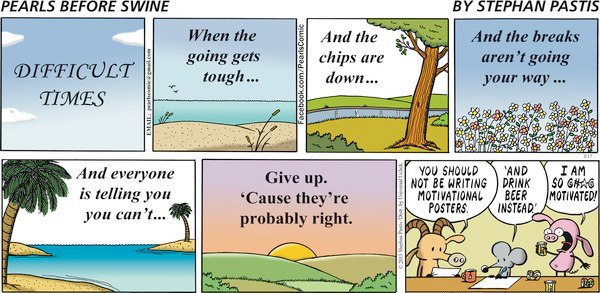
So anyway, since we are getting ready for another big winter storm I will close for the day. Tomorrow we’ll see what I put out, until then I think that I just might drink beer instead.

Peace and blessings

Padre Steve+

Leave a comment

Filed under faith, Loose thoughts and musings, philosophy

Snow Days and a New Puppy

B-JOugIIUAAPOEF

We got hammered with some pretty good winter weather here in Hampton Roads, below freezing temperatures for several days followed by 5-6 inches of snow followed by sleet, ice and freezing rain. While not New England, and believe me I am not complaining this is a bit much for our local resources. VDOT and the local city workers are doing a good job clearing the main roads, but secondary roads as well as business, government and school parking lots are a mess.

The road network on the base where I work dates from when it was built in WWII. It is now the site of a number of Navy, Marine, Joint and NATO  headquarters, along with the Staff College. It takes forever to clear everything as the roads are narrow, developed land at a premium and nowhere to put the snow and ice. As a result, we were shut down yesterday and today. But we are not alone, school districts, colleges, businesses throughout the area are either shut down or running at the bare minimum capacity. Such as life in the coastal mid-Altantic. I would hate to see what would happen if we experienced what Boston and New England are going through.

Tonight, more snow in the forecast followed by extreme cold the next two days before things start warming over the weekend.

But the snow days have allowed me to have some daddy-puppy bonding time with the newest member of our little family, Izzy Bella.

Izzy is a Papillon and she and her breeder flew here yesterday from South Dakota. Izzy has already adapted and our two other girls, Molly our nearly 14 year old Papillon Dachshund mix, and Minnie our three year old Papillon are as well to having a new little sister. By the way, Izzy’s breeder has two boys still unspoken for, and if you want I can help you get in touch with her.

If you don’t know Papillons, they are a wonderful breed. They are in the top ten breeds for intelligence, very smart, very sweet, very playful and funny and great companions or therapy dogs. Molly, though only half-Papillon helped keep me alive during the worst of my PTSD times after Iraq. If either of us are having a bad day it is hard to be depressed as Minnie won’t let that happen.

For little dogs they are great dogs for guys. I am amazed at all the pictures on the Facebook Papillon sites of big brawny men with these dogs. They are playful, funny and tough.

Anyway, I digress. I hope you have a good day wherever you are and look for some more scintillating commentary, hard hitting articles and of course a lot of history on the site in the coming days.

Peace

Padre Steve+

3 Comments

Filed under dogs, Loose thoughts and musings, papillons

From the Heart: Padre Steve’s Favorite Songs of Love and Life for Valentine’s Day

Friends of Padre Steve’s World
A Bonus post for Valentine’s Day.
Peace
Padre Steve+

padresteve's avatarThe Inglorius Padre Steve's World

young loves

I have spent many Valentine’s Days away from my wife Judy over the course of my military career. Tonight though, for the second time in a row time. I will be with her. Two years ago  I was stationed away from her and holding the duty pager for the hospital where I served as the Director of Pastoral Care. I added up the time between when I was mobilized from the Army Reserve in 1996 to support the Bosnia Operation until when I returned from Camp Lejeune in August of 2013 and I figured at we had been apart 10 of 17 years due to military assignments. I am glad I am now on my last active duty assignment before retiring in 2017, and God willing won’t have to spend months or years away from her again.

In all of these times I have loved music. I remember dating Judy…

View original post 2,541 more words

Leave a comment

Filed under Loose thoughts and musings

The Orangeburg Massacre and the Uncertain Memory of Justice Clarence Thomas

Friends of Padre Steve’s World
Today is a good day, a good day to remember the past. This is a slightly edited article that I posted last year about this time. Again it is a reminder of our past, and how some people will do anything to deny that past. The article is about the Orangeburg Massacre of February 8th 1968. Think about it, 1968. It’s not that long ago. It is important that we do not forget history, as George Santayana said “Those who forget history are doomed to repeat it and it doesn’t take much for it to happen again, if not to Blacks, to Hispanics, Arabs, the LGBT community, you name the group. When it happens it will be at the hands of your neighbors, good respectable people, pillars of the community.
Never forget.
Have a great weekend.
Peace
Padre Steve+
Spread the word,
Peace
Padre Steve+

padresteve's avatarThe Inglorius Padre Steve's World

633060317174650000_Smith-Hammond-Middleton-1

Last February, Supreme Court Justice Clarence Thomas lamented the “race consciousness” and “sensitivity” as compared to growing up in Savannah Georgia in the 1960s.

If he were not in a position of nearly unlimited power and influence where he can through a legal opinion overturn established laws regarding voters rights, equal opportunity and discrimination it would be laughable. However, Justice Thomas seems to have missed so much of what was happening to African Americans and others during the Jim Crow Era, the campaigns for resistance in the “segregation forever” movement and the wanton violence used on African Americans who simply wanted the same rights that other Americans enjoyed.

How a man as educated and supposedly aware as Thomas supposedly is can make such an absurd statement is beyond me. In fact it is ludicrous and speaks volumes about how Thomas would willingly cover up the gross injustices that were perpetrated…

View original post 1,089 more words

Leave a comment

Filed under Loose thoughts and musings

They Answered Every Expectation: Black Regiments in the Civil War

Friends of Padre Steve’s World,
It is a very busy weekend as we get our house really for a new Papillon puppy, Izzy, or Izzy Belle who will be the little sister for our three year old Papillon Minnie, or Minnie Scule. Due to that and other things going on I am doing a re-posting of an article taken from one of my Gettysburg text chapters about emancipation and the African-American Regiments and volunteers who served during the Civil War. Since it is Black History Month I thought it appropriate. I will be putting out some more of my articles on the pioneers of the Civil Rights movement, African-American military men and the men of the Negro Leagues who helped bring some measure of of equality to African-Americans who suffered long under Jim Crow, segregation, prejudice, persecution and even were lynched, or burned alive by White Americans.
So anyway, have a great weekend,
Peace
Padre Steve+

padresteve's avatarThe Inglorius Padre Steve's World

41_090_lg

Friends of Padre Steve’s World,

The following is a newly added except to the first chapter of my Gettysburg Text. It is part of the chapter the “First Modern War” which I recently updated on this site. In order not to simply repost a massive article I have only posted the new material.

Peace

Padre Steve+

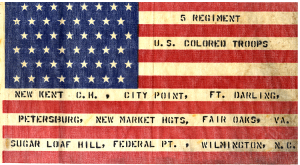
The war brought about another change to warfare in America. This was a societal and political and a political change that has shaped American military history, culture and life ever since. The Emancipation Proclamation gave African Americans, both Freedmen and recently freed slaves the opportunity to serve in the Union Army. The change of policy instituted by Lincoln was revolutionary as well as controversial and it had strategic implications for the war effort. There were many doubters in the north whose attitudes towards African Americans were not much different than Southerners, especially among the…

View original post 5,276 more words

Leave a comment

Filed under Loose thoughts and musings

Groundhog Day Predictions

groundhog-day-driving

“It’s the same thing your whole life: “Clean up your room. Stand up straight. Pick up your feet. Take it like a man. Be nice to your sister. Don’t mix beer and wine, ever.” Oh yeah: “Don’t drive on the railroad track.” 

Well, Punxsutawney Phil, the seer of weather seers made his predictions today. You guessed it, six more weeks of winter are on our way. Hopefully my next trip to Gettysburg will fall in between major winter storms like it did last year, apart from that I really don’t care, unless winter drags on into baseball season. A number of years ago I remember attending an opening day here in Norfolk where the temperature at game time was 38 degrees and winds were blowing in from center field at close to 40 knots. That was a cold ass opening day. I don’t want that again, but I digress…

However, Phil has expanded his predictions. Phil predicted another six years of political gridlock and insanity from the Tea Party and Religious conservatives, like that’s news, give me a break. Like that prediction takes some kind of gift….  Phil also predicted yet another decade or more of war in the Middle East, Africa and Eastern Europe. I have to admit, the rodent is a genius, he should be employed by a think tank and as a talking head on the various cable news networks. Likewise, the furry beast predicted that the NFL would have another five years of cheating, wife beating and other criminal activity in the NFL before Congress finally revokes the league’s non-profit status.

All that aside, I and probably you live Groundhog Day. I mean like the movie Groundhog Day. Hell, my wake up song on my iPhone is I Got You Babe just like the movie. Since I have been in the military over three decades I can say that every day is Groundhog Day, and every day I wake up on this side of the dirt is not a bad day. Actually, I wouldn’t mind a chance to replay a single day again and again until I exhausted all possibilities and got it right. It could be fun.

1625727_10152283192447059_782802676_n

Tonight I am again watching Groundhog Day and I can relate. If I was Bill Murray’s character, Phil Conners, I cannot say that I wouldn’t have done any of the things that he does in the movie. Presuming I wake up tomorrow, something that nothing none of us are guaranteed of doing, I will wake up to the words of I Got You Babe.

So until tomorrow, happy Groundhog Day and many more…

Peace

Padre Steve+


1 Comment

Filed under Loose thoughts and musings, purely humorous

The Civil War and the Transformation of Naval Warfare

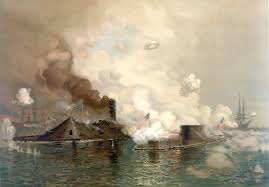
battleofhamptonroads

Friends of Padre Steve’s World

For the past month I have been doing a lot of work on my Civil War and Gettysburg text. As I looked at the first chapter which deals with the Civil War being the first truly modern war, I realized that the text was entirely land-centric. Part of this was because no naval forces were involved at Gettysburg, but they did have a significant and even a pivotal role in the defeat of the South. The technical developments at sea during the Civil War still affect us today. Since many of my students are Naval officers and our Staff College focuses on joint operations I thought it wise to include a brief introduction to those transformational developments of the Civil War.

Peace

Padre Steve+

Another aspect of the American Civil War that made it the first modern war was the naval war. There are several components of which we should take note. The first of which are the major technical advances in naval warship design, particularly in the matter of armor protection and steam propulsion. While both armor protection and steam propulsion were not new. Steam power had been introduced in the United States Navy in 1814 when Robert Fulton’s USS Demologos was launched. That ship was innovative but saw little service. The U.S. Navy commissioned a number of steam frigates, first paddle-wheel steamers and later screw-frigates in the 1830s, 1840s and 1850s. However during the ante-bellum era only seventeen of fifty-seven major ships (ships of the line, frigates and first rate sloops of war) were steam powered. By the end of the war most ships were steam powered or had sails just to supplement their steam plants.

The second major technical innovation was the use of iron in shipbuilding, particularly armor plating for protection. What had changed was that the French and British navies had adopted explosive shell in the 1830s. The first use of them by the Russians against the Turks at the Battle of Sinope in 1853 proved devastating to the Turks and convinced both the British and the French that something had to be done to counter the threat. The result was the ironclad.

During the Crimean War the French built ironclad floating batteries as well as “three small purpose built…gunboats…whose ironclad hulls proved equally impervious to solid shot and explosive shell.” [1] The French commissioned their first ironclad shell firing battleship, the Gloire in 1859. The British Royal Navy commissioned their first ironclad, the HMS Warrior in 1860. Though she did not have the rotating turrets and maintained sails as an auxiliary source of propulsion, Warrior was “rightly regarded as the first battleship of the modern age. Warrior was steam-propelled, shell firing, iron in construction from keel to bulwarks and heavily armored as well.” [2]

But it was in America that the steam powered ironclads changed naval warfare in a dramatic fashion. The Confederacy led the way in the development of ironclads largely out of necessity to break the Union blockade. As necessity is the mother of invention the Confederates were most creative in attempting to answer the Union blockade, which was tightening significantly by 1862 as Union Naval and Army forces conducted amphibious operations along the Confederate Coast seizing six of the nine ports with rail connections to the southern interior, while blockading the remaining ports. The “blockade reduced the South’s seaborne trade to less than a third of normal,” [3] which included imports of vital war materials as well as the export of the South’s only real commodity, cotton.

The blockade had a devastating effect on the southern economy and war effort: “by bringing about serious shortages in strategic items, not only added to the inflationary trends but also frustrated efforts to maintain the transportation network and to increase industrial output.” [4] A southern naval officer “conceded after the war that the blockade “shut the Confederacy out from the world, deprived it of supplies, weakened its military and naval strength.” [5] It also contributed to the decline in the southern standard of living, weakening the political will of the southern people by “accentuating the hardships of war by reducing the southern standard of living and denying consumers enough of many of the imports, such as coffee, which they valued. This was a cost of war which northerners did not have to bear.” [6]

The blockade and Union amphibious operations soon deprived the Confederacy of its major naval facilities and forced the confederate Navy to rely on small shipyards in often isolated locations. The isolation meant that the often paltry amount of supplies such as iron, wood, and weapons, could not get to these facilities, hindering the construction of warships. But the Confederate Navy also suffered from its secondary status to the Army and since “Davis favored the army, the navy received inadequate funding.” [7]
the-css-virginia-in-drydock

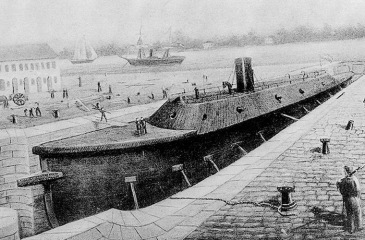
CSS Virginia in drydock

Despite this, southern naval personnel were decidedly inventive in attempting to find creative ways to defend their harbors as well as break the blockade. First was in the development of ironclad ships armed with large rifled cannons which fired the explosive shells which were so devastating against wooden ships. The first operational Confederate Ironclad the CSS Manassas was destroyed at New Orleans by Admiral Farragut’s fleet, but the most famous Confederate Ironclad had a decided effect on the war. This was the CSS Virginia formerly the Federal steam frigate USS Merrimac which had been burned at Norfolk to prevent her from falling into Confederate hands. The ship had burned to the waterline but its hull was intact. Likewise its engines, which even before the sinking were seriously in need of replacement, were intact.

Confederate Secretary of the Navy Stephen Mallory realized that innovation was the key to Confederate hopes at sea and he told the Naval Affairs committee in the new Confederate Congress “I regard the possession of an iron-plated ship as a matter of first necessity.” [8] Mallory sent agents to Europe to contract with French and British yards to build such ships but those efforts fell through when both countries decided to enforce their neutrality laws which forbade them from producing warships for a belligerent nation.

This caused Mallory to embark on converting the Merrimac into a large ironclad ram. In 1861, not long after the seizure of Norfolk and the Gosport Naval Shipyard, Mallory’s Chief of Ordnance and Hydrography, Lieutenant John M. Brooke, “had drawn up a design for transforming Merrimac’s hull into the iron plated CSS Virginia.” [9] The ship was cut down to the waterline and rebuilt with a “170 foot long casemate sloped at an angle of 36 degrees” [10]bolted onto the hull. Construction was agonizingly slow despite the efforts of officers on the scene. The ship’s executive officer, Lieutenant Catesby ap R. Jones “pressed the workmen to labor overtime, seven days a week” [11] but despite their efforts the ship was completed nearly four months after its projected completion date of November 1861. This was largely due to issues that would plague the Confederate shipbuilding industry throughout the war; “shortages of iron, congestion on the railroads hauling materials, and the necessity of retooling the Tredegar Iron works[12] to roll the armor plate slowed her construction.

The ship’s casemate had a four inch layer of armor plate, and the hull below was given a one inch armored belt extending to three feet below the waterline. Armed with six 9 inch Dahlgren smoothbore naval guns on the broadside, two 7 inch rifles forward and two 6.4 inch rifles aft and equipped with a seven foot iron ram on her bow, when complete, the new Virginia was unlike anything seen before. [13]

During construction Union spies leaked the plans to the North which catapulted the Lincoln and his Secretary of the Navy Gideon Welles into action. “When Welles learned of enemy plans for Merrimac, he appointed an Ironclad Board to study the problem. It recommended that the Navy Department let contracts for three experimental ironclads, one of them designed by John Ericsson and known as the Monitor.[14]

MMUSSM01

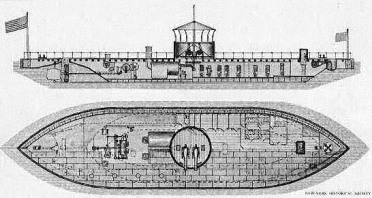
Ericsson, a Swede, was the inventor of the screw propeller and designer of the first U.S. Navy Screw Frigate the USS Princeton. The Monitor too was like nothing ever seen on the ocean. Described by some as a “cheese box on a raft” the small ship had all of her machinery located below the waterline on a completely iron hull that only drew 11 feet of water. The hull was protected by armor plate, but the most notable and innovative feature was a heavily armored revolving turret with eight inches of armor, mounted two massive 11 inch Dahlgren smoothbore guns which “could fire a 170-pound shot or 136-pound shell in any direction except straight ahead, where the pilot house sheathed in nine inches of armor was located.” [15] Future ships remedied this defect. Ericcson’s ship was mocked around the navy and by naval designers, but he and it would prove them wrong.

Monitor was completed two weeks before Virginia, but the Confederates elected to strike quickly. On March 8th 1862 the Virginia sailed under the Command of Franklin Buchanan, a veteran officer who had left the U.S. Navy to confront the Federal blockade force off Hampton Roads. During the battle she rammed and sank the large sailing Sloop of War USS Cumberland and shelled the sailing Frigate USS Congress, one of the Navy’s original six frigates until that ship caught fire and exploded during the night. The steam Frigate Minnesota, a sister ship of Merrimac and the flagship of the blockade force had run aground attempting to come to the aid of the two doomed ship and was at the mercy of Virginia. But tides and darkness caused Buchanan to withdraw for the night. March 8th was the “worst day in the history of the U.S. Navy. The Virginia sank two proud ships within a few hours – a feat no other enemy would accomplish until 1941. At least 240 bluejackets had been killed, including the Captain of the Congress – more than the navy suffered on any day of the war.”[16]

That night the tiny Monitor arrived and when Virginia steamed out on March 9th to complete the work she had begun the previous day, her crew saw a strange craft laying aside Minnesota. They did not realize that this was the new Union ironclad. As the Virginia approached Minnesota to finisher her off, the Monitor went into action. The ships fought a fierce engagement for several hours. The engagement was a draw and never fought again as neither side wanted to risk their only operational ironclad. Virginia had to be scuttled to avoid capture when Union forces captured Norfolk in May of 1862. However, the encounter had revolutionized naval warfare and doomed the graceful wooden wall of the sailing ships of the line and frigates. When the news of the action reached London the effect was shattering. The London Times commented:

“Whereas we had available for immediate purposes one hundred and forty-nine first class warships, we now have two, these being the Warrior and her sister Ironside. There is not now a ship in the English Navy apart from these two that it would not be madness to trust to an engagement with that little Monitor.” [17]

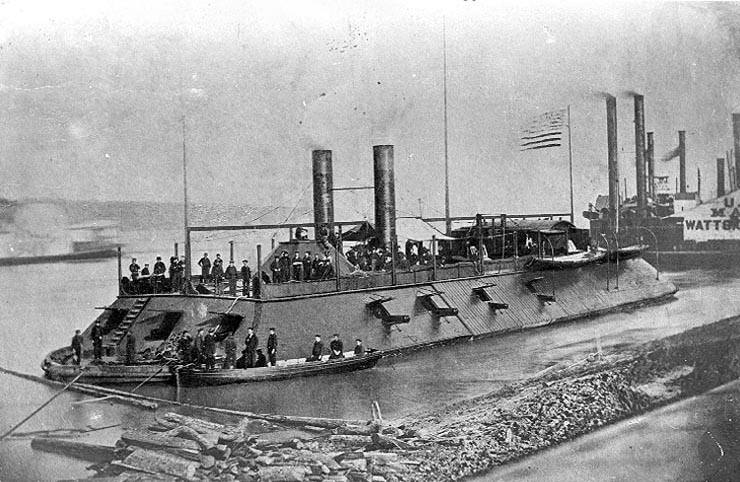
Designers on both sides experimented with various designs of ironclad warships. The Confederacy focused on building ironclad rams based on the Virginia, which featured a central armored casemate where all the ships guns were mounted. Eventually they completed twenty-one more such vessels which were used mostly in harbor defense activities. All of these ships faced construction challenges largely due to the shortage of iron plating, adequate propulsion systems and weapons. Some ships had armor plating consisting of railroad tracks which were bolted onto wooden casemates.
098604506

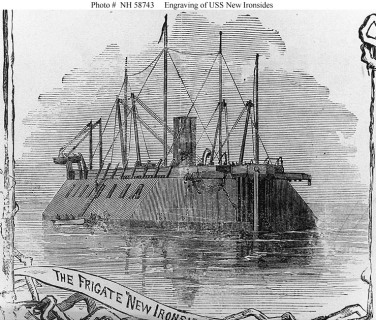
The U.S. Navy, with more shipyards and resources had a number of designs including the Eads river ironclads, the ironclad frigate USS New Ironsides and various types of “Monitors” featuring heavily armored revolving turrets designed by John Ericcson. Other designs were rejected for various reasons. While ironclads were the preferred type of ship, neither navy had the ability to build completely ironclad fleets and wooden ships still had a decided speed advantage over ironclads. Thus field-expedient protection was devised used which resulted in ships being protected by lumber, cotton and tin. However, by the end of the war the United States Navy had 58 monitors in operation. In addition to the monitor fleet another dozen or so ironclads of various types served in the U.S. Navy.

When the Ironclad Board of the United States Navy prioritized the types of ship to construct to meet the demands of the war, they rightly recognized that first priority had to be given to what we now call “the Brown Water Navy.” The Board determined that:

“Our immediate demands seem to require, first, so far as practicable, vessels invulnerable to shot, of light draught of water to penetrate our shoals, rivers, and bayous. We therefore favor the construction of this class vessels before going into a more perfect system of large iron-clad sea-going vessels of war.” [18]

Uss_Cairo_h61568

The new designs which featured steam propulsion and armor protection instantly made all previous ships obsolete and by the 1880s these features would be incorporated in warship design by navies around the world. The effect was immediate in England where “After 1865 all the Royal Navy’s new ships were built of iron; the most modern of the old were cut down and iron clad.[19] France and Russia followed, but the United States, in its post war draw down allowed its fleet to crumble and it would not be until the 1880s that the first steel ships would be built to replace the now obsolete monitors and the remaining wooden steam frigates.

892512_com_h59420

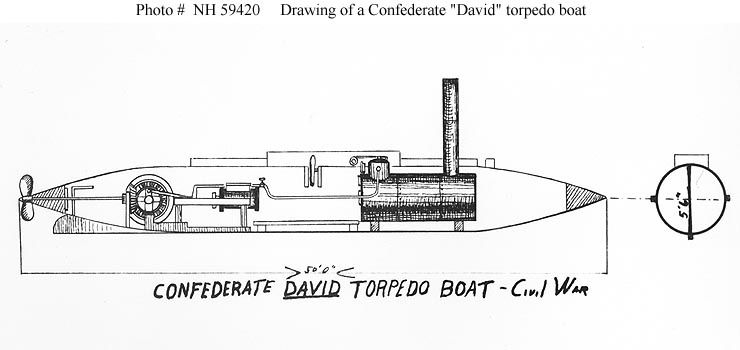
Two other naval developments from the Civil War still play an important role in naval warfare and strategy. Two were related to the modern submarine. The first that of a semi-submersible “torpedo boats” known as Davids, one of which disabled the massive USS New Ironsides, hitting the ironclad with a 60 pound charge on the tip of a spar torpedo mounted on its bow off of Charleston on October 5th 1863. The fifty foot long craft and two of her crew returned it to a heroes’ welcome. A Union torpedo boat under the command of Lieutenant William Barker Cushing, brother of Army Lieutenant Alonzo Cushing, a hero of “the Angle” at Pickett’s Charge, sank the ironclad CSS Albemarle on the Roanoke River with a spar mounted torpedo on October 27th 1864.

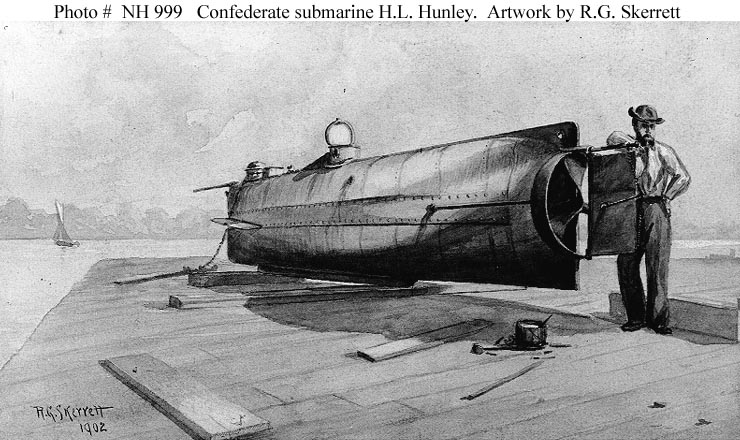
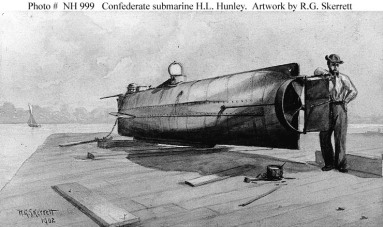
On February 17th the fully submersible CSS Hunley exploded a spar torpedo on the side of the USS Housatonic a steam sloop anchored off Charleston. The torpedo sank Housatonic and swamped the tiny Hunley taking her and her nine man crew to their watery grave. These early Confederate innovations spurred the development of submarines, something that the U.S. Navy pioneered and still leads the world in many ways. In many ways the submarine is the most deadly naval and strategic weapon system in the world today, and they trace their roots to the humble CSS Hunley, the first to sink a warship in combat.
hunley1lg

The Hunley and Monitor remain today the most famous ships of the Civil War, each of which irrevocably changed the character of naval warfare for generations to come.

The last development was the development of what were then called torpedoes, but are now known as mines by the Confederate Navy. Authorized by the ever innovative Secretary of the Navy Stephen Mallory, these weapons were used to protect blockaded ports from Union Naval forces and by the end of the war these “infernal devices” had sunk or damaged forty-three Union warships.” [20]

The lessons learned from the battles along America’s Littorals demonstrate the importance of being able to conduct both blue water as well as actions along contested shorelines and inland waterways. Likewise they demonstrate to naval strategists the importance of not ignoring any means that a weaker opponent can use to defend his coastline. The surprise attack on the guided missile destroyer USS Cole by terrorists with an explosive laden craft on October 12th 2000 demonstrate the vulnerability of even the most modern warships to technology not much different than that used against New Ironsides, Housatonic and Albemarle in the Civil War.

Notes

[1] Keegan, John The Price of Admiralty: The Evolution of Naval Warfare Penguin Books, New York and London 1988 p.110

[2] Ibid. Keegan The Price of Admiralty pp.110-111

[3] Ibid. McPherson. The Battle Cry of Freedom p.382

[4] Currant, Richard N. God and the Strongest Battalions in Why the North Won the Civil War edited by Donald, David Herbert A Touchstone Book, Simon and Schuster New York 1996 p.33

[5] Ibid. McPherson. The Battle Cry of Freedom p.381

[6] Jones, Archer. Military Means, Political Ends in Why the Confederacy Lost edited by Boritt, Gabor, Oxford University Press, Oxford and New York 1992 p. 75

[7] Millet, Allan R. and Maslowski Peter For the Common Defense: A Military History of the United States, Revised and Expanded Edition The Free Press, New York 1994 p.220

[8] McPherson, James War on the Waters: The Union & Confederate Navies 1861-1865 p.96

[9] Ibid. Thomas, The Confederate Nation pp.129-130

[10] Ibid. McPherson War on the Waters p.97

[11] Ibid. Thomas, The Confederate Nation p.130

[12] Ibid. McPherson War on the Waters p.97

[13] Ibid. McPherson War on the Waters p.97

[14] Ibid. Millet and Maslowski For the Common Defense Revised and Expanded edition p.221

[15] Ibid. McPherson War on the Waters p.99

[16] Ibid. McPherson. The Battle Cry of Freedom p.376

[17] Ibid. McPherson. The Battle Cry of Freedom p.377

[18] _____________ The Daybook: Civil War Navy Special Edition – Technology U.S. Navy Naval History and Heritage Center retrieved from http://www.history.navy.mil/content/dam/nhhc/browse-by-topic/War%20and%20Conflict/civil-war/cwsetech.pdf 16 January 2015 p.9

[19] Ibid. Keegan The Price of Admiralty p.111

[20] Ibid. McPherson Battle Cry of Freedom p.314

Leave a comment

Filed under Loose thoughts and musings

The Fever and the Fear: Conservative American Christians and Judgment at Nuremberg

Friends of Padre Steve’s World
I am going to be out tonight spending some time with a friend who needs to download and when I come home I want to spend the remaining part of the evening just visiting with my wife Judy and playing with our dogs. But I digress…
At work I am editing and re-writing another chapter of by Gettysburg text, you’ll get a look at it probably sometime next week. I am working on a project with my brother and just completed an article on the value of music to depression, anxiety and those traumatized by war for a church music publication. But again I digress…
In light of all that I decided to re-post something that I wrote just before the 2014 election. I think that it is still pretty relevant because after the election the leaders of the Christian Right have gotten even louder and more vicious in their crusade against all they despise. Thus I think it timely that since pre-season for the 2016 primaries and election has already began, at least for them that I publish this as a reminder about what happens when people allow their fear and hate to do what they should know not to do.
Have a good night,
Peace
Padre Steve+

padresteve's avatarThe Inglorius Padre Steve's World

IMG_0493.JPG

http://movieclips.com/FkTn-judgment-at-nuremberg-movie-dr-janning-explains-his-actions/

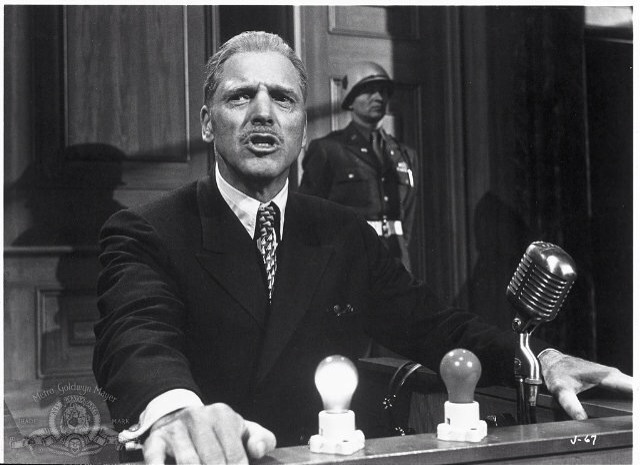
Yesterday I wrote about the lack of empathy among conservative American Christians and I drew some comparisons to the German Christians of the 1920s and 1930s who despite their reservations supported ultra-right wing parties and later the Nazi Party. As I mentioned yesterday this was brought about by the fear and hate propagated by those who had lost their favored status after the collapse of the Kaiser Reich, and especially the fear of what many Christians believed was the threat of atheistic Socialists and Communists. Their brief experiment with democracy which was devastated by political battles amid the 1919-1920 Weimar Inflation which destroyed the financial security of most Germans as well as the Stock Market Crash of 1929 which brought about the Great Depression made many receptive to the “Nazi Gospel.”

I think that conservative American Christians are going the same direction as they get swept up in the…

View original post 1,635 more words

Leave a comment

Filed under Loose thoughts and musings

Inherit the Wind: A Film for Today

Friends of Padre Steve’s World
I have a project to help my brother with so there won’t be a new article today. But the massacre by Moslem terrorists of Charle Hebdo staff and others in Paris this week was a big deal. When some leaders of the rather un-Christian American “Christian Right,” Bill Donohue of the Catholic League, who blamed the attack on the victims and Bryan Fischer of the American Family Association who claimed their death’s were God’s judgement on them for blaspheming the Christian faith , I wrote about that yesterday. Knowing that I would not have tome to write anything new I dug through my archives for this article about the film “Inherit the Wind” which deals with the Scopes Monkey Trial, a clash in this country between Fundamentalist religion enshrined as law and free speech, academic freedom and the right to disagree with state supported religious beliefs.
Thus it is quite applicable when it comes to addressing violence inspired by religion, as happened in Paris, and the attempt of people to impose their religious views on others through the police power of the state as is the case of the American Religious Right.
Have a great Sunday
Peace
Padre Steve+

padresteve's avatarThe Inglorius Padre Steve's World

inherit-the-wind

“As long as the prerequisite for that shining paradise is ignorance, bigotry and hate, I say the hell with it.” Henry Drummond (Spencer Tracy) Inherit the Wind

It is fascinating that a play and film set about an incident that actually occurred in the 1920s remains so timeless. It is hard to believe that 90 years after the trial and over 50 years after the movie that our society would still be debating the issue in the movie and that legislatures and school boards are still attempting to pass religious doctrine off as science.

itw2

It is a film about what is commonly called the “Scopes Monkey Trial” which was litigated in July of 1925 and featured an epic battle between populist three time Presidential Candidate and former Secretary of State William Jennings Bryan and famed defense attorney Clarence Darrow.

The trial was brought about after the passage of the Butler…

View original post 1,793 more words

1 Comment

Filed under Loose thoughts and musings