Category Archives: Military

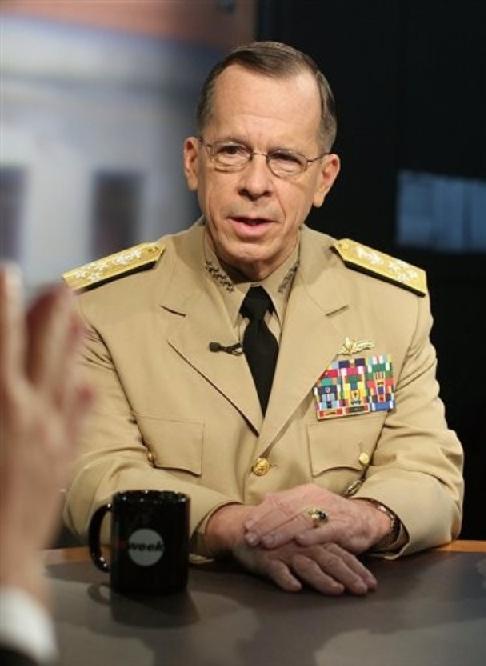
Gordon Klingenschmitt Calls Admiral Mullen a “Liar”

How do you know when Gordon Klingenschmitt is lying?

When his lips are moving.

Well Gordon James “Chaps” Klingenschmitt a former Navy Chaplain convicted by a Special Court Martial for disobeying a lawful order not to wear his uniform to participate in a partisan political rally back in 2006 is at it again.  The defrocked Priest, former chaplain, convicted criminal, compulsive liar, and theological thug has called the Chairman of the Joint Chiefs of Staff Admiral Mike Mullen a “liar” in an e-mail sent out through the Washington Times Marketing Showcase in which he was calling for Christians to join his petition “DEFENDING OUR TROOPS AGAINST OPEN HOMOSEXUAL AGGRESSION.” Since I received this unsolicited and poisonous e-mail I figured that thousands of others had it well. The fact that the conservative bastion Washington Times allows a man of Klingenschmitt’s low ethical and moral character to send out poison like this to collect money for his particular political-religious crusade shows me that this paper is nothing more than a shill for the extreme right wing fringe of American political and religious life.

Klingenschmitt who has little regard for truth as was evidenced during his relentless campaign against the Navy while serving as an active duty Navy Chaplain as per his standard operating procedure has one again engaged in the character assassination of yet another military officer, this time Admiral Mullen.  Klingenschmitt who has a palpable propensity to spin the truth in such a manner that it is no longer recognizable as truth; has launched this gratuitous attack against Admiral Mullen using the venomous invective that is his specialty.  The title of his e-mail reads: “Top Admiral Lies to Senate about Homosexuality.”  If I recall lying to Congress is like a felony, so not only has Klingenschmitt accused Admiral Mullen of being a liar but committing a Federal Crime.  Well I guess that Klingenschmitt knows what that is about having done it himself and then using it afterward to make a decent living off of gullible Klingenschmitt believing Christians who I sometimes refer to as the Klingenban who eager eat up his fabricated tails of being persecuted for “praying in Jesus Name.”

Since lying to congress is a pretty stiff charge to level at anyone let’s see the Klingenfraud’s leap of legal logic which allows him to make such a claim about the nation’s top military officer.  Klingenschmitt is his e-mail makes the following explanation of his case in his e-mail:

CHAIRMAN OF JOINT CHIEFS DEMANDS HOMOSEXUALS LIE TO MILITARY

Tuesday the Secretary of Defense Robert Gates and Chairman of the Joint Chiefs of Staff Admiral Mike Mullen deceived the Senate Armed Services Committee, repeating President Obama’s demand to repeal the “don’t ask, don’t tell” (DADT) prohibition against open homosexual aggression within the ranks of the military.  “We have in place a policy which forces young men and women to lie about who they are in order to defend their fellow citizens,” Admiral Mullen fibbed, revealing his personal belief that “allowing gays and lesbians to serve openly would be the right thing to do.”

First he claims that Admiral Mullen “deceived the Senate Armed Services Committee” by “repeating President Obama’s demand to repeal “the don’t ask, don’t tell” (DADT) prohibition against open homosexual aggression within the ranks of the military.”  If don’t ask, don’t tell was a “prohibition against homosexual aggression in the military” then the charge might have merit, but alas Gordon is serving up his own lie.  “Don’t ask don’t tell” was designed to protect homosexuals and allow them to serve in the military with the restriction that they could not openly admit that they are homosexual and to prevent commanders or others from asking if they are homosexual which then could be used against them in judicial, non-judicial and administrative procedures which leave them with a criminal record like Mr. Klingenschmitt and end their career.  It was never designed to protect the military from “homosexual aggression” as is charged by Mr. Klingenschmitt.  The fact that the nation’s top military officer supports allowing homosexuals to serve openly is lying by saying that don’t ask, don’t tell is a “policy which forces young men and women to lie about who they areis frankly insulting to any rational human being.  The policy indeed forces these men and women to daily hide a major part of who they are in order to serve.

Now here is where Mr. Klingenschmitt’s argument gets a little bit, oh well a lot loopy.  Instead of perusing any actual point of law in regard to the crime of lying to congress he goes into an anti-homosexual screed built around his theology which is taken loosely out of Romans Chapter One but even so incoherently argued that it makes your head spin.  It as if that he believes that his interpretation of scripture places him as the judge of Admiral Mullen or anyone, especially homosexuals who dare to disagree with him.  He then makes this incredibly ignorant statement of circular logic that says in short that homosexual man are trying to be women and homosexual women are trying to be men. You have to read this to believe it:

“Here’s a simple proof:  Men who were created by God with male body parts are not women, and they lie to themselves, the world, and their commanders when they pretend to be, and act like, women.  Women who were created by God with female parts are not men, and they lie to themselves, the world, and their commanders when they pretend to be, and act like, men.” So in other words if a gay person admits to being gay they are lying about who they are because they are pretending to be the opposite sex.

He then goes on:

“Mullen’s confused argument would permit men to deceptively act like women, and women to deceptively act like men, openly deceiving themselves, the world, and their military commanders, and boldface lying against God’s very truth, that He created men to be men, and women to be women.   But today’s confusing homosexual propaganda equates “honesty” with men openly flaunting their femininity, and “truthfulness” with women openly flaunting masculinity.   Who’s really telling God’s truth?”

Gordon states that: “Admiral Mullen’s confused argument…”  You have got to be kidding.  I don’t know any homosexual men on active duty who deceptively act like women and some of the homosexual men and women who are lesbians would surprise you, manly men and feminine women.  You see Gordon Klingenschmitt attempts to impose his beliefs on others and uses the basest of stereotypes to paint homosexual men as effeminate, when only some are and homosexual women as the classic “dyke” which again pandering to the basest of prejudice which seeks to all lesbians as the crudest stereotype imaginable.  He continues on in this vein for some time and it is not worth regurgitating here.

He then launches his attack loosely paraphrasing Romans One interspersed with his own commentary to buttress his charge that Admiral Mullen lied to Congress and that homosexuals are liars and that we need to help Senator McCain to “fight this open perversion, and protect our troops from open homosexual aggression…”  The attack is disingenuous and dishonorable, but then I would expect nothing less out of a man who has made a career out of defaming others and using bully tactics to attempt to force the Navy to let him do whatever he wants.

He then makes a vicious and yet nonsensical attack at Army Lieutenant Daniel Choi a West Point Graduate.

“CBS news interviewed homosexual Army Lt. Dan Choi, a graduate of the U.S. Military Academy at West Point who currently faces discharge for publicly announcing he’s gay.

“I think it’s a very healthy thing for people to be able to tell the truth and to come to terms with who they are. I think it’s a sign of maturity,” Choi said, “At my very first day at West Point, I learned that the honor code says a cadet will not lie, will not tolerate those who lie,” said Choi. “They didn’t say that a cadet who was gay could lie whereas straight cadets didn’t have to lie.”

As a USAF Academy graduate knowing the honor code, I now personally confront Choi as a liar, who now openly violates his honor oath, since he deceives himself and the world, by claiming to be feminine, when God created him masculine, with a male body.  LIAR. Choi should immediately be thrown out of the Army, not merely for sexual perversion, but for DISHONESTY AND LYING.  The only reason he graduated West Point is that he never lied by openly claiming to be feminine while a cadet, when God created him to be masculine.  THIS PROVES DON’T ASK DON’T TELL IS THE MOST HONEST POLICY, because it encourages people with sexual perversions not to openly lie about their sexual identity.  But if DADT is repealed by Congress, men will claim to be women, and women will claim to be men, and the open season of dishonesty and lying will begin.”

Klingenschmitt once again uses the argument that Choi like other homosexuals is a liar because they are honest about their sexual identity.  Whether Klingenschmitt and the Klingenban agree with this or not we live in a free country.  We don’t live in Afghanistan or Iran where guys just like Klingenschmitt, only Moslem versions, preach the same hatred and use their religion as the law of the land.  Klingenschmitt though “Christian” is no different than the Taliban and if people like him were ever to assume control of the country we would discover what fun it is to live in a country where religious fanatics have the power of the gun to enforce their law.  Lieutenant Choi in my view whether one agrees with his sexual preference has demonstrated integrity, honor and devotion to his country and never in his protest against don’t ask, don’t tell slandered his superiors.  However I digress. Klingenschmitt who did not lie about being on a combat tour on USS Anzio his combat record pales in comparison to Choi a Military Academy graduate, son of a Korean Baptist minister, Arabic and Farsi translator and interpreter who served two combat tours as an infantry officer in Iraq before returning to the National Guard was discharged under don’t ask, don’t tell when he revealed his homosexuality.  Since then he has become an advocate for ending don’t ask, don’t tell.  Both are advocates for their cause but Choi has never offered public prayers for the death of his opponents or smeared the reputations of honorable men who were his superiors either before his discharge or after.

Klingenschmitt then recites a litany of reasons of why don’t ask don’t tell should not be ended.  His e-mail makes the following points:

“Four reasons: 1) Allowing open homosexuality especially hurts unit cohesion and would cost American lives in war, damaging the trust shared in close proximity, common sleeping quarters and showering facilities that are unavoidable in close combat.  2) Men and women do not share the same showers for obvious reasons, so why force men to share showers with openly homosexual men?  This fact alone would hurt recruiting.  3) The rampant spread of the HIV-AIDS virus contaminates the blood often shared by necessity on the battlefield.  Soldiers requiring blood-transfusions and medics would be immediately endangered.  4) “Gay promotion quotas” would soon be forced upon presently impartial promotion boards, causing a burdensome rise in sexually-charged “equal opportunity” complaints against commanders, especially those who offend gays by inadvertently speaking of their traditional Judeo-Christian faith.”

First he makes the charge of decreased unit cohesion and trust but most recent polls of military personnel do not bear this out. Yes some will not be comfortable with open homosexuals in the ranks. However as I have said it is about conduct, if the standards of how one conducts themselves toward other service members are enforced uniformly there will be few problems.  Shower facilities are an issue often thrown up by people like Klingenschmitt but there is no actual facts to back it up.  His misuse of AIDs and HIV being blood donors either in combat zones or outside of them is spurious. No one with AIDS or HIV is allowed to donate blood and military personnel regulations which I helped to draft in 1987-88 forbid the deployment of HIV positive people to areas that they cannot be treated or that could endanger their medical condition.  Since HIV and AIDS is not confined to the homosexual population and is not being spread rampantly as Klingenschmitt alleges the argument is a straw man.  Finally the charge that there would be homosexual quotas for promotion is also disingenuous.

Plainly speaking Klingenschmitt has no honor. He is an expert at distortion of the facts, misusing scripture and character assassination. He has since his first days in the Navy sought to enforce his brand of Christianity on his shipmates, peers and superiors. He lodged complaints against every commanding office that he served under and with his accomplices at World Net Daily engaged in every form of malicious conduct imaginable to include clandestine recording of the his superiors informing him of his court-martial charges.  His shipmates from USS Anzio have told me in person and in comments to this site of his intimidation tactics and bullying on that ship.  Following his discharge from the Navy he has engaged in a tactic called “imprecatory prayer” against a number of adversaries, praying for God’s judgment on them and that their days be few, a comment that he says is not a prayer for their early death but in the context of the entire scriptural passage (Psalm 109: 7-11) can only be read as such.

Klingenschmitt also quoted Elaine Donnelly of the “Center for Military Readiness” a right-wing organization that features Phylliss Schafly as a member of its board of advisors, that “it is unconvincing to hold up the small, dissimilar of foreign nations…as models for America’s forces.” Well since 25 nations including our closest allies, Britain, Canada, Australia, Israel, Germany and France as well of most of NATO whose soldiers both straight and gay serve alongside of ours in Afghanistan have allowed homosexuals to serve with little or no disruption in operations or efficiency I wonder what she is getting at.  Maybe its that she feels that American military personnel are less professional than our allies and would not behave professionally if we end don’t ask, don’t tell.  It is curious that I don’t see too many elected Republicans getting on the Klingenban bandwagon…huh… perhaps they know that a large majority of voters would find their support of Klingenschmitt’s crusade unpalatable and might react negatively to them if they oppose the change. 

I have posted a myriad of links to other things that this dangerous man has done here:

http://shamefulchaplain.blogspot.com/

http://pubrecord.org/religion/3355/ex-chaplain-offered-sacrifice-jesus/

http://www.militaryreligiousfreedom.org/press-releases/audio_recordings.html

http://scienceblogs.com/dispatches/2009/04/klingenschmitt_prays_for_death.php

http://blog.au.org/2007/04/05/a-matter-of-honor-the-truth-comes-out-about-former-chaplain-klingenschmitt/

http://undergroundunbeliever.blogspot.com/2009/04/continuing-tale-of-court-martialed-navy.html

http://www.stripes.com/article.asp?section=104&article=33868

http://faithfulprogressive.blogspot.com/2009/08/scaring-naive-christians-and-elderly.html

http://www.benedictionblogson.com/2009/04/28/the-imprecatory-prayer-of-gordon-james-klingenschmitt/

http://www.huffingtonpost.com/chris-rodda/conspiracy-theorist-milit_b_204948.html

http://www.washingtonpost.com/wp-dyn/content/article/2006/01/09/AR2006010901812.html

http://scienceblogs.com/dispatches/2008/07/the_continued_absurdity_of_gor.php

http://bypi.blogspot.com/

http://hamptonroads.com/node/153451

http://www.britannica.com/bps/additionalcontent/18/25635760/ExChaplains-Boss-Says-Religious-Right-Tales-Inaccurate

http://www.democraticunderground.com/discuss/duboard.php?az=view_all&address=389×6708951

http://www.religionnews.com/index.php?/rnstext/does_god_answer_prayers_to_do_someone_ill1/

The list can go on and on, these are but a few reports about Klingenschmitt so here are my own tributes to “Chaps” which are linked below:

https://padresteve.wordpress.com/2009/05/30/gordon-klingenschmitt-and-his-followers-the-klingenfraud-and-the-klingenban/

https://padresteve.wordpress.com/2009/08/08/oh-lord-stuck-in-lodi-again%E2%80%A6-gordon-klingenschmitt-does-lodi/

So with Klingenschmitt in the news it is right that his theological cousins in the Taliban, Iran’s President Ahamadinejad and the Mullahs seek to enforce the same standards of belief on their people as Klingenschmitt and the Klingenban seek to do here. He may be a “D-lister” but he serves an evil purpose and masquerades as a minister of light.  Klingenschmitt’s cause is not the redemption and reconciliation paramount in the Christian Gospel, but rather a twisted and hateful campaign of self promotion as he exalts not Jesus but himself and his political cause which he baptizes with Scripture verses.  This is not Waziristan and the Taliban and Al Qaeda are not in charge. Our founding fathers fought to prevent the United States from becoming a theocracy. While we cherish the role of religion in particular the Judeo-Christian tradition of this country we recognize that this is a pluralistic nation where no religion can impose its views simply because they believe that they are more correct than others and no-one including Gordon Klingenschmitt can issue a Fatwah stating otherwise.

Have fun with the links and spread the news that Gordon Klingenschmitt is coming to town.

Peace,

Padre Steve+

2 Comments

Filed under faith, Lies of World Net Daily, Military, Political Commentary, Religion, US Navy

I Agree With Admiral Mullen and Secretary Gates on “Don’t Ask Don’t Tell”

Note: This is an article that many will not agree with me on.  I know this and write it anyway because I feel it is the right thing to do and also support the highest leaders in my military chain of command in what will be a contentious and acrimonious debate. I know that people on both sides of this issue are sincere in what they believe and if my position is in opposition to others I mean no disrespect. My position comes from 28 plus years in the military in which I have both served with and commanded homosexual soldiers who were stellar individuals and soldiers.  Likewise as a chaplain I have dealt with, served with and cared for homosexual Soldiers, Marines and Sailors who in order to serve were and still are forced to cover up an essential part of their life in order to serve in the military, deploy in harm’s way and risk all to serve our country. While some readers may not agree with me I do hope that people will not simply write off what I have to say because of their passionately held beliefs. I do believe that people can disagree and debate but at the end of the day we are all still Americans.  I dedicate this post to the service of the homosexual men and women with whom I have served and continue to serve among. I pray that they will be able to serve openly without fear of retribution.

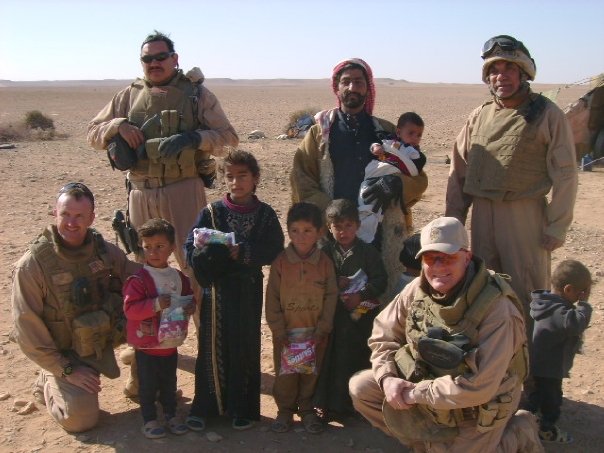
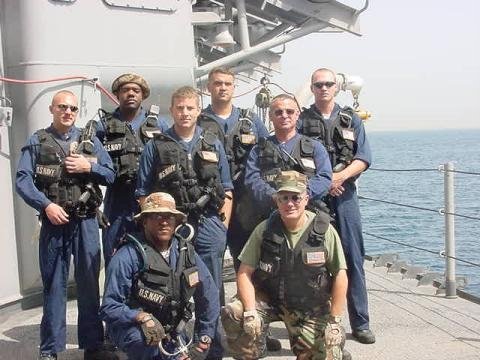
I have been in the military 28 plus years having served in the Army, Army National Guard, Army Reserve and the Navy. In my Navy career I have served multiple times with the Marines and also Navy EOD. I have been a platoon leader, company executive officer, company commander, and battalion, brigade and group staff officer.  I have served two tours in combat zones as an advisor to US Navy boarding teams before Operation Iraqi Freedom as well as working with our Marine, Army, Navy and Air Force advisers in Al Anbar Province.  In the course of my career I have served alongside of many homosexual Soldiers, Marines, Airmen and Sailors.  With very few exceptions I found them to be selfless, patriotic, professionals who had to live a lie in order to serve the country that they love.

When Admiral Mullen and Secretary Gates announced their support to end the “Don’t Ask Don’t Tell” law that in effect says that homosexuals are allowed to serve as long as they lie about who they are I was pleased.  I have known so many professional, patriotic and selfless men and women who as military servicemen and women have had to lie about an essential part of who they are in order to serve that I felt horrible for the fact that they had to hide who they are or face removal from the service.   Even if they served with distinction and rose to the highest ranks as was the case with some and did not cause problems that they could be discharged from the military for either admitting their sexual preference or having someone “turn them in.”  Of course either under “Don’t Ask Don’t Tell” was enough end their career and was something that I found to be both cruel and hypocritical.

I was platoon leader, company executive officer, company commander and brigade and battalion staff officer in the Army prior to becoming a Chaplain.  As such I dealt with military justice, military law and personnel policies as well as the management of soldiers diagnosed as HIV positive.  As the Adjutant of the Academy Brigade of the Academy of Health Sciences I worked with commanders and prosecutors the first case where a heterosexual soldier was convicted of intentionally spreading the HIV virus in 1987.  I dealt with the heartbreaking cases of career soldiers who found out that they had tested positive for that virus simply because I was the junior personnel officer in the organization and those senior to me at the schoolhouse did not want to meet these men.  I helped draft with members of the Office of the Surgeon General the Army policy on managing personnel with HIV and AIDS.

In my career I have known many honorable, decent and even yes “Christian” soldiers, sailors and Marines who were homosexual. In fact the vast majority of them were less trouble, less promiscuous and better soldiers, Marines or Sailors than their peers.  Even so they could not then and still cannot openly admit to their sexual preference.  My take is that in this age of where so many people are willing to say “I support the Troops” a yellow ribbon in their yard or decal on their car but unwilling to sign on the dotted line that it is wrong to forbid homosexuals to serve without fear of being discharged for admitting that they are gay for their sexual preference alone.  I feel that a man or woman who wants to serve our country knowing that we are at war and that they will likely be deployed into a combat zone should be allowed to so long as they meet the same standards that every other military member must meet in order to serve.  To me the issue is about conduct and performance and not someone’s sexual preference.  From a professional point of view this comes down to a matter of military personnel exhibiting professional conduct and behavior and not to their sexual preference.  So long as they are not making unwanted sexual advances in the workplace, not using command influence to force people into unwanted sex nor being so promiscuous that their conduct off base jeopardizes compromises them or jeopardizes national security that they should be allowed to serve openly. These are exactly the same standards applied to heterosexuals.  If they violate them then like any other Soldier, Sailor, Marine or Airman they should be disciplined.   I do not believe that various religious groups and political parties or even veterans groups should have veto power over this should the study commissioned by the SECDEF determine that the change will not cause undue disruption in the force or compromise our ability to successfully wage war and the Congress change the law to allow them to serve openly.

Twenty-five other countries including Israel and much of NATO allow openly homosexual men and women to serve and this has not impeded the professionalism of their military. Those countries are: Australia, Austria, Belgium, Canada, Czech Republic, Denmark, Estonia, Finland, France, Germany, Ireland, Israel, Italy, Lithuania, Luxembourg, Netherlands, New Zealand, Norway, Slovenia, South Africa, Spain, Sweden, Switzerland, United Kingdom and Uruguay. Many of the soldiers from these nations currently serve alongside of American forces in Afghanistan and have been in Iraq.  Additionally the Central Intelligence Agency, the Federal Bureau of Investigation, the Defense Intelligence Agency and the National Security Agency all allow openly homosexual men and women to serve in their ranks.

I liked Admiral Mullen’s blog http://www.jcs.mil/newsarticle.aspx?ID=221 and could not agree more with the Admiral.  I can say that I have served alongside homosexuals since the time that I enlisted. For the most part they have been hard working, honest and decent people who I would have loved to have as a neighbor or friend.  Like any other segment of humanity there have been some that I did not think should be in the military but this was not to their sexual preference but rather their performance and conduct.  Simply put some people regardless of sexual preference do not have what it takes to serve in the military.  If they cannot cut being in the military due to bad physical conditioning, lack of the brainpower needed to function in a high tech military or medical reasons, past criminal conduct or associations with groups opposed to the government, they should not be allowed to serve.  I don’t care if they are heterosexual, homosexual or vegisexual if they meet service criteria to serve they should be allowed to serve. Likewise if someone is willing to endure multiple deployments knowing the reality that they will serve in harm’s way and are willing to do so for King and Country I definitely think that they should be allowed to do so without penalty. I do not see the military seeking to throw out every heterosexual who has committed adultery, have sexual additions of various sorts or who have relationships that if are not outright fraternization are awfully close; all of which violate the Uniform Code of Military Justice.  Thus it puzzles me as to why homosexuals, especially those in a committed and stable relationship should be held to a higher standard than heterosexual who are not.   If the standard is conduct then the rules need to apply equally to all in an equitable manner.

To me as a Christian, Priest and career military officer it seems hypocritical to ask homosexuals to lie about a major part of their lives in order to serve on active duty and then if they do “come out of the closet” to bring them up on charges or discharge them because they seek to be honest about their sexual preference. When one takes a look at some the rather distinguished careers of some of those discharged, men and women who have served bravely in combat and been effective leaders it seems that the policy is flawed. It makes men and women who volunteer to serve the country in time of war to live a lie, in other words make them commit a violation of integrity in order to serve. What if the same standard was applied to other personal beliefs?  Can you imagine the outcry if Christians were told that in order to serve in the military that they could not do anything to acknowledge their faith even off base or in their home? Can you imagine the outcry if someone who is the member of a legal and legitimate political or social group such as those who are part of the pro-life movement or any other religious or moral cause being told that they will be discharged if they acknowledge their beliefs with a bumper sticker supporting their cause?   What “don’t ask don’t tell” tells people that if they want to serve that they cannot be honest about where they are.  Fundamentally is tells them that they should violate personal integrity in order to serve in a manner that is not applied to others who have beliefs or viewpoints that may be controversial or even serve to cause discord in the ranks.  Cases in point are military members who identify themselves as such on Neo-Nazi websites, such behavior and beliefs are certainly more potentially more dangerous to the military than homosexuality.

To be sure “throughout its existence, the United States military has viewed homosexuality as being incompatible with military service. The military identified sodomy as grounds for a dishonorable discharge under the Articles of War adopted in 1776, though it did not identify homosexuality as a “status” until 1942. During the Carter Administration, the “no exception” policy was adopted, officially banning homosexuals from military service.”[i]

“A Navy study, popularly referred to as the Crittenden Report, concluded as early as “1957 that homosexual service members did not pose a greater security risk than heterosexual personnel.” The Secretary of the Navy appointed a board to evaluate the Navy’s policies and procedures governing homosexual service members. No major changes were recommended, in part because of the military’s reluctance to “liberalize standards ahead of the civilian climate.”

The findings did acknowledge that many more homosexuals were likely serving in the Armed Forces than the small number that had been involuntarily discharged. The report noted that “there have been many known instances of individuals who have served honorably and well, despite being exclusively homosexual.”

The board also found no factual data to support the premise that homosexual service members “necessarily” posed a security risk. Research indicated that factors unrelated to sexual orientation constituted security risks and that the type of sexual activity mattered less than the “matter of indiscretion.” “According to the report, intelligence officers sometimes considered heterosexual relations more of a security threat than homosexual conduct.”  See the PDF of the Crittenden report at:

http://www.lonelygods.com/res/crittenden_report.pdf

[ii]

From what I see in the ranks the younger generation of Soldiers, Sailors, Marines and Airmen are much more open-minded about homosexuals in the military than my generation and those immediately following mine.  It is doubtlessly true that some would not be comfortable around openly homosexual servicemen and women but it is also true that many of the same service members serve alongside homosexuals presently without conflict or any major issues.  However as both Admiral Mullen and Secretary Gates noted it is best to actually hear from the troops as we look at the issue and be prudent in the way the change is done.  It is far more preferable to let the military examine the issue and come up with a plan than it is to allow special interest groups of any kind and politicians to decide the issue by legislative fiat be it to keep “don’t ask don’t tell” or to allow openly homosexual men and women to serve in the military.  The Israeli experience may actually help the U.S. military in dealing with the issue. In 1993 Israel removed “all restrictions on gay and lesbian soldiers were dropped. Homosexuals in the Israel Defense Forces could join close-knit combat units or serve in sensitive intelligence posts. They were eligible for promotion to the highest ranks. Fourteen years later, Israelis are convinced they made the right decision. “It’s a non-issue,” said David Saranga, a former IDF officer and now Israel’s consul for media and public affairs in New York. “There is not a problem with your sexual tendency. You can be a very good officer, a creative one, a brave one and be gay at the same time.”” [iii]

Attitudes in the ranks have changed since the 1990s like the rest of the country military personnel are now more comfortable with openly homosexual personnel.  A Zogby poll conducted in 2006 noted that “nearly three in four troops (73%) say they are personally comfortable in the presence of gays and lesbians. Of the 20% who said they are uncomfortable around gays and lesbians, only 5% are “very” uncomfortable, while 15% are “somewhat” uncomfortable. Just two percent of troops said knowing that gays are not allowed to serve openly was an important reason in their decision to join the military.” http://www.zogby.com/NEWS/readnews.cfm?ID=1222

Having served for nearly 29 years I think that the numbers in the poll are reflective of the military population.  A CNN-Gallup Poll of 4-6 May 2007 reported that “Seventy-nine percent of poll respondents said openly gay people should be allowed to serve in the military. Eighteen percent said they should not.” http://www.cnn.com/2007/US/06/27/poll.gay/index.html If we indeed are a republic that reflects the views of the people then maybe politicians and special interest groups need to listen to military men and women as well as the country at large.  I have listened to arguments on both sides of the issue and while in 1993 I agreed at “Don’t Ask Don’t Tell” was the right way to go I do not agree with some of the arguments used to maintain the present law like people ogling each other in the showers. Since most showers even in combat zones have separate stalls it is a straw man argument which appeals to emotion rather than appealing to fact.  Likewise comments such as those by Oliver North insinuating if gays were allowed to openly serve in the military that: Now, here’s what’s next. NAMBLA members, same-sex marriages. Are chaplains in the U.S. military going to be required to perform those kinds of rituals? Do they get government housing?[iv] North’s comment is simply incendiary especially in regard to the question about chaplains being “required” to perform “these types of rituals” is not rooted in any fact as no chaplain is required to perform rites or sacraments that go against what his or her church or religious body teaches nor their personal beliefs.  To suggest otherwise is simply disingenuous.

An interesting study by a student at the Marine Corps Command and Staff College making the point to change the “Don’t Ask Don’t Tell” law is found here:

http://www.dtic.mil/cgi-bin/GetTRDoc?AD=ADA508994&Location=U2&doc=GetTRDoc.pdf

This is a subject that needs to be addressed because it deals with patriot Americans who desire to serve their country in time of war. I pray that the law will be changed and that when the times comes for that change that people will not act in an acrimonious manner but instead be thankful that these men and women are willing to serve when so many are not. I know that some will totally disagree with my reasoning and that I will likely get some flak for this position, but I find the arguments of the Secretary of Defense and Chairman of the Joint Chiefs to have merit and to be reasonable and should at least be examined in a dispassionate matter by the military before any decision is made by Congress.

Peace,

Steve+


[i] Captain M Suhre, Changing the Department of Defense’s Policy on Homosexuals Marine Corps Command and Staff College 19 February 2008 retrieved from

http://www.dtic.mil/cgi-bin/GetTRDoc?AD=ADA508994&Location=U2&doc=GetTRDoc.pdf 5 Feb 2010

[ii] The Crittendon Report: Report of the Board Appointed to Prepare and Submit Recommendations to the Secretary of the Navy for the Revision of Policies, Procedures and Directives Dealing with Homosexuals 21 December 1956- 15 March 1957. Retrieved from http://www.lonelygods.com/res/crittenden_report.pdf 5 February 2010

[iii] Martin, Susan Taylor. Israeli experience may sway US Army policy on gays retrieved from http://www.glbtjews.org/article.php3?id_article=361 5 February 2010

[iv] Oliver North on the Sean Hannity Show retrieved at

http February ://www.foxnews.com/story/0,2933,584942,00.html 5 February 2010

5 Comments

Filed under Military, national security, Political Commentary

Padre Steve’s Military History and Theory Articles

I am not normal, ask anyone who knows me.  I am a Priest who is also a military history and theory “wonk.”  I guess part of the reason for this as that I did not begin life as a clergyman. In fact way back when, when I was a young whippersnapper it was my desire to be in the military.  I was a Navy brat who grew up during the height of the Vietnam War and had friends whose fathers did not return from that war.  Likewise when my dad was serving in Vietnam surrounded by the North Vietnamese and Viet Cong in a town called An Loc I had a blessed Sunday school teacher tell me that my dad was a “baby killer.”  When you are an eleven year or twelve year-old and get told that your dad is a baby killer by some hippie wench you grow somewhat cynical about such people early in life.

Even worse than Limbaugh and Hannity is Michael Savage. Savage who despite having an earned PhD in the field of nutrition is so clueless and rude in discussing military issues that I can’t believe my ears whenever I run into his program. His absolute disdain that he shows for military leadership and actual implications of how we wage war in this era is so off base that it isn’t even funny.  For all of their lack of understanding of military strategy and policy at least Limbaugh and Hannity for the most part treat people in the military respectfully.

We no longer live in the World War Two world, warfare has changed and as the 2010 Quadrennial Defense Review notes that the United States must “prevail in today’s wars” while at the same time “prevent and deter conflict” which involves “preventing the rise of threats to U.S. interests requires the integrated use of diplomacy, development, and defense, along with intelligence, law enforcement, and economic tools of statecraft, to help build the capacity of partners to maintain and promote stability.” If deterrence fails we must Prepare to defeat adversaries and succeed in a wide range of contingencies: If deterrence fails and adversaries challenge our interests with the threat or use of force, the United States must be prepared to respond in support of U.S. national interests. Not all contingencies will require the involvement of U.S. military forces, but the Defense Department must be prepared to provide the President with options across a wide range of contingencies, which include supporting a response to an attack or natural disaster at home, defeating aggression by adversary states, supporting and stabilizing fragile states facing serious internal threats, and preventing human suffering due to mass atrocities or large-scale natural disasters abroad.” (2010 QDR Executive Summary pp. v-vi)

So tonight I am highlighting a series of articles that I have written that deal with the kind of war that we are waging in Afghanistan and have done in Iraq as well as a couple of studies from military history that discuss how the diplomatic, intelligence, economic and military resources of a nation are all important in the continuum of conflict and the importance of alliances when waging global warfare. These are the articles that I have produced so far and will as time goes on continue to add to.  They span the spectrum and hopefully will assist the reader in sorting through a lot of the mindless gibberish that is pumped out from the political right and left on TV, radio and the internet.  Some of these are drawn out of military history but have an application today while others are more targeted at what is going on today.  Since this is an ever expanding subject for me I expect to post more articles on a regular basis.

Learning to Apply the Principles of Counterinsurgency Part One: Introduction to the Soviet-Afghan War

Mission Accomplished in Al Anbar: The Marines Turn Over the Mission to the Iraqis

The Anomaly of Operation Desert Storm and Its Consequences Today

War Without Mercy: Race, Religion, Ideology and Total War

Lessons on Coalition Warfare: The Dysfunctional Coalition German and the Axis Partners on the Eastern Front

The Afghan War 2009-2012: Lessons from Algeria 1954-1960 A Review of “A Savage War of Peace

Moslem Allies and Friends

Lessons for the Afghan War: The Effects of Counterinsurgency Warfare on the French Army in Indo-China and Algeria and the United States Military in Vietnam

The most dangerous assignment: 4 More Advisers Die In Afghanistan

Brothers to the End…the Bond between those Who Serve Together in Unpopular Wars

Iran Makes Noise in Persian Gulf: Obama Dispatches Patriots and Ships to Deter

Mission Accomplished in Al Anbar: The Marines Turn Over the Mission to the Iraqis

The Dangerous and Often Thankless Duty of Military Advisers

More on our Unsung Heroes-Military Advisers, Past and Present

The Ideological War: How Hitler’s Racial Theories Influenced German Operations in Poland and Russia

D-Day- Courage, Sacrifice and Luck, the Costs of War and Reconciliation

Dien Bien Phu- Reflections 55 Years Later

God in the Empty Places

I hope that this rather diverse series of articles and my comments will be helpful to the reader in sorting through all the crap that floats about as “truth” from all sides of the media and the various political parties, special interest groups and others more intent on seeing their often divergent and uninformed agendas.

Peace

Padre Steve+

Leave a comment

Filed under counterinsurency in afghanistan, Foreign Policy, hampton roads and tidewater, History, iraq,afghanistan, Military

Groundhog Day, Tapping the Keller Heller and Padre Steve’s Top World War Two Articles

Well today is Groundhog Day and Punxatwany Phil has predicted another six weeks of old man winter. This is something that does not surprise me as I expect to be “chilling” at Harbor Park the night of April 8th when the Tides play the Bulls in their home opener.  Back in 2005 the temperature was 38 degrees at game time with winds gusting to 40 mph blowing in over the center field wall.  Since we have already had a massive snowstorm this last weekend and may get another bout of winter weather beginning Friday I know the cuddly furball is right.  Every day I wake up thanking God for global warming as I can’t imagine how cold it would be without it.  So winter is here to stay for a while and I guess my short cargo pants have to wait until opening day to come back out.  Anyway while at back after trudging back to the office after my 0715 meeting I ran into one of our other chaplains in the hallway near our small Navy Exchange.  I went into the exchange to pick up a bottle of water and some apples and after waiting in line left the exchange to head back to the officer where I ran into the same chaplain in almost the same location.  I asked “didn’t I just see you here?” Since I had just passed him and he was going the other way I thought it was déjà vu all over again.  I followed up my question with the comment “well it is Groundhog Day.”  So once again though not waking to the sound of I Got You Babe I was confronted with the reality of Groundhog Day in the flesh several hundred miles from Punxatwany Phil. C’est le guerre.

Not today’s picture but still fun

Tonight was the tapping of the new Gordon Biersch seasonal brew, a “Keller Heller.” The Abbess and I went there with our 80 plus friend Eileen who is here on her annual trip from Brooklyn back to North Carolina.  Eileen is a good Irish Catholic who remembers bar-hopping with her late husband. She had a blast and folks loved her. Some of the regulars were calling the Keller Heller a Heller Keller when we first tried a version of it at our Stein Club Christmas dinner and voted on the next seasonal. When I heard “Heller Keller” I automatically started calling it “Helen Keller” because if you drink too much of it you’ll go blind.  We tasted brew master Allen Young’s version at a Stein Club get-together last week and it is well worth it.   The hops are from Germany and have been used in the making of the Czech Pilsner Urquell for many years.  They are a bit pricy from what I understand and Allen got a metric ton to do the brew so this seasonal should be around for a while. According the Allen only one other American brewery has used them.  I can attest that the “Helen Keller” is great and well worth the effort to get it.  Of course if you don’t live in Hampton Roads or happen to travel here during the time that we have it you will miss a very good beer.  On a side note the Abbess was inducted into the Stein Club and Greg, a recently retired Navy Medical Service Corps Officer and I provided back-up to the back-up singers at the tapping party.  The good thing was that the music was ‘50s retro and “do-wops” and other such lyrics are not hard to do.  The best part was when we helped out with “Jailhouse Rock” and yes we were dancing to the jailhouse rock, actually kind of reminded me of the Blues Brothers. I guess that there is nothing like a couple of old Navy junior officers to have some fun at something like this. So anyway if you are in Hampton Roads and want a great beer come down to Gordon Biersch at Town Center.  Do I get extra Passport Points for the plug?

So anyway, since I am just kind of rambling right now here are links to my “Top 10 World War II Articles.” I have left off articles that are more composite and only included some Second World War material.

The Ideological War: How Hitler’s Racial Theories Influenced German Operations in Poland and Russia

D-Day- Courage, Sacrifice and Luck, the Costs of War and Reconciliation

Operation “Dachs” My First Foray into the Genre “Alternative History”

Mortain to Market-Garden: A Study in How Armies Improvise in Rapidly Changing Situations

“Revisionist” History and the Rape of Nanking 1937

Unequal Allies: Lessons from The German’s and Their Allies on the Eastern Front for Today

The Paradox of Conflicting Doctrine: The US Campaign in France and Germany 1944-1945

Can Anybody Spare a DIME: A Short Primer on Early Axis Success and How the Allies Won the Second World War

Ein Volk Steht Auf: The German Volksturm, Ideology and late war Nazi Strategy

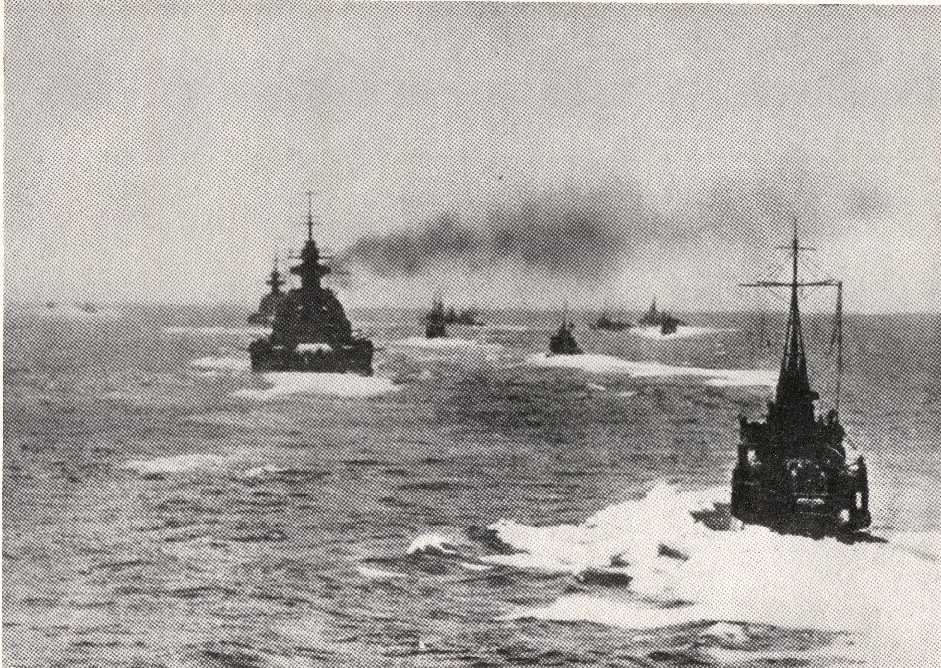
The Battleships of Pearl Harbor

So as Groundhog Day 2010 ends and we live our own Groundhog Days over the coming year don’t fear, find the humor in it all and remember that somewhere and somehow in this primordial mess that we live in that the Deity Herself still loves you and that God will never leave you or forsake you, even if you seem to be stuck in some hellish place where one day seems just like the last and the last and the last before the last or even the one or one hundred day that was just like it before that. Did that make sense? If not I think what we have is a failure to misunderstand each other.

Peace

Padre Steve+

Leave a comment

Filed under beer, Just for fun, Loose thoughts and musings, Military, national security

Iran Makes Noise in Persian Gulf: Obama Dispatches Patriots and Ships to Deter

Mahmoud Ahamadinejad threatens a “harsh blow at global arrogance”

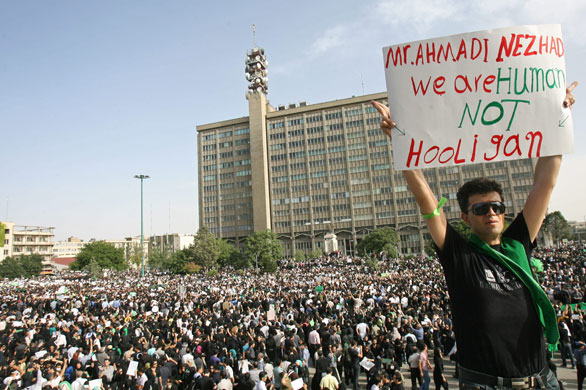
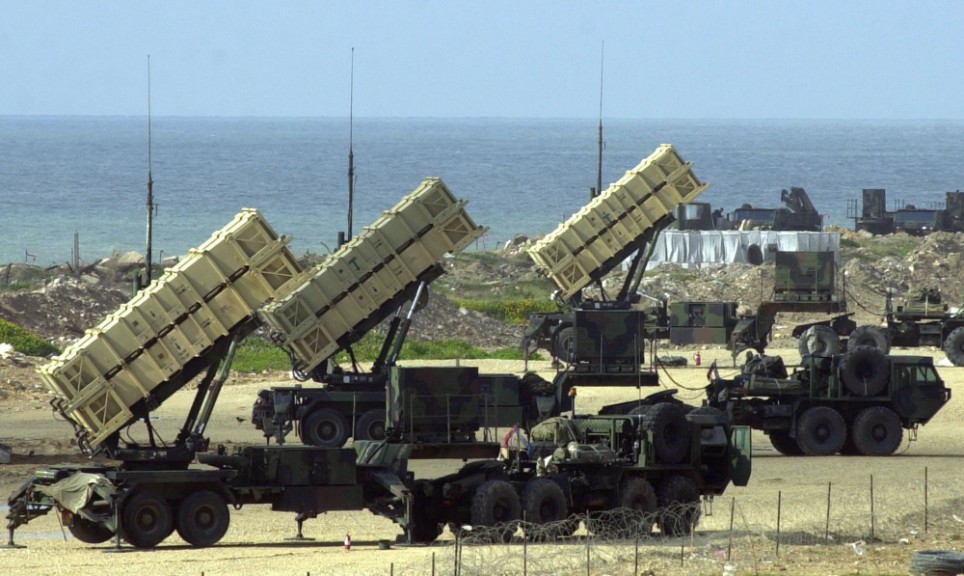
Something is going on in Iran.  The despotic regime of Mahmoud Ahamadinejad has been cracking down on dissidents and protestors over the last few months since the disputed presidential election.  Two opposition leaders were hanged yesterday.  The opposition is calling for protests on February 11th to coincide with the 31st anniversary of the Iranian Revolution.  At the same time government supporters and the Iranian Revolutionary Guard forces are planning both pro-regime activities as well as anti-opposition crackdowns in the days leading up to this event.  To add to the volatile mixture Iran’s President Mahmoud Ahamadinejad has threatened a “harsh blow against global arrogance” on the 11th.  There has been no explanation of what Ahamadinejad meant by his cryptic comments by the Iranian news service but  the Obama administration is taking them seriously by sending additional Aegis Missile ships equipped with anti-ballistic missile systems as well as Patriot air defense missiles to the Persian Gulf. To give you a glimpse of some of the confusion surrounding the current situation in Iran and in its implications for the West I have linked a number of articles from a wide variety of sources here:

http://www.guardian.co.uk/world/2010/jan/31/iran-nuclear-us-missiles-gulf

http://www.cnn.com/2010/WORLD/meast/01/31/iran.protests/index.html?section=cnn_latest

http://www.reuters.com/article/idUSTRE60U18R20100131?type=politicsNews

http://news.bbc.co.uk/2/hi/americas/8490929.stm

http://www.foxnews.com/politics/2010/02/01/missile-shield-gulf-ups-ante-iran/?test=latestnews

http://www.dailystar.com.lb/article.asp?edition_id=1&article_id=111329&categ_id=17

http://www.dailytimes.com.pk/default.asp?page=201022\story_2-2-2010_pg20_1

http://www.theaustralian.com.au/news/world/gulf-countries-accept-air-defences/story-e6frg6so-1225825224604

http://english.farsnews.com/newstext.php?nn=8811080764

http://www1.voanews.com/english/news/middle-east/Supreme-Leader-Claims-Iran-Remains-United-Against-Outside-Threat-82073702.html

http://www.rferl.org/content/Irans_Protesters_Must_Keep_Their_Eyes_On_February_11/1942248.html

http://www.opendemocracy.net/volker-perthes/iran-2010-11-four-scenarios-and-nightmare

http://en.rian.ru/world/20100129/157712614.html

http://www.rferl.org/content/Iran_Media_German_Diplomats_Involved_In_December_Riots_/1941229.html

http://www.haaretz.com/hasen/spages/1146909.html

http://www.energypublisher.com/article.asp?id=25925

http://www.presstv.ir/detail.aspx?id=116955&sectionid=3510303

http://www.google.com/hostednews/afp/article/ALeqM5hos0sGvW5l2cEN2xO2ex4fhamzIw

http://www.ynetnews.com/articles/0,7340,L3838323,00.htmlhttp://www.ynetnews.com/articles/0,7340,L-3838323,00.html

http://www.english.globalarabnetwork.com/201001284565/World-Politics/iran-morality-police-vanish-as-more-protests-loom-in-tehran.html

Massed Protests in Iran have been met by force

If you take a look at the details of these various reports there are a number of possibilities in regard to Iran, its internal political tensions and its repeated threats to US and Western interests. There are a myriad of possibilities many of which while directed outward are also directly related to the internal unrest in Iran in which a new generation who have grown up under the religious totalitarianism of the Mullah’s and men like Ahamadinejad who are convinced of the certainty of their beliefs and determined to impose them not only on their own people but their neighbors.  Ahamadinejad’s belief in the return of the 12th Mahdi to bring in a new era where the Caliphate will be established in Jerusalem is another wild card to factor into any equation.

Shahab-3 Missile test launch from mobile launcher

In the past year the Iranians have been increasingly more bellicose concerning their nuclear program and ballistic missile programs and have thwarted US, EU and UN initiatives to ensure that the nascent nuclear capacity is only capable of peaceful use and not capable of producing weapons grade uranium which could then be used in nuclear weapons.   They have expanded the number of centrifuges used for enriching uranium as well as continued to disperse and harden nuclear facilities against possible Israeli or US preventive strikes.  Additionally they have continued to increase their ballistic and cruise missile capabilities and the newer versions of the Shahab missile are capable of striking Western Europe.  The Revolutionary Guard forces have been actively supporting the Hezbollah terrorist group in Lebanon which in 2006 waged a successful war against Israel on the Israeli-Lebanese border.  It has continued to improve its asymmetric warfare capabilities as well as Naval and Revolutionary Guard Naval force capacity for disrupting shipping in the Straits of Hormuz through which a large percentage of the world’s oil is transported.

Iranian Missile Boat and Helicopter

Ahamadinejad’s latest remarks are ambiguous and could mean a number of things ranging from empty rhetoric designed to evoke a response from the United States or Israel up to military action.  Possible events within the continuum could be measures to destabilize Iraq where recently Iranian forces briefly occupied an Iraqi oil facility on the border near Basra before leaving when Iraq sent troops and threatened force to retake the facility.  Likewise a missile test of an upgraded or longer range Shahab could be planned, a military exercise in the Gulf or a test of a nuclear weapon which they might have succeeded in developing in their clandestine labs from previously enriched uranium.  The timing of the threat could also mean a military attack against Israel or US allies in the Persian Gulf including Kuwait, Bahrain, Qatar, the United Arab Emirates or Saudi Arabia.  Iran could in a “doomsday” strike launch a nuclear weapon (should it have an operation weapon) or chemical or biological weapons against Israel or even the rival Sunni Moslem Kingdom of Saudi Arabia, provoking a retaliatory strike which could embroil the region in a major war and might have worldwide implications. While I would think that the military attack would be a lower possibility the timing which coincides with the anniversary of the Revolution coupled with domestic unrest could mean that Ahamadinejad may feel that the benefit outweighs the risk.  It also could mean a stronger domestic crackdown on Iranian dissidents, whichever course of action the Iranians take it could make life even more interesting.

Shore based C-802 Surface to Surface Anti-Ship Missile in Iranian service

With the full spectrum of possibilities from simple rhetoric to a military strike laid out the Obama administration reportedly has sent Patriot Missile batteries to shield key Gulf allies and dispatched additional Aegis anti-ballistic missile capable ships from the US Navy to the Gulf.  Past remarks by the administration have been perceived as weak by the Iranians and the demonstration of US resolve by the dispatch of additional forces to the region may be designed to show that the Obama administration is not indecisive but capable of countering military threats to the region.

Additional ships of the Arliegh Burke Class that carry SM-3 missiles and Ant–Ballistic Missile systems have been moved into the Gulf along with Patriot Missile batteries

The administration’s move is prudent considering the potential threat.  Iran does not have the capabilities to fight a sustained war but could if fueled by the apocalyptic vision of Ahamadinejad mean that the Iranian government is willing to risk a confrontation with the United States because it perceives the Obama administration as weak.  I think that such an assumption by Ahamadinejad would be a serious mistake, however if he were to attempt a military or asymmetric-terrorist act of some kind he could create chaos until the United States and our allies eliminate his offensive capability.

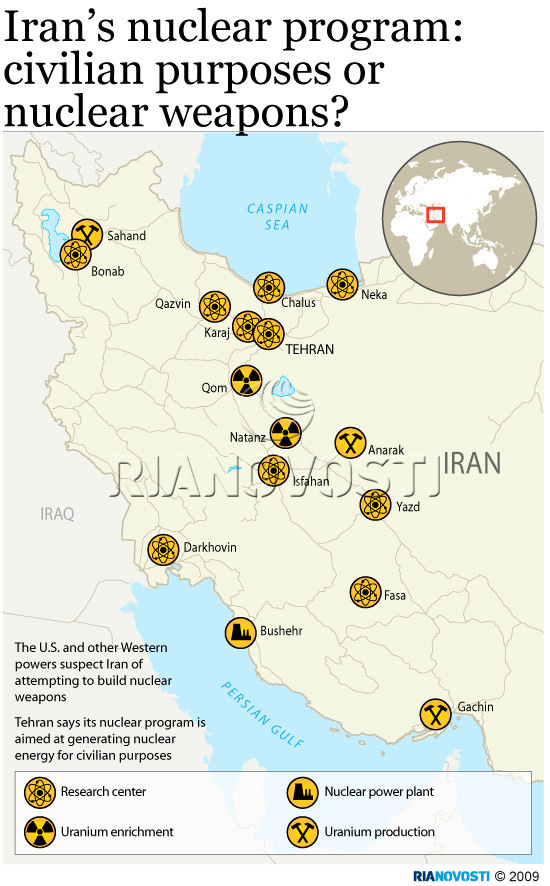
Iranian Nuclear facilities are dispersed around the country and in hardened sites

Potential problems that Iran could cause the United States could include disruption of transition efforts in Iraq through military or terrorist activity as well as to cause casualties or damage US military forces in that country. Far less likely is the possibility that the Iranians could offer support to their rivals in Al Qaida and the Taliban in Afghanistan if for no other reason than to disrupt the US/NATO mission in that country. Likewise the Iranians could attempt to cause economic and diplomatic problems in the region that would adversely affect the US and world economy that could be done short of war.

To deal with all possibilities the United States must not only be militarily ready to respond to any military threat but also to be able to exercise the full spectrum of diplomatic, economic and intelligence resources of its own and our allies.

So in about a week and a half we will know what the cryptic Ahamadinejad meant by his latest outburst, hopefully there will be some clarification before then so the US and its allies in the region can coordinate an effective response.  With tensions rising and uncertainty in the air it is important for the US, Israel and the West to get this right and hopefully give the Iranian opposition time to force Ahamadinejad and his supporters in the Iranian clergy and the Revolutionary Guard from power.  There is both danger and opportunity in the coming days and one can only hope that the Iranian opposition will be successful.

Peace,

Padre Steve+

Leave a comment

Filed under Foreign Policy, Military, national security

Stalingrad: Disaster on the Volga

Madonna of Stalingrad: Drawn by a German Chaplain and physician the piece was taken out of the city by one of the last officers to get out. It is now displayed in the Kaiser Wilhelm Memorial Church in Berlin

Sunday the 31st of January marks the surrender of the remnants of the German 6th Army to the Soviets at Stalingrad. The focus of this article is on how the Germans and Russians fought the Stalingrad campaign. In particular it is an analysis of the way the governments and military’s of both Nazi Germany and the Soviet Union planned and executed strategy during the course of the campaign adjusted to the situation and how the campaign ended. It is also a reminder of the price that ordinary soldiers can pay when a country commits them to war. I conclude with a potential modern application for the US and NATO in Afghanistan.

Stalingrad: Primary or Secondary Objective

The mistakes began early in the planning and conduct of the operation

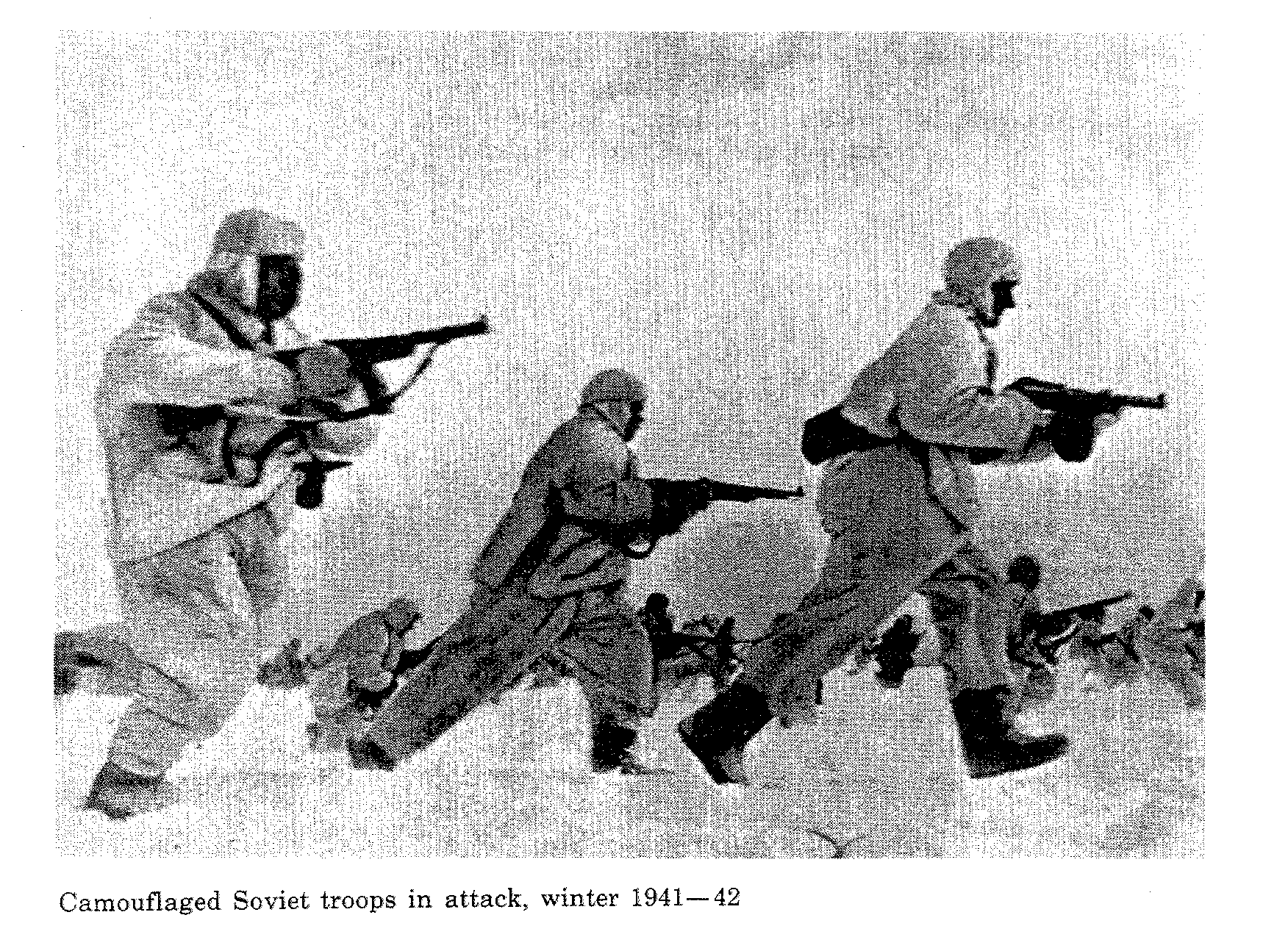
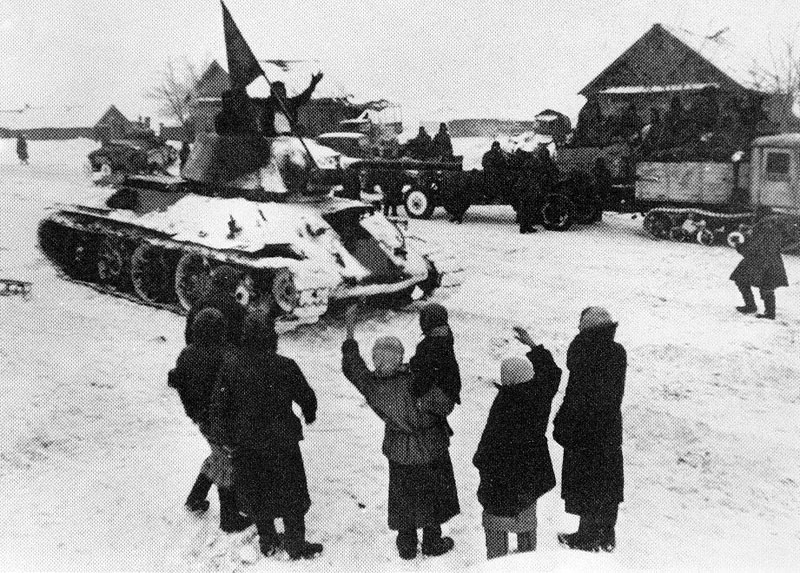
Following the Soviet winter offensive and the near disaster in front of Moscow the German High Command was faced with the strategic decision of what to do in the 1942 campaign.  Several options were considered and it was decided to seize the Caucasus oilfields and capture or neutralize the city of Stalingrad on the Volga.  However, the High Command was divided on the actual objective of the campaign.
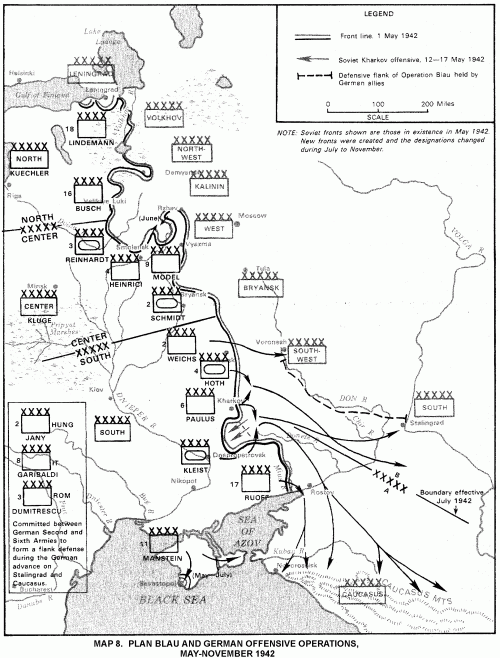
OKH under the guidance of General Halder assumed that Stalingrad was the objective and the advance into the Caucasus was a blocking effort.[i] Hitler and OKW planned to capture the Caucasus oil fields and capture or neutralize Stalingrad to secure the left flank.[ii] Both OKH and OKW considered Stalingrad significant but “German commanders initially regarded it as a weigh station en route to the Caucasus oil fields.”[iii] The conflict echoed in the ambiguity of Directive No. 41 which “included the ‘seizure of the oil region of the Caucasus’ in the preamble concerning the general aim of the campaign, yet made no mention of this in the main plan of operations.”[iv] At the planning conference held at Army Group South in early June “Hitler hardly mentioned Stalingrad. As far as his Generals were concerned it was little more than a name on the map. His obsession was with the oil fields of the Caucasus.”[v] Manstein noted that “Hitler’s strategic objectives were governed chiefly by the needs of his war economy….”[vi] Anthony Beevor notes that at this stage of planning “the only interest in Stalingrad was to eliminate the armaments factories there and secure a position on the Volga. The capture of the city was not considered necessary.”[vii] German planners “expected that the Soviets would again accept decisive battle to defend these regions.”[viii]

In Moscow Stalin and his Generals attempted to guess the direction of the impending German offensive.  “Stalin was convinced that Moscow remained the principle German objective…Most of the Red Army’s strategic reserves…were therefore held in the Moscow region.”[ix] To disrupt the German offensive and to attempt to recover Kharkov three offensives were launched by Red Army forces under the direction of Stavka. The largest of these on Kharkov was defeated between 12-22 May with the loss of most of the armor in southern Russia. This coupled with an equally disastrous defeat of Red Army forces in Crimea by Von Manstein’s 11th Army meant that the Red Army would face the Germans in a severely weakened condition.[x]

Operation Blau: Opening Moves and Divergent Objectives
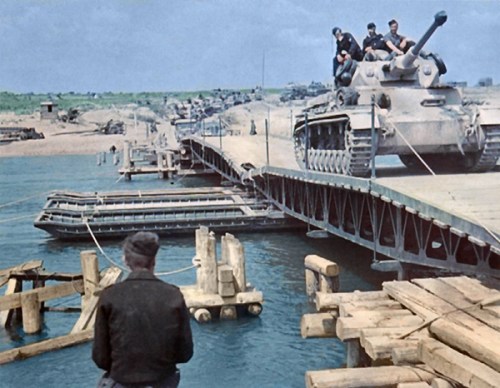
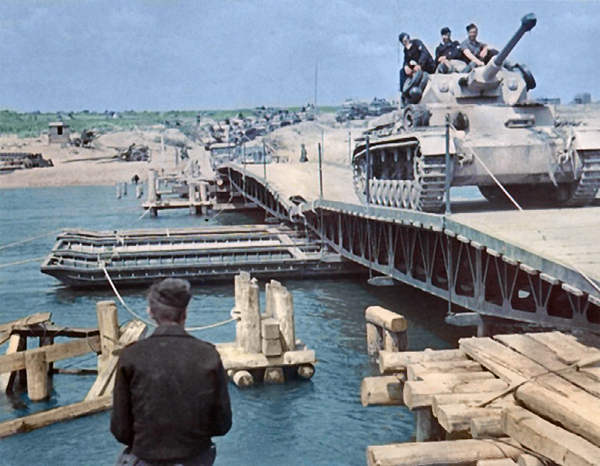
Panzers cross the Don

The German offensive began on 28 June under the command of Field Marshal von Bock. Bock’s command included two separate army groups, Army Group B under General Von Weichs with 2nd Army, 6th Army and 4th Panzer Army operated in the northern part of the operational area. Army Group A was to the south with 17th Army and 1st Panzer Army.[xi] Army Group B provided the main effort and quickly smashed through the defending Soviet armies and by the 20th Hitler believed that “the Russian is finished.”[xii] One reason for the German success in the south was that until July 7th Stalin believed that Moscow was still the primary objective.[xiii] Bock was prevented by Hitler from destroying Soviet formations left behind and was relieved of command by Hitler. He was replaced by Von Weichs which created a difficult command and control problem.  Manstein noted that this created a “grotesque chain of command on the German southern wing” with the result that Army Group A had “no commander of its own whatever” and Army Group B had “no few than seven armies under command including four allied ones.”[xiv]

Destroyed Soviet T-34s

This decision proved fateful.  Hitler’s decided to redirect the advance of the 4th Panzer Army to support an early passage of the lower Don, diverting it from its drive on Stalingrad.  Additionally the army groups became independent of each other when Bock was relieved of command.  They were “assigned independent-and diverging-objectives” under the terms of Directive No.45.[xv] This combination of events would have a decisive impact on the campaign.  The decision prevented a quick seizure of Stalingrad by 4th Panzer Army followed by a hand over to 6th Army to establish the “block” as described by Directive No.41.  Kleist noted that he didn’t need 4th Panzer Army’s help to accomplish his objectives and that it could have “taken Stalingrad without a fight at the end of July….”[xvi]

Field Marshall Von Paulus

The result was damning. Air support and fuel needed by Army Group A was transferred to 6th Army, denuding Army Group A of the resources that it needed to conclude its conquest of the Caucasus.[xvii] At the same time it denied Army Group B of the Panzer Army that could seize Stalingrad when it was still possible to do so.  Beevor calls Hitler’s decision a disastrous compromise.[xviii] Halder believed the decision underestimated the enemy and was “both ludicrous and dangerous.”[xix]

Focus on Stalingrad
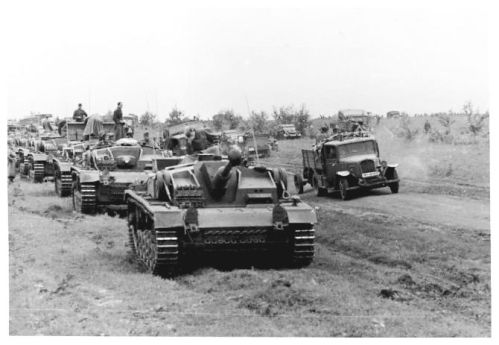
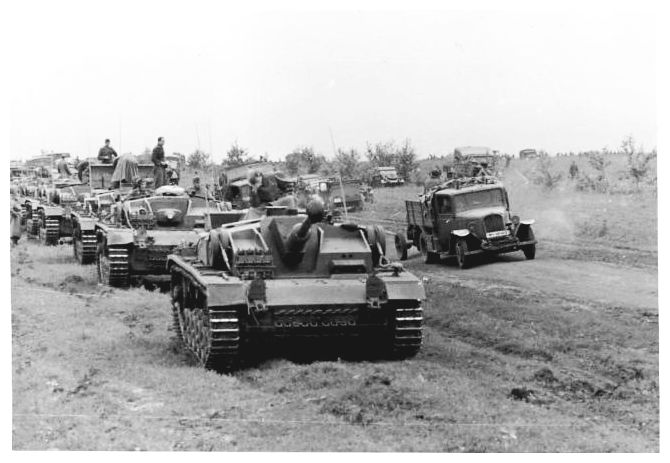
Sturmgeschutz Battalion Advancing toward Stalingrad

On July 22 as the Wehrmacht ran short on fuel and divisions to commit to the Caucasus, and 6th Army fought for control of Voronezh the Soviets created the Stalingrad Front. Stavka moved an NKVD Division to the city,[xx] and rapidly filled the new front with formations transferred from the Moscow Front.[xxi] Stalin issued Stavka Order 227, better known as “No Step Back” on 28 July. The order mandated that commanders and political officers who retreated would be assigned to Penal battalions[xxii] and armies were to form three to five special units of about 200 men each as a second line “to shoot any man who ran away.”[xxiii] Russian resistance west of the Don slowed the German advance. German commanders were astonished “at the profligacy of Russian commanders with their men’s lives.”[xxiv] Von Kleist compared the stubbornness of Russians in his area to those of the previous year and wrote that they were local troops “who fought more stubbornly because they were fighting to defend their homes.”[xxv] Additionally, Stalin changed commanders frequently in the “vain hope that a ruthless new leader could galvanize resistance and transform the situation.”[xxvi] General Chuikov brought the 64th Army into the Stalingrad Front in mid-July to hold the Germans west of the Don.[xxvii]
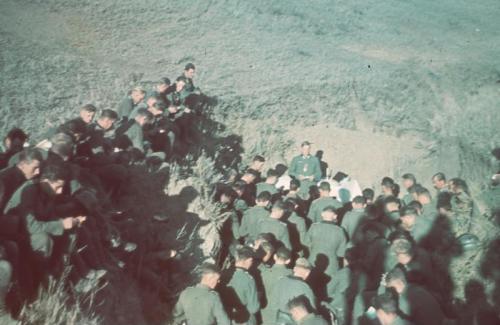
German Militarpfarrer (Chaplain) leading field service in August 1942

Further weakening the Germans OKW transferred key SS Panzer Divisions and the Grossdeutschland Division to France. Supporting Hungarian, Italian and Romanian allied armies which lacked motorization, modern armor or anti-tank units were unable to fulfill the gaps left by the loss of experienced German divisions and the expectations of Hitler.[xxviii] 6th Army was virtually immobilized for 10 days due to lack of supplies allowing the Russians to establish a defense on the Don Bend.[xxix] To the south the Germans were held up by lack of fuel and increased Soviet resistance including the introduction of a force of 800 bombers.[xxx] Glantz and House note that with the fall of Rostov on July 23rd “Hitler abruptly focused on the industrial and symbolic value of Stalingrad.”[xxxi] Undeterred by warnings from Halder that fresh Russian formations were massing east of the Volga and Quartermaster General, Wagner, who guaranteed that he could supply either the thrust to the Caucasus or Stalingrad but not both.[xxxii] Again frustrated by slow progress Hitler reverted to the original plan for 4th Panzer Army to assist 6th Army at Stalingrad, but the cost in time and fuel were significant to the operation and the question was whether “they could make up for Hitler’s changes in plan.”[xxxiii]

Strategic Implications

General Chuikov who directed the defense of Stalingrad during the battle

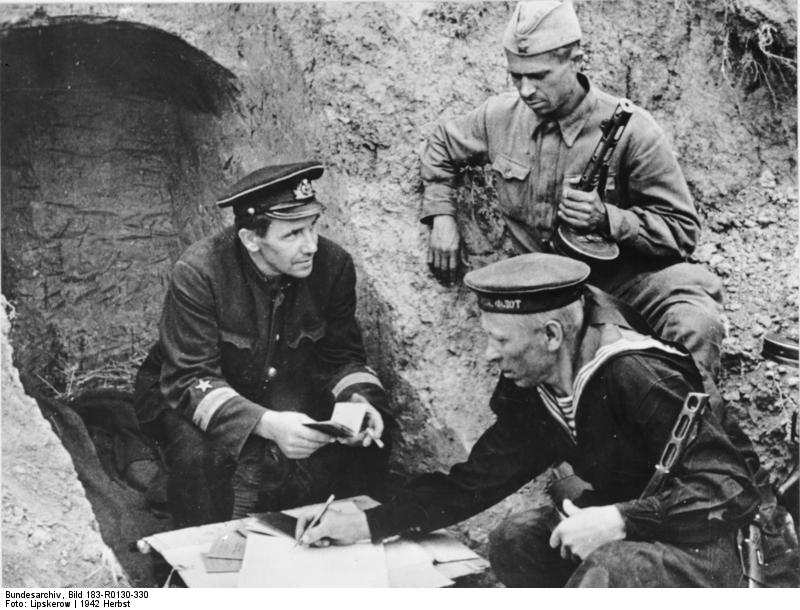
Soviet Naval Infantry and Political Officer

The changes in the German plan had distinct ramifications for both sides.  Von Mellenthin wrote that “the diversion of effort between the Caucasus and Stalingrad ruined our whole campaign.”[xxxiv] The Germans could not secure the Caucasus oil fields which Hitler considered vital to the German war effort.  They advanced deep into the region and captured the Maikop oil fields, though they were almost completely destroyed by the retreating Russians.[xxxv] Army Group A was halted by the Russians along the crests of the Caucasus on August 28th.[xxxvi] This left Hitler deeply “dissatisfied with the situation of Army Group A.”[xxxvii] Kleist and others attributed much of the failure to a lack of fuel[xxxviii] and Blumentritt noted that Mountain divisions that could have made the breakthrough were employed along the Black Sea coast in secondary operations.[xxxix]
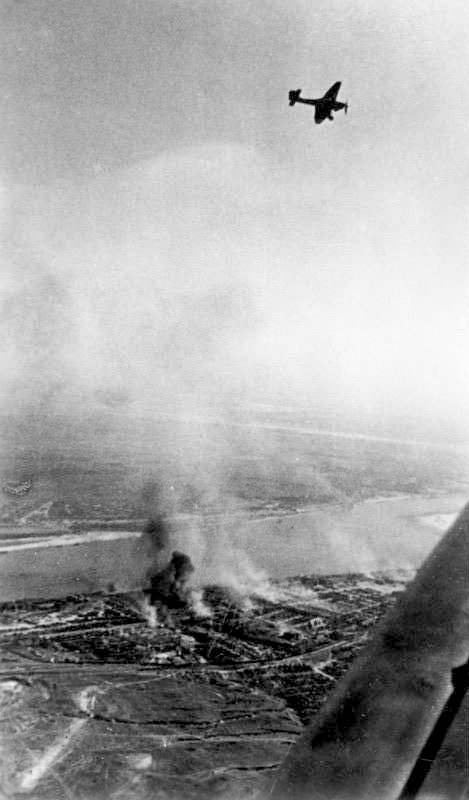
JU-87 Stuka over Stalingrad

Fuel and supply shortages delayed 6th Army’s advance while Hoth’s 4th Panzer Army was needlessly shuttled between Rostov and Stalingrad. By the time it resumed its advance the Russians “had sufficiently recovered to check its advance.”[xl] As 6th Army advanced the “protection of Army Group B’s ever-extending northern flank was taken over by the 3rd Rumanian, the 2nd Hungarian and the newly formed 8th Italian Army.”[xli] The allied armies were neither equipped for the Russian campaign nor well motivated.[xlii] The supply shortage in both army groups was not helped by a logistics bottleneck. All supplies came over a single Dnieper crossing, which Manstein noted, prevented swift movement of troops from one area to another.[xliii]

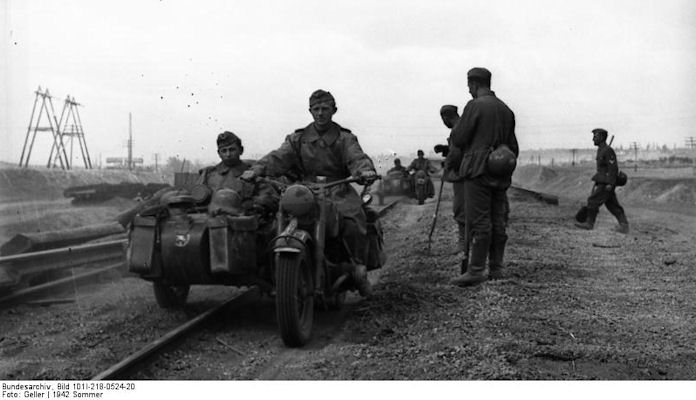
Reconnaissance Battalion of 24th Panzer Division near Stalingrad

Von Paulus’ 6th Army now attempted to rush Stalingrad between the 25th and 29th of July, while Hoth milled about on the lower Don.  However, Paulus’s piecemeal commitment of his divisions and failure to concentrate in the face of unexpectedly strong Soviet resistance caused the attacks to fail.  Paulus halted 6th Army on the Don so it could concentrate its forces and build its logistics base,[xliv] and to allow Hoth to come up from the south. This delay allowed the Russians to build up forces west of Stalingrad and reinforce the Stalingrad front and strengthen the defenses of the city,[xlv] and due to the distances involved it was easier for the Russians to reinforce the Stalingrad front.[xlvi] It also allowed the Russians to fill a number of key leadership positions with Generals who would skillfully fight the battle.[xlvii]
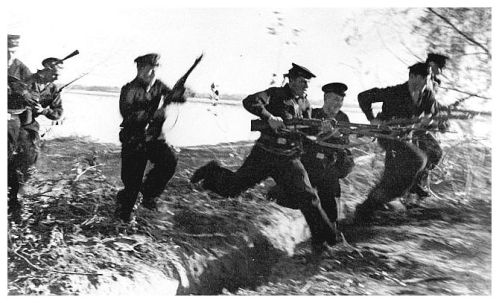
Russian Naval Infantry during early phase of battle

Hitler now focused on the capture of Stalingrad despite the fact that “as a city Stalingrad was of no strategic importance.”[xlviii] Strategically, its capture would cut Soviet supply lines to the Caucasus,[xlix] but this could be achieved without its capture. The checks in the south “began to give Stalingrad a moral importance-enhanced by its name-which came to outweigh its strategic value.”[l] To Hitler Stalingrad would gain “a mystic significance”[li] and along with Leningrad became “not only military but also psychological objectives.”[lii]

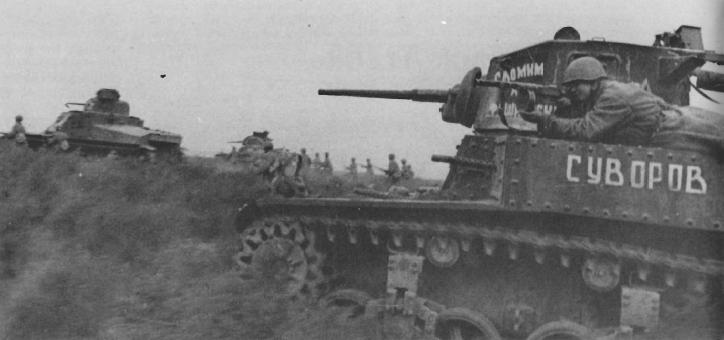
Red Army Armored troops using Lend-Lease American M3 Stuart and M3 Grant tanks

The Germans mounted a frontal assault with 6th Army and elements of 4th Panzer Army despite air reconnaissance that “the Russians are throwing forces from all directions at Stalingrad.[liii] Paulus as the senior General was in charge of the advance, with Hoth subordinated to him, but the attack had to wait until Hoth’s army could fight its way up from the south.[liv] Von Mellenthin comments rightly that “when Stalingrad was not taken on the first rush, it would have been better to mask it….”[lv] It is clear that the German advance had actually reached its culminating point with the failure of the advance into the Caucasus and Paulus’s initial setback on the Don, but it was not yet apparent to many involved.[lvi] The proper course of action would have been to halt and build up the front and create mobile reserve to parry any Russian offensive along northern flank while reinforcing success in the Caucasus. Manstein wrote that “by failing to take appropriate action after his offensive had petered out without achieving anything definite, he [Hitler] paved the way to the tragedy of Stalingrad!”[lvii]

Transfixed by Stalingrad
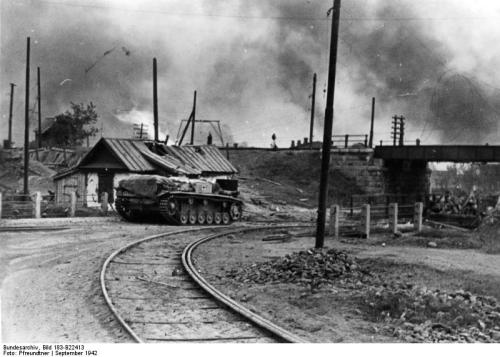
German Stug III at Stalingrad

On August 19th Paulus launched a concentric attack against the Russian 62nd and 64th Armies on the Don.  The attack ran into problems, especially in Hoth’s sector.[lviii] Yet, on the 22nd the 14th Panzer Corps “forced a very narrow breach in the Russian perimeter at Vertyachi and fought its way across the northern suburbs of Stalingrad,”[lix] and reached the Volga on the 23rd. That day 4th Air Fleet launched 1600 sorties against the city dropping over 1,000 tons of bombs.[lx] The breakthrough imperiled the Soviet position they had concentrated their strongest forces against Hoth.[lxi] The Germans held air superiority and continued heavy bombing attacks.  During the last days of August 6th Army “moved steadily forward into the suburbs of the city, setting the stage for battle.”[lxii] As the Soviets reacted to Paulus, Hoth achieved a breakthrough in the south which threatened the Russian position.  However 6th Army was unable to disengage its mobile forces to link up with the 4th Panzer Army and another opportunity had been missed.[lxiii]
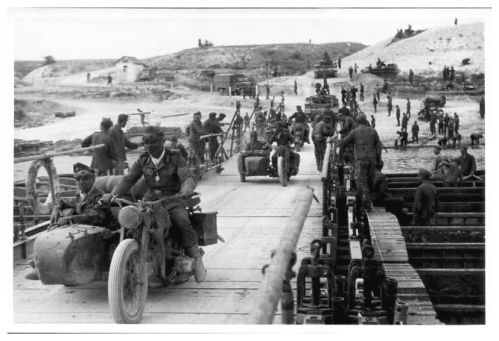
German unit crossing the Don

As 6th Army moved into the city Yeremenko ordered attacks against Hube’s 16th Panzer Division and Soviet resistance increased as more formations arrived the Germans suffered one of their heaviest casualty rates.”[lxiv] Though unsuccessful the counterattacks “managed to deflect Paulus’s reserves at the most critical moment.”[lxv] The Germans remained confident the first week of September as 6th Army and 4th Panzer Army linked up, but Yeremenko saved his forces by withdrawing and avoiding encirclement west of the city, retiring to an improvised line close to the city.[lxvi] On September 12th Chuikov was appointed to command 62nd Army in Stalingrad.  Chuikov understood that there “was only one way to hold on. They had to pay in lives. ‘Time is blood,’ as Chuikov put it later.”[lxvii] Stalin sent Nikita Khrushchev to the front “with orders to inspire the Armies and civilian population to fight to the end.”[lxviii] 13th Guards Rifle Division arrived on the 14th saved the Volga landings but it lost 30% casualties in its first 24 hours of combat.[lxix]
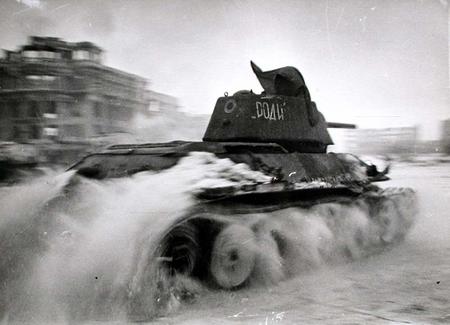
T-34 in Stalingrad

An NKVD regiment and other units held the strategically sited Mamaev Kurgan, keeping German guns from controlling the Volga.[lxx] The defenders fought house to house and block by block, Army and NKVD were reinforced by Naval Infantry.  Chuikov conducted the defense with a brutal ferocity, relieving senior commanders who showed a lack of fight and sending many officers to penal units.  Chuikov funneled massed German attacks into “breakwaters” where the panzers and infantry could be separated from each other causing heavy German casualties.[lxxi]
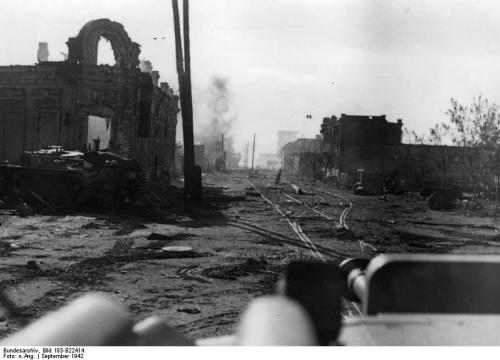
Street Fighting


Now the “city became a prestige item, its capture ‘urgently necessary for psychological reasons,’ as Hitler declared on October 2. A week later he declared that Communism must be ‘deprived of its shrine.’”[lxxii] The Germans did continue to gain ground, however slowly and at great cost, especially among their infantry, so much so that companies had to be combined.   Chuikov used his artillery to interdict the Germans from the far side of the Volga and the fight in the city was fought by assault squads with incredible ferocity and the close-quarter combat was dubbed “’Rattenkrieg’ by German soldiers.”[lxxiii] Paulus brought more units into the city and continued to slowly drive the Russians back against the river, by early October Chuikov wondered if he would be able to hold.[lxxiv] By early November Chuikov “was altogether holding only one-tenth of Stalingrad-a few factory buildings and a few miles of river bank.”[lxxv] Paulus expected “to capture the entire city by 10 November,”[lxxvi] despite the fact that many units were fought out. The 6th Army judged that 42% of the battalions of 51st Corps were fought out.[lxxvii] On 9 November Hitler declared “No power on earth will force us out of Stalingrad again!”[lxxviii]

Soviet Counteroffensive: Disaster on the Flanks

Soviet offensive on the flanks

Hungarian withdraw

Hungarian dead

On September 24th Hitler relieved Halder for persisting in explaining “what would happen when new Russian reserve armies attacked the over-extended flank that ran out to Stalingrad.”[lxxix] Many in the German side recognized the danger. Blumentritt said “The danger to the long-stretched flank of our advance developed gradually, but it became clear early enough for anyone to perceive it who was not willfully blind.”[lxxx] Warnings were also given by Rumanian Marshall Antonescu and the staff’s of Army Group B and 6th Army[lxxxi] but Hitler was transfixed on Stalingrad.  In doing so the Germans gave up the advantage of uncertainty and once their “aim became obvious…the Russian Command could commit its reserves with assurance.”[lxxxii]

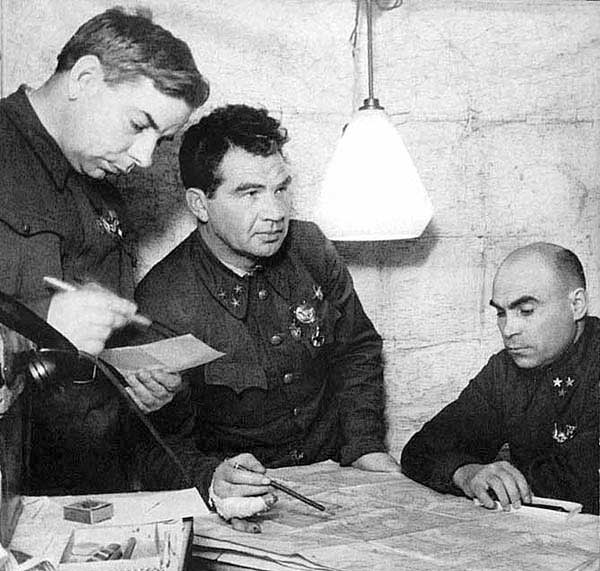
Chuikov and his staff

In the midst of Stalin’s concern about Stalingrad Stavka planners never lost sight of their goal to resume large scale offensive operations and destroy at least one German Army Group.[lxxxiii] Unlike Hitler Stalin had begun to trust his Generals and Stavka under the direction of Marshal Vasilevsky produced a concept in September to cut off the “German spearhead at Stalingrad by attacking the weak Rumanian forces on its flanks.”[lxxxiv] At first Stalin “showed little enthusiasm” for the attack, fearing that Stalingrad might be lost, but on 13 September he gave his full backing to the proposal[lxxxv] which Zhukov, Vasilevsky and Vatutin developed into a plan involving two operations, Operation Uranus, to destroy the German and allied forces at Stalingrad, Operation Saturn to destroy all the German forces in the south and a supporting attack to fix German forces in the north, Operation Mars aimed at Army Group Center.[lxxxvi]
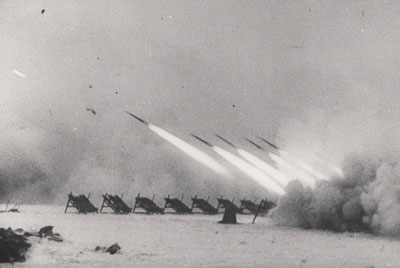
Soviet Katusha Rockets

To accomplish the destruction of 6th Army and part of 4th Panzer Army the Red Army employed over 60% of the “whole tank strength of the Red Army.”[lxxxvii] Strict secrecy combined with numerous acts of deception was used by the Red Army to disguise the operation.[lxxxviii] The plan involved an attack against 3rd Romanian Army on the northern flank by 5th Tank Army and two infantry armies with supporting units.[lxxxix] In the south against 4th Rumanian Army and weak element of 4th Panzer Army another force of over 160,000 men including 430 tanks were deployed.[xc] Despite warnings from his Intelligence Officer, Paulus did not expect a deep offensive into his flanks and rear and made no plans to prepare to face the threat.[xci] Other senior officers believed that the attack would take place against Army Group Center.[xcii] Warlimont notes that there was a “deceptive confidence in German Supreme Headquarters.”[xciii]

Luftwaffe JU-52s made many resupply runs into the pocket but suffered great losses

The storm broke on 19 November as Soviet forces attacked rapidly crushing Romanian armies in both sectors[xciv] linking up on the 23rd.[xcv] 48th Panzer Corps supporting the Romanians was weak and had few operational tanks.[xcvi] It attempted a counterattack but was “cut to pieces” in an encounter with 5th Tank Army.[xcvii] A promising attempt by 29th Motorized division against the flank of the southern Russian pincer was halted by the Army Group and the division was ordered to defensive positions south of Stalingrad.[xcviii] German airpower was neutralized by bad weather.[xcix] Paulus continued to do nothing as since the attacks were outside of his area of responsibility and waited for instructions.[c] As a result the 16th and 24th Panzer Divisions which could have assisted matters to the west remained “bogged down in street-fighting in Stalingrad.”[ci] Without support 6th Army units west of Stalingrad were forced back in horrific conditions.  By the 23rd 6th Army was cut off along with one corps of 4th Panzer Army and assorted Romanian units, over 330,000 men.  This now entrapped force that would require seven rifle armies and much staff attention to eliminate.[cii]

The Death of 6th Army
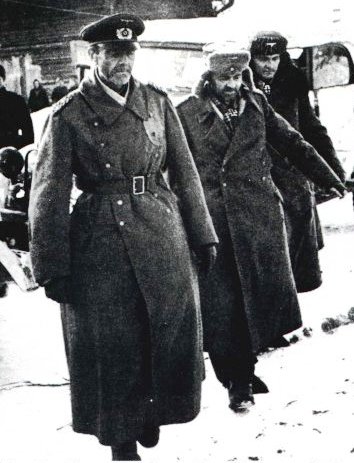
Paulus Surrenders

Hitler ordered Manstein to form Army Group Don to relieve Stalingrad. Hitler would not countenance a break out and wanted Manstein to break through and relieve 6th Army.[ciii] Hitler refused a request by Paulus on 23 November to move troops to prepare for a possible a break out attempt, assuring him that he would be relieved.[civ] Albert Speer notes that Zeitzler who replaced Halder insisted that the Sixth Army must break out to the west.”[cv] Hitler told Zeitzler that “We should under no circumstances give this up. We won’t get it back once it’s lost.”[cvi] Goering promised the Luftwaffe would be able to meet the re-supply needs of 6th Army by air, even though his Generals knew that it was impossible with the number of transport aircraft available.[cvii] Hitler took Goering at his word and exclaimed “Stalingrad can be held! It is foolish to go on talking any more about a breakout by Sixth Army…”[cviii] and a Führer decree was issued ordering that the front be held at all costs.[cix] Goerlitz states that “Hitler was incapable of conceiving that the 6th Army should do anything but fight where it stood.”[cx] Likewise Manstein had precious few troops with which to counterattack and had to protect the flank of Army Group A deep in the Caucasus. His army group was only corps strength and was spread across a 200 mile front.[cxi] Any relief attempt had to wait for more troops, especially Panzers.  Manstein too believed that the best chance for a breakout had passed and that it was a serious error for Paulus to put the request to withdraw through to Hitler rather than the Army Group or act on his own.[cxii] Many soldiers were optimistic that Hitler would get them out.[cxiii] Other generals like Guderian, Reichenau or Hoeppner might have acted, but Paulus was no rebel.[cxiv]
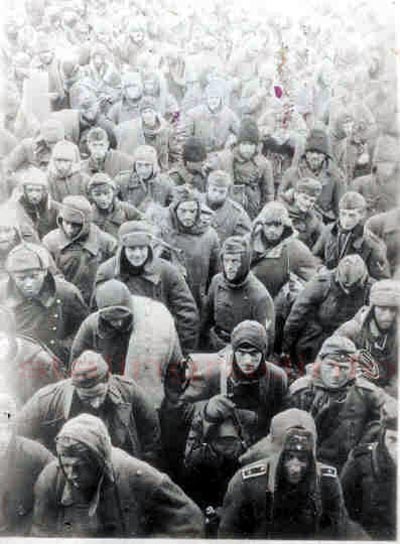
German POWs only 5000 of some 90,000 would see home again

Operation Saturn began on 7 December destroying the Italian 8th Army and forcing the Germans to parry the threat.[cxv] A relief attempt by 57th Panzer Corps under Hoth on 12 December made some headway until a massive Soviet counterattack on 24 December drove it back.[cxvi] This attack was hampered by OKW’s refusal to allocate the 17th Panzer and 16th Motorized divisions to Manstein,[cxvii] and by 6th Army not attacking out to link with the relief force.[cxviii]By 6 January Paulus signaled OKW: Army starving and frozen, have no ammunition and cannot move tanks anymore.”[cxix] On 10 January the Soviets launched Operation Ring to eliminate the pocket and despite all odds German troops fought on. On the 16th Paulus requested that battle worthy units be allowed to break out, but the request was not replied to.[cxx] On the 22nd the last airfield had been overrun and on 31 January Paulus surrendered.[cxxi]

Analysis: What Went Wrong

Stalingrad had strangely drawn the attention of both sides, but the Russians never lost sight of their primary objectives during the campaign. The Germans on the other hand committed numerous unforced errors mostly caused by Hitler and or von Paulus. These mistakes began early in the planning and After the fall of Stalingrad as the Soviets attempted to follow up their success by attempted to cut off Army Group “A” Manstein was permitted to wage a mobile defense while Von Kleist managed to withdraw with few losses.[cxxii] The superior generalship of Manstein and Von Kleist prevented the wholesale destruction of German forces in southern Russia and Manstein’s counter offensive inflicted a severe defeat on the Soviets. However the German Army had been badly defeated.  The seeds of defeat were laid early, the failure to destroy bypassed Soviet formations in July, the diversion of 4th Panzer Army from Stalingrad, and the divergent objectives of trying to capture the Caucasus and Stalingrad at the same time.  This diluted both offensives ensuring that neither succeeded.  Likewise the failure to recognize the culminating point when it was reached and to adjust operations accordingly was disastrous for the Germans. The failure create a mobile reserve to meet possible Russian counter offensives, and the fixation on Stalingrad took the German focus off of the critical yet weakly held flanks. The hubris of Hitler and OKW to believe that the Russians were incapable of conducting major mobile operations even as Stavka commenced offensive operations on those flanks all contributed to the defeat.  Clark notes these facts but adds that the Germans “were simply attempting too much.”[cxxiii] Soviet numbers allowed them to wear down the Germans even in defeat.[cxxiv] At the same time Stalin gave his commanders a chance to revive the mobile doctrine of deep operations with mechanized and shock armies that he had discredited in the 1930s.[cxxv] All through the campaign Zhukov and other commanders maintained both their nerve even when it appeared that Stalingrad was all but lost. They never lost sight of their goal of destroying major German formations though they failed to entrap Army Group A with 6th Army.

A Modern Application

It is well and good to attempt to remain on the offensive.  The U.S. currently has forces spread thinly over two combat theaters with possibilities that other threats in the same region could flare up.  Like the Germans the U.S. is operating in areas, especially Afghanistan where overland supply lines are vulnerable and where weather can and does affect resupply operations by both ground and air.  The fact that the U.S. is operating with just barely enough forces in areas where others have met disaster calls for a circumspect look at what our enemy’s capabilities really are and not allowing ourselves to be surprised when they do things that have worked for them in the past against the Russians.  While it is unlikely that the U.S. and NATO would face a Stalingrad type situation in Afghanistan it is possible that isolated forces could be overrun as the Afghans reprise tactics used so successfully against the Soviets and as they begin to operate in larger units, concentrate them quickly and with more firepower to catch NATO forces when they are most vulnerable.  It is true that they will not mass large numbers of tanks and artillery as the Soviets did against the Germans, but the principle of speed, concentration at the critical point and surprise can inflict defeats, even small ones like the attack on the US outpost in Wanat that can turn public sentiment in the U.S. and Europe against further commitments and against the war and force the NATO governments as well as the U.S. to give up the effort.

Notes

[i] Clark, Alan. Barbarossa: The Russian-German Conflict: 1941-45. Perennial Books, An imprint of Harper Collins Publishers, New York, NY 1965. p.191

[ii] Ibid.

[iii] Glantz, David M. and House, Jonathan. When Titan’s Clashed: How the Red Army Stopped Hitler. The University Press of Kansas, Lawrence KS, 1995. p.111

[iv] Ibid. Clark. p.191

[v] Beevor, Anthony. Stalingrad: The Fateful Siege: 1942-1943. Penguin Books, New York NY 1998. p.69

[vi] Manstein, Erich von. Forward by B.H. Liddle Hart, Introduction by Martin Blumenson. Lost victories: The War Memoirs of Hitler’s Most Brilliant General. Zenith Press, St Paul MN 2004. First Published 1955 as Verlorene Siege, English Translation 1958 by Methuen Company. p.291 This opinion is not isolated, Beevor Quotes Paulus “If we don’t take Maikop and Gronzy…then I must put an end to the war.” (Beevor pp. 69-70)  Halder on the other hand believed that Hitler emphasized that the objective was “the River Volga at Stalingrad. (Clark. p.190)

[vii] Ibid. Beevor. p.70.

[viii] Ibid. Glantz and House. p.106

[ix] Ibid. p.105-106

[x] Ibid. Clark. p.203.  The offensive did impose a delay on the German offensive.

[xi] Ibid. Clark. p.191 Each group also contained allied armies.

[xii] Ibid. p.209.

[xiii] Ibid. Glantz and House. p.119

[xiv] Ibid. Manstein. p.292.

[xv] Ibid. Clark. p.209

[xvi] Ibid. Clark.  p.211

[xvii] Ibid. Glantz and House. p.120. There is a good discussion of the impact of this decision here as 6th Army’s advance was given priority for both air support and fuel.

[xviii] Ibid. Beevor. p.74

[xix] Warlimont, Walter. Inside Hitler’s Headquarters 1939-45. Translated by R.H. Berry, Presido Press, Novato CA, 1964. p.249

[xx] Ibid. Beevor. p.75 This was the 10th NKVD Division and it took control of all local militia, NKVD, and river traffic, and established armored trains and armor training schools.

[xxi] Ibid. Clark. p.212

[xxii] Ibid. Glantz and House. p.121

[xxiii] Ibid. Beevor. p.85

[xxiv] Ibid. p.89

[xxv] Liddell-Hart, B.H. The German Generals Talk. Quill Publishers, New York, NY 1979. Originally published by the author in 1948. p.202

[xxvi] Ibid. Beevor. p.88

[xxvii] Ibid. Beevor. p.90

[xxviii] Ibid. Beevor. p.81

[xxix] Ibid. Glantz and House. p.121

[xxx] Ibid. Liddell-Hart. p.202

[xxxi] Ibid. Glantz and House. p.120

[xxxii] Goerlitz, Walter. History of the German General Staff. Westview Press, Frederick A. Praeger Publisher, Boulder, CO. 1985 p.416

[xxxiii] Ibid. Beevor. pp.95-96.

[xxxiv] Von Mellenthin, F.W. Panzer Battles: A Study of the Employment of Armor in the Second World War. Translated H. Betzler, Edited by L.C.F. Turner. Oklahoma University Press 1956, Ballantine Books, New York, NY. 1971. p.193

[xxxv] Shirer, William L. The Rise and Fall of the Third Reich. A Touchstone Book published by Simon and Schuster, 1981, Copyright 1959 and 1960. p.914

[xxxvi] Ibid. Glantz and House. p.122

[xxxvii] Ibid. Warlimont. p.256

[xxxviii] Ibid. Liddell-Hart. p.203

[xxxix] Ibid. p.204

[xl] Ibid. Shirer. p.914

[xli] Ibid. Goerlitz. p.416

[xlii] Ibid. Goerlitz. p.416

[xliii] Ibid. Manstein. p.293

[xliv] Ibid. Clark. p.214

[xlv] Ibid. Beevor. pp.97-99. The mobilization included military, political, civilian and industrial elements.

[xlvi] Liddell-Hart, B.H. Strategy. A Signet Book, the New American Library, New York, NY. 1974, Originally Published by Faber and Faber Ltd., London. 1954 & 1967. p.250

[xlvii] Ibid. Beevor. p.99.  Two key commanders arrived during this time frame, Colonel General Andrei Yeremenko, who would command the Stalingrad Front  and General Chuikov commander of 64th Army who would conduct the defense of the city.

[xlviii] Carell, Paul Hitler Moves East: 1941-1943. Ballantine Books, New York, NY 1971, German Edition published 1963. p.581

[xlix] Ibid. Shirer.  p.909.

[l] Ibid. Liddell-Hart, Strategy. p.250

[li] Wheeler-Bennett, John W. The Nemesis of Power: The German Army in Politics 1918-1945. St. Martin’s Press, New York, NY 1954.  p.531

[lii] Ibid. Wheeler-Bennett. p.531

[liii] Ibid. Beevor. p.96

[liv] Ibid. Clark. p.216.

[lv] Ibid. Von Mellenthin. P.193

[lvi] See Von Mellinthin pp.193-194.  Von Mellinthin quotes Colonel Dinger, the Operations Officer of 3rd Motorized Division at Stalingrad until a few days before its fall. Dingler noted that the Germans on reaching Stalingrad “had reached the end of their power. Their offensive strength was inadequate to complete the victory, nor could they replace the losses they had suffered.” (p.193) He believed that the facts were sufficient “not only to justify a withdrawal, but compel a retreat.” (p.194)

[lvii] Ibid. Manstein. p.294

[lviii] Ibid. Clark. p.216

[lix] Ibid. Clark. p.217

[lx] Ibid. Beevor. p.107

[lxi] Ibid. Beevor. p.107

[lxii] Ibid. Glantz and House. p.122

[lxiii] Ibid. Carell. P.601

[lxiv] Ibid. Beevor. p.118

[lxv] Ibid. Beevor. p.118

[lxvi] Ibid. Carell. p.602

[lxvii] Ibid. Beevor. p.128

[lxviii] Ibid. Carell. p.603

[lxix] Ibid. Beevor. p.134

[lxx] Ibid. Beevor. pp.136-137

[lxxi] Ibid. Beevor. p.149

[lxxii] Fest, Joachim. Hitler. Translated by Richard and Clara Winston, Harcourt, Brace, Jovanovich Publishers, San Diego, New York, London. 1974. p.661

[lxxiii] Ibid. Beevor. pp. 149-150

[lxxiv] Ibid. Beevor. p.164

[lxxv] Ibid. Carell. p.618

[lxxvi] Ibid. Glantz and House. p.123

[lxxvii] Ibid. Beevor. p.218

[lxxviii] Ibid. Carell. p.623

[lxxix] Ibid. Goerlitz. p.418

[lxxx] Ibid. Liddell-Hart. The German Generals Talk. p.207

[lxxxi] Ibid. Manstein. p292

[lxxxii] Ibid. Liddell-Hart. History of the Second World War. p.258

[lxxxiii] Ibid. Glantz and House. p.129

[lxxxiv] Ibid. Glantz and House. p.130

[lxxxv] Ibid. Beevor. pp.221-222 Glantz and House say that Stalin gave his backing in mid-October but this seems less likely due to the amount of planning and movement of troops involved to begin the operation in November.

[lxxxvi] Ibid. Glantz and House. p.130

[lxxxvii] Ibid. Beevor. p.226

[lxxxviii] Ibid. Glantz and House. p.132

[lxxxix] Ibid. Glantz and House. p.130

[xc] Ibid. Beevor. p.227

[xci] Ibid. Beevor. p.228

[xcii] Ibid. Clark. p.235

[xciii] Ibid. Warlimont. p.274

[xciv] Ibid, Carell. p.627 3rd Rumanian Army lost 75,000 men in three days.

[xcv] Ibid. Clark.pp.247-248

[xcvi] The condition of the few German Panzer Divisions in position to support the flanks was very poor, the 22nd had suffered from a lack of fuel and maintenance and this many of its tanks were inoperative. Most of the armor strength of the 48th Panzer Corps was provided by a Rumanian armored division equipped with obsolete Czech 38t tanks provided by the Germans.

[xcvii] Ibid. Clark. pp.251-252. The designation of 2nd Guards Tank Army by Clark has to be wrong and it is the 5th Tank Army as 2nd Guards Tank was not involved in Operation Uranus.  Carell, Beevor and Glantz properly identify the unit.

[xcviii] Ibid. Carell. p.630

[xcix] Ibid. Beevor. p.244

[c] Ibid. Beevor. p.247

[ci] Ibid. Beevor. p.245

[cii] Ibid. Glantz and House. p.134

[ciii] Ibid. Glantz and House. p.134

[civ] Ibid. Clark. p.256

[cv] Speer, Albert. Inside the Third Reich. Collier Books, a Division of MacMillan Publishers, Inc. New York, NY 1970. p.248

[cvi] Heiber, Helmut and Glantz, David M. Editors. Hitler and His Generals: Military Conferences 1942-1945. Enigma Books, New York, NY 2002-2003.  Originally published as Hitlers Lagebsprechungen: Die Protokollfragmente seiner militärischen Konferenzen 1942-1945. Deutsche Verlags-Anstalt GmbH, Stuttgart, 1962. p.27

[cvii] Ibid. Glantz and House. p.135 Glantz and House note that the amount of aircraft estimated to successfully carry out the re-supply operation in the operational conditions was over 1,000.  The amount needed daily was over 600 tons of which the daily reached only 300 tons only one occasion.

[cviii] Ibid. Speer. p.249

[cix] Ibid. Carell. p.636

[cx] Ibid. Goerlitz. p.426

[cxi] Ibid. Clark. p.252

[cxii] Ibid. Manstein. p.303

[cxiii] Ibid. Beevor. p.276

[cxiv] Ibid. Carell. p.640

[cxv] Ibid. Glantz and House. p.140

[cxvi] Ibid. Glantz and House. p.140

[cxvii] Ibid. Clark. p.264

[cxviii] Ibid. Manstein. p.337

[cxix] Ibid. Beevor. p320

[cxx] Ibid. Beevor. p.365

[cxxi] Of the approximately 330,000 in the pocket about 91,000 surrendered, another 45,000 had been evacuated.  22 German divisions were destroyed.

[cxxii] Ibid. Liddell-Hart. The German Generals Talk. p.211

[cxxiii] Ibid. Clark. p.250

[cxxiv] Ibid. Glantz and House. p.124

[cxxv] Ibid. Beevor. p.221

Bibliography

Beevor, Anthony. Stalingrad: The Fateful Siege: 1942-1943. Penguin Books, New York NY 1998

Carell, Paul Hitler Moves East: 1941-1943. Ballantine Books, New York, NY 1971, German Edition published 1963.

Clark, Alan. Barbarossa: The Russian-German Conflict:1941-45. Perennial Books, An imprint of Harper Collins Publishers, New York, NY 1965.

Fest, Joachim. Hitler. Translated by Richard and Clara Winston, Harcourt, Brace, Jovanovich Publishers, San Diego, New York, London. 1974

Glantz, David M. and House, Jonathan. When Titan’s Clashed: How the Red Army Stopped Hitler. The University Press of Kansas, Lawrence KS, 1995.

Goerlitz, Walter. History of the German General Staff. Westview Press, Frederick A. Praeger Publisher, Boulder, CO. 1985

Heiber, Helmut and Glantz, David M. Editors. Hitler and His Generals: Military Conferences 1942-1945. Enigma Books, New York, NY 2002-2003.  Originally published as Hitlers Lagebsprechungen: Die Protokollfragmente seiner militärischen Konferenzen 1942-1945. Deutsche Verlags-Anstalt GmbH, Stuttgart, 1962.

Liddell-Hart, B.H. The German Generals Talk. Quill Publishers, New York, NY 1979. Originally Published by the author in 1948.

Liddell-Hart, B.H. Strategy. A Signet Book, the New American Library, New York, NY. 1974, Originally Published by Faber and Faber Ltd., London. 1954 & 1967

Manstein, Erich von. Forward by B.H. Liddle Hart, Introduction by Martin Blumenson. Lost victories: The War Memoirs of Hitler’s Most Brilliant General. Zenith Press, St Paul MN 2004. First Published 1955 as Verlorene Siege, English Translation 1958 by Methuen Company

Shirer, William L. The Rise and Fall of the Third Reich. A Touchstone Book published by Simon and Schuster, 1981, Copyright 1959 and 1960

Speer, Albert. Inside the Third Reich. Collier Books, a Division of MacMillan Publishers, Inc. New York, NY 1970.

Von Mellenthin, F.W. Panzer Battles: A Study of the Employment of Armor in the Second World War. Translated H. Betzler, Edited by L.C.F. Turner. Oklahoma University Press 1956, Ballantine Books, New York, NY. 1971.

Warlimont, Walter. Inside Hitler’s Headquarters 1939-45. Translated by R.H. Berry, Presido Press, Novato CA, 1964.

Wheeler-Bennett, John W. The Nemesis of Power: The German Army in Politics 1918-1945. St. Martin’s Press, New York, NY 1954

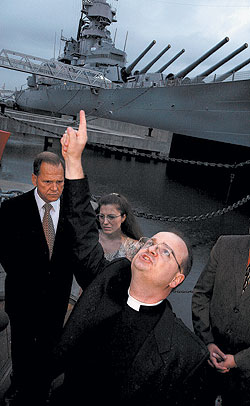
17 Comments

Filed under History, Military, world war two in europe

Power and Beauty the Battle Cruisers Scharnhorst and Gneisenau

Scharnhorst

The naval architects of Germany in the early 1930s designed some of the most beautiful as well as deadly warships of the Second World War.  Following Germany’s rejection of the provisions of the Treaty of Versailles the Kreigsmarine enacted a building program to enlarge and modernize the German Navy which then was composed of obsolete pre-Dreadnaught battleships and a few modern light cruisers and destroyers.   The first major units constructed were actually begun by the predecessor to the Kreigsmarine, the Reichsmarine of the Weimar Republic.  These were the Deutschland class Armored Ships, sometimes called “Pocket Battleships” and later reclassified as Heavy Cruisers. These ships were designed to replace the old pre-Dreadnaught battleships and incorporated electric welds to reduce displacement, diesel engines for extended cruise range to enable them to serve as commerce raiders and a battery of six 11” guns.  While an advance over anything in the German inventory they were outclassed by the British battle cruisers Hood, Renown and Repulse.

Gneisenau

The next and first truly capital ships built by the Kriegsmarine were the Scharnhorst and Gneisenau battleships which in reality were battle cruisers because of their light main battery of 11” guns as opposed to the 14”, 15” or 16” batteries of other nations battleships.  Despite this in displacement and armor protection of the ships was comparable to other battleships of the era and their designed speed of 31.5 knots was superior to almost all other battleships of the era including the British King George V Class and the US North Carolina class.  Only the British Hood was their superior in speed.

Gneisenau Main Battery

As built they displaced 31,000 toms, however at full combat load they both weighed in at nearly 38,000 tons and were 772 feet long.  They had an armor belt that was nearly 14 inches thick.  Armed with a main battery of nine 11” guns and a secondary armament of twelve 5.9 inch guns they also mounted a powerful for the time anti- aircraft battery of fourteen 4.1 inch guns, 16 37mm and 16 20mm anti-aircraft cannons.  Additionally they mounted six 21” torpedo tubes and carried three Arado 196 A3 scout planes.  The main battery was eventually to be replaced by six 15” guns but this never occurred although Gneisenau was taken in hand to mount the new weapons but the conversion was never completed.
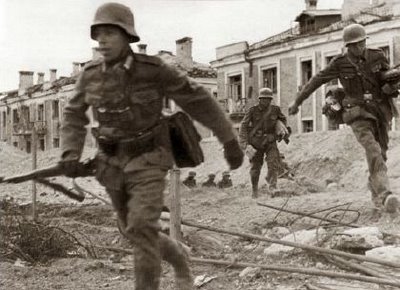
Scharnhorst in Action Against HMS Glorious

Laid down on 15 June 1935 and launched 3 October 1936 Scharnhorst was commissioned 7 January 1939.  Her sister Gneisenau was laid down 6 May 1935, launched 8 December 1936 and commissioned 21 May 1938.  Upon the commencement of the Second World War the two sisters began a reign of destruction on British shipping. In November they sank the Armed Merchant Cruiser HMS Rawalpindi During Operation Weserübung the pair surprised sank the aircraft carrier Glorious and her two escorting destroyers, the only time a Fleet carrier was caught and sunk by battleships during the war.   From January to March 1941 they conducted Operation Berlin against British merchant shipping in the North Atlantic sinking 22 ships before returning to base.

The Channel Dash Seen from Prinz Eugen

While in the port of Brest Gneisenau was bombed and torpedoed requiring extensive repairs.  Due to the exposed location of the port the German high command decided to return the ships to Germany along with the Heavy Cruiser Prinz Eugen.  This was Operation Cerberus and it took place from 11-13 February 1942 and involved the ships making a dash up the English Channel which was unsuccessfully contested by the British Royal Air Force and Royal Navy although both Scharnhorst and Gneisenau were damaged by mines and needed subsequent repairs.  While undergoing repairs in Kiel Gneisenau was further damaged by the Royal Air Force requiring repairs in or to steam to the port of Gotenhafen for repair and conversion.  Although some work was completed she was decommissioned and sunk as a blockship on 23 March 1945.  Following the war she was raised by the Poles and scrapped.

Gneisenau Sunk as Blockship

Scharnhorst was repaired following Operation Cerberes and in March 1943 was transferred to Norway where along with Tirpitz, Admiral Scheer, Lutzow (the former Deutschland), Admiral Hipper and Prinz Eugen she became part of a “fleet in being” poised to strike the Allied convoys bound for Russia. On Christmas Day 1943 under the command of Rear Admiral Erich Bey the Scharnhorst set sail with several destroyers undertook Operation Ostfront and the ensuing battle became known as the Battle of North Cape. This was to be an attack on two Russia bound convoys; however the orders were intercepted and decoded by the British which allowed Scharnhorst to be intercepted by the battleship HMS Duke of York four cruisers and a number of destroyers as she closed with the convoy after Bey had detached his escorting destroyers.  While attempting to escape she received damage that impacted her speed and maneuvering capabilities and was sunk with the loss of all but 36 of her 1968 man crew.  Her wreck was discovered 3 October 2000 some 70 miles north of North Cape Norway.

Thus ended the careers of two of the most beautiful ships to grace the seas, though their careers were short they both survived frequent heavy battle damage to return and fight again.  Perhaps their greatest weakness was the inability of the German Navy to provide them adequate escort and the Luftwaffe being unable to protect them against air strike while in port.

9 Comments

Filed under History, Military, Navy Ships, world war two in europe

A Global Force for Good

A Global Force for Good: A Sailor holds the hand of a Haitian Child

The Navy A Global Force For Good TV Spot

http://www.youtube.com/watch?v=6DriBYQvG_4

“I can imagine no more rewarding a career. And any man who may be asked in this century what he did to make his life worthwhile, I think can respond with a good deal of pride and satisfaction: ‘I served in the United States Navy.’” President John F Kennedy 1 August 1963, at the Naval Academy

“It follows than as certain as that night succeeds the day, that without a decisive naval force we can do nothing definitive, and with it, everything honorable and glorious.” George Washington 15 November 1781 to the Marquis de Lafayette

“A good Navy is not a provocation to war. It is the surest guaranty of peace.” President Theodore Roosevelt 2 December 1902, second annual message to Congress

“For in this modern world, the instruments of warfare are not solely for waging war. Far more importantly, they are the means for controlling peace. Naval officers must therefore understand not only how to fight a war, but how to use the tremendous power which they operate to sustain a world of liberty and justice, without unleashing the powerful instruments of destruction and chaos that they have at their command.” Admiral Arleigh Burke CNO 1 August 1961 at the Naval Academy

USNS Comfort off of Haiti

The newest Navy recruiting and public relations campaign features a comment “America’s Navy: A Global Force for Good.”  When it first came out some expressed their dislike of the new slogan; however as a Navy and Army veteran as well as a long time “Navy Brat” I found the slogan and the accompanying commercial inspiring and I can be extremely jaded and cynical when it comes to such advertisements and slogans.  See my post Memorable Recruiting Slogans and the All Volunteer Force. http://https://padresteve.wordpress.com/2009/05/03/memorable-recruiting-slogans-and-the-all-volunteer-force/

Neurosurgeons from Naval Medical Center Portsmouth operating on a patient aboard the Comfort- Baltimore Sun Photo

Maybe it is because I serve with a lot of great people who make up the Navy that I think this way. I have served with the brave souls of our EOD force, the Navy Expeditionary Combat Command, the crew of an elite Guided Missile Cruiser, the USS Hue City CG-66 and the professionals of Navy Medicine.  All these professionals be they war-fighters or care givers give so much of themselves to serve this country and protect others while at the same time laying their lives on the line to defend the people of the United States and others around the world.  For me this understanding of the Navy being a global force for good is relational and it goes beyond the crass cynicism of so many in the world who find little good about our nation.  I know that we have our faults but I really do believe that the good that we have done over the years and now outweighs our sins of commission and omission.  I was really offended when I saw some of the comments from some people in other countries condemning our efforts in Haiti.  I know of no other country that will empty itself to care for the people of a devastated and impoverished nation without expecting any form of repayment even while it is still in difficult economic straits.

Comfort receiving casualties- Baltimore Sun Photo

In the forefront of the humanitarian effort are my friends and shipmates in Navy Medicine on the USNS Comfort and ashore who are caring for the injured, sick and dying Haitian people.  These men and women were pulled out of our medical treatment facility and others with as little as 24 hours notice to deploy on a mission of incredible difficulty and undetermined length.  The emotional toll can be difficult as many of these professionals, physicians, nurses, corpsmen and others have deployed at least once if not two or three times to Iraq or Afghanistan.

Navy Pediatric Intensivist performs a procedure on a Afghan child

While the staff of the Comfort and those ashore toils to save lives others serve in Afghanistan running medical facilities often in conjunction with our allies.   These professionals are deployed from 7 months to a year and include some of the finest clinicians in the Navy.  Serving in Afghanistan the care for American wounded and sick, those of our NATO and Afghanistan National Army allies as well as the unfortunate civilians including children who are victims of terrorists acts, IEDs or military action mostly initiated by Taliban or Al Qaida forces.  Serving in harm’s way they see their compounds bombarded by incoming rockets, mortars and occasional artillery fire.  They also know that the vehicles that they travel in and helicopters that they fly in are targeted by Taliban forces and they care for those who are injured by IEDs on the same routes that they travel.  Having experienced this in Iraq I can say that it is a sobering and often eerie feeling that you get after you have been with Marines or Soldiers wounded by IEDs and ambushes on routes that you travel.  These men and women see the worst that humanity can do and still care about the victims.

USS Carl Vinson arrived quickly and began relief operations

Others serve in Iraq now supporting our Army troops with medical care working alongside Army and Air Force medical personnel, others are in the Horn of Africa and still others involved with other humanitarian missions or operational support of US Forces abroad.

One has to remember that these medical professionals do not just come out of a vacuum but are normally assigned to medical treatment facilities in the United States. As they depart to serve abroad those left behind continue the mission of caring for our military, their families, and military retirees going back to the Greatest Generation and other combat wounded veterans still entitled to medical care.   The workload back at home does not let up and the professionals back here work harder and longer to provide the quality care that our beneficiaries deserve. Dealing with patients and families I always hear about how much they appreciate the kindness and superior care that they get from our physicians, nurses, corpsmen and other medical professionals.

Boarding Team from USS Hue City

If you do not believe that these men and women are a “global force for good” then I am sorry that you cannot see the labor of love that these men and women provide to those entrusted to their care.  I am ashamed when I hear prominent media personalities call these “meals on wheels” missions. Personally I think it is hateful and demeaning towards the proud professionals who serve in these human tragedies and care for God’s people.  Likewise those that claim that this is being done to further US influence in Haiti are so clueless, in Haiti there is no payback even from a military or strategic point of view and even with our forces stretched thin around the world we still go out and do what no other country can do when we use our military to care for those afflicted by disaster.

In Haiti we are working hand in hand and side by with numerous Non-Governmental Organizations and other military medical professionals from the United States, Canada and other nations who are giving of themselves to serve the Haitian people.

USS Hue City 565 Feet of Naval Power on Patrol

I think that for once a recruiting phrase actually captures the essence of the Navy.  This is not about just being a better individual or improving your life or getting an education and experience.  It is about serving our nation and people as well as others around the world whether that mission is combating terrorists, pirates, protecting our vital interests or like in Haiti, or during the Indonesian Tsunami, Hurricane Katrina or at the World Trade Center and hundreds of other places, this Navy is a global force for good.

Tonight as you go to bed and sleep soundly after eating well and spending time with family, friends or enjoying some form of entertainment remember those of our Navy who serve at sea, in the mountains and deserts of Afghanistan, the cities of Iraq, the desolation of the Horn of Africa and around the world defending our interests, caring for our military personnel and their families and deploying to serve in harm’s way and in areas of devastation.  They are America’s “Global Force for Good.”  They are my shipmates.  They are the United States Navy.

Peace,

Padre Steve+

2 Comments

Filed under Military, national security, US Navy

Mission Accomplished in Al Anbar: The Marines Turn Over the Mission to the Iraqis

Religious Support Team 2 MNF-W the Desert Rats at Al Waleed August 2007

There was a time not very long ago that names like Al Anbar, Fallujah and Ramadi were synonymous with futility and humiliation.  But that was before a long time ago in a galaxy far far away. In late 2007 the Marines and our Iraqi Allies aided in large part by the “Anbar Awakening” where the Sunni in the province realized that Al Qaida Iraq’s motives were not in the best interest of the people gained the upper hand in a very short time.  The success was heralded as part of the “surge” but was in large part due to the effort made by the Marines to be seen as something other than occupiers but allies in a fight against foreigners that would brutally kill Iraqis to achieve their goals.

Iraqi Children Happy to see us near Baghdadi

I arrived in Al Anbar in August of 2007 and spent my tour as the Chaplain to the Marine, Army and other advisers in the province which at the time of my arrival were still very much in play.  Within days of arriving at our base of operations I took part in a number of mass casualty situations at the Shock Surgery Trauma center at Ta Qaddum where I prayed for, anointed and looked after Marines wounded when their vehicles were destroyed by improvised explosive devices during combat missions.  My tour was the highlighter of my military career.  In my tour with the advisors as well as the Iraqis of the 1st and 7th Iraqi Army divisions, Second Border Brigade and Iraqi Police, Highway Patrol and even a reconstruction team or two.

Allies: Colonel Cottrell and General Murthi of the 7th Iraqi Division at the Marine Corps Birthday 10 November 2007

During my time there I was privileged to serve with great Marines, Soldiers and even a number of Navy, Air Force, US Border Patrol and Customs personnel and contractors working with the Iraqis.  The Iraqis in many cases were valiant men who while serving against the insurgency and Al Qaida knew that their families were in danger from retaliation as were their own lives.

Friendship: Dinner with General Sabah

While Marines and Army forces took the battle to the insurgents the Iraqi Sunni Muslims in Al Anbar suddenly turned on the insurgents and Al Qaida Iraq.  Soon Iraqi civilians who had been either hostile or neutral towards the Marines and their own Iraqi Army and Police units turned on the Al Qaida and their allies.  Suddenly violence began to subside; Iraqi civilians began to report insurgents, weapons caches and IEDs.

Near COP South waiting to clear suspected IED

By the time that I left Iraq in February 2008 the situation in the province was such that the 1st Iraqi Division was able to be dispatched to Basra and Diyala where they in conjunction they would take the lead in driving the insurgents from these regions. Just before I left an Iraqi General, General Ali in Habbinya told me that I should come back in 5 years as a tourist because everything would be alright. Another Iraqi officer told me that if anything ever happened between us and “the Persians” that the Iraqis would be on our side.  I knew when I left that Iraq would be okay in the long run and I still believe that to be true.

Me with General Ali January 2008

Thursday the Sergeant Major of what used to be Multinational Force West or MNF-West announced the Marines of II Marine Expeditionary Force (Forward) would be conducting a transfer of authority for the American mission to the 1st Armored Division of the US Army as part of the US drawdown in Iraq without a relief in place.   For most people in the United States this will be an event of little significance Iraq is now despite the continued presence of US forces has been forgotten by most.

With Advisers and Leaders of a Company of the Iraqi 2nd Border Brigade

Concern is now focused on US military actions in Afghanistan and the humanitarian relief operations in Haiti.  However, it was in Iraq that an insurgency was defeated, the first time since the British defeated the Malayan insurgency sponsored by Chinese Communists, and the French had militarily defeated the Algerian insurgency before the French government under DeGaulle surrendered the hard fought success of the Paras and Legionnaires betraying them even as he looked after what he viewed as the future of France.

With Bedouin Family and Advsiers near Syria

In the summer of 2007 Iraq was viewed as a lost cause by much of the American body-politic, politicians of both parties and the media.  Now it is becoming a functional state, in large part due to the sacrifices of US Military personnel and the Iraqi Army and security forces.  U.S. Forces are disengaging and exiting the country. While it is likely that and advisory and support mission will remain as the Iraqis continue to rebuild and their Army and security forces continue to expand their capabilities.  The Iraqis recently showed their metal by facing down an Iranian incursion into Iraqi territory on a strategic oil field.

The text of the Sergeant Major’s message describing the transfer is posted below:

From: Carpenter SgtMaj Kiplyn (USF-W SGTMAJ)

Sent: Thursday, January 21, 2010 15:55

Subject: FAREWELL OF THE MARINES FROM IRAQ

UNCLASSIFIED

Please pass on,

SgtsMaj, MGySgts, CMDCMs, Marines and Sailors, Saturday, 23 January at 1100 will mark the end of the Marines in Iraq as an organization.  II MEF (fwd) will conduct a Transfer of Authority Ceremony with the First Armored Division without a Relief in Place from any incoming unit. USF-W (formally MNF-W) will merge with USD-C (formally MND-Baghdad) and will cease to exist.

After 6 years, over 850 Marines and Sailors killed in combat and another 8800 wounded we have completed our mission.  At our peak, we had almost 26,000 Marines and Sailors on deck, close to 200 aircraft, over 380,000 pieces of ground equipment, and were averaging close to 2000 significant events a month.  We have added a whole new generation of Heros; and names like Al Nasiriyah, Fallujah and Ramadi will be added to our History books.

Words can’t begin to explain the magnitude of effort and sacrifice our Marines and Sailors have gone through to help the Iraqi people.  Each year since the initial invasion, Marines and Sailors from all over the Corps have been a part of the revolving I MEF (fwd) and II MEF (Fwd) Commands.  Each year has been different with its own sets of unique challenges and each successive year, the incoming organization has built upon the successes of the outgoing organization.

This year was no different, we didn’t have anywhere near the level of fighting that previous MEFs have done.  However, we did conduct many operations, maintained security, continue to professionalize the Iraqi Security Forces, develop good governance and economics, assisted with the continued establishment of the Rule of Law and oversaw the peaceful transition of the provincial government.  We also had one unique mission that we can call our own. That was to finally bring the Marine Corps home. Over the past year, we have simultaneously conducted the responsible drawdown of 24,000 Personnel, over 34 COPs and FOBs, including Baharia, Rawah, and TQ and sent six years worth of equipment out of theater.

For those of you who served with me this year, thank you.  It was long and difficult at times, with our own set of challenges, but we did it.

It has been an honor to serve with you.

For those of you who have left your boot prints over here at least once during the last six years; thanks to you too. You set the stage for us to finish the job.  It has been costly, it has been challenging, it has taken a while with quite a few dark days. But, in the end, it was worth it.

All Marines and Sailors, including those who remained stateside have contributed to the overall success of the Marines and Sailors in Iraq and; all of us have known someone who didn’t make it back alive or has permanent injuries. It is up to us to ensure that those who follow never forgot their sacrifice or what we did here.

Collectively, we have added another illustrious chapter to the successful story of our Marine Corps.  One that all of us can be proud of.

Semper Fidelis,

K. Carpenter

Sergeant Major

United States Force – West, Iraq

(Previously Multi National Force – West) II Marine Expeditionary Force (Fwd)

21 January 2010

UNCLASSIFIED

Iraqi Recruits going through Basic Training

I am proud today to have been part of a mission that appears to have ended in success, at least in Al Anbar Province.  Semper Fidelis to the Marine Corps and the Sailors, Soldiers and Airmen who served alongside of us in Al Anbar as well as the Iraqi Army and security forces who despite the odds set the stage for the Iraqis and US Forces in the rest of the country to begin to re-establish order and normalcy to a country that has known little but war, dictatorship and tragedy over the past 40 years. I look forward to going back to Iraq someday and maybe visit some of those Iraqis that I was privileged to serve alongside.  May God bless all those who served honorably in Iraq and the Iraqi Army, security forces and the people of Iraq.

Peace,

Padre Steve+

Leave a comment

Filed under History, iraq,afghanistan, Military

German Tanks of World War II: The Panzer IV

Panzer IVF2 in Russia 1942

This is the first in a series of articles on German tanks of World War II.  I’m starting with the Panzer IV which was the mainstay of Wehrmacht and Waffen SS Panzer Formations throughout the war. The series will appear periodically over the next month.

Panzer IV E

The Panzer IV tank was unique among the Armored Fighting Vehicles of the Second World War in that it served in a front line role throughout the entire conflict.  No other tank in service in 1939 was still in front line service in 1945, a fact that shows the dependability, versatility and quality of the Panzer IV.

The Panzer IV was developed in 1934 out of a requirement for a medium tank to operate in a support and anti-infantry role.  It was meant to compliment the lighter Panzer II and Panzer III and the design requirements did not require the new tank engage enemy tanks on equal terms.  The Wehrmacht submitted its requirements and Krupp, Rheinmetall and MAN produced prototypes for evaluation and testing following which the Krupp version was selected for production.

PZ IV D in France

The new tank mounted a low velocity L24/ 75mm gun had a crew of 5. The Panzer IV had a maximum speed of 35 km/hour. The first three variants of the Panzer IV the Ausf A, B and C were developmental models. These limited production models with a total production of just over 200 vehicles were primarily used for training the fledgling Panzerwaffe. As the Wehrmacht had a need for more tanks many of  these were provided additional armor and placed in front line units until phased out of service.  The Panzer IV  D which was first produced in 1939-1940 was the first of the series designed for combat and issued to the Panzer Divisions.  One drawback of this model was that it had weak armor protection.  This deficiency was corrected to some degree in the next model, the Ausf E which was produced from 1940-1941.  Neither the Panzer IV D or E variants were produced in great numbers with fewer than 500 units produced.

Panzer IV G in North Africa

Limited numbers were used in the annexation of Austria and it first saw combat in Poland followed by the Blitzkrieg across France, North Africa, the Balkans and the Soviet Union.  It was in France and North Africa where the Germans ran up against French Char B heavy tanks and British Matilda Infantry tanks that they found that the gun power of the Panzer IV was inadequate to penetrate the heavy armor of these opponents.  Despite this the Germans maintain the low velocity gun on the next model, the Panzer IV F1 when it was introduced in 1941. When the Germans encountered the Red Army’s T-34 and KV-1 tanks during Operation Barbarossa they finally decided to equip the tank with a L43/ 75mm gun. This was sufficient to deal with any allied tank.  The first model to use this was the Panzer IV F-2 which rolled out in late 1941, of which nearly 500 were produced.

Panzer IV H with Additional Side and Turret Armor to protect against shaped projectiles

The continued need for improvements in response to combat conditions on the Eastern Front and North Africa meant that the F-2 was further refined in the Panzer IV G in 1942. The Mark IV G was the first model to be produced in large numbers with over 1600 units produced. The Mark IV G was superseded by the Panzer IV H which had a more powerful L/48 75mm gun.

Jagdpanzer IV with Long L/70 75mm gun

Each succeeding models armor protection was improved and beginning with the Mark IV G turret and side skirt armor was applied as protection against hollow charge projectiles.  The Mark IV H which was produced from1943 to1944 had a production run of nearly 3800 units.  The final model, the Mark IV J was produced in 1944-1945 with a total production run of about 1750 units.

Flak Pz IV Wirbelwind with 4x 20mm Flak

The Panzer IV served on every Front and was provided to Romania, Hungary and Finland in limited numbers.  It remained a formidable opponent to allied armor and was found in elite formations of the Wehrmacht and Waffen SS until the end of the war, despite being superseded by the newer and more powerful Panther. It was prized for its reliability and could engage or almost every allied tank on equal or superior terms up to the end of the war.  The long L 43/48 gun and side armor on the turret sometimes led the Panzer IV G, H and J to be confused by allied tank crews with the Tiger I. The chassis was modified to serve in a number of roles including the Jadgpanzer IV, a tank killer equipped with the Panther’s L/70 75mm gun forward mounted in a limited traverse mount.

Bruckenpanzer IV

Likewise the Sturmgeschutz IV assault gun was developed by the Artillery as a infantry support and anti-tank vehicle. Several FLAK versions including the Wirbelwind quad 20mm anti-aircraft tank were introduced to provide anti-aircraft support to the Panzers against allied fighter bombers while and a number of other specialized support versions, bridge layers, artillery support vehicles, command vehicles and some designed to support very esoteric super-weapon projects like the “Land Cruiser”  were produced in limited numbers.  After the war some Panzer IVs saw continued service in Finland, Hungary, and Romania and well after the war by Syria where they served in a dug in defensive mode during the Six Day War.

Syrian Panzer IV

2 Comments

Filed under armored fighting vehicles, History, Military