Category Archives: Military

Japan’s Self Defeating Attempts to Become Economically Self Sufficient in the 1930s

This is the first of a two part series that explores the similarities of the United States in 2009 to Japan of the early 1930s.  It explores the topic of economic self sufficiency or “autarky” and how nations can put the proverbial cart before the horse in terms of seeking ways to become self sufficient.  The Japanese chose the path of military conquest seeming to forget the fact that they were dependent on natural resources and manufactured equipment to wage such a war by the nations that they were attacking.

In the early 1930’s Japan’s desired to emulate the economic self-sufficiency of the United States or to achieve autarky controlling its own economic destiny by securing sufficient natural resources.  Japanese industrial and military leaders felt that such was needed for economic expansion as well as military preparation and expansion.  Key resources such as oil, specialized steels and alloys, iron ore, coking coal, machining tools and even cotton were not readily available in Japan proper.

Japans’ goal was unrealistic based on the differences of the two countries. In the early part of the 20th century the United States was self-sufficient in most critical natural resources and was a key supplier to the world of oil, iron, coal and grain.  Additionally most of the United States’ resources were contained within its borders or provided to it in trade with nations that needed what the United States had to offer in manufactured goods.  Japan did not have this.  As a nation it had few natural resources on the home islands and even suffered food shortages that resulted in famine at times.  It was dependant on other nations for basic natural resources to power its economy and to feed its population. As a result some of its political, economic and military leaders looked to achieve autarky through conquest.

Unfortunately for the Japanese they were surrounded by numerous powers that stood in their way.  To the north was Russia, which they vanquished in the 1905 war, but in doing so ended up nearly bankrupt, though they gained the Korean peninsula. However, the Japanese now faced the Soviet Union with its immense military on the Manchurian border and subterfuge in the politics of China by their support of Mao Tse Tung’s Red Chinese forces.  The Japanese were able to gain some possessions by participating on the Allied side in WWI at the expense of Germany and China, though they did not achieve all they wanted and felt cheated by the Allies at the Versailles peace conference. The first step was to invade Manchuria and seize its natural resources in 1931.  However to gain more than what they could garner in Manchuria the Japanese would have to do so at the expense of China and the Western Colonial powers, France, Britain, the Netherlands and United States. Japan’s quandary was how to achieve autarky without resorting to war with multiple enemies.

The Japanese faced a sort of “chicken or the egg scenario” as to what came first. In order to wage war Japan needed iron ore, coking coal and industrial salt from North China, oil from Borneo and Southeast Asia, cotton from America to make finished products for the American market. Likewise it needed special steels and alloys from the US to supply the war effort. The US was also the primary source of Japan for machine tools and other sophisticated industrial equipment needed for Japanese industry.  To go to war the Japanese required the imports of the very nations who stood in their way.

Yet to go to war entailed great risk, Japan did not have the resources, especially oil and metals with which to sustain their war effort without maintaining foreign trade with the very countries that they would have to engage in war.  All of these factors together made autarky in the style of the United States unreasonable through military means alone. It is likely that the Japanese could have achieved more by using more skillful diplomacy during the 1930s.  Had they built a mutually beneficial alliance with China, did more to exploit the natural resources of Manchuria and negotiated favorable trade deals with the United States they probably would have accomplished more than they did through using military force.  Some Japanese reformers attempted to make some of these reforms but were unsuccessful as the military particularly the Imperial Army, the government and industrial concerns became locked into the military option.

By contrast during its growth period the United States did not have to deal with significant military powers as it moved west across North America, only Native American Tribal groups.  The only power capable of stopping the United States was Great Britain.  While there were tensions between the United States and Great Britain along the Canadian border and Pacific Northwest during the 1850s, the United States never faced a significant external threat.  Thus the United States using very little military power gobbled up the continent and established its status as the Hegemon of the Western Hemisphere.  Japan could not do what it needed to do unless it negotiated with or conquered the powers that had significant military power to confront the Japanese and economic ability to strangle the Japanese economy.

This period should interest to any student of history, foreign policy and economics.  The study of the period of Japanese history needs to be considered by policy makers when considering war to obtain natural resources or critical supplies not indigenous to their country or for which they are dependent on potential hostile suppliers.  Like Japan in the 1930s the United States is not currently self sufficient in many natural resources especially oil and is dependent on other nations, especially China for critical items in its economy.  Having surrendered much of its industrial capacity and having failed to exploit alternatives to fossil based fuels, especially oil the United States faces a conundrum similar to the Japanese in the early 1930s.  The United States is militarily strong yet deeply politically divided and possibly unstable.  The United States is dependent on many nations, some who outwardly hostile to us for the very lifeblood of its economy.  Like the Japanese the military is singularly incapable of securing all of these resources and engaged in multiple wars that are tying up close to half our ground forces when one considers troops in theater and those unavailable because they slated to go or having just returned from combat deployments.  Additionally like the Japanese who were in the midst of the Great Depression the United States is going through what appears to be the worst economic times since that period.  Policy makers need to be careful when dealing with situations where economic factors are diminished and natural resources have to be imported to sustain the economy. Autarky is fine if you can do it but the United States has more in common economically with Japan of the 1930s than the we would like to admit.  Something to think about.

The second concluding section of this will be published in the next few days, the Deity Herself permitting…

Peace,

Steve+

5 Comments

Filed under History, Military

The Uncomfortable Legacy of Colonel General Ludwig Beck

“It is a lack of character and insight, when a soldier in high command sees his duty and mission only in the context of his military orders without realizing that the highest responsibility is to the people of his country.” Ludwig Beck

Bundesarchiv_Bild_183-C13564,_Ludwig_BeckLudwig Beck  Bundesarchiv Foto

This is one of those uncomfortable posts to write partially because I know that some people will take it completely wrong or ascribe meaning to it that I do not intend. I by training am a military historian, probably better at that than I am theology.  One thing that fascinates me in the study of military history is the actions of men in the face of evil and the meetings of such people at the intersections of where military and government policy intersect.  It is a timeless theme. The bulk of my study until the past few years was the German Army, particularly that of the Weimar Republic and the Wehrmacht to include policies, leaders, political attitudes and behavior in war and peace. Thus it makes sense for me to look at Colonel General Ludwig Beck who held the post of Chief of the German General Staff during the early part of the Nazi era.

Ludwig Beck is one of those characters in military history that makes professional military officers uncomfortable.  Beck is not the perfect example of righteousness nor was he always correct in things that he supported.  As an artillery regiment commander he defended the rights of soldiers and officers to be Nazi Party members though he himself was not one.  He, like many military officers was a conservative military officer by nature and became Chief of Staff of the Wehrmacht in 1935 two years after Hitler’s ascension to power.  Taking office Beck was troubled by some Nazi policies but not by the need for Germany to expand to areas that it had once controlled, he opposed the plan to attack Czechoslovakia not because of any love for the Czech state which he desired to be eliminated, but rather it being a war that Germany could not win. He resigned from his position a Chief of Staff in 1938 when he could not persuade the rest of the General Staff to resign in protest over Hitler’s plan which he felt would be disastrous for Germany.  Had the western powers led by Neville Chamberlain not caved at Munich it is likely that the Germans would have suffered badly against the Czech army and fortifications and with the entry of France into the war would have suffered a defeat that would have ended the Hitler regime.  In fact German officers who saw the extent of Czech preparations on the frontier following the Munich deal were greatly relieved that they did not have to fight their way into the Czech state.

After his resignation Beck played a key role in the resistance movement. He was involved in the planning for a number of attempts on Hitler’s life. Yet it was his leadership in the July 20th 1944 attempt on the life of Hitler that ensured his place in history.  With Colonel Klaus Von Stauffenberg and others in the General Staff at the Front and in Germany he acted to avert further destruction in Europe and the certain destruction of Germany.  The plot, Operation Valkyrie was marred by poor execution and failed to kill Hitler of seize power but for a few hours. The planners had left too much to chance and once Hitler had restored communications the coup attempted ended swiftly.  Had the attempt succeeded Beck was in line to become either the leader of Germany or the Head of the Army.  Instead while being interrogated after his capture he took his own life depriving Nazi leaders of the ability to put him up for a public trial at which he would have been humiliated and then executed.  The Kasserne in Sonthofen where the Bundeswehr MP School and Staff School as well as NATO and EU military schools are located is named for him.  It is there, ironically a former Adolf Hitler School that his memory and sacrifice is honored by the nation which emerged from the rubble of World War Two.  He is honored in a small museum and with a plaque recognizing his sacrifice.

492Ludwig Beck Kasserne Sonthofen

The reason that General Beck makes many of us in uniform uncomfortable (and I do include myself) is that he recognized that senior officers, especially those in high command who help set and execute policy cannot isolate themselves in the purely military aspects of the operations.  Instead he believed that officers have a higher duty to the constitution and people and not just the military mission that they have been assigned.  When he realized that he could not stop Hitler’s invasion of Czechoslovakia he resigned and worked in the obscurity of a small and often divided resistance movement against Hitler.  The bulk of the German high command, including many officers idolized in the United States did not recognize the higher duty. Many of these men were consummate professionals who did not support the evil of the Nazi regime and who conducted themselves honorably. Yet they effectively abetted its crimes by not opposing actions of their government that were against international law and morality as well as dangerous from purely a pragmatic military standpoint.

The problem is that military officers in any nation, including ours can face situations such as Beck faced.  A military’s character is demonstrated in how leaders deal with such situations.  Beck recognized the situation early, the bulk of his fellow officers did not recognize a problem until Germany was embroiled in a war that it could no longer win.  Even then most could not mount an opposition to Hitler because they did not want to be considered to be mutineers and violate their oath.  The potential to abet evil when military professionals bury their heads by planning and executing purely military aspects of a campaign is great.  If they ignore questionable policy or even policies that they know that have been judged by the international community to be illegal or immoral, such as torture of prisoners or waging wars of aggression against countries that have not attacked their nation they become complicit in their nations crimes.  This was the case with German Officers who may not have committed any personal crime and even tried to mitigate the evils of the Nazi regime were morally complicit in that evil.

In the United States the military shows its fidelity by remembering our oath to the Constitution and being faithful to it and the people that we serve.  As officers we represent all Americans and not just those of our political party, religious faith or social or economic interests, nor any political leader, faction or interest group within the nation. The Constitution, our military regulations, traditions and the Uniform Code of Military Justice are the standard by which we operate and by which we conduct ourselves and tools that protect us when policies or actions taken by the government or people within it violate those codes or international law.  The UCMJ makes it clear those officers who take part in, plan or a complicit in illegal actions in war are committing crimes.

When a nation become involved in wars which are non-traditional, revolutionary wars or insurgencies that barriers to professional conduct can be broken down. The Mai Lai massacre committed by 2LT William Calley’s platoon with the certain knowledge and maybe even approval of individuals in the chain of command is one example as were the uncontrolled chaos of prisoner abuse and torture at Abu Ghraib.

Times are difficult and we do not know what the future brings.  Stress in societies caused by economic conditions, natural disasters, lawlessness on the streets and divided and ineffective governments sometimes remove the moral restraints of the society and even affect the military.  One sees this in Weimar Germany as well as the 4th Republic in France which had to deal with post World War II economic difficulties, exacerbated by recriminations of political opponents for actions the others did during the war while France was occupied by Germany as well as the wars in Indo-China and Algeria which further divided the nation and the military.

It is in stressful and uncertain times that officers have to be men and women of principle who always uphold the highest traditions of their military as well as be the voice of conscience when governments, political parties, special interests or leaders begin to violate international norms in the conduct of war. Beck was not a perfect officer. He supported some of Hitler’s policies until after his resignation but like much of the resistance believed that the Nazi regime could only end up destroying Germany.  It is important to remember that like Ludwig Beck that officers do not need to sacrifice their honor to be faithful to their oath.

Peace, Steve+

16 Comments

Filed under History, leadership, Military, national security, world war two in europe

Going to War: Interlude in Fallujah Reunions, Redirection and a Stay at the Ramadan Inn

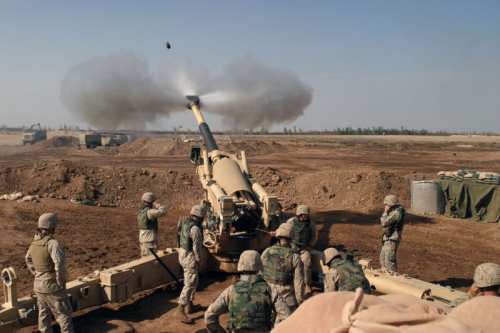
marine 155s in fallujahUSMC 155mm Howitzer firing on Insurgents at Fallujah in 2007

Note: This is the latest installment of my “Going to War” Series.  Other postings in this series are located in the Subjects section under “Tour In Iraq.” The series chronicles the tour of Religious Support Team-2 of the Iraq Assistance Group in MNF-West from July 2007-February 2008. We were the first Navy Chaplain and Assistant to work supporting advisers since the Vietnam War.

We woke up to the sound of more outgoing artillery fire.  The sun was shining outside as I look out my window at the sky above the California Barrier that protected our “suite” in the south wing of the Ramadan Inn.  Climbing out of the decrepit Iraqi bed with the fresh sheets I stumbled over my two tons of gear to look at the time while Nelson slept like a baby in his equally decrepit Iraqi bed.   My ever trusty alarm clock showed that it was about 0830, which meant we had gotten maybe 5 hours sleep and missed breakfast. Thankfully I had stockpiled a few pop-tarts and granola bars from the Camp Victory chow-hall the day before.   Opening the door and peering out into the hallway I saw it empty and walked across the hall to the head, shower and laundry room to do my morning business.   Despite being a Baath Party playground the suites at the Ramadan Inn were not furnished with their own toilet or shower, just a small sink and mirror.

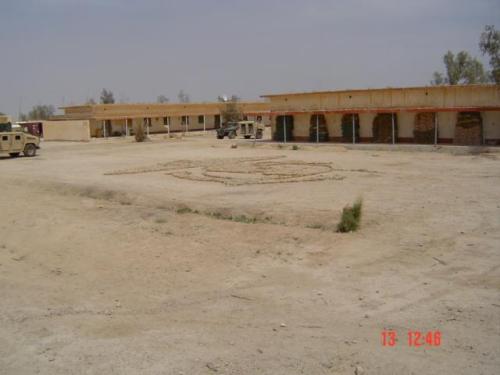
ramadan innRamadan Inn

Though the Ramadan Inn had seen better days it was certainly, despite being the playground of Uday and Qusay Hussein it was not exactly a palace like those of their father Saddam.  It was somewhat reminiscent of an old and run down motel along Route 666.  The floor was a marble type tile and the sand painted concrete building with a flat roof.  I strolled over to the head in my PT-sleep clothes and was relieved to be able to relieve myself in a facility that had actual porcelain shitters which flushed using real water.  If you have been to Iraq or Afghanistan you know that this is not always the case.  The showers were passable being a more European design and the water was hot.  I guess even the cold water was hot in Fallujah with temps in the 120s.  Once I had gotten up I awakened Nelson, the sleeping beauty. He then went through his morning ritual to make himself presentable to the world.  Those who know nelson know that if he can he will take care of his personal hygiene.  I ate one of my Strawberry Filled frosted Pop Tarts washed done with water and when Nelson was ready we walked over to the Chaplain office.  It was like a maze to get there. We walked across the way a bit, took a right, made a left and went through the normal transient quarters area, took a right went up a block or two, took a left, made another left, wound our way past a decorative lake, took a right, went past a number of buildings before passing a final bank of green porta-johns finding the MEF- Forward Chaplain Office to our right.  The sun shone brightly and though not a long walk was relatively warm and by the time we got to the Chaplain Office I was sweating.

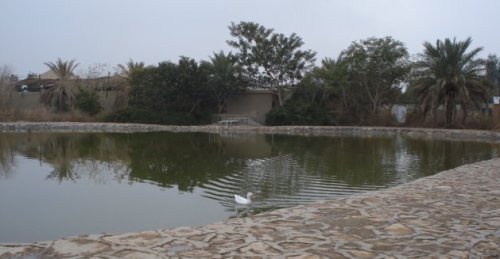
fallujah pondPond at Fallujah

The Chaplain office was like every other facility and was protected by California Barriers or Hesco’s. We were met by RP1 Roland and the Deputy MEF-FWD Chaplain CDR J.P. Hedges.  They were most hospitable and offered us water as well as coffee, which my caffeine deprived brain needed badly.  After introductions Nelson got together with RP1 Roland and I met with Chaplain Hedges doing the usual butt-sniffing that military professionals engage in when meeting someone for the first time.  This ritual usually consists of learning who our mutual friends are, where and with whom we had served in the Navy, where we went to school, something about our families and for Chaplains our faith tradition or denominational affiliation.  This is a customary act for chaplains as it is for other communities and specialties in the Navy.  On the positive side it is a way of making connection with each other and building relationships.  It is also a way or self preservation within the system as sometime there are people that do not have your best interests at heart. However for J.P. and I the meeting was very friendly. We d a lot of shared experiences in the types of duties we had done and we had mutual friends.  While we enjoyed conversation he began to introduce me to some of the things that had been going on in country the last few months.  After about 30 minutes Chaplain Mike Langston came in.  It was Mike who had worked with Peter Dissmore and the Corps Chaplain to bring us out to the west to cover the Marine and Army advisors in Al Anbar Province.

Mike had a couple of orders of business to take care of before he brought Nelson and I into his office and had our reunion. Nelson and I had both worked with Chaplain Langston.  It was good to see him again.  Nelson had worked for him in Afghanistan and I had been with him at 2nd Marine Division in 2000-2001.  He and Chaplain John Kaul arranged for me to take over Headquarters Battalion upon my return to work in a quasi-regimental billet with oversight of the independent battalions Religious Ministry Teams, though not the actual supervision of them. In addition to my regular duties counseling Marines, doing suicide interventions, conducting classes and supporting field exercises they used me, because of my experience to assist and evaluate chaplains who had been fired or relieved of their duties.  I got each one for 30-60 days to see if they could be recovered for further service or not.  In a sense this transformed me from a relief pitcher to a pitching coach.  Chaplain Langston was at a school when 9-11 occurred and during this time I was used as the Deputy Division Chaplain looking at readiness, training and potential deployment of our religious ministry teams with their units.  Both Nelson and I had experienced Chaplain Langston as a tough but fair chaplain.  What he did expect was that we would be out doing our job and keeping him or his office in the loop on our operations and issues facing us.  He did not attempt to micro-manage us.

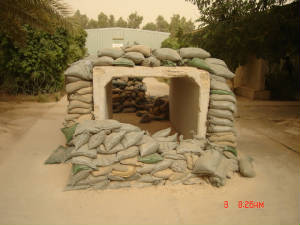
bunkers_everywhere.jpg.w300h225Bunkers to Protect Against Indirect Fire at Camp Fallujah

Mike Langston is a prior Marine Corps Infantry Officer who had been a been a Company Commander and battalion staff officer as well as instructor at “The Basic Course” which is the leveling field for all Marine Corps officers regardless of their commissioning source.  He played football in college and still has the physique of a defensive lineman.  He left active duty and went to seminary and when he was ordained and graduated from seminary entered the Navy Chaplain Corps. He had since risen to the pinnacle of a career for most chaplains having been promoted to Captain, the same as a Colonel for the other services and assigned as the 2nd Marine Division Chaplain.  He is a no-nonsense kind of guy and kind with a high level of energy and emotion.  He explained the current situation in the Province was, the locations of the various Marine Regimental Combat Teams (RCT-2 and RCT-6) as well as the one Army Brigade Combat Team, 3rd Brigade, 4th Infantry Division as well as the 1st Light Armor Reconnaissance Battalion and the MEF Aviation and logistics assets were located.  He then got down to the specifics of our mission which were pretty simple and suited to our personality as a ministry team. Basically he expected us to manage our own operations in the MEF area of operations. He expected that we coordinate our operations with the teams that we would support and keep his office informed of where we were going and what our general plan of operation was.  Since he had worked with both of us and we were both known and trusted quantities he gave us a tremendous amount of operational freedom to do our job.  His expectation was that we would be active and get out to the remotest places that we had training and assistance teams of advisors.  He told us about an Army team that had been based in Ramadi to do the job with the advisors.  He confirmed what Peter Dissmore had told us about this team.   They had never left the base in 4 months and basically hung out at the Ramadi main chapel. They managed to get their orders curtailed and left theater never once having contacted or visited any advisory teams.

ega fallujahMonument in the Traffic Circle at Camp Fallujah

We were also told of a change to our projected base of operations.  Our original plan of operations had us working out of the former British and Iraqi base at Habbinyah the location of the headquarters of the 1st Iraqi Division and the Advisors assigned to it.  Instead the Colonel in charge of those teams made the call that he could not support the operations of a Chaplain from his location. He held firm on this and the plan was changed so that we would operate from Ta’Qaddum a large air and logistic  hub about equidistant between Fallujah and Ramadi.  Ta’Qaddum is adjacent to Habbinyah on the south side of the Euphrates. It sits atop an escarpment overlooking the town to the north and Lake Habbinyah in the South.  In 1941 it was the site of a siege when the Iraqi military launched a revolt against the British who occupied the country despite it being given independence at the end of World War One.  The British we besieged in Habbinyah and the Iraq forces had the high ground atop the escarpment.  Unfortunately for the Iraqis and fortunately for the British the British forces had support from the Royal Air Force and the Iraqis had no logistics ability to support their units atop the escarpment.  The Iraqi forces were pounded and eventually a relief force arrived from Jordon to break the siege.  At TQ as it is known by most Americans we would be housed and taken care of by the 2nd Marine Logistics Group Chaplain, Commander Pat McLaughlin and his team.  We were instructed to make coordination to plan work with the teams supporting the 7th Iraqi Division, the 2nd Border Brigade, Iraqi Highway Patrol and the Provincial Police forces while working to build a bridge to the teams of the 1st Iraqi Division. The change was momentarily upsetting but ultimately it opened the door to the entire province where if we had been co-located with the 1st Division we may not have gotten out of its operational area.

Following the briefing, he, J.P, RP1 Roland, Nelson and I went to lunch at one of the two major chow halls on the camp where I met up with an old friend.  The friend was Captain Luke Fabiunke with whom I had served for 2 years at Marine Security Forces Battalion.  Luke was our S-6 and the Communications officer at Security Forces.  He was always fun to hang out with and was very supportive of my work as a chaplain there.  Luke was in the G-3 Operations shop t the MEF and specifically was working with the section that dealt with the training and advisory teams in the province.  It was good to see him and he immediately upon learning our mission asked how he could help.  This hook up was one that paid off in spades in the next 6 months.  It is a lesson that Chaplains need to build relationships with other staff officers in order to be successful, not just in their current assignment but in many cases later in their careers when they need assistance the most.  For me it helped meet my mission of finding and making contact with advisory teams of all types as soon as we hit the ground rather than operating blindly trying to figure our way around the labyrinth that was the operational setting for these teams.  I think that I owe Luke a beer or two for his assistance.

Following lunch we got to work.  Helped by Chaplain Hedges and RP1 Roland we were issued flight suits and Nelson a couple of sets of Marine Pattern Camouflage uniforms and I was issued two elderly Panasonic Tough Book laptops. One was set up for regular unclassified traffic and the other for classified work dealing with intelligence reports, weather and planning and submitting air movement requests.  Despite being a highly technological military when one gets into a combat zone technology assets for oddball teams like ours are sometimes scarce.  In fact I understood from Peter back at IAG that most of the Army teams had to share assets with others just to communicate.  Chaplain Langston and his staff ensured that we had freedom to be able to do our job without having to inconvenience others to do it.  They laptops may have been elderly but they worked.  Chaplain Hedges taught me the ins and outs of planning and coordinating the air support from Marine, Army and Air Force aviation assets and helped get us set up to do this.  Once again we got what we needed to do our mission.

We spent another three days in Fallujah preparing for the mission and making coordination with staff sections and others that we might have to call upon.  We also had a number of reunions with others that both of us had served with. I met Major Andy Niebel and Lieutenant Colonel Dave Ottignon who I had served with a Second Combat Engineer Battalion. They were good friends then and are men for whom I have a tremendous amount of respect.  I also met a number of Chaplain with whom I had previously served or knew from other duty stations. One of these was LT Joe Buenviaje, who had been my RP at 1st Battalion 8th Marines when I had done my relief pitching job there.  Joe had cross-rated from being a Boiler Technician to the RP rating not long before I had met him.  We had qualified for the old FMF qualification together and I was able to help him begin his journey to be a Navy Chaplain.  I was also blessed and honored to baptize his children at Camp LeJuene.  Joe has a heart of gold and did well in Iraq.  He got out with his Marines a lot, once almost getting blown up by an explosive device which blew up a highway overpass where they had just been conducting services. With them was a Catholic priest who had likewise just celebrated Mass.  They were leaving the site when the explosion hit and following the attack helped to take care of the wounded.

Having a cross on your uniform in a chow hall can lead to interesting situations as well as ministry.  Some people will automatically avoid you when they see the cross as if faith and religion was some sort of communicable disease.  I admit that there are some religious people and groups across the faith continuum that I think are toxic so I understand this.  Likewise there are people have been used, abused or burned by religious leaders or groups and thus want nothing to do with organized or even disorganized religion.   There are other people who are afraid that if they say something wrong that the chaplain might come down on them.  There are still others who when they see that you are a chaplain ensure that they get together with you and some will even pray for you. Regardless of the situation I always try to be friendly to those around me in a chow hall despite my preference for my introversion.  In fact I will attempt to start up conversations with anyone around me if nothing else to let them know that I know that they are there and that they can talk with me.

Some of the people that we supped or dined with were Religious Programs specialists like Nelson….well actually not so much like Nelson.  Nelson is one of those one of a kind animals that the Deity Herself cracked the mold when he was out of the oven.  These young men and women had been in country various lengths of time and were having as happens in almost every case good or bad experiences working with their chaplain.  There are unfortunately a few bad apples that mistreat their RPs and give the rest of us a bad name. Likewise there are bad RPs in the force.  Some actually set new lows for military conduct and discipline and give a bad name to the good sailors in the rating.  I had one that stole from the offering in Okinawa, forged offering forms, leave papers and burned up a new pickup truck to try to get the insurance money. I had another who tested positive for cocaine upon arriving to my ship and yet another who pretty much stayed one step ahead of the law.  I guess it is human nature that we get such folks and unfortunately because there are people like this who serve as Chaplains and RPs there is kind of a guilt by association.  As such RPs question the RPs that they know  as to how their chaplains treat them and are often wary of a chaplain that they do not know.  Nelson assured them that I was “cool” and we had a couple of interesting meals together.

There were a number of times in Fallujah where young sailors or Marines approached me about spiritual issues, family problems or prayer requests. There were even some young men and women who were interesting in becoming chaplains.  It was neat to be able to be there in those moments where our lives intersected, maybe for the one and only time.

We spent our last day in Fallujah getting ready for our flight, another really late flight.  During the day we heard that an Army CH-47 Chinook had crashed at TQ killing the crew and that the cause was undetermined as to whether it was due to hostile fire or a mechanical problem.  Such incidents raise your pucker factor especially when you will be flying into the same place that they crashed.  With this in mind we picked up our laundry had some chow, made some final coordination, called and e-mailed our families, did some PT and settled in for the evening waiting for RP1 Roland to pick us up. While outgoing artillery boomed in the distance we sat back in our room at the Ramadan Inn and discussed our plans, as well as wondered out loud what was in store for us.

3 Comments

Filed under History, iraq,afghanistan, Military, Pastoral Care, Tour in Iraq

Leave no Soldier Behind? I think not…A letter from an IOF Vet and Reader

Note: This is the sanitized version of an e-mail that I received last night from a OIF 05 and OIF 07 Veteran Army Officer who has been awarded two Bronze Star Medals for his service in Iraq and was Medivac’d out of Iraq during his second tour when he was diagnosed with an exceptionally rare incurable and eventually  fatal lung disorder that he contracted in Iraq with two separate Brigade Combat Teams.  Since then he has developed other medical conditions brought on by his lack of pulmonary function.   He is in process of being medically boarded out of the Army and is despairing to the point of having suicidal thoughts and ideations, wondering if it would be better for him to die on active duty so his wife and child would have a better financial support than if he waited to die a few years from now as a medical retiree.  I was able to contact this officer to listen to him at length this morning and afternoon. He has agreed to get help for these thoughts and I have given him the means to contact me any time and he has contracted with me to get help, I suggested a trip to his local medical facility Emergency Room.  He has given me permission to share this as he no longer feels protected enough by the Army to say it on his blog.  Please pray for this man and take care of the Combat Veterans, active duty, disabled or retired that you know.   His letter follows.

Peace,

Steve+

Dear Padre Steve,

This is why I am not posting on line…(I would say things like the following…)

I really do not know how much more I can take! I am beaten down, first by my own body and the diseases that are exacting a high price; second by the fight waged to receive some kind of medical care; third by the callus medical care provided; fourth by the institution of the Army attitude and treatment of “broken” people; by how the institution seeks to downplay and disregard the sacrifices of those who have sacrificed so much–by trivializing the toll of the disease–especially when not clearly visible.

Without a thirteen round prize fight the Army will throw me off the back of metaphoric  5-ton and act like they are doing me a favor by slowing down to 55 mph! “Look, you worthless scum-bag, we are doing you a favor by slowing down. Don’t, worry, you should be OK…we will try and get you off to the side so the tank does not role over you…”

The system, and the people within it, constantly questions your “worthiness” of any consideration. Then if you insist  on getting help for things that you know are wrong with you they double and triple question as if there is no way you could be telling the truth.

It is easy to say that I am at my wits end with all of what is going on in my life lately. The constant fight to receive what is necessary right is darning. I have been dealing with this callused indifference since being Medivac’d in the middle of my second Iraq tour. The system seems to be designed to wear you down so that rather than continuing to fight for the care that you need, just take what little the Army is willing to give.  I found out this week that after I am med-boarded out of the service that I will have to fight the Army all over again to be able to keep my Army benefits when I apply to the VA.  This is happening despite the fact that the Congress recently allowed for this compensation for veterans.

Will justice EVER be given? At what price?

Does the “Army” GIVE A DAMN!? The short answer is NO! There may be some individuals who do. What is experienced is the Teflon affect. Not many, if any, are willing to get dirty and fight for or on behalf on another. People end up getting treated as paper and numbers–not the individual they are, or for the sacrifices they have made. The individual is trivialized through the bureaucratic process that most involved in processing hide behind to separate them from the reality and often pain experienced by those suffering in the system.

I have recently started trying to get help from my PTSD.  A board certified Army physician that I wrote a consult for me to see someone.  I was contacted and told that the people who run the program here no longer take appointments or consults and that I would have to be “triaged” by a medical or psych tech to get an appointment that might be 3 months from now?  I might be dead by then. I don’t feel safe.

People may listen, but they usual will not, cannot, or do not know what to do. So trying to get help is like trying to find a particular molecule of water in the ocean.

This process SUCKS. It is worse than my first, very trauma filled, combat tour in Iraq (OIF 05-07). It is demoralizing. I squarely wish I had lost my legs them the lung function that I have lost!

I am an officer with TWO BRONZE STARS for my Iraq service.  I gave all that I had and my honesty, integrity and faith in the Army that I joined is being called into question.  If it is happening to me, what is happening to junior personnel? Who is their advocate? Is it any wonder that soldiers are committing suicide and unheard of rates?  Shit I have even counted up the money and figured that my family would be better off if I died on active duty than after my medical retirement.  What the hell is up with that? Why should I have to die for the Army to take care of my family?

What do I have to do to be heard? Does God even care? I’m just asking. Thanks for listening.

Sincerely,

Joe Smith (a pseudonym)

1 Comment

Filed under healthcare, iraq,afghanistan, leadership, Military

Padre Steve’s Highs and Lows of 28 Years Service

Ooops, this should have posted the 25th…all references in the post though it posted today are for the 25th.  The meltdown was the 24th, not my duty night.

Note: I think that I have pretty much recovered from last night’s mini-meltdown, though tired have has a good day working some stuff that is pretty cool that could be a positive thing for Navy and VA Chaplains.  I think success does help mitigate some of the effects of a meltdown.  If today had been crappy and I hadn’t had a good talk with Elmer the Shrink it might have continued.  Now with some sleep I could be cooking with gas even though my house is all electric.

On to the Post:
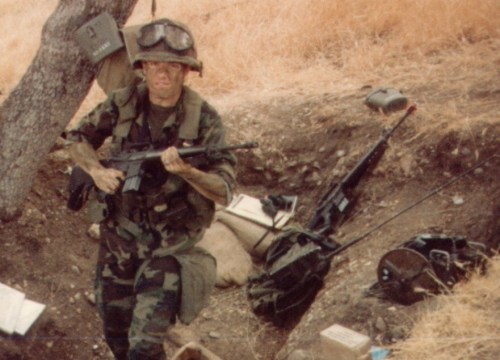
Soldier Once and YoungEnlisted in National Guard 1982

“So we’re all dogfaces, we’re all very, very different, but there is one thing that we all have in common: we were all stupid enough to enlist in the Army. We’re mutants. There’s something wrong with us, something very, very wrong with us. Something seriously wrong with us – we’re soldiers. But we’re American soldiers! We’ve been kicking ass for 200 years!” Bill Murray as John Winger in “Stripes” 1981

Well sports fans I am at the hospital tonight celebrating 28 years of service in the military. It really doesn’t seem like any more than 27 ½ but who’s counting right? And when I look back at the Army I joined I am reminded of Stripes.

I think that I have pretty much recovered from last night’s mini-meltdown, though tired have has a good day working some stuff that is pretty cool that could be a positive thing for Navy and VA Chaplains.  I think success does help mitigate some of the effects of a meltdown.  If today had been crappy and I hadn’t had a good talk with Elmer the Shrink it might have continued.  Now with some sleep I could be cooking with gas even though my house is all electric.

So 28 years ago today I went down and signed my name on the dotted line.  It was August 25th 1981 two months after the release of the movie Stripes and two months before I saw it with Judy at the $1 movie theater.  On that end of summer day I went down and signed my contract with the Army ROTC program at UCLA with the Chief Lord of Discipline himself, the Captain Bruce Lawson swearing me in.  He had just finished PT and though still in his PT clothes administered the Oath of Enlistment.  It was not much on ceremony but it was a start.  In fact most of my promotions in either the Army of the Navy have not come with much fanfare and I’m actually pretty okay with that so long as I get paid and get to do what I love doing which is being a Priest and getting to serve now as a Navy Chaplain.  So I followed with a trip down to the National Guard Armory on Victory Blvd in Van Nuys to enlist in the National Guard. Since I was not a scholarship student I was allowed to simultaneously enter the Guard.  So the 25th was kind of like a double header for me, I did the oath for the Guard later in the afternoon. It’s like Tommy Lasorda once said: “I love doubleheaders. That way I get to keep my uniform on longer.”

So I went in to Headquarters and Headquarters Battery and met the Company Commander, Captain J.J. Kramer, now a retired Colonel I believe and Major Charles Armagost, the Full Time Unit Administrator and Adjutant.  Wearing his green fatigues the good Major administered the Oath for the California National Guard, which differed from the Federal Oath in that it also included words about obeying the Governor of the State and the Laws of California etc…Following that I was walked down to the supply room where a rather rotund Sergeant began issuing me uniforms and field gear.  I got my first gift of US Military designer clothing and was told to report the Thursday after Labor Day for a “Battery Dark Night.”  So began my rather auspicious career.

I remember being in uniform in those early days without a single ribbon or medal to my name.  I’d look around and see all the guys who had served in Vietnam and some in Korea as well with all kinds of ribbons, medals, unit citations and qualification badges.  I would look at them and once I remarked to Judy that I wish that I would have a lot someday.  She accused me of whining, something that I feel is a mischaracterization of my attitude about not having anything and something that now with a full chest of ribbons, medals and qualification pins that she is not hesitant to remind me of and tell others about.
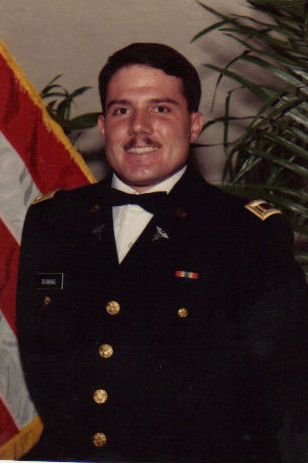
2LT Dundas 1983Look Mom One Ribbon

So what has transpired in 28 years?  Here are some of the highlights and a few lowlights of the of this adventure.

In 1981 it all began and things happened fast, within two weeks of enlisting I was driving an M-151A1 Jeep to Ft Irwin CA as part of battalion advance party and then spending the weekend learning to call in artillery fire. After going through hell and being destroyed and rebuilt by SFC Harry Ball, Drill Sergeant US Army like Richard Gere was in An Officer and a Gentleman I somehow got commissioned in part due to the forbearance of Major Lawson, the former Captain Lawson who has sworn me in.  Judy asks if I had my own “Puget Sound Deb” when she sees the movie with me that winter. However just prior to getting commissioned during my last annual training period at Camp Roberts I led team of Ersatz East German Kommando’s on raids against battalion rear area as the opposing forces.  I was almost run over in may M-151A1 by an M-548 Ammo Carrier during a strafing run coming down hills firing blanks from machine guns like the Rat Patrol and dropping Smoke and CS grenades in the vehicle’s path.  Later we captured the battery Operations Center during a firing mission. None of this made them happy but the Forward Observers and I had a blast.

After I got commissioned I attended the Medical Department Officer Basic Course at Ft Sam Houston TX and suffered for Jesus for 9 weeks in the Riverwalk Marriott hotel in downtown San Antonio. After this I spent 11 glorious weeks at Ft Knox Kentucky which by the way is in a “dry county” or at least it was back then  going through a 6 week course after being bumped by Saudi Arabian exchange officers.

557th comany command 1985Company Commander

From January 1984 through late December 1986 we were stationed with the 557th Medical Company Neubrucke and later Wiesbaden. Was a platoon leader and became company XO when our XO checked into a psych ward before Winter REFORGER. While in the field was promoted but o one realized that fact until we came out of the field in mid- February. In a late night hastily arranged ceremony which I had to drag Judy in from bed to see I was promoted and got my first real medal. In September I became a “relief pitcher” Company Commander when my new CO got fired. I was told “Lieutenant; clean up that Company.” After 7 months, and having to adjudicate close to 50 Article 15’s, and kicking a bunch of drug users out of the Army I was relieved by a Captain and I had my first and last Change of Command ceremony. Became a personnel officer at our group, pissed off the boss and had a miserable last couple months in Germany. However I completed my first row of ribbons made some really good lifelong German friends and learned to drive really fast and really good and developed a fine appreciation of good beer.

In 1987 I attended the Military Personnel Officer Course at Ft Benjamin Harrison which is in Indianapolis and continued on to Fort Sam Houston where I was assigned as the Adjutant for the Academy Brigade, Academy of Health Sciences.  I got promoted right after I got there and since Judy had not arrived I had the world’s best platoon sergeant, SFC Cynthia Carter help pin on my new Captain bars. Judy was quite happy that Cindy got to do this as she really liked her.  My Brigade Commander wondered what was up with that, but it was an honor to have her do the pinning. While there I worked on AIDS/HIV personnel policy and became “CINC AIDS” at the Academy. While there I collected my second Army Achievement Medal and an Army Commendation Medal.
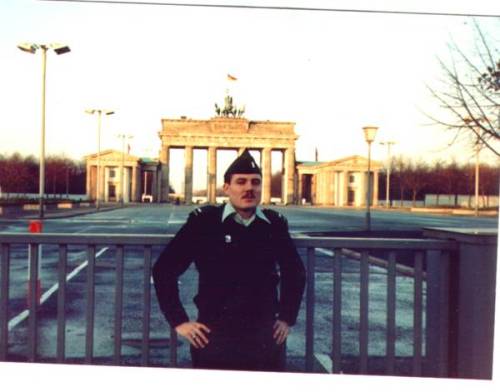
Berlin WallBerlin Wall 1986

In 1988 I left Active Army to attend Seminary and was appointed as an Armor officer in Texas Army National Guard.  I was told by my boss LTC Jim Wigger that I was moving from the “frying pan into the fire as the chaplains were a cutthroat bunch” and that the “Medical Department was not even in the same league as the Chaplains.” When the Division Chaplain found out that a seminarian was getting ready to drive tanks he pitched a fit and had me enter the Chaplain Candidate program.  In seminary I attended  the Chaplain Officer Basic Course at Fort Monmouth NJ. As Deputy Course leader and Company “First Sergeant” pissed off lots of chaplains and seminarians. Thankfully I was backed up by LTC Rich Whaley who saved my ass for the first time and not the last time.  I met my friend Fr Jim Bowman who kept me from doing anything really stupid. In 1992 I graduated from seminary was ordained and become a chaplain and assigned to 111th Engineer Battalion in Abilene. That year I got thrown out of the Chaplain Officer Advanced Course when school changed a policy on Chaplain Candidates awaiting final approval to be chaplains to enter course. After Billy Martin style tantrum Rich Whaley saves my ass a second time.

In 1993 I went back to Chaplain Officer Advanced Course, made amends and did the appropriate penance.  Meet up with Fr Jim Bowman again. In the fall of 1994 finished the final phase of the Chaplain Officer Advance Course.  Happiness is Ft Monmouth in your rear view mirror. In the summer of 1984 I viewed the O.J. Chase live on miniature TV in M-577 Command Track with Lakers playoff game in split screen while at Fort Hood.

In January 1995 I moved to Huntington WV to take a job as a contract ER Chaplain.  I transferred from one former Confederate Unit to another going from the Texas to the Virginia Army National Guard.  In December I was promoted to Major and transferred to the Army Reserve and got rid of the 410 mile one way trip for a drill.
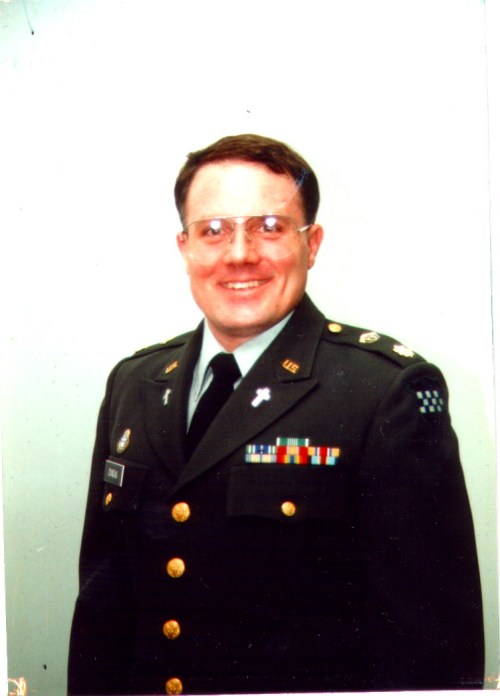
New MajorNew Major December 1995

In July of 1996 I got mobilized and sent to Germany to support Bosnia mission, lose job. While in Germany get to do a lot of cool stuff, got a bunch of medals and though the Chaplains there wanted me to be brought on regular active duty get told I am too senior to transfer to Regular Army. I actually think that the guy who made the decision remembered me from Chaplain School and did not want someone like me in “his” Chaplain Corps. Upon my return from Bosnia support the Reserves assigned to Ft Indiantown Gap PA as Installation Command Chaplain where in September 1998 I got to close down help close down the Federal side of things and transfer chapel and congregation to National Guard care. In October I returned to the reserves like a journeyman ball-player being sent back to AAA from the Majors. In December the Navy offered me a deal to play “in the show” on active duty and I took it, went from being an Army Reserve Major to Navy Lieutenant. My friend Father Fred Elkin was my first detailer and offered me a choice of East Coast or West Coast Marines when I asked for a ship.  We now serve together and get a good laugh about that now. It did turn out to be a good thing for me. One of the cool things about my time in the Navy has been since I have blown myself up enough in the Army and seen others do likewise that I know where the career “land mines” are and how not to step on them. This has been a great benefit to me.  It was like changing from one league to another in the middle of a baseball season.  The old stats don’t count for or against you when you start playing in the new league.

After Navy Chaplain School I was assigned to the 2nd Marine Division at Camp LeJuene NC. From then on my life has been going non-stop.  I was chaplain for 4 different battalions in the Division where Father John Kaul used me as a “relief pitcher” in situations where chaplains had either been fired for doing illegal or immoral things or replacing people who had to move on short notice orders. Did CAX at 29 Palms on multiple occasions and did a deployment to the Far East, Okinawa, Japan and Korea.  Collected more medals got my “old” version Fleet Marine Force Qualification. I was assigned to HQ BN 2nd MARDIV. 9-11 -01 attack happened. A couple of months later I reported to USS HUE CITY CG-66 in Mayport.
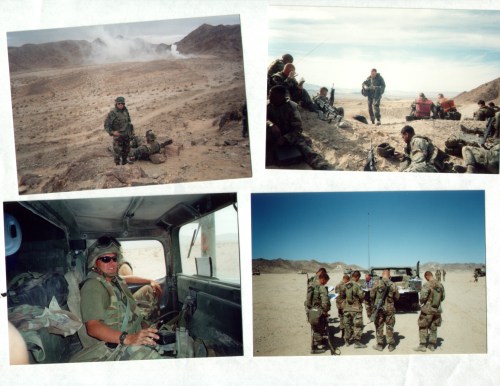
Dundas of the DesertDundas of the Desert 29 Palms 2000-2001

Not long after reporting went on the final work up exercises prior to deployment, deployed to the Horn of Africa, Northern Arabian Gulf, Gulf of Oman and Mediterranean.  Was an advisor for a boarding team in Northern Arabian Gulf and made 75 boardings of detained smugglers.  We almost got to see the Indians and Pakistanis get in a nuclear war, that was a bit sporty and we supported air operations in Afghanistan. After a period in the yards during following deployment as well as work with the great Marines who served in the Battle of Hue City I checked off the ship in October 2003, again collecting more medals and ribbons.
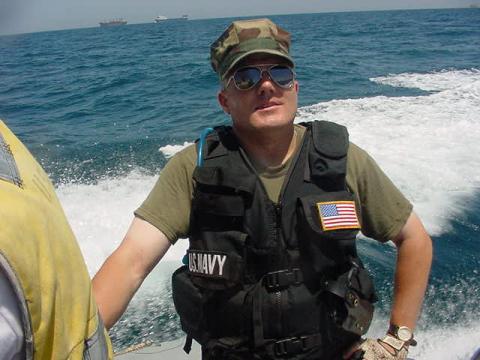
Boarding partyBoarding Party 2002

I went to Norfolk where I was assigned to the Marine Corps Security Force Battalion and my Commanding Officers, Colonel Mike Paulovich and Colonel Donald Rogers sent me about the world to care for our Marines.  Over that time I probably averaged 2 trips a month out of the area, many overseas to Japan, Hawaii, Spain, France, the United Kingdom and Bahrain, others to places far and wide in the Continental United States.  Colonel Paulovich and I probably worked more closely together than any commander that I have ever worked with and we went through many difficult times in that assignment. We are still friends to this day.  One of the cool things is the people that we work with. I was promoted to Lieutenant Commander in April 2006.  This meant that I had spent almost 16 years of my career wearing Captain or Lieutenant bars.  I again collected more ribbons and medals for the time with the Marines and was one of the first Navy Officers to get the Fleet Marine Force Officer Qualification pin while completing Marine Command and Staff College.
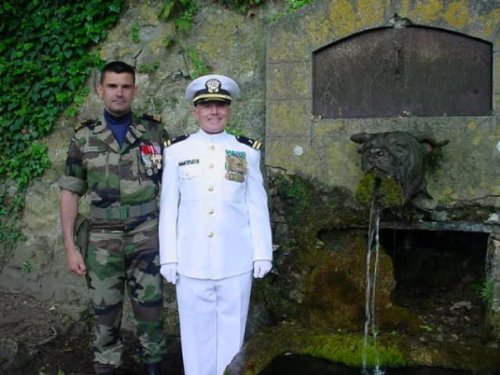
Belleau woodBelleau Wood France 2004

I then went to Navy EOD Group Two in Little Creek where I was the first chaplain assigned to EOD.  While there I got to go to Jordan to the Jordanian Army/UN Peace Operations Training Center and to Sicily.  I was snatched up to go to Iraq in July 2007 and served the most meaningful operational deployment of my career serving our Marine, Army, Navy, Air Force and Department of Justice and Homeland Security advisors to the Iraqi Army, Police and Border Forces in Al Anbar Province.  I came back from Iraq with a great case of PTSD, a gift that keeps on giving.  I checked out of EOD in September 2007 again with more medals and ribbons to my current assignment at Naval Medical Center Portsmouth where I get to do what I am passionate about as a Priest and Navy Chaplain serving in a teaching hospital.
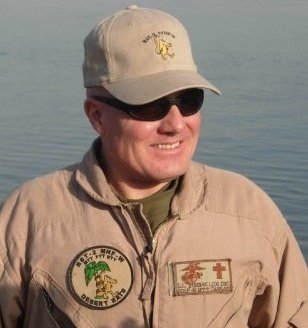
My Tom Clancy lookIraq 2008

Looking back it has been a long and strange trip and it is still an ongoing journey.  People ask me how I keep going even with the PTSD and it’s like Tommy Lasorda says “Guys ask me, don’t I get burned out? How can you get burned out doing something you love? I ask you, have you ever got tired of kissing a pretty girl?” Speaking of which now that I am on the way home after 31 or so hours at work I probably need to do with Judy when I see her.
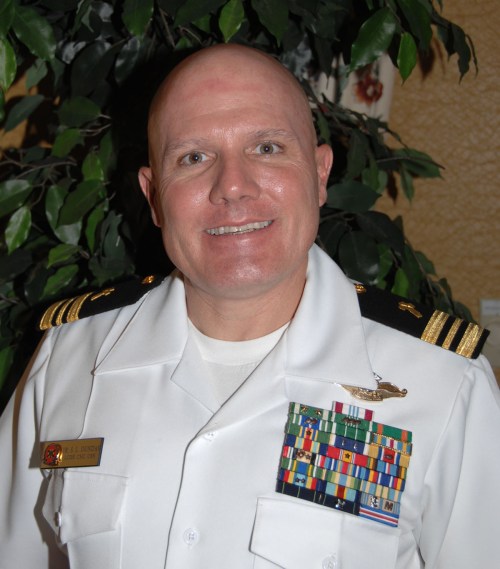
Steve Summer Whites 2008July 2008, Grand Admiral of the Ottoman Navy?

Peace,  Steve+

1 Comment

Filed under Baseball, History, iraq,afghanistan, Loose thoughts and musings, Military, PTSD

Going to War: A Reflection so Far, Memories, PTSD and hopes and fears Past and Present

964

As I have been writing of my experience in Iraq it is amazing to me the amount of emotions that I have experienced.  It is strange to feel like I am back there as I write.  I know that this is necessary but at times it is unnerving especially as I talk to friends who are going through much the same experience that I had coming home and sometimes worse.  I have been in e-mail contact with a friend from a NATO ally who has done a couple of tours in Afghanistan.  I can really feel for him as he is in a smaller military with a lot few resources that the Americans to deal with PTSD and other maladies from this war which seems to drag on without end.  Another friend on the West Coast has been dealing with the ravages of both PTSD and TBI and another Army Chaplain friend who has 2 Bronze Stars to his credit deals with PTSD as well as a very rare and eventually fatal lung and brachia condition.  Friends from my medical center are being deployed, I’ve been told that I am too valuable and needed where I am to deploy.  I do understand that at the same time deep in my heart I want to be with my friends from my ICU as they go to war.

The emotions took a big turn as I actually started writing about being in Iraq, beginning with the C-17 ride in to Baghdad.  In some sense the mirrored what I was going through two years ago.  It kind of came to a head the other night when I wrote about the rocket that went over my head at Camp Victory while waiting for my ride to head to the Camp Liberty heliport.  Then there was the flight to Fallujah and I can remember that flight.  I have never really liked flying in general and ancient helicopters in particular. Thinking that many of the CH-46s that I flew in while in Iraq had been in service in the Vietnam era was none too comforting.  They were almost as old as me.  Marine Helicopters are notorious for hydraulic fluid leaks.  The old joke goes” “How do you know when a Marine helicopter is low on hydraulic fluid?”  “When it stops leaking” is not entirely in jest.  I guess you can say that most of my career flying rotary wing aircraft in the Army and Navy has been just this side of terrifying.  I manage to survive every time but it takes forever to come back down from the anxiety of the preparation for and actual flights themselves it is no wonder that I still have problems sleeping and going on alert any time I hear a helicopter overhead.

Faith at times is an ongoing struggle. While I believe I question God more, especially when I see little kids suffering or read about young men and women killed in action or maimed by combat.  I find that I am less compassionate toward those who have not deployed who make suicide gestures and screw with their friends and families and then blow off help.  It angers me that their narcissism takes time and resources away from people who have been in the shit who need help and have to wait to get help.  I also find that religious people who have trite answers for everything really annoy me, especially those that are constantly talking about “spiritual warfare” when they have no clue about war, suffering and death. They are what Luther called the “theologians of glory” and they have no real answers, just platitudes that work fine until a real crisis comes.  Despite this I believe somehow in the God who is willing to be with me in the middle of the Valley of the Shadow of Death and at the foot of the Cross.

One of the things that tears at me now is the deep division in the United States as the obviously enlightened zealots of the extreme right and left push their agendas so hard that it seems impossible to find and amicable solution.  I wonder if we have entered “Weimar America.”  I guess I can understand how the moderates of the conservatives and socialists in Germany were ground to dust beneath the anvil of the Communists and hammer of the National Socialists in the later years of the Weimar Republic.  I really understand the military men who found both alternatives distasteful and tried in vain to seek the middle ground and maybe restore some sanity to the country.  That article is yet to be written.  I think I will call it “Weimar America?”  What really gets me is that both the right and left have dropped all pretense of civility and are now engaging in physical altercations at political meetings or “town hall” meetings and some have even be brandishing automatic weapons near venues where the President is speaking.  I have seen the results of this type of no-quarter politics in the Balkans and in Iraq.  I wonder what the hell all these demigods on both sides are thinking and if they in their devotion to their alleged “principles” would attempt “to destroy the country in order to save it.”   I have become ashamed of the leadership of both political parties as well as the special interest groups that drive the agendas of both extremes, especially as in the case of some who use the Christian faith to justify their actions.  When I see these people in action my anxiety level often returns to what it was in Iraq and on my return.  I can honestly say that the people on the extremes make me fear for my country.  I feel that they are pushing us to the abyss and that I can’t do a damned thing to stop it.  I’ve matured enough to know it is not simply the fault of one side or the other; as both are at fault and it seems that the most extreme on both sides have actually been wanting this to happen, at least from my viewpoint as a passionate moderate.

I have come to realize that my true countrymen are those that I have served with to defend this country and protect others abroad, especially as the insanity continues to spread.  Though I struggle and have to deal with emotions as if they were brand new every day just as I think that I am getting better I know that I have to keep going.  I owe it to my brothers and sisters from the current war and wars such as Vietnam.  Sometimes I wonder if all of us PTSD afflicted vets are the only sane people in the country. We are a brotherhood.  “We we happy few, we band of brothers.”

brothers

I’m glad that I have friends, especially vets from Iraq, Afghanistan, the Gulf and Vietnam.  Limey and Barney with the Hue City Vets, Ray and Charlie the Vietnam Veteran of America brothers who man the beer stand on the concourse behind home plate, and so many others like my trusty assistant Nelson Lebron who helped keep me safe and sane in Iraq.

In the middle of all of this I grieve for my Vietnam Vet and retired Navy Chief dad who wastes away in a nursing home with end stage Alzheimer’s which according to his doctor should have killed him months ago.

I’d better stop while I’m ahead.  I need to catch myself, maybe have a beer and focus on some baseball for a while before I get ready for work.  I have duty tomorrow and I expect that I will be busy the next couple of days.  I hope when I get off Wednesday afternoon that I will be able to see the Tides play.  I can use the view of the diamond at Harbor Park that helps calm my soul about now. Maybe between no and then I can get in with my buddy Elmer the Shrink.

pub2

Pray for me a sinner,

Peace, Steve+

7 Comments

Filed under alzheimer's disease, Baseball, iraq,afghanistan, Military, Political Commentary, PTSD, Tour in Iraq, vietnam

Scouts Out: My Neighbors in Section 100

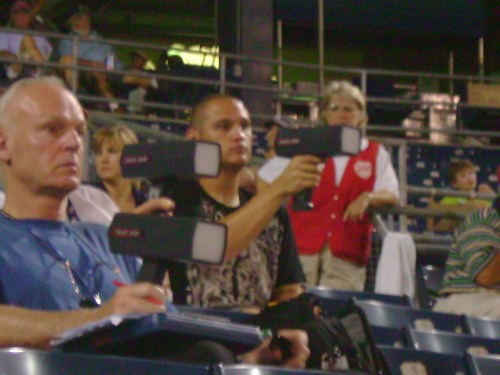
ScoutsGuns up: Scouts and Players with Radar Guns at Harbor Park
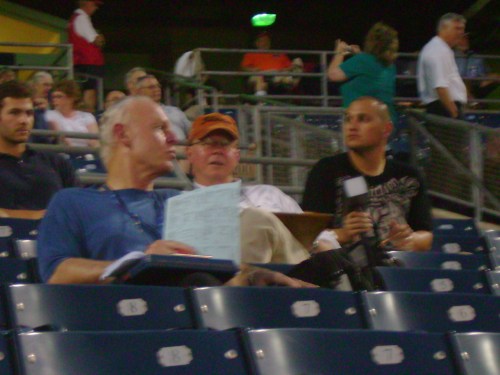
“If you don’t find high-caliber marble … you can’t create classic statues” John Schuerholz

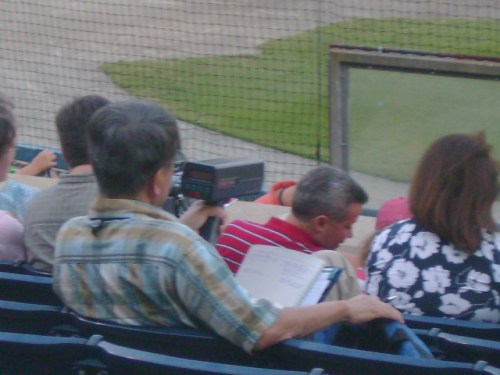
One of the interesting views from my pew in the Church of Baseball, Harbor Park section 102, Row B seat 2 is that of the scouts.  I often talk with my friend Elliott the Usher about the nuances of the game including the realm of the scouts, that often unsung group of men who find the raw talent that helps build the team.

Scouts are an interesting breed.  They work for a Major League club, but dwell in obscurity, as any true scout would do.  The seek talent, both raw and developed that will in their analysis help their club.  The scouts travel throughout the minors, colleges, high schools and independent leagues to see what talent might be available.  Sometimes they are former pro-ball players such as Bob Kison who works for the Orioles and Bill Singer who works for the Nationals, both of whom I have met this year at Harbor Park.  In addition to the team scouting organizations the Major League Baseball Scouting Bureau provides teams centralized scouting organizations which all have access to.  Currently the Major League Baseball Scouting Bureau employs 34 full time and 13 part times scouts in the USA, Canada and Puerto Rico.

I encounter a good number of scouts at Harbor Park.  They as well as player’s wives, families or friends and VIPs sit in section 100 to my left.  In addition to the scouts the Tides and the opposing teams frequently have at least one of their own players charting the game from that section.  I have had a number of interesting conversations about the game with scouts from the Orioles, Nationals, Pirates, Cubs, Mets, White Sox, Yankees and Braves as well as a scout from the Japanese Major League team the Yokohama Bays Stars.  There have been scouts from a good number of teams, including the Korean Baseball League that I have not chatted with prior to games.  One is very careful not to bother them during the game itself as they are looking closely at what is going on.  This is their bread and butter and they need to be respected while they work.

scouts 2Mets and Rays Scouts

Of course the job of the scout is directly impacted by both the current and projected needs of their teams, including the minor league system as well as how the teams are doing at the moment.  Thus from day to day scouts may be scouting individual players, or looking more in general for players that might of help to their team and its associated minor league system.  Once in a while I get to look at the sheets that scouts use in evaluating talent.  Since pitching is always a needed commodity they are seldom without their radar gun to measure the speed of pitches as well as charting pitch type, placement and what happened to the pitch.  It is a very detailed job collecting data on players as well as making first hand observations that could be as important as the numbers in determining whether a play is right for the organization.

The key to the success of any Major League organization is how well its scouting system identifies prospects for the big team.  Teams that are forward thinking spend the time and money to scout players either through the traditional methods or through the Sabremetrics system popularized in the book Moneyball about the Oakland Athletics methods under Billy Beane.  Some teams use a combination of both traditional methods and the more data oriented Sabremetrics. Some teams which are accused of simple “buying” their major league team through free agency like the Yankees actually have a very talented scouting department and minor league system.  The Yankees have built their own middle relief corps from their own system this year.  The bullpen with the exception of closer Mariano Rivera has been a weak spot over the past 8 years for the Yankees and they have remedied this on their own.  Likewise the Red Sox, Rays and Orioles maintain excellent scouting and minor league systems.  The Orioles are the newcomers in this building their team from scratch over the past few years.  In the West both the Angels and the A’s have strong minor league systems as do the Cardinals and Dodgers.

japanese scoutYokohama Bay Stars Scout

Unfortunately many organizations outside baseball, especially churches do not scout or develop talent.  Sometimes it is a organizational approach or prejudice that either seeks outsiders versus home grown talent, mega-churches are particularly bad about this often looking at outsiders to fill the their staffs.  On the other hand older main line denominations often are suspicious of outsiders even those with good track records.  Some Churches such as the Roman Catholic Church intentionally limit those who can serve as clergy to the ranks of unmarried celibate men, with a few exceptions made for married clergy from other churches.  Those men are taken through a process that often discounts any prior ministry they have as of little value and very few make it through the process of being ordained.  On the other side of the spectrum are churches which have no rhyme or reason as to how they choose develop or assign clergy with often very arbitrary means to choose pastors.  Clergy development from identifying young men and women who believe that they have a call to serve;  the nurture and care of these men and women, their education, formation and eventual ordination and assignment are particularly important if the Church is to fulfill its mandate of bearing witness of Christ in the world and caring for the people of God.

One can make application in many other fields.  In the military we typically recruit for most specialties but we look harder for specialties that require a more selective process such as Special Operations personnel.  In the medical field the military employs a very rigorous process of evaluating prospective physicians through medical school, internship and residency.  In specialties which a lot of personnel are required and in which there is a good amount of turnover and attrition many personnel are recruited but at certain career points a good number are weeded out.

Good scouting needs to be part of recruiting.  Talent must not simply be recruited based on test scores, but the whole person.  Organizations that seek excellence will use people to scout for and evaluate talent within their own organization or outside of it.  The goal of course is not to find one person that can play now, but to develop many people to deepen the organization and make it more resilient when it experiences personnel losses or has to make organizational moves. Without good scouting much recruiting effort will be spent and often wasted on people who do not fit what the organization needs at the present or in the future.

Peace, Steve+

Leave a comment

Filed under Baseball, leadership, Military, Pastoral Care, philosophy

Going to War: It was Just a Rocket and a Night Flight to Fallujah

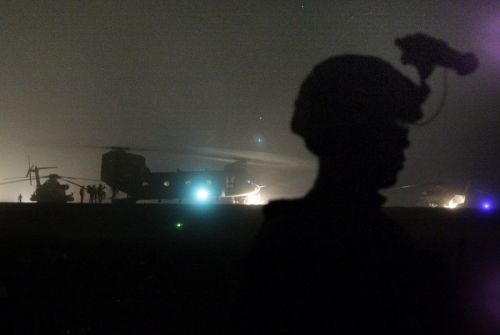
helos at nightTypical LZ at Night

That evening Nelson and I said farewell to our new friends at Iraq Assistance Group, went and got chow at the large Camp Victory chow hall.  What is interesting on some of the larger bases is just how well fed the troops are.  Of course there are those who are better fed than others who could use the “wide load” convoy signs hanging off of their asses.  The main chow hall at Victory has a number of serving lines and drink, salad and dessert islands.  It has the main serving line, a fast food short order line, a Mongolian BBQ line as well as variations of Giros, Indian food, pizza bar and of course soft serve as well as Baskin and Robbins Ice Cream.  Breakfast is another “feeder” with almost everything imaginable to eat.  I am not a big breakfast eater by and large so for me black coffee, hot or cold cereal and fruit was a normal breakfast.  After dinner we went and finished our packing and waited for our ride to take us to the Camp Liberty airfield.  Had I been stationed at Camp Victory I would have probably outgrown my uniforms as I look at food wrong and can add a pound.

We had a very late flight, about 0200.  Since you normally need to manifest for a flight two hours prior it means that you back up at least a hour before the manifest time.  This particular evening there was not much cooling going on and there was little illumination which meant in most places it was very dark. Especially in troop the billeting areas.  We dragged our gear to the entrance to the billeting area.  Nelson went back to his tent and I plopped my ass down on my bags.  About 2300 I heard and felt a rush over my head.  It was a rocket, probably a 107 mm rocket which is one of the most popular indirect fire weapon used by the insurgents or possibly a 122 mm rocket.  Both are former Soviet systems and not very accurate but still the fact that a rocket has buzzed me was disconcerting.  A few seconds later I heard an explosion.  I later heard the rocket had continued on and hit an uninhabited area of the camp.  Soon after it went over my head a very young looking soldier came running up to me in his PT gear with an M-16 at the ready.  He shouted “Sir, what was that?”  The young man appeared to be a bit scared to I simply quipped “Only a rocket son didn’t hit us.”  He seemed to relax just a bit and I said “You okay son?” the good thing about being as old as I am that you can get away with calling the young guys “son” because in most cases they I’m old enough to be their father.  I stay in game too much longer and the new kids could be grandchildren.  This young soldier said, “Well sir I’m on the quick reaction force and that sounded close.” In the background to the east machine gun and small arms fire could be heard.  A pair of gunships buzzed us going the general direction of the gunfire. Baghdad was definitely not a violence free school zone.  I replied to the young soldier. “Son, if I were you I’d report to where you need to go, better grab your helmet and flak.”  The young man looked at me in the dark, assuming I was a Marine officer since I was in my Marine Desert digital cammies, saluted and said “Yes sir” to which I replied “be safe soldier and God bless, keep up the good work.”  Once again he thanked me and hurried off into the night.

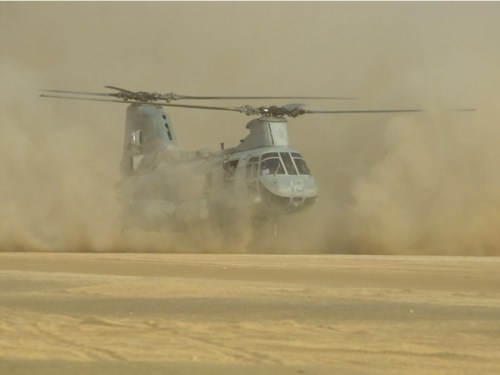
AIR_CH-46_Brownout_Landing_lgCH-46 Landing

A few minutes later, Nelson who has been in some pretty sporty situations in Afghanistan including once where he took out a knife wielding assailant at a checkpoint in Kabul with his fists, came up to me.  “Hey Chaps, did you hear that rocket? Sounded like a 107.”  I said to him, “Shit brother, it felt like it went right over my head. “  He responded quickly “Boss I think we’re in a war here.”  And I said “sounds like it partner, definitely sounds like it.”  Then he said “Chaps, you wouldn’t believe what I just saw.”  I said “Really, what?”  And he told me the story. “I was over looking for our boy when I needed to go to the head, so I opened one of the port-a johns and when I opened it saw this guy and girl having sex in it, like they didn’t have the door closed and you know how nasty those things are.”  I said “Partner you’ve got to be kidding me” and Nelson said “Chaps I wouldn’t do that to you, those people looked at me like I was stupid when I opened the door and I just said excuse me and closed the door. That place stank sir; I don’t know how they were doing it in there.”  I replied “Partner, I guess after a year of more here some folks will take whatever they can get.” “But, you’d think that they would find some dark spot rather that a port-a-john,” replied a thoroughly disgusted Nelson.  As I laughed at the misfortune of my little buddy, bodyguard and protector I simply said “There’s no accounting for taste my friend, no accounting for taste.”

We sat on our gear and waited, and waited.  The time when we should have been picked up went by and after about 15 minutes of chatter about not being picked up on time, Nelson said. “Boss you want e to go find our ride?”  I responded that I wanted him to as it was so dark that he might not know where to find us. A few vehicles had come and gone but none were our assigned wheels.  Finally after about 45 minutes our ride showed up, Nelson had found him on the other side of the compound in his truck listening to AFN radio.  He had come to the wrong side of the billeting area and was chastising me for not being there.  I said, “Sergeant, I said to meet us over here and I’ll be damned f we have to lug our gear a couple hundred yards to make you happy.”  I paused as he started to interrupt and then cut him off “Sergeant, don’t go there, you’re talking to a field grade officer who wasn’t always a chaplain, you went to the wrong place and you didn’t take the initiative to try to find us. We had to find you so don’t push your luck.”  He replied, almost dejectedly, “Yes sir” and I said, “consider this matter ended, get us to the airfield, we have a flight to catch.”  Nelson and I piled our gear into the back of the truck, got in and rode the airfield.

The Camp Liberty airfield, which deals exclusively in rotor wing aircraft, is one of the busiest heliports in the world.  Hundreds of flights go through it every day.  They are primarily Army, but a fair amount of Marine aircraft pass through as well.  We were flying Marine air tonight.  When we got to the heliport our chauffer had a difficult time finding a place to park.  Eventually we sort of double parked and Nelson and I and Nelson and I unloaded our gear with a bit of help from our chastened chauffer got up to the manifest desk where we were greeted by a civilian. He took our names and our mission number and then took out a marking pen and wrote it on the back of our hands.  I found that that at each place this was the primary way to identify who was getting off where or if you should even be on the aircraft. I found a seat and then because I couldn’t get comfortable walked outside for a while.  Nelson on the other hand, ground his gear, threw himself upon it pulled his cover over his eyes and took a power nap. He can sleep almost anywhere.

With about 10 minutes to go I woke up Nelson, and I find it amazing how he can wake back up the way he does.  When I take a nap I am useless for about 30 minutes after I wake up as my body tries to figure out what time it is. We both took turns guarding our gear as the other hit the head, once again a darkened port-a-john that stank to low hell.  When done we staged our gear near the lineup point.  Our mission was called and we lined up with about 30 others, a mixture of Marines, Sailors, contractors and a few soldiers.  We geared up, securing helmets, flaks, our packs as well as our massive EOD issue sea-bags.  Nelson helped me with mine as we got ready to walk, once was over my back and the second strapped across my chest, actually going from my chin to just above my knees.  Many of our fellow passengers had very little gear, and one fairly large contractor offered to help me with my gear.  I took him up on it about half of the 100 yards to where our bird had landed.

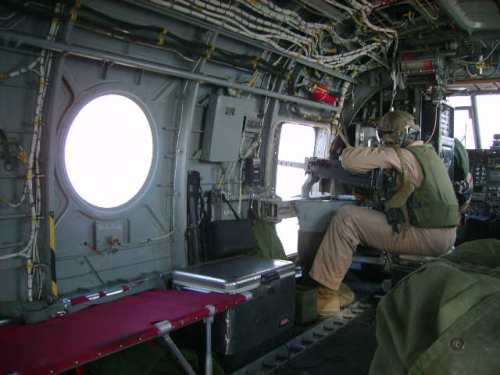
Watching our aircraft come in, a flight of 2 Marine CH-46s which date back to Vietnam service I was amazed at how surreal they looked coming in out of the night, their haze gray fuselages almost having a ghostly appearance as they set down.  Of course we had the bird that was farthest from the line up point and I was really glad for the help of this generous contractor.  As we loaded our bags onto the aircraft, stacking it in the center of the deck with everyone else’s gear, we each took one of the jump seats along the side and strapped ourselves in.  Sweat was pouring off of me and I felt totally winded, no amount of running, pull ups, pushups and crunches had prepared me to lug our heavy and ungainly gear around.  The dimly lit troop compartment was hot and I looked around the aircraft.  I noted the machine gunners in the front doors and the crewman in the back who took a seat with a 240 series machine gun mounted on a swivel.  It reminded me of the films I saw of the inside of World War Two B-17s, except that the flight suits were different.  The crew gave the let the pilots know that we were ready, and I wondered what we were heading into.  Nelson got my attention and gave me a “thumbs up” and I returned it as the lights went out that our flight lifted off.

1002CH-46 Door Gunner

Banking around to the left the 46 gained altitude and flew back across the camp as it did so I got my first view of Iraq after dark.  As we flew into the city of Baghdad there were lights and sometimes lit streets. In a few places I could see the flashing lights of emergency vehicles.  We soon began to descend into the city surrounded by tall buildings, mainly hotels and government buildings and I knew that we were in the “Green Zone.” We sat down on a small landing pad, the dim lights came back on and a couple of passengers got out of our bird which a couple of more boarded the flight. The scene from Camp Liberty was repeated and gear was off and on loaded, passengers boarded and debarked from the flight and the lights went off and the bird lifted off.  Gunners took their positions and chatted on their headsets obviously scanning for threats and assessing what was going on, or they could have been talking about the new video game one of them had bought at the exchange.

Banking left we gained altitude heading east, with Baghdad fading into the night the lights of the communities along the Euphrates came into view as we flew on toward Fallujah.  For me it was a fascinating experience, surreal and a bit of anxiety making but interesting as I thought of the history of the ancient civilizations who had settled here, the Assyrians, Babylonians and Persians and the fact that the faith of the Christian Church through Abraham and later the people of Israel began here with Abraham’s obedience to the Lord.

The flight only took about 16-18 minutes and we flew into Fallujah.  The bird sat down on a large tarmac and the crew motioned us to get up grab our gear and get off of the aircraft.  I was praying desperately that it would not be a long walk to the terminal from the helicopter pad.  As we hauled our gear off the 46 to get to the terminal I was about tapped out.  The 46 had landed about 100 yards from the terminal where our ride waited.  It might as well have been 100 miles.  I loaded one bag on my back and commenced to drag the other.  Nelson was ahead of me and realized that his old Padre was not doing well.  I was about halfway to the terminal when Nelson showed up with a Marine on a John Deere Gator. My gear was loaded aboard the Gator; I gave a hearty thank you to Nelson, the Marine and to the Deity Herself as I dragged my sorry ass to the terminal.

The Fallujah terminal like most terminals at heliports in Iraq was a plywood building constructed by the Seabees.  It was well lit inside, had air conditioning which I sucked up and a large refrigerator with bottled water stashed in it.  Once inside I took off my helmet as we checked in at the desk.  By now it was about 0245, I had been up since 0530 the previous day, done PT a Camp Victory, had a rocket fly directly above me and dragged 200 pounds of gear more places than I wanted to in 100 degree heat and I was a spent round.  War is a young man’s game and even though I am in good shape for someone my age, the key is that I am in good shape for someone my age, not a young guy.  Sweating profusely I found a liter bottle of water and downed it.  About that time a large African American 1st Class Petty Officer came in the door.  RP1 Donnie Roland was the LPO of the II MEF Forward Chaplain’s office and worked for Mike Langston.   Donnie, who is now a Chief is a guy that you definitely want on your side.  He hooked us up.  Normally personnel in a transient status in Fallujah are housed in tents with cots in varying degrees of disrepair.  Donnie got us rooms in the VIP quarters, nicknamed by the Marines the “Ramadan Inn.”  The place had once been the haunt of Uday and Qusay Hussein, Saddaam’s sons.  It had a pond in the center of the court yard and was reputedly a place where they would entertain senior members of the Ba’ath Party amid scenes of debauchery.  We were given a small room that had a desk and two small Iraqi beds, both of which had thin concave mattresses which had little support but were a definite step up from a cot.  Sheets, pillows and a blanket were included.  Our gear took up the majority of the room but it didn’t matter.  After a shower I crashed hard.  The bed might have been from a 5 star hotel, all that mattered at 0330 was that I could get to sleep.  RP1 Roland told us that Chaplain Langston said that we should get some sleep and come in when we could.  With outgoing artillery fire going off in the background I laid my worn out body down on the waiting mattress, I thought about the day and it came to me that the rocket that had went over my head could have killed me and a chill went down my tired spine.  Another salvo of artillery lashed out at the enemy, and my mind drifted back to the present.  I was now in Fallujah.  One more stop on the way to my war, Nelson was already asleep, I am amazed at his ability to go from 0-60 and 60-0 so fast.  More artillery fire boomed and as a former forward observer I found outgoing artillery fire to be comforting, amid it’s lullaby I went to sleep.

Leave a comment

Filed under History, iraq,afghanistan, Military, Tour in Iraq

Going to War: Baghdad, Briefings, Coordination and Connections

This is the 10th installment of my “Going to War” series which Chronicles my deployment with RP2 Nelson Lebron to Iraq in 2007-2008.  This installment deals with our time at Camp Victory in Baghdad as were prepared to go west. For other segments go to the “Tour in Iraq” link on the sidebar.

051Sitting on Saddam’s Throne

Following our arrival at Camp Victory Nelson and I continued to get our bearings. We went to the Iraq assistance Group where we checked in and began to meet the people who were going to be assisting us as we got ready to do our mission where we met with the Chaplain, Major Peter Dissmore, the Chief of staff, Colonel David Abramowitz and the Commanding General.  We received briefing and coordinating assistance from a number of the G-Shops in the IAG, the Chaplain and the Multi-National Corps Iraq Chaplain Office.

The visits with all were cordial and my long Army career as a Medical Service Corps Officer and Chaplain allowed me to have a edge in working with the Army because I knew the system, the language and the culture.  Now the IAG was run by the Army but was a joint command with Navy, Air Force and Marine staff in addition to the Army.  The IAG at least then was the coordinating office for the teams of Advisors and trainers working with the Iraqi Army, Border Forces and National Police.  Another command worked with the Provincial Police and other security forces throughout the country.

While we had an idea where we would be working before we deployed that we would work with the Marine and Army advisors in Multi-National Force West, we received the word that we would be going there.  MNF-West operates in Al Anbar Province which at that time was still a very dangerous place, although there were signs that things might be beginning to turn around.  It was funny as during our pre-deployment preparation and training took place almost everyone who heard that Nelson and I were going to Anbar expressed concern as the battle there had been very difficult since the U.S. led invasion.

The actual briefings and preparations did not take long, but the important part was building relationships that would assist us in our mission as it developed.  The two key people at IAG for our mission were Chaplain Dissmore and Colonel Abramowitz.  Chaplain Dissmore a chaplain of the Assemblies of God denomination, graduate of Princeton and ethics instructor at the Army Engineer school had been deployed like us as an individual augment as had Colonel Abramowitz.  We got along with both very well as we got details of the mission.  Colonel Abramowitz took a liking to us, especially Nelson, a fellow New Yorker.  Abramowitz is an Army Aviator and the son of an Army Infantry Colonel.  He is a big man, about 6′ 6′ or maybe taller and reminds me of a Jewish version of Patton.  When he found out that Nelson was a fighter and had multiple championship belts he had to “Google” him.  Nelson told him to “Google Nelson Lebron, kick boxer.”  When Colonel Abramowitz did he was amazed that Nelson was the real deal.  He became one of our strongest advocates in Baghdad.  We talked baseball of course the good Colonel being a Yankees fan. Another group of men who were invaluable to us were two former Iraqi Army and Air Force Generals who had fled the country during the reign of Saddaam after the the Gulf war.  Both helped us considerably as we gt to know more about the make up of the new Iraqi Army which after a couple of years had been purged of many of the opportunists and political hacks who had come in after it was re-established.  Many of the officers replacing the problem children were career military men, secular in outlook who had served since the Iran-Iraq war of the 1980s are well as in the First Gulf War.  These men wanted the chance to get the Iraqi Army back in shape as a fighting force, but faced opposition from certain political and religious groups in the country not to mention the insurgents who desired to undermine the effectiveness of this force from the beginning.

Almost immediately after meeting with the IAG staff we were on the phone with Navy Captain Mike Langston the Chaplain for MNF-W and II Marine Expeditionary Force Forward and his deputy Commander J. Hedges.  They were excited to have us coming to their area.  When Chaplain Dissmore informed them that they had the choice of a Navy team or an Army team they of course picked us.  This was also the intent of the IAG who realized that a Navy team would understand the more Marine oriented advisors and chain of command out west.  When Chaplain Langston heard that the team was composed of Nelson and me he expressed great pleasure as Nelson had served with him in Afghanistan and I had served with him at Second Marine Division.  As a result we had a great amount of trust placed in us because of prior service together as we were both known quantities.  Relationships matter in the military and this time they were a great help to us.

Dundas and FallahMeeting with General Falah

One of the things pointed out to us was that we were the first Navy team assigned to doing this type of mission since Vietnam.  Most of the Army teams doing the mission were reservists and according to the information that we were given were struggling.  A team that had been dispatched out west prior to us had been sent back early because of their ineffectiveness.  I had already known that we were the first Navy team to do this mission since Vietnam and had taken the time to read the histories of the chaplains who served in this “niche” role in that war.  Likewise being a history major and working on a second Masters in Military History I had been doing a lot of study on counter-insurgency and revolutionary warfare.  Not long prior to our deployment the Army and Marine Corps had issued a new manual on the subject.  When I read it I was surprised to find that I had already read many of the primary sources used in its compilation.  These are things that while not directly related o being a chaplain are things that help give a chaplain “street cred” and an ability to adapt to the culture and understand the language of the men that he serves with.  I did not stop being a Priest in this, but I knew where we fit and understood what the advisers on the MiTT  Military Transition teams, mission was and challenges that they faced.  This again put us ahead of the power curve going into the mission.  I do not think that any Religious Ministry or Army Unit Ministry Team has been as well prepared for this kind of mission than we were.

While at Camp Victory I met several old friends and acquaintances from Army and Navy service, as well as a Marine Corps Officer with who I had attended Command and Staff College.  One, LCDR Andy Wade who I had served with at 2nd MARDIV was completing a tour with the MNC-I Chaplain Office. Two of the Army Chaplains had been in my officer basic course and one, an Orthodox Priest was a friend from the Army Chaplain Officer basic course at Fort Monmouth NJ in 1990.  Peter Batkis was a newly commissioned 1LT when I went to the basic course and was the room mate of my good friend Fr Jim Bowman.  He was  now a Lieutenant Colonel and Chaplain for the 18th MP Brigade.  The other former classmate had been with an advisory team elsewhere in country and not had a good experience.  I was shocked to see how he had aged and how badly he wanted to get out of country.

While at Camp Victory we continued to get ourselves ready to go.  Our flight to Fallujah was arranged by the IAG staff and we began the process of waiting.  While waiting we were able to get some PT in and on the morning of the 8th of August (7 August in the States) while at breakfast I saw Barry Bonds hit home run #756 to break the record of Hank Aaron.  What I saw at Camp Victory amazed me.  The place was a veritable “little America” complete with the largest military exchange in country, about the size of a small Wal-Mart with a separate market for Iraqi vendors and, American fast food outlets housed in white trailers outside the exchange and a host of other exchange services found anywhere in the world, except to much of Al Anbar where we were heading.  It was kind of surreal, all of this Americana plunked down in there heart of Iraq, surrounded by blast walls and guarded with multiple check points. Parking lots were filled with a  mixture of tactical and non-tactical vehicles and every military person was armed. Helicopters overflew the area regularly, both transport aircraft and gunships, the gunships which flew what would have at one time been called a “Combat Air Patrol.” Additionally there was the ever present noise of small arms fire, distant explosions and sirens of various emergency and police vehicles.  The weather while 6-8 degrees cooler than Kuwait was still very hot and we were constantly picking up liter bottles of fresh water to stay hydrated.

Additionally we received the tour of the Al Faw Palace which was one of Saddaam Hussein’s major residences which had been taken over as the headquarters of Multi-National Force Iraq.  The palace was abuzz with the activity of the MNF-I staff.  In the lobby of the palace there is a throne given to Saddaam by Yasser Arafat in which almost everyone going through Camp Victory gets their photo taken in.

On our 4th day in country we got word that we would fly that night.  Nelson and I got ourselves packed, made final preparations and coordination with the IAG staff and waited.

Leave a comment

Filed under iraq,afghanistan, Military, Tour in Iraq

I Have a Reserve Component Marriage: Lot’s of Time Married but Not So Much Together

The Abby Normal Abbess aka Judy and I were married back in June of 1983.  I had been in the military a bit under 2 years at that point and the week before had been commissioned as a very dashing U.S. Army Medical Service Corps Second Lieutenant without a single ribbon or medal to my name.  Now here are 26 years later plus some change and I am still in the military, albeit the Navy and though I work in a Medical Center no longer am a Medical Service Corps Officer but a Padre.

WeddingThe Beginning of a Reserve Component Marriage

One day a few years back, I think about 2002 when I was deployed for our anniversary, a common occurrence in our lives, I am actually getting better at being home for them, now up to 11 of 26 just two anniversaries under .500.

When I began to think about how much time I had been gone I realized that I was like a reservist in the marriage.  I have credit for all the years but my time actually with Judy is a lot less.  It’s like a reservist who comes into the military, does some active duty, goes back to the reserves and then drills, does various types of training and is occasionally activated.  For example of the 17 ½ years that I spent in the Army only about 7 and some change counts as “active” time.  I have missed so much time in our marriage to exercises, deployments, duty, travel and schools that I am not even going to try to count it all up.  I can only guess that it is somewhere between 40% and 50% of our marriage that I have not spent the night at home, which is everyone knows is how you get your marriage retirement points in.  If you don’t see them, eat with them and sleep with them you don’t get credit for the day.   In fact you are a reservist in your marriage for all intents and purposes.  I can say that I am still in some sense a reservist in my marriage, though I am doing a lot better than I used to do at it.  However it has taken a lot of work to try to break myself of bad habits, a process that patently is not finished as the Abbess can attest.

So I meet lots of military couples where one or sometimes both are in the military.  Sometimes, actually more often than I would like I meet them in times where the marriage is in crisis.  Like marriages that are coming apart at the seams really bad that are getting ready to be flushed down the toilet into the septic tank of poisoned divorces where no one is a winner kind except the divorce attorney kind of bad.  Wow, that was a really long sentence.  These are the kind of marriages that could with just a few tweaks and an agent end up on Dr Phil or the Deity Herself forbid, Jerry Springer.

Now most thankfully have not travelled that far down the road to perdition but can certainly see the off ramp to it.  It is usually at this point that one of them will come to me; after all I’m the Padre and not the Shrink.  Unfortunately for many there is a stigma in going to see the Shrink and the Padre is genuinely a good and acceptable choice to consult when the marriage has gone to spit.  God bless the Shrinks and I mean all varieties of them because I am not one, nor do I want to be one.  The Abbess herself has often suggested that I get another graduate degree in some kind of Shrinkology but as my favorite theologian Harry Callahan says “A man’s got to know his limitations.” I tip my ball cap to them because they have a difficult and often thankless job.  I’m happy to refer any time to my colleagues.

That being the case I try to get to know the couple by asking open ended questions and without being too intrusive let them tell me what is going on with just a little occasional nudging.  It is usually at this point that the military couple tells me that they have been married for X number of years but only been together for Y number of months, often widely separated by long and arduous deployments, training and work ups.  It is not uncommon to find that a young couple was married 3 years ago and one went in the military, went to a deploying unit or ship, did work ups and deployed and returning 6-15 months later.  In their post-deployment leave they have a brief honeymoon before all hell breaks loose.

So when they come to see me I draw an analogy for them…that of the reservist.  I say “Petty Officer and Mrs Schmuckatellisen, you know I think what we have here is that you a couple of reservists in your marriage trying to work things out.”  A look of confusion often follows, this is my intent as if I use some kind of clinical language at that point it will either not be heard or go over their heads.  Once that thrown on the table like a beer coaster at a bar I begin to explain it to them.  I say “you guys don’t know each other.  You have been married for X number of years but have only been together a small portion of the time….in effect you are like reservists in the military.  You enlisted X number of years ago but only spent Y amount of time together.  It’s no wonder you are having problems, you don’t know each other.”

When I do this sometimes there is a muted chuckle from the couple as the light bulb comes on and they realize that what they are going through is difficult but to be expected when you do not spend time with the one that you love.   I encourage them to take the time to get to know each other again, and ask if the still love each other.  Most often the blushing couple looks at each other and says that they do love each other.  I then work with them to find whatever resources that they need to get them over the hump and begin to get to know each other again.  Sometimes that means referral to a marriage and family therapist or some other kind of Shrink and sometimes it means that I help get them set up with communication skills classes, marriage enrichment retreats, and if needed recommend individual therapy to one or both if they have a lot of markers for potential divorce, such as being children of a divorce, having a family history of substance abuse, physical, emotional or sexual abuse committed by a parent, sibling or other family member.

Sometimes they will continue to see me though I limit my time to a few visits before referring them to someone who can do the deeper work to help them along.  Like I said up front, I know my limitations.  At the same time it is good to see one or both and hear that they are doing better once they started getting help.

So if you are in one of these struggling Reserve Component marriages take heart and get help.  There is no need to make the divorce attorneys any richer than they already are.

anniverary 2009Celebrating 26 Years together…sort of, maybe only about 14 really together

Peace, Steve+

Post Script: Of course I have the duty tonight which means that I need to spend some time with the Abbess tomorrow…Gordon Biersch and a Ball Game perhaps?

2 Comments

Filed under marriage and relationships, Military