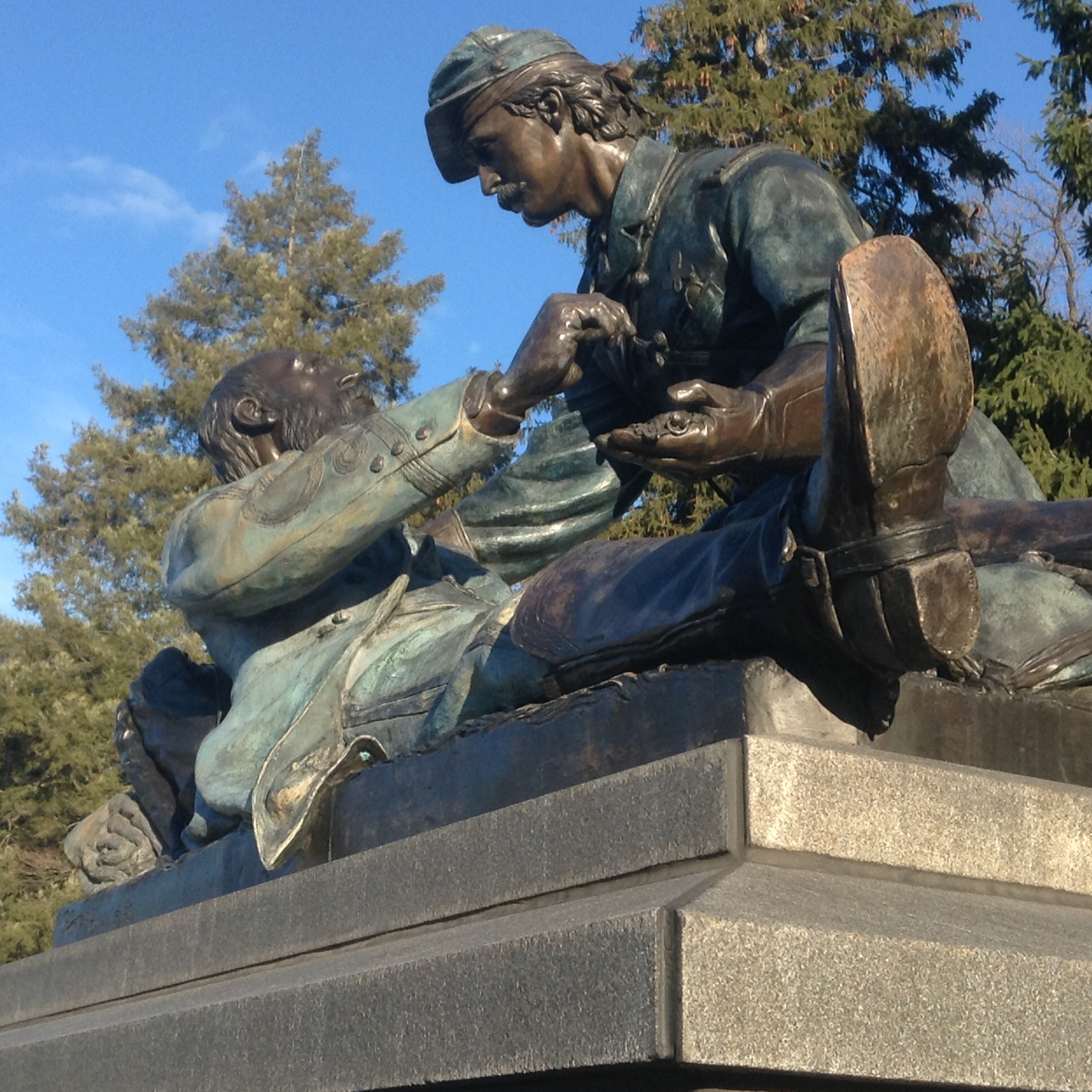
Category Archives: Military

Why We Keep Memorial Day

Friends of Padre Steve’s World,

This is Memorial Day Weekend, a weekend where we remember those who died in the service of our country. It is not a day to thank the living veterans, that day is Veteran’s Day. Nor is it the day to thank those men and women who currently wear the uniform and fight the wars of our country. This weekend I am reposting a number of articles from past years to remind my regular readers and those new to my writings about how important this remembrance is, not just to me, but to all of us. I do not say that lightly. Memorial Day is the offspring of the families of the American Civil War dead, when people who lost loved ones in the cause of liberty and the defense of the Union honored their loved ones.

No matter what your political views, ideology, or religious beliefs, please take time to remember the high human cost of freedom this weekend, especially on Monday when we observe Memorial Day.

Peace,

Padre Steve+

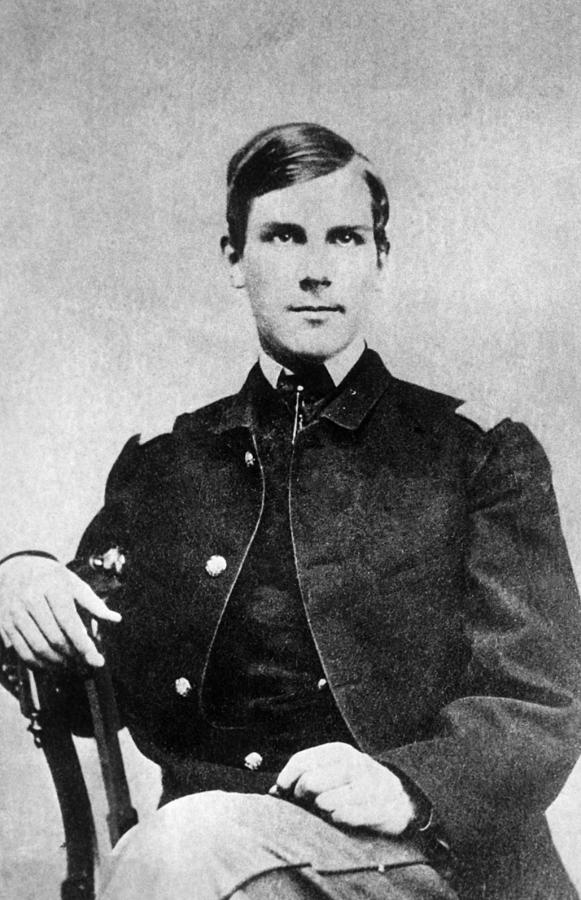
1-oliver-wendell-holmes-jr-1841-1935-everett

Oliver Wendell Holmes 

“even if those who come after us are to forget all that we hold dear, and the future is to teach and kindle its children in ways as yet unrevealed, it is enough for us that this day is dear and sacred…”

Nearly 20 years after the Civil War, Oliver Wendell Holmes Jr. then serving as Chief Justice of the Massachusetts Supreme Court spoke on Memorial Day 1884 in Keene New Hampshire at a gathering of veterans. He recalled an incident not long before where he had heard a young man ask “why people still kept up Memorial Day. The question was one that he pondered before his speech and that he attempted to find an answer, not to his fellow veterans who certainly understood their shared memories of war “but an answer which should command the assent of those who do not share our memories.”

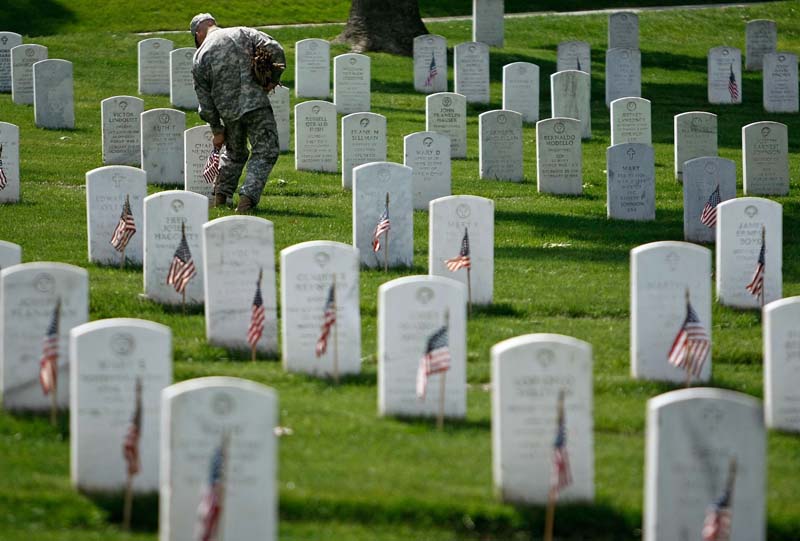
3rd Infantry Places American Flags At The Graves Of U.S. Soldiers

I think that having an answer for the question is as timely now as when Holmes first pondered it. Though his war was twenty years past and had torn the nation apart, there were still many men on both sides who had served in that terrible time and but even so many people were not only forgetting the war and the sacrifices made by so many but intent on becoming rich. Something that he would directly state in a Memorial Day address to the graduating class of Harvard University in 1895:

“The society for which many philanthropists, labor reformers, and men of fashion unite in longing is one in which they may be comfortable and may shine without much trouble or any danger. The unfortunately growing hatred of the poor for the rich seems to me to rest on the belief that money is the main thing (a belief in which the poor have been encouraged by the rich), more than on any other grievance. Most of my hearers would rather that their daughters or their sisters should marry a son of one of the great rich families than a regular army officer, were he as beautiful, brave, and gifted as Sir William Napier. I have heard the question asked whether our war was worth fighting, after all. There are many, poor and rich, who think that love of country is an old wife’s tale, to be replaced by interest in a labor union, or, under the name of cosmopolitanism, by a rootless self-seeking search for a place where the most enjoyment may be had at the least cost.”

However his message to his fellow veterans, mostly men from his own former regiment, the 20th Massachusetts was quite personal and something that they could find meaning in. Holmes understood war, he had seen much action and had been wounded at Ball’s Bluff, Antietam and Chancellorsville. He talked of the shared experience of war, something that those who have fought in our nation’s wars, as well as combat veteran soldiers in other countries can understand far more than people that have only known peace, even while their countrymen are at war.

Memorial Day Series

Holmes’s remembrances of the war and the comrades that he and those present had served with, those living and those dead is powerful. Many of us who have served in the wars that began on September 11th 2001 have lost friends in either Iraq or Afghanistan, and many more who are wounded or maimed in body, mind and spirit. Many survivors of wounds today would have died in previous wars.

Likewise his descriptions of the memories of war, triggered by “accidents” are real to those that have experienced war and combat.

“Accidents may call up the events of the war. You see a battery of guns go by at a trot, and for a moment you are back at White Oak Swamp, or Antietam, or on the Jerusalem Road. You hear a few shots fired in the distance, and for an instant your heart stops as you say to yourself, The skirmishers are at it, and listen for the long roll of fire from the main line. You meet an old comrade after many years of absence; he recalls the moment that you were nearly surrounded by the enemy, and again there comes up to you that swift and cunning thinking on which once hung life and freedom–Shall I stand the best chance if I try the pistol or the sabre on that man who means to stop me? Will he get his carbine free before I reach him, or can I kill him first?These and the thousand other events we have known are called up, I say, by accident, and, apart from accident, they lie forgotten.”

We all have our memories of our wars, those of us who remain, be we veterans of Iraq or Afghanistan, Somalia, Desert Storm, Lebanon, Vietnam, Korea or World War II. It is hard to believe that so few remain from World War II and Korea, and that even the Vietnam veterans are aging rapidly, most now in their 60s or 70s. In as much as the wars of the past decade have been fought by a tiny minority of American citizens fewer and fewer will understand the bond that we share through our memories of the living and the dead. We have been set apart by our experiences, even though the wars that we have fought differ in many ways.

481801_10151367001287059_1003164983_n-1.jpg

As such we should whenever possible take the time to meet and remember. That might be as groups of friends, unit associations or perhaps local chapters of Veterans organizations. We do this to remember but also to remind ourselves that we cannot live in the past alone, for the present likewise calls us to action, even after our service is complete.

Holmes put it well: “When we meet thus, when we do honor to the dead in terms that must sometimes embrace the living, we do not deceive ourselves. We attribute no special merit to a man for having served when all were serving. We know that, if the armies of our war did anything worth remembering, the credit belongs not mainly to the individuals who did it, but to average human nature. We also know very well that we cannot live in associations with the past alone, and we admit that, if we would be worthy of the past, we must find new fields for action or thought, and make for ourselves new careers.”

We remember the past, we remember our fallen and we remember the families who have lost loved ones in these wars as well as those whose lives have been changed and maybe even torn apart by the changes that war has wrought in their loved ones who returned different from war. In our service we have been set apart and as such as Holmes so well states we have the duty to “bear the report to those who will come after us.” His words carry forth to us today, we few we happy few as Shakespeare so eloquently wrote.

“nevertheless, the generation that carried on the war has been set apart by its experience. Through our great good fortune, in our youth our hearts were touched with fire. It was given to us to learn at the outset that life is a profound and passionate thing. While we are permitted to scorn nothing but indifference, and do not pretend to undervalue the worldly rewards of ambition, we have seen with our own eyes, beyond and above the gold fields, the snowy heights of honor, and it is for us to bear the report to those who come after us.”

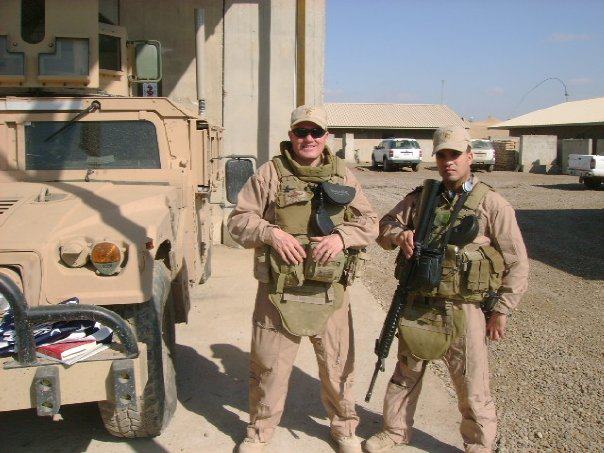
I will remember my time in Iraq and those that I served alongside. I will also remember friends who served in other units who did not return as well as those Marines, Sailors and Soldiers that I see every day in our Naval Hospital suffering from the physical, psychological and spiritual wounds of war.

This weekend I will remember and on Monday, that sacred day that we set aside to remember the fallen I take some time at noon to join in that time of remembrance and pray that maybe someday war will be no more.

That is why I think that we should remember Memorial Day even if others forget.

Peace

Padre Steve+

Leave a comment

Filed under civil war, History, iraq,afghanistan, Military, News and current events, shipmates and veterans, vietnam, world war one, world war two in europe, world war two in the pacific

Memorial Day Weekend 2016: The Buddy Poppy

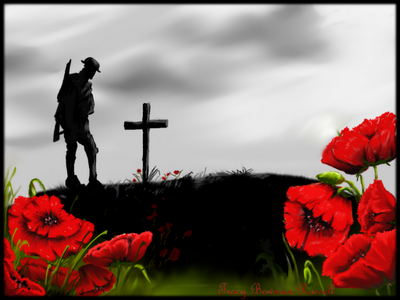
flanders_field

Friends of Padre Steve’s World

This is Memorial Day Weekend, a weekend where we remember those who died in the service of our country. It is not a day to thank the living veterans, that day is Veteran’s Day. Nor is it the day to thank those men and women who currently wear the uniform and fight the wars of our country. This weekend I am reposting a number of articles from past years to remind my regular readers and those new to my writings about how important this remembrance is, not just to me, but to all of us. I do not say that lightly. Memorial Day is the offspring of the families of the American Civil War dead, when people who lost loved ones in the cause of liberty and the defense of the Union honored their loved ones.

While the Buddy Poppy was something that came out of the First World War, and Armistice Day, which after the Second World War became Veteran’s Day. In time it has also become connected with the original Memorial Day. So today’s post is my first reflection of this weekend on the Buddy Poppy and Memorial Day.

No matter what your political views, ideology, or religious beliefs, please take time to remember the high human cost of freedom this weekend, especially on Monday when we observe Memorial Day.

Until tomorrow,

Peace,

Padre Steve+

1144221_orig

In Flanders Fields

John McCrae, 1915.

In Flanders fields the poppies blow

Between the crosses, row on row

That mark our place; and in the sky

The larks, still bravely singing, fly

Scarce heard amid the guns below.

We are the Dead. Short days ago

We lived, felt dawn, saw sunset glow,

Loved and were loved, and now we lie

In Flanders fields.

Take up our quarrel with the foe:

To you from failing hands we throw

The torch; be yours to hold it high.

If ye break faith with us who die

We shall not sleep, though poppies grow

In Flanders fields.

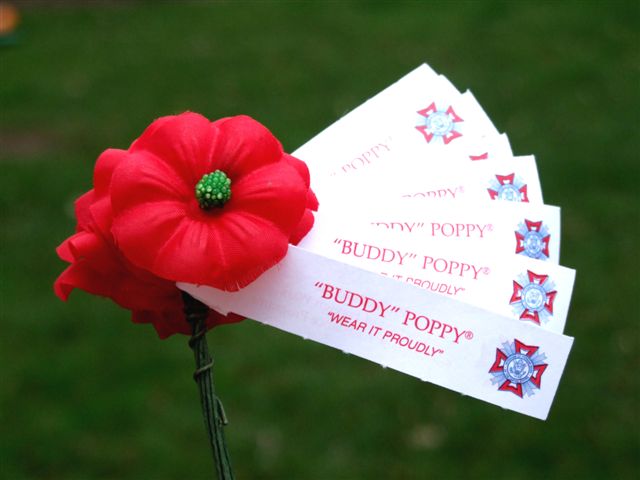
Besides the American Flag the Buddy Poppy is perhaps the most ubiquitous symbol of Memorial Day. This poppy as we know it came about when Mrs.VFW Moina Michael read McRea’s poem and inspired wrote this verse:

We cherish too, the Poppy red

That grows on fields where valor led,

It seems to signal to the skies

That blood of heroes never dies.

She then had the inspiration to begin wearing Red Poppies on Memorial Day and sold the poppies to friends and others with the money going to those in need. A French woman visiting the United States, a Madame Guerin discovered the new custom and took it back to France where she began to make artificial red poppies to sell with the proceeds going to the widows and orphans of the First World War. The custom spread to other countries and in 1921 the Franco-American Children’s League sold the poppies but disbanded in 1921. Madame Guerin approached the newly formed Veteran’s of Foreign Wars, the VFW in 1922 for assistance and in 1922 the VFW became the first American organization to sell poppies. Two years later the Buddy Poppy program began. The artificial poppies were made by disabled veterans who were paid for their work in order to provide them some form of income and distributed by other veterans across the country. Today the VFW continues to distribute the Buddy Poppies which are still produced by disabled Veterans at the nation’s Veteran’s Administration Hospitals.

I remember the first Buddy Poppy that I every received. It was just before Memorial Day 1970, before it became a 3 day weekend falling on the last Monday of May. We were living with my Grandparents in Huntington West Virginia as my dad sought suitable housing for us in Long Beach California while he was in the Navy.

Our initial move from the small town of Oak Harbor Washington, where my dad had been stationed at Naval Air Station Whidbey Island to Long Beach had not gone well. The first place we lived was in a dangerous neighborhood and with my dad traveling frequently to Naval Shipyards around the country to help commission new ships the stress on the family, especially my mother in dealing with that and two young boys was too much. Dad sent us back to Huntington where my Grandparents and numerous other relatives still lived for the duration of the school year as he sought better housing.

veterans-day-05-26-10-1

Memorial Day then was filled with visits to cemeteries to place flowers on the graves of departed relatives as well as flags on the graves of relatives who had served in the military. We made a number of stops that day at the Bowen and Dundas cemeteries as well as others where relatives were interred. Afterward we had a home cooked meal prepared by my maternal grandmother Christine and then made a trip on a city bus to my paternal grandmother Verdie.

Holidays, were much like that for us during that time that we lived in Huntington, until my dad came back and brought us back to Long Beach in June. Just before my dad arrived to take us back to Long Beach my mom, her cousin Valerie and I were shopping downtown, which at the time before I-64 took traffic around the town and led to a new mall and shopping complex being built just out of town, was a bustling place of commerce and activity. Major retailers all had their stores downtown, while the best movie theaters and restaurants were there as well.

We were coming out of the old SS Kresge store on Fourth Avenue and an elderly man wearing a VFW cap approached us and handed me a poppy. He had to be in his 70s so I presume that he was a Veteran of the First World War. He chatted briefly with my mom and Valerie and I am sure my mom gave him a bit of money for the poppy. I kept it for many years and it was eventually lost in one of our moves. But I will not forget it and any time I see a Veteran distributing them I make sure that I get one.

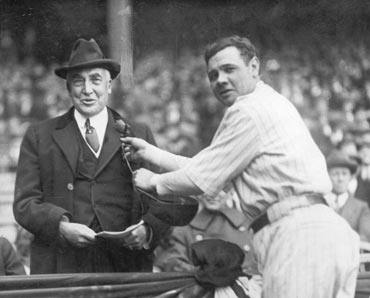
Babe-Ruth_MAIN

Babe Ruth and President Warren G Harding with the first official Buddy Poppy of 1923

For me the Buddy Poppy is a symbol of thanks for the sacrifices made by so many, those who did not come home from wars being killed or missing in action, as well as the wounded and the families of the dead and those that came home forever changed by their time in war. This year marks the 90th anniversary of it being the official flower of remembrance for those who died in our nation’s wars.

The poppy has even more significance for me now having served in Iraq. Seeing war’s devastation and knowing so many who have either been killed or wounded in the wars that we have engaged since September 11th 2001 has impacted me in ways that I could not have imagined before the war. Likewise having come back changed by my experience and having to deal with the affliction of severe PTSD I sense a camaraderie with those men who came home changed from war and in many cases returned to a country that did not understand them.

I will be observing the “Go Silent” moment at 12:01 Monday with the Iraq Afghanistan Veterans Association to honor those who have given the last full measure.

Peace

Padre Steve+

1 Comment

Filed under History, Military

So who did the dirty work for us? Armed Forces Day 2016

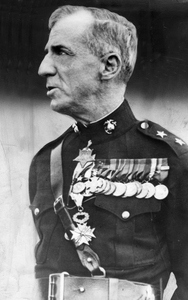
butler-medals1

Major General Smedley Butler, USMC

Friends of Padre Steve’s World,

Today I am reposting something I wrote last year regarding Armed Forces Day. I was pretty emotionally raw when I wrote it but at the same time after re-reading it I cannot disagree with anything that I wrote. So today in honor of the fewer than 1% who serve in the uniform of the United States at any given time I am glad to share this. The faux patriotism displayed by so many, the bumper stickers that say “I support the troops” while supporting politicians and corporations that exist solely to make war on the backs of such a small segment of society, while cavalierly tossing veterans aside is no patriotism at all.

This may piss some people off, but as a man who has served 35 years in uniform and who has been to war and seen its horror, I cannot be less than honest.  

So please, take some time today to thank a currently serving Soldier, Sailor, Marine, Airman, or Coastguardsman for their service, and don’t do it flippantly. Recognize that they make sacrifices that go beyond what most people make, and all too many suffer for their service.

Peace

Padre Steve+

Marine Major General and two time Medal of Honor winner Smedley Butler wrote, “What is the cost of war? what is the bill?…“This bill renders a horrible accounting. Newly placed gravestones. Mangled bodies. Shattered minds. Broken hearts and homes. Economic instability. Depression and all of its attendant miseries. Back -breaking taxation for generations and generations. For a great many years as a soldier I had a suspicion that war was a racket; not only until I retired to civilian life did I fully realize it….”

Today is Armed Forces Day and unfortunately most of the country will not notice unless they are attending a Baseball game where it is being observed or some special event on a base, national cemetery, monument or VFW hall. Armed Forces Day was established in 1948 by President Harry Truman after the founding of the Department of Defense.  It was established to honor and remember those currently serving, not the discharged or the retired veteran, they are remembered on Veterans Day, the former Armistice Day, nor the fallen who are commemorated on Memorial Day which we will do next weekend.

Unlike Veterans Day or Memorial Day there is no national holiday for Armed Forces Day. I find this ironic for a nation which claims to support the troops that the men and women who we honor are honored on a day that unless they are deployed in harm’s way or have duty, is regular day off like any Saturday. Personally I think the day should be celebrated by giving the active duty force a real day off and if they are deployed given some kind of down time as operational needs allow, and maybe even given them a ration of beer. We did this for the Marine Corps birthday in Iraq, so why not on Armed Forces Day? But I digress…

Back when Armed Forces Day was established there was still a draft which meant that in theory everyone had skin in the game and that our leaders were far more hesitant to commit the nation to war.

Back in 1952 the New York Times editors wrote:

“It is our most earnest hope that those who are in positions of peril, that those who have made exceptional sacrifices, yes, and those who are afflicted with plain drudgery and boredom, may somehow know that we hold them in exceptional esteem. Perhaps if we are a little more conscious of our debt of honored affection they may be a little more aware of how much we think of them.”

But sadly today in all honesty were think very little of them. Today of course there will be a fair number of local celebrations to honor members of the Armed Forces across the country, but for the most part they will be small and not well publicized. Most of the people in attendance will not even be there for the troops. They will be there for the event and their hearts will be warmed by the tributes paid to the troops. As a career officer and son of a Vietnam veteran Navy Chief I appreciate those events and at least some of the good hearted the people that put them together. Being a veteran of Operation Iraqi Freedom and Operation Enduring Freedom, especially those that have taken the time to honor Iraq and Afghanistan veterans like me who have returned from war totally fucked up. But again I digress, badda bing, badda boom, badda bomb…

me and nelson

Bu here is what really s upsetting to me, good number of these patriot, flag waving, war porn satiating, yet somehow inspiring ceremonies to honor the troops are not even coming for the heart of the people putting them on. Until it was exposed last year many of these ceremonies, particularly those done by the NFL were coming out of the Pentegon budget and being paid for by the taxpayers. These events are nothing more than faux patriotism and little more than propaganda that exploits the troops. They are being done as a recruiting tool with the Department of Defense which is paying hundreds of millions of dollars to the tax exempt National Football League and its teams to put on shows that give all the appearances of honoring the troops but are really nothing more than propaganda and recruiting commercials. Likewise for all which for all the money we the taxpayers spend on them actually net few recruits if any as a huge number of our current troops are the sons and daughters of men and women who have also served this country. They, like me, serve for something greater than partisan politics  greater than money, greater than anything that can easily be repaid. For most it is the ideal of the love of this country and the principles found in the Declaration of Independence, that all men are created equal. However, that is fodder for another article.

But honestly I am so offended by this faux  patriotism shown by the NFL and God knows who else that it causes me a great deal of anger. I say this because throughout our nation’s history our political leaders, business leaders and the populace as a whole have despised the military, and those who in the absence of a draft chose to serve. That despicable attitude was well recounted in Herman Wouk’s monumental novel, which became a classic film The Caine Mutiny. In the film a defense attorney for those accused of mutiny, Barney Greenwald played to perfection by Jose Ferrer told the acquitted mutineers of the Caine’s wardroom:

“You know something…when I was studying law, and Mr Keefer here was writing his stories, and you, Willie, were tearing up the playing fields of dear old Princeton,method was standing guard over this fat dumb happy country of ours, eh? Not us. Oh no, we knew you couldn’t make any money in the service. So who did the dirty work for us? Queeg did! And a lot of other guys. Tough, sharp guys who didn’t crack up like Queeg.” 

cropped-the-caine-mutiny-1954-1.jpg

For those who are now getting pissed off at me, let us look at facts. At any given time less than 1% of Americans are serving in all components of the military. For nearly 15 years we have been at war in Afghanistan and Iraq as well as other locations that we don’t like to talk about too much. However this has not been the effort of a nation at war, it is the war of a tiny percentage of the population, a segment that everyone is far too willing to exploit.

As a nation we are disconnected from the military and the wars that the military fights. The fact is that most Americans do not have a personal or vested interest in these wars, they have been insulated by political leaders of both parties from them. There is no draft, and no taxes were raised to fund the wars and the military is now worn out.

We have been at war for nearly 15 years and truthfully there is no end in sight. In that time every single Soldier, Sailor, Marine and Airman volunteered for duty or reenlisted during this time period. Motives may have varied from individual to individual, but unlike the World Wars, Korea and Vietnam every single one volunteered to serve in time of war. I think that this makes the current generation of veterans quite unique in our modern history, but not so different than the professionals who served before and after the Civil War,and  those who served before and after the First World War. The situation after the Second Wolrd War and the Cold War required a large standing military and large reserve force. This required the draft, which though hated by many  leavened the professional force with civilians who got a taste of military and when they left did not forget they meaning of their service and the sacrifices made by the professionals. We do not have that anymore. We are no longer are no longer a military composed of citizen soldiers. We who serve,  even in our reserve components are  a Warrior caste, set apart from the society that we serve.

There is a tragic disconnection between the military and civilian society in the United States. This is the result of deliberate public policy since the end of the Vietnam War supported by both political parties. For almost 40 years we have relied on an all volunteer force. It is that relatively small and socially isolated military which is sent to fight wars while the bulk of the population is uninvolved and corporations, lobbyists and think tanks get rich.

Andrew Bacevich wrote in his new book Breach of Trust: How Americans failed their Soldiers and their Country:

“Rather than offering an antidote to problems, the military system centered on the all-volunteer force bred and exacerbated them. It underwrote recklessness in the formulation of policy and thereby resulted in needless, costly, and ill-managed wars. At home, the perpetuation of this system violated simple standards of fairness and undermined authentic democratic practice. The way a nation wages war—the role allotted to the people in defending the country and the purposes for which it fights—testifies to the actual character of its political system. Designed to serve as an instrument of global interventionism (or imperial policing), America’s professional army has proven to be astonishingly durable, if also astonishingly expensive. Yet when dispatched to Iraq and Afghanistan, it has proven incapable of winning. With victory beyond reach, the ostensible imperatives of U.S. security have consigned the nation’s warrior elite to something akin to perpetual war.”

Bacevich, a retired Army Colonel and Vietnam veteran who lost a son in Iraq is dead on, as is Rachel Maddow who wrote in her outstanding book Drift: The Unmooring of American Military Power:

“The reason the founders chafed at the idea of an American standing army and vested the power of war making in the cumbersome legislature was not to disadvantage us against future enemies, but to disincline us toward war as a general matter… With citizen-soldiers, with the certainty of a vigorous political debate over the use of a military subject to politicians’ control, the idea was for us to feel it- uncomfortably- every second we were at war. But after a generation or two of shedding the deliberate political encumbrances to war that they left us… war making has become almost an autonomous function of the American state. It never stops.” 

The lobbyists, pundits, politicians, preachers and war profiteers that promote war don’t care about the troops. This especially applies to the likely GOP Presidential nominee Donald Trump, a man who brazenly and shamelessly equates his time at a military high school as being equal to actually serving while using multiple deferments and medical excuses to dodge the draft during the Vietnam War. Trump called military personnel who were captured by the enemy “cowards,” a man who cares not a whit about real men and women who serve this country. When Trump and other most other politicians say they do care about the troops they are lying out their asses. This is because no matter who is in office or who controls congress these people and corporations will promote policies that keep them employed and their businesses enriched, and yes, Bernie Sanders is on that list, despite his denunciations of war and vote against the Iraq war he has consistently supported weapons programs like the F-35 fighter plane fiasco which is such an example of waste, fraud and abuse,  not to mention overpriced, overdue, and underperforming weapons systems ever, in order to bring jobs to Vermont.

Marine Major General and Medal of Honor winner Smedley Butler was quite right when he said:

“War is a racket. It always has been. It is possibly the oldest, easily the most, surely the most vicious. It is the only one international in scope. It is the only one in which the profits are reckoned in dollars and the losses in lives. A racket is best described, I believe, as something that is not what it seems to the majority of the people. Only a small ‘inside’ group knows what it is about. It is conducted for the benefit of the very few, at the expense of the very many. Out of war a few people make huge fortunes.”

I think that the reason that our current wars have gone on so long is the that misguided policies have brought about a chronic disconnection in our society between those that serve in the military. But how can there not be when in the weeks after 9-11 people like President Bush and others either directly or in a manner of speaking told people to “go shopping” * as we went to war in Afghanistan? When I returned from Iraq I returned to a nation that was not at war whose leaders used the war to buttress their respective political bases.

The results are terrible. Suicide rates are continuing to rise among veterans who have returned to find that neither the VA nor the civilian mental health care sector is prepared to care for them. Even worse the members of the GOP controlled Congress are working their asses off to screw the troops. Ohio GOP Congressman, Tea Party favorite,  supposedly deeply committed Christian and even worse a Colonel in the Ohio Army National Guard has attempted and is attempting again to attach an Ammendment to the 2016 Nation Defense Authorization Act which would keep the Defense Department from enformice rules which would protect young troops from the predatory payday lenders who line the avenues leading to every major military base in the country. My opinion, this man is a traitor to the country even though he wears the uniform and has deployed and led soldiers in in Iraq and other locations during this war. He is selling out the the young troops to protect the payday lending industry with which has had a nearly incestuous relationship since he day that was elected to Congress.

But Congressman Stivers is not alone, Congressmen and women of both parties sell out the troops to prop up banks, insurance companies and Wall Street. Those military health benefits not directly provided in military medical centers are run through an organization called Tricare. Tricare, which is managed by the insurance companies who bid on competitive contracts is a for profit industry. These insurance companies routinely deny services to the families of military members, pay so little or are so mind numbingly  incompetent that many medical providers refuse to deal with them, leaving the troops their families stuck in the middle. That my friends is fact. Now the GOP led by the Koch brothers is attempting to privatize Veterans Admisistration Heath care. Now in all honesty, the chronically underfunded and bureaucratically bound VA. That being said my friends privatization will only make things worse for veterans who will now have to deal with private for profit insurance companies and Heath care systems that see them and their wounds and infirmaries as a way to make a buck off of taxpayer and to screw the veteran.

But let’s not stop there. Politicians of both parties and their backers from the financial sectors have been working overtime since the Adminstration of George W. Bush to roll back retirement benefits which they call  “entitlements” which are supposedly destroying the financial health and well being of the nation. Never mind the fact that these same  politicians have spent trillions of dollars bailing out the corporations which have almost single handed lay destroyed this nation’s economy time after time since the 1970s, and who support corporations who are based in this country but have sold the nation out and work against the interests of Americans.

But never mind, I digress, for as we all know it is the troops who are the leches who are bankrupting the country.

But this isn’t new my friends it began during the Reagan Administration which changed the retirement system from the flat 50% of one’s final active duty pay that one would retire with at 20 years of service or high multiples up to 75% at 30 years to an average of the last three, or the highest three years of pay that one earned while on active duty.  In effect the Reagan Adminstration robbed military retest of hundreds of thousand of dollars of hard earned benefits. But again the beloved Saint Ronald loved the troops, after all he said so.

Likewise, did you know that some GOP legislators want to cut the disability payments to military members who have been wounded or injured during their service?  You probably didn’t and you won’t find that fact out on Fox News or CNN. This is not to be confused with the retirement benefits that they are looking to cut.  This, my friends is the debt of honor that this nation owes to the men and women who have given everything and now are broken in body, mind and spirit. But, those who promote such policies, even those who have worn the uniform, like Congressman Stivers have no honor. Like those that sold out the Union veterans after the Civil War and the Doughboys after World War One they are much more indebted to their political benefactors than they are to te troops no matter what they say.

Now I do believe that Armed Forces Day should be better celebrated and I am grateful to the people that do things every day to thank and support military personnel. These wonderful people that do this come from across the political spectrum. Some are veterans and others non-veterans, but they care for and appreciate the men and women that serve in and fight the wars that no-one else can be bothered to fight.

943043_10151694525692059_632653331_n

Of course the politicians, pundits, preachers and the defense contractors, banks and lobbyists will find a way to profit. They will do so no matter how many more troops are killed, wounded or injured and how badly it affects military personnel or their families and will push to abandon those who fought as they do after every war. After all, to quote Smedley Butler, “war is a racket.”  So that is what I believe; and if God is just, and if there is a Hell, I hope that the people who promote war and profit from it, and then abandon those who fight their wars end up there, especially the preachers who this very morning will invite the troops to their churches to supposedly honor them even as they support the politicians whose policies damn the very troops that they pretend to honor today. 

That may sound harsh, but is it any more harsh than condemning people to Hell who have different beliefs or lifestyles who have harmed no one by their actions? I think not. 

As so to these preachers, I say, to use the words of one of my football coaches, “your actions speak so loud I can’t hear a word that you are saying.” 

Peace

Padre Steve+

President Bush’s actually words were “Now, the American people have got to go about their business. We cannot let the terrorists achieve the objective of frightening our nation to the point where we don’t — where we don’t conduct business, where people don’t shop…” http://georgewbush-whitehouse.archives.gov/news/releases/2001/10/20011011-7.html

3 Comments

Filed under History, Military, Political Commentary

“I Knew What I was Fighting For” Black Soldiers in the Civil War

Friends of Padre Steve’s World,

Today I am posting yet another major revision to the opening chapter to my Civil War and Gettysburg text. It is the follow up section to yesterday’s article on the Emancipation Proclamation and deals with the service of African American men in the U.S. Army. This was a major step in the long road to equality for African Americans, a task that is not fully complete, but has also benefited many other Americans of different races as well as women and LGBTQ people. I hope that you enjoy the read, but more importantly appreciate what those men went through to blaze a trail for freedom.

Peace,

Padre Steve+

African-American-Soldiers-in-Civil-War-Hero-H

From Slavery to Soldiering

But as the war continued on, consuming vast numbers of lives the attitude of Lincoln and his administration began to change. After a year and a half of war, Lincoln and the closest members of his cabinet were beginning to understand that the “North could not win the war without mobilizing all of its resources and striking against Southern resources used to sustain the Confederate war effort.” [1] Slave labor was essential to the Confederate war effort, not only did slaves still work the plantations, they were impressed into service in war industries as well as in the Confederate Army.

Lieutenant Colonel Arthur Freemantle, a British observer who was with Lee’s army at Gettysburg noted, “in the rear of each regiment were from twenty to thirty negro slaves.” [2] The fact is that the slaves who accompanied the army remained slaves, they were not the mythical thousands of black soldiers who rallied to the Confederate cause, nor were they employees. “Tens of thousands of slaves accompanied their owners to army camps as servants or were impressed into service to construct fortifications and do other work for the Confederate army.” [3] This fact attested to by Colonel William Allan, one of Stonewall Jackson’s staff members who wrote “there were no employees in the Confederate army.” [4] slaves served in a number of capacities to free up white soldiers for combat duties, “from driving wagons to unloading trains and other conveyances. In hospitals they could perform work as nurses and laborers to ease the burdens of patients.” [5] An English-born artilleryman in Lee’s army wrote in 1863 that “in our whole army there must be at least thirty thousand colored servants….” [6] When Lee marched to Gettysburg he did so with somewhere between ten and thirty-thousand slaves in support roles and during the advance into Virginia Confederate troops rounded up and re-enslaved as many blacks as they could, including Freedmen.

Lincoln’s Secretary of War, Edwin Stanton; who was a passionate believer in the justice of emancipation, was one of the first to grasp the importance of slave labor to the Confederate armies and how emancipation was of decided military necessity. Stanton, “Instantly grasped the military value of the proclamation. Having spent more time than any of his colleagues contemplating the logistical problems facing the army, he understood the tremendous advantage to be gained if the massive workforce of slaves could be transferred from the Confederacy to the Union.” [7]

Lincoln emphasized the “military necessity” of emancipation and “justified the step as a “fit and necessary war measure for suppressing the rebellion.” [8] The process of emancipation now became not only a moral crusade, but now became a key part of national strategy, not just in a military means, but politically, economically and diplomatically as Lincoln “also calculated that making slavery a target of the war would counteract the rising clamor in Britain for recognition of the Confederacy.”  [9]

Lincoln wrote to his future Vice President, Andrew Johnson, then the military governor of occupied Tennessee that “The colored population is the great available and yet unavailed of, force for restoration of the Union.” [10] The idea of simply mollifying the border states was dropped and policy changed that of “depriving the Confederacy of slave labor. Mobilizing that manpower for the Union – as soldiers as well as laborers – was a natural corollary.” [11] Reflecting President Lincoln’s and Stanton’s argument for the military necessity of emancipation, General Henry Halleck wrote to Ulysses Grant that:

“the character of the war has very much changed within the past year. There is now no possibility of reconciliation with the rebels… We must conquer the rebels or be conquered by them….Every slave withdrawn from the enemy is the equivalent of a white man put hors de combat.” [12]

Grant concurred with the decision. Grant wrote to in a letter to Lincoln after the assault on Battery Wagner by the 54th Massachusetts, “by arming the negro we have added a powerful ally. They will make good soldiers and taking them from the enemy weakens him in the same proportion as it strengthens us.” [13] William Tecumseh Sherman was supportive but also noted some facts that some radical abolitionists did not understand. He noted in his correspondence that, “The first step in the liberation of the Negro from bondage will be to get him and his family to a place of safety… then to afford him the means of providing for his family,… then gradually use a proportion – greater and greater each year – as sailors and soldiers.” [14] Lincoln wrote after the Emancipation Proclamation that “the emancipation policy, and the use of colored troops, constitute the heaviest blow yet dealt to the rebellion.” [15] The change was a watershed in both American history as well as the future of the U.S. Military services.

In conjunction with the Emancipation Proclamation Secretary of War Stanton “authorized General Rufus Saxton to “arm, uniform, equip, and receive into the service of the United States such number of volunteers of African descent as you may deem expedient, not exceeding 5,000, and [you] may detail officers to instruct them in military drill, discipline, and duty, and to command them.”  [16] The initial regiments of African Americans were formed by Union commanders in liberated areas of Louisiana and South Carolina, and most were composed of newly freed slaves. Others like the 54th Massachusetts were raised from free black men in the north. Stanton’s authorization was followed by the Enrollment Act passed by Congress in March of 1863 which established the draft also allowed blacks to serve. By March Stanton was working with state governors to establish more black regiments. The units became known as United States Colored Troops, or U.S.C.T. and were commanded by white officers and organized into the infantry, cavalry and, artillery regiments organized on the model of white regiments. The U.S.C.T. “grew to include seven regiments of cavalry, more than a dozen of artillery, and well over one hundred of infantry.” [17]

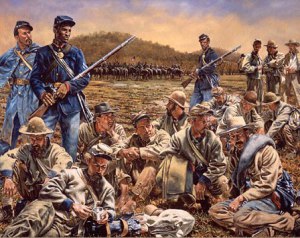
Some Union soldiers and officers initially opposed enlisting blacks at all, and some “charged   that making soldiers of blacks would be a threat to white supremacy, and hundreds of Billy Yanks wrote home that they would no serve alongside blacks.” [18]  But most common soldiers accepted emancipation, especially those who had served in the South and seen the misery that many salves endured, one Illinois soldier, stationed who served in the Western Theater of war wrote, “the necessity of emancipation is forced upon us by the inevitable events of the war… and the only road out of this war is by blows aimed at the heart of the Rebellion…. If slavery should be left undisturbed the war would be protracted until the loss of life and national bankruptcy would make peace desirable on any terms.” [19] Even so racial prejudice in the Union ranks never went away and sometimes was accompanied by violence. It remained a part and parcel of life in and outside of the army, even though many Union soldiers would come to praise the soldierly accomplishments and bravery of African American Soldiers. An officer who had refused a commission to serve with a U.S.C.T. regiment watched as black troops attacked the defenses of Richmond in September 1864:

“The darkies rushed across the open space fronting the work, under a fire which caused them loss, into the abattis… down into the ditch with ladders, up and over the parapet with flying flags, and down among, and on top of, the astonished enemy, who left in utmost haste…. Then and there I decided that ‘the black man could fight’ for his freedom, and that I had made a mistake in not commanding them.” [20]

“Once the Lincoln administration broke the color barrier of the army, blacks stepped forward in large numbers. Service in the army offered to blacks the opportunity to strike a decisive blow for freedom….” [21] Emancipation allowed for the formation of regiments of United States Colored Troops (USCT), mustered directly into Federal service, which in numbers soon dwarfed the few state raised Black Regiments.  However, it was the inspiration provided by those first state raised regiments, the heroic accounts of those units reported in Northern newspapers, as well as the unprovoked violence directed against Blacks in the 1863 draft riots that helped to provoke “many northerners into a backlash against the consequences of violent racism.” [22]

Despite the hurdles and prejudices that blacks faced even in the North, many African Americans urged others to enlist, self-help mattered more than self-preservation. Henry Gooding, an black sergeant from Massachusetts wrote the editor of the New Bedford Mercury urging fellow blacks to enlist despite the dangers, “As one of the race, I beseech you not to trust a fancied security, laying in your minds, that our condition will be bettered because slavery must die…[If we] allow that slavery will die without the aid of our race to kill it – language cannot depict the indignity, the scorn, and perhaps the violence that will be heaped upon us.” [23]

The valor of the state regiments, as well as the USCT units that managed to get into action was remarkable, especially in regard to the amount of discrimination levied at them by some northerners, and the very real threat of death that they faced if captured by Confederates. In response to the Emancipation Proclamation and to the formation of African American regiments the Confederate Congress passed

In May of 1863 Major General Nathaniel Banks dared to send the First and Third Regiments of “Louisiana Native Home Guard regiments on a series of attacks on Confederate positions at Port Hudson, Louisiana” [24] where they received their baptism of fire. They suffered heavy losses and “of the 1080 men in the ranks, 271 were hit, or one out of every four.” [25] Banks said of them in his after action report: “They answered every expectation…In many respects their conduct was heroic…The severe test to which they were subjected, and the determined manner in which they encountered the enemy, leave upon my mind no doubt of their ultimate success.” [26]

USCT UNit

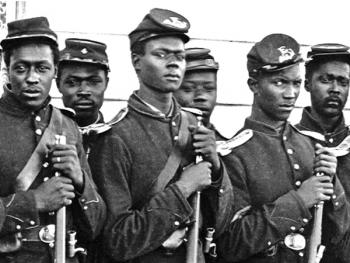
Men of the 4th Regiment of U.S. Colored Troops

But the most famous African American volunteer regiment was the 54th Massachusetts, commanded by Colonel Robert Gould Shaw, the “North’s showcase black regiment.” [27] Raised in Boston and officered by many men who were the sons of Boston’s blue blood abolitionist elite, the regiment was authorized in March 1863. Since there was still opposition to the formation of units made up of African Americans, Massachusetts Governor John Andrew authorized the formation of the 54th under the command of white officers, a practice that with few exceptions, became standard in the U.S. military until President Truman desegregated the armed forces in 1948. Governor Andrew was determined to ensure that the officers of the 54th were men of “firm antislavery principles…superior to a vulgar contempt for color.” [28]

8512218

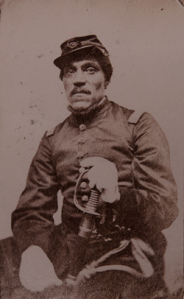
Lieutenant Stephen Swails

The 54th Massachusetts first saw action in early June 1863 and at Shaw’s urging were sent into battle against the Confederate positions at Fort Wagner on July 18th 1863. Leading the attack the 54th lost nearly half its men, “including Colonel Shaw with a bullet through his heart. Black soldiers gained Wagner’s parapet and held it for an hour before falling back.” [29] Though they tried to hold on they were pushed back after a stubborn fight to secure a breach in the fort’s defenses. “Sergeant William H Carney staggered back from the fort with wounds in his chest and right arm, but with the regiment’s Stars and Stripes securely in his grasp. “The old flag never touched the ground, boys,” Carney gasped as he collapsed at the first field hospital he could find.” [30] Shaw was buried with his men by the Confederates and when Union commanders asked for the return of his body were told “We have buried him with his niggers,” Shaw’s father quelled a northern effort to recover his son’s body with these words: We hold that a soldier’s most appropriate burial-place is on the field where he has fallen.” [31] As with so many frontal attacks on prepared positions throughout the war, valor alone could not overcome a well dug in enemy. “Negro troops proved that they could stop bullets and shell fragments as good as white men, but that was about all.” [32]

Despite the setback, the regiment went on to further actions where it continued to distinguish itself. The Northern press, particularly abolitionist newspapers brought about a change in the way that many Americans in the North, civilians as well as soldiers, saw blacks. The Atlantic Monthly noted, “Through the cannon smoke of that dark night, the manhood of the colored race shines before many eyes that would not see.”  [33]

Frederick Douglass, who had two sons serving in the 54th Massachusetts, understood the importance of African Americans taking up arms against those that had enslaved them in order to win their freedom:

“Once let a black man get upon his person the brass letters U.S… let him get an eagle on his button, and a musket on his shoulder and bullets in his pockets, and there is no power on earth which can deny he has won the right to citizenship in the United States.” [34]

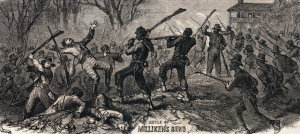
Other African American units less famous than the illustrious 54th Massachusetts distinguished themselves in action against Confederate forces. Two regiments of newly recruited blacks were encamped at Milliken’s Bend Louisiana when a Confederate brigade attempting to relieve the Vicksburg garrison attacked them. The troops were untrained and ill-armed but held on against a determined enemy:

 “Untrained and armed with old muskets, most of the black troops nevertheless fought desperately. With the aid of two gunboats they finally drove off the enemy. For raw troops, wrote Grant, the freedmen “behaved well.” Assistant Secretary of War Dana, still with Grant’s army, spoke with more enthusiasm. “The bravery of the blacks,” he declared, “completely revolutionized the sentiment in the army with regard to the employment of negro troops. I heard prominent officers who had formerly in private had sneered at the idea of negroes fighting express after that as heartily in favor of it.” [35]

The actions of the black units at Milliken’s bend attracted the attention and commendation of Ulysses Grant, who wrote in his cover letter to the after action report, “In this battle most of the troops engaged were Africans, who had little experience in the use of fire-arms. Their conduct is said, however, to have been most gallant, and I doubt not but with good officers that they will make good troops.” [36] They also garnered the attention of the press. Harper’s published an illustrated account of the battle with a “double-page woodcut of the action place a black color bearer in the foreground, flanked by comrades fighting hand-to-hand with Confederates. A brief article called it a “the sharp fight at Milliken’s bend where a small body of black troops with a few whites were attacked by a large force of rebels.” [37] In the South the result was chilling and shocked whites, one woman wrote “It is hard to believe that Southern soldiers – and Texans at that – have been whipped by a mongrel crew of white and black Yankees…. There must be some mistake.” While another woman in Louisiana confided in her diary, “It is terrible to think of such a battle as this, white men and freemen fighting with their slaves, and to be killed by such a hand, the very soul revolts from it, O, may this be the last.” [38]

By the end of the war over 179,000 African American Soldiers, commanded by 7,000 white officers served in the Union armies. For a number of reasons most of these units were confined to rear area duties or working with logistics and transportation operations. The policies to regulate USCT regiments to supporting tasks in non-combat roles “frustrated many African American soldiers who wanted a chance to prove themselves in battle.” [39]  Many of the soldiers and their white officers argued to be let into the fight as they felt that “only by proving themselves in combat could blacks overcome stereotypes of inferiority and prove their “manhood.” [40] Even so in many places in the army the USCT and state regiments made up of blacks were scorned:

“A young officer who left his place in a white regiment to become colonel of a colored regiment was frankly told by a staff officer that “we don’t want any nigger soldiers in the Army of the Potomac,” and his general took him aside to say: “I’m sorry to have you leave my command, and am still more sorry that you are going to serve with Negroes. I think that it is a disgrace to the army to make soldiers of them.” The general added that he felt this way because he was sure that colored soldiers just would not fight.”  [41]

The general of course, was wrong.  In the engagements where USCT units were allowed to fight, they did so with varying success most often attributable to the direction of their senior officers. When given the chance they almost always fought well, even when badly commanded. This was true as well when they were thrown into hopeless situations. One such instance was when Ferrero’s Division, comprised of colored troops were thrown into the Battle of the Crater at Petersburg when “that battle lost beyond all recall.” [42] The troops advanced in good order singing as they went, while their commander, General Ferrero took cover in a dugout and started drinking; but the Confederate defenders had been reinforced and “Unsupported, subjected to a galling fire from batteries on the flanks, and from infantry fire in front and partly on the flank,” a witness write, “they broke up in disorder and fell back into the crater.” [43] Pressed into the carnage of the crater where white troops from the three divisions already savaged by the fighting had taken cover, the “black troops fought with desperation, uncertain of their fate if captured.” [44] In the battle Ferrero’s division lost 1327 of the approximately 4000 men who made the attack. [45]

Major General Benjamin Butler railed to his wife in a letter against those who questioned the courage of African American soldiers seeing the gallantry of black troops assaulting the defenses of Petersburg in September 1864: The man who says that the negro will not fight is a coward….His soul is blacker than then dead faces of these dead negroes, upturned to heaven in solemn protest against him and his prejudices.” [46]

The response of the Confederate government to Emancipation and African Americans serving as soldiers was immediate and uncompromisingly harsh. Davis approved of the summary executions of black prisoners carried out in South Carolina in November 1862, and a month later “on Christmas Eve, Davis issued a general order requiring all former slaves and their officers captured in arms to be delivered up to state officials for trial.” [47] Davis warned that “the army would consider black soldiers as “slaves captured in arms,” and therefore subject to execution.” [48] While the Confederacy never formally carried out the edict, there were numerous occasions where Confederate commanders and soldiers massacred captured African American soldiers.

The response of the Lincoln administration to send a note to Davis and threaten reprisals against Confederate troops if black soldiers suffered harm. It “was largely the threat of Union reprisals that thereafter gave African-American soldiers a modicum of humane treatment.” [49]

When captured by Confederates, black soldiers and their white officers received no quarter from many Confederate opponents. General Edmund Kirby Smith who held overall command of Confederate forces west of the Mississippi instructed General Richard Taylor to simply execute black soldiers and their white officers: “I hope…that your subordinates who may have been in command of capturing parties may have recognized the propriety of giving no quarter to armed negroes and their officers. In this way we may be relieved from a disagreeable dilemma.” [50] This was not only a local policy, but echoed at the highest levels of the Confederate government. In 1862 the Confederate government issued an order that threatened white officers commanding blacks: “any commissioned officer employed in the drilling, organizing or instructing slaves with their view to armed service in this war…as outlaws” would be “held in close confinement for execution as a felon.” [51] After the assault of the 54th Massachusetts at Fort Wagner a Georgia soldier “reported with satisfaction that the prisoners were “literally shot down while on their knees begging for quarter and mercy.” [52]
HD_NgroWarFL640116p264cz.preview

On April 12th 1864 at Fort Pillow, troops under the command of General Nathan Bedford Forrest massacred the bulk of over 231 Union most of them black as they tried to surrender. While it is fairly clear that Forrest did not order the massacre and even attempted to stop it, it was clear that he had lost control of his troops. Forrest’s soldiers fought with the fury of men possessed by hatred of an enemy that they considered ‘a lesser race’ and slaughtered the Union troops as they either tried to surrender or flee; but while Forrest did not order the massacre, he certainly was not displeased with the result. Ulysses Grant wrote that:

“These troops fought bravely, but were overpowered I will leave Forrest in his dispatches to tell what he did with them.

“The river was dyed,” he says, “with the blood of the slaughtered for up to 200 years. The approximate loss was upward of five hundred killed; but few of the officers escaped. My loss was about twenty killed. It is hoped that these facts will demonstrate to the Northern people that negro soldiers cannot cope with Southerners.” Subsequently Forrest made a report in which he left out the part that shocks humanity to read.”  [53]

The bulk of the killing was directed at the black soldiers of the 6th U.S. Colored Heavy Artillery, which composed over a third of the garrison. “Of the 262 Negro members of the garrison, only 58 – just over 20 percent – were marched away as prisoners; while of the 295 whites, 168 – just under sixty percent were taken.”  [54] A white survivor of the 13th West Tennessee Cavalry, a Union unit at the fort wrote:

We all threw down our arms and gave tokens of surrender, asking for quarter…but no quarter was given….I saw 4 white men and at least 25 negroes shot while begging for mercy….These were all soldiers. There were also 2 negro women and 3 little children standing within 25 steps of me, when a rebel stepped up to them and said, “Yes, God damn you, you thought you were free, did you?” and shot them all. They all fell but one child, when he knocked it in the head with the breech of his gun.” [55]

A Confederate Sergeant who was at Fort Pillow wrote home a week after the massacre: “the poor deluded negroes would run up to our men, fall upon their knees and with uplifted hands scream for mercy, but were ordered to their feet and shot down.” [56]

African American soldiers proved themselves during the war and their efforts paved the way for Lincoln and others to begin considering the full equality of blacks as citizens. If they could fight and die for the country, how could they be denied the right to votes, be elected to office, serve on juries or go to public schools? Under political pressure to end the war during the stalemate before Petersburg and Atlanta in the summer of 1864, Lincoln reacted angrily to Copperheads as well as wavering Republicans on the issue of emancipation:

“But no human power can subdue this rebellion without using the Emancipation lever as I have done.” More than 100,000 black soldiers were fighting for the Union and their efforts were crucial to northern victory. They would not continue fighting if they thought the North intended to betray them….If they stake their lives for us they must be prompted by the strongest motive…the promise of freedom. And the promise being made, must be kept…There have been men who proposed to me to return to slavery the black warriors. “I should be damned in time & in eternity for so doing. The world shall know that I will keep my faith to friends & enemies, come what will.”  [57]

The importance of African Americans cannot be minimized, without them the war could have dragged on much longer or even ended in stalemate, which would have been a Confederate victory. Lincoln wrote about their importance in 1864:

“Any different policy in regard to the colored man, deprives us of his help, and this is more than we can bear. We can not spare the hundred and forty or hundred and fifty thousand now serving us as soldiers, seamen, and laborers. This is not a question of sentiment or taste, but one of physical force which may be measured and estimated as horse-power and Steam-power are measured and estimated. Keep it and you save the Union. Throw it away, and the Union goes with it.” [58]

Despite this, even in the North during and after the war, blacks, including former soldiers faced discrimination, sometimes that of the white men that they served alongside, but more often from those who did not support the war effort. Lincoln noted after the war:

“there will there will be some black men who can remember that, with silent tongue, the clenched teeth, the steady eye, the well poised bayonet, they have helped  mankind on to this great consummation; while, I fear, there will be some white ones, unable to forget that, with malignant heart, and deceitful speech, they have strove to hinder it.” [59]

Those rights would be fought for another century and what began in 1863 with the brave service and sacrifice of these African American soldiers began a process of increased civil rights that is still going on today. It would not be until after the war that some blacks were commissioned as officers in the Army. When Governor John Andrew, the man who had raised the 54th Massachusetts attempted to:

“issue a state commission to Sergeant Stephen Swails of the 54th…the Bureau of Colored Troops obstinately refused to issue Swails a discharge from his sergeant’s rank, and Swails promotion was held up until after the end of the war. “How can we hope for success to our arms or God’s blessing,” raged the white colonel of the 54th, Edward Hallowell, “while we as a people are so blind to justice?” [60]

The families of the free blacks who volunteered also suffered, especially those who still had families enslaved in Confederate occupied areas or Union States which still allowed slavery. One women in Missouri wrote her husband begging him to come home “I have had nothing but trouble since you left….They abuse me because you went & say they will not take care of our children & do nothing but quarrel with me all the time and beat me scandalously the day before yesterday.”  [61]
pride_over_prejudice-reeves-b-of-nashville

However, the Emancipation Proclamation transformed the war, and even jaded White Union soldiers who had been against emancipation and who were deeply prejudiced against blacks began to change their outlook as the armies marched into the South and saw the horrors of slavery. Russell Weigley wrote that Union soldiers:

“confronting the scarred bodies and crippled souls of African Americans as they marched into the South experienced a strong motivation to become anti-slavery men…Men do not need to play a role long, furthermore, until the role grows to seem natural and customary to them. That of liberators was sufficiently fulfilling to their pride that soldiers found themselves growing more accustomed to it all the more readily.” [62]

But even more importantly for the cause of liberty, the sight of regiments of free African Americans, marching “through the slave states wearing the uniform of the U.S. Army and carrying rifles on their shoulders was perhaps the most revolutionary event of a war turned into revolution.” [63]

At peak one in eight Union troops were African American, and Black troops made an immense contribution to the Union victory. “Black troops fought on 41 major battlefields and in 449 minor engagements. Sixteen soldiers and seven sailors received Medals of Honor for valor. 37,000 blacks in army uniform gave their lives and untold sailors did, too.” [64]

Of the African American soldiers who faced the Confederates in combat, “deep pride was their compensation. Two black patients in an army hospital began a conversation. One of them looked at the stump of an arm he had once had and remarked: “Oh I should like to have it, but I don’t begrudge it.” His ward mate, minus a leg, replied: “Well, ‘twas [lost] in a glorious cause, and if I’d lost my life I should have been satisfied. I knew what I was fighting for.” [65]

After the war many of the African American soldiers became leaders in the African American community and no less than 130 held elected office including the U.S. Congress and various state legislatures. Sadly the nation has forgotten the efforts of the Free Black Soldiers and Sailors who fought for freedom, but even so the “contribution of black soldiers to Union victory remained a point of pride in black communities. “They say,” an Alabama planter reported in 1867, “the Yankees never could have whipped the South without the aid of the Negroes.” Well into the twentieth century, black families throughout the United States would recall with pride that their fathers and grandfathers had fought for freedom.” [66]

Notes

[1] Ibid. McPherson Drawn With the Sword: Reflections on the American Civil War p.101

[2] Ibid. Guelzo Gettysburg: The Last Invasion p.160

[3] Foner, Eric Forever Free: The Story of Emancipation and Reconstruction Vintage Books a Division of Random House, New York 2005 p.45

[4] Ibid. Guelzo Gettysburg: The Last Invasion p.160

[5] Ibid. Glatthaar General Lee’s Army from Victory to Collapse p.313

[6] Ibid. Guelzo Gettysburg: The Last Invasion p.160

[7] Ibid. Goodwin Team of Rivals p.465

[8] Egnal, Marc Clash of Extremes: The Economic Origins of the Civil War Hill and Wang a division of Farrar, Straus and Giroux New York 2009 p.318

[9] Ibid. Foner Forever Free p.48

[10] Ibid. McPherson Tried by War p.159

[11] Ibid. McPherson Drawn With the Sword p.159

[12] McPherson, James M. Abraham Lincoln and the Second American Revolution Oxford University Press, New York and Oxford 1991 p.35

[13] Ibid. Guelzo Fateful Lighteningp.381

[14] Dobak, William Freedom by the Sword: The U.S. Colored Troops, 1862-1867 Skyhorse Publishing, New York 2013 p.10

[15] Ibid. McPherson Abraham Lincoln and the Second American Revolution p.35

[16] Ibid. Robertson Soldiers Blue and Gray p.31

[17] Ibid. Dobak Freedom by the Sword: The U.S. Colored Troops, 1862-1867 p.11

[18] Ibid. Robertson Soldiers Blue and Gray p.31

[19] Ibid. Gallagher, Gary W. The Union War Harvard University Press, Cambridge MA and London 2011 p.103

[20] Ibid. Robertson Soldiers Blue and Gray p.34

[21] Glatthaar, Joseph T. Black Glory: The African American Role in Union Victory in Why the Confederacy Lost edited by Gabor S. Boritt Oxford University Press, Oxford and New York 1992

[22] Ibid. McPherson. The Battle Cry of Freedom p.686

[23] Ibid. Goldfield America Aflame p.282

[24] Ibid. Guelzo Fateful Lightening p.379

[25] Ibid. Foote The Civil War, A Narrative Volume Two p.398

[26] Ibid. Guelzo Fateful Lightening p.379

[27] Ibid. McPherson. The Battle Cry of Freedom p.686

[28] Ibid. McPherson Drawn With the Sword p.101

[29] Ibid. McPherson. The Battle Cry of Freedom p.686

[30] Ibid. Guelzo Fateful Lightening pp. 380-381

[31] Ibid. McPherson. The Battle Cry of Freedom pp.686-687

[32] Ibid. Foote, The Civil War, A Narrative Volume Two p.697

[33] Ibid. McPherson. The Battle Cry of Freedom p.686

[34] Ibid. Guelzo Fateful Lightening p. 381

[35] Ibid. McPherson. The Battle Cry of Freedom p.634

[36] Trudeau, Noah Andre, Like Men of War: Black Troops in the Civil War 1862-1865 Little, Brown and Company, Boston, New York and London, 1998 p.58

[37] Ibid. Gallagher The Union War p.97

[38] Ibid. Trudeau Like Men of War: Black Troops in the Civil War 1862-1865 p.59

[39] Ibid. Gallagher The Union War p.92

[40] Ibid. McPherson Drawn With the Sword p.89 p.

[41] Catton, Bruce. A Stillness at Appomattox Doubleday and Company Garden City, New York 1953 p.227

[42] Ibid. Catton A Stillness at Appomattox p.249

[43] Foote, Shelby, The Civil War, A Narrative. Volume Three Red River to Appomattox Random House, New York 1974 p.537

[44] Wert, Jeffry D. The Sword of Lincoln: The Army of the Potomac Simon and Schuster, New York and London 2005 pp.384-385

[45] Ibid. Foote The Civil War, A Narrative Volume Three p.537

[46] Ibid. Robertson Soldiers Blue and Gray p.34

[47] Ibid. McPherson Battle Cry of Freedom p.566

[48] Ibid. Goldfield America Aflame p. 280

[49] Ibid. Weigley A Great Civil War p.188

[50] Ibid. Guelzo Fateful Lightening p. 377

[51] Ibid. Guelzo Fateful Lightening p. 377

[52] Ibid. Goldfield America Aflame p.281

[53] Grant, Ulysses S. Preparing for the Campaigns of ’64 in Battles and Leaders of the Civil War Volume IV, Retreat With Honor Edited by Robert Underwood Johnson and Clarence Clough Buel Castle, Secaucus NJ pp.107-108

[54] Ibid.  Foote The Civil War, A Narrative Volume Three p.111

[55] Ibid. Guelzo Fateful Lightening p. 378

[56] Ibid. Foote The Civil War, A Narrative Volume Three p.112

[57] Ibid. McPherson Abraham Lincoln and the Second American Revolution p.89

[58] Ibid. Glatthaar Black Glory: The African American Role in Union Victory p.138

[59] Ibid. McPherson The War that Forged a Nation p. 113

[60] Ibid. Guelzo Fateful Lightening p. 376

[61] Ibid. Goldfield America Aflame p.282

[62] Ibid. Weigley A Great Civil War p.192

[63] Ibid. Weigley A Great Civil War p.191

[64] Gallagher, Gary, Engle, Stephen, Krick, Robert K. and Glatthaar editors The American Civil War: The Mighty Scourge of War Osprey Publishing, Oxford UK 2003 p.296

[65] Ibid. Robertson Soldiers Blue and Gray p.36

[66] Ibid. Foner Forever Free p.55

1 Comment

Filed under civil rights, civil war, History, Military

Overcoming: A Review of and Reflection on “The Pink Marine”

Pink Marine Cover

Friends of Padre Steve’s World,

I sometimes have the opportunity to review various books, but it has been a while since I have done one. That being said I read a lot and probably do more book reviews, however, much of my reading is comprised of histories that a lot of other people just are not that interested in, and since I am not doing these reviews for an historical or political science journal, I see no point in writing reviews of them here.

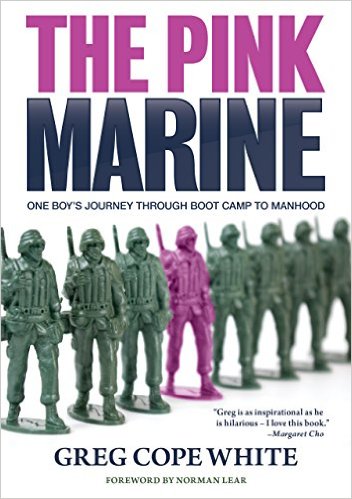
But once in a while I read a book that jumps out at me as something that I really feel the need to review. One of those is Greg Cope White’s The Pink Marine.

Greg served as a closeted Gay man for six years in the Marine Corps, leaving with the rank of Sergeant before the era of don’t ask don’t tell, but the book is not so much about that, although the threat of being found out and being court-martialed or discharged with a less than honorable discharge was always present.

But as I said, the book is about far more than that. This is not a story of a man talking about being persecuted, it is a book about overcoming obstacles and self-doubts to accomplish something worthwhile. For Greg this was becoming a United States Marine, something that he is still very much proud of being.

You do not have to be Gay to enjoy, appreciate, and be inspired by this book. It an outstanding read for anyone who wants to understand the importance of learning to overcome and succeed.

The book deals with life, and how Greg’s life, upbringing, a lifelong friendship, all came together during the crucible of Marine Boot Camp. This is a story of triumph in the face of self-doubt and adversity, a story of friendship, loyalty, and bonding that those who have not gone through Boot Camp, or other forms of rigorous initial entry training in the military, training which challenges you to reach beyond your limits and overcome all of the obstacles thrown in your path.

Greg’s story is a common story for many men and women, straight and gay alike who have volunteered to serve in the military, not knowing quite what to expect, and then be broken down, and built back up, not just as individuals but as a group. When Greg tells the stories of Boot Camp, the work of the Drill Instructors, and his story of conquering his own doubts and weaknesses I could relate.

While I am not Gay, I have served in the military some 35 years, 17 1/2 years in the Army, and about the same in the Navy, with about six of my Navy years serving with the Fleet Marine Force. I still remember the breaking process of my Army ROTC Advanced Camp at Fort Lewis Washington in the summer of 1982 when an Army Special Forces and Ranger, Vietnam combat veteran by the name of Sergeant First Class Harry Ball broke me down and built me back up. I have written about that before, and it has stayed with me. Greg’s very vivid description of his Marine Corps Drill Instructors, also Vietnam vets, made me feel like I was there again. Such training can be both traumatic and humorous and Greg tells it better than most.

Likewise, Greg’s retelling of his work to master the Marine Physical Fitness Test, (PFT) made me recall my transition from the Army to the Navy, serving with the Second Marine Division at Camp LeJeune North Carolina. Though I was about to turn forty, the Marines made me want to do more than settle for Navy standards or my former Army standards, I wanted to meet theirs. When I read his account of nearly maxing that test, it brought me back to when I passed the Marine PFT with a Class One score on my 40th birthday in March 2000, and completing a timed forced march in full combat gear at the end of a grueling field exercise. Though I am a Navy officer I proudly wear the Fleet Marine Force Qualification pin, it establishes a link with Marines that cannot be broken.

I heartily recommend Greg’s book to anyone, especially those that need some inspiration to begin to believe in themselves, and that they can accomplish things that they thought were unattainable. It is a story of what it takes to become a Marine, total commitment and the qualities of courage, honor, loyalty, and professionalism. That is what you get in this book.

Greg’s book should also be read by those who oppose Gays serving in the military. I would hope that reading it would help lessen their prejudice and enlighten them that Gays and Lesbians, like anyone else can serve our Nation honorably, with the highest distinction.

I found Greg’s story tremendously inspiring, even at the age of 56 and now passed over for Captain, happily getting ready for my final tour of duty before I retire.

The Pink Marine can be found in most bookstores as well as on Amazon.com which has it on their Kindle format. Greg is an author, television writer, and is the host of the Cooking Channel’s food and travel show Unique Sweets, writes for the Huffington Post, and has his own blog over called EAT.GREG.EAT at www.eatgregeat.com

Have a great day.

Peace,

Padre Steve+

4 Comments

Filed under History, leadership, LGBT issues, Military

Women in the Civil War: Spies, Nurses and Transgender Soldiers

women-civil-war-sarah-edmonds-frank-thompson-631

Friends of Padre Steve’s World,

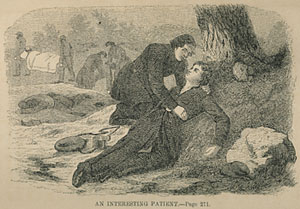
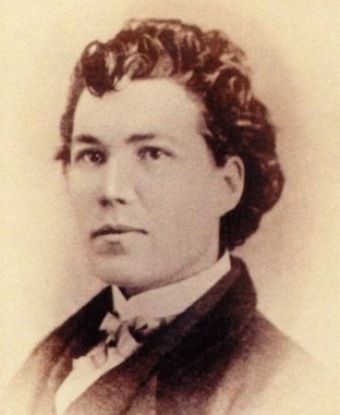
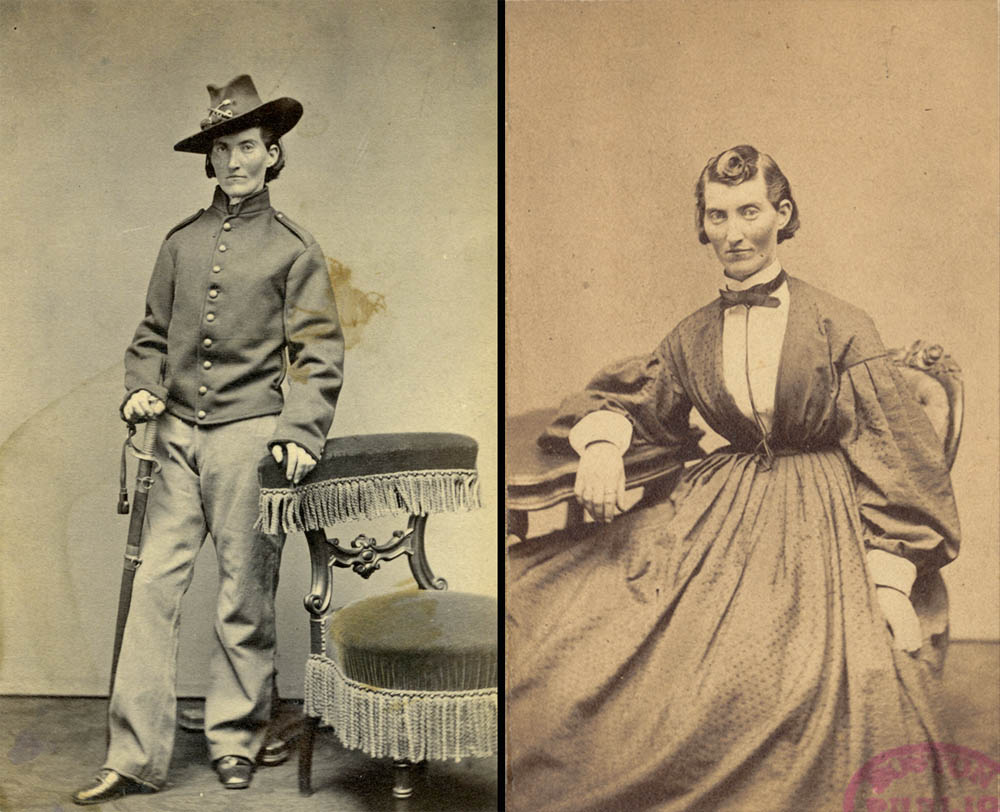
This is the follow-up to yesterday’s article on the early women’s rights movement. It deals with how women served in the Civil War. While women were not allowed to be soldiers, many disguised themselves and lived as men in order to do so, in effect living as transgender men. Others served as spies or nurses. All were pioneers, and though women are now beginning to reach the highest ranks of the U.S. Military, and being allowed to serve in military specialties previously limited to men, there is still much political and cultural opposition to them doing so. 

As before this is a section from my Civil War and Gettysburg text. I do hope that you find it interesting. 

Peace

Padre Steve+

Of course when the Civil War broke out the logical end of this train of though was that should women be allowed to serve in the military. Legally and socially it was not possible for women to serve in the military in 1861, but this did not stop women in the Union or the Confederacy from doing so. Quite a few women on both sides of the conflict chaffed about not being allowed to fight for their countries, their families and their causes, and despite official prohibitions that kept women from serving in any capacity but nursing, a good number of women found their way to go to war. While men in the North and South “were expected to enlist, any woman actively participating in the Civil War was an oddity if not a renegade.” [1] In some cases this involved hundreds of women taking male identities in order to fulfill their desires to serve their countries.

The motives of these women varied. In some cases women wanted gain the economic privileges of full citizenship, and for others the glory reserved to only to men. In our modern parlance those that took male identities would be considered transvestites or possibly transgender, but for them “transvestitism was a private rebellion against public conventions. By taking a male social identity, they secured for themselves male power and independence, as well as full status as citizens of their nation. In essence the Civil War was an opportunity for hundreds of women to escape the confines of their sex.” [2]

civilwar-07-patient1

During the war hundreds of women went to war, taking on the identity of men. They enlisted under male names and pretended to be men. Unless they were discovered to be women, or unless they confessed to their wartime service either during or after the war, most women managed to serve without being caught. Sadly, most of their service records were lost. In 1861 Private Franklin Thompson “enlisted in Company F of the 2nd Michigan Infantry…unknown to comrades, Thompson actually was Sarah Emma Edmonds.” [3] Edmonds served in the illustrious Iron Brigade until the disaster at Fredericksburg. Well known for her courage as Franklin Thompson, Edmonds participated in some of the bloodiest combats of the war. At Antietam she was caring for the wounded when she came upon a soldier who had been wounded in the neck. That soldier informed Edmonds that she was dying and after a surgeon came by and confirmed what the soldier said the dying soldier told Edmonds:

“I am not what I seem, but I am female. I enlisted from the purest motives, and I have remained undiscovered and unsuspected. I have neither father, mother nor sister. My only brother was killed today. I closed his eyes about an hour before I was wounded….I am Christian, and have maintained the Christian character ever since I entered the army. I have performed the duties of a soldier faithfully, and am willing to die for the cause of truth and freedom….I wish you to bury me with your own hands, that none may know after my death that I am other than my appearance indicates.” [4]

That unknown woman was not alone, at least nine women, eight Union and one Confederate, fought at Antietam and of those five were casualties. Five women, two Federal and three Confederate took part at Gettysburg. All three Confederate women at Gettysburg were either killed or wounded, or captured, including two women who took part in Pickett’s Charge. [5]

Edmonds_inline

Sarah Edmonds aka Franklin Thompson

Sarah Edmonds published a book Nurse and Spy in the Union Army while recovering from malaria in 1863. The book, which was published the following year, sold 175,000 copies, the proceeds that she donated to care for sick and wounded Union veterans. After the war, Edmonds attended Oberlin College, married, had three of her own children and adopted two more. She “became a member of the Grand Army of the Potomac, the organization for Union veterans of the Civil War. She applied for, and received, a military pension, and upon her death in 1898 was buried with full military honors.” [6] She was the only women admitted to the Grand Army of the Republic.

Clayton-Francis-L

Frances Clayton

Another of the women to serve was Frances Louisa Clayton. Fighting for the Union as a member of the Minnesota State Militia Cavalry and 2nd Minnesota Battery, serving under the command of Ulysses S. Grant she was wounded at Fort Donelson. Like many other women soldiers, Clayton mastered the art of behaving as a man. She “became “a capital swordsman,” but also commanded attention with her “masculine stride in walking” and “her erect and soldierly carriage.” [7] After the war she promoted her service in a book.

Albert-Cashier

However, most women were more discreet during and after the war regarding their true sexuality. Private Albert Cashier hid his sexuality identity for his entire term of service. He enlisted in August 1862 as a member of the 95th Illinois. Cashier was born in Ireland as a woman, Jennie Hodgers. He fought in forty battles and was discharged with the regiment in August 1865. At Vicksburg he was briefly captured by the Confederates while conducting a reconnaissance “but managed to escape by seizing a gun from one of her guards, knocking him down, and outrunning others. Comrades recalled Private Cashier climbing to the top of their fieldworks to taut the enemy into showing themselves.” [8]

After the war “Albert” returned home and lived as a “farmer and handyman and served as a caretaker in his church. He never married.” In 1890 he applied for and received a military pension and in 1911 the now elderly “man” was struck by a car and suffered a broken leg. The doctor threating him discovered that Albert was not a man, but a woman. But the doctor kept his confidentiality and without revealing “Albert’s” secret had the Union veteran admitted to the local Soldier’s and Sailors’ Home at Quincy, Illinois.” [9] A few years later the elderly “man” began to exhibit erratic behavior and was “committed to a public mental hospital and the word was out.” [10] With her story now sensational front page news and “old comrades in arms came to her defense.” [11] Her comrades had never known that “Albert” was a man during or after the war, while the news was a surprise to them they came to her defense. To combat some of the sensationalism in the media Albert’s fellow soldiers testified “to Albert’s bravery in combat and public good works in later life. Albert/Jennie died at Watertown State Hospital in 1915 at age seventy-one. The local post of the Grand Army of the Republic arranged for her burial. Her headstone reads: “Albert D.J. Cashier, Company G, 95th Illinois Infantry.” [12]

Wartime records are sketchy but as a minimum it is believed that “between 250 and 400 women disguised as men found their way into either the Federal or Confederate armies.” [13] Women known to have served had a “combined casualty rate of 44 percent” including the fact that “eleven percent of women soldiers died in the military.” [14] Some of those women are now well known but many others are lost to history. Most women tried to keep their sexual identities secret, even to the point of their death on the battlefield. Most of the women who served in the armies returned home to resume relatively normal lives after the war.

Other women would serve as spies for both sides, often rendering valuable assistance to their countries. The women who served as spies often took their lives into their hands; however, they often provided vital information to the Union or Confederate officers that they served. Pauline Cushman “parlayed her acting talents into a series of elaborate ruses that allowed her to pry information out of admiring and complaisant Confederate officers; Belle Boyd used an equal measure of talent in as a northern Virginia coquette to elide the same kind of information out of Federal officers.[15]

Even those women who were successful often suffered for their service during and after the war as they learned “that few people completely trusted or respected a spy, not even a “friend.” [16] Many, especially Southern women who spied for the Union were ostracized and persecuted in their communities after the war, and found little support from Northern politicians. Rebecca Wright, a young Quaker schoolteacher in Winchester, Virginia provided information that “enabled him to defeat General Early’s forces” in the Valley of 1864. She lost her job, and her former friends and neighbors boycotted her family’s businesses. Rejected for a pension, Sheridan helped Wright obtain “an appointment in a government office, remaining there for the rest of her days.” [17] Elizabeth Van Lew was a lifelong resident of Richmond and daughter of a wealthy businessman. She helped Union prisoners escape from Richmond’s notorious Libby prison and when Grant besieged Petersburg, Miss Van Lew “supplied him with a steady stream of information” [18]

01302012_harriet-tubman2-library-of-congress-600

Harriet Tubman

“African American women were generally dismissed as militarily harmless, a miscalculation that Harriet Tubman…used to immense advantage. Tubman, who had escaped from slavery in Maryland twenty years before the war and who had amassed considerable experience venturing into the south to guide runaways to the North undertook spying expeditions for the Federal troops on the South Carolina Sea Islands.” [19] The incredibly brave woman served throughout the war accompanying Union forces and securing vital information even as she worked to set other slaves free. Tubman’s “spying activities included convincing slaves to trust the Union invaders,” [20] many of whom would join the ranks of the newly raised regiments of U.S. Colored Troops.

dix

Dorothea Dix

Other women served in various roles caring for the wounded. In the North, “Dorothea Dix organized the Union’s army nurses for four years without pay; Mary Livermore headed the Union’s Sanitary Commission, inspecting army camps and hospitals….Scores of others like Clara Barton, volunteered to be nurses.” [21] All of these women did remarkable service, mostly as volunteers, and many witnessed the carnage of battle close up as the cared for the wounded and the dying which often created ethic concerns for the women nurses:

“Clara Barton described her crisis of conscience when a young man on the verge of death mistook her for his sister May. Unable to bring herself actually to address him as “brother,” she nonetheless kissed his forehead so that, as she explained, “the act had done the falsehood the lips refused to speak.” [22]

Clarabartonwcbbrady

Clara Barton

Of the women that served in the ranks, some were discovered, and many remained protected by their fellow soldiers. Quite a few received promotions and even served as NCOs or junior officers. With women now serving in combat or combat support roles in the U.S. Military since Operation Desert Storm in 1991, the stigma and scandal that these cross-dressing women soldiers of the Civil War has faded and as scholars and the public both “continue probing cultural notions of gender and identity, the reemerging evidence that women historically and successfully engaged in combat has met with less intellectual resistance and has taken on new cultural significance.” [23] As the United States military services examine the issues surrounding further moves to integrate the combat arms we also should attempt to more closely examine the service of the brave and often forgotten women who served on both sides of the Civil War.

Notes

[1] Silvey, Anita I’ll Pass for Your Comrade Clarion Books, New York 2008 p.9

[2] Ibid. Blanton and Cook They Fought Like Demons p.5

[3] Ibid. Lowry The Stories the Soldiers Wouldn’t Tell p.119

[4] Ibid. Silvey I’ll Pass for Your Comrade p.68

[5] Ibid. Blanton and Cook They Fought Like Demons pp. 15-16

[6] Ibid. Silvey I’ll Pass for Your Comrade p.90

[7] Ibid. Blanton and Cook They Fought Like Demons p.58

[8] Ibid. Blanton and Cook They Fought Like Demons pp. 16-17

[9] Ibid. Lowry The Stories the Soldiers Wouldn’t Tell p.121

[10] Ibid. Lowry The Stories the Soldiers Wouldn’t Tell p.121

[11] Ibid. Silvey I’ll Pass for Your Comrade p.90

[12] Ibid. Lowry The Stories the Soldiers Wouldn’t Tell p.121

[13] Ibid. Guelzo Fateful Lightening p.394

[14] Ibid. Blanton and Cook They Fought Like Demons pp.206-207

[15] ibid. Guelzo Fateful Lightening p.395

[16] Ibid. Massey Women in the Civil War p.87

[17] Ibid. Massey Women in the Civil War pp. 103-104

[18] Ibid. Massey Women in the Civil War p.102

[19] Ibid. Guelzo Fateful Lightening p.394

[20] Sizer, Lyde Cullen Acting Her Part: Narratives of Union Women Spies in Divided Houses: Gender and the Civil War Oxford University Press, New York and Oxford 1992 p.130

[21] Ibid. Silvey I’ll Pass for Your Comrade p.10

[22] Faust, Drew Gilpin, This Republic of Suffering: Death and the American Civil War Vintage Books, a division of Random House, New York 2008 p.12

[23] Ibid. Blanton and Cook They Fought Like Demons p.204

Leave a comment

Filed under civil rights, civil war, History, Military, Political Commentary

Freedom’s Pilot: Robert Smalls Fight for Freedom


Friends of Padre Steve’s World,

There are some people and events that are important but get swept up in broader historic events. One such story is that of Robert Smalls, a slave in Charleston South Carolina. Smalls was hired out to work with the money going to his master. He worked in a number of jobs, but as a teenager fell in love with the sea. He went to work as a slave worker on the city’s waterfront where he started as a common dockworker, became a rigger, a sailmaker, and finally a wheelman, which basically was a ship’s pilot, since slaves were not permitted that title. Even so his abilities and knowledge of Charleston harbor well well known and respected by ship owners. 


When South Carolina seceded and the Confederacy went to war, Smalls was assigned as wheelman of the CSS Planter, a small and lightly armed transport. On the night of May 12th and 13th of 1862, Smalls took advantage of all three white officer’s absence ashore, by putting into effect an escape plan he had worked out with the other slave crew members of Planter. Smalls and seven other slaves got the ship underway, with Smalls donning the captain’s uniform and a straw hat similar to the captain’s. In the darkness the ruse was perfect, no Confederades ashore suspected anything as Planter stopped to pick up the escaped slaves family members at another wharf before Smalls sailed out past the range of the Confederate shore battery guns to surrender to the USS Onward. Smalls present the U.S. Navy with the ship, her cargo, which included four artillery pieces intended for a Confederate fort in the harbor, but more importantly a Confederate code book and charts showing the location of deadly undersea mines and torpedoes that had been laid in the harbor. 

Smalls quickly became a hero. Congress voted him and his crew the prize money for the ship, and he met with Secretary of War Stanton to argue the case that blacks should be allowed to serve. Smalls’ story helped convince Lincoln of allowing African Americans to serve in the United Staes forces. Smalls served as a civilian pilot working for the Navy and and the Army, serving in numerous battles. He was the pilot for the experimental ironclad USS Keokuk when that ship was heavily damaged by over 90 hits at Charleston. He was responsible for getting the ship safely out of range of the  Confederate batteries before she sank, thus saving many crew members. 

He then was reassigned to the USS Planter, now assigned to the Army. The ship got caught in a crossfire between the Union and Confederate forces and Planter’s captain ordered the ship to surrender. Smalls objected, knowing that any African American caught serving Union forces would not be treated as prisoners of war, but either returned to slavery or executed by order of the Confederate Congress. Smalls took command of the vessel and steered her out of harm’s way. He was appointed Captain of the ship and was present for the ceremonial raising of the American flag over Fort Sumter in April 1865. Smalls was the first African American to command a ship in the service of the U.S. Military.

After the war Smalls got an education and when the 14th Amendment was passed ran for office, serving in the South Carolina legislature and as a member of Congress. He fought against changes to the 1895 South Carolina Constituion that disenfhchised African Americans and codified the Jim Crow laws which had be upheld by the Supreme Court in Plessy v. Ferguson. 

In 1889 Smalls was appointed U.S. Collector of Customs in Beaufort and served in that office until 1911. He also was director of a black owner railroad, and helped publish the black owners Beaufort Standard newspaper. He died in 1915 at the age of 75. 

Small’s courage and his fight for freedom, as well as others who did so should not be forgotten. 

Peace,

Padre Steve+ 

Leave a comment

Filed under civil rights, civil war, History, leadership, Military

War What is it Good For? Sometimes Something: The Context of War

cropped-the_storming_of_ft_wagner-lithograph_by_kurz_and_allison_1890a.jpg

Friends of Padre Steve’s World,

Today something different. Yesterday I did a post about the Gettysburg Address and the importance of the proposition that of democracy that all men are created equal. It is a radical proposition that since the writing of the Declaration of Independence, the Emancipation Proclamation, the Gettysburg Address, the Thirteenth, Fourteenth, Fifteenth and Nineteenth Amendments, the Voting Rights Act of 1964 and Civil Rights Act of 1965, as well as Supreme Court decisions in Brown v. Board of Education and Obergfell v. Hodges, has grown in or country to encompass civil rights for African Americans and other racial minorities, Women, and Gays. But those liberties had to be fought for, and would most likely never happened had not Abraham Lincoln and others in the North understood that neither liberty or Union could survive if the South succeeded. In fact, all of us owe our continued freedom to that understanding and the necessity of total war to achieve it.

However, yesterday I had a Twitter troll snipe at me, this time a left-wing troll who claimed to be a “liberal progressive.” However, his remarks were so ignorant of history and reality that I am sure the the had no clue how his words betrayed his alleged beliefs. So in a few words I told him that he was basically ignorant and blocked him. Most of the time when this happens to me it comes from supposed “conservatives,” or “white nationalists” of various flavors, to include the KKK and Neo-Nazi types. But the fact that this came from a self-proclaimed “liberal and progressive” proves that ignorance is not confined to any ideology. That is a sad commentary on our time.

So what I am posting today is an updated and slightly edited portion of the first chapter of my Civil War and Gettysburg text. The entire chapter is close to 150 pages and is probably going to become a book in its own right, but I think it is important for my readers to understand, that sometimes liberty only comes with great sacrifice and the complete defeat of those who want to deny it. That does not matter if it was the Confederacy, Nazi Germany, or even the so-called Islamic State.

As a man who came back changed by war I can only say that I hate it. That being said, though I am a progressive and liberal, I am a realist and understand that as evil as war is, that surrendering liberty to those who believe in “liberty for the few, and slavery for all others.” 

The section of the book may seem a bit wonkish, but it is important. I understand that some of my readers will disagree, but one cannot escape reality.

So anyway, that being said I wish you a good day.

Peace,

Padre Steve+

Richard Evans wrote something in the preface to his book The Third Reich in History and Memory that those who study military history often forget. He noted: “Military history, as this volume shows, can be illuminating in itself, but also needs to be situated in a larger economic and cultural context. Wherever we look, at decision making at the top, or at the inventiveness and enterprise of second rank figures, wider contextual factors remained vital.” [1] Thus while this work is an examination of the Gettysburg campaign it is important to understand the various issues that were formative for the men who directed and fought the battle. One cannot understand the determination the determination of Robert E. Lee to maintain the offensive, the dogged persistence of Joshua Chamberlain or Strong Vincent to hold Little Round Top, what brought John Buford to McPherson’s Ridge, what motivated Daniel Sickles to move Third Corps to the Peach Orchard, and what motivated the men of Pickett’s division to advance to their death on Cemetery Ridge, without understanding the broader perspective of culture, politics, economics, religion, sociology, and ideology that shaped these men.

The American Civil War was the first modern war. It was a watershed event in an era, which introduced changes in new types of weapons, more lethal versions of older weapons, tactics, army organization, logistics, intelligence and communications. Though the war did not change the essential nature of war, which Clausewitz says is “is an act of violence to compel our opponent to fulfill our will” [2] it expanded the parameters of war and re-introduced the concept of “total war” to the world and “because its aim was all embracing, the war was to be absolute in character.” [3] In a sense it was a true revolution in military affairs.

The Civil War was truly a revolution in military affairs. The war changed the character of war, as it had been known for centuries, since the Peace of Westphalia and the end of the Thirty Years War. In the American Civil War, the character of war changed from a limited war waged between opposing armies into a war that at times bordered on Clausewitz’s understanding of absolute or total war. This conflict was waged between two people who shared much in common but were divided by an ideology which encompassed politics, economics, society, law, and even religion.

The war was revolutionary in other ways, and brought about a host of social, philosophical, economic, and political changes which continue to impact the lives of people in the United States and around the world even today. Some of these, especially those regarding the abolition of slavery and emancipation, as well as the beginnings of the Women’s Rights movement have had a ripple effect in matters of political and social equality for other previously disenfranchised groups of citizens. One writer noted in regard to the social impacts that “The Civil War uprooted institutions, transformed our politics, influenced social relationships of half a continent, and wrought changes that echo down the generations.” [4] Mark Twain wrote in 1873 that the war “uprooted institutions that were centuries old, changed the politics of a people …and wrought so profoundly upon the national character that cannot be measured short of two or three generations.” [5]

In a sense, when Abraham Lincoln proclaimed “a new birth of freedom” in his Gettysburg address it served as a watershed moment in American history because it brought to the forefront the understanding of Jefferson and the other signers of the Declaration of Independence that all men are created equal. That statement, flowing from the Declaration was key to Lincoln’s understanding of human rights and dignity, and from it came the Emancipation Proclamation and the Thirteenth Amendment, which abolished slavery. Those would be followed by the Republican Congresses’ passage of the Fourteenth Amendment, which overturned the Dred Scott Decision, which denied all citizenship to blacks across the country, and by Ulysses S. Grant’s Fifteenth Amendment, which gave African American men to right to vote. That is the human and political context by which we have to understand the American Civil War.

Thus it is important to study the Gettysburg campaign in the context of the Civil War because the campaign of 1863 in the east cannot be divorced from what was happening in the west at Vicksburg, nor the Union blockade, nor the diplomatic, economic and informational aspects of the war. Likewise the Gettysburg campaign cannot be separated from its relationship to the broader understanding of the nature and character of war. To do this one must examine the connection between them and policies made by political leaders; to include the relationship of political to military leaders, diplomats, the leaders of business and industry and not to be forgotten, the press and the people. Likewise we must understand the various contexts of war, to include the social, political, ideological and even the religious components of war, how they impacted Civil War leaders and why civilian policy makers and military leaders must understand them today.

While the essential nature of war remains constant, wars and the manner in which they are fought have changed in their character throughout history, and this distinction matters not only for military professionals, but also policy makers. The changing character of war was something that military leaders as well as policy makers struggled with during the American Civil War much as today’s military leaders and policy makers seek to understand the character of warfare today. British military theorist Colin Gray writes “Since the character of every war is unique in the details of its contexts (political, social-cultural, economic, technological, military strategic, geographical, and historical), the policymaker most probably will struggle of the warfare that is unleashed.” [6] That was not just an issue for Abraham Lincoln and Jefferson Davis, both of whom struggled with the nature of the war which had been unleashed, but it is one for our present political leaders, who as civilian politicians are “likely to be challenged by a deficient grasp of both the nature of war as well as its contemporary context-specific character.” [7]

In addition to being the first modern war, or maybe I should say, the first war of the Industrial Age, the Civil War prefigured the idea of total war written about by Clausewitz that occurred in the World Wars of the Twentieth Century. The war combined a massive number of technological advances, which both preceded and occurred during it, in which the philosophical nature of the Industrial Revolution came to the fore.

Likewise, the enmity of the two sides for one another had been fostered by a half century of relentless and violent propaganda that ushered from the mouths of politicians, the press and even from the pulpit brought the element of hatred to the fore of the conflict. A Confederate Captain wrote his wife to teach his children “a bitter and unrelenting hatred of the Yankee race” that had “invaded our country and devastated it…[and] murdered our best citizens…. If any luckless Yank should unfortunately come my way he need not petition for mercy. If he does I will give him lead.” A soldier from a Wisconsin regiment wrote to his fiancée after the assault on Resaca, Georgia that his unit had captured twenty-three Confederates and “or boys asked if they remembered Fort Pillow and killed them all. Where there is no officer with us, we take no prisoners…. We want revenge for our brother soldiers and will have it…. Some of the [rebels] say they will fight as long as there is one of them left. We tell them that is what we want. We want to kill them all off and cleanse the country.” [8]

As such there were many times the American Civil War came close to Clausewitz’s understanding of absolute war in its in character, and it prefigured the great ideological wars of the twentieth century. J.F.C. Fuller noted “for the first time in modern history the aim of war became not only the destruction of the enemy’s armed forces, but also of their foundations- his entire political, social and economic order.” [9] It was the first war where at least some of the commanders, especially Ulysses S. Grant and William Tecumseh Sherman were men of the Industrial Age, in their thought and in the way that they waged war, in strategy, tactics even more importantly, psychologically. Fuller wrote:

“Spiritually and morally they belonged to the age of the Industrial Revolution. Their guiding principle was that of the machine which was fashioning them, namely, efficiency. And as efficiency is governed by a single end- that every means is justified- no moral or spiritual conceptions of traditional behavior must stand in its way.” [10]

Both men realized in early 1864 that “the South was indeed a nation in arms and that the common European practice of having standing armies engaged each other in set-piece battles to determine the outcome of a war was not enough to win this struggle.” [11] Though neither man was a student of Clausewitz, their method of waging war was in agreement with the Prussian who wrote that “the fighting forces must be destroyed; that is, they must be put in such a position that they can no longer carry on the fight” but also that “the animosity and the reciprocal effects of hostile elements, cannot be considered to have ended so long as the enemy’s will has not been broken.” [12]

William Tecumseh Sherman told the mayor of Atlanta after ordering the civilian population expelled that “we are not only fighting hostile armies, but a hostile people, and must make the old and young, the rich and poor, feel the hard hand of war.” [13] Sherman was one of the first American military leaders to understand that a civil war could not be waged according to the limited war doctrines most American officers had been taught. He not only “carried on war against the enemy’s resources more extensively and systematically than anyone else had done, but he developed also a deliberate strategy of terror directed against the enemy’s minds.” [14] While some might find this troubling, the fact remains that it was Sherman’s Southern sweep of all that lay before him that broke the back of the Confederacy.

vincent

Strong Vincent

But Sherman and Grant were not alone in understanding the problem of fighting a limited war against the Confederacy. In the fall of 1862 a twenty-five year volunteer Colonel serving with McClellan’s army in Virginia who would be instrumental in throwing back Hood’s assault on Little Round Top, and die leading the defense of that edifice, by the name of Strong Vincent, understood what had to happen if the Union were to overcome the rebellion of the Confederacy.

“We must fight them more vindictively, or we shall be foiled at every step.  We must desolate the country as we pass through it, and not leave a trace of a doubtful friend or foe behind us; make them believe that we are in earnest, terribly in earnest; that to break this band in twain is monstrous and impossible; that the life of every man, yea, of every weak woman or child in the entire South, is of no value whatever compared with the integrity of the Union.” [15]

To most modern Americans who have no experience of war other than seeing it as a video spectator, the words of Vincent and Sherman seem monstrous and even inhuman. However, those who persist in such thinking fail to understand the nature and context of war. While some wars may be fought in a limited manner, others, especially ones driven by militant and uncompromising ideologies, often backed by fanatical religious beliefs cannot be limited, and those that fight such wars must, to paraphrase the words of Strong Vincent, “must fight them more vindictively, or be foiled at every step.” It would have been interesting to see what Vincent might have achieved had he not been cut down by Confederate bullets on Little Round Top.

Abraham Lincoln came to embrace the eternal nature of war as well as the change in the character of the war over time. Lincoln had gone to war for the preservation of the Union, and initially pursued the war in a limited way, seeking to defeat Confederate armies in the field while sparing the people of the Confederacy from total destruction.

But in his quest to preserve the Union, something that for him was almost spiritual in nature, as is evidenced by the language he used in both of his inaugural addresses and the Gettysburg Address, he found that Confederacy would only return to the Union if conquered, and he became convinced that the South’s peculiar institution, that of slavery, must be destroyed in the process. Thus, instead of a war to simply re-unite the Union and let bygones be bygones, Lincoln changed the narrative of the war when he signed the Emancipation Proclamation. When this happened the war not only became a war to restore the Union, but the a war for the liberation of enslaved African Americans, After January 1st 1863 when the Emancipation Proclamation went into effect, Lincoln “told an official of the Interior Department, “the character of the war will be changed. It will be one of subjugation…The [old] South is to be destroyed and replaced by new propositions and ideas.” [16] That too was a modern understanding of war.

Of course, the revolution in military affairs that characterized the Civil War took time, but it was the political and military leaders of the North who better adapted themselves and their nation to the kind of war that was being fought. “Lincoln’s remarkable abilities gave him a wide edge over Davis as a war leader, while in Grant and Sherman the North acquired commanders with a concept of total war and the determination to make it succeed.” [17]

At the beginning of the war the leaders and populace of both sides still held a misguided and unrealistic romantic idea of war. Most people in the North and the South held on to the belief that the war would be over in a few months and that would be settled by a few decisive battles and that casualties would be comparatively light. This included most politicians as well as many military officers on both sides. There were some naysayers who believed that the war would be long and costly, like the venerable and rather corpulent General Winfield Scott, but politicians and the press mocked Scott and other doubters who even suggested that the war would be long, hard, and bloody. Of course those who predicted a short, easy, and relatively bloodless war were the ones proven wrong, though it would take the leaders and the people of both sides over a year to understand. When it was done the American Civil War became the bloodiest war ever waged by Americans, and it was against other Americans.

Notes

[1] Evans, Richard J. The Third Reich in History and Memory Oxford University Press, Oxford and New York 2015 p.ix

[2] Clausewitz, Carl von. On War Indexed edition, edited and translated by Michael Howard and Peter Paret, Princeton University Press, Princeton NJ 1976 p.75

[3] Fuller, J.F.C. The Conduct of War 1789-1961 Da Capo Press, New York 1992. Originally published by Rutgers University Press, New Brunswick N.J p.99

[4] Lowry, Thomas P. The Stories the Soldiers Wouldn’t Tell: Sex in the Civil War Stackpole Books, Mechanicsburg PA 1994 p.176

[5] McPherson, James The War that Forged a Nation: Why the Civil War Still Matters Oxford University Press, Oxford and New York 2015 p.48

[6] Gray, Colin S. Fighting Talk: Forty Maxims on War, Peace, and Strategy Potomac Book, Dulles VA 2009 p.36

[7] Ibid. Gray Fighting Talk p.36

[8] Ibid. McPherson The War that Forged a Nation pp.49-50

[9] Fuller, J.F.C. A Military History of the Modern World, Volume Three: From the Seven Days Battle, 1862, to the Battle of Leyte Gulf, 1944 Minerva Press 1956 p.88

[10] Ibid. Fuller A Military History of the Modern World, Volume Three p.88

[11] Flood, Charles Bracelen, Grant and Sherman: The Friendship that Won the War, Harper Perennial, New York 2005 p.238

[12] Ibid. Clausewitz p.90

[13] McPherson, James. The Battle Cry of Freedom: The Civil War Era Oxford University Press, Oxford and New York 1988 p.809

[14] Weigley, Russell F. The American Way of War: A History of United States Military History and Policy University of Indiana Press, Bloomington IN, 1973 p.149

[15] Nevins, James H. and Styple, William B. What Death More Glorious: A Biography of General Strong Vincent Belle Grove Publishing Company, Kearney NJ 1997 p.57

[16] Ibid. McPherson The Battle Cry of Freedom p.558

[17] Ibid. McPherson The Battle Cry of Freedom p.857

Leave a comment

Filed under civil rights, civil war, ethics, History, Military, Political Commentary

Cemetery & Culp’s Hill Pt 3

Friends of Padre Steve’s World

I am traveling with my students to Gettysburg this weekend and happen to be posting my newest additions to my text, these dealing with the battles for Culp’s Hill and Cemetery Hill which occurred on the night of July 2nd and early morning of July 3rd 1863. I hope you enjoy.

Peace,

Padre Steve+

???????????????????

Brigadier General Alpheus William, U. S. Army

What happened next is one of the more complicated and confusing issues of the day. During the morning Meade had considered a spoiling attack against Ewell’s Second Corps using Twelfth Corps and other units on the Federal right. In order to facilitate this he allowed Henry Slocum to persist in believing that he was still an acting wing commander for the troops of Twelfth Corps in what was the Union right wing on the march up to Gettysburg, and the now cancelled Pipe Creek Circular. In the process, Slocum appointed Alpheus Williams of his First Division to head the corps. However, “Meade cancelled the attack but failed to explicitly rescind the entire order, expecting Slocum to return command of the Twelfth Corps by default. He did not. Instead, Slocum assumed that the attack had been cancelled that he still commanded the right wing.” [1] This led to a situation where Meade was unaware of who was actually commanding the corps, and created confusion about what the series of events that happened next. Without direct orders from Meade to relinquish command of the non-existent wing, Slocum chose “to cast himself in the more important role, leaving the tactical handling of the Twelfth Corps to Alpheus Williams.” [2]

In fairness “George Meade was so preoccupied with by his struggle to contain Hill’s and Longstreet’s efforts against his left flank,” [3] that he permitted this nearly catastrophic situation to develop. Longstreet’s attack on the Federal left, supported by the brigades of Rans Wright and Cadmus Wilcox forced Meade to pull troops from all along the Federal line. The Second Corps and Fifth Corps went in and as Longstreet’s attack progressed Meade ordered in reinforcements from John Sedgwick’s Sixth Corps and Slocum’s Twelfth Corps to reinforce his forces in the Peach Orchard, the Wheat Field and along the southern extension of Cemetery Ridge, “but the summons could not have come at a worse time for Slocum, who was growing convinced that Culp’s Hill was about to receive its own attack.” [4] The issue was how much of Twelfth Corps did Meade order Slocum to send to Cemetery Ridge?

Since a copy of Meade’s actual order does not exist we are left with accounts of the various commanders and staff officers. According to some accounts Meade directed Slocum to send “at least one division” to the threatened sector, an assertion also made by Meade’s son who served as his aide during the battle. Partisans of Meade and Slocum have argued about this since the battle, and historians tend to take the side of either general depending on how they interpret the numerous and often conflicting accounts of the evening.

Slocum clearly interpreted the order as a “request for his entire corps. He discussed the matter with Williams in his assumed role as commander of the Twelfth Corps. Both of them expected Meade to amend the order when made aware of the situation on Culp’s Hill.” [5] His actions support that assertion. After the war Slocum insisted that Meade had ordered his to “remove the entire 12th Corps from its position on the right, to one on the left.” [6] But Slocum did not immediately comply with Meade’s order to send the entire corps, if that indeed was what Meade had ordered. Williams later wrote that Slocum ordered him to “detach all I could spare – at least one division on Culp’s Hill.” [7] While Williams dispatched Ruger’s division to the south he retained Geary’s division on the hill.

Meanwhile, after consulting with Williams, Slocum sent an aide to Meade “to convey his opinion that at least a division should be kept on Culp’s Hill.” [8] The aide, Colonel Hiram Rodgers, returned with “Meade’s permission to keep one brigade rather than a division on the right.” [9] It was fortunate that Meade relented, and allowed Slocum to keep a brigade, but “Slocum’s appeal also demonstrates that Meade gave him no initiative, despite what some historians have alleged. Slocum tried to amend the order, Meade insisted. He clearly gave Slocum no choice in the matter.” [10] When John Geary got the order to take two brigades to the south he obeyed, leaving George Sears Greene to defend Culp’s Hill, “leaving some 1,400 men to hold a sector previous occupied by almost 10,000.” [11]

Greene was ordered by Slocum to “occupy the breastworks as thrown up by the corps.” [12] He immediately set to the task of having his brigade redeploy to meet the demands of the new situation. He had a difficult choice to make, he could extent the line to occupy as much of the fortifications that he could, which would leave the line perilously thin, or he could occupy a shorter section that would allow him to better concentrate his firepower. “Greene elected to do the latter. He filled the abandoned trenches for a distance of three regiments, kept to more back to cover his original position, and sent a fifth forward to stiffen the picket line…. Even to hold what he had selected, Greene had to take the risk of nearly doubling the front of each regiment.” [13]

While Greene adjusted his brigade to meet the new situation Geary marched his troops into deepening night following Ruger. However in another unexplainable mistake, he and his division lost their way in the dark and marched south, away from the battle and stopped halted near Rock Creek where it formed a line. Thus, two brigades of the division were out of the battle for four critical hours, leaving Greene and his brigade to make the best of the situation on Culp’s Hill. Blame can be assigned to Geary for not sending out messengers to find Slocum, and to Slocum for losing track of the division which had marched past his headquarters on Powers Hill as they moved south. Part of the reason for this might have been that Slocum assumed that Geary was operating under the orders of Williams who he had appointed to command the corps, and “some hours would pass before everyone realized that Geary had marched off the game board and needed to be recalled to Culp’s Hill.” [14] Thankfully for the Army of the Potomac the march cost nothing in a strategic or tactical sense, but it easily could have.  “Slocum referred to Geary’s march as “an unfortunate and unaccountable mistake…. And the historian of the 2d Massachusetts concluded that “it did not show much of a soldier’s instinct to take a road leading to the rear and follow it for two miles before halting.” [15]

Notes

[1] Ibid. Melton C. Sherman’s Forgotten General p.130

[2] Ibid. Trudeau Gettysburg: A Testing of Courage p.395

[3] Ibid. Trudeau Gettysburg: A Testing of Courage p.394

[4] Ibid. Guelzo Gettysburg: The Last Invasion p.347

[5] Ibid. Melton Sherman’s Forgotten General p.131

[6] Ibid. Pfanz Gettysburg: Cemetery Hill and Culp’s Hill p.194

[7] Ibid. Pfanz Gettysburg: Cemetery Hill and Culp’s Hill p.194

[8] Ibid. Trudeau Gettysburg: A Testing of Courage p.395

[9] Ibid. Greene “A Step All-Important and Essential Element of Victory” p.114

[10] Ibid. Melton Sherman’s Forgotten General p.133

[11] Ibid. Trudeau Gettysburg: A Testing of Courage p.395

[12] Greene, George Sears. The Breastworks at Culp’s Hill in Battles and Leaders of the Civil War Volume III, The Tide Shifts Edited by Robert Underwood Johnson and Clarence Clough Buel Castle, Secaucus NJ p.317

[13] Ibid. Trudeau Gettysburg: A Testing of Courage pp.395-396

[14] Ibid. Trudeau Gettysburg: A Testing of Courage p.399

[15] Ibid. Greene “A Step All-Important and Essential Element of Victory” p.120

Leave a comment

Filed under civil war, History, leadership, Military

Culp’s and Cemetery Hill Pt 2

Friends of Padre Steve’s World

I am traveling with my students to Gettysburg this weekend and happen to be posting my newest additions to my text, these dealing with the battles for Culp’s Hill and Cemetery Hill which occurred on the night of July 2nd and early morning of July 3rd 1863. I hope you enjoy.

Peace,

Padre Steve+

Richard-Ewell

Lieutenant General Richard Ewell, C.S.A

During the day of July second little happened on Ewell’s front, an officer in Maryland Steuart’s brigade wrote “Greatly did officers and men marvel as morning, noon, and afternoon passed in inaction – on our part, not the enemy’s, for, as we well knew, he was plying axe and pick and shovel….” [1] . Though he had persuaded General Lee to leave his troops in place in order to assist Longstreet’s attack if the situation permitted, Ewell remained mostly inactive on July second with the exception of some skirmishing and a battle between the Stonewall Brigade and Gregg’s division of Federal Cavalry on Brinkerhoff’s Ridge about two and a half miles east of the town.

Lee was becoming more frustrated at the inaction of his corps commanders, and wanted Ewell to be able to support Longstreet’s attack, desire it to “make a simultaneous demonstration upon the enemy’s right, to be converted into a real attack should opportunity offer.” [2] But Ewell and his division commanders who had opposed the attack the previous evening, still were against it. Despite his misgivings, Ewell had been stung by Lee’s criticism the night before, and “was eager to make a redemptive showing today.” [3] Accordingly after his meeting with Lee around nine a.m. he began to position his units for the diversion that he hoped would turn into an opportunity to attack. After his conversation with Lee, Ewell “suffered between fear of another failure and an inner goad to commit his troops to action. His unsettled state could not have been helped by the long wait for the sound of Longstreet’s guns, which frayed the nerves.” [4]

Second Corps was deployed in a rough semi-circle to the east, north, and west of Culp’s and Cemetery Hill. The four brigades of Allegheny Johnson’s division which had not been present on the first day of battle occupied the area to the east of Culp’s Hill north of the Hanover Road. From there its skirmishers occasionally clashed with Federal skirmishers, while otherwise spending an uneventful day.

Edward “Old Allegheny” Johnson was an old regular army officer. Johnson was born in Salisbury, Virginia in 1816. He was a graduate of the West Point class of 1838 along with P.T.G. Beauregard and Irvin McDowell. Johnson had a solid record of service in the old Army, he served in the Seminole Wars and received brevet promotions to Captain and Major during the Mexican War. Like many officers that remained in the army after Mexico he served on the frontier on the Great Plains.

Johnson resigned his commission when Virginia seceded from the Union and was appointed Colonel of the 12th Georgia Infantry. [5] He was promoted to Brigadier General in December 1861. Johnson commanded a brigade sized force with the grand name of “the Army of the Northwest” which fell under the command of Stonewall Jackson.[6] He held the crest of the Allegheny Mountains so well with his small force that he was given the “nom de guerre “Allegheny” Johnson.” [7] Johnson was wounded in the ankle at the Battle of McDowell on May 8th 1862, but the wound took nearly a year to heal, imperfectly at that. He was a rather “curious, somewhat uncouth, and strangely fascinating man” [8] who made the most of his convalescence in Richmond, making pass after pass, and occasional proposals to women about town. He was a favorite of Stonewall Jackson who insisted that he be promoted to Major General and be given command of a division.

The division that Johnson took over was the former division of Jackson, and “many of these regiments had fought in “Stonewall” Jackson’s original division, and the troops enjoyed an spirit as exalted as their combat record.” [9] When Ewell was promoted to command Second Corps after Jackson’s death following the Battle of Chancellorsville Johnson was named as commander. Despite his wealth of experience in the pre-war army and service with Jackson in the Valley, Johnson was an outsider to the division and he commanded men “who knew him by reputation only.”[10] Like so many other Confederate division commanders at Gettysburg he had never before commanded a division, so he came to the position “with no real experience above the brigade level.” Likewise he was “unfamiliar with the qualities and limitations of his four new brigadiers,” [11] having served with none of them prior to the Gettysburg campaign. Two, “Maryland” Steuart, and James Walker were experienced brigade commanders, J.M. Jones was a former regular who due to problems with alcohol had only served in staff positions before being promoted to command a brigade, and Colonel Jesse Williams, a regimental commander with little experience had taken a brigade as there was no one else qualified.

Despite this, Johnson became quite popular with his men. Because Johnson walked with a limp and used a long staff to help him walk, it was said that: “his boys sometimes call him “Old Club.” [12] As a division commander “Johnson developed a reputation that when he threw his troops into battle, then struck with the punch of a sledgehammer, exactly the way Lee wanted his commanders to fight.” [13] Johnson “does well in nearly all his fights, hits hard and wins the confidence of his men.” [14] Gettysburg was his first test as a division commander, but not one that gave Johnson a real opportunity to excel.

Jubal Early’s division lay to the north of both Culp’s Hill and Cemetery Hill, with the brigades of Hays and Hoke posted “east of Baltimore Street in the ravine of Winebrenner’s Run,” where it “spent a miserable day,” as the ravine was “deep enough to cut off cooling breezes, its slopes were bare of trees, and the July sun warmed the Confederates without mercy. It was a debilitating and dangerous place. General Ewell wanted to pull Hays’s brigade back when it became apparent that the attack would be delayed, but he could not do so without risk of great loss. But staying there was not much better because, as Lt. William Seymour observed, it was almost death for a man to stand upright. ” [15]

“Old Jube” Early was an unusual character. He was described similarly by many to Dick Ewell in his gruffness and eccentrics. However, unlike Ewell, who was modest and charitable, Early was “ambitious, critical, and outspoken to the point of insubordination. Under certain circumstances he could be devious and malevolent.” [16] James Longstreet’s aide Moxey Sorrel wrote of him: “Jubal Early….was one of the ablest soldiers in the army. Intellectually he was perhaps the peer of the best for strategic combinations, but he lacked the ability to handle troops effectively in the field….His irritable disposition and biting tongue made him anything but popular.” [17] Despite this, Early had proved himself as a brigade commander and acting division commander and Lee referred to him affectionately as “my bad old man.” [18]

Early was the son of a tobacco planter in Franklin County Virginia. He was born in 1816 who had served in the Virginia legislature and was a Colonel of militia. Growing up he had an aptitude for science and mathematics. He was accepted into West Point in 1833 at the age of seventeen. He was a good student, but had poor marks for conduct and graduated in the eighteenth of fifty cadets in the class of 1837. His fellow students included Joe Hooker, John Sedgwick, Braxton Bragg, and John Pemberton, later, the doomed defender of Vicksburg. Also in the class was Lewis Armistead, with whom the young Early had an altercation that led to Armistead breaking a plate over his head in the mess hall. For the offense Armistead was dismissed from the academy.

He was commissioned into the artillery on graduation in 1837. However, after experiencing life in the active duty army, including service in the in the Seminole War, Early left the army and became a highly successful lawyer and active Whig politician. He served in the Mexican war as a Major with Virginia volunteers. Unlike some of his classmates, and later contemporaries in the Civil War, Early, and his men did not see combat, instead, serving on occupation duty. In Mexico Zachary Taylor made Early the “military governor of Monterrey, a post that he relished and filled with distinction.” [19]

After his service in Mexico, Early returned to Virginia, where he returned to his legal practice, serving as a prosecuting attorney. He also entered local politics where he served as a Whig in the Virginia legislature.

During his time in Mexico, Early contracted rheumatic fever, which left him with painful rheumatoid arthritis for the rest of his life. Due to it he “stooped badly and seemed so much older than his years that his soldiers promptly dubbed him “Old Jube” or Old Jubilee.” [20]

Jubal Early was “notoriously a bachelor and at heart a lonely man.” Unlike many Confederate officers he had “no powerful family connections, and by a somewhat bitter tongue and rasping wit” isolated himself from his peers.[21]

Likewise, in an army dominated by those with deep religious convictions, Early was avowedly irreligious and profane, though he did understand the importance of “the value of religion in keeping his soldiers’ spirits up” and as commander of the Army of the Valley, issued orders for a stricter keeping of the Sabbath. [22] Lee’s adjutant Walter Taylor wrote of him “I feared our friend Early wd not accomplish much because he is such a Godless man. He is a man who utterly sets at defiance all moral laws & such a one heaven cannot favor.” [23] That being said Porter Alexander praised Early and noted that his “greatest quality perhaps was the fearlessness with which he fought against all odds & discouragements.” [24]

Jubal Early was a Whig, and a stalwart Unionist who opposed Virginia’s secession, voting against it because he found it “exceedingly difficult to surrender the attachment of a lifetime to that Union which…I have been accustomed to look upon (in the language of Washington) as the palladium of the political safety and prosperity of the country.” [25]  Nonetheless, like so many others he volunteered for service after Lincoln called for 75,000 volunteers to crush the rebellion.

Robert E. Lee “appreciated Early’s talents as a soldier and displayed personal fondness for his cantankerous and profane Lieutenant …who only Stonewall Jackson received more difficult assignments from Lee.” [26] Early was the most influential of Ewell’s division commanders, and his “record in battle prior to Gettysburg was unsurpassed.” [27]

On Ewell’s left, Robert Rodes’s division, which had taken such a brutal beating at Oak Hill on July 1st lay to the west and north of Cemetery Hill in the town itself. “Doles’s, Iverson’s, and Ramseur’s brigades of Rodes’s division occupied Middle Street west from Baltimore Street to the edge of the town. O’Neal’s brigade was along the railroad bed to the right and rear, and Daniel’s brigade occupied the ridge at the seminary.” [28]

Ewell also took the time to scout for artillery positions, the only two that offered any support were on Seminary Ridge to the west and on Brenner’s Hill to the north, and on Brenner’s Hill he deployed Major Joseph Latimer’s artillery battalion. Latimer was not yet twenty years old at Gettysburg. Latimer had been a seventeen year-old student at the Virginia Military Institute at the outbreak of the war and volunteered to help a newly formed artillery battery. He impressed other officers enough that he was given a commission as a First Lieutenant shortly after turning eighteen, and promoted to Captain and command of Virginia’s Courtney Artillery in March of 1862. “Sometimes called “the “Boy Major” and “Young Napoleon,” Latimer had won the respect of the entire army for his skill and bravery,[29] and he was often cheered by the infantry as he rode by. His battlefield performance was such that he was promoted to Major in March 1863, and given command acting command of the battalion of Lieutenant Colonel R. Snowden Andrews who had been wounded at Winchester.

The lack of good positions to place his guns meant that Ewell’s artillery Chief, Colonel J. Thompson Brown had to work hard to find suitable firing positions for all of his guns. Some he placed on Seminary Ridge, and others on Brenner’s Hill. Brown “could get only forty-eight of the eighty or so guns of the Second Corps placed for action. Of these only thirty-two became actively engaged on July 2nd.” [30]

Around four o’clock Latimer’s batteries commenced firing at the Federal positions on Cemetery Hill, provoking a storm of counter-battery fire from Colonel Wainwright’s First Corps guns. The confederate batteries were placed on Brenner’s Hill, which was devoid of cover and about fifty feet lower than the opposing Federal batteries on Cemetery Hill. The Confederates opened fire and Wainwright noted the effectiveness of the Confederate fire from Brenner’s Hill, considering it some “of the most accurate we had seen,” and that the weight of shell between the two sides was about equal, but Latimer’s gunners had no chance. Heavy fire from Wainwright’s batteries “immediately answered him and soon found the range. Within five minutes one of his caissons exploded. Twenty-five men went down in the Allegheny Roughs. Gunners in other batteries began dropping, and it became evident that the open hill was too hot a place to stay.” [31]

The Union fire was most effective and caused great damage to the Confederate batteries. Wainwright wrote, “Still we were able to shut them up, and actually drive them from the field in about two hours.” [32]  The highly accurate Federal fire “smothered the enemy gunners and forced them to pull back from the hill out of effective range.[33]A Confederate artilleryman from the Chesapeake Artillery described the position as “simply a hell infernal,” and wrote “we were directly opposed by some of the finest batteries in the regular service of the enemy, which batteries moreover, held a position to which ours was a molehill. Our shells ricocheted over them, whilst theirs plunged into the devoted battalion, carrying death and destruction everywhere.” [34] Latimer realized that he could not keep up the fight and told General Johnson “that he could no longer hold his posting on Brenner’s Hill. He was told to evacuate all but four guns, which would be used to support the infantry.” [35] While directing the fire of the remaining battery Latimer was mortally wounded by an artillery burst. He died a month later, depriving the Confederacy of one of its most promising young artillery officers. Ewell, who admired him greatly wrote, “Though not yet twenty-one when he fell, his soldierly qualities had impressed me as deeply as those of any officer in my command.” [36] It was “a high price to pay for confirming what should have been apparent before the one-sided contest ever began.” [37] The Confederate cannonade achieved nothing. “As a demonstration it quite failed to distract the Federals, with Meade continuing to reinforce against Longstreet’s offensive. It also quite failed to uncover any obvious “opportunity” for a “real attack” against the Federal right.” [38]

Despite the beating Latimer’s battalion had suffered Ewell was now determined to play his part in the day’s action. During the tense waiting period before the attack Ewell had advised his division commanders “that they should begin their demonstration when they heard Longstreet’s guns. He left to their discretion whether or not they should change the threat into a real assault.” [39] As such he failed to coordinate Ewell made a critical mistake by failing to ensure that Johnson, Early, and Rodes coordinated any offensive that they should undertake. As a result the effort of the Second Corps devolved into three separate actions none of which were coordinated, with fatal results.

As Latimer’s attack ended “quiet, quiet, along with the fading sun, descended on Slcoum’s front,” [40] Ewell and his troops prepared for battle, the impact of Longstreet’s assaults on the Federal left were beginning to be felt on Culp’s Hill.

Notes

[1] Ibid. Sears Gettysburg  p.325

[2] Pfanz, Donald. Richard S. Ewell: A Soldier’s Life University of North Carolina Press, Chapel Hill and London 1998 p.314

[3] Foote, Shelby, The Civil War, A Narrative. Volume Two Fredericksburg to Meridian Random House, New York 1963 p.514

[4] Dowdy, Clifford. Lee and His Men at Gettysburg: The Death of a Nation Skyhorse Publishing, New York 1986, originally published as Death of a Nation Knopf, New York 1958 p.231

[5] Ibid. Warner Generals in Gray p.159 Others sources state this is the 12th Virginia and I cannot find a consensus.

[6] Ibid. Pfanz. Gettysburg: Cemetery Hill and Culp’s Hill p.123

[7] Ibid. Freeman Lee’s Lieutenants p.170

[8] Ibid. Freeman Lee’s Lieutenants p.459

[9] Greene, A. Wilson “A Step All-Important and Essential Element of Victory” Henry Slocum and the Twelfth Corps on July-1-2 in The Second Day at Gettysburg: Essays on Confederate and Union Leadership edited by Gallagher, Gary W.  Kent State University Press, Kent, Ohio and London, 1993 p.111

[10] Ibid. Freeman Lee’s Lieutenants p.459

[11] Ibid. Tagg The Generals of Gettysburg pp.269-270

[12] Ibid. Freeman Lee’s Lieutenants p.47

[13] Ibid. Glatthaar General Lee’s Army from Victory to Collapse p.345

[14] Ibid. Freeman Lee’s Lieutenants p.47

[15] Ibid. Pfanz Gettysburg: Cemetery Hill and Culp’s Hill p.127

[16] Ibid. Pfanz Richard S. Ewell p.268

[17] Ibid. Girardi. The Civil War Generals p.206

[18] Ibid. Wert  A Glorious Army p.155

[19] Ibid. Osborne Jubal p.28

[20] Ibid. Freeman Lee’s Lieutenants p.83

[21] Ibid. Freeman Lee’s Lieutenants p.33

[22] Ibid. Osborne Jubal p.385

[23] Ibid. Girardi. The Civil War Generals p.207

[24] Alexander, Edward Porter. Fighting for the Confederacy: The Personal Recollections of General Edward Porter Alexander edited by Gary Gallagher University of North Carolina Press, Chapel Hill 1989 p.397

[25] Ibid. Osborne Jubal p.50

[26] Gallagher, Gary W. Jubal A. Early, the Lost Cause, and Civil War History: A Persistent Legacy; Frank L Klement Lecture, Alternate Views of the Sectional Conflict Marquette University Press Marquette WI 2003 p.11

[27] Ibid. Tagg The Generals of Gettysburg p.256

[28] Ibid. Pfanz Gettysburg: Cemetery Hill and Culp’s Hill p.128

[29] Gottfried, Bradley The Artillery of Gettysburg Cumberland House Publishing, Nashville TN 2008 p.159

[30] Ibid. Coddington The Gettysburg Campaign: A Study in Command p.429

[31] Ibid. Dowdy Lee and His Men at Gettysburg: The Death of a Nation p.232

[32] Wainwright, Charles S. A Diary of Battle: The Personal Journal of Colonel Charles S. Wainwright 1861-1865 edited by Allan Nevins, Da Capo Press, New York 1998 p.243

[33] Coddington, Edwin B. The Gettysburg Campaign: A Study in Command, A Touchstone Book, Simon and Schuster New York, 1968 p.428

[34] Ibid. Pfanz Ewell p.316

[35] Ibid. Sears Gettysburg  p.283

[36] Ibid. Pfanz Ewell p.316

[37] Ibid. Foote The Civil War, A Narrative. Volume Two Fredericksburg to Meridian p.515

[38] Ibid. Sears Gettysburg  p.283

[39] Ibid. Dowdy Lee and His Men at Gettysburg: The Death of a Nation pp.231-232

[40] Ibid. Greene “A Step All-Important and Essential Element of Victory” p.113

Leave a comment

Filed under civil war, Gettysburg, History, leadership, Military