Category Archives: Military

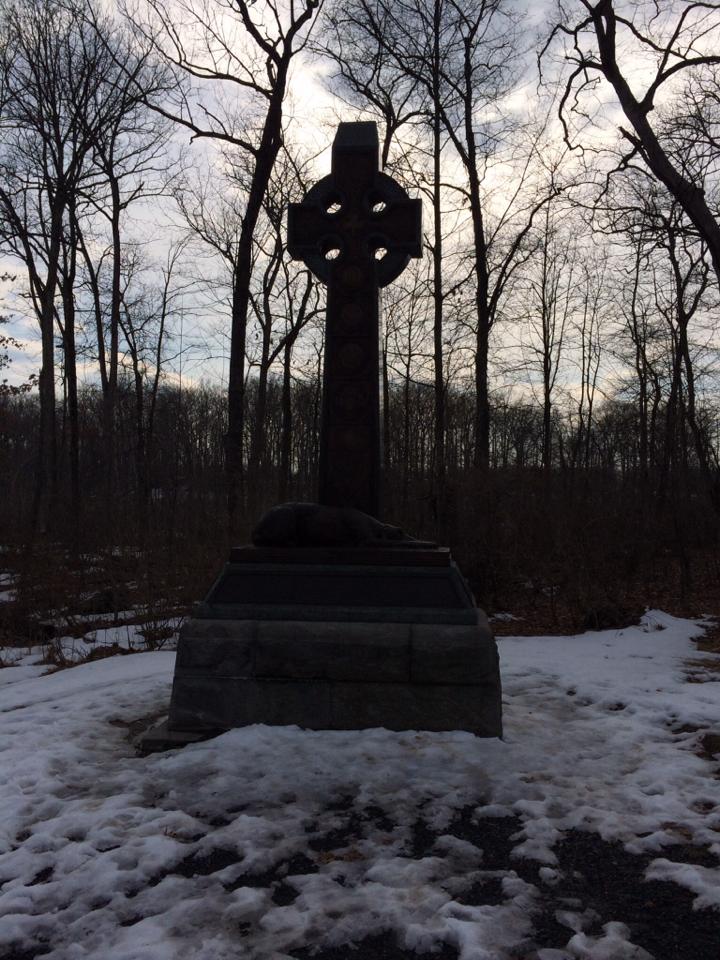
Hallowed Ground: A Weekend at Gettysburg


Friends of Padre Steve’s World,

Once again I am leading a group of my students on a Staff Ride at Gettysburg. We left the Staff College later than I like to but even so we made much better time getting up here than we usually do, only a little traffic to slow us down on I-495 on the way out of Washington D.C. This got us into Gettysburg earlier than I expected so after getting my stuff in my hotel room I took a walk around Cemetery Hill and through the Soldiers Cemetery.

As always I was astounded and humbled as I walked the ground. This really is hallowed ground. I think that Abraham Lincoln, who spoke “a few words” at the dedication of the Soldiers Cemetery said it the best:

“But, in a larger sense, we can not dedicate — we can not consecrate — we can not hallow — this ground. The brave men, living and dead, who struggled here, have consecrated it, far above our poor power to add or detract. The world will little note, nor long remember what we say here, but it can never forget what they did here. It is for us the living, rather, to be dedicated here to the unfinished work which they who fought here have thus far so nobly advanced. It is rather for us to be here dedicated to the great task remaining before us — that from these honored dead we take increased devotion to that cause for which they gave the last full measure of devotion…”


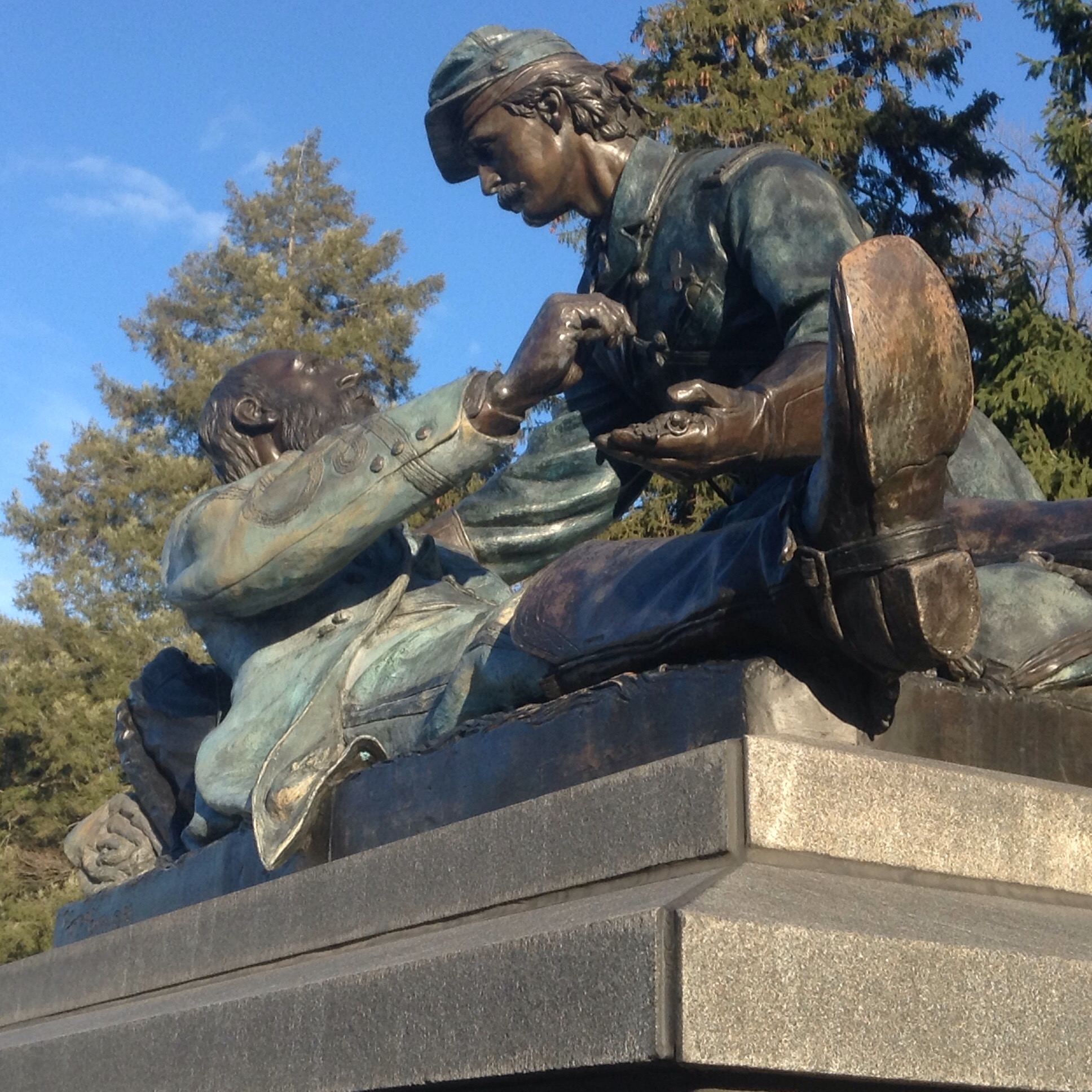
As I walked around Cemetery Hill and through the Soldiers Cemetery I felt the presence of the men that fought and died to preserve this remarkable Union. But when I got to the Masonic Memorial on the western slope of the hill was touched by an image of one of the more human things that happened on the battlefield. That image is a statue of a Union officer, a Captain Bingham rendering aid to Confederate General Lewis Armistead as the latter lay mortally wounded after leading his troops to the High Water Mark of the Confederacy. The story of Armistead is tragic, I have written about it before and it was movingly portrayed by Richard Jordan in the movie Gettysburg.

But when I come up here it is always Lincoln’s words, as well as the gallantry of the soldiers of the Army of the Potomac that inspire me more than anything. Please don’t get me wrong, while I admire the bravery and many of the cities of the Conferate soldiers, I despise the cause that they died for, and no, it is not the myth of states rights. It is the reality that Confederate leaders seceded because they had failed in Congress and at the ballot box to expand slavery outside of where it was legal.

I guess that is why Lincoln’s conclusion of the address resonates with me so much, “that from these honored dead we take increased devotion to that cause for which they gave the last full measure of devotion — that we here highly resolve that these dead shall not have died in vain — that this nation, under God, shall have a new birth of freedom — and that government of the people, by the people, for the people, shall not perish from the earth.”

So anyway, I hope that you are enjoying my latest Gettysburg posts.

Peace

Padre Steve+q

Leave a comment

Filed under civil war, Gettysburg, Military

July Second at Gettysburg Pt.3: Confederate Deployments

LongstreetJ_main

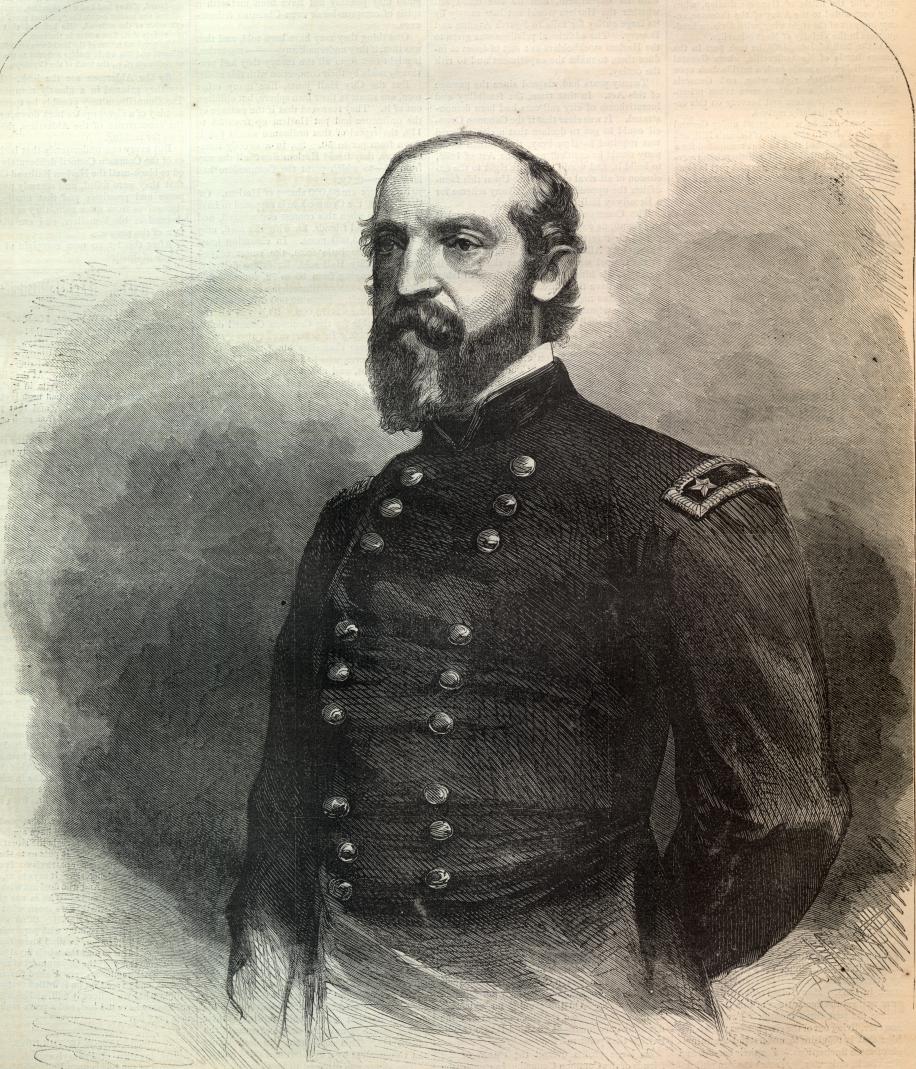
Lieutenant General James Longstreet C.S.A.

Friends of Padre Steve’s World

For those that have followed my writing for some time you know that I teach military history and ethics at the Joint Forces Staff College. One of the great joys that I have is leading the Gettysburg Staff Ride, which is an optional event for students that want to participate. When I took the position here I took some of my older writings on Gettysburg and put them into a student study guide and text. That was two years ago. Then the text was about 70 pages long. It is now about 925 pages long and eventually I hope to get it published. When and if that happens I expect it to become two, and possibly three books.

This is the third of a series of articles that I will be posting potions of a chapter that I have rewritten about the critical battles on the south side of the battlefield on July 2nd 1863, the battle for Devil’s Den, the Wheatfield, the Peach Orchard, and the final repulse on Cemetery Ridge.

As you read this don’t just look at the events, but look at the people, and their reaction to the what they encountered on the battlefield, for that understanding of people is where we come to understand history.

So even if you are not a Civil War buff, or even a history buff, take the time to look at the people, their actions, and the things that made them who they were, and influenced what they did. History is about people.

So please enjoy,

Peace

Padre Steve+

But Sickles’ deployment of his Corps had a number of lasting effects, “for all of Dan Sickles’ many faults,, he was correct on one point: the primary Confederate attack would occur on his front…” and “by moving forward into the Peach Orchard, he occupied one of the Key objectives of the Confederate attack plan.” [1] In fact, Longstreet had done “exactly what Sickles had thought he would do – wheeled around and come in from the South.” [2]

Lee and Longstreet the morning had been spent disagreeing on a plan to crush Meade’s army. Though Lee’s army was operating on exterior lines with his corps having no way to effectively coordinate their actions, Lee still desired to attack. Complicating matters was the fact that Lee was still lacking Stuart’s Cavalry with which to do a proper reconnaissance of the Federal positions. Likewise, Longstreet’s First Corps did not have Pickett’s Infantry division, Law’s brigade of Hood’s division when Lee insisted that Longstreet and his First Corps make a frontal attack on the Union left. Longstreet, as he had the night prior and earlier in the morning demurred, and tried to convince Lee of moving the army to the south and turning the Union flank the south of the Round Tops. Lee rejected Longstreet’s argument sand Longstreet reportedly told Hood “The General is a little nervous this morning; he wishes me to attack; I do not wish to do so without Pickett. I never like to go into battle with one boot off.” [3]

Part of the conflict was that Lee did not believe that Longstreet proposed move could succeed without the assistance of Stuart’s cavalry, while Longstreet did not believe that his First Corps had the combat necessary combat power to successfully complete the mission without Pickett’s division. Lee would hear no more of Longstreet’s objections and ordered the attack, and Lee in his after action report noted, “Longstreet was directed to place the divisions of McLaws and Hood on the right of Hill, partially enveloping the enemy’s left, which he was to drive in.” [4] Instead of leaping into action, Longstreet “allowed his disagreement with Lee’s decision to affect his conduct. One the commanding general determined to assail the enemy, duty required Longstreet to comply with the vigor and thoroughness that had previously characterized his generalship.” [5] This he did not do, he sought further delay, and though he could not force Lee to wait until Pickett arrived he did ask and get permission “to wait until Hood’s division was completed by the arrival of Law’s brigade.” [6] This unit arrived about forty-five minutes later and Longstreet finally began to move his divisions to their starting positions.

mclaws

Major General Lafayette McLaws C.S.A.

Leading the advance division was Major General Lafayette McLaws. McLaws was “a capable soldier without flair, who steady performance never produced a high moment. His reliability and dogged tenacity rubbed off on his men, however, and made them as hard to dislodge as any in the army.” [7] He had put together as solid of a record as a division commander and led the division for almost two years. During his time in command his exceptional care for the welfare of his men had endeared him to them. He and his division were excellent in the defense, and McLaws was very deliberate “but his attention to his men made him and his division a reliable command.” [8]

Porter Alexander noted that in the defense “McLaws was about the best in the army…being very painstaking about details, & having an eye for good ground.” [9] But there was a drawback, for all of his solidness and fortitude “he lacked a military imagination,” and was “best when told exactly what to do and closely supervised by superiors.” [10] McLaws’ solid division was typical of many of the units in Longstreet’s First Corps, “outstanding on defense and led by a competent soldier, they were thoroughly dependable. With the reliance of old pro’s, they did what they were told, stood up under heavy casualties, and produced tremendous firepower.” [11]

The two divisions began their march which “soon became a comedy of errors such as one might expect of inexperienced commanders and raw militia, but not of Lee’s War Horse” and his veteran troops.” [12] In part this was due to a lack of well trained staff officers to help guide the movements and ensure that the divisions reached their assigned position on the battlefield with a minimum of friction. Longstreet, who was still upset about Lee overriding his course of action, Longstreet “chose this moment to be more than punctilious in complying with army protocol. Since Lee had ordered Johnson to lead and guide the head of the column, which was McLaws’ division, Longstreet decided to regard him as Lee’s special representative who during the march possessed greater authority over these troops than he.” [13] Longstreet’s decision was questionable at best, for he ceded command of an approach to contact to a relatively inexperienced engineering officer who had no experience leading large numbers of troops and dropped back, accompanying Hood’s division.

Colonel Porter Alexander, who observed the Confederate infantry’s movements and who had successfully navigated the terrain not long before, wrote:

“This is just one illustration of how time may be lost in handling troops, and the need of an abundance of competent staff officers by the generals in command. Scarcely any of our generals had half of what they needed to keep a constant & close supervision on the execution of important orders. And that always ought to be done. An army is like a great machine, and in putting it into battle it is not enough for its commander to merely issue the necessary orders. He should have a staff ample to supervise the execution of each step, & to promptly report any difficulty or misunderstanding. There is no telling the value of the hours which were lost by that division that morning.” [14]

Since Longstreet, wisely wanted his movements to be out of sight of the enemy, the two divisions had to pick their way across bad ground, over stone walls, and wooden fences which had to be torn down, which combined with the miserably hot weather slowed their advance. Eventually, just passed the Black Horse Tavern the head of McLaws’ division came upon a clear piece of high ground that was in clear view of the Union signal station on Little Round Top and halted. Longstreet came riding up to find the reason for the delay and going with McLaws, he snapped “Why this won’t do,… Is there any way to avoid it?” [15]

Brigadier General Joseph Kershaw, whose brigade led the march, and who has to be considered one of the most objective officers in the controversy that continued long after the battle, recalled what happened.

“At length General McLaws ordered me to move by a flank, get under the cover of the hill and move along Marsh Creek toward the enemy, taking care to keep out of their view. In executing this order we passed the Black Horse Tavern and followed a road leading from that point to the Emmitsburg pike, until the head of the column reached a point where the road passed over the top of a hill from which our movement would be plainly visible from the Federal signal station on Little Round Top. Here we were halted by General McLaws in person, while he and General Longstreet rode forward to reconnoiter.” [16]

The countermarch became a muddled mess. The halt had snarled the divisions of Hood and McLaws, “quickest way to countermarch was simply to about face the troops, but McLaws had been assigned specifically by lee to lead the column into attack position and he felt obliged to hold that place.” [17] With McLaws insisting on maintaining his position, the whole column had to double back on itself. As such the initial halt and the subsequent countermarch further slowed the Confederate deployment as McLaws and Hood’s divisions became entangled and had to be separated. To reach their positions the Longstreet’s troops “followed a farm lane to Fairfield Road, marched north a short distance before striking a road along Willoughby Run, and angled southeast, shielded by Seminary Ridge. At Pitzer’s Schoolhouse they struck Millerstown Road, turned east, and approached the ridge’s crest,[18] where they were met by an astounding sight. Instead of finding the open ground along the Emmitsburg Road as they expected, Longstreet and McLaws discovered the high ground of the Peach Orchard full of Dan Sickles’ Third Corps infantry and artillery.

In the time it had taken for Longstreet to move his corps to its start positions, the situation on the ground had changed. While Sickles move jeopardized the Federal line, it also “disrupted Confederate Battle plans. Should the Sickles salient be attacked or outflanked?” [19] Lee had developed his plan on the assumption that First Corps would not encounter enemy opposition as they moved up the Emmitsburg Road. Years later McLaws wrote, “The view presented astonished me…” [20] “as the enemy was massed in my front and extended to my left and right as far as I could see.” [21]and to his wife he wrote about it a few days later, “On arriving at the vicinity of the Orchard, the enemy were discovered in greater force than we supposed, and two of my brigades were deployed to face the enemy, and the other two in the rear as reserve…” [22] The presence of Third Corps necessitated that Longstreet either notify Lee of the change and ask for new orders, or to adjust in the fly and redeploy his troops to meet the new situation. While informing Lee would have been the optimal course of action, Longstreet, who had been rebuffed by Lee on several occasions in the last day, and probably was in no mood to again go toe-to-toe with the general commanding, rigidly held to the attack, and chose the latter course of action.

Instead of deploying perpendicular to the Emmitsburg Road in order to roll up the flank of the Federal positions, but “for Longstreet to attack at the angle Lee had specified would expose him to enfolding fire.” [23] To meet the new situation, Longstreet and McLaws deployed parallel to the road to make a frontal attack on the salient presented by Third Corps, while Hood’s division was ordered further south in order to take Little Round Top, while McLaws wrote that he “was directed not to assault until General Hood was in position.” [24] the movement took about another hour as Hood attempted to mask the movement of his troops from Federal observers by remaining in the wood line.

Porter Alexander, whose ever-insightful observations provide an alarming commentary on the Confederate senior leadership and their preparation for the assault the Federal left: “I never remember hearing of any conference or discussions among our generals at this time as to the best formations & tactics in making our attacks, & our method on this occasion struck me as peculiar even then, & I don’t think it was the best.” [25]

Lt._Gen._John_B._Hood

Major General John Bell Hood C.S.A.

Hood was never one to hesitate to attack, but when he saw the situation that faced First Corps, he objected to the attack. “For the first time in his army career Hood suggested a change of orders to his commanding general,” [26] and pleaded with Longstreet to change it. “From his own observations and those of his scouts he concluded that the attack would be futile and result in wanton wage of life.” [27] The fierce Texan “recognized that the battle order, written more than two miles away on mistaken information…did not fit existing conditions.” [28] His objections included the rocky terrain which he believed would break up his battle formations, as well as “the concave character of the enemy’s line from the north end of Cemetery Ridge to Big Round Top would expose his division to a “destructive fire in flank and rear, as well as in front” if his men attacked it obliquely.” [29]He told Longstreet that it was “unwise to attack up the Emmitsburg Road, as ordered” and requested that he be allowed to “turn Round Top and attack the enemy flank and rear.” [30]

Lafayette McLaws “believed that if Lee had known of the changed conditions that he would have called off the attack.” [31] While this might have been the case, Lee was now over two miles away on his way back to his headquarters after pushing Longstreet to force the attack. From his other decisions to force the attack on both July 2nd and 3rd McLaws’ opinion can be debated. But Longstreet had consulted with Lee and while Lee “was already fretting over the delay which had occurred,” and even if it was no longer possible to launch an attack that wheeled up the Emmitsburg Road, he certainly was not going to call the whole thing off.” [32]

Meanwhile, the debate between Longstreet and Hood continued as Hood objected and Longstreet reiterated Lee’s insistence on the planned attack. McLaws noted that Hood “found that the enemy were strongly posted on two rocky hills, with artillery and infantry…” [33] and he pleaded for freedom of maneuver. He believed that an attack up the rocky hills was doomed and later noted “it seemed to me that the enemy occupied a position so strong- I may say impregnable – that independently of their flank fire, they could easily repulse our attack by merely throwing or rolling stones down the mountainside as we approached.” [34]

Despite his objections to the plan Longstreet ordered Hood to attack as Lee planned and after a fourth attempt by Hood to persuade Longstreet to change the plan Longstreet told his subordinate “We must obey the orders of General Lee.” [35] In defending his decision to launch the attack despite his own misgivings after the war Longstreet wrote, “that the move to the right had been proposed the day before and rejected.” [36] However, Longstreet’s explanation, made years after the battle and in the midst of a long running dispute with Jubal Early on who was at fault for the defeat at Gettysburg, was somewhat disingenuous.

Longstreet was referring to Lee’s rejection of Longstreet’s plan for an operational movement by the army to position itself between the Army of the Potomac and Washington, in order to fight a defensive battle, not the tactical adjustment to the plan of attack that Hood proposed. Clifford Dowdy argued that, “In basing his rejection of Hood’s extemporized plan on the rejection of his own strategy, Longstreet revealed the depth of the wound to his own ego and the consequent undermining of his judgement.” [37] This is an argument that has some merit, and it seems to be born out by Longstreet’s repeated rejections and dismissals of Hood’s repeated proposals to attempt to flank the Federal left. However, in light of the arrival of John Sedgwick’s Sixth Corps on the battlefield about the time of the assault it is quite possible that Hood’s division could have been completely separated from the rest of the Confederate army, surrounded and destroyed had Longstreet yielded to his subordinate’s request.

To be continued…

Notes

[1] Ibid. Hessler Sickles at Gettysburg p.134

[2] Ibid. Swanberg Sickles the Incredible p.213

[3] Ibid. Pfanz Gettysburg the Second Day p.112

[4] Ibid. Dowdy Lee and His Men at Gettysburg p.192

[5] Ibid. Wert General James Longstreet p.268

[6] Ibid. Dowdy Lee and His Men at Gettysburg p.192

[7] Tagg, Larry The Generals of Gettysburg: The Leaders of America’s Greatest Battle Da Capo Press Cambridge MA 1998 Amazon Kindle Edition pp.208-209

[8] Ibid. Wert General James Longstreet p.209

[9] Ibid. Alexander Fighting for the Confederacy: p.170

[10] Ibid. Tagg The Generals of Gettysburg p.209

[11] Ibid. Dowdy. Lee and His Men at Gettysburg p.176

[12] Ibid. Coddington The Gettysburg Campaign a Study in Command p.378

[13] Ibid. Coddington The Gettysburg Campaign a Study in Command pp.378-379

[14] Ibid. Alexander Fighting for the Confederacy p.236

[15] Ibid. Sears Gettysburg p.258

[16] Kershaw, J.B. Kershaw’s Brigade at Gettysburg in Battles and Leaders of the Civil War Volume III, The Tide Shifts. Edited by Robert Underwood Johnson and Clarence Clough Buel Castle, Secaucus NJ p.331

[17] Ibid. Sears Gettysburg p.259

[18] Wert, Jeffry D. A Glorious Army: Robert E. Lee’s Triumph 1862-1863 Simon and Schuster, New York and London 2011 pp.256-257

[19] Taylor, John M.Duty Faithfully Performed: Robert E. Lee and His Critics, Brassey’s Dulles Va 1999 p.148

[20] Ibid. Wert “General James Longstreet p.271

[21] Foote, Shelby The Stars in Their Courses: The Gettysburg Campaign June-July 1863 Modern Library, a division of Random House New York 1994 p.124

[22] Oeffinger, John C. Editor. A Soldier’s General: The Civil War Letters of Major General Lafayette McLaws, University of North Carolina Press 2009 p.196

[23] Ibid. Taylor Duty Faithfully Performed p.148

[24] Ibid. Oeffinger A Soldier’s General p.196

[25] Ibid. Alexander Fighting for the Confederacy p.238

[26] Ibid. Dowdy Lee and His Men at Gettysburg p.205

[27] Ibid. Coddington The Gettysburg Campaign p.382

[28] Ibid. Dowdy Lee and His Men at Gettysburg p.204

[29] Ibid. Coddington The Gettysburg Campaign p.382

[30] Ibid. Foote The Civil War, A Narrative: Fredericksburg to Meridian p.499

[31] Ibid. Taylor Duty Faithfully Performed p.148

[32] Ibid. Guelzo Gettysburg, the Last Invasion p.254

[33] Ibid. Oeffinger A Soldier’s General p.196

[34] Ibid. Foote The Civil War, A Narrative: Fredericksburg to Meridian p.499

[35] Ibid. Foote The Stars in Their Courses p.126

[36] Ibid. Dowdy Lee and His Men at Gettysburg p.206

[37] Ibid. Dowdy Lee and His Men at Gettysburg p.206


Leave a comment

Filed under civil war, Gettysburg, History, Military

A Grand Sight to Witness: July 2nd at Gettysburg Pt. 2

sickles peach orchard

Friends of Padre Steve’s World

For those that have followed my writing for some time you know that I teach military history and ethics at the Joint Forces Staff College. One of the great joys that I have is leading the Gettysburg Staff Ride, which is an optional event for students that want to participate. When I took the position here I took some of my older writings on Gettysburg and put them into a student study guide and text. That was two years ago. Then the text was about 70 pages long. It is now about 925 pages long and eventually I hope to get it published. When and if that happens I expect it to become two, and possibly three books.

This is the second of a series of articles that I will be posting potions of a chapter that I have rewritten about the critical battles on the south side of the battlefield on July 2nd 1863, the battle for Devil’s Den, the Wheatfield, the Peach Orchard, and the final repulse on Cemetery Ridge.

As you read this don’t just look at the events, but look at the people, and their reaction to the what they encountered on the battlefield, for that understanding of people is where we come to understand history.

So even if you are not a Civil War buff, or even a history buff, take the time to look at the people, their actions, and the things that made them who they were, and influenced what they did. History is about people.

So please enjoy,

Peace

Padre Steve+

sickles as brigadier

The Problem of Dan Sickles and Third Corps

In the early morning hours of July 2nd 1863, George Meade had instructed Dan Sickles’ Third Corps “to go into position on the left of the Second corps [so] that his right was to connect with the left of the Second Corps, [and] he was going to prolong the line of that corps occupying the position that general Geary held the night before,” [1] that is the area of South Cemetery Ridge and Little Round Top. However during the night and early morning hours Sickles had not done so. However, Sickles was not comfortable with the position of his corps, especially in relation to the high ground that lay in front of him.

All morning he had been lobbying Meade, through Meade son and Aide-de-Camp Captain George Meade, the Artillery Reserve Commander Henry Hunt, Warren and even Meade himself to adjust the line held by his corps to no avail. Sickles had posted some of Birney’s division to the west of Plum Run near the Peach Orchard as pickets. His left, which should have rested on Little Round Top was located at Devil’s Den while Berdan’s Sharpshooters pushed further west as a skirmish line along with a few regiments of Birney’s division and a few squadrons of cavalry.

Sickles ordered Berdan to lead about one hundred of his sharpshooters into the woods west of the Warfield farm where they engaged part of Cadmus Wilcox’s brigade and noticed “three columns in motion in the rear of the wood, changing direction… by the right flank.” [2] The troops were those of Hood and McLaws divisions moving to their start positions from which they would assault the federal left. Berdan reported the Confederate troop movements to Sickles. Additionally, Sickles was also concerned because John Buford’s Cavalry division which has been deployed on the Federal left, had just “been pulled to the rear to be refitted, but not replaced. The horsemen had been supplying him with vital information about rebel dispositions; with mobile reconnaissance now gone, Sickles felt naked and vulnerable.” [3] He believed that it was absolutely vital that he move troops onto the Peach Orchard, and to a hill known as Stony Hill, Houck’s Ridge, and another known by local children by the sinister name of Devil’s Den.

Sickles decided to voice his concerns to Meade and sent his aide de camp, Major Henry Tremain, to report those concerns at Meade’s headquarters. Tremain explained the positions of the Third Corps, as well as the skirmishers, and reminded Meade “that there were no troops on the left of Third Corps, and told him that Sickles had sent General Graham to bring up the two brigades left at Emmitsburg.” [4] Apparently Meade was not concerned and paid little attention to Sickles concerns. Later in the morning Sickles had Tremain take him to Meade’s headquarters where Sickles complained about the position. He noted that “the Ridge dipped slightly just before meeting Little Round Top,” [5] and that there was higher ground in front. Sickles “spoke of his concerns, the poor position assigned to his corps, the advantages of holding the high ground at the Peach Orchard, and his fear of an assault from his front.” [6] Meade seemed unconcerned and Sickles pressed Meade to see the ground for himself. Meade curtly refused to do so, so Sickles asked if “Meade would at least send his chief engineer, Gouverneur K. Warren? The answer was even more curt: no” [7]

Meade was most concerned about another Confederate assault on his right, and paid little attention to the concerns of the political general. Sickles also asked the army commander “if he was authorized to post his corps in a manner he “should deem the most suitable.” Meade replied, “Certainly, within the limits of the general instructions I have given you; any ground within those limits you choose to occupy I leave to you.” [8] Finally after some discussion Sickles was able to convince Meade to send his artillery chief, Henry Hunt to come with him to examine potential artillery positions for his corps. Had Meade not been so concerned about his right he might have paid more attention to the reports of the Signal Corps station on Little Round Top which as early as noon were reporting the Confederate troop movements being reported by Sickles and Berdan. Scoffing at Sickles Meade allegedly said, “Generals are all apt to look for the attack to be made where they are.” [9]

Hunt accompanied Sickles back to his corps and made a reconnaissance of the ground that Sickles was determined to hold. While Hunt believed that it had some advantages that those advantages were cancelled out by several factors, including the fact that the position would be a salient exposed to enemy attacks from multiple sides, and that the Third Corps “was not strong enough with only two divisions instead of the three possessed by most corps) to hold the new line and also connect Hancock’s flank in the north.”[10] Though Hunt sympathized with Sickles predicament, and recognized the inadequacies along the southern sector of Cemetery Ridge near Little Round Top, he would not authorize the insistent Knickerbocker to advance. He “suggested that Sickles talk further with headquarters, and he now advised Meade to examine the position for himself.” [11] Hunt then left Sickles in order to check on his other artillery dispositions along Cemetery Ridge.

Sickles, who lived with the vision of being ordered off of Hazel Grove by Hooker at Chancellorsville and who had seen what had happened to Howard’s Eleventh Corps when it had its flank rolled up by Jackson, now felt that history was about to repeat itself. Though his requests to Meade and Hunt had been met with a “no,” and while Hunt’s answer might have been more ambiguous, but the answer was still no, unless Meade changed his mind. That did not happen. Hunt made his report to Meade and told Meade that “the proposed line [by Sickles] was a good one in itself; that it offered favorable positions for artillery, but that its relations to other lines were such that I could not advise it, and suggested that he examine it himself before ordering occupation.” [12]

With Hunt gone, and Sickles having heard what he wanted to hear from Meade and the artillery chief, Sickles acted on his own. Sickles was determined not to be victimized a second time by Robert E. Lee and “he was not going to let his men suffer the fate of the Eleventh Corps.” [13] As he continued to get reports from Berdan’s skirmishers of the Confederate build up just to the west of the Peach Orchard, he “took it to mean that the Peach Orchard line that he coveted was about to be occupied by the enemy. At 2:00 P.M., without authorization from Meade, without even informing Meade, he ordered Third Corps forward.” [14]

It was an act of brazen insubordination, but typical of him, and while historians still debate what Sickles did, his action was not entirely without justification. Some of this is directly attributed to George Meade, whose apparent lack of empathy for Sickles’ plight as the commander on the scene, and for “the situation on his front, and so Sickles had taken the bit in his teeth and abandoned the position ordered by General Meade for one that he believed better. He defended his decision and action afterward – aggressively, if not always credibly and honorably – until his dying day, half a century later.” [15] Sickles later wrote: “Impossible to wait any longer without giving the enemy serious advantages in his attack, I advanced my line toward the highest ground to my front, occupying the Emmitsburg Road at the very point where Longstreet hoped to cross it unopposed.” [16] But Sickles, while he certainly believed that he was making the correct move, did not see the second, third, and fourth order effects of his decision on the Union defensive plan. Admittedly, had Meade paid more attention to Sickles’ pleas earlier in the day and not been consumed with concern for the Federal right, the situation might not have come to this. But like in any real world situation the clash between Sickles and Meade was not simply a matter of a disagreement in tactics, but of a profound distrust for one another. Meade, the professional, had little regard for and loathed Sickles the political general, while Sickles, ever the politician, believed that Meade was doing what he could to set him up for failure, and “that Meade had deliberately left him alone in the path of a Confederate landslide, with no cavalry screen and no supports within easy distance.” [17] Some of Sickles’ officers in Third Corps saw the situation in a similar manner. Lieutenant Colonel Rafferty “argued that no attention was paid to Sickles’ concerns and “General Sickles has one sterling quality of a good soldier, – he was equal to an emergency; and left as he was now to the exercise of his own judgement, he was prompt to act.” [18]

About mid-afternoon Sickles advanced Third Corps forward in a “mile long line of battle with waving flags and rumbling batteries rolling west into the afternoon sunlight.” [19] It was a magnificent sight that was inspiring to watch, and perplexing to other commanders Frank Haskell, wrote, “It was magnificent to see those ten or twelve thousand men – the were good men- with their batteries and some squadrons of cavalry upon the left flank, all in battle order in several lines with flags streaming, sweep steadily down the slope, across the valley, and up the next ascent towards their destined position! From our position we could see it all.” [20] Others were equally impressed with the sight that they beheld.

“The eye beheld” wrote an officer of Carr’s brigade, “battery and brigade extended from point to point,” full of “moving columns and gay banners.” It was “a grand sight to witness this little corps of two divisions gallantly move on the advance,” and despite what was taking place on what was after all a battlefield, it all “appeared to be a peaceful review….” [21]

Another wrote, “The sun shone brilliantly on their waving colors, and flashed in scintillating rays from their burnished arms, as with well aligned ranks and even steps they moved proudly across the field. Away to the right, along cemetery Ridge, the soldiers of the Second Corps, leaving their coffee and their cards, where they gazed with soldierly pride and quickened pulse on the stirring scene.” [22] As the troops advanced “the fifteen-piece brass band of the 114th Pennsylvania (Collis’ Zouaves) thumped away to mark the time.” [23] Chaplain Joseph Twitchell who had been with the Excelsior Brigade from the beginning wrote, “with a firm step with colors flying the bravest men in the army marched in the open field. It was a splendid sight.” [24] The sight inspired the men, and it was remember by witnesses long after other memories had faded into time.

Sickles advance confused John Gibbon, who watched in amazement from his vantage point on Cemetery Ridge “commanding Hancock’s Second Division on Cemetery Ridge, looked out in amazement and wondered if a general order to advance upon the enemy had somehow missed him.” [25] Gibbon’s Corps commander Winfield Scott Hancock saw it too and wrote: “I recollect looking on and admiring the spectacle, but I did not know the object of it.” He “quietly” remarked to his staff, “Gentlemen, that is a splendid advance” and “beautiful to look at.” But he could not imagine that Meade had sanction this parade, and he predicted that “those troops will be coming back again very soon.” [26]

The movement to the Peach Orchard placed the Third Corps nearly a mile in front of his previous position, and opened up a significant gap between his corps and Hancock’s Second Corps. Sickles was now attempting to hold a new line that was nearly twice as long as the position that Meade had designated. By advancing Sickles had “put his corps out of alignment with the rest of the army and exposed his flanks.” [27] The line Meade had prosed was essentially a straight line, only about 1,600 yards long with its left flank anchored on Little Round Top and its right tied in to the line of Second Corps on Cemetery Ridge. It was a manageable front for a small corps of less than 11,000 soldiers. The new front which Sickles occupied was some 2,700 yards long and he did not have enough men to fill it out, or extend it to Little Round Top. Instead he had to anchor his left flank on Devil’s Den, some 500 yards to the front of Little Round Top. Sickles “wanted to hold the road and the peach-orchard hill and to bend the rest of the line back to the Round Tops, and he did not have enough men for it.” [28] The line Sickles created formed a salient, which protruded toward the Confederate line, and it “would be dangerously exposed to attack from two directions – the west and the south simultaneously.” [29] Humphrey’s Second Division aligned itself on the Emmitsburg road facing west and northwest, while “Birney’s division crammed the little orchard with men and guns and extended its line back to the southeast.” [30]

He placed Humphrey’s division along the Emmitsburg Road and extended Birney’s division through the Peach Orchard, a wheat field down to Devil’s Den where Birney ran out of troops. Birney had barley 5,000 soldiers to hold the ground assigned, which stretching in an irregular pattern from the east side of the Peach Orchard, down the Stoney Hill, to Houck’s Ridge and Devil’s Den, “Charles Graham’s brigade on the right, at the Orchard, Regis de Trobriand’s in the center, and Hobart Ward’s on the right…. At the literal end of the line – the extreme left of the Army of the Potomac – was Captain James E. Smith’s New York 5th Independent Battery, posted on Houck’s Ridge overlooking devil’s Den.” [31] The position on the ridge was so tight that Smith could only deploy four of his six guns on it and was forced to place the other two in the Plum Run Valley, later known as the “Valley of Death,” between Devil’s Den and Little Round Top. Despite his good intentions, Sickles had formed an exposed and vulnerable salient which was too thinly manned for its length. It was open to attack on three sides, had little depth, no reserves and no place to fall back to as an alternate position.[32]

While Sickles was deploying his Corps, George Meade called for a conference of his corps commanders at the Leister House. Unable to see Sickles movement as his headquarters was behind and below the crest of Cemetery Ridge, Meade was consulting with various staff members and sending messages to Washington regarding his plans. As such Meade was one of the last to find out about Sickles’ advance.

When John Sedgwick’s Sixth Corps arrived Meade sent a message to Halleck informing him “The Sixth Corps is just coming in, very much worn out. I have…awaited the attack of the enemy, I having a strong position for the defensive…. He has been moving on both my flanks apparently. Expecting battle, I have ordered my trains to the rear.” [33] With Sedgwick now on the field, Meade called for a meeting of his corps commanders, sending a circular to each. Sickles received his copy and asked “to be excused, stating that the enemy was in great force on his front and preparing to attack.” [34] Meade refused to let Sickles off the hook and ordered his recalcitrant general to report to the Leister house.

Before Sickles arrived, Gouverneur Warren told Meade that Sickles’ corps was not in position, and the army commander’s volcanic tempter erupted just as Sickles rode up. An engineering officer at the headquarters wrote, “I never saw General Meade so angry if I may call it.” When Meade saw Sickles he ordered him to “retire his line to the position he had been instructed to take.” [35] Meade told Sickles to get back to Third Corps immediately, Sickles recalled that “General Meade met me just outside the headquarters and excused me from dismounting”…. He said that I should return at once and that he would follow soon.” [36] Meade soon followed after he instructed General Sykes of Fifth Corps to shift it “from its reserve position toward the left with all speed, “and hold it at all hazards.” [37] Riding with Warren, the two men saw the empty positions on Cemetery Ridge where Third Corps should have been and saw where Sickles had placed them in front of the line. Warren, most familiar with the section of the line, noted that Third Corps “was very badly disposed on that part of the field,” [38] commented to Meade, “Here is where our line should be,” and “Meade replied grimly, “it is too late now.” [39] Meade later explained, that he was, “wholly unprepared to find it [Sickles’ corps] advanced beyond the line of Second Corps. It’s lines were over a mile and a half out to the front, to the Emmitsburg Road, entirely disconnected with the rest of the army, and beyond supporting distance.” [40]

Meade had been surprised by his subordinate’s unauthorized move, and his “staff served him poorly with respect to the Third corps activities,” [41] the at times crotchety Pennsylvanian did not lose his composure. While Meade went forward to meet Sickles, he sent Warren to check what was happening at Little Round Top and authorized Warren to attend to it and would help save the exposed left flank of the army when he discovered that Little Round Top was undefended.

About the time that Meade arrived at the Peach Orchard, Sickles corps was about to be hit by the full fury and power of Hood’s and McLaws’ divisions of Longstreet’s First Corps. The Confederate infantry was supported by Porter Alexander who had situated 46 well placed artillery pieces in a perfect position to open fire on Birney and Humphrey’s Third Corps divisions in the Peach Orchard Salient. [42]

When he confronted Sickles in the Peach Orchard, George Meade was visibly perturbed. Looking at Sickles’ dispositions, Meade informed the New Yorker, “General I am afraid that you are too far out” [43] as he attempted to control his temper. Sickles disagreed and said that “if supported, the line could be held; and in my judgement it was the best one.” [44] with support he could hold the position because it was higher ground than what he had previously occupied. Meade then pointed out the obvious stating “General Sickles this is in some respects higher ground than that to the rear, but there is still higher in front of you…” [45] As the conversation progressed Meade told Sickles that “this is neutral ground, our guns command it as well as the enemy’s. The reason you cannot hold it applies to them.” [46]

Sickles now offered to withdraw, and reportedly told Meade, “General, I have received no orders. I have made these dispositions to the best of my judgement. Of course I shall be happy to modify them according to your views.” [47] But as he did so the Confederate cannonade began signaling the beginning of Longstreet’s attack. Meade told Sickles “I wish to God you could,” said Meade, “but the enemy won’t let you.” [48] Another account states that Meade told Sickles “You cannot hold this position but the enemy will not let you get away without a fight, & it may begin at any time now.” [49] Meade later wrote about the encounter, “Having found Major-General Sickles, I was explaining to him that he was too far in advance, and discussing with him the propriety of withdrawing, when the enemy opened fire on him with several batteries in his front and on his flank, and immediately brought forward columns of infantry and made a most vigorous assault.” [50] For Sickles and Meade their exchange in the Peach Orchard on the afternoon of July 2nd 1863 would develop into an acrimonious lifelong feud, with both men and their supporters bending the truth, and sometimes repeating outright lies to defend their actions before Congress, and in the press.

Since John Sedgwick’s powerful Sixth Corps had just arrived Meade ordered it into reserve to replace Sykes’ Fifth Corps which he had ordered, along with division of Winfield Scott Hancock’s Second Corps to support Sickles’ Third Corps around the Peach Orchard and Wheat Field. Meade told Sickles, “I will send you the Firth Corps, and you may send for support from the Second Corps.” [51] Meade, acting decisively then told Sickles “if you need more artillery call on the reserve!” [52] Henry Hunt heard the conversation and immediately went to work to get as many guns as possible up to support Sickles. It was an action that very likely saved the day, example of Meade taking control of a bad situation, albeit one that he might have prevented by paying more attention to Sickles, but, even so, preventing it from becoming even worse. General Tyler, commander of the Artillery Reserve, “had already sent up the first two batteries Hunt had ordered; now, on his own initiative, the Reserve commander dispatched McGilvery’s First Volunteer Brigade to the scene; Hunt met it on the road and was extremely relieved by its presence.” [53] The guns that Hunt and Tyler had rushed to the front were about to be put to good use in the impending fight.

To be continued…

Notes

[1] Ibid. Trudeau Gettysburg a Testing of Courage p.294

[2] Ibid. Guelzo, Gettysburg The Last Invasion p.246

[3] Longacre, Edward G. The Man Behind the Guns: A Military Biography of General Henry J. Hunt, Chief of Artillery, Army of the Potomac Da Capo Press, Perseus Book Group, Cambridge MA 2003 p.163

[4] Ibid. Pfanz The Second Day at Gettysburg p.90

[5] Ibid. Cleaves Meade of Gettysburg p.145

[6] Ibid. Pfanz The Second Day at Gettysburg p.93

[7] Ibid. Guelzo, Gettysburg The Last Invasion p.247

[8] Ibid. Sears Gettysburg p.250

[9] Ibid. Guelzo, Gettysburg The Last Invasion p.247

[10] Ibid. Longacre The Man Behind the Guns p.162

[11] Ibid. Cleaves Meade of Gettysburg p.146

[12] Ibid. Hessler Sickles at Gettysburg p.120

[13] Ibid. Coddington The Gettysburg Campaign a Study in Command p.45

[14] Ibid. Sears Gettysburg p.252

[15] Ibid. Pfanz The Second Day at Gettysburg p.103

[16] Ibid. Keneally American Scoundrel p.279

[17] Ibid. Guelzo, Gettysburg The Last Invasion p.246

[18] Ibid. Hessler Sickles at Gettysburg p.132

[19] Ibid. Catton Glory Road p.288

[20] Oates, William C. and Haskell, Frank A. Gettysburg: The Confederate and Union Views of the Most Decisive Battle of the War in One Volume Bantam Books edition, New York 1992, originally published in 1905 p.168

[21] Ibid. Guelzo, Gettysburg The Last Invasion pp.250-251

[22] Ibid. Pfanz The Second Day at Gettysburg p.145

[23] Ibid. Guelzo, Gettysburg The Last Invasion p.250

[24] Ibid. Pfanz The Second Day at Gettysburg p.145

[25] Ibid. Catton Glory Road p.288

[26] Ibid. Guelzo, Gettysburg The Last Invasion p.251

[27] Ibid. Coddington The Gettysburg Campaign a Study in Command p.355

[28] Ibid. Catton Glory Road p.288

[29] Ibid. Hessler Sickles at Gettysburg p.117

[30] Ibid. Catton Glory Road p.288

[31] Ibid. Sears Gettysburg p.265

[32] Ibid. Foote The Civil War, A Narrative: Fredericksburg to Meridian p.496

[33] Ibid. Cleaves Meade of Gettysburg p.147

[34] Ibid. Pfanz The Second Day at Gettysburg p.139

[35] Ibid. Sears Gettysburg p.263

[36] Ibid. Trudeau Gettysburg: A Testing of Courage p.319

[37] Ibid. Sears Gettysburg p.263

[38] Ibid. Jordan Happiness is not My Companion p.90

[39] Ibid. Trudeau Gettysburg: A Testing of Courage p.320

[40] Ibid. Hessler Sickles at Gettysburg p.146

[41] Ibid. Pfanz The Second Day at Gettysburg p.141

[42] Ibid. Catton Glory Road p.289

[43] Ibid. Foote The Civil War, A Narrative: Fredericksburg to Meridian p.496

[44] Ibid. Trudeau Gettysburg: A Testing of Courage p.325

[45] Schultz, Duane The Most Glorious Fourth: Vicksburg and Gettysburg July 4th 1863. W.W. Norton and Company New York and London, 2002 p.251

[46] Ibid. Sears Gettysburg p.263

[47] Ibid. Pfanz The Second Day at Gettysburg p.143

[48] Ibid. Sears Gettysburg p.263

[49] Ibid. Trudeau Gettysburg: A Testing of Courage p.326

[50] Ibid. Hessler Sickles at Gettysburg pp.146-148

[51] Ibid. Guelzo, Gettysburg The Last Invasion p.252

[52] Ibid. Foote The Civil War, A Narrative: Fredericksburg to Meridian p.497

[53] Ibid. Longacre The Man Behind the Guns pp.163-164

1 Comment

Filed under civil war, Gettysburg, History, Military

July 2nd at Gettysburg: Part 1, Preparations

The Enemy is There

Friends of Padre Steve’s World

For those that have followed my writing for some time you know that I teach military history and ethics at the Joint Forces Staff College. One of the great joys that I have is leading the Gettysburg Staff Ride, which is an optional event for students that want to participate. When I took the position here I took some of my older writings on Gettysburg and put them into a student study guide and text. That was two years ago. Then the text was about 70 pages long. It is now about 925 pages long and eventually I hope to get it published. When and if that happens I expect it to become two, and possibly three books.

This is the first of a series of articles that I will be posting potions of a chapter that I have rewritten about the critical battles on the south side of the battlefield on July 2nd 1863, the battle for Devil’s Den, the Wheatfield, the Peach Orchard, and the final repulse on Cemetery Ridge.

As you read this don’t just look at the events, but look at the people, and their reaction to the what they encountered on the battlefield, for that understanding of people is where we come to understand history.

So even if you are not a Civil War buff, or even a history buff, take the time to look at the people, their actions, and the things that made them who they were, and influenced what they did. History is about people.

So please enjoy,

Peace

Padre Steve+

Preparations

On July 2nd 1863 as on the first day of battle and throughout the Gettysburg campaign issues of command and control would be of paramount importance to both armies. On the second day the glaring deficiencies of Robert E Lee and his corps commanders command and control at Gettysburg would again be brought to the fore. Likewise the exemplary command of the Army of the Potomac by George Meade, Winfield Scott Hancock, staff artillery officer Henry Hunt and staff engineer Gouverneur Warren exemplified the best aspects of what we now define as Mission Command.

The definition of mission command as currently defined in American doctrine helps us in some ways to understand what happened on July 2nd 1863. Without imposing current doctrine on the leaders at Gettysburg, the definition describes the timeless aspect of leadership in battle and the importance of the human dynamic in war.

“Mission command is the conduct of military operations through decentralized execution based upon mission-type orders. Successful mission command demands that subordinate leaders at all echelons exercise disciplined initiative, acting aggressively and independently to accomplish the mission. Essential to mission command is the thorough knowledge and understanding of the commander’s intent at every level of command.” [1]

It is with this in mind that we look at the actions of various commanders during the critical second day of the battle of Gettysburg, and as we do so we also try to examine their lives and in a sense try to bring them to life. It is important because the actions of a number of commanders, including Robert E. Lee, George Meade, James Longstreet, Dan Sickles, and to a lesser degree A.P. Hill would be the subject of a great amount of controversy and partisan bickering that still lingers a century and a half later.

Confederate Consternation

Before the sun rose on July 2nd James Longstreet took stock of the situation. The burly commander of First Corps was now working to bring the divisions of McLaws and Hood from their bivouac sites west of Herr’s Ridge and onto the battlefield. While his divisions moved out, Longstreet met with Lee to again express his opposition to taking the offensive. He again brought up the subject of making a “broad turning movement around the enemy’s left flank that would place the Confederate army between the Federal capital and George Meade’s army.” [2] As he did the previous night, Lee again rebuffed Longstreet’s suggestion and apparently frustrated by Longstreet’s continued resistance to his decision Lee “walked off by himself, away from the conflict.” [3] Lee then left Longstreet and went to confer with Dick Ewell to discuss the possibility of attacking the Federal right, and he sent his staff topographical engineer, Captain Samuel Johnson to reconnoiter the Federal left.

At this point Lee had not yet decided where to attack. Again he conferred with Ewell about the possibility of attacking the Federal right, but Ewell again dissuaded him from doing so. Ewell insisted that a “daylight attack on Culp’s Hill or Cemetery Hill would be costly and of doubtful success.” [4] For a second time Lee brought up the possibility of Ewell redeploying his corps from its positions around the “fishhook” of the Federal line to the west where they could better support an assault on the Federal left, but as he had the previous night “Ewell persuaded the general commanding to leave his corps where it was.” [5] In doing so Ewell promised to create a demonstration on the Federal right when he heard Longstreet’s attack commence. But, “according to Fitzhugh Lee, He decided to turn Meade’s left with Longstreet’s corps, demonstrate against his centre and right with Hill’s and Ewell’s corps, and then convert this demonstration into a real attack directly Longstreet’s attack succeeded.” [6] Ewell’s corps was to be the “anvil against which Longstreet would smash whatever was left of the 1st and 11th Corps, or any other Union reinforcements might have arrived overnight.” [7] However, the position of Second Corps around the fishhook was a poor position. “It greatly extended the army’s lines, and confronted the most defensible part of the Federal lines.” [8] Likewise, the position offered little advantage for Ewell’s artillery.

By the time Lee returned to his headquarters the divisions of Hood and McLaws, with the exception of Law’s brigade of Hood’s division, “which had been “left by Hood on picket” below the pike stretching back to Chambersburg, and was far behind the others” [9] were marching onto the field and halted just west of Seminary Ridge while the Confederate leaders conferred. But Longstreet was also troubled by the absence of George Pickett’s division of Virginians, which due to the lack of cavalry had been left at Chambersburg to guard the Confederate supply trains and would not be available for action until late in the evening.

Captain Johnson returned to the headquarters following his reconnaissance of the Federal left. He reported that the Federal left was weakly held and that there were no Federal troops on the Round Tops. But Johnson’s reconnaissance was not nearly as thorough or accurate as he reported. Johnson made “no detailed sketches of the hazardously rough ground at the southern end of the Federal line” and gave “an inadequate picture of the obstacles to mass troop movement.”[10] Despite getting up to the Round Tops he did not observe the large number of Union troops from Sickles’ Third Corps in the woods to the north and northwest of Little Round Top. The latter omission appears to be more to bad timing, lack of attention, Johnson’s lack of familiarity with the terrain and lack of experience in conducting a reconnaissance that should have been undertaken by cavalry scouts.

Johnson arrived with his report as Lee was conferring with Hill and Longstreet. He traced his route on the map. Johnson’s replies to Lee’s questions satisfied Lee that the Federal left was again up in the air and unprotected as it had been at Chancellorsville. However, this was not the case. First, had Johnson taken the route that he described he “would have come upon the encampments of the Third Corps, located north and west of Little Round Top. He would have also encountered trouble from John Buford’s cavalry vedettes, some of whom were posted about Sherfy’s peach orchard.” [11] Johnson claimed to have gotten up to Little Round Top, and if he did the only way he could not have seen Federal troops was if he had gotten there “just after the guarding troops of the night had been withdrawn and just before their replacements had arrived.” [12] Even if that was the case it would have been hard for Johnson to miss the Third Corps troop bivouacs. The Federals might have been obscured from the Captain’s view by the morning mist, but “Johnson should have detected the noise of men and animals, drums and bugles.” [13] A more likely scenario is that the inexperienced Johnson went further south and scaled Big Round Top from which his report of seeing no troops would have been completely accurate, but the inaccuracies of Johnson’s report were to cause serious complications and consequences for Lee’s plan.

Johnson’s report convinced Lee of the soundness of his plan to roll up the Federal left. He again conferred with Longstreet and announced his intention to attack Meade’s left flank with Hood and McLaws divisions. Lee went directly to McLaws and described his plan. He desired McLaws division to move south to a position perpendicular to the Emmitsburg Road south of the Peach Orchard. McLaws said it was possible but wanted to make a personal reconnaissance and Longstreet objected to the position that Lee indicated for McLaws division. Longstreet said “No, sir, I do not want wish for you to leave your division,” and tracing with his finger a line perpendicular to that drawn on the map, said, “I wish your division placed so.” “No, General,” Lee objected, “I wish it placed just so.” [14] Lee’s statement ended the conversation and after another consult with Ewell, Lee returned to lay out his plan. As he left for his division McLaws recalled that “General Longstreet appeared if he was irritated and annoyed,… but the cause I did not ask.” [15]

The divisions of Hood and McLaws were still about a mile and a half to the rear of the Confederate line. As soon as those divisions were in position they would march south while attempting to remain unseen by Federal troops on the high ground to the east, and then wheel left and come up the Emmitsburg Road into what Lee believed was the rear of the Federal position. After his brief consultation with Ewell regarding the security of his left flank, Lee returned to check the progress of Longstreet. Longstreet had not been completely inactive. He had already sent out his artillery led by Porter Alexander to find a suitable position to support the impending attack, but he did not make any further consultations with Hood of McLaws, nor send any officers to make a further reconnaissance until receiving definitive orders from Lee to launch the attack. For some reason, perhaps his misunderstanding with Lee concerning the nature of the campaign, or Lee’s rejection of his course of action, Longstreet did not demonstrate his usual energy and the careful preparation that he showed in previous actions. His biographer, Jeffry Wert noted “He allowed his disagreement with Lee to affect his conduct….The concern for detail, the regard for timely information, and the need for preparation were absent. Or, as Moxley Sorrell admitted, “there was apparent apathy in his movements. They lacked the fire and point of his usual bearing on the battlefield.” [16]

Like all movements to contact made by large armies was fraught with logistical complications and irritating, yet unavoidable delays in moving large numbers of troops over unfamiliar terrain. Even if Longstreet had acted with greater alacrity, and if the Confederates at all levels had been more efficient managers, “it would take several hours for to march them a distance of four miles or more to the place where they would be deployed for battle.” [17] Lee desired for McLaws division to lead the assault. However, McLaws division was trailing Hood’s troops on the Chambersburg Pike west of town, and would have to pass around Hood’s division to take up its position in the Confederate van. Another delay occurred when Longstreet requested additional time for Law’s brigade of Hood’s division, marching up from Guilford to rejoin Hood before he began his movement. Lee acquiesced to Longstreet and Law’s men reached Hood about an hour later.

Lee’s plan required that Anderson’s division of Hill’s Corps would have to move first to take up a supporting position along Seminary Ridge so it could launch a supporting attack as Longstreet’s corps advanced up the Emmitsburg Road. However, elements of Anderson’s division had become embroiled in a firefight at the Bliss farm which delayed his movement to reach his start position for the attack. But in addition to this, lee complicated matters by not removing Anderson from Hill’s command and giving Longstreet operational control. Instead Lee, possibly to avoid hurting the “sensitive Hill by removing a division that had not yet fought with his corps, and yet allow Longstreet to call on Anderson without going through Hill, Lee instructed Anderson “to cooperate…in Longstreet’s attack.” [18] It was another example of Lee’s vague orders which plagued the campaign, as one historian observed, “This order was the vaguest he ever gave. He did not specify whether Anderson was to act under the orders of Longstreet, or of Hill. His new corps commander, or Lee’s own. He seemed to be reverting to the loose structure of his early days in command.” [19]

But even more importantly it was an offensive that required “careful coordination and expert timing. If his plan was sound, which is debatable, there was still the question of whether the army was equal to the task.” [20]

As the various Confederate commands struggled to get in position to attack, without being observed, the Army of the Potomac readied itself for action. After the near disaster of July 1st, the army had recovered its “operational balance, setting in place the systems necessary for command and control.” [21] Meade and his subordinates had chosen a strong position from which they could maximize their strengths, and in addition to this they ensured that each corps had established headquarters and reported their position to the army staff. Wireless was set up to allow Meade to communicate directly to Washington, while the army’s Signal Corps detachments set up observation points on every bit of high ground under Federal control, including Little Round Top, which allowed them communicate with Meade’s headquarters by semaphore. Meanwhile, Henry Hunt had brought up the reserve artillery and began refitting damaged guns while supervising the emplacement of newly arrived batteries along the Federal line. Even more importantly, unlike Lee whose exterior lines refusal to use semaphore created undue delays in communications, Meade’s little headquarters at the Leister house was “almost up to the line of battle and little time would be wasted in the transmittal of orders.” [22]

general-george-meade

Meade’s Defensive Preparation

On the morning of July 2nd the Army of the Potomac was mostly assembled on the high ground from Culp’s Hill to Cemetery Hill and along Cemetery Ridge. In the north and east, the Twelfth Corps under the command of Major General Henry Slocum held Culp’s Hill and protected the Federal right. His troops began fortifying the already formidable position as soon as they arrived on the night of July 1st and continued to strengthen their positions throughout the day.

413px-Gettysburg_Battle_Map_Day2

The battered remnants of the First and Eleventh Corps held Cemetery Hill where they had made their final stand on the night of July 1st. Oliver Howard retained command of Eleventh Corps, while Meade returned Doubleday to command of his division and brought John Newton from Sixth Corps to command the remnants of the battered First Corps. Winfield Scott Hancock’s crack Second Corps extended the line down southward down Cemetery Ridge. To Second Corps right was Dan Sickles’ Third Corps. George Sykes Fifth Corps was in reserve just to the north and east of Little Round Top, while John Sedgwick’s massive Sixth Corps was still enroute, marching up the Baltimore Pike. “The convex character of the Union line facilitated the rapid movement of troops to reinforce any threatened section.” [23] Unlike Lee’s troops who had to make long marches to support each other, the Union men “never had to march more than two and half miles, usually less.” [24]This would provide Meade with a vital advantage during the viscous battle that was to ensue on July 2nd and as the ever observant Porter Alexander noted, “Communication between our flanks was very long – roundabout & slow while the enemy were practically all in one convenient sized bunch. Reinforcements from their extreme right marched across in ample time to repulse our attack on their extreme left. But Ewell’s men could hardly have come to our help in half a day – & only under view & fire.” [25]

The Army of the Potomac now occupied a solid and well laid out position which commanded the battlefield. Meade and Warren were worried that Lee might attempt to turn them out of their position by moving south, as Longstreet was begging Lee to do, but in reality there was little threat. Even so, Major General Gouverneur Warren, the Army’s Staff Engineer Officer who had been sent by Meade to assist Hancock the night of the first wrote his wife that morning: “we are now all in line of battle before the enemy in a position where we cannot be beaten but fear being turned.” [26]

There was one notable problem, the commander of the Third Corps, Major General Dan Sickles did not like the position assigned to his corps on the south end of Cemetery Ridge.

To be continued…

Notes

[1] __________ Mission Command White Paper and JP 3-31

[2] Wert, Jeffry D. General James Longstreet The Confederacy’s Most Controversial Soldier, A Touchstone Book, Simon and Schuster, New York and London 1993 pp. 260-261

[3] Thomas, Emory Robert E. Lee W.W. Norton and Company, New York and London 1995 p.297

[4] Pfanz, Donald. Richard S. Ewell: A Soldier’s Life University of North Carolina Press, Chapel Hill and London 1998 p.315

[5] Sears, Stephen Gettysburg Houghton Mifflin Company Boston and New York 2004 p.256

[6] Fuller, J.F.C. Grant and Lee: A Study in Personality and Generalship, Indiana University Press, Bloomington IN 1957 p.197

[7] Guelzo, Allen C. Gettysburg: The Last Invasion Vintage Books a Division of Random House, New York 2013 p.236

[8] Ibid. Sears Gettysburg p.256

[9] Ibid. Guelzo, Gettysburg The Last Invasion p.237

[10] Dowdy, Clifford. Lee and His Men at Gettysburg: The Death of a Nation Skyhorse Publishing, New York 1986, originally published as Death of a Nation Knopf, New York 1958 p.186

[11] Trudeau, Noah Andre Gettysburg a Testing of Courage Perennial Books, Harper Collins Publishers, New York 2002 p.289

[12] Ibid. Dowdy Lee and His Men at Gettysburg p.186

[13] Ibid. Wert General James Longstreet p.262

[14] Pfanz, Harry W. Gettysburg the Second Day University of North Carolina Press, Charlotte and London, 1987 p.110

[15] Ibid. Trudeau Gettysburg a Testing of Courage p.290

[16] Ibid. Wert General James Longstreet p.268

[17] Coddington, Edwin B. The Gettysburg Campaign a Study in Command A Touchstone Book, Simon and Schuster, New York 1968 p.376

[18] Ibid. Dowdy Lee and His Men at Gettysburg p.193

[19] Ibid. Dowdy Lee and His Men at Gettysburg p.193

[20] Ibid. Coddington The Gettysburg Campaign p.384

[21] Ibid. Trudeau Gettysburg a Testing of Courage p.292

[22] Cleaves, Freeman Meade of Gettysburg University of Oklahoma Press, Norman and London 1960 p.142

[23] Ibid. Coddington The Gettysburg Campaign a Study in Command p.332

[24] Ibid. Coddington The Gettysburg Campaign a Study in Command p.332

[25] Alexander, Edward Porter. Fighting for the Confederacy: The Personal Recollections of General Edward Porter Alexander edited by Gary Gallagher University of North Carolina Press, Chapel Hill 1989 p242

[26] Jordan, David M. Happiness is Not My Companion: The Life of G.K. Warren Indiana University Press, Bloomington Indiana 2001 p.89

Leave a comment

Filed under civil war, Gettysburg, History, Loose thoughts and musings, Military

Fighting Germans and Jim Crow: African-Americans in the First World War

Harlem_Hell_Fighters

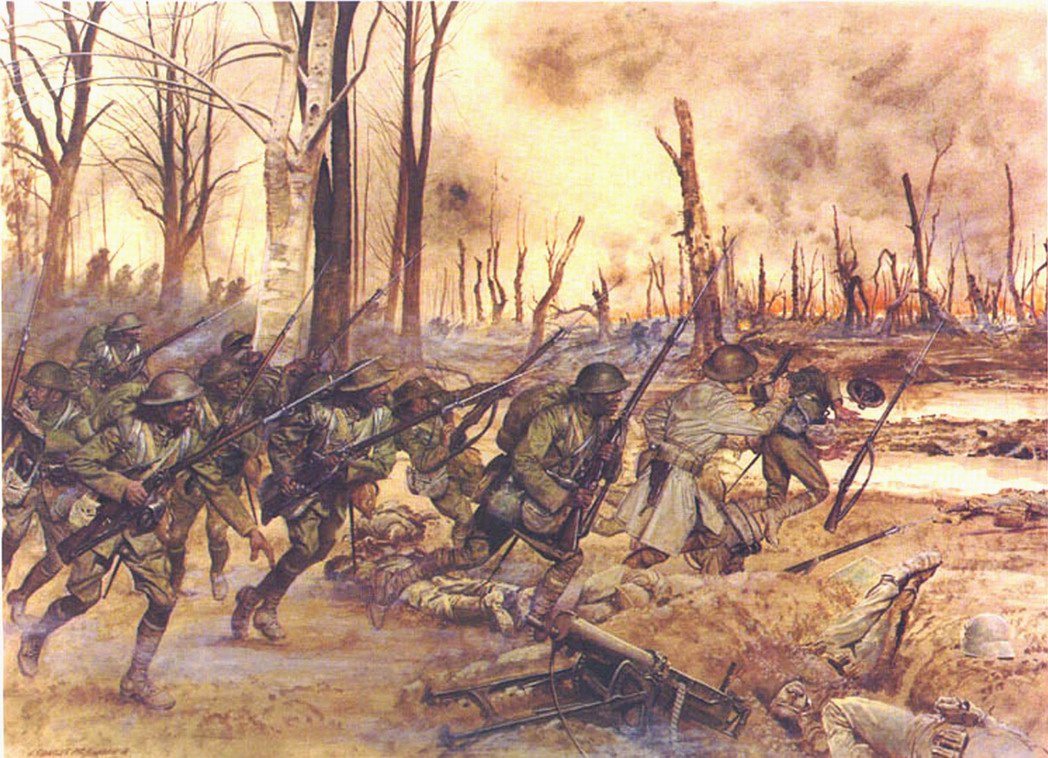
Harlem Hellfighters in Action

Friends of Padre Steve’s World,

One of the things about history is that we tend to forget the sacrifices of men who fought for the ideals of liberty, even when they were denied it themselves. That was the case with the African American men who served in the Army after the Civil War and well into the 1960s, fighting the external enemies of the United States, while being subject to the discrimination of Jim Crow and the Black Codes at home.

They were Americans who in spite of prejudice and in spite of intolerance and persecution loved their country. They were men who labored under the most difficult circumstance to show all Americans and the world that they were worthy of being soldiers and citizens of the United States of America.

They were all volunteers and many of them were veteran soldiers had already served full careers on the Great Plains. They were the Buffalo Soldiers, and when the United States entered the First World War, they were not wanted. Instead, the veterans were left on the frontier and a new generation of African American draftees and volunteers became the nucleus of two new infantry divisions, the 92nd and 93rd.

However in the beginning they too were kept out of action. These men were initially regulated to doing labor service behind the lines and in the United States. But finally, the protests of organizations such as the NAACP and men like W.E.B.DuBois and Phillip Randolph forced the War Department to reconsider the second class status of these men and form them into combat units.

Despite this the leadership of the AEF, or the American Expeditionary Force of General John Pershing refused to allow these divisions to serve under American command. Somehow the concept of such men serving alongside White Americans in the “War to end All War” was offensive to the high command.

Instead these divisions were broken up and the regiments sent to serve out of American areas on the Western Front. The regiments of the 93rd Division were attached to French divisions. The 369th “Harlem Hellfighters” were first assigned to the French 16th Division and then to the 161st Division.

The 370th “Black Devils” were detailed to the French 26th Division and the 371st and 372nd Infantry Regiments were assigned to the French 157th (Colonial) Division, which was also known as the Red Hand Division.

These units performed with distinction. The 371st was awarded the French Croix de Guerre and Légion d’honneur and Corporal Freddie Stowers of the 1st Battalion 371st was the only African American awarded the Congressional Medal of Honor in the First World War. The 372nd was also awarded the Croix de Guerre and Légion d’honneur for its service with the 157th Division.

The 157th (Colonial) Division had suffered badly during the war and been decimated in the unrelenting assaults in the trench warfare of the Western Front. It was reconstituted in 1918 with one French Regiment and two American regiments, the Negro 371st and 372nd Infantry. On July 4th 1918 the commanding General of the French 157th Division, General Mariano Goybet issued the following statement:

“It is striking demonstration of the long standing and blood-cemented friendship which binds together our two great nations. The sons of the soldiers of Lafayette greet the sons of the soldiers of George Washington who have come over to fight as in 1776, in a new and greater way of independence. The same success which followed the glorious fights for the cause of liberty is sure to crown our common effort now and bring about the final victory of right and justice over barbarity and oppression.”

220px-Red_Hand_Division

While many white American soldiers depreciated their French hosts and attempted to sow the seeds of their own racial prejudice against the black soldiers among the French, Southerners in particular warned the French of  the “black rapist beasts.” However the French experience of American blacks was far different than the often scornful treatment that they received from white American soldiers.

“Soldiers from the four regiments that served directly with the French Army attested to the willingness of the French to let men fight and to honor them for their achievements. Social interactions with French civilians- and white southern soldiers’ reactions to them- also highlighted crucial differences between the two societies. Unlike white soldiers, African Americans did not complain about high prices in French stores. Instead they focused on the fact that “they were welcomed” by every shopkeeper that they encountered.”

Official and unofficial efforts by those in the Army command and individual soldiers to stigmatize them and to try to force the French into applying Jim Crow to laws and attitudes backfired. Villages now expressed a preference for black over white American troops. “Take back these soldiers and send us some real Americans, black Americans,” wrote one village mayor after a group of rowdy white Americans disrupted the town.”

Stowers

The citation for Corporal Stowers award of the Medal of Honor reads as follows:

Corporal Stowers, distinguished himself by exceptional heroism on September 28, 1918 while serving as a squad leader in Company C, 371st Infantry Regiment, 93d Division. His company was the lead company during the attack on Hill 188, Champagne Marne Sector, France, during World War I. A few minutes after the attack began, the enemy ceased firing and began climbing up onto the parapets of the trenches, holding up their arms as if wishing to surrender. The enemy’s actions caused the American forces to cease fire and to come out into the open. As the company started forward and when within about 100 meters of the trench line, the enemy jumped back into their trenches and greeted Corporal Stowers’ company with interlocking bands of machine gun fire and mortar fire causing well over fifty percent casualties. Faced with incredible enemy resistance, Corporal Stowers took charge, setting such a courageous example of personal bravery and leadership that he inspired his men to follow him in the attack. With extraordinary heroism and complete disregard of personal danger under devastating fire, he crawled forward leading his squad toward an enemy machine gun nest, which was causing heavy casualties to his company. After fierce fighting, the machine gun position was destroyed and the enemy soldiers were killed. Displaying great courage and intrepidity Corporal Stowers continued to press the attack against a determined enemy. While crawling forward and urging his men to continue the attack on a second trench line, he was gravely wounded by machine gun fire. Although Corporal Stowers was mortally wounded, he pressed forward, urging on the members of his squad, until he died. Inspired by the heroism and display of bravery of Corporal Stowers, his company continued the attack against incredible odds, contributing to the capture of Hill 188 and causing heavy enemy casualties. Corporal Stowers’ conspicuous gallantry, extraordinary heroism, and supreme devotion to his men were well above and beyond the call of duty, follow the finest traditions of military service, and reflect the utmost credit on him and the United States Army.

Corporal Stowers is buried at the Meuse-Argonne American Cemetery. The award of the Medal of Honor was not made until 1991 when President George H. W. Bush presented it to Stowers’ two surviving sisters.

The contrast between the American treatment of its own soldiers and that of the French in the First World War is striking. The fact that it took President Harry S. Truman to integrate the U.S. Military in 1948 is also striking. African Americans had served in the Civil War, on the Great Plains, in Cuba and in both the European and Pacific Theaters of Operation in the Second World War and were treated as less than fully human by many Americans.

770px-369th_15th_New_York

Men of the 371st and 372nd Infantry Regiments of the French 157th Division Awarded the Croix d’Guerre

Even after President Truman desegregated the armed forces in 1948, African Americans, as well as other racial minorities, women and gays have faced very real discrimination. The military continues to make great strides, and while overt racist acts and other types of discrimination are outlawed, racism still remains a part of American life.

Today things have changed, and that in large part is due to the unselfish sacrifice in the face of hatred and discrimination of the men of the USCT and the State Black Regiments like the 54th Massachusetts and the Louisiana Home Guards who blazed a way to freedom for so many. Those who followed them as Buffalo Soldiers and volunteers during the World Wars continued to be trail blazers in the struggle for equal rights. A white soldier who served with the 49th Massachusetts wrote “all honor to our negro soldiers. They deserve citizenship. They will secure it! There would be much suffering in what he termed “the transition state” but a “nation is not born without pangs.”

Unfortunately racial prejudice is still exists in the United States. In spite of all the advances that we have made racism still casts an ugly cloud over our country. Despite the sacrifices of the Buffalo Soldiers, the leaders of the Civil Rights movement and others there are some people who like the leaders of the AEF in 1917 and 1918 cannot stomach having blacks as equals or God forbid in actual leadership roles in this country.

A good friend of mine who is a retired military officer, a white man, an evangelical Christian raised in Georgia who graduated from an elite military school in the South, who is a proponent of racial equality has told me that the problem that many white people in the South have with President Obama is that “he doesn’t know his place.” Yes racism is still real and rears its ugly head all too often.

Peace

Padre Steve+

3 Comments

Filed under civil rights, History, Military, Political Commentary, world war one

War and Redemption: Dan Sickles Pt.5

sickles as brigadier

Friends of Padre Steve’s World

I am a historian as well as a chaplain and priest. I do a lot of work with the Battle of Gettysburg and much of my work involves biography as I believe that the one constant in history is people. Technology and many other things may change, but people and human nature are constant, for good and for bad, and frankly I find people fascinating.

One of the most fascinating people of the Battle of Gettysburg is Union Major General Daniel E. Sickles, a man who was one of the most fascinating, salacious, scandalous, and incredible figures ever to grace and disgrace American history.

This is the fifth of a multi-part series taken from my Gettysburg and Civil War text. I hope that you enjoy.

Peace,

Padre Steve+

Dan Sickles completed his term in Congress making few speeches and maintaining a relatively low profile, frequently entering and leaving through side entrances. But as tensions rose and secession fever built, Sickles, the longstanding supporter of Southern states rights, who had declined to run for reelection “briefly transformed himself from outcast to firebrand” [1] when secessionist troops opened fire on the transport Star of the West when that ship attempted to deliver supplies to Fort Sumter. Surprising his Southern colleagues he declared the attack on the ship as “naked, unmitigated war,” and declared:

It will never do, sir, for them [the South] to protest against coercion and, at the same moment, seize all the arms and arsenals and forts and navy-yards and ships… when sovereign states by their own deliberate acts, make war, they must not cry peace… When the flag of the Union is insulted, when the fortified place provided for the common defense are assaulted and seized, when the South abandons its Northern friends for English and French alliances, then the loyal and patriotic population of that imperial city [New York] are unanimous for the Union.” [2]

He declared the assault to an act of war, and predicted that “the men of New York would go in untold thousands anywhere to protect the flag of its country and to maintain its legitimate authority.” [3] Sickles’ speech was electrifying and heartened back to his early career and what might have been, and during the remaining days of his term he continued to speak out in the House against the actions of the South and sponsored legislation to bills to suspend postal service with the South and recover the funds in the United States Mint buildings which had been seized by seceding states. He thundered in the presence of Southern friends still serving in the House, “Surely the chivalrous men of the South would scorn to receive the benefit of our postal laws,… “They cannot intend to remain, like Mahomid’s coffin, between heaven and earth, neither in nor out of the Union, getting all the benefits, and subjecting us to all its burdens.” [4]

Shortly thereafter Dan Sickles left Washington to what many thought would be political and possibly personal oblivion, but they underestimated Sickles. Ambition and the desire for redemption still burned in his heart, and shortly after President Lincoln called for 75,000 volunteers to put down the rebellion, Sickles volunteered to help raise and lead the men of the Empire State into battle to restore the Union. As the future commander of a one of the regiments, the French born journalist, Regis De Trobriand, noted “during the lead-up to Sumter, Dan had been among the conciliatory and moderate, “but when the sword was drawn, he was one of the first to throw away the scabbard.” [5]

sickles-brigade

Taking up the challenge to raise a regiment sickles went to work, and “almost overnight, using flag-waving oratory, organizational skills, and promissory notes, he had his regiment, the 70th New York volunteers well in hand.” [6] Soon his authority was expanded to recruit a brigade, which rapidly filled with volunteers, soon over 3,000 men were under his command, and the new brigade, consisting of the 70th, 71st, 72nd, 73rd and 74th New York Volunteers which Sickles promptly christened the Excelsior Brigade, taking on the Empire State’s motto. However many of the brigade’s volunteers were scorned because of Sickles’ reputation, the brigade’s historian wrote, “no name was too bad for you; one would call you this and another would call you that, and even a person’s own relatives would censure him for joining such a Brigade as that of Daniel E. Sickles.” [7]

Even so, Sickles rapidly captured the hearts of his men. Volunteers were found throughout New York, as well as New Jersey, Ohio, and Pennsylvania, and the men represented the spectrum of White America; men of traditional Anglo-Saxon origin mingled with Irish, Germans, and Dutch. But he was so successful in recruiting that organizers of other regiments, especially in rural New York counties demanded that the Republican governor, Edward Morgan, order Sickles to disband most of the brigade. Believing the action politically motivated, Sickles refused and went directly to Lincoln to get the brigade Federal recognition. At first Lincoln balked at the request, he needed troops but was yet unwilling to get in the way of what he saw as the individual state control of their militias. The result was an impasse as Federal and New York officials argued about the brigade and the status of Sickles himself.

Sickles organizational and leadership skills were tested by the situation, and he went to extraordinary lengths to meet the needs of his soldiers for housing, food and sanitation, “and financed its camp for some time out of his own purse…. At one point he rented a circus tent from P.T. Barnum to house several hundred of his recruits. At another, with several companies or more quartered in a bare hall on lower Broadway, he contracted a cheap bath-house to give fourteen hundred men a shave and shower at ten cents apiece.” [8] To meet the need for cooked meals Sickles’ old friend Captain Wiley “commandeered cooks for the brigade from Delmonico’s, working in inadequate kitchens in side streets, they tried to turn out enough food for the men.” [9] Eventually the brigade was given a campsite on “Staten Island, near Fort Wadsworth, where he and his men could wait until the issue of mustering-in was settled.” [10]

Finally in July of 1861 the Excelsiors were officially mustered in to service as New York Volunteer troops and Sickles commissioned as a Colonel, functioning as the commander of the 70th New York and the de-facto commander of the brigade. Lincoln nominated Sickles for a commission as a Brigadier General of Volunteers but due to pressure from New York officials, still steaming at Sickles for going to Lincoln, and the Senate delated confirmation for months, forcing Lincoln to re-nominate him a second time after which they confirmed him in May 1862, in some measure due to the influence of Sickles former defense attorney, Edwin Stanton who had succeeded Simon Cameron as Secretary of War.

Sickles and his brigade first saw combat at Fair Oaks during the Seven Day’s battle. Sickles acquitted himself well during the fighting, he seemed to be a natural leader of men, who cheered him as he led them into battle. The actions of the Excelsiors and their newly minted Brigadier were praised by the Army commander, George McClellan in a letter to Stanton, “The dashing charge of the Second and Fourth Regiments,…”the cool and steady advance of the Third, occurred under my immediate observation and could not have been surpassed.” [11] A news correspondent attached to the army wrote:

“Gen. Sickles had several narrow escapes; he was always to be found in the thickest of the fight. Had those gifted Senators who refused to confirm his nomination, but witnessed the enthusiasm of his troops when serving under him, and his military qualifications for office, they would do penance until re-elected.” [12]

The success at Fair Oaks was not followed up by McClellan, despite the urging of many officers, including Sickles and Richmond, which many believed could have been taken, remained in Confederate hands. Sickles performance during the Peninsular Campaign won Dan the respect and affection of his soldiers, as well as the respect of his division commander Fighting Joe Hooker. Unlike many other leaders who in their first taste of combat on the Peninsula saw the terrible carnage of battle, the immense numbers of casualties, and the suffering of the troops, Sickles maintained his composure, as others collapsed, “neither the casualties nor the state of the earth daunted Sickles.” [13] Hundreds of his Excelsiors, including his own aid-de-camp were killed or wounded during the campaign, and “the Excelsior Brigade, through steadily reduced by deaths, wounds and illness, had been forged into a body of hard-bitten, battle-wise soldiers educated in the necessities of war and in the tricks of self-preservation.” [14] A member of the brigade wrote, “It is no fable about the men of this Brigade thinking a great deal of the General.” [15]

Following the army’s withdraw from the Peninsula and its return to encampments near Washington D.C. Sickles went back to New York to raise new troops to replace those killed or wounded during the campaign. He also took time to organize efforts to care of the children of the brigade’s soldiers, living and dead who were being taken care of at the Union Home School. Due to this he missed the battles of Second Bull Run and Antietam. His recruiting efforts were successful, even former political enemies were impressed by his service, and his ability to raise and organize troops. His reputation had been so completely rehabilitated by his war service that some of his “old backers in Tammany wanted him to run again for Congress,” [16] but he was opposed by others, like his old friend Sam Butterworth, who had become a “Copperhead,” an anti-war, faction that wanted to end the war and let the South go on its way; “to them, Dan had become a Lincoln man, a crypto-Republican.” [17] the relief of many of his troops he declined the offer to run again. As one of his Chaplains, Joseph Twitchell noted Sickles, “is getting fixed in his new place most successfully and will probably serve himself, as well as the country, better here than in a war of words.” [18]

Sickles-Excelsior-Brigade-Headquarters-City-Hall-Park.-Yorktown

During his recruiting efforts Sickles, now a military, as well as political realist, made many speeches, in which he recognized that conscription was inevitable. Having seen the brutal cost of war and the suffering of his men, Sickles complained of the lack of effort being provided in New York to the war effort. In a speech at the Produce Exchange, he praised the leadership and nerve of President Lincoln, and said, “A man may pass through New York, and unless he is told of it, he would not know that this country is a war…. In God’s name, let the state of New York have it to say hereafter that she furnished her quota for the army without conscription – without resorting to a draft!” [19]

When he returned to the army in November of 1862 his old division commander, Hooker had been promoted to corps command following the relief of George McClellan, and as the senior brigadier was promoted to command of the division. His, division, the Second Division of Third Corps was used in a support role at Fredericksburg and saw little action in that fight and only suffered about 100 casualties. His old friend and defense counsel Thomas Meagher, now commanding the Irish Brigade saw his brigade shattered in the carnage of at Fredericksburg. After Ambrose Burnside who had commanded the army during that fiasco was relieved of command Hooker was appointed by Lincoln as commander of the Army of the Potomac.

One of Hooker’s organizational changes was to establish a Cavalry Corps which was to be commanded by Major General George Stoneman, the commander of Third Corps. This left “Sickles as the corps’ ranking officer.” [20] Sickles was promoted to command the Third Corps by Hooker, who chose Sickles over another volunteer officer, David Birney. Had a professional officer rather than Birney been his competition, “Sickles would have remained division commander.” [21] Sickles was given the corps “on a provisional basis, for his appointment as a major general had not yet been confirmed by the Senate and corps command was definitely a two-star job.” [22] Once again it was political enemies in the Senate, this time Republicans who did not trust the Democrat, who delayed Sickles’ promotion to Major General, but he was finally confirmed on March 9th 1863, with his promotion backdated to November 29th of 1862. “Professionals in the army attributed his rise to his “skill as a political maneuverer.” Few men, however, questioned his personal bravery.” [23]

To be continued…

Notes

[1] Ibid. Hessler Sickles at Gettysburg p.21

[2] Ibid. Hessler Sickles at Gettysburg p.111

[3] Ibid. Keneally American Scoundrel p. 212

[4] Ibid. Keneally American Scoundrel p.214

[5] Ibid. Keneally American Scoundrel p.219

[6] Ibid. Sears Controversies and Commanders p.201

[7] Ibid. Hessler Sickles at Gettysburg p.23

[8] Ibid. Catton Glory Road p. 153

[9] Ibid. Keneally American Scoundrel p.222

[10] Ibid. Keneally American Scoundrel p.222

[11] Ibid. Hessler Sickles at Gettysburg pp.30-31

[12] Ibid. Swanberg Sickles the Incredible p.149

[13] Ibid. Keneally American Scoundrel p.245

[14] Ibid. Swanberg Sickles the Incredible p.153

[15] Ibid. Wert The Sword of Lincoln p.222

[16] Ibid. Hessler Sickles at Gettysburg p.32

[17] Ibid. Keneally American Scoundrel p.245

[18] Ibid. Hessler Sickles at Gettysburg p.32

[19] Ibid. Keneally American Scoundrel p.252

[20] Ibid. Wert The Sword of Lincoln p.223

[21] Ibid. Sears Controversies and Commanders p.206

[22] Ibid. Swanberg Sickles the Incredible p.168

[23] Ibid. Wert The Sword of Lincoln p.223

2 Comments

Filed under civil war, History, leadership, Military

Finding Ways to Live With It: 8 Years After Returning from Iraq

IMG_0222

Friends of Padre Steve’s World

Just a short thought on this Friday morning. It has been eight years to the day that I stepped back in country and returned from my tour in Iraq. I have written much about that tour so I won’t spend any time recounting those experiences and just share a couple of observations that come from my struggle with PTSD and other maladies associated with that tour. In fact the night before last I fell out of bed as during a nightmare I rolled to escape attacking enemy soldiers. Sadly, this is nothing new, at least this time I escaped unhurt. 

It has been a terribly difficult eight years as in addition to my own struggles I have watched friends who also served in Iraq and Afghanistan, struggle as they have tried to readjust to life out of the sandbox. Of course there are those who never came home, friends and comrades killed in action, as well as those that either died of illness or wounds incurred during their tours, and others who sadly took their lives after their return. Likewise, there is the cost born by spouses, the broken marriages, substance abuse, and so many other issues.

No wonder two-time Medal of Honor winner, Marine Corps Major General Smedley Butler noted, “What is the cost of war? what is the bill? “This bill renders a horrible accounting. Newly placed gravestones. Mangled bodies. Shattered minds. Broken hearts and homes. Economic instability. Depression and all of its attendant miseries. Back -breaking taxation for generations and generations. For a great many years as a soldier I had a suspicion that war was a racket; not only until I retired to civilian life did I fully realize it….”

I have spent years trying to make heads or tails out of my own struggles and I finally have come to the realization that I am probably about as good as I will get. I do not trust the military mental health system, even though there are some very good doctors, therapists and other providers in it. While I have had some very good therapists, all were civilians, I cannot see any of them here and to try to get back into the system is often dehumanizing. I have someone managing my medicines, for PTSD and my chronic insomnia and the combinations are working better than other attempts so I am not going to complain.

I have a wonderful wife who has neither divorced nor killed me, though she probably would have been justified a number of times. I have two wonderful little dogs who incredibly comforting. Likewise I have friends, some in the military, some at my work at the Staff College, and others at the Gordon Biersch Brewery Restaurant, my version of Cheers. I don’t know what I would have done without these wonderful people. So I am grateful, and as I said, things are about as good as they will get.

One of my favorite actors, James Spader, plays a character named Raymond Reddington on the television show The Blacklist. During one episode he told another character something quite profound, something that I began to embrace last year, and though some might find it odd, I find it comforting.

“There is nothing that can take the pain away. But eventually, you will find a way to live with it. There will be nightmares. And every day when you wake up, it will be the first thing you think about. Until one day, it’s the second.”

Have a great weekend,

Peace,

Padre Steve+

1 Comment

Filed under Loose thoughts and musings, mental health, Military, Tour in Iraq

Stalingrad at 73

Friends of Padre Steve’s World

Sunday the 31st of January marked 73rd anniversary of  the surrender of the remnants of the German 6th Army to the Soviets at Stalingrad. The focus of this article is on how the Germans and Russians fought the Stalingrad campaign. In particular it is an analysis of the way the governments and military’s of both Nazi Germany and the Soviet Union planned and executed strategy during the course of the campaign adjusted to the situation and how the campaign ended. It is also a reminder of the price that ordinary soldiers can pay when a country commits them to war. In all nearly two million Axis and Soviet personnel, including civilians were killed, wounded, or captured during the campaign.

That being said, it is a reminder to all of us of the consequences of how xenophobic and racist politics of self-anointed leaders, and their followers can lead nations into disaster.

Peace 

Padre Steve+

Stalingrad: Primary or Secondary Objective
 keitel-jodl-hitler

The mistakes began early in the planning and conduct of the operation

Following the Soviet winter offensive and the near disaster in front of Moscow the German High Command was faced with the strategic decision of what to do in the 1942 campaign.  Several options were considered and it was decided to seize the Caucasus oilfields and capture or neutralize the city of Stalingrad on the Volga.  However, the German High Command was divided on the actual objective of the campaign.

operation blau map

The Oberkommando des Heer or the OKH (Army High Command) under the guidance of General Franz Halder assumed that Stalingrad was the objective and the advance into the Caucasus was a blocking effort.[i] Hitler and Oberkommando des Wehrmacht or the OKW planned to capture the Caucasus oil fields and capture or neutralize Stalingrad to secure the left flank.[ii] Both OKH and OKW considered Stalingrad significant but “German commanders initially regarded it as a weigh station en route to the Caucasus oil fields.” [iii] The conflict echoed in the ambiguity of Directive No. 41, which “included the ‘seizure of the oil region of the Caucasus’ in the preamble concerning the general aim of the campaign, yet made no mention of this in the main plan of operations.” [iv] At the planning conference held at Army Group South in early June “Hitler hardly mentioned Stalingrad. As far as his Generals were concerned it was little more than a name on the map. His obsession was with the oil fields of the Caucasus.” [v] Manstein noted, “Hitler’s strategic objectives were governed chiefly by the needs of his war economy….” [vi] Historian Anthony Beevor noted that at this stage of planning “the only interest in Stalingrad was to eliminate the armaments factories there and secure a position on the Volga. The capture of the city was not considered necessary.” [vii] German planners “expected that the Soviets would again accept decisive battle to defend these regions.” [viii]

In Moscow Stalin and his Generals attempted to guess the direction of the impending German offensive.  “Stalin was convinced that Moscow remained the principle German objective…Most of the Red Army’s strategic reserves…were therefore held in the Moscow region.” [ix] The Soviet High Command, Stavka attempted to disrupt the German offensive and to recover Kharkov by launching three offensives three offensives of their own. The largest of these, an attack on Kharkov was defeated by the Germans between the 12th to the 22nd of May, with the loss of most of the armor in southern Russia. This disaster was accompanied by an equally disastrous defeat of Red Army forces in Crimea by Erich Von Manstein’s 11th Army, and the combination meant that the Red Army would face the Germans in a severely weakened condition. [x]

Operation Blau: Opening Moves and Divergent Objectives
panzers_across_the_don

Panzers cross the Don

The German offensive began on 28 June under the command of Field Marshal Fedor von Bock. Von Bock’s command included two separate army groups, Army Group B under General Maximilian Von Weichs with 2nd Army, 6th Army and 4th Panzer Army operated in the northern part of the operational area. Army Group A under Field Marshall Wilhelm List was to the south with 17th Army and 1st Panzer Army, with the goal of driving into the Caucasus. [xi] Army Group B provided the main effort for the offensive and its forces quickly smashed through the defending Soviet armies and by the 20th Hitler believed that “the Russian is finished.” [xii] One reason for the German success in the south was that until July 7th Stalin believed that Moscow was still the primary objective for any German summer offensive. [xiii] Despite his success, Hitler prevented Von Bock from destroying the Soviet formations that had been left behind and was relieved of command by Hitler. This enabled many of those units to escape the German onslaught. For his trouble Von Bock was replaced by Von Weichs, which created a difficult command and control problem.  Manstein noted that this created a “grotesque chain of command on the German southern wing” with the result that Army Group A had “no commander of its own whatever” and Army Group B had “no few than seven armies under command including four allied ones.” [xiv]

Bild 169-0894

Destroyed Soviet T-34s

This decisions made next proved fateful.  Hitler’s decided to redirect the advance of the 4th Panzer Army to support an early passage of the lower Don, diverting it from its drive on Stalingrad.  Additionally the army groups became independent of each other when Bock was relieved of command.  They were “assigned independent-and diverging-objectives” under the terms of Directive No.45. [xv] This combination of events had a decisive impact on the campaign.  Hitler’s decision prevented a quick seizure of Stalingrad by 4th Panzer Army followed by a hand over to 6th Army to establish the “block” as described by Directive No.41.  Kleist noted that he didn’t need 4th Panzer Army’s help to accomplish his objectives and that it could have “taken Stalingrad without a fight at the end of July….” [xvi]
 general-paulus

Field Marshall Von Paulus

The result was damning. The Luftwaffe air support and fuel needed by Army Group A was transferred to 6th Army, denuding Army Group A of the resources that it needed to conclude its conquest of the Caucasus. [xvii] At the same time it denied Army Group B of the Panzer Army that could have seized Stalingrad when it was still possible to do so.  Anthony Beevor called Hitler’s decision a disastrous compromise, [xviii] while Halder believed that Hitler’s decision underestimated the enemy and was “both ludicrous and dangerous.” [xix]

Focus on Stalingrad

battle-stalingrad-ww2-second-world-war-two-russian-eastern-front-unseen-pictures-photos-images

Sturmgeschutz Battalion Advancing toward Stalingrad

On July 22nd as the Wehrmacht ran short on fuel and divisions to commit to the Caucasus, and 6th Army fought for control of Voronezh the Soviets created the Stalingrad Front. Stavka moved an NKVD Division to the city [xx] and rapidly filled the new front with formations transferred from the Moscow Front. [xxi] Stalin then issued Stavka Order 227, better known as “No Step Back” on July 28th. The order mandated that commanders and political officers who retreated would be assigned to Penal battalions[xxii] and each field army was to form three to five special units of about 200 men each as a second line “to shoot any man who ran away.” [xxiii] Russian resistance west of the Don slowed the German advance. German commanders were astonished “at the profligacy of Russian commanders with their men’s lives.” [xxiv] Von Kleist compared the stubbornness of Russians in his area to those of the previous year and wrote that they were local troops who fought more stubbornly because they were fighting to defend their homes.” [xxv] Additionally, Stalin changed his commanders frequently in the “vain hope that a ruthless new leader could galvanize resistance and transform the situation.” [xxvi] General Chuikov brought the 64th Army into the Stalingrad Front in mid-July to hold the Germans west of the Don.[xxvii]

The OKW further weakened the German offensive by transferring several key SS Panzer Divisions and the Grossdeutschland Panzer Division to France. The Hungarian, Italian and Romanian armies that were part of the army group lacked motorization; modern armored and anti-tank units, and were unable to fulfill the gaps left by the loss of the experienced German divisions that had been transferred and the expectations of Hitler. [xxviii] The German 6th Army was virtually immobilized for 10 days due to lack of supplies allowing the Russians to establish a defense on the Don Bend. [xxix]

To the south the Germans were held up by lack of fuel and increased Soviet resistance including the introduction of a force of 800 bombers, which took away the total domination of the air that the Germans had previously enjoyed.[xxx] David Glantz and House note that after the fall of Rostov on July 23rd “Hitler abruptly focused on the industrial and symbolic value of Stalingrad.” [xxxi] Hitler was undeterred by warnings from Halder that fresh Russian formations were massing east of the Volga and those of Quartermaster General Erich Wagner, who guaranteed that he could supply either the thrust to the Caucasus or Stalingrad but not both operations simultaneously. [xxxii] Again frustrated by the slow progress to take Stalingrad, Hitler reverted to the original plan for the 4th Panzer Army to assist the 6th Army at Stalingrad, but the cost in time and fuel to move that army from the Caucasus to Stalingrad were significant to the operation and the question was whether “they could make up for Hitler’s changes in plan.” [xxxiii]

Strategic Implications

The changes in the German plan had distinct ramifications for both sides.  Friedrich Von Mellenthin wrote, “the diversion of effort between the Caucasus and Stalingrad ruined our whole campaign.” [xxxiv] The Germans could not secure the Caucasus oil fields that Hitler considered vital to the German war effort.  The Germans advanced deep into the region and captured the Maikop oil fields, though the drilling and refining facilities were almost completely destroyed by the retreating Russians when they withdrew.[xxxv] Due to the lack of fuel and increased Soviet resistance Army Group A was halted along the crests of the Caucasus on August 28th. [xxxvi] This setback left Hitler deeply “dissatisfied with the situation of Army Group A.” [xxxvii] Kleist and others attributed much of the failure to a lack of fuel [xxxviii] while Gunther Blumentritt observed that Mountain divisions that could have made the breakthrough were employed along the Black Sea coast in secondary operations. [xxxix]

battle_stalingrad65

JU-87 Stuka over Stalingrad

Meanwhile on the Stalingrad front, fuel and supply shortages hampered 6th Army’s advance while Hermann Hoth’s 4th Panzer Army was needlessly shuttled between Rostov and Stalingrad. By the time the 4th Panzer Army resumed its advance the Russian forces around Stalingrad “had sufficiently recovered to check its advance.” [xl] As the 6th Army advanced into Stalingrad the “protection of Army Group B’s ever-extending northern flank was taken over by the 3rd Rumanian, the 2nd Hungarian and the newly formed 8th Italian Army.” [xli] The allied armies had to occupy overextended fronts, and these formations were neither trained equipped for the Russian campaign, nor well motivated to die for Germany. [xlii] The supply shortage in both German army groups was not helped by a logistics bottleneck. All supplies for both army groups had to transit over a single crossing on the Dnieper River, which Manstein noted, also prevented swift movement of troops from one area to another. [xliii]

 pzdiv-24-motorcycle-stalingrad

Reconnaissance Battalion of 24th Panzer Division near Stalingrad

Von Paulus’ 6th Army attempted to capture Stalingrad with a swift attack between the 25th and 29th of July, even as Hoth’s 4th Panzer Army milled about on the lower Don.  However, Paulus’s piecemeal commitment of his divisions and failure to concentrate in the face of unexpectedly strong Soviet resistance caused the attacks to fail.  Paulus then halted the 6th Army on the Don so it could concentrate its forces and build its logistics base, [xliv] and to allow Hoth’s army to come up from the south. This further delay allowed the Russians to build up even more forces west of Stalingrad, to reinforce the Stalingrad front, and to strengthen the defenses of the city. [xlv] Likewise, due to the distances involved it now was easier for the Russians to reinforce the Stalingrad front than it was for the Germans. [xlvi] As they strengthened their positions, the Soviets filled a number of key leadership positions with competent and tough Generals who would skillfully fight the coming battle for the city.[xlvii]

russian marines stalingrad

Hitler now focused on the capture of Stalingrad despite the fact that “as a city Stalingrad was of no strategic importance.” [xlviii] Strategically, its capture would cut Soviet supply lines to the Caucasus, [xlix] but this could be achieved without its capture. The check of the German advance in the Caucasus “began to give Stalingrad a moral importance-enhanced by its name-which came to outweigh its strategic value.” [l] To Hitler Stalingrad would gain “a mystic significance” [li] and along with Leningrad became “not only military but also psychological objectives.” [lii]

battle_stalingrad79

Red Army Armored troops using Lend-Lease American M3 Stuart and M3 Grant tanks

Despite the risks the Germans now mounted a frontal assault using the 6th Army and elements of 4th Panzer Army despite having intelligence reports supported by airiel reconnaissance that “the Russians are throwing forces from all directions at Stalingrad.” [liii] Friedrich von Paulus as the senior General was in charge of the advance, with Hoth subordinated to him, but the attack had to wait until Hoth’s army could fight its way up from the south. [liv] Von Mellenthin comments rightly, “when Stalingrad was not taken on the first rush, it would have been better to mask it….” [lv] Such a decision would have enabled the Germans to strengthen their lines and prepare for the inevitable Soviet counter-offensive. In retrospect it is clear that the German advance had actually reached its culminating point with the failure of the advance into the Caucasus and Paulus’s initial setback on the Don, but it was not yet apparent to many involved. [lvi] The proper course of action would have been to halt and build up the front and create mobile reserve to parry any Russian offensive along northern flank while reinforcing success in the Caucasus. Manstein wrote, “by failing to take appropriate action after his offensive had petered out without achieving anything definite, he [Hitler] paved the way to the tragedy of Stalingrad!” [lvii]

Transfixed by Stalingrad

Bild 183-B22413

German Stug III at Stalingrad

On August 19th Paulus launched a concentric attack against the Russian 62nd and 64th Armies.  The attack ran into problems, especially in Hoth’s sector. [lviii] Yet, on the 22nd the 14th Panzer Corps of 6th Army “forced a very narrow breach in the Russian perimeter at Vertyachi and fought their way across the northern suburbs of Stalingrad,” [lix] reaching the Volga on the 23rd. That day 4th Air Fleet launched some 1600 sorties against the city dropping over 1,000 tons of bombs. [lx] The breakthrough by the 6th Army imperiled the Soviet position as they had concentrated their strongest forces against Hoth. [lxi] For the moment the Germans held air superiority and continued heavy bombing attacks.  During the last days of August 6th Army “moved steadily forward into the suburbs of the city, setting the stage for battle.” [lxii] As the Soviets reacted to Paulus, Hoth’s army achieved a breakthrough in the south that threatened the Russian position.  However the 6th Army was unable to disengage its mobile forces from inside Stalingrad to link up with the 4th Panzer Army and another opportunity to defeat major Soviet forces in the area and secure the city was missed. [lxiii]
battle-stalingrad-ww2-second-world-war-germans-don-river-rare-pictures-unseen-photos-images

German unit crossing the Don

As the 6th Army moved into the city General Yeremenko ordered attacks against General Hube’s 16th Panzer Division. Soviet resistance increased as more formations arrived the Germans suffered one of their heaviest casualty rates. [lxiv] Though unsuccessful the Soviet counterattacks “managed to deflect Paulus’s reserves at the most critical moment.” [lxv] The Germans remained confident the first week of September as 6th Army and the 4th Panzer Army linked up, but Yeremenko saved his forces by withdrawing and avoided encirclement west of the city, retiring to an improvised line closer to the Stalingrad. [lxvi] On September 12th Vasily Chuikov was appointed to command 62nd Army in Stalingrad.  Chuikov understood that for the Soviets in Stalingrad there “was only one way to hold on. They had to pay in lives. ‘Time is blood,’ as Chuikov put it later.” [lxvii] Stalin sent Nikita Khrushchev to the front “with orders to inspire the Armies and civilian population to fight to the end.” [lxviii] In the next few days the 13th Guards Rifle Division arrived and saved the Volga landings, which allowed the Soviets to continue to resupply Stalingrad, but the division last 30% of its troops as casualties in its first 24 hours of combat. [lxix]
t-34 stalingrad

T-34 in Stalingrad

An NKVD regiment and other units held the strategically sited Mamaev Kurgan, keeping German guns from controlling the Volga.[lxx] The defenders contucted a house to house and block by block fight, and the Red Army and NKVD units were reinforced by Naval Infantry.  Chuikov conducted the defense with a brutal ferocity, relieving senior commanders who showed a lack of fight and by sending many officers to penal units.  Chuikov’s defensive plan was masterful; he funneled German attacks into “breakwaters” where the panzers and infantry could be separated from each other causing heavy German casualties. [lxxi]

Bype36yIQAASUVK

resized_battle-stalingrad-6

resized_battle-stalingrad-4

Now for Hitler the “city became a prestige item, its capture ‘urgently necessary for psychological reasons,’ as Hitler declared on October 2. A week later he declared that Communism must be ‘deprived of its shrine.’” [lxxii] The Germans continued to gain ground in the city, but slowly and at great cost, especially among their infantry, so much so that decimated companies had to be combined to form combat effective units.
Bild 183-R0130-330

person_chuikov1

Chuikov used his artillery to interdict the Germans from the far side of the Volga while assault squads with incredible ferocity fought the fight in the city.   The close-quarters combat in the city was dubbed, “Rattenkrieg by German soldiers.” [lxxiii] Paulus continued to bring more units into the city, further thinning his flanks, but his troops continued to slowly drive the Russians back against the river, and by early October Chuikov wondered if he would be able to hold. [lxxiv] It appeared that the Germans might finally capture Stalingrad, and by November Chuikov “was altogether holding only one-tenth of Stalingrad – a few factory buildings and a few miles of river bank.” [lxxv] Paulus now expected “to capture the entire city by 10 November,” [lxxvi] despite the fact that many of his units were fought out. The causalities had been massive; an analysis by 6th Army determined that 42% of the battalions of 51st Corps were fought out. [lxxvii] Even so on November 9th, a confident Hitler declared “No power on earth will force us out of Stalingrad again!” [lxxviii] However, that boast was misplaced.

Soviet Counteroffensive: Disaster on the Flanks

stalingrad-map-counterattack

T34_Stalingrad-Offensive-px800

soviet infantry attacking

Soviet Forces Advancing

As 6th Army fought its way into Stalingrad some officers in the German High Command attempted to warn Hitler of the danger. Hitler now tolerated no interference, and on September 24th he relieved Halder for persisting to explain, “what would happen when new Russian reserve armies attacked the over-extended flank that ran out to Stalingrad.” [lxxix] Many on others the German side recognized the danger. Blumentritt said, “The danger to the long-stretched flank of our advance developed gradually, but it became clear early enough for anyone to perceive it who was not willfully blind.” [lxxx] Rumanian Marshall Antonescu, and the staffs of both Army Group B and Paulus’s 6th Army warned Hitler too, [lxxxi] but Hitler was transfixed on Stalingrad.  By their sole focus on Stalingrad the Germans gave up the advantage of uncertainty and once the German “aim became obvious…the Russian Command could commit its reserves with assurance.” [lxxxii]

person_chuikov4

Chuikov and his staff

Despite Stalin’s concern about Stalingrad the Stavka planners never lost sight of their goal to resume large-scale offensive operations and destroy at least one German Army Group. [lxxxiii] Unlike Hitler, the ever suspicious Stalin had begun to trust his Generals and Stavka under the direction of Marshal Vasilevsky produced a concept in September to cut off the “German spearhead at Stalingrad by attacking the weak Rumanian forces on its flanks.” [lxxxiv] At first Stalin “showed little enthusiasm” for the attack, fearing that Stalingrad might be lost, but on 13 September he gave his full backing to the proposal [lxxxv] which Marshals Zhukov, Vasilevsky and Vatutin developed into a plan involving three operations; Operation Uranus, to destroy the German and allied forces at Stalingrad, and Operation Saturn to destroy all the German forces in the south, and a supporting attack to fix German forces in the north, Operation Mars aimed at Army Group Center. [lxxxvi]

Russian-Ground-Mount-Rocket

Soviet Katusha Rockets

To accomplish the destruction of 6th Army and at least a part of 4th Panzer Army around Stalingrad the Stavka planners employed over 60% of the “whole tank strength of the Red Army.” [lxxxvii] Strict secrecy combined with numerous acts of deception was used by the Red Army to disguise the operation. [lxxxviii] The plan involved an attack against 3rd Romanian Army on the northern flank by the Soviet 5th Tank Army and two infantry armies and their supporting units. [lxxxix] In the south another force of over 160,000 men and 430 tanks were deployed against 4th Rumanian Army and weak element of 4th Panzer Army. [xc] Despite warnings from his Intelligence Officer, Paulus did not expect a deep offensive into his flanks and rear and made no plans to prepare to face the threat. [xci] Other senior officers believed that the attack would take place against Army Group Center. [xcii] Walter Warlimont who served at OKW noted that there was a “deceptive confidence in German Supreme Headquarters.” [xciii]

 ju-52 stalingrad

Luftwaffe JU-52s made many resupply runs into the pocket but suffered great losses

The storm broke on 19 November as Soviet forces attacked rapidly crushing Romanian armies to the north and the south of Stalingrad [xciv] linking up to encircle the Germans in the city on the 23rd. [xcv] The German 48th Panzer Corps supporting the Romanians was weakened by the exhausting campaign and had few operational tanks. [xcvi] It attempted a counterattack but was “cut to pieces” in an engagement against the 5th Tank Army. [xcvii] A promising attempt by the German 29th Motorized division against the flank of the southern Russian pincer was halted by the Army Group and the division was ordered to defensive positions south of Stalingrad. [xcviii] To compound German problems the Luftwaffe was neutralized by bad weather. [xcix] Inside the city Paulus continued to do nothing as since the attacks were outside of his area of responsibility and rather than taking the initiative to extricate his forces, waited for instructions. [c] As a result the 6th Army’s 16th and 24th Panzer Divisions that could have assisted matters to the west remained “bogged down in street-fighting in Stalingrad.” [ci] Without support of the army’s Panzer formations, the 6th Army units west of Stalingrad were forced back in horrific conditions.  By the 23rd of November the 6th Army was cut off along with one corps of the 4th Panzer Army and assorted Romanian units, over 330,000 men.  Though they had the Germans surrounded, the entrapped force would require the Soviets to use seven rifle armies and much staff attention to eliminate. [cii]

von Paulus surrenders to the Soviets

Paulus Surrenders

Hitler ordered Von Manstein to form a new, composite, Army Group Don, to relieve Stalingrad. Hitler would not countenance a break out by the encircled forces and wanted Manstein to break through and relieve the 6th Army.[ciii] Hitler refused a request by Paulus on 23 November to move troops to prepare for a possible a break out attempt, and assured him that he would be relieved. [civ] Albert Speer noted that General Kurt Zeitzler who replaced Halder at OKW insisted that the Sixth Army “must break out to the west.” [cv] Hitler, completely obsessed with capturing Stalingrad told Zeitzler, “We should under no circumstances give this up. We won’t get it back once it’s lost.” [cvi] The ever boastful Herman Goering promised that his Luftwaffe would be able to meet the re-supply needs of 6th Army by air, even though his own Generals knew that it was impossible with the number of transport aircraft available. [cvii] However, Hitler took his Luftwaffe chief at his word and exclaimed “Stalingrad can be held! It is foolish to go on talking any more about a breakout by Sixth Army…” [cviii] Hitler then issued a Führer decree ordering that the front be held at all costs. [cix] Walter Goerlitz stated, “Hitler was incapable of conceiving that the 6th Army should do anything but fight where it stood.” [cx] Likewise Manstein had precious few troops with which to counterattack, as he also had to protect the flank of Army Group A, which was still deep in the Caucasus.

hungarian withdraw

hungarian dead stalingrad

Hungarian Dead and Wounded

Manstein’s “army group” was only corps strength and was spread across a 200 mile front. [cxi] Any relief attempt had to wait for more troops, especially Panzers.  Manstein believed that the best chance for a breakout had passed and that it was a serious error for Paulus to put the request to withdraw through to Hitler rather than the Army Group or act on his own [cxii] and many soldiers, long conditioned to believe in the promises of their Hitler were optimistic that Hitler would get them out of the caldron. [cxiii] Other German generals like Guderian, Reichenau, Heinrici, Hoeppner, or even the Waffen SS General Sepp Dietrich might have acted to save their army, but Paulus, surrounded in the city, was knew nothing but obedience.[cxiv]
pows stalingrad

German POWs only 5000 of some 90,000 would see home again

Operation Saturn began on 7 December destroying the Italian 8th Army and forcing the Germans to parry the threat.[cxv] A relief attempt by 57th Panzer Corps under Hoth on 12 December made some headway until a massive Soviet counterattack on 24 December drove it back.[cxvi] This attack was hampered by OKW’s refusal to allocate the 17th Panzer and 16th Motorized divisions to Manstein,[cxvii] and by 6th Army not attacking out to link with the relief force.[cxviii]By 6 January Paulus signaled OKW: Army starving and frozen, have no ammunition and cannot move tanks anymore.”[cxix] On 10 January the Soviets launched Operation Ring to eliminate the pocket and despite all odds German troops fought on. On the 16th Paulus requested that battle worthy units be allowed to break out, but the request was not replied to.[cxx] On the 22nd the last airfield had been overrun and on 31 January Paulus surrendered.[cxxi]

Analysis: What Went Wrong

Stalingrad had drawn the attention Hitler and Stalin and the lives of their soldiers into a giant vortex of death. However, the Soviet Stavka, even when facing disaster never lost sight of their primary objectives during the campaign. The Germans on the other hand committed numerous unforced errors mostly caused by Hitler and or von Paulus. The German mistakes began early in their planning process and continued throughout the campaign. Overconfident, they failed to follow up success, and allowed the Soviets to regroup and then smash their forces at Stalingrad.
Russland-Nord, Erich von Manstein, Brandenberger

Von Manstein

After the fall of Stalingrad as the Soviets attempted to follow up their success by attempting to cut off Army Group “A.” Manstein, with the meager forces at hand was permitted by Hitler to wage a mobile defense while Von Kleist managed to withdraw his army group with few losses. [cxxii] The superior generalship of Manstein and Von Kleist prevented the wholesale destruction of German forces in southern Russia and Manstein’s counter offensive inflicted a severe defeat on the Soviets, showing them that the German army, though wounded was not without the power to fight back.

But the German Army had suffered a massive defeat.  The seeds of defeat were laid early, the failure to destroy bypassed Soviet formations in July, the diversion of 4th Panzer Army from Stalingrad, and the divergent objectives of trying to capture the Caucasus and Stalingrad at the same time.  This diluted both offensives ensuring that neither succeeded.  Likewise the failure to recognize the culminating point when it was reached and to adjust operations accordingly was disastrous for the Germans. The failure create a mobile reserve to meet possible Russian counter offensives, and the fixation on Stalingrad took the German focus off of the critical yet weakly held flanks.

The hubris of Hitler and OKW to believe that the Russians were incapable of conducting major mobile operations even as Stavka commenced massive offensive operations on the thinly held flanks all contributed to the defeat.  Alan Clark notes these facts but adds that the Germans “were simply attempting too much.” [cxxiii] Likewise, the Soviet advantage in numbers allowed them to wear down the Germans even early in the campaign when they were suffering defeat after defeat. [cxxiv] Stalin, whose decisions had nearly lost the war in 1941 gave his commanders a chance to revive the mobile doctrine of deep operations with mechanized and shock armies that he had discredited in the 1930s. [cxxv] All through the campaign Zhukov and other commanders maintained both their nerve even when it appeared that Stalingrad was all but lost. They never lost sight of their goal of destroying major German formations though they failed to entrap Army Group A with 6th Army.

Notes

[i] Clark, Alan. Barbarossa: The Russian-German Conflict: 1941-45. Perennial Books, An imprint of Harper Collins Publishers, New York, NY 1965. p.191

[ii] Ibid.

[iii] Glantz, David M. and House, Jonathan. When Titan’s Clashed: How the Red Army Stopped Hitler. The University Press of Kansas, Lawrence KS, 1995. p.111

[iv] Ibid. Clark. p.191

[v] Beevor, Anthony. Stalingrad: The Fateful Siege: 1942-1943. Penguin Books, New York NY 1998. p.69

[vi] Manstein, Erich von. Forward by B.H. Liddle Hart, Introduction by Martin Blumenson. Lost victories: The War Memoirs of Hitler’s Most Brilliant General. Zenith Press, St Paul MN 2004. First Published 1955 as Verlorene Siege, English Translation 1958 by Methuen Company. p.291 This opinion is not isolated, Beevor Quotes Paulus “If we don’t take Maikop and Gronzy…then I must put an end to the war.” (Beevor pp. 69-70)  Halder on the other hand believed that Hitler emphasized that the objective was “the River Volga at Stalingrad. (Clark. p.190)

[vii] Ibid. Beevor. p.70.

[viii] Ibid. Glantz and House. p.106

[ix] Ibid. p.105-106

[x] Ibid. Clark. p.203.  The offensive did impose a delay on the German offensive.

[xi] Ibid. Clark. p.191 Each group also contained allied armies.

[xii] Ibid. p.209.

[xiii] Ibid. Glantz and House. p.119

[xiv] Ibid. Manstein. p.292.

[xv] Ibid. Clark. p.209

[xvi] Ibid. Clark.  p.211

[xvii] Ibid. Glantz and House. p.120. There is a good discussion of the impact of this decision here as 6th Army’s advance was given priority for both air support and fuel.

[xviii] Ibid. Beevor. p.74

[xix] Warlimont, Walter. Inside Hitler’s Headquarters 1939-45. Translated by R.H. Berry, Presido Press, Novato CA, 1964. p.249

[xx] Ibid. Beevor. p.75 This was the 10th NKVD Division and it took control of all local militia, NKVD, and river traffic, and established armored trains and armor training schools.

[xxi] Ibid. Clark. p.212

[xxii] Ibid. Glantz and House. p.121

[xxiii] Ibid. Beevor. p.85

[xxiv] Ibid. p.89

[xxv] Liddell-Hart, B.H. The German Generals Talk. Quill Publishers, New York, NY 1979. Originally published by the author in 1948. p.202

[xxvi] Ibid. Beevor. p.88

[xxvii] Ibid. Beevor. p.90

[xxviii] Ibid. Beevor. p.81

[xxix] Ibid. Glantz and House. p.121

[xxx] Ibid. Liddell-Hart. p.202

[xxxi] Ibid. Glantz and House. p.120

[xxxii] Goerlitz, Walter. History of the German General Staff. Westview Press, Frederick A. Praeger Publisher, Boulder, CO. 1985 p.416

[xxxiii] Ibid. Beevor. pp.95-96.

[xxxiv] Von Mellenthin, F.W. Panzer Battles: A Study of the Employment of Armor in the Second World War. Translated H. Betzler, Edited by L.C.F. Turner. Oklahoma University Press 1956, Ballantine Books, New York, NY. 1971. p.193

[xxxv] Shirer, William L. The Rise and Fall of the Third Reich. A Touchstone Book published by Simon and Schuster, 1981, Copyright 1959 and 1960. p.914

[xxxvi] Ibid. Glantz and House. p.122

[xxxvii] Ibid. Warlimont. p.256

[xxxviii] Ibid. Liddell-Hart. p.203

[xxxix] Ibid. p.204

[xl] Ibid. Shirer. p.914

[xli] Ibid. Goerlitz. p.416

[xlii] Ibid. Goerlitz. p.416

[xliii] Ibid. Manstein. p.293

[xliv] Ibid. Clark. p.214

[xlv] Ibid. Beevor. pp.97-99. The mobilization included military, political, civilian and industrial elements.

[xlvi] Liddell-Hart, B.H. Strategy. A Signet Book, the New American Library, New York, NY. 1974, Originally Published by Faber and Faber Ltd., London. 1954 & 1967. p.250

[xlvii] Ibid. Beevor. p.99.  Two key commanders arrived during this time frame, Colonel General Andrei Yeremenko, who would command the Stalingrad Front  and General Chuikov commander of 64th Army who would conduct the defense of the city.

[xlviii] Carell, Paul Hitler Moves East: 1941-1943. Ballantine Books, New York, NY 1971, German Edition published 1963. p.581

[xlix] Ibid. Shirer.  p.909.

[l] Ibid. Liddell-Hart, Strategy. p.250

[li] Wheeler-Bennett, John W. The Nemesis of Power: The German Army in Politics 1918-1945. St. Martin’s Press, New York, NY 1954.  p.531

[lii] Ibid. Wheeler-Bennett. p.531

[liii] Ibid. Beevor. p.96

[liv] Ibid. Clark. p.216.

[lv] Ibid. Von Mellenthin. P.193

[lvi] See Von Mellinthin pp.193-194.  Von Mellinthin quotes Colonel Dinger, the Operations Officer of 3rd Motorized Division at Stalingrad until a few days before its fall. Dingler noted that the Germans on reaching Stalingrad “had reached the end of their power. Their offensive strength was inadequate to complete the victory, nor could they replace the losses they had suffered.” (p.193) He believed that the facts were sufficient “not only to justify a withdrawal, but compel a retreat.” (p.194)

[lvii] Ibid. Manstein. p.294

[lviii] Ibid. Clark. p.216

[lix] Ibid. Clark. p.217

[lx] Ibid. Beevor. p.107

[lxi] Ibid. Beevor. p.107

[lxii] Ibid. Glantz and House. p.122

[lxiii] Ibid. Carell. P.601

[lxiv] Ibid. Beevor. p.118

[lxv] Ibid. Beevor. p.118

[lxvi] Ibid. Carell. p.602

[lxvii] Ibid. Beevor. p.128

[lxviii] Ibid. Carell. p.603

[lxix] Ibid. Beevor. p.134

[lxx] Ibid. Beevor. pp.136-137

[lxxi] Ibid. Beevor. p.149

[lxxii] Fest, Joachim. Hitler. Translated by Richard and Clara Winston, Harcourt, Brace, Jovanovich Publishers, San Diego, New York, London. 1974. p.661

[lxxiii] Ibid. Beevor. pp. 149-150

[lxxiv] Ibid. Beevor. p.164

[lxxv] Ibid. Carell. p.618

[lxxvi] Ibid. Glantz and House. p.123

[lxxvii] Ibid. Beevor. p.218

[lxxviii] Ibid. Carell. p.623

[lxxix] Ibid. Goerlitz. p.418

[lxxx] Ibid. Liddell-Hart. The German Generals Talk. p.207

[lxxxi] Ibid. Manstein. p292

[lxxxii] Ibid. Liddell-Hart. History of the Second World War. p.258

[lxxxiii] Ibid. Glantz and House. p.129

[lxxxiv] Ibid. Glantz and House. p.130

[lxxxv] Ibid. Beevor. pp.221-222 Glantz and House say that Stalin gave his backing in mid-October but this seems less likely due to the amount of planning and movement of troops involved to begin the operation in November.

[lxxxvi] Ibid. Glantz and House. p.130

[lxxxvii] Ibid. Beevor. p.226

[lxxxviii] Ibid. Glantz and House. p.132

[lxxxix] Ibid. Glantz and House. p.130

[xc] Ibid. Beevor. p.227

[xci] Ibid. Beevor. p.228

[xcii] Ibid. Clark. p.235

[xciii] Ibid. Warlimont. p.274

[xciv] Ibid, Carell. p.627 3rd Rumanian Army lost 75,000 men in three days.

[xcv] Ibid. Clark.pp.247-248

[xcvi] The condition of the few German Panzer Divisions in position to support the flanks was very poor, the 22nd had suffered from a lack of fuel and maintenance and this many of its tanks were inoperative. Most of the armor strength of the 48th Panzer Corps was provided by a Rumanian armored division equipped with obsolete Czech 38t tanks provided by the Germans.

[xcvii] Ibid. Clark. pp.251-252. The designation of 2nd Guards Tank Army by Clark has to be wrong and it is the 5th Tank Army as 2nd Guards Tank was not involved in Operation Uranus.  Carell, Beevor and Glantz properly identify the unit.

[xcviii] Ibid. Carell. p.630

[xcix] Ibid. Beevor. p.244

[c] Ibid. Beevor. p.247

[ci] Ibid. Beevor. p.245

[cii] Ibid. Glantz and House. p.134

[ciii] Ibid. Glantz and House. p.134

[civ] Ibid. Clark. p.256

[cv] Speer, Albert. Inside the Third Reich. Collier Books, a Division of MacMillan Publishers, Inc. New York, NY 1970. p.248

[cvi] Heiber, Helmut and Glantz, David M. Editors. Hitler and His Generals: Military Conferences 1942-1945. Enigma Books, New York, NY 2002-2003.  Originally published as Hitlers Lagebsprechungen: Die Protokollfragmente seiner militärischen Konferenzen 1942-1945. Deutsche Verlags-Anstalt GmbH, Stuttgart, 1962. p.27

[cvii] Ibid. Glantz and House. p.135 Glantz and House note that the amount of aircraft estimated to successfully carry out the re-supply operation in the operational conditions was over 1,000.  The amount needed daily was over 600 tons of which the daily reached only 300 tons only one occasion.

[cviii] Ibid. Speer. p.249

[cix] Ibid. Carell. p.636

[cx] Ibid. Goerlitz. p.426

[cxi] Ibid. Clark. p.252

[cxii] Ibid. Manstein. p.303

[cxiii] Ibid. Beevor. p.276

[cxiv] Ibid. Carell. p.640

[cxv] Ibid. Glantz and House. p.140

[cxvi] Ibid. Glantz and House. p.140

[cxvii] Ibid. Clark. p.264

[cxviii] Ibid. Manstein. p.337

[cxix] Ibid. Beevor. p320

[cxx] Ibid. Beevor. p.365

[cxxi] Of the approximately 330,000 in the pocket about 91,000 surrendered, another 45,000 had been evacuated.  22 German divisions were destroyed.

[cxxii] Ibid. Liddell-Hart. The German Generals Talk. p.211

[cxxiii] Ibid. Clark. p.250

[cxxiv] Ibid. Glantz and House. p.124

[cxxv] Ibid. Beevor. p.221


Bibliography

Beevor, Anthony. Stalingrad: The Fateful Siege: 1942-1943. Penguin Books, New York NY 1998

Carell, Paul Hitler Moves East: 1941-1943. Ballantine Books, New York, NY 1971, German Edition published 1963.

Clark, Alan. Barbarossa: The Russian-German Conflict:1941-45. Perennial Books, An imprint of Harper Collins Publishers, New York, NY 1965.

Fest, Joachim. Hitler. Translated by Richard and Clara Winston, Harcourt, Brace, Jovanovich Publishers, San Diego, New York, London. 1974

Glantz, David M. and House, Jonathan. When Titan’s Clashed: How the Red Army Stopped Hitler. The University Press of Kansas, Lawrence KS, 1995.

Goerlitz, Walter. History of the German General Staff. Westview Press, Frederick A. Praeger Publisher, Boulder, CO. 1985

Heiber, Helmut and Glantz, David M. Editors. Hitler and His Generals: Military Conferences 1942-1945. Enigma Books, New York, NY 2002-2003.  Originally published as Hitlers Lagebsprechungen: Die Protokollfragmente seiner militärischen Konferenzen 1942-1945. Deutsche Verlags-Anstalt GmbH, Stuttgart, 1962.

Liddell-Hart, B.H. The German Generals Talk. Quill Publishers, New York, NY 1979. Originally Published by the author in 1948.

Liddell-Hart, B.H. Strategy. A Signet Book, the New American Library, New York, NY. 1974, Originally Published by Faber and Faber Ltd., London. 1954 & 1967

Manstein, Erich von. Forward by B.H. Liddle Hart, Introduction by Martin Blumenson. Lost victories: The War Memoirs of Hitler’s Most Brilliant General. Zenith Press, St Paul MN 2004. First Published 1955 as Verlorene Siege, English Translation 1958 by Methuen Company

Shirer, William L. The Rise and Fall of the Third Reich. A Touchstone Book published by Simon and Schuster, 1981, Copyright 1959 and 1960

Speer, Albert. Inside the Third Reich. Collier Books, a Division of MacMillan Publishers, Inc. New York, NY 1970.

Von Mellenthin, F.W. Panzer Battles: A Study of the Employment of Armor in the Second World War. Translated H. Betzler, Edited by L.C.F. Turner. Oklahoma University Press 1956, Ballantine Books, New York, NY. 1971.

Warlimont, Walter. Inside Hitler’s Headquarters 1939-45. Translated by R.H. Berry, Presido Press, Novato CA, 1964.

Wheeler-Bennett, John W. The Nemesis of Power: The German Army in Politics 1918-1945. St. Martin’s Press, New York, NY 1954

2 Comments

Filed under History, Military, world war two in europe

One Faithful Harp Shall Praise Thee: The Minstrel Boy

943043_10151694525692059_632653331_n

Friends of Padre Steve’s World,

Eight years ago I was in the process of returning home from Iraq spending my last couple of days in country before flying out to Kuwait and then the United States. I was already in a rather melancholy state knowing that the Chaplain incoming higher headquarters had turned off my relief for Al Anbar Province after I had paved the way for him with all of the teams of advisers that I had worked with during my time serving them. My relief a personal friend was diverted to the Army advisers with a different Iraqi Division in the north of the country. I felt that the incoming senior chaplain had betrayed and abandoned the men that I worked so hard to care for. Later I heard that he had disregarded my heavily detailed after action reports and told at least one senior chaplain that he “had heard that I was out there but didn’t know if I  had done anything.”

It was at that point that I realized that you could do your job and sacrifice yourself to complete a mission only to have someone with their own agenda do what they could to discredit you.  I felt betrayed and still do. I was asked by my therapist about this and frankly, though I have tried to forgive the feelings always come back, especially this time of year.

Where the senior Chaplain that I worked for did all that he could to support my team’s mission and see that we were properly recognized at Multi-National Corps Iraq in Baghdad his successor dismissed our work. It was the first time in my Navy career that I had experienced that.  I think it was the fact that I worked for a non-traditional billet working for an Army led joint command outside the normal Navy-Marine Corps chain was a big part of this. Inter-service rivalries and the disdain of those bound by conventional thinking are not new and those that have done such non-conventional work have frequently been treated in a similar manner.

The Minstrel Boy (Thomas Moore)

The minstrel boy to the war is gone,
In the ranks of death ye will find him;
His father’s sword he hath girded on,
And his wild harp slung behind him;
“Land of Song!” said the warrior bard,
“Tho’ all the world betray thee,
One sword, at least, thy rights shall guard,
One faithful harp shall praise thee!”

The Minstrel fell! But the foeman’s chain
Could not bring his proud soul under;
The harp he lov’d ne’er spoke again,
For he tore its chords asunder;
And said “No chains shall sully thee,
Thou soul of love and bravery!
Thy songs were made for the pure and free
They shall never sound in slavery!”

The Minstrel Boy will return we pray
When we hear the news we all will cheer it,
The minstrel boy will return one day,
Torn perhaps in body, not in spirit.
Then may he play on his harp in peace,
In a world such as heaven intended,
For all the bitterness of man must cease,
And ev’ry battle must be ended.

(Last verse anonymous Civil War)

I think that is why the line in the song “Tho’ all the world betray thee” means so much to me and a big reason why the song touches me in the way it does. It is a song of men changed by war.

Looking back there are some songs which are particularly meaningful to me after my time in Iraq that send a chill up my spine when I hear them. One of these is the patriotic Irish song The Minstrel Boy written by Thomas Moore while a student in honor of friends killed in the Irish Rebellion of 1798.  The song was very popular among soldiers of Irish descent in the American Civil War as well as soldiers fighting in Irish Regiments in World War One and World War Two.

irish brigade monument

Irish Brigade Monument at Gettysburg

The song is powerful when you hear it for it speaks of the reality of war, war that changes those, even those that return home are not unchanged by it.  It speaks of the sacrifices required by those that go to war and even the effects on the community, the loss of young people.  The final verse added by an anonymous author during the American Civil War in a sense is a prayer, a prayer of return as well as reconciliation. It has been recorded a number of times including an instrumental during the film Blackhawk Down. Another rendition is in the television mini-series Rough Riders about the 1st U.S. Volunteer Cavalry at the Battle of San Juan Hill and one in the movie Gettysburg as Father Corby blesses the Irish Brigade.

My life has been changed and faith challenged. When I went to Iraq I still maintained a sense of idealism.   After Iraq and having to deal with PTSD and a psychological, spiritual and physical breakdown as well as a profound sense of abandonment by some senior chaplains, my former church and even God I am a different person. My faith which had been shattered to the point of being a practical agnostic for nearly two years has returned and even now eight years later still I struggle with belief, unbelief and faith in general, but I don’t think that is a bad thing. I believe that if we are not changed by what God allows or by what life brings I don’t think that we grow as human beings, or for that matter are of much use to anyone else. As a Priest I wonder if I could work in the environment that I work without having gone through what I did.

I see many of the “minstrel boys” and girls of our era and having also been to war and come back changed the last lines of the final verse is a prayer that I echo. One of the versions that I particularly like is the one sung in the Star Trek the Next Generation episode “The Wounded.” While it is only the first verse it deals with the lives of two officers whose lives are forever changed by war.

This is dedicated to all those who have served who have gone through the pain of war and return until war shall be no more, but until then at least one faithful harp will praise thee…

Peace

Padre Steve+

Leave a comment

Filed under faith, iraq, mental health, Military, music, Tour in Iraq

Iraq Revisited: An Unexpected Phone Call

Dundas and Fallah

With my Friend Falah in late January 2008

Friends of Padre Steve’s World,

I often write about my time in Iraq, but today just a short thought, a good news story.

Since I left Iraq in 2008 I always prayed that those Iraqis that I knew and worked with, for them, their families, and their country. There is something that comes from having actually gotten to know these men and women and having served alongside them that those who have never done cannot understand or fathom. It is a connection that enables one to see clearly when others minds are clouded by ideology, and information about Iraq and its people, that they really do not understand, because frankly they have never really gotten to know and care for actual Iraqis.

I guess that is one of the things that was so devastating from me personally when I came home from Iraq, I actually cared for the Iraqis. Those that I knew and worked with were amazing hosts, and would do anything for you. Those who fought alongside of the United States, even after how we destroyed their country in the name of liberating it from Saddam, while unleashing a witches cauldron of violence which is spreading around the world, risked their lives then, and those still alive risk their lives today.

One of those men, my friend General Falah, called me yesterday. It was a pleasant surprise, as he is a friend. He was the first Iraqi that I met when I served with the Iraq Assistance Group, and the last that I saw as I left country. At that point he was working for the U.S. supporting the advisory forces, and staff. I wish that I could tell you more about him, his amazing story, and his family, but I cannot say too much about him because I do not want to endanger them. However, as a senior leader in the Iraqi Air Force he is actively engaged in fighting DAESH, and sadly, most Americans do not give him, or the other Iraqi troops now engaged in fighting DAESH enough credit. They are risking their lives in an attempt to defeat DAESH and reunify their country, while American politicians and pundits criticize them for having to do what they need to do to defend their country.

I pray that my friend Falah and his men will be successful, because it matters not just to Iraqis, but to us. Likewise, I pray that one day, I can go back to Iraq. But then I don’t expect most people to understand. Inshallah. (إن شاء الله)

Peace

Padre Steve+

1 Comment

Filed under iraq, middle east, Military, Tour in Iraq