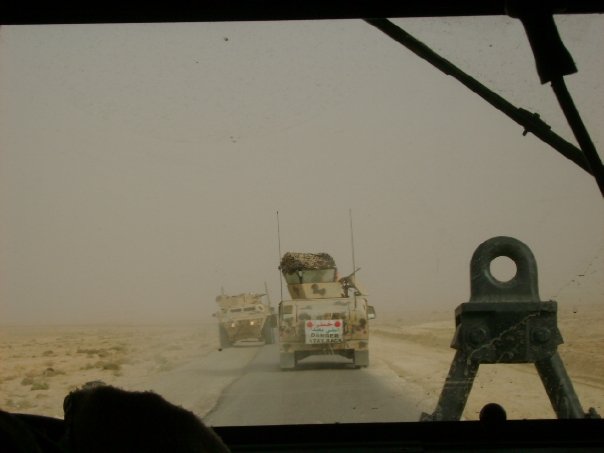
Category Archives: Military

Thoughts Before a Memorial Service

wartired

I am in a hotel in Fredericksburg Virginia tonight as I will be attending a Celebration of Life for Captain Tom Sitsch, United States Navy. As those who follow this site know, Captain Sitsch was my last Commodore at EOD Group Two and though I didn’t know him long he made a big impact in my life when I most needed human compassion. 

I traveled this evening, driving in the bitterly cold dark January night up Interstate 64 and Interstate 95, un-melted snow from the most recent winter storm still covers the ground on either side of the highway. The dark shapes of trees lined the road, silhouetted against the night sky, most stars unseen because of a thin cloud layer.

The trip took about two and a quarter hours, good time if you know how traffic can be on these roads. When I got to the hotel I discovered that I had forgotten by sleep medications and what I call my “docile pills” so I expect that sleep will be a challenge tonight, even though I am quite tired. So I walked over to a nearby restaurant and had a couple of beers and some wings at the bar before coming back to my room.

Captain Sitsch took his life two weeks ago. A war hero, who suffered from PTSD he saw his, career, life and family collapse around him. He didn’t get the help that he needed and as things collapsed he was pilloried in the media. His wife and children had to suffer as well. Living with mental illness is not easy; families often don’t know where to turn when the person that they love falls apart. I wrote about this a number of years ago, my wife has suffered watching the man that she loves struggle with the ravages of PTSD, something that she too knows all too well having been abused as a child. 

This is especially true for military families who are used to their loved one being the strong one. The sad thing is that while this is a big problem in the military, it is also a problem in the civilian world. Some studies estimate that nearly one third of Americans either live with or work with someone afflicted with some kind of mental illness. 

The problem doesn’t just extend to families but the society at large. Our military compared to our population is quite small, all volunteer and quite often isolated from much of society. The horrific pace of wartime deployments and now the shift to doing more with less amid a major reduction in force, even as the wars wind down has a terrible effect on service members and their loved ones.

Those who don’t serve, or have not served do not really understand, even those who are sympathetic and actually care. I think that we will see a phenomena similar to the years after the Vietnam War, when our society rushed to forget the war and were often embarrassed by those who served. Stereotypes of soldiers shown in the media, on the news, or in entertainment then, presented veterans in almost comic book like caricatures, often in the most negative manner possible. Today the media coverage is a mixed bag, some making us to be uber-heroes and supermen, others men and women who deserve pity, and sometimes the negative portrayals that were so common after Vietnam. 

If it was just a media and society issue it be one thing, but even as men like Captain Sitsch fall through the crack there are those in the private sector and their political allies in Congress pushing the government to cut the pay, health and education benefits promised to those that served in the military, even those who came back wounded, or changed by war.

Those wrestling with budgets in Congress, look to solving budgetary woes not by cutting weapons systems that the military no longer wants or needs, or by cutting superfluous bases in their congressional districts. Instead, they choose to cut the benefits that they had promised to veterans and their families before and during the war. The proposed cuts now include health benefits as well as pensions, balanced unfairly on those who have spent the majority of their careers at war, many of whose skills do not translate in the civilian economy.

Of course these actions will have even more drastic effects on military members, veterans and their families. We can expect that more heroes like Captain Sitsch and their families will succumb to the pressures of service and what happens after they leave the service. Divorce, domestic violence, substance abuse and suicide have been on the rise for years in the military and there is no empirical or historical evidence to suggest things will get better anytime soon.

I predict that it will get far worse before it gets better.  Lieutenant General Hal Moore, famous for his book We Were Soldiers Once, and Young noted how his generation of warriors were treated after Vietnam.

“in our time battles were forgotten, our sacrifices were discounted, and both our sanity and suitability for life in polite American society were publically questioned.”   

Sadly, things have not changed that much. Rudyard Kipling wrote in his Poem Tommy: 

“For it’s Tommy this, an’ Tommy that, an’ “Chuck him out, the brute!” But it’s “Saviour of ‘is country” when the guns begin to shoot; An’ it’s Tommy this, an’ Tommy that, an’ anything you please; An’ Tommy ain’t a bloomin’ fool — you bet that Tommy sees!” 

481801_10151367001287059_1003164983_n-2

Tomorrow I will be present to pay my respects to a tragic hero. Tom Sitsch, deserves to be remembered for all the good things that he did defending this country, saving lives and putting himself in danger time and time again. I pray that those present will know the comfort and peace of God as well as the special bond of friendship and family that we share as part of the Brotherhood of War.  I also pray, maybe against hope that our country will not throw veterans under the bus as they have so many times after war, and that no more men or women will have to be overcome by the despair that Captain Sitsch had to live with for God knows how long before he took his life.

Peace

Padre Steve+
7 Comments

Filed under Military, PTSD, remembering friends

1914: The Beginning of a Century of War

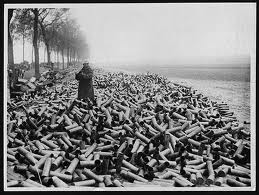
worldwar1-battlefield

This year marks the centennial of the onset of the First World War, a war which ushered in the world that we live today.  It was a war which changed warfare, a war which destroyed a long standing social and political order, a war that radically re-drew national boundaries and a war which planted the seeds of both freedom and tyranny, peace and more war. It was a war like no other before it. 

images-75


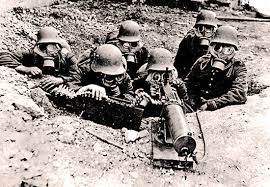
It lasted four years and was fought in Europe, Africa, the Middle East and Asia as well as at sea in every corner of the globe. It was a war which introduced humanity to the full effect of industrialized warfare, carnage on a vaster scale than had ever been seen, and the introduction of aircraft, submarines, tanks and poisoned gas as instruments of war. It was the birth of a new era of war. 

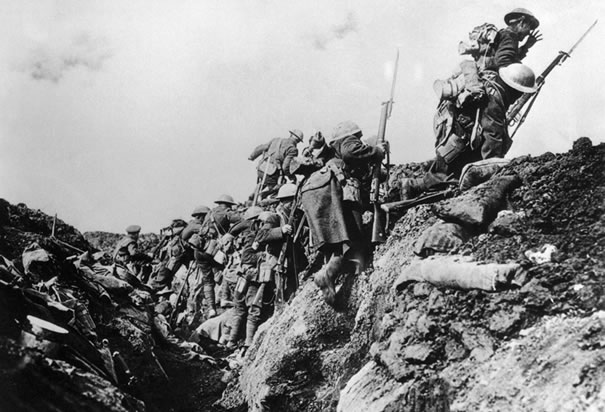
canadian-soldiers-going-over-trench

In terms of the human cost it changed war, amplifying the carnage of the U.S. Civil war by an unimaginable magnitude.  Firepower and weaponry had advanced exponentially in the intervening years, but offensive tactics had remained as they were before.  Military experts remained in denial about the changes, even when the evidence was before their eyes. Regiments charged into battle shoulder to shoulder, relaying on élan to overcome firepower, the French Army outfitted in bright blue uniforms with red trousers and kepi forage hats valiantly attacking German’s outfitted in field gray.  Cavalry retained its place on the battlefield for a brief moment, Uhlans, Lancers, Cuirassiers and Dragoons charged about but found that the modern battlefield was not their place. 

images-74

Old Generals looked to the past for answers, and found none while remaining in denial about the power of the weapons and technology their troops faced. Field Marshal Douglas Haig said in 1915, after nearly 2 million men had fallen on the Western Front The machine gun is a much over rated weapon...”

images-73

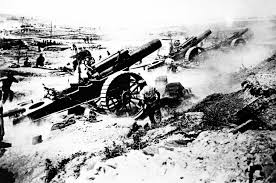
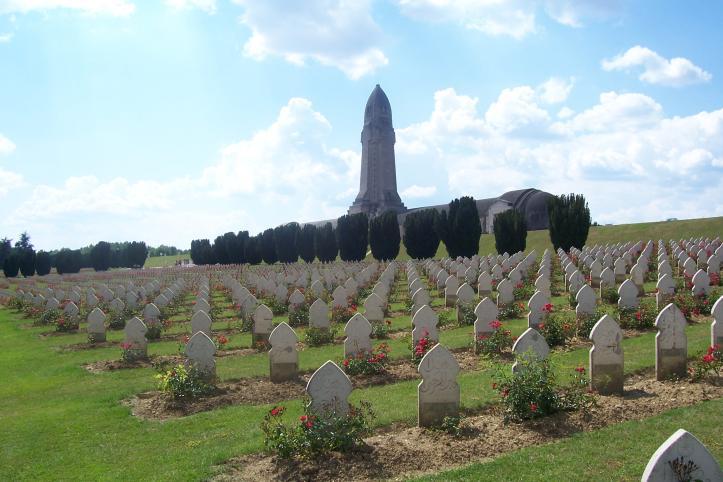
But as the war progressed the instruments of war, particularly the artillery became the weapon of choice for commanders. The symbolism of the massive French Memorial at Verdun, it’s spire shaped like an artillery round is an apt reminder of the power of artillery during the war and the reliance of the combatants on it.

cimetiere_-_douaumont

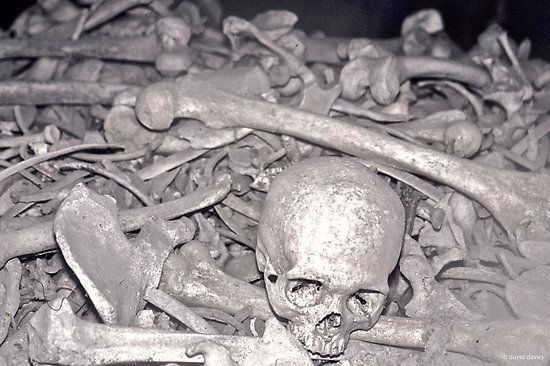
The human cost was horrific. Over 65 million soldiers were called up on all sides of the conflict, of which nearly 37.5 million became casualties, some 57.5% of all soldiers involved. Some countries saw the flower of their manhood, a generation decimated. Russia sustained over 9 million casualties of the 12 million men they committed to the war, a casualty rate of over 76%. The other Allied powers suffered as well.  France lost 6.4 million of 8.5 million, or 73%, Great Britain 3.1 million of nearly 9 million, 35%; Italy 2.2 million of 5.6 million, 39%. Their opponents, Germany, Austria-Hungary and the Ottoman Empire suffered greatly. Germany sustained 7.1 million casualties of 11 million men called up, or nearly 65%, Austria 7 million of 7.8 million, 90% and the Ottoman Empire 975,000 of 2.8 million or 34% of the soldiers that they sent to war.

flat,550x550,075,f

The United States, though a late entry into the war suffered 323,000 casualties of over 4.3 million men called to arms in barely a year of combat, most occurring in the summer and fall of 1918.

Erich Maria Remarque wrote of the carnage and casualties in All Quiet on the Western Front:

“A man cannot realize that above such shattered bodies there are still human faces in which life goes its daily round. And this is only one hospital, a single station; there are hundreds of thousands in Germany, hundreds of thousands in France, hundreds of thousands in Russia. How senseless is everything that can ever be written, done, or thought, when such things are possible. It must be all lies and of no account when the culture of a thousand years could not prevent this stream of blood being poured out, these torture chambers in their hundreds of thousands. A hospital alone shows what war is.”

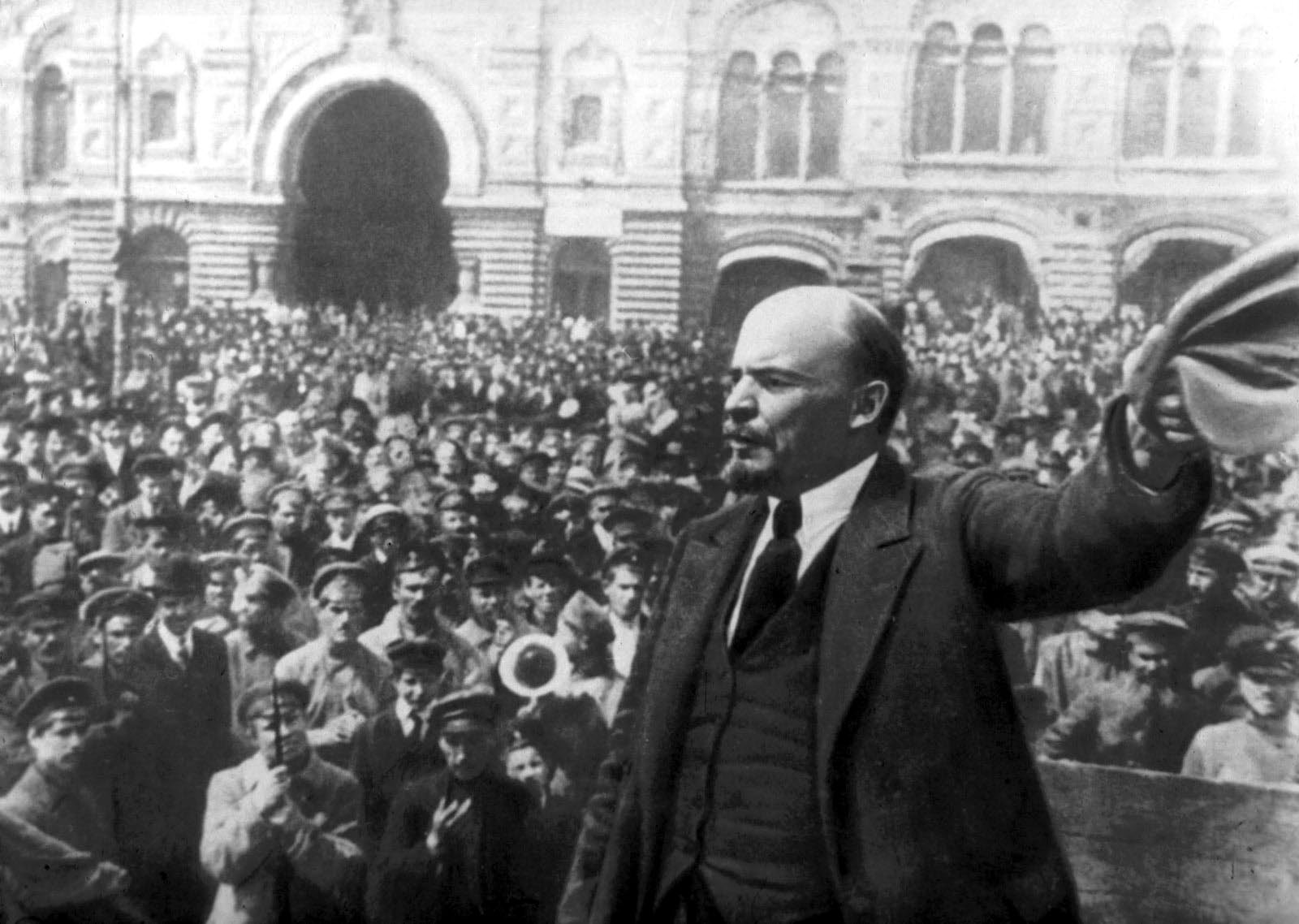
The war brought about the overthrow of Imperial Germany, Imperial Russia, the Austro-Hungarian Empire and the Ottoman Empire. The resultant break up of those empires brought freedom for some in Europe, a change in colonial masters for others in the Middle East, Africa and Asia, as well as civil war, failed attempts at democracy and the establishment of Communist or Fascist dictatorships in Germany, Italy and Russia. 

the-russian-revolution-1917-1923-also-known-as-the-october-revolution-led-by-vladimir-lenin


The promise of a just peace died at the hands of the victors, and the conditions of peace as well as the unrest in Europe eventually brought about another even more horrific Second World War. It was a war to end all war, but the peace became a peace to end all peace.

Lawrence_1519699c-2


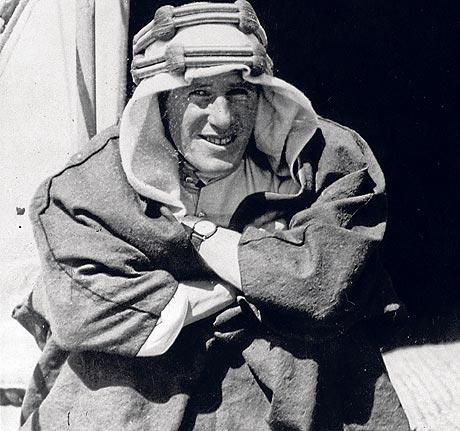
The young men who fought the war had hoped for better, but it was not to be. T. E. Lawrence, or as he is often known “Lawrence of Arabia” wrote after the war:

“We were fond together because of the sweep of open places, the taste of wide winds, the sunlight, and the hopes in which we worked. The morning freshness of the world-to-be intoxicated us. We were wrought up with ideas inexpressible and vaporous, but to be fought for. We lived many lives in those whirling campaigns, never sparing ourselves: yet when we achieved and the new world dawned, the old men came out again and took our victory to remake in the likeness of the former world they knew. Youth could win, but had not learned to keep, and was pitiably weak against age. We stammered that we had worked for a new heaven and a new earth, and they thanked us kindly and made their peace.”

I will be writing a lot about this war in 2014. It is something that we cannot forget. The world today is much like it was in 1914. There have been many small wars in far off places fought by a few professionals of the great powers. Tensions rise as established nations and empires shrink and new powers rise to challenge them. The terrible peace and the borders established by Sykes-Picot continue to bring war and misery to the world today.

What I write will include stories of soldiers, battles, weapons and diplomacy and the cost of war.  I will do so because it is still pertinent, it still matters. The terrible costs need to be recounted, because our world could easily fall into a similar tragedy.  

princip460x276

British historian Max Hastings wrote about the changes in Europe leading up to the World War, noting that they occurred in approximately the same span of time as have transpired since the attacks of September 11th 2001. Hasting records in his book Catastrophe 1914: Europe Goes to War that “Austrian writer Carl von Lang wrote early in 1914: “There is a feeling that events re in the air; all that is unpredictable is their timing. Perhaps we will see several more years of peace, but it is equally possible that overnight some tremendous upheaval will happen.”  

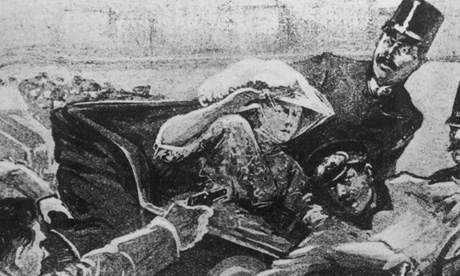
Otto von Bismarck prophetically wrote: “If there is ever another war in Europe, it will come out of some damned silly thing in the Balkans.” In July 1914, in the provincial town of  Sarajevo, the assassination of an unappreciated and unloved Austrian Archduke, Franz Ferdinand, who was likely the one man in that country who would have tried to avoid war, proved to be the match that lit the kindling which set off the conflagration of the First World War. 

Peace

Padre Steve+

1 Comment

Filed under History, Military, News and current events

The Enduring Crisis: Suicides in Veterans Spiking

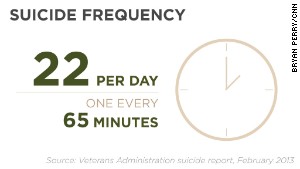
126642_600The Veterans Administration released a disturbing report that male veterans under 30 years old saw a 44% increase in the rate of suicide. The rate for women veterans increased by 11%. About 22 veterans a day committed suicide in 2013. That did not count those still on active duty numbers which are still high but have dropped somewhat since 2012 and previous years.

The VA National Mental Health Director for Suicide Prevention, Jan Kemp said “Their rates are astronomically high and climbing…” Kemp postulated that reasons for the spike might include “the pressures of leaving military careers, readjusting to civilian life and combat injuries like post-traumatic stress disorder…”

I believe that the stigma that many felt about getting psychological help while they were in the military continues on when they enter civilian life. Unlike the military where there is still some sense of camaraderie and a chance that the chain of command might force a service member to get help, no corresponding structure or community exists in the civilian world. Young veterans are often isolated and face new stresses while they are already on edge. Many find that the military occupation specialities that they trained for have no direct civilian counterpart, leaving them struggling in the civilian job market. Combat injuries as well as injuries sustained in training often continue on, limiting what they can do and the unseen injuries of PTSD, Traumatic Brain Injury and Moral Injury, often undiagnosed and untreated lurk in the background.

20131108-ArlingtonVA-MilitaryInforgraphic

This is a national tragedy and crisis. Many of these young men and women are among the best and brightest. They volunteered to serve in time of war and now as the military, especially the Army and Marine Corps begin to shed large numbers of troops, many more will be thrust into a world that they may be ill equipped to survive.

They will attempt to go to work or attend school, quite often alone. There they will be surrounded by people who have no idea of the issues that they face or understanding of the military world that they left, or the places that they served. I think this social isolation will be a killer for many.

130919123908-suicide-frequency-story-body

My recommendation is that people who work or go to school with these young veterans, or for that matter any veteran get to know them. Help them adjust to the world and keep an eye on them. Ask them how they are doing and just show that you care. You do not have to be a veteran to do that. Likewise get to know about the resources that are available for veterans and help direct them to them. Have the courage to care.

Resources include the Veterans Crisis Hotline which is staffed 24 hours a day, 7 days a week. They can be reached at (800)-273-8255, press 1, or here to chat online. They also allow veterans to send a text message to 838255 to receive confidential support 24 hours a day.

Another resource is the Real Warriors Live Chat. The a trained health resource consultant is ready to talk, listen and provide guidance and resources. They can be reached by calling 866-966-1020 or going to their live chat service here http://www.realwarriors.net/livechat.

Afterdeployment.org http://afterdeployment.t2.health.mil offers wellness resources for the Military Community. Service members in transition to civilian life can contact inTransition by calling 800-424-7877 or at their website http://www.health.mil/InTransition/default.aspx

To me this is personal. I still suffer from the effects of PTSD and I have known far too many veterans who have taken their own lives, or struggle with mental health issues, physical injuries and illness, or social isolation. This week a brilliant and heroic senior officer I knew, who helped me when I was collapsing due to the effects of PTSD took his own life. This is something that all of us have a stake in. Please help look out for our veterans.

Peace

Padre Steve+

5 Comments

Filed under healthcare, Military, News and current events, PTSD

“A Foreign World”: The High Cost of Coming Home from War

295_26912117058_5652_n

For me it began in February 2008 when on the way back from Iraq the military charter aircraft bringing us home stopped in Ramstein Germany. After a few hour layover we re-boarded the aircraft but we were no longer alone, the rest of the aircraft had been filled with the families of soldiers and airmen stationed in Germany. Just days before most of us had been in Iraq or Afghanistan. The cries of children and the intrusion of these people, not bad people by any means on our return flight was shocking, it was like returning to a world that I no longer knew.

I think that coming home from war, especially for those damaged in some way, in mind, body or spirit is harder than being at war. In that thought I am not alone. Erich Maria Remarque in his classic novel All Quiet on the Western Front wrote:

“I imagined leave would be different from this. Indeed, it was different a year ago. It is I of course that have changed in the interval. There lies a gulf between that time and today. At that time I still knew nothing about the war, we had been only in quiet sectors. But now I see that I have been crushed without knowing it. I find I do not belong here any more, it is a foreign world.” Erich Maria Remarque in All Quiet on the Western Front

Likewise, Guy Sager a French-German from the Alsace and veteran of the Grossdeutschland Division on the Eastern Front in World War II noted at the end of his book The Forgotten Soldier: 

“In the train, rolling through the sunny French countryside, my head knocked against the wooden back of the seat. Other people, who seemed to belong to a different world, were laughing. I couldn’t laugh and couldn’t forget.” Guy Sager in The Forgotten Soldier

I have been reminded of this several times in the past week. It began walking through a crowded Navy commissary on Saturday, in the few minutes in the store my anxiety level went up significantly. On Tuesday I learned of the death of Captain Tom Sitsch my last Commodore at EOD Group Two, who died by his own hand. His life had come apart. After a number of deployments to Iraq as the Commander EOD Mobile Unit 3 and of Task Force Troy he was afflicted with PTSD. Between June of 2008 and the end of 2009 he went from commanding an EOD Group to being forced to retire.  Today I had a long talk with a fairly young friend agonizing over continued medical treatments for terminal conditions he contracted in two tours in Iraq where he was awarded the Bronze Star twice.

I have a terrible insomnia, nightmares and night terrors due to PTSD. My memories of Iraq are still strong, and this week these conditions have been much worse. Sager wrote:

“Only happy people have nightmares, from overeating. For those who live a nightmare reality, sleep is a black hole, lost in time, like death.”

Nearly 20 years after returning from war, a survivor of the 1st Battalion 308th Infantry, the “Lost Battalion” of World War One, summed up the experience of so many men who come back from war:

“We just do not have the control we should have. I went through without a visible wound, but have spent many months in hospitals and dollars for medical treatment as a result of those terrible experiences.”

Bradley-12-2

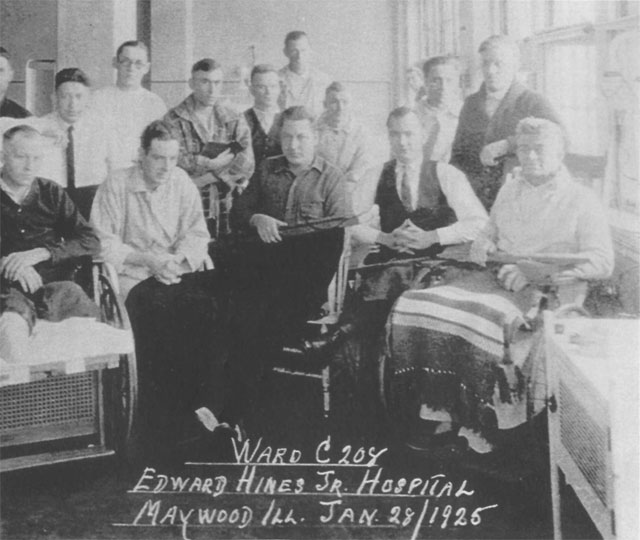
Two time Medal of Honor winner Major General Smedley Butler toured Veterans hospitals following his retirement from the Marine Corps. He observed the soldiers who had been locked away. In his book War is a Racket:

“But the soldier pays the biggest part of this bill. If you don’t believe this, visit the American cemeteries on the battlefields abroad. Or visit  any of the veterans’ hospitals in the United States….I have visited eighteen government hospitals for veterans. In them are about 50,000 destroyed men- men who were the pick of the nation eighteen years ago. The very able chief surgeon at the government hospital in Milwaukee, where there are 3,800 of the living dead, told me that mortality among veterans is three times as great as among those who stayed home.”

Similarly Remarque wrote in All Quiet on the Western Front:

“A man cannot realize that above such shattered bodies there are still human faces in which life goes its daily round. And this is only one hospital, a single station; there are hundreds of thousands in Germany, hundreds of thousands in France, hundreds of thousands in Russia. How senseless is everything that can ever be written, done, or thought, when such things are possible. It must be all lies and of no account when the culture of a thousand years could not prevent this stream of blood being poured out, these torture chambers in their hundreds of thousands. A hospital alone shows what war is.”

Lt.ColonelCharlesWhiteWhittlesey

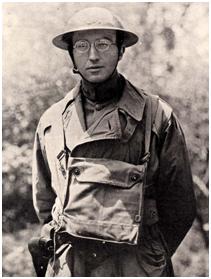
Sometimes even those who have been awarded our Nation’s highest award for valor succumb to the demons of war that they cannot shake, and never completely adjust to life at “home” which is no longer home. For them it is a different, a foreign world to use the words of Sager and Remarque. Lieutenant Colonel Charles Whittlesey won the Congressional Medal Medal of Honor as Commander of 1st Battalion 308th Infantry, the “Lost Battalion” in France. After the war he was different. He gave up his civilian law practice and served as head of the Red Cross in New York. In that role, and as the Colonel for his reserve unit, he spent his time visiting the wounded who were still suffering in hospitals. He also made the effort to attend the funerals of veterans who had died. The continued reminders of the war that he could not come home from left him a different man. He committed suicide on November 21st 1921not long after serving as a pallbearer for the Unknown Soldier when that man was interred at Arlington National Cemetery.

In the eulogy Judge Charles L. Hibbard noted:

“He is sitting on the piazza of a cottage by the sea on a glorious late September day but a few weeks ago. . . He is looking straight out to sea, with naught but sea between him and that land where lie so many of his boys. The beating surf is but an echo, the warm, bright sunshine, the blue sky, the dancing waves, all combine to charm. But a single look at his face and one knows he is unconscious of this glory of Nature. Somewhere far down in the depths of his being or in imagination far off across the waters he lives again the days that are past. That unconscious look has all the marks of deep sorrow, brooding tragedy, unbearable memories. Weeks pass. The mainspring of life is wound tighter and tighter and then comes the burial of the Unknown Soldier. This draws the last measure of reserve and with it the realization that life had little now to offer. This quiet, reserved personality drew away as it were from its habitation of flesh, thought out the future, measured the coming years and came to a mature decision. You say, ‘He had so much to live for – family, friends, and all that makes life sweet.’ No, my friends, life’s span for him was measured those days in that distant forest. He had plumbed the depth of tragic suffering; he had heard the world’s applause; he had seen and touched the great realities of life; and what remained was of little consequence. He craved rest, peace and sweet forgetfulness. He thought it out quietly, serenely, confidently, minutely. He came to a decision not lightly or unadvisedly, and in the end did what he thought was best, and in the comfort of that thought we too must rest. ‘Wounded in action,’ aye, sorely wounded in heart and soul and now most truly ‘missing in action.’”

Psychologist and professor Dr Ari Solomon analyzed the case of Colonel Whittlesey and noted:

“If I could interview Whittlesey as a psychologist today, I’d especially have in mind … the sharp discrepancy between the public role he was playing and his hidden agony, his constant re-exposure to reminders of the battle, his possible lack of intimate relations, and his felt need to hide his pain even from family and dearest friends.”

I wish I had the answer. I have some ideas that date back to antiquity in the ways that tribes, clans and city states brought their warriors home. The warriors were recognized, there were public rituals, sometimes religious but other times not. But the difference is that the warriors were welcomed home by a community and re-integrated into it. They were allowed to share their stories, many of which were preserved through oral traditions so long that they eventually were written down, even in a mythologized state.

But we do not do that. Our society is disconnected, distant and often cold. Likewise it is polarized in ways that it has not been since the years before our terrible Civil War. Our warriors return from war, often alone, coming home to families, friends and communities that they no longer know. They are misunderstood because their experience is not shared by the population at large. The picture painted of them in the media, even when it is sympathetic is often a caricature.  Their camaraderie with the friends that they served alongside is broken by distance and the frenetic pace of our society. Remarque wrote “We were all at once terribly alone; and alone we must see it through.”

If we wonder about the suicide epidemic among veterans we have to ask hard questions. Questions like why do so many combat veterans have substance abuse problems and why is it that approximately one in ten prisoners serving time are veterans? It cannot be simply that they are all bad eggs. Many were and are smart, talented, compassionate and brave, tested and tried in ways that our civilian society has no understanding for or clue about. In fact to get in the military most had to be a cut above their peers. We have to ask if we are bringing our veterans home from war in a way that works. Maybe even more importantly we have to ask ourselves if as a culture if we have forgotten how to care about each other. How do we care for the men and women who bear the burden of war, even while the vast majority of the population basks in the freedom and security provided by the soldier without the ability to empathize because they have never shared that experience.

For every Tom Sitsch, Charles Whittlesey or people like my friend, there are countless others suffering in silence as a result of war. We really have to ask hard questions and then decide to do something as individuals, communities and government to do something about it. If we don’t a generation will suffer in silence.

Peace

Padre Steve+
2 Comments

Filed under History, iraq,afghanistan, Military, PTSD

Ending the Stigma: PTSD, TBI and Moral Injury in Senior Leaders

295_26911892058_4301_n

Yesterday I wrote about the death of my former Commodore at EOD Group Two, Captain Thomas Sitsch who committed suicide on Monday outside a New Hampshire Hospital. Captain Sitsch was another casualty of the longest wars this nation has engaged.

Many senior leaders in the military, officers and senior enlisted of every service have frequently deployed to Iraq, Afghanistan as well as other locations in the war on terror. Since the war has been going over 12 years many have spent over half of their careers preparing for, engaging in, or recovering from wartime deployments. Many have suffered physical injuries as well as the unseen injuries of war, PTSD, Traumatic Brain Injury and Moral Injury. Unfortunately they are often the last people to seek help.

In the past few years I have personally known or know of a number of senior officers and senior enlisted personnel who have committed or attempted suicide or had their careers destroyed because of their actions. Some like Captain Sitsch were diagnosed with PTSD, others displayed some or all of the indicators but either refused help or put getting help aside in order to “stay in the fight.”

In the past couple of years the Commanding Officer of a deployed SEAL Team committed suicide in Afghanistan, two Marine Expeditionary Unit commanding officers were relieved after incidents that probably have their genus in PTSD, or Moral Injury. I would almost bet that some of the issues that some of our senior leaders have been relieved of their duties for are also the result of untreated PTSD, TBI, Combat Stress Injury or Moral Injury.

dallaire-rwanda

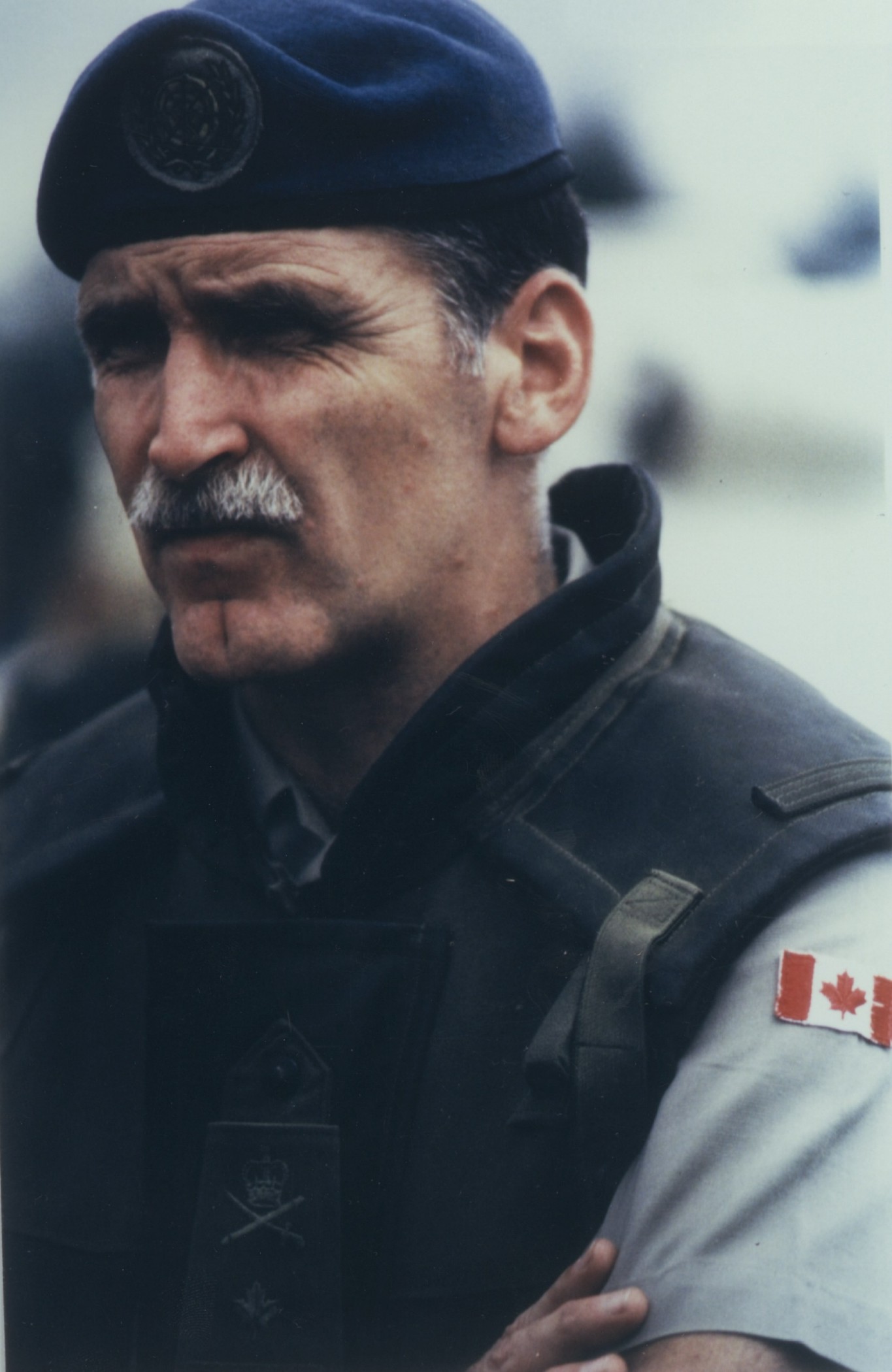
Retired Canadian General Romeo Dallaire still suffers from PTSD following his command of the UN Rwanda force in the middle of that country’s genocide. He attempted suicide in 2000 and still suffers. Last month he was involved in a car accident on his way to work in the Canadian Senate when he fell asleep at the wheel of his car. He had not slept the previous night due to reliving the horrors of that experience. As someone who still suffers chronic insomnia related to my PTSD I understand how this can happen.

The PTSD of T. E. Lawrence’s experience of war in the Middle East in the First World War shows in the pages of his classic Seven Pillars of Wisdom and various letters. Lawrence, who could have risen to high rank in the military or the foreign service basically went underground under an assumed name to serve in the ranks of the Royal Air Force in the 1920s. He wrote to Eric Kennington in 1935 not long before his death in a motorcycle accident:

“You wonder what I am doing? Well, so do I, in truth. Days seem to dawn, suns to shine, evenings to follow, and then I sleep. What I have done, what I am doing, what I am going to do, puzzle and bewilder me. Have you ever been a leaf and fallen from your tree in autumn and been really puzzled about it? That’s the feeling.”  

That is a part of our military culture. Leaders are under a great deal of pressure to accomplish often impossible missions and to take care of their troops. Many have been exposed to repeated combat trauma and had to bury more than one of their troops, often after the person commits suicide. Many anguish over the deaths, blame themselves and heap guilt on top of grief on top of traumatic or moral injury.

As I said many do not seek help due to an overwhelming cultural stigma against getting help, or “going to the wizard.” Likewise they know that that the reality is that if they seek help them may never command or be assigned to sensitive career enhancing billets again. As one senior leader told me “its hard when they say if you have issues and they are known that you can still have a successful career, but you will never be promoted or selected to a critical position, again.” 

1517080376

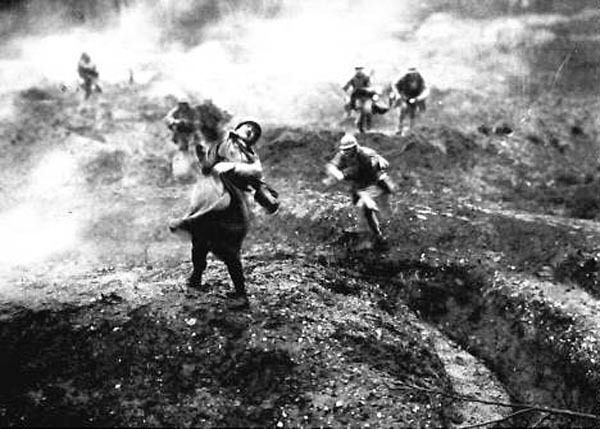
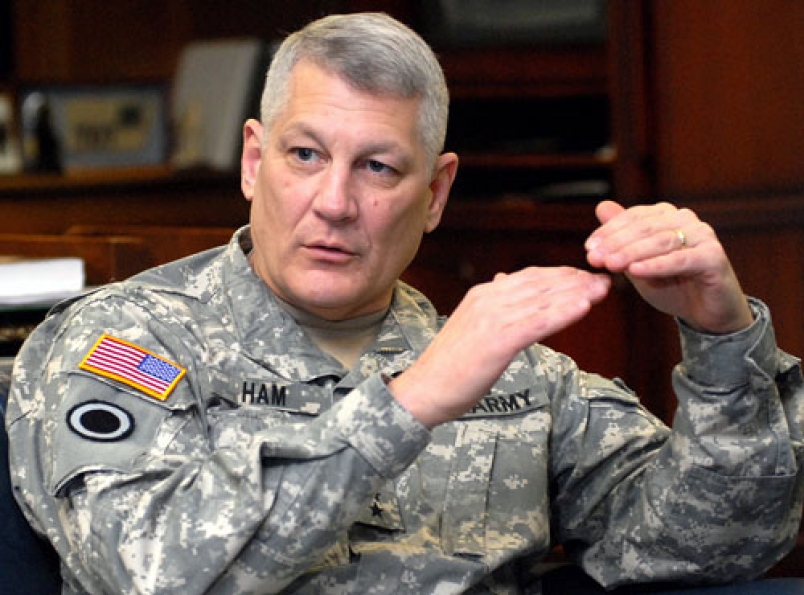
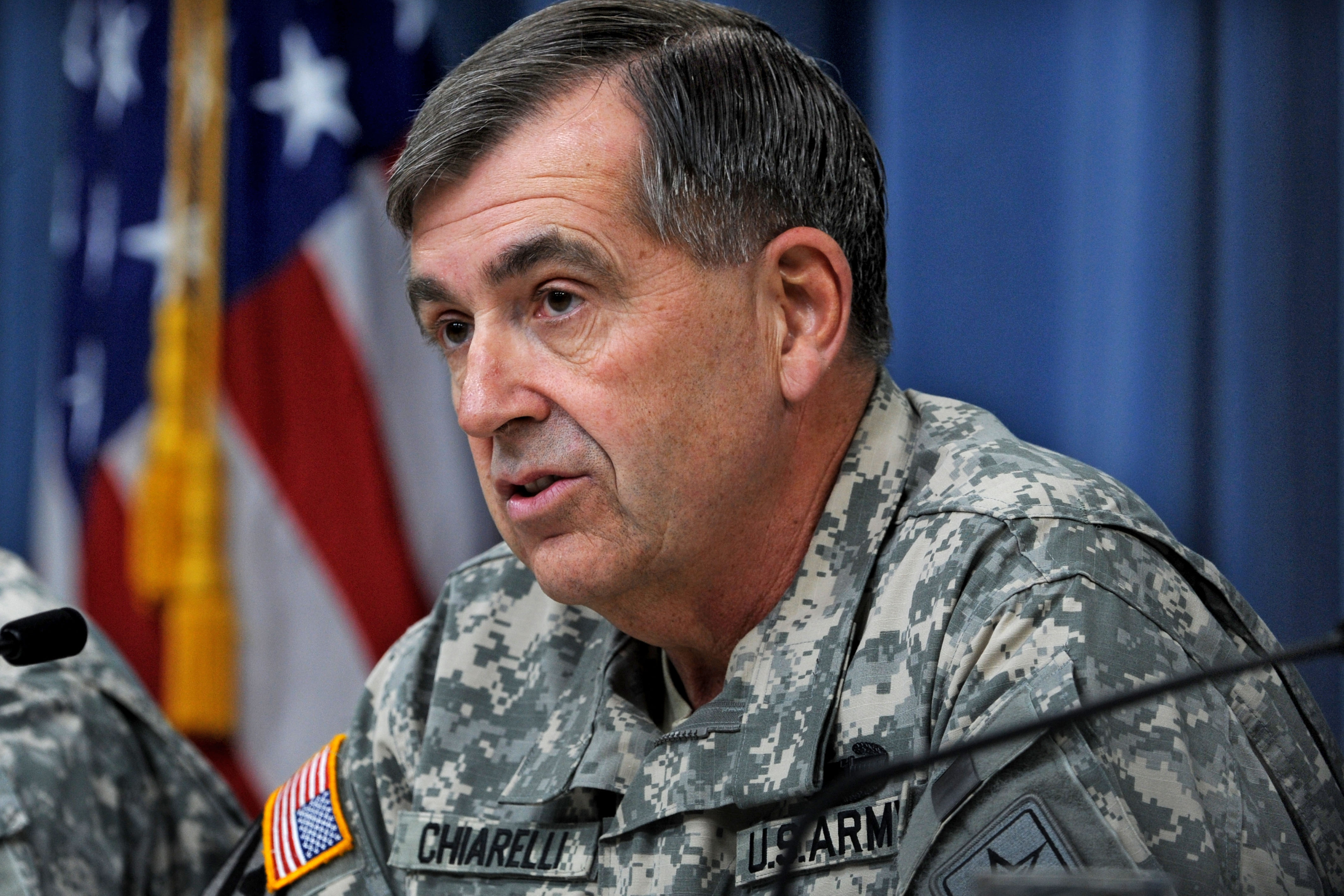
A few senior leaders have admitted to suffering from the symptoms of Combat Stress Injury and sought treatment. The most senior was General Carter Ham who began to suffer symptoms following his deployment to Mosul Iraq in 2004. Major General Gary Patton has also sought help for PTSD. Lieutenant General Peter Chiarelli, now retired has taken up the cause to reduce the stigma seeking to have PTSD renamed Post Traumatic Stress Injury instead of “disorder” because it is an injury.

110119-D-9880W-005.JPG

I wish I had an answer. For me it took a complete crash to get help as well as the assistance of two fine EOD officers, Admiral Frank Morneau and Captain Sitsch. Even with that initial assistance I still feel a certain stigma. My experience is that senior leaders who admit to this and seek treatment often become radioactive. I feel this most often around other chaplains. I am sure that senior leaders probably feel the same way when they are around others who either do not have the experience or who are trying to bury theirs.

One thing that I do think would be helpful is that instead of promoting stigma would be to stand alongside each other. Relationships are key to this and while professional help is good the only thing that can take away the stigma is to get back to standing beside each other in crisis rather than abandoning those who struggle. We are the willing participants in a zero defect culture which sees struggle as weakness and a mark of failure. The sad thing is that under our current system many of the greatest military leaders in history would not be promoted. It is no wonder the leaders who we have invested so much in developing and have sacrificed so much of themselves do not seek help.

grant-and-sherman-122304

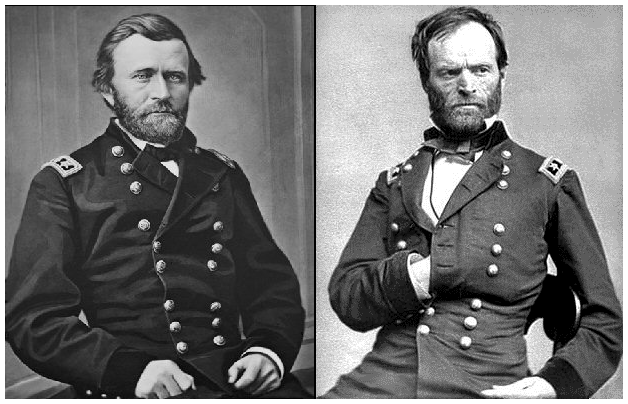
I like the example of Ulysses Grant and William Tecumseh Sherman. Both had significant problems after they left the Army after the Mexican War and in the early days of the Civil War. Grant struggled with drinking and Sherman suffered terrible depression. Sherman said of their relationship: “Grant stood by me when I was crazy, and I stood by him when he was drunk, and now we stand by each other.”

The reality is that in today’s more corporate military culture that neither of these men would have ever been promoted to high command. They would have been shunted aside.

Something has to change if we are to end this terrible scourge. I hope that General Ham and General Chiarelli are working with mental health professionals are able to help change the culture, but then by themselves they cannot. That has to start as we say in the Navy “at the deck plates.” It is up to us to change our culture, to be warriors who look after our fellow warriors in their time of need and who by our actions take away the stigma that keeps our brothers and sisters from getting help.

Peace

Padre Steve+
2 Comments

Filed under iraq,afghanistan, Military, News and current events, PTSD

The Never Built Battlecruisers of 1921: The G3, Amagi and Lexington Classes

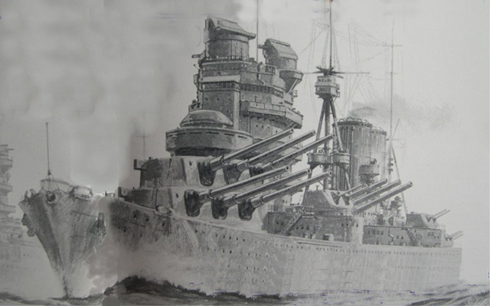
artist

Artists Depiction of G3 Battlecruiser 

As the First World War ended a new Naval Race was heating up. The United States had announced its intention during the war to build a navy second to none while Imperial Japan was making plans for a fleet that would give it superiority in the Western Pacific. The British, though still be far the largest naval power in the world were burdened by the massive costs of war and empire, but also seeking to maintain their naval dominance.

The ships known as battle cruisers were first built by the British Royal Navy as a compliment to the all big gun Dreadnought battleships. The Battle Cruiser concept was a ship of roughly the same size and firepower as a Battleship but sacrificing protection for greater speed, endurance and range.  and Japan joined in the Battle Cruiser race before and during the war. The United States had concentrated on Battleships.

800px-InvincibleBlowingUpJutland1916

HMS Invincible Blowing Up at Jutland 

During the war the weaknesses of the type were exposed during the Battle of Jutland where three British Battle Cruisers, the HMS Invincible, HMS Indefatigable and HMS Queen Mary blew up with the loss of most of their crews of the  3311 officers and sailors on the ships only 26 survived. The HMS Lion was almost lost in a similar manner but for the heroic actions of her crew. The British ships had glaring deficiencies in armor protection and the arrangement of their ammunition magazines and hoists which certainly contributed to their loss. Their German counterparts on the other hand proved much tougher and though all sustained heavy damage while engaging British Battleships and Battle Cruisers, only one the Lützow was lost. She absorbed over 30 hits from large caliber shells and only lost 128 crew members.

h60404

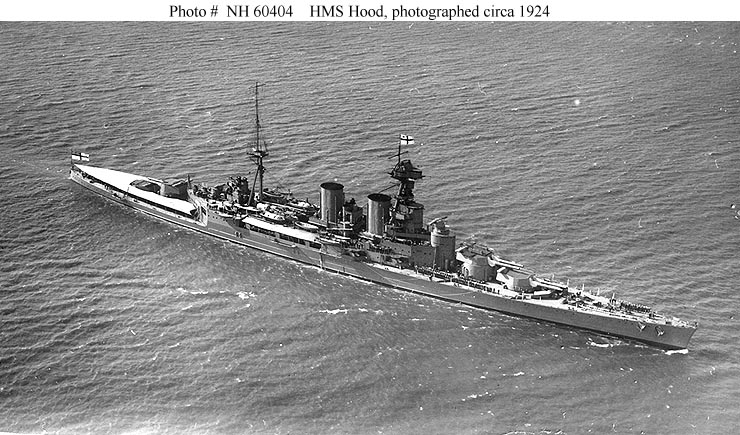
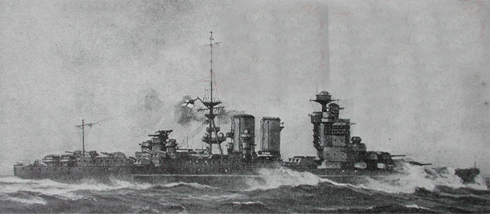
As the war progressed other Battle Cruisers were built, the British launched the HMS Repulse and HMS Renown and completed the HMS Hood shortly after the war was over. The Japanese built the four ship Kongo class from a British design. As the powers embarked on the next Naval Race planners and naval architects designed ships of massive firepower, better protection and higher range and speed. All would have been better classed as Fast Battleships.

The British designed and began construction on the G3 class in 1921, the Japanese the Amagi Class, and the United States the Lexington Class. However the construction and completion of these ships as Battle Cruisers was prevented by the Washington Naval Treaty.

invincible 490

The treaty was ratified in 1922 limited the United States and Great Britain to a maximum of 525,000 tons in their battle ship fleets and 125,000 tons in aircraft carriers.  The Japanese agreed to a limit of 315,000 tons and the French and Italians 175,000 tons each. Tonnage for battleships was limited to a maximum of 35,000 tons with a limitation on guns size to 16 inches.  Since the bulk of the ships planned or being built by the US and Japan exceeded those limits they would be effected more than the British whose post war shipbuilding program had not begun in earnest, in fact the G3 Class had just been approved for construction.

The G3 class would have comprised four ships and been similar to the N3 Class Battleships. They were very well balanced ships and would have mounted nine 16” guns in three turrets on a displacement of 49,200 tons and deep load of 54,774 tons. They had an all or nothing protection plan meaning that the armored belt was concentrated in vital areas around the armored citadel, conning tower, turrets and magazines and engineering spaces. Their armor belt would have ranged from 12-14 inches, deck armor from 3-8 inches, conning tower 8 inches, barbettes 11-14 inches, turrets 13-17 inches and bulkheads 10-12 inches. Their propulsion system of 20 small tube boilers powering 4 geared steam turbines connected to 4 propeller shafts would have produced 160,000 shp with a designed speed of 32 knots.

The four ships, none of which were named were ordered between October and November of 1921. Their construction was suspended on November 18th 1921 and they and the N3 Battleships were cancelled in February 1922 due to the limitations of the Washington Naval Treaty. Many concepts of their design were incorporated in the Nelson Class Battleships.

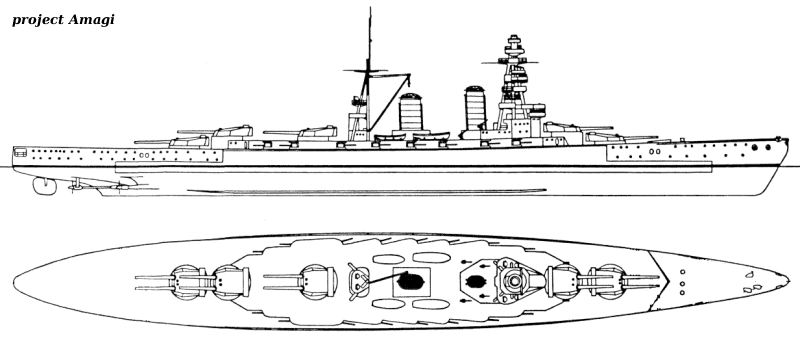
rys-amagi

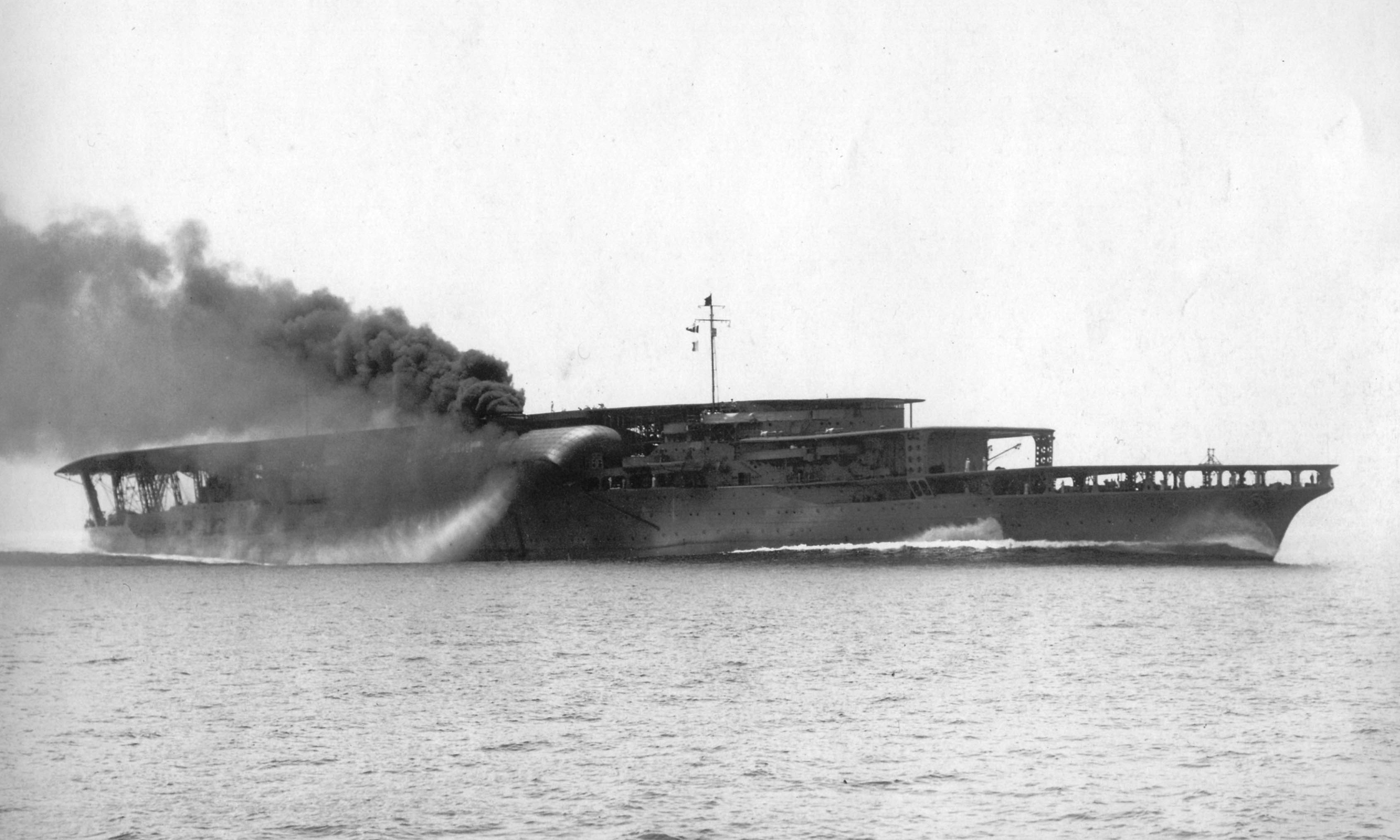
Amagi Class as Designed, Akagi as Completed (below) 

JapaneseAircraftCarrierAkagi3Deck_cropped

The four planned Japanese Amagi Class ships would have mounted ten 16” guns on a displacement of 47,000 tons at full load. Their propulsion system 19 Kampon boilers powering four Gihon turbines would have given them a maximum speed of 30 knots, They would have had less protection than the G3 ships being more of a traditional Battle Cruiser design. As a result of the Washington Naval Treaty the Japanese elected to convert two of the ships, the Amagi and Akagi to aircraft carriers. Amagi was destroyed on the ways during the great Tokyo earthquake and Akagi was completed as a carrier. The other two vessels were scrapped on the ways.

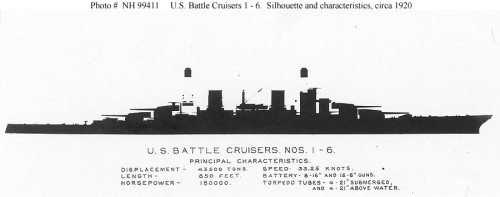
lexington-class-battle-cruisern11978

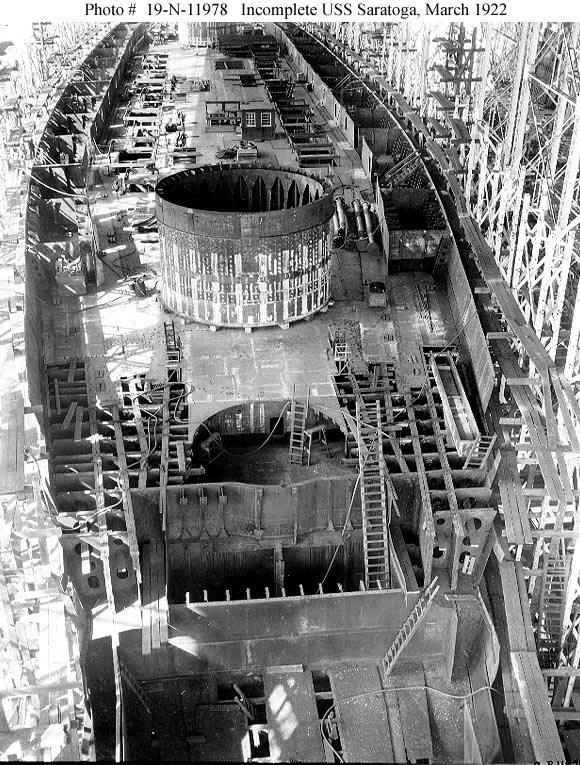
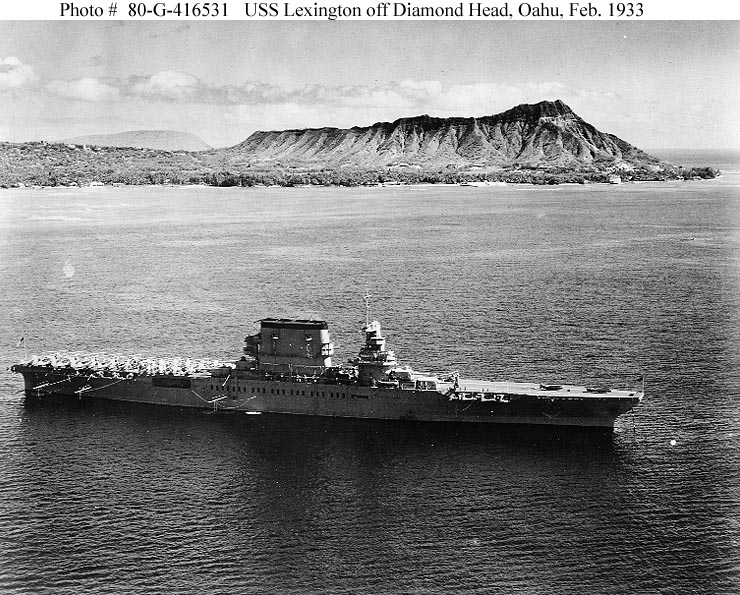
The United States Navy planned the six ship Lexington Class. These ships would have mounted eight 16” guns on a ship displacing 43,254 tons at full load. They would have had a maximum speed of 33 knots being powered by 16 boilers which drove 4 GE electric turbines producing 180,000 shp. It was a massive engineering plant and the class did not have as heavy armor protection as either the G3 or Amagi classes but were superior in speed as well as endurance. Upon ratification of the Washington Naval Treaty four of the six ships were cancelled and the remaining two, the Lexington and Saratoga competed as aircraft carriers.  Had any of the ships been completed as Battle Cruisers it is likely due to their speed that they would have operated primarily with the the carriers that the US Navy built during the 1930s.

g416531

One can only speculate what the navies of World War II would have looked like had the Washington and the subsequent London Naval Treaties not been ratified. One can also only imagine how the war at sea would have been different had the ships completed as carriers been completed as Battle Cruisers.

However that was not to be, of the planned 14 ships of these three classes only three were completed, all as aircraft carriers. Thus they are an interesting footnote in the annals of naval ship design and not much more.

Until tomorrow,

Peace

Padre Steve+
4 Comments

Filed under History, Military, Navy Ships, US Navy

Padre Steve’s Christmas Journey of Healing

996759_10152169414832059_1833080489_n

“God weeps with us so that we may one day laugh with him.” Jürgen Moltmann

Christmas is a special time for me, it always has been but in spite of that there were times that I took the faith element for granted. I believed and my faith in God, for me the Christian God, Father, Son and Holy Spirit was unquestioned. I knew the Scriptures, the Creeds and the Councils and I felt that my faith in a sense was untouchable. I was sure of it, in fact almost cocksure or arrogant about it. That came out in published writings in a very conservative Catholic monthly, the New Oxford Review back in 2000-2001.

For me the elements of my faith were very much intellectual. I could see other points of view but if I disagreed with them enough I would engage them with the purpose of defeating them. Of course this usually went to theological methods, history and hermeneutics. As far as those that lost their faith it was something that I had difficulty comprehending. Not that I was unsympathetic or uncaring of them or their plight, but I didn’t see how it could happen to me.

But that was before Iraq. That was before PTSD, moral injury and my own crisis of faith when I returned from the Iraq War in 2008.  That changed me as war has changed so many others before. Guy Sager wrote of his return from war in his classic The Forgotten Soldier:

“In the train, rolling through the sunny French countryside, my head knocked against the wooden back of the seat. Other people, who seemed to belong to a different world, were laughing. I couldn’t laugh and couldn’t forget.” 

iraq christmas

My return instigated a crisis of faith, I felt like I still belonged in Iraq and home seemed like a foreign land.  In the crisis I was for all practical purposes I was an agnostic trying to believe and feeling abandoned by God and many of his people, especially clergy.  Commodore Tom Sitsch at EOD Group Two, a veteran of much combat asked me “where does a Chaplain go for help?” I told him “not to other Chaplains or clergy.”

That crisis etched a permanent scar in my soul which led to some fairly major changes in my life.  It forced me to enter what Saint John of the Cross called the “Dark Night of the Soul.”

I will not tell of how my great spiritual disciplines and intellect helped me get through the crisis, as they did not. I found it hard to pray or believe in anything for nearly two years as I struggled with abandonment. I felt that God, the Church and the Navy had abandoned me.  The only thing that kept me going was my profound sense of vocation as a Priest and Chaplain and commitment to others who were suffering.

I was losing my battle with PTSD during that time, depressed, anxious and despairing I threw myself into my work among the critically ill ICU patients and those that cared for them.  Christmas Eve of 2008 was spent in despair as I wandered through the darkness on a cold night after leaving Mass because I could not get through it.

Though I found a community and camaraderie among those that I worked with and tried to provide spiritual care,  my own condition grew worse.  I was so bad enough that my clinical duties had to be curtailed over my objections in September of 2009.

I still stood the overnight duty and filled in for others as needed, but for a number of months I had no clinical assignments.  That meant that others in our minimally staffed department had to fill in for me. I am sure that they resented that, especially because before this I often worked 80-90 hours a week mostly in our ICUs and the staff of the ICUs now expected that kind of intensive ministry and support.

But in my desperation I was greeted with a surprise. On one of the on call nights not long before Christmas I received a call to the ER to provide the last rites to an elderly retired Navy Medical Doctor.  The man was a saint, faithful to God, his Church and the community. For years he dedicated much of his practice to the poorest members of the community, delivering babies for women with no insurance and caring for prisoners in the Portsmouth City Jail.  He breathed his last as I prayed this prayed the prayer of commendation following the anointing and something strange happened. I felt the presence of God for the first time since Christmas of 2007 in Iraq. It is too this day hard to explain.

Something miraculous happened that night and by Christmas Eve I realized that something was happening to me. As I wrote in Padre Steve’s Christmas Miracle on Christmas Eve of 2009:

“Mid afternoon I was walking down the hall and I experienced a wave of emotion flood over me, and unlike the majority of emotions that I have felt in the past couple of years this was different.  It was a feeling of grace and I guess the presence of God.  I went up and talked with Elmer the shrink about what I was feeling and the experience was awesome, I was in tears as I shared, not the tears of sadness, but of grace.  I am beginning to re-experience the grace of God, something that has been so long absent that I did not expect it, at least right now.  I didn’t do anything differently; I certainly was not working extra hard to pray more, get more spiritual or pack my brain full of Bible verses.  I was too far gone to do those things.  It was all I could do many mornings just to get out of bed and come to work.”

Since that time I have continued to recover faith and belief. I cannot say that it is the same kind of faith that I had before Iraq. This was a different kind of faith.  It was faith born of the terrible emptiness and pain of abandonment and despair, a faith that is not content with easy answers and not afraid to ask questions.  It is a faith in Jesus Christ, the crucified one who’s image we see hanging from the crucifix and adorning icons of the Crucifixion. It is as Jürgen Moltmann wrote in The Crucified God:

“The Symbol of the Crucifix in church points to the God who was crucified not between two candles on an altar, but between two thieves in the place of the skull, where the outcasts belong, outside the gates of the city. It is a symbol which therefore leads out of the church and out of religious longing in to the fellowship of the oppressed and abandoned. On the other hand, it is a symbol which calls the oppressed and godless into the church and through the church into the fellowship of the crucified God”

My Philosophy of Religion Professor, Dr. Yandall Woodfin at Southwestern Baptist Theological Seminary told us in class that until we had “dealt with the reality of suffering and death we were not doing Christian theology.” At the time the words were offensive to me, but by the time I had graduated and also done a year of Clinical Pastoral Education they became a part of my experience. However that did not prepare me for the darkness that I lived in from February of 2008 until that Christmas Eve of 2009.  I would say that in addition to Dr Woodfin’s understanding of grappling with suffering and death that one has to add the abandonment of the outcast to the equation.

The “I Believe in God” of the Creed is no longer for me simply a theological proposition to defend, but rather an experience of God born out of pain, despair, anxiety, doubt, unbelief and abandonment. During my crisis I found almost no Christians willing to walk through the darkness with me, including clergy. The only clergy willing to were those who were walking the same path of the outcast with me, suffering from PTSD, TBI and other unseen wounds of war. It was if I was radioactive. Many people had “answers” for me, but none sought to understood my questions until my first  therapist Dr. Elmer Maggard asked me “how I was with the big guy?”

When I finally collapsed in the summer of 2008 and met with Dr. Maggard I made a conscious decision that I would not hide what I was going through.  I felt that if someone didn’t speak out that others like me wouldn’t seek help. In the nearly six years since I returned from Iraq I have encountered many people, men and women, current and former military personnel and families of veterans who came to me either in person or through this website. It led to me being interviewed in a newspaper and being featured on the Real Warriors website http://www.realwarriors.net , a program run by the Department of Defense to help reduce the stigma of getting help for PTSD which features the stories of military personnel suffering from it. My story can be found here: http://www.realwarriors.net/multimedia/profiles.php

I have had a number of military chaplains come to me also experiencing a  faith crisis. Most said that I was the first Chaplain or minister that they had met or who admitted that he struggled with faith and the existence of God.  For a minister to be open about such struggles is dangerous. When my faith returned and was different I was asked to leave my former denomination because I was now “too liberal.”

295_26912092058_3949_n

In each of those encounters with those suffering there was a glimmer of hope for me and I think for them.  It was as if for the first time we had people that we could be open with.  Co-workers and others said that I was “real.” I certainly do not boast of that because it was painful to be transparent with people while in the depths of doubt and despair while hoping that somehow God would touch them with some measure of grace when I found it hard to believe.  I guess it was the fact that I was willing to walk with them in their crisis and let them be honest even if it meant facing my own pain and doubt. I learned something about being what Henri Nouwen called a wounded healer.  Nouwen wrote:

“Nobody escapes being wounded. We all are wounded people, whether physically, emotionally, mentally, or spiritually. The main question is not “How can we hide our wounds?” so we don’t have to be embarrassed, but “How can we put our woundedness in the service of others?” When our wounds cease to be a source of shame, and become a source of healing, we have become wounded healers.”

I do still struggle with the continued effects of War and PTSD, but I am in a much better place. I also struggle with faith at times when I look at the actions of those who profess to believe but treat others with contempt. I can understand the quote from the Gospel “I believe, help my unbelief.”

379132_10150515338077059_671902058_10701625_1511457102_n

So today this wounded healer will celebrate a special Christmas at home. My wife and I will celebrate a Mass, enjoy a Christmas dinner with our dogs, Molly and Minnie. Depending on how she feels we will either go out to a movie or watch one at home.

I want to thank all of my readers, especially those who like or comment on these posts. You are appreciated, some are lengthly and you choose to take your time to read them and often share them. If you are walking the path of the outcast feel free to drop me a line here or on my Facebook page. My wish for you and for all is a Christmas of peace, reconciliation and love.

Peace and blessings,

Padre Steve+

16 Comments

Filed under faith, Military, ministry, Pastoral Care, PTSD, Religion, Tour in Iraq

Christmas at the Front 2013: A Look at Christmas Now and in Military History

German Bundeswehr army soldiers decorate a fir tree imported from Germany for Christmas eve in the army camp in Kunduz

German Bundeswehr Soldiers decorating for Christmas in Afghanistan 

Today as on so many Christmas Days in days gone by military personnel serve on the front lines in wars far away from home. Today American and NATO troops engage a resourceful and determined enemy in Afghanistan. American Marines are working to safeguard the lives of Americans in South Sudan while French troops are intervening in Mali and the Central African Republic to attempt to prevent genocide. In many corners of the globe others stand watch on land, at sea and in the air. Unfortunately on this Christmas wars continue and most likely will until the end of time as we know it.

adopt_a_platoon

It is easy to understand the verse penned by Henry Wadsworth Longfellow in his song I Heard the Bells on Christmas Day after the death of his wife and wounding of his son in the US Civil War:

And in despair I bowed my head

“There is no peace on earth,” I said,

“For hate is strong and mocks the song

Of peace on earth, good will to men.

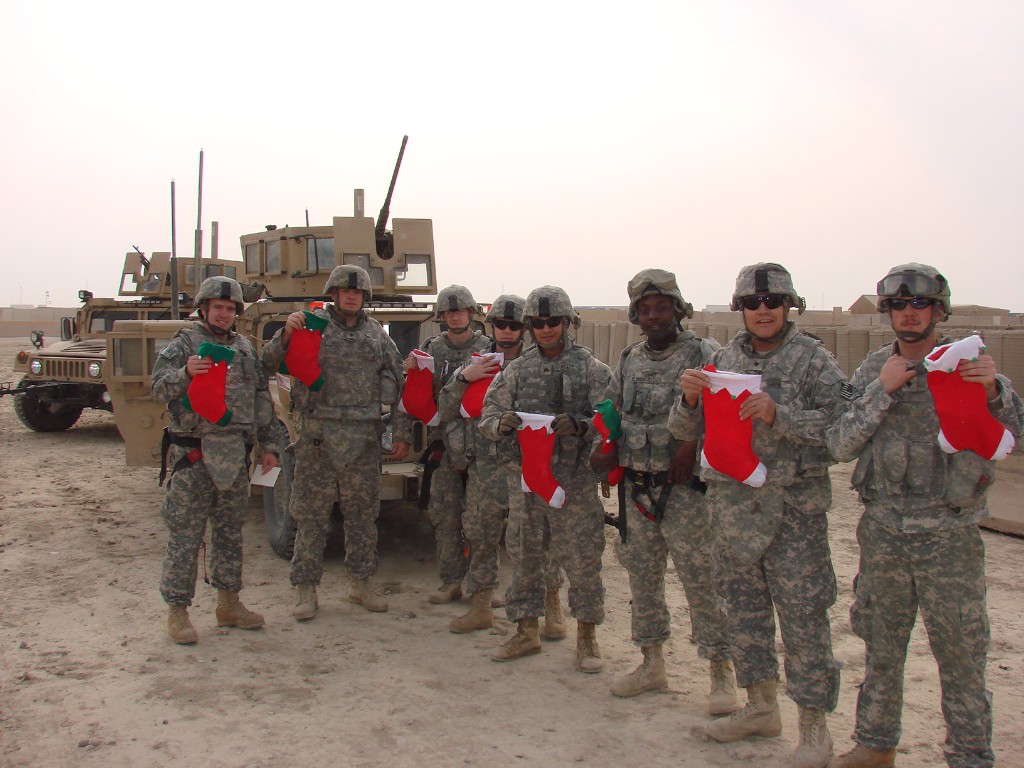
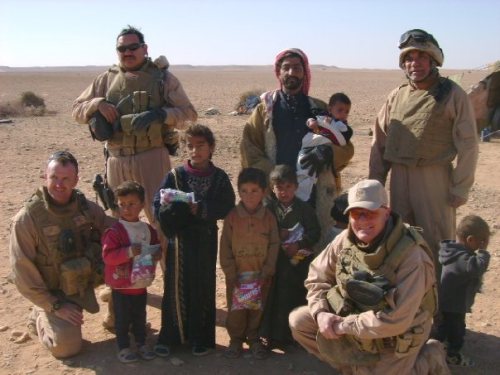
I have done my time in Iraq at Christmas on the Syrian-Iraqi Border in 2007 with our Marine advisors and their Iraqis.  That was the most memorable Christmas and the most important Christmas Masses that I ever celebrated. Since returning home have thought often of those that remain in harm’s way as well as those soldiers, sailors, Marines and airmen, American and from other nations that have spent Christmas on the front lines. Some of these events are absolutely serious while others display some of the “light” moments that occur even in the most terrible of manmade tragedies.

streets-trenton

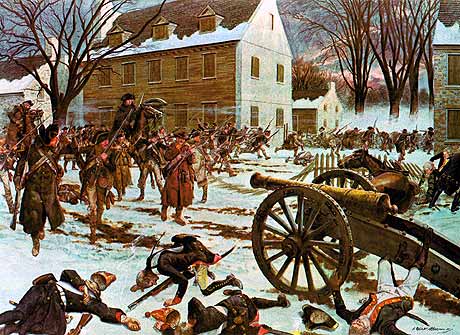
Christmas 1776 at Trenton

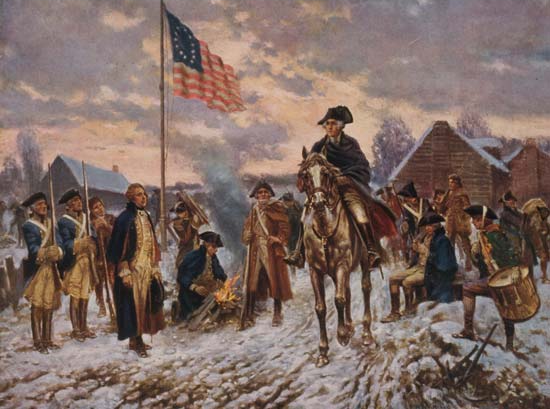
In American history we can look back to 1776, of course we could go back further but 1776 just sounds better. On Christmas of 1776 George Washington took his Continental Army across the Delaware to attack the British garrison at Trenton. Actually it was a bunch of hung over Hessians who after Christmas dinner on the 24th failed to post a guard which enabled them to be surprised,  but it was an American victory.

washington2

In 1777 Washington and his Army had a rather miserable Christmas at Valley Forge where they spent the winter freezing their asses off and getting drilled into a proper military force by Baron Von Steuben.

The-Eggnog-Riot

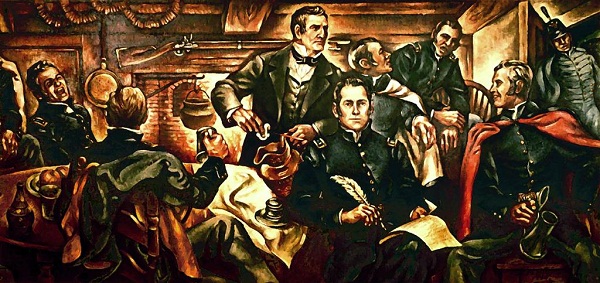
The Eggnog Riot

While not a battle in the true sense of the word the Cadets at West Point wrote their own Christmas legend in the Eggnog Riot of 1826 when the Cadets in a bit of holiday revelry had a bit too much Eggnog and a fair amount of Whiskey and behaved in a manner frowned upon by the Academy administration. Needless to say that many of the Cadets spent the Christmas chapel services in a hung over state with a fair number eventually being tossed from the Academy for their trouble.

battlezz

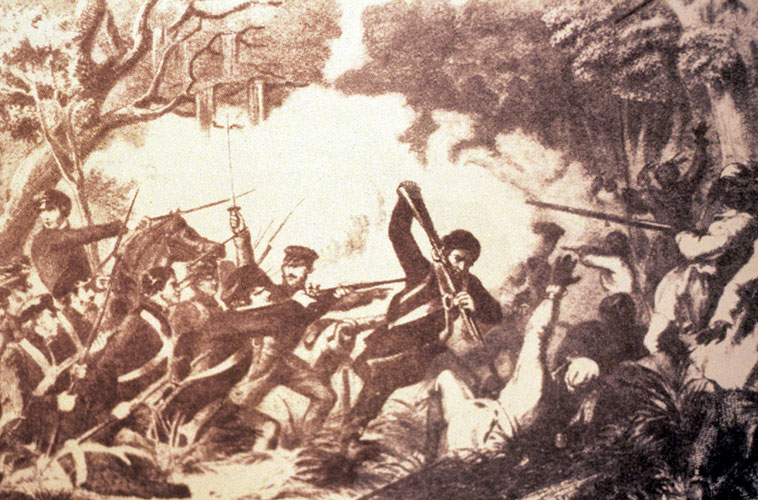
The Battle of Lake Okeechobee

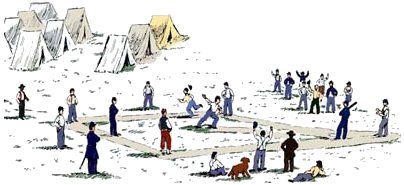
In 1837 the U.S. Army was defeated at the Battle of Lake Okeechobee by the Seminole Nation, not a Merry Christmas at all.  In 1862 the Army of the Potomac and Army of Northern Virginia faced each other across the Rappahannock River after the Battle of Fredericksburg while to the south in Hilton Head South Carolina 40,000 people watched Union troops play baseball some uttering the cry of many later baseball fans “Damn Yankees.”

civil_war_baseball

Blue and Grey Christmas Baseball

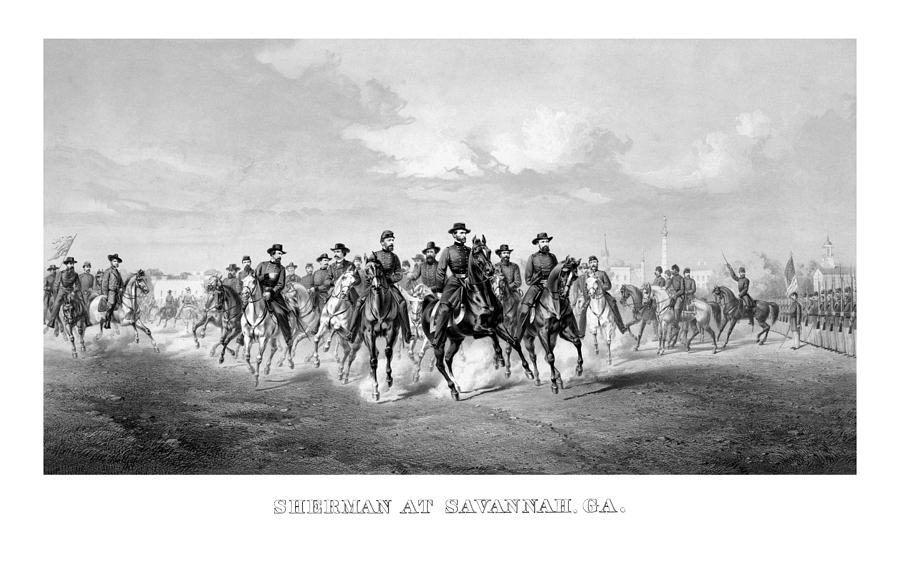
In 1864 the Army of the Potomac and Army of Northern Virginia faced each other again in the miserable trenches of Petersburg while General William Tecumseh Sherman enjoyed Christmas in Savannah Georgia after cutting a swath of destruction from Atlanta to the sea. He presented the city to Lincoln who simply said “nice, but I really wanted Richmond.”

general-sherman-at-savannah-war-is-hell-store

Napoleon had something to celebrate on December 25th 1801 after surviving an assassination attempt on Christmas Eve and 1809 he was celebrating his divorce from Empress Josephine which had occurred on the 21st of December.

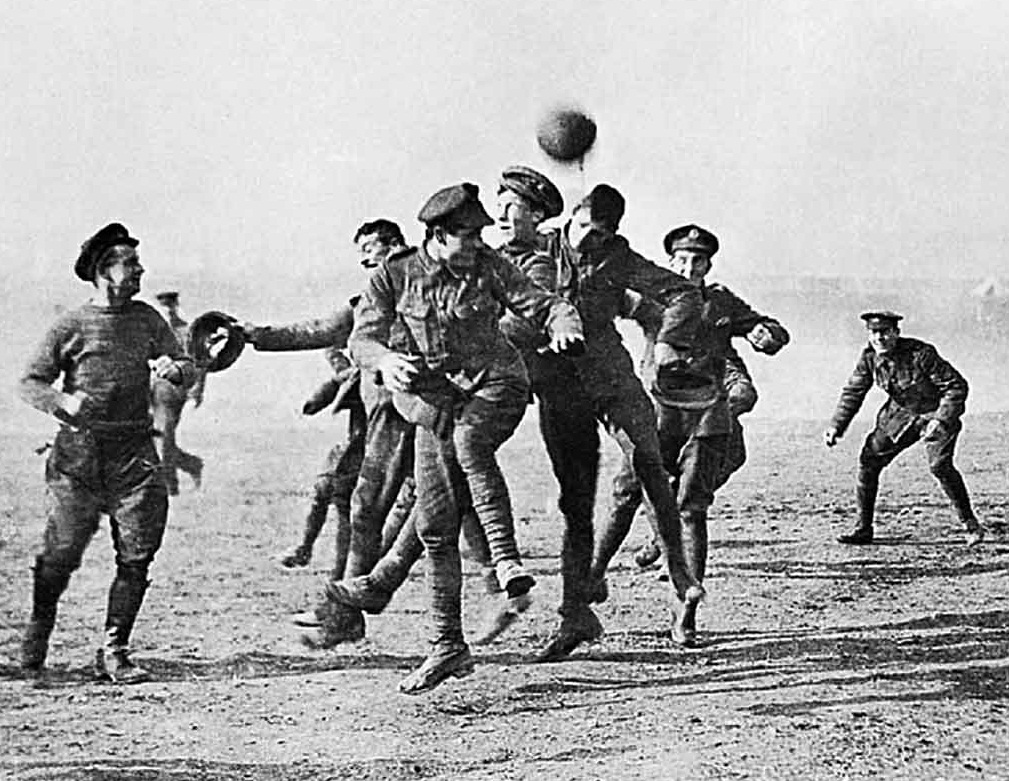
football-truce

The Christmas Truce 

In 1914 “Christmas Truce” began between British and German troops and threatened to undo all the hard work of those that made the First World War possible.  Thereafter the High Commands of both sides ensured that such frivolity never happened again. The movie Joyeux Noel (Merry Christmas) does a wonderful job in bringing home the miraculous truce.

article-2106230-0003FB2000000258-130_634x578

General and Montgomery and his Staff, winter 1942

World War II brought much suffering. In 1941 after Pearl Harbor the Japanese forced the surrender of Hong Kong and its British garrison while two days later the Soviets launched their counterattack at Moscow against Hitler’s Wehrmacht. In Libya the British were retaking Benghazi from the Afrika Corps after a brutal series of tank battles in Operation Crusader.  A year later the Americans were clearing Guadalcanal of the Japanese. General Montgomery’s 8th Army was pursuing Rommel’s Afrika Korps into Tunisia as American and British forces under General Dwight D. Eisenhower were slogging their way into Tunisia against tough German resistant.  In Russia the Red Army was engaged in a climactic battle against the encircled German 6th Army at Stalingrad. At Stalingrad a German Physician named Kurt Reuber painted the famed Madonna of Stalingrad.

Bundeswehr zeigt "Stalingrad"-Ausstellung

Kurt Reuber’s Madona of Stalingrad

The drawing which was taken out of Stalingrad by one of the last German officers to be evacuated now hangs in the Kaiser Wilhelm Memorial Church in Berlin. Reuber drew another in 1943 while in a Soviet POW campbefore his death from Typhus in early 1944. Reuber wrote to his wife of painting in Stalingrad:

“I wondered for a long while what I should paint, and in the end I decided on a Madonna, or mother and child. I have turned my hole in the frozen mud into a studio. The space is too small for me to be able to see the picture properly, so I climb on to a stool and look down at it from above, to get the perspective right. Everything is repeatedly knocked over, and my pencils vanish into the mud. There is nothing to lean my big picture of the Madonna against, except a sloping, home-made table past which I can just manage to squeeze. There are no proper materials and I have used a Russian map for paper. But I wish I could tell you how absorbed I have been painting my Madonna, and how much it means to me.”

“The picture looks like this: the mother’s head and the child’s lean toward each other, and a large cloak enfolds them both. It is intended to symbolize ‘security’ and ‘mother love.’ I remembered the words of St.John: light, life, and love. What more can I add? I wanted to suggest these three things in the homely and common vision of a mother with her child and the security that they represent.”

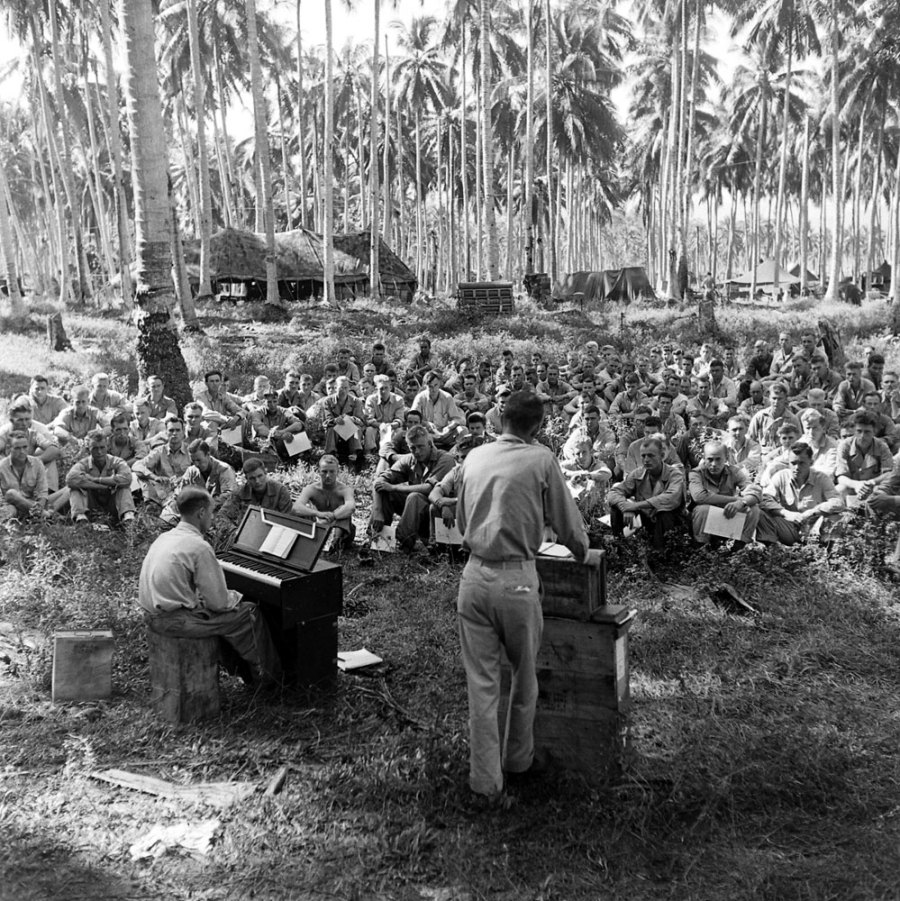
34_116111820

Christmas Concert at Guadalcanal 

In 1943 the Marines were battling the Japanese at New Britain while the Red Army was involved in another major winter offensive against the Wehrmacht. In 1944 Christmas found the Russians advancing in Hungary.

christmas-celebration-before-battle-of-the-bulge


Bastogne Christmas 

In December 1944 the Americans were engaged in a desperate battle with the Germans in the Ardennes now known as The Battle of the Bulge. On Christmas day the leading German unit, the 2nd Panzer Division ran out of gas 4 miles from the Meuse River and was destroyed by the American 2nd Armored Division.

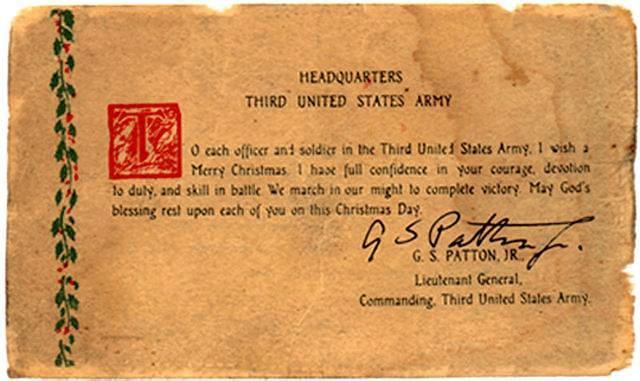
0001photo

As that was occurring the embattled 101st Airborne Division at Bastogne was relieved by General George Patton’s 3rd Army. Patton had his Chaplain pen this Christmas prayer:

“Almighty and most merciful Father, we humbly beseech Thee, of Thy great goodness, to restrain these immoderate rains with which we have had to contend. Grant us fair weather for Battle. Graciously hearken to us as soldiers who call upon Thee that, armed with Thy power, we may advance from victory to victory, and crush the oppression and wickedness of our enemies and establish Thy justice among men and nations.”

In the Philippines Douglas MacArthur’s forces were fighting hard to liberate Leyte, Samar and Luzon from the Japanese. At sea US and Allied naval forces fought off determined attacks by Kamikazes.

USO2

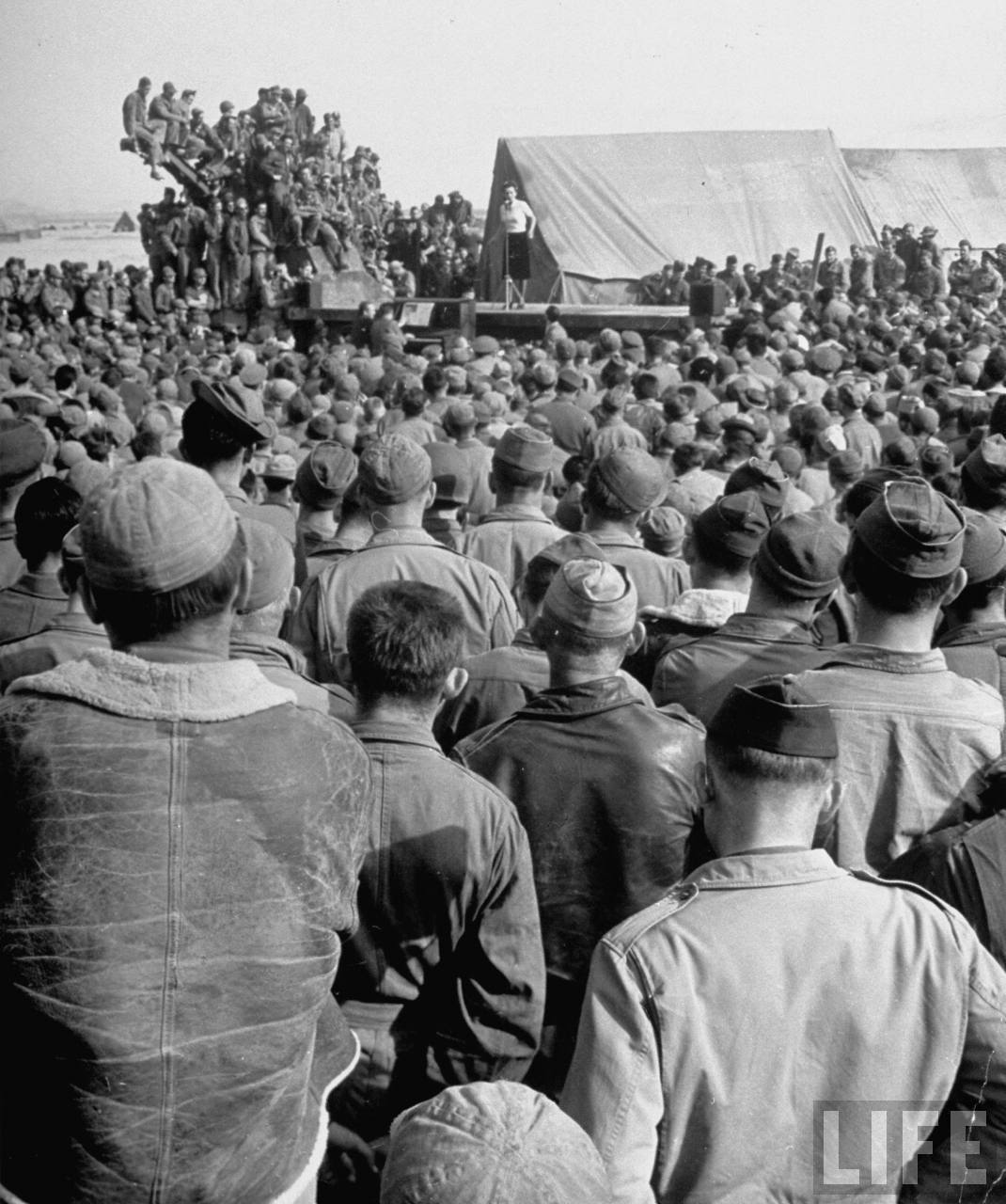
USO Christmas Show in WWII

During the war the USO sponsored many entertainers who went to combat zones to perform Christmas shows, among them was Bob Hope.

onship

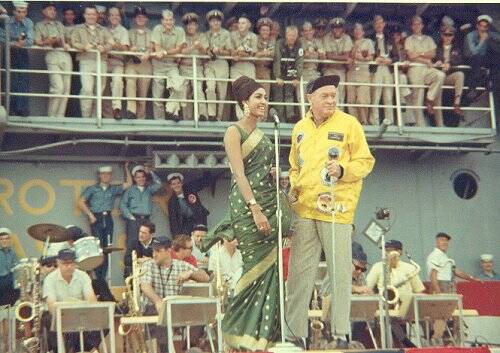
Bob Hope Christmas Show on USS Ticonderoga CVA-14 off Vietnam 

In the years following the Second World War Christmas was celebrated while armies continued to engage in combat to the death. Christmas of 1950 was celebrated in Korea as the last American forces were withdrawn from the North following the Chinese intervention which the 1st Marine Division chewed up numerous Red Chinese divisions while fighting its way out of the Chosin Reservoir.

size0-army.mil-28691-2009-02-09-110252

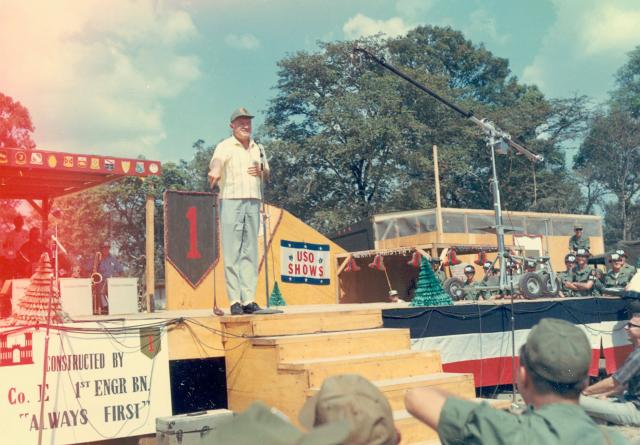
Bob Hope with 1st Infantry Division in Vietnam

In 1953 the French garrison of Dien Bien Phu celebrated Christmas in primitive fashion unaware that Vietnamese General Giap was already marshaling his forces to cut them off and then destroy them shortly after Easter of 1954.   In 1964 the U.S. committed itself to the war in Vietnam and for the next 9 years American Soldiers, Marines, Sailors and Airmen battled the North Vietnamese and Viet Cong with Marines fighting the North at Khe Sanh during Christmas of 1967. A hallmark of that war would be Bob Hope whose televised Christmas specials from that country helped bring the emotion of Christmas at the front back to those at home.

DSChristmasmenu

In the years after Vietnam American troops would spend Christmas in the Desert of Saudi Arabia preparing for Operation Desert Storm in 1990, in Somalia the following year and in the Balkans. After September 11th 2001 U.S. Forces spent their first of at least 12 Christmas’s in Afghanistan. From 2003 thru 2011 US and coalition partner troops spent 8 years in Iraq, that was my war.

295_26912097058_4309_n-2

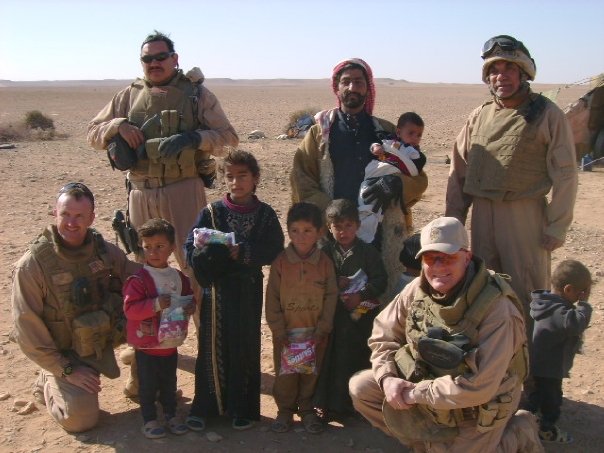
Christmas with Bedouin on Christmas Eve (above) and Christmas games at COP North Al Anbar Province Iraq 2007 (Below)

483430_10151366974467059_2085986953_n

533506_10151366982452059_1397805608_n

Christmas Services at COP South Al Anbar Province, Iraq 2007

Today Americans and our Allies serve around the world far away from home fighting the war against Al Qaeda and its confederates and some may die on this most Holy of Days while for others it will be their last Christmas.

Please keep them and all who serve now as well as those that served in the past, those that remain and those that have died in your prayers.

Peace

Padre Steve+
3 Comments

Filed under civil war, faith, History, iraq,afghanistan, Loose thoughts and musings, Military, Religion, world war two in europe, world war two in the pacific

Where I Belong: Padre Steve and the Christmas Truce

889

Christmas 2007 COP South, Al Anbar Province Iraq

“I belong with those who are in pain, and who have lost their faith, I belong here.” Father Palmer, the Chaplain in Joyeux Noel (Merry Christmas)

Last night I again watched the film classic Joyeux Noel (Merry Christmas) which is the story of the amazing and exceptional Christmas Truce of 1914. It is a film that each time I see it that I discover something new, more powerful than the last time I viewed it.

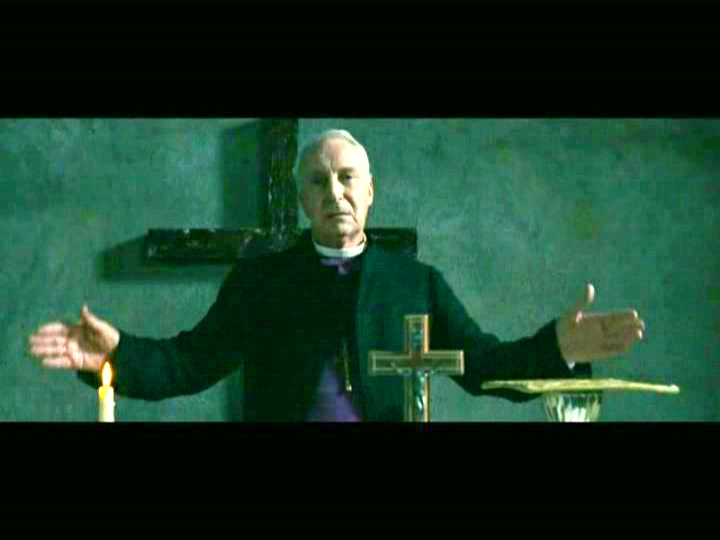
As a Chaplain I am drawn to the actions of the British Padre who during the truce conducts a Mass for all the soldiers, British, French and German in no-man’s land, who goes about caring for the soldiers both the living and the dead.  His actions are contrasted with his Bishop who comes to relieve him of his duties and to urge on the replacement soldiers to better kill the Germans.

palmer

Father Palmer Tending the Wounded

As the Chaplain begins to provide the last Rites to a dying soldier the Bishop walks in, in full purple cassock frock coat and hat and the chaplain looks up and kisses his ring.

As the chaplain looks at his clerical superior there is a silence and the Bishop looks sternly at the priest and addresses him:

“You’re being sent back to your parish in Scotland. I’ve brought you your marching orders.”

Stunned the Priest replies: “I belong with those who are in pain, and who have lost their faith, I belong here.”

The Bishop then sternly lectures the Priest: “I am very disappointed you know. When you requested permission to accompany the recruits from your parish I personally vouched for you. But then when I heard what happened I prayed for you.”

The Priest humbly and respectfully yet with conviction responds to his superior: “I sincerely believe that our Lord Jesus Christ guided me in what was the most important Mass of my life. I tried to be true to his trust and carry his message to all, whoever they may be.”

The Bishop seems a bit taken aback but then blames the Chaplain for what will next happen to the Soldiers that he has served with in the trenches: “Those men who listened to you on Christmas Eve will very soon bitterly regret it; because in a few days time their regiment is to be disbanded by the order of His Majesty the King. Where will those poor boys end up on the front line now? And what will their families think?”

They are interrupted when a soldier walks in to let the Bishop know that the new soldiers are ready for his sermon. After acknowledging the messenger the Bishop continues: “They’re waiting for me to preach a sermon to those who are replacing those who went astray with you.” He gets ready to depart and continues: “May our Lord Jesus Christ guide your steps back to the straight and narrow path.”

The Priest looks at him and asks: “Is that truly the path of our Lord?”

The Bishop looks at the Priest and asks what I think is the most troubling question: “You’re not asking the right question. Think on this: are you really suitable to remain with us in the house of Our Lord?”

With that the Bishop leaves and goes on to preach. The words of the sermon are from a 1915 sermon preached by an Anglican Bishop in Westminster Abbey. They reflect the poisonous aspects of many religious leaders on all sides of the Great War, but also many religious leaders of various faiths even today, sadly I have to say Christian leaders are among the worst when it comes to inciting violence against those that they perceive as enemies of the Church, their nation or in some cases their political faction within a country.

bishop

The Bishop Leads His “Service” 

http://www.youtube.com/watch?v=fMPxjUE40iw

“Christ our Lord said, “Think not that I come to bring peace on earth. I come not to bring peace, but a sword.” The Gospel according to St. Matthew. Well, my brethren, the sword of the Lord is in your hands. You are the very defenders of civilization itself. The forces of good against the forces of evil. For this war is indeed a crusade! A holy war to save the freedom of the world. In truth I tell you: the Germans do not act like us, neither do they think like us, for they are not, like us, children of God. Are those who shell cities populated only by civilians the children of God? Are those who advanced armed hiding behind women and children the children of God? With God’s help, you must kill the Germans, good or bad, young or old. Kill every one of them so that it won’t have to be done again.”

The sermon is chilling and had it not been edited by the director would have contained the remark actually said by the real Bishop that the Germans “crucified babies on Christmas.”  Of course that was typical of the propaganda of the time and similar to things that religious leaders of all faiths use to demonize their opponents and stir up violence in the name of their God.

When the Bishop leaves the Priest finishes his ministration to the wounded while listening to the words of the Bishop who is preaching not far away in the trenches. He meditates upon his simple cross, takes it off, kisses it hand hangs it upon a tripod where a container of water hangs.

The scene is chilling for a number of reasons. First is the obvious, the actions of a religious leader to denigrate the efforts of some to bring the Gospel of Peace into the abyss of Hell of earth and then to incite others to violence dehumanizing the enemy forces. The second and possibly even more troubling is to suggest that those who do not support dehumanizing and exterminating the enemy are not suitable to remain in the house of the Lord. Since I have had people, some in person and others on social media say similar things to what the Bishop asks Palmer the scene hits close to home.

iraq bedouin

Christmas Eve 2007 with the Bedouin 

When I left Iraq in February 2008 I felt that I was abandoning those committed to my spiritual care, but my time was up. Because of it I missed going with some of my advisors to Basra with the 1st Iraqi Division to retake that city from insurgents. It was only a bit over a month after I had celebrated what I consider to be my most important Masses of my life at COP South and COP North on December 23rd as well as Christmas Eve and Christmas Day. When I left the new incoming senior Chaplain refused to take my replacement leaving our advisors without dedicated support. He then slandered me behind my back because what I was doing was not how he would do things and because I and my relief were under someone else’s operational control. It is funny how word gets back to you when people talk behind your back. Thankfully he is now retired from the Navy and I feel for any ministers of his denomination under his “spiritual” care.  So I cannot forget those days and every time I think about them, especially around Christmas I am somewhat melancholy and why I can relate so much to Father Palmer in the movie.

It has been six years since those Christmas Masses and they still feel like yesterday. In the intervening years my life has been different. Severe and Chronic PTSD, depression, anxiety and insomnia were coupled with a two year period where due to my struggles I lost faith, was for all practical purposes an agnostic. I felt abandoned by God, my former church and most other Chaplains. It was like being radioactive, there was and is a stigma for Chaplains that admits to PTSD and go through a faith crisis, especially from other Chaplains and Clergy.  It was just before Christmas in late 2009 that faith began to return in what I call my Christmas Miracle. But be sure, let no one tell you differently, no Soldier, Sailor, Marine or Airman who has suffered the trauma of war and admitted to PTSD does not feel the stigma that goes with it, and sadly, despite the best efforts of many there is a stigma.

Now that faith is different and I have become much more skeptical of the motivations of religious leaders, especially those that demonize and dehumanize those that do not believe like them or fully support their cause or agenda. Unfortunately there are far too many men and women who will use religion to do that, far too many.  

As for me I am in a better place now. I still suffer some of the effects of the PTSD, especially the insomnia, nightmares and anxiety in crowded places and bad traffic, but I do believe again. Like the Priest in the movie I know that my place is with those who are “in pain, and who have lost their faith.” Like Paul Tillich I have come to believe that “Sometimes I think it is my mission to bring faith to the faithless, and doubt to the faithful.” 

Praying for Peace this Christmas,

Padre Steve+

6 Comments

Filed under faith, film, History, Military, ministry, Pastoral Care, PTSD, Religion, Tour in Iraq

Christmas in the Cauldron: Kurt Reuber and the The Madonna of Stalingrad

Bundeswehr zeigt "Stalingrad"-Ausstellung

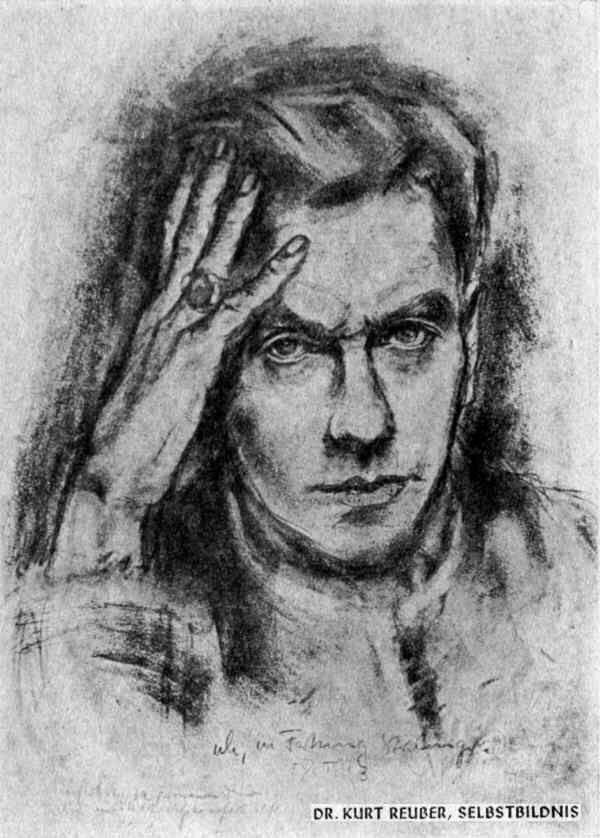
Kurt Rueber was a theologian, pastor and medical doctor. A friend of Albert Schweitzer he was conscripted to serve as a physician in the Germany Army at the beginning of the war. By November 1942 he was a seasoned military physician serving with the 16th Panzer Division, part of the German 6th Army, which had been fighting in the hell of Stlaingrad. When that division along with most of 6th Army was surrounded by the Soviets, cut of from most supply and without real hope of relief he continued to serve the soldiers committed to his care.

k_reuberl

A Self Portrait 

However that care also included spiritual matters. Rueber was also an artist and pastor and as such he reflected on the desparation of the German soldiers in the Stalingrad pocket. He wrote to his family.

“I wondered for a long while what I should paint, and in the end I decided on a Madonna, or mother and child. I have turned my hole in the frozen mud into a studio. The space is too small for me to be able to see the picture properly, so I climb on to a stool and look down at it from above, to get the perspective right. Everything is repeatedly knocked over, and my pencils vanish into the mud. There is nothing to lean my big picture of the Madonna against, except a sloping, home-made table past which I can just manage to squeeze. There are no proper materials and I have used a Russian map for paper. But I wish I could tell you how absorbed I have been painting my Madonna, and how much it means to me.”

“The picture looks like this: the mother’s head and the child’s lean toward each other, and a large cloak enfolds them both. It is intended to symbolize ‘security’ and ‘mother love.’ I remembered the words of St. John: light, life, and love. What more can I add? I wanted to suggest these three things in the homely and common vision of a mother with her child and the security that they represent.”

The picture was drawn on the back of a captured Soviet map and when he finished it he displayed it in his bunker, which became something of a shrine. Reuber wrote:

“When according to ancient custom I opened the Christmas door, the slatted door of our bunker, and the comrades went in, they stood as if entranced, devout and too moved to speak in front of the picture on the clay wall…The entire celebration took place under the influence of the picture, and they thoughtfully read the words: light, life, love…Whether commander or simple soldier, the Madonna was always an object of outward and inward contemplation.”

As the seige continued men came to the bunker for both medical care and spiritual solace.  On Christmas Eve Reuber found himself treating a number of men wounded by bombs outside the bunker. Another soldier lay dying, just minutes before the soldier had been in the bunker singing the Christmas hymn O Du Froeliche.  Reuber wrote:

“I spent Christmas evening with the other doctors and the sick. The Commanding Officer had presented the letter with his last bottle of Champagne. We raised our mugs and drank to those we love, but before we had had a chance to taste the wine we had to throw ourselves flat on the ground as a stick of bombs fell outside. I seized my doctor’s bag and ran to the scene of the explosions, where there were dead and wounded. My shelter with its lovely Christmas decorations became a dressing station. One of the dying men had been hit in the head and there was nothing more I could do for him. He had been with us at our celebration, and had only that moment left to go on duty, but before he went he had said: ‘I’ll finish the carol with first. O du Frohliche!” A few moments later he was dead. There was plenty of hard and sad work to do in our Christmas shelter. It is late now, but it is Christmas night still. And so much sadness everywhere.”

On January 9th 1943 with all hope of escape or reinforcement gone Reuber gave the picture to the battlaion commander.  The officer was too ill to carry on and was one of the last soldiers to be evacuated from the pocket.

stalingrad-german-pow-595x351stalingrad-dogs-do-you-want-to-live-forever

German POWs walking out of Stalingrad

Reuber was taken prisoner and survived the harrowing winter march to the Yelabuga prison camp. In late 1943 Reuber wrote his  Christmas Letter to a German Wife and Mother – Advent 1943. It was a spiritual reflection but also a reflection on the hope for life after the war, when the Nazi regime would be defeated, and Germany given a new birth.

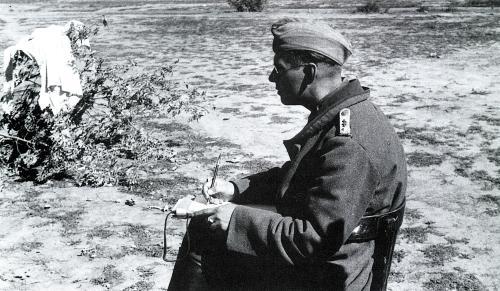
drkrop

drkrdr

Reuber operating on a wounded soldier above and drawing below

Reuber wrote:

“The concatenation of guilt and fate has opened our eyes wide to the guilt. You know, perhaps we will be grateful at the end of our present difficult path yet once again that we will be granted true salvation and liberation of the individual and the nation by apparent disappointment of our “anticipation of Advent”, by all of the suffering of last year’s as well as this year’s Christmas. According to ancient tradition, the Advent season is simultaneously the season of self-reflection. So at the very end, facing ruin, in death’s grip – what a revaluation of values has taken place in us! We thus want to use this period of waiting as inner preparation for a meaningful new existence and enterprise in our family, in our vocation, in the nation. The Christmas light of joy is already shining in the midst of our Advent path of death as a celebration of the birth of a new age in which – as hard as it may also be – we want to prove ourselves worthy of the newly given life.”  (Erich Wiegand in Kurt Reuber, Pastor, Physician, Painter, Evangelischer Medienverb. Kassel 2004. )

Reuber did not live to see that day. He died of Typhus on January 20th 1944, not long after writing this and just a few weeks after painting another portrait of the Madonna, this one entitled The Prisoner’s Madonna. He was not alone, of the approximately 95,000 German POWs taken at Stalingrad only about 6,000 returned home. 

prisoner's madonna

His paintings survived the war and his family gave The Madonna of Stalingrad  to the Kaiser Wilhelm Memorial Church in Berlin when its ruins were restored as a symbol of hope and reconcilliation. Copies are also displayed in Coventry Cathedral and the Russian Orthodox Cathedral in Volgagrad, the former Stalingrad. A copy of The Prisoner’s Madonna is now displayed at the Church of the Resurrection in Kassel. 

pg-34-stalingrad-2-getty

I have a print of the Madonna of Stalingrad in my office. It has become one of the most meaningful pictures I have since I returned from Iraq in 2008. To me they are symbols of God’s presence when God seems entirely absent.

Praying for an end to war.

Peace

Padre Steve+
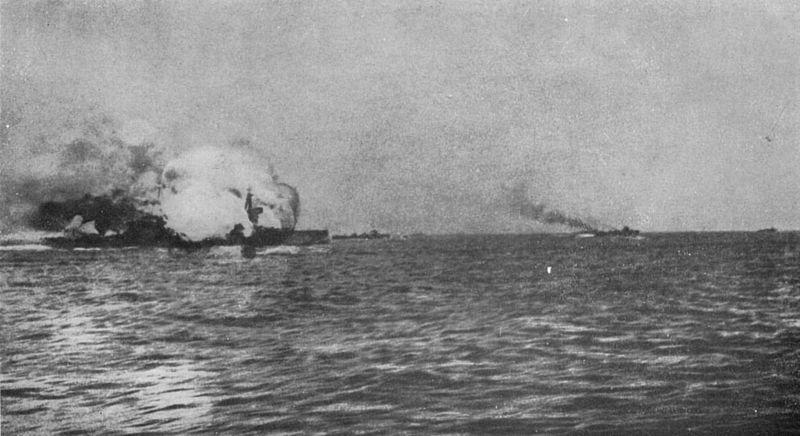
13 Comments

Filed under faith, History, Loose thoughts and musings, Military, Religion, world war two in europe