Category Archives: News and current events

God Help Texas, the United States, and the President before It’s Too Late


Friends of Padre Steve’s World,

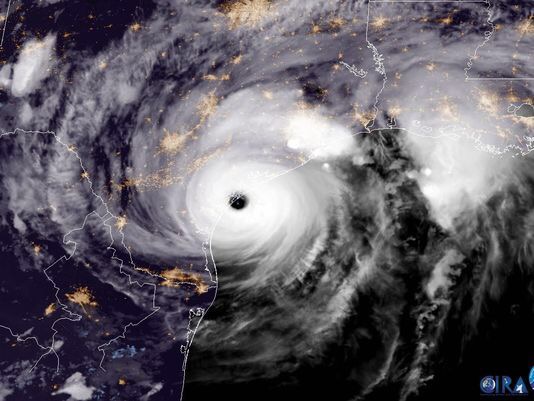
I am very concerned for all the people that I know who live along the Gulf Coast of Texas as category IV Hurricane Harvey makes landfall. That storm is likely going to be one of the most devastating to Texas and the United States in many years. I’ve lived through more hurricanes than I can count going back to Hurricane Gilbert in 1988 where I was the director of a Red Cross emergency shelter in San Antonio for refugees from the same region being crushed by Harvey. Unlike Harvey, Gilbert moved fast and wasn’t a huge rainmaker, but Harvey will be a killer, and all the President can do is pardon a man who violated the civil rights of thousands of people and who only has told the people of Texas “good luck.” Now he did sign a disaster declaration for the state but if he continues on with threatening a government shutdown and debt default if Congress doesn’t pay for the wall that he promised that Mexico would pay for, and his proposed cutbacks to every Federal agency that would normally be there to help citizens in such an emergency what will that matter? 

This is truly a frightening time. We have a President who shows no regard for the law or the Constitution and who cannot even mention the military personnel and police officers that died over the weekend during a campaign rally? I mean really. And now he goes to Camp David as Texas stands on the brink of disaster. Will he not at least do a flyover abroad Air Force One as former President Bush did during Katrina? Can he not interrupt his Twitter storm against people he believes are his opponents not to show a modicum of respect for dead military personnel and police officers? 

Actually he cannot because he has no moral center. The President has demonstrated time and time again that he is a narcissist and sociopath who cannot feel empathy for anyone, even his supporters, many of whom will die this weekend in Texas as Harvey parks himself over them. If you have been blessed not to have had to go through a major hurricane or lose property and money due to one you are fortunate. No hurricane, but especially category III and IV hurricanes are not to be trifled with. 

But then he does have the time to sign a ban against patriotic Transgender Americans who meet every physical and mental requirement to serve in the military from doing so. The fact that his order will be shown to violate the 14th Amendment and will be held up in the courts does not seem to bother him. The fact that he who enjoyed multiple draft deferments during the Vietnam War, including a medical waiver for having heal spurs even as he played college baseball and was being scouted by major league teams would forbid qualified Transgender Americans from serving when none of his service chiefs ask him to do so is dumbfounding. 

This week the President has called journalists the enemy, refused to honor the lives of 20 American servicemen and police officers who died in the line of duty, but whompardoned a man convicted of defying the courts in order to violate the civil rights of the prisoners in his charge in direct contravention of Justice Department guidelines on pardons. Yes, other Presidents have pardoned undeserving individuals, but this sends a message to Federal prosecutors, the Congress, and Special Prosecute Robert Mueller that if any of them dare to indict or convict individuals connected with the ongoing Russia investigation that he will pardon them in defiance of the law. It is setting up the very really possibility of a constitutional crisis. 

The utter contempt for the law, the Constitution, and the basic decorum of his office, coupled with his lack of compassion and empathy for anyone, including his supporters, and his lack of any strategic thinking in terms of foreign affairs is frightening. Only a despot would behave as the President does. 

My comments today are in no way disrespectful of the President, but are based on my respect for the office that he occupies and the Constitution of the United States. I do not know why the President is behaving in the manner that he is, but I have to at least consider that for all of the personal criticism leveled against him and his actions that the demands of the office are harming his mental and psychological capacity to function. He seems to be cycling down before our very eyes and truthfully I am as much concerned for him as I am the country. But it doesn’t seem that those closest to him have the moral courage to demand that he seek help before he destroys himself and possibly the country. I mean what supporter, especially Christian clergy, could not be concerned for the physical and mental health that the man that they elected President? But it doesn’t seem that they care, so long as he helps give them what they want. 

On the other hand any decent person can both oppose a President’s actions and policies while still caring about him as a person. Human decency requires that those serving in the administration, members of the President’s political party in Congress, and ordinary citizens have the moral courage to care enough about Donald Trump the man to start asking those hard questions. These are not normal times and no one in full possession of their faculties behaves in the manner the President is behaving. 

In the meantime I will be praying for all the people I know in Texas, those who have died in the line of duty, and yes, even the President. 

So until tomorrow,

Peace

Padre Steve+

1 Comment

Filed under News and current events, Political Commentary, weather

Statues With Limitations: Part Three


Friends of Padre Steve’s World,

Today I am continuing my series about statues and monuments which was fueled by the controversy regarding various Confederate monuments and memorials, most which are in the South but many others in states that remained loyal to the Union, were not states at the time of the Civil War, or which were in areas be they North or South which were heavily pro-Union and which sent more soldiers to fight for the Union then they did the Confederacy. 

It is interesting to see how memory and myth cloud history when it comes to monuments, especially those to the Southern Confederacy, a nation that was described by its Vice President, former US Senator Alexander Stephens in these words:

“Our new government is founded upon exactly the opposite idea; its foundations are laid, its corner- stone rests upon the great truth, that the negro is not equal to the white man; that slavery — subordination to the superior race — is his natural and normal condition. [Applause.] This, our new government, is the first, in the history of the world, based upon this great physical, philosophical, and moral truth.” 

Confederate President Jefferson Davis, who so many monuments are dedicated was not happy with his Vice President’s remarks, not because he didn’t believe them not to be true but because their honesty could hurt the cause of the Confederacy abroad. He noted:

“That speech infuriated me, Oh, what Stephens had said was true, perfectly true, but could anything hurt us more abroad than such impolitic remarks? It was the beginning of a fatal falling out between me and that rebellious and vindictive dwarf, who was hell-bent on forming his own policies and disputing mine with niggardly deviousness.” 

The fact is that the vast majority of the Confederate monuments, be they located in the former eleven Confederate states, or place that were not a part of the Confederacy were not built to honor the several hundred thousand Confederate dead, but to remind Blacks that they were subordinate to Whites wherever the were erected. This can be seen by the periods during which they were constructed. Only a few were built in the first two decades following the war, and some of those, including the monument in Portsmouth, Virginia were built by the wives, mothers, and children of the fallen. Honestly as to those I understand why they are where they are, and while I think that 150 years later, unless the context of their construction and monuments or historical narratives to the victims of the Confederacy and the institution of Souther Slavery are placed alongside, I am hard pressed to explain why they remain in places of honor. 

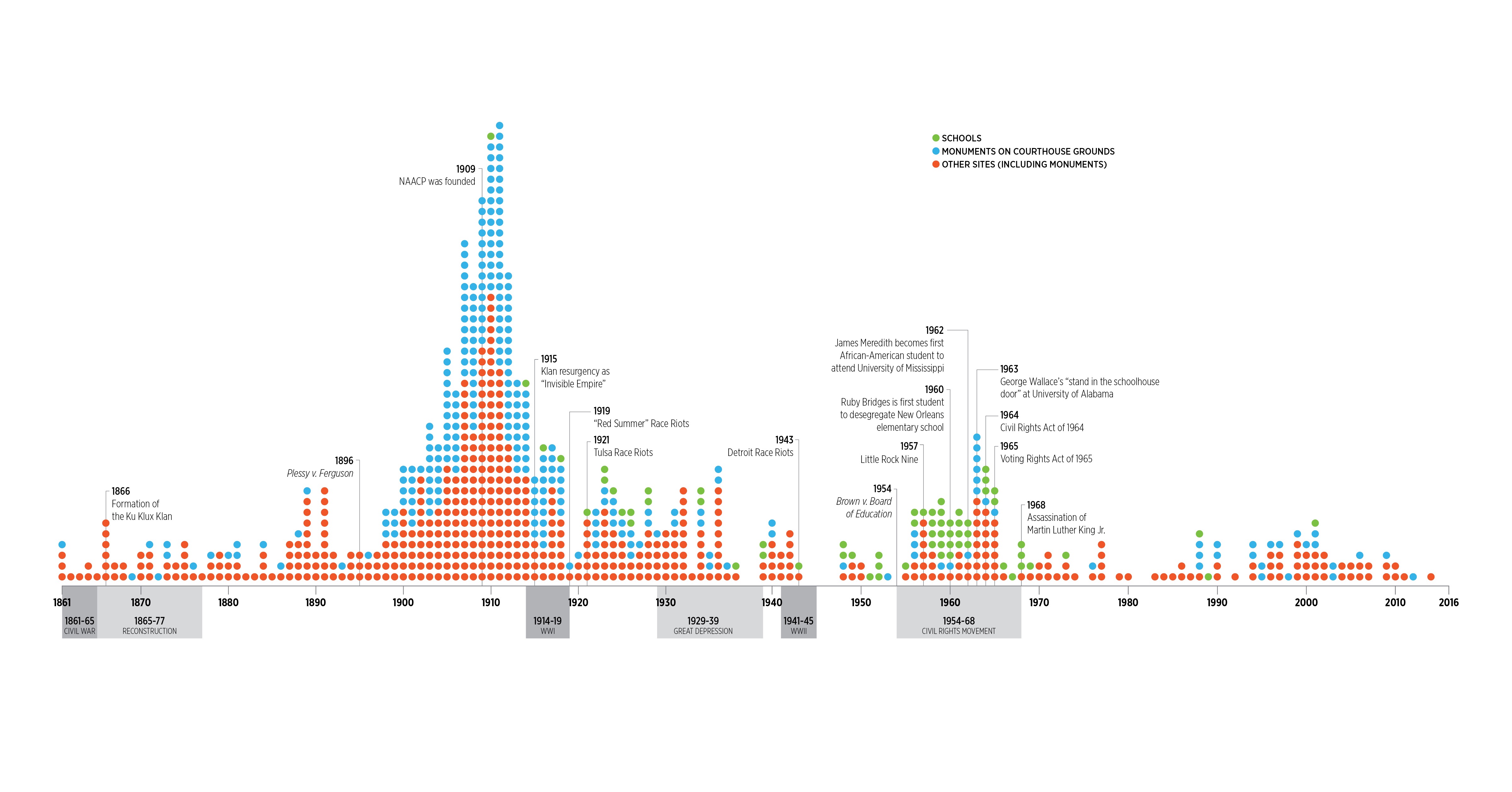
But honestly, those memorials are but a minority. Most of the Confederate monuments that spark such freak controversy today were erected anywhere from 30 to 150 years after the war. The periods that they were built are interesting of themselves. The biggest spike in construction began in the immediate aftermath of the Plessy v. Ferguson ruling that legalized Jim Crow and the second during the backlash against the Civil Rights Movement beginning around 1948. The chart below provides a good representation of when the Confederate monuments were built. 
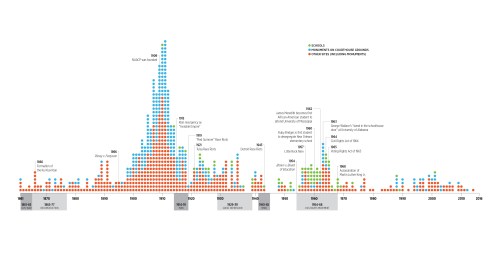
As I mentioned in my first two articles of this series I am not of the opinion that the monuments should be destroyed, nor do I think that they should be torn down by protesters. I think that each monument should be examined based on its historical merit. Since the vast majority happen to be from the days of the Confederate resurgence after Plessy and in the height of the Dixiecrat response to the Civil Rights movement beginning after Brown v. Board of Education which overturned Plessy in 1954. So today I am going to use the example of the monuments in Hampton Roads area as a teaching point. 

Virginia where I live has 223 Confederate monuments, the most of any state. That is in a sense understandable due to it being the largest state in the Confederacy as well as the site of its capital. There are three major public monuments located in South Hampton Roads as well as a number of monuments in local cemeteries throughout the area.

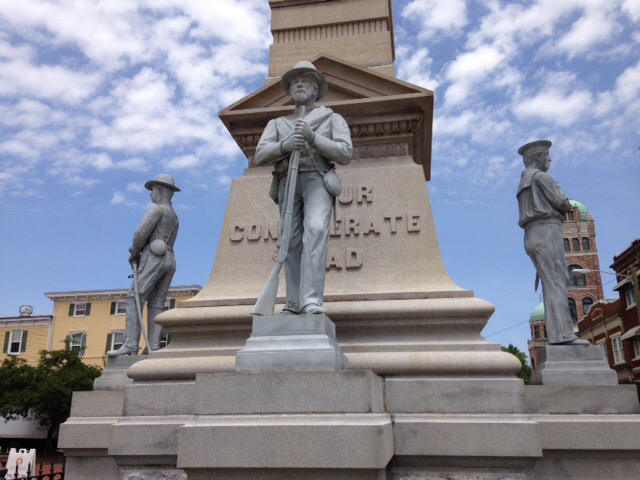
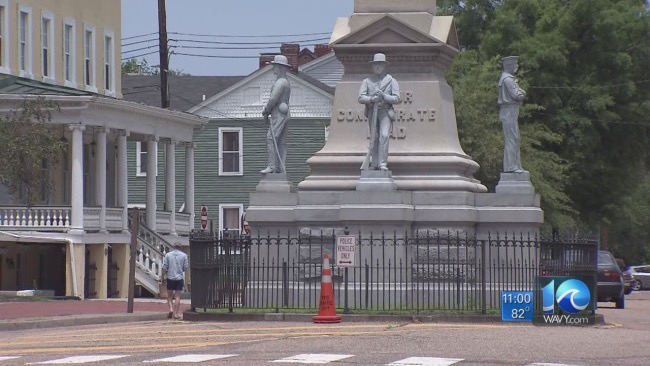
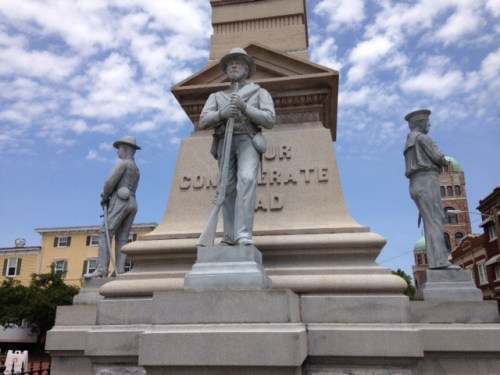
The one located in Portsmouth is the oldest and the most interesting from a historical point of view. Planning and fund raising for it began in the late 1860s shortly after the war and it was dedicated on the site where slaves were whipped and punished in the town square. It was dedicated in 1893. The head of the local Sons of Confederate Veterans chapter say that it was placed there when a church where it was planned to be located backed out. I do not know the veracity of that claim. That being said the location is still problematic, especially since Portsmouth is heavily African American and many of the Black families there trace their roots to the slaves of the city’s ante-bellum times. The monument itself is one of the most interesting monuments that I have seen. It is an imposing sight in the old court square. At its center is an obelisk on which is inscribed To Our Confederate Dead. The obelisk is surrounded by four statues representing an infantryman, a cavalryman, an artillleryman, and a sailor. I think that it would fitting if this monument was moved in its entirety to a cemetery in the city where Confederate war dead are buried. It could be replaced by any number of monuments, perhaps one to the city’s war dead from the World Wars, Korea, Vietnam, the First Gulf War, and the current wars which have been going on since 2001. 
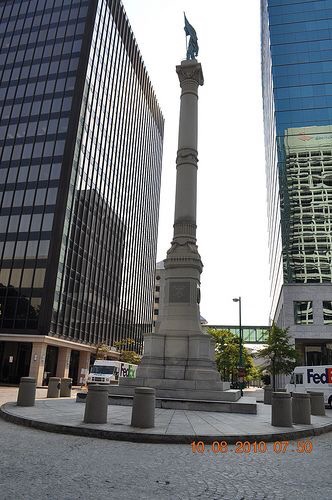

Norfolk’s monument is located within a block of where the slave auctions, the slave jail, the slave infirmary, and a few blocks from the docks where the were shipped to other destinations. This is important because Norfolk was the leading port in the slave trade from about the 1830s until the outbreak of the Civil War. The monument is over 80 feet tall and is capped by the figure of a defiant Confederate soldier holding a sword and the Confederate flag. At its base are engravings of the Confederate Battle Flag and a dedication to Our Confederate Dead. Despite those words this monument can only be described as a monument to White Superority and should be removed and replace with a monument to all of the city’s war dead. The statue adorning the top could go to a museum. 
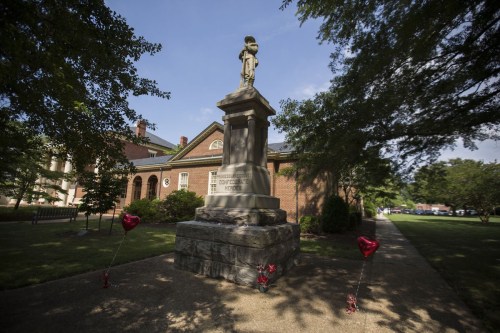

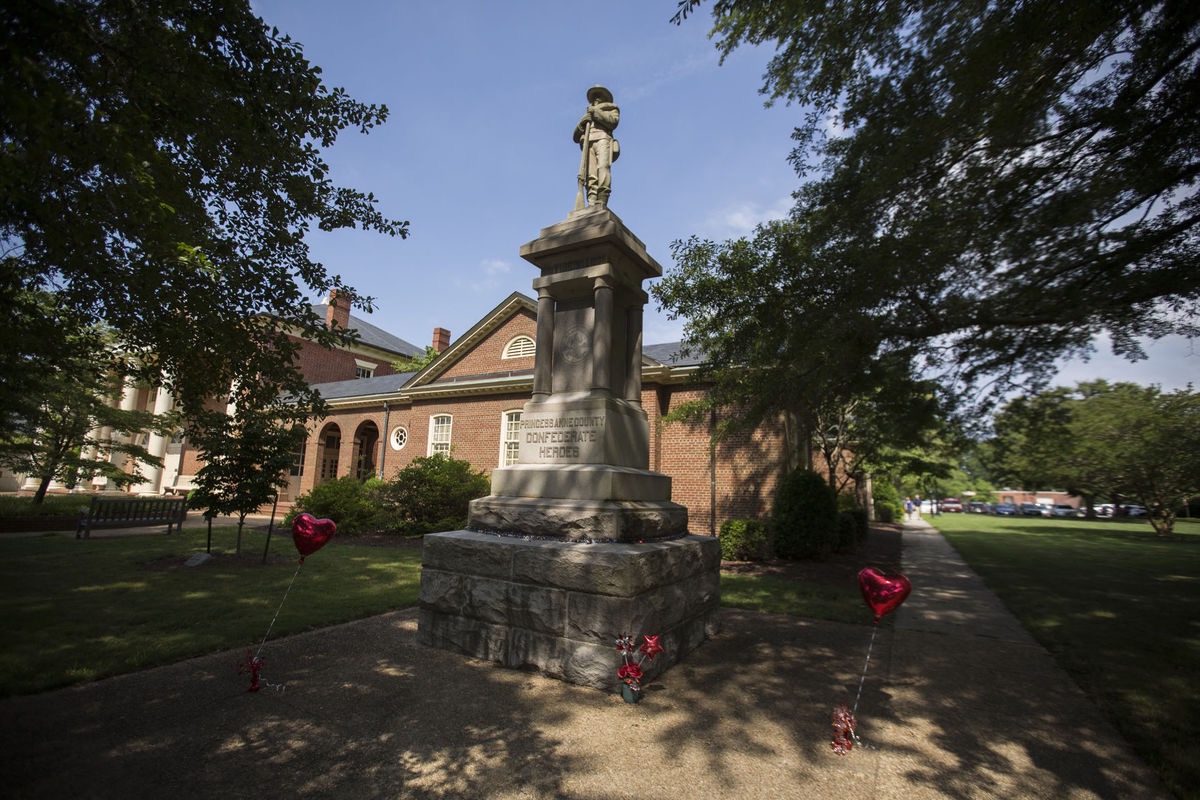
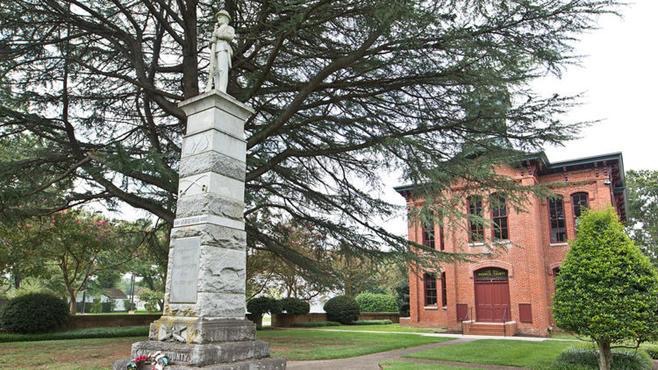
In Virginia Beach the Confederate Monument is outside the old Princess Anne County Courthouse where slave auctions were held, and which is on the grounds of the current Virginia Beach Municipal complex. In older times it would have been seen by all entering the city hall or courts for any reason. It is over 20 feet tall and topped by the statue of a Confederate infantryman. Unlike the other monuments dedicated to the dead, this one is dedicated to Our Confederate Heroes. Now it is in a distinctly less visible location and one has to go out of their way to find it. I think it could remain where it is but only if there was monument to the victims of slavery who were bought and sold there. That would provide context for it. 
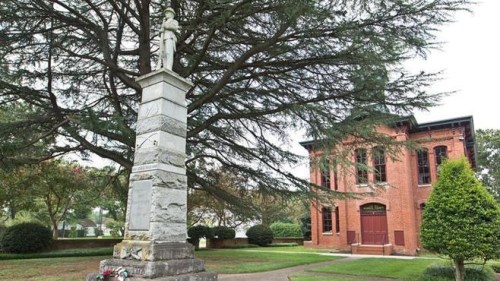

That monument was erected in 1905 during the height of the re-establishment of White Rule and White Sumpremacy after Plessy. One other, in the Denbeigh section of Newport News stands at site of the old Warwick County Courthouse. Denbeigh was named after the Denbeigh Plantation and the county seat was moved to Newport News when Denbeigh and Warwick county consolidated with the independent cit of Newport News in 1958. The courthouse is now a museum and the monument was dedicated in 1909 to the men of Company H, 32nd Virginia Infantry Regiment. The regiment, recruited from the Peninsula in early 1861 had a number of companies farmed out to the artillery was reconstituted as a small, 7 company regiment in 1862. It was decimated at Antietam and served to the end of the war with the Army of Northern Virginia where five officers and forty-two enlisted men surrendered with Robert E. Lee on April 9th 1865. Since this monument is dedicated to a specific unit which distinguished itself in numerous engagements, including Antietam, and Petersburg that relocating it to one of those battlefields would be completely appropriate. 

Admittedly all of these monuments served a twofold purpose, in the case of Portsmouth, from what I have read was that those who began to contribute money for the monument was to honor the fallen. By the time it was built that purpose was also mixed with the political desire of many whites to re-establish White Supremacy. The same is true with the other monuments in the public square. As to monuments located in cemeteries where Confederate soldiers are interred it is only fitting that they remain where they are. 

As to what should be done with each monument there are options, but what can actually be done with them are dictated by State Law which stipulates that localities can erect monuments but cannot “disturb or interfere with any monuments or memorials so erected.” That is a problem for the Virginia legislature to deal with and truthfully I believe that they should amend the law to allow municipalities to remove, alter, or relocate monuments. 

As a historian I think that all can serve as teaching points and that whatever is done with them that their context in relation to slavery, the Civil War, Reconstruction and Jim Crow needs to be clarified as part of teaching history and in the process expunging the myths of the Lost Cause and the Noble South from the historical narrative. 

I want to make a couple of points. First I do not think it is wrong for the relatives and descendants of those who fell in any war to want to remember them. I have traveled throughout Europe and I have seen the monuments in city squares that list the dead from wars dating back to the Napoleonic periods and before. Even if I disagree wth the cause that they fought for I will not forbid their descendants to honor their memory, even if I refuse to honor the military service of my ancestors who rebelled against the Union in 1861. 

I think that the Confederate monuments in Portsmouth, Newport News, Norfolk, and Virginia Beach can serve a purpose greater than for which they were originally constructed. I have described what I think would be best done with each, but I believe that with some modifications that each could remain where they are now so long as there are monuments to those who were the victims of slavery, those who were the unwilling conscripts recruited for that immoral and inhuman cause, and those who opposed that cause, before, during, or after the war. 

The same is true for many other of the Confederate monuments throughout the South. But, at the same time we have to address the monuments to Confederate leaders which built during the same time period as these generic representations of Confederate soldiers. The fact is that the leaders of the Confederate rebellion against the United States are much more responsible for the deaths of three quarters of a million soldiers and the devastation of the South than any ordinary soldier. These leaders include the Confederate President, Jefferson Davis, secessionist politicians like Henry Benning and Alexander Stephens, and military leaders like Robert E. Lee, Stonewall Jackson, and Braxton Bragg. I see little reason for monuments to men who were responsible for such great suffering to remain in places of honor. 

But honestly even this is not enough, for to fully tell the story we have to also honor the Southern Unionists like George Thomas and John Buford who did not forsake their oaths the the country, and men like Robert E. Lee’s lieutenants James Longstreet, Richard Ewell, Billy Mahone, and John Mosby who fully reconciled to the Union, and who were deomonized and then written out of Southern history. 
So anyway, I will deal specifically with monuments to Confederate leaders another time, but I think this is enough for now. That being said, any monuments to the leaders of the Confederacy or those who served during that rebellion need to be held to the bar of history, otherwise we mock all of their victims, and yes, even the sacrifices of the innumerable Johnny Rebs who died in a war that most had little or nothing to gain from. 

Peace 

Padre Steve+

3 Comments

Filed under civil war, historic preservation, History, News and current events, Political Commentary

“It’s the People Stupid” The Need for Professional Mariners 


Friends of Padre Steve’s World,

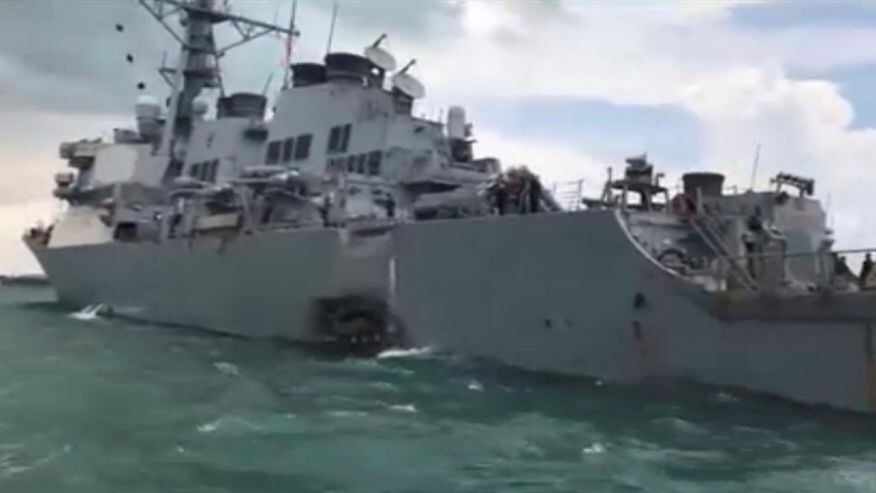
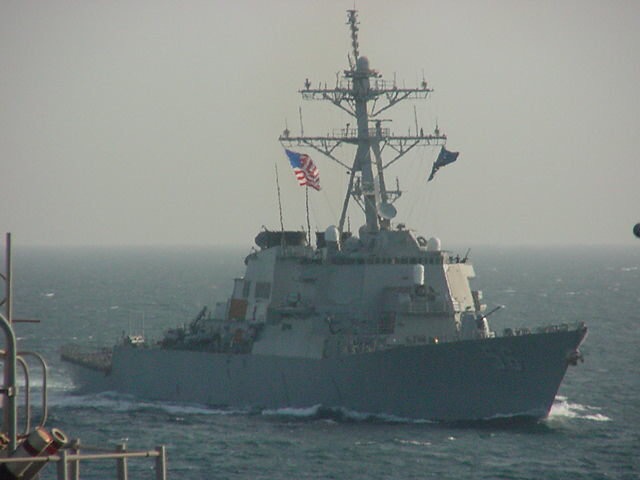
I’m holding off finishing the last part of my series Statues with Limitations until tomorrow. Of the past day I have been consumed with the collision of the USS John S. McCain with a tanker near Singapore that quite likely has claimed the lives of ten U.S. Navy sailors. It was the second fatal collision in less than three weeks involving some of the most technologically advanced warships in the world with merchant ships. The other was that of the USS Fitzgerald which was at fault in a collision with a container ship near Tokyo bay. 

Today I have been in contact with our regional casualty assistance coordinator and chaplains who are already or might be called to go to the home of a sailor’s next of kin to inform them that their sailor is dead. If you have never had to make such a notification you are lucky. They are not easy and they never get easier. Between the military and my time as hospital emergency and trauma department chaplain I have been involved in far too many of them, I lost count around the 350 point, I’ve probably been involved in close to 500 such notifications of all types. 

Frankly there are no words that can adequately convey how hard that news is on the loved ones of those who died, especially when their deaths were most likely preventable. Last week I read the preliminary report on what happened aboard Fitzgerald. It was damning and showed some systemic cultural issues that need to be fixed. I am sure that the Navy will fully investigate the incident involving McCain too, and the report will likely be just as damning. It is bad enough that the Commander of the Navy’s Seventh Fleet, to which Fitzgerald, McCain, and the cruiser Antietam which had a grounding incident near Yokosuka Japan, and the cruiser Lake Champlain which collided with a Korean fishing boat, was relieved of his command just before his scheduled retirement.

But the problem is bigger than simply relieving and replacing officers proved to be at fault in these incidents, the Navy is very good at that. The problem is that about 15 years ago the Navy shut down its Surface Warfare Officer School in Newport, Rhode Island as a cost cutting measure. Instead of going to a school after being commissioned from the Naval Academy, ROTC, or Officer Candidate School, to learn the basics of navigation, seamanship, damage control, engineering, and combats systems operations, these tasks were pushed onto the commanding officers of the ships the new officers were assigned. That began in 2002 and I remember discussing the detrimental effect this would have with fellow officers about the USS Hue City. Some 15 years later these are the officers who are becoming the commanding officers and executive officers of our ships. Most of them don’t spend enough time at sea to be truly professional mariners, and many of them spend years between sea assignments. As such they really don’t know their ships that well, the don’t know the sea that well, and as a result they have become addicted to technology at the expense of doing the basics like looking out the window and taking action to avoid collision. It comes down to in the words of my former Commanding Officer, Captain Rick Hoffman said about these incidents: 

“I am feeling a sense of increasing outrage. The more I write and get replies from so many great shipmates and long time friends, the more I feel a sense of urgency to see if we can’t take these tragedies to force a larger conversation about our SWO culture…or rather the demise of the culture. Help build a path forward that restores the professionalism and focus necessary to have a strong Surface Navy. Perhaps our ships are complex enough to look at the Royal Navy model. Professionals on the bridge, professionals manning the Combat Systems, professionals manning the engineering plant. Not this mongrel program that trains everyone up to the minimum level of competence just long enough to survive your tour and go ashore. Ten years later you go back to sea…in command. I guess I am just feeling frustrated.”

It is not a matter of technology being the answer, we have amazing technology, but as one former officer wrote “Technical solutions don’t solve cultural issues. We need to refocus on our capabilities as mariners.” Captain Hoffman noted: 

“I am pondering the value of sparking a larger discussion about our systemic challenges with basic maritime skills. We are ship drivers, we have technical skills but we are not mariners as a community. We don’t cherish the necessary focus on knowing and feeling the ship, the sea and the larger maritime environment. Just look out the window!!!! The CNO just called for industry to provide more solutions. THAT IS INSANE. It is the people, stupid. We have enough tools, we have forgotten how to use them. Eyeballs and brains. Engage the eyeballs and brains.”

The fact is that for more than a decade the men and women that officer our ships have been pulled many different directions, by various factors, many of our own doing. Quite a few were pulled off of ships at critical points in their career to serve in the sands of Iraq or the mountains of Afghanistan. Our Navy has stopped doing the basics of being professional mariners first so that they can get their ships safely from place to black and be ready to sail into harm’s way at a moment’s notice. 


As Captain Hoffman and so many other men who have commanded ships whose comments I have been reading have noted, the issue is cultural and it is a need to return to the basics. 

Until we do that we are going to keep getting sailors killed, and causing great damage to ships that cost billions of dollars in avoidable incidents. 

As for me, I hope that I don’t have to make another death notification, especially for a death that needn’t happen. 

Until tomorrow,

Peace

Padre Steve+ 

2 Comments

Filed under Military, national security, Navy Ships, News and current events, US Navy

Statues With Limitations: Part Two


Friends of Padre Steve’s World,

Alexander Pope wrote “Monuments, like men, submit to fate.” 

Two days ago I began a series regarding the Confederate Monument Controversy. I was going to begin today’s article by going directly into what I think should be done with these monuments but think that a little bit more background and context is necessary. That context is best put in the difference between history and memory. History, is made by people because it has real world effects cannot be erased because for good or bad its effects always are with us. Memory on the other hand is often selective and tends toward sentimentally. Because of that, memory often leads to the preservation of things that provide us with a certain sense of comfort, things that buttress our innate sense of superiority. 

Statues and monuments themselves have to be taken in their historical context: especially what they meant to the people that erected them and the era in which they were constructed. From time immemorial people and nations have erected statues and monuments to dieties, empowers, kings, generals, and yes, even philosophers and historians. They have also sought to commemorate the lives of soldiers who died in various wars, in part to honor their dead as did the ancient Athenians at Kerameikos, but more often to build upon a sense of national myth and purpose, to link the sacrifices of yesterday’s leaders, or soldiers to their current generation’s political, social, and even spiritual urges.

Some religions like Judaism and Islam have traditionally frowned upon the erection of statues and images that represented their dieties, their saints, or their leaders, fearing that such images could lead to idolatry. There was even a constroversy in the Christian Church, the Iconoclast Controversy, which dealt with this matter which took more than a hundred years to resolve. 

In Western society, especially since the Romans there has been a conscious attempt by nations to built statues and monuments to their leaders and other men, as women seldom rated such honor, whether they actually deserved honor or not. As such there are monuments in prominent places to men with political, social, hereditary, or economic connections who when compared to their contemporaries, or others, before or after them, have done little to be heirs to such honor. This does not mean that they were necessarily bad people, or even unworthy of the honor of their time, but rather that they are undeserving of perpetual honor in the most public of locations, or in places unconnected with where they made their name. 

Cemeteries and museums are the best places for statues which have past their effective life in the public square. Removing them does nothing to harm history, nor does it write them out of history. I like how the Old Testament writers of the books of the Kings and Chronicles end their discussions of the kings of Israel and Judah. They note that these men’s lives and deeds, good and evil, are written about and where they were buried to be with their ancestors. An example of the is Jesus, one of the kings of Israel in the book of Second Kings: “Now the rest of the acts of Jehu, all that he did, and all his power, are they not written in the Book of the Annals of the Kings of Israel?”

Since the Jews of the Old Testament did not build statues to their leaders for fear of idolatry the ensured through the oral, and later the written tradition that these leaders, the good and the bad, were remembered for their work and contributions. The Islamic tradition is quite similar. 

The ancient Greeks, particularly those of Athens chose to use the cemetery as a place to remember their dead. In dedicating the Mount Auburn Cemetery during the Greek revival, U.S. Supreme Court Justice Joseph Story noted: 

“The Greeks exhausted the resources of their exquisite art in adorning the habitations of the dead. They discouraged internments within the limits of their cities; and consigned their relics to shady groves, in the neighborhood of murmuring streams and merry fountains, close by the favorite resorts of those who were engaged in the study of philosophy and nature, and called them, with the elegant expressiveness of their own beautiful language, cemeteries or “places of repose.”

Cemeteries are always places where the dead can be honored or remembered, where their descendants can find comfort and even sense the presence of their departed ancestors. 

But the public square is another matter. Times change, governments and governmental types change. The statues that the early colonists of the British American colonies erected to King George III had no place in the new republic and were removed. Monuments to Josef Stalin and Vladimir Lenin where removed from their places of prominence in Hungary, Czechoslovakia, Poland, and Romania once those countries escaped Soviet domination. 

Statues in public places dedicated to specific individuals or events tend to have a shelf life which means that they regardless of who they are dedicated to need to be periodically re-examined to see if they should remain in their current place of honor or be moved to a different location. But the United States is a comparatively young country, our oldest monuments are likewise comparatively new, and many pale in comparison to those of Europe, the Middle East, and Asia. In those areas multiple civilizations and empire have risen and fallen, massive monuments have been erected, toppled, or faded away. Many surviving monuments now are in museums, collections of antiquity representing fallen civilizations, or have been moved from places of honor and replaced by ones that more appropriately represent the national culture and experience. 

As we approach the first quarter millenium of our experiment as a republic it is a good time to look at what we have commemorated with monuments and make considered decisions about each of them, and not just Confederate monuments. Obviously many, especially those that deal with our founding as a nation and our founders need to stay, but others should be replaced, or removed to more appropriate venues, or in cases of monuments that memorialize the more shameful parts of our history, maybe leave them and place other monuments and markers to explain the historical context and promote history versus myth. Likewise if we decide to remove them, what replaces them should be well thought out. This actually goes beyond the monuments themselves but has all to do with history, historical preservation, and the narrative that a community wants to communicate about its history, its values, and yes, even its future, for those monuments for good or bad are part of what bind generations together. 

As no point do I think they should be destroyed, even those to men who were evil, or represented evil causes. It think in the cases of truly evil men that their statues should be placed in parks, at eye level with other statues like them. The process then allows people to view them not as exalted figures, but people with feet of clay. A number of Eastern European countries have done this with statues of Stalin, Lenin, and others from the Soviet era. 

The placement or monuments is of more importance than their existence, and their contexts matter. Honore De Balzac noted: “With monuments as with men, position means everything. 

So anyway, tomorrow I will wrap this up by dealing with the Confederate Monument Controversy.

Peace

Padre Steve+

Leave a comment

Filed under culture, historic preservation, History, News and current events

The Past Isn’t Quaint: A Pause to Reflect


Friends of Padre Steve’s World,

I mentioned that I will be continuing my article on the Confederate Statue Controversy when I posted my last two articles. I will be doing that but the date has been pushed back as I have paused to read and reflect a bit more before I publish them here. I have my drafts of what look like another two articles in that series, but I want to do a bit more reading, and reflection before I go final with them. The same goes for my article on General Robert E. Lee. That being said it is interesting to have three drafts in different stages of readiness but not being ready to go with any of them just yet mainly because I want to do my best to cover the subjects as truthfully as possible. 

This is the problem of history. It requires critical thinking and also an argument that is accountable to evidence, as Jill Lapore noted: 

“History is the art of making an argument about the past by telling a story accountable to evidence. In the writing of history, a story without an argument fades into antiquarianism; an argument without a story risks pedantry. Writing history requires empathy, inquiry, and debate. It requires forswearing condescension, cant, and nostalgia. The past isn’t quaint. Much of it, in fact, is bleak.”

The fact is that many of the subjects that I write about are rather bleak, and often exist in places where to be fair one has to be empathetic, inquire, and even seek debate with people who disagree. I believe that what I write must be relatable today, even if it occurred hundreds of years ago. 

Later today I will be watching the solar eclipse and polishing up an article for tomorrow, probably one dealing with the Confederate Statue Controversy. That being said I have much on my mind; friends who have contacted me for guidance or encouragement, the illness of one of the people who work for me, and concern about the sailors injured and missing following the collision of the USS John S. McCain with a civilian tanker near Singapore. If you haven’t served at sea you might not understand that last concern. 

So anyway, until tomorrow,

Peace

Padre Steve+

Leave a comment

Filed under History, Loose thoughts and musings, News and current events, US Navy

Statues With Limitations: Part One


Friends of Padre Steve’s World,

Over the past week I have written a number of articles about what happened in Charlottesville and I have promised to write something about the Confederate Monument controversy. Last night I posted an article about that controversy in light of one particular monument in Colfax, Louisiana, the site of one of the most brutal massacres committed in the name of White Supremacy in our nation’s history. I do hope that you read it and share it. 

Likewise I have I have posted quite a few articles and links to articles regarding what happened at Charlottesville and the subsequent debate about removing Confederate statues on my Facebook and Twitter pages. 

Today I am beginning a two part article dealing with my thoughts on the monuments themselves. This section is more of a background article before part two which will deal with my thoughts about the monuments themselves in the broader context of them, as well as other monuments not necessarily connected with the Confederate monuments. 

First, as to the Confederate Monuments, my comments are not meant to impugn the lives of people’s ancestors. My family on both my paternal and maternal sides fought as members of the 8th Virginia Cavalry on the side of the Confederacy even though their part of Virginia officially sided with the Union. One of them, the family patriarch on my paternal side was a slave holder who after the war refused to swear his allegiance to the United States and probably was a member of White Supremacist groups after the war. There is no doubt of what he fought for, and the fact that he was a traitor and remained a traitor to our country. I don’t know as many details about the maternal side except they were part of the same regiment, except that they were not subject to conscription and as such all volunteered willingly to fight against the United States. For that is a problem, I find it hard to honor their military service because it was against the United States. There are no records that I know of, no letters that they wrote which say what they thought, and they are not “mentioned in dispatches” (the manner in which the Confederate Army honored soldiers) for any particular gallantry, in fact the history of the regiment mentions that my paternal family patriarch deserted in February of 1865. 

I do draw a distinction between the kinds of men that served in the Confederate Army. In particular I make a distinction between those that were eager volunteers for the Confederacy and those who were unwilling conscripted in the Confederate Draft beginning in early 1862 because the Confederate Army could not get enough willing volunteers. These men were drafted, often against their will. Most had no means to pay for a substitute or did not have political connections. Interestingly one of the notable exemptions to the Confederate Draft were the men who were exempted  because they owned more than ten slaves or worked for someone that owned more than 20 slaves. This was known as the Twenty Slave Rule, which modified in Draft Law of 1864 to 15 slaves. As you can imagine many poor Whites who owned no slaves found the rule to be quite unjust, but privilege is just that, quite unjust. 

As a result the conscripts were frequently abused by the willing volunteers and frequently deserted. When found, most were summarily executed following a Drumhead Trial. As the war became more desperate, deserters were summarily exectuted without trial. Hundreds of deserters from the Army of Northern Virginia were executed in the last months of the war by the direct order of Robert E. Lee simply because they were trying to go home to their families who had been displaced by the advance of Sherman’s army in Georgia and the Carolinas. These men were victims of the war and secessionist leaders as much as anyone. If you read some of their letters they are heartbreaking. 

Those who volunteered to serve the Confederate cause, especially men who had been officers in the United States Army or Navy no-matter their reason for serving the Confederacy, their gallantry as soldiers, battlefield heroics, leadership skills, or tactical brilliance were traitors to the United States. Yes they were Americans, and many had served honorably before the Civil War, but that makes them no less traitors. After the war a good number of the survivors reconciled with the Union, opposed the growing myth of the Lost Cause, and took no part in subsequent violence or in implementing discriminatory measures against the now free Blacks. Among the most prominent of these men were Lee’s lieutenants James Longstreet, Richard Ewell, John Mosby, and Billy Mahone. I have no doubt that A.P. Hill would have joined them had he not been killed in action at the end of the war, and following the war his widow opposed Jubal Early and other proponents of the Lost Cause. Robert E. Lee himself did reconcile and opposed the use of the Confederate flags, uniforms, and monuments. I will explore Lee’s actions before, during and after the war in another article that I have already started to draft. 

Interestingly, very few monuments, except those on battlefields are dedicated to these men in the South, except from Robert E. Lee who ironically wanted no part of them. Nor are there monuments in the South to Southern officers who remained loyal to the Union during the war including Generals Winfield Scott, George Thomas, John Buford, John Gibbon, Montgomery Miegs, and Admiral David Farragut. 

Likewise there is another class of men who have to be considered when dealing with the Monument Controversy. These were the political leaders whose actions led directly to the deaths of three quarters of a million men, including hundreds of thousands of Southern men, and the destruction of much of the South. How even the most devoted Southerner who wants to honor their soldiers can tolerate monuments to these leaders in their back yards is beyond me. These were also the men who ensured that every state legislature made sure that the primary reason they gave for secession in their various articles of secession was preserving and expanding slavery, while maintain white superiority. As Confederate Vice President Alexander Stephens noted in his Cornerstone Speech:

“Our new Government is founded upon exactly the opposite idea; its foundations are laid, its cornerstone rests, upon the great truth that the negro is not equal to the white man; that slavery, subordination to the superior race, is his natural and normal condition.”

There is a final group that needs to be considered. These were Confederate veterans, including notables like General Nathan Bedford Forrest, as well as men who did not serve in the war who joined paramilitaries that terrorized and killed newly free blacks. There were others who established the Black Codes which were pre-Jim Crow laws that placed many former slaves into a form of slavery by other means, imprisoning them and making them forced laborers on plantations, and businesses, many owned by Northerners. 

Racism and slavery was at the heart of the war, and it was not just a Southern problem. Many Northern businesses and banks had a strong financial interest in slavery, and there was a strong anti-war, pro-Confederate movement in the North that fully approved of slavery, the post-war Black Codes, and Jim Crow. Likewise there were many Northerners who were just as racist before, during and after the war. There were and are still are many Sundown Towns in the North and states that were never a part of the Confederacy. In no way can Northerners be fully excused from the crime of slavery, nor can they be absolved of being as racist any pro-slavery Confederate or Jim Crow proponent. Some of these men have monuments built in their honor which likewise should be examined if we are going to talk about the Confederate monuments. 

As to the monuments themselves, the vast majority were erected after the Plessy v. Ferguson case that legalized the Jim Crow Laws and empowered the movement to disenfranchise blacks, to fire them from positions in Federal and State governments, and to use violence against Blacks to keep them in line. Almost all of the monuments which were erected between 1895 and 1930 were put up not to honor the men who served but to remind Blacks of their status. The same is true of the next major surge of monument building which occurred during the Civil Rights movement, again to demonstrate to Blacks that they were subordinate to Whites, and many of these monuments were erected in places where no Confederate soldiers came from, and others which commemorate men who committed terrorist acts and murder against Blacks in the years after the war. In many case these monuments are located in cities and towns that are heavily African American. Two of these are no far from where I live in Norfolk and Portsmouth Virginia. They have different histories which I think leads to a discussion about their context. 

So, that is some of the background. I’ve written a lot about slavery, secession, and Jim Crow and will put some of those articles out again, and tomorrow I will have my proposal on what I think should be done with the various monuments. This will take into the context each type of monument and how to respectfully deal with them and how people feel about them, both opponents and supporters. In looking at what I wrote here the series may well be more than two parts. 

Until tomorrow,

Peace

Padre Steve+ 

4 Comments

Filed under civil rights, civil war, History, News and current events, Political Commentary

“Time to Oblterate the Marks of Civil Strife and the Feelings of Oblivion the Feelings it Engendered”  


Friends of Padre Steve’s World,

Just a short post today because I have become weary of cyber-battles with neo-Confederates and Alt-Right Nazis. That is not to say that I won’t stop fighting them, but don’t have a lot of energy to put into this post because of those battles. I guess it could be worse, I could be tired because I had spent the day getting real bullets fired at me by these people’s Confederate and Nazi ancestors. I have been shot at in combat by Iraqi insurgents, and no it is not fun, especially when you are the only guy there without a weapon. That being said, my ancestors on both sides of my family fought for the Confederacy, and those on my paternal side were slave owners, Confederate officers, and unrepentant rebels who would not reconcile themselves to the defeat of the Confederacy. 

Unlike my ancestors, Confederate General James Longstreet was honest with himself and to the causes of the war. He wrote this in 1867:

“The surrender of the Confederate armies in 1865 involved: 1. The surrender of the claim to the right of secession. 2. The surrender of the former political relations of the negro. 3. The surrender of the Southern Confederacy. These issues expired on the fields last occupied by the Confederate armies. There they should have been buried. The soldier prefers to have the sod that receives him when he falls cover his remains. The political questions of the war should have been buried upon the fields that marked their end.” 

I am going to write about my rather nuanced view of statues dedicated to Confederate soldiers or leaders in the next few days. I had a really good, and lengthy discussion today with a fellow officer and friend about that subject. When I write it my words will probably not make anyone completely happy because I am not an absolutist in my views. While I reject what my ancestors fought for I also know that there were Confederate soldiers who were drafted against their will, Southerners like George Thomas and John Buford, who fought for the Union, and Northerners who fought political battles against Abraham Lincoln and wanted the South to win its independence because it would be good for business, and because they were as racist as the most rabid slave power secessionist. There were also Confederates who after their defeat, including James Longstreet, John Mosby, and Billy Malone who reconciled with the United States, recanted their secessionist views, and were demonized as if they were Judas Iscariot by the leaders of the Lost Cause cult because they did so. 

Robert E. Lee, who as so many statues in his honor including the one in Charlottesville that the Neo-Nazis supposedly went to defend, made this comment regarding such things, he was not in favor of them because he did not think it wise to keep open the wounds of war. He said:

“I think it wiser moreover not to keep open the sores of war, but to follow the examples of those nations who endeavored to obliterate the marks of civil strife and to commit to oblivion the feelings it engendered.” 

The neo-Confederates would be wise to heed to his words and those of James Longstreet. 

But I’ll leave that until I write that article. 

Peace

Padre Steve+ 

6 Comments

Filed under civil rights, civil war, ethics, History, Military, News and current events, Political Commentary

A Contempt for Facts and Defense of Nazis: the President’s Response to Charlottesville 


Friends of Padre Steve’s World,

I feel like I now live in a alternate universe where everything looks like it is supposed to but at the same time everything is different. This has been particularly striking apparent to me some since the Nazi caused violence in Charlottesville and the President’s multiple responses, ending with yesterday’s news conference in which he deflected the blame for that violence onto what he called “the alt-left.”

Honestly I had a hard time believing this was real, but it is, and now I must continue to speak out. If I don’t I will be as guilty before the bar of justice and humanity as the President and his apologists. Dietrich Bonhoeffer wrote: 

“If I sit next to a madman as he drives a car into a group of innocent bystanders, I can’t, as a Christian, simply wait for the catastrophe, then comfort the wounded and bury the dead. I must try to wrestle the steering wheel out of the hands of the driver.” 

The President is a Nationalist who by his words and actions seems to ally himself with the White Nationalists of the Alt-Right. He does his best not to criticize them and when he does he blames their (and his) opponents using a language of moral equivalence. Hannah Arendt wrote: 

“Before mass leaders seize the power to fit reality to their lies, their propaganda is marked by its extreme contempt for facts as such, for in their opinion fact depends entirely on the power of the man who can fabricate it.” 

It is hard for me to imagine any leader in American history who fits Arendt’s description better than President Trump. 

I was aghast when I heard President Trump’s third set of remarks about the Nazi caused violence and death in Charlottesville this weekend. I hardly could believe my ears and just shook my heard when I read the complete transcript. I never believed that I would ever hear any American President do his utmost to deflect the blame off of Nazis and Nazi sympathizers than I heard today. At the same time I had no doubt that this would happen at some point as since the President first announced his candidacy in 2015 I have been saying it, even here on this website, but every time I wrote about it I wanted to be wrong. Sadly I wasn’t wrong and now the President has a news conference and blames everyone but the Nazis for the violence, insisting that there were some “very good people among them” even as he blame liberals of the fictional “alt-left” for what happened.

Yesterday the President held a news conference in which he said that the ideology of the Alt-Right, including the KKK and the Nazis was against American values. I watched it and it seemed forced as he read it from a teleprompter. It sounded so forced that Richard Spencer, one of the leading Alt-Right agitators said that he didn’t believe the President’s words were sincere. 

Today proved that the Nazi was absolutely right about the President. The press conference was a not only a public relations and political disaster for the President, but it covered him in disgrace and dishonor. It also embarrassed the country in the eyes of the world. It was unbelievable. 

The only people who seem to be happy are the Nazis of the Alt-Right who praised the President for his “honesty and courage.” 

The President and his Nazi like apologists have turned their words to reject and demonize legitimate opposition in order to deflect criticism from themselves. In his book On Tyranny Timothy Snyder wrote about how Hitler did this in Nazi Germany:

“Victor Klemperer, a literary scholar of Jewish origin, turned his philological training against Nazi propaganda. He noticed how Hitler’s language rejected legitimate opposition: The people always meant some people and not others (the president uses the word in this way), encounters were always struggles (the president says winning), and any attempt by free people to understand the world in a different way was defamation of the leader (or, as the president puts it, libel).”

As I said, the only people defending him are the Nazis of the Alt-Right and the Court Evangelicals who have been his most stalwart supports. There seems to be nothing that he can do to disappoint them and they quickly jump to his defense using the same arguments of moral equivalence that that the President does. The former are Nazis whether they assume the title or not, the latter are no better than the German church leaders who encouraged their flocks to support Hitler and refused to speak out against the crimes of the Nazis. 

Yesterday the President lost any remaining credibility he had in terms of upholding his office and defending the Constitution against all enemies, foreign and domestic. 

God help us,

Peace,

Padre Steve+

5 Comments

Filed under civil rights, ethics, holocaust, laws and legislation, leadership, News and current events, philosophy, Political Commentary

The Vision of the Alt-Right Nazis: Allied Footage of the Nazi Concentration Camps


Friends of Padre Steve’s World,

I am going to keep this short today. Bottom line up front I have grown weary of the moral equivalency that I see in the comments of many conservatives, especially conservative Christians, including friends who cannot seem to find the courage to publicly denounce the White Supremacists of the Alt-Right, or as they should be labeled Nazis, because that is what they are. 

I returned from my vacation yesterday and of course I heard the President’s two day’s late and devoid of passion statement about the Nazi caused violence in Charlottesville. They were nice words, and had he said them two days ago, or tweeted them as quickly as he denounces his critics I might have believed his words. Truth be told, I’ll believe him when his actions match his words, but I digress… 

Last night I watched the movie Nuremberg just to remind myself of the evils of Naziism. During the scene where the prosecution shows the film made by the allies on the liberation of various Nazi Concentration Camps I wept. I have seen them before, but after the public display made by the American Nazis of the Alt-Right this weekend I was horrified to see so many people use the argument of moral equivalency to dismiss criticism of the Nazis. The argument that, “yes this was bad, but…”  was so prevalent that among so many Christians that I wanted to throw up. 

But today I want to remind people about when they refuse to take a public stand regarding the evil of White Supremacy, whether it be in its American form of the KKK, or the most notorious, that of the Nazis. Honestly, I have a hard time believing that anyone who calls themeselves a patriotic American, or a Christian is either if they let the lies, hatred, and violence of these Nazis, who now call themselves the Alt-Right go unopposed. 

What is the desired end state that the Nazis of the Alt-Right? It is the deaths of those who oppose them and the establishment of a ethnocentric, or racist state. That has always been their goal, whether they be the Jim Crow loving, slavery supporting, American racists, or those who followed, or still subscribe to  Adolf Hitler’s anti-Semitic theories of the Master Race

So here’s the deal. Watch the film that was show at Nuremberg, all of it. Then, if you have the slightest compunction to sweep the words and the actions of this latest bunch of American Nazis under the rug, then just own the name and title of Nazi. 

Here’s the film, and don’t bother with the popcorn, if you have a soul you’ll probably vomit it. 

https://youtu.be/xlhZe0uWYoo 

Until tomorrow,

Peace,

Padre Steve+

2 Comments

Filed under civil rights, holocaust, nazi germany, News and current events, Political Commentary

“Silence in the Face of Evil is Evil Itself” Charlottesville and the Deafening Silence of Conservative Christians 


Friends of Padre Steve’s World,

As I spent time watching for the response of many friends on social media to what happened in Charlottesville over the weekend there was one thing that stood out more glaringly than anything else. It wasn’t the response or lack thereof of President Trump. It wasn’t the hate filled invective of the damned Nazis and Klan, or as they call themselves now, the “Alt-Right.” It wasn’t the response most elected Republican or Democrat office holders, or of civil rights activists. It was the silence of conservative Christians and ordained clergy of whom I have many friends, some going back decades. The silence was deafening. 

But the silence of conservative Christians was even more deafening when I heard the claims of the Nazis and their supporters who called the violence “a victory of victories,” “the beginning of their revolution,” “their Beer Hall Putsch,” and that it “fulfills the promises of Donald Trump.” Even so most remained silent, the great and the small, the elected and the ordained, the politically active and the non-politically active. 

As I thought about this I knew that it had happened before, both in the United States and elsewhere. So I mused upon the words of the German pastor and martyr Dietrich Bonhoeffer that he wrote while a prisoner of the Nazi Gestapo, and the question that he posed to himself, and to those who would read his writings after his execution at Flosseberg Concentration camp. He wrote:

“We have been silent witnesses of evil deeds; we have been drenched by many storms; we have learnt the arts of equivocation and pretence; experience has made us suspicious of others and kept us from being truthful and open; intolerable conflicts have worn us down and even made us cynical. Are we still of any use?” 


It is a good question for all of us to ponder. But I think that it is a more pertinent question who for whatever reason cannot condemn the evil of racism, race hatred, and racial superiority. Whether it is those who excuse evil by using the argument of moral equivalence, those who are too afraid to speak up because it might cause them the loss of popularity or profit, and those who while maintaining their outward respectability quietly agree with the evil. I found it troubling that I saw very few conservative Christians, great or small, openly condemn the violence and death caused by the Nazis in Charlottesville, and like Bonhoeffer I ask, are we still of any use? 

Dr. Martin Luther King Jr. once said “Our lives begin to end the day we become silent about things that matter.” Yes, this does matter. It is a stain upon our nation, but even more for the Christian it is a profound witness against Jesus Christ, and a stain upon his Church. If those who profess the name of Christ cannot stand in the face of evil then what use are we? 

Bonhoeffer wrote: “Silence in the face of evil is itself evil: God will not hold us guiltless. Not to speak is to speak. Not to act is to act.” 

Please don’t get me wrong, I know a number of theologically conservative Christian friends, including my Friend Fr. Kenneth Tanner who have been a consistent witness for Christ and justice, and Kenneth is quite eloquent in his witness. But sadly I haven’t seen many who can even bother to put a like on an anti-Nazi and anti-racism post. Why I don’t know, maybe they don’t want to appear political, but there are times that even the most non-political people have to speak up. 


Charles Morgan Jr., a lawyer in Birmingham, Alabama, risked his status and reputation to speak out against the racism that helped bring about the bombing of the 16th Street Baptist Church by members of the KKK which killed four little girls and wounded many more. He noted: “It is not by great acts but by small failures that freedom dies. . . . Justice and liberty die quietly, because men first learn to ignore injustice and then no longer recognize it.” 

Too many Christians are turning a blind eye and remaining silent in the face of the evil of White Supremacy and race hatred, remaining silent and not surprisingly justice and liberty are dying. 

Thus I repeat Bonhoeffer’s question, are we still of any use?

Until tomorrow,

Peace

Padre Steve+

5 Comments

Filed under christian life, civil rights, faith, History, nazi germany, News and current events, Political Commentary