Category Archives: Pastoral Care

Truth Deniers: The Fundamentalist Idolatry of Preachers

Friends of Padre Steve’s World,

As I mentioned yesterday things have been quite busy and unsettled around here so I won’t be writing a lot today. That being said, I want to mention a comment that a fundamentalist Christian come to my Facebook page and send me a direct message excoriating me for a very considered article that I wrote about the death of the Reverend David Wilkerson a number of years ago after he drove his car into an oncoming truck.

It was a difficult article to write. As someone who admired David Wilkerson yet did not idolize him I took the time to read his blog posts, and then obtain the State Police accident reports, accident photos, and autopsy results. My conclusion based on the evidence, and my experience doing accident investigation when I was in the Army was that Wilkerson had to have intentionally driven into the oncoming truck. The police reports, the photos, and his own words all pointed to it. Honesty, I would have preferred to have discovered that the car had a mechanical issue, or that he had a medical event that caused him to veer into the oncoming truck, but the evidence did not show that. Instead, it showed that on a clear day, on a strait road, that he drove directly into an oncoming tractor-trailer rig, ending his life and fatally injuring his terminally ill wife.

Over the years I have had quite a few Evangelical Christians come to this site as well as my Facebook page to attack me, condemn me to Hell, and do everything but to dispassionately examine the evidence and come to a conclusion. The problem is that I took down the idol that they made of a good man, a man who did many good things, but who also had feet of clay, who like his wife was suffering from serious medical issues, and who had recently suffered the betrayal of the people that he had helped to promote to senior leadership at Times Square Church, people who would have not reached their positions without his help and assistance.

The problem is that David was a fundamentalist, and he had written a small polemic book about suicide being an unforgivable sin. I have the book, I read it before I wrote the article. Personally I don’t think that God will condemn to Hell a suffering person who makes a tragic choice such as suicide. There were many things that I admired David for and others that I disagreed with him, suicide was one of them.

Yesterday I got a personal message from another of his idolators who blasted me every which way but loose. Instead of responding like I have done in the past I realized that no words of mine would change this person’s opinion, so I simply deleted it without comment. To me it is no longer worth debating people who refuse to even entertain  possibilities that are at odds with their beliefs about the men they turn into idols.

That is a problem for many Evangelical and Fundamentalist Christians. I have seen too many deny and defends the real crimes of preachers who they have turned into idols. I saw it when I worked for a very well known Fundamentalist televangelist when I was in seminary in the late 1980s and early 1990s and throughout my ministry since then. It doesn’t matter what they do: defraud their followers, be caught in horrendous marital infidelity, abuse of children, and even murder, their followers will defend them to their dying day and then condemn anyone who dares point out inconvenient truths. Pardon me, but that is not Christian, it is idolatry.

To his credit, David Wilkerson did not defraud his flock, he did not cheat on his wife, he did not abuse children, or murder anyone. He appears to have been caught in the terrible throws of depression, hopelessness, and succumbed to the impulse to end his life. There are many people who have also contacted me over the years to share the good things about David and ministry, as well as how he touched their lives who also empathized with the suffering that led him to take his life. I think that demonstrates an appropriate response to the tragic death of someone who did many good things.

Anyway. That’s more than I intended to write and I had no idea how much something that happened almost seven years ago still inspires people to hate and condemn those who however reluctantly destroy their idolatrous image of good but flawed and suffering people. However, I continue to learn that as Lord Dumbledore said: “The truth.” Dumbledore sighed. “It is a beautiful and terrible thing, and should therefore be treated with great caution.”

It is, and some people cannot handle it.

Have a great Saturday.

Peace

Padre Steve+

10 Comments

Filed under faith, leadership, ministry, Pastoral Care, suicide

Compassion for a Bully

img_0002-1

Friends of Padre Steve’s World,

Let me say up front that this is going to be a weird article. I have been thinking about how to write this since Thursday morning when I read a column by David Brooks in the New York Times called A Gift for Donald Trump. I’ve linked that article at the end of my comments here. I know that those who have followed my writings about President Trump for nearly a year or more will have to be wondering what the hell is going on with me. So let me explain.

The article made me really think. As I read it I had to pause, think, and reflect so many times, that I read it again. Honestly, after I read it, I sat there at my desk for at least fifteen minutes in silence. I began to actually think about Donald Trump, not the President, not the businessman, not the reality television star, but the person; and I felt pity for him, even some amount of anguish, for the first time I felt compassion for him as a human being.

Please don’t get me wrong. Donald Trump reminds me of every bully that I have ever known, and I don’t like bullies, never had, never will. I was always the new kid in town and I was not a big kid. As a result I got bullied, but I always fought back, even when the odds were against me, so even when I lost those fights, I gained a manner of grudging respect from my tormenters. I didn’t like bullies when I was a kid, and I like them even less now. Likewise, I got in fights to defend smaller and weaker friends against bullies. I have grown up but I still try to defend the weak against the powerful in whatever way I can. This has led me to become, since my tour in Iraq, a civil rights advocate for minorities, women, and LGBTQ people.

Because of my experience I oppose almost everything President Trump, his administration, the Congress, or state and local governments propose when I believe that those policies will adversely effect people who are already treated with distain, contempt, and discriminated against by majorities. It seems that like Don Quixote I tend to joust against windmills. That being said I felt a deep sense of pity for Donald Trump the man when I read Brooks’s article.

I began to reflect about what I know about President Trump. He seems to be emotionally stunted, he brags about not having cried since he was a child, which I have to attribute to his upbringing. As an adult he has lived his life in perpetual conflict. It doesn’t seem to me that he has a real friend in the world,  I remembered the biographic film that introduced him at the Republican National Convention and that unlike most similar films, there were no statements by friends, colleagues, teachers, coaches, or pastors. At the time that struck me as strange, but now, watching his daily actions, especially his Twitter rants in which he targets specific enemies, real, and imagined. Then I thought about when he went to the White House on Inauguration Day, jumped out of his limousine, and left his wife in the dust in his haste to meet the Obamas. As I pondered those things I also realized that even among his closest advisors, he has no real friends; and I felt pity.

I watched as Republican Congressional leaders who were obviously uncomfortable with him, many of who had opposed him until he secured the nomination, jump on board the Trump train as long as he got them what they wanted. No real love or loyalty, just a slavish use of Mr. Trump to get their legislative agenda passed, with some speculating that they will dump him in favor of Mike Pence as soon as he outlives his political usefulness to them. But they are scheming politicians and have prayed for the day that they had a Republican as President for over eight years. But the key thing that I am observing is that they don’t really care about Trump the man.

But even worse, I began to think of the supposedly Christian leaders who threw their support behind Mr. Trump because they thought he would support their agenda, which he seems to be doing. Over 80% of Evangelical Christians voted for him despite the fact that in the past they would have demonized a man who had three marriages, committed adultery during them, cheated business associates, had his daughter convert to a non-Christian religion, and on and on. These jerks have condemned other candidates for much less, but in this case they had no problem: Christian ethics, virtues, character, and lack of any kind of Bible knowledge be damned. They ignored it all or made excuses in order to justify to their followers why this was right and the others weren’t.

When confronted about Mr. Trump’s decided lack of Christian character, virtue, or practice they made excuses for him. Some like longstanding political hack James Dobson said that he was a “baby Christian,” with the implication that we shouldn’t expect much out of him. Other’s like Paula White testified to knowing that he was a Christian. But as things went on, others, men like Franklin Graham, Robert Jeffress, and other political preachers, obviously implying that Mr. Trump is not a Christian, started using the metaphor of Cyrus the Great, the Persian Emperor, who helped deliver Israel from the Babylonian captivity. But they will use him to get what they want, his soul be damned. That my friends is sick.

These supposedly Christian leaders only care about President Trump for what they can get out of him, not because of anything else. For people who are quick to condemn others to hell for the slightest transgression, they don’t seem to care about President Trump’s very soul. That bothers me than the slimy politicians who are doing the same thing. If you want to know why people are fleeing the Christian church in the United States of America, look at their actions.

So I sat silently and I began to feel a measure of compassion for President Trump. Brooks said that if he could give President Trump any gift it would be the gifts of prudence and fraternity. Prudence to guide his actions, and fraternity, type of deep friendship by people that care.

So I began to think. What would I wish for President Trump? David Brooks says prudence and fraternity. I cannot argue with those, but I would also say that he would first find real friendship from people who want nothing from him, people who only care about genuine friendship, and what the Greeks called, brotherly love. Someone who actually has Mr. Trump’s best interest at heart, not just his profit or their agenda. Prudence of course would would obviously be something I would want him to have.

Sadly, that will not be any of those abominable preachers who only care about using him to fulfill their agenda, which they equate with God’s. Shame on them because they don’t give a damn about him as a human being. If I had had the opportunity that they had I would have just asked to sit with him, eat a bucket of chicken, watch television, and do nothing but be a friend and confidant who wants nothing from him, except to care about him as a person.

Finally, I would wish that Mr. Trump would have a sense of empathy for others. I don’t doubt his business acumen, or his ability to read weakness in others, nor his ability to demean, threaten, and humiliate people. He has wealth, celebrity, and now he is in reality the President of the most powerful country in the world. He seems to have everything, and at the same time he seems to have nothing, his life seems empty of almost everything that makes us human. Jesus said, “What does it profit a man to gain the whole world, but lose his soul?” In terms of soul I’m not talking the eternal one, I’m simply talking about the touch of humanity that has to exist in him somewhere, that must have been squelched at an early age.

I don’t know much about Mr. Trump’s father and mother, or his relationship with them, or his relationship with his siblings. Honestly, I can understand parents who want their children to succeed in life, maybe even continue the family business; but that being said, I wonder if they ever really cared about him as a son. I wonder, if in their quest to help make him a material success, his parents helped turn him into a narcissist. I wonder if they bred into him a contempt for people that doesn’t allow him to open up, that doesn’t allow him to become vulnerable to the point of having real friends.

I would hope for him, as a person, that something can break through the layers of whatever surrounds his heart, so he can know true friendship and learn how to empathize with people.

I can disagree with the man, I can oppose his policies, I can find how he treats others contemptible, but I cannot hate him, because in spite of everything I feel compassion for a man who was most likely emotionally crippled by the way he was brought up, maybe by parents who didn’t recognize the damage they were doing. Of course I could be entirely wrong. I have never met him, and know very little about his parents and how they raised him. 

That being said, I feel a sense of pity for him, despite my opposition to him I cannot hate him. I really do hope that he finds friendship, comes to know fraternity, gains prudence and wisdom, and develops a sense of empathy, if not for the country, for him, his wife, and young son.

I don’t expect that I will keep me from criticizing his polices or his actions in regard to people, I fully intend to be truthful in regard to those things, but I cannot but hope for him, his family, and for all of us since he is President, that he will come to know friendship, fraternity, and empathy. If you pray, I hope that you can pray for the same thing, even if you oppose everything that he does in office. In opposition we cannot lose our humanity, we cannot stoop to hate, or even worse, calculated deception to make our point, for if we do, it will be the end of our humanity. If we win the political battle and lose that, then there is no hope for us, and someone else will come along and do far worse than Donald Trump can ever think of doing because they will be more cunning, more ruthless, and able to make their crimes seem perfectly normal. Trust me, we don’t want that.

So have a great day.

Peace,

Padre Steve+


6 Comments

Filed under christian life, faith, leadership, Pastoral Care, Political Commentary

The Friend in My Adversity…

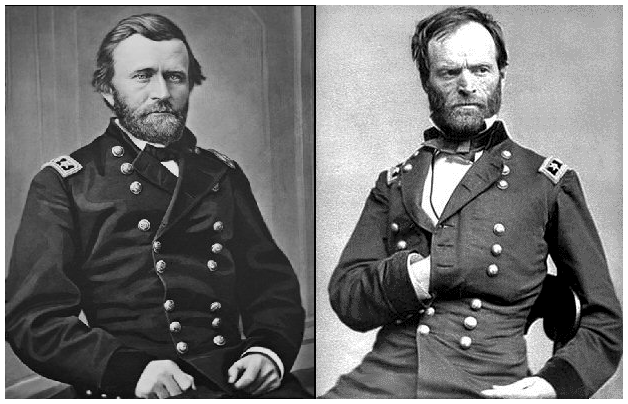
grant-and-sherman-122304

Friends of Padre Steve’s World,

Today just a short thought. I spent most of this holiday weekend down with a nasty cold which allowed me to do some reading and working on my book A Great War in a Revolutionary Age of Change: The Foundations of the American Civil War and Why it Still Matters Today. What I was working on was more on the technical “wonk” side of the development and use of artillery that preceded the war and how artillery was used in it. Lots of analysis, and delving through obscure books which I found absolutely fascinating, but anyway I digress and someday soon you’ll get to read that as well.

Last night a got a wonderful phone call from an old friend, a priest from my former denomination who remarkably hasn’t cast me off. We had a wonderful time, he’s a brilliant man, a combat veteran of Iraq and suffers from some of the same issues that plague me, but with added medical issues from inhaling so many toxins during his two combat tours. He’s gone through a lot, but he and his family are doing well. He is now in medical school and doing very well, but like I said he’s brilliant.

After we returned from Iraq we suffered and commiserated a lot, sometimes over a lot of alcoholic beverages. Last night our talk went on for quite a while and it was great just to do that, so relaxing, good memories, thoughtful discussion of what is going on in the country and in our lives. One thing he said that meant the world to me was the difference I had made as a mentor, encourager, and friend and how important I was to him. He said I was like the character that Kevin Costner played in Bull Durham, Crash Davis, the old catcher sent down to help out the rising star. In a way he is right, and I love the comparison.

As we talked he noted it was so seldom that people take the time to listen, care, encourage, and mentor others. In fact its something that is mentioned quite often in the New Testament. I mentioned to him that one of the people who recently expressed a similar thought to me was a former Navy doctor who I knew when he was an intern; he’s an atheist, but we truly appreciate and value each other.

Sadly, as a culture we have lost that connection and ability to care and learn from each other, even when we disagree on certain points, even important ones. Additionally, we often tend to discard those who are broken in some way, or who color too far outside the lines. There is a creeping Ayn Rand, survival of the fittest style of Social Darwinism that has infiltrated our culture, and especially the church. It has become part of our politics as well and I am sure under the new administration we will see it bloom as we have never seen it before, but I digress again…

Being friends means to let each other know how much we appreciate each other and encourage one another.

Ulysses S. Grant, who is one of my heroes with feet of clay remarked, The friend in my adversity I shall always cherish most. I can better trust those who helped to relieve the gloom of my dark hours than those who are so ready to enjoy with me the sunshine of my prosperity.” Grant’s ever mindful friend and subordinate William Tecumseh Sherman noted, “Grant stood by me when I was crazy, I stood by him when he was drunk. Now we stand together.” 

With that I wish you a good day,

Peace

Padre Steve+

2 Comments

Filed under christian life, Loose thoughts and musings, Pastoral Care, PTSD, remembering friends

2017: A Future Not Yet Written that Hinges on Each of a Thousand Choices

new-year

Friends at Padre Steve’s World

I tend to become somewhat reflective at the New Year, maybe more this year than in past years. I am reminded of Peter Benchley, who wrote, “The past always seems better when you look back on it than it did at the time. And the present never looks as good as it will in the future.” Likewise, St Augustine of Hippo once asked “How can the past and future be, when the past no longer is, and the future is not yet?”

Augustine’s question is interesting, but I think that his question is flawed. I think that the past lives in the present much more than we would like to think and that our future, though unwritten can unfold in a multitude of ways and possibilities.

Many of us live in the past as if it were today. We, individually and collectively, as individuals and nations live in the past and look to it much more fondly than when it was our present. I think that historian Will Durant possibly said it the best: “The past is not dead. Indeed, it is often not even past.”

As a historian myself I value the past and seek answers and wisdom from it to use in the present because what we do in the present does, for better or worse defines our future. Confucius said “study the past if you would define the future.” He was quite wise, he said to study the past did not say to live in it.

That is something that I have been learning for over twenty years since my Clinical Pastoral Education Residency Supervisor, using a Star Trek Next Generation metaphor from the episode A Matter of Time to confront me about living in the past. In the episode a shadowy visitor claiming to be from the future refuses to help the Captain Picard and crew of the Enterprise claiming that if he were to help that his “history – would unfold in a way other than it already has.”

Finally Picard is forced to make a decision and confronts the visitor, who turns out to be a thief from the past using time travel to collect technology to enrich himself. Picard responds:

“A person’s life, their future, hinges on each of a thousand choices. Living is making choices! Now, you ask me to believe that if I make a choice other than the one that appears in your history books, then your past will be irrevocably altered. Well… you know, Professor, perhaps I don’t give a damn about your past, because your past is my future, and as far as I’m concerned, it hasn’t been written yet!”

He was in telling me that my future did not have to be my past, and that opened a door of life and faith that I had never experienced before and which showed me that life was to be boldly lived in the present. While it meant a lot then, it means more now for the past according to William Shakespeare “is prologue.”

We cannot help being influenced by the past. We should indeed learn from it, but we cannot remain in it or try to return to it. Kierkegaard said that “Life can only be understood backwards; but it must be lived forwards.”

Since I am a Christian, at least by profession, my faith in that future is in the God who is eternal, the God of love. Victor Hugo in Les Miserables said “Love is the only future God offers.” That is the future that I want to envision despite the hatred that I see and hear from those who devalue and dehumanize people in the name of their religious beliefs or political ideology, which too often are indistinguishable.

Living is making choices and the future hinges on thousands of them. Many of these choices we make automatically without thought simply because we have always done them that way, or because that is how it was done in the past. However, if we want to break the cycle, if we want to live in and envision that future of the God of love then we have to live in the present though the past lives in us.

T.S. Elliot penned this verse:

“For last year’s words belong to last year’s language
And next year’s words await another voice.
And to make an end is to make a beginning.”

This is truth. We must all find our voice in 2017. My future, and for that matter your future my friends is not yet written, and those who claim otherwise are full of shit. So Happy New Year, find your voice and make a difference.

Peace

Padre Steve+

Leave a comment

Filed under christian life, faith, Pastoral Care, philosophy

Wounded Healers at Christmas

lastmass

Friends of Padre Steve’s World

The German theologian Jürgen Moltmann wrote, “God weeps with us so that we may one day laugh with him.”  Since coming home from Iraq in 2008 my faith has undergone a profound change. This is a part of my story that I share with you.

Christmas is a special time for me, it always has been but in spite of that there were times that I took the faith element for granted. I believed and my faith in God, for me the Christian God, Father, Son and Holy Spirit was unquestioned. I knew the Scriptures, the Creeds and the Councils and I felt that my faith in a sense was untouchable. I was sure of it, in fact almost cocksure or arrogant about it. That came out in published writings in a very conservative Catholic monthly, the New Oxford Review back in 2000-2001.

For me the elements of my faith were very much intellectual. I could see other points of view but if I disagreed with them enough I would engage them with the purpose of defeating them. Of course this usually went to theological methods, history and hermeneutics. As far as those that lost their faith it was something that I had difficulty comprehending. Not that I was unsympathetic or uncaring of them or their plight, but I didn’t see how it could happen to me.

But that was before Iraq. That was before PTSD, moral injury and my own crisis of faith when I returned from the Iraq War in 2008.  That changed me as war has changed so many others before. Guy Sager wrote of his return from war in his classic The Forgotten Soldier:

“In the train, rolling through the sunny French countryside, my head knocked against the wooden back of the seat. Other people, who seemed to belong to a different world, were laughing. I couldn’t laugh and couldn’t forget.” 

My return instigated a crisis of faith, I felt like I still belonged in Iraq and home seemed like a foreign land.  In the crisis I was for all practical purposes I was an agnostic trying to believe and feeling abandoned by God and many of his people, especially clergy.  Commodore Tom Sitsch at EOD Group Two, a veteran of much combat asked me “where does a Chaplain go for help?” I told him “not to other Chaplains or clergy.”

That crisis etched a permanent scar in my soul which led to some fairly major changes in my life.  It forced me to enter what Saint John of the Cross called the “Dark Night of the Soul.”

I will not tell of how my great spiritual disciplines and intellect helped me get through the crisis, as they did not. I found it hard to pray or believe in anything for nearly two years as I struggled with abandonment. I felt that God, the Church and the Navy had abandoned me.  The only thing that kept me going was my profound sense of vocation as a Priest and Chaplain and commitment to others who were suffering.

I was losing my battle with PTSD during that time, depressed, anxious and despairing I threw myself into my work among the critically ill ICU patients and those that cared for them.  Christmas Eve of 2008 was spent in despair as I wandered through the darkness on a cold night after leaving Mass because I could not get through it.

Though I found a community and camaraderie among those that I worked with and tried to provide spiritual care, my own condition grew worse.  I was so bad enough that my clinical duties had to be curtailed over my objections in September of 2009.

I still stood the overnight duty and filled in for others as needed, but for a number of months I had no clinical assignments.  That meant that others in our minimally staffed department had to fill in for me. I am sure that they resented that, especially because before this I often worked 80-90 hours a week mostly in our ICUs and the staff of the ICUs now expected that kind of intensive ministry and support.

But in my desperation I was greeted with a surprise. On one of the on call nights not long before Christmas I received a call to the ER to provide the last rites to an elderly retired Navy Medical Doctor.  The man was a saint, faithful to God, his Church and the community. For years he dedicated much of his practice to the poorest members of the community, delivering babies for women with no insurance and caring for prisoners in the Portsmouth City Jail.  He breathed his last as I prayed this prayed the prayer of commendation following the anointing and something strange happened. I felt the presence of God for the first time since Christmas of 2007 in Iraq. It is too this day hard to explain.

Something miraculous happened that night and by Christmas Eve I realized that something was happening to me. As I wrote in Padre Steve’s Christmas Miracle on Christmas Eve of 2009:

“Mid afternoon I was walking down the hall and I experienced a wave of emotion flood over me, and unlike the majority of emotions that I have felt in the past couple of years this was different.  It was a feeling of grace and I guess the presence of God.  I went up and talked with Elmer the shrink about what I was feeling and the experience was awesome, I was in tears as I shared, not the tears of sadness, but of grace.  I am beginning to re-experience the grace of God, something that has been so long absent that I did not expect it, at least right now.  I didn’t do anything differently; I certainly was not working extra hard to pray more, get more spiritual or pack my brain full of Bible verses.  I was too far gone to do those things.  It was all I could do many mornings just to get out of bed and come to work.”

Since that time I have continued to recover faith and belief. I cannot say that it is the same kind of faith that I had before Iraq. This was a different kind of faith.  It was faith born of the terrible emptiness and pain of abandonment and despair, a faith that is not content with easy answers and not afraid to ask questions.  It is a faith in Jesus Christ, the crucified one who’s image we see hanging from the crucifix and adorning icons of the Crucifixion. It is as Moltmann wrote in The Crucified God:

“The Symbol of the Crucifix in church points to the God who was crucified not between two candles on an altar, but between two thieves in the place of the skull, where the outcasts belong, outside the gates of the city. It is a symbol which therefore leads out of the church and out of religious longing in to the fellowship of the oppressed and abandoned. On the other hand, it is a symbol which calls the oppressed and godless into the church and through the church into the fellowship of the crucified God”

My Philosophy of Religion Professor, Dr. Yandall Woodfin at Southwestern Baptist Theological Seminary told us in class that until we had “dealt with the reality of suffering and death we were not doing Christian theology.” At the time the words were offensive to me, but by the time I had graduated and also done a year of Clinical Pastoral Education they became a part of my experience. However that did not prepare me for the darkness that I lived in from February of 2008 until that Christmas Eve of 2009.  I would say that in addition to Dr Woodfin’s understanding of grappling with suffering and death that one has to add the abandonment of the outcast to the equation.

The “I Believe in God” of the Creed is no longer for me simply a theological proposition to defend, but rather an experience of God born out of pain, despair, anxiety, doubt, unbelief and abandonment. During my crisis I found almost no Christians willing to walk through the darkness with me, including clergy. The only clergy willing to were those who were walking the same path of the outcast with me, suffering from PTSD, TBI and other unseen wounds of war. It was if I was radioactive. Many people had “answers” for me, but none sought to understood my questions until my first  therapist Dr. Elmer Maggard asked me “how I was with the big guy?”

When I finally collapsed in the summer of 2008 and met with Dr. Maggard I made a conscious decision that I would not hide what I was going through.  I felt that if someone didn’t speak out that others like me wouldn’t seek help. In the nearly six years since I returned from Iraq I have encountered many people, men and women, current and former military personnel and families of veterans who came to me either in person or through this website. It led to me being interviewed in a newspaper and being featured on the Real Warriors website http://www.realwarriors.net , a program run by the Department of Defense to help reduce the stigma of getting help for PTSD which features the stories of military personnel suffering from it. My story can be found here: 

http://www.realwarriors.net/multimedia/profiles/dundas.php

I have had a number of military chaplains come to me also experiencing a faith crisis. Most said that I was the first Chaplain or minister that they had met or who admitted that he struggled with faith and the existence of God.  For a minister to be open about such struggles is dangerous. When my faith returned and was different I was asked to leave my former denomination because I was now “too liberal.”

In each of those encounters with those suffering there was a glimmer of hope for me and I think for them.  It was as if for the first time we had people that we could be open with.  Co-workers and others said that I was “real.” I certainly do not boast of that because it was painful to be transparent with people while in the depths of doubt and despair while hoping that somehow God would touch them with some measure of grace when I found it hard to believe.  I guess it was the fact that I was willing to walk with them in their crisis and let them be honest even if it meant facing my own pain and doubt. I learned something about being what Henri Nouwen called a wounded healer.  Nouwen wrote:

“Nobody escapes being wounded. We all are wounded people, whether physically, emotionally, mentally, or spiritually. The main question is not “How can we hide our wounds?” so we don’t have to be embarrassed, but “How can we put our woundedness in the service of others?” When our wounds cease to be a source of shame, and become a source of healing, we have become wounded healers.”

I do still struggle with the continued effects of War and PTSD, but I am in a much better place. I also struggle with faith at times when I look at the actions of those who profess to believe but treat others with contempt. I can understand the quote from the Gospel “I believe, help my unbelief.”

So today this wounded healer will celebrate a special Christmas at home. My wife and I will celebrate a Mass, enjoy a Christmas dinner with our dogs, Molly and Minnie. Depending on how she feels we will either go out to a movie or watch one at home.

I want to thank all of my readers, especially those who like or comment on these posts. You are appreciated, some are lengthy and you choose to take your time to read them and often share them. If you are walking the path of the outcast feel free to drop me a line here or on my Facebook page. My wish for you and for all is a Christmas of peace, reconciliation and love.

Peace and blessings,

Padre Steve+

1 Comment

Filed under christian life, faith, ministry, Pastoral Care, PTSD, Tour in Iraq

Christ & Christmas

996759_10152169414832059_1833080489_n

Friends of Padre Steve’s World,

Just a short thought today as we get ready for Christmas. Of course it is still the season of Advent, but no time like Advent to talk about faith, but as I mentioned at the beginning of the month, I plan on sharing some of my faith experience, and this is another one of those posts.

The great author and novelist Anne Rice wrote after leaving the Catholic Church a few years ago, “My faith in Christ is central to my life. My conversion from a pessimistic atheist lost in a world I didn’t understand, to an optimistic believer in a universe created and sustained by a loving God is crucial to me. But following Christ does not mean following His followers. Christ is infinitely more important than Christianity and always will be, no matter what Christianity is, has been, or might become.”

I can understand that feeling, and now over five years after being asked to leave my former church I am in a good place, and for the most part I am over the pain, hurt, and bitterness that I felt in the immediate aftermath of that experience. While I still experience a sense of loss due being rejected by men I thought were friends, I don’t feel the terrible pain that I used to feel, especially this time of year. But that being said what I feel now is much more about other people who may be going through similar experiences in their own churches or faith communities.

The fact is that I do not want others to have to go what I went through. I know that such things happen every day, but I would never wish what I went through on anyone. 

Sadly, it will happen. It will happen in churches across the theological and ecclesiolgical  spectrum. In one breath church leaders and members will extoll the love of God, and in the next condemn and reject people for a myriad of reasons; and they will use the most hate filled and vile terminology covered with a thin veneer of theological and biblical justification. They will turn their backs on people who simply want to be loved, cared for, accepted, and listened to in their spiritual quest. 

Dietrich Bonhoeffer said:

“Many people are looking for an ear that will listen. They do not find it among Christians, because these Christians are talking where they should be listening.”

This Advent I am thankful that I have a number of friends, including some Christians from variety of backgrounds, as well as some chaplains who have stood by me even if they disagree with my theology, politics, or my favorite baseball teams. That being said, with the exception of such people who have been with me through thick and thin I am mostly terrified of being around conservative Christians, and most of my closest friends are people who are not welcome in most churches due to their beliefs or lifestyles. But they are genuine and we honestly care for each other. 

Most churches are frightening places for me, and the sad fact is that if I were not already a Christian there is little in American Christianity that would ever cause me to be interested in Jesus. I can totally understand why churches are hemorrhaging members, especially young people whose religious preference is “none,” for I too am in some sense an outcast. I guess that is why I can relate to Anne when she wrote, “following Christ does not mean following His followers. Christ is infinitely more important than Christianity and always will be, no matter what Christianity is, has been, or might become.”

Have a great day,

Peace

Padre Steve+

2 Comments

Filed under christian life, faith, Pastoral Care, philosophy, Religion

Belief & Unbelief in Advent

2004weihnachtsbrief-2

Friends of Padre Steve’s World,

I mentioned on Sunday that I would be writing about faith and doubt during the season of Advent and Christmas.  Gospel according to Saint Mark records the story of a man that brought his son to Jesus the Christ to be cured of a deadly disease. In desperation the man cries out to Jesus, “Lord I believe, help me in my unbelief.”

I understand that impassioned cry.

That being said, for a lot of people, including me, the season of Advent and Christmas are incredibly difficult and times where faith, already difficult becomes nearly impossible.  For many the season is not a time of joy but depression, sadness and despair. I know feeling well, for it has been the reality that I have lived with since returning from Iraq.

Before Iraq, Advent and Christmas were times of wonder and mystery and I really found it difficult to understand how anyone could be depressed during the season, but that was before I came home from Iraq. After Iraq, the seasons of Advent and Christmas became almost unbearable as I struggled to believe in anything, including God.

I have faith again, but I still struggle to find the same wonder and mystery of the season that I once experienced. I think that the last time I was truly joyful at Christmas and during Advent was in Iraq, celebrating the message of hope among our advisors up and down the Iraqi-Syrian border. I think the most special moment was serving Eucharist to an Iraqi Christian interpreter who had not received the Eucharist in years that Christmas Eve of 2007 at COP South. Somehow in that God forsaken land God seemed closer than any place I have been since.

Since I returned from Iraq my life has been a series of ups and major downs. In dealing with PTSD, anxiety, depression and chronic insomnia as well as my dad’s painfully slow death from Alzheimer’s disease, I have struggled with faith.  Prayer became difficult at best and as I dealt with different things in life I knew that I didn’t have any easy answers.  Going to church was painful. Chaplain conferences even more so, except being with others who struggled like me.  About the only place that I could find solace was at a baseball park.  For some reason the lush green diamond is one of the few places that comfort me.

I find that the issue of doubt is not uncommon for a lot of people, including ministers of most Christian denominations. I am sure that this can be the case with non-Christian clerics as well, but I cannot say that with any deal of authority.

For some Christian ministers and priests the seasons of Advent and Christmas can be difficult. For those of us who are ordained and view ministry or Priesthood as a sacred vocation this can difficult to deal with.  Ministers and others who suffer a crisis in faith, depression or despair endure a special kind of hell this time of year because we are not supposed to suffer a crisis in faith, for any reason.

I believe that for many people, a religious leader who has doubts and struggles with faith is disconcerting.  I know many ministers who for a myriad of reasons experienced a crisis in faith. Sometimes this involved great personal losses such as the loss of a child, a failed marriage or being let go or fired by a church, or experiencing any number of other major traumatic events.  All of these men and women are good people. But when they experienced a crisis, instead of being enfolded by a caring community of faith they were treated as faithless failures, and and abandoned or excluded from their faith community as if they were criminals.

When I was younger I used to look askance at pastors who had given up, lost their faith, or abandoned the ministry for whatever reason.  As a young seminary student and later young chaplain I had a hard time with such situations. They made no sense to me and I was somewhat judgmental until I started to get to know a decent number of “broken” ministers from various faith traditions that a lot more went into their decision than simply not being tough enough to hang in there until things got better.

While I saw this happen to others I never thought it would happen to me. I thought I was “bulletproof” and when it occurred I was stunned. I didn’t expect what happened nor its effect on me.

When I came back from Iraq I came home to find that my office had been packed up and many mementos lost, it took months to find most and there are still important documents that have never been recovered. My wartime accomplishments went unrecognized by most of my peers in the Chaplain Corps on my return home and I found no place of comfort.

As I crashed no one asked about my faith until I met my first shrink. It was after the initial crash that my commanding officers, Captain, now Admiral, Frank Morneau and Tom Sitsch both asked me about my faith.  I told them that I was struggling and both were more understanding than the vast majority of chaplain, ministers, or Christian lay people that I knew. Commodore Sitsch asked me “Where does a Chaplain go for help?”  I could only say, “not to other chaplains.” Sadly I had no idea how much Commodore Sitsch was going through as he ended his life on January 6th 2014, suffering the effects of untreated PTSD and TBI.

On the professional side I felt tremendously isolated from much of the clergy of my former church, and many chaplains. This is something that I still feel to some extent today, although there are some chaplains who I can be completely honest with, sadly, like me, they have also experienced major faith crisis and have struggled with the same kind of abandonment and betrayal that I have felt. I was angry then because I felt that I deserved better, because I had done all that was asked of me for both my former church and chaplain corps.

In the midst of the crisis I appreciated simple questions like “How are you doing with the Big Guy?” or “Where does a Chaplain go to for help?” Those questions showed me that the people who asked them cared.

There were many times between 2008 and 2010 that I knew that I had no faith.  People would ask me to pray and it was all that I could do to do to pray and hoped that God would hear me.  Even the things that I found comforting, the Mass, the Liturgy and the Daily Office were painful, and while faith has returned, some of the of them still are.

That being said, I am still a Christian, or maybe as I noted last week a Follower of Jesus, since the Christian “brand” is so badly tarnished by the politically minded, hateful, power seeking, media whores that populate the airwaves and cyber-space. This makes Advent and Christmas difficult.

Why I remain a Christian is sometimes hard to figure.  I am certainly not a Christian because of the church, what is called Christendom, or the actions of supposed Christians who want to use the police power of government to subjugate others. At the same time like the German priest and theologian Hans Kung “I can feel fundamentally positive about a tradition that is significant for me; a tradition in which I live side by side with so many others, past and present.” Nor am I a Christian because I think that the Christian faith has all of the answers to all of lives issues. After coming home from Iraq I know that it is not so. I have to be painfully honest and say that neither the Church nor Christians have all the answers. That may sound like heresy to some, but I can live with it.

I don’t presume to know God’s will and I can’t be satisfied with pat answers like I see given in so many allegedly Christian publications, sermons and media outlets.  Praying doesn’t always make things better. I remain a Christian in spite of these things and in spite of my own doubts.  I still believe that God cares in spite of everything else, and in spite of my own doubts, fears and failures.

One of the verses of the Advent hymn O’ Come O’ Come Emmanuel is a prayer for me this year.

O come, Thou Day-Spring, come and cheer

Our spirits by Thine advent here

Disperse the gloomy clouds of night

And death’s dark shadows put to flight.

 So now, for those that like me struggle with faith, those who feel abandoned by God, or by family and friends, I pray that all of us will experience joy this season. So I do pray that the Day Spring will come and cheer, all of us with his advent here.

Peace,

Padre Steve+

2 Comments

Filed under christian life, faith, Pastoral Care, Tour in Iraq

Not to Be Alone: Why Gay Marriage Matters

Friends of Padre Steve’s World

I have been thinking about the profound legal and moral implications of the Supreme Court ruling on marriage equity, the Obergfell v. Hodges case. One of those impacts in in a very simple and human concern, the ability of people to be with their loved ones during medical crisis or when they are dying. I saw the profound implications of not having this right when I was a young chaplain doing my hospital residency at Parkland Hospital in Dallas, Texas 1993 and 1994. This is the story of those two encounters and how they changed me.

Peace

Padre Steve+

marriage equality

For me it is still hard to comprehend, a young chaplain; two relatively young men dying of AIDS, two partners, two families and two radically different experiences of humanity, faith, religion and authentic loving relationships.

I was still a relatively inexperienced minister and chaplain back when I was doing my Pastoral Care residency at Parkland Memorial Hospital in Dallas Texas back in 1993 and 1994. Yes I had graduated from seminary. Yes I had a bit of chaplain experience as an Army National Guard chaplain and as a counselor at a major evangelical Christian ministry, and yes I had experience in dealing with AIDS as a Medical Service Corps officer in the Army.

Despite that, I was so ill prepared to deal with the massively different treatment of people dying from AIDS from their families. Families that in some cases shared the same Christian faith as me. I think that is one of the things that young ministers struggle with when they enter the nether world between life and death, mortality and immortality, faith and unbelief in the real world. When I was in seminary the senior pastor of the mega-church that I attended told a story about being approached by a family member of someone who was very sick and in hospital. The person wanted him to visit them while they were a patient. He had been their pastor for years. When they ask him if he would come, he refused. He recounted that the “parishioner asked just how sick he would have to be to get a hospital visit?” The pastor told us his response. He laughed and said “you don’t want to be that sick.” The congregation laughed and I was devastated.

The pastor was a leader in the New Apostolic Reformation, a friend of John Wimber, Rick Joyner and others who helped to pave the way to the heartless, unfeeling, political “Christianity” and “Dominion theology” that is in vogue with the Tea Party and Religious Right today. When I questioned him about his comments later he told me that thought that pastoral care of those in his congregation, especially in regard to hospital visits was “below his office as an apostle, that others had that responsibility.” The thing that disturbed me the most was that he had ordained me as an Evangelical minister in that church to be a chaplain barely two years before this. I had respected him and now I felt a tremendous sense of emptiness when I left his office.

So when I began my pastoral care residency at Parkland I found that I had a lot to learn about the real world of religious faith, religious hypocrisy and religious hatred and intolerance.

Early in my residency I dealt with a number of AIDS cases. I wrote about one of those cases last night, although that was not really early in my residency, it was closer to the end of it. There were two cases besides that one that made such deep impressions on me that I can never forget them. Both involved young, white, homosexual men dying of the complications from full blown AIDS. Both came from very “Evangelical Christian” families (both were Southern Baptist) and both were being grieved by what we called then, their “significant others” as well as their biological families. But that was where the similarities ended.

The first case was in the second month of my residency, when I was the chaplain for the Medical ICU, before the Pastoral Care Director wisely moved me to the Trauma and Surgery department. A patient came to us, a man, about my age, a successful architect with many friends who was experiencing pneumonia brought about by his immunodeficiency brought about by HIV.

When he arrived he was still able to communicate and he had many of his friends as well as his significant other visiting him. They loved him and he loved them. There was a sense of community and if I dare say real family as they visited. In those first few days I got to know him and these people, most of who were homosexual but not all. There were a number of women there, who I am sure had the patient, who was a remarkably handsome man, been a heterosexual, would have loved to have been his wife.

My encounter with him, before his condition worsened to the point that he had to go on a ventilator and was sedated was transforming. He grew up in the church, knew that he was homosexual, attempted to live with it and finally came out as gay, and was disowned by his family. Despite this he became a highly successful architect, had many friends, was active in charitable works, and still maintained his faith in Jesus. I came to appreciate him, the man who for was for all purposes his spouse and his friends.

However, when his condition deteriorated his estranged family, the people who had disowned him, rushed to his “rescue.” In good Christian form they brought their pastor who though their son was unconscious proceeded to preach at him regarding his need to “repent” and “to come back to Jesus.” The family also took advantage of the law. They were his biological family and next of kin. They banned the man’s partner and friends from his room as he lay dying.

The family’s pastor preached at the dying man and glared at the people closest to him while he was present.  I was appalled by his, and their behavior. While they isolated their son from those closest to him and allowed their pastor to condemn him as he died, I remained with his partner and friends. I prayed with them, I cried with them, I embraced them. When the family left I went with them to be with this young man’s mortal body. We prayed and after the nurses prepared his body and the doctors completed their final notes, I walked with them as we took his body on that long trip from the ninth floor to basement, where the morgue awaited. I still cry when I think of this encounter, of how supposedly Christian people would not only keep their son, who they had rejected and condemned from those who loved him the most as he lay dying.

A couple of months later I was in my element as the Trauma and Surgery Department Chaplain, but I still had on call duty where I was responsible for crisis situations anywhere in the house. One of those wild nights I got a call from the nursing staff of Nine South, the Medical Step Down unit where the lady that I wrote about last night had passed away, but that was still in the future.

This time there was another young white man, another partner, another family. This young man was not in the ICU fighting for his life, he was passing away in the quiet solitude of his room with his mother and father, his partner and his friends at his side. Like the other young man he was a man of faith. He loved Jesus, he loved his family and he loved his partner.

He was from the area west of Dallas, the area between Fort Worth and Abilene. His mom and dad were ranchers, dad was wearing his cowboy hat, a plaid shirt, classic western Levi’s jeans and cowboy boots. His mom was wearing a simple dress. Both were thing, tanned and their faces lined by the sun and weather and from being out on the range with their cattle. The young man who was with them, the dying man’s partner was casually dressed but though he was from the same area was not a rancher.

I spent time with all of them. The contrast between the “Christian” parents and pastor of the first young man could have not been more profound. Like the architect’s parents, they were Christians. In fact they were Southern Baptists who attended a small country church in the town that they lived. By any sense of the word they could be described as “Fundamentalist” Christians, but unlike so many fundamentalists they focused on loving God and loving people, even people that so many Christians reject out of hand.

I arrived as the patient was breathing his last. I remained with him, his parents, partner and friends as he passed away, and when his parents asked I offered a prayer commending his soul to God. As I did this his partner was in a state of near collapse, exclaiming “I have no one now, I am alone!” His grief was overwhelming, he had no legal status, in the eyes of the law he meant nothing, though the man that he loved had just died. My heart was rent, and I held on to him.

As I did, the patient’s father came alongside of us. The father said to the young man “You are not alone, you are our son now, we love you.” When this dear man said this we all were in tears, as I am right now. I stayed with all of these dear people as the nursing staff prepared the young man’s body to go to the morgue. At some point the parents escorted their son’s now widowed partner out of the hospital. Mom and dad walked on either side of him as they left the ward. If there was anyone couple on this either who were true Christians, it was this dear couple. As we parted I could not hold back the tears, and the father of the deceased gave me a hug and thanked me for being with them and honoring his son.

I remained with the nursing staff and the internal medicine resident as they complete their duties and took the young man’s body to the morgue. After that I went back to the emergency room where some of the nursing staff, including a RN who at one time had been an Assemblies of God pastor, but was now an avowed atheist who loved to torment chaplains, except me, comforted me in my grief. It is funny that an atheist would be comforting the chaplain after such an event, but then if I do believe in God, why can’t I believe that anyone cannot share in the grief of others and of comfort and care.

It was a story that I could only share with my pastoral care residency supervisor, in our residency group and with my wife Judy, as I knew if I shared my experience at church that at best I would only be humored, and most probably be ostracized. In fact I had to keep that story pretty much under wraps until 2010 when was told to leave the church which had ordained me a priest, for among other things speaking out for the rights of Gays, Lesbians and the LGBTQ community. By then I had met and served with far too many Gays who were far better Christians than most of the Christians who condemned them not to do so.

But, in a way it was a step to freedom because I realized that what I had been taught for so long was so horribly at odds with the message of Jesus.

Two deaths, two men, two partners, two families, two experiences of God’s grace, two experiences of a common humanity and the experience of one very flawed, but no longer confused chaplain…

Leave a comment

Filed under christian life, civil rights, ethics, faith, healthcare, laws and legislation, LGBT issues, ministry, Pastoral Care

“You Don’t Want to Be That Sick” Pastors Who Ignore

themiddle

Back when I was doing my Clinical Pastoral Education Residency at Parkland Memorial Hospital I was astounded to hear my pastor make a comment which I think was one of the most heartless that I have ever heard said from a pulpit.  The church was a large and trendy Evangelical-Charismatic Church which I had attended throughout seminary and had ordained my in October 1991.  The Pastor was recounting an incident where one of our members had been critically ill in hospital and had not been visited by him.  After the parishioner was released from hospital he asked the pastor: “How sick do I have to be for you to visit me in the hospital?”  The pastor told us his response: “Sir, you don’t want to be that sick.”

The congregation laughed at the pastor’s story and he went on to talk about how he and other senior pastors should not be doing that kind of work because it “distracted them from bigger Kingdom tasks.”  You see according to the pastor the care of sick parishioners did not contribute to the “growth” of the church and thus was a “distraction and better left to others.”

The comment struck a raw nerve now that I was dealing with the suffering and death every day of people who had been abandoned by the churches and pastors.  I lost all respect for him as a man and pastor during that sermon.  My philosophy of religion professor at Southwestern Baptist Seminary, Dr. Yandall Woodfin said: “You have not done Christian theology until you have dealt with suffering and death.”

Unfortunately my old pastor, and many more like had stopped doing Christian theology in order to be an “Apostle” and CEO.  He was “growing” the church and managing programs, but had for the most part stopped caring as in being a pastoral care giver.

Now this pastor is not alone and nor is the issue of the lack of care confined to Evangelical or Charismatic churches. The trend has has found its way across the denominational spectrum.  Sometimes this is by design as is the case of the Mega-churches.

Pastors of mega-churches are for all practical purposes CEOs of large organizations and have a multiplicity of specialized staff, but often which do little for pastoral care. Having attended a number of these churches, and worked for a prominent television evangelist I can sadly report seeing this first hand many times.

Sometimes this problem it is by default in cases such as the Roman Catholic Church.  In that church the ever worsening shortage of Priests is forcing the closure of smaller parishes and the increase of large parishes with a corresponding decrease in what Priests can do for their people.   Even very good Priests cannot keep pace with the demand of both Sacramental needs as well as pastoral care.

No matter if it is by design or default the result is similar.  The least, the lost and the lonely those “lambs” that Jesus talks about who need care and feeding are shunted aside.  In one case, that of the Catholic Church it is primarily a lack of Priests, Deacons and Sisters to provide this care, although sadly there are Catholic priests who do not see themselves as care givers.

The “by design” issue is more far more troubling as the focus of the church is growth, sustaining numbers, programs and buildings.  This requires that pastors spend their time with members who can supply the vast financial need that those plans require.  I have seen this in numerous congregations across the spectrum, which sometimes as was the case at a church that I attended in Florida results in a financial meltdown and collapse of the congregation, many of whom gave up and went elsewhere when the extent of the scandal became known.  Likewise the ripple effects that this caused in the denomination were like a Tsunami, it was disastrous and the church is still in recovery mode.  Going back to my pastor back when I was in residency I got the feeling that had he been the shepherd in the Parable of the lost sheep (Luke 15) that he would have let it go as hunting for it might have distracted him from the others.

When I was in seminary there were quite a number of my fellow students who chafed about having to take courses on pastoral care.  I remember friends and fellow students complaining that what they needed were more “practical courses” such as “church growth, evangelism and Sunday School program management.”  Courses dealing with Pastoral Care were seen as a bother and distraction.  Not to mention academic courses such as Systematic Theology, Philosophy of Religion and Church History which offer timeless lessons for pastors.  One friend talked about his Master of Divinity only having a “shelf-life of 5 years” because what he learned would be outdated.

Well in a way he was right.  His focus was on classes that dealt with programs and methods of church growth, programs and management.   From that perspective his degree would rapidly be obsolescent as soon as the next trend in church growth came along and everyone jettisoned the last method in favor of the new.

With the ubiquity of the Mega-church which unlike the Leisure Suit is not going away anytime soon.  The rise of the “Superstar” Pastors such as Bill Hybels, Joel Osteen and Rick Warren and the proliferation of massive “Ministry Media” conglomerates and stand-alone television ministries are actually dangerous to the vitality and health of the Christian Church in the United States.  They propagate methods which have the sole intent of getting people into church or giving to a ministry and keeping them there, doctrine, worship, sacraments or ordinances, and pastoral care of the least, lost and lonely be damned.  The methods are pragmatic and impersonal.   Numbers and crowds define expertise, credibility and worth. The bigger the church the better the church, it’s that simple.

Unlike others who pick these ministers apart for their theology or business practices my problem with what is happening is what happens to regular people in these large and often very impersonal churches.  It is easy for people to get lost, forgotten and when they are going through difficulty abandoned when the church stops making a conscious effort to do real pastoral care and focus purely on the programs which lend to growth.  Often the substitute for pastoral care is found in the home cell group, or care group or whatever cute name a church can pin on a meeting at a member’s house.

The home groups or cell groups have a noble intention.  They attempt to build community in an otherwise very impersonal organization.  There are some really good things that can come out of healthy home groups as well as long lasting friendships.  We have a couple from our time in San Antonio that is still a very real part of our lives, they showed us genuine love and care and we remain friends.  Of course this couple had an advantage over most home group leaders; he was a clinical social worker by trade who was heading off to seminary.

Most home groups are not that fortunate.  There are unhealthy groups which are led by people who are poorly trained and equipped to deal with broken people.  The good group leaders recognize their limitations and try to get help for those who are really hurting.  Others who do not know their limitations end up abusing these dear lambs of God. Often this is because sick, depressed or lonely people take too much time, are too needy, or that their problems don’t match up with their church theology.

My wife and I know this from personal experience as my wife suffered from a number of ailments throughout seminary and we were going through tremendous health and financial difficulties and in some places we felt cast aside and like we did not matter.  We were fortunate that some people did care and we did make it through, however it was not something that I would ever want to repeat.  I have heard similar stories from hundreds of people that I have come across in my life and work over the years.

I don’t care what you call it, but any church which has multiple services of several thousand or a major service of close to 20,000 as occurs at Osteen’s Lakewood Church is no longer focused on caring for people but sustaining their growth and market share.

I remember reading Charisma Magazine back in the mid-1990s when I still read it regularly about a church in North Dallas that has a period of incredible church growth in which it grew from 1,200 members to well over 7,000.  In the article the pastor touted the church programs which drew people to the church.  What the dirty little secret which was not mentioned was that two exits south of this church a Mega-church of some 10,000 members imploded when the Pastor, one Bob Tilton got caught doing some pretty bad stuff.  This church despite its claims of great programs simple picked up about 6,000 of these people because they were close by and a similar type of church.

All of this is dangerous as to its impact on people.  One only has to look at the latest Barna Polls about what is going on in churches to see that these large churches are alienating people even as they grow.  People come, but others either burn out trying to keep pace with the manic pace of programs proliferated by these churches or they get lost in the crowd and forgotten.  I meet a least a person every day who is a displaced Christian, often hurt, lonely and broken, not only by what they have experienced in life, but by the cold emptiness that they feel when a church surrounded by thousands of people who don’t even know their name.

Some churches do recognize that people have issues that need to be addressed and have in-house Christian counseling programs or refer members to Christian counseling services.   I think that there certainly is a place for clinically trained therapists in the life of a church; however this is not really pastoral care, even when they use “Biblical” methods.   In a sense it is the outsourcing by pastors of one of the most vital missions entrusted to a church, the pastoral care of the flock of God to others, in a sense, “hirelings.”  Again my issue is not with the therapists or Christian counselors, but rather pastors who refuse to do pastoral care as part of their ministry.

Ultimately it is people that are important, even those who are not rich, powerful and who have problems that don’t fit nicely into theological boxes or paradigms promoted by church growth experts. It is high time that churches start reclaiming one of the most vital missions given by Jesus to his Disciples, to care for the least, the lost and the lonely.
The onus for this falls on pastors who cannot simply outsource one of their primary missions as given by Jesus himself to others.  If pastors do not set the example of being caring pastoral care givers, it will not matter that they are supposedly “empowering” laypeople to do ministry.  Instead it sends another more ominous message, that if it is not important for the pastor, why should it be important to me?

Every member of the church at some time goes through a crisis when their faith, family, health or vocation.  Sometimes these are not isolated events but rather prolonged periods of anguish, as what Saint John of the Cross described as “the Dark Night of the Soul” where it seems that God has even abandoned the person.  Unfortunately people in this situation are often abandoned by their church as things fail to improve.  Despairing they become the lost sheep whose shepherd has abandoned.  This is the hardest time for pastoral care, the times where we as pastors are called to stand with someone as Mary the Mother of Jesus did at the Cross, just simply being there though nothing else can be done.

Now do I understand that the demands of running a large church can be sometimes become such that pastors have difficulty making time for pastoral care?

Of course I understand this, at the same time pastors, even those who function primarily as pastor-teacher/CEOs still have the responsibility of caring for people, not simply administering programs and preaching.  Pastors need to set the example of care for people, real people, the regular people who populate their pews, by their books and give to their ministry, even if it is only in small ways, not just the super-givers or the wealthy and powerful.

James’s “right strawy epistle” (Martin Luther’s words) has much to say about favoring the rich and powerful and neglecting the poor and seemingly insignificant people hanging about the peanut galleries of their large “Worship Centers.”  Even if the pastor has limited time he or she must be about the flock, or they will forget what the needs of the flock really are and instead of the People of God, the lambs who Jesus says to care for they will simply be the consumers of a religious message who we have to keep coming back to keep the operation going.

Peace,

Padre Steve+

2 Comments

Filed under christian life, faith, ministry, Pastoral Care, Religion

God’s Going to Get the Church for Its Greed

JoelOsteen_FOR_PROSPERITY

Back when I was in seminary at Southwestern Baptist, before the Fundamentalist takeover of that once proud school, my Church History professor, Dr. Doyle Young made the comment “God’s going to get us for our stained glass windows.” It was in the context of the rich and indolent nature of the American church. This was back in 1988 and 1989, sadly, things have only gotten worse.

In his various lectures Dr. Young was always able to weave church history into contemporary issues. He was really an amazing professor and he understood human nature more than most theologians. As such his lectures always had a profound amount of biography of the men and women who influenced church history. In fact, that biographical narrative is something that I have adopted in my own teaching and writing about history. That biographical emphasis helps keep me grounded and allows me to see that some things never change.


I noticed this again tonight when I posted a meme on Facebook about the televangelist and mega-church “pastor” Joel Osteen purchasing a 10.4 million dollar home. All of a sudden I had two men, one the son of a prominent televangelist that I worked for in the early 1990s, and the other a man who served with me as a Priest in my former denomination and now is a fairly high ranking priest in a diocese of the Episcopal Church open fire on me and defending the opulence of Osteen. When I asked what Jesus would do the televangelist’s son made comments made comments which were almost mocking of Jesus and his death for us. The Episcopal priest continued his defense and finished his post with the comment “cheers!” Frankly I found nothing to cheer about in their comments. When one of the men who served with me at war commented on the post, the Episcopal priest attacked him.

Do I really care what these men think of me? The hell no, not anymore. I invited both of them to drop me as “friends” because frankly I don’t want to be associated with people who make their living off the backs and hard earned money of the tithes and offerings of people who often cannot afford it and then defend the greed and opulence of wealthy minsters. I cannot do that. In fact when I retire from the Navy I will help other ministers and churches but I will not take any salary. I cannot do that, it seems to me that the Gospel which is supposedly freely given to us, should in turn be given.

Does that mean that I think that ministers should not be paid? Not at all. But there is a point, which is different in every church where what a minister makes is too much, and when the money that is sucked into a church or ministry only serves to prop that church or ministry up without helping any of God’s people but the livelihood of the minister.

I have heard so many rationalizations for this by ministers and Christians that it makes my head swim. I just remember reading the notes, letters and phone calls from poor people giving what they could not afford to the televangelist that I worked for in the early 1990s. Thinking about what those people gave and wrote breaks my heart to this day, especially when I see that man on television and radio talking about and actively backing the politicians who do the most to further impoverish the poor and support war without end.

Barry McGuire, the rock and roller who wrote and performed the song Eve of Destruction wrote another song after he became a Christian in the late 1960s called Don’t Blame God (for the Sins of America). Some of words in that song, a song of protest by a new Christian at the American church are even more accurate today.

On every worthless coin
and every dollar bill
you see the words in god we trust
but outta fear we kill

we got million dollar churches
but nobody’s on their knees
we got too many selfish people
just doin what they please

Sadly, because of the lives and actions of such people, many are fleeing the church, even those who grew up in it, the baptized. The fastest growing religious demographic in the country is the Nones those who ascribe to no religion. Many people blame God for the action of such people, but if I understand the message of justice of Jesus, John the Baptist and the prophets I know that it’s not God to blame. Instead it is us, those who claim to represent God while making our living off the backs of the weak and supporting the powerful. The Price Bishops of the Middle Ages would be jealous at how well we American Christians do this.

The song’s chorus would be banned in most churches especially those who have sold their souls for political power and economic wealth:

so don’t blame God for the
sins of america
america is fallen from the ways of the Lord
Don’t blame God for the
sins of america
livin for the dollar, she’ll be dyin’ by the sword


Anyway, this was one of those articles that I had thought about writing for a while and just needed a trigger. I guess I got it.

Peace

Padre Steve+


3 Comments

Filed under christian life, faith, Pastoral Care, political commentary, Religion