Category Archives: philosophy

The Uncomfortable Middle: The Challenge to the Certitude of Unprovable Doctrine

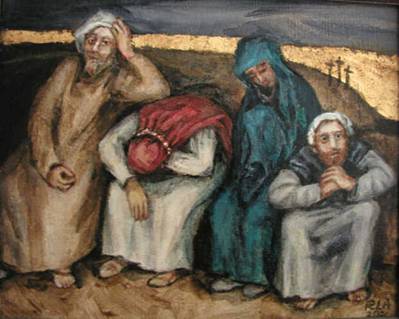
holy-saturday

“Man no longer lives in the beginning–he has lost the beginning. Now he finds he is in the middle, knowing neither the end nor the beginning, and yet knowing that he is in the middle, coming from the beginning and going towards the end. He sees that his life is determined by these two facets, of which he knows only that he does not know them”  Dietrich Bonhoeffer

I was watching an episode of Star Trek Voyager tonight, one called Distant Origin where a scientist of a race in the Delta Quadrant believes that genetic evidence indicated that their race originated on Earth. His thesis is challenged the doctrine of his species and he was accused of “heresy against Doctrine” for positing something different than his people believed. He ends up being persecuted and punished for his beliefs.

Now I want to be diplomatic about this. I am not someone who simply is a contrarian to established doctrines, be they theological, scientific or even military theories. That being said I think it is only right to question our presuppositions, as Anselm of Canterbury did through faith seeking understanding.

That understanding as a Christian is based on the totality of the message of the Christian faith. Hans Kung said it well:

“Christians are confident that there is a living God and that in the future of this God will also maintain their believing community in life and in truth. Their confidence is based on the promise given with Jesus of Nazareth: he himself is the promise in which God’s fidelity to his people can be read.” 

What we have to admit is that our belief is rooted in our faith, faith which is given to us through the witness of very imperfect people influenced by their own culture, history and traditions. Even scripture does not make the claim to be inerrant, and the Bible cannot be understood like the Koran or other texts which make the claim to be the infallible compendium of faith delivered by an angel or dictated by God himself. It is a Divine-human collaberation so symbolic of the relationship that God has with his people.

There is a certain sense of relationship between God and humanity within scripture and that relationship creates certain tensions between God and those people. The interesting thing is that Scripture is a collection of texts which record often in terrible honesty the lack of perfection of both the writers and their subjects. They likewise record the sometimes unpredictable and seemingly contradictory behavior of God toward humanity in the Old Testament. They bear witness to the weaknesses, limitations and lack of understanding of the people of God of the message of God but even in that those limitations and weaknesses that God is still faithful to humanity in the life death and resurrection of Jesus of Nazareth.

The real fact of the matter is that fixed doctrines are much more comfortable than difficult questions than honestly examining the contradictions that exist within Scripture, history and tradition. The fact is this makes many people uncomfortable and thus the retreat into the fortress of fixed and immutable doctrine. This is the magnetic attraction of funamentalism in all of its forms, not just Christian fundamentalism.  Yet for me there is a comfort in knowing that no matter how hard and fast we want to be certain of our doctrines, that God has the last say in the matter in the beginning and the end. We live in the uncomfortable middle but I have hope in the faith that God was in the beginning. Besides as Bonhoeffer well noted “A God who let us prove his existence would be an idol” 

Our doctrines, the way we interpret Scripture and the way we understand God are limited by our humanity and the fact that no matter how clever we think we are that our doctrines are expressions of faith. This is because we were not in the beginning as was God and we will not be at the end, at least in this state. We live in the uncomfortable middle.

We are to always seek clarity and understanding but know that it is possible that such understanding and the seeking of truth, be it spiritual, historical, scientific or ethical could well upset our doctrines, but not God himself. As Henri Nouwen wrote: “Theological formation is the gradual and often painful discovery of God’s incomprehensibility. You can be competent in many things, but you cannot be competent in God.”

Peace

Padre Steve+

1 Comment

Filed under christian life, faith, philosophy, Religion

Relearning Ministry Again For the First Time

198177_10151361204842059_1890411795_n

“Ministry means the ongoing attempt to put one’s own search for God, with all the moments of pain and joy, despair and hope, at the disposal of those who want to join this search but do not know how.” Henri Nouwen 

It was over 20 years ago that I graduated from seminary. I was a very good student and took every opportunity to learn, even when what I learned challenged my assumptions. Thus in a Southern Baptist seminary I basically came out as an Anglo-Catholic or progressive Vatican II type Catholic. But even so I was was still quite limited in my understanding of ministry.

My time in a Clinical Pastoral Education Residency a year after I graduated from seminary was filled with more discovery, much of it very painful as I confronted many of my own demons, But even what I learned there was just a chip off the top of the iceberg. While it was valuable it was something that took many more years to begin to fully grasp.

In each of these places and times of learning I discovered much, but like any novice my actual understanding of what I learned with limited by my own strengths as an analytical thinker and intuitive personality type. I was quite convinced of my competencies, skills and abilities, particularly in history and theology. I could wear people out picking apart arguments that I thought were flawed. Likewise on the occasions people came to me for advice I often would fall back on my strengths in analyzing their situation and giving them an answer. I was so obnoxious about it Judy would sometimes call me “the Great White One Who Knows it All.”

At various points in my life, seminary, preparation for the ordination to the Priesthood, during Clinical Pastoral Education and in the various military Chaplain school course that I have attended had to write and sometimes present a philosophy or theology of ministry. As I think about them most did talk about being present, but much more focus was on  programs and methods of teaching or even counseling from a cognitive behavioral theory method, but little to do with just being present and listening, presence was more about showing my face and being known that it was actually being with people. The changes in my “philosophy or theology of ministry” were honed in the crucibles of critical care ministry in hospital Trauma Departments and ICUs, and at war, deployed on ship or in Iraq. In those places I learned that between life and death that sometimes what matters most is just being there and not avoiding the pain by giving advice, offering a prayer, no matter how sincere and getting out of Dodge before the hard questions got asked.

I have found that young ministers or those new to ministry regardless of their age are often quite zealous and even when quite sincere often run roughshod over others. I think that is not so much a human failing but rather a result of our theological and ministerial training process. We focus on everything but being with real people, and among the professions we often are those among the least likely to truly listen to people before we diagnose a situation and give an answer. If we come from or are influenced by a tradition where what we believe that we are accurately discerning what the Holy Spirit is saying, or that we have the authoritative interpretation of Holy Scripture or that our theological premise is more correct than the others out there.

Please know this is not an attack on any particular denomination or theological school of thought. It just happens to be very common across the board in the way we do ministry as American Christians regardless of our denominational affiliation or whether we are liberal or conservative. It was bad enough when we all pretty much attended seminary in residence with other people and had to physically interact with other students or professors, some of whom challenged our views.

I believe that in the present reality of theological education in America, where online seminary programs are flourishing that an overall lack of contact and isolation is making the overall quality of ministry worse.  Simply put this is because we spend our time in a theological cocoon of our own making, deviod of relationships with people who really know us.  The result is that we become less attentive to others and more convinced of our own correctness and often suffer from a dangerous amount of narciscistic behaviors which are quite often displayed for the world to see.

 I wonder at times if the Jesuit formation process than anything that we do here.  While the 12 years long process done by the Jesuits is difficult and maybe even unworkable for some, I wonder if it is actually a better model for ministry.  I also wonder wonder if possibly we can learn from Buddhism. From what I see there appear many practices in it that are not antithetical to the Christian faith and may actually help us to be better spiritual directors, guides and care givers. I read a book by Wolfhart Pannenberg years ago about commonalities and where Christians and Buddhists could learn from each other. I still have it and when I return home I will have to take the time to re-read it. Part of my curiousity lies in the fact that I am also a military historian and theoritician and much as I see much complementary thought in the military theories of Sun Tzu and Carl Von Clausewitz, one who was Eastern in thought and the other a product of Classic Western Liberal thought and philosphy. Both understood the human dimension of life, war and statesmanship and as such their military theories are timeless. Could it be that Christians could learn from Buddhists. I know that some do and I wonder if because our God is bigger than our conception that his grace allows people outside the Christian tradition to understand his will better than us sometimes. I think of the encounters of Jesus with Roman officials who he complimented saying “I have not seen such faith in all of Israel.”

I know this because I lived my ministerial life in this manner for many years. In a sense I remained a novice so long as I thought that I knew everything. The late and great Hall of Fame Manager of the Baltimore Orioles, Earl Weaver said “It’s what you learn after you know it all that counts.” 

For me it took falling apart and feeling abandoned by peers, colleagues, the church institution and even God that took me to a new place ministry. Of course that came through the pain of loss, madness and abandonment that basically left me questioning everything, even the existence of God, I was for all practical purposes an agnostic. Coming back from war changed and suffering from PTSD and its effects makes more of an impact on faith than you can imagine. Since I have written about this part of my experience many times before so I won’t go into detail here.

295_27076762058_7573_n

Needless to say five years ago I began a journey that challenged my beliefs and changed me quite a bit as a Priest and Navy Chaplain. I won’t bore you with those changes either because I have written about them at length.

What I have learned and over the past five years is that Henri Nouwen who I quoted at the beginning of this article was correct. We as ministers frequently fail in this, instead we feel the need to say something, when often saying little or nothing but simply being with people and fully engaged in hearing them and whether through their words, expressions, tears or silence stay with them. Our words, suggestions and advice, even when theologically correct and in accordance with good counseling theory often are not heard by the suffering person because we are not listening and instead offering a diagnosis. Dietrich Bonhoeffer stated this Christian conundrum well:

“Christians, especially ministers, so often think they must always contribute something when they are in the company of others, that this is the one service they have to render. They forget that listening can be a greater service than speaking.”

I cannot tell you how many times that I have met people who have been hurt by well meaning ministers who simply cannot shut up and need to give advice. Let’s face it, the temptation is by virtue of our calling, our ordination or commissioning that we believe that words are essential. St. Francis of Assisi said “preach the Gospel at all times, use words when necessary.” Actions do speak louder than words and one of those actions is listening and maintaining a holy silence as we allow the Spirit of God to work in a life even as we remain present. Henri Nouwen wrote:

“Somewhere we know that without silence words lose their meaning, that without listening speaking no longer heals, that without distance closeness cannot cure.” 
n671902058_1153804_6925

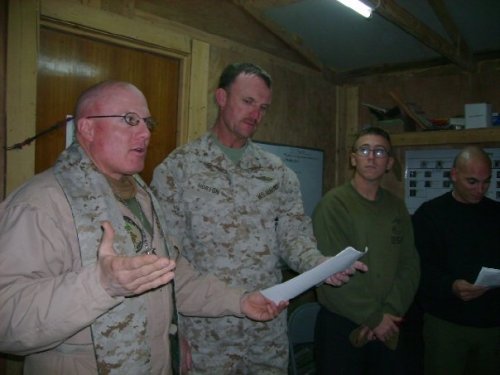
For me though I have continued to evolve in ministry I do often feel like a novice. I have to fight the temptation to simply diagnose and give advice every day. That being said I am much more comfortable with listening and being present even more than I was a year ago. A lot of this credit goes to my Command Master Chief Ed Moreno, who I spend many hours a week with. He is a very spiritual person, a good listener and patient man who in a sense is a companion and fellow traveller on this spiritual journey.

For me it is almost as if I am relearning everything about ministry for the first time.

Well, that is enough for tonight. It is time that I shut up.

Blessings and Peace,

Padre Steve+

Leave a comment

Filed under christian life, faith, Pastoral Care, philosophy, PTSD, Religion

What Goes Around…The Problem of Trolls

troll_2

I find it amazing just how nasty some people can be in cyberspace. The behavior of some towards people that they know nothing about on sites like Facebook, Twitter and even comments on news articles or blogs is mind boggling in terms of outright rudeness.

A lot of people refer to such purveyors of hate and ignorance, and that is really what it is, as Trolls.

The sad thing is that most of the Trolls that I am accosted by claim to be Christians or those who are claim to be family values type conservatives or anti-government types. Actually it makes me tired.

It has been a while since I had any of these, but today I got hit on Twitter by someone who decided to insult first and then not ask questions later. I gave a short terse response, then blocked and ignored him. I looked at his Twitter profile and he kind of fit the conservative anti-government mold. I know that some conservatives experience similar behaviors from some people on the political left so I don’t think that it is limited to any particular group. Anti-social and rude behavior is common to humanity and has been made worse by our wonderful technology.

Unfortunately that is the common denominator of Trolls regardless of their politics, religion. ideology or alma mater. Personally I don’t know how people can be so angry and it does cause me great concern.

As a historian it kind of scares me. It reminds me of what I read about the United States in the 1850s before the Civil War and after Reconstruction, or Weimar Germany.

185615_1857288397412_3950321_n

Likewise from my experience in Iraq I learned from Iraqi officers just how they felt about the extremists, especially the religious types both Sunni and Shia who helped drive that country into a civil war. A civil war that is threatening to again envelop that unfortunate country that we helped destroy. In fact though they had billets for Imam’s in thier units most Iraq commanders would not fill them because the Imam’s and Mullahs of both sides were seen to be a big part of the problem. It is a warning that our religious leaders who want to establish their religion above all others should heed. But I digress…

The fact is that for all its wonders the world of cyberspace has removed many of the boundaries and filters that many people used to take for granted. Most people would never say the things to someone in person that they do on the internet. I believe that this has made us a much less civil society and in fact it is a cancer that will destroy us if we are not careful.

Oh well, Karma is a bitch. Though I will not be the one to take matters in my own hands, the truth of the matter is that Trolls will see that what goes around comes around.

Peace

Padre Steve+

Leave a comment

Filed under Loose thoughts and musings, philosophy

Kindred Spirits

400236_10151328400862059_541742014_n

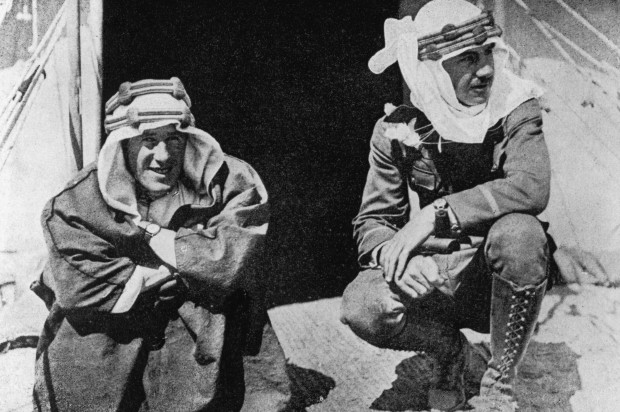
“All men dream: but not equally. Those who dream by night in the dusty recesses of their minds wake in the day to find that it was vanity: but the dreamers of the day are the dangerous men, for they may act their dreams with open eyes, to make it possible. This I did.” T. E. Lawrence

52086880-e1359135444105-620x412

I am an introvert, an academic and a circuitous thinker versus a linear thinker. I am also a dreamer, thinking about possibilities, alternate realities and going beyond the possible. I often discover answers to situations that I face in unrelated subjects. Usually something else that I have read, studied, watched or heard often from history, literature, film, music and sports, especially baseball. I tend to be an outside of the box thinker and I am sure that some that know me consider me quirky or sometimes even off the reservation. I like to ask, ponder and muse about hard questions, sometimes playing Devil’s Advocate.

Frankly I am okay with that.

I love writing and writing has become an extension of me as much as it has been part of my recovery, spirituality and psychological health. In a sense writing has been part of my post Iraq redemption.

I like dealing with people individually and find that I can be as at ease with the a person of most humble means with no power or influence as I can with those of great power, means and influence.

I feel most comfortable teaching and prefer, even as a Naval officer to avoid the limelight. When I was younger that was not the case. I sought promotion and remember hoping to be a Army Colonel or maybe even a General. When I gave up my rank as a Major in the Army Reserve to enter active duty in the Navy in 1999 it was as if that burden was removed. While I have done well in the Navy and have been promoted to the rank of Commander in the Chaplain Corps, I do not seek higher rank. If in a few years I get promoted that is okay, but I almost wonder due to the nature of the jobs at that level if I was promoted if I would be really happy.

I am a Priest and cannot see myself as a Bishop. I am a historian, a teacher, a bit of a counselor, I do ethics well and function very well serving as a chaplain in hospital Intensive Care Units and Trauma departments. While I have served as a company commander in the Army and had other positions where I supervised good numbers of people with a fair amount of responsibility I have found that I prefer to be in less visible positions where my influence is used helping others achieve success.

Thus I really am looking forward to my next assignment at the Joint Forces Staff College where I will be teaching ethics and probably some military history to men and women going to positions of great authority, some of whom will become Generals or Admirals. If I do my job right these men and women may learn something from me that helps them do good things for our nation, their soldiers and even the populations of countries that they be serving in, or occupying.

I think in some ways I am becoming a spiritual director and guide to some people as a Priest and Chaplain. The latter is something that was not sought, nor something that I could ever imagine.  Despite my dual callings as both a Priest and military officer, great experience, education and training I have found that I frequently have felt totally inadequate when people ask me difficult questions.

295_26912097058_4309_n

I am fortunate that I can admit to people that I have questions, doubts and that much of my success is due to other people who took the time to mentor me, teach me and care for me throughout my life and career. Some were teachers, some coaches, some military officers, Navy Chiefs, or NCOs from the Army or Marine Corps, and a few clergymen.

I also have some people that I consider kindred spirits. I think that we all need to have people like that, those that we know personally and those that we know from history, literature, sports, films or whatever. I think that since everyone is different and that we learn in different ways, understand God in different ways that somehow God is not bound to any particular means of speaking to us and reveals himself to us in various ways and that one of those ways is through people that are kindred spirits.

In my case I find such men and women are those that like me march to a different drummer, those that think outside the box and those not threatened by ideas, discoveries or philosophies different than their own. Those who can see the humanity and value in people who are not necessarily like them. Those who in their lives often failed before they succeeded and whose journeys were not easy and those who did not seek the highest office or aspire to be a celebrity even when they had the chance.

I think that the one man who I can call a kindred spirit is T. E. Lawrence, known as history as Lawrence of Arabia. As I read his autobiography I found a complicated and often contradictory man who after achieving fame laid it down even though he could have held any of a number of great positions of power. He really was an amazing person. Lawrence wrote:

“The rare man who attains wisdom is, by the very clearness of his sight, a better guide in solving practical problems than those, more commonly the leaders of men, whose eyes are misted and minds warped by ambition for success….”

That is what I have been learning since Iraq.

Peace

Padre Steve+

Leave a comment

Filed under History, philosophy

Trayvon Martin and the Pro-Life Movement: Do the Post-Born Matter at All?

trayvon-grave

I am perplexed tonight. I see people, many of whom are friends fight stridently against all abortion. I am not for abortion, but I do not think that it should be banned. That aside what I think the pro-life movement as a whole in the United States has become is simply an anti-abortion movement. Sometimes one where demented individuals in it feel justified in killing people who work in abortion clinics, even murdering them in church.

I am perplexed because I seldom see any of the high level culture warriors that fight the abortion battles ever raise a cry about issues of justice concerning people that are already born.

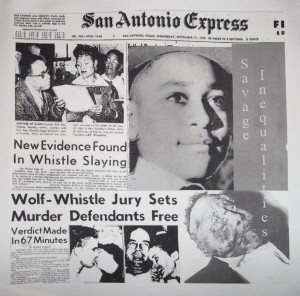
The Trayvon Martin murder and acquittal of the man that killed him should send a chill down anyones spine. In some places like Florida all someone has to claim is that they “felt threatened” to justify the use of deadly force against unarmed people. That is the law, and if there are no videos of the incident or eyewitnesses willing to lay it all on the line then there is a strong chance that the killer will go free. That is a fact and I will not go deep into the racial component of this but it doesn’t seem to me that we have advanced that much since young Emmett Till was murdered and his murderers also acquitted.

emmett-till-news-square-300x296

But going back to my main point I don’t think that we really have a true “pro-life” movement in this country. We have an anti-abortion movement which to some degree say that they are fighting for the lives of unborn babies. One does not have to agree with the theology, philosophy or science that they use, but that certainly has to be considered a part of a comprehensive pro-life ethic, abortion for the sake of eugenics including the selection of the sex of an unborn child or solely as a means of birth control are ethically problematic. That being said there are many times, more so than we would want to admit that abortions are tragically necessitated for the life and health of the mother. Sorry, the woman carrying the child should also have the right to her life.

You see I don’t think that simply being anti-abortion is being pro-life, unless you are willing to apply that right to life to already living people.

I have a hard time with people that claim to be pro-life not fighting against the death penalty, against unjust wars of aggression, against targeted assassinations, against the use of drones to kill supposed militants in the remote parts of Pakistan notwithstanding the fact that many infants and pregnant women carrying unborn babies are killed as well. But then I guess that they are just collateral damage and don’t count. After all they are all Moslems and not Americans.

I have a hard time with those that are anti-abortion who would fight against government programs designed to care for pregnant women such as good pre-natal care for the child and primary care for the medical needs of the mother.  I wonder why they are not fighting for the medical and nutritional needs of babies born to poor people and assist young families from impoverished areas get decent jobs and ensure that affordable child care is available. I wonder why supposedly “pro-life” people are not out marching against gun violence, why many will not lift a finger to help the poor, care for the needy, care for the sick and dying, including the elderly who our society seems to be throwing under the bus in every imaginable way unless they are fabulously well off.

Why does it seem that many pro-life leaders are not concerned about issues that effect the lives of pro-life people who happen to be poor, or members of racial or ethnic minorities? But what seems to be the case is that the most vocal and prominent leaders that call themselves “pro-life” or “family values” conservatives both the preachers and the politicians are more concerned about low taxes for the wealthiest people and corporations than they are about people.

Some conservatives and libertarians will say that these are not government responsibilities but the responsibility of churches and charities. I understand the philosophy and in fact I would love to see more churches doing more to alleviate the need for the government to step in. But by and large churches in general and especially conservative evangelical Christian churches have abdicated this responsibility which is mandated in the Gospels and exemplified in the lives of people like Saint Francis of Assisi and so many others. But now even churches that run hospitals frequently subordinate care to the insurance industry and while considered “not for profit” are as for profit as any non-religious hospital.  If evangelicals put half the money that they did into Sunday morning entertainment sessions masquerading as worship and building massive mega-church, media and television empires dominated by the families and friends of their pastors maybe I would have some faith that they were indeed “pro-life.”

I know that some of my conservative friends will see this as some sort of liberal screed. I get that but please, I ask that if people only want to be anti-abortion and not rest of the pro-life ethic then be honest and say that.

The fact of the matter is we are not a pro-life society now in any way shape or form and from our history including slavery, the genocide committed against native Americans, the exploitation of poor countries for the sake of our economy I have a hard time believing the myth that we ever were such a society.

Trayvon Martin is dead. The Florida law was followed, but justice was not done. A young black man was denied his right to life and it doesn’t seem to matter to the “pro-life” movement as a whole. I can’t wait to hear some of the political preachers and politicians that claim to be pro-life defend this verdict.

I guess that is why I am perplexed. It just doesn’t seem to me that the post-born matter to supposedly pro-life people.

Peace

Padre Steve+


Leave a comment

Filed under christian life, civil rights, healthcare, News and current events, philosophy, Political Commentary, pro-life anti-abortion

The More Things Change and What You Leave Behind…

images-50

“It’s like I said. The more things change, the more they stay the same.” Quark (the final line of Star Trek Deep Space Nine)

Today has been one of those weird, somewhat challenging, a bit difficult on an emotional level and at the same time rewarding days. It was a day that involved dealing with people that I care for, that work for me that within a bit over a month I will be leaving. Men and women that have impacted my life and from what I understand will miss me, as one said “my quirkiness and all.”

This happened to be the second day of the sequester which will impact me and my staff and will ensure that my last month in my current billet will be challenging and meaningful. What I hope is that the things that I am able to do in the next month will not only survive me but help provide the resources, structure and environment to allow my successor to take things to the next level in providing spiritual care for the diverse population of Sailors, Marines, their families, veterans, retirees and their families, as well as our civilian employees.

You see ultimately, the show here will go on without me and the best that I can do besides caring for those in my charing in the here and now is to help ensure that I leave something behind that others can build on. That too is something that you learn in this military life, that what you do is not ultimately about you.  It is about service to the nation and to the people that you have the privilege to serve alongside no matter what the duty station.

When one lives their life in the military these transitions happen all too often. In a sense our lives in the military are very transitory, maybe more so than many would be comfortable with. For relatively short periods of our lives, maybe months, or a few years or in the case of deployments in combat zones sometimes days, hours or even minutes. But in those transitory times our lives can be bound together in ways unimagined by most people that do not share this military life or experience.

My regular readers know that I grew up in this environment as a child and that as an adult I have always felt the strange call to serve. What I find amazing is that after nearly 32 years of service between the Army and the Navy, active, reserve and National Guard around the world in peace and war is that I am still serving and will be, Lord willing for a number of years more and truthfully God only knows when this rather lengthly chapter of my life ends and another begins.

In light of the events of the past few days, the situations that I am dealing with at work, what I am trying to wrap up even as next month promises to be busy I found it fascinating that I was completing the viewing of the final episode of Star Trek Deep Space Nine called What You Leave Behind. I found the title of the episode to be serendipitous with my recent experiences and feelings about my impending transfer.

Despite how much I have moved around in life I find that I do not do “goodbyes” well. I like to imagine that I will see people again and I do, as many of the people that I have gone to school with, served with in the military or in the ministry together know I am one that treasures relationships. Heck, I look on my Facebook page there are people from almost every era of my life, many who I have served alongside dating to the very beginning of my military career. There are many others that I would dearly love to find and meet again.

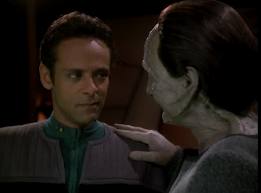
In one of the final scenes of the episode Dr Bashir and the Cardassian tailor and former spy Garak part ways after a devastated Cardassia is liberated from the Dominion. Bashir as is typical of many of us is attempting to off some consolation to his friend who is grieving what has happened to his planet.

images-51

BASHIR: You and I both know that the Cardassians are a strong people. They’ll survive. Cardassia will survive. 

GARAK: Please, Doctor. Spare me your insufferable Federation optimism. Of course it will survive, but as not the Cardassia I knew. We had a rich and ancient culture. Our literature, music, art were second to none. And now, so much of it is lost. So many of our best people, our most gifted minds.
BASHIR: I’m sorry, Garak. I didn’t mean
GARAK: Oh, it’s quite all right, Doctor. You’ve been such a good friend. I’m going to miss our lunches together.
BASHIR: I’m sure we’ll see each other again.
GARAK: I’d like to think so, but one can never say. We live in uncertain times.

As I approach my last month before my transfer I will certainly be experiencing many feelings that tend to bring a certain amount of sentimental melancholy. I will miss the people I have come to know here even as I rejoice in being able to return home and live with my wife Judy again full time.

There are times that I feel like Garak and Bashir. I like to believe, I like to be optimistic like Bashir, but there is a certain amount of sometimes cynical realism that pervades my thoughts, like Garak. I can understand both men. But as much as I understand them I also understand the military and like Quark have to admit “that the more things change the more they stay the same.”

But regardless of that, I can say about those that I have the the honor of working with, like Captain Sisko in that last episode of Deep Space Nine: “This may be the last time we’re all together, but no matter what the future holds, no matter how far we travel, a part of us, a very important part, will always remain here…”

Peace

Padre Steve+

Leave a comment

Filed under leadership, Military, philosophy, remembering friends, star trek

Gettysburg at 150: The Soul of a Hero Joshua Chamberlain

chamberlain

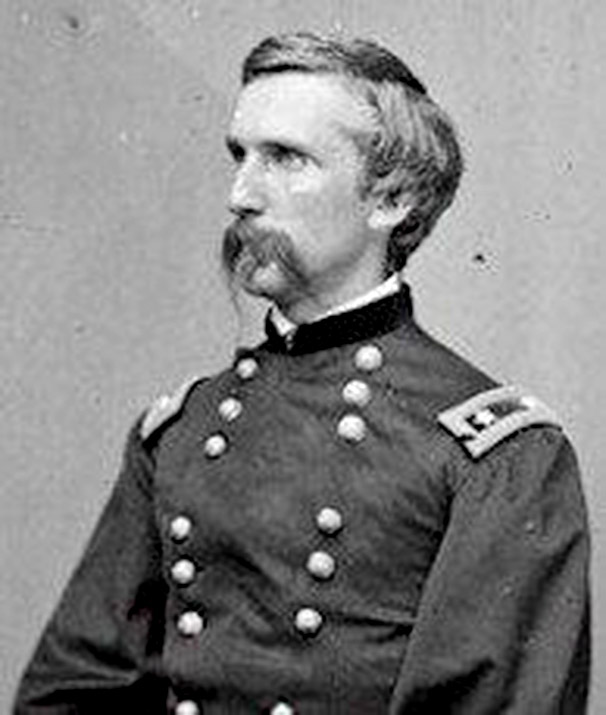
I want to take a brief moment tonight to think about the heart, soul and morality of a soldier, scholar and theologian, Colonel, later Major General Joshua Lawrence Chamberlain, the hero of Little Round Top and certainly a man whose actions as commanding officer of the 20th Maine Regiment at Gettysburg helped preserve the Union.

After the war Chamberlain spoke of the battle often. One of his most famous quotes is a testament to his humanity and integrity.

In great deeds, something abides. On great fields, something stays. Forms change and pass; bodies disappear; but spirits linger, to consecrate ground for the vision-place of souls… generations that know us not and that we know not of, heart-drawn to see where and by whom great things were suffered and done for them, shall come to this deathless field, to ponder and dream; and lo! the shadow of a mighty presence shall wrap them in its bosom, and the power of the vision pass into their souls.”

Chamberlain was a graduate of Bowdoin College and Bangor Theological Seminary, fluent in 9 languages other than English. He was Professor of Rhetoric at Bowdoin before seeking an appointment in a Maine Regiment without consulting either the college or his family. He was offered command of the 20th Maine but asked to be appointed as a Lieutenant Colonel which he was in August 1862. He fought at Fredericksburg and was named commander of the regiment when Colonel Ames, his commander was promoted following Chancellorsville.

Chamberlain was awarded the Medal of Honor for his valor at Little Round Top in 1893. He was gravely wounded during the siege of Petersburg in June of 1864 while commanding a brigade and promoted to Brigadier General. He returned to duty later in the year as commander of the 1st Brigade, 1st Division V Corps and was again wounded at Petersburg in a skirmish at Quaker Road and was promoted to Brevet Major General by Abraham Lincoln. Chamberlain received the surrender of Lee’s decimated Army if Northern Virginia. He would go on to serve as a four term Governor of Maine and remained active with the Grand Army of the Republic veteran’s organization, remained active as an educator and President of Bowdoin College and founded the Maine Institute for the Blind which is now known as the Iris Foundation. He died of his wartime wounds on February 24th 1914.

LRT

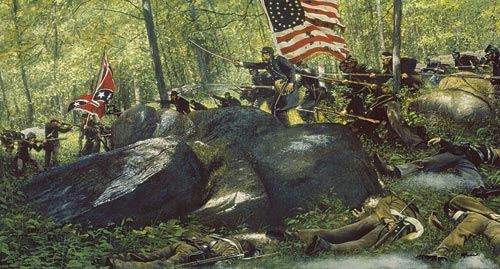
As the 20th Maine, tired from fighting off numerous assaults by attacking Confederates and now out of ammunition saw another wave of Confederates come up the slopes of Little Round Top Chamberlain ordered his men to fix bayonets and execute a right wheel. The move caught the advancing Rebels who were sensing victory by complete surprise. Chamberlain wrote in his official report of the battle:

“The enemy seemed to have gathered all their energies for their final assault. We had gotten our thin line into as good a shape as possible, when a strong force emerged from the scrub wood in the valley, as well as I could judge, in two lines in echelon by the right, and, opening a heavy fire, the first line came on as if they meant to sweep everything before them. We opened on them as well as we could with our scanty ammunition snatched from the field.

It did not seem possible to withstand another shock like this now coming on. Our loss had been severe. One-half of my left wing had fallen, and a third of my regiment lay just behind us, dead or badly wounded. At this moment my anxietv was increased by a great rbar of musketry in my rear, on the farther or northerly slope of Little Round Top, apparently on the flank of the regular brigade, which was in support or Hazlett’s battery on the crest behind us. The bullets from this attack struck into my left rear, and I feared that the enemy might have nearly surrounded the Little Round Top, and only a desperate chance was left for us. My ammunition was soon exhausted. My men were firing their last shot and getting ready to “club” their muskets.

It was imperative to strike before we were struck by this overwhelming force in a hand-to-hand fight, which we could not probably have withstood or survived. At that crises, I ordered the bayonet. The word was enough. It ran like fire along the line, from man to man, and rose into a shout, with which they sprang forward on the enemy, now not 30 yards away. The effect was surprising; many of the enemy’s first line threw down their arms and surrendered. An officer fired his pistol at my head with one hand, while he handed me his sword with the other. Holding fast by our right, and swinging forward our left, we made an extended “right wheel,” before which the enemy’s second line broke and fell back, fighting from tree to tree, many being captured, until we had swept the valley and cleared the front of nearly our entire brigade.”

The successful defense of Little Round Top by Chamberlain’s gallant 20th Maine as well as the other regiment’s of Colonel Strong Vincent’s brigade saved the Army of the Potomac from being enveloped by the Confederate right wing and defeated in detail. Such a defeat very probably would have given the peace party in the North the leverage that they needed to change the political calculus and end the war, giving the Confederacy independence and destroying the Union.

Though he was a valiant soldier Chamberlain was thoughtful and never lost his sense of honor, integrity or Christian morality in the war. Perhaps it was his education or upbringing. Perhaps it was ideals that were so much a part of his psyche that no matter where he served, or how great the sacrifice and suffering that he still kept his essential humanity. Even in victory he maintained a magnanimous spirit towards former enemies when they surrendered.

As the war drew to a close and Chamberlain continued to lead troops in mortal combat in the campaign at Petersburg and Appomattox Chamberlain saw much that caused to to ask hard questions. With friends lying dead and dying around following the Battle at the Quaker Road on March 30th 1865 Chamberlain pondered:

“But we had with us, to keep and care for, more than five hundred bruised bodies of men–men made in the image of God, marred by the hand of man, and must we say in the name of God? And where is the reckoning for such things? And who is answerable? One might almost shrink from the sound of his own voice, which had launched into the palpitating air words of order–do we call t?–fraught with such ruin. Was it God’s command that we heard, or His forgiveness that we must forever implore?”

I think that we have a lot to learn from Joshua Chamberlain. His question at the Quaker Road is one that anyone leading nations, or military units into the valley of the shadow of death need to ask, especially when the war or conflict is waged “in the name of God” whoever’s God it might be.  All too often evil done in the name of the Almighty is blessed by the Trinity of Evil, the Preacher, Pundits and Politicians who use being on the side of God to justify the basest evil and inhuman deeds. But then maybe it is only the rare man like Chamberlain who can see through the darkness and still discern the “divine spark” in a man.

gl-pr-105

As Chamberlain received the surrender of the units of the Army of Northern Virginia he paid the bedraggled but still proud Confederates the honor of a salute. One Rebel General said to him “You astonish us by your honorable and generous conduct. I fear we should not have done the same by you had the case been reversed.” Another commented “I went into that cause and I meant it. We had our choice of weapons and of ground, and we have lost. Now” pointing at the Stars and Stripes “that is my flag, and I will prove myself as worthy as any of you ” (Soul of the Lion: A Biography of General Joshua L. Chamberlain. by Willard M Wallace, Thomas Nelson and Sons, New York 1960. Reprinted 1991 by Stan Clark Military Books, Gettysburg PA. p.190) 

May we all learn to find that divine spark before it is too late.

Peace

Padre Steve+

1 Comment

Filed under civil war, faith, History, Military, philosophy

Faith’s Journey: A Progressive Christian Navy Chaplain Looks at the Journey to Wholeness

400236_10151328400862059_541742014_n

June 27th 2013: After the events of this week including the Supreme Court decision declaring the Defense of Marriage Act unconstitutional I decided to re-publish an article that was one of the most important that I ever published. Not so much because of the what I think was so earth shattering regarding the content but because of what happened after its publication. At the point in time that I wrote it I was pushing the envelope with my former denomination, but figured that in light of all the controversies and schisms in that church at the time that whatever I wrote would not result in any problems. But I was wrong. I received a call the next day from my bishop telling me that I needed to find a new home because I was “too liberal.”

It was actually quite fascinating, I was able to gain a new church home which was much more progressive, welcoming and catholic, being of the Old Catholic tradition. For me that phone call was just a few months later deposed for attempting to create yet another schism in the church. I think it is even more interesting because some of my friends still in that church think that he used this article as a reason to get rid of me in order to keep me from exposing his scheme. I don’t know if that it the case or not, but my friends believe it to be a distinct possibility. That being said one of my long time priest friends revealed his plot to the other bishops and the bishop who forced me  was deposed. Irony is fascinating. Since that time my former church is regaining its footing and doing better and for my friends in it I am glad for even if I have differences in theology, faith or beliefs with people who I consider to be friends, they are still friends and I wish them well.  

So anyway, for those that are fairly new followers on this site here is the article that in a sense served as a declaration of independence and station on the road to wholeness and integrity. 

Peace, Padre Steve+

Faith Journeys: Why I am Still a Christian (Originally published 22 September 2010)

There are many times that I totally empathize with author Anne Rice in saying that she has left Christianity yet still has faith in Christ.  For Rice it was the lack of love shown by the institutional church for people that are marginalized and treated as if they were unredeemable by often well meaning Christians.

I know what it feels like to be marginalized after I came back from Iraq because many of my Christian friends seemed, at least in my view to be tied to the absolute hogwash that spews from talk radio hosts and allegedly “Christian” politicians.  I remember having some Christians question my patriotism and even my faith because I disagreed with them regarding certain aspects of the war, despite the fact that I had been on the ground in harm’s way serving with our advisors and Iraqis in Al Anbar province.  The fact that not a clergyman, civilian or military, took time to care for me when I was in a major PTSD meltdown and crisis of faith before I went to Naval Medical Center Portsmouth didn’t seem to matter because a political agenda was given primacy over the simple truths and hard demands of the Gospel.

Yesterday I wrote about Chaplains that experience a crisis of faith after coming home from a combat deployment.  For me there is nothing more symbolic of the lack of soul left in many Christians and Christian Churches in how they treat those that have served faithfully. Those Chaplains that have served  God, Church and Country and come back spiritually wondering what happened, not knowing what to believe and feeling abandoned by God and cast off by the Church and the military simply because we have a hard time with the so called “orthodoxy” of some Christians.

I went through a period after Iraq where feeling abandoned and isolated from those of a like faith that I was for all practical purposes an agnostic.  That was a really difficult time in my life and if you think that anything sucks try to be a Chaplain when you no longer know if God exists and the only person asking how you are doing with “the Big Guy” is your therapist. I can say without a doubt that it sucks like a Hoover and I know that I am not alone in my feelings.  I have met others whose experience is similar to mine but those that are struggling right now, caught between our faith and the feeling of being abandoned by God and his people because our experience of seeing the human suffering caused by war has shaken us.

Let’s talk about spiritual despair. Did you know that in the past couple of years that two Army Chaplains and one Navy Chaplain have committed suicide? These were men of faith who had served in peace and war at least one that had served at the Battle of Hue City as a Marine before becoming a Priest and Chaplain.  Another Army Chaplain that had served in Iraq as a minister of a conservative Charismatic and Evangelical Christian denomination became a Wiccan and was excoriated by Christians.  I don’t know his faith journey but I have to believe that part was his experience in Iraq and experience on his return. I don’t know about you but those are all signs of spiritual despair and feeling cut off from their faith community and even God, his or her self.

I am still a Christian. I believe in the God of Scripture, the Creeds and the Councils. At the same time that belief is not as rigid as it once was. I used to consider those that didn’t believe like I did in relation to Scripture, the Creeds and Councils not to be Christians.  I cannot say that now. I am much more to have the Grace and Mercy of God be my default position and let other things fall out where they may.  My practice of my faith has changed. When I came back from Iraq I attempted, as it were without success to keep my faith structure and practice the same as it was before I deployed to Iraq.  Within six months of Iraq I could no longer pray the Daily Office with any kind of faithfulness and by Lent 2009 give up the practice for Lent hoping to recover some authenticity to my faith. The authenticity has returned and after about a hear and a half I am seeking a way to reincorporate what had been a very important part of my daily practice of faith into my life without feeling like I am a phony in doing so.

I went through a period of absolute spiritual despair even leaving a Christmas Eve Mass in 2008 to walk home in the dark, alone, looking at the sky and asking God if he even existed.  A year later after my life had completely fallen apart I experienced what I call my “Christmas miracle” where I was called to our Emergency Room to provide the “last rites” to a retired Navy doctor and active Episcopalian when I was the duty Chaplain.  As I prayed the last prayer of commendation and removed my oil covered fingers from the man’s forehead he breathed his last. His wife told me that he was waiting to be anointed before he died.  The young doctor, a Psychology Resident doing his ER rotation who called me to the ER would die a couple of months later of natural causes in his living room not long after we had taken the “fat boy” program PT test together.

From that moment the paradigm shifted.  Faith began to return and I began to experience the presence of God again, not is the same was as before Iraq but one that was more relational, grace filled and informal.  I will likely begin praying the Daily Office again in the near future but I will approach it from a different point of view.  I will no longer use it simply to fulfill my priestly vows and obligations but rather as a way to re-experience and if need be re-imagine God.  Now before the heresy hunters think that I am re-imagining God is some unbiblical manner they are wrong. I want to re-imagine God as he has been revealed to his people both in Scripture, Tradition and in the life of his, or her people today.

moralssquad

How have I changed? I believe again. I am no longer an agnostic hoping and praying that God just might be there. My faith has become much more deeply rooted and grounded in the “Crucified God” and my faith in the “theology of the Cross.”  It is no longer connected to my politics and I refute any political ideology that attempts to use the Christian faith and the faith of well meaning Christians for purposes that Jesus himself would have condemned.  I don’t think Jesus was a big fan of his followers attempting to be the favorites of any political party or ideological system. In fact if I recall he really had pretty harsh words for his fellow Jews who were all wrapped around the axels with that kind of stuff. Jesus seems to befriend and hang around with those that are not connected to the religious, political or economic elites. In fact he seemed to reserve his harshest words for such people.  Jesus seemed to have a pretty good relationship with those marginalized and rejected by the religious folks of his day. He welcome sinners and tax collectors to his table and praised the faith of gentile Roman officers and stopped the super-religious folks from stoning an adulterous woman.

This is the Jesus that I follow and the Jesus that I believe is present in body, soul and spirit in the Eucharist.  I believe like Hans Kung and others that this table belongs to the baptized community of faith and not to an exclusive Priestly class who dictate who can come to the table.  It is not the exclusive property of any denomination or Church organization especially those that most loudly state this to be the case.

Now if saying this makes me a heretic then a heretic I will be. It is better to be a heretic in the eyes of Pharisees than to be one that denies justice to the persecuted people of God.  I guess that makes this moderate a liberal and to some an unbeliever.  Yet I believe in the God of Abraham, Isaac and Jacob. I believe in the Jesus that defied religious systems to offer the grace of God to the people that those systems rejected and the Jesus that was far more critical of “believers’ than those rejected as unbelievers.  I guess that is why I can accept women as ministers or even Priests, accept homosexuals as Christian brothers and sisters, and see Christ and the grace and love of God in people that are not “Christians” even the Muslims in Iraq that treated me with respect and even if they had an “Aryan” view of Jesus still showed a greater reverence for Jesus and the Blessed Virgin Mary than many that claim Jesus for themselves.

Why? You ask. Very simply I once was lost but now am found.  I thought that I knew it all before, now I know that I don’t know it all and that God is the God of surprises, just look in Scripture.  I doubt at times. I know that there are many answers that elude me and I cannot answer just by citing or using Scripture out of its historic, cultural and linguistic context.  I believe in the God that did not reject me when I didn’t know if he even existed.

Why am I still a Christian when I have so many problems with how many Christians practice the faith? Because I believe and not because will not I tow anyone’s party line be they liberals or conservatives. I believe in spite of my unbelief in a fellowship of those who as a result of war and trauma have trouble believing those that won’t race the cold realities of this life. I believe because many times it was those marginalized by others, especially those marginalized by the “faithful” showed me the love of God when the “faithful” for pure or impure motives, or even because they didn’t know what to do allowed me to sink into despair and isolation. So in the words of my favorite heretic Martin Luther I say “Here I stand, I can do no other. So help me God. Amen.”

Peace,

Padre Steve+

1 Comment

Filed under christian life, faith, Pastoral Care, philosophy, Religion

The Heresy of Thinking and Reason in an Age of Fanaticism

The Heresy of Thinking and Reason in an Age of Fanaticism.

Leave a comment

Filed under History, philosophy, Political Commentary

A Pause on a Monday Night to Reflect and Give Thanks

400236_10151328400862059_541742014_n

Well it has been a busy few days travel, doing a wedding for a dear couple that I have worked with for almost 5 years and a busy time at work. On top of everything I have the duty pager tonight, so far an uneventful night despite a couple of somewhat sporty events during the day.  I am also adjusting to the fact that I will be transferring to my new assignment in two months. I have enjoyed my current assignment but the geographic separation from my wife Judy with only sporadic visits home for the past three years has been wearying. It will be good to be back with her. Our time together gets better every time I go home. That is a good thing because for a time after Iraq and my assignments in Naval Medical Centers that she wondered if our marriage would survive. Life for her with the man dealing with the PTSD “Mad Cow” was a bitch at times.

I have a lot to be thankful for in the non-cyberspace world, friends, family, dogs, as well as vocation, calling and career that I love doing. All of that makes a big difference.

So tonight instead of writing anything too serious I want to pause for a moment and thank all of those that subscribe to Padre Steve’s World as well as others that follow me and the site through Facebook or Twitter. There are thousands or millions of other sites to browse around on in cyber space, not to mention  books and film and other forms of learning, information and entertainment. I am just happy that a decent number of people read what I write and quite a few send me notes or leave comments that mean a lot to me, especially when I see how something that I wrote or that I have shared from my experience has touched their lives in some way. That is actually humbling and I am most grateful.

Now I know that some of what I write appeals to a wide variety of people and that some people may be interested or not interested in a given topic. I figure that some variety is the spice of life. Likewise I know that thinking and rational people will not always agree with me, heck there are some times that I don’t even agree with me, it’s that whole PTSD “mad Cow” deal.

When I was going through my darkest times after Iraq dealing with PTSD, depression, anxiety, insomnia, night terrors and nightmares it was a rather desperate time in my life. There were times that I wondered if I was able to be of help to anyone when it seemed that I couldn’t even help myself. I was unprepared for this, before I went to Iraq I was arrogant enough to think that I was untouchable and would never be affected by any form of combat stress, much less full blown PTSD.

Tonight I was watching an episode of season seven of Star Trek Deep Space Nine, called Afterimage. It is about the successor to Jadzia Dax who was killed at the end of season six. The new character “Ezri Dax” is a young counselor who ended up with the Dax symbiont by accident and out of necessity, without the years of training and selection process normal to her planet and race. Unprepared for this she struggles to find herself. After a confrontation with a a man that she is counseling she goes to Captain Sisko and confesses her inadequacy and offering her resignation. Sisko asked her “why” and she replied “Because I can’t do my job. Garak was right. How can I help other people when I can’t even help myself?”

One of my favorite fictional Priests is Father Mulcahy of M*A*S*H. In one episode where he has hit the wall he remarks: “It doesn’t matter whether you feel useful or not when you’re moving from one disaster to another. The trick, I guess, is to just keep moving.”

I felt that way so many times after Iraq and the years that followed. Over the years things have gotten better with therapy, medication, some spiritual care and the support of colleagues where I have worked. This blog has been a big part of that journey as I rediscovered who I am and what I am becoming as a human being in relationship with God and the people of God, regardless of their spiritual beliefs or non-spiritual beliefs, their political beliefs, their lifestyle or even really important things like if the a Dodgers’ or Yankee’s fan. Since I am a fan of the Giants and Orioles this is more important than you can imagine.

188054.strip

So to my long time readers thank you for persevering. To my new readers, subscribers and those that follow me on Facebook or Twitter, welcome to my little world.

Peace and blessings,

Padre Steve+

PS Tomorrow I will be looking at the serious situation developing in all seriousness in Syria.

3 Comments

Filed under faith, Pastoral Care, philosophy, PTSD