Category Archives: Political Commentary

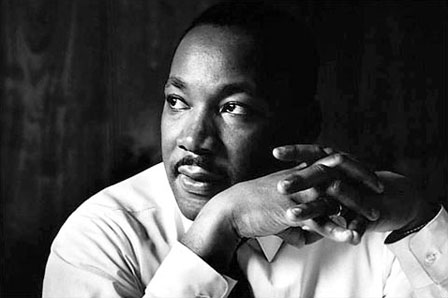
Critical Thinking & Conscience: Learning from Dr. Martin Luther King Jr.

index

Friends of Padre Steve’s World

I have been taking the time to do some reading and reflecting and yesterday I wrote a short piece about reason, critical thinking and the challenge of unreason and anti-intellectualism in our society. As I did that I was reminded of the words of Dr. Martin Luther King Jr. as he addressed issues prevalent in the 1960s; many of which unfortunately are still with us today.

A lot of people today seek to marginalize Dr. King’s life and work by simply relegating him to the pages of history. The attitude of such people seems to be that maybe Dr. King was important in his day, but that we have advanced to the point that we don’t need to see beyond the King of history. Thus we miss so much of what he still teaches us today.

Dr. King was a man of tremendous personal courage. Nearly every day of his public ministry and advocacy for the rights of African Americans and the poor his life was in danger. Of course he, like so many other men who throughout history understood that those that champion the cause of justice and peace must ask hard questions. They must engage in hard thinking. They must challenge their own beliefs as well as those that they come in contact, and they must do so from the least safe place to do so, the place of conscience which commands us to do what is right.

In 1968 Dr. King said something that should make us all look in the mirror and ask who we really are and what we represent. He noted how cowardice, expediency and vanity all vie with conscience. He said:

“On some positions, Cowardice asks the question, “Is it safe?” Expediency asks the question, “Is it politic?” And Vanity comes along and asks the question, “Is it popular?” But Conscience asks the question “Is it right?” And there comes a time when one must take a position that is neither safe, nor politic, nor popular, but he must do it because Conscience tells him it is right.” 

If you look closely at what Dr. King said one can almost see every political, business or religious leader make decisions about things which matter to people, but without facing the demands of conscience.

It would be easy just to say this of our leaders. However, it is also true of most of us, for regardless of our protestations most of us follow the demands of cowardice, expediency or vanity rather than conscience. We do it not because we are bad people, but because we fear the potential negative consequences of doing the right thing, we count the cost and decide we cannot pay it.

Every time we make these decisions not to do the right, but to shrink in cowardice, appeal to the calculation of being politic, or choose to go with what is popular, something in us dies.

Dietrich Bonhoeffer, the German pastor and martyr wrote about the results of such equivocation from prison:

“We have been silent witnesses of evil deeds: we have been drenched by many storms; we have learnt the arts of equivocation and pretense; experience has made us suspicious of others and kept us from being truthful and open; intolerable conflicts have worn us down and even made us cynical. Are we still of any use?”

But to follow the demands of conscience requires us to think, and think critically. Too often we simply do things or support causes because we are comfortable with the ideas, and because we do not want to face inconvenient or uncomfortable ideas. We do not like to be challenged. I think that is why there is such a great appeal to often ignorant loud mouthed politicians, pundits and preachers, the Unholy Trinity, to do our thinking for us. The pundits, preachers and politicians often appeal to the must base human instincts to turn citizens against each other, or to drive up support for their ideology. Such ideas are made more destructive when they appear as “memes” on social media, attached to pictures which are designed to invoke an emotional response of anger, hatred and resentment at person or group being demonized. In following them we can become unthinking fanatics, convinced of our rightness without ever examining what we believe to see if it really true.

This is not thinking when we follow the lead of such people, regardless of their ideology. In doing so we give up our right and responsibility to think for ourselves and ask the hard questions. Eric Hoffer noted how ideology blinds us:

“A doctrine insulates the devout not only against the realities around them but also against their own selves. The fanatical believer is not conscious of his envy, malice, pettiness and dishonesty. There is a wall of words between his consciousness and his real self.”

Dr. King’s words spoken in 1963 are equally true today:

“Rarely do we find men who willingly engage in hard, solid thinking. There is an almost universal quest for easy answers and half-baked solutions. Nothing pains some people more than having to think.”

I hope that we may we find in Dr. King’s words inspiration to be people of character and conscience today. But to do so we must start doing the hard thinking that allows us to follow the demands of conscience and not cowardice. We must do the hard thinking that places justice over popularity and the hard thinking which exposes the emptiness of brazen political calculation embodied in the easy answers and half-baked solutions of the Unholy Trinity. Sadly, I don’t think that most people want to do this type of thinking, our materialistic culture does not value it and as a result we give up our rights as a people to a few oligarchs who throw a few small breaks our way while they expand their control, power and wealth. It’s a bad formula and we all suffer for it. It is time to stop asking if things are safe, politic, or expedient and do the hard work and thinking that conscience demands.

Peace

Padre Steve+

Leave a comment

Filed under civil rights, ethics, History, Political Commentary

Reason, the Salvation of Freedom

IMG_0230

Friends of Padre Steve’s World,

Adlai Stevenson once wrote

“Unreason and anti-intellectualism abominate thought. Thinking implies disagreement; and disagreement implies nonconformity; and nonconformity implies heresy; and heresy implies disloyalty. So, obviously, thinking must be stopped. But shouting is not a substitute for thinking and reason is not the subversion but the salvation of freedom.”

I have traveled to a lot of places, in this country and around the world where reason has been a scarce commodity and to me that has always been a frightening specter; a world where reason is is all too often sacrificed on the altar of political, ideological or religious expediency.

I had a Church History professor in seminary that was known for his attention to detail and his expectation that his students would master the subject.  His method was quite simple. A fellow student asked him during review for a mid-term exam “what do we need to study for the test?”  His answer was simple “everything.” The student restated his question “what do we really need to know?”  My professor paused and made a comment that did not make the student very happy.  He said something that I paraphrase here “it is the details that enable you to see the big picture, without the details you know nothing.”

A good number of my fellow students did not appreciate the fact that he was deadly serious.  I actually think that GOP Presidential hopeful Mike Huckabee, who flunked out of my seminary, may have been one of them. It was not simply the ability to remember names and dates and events but to be able to connect them and see what was really important.  Many did not take him seriously and when the test came many failed it.  In fact some continued to fail every exam because they could not reconcile that details were important. The attitude of a good number of my classmates was that history, philosophy or even systematic theology was not important especially if they involved study of people or ideas that they did not agree with.

Unfortunately we now live in an age of anti-intellectualism and anti-historicism. As much as some of us would like to try to affix blame, this is not a problem that can be blamed on any one side of the political spectrum. Sadly, it cuts across the spectrum as people return to more primal instincts in an uncertain time, where established political parties and systems of government seem unable to get the job done, where economic systems seem rigged in favor of a small minority of people and where the social and religious underpinnings of society are rocked by change and uncertainty.

But reason does matter, and those who ignore it do so at their own peril as Christopher Hitchens once said “That which can be asserted without evidence, can be dismissed without evidence.” History shows us in times like this, where reason is tossed aside in favor of primordial urges; that instead of seeking answers and instead of trying to figure out what is really important and studying the details of the great questions, that frustrated people become intellectually lazy and gravitate towards people who play to their often legitimate anger and frustration.

People simply fall back on the dogmas presented by the Unholy Trinity of Pundits, Politicians and Preachers that cater to their ideology for reassurance and quite often carry very dangerous demagogues into office with often-tragic results for their nations and the world.  The demagogues of the Unholy Trinity are quite good at taking advantage of frightened and angry people who need scapegoats.

If you listen to talk radio or are a devoted fan of any particular cable news pundit you can see this on display daily and even more so by our political leaders and those seeking political power. For the most part what is presented is at best half-truth sprinkled with deadly venom of hatred to make the half-truth an absolute truth.  In such a world facts are only important if the “true believer” can use them buttress his ideological bias even if he has to take the completely out of context to in order to do so.  The demagogues do not need to appeal to reason, they appeal to something more primal, they appeal to fear, anger, and the need of desperate people to find someone to blame.

Appealing to fear and loathing is so much easier than using reason. To call an opponent a Communist or Nazi, Fascist or Imperialist, Unbeliever or Heretic or even a Racist; and then connect them to the evil we want to demonize them is far easier than it is to actually engage them in a truthful debate and to see things in their historical context. The same is true when we try to shut them down without even listening to them or giving the chance to air their views, even views that are not supported by the facts or history. Likewise when we use such labels against those that disagree with us we dehumanize our opponents thereby justifying any evil that we use to silence them. That is one reason that on this site I do my best to listen to others, even those who do not agree with me and why I do my best to build bridges and maintain a respectful dialogue. I may disagree with someone’s argument but I will always do my best to treat them with respect, allow them to present their position and unless they are threatening me with death or bodily harm allow their comments to remain on the site. Sadly, I have had some of those threats, notably from known White Supremacists, one of which was so specific in violent intent that I had to report the man to the FBI.

That being said, I have a decent number of people who comment and express their disagreement, sometimes quite strongly, with me who are respectful and who I will never label with any of those often-pejorative terms. In fact there one commentator on this site with who I have often spirited disagreements, but despite that I have come to appreciate him and believe that if we were to spend any amount of time together drinking beer and watching baseball that we could become fast friends. But sadly, I do not think that many people on either side of the political divide could do now. I actually wouldn’t mind spending time with this man. Why? Because despite all of our disagreements; he remains respectful and continues to comment. I think that speaks volumes about his character, which has to be honorable. I think that is what we are supposed to be about in the United States.

Sometimes it seems to me that we presume that if we repeat what we believe enough, even if it what we believe is unsound or erroneous that it will become truth.  As individuals, governments, institutions and businesses we often settle for easy answers that agree with our presuppositions and dismiss opposing views as heresy.  Too often we allow people of little learning but whose great charm and salesmanship ability, to sell us myth in place of fact and this happens across the political, social, economic and theological spectrum. That is a tragedy for all of us no matter what our political, ideological, or religious views.

I have written on this site about the study of history as well as ways of learning.  The little things do matter, and the study of history, philosophy, theology, the sciences, economics in fact anything of any importance is based on understanding details, and things like precedent and context.  It is not enough to string together a series of quotations or citations if they are taken out of context, altered or intentionally misused to fit our ideology or doctrine, whatever it may be.

Such methods may comfort the true believer in whatever cause and even make them feel superior to those that disagree but such thinking. But it blinds them to reality and ensures that they never become aware of their own envy, malice, pettiness and dishonesty. The “wall of words” that flow so easily from the mouths and pens of the members of the Unholy Trinity that their faithful followers, ensures that they are unable to separate them from reality, truth from fiction, opinion from fact.  This “wall of words” serves as their protection against any thought, fact, presumption or doctrine that contradicts them.  John F Kennedy said, “Too often we enjoy the comfort of opinion without the discomfort of thought.” 

In times like this it is most important to take the time to learn from history, not just generalities that mix fact and myth but the little details that make up history and for that matter the sciences, philosophy, sociology, political thought and theology.  As a society we have ceased to do this and until we take the time to return to such study, dialogue and put aside our blinders we will be doomed to remain as we are no matter what political party is in power or ideology dominates the airwaves and cyber space.

Reason, it is important, and as unreasonable as it sounds there is a prayer that neatly sums up what I desire for me and for our society:

From the cowardice that dares not face new truth

From the laziness that is contented with half truth

From the arrogance that thinks it knows all truth,

Good Lord, deliver me.

Have a great night.

Peace

Padre Steve+

3 Comments

Filed under civil rights, faith, History, leadership, Political Commentary

The Peril of Preventive War

Friends of Padre Steve’s World,

About this time of month one hundred and one years ago the armies of Europe were beginning a four-year bloodletting that killed over ten million soldiers and resulted in twenty million other deaths. That war spawned other wars and conflicts the world over, some of which still go on today. Since I have been to war in Iraq, a war that if we took international law and war crimes seriously would be considered illegal under the codes that we tried the major German and Japanese war criminals under at the end of the Second World War, I take war, and going to war very seriously.

The beginning of the First World War provides an example for us of how out of control things can get when leaders opt for war when doing the hard work to keep the peace is much more in their interests.

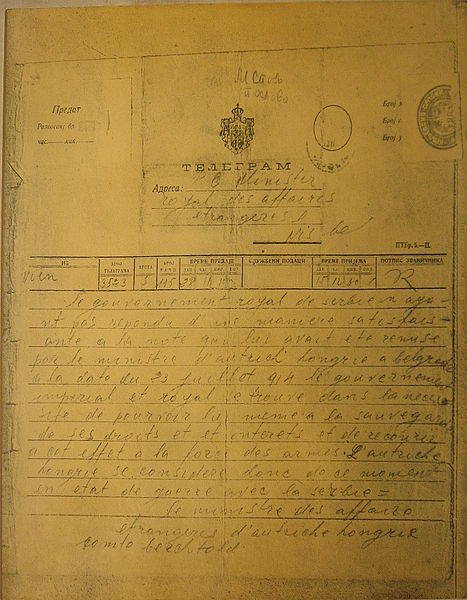
The Austrian Declaration of War against Serbia

One of the premier military and political theorist who has ever lived, Carl von Clausewitz “No one starts a war–or rather, no one in his senses ought to do so–without first being clear in his mind what he intends to achieve by that war and how he intends to conduct it.” Sadly, few political leaders take his advice.

It was a war that should never have happened. It was a war for which the belligerent powers could boast many causes but for which few had any real objectives. One hundred and one years ago this week the armies nations of Europe were beginning clashing on the frontiers of France, Germany, Belgium and Russia. Their leaders were hell bent on waging a war that all thought would be short, decisive and end in victory for their side. The leaders were wrong and nearly a century later the world still pays the price for their misplaced beliefs and hubris of those men.

It was a war in large part brought on by the declining Austro-Hungarian Empire’s fears. Fear of neighbors, ethnic minorities and its place among regional and world powers led the leaders of the Austro-Hungarian Empire to decide for war when the very unpopular heir to the throne Archduke Franz Ferdinand was assassinated in Sarajevo, the capital of the recently annexed province of Bosnia-Herzegovina on June 28th 1914.

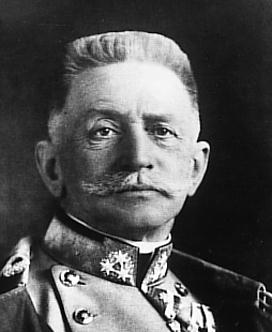
Conrad von Hötzendorf: War was the only means of politics

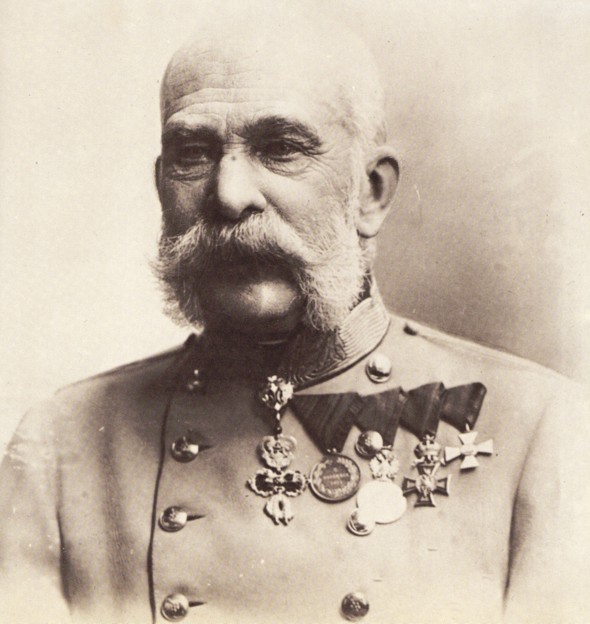
It was a series of decisions by those in the government of the Empire that brought Europe and the world to war, a war which we still feel the effects of today. In particular it was the decisions of the Austrian Chief of the General Staff Conrad von Hötzendorf, the Foreign Minister Leopold Berchtold and the aging Emperor, Franz Joseph which plunged the world into a world war which spawned revolutions, regional wars, a second world war, a cold war and countless other wars. The decisions were based on the belief, still common today that war is the only means of politics.

Emperor Franz Joseph: “If we must go under, we better go under decently”

Hötzendorf had been a continual advocate of war in every situation. He lobbied for war in 1907 against Italy and Serbia, in 1908 against Serbia, Russia and Italy, in 1909 against Serbia and Montenegro, in 1910 against Italy and the list increased in the years leading up to the war. He fervently believed that “the use of armed force alone could retard the centrifugal forces of nationalism in the ‘multinational empire’; war was the only means of politics.” The Emperor, Franz Joseph was of the same mindset by 1914 and in the days following the assassination of Franz Ferdinand he gave his approval to the actions of Hötzendorf and the diplomacy of Berchtold that doomed the Austro-Hungarian Empire and would destroy and remake Europe within a span of four years.

Theobald von Bethmann-Hollweg: The Blank Cheque

 The leadership of the Empire had decided on war within days of the assassination. Berchtold dispatched an emissary to Kaiser Wilhelm who decided in counsel with his Imperial Chancellor Theobald von Bethmann-Hollweg gave the Austrians a “blank cheque” of unconditional support for war against Serbia. Berlin was confident that “the Balkan crisis could be localized” and “advised Vienna to “proceed with all means at its disposal” and that Germany would support Austria-Hungary “come what may.” In doing so they willingly ignored the wise counsel of Otto Von Bismarck who considered the Balkans “not worth the life of a single Pomeranian Grenadier.

800px-Bain_News_Service_-_The_Library_of_Congress_-_Kaiser_Wilhelm_(LOC)_(pd)

Kaiser Wilhelm II

After they received German support the Austrians did everything that they could to ensure that war would occur. Their demands of Serbia were intentionally designed to be unacceptable to that country and they held key information from their German allies in the three weeks after they received the unconditional German support.

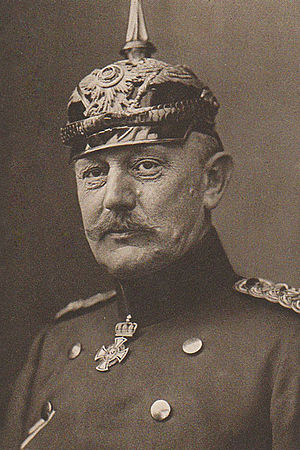
Helmuth Von Molkte: “no alternative but to fight a preventive war…” 

German militarists, particularly the Chief of the General Staff Helmuth Von Molkte the younger saw the coming conflict in racial and cultural terms. Von Molkte said that the coming war   would come “sooner or later” and be a war “primarily a struggle between Germans and Slavs” and compared Serbia to an “abscess.”  As the war cloud built Von Molkte told the Foreign Secretary von Jagrow that there was “no alternative but to fight a preventive war so as to beat the enemy while we could still emerge fairly well from the struggle” ignoring the advice of the Iron Chancellor Otto Von Bismarck who counseled “Preventive war is like committing suicide out of fear of death.”


Austrian Reservists going to war

 The Austrians felt that the threat from Serbia combined with internal political factors related to the Hungarian and other Slavic regions of the Empire, and the increasing influence of Russia and Germany in the Balkans was an existential threat. At the same time they were poorly prepared for war. Their military was large but poorly trained and equipped.  Their national infrastructure, industry and railroads were ill prepared for the demands of war. Their German allies had not planned for war either and were critically short of the required stocks of ammunition needed for a general war in Europe.

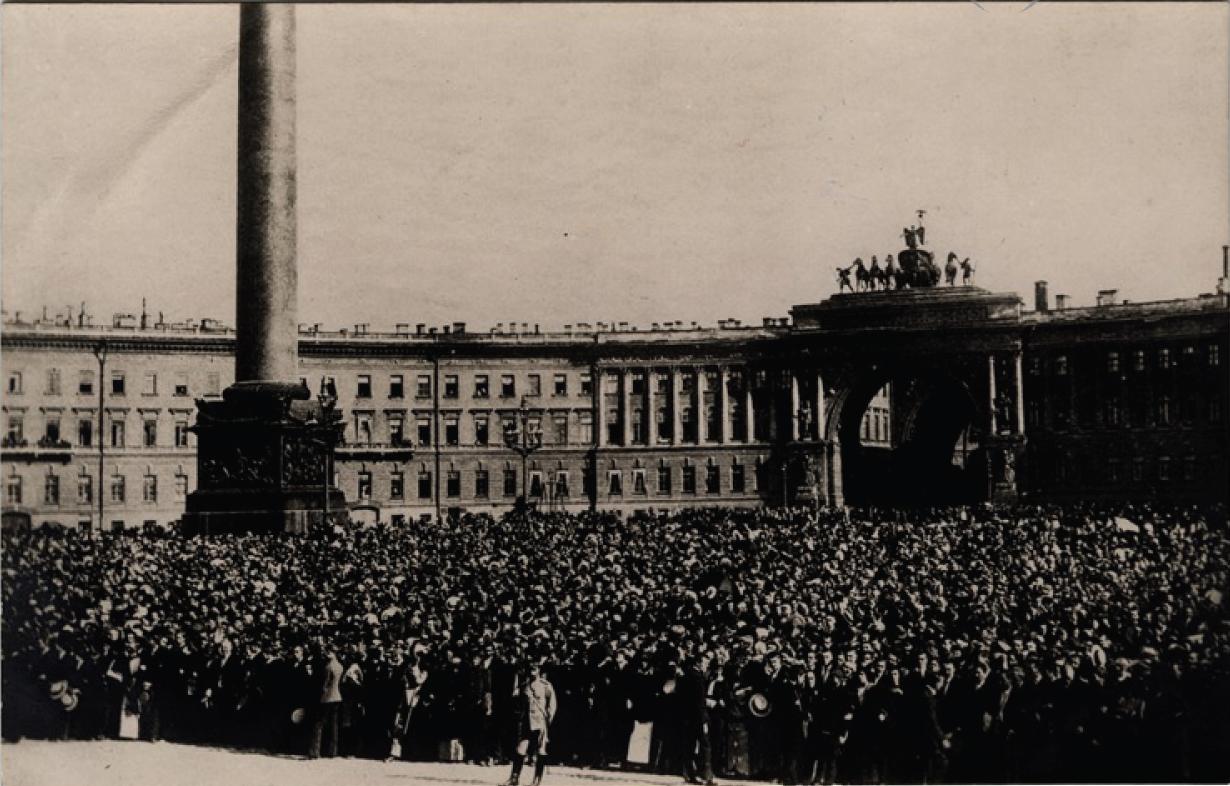
Cheering crowds in Petersburg

The Russians were heavily invested in the Balkans linked to other Slavic people by culture, language and religion. The French were bent on revenge against the Germans for the debacle of 1870 and had no stake in what happened in the Balkans. The British a few years prior to the war had told the Belgians not to expect support if they were invaded by Germany, but declared war to “protect Belgian neutrality.”

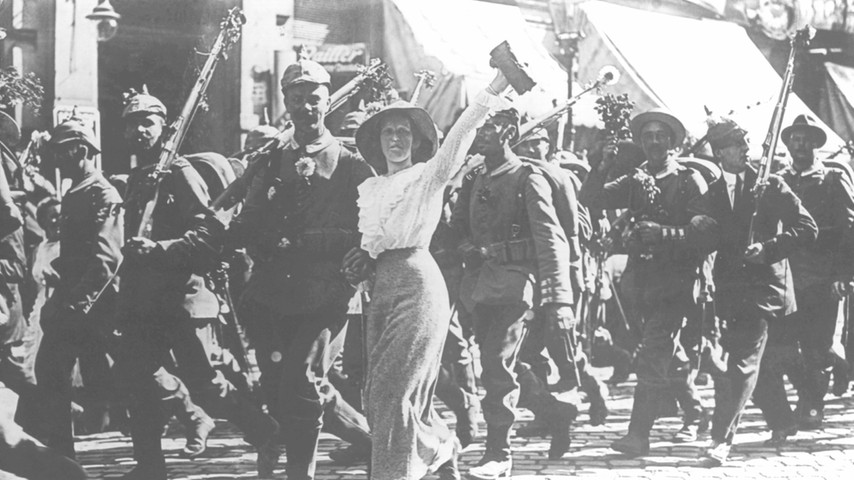
German wives and girlfriends walking alongside the Landser…

 The Austrians thought that with German support that even if Russia intervened that the war could be limited to Serbia. They were wrong. Just as the Germans had given the Austrians a “blank cheque” the French, both officially and unofficially were giving the Russians their own blank cheque. French Ambassador Maurice Paleologue assured Russian Foreign Minister S.D. Sazonov of the “complete readiness” of France to fulfill her obligations as an ally in case of necessity.

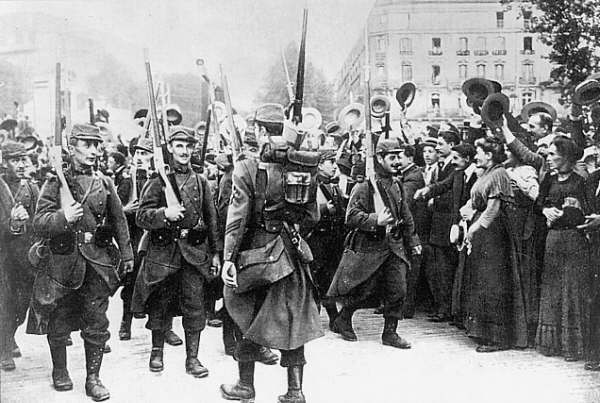
French Soldiers being cheered

Austria declared war on July 28th, Russia followed by a partial mobilization to support Serbia on the 29th. Kaiser Wilhelm attempted to avert war at the last minute but Czar Nicholas II wrote, “An ignoble war has been declared on a weak country. The indignation of Russia, fully shared by me, is enormous. I foresee that very soon I shall be overwhelmed by pressure to which I am exposed and compelled to take measures which will lead to war.”  This was met with German mobilization on the 30th and the French on August 1st. Declarations of war were exchanged and on August 4th in response to Germany’s refusal to respect the neutrality of Belgium Great Britain declared war against Germany.

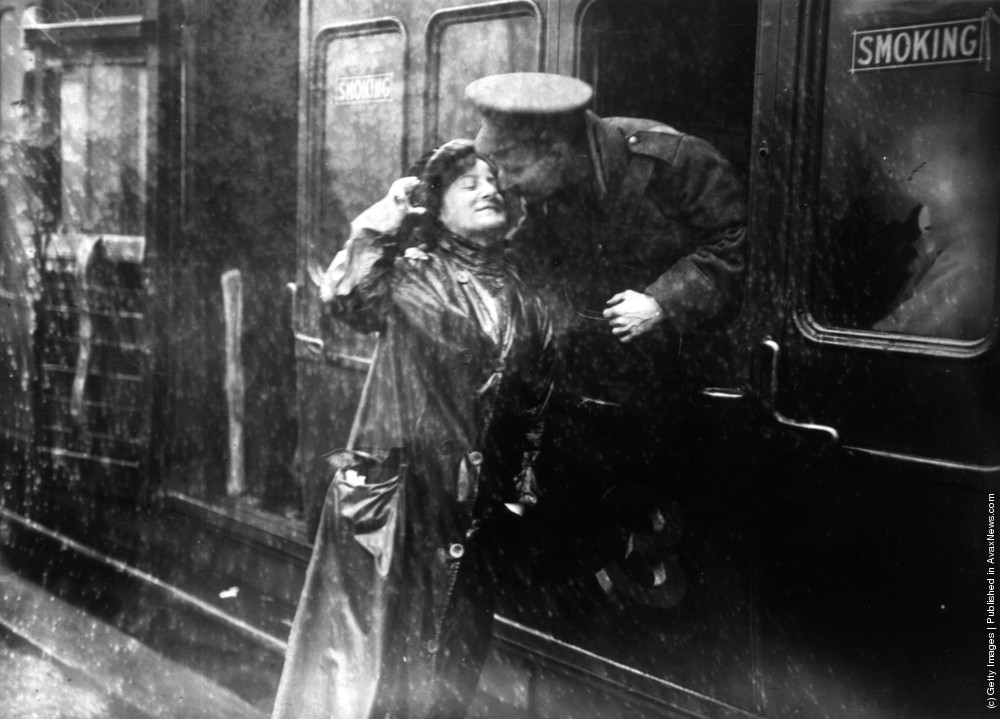
A final kiss from a British Soldier at Victoria Station

They were fateful days. Only the Austrians entered the war with any positive objectives, military or political goals. Every other power lurched into the war without clear objectives or end states. One writer noted that the war had “causes but no objectives.”

The world again finds itself perched at the edge of the abyss of war. There are people, smart and otherwise reasonable people who believe that they can wage “preventive wars” and rely on brute military force to solve nearly any problem. There are others that suggest that we should not criticize “allies” even when their decisions could be disastrous to them and the world, much as the Germans gave their Austrian brothers a “blank cheque.”  I wish that they would just look at the consequences before they commit nations and the world to more war that can only result in calamity and great suffering without benefit for anyone or any nation involved.

Those that counsel “preventive wars” need to remember the words of Otto Von Bismarck that “Preventive war is like committing suicide out of fear of death.”

Peace

Padre Steve+

3 Comments

Filed under Foreign Policy, History, leadership, Military, national security, Political Commentary, world war one

Shades of Confederate Gray

fig25

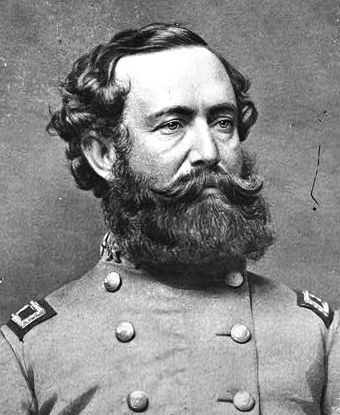
Major General Patrick Cleburne C.S.A. 

“When the prophet, a complacent fat man,
Arrived at the mountain-top
He cried: “Woe to my knowledge!
I intended to see good white lands
And bad black lands—
But the scene is gray.”

Stephen Crane

Friends of Padre Steve’s World,

If you read my work you know how much I condemn the cause of the Confederacy and the institution of slavery. I also make no bones about the continued use of the symbols of the Confederacy by some who do not use them simply to honor the memory of dead soldiers but rather to further inflame political and racial divides. As a descendant of slave owners and Confederate officers I do understand the tension. THe family patriarch on my paternal side was an unreconstructed Rebel. He was a slave owner who served as a Lieutenant in the Confederate cavalry during the war and refused to sign the loyalty oath to the United States. For this he lost his lands and plantation. There are some who sincerely desire to honor their ancestors, and I think that is honorable, but to stand by an indefensible cause as my ancestors did is another matter to me.

I agree with historian George Santayana who wrote “Loyalty to our ancestors does not include loyalty to their mistakes.” I think we have to be able to deal with that, and I do not only mean for the descendants of slave owners and Confederates. Certainly the descendants of those in the North who cooperated with, enabled and profited from slavery, and then the entire movement to reenslaved freed blacks by other means after the war have nothing to be proud of in this regard. I readily admit that many political, industrial and religious leaders in the North were little better than many Southern leaders (see my articles Accomplices to Tyranny: The North & Reconstruction and Corporate Slavery & the Black Codes ). Both of these articles highlight how Northerners, especially politicians from both political parties and industrialists who took in those injustices committed against blacks. The same people on both sides of the Mason-Dixon Line dis similar things to poor whites who they referred to as “White Trash” as well as Native Americans, women later other immigrants like the Chinese. As we get closer to Labor Day I am going to spend some time on how American workers of all races were treated during that time, but not today.

IMG_1879

Instead I want to talk about shades of gray. As my regular readers know I believe that people are the most important part of history, and that people are seldom fully good or fully evil. In fact most people, saints and sinners alike live lives of some shade of gray. Thus I believe that good people can sometimes support evil causes and otherwise evil people can end up on the right side of history by supporting a good cause. We have other people that we treat as icons who had dark places in their lives, and did things that were not honorable; history is full of them. The problem is that we like to look at people as totally good or totally evil, it’s easier that way.

That is the case when we look at men who fought for the Confederacy and the Union during the Civil War, and since I have spent a lot of time hammering the cause that Confederate soldiers fought to defend, even those who opposed secession and slavery; it is only right that I spend some time talking about the shades of Confederate Gray. To do this we have to be able to put aside the notion that every Confederate was a racist or White Supremacist.

Hill.28135413_std

Lieutenant General A.P. Hill

Those who fought for the Confederacy spanned the spectrum of belief and often fought for reasons other than slavery and some of their stories are tragic. Lieutenant General A.P. Hill opposed slavery before the war and opposed secession but because his state and his family seceded he went south. In 1850 he was on leave from the army and learned of a lynching in his home town of Lynchburg, he wrote “Shame, shame upon you all, good citizens…Virginia must crawl unless you vindicate good order or discipline and hang every son of a bitch connected with this outrage.” Hill was incredibly brave and led his troops honorably throughout the war. Sadly he died in action just days before the end of the war at Petersburg and his widow took no part in any commemorations of the Lost Cause after the war.

Brigadier General Lewis Armistead who led Pickett’s troops to the High Water mark at the Battle of Gettysburg is another tragic figure. He was a widower who lived a life of much sorrow and loneliness and the army was his life; his best friends were in the army. His very best friend, Winfield Scott Hancock and his wife Almira remained with the Union, their parting in California at the beginning of the war is heartrending, and it was Hancock’s troops who inflicted the mortal wound on him.

Major General Patrick Cleburne, called the “Stonewall Jackson of the West” is another. He was an Irish immigrant to Arkansas. He had no slaves, opposed the institution and fought because the people he lived among were his friends. He was the first Confederate to broach the subject of emancipating the slaves, and for this he was ostracized, and not promoted to Lieutenant General and command of a Corps. He died in action at the Battle of Franklin in 1864.

There are others, Lieutenant General James Longstreet who was probably the best corps commander on either side during the war, quickly reconciled, became a Republican and served in various capacities in government after the war. For this, as well as needing a scapegoat for the loss at Gettysburg Longstreet was treated as a modern Judas Iscariot by many in the South, especially among the proponents of the Lost Cause. Major General William “Little Billy” Mahone was another like Longstreet who joined the Republican Party and suffered a fair amount of criticism for his stance.

Another more interesting personality was Colonel John S. Mosby, the legendary “Gray Ghost” of Virginia whose “Raiders” caused Union forces much difficulty throughout the war. Mosby is interesting, he did not support slavery, was not a proponent of secession but felt that it was his duty to fight for his state. This was not unusual because in that era most people in all parts of the country, felt much more loyalty to their own state, or even city or county than they did to the national government. He and his troops served honorably and after the war too he supported reconciliation, he became a Republican and a friend and supporter of Ulysses Grant. He was not ashamed of his service and stated after the war, “I am not ashamed of having fought on the side of slavery—a soldier fights for his country—right or wrong—he is not responsible for the political merits of the course he fights in” and that “The South was my country. But he also condemned those in the South who denied that slavery was the cause of the war. All this made him anathema and he had to live the rest of his life outside the south or serving in various overseas diplomatic postings.

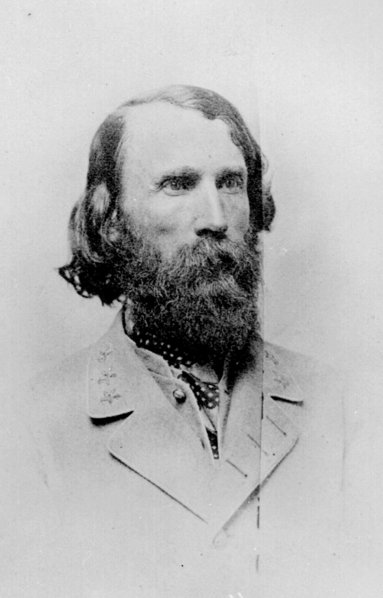
There were other shades of gray among Confederates, some like Lieutenant General Jubal Early who was not a slave owner and vehemently opposed secession in the Virginia legislature until the state seceded. When it did he joined the Confederate forces and became one of the fiercest supporters of Confederate independence who ever lived. In fact Early, though pardoned by President Andrew Johnson, never reconciled with the United States and became the leading proponent of the history of the Lost Cause. Early’s Corps Commander Lieutenant General Richard Ewell was more circumspect, he owned and admitted the mistakes he made during the war as a commander, and he fully reconciled to the United States. Before he died Ewell “insisted that nothing disrespectful to the United States Government be inscribed upon his tomb.”

Hampton_inline

Lieutenant General Wade Hampton

Lieutenant General Wade Hampton of South Carolina was one of the richest men in the South if not the country when war came. He supported secession, owned hundreds of slaves, but for a slave owner he was relatively decent in the way he treated his slaves. He fought through the war and returned home to nothing. He became involved in politics, remained very much a White Supremacist, but that being said built bridges to African American political and religious leaders when he ran for governor, even as the terrorist bands of the Red Shirts did all they could to ensure that blacks were harassed, disenfranchised and even killed to keep them from voting. To the surprise of the militants Hampton adopted a moderate course, kept blacks in his cabinet and in state offices, kept a regiment of African American militia in Charleston and opposed the black codes and Jim Crow. For this he was run out office. When he died his last words were “God bless my people, black and white.”

One the other hand there were men like Lieutenant General Nathan Bedford Forrest who helped found the Ku Klux Klan, and even led some of the early violence against blacks, and purchased black prisoners for use on his plantation after the war. However, he evolved on the issue, and left the Klan in 1869 and in 1875 two years before his death began to promote racial harmony. He spoke about that to a group of African Americans, where he received a bouquet of flowers from a black women he was condemned throughout the South. An article in the Charlotte Observer noted “We have infinitely more respect for Longstreet, who fraternizes with negro men on public occasions, with the pay for the treason to his race in his pocket, than with Forrest and Pillow, who equalize with the negro women, with only ‘futures’ in payment.”

There were many Confederate Soldiers who fought and died because they did believe in White Supremacy and hated the North, that too is a fact, and many of those who lived carried on that hate until they died.

birth_of_a_nation-3

There were others who never reconciled and who rewrote history to minimize the importance of slavery and White Supremacy to the Confederate cause, these included Jefferson Davis, his Vice President Alexander Stephens, and Brigadier General Henry Benning of Georgia. All had spearheaded the drive for secession, spoken and wrote forcefully for not only preserving but expanding slavery Stephens said quite clearly in 1861 what the Confederacy was founded upon in his Cornerstone Speech “Our new Government is founded upon exactly the opposite idea; its foundations are laid, its cornerstone rests, upon the great truth that the negro is not equal to the white man; that slavery, subordination to the superior race, is his natural and normal condition.” However, after the war all of them sought to distance themselves from this and change the narrative to Constitutional, economic and political reasons.

KKK-Nast

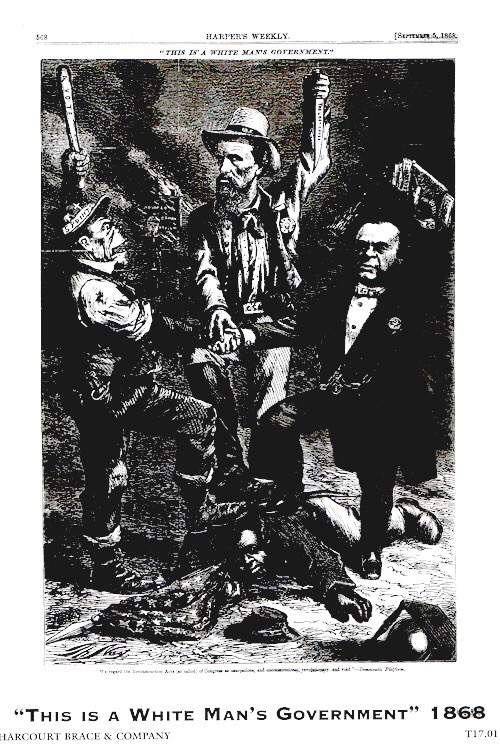
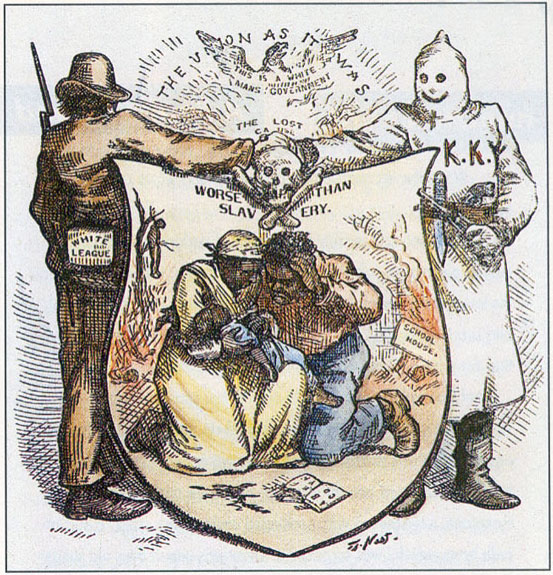
There were also many Confederate soldiers for whom the war never ended and they did continue it by other means, either as members of any of the various terrorist groups such as the Klan, the Red Shirts, the White League, the White Liners, or any of the related groups who terrorized and killed blacks and their white supporters, be they Northern “Carpetbaggers” or Southern “Scalawags.”

I could go on longer or in more detail on any of these men and probably could write a book about any of them, but I wanted to show that even when a cause is wrong, that we cannot condemn people as groups, and we also have to take into account people’s evolution on issues. The evolution of Wade Hampton and Nathan Bedford Forrest was far different than that of Jubal Early and others who supported the Lost Cause. I wish my family patriarch had been more like Mosby, Hampton, Hill, Ewell, Cleburne, or even Forrest rather than Jubal Early and others who never reconciled and in some cases continued to use violence to oppress others. 

Shades of gray. In history you can’t live with them and you can’t live without them.

Peace

Padre Steve+

3 Comments

Filed under civil rights, civil war, ethics, History, leadership, Political Commentary

Apologists for Genocide: Limbaugh, Barton & Streicher

Manife4

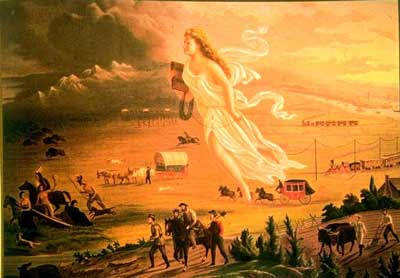
Manifest Destiny and Genocide: Drive Out and Destroy Native Americans

Friends of Padre Steve’s World,

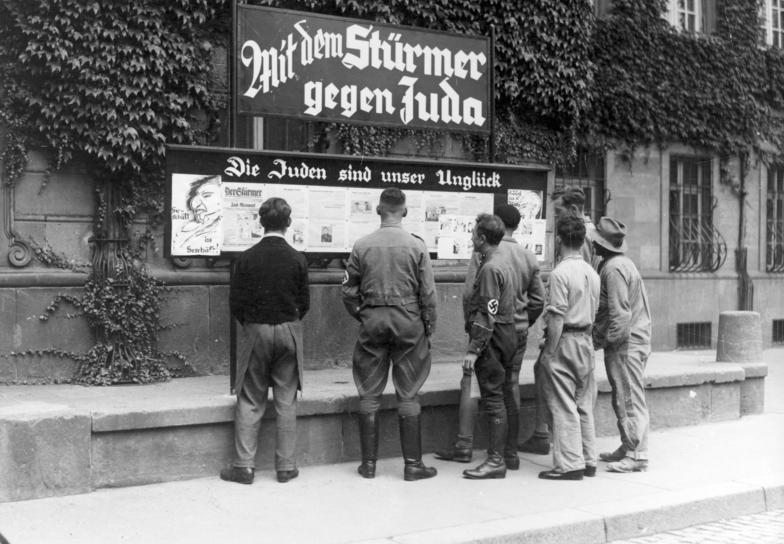
One thing that I find amazing in our world, particularly among many pundits who profess themselves to abide by supposed “Christian Principles” make comments that defy any sense of Christian morality.The sad thing is that these pundits, as well as the preachers and politicians who echo their thoughts are delving into a type of propaganda that is strikingly similar to that used by the notorious Julius Streicher, whose Der Stürmer demonized the Jews in the years before and during the Second World War, and provided many Germans with a worldview from which they went on to annihilate the Jews. When most of these people today talk they are not targeting the Jews, unless they are liberal American Jews, but rather justifying the genocide against Native Americans, making excuses for slavery and proposing laws which are as tyrannical minority groups, gays and women as were the Black codes, Jim Crow and the Nazi Nuremburg Racial Laws. I have written some about that before but think that today would be a good opportunity to directly address the words of some of these individuals.

One of the biggest of these over the past three decades has been Rush Limbaugh Back in 2009 Limbaugh in defending the extermination of American Indians said, “Holocaust? Ninety million Indians? Only four million left? They all have casinos — what’s to complain about?”

If Limbaugh was a lone person making such comments we could blow him off. However there are many like him, professional pundits and politicians but even more concerning are the preachers who make similar statements. I guess the silver lining in the Limbaugh cloud is that he is becoming more and more irrelevant by the day as his show continues to be dropped by radio stations in major markets.

While Limbaugh is deflating there are others rushing to take his place and some of these men and women are quite influential, especially those who flat out claim to be Christians who speak for God, and who often claim that God is speaking to them.

Their ideas penetrate many parts of our society, and not just religious people. They include pastors of some of the most politically influential churches and ministries in the country. Whether the comments are directed against Native Americans as was this particular quote from Limbaugh or African Americans, Mexican Americans, Moslems, Gays and Lesbians, Jews (especially liberals) or political liberals they demonstrate a profound and troubling lack of empathy.

barton

David Barton

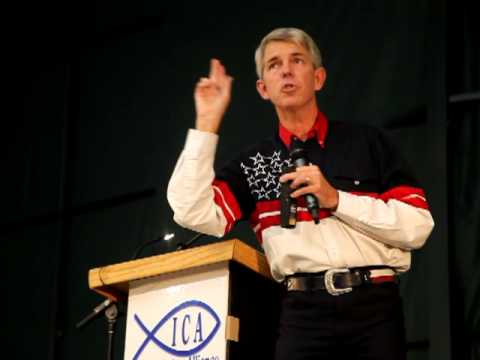
David Barton, a fraudulent self-proclaimed “Christian” historian whose work is often to be so error ridden that publishers have to pull his books from the shelves is one of them. Barton, whose highest earned academic degree is a Bachelor’s degree in Religious Education from Oral Roberts University, who has no academic background or training in history at all is frequently referred to as “Dr. Barton,” a title he never repudiates. He served as Vice-Chairman of the Texas Republican Party from 1997-2006 and he has served as an adviser to Newt Gingrich, Michele Bachmann, Kansas Gov. Sam Brownback and Mike Huckabee. Though he is thoroughly discredited he is quite popular among many in the Christian Right and appears frequently on Glenn Beck’s program and is a frequent speaker at major political and religious conferences where he lauded and never challenged.

Like Limbaugh, Barton too has weighed in on genocidal extermination of Native Americans by whites Barton said: “You have to deal, a lot of it, with how the enemy responds. It’s got to be based on what the enemy responds [to,] you cannot reason with certain types of terrorists; and see that’s why we could not get the Indians to the table to negotiate with us on treaties until after we had thoroughly whipped so many tribes …”

If that was not enough Barton justified those comments, he continued his diatribe in much the same manner as the Nazis did when defending their genocide against the Jews.

“People complain about the fact that the American military and buffalo hunters went out and wiped out all the buffalo in the western plains.  Doing that was what brought the Indians to their knees because the Indians lived on those wide western plains where there were very few towns; Indians didn’t go into town to buy supplies, they went to the buffalo herds, that’s where they got their meat, that’s where they got their coats, the hides provided coats, they provided covering for their teepees.

If you don’t have the buffalos, those Indians cannot live on the open western plains without those buffalo and so what happened was the military wiped out the supply line by wiping out the buffalo.  That’s what brought those wars to an end, that’s what brought the Indians to their knees and ended all the western conflict.”

Bryan Fischer of the American Family Association who is one of the primary preachers of hate against a wide range of groups said about the Native Americans: “Many of the tribal reservations today remain mired in poverty and alcoholism because many native [sic] Americans continue to cling to the darkness of indigenous superstition instead of coming into the light of Christianity and assimilating into Christian culture.”

Barton, a chest thumping Evangelical Christian uses the defense that the end justifies the means, a defense used by the Nazis at the various Nuremberg trials, which was excoriated and destroyed. Barton’s defense of the extermination of the Native Americans is akin to what some of the Nuremberg defendants said in their own defense.

But it is not just the extermination of Native Americans that is a concern. Preachers of hate claiming to be speaking for God often show no compassion, empathy or feeling for victims of natural disasters, disease or mass murder. The examples are too numerous to quote from all of them and in the interest of brevity I will just mention a few.

Bryan Fischer who seems to have something to say about everything said after the school shootings in Newtown Connecticut year:

“The question is going to come up, where was God? I though God cared about the little children. God protects the little children. Where was God when all this went down. Here’s the bottom line, God is not going to go where he is not wanted.” 

Likewise he said about the Moslem extremists who carried out the attacks of 9-11-2001: “The jihadist on 9/11 were the agents of God’s wrath in order to get our attention as a people.” I could go through speech after speech, column after column, diatribe after diatribe of men like Limbaugh, Fischer and so many others demonstrate any sense of empathy for those that they condemn. Some of the worst are from ministers like Fischer.  John Hagee who pastors Cornerstone Church, a mega-church in San Antonio with over 20,000 active members said last week on the Trinity Broadcasting Network that the 9-11 attacks were “God’s judgment on America.” In fact any time a natural disaster hits, especially areas with high percentages of poor people and minorities such as New Orleans during Hurricane Katrina these preachers almost line up gleefully to ascribe them to God’s judgment. Franklin Graham said at the time: “This is one wicked city, OK?  It’s known for Mardi Gras, for Satan worship.  It’s known for sex perversion.  It’s known for every type of drugs and alcohol and the orgies and all of these things that go on down there in New Orleans…There’s been a black spiritual cloud over New Orleans for years….” Later on CNN when confronted about the comments by Larry King Graham backtracked saying:  “I would never say that this is God’s judgment on New Orleans or any other place.”

There is no empathy among these people, no real care or concern, and that is of itself evil.

The comments have become all too pervasive and poisonous. The sad thing is that those make these kind of comments really do have no compassion or empathy for people that they have labeled “enemies of God” or “enemies of America.” They honestly believe that they are doing right. Philosopher Eric Hoffer noted:

“The impression somehow prevails that the true believer, particularly the religious individual, is a humble person. The truth is the surrendering and humbling of the self breed pride and arrogance. The true believer is apt to see himself as one of the chosen, the salt of the earth, the light of the world, a prince disguised in meekness, who is destined to inherit the earth and the kingdom of heaven too. He who is not of his faith is evil; he who will not listen will perish.”

Captain Gustave Gilbert an Army Psychologist at Nuremberg wondered about how people could commit the atrocities of the Holocaust.

“In my work with the defendants (at the Nuremberg Trails 1945-1949) I was searching for the nature of evil and I now think I have come close to defining it. A lack of empathy. It’s the one characteristic that connects all the defendants, a genuine incapacity to feel with their fellow men. Evil, I think, is the absence of empathy.” 

I think he is right the more that I read and listen to men like Limbaugh, Hagee, Fischer and their fellow travelers. That lack of empathy was demonstrated in the words of Rudolf Höss the Commandant of Auschwitz. In an interview with Army Psychiatrist Major Leon Goldensohn at Nuremberg Höss said in regard to his crimes and how he had no feeling or empathy for his victims:

“I thought I was doing the right thing,” said Höss. “I was obeying orders, and now, of course, I see that it was unnecessary and wrong. But I don’t know what you mean by being upset about these things because I didn’t personally murder anybody. I was just the director of the extermination program at Auschwitz. It was Hitler who ordered it through Himmler and it was Eichmann who gave me the orders regarding transports.”

hoess

Colm Feore as Rudolf Höss

http://www.youtube.com/watch?v=A0hJqNuRH1A

The fact is that these pundits, preachers and politicians lay the groundwork by which people justify the persecution of others by demonizing and dehumanizing those that they detest. While the men doing the preaching today may never actually commit atrocities their words are laying the groundwork that others will use to justify their actions. The crimes committed by the Nazis had their genus in decades of fierce anti-Semitic campaigns conducted often by the same Unholy Trinity of Pundits, Preachers and Politicians.

streicher

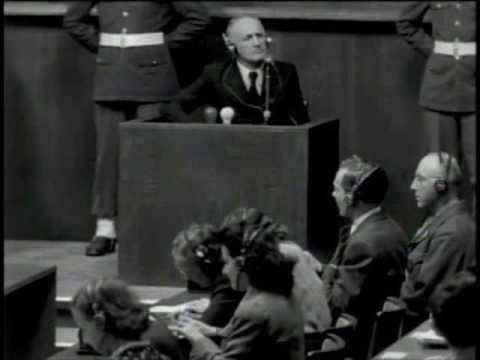
Streicher at Nuremburg

In Nazi Germany one of the Chief media propagandists was Julius Streicher, publisher of the daily “Der Sturmer.” At Nuremberg the prosecution summed up its case against Streicher:

“The defendant Streicher is an accessory to the persecution of the Jews within Germany and in occupied territories which culminated in mass murder of an estimated six million men, women, and children. The propaganda in Der Stürmer and other Streicher publications, for which he had admitted responsibility, was of a character calculated to stir up fanatic fear and hatred of the Jewish people and to incite to murder…Through propaganda designed to incite hatred and fear, defendant Streicher devoted himself, over a period of twenty-five years, to creating the psychological basis essential to carrying through a program of mass murder. This alone would suffice to establish his guilt as an accessory to the criminal program of extermination.”

Worms, Antisemitische Presse, "Stürmerkasten"

When Streicher was cross-examined he was asked if his words in his paper were not preaching race hatred. The prosecutor asked: “And do you think to call them “blood-suckers,” “a nation of blood-suckers and extortioners”-do you think that’s preaching hatred? To this Streicher responded “No, it is not preaching hatred; it is just a statement of facts.”

I have seen what the dehumanization of people does in Iraq. When I was there both Sunni and Shia military officers refused to have Imam’s in their units because they saw how Imams and Mullahs from both factions in the country fanned the flames of hatred against the other and led the country into civil war and threaten to again. The troubling thing is that I am seeing the same thing here from the religious propagandists of the American political right.

However this is not something that some of these “Christian Leaders” understand, they speak, act and write with the same conviction of Julius Streicher, they believe that what they say in not preaching hate, but stating fact. But the fact is that ideas do have consequences and the preachers of hate are responsible for the evil that they incite, they are accessories to any crimes committed by those who embrace their ideology, and some people have actually killed others in cold blood because they believe and follow the words of these preachers of hate. The real fact is that these allegedly Christian propagandists like Barton, Fischer, Rick Wiles, Gary North, John Hagee, James Robison, and so many others are little different than Streicher. The targets of their hate may not be the Jews, but it is still vitriolic hate cloaked under a thin veneer of religion. Eric Hoffer was certainly right about such people.

One of the philosophical leaders of the Dominionist movement Gary North who is closely connected to the power structure of the Tea Party wrote: “The long-term goal of Christians in politics should be to gain exclusive control over the franchise. Those who refuse to submit publicly to the eternal sanctions of God by submitting to His Church’s public marks of the covenant–baptism and holy communion–must be denied citizenship, just as they were in ancient Israel.”

It is little different than the philosophy which drove the Nazi persecution of the Jews. It is interesting to compare North’s writings with the Nuremberg Laws: The Law on German Citizenship stated:  “A citizen of the Reich is that subject only who is of German or kindred blood and who, through his conduct, shows that he is both desirous and fit to serve the German people and Reich faithfully.” and that “A Jew cannot be a citizen of the Reich. He has no right to vote in political affairs and he cannot occupy public office.”

That poisonous message is something that allowed people like Höss do what they did and feel nothing for their victims. They were and are truly men without empathy as are so many on the supposedly “Christian” right.

So, have a nice night and please read up on some of these guy on the Christian Right and the political pundits who like Streicher preach hatred with conviction, and unlike Streicher, do so in the name of God.

Peace

Padre Steve+

2 Comments

Filed under civil rights, History, Political Commentary

Some are More Equal than Others: The Hatred that Will not Die

John_Lewis_t580

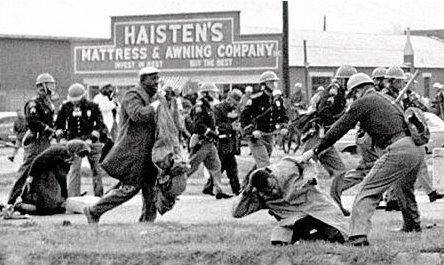
Bloody Sunday

Friends of Padre Steve’s World

I am back from Gettysburg and recuperating from the trip. I took my wife Judy to get the staples removed from her abdomen following her surgery and things are looking really good. She will be monitored and tested regularly every three months for the next two years to ensure that the cancer has not returned but the odds are it will not.

Anyway, while I while I was at Gettysburg something happened that took me aback. It was not anything from any of my students who were absolutely awesome, but it was something else.

I always end the staff ride by taking the students to the National Soldier’s Cemetery. There we talk about terrible human cost of the battle and I introduce them to a number important topics related to the cemetery. I talk about the rural cemetery movement and the Greek revival in America in the 1820s, which is culturally important to us. Then I move on the dedication of the Soldier’s Cemetery. I discuss the layout of the cemetery and how it was designed so that the grave of every soldier is of equal importance and then I read some of the comments of the keynote speaker, Edward Everett. Following this I discuss the writing of the Gettysburg Address, the way Lincoln used it to universalize the Declaration of Independence and then I recite it, and remind my students, especially my American officer students why this is so important to us as we remember our oath of office and our duty.

1880_Anti-Chinese_Riot_in_Denver_anagoria

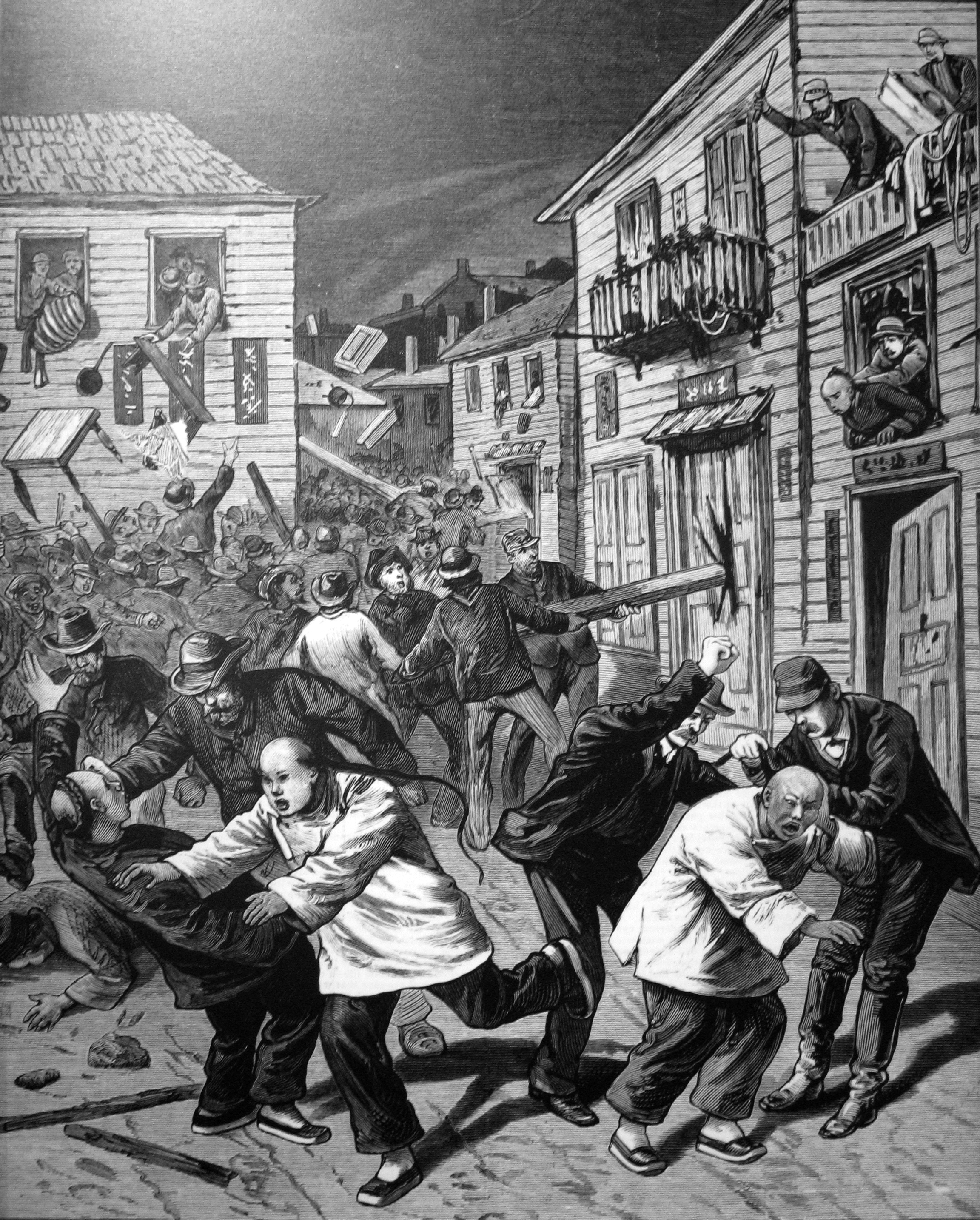
Violence Against Chinese Immigrants in Denver 1880s

While we were gathering near the spot where Lincoln gave his address, an elderly white couple, which appeared to be in their early eighties, was on a bench where my students gathered. I invited them to stay if they wanted and let them know why we were there. They were very attentive as were my students and when we concluded and my students began to head back to our vans or to their own vehicles for the trip back to Norfolk, the man approached me and asked directions on how to get to the Chambersburg Road which I gladly gave him; and then he said: “You know that when they say that “all men are created equal” that some are more equal than others.”

9587864_orig

I was stunned and attempted to deflect the man’s obvious racist comment with humor, referring to the rivalry of UCLA where I did my Army ROTC training about thirty-three years ago with that of the University of Southern California. The man looked at me and said that he was from Georgia and wished that California would just drop off into the ocean, and then walked away.

I thought to myself: “you corpulent old racist bastard.” I was really tempted to follow him and confront him, but I backed off. I realized based on his age, and that he probably opposed everything about the civil rights movement and supported Jim Crow and that there was nothing that could change his mind. He was old enough that he may have actually taken part in some of the anti-civil rights actions of the 1950s and 1960s. I don’t know, but it is possible.

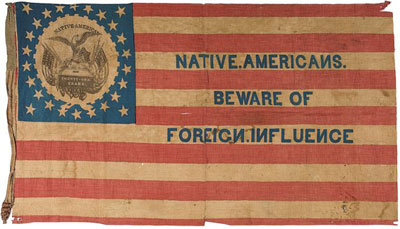
know-nothing_flag

The Flag of the Know Nothing Party

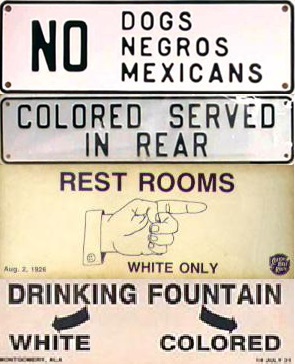
Sadly, there are a lot of people in this country who believe exactly what that man voiced. Some are racist, and not just towards African Americans but to Latinos, Native Americans, Asians, Arabs and others. There are those who believe that women and gays are not equal. Many of these people are leading politicians at the federal, state and local levels, media personalities and corporate leaders who have significant political and economic clout and if they ever had complete power would overturn or nullify every law that protects the civil rights of those they believe are less than equal, in some extreme case even less than human.

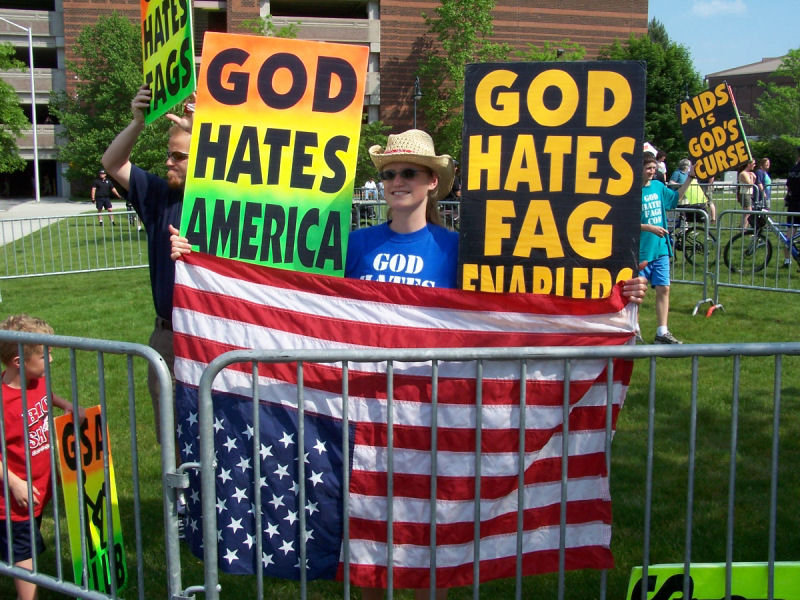
GodHatesFags-TsongasArena043

There are many reasons that people use to justify these attitudes; some pseudo-scientific, some religious, some economic, and many based on a crude Social Darwinism emphasizing the “survival of the fittest.” I heard someone else in a restaurant this weekend say exactly that when they were talking about the poor. Again, lest we want to simply use this to beat on Southerners, this is not simply an attitude confined to the South; it is all over the country, and that was the often the case throughout our American history.

It really does grieve me when I see this. The ghosts of our past intrude on so many parts of our national life, condemning the living to have to relive them in our own time. Historian George Santayana said it so well: “Those who cannot remember the past are condemned to repeat it.”

Have a good night.

Peace

Padre Steve+

2 Comments

Filed under civil rights, Gettysburg, History, Political Commentary

The Unfinished Work of the New Birth of Freedom

Friends of Padre Steve’s World

I am on the way back from another Staff Ride with my students to Gettysburg. For me the place is incredibly important, when I go it is not just a trip back into history, it is an intensely spiritual trip, especially when I visit the National Soldier’s Cemetery where Abraham Lincoln delivered the Gettysburg Address. For me, like Lincoln, this is hallowed ground, and a place from which I always recommit myself to the unfinished work of the New Birth of Freedom, a work that has all too often suffered due to those who for whatever reason, be it racial, economic or political are willingly to work against freedom and equality. The message of the address takes us back to those words of the Declaration of Independence, that all men are created equal and endowed with certain unalienable rights; among them life liberty and the pursuit of happiness. 

Sadly these noble words of our founders in the Declaration were not meant for all. They were only applicable to White men and not to African Americans, Native Americans or women. In fact the Constitution was explicit in treating blacks as less than human. For eight-seven years blacks awaited some form of redemption, and that came initially in the Emancipation Proclamation. Six months later Robert E. Lee was defeated at Gettysburg. When the Cemetery was dedicated Lincoln recalled and made the first steps by an American President, all but two of whom before him had been slaveowners to begin to universalize the promise of those words in the Declaration. He talked of a new birth of freedom, and reminded his audience that the mission was not finished and that “It is rather for us to be here dedicated to the great task remaining before us — that from these honored dead we take increased devotion to that cause for which they gave the last full measure of devotion…” 

The following is a chapter of my Gettysburg text which deals with that event and that speech. 

Have a great weekend.

Peace

Padre Steve+
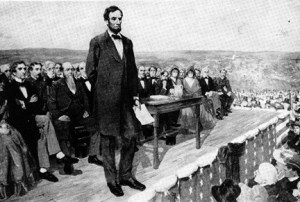
gburg address

I am always humbled when I travel to Gettysburg. It is hard to believe in that now peaceful pastoral setting that over 157,000 Americans, almost 82,000 Union and 75,000 Confederate met in a three day battle. In those three days over 28,000 Confederates and 23,000 Union soldiers were killed, wounded, missing or captured. It was the greatest number of casualties inflicted in one battle on American soil in history.

The places that the battle was fought have become legendary, for they are “hallowed ground” as President Abraham Lincoln so eloquently put it. The places, McPherson’s and Herr’s Ridge, Seminary Ridge, the Railroad Cut, Barlow’s Knoll, Cemetery Hill, Culp’s Hill, The Wheat Field, Devil’s Den, the Peach Orchard, Little Round Top, Cemetery Ridge, the Apse of Trees, the Angle and the High Water Mark are in a sense holy, or hallowed, consecrated by those who struggled there, those who lived and those who gave the last full measure of devotion to their country. When I take my students there I always finish at the Soldier’s Cemetery where Abraham Lincoln delivered the Gettysburg Address.

I think about those men of both sides, fully convinced of the rightness of their cause who fought valiantly in the struggle. That being said when I go there though my family predominantly fought for the Confederacy my heart is drawn to those men who remained loyal to the Union and those who answered the call of Abraham Lincoln to serve in a cause greater than their own interests, the great and the small alike.

Lincoln was a masterful orator who managed to rally the Union and bring hundreds of thousands of men volunteer before Gettysburg. They came for an ideal an ideal which Lincoln’s oratory was probably the most effective at articulating in a way that men would volunteer to suffer hardship, fight and die to bring about. It was well put in the movie Gettysburg where Colonel Joshua Chamberlain, played by Jeff Daniels said:

“This is a different kind of army. If you look at history you’ll see men fight for pay, or women, or some other kind of loot. They fight for land, or because a king makes them, or just because they like killing. But we’re here for something new. This has not happened much, in the history of the world: We are an army out to set other men free. America should be free ground, all of it, from here to the Pacific Ocean. No man has to bow, no man born to royalty. Here we judge you by what you do, not by who your father was. Here you can be something. Here is the place to build a home. But it’s not the land. There’s always more land. It’s the idea that we all have value, you and me. What we’re fighting for, in the end… we’re fighting for each other…” [1]

On November 19th 1863 Lincoln delivered a “few words” at Gettysburg which were in all practical aspects a benediction at the dedication of the battlefield cemetery. Lincoln was the second speaker at the ceremony following former Pennsylvania Congressman Edward Everett who spoke for more than two hours, a typical speech from the period.

Everett was one of the leading orators of his day. Everett was “a scholar and Ivy-League diplomat who could hold mass audiences in thrall. His voice, diction, and gestures were successfully dramatic, and he always performed his carefully written text, no matter how long, from memory.” [2]

The 270 words of Lincoln’s address are perhaps the most important of any speech or document in American history save the Declaration of Independence and the Constitution of the United States, in those words “Lincoln, nevertheless managed to justify the ways of democracy more than anyone, then or now.” [3]

The speech was so powerful that Everett wrote Lincoln the next day:

“Permit me also to express my great admiration of the thoughts expressed by you, with such eloquent simplicity & appropriateness, at the consecration of the Cemetery. I should be glad, if I could flatter myself that I came as near to the central idea of the occasion, in two hours, as you did in two minutes.” [4]

The speech is short, but its eloquence is unmatched. Lincoln wrapped ideas, concepts and ideals that men have written volumes about into a speech so powerful that many have memorized it.

But few realize the context that it must be placed. Though the Union had defeated Lee’s Army at Gettysburg and Grant had taken Vicksburg to cut the Confederacy in half the North was growing war weary. During the fall of 1863 after a series of inconclusive battles in northern Virginia both Lee and Meade’s armies had sent significant numbers of troops to the west, to support operations in eastern Tennessee.

Lee sent Longstreet’s First Corps, which took part in the bloody battle of Chickamauga, which “is a Cherokee word meaning “river of death.” [5] where on September 19th and 20th the Federal Army of the Cumberland under General Rosecrans “were soundly whipped at …and driven back into the strategic point of Chattanooga.” [6] The number of casualties on both sides, over 16,000 Federal and 18,000 Confederate, a “combined total of 34,634 was exceeded only the three day slaughter at Gettysburg and by the week-long series of five battles known collectively as the Seven Days.” [7] Despite the number of casualties it was one of the biggest Confederate victories of the war. A clerk in Richmond wrote “The whole South will be filled again with patriotic fervor, and in the North there will be a corresponding depression.” [8] That changed rapidly when the Union reacted quickly and reversed the strategic situation. One action taken was to deploy Oliver Howard’s XI Corps and Henry Slocum’s XII Corps west, where “they would be commanded by Joe Hooker, who was conveniently at hand and unemployed.” [9]

In the east during the following weeks “Lee and Meade, like two wounded, spent gladiators, sparred listlessly along the Rapidan. It seemed to Northerners that the fruits of Gettysburg had been thrown away.” [10] Lee sensed an opportunity to go back on the offensive against Meade’s weakened army, but his offensive was stopped on October 14th when “the Union Second Corps shattered a reckless attack by A.P. Hill’s corps at Bristoe Station, five miles south of Manassas.[11]

There was a faction in the North, the Copperheads, who were willing even after Gettysburg and Vicksburg to end the war on terms favorable to the Confederacy, even allowing for Confederate independence and the continuation of slavery. They “clamored for negotiations with the Confederacy to restore the Union on the basis of status quo antebellum and, until the closing months of the war charged that as long as the antislavery party remained in power the restoration of the Union could not be achieved.” [12] They believed that the war was a failure and that military action could not be achieved by force of arms.

The leading Copperheads included Clement Vallandigham of Ohio and George W. Woodward of Pennsylvania were typical, both opposed the use of force against Confederate secession; Woodward had written in 1860 that “Slavery was intended as a special blessing to the people of the United States,” that “Secession is not disloyalty” and “I cannot condemn the South for withdrawing….I wish Pennsylvania could go with them.” [13] The efforts of the Copperheads to gain governorships in Ohio and Pennsylvania met defeat in November 1863, as the Union victories at Gettysburg and Vicksburg “undercut their theme of the war’s failure.” [14] Their efforts would persist through the 1864 Presidential election, but instead of preaching the war’s failure they would concentrate on defeating emancipation. The Copperheads, “labeled all Republicans, including Lincoln, as radicals bent upon destroying the Union and undermining the Constitution.” [15]

However, the anti-abolitionist and racist views espoused by the northern Democrat Copperheads had begun to lose their potency in the North after July of 1863 with the onset of “the New York draft riot, which shocked many northerners into a backlash against the consequences of virulent racism” [16] and the sacrifice of the African American 54th Massachusetts Infantry when it assaulted Fort Wagner outside of Charleston South Carolina, which occurred “just after the Democratic rioters in New York had lynched black people and burned the Colored Orphan Asylum. Few Republican newspapers failed to point the moral: black men who fought for the Union deserved more respect than white men who fought against it.” [17]

It is also important to understand how Lincoln’s address at Gettysburg is reflective of the various intellectual and philosophical movements of the time. Even the location of the cemetery and the burial plots within it was significant. A Gettysburg lawyer, David Wills proposed to “Governor Andrew Curtain of Pennsylvania the establishment of a soldiers’ cemetery where the Union dead could be reburied with dignity and honor.” [18] The place was then outside the city, a plot of 17 acres purchased by Wills adjacent to the existing town cemetery on Cemetery Hill. That was significant culturally, for the Gettysburg Cemetery was part of a movement called the Rural Cemetery movement. The movement was part of the Greek revival in the United States and connected with the Transcendentalist movement.

The Rural Cemetery movement was launched at Cambridge’s Mount Auburn Cemetery, and Edward Everett was a key figure in it. Mount Auburn “took Athens’s Kerameikos as its model, since that ancient burial ground existed outside the city proper, near the groves of the Akademy, in what was still countryside.” [19] In his speech at Mount Auburn’s dedication, U.S. Supreme Court Justice Joseph Story noted:

“The Greeks exhausted the resources of their exquisite art in adorning the habitations of the dead. They discouraged internments within the limits of their cities; and consigned their relics to shady groves, in the neighborhood of murmuring streams and merry fountains, close by the favorite resorts of those who were engaged in the study of philosophy and nature, and called them, with the elegant expressiveness of their own beautiful language, cemeteries or “places of repose.” [20]

He further noted:

“Our cemeteries, rightly selected and properly arranged, may be made subservient to some of the highest purposes of religion and human duty. They may preach lessons to which none may refuse to listen and which all that live must hear. Truths may there be felt and taught, in the silence of our meditations, more persuasive and more enduring than ever flowed from human lips.” [21]

Everett in his Gettysburg oration linked what they were doing at the Soldiers’ Cemetery with the Greek tradition:

“It was appointed by law in Athens, that the obsequies of the citizens who fell in battle should be performed at the public expense, and in the most honorable manner. Their bones were carefully gathered up from the funeral pyre where their bodies were consumed, and brought home to the city. There, for three days before the interment, they lay in state, beneath tents of honor, to receive the votive offerings of friends and relatives,–flowers, weapons, precious ornaments, painted vases (wonders of art, which after two thousand years adorn the museums of modern Europe),–the last tributes of surviving affection. Ten coffins of funereal cypress received the honorable deposit, one for each of the tribes of the city, and an eleventh in memory of the unrecognized, but not therefore unhonored, dead, and of those whose remains could not be recovered….” [22]

The layout of the cemetery, and the manner in which the dead were buried was also significant when one considers the messages of both Everett and Lincoln that day. “The cemetery at Gettysburg was arranged so that every grave was of equal importance; William Saunders’s design, like Lincoln’s speech, affirmed that every dead soldier mattered equally regardless of rank or station.” [23] In this place “some 3,577 Union soldiers (half of them unknown) from eighteen states are buried.” [24]

The speeches of Everett and Lincoln are deeply connected with Romanticism, the Greek revival and the Transcendentalist movement in the United States. Both were children of the enlightenment, and Everett, a former President of Harvard was well versed in these subjects and Lincoln, though a politician who appealed to the tenets of the Enlightenment, the Declaration of Independence and the Constitution. Lincoln appealed to the “sacred principles of the laws of nature,” and hailed “the constitution and laws” as “hewn from the solid quarry of sober reason.” For Lincoln, the war was a test of the practical worth of liberalism.” [25]

Everett had been a mentor to some of the leading Transcendentalist thinkers of his era including Ralph Waldo Emmerson who found that the experience of “Everett’s classroom gave him an entirely new direction in life. He wrote:

“Germany had created [literary] criticism in vain for us until 1820, when Edward Everett returned from his five years in Europe, and brought to Cambridge his rich results, which no one was so fitted by natural grace and splendor of his rhetoric to introduce and recommend….The novelty of the learning lost northing in the skill and genius of its interpreter, and the rudest undergraduate found a new morning opening to him in the lecture room at Harvard.” [26]

Everett, who had previously dedicated battlefields at Bunker Hill, as well as Lexington and Concord, was at his best when dedicating battlefields and cemeteries. He spent weeks preparing his speech. Everett had studied the battle and knew it well from official reports and talks with those who fought it. Everett painted a vivid picture of the battle for his audience and connected the sacrifice of those who fought and died to preserve the Union form antiquity and from those who founded the nation. He noted why they had gathered:

“We have assembled, friends, fellow-citizens, at the invitation of the Executive of the great central State of Pennsylvania, seconded by the Governors of seventeen other loyal States of the Union, to pay the last tribute of respect to the brave men who, in the hard-fought battles of the first, second, and third days of July last, laid down their lives for the country on these hillsides and the plains before us, and whose remains have been gathered into the cemetery which we consecrate this day. As my eye ranges over the fields whose sods were so lately moistened by the blood of gallant and loyal men, I feel, as never before, how truly it was said of old that it is sweet and becoming to die for one’s country. I feel, as never before, how justly, from the dawn of history to the present time, men have paid the homage of their gratitude and admiration to the memory of those who nobly sacrifice their lives, that their fellow-men may live in safety and in honor. And if this tribute were ever due, to whom could it be more justly paid than to those whose last resting-place we this day commend to the blessing of Heaven and of men?” [27]

In his narrative Everett aspired to more than mere accuracy. Along “with Bancroft and other romantic historians of his time, he meant to create a tradition that would inspire as well as inform. Like the Attic orators- and dramatists- he knew the power of symbols to create a people’s political identity.” [28]

Lincoln was sick when he delivered the address having what was mostly likely a mild form of Smallpox when he gave the address. Thus the tenor, simplicity and philosophical depth of the address are even more remarkable. It is a speech given in the manner of Winston Churchill’s “Blood sweat toil and tears” address to Parliament upon being appoint Prime Minister in 1940. Likewise it echoes the Transcendentalist understanding of the Declaration of Independence as a “test for all other things.”

Many in the United States and Europe did not agree and argued that no nation found on such principles could long survive. The more reactionary European subscribers of Romanticism ridiculed the “idea that a nation could be founded on a proposition….and they were not reluctant to point to the Civil War as proof that attempting to build a government around something as bloodless and logical as a proposition was futile.” [29]

But Lincoln disagreed. He believed that the “sacrifices of Gettysburg, Shiloh, Murfreesboro, Chancellorsville, and a hundred other places demonstrated otherwise, that men would die rather than to lose hold of that proposition. Reflecting on that dedication, the living should themselves experience a new birth of freedom, a determination- and he drove his point home with a deliberate evocation of the great Whig orator Daniel Webster- “that government of the people, by the people, for the people, shall not perish from the earth.” [30]

The Unitarian pastor and leading Transcendentalist Theodore Parker wrote:

“Our national ideal out-travels our experience, and all experience. We began our national career by setting all history at defiance- for that said, “A republic on a large scale cannot exist.” Our progress since that has shown that we were right in refusing to be limited by the past. The practical ideas of the nation are transcendent, not empirical. Human history could not justify the Declaration of Independence and its large statements of the new idea: the nation went beyond human history and appealed to human nature.” [31]

Likewise Lincoln’s address echoes the thought of George Bancroft who wrote of the Declaration:

“The bill of rights which it promulgates is of rights that are older than human institutions, and spring from the eternal justice…. The heart of Jefferson in writing the Declaration, and of Congress in adopting it, beat for all humanity; the assertion of right was made for the entire world of mankind and all coming generations, without any exceptions whatsoever.” [32]

Parker’s words also prefigured an idea that Lincoln used in his address, that being: The American Revolution, with American history since, is an attempt to prove by experience this transcendental proposition, to organize the transcendental idea of politics. The ideal demands for its organization a democracy- a government of all, for all, and by all…” [33]

Lincoln delivered these words on that November afternoon:

Four score and seven years ago our fathers brought forth on this continent, a new nation, conceived in Liberty, and dedicated to the proposition that all men are created equal.

Now we are engaged in a great civil war, testing whether that nation, or any nation so conceived and so dedicated, can long endure. We are met on a great battle-field of that war. We have come to dedicate a portion of that field, as a final resting place for those who here gave their lives that that nation might live. It is altogether fitting and proper that we should do this.

But, in a larger sense, we cannot dedicate — we can not consecrate — we can not hallow — this ground. The brave men, living and dead, who struggled here, have consecrated it, far above our poor power to add or detract. The world will little note, nor long remember what we say here, but it can never forget what they did here. It is for us the living, rather, to be dedicated here to the unfinished work which they who fought here have thus far so nobly advanced. It is rather for us to be here dedicated to the great task remaining before us — that from these honored dead we take increased devotion to that cause for which they gave the last full measure of devotion — that we here highly resolve that these dead shall not have died in vain — that this nation, under God, shall have a new birth of freedom — and that government of the people, by the people, for the people, shall not perish from the earth.[34]

In a time where many are wearied by the foibles and follies of our politicians, even wondering about our form of government can survive Lincoln’s words matter. Dr. Allen Guelzo, Professor of Civil War Studies at Gettysburg College wrote in the New York Times:

“The genius of the address thus lay not in its language or in its brevity (virtues though these were), but in the new birth it gave to those who had become discouraged and wearied by democracy’s follies, and in the reminder that democracy’s survival rested ultimately in the hands of citizens who saw something in democracy worth dying for. We could use that reminder again today.” [35]

Dr. Guelzo is quite correct. Many people in this country and around the world are having grave doubts about our democracy. I wonder myself, but I am an optimist. I do believe that we will recover because for the life of me I see no nation anywhere else with our resiliency and ability to overcome the stupidity of politicians, pundits and preachers.

The amazing thing was that in spite of everything the Union survived. Lincoln was a big part of that but it was the men who left lives of comfort and security like Joshua Chamberlain and so many others who brought about that victory. Throughout the war, even to the end Southern political leaders failed to understand that Union men would fight and die for an ideal, something greater than themselves, the preservation of the Union and the freedom of an enslaved race. For those men that volunteered to serve, the war was not about personal gain, loot or land, it was about something greater. It was about freedom, and when we realize this fact “then we can contemplate the real meaning of “that cause for which they gave the last full measure of devotion.” [36]

Now I for one do not think that we are currently living up to the ideals enunciated by Lincoln that day at Gettysburg. I can understand the cynicism disillusionment of Americans as well as those around the world who have for over 200 years looked to us and our system as a “city set on a hill.” That being said, when I read these words and walk that hallowed ground I am again a believer. I believe that we can realize the ideal, even in our lifetime should we desire.

Notes

[1] Shaara, Michael. The Killer Angels, Ballantine Books, New York. 1974 p.28

[2] Wills, Garry. Lincoln at Gettysburg: The Words that Remade America Simon and Schuster Paperbacks, New York 1992 p.25

[3] Guelzo Allen C. Fateful Lightening: A New History of the Civil War Era and Reconstruction Oxford University Press, Oxford and New York 2012 p.407

[4] Everett, Edward Letter from Edward Everett to Abraham Lincoln, (Transcription) 20 November 1863 retrieved from http://www.in.gov/judiciary/citc/files/everett-to-lincoln.pdf July 18th 2014

[5] Ibid. Guelzo Fateful Lighteningp.352

[6] Hebert, Walter H. Fighting Joe Hooker University of Nebraska Press, Lincoln and London 1999. Originally published by Bobbs-Merrill, New York 1944

[7] Foote, Shelby, The Civil War, A Narrative. Volume Two Fredericksburg to Meridian Random House, New York 1963 p.758

[8] Ibid. Foote The Civil War, A Narrative. Volume Two p.757

[9] Ibid. Foote The Civil War, A Narrative. Volume Two p.764

[10] Sears, Stephen W. Gettysburg Mariner Books, Houghton Mifflin Company Boston, New York 2004 p.513

[11] McPherson, James M. Tried by War: Abraham Lincoln as Commander in Chief Penguin Books, New York and London 2008 p.200

[12] Harris, William C. With Charity for All: Lincoln and the Restoration of the Union The University Press of Kentucky, Lexington KY 1997 p.7

[13] McPherson, James. The Battle Cry of Freedom: The Civil War Era Oxford University Press, Oxford and New York 1988 p.685

[14] Ibid. McPherson The Battle Cry of Freedom p.685

[15] Ibid. Harris With Charity for All p.7

[16] Ibid. McPherson The Battle Cry of Freedom p.686

[17] Ibid. McPherson The Battle Cry of Freedom p.687

[18] McPherson, James M. This Hallowed Ground Crown Publishers, New York 2003 p.137

[19] Ibid. Wills. Lincoln at Gettysburg p.63

[20] Ibid. Wills. Lincoln at Gettysburg p.64

[21] Ibid. Wills. Lincoln at Gettysburg p.65

[22] Everett, Edward Gettysburg Address retrieved from http://voicesofdemocracy.umd.edu/everett-gettysburg-address-speech-text/ 21 August 2014

[23] Faust, Drew Gilpin, This Republic of Suffering: Death and the American Civil War Vintage Books, a division of Random House, New York 2008 p.100

[24] Ibid. McPherson This Hallowed Ground p.137

[25] Ibid. Guelzo. Fateful Lightening pp.406-407

[26] Ibid. Wills. Lincoln at Gettysburg p.45

[27] Ibid. Everett Gettysburg Address

[28] Ibid. Wills. Lincoln at Gettysburg p.51

[29] Ibid. Guelzo. Fateful Lightening p.409

[30] Ibid. Guelzo. Fateful Lightening p.408

[31] Ibid. Wills. Lincoln at Gettysburg p.110

[32] Ibid. Wills. Lincoln at Gettysburg p.105

[33] Ibid. Wills. Lincoln at Gettysburg p.105

[34] Lincoln, Abraham The Gettysburg Address the Bliss Copy retrieved from http://www.abrahamlincolnonline.org/lincoln/speeches/gettysburg.htm

[35] Guelzo, Allen C. Lincoln’s Sound Bite: Have Faith in Democracy New York Time Opinionator, November 17th 2013 retrieved from http://opinionator.blogs.nytimes.com/2013/11/17/lincolns-sound-bite-have-faith-in-democracy/?_php=true&_type=blogs&_r=0 July 18th 2014

[36] Ibid. McPherson This Hallowed Ground p.138

2 Comments

Filed under civil rights, civil war, History, Political Commentary

The Heritage is Hate

Friends of Padre Steve’s World

  
I am honored to be at Gettysburg this weekend leading a group of my students on another Staff Ride. This is hallowed ground at which the forces of a rebellion founded on the principles of White Supremacy and the enslavement of African Americans were decisively defeated when they attempted to invade Free States to secure their right to enslave others.

When you come to Gettysburg you can buy all sorts of crap with the Confederate Battle Flag or the national flags of the Confederacy emblazoned on them. You can also see the Confederate Battle flag in the windows or hung outside businesses ride alongside the American flag. In some ways I can understand this. Lots of people come to this place, many of who had ancestors who fought for the Confederacy. Heck my ancestors did and at one time I was proud of that Confederate “heritage” until I actually got beyond the history of the Lost Cause which I had assumed was true and the whitewashing of the school textbooks that were part of my education, and not just in the South, mostly on the west coast.

I often get asked questions by my non-American students, my students from NATO or other allied countries on how a flag that symbolized treason and a failed rebellion can fly next to our own national flag, the Stars and Stripes. Part of this is heritage, and in fact the Confederate Battle Flag disappeared for a while after the Civil War except as a marker placed by grieving families on the graves of fallen Confederate soldiers. Truthfully I have no issue with that because they did not die fighting for Old Glory. However, when that flag became the chief symbol of the Ku Klux Klan in its terror campaign against newly free African Americans and their supporters it ceased to be simply a symbol a failed rebellion and of fallen soldiers, but became a symbol of race hatred.

Now let me make this clear. If a family who had a Confederate ancestor wants to fly the flag from their house or put one on a grave, I may disagree with them but they can do it. However, when I have that flag stuffed in my face by people who drive big-assed pickup trucks with massive Confederate Battle Flags flying from mounts on their truck beds my blood boils, especially when they drive through the streets of Gettysburg with it flying like the one that drove past me last night. Likewise one of the popular items sold by the souvenir stores is the t-shirt with the Battle Flag that says “Heritage not Hate” but I digress…

Now if someone wants to be so silly as to display their ignorance about what that heritage is, that is their choice, but I will not assist them. Since it is late here are just a couple of quotes from a Confederate Flag designer and the Confederate Vice President as to what that flag symbolized and what that cause was.

The designer of the second Confederate National Flag, which incorporated the Battle Flag as its jack, the so-called “Stainless Banner” which was introduced in 1863 was quite clear on the meaning and heritage of that flag. William T. Thompson, designer of the Second Confederate National Flag and editor of the Savannah Morning News wrote in 1863:

“As a people we are fighting to maintain the heavenly ordained supremacy of the white man over the inferior or colored race; a white flag would thus be emblematical of our cause. Such a flag would be a suitable emblem of our young confederacy, and sustained by the brave hearts and strong arms of the south, it would soon take rank among the proudest ensigns of the nations, and be hailed by the civilized world as THE WHITE MAN’S FLAG.”

“As a national emblem, it is significant of our higher cause, the cause of a superior race, and a higher civilization contending against ignorance, infidelity, and barbarism. Another merit in the new flag is, that it bears no resemblance to the now infamous banner of the Yankee vandals.”

The latter comment was due to many Confederate’s unhappiness with the Stars and Bars, the first national flag of the Confederacy, which to some too closely resembled the American flag that they admittedly hated.

Confederate Vice President Alexander Stephens in his Cornerstone Speech 1861boldly proclaimed:

“Our new Government is founded upon exactly the opposite idea; its foundations are laid, its cornerstone rests, upon the great truth that the negro is not equal to the white man; that slavery, subordination to the superior race, is his natural and normal condition.”

Since it is late and I have an early day tomorrow, I will close by saying if you choose to fly this flag and shove it in my face at least have the intellectual honesty and integrity to admit what that heritage was; it was about White Supremacy and Slavery, and the only state right that the South fought to protect was to ensure that slavery could not only continue to expand. The rights of Free States did not matter to them as was evidenced in the Congressional Gag rule of 1836 which forbade the discussion of slavery in the congress, something that John Quincy Adams fought for years until it was lifted. They had no problem with censoring Northern newspapers, which criticized slavery in the 1830s and 1840s. The Fugitive Slave Act of 1850 forced citizens of Freed States to deliver escaped slaves back to their Southern owners, and the Dred Scott decision denied that African Americans could be citizens.

I could go on but like I said I am tired. Have a great and hopefully thoughtful and reflective weekend.

Peace

Padre Steve+

2 Comments

Filed under civil rights, civil war, Political Commentary

Leave them on the Ice Floe to Die: Post Hospitalization Health Care in the United States

images-7

Friends of Padre Steve’s World

Thank you all for your expressions of support, kind thoughts, positive waves, and prayers over the past few weeks. My wife Judy is doing well, her wound is no longer draining, the sutures are healing and it looks like her staples will come out Monday. She is pretty much able to take care of herself and it looks like she will have a good number of visitors while I am in Gettysburg.

Now this has been an interesting experience. You see when someone leaves the hospital after major surgery insurance companies, even good ones are loath to pay for any in-home care, so everything falls on the family of the person, in our case since we don’t have 19 kids to saddle with the work, that person is me. In fact for most people the work falls on their spouse or their significant other, or possibly a teenage kid.

Now I am lucky, I am a fairly senior military officer and I work in an academic setting where I do not have to deploy and have a command that is very supportive of whatever time I need to care for Judy. I don’t have to worry about my paycheck getting docked ort losing my job. Sadly, a majority of Americans have to worry about that if their family member is sick, or needs post surgery care. I think that is a terrible situation if you ask me; condemn Europeans as socialists who pay too much in taxes, but at least they get something for what they pay, most European countries have effective health care and social service systems that do not let people fall through the crack.

For a nation that considers itself the pinnacle of humanitarianism and which is supposedly “pro-life” the situation is shameful, and frankly I think we should be ashamed. We are not pro-life at all, even the people that call themselves that tend to be pro-birth and the hell with you after that, unless you are rich.

Interestingly enough the Commonwealth Fund, hardly a liberal institution, ranked the United States 11th of 11 developed western countries in terms of health care, including accessibility and outcomes, of course all of those countries are willing to have universal health care, and sorry even Obamacare is not socialized medicine, it is simply a modified version of the Heritage Foundation’s plan that they touted over a decade ago and similar to Romneycare. It still keeps the insurance companies in control of most healthcare decisions. If you want to see where the United States ranks here is the listing:

  1. United Kingdom
  2. Switzerland
  3. Sweden
  4. Australia
  5. Germany & Netherlands (tied)
  6. New Zealand & Norway (tied)
  7. France
  8. Canada
  9. United States

The link to the Forbes Magazine article where you can find the report is here: http://www.forbes.com/sites/danmunro/2014/06/16/u-s-healthcare-ranked-dead-last-compared-to-10-other-countries/

But anyway, I digress. When a person leaves the hospital the family, with very few exceptions is lead to fend for themselves. Post hospital prescriptions may be covered by insurance, ours are, but nothing else is. If you need surgical pads, gauze, bandages, antiseptic wipes or a host of other potential needs, they come out of your pocket, thankfully mine are deep enough to handle these expenses, but think of the person who lives paycheck to paycheck and because they have to take unpaid leave are not getting a paycheck during their loved one’s illness.

When your loved one is recovering you become all the things that the hospital provides while they are an inpatient. You are nursing services, you get to check, clean and dress their wounds, make sure they get their medicines and monitor them for anything that might be going wrong. Now for me this is not a problem, I have a significant amount of medical background as a Medical Service Corps officer in the Army as well as a hospital chaplain working trauma, critical-care and ICUs. Blood, guts, bodily fluids, I can handle them; spot infection, got it; change dressings, and do other things that gross people out, can do. Again, I am lucky; I have training and experience but sadly when most people leave the hospital their untrained and inexperienced relatives get to do this. The family also is the nursing aid, the dietary service, rehab service, housekeeping and laundry service. It is a full time job, which most families are not, trained to deal with and many do not have the resources to do. Let’s say that because they have to pay rent the caregiver has to leave the recovering patient alone, they are hosed unless perhaps a friend or neighbor volunteers to do this, once again at no cost to the insurance company of the health care system.

For those that do not think that nurses earn their money they are sadly mistaken, nursing is hard, it is physical and emotional. I know why nurses only work 3-4 days before they get a break, it is demanding. Judy often tells me from previous experiences with me as her nurse that I graduated from the Leave Them on the Ice Floe to Die School of Nursing. Now with global warming and the ice flows all melting I had no place to put her so I really had to work hard. Actually, I didn’t mind it, I wanted to make sure that there were no complications and that nothing happened to her I really worked hard to care for her, and I wanted to do it. However, that being said that is what our health care system does to people when it puts them out of hospital, it leaves them and their families out on the ice flow and sadly the ice floes are disappearing. We need to really change how we do health care in this country before they are gone.

PearlsBeforeSwine-28Oct2013


So anyway, I am now on the way to Gettysburg to lead 20 students as well as some faculty and family members on my third staff ride of the year. Tomorrow and Sunday I will be out and about the battlefield teaching. I’ll post something short tomorrow night.

Again thank you and blessings

Peace

Padre Steve+

Leave a comment

Filed under healthcare, News and current events, Political Commentary

The Long Shadow of Hiroshima

Cloud

Friends of Padre Steve’s World

Seventy years ago the world changed. A remarkably destructive weapon was introduced in combat, a single bomb that annihilated the city of Hiroshima Japan. The effects were immediate, 70,000 to 80,000 people were killed, tens of thousands of others wounded, many of whom would suffer from the effects of radiation and radiation burns the rest of their lives. Within days a second bomb was dropped on Nagasaki with similar results, and Japan sued for peace. The Second World War was over and a new world was born, a world under the shadow of nuclear weapons.

John Hersey in his book on Hiroshima wrote: “The crux of the matter is whether total war in its present form is justifiable, even when it serves a just purpose. Does it not have material and spiritual evil as its consequences which far exceed whatever good might result? When will our moralists give us an answer to this question?” I have to echo his thoughts.

I teach the ethics of war to senior military officers at a major US. Military Staff College. One of the things that we do in the class is to have the officers do presentations on different historical, or potential ethical problems faced by national policy makers, military commanders and planners. The goal is to have these men and women dig deep and examine the issues, and think about the implications of what they will do when they go back out to serve as commanders, staff officers, advisors to civilian leaders and planners.

In each class at least one student deals with the use of the Atomic bombs, often these are Air Force or Navy officers who have served with nuclear forces. Unlike the depiction in the classic movie Dr. Strangelove or other depictions that show officers in these forces as madmen, the fact is that I have been impressed with the thoughtfulness and introspective nature of these men and women. The sincerely wrestle with the implications of the use of these weapons, and many are critical of the use of them at Hiroshima and Nagasaki. That is comforting to me to know that at least in the U.S. military that there are many who can reflect and do try to look at things not just from a purely military standpoint. Of course since I know humanity I figure that there are others in our ranks who are not so reflective or sensitive to the moral implications of the use of these weapons.

I am no stranger to what these weapons, as well as chemical and biological weapons can do. Thirty years ago when I was a young Army Medical Service Corps lieutenant I was trained as a Nuclear, Chemical and Biological Defense Officer. I learned the physical effects of exposure to these weapons, how many Rads of radiation a person could receive before they became sick and died. I learned what radiation exposure does to people at each stage. We trained with maps to chart fallout patterns, and the maps had the cities and towns that we lived in, this was Cold War Germany and yes both NATO and the Warsaw Pact expected that tactical nuclear weapons and chemical weapons would be used and we had to be able to operate in contaminated environments. We operated under the idea of Mutual Assured Destruction or MAD as a deterrent to war. It was chilling and made me realize that the use of these weapons today would be suicidal. When Chernobyl melted down we were in the fallout zone and were given instructions on what we could and could not do in order to minimize any possible exposure to radiation poisoning.

So when it comes to the first use of the Atomic bomb I am quite reflective. As a historian, military officer, chaplain and priest who has been trained on what these weapons can do I have a fairly unique perspective. Honestly, as a historian I can understand the reasons that President Truman ordered its use, and I can understand the objections of some of the bomb’s designers on why it should not be used. I’ve done the math and the estimates of casualties had there been an invasion of the Japanese home islands is in the millions, most of which would have been Japanese civilians.

9674_Photo_5

My inner lawyer can argue either point well, that being said the manner in which it was used at Hiroshima and Nagasaki troubles me. Hiroshima did have military targets, but a big part of the choice was its location, surrounded by hills, which created a bowl that would focus the explosion and maximized its effect. Many of the larger military and industrial targets lay outside the kill zone. The designers and officers on the committee wanted to show the Japanese, as well as the world the destructive power of the weapon. Those who opposed its use hoped that it would convince the leaders of nations that war itself needed to be prevented. The recommendation of the committee can be found here:

http://www.atomicarchive.com/Docs/ManhattanProject/Interim.shtml

Of the 150 scientists who were part of the bomb’s design team only 15% recommended the military use without a demonstration to show the Japanese the destructive power of the bomb and a chance to end the war. The poll of the scientists can be found here:

http://www.atomicarchive.com/Docs/ManhattanProject/Poll.shtml

Leo Szilard wrote a letter to Edward Teller seeking his support in sending a petition to President Truman regarding his opposition to the use of the weapon based on purely moral considerations. Szilard wrote:

“However small the chance might be that our petition may influence the course of events, I personally feel that it would be a matter of importance if a large number of scientists who have worked in this field wont clearly and unmistakably on record as to their opposition on moral grounds to the use of these bombs in the present phase of the war.

Many of us are inclined to say that individual Germans share the guilt for the acts which Germany committed during this war because they did not raise their voices in protest against those acts, Their defense that their protest would have been of no avail hardly seems acceptable even though these Germans could not have protested without running risks to life and liberty. We are in a position to raise our voices without incurring any such risks even though we might incur the displeasure of some of those who are at present in charge of controlling the work on “atomic power.”

The entire text is here:

http://www.atomicarchive.com/Docs/ManhattanProject/SzilardTeller1.shtml

The two petitions of the scientists to the President are here, the second letter concludes with this recommendation:

“If after the war a situation is allowed to develop in the world which permits rival powers to be in uncontrolled possession of these new means of destruction, the cities of the United States as well as the cities of other nations will be continuous danger of sudden annihilation. All the resources of the United States, moral and material, may have to be mobilized to prevent the advent of such a world situation. Its prevention is at present the solemn responsibility of the United States–singled out by virtue of her lead in the field of atomic power.

The added material strength which this lead gives to the United States brings with it the obligation of restraint and if we were to violate this obligation our moral position would be weakened in the eyes of the world and in our own eyes. It would then be more difficult for us to live up to our responsibility of bringing the unloosened forces of destruction under control.

In view of the foregoing, we, the undersigned, respectfully petition: first, that you exercise your power as Commander-in-Chief to rule that the United States shall not resort to the use of atomic bombs in this war unless the terms which will be imposed upon Japan have been made public in detail and Japan knowing these terms has refused to surrender; second, that in such an event the question whether or not to use atomic bombs be decided by you in the light of the consideration presented in this petition as well as all the other moral responsibilities which are involved.”

http://www.atomicarchive.com/Docs/ManhattanProject/SzilardPetition.shtml

http://www.atomicarchive.com/Docs/ManhattanProject/Petition.shtml

Ralph Bard, Undersecretary of the Navy wrote to Secretary of War Stimson his opinion on July 17th 1945:

“Ever since I have been in touch with this program I have had a feeling that before the bomb is actually used against Japan that Japan should have some preliminary warning for say two or three days in advance of use. The position of the United States as a great humanitarian nation and the fair play attitude of our people generally is responsible in the main for this feeling.”

I think that those who debate the history of this need to look at the entire picture and read the letters, the documents and take into account everything. My hope is that leaders, policy makers, legislators and we the people continue to work to eliminate nuclear weapons. It is true that the nuclear stockpiles of the United States and Russia are significantly smaller than when the Cold War ended, but even so what remain are more than enough to extinguish human life on the planet. Add to these the Chinese, French, British, Indian, Pakistani and the hundreds of undeclared weapons of Israel the fact is that there remains the possibility that they could be used. Likewise there are nuclear programs in other nations which given enough time or believing them necessary could produce weapons, including Iran and Saudi Arabia. Add to this the possibility of a terrorist group producing or acquiring a weapon the world is still a very dangerous place.

26362hiroshima_shame

That is the world that we live in and the world in which policy makers, legislators and educated people who care about the world must attempt to make safe. If you asked me I would say outlaw them, but that will never happen. Edward Teller wrote Leon Szilard:

“First of all let me say that I have no hope of clearing my conscience. The things we are working on are so terrible that no amount of protesting or fiddling with politics will save our souls…. Our only hope is in getting the facts of our results before the people. This might help to convince everybody that the next war would be fatal. For this purpose actual combat use might even be the best thing…. But I feel that I should do the wrong thing if I tried to say how to tie the little toe of the ghost to the bottle from which we just helped it to escape…”

The ghost is out of the bottle, and nothing can ever get it back in. We can only hope and pray that reasonable people prevent any of these weapons from ever being used and that war itself would end.

Peace

Padre Steve+

2 Comments

Filed under ethics, History, Military, News and current events, Political Commentary, world war two in the pacific