Category Archives: Religion

The Lure of Trump’s Cross of Gold

cross

Friends of Padre Steve’s World

In the post-election euphoria of the prosperity preachers who very Donald Trump as a political savior, and the President Elect’s stacking of his cabinet with billionaires of the first order, most of whom have no experience in the cabinet positions or are opposed to the missions of the departments they are to head one wonders what the 80% plus of self-identified Evangelical of Conservative Christians were thinking. But then, the answer is not that hard to find. For decades many of these people have been taught by their leaders that government policies that actually protect and benefit them are evil, and that God himself is basically a survival of the fittest Social Darwinist, that is basically the Gospel that they have been taught for decades. I used to be a clergyman in a denomination where many people believed and practiced such a faith.

So let me ask if you remember when conservative Christian politicians and preachers actually supported working people? I am not kidding, there was a time when some did exactly that and did so in the highest reaches of their political parties. Unlike today’s preachers they were not just lobbying for more tax cuts for the most wealthy, and extolling the job “creators” over the the people whose labor actually produces products, instead they spoke boldly on behalf of regular people. Sadly today all of the major political figures as well as most of the minor ones who claim to be “conservative Christians” have more in common with the greedy Robber Barons than one of the most celebrated conservative Christian politicians who has ever lived.

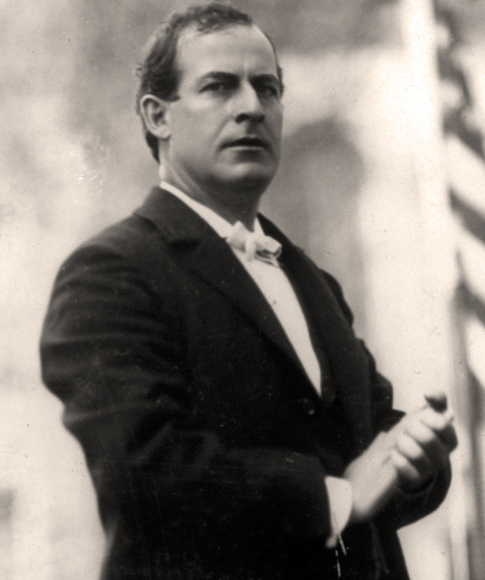
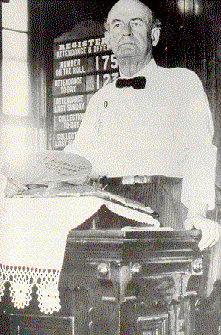
William Jennings Bryan was one of the most influential politicians of his era. Bryan served as Secretary of State under Woodrow Wilson, he was a Senator and three time Presidential Candidate. He was also a very conservative Fundamentalist Christian perhaps most famous, or perhaps infamous now as one of the prosecuting attorneys at the Scopes “Monkey” Trial of 1925. In fact I can find that Bryan’s handling of that case played to the basest religious and social hatred of his day and though he thought that he was defending “Biblical” values  ended up making Christians look but small minded, intolerant and hateful. The movie Inherit the Wind, though a fictional account of that trial, shows how decent Christians can become consumed with hatred in the name of righteousness.  It is a sad thing that Bryan is most remembered for the Scopes Trial than when he bucked the political system of both the Republican and Democratic parties to speak up for workers and small businessmen. Personally I cannot imagine Ted Cruz, Mike Huckabee, Marco Rubio or any other supposedly Christian political leader, especially the President Elect doing what Bryan did.

Whether one agrees on Bryan’s fundamentalist religious doctrine regarding the creation of the earth or the manner of how God created the earth,  one has to admit that of pre-Great Depression politicians he was quite amazing. Especially in how he saw through the Godlessness of unbridled capitalism and the devaluation of workers by valued capital over the people that actually produced anything.

As an American and a Christian I have to look at the body of work and life of a man. I don’t have to agree with all that they stood for or did and though I find much fault in Bryan and his supporters in the Scopes Trial I do not throw out the good things that he did and got right.

I think the apex of Bryan’s political thought is encapsulated in his speech at the Democratic National Convention of 1896, what is now called the Cross of Gold Speech.

When one looks at it now it really is timeless. Bryan saw through the charade that was being played out by politicians and the big money Wall Street types that they represented with great verve. It was a speech that one might have heard come from a prophet in the Old Testament.

HD_WilliamJenningsBryan1896

I am just going to quote a couple of pertinent sections from the speech to trigger the thought of anyone reading this article. I think that they could be spoken today in light of the way that many conservative Christians both Evangelical and Fundamentalist Protestants, Roman Catholics and those that preach the so called “Prosperity Gospel” have thrown their support behind ideas that are nothing more than unvarnished, crude materialism of the worst kind. In fact I believe that it is nothing more than the “baptism” of such thought by Christians are among the biggest reasons for the massive exodus of people from the churches and the rise of the “Nones,” or those with no religious preference.

Bryan said:

“We say to you that you have made the definition of a business man too limited in its application. The man who is employed for wages is as much a business man as his employer; the attorney in a country town is as much a business man as the corporation counsel in a great metropolis; the merchant at the cross-roads store is as much a business man as the merchant of New York; the farmer who goes forth in the morning and toils all day, who begins in spring and toils all summer, and who by the application of brain and muscle to the natural resources of the country creates wealth, is as much a business man as the man who goes upon the Board of Trade and bets upon the price of grain; the miners who go down a thousand feet into the earth, or climb two thousand feet upon the cliffs, and bring forth from their hiding places the precious metals to be poured into the channels of trade are as much business men as the few financial magnates who, in a back room, corner the money of the world. We come to speak of this broader class of business men.”

His words are striking in their directness and honesty. They are not only Christian but they are deeply American. He called on his Democratic party, which had been as bad as the Republicans during the age of the unregulated Robber Barons who used the Gold Standard to manipulate the markets and eliminate silver as currency to their benefit to be different:

“Upon which side will the Democratic Party fight; upon the side of “the idle holders of idle capital” or upon the side of “the struggling masses”? That is the question which the party must answer first, and then it must be answered by each individual hereafter. The sympathies of the Democratic Party, as shown by the platform, are on the side of the struggling masses, who have ever been the foundation of the Democratic Party.”

His arguments could be called true Christian populism. Bryan talked about two ideas of diametrically opposed types of government and economics:

“There are two ideas of government. There are those who believe that, if you will only legislate to make the well-to-do prosperous, their prosperity will leak through on those below. The Democratic idea, however, has been that if you legislate to make the masses prosperous, their prosperity will find its way up through every class which rests upon them.”

He concluded his speech with this statement.

“Having behind us the producing masses of this nation and the world, supported by the commercial interests, the laboring interests, and the toilers everywhere, we will answer their demand for a gold standard by saying to them: “You shall not press down upon the brow of labor this crown of thorns; you shall not crucify mankind upon a cross of gold.”

When I hear the unholy trinity of politicians, pundits and preachers who extol the virtue of capital over labor and the worship of wealth as the highest good I wish that there would be some that would remember that the people who actually make things, grow things, fix things and maintain things are not just human capital, but people.

Despite his rigid anti-science beliefs, as well as his often pro-Jim Crow positions, one almost wishes for the day that a man like William Jennings Bryant spoke for Christians rather than seeing Christians throw themselves at the feet of a man who has pulled the wool over their eyes, emasculated them, and will doom them and their churches to irrelevancy as more and more people abandon the the Christian faith.

1-rtx211ir

Today that unholy trinity is poised to take over every branch of the Federal Government because of the fact that Evangelical and Conservative Christians abandoned all principle to elect a man who despite his words during the campaign has a history of standing against everything that they believe. And after all, it is people that matter and sadly that doesn’t seem to matter to the sycophants who cheer every word of the President Elect even as he and his billionaire cabinet members enact policy after policy that will destroy them.

That is something to think about.

Peace

Padre Steve+

Leave a comment

Filed under faith, News and current events, Political Commentary, Religion

Two Types of Faith: Fiendish Sadistic Cruelty or Mercy and Justice

Witch-scene4

Friends of Padre Steve’s World,

The great Philosopher Alfred North Whitehead once wrote, “Religion carries two sorts of people in two entirely opposite directions: the mild and gentle people it carries towards mercy and justice; the persecuting people it carries into fiendish sadistic cruelty…” 

As I watch the reaction of many people who call themselves Christians in the wake of Donald Trump’s election I find much truth in Whitehead’s words. I feel that what has posed as Christianity in the United States has been revealed as a sham; a way for religious leaders to enrich themselves and gain power even if it means forsaking the Gospel to do so.

Those who follow my writings know how much I struggle with faith and doubt on a daily basis. I believe, but as the man told Jesus when he asked Jesus to heal his child “I believe, help my unbelief.” I no longer believe in the “absolute truths” that I once believed. Of course to some this makes me a heretic or worse. That being said, I have faith in a God I cannot see. I have faith in a God who clothes himself in human weakness and allows himself to be killed based on the trumped up charges of corrupt and fearful religious leaders. Thus I have a problem with Christians or members of other religions try to use the police power of state to enforce their beliefs on others, something that is about to become reality in our country.

I believe, but my doubts are all too real. Frankly I cringe when I hear religious people speaking with absolute certitude about things that they ultimately cannot prove, and that includes the concept of justice, which cannot always be measured in absolutes. Captain Jean Luc Picard (Patrick Stewart) noted in the Star Trek the Next Generation episode Justice: 

“I don’t know how to communicate this, or even if it is possible. But the question of justice has concerned me greatly of late. And I say to any creature who may be listening, there can be no justice so long as laws are absolute. Even life itself is an exercise in exceptions.”

I have found and learned to accept that life as we know it “is an exercise in exceptions.”  We all make them, and the Bible and the history of the church is full of them. So I have a hard time with people who claim an absolute certitude in beliefs that wish to impose on others. Whitehead wrote: “There are no whole truths; all truths are half-truths. It is trying to treat them as whole truths that plays the devil.” Unfortunately many true believers fail to understand that fact and whenever they gain political power use it to enforce their half-truths as if they were absolute truth. This behavior is demonstrated throughout history by people who profess every religious creed in the world.

Proving Whitehead’s words, many true believers frequently wrap themselves in the certitude of their faith assuming that they are the custodians of all truth, not recognizing that they are ignorant of their very ignorance.  The true believers espouse doctrines that are unprovable and then build complex doctrinal systems to prove them, systems that then which must be defended, sometimes to the death; and may whatever God you believe in protect you should you cross them.

Eric Hoffer wrote: “A doctrine insulates the devout not only against the realities around them but also against their own selves. The fanatical believer is not conscious of his envy, malice, pettiness and dishonesty. There is a wall of words between his consciousness and his real self.”

Henri Nouwen wrote, “Theological formation is the gradual and often painful discovery of God’s incomprehensibility. You can be competent in many things, but you cannot be competent in God.”

No one can be competent in God, and that those who claim to be are either hopelessly deluded, or worse, are evil men masquerading as good. Those that speak of absolutes and want to use the Bible or any other religious text as some sort of rule book that they alone can interpret need to ask themselves this question, “When has justice ever been as simple as a rulebook?” 

Sadly too many people, Christians, Moslems, Jews, Hindus, and others apply their own misconceptions and prejudices to their scriptures and use them as a weapon of temporal and divine judgement on all who they oppose. However, as history, life and even our scriptures testify, that none of us can absolutely claim to know the absolutes of God. As Captain Picard noted “life itself is an exercise in exceptions.” 

It takes true wisdom to know when and how to make these exceptions, wisdom based on reason, grace and mercy. Justice, is to apply the law in fairness and equity, knowing that even our best attempts can be misguided. If instead of reason we appeal to emotion, hatred, prejudice or vengeance and clothe them in the language of righteousness, what we call justice can be more evil than any evil it is supposed to correct, no matter what our motivation. Whitehead noted something that people of faith should remember and practice: “Religion will not regain its old power until it can face change in the same spirit as does science. Its principles may be eternal, but the expression of those principles requires continual development.”

The temporal power of the Christians who have thrown away the Gospel to use the election of Donald Trump to to further their temporal agenda of gaining earthly power completely miss the essence of faith, and the concept of justice. They have shown themselves to be little different from the theocrats that they condemn in the Islamic world, but then the mirror can be a difficult thing to look at.

But we see it all too often, religious people and others misusing faith or ideology to condemn those they do not understand or with whom they disagree. When such people gain power they tend to expand that power into the realm of theocratic absolutism and despotism. As Captain Jean Luc Picard noted in the Start Trek Next Generation episode The Drumhead:

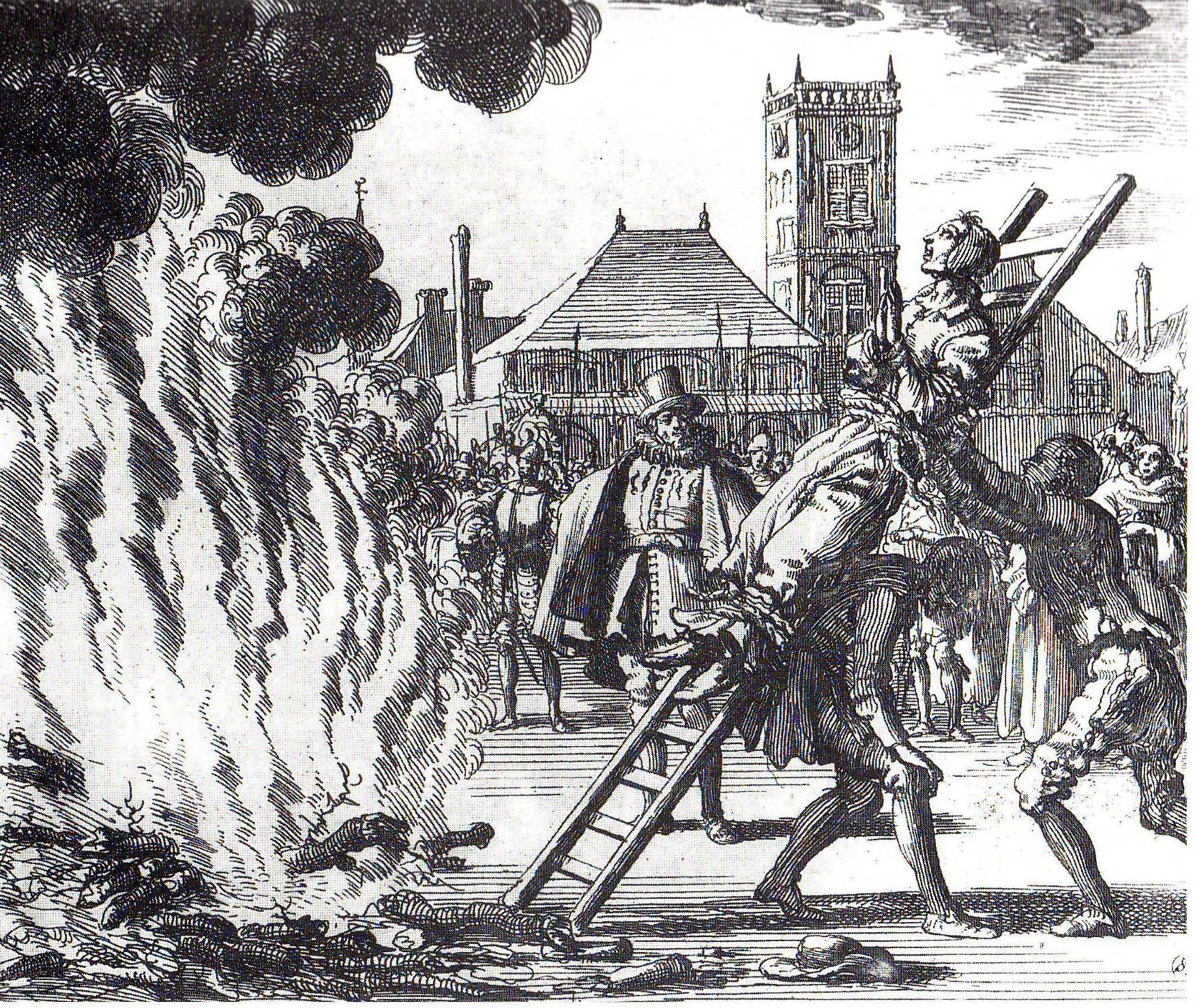
“We think we’ve come so far. Torture of heretics, burning of witches it’s all ancient history. Then – before you can blink an eye – suddenly it threatens to start all over again.”

That day is already here and it will become much worse before it gets better, especially since there will be little to restrain them unless the man that they sold their souls to support in order to increase their power turns on them; and that is always a possibility with Donald Trump.

Peace

Padre Steve+

3 Comments

Filed under faith, History, philosophy, Political Commentary, Religion

Portent of the Apocalypse?

Friends of Padre Steve’s World,

Instead of a trip into history and our current political situation I am going to muse about the possibility of a Chicago Cubs and Cleveland Indians World Series. 

For those who have read my writing on this site for a long time you understand that from the beginning I have believed that if the Cubs ever win the World Series that it well could herald the Second Coming of Christ and with it the end of the world as we know it. Theologians call this Eschatology or the study of the end times and unlike most theologians much of my eschatology is based on baseball thanks to the late W.P. Kinsella who wrote the wonderful novel The Iowa Baseball Confederacy which deals with time travel and a mythical game between the 1908 Chicago Cubs and a pickup team in Iowa. It is an amazing read based around baseball, fantasy, time travel, and an eschatological battle between Native American Gods, but I digress… 

The fact is that there is a very real possibility that the two baseball teams who have suffered the longest World Series droughts could end up playing each other for the baseball title. The Cubs won their last one a mere 108 years ago in 1908 while the Indians last won the series in 1948. The Tribe has already secured their place in the 2016 World Series by defeating the Red Sox and Blue Jays to win the American League Championship, while the Cubs are but a game for winning the National League Pennant against the evil Los Angeles Dodgers. The last time the Cubs were this close was in 2003 when they fell apart in game six of the NLCS and lost to the Miami Marlins in seven games. 

Now honestly I have always had a soft spot for the Indians. I remember reading stories of Bob Feller and Satchel Paige when I was in 5th grade and then when I was stationed in Camp LeJeune North Carolina from 1999-2001 and 2010-2013 I became a regular at the Indians’ Carolina League farm team, the Kinston Indians. 

Since my beloved San Francisco Giants and Baltimore Orioles have been eliminated from contention I have to be a realist. I could root for the Dodgers to upset the Cubs, but the Dodgers are evil, not my love for the Giants. Thus I cannot be for them unless they are playing the Dallas Cowboys, that that is impossible. 

My second option is to root for the Cubbies to win it all. However, I have never had a warm and fuzzy feeling for the Cubs nor do I want Jesus to come back right now, not that he wouldn’t be welcome but there is so much baggage that comes along with the second coming, wars, disasters, rivers of blood, dogs and cats living together, it would be bad. 

So I am left with the lovable Tribe, who last got this close to a World Series title in the movie Major League, which by the way is one of my favorite baseball movies and whose winning of the World Series probably won’t usher in the apocalypse. 

So until tomorrow,

Peace

Padre Steve+ 

1 Comment

Filed under Baseball, faith, Religion

Judgmental Christians, Hurricane Matthew, and the Absence of Empathy

Friends of Padre Steve’s World,

Yesterday I wrote about the reactions of some supposedly Christian preachers and pundits who claimed that Hurricane Matthew was a “God’s judgment” on the nation for extending basic rights to Gays rather than killing them and against Hillary Clinton supporters.

Personally I cannot fathom such hate coming from supposed Christians who are claiming to speak for God. It makes no sense to me. It’s like the preachers including the late Jerry Falwell who said that the attacks of September 11th 2001 where “God’s judgment” on the United States. I just don’t get it. How people can have such hate for their neighbors that they can rejoice in disasters that affect so many people makes no sense to me, it is perverse.

But then I realize that such people have no empathy for their fellow human beings, even those who share their faith. I am reminded of the words of the Army Psychologist at the Nuremberg War Crimes Trials, Gustave Gilbert when he said:

“In my work with the defendants (at the Nuremberg Trails 1945-1949) I was searching for the nature of evil and I now think I have come close to defining it. A lack of empathy. It’s the one characteristic that connects all the defendants, a genuine incapacity to feel with their fellow men. Evil, I think, is the absence of empathy.”

I have to agree with that. A basic lack of empathy, it is the one thing that connects anyone who can rejoice when disasters strike and claim that it is God doing the work. Such people are sociopaths. Sadly, if by some chance Donald Trump takes power we will have a certifiable sociopath for a President.

Until tomorrow,

Peace

Padre Steve+

1 Comment

Filed under ethics, faith, History, News and current events, Religion

Hell Hath no Fury Like a Fundamentalist Scorned: Phyllis Schafly Dead at 92


Friends of Padre Steve’s World,

I never rejoice in the death of anyone, but there are some people who because of their body of life’s work that I will not miss. Phyllis Schafly is one of them. She was one of the leading religious agitators who fought to deny equal rights to women by stopping the passage of the Equal Rights Amendment which by an act of Congress would have guaranteed women the same rights as men, and to the end of her life was a strident opponent of equality for LGBTQ people, and immigrants. 

Schafly used her religious beliefs as a weapon to deny rights to fellow citizens, and in doing so became one of the most forceful advocates of a supposedly Christian theocracy which mobilized millions of voters and made her the darling of the political preachers of the religious right for over forty years. Most recently she had cast her political power as a leader of the Christian Right behind Donald Trump. Honestly, I can think of few people who so vehemently and successfully used the power of religiously infused politics to such a degree as Schafly, and the words of James Spader’s character in the television series The Blacklist seem to apply to this now dead woman, “hell hath no fury like a fundamentalist scorned.” 

But there is always a price for such foolishness. Schafly and her allies in the political Christian Right who so desired to bring about the Kingdom of God by attempting to both subvert the Constitution through biased religious lawmaking, by demonizing her opponents, and by denying the very source of life of our nation, the proposition that all men are created equal actually helped destroy the real spiritual influence of the Christian faith in the United States more than anyone. They sold their birthright, discredited the church, and for what? The illusion of political power and influence. 

A few years back the Barna Report, a very reputable Evangelical Christian polling organization noted that the fastest growing segment of the American religious mosaic was “the nones,” people who have no preference in religious belief, and the fastest growing subsets of the “nones” are Atheists, Agnostics, and Free Thinkers. In fact number one of the reasons cited by Barna is that a vast majority of young people, including those who grew up in the church, described the church as too political. A February 2016 study by Barna noted that almost half of non-religious Americans view Christianity as extremist, and dangerous. That should trouble any Christian leader, but it never bothered Schafly or for that matter any of her political preacher allies. Likewise according to a Barna study released in October 2014, nearly half of the ever rising number of “the unchurched” find it hard to name a single positive contribution of the church to society. 

But the situation is worse if you look at why young Christians leave the church. According to a Barna survey in September 2011 young Christians believe that the church is overprotective, shallow, antagonistic toward science, that they feel judged by older church members who are simplistic and judgemental, that church is like a “country club” that is antagonistic and unwelcoming of outsiders, and that it is a place unfriendly to those that doubt. Specific comments by large numbers of Christian young people who are feeling the church include that it is “too political,” “fear based and risk adverse,” and that it “demonizes those outside the church.” But I think the most damning finding of that survey was that twenty percent  of Christian young people said that “God seems missing from my experience in church.” 

Throughout her life Phyllis Schafly made her money and fame by demonizing all opposition, she rallied supporters by promoting fear, and she, maybe even more that the Elmer Gantry types of charlatan political and prosperity preachers is in large part responsible for the current sad state of the Christian church in the United States. I remember back in the late 1970s and 1980s the hold that she had on churches that I attended. She was practically deified for her opposition to women’s rights, and LGBTQ people. She could be found at the side of any political hack willing to give her a place in the podium almost to the day she died, even this summer she appeared at the side of Donald Trump, as always casting the pearls of the Gospel at the feet of a man whose life and work exemplifies the complete opposite of what was once considered Christian virtue. 

When I learned of Mrs Schafly’s death I was watching an episode of The Blacklist. Reddington made the comment “you know what my problem with religion is? Man. Like anything that has potential to be beautiful, man will turn it into somethings ugly.” I could not help by think of the irony. 


Schafly spent her last year nearly destroying the Eagle Forum organization that she helped to found by endorsing Trump, a man who she called “the last hope for America” even as she filed a lawsuit against nephew Tom from trademarking his Schafly Beer because she was the person who made her name famous. 

Truthfully, like I said, I never rejoice in the death of anyone, even someone like Mrs Schafly whose actions I believe we’re so detrimental to so many people and to the church itself. I pray that she finds God to be more merciful to her than she was to others, and I do hope after a life spent demonizing and denying the rights of people that she despised, I hope that her tortured and embittered soul finds some measure of peace that she seemed unable to find in life. 

What a shame… 

So until tomorrow,

Peace,

Padre Steve+ 

7 Comments

Filed under civil rights, Political Commentary, Religion

Reflecting on “Inherit the Wind”

donald-trump-prays-with-religious-leaders

Friends of Padre Steve’s World,

“As long as the prerequisite for that shining paradise is ignorance, bigotry and hate, I say the hell with it.” Henry Drummond (Spencer Tracy) Inherit the Wind

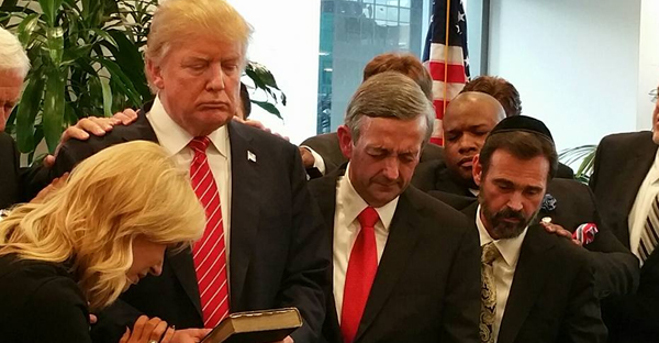
Today has been a very busy day at work but I have been doing some reflection and instead of watching the Olympics tonight I decided to again watch the classic film Inherit the Wind. I really do believe that it is well worth watching, especially when a charlatan with no Christian virtues whatsoever stokes up the hopes of conservative Christians by promising that if he is elected he will make Christianity great again. Of course the Christianity that he refers to is not that of Jesus, but that of Constantine and every other strongman who has used the Christians and the church to achieve earthly power and to crush any opposition. Noted televangelists have come to Trump’s side, many like John Hagee saying that Christians that God will punish Christians, that vote against Trump. That is why this film is still so pertinent.

It is fascinating that a play and film set about an incident that actually occurred in the 1920s remains so timeless. It is hard to believe that 90 years after the trial and over 50 years after the movie that our society would still be debating the issue in the movie and that legislatures and school boards are still attempting to pass religious doctrine off as science.

inherit-the-wind

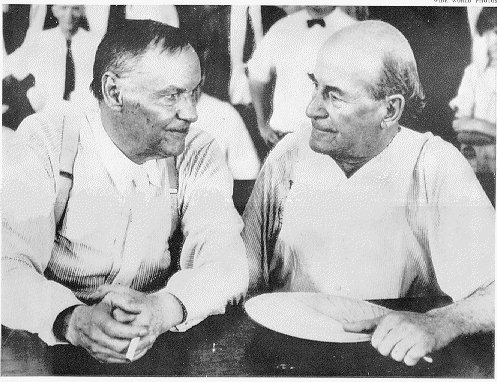
It is a film about what is commonly called the “Scopes Monkey Trial” which was litigated in July of 1925 and featured an epic battle between populist three time Presidential Candidate and former Secretary of State William Jennings Bryan and famed defense attorney Clarence Darrow.

The trial was brought about after the passage of the Butler Act in Tennessee. It was an act that made it a criminal offense to teach evolution in any publicly funded school. The act stipulated:

“That it shall be unlawful for any teacher in any of the Universities, Normals and all other public schools of the State which are supported in whole or in part by the public school funds of the State, to teach any theory that denies the story of the Divine Creation of man as taught in the Bible, and to teach instead that man has descended from a lower order of animals.”

The author of the act was Tennessee State Representative John W. Butler, a farmer and the head of the World Christian Fundamentals Association an interdenominational organization dedicated to a “New Protestantism” based on the Pre-Millennial interpretation of Bible prophecy.

itw2

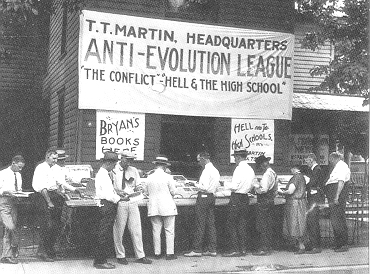
Butler was heavily influenced by William Jennings Bryant who with his followers had gotten legislation banning evolution in 15 states. H.L. Mencken commented that over the years of his public life that Bryan had “transformed himself” into some “sort of Fundamentalist Pope.”

Butler was opposed to the teaching of evolution and the act passed the house by a vote of 75-1. No public hearings had been held on it and no debate proffered.

Butler’s legislation did face some opposition in the State Senate. However it passed there on a vote of 24-6 after the famous Fundamentalist evangelist Billy Sunday preached as series of revival meetings to incite public opinion in favor of the bill. Sunday’s message was clear, he preached that “Education today is chained to the Devil’s throne” and praised Butler and the House for their “action against that God forsaken gang of evolutionary cutthroats.” The bill was signed into law by Governor Austin Peay, but Peay expected little to come of it.

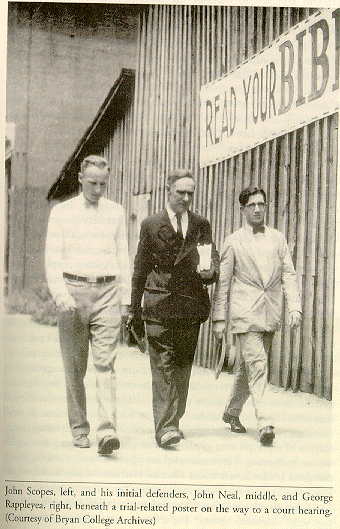
The American Civil Liberties Union put the law to the test using high school biology teacher John Scopes who was charged with breaking the law. The trial ended up becoming less about the guilt or innocence of Scopes or even the constitutionality of the law, but rather as the field where the conflict between religious and social issues and faith versus intellectualism was fought. Butler, the man who legislated the law on religious grounds covered it as a correspondent.

daytonscene

Mencken wrote of the trial:

“The Scopes trial, from the start, has been carried on in a manner exactly fitted to the anti- evolution law and the simian imbecility under it. There hasn’t been the slightest pretense to decorum. The rustic judge, a candidate for re-election, has postured the yokels like a clown in a ten-cent side show, and almost every word he has uttered has been an undisguised appeal to their prejudices and superstitions. The chief prosecuting attorney, beginning like a competent lawyer and a man of self-respect, ended like a convert at a Billy Sunday revival. It fell to him, finally, to make a clear and astounding statement of theory of justice prevailing under fundamentalism. What he said, in brief, was that a man accused of infidelity had no rights whatever under Tennessee law…”


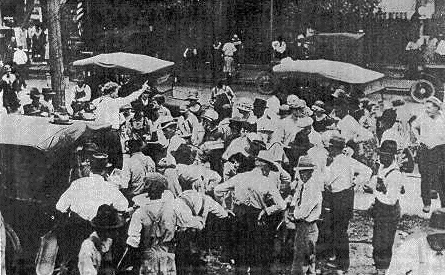
It was an epic event covered by news outlets across the nation and the atmosphere in the town outside the courthouse was circus like, something that the movie depicts very well. The defense was not allowed to produce Scientists as witnesses, even to the chagrin of Butler who despite his opposition to evolutionary theory felt that it was not fair. When all was said and done Scopes had been convicted and a fine of $100 assessed, which was overturned on appeal. Bryan died a week after the trial and of the 15 states with similar legislation to Butler passed them into law.

SCO_EVOL

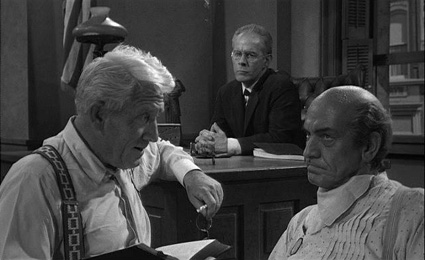
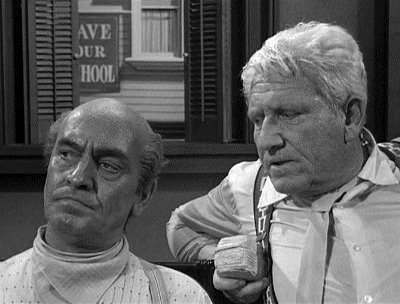
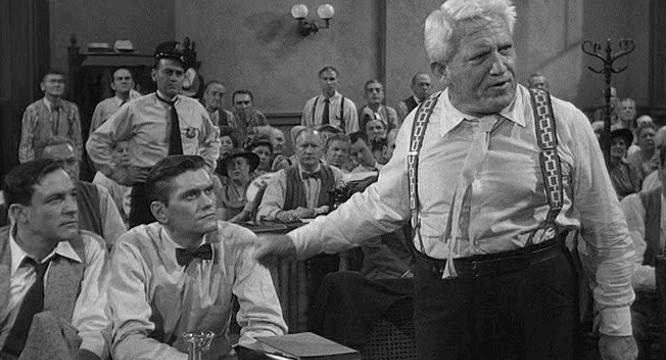
The film is based on the play of the same name written in 1950 by Jerome Lawrence and Robert E. Lee. It was written during the height of the McCarthy Era and opened in 1955. The first film version starring Spencer Tracy as Henry Drummond (Clarence Darrow), Frederic March as Matthew Harrison Brady (William Jennings Bryan), Gene Kelly as E.K. Hornbeck (H.L. Mencken) while Dick York played Bertram Cates (John Scopes). Lawrence and Lee invented some fictional characters including Reverend Brown played by Claude Akins.

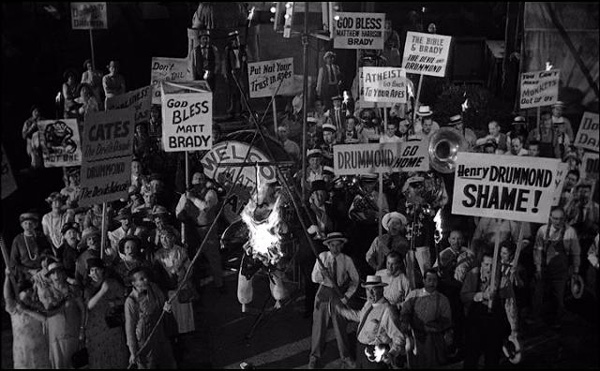
The film directed by Stanley Kramer captures the raw emotions of the trial, the participants and the spectators who came from near and far. The depiction of the angry mob of Christians is terrifying to watch. In the film they sing:

“We’ll hang Bertram Cates to a sour apple tree, we’ll hang Bertram Cates to a sour apple tree, we’ll hang Bertram Cates to a sour apple tree. Our God is marching on! Glory Glory Hallelujah! Glory Glory Hallelujah! Glory Gory Hallelujah! His truth is marching on. We’ll hang Henry Drummond to a sour apple tree, we’ll hang Henry Drummond to a sour apple tree, we’ll hang Henry Drummond to a sour apple tree, our God is marching on.”

inheritwind

March’s depiction of Matthew Harrison Brady is riveting. The Brady of the film does not do justice to other parts of Bryan’s life. Bryan, outside his fight against evolution was ahead of his time in many ways. Earlier in his career he had pressed for Universal Suffrage, fought against war and labored against the social Darwinism of the banks, business and the Robber Barons. However the loss of three Presidential elections left him bitter and it is believed that he saw the trial as an opportunity to regain the limelight and perhaps build a base to again run for President. This speech by Brady is a fair characterization of Bryan’s beliefs:

“I have been to their cities and I have seen the altars upon which they sacrifice the futures of their children to the gods of science. And what are their rewards? Confusion and self-destruction. New ways to kill each other in wars. I tell you gentlemen the way of science is the way of darkness.”

The problem with the Bryan of the Scopes Trial was that he was a caricature of his former self, he played to the crowds. The trial played to the worst parts of his character and that shows in the movie depiction. Some Christians find this an unfair portrayal and even call it a lie, however even though March’s portrayal is fictional it does fit the spirit of the trial which is captured in the writings of many of the contemporary commentators of the trial. Mencken wrote of the real Bryan: It is a tragedy, indeed, to begin life as a hero and to end it as a buffoon.


wjb_pulpit

Another of those commentators, Marcet Haldeman-Julius wrote of the real Bryan:

“As he sat there in the court room, day after day, silent, fanning, fanning, his face set I was appalled by the hardness, the malice in it. No one who has watched the fanatical light in those hard, glittering black eyes of Bryan’s can doubt but that he believes both in a heaven and in a hell. At the same time the cruel lines of his thin, tight-pressed mouth proclaim, it seems to me, that he would stop at nothing to attain his own ends. It is anything but a weak face–Bryan’s. But it is a face from which one could expect neither understanding nor pity. My own opinion is that he is sincere enough in his religion. Also that in it is included the doctrine Paul so frankly taught–that a lie told for the glory of God is justified…”

scope2

But I think that the real drama and tension in the film comes from Spencer Tracy in his portrayal of Drummond. This speech is taken almost verbatim from the trial:

“Can’t you understand? That if you take a law like evolution and you make it a crime to teach it in the public schools, tomorrow you can make it a crime to teach it in the private schools? And tomorrow you may make it a crime to read about it. And soon you may ban books and newspapers. And then you may turn Catholic against Protestant, and Protestant against Protestant, and try to foist your own religion upon the mind of man. If you can do one, you can do the other. Because fanaticism and ignorance is forever busy, and needs feeding. And soon, your Honor, with banners flying and with drums beating we’ll be marching backward, BACKWARD, through the glorious ages of that Sixteenth Century when bigots burned the man who dared bring enlightenment and intelligence to the human mind!”

0237318_11378_MC_Tx360

I think that this speech is the real crux of the tension that we face even now. Legislators in a number of States have enacted laws of much the same kind of spirit as Butler and defended them with the same kind of fire as Bryan. Civil libertarians, especially secular ones bring up the same issues as Darrow did. I am a Christian and a Priest and my thinking about this is much like that espoused by Drummond in the movie.

So the film may be a fictional depiction of the Scopes Trial, but it is a film that I think that people would do well to watch. I don’t expect everyone to agree with me or the issues that I agree with brought up by the character of Henry Drummond. However, I think that everyone should watch the film and come to their own conclusions as well as to ask themselves how their particular ethic, whether secular or religious informs them in how they deal with this issue and so many others that divide us today.

I just know when I watched it again this week that it could have been in the news this week, only with a different cast of characters. My concern is that there is a very loud minority that wants to inflict its particular religious view on everyone and use the public treasure to do it. The attitude of many of these people is much like the characters from the actual Scopes Trial including their view that pushes both demonizes those they oppose and their desire to regulate the secular opposition to the sidelines.

SCOPES1

I know that the same accusation is made by religious people of secularists, however I have seen the results of religious wars in Iraq and the Balkans, and from history. Those conflicts and the brutality of religious people in them give me great pause when I see religious and political leaders here suggest curtailing the civil liberties and even using the law against those that they oppose. As Drummond asked in the movie: “Must men go to jail because they find themselves at odds with a self-appointed prophet?”

That is why this film is so important.

Peace

Padre Steve+

3 Comments

Filed under faith, film, History, laws and legislation, Political Commentary, Religion

The Appalling Silence of Good People

img_0071

Friends of Padre Steve’s World,

I have been asked by some people why I as a chaplain, priest, and military officer, not to mention the fact that I am heterosexual, so strongly support my Gay and Lesbian friends, as well as the LGBTQ community. My answer has to echo the words of Albert Einstein who said “If I were to remain silent, I’d be guilty of complicity.”

Many times the question is crouched in theological terms, and those that ask presume that I am supporting sin, and aiding as some say the “enemies of God.” The problem is, that if being Gay is a sin, then why are not all those concerned about them doing something other than condemning them unto their last breath? Likewise why are the sin hunters who hate LGBTQ people with unmatched passion; who use local, state and when possible attempt to use the Federate government to legislate against equality for LGBTQ people, and who remain dreadfully silent when Gays are attacked and killed, never condemn those that practice what are called the Seven Deadly Sins? If you don’t know them here they are; pride, envy, gluttony, lust, anger, greed, and sloth. They infect our society root and branch, and dare I say our hallowed religious institutions, from which so much of the anti-Gay venom spews forth.

I wish I knew the answer to that, but for some reason it seems that religions in general tend to condemn, persecute, and even sanction the killing of Gays, especially Gay men, more than any other institutions. Christians, Muslims, Hindus, Jews, there are elements in all these religions who are not content with simply preaching against homosexuality, but wherever they have control of government to persecute and kill LGBTQ people.

Early Sunday morning a man whose personal hatred toward Gay men, and radical Islamic religious based terrorist ideology formed a nexus of evil that allowed him to kill about fifty men and women, while wounding over fifty more. This was certainly a terrorist act, in the words of the man who committed the massacre an act done in the name of his understanding of Islam, and in accordance with the overall goals of the Islamic State.

We will find out if there is a deeper connection between the killer and the Islamic State, but that is not the biggest question here. Why did he strike a Gay nightclub versus any other soft target? There are hundreds if not thousands of soft targets in South Florida, including some which would have just as easy, and symbolic as symbols of America or even Christianity. Why not a sporting event, a non-gay nightclub, a park, a school, or even a church? Well, because here is what many Americans don’t want to admit, he hated Gays, and specifically targeted them on Pride weekend. Those two factors my friends are the key. He could have attacked anything, but he chose to kill mass numbers of Gays and others gathered at the Pulse nightclub.

Sadly he is not alone and has found significant support from anti-Gay Christian leaders like Pastor Steven Anderson and Walid Shoebat who both would prefer Gays to be killed, in fact Anderson’s only issue was the fact that it should have been the government that killed them, not the terrorist. Shoebat said that the only people mourning over the victims of the massacre are “liberals, idiots, and Gay lovers.”  I will not repeat rest of their hate filled venom here because it boggles the mind. How such people can even call themselves Christians is beyond me.

Mercifully others who are often at the front in condemning Gays have been relatively silent and mentioned that they will be “praying for the victims and their families.” But such prayers are cheap, unless you actually care about the people you are praying for, and unless you can empathize with them. Sadly, many of these religious leaders and their political allies have no intent of backing down on their work to curtail, limit, or roll back the rights of LGBTQ people, even to the point of criminalizing homosexuality.

But then there are others who are genuinely good people, who have friendships with Gays and even have Gay family members but still refuse to take the necessary step to support the basic human and legal rights of their friends and family members, and who for whatever reason, fear of being ostracized by their church or any number of a myriad of other reasons remain silent when horrible, inhuman crimes take place. But then Dr. Martin Luther King Jr. noted, “Not only will we have to repent for the sins of bad people; but we also will have to repent for the appalling silence of good people.”

All I know is that I will continue to speak out for LGBTQ people, and I will not be silent. I am sure that will lose me some friends, but I cannot stand by and remain silent, it would make me complicit with the man that killed and wounded all of those innocent people, and with the religious leaders that harbor the same views.

That is all for now. Have a good day, and please, even if you do not agree with me on anything else, and please take the time to try to feel a measure of empathy for those killed, those wounded, and those who grieve for them, and if you can take the next step to speak up for them. I promise that you will not regret that decision.

Peace

Padre Steve+

5 Comments

Filed under civil rights, crime, ethics, faith, LGBT issues, Political Commentary, Religion

Zealots and Ideologues

raymond-reddington-sunglasses

“In this world, there are no sides. Only players.”

Friends of Padre Steve’s World,

I think my favorite character on television is Raymond “Red” Reddington, played by James Spader on the shoe The Blacklist. He is a very complex and troubling character, and the thing is I can understand him. His is a world of gray where he does the right thing for wrong reasons and the wrong thing for right reasons. His loyalties are personal and not ideological, he is a man of contradictions, as am I. Raymond Reddington one said, “Cultural peculiarities notwithstanding, I find cock fighting to be abominable. However, truth be told, I do love fried chicken.” I totally agree with that, sorry Vegan friends.

My regular readers know that I am a complex person as well. I am a Christian, a priest at that, who often doubts; a career military officer who hates war, but also realizes that as much of an evil as war is, that there are worse evils than war itself.  Likewise I am very liberal and progressive in my political and social beliefs, but I serve in a profoundly conservative institution that is not always welcoming to my beliefs. But that being said, even though I am a liberal and progressive at heart, my education as a historian and my life experience mitigates against me becoming an ideologue or zealot, and I am not a revolutionary.

I tend to be able to see and appreciate arguments of multiple points of view on almost every issue, and I wrestle with them, doing the best I can to do the right thing. Whether it is for the right reason or not, I don’t pretend to know. Maybe that is one reason I have friends on all sides of the political, religious, and ideological debates that rage about this country and in the world. But as always I digress…

In the last episode of season three of The Blacklist, Reddington tells an assistant FBI director who he has been helping solve crimes, “I know so many zealots, men and women, who choose a side, an ideology by which to interpret the world. But, to get up every single day and do the hard work of deciding what to believe. What’s right, today? When to stand up or stand down. That’s courage.” From my experience I believe that to be the truth, and truthfully, I would rather deal with people that wrestle with this difficult world than rather than those whose beliefs are shaped by their ideology first, regardless of facts, divergence of opinions, history, science, reality, and experience.

But what bothers me in what I see going on in this country and around the world is that mass movements of ideologues and zealots of every persuasion, political and religious, those that have seized or are trying to seize power in many nations, and foment revolution. Captivated by ideological purity, they are unwilling to compromise and frequently label anyone that disagrees with them or the leader of their movement, even in the slightest manner as traitors or evil. Many times the zealots take no time to evaluate the quality of the merits of their movement or those that oppose them, their cause is right, their opponents are evil and need to be destroyed. I think the most distressing case is where the Nazis and German Communists worked together to destroy the Weimar Republic in the late 1920s and early 1930s.

Eric Hoffer wrote,  “The quality of ideas seems to play a minor role in mass movement leadership. What counts is the arrogant gesture, the complete disregard of the opinion of others, the singlehanded defiance of the world.” Likewise, Hoffer noted something that I observe almost every day, that the zeolots and ideologues of mass movements use anger and hatred to unify their followers. Hoffer noted, “Hatred is the most accessible and comprehensive of all the unifying agents. Mass movements can rise and spread without belief in a god, but never without a belief in a devil.” Believe, me, ask any ideologue of any type, and he or she will tell you who their devil is. But sadly history demonstrates that a mass movements of any type, political, ideological, or religious has achieved powe, all opponents, especially those closest to them ideologically or religiously are the enemy, or to use Hoffer’s words “a devil.” The opponents closest to the ideologues ideology have to be destroyed or discredited first, before they can move on to battle their real opposites. Just look at history.

The ideologue cannot lose because he already knows his answer, the classic fundamentalist Christian quote, “God said it, I believe it, that settles it”  is very much descriptive of other ideologically driven mass movements be they conservative or liberal. The ideologue’s attitudes are derived from their ideology and are often not subject to facts. I see it every day, especially on social media where partisans of evil persuasion fire broadside after broadside at all opponents, regardless of the facts, or even the fact that there may be more than one equally valid viewpoint on a subject. But then I tend to see everything in various shades of gray and not in black and white absolutes, and ideologues of all types frighten me, even those whose unbending beliefs are sugarcoated with millennial or utopian sentiments of the perfect world that will follow their victory. I know from history that such is not the case, in far too many instances first thing that radical, or self-proclaimed revolutionaries do after achieving absolute power is to kill.

Maybe that is why I like Raymond Reddington. I really do think that real courage is to wrestle with reality every day and do the hard work of deciding what to believe; and today that may be different then tomorrow, but it will be based on reality and tempered by my often contradictory beliefs. Of course a true political ideologue or religious fundamentalist will condemn me to their version of hell of being that honest, but it is true. That is my uncomfortable reality, it may not be right, and my vision may be skewed and distorted, but it is what it is, and as Reddington said, “In the kingdom of the blind, the one-eyed man is king.”

So until tomorrow,

Peace

Padre Steve+

2 Comments

Filed under ethics, faith, History, philosophy, Political Commentary, Religion

The Straw that Stirs the Drink: The Implications of Resurgent Religion for Strategists and Policy Makers

isis-terrorists

Friends of Padre Steve’s World,

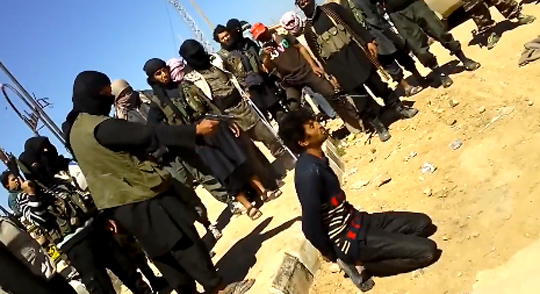
I am being published in the most recent issue of Campaigning: The Journal of the Joint Forces Staff College. The article will be available along with the rest of the journal at the website of the college, but I am posting it here. It is an interesting topic since religion is raising its head in numerous conflicts around the world, and is a very real part of the contemporary American political climate. Note, the pictures are not included in the Campaigning issue.

I hope that you enjoy.

Peace

Padre Steve+

One can never separate war and the means by which it is fought from its political ends. There are, however, many societies whose language and religious ideology shape the leader’s political ends. To borrow the immortal words of legendary baseball slugger Reggie Jackson, religion is often “the straw that stirs the drink.” The fact that religious ideologies influence societies and international relations is not new, but after almost three centuries of decline the twenty-first century promises to begin a new age of religious influence. Samuel Huntington notes, “Western secular models of the state are being challenged and replaced”[1] in many nations as religious influence grows. The indicators of this shift, religious, cultural, and racial, are glaringly obvious in the Middle East but clearly present in Eastern Europe, Russia, the Balkans, India, Latin America, and the United States, and threaten to subvert Western secular models of the state.

According to Clausewitz, war is an extension or continuation of politics. Clausewitz, a product of classic German Liberalism, understood the term politics in light of the German concept Weltanschauung, which translates as “World View.” The term is not limited to a particular doctrine or the ideology of party politics, but it encompasses the worldview of a people or culture and includes religion. Religious leaders, as well as media outlets and politicians, use a world view to influence their populatio. In fact, the world view is often crucial in the decision by a people to go to war, their rationale for going to war, whom they war against, the means for conducting war, and the end state they envision from warring.

image.adapt.960.high

Because Weltanschauung includes all elements of culture, to include race, religion, and economy, as well as sociological and historical factors; religious leaders, as well as media outlets and politicians, use it to manipulate their people. Radical proponents of religious fundamentalism around the world, who reject the pluralities of modernism and science, skillfully “use each new method of communication” [2] to spread their message of fear in a dualistic manner  to influence those most vulnerable to the threat of change.

Modern Americans and Western European policy makers tend to look at the world, and issues of politics and policy in isolation from each other, and especially in isolation from religion. Such an atomistic method ensures that many policy makers cannot see the forest for the trees. This is particularly true when religion is a motivating factor and an ideological component of conflict. Religiously based ideology is a powerful and “often intractable force that can be quite unresponsive to all the instrumentalities of state power, let alone the instrumentalities of foreign policy,” [3] and has been so from the advent of civilization to the present day. Samuel Huntington observed, “To a very large degree, the major civilizations in human history have been closely identified with the world’s great religions; and people who share ethnicity and language but differ in religion may slaughter each other….” [4]

Even among religions that claim to worship the same god beliefs may differ, and that fact underscores Colin Gray’s all important, “contexts of war.” Gray makes the case for seven essential contexts policy makers and military leaders must understand regarding war that “can have strong negative consequences,” [5] if ignored or misunderstood.

Each of the contexts is associated with the manner of social development, and define the essential characteristics of a particular armed conflict. In many areas of the world religion functions as the “central political pillar maintaining the power of [the] ruler—a major pole in determining people’s loyalty—and as a key ingredient in determining a nation’s stability or instability.” [6] Religion and religious values remain instrumental to the ethics and the social norms of a society and dictate how it deals with other nations and peoples, as well as how it conducts war.

Over the course of the last three centuries the emphasis on rational and empirical thought predisposed western strategists and policy makers to exclude religion as a component of analysis. Furthermore, the scientific methodology used by many analysts dictates that they asses individual components of issues in isolation from each other, and often without connection to their opponent’s world view. Experts dissect economic factors, military capabilities, existing political systems, diplomatic considerations, and the ways societies gather information and exhaustively examine and evaluate each individual component. But the problem comes when policymakers fail to understand how world view, ideological factors, history, and religious belief impact how a given opponent will conduct war.

ISIS-MAP

In part, policy makers tend to interpret information through their own worldview. As Gray notes, “Policy and strategy will be influenced by the cultural preferences bequeathed by a community’s unique interpretation of its history as well as by its geopolitical-geostrategic context.” [7] As such, both military and civilian policy makers fail to address the criticality of religion to developing effective strategy. Barbara Tuchman wrote, “When information is relayed to policy-makers, they respond in terms of what is already inside their heads and consequently make policy less to fit the facts than to fit the notions and intentions formed out of the mental baggage that has accumulated in their minds since childhood.” [8] A world view imposes cultural prejudices and blinders on western policy makers and strategists, that predispose them to look for shortcuts, or the most convenient explanations selected from the information they can see. Edward Luttwak wrote:

Enlightenment prejudice has remained amply manifest in the contemporary professional analysis of foreign affairs. Policymakers, diplomats, journalists, and scholars who are ready to overinterpret economic causality, who are apt to dissect social differentiations most finely, and who will minutely categorize political affiliations are still in the habit of disregarding the role of religion, religious institutions, and religious motivations in explaining politics and conflict, and even in reporting their concrete modalities. Equally the role of religious leaders, religious institutions, and religiously motivated lay figures in conflict resolution has also been disregarded – or treated as a marginal phenomenon hardly worth noting. [9]

Unbeknownst to policy makers, their prejudices, the world view blinders they wear, inhibit them from seeing how interconnected the most primal elements of the human experience are to others’ worldviews, even their own. As such, both military and civilian policy makers fail to address the criticality of religion to developing effective strategy.

Many people believed that modern ideas, “such as science, technology, secularism, and humanism would overcome the religious concept of the universe that dominated premodern society.” [10] Contemporary Western strategists and policy makers came to adulthood in a culture that supplanted the importance of religious ideas and need. A global, four-decade resurgence of religious ideals makes adaptation for strategists and planners difficult because of the dramatic shift in essential, unquestioned views. [11] Others’ worldviews, including religious beliefs, often influence the application of economic, political, diplomatic, military power, and the use and dissemination of information. That fact remains true despite the religion or sect involved, and especially in a decidedly secular, or at least outwardly non-religious, nation. Perhaps, by ignorance or a refusal to admit the importance of religious motivations in conflict, strategists and planners fail to realize the western culture arose from primal religious beliefs that informed politics, philosophy, ethics, law, economics, art, racial constructs, and science for nearly 1500 years. Perhaps, that refusal fueled a justified appall or embarrassment of the religious justifications their forbearers used to incite war that subjugated or exterminated peoples.

The United States Military made a belated attempt to address ideology, culture, and religion in terms of counter-insurgency doctrine when it published the U.S. Army/Marine Counterinsurgency Manual. The discussion of these issues is limited to two pages that specifically deal with various extreme Moslem groups that use religion as a pillar of their ideology, strategy, and operations. But the analysis in the counterinsurgency manual is limited because its focus is very general and at a tactical level. While the manual encourages leaders to attempt to understand the cultural differences it contains little to help leaders understand the importance of religion and ideology at the strategic and operational levels.

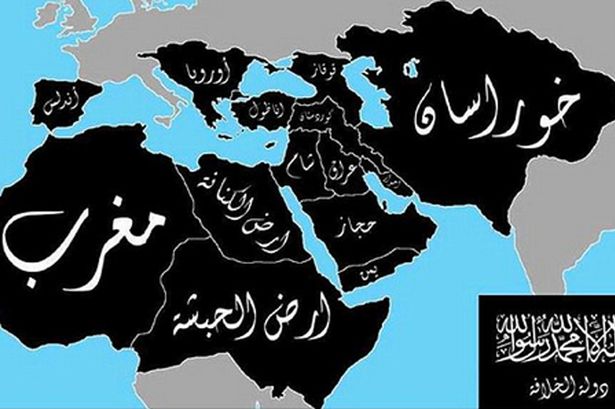
Commendably, the manual discusses how terrorist and insurgent groups use ideology, which is frequently based on religion to create a narrative. The narrative often involves a significant amount of myth presented as history, such as how Al Qaida and ISIL use the Caliphate as a religious and political ideal that for many Moslems, “produces a positive image of the golden age of Islamic civilization.” [12]

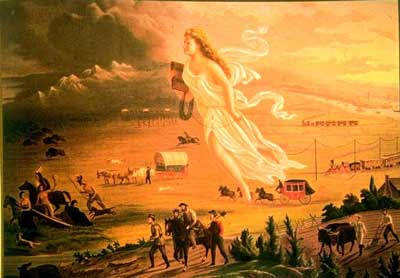
A purely intellectual understanding of how Al Qaida and ISIL use symbolism and imagery limits how strategists and planners can develop methods to counter it. Rather, strategists and planners would benefit from a historical introspection that leads to a personal reflection, aimed at understanding how the theological tools of the Christian religion subjugated peoples and the ramifications today. Protestant Christianity, particularly the Puritan concept of “a city set on a hill” undergirded the American belief in the nation’s Manifest Destiny, which in large part led to the extermination of the Native Americans, the War with Mexico, the romanticism of the ante-bellum American South, the belief that African Americans were sub-human, and that God ordained slavery. The concept persisted after the Civil War in the myth of the Lost Cause, and was exported abroad as the United States belatedly entered the race for overseas colonies.
Manife4

The concept of Manifest Destiny is still an essential element of the idea of American Exceptionalism, which often justifies much of American foreign policy. Former President George W. Bush alluded to this idea in his 2003 State of the Union Address where he said, “that freedom is the right of every person and the future of every nation. The liberty we prize is not America’s gift to the world, it is God’s gift to humanity.” [13] Throughout the Bush presidency, the President’s idea that God undergirded the policy of the United States led to a mismatch of policy ends and the means to accomplish them. Former Israeli Ambassador to the United States and historian Michael Oren wrote:

Not inadvertently did Bush describe the struggle against Islamic terror as a ‘crusade to rid the world of evildoers.’ Along with this religious zeal, however, the president espoused the secular fervor of the neoconservatives…who preached the Middle East’s redemption through democracy. The merging of the sacred and the civic missions in Bush’s mind placed him firmly in the Wilsonian tradition. But the same faith that deflected Wilson from entering hostilities in the Middle East spurred Bush in favor of war. [14]

Only when policy makers and strategists understand that the use of religious ideology to conquer, subjugate, and terrorize in the name of God is universal, does it become easier to defeat those who employ it.

American Presidents often invoke the name of God to justify the compulsion to conquer, such as McKinley did when he decided to annex the Philippines in 1899 following the defeat of the Spanish. The war against the Filipinos used some of the most bloodthirsty tactics employed to fight the Filipino insurgents, who only wanted independence, and stained our own national honor. Mark Twain wrote: “There must be two Americas: one that sets the captive free, and one that takes a once-captive’s new freedom away from him, and picks a quarrel with him with nothing to found it on; then kills him to get his land. . . .” [15]

A doubtlessly sincere McKinley sought counsel from God about whether he should annex the Philippines or not. Barbara Tuchman wrote: “He went down on his knees, according to his own account, and ‘prayed to Almighty God for light and guidance’. He was accordingly guided to conclude “that there was nothing left to do for us but to take them all, and to educate the Filipinos. And uplift and civilize and Christianize them, by God’s grace to do the very best we could by them, as our fellowmen for whom Christ died.” [16]

The counterinsurgency manual does mention how “Ideology provides a prism, including a vocabulary and analytical categories, through which followers perceive their situation.” [17] But again, it does this at a micro-level and the lessons are not applied at the higher levels of strategic thinking and policy. This is often due to the fact that American and other western strategists and policy makers view religion “as a set of theological issues rather than as a profoundly political influence in public life.”[18] Even after nearly a decade and a half of unremitting war against enemies for whom religion is at the center of their politics, policy makers still misread or neglect the importance of religion and religiously based ideology in the political motivations of their opponents. In many cases, the religion of a people is a stronger part of their identity than that of the state. Nations created during the post-colonial era “continue to see religion, clan, ethnicity, and other such factors as the markers of community identity” [19] Despite the advances in communications and technology and the globalization of so many western concepts, the political and religious leaders of Islamic nations view modern western political and social concepts as unwanted intrusions on their ancient cultures, and more importantly, insults to their religion.

kim davis pastor

But, lest American policy makers and strategists see this rise as something completely foreign, a similar phenomenon is occurring in the United States. Despite the fact that a growing number of Americans espouse no-religious preference and, according to multiple studies conducted over a period of two decades, are leaving organized Christianity, adherents of two highly motivated and militant branches of Christianity have grown in strength and political power over the last forty years. The group known as Christian Dominionism advocates Christian domination of all parts of society and culture, and Pre-Millennial Dispensationalists believe in the imminent return of Christ to earth, including the belief that most of the earth’s population will be killed during the Apocalypse. A Pew Research Center survey found that by the year 2050, that 41% of Americans believe that Jesus Christ will return to earth. [20] Leaders, politicians (including major conservative presidential hopefuls), pundits, and preachers often weigh in on public policy, to include military strategy, and claim that God’s law supersedes that of the state. They simultaneously reject secularism while legislating against those they deem enemies, and advocate for a “holy war” against Islam without distinction to Islam’s own divisions and distinctive denominational differences.

may appear irrational American strategists and policy makers, but it is completely rational to those who subscribe to it. The study of history, particularly how the deep roots of religion and faith shape cultural worldviews, as well as the actions of various peoples and nations, helps the policy maker and strategist adapt policy, strategy, and ultimately operational and tactical methods to the context of the conflict at hand. To do this effectively it is important that American strategists not be afraid to examine our own past to see how our ancestors used religion for good as well as for evil. However, the often dark mirror of history can be disconcerting to peer into. People tend to be uncomfortable when the face that they see in the mirror is all too similar to their current enemies, to the point that one might turn away in fear of what they see. The inability to look into the dark mirror of our own history is especially perilous when enemies are perfectly willing to wage war without end unto the destruction of the world in the name of their God, because when you belatedly look back in the mirror, failure will be staring you right in the face.

Notes

[1] Huntington, Samuel P. Who Are We? America’s Great Debate The Free Press, Simon and Schuster Europe, London 2004 p.360

[2] Jacoby, Susan. The Age of American Unreason Revised and Updated Vintage Books, A Division of Random House, New York 2008 p.18

[3] Luttwak, Edward. The Missing Dimension  in Religion: The Missing Dimension of Statecraft  Oxford University Press, Oxford and New York 1994 p.13  

[4] Huntington, Samuel P. The Clash of Civilizations and the Remaking of the World Order Touchstone Books, New York 1997 p.42

[5] Gray, Colin S. Fighting Talk: Forty Maxims on War, Peace, and Strategy Potomac Book, Dulles VA 2009 p.5

[6] Rubin, Barry Religion in International Affairs in Religion: The Missing Dimension of Statecraft  Oxford University Press, Oxford and New York 1994 pp.20-21

[7] Ibid. Gray Fighting Talk p.25

[8] Tuchman, Barbara W. Practicing History Alfred A. Knopf, New Your 1981 p.289

[9] Ibid Luttwak The Missing Dimension pp.9-10

[10] Ibid. Rubin Religion in International Affairs p.21

[11] Ibid. Rubin Religion in International Affairs p.21

[12] ___________ U.S. Army/ Marine Counterinsurgency Field Manual FM 3-24 MCWP 3-33.5 15 December 2006 with and forward by General David A Petraeus and General James Amos, Konecky and Konecky, Old Saybrook CT 2007 p.26

[13] Bush, George W. State of the Union Address Washington D.C. January 28th 2003 retrieved from Presidential Rhetoric.com http://www.presidentialrhetoric.com/speeches/01.28.03.html 10 June 2015

[14] Oren, Michael Power, Faith and Fantasy: America and the Middle East 1776 to the Present W.W. Norton and Company, New York and London 2007 p.584

[15] Twain, Mark To the Person Sitting in Darkness February 1901 Retrieved from The World of 1898: The Spanish American War The Library of Congress http://www.loc.gov/rr/hispanic/1898/twain.html 12 December 2014

[16] Ibid. Tuchman Practicing History p.289

[17] Ibid. U.S. Army/ Marine Counterinsurgency Field Manual p.27

[18] Ibid. Rubin Religion in International Affairs in Religion p.20

[19] Ibid. Rubin Religion in International Affairs p.22

[20] Pew Research Center, U.S. Politics and Policy, http://www.people-press.org/2010/06/22/public-sees-a-future-full-of-promise-and-peril/

8 Comments

Filed under Foreign Policy, History, middle east, national security, News and current events, Religion

All Should be Equally Free: Recognizing the Terror of the New Religious Liberty Laws

john leland

Friends of Padre Steve’s World,

This may seem a familiar topic for my readers, but due to events in a number of states I feel compelled to talk about it again. The issue of religious liberty and the right to free expression has once again come to the fore in the wake of the Obergfell v. Hodges ruling and the pathetically un-American passage of particularly odious, religiously based anti-LGBT laws in North Carolina, Mississippi, and Tennessee, as well as one that was vetoed by Georgia’s governor. I call these laws pathetic and un-American because they fly in the face of the ideals of the real champions of religious liberty in the United States. One of these early proponents of religious liberty and freedom in the United States was the Virginia Baptist pastor, John Leland.

Sadly, many American Christians either have never heard of him. Likewise, if they have heard of him, as the great pontificator, Mike Huckabee should have in his brief tenure as a student at Southwestern Baptist Theological Seminary; they seem to have ignored his warnings about state religion. I guess that problems in his church history and Baptist history classes were a big reason that he left seminary. Ideologues like the Huckster didn’t last at Southwestern, at least until the fundamentalist takeover in 1994 that helped destroy the academic and scholarly reputation of that once fine school, but I digress….

Leland was a friend of Thomas Jefferson and James Madison and without him it is unlikely that the First Amendment of the Constitution would have mentioned religious faith. Leland had a very personal interest in this as during the 1780s the Anglican Church in Virginia was attempting to again become the official state religion. Anglicans, with the help of local authorities were attacking Baptist congregations and even resorting to physical violence. In defiance of the Anglicans, Leland wrote:

“The notion of a Christian commonwealth should be exploded forever. … Government should protect every man in thinking and speaking freely, and see that one does not abuse another. The liberty I contend for is more than toleration. The very idea of toleration is despicable; it supposes that some have a pre-eminence above the rest to grant indulgence, whereas all should be equally free, Jews, Turks, Pagans and Christians.”

There is a form of religion and indeed the “Christian” faith that is toxic and if not treated leads to the spiritual and sometimes the physical and emotional death of the infected person.

There is a nationalized version of this supposedly Christian faith in the Untied Stats today. It is a bastardized version of the Christian faith overlaid with the thin veneer of an equally bastardized version of American history. Its purveyors are quite popular in the world of “conservative” American Evangelicalism and Catholicism.

Supreme Court Justice Robert Jackson and chief Nuremberg war crimes trials prosecutor warned us about people like them over a half-century ago. Jackson wrote, “[I]n our country are evangelists and zealots of many different political, economic and religious persuasions whose fanatical conviction is that all thought is divinely classified into two kinds — that which is their own and that which is false and dangerous.”

Pat Robertson, evangelist and founder of the Christian Broadcasting Network is an example of what Leland and Jackson warned us about. Robertson said on his program that “You say you’re supposed to be nice to the Episcopalians and the Presbyterians and the Methodists and this, that, and the other thing. Nonsense, I don’t have to be nice to the spirit of the Antichrist.” — Pat Robertson, The 700 Club, January 14, 1991. The late David Chilton was another. He wrote: “We believe that institutionally Christianity should be the official religion of the country, that its laws should be specifically Christian”

It is quite fascinating when you look at it. This faith is a combination of a selective reading of American history, Christian teaching and Biblical interpretation that mixes and matches a wide variety of mutually conflicting and contradictory traditions. This Toxic “faith” if you can call it that; is based on a reading of American and Western History, which negates, marginalizes or willingly distorts the views or contributions of those who they disagree. It does not matter of their opponents are not Christians, or were Christians, including Baptists like John Leland and Roger Williams. Due to their experiences of religious persecution, Williams and Leland refused to buy into any form of state sanctioned religion.

I find it interesting that Conservative Icon and champion of limited government Barry Goldwater had great reservations about those that sought to establish the superiority of any religion. Goldwater said on the Senate floor: “The religious factions that are growing throughout our land are not using their religious clout with wisdom. They are trying to force government leaders into following their position 100 percent.”

The leaders of this new and quasi “Christian faith” are many and include some of the most popular religious leaders in the United States such as Pat Robertson, the pseudo-historian David Barton, James Robison, Gary North, Bryan Fischer, James Dobson, Gary Bauer Phyllis Schafley and a host of others. For them the Gospel has been equated with government legislation of supposedly “Christian” values; which conveniently are defined by their political agenda, often in complete contradiction to the Gospel and to nearly 2000 years of Christian experience. North, one of the most eloquent expositors of the Dominionist movement wrote:

“The long-term goal of Christians in politics should be to gain exclusive control over the franchise. Those who refuse to submit publicly to the eternal sanctions of God by submitting to His Church’s public marks of the covenant–baptism and holy communion–must be denied citizenship, just as they were in ancient Israel.”

That is quite a statement and those who think that they can co-opt people like North, Robertson or others are quite mistaken. Goldwater realized this. What is fascinating to me is to watch these men and women advocate religious and political positions in regard to Church-State relations that completely opposite of what early American Christian and non-Christian civil libertarians imagined when our country was founded. Positions that quite often are at odds with even the historical tenants of their own faith. Their only claim to innocence can be because not a one of them have any training in history and often are even worse when it comes to their understanding of the Christian tradition, which did not begin in and will not end in the United States.

In this confused and often hateful “faith” we see men and women who hate centralized government but extol a centralized religion. I was talking with a friend who is adamantly opposed to a powerful Federal Government but extols the perfection of the centralized bureaucracy of his Roman Catholic Faith. He could not see the contradiction. I watch others who extol an almost Libertarian understanding of the government and the Constitution who supposedly in their religious tradition are from the “Free Church” who now advocate the supremacy of the Church over the State and in doing so their particular and limited understanding of Church over that of the Church Universal.

In this confused and contradictory setting there are Catholics espousing political views that are in direct opposition to the understanding of government supported by the Magisterium of the Church. There are Evangelical and Charismatic Protestants that mix and match the untenable and contradictory beliefs of Dominionism and Millennialism which involve on one hand the takeover of earthly power by the Church and the ushering in of the Kingdom of God and the understanding that earthly power is ultimately under the dominion of Satan and must be overcome by the Second Coming of Christ.

Leland wrote:

“These establishments metamorphose the church into a creature, and religion into a principle of state, which has a natural tendency to make men conclude that Bible religion is nothing but a trick of state.”

Leland was one of the most important persons in regards to the relationship of the Christian Churches to the American Government. He was a champion of the religious liberty enshrined in the Bill of Rights and helped influence both James Madison and Thomas Jefferson. He noted in 1791:

“Is conformity of sentiments in matters of religion essential to the happiness of civil government? Not at all. Government has no more to do with the religious opinions of men than it has with the principles of mathematics. Let every man speak freely without fear–maintain the principles that he believes–worship according to his own faith, either one God, three Gods, no God, or twenty Gods; and let government protect him in so doing, i.e., see that he meets with no personal abuse or loss of property for his religious opinions. Instead of discouraging him with proscriptions, fines, confiscation or death, let him be encouraged, as a free man, to bring forth his arguments and maintain his points with all boldness; then if his doctrine is false it will be confuted, and if it is true (though ever so novel) let others credit it. When every man has this liberty what can he wish for more? A liberal man asks for nothing more of government.” John Leland, “Right of Conscience Inalienable, and Therefore, Religious Opinions Not Cognizable By The Law”

When the adherents of a faith, any faith, but especially the Christian faith enlist the government to enforce their understanding of faith they introduce a toxicity that is eventually fatal when consumed and acted on.

I think that much of what we are witnessing today is much more the product of fear mongering preachers that see opportunity in their political alliances and that are willing to reduce the Gospel to a number of “Christian values” in order to achieve a political end; even if that end is ultimately destructive to the Church and to the Gospel.

The message of the Apostle Paul to the Church in Corinth was this: “All this is from God, who reconciled us to himself through Christ, and has given us the ministry of reconciliation; that is, in Christ God was reconciling the world to himself, not counting their trespasses against them, and entrusting the message of reconciliation to us.” (2 Cor 5:18-19 NRSV) 

The early church thrived when it had no earthly power. It thrived when it was persecuted and when the Roman government openly supported almost every religion but it. However, once it became powerful and worldly it became ensnared in affairs far from that simple message of reconciliation.

It was in this country that the various sects of the Christian faith had the opportunity to make a new start, unencumbered by the trappings of power. But instead, like those that came before us, the toxin of power has all too often seduced us. John Leland understood this and fought to ensure that all people of faith were free and unencumbered by state supported religion.

Leland’s friend James Madison wrote to Edward Everett toward the end of his life:

“The settled opinion here is, that religion is essentially distinct from civil Government, and exempt from its cognizance; that a connection between them is injurious to both; that there are causes in the human breast which ensure the perpetuity of religion without the aid of the law; that rival sects, with equal rights, exercise mutual censorships in favor of good morals; that if new sects arise with absurd opinions or over-heated imaginations, the proper remedies lie in time, forbearance, and example; that a legal establishment of religion without a toleration could not be thought of, and with a toleration, is no security for and animosity; and, finally, that these opinions are supported by experience, which has shewn that every relaxation of the alliance between law and religion, from the partial example of Holland to the consummation in Pennsylvania, Delaware, New Jersey, &c., has been found as safe in practice as it is sound in theory. Prior to the Revolution, the Episcopal Church was established by law in this State. On the Declaration of Independence it was left, with all other sects, to a self-support. And no doubt exists that there is much more of religion among us now than there ever was before the change, and particularly in the sect which enjoyed the legal patronage. This proves rather more than that the law is not necessary to the support of religion” (Letter to Edward Everett, Montpellier, March 18, 1823).

That is the antidote to the toxic faith embodied in the politically motivated Christian Right. It stands against any idea of a state sanction or religion or a religion that like in Saudi Arabia or Iran controls the state. It stands in opposition to the beliefs of so many “Christian” religious leaders work to ensure that they control the powers of government. Attempts that try to proclaim their superiority above even the ultimate message of the Gospel that proclaims, “for God so loved the world….” 

By the way there are always results. The Puritans who many extoll were some of the most intolerant of dissenters of any group that has every held the reins of power over the state and religion ever known in this country. Their victims included Quakers as well as American Indian converts to Christianity. The picture below of the Puritans hanging Quakers in the Massachusetts Bay Colony should give pause to anyone who thinks that such actions are not possible today should any religion gain control of political power.

Peace

Padre Steve+

3 Comments

Filed under christian life, civil rights, faith, History, laws and legislation, LGBT issues, News and current events, Political Commentary, Religion