Category Archives: World War II at Sea

Operation Rheinübung and the Sinking of the Mighty Hood

hms-hood-sinking11

Artist rendition of the Loss of the HMS Hood

Friends of Padre Steve’s World,

I am still working on my article on the Bismarck Class battleships which is the first of a series on the late Treaty and Post Treaty battleship. However, the research has been time consuming and Massive amounts of technical data on Bismarck and her contemporaries is making this a much more technologically wonk type of article than I expected. I am continuing to work on it, even though I had hoped to publish it before I went on to the history of Operation Rheinübung, the deployment of Bismarck and the heavy cruiser Prinz Eugen against British convoys in the hopes that they would sink and destroy a lot of ships and return to home safely as the Scharnhorst and Gneisenau had during Operation Berlin which sank 22 ships between February and March 1941, an operation commanded by Admiral Günther Lütjens who commander the Bismarck task force.

The Bismarck and Prinz Eugen set sail for Operation Rheinübung on 18 May 1941 over the protests of Lütjens’s protest to delay the operation until Scharnhorst could be repaired d Tirpitz was fully operational. However, this was not possible until early July, and Grand Admiral Erich Raeder had his own agenda. Of the participants in the operation, only he knew that Hitler had planned to attack the Soviet Union on 22 June 1941. That invasion, Operation Barbarossa gave the Kriegsmarine just a small supporting role compared to the Heer, Luftwaffe, and even the SS. So Raeder ordered Lütjens into action in order to score a success that would enable him to continue to argue the need for more battleships and surface forces. Reader instructed Lütjens to not reveal the planned operation to anyone, including Hitler, which Lütjens obeyed when Hitler visited Bismarck on 5 May without Raeder being present. Concerning the operation itself Raeder’s orders to Lütjens stressed that “The primary target in this operation is the enemy’s merchant shipping; enemy warships will be engaged only when that objective makes it necessary and it can be done without excessive risk.”

On 20 May the German ships were sighted numerous Swedish and Norwegian fishing boats, and by a scout plane from the Swedish Cruiser Gotland which reported their position to the Swedish Admiralty. This information was leaked to the British Naval Attaché and relayed to the British Admiralty: “Kattegat, today 20 May. At 1500, two large warships, escorted by three destroyers, five ships and ten or twelve planes, passed Marstrand to the northeast. 2058/20.”

They were also sighted by a Norwegian agent who sent a report of their presence. On 21 May the two ships arrived in Grimstadfjiord near Bergen in order to allow Prinz Eugen to refuel, however Lütjens elected not to top off Bismarck’s fuel tanks, which would prove to be a fatal mistake.

May 21st was a day where the skies were perfectly clear, and alerted to their presence of the German Force, the Royal Air Force sent reconnaissance aircraft to confirm that they were really on the move. At 1315 hours a Spitfire equipped with onboard high altitude cameras spotted the German Force and returned to Scotland where their photos were sent to the Admiralty. As a result the Royal Navy ultimately mobilized six battleships, three battlecruisers, two aircraft carriers, sixteen cruisers, thirty-three destroyers and eight submarines to find and kill the German ships and to protect the 11 convoys currently at sea or preparing to sail. It was the largest deployment of the Royal Navy for a single operation to that point in the war.

Since the daylight prevented an unobserved departure, Admiral Lütjens decided to depart under cover of darkness for his breakout into the North Atlantic. Likewise, Admiral John Tovey, commander of the Home Fleet began his deployment to find and sink the Bismarck. Not knowing which route the Bismarck would use to break out, Tovey sent the pride of the Royal Navy, the “Mighty” HMS Hood and the brand new King George V Class battleship HMS Prince of Wales and four destroyers to join the heavy cruisers HMS Norfolk and HMS Suffolk under the command of Rear Admiral Frederick Wake Walker to Guard the Denmark Strait, which  Lütjens had used earlier in the year with Scharnhorst and Gneisenau, and sent the modern and powerful light cruisers Manchester and Birmingham to patrol the area southeast of Iceland. In addition he kept several light cruisers on station between the Faroe and Orkney Island Gap in case the Germans attempted a straight run through the British blockade.

Early on 22 May Tovey departed Scapa Flow with King George V, the new carrier HMS Victorious, and their escorts, which would soon be joined by the battlecruiser HMS Repulse. which was already at sea. The older battleships HMS Rodney, HMS Ramillies, and HMS Revenge were also at sea escorting convoys, from which they would be detached to seek out the Bismarck. Finally, Force H comprised of the aircraft carrier HMS Ark Royal, battlecruiser HMS Renown, the light cruiser HMS Sheffield and their escorting destroyers, under the command of Rear Admiral James Somerville, based at Gibraltar, were alerted for possible deployment to the North Atlantic, even though their primary mission was to counter the Italians in the Mediterranean.

The 22nd of May was uneventful as each side sailed into the reaches of the North Atlantic, as was most of the 23rd as Bismarck and Prinz Eugen were able to use foul weather conditions to avoid British patrol aircraft, but but about 2000 hours they were detected by the radar of HMS Suffolk. Bismarck sighted and engaged Suffolk and Norfolk which returned fire and ducked into a fog bank as Suffolk continued to shadow Bismarck using her radar and continuing to send reports to Admiral Holland on Hood. However during the exchange Bismarck’s forward radar was damaged by the concussion of her main battery and Lütjens had Prinz Eugen take the lead. For the remainder of the night the ships continued to move through the Denmark Strait. Knowing his Force had been detected and surprise had been lost Lütjens could have reversed course and returned to Norway to await the availability of Scharnhorst and Tirpitz and a more favorable time to break out, but he continued on to a destiny that would result in the loss of the world’s two largest battleships in one of the most dramatic naval campaigns in history.

The first of the great ships lost would be the “Mighty Hood”, which was sunk by the Bismarck and Prinz Eugen during a very short and shocking engagement on the morning of 24 May. The news was broken to most of the world by American journalist Edward R. Murrow who in his radio broadcast reported:

“This is London, Ed Murrow reporting. This island, which is no stranger to bad tiding, received news today that HMS Hood largest warship in the British fleet and pride of the British navy, has been sunk by the German battleship Bismarck. From the Hood’s compliment of 1500 men, there were three survivors.”

The news of the sinking of the great ship stunned the world, and it is a tragic anniversary is something that I always mark. I first read about this battle in C.S Forrester’s little book Hunting the Bismarck when I was in 4th grade. That book was used as the screenplay for the 1960 film Sink the Bismarck.

This essay is in honor of the gallant HMS Hood and her crew.  It is fitting for Memorial Day weekend although the HMS Hood and her killer, the German battleship Bismarck were not American. Both were great ships manned by gallant crews and the loss of both ships was tragic, especially from the aspect of the great loss of human life. I do hope and pray that we never forget the sacrifice of these men and all others who have gone down to the sea in great ships.

hood-malta1

HMS Hood at Malta

There are some warships and naval engagements which assume legendary proportions.  The Battle of the Denmark Strait on 24 May 1941 between the two largest battleships in commission at the time, the pride of the British Royal Navy the HMS Hood and the German behemoth Bismarck is legendary as are those two mighty ships.  The battle came at a critical time as the Britain stood alone against the seemingly invincible German Blitzkrieg.

hood-at-san-francisco1

Hood in San Francisco on 1920s goodwill tour

Britain had been driven from Western Europe and Britain was being bombed regularly by Hermann Goering’s Luftwaffe. In the Balkans a British expeditionary force that had been sent to Greece had been defeated and it’s survivors withdrawn as Germans assaulted and conquered Crete with airborne forces, albeit with such heavy losses that Hitler forbade any more large airborne operations. In the Western Desert of North Africa, the Afrika Korps under Field Marshall Erwin Rommel had driven off a British counter-offensive on the Libyan-Egyptian frontier and were laying siege to Tobruk.  In the Atlantic German U-Boats sank 66 Allied Merchant Ships of over 375,000 tons and the Royal Navy would lose 25 warships not including the Hood to surface action or U-Boats in the Atlantic alone. But before Hood the British had lost the aircraft carriers Glorious and Courageous and the battleship Royal Oak. 

hms_hood_march_17_19241

The Hood was the pride of the Royal Navy and was world famous due to her inter-war international presence and goodwill visits. She displaced 47,430 tons full load and she was armed with eight 15” guns in four twin turrets.  Designed as a battle cruiser she was less heavily armored than contemporary battleships and had weak vertical protection from plunging shellfire. Her armored upper deck and armored deck had a combined 83mm of armor. This was a fault which was known but never rectified between the wars and when the war came the Royal Navy could ill-afford to take her out of service for the necessary improvements to her protection system.  She was fast with a designed speed of 31 knots which been reduced to 28 knots by 1939 as a result of modifications which increased her displacement.   This was further reduced by the wear and tear on her propulsion plant to 26.5 knots by 1940.

Hood was designed before the battle of Jutland (May 1916) where the weaknesses in the armor protection of British Battlecruisers was exposed as three, the HMS Invincible, HMS Queen Mary and HMS Indefatigable were destroyed by plunging fire which exploded their magazines.  Though her design was modified during construction she still was vulnerable to plunging fire. She was scheduled for a major refit which would have included significant improvement in armor protection in 1941, but the war prevented Hood from receiving anything more than improvements to her anti-aircraft batteries.

Combat1lg

Hood (nearly hidden by falling shells) in action at Mers-El-Kebir

During the war Hood was engaged in patrol and search operations against German raiders in the North Atlantic and in June 1940 joined Force “H” in the Mediterranean.  As Flagship of Force “H” she took part in the sinking of French Fleet Units including the Battleship Bretagne at Mers-El-Kebir on 3 July 1940 following the French surrender to the Germans and remained in operation searching for the German Pocket Battleship Admiral Scheer and the Heavy Cruiser Admiral Hipper until she was withdrawn for a brief refit in January 1941.

Following another brief refit in mid-March, Hood was underway from mid-March searching for the German raiders Scharnhorst and Gneisenau and also false report of Bismarck breaking out into the Atlantic in April 1941. She returned to Scapa Flow on 6 May 1941.

bismarck1

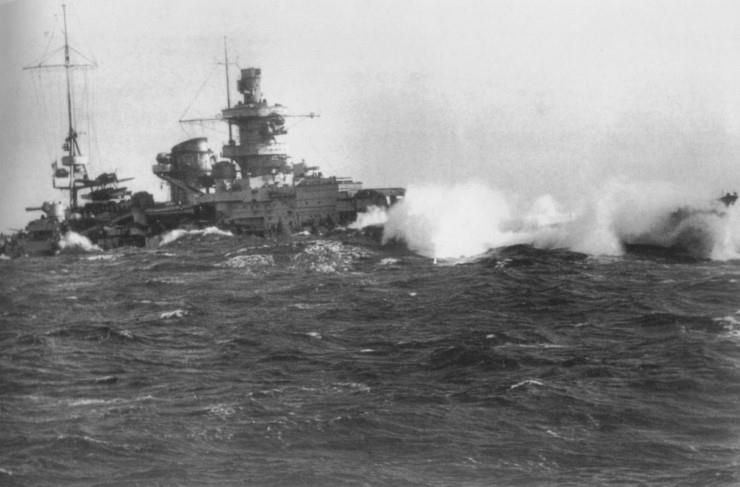
Bismarck

When the British discovered that Bismarck had entered the Atlantic, Hood the flagship of Vice Admiral Lancelot Holland, was dispatched to find and sink her with the newly commissioned battleship HMS Prince of Wales.  The battleships were to join the Heavy Cruisers HMS Suffolk and HMS Norfolk at the entrance to the Denmark Strait.  When the cruisers discovered Bismarck along with her consort the Heavy Cruiser Prinz Eugen the two British battleships steamed into naval history.

flagshippg213

Bismarck was slightly larger than Hood and mounted the same main armament but that was about all the two ships had in common. If the battle was a battle between heavyweight prize fighters Hood was the valiant but crippled champion and Bismarck the young and overpowering challenger.  Bismarck was slightly faster than the limping Hood and was one of the most well protected ships ever built.  Her gunnery officers and the men that manned her deadly 15” guns were like previous generations of German sailors, gunnery experts, working with some of the finest naval guns ever made.

Schlachtschiff Bismarck, Seegefecht

Bismarck firing on Hood

gallbismdenmarkstrait11

The German ships were shadowed at a distance by the Norfolk and Suffolk. The German task force under the command of Admiral Gunther Lütjens emerged from the strait and were sighted by the British at 0537.  Knowing his ships weakness in regard to plunging fire Admiral Holland desired to steer a direct course at the German ships in order to close the range quickly in order to narrow the range and prevent being hit by the same kind of plunging fire that doomed the British battle cruisers at Jutland.

However, events dictated otherwise and the British were forced to close the range much more slowly than Admiral Holland desired, and exposed both Hood and Prince of Wales to German plunging fire for a longer period of time.  As such Holland then turned and tried to close the German ships faster. The result was that his gunnery was degraded by wind and spray coming over the bows of his ships compounded by his inability to bring his after turrets to bear on the German ships.

hood0231

Hood, photographed from Prince of Wales moments before being hit and sunk by Bismarck

At 0553 Holland ordered his ships to open fire. Unfortunately, he dis so without the benefit of Suffolk and Norfolk being in position to engage the Prinz Eugen.  Due to the similar appearance of the German ships Hood initially concentrated her fire on Prinz Eugen assuming her to be the Bismarck while Prince of Wales engaged Bismarck.

During the initial exchange of fire Prince of Wales drew first blood by hitting Bismarck three times with her 14″ guns. One hit damaged Bismarck’s seaplane catapult. A second did minor damage to machinery spaces, and a third which passed throughBismarck’s bow near the waterline and severed the fuel lines from her forward fuel tanks to her engines. The third hit would prove the might German Leviathan’s undoing.

prinzeugen-21

Prinz Eugen

Both German ships opened fire at 0555 and concentred their fires on the Hood.  Prinz Eugen immediately hit Hood with at least one 8” shell which set a large fire among the ready to use 4”ammunition stored in lockers near the mainmast. The hit started a large fire which Hood’s damage control teams raced to contain.  At 0600, Admiral Holland ordered his ships to turn to port in order to bring the rear turrets of his battleships into the fight.

As the squadron executed the turn Hood was straddled by a salvo from Bismarck and observers on Prince of Wales observed an explosion between “X” turret and the mainmast of Hood. The hit set off the 4″ magazine and the resultant explosion consumed the Hood causing her bow to jut sharply out of the water before sinking beneath the waves in under 3 minutes time. Witnesses on both sides of the engagement were stunned by the sudden and violent end of the Hood.

With Hood now destroyed the Germans rapidly shifted their fire to the Prince of Wales, crippling the battleship and knocking her out of the action.  Bismarck was now in a perfect position to finish off Prince of Wales but she did not do so. Against the advice of Bismarck’s Captain Ernst Lindemann, Admiral Lütjens refused to follow up his advantage to sink the crippled British battleship and instead broke off the action.

hood_explosion_sketch1

Hood blows up. Drawing by the Captain of HMS Prince of Wales J.C. Leach

Only three crewmen for Hood, Petty Officer Ted Briggs, Seaman Bob Tilburn and Midshipman Bill Dundas survived the cataclysm out of a total of 1415 souls embarked. They were rescued 4 hours later nearly dead of hypothermia. They stayed awake by singing  “Roll out the Barrel” until they were rescued by the destroyer HMS Electra.

hood_blowup1

Briggs who died in 2008 recounted the sinking:

“Then she started listing to starboard. She righted herself, and started going over to port. When she had gone over by about 40 degrees we realised she was not coming back…” Briggs was sucked under the water “I had heard it was nice to drown. I stopped trying to swim upwards. The water was a peaceful cradle – I was ready to meet my God. My blissful acceptance of death ended in a sudden surge beneath me, which shot me to the surface like a decanted cork in a champagne bottle. I turned, and 50 yards away I could see the bows of the Hood vertical in the sea. It was the most frightening aspect of my ordeal, and a vision which was to recur terrifyingly in nightmares for the next 40 years.” (The Daily Telegraph 5 October 2008)

briggs1

Ted Briggs

tilburn4111

Bob Tilburn

The Admiralty reported the loss of the Hood later in the day saying Hood received an unlucky hit in a magazine and blew up.”  The official report of the sinking released later in the year said:

That the sinking of Hood was due to a hit from Bismarck’s 15-inch shell in or adjacent to Hood’s 4-inch or 15-inch magazines, causing them all to explode and wreck the after part of the ship. The probability is that the 4-inch magazines exploded first.”

The commission’s findings have been challenged by a number of naval historians and there are several theories of how the magazines might have exploded. However, all theories point to a massive magazine explosion which may not have be caused by a plunging round but from a hit which detonated the unprotected 4” magazines or a hit from Bismarck that struck below Hood’s waterline and exploded in a magazine.

For forty years the Hood’s wreckage lay undiscovered. Her wreck was located in 2001 lying across two debris fields. The post mortem examination revealed that Hood’s after magazines had exploded.  Hood’s resting place is designated as a War Grave by Britain and protected site under the Protection of Military Remains Act of 1986.

bismarck-sinking1

Bismarck sinking

Bismarck and her crew did not long survive her victory.  When close to refuge in the French port of Brest on May 26th the great ship was crippled by a lucky aerial torpedo hit from a Fairley Swordfish bomber flying from the HMS Ark Royal. 

The hit damaged Bismarck’s rudders and forced her to steer a course towards the approaching British fleet. Throughout the night Bismarck fought off attacks by British and Polish destroyers on the morning of May 27th 1941, after absorbing massive damage from the HMS King George V, HMS Rodney and several cruisers including HMS Dorsetshire, he plucky and persistent Norfolk and several destroyers, Bismarck was scuttled by her crew. When she went down she took with her all but 115 souls of her crew of over 2200 which included the Fleet Staff of Admiral Lütjens.

hms-prince-of-wales1

HMS Prince of Wales

A few months later, Prince of Wales would take Winston Churchill to Argentia Bay Newfoundland to meet with Franklin Roosevelt. At the conference that took place in August 1941, the Atlantic Charter was drafted. With the increased threat of Japanese expansion Prince of Wales reported to the Far East where she was sunk along with the Battlecruiser HMS Repulse on 9 December 1941 by a force of land based Japanese aircraft.  The Prinz Eugen was the only heavy ship of the German Navy to survive the war and was taken as a prize by the US Navy when the war ended. She was used as a target during the Able and Baker nuclear tests at Bikini Atoll, but did not sink. She was too radioactive to be repaired and her hulk was towed to Kwajalein Atoll where she capsized and sank on 22 December 1946. Her wreck is still visible.

The loss of the Hood traumatized the people of Britain and the Royal Navy; she had been the symbol of British Naval power for over 20 years and people around the world were likewise stunned at her demise. The sinking of the Hood and the loss of her crew was a tragedy which all sailors assigned to large and prestigious ships and the nations that they sail for need to keep in mind.

No matter how mighty any ship may be, every ship has an Achilles heel and no ship is unsinkable, and human beings bear the brunt of such tragedies.  Of the over 3600 officers and crew of the Hood and the Bismarck only 118 survived.

dundasw1

I will continue to remember the gallant Hood, her brave crew, especially my very distant relative Midshipman Bill Dundas who I never met.  He left the Royal Navy with the rank of Lieutenant Commander in about 1960, and was killed in a car wreck in 1965. According to the Hood Association website he was troubled by the sinking for the rest of his life.  I think that I could understand as I am still troubled by my far less traumatic experience of war in Iraq.

Until tomorrow,

Peace

Padre Steve+
1 Comment

Filed under History, Military, Navy Ships, World War II at Sea, world war one, world war two in the pacific

The Late Treaty and Post Treaty Battleships, an Introduction

Line Drawing of the German H-39 Class Battleship

Friends of Padre Steve’s World,

I am still on Trump and COVID19 overload so I am going back to the introductory article of a series I planned years ago.

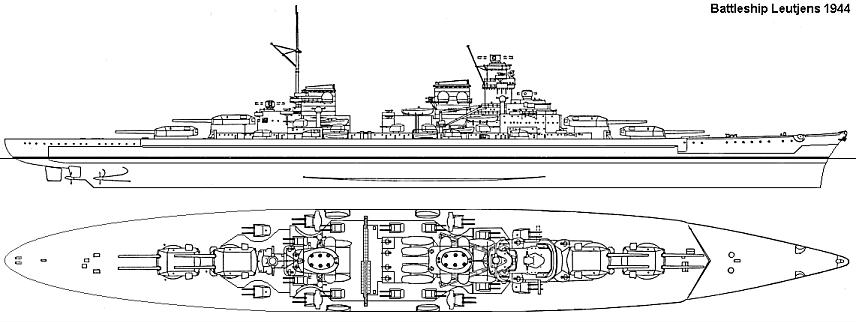
This is the introductory article for a series of ten articles on the classes of battleships built or planned by the major powers following the expiration of the Second London Naval Treaty. A previous series of articles dealt with the battleships constructed in compliance or close compliance with the treaty. This series will cover the Japanese Yamato Class, and Super Yamato Classthe British Lion Class, the Vanguard, the German Bismarck and H39 Classes, the French Alsace Class, the Soviet Sovyetskiy Soyuz Classand finally the American Iowa and Montana classes.

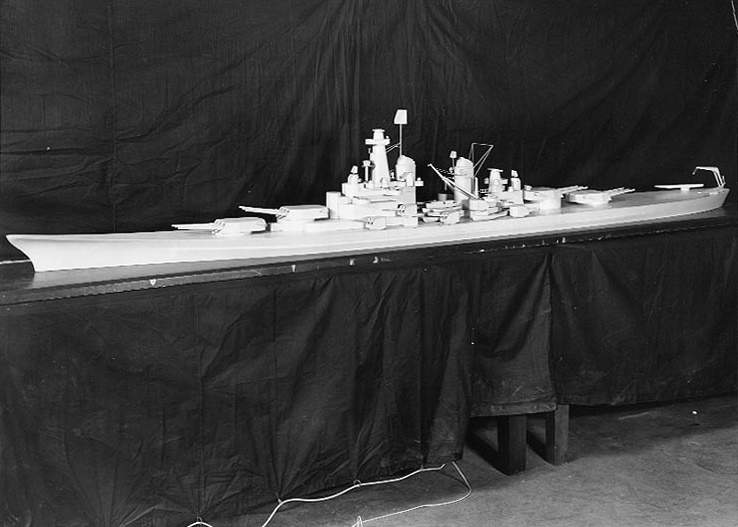
Model of the Montana Class

When I first wrote this article over a decade ago I classed all of these ships as post-Treaty designs while overlooking the fact that most were designed during the Treaty period, and that most were designed and built in violation of it, or by invoking the  escalator clause. In truth only the Vanguard, the Montana’s and the never laid down German ships of the H-41 Class and beyond, as well as the Japanese Super Yamatos.

All of these ships were designed and built or designed in the late 1930s and early 1940s and with the exception of the Sovietetskiy Soyuz Class built on each navy’s past experience in battleship design and construction. The Japanese had constructed no treaty battleships in the 1930s, so the Yamato’s were the first battleships constructed by Japan since the Nagato Class which had been completed in the 1920s and the incomplete Tosa Class.

The Bismarck

The Second London Naval Treaty of 25 March 1936 was signed by France, Britain and the United States. Japan walked out on the conference and the Italians did not sign because of the outcry that their invasion of Abyssinia had evoked.  The treaty called for ships to have a standard displacement of not more than 35,000 tons and main armament not to exceed 14” guns. This was a reduction in the size of armament from the previous London and Washington treaties. When the Japanese delayed and then refused to sign the agreement, as did the Italians, refused the United States invoked the escalator clause which permitted them to disregard the treaty limitations.

USS Iowa lead ship of the Iowa class

The Americans who invoked only the armament part of the clause on the North Carolina and South Dakota classes. However they took full advantage of it to construct the 45,000 ton Iowa class. The plans called for six of this class, but only four were completed. The Montana Class of 65,000 tons mounting twelve 16” guns and Provided protection against that type of shell. The Montana Class ships were never laid down but because of their features will be covered in this series of articles.

Line Drawing of the Lion Class

Following the King George V Class the Royal Navy planned the Lion Class which was in essence an enlargement of the King George V Class armed with nine 16” guns.  Four of the Lion ships we’re planned, but none were to built. They cancelled early in the war and only one further battleship the 44.500 ton HMS Vanguard would be completed by the Royal Navy but not until 1946.

HMS Vanguard

The Germans, who were not a signatory to the treaty but had an agreement with Britain to limit their total naval tonnage to 35% of Britain’s had build the Scharnhorst Class Battlecruisers in the mid 1930s and began the Bismarck Classthe largest capital ships completed in Europe. These were to be followed by the H39, H41, H42, H43 and H44 classes ranging in displacement from 56,444 tons to 131,000 tons with armament ranging from eight 16” to eight 20” guns. Since just two of the H39’s were laid down and then cancelled while in the early stages of construction, and the others never laid down, so I will only discuss the H39 class in this series. The others only existed in the world of a mad dictator’s fantasies.

Sovyetskiy Soyuz Class

The Soviet Union which was never a signatory to any of the naval treaties and had not built a battleship since the First World War planned the massive Sovyetskiy Soyuz Class. This would have been a Class of 15 ships would have displaced 58,220 tons and mounted nine 16” guns. Several designs were evaluated, including those of American and Italian shipbuilders and designers. The foreign designs were rejected in favor of a Soviet design. However, the timing coincided with Stalin’s purge of the Armed forces leadership, as well as men who ran military and naval production plants. This added a further delay in their design and construction. The four initial ships of the class were laid down but never completed due to the Nazi invasion in 1941. Construction was halted and all were scrapped after the war.

Yamato

The Japanese Yamato Class, the largest battleships ever constructed of 69,998 tons standard displacement armed with nine 18” guns, the largest main battery ever installed on battleships were the largest capital ships built before the second generation of U.S. Navy super carriers.

The French Alsace Class was intended to counter the German H-39s. They would have been an enlarged and more heavily armed modification of the Richelieu Class. However, the German attack and and conquest of France led to their cancellation before they were ever laid down.

The first article I write will be about the Bismarck Class and that will appear later this week. This will be cutting it close because I plan on dealing with Operation Rheinübung, the deployment of Bismarck and Prinz Eugen which would turn out to be one of the most intense times of the war, especially for the British and the Royal Navy. So tomorrow on to the Bismarck and Tirpitz.

Peace,

Padre Steve+

1 Comment

Filed under germany, History, imperial japan, Military, Navy Ships, nazi germany, World War II at Sea, world war two in europe, world war two in the pacific

An Experiment in Failure: The Beautiful, Flawed, Expensive, and Expendable Alaska Class Large Cruisers

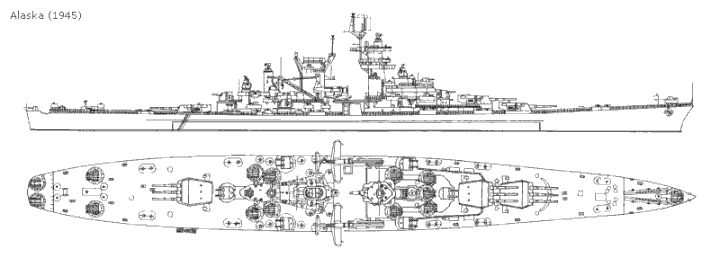
Line drawing of Alaska in 1945

Friends of Padre Steve’s World,

The three ships of the Alaska Class were among the most confusing and curious designs of warships ever built for the US Navy. They had their genus in the early 1930s when the Germans deployed the Deutschland Class Pocket Battleships, which in reality were heavy cruisers with 11” guns designed for long range commerce raiders. Both the Americans and French began to design something larger and faster. The French produced the excellent Dunkerque Class which could be classed as as either a Battlecruiser, or Fast Battleship. The American designs languished on the drawing board due to bureaucratic conflicts between those who believed a specialized ship to track down commerce raiders was necessary, and those who thought such designs were a waste of money and resources.

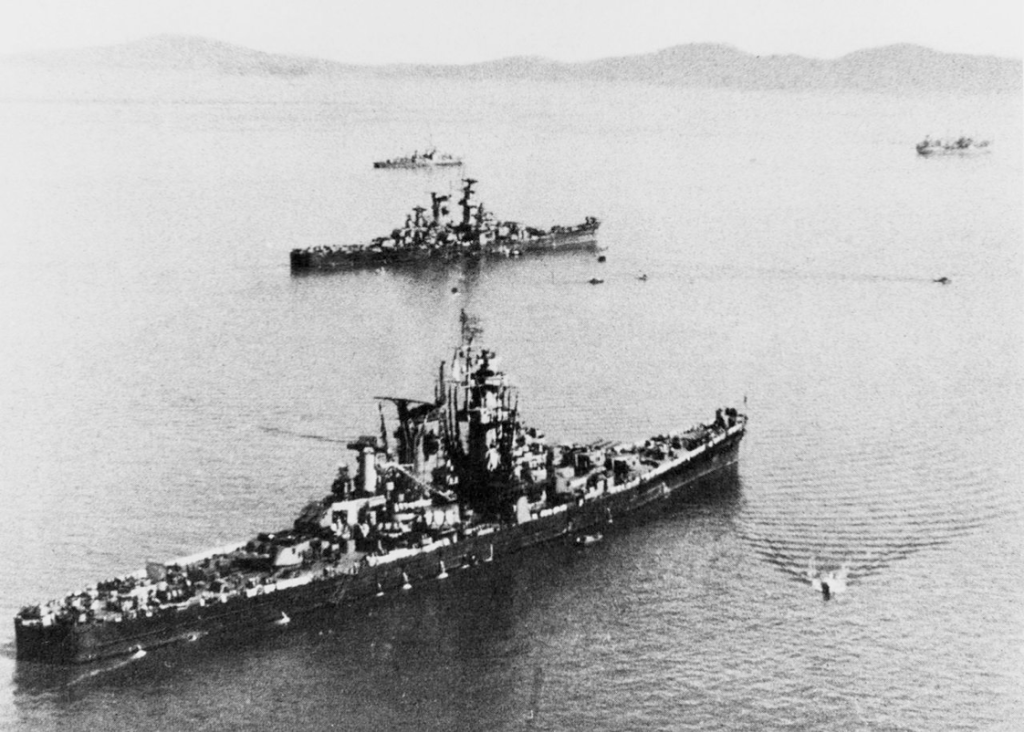
Alaska and Guam Together 

However in the late 1930s a rumor of Japanese “super cruiser” put them back into the planning stage  with President Franklin Roosevelt being a supporter of the concept. In truth the Japanese had no such ship on the drawing board, but still the process of trying to figure out what the ship and its mission would be perplexed designers. Add this to political pressure and  the resulting confusion had nine different designs underway at the same time, everything from a 6,000 ton modification of the Atlanta Class anti-Aircraft cruiser, an enlarged heavy cruiser, to a 38,000 ton fast battleship. Eventually the Naval General Board Chose in essence what was a greatly enlarged, up-armored and up-gunned modification of the Baltimore Class heavy cruisers.

The confusion even manifested in what the Navy decided to call the class. Based on their size, speed and armament they looked like Battlecruisers, but if you compared them to other battlecruisers they had severe deficiencies in armor and anti-torpedo defenses when compared the the old but still effective British Hood, Repulse, and Renown, the French Dunkerque Class, the German Scharnhorst Class, and the Japanese Kongo Class, which were all battlecruisers or fast battleships.

The Navy classed them as Large Cruisers and deigned them as CB. The Navy designated Heavy Cruisers as CA, Light Cruisers as CL, and the US Navy’s one attempt to build large Battlecruisers, the Lexington Class were designated as CC before they were cancelled with two of the four ships , Lexington and Saratoga completed as Aircraft Carriers. Likewise the naming of the class straddled the line between States and Cities. Battleships were named after States, cruisers were named after cities, but the Alaska Class were named after territories. While Alaska and Hawaii became states later, they were not states at the time. The ambiguity of their names reflected the confusion of their design and mission.

They were designed to hunt and kill the German Pocket Battleships, the imagined large Japanese Cruisers, and as a counter the battlecruisers Scharnhorst and Gneisenau which in 1939 and 1940 had created havoc in the Atlantic raiding convoys and sinking the Royal Navy Aircraft Carrier HMS Courageous.


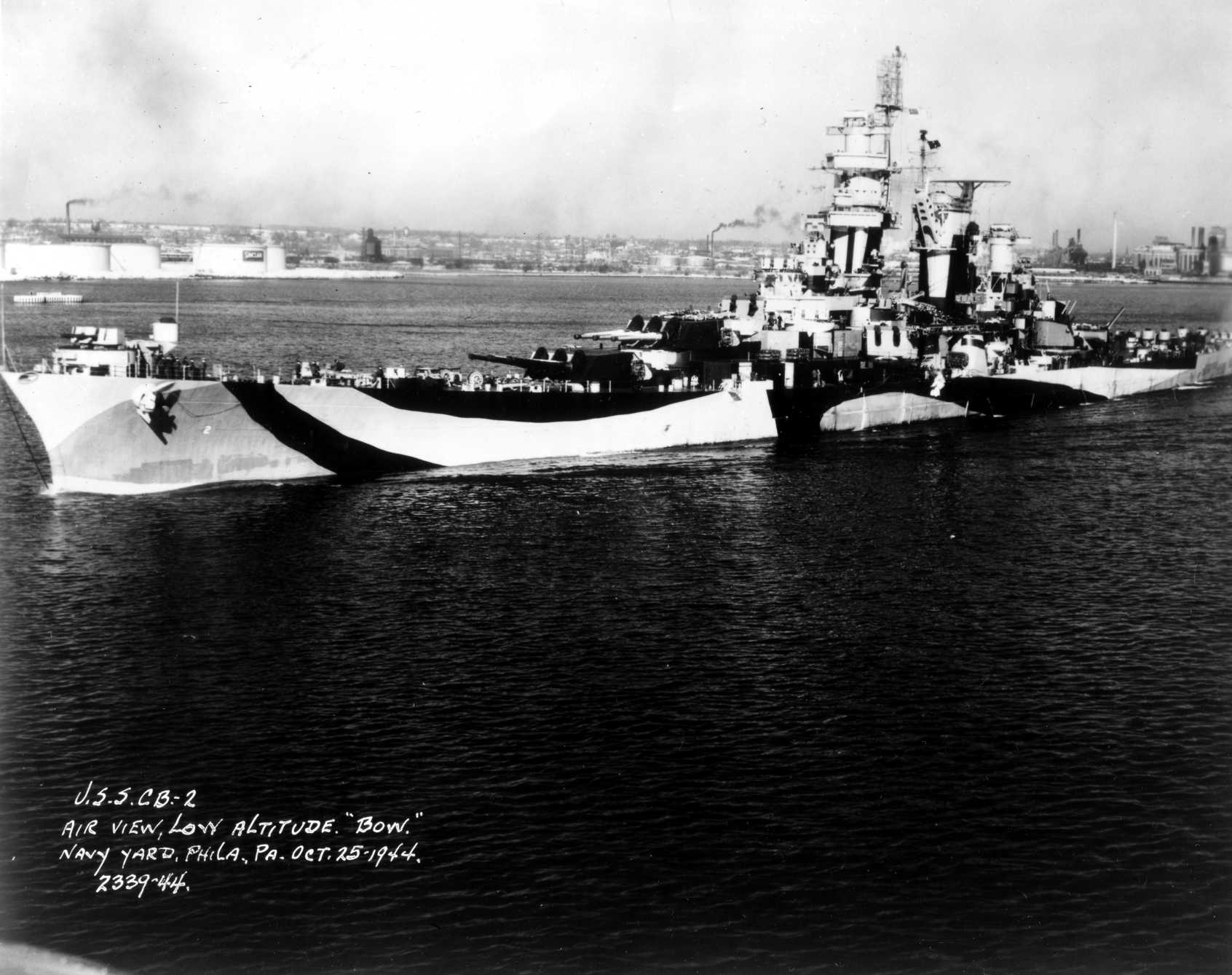
USS Missouri (Top) with USS Alaska (below) at Norfolk Naval Station 1944

As designed the ships were 809 feet long and 91 feet wide, displaced 27,000 tons, and mounted 9 12” guns in three turrets, and and were capable of 33 knots.  They used the expanded hull design of the Baltimore Class, and used the same propulsion system as the Essex Class Aircraft Carriers. The ships mounted a large anti-aircraft battery of twelve 5” 38 caliber Dual Purpose guns, fifty-six 40mm cannons in quad and twin mounts, and thirty four 20mm light anti-aircraft guns. But even this was less than they could have mounted. That was because instead of placing the ship’s aviation facilities on the fantail as was done on the Brooklyn Class Light Cruisers, the Heavy Cruiser Wichita, the Cleveland Class Light Cruisers, the Baltimore Class, and all the modern battleships, to the earlier midships aviation facilities including port and starboard catapults. The Navy’s experience in combat during the Guadalcanal Campaign showed this arrangement to be a vulnerability in surface actions. Despite this the design was not changed.

Their armor protection was proof against 8” and 11” shells but could not withstand the heavier shells of battleships. In addition, to keep the ships at their designed displacement, no below the waterline torpedo protection was provided. The lack of that would have made them vulnerable That being said they had a good anti-aircraft battery, could keep pace with the fast carriers, and conduct shore bombardment operations against the Japanese mainland. None engaged any type of ship that they were designed to fight. The Alaska and Guam were the only two ships of the class completed and which saw service in the war. They were both decommissioned having served barely two and a half years active service each. Hawaii was launched but construction was suspended when she was 84% complete, and she was never commissioned.

The Scharnhorst: She and the Gneisenau were the threat that the Alaska’s were designed to counter

Alaska was laid down in December 1941 shortly after Pearl Harbor, launched 15 August 1943 and commissioned on 17 June 1944. Her sister ship, Guam was launched on 12 November 1943 and commissioned 17 September 1944.  The final ship of the class to be built the Hawaii was launched after the war in November 1945 with her construction halted when she was 84% complete in 1947. Three planned ships, the Philippines, Puerto Rico and Samoa were never laid down.

Aerial View of USS Alaska

While fast and large with more than adequate firepower the purpose that they created for no longer existed by the time that they were commissioned.  Of the German Pocket Battleships, Graf Spee had been scuttled in 1939, while Lützow the former Deutschland, and Admiral Scheer were bottled up in the Baltic. The Scharnhorst had been sunk by a 12 ship British task force led by the HMS Duke of York on December 26th 1943 after mounting an attack on a Murmansk convoy at the Battle of North Cape.  Her sister Gneisenau had been heavily damaged in the “channel dash” and bombing in Kiel. While being refitted to replace her nine 11” guns with six 15” guns the work was discontinued after the sinking of the Scharnhorst. Her main battery and secondary armament were removed and used to reinforce the Atlantic Wall, mostly in Norway.

The USS Guam in 1945

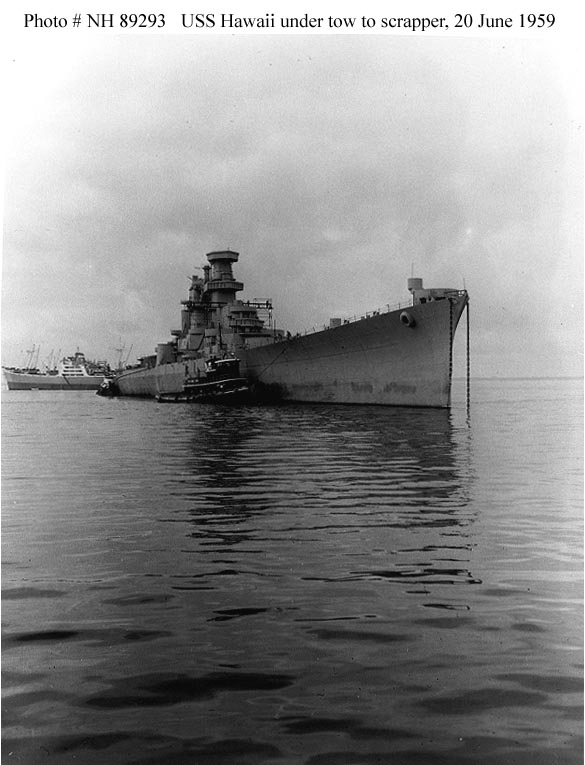
With their natural opponents no longer a factor in the war the Alaska and Guam were sent to the Pacific where they spent their time escorting fast carrier task forces, conducting naval gunfire support missions off Okinawa and conducting sweeps in Japanese waters as part of the initial blockade of Japan.  Following the war Alaska and Guam were active in Operation Magic Carpet the return of US servicemen from the Far East to the United States. Alaska and Guam were decommissioned in February 1947 remaining in reserve until stricken from the Naval List. Alaska was scrapped in 1960 and Guam being in 1961. The fate of Hawaii was be debated for years. Suggestions included to complete here her as the first guided missile cruiser (CG) and later a Command Cruiser (CC) were rejected as too expensive and she was sold for scrap in 1959.

Incomplete and undervalued the Hawaii being towed to the breakers in 1959

The era of the Battle Cruiser which began with the launching of the HMS Invincible in 1907 culminated in with launching of the HMS Hood, or arguably the  Dunkerque or Scharnhorst Classes, but not with the Alaska Class. They looked a lot like battlecruisers, but that is where the similarity ended.  It was an ignominious ending for expensive and practically unused ships being broken up. But it had to be. Their lack of underwater protection, barely average armor protection, ill designed aviation facilities, and main battery which was unique, expensive, and had a tendency to break down ensured that they could not have another mission. Instead, for a much more affordable cost, Baltimore Class cruisers were converted into guided missile cruisers or retained as naval gunfire support ships. Likewise, Cleveland Class light cruisers were converted to guided missile cruisers. One of the Baltimore Class, the Norfolk was converted into a Command Cruiser, and two others converted into the light fleet carriers, and later command ships, Wright and Saipan. 

In light of the need for a combination of substantial naval gunfire support, on a platform large enough to support the latest Aegis air defense radars and missiles to protect an Expeditionary Strike Group, capable of ballistic missile defense, and equipped with combat proven 6”, 8”, or 16” guns for naval gunfire support missions, Tomahawk Cruise missiles, and the latest anti-ship missiles and close in protective missiles and guns is needed. The existing Zumwalt Class, Arleigh Burke Class, and Ticonderoga Class, are incapable of fulfilling such a role. The ships would have to be cable of independent operations, and have the capacity to incorporate new technologies including laser weapons, newly developed combat drones capable of ship to shore, ship to ship, and ASW operations, are needed. The ships would have to be capable of extended independent operations, and have substantial protection against current anti-ship weapons, and torpedoes. It seems  to me that a new class of Battle Cruisers, in effect a new, enlarged and much improved Alaska Class would be in order.

The Alaska Class was a failure in design and practice. By the time they were completed their primary mission no longer existed, and the compromises in their design ensured that they would be incapable of any real modernization that would make them effective components of a modern Navy. It was not the first or last time the US Navy, the Royal Navy, or any other Navy has design and built a lemon.

Until tomorrow,

Peace

Padre Steve+

2 Comments

Filed under Foreign Policy, germany, History, imperial japan, Military, national security, Navy Ships, nazi germany, US Navy, World War II at Sea, world war two in the pacific

Short, Squat, Powerful and Well Protected: The South Dakota Class Battleships

Friends of Padre Steve’s World,

I am still on my holiday from writing about the novel Coronavirus 19 and President Trump and his Administration’s incompetent response to it. It is a response that has already claimed 87,000  American lives, and every day more damning evidence shows the results for the President’s use of it for political purposes, almost all of which are backfiring as much as his malfeasance and willingness to see Americans die by the tens of thousands to maintain his cloud-cuckoo-land fantasy that this will go back to normal as if by magic. But, I won’t go any farther tonight on that tonight.

I was so inflamed about what was happening earlier today I decided that it was best to continue my series on the battleships designed and built by the British, French, Germans, Italians, and Americans from after the Battleship Holiday mandated by the Washington Naval Treaty, and the restrictions of the London Naval Treaty. The Germans were not signatories to these treaties as they were already under the much more severe provisions of the Treaty of Versailles, until the Hitler regime began to clandestinely violate it in 1934, and publicly in 1935. The British signed at bilateral naval accord with Germany in June of 1935, which the Germans renounced in 1938 in order to build a fleet of battleships that Hitler believed would allow him to achieve naval parity or superiority over the British, which he renounced in 1938 during the Czechoslovakia crisis.

This is the fifth and last in a series of articles about the battleships built under the provision of the Washington and London Naval Treaty limitations in the 1930s. I am not including the ships which were already in service or completed in the immediate aftermath of the Washington Treaty. That treaty required the British to scrap 23, the Americans 30, and Japanese 17 Battleships or Battlecruisers to comply with the treaty. Some were allowed to be converted to Aircraft Carriers, and some demilitarized to serve as training or target ships.

This series looks at the modern battleships built by the future World War II combatants between 1932 and 1939. This article covers the American South Dakota Class. Previous articles dealt with the British Royal Navy’s King George V Class, The German Kriegsmarine Scharnhorst Class, the Italian Reginia Marina’s Vittorio Veneto Class, the United States Navy’s North Carolina Class, and the French Dunkerque and Richelieu Classes.The German Bismarck, Japanese Yamato, British Vanguard and American Iowa classes will be covered in a subsequent series.

I think that I will also go back and deal with various classes of ships that were allowed to be kept after the Washington Naval Treaty. These included  two of the three partially built American Colorado Class, the two ship British Nelson Class, and the second of the Japanese Nagato Class, the Mutsu; and the battleships and battlecruisers that were completed as Aircraft Carriers by the United States, Britain, Japan, and France. From there I could move on and write about and the new battleships and battlecruisers planned or under construction at the time the treaty came into effect, the ships that had they been built would have launched a major naval arms race in the 1920s, something that few nations could have afforded, especially Great Britain.  I think I will even go back to the Dreadnoughts and Battlecruisers of the First World War. Of course there are a lot of them, so I will probably focus on the ships that continued serving through the Second World War. I might even delve into the German H type battleships which were more fanciful than realistic, only satisfying the need of Hitler for nothing but the biggest, the American Montana Class, the British HMS Vanguard, the French Alsace Class, and the Japanese A-150 or Super Yamato’s. 

Since there is much disagreement about which of the ships that I have written about in this series,  I may try to do a comparison to determine which was the best of these classes in the categories, of armament, speed and range, armor protection, reliably, and performance in combat. One has to remember that these were the first battleships built by their respective navies since the First World War, each was built under the constraints imposed by the naval treaties, and their influenced by the developments of potential opponents and the changing world situation. In some cases sacrifices were made on each design due to expediency and the need to get them to the fleet.

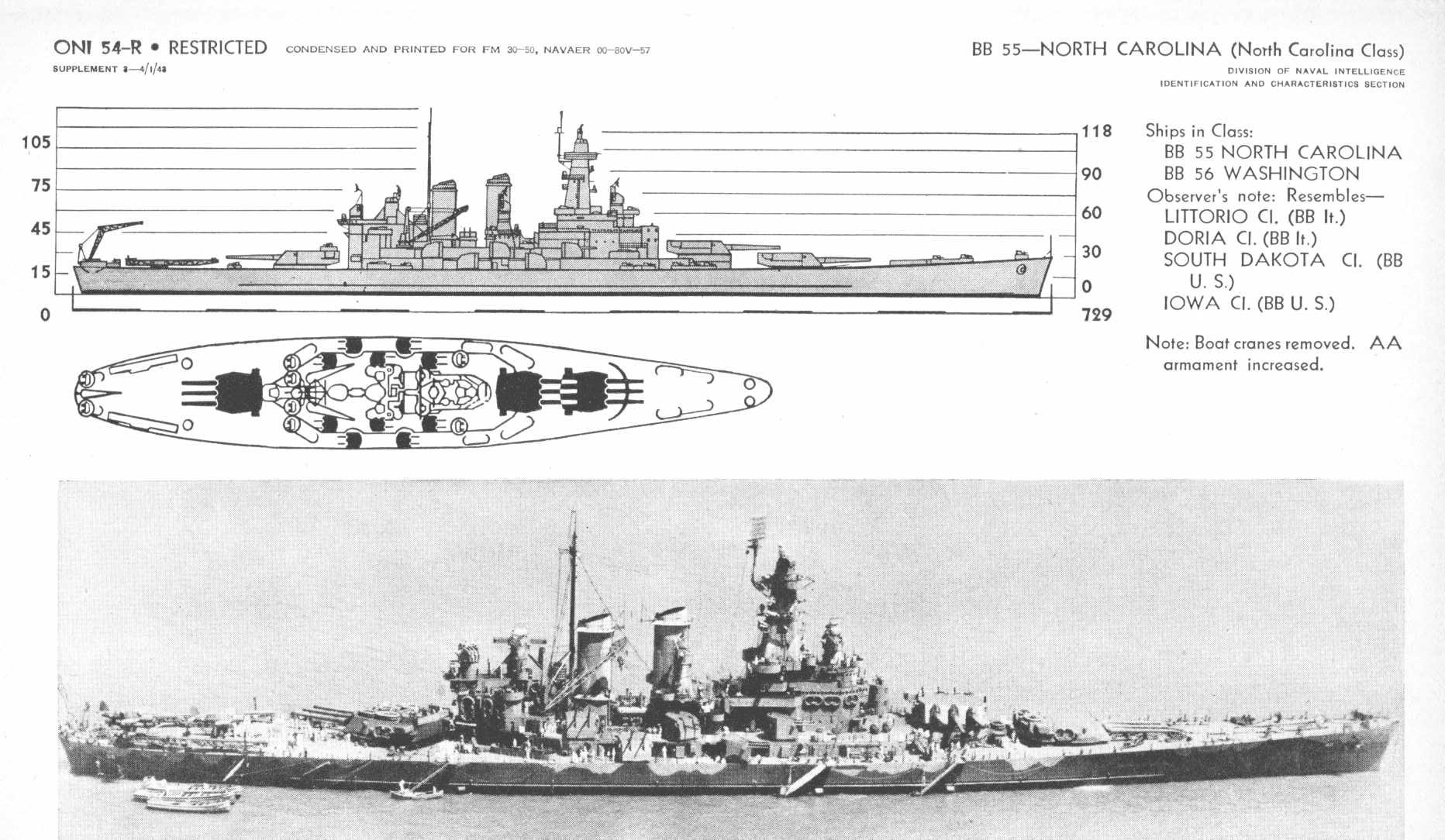
As the world edged closer to war in the late 1930s the U.S. Navy followed up its decision to build the two ship North Carolina class battleships with additional fast battleships. Initially the General Board wanted two additional North Carolina’s the Chief of Naval Operations, Admiral William H. Standley wanted a different design, which may have created the toughest and best of the battleships in this series. Compared to the other battleships built in this era, the South Dakota Class was short, fat, a bit slower, but was superbly protected with a well designed armored citadel, excellent main, secondary, and anti-aircraft batteries, and superior radars, fire direction systems and combat operation centers. They demonstrated a knack for survival as well as an ability to inflict damage, as was shown by the South Dakota and Massachusetts.

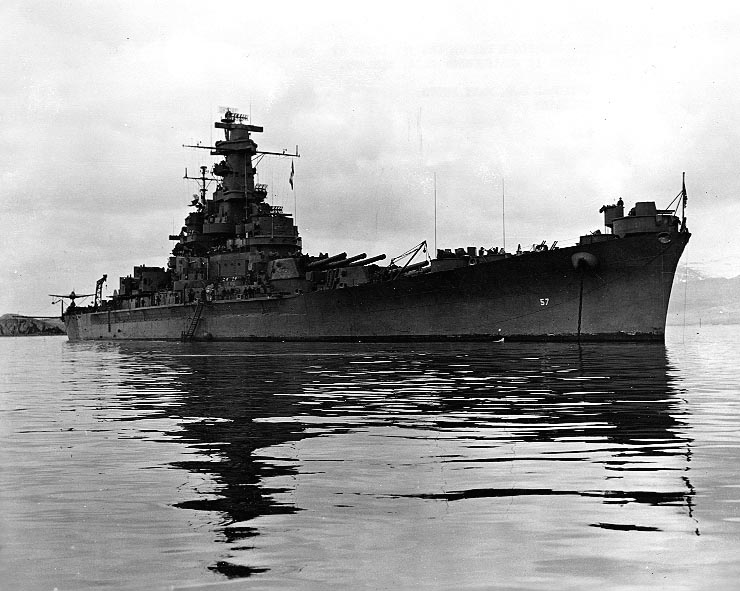
USS South Dakota BB-57 in 1943

Design work started in 1937 and several designs were proposed in order to correct known deficiencies in the preceding North Carolina class to include protection and the latest type of steam turbines.  As in the North Carolina’s the Navy struggled to find the optimal balance between armament, protection and speed. In the end the Navy decided on a shorter hull form with greater beam which necessitated greater power to maintain a high speed. The armor protection was maximized by using an interior sloped belt of 12.2 inch armor with 7/8” STS plates behind the main belt which made the protection the equivalent to 17.3 inches of vertical armor. The Belt continued to the bottom of the ship though it was tapered with the belt narrowing to 1 inch to provide addition protection against plunging fire which struck deeper than the main belt. As an added feature to protect against torpedo hits a multi-layered four anti-torpedo bulkhead system was included, designed to absorb the impact of a hit from a 700 pounds of TNT.

In order to accommodate the machinery necessary to provide the desired speed of 27 knots on the shorter hull the machinery spaces were rearranged.  The new design placed the boilers directly alongside the turbines with the ship’s auxiliaries and evaporators also placed in the machinery rooms. Additional design changes made to save space included making the crew berthing areas smaller. This included that of officers as well as the senior officers and shrinking the size of the galley’s and the wardroom from those on the North Carolina’s. The resultant changes allowed the ships to achieve the 27 knot speed, improved protection and carry the same armament of the North Carolina’s within the 35,000 treaty limit.

Two ships of the design were approved and with the escalator clause invoked by the Navy two more ships were ordered all with the nine 16” gun armament of the North Carolina’s.  The leading ship of the class the South Dakota was designed as a fleet flagship and in order to accommodate this role two of the 5” 38 twin mounts were not installed leaving the ship with 16 of these guns as opposed to the 20 carried by the rest of the ships of the class. The final design was a class of ships capable of 27.5 knots with a range of 17,000 miles at 15 knots mounting nine 16” guns with excellent protection on the 35,000 tons and full load displacement of 44,519 tons.

The lead ship of the class the USS South Dakota BB-57 was laid down 5 July 1939 at New York Shipbuilding in Camden New Jersey, launched on 7 June 1941 and commissioned on 20 March 1942.  Following her commissioning and her shakedown cruise South Dakota was dispatched to the South Pacific. Soon after her arrival she struck a coral reef at Tonga which necessitated a return to Pearl Harbor for repairs.

When repairs were complete she was attached to TF 16 escorting the USS Enterprise CV-6 during the Battle of the Santa Cruz Islands on 26 October 1942.  During the battle she was credited with shooting down 26 Japanese aircraft but was struck by a 500 lb bomb on her number one turret which caused no damage.


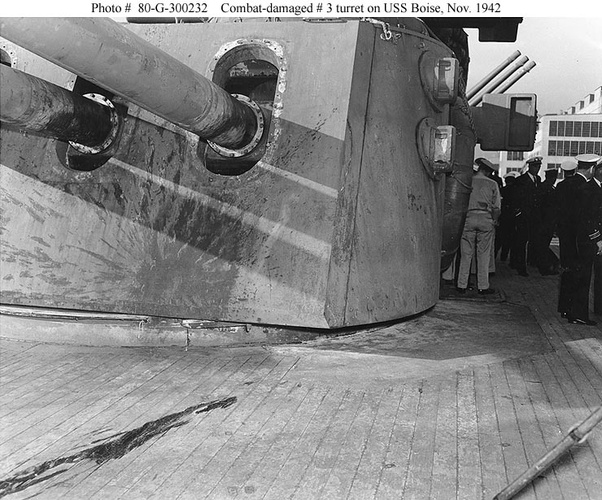
The Dent in South Dakota’s Number Three Turret from a hit from a 14” Shell from Kirishima

She joined TF-64 paired with the battleship USS Washington during the Second Naval Battle of Guadalcanal on14-15 November 1942. During the action South Dakota suffered a power outage and was hit by over by a minimum of 26 enemy shells, and possibly up to 40. At least one of a 14” shell from Kirishima, 18 8” shells from the Heavy Cruisers, 6 6” shells from from Japanese light cruisers, and at least one 5” shell from a destroyer. The damage was superficial, once her power was restored much of the damage was repaired ship’s crew. The shellfire knocked out three of her fire control radars, her radio and main radar set which were also repaired.

Three of the escorting destroyers, USS Preston, USS Walke, and USS Benham were sunk or mortally wounded, and USS Gwin was damaged.destroyers were also lost but the Washington mortally wounded the fast battleship Kirishima and destroyer Ayanami which were scuttled the next day and damaged the heavy cruisers Atago and Takao.

South Dakota returned to New York for repairs which completed in February 1943. She joined the carrier USS Ranger CV-4 for operations in the Atlantic until April when she was attached to the British Home Fleet. She sailed for the Pacific in August 1943 and rejoined the Pacific Fleet in September. The battleship joined Battleship Divisions 8 and 9 and supported the invasion of Tarawa providing naval gunfire support to the Marines.

South Dakota spent the rest of the war was spent escorting carriers as well as conducting bombardment against Japanese shore installations. She participated in almost every action of the U.S. drive across the Central Pacific. She was struck by a 500 pound bomb during the Battle of the Philippine Sea that destroyed several anti-aircraft mounts and killed 26 of her crew.

A Photo taken from South Dakota while anchored in Tokyo Bay with Mount Fuji in the Background 

South Dakota was present at the Japanese surrender in Tokyo Bay and returned to the United States in 1945. She was decommissioned and placed in reserve on 31 January 1947. She was stricken from the Naval Register on 1 June 1962 and sold for scrap in October of that year. Various artifacts of this gallant ship to include a propeller, a 16” gun and the mainmast are part of the USS South Dakota Memorial Park in Sioux Falls South Dakota. 6,000 tons of armored plate were returned to the U.S. Atomic Energy Commission for use in civilian nuclear programs and a second screw is displaced outside the U.S. Naval Museum in Washington D.C.  She received 13 battle stars for World War II service.

South Dakota also had the dubious distinction of having the youngest sailor of the war 12 year old Calvin Graham who confessed lying about his age to the Gunnery Officer, LT Sergeant Schriver. Graham was court-martialed and given a dishonorable discharge spending 3 months in the ship’s brig before he was able to be returned to the United States where just after his 13th birthday he entered 7th grade. Shriver was wounded at Guadalcanal and was awarded the Purple Heart. He left the Navy in in 1945 as a Lieutenant Commander. He later became the Brother in law of John F. Kennedy, and the first Director of the Peace Corps, and became the the running mate of Senator George McGovern in the 1972 Presidential Election, to Richard Nixon and Spiro Agnew. 

USS Indiana BB-58 Bombarding Japan in 1945

The second ship of the class the USS Indiana BB-58 was laid down at Newport News Naval Shipyard on 20 November 1939 launched on 21 November 1941 and commissioned on 30 April 1942.  She served throughout the Pacific War by serving with the fast battleships of Vice Admiral Willis Lee’s TF-34, escorting carriers during major battles such that the Battle of the Philippine Sea or as it is better known the Marianas Turkey Shoot. She returned to the United States for overhaul and missed the Battle of Leyte Gulf but served at Iwo Jima, Okinawa and operations against the Japanese home islands. During the beginning of the Marshall Islands campaign Indiana received her heaviest damage. During night operations with a carrier task group she turned in front of USS Washington. A collision ensued which caused heavy damage to Indiana, including the loss of nearly 200 feet of her armored belt. The collision took off about 20 feet of Washington’s bow which remained imbedded in the Indiana until she was repaired. Washington also required a return to the United States for repairs.

Following the war she was decommissioned in 1947 and sold for scrap in September 1963.   A number of her relics are preserved at various locations in Indiana and her prow and mainmast are centerpieces of a display at the University of Indiana’s football stadium. Much of her armor was provided to the U.S. Atomic Energy Commission for use in civilian programs.

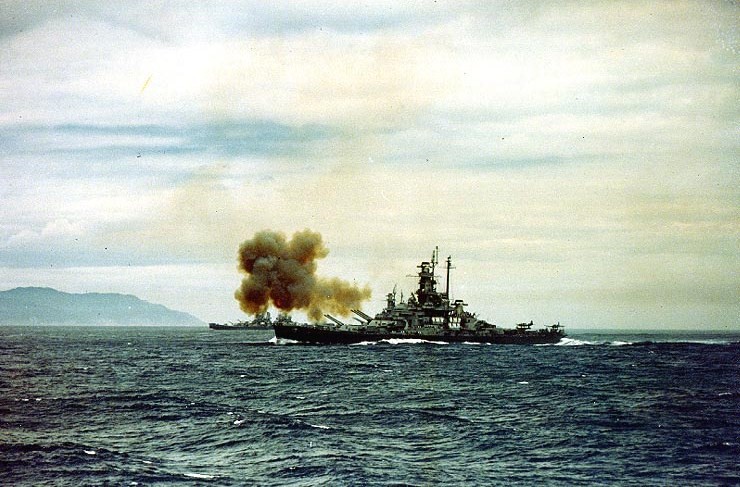
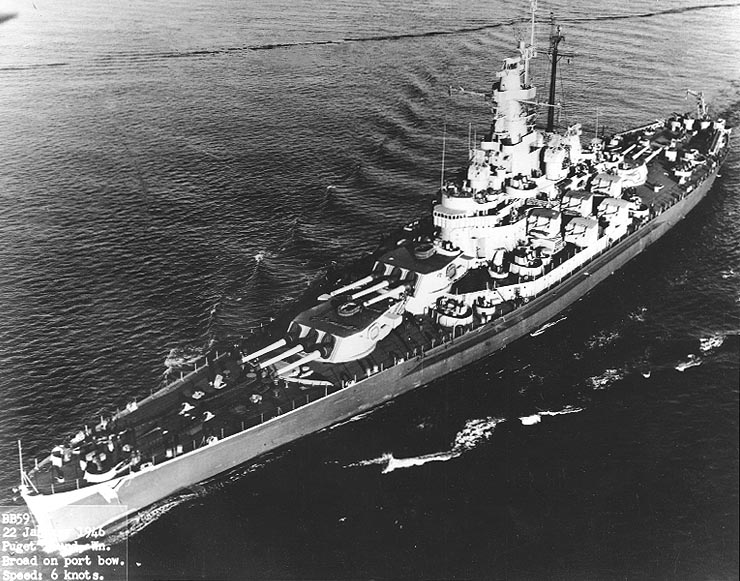
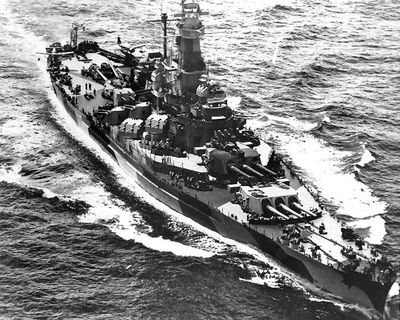
USS Massachusetts BB-59 in January 1946 in the Puget Sound

The third ship of the class the USS Massachusetts BB-59 was laid down on 20 July 1939 at Bethlehem Steel Corporation Fore River Yard in Salem Massachusetts and launched on 23 September 1941 and commissioned on 12 May 1942. After her shakedown cruise she was assigned to the Atlantic Fleet where she took part in Operation Torch, the Allied invasion of French North Africa. During the operation she engaged French shore batteries, damaged the battleship Jean Bart and sank 2 cargo ships and along with the heavy cruiser Tuscaloosa sank the destroyers Fougueux and Boulonnais and the light cruiser Primauguet.

Following her assignment in the Atlantic she sailed for the Pacific where she began operations in January 1944. She took part in almost every major operation conducted by the Pacific Fleet escorting the Fast Carrier Task Forces and operating as a unit of TF-34 the Fast Battleship Task force including the Battle of Leyte Gulf.  She ended the war conducting operations against the Japanese home islands.  She was decommissioned in 1947 and stricken from the Naval Register on 1 June 1962.

USS Massachusetts BB-59 at Battleship Cove, Fall River Massachusetts

She was saved from the fate of Indiana and South Dakota as the people of Massachusetts with the assistance of schoolchildren who donated $50,000 for her renovation and preservation as a memorial. She became that in 1965 at Battleship Cove in Fall River Massachusetts and she remains there designated as a National Historic Landmark.  During the naval build up of the 1980s much equipment common to all modern battleships was removed for use in the recommissioned battleships of the Iowa class.


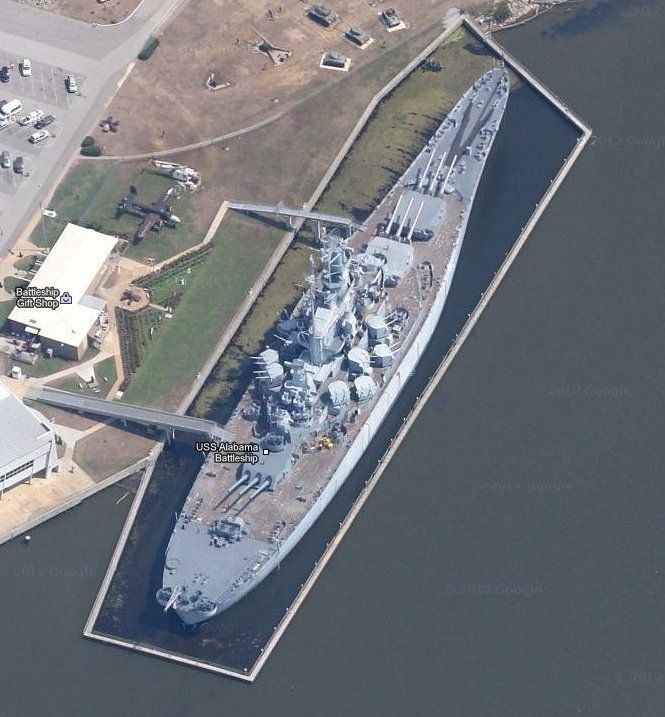
The final ship of the class the USS Alabama BB-60 was laid down on 1 February 1940 at Norfolk Naval Shipyard. She was launched on 21 February 1942 and commissioned 16 August 1942. Following her shakedown cruise and initial training off the Atlantic coast she joined the repaired South Dakota and operated as part of TF 22 attached to the British Home Fleet.

She conducted convoy escort operations, participated in the reinforcement of Spitsbergen and in an operation which attempted to coax the German battleship Tirpitz out of her haven in Norway. Tirpitz did not take the bait and Alabama and South Dakota returned to the United States in August 1943.

Following a brief refit she and South Dakota transited to the Pacific were the trained with the fast carriers.  She took part in the invasion of the Gilberts taking part in Operation Galvanic against Tarawa and the Army landings on Makin Island.

As 1944 began Alabama continued her operations with the fast carriers of TF-38 and the fast battleships of TF-34.  She took part in operations against the Marshalls and took part in the invasion of the Marianas Islands and the Battle of the Philippine Sea, the Great Marianas Turkey Shoot. From there she supported the invasion of Palau and other islands in the Caroline Islands followed by operations against New Guinea and the invasion of the Philippine and the Battle of Leyte Gulf before returning to the United States for overhaul.

Chief Petty Officer Bob Feller
Alabama 
returned to action during the invasion of Okinawa and in shore bombardment operations against the Japanese Mainland. When the war ended the Alabama had suffered no combat deaths and only 5 wounded following the misfire of one of her own 5” guns earning her the nickname of “Lucky A.”  Hall of Fame pitcher Bob Feller served as a Chief Petty Officer and gun mount captain on Alabama during the war.

She was decommissioned on 9 January 1947 and stricken from the Naval Register on 1 June 1962. The people of the State of Alabama formed the “Alabama Battleship Commission” and raised $1,000,000 including over $100,000 collected by schoolchildren to bring her to Alabama as a memorial.  She was turned over to the state in 1964 and opened as a museum on 9 January 1965. She was declared a National Historic Landmark in 1986.  She has been used as a set in several movies and continues to serve as a museum preserving the legacy of the men that served aboard her and all of the battleship sailors of World War II.

another thing about the South Donata Class was that their design was evident in the rebuilding of the USS California, USS Tennessee, and USS West Virginia when they were completely modernized after Pear Harbor.

USS West Virginia after her complete modernization after being sunk at Pearl Harbor

In the 1950s a number of proposals were considered to modernize the ships of the class to increase their speed to 31 knots using improved steam turbines or gas turbines. The Navy determined that to do this would require changes to the hull form of the ships making the cost too prohibitive.  The ships were certainly the best of the treaty type battleships produced by any nation in the Second World War. The damage sustained by South Dakota at the Second Naval Battle of Guadalcanal would have not only put most battleships of her era out of action but might have caused enough damage to sink them. Their armament was equal or superior to all that except the Japanese Yamato Class and their protection was superior to most ships of their era, and it was was exceptional, as was evident by the damage sustained by South Dakota. 

Alabama as a Museum Ship 

It is good that both the Massachusetts and the Alabama have been preserved as memorials to the   ships of the class, their sailors and the United States Navy in the Second World War. Because of the efforts of the people of Massachusetts and Alabama millions of people have been able to see these magnificent ships and remember their fine crews. Both have hosted reunions of their ships companies since becoming museum ships and with the World War Two generation passing away in greater numbers every day soon these ships as well as the USS Texas, USS North Carolina, USS Missouri, USS New Jersey, USS Wisconsin aUSS Iowa which stricken from the Naval Register awaits an uncertain fate as a resident of the “Ghost Fleet” in Suisun Bay California.  No other nation preserved any other dreadnought or treaty battleship thus only these ships remain from the era of the Dreadnought. I so much wish that the British had preserved one of the King George V  ships, or maybe the mostend celebrated Royal Navy Battleships of both World Wars, the HMS Warspite had been preserved. I also regret that none of the survivors of the attack on Pearl Harbor were preserved, nor any of the standard battleships of the Nevada, Pennsylvania, New Mexico, California, or Colorado Classes.

I am fortunate. I have been able to go aboard the North Carolina, Alabama, Texas, and Wisconsin, as well as a number of the surviving aircraft carriers, destroyers, and submarines preserved in the United States. However, too few, especially the ships which bore the brunt of the war like the carrier USS Enterprise were never saved, despite the pleas of men like Admiral William “Bull” Halsey.

I habe also been able to visit ships like the USS Constitution, USS Constellation, Clipper ship Star of India, the Japanese Battleship Mikasa, the USS Nautilus, the German Tall Ship Gorch Fock II, and so many more, but I still have a bucket list of ships I want to visit in the United States, Canada, Great Britain, Germany, Greece, Sweden, Russia, France, Australia, Italy, Turkey, Japan, and Finland.

With those pipe dreams in mind, I wish you all the best. Until tomorrow when I decide to weigh in again on novel Coronavirus 19 and the crisis being fostered by the Trump Administration in this country; please be safe. Don’t do dumb things like going into crowded places with few people wearing masks and the vast majorly of people not adhering to social distancing. Even if other people decide to be stupid and put others and well as their own lives at risk, don’t be like them. I speak this from the heart and I don’t care if someone disagrees with my politics, faith, or social commentary, I would prefer that they not die or through their stupidity and arrogance get other people sick or die. Darwin is not Kind when it comes to the stupidity and arrogance of people regardless of the race, ethnicity, faith, ideology, political leanings, social standing, economic position, or nationality.

I don’t care if people agree with me or not, but don’t do dumb things. This may sound harsh but I tend to speak from my heart when lives and civilization itself are at stake. But please remember the words of Robert Henlein:

“Stupidity cannot be cured. Stupidity is the only universal capital crime; the sentence is death. There is no appeal, and execution is carried out automatically and without pity.” 

Peace,

Padre Steve+

6 Comments

Filed under Foreign Policy, historic preservation, History, imperial japan, Military, Navy Ships, nazi germany, Political Commentary, US Navy, World War II at Sea, world war one, world war two in europe, world war two in the pacific

The King George V Class Battleships: The Imperfect yet Important British Bulwarks of WII

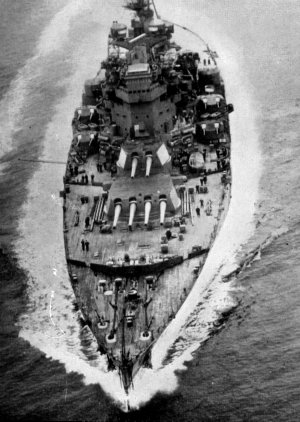
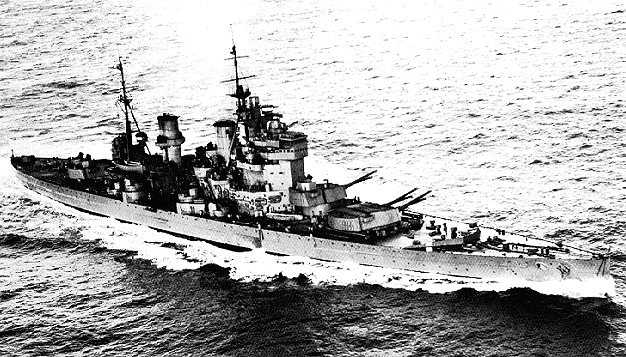
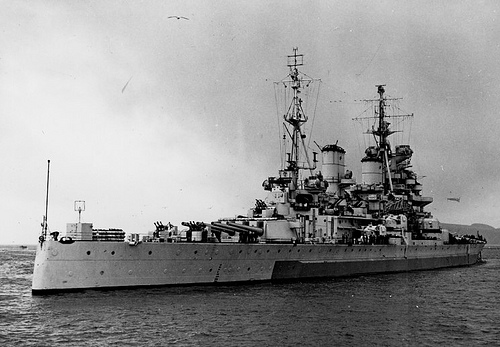
HMS King George V

Friends of Padre Steve’s World,

I am still on my holiday from writing about the novel Coronavirus 19 and President Trump and his Administration’s incompetent response to it. It is a response that has already claimed 85,000 American lives. But, I won’t go any farther tonight on that. Instead I am going back to my series on the battleships designed and built by the British, French, Germans, Italians, and Americans from after the Battleship Holiday mandated by the Washington Naval Treaty, and the restrictions of the London Naval Treaty. The Germans were not signatories to these treaties as they were already under the much more severe provisions of the Treaty of Versailles, until the Hitler regime began to clandestinely violate it in 1934, and publicly in 1935. The British signed at bilateral naval accord with Germany in June of 1935, which the Germans renounced in 1938 in order to build a fleet of battleships that Hitler believed would allow him to achieve naval parity or superiority over the British.

This is the fourth in a series of five articles on the battleships built under the provision of the Washington and London Naval Treaty limitations in the 1930s. I am not including the ships which were already in service or completed in the immediate aftermath of the Washington Treaty which required the British to scrap 23, the Americans 30, and Japanese 17 Battleships or Battlecruisers to comply with the treaty. Some were allowed to be converted to Aircraft Carriers, and some demilitarized to serve as training or target ships.

This series looks at the modern battleships built by the future World War II combatants between 1932 and 1939. This article covers the British Royal Navy King George V Class. The previous articles dealt with the German Scharnhorst Class, the Italian Vittorio Veneto Class, the American North Carolina Class, and the Frech Dunkerque and Richelieu Classes. The final article will be about the American South Dakota Class. The German Bismarck, Japanese Yamato, British Vanguard and American Iowa classes will be covered in a subsequent series.

Since there is much disagreement about which of the ships that I have written about I may try to do a comparison to determine which was the best of these classes in the categories, of armament, speed and range, armor protection, reliably, and performance in combat. One has to remember that these were the first battleships built by their respective navies since the First World War, each was built under the constraints imposed by the naval treaties, and their influenced by the developments of potential opponents and the changing world situation. In some cases sacrifices were made on each design due to expediency and the need to get them to the fleet.

HMS King George V in 1941

The last class of Royal Navy Battleships was the Nelson Class of two ships, HMS Nelson and HMS Rodney. They were a compromise design based on N3 Class of battleships which had to be cancelled due to the Washington Treaty. The Nelson’s have been described as a “chopped off” N3 which used the 16” guns of the also cancelled G3 Battlecruisers. The design sacrificed speed for protection and firepower. Their protection was good, as was their armament, but their propulsion plants were a constant source of trouble. By the late 1920s the Royal Navy’s battle force was comprised of the two Nelson’s, the fast Battlecruisers Hood, Renown and Repulse and the 10 ships of the Queen Elizabeth and Revenge Classes all designed before the First World War.

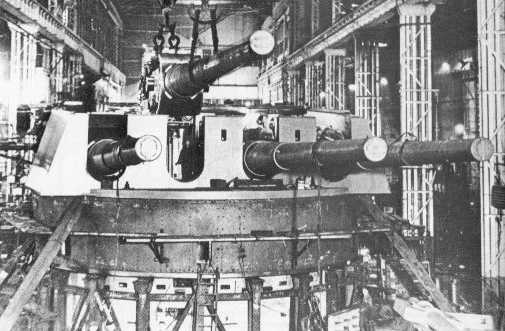
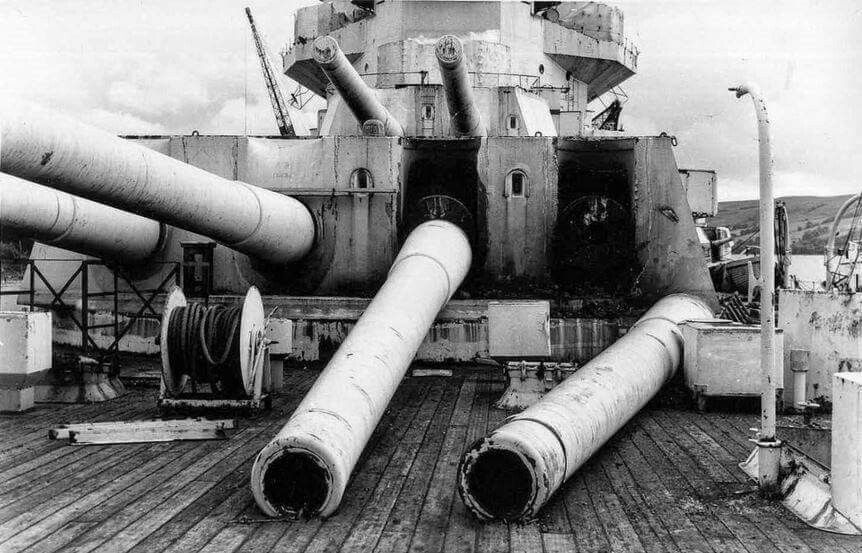
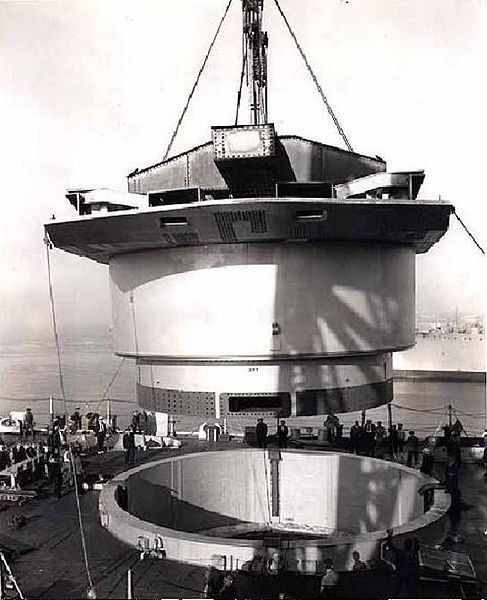
King George V Class Quad Turret being built

The Royal Navy began planning for a new class of battleships in 1928. But these plans were shelved with the signing of the London Naval Treaty which continued the “building holiday” on capital ship construction as well as the size and armament of capital ships until 1937.  Because of the pacifist movement of the 1920, the Great Depression, and the desire of the British government to abide by international treaties in spite of the violations of those treaties, nothing was done until 1937.

With the realization that its battle force was dated, and the knowledge that other nations had laid down new classes of battleships the Royal Navy recommenced planning in 1935.  The Navy planned to build to the maximum of the 35,000 displacement limitation and placed a great measure of emphasis on armor and protection. Early designs emphasized ships with heavy firepower and protection at the expense of speed, like the American Colorado Class, the cancelled South Dakota Class, and early designs for new battleships of similar design by the U.S. Navy in the early 1930s.

Numerous Designs were proposed. Eventually the new class of battleships were designed to achieve a 28 knot speed which made them faster than all existing British battleships, although slower than the Battlecruisers. The planners had alternative designs to use 14”, 15” or 16” guns with the Navy favoring the 15” models which had equipped all of their other ships with the exception of the Nelson’s. However the Admiralty to use 14” as the government was endeavoring to negotiate with other powers to impose a 14” limitation on armament for new battleships, and the Admiralty estimated that a move to arm the ships with 15” or 16” guns could delay the completion of the ships by a year or more.

during the second London Treaty of 1935, the Americans and French agreed to the limit their size and armament of their ships, however neither the Japanese nor Italians followed suite, and as a result all new battleships of other powers had larger guns than the King George V Class. The Italians opting for 15” Guns on the Vittorio Veneto Class, the French and Americans invoking the escalator clause of the treaty. The French opted to arm the Richelieu Class with 15” guns, while the Americans chose to arm the North Carolina, South Dakota and the Iowa Classes with 16” guns. The Japanese Opted for 18” guns for their Yamato Class, which also displaced nearly twice as much as the treaty allowed. The Germans who were not a signatory built their Scharnhorst Class with 11” Guns although, those were an expedient as they were planned to be armed with 15” guns. The Germans also equipped the Bismarck Class with 15” guns.

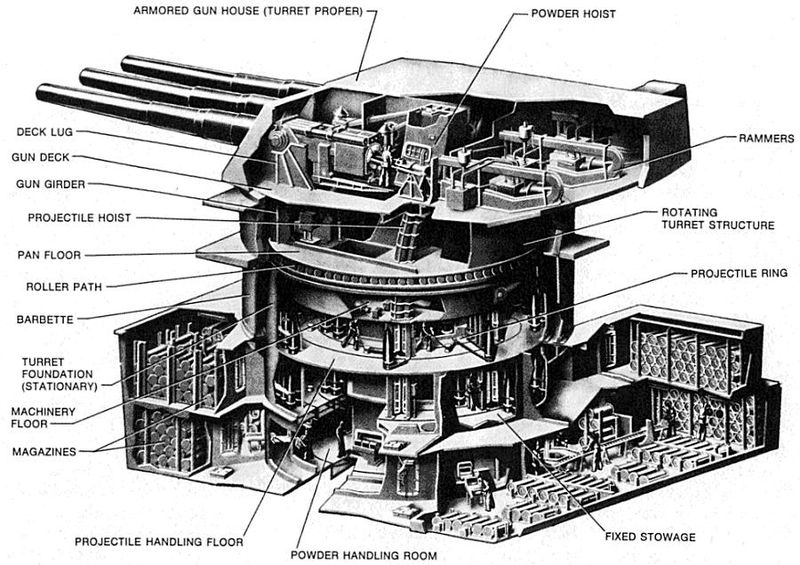
The Royal Navy attempted to rectify this by placing more guns on the ships than those of other navies. They wanted to mount twelve 14” guns mounted in Three quadruple turrets, but this was impossible on the 35,000 platform without compromising protection, speed, or stability.  Thus the Admiralty compromised on 10 guns mounted in 2 quadruple and 1 twin turret.

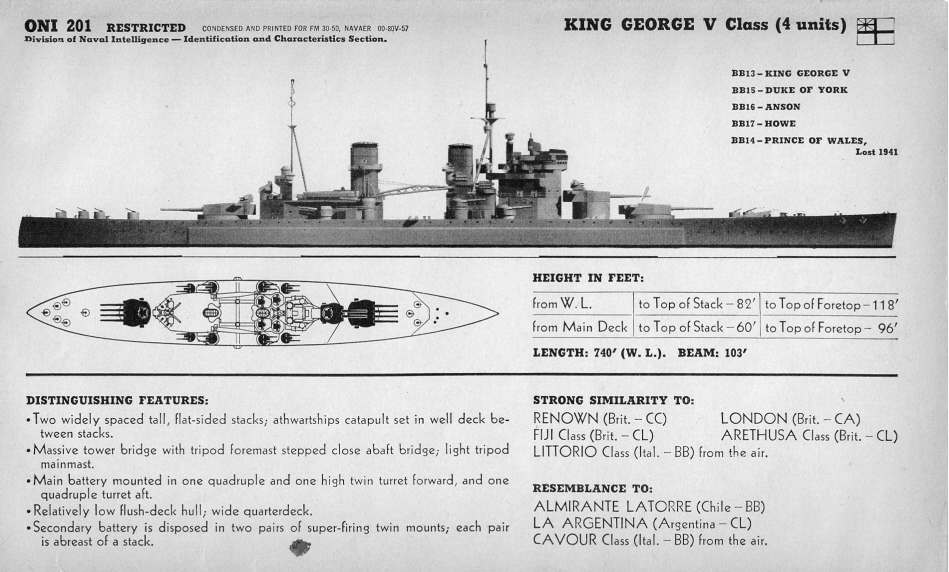
ONI Drawing of King George Class

The ships displaced a full load displacement of 42,237 tons in 1942. This increased to 44,460 tons by  1944. The were 745 feet long had a beam of 103 feet, a top speed of 28 knots with a cruising range of 5,400 nautical miles at 18 knots. Their relatively poor endurance limited their operations in the Pacific and even nearly caused King George V to have to abandon the chase of the Bismarck in May 1941. The compromise in displacement also limited the amount of fuel they could carry.

The main batteries of the ships proved problematic in combat. The quadruple turret design caused most of the ships problems. This was demonstrated in the engagement of the Prince of Wales against the Bismarck as well as the King George V in its duel with the same German behemoth when A turret became disabled and completely out of action for 30 minutes and half of the main battery being out of action for most of the engagement for mechanical reasons.  The Duke of York achieved excellent results against the Scharnhorst at the Battle of North Cape, but even in that engagement the main battery of Duke of York was only able to be in action 70% of the time due to the guns  jamming, or being inoperablere for various periods of time.  One of the other drawbacks of the design was that in order to replace a gun due to wear and tear, that the turret itself had to be dismantled in order to remove and replace the guns. Most other navies had planned for the replacement of guns without such such massive work.

The main secondary armament of 5.25” dual purpose guns in twin mounts suffered from poor rate of fire and slow traverse, both of which were well below their designed standards, and definitely inferior to the American 5” 38 dual purpose twin mounts and their Mark 38 fire direction radar.

The mounting of the armament was designed to provide protection against turret explosions which could potentially detonate the ship’s magazines.  The main side and underwater protection scheme was sound and protected the ships well in combat, and might have been the best of the ships built in there era. The vertical protection was also sound as was the protection afforded to the turret barbets and placement of the magazines to shield them from plunging fire.

Only the Prince of Wales was lost due to enemy action. Initially it was thought that she was hit by 6 aerial torpedoes and two 500 pound bombs. Her main armor and underwater anti-Torpedo defenses around her fully armored casemate would have protected her from major damage, but only one of the torpedoes hit that belt. However three torpedoes hit her in areas without such protection, forward and aft of the casemate. Later examination of her wreck revealed that the culprit was a torpedo which detonated in a propeller shaft outside of the armored belt which caused uncontrolled flooding when she was attacked by Japanese aircraft on 8 December 1941. No matter how well protected, no ship is completely proof against the damage of bombs, torpedoes, or now missiles.

HMS Anson conducting gunnery exercises

The propulsion systems of the class developed problems after 1942 when fuel oil quality was decreased because of the need for aviation gas.  The new mixtures which were of  higher viscosity and contained more water than the boilers could effectively bur. This increased maintenance costs and decreased efficiency. To compensate the Admiralty designed new higher pressure fuel sprayers and burners which returned the boilers to full efficiency, and which should be used on the later HMS Vanguard. 

The lead ship of the class the King George V was laid down on 1 January 1937, and  launched on 21 February 1939. She was commissioned on 11 December 1940.  As the flagship of the Home Fleet she took part in the unsuccessful search for the Scharnhorst and Gneisenau during their early 1941 convoy raiding operation. Later during the hunt for the Battleship  Bismarck in May 1941 during which she earned lasting fame in helping to sink that ship, despite failures in her main battery which silenced half or her main guns.

She took part in the Murmansk convoy protection as well as Operation Husky, the invasion of Sicily before sailing to the Far East for operations against the Japanese. She finished the war with the British Pacific Fleet and was present at the Japanese surrender in Tokyo Bay.  She returned as flagship of Home Fleet until she was decommissioned in 1949. She was subsequently sold for scrap in 1957.

Prince of Wales pulling into Singapore

The second ship of the class the Prince of Wales laid down on 1 January 1937, launched on 3 May 1939 and commissioned 19 January 1941 although she was not officially completed until March 1941. Her initial operation came in May 1941 when she sailed with the HMS Hood to intercept the Bismarck. When she sailed she still had shipyard technicians aboard.  Damaged in the action she did score an important hit on Bismarck which cut a fuel line making her forward tanks inaccessible and causing her to make her run for Brest which she did not complete. Another hit damaged Bismarck’ aircraft catapult and a third disabled an electric dynamo. During the engagement she took heavy damage, and suffered malfunctions to her main battery, and withdrew from the action. The question still remains to this day why Admiral Lütjens aboard Bismarck did not decided to finish Prince of Wales off and sailed back the way she came after destroying two of the Royal Navy’s most powerful ships. Repaired and returned to service she could have sailed with her sister ship Tirpitz, maybe in a coordinated operation with Scharnhorst and Gneisenau that could have cost the Royal Navy much more in power and prestige.

Church Service on Prince of Wales at Argentia Bay with Churchill and Roosevelt in attendance

Following her badly needed repairs. Prince of Wales carried Winston Churchill to the Argentia Bay, Newfoundland, where in secret he met with Franklin D. Roosevelt and together drafted the Atlantic Charter. In late 1941 she accompanied the HMS Repulse to Singapore to bolster the British presence in the Far East. Under the command of Admiral Tom Phillips the ships sailed to attack Japanese invasion convoys, but without air cover was sunk by Japanese aircraft which struck her with 4 torpedoes and a bomb, the key hit being a lucky hit on her propeller shaft which caused flooding that caused a loss of power to pumps and anti-aircraft defenses. Repulse was also sunk in the engagement. Their sortie was doomed by an admiral who did not understand the importance of air power, and who had left the carrier sent to assist them, HMS Hermès behind. Poor communication between the land based fighters, Royal Austrian Air Force Brewster Buffaloes which would have been outnumbered and outclassed by Japanese aircraft and the task force destroyed nonetheless.

Prince of Wales sinking and being abandoned

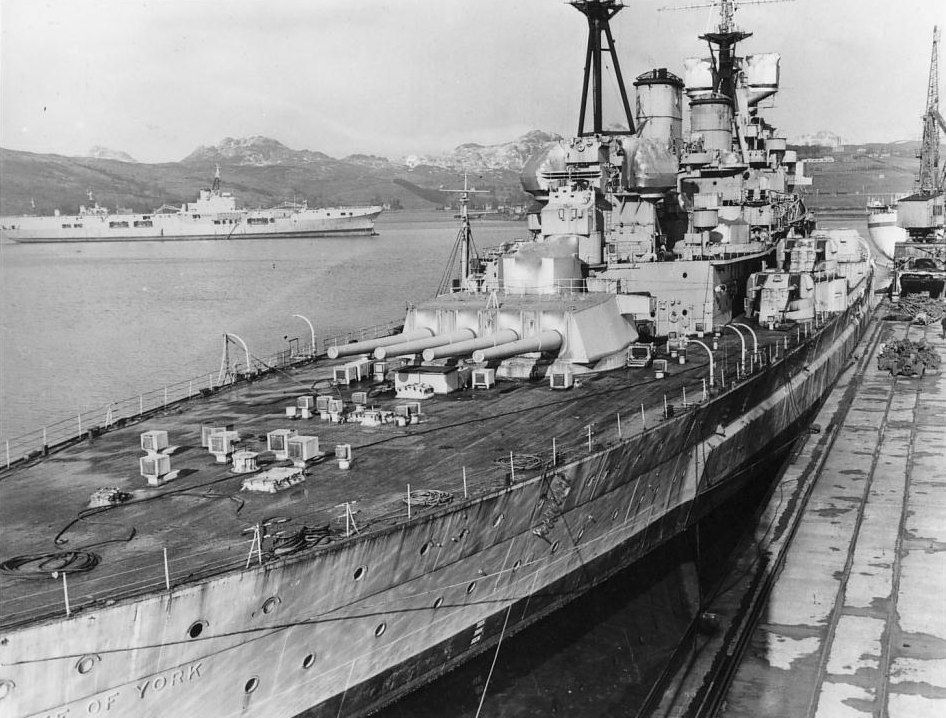
The third ship the Duke of York was laid down 5 May 1937, and launched on 28 February 1940. She was commissioned 4 November 1941. She provided convoy escort for the Lend Lease convoys to the Soviet Union. On December 25th 1943 she and her accompanying cruisers and destroyers sank the  Scharnhorst on 26 December 1943 during the Battle of North Cape. Like King George V and Prince of Wales she also suffered from mechanical failures oof the guns of her main battery. She was transferred to the Pacific in 1944 and served at Okinawa.  She was present  at the Japanese surrender at Singapore. She was decommissioned in 1949 and scrapped in 1957.

Duke of York

The fourth ship of the class the HMS Howe was laid down on 1 June 1937, and launched on 9 April 1940. She was commissioned on 29 August 1942.  She served with the Home Fleet and in the Mediterranean until she was transferred to the Pacific in August 1944. She was stuck and damaged by a Kamikaze in May 1945. Howe was sent for refit at Durban South Africa. She was still in refit when the war ended. She returned home and was placed in reserve in 1950 and scrapped in 1958.

HMS Howe

The last of the class the Anson was laid down 20 July 1937, and launched 24 February 1940. She was commissioned on 22 June 1942. She operated in the Mediterranean and the North Atlantic and was sent to the Pacific in 1945 where she  accepted the surrender of the Japanese Forces at Hong Kong. She returned to Britain and was decommissioned in 1951 and scrapped in 1957.

HMS Anson

For the most part the ships of the King George V Class had rather unremarkable careers for The most part with the exception of the Prince of Wales and King George V in the hunt for the Bismarck and the Duke of York sinking the Scharnhorst. They had a number of technical problems which limited their operations in the war, However, they and their brave crews deserve to be remembered as helping to hold the line against the Axis in the early years of the war and sank two of the four German Battleships lost during the war.  This alone was as remarkable achievement as of their contemporaries, for only the USS Washington, and the heavily modernized battleships sunk or damaged at Pearl Harbor, the USS West Virginia, USS California, and USS Tennessee sank enemy battleships in combat.

The King George V Class suffered serious design flaws, but in the case of their armored casemate and protection from enemy shellfire the were superior to most. Unfortunately, the true measure of their their success and design were never proven. Duke of York sank an overmatched and outnumbered Scharnhorst after her Admiral took too long to remove his ship from danger. Likewise, Prince of Wales was lucky to survive her encounter with Bismarck, and King George V, greatly assisted by HMS Rodney, and a host of cruisers and destroyers backed up by Force H sank Bismarck, which due to a torpedo hit from a Swordfish torpedo bomber from HMS Ark Royal was limited in speed and out of control.

It would have been interesting to see how they would have performed against the Vittorio Veneto Class, the Japanese Nagato, Kongo, or Yamato Class ships, or even the Scharnhorst or Bismarck in an undamaged state. I think they could have easily defeated the Kongo class, but Nagato, and Yamato would have been a different matter.

HMS Duke of York Being Scrapped 

Regardless, I think the King George V Class was a solid design, sadly limited by treaty limitations and the hopes of their government that potential enemies would do the same. Sadly, the Royal Navy even attempted to combine their heavy main battery armament and protection with guided missile and radar developments being made at the same time could have served as command ships of NATO task forces until the 1970s or 1980s. None were over 20 years old when they were sent to the breakers.

Their limitations notwithstanding, they performed excellently in the Second World War. It is sad that none survive today.

Until tomorrow,

Peace

Padre Steve+

4 Comments

Filed under History, Military, Navy Ships, nazi germany, World War II at Sea, world war two in europe, world war two in the pacific

Beautiful, Deadly, and Mostly Forgotten: the French Dunkerque and Richelieu Class Battleships

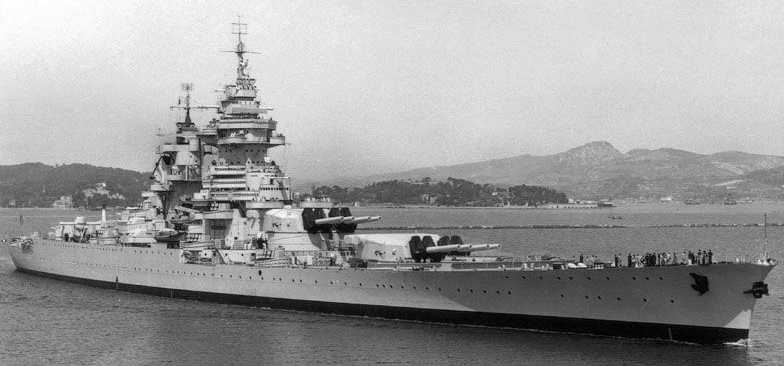
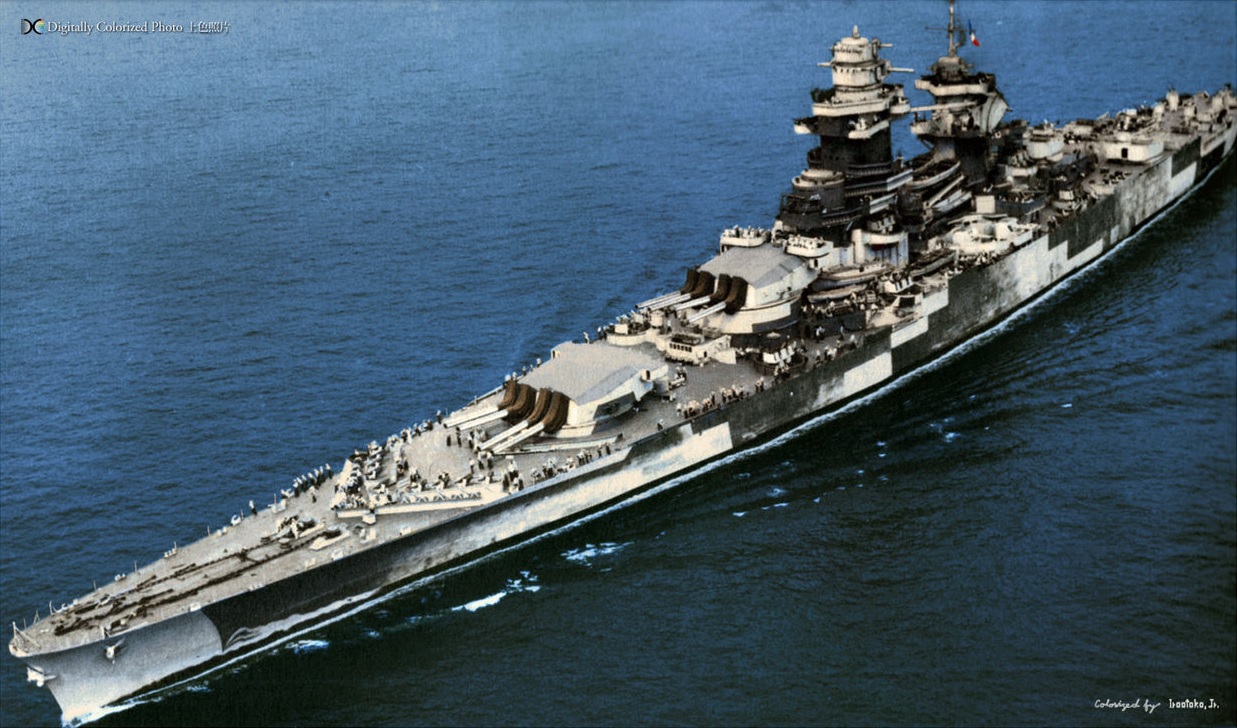
Richelieu in the 1950s © Photo Marius BAR – Toulon (France) site internet : http://www.mariusbarnumerique.fr  

Friends of Padre Steve’s World,

I decided to take another night off from the insanity of President Trump, his response to the novel Coronavirus 19 Pandemic and the rest of the craziness. Tonight I continue writing about the battleship classes developed by the Americans, British, Italians, French and Germans in the 1930s.

The series deals with battleships built under the provision of the Washington and London Naval Treaty limitations in the 1930s. Thus these articles are about the first modern battleships that the combatants built since the end of World War One and its immediate aftermath. The Washington Treaty established limits on tonnage of battleships for the signatories, and instituted a ten year “holiday” on the production of new battleships but set no similar limits on cruisers. The London Treaties limited the size and armament of new battleships, 35,000 tons in displacement and a main armament of 14” guns. The treaty had an “escalation” clause that allowed 16” guns if a signatory was shown to be breaking the treaty.

The first three articles were about the German Scharnhorst Class, the Italian Vittorio Veneto Class, and the U.S. North Carolina Class. This article covers the French Dunkerque class and Richelieu class Battleships. The next articles will deal with the British King George V Class and American South Dakota Class. The German Bismarck, Japanese Yamato, British Vanguard and American Iowa Classes will be covered in a subsequent series.

Dunkerque 1937

In the 1920s the French Navy concentrated on cruiser construction. By the late 1920s it realized the need to develop a class of Fast Battleships to the large Italian Trento Class heavy cruisers and German Deutschland class Pocket Battleships. but was limited by the Washington Treaty to just 70,000 tons which meant that in order to have a number of battleships that they would have to be smaller but still mount a significant armament.

The new Dunkerque class which the French termed Fast Battleships was more like a battle cruiser. They were less heavily armed and armored than existing battleships, as well as the new classes of Battleships being developed by other navies in the mid-1930s.  The Dunkerque class had a designed displacement of 26,500 tons and displaced 35,000 tons at full load. They top speed of 31 knots. Their main battery consisted of eight 13” guns in two quadruple turrets both mounted forward. This allowed all guns to fire forward during engagements to present the smallest possible silhouette to the enemy.  They employed all or nothing armor protection ensuring the strongest protection over vital spaces with their armor designed to protect the ships against German 11” gunfire from the Pocket Battleships or the Scharnhorst Class Battlecruisers. They also mounted a powerful dual purpose armament as the French recognizing the need for effective defense against aircraft as well as surface ships.

Dunkerque Class:


Dunkerque was laid down on 24 December 1932, launched on 2 October 1935 and commissioned on 1 May 1937. Her sister Strasbourg followed and was laid down in 1934 and launched on 12 December 1936 and commissioned in 1939. When war was declared the two ships spent their time operating with the Royal Navy searching for German raiders and to escort convoys.

Strasbourg

When the Germans overran France in June 1940 the ships took refuge at Mers-el-Kibir where with other French Fleet units they were the target of the Royal Navy to keep them from being taken over by the Germans on 3 July 1940. Dunkerque was heavily damaged in the attack and sank with the loss of 210 sailors after being hit by four 15” shells from the Battlecruiser HMS Hood, as well as the Battleships HMS Resolution and HMS Valiant, as well as underwater damage from depth charges from a patrol ship moored next to her which was sunk by a torpedo.

Strasbourg Escaping from Mers-el-Kibir 

However, Strasbourg escaped to Toulon with 5 destroyers where she joined the bulk of the French Fleet in the so called “Free Zone” of Vichy France. She was joined by Dunkerque following the completion of temporary repairs in February 1942.

Dunkerque entered drydock for permanent repairs at Toulon and was there when the Germans occupied Vichy. Under threat of capture the Fleet was scuttled. Dunkerque was destroyed in drydock and declared a total loss. Both the Germans and Italians attempted scrapping operations and the wreck was further damaged by Allied bomber attacks.

The Hulk of the Dunkerque in1944

What was left of the hulk was refloated and finally scrapped in 1958. Strasbourg was scuttled by her crew, but refloated by the Italian Navy in July 1943. After the Italian surrender she taken over by the Germans, but was sunk again during an American air attack in August 1944. After the war she was refloated and used as a test bed for underwater explosions until she was condemned.  She was sold for scrapping in 1955.

Richelieu Class


The Richelieu class was derived from the Dunkerque class in response to the Italian Vittorio Veneto Class.  With a standard displacement of 35,000 tons and a full load displacement of 48,950 tons the ships were the largest built by the French Navy until the commissioning of the Nuclear Aircraft Carrier Charles DeGaulle.

The ships shared the layout of the Dunkerque Class with their main battery of eight 15” guns mounted in quadruple turrets forward which like the Dunkerque’s allowed them to present the smallest silhouette possible to an opposing ship while being able to employ their entire main battery.   Their speed, protection and design were state of the art and comparable to their contemporaries in other navies.  They were capable of 32 knots at full speed and had a cruising range of 7671 miles at 20 knots.

The main battery was spaced far enough apart to ensure that a single hit could not put both turrets out of action and each turret was internally subdivided to prevent a single hit from knocking out all four guns. The mounted 9 6” dual purpose guns in three triple turrets aft and 24 4” AA guns in 12 twin-mounts located amidships.  During the war Richelieu was repaired and refitted in the US receiving 56 40mm Bofors AA guns in quadruple mounts and 48 20mm Oerlikon AA guns in place of her original 37mm cannons and 13.2 inch machine guns.

Richelieu arrives in New York in 1943

Richelieu was laid down in October 1935, launched in January 1939 and began sea trials in January 1940. When the Germans broke through the French defenses and threatened Brest Richelieu put to sea to French North Africa and was commissioned in June at Dakar. She was damaged by an aerial torpedo launched by a Swordfish Torpedo bomber from the HMS Hermes and received emergency repairs in Dakar. On 24 September she fought an engagement against the Royal Navy at the Battle of Dakar and was damaged by two 15” shells fired by the HMS Barham and was further damaged by a misfire in one of her turrets.

Richelieu Following Repairs and Modernizing in the United States 

Following the French return to the Allied camp she was sailed to New York for major repairs and modernization from January to November of 1943. Following this she operated with the British Home Fleet until March of 1944 when she was sent to the India Ocean to serve with the British Far East Fleet in operations against the Japanese until the end of the war. Following the war she took part in the initial stages of the campaign in French Indochina. She was placed in reserve in 1956 and struck from the Navy list and scrapped in 1968.

The Damaged Jean Bart at Casablanca

Her sister Jean Bart was laid down in December 1936 and launched on 6 March 1940.  With the German Wehrmacht approaching Saint-Nazaire she was just  75% complete. Her engines were untested engines and only one of her main battery turrets installed. Likewise, no secondary hard been installed and a few 37mm AA guns and machine guns were mounted to allow Jean Bart put to sea to escape the German advance and sailed to Casablanca.  The navy attempted to ship her second main battery turret on a freighter but that ship was sunk by a U-boat enroute to Casablanca. She was at Casablanca when the Allies invaded North Africa and was attacked by the U.S. Navy when the Vichy government refused to surrender on 8 November 1942.

During Operation Torch Jean Bart was engaged by the Battleship USS Massachusetts and aircraft from the carrier USS Ranger. She was damaged by several bombs and shells from the 16” guns of Massachusetts. She engaged Massachusetts with her one working turret but scored no hits. On the 10th she opened fire on the USS Augusta and was attacked again by aircraft from the Ranger which damaged her so badly that she had to be run aground to prevent her from sinking.

After temporary repairs, she remained in Dakar for the duration of the war. Despite the requests of the French Navy to have her sent to the United States for repairs and completion, the Americans and British did not feel that they needed another fast battleship. So she remained in Dakar for the duration of the war serving as a training ship. Following the war it was suggested that she be converted to an aircraft carrier but that was rejected and she was completed as a battleship and commissioned in 1949, although not completed and placed in active service until 1955. She took part in the Suez crisis of 1956, was decommissioned in 1957 and finally struck from the Navy list in 1969 and sold for scrap in 1970.

Jean Bart in the 1950s

Both the Dunkerque and Richelieu class were ships of unrealized potential due to the French surrender and the deep divisions between the Vichy and Free French governments.  Had circumstances been different they might have played an important role in the Battle of the Atlantic or in the Mediterranean during the war. I wonder how the Dunkerque’s against the Scharnhorst Class would of have came out, or even an engagement of them against the older Andria Doria, and Conte di Cavour Class battleships of the Regina Marina. 

Likewise, I wonder how the Richelieu Class  might have done in open combat with their Italian Vittorio Veneto Class or even the German Bismarck and Tirpitz. Instead they and their brave crews had to battle the Axis powers as well as former allies in circumstances in which all the cards were against them. One of Richelieu’s 15” guns is mounted on the waterfront at Brest as a memorial to these brave ships and the men that sailed them.

These ships were very advanced for their time, but unfortunately they did not get to do what they were designed to do. They were well designed, and compared favorably with almost every class of World War II battleship. The were beautiful tragic reminders that even the best designed warships are products of their times and circumstances. Those that survive war or become obsolescent almost always are determined  to be of no use, and are discarded. Some get reprieves as museum ships, but most end up scrapped or sunk as targets.

Such is the life and death of every warship.

Until tomorrow,

Peace,

Padre Steve+

4 Comments

Filed under History, Military, Navy Ships, World War II at Sea, world war two in europe

The North Carolina Class Battleships: The First of the Modern U.S. Navy Battleships

Friends of Padre Steve’s World,

After spending the time to take two days each to write two detailed articles on issues related to the novel Coronavirus 19 I needed a break. I could have started another COVID 19 article tonight but I needed a break, especially after I listened to today’s COVID 19 Task Force Press conference, which was more of a cheerleading fan rally than anything seriously informative. But I have to leave that here for now, I don’t have the emotional energy to write about it right now, after all there will be plenty of other chances to chronicle this and more.

So tonight I am going back to different classes of naval warships. This is another in a series of six articles on the battleships built under the provision of the Washington and London Naval Treaty limitations in the 1930s. I am not including the ships which were completed in the immediate aftermath of the Washington Treaty limitations. This series looks at the modern battleships that the World War II combatants would produce in the 1930s which saw service in the war. The first deal that the German Scharnhorst class and another covered the Italian Vittorio Veneto class. In between my commentary on current events, as well as the Holocaust, I plan to go back to the French Dunkerque and Richelieu classes, the British King George V class, and the United States South Dakota class. The German Bismarck, Japanese Yamato, British Vanguard and American Iowa classes will be covered in a subsequent series.I will probably write about the battleships that each of these nations planned but either did not complete or never left the drawing board, including  the fantastical German ships of the various H classes.

So until tomorrow, I hope that you enjoy this.

Peace,

Padre Steve+
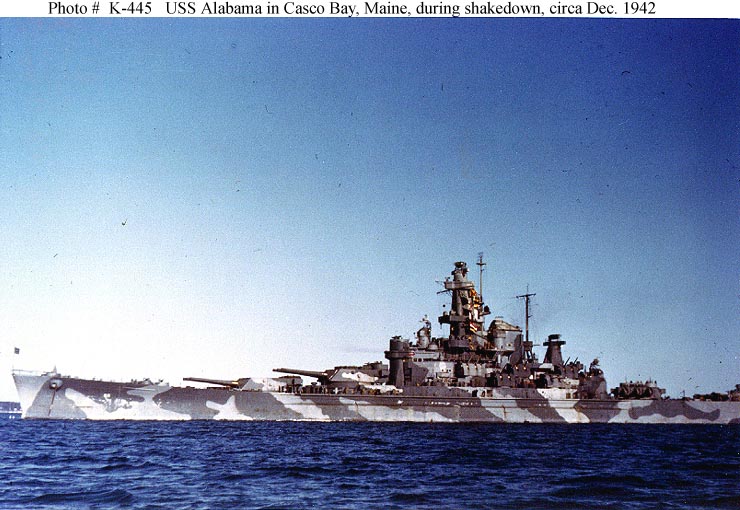
Turret base of USS Washington being lowered into barbet

The United States finished the First World War as the rising economic and potential military power in the world. The British Empire was economically reeling beset by massive debts, heavy loss of life and an empire which was beginning to smell the fresh breezes of independence.  The United States retreated into isolationism and a naïve and unfounded optimism that war could be outlawed while turning its back on the one organization that might have helped bring nations together, the League of Nations. In this environment the United States sponsored the Washington Naval Conference of 1922 which produced the Washington Naval Treaty.  The treaty stipulated limitations on total battleship tonnage, main armament and the maximum tonnage allowed per ship. Ships already in existence could not be replaced until they reached the age of 20 years. A battleship “building holiday” of 10 years was mandated with the major signatories allowed to complete a few ships that were already under construction. Whole classes of new construction were cancelled and many ships under construction were scrapped on the ways or completed only to be scrapped or sunk as targets. The Royal Navy completed two ships of the Nelson Class, the United States completed the 3 ship Maryland Class using a 4th vessel the incomplete USS Washington as a target and the Japanese were allowed to complete two ships of the Nagato Class. The Royal Navy completed the Battleship Eagle and Battle Cruisers Furious, Glorious and Courageous as Aircraft Carriers, the U.S. Navy the incomplete Battle Cruisers Lexington and Saratoga and the Japanese the Battle Cruiser Akagi and Battleship Kaga as carriers. The treaty limits of the Washington Conference were renewed in the London Treaty which also sought to limit the main batteries of new battleships to 14 inch guns.

North Carolina Class 16″ Gun Turret

The U.S. Navy began a study of new designs for a fast battleship class to comply with the treaty restrictions in May to July of 1935.  A minimum of 35 different designs were submitted and reviewed by the Navy and also reviewed by the faculty of the Naval War College. These designed included everything from an improved version of the Standard Type which had culminated in the Maryland Class and the never built South Dakota Class.

The Type VII Design, a Return to the Standard Battleship 

After a considerable amount of debate a design called the Type XVI was selected. The design originally called for twelve 14” guns mounted in three quadruple turrets. Other designs considered called for twelve 14″ guns in triple turrets. When the Japanese opted out of the treaty and the Italians began building the Vittorio Veneto Class with 15” guns the U.S. Navy officially adopted the “escalation clause” and the design was modified to mount nine 16” guns in triple turrets primarily due to the expectation that the Japanese Imperial Navy would mount larger guns in its new ships.

Initial Type XVI design with 14″ guns

The Navy worked to achieve the maximum speed, armament and protection that it could within the 35,000 ton limitations of the Washington and London Naval Treaties. There was debate among Admirals and designers as to how to solve the problem with some factions leaning toward greater speed and lighter armor and armament and others weighing in on a slightly slower ship with greater firepower and protection.

The Type XVI (modified) design original called for a main battery of twelve 14” guns in quadruple turrets, but this was changed to nine 16” guns in triple turrets. The main armor belt was 12” inclined 15 degrees with 16” armor on the turret faceplates and barbets having 16” side armor.  Their conning tower was also protected by 14” armor.  This gave them heavier armor than the Italian Vittorio Veneto Class. They had a lighter belt than the British King George V Class but were afforded more protection to their turrets, barbets and conning tower. Likewise, they had slightly less armor than the French Richelieu class due to the Design of the class which placed all main battery guns forward, using all or nothing armor protection. However, the design was a compromise and the armor could not have protected the ships from 16” shellfire, and there were weaknesses in the anti-torpedo defenses which were shown when North Carolina was torpedoed during the Guadalcanal campaign along with the USS Wasp. 

View of USS Washington Conning Tower showing Mk 38 5″ gun directors and SG Surface Search Radar

Their top speed of 27 knots was slower than their European counterparts but their range was far superior to all being able to steam over 20,000 miles at 15 knots and 6,610 miles at 25 knots. Their top speed and ranged decreased slightly during the war with the addition of more anti-aircraft guns and sensors.

Other designs were considered in the selection process, but most of the designs considered had speeds from 27-30 knots depending on whether the designers sacrificed speed for armament and protection, or protection and firepower for speed. One design, the Type VII resembled earlier classes of battleships with a speed of only 23 knots in favor of much heavier protection on a shorter hull.

USS North Carolina BB-55

The North Carolina Class was comparable in many ways with the Japanese Nagato Class in speed, protection and armament, but they had a far greater cruising range which made them excellent for operations in the Pacific either parts of Fast Carrier task forces, the Battle Line of the Third or Fifth Fleet, or centerpieces of surface action groups.

The North Carolina’s also were superior to their contemporaries in their anti-aircraft armament as well as their electronics, radar and fire direction suites which were all continuously upgraded throughout the war.

The construction of the ships was slow due to material shortages in the late 1930s. Likewise, the design change to 16” guns from the original 14” guns, as well as labor issues which not only lengthened the time of their construction and raised their cost from $50 million to $60 million dollars each.

North Carolina during underway replenishment in the Pacific

USS North Carolina was laid down on 27 October 1937, launched on 13 June 1940 and commissioned 9 April 1941. However, it was months before she was operational due to severe longitudinal vibration of her propeller shafts which was corrected by a modified propeller design.  Despite the efforts to keep to the treaty limitations the ships displaced 36,600 long tons and had a full load displacement of 44,800 long tons. By 1945 the ships full load displacement had increased to 46,700 long tons for North Carolina and 45,370 long tons for Washington.

Torpedo Damage to North Carolina

When North Carolina completed her shakedown cruise she was sent to the Pacific where she joined Task Force 16 and the USS Enterprise on 6 August 1942.   She defended Enterprise during the Battle of the Easter Solomons on 24 August and during an 8 minute period she shot down between 7 and 14 Japanese aircraft. On 15 September she was badly damaged by a torpedo from the Japanese submarine I-15 which necessitated her withdraw to Pearl Harbor for repairs.

The gravity of the damage from the hit sparked great debate in the Navy regarding her protection with some wondering if too much had been sacrificed in her design, despite this no modifications were made to the ships of the Iowa class.

Upon her return to service she operated with TF 38 and TF 58 protecting the carrier task forces in their operations against the Japanese as well as with TF 34 the Fast Battleship Task Force under the command of Vice Admiral Willis Lee.  Serving throughout the Pacific campaign she took part in every major operation in the Central Pacific except Leyte Gulf and against the Japanese mainland.  Her Marines and Sailors took part in the initial occupation of Japan.  She was decommissioned and placed in reserve on 1 June 1960 and survived scrapping to be bought by the State of North Carolina for $250,000 and turned into a memorial at Wilmington North Carolina.  She remains a National Historic Landmark and is maintained by the USS North Carolina Battleship Commission. She is exceptionally well maintained and much of the ship is open for tours.

USS Washington BB-56 on high speed run in 1945

The USS Washington was laid down 14 June 1938 launched on 1 June 1940 and commissioned 15 May 1941 though like North Carolina had propeller shaft vibrations which delayed her operational availability.  She became the first U.S. Navy Battleship to take an active part in the war when she joined the British Home Fleet in March 1942 operating with the Royal Navy escorting Arctic convoys bound for the Soviet Union against possible forays of the Battleship Tirpitz and other heavy German surface units until 14 July when she returned to the United States for a brief overhaul.

Following her overhaul, Washington was deployed to the South Pacific to join U.S. Forces operating against the Japanese at Guadalcanal and became the Flagship of Rear Admiral Willis Lee.  During the Naval Battle of Guadalcanal on the night of 14-15 November she and the USS South Dakota sailed with 4 destroyers to intercept a Japanese task force.  The Japanese force led by the Battleship Kirishima included 2 heavy and 2 light cruisers as well as 9 destroyers.  The Japanese hit the Americans hard early in the battle sinking 3 of the 4 American destroyers and inflicting significant topside damage to South Dakota which caused a power outage and knocked her out of the action.  Washington sailed on undetected by the Japanese and opened a devastating barrage against Kirishima. Washington scored hits on Kirishima with at least 9 of her 16” shells and over 40 5” shells. Kirishima was mortally wounded. despite the best attempts of her crew to save her, she was scuttled the following day. After mauling Kirishima, Washington then drove off the other Japanese ships sparing Henderson Field from certain heavy damage.

Washington blasting Kirishima at the Naval Battle of Guadalcanal 14-15 November 1942

Washington’s victim the IJN Battleship Kirishima

Washington continued operations in the South and Central Pacific until she was damaged in a collision with USS Indiana which resulted in her losing nearly 60 feet from her bow on 1 February 1944. She received temporary repairs before returning to the Puget Sound Naval Shipyard to receive a new bow and other modernizations returning to action in May 1944. She remained in operation against the Japanese the rest of the war. She was decommissioned in 1947 and struck from the Naval Register on 1 June 1960 and sold for scrap.

North Carolina and Washington in Reserve

Various improvements and ideas were suggested while the ships remained in reserve as some in the Navy wished to reactivate them to include lightening them to increase their speed, and conversion into Helicopter Carriers all of which were rejected. The rejection of these attempts to modernize and recommission the ships ensured their fates.

Fireworks over the North Carolina in Wilmington (US Navy Photo)

Though the North Carolina class was a compromise design they performed admirably throughout the war.  They and their brave crews are remembered in Naval History and the preservation of North Carolina has ensured that they will never be forgotten.

6 Comments

Filed under historic preservation, History, Military, Navy Ships, US Navy, World War II at Sea, world war two in the pacific

The Vittorio Veneto Class Battleships: The Pride of Italy and Victims of Changing Technology


Vittorio Veneto and Littorio

Friends of Padre Steve’s World,

Once again I have decided to destress and not write about COVID 19, politics, or the Holocaust and instead write about an interesting, and even fascinating class of warships which have been often forgotten.

This is the first in a series of six articles on the battleships built under the provision of the Washington and London Naval Treaty limitations in the 1930s. I am not including the ships which were completed in the immediate aftermath of the Washington Treaty limitations. This series looks at the modern battleships that the World War II combatants would produce in the 1930s which saw service in the war.

Part one covers the Italian Vittorio Veneto class, Part Two the French Dunkerque and Richelieu Classes, Part Three the British King George V Class and Part Four the American North Carolina and South Dakota Classes. The thing that I find interesting about all of these ships is who inventive each Navy building them was considering treaty restraints and their own adherence to, disregarding of, or the technical issues that they faced as none had designed or built a new battleship since the end of the First World War. In the case of Italy they did not even complete their most modern design after the war, thus the building of large and fast battleships was something new to each party. Had the economic effects of the First World War been so difficult, and the following Great Influenza of 1918-1919 so devastating, all of the navies involved might have completed ships that would have influenced the next generation.

I have already published the final part which covers the German Scharnhorst Class entitled Power and Beauty the Battle Cruisers Scharnhorst and Gneisenau The German Bismarck, Japanese Yamato, British Vanguard and American Iowa Classes will be covered in a subsequent series.

Most of these ships were constructed after the expiration of the treaties, but since most of the navies at least attempted to maintain a façade of compliance with the treaty limitations, most were officially listed as complying with the treaty restrictions. The fact that nations frequently lie about their adherence to treaty limitations, is nothing new, or surprising.

The Washington Naval Treaty placed a limit on the displacement and armament of battleships. It also stipulated the tonnage of capital ships allowed for each Navy, as well as limits on the displacement of cruisers, and destroyers. The only country not effected by the treaty was Germany, which until 1935 was required to observe much stricter limitations than Great Britain, the United States, France, Italy, or Japan.

The Washington Naval Treaty led to the scrapping or cancellation of nearly all the super Dreadnoughts, and fast battleships, sometimes known as Battlecruisers of the United States, Great Britain, Japan, France, and Italy. However, its restrictions opened up the development of large aircraft carriers by the United States and Japan which each were allowed to complete two of their new battleships or Battlecruisers into aircraft carriers, specifically the IJN Akagi and Kaga, and the American USS Lexington and Saratoga.

The London Treaty continued the restrictions of the Washington Treaty which limited the displacement of new ships to 35,000 tons with the main battery being limited to 16” guns. Each of the treaty signatories as well as the Germans, who were bound by the much more stringent Treaty of Versailles restriction, endeavored to build to the limit of the treaty and if possible skirt the limitations in terms of displacement which allowed them to increase protection as well as more powerful engineering plants. The Germans, now Hitler’s Third Reich, were aided in this by a bi-lateral Naval Agreement with Britain in 1935. The treaty not only allowed them a legal way to avoid the Versailles restrictions and gain international respect.

The Royal Italian Navy, or the Regia Marina had not completed a battleship design since the Andria Doria Class which were constructed between 1912 and 1915. These ships were provided  an extensive modernization between 1937 and 1940.  The modernization allowed them to serve as first line ships throughout the war. A subsequent class the Francesco Caracciolo class was started during the First World War but no ships of the class were completed. Italy’s war debts, overall financial condition, as well as the similar situation of the French, Italy’s main rival in the Mediterranean Sea, ensured that the Regina Marina had little money for new ships or modernizing old ships during the 1920s and 1930s. Even the accession of Mussolini did little to help the Navy until the 1930s. Even then competing ideas of how to build a new Navy were present in the Italian Naval High Command. Some placed their emphasis on large numbers of battleships, others a mix of aircraft carriers, fast battleships, cruisers and destroyers, while other sought a middle ground.

However, the Italians were forced to act as in the 1930s a new naval arms race was underway in the Mediterranean. The French Navy had begun a new class of Fast Battleships, the Dunkerque class which were designed to defeat the German Deutschland class “pocket battleships” and the follow on Richelieu Class of fast battleships. Mussolini saw the new French ships as a threat to the his control of the Mediterranean, or as the Italians and their Roman ancestors called it Mare Nostrum (our Sea), and ordered the construction of a new class of battleships to help Italy achieve naval dominance in the Mediterranean.

The new ships were of a breathtaking design. They were  large, fast and heavily armed. While they were officially listed as meeting the prescribed treaty limit of 35,000 tons they actually would displace 41,177 tons standard displacement, and 45,963 tons full load. They were armed with a main battery of 9 15” L/50 guns in triple turrets. They had a secondary armament of 12 6” and 12 3.5” dual purpose guns, and a powerful light anti-aircraft battery of 20 37mm and 30 20mm anti-aircraft guns. They were capable of a top speed of 30 knots. Although they had a relatively short range of 3900 miles at 20 knots, they were formidable ships for operations in the constrained waters of the Mediterranean where they would not be required to operate at long ranges from Italian bases in Italy, Sicily, or Libya. They were well protected from shellfire, although their Pugliese torpedo defense system proved inferior to traditional designs, because it did not hold up well to direct hits, or close aboard explosions which resulted in massive flooding when hit by a torpedo or by a near miss from a heavy bomb or shell.

Their main armament though formidable was not without its flaws. The 15” guns had a very long range of 42 km or 26.6 miles and high muzzle velocity of 2900 fps. This meant that they had a long reach, however, their high muzzle velocity led to a barrel life of only about half that of their counterparts, and led to inconsistent shell fall patterns, which lessened to probability of hitting targets at long range. The guns also suffered from a slow rate of fire of only 1.3 rounds per gun a minute.

The Ships

Vittorio Veneto in 1943

The Vittorio Veneto was laid down 1934 along with her sister the Littorio, and was launched on 25 July 1937. She was commissioned on 28 April 1940, barely a month before Italy declared war on France and Britain. She would see action numerous times and give a good account of herself against the British taking part in 56 war missions. She fought at the Battle of Cape Spartivento (Teulada) where she fired 19 salvos to drive off a 7 ship British cruiser squadron in a pitched battle that also included the battleship HMS Ramillies and battle cruiser HMS Renown. In 1941 she took part in the Battle of Cape Matapan where she was damaged by an aerial torpedo after driving off a British cruiser squadron. After repairs she was back in action and on 15 June 1942 participated in the Battle of Mid-June, where she and her sister ship Littorio successfully fenced off a large British convoy from Alexandria by their mere presence at sea.  She was also the first Italian battleship equipped with radar. She surrendered with the Italian fleet to the Allies on 8 September 1943 surviving furious German air attacks. She was interred at the Great Bitter Lakes in the Suez Canal. After the war she taken as war compensation and was returned to Italy and scrapped beginning in 1948.


Littorio

Littorio (later Italia): Littorio was laid down in 1934 and launched on 22 August 1937 and commissioned on 6 May 1940.  She participated in 43 operations including the Battle of Sirte and several actions against British convoys.  Following the Battle of Mid-June she was struck by an aerial torpedo dropped by a Wellington bomber. She was repaired and upon the removal of Mussolini from power was renamed Italia and surrendered with the Italian Fleet on 8 September 1943 being damaged by a Fritz-X radio controlled bomb. With her sister the ex Vittorio Veneto, now Italia, she was interred in the Great Bitter Lake and was returned to Italy where she was decommissioned and scrapped beginning in 1948.


Roma

 Roma was laid down 18 September 1938, launched on 9 June 1940 and commissioned 14 June 1942.  Despite her addition to the fleet she was not deployed due to a fuel shortage. She sailed with the Italian Fleet to surrender on 8 June under the guise of the fleet sailing to attack the Allied invasion fleet off Salerno. The Germans discovered the ruse and the Luftwaffe launched air attacks against the Italian Fleet. Luftwaffe Dornier Do-217s armed with Fritz-X radio controlled bombs attacked the fleet as it transited the Strait of Bonafacio.


Roma exploding after being hit by Fritz-X radio guided bomb 

Roma was hit by two of the missiles the first which flooded two boiler rooms and the aft engine room.  She was hit again by a second Fritz-X which hit in the forward engine room causing catastrophicdamage. The explosions ignited the number two turret magazine blowing the turret off the ship and causing the ship to capsize and break in two. She sank, carrying 1255 of her crew including Admiral Carlo Bergamini to their death. Roma was the first ship sunk by a radio controlled bomb, the forerunner of our current air launched anti-ship missiles. In the years since, lightly constructed surface ships have not faired well against air or sea fired anti-ship missiles.


The Fritz-X Radio Guided Bomb

The fourth and final ship of the Class, Impero, was was laid down and launched, but never completed. When Italy surrendered the Germans used her incomplete hull as a target sinkinrn her. She was raised and scrapped after the war.

Impero Being Launched in 1939

The Vittorio Veneto class was a sound design and operationally successful against the Royal Navy. Her design was explored by the Soviet, Dutch, and Spanish navies in their attempts to build moderner battleships or battlecruisers, although none came to fruition. The fact that the two surviving ships, as well as the newest most modern were scrapped was a travesty as the Cold War began. Their loss left Italy with the remaining two Andrea Doria class battleships, completed in 1915 and 1916 as the battle force of the Italian Navy, until they were scrapped in the late 1950s and early 1960s.

The brave sailors of the Regina Marina who manned these fine ships should not be forgotten.

Until tomorrow,

Peace,

Padre Steve+

1 Comment

Filed under History, Military, national security, Navy Ships, nazi germany, World War II at Sea, world war two in europe

Swift and Deadly, the Japanese Fubuki Class “Special Type” Destroyers


IJNS Fubuki

Friends of Padre Steve’s World,

Tonight something different, once again going back to write about important classes of Navy ships. I will continue doing this whenever I need a break from mass deaths, politics, and trying to inject reason into the vacuous minds of so many Americans about COVID 19.

The Imperial Japanese Navy set the standard for new destroyer construction in the 1920. While the United States Navy and British Royal Navy were fully stocked with their First World War design destroyers the Imperial Navy’s General Staff issued a requirement for a class of large destroyers which would complement the new classes of modern cruisers being built for the navy. There was nothing wrong with their existing destroyers of the Minekaze, Wakatake, Kamikaze, and Mutsuki classes, many of which continued to serve in secondary roles in the Second World War as escorts for convoys and invasion groups.  They were the equals of contemporary British and American destroyers, but the Imperial Navy’s long range plan required larger, faster, more powerful and longer range destroyers.

The Navy requirement called for a 2000 ton ship capable of 39 knots with a 4000 mile range at 14 knots, that could carry a large number of torpedoes and a heavy gun armament. The program was designed to give the numerically inferior Imperial Navy a qualitative superiority against any opponent. The ships displaced 1750 tons, but even then their displacement limited  their top speed to 35 knots, not the specified 39 knots.


WWII Office of Naval Intelligence images for Fubuki Class variants

The 24 ship Fubuki Class was such a quantum leap over other contemporary destroyers that the Imperial Navy referred to them as the Special Type. Their large size, heavy armament and high speed made them equal to many light cruisers of the era.

The basic design was modified to carry more guns and torpedoes on an increased displacement and the result was a 388 foot long 1750 ton ship armed with six 5” 50 caliber guns in weather proof and splinter proof mounts.  On the initial 10 ships of the class the guns could only be elevated 40 degrees which made them less than effective in an anti-aircraft role. However, in the succeeding two groups of the class, the 5” mounts were an improved type which allowed them to elevate each gun separately up to 75 degrees.  The ammunition magazines were below the gun mounts and ammunition was passed to the guns by hoists.  This gave them a decided edge in rate of fire over other destroyers which had open or partially shield mounts dependant on ammunition passers carrying ammunition to them from central magazines.


Close up of IJNS Sagiri

As built the light anti-aircraft armament composed of two Type 93 13mm machine guns. In the years before the war, and during the war their anti-aircraft was increased in some cases up to twenty-two 25mm anti-aircraft guns and 10 of the Type 93 machine guns. In 1944 surviving ships of the class had their X- 5” gun mount removed to facilitate more 25mm guns, radar and an additional depth charge capacity.


IJNS Ikazuchi

The nine 24” torpedo tubes in triple mounts were able to be reloaded while in battle a capability not shared by other destroyers.  The ships carried a total of 18 torpedoes which initially were of the Type 8 torpedos carried on earlier destroyers. However, these were replaced by the oxygen powered Type 93 “Long Lance” torpedoes before the war. These torpedoes had a higher speed, longer range and heavier warhead than torpedoes produced by other navies.  The deadly Long Lance torpedoes would become the scourge of Allied navies during the war, especially during the brutal surface engagements of 1942.


IJNS Yugiri

Due to the added weight their increased armament made to the design unstable in heavy seas, and a longitudinal hull weakness that necessitated in the class being rebuilt between 1935 and 1937. The rebuild increased their displacement to 2050 tons standard and to over 2400 tons full load. The increase in displacement resulted in a slight reduction of speed.


IJNS Hibiki

The class was built in three groups, and each is sometimes referred to as a separate class as each incorporated improvements over the preceding group. The first 10 ships of the class which are sometimes referred to as the Fubuki Class were of less complex design than subsequent ships. Their overall length was 388 feet, with a beam of 34 feet, and draft 10.5 feet. They had a smaller bridge and exposed gunfire control room than the next two groups.

The second group of 10 ships are commonly referred to as the Ayanami Class. The group had an enlarged bridge structure which enclosed previous exposed positions to include the gunfire control room, and  range finders. They were also provided a range finder tower.  They were the first ships to receive the improved Type B gun mounts.  The final subtype of the class, the Akatsuki Class comprised just 4 ships and was distinguished by a smaller forward funnel, larger boilers and a unique splinter proof torpedo tube mount housing.


IJNS Ayanami

The ships of the class participated in every major campaign of Japan’s war in the Pacific as well as operations against China in the 1930s.One ship the Miyuki was lost in a collision with another destroyer in August 1934.

All remaining ships of the class  served with distinction throughout the war, especially during the Battle of the Java Sea and operations around Guadalcanal and the Solomon Islands and the Aleutians  from 1941-1943. The participated in the sinking of the heavy cruisers, USS Houston, HMS Exeter, and the light Cruiser HMAS Perth, a number of destroyers, submarines, patrol ships and auxiliaries, while providing escort to carrier task forces, surface groups, and convoys. The Ikazuchi and Inazuma were noted for their rescue and humanitarian treatment of allied sailors, including those of the USS Pope during the Battle of the Java Sea. No ship or crew of the class was ever accused of committing war crimes or mistreating prisoners of war or other survivors of Allied ships.

All of the ships of the class except the Hibiki and Ushio were lost in action during the war. Four the Fubuki, Ayanami, Yuguri and Ataksuki were sunk in surface actions. Eight ships the Usogumo, Shirakumo, Isonami, Shikinami, Sagiri, Sazanami, Inazuma, and Ikazuchi were lost to Allied submarines.  Seven ships the Shirayuki, Hatsuyuki, Murakumo, Uranami, Asagiri, Oboro and Akebono were sunk by aircraft and two the Shinonome and Amagiri fell victim to mines.

The demilitarized IJNS Ushio after the war

Hibiki was given to the Soviet Union following the war and served in that Navy until either 1953 or 1963 depending on the source. She was used as a target and sunk in the 1970s near Vladivostok and her wreck is now a tourist site for divers. Ushio surrendered to the Allies was demilitarized, assisted in the evacuation of Japanese forces from conquered areas, and then scrapped in 1948.

As a sidebar, the  Amagiri played a role in the life of future President John F Kennedy when she rammed and sank his PT-109 in the Blackett Strait on August 2nd 1943. Her commanding officer at the time Lieutenant Commander Kohei Hanami attended Kennedy’s inauguration in 1961. Even before Kennedy ran for the Senate Hanami wrote to Kennedy expressing his admiration. Kennedy’s daughter Caroline met Hanami’s widow in 2015 and invited her to the christening of the USS John F. Kennedy CVN 79. 

The Fubuki Class destroyers set a standard in destroyer construction that other navies around the world sought to emulate. Fast and powerful they and their crews fought gallantly in the Second World War and though in a losing cause deserve to be remembered.

Peace,

Padre Steve+
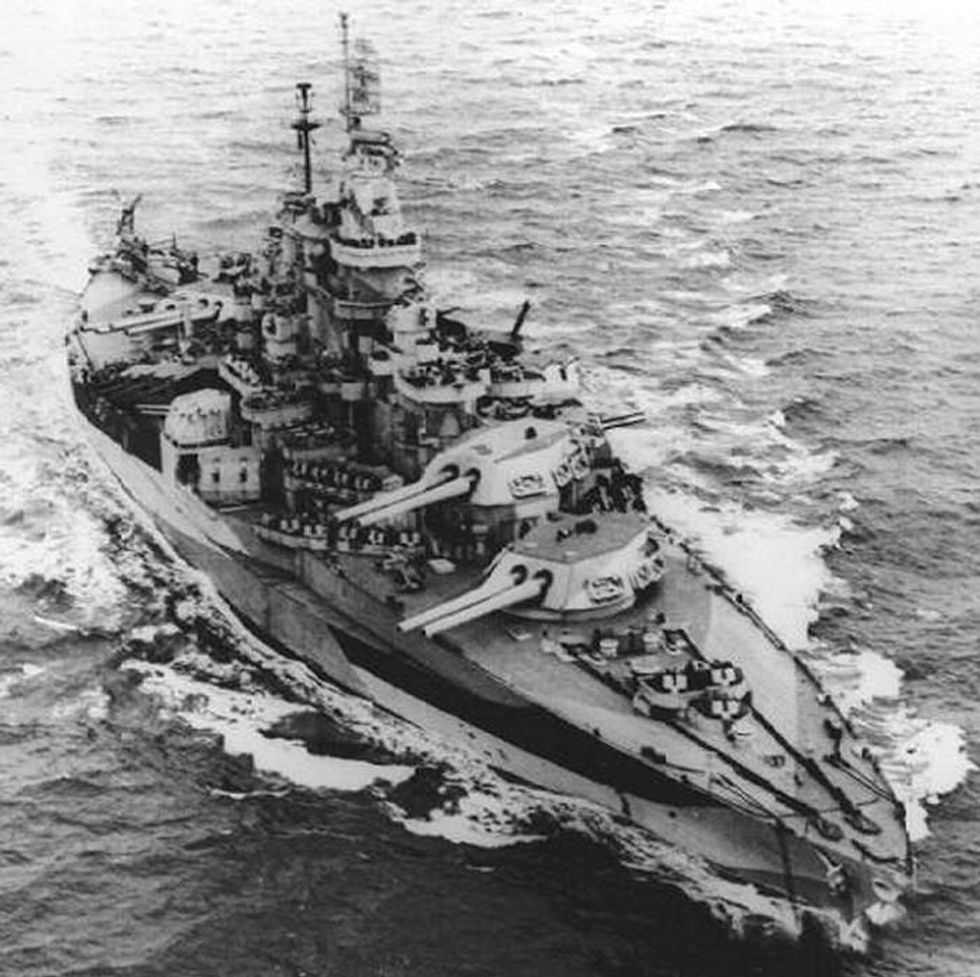
Leave a comment

Filed under History, imperial japan, Loose thoughts and musings, Military, Navy Ships, US Navy, US Presidents, World War II at Sea, world war two in the pacific

Power, Beauty and Tragedy at Sea: The Battlecruisers Scharnhorst & Gneisenau

Scharnhorst

Friends of Padre Steve’s World,

I was too tired last two nights to write anything. Thursday I had a long but good day at work and had to clean out much of my private email last night before I could do anything else because I was at over 90% of my email storage capacity. And it took forever to sort through it and get it down to almost 50%. Likewise, I did very little on social media. I finally caught up on my comics from the last couple of days and replied to some correspondence that I needed to do and began to work on this last night, but again found that I was too tired to complete it. So when it appeared that I wouldn’t complete it until after midnight I simply said “what the hell” and put it off until now.

This is another one of those posts to switch things up and write about a class of warships that I find fascinating, the World War II German Battlecruisers, Scharnhorst and Gneisenau. First and foremost I think that they were among the most beautiful capital ships ever built. That doesn’t mean that they didn’t have design flaws, or were superior to many other capital ships. Gneisenau’s career was cut short by Germany’s inability to protect her while in port, while Scharnhorst was the victim of an ill planned sortie under the command of an admiral who had no experience commanding large ships and who had only assumed command of her task force the day before. So if you are a Naval history or warship  buff, enjoy.

Have a great day, stay inside and if you have to go out wear a mask and keep a safe distance from others to protect you and them.

Peace,

Padre Steve+


The naval architects of Germany in the early 1930s designed some of the most beautiful as well as deadly warships of the Second World War.  Following Nazi Germany’s rejection of the provisions of the Treaty of Versailles the Kreigsmarine enacted building program to enlarge and modernize the German Navy.

Gneisenau refueling  from Tanker Westerwald in July 1939 

The first major units constructed were actually begun by the predecessor to the Kreigsmarine, the Reichsmarine of the Weimar Republic.  These were the Deutschland class Armored Ships, Panzerschiffe, sometimes called “Pocket Battleships” and later during the war were reclassified as Heavy Cruisers. These ships were designed to replace the old pre-Dreadnaught battleships which Germany was allowed to retain following the Treaty of  Versailles. The ships incorporated electric welds to reduce displacement, diesel engines for extended cruising range to enable them to serve as commerce raiders and a battery of six 11” guns. It was believed that as surface raiders their speed would allow them to avoid battle with all existing battleships except the three British Battlecruisers Hood, Renown, and Repulse, while being able to outgun any heavy or light cruiser they might encounter on such a mission. While they were an advance over anything in the German inventory they were outclassed by Hood, Renown and Repulse, as well as later French Dunkerque and Strasbourg. 

Gneisenau

The next and first truly capital ships built by the Kriegsmarine were the Scharnhorst and Gneisenau battleships which in reality were battle cruisers because of their light main battery of 11” guns as opposed to the 14”, 15” or 16” batteries of other nations battleships. The Hermans did. plan to rearm them with 15” guns but the war kept that from happening.

Scharnhorst before the War 

Despite the disparity in their main armament, their displacement and armor protection was comparable to other battleships of the era and their designed speed of 31.5 knots was superior to almost all other battleships of the era including the British King George V Class and the US North Carolina class.  Only the British Hood was superior to them in speed. However, their speed came at a cost, they did not have the long cruising range to make them truly effective commerce raiders because they were propelled by steam turbines which consumed large amounts of fuel. Since the Germans did not have a fleet replenishment system like the U.S. Navy, nor the secure network of worldwide bases of the Royal Navy, they could only operate in the Northern Atlantic or Arctic for limited amounts of time. If damaged there were few safe harbors for them which had the capability of repairing them without them being exposed to allied bombers.

Gneisenau Main Battery

As built they displaced 31,000 toms, however at full combat load they both weighed in at nearly 38,000 tons and were 772 feet long.  They had an armor belt that was nearly 14 inches thick.  Armed with a main battery of nine 11” guns and a secondary armament of twelve 5.9 inch guns they also mounted a powerful for the time anti- aircraft battery of fourteen 4.1 inch guns, 16 37mm and 16 20mm anti-aircraft cannons.  Additionally they mounted six 21” torpedo tubes and carried three Arado 196 A3 scout planes.  The main battery was eventually to be replaced by six 15” guns but this never occurred although Gneisenau was taken in hand after being damaged in Operation Cerberus to mount the new weapons but the conversion was never completed.

Scharnhorst in Action Against HMS Glorious

Scharnhorst was laid down on 15 June 1935 and launched 3 October 1936. She was commissioned 7 January 1939.  Her sister Gneisenau was laid down 6 May 1935, launched 8 December 1936 and commissioned 21 May 1938.  Upon the commencement of the Second World War the two sisters began a reign of destruction on British shipping in the North Atlantic. On 23 November 1939 they sank the Armed Merchant Cruiser HMS Rawalpindi while on patrol near the Faroe Islands.

During Operation Weserübung the pair surprised sank the aircraft carrier HMS Glorious and her two escorting destroyers HMS Ardent and Acasta on 7 June 1940. It was the only time a Fleet carrier was caught and sunk by battleships during the war. However, Scharnhorst was hit by a torpedo from Acasta which led to her being withdrawn to Trondheim, for temporary repairs before retiring to Kiel for permanent repairs.

Scharnhorst during Operation Berlin and being Refueled during the Operation

From January to March 1941 they conducted Operation Berlin under the command of Admiral Gunther Lütjens against British merchant shipping in the North Atlantic sinking 22 ships before returning to base. During the action the task force encountered the British Battleships HMS Ramillies and HMS Malaya escorting different convoys which Lütjens refused to engage. After sinking ships from another convoy they encountered HMS King George V and HMS Rodney which they escaped using their superior speed, but by now, Lütjens realize that the danger of continuing the outweighed the potential success and headed for repairs in the port Brest, in occupied France.

While in Brest Scharnhorst needed repairs to a superheater for her boilers, while Gneisenau was damaged during a British air raid and were unable to deploy with Bismarck and Prinz Eugen for Operation Rheinübung, during which Bismarck sank HMS Hood, but was damaged by a 14” shell from HMS Prince of Wales which cut the fuel line from the ship’s forward fuel tanks. Lütjens decided to cut the mission short and escape to Brest, but was damaged by an aerial torpedo from a Swordfish torpedo bomber flying from HMS Ark Royal which wrecked her steering gear and allowed HMS King George V, HMS Rodney, as well as cruisers and destroyers to catch and sink her on May 27th. Prinz Eugen returned safely to Brest to join the Battlecruisers.

The Channel Dash Seen from Prinz Eugen above and below


                          Admiral Cilliax Addressing the Crew of Scharnhorst at Kiel

While at Brest Gneisenau was again bombed and torpedoed requiring extensive repairs.  Due to the exposed location of the port, the German high command decided to return the ships to Germany along with the Heavy Cruiser Prinz Eugen.  Commanded by Vice Admiral Otto Ciliax,  Operation Cerberus took place from 11-13 February 1942. It involved the Battlecruisers and Prinz Eugen, accompanied by destroyers, E-Boats, and R-Boats. The force was protected heavy Luftwaffe fighter cover, Code named Operation Donnerkeil the air operation was commanded by the legendary Luftwaffe fighter ace, General Adolf  Galland. 

The dash up the English Channel, was unsuccessfully contested by the Royal Air Force and Royal Navy. The German ships successfully broke through the Channel in broad daylight and protected itself from being damaged by aircraft, motor torpedo boats, destroyers, and shore batteries. Once clear of the channel and headed for home both Scharnhorst and Gneisenau struck mines which caused various amounts of damage, but both got through to Kiel.

The success of the daylight passage through the English Channel shocked and infuriated the British public. The Times of London published an editorial on 14 February which fumed:

Vice Admiral Ciliax has succeeded where the Duke of Medina Sidonia failed. Nothing more mortifying to the pride of our sea-power has happened since the seventeenth century. […] It spelled the end of the Royal Navy legend that in wartime no enemy battle fleet could pass through what we proudly call the English Channel.

Despite the fact that then Operation was successful, the high command of the German Navy Their breakthrough was an embarrassment to the Royal Navy and Royal Air Force. The high Command of the German Navy considered it a tactical victory but a strategic defeat, for it had traded a base, albeit exposed from which it could conduct offensive operations, to the defense of Norway, a mission of dubious value at best.

                                    Gneisenau after being Bombed in Floating Dry Dock

While undergoing repairs in a floating dry dock at Kiel Gneisenau was heavily damaged by the Royal Air Force on the night of 26-27 February. The damage was such that the Kriegsmarine High Command decided to elongate her damaged bow section and rearmament to replace her main battery with 15” guns. Once seaworthy she steamed to the port of Gotenhafen for full repairs and rearmament. Although some work was completed the conversion was halted by Hitler who was infuriated by the failure of a German Task Force at the Battle of the Barents Sea, 30-31 December 1942. Hitler fired Grand Admiral Erich Raeder, and and gave an order to scrap what remained of the German surface fleet and concentrate on the U-Boat war. Admiral Karl Donitz prevented the scrapping of the fleet, but most ships were laid up and their crews reassigned to provide crews for U-Boats. Gneisenau was disarmed with her 11” and twin 5.9” removed and installed along the Atlantic Wall. One triple 11” turret, either Bruno or Dora was installed as part of a coastal defense battery in Norway. The battery was taken over by the Norwegians after liberation and remained in commission as Austrått Fort until 1968. Since then it has become a well preserved museum.

When the Red Army approached Gotenhafen her remaining crew moved her to the harbor entrance and sank her as a block ship on 27 March 1945.  Following the war she was raised by the Poles and scrapped in 1951.

Gneisenau Sunk as Blockship 

Turret of Gneisenau at Austrått Fort Norway


Scharnhorst was repaired following Operation Cerberes and in March 1943 was transferred to Norway where along with Tirpitz, Admiral Scheer, Lutzow (the former Deutschland), Admiral Hipper and Prinz Eugen she became part of a “fleet in being” poised to strike the Allied convoys bound for Russia. On Christmas Day 1943 under the command of Rear Admiral Erich Bey the Scharnhorst set sail with several destroyers undertook Operation Ostfront and the ensuing battle became known as the Battle of North Cape. The mission was an attack on two Russia bound convoys. But the orders were intercepted and decoded by the British. Admiral Bruce Fraser planned a trap to intercept and neutralize Scharnhorst. 

Once Scharnhorst sailed the battleship HMS Duke of York, four cruisers and a number of destroyers as she closed on the convoy. However, due to the sea conditions Bey detached his escorting destroyers and ordered them to return to port.  Duke of York and her supporting cruisers and destroyers engaged Scharnhorst. Bey now realized he had no chance of destroying the convoy and attempted to escape.  However, Scharnhorst was damaged and her speed and maneuvering capabilities impaired.  Now virtually defenseless and surrounded the great ship was sunk with the loss of all but 36 of her 1968 man crew. Her wreck was discovered 3 October 2000 some 70 miles north of North Cape Norway.

Sinking of Scharnhorst by Charles Turner ( c) National Maritime Museum; Supplied by The Public Catalogue Foundation

Survivors of Scharnhorst debark in England 

Thus ended the careers of two of the most beautiful battleships ships to grace the seas. Though their  careers were short they both survived frequent heavy battle damage to return and fight again.  Perhaps  their greatest weakness was the inability of the German Navy to provide them adequate escorts at sea, and the inability of the Luftwaffe to protect them against air strikes while in port. But ultimately their great weakness was the poor naval strategy employed by Hitler and Raeder at the beginning of the war which ensured their destruction. Of the major German surface units only the Pocket Battleships we’re capable of long range commerce raiding operations. The short range of the other heavy German ships, their reliance on steam turbines rather than Diesel engines, lack of air and surface support at sea, and secure overseas bases that that could operate doomed all of them to failure, and resulted in the deaths of far too many brave sailors, fighting for their country in an unrighteousness and evil cause.

Leave a comment

Filed under germany, History, Military, national security, Navy Ships, nazi germany, World War II at Sea, world war two in europe