Category Archives: world war two in europe

The Late Treaty and Post Treaty Battleships, an Introduction

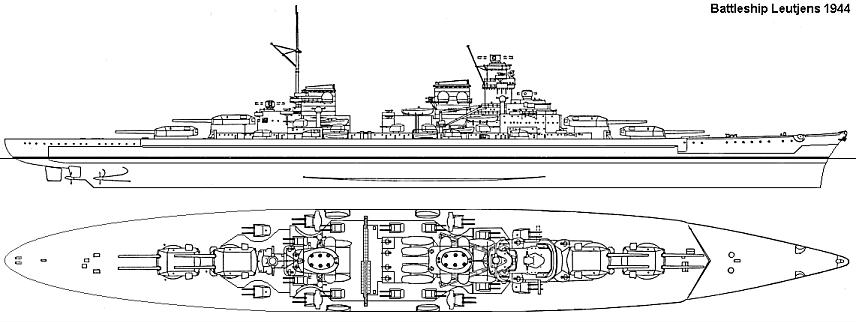
Line Drawing of the German H-39 Class Battleship

Friends of Padre Steve’s World,

I am still on Trump and COVID19 overload so I am going back to the introductory article of a series I planned years ago.

This is the introductory article for a series of ten articles on the classes of battleships built or planned by the major powers following the expiration of the Second London Naval Treaty. A previous series of articles dealt with the battleships constructed in compliance or close compliance with the treaty. This series will cover the Japanese Yamato Class, and Super Yamato Classthe British Lion Class, the Vanguard, the German Bismarck and H39 Classes, the French Alsace Class, the Soviet Sovyetskiy Soyuz Classand finally the American Iowa and Montana classes.

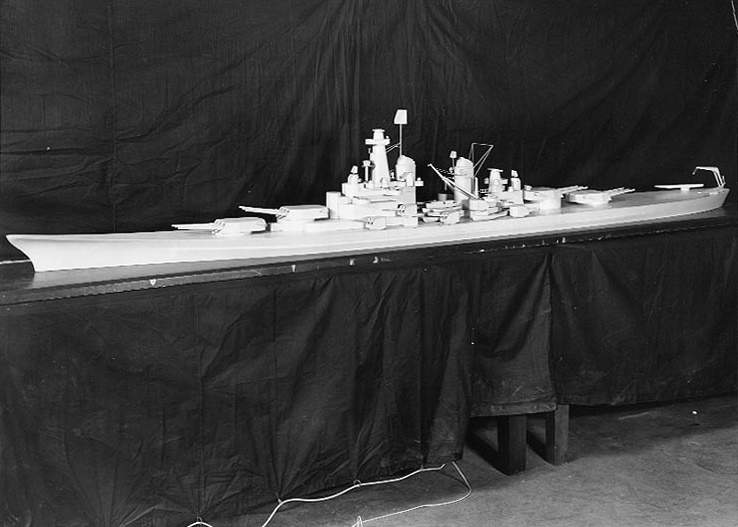
Model of the Montana Class

When I first wrote this article over a decade ago I classed all of these ships as post-Treaty designs while overlooking the fact that most were designed during the Treaty period, and that most were designed and built in violation of it, or by invoking the  escalator clause. In truth only the Vanguard, the Montana’s and the never laid down German ships of the H-41 Class and beyond, as well as the Japanese Super Yamatos.

All of these ships were designed and built or designed in the late 1930s and early 1940s and with the exception of the Sovietetskiy Soyuz Class built on each navy’s past experience in battleship design and construction. The Japanese had constructed no treaty battleships in the 1930s, so the Yamato’s were the first battleships constructed by Japan since the Nagato Class which had been completed in the 1920s and the incomplete Tosa Class.

The Bismarck

The Second London Naval Treaty of 25 March 1936 was signed by France, Britain and the United States. Japan walked out on the conference and the Italians did not sign because of the outcry that their invasion of Abyssinia had evoked.  The treaty called for ships to have a standard displacement of not more than 35,000 tons and main armament not to exceed 14” guns. This was a reduction in the size of armament from the previous London and Washington treaties. When the Japanese delayed and then refused to sign the agreement, as did the Italians, refused the United States invoked the escalator clause which permitted them to disregard the treaty limitations.

USS Iowa lead ship of the Iowa class

The Americans who invoked only the armament part of the clause on the North Carolina and South Dakota classes. However they took full advantage of it to construct the 45,000 ton Iowa class. The plans called for six of this class, but only four were completed. The Montana Class of 65,000 tons mounting twelve 16” guns and Provided protection against that type of shell. The Montana Class ships were never laid down but because of their features will be covered in this series of articles.

Line Drawing of the Lion Class

Following the King George V Class the Royal Navy planned the Lion Class which was in essence an enlargement of the King George V Class armed with nine 16” guns.  Four of the Lion ships we’re planned, but none were to built. They cancelled early in the war and only one further battleship the 44.500 ton HMS Vanguard would be completed by the Royal Navy but not until 1946.

HMS Vanguard

The Germans, who were not a signatory to the treaty but had an agreement with Britain to limit their total naval tonnage to 35% of Britain’s had build the Scharnhorst Class Battlecruisers in the mid 1930s and began the Bismarck Classthe largest capital ships completed in Europe. These were to be followed by the H39, H41, H42, H43 and H44 classes ranging in displacement from 56,444 tons to 131,000 tons with armament ranging from eight 16” to eight 20” guns. Since just two of the H39’s were laid down and then cancelled while in the early stages of construction, and the others never laid down, so I will only discuss the H39 class in this series. The others only existed in the world of a mad dictator’s fantasies.

Sovyetskiy Soyuz Class

The Soviet Union which was never a signatory to any of the naval treaties and had not built a battleship since the First World War planned the massive Sovyetskiy Soyuz Class. This would have been a Class of 15 ships would have displaced 58,220 tons and mounted nine 16” guns. Several designs were evaluated, including those of American and Italian shipbuilders and designers. The foreign designs were rejected in favor of a Soviet design. However, the timing coincided with Stalin’s purge of the Armed forces leadership, as well as men who ran military and naval production plants. This added a further delay in their design and construction. The four initial ships of the class were laid down but never completed due to the Nazi invasion in 1941. Construction was halted and all were scrapped after the war.

Yamato

The Japanese Yamato Class, the largest battleships ever constructed of 69,998 tons standard displacement armed with nine 18” guns, the largest main battery ever installed on battleships were the largest capital ships built before the second generation of U.S. Navy super carriers.

The French Alsace Class was intended to counter the German H-39s. They would have been an enlarged and more heavily armed modification of the Richelieu Class. However, the German attack and and conquest of France led to their cancellation before they were ever laid down.

The first article I write will be about the Bismarck Class and that will appear later this week. This will be cutting it close because I plan on dealing with Operation Rheinübung, the deployment of Bismarck and Prinz Eugen which would turn out to be one of the most intense times of the war, especially for the British and the Royal Navy. So tomorrow on to the Bismarck and Tirpitz.

Peace,

Padre Steve+

1 Comment

Filed under germany, History, imperial japan, Military, Navy Ships, nazi germany, World War II at Sea, world war two in europe, world war two in the pacific

Short, Squat, Powerful and Well Protected: The South Dakota Class Battleships

Friends of Padre Steve’s World,

I am still on my holiday from writing about the novel Coronavirus 19 and President Trump and his Administration’s incompetent response to it. It is a response that has already claimed 87,000  American lives, and every day more damning evidence shows the results for the President’s use of it for political purposes, almost all of which are backfiring as much as his malfeasance and willingness to see Americans die by the tens of thousands to maintain his cloud-cuckoo-land fantasy that this will go back to normal as if by magic. But, I won’t go any farther tonight on that tonight.

I was so inflamed about what was happening earlier today I decided that it was best to continue my series on the battleships designed and built by the British, French, Germans, Italians, and Americans from after the Battleship Holiday mandated by the Washington Naval Treaty, and the restrictions of the London Naval Treaty. The Germans were not signatories to these treaties as they were already under the much more severe provisions of the Treaty of Versailles, until the Hitler regime began to clandestinely violate it in 1934, and publicly in 1935. The British signed at bilateral naval accord with Germany in June of 1935, which the Germans renounced in 1938 in order to build a fleet of battleships that Hitler believed would allow him to achieve naval parity or superiority over the British, which he renounced in 1938 during the Czechoslovakia crisis.

This is the fifth and last in a series of articles about the battleships built under the provision of the Washington and London Naval Treaty limitations in the 1930s. I am not including the ships which were already in service or completed in the immediate aftermath of the Washington Treaty. That treaty required the British to scrap 23, the Americans 30, and Japanese 17 Battleships or Battlecruisers to comply with the treaty. Some were allowed to be converted to Aircraft Carriers, and some demilitarized to serve as training or target ships.

This series looks at the modern battleships built by the future World War II combatants between 1932 and 1939. This article covers the American South Dakota Class. Previous articles dealt with the British Royal Navy’s King George V Class, The German Kriegsmarine Scharnhorst Class, the Italian Reginia Marina’s Vittorio Veneto Class, the United States Navy’s North Carolina Class, and the French Dunkerque and Richelieu Classes.The German Bismarck, Japanese Yamato, British Vanguard and American Iowa classes will be covered in a subsequent series.

I think that I will also go back and deal with various classes of ships that were allowed to be kept after the Washington Naval Treaty. These included  two of the three partially built American Colorado Class, the two ship British Nelson Class, and the second of the Japanese Nagato Class, the Mutsu; and the battleships and battlecruisers that were completed as Aircraft Carriers by the United States, Britain, Japan, and France. From there I could move on and write about and the new battleships and battlecruisers planned or under construction at the time the treaty came into effect, the ships that had they been built would have launched a major naval arms race in the 1920s, something that few nations could have afforded, especially Great Britain.  I think I will even go back to the Dreadnoughts and Battlecruisers of the First World War. Of course there are a lot of them, so I will probably focus on the ships that continued serving through the Second World War. I might even delve into the German H type battleships which were more fanciful than realistic, only satisfying the need of Hitler for nothing but the biggest, the American Montana Class, the British HMS Vanguard, the French Alsace Class, and the Japanese A-150 or Super Yamato’s. 

Since there is much disagreement about which of the ships that I have written about in this series,  I may try to do a comparison to determine which was the best of these classes in the categories, of armament, speed and range, armor protection, reliably, and performance in combat. One has to remember that these were the first battleships built by their respective navies since the First World War, each was built under the constraints imposed by the naval treaties, and their influenced by the developments of potential opponents and the changing world situation. In some cases sacrifices were made on each design due to expediency and the need to get them to the fleet.

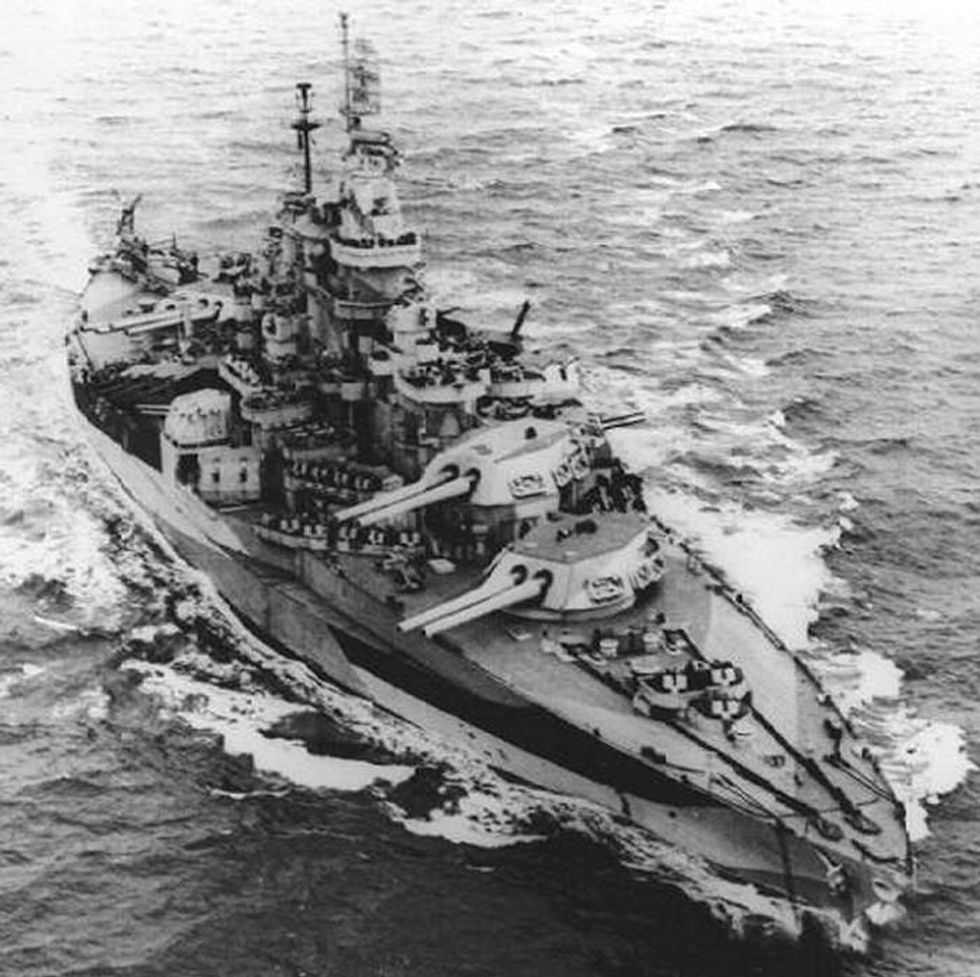
As the world edged closer to war in the late 1930s the U.S. Navy followed up its decision to build the two ship North Carolina class battleships with additional fast battleships. Initially the General Board wanted two additional North Carolina’s the Chief of Naval Operations, Admiral William H. Standley wanted a different design, which may have created the toughest and best of the battleships in this series. Compared to the other battleships built in this era, the South Dakota Class was short, fat, a bit slower, but was superbly protected with a well designed armored citadel, excellent main, secondary, and anti-aircraft batteries, and superior radars, fire direction systems and combat operation centers. They demonstrated a knack for survival as well as an ability to inflict damage, as was shown by the South Dakota and Massachusetts.

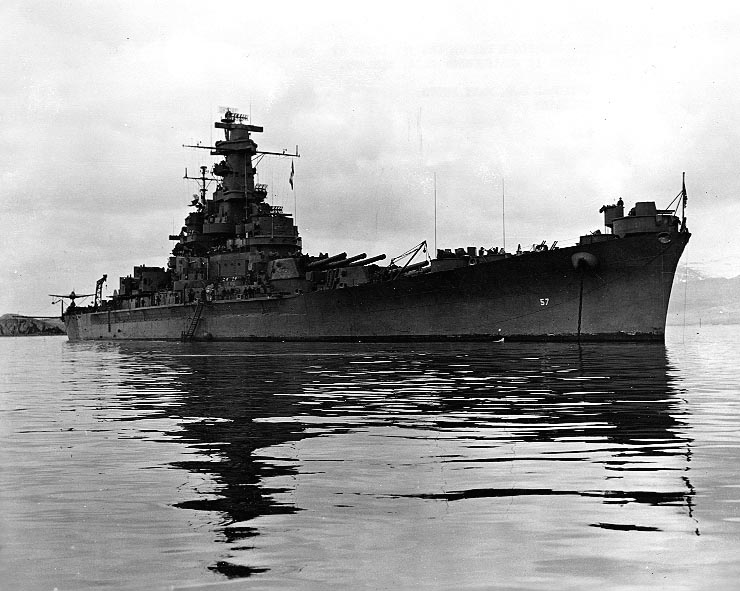
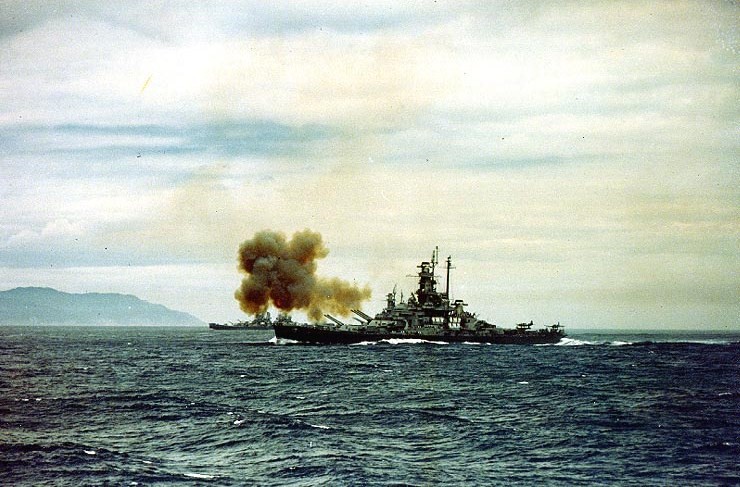
USS South Dakota BB-57 in 1943

Design work started in 1937 and several designs were proposed in order to correct known deficiencies in the preceding North Carolina class to include protection and the latest type of steam turbines.  As in the North Carolina’s the Navy struggled to find the optimal balance between armament, protection and speed. In the end the Navy decided on a shorter hull form with greater beam which necessitated greater power to maintain a high speed. The armor protection was maximized by using an interior sloped belt of 12.2 inch armor with 7/8” STS plates behind the main belt which made the protection the equivalent to 17.3 inches of vertical armor. The Belt continued to the bottom of the ship though it was tapered with the belt narrowing to 1 inch to provide addition protection against plunging fire which struck deeper than the main belt. As an added feature to protect against torpedo hits a multi-layered four anti-torpedo bulkhead system was included, designed to absorb the impact of a hit from a 700 pounds of TNT.

In order to accommodate the machinery necessary to provide the desired speed of 27 knots on the shorter hull the machinery spaces were rearranged.  The new design placed the boilers directly alongside the turbines with the ship’s auxiliaries and evaporators also placed in the machinery rooms. Additional design changes made to save space included making the crew berthing areas smaller. This included that of officers as well as the senior officers and shrinking the size of the galley’s and the wardroom from those on the North Carolina’s. The resultant changes allowed the ships to achieve the 27 knot speed, improved protection and carry the same armament of the North Carolina’s within the 35,000 treaty limit.

Two ships of the design were approved and with the escalator clause invoked by the Navy two more ships were ordered all with the nine 16” gun armament of the North Carolina’s.  The leading ship of the class the South Dakota was designed as a fleet flagship and in order to accommodate this role two of the 5” 38 twin mounts were not installed leaving the ship with 16 of these guns as opposed to the 20 carried by the rest of the ships of the class. The final design was a class of ships capable of 27.5 knots with a range of 17,000 miles at 15 knots mounting nine 16” guns with excellent protection on the 35,000 tons and full load displacement of 44,519 tons.

The lead ship of the class the USS South Dakota BB-57 was laid down 5 July 1939 at New York Shipbuilding in Camden New Jersey, launched on 7 June 1941 and commissioned on 20 March 1942.  Following her commissioning and her shakedown cruise South Dakota was dispatched to the South Pacific. Soon after her arrival she struck a coral reef at Tonga which necessitated a return to Pearl Harbor for repairs.

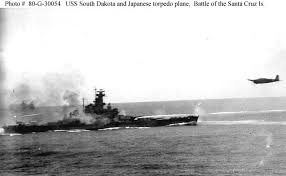
When repairs were complete she was attached to TF 16 escorting the USS Enterprise CV-6 during the Battle of the Santa Cruz Islands on 26 October 1942.  During the battle she was credited with shooting down 26 Japanese aircraft but was struck by a 500 lb bomb on her number one turret which caused no damage.


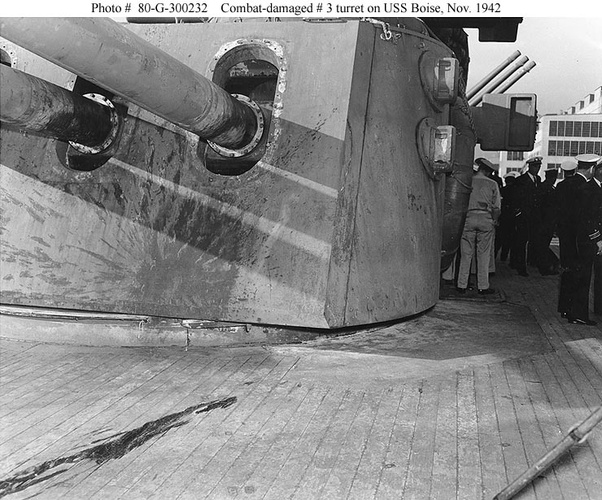
The Dent in South Dakota’s Number Three Turret from a hit from a 14” Shell from Kirishima

She joined TF-64 paired with the battleship USS Washington during the Second Naval Battle of Guadalcanal on14-15 November 1942. During the action South Dakota suffered a power outage and was hit by over by a minimum of 26 enemy shells, and possibly up to 40. At least one of a 14” shell from Kirishima, 18 8” shells from the Heavy Cruisers, 6 6” shells from from Japanese light cruisers, and at least one 5” shell from a destroyer. The damage was superficial, once her power was restored much of the damage was repaired ship’s crew. The shellfire knocked out three of her fire control radars, her radio and main radar set which were also repaired.

Three of the escorting destroyers, USS Preston, USS Walke, and USS Benham were sunk or mortally wounded, and USS Gwin was damaged.destroyers were also lost but the Washington mortally wounded the fast battleship Kirishima and destroyer Ayanami which were scuttled the next day and damaged the heavy cruisers Atago and Takao.

South Dakota returned to New York for repairs which completed in February 1943. She joined the carrier USS Ranger CV-4 for operations in the Atlantic until April when she was attached to the British Home Fleet. She sailed for the Pacific in August 1943 and rejoined the Pacific Fleet in September. The battleship joined Battleship Divisions 8 and 9 and supported the invasion of Tarawa providing naval gunfire support to the Marines.

South Dakota spent the rest of the war was spent escorting carriers as well as conducting bombardment against Japanese shore installations. She participated in almost every action of the U.S. drive across the Central Pacific. She was struck by a 500 pound bomb during the Battle of the Philippine Sea that destroyed several anti-aircraft mounts and killed 26 of her crew.

A Photo taken from South Dakota while anchored in Tokyo Bay with Mount Fuji in the Background 

South Dakota was present at the Japanese surrender in Tokyo Bay and returned to the United States in 1945. She was decommissioned and placed in reserve on 31 January 1947. She was stricken from the Naval Register on 1 June 1962 and sold for scrap in October of that year. Various artifacts of this gallant ship to include a propeller, a 16” gun and the mainmast are part of the USS South Dakota Memorial Park in Sioux Falls South Dakota. 6,000 tons of armored plate were returned to the U.S. Atomic Energy Commission for use in civilian nuclear programs and a second screw is displaced outside the U.S. Naval Museum in Washington D.C.  She received 13 battle stars for World War II service.

South Dakota also had the dubious distinction of having the youngest sailor of the war 12 year old Calvin Graham who confessed lying about his age to the Gunnery Officer, LT Sergeant Schriver. Graham was court-martialed and given a dishonorable discharge spending 3 months in the ship’s brig before he was able to be returned to the United States where just after his 13th birthday he entered 7th grade. Shriver was wounded at Guadalcanal and was awarded the Purple Heart. He left the Navy in in 1945 as a Lieutenant Commander. He later became the Brother in law of John F. Kennedy, and the first Director of the Peace Corps, and became the the running mate of Senator George McGovern in the 1972 Presidential Election, to Richard Nixon and Spiro Agnew. 

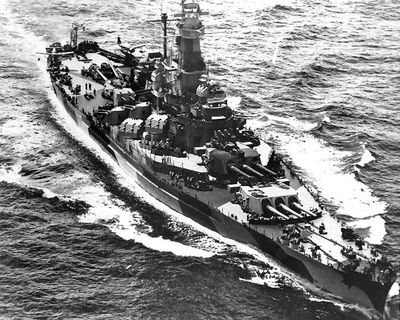
USS Indiana BB-58 Bombarding Japan in 1945

The second ship of the class the USS Indiana BB-58 was laid down at Newport News Naval Shipyard on 20 November 1939 launched on 21 November 1941 and commissioned on 30 April 1942.  She served throughout the Pacific War by serving with the fast battleships of Vice Admiral Willis Lee’s TF-34, escorting carriers during major battles such that the Battle of the Philippine Sea or as it is better known the Marianas Turkey Shoot. She returned to the United States for overhaul and missed the Battle of Leyte Gulf but served at Iwo Jima, Okinawa and operations against the Japanese home islands. During the beginning of the Marshall Islands campaign Indiana received her heaviest damage. During night operations with a carrier task group she turned in front of USS Washington. A collision ensued which caused heavy damage to Indiana, including the loss of nearly 200 feet of her armored belt. The collision took off about 20 feet of Washington’s bow which remained imbedded in the Indiana until she was repaired. Washington also required a return to the United States for repairs.

Following the war she was decommissioned in 1947 and sold for scrap in September 1963.   A number of her relics are preserved at various locations in Indiana and her prow and mainmast are centerpieces of a display at the University of Indiana’s football stadium. Much of her armor was provided to the U.S. Atomic Energy Commission for use in civilian programs.

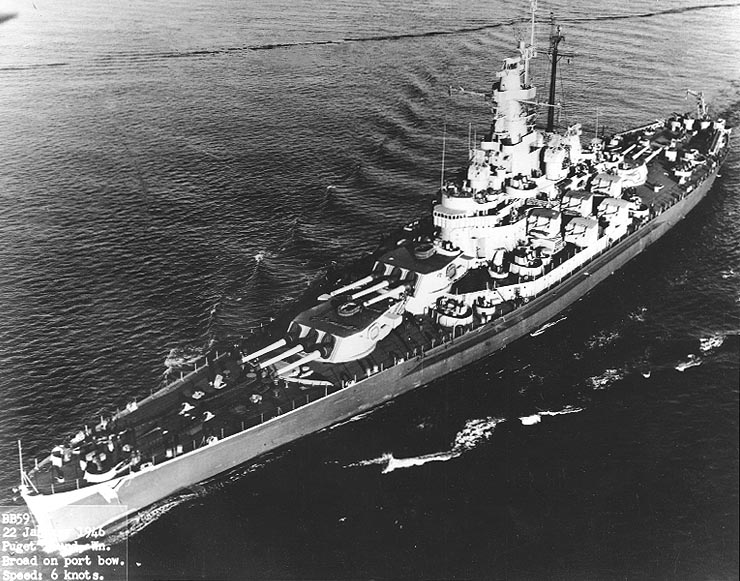
USS Massachusetts BB-59 in January 1946 in the Puget Sound

The third ship of the class the USS Massachusetts BB-59 was laid down on 20 July 1939 at Bethlehem Steel Corporation Fore River Yard in Salem Massachusetts and launched on 23 September 1941 and commissioned on 12 May 1942. After her shakedown cruise she was assigned to the Atlantic Fleet where she took part in Operation Torch, the Allied invasion of French North Africa. During the operation she engaged French shore batteries, damaged the battleship Jean Bart and sank 2 cargo ships and along with the heavy cruiser Tuscaloosa sank the destroyers Fougueux and Boulonnais and the light cruiser Primauguet.

Following her assignment in the Atlantic she sailed for the Pacific where she began operations in January 1944. She took part in almost every major operation conducted by the Pacific Fleet escorting the Fast Carrier Task Forces and operating as a unit of TF-34 the Fast Battleship Task force including the Battle of Leyte Gulf.  She ended the war conducting operations against the Japanese home islands.  She was decommissioned in 1947 and stricken from the Naval Register on 1 June 1962.

USS Massachusetts BB-59 at Battleship Cove, Fall River Massachusetts

She was saved from the fate of Indiana and South Dakota as the people of Massachusetts with the assistance of schoolchildren who donated $50,000 for her renovation and preservation as a memorial. She became that in 1965 at Battleship Cove in Fall River Massachusetts and she remains there designated as a National Historic Landmark.  During the naval build up of the 1980s much equipment common to all modern battleships was removed for use in the recommissioned battleships of the Iowa class.


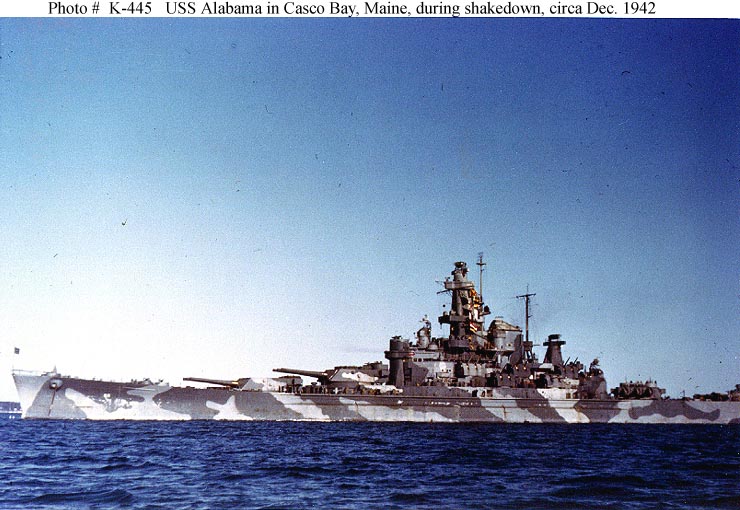
The final ship of the class the USS Alabama BB-60 was laid down on 1 February 1940 at Norfolk Naval Shipyard. She was launched on 21 February 1942 and commissioned 16 August 1942. Following her shakedown cruise and initial training off the Atlantic coast she joined the repaired South Dakota and operated as part of TF 22 attached to the British Home Fleet.

She conducted convoy escort operations, participated in the reinforcement of Spitsbergen and in an operation which attempted to coax the German battleship Tirpitz out of her haven in Norway. Tirpitz did not take the bait and Alabama and South Dakota returned to the United States in August 1943.

Following a brief refit she and South Dakota transited to the Pacific were the trained with the fast carriers.  She took part in the invasion of the Gilberts taking part in Operation Galvanic against Tarawa and the Army landings on Makin Island.

As 1944 began Alabama continued her operations with the fast carriers of TF-38 and the fast battleships of TF-34.  She took part in operations against the Marshalls and took part in the invasion of the Marianas Islands and the Battle of the Philippine Sea, the Great Marianas Turkey Shoot. From there she supported the invasion of Palau and other islands in the Caroline Islands followed by operations against New Guinea and the invasion of the Philippine and the Battle of Leyte Gulf before returning to the United States for overhaul.

Chief Petty Officer Bob Feller
Alabama 
returned to action during the invasion of Okinawa and in shore bombardment operations against the Japanese Mainland. When the war ended the Alabama had suffered no combat deaths and only 5 wounded following the misfire of one of her own 5” guns earning her the nickname of “Lucky A.”  Hall of Fame pitcher Bob Feller served as a Chief Petty Officer and gun mount captain on Alabama during the war.

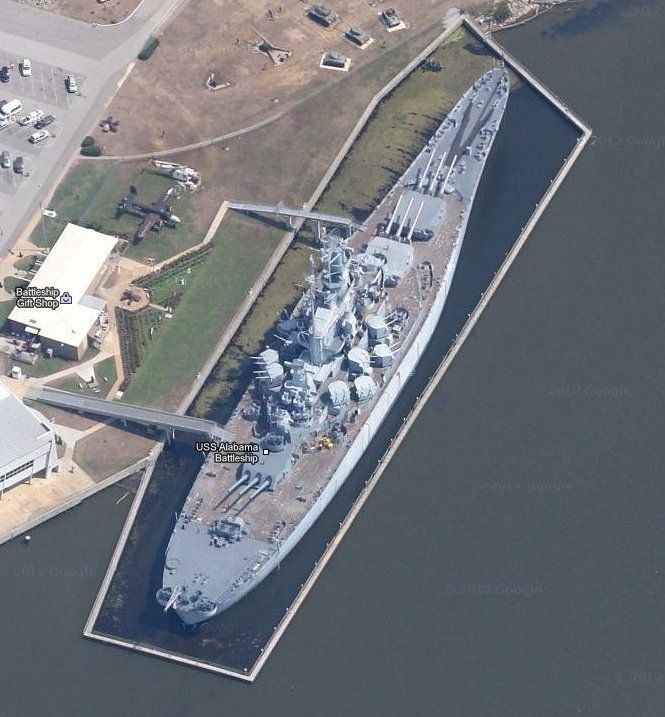
She was decommissioned on 9 January 1947 and stricken from the Naval Register on 1 June 1962. The people of the State of Alabama formed the “Alabama Battleship Commission” and raised $1,000,000 including over $100,000 collected by schoolchildren to bring her to Alabama as a memorial.  She was turned over to the state in 1964 and opened as a museum on 9 January 1965. She was declared a National Historic Landmark in 1986.  She has been used as a set in several movies and continues to serve as a museum preserving the legacy of the men that served aboard her and all of the battleship sailors of World War II.

another thing about the South Donata Class was that their design was evident in the rebuilding of the USS California, USS Tennessee, and USS West Virginia when they were completely modernized after Pear Harbor.

USS West Virginia after her complete modernization after being sunk at Pearl Harbor

In the 1950s a number of proposals were considered to modernize the ships of the class to increase their speed to 31 knots using improved steam turbines or gas turbines. The Navy determined that to do this would require changes to the hull form of the ships making the cost too prohibitive.  The ships were certainly the best of the treaty type battleships produced by any nation in the Second World War. The damage sustained by South Dakota at the Second Naval Battle of Guadalcanal would have not only put most battleships of her era out of action but might have caused enough damage to sink them. Their armament was equal or superior to all that except the Japanese Yamato Class and their protection was superior to most ships of their era, and it was was exceptional, as was evident by the damage sustained by South Dakota. 

Alabama as a Museum Ship 

It is good that both the Massachusetts and the Alabama have been preserved as memorials to the   ships of the class, their sailors and the United States Navy in the Second World War. Because of the efforts of the people of Massachusetts and Alabama millions of people have been able to see these magnificent ships and remember their fine crews. Both have hosted reunions of their ships companies since becoming museum ships and with the World War Two generation passing away in greater numbers every day soon these ships as well as the USS Texas, USS North Carolina, USS Missouri, USS New Jersey, USS Wisconsin aUSS Iowa which stricken from the Naval Register awaits an uncertain fate as a resident of the “Ghost Fleet” in Suisun Bay California.  No other nation preserved any other dreadnought or treaty battleship thus only these ships remain from the era of the Dreadnought. I so much wish that the British had preserved one of the King George V  ships, or maybe the mostend celebrated Royal Navy Battleships of both World Wars, the HMS Warspite had been preserved. I also regret that none of the survivors of the attack on Pearl Harbor were preserved, nor any of the standard battleships of the Nevada, Pennsylvania, New Mexico, California, or Colorado Classes.

I am fortunate. I have been able to go aboard the North Carolina, Alabama, Texas, and Wisconsin, as well as a number of the surviving aircraft carriers, destroyers, and submarines preserved in the United States. However, too few, especially the ships which bore the brunt of the war like the carrier USS Enterprise were never saved, despite the pleas of men like Admiral William “Bull” Halsey.

I habe also been able to visit ships like the USS Constitution, USS Constellation, Clipper ship Star of India, the Japanese Battleship Mikasa, the USS Nautilus, the German Tall Ship Gorch Fock II, and so many more, but I still have a bucket list of ships I want to visit in the United States, Canada, Great Britain, Germany, Greece, Sweden, Russia, France, Australia, Italy, Turkey, Japan, and Finland.

With those pipe dreams in mind, I wish you all the best. Until tomorrow when I decide to weigh in again on novel Coronavirus 19 and the crisis being fostered by the Trump Administration in this country; please be safe. Don’t do dumb things like going into crowded places with few people wearing masks and the vast majorly of people not adhering to social distancing. Even if other people decide to be stupid and put others and well as their own lives at risk, don’t be like them. I speak this from the heart and I don’t care if someone disagrees with my politics, faith, or social commentary, I would prefer that they not die or through their stupidity and arrogance get other people sick or die. Darwin is not Kind when it comes to the stupidity and arrogance of people regardless of the race, ethnicity, faith, ideology, political leanings, social standing, economic position, or nationality.

I don’t care if people agree with me or not, but don’t do dumb things. This may sound harsh but I tend to speak from my heart when lives and civilization itself are at stake. But please remember the words of Robert Henlein:

“Stupidity cannot be cured. Stupidity is the only universal capital crime; the sentence is death. There is no appeal, and execution is carried out automatically and without pity.” 

Peace,

Padre Steve+

6 Comments

Filed under Foreign Policy, historic preservation, History, imperial japan, Military, Navy Ships, nazi germany, Political Commentary, US Navy, World War II at Sea, world war one, world war two in europe, world war two in the pacific

The King George V Class Battleships: The Imperfect yet Important British Bulwarks of WII

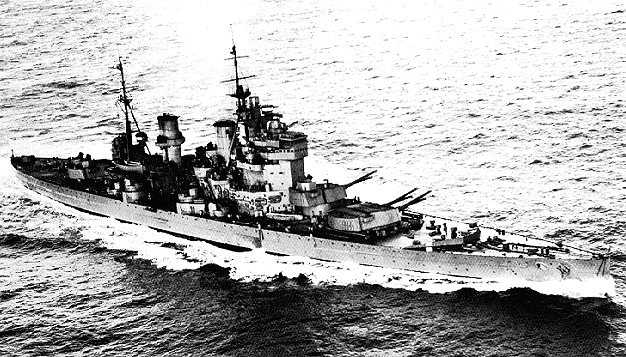
HMS King George V

Friends of Padre Steve’s World,

I am still on my holiday from writing about the novel Coronavirus 19 and President Trump and his Administration’s incompetent response to it. It is a response that has already claimed 85,000 American lives. But, I won’t go any farther tonight on that. Instead I am going back to my series on the battleships designed and built by the British, French, Germans, Italians, and Americans from after the Battleship Holiday mandated by the Washington Naval Treaty, and the restrictions of the London Naval Treaty. The Germans were not signatories to these treaties as they were already under the much more severe provisions of the Treaty of Versailles, until the Hitler regime began to clandestinely violate it in 1934, and publicly in 1935. The British signed at bilateral naval accord with Germany in June of 1935, which the Germans renounced in 1938 in order to build a fleet of battleships that Hitler believed would allow him to achieve naval parity or superiority over the British.

This is the fourth in a series of five articles on the battleships built under the provision of the Washington and London Naval Treaty limitations in the 1930s. I am not including the ships which were already in service or completed in the immediate aftermath of the Washington Treaty which required the British to scrap 23, the Americans 30, and Japanese 17 Battleships or Battlecruisers to comply with the treaty. Some were allowed to be converted to Aircraft Carriers, and some demilitarized to serve as training or target ships.

This series looks at the modern battleships built by the future World War II combatants between 1932 and 1939. This article covers the British Royal Navy King George V Class. The previous articles dealt with the German Scharnhorst Class, the Italian Vittorio Veneto Class, the American North Carolina Class, and the Frech Dunkerque and Richelieu Classes. The final article will be about the American South Dakota Class. The German Bismarck, Japanese Yamato, British Vanguard and American Iowa classes will be covered in a subsequent series.

Since there is much disagreement about which of the ships that I have written about I may try to do a comparison to determine which was the best of these classes in the categories, of armament, speed and range, armor protection, reliably, and performance in combat. One has to remember that these were the first battleships built by their respective navies since the First World War, each was built under the constraints imposed by the naval treaties, and their influenced by the developments of potential opponents and the changing world situation. In some cases sacrifices were made on each design due to expediency and the need to get them to the fleet.

HMS King George V in 1941

The last class of Royal Navy Battleships was the Nelson Class of two ships, HMS Nelson and HMS Rodney. They were a compromise design based on N3 Class of battleships which had to be cancelled due to the Washington Treaty. The Nelson’s have been described as a “chopped off” N3 which used the 16” guns of the also cancelled G3 Battlecruisers. The design sacrificed speed for protection and firepower. Their protection was good, as was their armament, but their propulsion plants were a constant source of trouble. By the late 1920s the Royal Navy’s battle force was comprised of the two Nelson’s, the fast Battlecruisers Hood, Renown and Repulse and the 10 ships of the Queen Elizabeth and Revenge Classes all designed before the First World War.

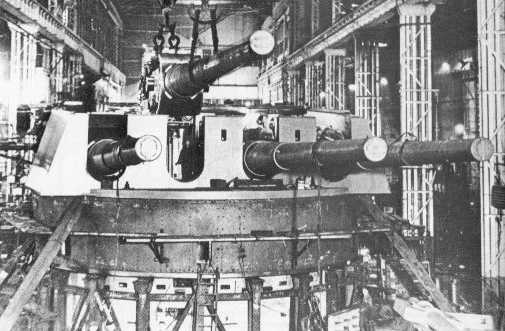
King George V Class Quad Turret being built

The Royal Navy began planning for a new class of battleships in 1928. But these plans were shelved with the signing of the London Naval Treaty which continued the “building holiday” on capital ship construction as well as the size and armament of capital ships until 1937.  Because of the pacifist movement of the 1920, the Great Depression, and the desire of the British government to abide by international treaties in spite of the violations of those treaties, nothing was done until 1937.

With the realization that its battle force was dated, and the knowledge that other nations had laid down new classes of battleships the Royal Navy recommenced planning in 1935.  The Navy planned to build to the maximum of the 35,000 displacement limitation and placed a great measure of emphasis on armor and protection. Early designs emphasized ships with heavy firepower and protection at the expense of speed, like the American Colorado Class, the cancelled South Dakota Class, and early designs for new battleships of similar design by the U.S. Navy in the early 1930s.

Numerous Designs were proposed. Eventually the new class of battleships were designed to achieve a 28 knot speed which made them faster than all existing British battleships, although slower than the Battlecruisers. The planners had alternative designs to use 14”, 15” or 16” guns with the Navy favoring the 15” models which had equipped all of their other ships with the exception of the Nelson’s. However the Admiralty to use 14” as the government was endeavoring to negotiate with other powers to impose a 14” limitation on armament for new battleships, and the Admiralty estimated that a move to arm the ships with 15” or 16” guns could delay the completion of the ships by a year or more.

during the second London Treaty of 1935, the Americans and French agreed to the limit their size and armament of their ships, however neither the Japanese nor Italians followed suite, and as a result all new battleships of other powers had larger guns than the King George V Class. The Italians opting for 15” Guns on the Vittorio Veneto Class, the French and Americans invoking the escalator clause of the treaty. The French opted to arm the Richelieu Class with 15” guns, while the Americans chose to arm the North Carolina, South Dakota and the Iowa Classes with 16” guns. The Japanese Opted for 18” guns for their Yamato Class, which also displaced nearly twice as much as the treaty allowed. The Germans who were not a signatory built their Scharnhorst Class with 11” Guns although, those were an expedient as they were planned to be armed with 15” guns. The Germans also equipped the Bismarck Class with 15” guns.

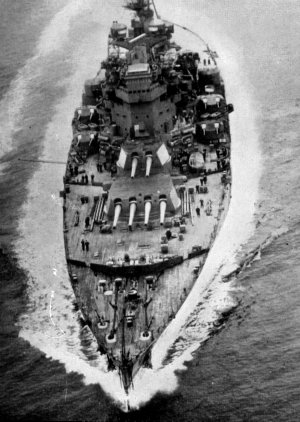
The Royal Navy attempted to rectify this by placing more guns on the ships than those of other navies. They wanted to mount twelve 14” guns mounted in Three quadruple turrets, but this was impossible on the 35,000 platform without compromising protection, speed, or stability.  Thus the Admiralty compromised on 10 guns mounted in 2 quadruple and 1 twin turret.

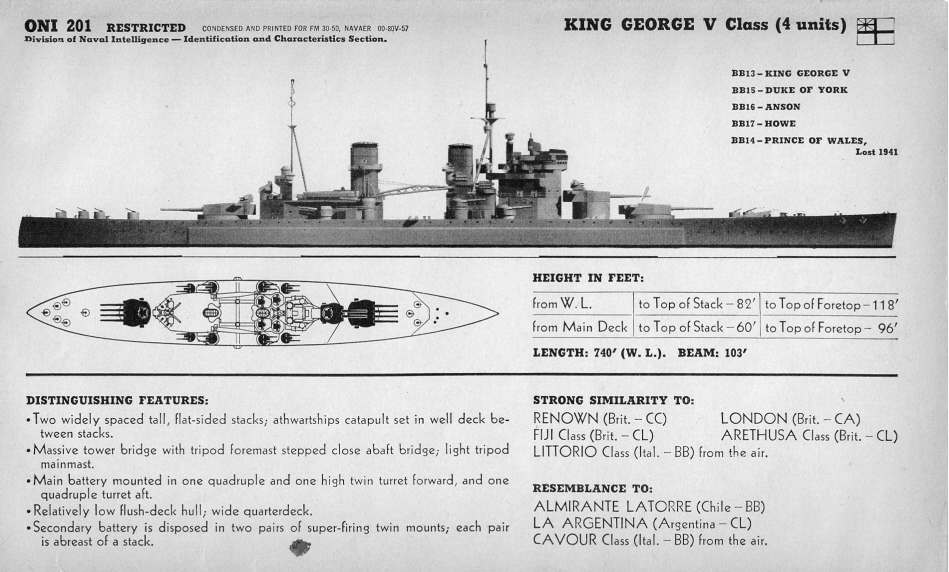
ONI Drawing of King George Class

The ships displaced a full load displacement of 42,237 tons in 1942. This increased to 44,460 tons by  1944. The were 745 feet long had a beam of 103 feet, a top speed of 28 knots with a cruising range of 5,400 nautical miles at 18 knots. Their relatively poor endurance limited their operations in the Pacific and even nearly caused King George V to have to abandon the chase of the Bismarck in May 1941. The compromise in displacement also limited the amount of fuel they could carry.

The main batteries of the ships proved problematic in combat. The quadruple turret design caused most of the ships problems. This was demonstrated in the engagement of the Prince of Wales against the Bismarck as well as the King George V in its duel with the same German behemoth when A turret became disabled and completely out of action for 30 minutes and half of the main battery being out of action for most of the engagement for mechanical reasons.  The Duke of York achieved excellent results against the Scharnhorst at the Battle of North Cape, but even in that engagement the main battery of Duke of York was only able to be in action 70% of the time due to the guns  jamming, or being inoperablere for various periods of time.  One of the other drawbacks of the design was that in order to replace a gun due to wear and tear, that the turret itself had to be dismantled in order to remove and replace the guns. Most other navies had planned for the replacement of guns without such such massive work.

The main secondary armament of 5.25” dual purpose guns in twin mounts suffered from poor rate of fire and slow traverse, both of which were well below their designed standards, and definitely inferior to the American 5” 38 dual purpose twin mounts and their Mark 38 fire direction radar.

The mounting of the armament was designed to provide protection against turret explosions which could potentially detonate the ship’s magazines.  The main side and underwater protection scheme was sound and protected the ships well in combat, and might have been the best of the ships built in there era. The vertical protection was also sound as was the protection afforded to the turret barbets and placement of the magazines to shield them from plunging fire.

Only the Prince of Wales was lost due to enemy action. Initially it was thought that she was hit by 6 aerial torpedoes and two 500 pound bombs. Her main armor and underwater anti-Torpedo defenses around her fully armored casemate would have protected her from major damage, but only one of the torpedoes hit that belt. However three torpedoes hit her in areas without such protection, forward and aft of the casemate. Later examination of her wreck revealed that the culprit was a torpedo which detonated in a propeller shaft outside of the armored belt which caused uncontrolled flooding when she was attacked by Japanese aircraft on 8 December 1941. No matter how well protected, no ship is completely proof against the damage of bombs, torpedoes, or now missiles.

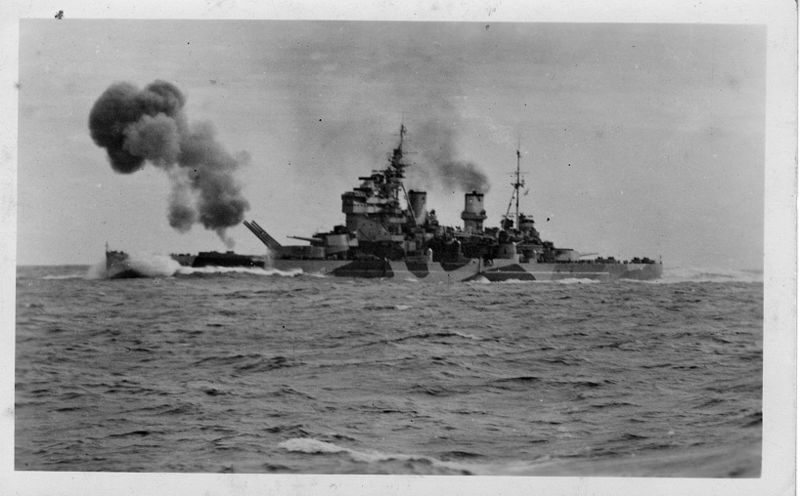
HMS Anson conducting gunnery exercises

The propulsion systems of the class developed problems after 1942 when fuel oil quality was decreased because of the need for aviation gas.  The new mixtures which were of  higher viscosity and contained more water than the boilers could effectively bur. This increased maintenance costs and decreased efficiency. To compensate the Admiralty designed new higher pressure fuel sprayers and burners which returned the boilers to full efficiency, and which should be used on the later HMS Vanguard. 

The lead ship of the class the King George V was laid down on 1 January 1937, and  launched on 21 February 1939. She was commissioned on 11 December 1940.  As the flagship of the Home Fleet she took part in the unsuccessful search for the Scharnhorst and Gneisenau during their early 1941 convoy raiding operation. Later during the hunt for the Battleship  Bismarck in May 1941 during which she earned lasting fame in helping to sink that ship, despite failures in her main battery which silenced half or her main guns.

She took part in the Murmansk convoy protection as well as Operation Husky, the invasion of Sicily before sailing to the Far East for operations against the Japanese. She finished the war with the British Pacific Fleet and was present at the Japanese surrender in Tokyo Bay.  She returned as flagship of Home Fleet until she was decommissioned in 1949. She was subsequently sold for scrap in 1957.

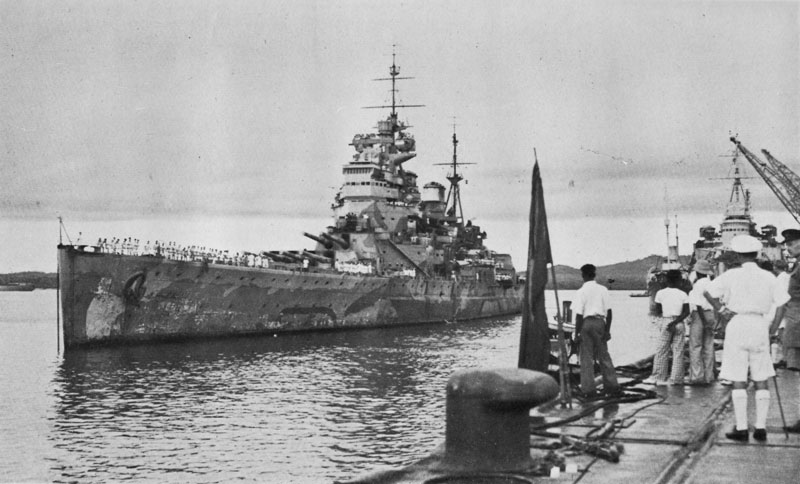
Prince of Wales pulling into Singapore

The second ship of the class the Prince of Wales laid down on 1 January 1937, launched on 3 May 1939 and commissioned 19 January 1941 although she was not officially completed until March 1941. Her initial operation came in May 1941 when she sailed with the HMS Hood to intercept the Bismarck. When she sailed she still had shipyard technicians aboard.  Damaged in the action she did score an important hit on Bismarck which cut a fuel line making her forward tanks inaccessible and causing her to make her run for Brest which she did not complete. Another hit damaged Bismarck’ aircraft catapult and a third disabled an electric dynamo. During the engagement she took heavy damage, and suffered malfunctions to her main battery, and withdrew from the action. The question still remains to this day why Admiral Lütjens aboard Bismarck did not decided to finish Prince of Wales off and sailed back the way she came after destroying two of the Royal Navy’s most powerful ships. Repaired and returned to service she could have sailed with her sister ship Tirpitz, maybe in a coordinated operation with Scharnhorst and Gneisenau that could have cost the Royal Navy much more in power and prestige.

Church Service on Prince of Wales at Argentia Bay with Churchill and Roosevelt in attendance

Following her badly needed repairs. Prince of Wales carried Winston Churchill to the Argentia Bay, Newfoundland, where in secret he met with Franklin D. Roosevelt and together drafted the Atlantic Charter. In late 1941 she accompanied the HMS Repulse to Singapore to bolster the British presence in the Far East. Under the command of Admiral Tom Phillips the ships sailed to attack Japanese invasion convoys, but without air cover was sunk by Japanese aircraft which struck her with 4 torpedoes and a bomb, the key hit being a lucky hit on her propeller shaft which caused flooding that caused a loss of power to pumps and anti-aircraft defenses. Repulse was also sunk in the engagement. Their sortie was doomed by an admiral who did not understand the importance of air power, and who had left the carrier sent to assist them, HMS Hermès behind. Poor communication between the land based fighters, Royal Austrian Air Force Brewster Buffaloes which would have been outnumbered and outclassed by Japanese aircraft and the task force destroyed nonetheless.

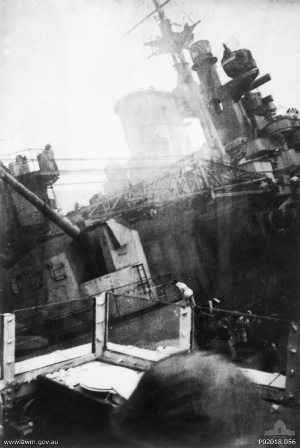
Prince of Wales sinking and being abandoned

The third ship the Duke of York was laid down 5 May 1937, and launched on 28 February 1940. She was commissioned 4 November 1941. She provided convoy escort for the Lend Lease convoys to the Soviet Union. On December 25th 1943 she and her accompanying cruisers and destroyers sank the  Scharnhorst on 26 December 1943 during the Battle of North Cape. Like King George V and Prince of Wales she also suffered from mechanical failures oof the guns of her main battery. She was transferred to the Pacific in 1944 and served at Okinawa.  She was present  at the Japanese surrender at Singapore. She was decommissioned in 1949 and scrapped in 1957.

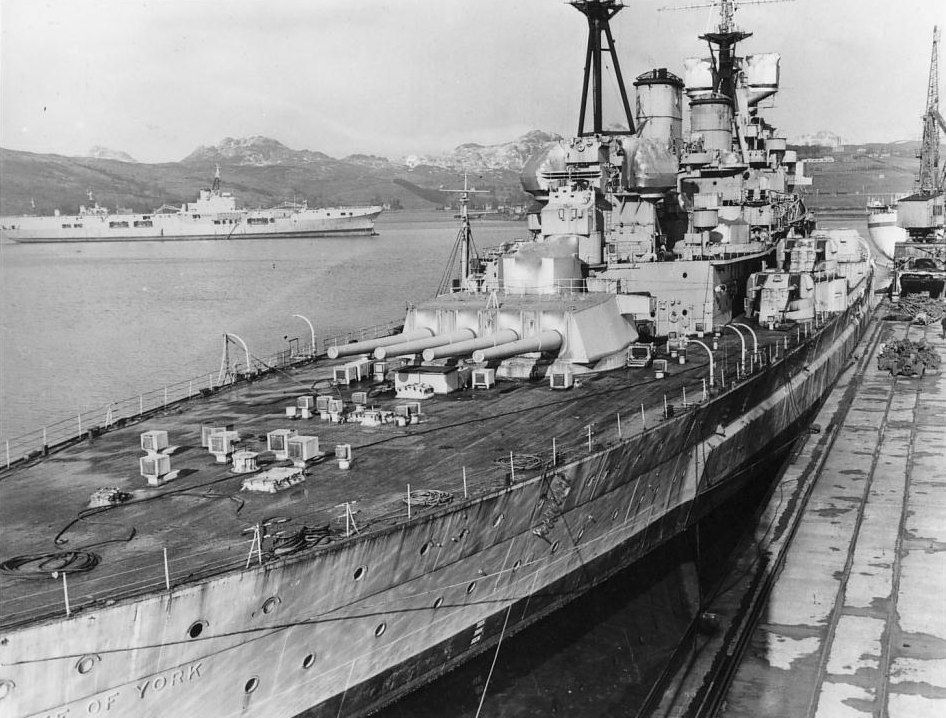
Duke of York

The fourth ship of the class the HMS Howe was laid down on 1 June 1937, and launched on 9 April 1940. She was commissioned on 29 August 1942.  She served with the Home Fleet and in the Mediterranean until she was transferred to the Pacific in August 1944. She was stuck and damaged by a Kamikaze in May 1945. Howe was sent for refit at Durban South Africa. She was still in refit when the war ended. She returned home and was placed in reserve in 1950 and scrapped in 1958.

HMS Howe

The last of the class the Anson was laid down 20 July 1937, and launched 24 February 1940. She was commissioned on 22 June 1942. She operated in the Mediterranean and the North Atlantic and was sent to the Pacific in 1945 where she  accepted the surrender of the Japanese Forces at Hong Kong. She returned to Britain and was decommissioned in 1951 and scrapped in 1957.

HMS Anson

For the most part the ships of the King George V Class had rather unremarkable careers for The most part with the exception of the Prince of Wales and King George V in the hunt for the Bismarck and the Duke of York sinking the Scharnhorst. They had a number of technical problems which limited their operations in the war, However, they and their brave crews deserve to be remembered as helping to hold the line against the Axis in the early years of the war and sank two of the four German Battleships lost during the war.  This alone was as remarkable achievement as of their contemporaries, for only the USS Washington, and the heavily modernized battleships sunk or damaged at Pearl Harbor, the USS West Virginia, USS California, and USS Tennessee sank enemy battleships in combat.

The King George V Class suffered serious design flaws, but in the case of their armored casemate and protection from enemy shellfire the were superior to most. Unfortunately, the true measure of their their success and design were never proven. Duke of York sank an overmatched and outnumbered Scharnhorst after her Admiral took too long to remove his ship from danger. Likewise, Prince of Wales was lucky to survive her encounter with Bismarck, and King George V, greatly assisted by HMS Rodney, and a host of cruisers and destroyers backed up by Force H sank Bismarck, which due to a torpedo hit from a Swordfish torpedo bomber from HMS Ark Royal was limited in speed and out of control.

It would have been interesting to see how they would have performed against the Vittorio Veneto Class, the Japanese Nagato, Kongo, or Yamato Class ships, or even the Scharnhorst or Bismarck in an undamaged state. I think they could have easily defeated the Kongo class, but Nagato, and Yamato would have been a different matter.

HMS Duke of York Being Scrapped 

Regardless, I think the King George V Class was a solid design, sadly limited by treaty limitations and the hopes of their government that potential enemies would do the same. Sadly, the Royal Navy even attempted to combine their heavy main battery armament and protection with guided missile and radar developments being made at the same time could have served as command ships of NATO task forces until the 1970s or 1980s. None were over 20 years old when they were sent to the breakers.

Their limitations notwithstanding, they performed excellently in the Second World War. It is sad that none survive today.

Until tomorrow,

Peace

Padre Steve+

4 Comments

Filed under History, Military, Navy Ships, nazi germany, World War II at Sea, world war two in europe, world war two in the pacific

Beautiful, Deadly, and Mostly Forgotten: the French Dunkerque and Richelieu Class Battleships

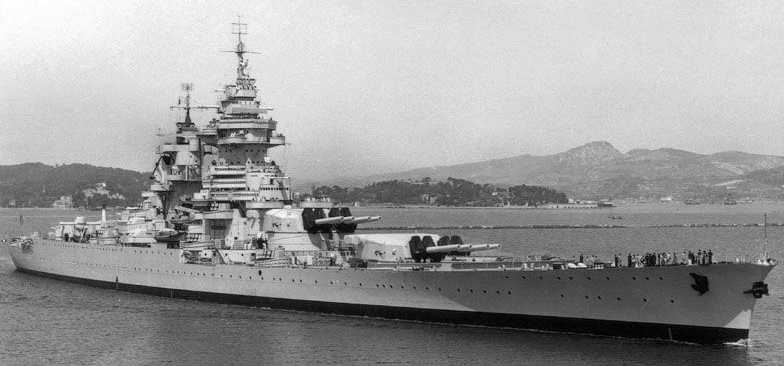
Richelieu in the 1950s © Photo Marius BAR – Toulon (France) site internet : http://www.mariusbarnumerique.fr  

Friends of Padre Steve’s World,

I decided to take another night off from the insanity of President Trump, his response to the novel Coronavirus 19 Pandemic and the rest of the craziness. Tonight I continue writing about the battleship classes developed by the Americans, British, Italians, French and Germans in the 1930s.

The series deals with battleships built under the provision of the Washington and London Naval Treaty limitations in the 1930s. Thus these articles are about the first modern battleships that the combatants built since the end of World War One and its immediate aftermath. The Washington Treaty established limits on tonnage of battleships for the signatories, and instituted a ten year “holiday” on the production of new battleships but set no similar limits on cruisers. The London Treaties limited the size and armament of new battleships, 35,000 tons in displacement and a main armament of 14” guns. The treaty had an “escalation” clause that allowed 16” guns if a signatory was shown to be breaking the treaty.

The first three articles were about the German Scharnhorst Class, the Italian Vittorio Veneto Class, and the U.S. North Carolina Class. This article covers the French Dunkerque class and Richelieu class Battleships. The next articles will deal with the British King George V Class and American South Dakota Class. The German Bismarck, Japanese Yamato, British Vanguard and American Iowa Classes will be covered in a subsequent series.

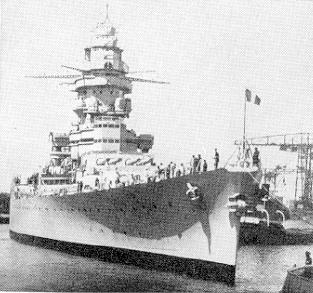
Dunkerque 1937

In the 1920s the French Navy concentrated on cruiser construction. By the late 1920s it realized the need to develop a class of Fast Battleships to the large Italian Trento Class heavy cruisers and German Deutschland class Pocket Battleships. but was limited by the Washington Treaty to just 70,000 tons which meant that in order to have a number of battleships that they would have to be smaller but still mount a significant armament.

The new Dunkerque class which the French termed Fast Battleships was more like a battle cruiser. They were less heavily armed and armored than existing battleships, as well as the new classes of Battleships being developed by other navies in the mid-1930s.  The Dunkerque class had a designed displacement of 26,500 tons and displaced 35,000 tons at full load. They top speed of 31 knots. Their main battery consisted of eight 13” guns in two quadruple turrets both mounted forward. This allowed all guns to fire forward during engagements to present the smallest possible silhouette to the enemy.  They employed all or nothing armor protection ensuring the strongest protection over vital spaces with their armor designed to protect the ships against German 11” gunfire from the Pocket Battleships or the Scharnhorst Class Battlecruisers. They also mounted a powerful dual purpose armament as the French recognizing the need for effective defense against aircraft as well as surface ships.

Dunkerque Class:


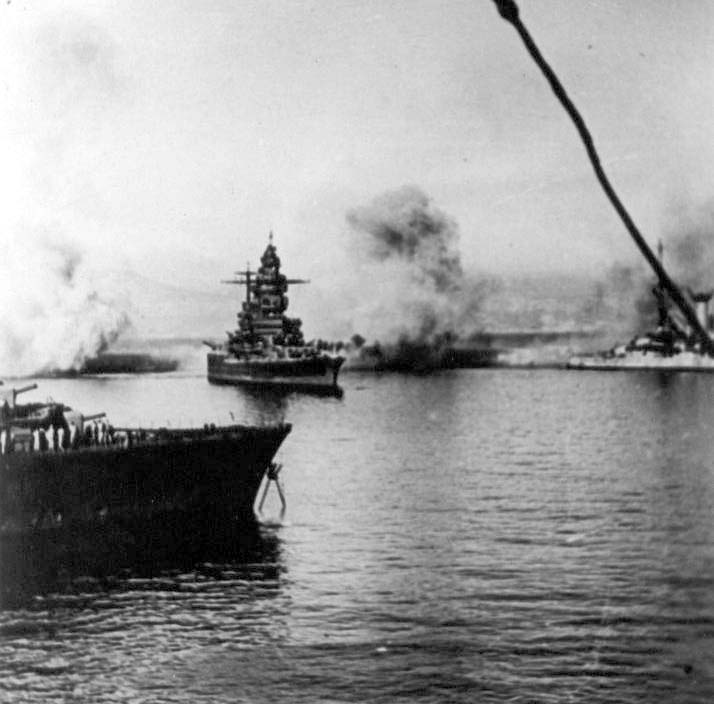
Dunkerque was laid down on 24 December 1932, launched on 2 October 1935 and commissioned on 1 May 1937. Her sister Strasbourg followed and was laid down in 1934 and launched on 12 December 1936 and commissioned in 1939. When war was declared the two ships spent their time operating with the Royal Navy searching for German raiders and to escort convoys.

Strasbourg

When the Germans overran France in June 1940 the ships took refuge at Mers-el-Kibir where with other French Fleet units they were the target of the Royal Navy to keep them from being taken over by the Germans on 3 July 1940. Dunkerque was heavily damaged in the attack and sank with the loss of 210 sailors after being hit by four 15” shells from the Battlecruiser HMS Hood, as well as the Battleships HMS Resolution and HMS Valiant, as well as underwater damage from depth charges from a patrol ship moored next to her which was sunk by a torpedo.

Strasbourg Escaping from Mers-el-Kibir 

However, Strasbourg escaped to Toulon with 5 destroyers where she joined the bulk of the French Fleet in the so called “Free Zone” of Vichy France. She was joined by Dunkerque following the completion of temporary repairs in February 1942.

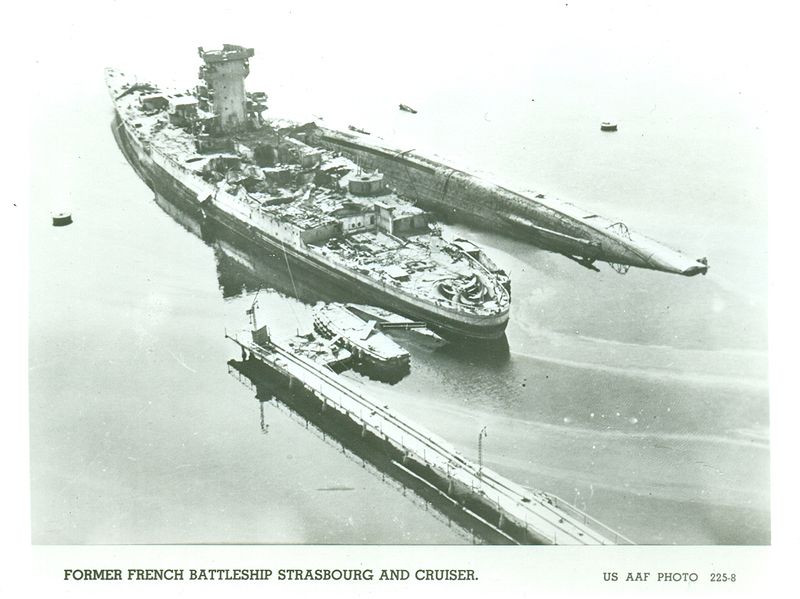
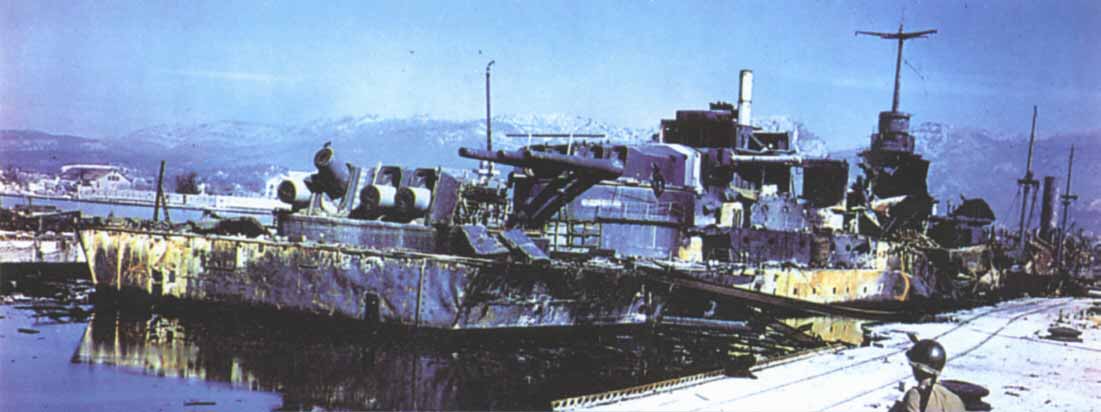
Dunkerque entered drydock for permanent repairs at Toulon and was there when the Germans occupied Vichy. Under threat of capture the Fleet was scuttled. Dunkerque was destroyed in drydock and declared a total loss. Both the Germans and Italians attempted scrapping operations and the wreck was further damaged by Allied bomber attacks.

The Hulk of the Dunkerque in1944

What was left of the hulk was refloated and finally scrapped in 1958. Strasbourg was scuttled by her crew, but refloated by the Italian Navy in July 1943. After the Italian surrender she taken over by the Germans, but was sunk again during an American air attack in August 1944. After the war she was refloated and used as a test bed for underwater explosions until she was condemned.  She was sold for scrapping in 1955.

Richelieu Class


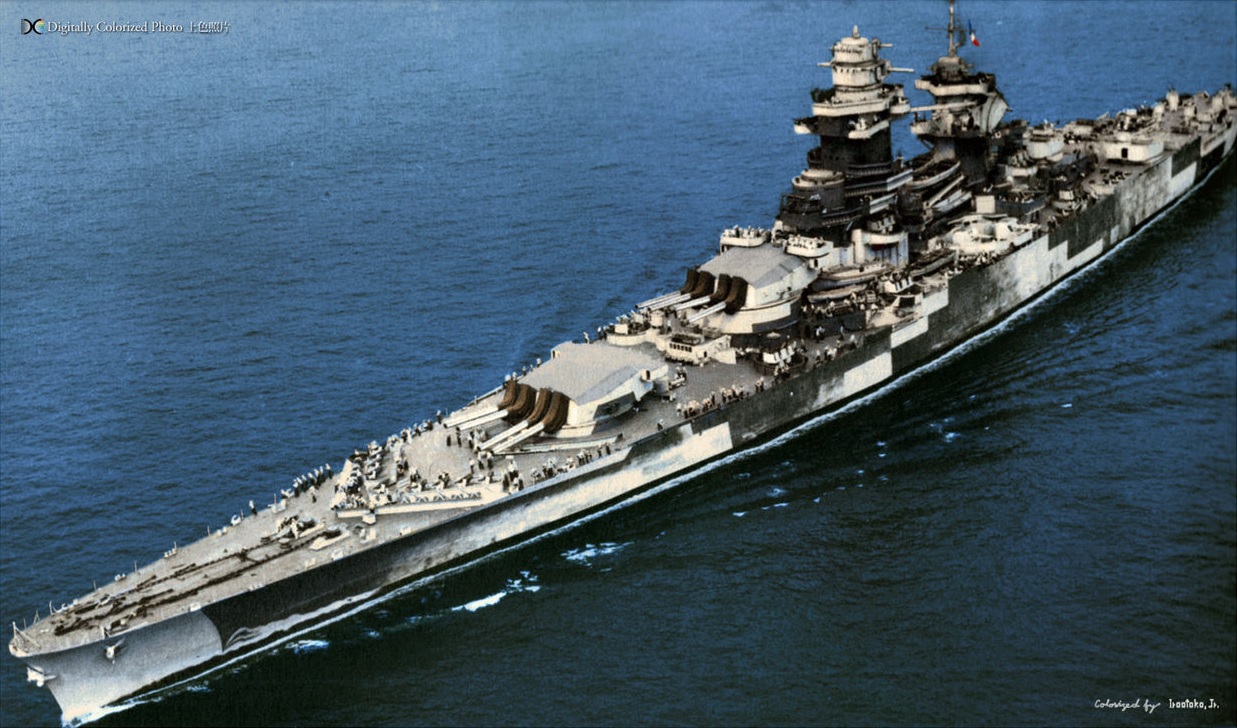
The Richelieu class was derived from the Dunkerque class in response to the Italian Vittorio Veneto Class.  With a standard displacement of 35,000 tons and a full load displacement of 48,950 tons the ships were the largest built by the French Navy until the commissioning of the Nuclear Aircraft Carrier Charles DeGaulle.

The ships shared the layout of the Dunkerque Class with their main battery of eight 15” guns mounted in quadruple turrets forward which like the Dunkerque’s allowed them to present the smallest silhouette possible to an opposing ship while being able to employ their entire main battery.   Their speed, protection and design were state of the art and comparable to their contemporaries in other navies.  They were capable of 32 knots at full speed and had a cruising range of 7671 miles at 20 knots.

The main battery was spaced far enough apart to ensure that a single hit could not put both turrets out of action and each turret was internally subdivided to prevent a single hit from knocking out all four guns. The mounted 9 6” dual purpose guns in three triple turrets aft and 24 4” AA guns in 12 twin-mounts located amidships.  During the war Richelieu was repaired and refitted in the US receiving 56 40mm Bofors AA guns in quadruple mounts and 48 20mm Oerlikon AA guns in place of her original 37mm cannons and 13.2 inch machine guns.

Richelieu arrives in New York in 1943

Richelieu was laid down in October 1935, launched in January 1939 and began sea trials in January 1940. When the Germans broke through the French defenses and threatened Brest Richelieu put to sea to French North Africa and was commissioned in June at Dakar. She was damaged by an aerial torpedo launched by a Swordfish Torpedo bomber from the HMS Hermes and received emergency repairs in Dakar. On 24 September she fought an engagement against the Royal Navy at the Battle of Dakar and was damaged by two 15” shells fired by the HMS Barham and was further damaged by a misfire in one of her turrets.

Richelieu Following Repairs and Modernizing in the United States 

Following the French return to the Allied camp she was sailed to New York for major repairs and modernization from January to November of 1943. Following this she operated with the British Home Fleet until March of 1944 when she was sent to the India Ocean to serve with the British Far East Fleet in operations against the Japanese until the end of the war. Following the war she took part in the initial stages of the campaign in French Indochina. She was placed in reserve in 1956 and struck from the Navy list and scrapped in 1968.

The Damaged Jean Bart at Casablanca

Her sister Jean Bart was laid down in December 1936 and launched on 6 March 1940.  With the German Wehrmacht approaching Saint-Nazaire she was just  75% complete. Her engines were untested engines and only one of her main battery turrets installed. Likewise, no secondary hard been installed and a few 37mm AA guns and machine guns were mounted to allow Jean Bart put to sea to escape the German advance and sailed to Casablanca.  The navy attempted to ship her second main battery turret on a freighter but that ship was sunk by a U-boat enroute to Casablanca. She was at Casablanca when the Allies invaded North Africa and was attacked by the U.S. Navy when the Vichy government refused to surrender on 8 November 1942.

During Operation Torch Jean Bart was engaged by the Battleship USS Massachusetts and aircraft from the carrier USS Ranger. She was damaged by several bombs and shells from the 16” guns of Massachusetts. She engaged Massachusetts with her one working turret but scored no hits. On the 10th she opened fire on the USS Augusta and was attacked again by aircraft from the Ranger which damaged her so badly that she had to be run aground to prevent her from sinking.

After temporary repairs, she remained in Dakar for the duration of the war. Despite the requests of the French Navy to have her sent to the United States for repairs and completion, the Americans and British did not feel that they needed another fast battleship. So she remained in Dakar for the duration of the war serving as a training ship. Following the war it was suggested that she be converted to an aircraft carrier but that was rejected and she was completed as a battleship and commissioned in 1949, although not completed and placed in active service until 1955. She took part in the Suez crisis of 1956, was decommissioned in 1957 and finally struck from the Navy list in 1969 and sold for scrap in 1970.

Jean Bart in the 1950s

Both the Dunkerque and Richelieu class were ships of unrealized potential due to the French surrender and the deep divisions between the Vichy and Free French governments.  Had circumstances been different they might have played an important role in the Battle of the Atlantic or in the Mediterranean during the war. I wonder how the Dunkerque’s against the Scharnhorst Class would of have came out, or even an engagement of them against the older Andria Doria, and Conte di Cavour Class battleships of the Regina Marina. 

Likewise, I wonder how the Richelieu Class  might have done in open combat with their Italian Vittorio Veneto Class or even the German Bismarck and Tirpitz. Instead they and their brave crews had to battle the Axis powers as well as former allies in circumstances in which all the cards were against them. One of Richelieu’s 15” guns is mounted on the waterfront at Brest as a memorial to these brave ships and the men that sailed them.

These ships were very advanced for their time, but unfortunately they did not get to do what they were designed to do. They were well designed, and compared favorably with almost every class of World War II battleship. The were beautiful tragic reminders that even the best designed warships are products of their times and circumstances. Those that survive war or become obsolescent almost always are determined  to be of no use, and are discarded. Some get reprieves as museum ships, but most end up scrapped or sunk as targets.

Such is the life and death of every warship.

Until tomorrow,

Peace,

Padre Steve+

4 Comments

Filed under History, Military, Navy Ships, World War II at Sea, world war two in europe

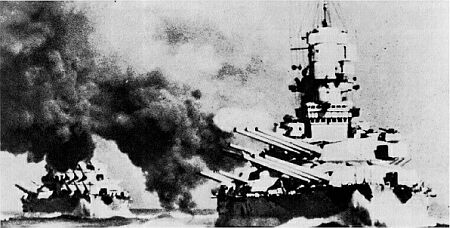
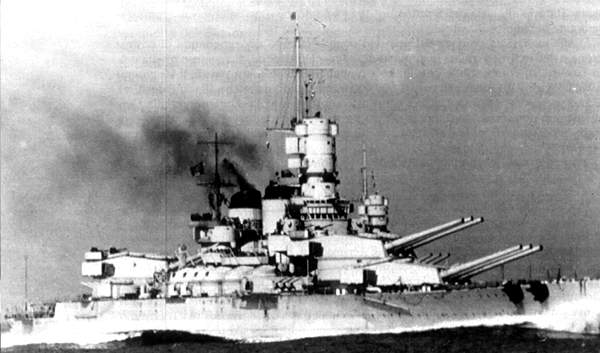
The Vittorio Veneto Class Battleships: The Pride of Italy and Victims of Changing Technology


Vittorio Veneto and Littorio

Friends of Padre Steve’s World,

Once again I have decided to destress and not write about COVID 19, politics, or the Holocaust and instead write about an interesting, and even fascinating class of warships which have been often forgotten.

This is the first in a series of six articles on the battleships built under the provision of the Washington and London Naval Treaty limitations in the 1930s. I am not including the ships which were completed in the immediate aftermath of the Washington Treaty limitations. This series looks at the modern battleships that the World War II combatants would produce in the 1930s which saw service in the war.

Part one covers the Italian Vittorio Veneto class, Part Two the French Dunkerque and Richelieu Classes, Part Three the British King George V Class and Part Four the American North Carolina and South Dakota Classes. The thing that I find interesting about all of these ships is who inventive each Navy building them was considering treaty restraints and their own adherence to, disregarding of, or the technical issues that they faced as none had designed or built a new battleship since the end of the First World War. In the case of Italy they did not even complete their most modern design after the war, thus the building of large and fast battleships was something new to each party. Had the economic effects of the First World War been so difficult, and the following Great Influenza of 1918-1919 so devastating, all of the navies involved might have completed ships that would have influenced the next generation.

I have already published the final part which covers the German Scharnhorst Class entitled Power and Beauty the Battle Cruisers Scharnhorst and Gneisenau The German Bismarck, Japanese Yamato, British Vanguard and American Iowa Classes will be covered in a subsequent series.

Most of these ships were constructed after the expiration of the treaties, but since most of the navies at least attempted to maintain a façade of compliance with the treaty limitations, most were officially listed as complying with the treaty restrictions. The fact that nations frequently lie about their adherence to treaty limitations, is nothing new, or surprising.

The Washington Naval Treaty placed a limit on the displacement and armament of battleships. It also stipulated the tonnage of capital ships allowed for each Navy, as well as limits on the displacement of cruisers, and destroyers. The only country not effected by the treaty was Germany, which until 1935 was required to observe much stricter limitations than Great Britain, the United States, France, Italy, or Japan.

The Washington Naval Treaty led to the scrapping or cancellation of nearly all the super Dreadnoughts, and fast battleships, sometimes known as Battlecruisers of the United States, Great Britain, Japan, France, and Italy. However, its restrictions opened up the development of large aircraft carriers by the United States and Japan which each were allowed to complete two of their new battleships or Battlecruisers into aircraft carriers, specifically the IJN Akagi and Kaga, and the American USS Lexington and Saratoga.

The London Treaty continued the restrictions of the Washington Treaty which limited the displacement of new ships to 35,000 tons with the main battery being limited to 16” guns. Each of the treaty signatories as well as the Germans, who were bound by the much more stringent Treaty of Versailles restriction, endeavored to build to the limit of the treaty and if possible skirt the limitations in terms of displacement which allowed them to increase protection as well as more powerful engineering plants. The Germans, now Hitler’s Third Reich, were aided in this by a bi-lateral Naval Agreement with Britain in 1935. The treaty not only allowed them a legal way to avoid the Versailles restrictions and gain international respect.

The Royal Italian Navy, or the Regia Marina had not completed a battleship design since the Andria Doria Class which were constructed between 1912 and 1915. These ships were provided  an extensive modernization between 1937 and 1940.  The modernization allowed them to serve as first line ships throughout the war. A subsequent class the Francesco Caracciolo class was started during the First World War but no ships of the class were completed. Italy’s war debts, overall financial condition, as well as the similar situation of the French, Italy’s main rival in the Mediterranean Sea, ensured that the Regina Marina had little money for new ships or modernizing old ships during the 1920s and 1930s. Even the accession of Mussolini did little to help the Navy until the 1930s. Even then competing ideas of how to build a new Navy were present in the Italian Naval High Command. Some placed their emphasis on large numbers of battleships, others a mix of aircraft carriers, fast battleships, cruisers and destroyers, while other sought a middle ground.

However, the Italians were forced to act as in the 1930s a new naval arms race was underway in the Mediterranean. The French Navy had begun a new class of Fast Battleships, the Dunkerque class which were designed to defeat the German Deutschland class “pocket battleships” and the follow on Richelieu Class of fast battleships. Mussolini saw the new French ships as a threat to the his control of the Mediterranean, or as the Italians and their Roman ancestors called it Mare Nostrum (our Sea), and ordered the construction of a new class of battleships to help Italy achieve naval dominance in the Mediterranean.

The new ships were of a breathtaking design. They were  large, fast and heavily armed. While they were officially listed as meeting the prescribed treaty limit of 35,000 tons they actually would displace 41,177 tons standard displacement, and 45,963 tons full load. They were armed with a main battery of 9 15” L/50 guns in triple turrets. They had a secondary armament of 12 6” and 12 3.5” dual purpose guns, and a powerful light anti-aircraft battery of 20 37mm and 30 20mm anti-aircraft guns. They were capable of a top speed of 30 knots. Although they had a relatively short range of 3900 miles at 20 knots, they were formidable ships for operations in the constrained waters of the Mediterranean where they would not be required to operate at long ranges from Italian bases in Italy, Sicily, or Libya. They were well protected from shellfire, although their Pugliese torpedo defense system proved inferior to traditional designs, because it did not hold up well to direct hits, or close aboard explosions which resulted in massive flooding when hit by a torpedo or by a near miss from a heavy bomb or shell.

Their main armament though formidable was not without its flaws. The 15” guns had a very long range of 42 km or 26.6 miles and high muzzle velocity of 2900 fps. This meant that they had a long reach, however, their high muzzle velocity led to a barrel life of only about half that of their counterparts, and led to inconsistent shell fall patterns, which lessened to probability of hitting targets at long range. The guns also suffered from a slow rate of fire of only 1.3 rounds per gun a minute.

The Ships

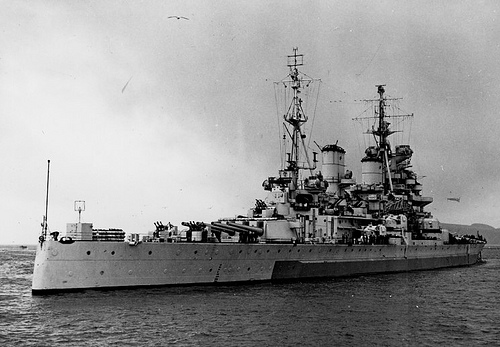
Vittorio Veneto in 1943

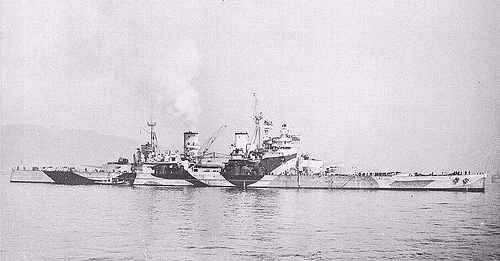
The Vittorio Veneto was laid down 1934 along with her sister the Littorio, and was launched on 25 July 1937. She was commissioned on 28 April 1940, barely a month before Italy declared war on France and Britain. She would see action numerous times and give a good account of herself against the British taking part in 56 war missions. She fought at the Battle of Cape Spartivento (Teulada) where she fired 19 salvos to drive off a 7 ship British cruiser squadron in a pitched battle that also included the battleship HMS Ramillies and battle cruiser HMS Renown. In 1941 she took part in the Battle of Cape Matapan where she was damaged by an aerial torpedo after driving off a British cruiser squadron. After repairs she was back in action and on 15 June 1942 participated in the Battle of Mid-June, where she and her sister ship Littorio successfully fenced off a large British convoy from Alexandria by their mere presence at sea.  She was also the first Italian battleship equipped with radar. She surrendered with the Italian fleet to the Allies on 8 September 1943 surviving furious German air attacks. She was interred at the Great Bitter Lakes in the Suez Canal. After the war she taken as war compensation and was returned to Italy and scrapped beginning in 1948.


Littorio

Littorio (later Italia): Littorio was laid down in 1934 and launched on 22 August 1937 and commissioned on 6 May 1940.  She participated in 43 operations including the Battle of Sirte and several actions against British convoys.  Following the Battle of Mid-June she was struck by an aerial torpedo dropped by a Wellington bomber. She was repaired and upon the removal of Mussolini from power was renamed Italia and surrendered with the Italian Fleet on 8 September 1943 being damaged by a Fritz-X radio controlled bomb. With her sister the ex Vittorio Veneto, now Italia, she was interred in the Great Bitter Lake and was returned to Italy where she was decommissioned and scrapped beginning in 1948.


Roma

 Roma was laid down 18 September 1938, launched on 9 June 1940 and commissioned 14 June 1942.  Despite her addition to the fleet she was not deployed due to a fuel shortage. She sailed with the Italian Fleet to surrender on 8 June under the guise of the fleet sailing to attack the Allied invasion fleet off Salerno. The Germans discovered the ruse and the Luftwaffe launched air attacks against the Italian Fleet. Luftwaffe Dornier Do-217s armed with Fritz-X radio controlled bombs attacked the fleet as it transited the Strait of Bonafacio.


Roma exploding after being hit by Fritz-X radio guided bomb 

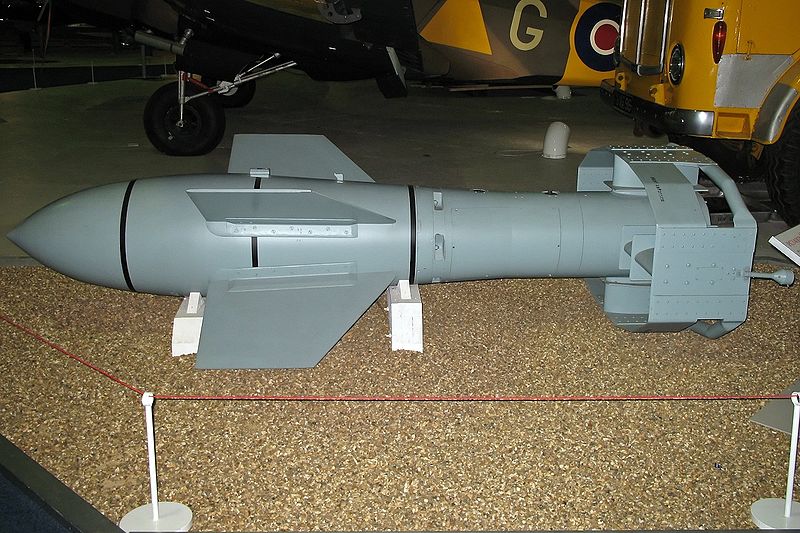
Roma was hit by two of the missiles the first which flooded two boiler rooms and the aft engine room.  She was hit again by a second Fritz-X which hit in the forward engine room causing catastrophicdamage. The explosions ignited the number two turret magazine blowing the turret off the ship and causing the ship to capsize and break in two. She sank, carrying 1255 of her crew including Admiral Carlo Bergamini to their death. Roma was the first ship sunk by a radio controlled bomb, the forerunner of our current air launched anti-ship missiles. In the years since, lightly constructed surface ships have not faired well against air or sea fired anti-ship missiles.


The Fritz-X Radio Guided Bomb

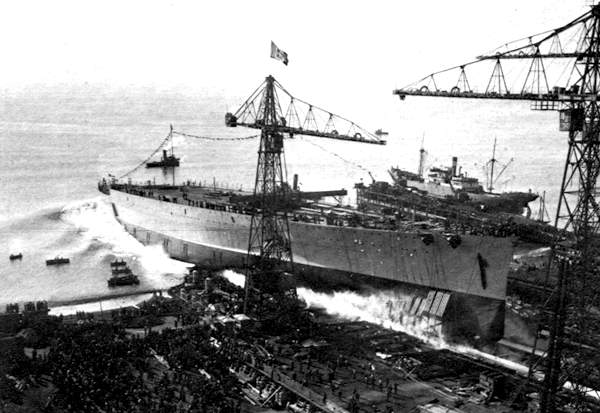
The fourth and final ship of the Class, Impero, was was laid down and launched, but never completed. When Italy surrendered the Germans used her incomplete hull as a target sinkinrn her. She was raised and scrapped after the war.

Impero Being Launched in 1939

The Vittorio Veneto class was a sound design and operationally successful against the Royal Navy. Her design was explored by the Soviet, Dutch, and Spanish navies in their attempts to build moderner battleships or battlecruisers, although none came to fruition. The fact that the two surviving ships, as well as the newest most modern were scrapped was a travesty as the Cold War began. Their loss left Italy with the remaining two Andrea Doria class battleships, completed in 1915 and 1916 as the battle force of the Italian Navy, until they were scrapped in the late 1950s and early 1960s.

The brave sailors of the Regina Marina who manned these fine ships should not be forgotten.

Until tomorrow,

Peace,

Padre Steve+

1 Comment

Filed under History, Military, national security, Navy Ships, nazi germany, World War II at Sea, world war two in europe

The Liberation of Dachau “Model Camp” at 75 Years

Friends of Padre Steve’s World,

Today marked the 75th anniversary of the liberation of Dachau, the model concentration camp of the the Nazi SS State.


On March 20th 1933, barely a month and a half after the Nazi takeover of the German government and three days before the passage of the Enabling Act the Police President Of Munich, SS Reichsführer Heinrich Himmler ordered the establishment of the Dachau Concentration Camp. He appointed SS Standartenführer Hilmar Wäckerle as Commandant and the first 200 political prisoners from Munich’s Stadelheim prison arrived at Dachau on March 22nd.

The first SS guards assigned to Dachau were given the following instruction:

“Comrades of the SS!
You all know what the Fuehrer has called us to do. We have not come here for human encounters with those pigs in there. We do not consider them human beings, as we are, but as second-class people. For years they have been able to continue their criminal existence. But now we are in power. If those pigs had come to power, they would have cut off all our heads. Therefore we have no room for sentimentalism. If anyone here cannot bear to see the blood of comrades, he does not belong and had better leave. The more of these pig dogs we strike down, the fewer we need to feed.”

Wäckerle’s brief tenure as Commandant was marked by extraordinary brutality on the part of his staff, so much so that charges were brought against him by the Munich courts which resulted in his relief by SS Gruppenführer Theodore Eicke in July 1933. Eicke would establish the regulations which governed all the later Concentration Camps, and make Dachau the model camp for all others.

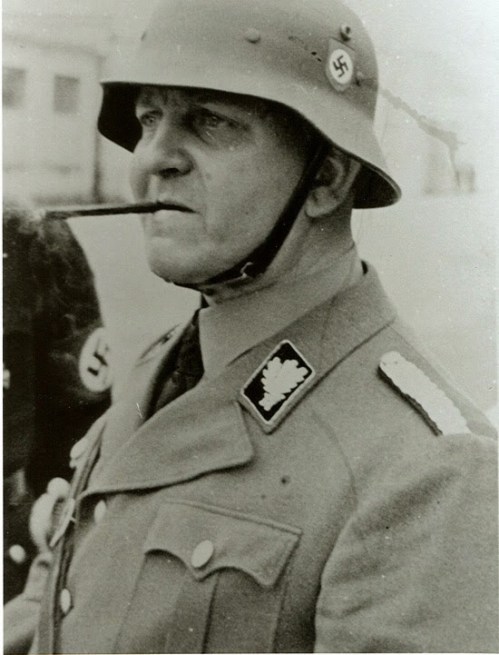
Theodore Eiche

Theodore Eicke

Among the later SS killers of the Holocaust who served at Dachau were Adolf Eichmann, and the Commandant of Auschwitz, Rüdolf Höss. It became a training ground for other Concentration Camp commanders and staff. Others would become leaders in the Waffen SS and the Einsatzgruppen death squads.

The announcement of Dachau’s Opening was reported by the German press in this release:

On Wednesday the first concentration camp is to be opened in Dachau with an accommodation for 5000 people. ‘All Communists and—where necessary—Reichsbanner and Social Democratic functionaries who endanger state security are to be concentrated here, as in the long run it is not possible to keep individual functionaries in the state prisons without overburdening these prisons, and on the other hand these people cannot be released because attempts have shown that they persist in their efforts to agitate and organize as soon as they are released.

Dachau began as a political prisoner camp for the Nazis to imprison Socialists, Communists, Jehovah’s Witnesses, some Jews, and other dissidents. It wasn’t a “death camp” designed to exterminate people even though tens of thousands of people died or were executed there. It was designed to terrorize, dehumanize, and destroy the souls of its inmates.

It was a place of inhuman medical experiments, a place of terror, and the administrative center of a network of over 30 large and 100 small sub-Camps which were used as sources of slave labor for the German armaments industry. But one has to remember that the SS was not simply an instrument of terror, but an institution also devoted to profit. Prisoners were valued in what their lives equated in profits. A prisoner was valued in what he or her could produce versus the expenses of keeping them alive for a period of 6 to 12 months. Under Himmler and his assistant for production and profits, ObergrüppenfuhrerOswold Pöhl the Concentration Camps, as well as the death camps became centers of profit for the SS in collaboration with German industrial concerns and industries owned by the SS itself.

Dachau was not one of the Death Camps, although it was a place of incredible cruelty, extraordinary suffering, brutality, and death. While not a “death camp” per say, an estimated 40,000 or more  prisoners were murdered there. For tens of thousands of others it served as a transit camp from which they were sent to the death factories in Poland, including Auschwitz, or other work camps, where many died of being worked to death, malnutrition, disease, or the simple cruelty and maltreatment inflicted on them by the guards.

Holocaust survivor Yehuda Bauer wrote: “The horror of the Holocaust is not that it deviated from human norms; the horror is that it didn’t. What happened may happen again, to others not necessarily Jews, perpetrated by others, not necessarily Germans. We are all possible victims, possible perpetrators, possible bystanders.”

The picture that you see above is the memorial to the Unknown Prisoner at Dachau. The words: “Den Toten zur Ehr, den Lebenden zur Mahnung” [To Honor the Dead, to Warn the Living] are engraved at its base.

I have been to Dachau at least a half dozen times beginning back in 1996. For me as a historian of the period the trip is both for learning and for meditation, for beyond its historical significance this is a holy place, a place made holy by the blood of tens of thousands of victims of one of the most evil regimes in history. The crimes committed by the staff of Totenkopfverbande SS guards from it’s inception were intended to terrorize and dehumanize the inmates who included political prisoners, religious objectors, Jews, and homosexuals. The inmates were not there because they were convicted of any crimes, in fact many had actually been exonerated by courts. In the case of those who had been convicted by courts, all had served what ever sentence they had been convicted of, but upon their release from prison were picked up by the SS and taken to Dachau where they were imprisoned without being charged with a crime, and an indefinite period and no date of release. Sometimes prisoners would suddenly and without warning be released, but they remained under observation by the local police and Gestapo. If they talked about their experience they were quite often sent back.

Prisoners were told on arrival:

Here you are, and you’re not in a sanatorium! You’ll have got that already. Anyone who hasn’t grasped that will soon be made to. You can rely on that . . . You’re not prison inmates here, serving a sentence imposed by the courts, you’re just ‘prisoners’ pure and simple, and if you don’t know what that means, you’ll soon find out. You’re dishonourable and defenceless! You’re without rights! Your fate is a slave’s fate! Amen.

In the Camp the prisoners were subject to punishment for even the most minor or perceived infractions, beatings, and whippings. Other punishments were meted out by guards who themselves were punished if they showed any mercy or human kindness to a prisoner. “While an offender sentenced to a term in prison knew when he was going to get out, release for the concentration camp inmate was determined by the whim of a quarterly review board, and could be delayed by the malice of any of the SS guards.”

Theodore Eicke, the commandant who systematized the Concentration Camp system created a world that his subordinate, and the later Commandant of Auschwitz, Rudolf Hoess described:

“It was Eicke’s intention that his SS-men, by means of continuous instruction and suitable orders concerning the dangerous criminality of the inmates, should be made basically ill-disposed towards the prisoners. They were to ‘treat them rough’, and to root out once and for all any sympathy they might feel for them. By such means, he succeeded in engendering in simple-natured men a hatred and antipathy for the prisoners which an outsider will find hard to imagine.”

Even a brutal man like Hoess found the brutality hard to watch, he recalled the:

“malicious evil-minded, basically bad, brutal, inferior, common creatures’ amongst the guards, who compensated for their sense of inferiority by venting their anger on the prisoners. The atmosphere of hatred was total.”

In the twelve years of its existence the staff of Dachau, through mistreatment, execution by bullet, gallows, through being used as subjects in grotesque medical experiments, by “execution by work,” or untreated illness and disease, murdered 41,566 prisoners. The point to be remembered is that despite this incredible number of murders that Dachau was not an extermination camp.

As the Third Reich crumbled the Nazis attempted to hide their crimes. Many inmates from Dachau were sent to other camps, by train or forced marched hundreds of miles. During these transits many, already shells of humanity due to maltreatment, disease and malnourishment. Even as this was happening trains from other camps were arriving at Dachau.


On 29 April 1945 units of the U.S. Army 45th and 42nd Infantry Divisions liberated Dachau, which was surrendered by its senior remaining officer, a mere SS 1st Lieutenant, as the commandant and   o ther senior officer had already fled. Most to be captured within days or weeks. The liberators were shocked by what they saw, the piles of dead, the bones in the crematoria, the emaciated prisoners,  and a train car full of dead, and some soldiers took their revenge on some of the guards, and massacred an estimated 20-50 of the surrendered SS men. Although charges were preferred, they were dropped.

The Execution of SS Guards at Dachau 

Regardless of the actions of the American liberators, even those who took justice into their own hands, the fact is that the Dachau guards all knew what was going on and had each to some degree participated in the atrocities at Dachau and in some cases other camps, or on the Eastern Front.

You may wonder why I took the time to go into such detail about my visits to Dachau and its terrible legacy. The answer is the same why I choose to walk American Civil War battlefields, it is to being to try to understand what the people there were seeing and experiencing.

Of course there were the prisoners who were so savagely treated by their jailers. Then there were the bystanders, the citizens of Dachau and other German cities who watched as Jews, political enemies, and others were marched to the camp, which was not a secret installation. Finally, there were the perpetrators, very few of whom were punished for their actions.

But another reason is that the survivors, be they victims, perpetrators, or bystanders are rapidly passing away

Soon none will be left. When that happens it is up to us the living to ensure that this is not forgotten and that those murdered at Dachau, the other Concentration Camps, the extermination camps, and those killed by the murder squads that went from one end of Europe to the other in a systematic attempt to wipe every Jew that they could find off of the face of the earth. Yes, there were other victims, but the Nazi crusade against the Jews knew no boundaries, physical or time included. Unlike every other genocide it extended beyond national borders, or time; it was an eschatological crusade that by the will of Hitler was limited by only one factor, the complete military defeat that was inflicted on Nazi Germany by those who she attacked.


Finally, the story must be told because there are those who either claim it didn’t happen, or are tired of talking about it. In Germany those include leaders of the new-Nazi AfD (Alternative for Germany) Party. In the United States, Britain, and other nations there are members of many new-Nazi and Alt-Right groups who desire very much the same thing. But if decent people decide not to speak out, if we remain silent, there is nothing anywhere that will keep these ideological descendants of Hitler from beginning it again, if not to the Jews, to other despised racial, religious, ethnic, or ideological groups. We live in a world where demagogues take advantage of people’s legitimate anxieties and deeply ingrained prejudices to stir up ungodly anger and hatred in order to both gain new followers and to incite those followers to a campaign of violence.

Doctor Timothy Snyder wrote:

“The European history of the twentieth century shows us that societies can break, democracies can fall, ethics can collapse, and ordinary men can find themselves standing over death pits with guns in their hands. It would serve us well today to understand why.”

But I know why, there are some people who are sociopaths, who though they seem ordinary have no empathy for others, and they are more numerous than we might ever suspect. Captain Gustave Gilbert, a psychologist assigned to the major war crime defendants at the Nuremberg war crimes trials noted:

“In my work with the defendants (at the Nuremberg Trails 1945-1949) I was searching for the nature of evil and I now think I have come close to defining it. A lack of empathy. It’s the one characteristic that connects all the defendants, a genuine incapacity to feel with their fellow men. Evil, I think, is the absence of empathy.”

That absence of empathy runs strong among Trump supporters and others of the religious and political right today. For the rest of my life I will fight them and expose them.

So until tomorrow I wish you all the best and ask that no matter what the leaders of your state say, to obey common sense and facts and be as careful as you can, as the COVID 19 pandemic is far from over.

Peace,

Padre Steve+

5 Comments

Filed under authoritarian government, Coronavirus, Diseases Epidemics and Pandemics, ethics, germany, History, holocaust, Military, nazi germany, News and current events, Political Commentary, racism, Religion, us army, world war two in europe

Power, Beauty and Tragedy at Sea: The Battlecruisers Scharnhorst & Gneisenau

Scharnhorst

Friends of Padre Steve’s World,

I was too tired last two nights to write anything. Thursday I had a long but good day at work and had to clean out much of my private email last night before I could do anything else because I was at over 90% of my email storage capacity. And it took forever to sort through it and get it down to almost 50%. Likewise, I did very little on social media. I finally caught up on my comics from the last couple of days and replied to some correspondence that I needed to do and began to work on this last night, but again found that I was too tired to complete it. So when it appeared that I wouldn’t complete it until after midnight I simply said “what the hell” and put it off until now.

This is another one of those posts to switch things up and write about a class of warships that I find fascinating, the World War II German Battlecruisers, Scharnhorst and Gneisenau. First and foremost I think that they were among the most beautiful capital ships ever built. That doesn’t mean that they didn’t have design flaws, or were superior to many other capital ships. Gneisenau’s career was cut short by Germany’s inability to protect her while in port, while Scharnhorst was the victim of an ill planned sortie under the command of an admiral who had no experience commanding large ships and who had only assumed command of her task force the day before. So if you are a Naval history or warship  buff, enjoy.

Have a great day, stay inside and if you have to go out wear a mask and keep a safe distance from others to protect you and them.

Peace,

Padre Steve+


The naval architects of Germany in the early 1930s designed some of the most beautiful as well as deadly warships of the Second World War.  Following Nazi Germany’s rejection of the provisions of the Treaty of Versailles the Kreigsmarine enacted building program to enlarge and modernize the German Navy.

Gneisenau refueling  from Tanker Westerwald in July 1939 

The first major units constructed were actually begun by the predecessor to the Kreigsmarine, the Reichsmarine of the Weimar Republic.  These were the Deutschland class Armored Ships, Panzerschiffe, sometimes called “Pocket Battleships” and later during the war were reclassified as Heavy Cruisers. These ships were designed to replace the old pre-Dreadnaught battleships which Germany was allowed to retain following the Treaty of  Versailles. The ships incorporated electric welds to reduce displacement, diesel engines for extended cruising range to enable them to serve as commerce raiders and a battery of six 11” guns. It was believed that as surface raiders their speed would allow them to avoid battle with all existing battleships except the three British Battlecruisers Hood, Renown, and Repulse, while being able to outgun any heavy or light cruiser they might encounter on such a mission. While they were an advance over anything in the German inventory they were outclassed by Hood, Renown and Repulse, as well as later French Dunkerque and Strasbourg. 

Gneisenau

The next and first truly capital ships built by the Kriegsmarine were the Scharnhorst and Gneisenau battleships which in reality were battle cruisers because of their light main battery of 11” guns as opposed to the 14”, 15” or 16” batteries of other nations battleships. The Hermans did. plan to rearm them with 15” guns but the war kept that from happening.

Scharnhorst before the War 

Despite the disparity in their main armament, their displacement and armor protection was comparable to other battleships of the era and their designed speed of 31.5 knots was superior to almost all other battleships of the era including the British King George V Class and the US North Carolina class.  Only the British Hood was superior to them in speed. However, their speed came at a cost, they did not have the long cruising range to make them truly effective commerce raiders because they were propelled by steam turbines which consumed large amounts of fuel. Since the Germans did not have a fleet replenishment system like the U.S. Navy, nor the secure network of worldwide bases of the Royal Navy, they could only operate in the Northern Atlantic or Arctic for limited amounts of time. If damaged there were few safe harbors for them which had the capability of repairing them without them being exposed to allied bombers.

Gneisenau Main Battery

As built they displaced 31,000 toms, however at full combat load they both weighed in at nearly 38,000 tons and were 772 feet long.  They had an armor belt that was nearly 14 inches thick.  Armed with a main battery of nine 11” guns and a secondary armament of twelve 5.9 inch guns they also mounted a powerful for the time anti- aircraft battery of fourteen 4.1 inch guns, 16 37mm and 16 20mm anti-aircraft cannons.  Additionally they mounted six 21” torpedo tubes and carried three Arado 196 A3 scout planes.  The main battery was eventually to be replaced by six 15” guns but this never occurred although Gneisenau was taken in hand after being damaged in Operation Cerberus to mount the new weapons but the conversion was never completed.

Scharnhorst in Action Against HMS Glorious

Scharnhorst was laid down on 15 June 1935 and launched 3 October 1936. She was commissioned 7 January 1939.  Her sister Gneisenau was laid down 6 May 1935, launched 8 December 1936 and commissioned 21 May 1938.  Upon the commencement of the Second World War the two sisters began a reign of destruction on British shipping in the North Atlantic. On 23 November 1939 they sank the Armed Merchant Cruiser HMS Rawalpindi while on patrol near the Faroe Islands.

During Operation Weserübung the pair surprised sank the aircraft carrier HMS Glorious and her two escorting destroyers HMS Ardent and Acasta on 7 June 1940. It was the only time a Fleet carrier was caught and sunk by battleships during the war. However, Scharnhorst was hit by a torpedo from Acasta which led to her being withdrawn to Trondheim, for temporary repairs before retiring to Kiel for permanent repairs.

Scharnhorst during Operation Berlin and being Refueled during the Operation

From January to March 1941 they conducted Operation Berlin under the command of Admiral Gunther Lütjens against British merchant shipping in the North Atlantic sinking 22 ships before returning to base. During the action the task force encountered the British Battleships HMS Ramillies and HMS Malaya escorting different convoys which Lütjens refused to engage. After sinking ships from another convoy they encountered HMS King George V and HMS Rodney which they escaped using their superior speed, but by now, Lütjens realize that the danger of continuing the outweighed the potential success and headed for repairs in the port Brest, in occupied France.

While in Brest Scharnhorst needed repairs to a superheater for her boilers, while Gneisenau was damaged during a British air raid and were unable to deploy with Bismarck and Prinz Eugen for Operation Rheinübung, during which Bismarck sank HMS Hood, but was damaged by a 14” shell from HMS Prince of Wales which cut the fuel line from the ship’s forward fuel tanks. Lütjens decided to cut the mission short and escape to Brest, but was damaged by an aerial torpedo from a Swordfish torpedo bomber flying from HMS Ark Royal which wrecked her steering gear and allowed HMS King George V, HMS Rodney, as well as cruisers and destroyers to catch and sink her on May 27th. Prinz Eugen returned safely to Brest to join the Battlecruisers.

The Channel Dash Seen from Prinz Eugen above and below


                          Admiral Cilliax Addressing the Crew of Scharnhorst at Kiel

While at Brest Gneisenau was again bombed and torpedoed requiring extensive repairs.  Due to the exposed location of the port, the German high command decided to return the ships to Germany along with the Heavy Cruiser Prinz Eugen.  Commanded by Vice Admiral Otto Ciliax,  Operation Cerberus took place from 11-13 February 1942. It involved the Battlecruisers and Prinz Eugen, accompanied by destroyers, E-Boats, and R-Boats. The force was protected heavy Luftwaffe fighter cover, Code named Operation Donnerkeil the air operation was commanded by the legendary Luftwaffe fighter ace, General Adolf  Galland. 

The dash up the English Channel, was unsuccessfully contested by the Royal Air Force and Royal Navy. The German ships successfully broke through the Channel in broad daylight and protected itself from being damaged by aircraft, motor torpedo boats, destroyers, and shore batteries. Once clear of the channel and headed for home both Scharnhorst and Gneisenau struck mines which caused various amounts of damage, but both got through to Kiel.

The success of the daylight passage through the English Channel shocked and infuriated the British public. The Times of London published an editorial on 14 February which fumed:

Vice Admiral Ciliax has succeeded where the Duke of Medina Sidonia failed. Nothing more mortifying to the pride of our sea-power has happened since the seventeenth century. […] It spelled the end of the Royal Navy legend that in wartime no enemy battle fleet could pass through what we proudly call the English Channel.

Despite the fact that then Operation was successful, the high command of the German Navy Their breakthrough was an embarrassment to the Royal Navy and Royal Air Force. The high Command of the German Navy considered it a tactical victory but a strategic defeat, for it had traded a base, albeit exposed from which it could conduct offensive operations, to the defense of Norway, a mission of dubious value at best.

                                    Gneisenau after being Bombed in Floating Dry Dock

While undergoing repairs in a floating dry dock at Kiel Gneisenau was heavily damaged by the Royal Air Force on the night of 26-27 February. The damage was such that the Kriegsmarine High Command decided to elongate her damaged bow section and rearmament to replace her main battery with 15” guns. Once seaworthy she steamed to the port of Gotenhafen for full repairs and rearmament. Although some work was completed the conversion was halted by Hitler who was infuriated by the failure of a German Task Force at the Battle of the Barents Sea, 30-31 December 1942. Hitler fired Grand Admiral Erich Raeder, and and gave an order to scrap what remained of the German surface fleet and concentrate on the U-Boat war. Admiral Karl Donitz prevented the scrapping of the fleet, but most ships were laid up and their crews reassigned to provide crews for U-Boats. Gneisenau was disarmed with her 11” and twin 5.9” removed and installed along the Atlantic Wall. One triple 11” turret, either Bruno or Dora was installed as part of a coastal defense battery in Norway. The battery was taken over by the Norwegians after liberation and remained in commission as Austrått Fort until 1968. Since then it has become a well preserved museum.

When the Red Army approached Gotenhafen her remaining crew moved her to the harbor entrance and sank her as a block ship on 27 March 1945.  Following the war she was raised by the Poles and scrapped in 1951.

Gneisenau Sunk as Blockship 

Turret of Gneisenau at Austrått Fort Norway


Scharnhorst was repaired following Operation Cerberes and in March 1943 was transferred to Norway where along with Tirpitz, Admiral Scheer, Lutzow (the former Deutschland), Admiral Hipper and Prinz Eugen she became part of a “fleet in being” poised to strike the Allied convoys bound for Russia. On Christmas Day 1943 under the command of Rear Admiral Erich Bey the Scharnhorst set sail with several destroyers undertook Operation Ostfront and the ensuing battle became known as the Battle of North Cape. The mission was an attack on two Russia bound convoys. But the orders were intercepted and decoded by the British. Admiral Bruce Fraser planned a trap to intercept and neutralize Scharnhorst. 

Once Scharnhorst sailed the battleship HMS Duke of York, four cruisers and a number of destroyers as she closed on the convoy. However, due to the sea conditions Bey detached his escorting destroyers and ordered them to return to port.  Duke of York and her supporting cruisers and destroyers engaged Scharnhorst. Bey now realized he had no chance of destroying the convoy and attempted to escape.  However, Scharnhorst was damaged and her speed and maneuvering capabilities impaired.  Now virtually defenseless and surrounded the great ship was sunk with the loss of all but 36 of her 1968 man crew. Her wreck was discovered 3 October 2000 some 70 miles north of North Cape Norway.

Sinking of Scharnhorst by Charles Turner ( c) National Maritime Museum; Supplied by The Public Catalogue Foundation

Survivors of Scharnhorst debark in England 

Thus ended the careers of two of the most beautiful battleships ships to grace the seas. Though their  careers were short they both survived frequent heavy battle damage to return and fight again.  Perhaps  their greatest weakness was the inability of the German Navy to provide them adequate escorts at sea, and the inability of the Luftwaffe to protect them against air strikes while in port. But ultimately their great weakness was the poor naval strategy employed by Hitler and Raeder at the beginning of the war which ensured their destruction. Of the major German surface units only the Pocket Battleships we’re capable of long range commerce raiding operations. The short range of the other heavy German ships, their reliance on steam turbines rather than Diesel engines, lack of air and surface support at sea, and secure overseas bases that that could operate doomed all of them to failure, and resulted in the deaths of far too many brave sailors, fighting for their country in an unrighteousness and evil cause.

Leave a comment

Filed under germany, History, Military, national security, Navy Ships, nazi germany, World War II at Sea, world war two in europe

“If I Offended You… I’m not in the least Sorry” The Liberation of Buchenwald at 75

Friends of Padre Steve’s World,

During our trip to Germany last year we visited the Buchenwald Concentration Camp, which as a Major Camp had numerous sub-Camps, including Ohrdruf which Generals George Patton and Dwight Eisenhower visited shortly after its liberation in April 1945. Both went out of their way to describe the horrors they saw.

In our day there are fewer and fewer people who lived through or personal saw or documented the evils of the Nazi Concentration Camps. Likewise, there are a host of Holocaust deniers who produce a plethora of pseudo-scholarly articles claiming to be legitimate historians. Even more frighteningly the rise of apologists for the Nazi regime including those who are active members of allegedly conservative parties in the United States and the European Union is beginning to influence politics. The abject racism, rejection of anyone considered racially inferior, and quite often their unhidden anti-Semitism show that what lies in the dark heart of Naziism is not dead and in fact is rising.

In the United States its rise is being fueled and legitimized by the Presidency of Donald Trump who has referred to American Nazis and White Supremacists as “very good people” after one of their protests where an anti-Nazi demonstrator was murdered and others brutally attacked. In the same time frame a good number of Republican candidates have exposed themselves as White Supremacists and actual Nazis while running for office. A host of new-Nazi and White supremacist organizations openly meet and flood the internet with their race hatred, and it goes unchecked by the Administration and the Justice Department.

The fact is that anyone who denies the Holocaust, attempts to minimize it, or advocates the same policies of race hatred and violence against political, religious, or other opponents is no better than the perpetrators of the Holocaust. Likewise, those who stand by and say nothing are worse. As Yehuda Bauer wrote:

“The horror of the Holocaust is not that it deviated from human norms; the horror is that it didn’t. What happened may happen again, to others not necessarily Jews, perpetrated by others, not necessarily Germans. We are all possible victims, possible perpetrators, possible bystanders.”

The good thing is that there were people who took the time to record what they saw in the Nazi Concentration Camps and exposed those deeds to the world in such a way that only perverted and evil people could brazenly deny those facts.

One of the most detailed descriptions of a liberated Concentration Camp was written by General George Patton in his memoirs entitled War as I Knew It.

… we drove to Ohrdruf and visited the first horror camp any of us had ever seen. It was the most appalling sight imaginable.

A man who said he was one of the former inmates acted as impresario and showed us first the gallows, where men were hanged for attempting to escape. The drop board was about two feet from the ground, and the cord used was piano wire which had an adjustment so that when the man dropped, his toes would just reach the ground and it would take about fifteen minutes for him to choke to death, since the fall was not sufficient to break his neck. The next two men to die had to kick the board out from under him. It was stated by some of the Germans present that the generals who were executed after the Hitler bomb incident were hanged in this manner.

Our guide then took us to the whipping table, which was about the height of the average man’s crotch. The feet were placed in stocks on the ground and the man was pulled over the table, which was slightly hollowed, and held by two guards, while he was beaten across the back and loins. The stick which they said had been used, and which had some blood on it, was bigger than the handle of a pick.

Our guide claimed that he himself had received twenty-five blows with this tool. It later developed that he was not a prisoner at all, but one of the executioners. General Eisenhower must have suspected it, because he asked the man very pointedly how he could be so fat. He was found dead next morning, killed by some of the inmates.

Just beyond the whipping table there was a pile of forty bodies, more or less naked. All of these had been shot in the back of the head at short range, and the blood was still cooling on the ground.

In a shed near-by was a pile of forty completely naked bodies in the last stages of emaciation. These bodies were lightly sprinkled with lime – not, apparently, for the purpose of destroying them, but to reduce the smell. As a reducer of smell, lime is a very inefficient medium.

The total capacity of the shed looked to me to be about two hundred bodies. It was stated that bodies were left until the shed was full and then they were taken out and buried. The inmates said some three thousand people had been buried from this shed since January 1, 1945.

When our troops began to draw near, the Germans thought it expedient to remove the evidence of their crimes. They therefore used the inmates to exhume the recently buried bodies and to build a sort of mammoth griddle of 60 cm. railway tracks laid on a brick foundation. The bodies were piled on this and they attempted to burn them. The attempt was a bad failure. Actually, one could not help but think of some gigantic cannibalistic barbecue. In the pit itself were arms and legs and portions of bodies sticking out of the green water which partially filled it.

General Walker and General Middleton had wisely decided to have as many soldiers as possible visit the scene. This gave me the idea of having the inhabitants themselves visit the camp. I suggested this to Walker, and found that he had already had the mayor and his wife take a look at it. On going home those two committed suicide. We later used the same system in having the inhabitants of Weimar go through the even larger slave camp (Buchenwald) north of that town. (Excerpted for G. Patton War as I Knew It)

Dwight D. Eisenhower wrote after seeing the camp:

The same day [April 12, 1945] I saw my first horror camp. It was near the town of Gotha. I have never felt able to describe my emotional reactions when I first came face to face with indisputable evidence of Nazi brutality and ruthless disregard of every shred of decency. Up to that time I had known about it only generally or through secondary sources. I am certain, however that I have never at any other time experienced an equal sense of shock.

Eisenhower was so moved that he ordered that the best reporters and newsmen come and record what he had seen. He did not want the horrors to be denied by history. He wrote:

I visited every nook and cranny of the camp because I felt it my duty to be in a position from then on to testify at first hand about these things in case there ever grew up at home the belief or assumption that `the stories of Nazi brutality were just propaganda.’ Some members of the visiting party were unable to through the ordeal. I not only did so but as soon as I returned to Patton’s headquarters that evening I sent communications to both Washington and London, urging the two governments to send instantly to Germany a random group of newspaper editors and representative groups from the national legislatures. I felt that the evidence should be immediately placed before the American and British publics in a fashion that would leave no room for cynical doubt.

One of those reporters was Edward R. Murrow who broadcast his visit to Buchenwald:

There surged around me an evil-smelling stink, men and boys reached out to touch me. They were in rags and the remnants of uniforms. Death already had marked many of them, but they were smiling with their eyes. I looked out over the mass of men to the green fields beyond, where well-fed Germans were ploughing….

[I] asked to see one of the barracks. It happened to be occupied by Czechoslovaks. When I entered, men crowded around, tried to lift me to their shoulders. They were too weak. Many of them could not get out of bed. I was told that this building had once stabled 80 horses. There were 1200 men in it, five to a bunk. The stink was beyond all description.

They called the doctor. We inspected his records. There were only names in the little black book — nothing more — nothing about who had been where, what he had done or hoped. Behind the names of those who had died, there was a cross. I counted them. They totaled 242 — 242 out of 1200, in one month.

As we walked out into the courtyard, a man fell dead. Two others, they must have been over 60, were crawling toward the latrine. I saw it, but will not describe it.

In another part of the camp they showed me the children, hundreds of them. Some were only 6 years old. One rolled up his sleeves, showed me his number. It was tattooed on his arm. B-6030, it was. The others showed me their numbers. They will carry them till they die. An elderly man standing beside me said: “The children — enemies of the state!” I could see their ribs through their thin shirts….

We went to the hospital. It was full. The doctor told me that 200 had died the day before. I asked the cause of death. He shrugged and said: “tuberculosis, starvation, fatigue and there are many who have no desire to live. It is very difficult.” He pulled back the blanket from a man’s feet to show me how swollen they were. The man was dead. Most of the patients could not move.

I asked to see the kitchen. It was clean. The German in charge….showed me the daily ration. One piece of brown bread about as thick as your thumb, on top of it a piece of margarine as big as three sticks of chewing gum. That, and a little stew, was what they received every 24 hours. He had a chart on the wall. Very complicated it was. There were little red tabs scattered through it. He said that was to indicate each 10 men who died. He had to account for the rations and he added: “We’re very efficient here.”

We proceeded to the small courtyard. The wall adjoined what had been a stable or garage. We entered. It was floored with concrete. There were two rows of bodies stacked up like cordwood. They were thin and very white. Some of the bodies were terribly bruised; though there seemed to be little flesh to bruise. Some had been shot through the head, but they bled but little.

I arrived at the conclusion that all that was mortal of more than 500 men and boys lay there in two neat piles. There was a German trailer, which must have contained another 50, but it wasn’t possible to count them. The clothing was piled in a heap against the wall. It appeared that most of the men and boys had died of starvation; they had not been executed.

But the manner of death seemed unimportant. Murder had been done at Buchenwald. God alone knows how many men and boys have died there during the last 12 years. Thursday, I was told that there were more than 20,000 in the camp. There had been as many as 60,000. Where are they now?

I pray you to believe what I have said about Buchenwald. I reported what I saw and heard, but only part of it. For most of it, I have no words. 

If I have offended you by this rather mild account of Buchenwald, I’m not in the least sorry….

The fact is that as much as we want to pretend that what happened a Buchenwald, Flossenbürg, Dachau, Bergen-Belsen, Auschwitz, Soribor, Belzec, and Treblinka are images from history that cannot happen again, they are an ever present reality and they cannot be ignored. Sadly, I cannot help but to imagine that this can and will happen again in my lifetime. The late Primo Levi, a Jewish Italian philosopher and survivor of Auschwitz wrote: “It happened, it can happen again.” 

I will now quote from one of my favorite episodes of Star Trek the Next Generation called The Drumhead uttered by Jean Luc Picard:

We think we’ve come so far. Torture of heretics, burning of witches it’s all ancient history. Then – before you can blink an eye – suddenly it threatens to start all over again.

That is our reality. There are people, even neighbors and those that we think are friends who would become perpetrators or remain bystanders when those that transgress the way of Trump . I would love to be wrong about this, but I am a historian and a theologian and I know the human condition far too well to sit back and remain silent, no matter what the cost.

I often quote historian Timothy Snyder, but he was all too correct when he wrote these words about three and a half years ago:

The European history of the twentieth century shows us that societies can break, democracies can fall, ethics can collapse, and ordinary men can find themselves standing over death pits with guns in their hands. It would serve us well today to understand why.

If you don’t believe me read the words of the President, his closest supporters, the prominent political preachers of the Christian Right, and any number of Trump leaning columnists, pundits, and politicians. There are some who are so far gone that they will accuse any opponent of being disloyal, not the the Constitution or the law but to President Trump.

Some of the preachers even blame the Jews for the current Coronavirus 19 pandemic, as well as abortion and pornography. One, a supposed “Christian Pastor” and I use those two words loosely, named Rick Wiles specifically blamed the Jews for controlling abortion and pornography. He said that President Trump wouldn’t take executive action to shut down porn or abortion because his daughter Ivanka and her husband Jarod Kushner are Jews. Earlier in the month he blamed the Jews for Coronavirus as well. I can fault Jarod and Ivanka for much, but being Jews or being responsible for abortion and pornography, my God no. Sadly, there a lot more like Wiles out there.

Others don’t directly blame the Jews, but use other terms coined by the American and German eugenicists in the 1920s, 1930s, and were finally put into action by the Nazis in 1939. These people, often very learned decided that others, particularly the elderly, the chronically sick, the mentally ill, the physically or mentally disabled, “asocials”, babies born with disabilities or illnesses, were not worth keeping alive. Bill O’Reilly, formerly of Fox News described most of the victims of the virus “were on their last legs anyway.”  His words reminded me of the terms of the eugenicists and the Nazi killers, “Life unworthy of life.” 

In 2018, one of those people tried to get my commanding officer to have me tried by Court Martial for a sermon in which he lied about what I said. I had to spend my money to hire a lawyer to defend me from the false charges and have them dismissed during the preliminary investigation.

No we are living in the middle of a deadly pandemic that has officially killed over 20,000 Americans, infected a half million more, and has a death rate of 41% among resolved cases, that is those who have died or survived the virus. Sadly, that number represents under 10% of the total official number of cases, of which around 481,00o are still active. Within weeks the economy has crashed, and the unemployment rate is over 10%. Mass graves for the dead are being dug in New York.

If the President desired to use them, there are a host of Executive Orders that would give him nearly absolute power. I am sure that his executive centric Attorney General, Bob Barr would no doubt implement in order to secure total power. So far the President has not shown the will to truly wield his executive powers during the current national emergency. For the first time all 50 States are under emergency declarations. I hope that the President resists the urge to listen to people like the Attorney General, or anyone advocating such action.

Trust me, if this happens and we lat it go, our fate will be worse than that of Nazi Germany because we should have known better. We should have learned from Dwight Eisenhower and George Patton. We should have learned fro Dietrich Bonhoeffer and Martin Niemöller, we should have learned from the Nuremberg trials, but we have not.

So with all of that happy commentary I will leave you until tomorrow.

Until then have a good night, and please, never forget.

Peace

Padre Steve+

8 Comments

Filed under Coronavirus, Diseases Epidemics and Pandemics, euthanasia, germany, History, holocaust, laws and legislation, natural disasters, nazi germany, News and current events, Political Commentary, world war two in europe

When the President Calls Military Officers Traitors: Trump, LTC Vindman, and the Testimony of Colonel Johannes Steinhoff

Friends of Padre Steve’s World,

Yesterday, the Commander in Chief, after removing Lieutenant Colonel Alexander Vindman from his post in the National Security Council, and having him escorted out of the White House, something designed to humiliate the combat wounded officer, made an announcement that Vindman should be prosecuted by the military for obeying his oath of office, also known as not giving absolute personal loyalty to the President. The action by the President is unprecedented in American history. It is the act of an man unleashed from the law, the the Constitution, and the institutional guardrails placed by the Founders to prevent an authoritarian regime from taking control of the country.

I have written a lot about the dehumanization of people and genocide, and some of the things that create a climate where such events take place, and how political and religious leaders stir the primal passions of otherwise good, decent and law abiding citizens. I have written about some of my favorite resistance figures in history. But that being said writing about the anti-Nazi resistors caused me to go back are re-read a book by World War II German Luftwaffe ace Johannes Steinhoff.

Steinhoff was unlike many of the German officers who wrote memoirs following the war, memoirs that historian Williamson Murray wrote “fell generally into two categories; generals writing in the genre of “if the fuhrer had only listened to me!” and fighter pilots or tank busters writing about their heroics against the productive flood from America or the primitively masses of the Soviet Union.”

Steinhoff’s book, The Final Hours: The Luftwaffe Plot Against Goering should be essential reading for any currently serving officer, diplomat, Federal law enforcement, intelligence, or Department of Justice official  as the Trump administration becomes more established and capricious.

steinhoff6

General Johannes Steinhof (above) as a Bundeswehr and NATO officer, showing his burns and before his crash (below)

steinhoff WW II

In his books, Steinhoff does something that you do not see authors do in most military or political memoirs, he actually does serious self reflection on his role in supporting an evil regime. In his introduction to his book The Final Hours the legendary fighter ace who was horribly disfigured when his Me-262 jet fighter crashed and burned two weeks prior to the end of the war wrote:

“In recalling these events, which had been long buried in my memory, it has not been my intention to make excuses. Our unconditional self-sacrifice in the service of the Third Reich is too well documented for that….

So it is because of what is happening today—with freedom threatened in virtually every respect by its own abuse—that I offer this contribution, in the form of an episode in which I was myself involved, to the history of the soldier in the twentieth century. Soldiers have always, in every century of their existence, been victims of the ruthless misuse of power; indeed, given the opportunity, they have joined in the power game themselves. But it fell to our own century to accomplish, with the aid of a whole technology of mass extermination, the most atrocious massacres in the history of mankind. This fact alone makes pacifism a philosophy worthy of respect, and I have a great deal of sympathy with those who profess it. 

The figure of the soldier in all his manifestations is thus symptomatic of the century now nearing its close, and it is to the history of that figure that I wish to contribute by describing what happened to me. I have tried to show what it is possible to do to men, how insidiously they can be manipulated by education, how they can be hoisted onto a pedestal as “heroes,” how they can be so corrupted as even to enjoy the experience—and how they can be dropped and denounced as mutineers when they discover that they have scruples. The complete lack of scruples that such treatment implies is peculiar to rulers who believe that the problems of their own and other peoples can be solved by imposing, through the use of military force, peace on their, the rulers’, terms—in our case a pax germanica, but the second Latin word is readily interchangeable.” from “The Final Hours: The Luftwaffe Plot Against Goring (Aviation Classics)” by Johannes Steinhoff

Since I am a historian and and a career military officer with service in the Iraq War, a war that was illegal and unjust by all measure I can understand Steinhof’s words. Because much of my undergraduate and graduate work focused on German history, particularly that of Imperial Germany after the unification, the Weimar Republic, and the Nazi Reich, I draw a lot of lessons from the period. I also understand how people in this country can fall for the same kind of vitriolic propaganda that the Germans of that era did. I can understand because for years I fell for the lies and propaganda being put out by the politicians, pundits and preachers of the American political right.

In fact I wrote about an incident that happened to me in my own chapel where a dedicated Trump supporter attempted to have me charged with Conduct Unbecoming an Officer and Contempt for the President.  He did this because I used biblical preaching backed by sound theology and history to condemn the President’s comparison of immigrants of darker skin colors as “animals” and an “infestation.” I compared those words with the way Hitler and other totalitarian leaders used such terminology to dehumanize their victims. As I mentioned I was completely cleared by the preliminary inquiry but it sends a chill through my spine.

10665323_10154041610267059_5277331492232210946_n

A picture of me (on left) in Iraq 2007 with my assistant and bodyguard RP1 Nelson Lebron

One of those lessons is that in times of crisis, that people, no matter what their race, culture, religious belief system, educational, or economic background are still human. Humanity is the one constant in all of history, our prejudices are often ingrained in us during childhood and reinforced by the words of politicians, pundits, and preachers. In times of stress, crisis, and societal change or upheaval even good people, moral people, people of great intellectual, scientific abilities can fall prey to demagogues who preach hate and blame others, usually racial, ethnic, or religious minorities, as well as civil libertarians who champion the rights of those minorities for the problems of the nation.

Shrewd politicians, preachers, and pundits do this well. They demonize the target group or population and then let the hatred of their disaffected followers flow. The leaders need that disaffected and angry base in order to rise to power; such was how Hitler, Stalin, and so many other despots gained power. They took advantage of a climate of fear, and found others to blame. For Hitler it was the Jews, Slavs, Socialists and Communists; while for Stalin it was various groups like the Ukrainians, or the Poles who were the devil to be feared and destroyed. Timothy Snyder in his book Bloodlands: Europe Between Hitler and Stalin wrote:

“Dead human beings provided retrospective arguments for the rectitude of policy. Hitler and Stalin thus shared a certain politics of tyranny: they brought about catastrophes, blamed the enemy of their choice, and then used the death of millions to make the case that their policies were necessary or desirable. Each of them had a transformative utopia, a group to be blamed when its realization proved impossible, and then a policy of mass murder that could be proclaimed as a kind of ersatz victory.”

But that being said, there are a lot of people who from childhood believe the lies about others without question. In good times such people continue on with life as normal, but in crisis those hatreds and prejudices come to the fore. Rudolf Höss, the notorious sociopath who commanded Auschwitz told American Army psychologist Gustave Gilbert about his reaction when ordered to turn the camp into an extermination center. He said that the order “fitted in with all that had been preached to me for years,” and “at the same time I didn’t think of it as propaganda, but as something one just had to believe.” 

Eugene Davidson in his book on the Nuremberg Trials wrote:

“Every society has in it at all times negative, criminal, sadistic, asocial forces. What holds them in check more than law and police is the consensus of the society – a general belief that despite everything wrong and stupid and muddleheaded in politics, the state is a going concern that will somehow make its way into the future.” (Davidson, The Trial of the Germans p.581)

But when things do not go well, when people do not feel that things will be okay, that the future will be better, and that they have a purpose they look for answers. However, they tend to find their answers in the rantings of demagogues, race baiters, conspiracy theorists, and others who they would tend to dismiss out of hand in good times. In Germany it was the loss of the First World War, the humiliation of Versailles and the economic chaos and social change of the Weimar period which allowed Hitler to gain an audience, then a following, then political power. The demagogues played to what was already in the hearts and minds of the disaffected masses, without that fertile soil, the rantings of Hitler and his propagandists would have never succeeded. Albert Speer wrote:

“As I see it today, Hitler and Goebbels were in fact molded by the mob itself, guided by its yearnings and its daydreams. Of course, Goebbels and Hitler knew how to penetrate through to the instincts of their audiences; but in the deeper sense they derived their whole existence from these audiences. Certainly the masses roared to the beat set by Hitler’s and Goebbels’ baton; yet they were not the true conductors. The mob determined the theme. To compensate for misery, insecurity, unemployment, and hopelessness, this anonymous assemblage wallowed for hours at a time in obsessions, savagery and license. The personal unhappiness caused by the breakdown of the economy was replaced by a frenzy that demanded victims. By lashing out at their opponents and vilifying the Jews, they gave expression and direction to fierce primal passions.”

In a sense a similar thing has happened in the United States which has experienced a series of wars beginning with Vietnam, the shock of the 9-11-2001 attacks, the economic crash of 2007 and 2008 which devastated the savings, home ownership, and investments of many Americans while at the same time benefiting the banking and brokerage houses whose government assisted policies brought about the crash. Of course there are other issues, many religious conservatives hate the progress made by the Women’s and Gay Rights movements, and their leaders play to their fears in apocalyptic terms. I could go on, but I am sure that my readers can identify other issues which demagogues and others use to spread fear and hate to further their goals. The fact is that without the the fertile soil that lays in the hearts of their most fervent followers they would never have a following.

In Weimar Germany hate mongers like Julius Streicher and propagandist Josef Goebbels stuck a chord with disenchanted people who felt that they had lost their country. They were fearful, angry, and desired a leader who would “make Germany great again.” Hitler and his Nazi media sycophants played to that fear, and took advantage of their anger at the existing order. Davidson wrote such people “exist everywhere and in a sick society they can flourish.” 

For decades the way has been prepared for true extremists to take advantage of the fears and doubts of people as modern American versions of Streicher and Goebbels have been at work for years. Rush Limbaugh was a modern pioneer of this in the United States, and he has been joined by so many who are even more extreme in their rantings that it is hard to name them all. Likewise, whole media corporations especially Fox News, websites, and political networks spread such fear every minute of the day, claiming that they, and they alone are real Americans. They actively support politicians who condemn, and sometimes even threaten people who oppose them, and all the while claim that “make America great again.”

When I was younger I devoured that propaganda, despite all of my learning I followed the rantings of men who I realize today are propagandists who promote the basest of lies, and hatred, often in the name of God. I was changed when I was at war, and when I returned home from Iraq in 2008 I realized through hard experience that I had been lied to, and that as a result that thousands of my brothers and sisters were dead, and tens of thousands shattered in body, mind, and spirit. Likewise I saw the massive destruction levied on Iraq and realized how terrible war really is. That was my epiphany, that is what it took to see how much I had been lied to, and it called me to question everything else that I had so willingly believed, things which had been fed to me by years of indoctrination in church, through the media, and by politicians who I believed were truly Christian. I can understand now how Martin Niemoller felt after the Nazi seizure of power when he said, “I hated the growing atheistic movement, which was fostered and promoted by the Social Democrats and the Communists. Their hostility toward the Church made me pin my hopes on Hitler for a while. I am paying for that mistake now; and not me alone, but thousands of other persons like me.”

There was a time that I hated people who espouse the views that I hold today, the views that I write about so often here on this site. I can remember how angry I would get as I listened to the propaganda being put out by Limbaugh, Hannity, the Fox News Channel and all of the others that I listened to every time that I had the chance. But when I changed after Iraq, I felt the sting of that hatred in very real ways. I remember the day I was called by my bishop in my former church, who told me that I had to leave because my views on women, gays, and Moslems were to use his words were now “too liberal.” After that, many men who I considered to be the best of friends turned their backs on me, some in the most bitter and vindictive of ways.

But I realize now that what they did was because I had in a sense left the cult, and had to be ostracized. I can understand that now, because when I was under the spell I too turned my back on people who had fallen out of favor, or people who had rejected the tenants of the church or the political movement, and those are things that I can never undo. But at the time it made sense, it fitted in with all I had been taught for decades, as Albert Speer wrote of Hitler, “One seldom recognizes the devil when he is putting his hand on your shoulder.”

What happened to Steinhoff’s generation is threatening to happen again, in our country, an authoritarian movement is threatening to destroy our democracy and republic. In it soldiers are esteemed, until they realize what is going on and speak out, but by then it is usually too late. I am understanding that fact more and more every day, and having had people troll this blog and call me a traitor and worse, I understand just a bit of what happened to Steinhoff and his fellow officers when they protested to the highest levels what was happening to Germany in early 1945.

In 1944 he and other fighter pilots were subjected to a political indoctrination session and realized that in the Nazi state loyalty and doctrinal purity to Naziism was more important than either combat service or competence. He wrote:

“Now, however, we realized to our horror that a group of officers had decided, after five years of war, to conduct a purge among the troops with the object of eliminating all those “whose past life and present conduct were not consonant with the National-Socialist type” and who did not “stand firm on National-Socialist principles.” We sat there petrified, but some of those present appeared hugely to enjoy the ensuing discussion of what they called “National-Socialist guidelines.” Perhaps, though, for many it was simply an attempt to escape into a less concrete area of discussion than the desperate military situation—and then there was the added satisfaction of being able to censure others. Fanaticism took the place of hopelessness, and phrases like “faith in the Führer,” “rootedness in National-Socialist ideology,” and “irreproachability of character” fell without hesitation from people’s lips. The Luftwaffe leadership, it was said, must be “combed” from top to bottom, and then someone even came out with the “National-Socialist soul…”

We will soon know how military professionals react to being labeled as traitors. President Trump and his followers have been demonizing the personnel of the nation’s intelligence, law enforcement, and diplomatic communities since before the election. The President lambasts critics of any station on his Twitter feed which results in them receiving death threats from his followers. I expect that when Secretary of Defense James Mattis speaks his mind and tells the truth that we will find out.

Personally I expect that when he does that Trump and his most strident supporters will label him as a traitor for doing so. Like a religious cult they have no capacity to tolerate dissent, loyalty to the man will supersede loyalty to the country or the Constitution. When that happens it will be interesting to see the throngs of people in the military and outside of it who make the choice to throw one of the most courageous, selfless, and intellectual soldiers ever produced by our nation under the bus.

Their’s will be a conscious decision. My opinion is that the Constitution and the country will always come first. I wanted to give the President the benefit of the doubt and prayed that he world do the right thing for the country. But I was wrong. I am concerned because of his past and current behavior that his only loyalty is to himself. General Ludwig Beck, who resigned rather than obey Hitler’s order to invade Czechoslovakia in 1938 and died in the anti-Hitler coup attempt in 1944 said:

“It is a lack of character and insight, when a soldier in high command sees his duty and mission only in the context of his military orders without realizing that the highest responsibility is to the people of his country.” 

With all the firings, resignations and shuffling done by the President at the Defense Department, I am less sure than ever of senior officers and civilian leaders in the Pentagon will due with the direct threat directed by the President at Lieutenant Colonel Vindman. Over the past three years I have have many doubts about many of our leaders: be they military, political, business, or religious, than I have ever had in my life and military career. It seems that there are many people who will sell their souls for their personal advancement, the advancement of their agenda, or an increase in their bottom line. It is after all human nature.

At Nuremberg, Hermann Goering was asked by Gustave Gilbert as to “why he and the others had been such abject “yes men,” Goering replied: “Please show me a ‘no man’ in Germany who is not six feet under the ground today.” Goering, who was exceptionally intelligent and talented subordinated himself to Hitler and while not completely correct in regards to the fate of all the “no men” completely understand the principle of unconditional personal loyalty to his leader, which makes the actions of men like Johannes Steinhoff much more remarkable.

But the question is: will we see true men and women of courage who will stand when it appears there is no chance of success? As Atticus Finch said in To Kill a Mockingbird: “Real courage is when you know you’re licked before you begin, but you begin anyway and see it through no matter what.” 

That will be what is demanded in the coming months and years.

Peace

Padre Steve+

9 Comments

Filed under civil rights, ethics, History, leadership, Military, nazi germany, News and current events, Political Commentary, us army, world war two in europe

“Mislead by a Blind Sense of Duty” Field Marshal Erich Von Manstein and His Epic Counterstroke of February 1943

Friends of Padre Steve’s World,

I’m pullings something out of my archives today. It’s actually a paper I wrote for one of my Masters Degree Classes back in 2009 that I decided to post on the site. Since then I have done much more study on the battle from other sources, many more critical of Manstein and revealing of the crimes committed by his troops on the Eastern Front.  I have been reading Paul Carrell’s Unternehem Barbarossa Im Bild (Operation Barbarossa in Pictures) in German I decided to repost it today.  I could probably do more with it but except for more biographical work on Von Manstein I don’t expect that I will. For me character matters more than battlefield brilliance.

The article deals with the crisis that the German armies faced following Stalingrad and how Field Marshal Erich von Manstein succeeded in talking Adolf Hitler out of certain defeat and inflicting a massive defeat on the now overconfident and over extended Soviet armies.

Von Manstein was a brilliant strategist, his bold plan to conquer France in 1940 was a masterpiece, and his conduct of combat operations on the Eastern Front until his relief in March of 1944 for withdrawing (and saving) his armies from Soviet destruction without Hitler’s approval. Von Manstein was a brilliant commander at the operational level of war, but he also gave his approval and support to war crimes committed by the SS Einsatzgruppen against the Jews and others in his area of operations. He believed that Bolshevism and the Jews were linked, thus in his codicil to Von Reichenau’s Severity Order in November 1941 stated:

“Jewish Bolshevik system must be wiped out once and for all and should never again be allowed to invade our European living space … It is the same Jewish class of beings who have done so much damage to our own Fatherland by virtue of their activities against the nation and civilisation, and who promote anti-German tendencies throughout the world, and who will be the harbingers of revenge. Their extermination is a dictate of our own survival.”

This article depicts Manstein at his zenith when even Hitler was forced to give in to his logic, but barely a year later Hitler relieved him of command as Manstein remained committed to a mobile defense surrendering space while attempting to maximize Soviet casualties.

He is a complex character, he defended German Jews in the Reichswehr yet went on to cooperate in the deaths of hundreds of thousands of Jews in Russia. There is a decent possibility that he had some Jewish ancestry, he opposed the Aryan Paragraph which banned Jews from serving in the German armed forces telling General Ludwig Beck that anyone who had volunteered to serve had already proved their worth. Part of this may have been to protect mixed race grand-nephews who were already serving in the Reichswehr and his concern that he might have Jewish blood. The SS launched an investigation regarding this, but never completed it. The results of what they found or did not find are unknown. It makes me wonder if I could make an extended trip to Germany and do some research on the topic because for all of his other anti-Semitic beliefs, he did not believe that the Germans had murdered the number of Jews that they did. Von Manstein’s criticisms of Hitler were restricted to the conduct of the war, not the political and moral aspects that formed the heart of Nazi policy and the Holocaust.

Though he knew that Hitler was leading Germany to destruction, he rebuffed his colleagues who attempted to kill Hitler and the overthrow the Nazi regime. Likewise, though he was tried and convicted of war crimes he was given an early release from prison at the behest of Winston Churchill, Konrad Adenauer and other notables. After his release he went on to advise the German government on the organization of the new Bundeswehr, and become something of a celebrity among military history students, and military officers, especially Britain and the United States.

Manstien’s  post war writings were highly critical of Hitler and for the most part he succeeded in rehabilitating himself, in large part with the help of  Western military historians and theorists of mobile warfare. The men looked at the military aspects of the war and built what amounted to a cult around him and German military operations, with scant regard to the murderous policies of the Nazis. When Manstein died in 1973 at the age of 85 he was the last surviving German Field Marshal and was buried with full military honors.

While it is true that Manstein was a brilliant commander and strategist, he aided and abetted one of the most criminal regimes in history. The German magazine Der Spiegel wrote of him: “He assisted in the march to catastrophe—misled by a blind sense of duty.”

My concern today is if American Generals will be misled by their blind sense of duty and assist in a march to catastrophe as President Donald Trump obliterates all legal, Constitutional, and institutional guardrails our Founders placed to prevent authoritarian rule.

Until tomorrow,

Peace,

Padre Steve+

Introduction

After Stalingrad the Soviets followed up on their success and attempted to entrap the rest of Army Group South. Field Marshall von Manstein attempted to save the Army Group and perhaps prevent the Soviets from collapsing the entire German front.
Bild 101I-209-0086-12Manstein (center) planning at the front

Chaos and Peril in the South

As 6th Army died at Stalingrad field Marshall von Manstein was faced with one of the most challenging situations faced by any commander in modern times.  He faced strategic and operational “problems of a magnitude and complexity seldom paralleled in history.”[i] Manstein had to deal with a complex military situation where he had minimal forces to counter the moves of a superior enemy force that was threatening to entrap all German forces in southern Russia. Additionally Manstein had to deal with the “Hitler’s obstinate opposition to a maneuver defense and a Red Army flushed with the victory of Stalingrad.”[ii]Facing him were the six Russian armies of the Voronezh and Southwestern Fronts led by Mobile Group Popov[iii]. These Armies had broken through the Hungarian and Italian armies “making a breach 200 miles wide between the Donetz and Voronezh, and were sweeping westward past Manstein’s flank.”[iv]
flak in caucasus

The most dangerous threat that Manstein faced was to Army Group A in the Caucasus. This Army Group “found itself in danger of being cut off, forcing an immediate withdraw.”[v] Disaster was averted by the desperate holding actions of Manstein’s meager forces, Army detachment’s Fretter-Pico and Hollidt, and winter conditions that made “offensive operations extraordinarily difficult, even for the hardiest Soviet troops.”[vi]

A smart withdraw executed by General von Kleist managed to extricate the Army group “just as the Stalingrad forces collapsed.”[vii] To parry the Soviet thrusts the Germans lacked forces to “establish a deeply echeloned defense” and “instead combined maneuver… with stubborn positional defense to give artificial depth to the battlefield.  In this way the Germans were able to break major Soviet attacks, preventing catastrophic breakthroughs….”[viii] The timely introduction of a battalion of Tiger tanks prevented the Russians from breaking through to Rostov and “cutting the rail and road lines on which First Panzer Army’s retreat depended.”[ix] Even so the escape of the Army Group was narrow. “In terms of time, space, force, and weather conditions it was an astonishing performance-for which Kleist was made a field-marshal.”[x] With the Russians only 70 kilometers from Rostov and his own forces 650 kilometers from that city Kleist executed a withdraw “which had appeared hardly possible to achieve.”[xi] The divisions extricated by Kleist would be instrumental in the coming weeks as Manstein moved to counter the Soviet offensive.
Ostfront, Adolf Hitler, Erich v. Manstein

Hitler and Manstein

Despite the successful withdraw the situation was still precarious in early February, Manstein had no effective contact with his left wing, the bulk of which was tied to Kharkov, The Russians had “virtually complete freedom of action across a fifty-mile stretch of the Donetz on either side of Izyum.”[xii] Manstein was hard pressed to “halt the raids of Mobile Group Popov and other exploiting Soviet tank corps in Operation Gallop.”[xiii] Manstein’s forces in the eastern sector had been divided by Russian penetrations, which threatened 1st Panzer Army’s western flank and blocked the Army Group’s main railway line.[xiv]

On 15 February “the SS Panzer Corps withdrew from Kharkov-in spite of orders from Hitler…that the city was to be held to the last.”[xv] SS General Paul Hausser, the corps commander realized that the order to hold Kharkov was impossible and requested permission to withdraw. This was was refused by General Lanz. Under pressure from encircling Russian forces outside and from partisans inside the city, Hausser disobeyed the order and extricated his troops,[xvi] thereby saving thousands of German soldiers and preserved the SS Panzer Corps as a fighting unit.[xvii] Lanz was relieved by Hitler for the loss of Kharkov and although Hausser would escape immediate censure, “Hitler did see it as a black mark against his name.”[xviii] With Kharkov now in Soviet hands the gap between Manstein’s army group and Field Marshal von Kluge’s Army Group Center increased to over 100 miles.[xix] It appeared that the entire German southern flank was disintegrating.  Manstein estimated the ratio of German to Soviet forces in his area at 1:8.[xx] He believed that the Soviets could advance and subsequently “block the approaches to the Crimea and the Dnieper crossing at Kherson” which would “result in the encirclement of the entire German southern wing.”[xxi] Popov’s Mobile Group crossed the Donets and reached Krasnoarmeiskaia by 12 February. Vatutin committed two additional fresh tank corps toward Zaporozhe, a critical transport node which was also the location of Manstein’s headquarters.[xxii]
SS-Tiger-LSAH-01Tiger Tanks assigned to 1st SS Panzer Division

Hitler arrived to consult with Manstein on 17 February and remained for three days with Soviet forces perilously close.  Manstein only had some flak units and the Army Group Headquarters Company between him and Popov’s advanced elements. On Hitler’s last day “some T-34’s approached to within gun range of the airfield.”[xxiii]

The conference of Hitler with Manstein at Zaporozhe as well as a previous conference at the Wolfsschanze on 6 February was critical to the development of Manstein’s plan to restore the front. Manstein had now gotten both the 1st and 4th Panzer Armies across the Don, and “with this striking force, he felt confident of smashing the Russian offensive if he was given a free hand to withdraw from the line of the Donetz, evacuate Rostov and take up a much shorter front along the Mius river.”[xxiv] The conference on the 6th was one of the “rare moments in the war where Hitler authorized a strategic withdraw on a major scale.”[xxv] Yet as the Russians continued to advance Hitler became concerned and came to Zaporozhe.  At first Hitler would not concede to Manstein, as he wanted to assemble the SS Panzer Corps for an attack to recapture Kharkov.[xxvi]Manstein explained the need for a counter stroke and through much explanation was able to convince Hitler that the capture of Kharkov was not possible unless “we first removed the danger of the Army Group being cut off from its rear communications.”[xxvii]
T34_Stalingrad-Offensive-px800Soviet formations advance

The Russian aim was now obvious[xxviii] and Manstein had correctly discerned their strategy.  Manstein knew that his Army Group had to hold the line on the Mius and then quickly defeat the enemy between 1st Panzer Army and Army Detachment Kempf[xxix] in “order to prevent its own isolation from the Dnieper crossings.”[xxx] The Soviets had outrun their logistics support and had suffered heavy losses of their own and had serious equipment shortages.[xxxi] Manstein explained to Hitler the opportunity offered as it was now the Russians who “were worn out” and far from their supply dumps as the Germans had been in November 1942.  Manstein “foresaw an opportunity to seize the operational initiative with a counter offensive of his own.  Manstein’s target was the Soviet armored spearheads, still careening southwestward between Kharkov and Stalino.”[xxxii] Manstein believed that when the Russian “spearhead lunged, as it must toward the crossings on the upper Dnieper,” then Hoth’s Army would be let loose again.  The three SS Panzer divisions could then “play their rightful role as avengers, and strike southeast to meet 4th Panzer Army, catching the Russian armour in a noose.”[xxxiii] Hitler agreed to Manstein’s plan and Manstein shifted 4th Panzer Army to assume control of the SS Panzer Corps, now reinforced by 3rd SS Panzergrenadier Division “Totenkopf.” Hitler reinforced Manstein and released 7 battle worn Panzer and motorized divisions for his attack.[xxxiv]

Soviet Miscalculation

It was now Stalin’s time to miscalculate. He and his subordinates “continued to believe that they were on the verge of a great victory. German defenses in southern Russia appeared to be crumbling and the Stavka sought to expand that victory to include Army Group Center.”[xxxv] To this end they diverted armies to the north and launched attacks in that direction.  However German defenses were stiff and the plan was “predicated on the assumption of continued offensive success further south.”[xxxvi] Reinforcements from Stalingrad failed to deploy and “Army Group Center’s defenses, prepared for the past year and a half proved formidable.”[xxxvii]

In the south Stalin saw the Dnieper and almost “heedlessly drove his armies towards what he thought would be the decisive victory on the banks of this huge Russian river,”[xxxviii] but, Soviet “ambitions exceeded their available resources and the skill of their commanders.”[xxxix] The SS Panzer Corps withdraw from Kharkov “further heightened the Soviet’s intoxication with victory”[xl] and confirmed their beliefs that the Germans were withdrawing.  Stalin believed that “it was inconceivable that Hitler’s Praetorian Guard would abandon Kharkov except as part of a general order to retreat.”[xli] He believed that the encirclement of Army Group South would lead to a chain reaction and quick way to victory over German forces in the east.  Believing that there was no way for the Germans to recover and establish a solid front on the Mius,[xlii] Stalin continued to drive his forces to attack, yet the Russian offensive in the south had reached what Clausewitz had called the “culminating point” and Stalin’s armies were now extremely vulnerable. “The weather, the devastated communications, and their own inexperience in maintaining the traffic density required to support a deep penetration on a narrow front had combined to force a dangerous dispersal of effort on the Russian advance which had broken down into four separate groups.”[xliii]

panzer ivfPanzers assembling to attack

The Soviet forces were now in a dangerous predicament being spread out across the entire south of Russia.  One group, composed of the 69th Army and 3rd Tank Army pushed against Army detachment Kempf west of Kharkov.  To the south the badly depleted 6th Army and 1st Guards Army were now “strung out down a long corridor they had opened between Izyum and Pavlograd,”[xliv] Mobile Group Popov was lagging further east near Krasnoarmeiskaia.   Additional units were isolated behind the front of Army Detachment Fretter-Pico and near Matveyev.  Soviet commanders believed that the Germans were in worse shape and that “the risks of dispersal were justified.”[xlv] They had not anticipated or made allowance for Manstein’s coolness under pressure and actions to preserve his armor while thinning his front “well past the accepted danger limit.”[xlvi]Likewise the Soviets did not know that the Germans had cracked the code used by the Southwest front and from 12 February on “were now privy to Popov’s and Vatutin’s thoughts,” now knowing precisely where the Russians would attack.[xlvii] Manstein had withstood temptation and Hitler’s pressure to use his reserves “for a direct defense of the Dnieper line.”[xlviii] As such he was prepared to launch a devastating counter-stroke against the dispersed and weakened Russian armies which were still advancing into the trap he planned for them. He had managed to “save his counteroffensive plan from Hitler’s shrill demands that the new reserves be thrown into battle piecemeal to prevent further territorial losses.”[xlix] The stage was now set for a two classic mobile operations.[l]

The Destruction of Mobile Group Popov, 6th Army and 1st Guards Army

Manstein launched his counter-stroke on 21 February against Popov’s Mobile Group using XL Panzer Corps under the command of General Henrici composed of the 7th and 11th Panzer Divisions and SS Motorized Division Viking. Popov’s Group was exposed. Popov had “succeed in cutting the railway from Dnepropetrovsk to Stalino and was itching to push further south to Mariupol on the Sea of Azov.”[li] The Soviets once again had failed to discern German intentions, believing that the Germans were retreating.[lii] Likewise the Soviet high command did not fully understand Popov’s situation. His force was weak in tanks and low on fuel and his Mobile Group was defeated in detail by the German Corps.  Popov’s immobilized tank and motorized rifle formations resisted desperately but were bypassed by the panzers.  The 330th Infantry Division mopped up the remnants of these formations.[liii] The key battles took place around the town of Krasnoarmeiskaia and the battle became a running battle between that town and the Donets River.[liv] Popov requested permission to retreat, but still believing the Germans to be retreating Vatutin gave a categorical “no.” The terrain in the area was “almost completely open”[lv] and “Popov’s proud Armoured Group was cut up like a cake.”[lvi] Popov extricated some of his units but “only after serious losses in manpower and equipment.”[lvii] Despite this it would not be until the 24th that Vatutin would order a halt to offensive operations.[lviii]

kharkovSS Panzers in Kharkov

As Popov sought to get his units out of the German scythe Manstein set his sights on 6th Army, 1st Guards Army and 25th Tank Corps which was approaching Zaporozhe.[lix] He assigned the task to Hoth’s 4th Panzer Army and its XLVIII Panzer Corps under General Knobelsdorf composed of the 6th and 17th Panzer Divisions and the SS Panzer Corps comprising SS Divisions LiebstandarteDas Reich and Totenkopf.[lx] Manstein gave Hoth a brief but explicit order: “The Soviet Sixth Army, now racing towards Dnepropetrovsk through the gap between First Panzer Army and Army Detachment Kempf, is to be eliminated.”[lxi]

The XLVIII Panzer Corps and SS Panzer Corps were unleashed against the exposed flank of the 6th Army and 1st Guards Army.   XLVIII Panzer Corps quickly “seized bridgeheads over the Samara River, and prepared to move north into the rear of the exhausted Soviet Sixth Army.”[lxii] The two Panzer Corps then made a coordinated concentric attack northwest which “came as a complete surprise to the Russians.”[lxiii] Das Reich thrust deep into the flank of 6th Army supported by Stukas from Richthofen’s 4th Air Fleet.  This attack dislodged one Soviet Rifle Corps and destroyed another allowing the division to capture Pavlograd while XLVIII Panzer Corps led by 17th Panzer Division pushed from the south linking up with the SS Corps. This cut off the Soviet 25th Tank Corps and threatened 6thArmy.[lxiv] What followed was a disaster for the Russians.

Despite the overwhelming evidence to the contrary Stavka and the Soviet Front commanders still believed that the Germans were retreating.  6th Army was ordered to continue its advance by the front commander who believed that the two German Panzer Corps were withdrawing.[lxv] In a few days the 17th Panzer Division “gained the Izyum-Protoponovka sector on the Donetz River, while the SS Panzer Corps took Losovaya and established contact with Army Detachment Kempf, which had joined the attack from the west.”[lxvi] XL Panzer Corps with the 3rd and 7thPanzer Divisions and 333rd Infantry Division joined in the attack on Popov’s remaining forces completing their destruction.[lxvii]

As Hoth and Hausser converged on Pavlograd, Das Reich and Totenkopf “swung left to the east and then wheeled back north again running parallel to the Russian divisions fleeing from Forty-eighth Panzer Corps. What ensured was a turkey shoot.”[lxviii]Fleeing Russian forces on the open steppe were visible and engaged at long range.[lxix] Leibstandarte helped by holding the left flank against Russian counter attacks from the units now isolated in the west,[lxx] and Totenkopf’s Grenadiers fanned out supported by Stukas to “kill or capture as many Russians as possible.”[lxxi]

By 1 March the Russian penetrations had been eliminated. Popov’s Mobile Group was smashed, 6th Army and 1st Guards Army badly mauled. 25th Tank Corps and three Rifle divisions had to be completely written off and numerous other corps and divisions took heavy casualties.  Two additional corps, encircled before the offensive began were eliminated by German forces.[lxxii] The Germans counted 23,000 Russian dead on the battlefield, and Manstein noted that “the booty included 615 tanks, 354 field pieces, 69 anti-aircraft guns and large numbers of machine guns and mortars.”[lxxiii] The Germans only took 9,000 prisoners as they were too weak, especially in infantry to seal off the encircled Soviet forces.[lxxiv] Yet the forces that escaped they were in no condition to “block the continued progress of the Panzers and SS.”[lxxv] Now there was a 100 mile gap in the Russian lines with nothing no troops to fill it and only “General Mud” could stop the Germans.[lxxvi] Manstein was not yet finished and the next phase of his operation against the Soviet formations west of Kharkov and that city were about to commence.

The Destruction of 3rd Tank Army

With the immediate threat to his Army Group eliminated and having regained the initiative, Manstein and Army Group South now “proceeded to deliver the stroke against the ‘Voronezh Front’– i.e. the forces located in the Kharkov area.”[lxxvii] But the Russians had not been idle. In order to attempt to assist 6thArmy 3rd Tank Army moved two tank corps and three Rifle divisions south and these ran into Manstein’s advancing panzers.[lxxviii] Manstein’ noted his objective now was “not the possession of Kharkov but the defeat-and if possible the destruction of the enemy units located there.”[lxxix] Between March 1st and 5th his forces advanced on Kharkov. Not knowing the Germans dispositions[lxxx]3rd Tank Army made the mistake of moving between the Leibstandarte’s defensive positions and the attacking divisions of the SS Panzer Corps. Hausser wheeled Totenkopf around and completed an encirclement of these units near Bereka on 3 March.[lxxxi] The Russians made futile attempts to break out but the SS Divisions tightened the noose around them and they were eliminated by the SS Panzer Corps which “engaged in concentric attacks during the three days of hard fighting.”[lxxxii] Even Regimental commanders like Heinz Harmel of Das Reich’s Der Fuhrer regiment became engaged in close combat with the Russians.[lxxxiii] The battle was fought in “snowstorms whose intensity caused the SS severe privations.”[lxxxiv] Totenkopf and Das Reich slammed the Russians “back against the Tiger tanks and assault guns of the Leibstandarte.”[lxxxv] The elimination of these units netted another 12,000 Russians killed,[lxxxvi] knocking “out the last remaining obstacle between the Germans and Kharkov.”[lxxxvii]

Return to Kharkov and Controversy

Manstein turned his attention to Kharkov, supported by Richthofen’s 4th Air Fleet which for the last time in Russia “provided undisputed air superiority for a major German mechanized operation.”[lxxxviii] He decided to “roll up the enemy from the flank and force him away from Kharkov in the process.”[lxxxix]He ordered a “pincer on the town, sending Grossdeutschland around to the north with a reinforced Kempf detachment and the combined force of Hoth and the SS to attack the town from the south and rear.”[xc] Manstein planned to make a wide envelopment to avoid embroiling his panzers in costly urban combat stating “that at all costs the Army Group wished to avoid Kharkov’s becoming a second Stalingrad in which our assault forces might become irretrievably committed.”[xci] To this end he sent Das Reich and Totenkopf which were approaching from the south to west of the city[xcii] while XLVIII Panzer Corps swung east toward the Donetz.[xciii] As Hoth’s forces came up from the south to envelope the city, Grossdeutschland and the XI and LI Corps fought the Russians to the north and west,[xciv] eventually moving up to Belgorod.  By 8 March lead elements of the SS Panzer Corps were on the outskirts of the city.

At this point there is some controversy as to German actions. As noted Manstein wished to avoid urban combat and desired to surround the city and force its surrender.  According to one writer Hoth ordered Hausser “to seal off the city from the west and north and to take any opportunity to seize it.”[xcv] Others including Glantz and House and Murray and Millett state that Hausser “ignored a direct order” and attacked into the city.[xcvi] Manstein does not explicitly say that there was a direct order but notes that the Army Group “had to intervene vigorously on more than one occasion to ensure that the corps did not launch a frontal attack on Kharkov.”[xcvii] Sydnor states that Hausser ignored a direct order by Hoth on the 11th by detailing a battalion of Totenkopf to assist Das Reich and Leibstandarte in retaking Kharkov by direct assault. The order entailed pulling Das Reich out of the city and taking it to the east.[xcviii] Lucas adds that this order came in the midst of hard fighting in the city and could not be carried out by the division.[xcix]Carell notes that on 9 March Hoth instructed Hausser that “opportunities to seize the city by a coup are to be utilized,”[c] and goes into detail regarding how Hoth’s 11 March order applied to Das Reich. It was to be pulled out of action and brought east, but division was heavily engaged and in the process of breaking through Soviet defenses “quicker in fact than if he had pulled “Das Reich” out of the operation and led it all the way round the city along those terrible muddy and time wasting roads.”[ci] In the end the SS took Kharkov, Manstein said that the city “fell without difficulty”[cii] while others note the difficulty of the action and the casualties suffered by the SS.  Kharkov’s capture; the defeat of Rokossovsky’s campaign against Orel and the beginning of the spring Rasutitsa ended the winter campaign and stabilized the front.

Analysis

The Russian winter offensive following Stalingrad had great potential.  Manstein said: “the successes attained on the Soviet side, the magnitude of which is incontestable.”[ciii] The greatest Soviet shortcomings were inexperience in conducting deep mobile operations and the inability of their logistics system to keep up with their advance.  Clark notes that this was their “first experience of an offensive war of movement on a large scale.[civ] Glantz and House are not alone in noting that the “Stavka continued to undertake operations that were beyond its resources.”[cv] Murray and Millett state that they “lacked the operational focus that had marked the Stalingrad offensive.”[cvi] Had they had the resources and ability to execute their plans they might have destroyed all German forces in the south.  They misread German intentions based on their own over-optimistic expectations opened their forces to Manstein’s devastating counter stroke.  Von Mellenthin, possibly showing some prejudice commented that the Russian soldier “when confronted by surprise and unforeseen situations he is an easy prey to panic.”[cvii]

The Germans snatched victory out of what appeared to be certain defeat aided by Russian mistakes and operational shortcomings.  Manstein refused to panic and conserved his forces for his counterattack.[cviii] Kleist brought his Army Group out of what might have been encirclement worse than Stalingrad.  Hitler for the most part gave Manstein operational freedom which he had not provided other commanders.  German Panzer forces conducted mobile operations against superior enemy armored forces and bested them.  Landsers held their own in at critical junctures, especially on the Mius and gave Manstein the opportunity to employ the panzers in the mobile defense.[cix] The Luftwaffe recovered its balance and the coordinated operations between it and German ground forces gave them an edge at a point where the Red Air Force was unable to support the Red Army.[cx] Above all the Germans still maintained the edge in both overall quality of generalship, especially that of Manstein and Kleist, but not to exclude Hoth, Hausser and lower level commanders.  Additionally the average German soldier still maintained an edge over his Soviet adversary in the confusion of mobile operations in open terrain.   Manstein and his forces gave Hitler breathing room on the eastern front.[cxi] As Clark notes: “few periods in World War II show a more complete and dramatic reversal of fortune than the fortnight in February and the first in March 1943…it repaired its front, shattered the hopes of the Allies, nipped the Russian spearhead. Above all it recovered its moral ascendancy.”[cxii]

Notes 


[i] Von Mellenthin, F.W. Panzer Battles: A Study of the Employment of Armor in the Second World War. Translated by H. Betzler, Ballantine Books, New York, NY, 1971. Originally Published University of Oklahoma Press, 1956. p245

[ii] Glantz, David M. and House, Jonathan. When Titans Clashed: How the Red Army Stopped Hitler. University Press of Kansas, Lawrence, KS. 1995. p.143

[iii] Ibid. Glantz. P.143. These units include 3rd Tank Army, 1st and 3rd Guards Armies and the 6th, 40th and 69th Armies.

[iv] Liddell-Hart. B.H. Strategy.  A Signet Book, the New American Library, New York, NY 1974, first published by Faber and Faber Ltd. London, 1954 and 1967. p.253

[v] Raus, Erhard. Panzer Operation: The Eastern Front Memoir of General Raus, 1941-1945. Compiled and Translated by Steven H Newton. Da Capo Press a member of the Perseus Book Group, Cambridge, MA 2003. p.185

[vi] Murray, Williamson and Millett, Allan R. A War to Be Won: Fighting the Second World War, The Belknap Press of Harvard University Press, Cambridge MA. 2000. pp.291-292

[vii] Liddell-Hart, B.H. History of the Second World War. G.P. Putnam’s Son’s, New York, NY. 1970  p.478

[viii] Wray, Timothy A. Standing Fast: German Defensive Doctrine on the Russian Front in World War II, Prewar to March 1943. U.S. Army Command and General Staff College, Fort Leavenworth, KS. 1986. p.161

[ix] Ibid. Murray and Millett. p.292

[x] Ibid. Liddell-Hart, Second World War. p.479

[xi] Liddell-Hart, B.H. The German Generals Talk. Quill Publishing, New York, NY. 1979. Copyright 1948 by B.H. Liddell-Hart. pp.211-212.

[xii] Clark, Alan. Barbarossa: The Russian-German Conflict, 1941-45.Perennial, an Imprint of Harper Collins Books, New York, NY 2002. Originally published by William Morrow, New York, NY 1965. pp.299-300

[xiii] Glantz, David M and House, Jonathan. The Battle of Kursk.  University Press of Kansas, Lawrence, KS. 1999. p.11

[xiv] Manstein, Erich von. Lost Victories. Translated by Anthony G. Powell, Zenith Press, an imprint of MBI Publishing Company, St Paul, MN. 2004. First Published as Verlorene Siege Athenaum-Verlag, Bonn, GE 1955, English edition Methuen & Company Ltd. 1958  p.417

[xv] Ibid. Clark. p.300

[xvi] Carell, Paul. Scorched Earth: The Russian German War 1943-1944. Translated by Ewald Osers, Ballantine Books, New York, NY 1971, published in arrangement with Little-Brown and Company. pp.196-199

[xvii] Lucas, James. Das Reich: The Military History of the 2nd SS Division.Cassell Military Paperbacks, London, UK, 1999. First published by Arms and Armour, 1991. p.91  Glantz and House criticize Hausser saying that the SS Panzer Corps Staff lacked the experience to perform its mission.  (Titans Clashed p.144) Most other commentators agree with the necessity of his withdraw.

[xviii] Messenger, Charles. Sepp Dietrich: Hitler’s Gladiator. Brassey’s Defence Publishers, London, 1988. p.113

[xix] Ibid. Clark. p.300

[xx] Ibid. Manstein. p.419

[xxi] Ibid. Manstein. pp.418-419

[xxii] Ibid. Glantz and House. When Titans Clashed. p.144

[xxiii] Ibid. Clark. p.300

[xxiv] Ibid. Von Mellenthin. p.251

[xxv] Ibid. Carell. p.191

[xxvi] Ibid. Manstein. p.424.

[xxvii] Ibid. Manstein. p.428

[xxviii] Ibid. Liddell-Hart. Second World War. p.481

[xxix] This had previously been Army Detachment Lanz, but Lanz had bee relieved over the loss of Kharkov.

[xxx] Ibid. Manstein. p.429

[xxxi] Ibid. Murray and Millet. p.292

[xxxii] Ibid. Wray. p.162

[xxxiii] Ibid. Clark. p.302.

[xxxiv] Ibid. Glantz and House. When Titans Clashed. p.145

[xxxv] Ibid. Glantz and House. When Titans Clashed . pp.144-145

[xxxvi] Ibid. Glantz and House. When Titans Clashed. p.146

[xxxvii] Ibid. Murray and Millett. p.293

[xxxviii] Ibid. Carell. p.191

[xxxix] Ibid. Murray and Millett. p.292

[xl] Ibid. Carell. p.199

[xli] Ibid. Carell. p.199

[xlii] Ibid. Carell. p.193

[xliii] Ibid. Clark. p.303

[xliv] Ibid. Clark. p.304

[xlv] Ibid. Clark. p.304

[xlvi] Ibid. Clark. p.304

[xlvii] Ibid. Carell. p.210

[xlviii] Ibid. Liddell-Hart. Strategy p.253

[xlix] Ibid. Wray. p.163

[l] Ibid. Glantz and House. When Titans Clashed. p.147. Note comments by Glantz and House in footnote 31 on relative strengths of forces involved, especially the weakness of German forces.

[li] Butler, Rupert. SS Wiking: The History of the Fifth SS Division 1941-45.Casemate, Havertown, PA. 2002. p.93

[lii] Ibid. Carell. p.211

[liii] Ibid. Carell. p.210

[liv] Ibid. Glantz and House. When Titans Clashed. p.147

[lv] Ibid. von Mellenthin. p.253

[lvi] Ibid. Carell. p.210

[lvii] Ibid. Murray and Millett. p.293

[lviii] Ibid. Carell. p.213

[lix] Ibid. Glantz and House. When Titans Clashed. p.147

[lx] There is difference in various accounts as to which units composed these Panzer Corps. Von Mellenthin adds 11th Panzer to the XLVIII Panzer Corps and some accounts do not list the Liebstandarte as part of the SS Panzer Corps.

[lxi] Ibid. Carell. p.211

[lxii] Sydnor, Charles W. Soldiers of Destruction: The SS Death’s Head Division 1933-1945. Princeton University Press, Princeton NJ. 1977. p.268

[lxiii] Ibid. Von Mellenthin. p.252

[lxiv] Ibid. Carell. p.212

[lxv] Ibid. Carell. p.212

[lxvi] Ibid. Von Mellenthin. p.252

[lxvii] Ibid. Carell. p.213

[lxviii] Ibid. Sydnor. pp.268-269

[lxix] Ibid. Von Mellenthin. p.253

[lxx] Meyer, Kurt. Grenadiers. Translated by Michael Mende and Robert J. Edwards. J.J. Fedorowicz Publishing Inc. Winnipeg, Manitoba. Canada. 2001. pp.180-181

[lxxi] Ibid. Sydnor. p.269

[lxxii] Ibid. Manstein. p.433

[lxxiii] Ibid. Manstein. p.433. Sydnor lists an addition 600 anti-tank guns and notes that the tanks were almost all T-34s. (Sydnor. p.269)

[lxxiv] Ibid. Glantz and House. When Titans Clashed. p.147

[lxxv] Ibid. Clark. p.306

[lxxvi] Ibid. Carell. p.216

[lxxvii] Ibid. Manstein. p.433

[lxxviii] Ibid. Glantz and House. When Titans Clashed. p.187

[lxxix] Ibid. Manstein. p.433

[lxxx] Ibid. Meyer. p.181

[lxxxi] Ibid. Carell. p.216

[lxxxii] Ibid. Meyer. pp.181-182

[lxxxiii] Ibid. Lucas. p.95

[lxxxiv] Ibid. Lucas. p.95

[lxxxv] Ibid. Sydnor. p.277

[lxxxvi] Ibid. Manstein. p.434

[lxxxvii] Ibid. Sydnor. p.277

[lxxxviii] Ibid. Glantz and House. Kursk. p.13

[lxxxix] Ibid. Manstein. p.435

[xc] Ibid. Clark. p.306

[xci] Ibid. Manstein. p.435

[xcii] Ibid. Sydnor. p.278

[xciii] Weingartner, James. J. Leibstandarte SS Adolf Hitler: A Military History, 1933-45. Battery Press, Nashville, TN.(no publication date listed)  p.75

[xciv] Ibid. Raus. pp.189-192

[xcv] Ibid. Messenger. p.114

[xcvi] See Glantz and House p.187 and Murray and Millett p.293

[xcvii] Ibid. Manstein. p.436

[xcviii] Ibid. Sydnor. p.278

[xcix] Ibid. Lucas. p.96

[c] Ibid. Carell. p.216

[ci] Ibid. Carell. p.219

[cii] Ibid. Manstein. p.436

[ciii] Ibid. Manstein. p.437

[civ] Ibid. Clark. p.303

[cv] Ibid. Glantz and House. p.143

[cvi] Ibid. Murray and Millett. p.292

[cvii] Ibid. Von Mellenthin. p.254

[cviii] A comment by Von Mellenthin commenting on Manstein’s coolness in the conduct of his operations compares him to Robert E. Lee. “To find another example of defensive strategy of this caliber we must go back to Lee’s campaign in Virginia in the summer of 1864. (Von Mellenthin. p.245)

[cix] For some additional comments along these lines see vn Mellenthin who notes four points in regard to the counter stroke: 1. High level commanders did not restrict the moves of armored formations, but gave them long range tasks. 2. Armored formations had no worries about their flanks because the High Command had a moderate infantry force available for counterattacks. 3. All commanders of armored formations, including corps, conducted operations not from the rear, but from the front. 4. The attack came as a surprise regarding the time and place. (Von Mellenthin p.254)

[cx] Ibid. Murray and Millett. p.293

[cxi] Despite his success Hitler was not happy with Manstein in regard to giving up ground for operational purposes and Manstein would lose much of the freedom that he enjoyed by March. Wray has a discussion of this.  See Wray. pp.162-163.  The Nazi hierarchy actively promoted the exploits of the SS Panzer Corps and its leaders, especially the commander of the Leibstandarte Sepp Dietrich. (see Weingartner pp. 76-77) The recognition of Hausser would be delayed, some speculate as a result of his disobedience in giving up Kharkov in February.

[cxii] Ibid. Clark. p.306

Bibliography

Butler, Rupert. SS Wiking: The History of the Fifth SS Division 1941-45.Casemate, Havertown, PA. 2002

Carell, Paul. Scorched Earth: The Russian German War 1943-1944. Translated by Ewald Osers, Ballantine Books, New York, NY 1971, published in arrangement with Little-Brown and Company

Clark, Alan. Barbarossa: The Russian-German Conflict, 1941-45. Perennial, an Imprint of Harper Collins Books, New York, NY 2002. Originally published by William Morrow, New York, NY 1965

Glantz, David M and House, Jonathan. The Battle of Kursk.  University Press of Kansas, Lawrence, KS. 1999

Glantz, David M. and House, Jonathan. When Titans Clashed: How the Red Army Stopped Hitler. University Press of Kansas, Lawrence, KS. 1995

Liddell-Hart, B.H. The German Generals Talk. Quill Publishing, New York, NY. 1979. Copyright 1948 by B.H. Liddell-Hart.

Liddell-Hart, B.H. History of the Second World War. G.P. Putnam’s Son’s, New York, NY.

Liddell-Hart. B.H. Strategy.  A Signet Book, the New American Library, New York, NY 1974, first published by Faber and Faber Ltd. London, 1954 and 1967

Lucas, James. Das Reich: The Military History of the 2nd SS Division. Cassell Military Paperbacks, London, UK, 1999. First published by Arms and Armour, 1991

Manstein, Erich von. Lost Victories. Translated by Anthony G. Powell, Zenith Press, an imprint of MBI Publishing Company, St Paul, MN. 2004. First Published as Verlorene Siege Athenaum-Verlag, Bonn, GE 1955, English edition Methuen & Company Ltd. 1958

Messenger, Charles. Sepp Dietrich: Hitler’s Gladiator. Brassey’s Defence Publishers, London, 1988

Meyer, Kurt. Grenadiers. Translated by Michael Mende and Robert J. Edwards. J.J. Fedorowicz Publishing Inc. Winnipeg, Manitoba. Canada. 2001

Raus, Erhard. Panzer Operation: The Eastern Front Memoir of General Raus, 1941-1945. Compiled and Translated by Steven H Newton. Da Capo Press a member of the Perseus Book Group, Cambridge, MA 2003

Sydnor, Charles W. Soldiers of Destruction: The SS Death’s Head Division 1933-1945. Princeton University Press, Princeton NJ. 1977

Von Mellenthin, F.W. Panzer Battles: A Study of the Employment of Armor in the Second World War. Translated by H. Betzler, Ballantine Books, New York, NY, 1971. Originally Published University of Oklahoma Press, 1956

Weingartner, James. J. Leibstandarte SS Adolf Hitler: A Military History, 1933-45. Battery Press, Nashville, TN.(no publication date listed)

Wray, Timothy A. Standing Fast: German Defensive Doctrine on the Russian Front in World War II, Prewar to March 1943. U.S. Army Command and General Staff College, Fort Leavenworth, KS. 1986

4 Comments

Filed under ethics, History, holocaust, leadership, Military, nazi germany, Political Commentary, world war two in europe