Tag Archives: adelbert ames

Gettysburg Day One: “A Portrait of Hell” The Collapse of Barlow and Schimmelpfennig’s Divisions at Blocher’s Knoll

XI_Coprs_July_1_Gettysburg_Barlows_advance_thumb

Note to readers: This is another of my articles on the battle of Gettysburg.  

Oliver Howard’s XI Corps had a bad reputation in the Army of the Potomac through no fault of its commander. Composed mainly of German immigrants the corps was on the extreme right of the Union line at Chancellorsville with its flank exposed. It was hit unexpectedly by Jackson’s Corps and routed, its soldiers fleeing as Howard and other commanders tried to rally them. The action earned the corps the derisive nickname “the flying Dutchmen.”

As the battle along McPherson’s and Seminary Ridge continued between Hill’s Third Corps and the Union I Corps and Buford’s Cavalry Howard’s Corps deployed to cover I Corps flank. Howard sent two divisions forward under the command of Major General Carl Schurz. The divisions Schurz’s Second division temporarily under the command of Brigadier General Alexander Schimmelpfennig, one of the brigade commanders and the First Division under the command of Brigadier General Francis Barlow were small divisions of just two brigades apiece. Schurz estimated that the two divisions numbered “hardly over 6,000 effective men when going into battle….[1]

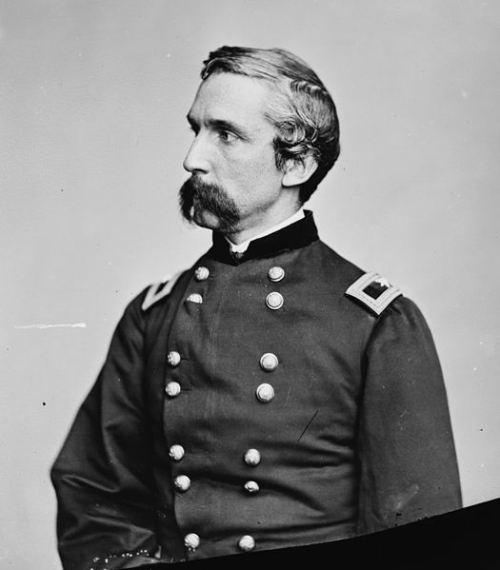
schurz

Carl Schurz

Schurz intended to bring these two divisions into line each with one brigade forward and one in reserve. Schimmelpfennig’s brigade was placed at a right angle to the flank of Robinson’s division and it was his intention that Barlow’s division “extend Schimmelpfennig’s front facing north” keeping Ames’ brigade as a reserve in the right rear “in order to use it against a possible flanking movement by the enemy.” [2]

However Barlow did not comply. Barlow was a 29 year old Harvard law graduate and Boston Brahmin was well connected politically with the more radical abolitionists of the Republican Party and had an intense dislike of Democrats. He came from a family well entrenched in Boston society and though he became a competent soldier and was promoted to Brigadier General after Antietam and was convinced to command a division in XI Corps by Howard after Chancellorsville. He soon regretted his decision. Barlow was to use modern terminology somewhat of an elitist and snob. He “disliked the beery and impenetrable Germans in his division as much as he disliked Democrats.” He admitted that he had “always been down on the ‘Dutch’ & I do not abate my contempt now.” [3]

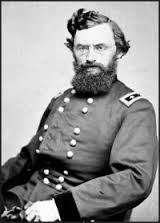
barlow

Francis Barlow

Barlow was the only non-German division commander in XI Corps and he had little regard for Schurz. Instead of following Schurz’s direction he advanced Colonel Leopold Von Gilsa’s small brigade with two sections of artillery to a small knob of high ground known as Blocher’s Knoll. Instead of maintaining Ames’ brigade in reserve and to the right to guard against a flanking attack he deployed it facing slightly northeast on the right of Von Gilsa’s brigade. It was to be a costly error. Schurz noted:

“But I now noticed that Barlow, be it that he had misunderstood my order, or that he was carried away by the ardor of the conflict, had advanced his whole line and lost connection with my third division on the left, and…he had instead of refusing, had pushed forward his right brigade, so that it formed a projecting angle with the rest of the line.” [4]

There are still debates as to why Barlow advanced but one of the most likely explanations is that he saw the unprotected left of Brigadier General George Doles’s brigade of Georgians from Rodes divsion and wanted to strike them in the flank. [5] However this left his own flank exposed to the attack of Brigadier General John Gordon’s brigade of Early’s division.
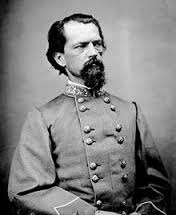
gordon

John Gordon

Gordon’s troops hit the exposed right flank of Von Gilsa’s brigade and that force rapidly cracked under the fierceness of the Confederate assault. Jones’ artillery battalion “enfiladed its whole line and took it in reverse” [6] supporting Gordon as well as Hays and Avery’s brigades as they advanced. One Confederate recalled “it was a fearful slaughter, the golden wheat fields, a few minutes before in beauty, now gone, and the ground covered with the dead and wounded in blue.” [7]

As Von Gilsa’s brigade collapsed Gordon “focused on the exposed right flank of Ames’s brigade” and Doles fell upon its left and “Ames’s outnumbered troops also collapsed” [8] even as he advanced his brigade to support Von Gilsa’s now fleeing troops. Ames took command of the shattered remnants of the two brigades when Barlow, attempting to rally his troops fell badly wounded. Barlow would be assisted by Gordon who had one of Early’s staff “carried to the shade” of a nearby farmhouse. [9] Barlow recovered and “he and Gordon established a friendship that lasted for the remainder of their lives.” [10]
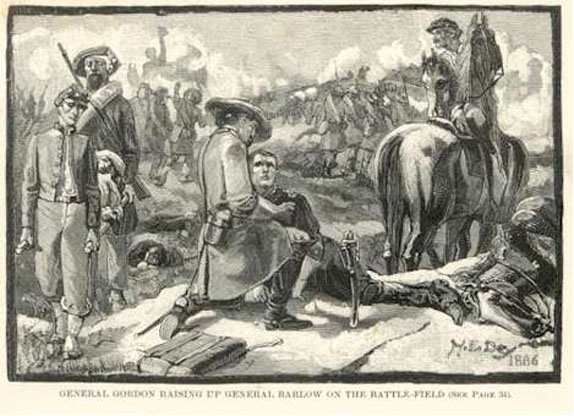
barlow and gordon

Schurz attempted to recover the situation by extending Schimmelpfennig’s division to the right, and advanced his reserve brigade under Polish born Colonel Wladimir Krzyzanowski to support Barlow counterattacking against Doles’s brigade. However they too were rolled up in the Confederate assault, both of Krzyzanowski’s flanks received enfilading fire and the brigade fell back across the Carlisle Road toward an orchard on the north side of Gettysburg.” [11] During the retreat the 157th New York sacrificed itself leaving over 75 percent of its men on the battlefield. Krzyzanowski described the scene as “a portrait of hell.” [12]

Harry Hays brigade of Louisianans joined the assault on the collapsing Federal right while on the left Schimmelpfennig’s line collapsed and the Prussian joined his troops in retreat. Inside the town he was unhorsed and in order to avoid capture “took refuge in a woodshed, where he remained in hiding the next three days.” [13]

Howard, looking for relief from Major General Slocum’s XII Corps sent the First Brigade of Brigadier General Adolph Von Steinwehr’s division from Cemetery Hill to support the fleeing men of Barlow and Schimmelpfennig’s divsions. The small brigade of about 800 soldiers under the command of Colonel Charles Coster advanced through the town to a brickyard on the outskirts of the town. They were hit hard by Hays and Avery’s brigades of Early’s division; Avery’s which took them in the right flank. Both flanks turned by the advancing Confederates [14] Coster’s brigade too broke under the pressure leaving many prisoners to the Confederates. The commander of the 134th New York exclaimed “I never imagined such a rain of bullets.” [15] Coster survived but resigned from the army a few months later never having filed and official report. [16]

Barlow was acrimonious toward his troops who he had so carelessly exposed to the Confederate onslaught. He wrote “We ought to have held the place easily, for I had my entire force at the very point where the attack was made….But the enemies [sic] skirmishers had hardly attacked us before my men began to run. No fight at all was made.” [17] However this statement is not backed by others on the Union of Confederate side. Henry Hunt wrote that it was “an obstinate and bloody contest” [18] while Gordon wrote:

“The enemy made a most obstinate resistance until the colors of the two lines were separated by a space of less than 50 paces, when his line was broken and driven back, leaving the flank which this line had protected exposed to the fire from my brigade. An effort was made by the enemy to change his front and check our advance, but the effort failed and this line too, was driven back in the greatest confusion with immense loss in killed, wounded and prisoners.” [19]

A private of the 61st Georgia Infantry of Gordon’s brigade wrote the XI Corps troops “stood firm until we got near them. Then they began to retreat in good order. They were harder to drive than we had known them before….Their officers were cheering their men and behaving like heroes and commanders of ‘the first water’” [20]
xi corps

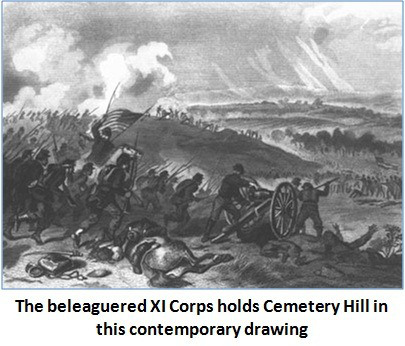
Their right now uncovered by the retreat of the XI Corps the battered I Corps survivors fell back through the town onto Cemetery Ridge.  There they and the remnants Barlow and Schimmelpfennig’s divisions were rallied by Howard and the recently arrived Major General Winfield Scott Hancock around Colonel Orland Smith’s fresh and dug in brigade and a substantial amount of artillery.

[1] Coddington, Edwin B. The Gettysburg Campaign: A Study in Command, A Touchstone Book, Simon and Schuster New York, 1968 p.288

[2] Guelzo, Allen C. Gettysburg: The Last Invasion Vintage Books a Division of Random House, New York 2013 p.181

[3] Ibid. Guelzo. P.181

[4] Green, A. Wilson. From Chancellorsville to Gettysburg: O. O. Howard and Eleventh Corps Leadership in The First Day at Gettysburg edited by Gallagher, Gary W. Kent State University Press, Kent Ohio 1992 p.77

[5] Ibid. Greene p.78

[6] Hunt, Henry The First Day at Gettysburg in Battles and Leaders of the Civil War edited by Bradford, Neil Meridian Press, New York 1989 p.363

[7] Ibid. Greene p.79

[8] Ibid. Greene p.79

[9] Ibid. Guelzo p.188

[10] Dowdy, Clifford. Lee and His Men at Gettysburg: The Death of a Nation Skyhorse Publishing, New York 1986, originally published as Death of a Nation Knopf, New York 1958 p.141

[11] Ibid. Greene p.80

[12] Ibid. Guelzo p.186

[13] Foote, Shelby, The Civil War, A Narrative. Volume Two Fredericksburg to Meridian Random House, New York 1963 p.477

[14] Tredeau, Noah Andre. Gettysburg: A Testing of Courage, Harper Collins Publishers, New York 2002 p.241

[15] Ibid. Trudeau p.241

[16] Ibid. Guelzo p.190

[17] Ibid Greene p.79

[18] Ibid. Hunt The First Day at Gettysburg p.365

[19] Report of Brigadier General J. B. Gordon, CSA, commanding brigade, Early’s Divsision, in Luvaas, Jay and Nelson Harold W editors. The U.S. Army War College Guide to the Battle of Gettysburg South Mountain Press, Carlisle PA 1986 p.45


[20] Ibid. Greene p.79

Leave a comment

Filed under civil war, History, Military

“Don’t Give an Inch” The Engineer and the Professors on the Hill, Major General Gouverneur Warren and Colonels Strong Vincent and Joshua Chamberlain

daytwoconfederate-charge-up-little-round-top-battle-of-gettysburg-c-1863

The Confederate Onslaught

“In great deeds, something abides. On great fields, something stays. Forms change and pass; bodies disappear; but spirits linger, to consecrate ground for the vision-place of souls… generations that know us not and that we know not of, heart-drawn to see where and by whom great things were suffered and done for them, shall come to this deathless field, to ponder and dream; and lo! the shadow of a mighty presence shall wrap them in its bosom, and the power of the vision pass into their souls.” ― Joshua Lawrence Chamberlain

The Federal Army at Gettysburg had a wide variety of officers. Many senior officers were graduates of West Point but in the expansion of the Army and the call of up militia from the various states other officers were political appointments. Many had no prior military service and at times that lack of experience was tragic. However some of the time those volunteers were the men who by their service helped save the Union.

413px-Gettysburg_Battle_Map_Day2Gettysburg Day Two Overview: Map by Hal Jespersen http://www.posix.com/CW 

On July 2nd 1863 the situation at Gettysburg was precarious. Robert E Lee had ordered an attack to seize a hill at the far end of the Federal line, Little Round Top and turn the Union flank. General Meade had ordered III Corps under Major General Dan Sickles to extend it’s line to defend the southern section of his line on Cemetery Ridge. Unfortunately Sickles, without permission moved his Corps several hundred yards west forming a vulnerable salient at the Peach Orchard leaving the southern flank in the air.

gkwarrenMajor General Gouverneur Warren

When Meade saw the developing situation he sent his Chief Engineer, Major General Gouverneur Warren to take charge on the flank. When Warren arrived he found the hill undefended and he dispatched staff officers to get assistance from any units in the area. Major General George Sykes of V Corps responded sending a messenger to the commander of his 1st Division. The messenger encountered the commander of the division’s 3rd Brigade Colonel Strong Vincent who immediately took the initiative and ordered his four regiments up Little Round Top without waiting for permission.

gkwarren_roundtopWarren at Little Round Top

Vincent and his regiments arrived in a nick of time. He deployed his regiments, along the spur running to the south if the top of the hill. The 16th Michigan on the right with the 44th New York, 83rd Pennsylvania at his center and the 20th Maine under the Command of Colonel Joshua Chamberlain on the extreme left of the line. Vincent ordered to Chamberlain to “hold at all costs.” Chamberlain led his regiment skillfully and when nearly out of ammunition led a charge down the slope of Little Round Top which ended the Confederate chances of gaining the hill and turning the flank of Meade’s Army.

little_round_top2Little Round Top-Map by Hal Jespersen http://www.posix.com/CW 

Warren was a West Point graduate and had been a topographical engineer for most of his pre-war career and saw combat against the Sioux at the Battle of Ash Grove in 1855. When the war began Warren was a mathematics instructor at West Point. He helped raise a militia regiment in New York and was appointed to Lieutenant Colonel. As a regimental commander and later brigade commander he saw much combat and was wounded at the Battle of Gaines Mill during the Seven Days.  When the Army was reorganized in February 1863 he was named Chief Engineer of the Army of the Potomac by Major General Joseph Hooker. When Major General Meade relieved Hooker on June 28th he retained Warren.

colstrong_vincentThe 26 year old Colonel Strong Vincent

Colonel Strong Vincent was a 26 year old Harvard graduate and lawyer from Erie Pennsylvania. He was appointed as a 1st Lieutenant and Adjutant of the Erie Regiment and married his wife Elizabeth the same day.  He wrote her before his death “if I fall, remember you have given your husband to the most righteous cause that ever widowed a woman.”

Vincent was commissioned as a Lieutenant Colonel in the 83rd Pennsylvania September 14th 1861. He assumed command of the regiment when the commander was killed during the Seven Days in June of 1862. He commanded the regiment at Fredericksburg in December 1862 and was promoted to command the 3rd Brigade when its commander was killed at Chancellorsville in May 1863.

joshua_chamberlain_-_brady-handyJoshua Chamberlain

Colonel Joshua Chamberlain was a graduate of Bowdoin College and Bangor Theological Seminary. Chamberlain was fluent in 9 languages other than English. He was Professor of Rhetoric at Bowdoin before seeking an appointment in a Maine Regiment without consulting either the college or his family. He was offered command of the 20th Maine but asked to be appointed as a Lieutenant Colonel which he was in August 1862. He fought at Fredericksburg and was named commander of the regiment when Colonel Adelbert Ames, his commander was promoted following Chancellorsville.

vincentdont-give-an-inch-up-5-smaller“Don’t Give and Inch!”

The battle of Little Round Top is one of the most famous of all Civil War battles. Chamberlain along with Vincent are immortalized in the film Gettysburg which is based on Michael Shaara’s Pulitzer Prize winning novel The Killer Angels. Vincent was mortally wounded while leading the defense of the hill. When killed he was standing on a large boulder with a riding crop ordering the men of the 16th Michigan who were beginning to waiver “don’t give an inch.” Two months later his wife gave birth to a baby girl. The baby would not live a year and was buried next to him

Warren became a distinguished Corps commander until he ran afoul of the fiery General Phillip Sheridan in 1865. Sheridan relieved Warren of command of V Corps following the Battle of Five Forks where Sheridan believed that Warren’s Corps had moved too slowly in the attack. The relief was brutal and ruined his career.  Warren resigned his commission as a Major General after the war and returned to his permanent rank as a Major of Engineers. He served another 17 years doing engineering  duty being promoted to Lieutenant Colonel in 1879. He sought a Court of Inquiry to exonerate himself but this was refused until President Grant left office. The Court eventually exonerated him but he died before the results were published. Embittered he directed that he be buried in civilian clothes and without military honors.

Chamberlain was awarded the Medal of Honor for his valor at Little Round Top in 1893. He was gravely wounded during the siege of Petersburg in June of 1864 while commanding a brigade and promoted to Brigadier General. He returned to duty later in the year as commander of the 1st Brigade, 1st Division V Corps and was again wounded at Petersburg in a skirmish at Quaker Road and was promoted to Brevet Major General by Abraham Lincoln.

Chamberlain was given the unique honor to receive the surrender of Lee’s decimated Army of Northern Virginia at Appomattox. He would go on to serve as a four term Governor of Maine and remained active with the Grand Army of the Republic veteran’s organization. He remained active as an educator and as the President of Bowdoin College. He founded the Maine Institute for the Blind which is now known as the Iris Foundation. He died of complications from his wartime wounds on February 24th 1914.

These three men acted with great courage and alacrity on the afternoon of July 2nd 1863. Warren for his immediate action to call for assistance when he discovered that the hill was undefended and the line exposed, Vincent for his swift taking of responsibility and getting his brigade up the hill before the Confederates could gain the summit and Chamberlain for his dogged refusal to yield against repeated assaults.

DSCN8806Only one of the three, Warren was a professional soldier. Unfortunately as a topographic engineer he was an outsider to many in the army and not fully appreciated by Grant or Sheridan who destroyed his career. The youthful Vincent died of his wounds days after the battle. He was recommended for promotion to Brigadier General by Meade but the promotion was never confirmed by the Senate. Chamberlain is still one of the revered commanders of the Civil War.

It is easy for those enamored with military history to forget the stories behind the men that fought the battles of war. It is easy to isolate and analyze a commander’s actions in battle and ignore the rest of their lives.  I think that this does a great disservice to the men themselves. I say this because everyone who serves in the military has their reasons for serving. Some noble and some base and many a combination of many motives. Likewise everyone who dons the uniform in time of war gives up something of themselves and sometimes even heroes are destroyed by the institutions that they serve. That is a warning to all who serve. Chamberlain wrote:

“It is something great and greatening to cherish an ideal; to act in the light of truth that is far-away and far above; to set aside the near advantage, the momentary pleasure; the snatching of seeming good to self; and to act for remoter ends, for higher good, and for interests other than our own.”

In the hopes that we all will strive to cherish that ideal, that truth and to set aside all that keeps us from it.

Peace

Padre Steve+

Leave a comment

Filed under civil war, History, leadership, Military