Tag Archives: barbara tuchman

Friday Thoughts

img_2503

Friends of Padre Steve’s World,

I have a few loose thoughts today and am kind of taking a break to again read and ponder different subjects, but first I want to thank those folks who took the time to send warm wishes, thoughts and prayers our way following my wife’s procedure to get some Kidney Stones blasted to smithereens. She is recovering well.

I was really happy to hear that Harriet Tubman, the great former slave and heroine of the Underground Railroad will replace Andrew Jackson on the $20 bill. I think it is long overdue, Tubman was a hero who put her life on the line time after time to help slaves escape before and during the war. She helped lead the Combanhee River Riad in June of 1863 which freed over 750 raids. Of course the announcement was cricized by the retired neurosurgeon and failed presidential candidate Ben Carson. 

I was absolutely shocked and saddened to hear about the passing of the iconic and brilliant musician Prince yesterday. He was an amazing musician, incredible performer, and so versatile. While his music will remain a part of our lives and culture, he died far too young at the age of 57.

I was sad to see that Chicago Cubs outfielder Jason Heyward had to deal with racist taunts on his first trip back to St. Louis on Monday. I hoped that we had gotten past that kind of idiocy and hatred, but maybe not. Some things seem to never change, Jackie Robison got the same treatment in St. Louis when he broke the color barrier.

Speaking of the Cubs, Jake Arrieta pitched the second no-hitter of his career last night, defeating the Cincinnati Reds. Having watched and gotten to know Jake at the Orioles Triple A affiliate, the Norfolk Tides, I am always happy to hear of his success. 

Since I have been doing a lot of reading lately, I want to remind folks of the great Barbara Tuchman’s comment about the importance of books. She said, “Books are … companions, teachers, magicians, bankers of the treasures of mind. Books are humanity in print.”

With that I shall wish you a wonderful weekend because I do plan on having one.

Peace

Padre Steve+

Leave a comment

Filed under Loose thoughts and musings, News and current events

The Straw that Stirs the Drink: The Implications of Resurgent Religion for Strategists and Policy Makers

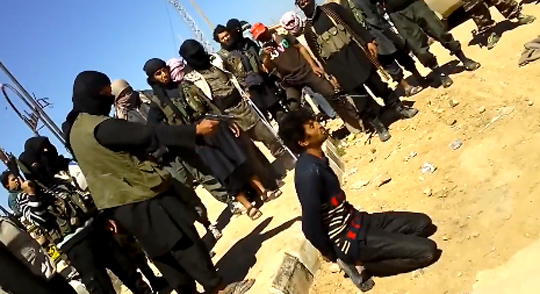
isis-terrorists

Friends of Padre Steve’s World,

I am being published in the most recent issue of Campaigning: The Journal of the Joint Forces Staff College. The article will be available along with the rest of the journal at the website of the college, but I am posting it here. It is an interesting topic since religion is raising its head in numerous conflicts around the world, and is a very real part of the contemporary American political climate. Note, the pictures are not included in the Campaigning issue.

I hope that you enjoy.

Peace

Padre Steve+

One can never separate war and the means by which it is fought from its political ends. There are, however, many societies whose language and religious ideology shape the leader’s political ends. To borrow the immortal words of legendary baseball slugger Reggie Jackson, religion is often “the straw that stirs the drink.” The fact that religious ideologies influence societies and international relations is not new, but after almost three centuries of decline the twenty-first century promises to begin a new age of religious influence. Samuel Huntington notes, “Western secular models of the state are being challenged and replaced”[1] in many nations as religious influence grows. The indicators of this shift, religious, cultural, and racial, are glaringly obvious in the Middle East but clearly present in Eastern Europe, Russia, the Balkans, India, Latin America, and the United States, and threaten to subvert Western secular models of the state.

According to Clausewitz, war is an extension or continuation of politics. Clausewitz, a product of classic German Liberalism, understood the term politics in light of the German concept Weltanschauung, which translates as “World View.” The term is not limited to a particular doctrine or the ideology of party politics, but it encompasses the worldview of a people or culture and includes religion. Religious leaders, as well as media outlets and politicians, use a world view to influence their populatio. In fact, the world view is often crucial in the decision by a people to go to war, their rationale for going to war, whom they war against, the means for conducting war, and the end state they envision from warring.

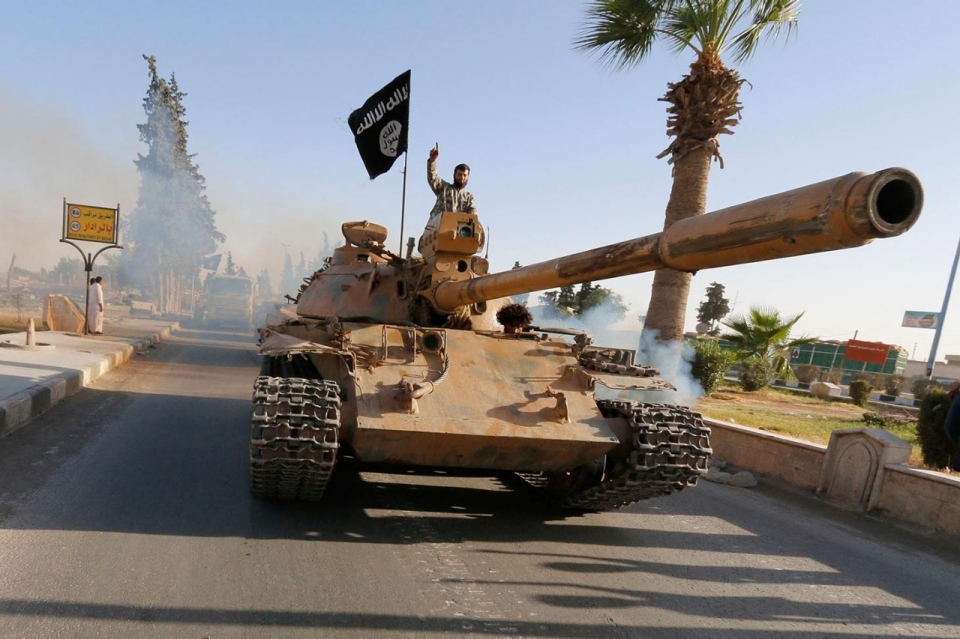
image.adapt.960.high

Because Weltanschauung includes all elements of culture, to include race, religion, and economy, as well as sociological and historical factors; religious leaders, as well as media outlets and politicians, use it to manipulate their people. Radical proponents of religious fundamentalism around the world, who reject the pluralities of modernism and science, skillfully “use each new method of communication” [2] to spread their message of fear in a dualistic manner  to influence those most vulnerable to the threat of change.

Modern Americans and Western European policy makers tend to look at the world, and issues of politics and policy in isolation from each other, and especially in isolation from religion. Such an atomistic method ensures that many policy makers cannot see the forest for the trees. This is particularly true when religion is a motivating factor and an ideological component of conflict. Religiously based ideology is a powerful and “often intractable force that can be quite unresponsive to all the instrumentalities of state power, let alone the instrumentalities of foreign policy,” [3] and has been so from the advent of civilization to the present day. Samuel Huntington observed, “To a very large degree, the major civilizations in human history have been closely identified with the world’s great religions; and people who share ethnicity and language but differ in religion may slaughter each other….” [4]

Even among religions that claim to worship the same god beliefs may differ, and that fact underscores Colin Gray’s all important, “contexts of war.” Gray makes the case for seven essential contexts policy makers and military leaders must understand regarding war that “can have strong negative consequences,” [5] if ignored or misunderstood.

Each of the contexts is associated with the manner of social development, and define the essential characteristics of a particular armed conflict. In many areas of the world religion functions as the “central political pillar maintaining the power of [the] ruler—a major pole in determining people’s loyalty—and as a key ingredient in determining a nation’s stability or instability.” [6] Religion and religious values remain instrumental to the ethics and the social norms of a society and dictate how it deals with other nations and peoples, as well as how it conducts war.

Over the course of the last three centuries the emphasis on rational and empirical thought predisposed western strategists and policy makers to exclude religion as a component of analysis. Furthermore, the scientific methodology used by many analysts dictates that they asses individual components of issues in isolation from each other, and often without connection to their opponent’s world view. Experts dissect economic factors, military capabilities, existing political systems, diplomatic considerations, and the ways societies gather information and exhaustively examine and evaluate each individual component. But the problem comes when policymakers fail to understand how world view, ideological factors, history, and religious belief impact how a given opponent will conduct war.

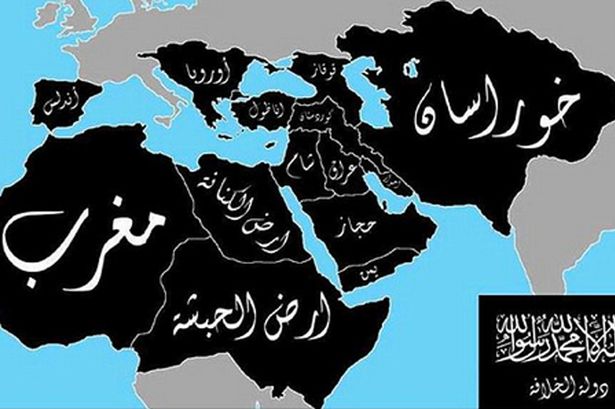
ISIS-MAP

In part, policy makers tend to interpret information through their own worldview. As Gray notes, “Policy and strategy will be influenced by the cultural preferences bequeathed by a community’s unique interpretation of its history as well as by its geopolitical-geostrategic context.” [7] As such, both military and civilian policy makers fail to address the criticality of religion to developing effective strategy. Barbara Tuchman wrote, “When information is relayed to policy-makers, they respond in terms of what is already inside their heads and consequently make policy less to fit the facts than to fit the notions and intentions formed out of the mental baggage that has accumulated in their minds since childhood.” [8] A world view imposes cultural prejudices and blinders on western policy makers and strategists, that predispose them to look for shortcuts, or the most convenient explanations selected from the information they can see. Edward Luttwak wrote:

Enlightenment prejudice has remained amply manifest in the contemporary professional analysis of foreign affairs. Policymakers, diplomats, journalists, and scholars who are ready to overinterpret economic causality, who are apt to dissect social differentiations most finely, and who will minutely categorize political affiliations are still in the habit of disregarding the role of religion, religious institutions, and religious motivations in explaining politics and conflict, and even in reporting their concrete modalities. Equally the role of religious leaders, religious institutions, and religiously motivated lay figures in conflict resolution has also been disregarded – or treated as a marginal phenomenon hardly worth noting. [9]

Unbeknownst to policy makers, their prejudices, the world view blinders they wear, inhibit them from seeing how interconnected the most primal elements of the human experience are to others’ worldviews, even their own. As such, both military and civilian policy makers fail to address the criticality of religion to developing effective strategy.

Many people believed that modern ideas, “such as science, technology, secularism, and humanism would overcome the religious concept of the universe that dominated premodern society.” [10] Contemporary Western strategists and policy makers came to adulthood in a culture that supplanted the importance of religious ideas and need. A global, four-decade resurgence of religious ideals makes adaptation for strategists and planners difficult because of the dramatic shift in essential, unquestioned views. [11] Others’ worldviews, including religious beliefs, often influence the application of economic, political, diplomatic, military power, and the use and dissemination of information. That fact remains true despite the religion or sect involved, and especially in a decidedly secular, or at least outwardly non-religious, nation. Perhaps, by ignorance or a refusal to admit the importance of religious motivations in conflict, strategists and planners fail to realize the western culture arose from primal religious beliefs that informed politics, philosophy, ethics, law, economics, art, racial constructs, and science for nearly 1500 years. Perhaps, that refusal fueled a justified appall or embarrassment of the religious justifications their forbearers used to incite war that subjugated or exterminated peoples.

The United States Military made a belated attempt to address ideology, culture, and religion in terms of counter-insurgency doctrine when it published the U.S. Army/Marine Counterinsurgency Manual. The discussion of these issues is limited to two pages that specifically deal with various extreme Moslem groups that use religion as a pillar of their ideology, strategy, and operations. But the analysis in the counterinsurgency manual is limited because its focus is very general and at a tactical level. While the manual encourages leaders to attempt to understand the cultural differences it contains little to help leaders understand the importance of religion and ideology at the strategic and operational levels.

Commendably, the manual discusses how terrorist and insurgent groups use ideology, which is frequently based on religion to create a narrative. The narrative often involves a significant amount of myth presented as history, such as how Al Qaida and ISIL use the Caliphate as a religious and political ideal that for many Moslems, “produces a positive image of the golden age of Islamic civilization.” [12]

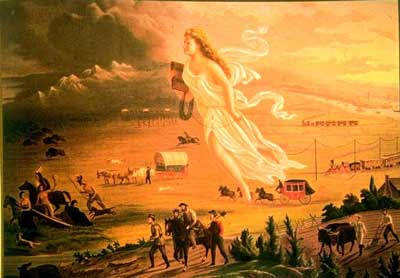
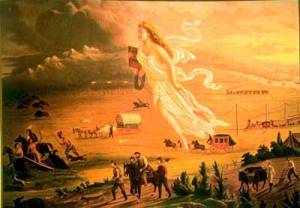
A purely intellectual understanding of how Al Qaida and ISIL use symbolism and imagery limits how strategists and planners can develop methods to counter it. Rather, strategists and planners would benefit from a historical introspection that leads to a personal reflection, aimed at understanding how the theological tools of the Christian religion subjugated peoples and the ramifications today. Protestant Christianity, particularly the Puritan concept of “a city set on a hill” undergirded the American belief in the nation’s Manifest Destiny, which in large part led to the extermination of the Native Americans, the War with Mexico, the romanticism of the ante-bellum American South, the belief that African Americans were sub-human, and that God ordained slavery. The concept persisted after the Civil War in the myth of the Lost Cause, and was exported abroad as the United States belatedly entered the race for overseas colonies.
Manife4

The concept of Manifest Destiny is still an essential element of the idea of American Exceptionalism, which often justifies much of American foreign policy. Former President George W. Bush alluded to this idea in his 2003 State of the Union Address where he said, “that freedom is the right of every person and the future of every nation. The liberty we prize is not America’s gift to the world, it is God’s gift to humanity.” [13] Throughout the Bush presidency, the President’s idea that God undergirded the policy of the United States led to a mismatch of policy ends and the means to accomplish them. Former Israeli Ambassador to the United States and historian Michael Oren wrote:

Not inadvertently did Bush describe the struggle against Islamic terror as a ‘crusade to rid the world of evildoers.’ Along with this religious zeal, however, the president espoused the secular fervor of the neoconservatives…who preached the Middle East’s redemption through democracy. The merging of the sacred and the civic missions in Bush’s mind placed him firmly in the Wilsonian tradition. But the same faith that deflected Wilson from entering hostilities in the Middle East spurred Bush in favor of war. [14]

Only when policy makers and strategists understand that the use of religious ideology to conquer, subjugate, and terrorize in the name of God is universal, does it become easier to defeat those who employ it.

American Presidents often invoke the name of God to justify the compulsion to conquer, such as McKinley did when he decided to annex the Philippines in 1899 following the defeat of the Spanish. The war against the Filipinos used some of the most bloodthirsty tactics employed to fight the Filipino insurgents, who only wanted independence, and stained our own national honor. Mark Twain wrote: “There must be two Americas: one that sets the captive free, and one that takes a once-captive’s new freedom away from him, and picks a quarrel with him with nothing to found it on; then kills him to get his land. . . .” [15]

A doubtlessly sincere McKinley sought counsel from God about whether he should annex the Philippines or not. Barbara Tuchman wrote: “He went down on his knees, according to his own account, and ‘prayed to Almighty God for light and guidance’. He was accordingly guided to conclude “that there was nothing left to do for us but to take them all, and to educate the Filipinos. And uplift and civilize and Christianize them, by God’s grace to do the very best we could by them, as our fellowmen for whom Christ died.” [16]

The counterinsurgency manual does mention how “Ideology provides a prism, including a vocabulary and analytical categories, through which followers perceive their situation.” [17] But again, it does this at a micro-level and the lessons are not applied at the higher levels of strategic thinking and policy. This is often due to the fact that American and other western strategists and policy makers view religion “as a set of theological issues rather than as a profoundly political influence in public life.”[18] Even after nearly a decade and a half of unremitting war against enemies for whom religion is at the center of their politics, policy makers still misread or neglect the importance of religion and religiously based ideology in the political motivations of their opponents. In many cases, the religion of a people is a stronger part of their identity than that of the state. Nations created during the post-colonial era “continue to see religion, clan, ethnicity, and other such factors as the markers of community identity” [19] Despite the advances in communications and technology and the globalization of so many western concepts, the political and religious leaders of Islamic nations view modern western political and social concepts as unwanted intrusions on their ancient cultures, and more importantly, insults to their religion.

kim davis pastor

But, lest American policy makers and strategists see this rise as something completely foreign, a similar phenomenon is occurring in the United States. Despite the fact that a growing number of Americans espouse no-religious preference and, according to multiple studies conducted over a period of two decades, are leaving organized Christianity, adherents of two highly motivated and militant branches of Christianity have grown in strength and political power over the last forty years. The group known as Christian Dominionism advocates Christian domination of all parts of society and culture, and Pre-Millennial Dispensationalists believe in the imminent return of Christ to earth, including the belief that most of the earth’s population will be killed during the Apocalypse. A Pew Research Center survey found that by the year 2050, that 41% of Americans believe that Jesus Christ will return to earth. [20] Leaders, politicians (including major conservative presidential hopefuls), pundits, and preachers often weigh in on public policy, to include military strategy, and claim that God’s law supersedes that of the state. They simultaneously reject secularism while legislating against those they deem enemies, and advocate for a “holy war” against Islam without distinction to Islam’s own divisions and distinctive denominational differences.

may appear irrational American strategists and policy makers, but it is completely rational to those who subscribe to it. The study of history, particularly how the deep roots of religion and faith shape cultural worldviews, as well as the actions of various peoples and nations, helps the policy maker and strategist adapt policy, strategy, and ultimately operational and tactical methods to the context of the conflict at hand. To do this effectively it is important that American strategists not be afraid to examine our own past to see how our ancestors used religion for good as well as for evil. However, the often dark mirror of history can be disconcerting to peer into. People tend to be uncomfortable when the face that they see in the mirror is all too similar to their current enemies, to the point that one might turn away in fear of what they see. The inability to look into the dark mirror of our own history is especially perilous when enemies are perfectly willing to wage war without end unto the destruction of the world in the name of their God, because when you belatedly look back in the mirror, failure will be staring you right in the face.

Notes

[1] Huntington, Samuel P. Who Are We? America’s Great Debate The Free Press, Simon and Schuster Europe, London 2004 p.360

[2] Jacoby, Susan. The Age of American Unreason Revised and Updated Vintage Books, A Division of Random House, New York 2008 p.18

[3] Luttwak, Edward. The Missing Dimension  in Religion: The Missing Dimension of Statecraft  Oxford University Press, Oxford and New York 1994 p.13  

[4] Huntington, Samuel P. The Clash of Civilizations and the Remaking of the World Order Touchstone Books, New York 1997 p.42

[5] Gray, Colin S. Fighting Talk: Forty Maxims on War, Peace, and Strategy Potomac Book, Dulles VA 2009 p.5

[6] Rubin, Barry Religion in International Affairs in Religion: The Missing Dimension of Statecraft  Oxford University Press, Oxford and New York 1994 pp.20-21

[7] Ibid. Gray Fighting Talk p.25

[8] Tuchman, Barbara W. Practicing History Alfred A. Knopf, New Your 1981 p.289

[9] Ibid Luttwak The Missing Dimension pp.9-10

[10] Ibid. Rubin Religion in International Affairs p.21

[11] Ibid. Rubin Religion in International Affairs p.21

[12] ___________ U.S. Army/ Marine Counterinsurgency Field Manual FM 3-24 MCWP 3-33.5 15 December 2006 with and forward by General David A Petraeus and General James Amos, Konecky and Konecky, Old Saybrook CT 2007 p.26

[13] Bush, George W. State of the Union Address Washington D.C. January 28th 2003 retrieved from Presidential Rhetoric.com http://www.presidentialrhetoric.com/speeches/01.28.03.html 10 June 2015

[14] Oren, Michael Power, Faith and Fantasy: America and the Middle East 1776 to the Present W.W. Norton and Company, New York and London 2007 p.584

[15] Twain, Mark To the Person Sitting in Darkness February 1901 Retrieved from The World of 1898: The Spanish American War The Library of Congress http://www.loc.gov/rr/hispanic/1898/twain.html 12 December 2014

[16] Ibid. Tuchman Practicing History p.289

[17] Ibid. U.S. Army/ Marine Counterinsurgency Field Manual p.27

[18] Ibid. Rubin Religion in International Affairs in Religion p.20

[19] Ibid. Rubin Religion in International Affairs p.22

[20] Pew Research Center, U.S. Politics and Policy, http://www.people-press.org/2010/06/22/public-sees-a-future-full-of-promise-and-peril/

8 Comments

Filed under Foreign Policy, History, middle east, national security, News and current events, Religion

Men Who know too Little

heres-what-donald-trump-supporters-really-believe

Friends of Padre Steve’s World

I am on the way to Houston for my annual denomination Chaplain training symposium and as you have gathered from what I wrote last week I spend a good amount of time doing some reading and reflection.

One thing that I seem to be noticing in the current presidential race is the nearly blind certitude of most of the candidates, especially Donald Trump and Ted Cruz, and this reminds me of something that I read. Barbara Tuchman wrote, “No one is so sure of his premises as the man who knows too little.” When I look at Cruz and Trump, I am struck by how this resonates. Now to be sure they are not alone, but they stand out because of the way that they talk about foreign and domestic policy, demonize all that oppose them, and act as if they, and they alone are the political messiah who can save the world, and to borrow Trump’s campaign slogan which is on every Chinese made baseball hat, “Make America Great Again.”

This particularly concerns me in matters of foreign policy and national security. Trump seems to be ready to destroy alliances that do benefit us a nation and to demean the leaders of allied nations even as he brags on totalitarian leaders like Russia’s President Putin. Cruz on the other hand, according to his speeches is willing to “carpet bomb our enemies” seems to be ready to begin a policy of total war to achieve his goals. Honestly, I would be more scared of Cruz than Trump, simply because Cruz masks his ignorance and blind hatred in a belief, that he is anointed by God to lead the United States.

Tuchman wrote, “Strong prejudices in an ill-formed mind are hazardous to government.”

I think that is at the root of many of our political maladies, and not just on the political right, where they their proponents, who show not an ounce of empathy; are stoked by hatred of the other, encouraged by religious intolerance, and bolstered by the power of myth masquerading as fact are incredibly dangerous and proto-fascist.

But to be fair, when I read what many supposed progressives write, they seem more like angry revolutionaries willing to destroy systems at any cost, without replacement systems ready, and without thinking of second, third and fourth order effects on society as a whole. Some seem to be as intolerant of debate and compromise as are their opponents on the political right.

I am a progressive; my beliefs about the banking systems, economic inequalities, universal health care, civil rights, gay rights, women’s rights, and the use of national power in foreign relations, are all progressive. But I am also a pragmatist, you have to think before you act and you have to do things one thing at a time and sometimes, in a democracy that takes time and true political wisdom is to sense the time.

As my real progressive hero Franklin Delano Roosevelt noted in words that seem as pertinent today as when he spoke them during the Great Depression, “From the end of the World War twenty-one years ago, this country, like many others, went through a phase of having large groups of people carried away by some emotion–some alluring, attractive, even speciously inspiring, public presentation of a nostrum, a cure-all….There always exists in a democratic society a large group which, quite naturally, champs at the bit over the slowness of democracy; and that is why it is right for us who believe in democracy to keep the democratic processes progressive–in other words, moving forward with the advances in civilization. That is why it is dangerous for democracy to stop moving forward because any period of stagnation increases the numbers of those who demand action and action now.”

Until tomorrow,

Peace

Padre Steve+

Leave a comment

Filed under History, leadership, News and current events, Political Commentary

Power and Folly

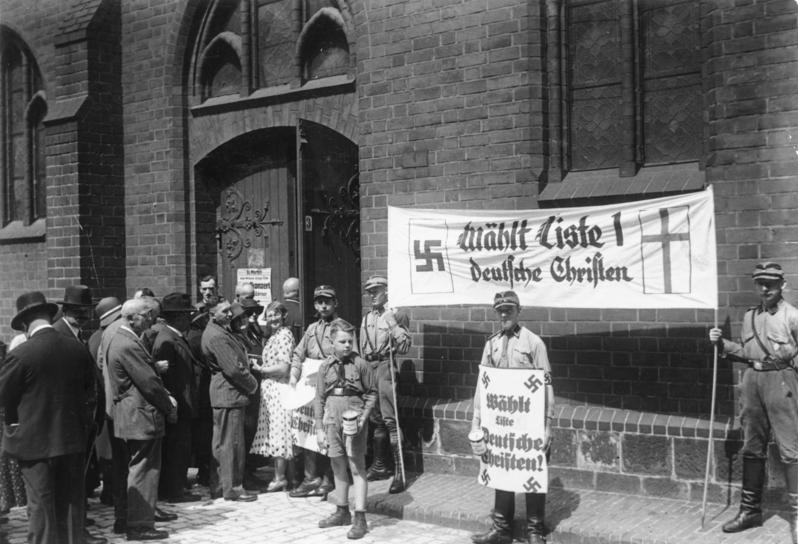
ADN-ZB/Archiv Kirchenwahl am 23.7.1933 in Berlin. Wahl in der Marien Kirche am Neuen Markt. Nazistische Wahlpropaganda unter Maske des Christentums.

I have refrained from tackling any politics for over a week now, and that was a good thing. My time of deliberate rest from jumping into any of the major political, judicial, or social controversies the past week has been good. It has allowed me to re-center myself. As I have done so I have taken a step back just to observe, to watch and listen, and to continue to read, study, reflect, and yes, to relax. .

Of course, much of that study and reflection turns back to history. Barbara Tuchman wrote, “Chief among the forces affecting political folly is lust for power, named by Tacitus as “the most flagrant of all passions.” One go a minute without observing this.

Dietrich Bonhoeffer was a German pastor and theologian who openly opposed Hitler and his policies in an age when the bulk of German Christians either threw their wholehearted allegiance behind Hitler, or simply did nothing. Bonhoeffer wrote about the violence of Nazi power, and how it, like other brazen displays of power produces outbursts of folly. He noted:

“If we look more closely, we see that any violent display of power, whether political or religious, produces an outburst of folly in a large part of mankind; indeed, this seems actually to be a psychological and sociological law: the power of some needs the folly of others. It is not that certain human capacities, intellectual capacities for instance, become stunted of destroyed, but rather that the upsurge of power makes such an overwhelming impression that men are deprived of their independent judgment, and…give up trying to assess the new state of affairs for themselves.”

It is important for all of us, no matter what our political ideology, or who our chosen candidate is, not to get caught up in the violence of power. We must retain our capacity for independent judgment and never give up our individual and collective responsibility to assess what is going on and make informed judgments.

Unfortunately, that can be quite an undertaking when we are bombarded with an endless assault by politicians, pundits, and preachers, and their media allies and enablers every minute of the day. Even so, we cannot abandon our duty to think and ask the hard questions, even of those we agree with and support.

Anyway, until tomorrow,

Peace

Padre Steve+

Leave a comment

Filed under ethics, History, News and current events, Political Commentary

The More Things Change…

5663117546_c4150a82fc_b

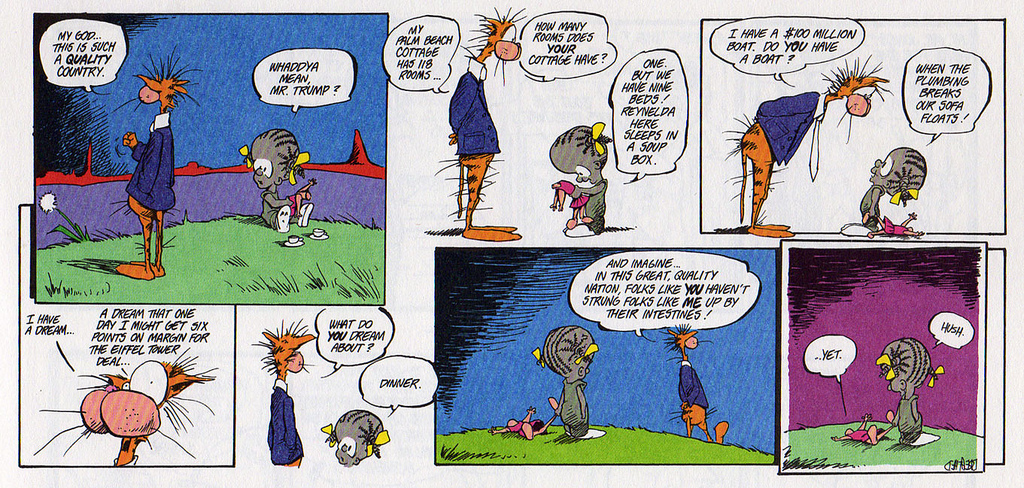
If the print on the strip is too spall on your phone or tablet the link is here: http://www.gocomics.com/bloomcounty/2015/02/17 Likewise if you click on the picture it should be larger and more readable

Friends of Padre Steve’s World

Dr. Martin Luther King Jr. once said, “Our lives begin to end the day we become silent about things that matter.” Right now there a lot of things that really matter, that far too many people remain silent about, and since Donald Trump is no longer considered a political joke, it is time to do some reflection. Frankly I think some of that reflection can be found in old comic strips, some of them never get old.

It is funny how timeless the social commentary of Berkeley Breathed’s classic comic strip Bloom County is even today. The strip shown above is from 1987. It is part of a series of strips where Donald Trump’s brain is transplanted into Bill the Cat’s body leading to some interesting encounters with the citizens of Bloom County.

In this strip, a little Black girl named “Ronald Ann,” named such by her dad after Ronald Reagan meets Mr Trump. The Donald, like all of us has a dream, but his is a bit different, and in the strip he is symbolic of the worst part of our humanity, that which has everything, while denying others of even the chance to achieve. A class of people who have no empathy, and for whom nothing matters but their bottom line, and they have an army of politicians to enshrine their policies into law, pundits who shamelessly defend them, media empires that promote them and their lifestyles as good, and preachers who give the blessing of something that they call “God” to their most ungodly world view.

The amazing thing is that those who promote this vast imbalance don’t even recognize what they are doing to civilization. Barbara Tuchman wrote in her book A Distant Mirror: The Calamitous 14th Century that “When the gap between ideal and real becomes too wide, the system breaks down.”

We are watching this unfold before our very eyes and those leading the charge, the politicians, bankers, moguls, media empires, pundits and preachers are blind to what they are sowing. Sadly they don’t seem to care so long as they have power and their profit margins increase.

What they are sowing is the seed of violent revolution, and not just in the United States, but around the world. They are sowing the seeds of war, they have helped create the growing threat of the Islamic State and Boko Haram, and their short sighted policies will bring down nations and economic systems.

Bu then such people and those who allow them to do what they do do not study history, except for the sanitized kind of myth that makes them feel good and justifies their actions. The same is true of how they view philosophy and religion. That is why they love the pseudo-history of people like David Barton, the philosophy of Ayn Rand, and the theology of Christian Dominionism and the Prosperity Gospel. Sadly, those who call themselves “Christians” and promote this seem oblivious to the fact that it is all based on Social Darwinism, the survival of the fittest. But then to the preachers who support those who benefit by such thought believe that a lie told for the glory of God is justified.

As such they seem to have little capacity for empathy or compassion, the death and suffering of people from disease, poverty and war makes no impact on them. Tuchman wrote “[T]he obverse of facile emotion in the 14th century was a general insensitivity to the spectacle of pain and death.” 

The same is true with technology. We have the most wonderful technological capabilities but instead of harnessing them for good, we turn them into instruments of destruction, instruments that may one day destroy all of us. Tuchman wrote: “For belligerent purposes, the 14th century, like the 20th, commanded a technology more sophisticated than the mental and moral capacity that guided its use.” Sadly, that gap between technology and mental and moral capacity to use it has only grown exponentially in this new century 21st century.

Sadly, that bit of satire about Donald Trump and Ronald Ann in this 1987 Bloom County comic strip is even more true today than when Berkeley Breathed drew it and penned the words. The power of the pen can be seen even today as people who speak out, write or pen satire become targets of those that they critique.

But I can no longer be silent when I see such institutionalized evil that is blessed by the politicians, pundits and preachers, who I call the Trinity of Evil. I would rather be called every epitaph that the promoters and supporters of such a hateful, tyrannical and perverse system can muster, than not to speak the truth. It’s funny how the words to the The Logical Song by Supertramp ring true for me:

“Now watch what you say or they’ll be calling you a radical, liberal, fanatical, criminal.”

I’ll have to write about that song sometime soon, as it seems to speak volumes about my own journey, but I digress…

I said at the beginning of last year that I would seek truth and speak truth. Until I came back from Iraq in 2008, having seen and experienced the horror of war, the lies of my government in launching that war in Iraq that has latterly sowed the wind and is reaping the whirlwind with the Islamic State’s advance, I said nothing, and at times even defended the system. But since then I cannot. I have already paid a price, men who I thought were friends abandoned me, a church that I had faithfully served, threw me out and I have been threatened, harassed and trolled by white supremacists; religious fanatics of various denominations, and political ideologues.

But truth is truth and I cannot be silent. As Dr. King so well put it: “There comes a time when one must take a position that is neither safe, nor politic, nor popular, but he must take it because conscience tells him it is right.”

Peace

Padre Steve+

1 Comment

Filed under Political Commentary

People, History, and Truth

gettysburgpickettscharge

Friends of Padre Steve’s World,

English historian and military theorist Colin Gray noted that “people matter most” when we deal with history, policy, or politics, but especially in the matter of war.

I think one of the sad things about history is that many authors, especially in military history, but other areas as well, seem to treat the participants as bit players in a series of events, rather than a prism from which to understand and view history.

I cannot tell you how many times I have had students, and even colleagues tell me that history is dry, boring and uninteresting to them. I will not condemn them, for certainly if it is that is case, it is not their fault, but rather those who write and teach history. If all history is, is arbitrary dates, lists of disconnected events and names of people, without any context to their lives, why should they care about it?

When I first began to study history I was much more concerned about events than people. However, over the past couple of years I have began to develop what I call my philosophy of history. That has come about through my study of the events leading to the American Civil War and in particular my study of the Battle of Gettysburg, but also in other historical events such as the Arab Revolt of 1917, and the French adventures in Indochina and Algeria.

In doing all of my research I have read a large number of books, articles and primary sources on these subjects and my personal library appears to be growing at an exponential rate. I have noticed that much of what I have read deals very little with the people involved, unless I am reading a biography, and even some of the biographies seem to be event heavy, and person light and sometimes it seems that the subjects of the biography are often one dimensional, and almost caricatures of who they really were. Some of the alleged biographies that I read would be better described as hagiography, to make the subjects appear saintlike, the type of writing used by religious writers to make saints a lot less human. There are others who go to the opposite extreme and do all they can to demonize their subject. In either case the method is less than honest, but for many people, profit and propaganda value mean more than truth. Of course either type of writing appeals to the masses who do not care about nuance, or for that matter truth.

But such is not history. Neither are “histories” which are designed to support a particular ideology, be it political, religious, or economic. Such works are not history, but propaganda. When I see people, in this country forbidding the teaching of history because it is not patriotic enough I want to scream. It is like I am watching the propagandists of Stalin’s Soviet Union, Hitler’s Third Reich, or any of many other nations that used ideology or religion to supress history that didn’t meet their definition of “patriotic.” But then I digress…

My gut feeling says that such artificial divisions between history and biography do a disservice to the reader. I take a tremendous pleasure in writing, and I like to try to communicate and interpret facts, which is indeed the vocation of the historian, in a manner that makes them interesting. What I am finding is that when telling the stories of events we must also tell the stories of the people who make these events.

Without such a connection there is little to interest most readers. People tend to be interested in people because there is a connection. The human being is still the human being, no matter what age, country, culture, religion that they belong to. I learned a lot of this from reading the works of Barbara Tuchman who in her writings about events, never forgot importance of people, and refused to turn them in to one dimensional caricatures.

In my writing now I attempt to bring the prism of the biography into the events that I write about.

I had a fellow faculty member note that he liked what I wrote about Gettysburg because it was more than just the events, it was the personal connection he felt to the people.

People matter because they have so many layers. I guess one of the things that makes my writing approach a bit different is that while I am a historian, I am also trained in philosophy, pastoral care and psychology, all of which deal with existential matters.In the next few days you will be seeing some of my Gettysburg work, and hopefully as you read it you will notice that I attempt to find that nuance in the various men, on both sides of the conflict, who are part of the story.

Image found that the complexities and contradictions of the subjects of history, the people help me understand the events more than anything. I think my epiphanies came in reading about the lives, as well at writings of men like T.E. Lawrence and Gouvereur Warren whose triumphs, struggles, weaknesses and injuries mirror my own. In learning about these men as people, in the context of what they accomplished helps me to understand their history and the era that they lived far more than simply recounting how they influenced a battle.

I find that the lives, beliefs, motivations, relationships, and experiences of people to be paramount to understanding events. People are complex, multi-layers and often contradictory. All of my heroes all have feet of clay, which in a sense makes their stories even richer, and the events that they helped bring about more fascinating, because then I gain a holistic perspective and develop an empathy for them. Even good and honorable people who find themselves due to race, religion, or nationality fighting for an evil cause, or evil people fighting for a good cause. If you are trapped by ideological or religious certitude that may confuse or even offend you, but it is a part of the human condition. That my friends is history.

Barbara Tuchman noted “that if the historian needs to submit himself to his or her material instead of trying to impose himself on his material, then the material will ultimately speak to him and supply the answers.”

This is very important, because when we do this we discover the answers to the why questions, especially the why questions that are so very uncomfortable, are necessary if we want to discover truth.

I know that I can find connections in the strengths as well as their weaknesses of people that I admire. Thus when I see ordinary people taking part in events, for good or for evil,I can say that given the same set of circumstances that that could be me. Context matters, nuance matters, people matter. If we do not understand that, history becomes nothing more than a set of manipulated facts, devoid of context that can be used to buttress the most evil intentions.

I do plan on developing these thoughts over the coming weeks and months, but for now it will suffice to say that when I write about history, that people matter. That is why I write.

Peace

Padre Steve+

5 Comments

Filed under History, philosophy

The Unfolding of Miscalculations: Syria 2015

russian jet in flames

Friends of Padre Steve’s World,

The tensions fuel by the incredibly complex and dangerous war in Syria just when up, as I like to say the “pucker factor” is very high, in fact it is getting close to stage ten. Barbara Tuchman wrote, “War is the unfolding of miscalculations” and it seems that right now there are whole a lot of miscalculations going on.

Yesterday a Russian Su-24 fighter plane was blasted out of the sky by a Turkish F-16. Reports conflict, Turkey say that the Russian aircraft had violated its airspace multiple times and had been given multiple warnings before the shoot down. The Russians claim that the aircraft was on the Syrian side of the border and that the attack was an unprovoked violation, and Russian President Putin called it a “stab in the back.” Russia is accusing Turkey of backing DAESH, while Russia’s forces, which are supposedly there to fight DAESH are spending more time attacking Syrian President Assad’s non-DAESH Syrian opposition, including Turkoman Syrians fighting the Assad regime in the area where the jet was shot down. Some think that it might be payback for the Russians bombing the faction supported by the Turks.

Admittedly, Turkey has a right to self-defense and the Russians are operating in Syria without any kind of international mandate. That being said, the Russians are there at the behest of the Assad government, which even if we don’t like it is still the legal government of Syria, a long term ally and client of Russia, going back to the old Soviet days.

However, the feud between Russia and Turkey goes back hundreds of years. They hate each other, and this hatred goes back to the days of the Tsars and the Ottomans. The hatred is generations old, and is cultural, religious and political. Maybe that is why we in the west do not understand it, but I digress… 

The fact is that the actions of both nations, as well as most other nations in the West including the United States have helped to stoke the fire of the Syrian war, which is threatening to escalate into a regional conflict. I am not going to go into all the details of what has brought us to this point, because they are too many to cover. Some of course are saying that it could lead to a World War, but I do think that cooler heads will prevail. Of course I could be wrong, as Tuchman wrote, “To admit error and cut losses is rare among individuals, unknown among states.”

It is now time for President Obama to step up to the plate, and not rattle sabers, but to help pull everyone back from the brink. He needs to work with Russia’s President Putin to deescalate the crisis. Since everyone involved has a stake in what happens it Syria it cannot be ignored. The nations involved need to sit down and come up with a way to defeat DAESH and bring peace to Syria and Iraq. Of course this is easier said than done, especially since bullets are flying, blood is flowing, and tensions rising. The fallibility of human beings has been demonstrated time and time again in this war, and as Tuchman wrote in The Guns of August, “Human beings, like plans, prove fallible in the presence of those ingredients that are missing in maneuvers – danger, death, and live ammunition.”

In 1962 President Kennedy faced the real possibility of nuclear war with the Soviet Union during the Cuban Missile Crisis. Kennedy had just read Tuchman’s The Guns of August which had just been published. He was shocked by the words of German Chancellor Bethmann-Hollweg who when asked how World War One started replied “Ah, if only one knew.” Kennedy asked General Curtis LeMay what would happen if the Soviets did not back down, and the officer replied that he would order a nuclear strike. Kennedy could not go down that road, he referred to the book when he remarked, “If this planet is ever ravaged by nuclear war—if the survivors of that devastation can then endure the fire, poison, chaos and catastrophe—I do not want one of these survivors to ask another, “How did it all happen?” and to receive the incredible reply: “Ah, if only one knew.”

The downing of this Russian jet shows just how easily things can spin out of control. It is time for calmer heads to prevail and walk this back before things get really out of hand.

Peace

Padre Steve+

2 Comments

Filed under History, middle east, Military, national security, News and current events

The Lamps are Going Out: Paris & the End of the Illusion of Peace

Lamplighter

Friends of Padre Steve’s World,

It is barely a day and a half after the massacre committed by Islamic terrorists in Paris, and the shock is still being felt around the world. In watching the images and listening to the words of various leaders I feel that something has changed; that the illusion of peace that we have lived under, has been shattered.

sKLhhPT

In two weeks the self-proclaimed Islamic State has claimed credit for the downing of a Russian airliner over the Sinai Peninsula, an attack in Beirut Lebanon, and, on Friday night the horrific series of attacks in Paris. The combined death toll for the three attacks is close to 400, almost all of who were innocent civilians doing nothing more than going about their daily lives. Hundreds more were wounded in Beirut and Paris. ISIL has promised to conduct more attacks on all nations that oppose them in Syria and Iraq. The attacks have awakened people to the fact that ISIL is not just a threat to the Middle East, but around the world.

Some are now calling this war, and in fact it is, a war that most of us have ignored though it has been going on for over two decades. But in just two weeks, the hybrid terrorist state known as ISIL has changed the course of that war. The war as we know it began in the years after the First Gulf War as young Saudis returning from Afghanistan, led by Osama Bin Laden took up arms against the “infidel” Americans based in Saudi Arabia. In the 1990s the terrorism was confined to Al Qaeda attacks throughout the Middle East, and included attacks on American military personnel, installations, and ships. Then on September 11th 2001 Al Qaeda changed the narrative by attacking the United States, killing nearly 3000 people at the World Trade Center, the Pentagon, and aboard four airliners. The United States responded by going after Al Qaeda and its supporters in Afghanistan.

Had the American response been contained to that action, the war might have taken a different course, and we might not be here today. But within months of 9-11 the Bush Administration began planning to attack Saddam Hussein’s Iraq and propagandizing the American people to support it, with or without allied or United Nations sanction. The operation to topple Saddam opened Pandora’s box, and who knows when we will ever live in peace again. Twelve years after President Bush announced the end operations in Iraq aboard the USS Abraham Lincoln with a banner that boldly proclaimed, “Mission Accomplished” behind him, the war that he unleashed in Iraq has spread in ways that even the most pessimistic critics of Bush did not predict.

With the war now entering an even more troubling and dangerous phase we should remind ourselves of the words of Winston Churchill, “Never, never, never believe any war will be smooth and easy, or that anyone who embarks on the strange voyage can measure the tides and hurricanes he will encounter. The statesman who yields to war fever must realize that once the signal is given, he is no longer the master of policy but the slave of unforeseeable and uncontrollable events…. Always remember, however sure you are that you could easily win, that there would not be a war if the other man did not think he also had a chance.”

As I observe events on I am reminded of Barbara Tuchman’s description of Sir Edward Gray on the eve of the First World War, “Watching with his failing eyes, the lamps being lit in St. James Park, Grey was heard to remark that “the lamps are going out all over Europe; we shall not see them again in our lifetime.”

Sadly, I do believe that the last lamps of peace are going out around the world in the fight against the Islamic State. I have no idea when, how, or even if this conflict will end.

Praying for peace,

Padre Steve+

7 Comments

Filed under Foreign Policy, History, iraq,afghanistan, middle east, News and current events, Political Commentary, terrorism

The Day After Veteran’s Day

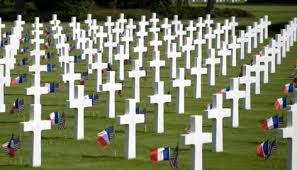
american cemetery

Friends of Padre Steve’s World,

It is the day after Veteran’s Day and I still am in a reflective mood about it. Of course if there were no war, if war had become a thing of the past, a sad chapter in the course of human history, the day would be less personal. It would simply be a day where people looked back in time possibly honoring ancestors, but not to their left or right, remembering their family members, friends, and neighbors who fight the wars that most people avoid. Herman Wouk, in his classic novel War and Remembrance wrote:

“In the glare, the great and terrible light of this happening, God seems to signal that the story of the rest of us need not end, and that the new light can prove a troubled dawn. 

For the rest of us, perhaps. Not for the dead, not for the more than fifty million real dead in the world’s worst catastrophe: victors and vanquished, combatants and civilians, people of so many nations, men, women, and children, all cut down. For them there can be no new earthly dawn. Yet thought their bones like in the darkness of the grave, they will not have died in vain, if their remembrance can lead us from the long, long time of war to the time for peace.”

The First World War was supposed to be the war to end all war, instead became war to end all peace. That war ended at the eleventh day, of the eleventh month, and the eleventh day of 1918. However, the subsequent turmoil after that first “Armistice Day” which ended the fighting of the First World War, has birthed war without end. The Treaty of Versailles and the Sykes-Picot agreement ensured that war would be part of the last century and will be a part of life for the foreseeable future. Agatha Christie, the great English author who served as a volunteer nurse in the First World War, wrote, “One is left with the horrible feeling now that war settles nothing; that to win a war is as disastrous as to lose one.”

General Robert E. Lee wrote his wife Mary Custis Lee in 1864 as the bloodshed of the Civil War came to a climax, “What a cruel thing is war: to separate and destroy families and friends, and mar the purest joys and happiness God has granted us in this world; to fill our hearts with hatred instead of love for our neighbors, and to devastate the fair face of this beautiful world.”

As I noted, Veteran’s Day 2015 is over but I have not stopped reflecting on war and its cost. Having served in combat myself, and having stood over the wounded in field hospitals in Iraq and having seen the devastation of war up close and personal I have a hard time reducing war to the technology, the tactics and trivia that seem to satisfy the consumers of war porn. Call me whatever you want but I cannot get around the human cost of war. William Tecumseh Sherman reflected, “It is only those who have neither fired a shot nor heard the shrieks and groans of the wounded who cry aloud for blood, more vengeance, more desolation. War is hell.” 

One of my favorite historians of the Second World War, Cornelius Ryan who wrote the magnificent accounts of D-Day, The Longest Day, Operation Market Garden, A Bridge Too Far, and the Battle of Berlin, The Last Battle said about his accounts: “What I write about is not war but the courage of man.” I think that writing about courage is appropriate and I do a lot of that. But I think in addition to courage that we also must write about the frailty and fallibility of human beings, especially the leaders who plan and conduct war, as well as the ordinary men and women who serve during war.

When I teach or write about military history I find it important to make sure that the people who made that history are not forgotten.  After all, as the British military theorist Colin Gray says, “people matter most” when we deal with history, policy, or politics, especially in the matter of war. He is right of course; people are the one constant in war. Weapons and tactics may change, but people do not.

Likewise we cannot forget that war, even wars for the most excruciatingly correct and even righteous reasons are always tragic. The cost of war, even so called “good wars” is devastating. Ernest Hemingway wrote, “Never think that war, no matter how necessary, nor how justified, is not a crime.” To the war porn addicts the words of Sherman or Hemingway surely are offensive, but they provide a necessary warning to the politicians, pundits and preachers who cannot get enough war to satiate their bloodlust and need for power. Sadly, most of the men and women who revel in war without end have neither served in combat or have any skin in the game regarding the wars that they support and those which they work so hard to bring about. Maybe if they did then they would not be so quick to send young men and women to war.

Those who follow me on this site know that I write about war a lot, some might say too much, but I cannot help that. My life has been forever changed by war.  If you look back through my archives you can see how my writing has evolved when it comes to dealing with war and part of that is because I do not want the sacrifices of the men and women who fought those wars to be forgotten or cheapened by a society which from the very beginning of our history has done so. Lieutenant General Hal Moore who co-authored the book “We Were Soldiers Once, and Young” wrote: “in our time battles were forgotten, our sacrifices were discounted, and both our sanity and suitability for life in polite American society were publicly questioned.” By continuing to write and teach I hope to ensure that this does not happen. Maybe I am “pissing into the wind,” but I cannot stand by silently and pretend that war can be glamorized and glorified for the benefit people who never serve.

I am a combat veteran, I have seen the devastation of war, I have lost friends in war, men and women who did not come home. I have seen other friends struggle in the aftermath of war, and I have seen some lose that struggle. Because I am a military historian as well as a priest, I feel a sacred duty to ensure that people know the real cost of war.

I do this in my official capacity teaching ethics and leading the Gettysburg Staff Ride for the Staff College where I have the honor to serve as faculty. This itself is interesting as I am spending the final few years of a three and a half decade military career teaching the men and women who in not too long of time will be our nation’s senior military leaders. That is a responsibility that I take most seriously. Thus I always, whether it is in teaching the ethics of war, or about the Battle of Gettysburg I attempt to impress this on my students. I preach from day one to every class that their decisions in the planning process, their recommendations to senior political and military leaders, and their decisions on the battlefield impact real people, their soldiers, the people in the lands that they fight and on the home front.

I have been writing a text for the Gettysburg Staff Ride, which I believe, will eventually become at least two and maybe more books. I tie a lot of biographic material in with the text, again in order to make what could be a dry and mechanical affair more real to my students and readers. That is one of the reasons that I find going to Gettysburg and walking that hallowed ground so important.

I find that the lives, beliefs, motivations, relationships, and experiences of people to be paramount to understanding events. People are complex, multi-layered and often contradictory. All of my heroes all have feet of clay, which in a sense makes their stories even richer, and the events that they helped bring about far more fascinating. By not denying their humanity, by understanding and appreciating their flaws, even the flaws in their character, I gain a more holistic perspective and develop a greater appreciation and empathy for them and a deeper understanding of my own flaws. As T.E. Lawrence wrote, “Immorality, I know. Immortality, I cannot judge.” 

The complex and contradictory nature of humanity leads to a lot of confusion for people who see the world through the black and white lens of cosmic dualism where there is only good and evil and “if you’re not for us, you’re against us.”  Human nature shows us that things are much more complex, nuanced and blurry, there are far more than fifty shades of gray when it comes to humanity and the participation of men and women in war.

Because of this otherwise good and honorable people can find themselves for any number of reasons, fighting for an evil cause, while people who are more evil than good can end up fighting for a good cause. Now if you are one of those people who are trapped by an absolute ideological or religious certitude that cannot allow for such contradictions, that statement may confuse or even offend you. For that I do not apologize and I hope that you are offended enough to face the truth, for that is the human condition, and that my friends is what history, and especially that dealing with the most destructive and consequential issues involving humanity must deal with.

So I will continue to write about war and try in the process to humanize it for my readers and to tell the stories of the tragedy that is war in such a way that even those who have not been to war, can imagine it and in doing so make wise decisions if they are to send other people’s children to fight their wars. The subject is far too important to be left to the purveyors of war porn who seek to satiate the bloodlust of others. Thus I write to ensure people remember, so that those who do not know war will never have to experience it.

As for the form of my writing, I am becoming much more deliberate in trying to craft the story. Barbara Tuchman wrote something that I am now beginning to appreciate as I write my own book on Gettysburg and the Civil War, and other works that I plan on writing, “I have always felt like an artist when I work on a book. I see no reason why the word should always be confined to writers of fiction and poetry.” 

Anyway, that is all for today.

Peace

Padre Steve+


Leave a comment

Filed under books and literature, History, philosophy

Be Clear in Your Mind: The Lesson of 9-11’s Aftermath

IMG_2671

Friends of Padre Steve’s World

I have been reflecting about the attacks of September 11th 2001 and their aftermath, and today a final post on that subject for now. The great German military theorist Carl von Clausewitz wrote, “No one starts a war-or rather, no one in his senses ought to do so-without first being clear in his mind what he intends to achieve by that war and how he intends to conduct it.” Sadly, the leaders of nations seldom heed his sage advice.

Nations and peoples who suffer devastating attacks often respond out of deep anger and emotion, and many times. The United States did so after 9-11-2001, and while the initial response to attempt to kill Osama Bin Laden and destroy Al Qaeda in Afghanistan was considered justified by most of the world, what that war, and the subsequent war invasion of Iraq became can be best described as best ill-advised and at worst criminal. After over fourteen years of war, these wars are by no means over, and I have to use the words of T.E. Lawrence to describe the situation, “We have not reached the limit of our military commitments…”

The great Greek Historian Thucydides wrote words which pretty much describe how we got to where we are in this war without end:

“Think, too, of the great part that is played by the unpredictable in war: think of it now, before you are actually committed to war. The longer a war lasts, the more things tend to depend on accidents. Neither you nor we can see into them: we have to abide their outcome in the dark. And when people are entering upon a war they do things the wrong way round. Action comes first, and it is only when they have already suffered that they begin to think.”

Likewise, we, and I don’t just mean the former Bush administration, but many others today who think that war is always the first and best option. We forget the words of Winston Churchill who, despite his many blunders in both World Wars wrote:

“Never, never, never believe any war will be smooth and easy, or that anyone who embarks on the strange voyage can measure the tides and hurricanes he will encounter. The statesman who yields to war fever must realize that once the signal is given, he is no longer the master of policy but the slave of unforeseeable and uncontrollable events…. Always remember, however sure you are that you could easily win, that there would not be a war if the other man did not think he also had a chance.”

The imperial hubris of our actions following 9-11-2001, most notably the invasion of Iraq have opened the gates of Hell in the Middle East and it will take a lot, and not just military power to contain them. Let’s face it, as much as we don’t like to admit it, General James Mattis was right when he said, “No war is over until the enemy says it’s over. We may think it over, we may declare it over, but in fact, the enemy gets a vote.”

image.adapt.960.high

What is next, I do not know; but if history teaches us anything, people, especially the leaders of nations don’t learn from it. Barbara Tuchman said it so well:

When information is relayed to policy-makers, they respond in terms of what is already inside their heads and consequently make policy less to fit the facts than to fit the notions and intentions formed out of the mental baggage that has accumulated in their minds since childhood.”

Peace

Padre Steve+

1 Comment

Filed under History, iraq,afghanistan, Military, national security, Political Commentary