Tag Archives: democracy

The Limit of Soldierly Obedience: Ludwig Beck and a Lesson for Officials in Authoritarian States

Friends of Padre Steve’s World,

While we were in Berlin I visited the German Resistance Memorial Center. The museum is located in what was the headquarters of the German Army in World War One, the Weimar Republic, and during the Nazi Era. On July 20th 1944, German Army officers attempted to kill Adolf Hitler, overthrow the Nazi regime, and end the war. Sadly, they failed in their attempt and most of those involved were tried and executed for what their criminal government considered treason.

Of course by the law of their times their act was treasonous, but morally it was all that men and women committed to the rule of law and human rights could do. The officers involved had all sworn a personal oath of obedience to Adolf Hitler as the Führer and Reichskanzler of Germany in 1934. At the time most of the men who swore that oath did not anticipate what would come. Many of the older officers had served in the Imperial Army and sworn an oath to the Kaiser and their dynasties of the lands where they entered service. That changed in 1918 when the Weimar Republic came into existence and military officers as well as civil servants swore an oath to the constitution rather than a person.

A year after Hitler came to power as Reichskanzler, President Hindenburg died. Hitler, seized the opportunity used the occasion to swear the military, as well as the civil service to a new oath. This oath was not to the Constitution, or to Office of thePresidency or Chancellor, but to him personally as the Führer and Reichskanzler.

Most officers and civil servants, even those uncomfortable with Hitler’s policies obeyed their oaths and simply stayed in their lanes and did their jobs, even when they had incontrovertible evidence of Nazi atrocities.

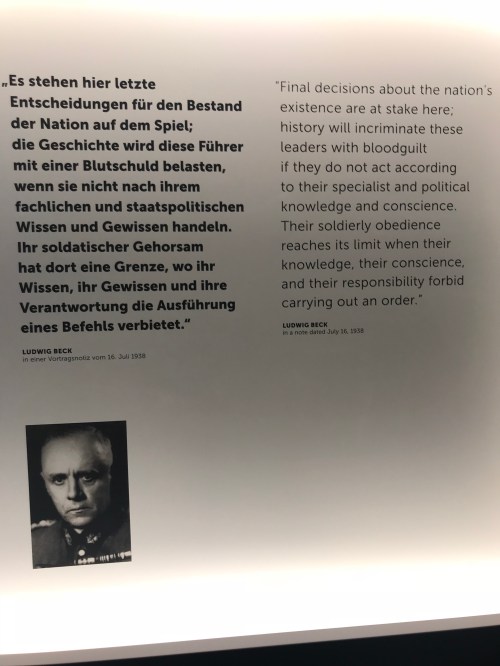
Yet there were others who for a number of reasons, in some cases noble, and in others pragmatic, or even base, decided to break the oath they had sworn to Hitler in 1934. Among these men was General Ludwig Beck. Beck noted:

“It is a lack of character and insight, when a soldier in high command sees his duty and mission only in the context of his military orders without realizing that the highest responsibility is to the people of his country.”

With the rise of legally elected authoritarian rulers in Europe and the Americas should concern men and women who have sworn to uphold the constitutions of their countries. These leaders campaigning against democratic institutions, and upon gaining power purge those institutions of opponents and use them to solidify their own power. The veneer of democracy is maintained while the soul of it is crushed. Too often those charged with guarding it are willing participants in its death, soldiers, civil servants, judges, and legislators.

That is what Beck understood. He resigned his office as Chief of Staff of the German Army in 1938 over Hitler’s plan to invade Czechoslovakia, became a member of the anti-Hitler resistance and died in the failed attempt on Hitler’s life on July 20th 1944. He was a career Army officer and a conservative, but he realized that there are limits to obedience in the face of evil.

I fear that there are many men and women in nations whose democratic institutions are being subordinated to authoritarian rulers who will not rise to the occasion and allow those institutions and eventually their nations to perish. Sadly, that also includes those in the United States.

I will leave you with that thought for the evening.

Until tomorrow,

Peace,

Padre Steve+

2 Comments

Filed under ethics, History, Military, nazi germany, News and current events, Political Commentary

The Pattern of Despotic Rulers

Image result for liddell hart

B. H. Liddell-Hart

Friends of Padre Steve’s World,

A couple of years ago I read the short but poignant little but by the British military historian B.H. Liddell-Hart entitled Why Don’t We Learn from History. The book was written in not long before his death in 1970 and it is good quite good. It deals with a number of issues, including the conflict between history and propaganda, or when faith, especially religious faith as treated as historic or scientific fact; especially when propaganda or faith is preached as if it were history, if it were truth. But he also contrasted democracy and totalitarianism.

Liddell-Hart was a realist, especially about democracy and totalitarianism. While he admitted the inefficiencies of democracy, he realized that it was far less dangerous than the “stupidity” of totalitarianism. In fact it was important for him to note just how this inefficient system was for freedom. He wrote:

“What is of value in “England” and “America” and worth defending is its tradition of freedom, the guarantee of its vitality. Our civilization, like the Greek, has, for all its blundering way, taught the value of freedom, of criticism of authority, and of harmonising this with order. Anyone who urges a different system, for efficiency’s sake, is betraying the vital tradition.”

There is much to ponder in his book and I will probably write some more of my thoughts on it, but when I read it I was struck by just how much Liddell-Hart in his description of a despot described President Donald Trump through the his campaign and after his election and inauguration.

“We learn from history that self-made despotic rulers follow a standard pattern. In gaining power: They exploit, consciously or unconsciously, a state of popular dissatisfaction with the existing regime or of hostility between different sections of the people. They attack the existing regime violently and combine their appeal to discontent with unlimited promises (which, if successful, they fulfil only to a limited extent). They claim that they want absolute power for only a short time (but “find” subsequently that the time to relinquish it never comes). They excite popular sympathy by presenting the picture of a conspiracy against them and use this as a lever to gain a firmer hold at some crucial stage.” 

Once authoritarian, despotic, or dictatorial leaders gain power through the democratic process they seldom deviate from how they behave when seeking power. Liddell-Hart wrote:

“We learn from history that time does little to alter the psychology of dictatorship. The effect of power on the mind of the man who possesses it, especially when he has gained it by successful aggression, tends to be remarkably similar in every age and in every country.”

So please, take a breathe for a second and think about this in terms of President Trump and his actions during his first two weeks in office. Liddell-Hart noted that once a despot achieves power that their reign is marked by the following types of events:

“On gaining power:  They soon begin to rid themselves of their chief helpers, “discovering” that those who brought about the new order have suddenly become traitors to it. 

They suppress criticism on one pretext or another and punish anyone who mentions facts which, however true, are unfavourable to their policy. They enlist religion on their side, if possible, or, if its leaders are not compliant, foster a new kind of religion subservient to their ends. 

They spend public money lavishly on material works of a striking kind, in compensation for the freedom of spirit and thought of which they have robbed the public. 

They manipulate the currency to make the economic position of the state appear better than it is in reality. 

They ultimately make war on some other state as a means of diverting attention from internal conditions and allowing discontent to explode outward. 

They use the rallying cry of patriotism as a means of riveting the chains of their personal authority more firmly on the people. 

They expand the superstructure of the state while undermining its foundations by breeding sycophants at the expense of self-respecting collaborators, by appealing to the popular taste for the grandiose and sensational instead of true values, and by fostering a romantic instead of a realistic view, thus ensuring the ultimate collapse, under their successors if not themselves, of what they have created. 

This political confidence trick, itself a familiar string of tricks, has been repeated all down the ages. Yet it rarely fails to take in a fresh generation.”

Now pause for a moment. Donald Trump has been in office barely two weeks. Look at how he is behaving. Read his words, examine his actions, and not just during the past two weeks but throughout his business career and his campaign for the presidency. Then, take the time to let Liddell-Hart’s words sink in, hours, days, weeks, or even months. Contemplation and reflection are far better than visceral and emotional reactions.

This is something to think about.

Peace

Padre Steve+

1 Comment

Filed under History, nazi germany, News and current events, Political Commentary

Nothing Alters the Psychology of Dictatorship

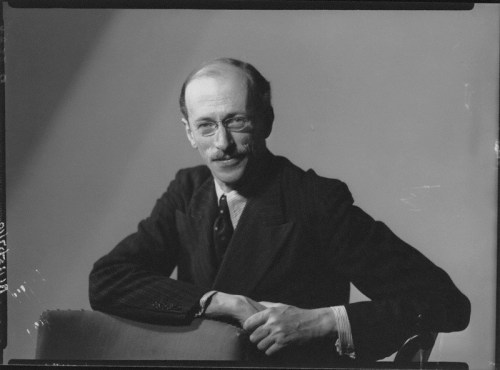
NPG x25404; Sir Basil Henry Liddell Hart by Howard Coster

B. H. Liddell-Hart

Friends of Padre Steve’s World,

A couple of weeks ago I re-read the short but poignant little but by the British military historian B.H. Liddell-Hart entitled Why Don’t We Learn from History. The book was written in not long before his death in 1970 and it is good quite good. It deals with a number of issues, including the conflict between history and propaganda; or when faith, especially religious faith as treated as historic or scientific fact; and when propaganda or faith is preached as if it were history, if it were truth. In doing this he also contrasted democracy and lure of totalitarianism.

Liddell-Hart was a realist, especially about democracy and totalitarianism. He served on the Western Front in the First World War and was wounded in a German gas attack. Between the wars he was one of the theorists of armored warfare and the use of tanks in a combined arms force, and he was also quite observant of the trends toward totalitarianism in the late 1920s and 1930s.

Hart, like many others admitted the inefficiencies of democracy, however, he realized that it was far less dangerous than the “stupidity” of totalitarianism. In fact it was important for him to note just how this inefficient system was for freedom. He wrote:

“What is of value in “England” and “America” and worth defending is its tradition of freedom, the guarantee of its vitality. Our civilization, like the Greek, has, for all its blundering way, taught the value of freedom, of criticism of authority, and of harmonising this with order. Anyone who urges a different system, for efficiency’s sake, is betraying the vital tradition.”

There is much to ponder in his book and I will be posting some more of my thoughts on it, but when I looked at it again I was struck by just how much Liddell-Hart in his description of a despot described President Donald Trump through the his campaign and after his election and inauguration.

“We learn from history that self-made despotic rulers follow a standard pattern. In gaining power: They exploit, consciously or unconsciously, a state of popular dissatisfaction with the existing regime or of hostility between different sections of the people. They attack the existing regime violently and combine their appeal to discontent with unlimited promises (which, if successful, they fulfil only to a limited extent). They claim that they want absolute power for only a short time (but “find” subsequently that the time to relinquish it never comes). They excite popular sympathy by presenting the picture of a conspiracy against them and use this as a lever to gain a firmer hold at some crucial stage.” 

Once authoritarian, despotic, or dictatorial leaders gain power through the democratic process they seldom deviate from how they behave when seeking power. Liddell-Hart wrote:

“We learn from history that time does little to alter the psychology of dictatorship. The effect of power on the mind of the man who possesses it, especially when he has gained it by successful aggression, tends to be remarkably similar in every age and in every country.”

So please, take a breathe for a second and think about this in terms of President Trump and his actions during his first two weeks in office. Liddell-Hart noted that once a despot achieves power that their reign is marked by the following types of events:

“On gaining power:  They soon begin to rid themselves of their chief helpers, “discovering” that those who brought about the new order have suddenly become traitors to it. 

They suppress criticism on one pretext or another and punish anyone who mentions facts which, however true, are unfavourable to their policy. They enlist religion on their side, if possible, or, if its leaders are not compliant, foster a new kind of religion subservient to their ends. 

They spend public money lavishly on material works of a striking kind, in compensation for the freedom of spirit and thought of which they have robbed the public. 

They manipulate the currency to make the economic position of the state appear better than it is in reality. 

They ultimately make war on some other state as a means of diverting attention from internal conditions and allowing discontent to explode outward. 

They use the rallying cry of patriotism as a means of riveting the chains of their personal authority more firmly on the people. 

They expand the superstructure of the state while undermining its foundations by breeding sycophants at the expense of self-respecting collaborators, by appealing to the popular taste for the grandiose and sensational instead of true values, and by fostering a romantic instead of a realistic view, thus ensuring the ultimate collapse, under their successors if not themselves, of what they have created. 

This political confidence trick, itself a familiar string of tricks, has been repeated all down the ages. Yet it rarely fails to take in a fresh generation.”

Now pause for a moment. This is happening all over the world. It began again in Vladimir Putin’s Russia around 2010 and under a veneer of democratic “voting” Putin has become for all intents and purposes the dictator of Russia for as long as he desires. In Turkey Recip Erdogan has done the same thing, and it has also started in Hungary, Poland, and the Czech Republic. In China President Xi managed to abrogate the Chinese Communist Constitution to become ruler for life.

In the United States Donald Trump has been in office for about 15 months. Look at how he is behaving. Read his words, examine his actions, and not just during his presidency but throughout his business career and his campaign for the presidency. Then look at how his followers take it all in.

Then, take the time to let Liddell-Hart’s words sink in.

This is something to think about.

Peace

Padre Steve+

4 Comments

Filed under History, News and current events, Political Commentary

The Danger of Private Power of Corporate Oligarchs Backed by President Trump and Congress: Warnings from Franklin Roosevelt

roosevelt2

Friends of Padre Steve’s World,

As we enter into what I think will be a very eventful and peril filled 2018 I think that it is to take heed of the warnings of President Franklin Delano Roosevelt spoke these words in his Four Freedoms speech. I think they are worth pondering as we go into the second year of the Trump Presidency and the increase of autocratic rule worldwide. Roosevelt said:

“I suppose that every realist knows that the democratic way of life is at this moment being directly assailed in every part of the world — assailed either by arms or by secret spreading of poisonous propaganda by those who seek to destroy unity and promote discord in nations that are still at peace.”

Sadly a large portion of the American populace neither seems to understand or care about these threats to our Constitution and democratic way of life. I will return again to that speech early in 2018 but tonight I wanted to share a couple of other thoughts by him from his Message to Congress on Controlling Monopolies of April 1938 which I think are appropriate for us to ponder at this critical time.

“Unhappy events abroad have retaught us two simple truths about the liberty of a democratic people.

The first truth is that the liberty of a democracy is not safe if the people tolerate the growth of private power to a point where it becomes stronger than their democratic state itself. That, in its essence, is Fascism—ownership of Government by an individual, by a group, or by any other controlling private power.

The second truth is that the liberty of a democracy is not safe if its business system does not provide employment and produce and distribute goods in such a way as to sustain an acceptable standard of living.

Both lessons hit home.

Among us today a concentration of private power without equal in history is growing…”

His speech in its entirety can be read here: http://www.presidency.ucsb.edu/ws/?pid=15637

When I read Roosevelt’s words I am concerned.  It appears to me that what he spoke then is perhaps even more true now. In the past year we have seen the consolidation of power in the hands of the great corporate oligarchs of our time, speeded by the executive actions of the Trump administration and the legislation of the Republican controlled Congress.

His words are a warning to the wise…

Have a great day,

Peace

Padre Steve+

Leave a comment

Filed under History, laws and legislation, leadership, News and current events, Political Commentary

Embracing “Lawless Disorder”

Friends of Padre Steve’s World,

For nearly two years since President Trump began his presidential campaign in 2015 I have been warning that if elected he would become an authoritarian leader. After seven months in office many of his strongest supporters are beginning to discover that I and others were more accurate than any of us wanted to be. In fact I often said that I hoped more than anything that I was wrong about the President, but nearly every day his words or actions confirm my initial predictions of him becoming a true authoritarian leader.

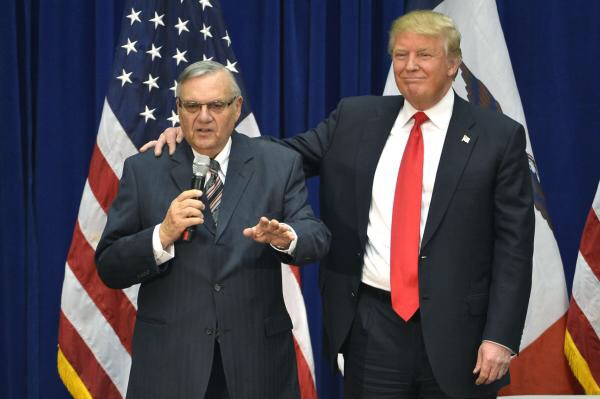
Following President Trump’s pardon of Sheriff Joe Arpaio the Washington Examiner, one of the most conservative publications in the United States with a history of supporting Donald Trump declared “Trump, once the law and order candidate, embraces lawless disorder with Arpaio pardon.” The editorial went on to mention that “But “law and order,” if the words have any meaning, has to apply to government actors as well. Lawless sheriffs promote disorder, and that’s what Arpaio did to get himself convicted.” They properly understood that what Sheriff Joe did was lawless and that the President’s decision to pardon him outside the normal channel for granting pardons was an act that will cause the rule of law to break down and that in the case of this pardon “it’s clear Trump has abused that power for a friend and political ally.”

Senator John McCain released a statement condemning the President’s action. He wrote:

“No one is above the law and the individuals entrusted with the privilege of being sworn law officers should always seek to be beyond reproach in their commitment to fairly enforcing the laws they swore to uphold. … The President has the authority to make this pardon, but doing so at this time undermines his claim for the respect of rule of law as Mr. Arpaio has shown no remorse for his actions.”

But the abuse of power has been a hallmark of the President and in this case it is ominous because it sends a signal to prosecutors and the courts that if a friend of the President is charged with or convicted of a crime that this President will trample judicial decisions just because he can. In fact it was revealed that months before Arpaio was convicted that Trump pressed Attorney General Jeff Sessions to find a way to drop the prosecution. This is not the action of a man who respects the Constitution, the law, or the separation of powers, it is the action of an authoritarian who has no respect for the law who will use is capriciously to enhance his own power at the expense of the country. The late Christopher Hitchens wrote, “The essence of tyranny is not iron law. It is capricious law.”

The problem is that most people in the United States are still trying to understand the President’s actions and words through the lens of traditional American political norms. Gary Kasparov, the Russian chess champion and political dissident noted the error of this reasoning. He tweeted “People are still trying to see Trump through the framework of democracy. But he doesn’t understand them or care to. This was a display of power.” He went on to note that “dictators & would be autocrats do not ask “Why?” when it comes to using power for their advantage. They ask “why not?”

There are many people who did not believe, despite his words during the campaign about disrupting and destroying the institutions of the country that the President would do little harm, that he would be restrained by the courts and the Congress. While the courts have checked some of his unconstitutional actions, and the Congress has passed very little of his legislative agend, the President shows few signs that he respects the rule of law. In fact he attacks the courts, the Congress, the press, and individual citizens on a daily basis when they oppose him. Likewise he shows no respect for the Constitution that he swore to uphold, proving those who believed that he would act in accordance with our system of law and government wrong.

Yale historian Doctor Timothy Snyder wrote about those who make such assumptions when dealing with authoritarian leaders: “The mistake is to assume that rulers who came to power through institutions cannot change or destroy those very institutions—even when that is exactly what they have announced that they will do.”

When President Trump pardoned Sheriff Arpaio he crossed a political Rubicon. His course is set. I just hope those who know better in his political party finally, if belatedly, show the moral courage to stand against what he is doing to our political system. If they do not he will do lasting damage to our form of government that will long outlive him or his presidency. Former Republican Senator John Danforth has urged responsible Republican leaders to stand. He wrote these words in the Washington Post:

“In honor of our past and in belief in our future, for the sake of our party and our nation, we Republicans must disassociate ourselves from Trump by expressing our opposition to his divisive tactics and by clearly and strongly insisting that he does not represent what it means to be a Republican.”

The President is fast becoming an existential threat to both the party of Lincoln and the Republic. No matter how he and his surrogates try to exhaust his opponents, and to break them by the shear volume of his lies, and actions against so many in this country, to include the leaders of his own party, it is not time to retreat. We must all continue to speak, and we must begin again to that together as Republicans, Democrats, and Independents to hold him accountable and preserve a Rupublic that holds promise for all of us. If we don’t he will slice us up like salami into our little groups to dilute our power.

Until tomorrow,

Peace

Padre Steve+

Leave a comment

Filed under civil rights, ethics, Loose thoughts and musings, News and current events, Political Commentary

A Sense of Foreboding and a Determination to Fight

img_3414

Friends of Padre Steve’s World,

Hannah Arendt wrote: “When evil is allowed to compete with good, evil has an emotional populist appeal that wins out unless good men and women stand as a vanguard against abuse.

She was right. We are seeing a populist appeal that is embracing evil and it is happening before our very eyes.

I cannot shake the deep sense of foreboding I have regarding the country and the world after President Trump’s repeated attacks on NATO, his shredding of the Paris Climate accord, and the threat of war on the Korean Peninsula are enough to concern any right thinking person. Likewise, the swirl of allegations concerning what appears to be treasonous activities by his closest advisers and his apparent attempts to have them covered up by the FBI and various intelligence agencies. There is something very wrong going on and it almost feels that I can see the disaster unfolding before it happens.

I am not the only one to notice, leading conservative writers, foreign policy experts, and constitutional scholars have pointed out the same things that I have been saying for over a year. I do try to be positive and to believe that things will work out for the best, but the more I observe the more my confidence in our leaders and for that purpose many of our people to do the right thing is diminished.

That being said I do not give in to the feelings of foreboding or intend give up without a fight. I want my country to live up to its ideals, I am concerned about the real world, our alliances, our environment, and the real threat to freedom.  I believe in a particular universal ideal enunciated in the Preamble of the Declaration of Independence that All men are created equal, and as such that I must continually stand for what is right, what is true, and what is enduring.

I am worried about our democracy and I agree with Timothy Snyder who wrote:

“Democracy failed in Europe in the 1920s, ’30s, and ’40s, and it is failing not only in much of Europe but in many parts of the world today. It is that history and experience that reveals to us the dark range of our possible futures. A nationalist will say that “it can’t happen here,” which is the first step toward disaster. A patriot says that it could happen here, but that we will stop it.”  

It can happen here, and if we are patriots and not simply nationalists we must stand for principle and work for a new birth of freedom even as it seems that freedom itself is in danger. So as I write about some of the notable events of our history that we commemorate over the coming days please know that I take inspiration from them as I hope you will.  We must stand.

Peace

Padre Steve+


Leave a comment

Filed under News and current events, philosophy, Political Commentary

“If nothing is true…” A Review of “On Tyranny: Twenty Lessons from the Twentieth Century” by Timothy Snyder

On Tyranny: Twenty Lessons from the Twentieth Century, 128 pages, Tim Duggan Books, March 2017

Timothy Snyder is the Housum Professor of History at Yale University and a permanent fellow at the Institute for Human Sciences in Vienna. Among his publications are several award-winning books, all of which have been translated: The Red Prince: The Secret Lives of a Habsburg Archduke (2008); Bloodlands: Europe Between Hitler and Stalin (2010), Black Earth: The Holocaust as History and Warning, Snyder is also the co-editor of Wall Around the West: State Borders and Immigration Controls in Europe and North America (2001) and Stalin and Europe: Terror, War, Domination (2013). He helped Tony Judt to compose a thematic history of political ideas and intellectuals in politics, Thinking the Twentieth Century (2012). He is a member of the Committee on Conscience of the United States Holocaust Memorial Museum and sits on the advisory councils of the Yivo Institute for Jewish Research and other organizations.

Friends of Padre Steve’s World,

Today a short review of a very timely new book. Dr. Timothy Snyder’s On Tyranny: Twenty Lessons from the Twentieth Century.

The book is a must read for anyone concerned with the direction that the United States and Western Europe are heading at this time. If we have an expert in understanding tyranny today it is Dr. Snyder. His research and writing in that field, highlighted by his books and publications on the history of Germany and Eastern Europe should be read in order to grasp the full implications of totalitarianism.

This book is timely and concise. It easily can be read in one sitting, but you will want to go back and read it again and again as his salient points need to be thought about, digested, and taken for action, not only in public but in our private lives.

Snyder’s premise is that Americans are no wiser than the peoples of Europe in the 1920s and 1930s in their response and acceptance of totalitarian movements. He asserts that we must grapple with history to understand what is going on and to warn us that temptation “to think our democratic heritage automatically protects us from threats,” is a “misguided reflex.”

In the twenty short chapters of the book Snyder presents twenty historical lessons from the twentieth century which he has adapted to the situation that we find ourselves today. Our founders were aware of the dangers to the republic that they founded, and from their study of Greece and Rome, particularly the threats of oligarchy and empire which overcame those ancient democracies. He explains that the founders attempted to mitigate those dangers in the institutions that they created but did not think that what they created was immune to those threats. James Madison wrote that tyranny rises “on some favorable emergency.”  The understood as Aristotle did that inequity brought instability and Plato’s belief that demagogues exploited free speech to install themselves as tyrants. They “fought to avoid the evil that they, like the ancient philosophers, called tyranny.”  That is an ongoing struggle today, both in the United States and Western Europe.

His talks about the means that authoritarians use to gain and keep power, particularly in their cynical derision of truth, claims to different truths, and alternative facts. One particular point that he makes is that we have to believe in truth, and fight for it. He writes: “To abandon facts is to abandon freedom. If nothing is true, then no one can criticize power, because there is no basis to do so. If nothing is truth, then all is spectacle. The biggest wallet pays for the most blinding lights.”

In each chapter he makes very practical observations and recommendations which can be implemented in our public and private lives. One of the most important of these is real human contact, meeting and getting to know people who came from different backgrounds and experiences than us; simple things like making eye contact, and having private lives, building friendships, and hobbies, even as he notes former Czech dissident and later President Vaclav Havel even suggested brewing beer.

But he also mentions the importance of remembering professional ethics, investigating truth claims, standing out in the crowd, not obeying authority in advance, defend democratic institutions including the press and the courts, to listen for dangerous words such as extremism and terrorism, as well as what he calls the “fatal notions of emergency and exception” and the “treacherous use of patriotic vocabulary.”

I could go on, but I would rather that you read his words. The book can be purchased for under seven dollars, and the Kindle edition for under three dollars.

I highly recommend this book, it is a must for our day.

Peace

Padre Steve+

4 Comments

Filed under ethics, History, News and current events, philosophy, Political Commentary

Resisting Authortarianism: Part One


Friends of Padre Steve’s World,

Tonight, like last night I am posting another thought from B.H. Liddell-Hart’s book Why don’t We Learn from History? 

The book is worth the read for anyone, even though it is written by a military historian and theorist. Liddell-Hart had a keen understanding of the limitations of Democracy, but recognized the inherent evil of the totalitarian or authoritarian state, and such leaders. Thus, when we see a democratically elected leader rapidly move toward authoritarianism, attempting to silence political and press critics, accused the acting head of the Department of Justice of “betrayal,” and attacking the institutions of justice that oppose him, while praising foreign despots, we should be concerned for our liberty. 

Liddell-Hart wrote something very profound that we should all think about: 

What is of value in “England” and “America” and worth defending is its tradition of freedom, the guarantee of its vitality. Our civilization, like the Greek, has, for all its blundering way, taught the value of freedom, of criticism of authority, and of harmonising this with order. Anyone who urges a different system, for efficiency’s sake, is betraying the vital tradition.

He noted:

It is man’s power of thought which has generated the current of human progress through the ages. Thus the thinking man must be against authoritarianism in any form, because it shows its fear of thoughts which do not suit momentary authority.

The power of thought, the unending quest for truth, the questioning of authorities who claim absolute power, are all essential to maintaining human freedom. However, freedom cannot be defended if its defenders have either forgotten how to think critically, or never learned to at all. The latter should be concerning as for years the emphasis of education has been to train people for a job with specific but narrow skills, while critical thinking, based in reason, science, history, philosophy, literature, and the arts has taken a back seat. Giles Lauren who wrote the preface to the latest edition of Why don’t We Learn from History? wrote:

Education, no longer liberal, has largely become a question of training in a skill for gain rather than teaching us how to think so as to find our own way. ‘It is strange how people assume that no training is needed in the pursuit of truth.’ We must learn to test and judge the information that comes before us. After all: ‘Whoever habitually suppresses the truth … will produce a deformity from the womb of his thought.’

This my friends is not comfortable, and neither should it be. But the truth is that most people actually fear truth because it is uncomfortable. Liddell-Hart wrote:

We learn from history that in every age and every clime the majority of people have resented what seems in retrospect to have been purely matter-of-fact comment on their institutions. We learn too that nothing has aided the persistence of falsehood, and the evils resulting from it, more than the unwillingness of good people to admit the truth when it was disturbing to their comfortable assurance. Always the tendency continues to be shocked by natural comment and to hold certain things too “sacred” to think about.

I am watching people, many of them good people, decent people, even brilliant people either openly support the move toward authoritarianism, or remain silent, even when they recognize the truth. In such times it is important to seek the truth, and proclaim the truth, even if it unpopular, and unpleasant. This means that we also have to look inside ourselves, and be honest because we all have the capacity to believe the lie and not to recognize the distinction between fact and fiction. Hannah Arendt wrote in her book The Origins of Totalitarianism:

The ideal subject of totalitarian rule is not the convinced Nazi or the convinced Communist, but people for whom the distinction between fact and fiction ( i.e., the reality of experience) and the distinction between true and false ( i.e ., the standards of thought) no longer exist.

I will continue this tomorrow. Have a great night and sleep well.

Peace

Padre Steve+ 

Leave a comment

Filed under History, News and current events, Political Commentary

The Psychology of Dictatorship: A Historical Retrospective

by Howard Coster, half-plate film negative, 1939

                  Sir B.H. Liddell-Hart

Friends of Padre Steve’s World,

Last year I read the short but poignant little but by the British military historian B.H. Liddell-Hart entitled Why Don’t We Learn from History. The book was written in not long before his death in 1970 and it is good quite good. It deals with a number of issues, including the conflict between history and propaganda, or when faith, especially religious faith as treated as historic or scientific fact; especially when propaganda or faith is preached as if it were history, if it were truth. But he also contrasted democracy and totalitarianism.

Liddell-Hart was a realist, especially about democracy and totalitarianism. While he admitted the inefficiencies of democracy, he realized that it was far less dangerous than the “stupidity” of totalitarianism. In fact it was important for him to note just how this inefficient system was for freedom. He wrote:

“What is of value in “England” and “America” and worth defending is its tradition of freedom, the guarantee of its vitality. Our civilization, like the Greek, has, for all its blundering way, taught the value of freedom, of criticism of authority, and of harmonising this with order. Anyone who urges a different system, for efficiency’s sake, is betraying the vital tradition.”

There is much to ponder in his book and I will probably write some more of my thoughts on it, but when I read it I was struck by just how much Liddell-Hart in his description of a despot described President Donald Trump through the his campaign and after his election and inauguration.

“We learn from history that self-made despotic rulers follow a standard pattern. In gaining power: They exploit, consciously or unconsciously, a state of popular dissatisfaction with the existing regime or of hostility between different sections of the people. They attack the existing regime violently and combine their appeal to discontent with unlimited promises (which, if successful, they fulfil only to a limited extent). They claim that they want absolute power for only a short time (but “find” subsequently that the time to relinquish it never comes). They excite popular sympathy by presenting the picture of a conspiracy against them and use this as a lever to gain a firmer hold at some crucial stage.” 

Once authoritarian, despotic, or dictatorial leaders gain power through the democratic process they seldom deviate from how they behave when seeking power. Liddell-Hart wrote:

“We learn from history that time does little to alter the psychology of dictatorship. The effect of power on the mind of the man who possesses it, especially when he has gained it by successful aggression, tends to be remarkably similar in every age and in every country.”

So please, take a breathe for a second and think about this in terms of President Trump and his actions during his first two weeks in office. Liddell-Hart noted that once a despot achieves power that their reign is marked by the following types of events:

“On gaining power:  They soon begin to rid themselves of their chief helpers, “discovering” that those who brought about the new order have suddenly become traitors to it. 

They suppress criticism on one pretext or another and punish anyone who mentions facts which, however true, are unfavourable to their policy. They enlist religion on their side, if possible, or, if its leaders are not compliant, foster a new kind of religion subservient to their ends. 

They spend public money lavishly on material works of a striking kind, in compensation for the freedom of spirit and thought of which they have robbed the public. 

They manipulate the currency to make the economic position of the state appear better than it is in reality. 

They ultimately make war on some other state as a means of diverting attention from internal conditions and allowing discontent to explode outward. 

They use the rallying cry of patriotism as a means of riveting the chains of their personal authority more firmly on the people. 

They expand the superstructure of the state while undermining its foundations by breeding sycophants at the expense of self-respecting collaborators, by appealing to the popular taste for the grandiose and sensational instead of true values, and by fostering a romantic instead of a realistic view, thus ensuring the ultimate collapse, under their successors if not themselves, of what they have created. 

This political confidence trick, itself a familiar string of tricks, has been repeated all down the ages. Yet it rarely fails to take in a fresh generation.”

Now pause for a moment. Donald Trump has been in office barely two weeks. Look at how he is behaving. Read his words, examine his actions, and not just during the past two weeks but throughout his business career and his campaign for the presidency. Then, take the time to let Liddell-Hart’s words sink in, hours, days, weeks, or even months. Contemplation and reflection are far better than visceral and emotional reactions.

This is something to think about.

Peace

Padre Steve+

Leave a comment

Filed under History, News and current events, philosophy, Political Commentary

The Peril of Private Power: A Warning from Franklin D. Roosevelt

roosevelt2

Friends of Padre Steve’s World,

Since I posted about Franklin D. Roosevelt’s 1941 State of the Union address and the Four Freedoms yesterday, I thought that I would follow it up with just a couple of truths from him:

“Unhappy events abroad have retaught us two simple truths about the liberty of a democratic people.

The first truth is that the liberty of a democracy is not safe if the people tolerate the growth of private power to a point where it becomes stronger than their democratic state itself. That, in its essence, is Fascism—ownership of Government by an individual, by a group, or by any other controlling private power.

The second truth is that the liberty of a democracy is not safe if its business system does not provide employment and produce and distribute goods in such a way as to sustain an acceptable standard of living.

Both lessons hit home.

Among us today a concentration of private power without equal in history is growing…”

Sounds to me like he was well acquainted with our President Elect. A warning to the wise…

Have a great day,

Peace

Padre Steve+

1 Comment

Filed under History, leadership, News and current events, Political Commentary