Tag Archives: dietrich bonhoeffer

Thursday Thoughts on Life, Faith, Doubt and Beer

1622612_10152232336042059_727365308_n

“There are moments, sure, where you think ‘Is there a God? Where is God?” Archbishop Justin Welby

Friends of Padre Steve’s World. Yesterday I promised you part two of the revised article on the American Civil War as the first modern war. I tried to get it done but since I am so unhappy with the previous edition of it I am tearing it apart and get it logically sorted out. I have been doing this for a while and finally got the first part of it done yesterday. I thought that I could get the rest done today but between a very busy day with multiple meetings and presentations at work as well as securing help for a sailor in a difficult crisis couldn’t get it done. Not only that I am busy getting ready to travel to Munich and the real Oktoberfest tomorrow. That will be fun, we have lived there before and travelled there many times, but never to Oktoberfest. In the week there my wife and plan on going to Salzburg and possibly Nuremberg or Wurzburg. We’ll get back next weekend and then I will get back to work on it.

But anyway, we are so looking forward to this trip, which we are making with a good number of friends from the Gordon Biersch Brewery Restaurant Stein Club. The trip is paid for by the Gordon Biersch Passport rewards program. Trust me it is the best rewards program of any restaurant anywhere, not only do they have great craft beer and food, but they reward you well, but I digress.

Just a few thoughts on the words of the Archbishop of Canterbury, Justin Welby who in an interview at the Bristol Cathedral. You can watch that interview here:

https://www.youtube.com/watch?v=exmHYXNEt9A&feature=youtu.be&t=11m52s 

The remarks shocked some because he quite honestly noted how: “There are moments, sure, where you think ‘Is there a God? Where is God?”

Of course clergy are no supposed to doubt but as I have noted before that I went through almost two years following my tour in Iraq suffering a complete emotional, spiritual and physical collapse from PTSD where I was for all intents and purposes an agnostic just praying that God still existed. So Archbishop Welby’s comments were absolutely refreshing to hear, because for a church leader to do so upsets the apple cart of blind certitude in doctrines that because they deal with God we cannot prove. As Dietrich Bonhoeffer said: “a God who would let us prove his existence is an idol.”

Archbishop Welby did note something that I also, at least, most of the time agree: “It is not about feelings, it is about the fact that God is faithful and the extraordinary thing about being a Christian is that God is faithful when we are not.”  Honestly I still doubt every day, but I also believe. Andrew Greeley’s fiction Bishop Blackie Ryan noted: “Most priests, if they have any sense or any imagination, wonder if they truly believe all the things they preach. Like Jean-Claude they both believe and not believe at the same time.”

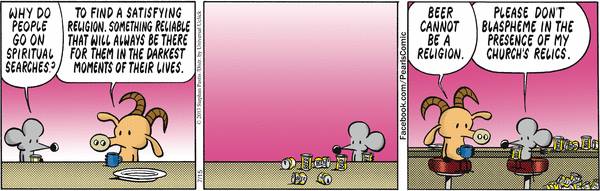
But since I am going to Oktoberfest one last thought on faith and beer.

church relics

So, since I am still busy and unlike my wife have done nothing to pack for the trip, I wish you a good night.

Peace

Padre Steve+

2 Comments

Filed under christian life, faith

The Fallacy of Reductionist Fundamentalism: You Cannot be Competent in God

galaxy_universe-normal1

Today is a day for something a bit more theological in nature. A couple of days ago I wrote about the dangers of reductionist fundamentalism. One of the issues that fundamentalists of all stripes wrestle with is the issue of certitude. For them life has to be bounded by certainty. For them, whether in the matter of origins, or how life came about, in the matter of faith and morals, how life is lived in the present; or how the world ends, life must be certain. In fact, fundamentalism in all its forms inculcates believers that there is only one way of thinking, one way of knowing, one way of understanding things that are unknowable. 

Because of this need for certitude, Christians, Moslems, Jews and others of various persuasions have attempted to define the beginning and the end, as well as to dictate what is acceptable to believe, or acceptable behavior. However, this actually says more about their insecurity than reflects the strength of their beliefs. I can speak to this need for certitude from a Christian point of view, and from my study of other faiths make what I think is informed commentary.

But for people who supposedly believe in God, the reality is that in presuming certitude in what we think that we know  is actually a denial of faith. Dietrich Bonhoeffer wrote that “a God who would let us prove his existence is an idol.” Bonhoeffer was right, not only do those that presume to know exactly how creation came about, how the universe will end or say with unrequited certitude what constitutes proper belief or behavior in the eyes of God make an idol of their God, they also, whether they intend to or not, put themselves in the place of God.

According to the writer of the Book of Hebrews, “faith is the essence of things hoped for, the evidence of things unseen.” That writer, who I think is Priscilla (see Acts Priscilla and Aquila) understood that faith was not the same as empirical knowledge, otherwise it would not be faith. To understand faith in a modern sense it means that faith is something that we admittedly cannot prove. That is why it is faith.

I am admittedly a skeptic. I am. Christian, I do believe, but I doubt as much as I believe. In fact for nearly two years I lived as an agnostic, a priest praying that God still existed, thus is believe but even now doubt. That being said I have seen things that cannot be explained by science or anything rational, and there are physicians that I have worked with that can attest to those things. That being said I think there are a lot of events claimed by some as “miraculous” that are explainable and are not miraculous at all.

The fact is, whether it it about creation and the questions of origins, an exact definition by which to judge absolute truth for living or belief, or the manner of how creation will end; every single statement of such absolutes is contradicted by the fact that we live as Bonhoeffer wrote, and I like to call “the uncomfortable middle. Bonhoeffer wrote in his book Creation, Fall and Temptation that:

“Man no longer lives in the beginning–he has lost the beginning. Now he finds he is in the middle, knowing neither the end nor the beginning, and yet knowing that he is in the middle, coming from the beginning and going towards the end. He sees that his life is determined by these two facets, of which he knows only that he does not know them.”  

The reality for Christians is that we have to admit is that our belief is rooted in our faith, faith which is given to us through the witness of very imperfect people influenced by their own culture, history, traditions as well as limitations in terms of scientific knowledge. Even scripture does not make the claim to be inerrant, though some Christian Fundamentalist make that claim. Because of that, the Bible cannot be understood like the Koran or other texts which make the claim to be the infallible compendium of faith delivered by an angel or dictated by God himself. The Bible, of we actually believe it, is a Divine-human collaboration so symbolic of the relationship that God has with his people, often confusing and contradictory yet inspiring. As Hans Kung so rightly wrote:

“Christians are confident that there is a living God and that in the future of this God will also maintain their believing community in life and in truth. Their confidence is based on the promise given with Jesus of Nazareth: he himself is the promise in which God’s fidelity to his people can be read.” 

Does that mean that we fully comprehend the nature of Christ, or the doctrinal formulation of the Hypostatic Union which defines Christ as being fully human and fully God? Or does it mean that we fully comprehend or understand the doctrine of the Trinity encapsulated in either the Nicene or Athanasian Creed? Certainly not, none of those doctrines are provable by science, or for that manner even history, for there were and are people who consider themselves Christians who do not believe and who reject those doctrinal formulations. Thus for Christians to attempt to argue such matters as fact to those who do not believe is not productive at all. We must understand that faith in the living Christ is not in a doctrine but  a promise that we believe, by faith, is given given by God through Jesus of Nazareth.

The real fact of the matter is that fixed doctrines are much more comfortable than living with difficult questions or honestly examining the contradictions that exist within Scripture, history and tradition. The fact is this makes many people uncomfortable and thus the retreat into the fortress of fixed and immutable doctrine found in the various incarnations of Fundamentalism.

The fact is the world is not a safe place, and our best knowledge is always being challenged by new discoveries many of which make people nervous and uncomfortable, especially people who need the safety of certitude. So in reaction “true believers” become even more strident and sometimes even violent when confronted with issues that question immutable doctrine.

I wish it were otherwise but Christianity cannot get away unscathed by such criticism. At various points in our history we have had individuals, churches and Church controlled governments persecute and kill those that have challenged their particular orthodoxy. Since Christian fundamentalists are human they like others have the capacity for violence if they feel threatened, or the cause is “holy” enough. Our history is full of sordid tales of the ignorance of some Christians masquerading as absolute truth and crushing any opposition. Doctrinal certitude is comforting. It is as Eric Hoffer wrote:

“A doctrine insulates the devout not only against the realities around them but also against their own selves. The fanatical believer is not conscious of his envy, malice, pettiness and dishonesty. There is a wall of words between his consciousness and his real self.”

This is the magnetic attraction of fundamentalism in all of its forms, not just Christian fundamentalism.  Yet for me there is a comfort in knowing that no matter how hard and fast we want to be certain of our doctrines, that God has the last say in the matter in the beginning and the end.

But there some Christians who now faced with the eloquence of men like Neil DeGrasse Tyson and Bill Nye who make legitimate challenges respond in the most uncouth and ignorant manners. The sad thing is that their response reveals more about them and their uncertainty and insecurity than it does the faith that they boldly proclaim.

themiddle1

Our doctrines, the way we interpret Scripture and the way we understand God are limited by our humanity and the fact that no matter how clever we think we are that our doctrines are at best expressions of faith. We were not there in the beginning  and we will not be present at the end, at least in this mortal state. We do live in the uncomfortable middle. Our faith is not science, nor is it proof. That is why it is called faith, even in our scriptures where as Paul the Apostle says “If Christ is not raised your faith is worthless”  and we “are to be pitied among men.” (1 Cor. 15:17-18)

We are to always seek clarity and understanding. However it is possible that such understanding and the seeking of truth, be it spiritual, historical, scientific or ethical could well upset our doctrines about God and that is not heresy, it is an admission that God will not allow us to put hi m in our theological box. As Henri Nouwen wrote: “Theological formation is the gradual and often painful discovery of God’s incomprehensibility. You can be competent in many things, but you cannot be competent in God.”

With that I will close for tonight.

Peace

Padre Steve+

Leave a comment

Filed under christian life, faith, philosophy, Religion

Church, Faith, Tolerance and Reconcilliation

1622612_10152232336042059_727365308_n

“Sometimes I think it is my mission to bring faith to the faithless, and doubt to the faithful.” Paul Tillich

My friends, I write this because of something that happened to me a couple of days ago. It was an incident that upset me greatly because it ended up in the fracturing of a relationship by a friend who evidently could not tolerate where I was in my life as a priest and Christian. I discovered again the reality of what Dietrich Bonhoeffer wrote:

“Many people are looking for an ear that will listen. They do not find it among Christians, because these Christians are talking where they should be listening. But he who can no longer listen to his brother will soon be no longer listening to God, either; he will be doing nothing but prattle in the presence of God, too. This is the beginning of the death of the spiritual life, and in the end there will be nothing left but spiritual chatter and clerical condescension arrayed in pious words… never really speaking to others.”

My experience of the Church is profoundly influenced by my life in the nether world of the military culture. My world view is shaped by a blending of various Christian traditions, mutual support and collaboration among believers of often radically different points of view. Because of the love, care and mentoring of people from a blend of different traditions I came to know God and survived a tumultuous childhood with many moves.

As a historian I have been blessed to study church history from the early Church Fathers to the present. As I look to church history I find inspiration in many parts of the Christian tradition. In fact rather being threatened by them I have become appreciative of their distinctiveness. I think that there is a beauty in liturgy and stability in the councils and creeds of the Church. At the same time the prophetic voice of evangelical preaching shapes me, especially the message of freedom and tolerance embodied in the lives and sacrifice of men like John Leland, the American Baptist who helped pioneer the concept of Freedom of Religion established in the Constitution of the United States, of William Wilberforce who labored to end slavery in England and, Martin Luther King Jr. who led the Civil Rights movement.

Likewise that prophetic message of the faith is demonstrated in the ministry, writing and martyrdom of Dietrich Bonhoeffer and his contemporaries Martin Niemoller and Jesuit priest Father Rupert Meyer. All three resisted and preached against the evils of Nazism. In a more contemporary setting I am inspired by Bishop Desmond Tutu who helped topple apartheid in South Africa.

Women like Teresa of Avila and St Catherine show me that women have a legitimate place of ministry and leadership in the Church. I am convinced through my study of Church history, theology and a deep belief in the power of the Holy Spirit that women can and should serve as Priests and Bishops in the church.

My theology has shaped by the writings of Hans Kung, Yves Congar, Jurgen Moltmann, Andrew Greeley, and Henry Nouwen. I’ve been challenged by St Francis of Assissi, John Wesley and Martin Luther. I am especially inspired by Pope John XXIII whose vision brought about the Second Vatican Council and I am inspired by Pope Francis.

I pray that Christians can live in peace with one another and those who do not share our faith. I pray that we can find ways to overcome the often very legitimate hurts, grievances and divisions of our 2000 year history. At the same time I pray that we can repent from our own wrongs and work to heal the many wounds created by Christians who abused power, privilege and even those who oppressed others, waged war and killed in the name of Jesus.

I do not believe that neither triumphalism nor authoritarianism has a place in in a healthy understanding of the church and how we live. I am suspicious of any clergy who seek power in a church or political setting. I profoundly reject any argument that requires the subjection of one Church with its tradition to any other Church. In fact I think that the arrogance and intolerance of Christians to others is a large part of why people are leaving the church in droves and that the fastest growing “religious group” is the “nones” or those with no religious preference. Andrew Greeley said something that we should take to heart:

“People came into the Church in the Roman Empire because the Church was so good — Catholics were so good to one another, and they were so good to pagans, too. High-pressure evangelization strikes me as an attempt to deprive people of their freedom of choice.”

I grew up in and have lived my life in a very open and ecumenical environment. I have lost any trace denominational parochialism and competition that I might have had if I had become a pastor of a civilian parish instead of a chaplain. It is interesting that the pastor that first ordained me in the evangelical tradition and the bishop that ordained me as a priest both did so with the intent that I serve as a chaplain. Whether it was the recognition of a gifting for the work or the fact that they didn’t want me messing up their civilian operations by asking hard questions I will never know.

I believe that my environment and the men and women who have helped shape my life have been a stronger influence in the way I think about ecumenical relations and ministry than my actual theology or ecclesiology. Whether they were Catholics, Anglicans, Lutherans, Methodists, Presbyterians, Evangelicals or even those considered by many to be outside the faith including Jews, Moslems, Buddhists, Mormons and even complete non-believers all have contributed to my life and faith.

I have grown weary of refighting theological debates that have divided the church for a thousand years. Since what we know of theology including our Scriptures and Creeds are based on faith and not science I see no reason to continue to battle.

That doesn’t mean that I think we should put our brains in neutral but rather we must wrestle with how to integrate our faith with science, philosophy and reason, otherwise we will become irrelevant. In that sense I identify with Saint Anslem of Canterbury who wrote about a faith seeking understanding and Erasmus of Rotterdam who very well understood the importance of both faith and reason. In that sense I am very much at home with the Anglian triad of Scripture, Reason and Tradition when it comes to approaching faith.

I struggle with faith and belief. After Iraq I spent two years as a practical agnostic. As Andrew Greeley wrote: “Most priests, if they have any sense or any imagination, wonder if they truly believe all the things they preach. Like Jean-Claude they both believe and not believe at the same time.” Andrew Greeley “The Bishop and the Beggar Girl of St Germain”

I am an Old Catholic and believe that inter-communion does not require from either communion the acceptance of all doctrinal opinion, sacramental devotion, or liturgical practice characteristic of the other, but implies that each believes the other to hold all the essentials of the Christian faith. I like to think that I embody what the early Anglicans referred to as the via media and that somehow my life and ministry has been about building bridges at the intersections of faith with a wide diversity of people.

When I have tried to embrace traditionalism or choose to fight theological battles I have ended up tired, bitter and at enmity with other Christians. In a sense when I tried those paths I found that they didn’t work for me. I discovered that I was not being true to who God had created and guided my life, education and experience. I feel like T. E. Lawrence who wrote:

“The rare man who attains wisdom is, by the very clearness of his sight, a better guide in solving practical problems than those, more commonly the leaders of men, whose eyes are misted and minds warped by ambition for success….”

My favorite theological debates have been with other chaplains over pints of good beer in German Gasthausen or Irish pubs. Those were good times, we argued but we also laughed and always left as friends and brothers. I believe since we are human that none of us will ever fully comprehend all of God or his or her truth. I believe that the Holy Spirit, God’s gracious gift to her people will guide us into all Truth. For me my faith has become more about relationships and reconciliation than in being right.

As far as those who disagree with me that is their right, or your right if you disagree. I don’t expect agreement and I am okay with differences and even if I disagree with an individual or how another religious denominations polity, theology, beliefs or practices those are their rights. In fact I am sure that those that believe things that I don’t are at least as sincere as me and that those beliefs are important to them. I just ask that people don’t try to use them to force their faith or belief on others, be it in churches or by attempting to use the power of government to coerce others into their belief systems.

To my friend who broke contact with me when I refused to debate his argument that I should submit myself to his Church and tradition, the door is open for reconciliation.

Peace

Padre Steve+

2 Comments

Filed under christian life, faith, Religion

Easter and the Outcasts: For Many the Season is Painful

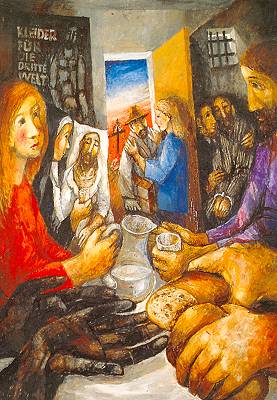
barmherzigkeit

Sieger Köder
“Barmherzigkeit” (Mercy)

“Let us not underestimate how hard it is to be compassionate. Compassion is hard because it requires the inner disposition to go with others to place where they are weak, vulnerable, lonely, and broken. But this is not our spontaneous response to suffering. What we desire most is to do away with suffering by fleeing from it or finding a quick cure for it.” Henri Nouwen

It is now Holy or Maundy Thursday, the beginning of the Easter Triduum. Mid-way through Holy Week and I am doing some thinking about Christians that have suffered a crisis in faith or loss of faith. I meet them all the time and read their stories on blogs, books and social media. Of course I run across more now because I have gone through such a crisis and have written about it and through that had my story publicized. As a result I am contacted by people who have suffered trauma, especially related to PTSD as well as those that care for such people.

For many Christians Holy Week and Easter can be particularly painful. Having known plenty of these people I can say that this phenomenon is one of the more tragic aspects of the season. People who at one time felt the presence of God in their life only sense emptiness and loneliness. For some this loneliness can transition to a feeling of hopelessness where even death appears more comforting than life in the present.

I say this because so many people suffering people often go unnoticed or are ignored in church. Their loss could be that of a spouse or child, the loss of something else significant or another type of trauma that devastates them. Others find that they are rejected by the communities of faith that they had been part of all of their lives because of divorce or because of their sexual preference. However, no matter the cause of the suffering many people discover that they are outcasts in the place where they should be cared about more than anywhere else.

Many pastors and priests are either unaware of them, uncomfortable around them or irritated by them because they don’t respond like “normal” people to the message of Easter. I have found from my own experience returning from Iraq that Easter despite the message of resurrection and hope often triggers a despair of life itself. It is not so bad this year for me but I can remember coming home from Iraq and going through an extended period of time where I felt absolutely alone and no longer sensed the presence of God. I have to say that as a Priest and Chaplain that experience was one of the most frightening of my life.

Years ago I believed that if someone was in the midst of a crisis in faith if they read the Bible more, prayed more and made sure that they were in church that things would work out. I believed then that somehow with a bit of counseling, the right concept of God and involvement in church activities that God would “heal” them.

Call me a heretic but I do not believe that now. That line of thinking is nice for people experiencing a minor bump in their life. However it is absolutely stupid advice to give people who are severely traumatized, clinically depressed, and suicidal or who no longer perceive the presence of God in their lives. This is especially true for those abused by parents or clergy. That kind of wound does damage to the victim’s very concept and understanding of God which can last a lifetime, and in some churches leads to continued re-victimization as the victims are blamed for their plight.

Thus I cannot condemn those who have lost their faith or are wavering in their faith due to trauma, abuse or any other psychological reason. The numbers of people victimized by family, teachers, clergy other authority figures is mind numbing. Likewise we don’t even bother to count the vast numbers of people in our churches who have lost children or other loved ones, experienced some kind of physical trauma related to accidents, had near death experiences or combat deal with the wounds of war. They are all over the place and many go unnoticed in the church.

Sometimes the damage makes it nearly impossible for people to comprehend a God who both cares about them and who is safe to approach. To some God is at best a detached and uncaring being who allowed them to be hurt, and those that serve him in positions of authority are willing accomplices and are no safe.

My experience of coming home from Iraq and the trauma of my return and were absolutely frightening. I was in such bad shape that I left Christmas Eve Mass in 2008 before it started and walked through the dark wondering if God even existed. My isolation from other Christians and the church community and despair that I experienced showed me that such a loss of faith is not to be trifled with by care givers. Nor is it to be papered over with the pretty wallpaper or neat sets of “principles” drawn up by “pastors” who refuse to deal with the reality of the consequences of a fallen world and their impact on real people.

Those that I have talked to and read about who have suffered a crisis or loss of faith almost always express how they feel cut off and even abandoned by God. It is also something that I experienced, thus for me it is not an academic exercise. It is not simply depression that people are dealing with, but despair of life itself. Sometimes it seems that death or just going to sleep is preferable to living. This overwhelming despair impacts almost all of life. It is if they never are able to leave the “God-forsakenness” of Good Friday and cannot climb out of the tomb. For some the pain is so much that suicide becomes an option and the belief that their family, friends and loved ones would be better off without them. I have seen this too many times to count.

It is hard to reach for the person experiencing this pain to reach out but it is also difficult for those who care enough to reach out to them. I can say that I was not easy to deal with and because of my distrust it was hard to believe that anyone cared, even when they did. However the people who chose to remain with me and walk with me through the ordeal in spite of my frequent crashes, depression, anger and even rage helped get me through the worst of this. I’m sure that some who had to deal with me in that condition got burned out as I was not easy to deal with. Some chose not walk with me as I began to go down this road in early 2008 and the sad thing is that many were ministers and fellow chaplains. In some ways I don’t blame them. However it is telling that the first person that asked me about my spiritual life “or how I was with the Big Guy” was my first therapist.

The topic of a loss of faith or the reality of feeling God forsaken is had to deal with but is something that we need to face especially during Holy Week. The Cross necessitates this, Jesus was considered “God-Forsaken” and that is what is so perplexing about Good Friday. He is the battered and abandoned victim on that day, a day when all hope appears to be gone. German theologian Jurgen Moltmann wrote something quite profound:

“When God becomes man in Jesus of Nazareth, he not only enters into the finitude of man, but in his death on the cross also enters into the situation of man’s godforsakenness. In Jesus he does not die the natural death of a finite being, but the violent death of the criminal on the cross, the death of complete abandonment by God. The suffering in the passion of Jesus is abandonment, rejection by God, his Father. God does not become a religion, so that man participates in him by corresponding religious thoughts and feelings. God does not become a law, so that man participates in him through obedience to a law. God does not become an ideal, so that man achieves community with him through constant striving. He humbles himself and takes upon himself the eternal death of the godless and the godforsaken, so that all the godless and the godforsaken can experience communion with him.” 

Scripture plainly teaches that we are to “bear one another’s burdens, and in this way you will fulfill the law of Christ.” But this can be hard to do, we don’t like dealing with suffering. But as Dietrich Bonhoeffer said “We must learn to regard people less in light of what they do or omit to do, and more in the light of what they suffer.” It is our willingness to be with people in their suffering that is one of the true marks of the Christian. Being with someone in triumph is far easier than with walking with and holding on to those who suffer the absence of God. It is presence and love not sermons that people who have lost their faith need as Bonhoeffer so eloquently said “Where God tears great gaps we should not try to fill them with human words.”

I do pray that as we walk with Jesus this Holy Week that we will not forget those who despair of live and feel as if they are “God-forsaken.”

Peace

Padre Steve+

1 Comment

Filed under christian life, faith, Pastoral Care, PTSD, Religion

Distant Origen: The Danger of Doctrinal Certitude While Living in the Uncomfortable Middle

galaxy_universe-normal

“Man no longer lives in the beginning–he has lost the beginning. Now he finds he is in the middle, knowing neither the end nor the beginning, and yet knowing that he is in the middle, coming from the beginning and going towards the end. He sees that his life is determined by these two facets, of which he knows only that he does not know them”  Dietrich Bonhoeffer

There is an episode of Star Trek Voyager called Distant Origin where a scientist of a race in the Delta Quadrant believes that genetic evidence indicated that their race originated on Earth. His thesis is challenged the doctrine of his species and he was accused of “heresy against Doctrine” for positing something different than his people believed. He ends up being persecuted and punished for his beliefs.

Now I want to be diplomatic about this. I am not someone who simply is contrary to established doctrines, be they theological, scientific or even military theories. That being said I think it is only right to question our presuppositions, as Anselm of Canterbury did through faith seeking understanding.

That understanding as a Christian is based on the totality of the message of the Christian faith. Hans Kung said it well:
“Christians are confident that there is a living God and that in the future of this God will also maintain their believing community in life and in truth. Their confidence is based on the promise given with Jesus of Nazareth: he himself is the promise in which God’s fidelity to his people can be read.” 

What we have to admit is that our belief is rooted in our faith, faith which is given to us through the witness of very imperfect people influenced by their own culture, history and traditions. Even scripture does not make the claim to be inerrant, and the Bible cannot be understood like the Koran or other texts which make the claim to be the infallible compendium of faith delivered by an angel or dictated by God himself. It is a Divine-human collaboration so symbolic of the relationship that God has with his people, often confusing and contradictory yet inspiring.

themiddle

There is a certain sense of relationship between God and humanity within scripture and that relationship creates certain tensions between God and those people. The interesting thing is that Scripture is a collection of texts which record often in terrible honesty the lack of perfection of both the writers and their subjects. They likewise record the sometimes unpredictable and seemingly contradictory behavior of God toward humanity in the Old Testament. They bear witness to the weaknesses, limitations and lack of understanding of the people of God of the message of God but even in that those limitations and weaknesses that God is still faithful to humanity in the life death and resurrection of Jesus of Nazareth.

The real fact of the matter is that fixed doctrines are much more comfortable than difficult questions than honestly examining the contradictions that exist within Scripture, history and tradition. The fact is this makes many people uncomfortable and thus the retreat into the fortress of fixed and immutable doctrine found in the various incarnations of Fundamentalism.

The fact is the world is not a safe place, and our best knowledge is always being challenged by new discoveries many of which make people nervous and uncomfortable, especially people who need the safety of certitude. So in reaction the true believers become even more strident and sometimes, in the case of some forms of Islam and Hinduism violent.

Picard

Christianity cannot get away unscathed by such criticism. At various points in our history we have had individuals, churches and Church controlled governments persecute and kill those that have challenged their particular orthodoxy. Since Christian fundamentalists are human they like others have the capacity for violence if they feel threatened, or the cause is “holy” enough. Our history is full of sordid tales of the ignorance of some Christians masquerading as absolute truth and crushing any opposition. It is as Eric Hoffer wrote:

“A doctrine insulates the devout not only against the realities around them but also against their own selves. The fanatical believer is not conscious of his envy, malice, pettiness and dishonesty. There is a wall of words between his consciousness and his real self.”

This is the magnetic attraction of fundamentalism in all of its forms, not just Christian fundamentalism.  Yet for me there is a comfort in knowing that no matter how hard and fast we want to be certain of our doctrines, that God has the last say in the matter in the beginning and the end. We live in the uncomfortable middle but I have hope in the faith that God was in the beginning. Besides as Bonhoeffer well noted “A God who let us prove his existence would be an idol” 

But there some Christians who now faced with the eloquence of men like Neil DeGrasse Tyson and Bill Nye who make legitimate challenges respond in the most uncouth and ignorant manners. The sad thing is that their response reveals more about them and their uncertainty than it does the faith that they boldly proclaim.

Our doctrines, the way we interpret Scripture and the way we understand God are limited by our humanity and the fact that no matter how clever we think we are that our doctrines are expressions of faith. This is because we were not in the beginning as was God and we will not be at the end, at least in this state. We live in the uncomfortable middle, faith is not science, nor is it proof, that is why it is called faith, even in our scriptures.

We are to always seek clarity and understanding but know that it is possible that such understanding and the seeking of truth, be it spiritual, historical, scientific or ethical could well upset our doctrines, but not God himself. As Henri Nouwen wrote: “Theological formation is the gradual and often painful discovery of God’s incomprehensibility. You can be competent in many things, but you cannot be competent in God.” Is that not the point of the various interactions of Jesus with the religious leaders of his day? Men who knew that they knew the truth and even punished people who had been healed by Jesus such as the man born blind in the 9th Chapter of John’s Gospel.

vasily-surikov-christ-healing-the-man-born-blind

“You are that man’s disciple; we are disciples of Moses! We know that God spoke to Moses, but we do not know where this one is from.” The man answered and said to them, “This is what is so amazing, that you do not know where he is from, yet he opened my eyes. We know that God does not listen to sinners, but if one is devout and does his will, he listens to him. It is unheard of that anyone ever opened the eyes of a person born blind. If this man were not from God, he would not be able to do anything.” They answered and said to him, “You were born totally in sin, and are you trying to teach us?” Then they threw him out.”

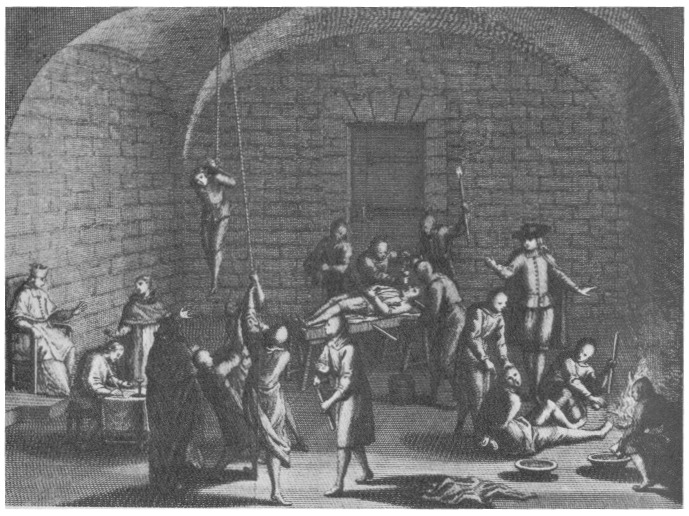
The interchange between the religious leaders and the man is not an indictment on Judaism, but rather on religious certitude in any time or place. The fact is that the Pharisees are no different than those who ran the Inquisition, or those who conducted Witch Trials or those who attempt to crush anyone who questions their immutable doctrine no matter what their religion. They were and are true believers.

In the episode of Star Trek the Next Generation called The Drumhead Captain Picard counsels Lieutenant Worf after their encounter with a special investigator who turned an investigation into a witch hunt on the Enterprise. Picard told Worf, who had initially been taken in by the investigator:

“But she, or someone like her, will always be with us, waiting for the right climate in which to flourish, spreading fear in the name of righteousness. Vigilance, Mister Worf – that is the price we have to continually pay.”

And that is true.

Peace

Padre Steve+

Leave a comment

Filed under faith, philosophy, Religion

Faith and Doubt on a Friday During Lent

tom-clancy-look-2

William James wrote that “Faith means belief in something concerning which doubt is theoretically possible.”

Many religious people, be they Christians, Jews, Moslems or others equate their faith in what cannot be seen or proven to be a certainty. But faith, even as understood by someone like the Apostle Paul was something that was not provable in this life. In fact Paul is bold enough to proclaim that if Christians are not correct concerning their faith in the risen Christ that they are to be pitied among men.

Faith in something, even God is not proof. In fact faith can never be asserted to be fact until the final consummation. Dietrich Bonhoeffer in his classic Creation and Fall Temptation, Two Biblical Studies wisely noted that:

“Man no longer lives in the beginning–he has lost the beginning. Now he finds he is in the middle, knowing neither the end nor the beginning, and yet knowing that he is in the middle, coming from the beginning and going towards the end. He sees that his life is determined by these two facets, of which he knows only that he does not know them”

Bonhoeffer’s words show a wisdom often lacking in young theologians. No matter how firmly we believe the words of Scripture or the Creeds they are at their heart statements of faith, not fact. They may be true, and I believe them to be. That being said we cannot prove them  and simply making circular arguments about their truth does not make them true. Thus I always find that I am amazed when I see some Christians insist that what they believe is “absolute truth” even when they have no “proof” of its truth outside of their statements of faith. Such is the trap of circular logic. Bonhoeffer quite correctly noted that “A God who let us prove his existence would be an idol.”

I have learned to appreciate the struggle of faith. I believe, but I seek understanding. That being said I know that whatever I know, I only know in part, as Paul said I see “through a glass darkly,” but one day I shall see “face to face.”

Those that equate faith with certitude do so at their own peril, and often are willing to sacrifice others to ensure that their belief remains unquestioned.

The great American Jurist Oliver Wendell Holmes wrote:

“Certitude leads to violence. This is a proposition that has an easy application and a difficult one. The easy application is to ideologies, dogmatists, and bullies–people who think that their rightness justifies them in imposing on anyone who does not happen to subscribe to their particular ideology, dogma or notion of turf. If the conviction of rightness is powerful enough, resistance to it will be met, sooner or later by force. There are people like this in every sphere of life, and it is natural to feel that the world would be a better place without them!”

The fact is that there is nothing wrong with doubt. There is nothing wrong with struggle. In fact it is shown in the lives of those that we consider “saints” throughout both the Jewish and Christian scriptures.

Faith without doubt and faith without struggle is not faith, it is idolatry. Bonhoeffer expressed this well when he said “A God who let us prove his existence would be an idol.”

In fact absolute certitude masquerading as faith in the life of the faithful often leads to great violence and evil. One only has to look at what happened on September 11th 2001 to see the results of such violent certitude.

As for me I have faith, but at the same time I doubt. Sometimes doubts outweigh faith and at other times faith outweighs doubt. That being said I find comfort in the scriptures where Paul honestly and openly writes of his conflicts and doubts. Henri Nouwen had it right when he said:

“Theological formation is the gradual and often painful discovery of God’s incomprehensibility. You can be competent in many things, but you cannot be competent in God.”

That is the real fact of the matter. It is something that Christians more interested in truth rather than protecting their social position have believed for decades have died to proclaim.

None of us, no matter how learned we are, or how certain we believe, really know much about God. And that my friends is certain.

Peace

Padre Steve

Leave a comment

Filed under christian life, faith, Religion

Military Ethics, Legality and Morality: The Damage Being Caused by the Emphasis on STEM to the Detriment of the Humanities in Military Officer Programs

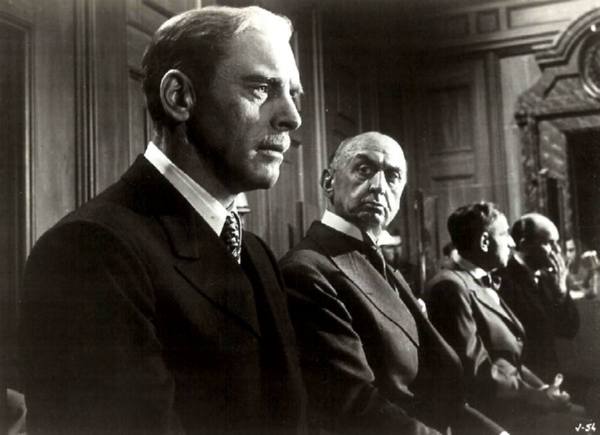
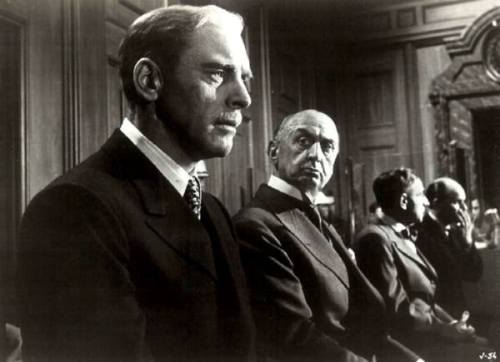
photo-jugement-a-nuremberg-judgment-at-nuremberg-1961-1

“We have been silent witnesses of evil deeds: we have been drenched by many storms; we have learnt the arts of equivocation and pretense; experience has made us suspicious of others and kept us from being truthful and open; intolerable conflicts have worn us down and even made us cynical. Are we still of any use?” Dietrich Bonhoeffer 

I have lost count of the number of scandals regarding the ethical failures of American military leaders. Today at lunch I was talking with a gentleman in charge of the military outreach for a local university where I am considering beginning a Ph.D. program in Organizational Leadership.

There are many reasons given for the these ethical failures, everything from the disintegration or the nuclear family, to the lack of religious upbringing, to the supposedly liberal educational system. However, while I think some of these issues may have some impact, I am not convinced that they are the root cause of the ethics crisis that seems to be plaguing the military.

As we discussed aspects of the program the subject got to the subject of military leaders being fired for ethical, legal and moral lapses. This is something that I am giving much though since I am now teaching ethics at a senior level military staff college. What I am noticing is that many officers struggle with basic concepts regarding history, philosophy, ethics, political science, religion, the arts and literature and other subjects that because I immerse myself in them just assume that any military professional should know.

But that is not the case. For the last thirty to forty years the commissioning programs of our services have given preference to those in the STEM, Science, Technology, Engineering and Mathematics fields. In fact the probability is that the liberal arts or social science major will not be admitted to service academy or ROTC program, even a non-scholarship program unless they are in a STEM major. This is especially true of my own service, the Navy and the Air Force but is not absent from the Army and the Marine Corps.

This is not new. In 1981 I joined Army ROTC because the Navy told me that even to be a non-scholarship student in the program I would have to change my major from history to a STEM major.

This is not simply a military issue, but it is a systemic issue in higher American education programs, programs which due to the demands of the business and technology sectors have gutted liberal arts programs and the social sciences. All of this has been done in the name of making sure that people are “prepared for jobs” and that education is related directly to employability and again jobs. That is why in large part for profit schools have proliferated offering programs focused on narrow job fields in technical majors. This has impacted higher education in public and private universities which at one time had thriving liberal arts, humanities and social science programs as well as the military where the emphasis on STEM has created havoc in terms of ethics.

Dietrich Bonhoeffer wrote:

“The ‘polymath’ had already died out by the close of the eighteenth century, and in the following century intensive education replaced extensive, so that by the end of it the specialist had evolved. The consequence is that today everyone is a mere technician, even the artist…”

Education is now viewed by most as a pathway to a better job, not a quest for understanding, knowledge or even personal improvement. That attitude is enmeshed in our culture and has been for decades. It even shows up in seminaries where programs are not focused in the classics and timeless subjects in theology, history, philosophy, ethics, languages and hermeneutics but instead methods of “growing” a church or running a program. When I was in seminary, a large conservative evangelical seminary many students complained about having to take classes that had nothing to do with running their church. Many of my fellow students despised Church History, Ethics, Philosophy of Religion, and even Systematic Theology and then complained that the courses that were oriented to running a church would be out of date in a few years.

The common theme whether this be in the for profit schools, the public and private universities, the military and seminaries is that we have trained two generations of people to be good technicians and technocrats. Men and women very skilled at getting at job done but that lack the basic ethical and moral grounding that those in previous generations received as part of their education, in the home, in their religious institutions and in the educational system.

The problem is that when you strip away a solid grounding in the arts, liberal arts and social sciences you breed people who may be very good at getting a job done. However they are people who lack the knowledge passed on by people who have shaped civilization for millennia.  They are ignorant of Hammurabi, Moses, Plato, Cicero, Aristotle, Marcus Aurelius, Thomas Aquinas, the great philosophers and thinkers from the East and the West, those who brought about the Reformation, the Renaissance and the Enlightenment and even the Scientific and Industrial Revolutions, Universal Suffrage, Emancipation and Civil Rights.

Their technical education divorces them from those that developed the legal, ethical and moral codes of our culture. They lack the cohesive understanding of social responsibility and connection that have held western civilization together. Those have been replaced by ethics that are dominated by pragmatism or utilitarianism, even in seminaries where classes on ethics or moral theology are often relegated to elective status. How else can we explain the wholesale disintegration of moral and ethical codes of behavior across the vocational spectrum be it business, government, the military or religious institutions?

The question for many people, and maybe most people in our society, including the military is not what is moral or ethical but what is “legal,” and what are the loopholes in the law that allow one to escape the consequences of their immoral, illegal or unethical behavior.

We have raised at least two, maybe three generations of technicians and technocrats, and that trend shows no sign of abating. In North Carolina last year the Republican Governor proposed eliminating tuition assistance from any program not directly related to “jobs.” By that he meant eliminating such assistance from non-STEM programs.

What this does, and I think we are seeing this today is produces people who are good at doing jobs, but have a difficult time in critical thinking or looking at the logical consequences of their ideas and actions.

Many cannot see the moral or ethical dimensions of life and even turn religion to an exercise designed to benefit them in a tangible material way. Thus there is a proliferation of churches that preach some kind of “prosperity Gospel” and those that pervert religion and use it to suppress the freedoms of others by force of law.

But let me return to the military implications of my thesis. What I have observed in my career of over 30 years of military service is a culture that has developed in an ethical vacuum. We have sought to inculcate a service culture based on Army, Navy, Air Force or Marine Corps “values” such as “honor, courage and commitment.” However, for many maybe even most those are mere words. They are shibboleths akin to religious creeds recited by people for whom they are irrelevant because they are not job related.

Now this is not an attack on those in the military, for those in the military simply reflect the culture that they come from. This includes the family, religious, social and educational systems of our society. In fact I actually believe that for the most part people in the military do a better job with values, ethics and morality than many in the civilian society. That being said there is something seriously wrong in what we are doing. If there wasn’t there would not be so many egregious lapses that call the moral fitness of senior military leadership into question.

This is especially important because the trust of the nation is invested in these men and women. The responsibilities that they have regarding the lives of people, the security of the nation and the maintenance, security and use of powerful weapons, including nuclear weapons and information technology that can be used to pry into the private lives of unknowing citizens all dictate that the ethical and moral standards of the military have to be above those found in the private sector.

Unfortunately there is no immediate “fix” for the problem because it it so systemically rooted in our society. However something will have to be done, the Chairman of the Joint Chiefs of Staff and Secretary of Defense have directed the military redouble its emphasis on teaching ethics at every level. However it is my opinion that we will have to go far beyond the recitation of creeds and repetition of words about “values” that have little relevance to people educated and brought up to simply do a job. This will be a difficult task, especially in military organizations being reduced in number while still engaged in war and increasing other operations around the world.

As to the broader societal issues, those run deep, but one thing in my mind is certain, there has to be a renewed emphasis on the humanities, liberal arts and social sciences to include the classics of western and world literature, art, philosophy, history and thought. We cannot reduce education to technical elements that require little in the way of critical thought, or for that matter provide people with “education” that does not force them to deal with the dark areas of life that are uncomfortable and the gray areas that fill our universe.

In the Second World War many of the best and brightest of young German intellectuals joined the SS and its sister organizations, organizing and executing the extermination of the Jews and others in Germany and occupied lands. Most of these men did not give their actions a second thought. They were doing their jobs, most of the time in a very dispassionate matter. They carried out orders because they were “legal.” Ethics and morality were no concern simply because they were sworn to obey orders.

The task to change this cannot be that of the military and its leadership alone. If we fail to change our education systems, our home life and even our religious life we will unleash the greatest generation of amoral technocrats who have ever walked the face of the earth. They will be men and women who will have no problem committing the greatest crimes, simply because they are “legal” and because they have only been taught to do their job.

Peace

Padre Steve+

5 Comments

Filed under ethics, leadership, Military, News and current events, philosophy

God With Us? The Misuse of God’s Promise by Political Partisans

barmherzigkeit

It is one of the most amazing stories of salvation history. The Incarnation of God in Jesus the Christ. Matthew’s Gospel (Ch 1 v.24), referring back to the words of Isaiah delivers the message in words which find their way into our culture every Christmas through Georg Friedrich Handel’s Messiah: “Behold, the virgin shall conceive and bear a son, and they shall call his name Emmanuel, ‘God with us.’”

That message, which lays at the heart of the Christian Gospel is really amazing.  It is a message that points to a Gospel meant for all people and not any particular nation, nor any political, racial, or ethnic group that wishes to appropriate it for themselves alone.

It is the message of the humility and grace of God.  It is the message God humbling himself to become incarnate and not only live among his creation, but to suffer and die for the salvation of it. All of it. As Paul wrote so well in his epistle to the Philippians:

“Let the same mind be in you that was in Christ Jesus, who, though he was in the form of God, did not regard equality with God as something to be exploited, but emptied himself, taking the form of a slave, being born in human likeness. And being found in human form, he humbled himself and became obedient to the point of death– even death on a cross.” (Phil 2:5-7)

Unfortunately that message is all too often appropriated and twisted into something unrecognizable by those who seek to use it to bolster their particular ideology, nationalism or even racism. In practice, human beings are much more likely to claim this message to bolster their own hatred and intolerance or justify their nation’s desire for conquest. It matters not if the a Christian in any sense of the word or not. One sees the same idea floated by zealots of almost every major religion. The appeal to being on the same side of God trumps all other arguments.

As a historian I have studied this often. In the United States it is encompassed in the idea of Manifest Destiny; but can be seen in the life and history of many nations who in their belief that God was on their side have slaughtered hundreds of millions of people. One does not have to look far to see leaders of nations, political factions, ideologues or other fanatics appropriate God as the trump card of their message. However, it is not just a matter for history. It happens every day, and it is not pretty. Many use it to justify the most reprehensible crimes, persecution, ethnic cleansing and even genocide. They do so all in the name of God, preaching that God is with them, and not those who they despise.

god-government-77-cover-photo

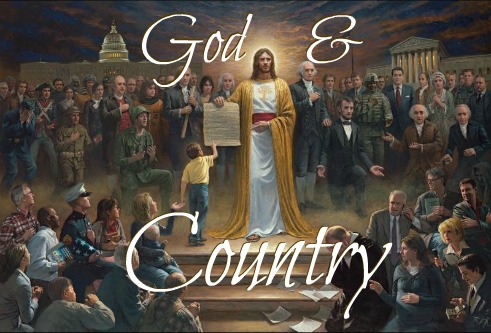
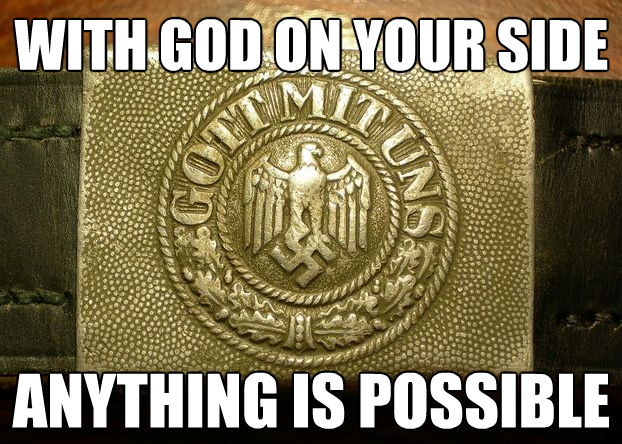
Today I saw a blog on a service that I use to promote my website. The author of the blog promotes an extremely conservative political ideology with most of his posts being directed with some vehemence, often colored by blatant racism at President Obama and others that he does not agree with. Usually his posts are filled with such hyperbole and nonsense that I simply ignore them. However, today he posted something that as a Christian really bothered me. His post was titled Do Not Fear, God is With Us, and it featured the picture shown above. When I saw it, I felt a chill run down my spine. It was as if I was envisioning the virulent hatred of other races, creeds and nations exhibited by those who have claimed that mantle before. I can see it now, a belt-buckle with a Swastika, ringed in the words “Gott Mit Uns.” 

gottMitUns

The sad thing is that the Christians who claim this mantle misuse scripture and twist it to justify their hatred of all that they disagree with, have lost sight of the Gospel. Instead they have allowed their passionate hatred and prejudice to hijack the message of the Gospel to promote political partisanship, hyper nationalism and xenophobia. This can hardly be called Christian. If such ideas were was limited to the fringe of society it would not be so concerning. However, this blogger represents a significant portion of the American electorate; and his comments are echoed by the very powerful, and allegedly Christian leaders of partisan political organizations, as well as pundits, politicians and preachers. If you do not agree with them you are not a real American.

ds13_1929_by_panzergirl69-d5zanbl

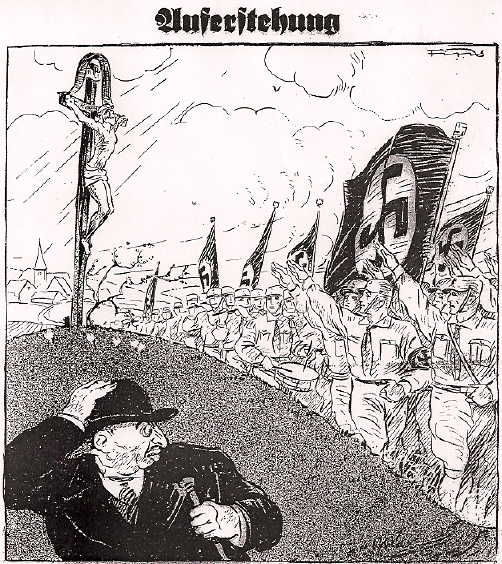
Cartoon from the Nazi Der Sturmer linking the Nazi Movement to Christ, with the Jew being the villain 

Instead of seeing the message of God’s grace, love and mercy for all people, we see triumphalist Christians that claim that God is with them. In their zeal they ride roughshod over others, and despise all who disagree with or oppose them. Their opponents are painted as being in league with the Devil, modern Judas Iscariots. In their lives and ideology many Christians follow leaders who espouse brutal doctrines of Social Darwinism and sell their birthright for a pittance. They attempt to use of the police power of government at every level against those that they disapprove, in matters of faith, lifestyle or politics. Likewise they have no compunction about using the military and economic power of the nation to crush weaker nations, all because they believe that they and their country have God on their side.

But do such sentiments have any place in the message of Christians? I think not. As Paul the Apostle notes: if in Christ “there is no longer Jew or Greek, there is no longer slave or free, there is no longer male and female; for all of you are one in Christ Jesus.” (Gal 3:28) Or as Paul writes in 2 Corinthians “in Christ God was reconciling the world to himself, not counting their trespasses against them, and entrusting the message of reconciliation to us.” (2 Cor 5: 19)

The Gospel is not about God being on the side of any nation or political ideology. Such ideas always end in disaster for those that believe them, and who use God to justify their actions.

0725-Morgan-McNaughton-one-nation-550x358

McNoughton’s “One Nation under God”

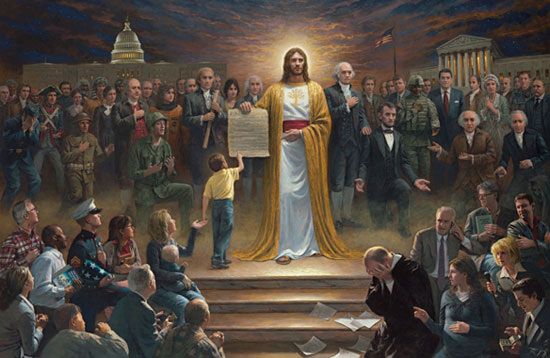
The picture on the website that triggered this little article is one by a Mormon artist, John McNoughton. McNoughton has frequently blended the image of Jesus with the most banal appeal to American “patriotism” and crude attacks on President Obama. In this picture as well as others the artist has Jesus holding a copy of the Constitution of the United States in his right hand, with his friends on that side, and his foes, including judges, others viewed as liberals and women. In his more crass attacks on the President in other paintings he shows Obama trampling the Constitution while white people are bound in chains. All of these show up with startling frequency on supposedly Christian websites.

1896_cartoon

US Political Cartoon from 1896

The sad truth is that McNoughton is not the first to practice this crude form of xenophobic patriotism, which appeals to God in order to vilify the opponents of their ideology. It has been used in this country before, as well as in Europe to vilify Jews, racial minorities and political opponents.

Yes, I do believe that God is with us, however, that is not confused with appeals to my patriotism, which is real and has led me to serve this nation for over 30 years in the military including two combat tours in the Middle East. Nor does it add or detract from my support of our Constitution, why does not mention God once, despite its guarantee of religious freedom for all, not just Christians. It is an amazing document, one that I will die to defend, but it is not handed down by God, and Jesus never referred to it.

Instead, my belief that God is with us flows from the mystery of the Incarnation, that miracle of salvation history.  I believe in the message wonderfully referred to in the liturgy as the “mystery of faith,” that Christ has died, Christ is risen and Christ will come again. My belief flows from the simple message that for God so loved the world… and not that God so established this or any other nation or political ideology as his own.

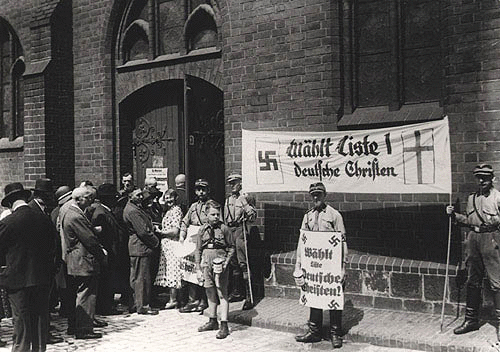
I understand the fear that drives men like the blogger who posted the article I saw, as well as men like McNoughton. Their fear of the other allows them to use these images to promote their hopelessly confused faith and ideology. Dietrich Bonhoeffer who saw the same fear and hatred present among his fellow Germans, especially German Christians wrote:

“The Christian must treat his enemy as a brother, and requite his hostility with love. His behavior must be determined not by the way others treat him, but by the treatment he himself receives from Jesus; it has only one source, and that is the will of Jesus.”

deutschenchristen2

What I see from the present political ideologues has nothing to do with love of God or our neighbor, but their efforts to protect their status in society, their political power and subject all others to their will.

God is with us indeed, in the humility of a borrowed manger, on the gibbet of a Roman cross, and in shame of a borrowed tomb. God is really present with us in the the bread and wine, in the word, and in the lives of his people; especially the least, the lost and the lonely. To attempt to crudely use God to buttress any earthy power is heresy. Those that use it in such a manner, though proclaiming their fealty to Christ, or any other God, willingly trample the message of the God who humbled himself, even to death on a cross.

Peace

Padre Steve+
1 Comment

Filed under christian life, faith, Political Commentary, Religion

Gratitude, Relationships and Hope; Even in Death

n671902058_1219154_8844

“Gratitude changes the pangs of memory into a tranquil joy.” Dietrich Bonhoeffer

Today I was able to attend the Celebration of Life for Captain Tom Sitsch. It was good to be able to attend. I was able to meet his brother Mike and Sister Karen as well as many others who knew and loved Tom. These included men that I know from my time with EOD Group Two, some of whom have since retired from the military.

I was touched by the words that Mike and Karen spoke about Tom, as well as the remembrances of others. There were times during the service that I felt tears coming down my cheeks, and when I needed to wipe them from my eyes.

The pastor who spoke mentioned something that resonated with me. He noted that when he talked with Tom about God and faith, that Tom commented to him that “after all he had seen and experienced he didn’t know if he could believe in God.” That I can understand, there is something about the moral injury of war, not just the the physical injuries sustained or the clinical diagnosis of PTSD, or Traumatic Brain Injury that does terrible damage to the soul. A good number of people noted that they thought that he saw something, or experienced a loss in his last tour in Iraq that shook him beyond anything he had ever anticipated. That too I can understand.

It was good to be able to be invited to attend and for me it was a good chance to remember the life of a man who was there for me when I needed it. There was a slide show that depicted Tom’s life, his love for is family, his military career and the life that he attempted to life after his retirement. Between the stories, the shared memories and the pictures I gained an even greater appreciation for Tom Sitsch.

On a personal side it was just good to be there with people who knew and loved Tom. It was really good for me because for once I didn’t have any official role. I cannot remember the last time when I went to a memorial service where I was not involved in the planning, execution or participation in it, quite often as the primary speaker. For once I was able to grieve, remember and celebrate the man that I knew with others whose lives he touched.

It was just good to be with such good people, all of who loved and cared for Tom. There is something healing when people are able to grieve the loss of someone they love together. It is healing, even when tears are shed. Unfortunately, there is nothing any of us can do to bring Tom back. We all, his family, friends, and those that he served alongside all grieve, each in our own way, but we share a common grief, that of the loss of a man who touched our lives.

Dietrich Bonhoeffer noted about loss:

“There is nothing that can replace the absence of someone dear to us, and one should not even attempt to do so. One must simply hold out and endure it. At first that sounds very hard, but at the same time it is also a great comfort. For to the extent the emptiness truly remains unfilled one remains connected to the other person through it. It is wrong to say that God fills the emptiness. God in no way fills it but much more leaves it precisely unfilled and thus helps us preserve — even in pain — the authentic relationship. Further more, the more beautiful and full the remembrances, the more difficult the separation. But gratitude transforms the torment of memory into silent joy. One bears what was lovely in the past not as a thorn but as a precious gift deep within, a hidden treasure of which one can always be certain.” 

The loss of Tom Sitsch left all of us with many beautiful remembrances, which as Bonhoeffer so correctly noted that his separation from us s “more difficult.”

But in the midst of the deep feelings of loss that all of us felt, there were questions. Many wondered what they could have done to change the tragic outcome. The question of “what if?” bothers all of us. Likewise, there was the realization that there are others, who like Tom who need help and are probably not getting it.

My prayers go put to all those who feel the loss of Tom Sitsch, especially his family, friends and those that served with him.

Tonight I heard from a Navy Chaplain that I had not talked to in a long time. It was really good to spend time on the phone with him. I had the honor of baptizing his children back in 2000 when he was my Religious Program specialist. He went on to become a chaplain and do well, serving in the thick of the fighting in Al Anbar Province with a Marine Corps infantry battalion, just missing getting blown up in a large IED blast after completing a service for Marines at a Combat Outpost. He will be retiring later this year, and I hope that he can get on with the Veterans Administration to continue to care for our veterans.

I do hope that in some little way that I can be of help to those who grieve, and those whose lives have been torn apart by the trauma of war. Hopefully, in my own small way, even though I am often filled with doubt, unbelief, and usually have more questions than I have answers, I can at least be there for people who struggle.

I go to bed tonight grateful for what Tom Sitsch did for me; for being invited to attend the service today, to be with others who grieve, and to reunite with an old friend. Those are some of the remarkable things about military life that I am thankful.

Well, that is all for tonight, except for a prayer:

Keep watch, dear Lord, with those who work, or watch, or
weep this night, and give your angels charge over those who
sleep. Tend the sick, Lord Christ; give rest to the weary, bless
the dying, soothe the suffering, pity the afflicted, shield the
joyous; and all for your love’s sake. Amen. (From the Book of Common Prayer) 

Peace

Padre Steve+

Leave a comment

Filed under Loose thoughts and musings

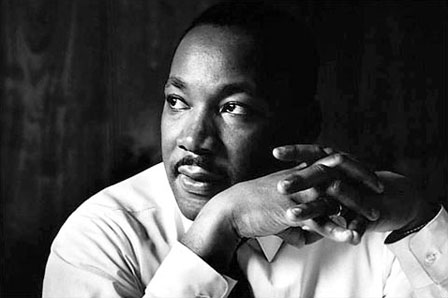
Conscience and Hard Solid Thinking: Two Things We Lack, A Reminder from Dr Martin Luther King Jr.

index

Today I am reminded of the words of Dr Martin Luther King Jr. as he addressed issues prevalent in the 1960s which unfortunately are still with us today. A lot of people today seek to marginalize Dr King’s life and work by simply relegating him to the pages of history. The attitude of such people seems to be that maybe Dr King was important in his day, but that we have advanced to the point that we don’t need to see beyond the King of history. Thus we miss so much of what he still teaches us today.

Dr. King was a man of tremendous personal courage. Nearly every day of his public ministry and advocacy for the rights of African Americans and the poor his life was in danger. Of course he, like so many other men who throughout history understood that those that champion the cause of justice and peace must ask hard questions. They must engage in hard thinking. They must challenge their own beliefs as well as those that they come in contact, and they must do so from the least safe place to do so, the place of conscience which commands us to do what is right.

In 1968 Dr. King said something that should make us all look in the mirror and ask who we really are and what we represent. He noted how cowardice, expediency and vanity all vie with conscience. He said:

“On some positions, Cowardice asks the question, “Is it safe?” Expediency asks the question, “Is it politic?” And Vanity comes along and asks the question, “Is it popular?” But Conscience asks the question “Is it right?” And there comes a time when one must take a position that is neither safe, nor politic, nor popular, but he must do it because Conscience tells him it is right.” 

If you look closely at what Dr. King said one can almost see every political, business or religious leader make decisions about things which matter to people, but without facing the demands of conscience.

It would be easy just to say this of our leaders. However, it is also true of most of us, for regardless of our protestations most of us follow the demands of cowardice, expediency or vanity rather than conscience. We do it not because we are bad people, but because we fear the potential negative consequences of doing the right thing, we count the cost and decide we cannot pay it.

Every time we make these decisions not to do the right, but to shrink in cowardice, appeal to the calculation of being politic, or choose to go with what is popular, something in us dies.

Dietrich Bonhoeffer, the German pastor and martyr wrote about the results of such equivocation from prison:

“We have been silent witnesses of evil deeds: we have been drenched by many storms; we have learnt the arts of equivocation and pretense; experience has made us suspicious of others and kept us from being truthful and open; intolerable conflicts have worn us down and even made us cynical. Are we still of any use?”

But to follow the demands of conscience requires us to think, and think critically. Too often we simply do things or support causes because we are comfortable with the ideas, and because we do not want to face inconvenient or uncomfortable ideas. We do not like to be challenged. I think that is why there is such a great appeal to often ignorant loud mouthed politicians, pundits and preachers, the Unholy Trinity, to do our thinking for us. The pundits, preachers and politicians often appeal to the must base human instincts to turn citizens against each other, or to drive up support for their ideology. Such ideas are made more destructive when they appear as “memes” on social media, attached to pictures which are designed to invoke an emotional response of anger, hatred and resentment at person or group being demonized. In following them we can become unthinking fanatics, convinced of our rightness without ever examining examining what we believe to see if it really true.

This is not thinking when we follow the lead of such people, regardless of their ideology. In doing so we give up our right and responsibility to think for ourselves and ask the hard questions. Eric Hofer noted how ideology blinds us:

“A doctrine insulates the devout not only against the realities around them but also against their own selves. The fanatical believer is not conscious of his envy, malice, pettiness and dishonesty. There is a wall of words between his consciousness and his real self.”

Dr King’s words spoken in 1963 are equally true today:

“Rarely do we find men who willingly engage in hard, solid thinking. There is an almost universal quest for easy answers and half-baked solutions. Nothing pains some people more than having to think.”

As we honor the memory of Dr. King this weekend may we do so by not just relegating him to the pages of history, but may we find in his words inspiration to be people of character and conscience today. May we start doing the hard thinking that allows us to follow the demands of conscience and not cowardice, the hard thinking that places justice over popularity and the hard thinking which exposes the emptiness of political calculation.

Peace

Padre Steve+
Leave a comment

Filed under christian life, civil rights, philosophy, Political Commentary