Tag Archives: dwight eisenhower

Remembering the Men of D-Day

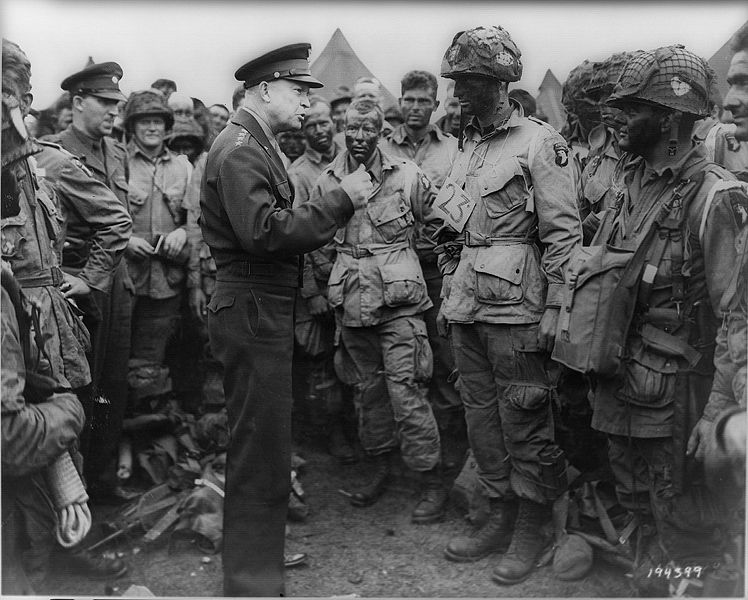
Eisenhower with Paratroopers of the 101st Airborne Division

Soldiers, Sailors and Airmen of the Allied Expeditionary Force!

You are about to embark upon the Great Crusade, toward which we have striven these many months. The eyes of the world are upon you. The hopes and prayers of liberty-loving people everywhere march with you.  In company with our brave Allies and brothers-in-arms on other Fronts, you will bring about the destruction of the German war machine, the elimination of Nazi tyranny over the oppressed peoples of Europe, and security for ourselves in a free world.

Your task will not be an easy one. Your enemy is well trained, well equipped and battle hardened. He will fight savagely.

 But this is the year 1944! Much has happened since the Nazi triumphs of 1940-41. The United Nations have inflicted upon the Germans great defeats, in open battle, man-to-man. Our air offensive has seriously reduced their strength in the air and their capacity to wage war on the ground. Our Home

Fronts have given us an overwhelming superiority in weapons and munitions of war, and placed at our disposal great reserves of trained fighting men. The tide has turned! The free men of the world are marching together to Victory!

 I have full confidence in your courage and devotion to duty and skill in battle. We will accept nothing less than full Victory!

 Good luck! And let us beseech the blessing of Almighty God upon this great and noble undertaking.

                                            SIGNED: Dwight D. Eisenhower
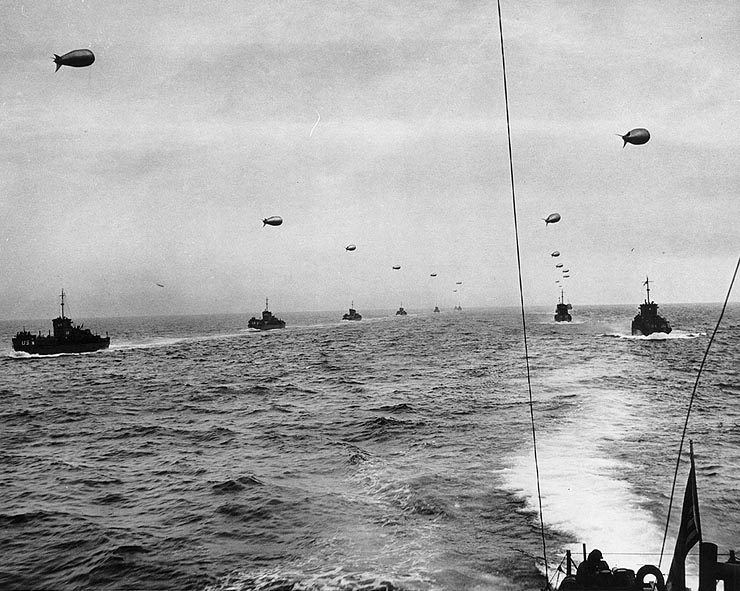
Convoy of Landing Craft Infantry (LCI) steaming toward Normandy

On June 6th 1944 the Allies invaded German controlled France on the beaches of Normandy. By that evening the Allied Expeditionary Force had landed six infantry divisions on five invasion beaches and the bulk of three airborne divisions on the approaches to those beaches. Near 175,000 Allied Soldiers, Sailors, Airmen and Marine Commandos were involved in the attack and nearly 10,000 would listed be as killed, wounded or missing by the end of the day, over half on Omaha Beach.

British Commandos landing on Sword Beach. Their Commander Lord Lovat is to the right of the column in the surf

The names of the invasion beaches and the units involved have been immortalized in history, in film and literature. The American 101st Airborne “Screaming Eagles,” the “All American” 82nd Airborne Division and British 6th Airborne Division “Red Devils” made the largest night airborne drop and battled Germans, the elements as the struggled to reorganize on the heels of widely scattered drops.  The Americans battled the German 91st Airlanding Division and the crack 6th Parachute Regiment, while the British faced men of the 716th “Static” Infantry Division and battle groups of the nearby 21st Panzer Division.

British Commandos landing at Gold Beach

On Sword Beach men of the 3rd British Division and 27th Armoured Brigade teamed with the 1st Special Services Brigade composed of Army and Royal Marine Commandos made the assault, to their right on Juno Beach the Canadians of the 3rd Canadian Division, 2nd Canadian Armoured Brigade and two Royal Marine Commandos (battalions) while to their right on the middle invasion beach, God Beach the British 50th (Northumbrian) Infantry Division and 8th Armoured Brigade went ashore with elements of the British 79th Armoured Division and the 47th Royal Marine Commando.

Omaha Beach

To the right of the British landed the American V Corps on Omaha Beach, the 1st Infantry Division, the famous “Big Red One” and the 29th “Blue and Gray” Infantry Division of the Virginia and Maryland National Guard. They would fight the most seasoned Germans on the beaches that day, the hardened combat veterans of the 352nd Infantry Division.  The battle of Omaha was nearly a disaster and a one point General Omar Bradley contemplated withdraw from the beach.  The American troops, including the men of the 2nd Ranger Battalion who scaled the cliffs of Point du Hoc to protect the beach from enfilade fire from German artillery mounted on the point, yet the German guns had not yet been emplaced and the Rangers fought a bitter battle against strong German resistance on that rugged mount.  On the far right the American VII Corps led by the 4th Infantry Division assaulted Utah Beach; fortunately the Americans landed away from their planned point of assault and faced little resistance. Had they landed in the correct location they might fared as their neighbors on Omaha Beach.
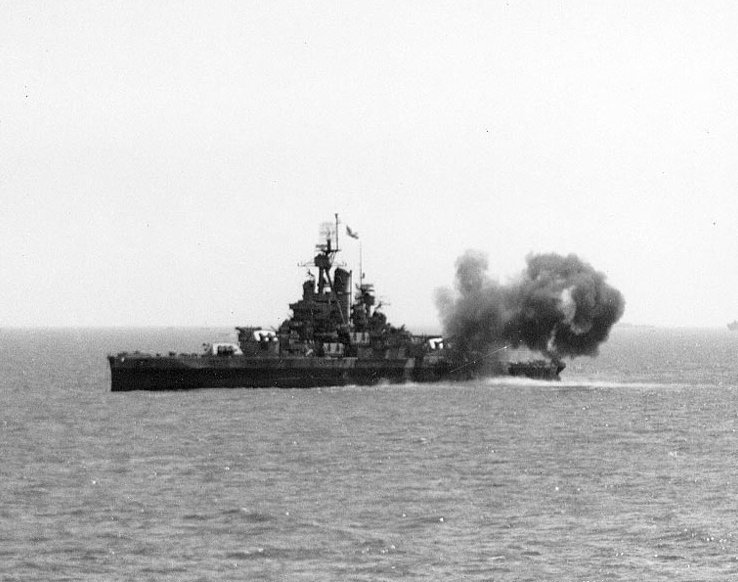
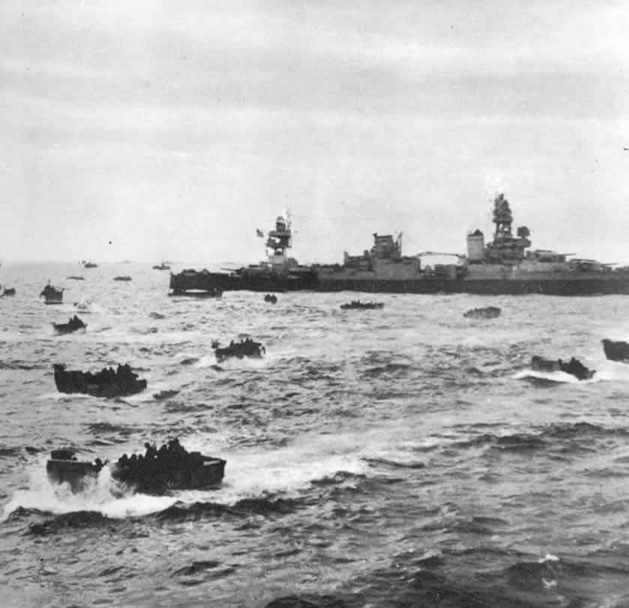
USS Nevada bombarding Normandy beaches

Offshore the venerable battleships HMS Warspite and HMS Ramillies and the USS Texas, USS Nevada and USS Arkansas provided fire support to the beaches aided by the Free Naval Forces of France, the Netherlands, Poland and Norway.  The French forces included the cruisers Montcalm and Georges Leygues.

Names such has St Mere-Eglise and Pegasus Bridge, the Merville Battery, Point du Hoc and Bloody Omaha remain etched in the minds of the dwindling number of surviving veterans as well as historians, military personnel and others that take the time to remember the sacrifices of these men.

The Men came from all parts of the United States and the British Commonwealth. Additionally personnel from France and other countries occupied by Nazi Germany were represented in the land, air and naval forces involved.  For the French, humiliated by their defeat in 1940 and divided by the Vichy and Free French divide were determined, despite their small numbers to liberate their homeland.

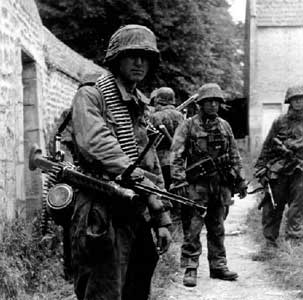
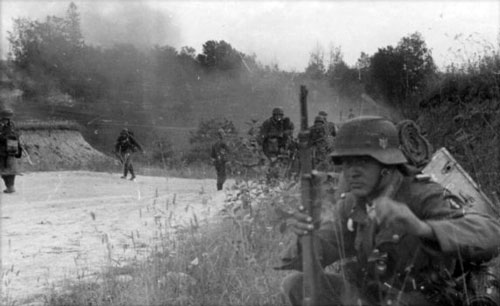
The forgotten Soldiers, Panzer Grenadiers in Normandy

They were opposed by four German Divisions, a Luftwaffe Fallschirmjaeger regiment and elements of the 21st Panzer Division.  The Germans with nothing in the way of air support and no significant naval forces were on their own. Hitler had refused Rommel’s request to deploy Panzer divisions near the beaches and was not awakened when word came of the invasion.  German soldiers fought with considerable valor and would do so throughout the Normandy campaign, even if they fought for a regime that was evil at its core.

On the night of June 6th President Franklin Roosevelt addressed the American people, offering a prayer for the nation, the troops and the success of the invasion:

My Fellow Americans:

Last night, when I spoke with you about the fall of Rome, I knew at that moment that troops of the United States and our Allies were crossing the Channel in another and greater operation. It has come to pass with success thus far.

And so, in this poignant hour, I ask you to join with me in prayer:

Almighty God: Our sons, pride of our nation, this day have set upon a mighty endeavor, a struggle to preserve our Republic, our religion, and our civilization, and to set free a suffering humanity.

Lead them straight and true; give strength to their arms, stoutness to their hearts, steadfastness in their faith.

They will need Thy blessings. Their road will be long and hard. For the enemy is strong. He may hurl back our forces. Success may not come with rushing speed, but we shall return again and again; and we know that by Thy grace, and by the righteousness of our cause, our sons will triumph.

They will be sore tried, by night and by day, without rest — until the victory is won. The darkness will be rent by noise and flame. Men’s souls will be shaken with the violences of war.

For these men are lately drawn from the ways of peace. They fight not for the lust of conquest. They fight to end conquest. They fight to liberate. They fight to let justice arise, and tolerance and goodwill among all Thy people. They yearn but for the end of battle, for their return to the haven of home.

Some will never return. Embrace these, Father, and receive them, Thy heroic servants, into Thy kingdom.

And for us at home — fathers, mothers, children, wives, sisters, and brothers of brave men overseas, whose thoughts and prayers are ever with them — help us, Almighty God, to rededicate ourselves in renewed faith in Thee in this hour of great sacrifice.

Many people have urged that I call the nation into a single day of special prayer. But because the road is long and the desire is great, I ask that our people devote themselves in a continuance of prayer. As we rise to each new day, and again when each day is spent, let words of prayer be on our lips, invoking Thy help to our efforts.

Give us strength, too — strength in our daily tasks, to redouble the contributions we make in the physical and the material support of our armed forces.

And let our hearts be stout, to wait out the long travail, to bear sorrows that may come, to impart our courage unto our sons wheresoever they may be.

And, O Lord, give us faith. Give us faith in Thee; faith in our sons; faith in each other; faith in our united crusade. Let not the keeness of our spirit ever be dulled. Let not the impacts of temporary events, of temporal matters of but fleeting moment — let not these deter us in our unconquerable purpose.

With Thy blessing, we shall prevail over the unholy forces of our enemy. Help us to conquer the apostles of greed and racial arrogances. Lead us to the saving of our country, and with our sister nations into a world unity that will spell a sure peace — a peace invulnerable to the schemings of unworthy men. And a peace that will let all of men live in freedom, reaping the just rewards of their honest toil.

Thy will be done, Almighty God.

Amen.

President Franklin D. Roosevelt – June 6, 1944

Forty years later President Ronald Reagan made one of the most memorable speeches about the landings when he spoke at Omaha Beach.

We stand today at a place of battle, one that 40 years ago saw and felt the worst of war.  Men bled and died here for a few feet of – or inches of sand, as bullets and shellfire cut through their ranks.  About them, General Omar Bradley later said, “Every man who set foot on Omaha Beach that day was a hero.”

Some who survived the battle of June 6, 1944, are here today.  Others who hoped to return never did.

“Someday, Lis, I’ll go back,” said Private First Class Peter Robert Zannata, of the 37th Engineer Combat Battalion, and first assault wave to hit Omaha Beach.  “I’ll go back, and I’ll see it all again.  I’ll see the beach, the barricades, and the graves.”

Those words of Private Zanatta come to us from his daughter, Lisa Zannata Henn, in a heart-rending story about the event her father spoke of so often.  “In his words, the Normandy invasion would change his life forever,” she said.  She tells some of his stories of World War II but says of her father, “the story to end all stories was D-Day.”

“He made me feel the fear of being on the boat waiting to land.  I can smell the ocean and feel the sea sickness.  I can see the looks on his fellow soldiers’ faces-the fear, the anguish, the uncertainty of what lay ahead.  And when they landed, I can feel the strength and courage of the men who took those first steps through the tide to what must have surely looked like instant death.”

Private Zannata’s daughter wrote to me, “I don’t know how or why I can feel this emptiness, this fear, or this determination, but I do.  Maybe it’s the bond I had with my father.  All I know is that it brings tears to my eyes to think about my father as a 20-year old boy having to face that beach.”

The anniversary of D-Day was always special to her family.  And like all the families of those who went to war, she describes how she came to realize her own father’s survival was a miracle:  “So many men died.  I know that my father watched many of his friends be killed.  I know that he must have died inside a little each time.  But his explanation to me was, “You did what you had to do, and you kept on going.”

When men like Private Zannata and all our Allied forces stormed the beaches of Normandy 40 years ago they came not as conquerors, but as liberators.  When these troops swept across the French countryside and into the forests of Belgium and Luxembourg they came not to take, but to return what had been wrongfully seized.  When our forces marched into Germany they came not to prey on a brave and defeated people, but to nurture the seeds of democracy among those who yearned to be free again.

We salute them today.  But, Mr. President (Francois Mitterand of France), we also salute those who, like yourself, were already engaging the enemy inside your beloved country, the French Resistance.  Your valiant struggle for France did so much to cripple the enemy and spur the advance of the armies of liberation.  The French Forces of the Interior will forever personify courage and national spirit.  They will be a timeless inspiration to all who are free and to all who would be free.

Today, in their memory, and for all who fought here, we celebrate the triumph of democracy.  We reaffirm the unity of democratic people who fought a war and then joined with the vanquished in a firm resolve to keep the peace.

From a terrible war we learned that unity made us invincible; now, in peace, that same unity makes us secure.  We sought to bring all freedom-loving nations together in a community dedicated to the defense and preservation of our sacred values.  Our alliance, forged in the crucible of war, tempered and shaped by the realities of the post-war world, has succeeded.  In Europe, the threat has been contained, the peace has been kept.

Today, the living here assembled:  officials, veterans, area citizens, pay tribute to what was achieved here 40 years ago.  This land is secure.  We are free.  These things are worth fighting and dying for.

Lisa Zannata Henn began her story by quoting her father, who promised that he would return to Normandy.  She ended with a promise to her father, who died 8 years ago of cancer:  “I’m going there, Dad, and I’ll see the beaches and the barricades and the monuments.  I’ll see the graves, and I’ll put flowers there just like you wanted to do.  I’ll never forget what you went through, Dad, nor will I let any one else forget.  And, Dad, I’ll always be proud.”

Through the words of his loving daughter, who is here with us today, a D-Day veteran has shown us the meaning of this day far better than any President can.  It is enough to say about Private Zannata and all the men of honor and courage who fought beside him four decades ago:

We will always remember.
We will always be proud.
We will always be prepared,
So we may always be free.

Thank you.

Let us remember those brave men who fought at Normandy as we go to bed having been the benefactors of their sacrifice for the last 67 years.

Peace

Padre Steve+
3 Comments

Filed under History, Military, world war two in europe

Our Bottom Line is our Honor: Padre Steve Talks About Wall Street

“It was the mystical dogma of Bentham and Adam Smith and the rest, that some of the worst of human passions would turn out to be all for the best. It was the mysterious doctrine that selfishness would do the work of unselfishness.” G.K. Chesterton

The United States is one of the most religious of Nations especially in what we worship. I’m not talking about God her I’m talking about money. The High Priests of this religion are those that run the financial institutions as well as much of what is sometimes described as “American” business. The bottom line is their honor and profit their goal.

I tell you what there is no such thing as an “American” Banker, Investor, Broker or President of any major corporation based in the United States they are men and women without a country with their only loyalty being their profits and what benefits their bottom line. The truth is as Napoleon Bonaparte said so succinctly “Money has no motherland; financiers are without patriotism and without decency; their sole object is gain.”

This has never been in more evidence than today.  The situation has been worsening since the end of the Cold War when under the name of “Free Trade” financial institutions and multinational corporations based in the United States have been selling us short once they figured that they could do better elsewhere like in Communist China as well as Third and Second World countries controlled by tyrants and despots who couldn’t give a damn about human rights.  Mind you that for many years it was American money, the American people and military power that enabled them to prosper particularly in the days when Presidents like Theodore Roosevelt maintain protectionist policies that actually helped them and the country at the same time.

The United States was never stronger than when we practiced protectionism. It benefited out people as well as businesses.  But when people like Teddy Roosevelt saw things that business did which were criminally irresponsible either in the treatment of workers or the environment business cried foul and it has been that way ever since. All “good” conservatives and libertarians have worshiped at the foot of the God of Capitalism and its prophets and the sacred doctrine of Free Trade.

The end of the year numbers are out and it looks like Wall Street and Major U.S. based corporations are doing quite well thank you while doing everything that they can to avoid being good citizens to the people of this country that made them what they are. Profits are up as are stocks and Wall Street is living high on the hog despite having made a mess of things to the point that the American Government had to give them our money, and lots of it to stay solvent and not crash the entire economy. It is as Thomas Jefferson once said “I sincerely believe, with you, that banking establishments are more dangerous than standing armies; and that the principle of spending money to be paid by posterity, under the name of funding, is but swindling futurity on a large scale.” To be blunt “American” financial institutions have raped this country and now that they are done with us are willing to take our money, use our military to protect or even enhance their operations overseas are willing to throw us under the bus because they can make more money elsewhere.

Well it seems that there is happiness in Mudville or shall I say on Wall Street as the year end numbers roll in.  Unfortunately for many Americans those profits won’t benefit this country.  Unemployment remains high, our personal and government debts are skyrocketing and deficits are killing the country while good paying technical and industrial jobs are moved overseas as supposedly American business shutters their U.S. production centers.  Meanwhile business and financial leaders carp about the United States not being a “friendly corporate environment” with “too much government regulation” and too many “powerful unions” as the reason for them to invest elsewhere.  Little things such as safety, the environment and even God forbid the lives of the people that work for them are of little concern, if the citizens of the U.S. or any other country decide that they want a bit more control of such issues then they are thrown under the bus by the financial institutions and corporations. If the U.S. Government asks them for anything it is “screw you” we’ll move to India where incidents what happened like the Union Carbide plant in Bhopal India don’t matter too much and Communist China which does its damndest to violate the human rights of its own people and run roughshod over its neighbors.

Andrew Jackson, perhaps the last President with the guts and moral principles to stand up to the likes of such people said:

“Every man is equally entitled to protection by law; but when the laws undertake to add… artificial distinctions, to grant titles, gratuities, and exclusive privileges, to make the rich richer and the potent more powerful, the humble members of society — the farmers, mechanics, and laborers — who have neither the time nor the means of securing like favors to themselves, have a right to complain of the injustice of their government.”

What Jackson said then is just as applicable now. Nearly every law that is passed in Washington is full of loopholes and benefits for the rich who then after bankrupting the country have the nerve to complain about government social programs. Usually they say that caring for the poor is the voluntary responsibility of individuals, churches and private charities which on principle I agree with, but on the whole is not practical because the need is too great mostly due to the power of the financials and the incompetence of government agencies.

The attitude of these supposedly “American” financial institutions and corporations seems to be all about “Free Trade.” The sad thing is that the moniker of “Free Trade” is somewhat Orwellian if you ask me.  The reality of “free trade” is that these interests should be able to do whatever they want, however they want without anyone being able to regulate them of tell them what to do.  In reality their carping about this not being a “business friendly environment” is them dictating to us that they should be able to operate for free from here while trading wherever they want without any responsibility or return to the country and people that made their success possible in the first place.  I would argue it is the financial houses and multi-national corporations based in the United States that are the real power in the world and that they have used us up and are now in the process of dumping us like they have so many World powers before us.

Napoleon saw this and said: “When a government is dependent upon bankers for money, they and not the leaders of the government control the situation, since the hand that gives is above the hand that takes. The late Marine Corps Major General and two time Medal of Honor winner Smedley Butler said back in 1933 concerning the way that financiers use the government, in particular the military to advance their interests:

“I spent thirty- three years and four months in active military service as a member of this country’s most agile military force, the Marine Corps. I served in all commissioned ranks from Second Lieutenant to Major-General. And during that period, I spent most of my time being a high class muscle- man for Big Business, for Wall Street and for the Bankers. In short, I was a racketeer, a gangster for capitalism….I helped make Mexico, especially Tampico, safe for American oil interests in 1914. I helped make Haiti and Cuba a decent place for the National City Bank boys to collect revenues in. I helped in the raping of half a dozen Central American republics for the benefits of Wall Street. The record of racketeering is long. I helped purify Nicaragua for the international banking house of Brown Brothers in 1909-1912. I brought light to the Dominican Republic for American sugar interests in 1916. In China I helped to see to it that Standard Oil went its way unmolested.”

Let’s fast forward on this while American soldiers get killed by Improvised Explosive Devices in Iraq and Afghanistan, many made with the assistance of Iranian agents the Treasury Department granted over 10,000 permits for U.S. corporations to trade with Iran with you guessed it my friends, some of the Largest U.S. banks reaping the profit.  This has been going on for years and while the bulk of such trade is limited to food items like Louisiana Hot Sauce it has also included deals which allowed other U.S. corporations to trade with Iranian companies that are suspected of involvement in terrorism or weapons proliferation.  http://www.foxnews.com/world/2010/12/23/report-treasury-okd-business-iran/#ixzz19SAQIwIu Pardon my ignorance but isn’t that like blood money when our troops die from Iranian assisted attacks?

Don’t worry though, we are in good company as such people have done the same to those that came before us as well, just look at Britain, once business bled her dry they cast her aside.  You see my friends our government doesn’t really control anything. It is the corporate and financial elites that run the country and dare I say the world.  James Madison saw it coming noting that “History records that the money changers have used every form of abuse, intrigue, deceit, and violent means possible to maintain their control over governments by controlling the money and its issuance.”

Financial institutions and many multinational corporations have acted in the most unseemly of fashions literally bankrupting nations and individuals while they continue to prosper and it seems that they can never get enough.  Great Americans have warned of the dangers of the financial elites controlling both national as well as private lending institutions. In fact if you look at the leadership of the Federal Reserve and the Treasury Department there is an almost incestuous link between them and Wall Street. Dwight Eisenhower talked about the danger of the “military-industrial complex” but that threat is nothing compared to the control that those that come out of Wall Street Investment Banks have over the nations’ economic and monetary policy and over the legislators that supposedly exercise oversight of such institutions. Thomas Jefferson noted that:

“If the American people ever allow private banks to control the issue of their money, first by inflation and then by deflation, the banks and corporations that will grow up around them (around the banks), will deprive the people of their property until their children will wake up homeless on the continent their fathers conquered.”

While Andrew Jackson lectured the leaders of the 2nd Bank of the United States before (probably unwisely) withdrawing U.S. assets from the Bank and eventually destroying it:

“Gentlemen, I have had men watching you for a long time and I am convinced that you have used the funds of the bank to speculate in the breadstuffs of the country. When you won, you divided the profits amongst you, and when you lost, you charged it to the bank. You tell me that if I take the deposits from the bank and annul its charter, I shall ruin ten thousand families. That may be true, gentlemen, but that is your sin! Should I let you go on, you will ruin fifty thousand families, and that would be my sin! You are a den of vipers and thieves.”

I think that even though Jackson’s decision hurt the economy which resulted in the Panic of 1837 but his reasons were sound:

It concentrated the nation’s financial strength in a single institution.

It exposed the government to control by foreign interests.

It served mainly to make the rich richer.

It exercised too much control over members of Congress.

It favored northeastern states over southern and western states.

Banks are controlled by a few select families.

Banks have a long history of instigating wars between nations, forcing them to borrow funding to pay for them.

Now tell me what has changed in this? If I hadn’t said that Jackson used these reasons to abolish the Second Bank of the United States one might think that I am talking about Wall Street and the Federal Reserve.  Let’s see….it looks to me like the only people getting rich are the Wall Street financiers and those that they favor. It seems that foreign nations, particularly the Chinese Communist have us by the balls holding a huge amount of our debt.  It seems that Congress under both Democratic and Republican control is in their power and will do anything that they want in order to “help the economy” but in reality secure their own power and I could go on but won’t.

Now I’m sure that some of my conservative friends and readers will label me as a liberal or Socialist but I’m not, I just want to see those that benefit from the security that our military provides and the hard work of Americans just actually start helping our side rather than looking to their our filthy money grubbing interests. Some things never change do they?

Peace

Padre Steve+

2 Comments

Filed under economics and financial policy, History, laws and legislation, Military, national security, philosophy

NUTS!

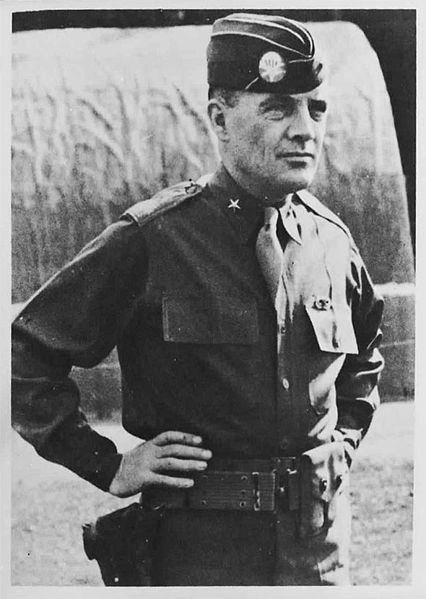
Brigadier General Anthony McAuliffe

On December 16th 1944 the German Army launched an assault in the Ardennes Forrest completely surprising the thinly spread American VIII Corps.  The German 6th Panzer Army, 5th Panzer Army and 7th Army attacked and forced the surrender of 2 regiments of 106th Infantry Division, mauled the 28th Division in the center of the American line while battering other U.S. forces.  To the north the 2nd and 99th Infantry Divisions were tenaciously defending Elsenborn Ridge while to the south the thinly spread 4th Infantry and 9th Armored Divisions resisted the 7th Army advance. As elements of the two German Panzer armies advanced west Eisenhower dispatched his only reserves the 82nd and 101st Airborne Divisions to meet the threat. The 82nd moved to the town of St Vith to aid the 7th Armored Division while the 101st was dispatched to hold the key road center of Bastogne.

By the 22nd the besieged American defenders of Bastogne were causing Hasso Von Manteuffel’s 5th Panzer Army headaches. Manteuffel’s leading Panzer units of the 2nd Panzer Division and Panzer Lehr had been thwarted from taking the town by a Combat Command of 10th Armored Division and lead elements of the 101st.  After failing to take the town the Germans invested it with the 26th Volksgrenadier Division and a regiment of Panzer Lehr while 2nd Panzer and the bulk of Panzer Lehr continued their westward advance.

Cut off from any other American forces the 101st and a collection of stray units including CCB 10th Armored Division and remnants of CCR 9th Armored Division, three 155mm artillery battalions including the African American 969th Field Artillery Battalion held out. By the 21st of December they were completely surrounded.

The Commander of the American garrison was Brigadier General Anthony McAuliffe. McAuliffe was the acting commander of the 101st and normally was the commander of the Division Artillery. Major General Matthew Ridgeway and many key commanders and staff were away from the division when it was hastily deployed to the Bulge to combat the German offensive.  McAuliffe commanded a division short of ammunition, food and cold weather gear.

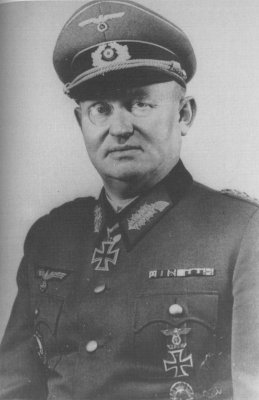
General Der Panzertrüppen Heinrich Freiherr von Lüttwitz

The German forces surrounding the city were commanded by the veteran General Der Panzertrüppen Heinrich Freiherr von Lüttwitz commander of XLVII Panzer Corps.  Lüttwitz believing that resistance was futile sent the following message under a flag of truce to McAuliffe:

To the U.S.A. Commander of the encircled town of Bastogne.

The fortune of war is changing. This time the U.S.A. forces in and near Bastogne have been encircled by strong German armored units. More German armored units have crossed the river Our near Ortheuville, have taken Marche and reached St. Hubert by passing through Hompre-Sibret-Tillet. Libramont is in German hands.

There is only one possibility to save the encircled U.S.A. troops from total annihilation: that is the honorable surrender of the encircled town. In order to think it over a term of two hours will be granted beginning with the presentation of this note.

If this proposal should be rejected one German Artillery Corps and six heavy A. A. Battalions are ready to annihilate the U.S.A. troops in and near Bastogne. The order for firing will be given immediately after this two hours term.

All the serious civilian losses caused by this artillery fire would not correspond with the well-known American humanity.

The German Commander

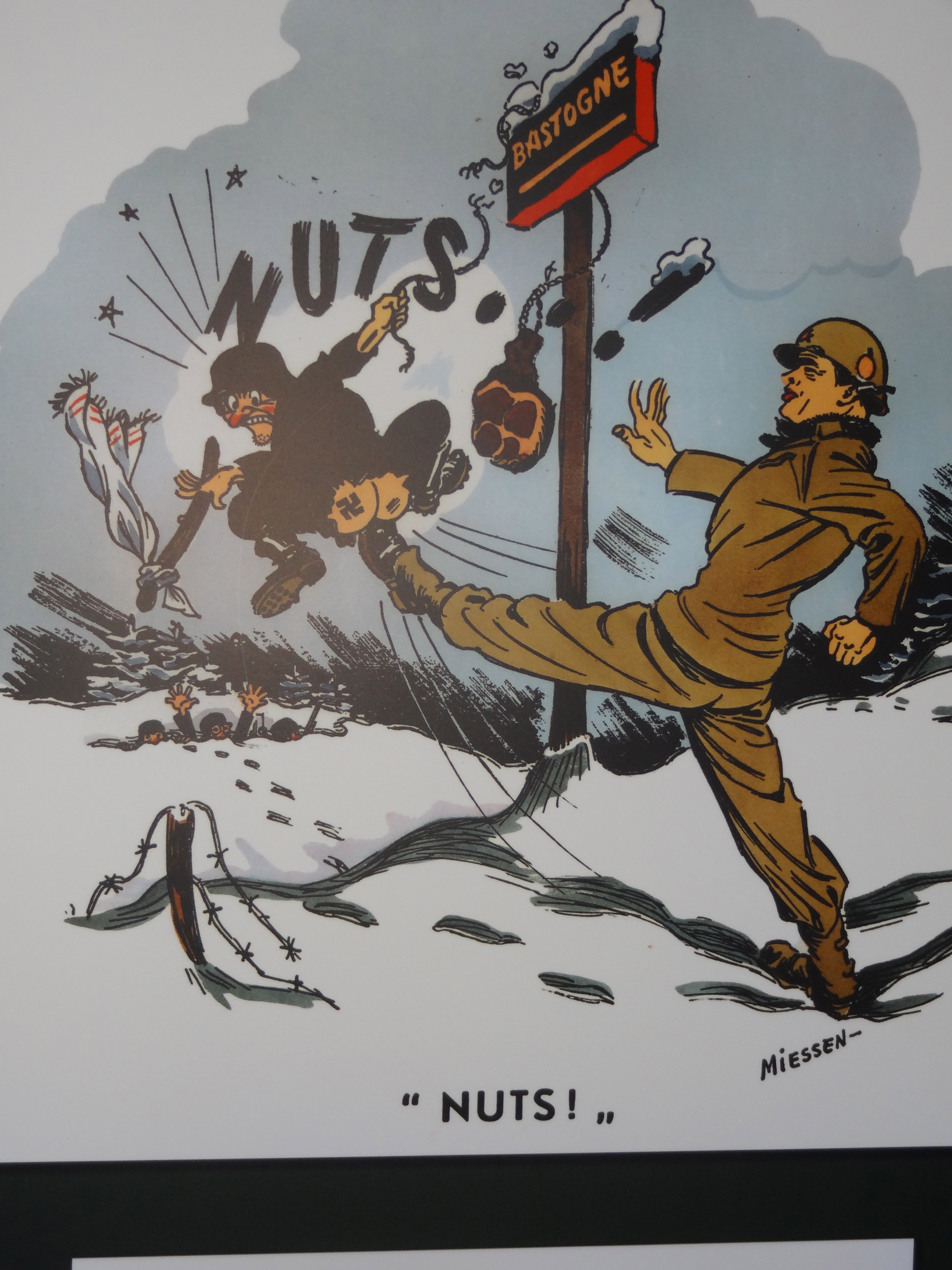
McAuliffe’s response has become one of the immortal responses to a surrender demand in military history. According to staff members present when he received Lüttwitz’s note he simple said “nuts.” One of his staff officers suggested that he use “nuts” as his official reply to Lüttwitz and the following reply was typed:

To the German Commander

NUTS!

The American Commander

The reply was delivered by the commander of the 327th Glider Infantry Regiment Lieutenant Colonel Joseph Harper and his S-3 Major Alvin Jones. When Harper delivered the message he told the German delegation that in “plain English” it meant “Go to hell.” The scene has been immortalized on film in the movie The Battle of the Bulge http://www.youtube.com/watch?v=73OiRZf7DsM

dsc00072

The garrison held out until it was relieved on December 26th by the 4th Armored Division of General George Patton’s 3rd Army.  Despite that the situation remained tenuous and the town was the scene of much hard fighting over the next two weeks.

McAuliffe went on to command the 103rd Infantry Division by the end of the war.  He returned to Europe as Commander of 7th Army in 1953 and U.S. Army Europe in 1955. He retired in 1956 with the rank of General.  He died in 1975 at the age of 77. His adversary Von Lüttwitz died at the age of 72 in 1969.

As we remain engaged in the current war it is always worth our time to remember the heroism, courage and faith of those that served before us.

Peace

Padre Steve+
Post Script: To read more about the Battle of the Bulge on this site go to Wacht am Rhein: The Battle of the Bulge

4 Comments

Filed under History, Military, world war two in europe

The Breakout from Normandy

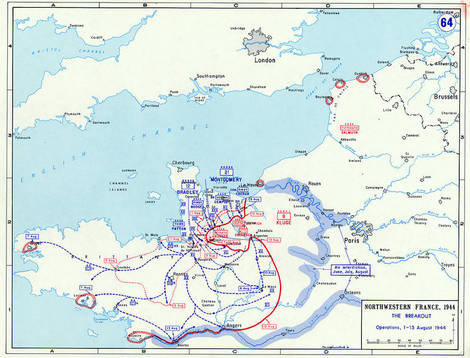
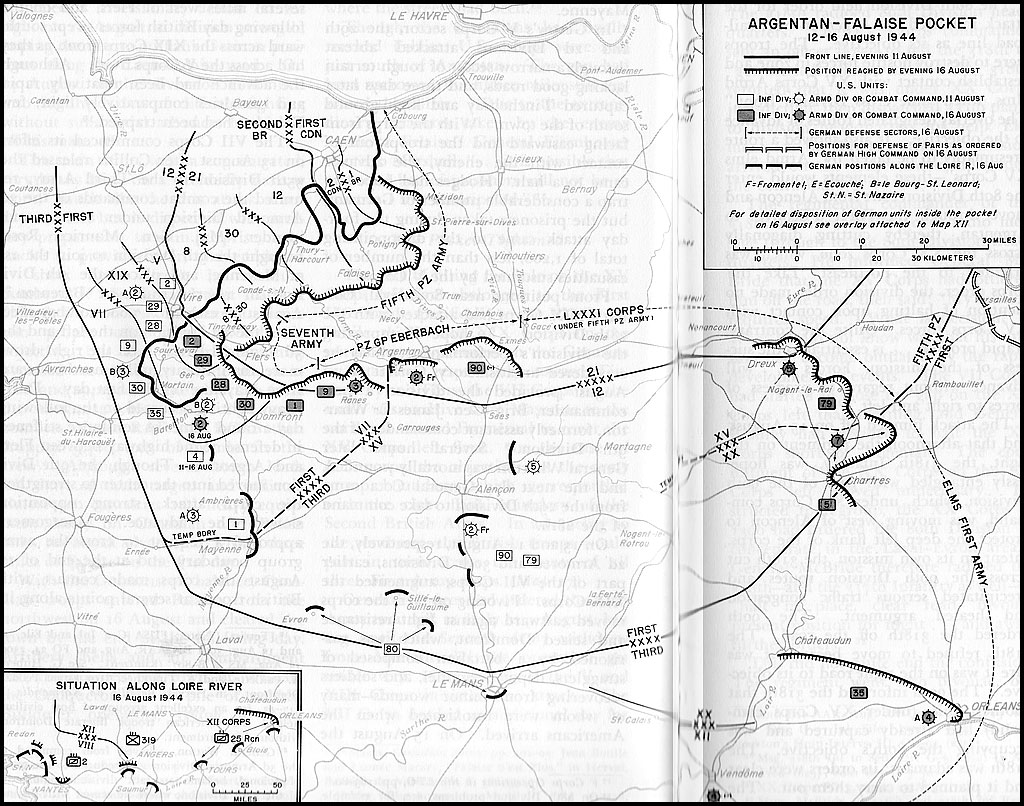
Map of Normandy Breakout

The breakout from Normandy by Bradley’s 12th Army Group at St Lo opened a realm of possibilities for the Allies to defeat the German Army in detail and end the war.  Unfortunately for the Allies the manner that they would exploit their success achieved during Operation COBRA led to their failure to completely destroy the German Army in the west in the late summer of 1944 would ultimately prolong the war.

The Allied and German problem in August 1944 was the sudden change in the nature of the campaign from a nearly static war of attrition in the Norman hedgerows to a campaign of maneuver.  This change brought about a number of opportunities for the Allies to envelope large portions of the German Army in western France as well as in Belgium and southern Holland. Max Hastings notes that the campaign became more of a “commander’s battle” in which it was “the decisions of the generals that determined the manner in which events unfolded in August, their successes and failures which brought about the position that was achieved by September.”[i] This was a major change as Hastings correctly notes in that prior to the breakout success in the hedgerows had been determined on “the ability of British, American and Canadian units to seize ground from their German opponents on the next ridge, the next hedge, beyond the next road.” [ii] In the hedgerows there was not much room for higher level commanders to influence the battle but once the breakout occurred the decisions made by commanders on both sides had greater influence in the following operations. This would become important as the weaknesses in the quality of allied generalship would begin to show, along with logistics management issues and the failure of the Allied High Command to recognize the resiliency of German forces and the resourcefulness of German leaders in their ability to cope with disaster and recover from it.  These were key elements in the campaign that kept the Allies from ending the war by Christmas.[iii]

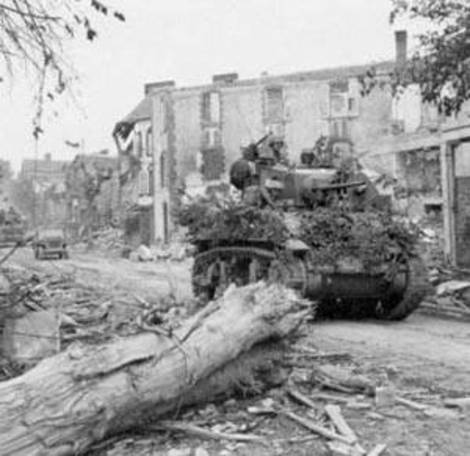
US M5 Light Tank advancing through Coutances

Early in the campaign it was decided that Bradley’s forces needed to capture the Brittany ports, particularly Brest to alleviate shortages of supplies which all still were being delivered across the beaches.  However, the implications of this decision were strategically short sighted and deprived the Allies of a decisive victory in France.  As Third Army exploited the break out from Normandy into the French interior the preponderance of its forces went west which deprived the Americans of the better part of two army corps as well as the logistical assets needed to trap the major part of the German Army in Normandy.  The campaign in Brittany would prove a diversion which did nothing to help the Allied cause.  The divisions committed, casualties taken and supplies expended in an attempt to capture ports that the Germans destroyed before the Americans could capture them. Russell Weigley points this out as a major mistake by Bradley which did little to help the Allied logistical problems and diverted much needed troops away from the focal point of the action in Normandy.[iv] Max Hastings criticized Bradley’s lack of imagination in the initial stages of the breakout by adhering to the original Overlord plan.[v] This is seconded by Patton’s biographer Carlo D’Este.[vi]

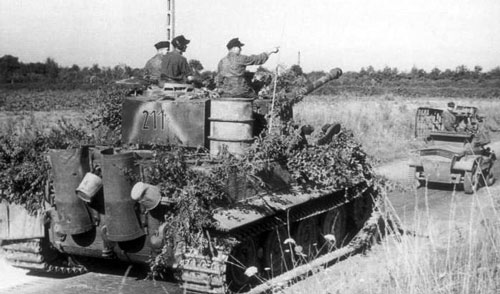
Tiger Tank in Normandy

Patton’s 3rd Army’s weakened eastern push coupled with the continued pressure of the British Army Group toward Falaise put the Germans in a strategic dilemma. With the gate open at Avranches they could attempt to restore the front in Normandy by pinching off the advance or withdraw to the Seine or even further as no “defensive position short of the permanent fortifications of the West Wall on Germany’s frontier offered so many defensive strengths as the Normandy line the Americans had just breached and turned.”[vii] The choice advocated by some senior German commanders was an orderly withdraw to the Seine which would have removed the danger of being enveloped in Normandy as well as make the Allies attack across a major water obstacle defended by still formidable formations.

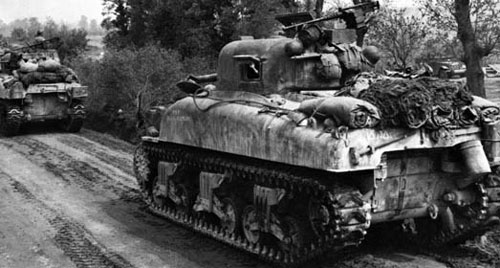
5th Armored Division Shermans near Argentan

With limited options the Hitler decided on a course of no withdraw and ordered his commanders to marshal their panzer divisions seal the breach and ensnare the allies in the hedgerows.[viii] Hitler and Field Marshal von Kluge disagreed in regard to the offensive which Kluge saw as a limited offensive but which Hitler believed gave the Germans a chance to cut off the American forces in Brittany and possibly even more.  Hitler believed that “once the coast had been reached at Avranches a beginning should be made with rolling up the entire Allied position in Normandy!”[ix] General Eugen Meindl of II Parachute Corps was blunt in his assessment of the attack. Paul Carrel in his book “Invasion! They’re Coming” quotes Meindl speaking with Von Kluge’s son a first lieutenant serving at the front:

“Kindly convey to your father exactly what I’m going to say to you. The time has come when Normandy can no longer be held. It cannot be held because the troops are exhausted. This is the fault mainly of orders to hold out in hopeless positions, but we are still being ordered to hold out even now. The enemy will break through to the west and outflank us. If your father knew what is was to operate against an enemy with downright fabulous command of the air, then he would know that our only hope of doing something useful is by attacking at night. Tomorrow’s tank attack is going to be a failure…and all that’s left for the grenadiers to do is lie down and sacrifice their lives. It’s heartbreaking to have to stand by and watch!”

Grenadiers of the 12th SS Panzer Division “Hitler Jugend”

The German attack, Operation Lüttich was led by XLVII Panzer Corps assisted by elements of 1st SS Panzer Division.  Despite warnings from ULTRA the panzers achieved tactical surprise on the front of the 30th US Division at Mortain on the night of 6-7 August advancing without the customary preparatory artillery bombardment.[x] The Germans initially made progress against the 30th Division which had recently taken over positions at Mortain. However the Americans of the 2nd Battalion 120th Infantry “Old Hickory” Regiment held onto key high ground which enabled them to call artillery fire and air strikes on the German forces attacking toward Avranches which included the elite 2nd, 116th, 2nd SS, and part of the 1st SS Panzer Divisions along with a kampfgruppe cobbled together from the remnants of Panzer Lehr and four battered infantry divisions.[xi] The Americans quickly reinforced 30th Division with elements of 2nd Armored Division, 35th Infantry Division and the veteran 4th Infantry Division to hold the line against the weakened German Panzer divisions.  Bradley and other American commanders viewed Lüttich as “an opportunity, not a threat”[xii] which could enable the Allies to entrap the vast majority of German forces in France.  Bradley was “not merely confident of withstanding them, but expected to destroy them.”[xiii] Bradley attempted to lure more Germans into the potential trap hoping that the Germans would press their attacks around Mortain.[xiv]

On the German side the ground commanders were furious at the failure of the Luftwaffe to shield them from Allied air attacks which devastated the Panzers.  The Luftwaffe and promised that 300 fighters would support the attack to provide protection from Allied close air support.  However the Luftwaffe squadrons were engaged by British and American fighters and so badly mauled that no Luftwaffe units made a appearance over Mortain.[xv] Thus despite their initial success which had promise of cutting off the advancing American spearheads the German Panzers were turned back by the Americans who did not even halt their eastward movement which further imperiled the German forces in Normandy.

With the German Panzer divisions ensnared at Mortain, the 3rd Army drove east while the Canadian army attacked towards Falaise. Bradley suggested that the Allies attempt a short envelopment of German forces at Falaise in which over 100,000 German troops would be trapped between the Patton’s troops advancing north and the Canadians.  The Canadians opened their TOTALIZE offensive from Caen to Falaise on August 8th but as was the case in every part of the campaign against determined German resistance as the XV Corps of 3rd Army advanced east.  Bradley’s plan ended the deep envelopment by XV Corps of 3rd Army designed to entrap the Germans against the Seine crossings, an operation that might promise “still surer results.”[xvi] Bradley told Treasury Henry Morgenthau that he had “an opportunity that comes to a commander not more than once in a century. We’re about to destroy and entire hostile army.”[xvii] Hastings noted that “had the Germans “behaved rationally, recognized the threat of envelopment to their entire front and begun a full-scale retreat east, then Bradley could indeed been accused of losing his armies a great prize.”[xviii]

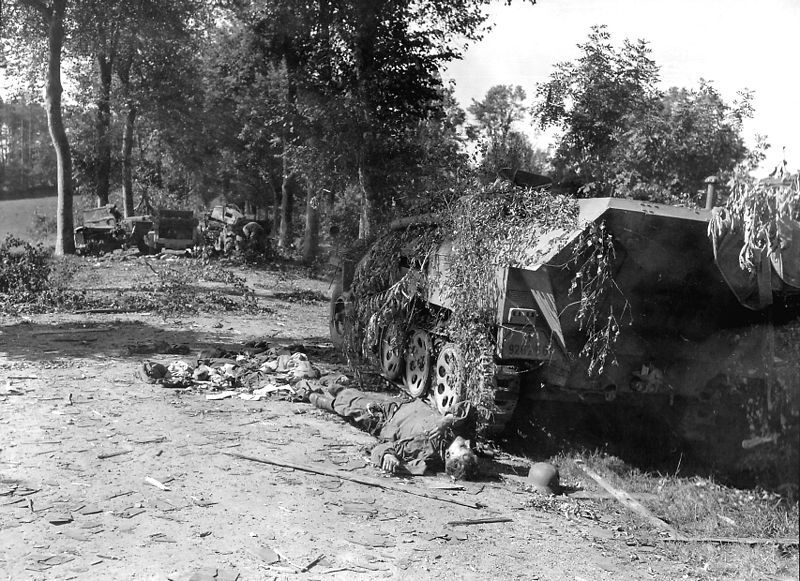
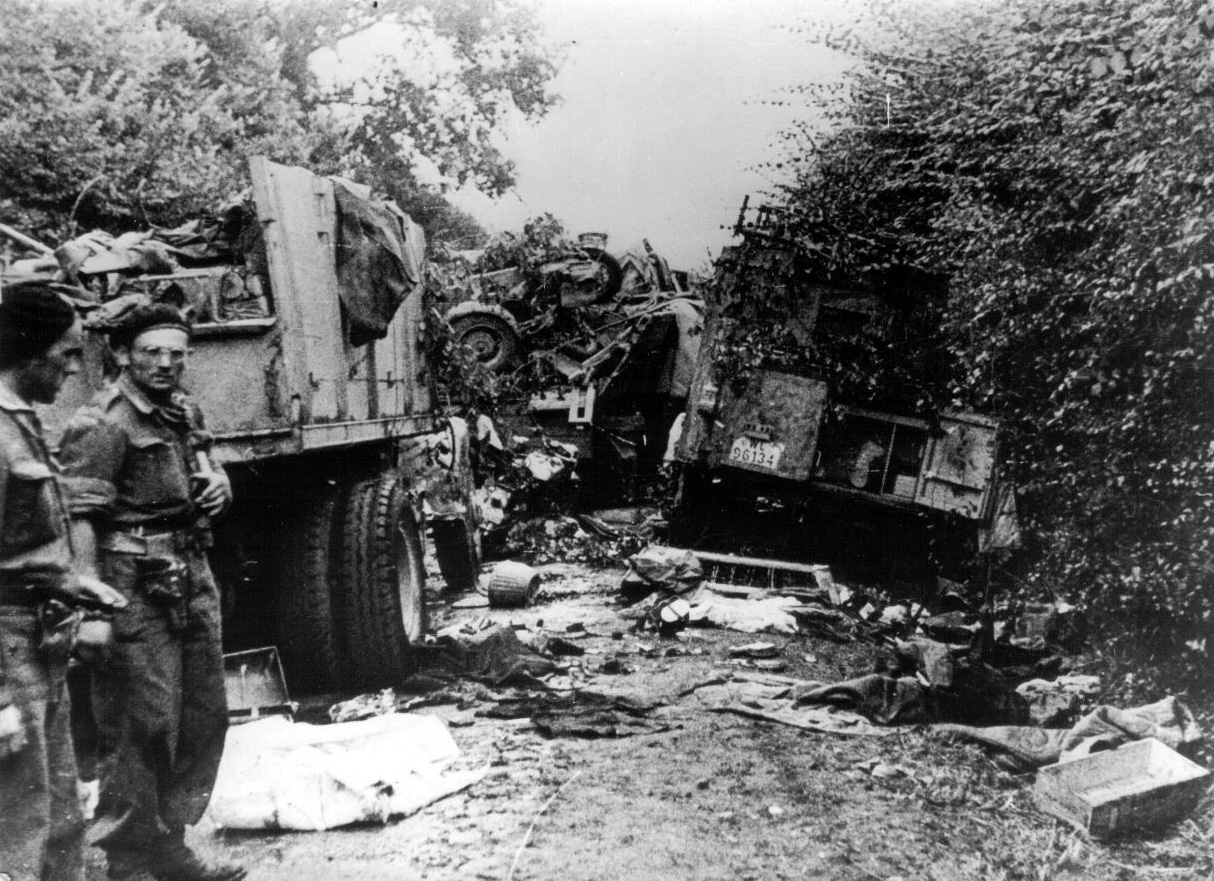
Wrecked German vehicles near Mortain

The decision by Bradley to turn the better part of 3rd Army west into Brittany had deprived him of forces that could have better accomplished mission of entrapping the Germans.  General Wood of 4th Armored Division to his dying day “remained embittered over the lost opportunity”[xix] when his division was turned back into Brittany rather than being allowed to move east toward the Seine.   Weigley points out an even deeper flaw regarding the Brittany decision.  This was that that the OVERLORD planners “had not thought anything resembling the Avranches breakout and pursuit without pause to the Seine likely… stating that it is among the worst forms of generalship that takes counsel of its fears. Yet that was exactly the condition of OVERLORD logistical planning.”[xx] Weigley’s point is well taken, the Allies had not planned for success nor had they anticipated in the OVERLORD planning the full range of possibilities that might open to them once a breakout had occurred.

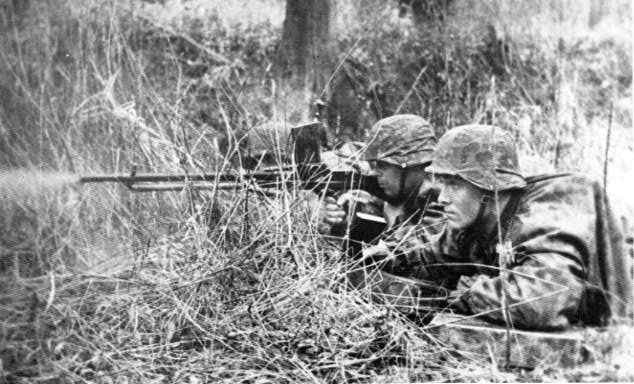
12th SS Panzer Division Machine Gun team

The Allies did have a chance to destroy the German 7th Army.  The LXVII Panzer Corps and II SS Panzer Corps as well as the remnants of II Parachute Corps and other formations battered in Normandy were attempting to withdraw to the east from Mortain. The remnants of I SS Panzer Corps led by 12 SS Panzer Division and Army Panzer divisions such as the 21st Panzer Division offered determined resistance to the Canadians who were attacking toward Falaise.  To the south only scattered Kampfgruppen of divisions shattered in Normandy opposed Patton’s forces at Argentan. The Germans were aided by a fortuitous decision of the commander of the 2nd French Armored Division to move a combat command along a road needed by the American 5th Armored Division delaying it and allowing the Germans to send a battalion into the Argentan which could have “fallen easily a few hours before.”[xxi] The Allies were bedeviled by several other failures which prevented the short double envelopment from occurring and allowing the remnants of 7th Army to escape to fight again despite grievous losses in men, material, and especially armored fighting vehicles, artillery and motor transport.

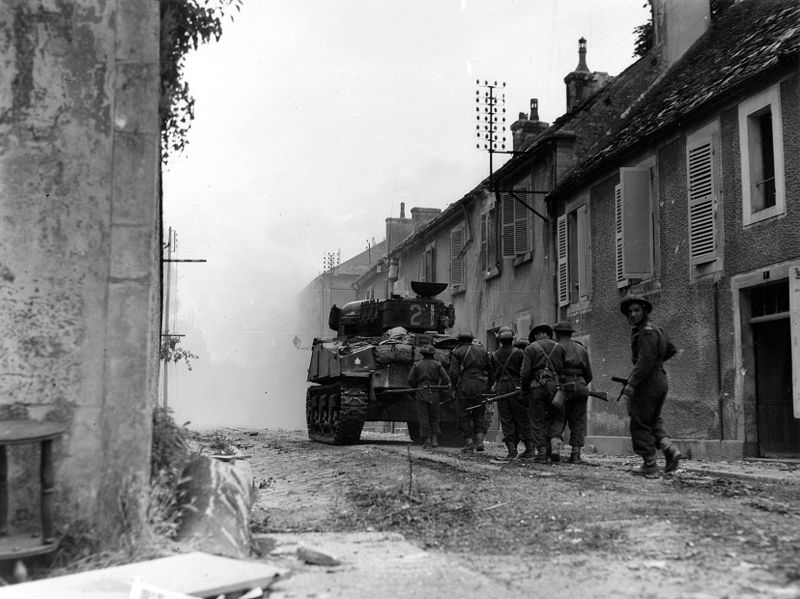
Canadians advance in Falaise

The first of these was the Canadian failure to push the Germans out of Falaise despite overwhelming material and air superiority.  The Canadian offensive Operation TOTALIZE was planned by the best of the Canadian generals, General Simonds. Unfortunately Simonds was not in command of the operation.  Totalize was a promising attack but bogged down halfway to Falaise due to a quick counterattack by 12th SS Panzer kampfgruppen, as well as a misguided bombing attack on the attacking forces by Allied air units, and the inexperience of the attacking units.  The Canadian 4th Armored Division and Polish 1st Armored Divisions paused to eliminate strong points rather than bypass them which allowed the Germans to reform their lines.[xxii] The second failure was that of Montgomery who refused to adjust army group boundaries with Americans and instead ordered the Canadians “renew their drive promptly and vigorously.”[xxiii] This refusal held the Americans advance at Argentan while the Canadians battered themselves against far stronger German opposition.  However, General Crerar of Canadian 1st Army was as bad of Army commander as could be found.  Weigley somewhat sarcastically points out that Crerar spent five days “doing what really battlewise generalship could do by regrouping and making diversionary attacks.”[xxiv] It took over 48 hours for Crerar to launch a determined attack to close the gap despite the weakness of German forces. Even a personal phone call by Montgomery to Crerar urging him to “close the gap between First Canadian Army and 3rd U.S. Army” did nothing to move the Canadian general and Crerar’s dawdling allowed many Germans to escape from Normandy to fight again.[xxv] Despite the vice that had closed around them the Germans successfully withdrew experienced battle groups of elite Wermacht and SS Panzer Divisions as well as the Paratroopers of II Parachute Corps to fight again.  General Meindl himself led a battle group of Falschirmjaeger from his Corps during their breakout through the Allied lines.  Despite the loss of 40,000 soldiers in the Falaise Pocket the Germans had saved a substantial part of their Army.

US Infantry advancing near Argentan

General Kurt Meyer of 12th SS Panzer Division faulted the Canadian leadership with a failure to use imaginative planning, and noted that “none of the Canadian attacks showed the genius of a great commander.”[xxvi] American units which Patton had cautiously advanced north of Argentan towards Falaise were recalled after Bradley was unable to convince Montgomery to alter the army-group boundary in light of the new circumstances.[xxvii] Patton recounted that he believed that his units could have “easily entered Falaise and closed the gap” and that the “halt was a great mistake.”[xxviii]

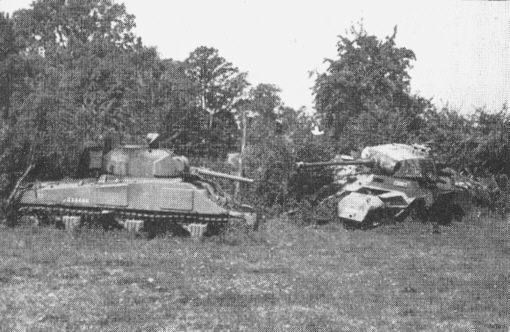
Knocked out Sherman of the Polish Armored Division next to a knocked out Panther

Weigley blames Bradley as much for the halt order as much as Montgomery for “discouraging whatever might have been done to rectify the blunder- even discouraging on August 13th a call from the Supreme Commander to Montgomery about the inter-allied boundary.”[xxix] Thus through a series of Allied mistakes particularly by senior commanders the first opportunity to envelop the Germans passed into history as a great yet incomplete victory.  A victory which though impressive allowed experienced German forces to escape to fight again. As the Germans escaped from Falaise the Allies began a pursuit in conjunction with landings in the south of France that would take them to the borders of Germany.

Polish Soldiers at the Corridor of Death


[i] Hastings, Max. Overlord: D-Day and the Battle for Normandy Vintage Books, New York, 1984 p.280

[ii] Ibid.

[iii] Hastings, Max. Armageddon: The Battle for Germany 1944-1945 Alfred a Knopf, New York, 2004 p.37.  Hastings comments that “British planners threw away it had learned since 1939 about the speed of reaction of Hitler’s army, its brilliance at improvisation, its dogged skill in defense, its readiness always to punish allied mistakes.”

[iv] Weigley, Russell F. Eisenhower’s Lieutenants: The Campaign of France and Germany, 1944-1945, Indiana University Press, Bloomington IN, 1981pp.184-186

[v] Ibid. Hastings. Overlord pp.282-283

[vi] D’Este,  Carlo. Patton: A Genius for War. Harper Collins Publishers New York, 1995 pp.632-633

[vii] Ibid.  p.195

[viii] Ibid. Also

[ix] Warlimont, Walter. Inside Hitler’s Headquarters 1939-45 Presidio Press, Novato CA 1964 pp.449-450.

[x] Ibid pp.195-196. Weigley notes that Montgomery and most other Allied commanders  had been optimistic in not anticipating the German counter attack despite the ULTRA warnings, while Bradley and Patton were cautious in making troop deployments.

[xi] Michael Reynolds in Steel Inferno: The 1st SS Panzer Corps in Normandy notes that the Americans inflicted “astonishing casualties on the northern thrusts of 2nd SS Panzer and remained undefeated when the Germans withdrew 4 days later.”  Reynolds, Michael Steel Inferno: The 1st SS Panzer Corps in Normandy Dell Publishing, New York, 1997 p.264

[xii] Ibid. Hastings Overlord p.283

[xiii] Ibid.

[xiv] Ibid. Weigley p.199.

[xv] Carrell, Paul. Invasion! They’re Coming!” Trans. E. Osers, Originally published as Sie Kommen! Gerhard Stalling Verlag 1960, Bantam Books New York, 1964, 5th Printing June 1984. p. 249

[xvi] Ibid. Weigley p. 199

[xvii] Ibid. p.200

[xviii] Ibid. Hastings. Overlord. pp.282-283

[xix] Ibid. D’Este. p.631

[xx] Ibid. Weigley. p.286  He also points out that the Brittany diversion could have been “worse had it not been for Montgomery’s influence”  p.288

[xxi] Ibid. p. 202

[xxii] Ibid. p.204

[xxiii] Ibid.

[xxiv] Ibid.

[xxv] Reynolds, Michael Steel Inferno: 1st SS Panzer Corps in Normandy Dell Publishing New York, 1997. p.320.

[xxvi] Meyer, Kurt Grenadiers trans. By  Michael Mende and Robert J.  Edwards, J.J. Fedorowicz Publishing, Inc. Winnipeg Manitoba, Canada 2001 p.290.

[xxvii] Ibid. Hastings Overlord pp.288-289.

[xxviii] Patton, George S. War As I Knew It Bantam Books NY  published 1980, originally published by Houghton Mifflin Company 1947. pp.101-102

[xxix] Ibid. Weigley p.209  Weigley quotes Major Hansen, Bradley’s aide in stating that the Falaise halt orde was “the only decision he has ever questioned.”

Leave a comment

Filed under Loose thoughts and musings

D-Day: Omaha Beach

LCVP’s pass USS Augusta

Like the rest of the Allied invasion forces the 1st and 29th Divisions set sail from their embarkation ports with the intent of landing on June 5th.  General Bradley, commanding the First Army until the American Army Group would be activated accompanied the invasion force.  The OMAHA landing was placed under General Gerow and his V Corps while VII Corps landed the 4th Infantry Division landed at Utah supported by airdrops of the 82nd and 101st Airborne Divisions inland.  American command and control was exercised from sea although General Officers went ashore with each of the American divisions.  A severe channel storm disrupted the plan to land on the 5th and Eisenhower delayed the invasion one day catching a break in the weather and electing to go on the 6th.[i] This delay while uncomfortable for the embarked troops caused the Germans to believe that no invasion would take place until the next favorable tide and moon cycle later in the month[ii] a break which caused a number of senior German leaders, including Rommel to be absent from the invasion front when the Allies landed.[iii]

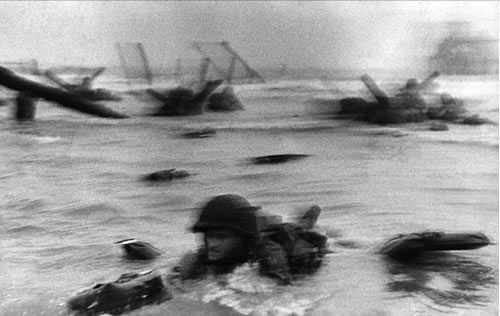
US Soldier struggling in surf at Omaha Beach

The landing beaches at OMAHA stretched about 6500 meters from Colleville-Sur-Mer to Vierville-Sur-Mere in the west.  A further objective to the west of Vierville; Pont du Hoc, was believed to house a 150mm battery sighted where it could enfilade OMAHA and was assigned to the 2nd Ranger Battalion.  Companies from this battalion made a heroic landing and scaled the cliffs to capture the strongpoint only to discover that the guns had not been emplaced and held their isolated beachhead until relieved by the 29th Division on the morning of June 8th.[iv]

H-Hour for OMAHA was 0630.  Unfortunately the assault troops were transferred to their LCVPs 16-20 kilometers from the beach resulting in a long and dangerous ride in the small craft for the infantry.  Most of the infantry were completely soaked in sea spay and seasick before going ashore carrying loads far above what they normally would carry into battle.[v] One battalion of DD tanks, the 741st Armored Battalion, supporting the 16th Infantry of 1st Infantry Division was launched too far out and nearly all of its tanks were swamped and lost before firing a shot in anger.[vi] Weigley notes that at OMAHA “at least 10 of the LCVPs sank” as did “the craft carrying almost all of the 105mm howitzers that were to be the first artillery ashore after the tanks.”[vii] The losses would cripple the assault on OMAHA and nearly cause its abandonment.

As the soldiers of the American divisions on OMAHA came ashore they faced German defenders of the 352nd, 716th and a regiment of the 709th Infantry Division, the latter under the tactical command of the 352nd.   Without the bulk of their tanks artillery and lacking close air support the Americans struggled across the beaches and were cut down in large numbers before being pinned down behind the sea wall.[viii] As the Americans pinned down on the beach failed to advance the time tables for the reinforcing waves became snarled amid the German beach obstacles which had not been cleared due to 40% casualties among the Combat Engineers and the loss of all but five bulldozers.[ix] Naval officers were frustrated in their attempts to provide support by the lack of identifiable targets on the beaches but strongpoints were “knocked out by either by superbly directed vigorous gunfire from destroyers steaming as close as 800 yards offshore, or by determined action from Rangers or infantry.[x]

Grenadiers of 352nd Infantry Division move to counter-attack

Soldiers ashore discovered the truth that they were not facing the static 716th Division but the 352nd Division as well.[xi] But for the leadership of Brigadier General Norman Cota, assistant division commander of 29th Infantry Division and Colonel Charles Canham of the 116th Infantry who were able to rally their troops and just enough leaders and small units from the 116th which had its linage back to the “Stonewall Brigade” as well as units of the 1st Divisions’ 16th and 18th Regiments  who kept their heads and began to lead survivors through the dunes and up the bluffs to attack German defenders of the roads leading up from the beach from the flank and rear as well as a mid-day break in the weather which allowed some close tactical air support General Bradley may have ordered the evacuation of OMAHA.

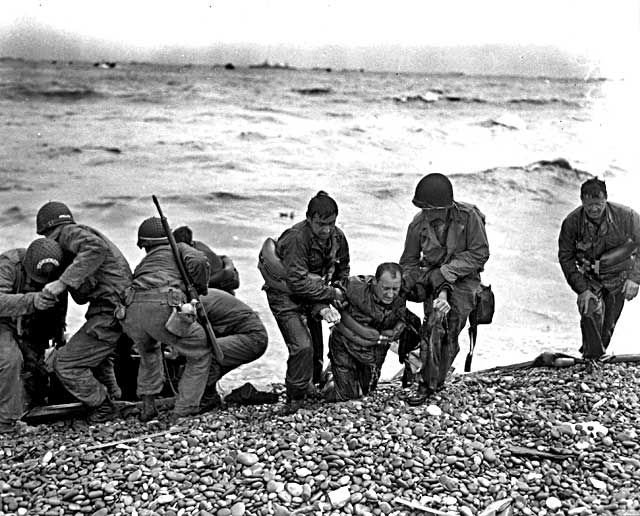
Omaha Beach rescue of wounded from surf

At sea events were as confused as Bradley and his staff attempted to make sense of what was going on.  Even later in the evening there was discussion of diverting all further reinforcements from OMAHA to the British beaches.[xii]At 1330 hours “Gerow signaled Bradley: “Troops formerly pinned down on beaches…advancing up heights behind beaches.”[xiii] By the end of the day Bradley’s aid Major Hansen noted Bradley’s comments to Collins: “They are digging in on Omaha beach with their fingernails. I hope they can push in and get some stuff ashore.”  And Montgomery: “Someday I’ll tell Gen[eral] Eisenhower just how close it was for a few hours.”[xiv]

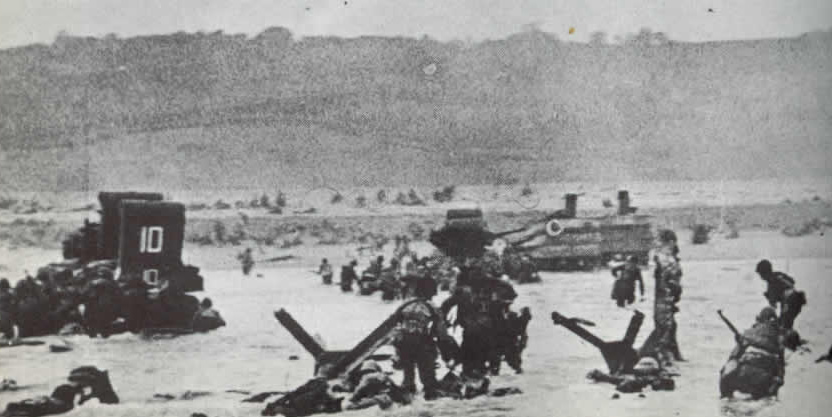
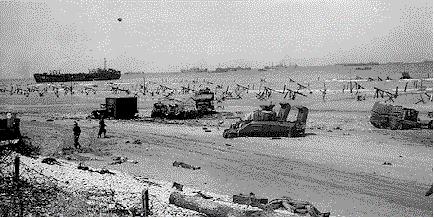
Omaha Beach Wreckage

The landings at OMAHA did succeed at a cost of over 2000 casualties, critical to their success were the German inability to reinforce their defending troops on the beach and the weakness of the units available to mount the standard counterattack that was critical to German defensive plans on D-Day itself. The 352nd Division fought superbly under the full weight of V Corps and the British XXX Corps on its right suffering heavy casualties as they contested every inch of ground.  The 716th Division units melted under the onslaught.  Allied air supremacy played a key role as sorties by the 8th and 9th Air Forces helped keep German reinforcements from arriving and interdicted counter attacks inland.  Weigley credits the Allied air superiority with the success of the landings and with limiting the cost of allied lives.[xv] Von Rundstedt and other German commanders in France were limited by the delay and refusal of Hitler and OKW to release Panzer reserves when needed most early on June 6th.  By the close of D-Day allied forces had secured the five invasion beaches but not achieved their objectives of taking Caen and Bayuex and forces had not linked up leaving the beaches extremely vulnerable had the Germans been able to mount a rapid counterattack by Panzers and strong infantry formations.

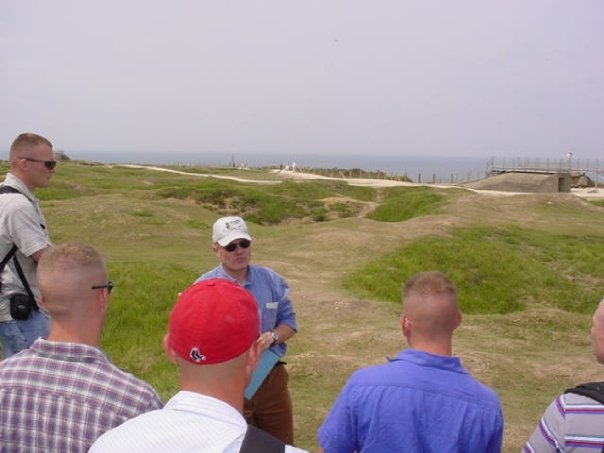
The author lecturing at Pont du Hoc Omaha Beach 2004


[i] Ibid. p.74-75

[ii] Von Luck, Hans.  “Panzer Commander“ Dell Publishing, New York, 1989 pp. 169-170.  Von Luck a regiment commander in 21st Panzer noted that General Marcks of 84th Corps had predicted a 5 June invasion at a conference May 30th.

[iii] Almost every D-Day historian talks about the weather factor and its effect on the German high command’s reaction to the invasion.  Rommel was visiting his wife for her birthday and planned to make a call on Hitler. Others including commanders of key divisions such as the 91st Airlanding Division were off to a war game in Rennes and the 21st Panzer Division to Paris.

[iv] Ibid. Weigley p. 96

[v] See Cornelius Ryan, “The Longest Day” Popular Library Edition, New York 1959. pp. 189-193 for a vivid description of the challenges faced by soldiers going from ship to landing craft and their ride in to the beaches.

[vi] Ibid. Weigley. p.78 Weigley talks about the order for the tanks to be carried ashore on their LCTs that did not get transmitted to the 741st.

[vii] Ibid.

[viii] Ibid. Weigley  p. 87 The weather prevented the aerial bombardment from being effective. Because the bombers could not see their targets they dropped their bomb loads further inland, depriving the infantry of support that they were expecting.  Naval gunfire support had some effect but had to be lifted as the troops hit the beach leaving much of that support to come from Destroyers and specially equipped landing craft which mounted rockets and guns.

[ix] Ibid. Hastings. pp. 90-91.

[x] Ibid. p.99

[xi] Ibid. Weigley p.80

[xii] Ibid. p.101  Also see Weigley p.80

[xiii] Ibid. p.99

[xiv] Ibid. Weigley. p.95

[xv] Ibid. p.94

2 Comments

Filed under History, Military, world war two in europe