Tag Archives: frederick douglass

“One after another they have closed the heavy doors upon him…” The Dred Scott Decision

Friends of Padre Steve’s World,

Another article from one of my Civil War texts, this one dealing with the infamous Dred Scott decision. That decision, made by a Southern dominated, Supreme Court, members of whom included number of slave owners, done in collusion with President Elect James Buchanan, declared that African Americans had no right to citizenship, thus no protection under the law, no-matter where they lived. It would not be overturned until after the Civil War when Congress passed the 14th Amendment, an amendment that is vital for all of our liberties.

Again, for those in denial about how we got to this point in our history, this is not a comfortable subject.

Have a great day,

Peace

Padre Steve+

dred scott

Dred Scott

The Deepening Divide

As the 1850s wore on, the divisions over slavery became deeper and voices of moderation retreated. The trigger for the worsening of the division was the political battle regarding the expansion of slavery; even the status of free blacks in the north that were previously slaves, over whom their owners asserted their ownership. Southerners considered the network to help fugitive slaves escape to non-slave states, called the Underground Railroad “an affront to the slaveholders pride” and “anyone who helped a man or woman escape bondage was simply a thief” who had robbed them of their property and livelihood, as an “adult field hand could cost as much as $2000, the equivalent of a substantial house.” [1]

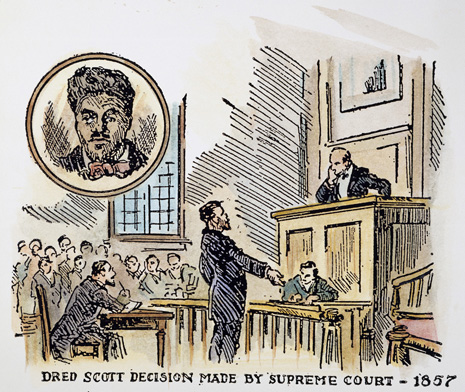
In 1856 the Supreme Court, dominated by southern Democrats ruled in favor of southern views in the Dred Scott decision, one pillar of which gave slavery the right to expand by denying to Congress the power to prohibit slavery in Federal territories. Taney’s ruling in the case insisted “Neither the Declaration of Independence nor the Constitution had been intended to apply to blacks he said. Blacks were “so far inferior that they had no rights which the white man was bound to respect.” Taney did not stop with this but he declared the Missouri Compromise itself unconstitutional for “Congress had exceeded its authority when it forbade slavery in the territories by such legislation as the Missouri Compromise, for slaves were private property protected by the Constitution.” [2]

ROGER B. TANEY (1777-1864).  Roger Taney, Chief Justice of the U.S. Supreme Court, handing down his decision on the Dred Scott case, 1857. American illustration.

Dred Scott Decison

The decision was momentous, but the judicial fiat of Taney and his court majority was a disaster for the American people. It solved nothing and further divided the nation:

“In the South, for instance, it encouraged southern rights advocates to believe that their utmost demands were legitimatized by constitutional sanction and, therefore, to stiffen their insistence upon their “rights.” In the North, on the other hand, it strengthened a conviction that an aggressive slavocracy was conspiring to impose slavery upon the nation, and that any effort to reach an accommodation with such aggressors was futile. While strengthening the extremists, it cut the ground from under the moderates.” [3]

The decision in the case is frightening when one looks upon its tenor and implications. The majority opinion, which was written by Chief Justice Roger Taney, was chilling, not only in its views of race, but the fact that blacks were perpetually property without the rights of citizens. Taney wrote:

“Can a negro, whose ancestors were imported into this country, sold as slaves, become a member of the political community formed and brought into existence by the Constitution of the United States, and as such become entitled to all the rights, and privileges, and immunities, guaranteed by that instrument to the citizen?…It is absolutely certain that the African race were not included under the name of citizens of a state…and that they were not included, and were not intended to be included, under the word “citizens” in the Constitution, and therefore claim none of the rights and privileges which that instrument provides for and secures to citizens of the United States. On the contrary, they were at that time considered as a subordinate and inferior class of beings, who had been subjugated by the dominant race, and, whether emancipated or not, yet remain subject to their authority, and had no rights or privileges but those who held the power and the Government might choose to grant them” [4]

The effect of the ruling on individuals and the states was far reaching. “No territorial government in any federally administered territory had the authority to alter the status of a white citizen’s property, much less to take that property out of a citizen’s hands, without due process of law or as punishment for some crime.” [5] Free slaves were no longer safe, even in Free States, from the possibility of being returned to slavery, because they were considered property. The tens of thousands of free blacks in the South were effectively stripped of citizenship, and became vulnerable to either expulsion or re-enslavement, something that the legislatures in Virginia, North Carolina and Missouri debated in 1858. Likewise the decision cast doubt on the free status of every African American regardless of residence.” [6]

roger-b-taney-1-sized

Chief Justice Roger B. Taney

But the decision had been influenced by President-Elect James Buchanan’s secret intervention in the Supreme Court deliberations two weeks before his inauguration. Buchanan hoped by working with the Justices that he would save the Union from breaking apart by appeasing slave owners and catering to their agenda. “The president-elect wanted to know not only when, but if the Court would save the new administration and the Union from the issue of slavery in the territories. Would the judges thankfully declare the explosive subject out of bounds, for everyone who exerted federal power? The shattering question need never bother President Buchanan.” [7] In his inaugural address he attempted to camouflage his intervention and “declared that the Court’s decision, whatever it turned out to be, would settle the slavery issue forever.” [8]

But Buchanan attempt at appeasement was mistaken. The case made the national political situation even more volatile because it destroyed the political middle in Congress which had previously found compromise.  Taney’s decision impaired “the power of Congress – a power which had remained intact to this time – to occupy the middle ground.” [9] The Dred Scott decision was far reaching in its implications and Taney declared that Congress “never had the right to limit slavery’s expansion, and that the Missouri Compromise had been null and void on the day of its formulation.” [10] Taney’s ruling fulfilled what Thomas Jefferson wrote when he noted that the Missouri Compromise was merely a reprieve from the broader ideological and economic issues involved regarding slavery, and Taney destroyed that reprieve with the stroke of his pen.

The Court’s decision “that a free negro was not a citizen and the decision that Congress could not exclude slavery from the territories were intensely repugnant to many people in the free states” [11] and it ignited a firestorm in the north where Republicans now led by Abraham Lincoln, decried the decision and southerners basked in their judicial victory. Southerners were exultant, the Richmond Enquirer wrote that the Court had destroyed “the foundation of the theory upon which their warfare has been waged against the institutions of the South.” [12] Northerners now quite rightly feared that an activist court would rule to deny their states the right to forbid slavery. As early as 1854 Lincoln posed the idea that the Declaration of Independence was the standard maxim of free society …constantly spreading and deepening its influence,” ultimately applicable “to peoples of all colors everywhere.” [13]

After the Dred Scott decision Lincoln warned that the Declaration was being cheapened and diluted, he remained insistent on this point, he noted:

“Our Declaration of Independence was held sacred by all, and thought to include all” Lincoln declared, “but now, to aid in making the bondage of the Negro universal and eternal, it is assaulted, and sneered at, and construed, and hawked at, and torn, till, its framers could ride from their graves, they could not recognize it at all.” [14]

Lincoln attacked the decision noting that Taney “insists at great length that negroes were no part of the people who made, or for whom made, the declaration of Independence or the Constitution.” But as Doris Kearns Goodwin notes “in at least five states, black voters action on the ratification of the Constitution and were among the “We the People” by whom the Constitution was ordained and established.” Lincoln acknowledged that the founders “did not declare all men equal in all respects. They did not mean to say that all were equal in color, size, intellect, moral developments, or social capacity.” But they dis declare all men “equal in ‘certain inalienable rights, among which are life, liberty, and the pursuit of happiness.’…They meant simply to declare the right, so the enforcement of it might follow as circumstances permit.” [15]

Not only that, Lincoln asked the logical question regarding Taney’s judicial activism. Lincoln and other Republican leaders “noted that all slavery needed was one more Dred Scott decision that a state could not bar slavery and the objective of Slave Power to nationalize slavery would be accomplished.” [16] How long would it be, asked Abraham Lincoln, before the Court took the next logical step and ruled explicitly that the:

“Constitution of the United States does not permit a state to exclude slavery from its limits?” How far off was the day when “we shall lie down pleasantly thinking that the people of Missouri are on the verge of making their State free; and shall awake to the reality, instead, that the Supreme Court has made Illinois a slave State?” [17]

Lincoln discussed the ramification of the ruling for blacks; both slave and free:

“to aid in making the bondage of the Negro universal and eternal….All the powers of the earth seem rapidly combining against him. Mammon is after him; ambition follows, and philosophy follows, and the theology of the day is fast joining the cry. They have him in his prison house;…One after another they have closed the heavy doors upon him…and they stand musing as to what invention, in all the dominions of mind and matter, can be produced the impossibility of his escape more complete than it is.” [18]

Frederick Douglass noted that “Judge Taney can do many things…but he cannot…change the essential nature of things – making evil good, and good, evil.” [19]

Lincoln was not wrong in his assessment of the potential effects of the Dred Scott decision on Free States.  State courts in free-states made decisions on the basis of Dred Scott that bode ill for blacks and cheered slave owners.  In newly admitted California the state supreme court ominously “upheld a slaveowner’s right to retain his property contrary to the state’s constitution.” [20]

A similar decision made by a New York Court was being used by slave-states to bring that issue to the Taney Court following Dred Scott. “In 1852 a New York judge upheld the freedom of eight slaves who had left their Virginia owner while in New York City on their way to Texas.” [21] The Dred Scott decision brought that case, Lemon v. The People back to the fore and “Virginia decided to take the case to the highest New York court (which upheld the law in 1860) and would have undoubtedly appealed it to Taney’s Supreme Court had not secession intervened.” [22] Even non-Republican parties such as the democrats could see the writing on the wall. The national publication of the Democratic Party, the Washington Union “announced that the clear implication of the Dred Scott decision was that all state laws prohibiting a citizen from another state, either permanently or temporarily, were unconstitutional.” [23]

Notes

[1] Goodheart, Adam. Moses’ Last Exodus in The New York Times: Disunion, 106 Articles from the New York Times Opinionator: Modern Historians Revisit and Reconsider the Civil War from Lincoln’s Election to the Emancipation Proclamation Edited by Ted Widmer, Black Dog and Leventhal Publishers, New York 2013 p.15

[2] Ibid. Goodwin Team of Rivals p. 189

[3] Ibid. Potter The Impending Crisis p.291

[4] Ibid. Guelzo Fateful Lightning: A New History of the Civil War Era and Reconstruction p.91

[5] Ibid. Guelzo Fateful Lightning pp.91-92

[6] Ibid. Goldfield America Aflame p.142

[7] Ibid. Freehling The Road to Disunion Volume II: Secessionists Triumphant 1854-1861 p.115

[8] Ibid. Freehling The Road to Disunion Volume II: Secessionists Triumphant 1854-1861 p.109

[9] Ibid. Potter The Impending Crisis p.291

[10] Ibid. Levine Half Slave and Half Free p.210

[11] Ibid. Potter The Impending Crisis p.279

[12] Ibid. Goodwin Team of Rivals p. 190

[13] Ibid. Catton Two Roads to Sumter p.139

[14] Ibid. Guelzo Fateful Lightning p.93

[15] Ibid. Goodwin Team of Rivals p. 190

[16] Gienapp, William E. The Republican Party and Slave Power in The Civil War and Reconstruction Documents and Essays Third Edition edited by Michael Perman and Amy Murrell Taylor Wadsworth Cengage Learning Boston MA 2011 p.81

[17] Ibid. Levine Half Slave and Half Free p.211

[18] Ibid. Catton Two Roads to Sumter p.139

[19] Ibid. Goodwin Team of Rivals p. 190

[20] Ibid. Gienapp The Republican Party and Slave Power p.81

[21]  Ibid. McPherson The Battle Cry of Freedom p.181

[22] Ibid. McPherson The Battle Cry of Freedom p.181

[23] Ibid. Gienapp The Republican Party and Slave Power p.82

1 Comment

Filed under civil rights, civil war, History, laws and legislation, Political Commentary

“An Institution Sanctioned by God” Southern Religious Support of Slavery

Friends of Padre Steve’s World,

Here is another excerpt from one of my Civil War texts dealing with the role of the Christian faith in justifying Southern Slavery. Once again it is not an easy subject to deal with for many people. Most American Christians of any denomination, Northern or Southern, would prefer that our often less than stellar practice of our faith didn’t exist, or be relegated to the deepest part of the dustbin of history. If they would stay that wouldn’t be a bad thing, but those attitudes, prejudices, and actions seem to always find a way back into current practice, if not in this case against African Americans, with the group du jour. Most of the time now it seems to involve immigrants, both legal and illegal, Muslims, and LGBTQ people. As the evangelical Anglican theologian Alistair McGrath writes: “the arguments used by the pro-slavery lobby represent a fascinating illustration and condemnation of how the Bible may be used to support a notion by reading the text within a rigid interpretive framework that forces predetermined conclusions to the text.”

So have a great day

Peace

Padre Steve+

furman

The noted South Carolina Baptist minister, the Reverend Richard Furman wrote: “The right of holding slaves is clearly established by the Holy Scriptures, both by precept and example.”  [1]

Like other people who supported the institution of slavery in the Americas before them, Southerners turned to the Christian faith to buttress their cause. Catholic and Protestant churches of England, France, the Netherlands, Spain and Portugal all provided their theological and ecclesiastical blessing to slavery and the slave trade. When a Catholic priest wrote his superiors asking if the slave trade and all of its components were legal according to Canon Law he received this answer:

“Your Reverence writes me that you would like to know whether the Negroes who are sent to your parts have been legally captured. To this I reply that I think your Reverence should have no scruples on this point, because this is a matter which has been questioned by the Board of Conscience in Lisbon, and all its members are learned and conscientious men. Nor did the bishops who were in Sao Thome, Cape Verde, and here in Loando – all learned and virtuous men – find fault with it. We have been here ourselves for forty years and there have been among us very learned Fathers…never did they consider the trade as illicit. Therefore we and the Fathers of Brazil buy these slaves for our service without any scruple….” [2]

In the American colonies, the Church of England accommodated itself to the plantation system by adapting itself to the ways of the plantation owners and slave traders. This began in 1619 when planters in Virginia and Maryland began to bring in slaves due to their “growing success by growing and exporting tobacco.” [3] To escape the ancient Christian prohibition on believers owning other believers most plantation owners refused to all their slaves to be baptized. However, to allow for some slaves to be baptized a law was passed in 1667 “declaring that baptism did not change a slave’s condition – another indication of the degree to which established religion was willing to bend to the interests of the powerful.”  [4] It is interesting to note that this uniquely American Anglican idea that baptism did not change the nature of a person, was also used by the Nazis in regard to Jews who had converted to Christianity.

In light of the threat posed to slavery by the emerging abolitionist movement, slaveholders were forced to shift their defense of slavery away from it being simply a necessary evil to a positive good. The institution of slavery became “in both secular and religious discourse, the central component of the mission God had designed for the South.” [5] Like in the North where theology was at the heart of many abolitionist arguments, in the South theology was used to enshrine and defend the institution of slavery. British Evangelical-Anglican theologian Alister McGrath notes how “the arguments used by the pro-slavery lobby represent a fascinating illustration and condemnation of how the Bible may be used to support a notion by reading the text within a rigid interpretive framework that forces predetermined conclusions to the text.” [6]

Southern religion was a key component of something bigger than itself and played a role in the development of an ideology much more entrenched in the Southern culture than the abolitionist cause did in the North.  This was in large part due to the same Second Great Awakening that brought abolitionism to the fore in the North. “Between 1801 when he Great Revival swept the region and 1831 when the slavery debate began, southern evangelicals achieved cultural dominance in the region. Looking back over the first thirty years of the century, they concluded that God had converted and blessed their region.” [7] The Southern political and religious ideology enshrined slavery as a key component of all areas of life. It was a complete worldview, a system of values, culture, religion and economics, or to use the more modern German term “Weltanschauung.” The Confederate worldview was the Cause. As Emory Thomas wrote in his book The Confederate Nation:

“it was the result of the secular transubstantiation in which the common elements of Southern life became sanctified in the Southern mind. The South’s ideological cause was more than the sum of its parts, more than the material circumstances and conditions from which it sprang. In the Confederate South the cause was ultimately an affair of the viscera….Questions about the Southern way of life became moral questions, and compromises of Southern life style would become concession of virtue and righteousness.” [8]

Despite the dissent of some, the “dominant position in the South was strongly pro-slavery, and the Bible was used to defend this entrenched position.” [9] This was tied to a strongly Calvinistic theology which saw slavery in context with the spread of the evangelical Protestant faith that had swept through the South as slavery spread. For many, if not most Southern ministers “the very spread of evangelical religion and slave labor in the South was a sign of God’s divine favor. Ministers did not focus on defending slavery in the abstract but rather championed Christian slaveholding as it was practiced in the American South. Though conceding that some forms of slavery might be evil, Southern slavery was not.” [10]

The former Governor of South Carolina, John Henry Hammond, led the religiously based counter argument to the abolitionists. Hammond’s arguments included biblical justification of blacks being biologically inferior to whites and slavery being supported in the Old Testament where the “Hebrews often practiced slavery” and in the New Testament where “Christ never denounced servitude.”  [11] Hammond warned:

“Without white masters’ paternalistic protection, biologically inferior blacks, loving sleep above all and “sensual excitements of all kinds when awake” would first snooze, then wander, then plunder, then murder, then be exterminated and reenslaved.” [12]

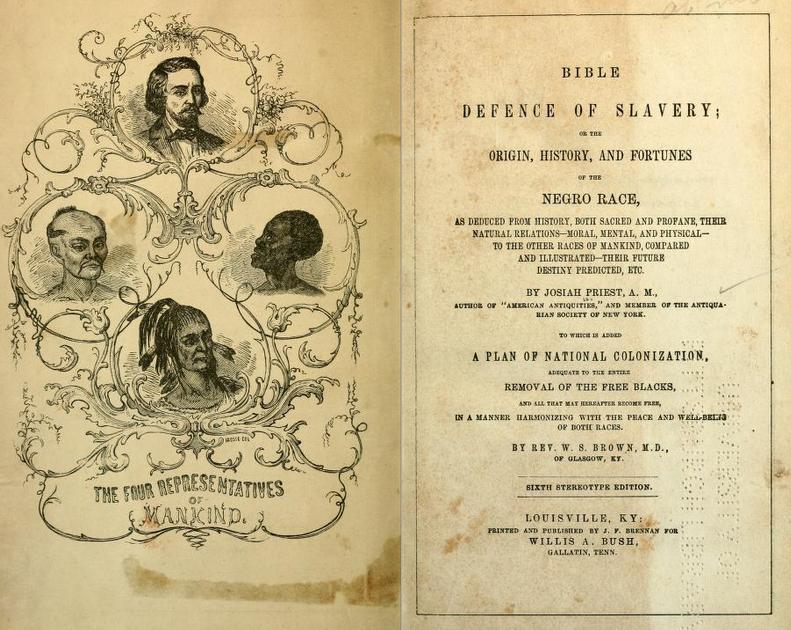
Others in the South, including politicians, pundits and preachers were preaching “that slavery was an institution sanctioned by God, and that even blacks profited from it, for they had been snatched out of pagan and uncivilized Africa and been given the advantages of the gospel.” [13] The basic understanding was that slavery existed because “God had providential purposes for slavery.” [14]

At the heart of the pro-slavery theological arguments was in the conviction of most Southern preachers of human sinfulness. “Many Southern clergymen found divine sanction for racial subordination in the “truth” that blacks were cursed as “Sons of Ham” and justified bondage by citing Biblical examples.” [15] But simply citing scripture to justify the reality of a system of which they reaped the benefit, is just part of the story. The real issue was far greater than that. The theology that justified slavery also, in the minds of many Christians in the north justified what they considered “the hedonistic aspects of the Southern life style.” [16] This was something that abolitionist preachers continually emphasized, criticizing the greed, sloth and lust inherent in the culture of slavery and plantation life, and was an accusation of which Southern slaveholders, especially evangelicals took umbrage, for in their understanding good men could own slaves. Their defense was rooted in their theology. The hyper-individualistic language of Southern evangelicalism gave “new life to the claim that good men could hold slaves. Slaveholding was a traditional mark of success, and a moral defense of slavery was implicit wherever Americans who considered themselves good Christians held slaves.” [17] The hedonism and fundamentalism that existed in the Southern soul, was the “same conservative faith which inspired John Brown to violence in an attempt to abolish slavery…” [18]

Slave owners frequently expressed hostility to independent black churches and conducted violence against them, and “attacks on clandestine prayer meetings were not arbitrary. They reflected the assumption (as one Mississippi slave put it) “that when colored people were praying [by themselves] it was against them.” [19] But some Southern blacks accepted the basic tenets of slave owner-planter sponsored Christianity. Frederick Douglass later wrote “many good, religious colored people who were under the delusion that God required them to submit to slavery and wear their chains with weakness and humility.” [20]

The political and cultural rift began to affect entire church denominations. The heart of the matter went directly to theology, in this case the interpretation of the Bible in American churches.  The American Protestant and Evangelical understanding was rooted in the key theological principle of the Protestant Reformation, that of Sola Scripura, which became an intellectual trap for northerners and southerners of various theological stripes. Southerners believed that they held a “special fidelity to the Bible and relations with God. Southerners thought abolitionists either did not understand the Bible or did not know God’s will, and suspected them of perverting both.”  [21]The problem was then, as it is now that:

 “Americans favored a commonsense understanding of the Bible that ripped passages out of context and applied them to all people at all times. Sola scriptura both set and limited terms for discussing slavery and gave apologists for the institution great advantages. The patriarchs of the Old Testament had owned slaves, Mosaic Law upheld slavery, Jesus had not condemned slavery, and the apostles had advised slaves to obey their masters – these points summed up and closed the case for many southerners and no small number of northerners.” [22]

In the early decades of the nineteenth century there existed a certain confusion and ambivalence to slavery in most denominations. The Presbyterians exemplified this when in 1818 the “General Assembly of the Presbyterian Church, while opposing slavery against the law of God, also went on record as opposing abolition, and deposed a minister for advocating abolition.” [23] There were arguments by some American Christians including some Catholics, Lutherans, Episcopalians and others to offer alternative ways to “interpreting and applying scripture to the slavery question,  but none were convincing or influential enough to force debate”  [24] out of the hands of literalists.

However the real schisms between the Northern and Southern branches of the major denominations which began to emerge in the mid to late 1830s continued to grow with the actual breakups of the major denominations coming in the 1840s. The first denomination to split was the Methodist church. This occurred in 1844 when “the Methodist General Conference condemned the bishop of Georgia for holding slaves, the church split and the following year saw the birth of the Methodist Episcopal Church.” [25] Not all Methodists in the South agreed with this split and a few Methodist abolitionists in the South “broke away from mainline Methodism to form the Free Methodist Church.” [26]

defense-of-slavery

The Baptists were next, when the Foreign Mission Board “refused to commission a candidate who had been recommended by the Georgia Baptist Convention, on the ground that he owned slaves” [27] resulting in the formation of the Southern Baptist Convention. The Baptist split is interesting because until the early 1800s there existed a fairly strong anti-slavery movement in states such as Kentucky, while in 1790 the General Committee of Virginia “adopted a statement calling slavery “a violent deprivation of the rights of nature, and inconsistent with a republican government; and therefore [we] recommend it to our brethren to make use of every legal measure, to extirpate the horrid evil from the land.”  [28]

However, in many parts of the Deep South there existed no such sentiment and in South Carolina, noted Baptist preachers including “Richard Furman, Peter Bainbridge, and Edmund Botsford were among the larger slaveholders.” [29] Furman wrote a defense of slavery in 1822 where he made the argument that “the right of holding slaves is clearly established in the Holy Scriptures by precept and example.” [30]  After a number of slave uprisings, including the Nat Turner Revolt in Virginia, pro-slavery voices “tended to silence any remaining antislavery voices in the South.” [31]

These voices grew more ever more strident and in 1835 the Charleston Association “adopted a militant defense of slavery, sternly chastising abolitionists as “mistaken philanthropists, and denuded and mischievous fanatics.”  [32] Those who met in Augusta Georgia to found the new Southern Baptist Convention indicated that “the division was “painful” but necessary because” our brethren have pressed upon every inch of our privileges and our sacred rights.”  [33] Since the Baptist split was brought about by the refusal of the Triennial Convention to appoint slaveholders as foreign missionaries the new convention emphasized the theological nature of their decision:

“Our objects, then, are the extension of the Messiah’s kingdom, and the glory of God. Not disunion with any of his people; not the upholding of any form of civil rights; but God’s glory, and Messiah’s increasing reign; in the promotion of which, we find no necessity for relinquishing any of our civil rights. We will never interfere with what is Caesar’s. We will not compromit what is God’s.” [34]

Of course, to the Baptists who met at Augusta, “what was Caesar’s” was obviously the institution of slavery.

The last denomination to officially split was the Presbyterians in 1861 who, “reflecting the division of the nation, the Southern presbyteries withdrew from the Presbyterian Church and founded their own denomination.” [35] The split in the Presbyterian Church had been obvious for years despite their outward unity. Princeton’s eminent Charles Hodge tried to be a peacemaker in the denomination warning of the dangers of disunion. He wrote, “If we are to be plunged into the horrors of civil war and servile insurrections, no tongue can tell how the cause of the Redeemer must suffer throughout our whole land.” [36] But like many conservatives of his time Hodge was misguided in thinking that moderates could prevail and that a sentimental attachment to the Union would prevent secession and war.

Some Southern pastors and theologians were at the forefront of battling their northern counterparts for the theological high ground that defined just whose side God was on. James Henley Thornwell presented the conflict between northern evangelical abolitionists and southern evangelical defenders of slavery in Manichean terms, a battle between Christianity and Atheism, and he believed that abolitionists attacked religion itself.

Robert Lewis Dabney, a southern Presbyterian pastor who later served as Chief of Staff to Stonewall Jackson in the Valley Campaign and at Seven Pines and who remained a defender of slavery long after the war was over wrote that:

“we must go before the nation with the Bible as the text and ‘Thus saith the Lord’ as the answer….we know that on the Bible argument the abolition party will be driven to reveal their true infidel tendencies. The Bible being bound to stand on our side, they have to come out and array themselves against the Bible. And then the whole body of sincere believers at the North will have to array themselves, though unwillingly, on our side. They will prefer the Bible to abolitionism.” [37]

Southern churches and church leaders were among the most enthusiastic voices for disunion and secession. They labeled their Northern critics, even fellow evangelicals in the abolition movement as “atheists, infidels, communists, free-lovers, Bible-haters, and anti-Christian levelers.”  [38] The preachers who had called for separation from their own national denominations years before the war now “summoned their congregations to leave the foul Union and then to cleanse their world.” [39] Thomas R.R. Cobb, a Georgia lawyer, an outspoken advocate of slavery and secession who was killed at the Battle of Fredericksburg, wrote proudly that Secession “has been accomplished mainly by the churches.” [40]

The Reverend William Leacock of Christ Church, New Orleans declared in his Thanksgiving sermon of 1860: “Our enemies…have “defamed” our characters, “lacerated” our feelings, “invaded “our rights, “stolen” our property, and let “murderers…loose upon us, stimulated by weak or designing or infidel preachers. With “the deepest and blackest malice,” they have “proscribed” us “as unworthy members… of the society of men and accursed before God.”  Unless we sink to “craven” beginning that they “not disturb us,…nothing is now left us but secession.” [41]

The fact that so many Protestant ministers, intellectuals, and theologians, not only Southerners, but men like “Princeton’s venerable theologian Charles B. Hodge – supported the institution of slavery on biblical grounds, often dismissing abolitionists as liberal progressives who did not take the Bible seriously” leaves a troubling question over those who claim to oppose issues on supposedly Biblical grounds. There were many such men in the North who spoke out for it and against Christian Abolitionists “in order to protect and promote interests concomitant to slavery, namely biblical traditionalism, and social and theological authority.” [42] The Northern clerical defenders of slavery perceived the spread of abolitionist preaching as a threat, not just to slavery “but also to the very principle of social and ecclesiastical hierarchy.” [43] Alistair McGrath asks a very important question for modern Christians who might be tempted to support a position for the same reasons today, “Might not the same mistakes be made all over again, this time over another issue?” [44]

Notes

[1] Furman, Richard Exposition of the Views of Baptists, Relative to the Coloured Population in the United States May 28th 1823, In Communication the Governor of South Carolina, Second Edition A.E. Miller, Charleston SC 1838 retrieved from http://faceweb.furman.edu/~benson/docs/rcd-fmn1.htm 15 July 2016

[2] Ibid. Zinn A People’s History of the United States pp.29-30

[3] Ibid. Gonzalez The History of Christianity Volume 2: The Reformation to the Present Day Harper p.219

[4] Ibid. Gonzalez The History of Christianity Volume 2: pp.219-220

[5] Gallagher, Gary W. The Confederate War: How Popular Will, Nationalism and Military Strategy Could not Stave Off Defeat Harvard University Press, Cambridge MA and London 1999 p.67

[6] Ibid. McGrath Christianity’s Dangerous Idea p.324

[7] Ibid. Daly When Slavery Was Called Freedom p.69

[8] Ibid. Thomas The Confederate Nation 1861-1865 p.4

[9] Ibid. McGrath Christianity’s Dangerous Idea p.324

[10] Ibid. Varon Disunion! p.109

[11] Ibid. Freehling The Road to Disunion Volume One p.29

[12] Ibid. Freehling The Road to Disunion Volume One p.29

[13] Ibid. Gonzalez The History of Christianity Volume 2: p.251

[14] Ibid. Daly When Slavery Was Called Freedom p.54

[15] Ibid. Thomas The Confederate Nation p.22

[16] Ibid. Thomas The Confederate Nation p.22

[17] Ibid. Daly When Slavery Was Called Freedom p.30

[18] Ibid. Thomas The Confederate Nation p.22

[19] Ibid. Levine Half Slave and Half Free p.116

[20] Ibid. Levine Half Slave and Half Free p.116

[21] Ibid. Daly When Slavery Was Called Freedom p.60

[22] Ibid. Rable God’s Almost Chosen Peoples  p.14

[23] Ibid. Gonzalez The History of Christianity Volume 2 p.251

[24] Ibid. Rable God’s Almost Chosen Peoples  p.14

[25] Ibid. Gonzalez The History of Christianity Volume 2 p.251

[26] Ibid. McGrath Christianity’s Dangerous Idea p.324

[27] Ibid. Gonzalez The History of Christianity Volume 2 p.251

[28] Ibid. McBeth The Baptist Heritage p.383

[29] Ibid. McBeth The Baptist Heritage p.384

[30] Ibid. McBeth The Baptist Heritage p.384

[31] Ibid. McBeth The Baptist Heritage p.384

[32] Ibid. McBeth The Baptist Heritage p.384

[33] Shurden, Walter B Not a Silent People: The Controversies that Have Shaped Southern Baptists Broadman Press, Nashville TN 1972 p.58

[34] Ibid. Shurden Not a Silent People p.58

[35] Ibid. Gonzalez The History of Christianity Volume 2 p.251

[36] Ibid. Rable God’s Almost Chosen Peoples p.13

[37] Ibid. Rable God’s Almost Chosen Peoples  p.14

[38] Ibid. Daly When Slavery Was Called Freedom  p.97

[39] Freehling, William. The Road to Disunion Volume II: Secessionists Triumphant 1854-1861 Oxford University Press, Oxford and New York 2007 p.460

[40] Ibid. Rable God’s Almost Chosen Peoples  p.39

[41] Ibid. Freehling  The Road to Disunion Volume II p.462

[42] Ibid. Daly When Slavery Was Called Freedom  p.38

[43] Ibid. Varon Disunion! P.108

[44] Ibid. McGrath Christianity’s Dangerous Idea p.324

1 Comment

Filed under civil rights, civil war, ethics, faith, History, Political Commentary, Religion

Slavery and National Expansion: the Compromise of 1850 or “The Privilege of Belonging to the Superior Race…” Part 3

thomas-sims-marched-into-slavery-nypl

Enforcing the Fugitive Slave Law in Boston 

Friends of Padre Steve’s World

Today the third installment of a three part series  of my work dealing with American Slavery in the ante-bellum period. These next articles deal with the subject of what happens when laws are made that further restrict the liberty of already despised, or enslaved people. In this case the subject is the Compromise of 1850 and its associated laws such as the Fugitive Slave Act of 1850.

This is an uncomfortable period of history for Americans with either a sense of conscience, or those who believe the racist myths surrounding the “Noble South” and “The Lost Cause.”  I hope that you find them interesting, especially in light of current events in the United States.

Peace,

Padre Steve+

The Fugitive Slave Act of 1850

Robert Toombs of Georgia was an advocate for the expansion of slavery into the lands conquered during the war. Toombs warned his colleagues in Congress “in the presence of the living God, that if you by your legislation you seek to drive us from the territories of California and New Mexico, purchased by the common blood and treasure of the whole people…thereby attempting to fix a national degradation upon half the states of this Confederacy, I am for disunion.”  [1]

The tensions in the aftermath of the war with Mexico escalated over the issue of slavery in the newly conquered territories brought heated calls by some southerners for secession and disunion. To preserve the Union, Henry Clay and Daniel Webster, supported by the new President Millard Fillmore were able to pass the compromise of 1850 solved a number of issues related to the admission of California to the Union and boundary disputes involving Texas and the new territories.  But among the bills that were contained in it was the Fugitive Slave Law, or The Fugitive Slave Act of 1850. The act was the device of Henry Clay which was meant to sweeten the deal for southerners. The law would “give slaveholders broader powers to stop the flow of runaway slaves northward to the free states, and offered a final resolution denying that Congress had any authority to regulate the interstate slave trade.” [2]

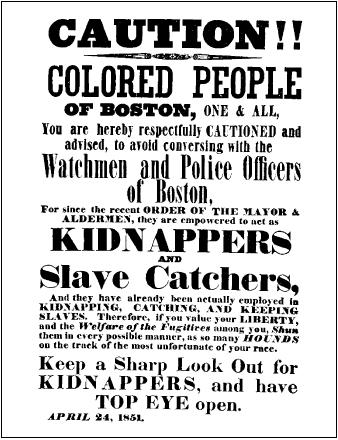
fugitive-slave-law

A Warning to Blacks in Boston regarding the Fugitive Slave Law

For all practical purposes the Compromise of 1850 and its associated legislation nationalized the institution of slavery, even in Free States. It did this by forcing all citizens to assist law enforcement in apprehending fugitive slaves. It also voided state laws in Massachusetts, Vermont, Ohio, Connecticut, Pennsylvania and Rhode Island, which barred state officials from aiding in the capture, arrest or imprisonment of fugitive slaves. “Congress’s law had nationalized slavery. No black person was safe on American soil. The old division of free state/slave state had vanished….” [3] If there was any question as to whose “States Rights” the leaders of the South were advocating, it was certainly not those of the states whose laws were voided by the act.

That law required all Federal law enforcement officials, even in non-slave states to arrest fugitive slaves and anyone who assisted them, and threatened law enforcement officials with punishment if they failed to enforce the law. The law stipulated that should “any marshal or deputy marshal refuse to receive such warrant, or other process, when tendered, or to use all proper means diligently to execute the same, he shall, on conviction thereof, be fined in the sum of one thousand dollars.” [4] In effect the law nullified state laws and forced individual citizens and local officials to help escaped slaves regardless of their own convictions, religious views, and state and local laws to the contrary.

Likewise the act compelled citizens in Free states to “aid and assist in the prompt and efficient execution of this law, whenever their services may be required….” [5] Penalties were harsh and financial incentives for compliance attractive.

“Anyone caught providing food and shelter to an escaped slave, assuming northern whites could discern who was a runaway, would be subject to a fine of one thousand dollars and six months in prison. The law also suspended habeas corpus and the right to trial by jury for captured blacks. Judges received a hundred dollars for every slave returned to his or her owner, providing a monetary incentive for jurists to rule in favor of slave catchers.” [6]

The law gave no protection for even black freedmen, who simply because of their race were often seized and returned to slavery. The legislation created a new extra-judicial bureaucratic office to decide the fate of blacks. This was the office of Federal Commissioner and it was purposely designed to favorably adjudicate the claims of slaveholders and their agents, and to avoid the normal Federal Court system. There was good reason for the slave power faction to place this in the law, many Federal courts located in Free States often denied the claims of slave holders, and that could not be permitted if slavery was to not only remain, but to grow with the westward expansion of the nation.

When slave owners or their agents went before these new appointed commissioners, they needed little in the way of proof to take a black back into captivity. The only proof or evidence other than the sworn statement by of the owner with an “affidavit from a slave-state court or by the testimony of white witnesses” [7] that a black was or had been his property was required to return any black to slavery. The affidavit was the only evidence required, even if it was false.

runaway

Since blacks could not testify on their own behalf and were denied legal representation before these commissioners, the act created an onerous extrajudicial process that defied imagination. Likewise, the commissioners had a strong a financial incentive to send blacks back to slavery, unlike normal courts the commissioners received a direct financial reward for returning blacks to slave owners. “If the commissioner decided against the claimant he would receive a fee of five dollars; if in favor ten. This provision, supposedly justified by the paper work needed to remand a fugitive to the South, became notorious among abolitionists as a bribe to commissioners.” [8] It was a system rigged to ensure that African Americans had no chance, and it imposed on the citizens of Free states the legal obligation to participate in a system that many wanted nothing to do with.

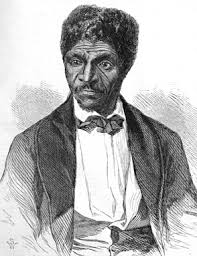
Douglass.JPG

Frederick Douglass 

Frederick Douglass wrote about the new law in the most forceful terms:

“By an act of the American Congress…slavery has been nationalized in its most horrible and revolting form. By that act, Mason & Dixon’s line has been obliterated;…and the power to hold, hunt, and sell men, women, and children remains no longer a mere state institution, but is now an institution of the whole United States.” [9]

Douglass was correct as was demonstrated during an incident in Boston in 1854 where an escaped slave named Anthony Burns, who had purchased his freedom, was arrested under the Fugitive Slave Act. The arrest prompted a protest in which, “an urban mob – variously composed of free Negro laborers, radical Unitarian ministers, and others – gathered to free him. They stormed the Federal courthouse, which was surrounded by police and wrapped in protective chains….Amid the melee, one protestor shot and killed a police deputy.” [10] The heated opposition to Burns’ arrest provoked the passions of thousands of Bostonians who protested for his release that caused the Massachusetts governor to deploy two batteries of artillery outside the courthouse to deter any more attacks. When the Federal Fugitive Slave Law commissioner consigned Burns to his Southern owner, the prisoner placed in shackles and was marched down State Street. Tensions were now running extremely high and a “brigade of Massachusetts militia and local police were required to run Burns through a gauntlet and deposit him on the ship that would remand him to Virginia.” [11] Bostonians began to see their city as it was in the early days of the American Revolution, as a place that resisted tyranny. Neither did they did not forget Burns but raised the money to purchase his freedom. William Lloyd Garrison wrote, “the “deed of infamy… demonstrated as nothing else that “only “the military power of the United States” could sustain slavery.” [12] Nevertheless, Boston’s “mercantile elite had vindicated law and order” [13] but in the process they helped move so abolitionists who had been advocates of pacifism and non-violence to physical resistance to the bounty hunting Southerners. “Across the North, prisons were broken into, posses were disrupted, and juries refused to convict.” [14]

Violence between slave hunters and their protectors did break out in September 1851 when “a Maryland slave owner named Edward Gorsuch crossed into Pennsylvania in pursuit of four runaways.” [15] Gorsuch and his armed posse found them in the Quaker town of Christiana, where they were being sheltered by a free black named William Parker and along with about two dozen other black men armed with a collection of farm implements and a few muskets who vowed to resist capture. Several unarmed Quakers intervened and recommended that Gorsuch and his posse leave for their own sake, but Gorsuch told them “I will have my property, or go to hell.” [16] A fight then broke out in which Gorsuch was killed and his son seriously wounded, and the fugitives escaped through the Underground Railroad to Canada.

The Christiana Riot as it is called now became a national story. In the North it was celebrated as an act of resistance while it was decried with threats of secession in the South. President Millard Fillmore sent in troops and arrested a number of Quakers as well as more than thirty black men. “The trial turned into a test between two cultures: Southern versus Northern, slave versus free.”  [17] The men were charged with treason but the trial became a farce as the government’s case came apart. After a deliberation of just fifteen minutes, “the jury acquitted the first defendant, one of the Quakers, the government dropped the remaining indictments and decided not to press other charges.” [18] Southerners were outraged, and one young man whose name is forever linked with infamy never forgot. A teenager named John Wilkes Booth was a childhood friend of Gorsuch’s son Tommy. “The death of Tommy Gorsuch’s father touched the young Booth personally. While he would move on with his life, he would not forget what happened in Christiana.” [19]

The authors of the compromise had not expected such resistance to the laws. On his deathbed Henry Clay, who had worked his entire career to pass compromises in order to preserve the Union, praised the act, of which he wrote “The new fugitive slave law, I believe, kept the South in the Union in ‘fifty and ‘fifty-one. Not only does it deny fugitives trial by jury and the right to testify; it also imposes a fine and imprisonment upon any citizen found guilty of preventing a fugitive’s arrest…” Likewise Clay depreciated the Northern opposition and condemned the attempt to free Anthony Burns, noting “Yes, since the passage of the compromise, the abolitionists and free coloreds of the North have howled in protest and viciously assailed me, and twice in Boston there has been a failure to execute the law, which shocks and astounds me…. But such people belong to the lunatic fringe. The vast majority of Americans, North and South, support our handiwork, the great compromise that pulled the nation back from the brink.” [20] 

While the compromise had “averted a showdown over who would control the new western territories,” [21] it only delayed disunion. In arguing against the compromise South Carolina Senator John C. Calhoun realized that for Southerners it did not do enough to support the peculiar institution and that it would inspire Northern abolitionists to redouble their efforts to abolish slavery. Thus, Calhoun argued not just for the measures secured in the compromise legislation, but for the permanent protection of slavery:

“He understood that slavery stood at the heart of southern society, and that without a mechanism to protect it for all time, the Union’s days were numbered.” Almost prophetically he said “I fix its probable [breakup] within twelve years or three presidential terms…. The probability is it will explode in a presidential election.”  [22]

Of course it was Calhoun and not the authors of the compromise who proved correct. The leap into the abyss of disunion and civil war had only been temporarily avoided. However, none of the supporters anticipated what would occur in just six years when a “train of unexpected consequences would throw an entirely new light on the popular sovereignty doctrine, and both it and the Compromise of 1850 would be wreaked with the stroke of a single judicial pen.” [23]

To be continued…

Notes

[1] Ibid. Guelzo Fateful Lightning pp.62-63

[2] Ibid. Guelzo Fateful Lightning p.68

[3] Ibid. Goldfield  America Aflame p.71

[4] ______________Fugitive Slave Act of 1850 retrieved from the Avalon Project, Yale School of Law http://avalon.law.yale.edu/19th_century/fugitive.asp 11 December 2014

[5] Ibid. Fugitive Slave Act of 1850

[6] Ibid. Goldfield America Aflame p.71

[7] Ibid. McPherson The Battle Cry of Freedom  p.80

[8] Ibid. McPherson The Battle Cry of Freedom p.80

[9] Ibid. Goldfield America Aflame p.72

[10] Goodheart, Adam 1861: The Civil War Awakening Vintage Books a division of Random House, New York 2011 p.42

[11] Ibid. Varon Disunion! The Coming of the American Civil War 1789-1858 p.241

[12] Mayer, Henry All on Fire: William Lloyd Garrison and the Abolition of Slavery W.W. Norton and Company, New York and London 1998 p.442

[13] Ibid. McPherson The Battle Cry of Freedom p.84

[14] Ibid. Guelzo Fateful Lightning p.73

[15] Ibid. Guelzo Fateful Lightning p.73

[16] Ibid. McPherson The Battle Cry of Freedom p.84

[17] Steers, Edward Jr. Blood on the Moon: The Assassination of Abraham Lincoln The University of Kentucky Press, Lexington 2001 p.33

[18] Ibid. McPherson The Battle Cry of Freedom p.85

[19] Ibid. Steers  Blood on the Moon: The Assassination of Abraham Lincoln p.33

[20] Oates, Stephen B. Editor The Approaching Fury: Voices of the Storm, 1820-1861 University of Nebraska Press, Lincoln and London 1997 p.94

[21] Ibid. Guelzo Fateful Lightning p.71

[22] Ibid. Goldfield America Aflame p.64

[23] Ibid. Guelzo Fateful Lightning p.71

4 Comments

Filed under civil rights, civil war, History, Political Commentary

When Political Parties Implode: “A Gross Violation of a Sacred Pledge”

whig-split

Friends of Padre Steve’s World,

I have been writing about the coming collapse of the Republican Party and have decided to republish some of my writings dealing with what happened to the Whig and Democratic Parties between 1854 and 1860. Today an article about how that process started from my draft text “Mine Eyes have seen the Glory” Race, Religion, Ideology and Politics in the Civil War Era.

Peace

Padre Steve+

The Compromise of 1850 was followed by another congressional act dealing with the status of the Kansas, Nebraska Territory. Both territories lay north of the line barring slavery set by the Missouri Compromise. While that act had been gutted and for all practical sense made meaningless by the Compromise of 1850, it still remained on the books and applied to the establishment of new territories.

The new legislation was sparked by those who in the interest of Manifest Destiny were committed to organizing the territories of the nation to the Pacific, and in some cases to Central America and Cuba. The man at the heart of this legislation was Democratic Senator Stephen Douglas of Illinois. Douglas saw the need for the organization of the territories and recognized that he needed Southern support for its passage. In response to pressure from Democrat Senators James Mason and Robert M. T. Hunter of Virginia, Andrew Butler of South Carolina and David Atchison of Missouri, Douglas crafted the measure and included an “explicit repeal of the ban on slavery north of 36° 30’.” [1]

The explicit use of this measure in the legislation to organize these territories created a storm in both in Washington D.C. and throughout the country. Northern opponents, including Salmon Chase condemned the bill as being “an atrocious plot” of slave power to “convert free territory” into a “dreary region of despotism, inhabited by masters and slaves.” [2] Chase and his allies published the “Appeal of the Independent Democrats” who “condemned this “gross violation of a sacred pledge” and promised to “call the people to come to the rescue of the country from the domination of slavery.” [3] Chase closed the appeal by warning that “the dearest interests of freedom and the Union are in imminent peril” and called for religious and political organization to defeat the bill.” [4]

Horace Greeley, the publisher of the New York Tribune, transformed his paper into an instrument that he used to fight against the act. In an editorial Greeley charged that the Southern slave owners and politicians were:

“not content within its own proper limits,…it now proposed to invade and overrun the soil of freedom, and to unroll the pall of its darkness over virgin territory whereon slave has never stood. Freedom is to be elbowed out of its own home to make room for the leprous intruder. The free laborer is to be expelled that the slave may be brought in.” [5]

After months of wrangling the bill was passed. Historian William Freehling described it as “the latest and most notorious pro-southern law.” [6] The last hope of those who opposed the bill was a veto by Democrat President Franklin Pierce, However, Pierce buckled to the pressure put on him by the supporters of the bill, including many Northern Democrats who supported businesses, banks, and industries that benefited from slavery. The bill for the approval of the measure by the Southern delegations of both parties was nearly unanimous. However, the bill only passed the House of Representatives only due to the support of forty-two Northern Democrats who decided to support their Southern colleagues and antagonize their own constituents and did not get the majority support of any Northern delegation other than Douglas’s own state of Illinois.

To further humiliate their Northern colleague’s Southern senators blocked a measure passed in the House that would have provided 160 acres of land from public property to new settles in the territories. The Southerners opposed that measure because they believed that the passage of such a law “would prove a most efficient ally for Abolition by encouraging and stimulating the settlement of free farms with Yankees and foreigners pre-committed to resist the participancy of slave owners in the public domain.” [7] In other words, they wanted every incentive for slaveholders to move to the new territories while making it more difficult for people who might oppose slavery to do so.

Frederick Douglass condemned the legislation and understood that the “shame of slavery was not just the South’s, that the whole nation was complicit in it.” [8]  In his 1852 Independence Day address the powerful voice of Freemen and abolitionists everywhere spoke of the hypocrisy that the new laws for bolstering the support and spread of slavery. To do so he condemned them from the words of the Declaration of Independence itself:

“Fellow citizens: Pardon me, and allow me to ask, why I am called upon to speak here today? What have I or those I represent to do with your national independence? Are the great principles of political freedom and natural justice, embodied in that Declaration of Independence, extended to us? And am I, therefore, called upon to bring our humble offering to the national altar, and to confess the benefits, and express devout gratitude for the blessing resulting from independence to us?…

What to the American slave is your Fourth of July? I answer, a day that reveals him to be more than all the days of the year, the gross injustice and cruelty to which he is the constant victim. To him your celebration is a sham; your boasted liberty an unholy license; your national greatness, swelling vanity; your sounds of rejoicing are empty and heartless; your denunciation of tyrants, brass-fronted impudence; your shouts of liberty and equality, hollow mockery; your prayers and hymns, your sermons and thanksgivings, with all your religious parade and solemnity, are to him mere bombast, fraud, deception, impiety, and hypocrisy – a thin veil to cover up the crimes which would disgrace a nation of savages. There is not a nation on earth guilty of practices more shocking and bloody than the people of these United States at this very hour.

Go where you may, search out where you will, roam through all the monarchies and despotisms of the Old World, travel through South America, search out every abuse and when you have found the last, lay your facts by the side of everyday practices of this nation, and you will say with me that, for revolting barbarity and shameless hypocrisy, America reigns without a rival…” [9]

As the pressure mounted, the established political parties began to fray at the as those most committed to perpetuating slavery became more extreme in their views. Thus, the war was preceded by the fracturing of political parties and alliances that had worked for compromise in the previous decades to preserve the Union even at the cost of maintaining slavery. The outrage in the North over the Kansas-Nebraska Act combined with the previous Compromise of 1850 provoked a political and social firestorm.

The result of this increased tension shattered the Whig and the Democratic parties along sectional lines. The Whigs in the south collapsed into insignificance and in the North had disintegrated by 1856. The election of 1854 had shattered the Whigs precarious unity, and the bitter division destroyed the party as a national party. Senator Truman Smith resigned from the Senate in disgust and noted “The Whig party has been killed off by that miserable Nebraska business.” [10]  As a result many Northern Whigs gravitated to new political parties, including the nascent Republican Party, which gained Abraham Lincoln, who like many others left the Whigs.

The Democrats now were split between Northern and Southern factions but managed to keep their outward unity for a few more years. While the Democrats were still nominally a national party the losses in 64 of 88 Northern districts in the 1854 election ensured that the party was now for most part a regional party, a party dominated by its pro-slavery Southern wing. The 1854 election had cost the Democrats seventy-four of one hundred and fifty seven seats in the House. In New England only one of thirteen Democrats retained their seats, and in many other areas of the North. Many Northern Democrats too would find homes in the new Republican Party, including William Seward, Salmon Chase, Thaddeus Stevens and Schuyler Colfax. [11]

The national Whig and Democratic Parties that had dominated American life for decades were collapsing and as they did so, the fabric of the Union itself began to fray. The Whigs and the Democrats were national parties, and as such they were an important part of the bonds that held the country together, in them leaders of the North and the South mingled, became friends and worked together, but slavery destroyed that bond. When they splinted into sectional parties, with the Whigs collapsing and the Democrats splitting into hostile Northern and Southern factions it boded ill for the country at large.

Notes

[1] Ibid. McPherson The Battle Cry of Freedom p.123

[2] Ibid. McPherson The Battle Cry of Freedom p.124

[3] Ibid. Egnal  Clash of Extremes p.208

[4] Ibid. Foner Free Soil, Free Labor, Free Men p.94

[5] Ibid. Goldfield America Aflame p.99

[6] Ibid. Freehling The Road to Disunion Volume One p.559

[7] Ibid. McPherson The Battle Cry of Freedom p.126

[8] Zinn, Howard The Other Civil War: Slavery and Struggle in Civil War America Harper Perennial, Harper and Row, New York 2011 p.20

[9] Ibid. Zinn The Other Civil War pp.20-21

[10] Ibid. McPherson The Battle Cry of Freedom p.125

[11] Ibid. Egnal Clash of Extremes p.215

1 Comment

Filed under civil war, History, Political Commentary

The Offering We Bring: Memorial Day

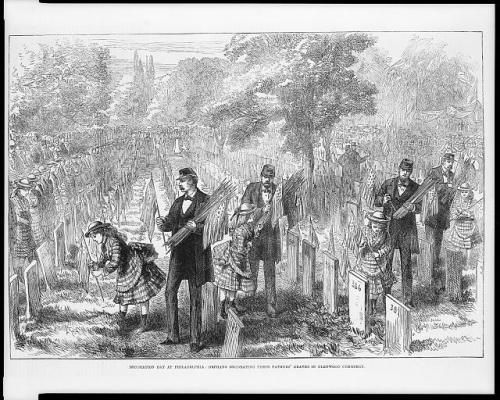
decoration-day1

“Dark and sad will be the hour to this nation when it forgets to pay grateful homage to its greatest benefactors. The offering we bring to-day is due alike to the patriot soldiers dead and their noble comrades who still live; for, whether living or dead, whether in time or eternity, the loyal soldiers who imperiled all for country and freedom are one and inseparable.” From Frederick Douglass’ Memorial Day Speech 1884

Memorial Day, at one time known as Decoration Day is one of our most sacred civil holidays that we celebrate in the United States, or at least it should be. It was a holiday born out of the shedding of the blood of about 600,000 American soldiers, from the North and the South in the Civil War, a singular event that still echoes in our history and in some sense defines who we are. The sad thing is that many; if not most Americans it is simply another holiday, a chance maybe to get a three day weekend at the end of the school year and beginning of summer vacation. This is so because we and our government dominated by business interests and our own wallets for decades knowingly made the decision to sacrifice of the teaching of history and heritage at the altar of “education” that “produces jobs.”

racecourse_t600

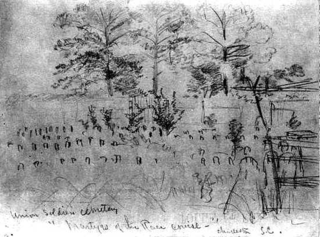
The Racecourse Cemetery

But the first observance of what we now know as Memorial Day is fascinating and it needs to be remembered. Frederick Douglass was absolutely right when he spoke the words that I began this article, and we need to remember the humble beginnings of this day which was first marked by recently freed slaves in Charleston South Carolina on May 1st 1865, barely two weeks after Abraham Lincoln was assassinated and three weeks after the surrender of Robert E. Lee and the Army of Northern Virginia at Appomattox Court House. Their commemoration was for the most part forgotten as Charleston sought to remove the vestiges of any Union sacrifice within the city limits in the 1880s.

The acrid smell of smoke of the last battles of the American Civil War was still lingering over many towns and cities in the South on May 1st 1865. Charleston South Carolina, the hotbed of secession was particularly hard hit during the war. In 1861 Cadets of the Citadel and South Carolina militia forces began the war with the bombardment of Fort Sumter. Union Forces laid siege to the city in late 1863, a siege which ended with the city’s surrender to Union forces on 18 February 1865. The day of the surrender was somewhat ironic. Charleston, the city most associated with the opening of the conflict surrendered to Union forces on the fourth anniversary of the inauguration of Jefferson Davis as President of the Confederacy. By the time of its surrender much of the city had been destroyed by Union siege artillery and naval forces.

Charleston had also been the home of three of the Prisoner of War Camps. One was located in the Charleston City Jail and the other at Castle Pinckney which had been one of the ante-bellum U.S. Army installations in the city. A third camp was erected on the site of the Washington Race Course and Jockey Club in 1864. This was an open air camp and Yale Historian David Blight wrote that “Union soldiers were kept in horrible conditions in the interior of the track; at least 257 died of exposure and disease and were hastily buried in a mass grave behind the grandstand.”

By the end of the war most of the white population of the city had left and most of those remaining were recently freed slaves. After their liberation and the city’s occupation by Federal forces, which included the famous 54th Massachusetts as well as the 20th, 35th and 104th US Colored Troops Regiments, about 28 these recently liberated Black men went to work and properly reinterred these 257 Union dead on the raceway building a high fence around it. They inscribed “Martyrs of the Race Course” on an arch above the cemetery entrance.

6a01b8d0781960970c01b7c7901048970b-320wi

On May 1st over 10,000 Black Charlestonians gathered at the site to honor the fallen. Psalms, Scriptures and prayers were said, hymns were sung and many brought flowers. A parade of 2800 children covered the burial ground with flowers. They were followed by members of the Patriotic Association of Colored Men and the Mutual Aid Society. This society’s members provided relief supplies to Freedmen and provided aid to bury those Blacks who were too poor to afford burial. More citizens followed many laying flower bouquets on the graves. Children then led the singing of The Star Spangled Banner, America and Rally around the Flag. The Brigade composed of the 54th Massachusetts and the 35th and 104th Colored Regiments marched in honor of their fallen comrades. Following the formalities many remained behind for a picnic.

Other communities established their own Memorial Day observances in the years following the war, but the event in Charleston was the first. The first “Official” commemoration was on 30 May 1868 when Union General John Logan who headed the veteran’s organization called The Grand Army of the Republic appealed to communities to honor the dead by holding ceremonies and decorating the graves of the fallen.

In the South three different days served a similar purpose. In Virginia people commemorated the day on June 3rd, the birthday of Confederate President Jefferson Davis, the Carolinas marked the day on 10 May, the birthday of General Thomas “Stonewall” Jackson. In much of the Deep South the event was conducted April 26th, the anniversary of the surrender of General Joseph Johnson’s Army to General William Tecumseh Sherman. For many in the South, still attempting to come to grips with their defeat the day would become about “The Lost Cause” or “the defense of Liberty” or “States Rights” and the war was often referred to as the “War of Northern Aggression.”

The “Martyrs of the Racecourse” cemetery is no longer there. The site is now a park honoring the fascinatingly complex Confederate General and post-Reconstruction Governor of South Carolina Wade Hampton. An oval track remains in the park and is used to run or walk by the local population and cadets from the Citadel. Thankfully, at long last in 2010, one hundred and forty-five years after the dedication of that cemetery a marker was placed in that park commemorating the cemetery and the event that we now recognize as the first Memorial Day.

First-Memorial-Day-honoring-257-Union-soldier-martyrs-10000-freedmen-march-led-by-3000-children-05011865

The Union dead who had been so beautifully honored by the Black population were moved to the National Cemetery at Beaufort South Carolina by the 1880s. Some state that the reason for this was that the cemetery had fallen into neglect, and this may be the case, but the event and their memory conveniently erased from memory of Charlestonians. I do not think that this would have happened had the people who had the bodies moved simply restored and maintained the cemetery. Had not historian David Blight found the documentation we probably still would not know of this touching act by former slaves who honored those that fought the battles, and gave their lives to win their freedom. Blight wrote in 2011 in the 1870s Charleston “had no place for the former slaves’ march on their masters’ racecourse.”

The African American population of Charleston understood the bonds of slavery and oppression. They understood the tyranny of prejudice in which they only counted as 3/5ths of a person. They understood and saw the suffering of those that were taken prisoner while attempting to liberate them from the tyranny of slavery. They stand as an example for us today.

But their suffering was not over. Within little more than a decade Blacks in the South would be subject to Jim Crow and again treated by many whites as something less than human. The struggle of they and their descendants against the tyranny of racial prejudice, discrimination and violence over the next 100 years would finally bear fruit in the Civil Rights movement, some of whose leaders, like the Reverend Doctor Martin Luther King Jr. would also become martyrs. Unfortunately that struggle is not over.

Frederick Douglass spoke to Union Veterans on Memorial Day 1878. His words, particularly in light of the war and the struggles of African Americans since and the understanding of what those who were enslaved understood liberation to be are most significant to our time. It was not merely a war based on sectionalism or even “States rights,” it was a war of ideas, a war of diametrically opposed ideologies. He said:

“But the sectional character of this war was merely accidental and its least significant feature. It was a war of ideas, a battle of principles and ideas which united one section and divided the other; a war between the old and new, slavery and freedom, barbarism and civilization; between a government based upon the broadest and grandest declaration of human rights the world ever heard or read, and another pretended government, based upon an open, bold and shocking denial of all rights, except the right of the strongest.”

Douglass’s words were powerful then and they resonate today as many of the same ideas that were the cause of the Civil War and were continued during Jim Crow are still alive. Unfortunately there are those in our society who labor daily to establish the “rights” of the strongest over the weak, the poor, the powerless and minorities of all kinds. Of course such actions, often wrapped in the flag, patriotism and buttressed with cherry picked quotes (many of which are fake, changed or taken out of context) from some of our founders are designed to re-establish the oligarchy of the power of the few, much like the men who owned the lives of the slaves and poor whites in the ante-bellum American South. Such actions do nothing but demean and trample the sacrifice of those who fought for freedom and the only remedy is to fight them with the full knowledge of truth.

american-flag

I do hope that today we will celebrate Memorial Day in a fitting manner. Let us honor those Americans who died that others might be free. Let us look back at what freedom actually means and not forget the sacrifices of those that gave, and still give their lives in the “last full measure of devotion to duty” that others might live. Take a moment today at noon to pause what you are doing and go silent for at least one minute, and remember.

Peace

Padre Steve+

Leave a comment

Filed under civil war, History, News and current events

Equality: The Early Women’s Rights Movement

senecafalls-womanspeaking

The Seneca Convention

Friends of Padre Steve’s World,

The issue of Women’s Rights is still in the forefront of political debate in the United States. Women’s rights have been slow to progress despite the passage of the 19th Amendment which gave women the right to vote in 1920. The defeat of the Equal Rights Amendment in 1982 gave added ammunition to conservative opponents of Women’s rights to fight them.

Though women have long been in the workplace in many cases there is a large gap in pay for men and women doing the same jobs and having the same qualifications, likewise, the number of women in senior positions in the private sector and in government is still dwarfed by the numbers of men. The are numerous disparities in how men and women are treated in society, and in many cases and in many parts of conservative society, especially churches, women are still considered less than equal to men. In light of the fact that we will likely have a woman running as the Democratic Party nominee for President the issue is even more pronounced, and Hilary Clinton, whether one likes her or not, and regardless of her policies, or previous record as a Senator or Secretary of State, is held to a higher standard of scrutiny than men in those position.

But this is nothing new, and in light of this I have decided to re-post a sightly edited portion of the chapter in my Civil War and Gettysburg text that deals with the early Women’s Rights movement. I hope that you find it insightful.

Peace

Padre Steve+

Another development, which in large part is related to the abolition movement, was the campaign for women’s rights. The Civil War was also revolutionary because it was instrumental in propelling women into positions in American society that they had never before been allowed. The war Some of this was because many women decided to like those who campaigned for the end of slavery and the rights of African Americans to turn the world upside down. The war allowed the women who served, “in uniform or not, war permitted these women to experiment with a series of role reversals in gender,” [1] and in some cases gender and race. These experiments are the beginning of women’s’ equality and to women serving in the military.

In much of the country and in particular the South, women’s rights were the same as granted in English Common Law. Common law held to the more archaic understanding of the Christian Church that women were the property of their husbands, especially in cases of infidelity including during the trial of Dan Sickles for killing Barton Key.

Southern culture and law ensured that women had even few rights than the women in the North who were making some gains in the workplace and in various professions such as teaching and nursing. This was in large part due to the understanding that the “household was a spatial unit, defined by the property to which the owner not only held legal title over, but over which he exercised exclusive rights.” [2] As such Southern men had nearly unlimited rights and power over what occurred on his property, for “in societies in which landed property comprised the chief means of subsistence…legal title to the land had historically incorporated claims over the persons and labor of those who were dependents on it.” [3]

Thus for Southern men the stakes of ensuring slavery’s continuation and expansion were high, the culture of the South ante-bellum South was deeply patriarchal and “The possibility that the black man might be empowered like any other was such a threat to the southern social hierarchy that some white southerners were inclined to fear not only for their position as slaveowners but for the entire basis of their claim to patriarchal power. They feared for their power not only over their slaves but over their women as well.[4]

William Lloyd Garrison and the leaders of the abolitionist movement came into contact with two southern women who had converted to the abolitionist cause; South Carolina cotton heiresses, Sarah and Angelina Grimke. The two women were passionate as well as eloquent and became popular lecturers on the abolitionist speaking circuit. Angelina Grimke was a powerful speaker and linked abolition and women’s rights:

“We cannot push Abolitionism forward with all our might until we take up the stumbling block out of the road…. If we surrender the right to speak in public this year, we must surrender the right to petition next year, and the right to write the year after, and so on. What then can the woman do for the slave, when she herself is under the feet of man and shamed into silence?” [5]

The Grimke sisters and other women like them brought Garrison and others in the abolitionist movement into contact with the early leaders of the new women’s rights movement. The leaders of the movement, Elizabeth Cady Stanton, Abby Kelley, and Lydia Maria Child were outspoken in their belief that “a campaign to emancipate slaves could not avert its eyes from the need to emancipate American women from social conventions and legal restraints that prevented them, like the slave, from owning property and voting, and kept them altogether subservient to the interests of white males.” [6]

The principals involved in the abolitionist and the women’s movements, those of freedom, emancipation and equality eventually forged a bond between them, and have provided inspiration to others in their quest for political and social equality. For William Lloyd Garrison “the woman question clearly demonstrated how the logic of reform united all good causes and carried them to new ground. If in their endeavors to break the chains of slavery women discovered, as Abby Kelley put it, that “we were manacled ourselves,” the abolitionist principle required a defense of equal rights without regard to race or sex.” [7]

However, women found that their rights were not considered as important by the political leadership fighting for the rights of black men. Few in Congress “responded sympathetically to feminists’ demands. Reconstruction they insisted, was the “Negro’s hour.” [8] Though the economic situation of women began to improve, especially through women being admitted to the Civil Service. Likewise women began to have more educational opportunities in the post-war years. Women’s suffrage was not included in the Fifteenth Amendment, which caused a split between women’s groups and their long-time abolitionist allies who told them “If put on the same level and urged in the same connection, neither will soon be accomplished.” [9]  Even so in some territories women were granted the right to vote in territorial elections, “women were given the vote in Wyoming Territory in 1869. However, Wyoming’s admission as a state twenty years later came only after a heated debate on the women’s suffrage article in the state constitution.” [10]

Elizabeth Cady Stanton

In the 1800s women in the United States were bound by English common law. Women had no claim to property, wages, or even their children. Single women had few rights while married women had even fewer as:

“marriage very nearly meant the legal annihilation of a woman…once a woman was married all property and property rights were transferred to her husband, and she was permitted to own nothing in her own name. Married women could not make contracts, could not sue, could not buy or sell, except over their husband’s signatures.” [11]

A married woman’s position was as close to being a slave as could be, and only the plight of black female slaves was worse, for they were simply chattel. The few free black women mainly stayed unmarried “in order to maintain what few property rights they were entitled to.” [12] As they also did over blacks, white men ruled over women in all spheres of life. While the eventual emancipation of blacks provided more rights for black men, those did not help many black women as Sojourner Truth, a pioneering African-American abolitionist who spent forty-years as a slave said toward the end of her long life:

“There is a great stir about colored men getting their rights, but not one word about colored women; and if colored men get their rights, and not colored women theirs, you see colored men will be master over the women, and it will be just as bad as it was before. So I am for keeping the thing going while things are still stirring because if we wait till it is still, it will take a great while to get it going again….I suppose I am the only colored woman that goes on to speak for the rights of the colored women. I want to keep the thing stirring, now that the ice is cracked…” [13]

Elizabeth Cady Stanton was among the most vocal of women’s rights advocates. She believed that a woman’s place in the home was ultimately destructive and “reflected her subordinate position in society and confined her to domestic duties that served to “destroy her confidence in her own powers, lessen her self respect, and to make her willing to lead a dependent and abject life.” [14] Stanton noted how the condition of women of her day was “more fully identified with the slave than man possibly can be… For while the man is born to do whatever he can, for the woman and the negro the is no such privilege.” [15] It was a key observation and something even today, a state that some politicians, pundits and preachers would like to return women.

Since nearly all of the most “outspoken feminists had been schooled in abolitionist movement” they were “suspect in the South, where society was conservative, patriarchal, and insistence that ladies live in a kind of earthly limbo.” [16] Such women posed a threat to the pillars of Southern society. Since the South was now fighting tooth and nail against the abolitionist movement, anything closely connected with that movement, including the women who advocated abolition and women’s rights were shunned and their message rejected and inflammatory and revolutionary. It was not until the crisis caused by the Civil war that Southern women began to seize “the opportunity to lay claim to an increased reciprocity in gender relations.” [17]

But even with the abolition movement there was opposition the women’s rights, the 1839 meeting of the American Anti-Slavery Society witnessed a debate over including women in the membership. Conservative Evangelicals recoiled in disgust, and when the convention voted to allow women into the membership Lewis Tappan “got up a starchy “protest” which condemned the “repugnant” admission of women as an ‘expression of local and sectarian feelings…well suited to the unnecessary reproach and embarrassment to the cause of the enslaved as [it] is at variance with the general usage and sentiments of this and other nations.” [18] In May of 1840 the American Anti-Slavery Society split among religious lines when leading evangelicals led by the Tappan brothers withdrew from it.

But that neither stopped Garrison from working with women, nor kept Frederick Douglass from embracing them as part of the abolitionist movement. From this rather inauspicious beginning, the women’s rights movement began to infiltrate society, especially in the field of education. In 1848 at Seneca New York there was a convention that launched the modern women’s rights movement. Led by Stanton and Elizabeth Mott the delegates published a “Declaration of Sentiments, modeled on the Declaration of Independence, proclaimed “that all men and women are created equal” and deserved their “inalienable rights” include the right to elective franchise.” [19] The declaration was bold and its denunciation of the place of women in society to be considered revolutionary in character. Part read:

“He has never permitted her to exercise her inalienable right to elective franchise. He has compelled her to submit to laws, in the formation of which she had no voice. He has withheld from her rights which are given to the most ignorant and degraded men – both natives and foreigners… He has made her, if married, in the eye of the law, civilly dead. He has taken from her all right to property, even to the wages that she earns…. After depriving her of all her rights as a married woman, if single, and the owner of property, he has taxed her to support a government which recognizes her only when her property can be made profitable to it. He has monopolized nearly all the profitable employments, and from those she is permitted to follow she receives but a scanty remuneration. He closes against her all the avenues to wealth and distinction which he considers honorable to himself. As a teacher of theology, medicine of the law, she is not known… He has created a false public sentiment by giving the world a different code of morals for men and women, by which moral delinquencies which exclude women from society, are not only tolerated, but deemed of little account in man. He has usurped the prerogative of Jehovah alone, claiming his right to assign for her a sphere of action, when that belongs to her conscience and to her God. He has endeavored, in every way that he could, to destroy her confidence in her own powers, lessen her self-respect, and to make her willing to lead an abject and dependent life.” [20]

The declaration also stated, in words which inflamed many men that: “the history of mankind is a history of repeated injuries and usurpations on the part of man toward woman, having in direct object of an absolute tyranny over her.” [21] In the years following this meeting women took up an even more important place in the abolitionist movement, Abby Kelly Foster returned to head the work and recruited many talented women agents including Sallie Holley, Lucy Stone and Susan B. Anthony who “often made five or six appearances a week” in various abolitionist meetings and in 1850-1851 they were joined by the “black evangelist Sojourner Truth, whom Garrison had met and the Northampton colony in 1843 and for whom he had printed an autobiographical narrative.” [22] These women contributed greatly to the abolitionist cause and would in the years to come be among those who continued to fight not only for the rights of blacks, but the rights of women.

The new women’s rights groups continued to work hand in hand with the abolitionist groups but also began a campaign for the rights of women. In the mid-1850s primarily focused on “obtaining state laws guaranteeing women’s right to control their property and wages, to be legal guardians of their children, and to be paid salaries commensurate with their labors, while a few women advocated for more liberal divorce laws so that they could rid themselves of alcoholic, insane, criminal, or brutal husbands.” [23] These efforts secured some modest gains and by 1861 most states had granted women some type of property rights or had changed their laws to follow the community property principle.

While the movement made modest progress regarding property rights for women in some states, they made little progress in terms of elective franchise and better wages and working conditions. During the ante-bellum period, women who lobbied for such rights were met with open opposition and scorn. The press “frequently denounced and ridiculed the “strong-minded women…” [24] Despite such attitudes women did make some significant advancements, particularly in lay aspects of the church, such as Bible societies, moral reform organizations, as well as the abolition and temperance movements, which had gained prominence during the Second Great Awakening.

During the ante-bellum period women made great progress in education. By 1850 the United States was the only country where “girls went to elementary school and achieved literacy in virtually the same proportion as boys.” [25] Likewise a few women entered higher education, particularly at women’s seminaries, which were for all practical purposes boarding schools that produced teachers and writers, as well as the Oberlin College, which was founded by Christian abolitionists and welcomed students of both genders as well as of any racial minority. During the three decades prior to the war women made some specific gains, but more important “was the development to their talents for organization, cooperation, leadership, and self expression. It was a time of beginnings and not fulfillment, a time when most women realized and accepted the fact that they lived in a man’s world, a time when a few dedicated but belligerent visionaries were frustrated in their attempt to remake the social order “overnight.” [26]

However, the war would help bring about many more opportunities for women. In 1850 a follow on conference to the Seneca conference, the National Women’s Rights Convention denied the right of anyone to dictate what women could do with their lives:

“The right of any portion of the species to decide for another portion, of any individual to decide for another Individual what is not their “proper sphere”; that the proper sphere for all human beings is the largest and highest to which they are able to attain; what this is, can not be ascertained without complete Liberty of choice; women therefore, ought to choose for herself what sphere she will fill, what education she will seek, and what employment she will follow, and will not be bound to accept, in submission, the rights, the education, and the place which man thinks proper to allow her.” [27]

Notes

[1] Ibid. Guelzo Fateful Lightening p.395

[2] McCurry, Stephanie The Politics of Yeoman Households in South Carolina in Divided Houses: Gender and the Civil War Oxford University Press, Oxford and New York 1992 p.23

[3] Ibid. McCurry The Politics of Yeoman Households in South Carolina p.23

[4] Whites, Leeann The Civil War as a Crisis in Gender in Major Problems in the Civil War and Reconstruction, 3rd Edition Edited by Michael Perlman and Murrell Taylor Wadsworth Centage Learning, Boston 2011 p.16

[5] Ibid. Zinn The Other Civil War p.121

[6] Ibid. Guelzo Fateful Lightening pp.49-50

[7] Mayer, Henry All on Fire: William Lloyd Garrison and the Abolition of Slavery W.W. Norton and Company, New York and London 1998 p.265

[8] Ibid. Foner Forever Free p.124

[9] Ibid. Foner Forever Free p.125

[10] Massey, Mary Elizabeth, Women in the Civil War University of Nebraska Press, Lincoln NE 1966 p. 358

[11] Ibid. Guelzo Fateful Lightening p.391

[12] Ibid. Guelzo Fateful Lightening p.391

[13] Ibid. Zinn The Other Civil War pp.53-54

[14] Ibid. Goldfield America Aflame p.74

[15] Ibid. Guelzo Fateful Lightening p.50

[16] Ibid. Massey Women in the Civil War p. 19

[17] Ibid. Whites The Civil War as a Crisis in Gender p.21

[18] Ibid. Mayer All on Fire p.267

[19] Ibid. McPherson Battle Cry of Freedom p.36

[20] Blanton, DeAnne and Cook, Lauren M. They Fought Like Demons: Women Soldiers in the Civil War Vintage a books, a Division of Random House New York 2002 pp.3-4

[21] Ibid. Guelzo Fateful Lightening p.392

[22] Ibid. Mayer All on Fire p.424

[23] Ibid. Massey Women in the Civil War p.21

[24] Ibid. Massey Women in the Civil War pp.21-22

[25] Ibid. McPherson The Battle Cry of Freedom p.36

[26] Ibid. Massey Women in the Civil War p.23

[27] Ibid. Guelzo Fateful Lightening p.392.

1 Comment

Filed under civil rights, History, laws and legislation, leadership, News and current events, Political Commentary

Fort Sumter Pt 2: Only Two Parties Now

sumterflag

The Flag of Fort Sumter

Friends of Padre Steve’s World,

Here is part two of another two-part installment of my Civil War text. The story follows the implosion of the Democratic Party, the election of Abraham Lincoln, and the secession crisis. It describes who the attack came about and the reactions of people in all parts of the country, as well as the Army to those fateful shots. I hope that you enjoy.

Peace

Padre Steve+

When the Stars and Stripes came down on April 14th 1861 the North was galvanized as never before, and “the clash at Fort Sumter brought forth an outpouring of support for the Union and President Lincoln.” [1] Abner Doubleday wrote “With the first shot fired against Fort Sumter the whole North became united.” [2] Another observer wrote: “The heather is on fire….I never knew what popular excitement can be… The whole population, men, women, and children, seem to be in the streets with Union favors and flags.” [3] The assault on Fort Sumter help to unify the North in ways not thought possible by Southern politicians who did not believe that Northerners had the mettle to go to war against them. But they were wrong, those shots, which Jefferson Davis ordered had the opposite reaction, for Northerners, even opponents of abolition who were not supporters of Lincoln, slavery in the South was one thing, but the attack on a Federal garrison by massed artillery was another; even Senator Stephen Douglas, Lincoln’s stalwart opponent of so many campaigns went to the White House for a call to national unity. Returning to Chicago he told a huge crowd just a month before his untimely death:

“There are only two sides to the question. Every man must be for the United States or against it. There can be no neutrals in this war, only patriots – or traitors” [4]

For Frederick Douglass the shots marked a new phase in abolition:

“The first flash of rebel gunpowder and shell upon the starving handful of men at Sumter instantly changed the nation’s whole policy. Until then, the ever hopeful North was dreaming of compromise…

I wrote in my newspaper; “On behalf of our enslaved and bleeding brothers and sisters, thank God! The slaveholders themselves have saved the abolition cause from ruin! The government is aroused, the dead North is alive, and its divided people united. Never was a change so sudden, so universal, and so portentous. The whole North from East to West is in arms…” [5]

Douglas died less than a month later, possibly from cirrhosis of the liver, but his impact on the Democrats in the North was immense, “for a year of more his war spirit lived among most Democrats. “Let our enemies perish by the sword,” was the theme of democratic editorials in the spring of 1861. “All squeamish sentimentality should be discarded, and bloody vengeance wreaked upon the heads of the contemptable traitors who have provoked it by their dastardly impertinence and rebellious acts.” [6]

sickles as brigadier

Dan Sickles

One of these Democrats was New York Congressman Dan Sickles. He was one of many men whose outlook toward the South changed when Sumter was fired upon. Sickles had stridently defended Southerners and Southern states rights just months before, so long as they remained in the Union, and he took the actions of his former friends personally. He then became one of the first of men who were known as Union Democrats who followed Lincoln into the war, and despite his lack of ethics in much of his life it was a cause for which he would remain true, during and after the war.

When the soldiers of South Carolina opened fire on Fort Sumter, Sickles, who had said that no troops would cross through New York to invade the South in 1859 proclaimed “the men of New York would go in untold thousands anywhere to protect the flag of their country and to maintain its legitimate authority.” [7] In one of his last congressional speeches Sickles lambasted the South for its threat to the United States as a whole, and condemned the new Confederacy’s policies in spite of Northern attempts to conciliate them, “has been followed by insults to our flag; by the expulsion of the United States troops and authorities from navy yards and forts and arsenals; by measures to control the vast commerce of the Mississippi and its tributaries….” [8] He also condemned the South for its seizure of U.S. funds in the sub-treasuries and mints in the South as well sending envoys to England and France.

Sickles-Excelsior-Brigade-Headquarters-City-Hall-Park.-Yorktown

After the war Sickles, who had lost his leg in the Battle of Gettysburg fighting for the Union, oversaw the early efforts of reconstruction in North Carolina and for ordering the end to the public whippings of blacks by state officials was fired by President Andrew Johnston for supporting voting rights for African Americans. Congress reinstated him but Sickles who had so earnestly supported the South as late as 1860 no longer could stomach such abuse by those men who at one time his political friends and allies. During the election of 1876 Sickles, a lifelong Democrat labeled his party as “the party of treason.” [9] He joined forces with Republicans and helped to prevent the election of New York Democrat Samuel Tilden through shrewd political electioneering in key battleground states.

For Stephen Douglas the attack on Fort Sumter meant the end of his efforts to bring about some kind of reconciliation to reunite the country and restore the Union. When the Little Giant heard the news of the attack and reports of the statements of Confederate leaders he rushed to Lincoln to offer his support. Douglas wrote of the meeting:

“I heartily approve of your proclamation calling up 75,000 militia,” I told him. “Except that I would make it 200,000. You don’t know the dishonest purposes of these southern men as well as I do.” After a review of the strategic situation with the President Douglas continued, “Mr. President,” I said. “Let me speak plainly. I remain unalterably opposed to your Administration on purely its political issues. Yet I’m prepared to sustain you in the exercise of all your constitutional functions to preserve the Union, maintain the government, and defend the capital. A firm policy and prompt action are necessary. The capital of our country is in danger, and must be defended at all hazards, and at any expense of men and money. I speak of the present and future without reference to the past.

He shook my hand, hard. “We need more patriots like you, Douglas,” he said as he walked me to the door.

“I depreciate war,” I said in parting, “but if it must come, I’m with my country and for my country, under all circumstances and in every contingency.” [10]

Douglas then went to his fellow Democrats in Washington and told them: “We must fight for our country and forget all differences. There can be only two parties now – the party of patriots and the party of traitors. We belong to the first.” [11]

ewell

Richard Ewell

Army officers were conflicted between the Army that they had served, often for many years, the flag that they had fought under, longstanding friendships, and loyalty to their states and families. Richard Ewell who would rise to corps command in the Army of Northern Virginia, described the feelings of many officers in the ante-bellum Army: “Officers generally are very much adverse to any thing like civil war, though some of the younger ones are a bit warlike. The truth is in the army there are no sectional feelings and many from extreme ends of the Union are the most intimate friends.” [12] In California a number of those friends and their families bade tearful farewells as they parted ways. Brigadier General Albert Sidney Johnston and Captains Winfield Scott Hancock and Lewis Armistead gathered one last time. Hancock had already, who had great sympathy for his Southern friends, made his views known had previously announced “I shall fight not upon the principle of state-rights, but for the Union, whole and undivided.” [13] His commander, Johnston, and dear friend Armistead were departing to serve the Confederacy and the parting was painful. Almira Hancock wrote of the final night together in Los Angeles:

“The most crushed was Major Armistead, who with tears, which were contagious, streaming down his face, put his hands upon Mr. Hancock’s shoulders, while looking him steadily in the eye, said, “Hancock, good-bye; you can never know what this has cost me; and I hope God will strike me dead if I am ever induced to leave my native soil, should worse come to worst….” [14]

Colonel Robert E. Lee of Virginia looked askance at secession, but he had made the decision that no matter what he would not lead armies against the South. In fact it was clear when he left Texas to come east where his sentiments lay. He told a friend “If Virginia stands by the old Union, so will I. But if she secedes (though I do believe in secession as a constitutional right, nor that there is sufficient cause for revolution), then I will follow my native State with my sword, and if need be, with my life.” [15] When he returned to Washington D.C. he accepted a promotion to Colonel in the Regular Army less than a month before he was offered command of the Union armies by Abraham Lincoln, a position that he turned down. In his final interview with General Winfield Scott to announce his decision, he admitted that “the struggle had been hard. He did not believe in secession, he said, and if he owned every slave in the South he would free them all to bring peace; but to fight against Virginia was not in him.” [16] When Virginia seceded Lee submitted his resignation from the Army for a cause that he did not really believe was constitutional or necessary, noting in his letter:

“With all my devotion to the Union and feeling of loyalty and duty of an American citizen, I have not been able to make up my mind to raise my hand against my relatives, my children, my home. I have therefore, resigned my commission in the Army, and save in the defense of my native State…I hope I may never be called upon to draw my sword.” [17]

Within days Lee was appointed as a General and commander of the military forces of Virginia. When he arrived at the State House and “before he had much time to ruminate, he found himself being presented with George Washington’s sword, and hailed as a hero in a powerful tribute by the president of the convention.” [18] Even so, Lee’s decision was assailed by much of his Unionist oriented family, and many of them went on to serve the Union with distinction during the war. One relative wrote of Lee’s decision, “I feel no exalted respect for a man who takes part in a movement in which he says he can see nothing but ‘anarchy and ruin’… and yet very utterance scare passed Robt Lees lips… when he starts off with delegates to treat traitors.” [19]

Lee’s future right hand man and chief lieutenant, Thomas Jackson, the soon to be “Stonewall” Jackson was then a professor at the Virginia Military Institute. The often grim and serious Jackson saw the issue of secession as he did all of life through the prism of his Evangelical Protestant Calvinistic faith. For him it disunion was a matter of Divine Providence. When secession came and Jackson heard a minister friend in Lexington lamenting the nation’s troubles he noted:

“Why should Christians be at all disturbed about the dissolution of the Union? It can only come by God’s permission, and only will be permitted, if it is for his people’s good, for does he not say that all things shall work together for the good to them that love God?” [20]

In San Francisco Lieutenant James McPherson of the Corps of Engineers attempted to convince Lieutenant Porter Alexander from going home and joining the cause of the Confederacy. He bluntly spoke the facts of what would happen to the South in coming the war to the future Confederate artillery general:

“The population of the seceding states is only eight million while the North has twenty million. Of your 8 million over 3 million are slaves & may pose a dangerous element. You have no army, no navy, no treasury, no organization & practically none of the manufacturers – the machine shops, coal & iron mines & such things – which are necessary for the support of armies & carrying on war on a large scale.

You are but scattered agricultural communities & will be isolated from the world by blockades.

It is not possible for your cause to succeed in the end…” [21]

But Alexander, like so many Southern officers realized “that a crisis in my life was at hand. But I felt helpless to avert it or even debate the question what I should do. I could not doubt or controvert one of McPherson’s statements or arguments…” [22]

buford

John Buford

However, many Southern born officers serving in the Army did not leave. Close to half of the “Southern West Point graduates on active duty in 1860 held to their posts and remained loyal to the Union.” [23] One was Kentucky’s John Buford who would gain immortal fame at the Battle of Gettysburg. Since Buford’s family had longstanding ties to Kentucky, the pro-secession governor of Kentucky, Beriah Magoffin offered Buford a commission in that states’ militia. At the time Kentucky was still an “undeclared border slave state” and Buford loyal to his oath refused the governor’s offer. He wrote a brief letter to Magoffin and told his comrades that “I sent him word that I was a Captain in the United States Army and I intend to remain one.” [24] Around the same time the new provisional government of the Confederacy “offered Buford a general officer’s commission, which reached him by mail at Fort Crittenden.” [25] According to Buford’s biographer Edward Longacre “a well-known anecdote has him wadding up the letter while angrily announcing that whatever future had in store he would “live and die under the flag of the Union.” [26] A starker contrast could not be drawn.

Close to forty-percent of the Virginians serving on active-duty in the army remained faithful to the Union, including the Commander of the Army, General Winfield Scott and Robert E. Lee’s friend George Thomas and both were ostracized in the Old Dominion. “Thomas’s family never again communicated with him except to ask him to change his name. A young Virginian just out of West Point, acknowledged that by retaining his commission he had been shunned by all of his Southern associates; yet he still derided those who would hold their obligations so lightly as to abandon the nation when it most needed them.” [27]

But throughout the South, most people were less than circumspect and openly rejoiced at the surrender of Fort Sumter. In Richmond the night following the surrender “bonfires and fireworks of every description were illuminating in every direction- the whole city was a scene of joy owing to [the] surrender of Fort Sumter” – and Virginia wasn’t even part of the Confederacy.” [28] John Gordon, the future Confederate General was leading his Georgia volunteers to the new Confederate capital and “found the line of march an unbroken celebration: fires lighted the hilltops; fife-and-drum corps shrilled and thumped; cannons exploded their welcome.” [29]

poor--ulysses-s-grant-president-1040cs021412

Ulysses Grant

Far to the north in Bangor Maine a little known professor at Bowdin College named Joshua Lawrence Chamberlain read the news “could not abide the thought of a divided nation; the Founding Fathers “did not vote themselves into a people; they recognized and declared that they were a people” whose bonds out not to be severed by political, social, or economic grievances.” [30] The professor “was seized with anger that “the flag of the Nation had been insulted” and “the integrity and existence of the people of the United States had been assailed in open and bitter war.” [31] In Illinois, a former struggling former Regular Army officer and veteran of the War with Mexico, Ulysses S. Grant whose in-laws were sympathetic to the Southern cause who had volunteered to lead a regiment of Illinois volunteers, wrote “Whatever may have been my opinions before, I have but one sentiment now. That is to have a Government, and laws and a flag and they all must be sustained….There are but two parties now, Traitors and Patriots and I want hereafter to be ranked with the latter.” [32]

1st_7th_Reg_Departs

Even in cities that had often leaned toward the South like Cincinnati, people rushed to proclaim their patriotism and support of the Union. George Ticknor told an English friend “The whole population, men, women, and children, seem to be in the streets with Union favours and flags…. Civil war is freely accepted everywhere… by all, anarchy being the obvious, and perhaps the only alternative.” Pacifists who had rejected violence, even in support of righteous causes, turned bellicose. Ralph Waldo Emerson enthused, “Sometimes gunpowder smells good.” [33] As the Sixth Massachusetts Volunteer Infantry marched through the streets of New York on their way to Washington were greeted with cheers from thousands of New Yorkers. The New York Times reported the event:

“Flags were displayed at all the hotels on the route, and waving handkerchiefs from the balconies and windows signified the warm greetings of the fair sex to the brave Bay State soldiers. Opposite the New York Hotel a gray-haired old man mounted a stoop and addressing the soldiers and people, said that he had fought under the Stars and Stripes in the War of 1812 against a foreign power, and now that the flag was spit upon by those who should be its defenders. He closed his remarks by a “God bless our flag,” and left the crowd with tears streaming down his wrinkled cheeks.” [34]

The Rubicon had been crossed and there was now no going back for either side. Poet Walt Whitman wrote:

War! An arm’d race is advancing! The welcome for battle, no turning away;

War! Be it weeks, months, or years, an arm’d race is advancing to welcome it.” [35]

Notes

[1] Ibid. Cooper We Have the War Upon Us p.270

[2] Doubleday, Abner From Moultrie to Sumter in Battles and Leaders of the Civil War Volume I Edited by Robert Underwood Johnson and Clarence Clough Buel Castle, Secaucus NJ p.48

[3] Ibid. McPherson The Battle Cry of Freedom p.274

[4] Ibid. McPherson The Battle Cry of Freedom p.274

[5] Ibid. Oates The Approaching Fury p.423

[6] Ibid. McPherson The Battle Cry of Freedom pp.274-275

[7] Ibid. Keneally American Scoundrel p.212

[8] Ibid. Keneally American Scoundrel p.214

[9] Ibid. Goldfield America Aflame p.525

[10] Ibid. Oates The Approaching Fury pp.421-422

[11] Ibid. Oates The Approaching Fury p.422

[12] Pfanz, Donald. Richard S. Ewell: A Soldier’s Life University of North Carolina Press, Chapel Hill and London 1998 p.120

[13] Jordan, David M. Winfield Scott Hancock: A Soldier’s Life Indiana University Press, Bloomington and Indianapolis 1988 p.33

[14] Hancock, Almira Reminiscences of Winfield Scott Hancock Charles L Webster and Company, New York 1887 pp.69-70

[15] Thomas, Emory Robert E. Lee W.W. Norton and Company, New York and London 1995 p.187

[16] Ibid. Catton The Coming Fury p.335

[17] Ibid. Thomas The Confederate Nation p.85

[18] Pryor, Elizabeth Brown. Reading the Man: A Portrait of Robert E. Lee Through His Private Letters Penguin Books, New York and London 2007 p.295

[19] Ibid. Pryor Reading the Man p.295

[20] Ibid. Rable God’s Almost Chosen Peoples p.38

[21] Alexander, Edward Porter. Fighting for the Confederacy: The Personal Recollections of General Edward Porter Alexander edited by Gary Gallagher University of North Carolina Press, Chapel Hill 1989 p.24

[22] Ibid. Alexander Fighting for the Confederacy p.25

[23] Huntington, Samuel P. The Soldier and the State: The Theory and Politics of Civil-Military Relations, The Belknap Press of Harvard University Press, Cambridge MA and London 1957

[24] Ibid. Guelzo. Gettysburg: The Last Invasion p.121

[25] Longacre, Edward G. John Buford: A Military Biography Da Capo Press, Perseus Book Group, Cambridge MA p.70

[26] Ibid. Longacre John Buford p.70

[27] Pryor, Elizabeth Brown. Reading the Man: A Portrait of Robert E. Lee Through His Private Letters Penguin Books, New York and London 2007 p.292

[28] Ibid. Guelzo Fateful Lightening p.140

[29] Smith, Jean Edward. Grant Simon and Schuster, New York and London 2001 p.99

[30] Longacre, Edward G. Joshua Chamberlain: The Soldier and the Man Combined Publishing Conshohocken PA 1999 pp.49-50

[31] Ibid. Guelzo. Gettysburg: The Last Invasion p.139

[32] Ibid. Smith Grant p.103

[33] Ibid. Goldfield America Aflame p.205

[34] Holzer, Harold and Symonds, Craig L. Editors, The New York Times Complete Civil War 1861-1865 Black Dog and Leventhal Publishers, New York 2010 p.75

[35] Ibid. Goldfield America Aflame p.205

2 Comments

Filed under civil war, History, Military, Political Commentary

When Political Parties Implode, Pt 4: The Secession Crisis

Friends of Padre Steve’s World

Over the past six months or so I have alluded to events in the Republican Party that make it appear that it is about to implode. I am a historian, and there is precedent in American history for the collapse of a national political party. This happened before in the 1854 collapse of the Whig Party, the 1912 division in the republican Party, but more importantly during the 1858 through 1860 collapse of the Democratic Party. Now I am not a person to say that history repeats itself. there are similarities and trends, but nothing is ever exactly the same as to why different parties collapse.  

While the issues of each day may be different there are common threads of humanity, hubris and hatred that unite to destroy political parties. I think that this is happening now in the Republican Party, and that it is possible that something similar may occur with the Democratic Party in the coming years. So it is important to look at history whenever possible to see how different political leaders responded in times of intense ideological, economic, social, national, and sectional division.

I decided to add an afterward to the three part series on the disaster that the Democratic Party made for itself and the country between 1858 and 1860. The third part deals with the after effects of results of the democratic Party split in the election of 1860. This deals with the secession crisis that enveloped the nation as former Southern Democrats led their states into rebellion against the Union and Northern Democrats joined the anti-secession party in the North.

This is a section of one of the chapters of my Civil War and Gettysburg text and I hope that you will find it interesting and thought provoking.

Peace,

Padre Steve+

disunion_carolina-blog427

After the election Lincoln tried to reassure the South that he would remain true to his campaign promise not to interfere with slavery where it already existed, but he also refused to give in to threats of secession. Despite his belief that anything that he said would be twisted into the exact opposite by Southerners, Lincoln released a statement through Senator Lyman Trumbull in Springfield saying:

“The states will be left in complete control of their affairs and property within their respective limits as they have under any administration. I regard it as extremely fortunate for the peace of the whole country, that this point, upon which the Republicans have been for so long, as so presently misrepresented, is now brought to a practical test, and placed beyond the possibility of doubt. Disunionists per se, are now in hot haste to get out of the Union, precisely because they perceive they cannot, much longer, maintain apprehension among the southern people that in their homes, and firesides, and lives, are to be endangered by the action of the Federal Government.” [1]

On his way to Washington D.C. the President Elect stopped in New York and gave a speech “promising that he would “never of his own volition “consent to the destruction of this Union,” he qualified this promise with “unless it were that to be that thing for which the Union itself was made.” [2] Two days later Lincoln speaking Independence Hall in Philadelphia Lincoln further detailed what he meant in New York, going back to the premise of the Declaration of Independence in which “he asserted that he “never had a feeling politically that did not spring from the sentiments embodied in the Declaration…. I was not the mere matter of separation of the colonies from the mother land; but rather something in that Declaration” that provided “hope for the world for all future time. It was that which gave promise that in due time the weights should be lifted from the shoulders of all men, and that all should have an equal chance.” [3] It was a thought that he would continue to refine in the Emancipation Proclamation Gettysburg Address, the Thirteenth Amendment and in his Second Inaugural Address.

Stephen A. Douglas tried to reassure the Southern leaders as well even as argued against secession. He reminded Southerners how he had fought against Lincoln and the platform of the Republican Party and stated “that the mere election of any man to the Presidency does not furnish just cause for dissolving the Union.” [4] Addressing Southern concerns in a pragmatic way, the Little Giant tried to diffuse Southern fears by reminding them that the answer to their fears lay in the checks and balances laid out in the Constitution and in the ballot box. Douglas’s next words redound to the present day:

“It is apprehended that the policy of Mr. Lincoln and the principles of his party endanger the peace of the slaveholding states. Is that apprehension founded? No, it is not. Mr. Lincoln and his party lack the power, even if they had the disposition, to disturb or impair the rights and institutions of the South. They certainly cannot harm the South under existing laws. Will they have the power to repeal or change these laws, or to enact others? It is well known that they will be a minority in both houses of Congress, with the Supreme Court against them. Hence no bill can pass either house of Congress impairing or disturbing these rights or institutions of the southern people in any manner whatever, unless a portion of southern senators and representatives absent themselves so as to give an abolition majority in consequence of their actions.

In short, the President will be utterly powerless to do evil…. Four years shall soon pass, when the ballot box will furnish a peaceful, legal, and constitutional remedy for the evils and grievances with which the country might be afflicted.” [5]

An attempt in Congress led by President James Buchanan and Senator John J. Crittenden of Kentucky to bring about a constitutional compromise to mollify both sides was considered. A committee of thirteen senators was convened to entertain various compromise propositions, however, most of the suggested compromises were heavily weighted toward Southern interests, though it promised to restore the prohibition of slavery north of the line drawn in the Missouri Compromise.

lincolnearly

Abraham Lincoln

A frustrated Lincoln wrote, “I’ll tell you now what bothered me: the compromises measures introduced in Congress required the Republicans to make all the concessions.” [6] Lincoln warned Crittenden that such proposals would not be acceptable: “Entertain no proposition for a compromise in regard to the extension of slavery…. The instant you do they have us under again…. The tug has to come & better now than later.” [7]

Lincoln had seen how for four decades Southerners had pushed for compromises that only benefited them and the extension of slavery, even at the expense of Northern states rights and he was not about to let it happen again. The President Elect wrote:

“The Crittenden plan, I feared, would put the country back on the high road to a slave empire. Whether it was the revival of the Missouri Compromise line or a popular sovereignty, it was all the same. “Let neither be done,” I warned Republicans in Washington, “and immediately filibustering and extending slavery recommences. Within a year, we shall have to take Cuba as a condition on which the South will stay in the Union. Next it will be Mexico, then Central American. On the territorial question, I am inflexible. On that point hold firm as a chain of steel…” [8]

In the South the efforts of staunch Southern Unionists like Alexander Stephens to discourage secession were dismissed as the movement toward secession became a passion filled revolutionary movement, which acted as a cathartic movement for many Southerners. Like Douglas, Stephens had the greatest faith in the checks and balances provided in the Constitution and he pleaded with his fellow Georgians at the state capital of Milledgeville noting that the checks and balances “would render Lincoln “powerless to do any great mischief,” and he warned that “the dissolution of the Union would endanger this “Eden of the world,” that “instead of becoming gods, we shall become demons, and no distant day commence cutting one another’s throats…” [9] While his speech received favorable coverage in the North and even in London, it was met with little enthusiasm at home.

Influential Southern preachers joined in the push for secession and warned of what they saw as the dire consequences of Lincoln’s election. The Baptist clergyman James Furman expressed the outrage and paranoia of many in the South by warning after Lincoln’s election “If you are tame enough to submit, Abolition preachers will be at hand to consummate the marriage of your daughters to black husbands.” [10] Likewise entire southern denominations began to endorse secession, southern Methodists raised “alarms about a Union dominated by abolitionists as they called on the Lord for deliverance from the northern “Egypt.” The division of Israel and Judah (not to mention the nation’s already fractured churches0 became typologies for the American crisis. Just as southern Methodists had once “seceded from a corrupt church,” a Mississippi politician declared, “We must secede from a corrupt nation.” To drive the point home, Georgia Methodists ministers endorsed disunion by an overwhelming 87-9 vote.” [11]

Despite Lincoln and Douglas’s efforts during and after the election to strike a conciliatory tone, it did not take long before Southern states began to secede from the Union. In light of the profoundly sectional nature of Lincoln’s victory “emboldened many Southern politicians and journalists to insist that they would not be bound by the result.” [12] In his final speech before the Senate, Senator Robert Toombs of Georgia lambasted the “black Republicans” and abolitionists, “We want no negro equality, no negro citizenship, we want no negro race to degrade our own; and as one man [we] would meet you upon the border with the sword in one hand and the torch in the other.” [13] Other Senators, many who would become prominent leaders of the Confederacy made their speeches, some, like that of Jefferson Davis tinged with regret while others like Senator Stephen Mallory, and the future Secretary of the Navy for the Confederacy delivered a fiery broadside against his Northern colleagues, “You cannot conquer us. Imbue your hands in our blood and the rains of a century will not wipe away from them stain, while the coming generation will weep for your wickedness and folly.” [14] As these men finished the left the chambers of Congress where many had served for years many left with tears, while some marked their exit with angry words.

220px-Alexander_Stephens

Alexander Stephens

Stephens, still a Unionist at heart lamented the election even as he prepared to leave the Senate before becoming the vice president of the Confederacy, warned that “revolutions are much easier started than controlled, and the men who begin them [often] …themselves become the victims.” [15] Even so the senator noted “If the policy of Mr. Lincoln and his Republican associates be carried out…no man in Georgia will be more willing or ready than myself to defend our rights, interest, and honor at every hazard and to the last extremity.” [16] But as he resigned his office Stephens replied to a friend’s question, “why must we have civil war?”

“Because there are not virtue and patriotism and sense enough left in the country to avoid it. Mark me, when I repeat that in less than twelve months we shall be in the midst of a bloody war. What will become of us then God only knows.” [17]

But Stephens’ warning fell on deaf ears as passionate secessionist commissioners went throughout the South spreading their message of fear. “Thus fanned, mob spirit ran close enough to the surface to intimidate many moderates – the very temperament that inclines men toward moderation is apt to respond timidly when threatened or abused – and to push others closer to the extremist position.” [18] Such was the case with Southern moderates and Unionists as men like Stephens were swept up in the tumult as their states seceded from the Union. Senator Judah P. Benjamin of Louisiana wrote, “The prudent and conservative men South… were not able to stem the wild torrent of passion which is carrying everything before it…. It is a revolution…of the most intense character…and it can no more be checked by human effort, for the time, than a prairie fire by a gardener’s watering pot.” [19]

disunion_dec20_secession3-blog427

The Palmetto State of South Carolina was the first state to secede. Its senior senator, James Chesnut launched a fusillade against the North in a speech before the state legislature in which he argued that the South could not wait for another election: He thundered:

“Because of the Yankee puritans’ invasive mentality, incendiary documents would flood our region, Southern Republicans would fill our offices. Enemies would control our mails. The resulting upheaval would make “Lincoln’s election…a decree for emancipation. Slavery cannot survive the four years of an administration whose overwhelming influences” will be “brought to bear against it.” To submit now is to guarantee that before 1865, we must “slay the Negro, or ourselves be slain.” [20]

William Tecumseh Sherman was serving as the President the Louisiana State Seminary of Learning and Military Academy, what is now Louisiana State University. Like many men in the ante-bellum era, Sherman had thought little about the slavery issue, though he was very concerned with the preservation of the Union. He thought secession made no sense, especially for the people of the South. When Sherman read the news of South Carolina’s secession it “cut to the depths of his nationalistic soul.” The future general wept, and told his friend David Boyd “Boyd, you people of the South don’t know what you are doing! You think you can tear to pieces this great union without war…. “The North can make a steam-engine, locomotive, or railway car; hardly a yard of cloth or shoes can you make. You are rushing into war with one of the most powerful, ingeniously mechanical and determined people on earth…. You are bound to fail. Only in spirit and determination are you prepared for war.” [21] Sherman, the man who later proclaimed that “War is Hell” proved to be a remarkably accurate seer regarding the fate of the Confederacy.

South Carolina was followed by Mississippi, Florida, Alabama, Georgia, Louisiana and Texas. “A belt of seven states from South Carolina to Texas, embracing nearly one-sixth of the country’s population and nearly one-fifth of the national domain, had proclaimed independence and severed its ties with the Union.” [22] Many of the declarations of causes for secession made it quite clear and explicit that slavery, and fear that the institution was threatened by Northern abolitionists was the root cause. The declaration of South Carolina is typical of these and is instructive of the basic root cause of the war:

“all the States north of that line have united in the election of a man to the high office of President of the United States, whose opinions and purposes are hostile to slavery. He is to be entrusted with the administration of the common Government, because he has declared that that “Government cannot endure permanently half slave, half free,” and that the public mind must rest in the belief that slavery is in the course of ultimate extinction.” [23]

Throughout the war slavery loomed large, even though in the beginning of the abolition controversies of the 1830s many northerners “were content to tolerate slavery’s indefinite survival in the South so long as it did not impinge on their own rights and aspirations at home.” [24] Such attitudes were still common in the North during the late 1850s, especially among Democrats.

But it was the continued actions and multiple transgressions of slavery supporters that energized northerners as never before. Their use of the courts to advance their rights and the cause of slavery, by the compromises that had extended slavery to the territories; their use of the courts especially the Dred Scott to allow slaveholders to recover their human property, even in Free States provoked no end of indignation throughout the North, even for those sympathetic to Southern concerns. Those actions demonstrated to Northerners:

“just how fundamental and intractable the differences with Southern political leaders were. Thus educated, most northern voters had decided by 1860 that only an explicitly anti-slavery party could protect their interests.” [25]

The fiery abolitionist and profoundly religious editor of The Liberator, William Lloyd Garrison, used biblical imagery in a rather astute analysis of the behavior of Southern leaders after the election of 1860. He wrote of the Southern response to Lincoln’s election:

“Never had the truth of the ancient proverb “Whom the gods intend to destroy, they first make mad” been more signally illustrated than in the condition of southern slaveholders following Lincoln’s election. They were insane from their fears, their guilty forebodings, their lust for power and rule, hatred of free institutions, their merited consciousness of merited judgments; so that they may be properly classed as the inmates of a lunatic asylum. Their dread of Mr. Lincoln, of his Administration, of the Republican Party, demonstrated their insanity. In vain did Mr. Lincoln tell them, “I do not stand pledged to the abolition of slavery where it already exists.” They raved just as fiercely as though he were another John Brown, armed for southern invasion and universal emancipation! In vain did the Republican party present one point of antagonism to slavery – to wit, no more territorial expansion. In vain did that party exhibit the utmost caution not to give offense to any other direction – and make itself hoarse in uttering professions of loyalty to the Constitution and the Union. The South protested that its designs were infernal, and for them was “sleep no more!” Were these not the signs of a demented people?” [26]

But both sides were blind to their actions and with few exceptions, most leaders, especially in the South badly miscalculated the effects of the election of 1860. The leaders in the North did not realize that the election of Lincoln would mean the secession of one or more Southern states, and Southerners “were not able to see that secession would finally mean war” [27] despite the warnings of Alexander Stephens to the contrary. In fact throughout the South it was believed that there would be no war because “they believed that the Yankees were cowards and would not fight”… “Senator James Chesnut of South Carolina offered to drink all the blood shed as a consequence of secession. It became a common saying in the South during the secession winter that “a lady’s thimble will hold all the blood that will be shed.” [28]

Following their secession the five slave states of the lower South: “appointed commissioners to the other slave states, and instructed them to spread the secessionist message across the entire region. These commissioners often explained in detail why their states were exiting the Union, and they did everything in their power to persuade laggard slave states to join the secessionist cause. From December 1860 to April 1861 they carried the gospel of disunion to the far corners of the South.” [29]

The editors of the Philadelphia Press accused the Southern secessionists of being enemies of democracy and wrote:

“should the Cotton States go out in a body, we shall witness the beginning of an experiment to establish, on this continent, a great slaveholding monarchy. With few exceptions, the leaders of the Disunion cabal are men of the most aristocratic pretensions – men who…easily adopt the habits and titles of the European nobility. South Carolina, which is the head of Secession, is almost a monarchy herself. Her representatives in both branches of Congress, for years past, have acted upon the idea that the people of the free states are servile, and Mr. Hammond, the most candid and straightforward of the set, denounced the laboring white masses of the free States as the mudsills of society …” [30]

The mood of the South in the fall of 1860 was “fearful, uncertain, impatient and volatile, eager to adopt the course that best offered hope of deliverance – which was ideally suited for the immediacy and urgency of the radical secessionists.” [31] Using the political machinery of the Democratic Party in the South which they now possessed, the proponents of secession were far better organized than Southern Unionists who had a difficult time putting up a united front in the face of the radicals.

Slavery and the superiority of the white race over blacks were at the heart of the message brought by these commissioners to the legislatures of the yet undecided states. Former Congressman John McQueen of South Carolina wrote to secessionists in Virginia “We, of South Carolina, hope to greet you in a Southern Confederacy, where white men shall rule our destinies, and from which we may transmit our posterity the rights, privileges and honor left us by our ancestors.” [32] In Texas McQueen told the Texas Convention: “Lincoln was elected by a sectional vote, whose platform was that of the Black Republican part and whose policy was to be the abolition of slavery upon this continent and the elevation of our own slaves to an equality with ourselves and our children.” [33] These Southern secessionists were realists, they knew that the election of 1860 was a watershed in terms of the history of slavery in the United States, emancipation was coming, it might take a decade, it might take twenty-five or even fifty years, but they knew that it was coming, and for them secession was the only logical action left that was “consistent with their ideology.” [34] Many of these men now viewed it as an issue of now or never.

In his First Inaugural Address Lincoln cut to the heart of the division in the country: “One section of our country believes slavery is right and ought to be extended, while the other believes it is wrong and ought not to be extended. This is the only substantial dispute.” [35] Of course he was right, and his Southern opponents agreed. Jefferson Davis wrote: “The great northern party, thus organized, succeeded in electing to the office of the Presidency a man who openly proclaimed his hatred of slavery, who declared that the government could not endure “half slave and half free.” [36]

As the war began, white Southerners of all types and classes rallied to the call of war against the hated Yankee. The common people, the poor yeomen farmers were often the most stalwart defenders of the South. With the Orwellian slogan “Freedom is not possible without slavery” ringing in their ears, they went to war against the Yankees alongside their slave-owning neighbors to “perpetuate and diffuse the very liberty for which Washington bled, and which the heroes of the Revolution achieved.” [37]

Alexander Stephens, the longtime friend of Lincoln who had been a devout Unionist, who had supported Stephen Douglas until the bitter end, and who had strenuously opposed secession in the months leading to the election of 1860 was now the Vice President of the Confederacy. He had been elected Vice President the same day as Jefferson Davis was elected President by the new Confederate Congress and now went through the South speaking about the nature of the new government. Stephens explained the foundations of the Southern state in his Cornerstone Speech of March 21st 1861, the speech echoed what many Southerners had believed for years regarding slavery and the status of Blacks, namely that Blacks were a lesser order of humanity:

Our new government is founded upon exactly the opposite idea; its foundations are laid, its corner- stone rests upon the great truth, that the negro is not equal to the white man; that slavery — subordination to the superior race — is his natural and normal condition. [Applause.] This, our new government, is the first, in the history of the world, based upon this great physical, philosophical, and moral truth.” [38]

Jefferson Davis had issued instructions to cabinet members to downplay slavery as an issue and was infuriated. The new President of the Confederacy wrote: “That speech infuriated me, Oh, what Stephens had said was true, perfectly true, but could anything hurt us more abroad than such impolitic remarks? It was the beginning of a fatal falling out between me and that rebellious and vindictive dwarf, who was hell-bent on forming his own policies and disputing mine with niggardly deviousness.” [39]

The Orwellian definition of slavery as being necessary to liberty and the Confederate leader’s proclamations that they were comparable to the founding fathers was condemned throughout the North. The editors of the New York Evening Post wrote:

“The founders fought to “establish the rights of man… an principles of universal liberty.” The South was rebelling “not in the interest of general humanity, but of a domestic despotism…. Their motto is not liberty, but slavery.” Thomas Jefferson’s Declaration of Independence spoke for “Natural Rights against Established Institutions,” added the New York Tribune, while “Mr. Jeff. Davis’s caricature thereof is made in the interest of an unjust, outgrown, decaying institution against the apprehended encroachments of human rights.” It was, in short, not a revolution for liberty but a counterrevolution “reversing the wheels of progress…. to hurl everything backward into deepest darkness… despotism and oppression.” [40]

Secession3

Virginia’s Ordinance of Secession

Secession commissioners from the first seven Confederate States fanned out to the undecided Slave states to spread the message of secession. One of these men was Henry Benning of Georgia. Benning spoke to the secession convention of Virginia, a state that the new Confederacy deemed all-important to its cause and which it had to have on its side in the coming confrontation with the Union. There the Georgia Supreme Court Justice used the time-honored method of racial fear mongering to sway the men of the Virginia House of Delegates, he thundered:

“If things are allowed to go on as they are, it is certain that slavery is be abolished except in Georgia and the other cotton States, and…ultimately in these States also,” Benning insisted. “By the time the North shall have attained the power, the black race will be a large majority, and we will have black governors, black legislatures, black juries, black everything.” [41]

Not letting up the fiery Georgian told the Virginians that the North would invade the South to end slavery and of the outcome of such an invasion:

“We will be overpowered and our men compelled to wander like vagabonds all over the earth,” he told his audience, “and for our women, the horrors of their state cannot contemplate in imagination.” This then, was “the fate that Abolition will bring upon the white race….We will be exterminated.” [42]

Virginia’s Governor, John Letcher was “a longtime foe of secession and had wanted to bring slavery to an end in Virginia, but once elected to the governorship he adroitly put all that behind him, and rather like [Robert E.] Lee, he went to work with considerable efficiency for two causes in which he did not believe.” [43] One Unionist delegate to the convention wrote of the proceedings, “The scenes witnessed within the wall of that room…have no parallel in the annals of ancient or modern times. On the morning of the 17th, Mr. Wise rose from his seat and drawing a large Virginia horse-pistol from his bosom laid it before him and proceeded to harangue the body in the most violent and denunciatory manner. He concluded by taking his watch from his pocket and, with glaring eyes and bated breath, declared that events were now transpiring which caused a hush to come over his soul.” [44] Those events were a planned seizure of Federal facilities including the arsenal at Harpers Ferry and the Naval Yard at Norfolk. But not all in Virginia were convinced. The strongly Unionist western counties of the state, where few people owned slaves and those who did held very few, voted heavily against secession. The counties withstood the initial shock of secession and would “in a wholly extra-legal way, abetted by Washington – perform its own act of secession, breaking away from Virginia and clinging to the Union as a bob-tailed but finally acceptable new state.” [45]

Former President John Tyler added his voice to the secession cause in Virginia and “personally drafted a document placing the state’s military force under Jefferson Davis’s direct command.” Shortly thereafter he was “elected to the Confederate Congress – becoming the only former President to win office in a foreign country.” [46] However, before he could take office, the former President, now an intractable enemy of the country that he once led, died in Richmond. Shortly thereafter his portrait was removed from its place of honor in the capital.

Tennessee was another state where secession was problematic. Eastern Tennessee was strongly Unionist and the counties “held a convention, denounced the governor and legislature for making the alliance with the Confederacy, and sent a memorial asking that the eastern counties be allowed to form a new state.” [47] The legislature and governor refused this but the area would prove a problem for Jefferson Davis as well as Lincoln who would have liked to help the Tennessee Unionists, but had no military way to do so.

The highly divided border states of Kentucky and Missouri remained in the Union, but became highly partisan battlegrounds between secessionists and Unionists in which insurgents used terrorist methods against their fellow citizens throughout the war. Kentucky’s pro-secession Governor, Beriah Magoffin called the legislature into convention to decide secession “but the legislature, by a vote of 54 to 36 in the lower house, refused to call one and adjourned on February 11 without taking any decisive action.” [48] Losing that vote, he issued a declaration of neutrality which caused both Lincoln and Jefferson Davis to move with caution in the state. Lincoln understood the strategic importance of Kentucky and said “I think to lose Kentucky is nearly the same as to lose the whole game….Kentucky gone, we cannot hold Missouri, nor, as I think, Maryland. These all against us, and the job on our hands is too large for us. We may as well consent to separation at once, including the surrender of this capital.” [49] Lincoln’s use of caution, diplomacy, and when needed the force of the law, courts, and the military paid strategic military and economic dividends for the North as the Ohio River remained under Union control.

Maryland too remained in the Union as Governor Thomas H. Hicks, with the help of federal troops resisted a call in the legislature for a secession vote, even so as Union volunteers marched to Washington in response to Lincoln’s calls for troops some regiments were attacked in Baltimore. The 6th Massachusetts Volunteer Infantry was set upon as a “crowd of southern sympathizers threw bricks and stones and fired into their ranks as they changed trains. They returned the fire, killing twelve citizens and wounding many more, then packed their four dead on ice for shipment north, and came on to Washington, bearing their seventeen wounded on stretchers.” [50]

To Lincoln, the issue of secession as well as territory was “never just about politics. To him it spoke about the nation, even if primarily as a symbol. In his mind the nation must be about freedom, never slavery.” [51] For him the Union was sacred and could not be dissolved for any reason, especially the cause of slavery. In contrast to the secessionists who proclaimed that the states had formed the Federal Government and had the right to dissolve the Union, Lincoln, using the reasoning and arguments of Daniel Webster asserted in his inaugural address that the Union actually predated the Constitution:

“Descending from these general principles, we find the propositions that, in legal contemplation, the Union is perpetual, confirmed by the history of the Union itself. The Union is much older than the Constitution. It was formed, in fact, by the Articles of Association in 1774. It was matured and continued by the Declaration of Independence in 1776. It was further matured, and the faith of all the then thirteen States expressly plighted and engaged that it should be perpetual, by the Articles of Confederation in 1778. And final, in 1787, one of the declared objects for ordaining and establishing the Constitution, was “to form a more perfect Union.” [52]

In early April 1861, a few days before the first shot was fired at Fort Sumter, a New York Times editorial made a proposition that unveiled the reality of the situation now confronting the divided nation, and which so many had for so long refused to face: “If two sections can no longer live together, they can no longer live apart in quiet until it is determined which is master. No two civilizations ever did, or can, come into contact as the North and South threaten to do, without a trial of strength, in which the weaker goes to the wall…. We must remain master of the occasion and the dominant power on this continent.” [53]

Thus, the American ideological war was born; it had taken decades to reach the point of no return. It had taken years of frustration, and attempts at compromise by politicians who attempted to dodge the moral issues inherent in slavery. Time could not heal the wounds caused by slavery as long as “one section of the country regarded it as a blessing, the other as a curse.” [54] Frederick Douglass observed: “Whatever was done or attempted with a view to the support and secularity of slavery on served to fuel the fire, and heated the furnace of [anti-slavery] agitation to a higher degree than had any before attained.” [55]

Notes

[1] Ibid. Oates The Approaching Fury pp.355-356

[2] Ibid. Goodwin Team of Rivals p. 310

[3] Ibid. Goodwin Team of Rivals p. 310

[4] Ibid. Oates The Approaching Fury p.338

[5] Ibid. Oates The Approaching Fury pp.338-339

[6] Ibid. Oates The Approaching Fury p.355

[7] Ibid. Guelzo Fateful Lightening p.134

[8] Ibid. Oates The Approaching Fury pp.354-355

[9] Ibid. Goldfield America Aflame p.184

[10] Ibid. McPherson Drawn With Sword p.50 These words are little different than the words of many conservative Evangelical Christian pastors, pundits and politicians today in relation to the legalization of Gay marriage.

[11] Ibid. Rable God’s Almost Chosen Peoples pp.38-39

[12] Ibid. Holzer Lincoln and the Power of the Press p.256

[13] Ibid. Goodheart 1861 p.77

[14] Ibid. Goodheart 1861 p.77

[15] Ibid. McPherson The Battle Cry of Freedom p.238

[16] Cooper, William J. We Have the War Upon Us: The Onset of the Civil War November 1860-April 1861 Alfred a Knopf, New York 2012 p.75

[17] Ibid. Catton The Coming Fury pp.46-47

[18] Ibid. Catton Two Roads to Sumter pp.250-251

[19] Ibid. McPherson The Battle Cry of Freedom p.237

[20] Ibid. Freehling The Road to Disunion Volume II p.398

[21] O’Connell Robert L. Fierce Patriot: The Tangled Lives of William Tecumseh Sherman Random House, New York 2013 p65

[22] Ibid. Catton Two Roads to Sumter p.248

[23] __________ Declaration of the Immediate Causes Which Induce and Justify the Secession of South Carolina from the Federal Union. Retrieved from The Avalon Project, Yale School of Law http://avalon.law.yale.edu/19th_century/csa_scarsec.asp 24 March 2014

[24] Ibid. Levine Half Slave and Half Free p.251

[25] Ibid. Levine Half Slave and Half Free p.253

[26] Ibid. Oates The Approaching Fury p.342

[27] Ibid. Catton The Coming Fury p.122

[28] Ibid. McPherson The Battle Cry of Freedom p.238

[29] Ibid. Dew Apostles of Disunion p.18

[30] Ibid. Stampp The Causes of the Civil War p.189

[31] Ibid. Catton Two Roads to Sumter p.250

[32] Ibid. Dew Apostles of Disunion p.48

[33] Ibid. Dew Apostles of Disunion p.48

[34] Ibid. Foner Free Soil, Free Labor, Free Men p.145

[35] Lincoln, Abraham First Inaugural Address March 4th 1861 retrieved from www.bartleby.com/124/pres31.html 24 March 2014

[36] Ibid. Oates The Approaching Fury p.429

[37] Ibid. McPherson Drawn With Sword pp.50-51

[38] Cleveland, Henry Alexander H. Stevens, in Public and Private: With Letters and Speeches, before, during and since the War, Philadelphia 1886 pp.717-729 retrieved from http://civilwarcauses.org/corner.htm 24 March 2014

[39] Ibid. Oates The Approaching Fury p.382

[40] Ibid. McPherson The Battle Cry of Freedom p.244

[41] Ibid. Dew Apostles of Disunion p.66

[42] Ibid. Dew Apostles of Disunion p.67

[43] Ibid. Korda Clouds of Glory p.232

[44] Osborne, Charles C. Jubal: The Life and Times of General Jubal A. Earl, CSA Algonquin Books of Chapel Hill, Chapel Hill NC 1992 p.49

[45] Ibid. Catton The Coming Fury p.365

[46] Goodheart, Adam The Ashen Ruin in The New York Times: Disunion, 106 Articles from the New York Times Opinionator: Modern Historians Revisit and Reconsider the Civil War from Lincoln’s Election to the Emancipation Proclamation Edited by Ted Widmer, Black Dog and Leventhal Publishers, New York 2013 p.71

[47] Ibid. Catton The Coming Fury p.365

[48] Ibid. Potter The Impending Crisis p.510

[49] Foote, Shelby, The Civil War, A Narrative. Volume One: Fort Sumter to Perryville Random House, New York 1963 1958 p.53

[50] Ibid. Foote The Civil War, A Narrative. Volume One p.53

[51] Ibid. Cooper We Have the War Upon Us p.80

[52] Ibid. Wills Lincoln at Gettysburg p.130-131

[53] Ibid. Foote The Civil War, A Narrative. Volume One p.43

[54] Ibid. Catton Two Roads to Sumter p.143

[55] Ibid. Levine Half Slave and Half Free p.253

3 Comments

Filed under civil war, History, Political Commentary

Birth Pangs of Freedom: Blacks in the U.S. Military

negro-regiment-54th-ma

Friends of Padre Steve’s World,

This is a section of my Civil War and Gettysburg text, and I think it is important in light of our remembrance of the life and work of Dr. Martin Luther King Jr. As Dr. King noted in his I Have a Dream speech, “Five score years ago, a great American, in whose symbolic shadow we stand today, signed the Emancipation Proclamation. This momentous decree came as a great beacon light of hope to millions of Negro slaves who had been seared in the flames of withering injustice. It came as a joyous daybreak to end the long night of their captivity.” That Emancipation Proclamation began a slow and often tedious path towards freedom for African Americans, a path that was often paved with the toil, service, and blood of African Americans who served as Soldiers and Sailors, and later Airmen and Marines, who served even as their relatives and friends suffered under Jim Crow, and violence at home. Their sacrifices and service helped pave the way for Dr. King and the pursuit of civil rights in this country. This is part of their story.

Peace

Padre Steve+

Emancipation and the U.S. Military

The war brought about another change to warfare in America. This was a societal and political change that has shaped American military history, culture and life ever since. The Emancipation Proclamation gave African Americans, both Freedmen and recently freed slaves the opportunity to serve in the Union Army. The change of policy instituted by Lincoln was revolutionary as well as controversial and it had strategic implications for the war effort. There were many doubters in the north whose attitudes towards African Americans were not much different than Southerners, especially among the Copperheads.

Prior to the Emancipation some Union commanders in occupied Confederate territory “had unofficially recruited black soldiers in Kansas and in occupied portions of South Carolina and Louisiana in 1862. But the administration had not sanctioned these activities.” [1] The issue for Lincoln in 1861 and 1862 was the necessity of keeping the Border-Slave Sates of Kentucky, Missouri and Maryland, which had not seceded from the Union. Lincoln repudiated the orders of General John Fremont, in Missouri, and his friend General David Hunter, who commanded the Department of the South regarding emancipation, not because he was in complete disagreement, but because he felt that the officers had overstepped their authority.

Lincoln understood that this might hurt him with the abolitionist wing of the Republican Party. While Lincoln was certainly sympathetic to their cause, he insisted that such decisions were not within the prevue of local commanders, but that any such proclamations had to come from him, as Commander-in-Chief. He told Treasure Secretary Salmon Chase, who supported the measures of Hunter and Fremont, “No commanding general shall do such a thing, upon my responsibility, without consulting me.” [2] Lincoln’s decision to reverse and repudiate the decisions of local commanders infuriated some in his cabinet and in the Congress. But Lincoln remained firm in that conviction due to the need to ensure the cooperation of the Border States the continued loyalty of which were absolutely vital to winning the war, without which no meaningful emancipation would be possible.

However, Lincoln did support the efforts of General Benjamin Butler. Butler commanded the Federal forces at Fort Monroe in Hampton Roads. Butler had been a former pro-slavery Democrat who learned that the Confederates were using slaves to construct fortifications and to support their army on the Peninsula. In May 1862 twenty-three slaves escaped to his lines and their owner, a Confederate Colonel, “demanded the return of his property under the Fugitive Slave Law! With as deadpan expression as possible (given his cocked eye), Butler informed him that since Virginia claimed to have left the Union, the Fugitive Slave Law no longer applied.” [3] Butler then declared that since the escaped slaves had worked for the Confederate Army that they were “contraband of war – enemy property subject to seizure.” [4] It was a solid argument, since Southerners themselves referred to African American slaves as property was subject to seizure. Lincoln and Secretary of War Cameron approved of Butler’s action and “eventually, the Congress passed a confiscation law ending the rights of masters over fugitive slaves used to support Confederate troops.” [5]

Salmon Chase and other strong abolitionists opposed Lincoln vehemently for this, but it would not be long until Lincoln made the decision for emancipation. This was first accomplished by the Emancipation Proclamation, a military order that only applied to the states that had seceded. However, Lincoln would follow this by pushing for a constitutional amendment to end slavery. The latter occurred when Congress passed the Thirteenth Amendment was passed in January 1865. This amendment abolished slavery in the United States.

Lincoln had already decided upon emancipation in the spring of 1862, however, following the defeat of McClellan on the Peninsula he decided to postpone announcing it, Secretary of State Seward recommended against it until “until you can give it to the country supported by military success.” Otherwise the world might view it as an incitement for slave insurrections, “as the last measure of an exhausted government, a cry for help…our last shriek, on the retreat.” [6] The wisdom of Seward’s advice was profound, and Lincoln put off the announcement until after the Battle of Antietam.

McClellan, true to form opposed any such policy. When Lincoln visited him after his withdraw from the Peninsula, the defeated but still arrogant General handed Lincoln a memorandum on what McClellan viewed as the “proper conduct of the war.” McClellan advised Lincoln that the war “should not be a war looking to the subjugation of any State in any event…but against armed forces and political organizations. Neither confiscation of property, political executions of persons, the territorial organization of States, or the forcible abolition of slavery should be contemplated for a moment.” [7]

Lincoln was not seeking advice from his recalcitrant commander and put the letter in his pocket and simply told McClellan, “All right.” Interestingly enough just a few months earlier Lincoln would have agreed with McClellan’s views on the conduct of the war. However, with the passage of time and the realization that the Confederacy was fully committed to its independence as well as the continuance and even the expansion of slavery had come to the view that fighting a limited war with limited aims was foolish. He told another Unionist Democrat a few days after McClellan offered his advice that the war could not be fought:

“with elder-stalk squirts, charged with rose water….This government cannot much longer play a game in which it stakes all, and its enemies stake nothing. Those enemies must understand that they cannot experiment for ten years trying to destroy this government, and if they fail still come back into the Union unhurt.” [8]

But as the war continued on, consuming vast numbers of lives the attitude of Lincoln and his administration began to change. After a year and a half of war, Lincoln and the closest members of his cabinet were beginning to understand that the “North could not win the war without mobilizing all of its resources and striking against Southern resources used to sustain the Confederate war effort.” [9] Slave labor was essential to the Confederate war effort, not only did slaves still work the plantations, they were impressed into service in war industries as well as in the Confederate Army.

Lieutenant Colonel Arthur Freemantle, a British observer who was with Lee’s army at Gettysburg noted, “in the rear of each regiment were from twenty to thirty negro slaves.” [10] The fact is that the slaves who accompanied the army remained slaves, they were not the mythical thousands of black soldiers who rallied to the Confederate cause, nor were they employees. “Tens of thousands of slaves accompanied their owners to army camps as servants or were impressed into service to construct fortifications and do other work for the Confederate army.” [11] This fact attested to by Colonel William Allan, one of Stonewall Jackson’s staff members who wrote “there were no employees in the Confederate army.” [12] slaves served in a number of capacities to free up white soldiers for combat duties, “from driving wagons to unloading trains and other conveyances. In hospitals they could perform work as nurses and laborers to ease the burdens of patients.” [13] An English-born artilleryman in Lee’s army wrote in 1863 that “in our whole army there must be at least thirty thousand colored servants….” [14] When Lee marched to Gettysburg he did so with somewhere between ten and thirty-thousand slaves in support roles and during the advance into Virginia Confederate troops rounded up and re-enslaved as many blacks as they could, including Freedmen.

emancipation

Lincoln’s Secretary of War, Edwin Stanton; who was a passionate believer in the justice of emancipation was on of the first to grasp the importance of slave labor to the Confederate armies and how emancipation was of decided military necessity. Stanton, “Instantly grasped the military value of the proclamation. Having spent more time than any of his colleagues contemplating the logistical problems facing the army, he understood the tremendous advantage to be gained if the massive workforce of slaves could be transferred from the Confederacy to the Union.” [15]

Lincoln emphasized the “military necessity” of emancipation and “justified the step as a “fit and necessary war measure for suppressing the rebellion.” [16] The process of emancipation now became not only a moral crusade, but now became a key part of national strategy, not just in a military means, but politically, economically and diplomatically as Lincoln “also calculated that making slavery a target of the war would counteract the rising clamor in Britain for recognition of the Confederacy.” [17]

Lincoln wrote to his future Vice President, Andrew Johnson, then the military governor of occupied Tennessee that “The colored population is the great available and yet unavailed of, force for restoration of the Union.” [18] The idea of simply mollifying the border states was dropped and policy changed that of “depriving the Confederacy of slave labor. Mobilizing that manpower for the Union- as soldiers as well as laborers- was a natural corollary.” [19] Reflecting President Lincoln’s and Stanton’s argument for the military necessity of emancipation, General Henry Halleck wrote to Ulysses Grant that:

“the character of the war has very much changed within the past year. There is now no possibility of reconciliation with the rebels… We must conquer the rebels or be conquered by them….Every slave withdrawn from the enemy is the equivalent of a white man put hors de combat.” [20]

Grant concurred with the decision. Grant wrote to in a letter to Lincoln after the assault on Battery Wagner “by arming the negro we have added a powerful ally. They will make good soldiers and taking them from the enemy weakens him in the same proportion as it strengthens us.” [21] Lincoln wrote after the Emancipation Proclamation that “the emancipation policy, and the use of colored troops, constitute the heaviest blow yet dealt to the rebellion.” [22] The change was a watershed in both American history as well as the future of the U.S. Military services.

“Once the Lincoln administration broke the color barrier of the army, blacks stepped forward in large numbers. Service in the army offered to blacks the opportunity to strike a decisive blow for freedom….” [23] Emancipation allowed for the formation of regiments of United States Colored Troops (USCT), mustered directly into Federal service, which in numbers soon dwarfed the few state raised Black Regiments. However, it was the inspiration provided by those first state raised regiments, the heroic accounts of those units reported in Northern newspapers, as well as the unprovoked violence directed against Blacks in the 1863 draft riots that helped to provoke “many northerners into a backlash against the consequences of violent racism.” [24]

Despite the hurdles that blacks faced even in the North, Henry Gooding, an black sergeant from Massachusetts wrote the editor of the New Bedford Mercury urging fellow blacks to enlist despite the dangers, “As one of the race, I beseech you not to trust a fancied security, laying in your minds, that our condition will be bettered because slavery must die…[If we] allow that slavery will die without the aid of our race to kill it – language cannot depict the indignity, the scorn, and perhaps the violence that will be heaped upon us.” [25]

The valor of the state regiments, as well as the USCT units that managed to get into action was remarkable, especially in regard to the amount of discrimination levied at them by some northerners, and the very real threat of death that they faced of captured by Confederates.

In May of 1863 Major General Nathaniel Banks dared to send the First and Third Regiments of “Louisiana Native Home Guard regiments on a series of attacks on Confederate positions at Port Hudson, Louisiana” [26] where they received their baptism of fire. They suffered heavy losses and “of the 1080 men in the ranks, 271 were hit, or one out of every four.” [27] Banks said of them in his after action report: “They answered every expectation…In many respects their conduct was heroic…The severe test to which they were subjected, and the determined manner in which they encountered the enemy, leave upon my mind no doubt of their ultimate success.” [28]

220px-WilliamCarney

Sergeant William H. Carney of the 54th Massachusetts, Medal of Honor

But the most famous African American volunteer regiment was the 54th Massachusetts, commanded by Colonel Robert Gould Shaw, the “North’s showcase black regiment.” [29] Raised in Boston and officered by many men who were the sons of Boston’s blue blood abolitionist elite, the regiment was authorized in March 1863. Since there was still opposition to the formation of units made up of African Americans, Massachusetts Governor John Andrew authorized the formation of the 54th under the command of white officers, a practice that with few exceptions, became standard in the U.S. military until President Truman desegregated the armed forces in 1948. Governor Andrew was determined to ensure that the officers of the 54th were men of “firm antislavery principles…superior to a vulgar contempt for color.” [30]

The_Storming_of_Ft_Wagner-lithograph_by_Kurz_and_Allison_1890a

The 54th Massachusetts first saw action in early June 1863 and at Shaw’s urging were sent into battle against the Confederate positions at Fort Wagner on July 18th 1863. Leading the attack the 54th lost nearly half its men, “including Colonel Shaw with a bullet through his heart. Black soldiers gained Wagner’s parapet and held it for an hour before falling back.” [31] Though they tried to hold on they were pushed back after a stubborn fight to secure a breach in the fort’s defenses. “Sergeant William H Carney staggered back from the fort with wounds in his chest and right arm, but with the regiment’s Stars and Stripes securely in his grasp. “The old flag never touched the ground, boys,” Carney gasped as he collapsed at the first field hospital he could find.” [32] Shaw was buried with his men by the Confederates and when Union commanders asked for the return of his body were told “We have buried him with his niggers,” Shaw’s father quelled a northern effort to recover his son’s body with these words: We hold that a soldier’s most appropriate burial-place is on the field where he has fallen.” [33] As with so many frontal attacks on prepared positions throughout the war, valor alone could not overcome a well dug in enemy. “Negro troops proved that they could stop bullets and shell fragments as good as white men, but that was about all.” [34]

Despite the setback, the regiment went on to further actions where it continued to distinguish itself. The Northern press, particularly abolitionist newspapers brought about a change in the way that many Americans in the North, civilians as well as soldiers, saw blacks. The Atlantic Monthly noted, “Through the cannon smoke of that dark night, the manhood of the colored race shines before many eyes that would not see.” [35]

Frederick Douglass, who had two sons serving in the 54th Massachusetts, understood the importance of African Americans taking up arms against those that had enslaved them in order to win their freedom:

“Once let a black man get upon his person the brass letters U.S… let him get an eagle on his button, and a musket on his shoulder and bullets in his pockets, and there is no power on earth which can deny he has won the right to citizenship in the United States.” [36]

Other African American units less famous than the illustrious 54th Massachusetts distinguished themselves in action against Confederate forces. Two regiments of newly recruited blacks were encamped at Milliken’s Bend Louisiana when a Confederate brigade attempting to relieve the Vicksburg Garrison attacked them. The troops were untrained and ill-armed but held on against a determined enemy:

“Untrained and armed with old muskets, most of the black troops nevertheless fought desperately. With the aid of two gunboats they finally drove off the enemy. For raw troops, wrote Grant, the freedmen “behaved well.” Assistant Secretary of War Dana, still with Grant’s army, spoke with more enthusiasm. “The bravery of the blacks,” he declared, “completely revolutionized the sentiment in the army with regard to the employment of negro troops. I heard prominent officers who had formerly in private had sneered at the idea of negroes fighting express after that as heartily in favor of it.” [37]
pride_over_prejudice-reeves-b-of-nashville

By the end of the war over 179,000 African American Soldiers, commanded by 7,000 white officers served in the Union armies. For a number of reasons most of these units were confined to rear area duties or working with logistics and transportation operations. The policies to regulate USCT regiments to supporting tasks in non-combat roles “frustrated many African American soldiers who wanted a chance to prove themselves in battle.” [38] Many of the soldiers and their white officers argued to be let into the fight as they felt that “only by proving themselves in combat could blacks overcome stereotypes of inferiority and prove their “manhood.” [39] Even so in many places in the army the USCT and state regiments made up of blacks were scorned:

“A young officer who left his place in a white regiment to become colonel of a colored regiment was frankly told by a staff officer that “we don’t want any nigger soldiers in the Army of the Potomac,” and his general took him aside to say: “I’m sorry to have you leave my command, and am still more sorry that you are going to serve with Negroes. I think that it is a disgrace to the army to make soldiers of them.” The general added that he felt this way because he was sure that colored soldiers just would not fight.” [40]

The general of course, was wrong. In the engagements where USCT units were allowed to fight, they did so with varying success most often attributable to the direction of their senior officers. When given the chance they almost always fought well, even when badly commanded. This was true as well when they were thrown into hopeless situations. One such instance was when Ferrero’s Division, comprised of colored troops were thrown into the Battle of the Crater at Petersburg when “that battle lost beyond all recall.” [41] The troops advanced in good order singing as they went, while their commander, General Ferrero took cover in a dugout and started drinking; but the Confederate defenders had been reinforced and “Unsupported, subjected to a galling fire from batteries on the flanks, and from infantry fire in front and partly on the flank,” a witness write, “they broke up in disorder and fell back into the crater.” [42] Pressed into the carnage of the crater where white troops from the three divisions already savaged by the fighting had taken cover, the “black troops fought with desperation, uncertain of their fate if captured.” [43] In the battle Ferrero’s division lost 1327 of the approximately 4000 men who made the attack. [44]

Major General Benjamin Butler railed to his wife in a letter against those who questioned the courage of African American soldiers seeing the gallantry of black troops assaulting the defenses of Petersburg in September 1864: The man who says that the negro will not fight is a coward….His soul is blacker than then dead faces of these dead negroes, upturned to heaven in solemn protest against him and his prejudices.” [45]

When captured by Confederates, black soldiers and their white officers received no quarter from many Confederate opponents. General Edmund Kirby Smith who held overall command of Confederate forces west of the Mississippi instructed General Richard Taylor to simply execute black soldiers and their white officers: “I hope…that your subordinates who may have been in command of capturing parties may have recognized the propriety of giving no quarter to armed negroes and their officers. In this way we may be relieved from a disagreeable dilemma.” [46] This was not only a local policy, but echoed at the highest levels of the Confederate government. In 1862 the Confederate government issued an order that threatened white officers commanding blacks: “any commissioned officer employed in the drilling, organizing or instructing slaves with their view to armed service in this war…as outlaws” would be “held in close confinement for execution as a felon.” [47] After the assault of the 54th Massachusetts at Fort Wagner a Georgia soldier “reported with satisfaction that the prisoners were “literally shot down while on their knees begging for quarter and mercy.” [48]

On April 12th 1864 at Fort Pillow, troops under the command of General Nathan Bedford Forrest massacred the bulk of over 231 Union most of them black as they tried to surrender. While it is fairly clear that Forrest did not order the massacre and even attempted to stop it, it was clear that he had lost control of his troops. Forrest’s soldiers fought with the fury of men possessed by hatred of an enemy that they considered ‘a lesser race’ and slaughtered the Union troops as they either tried to surrender or flee; but while Forrest did not order the massacre, he certainly was not displeased with the result. Ulysses Grant wrote that:

“These troops fought bravely, but were overpowered I will leave Forrest in his dispatches to tell what he did with them.

“The river was dyed,” he says, “with the blood of the slaughtered for up to 200 years. The approximate loss was upward of five hundred killed; but few of the officers escaped. My loss was about twenty killed. It is hoped that these facts will demonstrate to the Northern people that negro soldiers cannot cope with Southerners.” Subsequently Forrest made a report in which he left out the part that shocks humanity to read.” [49]

The bulk of the killing was directed at the black soldiers of the 6th U.S. Colored Heavy Artillery, which composed over a third of the garrison. “Of the 262 Negro members of the garrison, only 58- just over 20 percent- were marched away as prisoners; while of the 295 whites, 168- just under sixty percent were taken.” [50] A white survivor of the 13th West Tennessee Cavalry, a Union unit at the fort wrote:

We all threw down our arms and gave tokens of surrender, asking for quarter…but no quarter was given….I saw 4 white men and at least 25 negroes shot while begging for mercy….These were all soldiers. There were also 2 negro women and 3 little children standing within 25 steps of me, when a rebel stepped up to them and said, “Yes, God damn you, you thought you were free, did you?” and shot them all. They all fell but one child, when he knocked it in the head with the breech of his gun.” [51]

A Confederate Sergeant who was at Fort Pillow wrote home a week after the massacre: “the poor deluded negroes would run up to our men, fall upon their knees and with uplifted hands scream for mercy, but were ordered to their feet and shot down.” [52]

African American soldiers proved themselves during the war and their efforts paved the way for Lincoln and others to begin considering the full equality of blacks as citizens. If they could fight and die for the country, how could they be denied the right to votes, be elected to office, serve on juries or go to public schools? Under political pressure to end the war during the stalemate before Petersburg and Atlanta in the summer of 1864, Lincoln reacted angrily to Copperheads as well as wavering Republicans on the issue of emancipation:

“But no human power can subdue this rebellion without using the Emancipation lever as I have done.” More than 100,000 black soldiers were fighting for the Union and their efforts were crucial to northern victory. They would not continue fighting if they thought the North intended to betray them….If they stake their lives for us they must be prompted by the strongest motive…the promise of freedom. And the promise being made, must be kept…There have been men who proposed to me to return to slavery the black warriors. “I should be damned in time & in eternity for so doing. The world shall know that I will keep my faith to friends & enemies, come what will.” [53]

The importance of African Americans cannot be minimized, without them the war could have dragged on much longer or even ended in stalemate, which would have been a Confederate victory. Lincoln wrote about their importance in 1864:

“Any different policy in regard to the colored man, deprives us of his help, and this is more than we can bear. We can not spare the hundred and forty or hundred and fifty thousand now serving us as soldiers, seamen, and laborers. This is not a question of sentiment or taste, but one of physical force which may be measured and estimated as horse-power and Steam-power are measured and estimated. Keep it and you save the Union. Throw it away, and the Union goes with it.” [54]

Despite this, even in the North during and after the war, blacks, including former soldiers faced discrimination, sometimes that of the white men that they served alongside, but more often from those who did not support the war effort. Lincoln noted after the war:

“there will there will be some black men who can remember that, with silent tongue, the clenched teeth, the steady eye, the well poised bayonet, they have helped mankind on to this great consummation; while, I fear, there will be some white ones, unable to forget that, with malignant heart, and deceitful speech, they have strove to hinder it.” [55]

Those rights would be fought for another century and what began in 1863 with the brave service and sacrifice of these African American soldiers began a process of increased civil rights that is still going on today. It would not be until after the war that some blacks were commissioned as officers in the Army. When Governor John Andrew, the man who had raised the 54th Massachusetts attempted to:

“issue a state commission to Sergeant Stephen Swails of the 54th…the Bureau of Colored Troops obstinately refused to issue Swails a discharge from his sergeant’s rank, and Swails promotion was held up until after the end of the war. “How can we hope for success to our arms or God’s blessing,” raged the white colonel of the 54th, Edward Hallowell, “while we as a people are so blind to justice?” [56]

The families of the free blacks who volunteered also suffered, especially those who still had families enslaved in Confederate occupied areas or Union States which still allowed slavery. One women in Missouri wrote her husband begging him to come home “I have had nothing but trouble since you left….They abuse me because you went & say they will not take care of our children & do nothing but quarrel with me all the time and beat me scandalously the day before yesterday.” [57]

However, the Emancipation Proclamation transformed the war, and even jaded White Union soldiers who had been against emancipation and who were deeply prejudiced against blacks began to change their outlook as the armies marched into the South and saw the horrors of slavery. Russell Weigley wrote that Union soldiers:

“confronting the scarred bodies and crippled souls of African Americans as they marched into the South experienced a strong motivation to become anti-slavery men…Men do not need to play a role long, furthermore, until the role grows to seem natural and customary to them. That of liberators was sufficiently fulfilling to their pride that soldiers found themselves growing more accustomed to it all the more readily.” [58]

At peak one in eight Union troops were African American, and Black troops made an immense contribution to the Union victory. “Black troops fought on 41 major battlefields and in 449 minor engagements. Sixteen soldiers and seven sailors received Medals of Honor for valor. 37,000 blacks in army uniform gave their lives and untold sailors did, too.” [59]

After the war many of the African American soldiers became leaders in the African American community and no less than 130 held elected office including the U.S. Congress and various state legislatures. Sadly the nation has forgotten the efforts of the Free Black Soldiers and Sailors who fought for freedom, but even so the “contribution of black soldiers to Union victory remained a point of pride in black communities. “They say,” an Alabama planter reported in 1867, “the Yankees never could have whipped the South without the aid of the Negroes.” Well into the twentieth century, black families throughout the United States would recall with pride that their fathers and grandfathers had fought for freedom.” [60]

The Southern Debate about Emancipation and Black Soldiers

In the South, politicians and many senior Confederate Officers fought against any allowance for blacks to serve, for they knew if they allowed this, that slavery itself must be swept away. Despite this, a few such as General Patrick Cleburne, an Irish immigrant and a division commander in the Army of Tennessee demonstrated the capacity for forward thinking in terms of race: Cleburne advocated that blacks serve as soldiers should be emancipated.

fig25

General Patrick Cleburne CSA

Cleburne, known as “the Stonewall Jackson of the West” was a bold fighter who put together a comprehensive plan. He noted that the Confederacy was losing the war because it did not have soldiers, the supplies or resources; and most significantly that “slavery, from being one of our chief sources of strength at the beginning of the war, has now become in a military point of view, one of our chief sources of weakness.” [61] Cleburne recommended that “we immediately commence training a large reserve of the most courageous of our slaves, and further that we guarantee freedom within a reasonable time to every slave in the South who shall remain to the confederacy in this war.” [62]

Cleburne’s realism came through in his appeal:

“Ever since the agitation of the subject of slavery commenced the negro has been dreaming of freedom and his vivid imagination has surrounded the condition with so many gratifications that it has become the paradise of his hopes.” It was also shrewd politically: “The measure we propose,” he added, “will strike dead all John Brown fanaticism, and will compel the enemy to draw off altogether or in the eyes of the world to swallow the Declaration of Independence without the sauce and disguise of philanthropy.” [63]

The Irishman’s “logic was military, the goal more men in uniform, but the political vision was radical indeed.” [64] He was asking more from his fellow Southerners than they could risk. He was “asking them to surrender the cornerstone of white racism to preserve their nation” [65] and he presented it in stark terms that few could stomach “As between the loss of independence and the loss of slavery, we can assume that every patriot will freely give up the latter- give up the Negro slave rather than be a slave himself.” [66] Cleburne’s words were those of a heretic, he noted “When we make soldiers of them we must make free men of them beyond all question…and thus enlist their sympathies also.” [67]

In January 1864 General W.H.T Walker obtained a copy of Cleburne’s proposal and sent it to Davis. Walker opposed it and expressed his outrage over it. Cleburne’s proposal went from being a military matter to a political matter and Davis intervened to quash the proposal. “Convinced that the “propagation of such opinions” would cause “discouragements, distraction, and dissension” in the army, Jefferson Davis ordered the Generals to stop discussing the matter…The only consequence of Cleburne’s action seemed to be the denial of promotion to this ablest of the army’s division commanders, who was killed ten months later at the Battle of Franklin.” [68] In fact Cleburne was “passed over for command of an army corps and promotion to lieutenant general” three times in the next eight months, and in “each care less distinguished, less controversial men received the honors.” [69] All copies of Cleburne’s proposal were destroyed by the order of Davis.

Cleburne was not the only military man to advocate the formation of Negro units or even emancipation. Richard Ewell suggested to Jefferson Davis the idea of arming the slaves and offering them emancipation as early as 1861, and Ewell went as far as “volunteering to “command a brigade of Negroes.” [70] During the war Robert E. Lee became one of the chief proponents of this. Lee said after the war that he had told Davis “often and early in the war that the slaves should be emancipated, that it was the only way to remove a weakness at home and to get sympathy abroad, and divide our enemies, but Davis would not hear of it.” [71]

Ten months later Davis raised the issue of arming slaves, as he now believed that military necessity left him little choice. On November 7th 1864 he made his views known to the Confederate Congress, and they were a radical departure from the hitherto political orthodoxy of slavery. In light of the manpower needs of the South as well as the inability to achieve foreign recognition Davis asked their “consideration…of a radical modification in the theory of law” of slavery…” and he noted that the Confederacy “might have to hold out “his emancipation …as a reward for faithful service.” [72]

This drew the opposition of previously faithful supporters. Davis was now opposed by some of his closest political allies including Howell Cobb who warned “The day that you make soldiers of them is the beginning of the end of the revolution. If slaves will make good soldiers our whole theory of slavery is wrong.” [73] Brigadier General Clement H. Stevens of South Carolina declared “I do not want independence if it is to be won by the help of the Negro.” [74]

Robert E. Lee began to be a formidable voice in the political debate going on in the Confederacy regarding the issue of blacks serving as soldiers and emancipation. He wrote to a member of Virginia’s legislature:

“we must decide whether slavery shall be extinguished by our enemies and the slaves used against us, or use them ourselves at the risk of the effects which may be produced on our social institutions…” and he pointed out that “any act for the enrolling of slaves as soldiers must contain a “well digested plan of gradual and general emancipation”: the slaves could not be expected to fight well if their service was not rewarded with freedom.” [75]

When Howell Cobb heard of Lee’s support for black soldiers and emancipation he fired of a letter to Secretary of War Seddon, “I think that the proposition to make soldiers of our slaves is the most pernicious idea that has ever been suggested since the war began. It is to me a source of deep mortification and regret to see the name of that good and great man and soldier, General R. E. Le, given as authority for such policy.” [76]

The debate began in earnest in the fall of 1864 and revealed a sharp divide in the Confederacy between those who supported the measure and those against it. Cabinet members such as Judah Benjamin and a few governors “generally supported arming the slaves.” [77] The Southern proponents of limited emancipation were opposed by the powerful governors of Georgia and North Carolina, Joe Brown and Zebulon Vance, and by the President pro-tem of the Confederate Senate R.M.T. Hunter, who forcibly opposed the measure. Robert Toombs of Georgia declared “the day that the army of Virginia allows a negro regiment to enter their lines as soldiers the will be degraded, ruined, and disgraced…” [78]

Much of the Southern press added its voice to the opposition. Newspapers in North Carolina declared the proposal “farcical” – “all this was done for the preservation and the perpetuation of slavery,” and if “sober men…are willing to enquire if the South is willing to abolish slavery as a condition of carrying on the war, why may it not be done, as a condition of ending the war?” [79] The Charleston Mercury considered the proposal apostasy and proclaimed “Assert the right in the Confederate government to emancipate slaves, and it is stone dead…” [80]

Some states in the Confederacy began to realize that slaves were needed in the ranks, but did not support emancipation. Led by Governor “Extra Billy” Smith, Virginia’s General Assembly finally approved a law in 1865 “to permit the arming of slaves but included no provision for emancipation, either before or after military service.” [81] Smith declared that without slavery the South “would no longer have a motive to fight.” [82]

Many Confederate soldiers displayed the attitude that would later propel them into the ranks of the Ku Klux Klan, the Red Shirts, the White League and the White Liners after the war. A North Carolina soldier wrote, “I did not volunteer to fight for a free negroes country… I do not think I love my country well enough to fight with black soldiers.” [83]

Finally in March of 1865 the Confederate Congress passed by one vote a watered down measure to allow for the recruitment of slaves. It stipulated that “the recruits must all be volunteers” [84] and those who volunteered must also have “the approbation of his master by a written instrument conferring, as far as he may, the rights of a freed man.” [85] While this in itself was a radical proposition for a nation which had went to war to maintain slavery, the fact was that the slave’s service and freedom were granted not by the government, but by his owner, and even at this stage of the war, few owners were willing to part with their property. It was understood by many that giving freedom to a few was a means of saving the “particular institution.” The Richmond Sentinel noted during the November debate: “If the emancipation of a part is the means of saving the rest, this partial emancipation is eminently a pro-slavery measure.” [86] Thus the law made “no mention of emancipation as a reward of military service” [87] and in deference to “state’s rights, the bill did not mandate freedom for slave soldiers.” [88]

But diehards opposed even the watered down measure. Robert Kean, who headed the Bureau of War and should have understood the stark reality of the Confederacy’s strategic situation, note in his diary, that the law:

“was passed by a panic in the Congress and the Virginia Legislature, under all the pressure the President indirectly, and General Lee directly, could bring to bear. My own judgment of the whole thing is that it is a colossal blunder, a dislocation of the foundations of society from which no practical results will be reaped by us.” [89]

It was Lee’s prestige alone that allowed the measure to pass, but even that caused some to question Lee’s patriotism. The Richmond Examiner dared to express a doubt whether Lee was “a ‘good Southerner’: that is, whether he is thoroughly satisfied of the justice and beneficence of negro slavery.” [90] Robert Toombs of Georgia stated that “the worst calamity that could befall us would be to gain our independence by the valor of our slaves” [91] and a Mississippi congressman stated, “Victory itself would be robbed of its glory if shared with slaves.” [92]

On March 23rd 1865 the War Office issued General Order Number 14, which authorized the call up and recruitment of slaves to the Confederate cause. The order read in part: “In order to provide additional forces to repel invasion…the President be, and he is hereby authorized to ask for and to accept from the owners of slaves, the services of such able-bodied negro men as he may deem expedient, for and during the war, to perform military service in whatever capacity he may direct…” While the order authorized that black soldiers “receive the same rations, clothing and compensation as are allowed to other troops in the same branch of service,” it did not provide for the emancipation of any of the black soldiers that might volunteer. Instead it ended “That nothing in this act shall be construed to authorize a change in the relation which the said slaves shall bear to their owners, except by the consent of the owners and of the States which they may reside….” [93]

Twelve days after the approval of the act, on March 25th two companies of blacks were formed for drill in Richmond’s Capitol Square. As the mobilized slaves assembled to the sounds of fifes and drums they were met with derision and violence as even “Small boys jeered and threw rocks” [94] at them. None of those few volunteers would see action as within a week the Confederate government had fled Richmond.

But some would see that history was moving, and attitudes were beginning to change. It took time, and the process is still ongoing. As imperfect as emancipation was and though discrimination and racism remained, African Americans had reached “levels that none had ever dreamed possible before the war.” [95] In April 1865 as Jefferson Davis and his government fled Richmond, with Davis proclaiming, “again and again we shall return, until the baffled and exhausted enemy shall abandon in despair his endless and impossible task of making slaves of a people resolved to be free.” [96]

The irony in Davis’s empty vow was stunning. Within a week Lee had surrendered and in a month Davis himself would be in a Federal prison. The Federal troops who led the army into Richmond came from General Godfrey Weitzel’s Twenty-fifth Corps, of Ord’s Army of the James. The Every black regiment in the Army of the James was consolidated in Weitzel’s Corps, along with Ferrero’s former division that had suffered so badly at the Battle of the Crater. “Two years earlier in New Orleans, Weitzel had protested that he did not believe in colored troops and did not want to command them, and now he sat at the gates of Richmond in command of many thousands of them, and when the citadel fell he would lead them in and share with them the glory of occupying the Rebel capital.” [97] Among Weitzel’s units were regiments of black “cavalrymen and infantrymen. Many were former slaves; their presence showed their resolve to be free.” [98]

The Post War Experience of Blacks in the U.S. Army

Some of those early African American soldiers went on to distinguish themselves on the prairie as the immortal Buffalo Soldiers. Other African Americans would fight in Cuba and the Philippines during the Spanish American War, however after the war the “contributions of black soldiers to the war were generally ignored, white Southern soldiers were hailed for their valor” [99] as part of a campaign to reintegrate the South into the life of the nation.

la-yosemite-buffalo-soldiers-slated-for-nation-001

Buffalo Soldiers

In the First World War, despite there being some instances of racial harmony, blacks, including officers faced discrimination and met with violent acts. “Refusals to arrest white soldiers who physically assaulted black soldiers accompanied by the tendency to rescind unpopular racial orders and to discourage black officers from demanding salutes from white soldiers” [100] was common.

Most of the Regular Army “Buffalo Soldier” units were not allowed to fight in the First World War. Instead they were left on the frontier and a new generation of draftees and volunteers became the nucleus of two infantry divisions, the 92nd and 93rd. However, at the beginning they were regulated to labor service units. The protests of organizations such as the NAACP and men like W.E.B. DuBois, and Phillip Randolph forced the War Department to reconsider the second-class status of these men and to form them into combat units.

Harlem_Hell_Fighters

Despite this, the leadership of the AEF, or the American Expeditionary Force, refused to allow these divisions to serve under American command. Instead they were broken up and the regiments of the 93rd Division were attached to French divisions. The 369th “Harlem Hellfighters” were assigned to the French 16th Division and then to the 161st Division. The 370th “Black Devils” were attached to the French 26th Division, while the 371st and 372nd were assigned to the French 157th (Colonial) Division, which was also known as the Red Hand Division. The 157th Division had suffered badly during the war and been decimated in the unrelenting assaults in the trench warfare of the Western Front. It was reconstituted in 1918 with one French Regiment and the two African American regiments. Both fought exceptionally well and were cited by the French government for their efforts. The 371st was awarded the French Croix de Guerre and Légion d’honeur. Corporal Freddie Stowers of the 1st Battalion 371st was the only African American awarded the Congressional Medal of Honor in the First World War. The 372nd was also awarded the Croix de Guerre and Légion d’honeur for its service with the 157th Division.

While many white American soldiers depreciated their French hosts and attempted to sow the seeds of their own racial prejudice against the black soldiers among the French, Southerners in particular warned the French of “black rapist beasts.” However the French experience of American blacks was far different than the often-scornful treatment that they received from white American soldiers.

“Soldiers from the four regiments that served directly with the French Army attested to the willingness of the French to let men fight and to honor them for their achievements. Social interactions with French civilians- and white southern soldiers’ reactions to them- also highlighted crucial differences between the two societies. Unlike white soldiers, African Americans did not complain about high prices in French stores. Instead they focused on the fact that “they were welcomed” by every shopkeeper that they encountered.” [101]

Official and unofficial efforts by those in the Army command and individual soldiers to stigmatize them and to try to force the French into applying Jim Crow to laws and attitudes backfired. Villages now expressed a preference for black over white American troops. “Take back these soldiers and send us some real Americans, black Americans,” wrote one village mayor after a group of rowdy white Americans disrupted the town.” [102]

761st-Tank-Bn

Even after President Truman desegregated the armed forces in 1948, African Americans, as well as other racial minorities, women and gays have faced very real discrimination. The military continues to make great strides, and while overt racist acts and other types of discrimination are outlawed, racism still remains a part of American life.
colin powell

General Colin Powell at the Buffalo Soldier Monument

Today things have changed, and that in large part is due to the unselfish sacrifice in the face of hatred and discrimination of the men of the USCT and the State Black Regiments like the 54th Massachusetts and the Louisiana Home Guards who blazed a way to freedom for so many. Those who followed them as Buffalo Soldiers and volunteers during the World Wars continued to be trailblazers in the struggle for equal rights. A white soldier who served with the 49th Massachusetts wrote, “all honor to our negro soldiers. They deserve citizenship. They will secure it! There would be much suffering in what he termed “the transition state” but a “nation is not born without pangs.” [103]

Those birth pangs helped to bring about a new birth of freedom for the United States, and not just for African Americans, but Women and  Gays as well.

Notes

[1] McPherson, James M. Tried by War: Abraham Lincoln as Commander in Chief Penguin Books, New York and London 2008

[2] Ibid. Goodwin Team of Rivals p.435

[3] Ibid. McPherson Tried by War p.58

[4] Ibid. McPherson Tried by War p.58

[5] Ibid. Goodwin Team of Rivals p.369

[6] Ibid. McPherson Tried by War p.109

[7] Ibid. Foote, The Civil War, A Narrative Volume Two p.531

[8] Ibid. McPherson. The Battle Cry of Freedom p.503

[9] Ibid. McPherson Drawn With the Sword: Reflections on the American Civil War p.101

[10] Ibid. Guelzo Gettysburg: The Last Invasion p.160

[11] Foner, Eric Forever Free: The Story of Emancipation and Reconstruction Vintage Books a Division of Random House, New York 2005 p.45

[12] Ibid. Guelzo Gettysburg: The Last Invasion p.160

[13] Ibid. Glatthaar General Lee’s Army from Victory to Collapse p.313

[14] Ibid. Guelzo Gettysburg: The Last Invasion p.160

[15] Ibid. Goodwin Team of Rivals p.465

[16] Egnal, Marc Clash of Extremes: The Economic Origins of the Civil War Hill and Wang a division of Farrar, Straus and Giroux New York 2009 p.318

[17] Ibid. Foner Forever Free p.48

[18] Ibid. McPherson Tried by War p.159

[19] Ibid. McPherson Drawn With the Sword p.159

[20] McPherson, James M. Abraham Lincoln and the Second American Revolution Oxford University Press, New York and Oxford 1991 p.35

[21] Ibid. Guelzo Fateful Lighteningp.381

[22] Ibid. McPherson Abraham Lincoln and the Second American Revolution p.35

[23] Glatthaar, Joseph T. Black Glory: The African American Role in Union Victory in Why the Confederacy Lost edited by Gabor S. Boritt Oxford University Press, Oxford and New York 1992

[24] Ibid. McPherson. The Battle Cry of Freedom p.686

[25] Ibid. Goldfield America Aflame p.282

[26] Ibid. Guelzo Fateful Lightening p.379

[27] Ibid. Foote The Civil War, A Narrative Volume Two p.398

[28] Ibid. Guelzo Fateful Lightening p.379

[29] Ibid. McPherson. The Battle Cry of Freedom p.686

[30] Ibid. McPherson Drawn With the Sword p.101

[31] Ibid. McPherson. The Battle Cry of Freedom p.686

[32] Ibid. Guelzo Fateful Lightening pp. 380-381

[33] Ibid. McPherson. The Battle Cry of Freedom pp.686-687

[34] Ibid. Foote, The Civil War, A Narrative Volume Two p.697

[35] Ibid. McPherson. The Battle Cry of Freedom p.686

[36] Ibid. Guelzo Fateful Lightening p. 381

[37] Ibid. McPherson. The Battle Cry of Freedom p.634

[38] Gallagher, Gary W. The Union War Harvard University Press, Cambridge MA and London 2011

[39] Ibid. McPherson Drawn With the Sword p.89

[40] Catton, Bruce. A Stillness at Appomattox Doubleday and Company Garden City, New York 1953 p.227

[41] Ibid. Catton A Stillness at Appomattox p.249

[42] Foote, Shelby, The Civil War, A Narrative. Volume Three Red River to Appomattox Random House, New York 1974 p.537

[43] Wert, Jeffry D. The Sword of Lincoln: The Army of the Potomac Simon and Schuster, New York and London 2005 pp.384-385

[44] Ibid. Foote The Civil War, A Narrative Volume Three p.537

[45] Ibid. Robertson Soldiers Blue and Gray p.34

[46] Ibid. Guelzo Fateful Lightening p. 377

[47] Ibid. Guelzo Fateful Lightening p. 377

[48] Ibid. Goldfield America Aflame p.281

[49] Grant, Ulysses S. Preparing for the Campaigns of ’64 in Battles and Leaders of the Civil War Volume IV, Retreat With Honor Edited by Robert Underwood Johnson and Clarence Clough Buel Castle, Secaucus NJ pp.107-108

[50] Ibid. Foote The Civil War, A Narrative Volume Three p.111

[51] Ibid. Guelzo Fateful Lightening p. 378

[52] Ibid. Foote The Civil War, A Narrative Volume Three p.112

[53] Ibid. McPherson Abraham Lincoln and the Second American Revolution p.89

[54] Ibid. Glatthaar Black Glory: The African American Role in Union Victory p.138

[55] Ibid. McPherson The War that Forged a Nation p. 113

[56] Ibid. Guelzo Fateful Lightening p. 376

[57] Ibid. Goldfield America Aflame p.282

[58] Ibid. Weigley A Great Civil War p.192

[59] Gallagher, Gary, Engle, Stephen, Krick, Robert K. and Glatthaar editors The American Civil War: The Mighty Scourge of War Osprey Publishing, Oxford UK 2003 p.296

[60] Ibid. Foner Forever Free p.55

[61] Ibid. Thomas, The Confederate Nation p.262

[62] Ibid. Thomas, The Confederate Nation p.262

[63] Winik, Jay April 1865: The Month that Saved America Perennial an Imprint of Harper Collins Publishers New York 2002 p.53

[64] Ibid. McCurry Confederate Reckoning p.327

[65] Ibid. Guelzo Fateful Lightening p. 370

[66] Ibid. Thomas, The Confederate Nation p.262

[67] Ibid. McCurry Confederate Reckoning p.327

[68] Ibid. McPherson. The Battle Cry of Freedom p.833

[69] Ibid. Thomas, The Confederate Nation p.262

[70] Ibid. Guelzo Fateful Lightening p. 370

[71] Ibid. Gallagher The Confederate War p.47

[72] Ibid. McCurry Confederate Reckoning p.335

[73] Ibid. Guelzo Fateful Lightening p. 370

[74] Ibid. Foner Forever Free p.55

[75] Korda, Michael. Clouds of Glory: The Life and Legend of Robert E. Lee Harper Collins Publishers, New York 2014 p.643

[76] Cobb, Howell Letter to James A. Seddon, Secretary of War, January 8, 1865 in the Confederate and Neo-Confederate Reader: The “Great Truth” about the “Lost Cause” Loewen, James W. and Sebesta, Edward H. Editors, University Press of Mississippi, Jackson 2010 Amazon Kindle edition location 4221 of 8647  

[77] Ibid. Thomas, The Confederate Nation p.293

[78] Ibid. McPherson. The Battle Cry of Freedom p.835

[79] Ibid. Guelzo Fateful Lightening p. 370

[80] Ibid. McCurry Confederate Reckoning p.337

[81] Ibid. Foote. The Civil War, A Narrative Volume Three pp.754-755

[82] Ibid. Guelzo Fateful Lightening p. 370

[83] Ibid. Guelzo Fateful Lightening p. 370

[84] Ibid. Foote. The Civil War, A Narrative Volume Three p. 755

[85] Ibid. Thomas, The Confederate Nation p.296

[86] Ibid. McPherson. The Battle Cry of Freedom p.836

[87] Ibid. Foote. The Civil War, A Narrative Volume Three p.755

[88] Ibid. McPherson. The Battle Cry of Freedom p.837

[89] Ibid. Foote. The Civil War, A Narrative Volume Three p.860

[90] Ibid. McPherson. The Battle Cry of Freedom p.837

[91] Ibid. Foote. The Civil War, A Narrative Volume Three p.860

[92] Ibid. McPherson. The Battle Cry of Freedom p.835

[93] Confederate Congress General Orders, No. 14, An Act to Increase the Military Force of the Confederate States, Approved March 13, 1865 in the Confederate and Neo-Confederate Reader: The “Great Truth” about the “Lost Cause” Loewen, James W. and Sebesta, Edward H. Editors, University Press of Mississippi, Jackson 2010 Amazon Kindle edition location4348 of 8647

[94] Ibid. Foote. The Civil War, A Narrative Volume Three p.860

[95] Ibid. Guelzo Fateful Lightening p. 386

[96] Levine, Bruce Half Slave and Half Free: The Roots of the Civil War Revised Edition, Hill and Wang, a division of Farrar, Strauss and Giroux, New York 1992 and 1995 p.241

[97] Catton, Bruce Grant Takes Command Little, Brown and Company Boston, Toronto and London 1968 p.411

[98] Ibid. Levine Half Slave and Half Free pp.241-242

[99] Huntington, Samuel P. Who Are We? America’s Great Debate The Free Press, Simon and Schuster Europe, London 2004 p.124

[100] Keene, Jennifer D. Doughboys, the Great War, and the Remaking of America The Johns Hopkins University Press, Baltimore and London 2001 p.88

[101] Ibid. Keane Doughboys, the Great War, and the Remaking of America p.128

[102] Ibid. Keane Doughboys, the Great War, and the Remaking of America p.129

[103] Ibid Gallagher The Union War p.113

1 Comment

Filed under civil rights, civil war, History, Loose thoughts and musings

Fanatical Idealists: John Brown

Friends of Padre Steve’s World

Another section from my Civil War and Gettysburg text while I am away. This one on John Brown, a man who was incredibly idealistic in his desire to free the slaves and frustrated by the lack of political progress in doing so. Brown was also a fanatic, willing to take lives, even innocent ones to make his point and fulfill his destiny. That is the problem with idealism when it becomes frustrated. Frustrated idealists often turn to violence to get their point across, which in turn makes even good causes suspect. Brown is no different than other religious ideologues and not just Christian ones. Religious idealists who become fanatics based on their belief in their cause and their destiny to fulfill it as agents of the almighty tend to be some of the most violent and ruthless of all. Brown provides us a little bit of an insight into the hearts of people who are willing to kill and to die for their religious, social and ideological beliefs. Interestingly enough it was none other than Edmund Ruffin, a slave owner and rabid supporter of the expansion of slavery and secession who seemed to understand Brown the best.

Peace

Padre Steve+

jb_portrait

John Brown

In the North there too existed an element of religious fanaticism. While “the restraining hand of churches, political parties and familial concerns bounded other antislavery warriors,” [1] and while most abolitionists tried to remain in the mainstream and work through legislation and moral persuasion to halt the expansion of slavery with the ultimate goal of emancipation; there were fanatical abolitionists that were willing to attempt to ignite the spark which would cause the powder keg of raw hatred and emotion to explode.

Most prominent among these men was John Brown. Brown was a “Connecticut-born abolitionist…a man with the selfless benevolence of the evangelicals wrought into a fiery determination to crush slavery.” [2] His father was an early abolitionist who helped later found Oberlin College. In his early years Brown “formulated a certitude about divine intervention against sinners, starring himself as God’s warrior against slaveholders.” [3] As early as 1834 Brown was “an ardent sympathizer the Negroes,” desiring to raise a black child in his own home and to “offering guidance to a colony of Negroes on the farm of the wealthy abolitionist Gerrit Smith at North Elba New York.” [4] Brown regarded moderate free Staters with disdain and though he was a fanatical Christian he never joined any church, and “obeyed only his conception of God’s unbounded command.” [5]

Brown “ridiculed Republican’s mainstream tactics. He disparaged even Yankee extremists for deploying too non-violent a strategy.” [6] After a series of failed business ventures the militant Brown went to Kansas and set about to change the equation through the use of terror. After the sack of Lawrence, Brown and a company of his marauders set upon and slaughtered the family of a pro-slavery settler at Pottawatomie Creek. [7] Brown and his son’s entered the house of one family, “dragged three men outside, shot the father through the head, and hacked and mutilated his two sons with broadswords.” [8] Two years later Brown went to Missouri where he “murdered a slaveholder, seized eleven slaves, and led the new freedmen 1100 miles to Canadian sanctuary.” [9]

The example of John Brown provides us with a good example to understand religious extremism, especially when it becomes violent. The counterinsurgency field manual notes in words that are certainly as applicable to Brown as they are to current religiously motivated terrorists, that “Religious extremist insurgents….frequently hold an all-encompassing worldview; they are ideologically rigid and uncompromising…. believing themselves to be ideologically pure, violent religious extremists brand those they consider insufficiently orthodox as enemies.”[10]

Brown was certainly “a religious zealot…but was nevertheless every much the product of his time and place….” [11] Brown was a veteran of the violent battles in Kansas where he had earned the reputation as “the apostle of the sword of Gideon” as he and his men battled pro-slavery settlers. Brown was possessed by a zealous belief that God had appointed him as God’s warrior against slaveholders. He despised the peaceful abolitionists and demanded action. “Brave, unshaken by doubt, willing to shed blood unflinchingly and to die for his cause if necessary, Brown was the perfect man to light the tinder of civil war in America, which was what he intended to do.” [12]

Brown attempted to gain financing from wealthy abolitionists for a new expedition to seize the Federal arsenal at Harper’s Ferry Virginia, and most would have nothing to do with his scheme. When they “touted their pacific antislavery societies, Brown responded that “your methods are perfectly futile; you would not release five slaves in a century; peaceful emancipation is impossible.” [13] After hearing William Lloyd Garrison and other abolitionist leaders after pleas for peaceful abolition he remarked: “We’ve reached a point,” I said, “where nothing but war can get rid of slavery in this guilty nation. It’s better that a whole generation of men, women, and children should pass away by a violent death than that slavery should continue to exist.” I meant that literally, every word of it.” [14]

Following that meeting, as well as a meeting with Frederick Douglass who rejected Brown’s planned violent action, Brown went about collecting recruits for his cause and set out to seize 10,000 muskets at the Federal armory in Harper’s Ferry, Virginia in order to ignite a slave revolt. Brown and twenty-one followers, sixteen whites and five blacks moved on the arsenal. As they went, Brown:

“believed that we would probably fail at the Ferry, would probably die. But I believed that all we had to do was make the attempt, and Jehovah would do the rest: the Heavens would turn black, the thunder would rend the sky, and a mighty storm would uproot this guilty land, washing its sins away with blood. With God’s help, I, John Brown, would effect a mighty conquest even though it was like the last victory of Samson.” [15]

After initial success in capturing the armory, Brown’s plan was frustrated and Brown captured by a force of U.S. Marines, led by Colonel Robert E. Lee and Lieutenant J.E.B. Stuart. Brown was tried and hanged, but his raid “effectively severed the country into two opposing parts, making it clear to moderates there who were searching for compromise, that northerner’s tolerance for slavery was wearing thin.” [16]

It now did not matter that Brown was captured, tried, convicted and executed for his raid on Harper’s Ferry. Brown to be sure was “a half-pathetic, half-mad failure, his raid a crazy, senseless exploit to which only his quiet eloquence during trial and execution lent dignity” [17] but his act was the watershed from which the two sides would not be able to recover; the population on both sides having gone too far down the road to disunion to turn back.

Brown had tremendous support among the New England elites, the “names of Howe, Parker, Emerson and Thoreau among his supporters.” [18] To abolitionists he had become a martyr “but to Frederick Douglass and the negroes of Chatham, Ontario, nearly every one of whom had learned something from personal experience on how to gain freedom, Brown was a man of words trying to be a man of deeds, and they would not follow him. They understood him, as Thoreau and Emerson and Parker never did.” [19]

But to Southerners Brown was the symbol of an existential threat to their way of life. In the North there was a nearly religious wave of sympathy for Brown, and the “spectacle of devout Yankee women actually praying for John Brown, not as a sinner but as saint, of respectable thinkers like Thoreau and Emerson and Longfellow glorifying his martyrdom in Biblical language” [20] horrified Southerners, and drove pro-Union Southern moderates into the secession camp.

The day that Brown went to his hanging he wrote his final missive. This was written once more in apocalyptic language, but also in which he portrayed himself as a Christ figure going to his cross on the behalf of a guilty people, but a people whom his blood would not atone:

“It’s now December second – the day of my hanging, the day the gallows become my cross. I’m approaching those gallows while sitting on my coffin in the bed of a military wagon. O dear God, my eyes see the glory in every step of the divine journey that brought me here, to stand on that platform, in that field, before all those soldiers of Virginia. Thank you, Father, for allowing an old man like me such might and soul satisfying rewards. I am ready to join thee now in Paradise…

They can put the halter around my neck, pull the hood over my head. Hanging me won’t save them from God’s wrath! I warned the entire country: I, John Brown, am now quite certain that the crimes of this guilty land will never be purged away, but with blood.” [21]

Brown’s composure and dignity during the trial impressed Governor Henry Wise of Virginia who signed Brown’s death warrant as well as that of fire-eater Edmund Ruffin. In his diary Ruffin “praised Brown’s “animal courage” and “complete fearlessness & insensibility to danger and death.” [22]

Brown’s death was marked with signs of mourning throughout the North, for Brown was now a martyr. Henry David Thoreau “pronounced Brown “a crucified hero,” [23] while through the North, Brown’s death was treated as a martyr’s death. Even abolitionists like William Lloyd Garrison who had condemned violence in the quest of emancipation praised Brown’s actions, while throughout the North:

“Church bells tolled, black bunting was hung out, minute guns were fired, prayer meetings assembled, and memorial resolutions adopted. In the weeks following, the emotional outpouring continued: lithographs of Brown circulated in vast numbers, subscriptions were organized for the support of his family, immense memorial meetings took place in New York, Boston and Philadelphia…” [24]

But in the South there was a different understanding. Despite official denunciations of Brown by Lincoln and other Republican leaders, the message was that the North could not be trusted. Brown’s raid, and the reaction of Northerners to it “was seized upon as argument-clinching proof that the North was only awaiting its opportunity to destroy the South by force….” [25]

Notes

[1] Ibid. Freehling The Road to Disunion Volume II p.207

[2] Ibid. Guelzo Fateful Lightening p.81

[3] Ibid. Freehling The Road to Disunion Volume II p.207

[4] Ibid. Potter The Impending Crisis p.211

[5] Ibid. Freehling The Road to Disunion Volume II p.207

[6] Ibid. Freehling The Road to Disunion Volume II p.206

[7] Ibid. Potter The Impending Crisis pp.211-212

[8] Ibid. Goldfield America Aflame p.118

[9] Ibid. Freehling The Road to Disunion Volume II p.208

[10] Ibid. U.S. Army/ Marine Counterinsurgency Field Manual p.27

[11] Ibid. Levine Half Slave and Half Free p.197

[12] Ibid. Korda, Clouds of Glory p.xviii

[13] Ibid. Freehling The Road to Disunion Volume II p.208

[14] Ibid. Oates The Approaching Fury p.203

[15] Ibid. Oates The Approaching Fury p.284

[16] Ibid. Korda Clouds of Glory p.xxxix

[17] Ibid. Catton Two Roads to Sumter p.187

[18] Ibid. Potter The Impending Crisis p.381

[19] Ibid. Potter The Impending Crisis p.375

[20] Ibid. Catton Two Roads to Sumter p.187

[21] Ibid. Oates The Approaching Fury p.290

[22] Ibid. Thomas The Confederate Nation p.3

[23] Ibid. McPherson The Battle Cry of Freedom p.210

[24] Ibid. Potter The Impending Crisis p.378

[25] Ibid. Guelzo Fateful Lightening p.119

1 Comment

Filed under civil war, History, Religion