Tag Archives: henri nouwen

Faith for those that Struggle with Faith

“When we honestly ask ourselves which person in our lives mean the most to us, we often find that it is those who, instead of giving advice, solutions, or cures, have chosen rather to share our pain and touch our wounds with a warm and tender hand. The friend who can be silent with us in a moment of despair or confusion, who can stay with us in an hour of grief and bereavement, who can tolerate not knowing, not curing, not healing and face with us the reality of our powerlessness, that is a friend who cares.” 
― Henri J.M. Nouwen, The Road to Daybreak: A Spiritual Journey

I’m taking a few minutes tonight even while watching primary returns and political punditry from Michigan and Arizona to muse a bit on faith during Lent.  I’ll post my analysis of tonight’s results tomorrow.

I have found over the past couple of years that there are many people that grew up in some kind of Christian home that for a host of reasons are struggling with faith, God and  the church. It is something that I find interesting from more than a theoretical premise because I went through a period after returning from Iraq where I struggled and could best be described as an agnostic struggling to recover faith.  Faith for me is still a work in progress, I can fully relate to father of the child Jesus healing in Mark 9:24 saying “I believe help my unbelief” and Thomas who after the Resurrection that he would not believe without being able to put his hands in the wounds of Christ.  Saint Anselm of Canterbury talked about faith seeking understanding and I think that is the mark of theological honesty.  I believe but seek understanding but even if I don’t understand I can have faith even if it is imperfect and plagued with doubts as well as frustration about things I see done in the church and in the name of Jesus.

When people come to me and admit their struggles I simply try to listen and let them be honest about their doubts and to know that even if they struggle that God still cares about them. I think that people, at least from what I hear are tired of the lack of honesty that characterizes much of what is being sold as Christianity in America.  What they struggle with is that “faith” marketed  by the health, wealth and political power preachers, pundits and politicians that make up the Unholy Trinity of American religious life.

Lent is one of those times of reflection where hopefully those that call on the name of Jesus can deepen faith or in the case of many that struggle, return to faith.  I really believe that honesty with God, each other and the world is one of the keys to faith and for those of us that struggle absolutely vital.

Part of that honesty to recover faith is to realize that God does love the real and very imperfect world that we live in. God loves wounded, doubting and imperfect people. Dietrich Bonhoeffer the German pastor, theologian and martyr said it this way “God loves human beings. God loves the world. Not an ideal human, but human beings as they are; not an ideal world, but the real world. What we find repulsive in their opposition to God, what we shrink back from with pain and hostility, namely, real human beings, the real world, this is for God the ground of unfathomable love.” 

Peace

Padre Steve+

1 Comment

Filed under christian life, faith, Religion

Faith and Doubt: A Reflection on Christmas

“God weeps with us so that we may one day laugh with him.” Jürgen Moltmann

There was a time in my life that faith in God, for me the Christian God, Father, Son and Holy Spirit was something that I pretty much took for granted until I had my own crisis of faith when I returned from Iraq in 2008.  It was that crisis where for all practical purposes I was an agnostic trying to believe while feeling abandoned by God and many of his people.  That crisis has etched a permanent scar in my soul which has led to some fairly major changes in my life but even more so forced me to actually enter what Saint John of the Cross called the “Dark Night of the Soul.”  Not that that is in any way a bad thing as difficult as it is.

I will not tell of how my great spiritual disciplines helped me get through this as they did not. I found it hard to pray or believe in anything for nearly two years as I struggled with abandonment. I felt that God, the Church and the Navy had abandoned me.  I was losing my battle with PTSD during that time, depressed, anxious and despairing I threw myself into my work among the critically ill ICU patients and those that cared for them.  Christmas Eve of 2008 was spent in despair as I wandered through the darkness on a cold night after leaving Mass because I could not get through it.

Though I found a community and camaraderie among those that I worked with and tried to provide spiritual care for my own condition grew worse, so much so that my clinical duties had to be curtailed in September of 2009.  I still stood the overnight duty and filled in for others as needed but for a number of months I had no ward assignments.  On one of the on call nights not long before Christmas I received a call to the ER where I was called to give the last rites to a retired Navy Medical Doctor who was a true Saint, faithful to God, his Church and the community where for years he had dedicated much of his practice to the poorest members of the community to include prisoners in the Portsmouth City Jail. He breathed his last as I prayed this prayer following the anointing of the sick:

Depart, O Christian soul, out of this world;

In the Name of God the Father Almighty who created you;

In the Name of Jesus Christ who redeemed you;

In the Name of the Holy Spirit who sanctifies you.

May your rest be this day in peace,

and your dwelling place in the Paradise of God.

Something happened that night and by Christmas Eve I realized that something was happening to me. As I wrote in Padre Steve’s Christmas Miracle on Christmas Eve of 2009 following an incredibly busy day full of life and death situations and ministry which amazed me:

“Mid afternoon I was walking down the hall and I experienced a wave of emotion flood over me, and unlike the majority of emotions that I have felt in the past couple of years this was different.  It was a feeling of grace and I guess the presence of God.  I went up and talked with Elmer the shrink about what I was feeling and the experience was awesome, I was in tears as I shared, not the tears of sadness, but of grace.  I am beginning to re-experience the grace of God, something that has been so long absent that I did not expect it, at least right now.  I didn’t do anything differently; I certainly was not working extra hard to pray more, get more spiritual or pack my brain full of Bible verses.  I was too far gone to do those things.  It was all I could do many mornings just to get out of bed and come to work.”

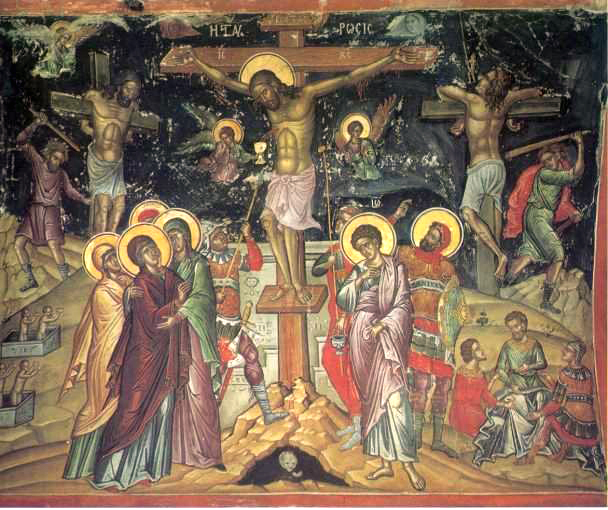
Since that time I have continued to recover faith and belief. I cannot say that it is the same kind of faith that I had before Iraq. No this was different, it was faith born of the terrible emptiness and pain of abandonment and despair, a faith that is not content with easy answers and not afraid to ask questions.  It is a faith in Jesus Christ, the crucified one who’s image we see hanging from the crucifix and adorning icons of the Crucifixion. It is as Jürgen Moltmann wrote in The Crucified God:

“The Symbol of the Crucifix in church points to the God who was crucified not between two candles on an altar, but between two thieves in the place of the skull, where the outcasts belong, outside the gates of the city. It is a symbol which therefore leads out of the church and out of religious longing in to the fellowship of the oppressed and abandoned. On the other hand, it is a symbol which calls the oppressed and godless into the church and through the church into the fellowship of the crucified God”

My Philosophy of Religion Professor in seminary, Dr. Yandall Woodfin told us in class that until we had “dealt with the reality of suffering and death we were not doing Christian theology.” At the time the words were offensive to me, but by the time I had graduated and also done a year of Clinical Pastoral Education they became a part of my experience, but even then that did not prepare me for the darkness that I lived in from February of 2008 until that Christmas Eve of 2009.  I would say that in addition to grappling with suffering and death that one has to add the abandonment of the outcast to the equation.

It is from this perspective that I will look at an ancient document that for many Christians is their Baptismal statement of faith or Creed.  ‘Credo in unum Deum’ “I Believe in God” is no longer for me simply a theological proposition which I both ascent to and defend, but rather an experience of God born out of pain, despair, anxiety, doubt, unbelief and abandonment finding almost no Christians willing to walk through the darkness with me, including clergy. It was if I was radioactive, many people had “answers” but none understood the questions and until my therapist Dr. Elmer Maggard asked me “how I was with the big guy?” and Commodore Tom Sitsch asked me “Where does a Chaplain go for help?”

When I finally collapsed in the summer of 2008 and met with Dr. Maggard I made a conscious decision that I would not hide what I was going through because I felt that if someone didn’t speak out then others like me wouldn’t seek help. In the nearly three years since I returned from Iraq I have encountered many people, men and women, current and former military personnel and families of veterans who came to me either in person or through this website.  Included were military chaplains also experiencing life and faith crisis. Most said that I was the first Chaplain or minister that they had met or read who said that he struggled with faith, belief and didn’t know if God existed.  In each of those encounters there was a glimmer of hope for me and I think for them, for the first time we had people that we could be open with.  Co-workers and others said that I was “real” and I certainly do not boast of that because it was painful to try to be transparent with people while in the depths of doubt and despair while hoping that somehow God would touch them with some measure of grace when I found it hard to believe.  I guess it was the fact that I was willing to walk, sometimes in unusual circumstances and locations with them even if it meant facing my own pain and doubt. I was learning something about being what Henri Nouwen called a wounded healer.  Nouwen wrote:

“Nobody escapes being wounded. We all are wounded people, whether physically, emotionally, mentally, or spiritually. The main question is not “How can we hide our wounds?” so we don’t have to be embarrassed, but “How can we put our woundedness in the service of others?” When our wounds cease to be a source of shame, and become a source of healing, we have become wounded healers.”

In the past year I have still had my times of struggle but have also found others that have gone through similar times.  People like me that have experienced the terrible effects of a crisis of faith that leads a person into despair of even to the point of life itself and all that is good. I am fortunate. I was talking with my Bishop recently in regard to the struggle that I have had in recovering the disciplines of the spiritual life. Thankfully she does understand and was encouraging. I guess that is why now when I have more compassion for someone when they tell me that they “lost their faith” especially those that have been changed by their experience of war or other trauma. I don’t necessarily have all the answers for them because I am quite obviously still figuring it out myself. However as I found sometimes it is not the person with the answers but simply the person that takes time to listen and care that is more important to a person when they struggle, especially for those that before the traumatic event had been strong believers.

I’ll write a bit more about Christmas and faith but not tonight.

Peace

Padre Steve+

3 Comments

Filed under christian life, faith, Pastoral Care, Religion

Martin Luther and My Theological Formation: An Old Catholic Priest talks about Luther’s Influence on his Life

The Luther Rose: When they stand under the Cross Christian Hearts turn to Roses

“Grace is given to heal the spiritually sick, not to decorate spiritual heroes.” Martin Luther

When a young Priest and Theology Professor at the University of  Wittenberg named Martin Luther posted the 95 Theses on the door of the Schlosskirche in Wittenberg it changed the course of Western as well as Church history.  He also changed mine.

Martin Luther was the first of a series of theologians that helped make me what I am now. When my Church History professor Dr. Doyle Young and Systematic Theology professor Dr. David Kirkpatrick introduced me to Luther’s writings and his “Theology of the Cross it was earth shaking.  It was his Theology of the Cross brought me to an incarnational understanding of the Christian faith because it is only through the Cross that we come to know God in a truly Christian sense of understanding.  For Luther the Cross was central to understanding the humanity’s relationship to the Trinity, and stands against Calvin whose understanding of God’s will and predestination from before time began tends minimize the Cross, for Calvin it is a mechanism but for Luther it is the most profound and personal revelation of God, Father Son and Holy Spirit. The incarnational and Trinitarian found in the Theology of the Cross also opened for me essential nature of the Eucharist to the Christian faith and which helping bring me to a catholic understanding of the faith.

The relational aspects of the Theology of the Cross were personalized in the Three Solas; Sola fides by faith alone, Sola Gratia by grace alone and Sola Scriptura by scripture alone. These became the hallmarks of the Reformation and without getting into the weeds to dissect all the ramifications for the Church and the world impact the way that many Christians practice and express their faith to the current day.

The Catholic in me tends to discount Sola Scriptura because Luther himself was such an imperfect practitioner of this. I find that the Anglican and Old Catholic triad of Scripture, Tradition and Reason is a more Biblical way of understanding what we can understand of God as well as in bearing witness of the self revelation of God in Christ in our world than is Sola Scriptura.

The Reformation which began when Luther posted his “theses” on the door of the Schlosskirche broke the hold of the Roman Catholic Church on Europe brought about many changes. It was the watershed moment when western church unity was fractured forever. As the years passed this increasingly fractured and diverse church in the west and helped end the primacy of the Church over the State.  The Reformation was also essential to the future Enlightenment as educational institutions, philosophers, historians and scientists gained the freedom to operate free from the all pervasive reach of the Church.

In the beginning when he walked up to the Schlosskirche to post his theses Luther intended nothing more than reforming and curtailing abuses in the Catholic Church and how the Church saw grace, faith and scripture.  Instead he changed the course of history in ways that most modern people, especially conservative Christians fail to comprehend today.  If they did they would not be embracing such heresy as the Dominion movement and it’s Seven MountainsTheology.

I did a lot of study on the Lutheran Reformation in and after seminary. In 1996 while stationed in Germany as a mobilized Army Reserve Chaplain had the privilege of organizing a series of Reformation tours to Wittenberg, Worms and Heidelberg.  We went to Wittenberg on Reformation day where we attended the Reformationstag service at the Schlosskirche.   I led a walking tour of the town that day.  One of the parishioners from the chapel asked me if I had been toWittenberg before because I seemed like I knew every place in the town.  I had to tell her that I had not been there in person but because of my study had imagined it so many times that I knew every place by heart.  When we went to Worms where Luther on trial before Charles V was told to recant his writings it as the same, except that in Worms the town hall where the Imperial Diet met was destroyed long ago.  However a stone in the pavement marks the spot where Luther concluding his defense before the Emperor Charles V and the assembled Princes and prelates with these immortal words:

“Unless I am convicted by scripture and plain reason – I do not accept the authority of the popes and councils, for they have contradicted each other – my conscience is captive to the Word of God. I cannot and I will not recant anything for to go against conscience is neither right nor safe. God help me. Amen.” It is legend that Luther said the words “Here I stand. I cannot do otherwise. God help me, Amen!”  These words were probably only added later by someone else to make the story more interesting as they do not appear in the council notes.  Not that Luther would have objected.  The film version is linked here:

http://www.youtube.com/watch?v=U0tk_EvWXQQ&feature=player_embedded

Likewise Luther’s debate with Swiss Reformer Ulrich Zwingli at the Marburgcolloquy regarding points of doctrine was significant for me. It was held that they might unify their separate reform movements. They agreed on all points except the Eucharist where Luther enunciated a very catholic understanding of the “Real Presence.”  Zwingli argued it to be a symbolic memorial though he conceded that it might have some spiritual component.   Luther would not budge and to each of Zwingli’s arguments pulled back the tablecloth to reveal the words “This is my body, this is my blood” which he had carved on the table.  They departed without achieving unity, something that has plagued Protestants to this day and when Zwingli was killed in battle when leading the militia from Zurich to fight the approaching Catholic Army.  When Luther heard about the Zwingli’s death he commented Zwingli drew his sword. Therefore he has received the reward that Christ spoke of, ‘All who take the sword will perish by the sword’ [Matt. 26:52]. If God has saved him, he has done so above and beyond the rule.” (Table Talk #1451) When I visitedMarburg with my friend Gottfried in 1997 I stood in the room where the men met and standing at that table I imagined Luther arguing with Zwingli.

Martin Luther helped begin the journey to the Priest that I am now. Others similar to Luther, the Catholic theologian and reformer in his own right Father Hans Kung who was able to do what Luther couldn’t do, make a case for Luther’s theology as part of catholic theology.  Lutheran theologian Jürgen Moltmann has brought Luther’s theology to the modern world and Dietrich Bonhoeffer who showed me an example of how to live out the incarnational message of theTheology of the Cross in a world gone mad.  Kung’s book On Being a Christian, Moltmann’s Theology of Hope and The Crucified God have being influential in my theological formation. Bonhoeffer’s contribution was how that theology is important in standing up to oppression in all forms, his writings including The Cost o Discipleship, Ethics Creation Fall and Temptation, Life Together and Letters and Papers from Prison.  All of these men helped me in my transition following seminary to a moderate Anglo-Catholic to an Old Catholic faith that places a high place to Scripture, Apostolic Tradition and Reason in interpreting and living out the faith.

Of course there are others that have influenced me, the early Church Fathers, Francis of Assisi, John Wesley, Karl Barth and Emil Brunner, Henri Nouwen, Father Andrew Greely  and Bernard Häring to name but a few.  But even so I have always had a special place in my heart for Luther even with all of his flaws which were many.  Luther was earthy, spoke his mind often in a direct and coarse way and had no problem with having fun or good beer.  I relate to him a lot and am in his debt because he helped me become who I am today.

Peace

Padre Steve+


2 Comments

Filed under christian life, faith, History, Religion

A Quiet Alleluia: Padre Steve Celebrates Easter 2011

“Ministry means the ongoing attempt to put one’s own search for God, with all the moments of pain and joy, despair and hope, at the disposal of those who want to join this search but do not know how.”  — Henri J.M. Nouwen

Those readers and friends that have walked with me over the past two years on this site as well as those that walked with me before I ever put pen to my thoughts know how much I have struggled with God and faith since my return from Iraq. Easter has been difficult during that time as was Christmas.  My journey has been marked by many doubts. Today was different. Today we observed a quiet Easter out at the Island Hermitage marked by solitude and community.

The day was quiet and uneventful. I have been writing of late on the Easter story as told by Longinus the Centurion who Church tradition accords the honor of being the Centurion who remarked at the foot of the cross “truly this man was the son of God.”  The Centurions of the Bible have always been models for me as a Christian because they were career military men who served a far flung empire and at in least one part of their careers served in an unpopular occupation of a subjugated land with a proud and unbroken populace.  In their case it was Judea of the First Century and mine was Iraq. The story of Longinus as he is known to Church tradition is one that has fascinated me, a gentile officer of an occupying army discovers God at the scene of a brutal execution which he himself supervised. The story has helped me as I imagined what it must have been like for a Roman Centurion serving in a troubled land ruled by a cabal of corrupt politicians representing Rome, the family of Herod and the powerful institution of the Jewish Temple leadership composed of the High Priest, the ruling Sanhedrin and various religious parties. Likewise the lad featured an undying insurgency dedicated to overthrowing the Romans and what some considered the corrupt administration of the High Priest who they believed to be a collaborator with the Roman occupiers. These were the Zealots.  I was fascinated by the story and the story led me to a deeper appreciation of the Easter story.

We had contemplated going to Camp LeJeune to Mass at the Base Chapel. My friend Father Jose is a wonderful pastor and serves as the base Catholic Chaplain. While it would have been nice to see him celebrate the liturgy it meant that we would do so as strangers in a large community of faith.  Judy and I still both struggle with large gatherings especially where we know very few people and decided that we would celebrate Eucharist together. We were joined in this by my land lady Sharon.  It was a quiet but joyful expression of faith and community where each of us has at times suffered under sometimes cold and unfeeling Church institutions and leaders.

I used the story of Longinus as my homily telling the story in story form rather than as a theological treatise or sermon.  After the homily we confessed the faith of the Nicene Creed, prayed for the church and the world especially the outcast and persecuted and celebrated the Eucharist around my small pine dining room table, which is actually in my living room which doubles a my bedroom. The Island Hermitage is not a mansion.

Later in the day Judy and I would take our little dog Molly on a walk through a park not far from here. The park is a woodland and wetland area on the Bogue Sound side of the island. To walk in those peaceful woods hearing, seeing and listening to the sights and sounds of nature was wonderful. Molly especially loved it as she hunted for some of the deer that she had seen a few days before while walking near the hermitage.  Following that we drove the 2 ½ miles to lands end with Molly’s ears and fur flapping in the breeze as she stood on Judy’s lap with her head and shoulders hanging out the door.  The evening was also quiet as I finished the Easter installment of the Longinus story and Judy made a number of bracelets from her seemingly unending supply of bracelet stuff.

About an hour ago I took Molly on a walk to do her nightly constitutional and as we walked in the dark I looked up into the clear night sky to see thousands of stars.  In 2008 I walked home from church on Christmas Eve looking up into the cold winter night sky wondering if God even existed.  Tonight I looked at the sky and uttered a simple thank you for the resurrection. I know that I believe again. The belief that became real again in 2009 during my “Christmas Miracle” while on duty at the Naval Medical Center is now a quiet and real part of my life and ministry, especially to those who have lost their faith or struggle with faith. It is a quiet alleluia that is now a part of my life again. It is not the same as what I had before and certainly some critics including some in my old denomination have labeled me a liberal, a heretic and even an apostate mostly because I do not agree with their political agenda or narrow and often undemocratic understanding of the Gospel and its social ramifications.  I suppose that should bother me but it no longer does. My skin has become more resistant to such critics and while such criticism from people that I counted as friends still stings in general I am much more resilient to it, obviously the Holy Spirit’s work in the life of this miscreant priest.

Yet I remain a Christian and an Old Catholic and treasure the gift that God has given us in Christ.  The ministry that I have now is different but it is founded upon that faith that people like Longinus discovered that first Easter and I can only say “I believe alleluia!”

Peace

Padre Steve+

3 Comments

Filed under christian life, faith, Pastoral Care, Religion

Introduction to “I Believe please Help Me Believe: The Apostle’s Creed for those Who Struggle with Faith”

“God weeps with us so that we may one day laugh with him.” Jürgen Moltmann

This is the first of a series of essays on the topic of doubt and faith related to the Apostle’s Creed.  There was a time in my life that faith in God, for me the Christian God, Father, Son and Holy Spirit was something that I pretty much took for granted until I had my own crisis of faith when I returned from Iraq in 2008.  It was that crisis where for all practical purposes I was an agnostic trying to believe while feeling abandoned by God and many of his people.  That crisis has etched a permanent scar in my soul which has led to some fairly major changes in my life but even more so forced me to actually enter what Saint John of the Cross called the “Dark Night of the Soul.”

I will not tell of how my great spiritual disciplines helped me get through this as they did not. I found it hard to pray or believe in anything for nearly two years as I struggled with abandonment. I felt that God, the Church and the Navy had abandoned me.  I was losing my battle with PTSD during that time, depressed, anxious and despairing I threw myself into my work among the critically ill ICU patients and those that cared for them.  Christmas Eve of 2008 was spent in despair as I wandered through the darkness on a cold night after leaving Mass because I could not get through it.

Though I found a community and camaraderie among those that I worked with and tried to provide spiritual care for my own condition grew worse, so much so that my clinical duties had to be curtailed in September of 2009.  I still stood the overnight duty and filled in for others as needed but for a number of months I had no ward assignments.  On one of the on call nights not long before Christmas I received a call to the ER where I was called to give the last rites to a retired Navy Medical Doctor who was a true Saint, faithful to God, his Church and the community where for years he had dedicated much of his practice to the poorest members of the community to include prisoners in the Portsmouth City Jail. He breathed his last as I prayed this prayer following the anointing of the sick:

Depart, O Christian soul, out of this world;

In the Name of God the Father Almighty who created you;

In the Name of Jesus Christ who redeemed you;

In the Name of the Holy Spirit who sanctifies you.

May your rest be this day in peace,

and your dwelling place in the Paradise of God.

Something happened that night and by Christmas Eve I realized that something was happening to me. As I wrote in Padre Steve’s Christmas Miracle on Christmas Eve of 2009 following an incredibly busy day full of life and death situations and ministry which amazed me:

“Mid afternoon I was walking down the hall and I experienced a wave of emotion flood over me, and unlike the majority of emotions that I have felt in the past couple of years this was different.  It was a feeling of grace and I guess the presence of God.  I went up and talked with Elmer the shrink about what I was feeling and the experience was awesome, I was in tears as I shared, not the tears of sadness, but of grace.  I am beginning to re-experience the grace of God, something that has been so long absent that I did not expect it, at least right now.  I didn’t do anything differently; I certainly was not working extra hard to pray more, get more spiritual or pack my brain full of Bible verses.  I was too far gone to do those things.  It was all I could do many mornings just to get out of bed and come to work.”

Since that time I have continued to recover faith and belief. I cannot say that it is the same kind of faith that I had before Iraq. No this was different, it was faith born of the terrible emptiness and pain of abandonment and despair, a faith that is not content with easy answers and not afraid to ask questions.  It is a faith in Jesus Christ, the crucified one who’s image we see hanging from the crucifix and adorning icons of the Crucifixion. It is as Jürgen Moltmann wrote in The Crucified God:

“The Symbol of the Crucifix in church points to the God who was crucified not between two candles on an altar, but between two thieves in the place of the skull, where the outcasts belong, outside the gates of the city. It is a symbol which therefore leads out of the church and out of religious longing in to the fellowship of the oppressed and abandoned. On the other hand, it is a symbol which calls the oppressed and godless into the church and through the church into the fellowship of the crucified God”

My Philosophy of Religion Professor in seminary, Dr. Yandall Woodfin told us in class that until we had “dealt with the reality of suffering and death we were not doing Christian theology.” At the time the words were offensive to me, but by the time I had graduated and also done a year of Clinical Pastoral Education they became a part of my experience, but even then that did not prepare me for the darkness that I lived in from February of 2008 until that Christmas Eve of 2009.  I would say that in addition to grappling with suffering and death that one has to add the abandonment of the outcast to the equation.

It is from this perspective that I will look at an ancient document that for many Christians is their Baptismal statement of faith or Creed.  ‘Credo in unum Deum’ “I Believe in God” is no longer for me simply a theological proposition which I both ascent to and defend, but rather an experience of God born out of pain, despair, anxiety, doubt, unbelief and abandonment finding almost no Christians willing to walk through the darkness with me, including clergy. It was if I was radioactive, many people had “answers” but none understood the questions and until my therapist Dr. Elmer Maggard asked me “how I was with the big guy?” and Commodore Tom Sitsch asked me “Where does a Chaplain go for help?”

When I finally collapsed in the summer of 2008 and met with Dr. Maggard I made a conscious decision that I would not hide what I was going through because I felt that if someone didn’t speak out then others like me wouldn’t seek help. In the nearly three years since I returned from Iraq I have encountered many people, men and women, current and former military personnel and families of veterans who came to me either in person or through this website.  Included were military chaplains also experiencing life and faith crisis. Most said that I was the first Chaplain or minister that they had met or read who said that he struggled with faith, belief and didn’t know if God existed.  In each of those encounters there was a glimmer of hope for me and I think for them, for the first time we had people that we could be open with.  Co-workers and others said that I was “real” and I certainly do not boast of that because it was painful to try to be transparent with people while in the depths of doubt and despair while hoping that somehow God would touch them with some measure of grace when I found it hard to believe.  I guess it was the fact that I was willing to walk, sometimes in unusual circumstances and locations with them even if it meant facing my own pain and doubt. I was learning something about being what Henri Nouwen called a wounded healer.  Nouwen wrote:

“Nobody escapes being wounded. We all are wounded people, whether physically, emotionally, mentally, or spiritually. The main question is not “How can we hide our wounds?” so we don’t have to be embarrassed, but “How can we put our woundedness in the service of others?” When our wounds cease to be a source of shame, and become a source of healing, we have become wounded healers.”

My journey through the words of the Apostle’s Creed will be less of a doctrinal exposition than a pastoral narrative of rediscovering faith. It is my hope and prayer that this feeble and imperfect attempt to experience the Apostle’s Creed will be of help to people.  People like me that have experienced the terrible effects of a crisis of faith that leads a person into despair of even to the point of life itself and all that is good.

Peace

Padre Steve+

6 Comments

Filed under christian life, faith, Pastoral Care, philosophy, PTSD, Religion

Observations of My Oral Surgery

Today I had the initial part of my implant work done to replace the departed “Undead Tooth of Terror. This was the first time I had oral surgery vice normal dentistry.  If you have never had it the only comparison to regular dentistry is that it involves teeth.  It is real surgery, albeit not like getting your noggin or ticker opened up.  However in the weeks leading up to this surgery I experienced a fair amount of anxiety and even a couple of nightmares related to the procedure, including if something went wrong. When you prepare for something like this, or any other medical or surgical procedure you sign a consent form. These include the risks associated with the procedure as well as the anesthesia.  One of these complications or risks is death which is not on my list of things that I want to experience in the next 30 years or so.

Implant Screws

I’ve done a lot of hospital work in major teaching hospitals, mainly in critical care, ER, Medical, Surgical, Burn, Neurosurgery and Pediatric ICU’s.  I have become quite adept at learning about what goes on in those places, to include understanding something about how critical care intensivists of all types work to include a lot of the technical things that they observe with patients.  I am probably one of the few chaplains who that has a copy of The ICU Book and can read heart rhythms, understanding the relationships of blood pressure, cardiac output, oxygen saturation levels as well as a host of other cool to know things.  When the Abbess was in the Emergency Room at a local hospital I made the diagnosis of her Epiglottis before the physicians.  After that one of our attendings at my hospital told me that wasn’t too late to go back to Medical School.  The thought is intriguing but alas, even Padre Steve doesn’t want to go back to school for that long at this point in life.  However I could probably play a very convincing doctor in film or on TV if given the chance.  I will entertain offers if someone wants to shoot something like MASH.

Today was interesting.  I was taken into one of the oral and maxillofacial surgery operating rooms.  These are equipped with the kinds of monitoring equipment found in an OR or an ICU.  I have observed these on quite a few patients and can read them rather well.  Today the difference was that they were monitoring me and not another person.  So this intrigued me, I have not been to a operating room since I was 7 years old at Bremerton Naval Hospital.  Things have changed in the 42 years between visits, or at least my perspective has changed.

I was seated in what looked like a dental chair on steroids.  I was hooked up to the monitor with a 4 lead EKG and pulse oxygen monitor and had a nasal cannula. An IV was placed and I was asked a litany of questions.  With all the monitors hooked up my doctor came in and talked about the procedure and a light anesthesia ‘cocktail” of drugs including Fentanyl and a couple of others that I cannot remember right now.  A large table was placed before me with a large number surgical and dental utensils.

Normal Sinus Rhythm

I looked up at the monitor as they got things going and made final preparations.  My heart rate was in the 58-67 range in normal sinus rhythm, in fact a very nice looking rhythm. My respiratory rate ranged from 5-11 a minute and my SPO2 or oxygen saturation ranged from 96-99.  Noninvasive blood pressure was 116/71 with a mean of 86.  Not bad for someone nearly 50.  The drugs we injected through the IV access point and I entered what is called “twilight” sedation.” It is a state where you are sedated but can still follow simple commands from the surgeon if need be.  I could hear what was going on but it was like being in a dreamlike state.  Occasionally I could hear the surgeon giving directions to his resident and also the noise of the drill, which was not the normal high pitched sound of a dental drill.

When it was over they brought me up out of the sedation and I looked around, my numbers were still close to what were on the monitor to begin with so I was still alive.  I was allowed to see the x-ray with the placement of the implant mount which is actually screws into the jaw.    I was informed that a bone graft was done and that I would only be able to have liquids and soft foods for the next two weeks.  I’ll have a follow up next week, be off of work until the New Year holiday, no PT for a week and light duty, including being told “not to talk too much” to allow the implant and graft to heal.

As I was collecting myself  I saw the corpsmen disposing of trash and “hazardous waste from the room.  In clear container, actually a container that is used for suctioned fluids from the mouth, was something that looked like a strawberry daiquiri, it was the blood and water suctioned from my mouth during the procedure and was about half full.  I commented to the corpsmen what I thought it looked like which caused them to laugh in agreement and said that I was a beer drinker.  I was wheeled out of the hospital in a wheelchair to the Abbess waited for me in my trusty 2001 Honda CR-V. I can’t drive through tomorrow and am to take it pretty easy.

The pain has been manageable and has been a far cry from the agony I went through during the summer with the Undead Tooth of Terror, something for which I can definitely thank the Deity Herself.

This has given me a small glimpse at the perspective of one of the patients that I see every day, so it has been worthwhile in a number of ways, and not just as a means to better dental health.  I remember Henri Nouwen’s book Beyond the Mirror which recounts his experience as a patient following being hit by the mirror of a truck alongside a road.  Such experiences are important for those who provide any kind of care, especially pastoral care.  For me the almost surreal experience was to borrow a phrase from Star Trek’s Mr. Spock simply “fascinating.”

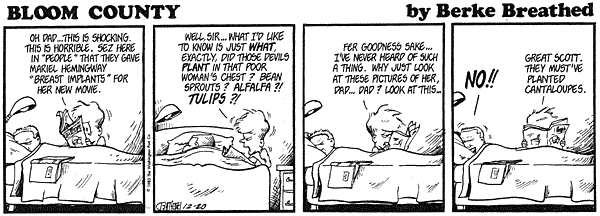
All I can say is that at least beer is a soft food and though I have an implant I will never look like Mariel Hemingway.

Peace

Padre Steve+

Leave a comment

Filed under healthcare, Religion

War, Remembrance and Healing: A Chaplain, Officer and Historian Makes His Way Home

The first version of this post was written in the spring of 2008 when I was doing a lot of soul searching and reflecting after Iraq. It was originally run in my church’s online news service.  I post it now with some updates that have been brought about by new ways that I am rediscovering God and because of the current situation in Afghanistan which has become worse in the past year. As I read news releases about casualties and attacks on NATO forces and Afghan civilians, especially those in small outposts or serving as advisers and trainers I am reminded of my time in Iraq.  Please don’t forget those who serve in Iraq and Afghanistan, or those who have served in prior wars. Especially keep in your prayers and help assist those who have returned injured in mind, body or spirit and those who made the supreme sacrifice.

874Leaving a Bedouin Camp 1 mile from Syria

I have been doing a lot of reflecting on ministry and history over the past since returning from Iraq. Since I’ve been back about a year and a half I can say that I have changed as a result of my service there.  Change can be scary but in my case it has been both necessary and probably good.  Ministry, theology and history have been part of my life for many years; they have taken on a new dimension after serving in Iraq. When I first wrote this piece not long after returning I was in pretty bad shape but in the months since I have been attempting to integrate my theological and academic disciplines with my military, life and faith experience since my return. I’m not done yet by any means, but things are getting better, not quite like Chief Inspector Dreyfus in The Pink Panther Strikes Again “Every day in every way I’m getting better and better…Kill Clouseau!” but a slowly getting better with some occasional bumps in the road.

One of the things that I have wrestled with is my faith, and returning from war changes a man.  Before I went to Iraq I thought that I had things pretty much together.  When I came home and fell apart it also affected my faith, doing little things became difficult and the effects were exaggerated by my isolation.  In a sense it was my Saint John of the Cross Dark night of the Soul experience.  I felt that God had abandoned me, people would come to me with their crisis of faith and I had to dig deep to stay with them, but in doing so I became acutely aware of the fact that I shared this with them. I couldn’t hide behind my collar or the cross on my uniform as the crisis was an interruption which drove me out of my comfort zone and forced me to deal with the world that the people I minister among deal with every day.
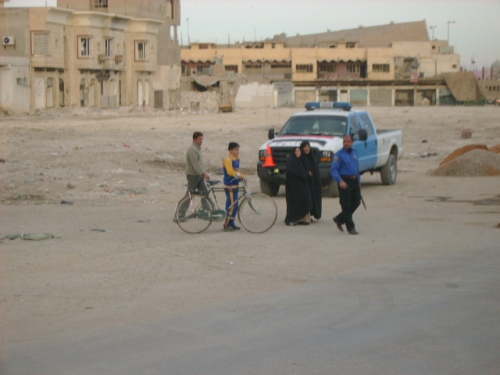
291Iraqi Police in Ramadi Escorting Civilians Across the War Zone of Route Michigan

There are those who believe that all forms of ministry are basically the same and that lessons learned are universally applicable and that somehow all ministries are proclamation oriented.  Unfortunately that is not the case and one of the places that this is true is the Military Chaplain ministry.  This mibnistry is much different than parish or para-church ministries and even different than other institutional ministries such as Police, Fire, Industrial or civilian health care chaplaincy.   It is different in that it is more incarnation versus proclamation. We not only minster to our people but we live among them.  We live the experience of those that we serve, especially in the uncertainly of war and deployments.  Chaplains live in a world where we are fully military officers and fully ministers of our own church or faith tradition. As a chaplain I never lose my calling of being a priest, but I am a priest in uniform, a military professional and go where our nations send me to serve the Sailors, Marines, Soldiers and Airmen who I live among be that overseas, or in the States.

142Always a Priest Eucharist with Advisers in the Far West of Al Anbar

There is always a tension in the military chaplain ministry. This is  especially true when the wars that we are sent to are unpopular at home and seem to drag on without the benefit of a nice clear victory such as VE or VJ Day in World War II or the homecoming after Desert Shield and Desert Storm. There are those that oppose the military chaplaincy on theological or philosophic grounds, usually some manner of absolutist understanding of ministry, church-state relations or social justice considerations.  My purpose is here not to defend military chaplain institutions against such criticism but rather to share the world and tension that military chaplains live in when our nation is engaged in unpopular which some consider unjust or illegal wars.

training team baseIsolated Base Camp for Advisers in Afghanistan

A lot of people have no “ethical” or “moral” qualms about wars that are easy to pigeonhole as just wars, especially if we win quickly and easily.  It is my belief that when things go well and we have easy victories that it is easy for religious people, especially more conservative Christians to give the credit to the Lord for the “victory.”  Unfortunately such “Credit” is given without them ever understanding or sometimes even caring about the human cost of war.   Likewise it is easy for others to give the credit to superior strategy, weaponry or tactics to the point of denying the possibility that God’s involvement.  Conversely and maybe even perversely I have heard some say that God has blessed the use of weapons or tactics that violate principles of fighting a “just war” especially that of proportionality. Such is the case in almost every war and Americans since World War Two have loved the technology of war seeing it as a way to easy and “bloodless” victory. In such an environment ministry can take on an almost “cheer-leading” dimension. It is hard to get around it, because it is a heady experience to be on a winning Army in a popular cause but I do think that many chaplains have a less “cheerleading” approach than many in conservative churches. The challenge for chaplains in such an environment is to keep our ministry of reconciliation in focus. To do so we must care for the least, the lost and the lonely and never forget the victims of war, especially the innocent and the vanquished, as well as our own wounded, killed and their families.

237Iraqi Kids in Al Anbar Province, a couple of months before they could not venture outside because of insurgent attacks, children are never winners in war

We are now seeing the conflict in Iraq winding down and what until this year had been “the good war” in Afghanistan go bad and support for it decline.  Strategy is being debated as how to best “win” the war in Afghanistan even as the United States withdraws from Iraq. The task of chaplains in the current war, and similar wars fought by other nations is different and really doesn’t allow for them to indulge themselves in “cheerleading.” In fact chaplains can themselves through isolation, lack of experience and fear can become more reflective and less “cheerleader” oriented the longer the war goes on without sign of appreciable progress, much less victory.  They feel the onslaught of their soldiers doubts, fears as well as the loss of friends and the chapel congregation through being killed or wounded in action. This  can take a terrible toll even for the most resilient of chaplain. In these wars, sometimes called counter-insurgency operations, revolutionary wars, guerilla wars or peace keeping operations, there is no easily discernible victory. These types of wars can drag on and on, sometimes with no end in sight. Since they are fought by volunteers and professionals, much of the population acts as if there is no war since it does often not affect them, while others oppose the war, all of which can affect the chaplain.

dien_bien_phu paras landingFrench Paratroops Landing at Dien Bien Phu

Chaplains volunteer to go with and place themselves in harms way to care for God’s people in the combat zone or far away from home. While they do this there are supporters of war as well as detractors who have no earthly clue about war or life in the military other then what they see in the media or experienced in peacetime or the cold war. Some supporters often seem more interested in political points of victory for their particular political party than for the welfare of those that are sent to fight the wars. This has been the case in about every war fought by the US since World War II. It is not a new phenomenon. Only the cast members change with the particular war.

legion indo-chinaForeign Legion Troops in Indochina

In order to somehow make sense of going on we cannot simply think of what is politically expedient for either those who support or want to expand the war, or others who want it ended now, both of which have consequences many of which are bad.  I think that we have to look at history and not just to American history to find answers, not simply answers to how to win or end the war but answers to the consequences that either course of action posits. Thus I think that we can find parallels in other militaries. I think particularly of the French professional soldiers, the paratroops, Colonials (Marines) and Foreign Legion who bore the brunt of the fighting in Indo-China. These men, not all of who were French were placed in a difficult situation by their government and alienated from their own people. In particular I think of the Chaplains, all Catholic priests save one Protestant, at the Battle of Dien Bien Phu, the epic defeat of the French forces that sealed the end of their rule in Vietnam. The Chaplains there went in with the Legion and Paras. They endured all that their soldiers went through while ministering the Sacraments and helping to alleviate the suffering of the wounded and dying. Their service is mentioned in nearly every account of the battle. During the campaign which lasted 6 months from November 1953 to May 1954 these men observed most of the major feasts from Advent through the first few weeks of Easter with their soldiers in what one author called “Hell in a Very Small Place.”
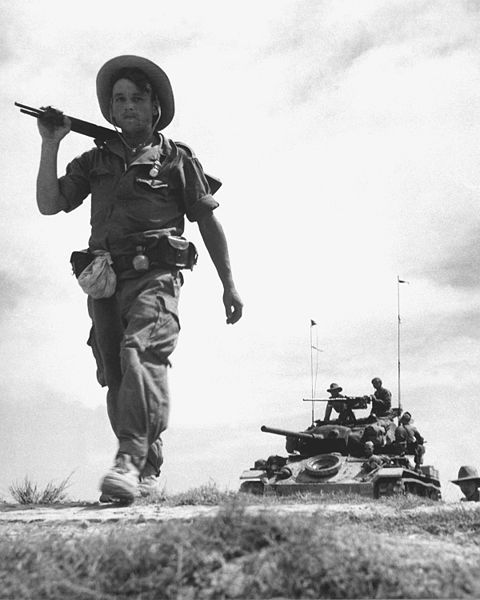
french troops indochinaFrench Troops on the March in Indochina

One author describes Easter 1954: “In all Christendom, in Hanoi Cathedral as in the churches of Europe the first hallelujahs were being sung. At Dienbeinphu, where the men went to confession and communion in little groups, Chaplain Trinquant, who was celebrating Mass in a shelter near the hospital, uttered that cry of liturgical joy with a heart steeped in sadness; it was not victory that was approaching but death.” A battalion commander went to another priest and told him “we are heading toward disaster.” (The Battle of Dienbeinphu, Jules Roy, Carroll and Graf Publishers, New York, 1984 p.239) This can be a terrible burden for the Padre who cares for such men.  Ministry in such places is truly an incarnational experience because there is no place to hide and the chaplain is as vulnerable as his flock.  It is the ministry that places us “in the valley of the shadow of death” where as the Psalmist says we are “to fear no evil for you are with us.” It is the ministry of Good Friday where to all appearances seems that God has abandoned the field and evil has won.

VIETNAM DIEN BIEN PHUFrench Surrender at Dien Bien Phu

Of course one can find examples in American military history such as Bataan, Corregidor, and certain battles of the Korean War to understand that our ministry can bear fruit even in tragic defeat. At Khe Sahn in our Vietnam War we almost experienced a defeat on the order of Dien Bien Phu. It was the tenacity of the Marines and tremendous air-support that kept our forces from being overrun.

legion algeriaLegionaries in Algeria, many French Troops Went from one War in Indochina to another in Algeria only to have the De Gaulle Government throw the Military Victory Away and Cause a Crisis

You probably wonder where I am going with this, back when I first drafted this year and a half ago I wondered too. But here is where I think I am going. We live in difficult of times at home and in Afghanistan.  It home we are mired in an economic crisis clouded by deep political division.  In Afghanistan we are engaged in a hard fight where units we are taking casualties and the mission is being debated.  Sometimes to those deployed and those who returned that their sacrifice is not fully appreciated by a nation absorbed with its own issues.  This of course is not universally true as there a people of all political viewpoints who care for the welfare and attempt to ensure that those who serve are not abandoned as those men who served in Vietnam.  I think that part of the feeling comes from the presentation of the war by the media which tends to focus only on the negative outcomes and not positive things that our soldiers accomplish. That can be discouraging to the men and women on the ground.  One of the most difficult things for me upon my return was to see the bitterness a division in the American people and political establishments and becoming quite depressed about it.   I stopped watching the perpetual news cycle and listening to talk radio.  The hatred, ignorance and crassness of it all was disheartening and I refuse to take any part in something that is so hate filled, power driven and unredemptive.
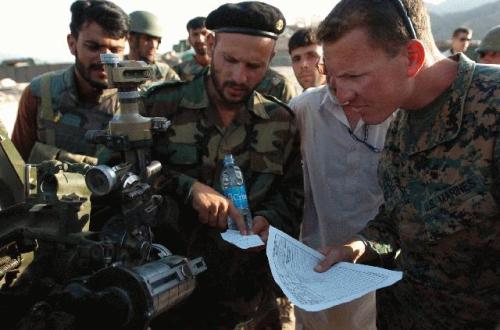
traiining team with afghan armyUSMC Training Team With Afghan Troops

For the French the events and sacrifices of their soldiers during Easter 1954 was page five news in a nation that was more focused on the coming summer. This is very similar to our circumstances today because it often seems that own people are more concerned about economic considerations and the latest in entertainment news than what is going on in Iraq or Afghanistan. The French soldiers in Indo-china were professionals and volunteers, much like our own troops today. Their institutional culture and experience of war was not truly appreciated by their own people.  Nor was it fully appreciated by their government which sent them into a war against an opponent that would sacrifice anything and take as many years as needed to secure their aim.  At the same time their own countrymen were unwilling to make the sacrifices needed to win and in fact had already given up their cause as lost. The sacrifice of French soldiers would be lost on their own people and their experience ignored by the United States when we sent major combat formations to Vietnam in the 1960s. In a way the French professional soldiers of that era have as well as British colonial troops before them have more in common with our force than the citizen soldier heroes of the “Greatest Generation.” Most of the “Greatest Generation” was citizen soldiers who did their service in an epic war and then went home to build a better country as civilians. We are now a professional military fighting unpopular wars and that makes our service just a bit different than those who went before us.  I related to the French troops who fought in Indochina and Algeria as well as our own Vietnam Vets than I do to others.  These is a kinship among us that goes beyond nationality, politics or age.

This is the world in which military chaplains’ minister.  It is a world of volunteers who serve with the highest ideals, men and women who enlist knowing that they will be deployed and quite likely end up in a combat zone. We go where we are sent, even when it is unpopular. It is here that we make our mark; it is here that we serve our Soldiers, Sailors, Marines and Airmen. Our duty is to bring God’s grace, mercy and reconciliation to men and women, and their families who may not see it anywhere else. It is a ministry of reconciliation by the means of incarnation. Many times those outside the military do not understand this. It is a different world full of contradictions and ambiguity.  Such situations even impact the families of those who serve.

When my dad was serving in Vietnam in 1972 I had a Sunday school teacher tell me that he was a “Baby Killer.” It was a Catholic Priest and Navy Chaplain who showed me and my family the love of God when others didn’t. As the country builds to the 2010 mid-term Congressional elections I anticipate that people from all parts of the political spectrum will offer criticism or support to our troops or the war in order to bolster their election chances which do not always coincide with what is in the best interest of the troops or the mission. Chaplains cannot be concerned about the politics nor even the policy as our duty is to be there as Priests, Ministers, Rabbis and Imams for those that we serve. We cannot afford to allow ourselves to be discouraged in caring for our men and women and their families because of all the strife in the body politic.  In addition we must continue on because most churches and other religious communities, even those supportive of our troops really don’t understand the nature of our service or the culture that we represent. We live in a culture where the military professional is in a distinct minority group upholding values of honor, courage, sacrifice and duty which may be foreign or archaic to many Americans, or for those countries with troops and chaplains in Afghanistan or Iraq. We are called to that ministry in victory and if it happens someday, defeat. In such circumstances we must always remain faithful to God as well as to those that we serve.

For those interested in the French campaign in Indo-China it has much to teach us. Good books on the subject include The Last Valley by Martin Windrow, Hell in a Very Small Place by Bernard Fall; The Battle of Dienbeinphu by Jules Roy; and The Battle of Dien Bien Phu- The Battle America Forgot by Howard Simpson. For a history of the whole campaign, read Street Without Joy by Bernard Fall. I always find Fall’s work poignant, he served as a member of the French Resistance in the Second World War and soldier later and then became a journalist covering the Nurnberg Trials and both the French and American wars in Vietnam and was killed by what was then known as a “booby-trap” while covering a platoon of U.S. Marines.

There is a picture that has become quite meaningful to me called the Madonna of Stalingrad. It was drawn by a German chaplain-physician named Kurt Reuber at Stalingrad at Christmas 1942 during that siege. He drew it for the wounded in his field aid station, for most of whom it would be their last Christmas. The priest would die in Soviet captivity and the picture was given to one of the last officers to be evacuated from the doomed garrison. It was drawn on the back of a Soviet map and now hangs in the Kaiser Wilhelm Memorial Church in Berlin where it is displayed with the Cross of Nails from Coventry Cathedral as a symbol of reconciliation. I have had it with me since before I went to Iraq. The words around it say: “Christmas in the Cauldron 1942, Fortress Stalingrad, Light, Life, Love.” I am always touched by it, and it is symbolic of God’s care even in the midst of the worst of war’s suffering and tragedy.

Madonna of StalingradMadonna of Stalingrad

So as you can see I have done a lot of reflecting over the past year and a half. It has been a spiritual journey, an intellectual and academic journey and a personal journey of slowly healing and recovery.  I have gone through some changes in the process which have not been easy, but certainly have deepened my faith even as I struggled and made me much more appreciative of life, love and peace.

I write in order to wrestle with what I have mentioned here, and I try to write something every night. I can full agree with Father Henri Nouwen in his book Beyond the Mirror as to the purpose that writing serves me in my journey.

“These many interruptions calling me ‘beyond’ compelled me to write. First of all, simply because writing seemed to be the only way for me not to lose heart to in the frightening and often devastating interruptions and to hold onto my innermost self while moving from known to unknown places. Writing helped me to remain somewhat focused amid the turmoil and discern the small guiding voice of God’s Spirit in the midst of the cacophony of distracting voices.  But there is a second motivation. Somehow I believed that writing was the one way tom let something of lasting value emerge from the pains and fears of my little, quickly passing life.  Each time life required me to take a new step into unknown spiritual territory, I felt a deep, inner urge to tell my story to others- perhaps as a need for companionship but maybe, too, out of an awareness that my deepest vocation is to be a witness of the glimpses of God I have been allowed to catch.”

pub2Slowly Getting Better

I am healing though it has been at times painful, but faith is returning and I can say that though it has not been easy it has been worth it.  I do hope that what little I do in my work and in my writing will be of help to those who struggle and those who recognize their own need for reconciliation, healing who need to hope again no matter who they are and what their circumstance.

Peace,

Padre Steve+

2 Comments

Filed under Loose thoughts and musings

The Battlefield of Jabez’s Mind: The Prayerfully Purpose Driven Five Love Languages for the Late Great Planet Earth

pub2Pondering the Imponderable

Since selves are very hard to help I am amazed daily with the latest self help books “baptized” with a smattering of Bible verses which are marketed to the hungry hordes that inhabit our Late Great Planet Earth. At the risk of offending everyone who knows and loves these books and yea verily even patterns their life after them as if they were the Scriptures themselves I have decided to write about this subject.  I have seldom discussed this with anyone outside my wife, the Abby Normal Abbess and a few brother miscreant Priests and un-named heretical co-conspirators.   As heretics who buck the party line we generally keep these conversations among ourselves in order not to offend the brethren and the sisteren. But today I just decided to say the heck with it all and be bold, yet hopefully funny in looking at these phenomena.

What really drove this was seeing friends Romans and countrymen flock to these baptized self-help books as if they were the latest editions of the Word of God printed in heaven and distributed by the Archangel Gabriel himself.  Now this may be a bit of an over-reach on my part for literary purposes but I think in some cases it is not far off the mark.  I don’t for a moment presume that everyone who finds meaning and value in these books has crossed this line into obsession but I am amazed with the almost cultic hold that they have over some people and ministries.  I cannot count the number of times when people have asked me as a Priest if I have read….fill in the blank.  Since my theological or inspirational reading usually deals with Church History, Ethics, Christology written by German theologians whose names start with “B” as well as books by Henri Nouwen or one of the plethora of Father Andrew Greeley “Bishop Blackie Ryan” mysteries that I own, I have to no recourse but to say “no” as my interests lay elsewhere.  Another line that I might use is that I’ve heard from people that name the book is supposed to be good.  In either case I am being honest.  This being said the next line from the person asking me is “well, you should, you’d really like it” or something similar.  I am always polite as I genuinely hope that they are getting something good out of these works and that the Deity Herself is using them in their lives.  I would after all patently hope that they have not wasted their hard earned money in light of our current economic difficulties.

What gets me in most cases is not the actual content of the books in question which especially in the case of the Purpose Driven Life or the Five Love Languages to be pretty benign, though I have heard some folks really hammer these books and their authors.  My concern is the almost hypnotic grip that these and other “method” promoting books have on their readers.  I have seen places where there are extended classes and seminars that go through the Purpose Driven Life or The Five Love Languages or any one of a number of other books where week after week people drag out their notebooks, Palm Pilots or whatever means of electronic note taking that they have and studiously listen and share about the book in question.  While Bible study is an ingrained feature of Evangelical Protestant life, it seems to me that these books are almost replacing Bible study with the study of what someone says that the Bible teaches.  Now this isn’t new at all as one only has to look at the number of books on the Rapture and Second coming by the multitude of “prophecy experts” to see this.  Again, I say that I find the contents of the Purpose Driven Life and the Five Love Languages to be rather benign, my concern is the importance being given to them which sometimes to me seems to border on cultic.

My feeling in regard to the Prayer of Jabez industry is another matter.  This is simply narcissistic prosperity gospel teaching repackaged for a new audience.  This book takes an incredibly minor prayer by an equally minor character (1 Chronicles 4: 9,10) and turns it into a revolutionary means of getting God to bless us.  It has spun off a whole line of targeted versions for kids and even a women’s Study Bible. Likewise it has spun off an array of merchandise apparently modeled on Yogurt’s marketing of Spaceballs merchandise.  The merchandise could be found in the “Jabez Junk” section of your local Christian book, music and novelty shop and included key chains, mugs, backpacks, Christmas ornaments, scented candles, mouse pads, and a framed artist’s conception of Jabez himself. A line of jewelry was introduced in 2002.  I found the whole thing deeply offensive and felt it to be a crass attempt by the author and the publishers to make money off of the flock of God.  I knew of pastors who spent years with their congregations dealing with the Prayer of Jabez. I wonder what they would have accomplished had they actually been teaching their congregations actual Christian doctrine, ethics and responsibility.

Fortunately for me and maybe unfortunately for others I have a rather twisted way of looking at life, which some of kindred spirit find amusing and those not find offensive.  I cannot for the life of me get around odd thoughts that occur when I see these books which is nowhere more evident than when I hear the words the Five Love Languages. Unfortunately my mind goes to the movie A Fish Called Wanda where Jamie Lee Curtis (who I have always found to be hot) plays an American in England who is let us say sexually excited by her lovers speaking in foreign languages.  In the case of the movie Kevin Kline speaking faux Italian and John Cleese who speaks Russian.  Thus when my office mate in Iraq was running a series of Five Love Language seminars for Marines and Sailors who were stationed at the base that I operated from I had a hard time keeping a straight face.  The chaplain was a very good guy and eventually I confessed what had been running through my mind and he did have a good sense of humor about it and began to laugh when he recalled the movie.  I guess my five love languages would be German, Dutch, Gaelic , Klingon and Romulan, I’ll have to try them sometime.

Until then I’ll just have to wage a battle in my mind to discover the purpose that drives my life while I extend my tent out to cover the five love languages on this the late great planet Earth.

mental floss

Peace, Steve+

2 Comments

Filed under Loose thoughts and musings, philosophy, Religion

Love Poverty and War…Suffering and Death… Christian Theology meets Reality in the Intersections of Life

“An antique saying has it that a man’s life is incomplete unless or until he has tasted love, poverty, and war.”  Christopher Hitchens

“You have not done Christian Theology until you have dealt with suffering and death” Yandall Woodfin

I deal with life in the intersection where theology has to deal with uncomfortable and often troubling questions.  When I first heard my Philosophy of Religion Professor at Southwestern Baptist make the statement that “you have not done Christian Theology until you have dealt with suffering and death” I was somewhat offended.  This was back in 1989 when I was still somewhat idealistic and believed what really popular preachers on radio and mega-churches said.  Now I can never say that I was completely in agreement with the “name it claim it, grab it stab it, God owes me and will bless me because I did…” pop-theology of the theological lightweights masquerading as teachers, preachers and prophets.  While I did not espouse it the view was prevalent in the churches that I was part of, in fact I choose Southwestern Baptist as a school because it did not tow that party line.  I just never expected my professors across the board in the School of Theology to be as nuanced and balanced as Dr. Woodfin and the others who helped give me my theological formation.

In seminary I developed a very good theological understanding and life hermeneutic that was far closer to Anglicanism or the reformers of the Second Vatican Council.  In fact it was theologians like Hans Kung, Yves Congar and Alistair McGrath as well as Jurgen Moltmann and Wolfhart Pannenberg who helped me in that.  Additionally the writings of Dietrich Bonheoffer, Emil Brunner and Henri Nouwen were influential as I developed my theological and spiritual life.  I was also thrust into the world of the Ante-Nicene Fathers of the Church, spending a semester of Systematic Theology studying and writing about Polycarp of Smyrna.  It was studying these contemporary theologians as well as the Church Fathers that I discovered Christian Theology at the intersection and it was Dr. Woodfin’s remark that caused me to really question the modern “theologians of glory.”  It is plainly obvious that this was in the day before the Baptist Taliban under Mullah Paige Patterson took the place over.  That was the time when it was a world class seminary and not just a pretty good Bible school.

It was the fact that even though I was in seminary life was really sucky.  Nothing went right.  Instead of the obvious “blessing of God” it seemed that we were cursed.  We had lost our home, cars, and were destitute.  I was working two and three jobs while Judy was sick and unable to work.  We lived in a hell hole on the east side of Fort Worth Texas, frequently featured on the TV show COPS.   One night in desperation I called the Terrible Blonde Network (TBN) for prayer.  For my trouble I was told that it was obvious that God was not calling me to ministry otherwise he would be blessing us.  That was a watershed experience and I rejected that idea on the spot.  It made me mad as hell that a well meaning but ignorant volunteer prayer partner would judge me in such a way.  When I went to work later at a TV ministry doing counseling, especially to broken pastors I never forgot that experience.  I realized that what the lady said and what many people that I knew espoused was God-babble bullshit.  The pastors that I talked to every week were suffering, often at the hands of the alleged people of God and even other ministers.  It was obscene.

So anyway, back to the subject of this article…yes I chased a rabbit there and it was intentional.  I had a New Testament Professor whose “rabbits” were often pastoral and theological gems.  That may not be a gem but it was a rabbit worth chasing.

Hitchens, a pretty strident atheist has some pretty good observations about how some religious people including modern Christian icons have been pretty poor examples.  Now he can be biased but his bias is balanced by the Orthodoxy espoused by his brother Peter.  Hitchens’ comment based on the writings of antiquity is quite true.  Until a man or for that matter a woman has experience love, poverty and war their life experience is incomplete.  As a personal testimony, I can say “AMEN!” I know this to be true.  I am married to the love of my life and our marriage has endured suffering, sickness, death, poverty and war.  We have in baseball terminology “hit for the cycle.”  While I have understood this I had never seen it in writing until I saw Hitchens’ book.  The theme of love, poverty and war is rich in ancient writings including the Bible.  It is also thematic in many cultural rituals around the world.  The warrior who loves his family endures poverty; usually famine or plague induced and then goes out to fight invaders.  If they win they come home to their loved ones victors who have protected home and hearth.  It is much like the movie Braveheart where William Wallace leads a campaign against the English who have invaded Scotland.  If they lose, there is the strong possibility that they will be slaughtered and their families enslaved.  The annals of the Punic Wars are rich in this theme as is the life of King David who knows love, poverty based on being a fugitive on more than one occasion and his life as a warrior.

I think this is true in the modern era as well.  Western culture based on consumerism and material wealth has been insulated from the depths of abject poverty, one only need place a poverty and famine stricken resident of almost any third world country who is deposited in a poor American city or town and ask him if he sees poverty.  If he does it will not be material poverty but one where love and community are missing.  If he goes up the street to the well off part of town he may be dazzled by the opulence but appalled by the loneliness of many people.  Western nations following the end of the Second World War and the recovery from it have not known the depths of poverty.  This may be changing now unless we can pull our economy out of the abyss that it seems perched upon, but even still at least so far the last couple of generations in the west have not known poverty as a whole.

Likewise the question of the experience of war for the modern person is one that is not experiential.  War in the west is now fought largely by military professionals while most of the nation’s population lives in the shadow and protection of their military prowess.  At one time with the draft war was experienced by all parts of the population in the west.  Today it is not and with that lack of experience there is a void, men and women have not discovered either how to live for something or die for something bigger than themselves.  One of the things that chafes my hide is when I hear ministers who have never served a day in uniform don a set of BDUs or Dessert Camouflage and preach a sermon on spiritual warfare. Sorry, that is a sham and the big TV guys who have done this should apologize to men and women who have been in combat and in harm’s way.  I once had a bishop in my church, who is no longer in his communion do an article about spiritual warfare trying to apply “principles” of Carl Von Clausewitz about war without ever really reading or understanding Clausewitz.  The treasure of Clausewitz is in his “principles” but in his understanding of the human condition brought about by his Lutheran faith, the Enlightenment and his experience of Prussia’s defeat and occupation by Napoleon followed by her recovery.  I was appalled by what my ex-bishop wrote and embarrassed for the church should any real soldier or military leader pick it up and read it.  Things like these show how little many religious leaders, or for that matter political leaders understand the human condition, life, love and war.

Dr. Woodfin was more right right than about anyone I have ever heard when he that we have not done Christian Theology until we have dealt with suffering and death. When you see innocents killed, children suffering from famine, war and disease.  When you have seen the bodies of young men and women who have died senseless deaths and when you have looked at a mother who has lost a child you begin to understand.  You begin to see the Cross.  An innocent man executed, a guilty man go free.  When you see friends and companions abandon their teacher and friend, a governor who knows a man is innocent be put to a brutal and agonizing death,  and a mother looking up at a cross where her son hangs and cries “My God my God, why have you forsaken me?” When you see these things you have to deal with the reality of where the Christian faith intersects the cold reality of our world.  It is as Alistair McGrath calls it, “life under the cross.”

I dare any of our modern digital era “theologians of glory” to enter this world, but most will not.  In fact they will continue to sell the sad sack of theological excrement that they call the Gospel to adoring crowds who will eventually discover that they have been sold a lie.  Many leave the faith while others take their place looking for “their” promised miracle, “their” blessing and their health, wealth and fortune.  Like the Catholic indulgence sellers of Martin Luther’s era, such “ministers” are blight on the Christian faith and for all of their “success” power and popularity have done more harm to the faith than benefit.  John Tetzel, Luther’s protagonist would tell people when collecting indulgences “A penny in the coffer rings, a soul from Purgatory springs.”  Today’s modern peddlers of pious poop promise “your prosperity grows when into our ministry you sow” or a “vow you make today God is bound to repay.”

Having seen this in real life when people buy the lie and end up devastated when “God” doesn’t come through for them, or when a well meaning but ignorant person tells them some horse shit about how God is not blessing them because….I want to scream.  I once had a pastor in a large evangelical and charismatic church which believed in “signs and wonders” tell the congregation about a conversation that he had with a parishioner who had been in the hospital and not been visited by him or the staff.  The parishioner, who gave a sizable amount of money to the church asked” “How sick do I have to be to get a hospital visit from you?”  The pastor, a nice guy laughed as he recounted his response.  “You don’t want to be that sick.”  The congregation laughed and I about cried as I was immersed in daily tragedy and trauma and Parkland Memorial Hospital in Dallas.  I knew too many people be abandoned by their pastors in a city consumed with powerful pastors as churches to believe that they were a priority for those suffering.

The truth is that many pastors and for that matter many people want to avoid dealing with suffering and death at any cost. Whole industries are built around the worship of youth and beauty and a culture, including the churches lift their heads to the sky for God’s blessing while avoiding the suffering around them.  There are pastors and parishioners who by the boatload have been thrown from the “Barque of the Church” because they either failed or did not have enough “faith”

Such is not the Gospel nor is it Christian in any way shape or form.  It is no wonder that so many have abandoned the faith when all they see on TV are the modern digital theologians of glory who bask in fame and fortune while adding to the rejection, alienation and despair of those who believed them to actually be telling the truth.

Love, poverty and war, suffering and death, where the Christian faith meets these in the intersection is where new life can begin for it is only through the agony of the Cross that we know the resurrection.

Peace, Steve+

4 Comments

Filed under alzheimer's disease, History, Loose thoughts and musings, philosophy, Religion