Tag Archives: hms hermes

Early British Aircraft Carriers: HMS Argus, Furious, Eagle, Courageous, Glorious, Hermes and Ark Royal

The British Royal Navy was the first to grasp the importance of the aircraft carrier and the first to embark on a carrier construction program and establish a Fleet Air Arm. Between the end of the First World War and the beginning of the Second the Royal Navy would build 7 carriers.  These ships in almost all cases were somewhat experimental as the Royal Navy experimented with flight deck and island designs, arresting systems, catapults and designs. The initial ships were all converted from other types with only two the Hermes and Ark Royal being built from the keel up as carriers.
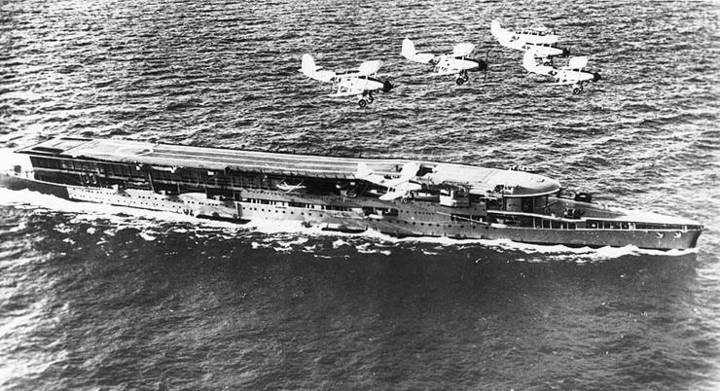
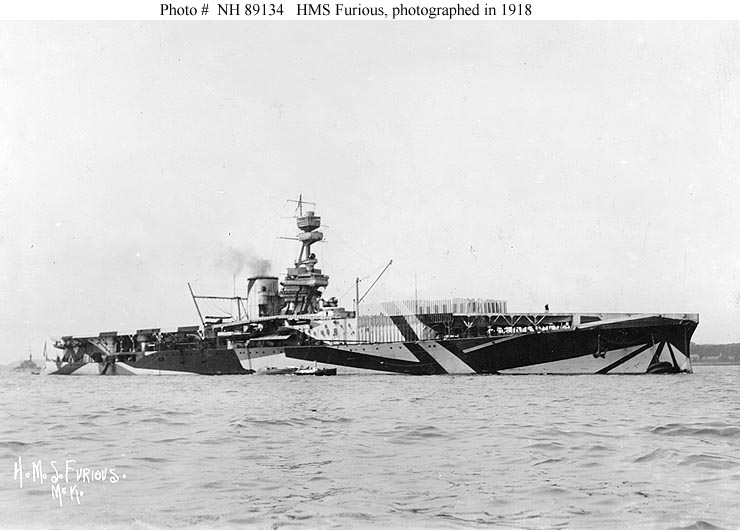
HMS Furious

HMS Furious: Furious was built as a Courageous class large light cruiser and mounted two 18” guns in single turrets. A flying off platform was added as was a second flight deck aft following the removal of those guns. She operated Fleet Air Arm Sopwith Pups but aircraft that attempted to land on her aft deck encountered severe turbulence caused by the air currents coming around the superstructure and funnel gasses. She was the first ship to land an aircraft underway on August 2nd 1917 during her trials however the pilot Squadron Commander Edwin Dunning was killed when his Pup’s engine choked on a later attempt. After the war Furious was laid up until she was taken in hand for conversion to an Aircraft Carrier between 1921 and 1925.  When she was completed she could operate a 36 aircraft air group. Between the wars she supported Fleet operations and was used in the testing and evaluation of aircraft. She conducted the first night landing on a carrier when she landed a Blackburn Dart on 6 May 1926. She received a number of overhauls and modernizations. During the war she supported numerous fleet operations including the North Africa landings, operations in the Mediterranean and operations against German fleet units in Norway including the Battleship Tirpitz. Her limitations began to show and she was placed in reserve in September 1944 and paid off in April 1945. She was subsequently used to evaluate the effects of explosives on her structure. She was sold for scrap in 1948.
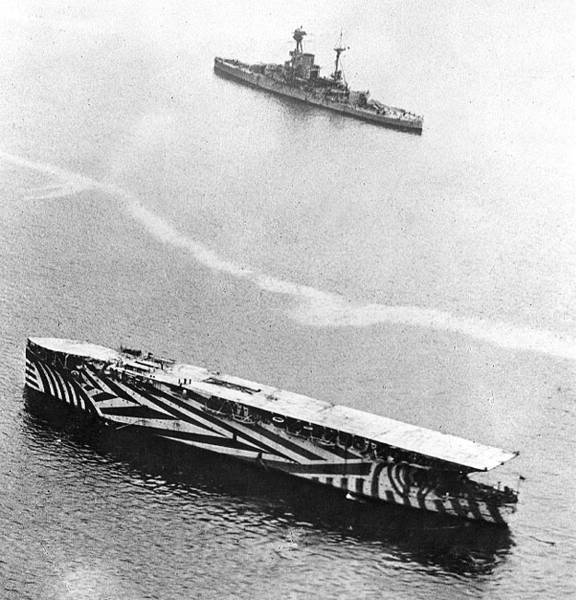
HMS Argus 1918

HMS Argus: The Argus was converted from the Italian Ocean Liner Conte Rosso which was purchases by the Royal Navy with the intent of converting her into an Aircraft Carrier.  She was built with a flush unobstructed flight deck after the Royal Navy’s unsuccessful divided flight deck experiment used on the HMS Furious following her conversion from a Light Battle Cruiser to a carrier. Argus was launched in 1917 and commissioned just prior to the end of the war on September 19th 1918.  Argus was small (15,775 tons) She was only capable of 20 knots and carried 18 aircraft. Like the USS Langley she was not a true frontline though she was used in that role as well as a training ship until the end of the 1920s when she was withdrawn from frontline service. Since she was built before the Washington Naval Treaty she was considered an experimental ship and not counted against Britain.  By the 1930s she was regulated to serving as a tender for remote controlled DH.82B Queen Bees.  During the early part of World War II the Royal Navy suffered heavy losses and the Argus assumed front line duties escorting convoys in the Atlantic and Mediterranean and ferrying badly needed aircraft to Malta for the Royal Air Force. She finally was withdrawn from service in 1944 and used as an accommodation ship until scrapped in 1946.
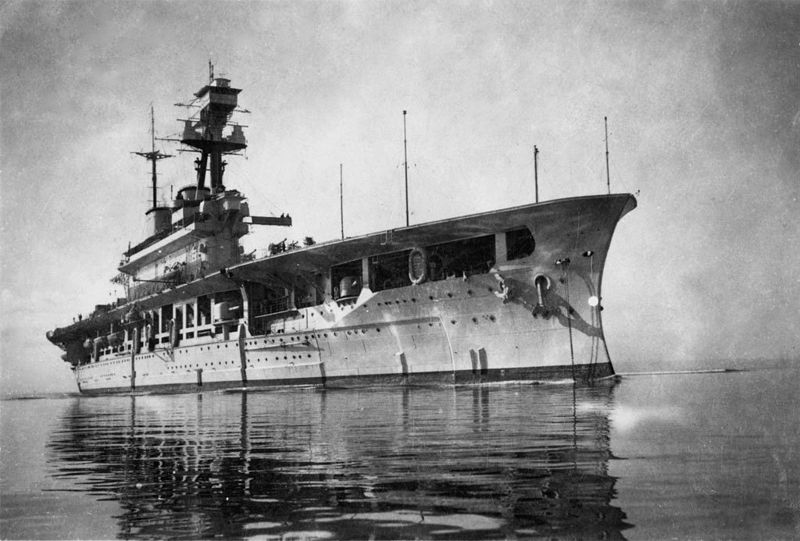
HMS Eagle 1942

HMS Eagle: Eagle was laid down as the Chilean Battleship Admirante Cochrane prior to World War I and her construction was suspended until the Royal Navy purchased her for completion as a through deck Aircraft Carrier. She was 667.5 feet long and displaced 26,000 tons full load and carried up to 21 aircraft.  She conducted sea trials but was taken back to the shipyard for improvements including an all oil-fired plant, anti-torpedo bulges and a longer island structure. She was commissioned in 1924 an saw much service through the 1920s and 1930s serving in the Mediterranean and the Far East until the outbreak of the Second World War.  With the outbreak of hostilities she was recalled from the Far East where she spent most of her time in the Mediterranean escorting convoys, launching airstrikes against Italian bases and fleet units sinking the submarine Iride and the depot ship Monte Gargano in the Gulf of Bomba on 22 August 1941.
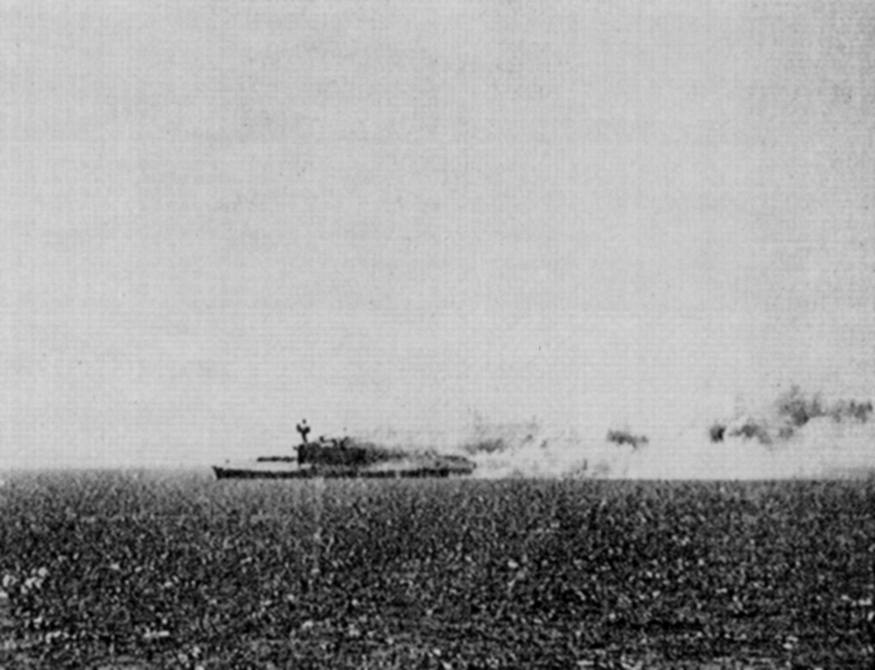
HMS Eagle burning and sinking

She was damaged by near misses by Luftwaffe bombers in October returned to England for repairs before returning to the Mediterranean in February 1942. She and her aircraft were very important in the defense of Malta until she was sunk during another Malta relief mission Operation Pedestal by the German U-Boat U-73 on 11 August 1942.  Hit by 4 torpedoes she sank in 4 minutes with the loss of 160 officers and crew.
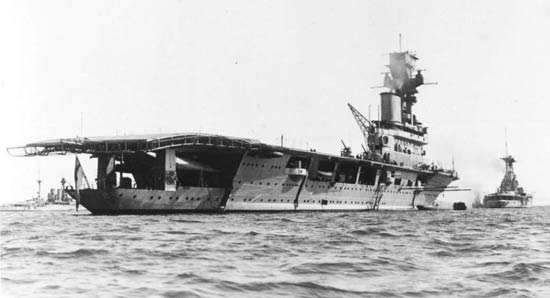
HMS Hermes

HMS Hermes: The Hermes was the first carrier built as such from the keel up using a cruiser type hull.  The design of the Japanese carrier Hosho was influenced by Hermes which was launched before Hosho was laid down although Hosho commissioned earlier. Hermes was a pioneer design with a full length flush flight deck and starboard side island structure. She was limited by her small size and slow speed although she could embark almost as many aircraft than could the much larger Eagle. She did have significant limitations including protection, endurance, only 6,000 miles at 18 knots and small air group size which varied from 15-20 aircraft. She primarily served on the China Station until placed in reserve in 1937. In 1939 she was reactivated briefly serving with the Home Fleet before being assigned to the South Atlantic Station. She sailed with HMS Prince of Wales for the Far East in late 1941 but did not accompany the Prince of Wales and Repulse to Singapore where they would be sunk when trying to intercept a Japanese convoy on December 8th 1941.
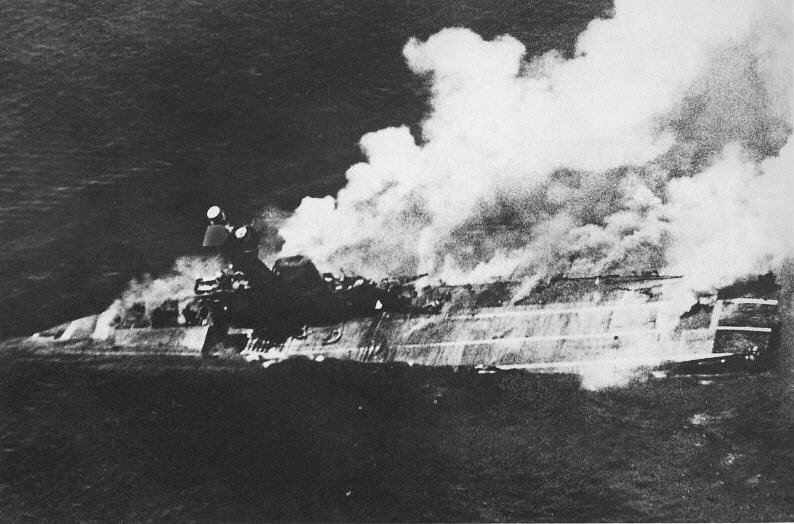
HMS Hermes sinking after Japanese air attack new Ceylon

She remained at Ceylon and escaped from the harbor before the Japanese carrier’s arrived, however returning to port she was spotted by a Japanese reconnaissance aircraft and attacked by 70 Japanese attack planes which hit her 40 times sinking her with the loss of 307 of her 664 man crew on 9 April 1942.
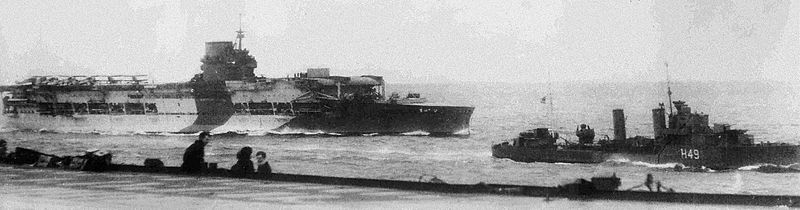
HMS Glorious and a destroyer taken from Ark Royal at close of Norwegian campaign

HMS Glorious: The Glorious was one of the three Courageous class Battlecruisers designed and built in World War One. Her sister ship HMS Furious had already been taken in hand for complete conversion to an aircraft when the Washington Naval Treaty was ratified. Under the terms of the treaty the Royal Navy had to significantly reduce its number of capital ships.  With their large size and high speed the Courageous class ships, like the American Lexington class were ideal candidates for conversion to aircraft carriers.  Glorious underwent conversion from 1924 until 1930 when she was recommissioned.  With an overall length of 786 feet and full load displacement of 27,859 tons she could carry 48 aircraft and steam at 30 knots. She would spend much of her career in the Mediterranean and undergo modernization from 1934-1935.  At the outbreak of the war she was in the Mediterranean and would take part in the hunt for the German Pocket-Battleship Admiral Scheer in the Indian Ocean until being brought back to the Home Fleet for operations in the Norwegian Campaign.
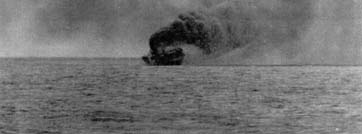
HMS Glorious sinking picture taken from Scharnhorst

As the British withdraw was completed her Commander requested to steam independently to Scapa Flow to hold a courts martial proceeding against his former Air Group Commander. Sailing with two escorting destroyers Glorious was sighted by the German Battlecruisers Scharnhorst and Gneisenau on June 8th 1941.  Unprepared with no Combat Air Patrol up or aircraft at the ready Glorious and her two escorting destroyers were sunk by the German warships. Only 43 of her complement and air group of nearly 1400 men survived.

HMS Courageous entering Malta

HMS Courageous: Courageous like her sister HMS Glorious was taken in hand for conversion to an aircraft carrier in 1924 was recommissioned as such in 1928.  She would serve primarily with the Atlantic and Home Fleets between the wars and upon commencement of hostilities.

HMS Courageous sinking after being torpedoed by U-29 17 September 1939

He became part of a U-Boat Hunter Killer Group and on the 17th of September 1939 barely 2 weeks after the start of the war she was sunk by two torpedoes fired by the U-29 taking with her 518 of her crew including her Captain.  Her loss sent a shudder through the Admiralty and resulted in Fleet Carriers being pulled from this type of duty.
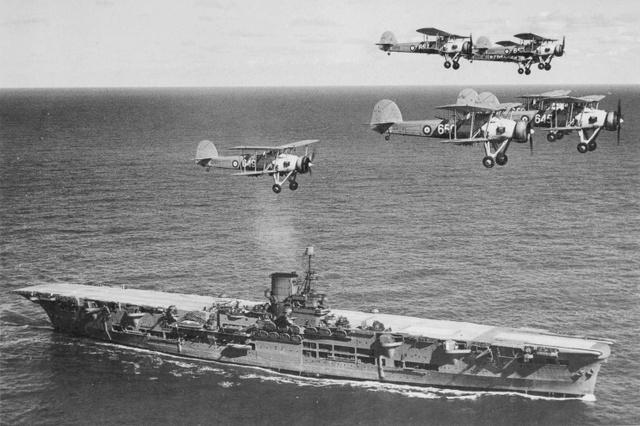
HMS Ark Royal

HMS Ark Royal: Ark Royal was the first truly modern Royal Navy carrier. Designed from the keel up as such she incorporated arresting gear and steam catapults. She also was built with two hangar decks as well as elevators that were integral to the hull and thus protected by the ship’s armor belt. Designed to operate 72 aircraft she normally operated 50-60 as the size and weight of aircraft had increased during the time of her construction and commissioning. Displacing 27,800 tons fully loaded she was 800 feet long and had a top speed of 31 knots and range of 7600 nautical miles (8700 miles) at 20 knots being the only British carrier of the era to compare favorably with her American and Japanese counterparts.  Commissioned in December of 1938 Ark Royal which was intended for service in the Far East was deployed with the Home Fleet and in the Mediterranean until the outbreak of the war. Initially employed on Hunter Killer duty she and her escorting destroyers sank the U-39 on 14 September 1939 followed by the hunt for the Pocket Battleship Graf Spee. She saw action in Norway and was a bulwark of British strength in the Mediterranean where she took part in the attack on the French Fleet at Mes-el-Kébir following the French surrender to Germany and the refusal of the French Commander to either scuttle the fleet or bring to British controlled waters.  She was engaged in numerous engagements and operations including the support of Malta, operations against the Italian Fleet and air strikes on Italian shore installations. She survived frequent air attacks by the Luftwaffe during these operations.  When the Bismarck broke out into the Atlantic Ark Royal was dispatched with Force H to assist in the hunt. Ark Royal’s Fairly Swordfish torpedo bombers found the Bismarck on 26 May 1941 and on their last chance to damage the German behemoth stuck her with a torpedo which jammed the Bismarck’s rudders allowing British Battleships to sink her the following day. She returned to the Mediterranean after this where she was again engaged in protecting convoys bound for Malta. While returning with Force H to Gibraltar following one of these runs on 10 November 1941 she was attacked by U-81 which scored a hit with one torpedo. A combination of poor command response, for which her Captain was found guilty of at court-martial as well as design flaws related to her electric power plant which made damage control nearly impossible once power was lost were responsible for her sinking.
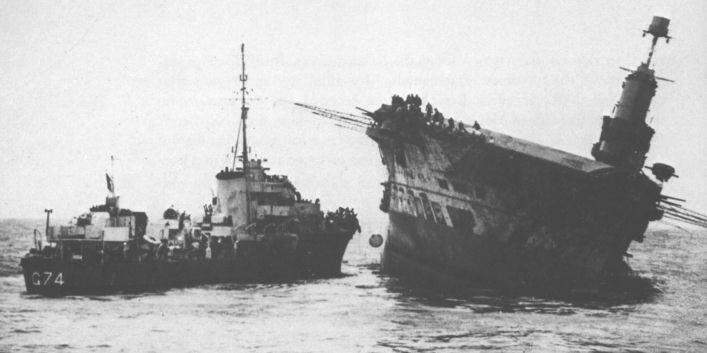
The Royal Navy helped pioneer the development of the aircraft carrier but most of their early ships had significant limitations in design, obsolescent aircraft and poor employment which were responsible for the losses of several of the ships.  However they did contribute to Britain’s ability to survive during the early years of the war.  The ships officers and men of these ships company as well as their air groups helped maintain the sea lanes which kept her in the war and allowed her forces to continue to fight in North Africa during the darkest days of the war.  One can never minimize their service or sacrifice in the especially in the early days of the war.

Today the Royal Navy has no Aircraft Carriers in commission. The last the Ark Royal was paid off this year and it will be nearly a decade before the new Queen Elizabeth class enters service. Until then the Royal Navy will have no capability to project air power in support of any contingency.  Let us hope for Britain that no such contingency arises.

Peace

Padre Steve+


10 Comments

Filed under History, Military, Navy Ships, world war two in europe, world war two in the pacific

Five Minutes that Changed History: The Battle of Midway 1022-1027 hours June 4th 1942

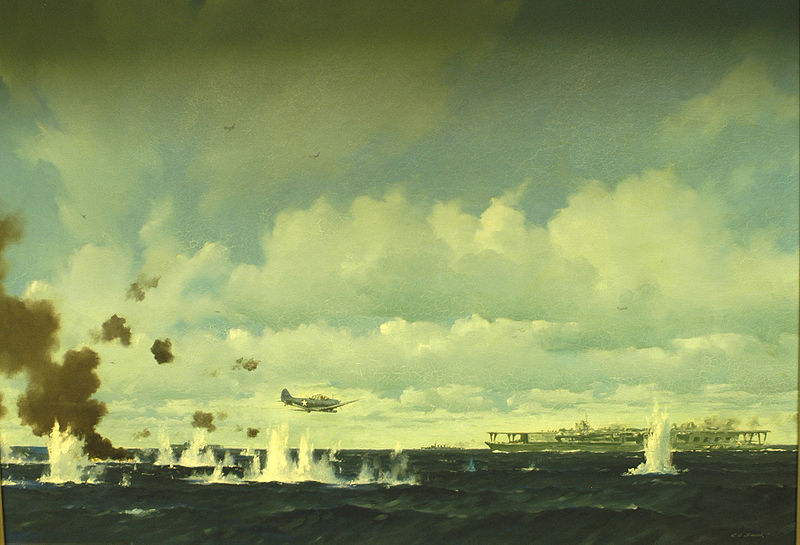
Instruments of Death SBD Dauntless Dive Bombers at Midway

Six months after Pearl Harbor the United States Navy met the Imperial Japanese Navy in battle on the seas and in the airspace around Midway Island. It was a battle between a fleet that had known nothing but victory in the months after Pearl Harbor, sweeping across the Pacific and the Indian Oceans and decimating Allied Naval forces that stood in their way, the HMS Prince of Wales and HMS Repulse off of Singapore, a force of Royal Navy cruisers and the Aircraft Carrier HMS Hermes in the Indian Ocean, the bulk of the US Asiatic Fleet in the waters around the Philippines and the Dutch East Indies culminating in the Battle of the Java Sea where the bulk of the American, British, Dutch and Australian naval forces engaged were annihilated.  In only one place had a Japanese Naval task force been prevented from its goal and that was at the Battle of the Coral Sea where Task Force 11 and Task Force 17 centered on the Carriers USS Lexington and USS Yorktown prevented a Japanese invasion force from taking Port Moresby sinking the light carrier Shoho, damaging the modern carrier Shokaku and decimating the air groups of the Japanese task force.

In May US Navy code breakers discovered the next move of the Imperial Navy an attack on Midway Island and the Aleutian islands.   Since the occupation of Midway by Japanese forces would give them an operational base less than 1000 miles from Pearl Harbor Admiral Chester Nimitz committed the bulk of his naval power, the carriers USS Enterprise CV-6, USS Yorktown CV-5 and USS Hornet CV-8 and their 8 escorting cruisers and 15 destroyers, a total of 26 ships with 233 aircraft embarked to defend Midway along with a force of 5 cruisers and 4 destroyers to cover the Aleutians.  Midway had a mixed Marine, Navy and Army air group of 115 aircraft which included many obsolete aircraft, 32 PBY Catalina Flying Boats, of which the 83 fighters, dive bombers, torpedo planes and Army Air Force bombers piloted by a host of inexperienced pilots.

The Japanese Flagship Akagi

The Japanese sent a force of 7 battleships, 7 carriers including the elite First Carrier Striking Group composed of the Pearl Harbor attackers Akagi, Kaga, Soryu and Hiryu and their highly trained and combat experienced air groups composed of 273 aircraft along with 14 cruisers and 39 destroyers assigned to take Midway and destroy the US Navy when it came out to fight as well as a force of 4 battleships, 12 destroyers assigned screen to the Aleutian invasion force which was accompanied by 2 carriers 6 cruisers and 10 destroyers.   The other carriers embarked a further 114 aircraft.  A factor which aided the Americans was the distance between the Japanese Task forces which were scattered over thousands of square miles of the Northern Pacific Ocean from which they could not rapidly come to the assistance of any other group.

With the foreknowledge provided by the code breakers the US forces hurried to an intercept position northeast of Midway eluding the Japanese submarine scout line which the Japanese Commander Admiral Yamamoto presumed would find them when they sailed to respond to the Japanese attack on Midway.  Task Force 16 with the Enterprise and Hornet sailed first under the command of Rear Admiral Raymond A Spruance and Task Force 17 under Rear Admiral Frank “Jack” Fletcher with the Yorktown which had been miraculously brought into fighting condition after suffering heavy damage at Coral Sea. Fletcher assumed overall command by virtue of seniority and Admiral Nimitz instructed his commanders to apply the principle of calculated risk when engaging the Japanese as the loss of the US carriers would place the entire Pacific at the mercy of the Japanese Navy.

On June 3rd a PBY Catalina discovered the Japanese invasion force and US long range bombers launched attacks against it causing no damage.  The morning of the 4th the Americans adjusted their search patterns in and the Japanese came into range of Midway and commenced their first strike against the island.  In response land based aircraft from Midway attacked the Japanese carrier force taking heavy casualties and failing to damage the Japanese task force.  The American Carrier task forces launched their strike groups at the Japanese fleet leaving enough aircraft behind of the Combat Air Patrol and Anti-submarine patrol.  As the Americans winged toward the Japanese fleet the Japanese were in confused.  A scouting report by an aircraft that had been delayed at launch discovered US ships but did not identify a carrier until later into the patrol.  This was the Yorktown and TF 17. The Japanese attempted to recover their strike aircraft and prepare for a second strike on the island and then on discovery of the carrier embarked on the task of unloading ground attack ordnance in favor of aerial torpedoes and armor piercing bombs.  The hard working Japanese aircrew did not have time to stow the ordnance removed from the aircraft but by 1020 they had the Japanese strike group ready to launch against the US carriers.

AM6-2 Zeros Mauled the US Torpedo Bombers

As the Japanese crews worked the Japanese carriers were engaged in fending off attacks by the US torpedo bomber squadrons, VT-6 from Enterprise, VT-8 from Hornet and VT-3 from Yorktown.  The Japanese Combat Air Patrol ripped into the slow, cumbersome and under armed TBD Devastators as they came in low to launch their torpedoes.  Torpedo Eight from Hornet under the command of LCDR John C Waldron pressed the attack hard but all 15 of the Devastators were shot down.  Only Ensign George Gay’s aircraft was able to launch its torpedo before being shot down and Gay would be the sole survivor of the squadron.

Hopelessly obsolete 40 of 44  TBD Devastators were lost in action

Torpedo 6 under the command of LCDR Eugene Lindsey suffered heavy casualties losing 10 of 14 aircraft with Lindsey being one of the casualties.  The last group of Devastators to attack was Torpedo 3 under the command of LCDR Lem Massey from the Yorktown.  These aircraft were also decimated and Massey killed but they had drawn the Japanese Combat Air Patrol down to the deck leaving the task force exposed to the Dive Bombers of the Enterprise and Yorktown.

TBD Devastator attacking Akagi

There had been confusion among the Americans as to the exact location of the Japanese Carriers, the Bombing 8 and Scouting 8 of Hornet did not find the carriers and had to return for lack of fuel with a number of bombers and their fighter escort having to ditch inn the ocean and wait for rescue.  The Enterprise group under LCDR Wade McClusky was perilously low on fuel when the wake of a Japanese destroyer was spotted.  McClusky followed it to the Japanese Task Force.  The Yorktown’s group under LCDR Max Leslie arrived about the same time.  The found the skies empty of Japanese aircraft. Aboard the Japanese ships there was a sense of exhilaration as each succeeding group of attackers was brought down and with their own aircraft ready to launch and deal a fatal blow to the American carrier wondered how big their victory would be.

At 1020 the first Zero of the Japanese attack group began rolling down the flight deck of the flagship Akagi, aboard Kaga aircraft were warming up as they were on the Soryu.  The unsuspecting Japanese were finally alerted when lookouts screamed “helldivers.” Wade McClusky’s aircraft lined up over the Akagi and Kaga pushing into their dives at 1022. There was a bit of confusion when the bulk of Scouting 6 joined the attack of Bombing 6 on the Kaga.  The unprepared carrier was struck by four 1000 pound bombs which exploded on her flight deck and hangar deck igniting the fully fueled and armed aircraft of her strike group and the ordnance littered about the hangar deck.  Massive fires and explosions wracked the ship and in minutes the proud ship was reduced to an infernal hell with fires burning uncontrollably. She was abandoned and would sink at 1925 taking 800 of her crew with her.     LT Dick Best of Scouting 6 peeled off from the attack on Kaga and shifted to the Japanese flagship Akagi. On board Akagi were two of Japans legendary pilots CDR Mitsuo Fuchida leader of and CDR Minoru Genda the architect of the Pearl Harbor attack and subsequent string of Japanese victories.  Both officers were on the sick list and had come up from sick bay to watch as the fleet was attacked.  Seeing Kaga burst into flames they stood mesmerized until Akagi’s lookouts screamed out the warning “helldivers” at 1026.  Best’s aircraft hit with deadly precision landing tow of their bombs on Akagi’s flight deck creating havoc among the loaded aircraft and starting fires and igniting secondary explosions which turned the ship into a witch’s cauldron.  By 1046 Admiral Nagumo and his staff were forced to transfer the flag to the cruiser Nagara as Akagi’s crew tried to bring the flames under control. They would do so into the night until nothing more could be done and abandoned ship at 2000.  Admiral Yamamoto ordered her scuttled and at 0500 on June 5th the pride of the Japanese carrier force was scuttled.

Scouting 6 gets the Akagi

VB-3 under LCDR Max Leslie from the Yorktown stuck the Soryu with 17 aircraft, only 13 of which had bombs due to an electronic arming device malfunction on 4 of the aircraft including the squadron leader Leslie.  Despite this they dove on the Soryu at 1025 hitting that ship with 3 and maybe as many as 5 bombs. Soryu like her companions burst into flames as the ready aircraft and ordnance exploded about her deck. She was ordered abandoned at 1055 and would sink at 1915 taking 718 of her crew with her.

The remaining Japanese flattop the Hiryu attained the same fate later in the day after engaging in an epic duel with the Yorktown which her aircraft heavily damaged.

It was quite miraculous what happened at Midway in those five pivotal minutes.  Authors have entitled books about Midway Incredible Victory and Miracle at Midway and the titles reflect the essence of the battle.  A distinctly smaller force defeated a vastly superior fleet in terms of experience, training and equipment and when it appeared that the Japanese Fleet would advance to victory in a span of less than 5 minutes turn what looked like certain defeat into one of the most incredible and even miraculous victories in the history of Naval warfare.  In those 5 minutes history was changed in a breathtaking way.  While the war would drag on and the Japanese still inflict painful losses and defeats on the US Navy in the waters around Guadalcanal the tide had turned and the Japanese lost the initiative in the Pacific never to regain it.   The Japanese government hid the defeat from the Japanese people instead proclaiming a great victory while the American government could not fully publicize the information that led to the ability of the US Navy to be at the right place at the right time and defeat the Imperial Navy.

When one looks at implications of the victory it did a number of things. First it changed the course of the war in the Pacific probably shortening it by a great deal.  Secondly it established the aircraft carrier and the fast carrier task force as the dominant force in naval warfare which some would argue it still remains.  Finally those five minutes ushered in an era of US Navy dominance of the high seas which at least as of yet has not ended as the successors to the Enterprise, Hornet and Yorktown ply the oceans of the world and the descendants of those valiant carrier air groups ensure air superiority over battlefields around the world.

Peace

Padre Steve+

7 Comments

Filed under History, Military, US Navy, world war two in the pacific

The Transitional Carriers: USS Ranger CV-4 and USS Wasp CV-7

Note: This is the second in a series of articles on US Aircraft Carriers. The first article “The First Aircraft Carriers Part One: The First American Flattops- Langley, Lexington and Saratoga” can be found at this link: https://padresteve.wordpress.com/2009/10/08/the-first-aircraft-carriers-part-one-the-first-american-flattops-langley-lexington-and-saratoga/

I expect to write a follow up article on the Yorktown class, followed by one on the World War II Essex class and Independence class carriers.  At some point I might tackle the post war modernizations, modifications and careers of the Essex class.

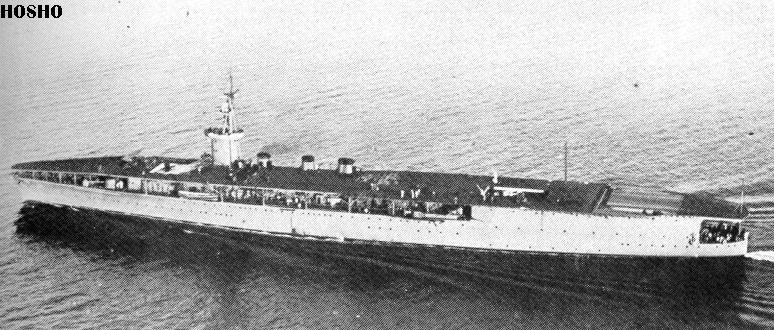
Following the success of the Langley, Lexington and Saratoga the Navy began to design aircraft carriers from the keel up.  The Japanese had already done so when they commissioned the IJN Hosho in 1922. Hosho displaced 10,000 tons was 579 feet long full load carried 26 aircraft at a top speed of 25 knots.  Hosho would serve in a secondary role in the Second World War, surviving the war with minor damage.

Hosho as Built

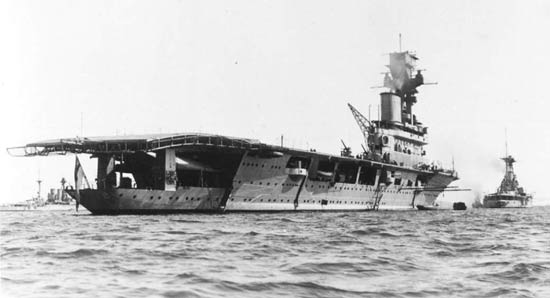
The British commissioned the HMS Hermes in 1923. She was slightly larger than Hosho at 12,900 tons and 598 feet long and capable of carrying 15-20 aircraft. She had a maximum speed of 25 knots.  She was sunk by Admiral Nagumo’s carrier strike force off Ceylon on 23 January 1941.  Both of these ships served in fleet support and training roles much of their careers being smaller and less capable of operating more modern aircraft developed in the late 1920s and 1930s.

HMS Hermes

The United States Navy was late compared to the Japanese and British ion designing carriers from the keel up, however when it did they were larger, faster and carried a far larger number of aircraft than the Hosho or Hermes.

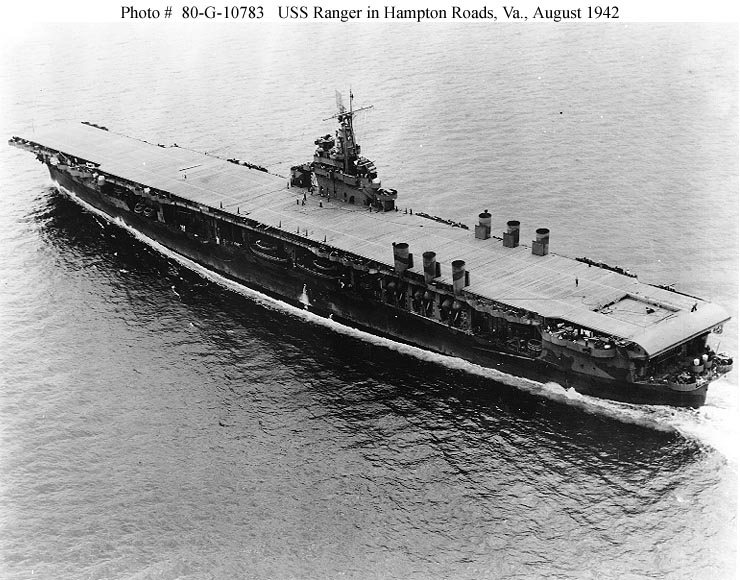
Ranger at Hampton Roads 1942: Note the Funnel Arrangement

The Ranger was commissioned on June 4th 1934 and displaced 14,500 tons, was 769 feet long and had a maximum speed of 29.25 knots.  She carried 86 aircraft, over four times more than Hermes and three times that of Hosho.  She was not initially equipped with a catapult though one would be added later with a more advanced one being retrofitted in 1944.  She had a unique funnel arrangement having 6 small funnels located aft along both sides of the flight deck. These could be repositioned out so as not to interfere with aircraft operations.

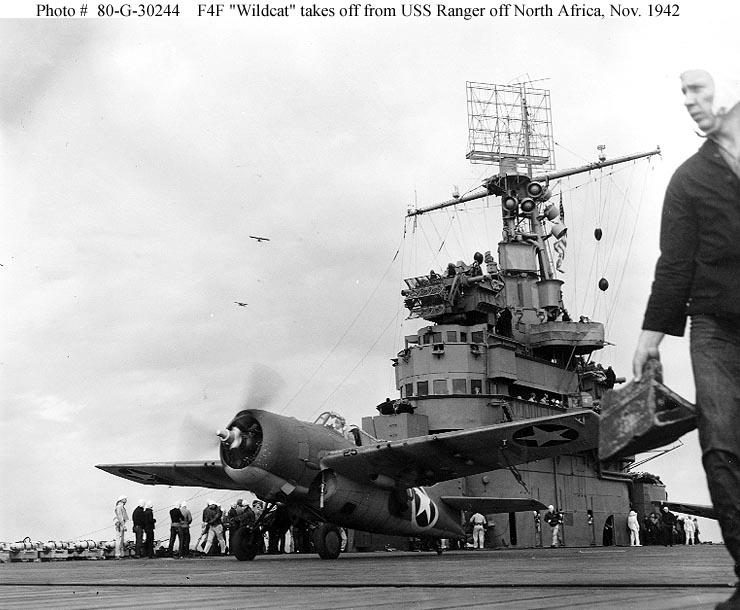
Ranger Launching F4F-3 Wildcat off French North Africa November 1942

She had a small island structure.  This was not a particularly satisfactory design and would not be repeated in the fleet carriers which followed but would be used on the Independence class Light Fleet Carriers (CVL) and all Escort Carriers (CVE).  Ranger would operate with the Pacific Fleet in the 1930s before returning to the Atlantic in early 1939.  She would participate in Neutrality Patrols to protect US Shipping and missions to transfer US Army Air Corps aircraft across the Atlantic.  After the US entry into the war would participate in the Allied landings in French North Africa, Operation Torch launching 496 sorties against Vichy French ships, airfields and ground targets.  She remained in the Atlantic in 1943 conducting patrols, transporting Army Air Corps aircraft across the Atlantic and operating with the British Home Fleet conducting raids against German ships and installations at Bodo Norway.  Following these operations she would be refitted and sent to the Pacific to serve as an advanced training carrier for pilots and air crew being trained for combat duty.   She would decommission in October 1946 and sold for scrap in 1947.

Wasp at Hampton Roads, May 1942

She was not used in a combat role in the Pacific as she was determined to be too small and too slow and having very limited armor protection.  However her design was such that it could be refined for future classes of carriers including better armor protection, expanded anti-aircraft capabilities and better command and control facilities.

The second of these transitional carriers was the USS Wasp; CV-7 was built as a replacement under the Washington Treaty for the Langley and her displacement was limited to 14,700 tons.  Laid down in 1936 and commissioned in April 1940 she benefitted from experience with the Ranger and though roughly the same displacement as Ranger and only marginally faster.  Wasp was only 688 feet long as compared to Ranger, but had better protection and a more efficient design that was similar to the larger Yorktown class ships.  She carried over 80 aircraft and was equipped with 2 flight deck and two hanger deck catapults. Wasp’s career was short but action filled.  During 1940 through early 1942 she remained in the Atlantic conducting training, Neutrality patrols, shadowing Vichy French warships in the Caribbean, transporting badly needed British Spitfires to the besieged island of Malta and operating with the British Home Fleet against the Germans.

Wasp Loading Spitfires for Malta

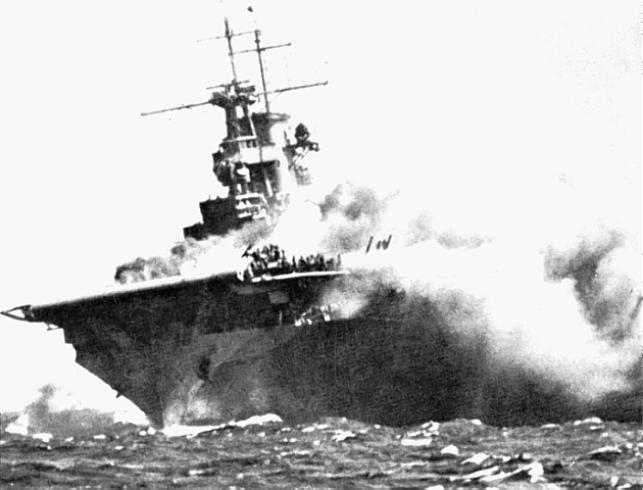
With the shortage of carriers in the Pacific due to the loss of Lexington and damage to Saratoga Wasp was transferred to the Pacific where her air group received new aircraft prior to sailing to the South Pacific to take part in the invasion of Guadalcanal in August 1942.  Her air group acquitted itself well in action against the Japanese in the initial operations and she would remain in the area of operations.  On September Wasp was escorting troop transports carrying the 7th Marine Regiment to Guadalcanal.   As she recovered aircraft she was hit by 2 torpedoes from the Japanese submarine I-19.  I-19 had executed one of the most successful attacks by a Japanese submarine on US Naval Forces during the war, sinking Wasp, damaging the Battleship North Carolina and the destroyer O’Brien which later sank while sailing to the United States for permanent repairs.  At about 1420 the powerful 24” “Long Lance” torpedoes hit the Wasp in the vicinity of her ammunition magazine and aircraft gasoline tanks.  The fires rapidly spread throughout the ship igniting ready ammunition for the anti-aircraft guns.  Despite damage control efforts the fires spread and large secondary explosions wracked the ship forcing her abandonment at 1520.  With the ship abandoned she was sunk by the USS Lansdowne going down at 2100 with the loss of 196 of her crew.

Wasp Burning and Sinking

Though small and short lived the Wasp was a successful design incorporating a folding T-shaped deck edge elevator which was a predecessor of the much larger ones found on modern US Aircraft Carriers. The Ranger despite her limitations was far more capable than other countries early designs and served well in the Atlantic and as a training platform.

Peace,

Padre Steve+

16 Comments

Filed under History, Navy Ships, world war two in europe, world war two in the pacific

The First Aircraft Carriers Part One: The First American Flattops- Langley, Lexington and Saratoga

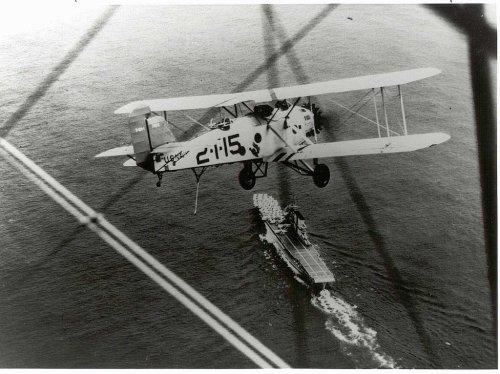
saratoga aircraft approach for landingAircraft over Saratoga

Note: This is the first in a series on the early aircraft carriers.  Two others will follow on the British and Japanese carriers.  My dad was a Chief Petty Officer in Naval Aviation.  As such I grew up around Naval Air Stations, Squadrons and of course Aircraft Carriers.  My dad retired off of the USS Hancock CVA-19 in 1974.  I spent two weeks underway on USS Coral Sea CV-43 as a NJROTC Cadet in the summer of 1976.  It was an experience that I will never forget.  While on the Cruiser USS Hue City CG-66 we deployed with the USS John F Kennedy CV-67 for Operation Enduring Freedom.  There is something about the power and majesty of the modern carriers at the same time there is a sense of timelessness in the first aircraft carriers.  Three of the first four American ships were converted from other platforms.  As a kid, a young adult and even now I am fascinated by all things Navy, especially ships that made history.  Here is my look at the first American Aircraft Carriers.

The United States did not invent the aircraft carrier although Eugene Ely flew an aircraft onto and off of the Armored Cruiser USS Pennsylvania on January 18th 1911.  It was the British Royal Navy which first built and operated aircraft carriers beginning with the HMS Furious which had been converted from a light Battle Cruiser.  The Royal Navy would covert the sister ships of the Furious, the Glorious and Courageous as well as the auxiliary ship the Argus before building their first carrier that was designed from the keel up, the HMS Hermes.     With the British building carriers and the Japanese following suit the United States began a program of aircraft carrier production and operation unmatched in history.

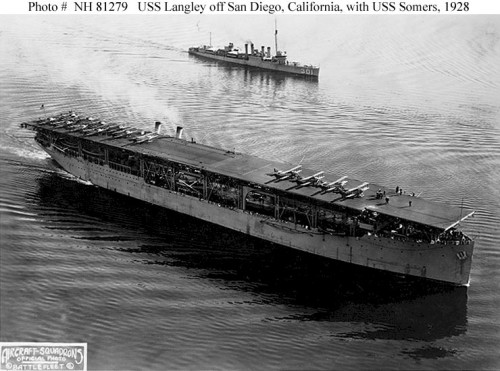
uss langleyUSS Langley CV-1 The “Covered Wagon”

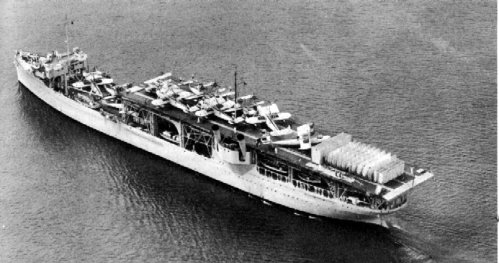
The first US carrier was the USS Langley, CV-1.  Langley was converted from the collier USS Jupiter beginning in July 1919.  She was commissioned as USS Langley CV-1 on 21 April 1920.  Displacing 15,150 tons fully loaded Langley embarked 34 aircraft and had a maximum speed of 15.5 knots.  Langley was primitive but groundbreaking.  She was the first carrier equipped with catapults and on 18 November 1922 achieved the first catapult takeoff by an aircraft.  She served as an invaluable training platform for Naval Aviators and helped provide the fleet with highly skilled flight crews that would operate from the USS Lexington and USS Saratoga.

langley as av-3Langley after conversion to AV-3

Nicknamed the “Covered Wagon” she served initially in the Atlantic until November of 1924 when she was transferred to the Pacific Battle Force.  She served as a carrier in the Pacific until 1936 when she was converted into a Seaplane Tender AV-3 and assigned to the Pacific in September 1939 based in Manila.  She was in the Philippines when the Japanese attacked and was sent south to Australia.  She was assigned to the ABDA forces defending the Netherlands East Indies and was sunk by her escorts after being bombed and disabled by Japanese aircraft while delivering fighter aircraft to Java with the loss of 16 sailors.

uss lexingtonUSS Lexington CV-2

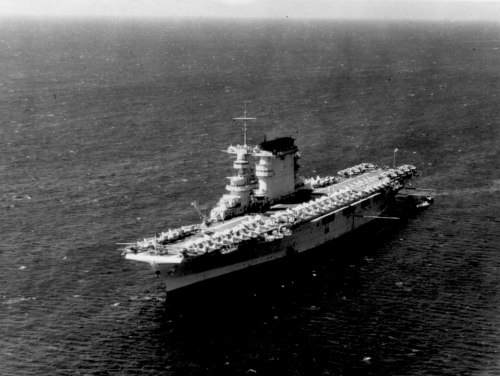
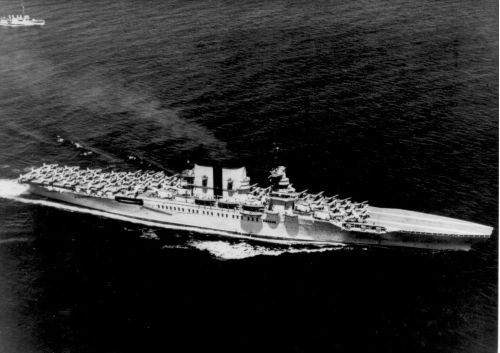
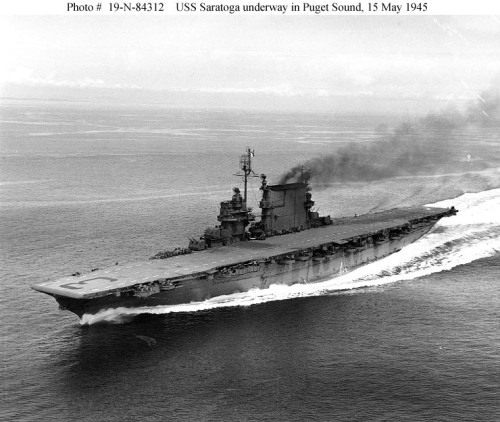
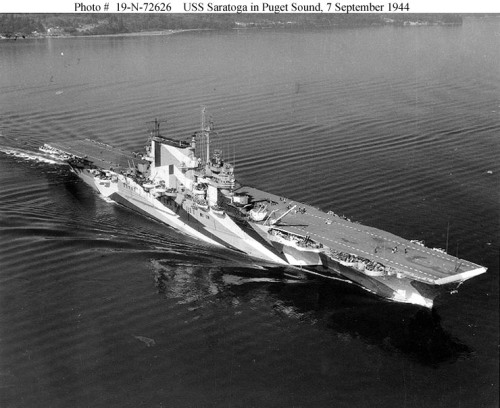
The second two American Aircraft Carriers were also conversions.  Unlike Langley the Lexington and Saratoga were converted from a new class of large and powerful battle cruisers whose construction had been canceled by the restrictions of the Washington Naval Treaty.  Commissioned on December 14th 1927 Lexington was 880 feet long and displaced 38,746 tons.  Saratoga was commissioned on November 16th of the same year and of similar dimensions and displacement.  Both of these ships could steam at 33.25+ knots and had a complement of 90 aircraft.  They were armed with eight 8” guns mounted in 4 turrets at the behest of more traditionally minded officers who felt that the armament might be needed for surface actions.

Saratoga underwayUSS Saratoga CV-3

They were the largest American carriers built until the Midway class appeared inin late 1945 and early 1946.  Of other nations pre-war carriers only the Japanese Navy’s Akagi and Kaga, converted from a battle cruiser and battle ship for the same reason as a the Lexington’s were comparable in size, air group capacity, protection and speed. Saratoga’s 8”battery would be replaced by twin 5” 38 caliber mounts in 1942.

lexington sinkingLexington Burning and Sinking

Both ships were used to help develop carrier doctrine and the concept of the carrier task force. Future leaders of Naval Aviation including Marc A. Mitscher trained aboard or flew from these ships.  Of particular note was that during Fleet Problem XIX in 1938 Saratoga launched a surprise air attack on Pearl Harbor from a point 100 miles off Oahu, setting a pattern that the Japanese copied in December 1941.

saratoga 1945Saratoga 1945

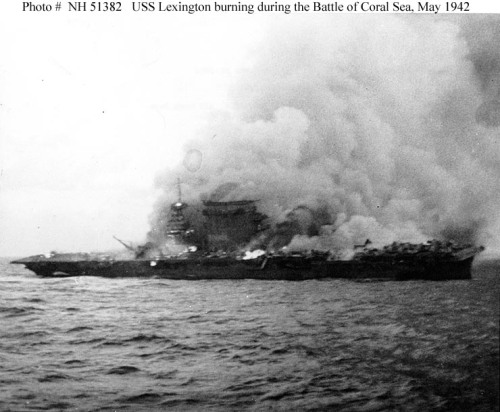
During World War II both helped hold the line after Pearl Harbor along with Enterprise, Yorktown and Hornet. Lexington was the flagship of TF-11 during as series of raids on Japanese outposts in the Solomons.  TF-11 joined Admiral Frank “Jack” Fletcher’s TF-17 at the Battle of Coral Sea, the first Naval Battle fought outside of eyesight of the respective forces. Lexington’s aircraft helped sink the Japanese light carrier Shoho on May 7th 1942 and heavily damage the fleet carrier Shokaku the following day. However aircraft from Shokaku and Zuikaku hit Lexington with two torpedoes and 3 bomb hits which her damage control parties seemed to have under control when vapors from ruptured aviation fuel lines were ignited resulting in a series of explosions which ignited uncontrollable fires. Her crew was evacuated by escorts and she was torpedoed by the destroyer USS Phelps.

Saratoga served throughout the war. She engaged in patrols after Pearl Harbor and while enroute to joining Enterprise was hit by a torpedo from the Japanese submarine I-16. After repairs she was rushed to Hawaii to join the American Task Forces at Midway but arrived in Hawaii the day after the battle.  Following this Saratoga operated in the Central Pacific in the first offensive at Guadalcanal.  She participated in the landings as the flagship of Admiral Fletcher and then at the Battle of Eastern Solomons sank the Japanese light carrier Ryujo and damaged the seaplane carrier Chitose.  Following this battle she was hit by a torpedo from the I-26. After repairs she again went to the Solomons joined by the light carrier USS Princeton.  On November 5th the two carriers conducted a brilliant strike on Japanese ships and aircraft facilities at Rabaul which were threatening the landings at Bougainville.

saratoga 1944Saratoga September 1943

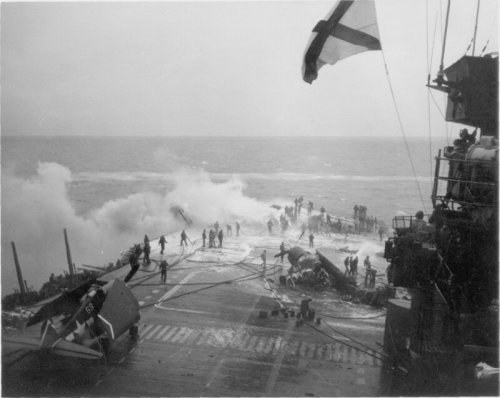
Following these operations Saratoga operated in the Gilberts and then with the British in the Indian Ocean.  She then was used as a training carrier for new pilots and aircrews at Pearl Harbor before being brought to Iwo Jima to operate night fighters against Kamikaze raids.  While conducting these operations she was attacked by Japanese aircraft in which 6 Japanese aircraft score 5 hits on her in 3 minutes.  Her forward flight deck was wrecked and she suffered great damage below decks and she lost 123 sailors.

saratoga kamikaze 2Saratoga burning after Kamikaze hits in 1945
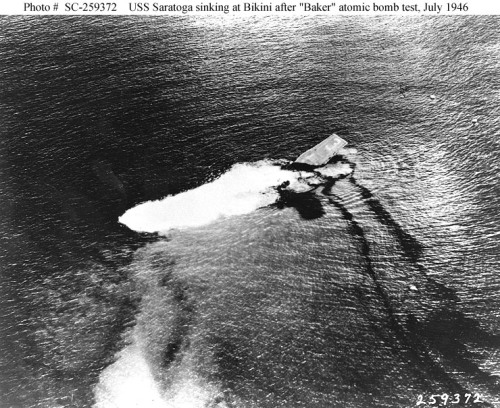
Following repairs she resumed training duties and after the defeat of Japan was involved in Operation Magic Carpet to bring Servicemen back from overseas.  Surplus to Navy needs at the end of the war Saratoga was sunk in Operation Crossroads at Bikini Atoll by an underwater atomic blast in the “Baker” bomb test a mere 500 yards from her position. She sank 7 hours later.

saratoga sinkingThe End of an Era- Saratoga goes down at Bikini

5 Comments

Filed under History, Navy Ships